Photographer Jordan King presents herself as a showgirl and a star in this Polaroid self-portrait. One of the series of four Polaroids taken in 2020, this image has been selected for the 2025 CONTACT Photography Festival’s billboard project. Transforming this photograph into a billboard communicates to the public that life is ever-evolving – sometimes leading to positive realizations and, at other times, presenting unforeseen challenges.
King shares that she and her friend Greg Manuel took this photograph in her New York apartment on March 13, 2020, just days before the COVID-19 pandemic disrupted everyone’s lives. However, the aim of this photoshoot was for King to celebrate her connection to the history and space of her apartment, where artists from the New York art scene, and stars, had lived prior to her. These included performance artist Clark Render and drag queen International Chrysis, both of whom continue to inspire her, and whose influence manifests in King’s use of heavy glam, dramatic costume, and playful attitude.
King’s polaroid portrait captures the instantaneity of the moment in which history and the inner self become one, all the while against a dual background in which the external, in this case, the pandemic, also comes to affect the narrative of the self—culminating in a photograph that captures the ever-evolving way of human life.
Jordan King, Untitled-1, 2020, billboard on Queen St West at Augusta Ave, Toronto, till May 31, 2025. Courtesy of CONTACT Photography Festival.
The significant influence of colonialism on cultures and traditions is well-documented, but what’s often overlooked is the role capitalism has played in dismantling communal ways of life. By prioritizing profit over people, capitalism has systematically eroded the social bonds that once held communities together. In response, people are now embracing their culture and coming together as communities to share responsibilities and care for common resources like land, water, and biodiversity. This shift is reflected in the exhibition Beyond The Commons: From Stardust to Everlasting Sun by artists Eve Tagny and mosquito girlfriend (Gabi Dao and Lou Lou Sainsbury) at A Space Main Gallery. The show explores communal stewardship, challenging narratives and envisioning a world beyond capitalism and colonialism. Through their thought-provoking work, the artists create new narratives from the ruins, embracing multiple truths and sensory experiences.
Eve Tagny, An Eroding Hearth, 2025, multimedia installation
Upon entering the gallery, Tagny’s installation An Eroding Hearth (2025)commands attention. The multimedia work combines video, sculpture, and photography to explore the artist’s family history. The videos showcase Tagny’s ancestral home in Cameroon. In one video, her father guides a tour through the house, highlighting family photographs that weave together threads of history and memory. In another, Tagny herself performs a quiet, ritualistic act, stepping on bricks and arranging family photos around them. The installation’s centerpiece is a low table-like structure adorned with ceramic candlesticks, hand molds, palm kernels, and clay vessels resembling ancient pottery fragments. These elements evoke the hearth as a symbol of connection, sustenance, and transformation.
Eve Tagny, Untitled, 2024, photography works from An Eroding Hearth
Through An Eroding Hearth Tagny reveals the intricate relationships between landscapes, cultural identity, societal values, and collective memory. The work invites viewers to reflect on the ways in which our surroundings shape and are shaped by our experiences, histories, and traditions. Curator Noor Alé notes that Tagny’s earth-made vessels evoke traditional containers, bridging past and present through material memory. This practice aims to reignite planetary care, fostering shared responsibility for the earth’s well-being. By exploring practices from the home to ecological sanctuaries, the work highlights the interconnectedness of personal experiences and broader societal contexts, promoting a deeper connection with the earth.
Eve Tagny, earth-made vessel from An Eroding Hearth
In the other room mosquito girlfriend’s film Resurrect Me as a Parasite (2025) and accompanying artworks such as a ceramic mosquito bust and bat marionettes, reclaim the trope of the parasite to highlight queer ecologies and challenge dominant narratives.
Installation view with mosquito girlfriend’s works, including bat marionettes (in front)
By examining symbiotic relationships and blurring boundaries between life and death, human and environment, the exhibition invites viewers to reconsider their relationships with nature and the marginalized, promoting a shift towards more inclusive thinking. Through a blend of film, sculpture, and performance, the exhibition creates a space for reimagining anticolonial relations with the more-than-human world.
Installation view with mosquito girlfriend, mosquito bust, ceramics
Beyond The Commons: From Stardust to Everlasting Sun conveys a sense of resilience and hope, emphasizing the importance of collective care, shared resources, and social support in the face of systematic challenges to ecological well-being. The artists suggest that communing involves nurturing relationships, resources, and the environment at multiple scales, from the local to the global.
Text and photo: Nusrat Papia
*Exhibition information: Beyond The Commons: From Stardust to Everlasting Sun / Eve Tagny and mosquito girlfriend (Gabi Dao & Lou Lou Sainsbury), April 12 – May 24, 2025, A Space Main Gallery, 401 Richmond St. W. Toronto. Gallery hours: Tuesday to Friday 11am – 5pm, Saturday 12 – 5pm.
At Zalucky Contemporary, Together in Quiet Light brings together the quiet, multidisciplinary practices of Holly Chang, Isabelle Parson, Chiedza Pasipanodya, and Alexandre Pépin in a shared search for presence, tenderness, and interconnection. Presented as a Core Exhibition of the CONTACT Photography Festival, the show draws on the language of nature, memory, and material to reflect on how we come to know ourselves and others, often through what remains unsaid.
Installation view of Together in Quiet Light. Courtesy of Zalucky Contemporary
Isabelle Parsons’ photographic series documents abandoned greenhouses—once sites of growth and cultivation, now held in a state of suspended decay. Her images resist dramatization: instead, they linger on the quiet details: beams warped by time, fogged panes of glass, and the silhouettes of plants caught between life and dormancy.
Installation view with Isabelle Parson’s work 2024, archive prints, 36.75 x 24.75 inches each. Courtesy of Zalucky Contemporary
Light plays an integral role in Parsons’ work, not only as a photographic element but as a metaphor for attention itself—how we look, and what we choose to see. These spaces, both shielded and exposed, become mirrors for interior life, where the fragility of organic systems reflects the precarity of memory, emotion, and ecological time.
Isabelle Parson, Fern and dead twig, 2024, archive print, 36.75 x 24.75 inches, detail. Photo: Yehyun Lee
A similar sense of introspection anchors the work of Holly Chang, whose photographic and ceramic installations draw from a deeply personal narrative of loss, migration, and cultural dissonance. Created in a period of grief, her images, taken during solitary hikes in Quirpon Island and Banff, are embedded into handcrafted ceramic vessels, which double as shadow boxes. These objects act as containers of both image and affect. By placing landscape photography within the intimate scale of a sculptural form, Chang suggests that healing, like identity, is not linear but layered, and often shaped by quiet accumulations. Her work speaks of the labor of making visible what is often hidden, and the possibility of nature as a collaborator in that process.
Holly Chang, Transporting, 2022, earthenware ceramic, c-print, rare earth magnet, stainless steel chain, 30 x 8 x 1.5 inches, detail. Courtesy of Zalucky Contemporary
While Chang’s ceramics carry the imprint of emotional geography, Chiedza Pasipanodya’s sculptural series Mauuyu is rooted in ancestral memory and material translation. Drawing on the baobab tree of her native Zimbabwe—renowned for its longevity, nourishment, and resilience—Pasipanodya hand-builds clay forms that recall the tree’s fruit. These sculptures are fired using organic materials such as rose petals, plantain chips, and sawdust, which leave unpredictable, ephemeral traces on the surface. Installed in metal vessels, the fruits feel both ancient and contemporary, intimate and ceremonial. For Pasipanodya, sculpture becomes a way of recording absence, preserving memory, and exploring how diasporic identity is carried, not just through language or image, but through gesture, ritual, and touch.
Chiedza Pasipanodya, Mauuyu, 2025, raku ceramic, steel, 38 x 15 x 13 inches. Courtesy of Zalucky Contemporary
Alexandre Pépin turns to painting as a space for imagining alternative modes of connection between bodies, cosmologies, and histories. In his work Together in Quiet Light, two figures hold each other in a dense, symbolic landscape populated by celestial bodies, foliage, and echoes of Byzantine iconography. The painting, rich with spiritual and queer references, suggests an elsewhere beyond time and geography, where intimacy becomes its own form of sanctuary. Pépin’s ongoing interest in mysticism and queer modernism gives the work a layered sense of lineage, positioning tenderness not as escape, but as a strategy for survival and transcendence.
Alexandre Pépin, Together in Quiet Light, 2025, oil on canvas, 72 x 84 inches. Courtesy of Zalucky Contemporary
The exhibition unfolds through gestures of restraint, subtlety, and quiet intensity. It privileges the kind of meaning that does not announce itself but accumulates in layers—through the grain of a ceramic vessel, the mist on a greenhouse pane, the gesture of a painted hand reaching through foliage. It is a space in which stillness becomes active, where slowness is not lack but depth, and where the unsaid often speaks the loudest. In this way, Together in Quiet Light reminds us that the most profound transformations rarely arrive with grandeur. They happen in the margins, in the spaces we are taught to overlook, and in the ones, we must learn to hold open.
What binds these artists is not only a shared vocabulary of nature, memory, or intimacy, but a deeper sensibility, a reverence for the labor of attention, and for the fragile, persistent work of being in relation. Their practices circle around acts of reckoning: with personal grief and inherited histories, with cultural displacement and bodily memory, with the longing for connection in a fragmented world. Together in Quiet Light proposes that paying attention, truly and slowly, with intention, is itself a radical act. In moments of shared vulnerability, new forms of presence can take root: presence that is not permanence, but as touch, as breath, as light briefly held—a radical act.
Yehyun Lee
*Exhibition information: Together in Quiet Light / Isabelle Parson, Holly Chang, Chiedza Pasipanodya, Alexandre Pépin, April 5 – May 24, 2025, Zalucky Contemporary, 3044 Dundas Street W. Toronto. Gallery hours: Thursday to Saturday, 12 – 5 pm or by appointment.
May 8 – 11, 2025 Better Living Centre, Exhibition Place 195 Princes’ Blvd, Toronto Hours: May 9 & 10, 12 – 8 pm, May 11, 12 – 6 pm.
Nusrat Papia
Artist Project showcases thousands of artworks, large-scale installations, and unique opportunities to engage directly with artists. Whether you take home a piece that truly resonates with you or explore more deeply by visiting the artists’ individual websites, this event invites you to connect with art on a personal level.
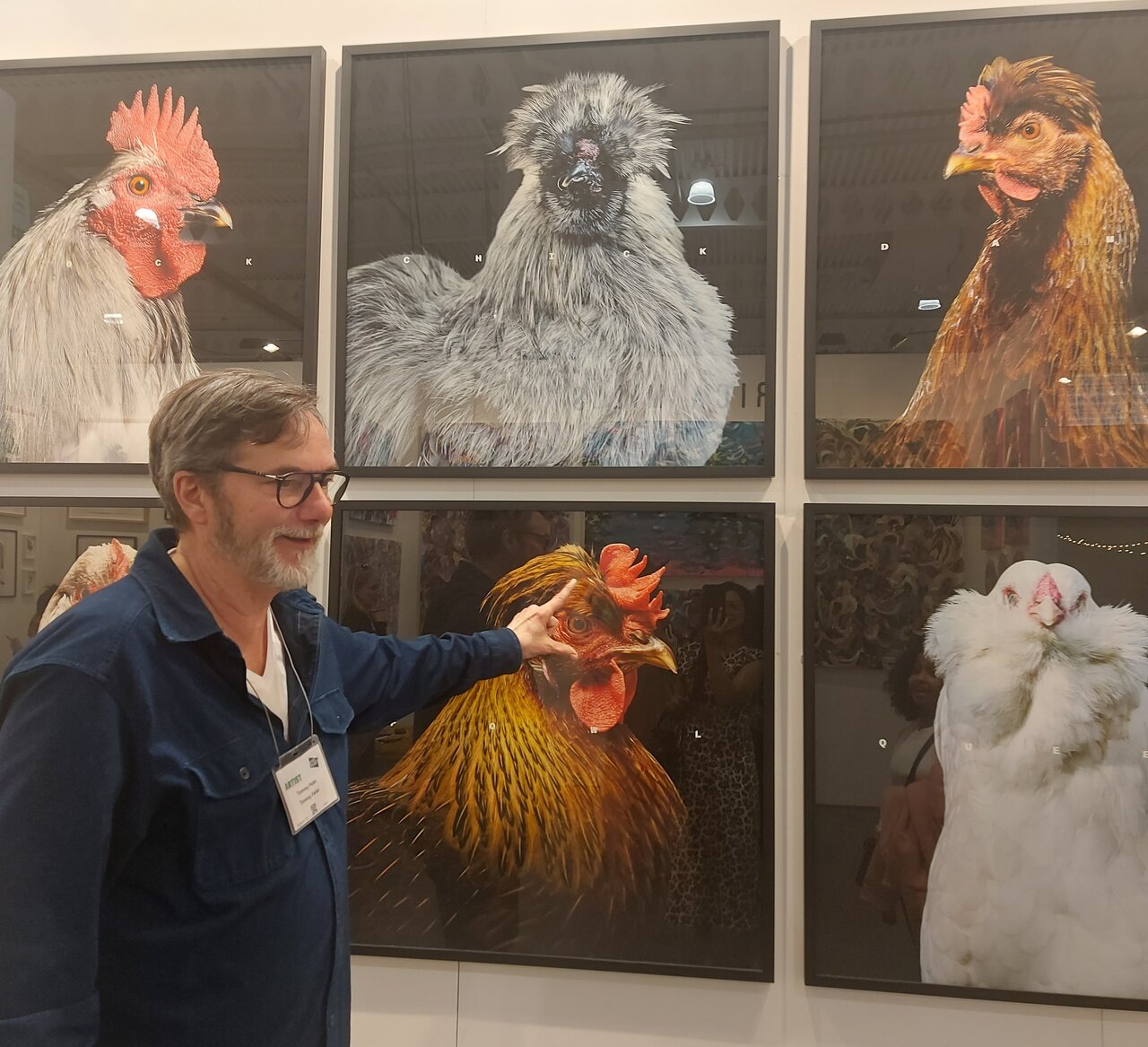
Walking through the aisle, it’s hard to decide where to stop. Thousands of booths with beautifully projected art beckon from different directions. Artist Tommy Feiler presented his photographs quite humorously on huge canvases that couldn’t be overlooked. Six of the large-scale canvases on the focal wall featured portraits of chickens. He shared the story behind the photographs: he’s feared chickens since childhood, which motivated him to take pictures of them to study them in detail through photography. As his fear transformed into art, the chicken portraits explored the semiotic instability of language and image.
Tommy Feiler explaining his chicken photographs
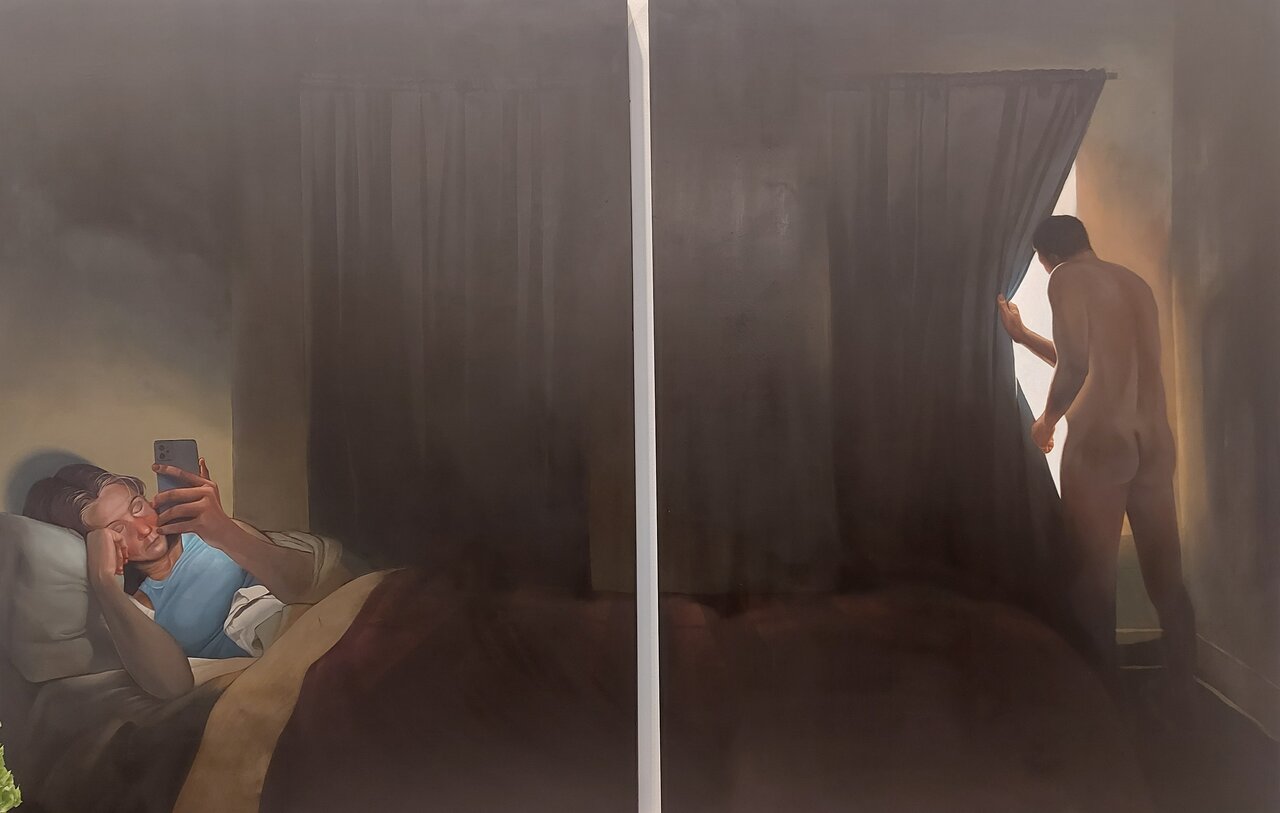
Erik Mohr, a Toronto artist, captures the beauty in the mundane, elevating overlooked aspects of daily life into meaningful works of art that invite reflection and appreciation. Inspired by the tenebrist tradition, he uses oil on wood panel to paint contemporary scenes illuminated by smartphones and matches. These light sources not only cast physical light but also shape the mood, emotion, and narrative of the scene. The soft glow of light invites reflection, sparking a dialogue about solitude, presence, and the ways in which distractions shape our experiences. The light, whether from outside or from a device, can transport us to another world or leave us suspended in between, highlighting the complexities of modern life.
Paintings by Erik Mohr
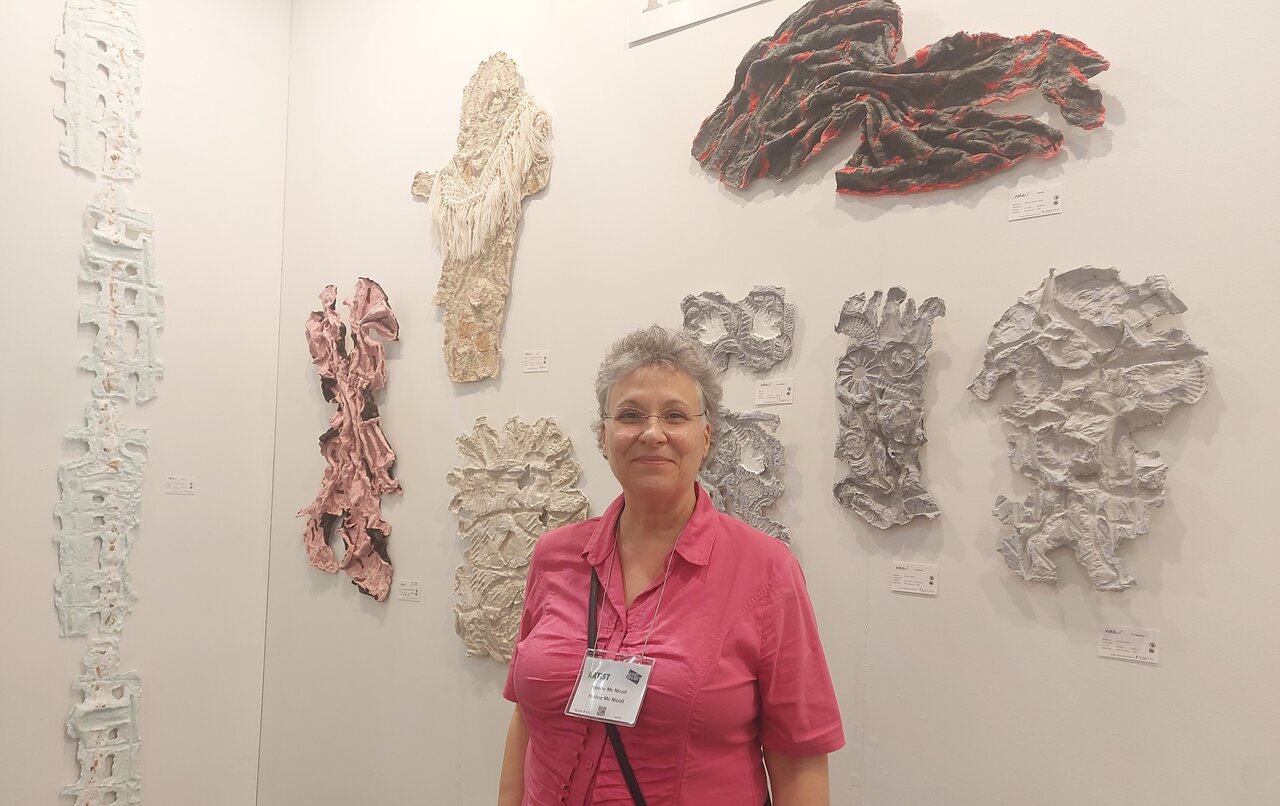
Hélène McNicoll is a plant lover, so it’s not a surprise that through her art she projects the connection between nature and human. Her work explores the interconnectedness of human and natural, capturing the moments where these worlds intersect in urban and suburban spaces. Through her imprint technique, using leftover cotton from fabric indstry, she documents fleeting encounters between beings, blurring the lines between art and reality. In the world of distortion, she believes in sustainability and her art shows how we left our print in the world through industrial items. In the imprint she used material like industrial ware, electric little fan, plant, leaves, looks like fossil that found on earth.
Hélène McNicoll in her booth
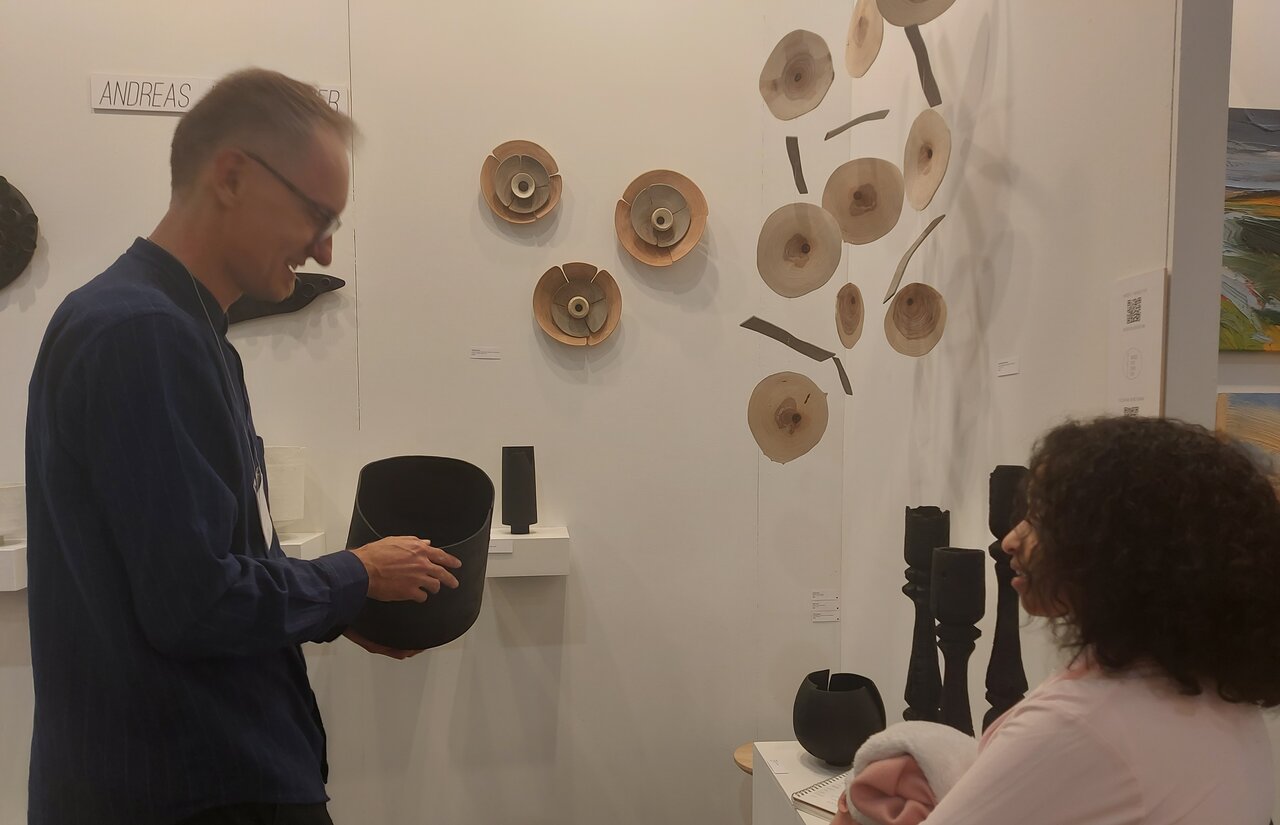
Born in Germany, Andreas Krätschmer studied cabinetmaking before focusing his studio practice on woodturning and sculpture. His work is deeply inspired by traditional craftsmanship, the cultural meaning of artifacts, and our connection to nature. He works with locally salvaged, freshly cut (“green”) wood, allowing it to dry and naturally warp, crack, and shift—embracing the unpredictable beauty of the material. This process mirrors nature’s transformations and reflects themes of resilience and vulnerability. One of his featured creations, Consumed’25, resembles a large candle holder and was inspired by wildfires. He described how, like a burning tree trunk—cracked yet still standing—it serves as a powerful reminder of nature’s strength and our responsibility to protect it.
Andreas Krätschmer in conversation with a visitor
Hundreds of artists and their works cannot be fully described in just a few words or sentences. The emotional exchange between the artist and the viewer is both powerful and exciting, as each artwork opens a dialogue beyond language.
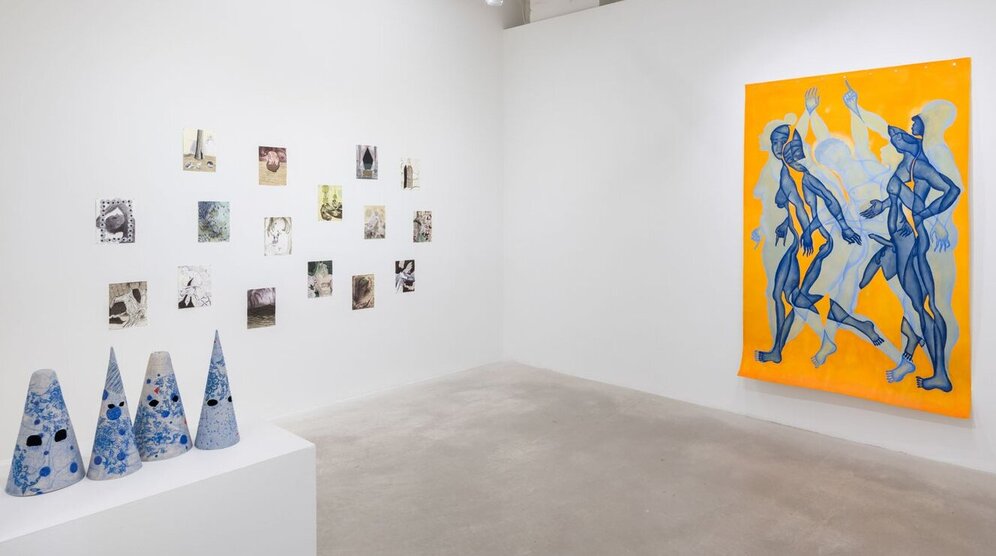
How do artists use visual language to explore their understanding of symbols? Echo Without Origin invites us to reflect on this question by creating space for slowness, contemplation, and openness. In a world saturated with images and messages, where meaning is often handed to us already defined, this exhibition offers something different. It encourages a more intuitive way of looking, where meaning isn’t fixed, but fluid.
Rooted in the concept of the “floating signifier”—a semiotic term describing symbols whose meanings shift depending on context—the works in this exhibition ask viewers to pause. The artists peel back layers of memory, history, and form not to deliver a singular answer, but to invite interpretation. In this way, they craft a new type of viewing experience—one that is intimate, personal, and intentionally unresolved. Spending time with these works reveals how meaningful the act of looking can be. Sitting with ambiguity, questioning your assumptions, and engaging with the intentions behind an artist’s gestures becomes a special kind of interaction—one that values presence over resolution. The artists remind us how precious it is to slow down and invest time in art, and in doing so, in ourselves.
Installation view of Echo Without Origin at Patel Brown. Courtesy of Patel Brown
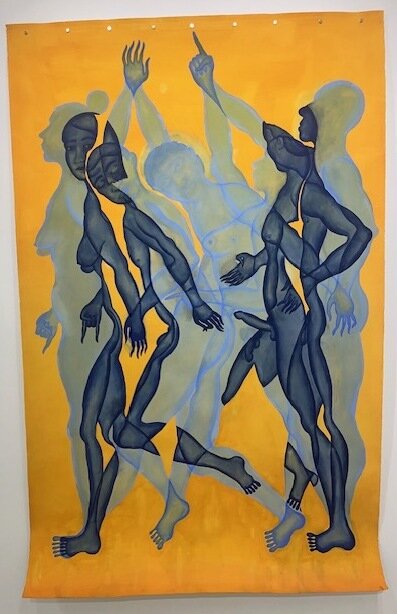
The individualized experience of art allows for a multitude of interpretations, pushing boundaries and encouraging viewers to see beyond a single idea or meaning. Throughout the exhibition, artists explore the tension between representation and abstraction, familiarity and mystery. Works by Winnie Truong and Balint Zsako focus on the human figure, but these figures often feel untethered, placed in ambiguous spaces, or fragmented across the surface.
Zsako’s bodies stretch and bend, frequently interacting with strange objects or symbols, giving the sense that they are caught in transition—between thought and action, past and future. Known for his intricate depictions of human figures engaged in ambiguous interactions, Zsako emphasizes the complexities of the human form. His playful approach invites viewers into a dialogue where meaning isn’t fixed, but open to interpretation.
Balint Zsako, Untitled (Physical Comedy) 01, 2025, watercolour, gouache on paper, 90 x 60 inches. Photo: Abuk Lual
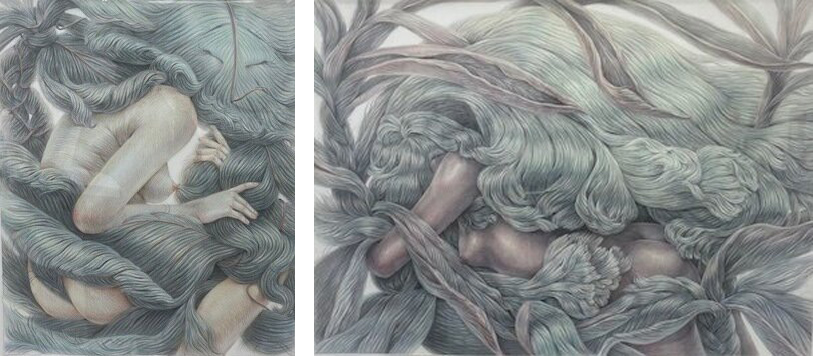
Truong and Zsako’s works are visually rich and intricately detailed, suggesting a powerful interplay between the body and surreal elements such as flowing strands of hair or vines. These forms partially obscure the figures, creating a sense of both intimacy and entrapment. These spiraling shapes highlight motion and fluidity, shifting focus away from fixed identities and origins and towards the constantly evolving nature of the body and self. Truong’s delicate pencil drawings and collaged hair forms create a surreal softness that blends identity with fantasy. Her figures seem to dissolve into dreamlike states, inviting viewers to reflect on the fluidity of identity.
Winnie Truong, Basilisk with Tits, 2016 (left), coloured pencil on paper, 24 x 20 inches and Hermit of the Hollow, 2016 (right), coloured pencil on paper, 41.5 x 59 inches. Photo: Abuk Lual
In contrast, Mia Sandhu, Alberto Porro, and Tuan Vu present figures that feel more grounded within their environments yet still invite viewers into worlds of layered meaning. Sandhu’s works blend pattern, architecture, and the female form to create dreamlike domestic spaces that reflect on womanhood, privacy, and cultural identity. These intimate yet surreal environments offer a reflective space where personal and collective narratives intertwine.
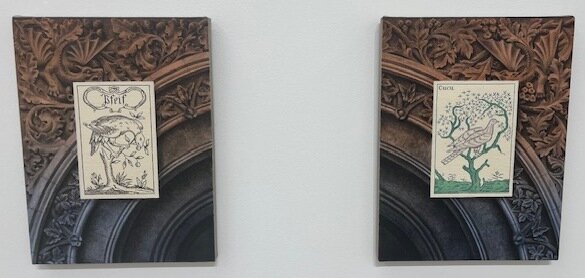
Alberto Porro, Pfeif, 2025 (left), Cucu, 2025 (right), both oil on linen, mounted on panel, 16 x 12 inches. Photo: Abuk Lual
Porro’s paintings reinterpret regional playing cards, transforming cultural symbols through a deeply personal lens. His work challenges viewers to reconsider preconceived notions and invites them to find meaning in the dynamic interplay of form, color, and symbolism. By blending abstract elements with cultural motifs, Porro creates a visual language that is both personal and universal, encouraging deeper engagement with the layers of meaning in his work.
Vu’s vibrant, color-rich scenes draw from both Eastern and Western art traditions, constructing mystical, tropical worlds where women and landscapes blend in quiet harmony. Though rooted in his early memories of Vietnam, Vu’s paintings are not direct representations. Instead, they weave together imagination and recollection to create dreamlike scenes where bathers seem suspended in time and place. These figures inhabit tropical landscapes that feel both familiar and surreal, evoking a sense of longing without pointing to a singular story or origin. Through his work, Vu taps into collective memory and personal history, creating a space for reflection and interpretation.
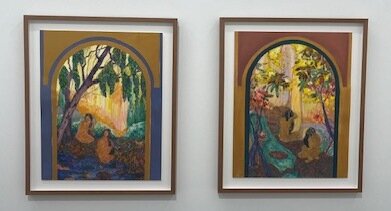
Tuan Vu, The Two Bathers, 2025 (left) and Bathers By the Falls, 2025 (right), both watercolour and oil on paper, 20 x 16 inches. Photo: Abuk Lual
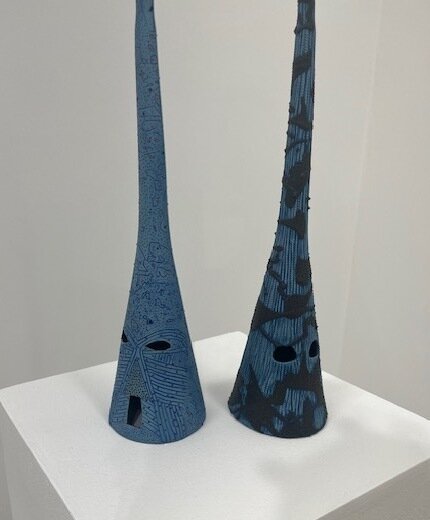
Other artists in the exhibition explore symbolism through objects and decoration using material to carry cultural and emotional significance. Tammie Rubin’s ceramic sculptures function as cultural relics – beautiful, coded and full of implied memory. Rubin’s Always & Forever (forever, ever)No.19 (2024) crafted from pigmented porcelain with underglaze continues this exploration. Measuring 15 x 8 x 4 inches the piece transforms the ordinary into extraordinary prompting reflection on the interconnectedness on personal and collective histories, with ceramics serving as vessels of memory and identity.
Meanwhile, Luke Painter and Ron Siu collaborate to create theatrical, highly stylized scenes that mix queer fantasy, historical references, and ornamentation. Their work is layered and lush, resisting any singular interpretation. The symbols they use pull viewers into a visual world that feels both familiar and strange, inviting rich, complex engagement with the pieces.
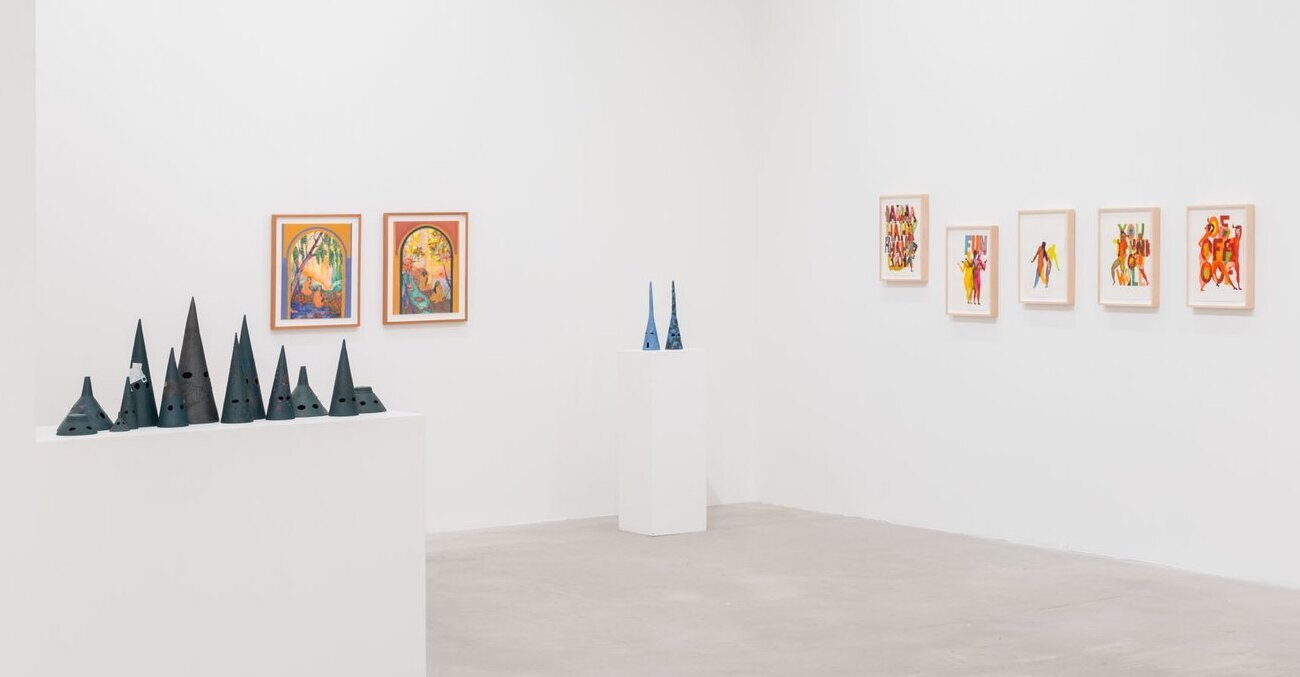
Installation view of Echo Without Origin at Patel Brown. Courtesy of Patel Brown
What connects these practices is a shared openness—none of the artists present their works as fixed or final. Instead, each invites viewers to actively participate in discovering the meaning. There is no clear, linear path through the exhibition. Viewers are asked to pay attention to how things shift: how a symbol might take on new resonance in a different context, how a body in space can speak to presence, absence, or transformation, and how patterns, colors, and forms can carry emotional weight, even when we can’t immediately name why. Echo Without Origin is not an exhibition that demands resolution. Instead, it offers an alternative reality to the pressure to know, define, or explain. It reminds us that symbols are alive— they move, stretch, and take on new meanings depending on who engages with them. In a fast-moving world that often reduces images to soundbites or content, this show invites us to be still, to look again, and to allow ourselves to not fully understand.
Abuk Lual
*Exhibition information: Echo Without Origin / Group show. March 21 – May 10, 2025, Patel Brown, 21 Wade Ave, #2, Toronto. Gallery hours: Tue – Sat, 10 am – 6 pm.
May 8 – 11, 2025 Better Living Centre, Exhibition Place 195 Princes’ Blvd, Toronto Hours: May 9 & 10, 12 – 8 pm, May 11, 12 – 6 pm.
Yehyun Lee: My favourites
At this year’s Artist Project, Toronto once again pulsed with the vibrant energy of over 250 independent artists gathering under one roof to share their visions. More than just an art fair, the event unfolded as a living, vibrant exchange of ideas, offering a rare opportunity to encounter artwork in a setting designed for conversation and curiosity. Between large-scale installations, guided tours, and an ever-present sense of artistic discovery, the experience was both intimate and alive with the possibility of stumbling across the unexpected. Among the countless talents on display, three booths stood out to me as windows into distinct, deeply considered artistic worlds.
Artist Project Booth Row View, Better Living Centre, 2025
At Booth 518, photographer Ian Brown offered a quiet, contemplative counterpoint to our image-saturated digital world. Working exclusively with analog materials—film stocks like Kodak and Fuji—Brown transcends the immediacy of digital capture, dipping instead into the ephemeral physicality of photography’s older traditions. Fascinatingly, his raw film photography, printed on richly textured paper, brings a tactile, gentle, and unmistakably human presence to the medium. There is something quietly resolute in his commitment to process, something that honours the beatific essence of photography as both craft and reflection.
Ian Brown, Booth 518, Artist Project 2025, Art Tour
His series Languishing Impermanence is a collection of images taken over the past decade that explores the uneasy, lingering relationship between humanity and the spaces we build, inhabit, and eventually abandon. These photographs are not just documents of neglect or absence—they are atmospheres of pause. Brown captures landscapes and streetscapes suspended in a liminal state, where traces of human presence echo faintly in stillness, caught somewhere between vitality and decay. His work resists spectacle in favour of something slower, more meditative, an elegy for what slips through our fingers, and a gentle reminder of the beauty found in what remains.
Ian Brown in front of Nevada Bus, Archival Giclee print, 30 x 40 inches
At Booth 109, Maureen O’Connor’s photographs offer a striking meditation on the convergence of the natural world and the built environment. By placing live Canadian animals, photographed in collaboration with local sanctuaries, within abandoned, crumbling domestic interiors, she creates uncanny tableaux that blur the boundary between wilderness and home. These spaces, long emptied of human presence, become transformative sites where memory lingers and new meaning begins to stir.
Maureen O’Connor, Booth 109, Artist Project 2025
O’Connor invites us to cross a threshold—literal and metaphorical—into settings where fragility is made visible in both creature and structure. Her images capture a deep stillness, asking us to imagine how animals inhabit these forgotten places, and what stories might unfold in their silent coexistence with the remnants of human life. In a country shaped by both its vast, untamed landscape and its carefully gridded cities, her work challenges us to consider how these opposing forces shape our sense of place, identity, and belonging.
Maureen O’Connor in front of (L-R) This Shadow is My Own & The Meadow, both Chromogenic Photograph, 20 x 20 inches
Emerging interdisciplinary artist and First in Show 2025 winner Ash Godley at booth 126 delivered one of the most strikingly cinematic experiences of the fair. Her oil paintings plunge the viewer into nocturnal worlds of stark contrast and unsettling familiarity. Drawing inspiration from game media, voyeurism, and the uncanny, Godley’s flashlight-lit scenes frame domestic architecture from the viewpoint of an unseen onlooker, often at night, always in the shadows. There is an eerie magnetism to her compositions: beams of light slicing through darkness, revealing just enough to stir curiosity and dread.
Ash Godley, Booth 126, Artist Project 2025
With a sophisticated command of light and colour, Godley turns ordinary spaces into theatrical stages of psychological drama. The viewer becomes complicit—an observer, maybe even an intruder, invited into moments and spaces that feel both intimate and forbidden. These paintings are not only formally intriguing, curious, and eerily beautiful; they ask urgent questions about perspective, surveillance, and what it means for us as viewers to look, to notice, to watch.
Ash Godley in front of Cottesmore Ave (footprints), 2025, Oil on canvas, 48 x 35 inches
Text and photo: Yehyun Lee
Rashana Youtzy
Entrance of the Artist Project at Better Living Centre
The fair was crowded with visitors ambling in groups. The excitement could be felt as patrons giddily opted for selfies in groups in front of some booths.
Artist Project 2025
As I was watching Hugo Cantin was taking a photo of visitors photographing his photo-based works, laughing together with them at the layers of his work.
Cantin’s works are meticulous collages using 16mm film, housed in LED light boxes
These interactions give the Artist Project an approachable atmosphere to strike up conversation.
Installation view of the Artist Project, 2025
Stephanie Singh sees the pace as an advantage. Singh noted that the opportunity for one-on-one has been helpful in explaining the technical process of her works. She was especially excited given that it was her first time at the Artist Project, and she won the Standing Ovation Award 2025.
Singh’s work uses sourced flora dried and incorporated into large resin works like the table and oval wall hangings pictured here
Through to the closing time of the fair on Friday night, the Artist Project was crowded. Several artists were packing up artworks, wrapping them in films or putting away terminal readers. Many people left with smiles on their faces and turning over artist cards in their hands, excitedly asking each other which booths they got to check out. Surely some of them will need another visit to the Artist Project, as it is impossible to see everything in one day.
Artist Project 2025 with Ben Johnston’s installation (in front)
May 8 – 11, 2025 Better Living Centre, Exhibition Place 195 Princes’ Blvd, Toronto Hours: May 9 & 10, 12 – 8 pm, May 11, 12 – 6 pm.
I had a busy day yesterday as I attended both the Media Preview and the Opening Night Party at the Artist Project.
At the media preview I talked with director Mia Nielsen who also one of the directors of Art Toronto, the International Art Fair in October, so she was busy changing hats. The dates were a big change as the Artist Project had happened in April in most years. This year it was up against the CONTACT Photography Festival and GRAD X OCADU. Over 250 artists are registered this year, up slightly from last year. There are also installations spread through out the venue as well as performances happening. Nielsen was confident that things were going smoothly.
Opening night provided to be a lively celebration of the artist community with the over 250 artist booths overflowing with guests. Only a few artists seemed to have generated early sales; it seemed the crowd was spending their money at the bar with long line ups. A few visitors were doing selfies with artists’ works.
Artist Project Opening Night with Trash Panda Brass performers
I chatted with Pixel Heller. I was more familiar with her previous photo installation. Her piece at the Artist Project took similar elements that she incorporated in her performance work.
Pixel Heller with her installation
There was a runway fashion show by LUNARA which was popular. A little disappointing that the fashion was not that artistic or colourful. There was just one designer.
James Fowler’s hut installation, Shelter is a large work constructed of 1900 squares of crochet works donated after he outsourced them on twitter and tik tok. As you entered this hut you saw four video installations embedded in the flooring of outdoor activities normally associated with Ontario’s North ice fishing. Fowler told me he invited some of his gay friends up North to experience some of these activities. Fowler who originally grew up in the north said a lot of locals had a hard time changing their stereo types of the gay community. It was a colourful and fun installation, and you could chill inside watching the videos.
James Fowler in front of his Shelter
I talked with artist Stan Olthuis who now hails from Peterborough and had a large interactive work, Elemental, that could be pushed on the floors surface like a large orb. He was having a performance with it later with two Hip Hop dancers and had smaller versions of the work that collectors could purchase.
Stan Olthuis with his interactive installation, Elemental
Many artists seemed overwhelmed with the crowds whether they had been long time participants of the Artist Project or newbies. Most of the artists were explaining their work to curious visitors. There was a true variety of works for collectors looking for new acquisitions.
Artists had used a wide variety of media, like Juliana Scherzer, who used leaves. I talked briefly with photographer Leah Oates who had a booth, and seemed happy with the response to her work. Artist Tommy Feiler was all smiles, happily chatting with interested visitors. Jes Young has a great sense of humor that transformed into her work.
Juliana Scherzer with her compositions
Leah Oates in front of her photographs
Tommy Feiler with his work
Jes Young in her booth
Painter Brandon Kennedy was doing well in his first year at the Project. Sculptor Carmen Mahave went to OCADU and has unusual but captivating sculptor works. Artist Mackenzie Browning is based in a small place called Freelton, near Hamilton. His installation with paper works was stunning and visitors were getting selfies with it.
Brandon Kennedy in front of his paintings
Carmen Mahave and her sculptures
Mackenzie Browning with his work
I liked Anna Wilson’s drawing of birds. Quebec artist Lise Gravel had some sculptures of women that were wonderful. Her son was in a booth next to her booth, and she talked about how he inspired her.
Anna Wilson surrounded by her drawings
Lise Gravel and her women
Sanghoon Kang, a former architect, was a little overwhelmed with all the response to his work. Mixed media artist Firouzeh Saremi Far had a great grouping of works all painted in blue. Painter Rachel Sardella was comfortable with the crowds and was getting a good response to her work.
Sanghoon Kang with his architectural compositions
Firouzeh Saremi Far surrounded by blue
Rachel Sardella in front of her paintings
Untapped artist Omar Chris Canales-Cisneros textile works caught my eye. Indeed, there were a lot of textile pieces in the Artist Project. Tanmay Parashar had shown in the Project before and was happy to be back. I like the contemporary paintings of Dori Vanderheyden.
Omar Chris Canales-Cisneros and his textiles
Tanmay Parashar with his works
Dori Vanderheyden in front of her paintings
The Artist Project was a great mix of works with something for everyone, using a variety of media and a good sampling of the creative workings of over 250 artists. Highly recommended.
The New Members show at the Sculptors Society of Canada presents a compelling cross-section of contemporary sculpture, featuring the diverse talents of Ruben Anton Komangapik, Viktor Mitic, Doğan Özdemir and Youren Yan. Far from a mere introduction, the exhibition asserts each artist’s place within a larger, evolving conversation about materiality, identity, and the cultural responsibilities of sculpture. What unites these otherwise disparate practices is a shared insistence on sculpture as a medium of confrontation and communion where the personal becomes political, and the tactile becomes transformative.
Ruben Anton Komangapik’s Tupilak is a diminutive, yet deeply resonant sculpture fashioned from ivory, gold, and glass beads. It stands as a convergence of ancestral legacy and contemporary reflection. Barely larger than the palm of a hand, this miniature figure defies its scale through the intensity of its symbolic charge and the precision of its execution. Komangapik, a sculptor of Inuit descent, draws from the rich tradition of tupilait: spirit figures historically carved by shamans to embody protective or retaliatory forces, often animated through ritual to confront enemies or ill-intentioned spirits. What immediately captivates is the figure’s outstretched hand, delicately holding a tiny mirror. In this gesture, the tupilak becomes less an emissary of vengeance. The mirror, encased in gold, reframes the traditional narrative: instead of reflecting outward aggression, it invites self-examination, perhaps even collective accountability.
Ruben Anton Komangapik, Tupilak, ivory, gold, glass bead (two views)
Viktor Mitic’s Hydra, a towering sculpture forged in 24k gold-plated stainless steel, is radiant, aggressive, and utterly magnetic. Standing taller than the viewer, the work commands not just space but attention, luring with its gilded surface while evoking a far more turbulent undercurrent. There is an unsettling beauty to Hydra, in part due to its material contradiction: gold, so often associated with opulence, purity, and divine authority, is here weaponized into a form that resists stability. The polished surface reflects not only the surrounding space but also the viewer, implicating us in the work’s disquiet. Lastly, it’s impossible not to feel small in its presence. There’s a visceral shiver in recognizing your own image fractured across something so cold and mythic. Hydra doesn’t just mirror the viewer; it exposes us.
Viktor Mitic, Hydra, 24k gold-plated stainless steel (left) and detail (right)
Youren Yan’s Christopher Columbus, cast in bronze, is a searing exploration into the legacy of monumentality and historical myth. Far from a conventional commemorative sculpture, Yan’s treatment of the infamous explorer is unflinching in its ambiguity, straddling the line between critique and spectacle. The use of bronze which is historically the medium of heroes, conquerors, and nation-builders immediately signals a dialogue with power. But in Yan’s hands, this material weight becomes ironic, even accusatory, as the figure of Columbus is rendered not triumphant, but spectral. There is no theatrical gesture, no melodramatic symbolism, just the heavy, immutable presence of bronze, imbued with the weight of centuries. That restraint is what makes the piece so potent. It draws the viewer into a confrontation with history: one that does not offer resolution, only the demand to look longer and deeper.
Youren Yan, Christopher Columbus, bronze (left) and detail (right)
Doğan Özdemir’s Black Panther, rendered in raw steel, is a sculpture that feels both unfinished and impossibly alive. At first glance, it appears incomplete: exposed welds, jagged edges, and a skeletal structure that defies the polished expectations of monumental animal forms. But it is precisely this incompleteness that animates the work, giving it a sense of motion and urgency rarely achieved in metal. The panther does not sit still for admiration; it lunges visually out of its own form. Materiality is crucial here. Steel, industrial and unforgiving, is shaped not into smooth anatomical realism but into suggestion. There is no decorative surface to distract the eye, only raw structure. Özdemir achieves something rare: a sculpture that breathes through its absences and that threatens to break free from its own medium.
Doğan Özdemir, Black Panther, Circle of Life, steel (two views)
In New Members, the Sculptors Society of Canada invites us into a dialogue where sculpture transcends its physicality, emerging as a medium that speaks to both personal identity and collective history. The artists challenge the viewer not only to appreciate form but to reckon with the tensions it holds, whether between past and present, beauty and violence, or material and meaning.
Text and photo: Kaya Meziane
*Exhibition information: New Members / Ruben Anton Komangapik, Viktor Mitic, Doğan Özdemir and Youren Yan, March 29 – May 9, 2025, Canadian Sculpture Centre, 95 Moatfield Drive, 5th Floor, North York. Gallery hours: Tue – Fri, 12 – 5 pm.
May 8 – 11, 2025 Better Living Centre, Exhibition Place 195 Princes’ Blvd, Toronto Hours: May 8, Opening night preview, 6 – 10 pm, May 9 & 10, 12 – 8 pm, May 11, 12 – 6 pm.
Discover and connect with over 250 independent artists at Artist Project in Toronto from May 8 – 11, 2025. Experience a stimulating environment designed to ignite enriching conversations and foster a personal connection with art. Explore thousands of artworks, large scale installations, enjoy curator led art tours and take home that special work that truly resonates with you.
Installation view of the Artist Project, 2024 with visitors. Photo: Phil Anderson
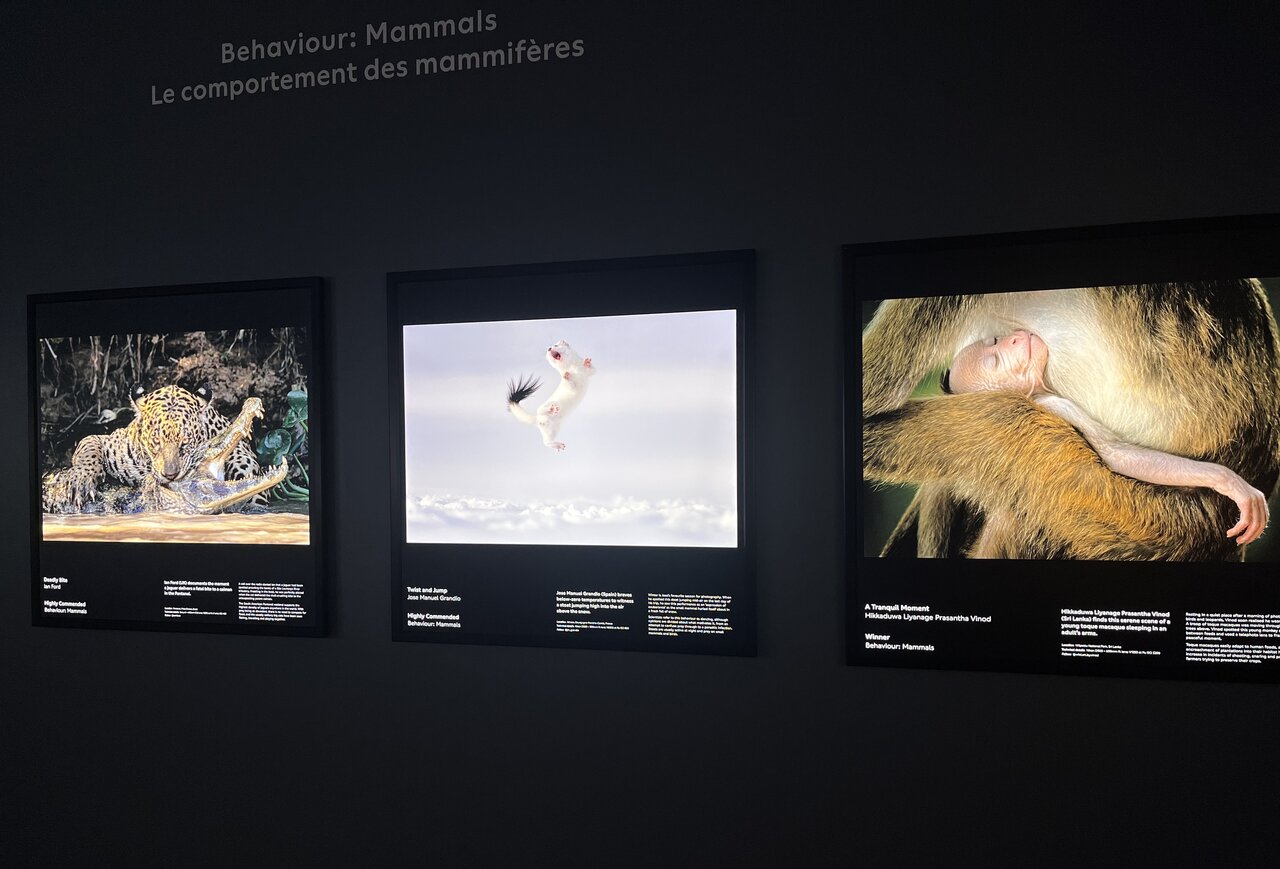
The Wildlife Photographer of the Year is the most prestigious nature photography competition in the world. Organized by the Natural History Museum of London, the competition selects the best submissions from photographers of all ages and nationalities to be displayed in a collective show. This show enlightens the soul and connects one to nature on a higher level. It is not only a collection of photographs and has an effect greater than that of an installation or film. Each photograph speaks for itself, and so do its depicted subjects, sending messages about climate change, pollution, survival, family, and urbanism without having to be explained in words. As one moves from one photo to the next, they are acquainted with distinct places on Earth, from the small world of insects to the vast expanse of mammals of grasslands and mountains. An intense array of emotions is felt as you face the photographs, brightly illuminated against the darkness of the walls and room, creating a meditative and reflective state which freezes time to invite one to think. In the “Behavior: Mammals” category, three photos summarize the complexity of animal behavior through fierce hunting, playful movement, and a mother’s priceless hug. Photos like these help us see how important it is for us to coexist with such beautiful creatures, and how lucky we are to see these sides of them.
Installation view (L-R): Ian Ford (UK), Deadly Bite; Jose Manuel Grandio (Spain), Twist and Jump, both Highly Commended, Behaviour: Mammals and Hikkaduwa Liyanage Prasantha Vinod, A Tranquil Moment, Winner, Behaviour: Mammals
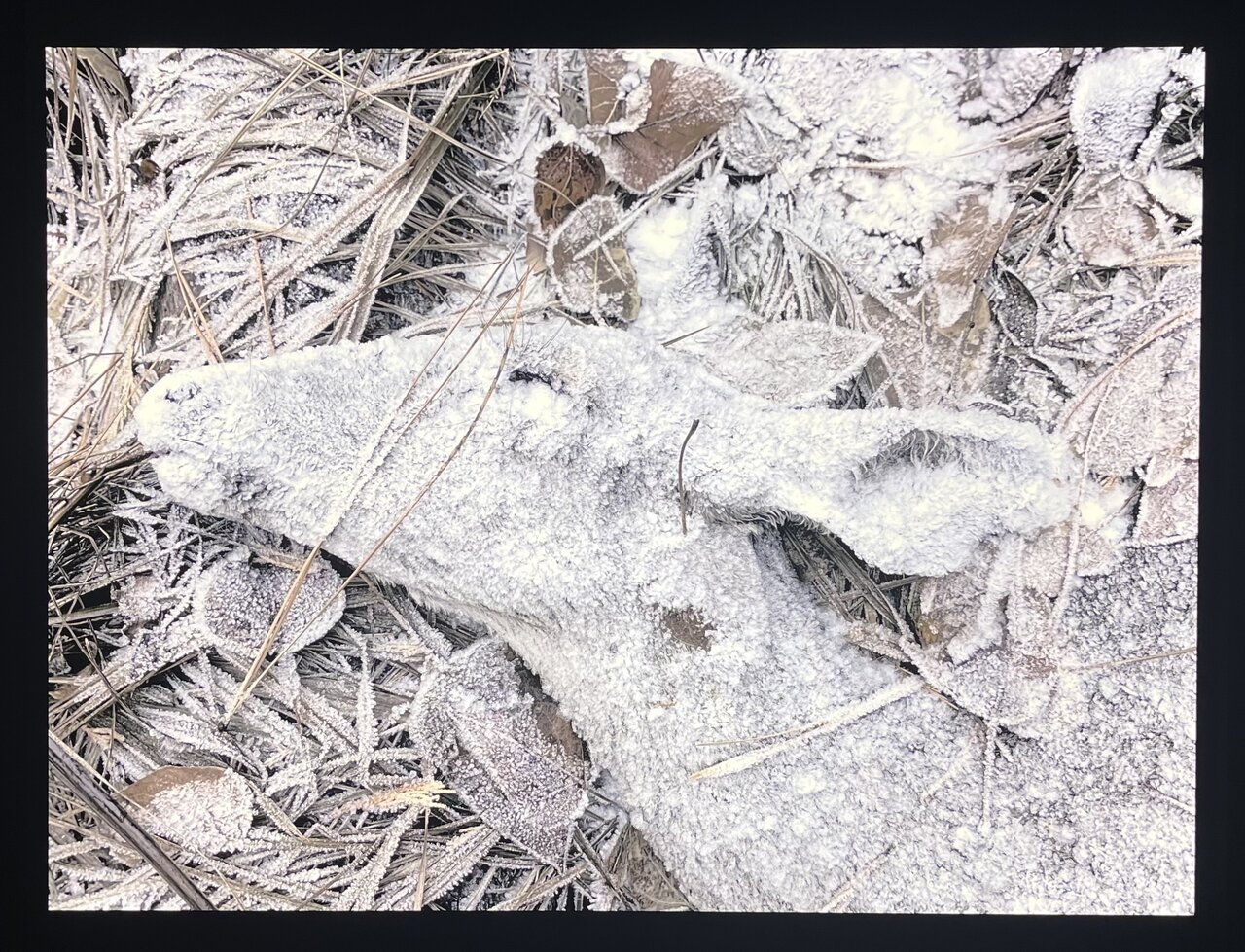
These scenes are contrasted by mournful photos like The Last Resting Place by Randy Robbins, which shows how those lively days of animals meet death. The sad emotions evoked by photos like this push one to think about the power of nature and the life cycle, and our own “power” in trying to control or exploit nature.
Randy Robbins (USA), The Last Resting Place, Highly Commended, Natural Artistry
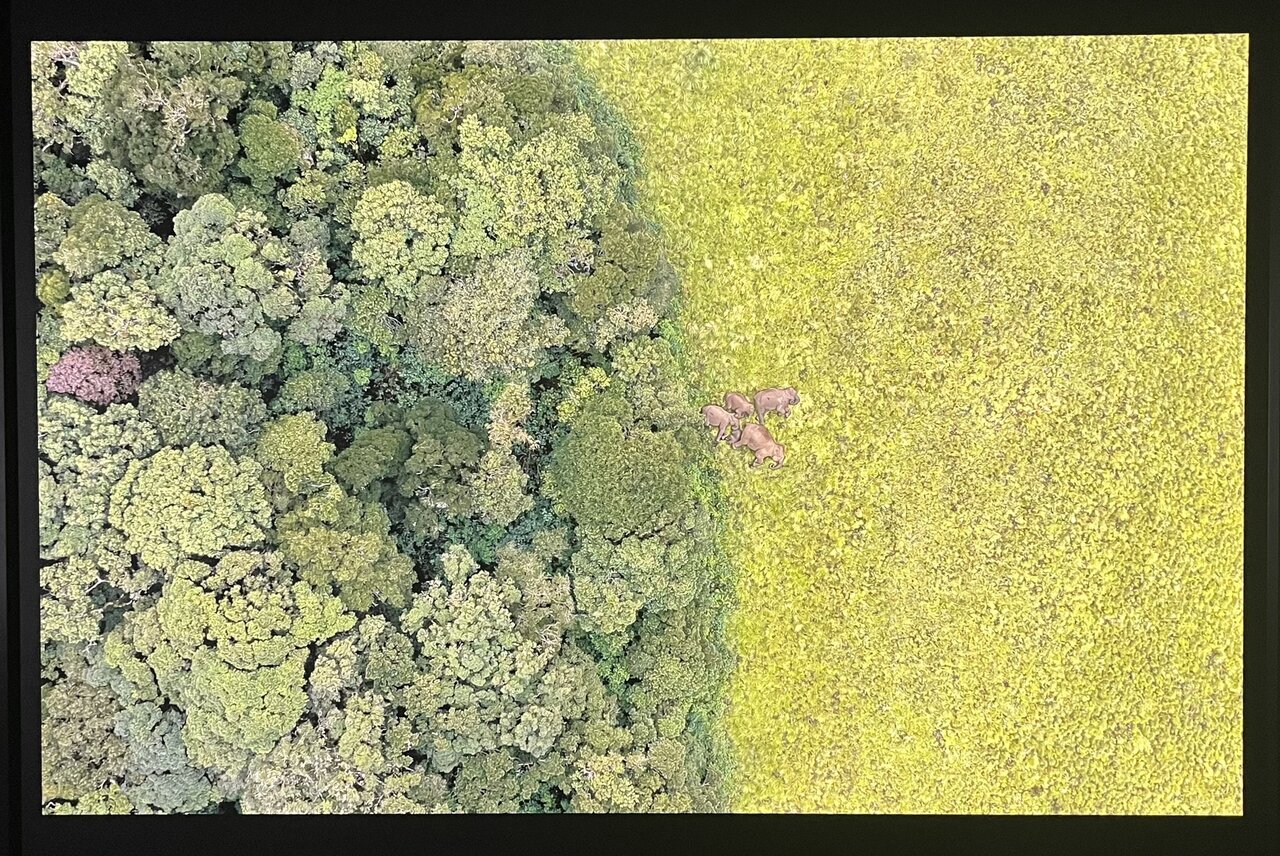
We also see how important the Earth is for every species in photos like Elephant Slumber by Dhanu Paran, where a heartwarming family of elephants peacefully lays in a large field.
Dhanu Paran (India), Elephant Slumber, Animals in their Environment
Text written beneath photos provide more context, and the bottom left corner of the panel states the result/accomplishment of the photo in the competition. This feature provides an interesting opportunity for engagement as one can check whether their favourite photo won first place, or which category the depicted scene represents.
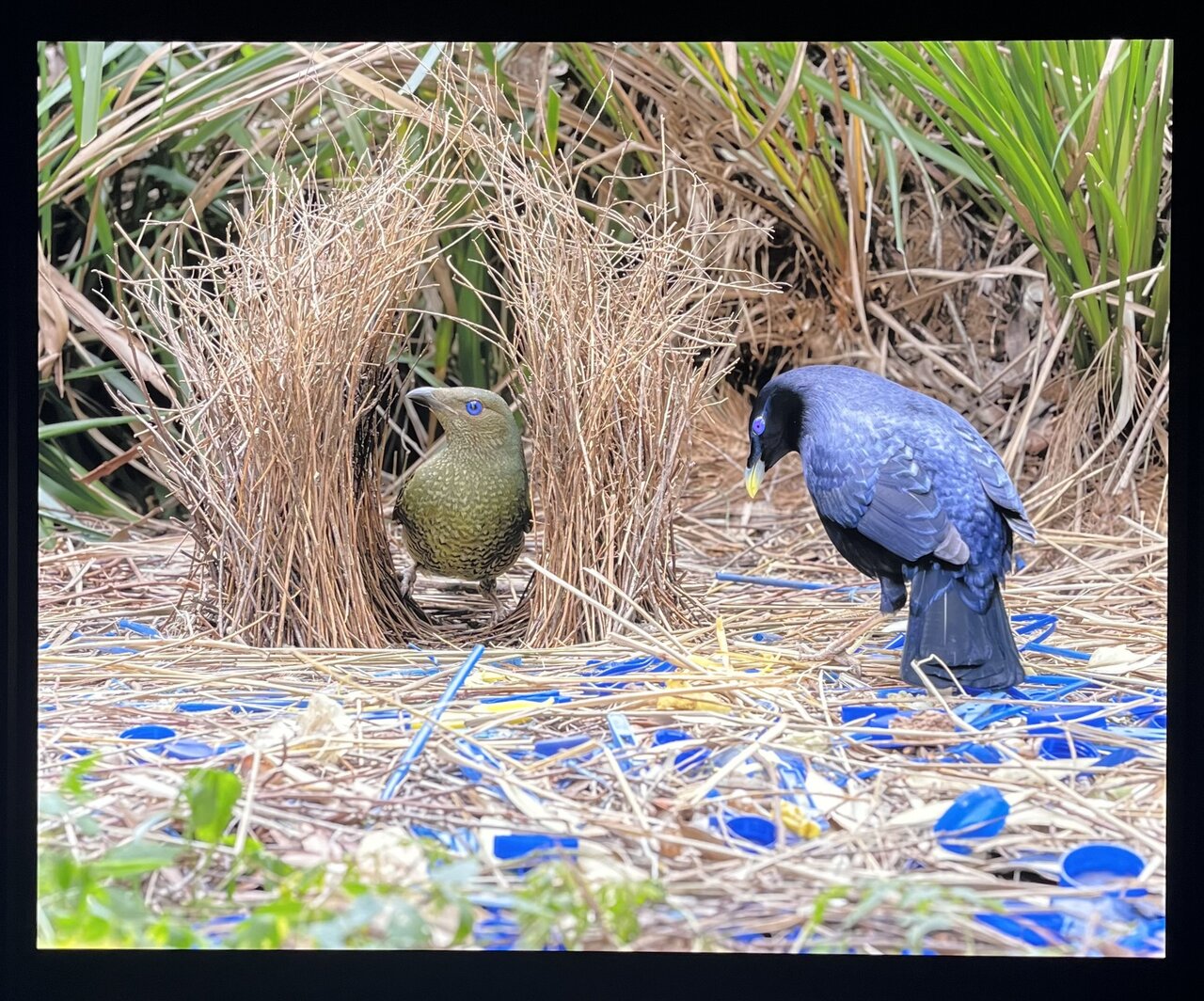
I was particularly impressed by the Young Photographers display category, showcasing some of the most astonishing work from experts as young as 7 years old. Occasionally, a red maple leaf sticker above displayed photos indicates work of Canadian photographers. Additionally, many different photography techniques are displayed, like underwater photography, aerial shots, macrophotography, and double exposure as seen in The Blue Bower of Keith Horton.
Keith Horton (Australia), The Blue Bower, Highly Commended, Behaviour: Birds
The displayed photographs reflect strong compositional strategies, aesthetic, and stunning colours which help create a memorable visual experience for the viewer. This exhibition will surely remain one the most emotional and inspiring experiences for me, and I will definitely be returning next year.
Text and photo: Nane Zadoorian
*Exhibition information: Wildlife Photographer of the Year 2024, till May 4, 2025, 100 Queen’s Park, Toronto. Museum hours: Tue – Sun 10 am – 5:30 pm.
The 29th edition of Toronto’s preeminent, annual, month-long festival presents over a hundred exhibitions city-wide. So, it isn’t easy to pick exhibits to see. We all look forward to seeing much more than the ones listed but these caught our interest and everyone is sure to have their own list as well.
EMESE KRUNAK-HAJAGOS, publisher/writer
Clara Gutsche May 7 – August 2, 2025 The Image Centre
Clara Gutsche, Collège Clarétain, Victoriaville, 1997. Courtesy of the artist.
Sylvia Galbraith: What Time Is This Place? May 9 – June 7, 2025 Abbozzo Gallery
Sylvia Galbraith, Loretta’s Place, 2019
PHIL ANDERSON, publisher/writer/photographer
Something Old, Something New: The Wedding Photography Collection of Stephen Bulger and Catherine Lash May 7 – June 7, 2025 The Image Centre
Motorcycle Matrimony, ca. 1969, gelatin silver print
Monica Rooney: We Remain: Portraits of Transgender Youth May 3 – May 25, 2025 Café ZUZU
Monica Rooney, Affirmations, 2024
STEVE ROCKWELL, publisher/writer
Yann Pocreau: The lapse in between March 13 – May 3, 2025 Blouin Division
Yann Pocreau, Les décalages 04, 2025. Courtesy of Blouin Division
Alison Postma: Tender to the Touch May 10 – July 5, 2025 Xpace Cultural Centre
Alison Postma, Guts, From Series: Tender to the Touch, 2024. Courtesy of the artist
ABUK LUAL, writer
Edward Musungu: Celebrating the Heritage of Lake Turkana May 1 – May 31, 2025 Regis College
Edward Musungu, Celebrating the Heritage of Lake Turkana, 2024
Christina Leslie: Pinhole Portraits and Places May 10 – July 5, 2025 Stephen Bulger Gallery
ANTONELLA PECORA RUIZ, writer/photographer
Jordan King: Untitled Polaroid Series May 1 – May 31, 2025 Billboard at Queen St W & Augusta Ave
Jordan King, Untitled Polaroid Series, Billboard at Queen St W & Augusta Ave
Kiri Dalena: Erased Slogans / Birds of Prey May 1 – May 31, 2025 Billboards at College St and Lansdowne Ave, Billboards at Dufferin St and Queen St
ELIN MACRAE, writer
Glenn McArthur: Muqarnas: Form and Light September 14, 2024 – September 7, 2025 Aga Khan Park
Glenn McArthur, Muqarnas: Form and Light, Aga Khan Park
HUGH ALCOCK, writer
Sandra Brewster: FISH April 12, 2025 – January 1, 2026 McMichael Canadian Art Collection
Study for FISH (detail) 2025
Jeanne Randolph: Pythagoras of the Prairies May 16 – June 21, 2025 Paul Petro Contemporary Art
KAYA MEZIANE, writer/photographer
Zinnia Naqvi, Faseeh Saleem, Clemens Thornquist: UnveilingStories of Common Objects May 4 – May 31, 2025 Art Address
Clemens Thornquist, Kitchen Series, 2024
Margaret Gdyczynski: Longing May 1 – May 30, 2025 Extra Butter Coffee
NANE ZADOORIAN, writer/photographer
Zara Dorafshanian:Culture May 1 – May 10, 2025 Ymm Art Space
Zara Dorafshanian, Dancing, 2024
Laiba Aslam, Niloufer Mavalvala, Faseeh Saleem: CulinaryCanvas May 1 – May 31, 2025 Narenj
NUSRAT PAPIA, writer/photographer
Steve Kean: Moving Landscapes II May 9 – June 7, 2025 Abbozzo Gallery
Steve Kean, What’s Real, 2024
REBEKAH BARONA, writer/photographer
Anu Kumar: Ghar May 1 – May 31, 2025 Billboards at College St. and Clinton St.
Anu Kumar, Untitled, 2019, from series Ghar. Courtesy of the artist
Amara King: Trinidad Tabanca May 1May 16 – May 29, 2025 She Said Gallery
POLYNA ALEXSEEV, writer/photographer
Paulina Sheck: Shoreline May 1 – May 31, 2025 Gallery 1265
Paulina Sheck, Shoreline 1, 2023
Paul Orenstein: Stranger on a Train May 18 – June 30, 2025 The Hall
RASHANA YOUTZY, writer
Christina Kakaletris: Washed Away: Fading Memories May 1 – May 31, 2025 Dirty Laundry
Christina Kakaletris, “Mom Memory”, 2025
Veronica Moore: Aquatic Rumours April 25 – August 10, 2025 Alleyway Gallery
SHERRY QIN, writer/photographer
Édouard Lock, Èxaucé: Ballet Studies May 15 – June 7, 2025 Atelier Next Door (AND1357)
Édouard Lock, Exaucé No.21, 1989
SOFIA DIAZ AGUILAR, writer/photographer
Suneil Sanzgiri: An Impossible Address April 12 – June 14, 2025 Mercer Union
Suneil Sanzgiri, An Impossible Address, 2025, 16mm to Digital, CGI. Courtesy of the artist
Andrew Taylor: Cerca de Casa May 26 – July 6, 2025 Taqueria Vegana
YEHYUN LEE, writer/photographer
Pınar Öğrenci, Helena Uambembe: Still Film: Photography inMotion May 1 – May 29, 2025 Goethe Insititute
Pınar Öğrenci, Good Luck in Germany, 2024, Video Still. Courtesy of the artist
Rebecca Wood: On Being Despised June 18 – August 2, 2025 The Image Centre
Images are courtesy of CONTACT Photography Festival
To make your own selection of exhibitions please click here.
May / Various locations across the Greater Toronto Area
The 29th edition of Toronto’s preeminent, annual, month-long festival presents over a hundred exhibitions city-wide. Established and emerging artists will present lens-based works in exhibitions, public art installations, and commissioned projects at museums, galleries, and public spaces across Toronto.
The 2025 Core Exhibitions and Public Art Installations present works by artists and photographers exploring topics including anti-colonial practices, community-building, Afro-futurism, crip liberation, ceremony and revolution, and personal and collective memory, addressing violent gaps in historical archives. Curated exhibitions and public art installations are presented in partnership with institutions across the Greater Toronto Area.
Public Art Programs involve public artist talks, workshops, portfolio reviews and more.
In theOpen Call Exhibitionsyou can visit community-generated exhibitions at venues throughout the city.
Please visit the CONTACT website for more information.
*Exhibition information: May 1 – May 31, 2025, some exhibitions begin before and/or extend beyond the month of May. Held at venues across the Greater Toronto Area
**Featured image: Sylvia Galbraith, Loretta’s Place, 2019 at Abbozzo Gallery