For those who have yet to see the work of Alberta-based photographer Kristopher Karklin, you may want to pay attention. On the vast spectrum of emerging-to-mid-career artists on the Canadian contemporary scene, he is most certainly one to watch. His most recent work, the subject of a solo exhibition currently on display at Barbara Edwards Contemporary, has not only generated a considerable amount of buzz, but has also piqued the interest of a number of high profile collectors, both individual and institutional. And for good reason. His newest series, a combination of photography and sculpture, strikes with uncanny accuracy not only at the northern Alberta landscape by which it was inspired, but also at many of the confining and alienating elements of contemporary rural and suburban life.
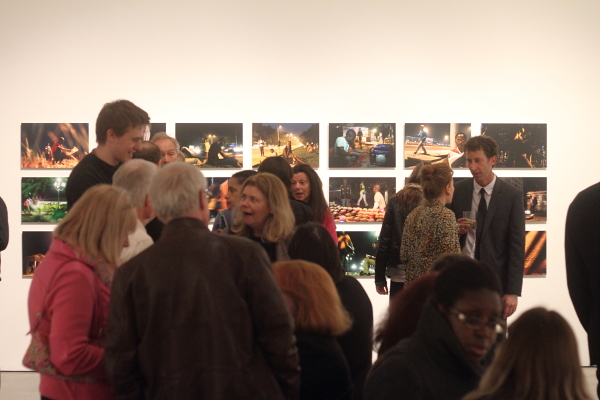
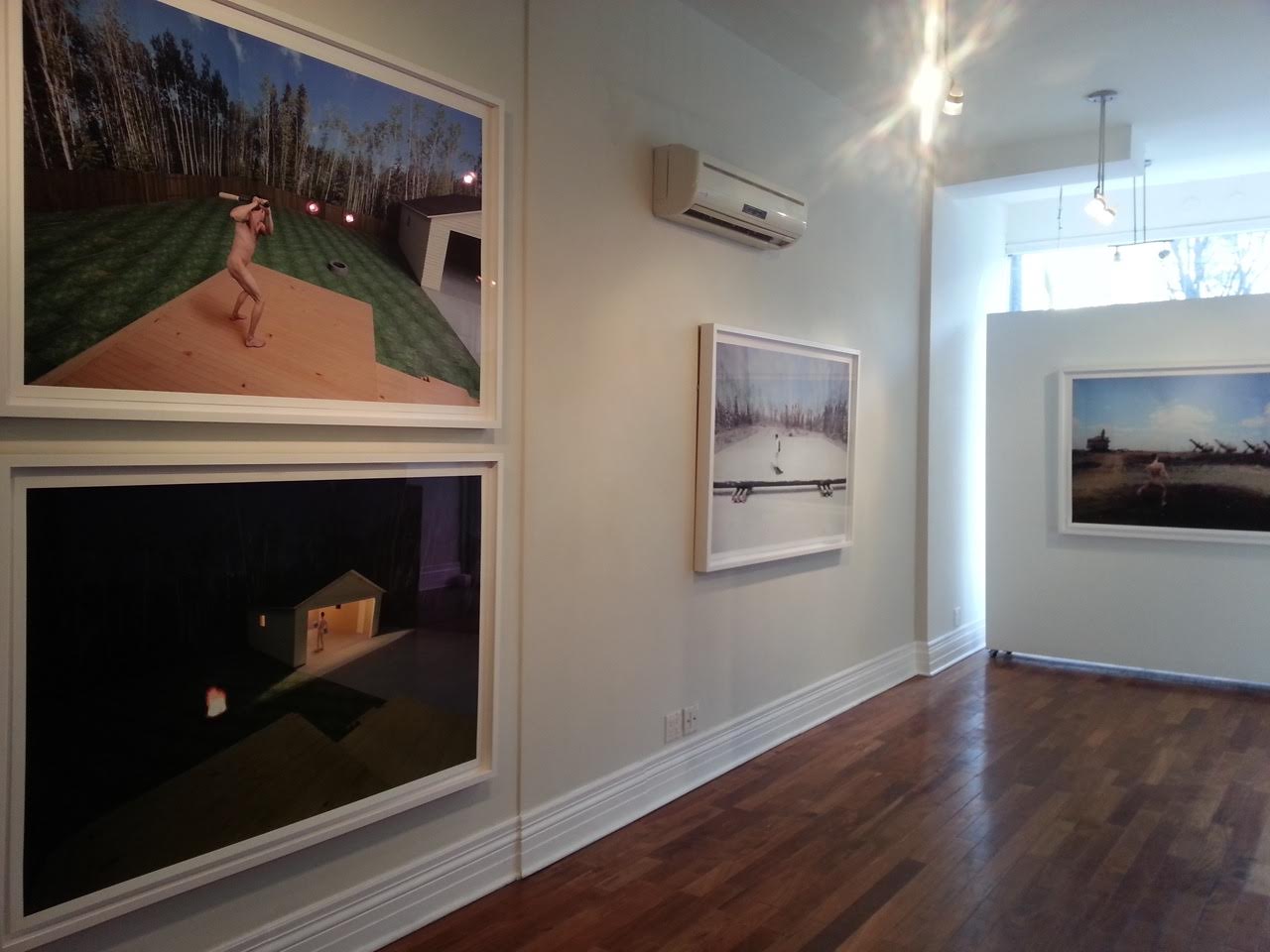 Installation view. Photo courtesy of Barbara Edwards Contemporary
When, years ago, Karklin began working in Fort McMurray, Alberta – a community now infamously known for its connection to the oil sands — he had no specific intention to create art from his experience. Yet, as he described in a recent interview, he was immediately captivated by what he saw there and simply started taking photographs. “It was like being on the moon or in the middle of the Arctic,” Karklin recollects. The experience was, for him, powerfully surreal. It is a feeling Karklin is remarkably effective at capturing. Building on his previous work, this newest series consists of figures set in strangely pristine, manufactured settings — an aesthetic result of an uncommon and very labour-intensive process. Like Berlin-based artist Thomas Demand, Karklin first creates his landscapes from meticulously constructed scale models — not unlike theatre or architectural maquettes — which he then photographs. Yet, in a departure from Demand, whose images tend to be uninhabited, Karklin also photographs human figures and transposes these into his scenes. The result is a thrillingly disjointed meeting of human and environment, set among layers of photographic and sculptural mediation.
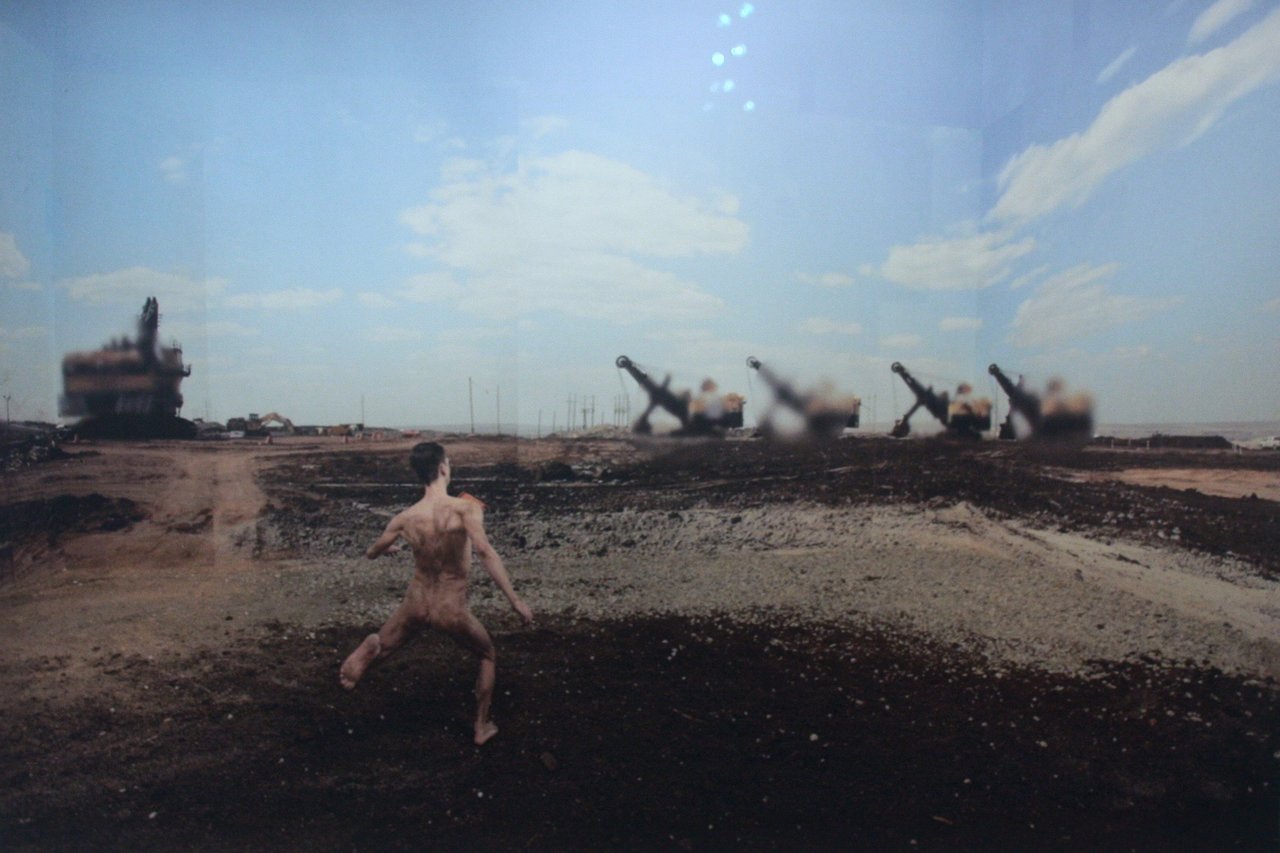 Kristopher Karklin, Runner, 2015, inkjet print, edition of 7, 36″ x 54 “. Photo: Catherine MacArthur Falls
This mediating effect stems in part from Karklin’s use of photocollage. The backdrops of sky, forest, and field we see in his images are Karklin’s original snapshots of the landscape, which he has pasted like wallpaper to the inside of his scale models and then re-photographed as part of the whole scene. The works are thus not only photographs of built environments, but also photographs of photographs. As the viewer, our distance from the ‘real’ landscape — the landscape that is up there, in northern Alberta, right now — is very far indeed. This distanciation mirrors that of the figures, who are separated from their environment in a number of ways. The most obvious of these, of course, is that the figures represent real people, while the environments are fake on almost every level. But there is also separation by process. Photographed independently, the figures and their environments never inhabit the same space or moment in time — wherever and whenever that might be — until Karklin artificially stitches them together. The snowshoer in “Pipeline” never actually snowshoed past the pipeline; the runner in “Runner” never really ran through the industrial site. The place and time captured in the image never existed. It is a disjuncture that reveals itself in the uneasy, often incongruous, positioning of each figure within his space. The awkward gait of the runner, for instance. The implausible physics of the jumper in “Reclaimed Tub”. The asynchronicity of the snowshoer, whose blurred edges suggest movement, but whose posture is rather still, wooden. It all adds up to a very clear sense of alienation between the figures and their environment, one that Karklin says was a palpable component of his experience in northern Alberta.
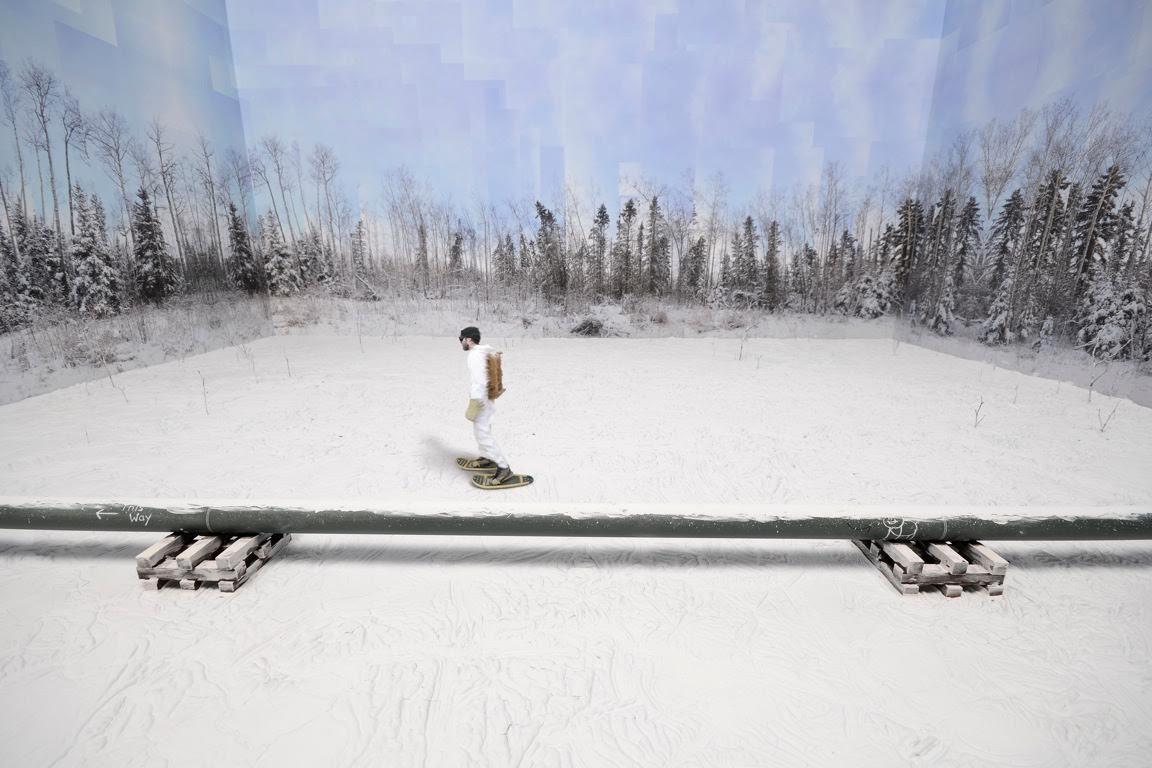 Kristopher Karklin, Pipeline, 2015, inkjet print, edition of 7, 36″ x 54″. Photo courtesy of Barbara Edwards Contemporary
It is an effect that is somewhat complicated by Karklin’s enclosure of his environments within the interior space of the model. This seemingly small move to bring the outdoors in constitutes a shift from his previous work, which involved maquettes of solely interior spaces. Of his new work, Karklin recalls that, while working in Alberta, he spent much of his time outdoors. The result was that the landscape became more his home than any indoor space. The series, he claims, is an attempt to capture this feeling. Yet, the work also creates a startling sense of un-hominess. By bringing the outside in, Karklin curtails an Alberta landscape known for its expansiveness, rendering it finite, enclosing. This has a surprising effect: the figures are distant from, yet confined by, their surroundings. Far from appearing at home, they seem trapped, in a way, by their rural or suburban environments. It is, perhaps, a feeling many rural, small town and suburban dwellers can relate to. Having myself grown up in suburban Alberta, I can say with certainty that it is a sense I am deeply familiar with.
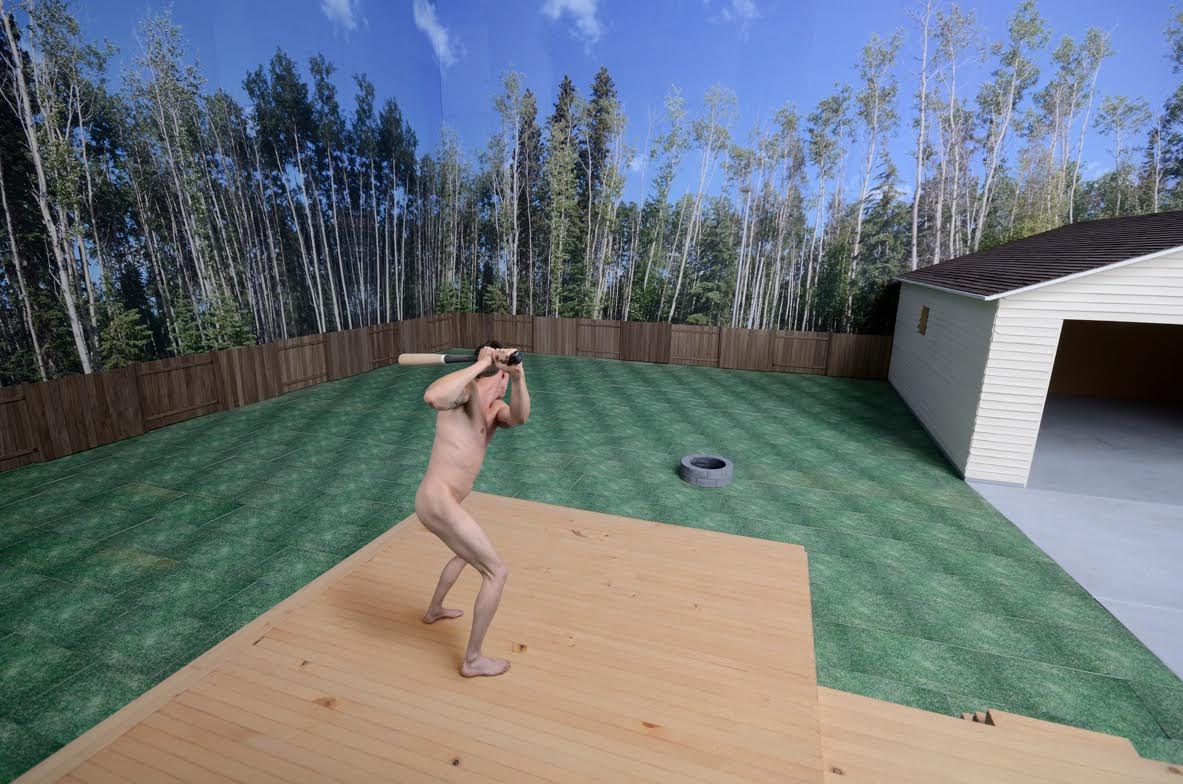 Kristopher Karklin, Backyard (Daytime), 2014, inkjet print, edition of 7, 36″ x 54″. Photo courtesy of Barbara Edwards Contemporary
Karklin at least partially exposes the interiority of his outdoor spaces by allowing signs of his work’s construction to remain visible. A sky will have clearly discernable corners, for example; a forest will have conspicuous seams. Shadows will appear where none should be. It is a display of artifice that also manifests in the materials and textures used—in the hard, plaster-like snow in “Pipeline”, the flat graphic water surface in “Reclaimed Tub”, or the tiled grass in “Backyard (Daytime)”. As Karklin explains, he uses such techniques to emphasize the fakeness of the environment, to bring the landscape into focus, to preclude it from blending into the background. Such details force us to consider the landscape and its relationship to its inhabitants. And, while these details are allowed to show through, many others are conspicuously erased. In all but one photo, for instance, the figures are photographed nude. Karklin thus strips them of much of the information that differentiates one individual from another. The landscape is similarly stripped. In Karklin’s backyard scenes, no toys or lawn equipment are left on the grass, no pots of flowers beautify wooden decks, no Christmas decorations, tools, or sporting goods wait patiently in the garage. There is no sense that anyone really lives in these spaces at all. These are places, persons, and lives that are eerily generic, replicable.
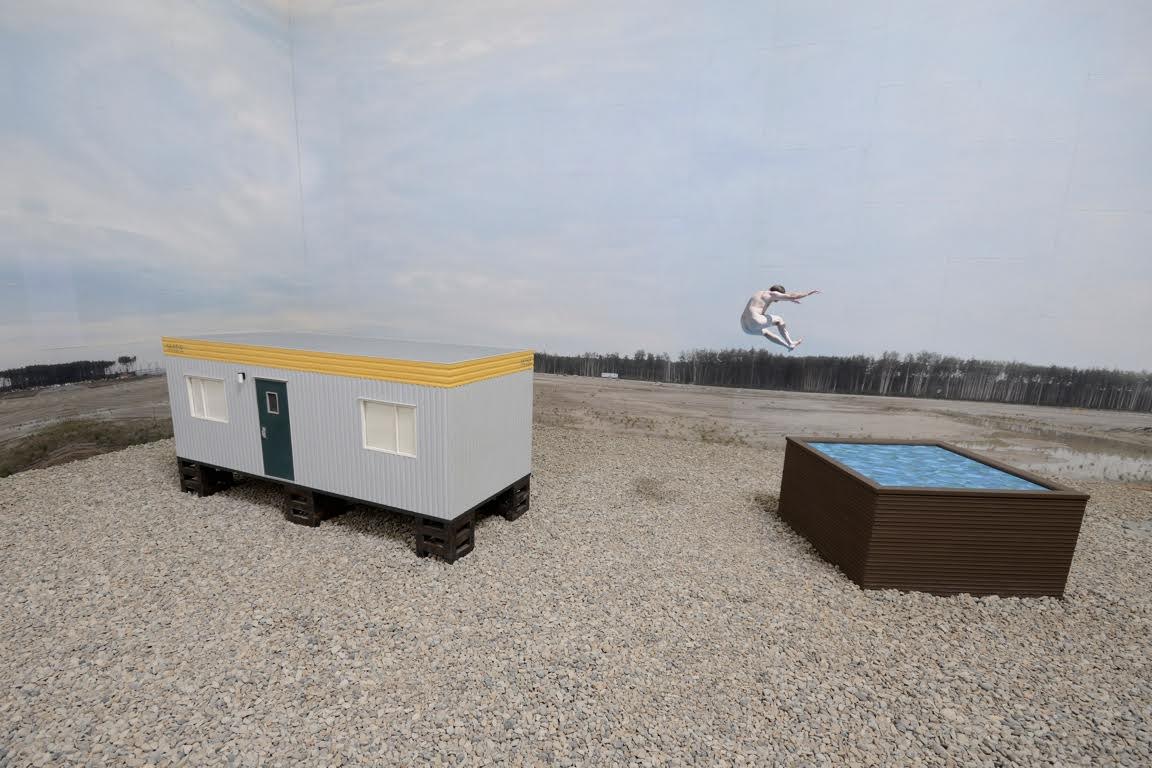 Kristopher Karklin, Reclaimed Tub, 2014, inkjet print, edition of 7, 36″ x 54″. Photo courtesy of Barbara Edwards Contemporary
The series is, all in all, full of tensions and provoking contradictions, not unlike the real landscape that inspired it. And though it is hard not to read Karklin’s work as a critique — particularly of a place that continues to receive so much negative attention — he is careful to note that he did not set out to produce political art. He was, rather, simply attempting to document the often-surreal place in which he was living, in all of its ambiguities. In this and many other respects, the work is spectacularly successful. But don’t take my word for it. Even this early in his career, Karklin’s sales history speaks for itself. Many of his pieces currently reside in the collection of Sir Elton John, for instance. Meanwhile, the entire set currently on display at BEC has been purchased by a major yet-to-be-announced Canadian museum. This means — fingers crossed — that it would be available for public viewing for many years to come. We should be so lucky.
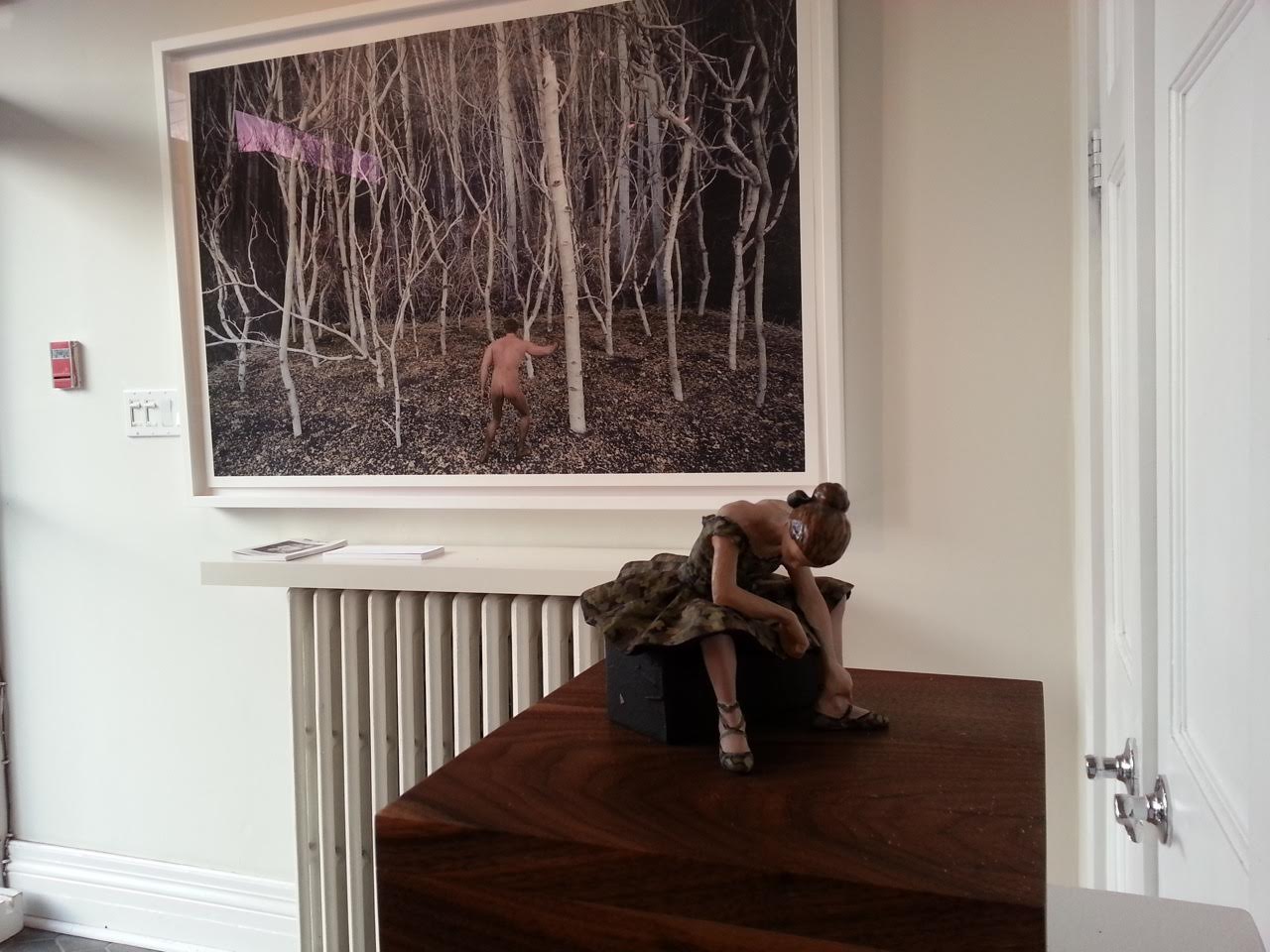 Installation view with Kristopher Karklin, Hunter, 2015, inkjet print, edition of 7, 36″ x 54″. Photo courtesy of Barbara Edwards Contemporary
Catherine MacArthur Falls
*Exhibition information: November 20, 2015 – January 9, 2016, Barbara Edwards Contemporary, 1069 Bathurst Street, Toronto. Gallery hours: Tue to Sat, 11 am – 6 pm (or by appointment).