Category: EVENTS
-
The Multiple Narratives in ‘Form Follows Fiction’
Prior to seeing Form Follows Fiction: Art and Artists in Toronto at the University of Toronto Art Museum, I was extremely skeptical. With a scope as large as ‘Art and Artists of Toronto’ and a showcase of work by 86 artists, I wondered how someone could thematically arrange such a broad spectrum of work into a cohesive exhibition. But after seeing it three times, hearing the curator’s talk, and reimagining the diversity of work to be a direct reflection of the diversity of Toronto, my skepticism was put to bed.
The theme of identity and the desire to define a sense of place is universal. I’ve had the privilege of discovering that after a brief period of separation, a weekend in Montreal or a year in London, the cultural and environmental characteristics of a city become much more distinct. Whether you’ve been here your whole life or migrated recently, everyone defines their sense of self through their similarities and differences to others—and the artists in Form Follows Fiction do just this. Using performative and allegorical processes, described as such by curator Luis Jacob, the work explores how the artists’ conditions have shaped their sense of place.
Form Follows Fiction is not historical, chronological, or a history of art in Toronto. Instead, over 100 works are thematically arranged under four outlined gestures: mapping, modelling, performing, and congregating. While the works span a period of about 50 years of artistic production, with historical documents dating as far back as the eighteenth century, Jacob’s exhibition was an honest and exciting exploration of artists in Toronto.
The exhibition was split between Justina M. Barnicke Gallery and the University of Toronto Art Centre. I luckily started at Justina M. Barnicke Gallery, where the works played a major introductory role. Through extremely diverse subject matter and materials, the work loosely dealt with how history informs our cultural environment. Whether asking more complex conceptual questions surrounding the formation of space or directly referencing legislative frameworks, the allegorical subtleties of the works create a powerful narrative about the ‘vacant lot’—a term used by Jacob as a metaphorical tool to consider how space is mapped both literally and figuratively.
The first work that strikes you upon entering the gallery is Premises for Self-Rule by Saulteaux First Nations Canadian artist Robert Houle. The work is comprised of four canvases visualizing four legislative acts in Canadian history. The middle canvas on the far right wall refers to the ‘Indian Act’ of 1876, a legislative act that became the initial basis for aboriginal assimilation by disallowing the practice of aboriginal ceremony, determining the land base of aboriginals in the form of reserves, and defining who qualified as an ‘Indian’ through Indian status. Despite undergoing numerous amendments, the act is still in place today (which is difficult to imagine considering that Canada was the first country in the world to adopt multiculturalism as an official policy in 1971). Houle’s works act as a ‘panorama’ of a legislative framework that contributed to the cultural upheaval of Indigenous people. Mediated between tradition and an imposed assimilation into Canadian culture, many natives still experience the ramifications of these highly controversial acts today.
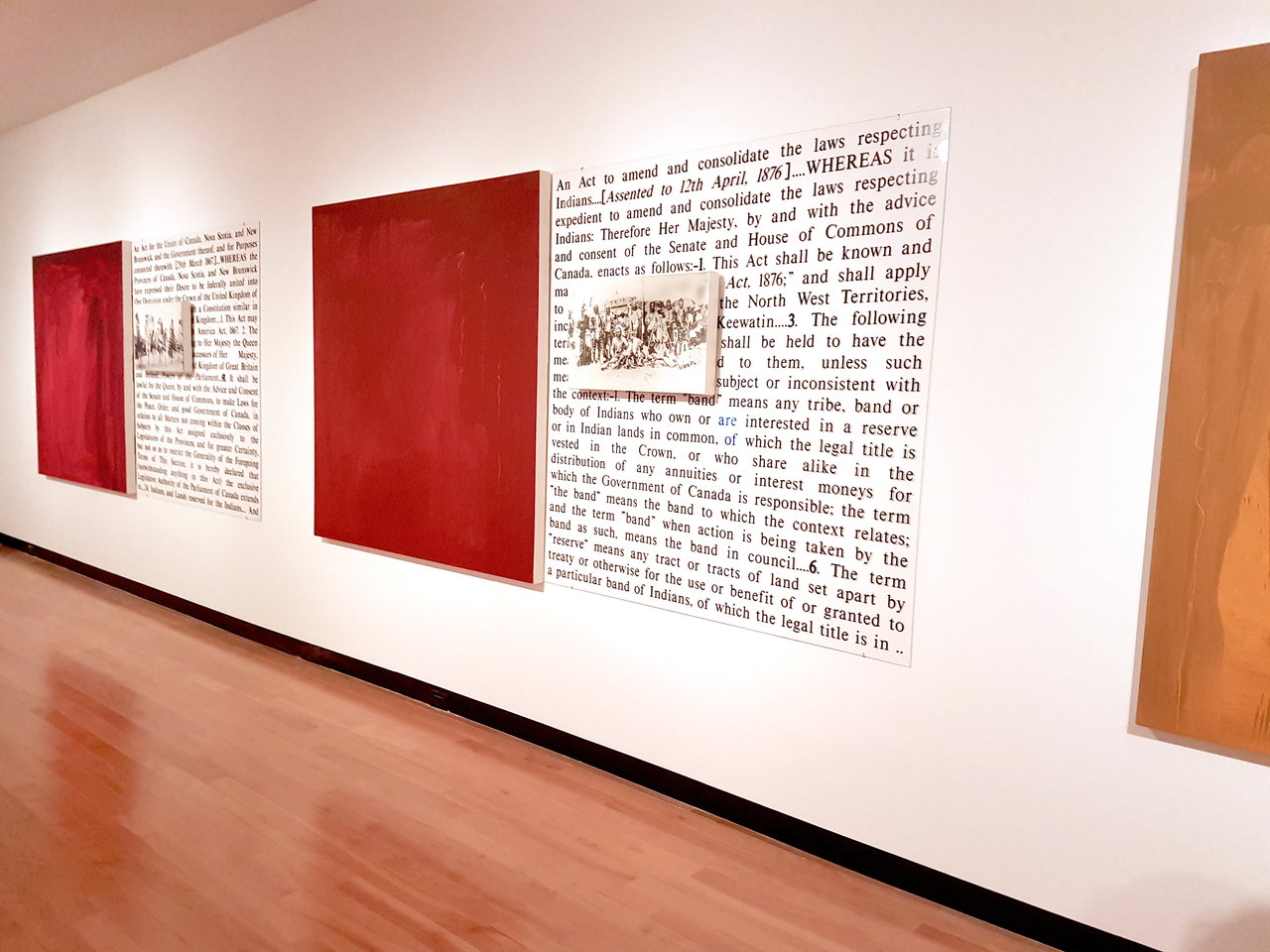 Robert Houle, Premises For Self-Rule, 1994, oil on canvas, photo emulsion on canvas, vinyl
Other notable, and slightly less politically charged, works in this gallery were Lisa Steele’s Birthday Suit—with scars and defects, Gordon Lebredt’s Get Hold of This Space, and Carole Conde & Karl Beveridge’s Work in Progress. Steele, born in Kansas City now living and working in Canada, created this video on the occasion of her 26th birthday, showcasing a history of the artist’s life through various injuries and scars and revealing another method of mapping. Winnipeg-born Gordon Lebredt presents a giant black box outlined on the wall with the words ‘GET HOLD OF THIS SPACE’ nestled inside, which articulates our relationship with space using the metaphorical notion of the ‘vacant lot’.
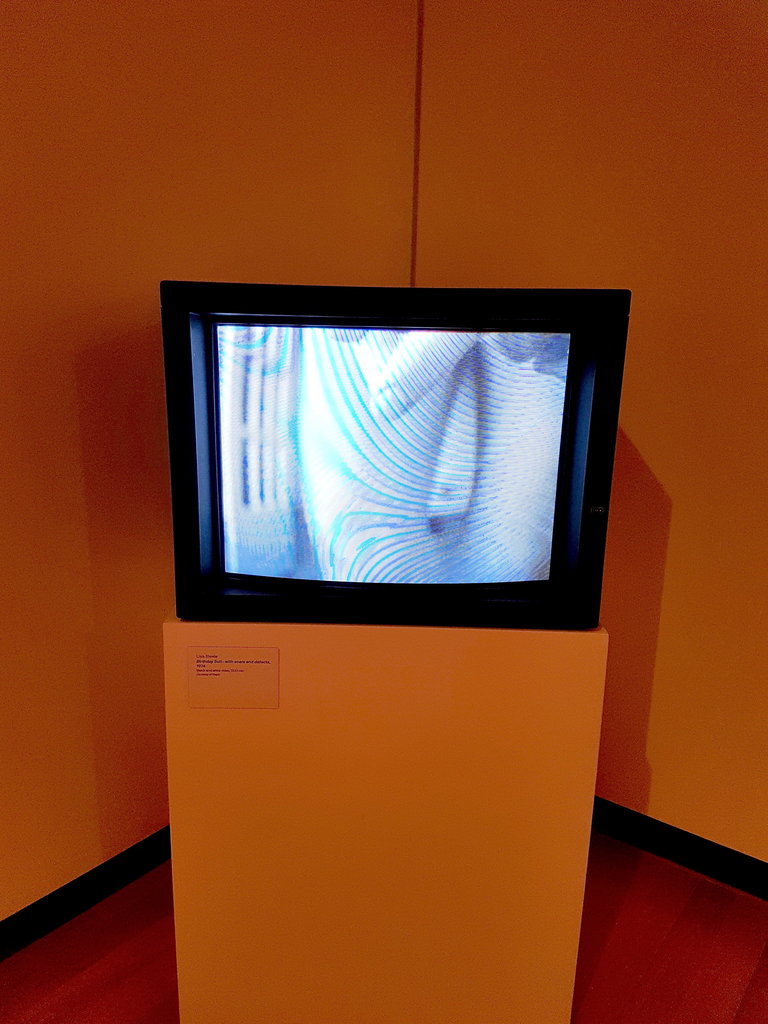 Lisa Steele, Birthday Suit—with scars and defects, 1974, black and white video, 13:23 min
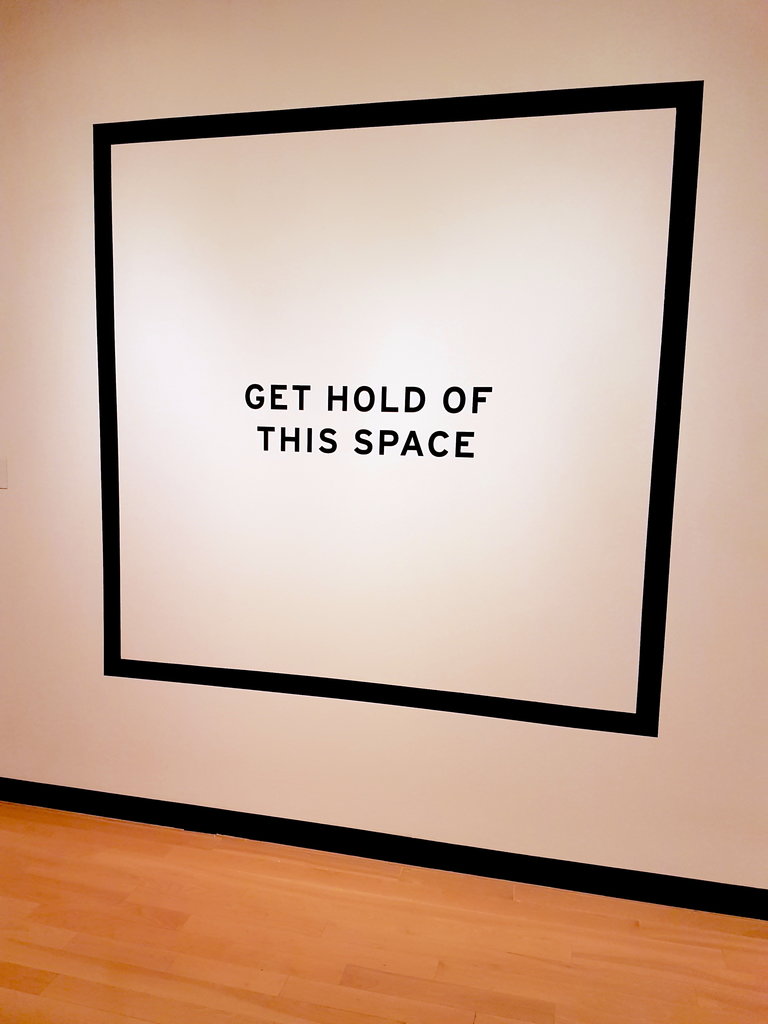 Gordon Lebredt, Get Hold of This Space, 1974/2010, latex paint and vinyl lettering
Canadian artists Conde and Beveridge present photographic panoramas that demonstrate a view of working women over twelve decades. Each woman is posed in a kitchen, where objects have been thoughtfully staged and the windows frame a documentary photograph relating to the politics of the period.
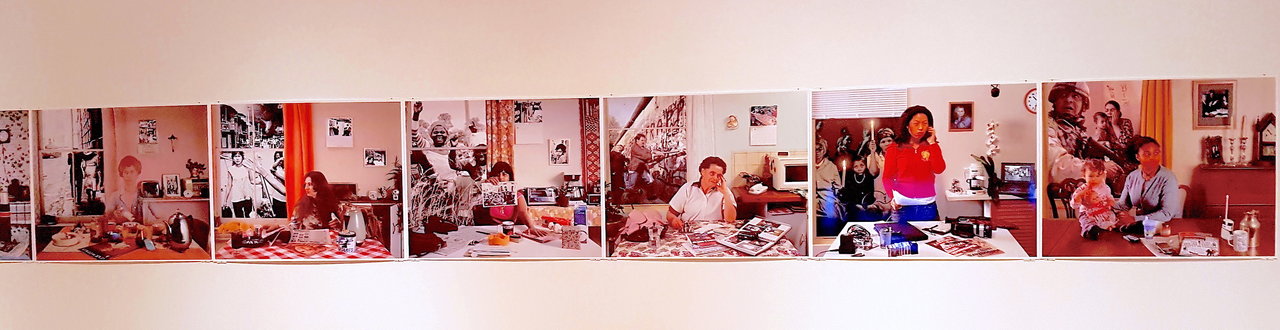 Carole Conde & Karl Beveridge, Work In Progress, 1980-2006, archival pigment print
Thus far, the exhibition was winning me over, but as an important aside, the curator’s talk played a major role in my reception of the work. Without it, I didn’t fully appreciate the relevance of certain works or their subtle relationships to one another. Now, to be clear, I am not calling for text panels about the thematic arrangement (which were also not provided), but individual explanations of specific works. For fear of sounding old fashioned: an exhibition of this scale needed some explanatory text panels. For contemporary art exhibitions outside of a major institutional setting, this practice is generally unheard of, but explanatory texts are not just for museums or posthumous shows.
Before listening to the curators talk, I felt that some of the works were misplaced, but after it I had those “A-ha!” and “Ohh” moments, where I thought, “NOW I get it!” For those unable to attend, explanatory texts could have filled in the gaps and brought the exhibition together. As someone in the arts, there is always that initial fear of embarrassment when you can’t make the leap between artwork and concept, but in many ways this gap is reflective of the exhibition and not a fault in an audiences viewing methodology—especially in a show with over 100 works.
Moving across to UTAC, which is markedly larger, I braced myself for an abundance of work. The first piece that captured my attention was Lifestyle Series by Ojibway artist Keesic Douglas. Four photographs feature an Anishinaabe couple surrounded by stereotypical features of their culture. Each photograph is a scene, staged and lit like a movie set. The couple are surrounded by dream catchers, stereotypical ‘Indian’ statuettes, deer skin drums, a Pocahontas mug, and many other ‘Indigenous’ objects. Living in these tableaus, the couple are surrounded literally, and figuratively, by the Indigenous stereotypes persisting in contemporary Canada. As Douglas once said in an interview: “I see photography as a reflection of the things around us.”
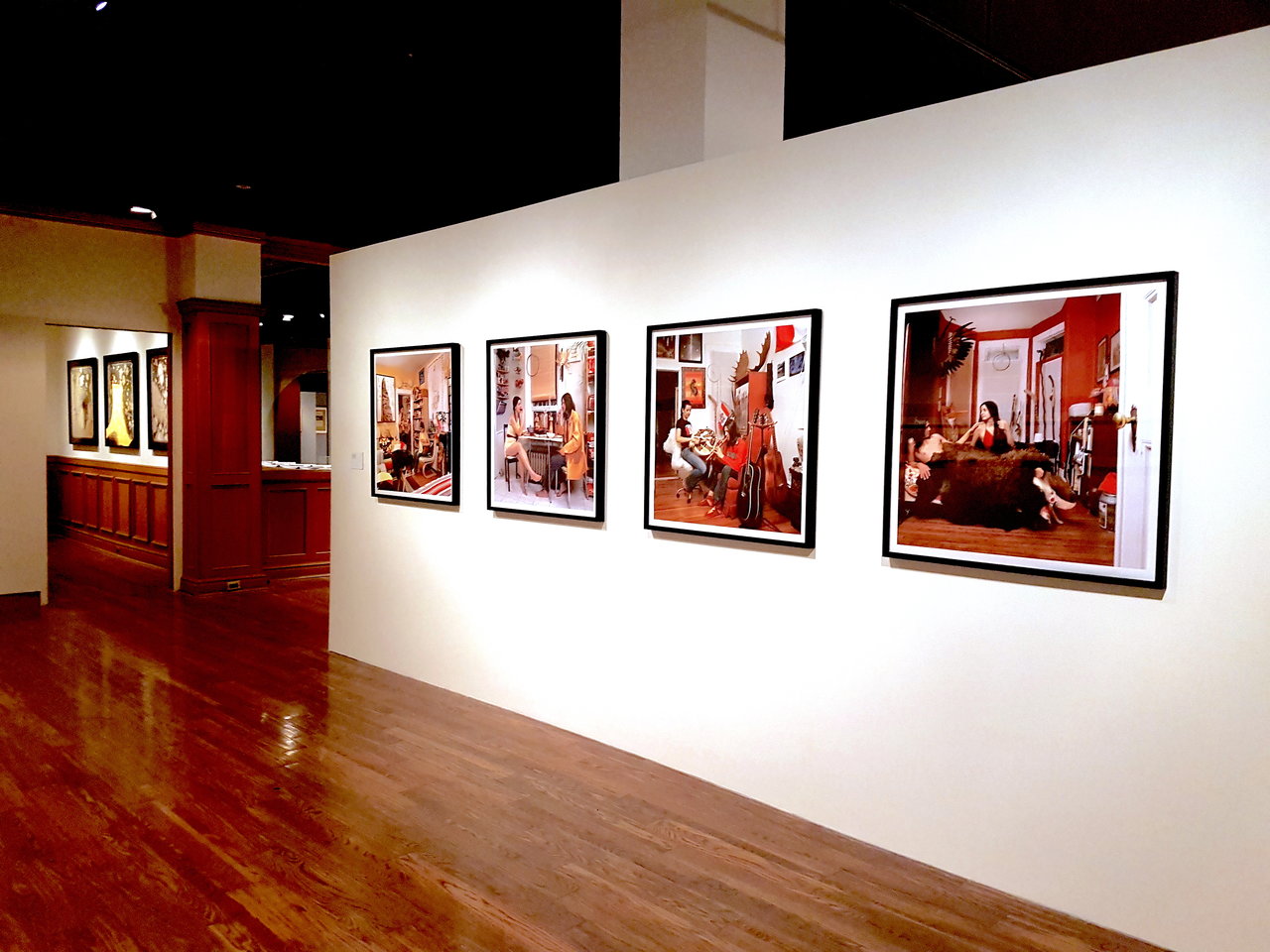 Keesic Douglas, Lifestyles, 2007
At this point I realized something: native and migrant groups likely experience a ‘sense of place’ quite differently. Indigenous people have dealt with a (forcible) shift towards assimilation against their established customs and traditions, while many migrants assimilate through choice. The experiences of these two groups created an interesting dialogue between how they are defined in relation to one another and how they mediate the space in-between. This is one of the exhibitions greatest successes, the representation of a diverse spectrum of artists from Indigenous, Canadian and migrant perspectives.
Despite outlining four thematic gestures at the beginning of the exhibition, there is no signage to designate which one was which, and no attempt to simplify the works into categories. This approach allowed the art and artists to escape restrictive definitions under thematic titles, and reiterated the diversity reflective of every major city. One of the greatest disservices an exhibition of this scale can do is to presume that 86 artists can be organized into neat categories.
As you delve deeper into the exhibition you are greeted by two crocheted banners stating “WE CAN’T COMPETE” and “WE WON’T COMPETE”. Created by Canadian artists Deirdre Logue and Allyson Mitchell, founders of FAG (Feminist Art Gallery), the works seek to reject the patriarchal art system, calling the biased structures that continue to govern contemporary artistic practice into question. FAG opens up spaces and creates opportunities for queer, feminist and local communities to converge and overlap. Negating existing structures and proposing a new trajectory, this work dealt with the same metaphoric themes as the work around it.
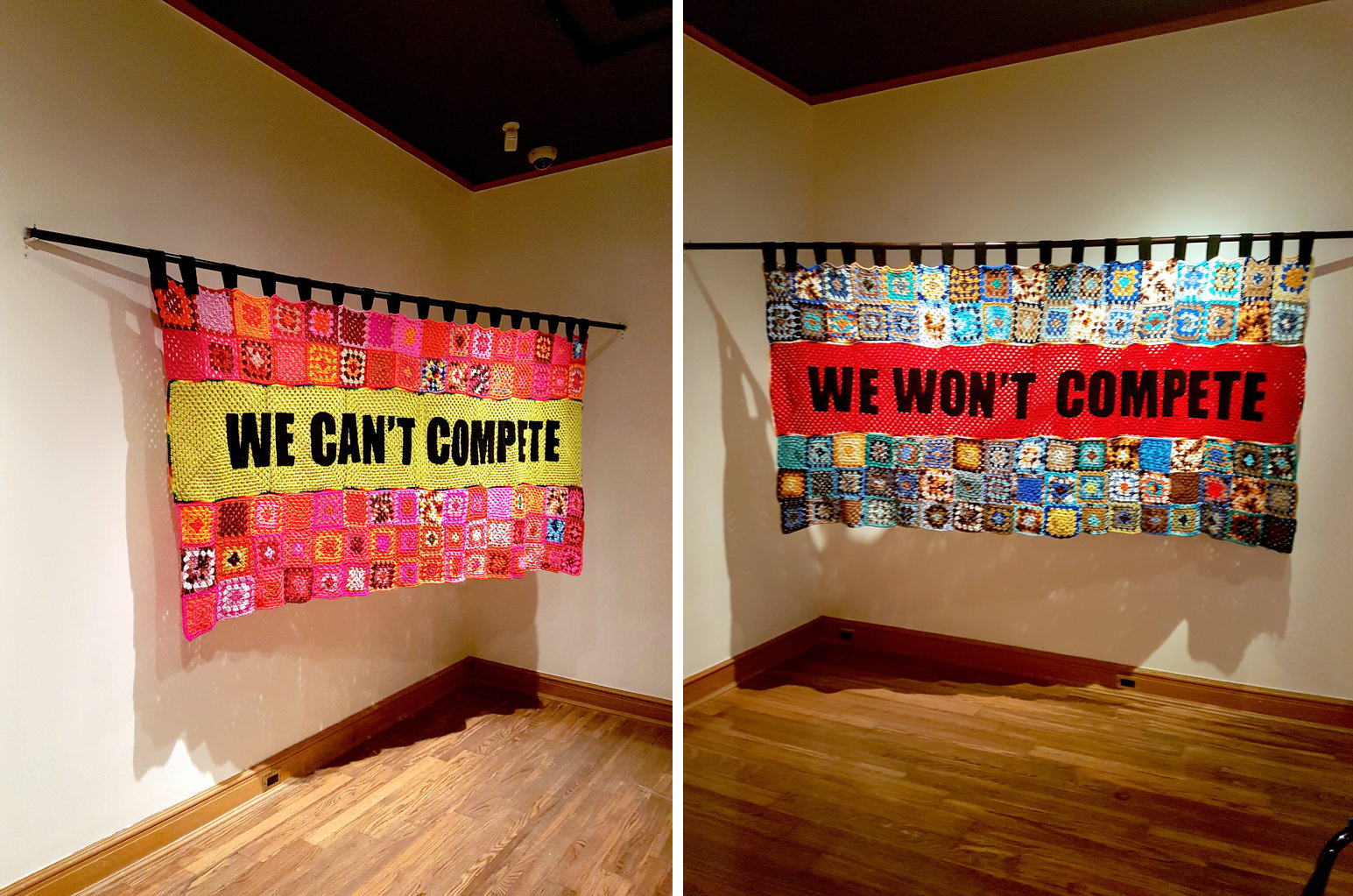 Deirdre Logue and Allyson Mitchell, CAN’T/WON’T, 2012, crocheted squares
In his talk, Jacob described this area through the allegorical notion of ‘modelling’. In society there exists a series of models—systems used as an example to follow or imitate. In almost every instance, we either reject them, do not measure up to them, or feel that we are much more than them. This whole room, from Suzy Lake’s A Genuine Simulation of… to Nobuo Kubota’s Reflections I, aims to define an individual sense of self. Suzy Lake, an American-born artist living and working in Toronto, created a series of photographs depicting the artist with varying amounts of makeup on her face. She is recognizable in some photographs while in others the makeup sits on her face like a mask. Lake raises key questions about authenticity, and how conforming to societal ‘models’ can turn you into an artificial version of yourself. Kubota’s work, on the other hand, is a matter-of-fact kind of work. The Canadian artist created a unified mirror that looks like two mirrors intersecting one another. This work, in the centre of the space, ties the artworks together. It is an invitation to look at oneself directly.
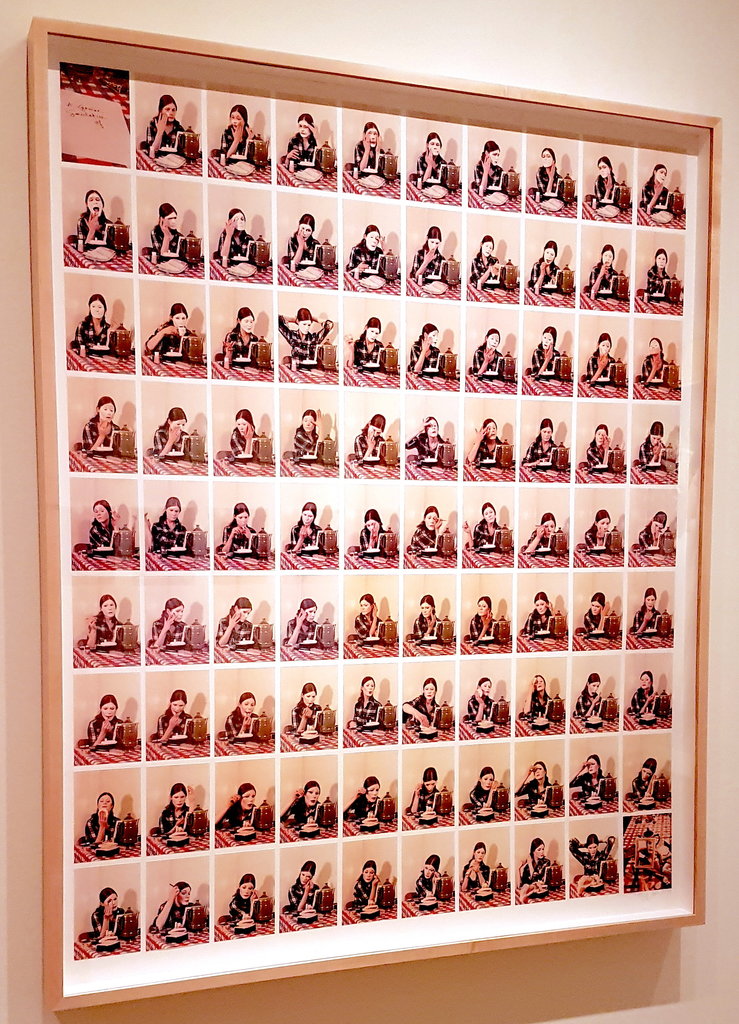 Suzy Lake, A Genuine Simulation of…, 1973-74, chromogenic prints drymounted
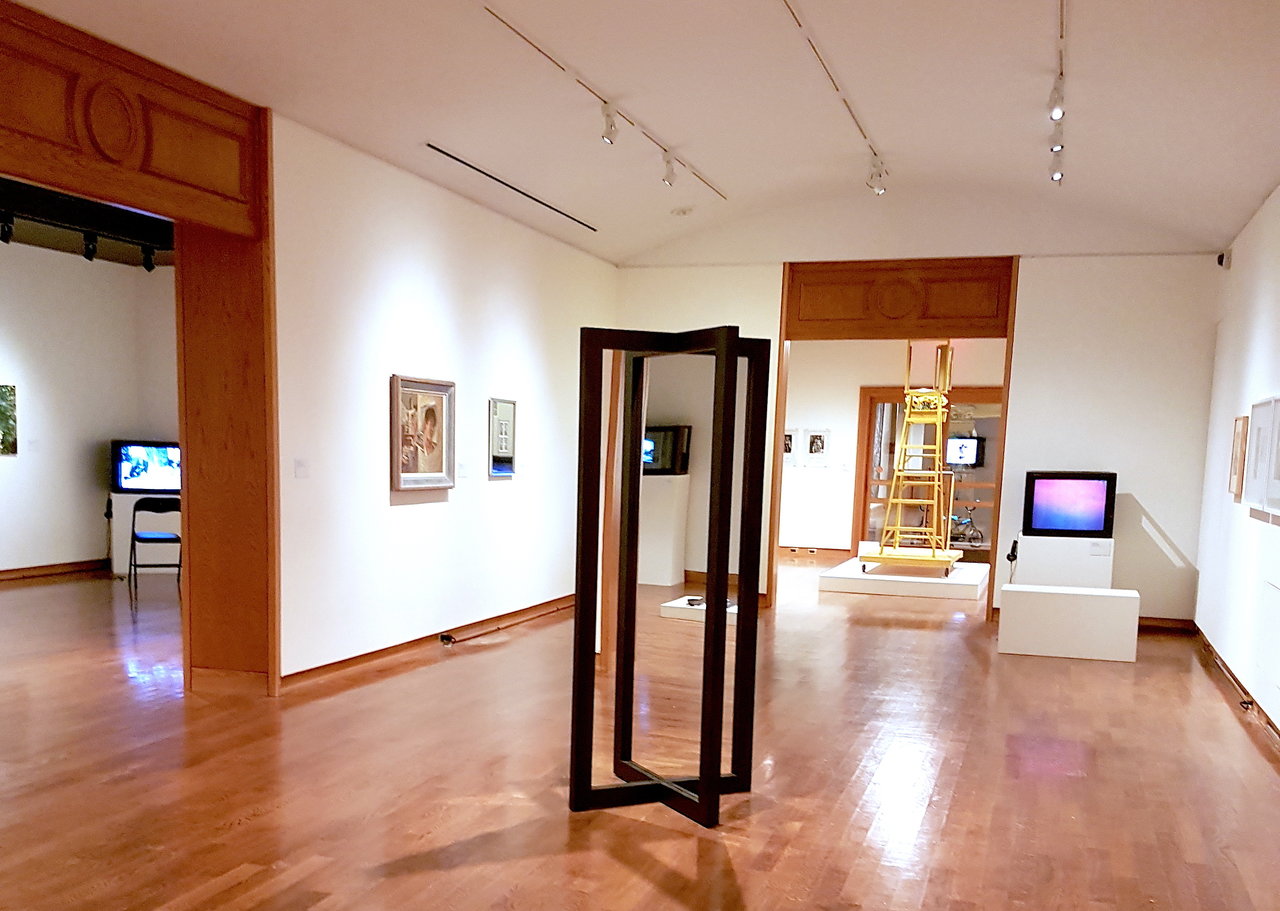 Nobuo Kubota, Reflections I, 1969, wood and mirror
Having only spoken about eight works, I could have easily written about every piece in Form Follows Fiction. Other major artists in this exhibition worth noting are Michael Snow, General Idea, Joanne Tod, Joyce Wieland, and many others; all of which are featured in the Art Gallery of Ontario’s Toronto: Tributes and Tributaries, 1971-1989. I initially wanted to review Form Follows Fiction in isolation of the AGO’s showcase, but there were too many comparisons to not give it a passing nod.
Toronto: Tributes and Tributaries, 1971-1989 brings together more than 100 works by 65 artists and collectives. It explores art in Toronto in the 70s and 80s, a time of economic prosperity as well as social and political upheaval. The AGO structured the exhibition as you would expect; the text panels and thematic organization were definitive of an institutional exhibition. The sections dealt broadly with ‘Performance’, ‘Self/Portrait’, ‘The Body’, ‘The Image’, ‘Representation’, etc. Overall, it was a fantastic exhibition. However, its greatest failure was Form Follows Fiction greatest success: it simplified a vast body of work into neat categories.
In Form Follows Fiction, every work deserved the time spent, which perhaps amounted to the exhibitions greatest shortcoming. With too many works to provide explanatory texts, and not enough time to appreciate them all, only a proportion of the show could be absorbed by any one visitor.
Text and photo: Megan Kee
*Exhibition information: Form Follows Fiction: Art and Artists in Toronto, September 6 – December 10, 2016, Justina M. Barnicke Gallery and University of Toronto Art Centre, under its new name: Art Museum University of Toronto, 7 Hart House Circle and 15 King’s College Circle, Toronto. Gallery hours: Tue & Thu – Sat 12 – 5 pm, Wed 12- 8 pm.
-
unheimlich / upcoming surrealist artists show

Sigmund Freud described the uncanny or unheimlich as, something that is familiar to us in some ways, but it is also strange and unknown. Our gallery exhibition is being hosted in an uncommon space (a student townhouse) and will capture some of what Freud was talking about in “The Uncanny”. The exhibition will display a diverse selection of art created in different mediums, including painting, print, and sculpture.
The collection features these up and coming surrealist artists:
Alex Pereira
Else Holler
John Campbell
Kaylin Andersen
Mike Webber
Rebeca D’Alessandro
Sarah Brittany Lowe
Shelby HackshawCurated by Kaylin Andersen
Assistant Curator, Sarah Brittany Lowe*Exhibition information: April 29 – May 6, 2016, 3061 Sir John’s Homestead, Unit 46, Mississauga. Gallery hours: Mon – Sat: 12 – 5 pm. $2.00 Admission
-
Politics of Fashion | Fashion of Politics
Politics of Fashion | Fashion of Politicsat the Design Exchange is an obvious treat for fashion lovers, the show also offers a great deal for art lovers too to mull over.
 Installation view.
Guest curated by the legendary Canadian fashion generalist, Jeanne Beker, and DX curator Sara Nickleson, Politics of Fashion | Fashion of Politics examines the increasingly communicative role of fashion in a modern society where politics, art and fashion interact with fervour. The curatorial statement emphasises fashion as a vehicle for social change, a platform for ideological assertions, and the act of dressing as a means for the expression of communal values. Fashion’s evolving treatment of themes including consumerism, activism, gender, sexuality, ethics, and power are documented here in this show.
 Moschino, “McDonalds Dress, 2014”. From the collection of Moschino.
There is feminist art from FEMEN Quebec, Nick Knight addresses race on the runways in a short fashion film, and the English Mod and Skinhead subcultures are examined. Hybrid pieces from Rad Hourani’s gender neutral line sheds gendered clothing traditions with designs rich in geometric shapes, solid colors, and strong, clear lines. Samples from Vivienne Westwood’s post-apocalyptic collection predict fashion in a future where climate change and environmental degradation continues. Outfits feature gasmasks, bleak colours, repurposed material and scraps, army surplus, and unfinished and jagged hems.
 FEMEN, “Crown”, 2013. FEMEN Quebec. From the collection of FEMEN Quebec.
 Rad Hourani, “Looks from Collection #12”. From the collection of Rad Hourani.
 Vivienne Westwood, “Climate Revolution Cape”, 2013. . From the collection of Pearl Westwood.
A highlight was the collection of vintage paper dresses on display. These A-line minis reek of the 1960s; they are boldly patterned or else they are vibrantly coloured in addition to being incredibly short! The dresses feature popular political figures of the era such as Pierre Trudeau and Richard Nixon.
A product of the media-image loving post-war consumer society of 1960s America, disposable paper dress fashion embodied ideologies of consumption, mass-production, and commercialism. Scott’s “Paper Caper” dress pitch ran: “Won’t last forever…who cares? Wear it for kicks—then give it the air.” Wearers displayed overt support of specific politicians, but more importantly, alliance with popular consumerist ideologies.
 From left to right: Dress 1, 2, 3: Paper dresses created for the Republican Party National Convention. 1968. Printed and bonded cellulose fibre, Dress 4: Paper dress created for the Liberal Party Leadership Convention. 1968. Printed and bonded cellulose fibre. Collection of the Fashion History Museum.
Like the pop-art that erupted during the same era, these paper dresses were for the masses. They are a form of pop-art in and of themselves, incorporating representational campaign images from the media and functioning as wearable advertisements. These paper dresses mark an overt merger and interaction between popular fashion, art, and politics.
Text and photo: Emily Kovacs
*Exhibition information: September 18, 2014 – January 25, 2015, Design Exchange, 234 Bay Street, Toronto. Gallery hours: Mon & Wed-Sun: 11 – 6 p.m., Tue: 11 – 9 p.m.
-
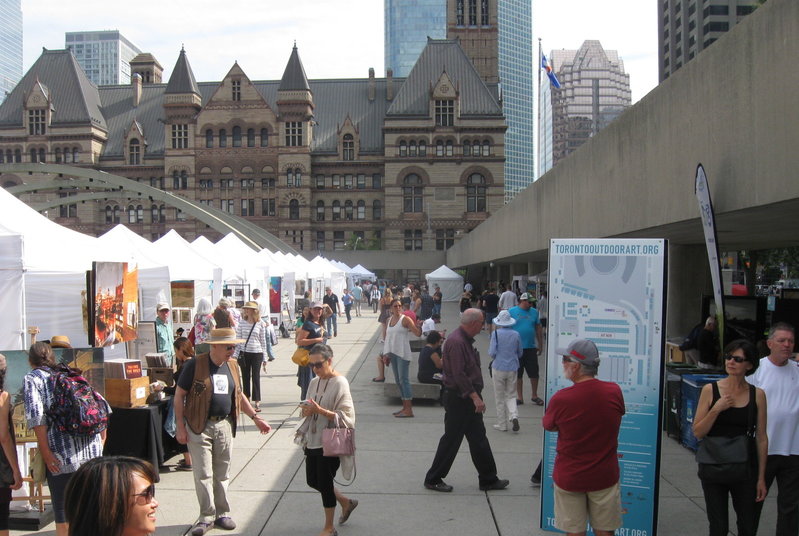
Queen West Art Crawl
 Queen West Art Crawl, 2013. Photo: Phil Anderson
Queen West Art Crawl
September 13 – 14, 2014
Queen West around Trinity-Bellwoods ParkFor Events and Locations please check: http://www.queenwestartcrawl.com/.
The Queen West Art Crawl began as a one-day event in 2003. Since then it has blossomed into a weekend-long festival of creativity and community. Our goal is to celebrate and cultivate the unique character, diversity and ethos of Parkdale and Queen West – a natural habitat for individual artists, arts organizations, artist run centres and businesses that promote art and culture.
2014 marks the 12th anniversary of the Queen West Art Crawl.
Come on down and enjoy the festivities along Queen Street West from Bathurst to Roncesvalles, taking place from September 21 – 22. Purchase a great work of art from one of our 250+ jury-selected artists at the Outdoor Art Show and Sale in Trinity-Bellwoods Park, or take part in a walking tour and attend a talk by one of our featured guest speakers. There are plenty of art events for crawlers of all ages, from the family-friendly KidsZone, to the New Crawl West, an art walk on Saturday and Sunday. Don’t miss out on all the action!
The 11th annual Outdoor Art Show & Sale will take place at Trinity Bellwoods Park on Saturday, September 13 to Sunday, September 14, from 11 am – 6 pm.
The main hub of the Queen West Art Crawl, the OASS is a two-day juried art exhibition featuring over 250 artists and artisans, food vendors, community booths, an exciting entertainment stage and our family friendly Kidz Zone.
-
Over the Rainbow / Speaker Series
 Attila Richard Lukacs, Coo coo ka-choo, Mr. Robinson (detail), 1999. Collection of Salah Bachir and Jacob Yerex. Photo: Toni Hafkensheid
Thursday, June 26, 2014 / 7 – 8 p.m.
Museum of Contemporary Canadian Art
952 Queen Street WestOver the Rainbow / Speaker Series
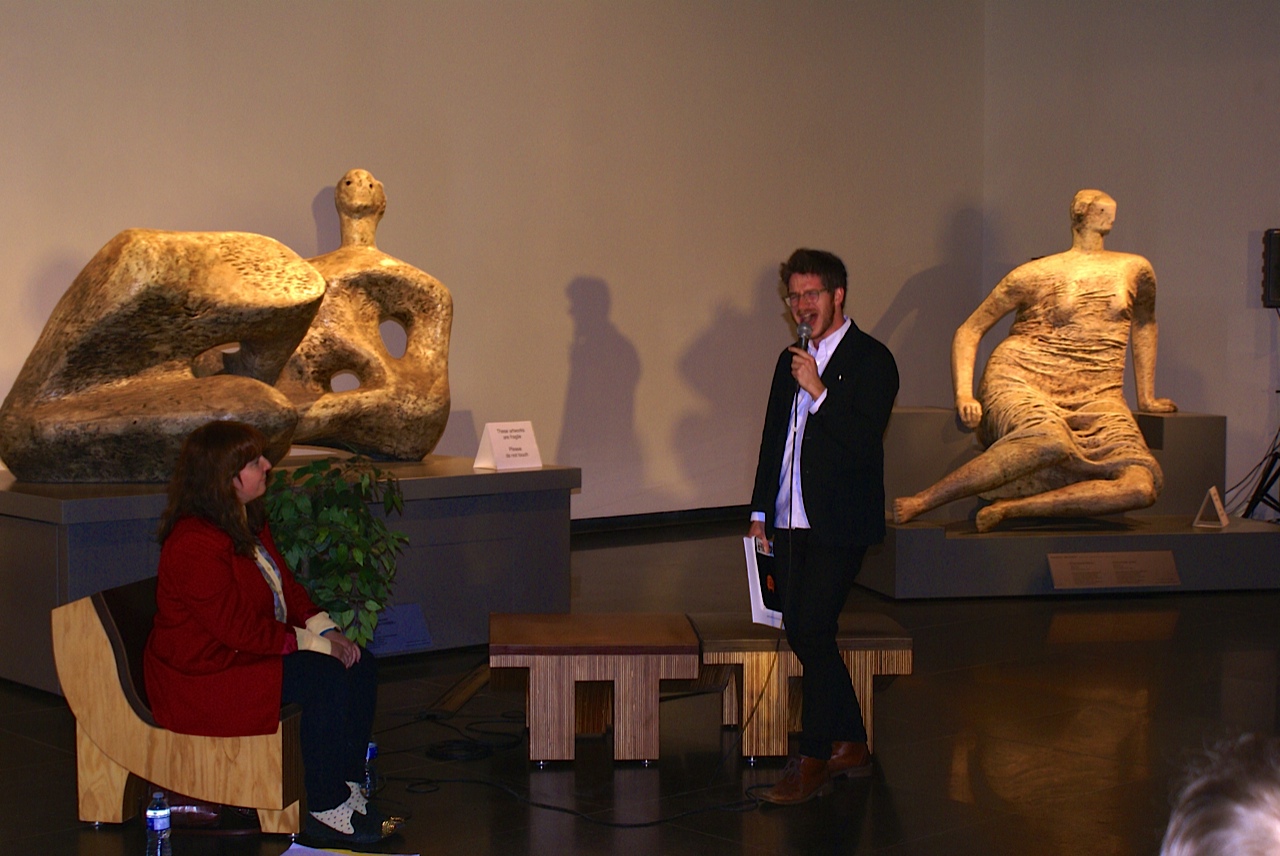
Exhibiting artists Stephen Andrews, Andy Fabo, Elle Flanders, and Attila Richard Lukacs will join Artistic Director and Curator David Liss to discuss themes of seduction and identity.
The exhibition represents a modest selection of works from the collection of Salah Bachir and Jacob Yerex, by both queer and heterosexual artists, broadly assembled around the themes of seduction and identity. Grouped together the exhibition presents works, mostly in drawing, painting and photography, which acknowledge certain archetypes associated with Queer Culture, drawing relationships between a historically marginalized culture and mainstream culture, and ways in which these have influenced each other. By focusing on reciprocal influences and relationships, and presented within the context of WorldPride 2014 Toronto, the thematic approach is meant to consider commonalities of human experience over opposition and difference.
-
Power Plant / Fall 2013 Opening Party
Fall 2013 Opening Party
Friday, September 20, 2013 | 8:00 p.m.
The Power Plant
231 Queens Quay West, Toronto
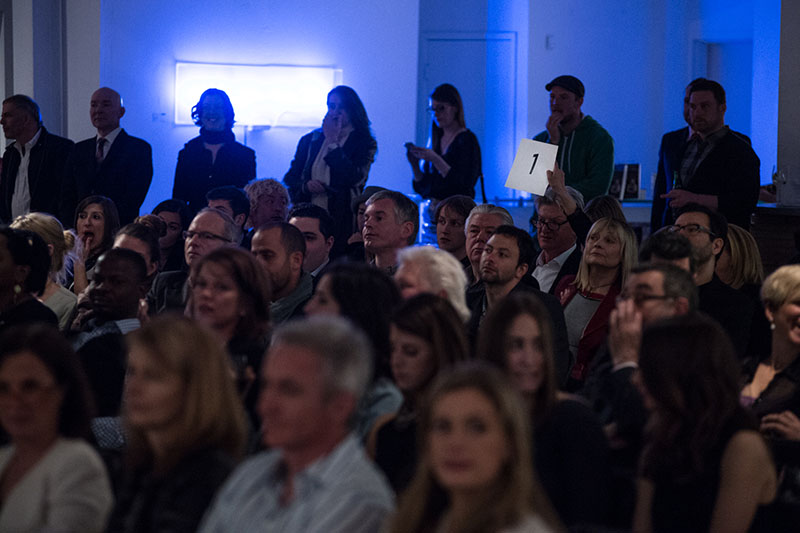
Join The Power Plant for the celebration of the opening of the fall exhibition Micah Lexier: One, and Two, and More Than Two on our lakeside patio. Party under the stars with featured artist Micah Lexier and many of the artists represented in the More Than Two portion of the exhibition. Enjoy music by Kikileaks and food by Gourmet Bitches. A cash bar will be available all evening.
In Fall 2013, The Power Plant presents a survey of significant work by Toronto-based artist Micah Lexier, bringing together an important selection of recent work that reflects the artist’s diverse and dynamic practice. At his most ambitious, however, is Lexier’s More Than Two (Let It Make Itself), a curatorial project that displays over 200 new and recently created artworks and objects by 101 artists/duos/collectives in and around Toronto.
The exhibition is open: September 21, 2013 – January 5, 2014, The Power Plant 231 Queens Quay West. Gallery Hours: Tue – Sun 10 – 5 p.m., Thurs 10 – 8 p.m.
-
Geoffrey Farmer wins the 2013 Gershon Iskowitz Prize
 Geoffrey Farmer
The Art Gallery of Ontario (AGO) and the Gershon Iskowitz Foundation are pleased to announce that Vancouver-born artist Geoffrey Farmer is the recipient of the 2013 Gershon Iskowitz Prize at the AGO. The award, which is presented annually to one artist who has made an outstanding contribution to the visual arts in Canada, includes a $50,000 cash prize and a solo exhibition at the AGO. Farmer’s exhibition will open in February 2014.
Borrowing elements from conceptual and installation art, Farmer’s works boldly combine sculpture, video, performance, drawing, photography and found objects. Internationally recognized for his singular approach and ability to blend poetry and social commentary in large-scale works, Farmer has received praise for his recent exhibition The Surgeon and the Philosopher at London’s Barbican Art Gallery from the Guardian for its “compelling vision.”
“Geoffrey Farmer’s works are unique because they are constructed anew each time they’re assembled,” said Kitty Scott, curator of modern and contemporary art at the AGO. “In this sense, the display at the AGO will offer visitors a chance to see the most recent workings of Geoffrey’s mind. We’re delighted to collaborate with the Gershon Iskowitz Foundation in presenting this prize to him.”
Born in British Columbia in 1967, Farmer lives and works in Vancouver. A graduate of the Emily Carr Institute of Art And Design in Vancouver, he first exhibited at the AGO in 2000. The Gallery purchased a significant work by Farmer in 2012 entitled And Finally the Street Becomes the Main Character (Clock).
“I’m deeply touched to receive this prize,” said Farmer. “Gershon Iskowitz has set an example through his generosity of spirit—a legacy that asks artists to support and help each other. I’m truly honoured.”
“One of the most important aspects of the Iskowitz Prize over time has been that it is grounded in one artist’s wish to help other artists,” said Jeanette Hlinka, president of the Gershon Iskowitz Foundation. “Gershon would be very happy that this idea is still central to the Prize, and that the artists who receive it—like Geoffrey Farmer—recognize this.”
-
“Swoon” by Katie Pretti
 Pathway 4, 2012, oil on canvas, 48 x 48 inches
October 11 – November 24, 2012
Opening Reception: Thursday, October 11, 6 – 9 p.m.
NEUBACHER SHOR CONTEMPORARY
5 Brock Avenue
Toronto, ON M6K 2K6
T: 416.546.3683
E: info@neubachershor.com
www.neubachershor.com
Hours: Wed- Sat, 12 – 5 p.m., and by appointment.Neubacher Shor Contemporary proudly presents “Swoon” by Katie Pretti.
Katie Pretti, brings forth a new and exciting collection of works which infuse her usual mastery of the canvas with pure emotion and impeccable thought. They are the culmination of her most recent experiences, traveling and working in multiple countries. A tremendous body of 14 works, SWOON is poised to become one of the most memorable shows of the year.
In between the dead past and the imagined future, it’s easy to fall victim to an invisible force. It can pull you to the ground, into the ground. If you focus on a single thing – a face in the crowd – you get less dizzy from the spinning. But there’s no use in saying that you’ll never fall again.
Katie Pretti says she feels like a ghost. Being in transit can have that effect of a person. A Tibetan might call it a bardo, a place between death and birth. Sometimes people don’t even know they’re dead and they keep walking around, enacting their daily routines, but they have no body. They no longer have any real connection to what they still believe is their life. It’s very confusing for them.
This collection of new work, created between LA and Toronto, created in transit, is about such confusion.
-
Frances Thomas: Recent Paintings

September 5 – October 6, 2012
Reception & 2nd Anniversary Party: Saturday, September 22, 2 – 4 p.m.
TELEPHONE BOOTH GALLERY
3148 Dundas St. W.
Toronto, ON, M6P 2A1
T: 647-270-7903
E: sharlene@telephoneboothgallery.ca
www.telephoneboothgallery.ca
Hours: Wed and Sat 11–6, Thurs and Fri 11 – 7 p. m.
Also featuring new works by Alison Fleming.Frances Thomas creates diffuse layered abstract compositions using an intuitive and improvisational application of medium to surface. Using complementary colours and a variety of mark making, the surfaces are imbued with rhythm and energy. Persistent themes in Thomas’s work include restlessness, anticipation and that which is unknown or unknowable. Her works convey a poetic distillation of thought, emotion, and sensation.
Frances Thomas is a Canadian artist. She holds a Bachelor of Fine Arts degree from York University in Toronto. She has participated in residencies at Pouch Cove, Newfoundland and Triangle Arts in Brooklyn, New York. Her paintings were featured in a solo exhibition titled but wait, with an accompanying catalogue, at the MacLaren Art Centre, Barrie, Ontario, in 2009/10. Thomas currently lives and works in Barrie, Ontario, and is part time faculty at Georgian College, School of Art and Design. She has exhibited in Edmonton, Barrie, Toronto and New York.
Alison Fleming‘s exquisitely rendered paintings capture urban storefronts and interiors that are familiar and iconic.
Alison Fleming graduated from the University of British Columbia in 1998 with a literature degree and studied drawing at the Florence Academy of Art in 1999. She has exhibited consistently since 2009 and won “Best in Exhibition” at the 2011 Toronto Outdoor Art Exhibition. Her work is in numerous private collections including Wedge Curatorial Projects.
-
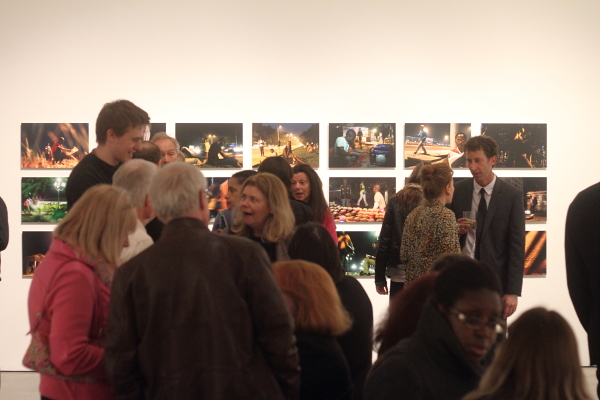
Luis Jacob “Spirits of the Grotto”
Offical launch: Friday, May 18, 2012, 5 – 5:30 p.m.
 Luis Jacob in front of his mural. Photo: Phil Anderson
The official Launch of Luis Jacob s Spirits of the Grotto at the Dufferin Underpass took place May 18 5:30pm with politicans, City of Toronto councillors Gord Perks and Ana Bailao, MPP Cheri DiNovo, MP Peggy Nash and other City Official from the Culture Department.
 Zuly Jacob (Luis’ s mother), Peggy Nash (Member of Parliament), Luis Jacob and Jose Jacob, (Luis’s father). Photo: Phil Anderson
Many interested residents and friends of Luis Jacob as well as media were also in attendance. The long awaited opening of this public art work was worth the waiting. The Dufferin Underpass is to be the envy of other areas of Toronto with underpasses.
 The “Spirits of the Grotto”, Dufferin Underpass. Photo: Luis Jacob
Artist Luis Jacob said in his interview to artoronto.ca, “The project at the Dufferin Underpass is titled “Spirits of the Grotto”. It consists of 34 panels that look like a series of large masks. Each panel has two colourful “eyes”; together they look like spirits residing inside the walls of the tunnel and watching us as we make our way inside. I imagine that some of these masks will remind people of the fabulous costumes of the Caribana parade, or the demons depicted in Tibetan silk paintings. Some panels feature depictions of mirror balls, which remind me of places like the Beaver Café, Stone’s Place, and Wrongbar, on Queen Street West.” The read the interview please go to http://www.artoronto.ca/?p=10910.
 The “Spirits of the Grotto”, Dufferin Underpass. Photo: Luis Jacob
Text: Phil Anderson
-
Urban Angels by Matthew Kudelka

May 3- 27, 2012
Opening: Saturday, May 5, 2 – 5 p.m.
DAVID KAYE GALLERY
1092 Queen Street West
(entrance on Dovercourt)
Toronto, ON M6J 1H9
T: 416.532.9075
E: info@davidkayegallery.com
www.davidkayegallery.com
Hours: Wed – Fri 11 – 6, Sat – Sun 11 – 5 p.m.Matthew Kudelka conducts an archaeology of the modern city. His prints reflect the urban as he encounters it directly. He chooses moments and transforms them in ways that destabilize the viewer’s expectations of their environment, emphasizing mood rather than polemic in an effort to ensure that viewers will see and absorb the familiar in ways they otherwise would not. His prints are only incidentally beautiful, demanding active thought rather than passive contemplation. He seeks out accurate portrayals of the places he knows best, which through his transformations engender moments that are both commonplace and unrepeatable. His subjects rise from the street and linger without dissipating. Figure and ground are inseparable and could not be otherwise. They are all always embedded in his experience of the city, never in contrast to or contradistinction from it. (East Gallery)