Author: artoronto

  • The Spinner The Dealer The Assassin at Clint Roenisch

    Heather Goodchild and Margaux Lenore Smith present a colorful, soothing, and thoughtful exploration of the various stages of life in their latest collaborative exhibition, The Spinner The Dealer The Assassin at the Clint Roenisch Gallery. This exhibition reflects on the canonical phases of existence by drawing inspiration from the ancient Greek myth of the Three Fates, referenced in its title, who symbolically oversaw the beginning, duration, and end of each human’s life. Ultimately, the works of both artists emphasize that while life encompasses a myriad of experiences, beings, and psychologies, it inevitably unfolds through defined stages.

    Installation view of Heather Goodchild’s and Margaux Lenore Smith, The Spinner The Dealer The Assassin at Clint Roenisch Gallery

    In exploring the theme of life, Goodchild’s documentation of the fire at St. Anne’s Anglican Church depicts a simultaneous resurrection, as regardless of where the viewer begins the narrative, the concept is present. If starting from the left, we encounter the church standing solitary, illuminated by a dim yet foreshadowing light above its entrance. This series unfolds an organic progression through the stages of life, from its silent beginning, culminating in chaos in the middle and finally arriving at a calm conclusion, where the church is reconstructed, becoming symbolic of healing and growth.

    Alternatively, starting from the right, the narrative unfolds with the initial phase of the church’s reconstruction, presenting itself as seemingly cohesive, yet still fragile. Next is chaos—an inherent aspect of a well-lived life—appearing more random than consequential in this narrative. Nevertheless, its unexpected presence reflects life’s inevitable yet unpredictable challenges. This message is solidified by the conclusion of this narrative on the left, as the church remains resilient and resolute.

    Heather Goodchild, St. Anne’s May 5th, 2020, each panel: oil on board 4 x 6 inches

    Still, the differing narratives relate to one another as Goodchild presents her documentation of the church from various angles, reminding us that we should approach life and its experiences from multiple perspectives if we wish to find rational solutions, an incentive for resilience, and a way to cultivate empathy for others.

    Margaux Lenore Smith’s oil paintings explore life from a female perspective by highlighting the perception of the body and emotions through her color palette. Pieces like Self Portrait with sprouted onion (2022) and Shadow (2022) share similar motifs and a mellow vibrancy. However, these works transcend their playful appearances, inviting viewers to engage with them on a deeper level, as they evoke thoughtful and empathetic responses. The piece that vividly encapsulates this sensation is Mother (2025), a captivating new work by Smith that truly distinguishes itself within the show. In this artwork, two contrasting nudes of women collaborate to symbolize the changing perception of women’s bodies throughout their lives. The woman on the left lies confidently, gazing directly at the viewer. Bold tones illuminate her as she holds a strong pose. This woman is aware of her presence and power as two observers stand mesmerized beneath her. In contrast, the woman on the right stands upright, with a hand resting on her pregnant stomach. Her face is hidden in cold shadows, making her unidentifiable and unobjectifiable to the audience below. By placing these contrasting figures at the same level, the artwork suggests a sense of equality between them, emphasizing the duality of femininity.

    Margaux Lenore Smith, Mother, 2025, oil on canvas over panel, 12 x 16 inches

    Smith’s Mother comments on how women’s identities evolve and how different life stages influence society’s perception. The artist highlights the constraining societal norms surrounding age and appearance, particularly regarding beauty standards and desirability.

    The centerpiece of The Spinner The Dealer The Assassin is a charming collaboration between the artists. Tower (2025) combines Smith’s bright, serene feminine world with Goodchild’s transformative structures.

    Heather Goodchild’s and Margaux Lenore Smith’s Tower, 2025, 6 x 6 x 8 feet. Exterior: ink and watercolour on silk; each 10 x 12 inches

    A series of watercolor scenes on silk screens by Smith adorns each side of the wooden monument. Within the structure, a more playful world emerges, revealed only by a small mirror positioned above the top, enabling viewers to contemplate this captivating creation. Together, the two artists have crafted a portal to a whimsical dimension where time is contained, uncertain, and perhaps, irrelevant, making Tower a counter-complementary message.

    Heather Goodchild and Margaux Lenore Smith Tower, 2025, interior: acrylic on wood, porcelain, papier mâché, wool, linen, cotton, human hair, hemp rope (on the top)

    To fully appreciate the lovely details and figures that line the interior, I recommend visiting the exhibition at the Clint Roenisch Gallery.

    Antonella Pecora Ruiz

    Images are courtesy of Clint Roenisch Gallery.

    *Exhibition information: Heather Goodchild and Margaux Lenore Smith, The Spinner The Dealer The Assassin, April 3 – May 31, 2025, Clint Roenisch Gallery, 190 St Helens Avenue, Toronto. Gallery hours: Wed – Sat 12 – 5 pm.

  • Maryam Taghavi at The Goldfarb Gallery

    Maryam Taghavi’s Unfolding Worlds at the Goldfarb Gallery leads visitors to traverse the boundaries of not only the physical world, but also the cultural, linguistic, and spiritual. Rooted and inspired by the Persian language, more specifically, the noghte, Taghavi takes the public on a marvelous multicoloured journey filled with movement, contrast, and culture.

    Installation view of “Maryam Taghavi: Unfolding Worlds” at The Joan and Martin Goldfarb Gallery at York University. Winter 2025. Photo: Toni Hafkenscheid.

    Upon entering the exhibition, the blue walls that compose the architectural installation engulf one in Taghavi’s world. Though it appears unassuming, smooth in both texture and colour, this installation manages to marvel visitors as they walk closer to the works. Located on large cyan planes, there are diamond-shaped cavities filled with light and colour. Looking into these reminds us of a kaleidoscope magnified in scale. The experience of moving through space to encounter this shower of stars is exceptionally beautiful and exciting. The show is also language-related. In this enchanting interior I look at the Persian letters as a visual representation of the culture and the strength of the language. The space is modelled after a hashti, a frontier between private and public space and, with its large scale, the artist is enveloping visitors into her cultural and private world.

    Installation view of “Maryam Taghavi: Unfolding Worlds” at The Joan and Martin Goldfarb Gallery at York University. Winter 2025. Photo: Toni Hafkenscheid.

    Further into the exhibition, framed by the blue walls, there are two artworks created with fabric. The first ethereal and fluid artwork is made up of two fabric pieces that hang from their top mid-point. The glistening soft hues of pink, yellow, and orange, and the forms the textiles create, resemble the shape of the noghte or a rhombus. One starts to notice that this shape is a recurring theme throughout the show; the noghte, is the shape that weaves through the entire exhibition.

    Installation view of “Maryam Taghavi: Unfolding Worlds” at The Joan and Martin Goldfarb Gallery at York University. Winter 2025. Photo: Toni Hafkenscheid.

    To the right of these gentle and delicate draperies, there are four more structured, but equally graceful pieces, also composed of fabric. They are presented in a way that allows visitors to move between and around the works. The fabrics have been airbrushed in mostly blue tones, however, there are fragments of other colours, like orange, pink and green. The large panels evoke the feeling of looking at the shimmering waves of a large body of water. The air-brushed strokes are interrupted with lines of white diamonds, once again, reminding the viewer of the importance of the noghte in Persian within this exhibition.

    Installation view of “Maryam Taghavi: Unfolding Worlds” at The Joan and Martin Goldfarb Gallery at York University. Winter 2025. Photo: Toni Hafkenscheid.

    Moving deeper into Taghavi’s world, there are metal shapes with diamond-shaped perforations. Once again, it requires people to move around it to enjoy it in its fullness. The artist seems to quite literally be unfolding her world as visitors travel through the exhibition in this choreography of unfolding and folding materials. These pieces allow viewers to understand the inside of the starry creations and although there are no colourful specks in this work, there are beautiful reflections of the artwork on the walls. I feel these reflections conclude the exhibition as it started with the prism being contained inside the walls and it ends with the prism reflecting itself onto the walls. Additionally, this reflective prism is interactive as visitors can see themselves on the mirrored surface and play with the shadows projected onto the walls.

    Installation view of “Maryam Taghavi: Unfolding Worlds” at The Joan and Martin Goldfarb Gallery at York University. Winter 2025. Photo: Toni Hafkenscheid.

    The awareness of Persian culture that Taghavi has created in this exhibition is exceptional and dynamic. A wonderfully vibrant experience that invites visitors into a geometric, warm, colourful, and cultural embrace.

    Sofia Diaz Aguilar

    Images are courtesy of The Joan and Martin Goldfarb Gallery at York University.

    *Exhibition information: Maryam Taghavi, Unfolding Worlds, February 1 – April 26, 2025, The Joan and Martin Goldfarb Gallery at York University, 83A York Blvd, Toronto. Gallery hours: Tue – Sat 12 – 5pm.

  • Hangama Amiri & Melissa Joseph at Cooper Cole

    Food is not just a means for survival. Food can be a site of intimacy, charged with memory and meaning, a feeling of belonging, and a place to gather. It is quite fitting then that Hangama Amiri’s and Melissa Joseph’s intricate handwork of textiles take on the theme of food in Gathering, currently showing at Cooper Cole. The cultural and domestic precedents of quilting and felting mirrors that of making food. Both are a slow art, a language of touch, the pulling of thread, or the kneading of dough. You might recall your mother mending a rip on your shirt, your grandfather’s secret sauce, or your family get-togethers that last hours after the last bite of dinner was taken. It is a labour of love, an occasion for connection. Amiri and Joseph capture these memories and preserve them into each manually worked stitch and piece of fabric, welcoming you to share with them the tenderness and warmth of food.

    Installation view of Hangama Amiri and Melissa Joseph, Gathering at Cooper Cole

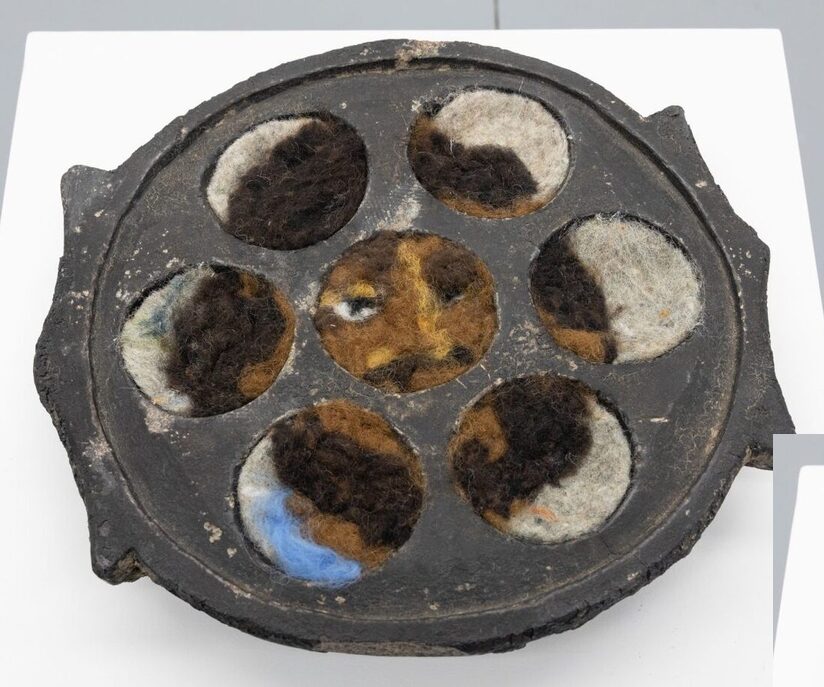
    Within the exhibition space, the artworks are neatly arranged like dishes around a table with the main dish sitting on a platform in the centre of the room. Made of needle felted wool mounted in a uniappam mold, this so-called main dish is Joseph’s My favourite Appam (and Idli) Wallah. Uniappam, appam, and idli are variations of Indian rice cakes, made by using a mold. Wallah means “one in charge of” and is typically used in combination with a noun. We see an image of a father figure fragmented into the individual compartments of the uniappam mold, the eponymous appam and idli chef. Seemingly a very simple execution of portraiture that ignites your senses of smell and taste. Joseph’s piece is loaded with both cultural and familial memory, a universal and personal sentiment of a close family member making your favourite snack, most likely from a recipe passed down through generations, not written down, but a recipe that lives on in these intimate moments between kin.

    Melissa Joseph, My favourite Appam (and Idli) Wallah, 2022, needle felted wool on industrial felt in found uniappam mold, 3 x 10 inches

    A similar piece from Joseph hangs on the wall. This time, Uncle Bill and his midget whites is felted onto a silver plate. Both the uniappam mold and the silver plate are found objects. They are artifacts that Joseph reanimates by literally embedding them with her memories of family. These tender memories become synonymous with the food that would otherwise sit inside the mold or plate. While Joseph’s work can be imbued with her personal experiences as a second-generation American, referencing specific people in her titles or using cultural materials, she is still able to impart the collective experience of immigrant life, inviting viewers to reflect on what it means to belong.

    Melissa Joseph, Thanksgiving 1986, 2025, needle felted wool and recycled sari silk, 31 x 45 inches

    On the other hand, Amiri’s painterly textiles approach the theme of food through the still-life genre. Still-life has a longstanding history with its initial rise in the seventeenth century being closely linked to colonial ventures and international trade. These paintings often depicted ‘exotic’ treasures and curiosities. Amiri co-opts the inherently imperialist still-life genre, and instead, uses it to express community, and the intangible culture associated with feasts and gatherings.

    Hangama Amiri, The Dinner Table, 2024, denim, cotton, chiffon, linen, muslin, silk, dye canvas, polyester, gauze, velvet, mesh polyester, and Jack Lenor Larson fabrics, 77.5 x 55 inches

    It could be argued though that The Dinner Table is not a still-life. The composition is filled with movement, packed with many textures from the various kinds of fabrics Amiri sewed together, and an assortment of dishes and utensils, congregated around a vibrant flower arrangement. Hands reach out from outside the frame to grab themselves a serving of food. We are transported to a room crowded with relatives, overlapping conversations and the smell of freshly cooked dishes fill the air. Still-life with Oysters and Lucky Lime is a similar scene, but instead, we take on the perspective of someone sitting at the table with a plateful. Once again, the still-life becomes animated and vibrant as the viewer gets invited into Amiri’s family meal.

    In tandem with Amiri’s grand and lively tapestries are smaller, intimate scenes rendered in coloured pencil on paper. Though still infused with vibrancy seen in the sewn textiles, Still-life with Almonds on Afghan Textiles and Eid, are more quiet vignettes, and void of any figures. However, the food depicted nevertheless contains a human touch; the carefully arranged bowls of grapes and almonds, or the preparing and setting of dishes for Eid. The invisible labour of love can be seen in the everyday objects of our home. The still-life is no longer a means to boast the exploits of colonial travel, but to express appreciation for the things that make our home and community.

    Hangama Amiri, Still-life with Almonds on Afghan Textile, 2022, colour pencil on paper, 14 x 11 inches

    Using food as both subject and symbol, Amiri’s and Joseph’s artworks wholly evokes the memories of shared meals. Through visual cues, we are reminded of the smell of freshly homemade dishes, the light symphony of spoons scraping plates, the overlapping chatter of your aunts and uncles gossiping, and the taste of your favourite dish that no professional chef can ever replicate. Gathering is a tribute to family and to those who work to put food on the table, to create a home.

    Installation view of Hangama Amiri and Melissa Joseph, Gathering at Cooper Cole

    Rebekah Barone

    Images are courtesy of Cooper Cole Gallery.

    *Exhibition information: Hangama Amiri and Melissa Joseph, Gathering, March 21 – April 26, 2025, Cooper Cole Gallery, 1134 + 1136 Dupont Street, Toronto. Gallery hours: Thru – Sat: 12 – 5pm.

  • Paper Stories at Propeller Art Gallery

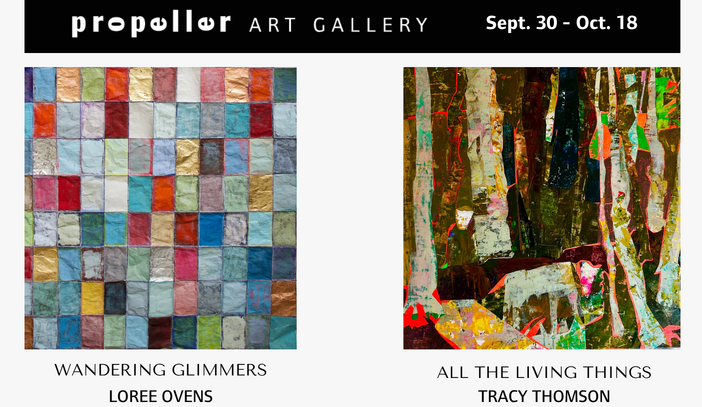
    In Paper Stories, artists Dominique Prévost, Susan Ruptash and Heejung Shin come together for a deep exploration of paper as both medium and message. Rooted in the traditions of Japanese washi and Korean hanji—papers celebrated for their tactile richness and meticulous craftsmanship. Each artist approaches the material with reverence, drawing from its historical depth to create works that are at once contemporary and timeless. United by a shared sensibility, their practices converge around the themes of repetition, rhythm, and poetry, transforming the gallery space into a meditation on light, texture, and movement. With a deliberately restrained palette, the exhibition calls on viewers to slow down, to observe, and to engage intimately with the subtle nuances of surface and form, an invitation to experience paper not merely as support, but as a living, breathing presence within the work itself.

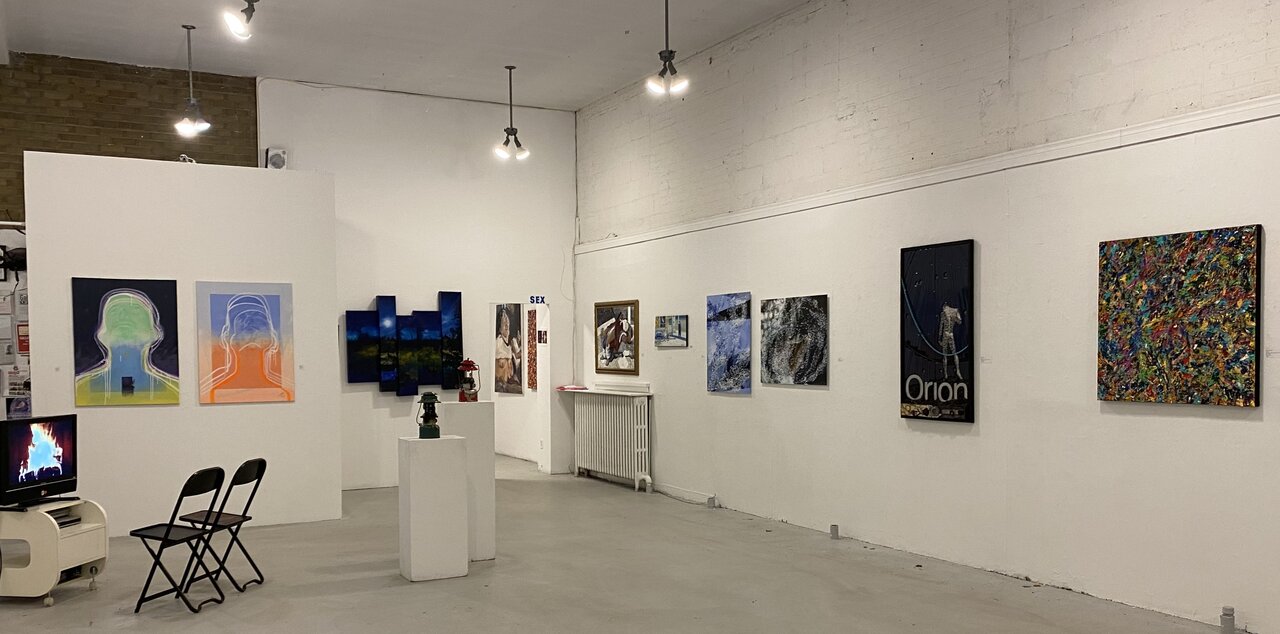
    Installation view of Paper Stories at Propeller Art Gallery

    Upon viewing Dominique Prévost’s work, I had the privilege of speaking with the artist herself. Prévost offered an insightful and generous analysis of both her own pieces and those of her fellow exhibitors. She emphasized that her primary source of inspiration is nature and the surrounding environment—a theme that resonates throughout her practice. With a deep sensitivity to light, rhythm, and organic form, she employs a wide range of techniques to create layered compositions that evoke the subtleties of the natural world. Each artwork is meticulously constructed from painted and manipulated papers, reflecting shifting light, fluid movement, and the repetition found in organic structures. The piece that particularly stood out to me was Snakes. It distinguishes itself through its dynamic representation and technical intricacy. Prévost explained that she used a graphite stencil to form the background, lending the work a soft, shadow-like depth that contrasts beautifully with the more vivid elements. The circular details were achieved through paint marbling, which introduces a sense of fluid motion and variation in texture. What struck me most, however, was the way the snakes push past the boundaries of the frame. Their bodies seem to slither outward, as if refusing containment, challenging the viewer’s sense of space and inviting a more physical, visceral engagement with the work. This disruption of the compositional edge imbues the piece with a sense of life and unpredictability, as though the image cannot be confined to the paper alone. It felt, in that moment, as though the snakes were not simply representations, but active presences within the work. Emotionally, the piece elicited a strange combination of calm and tension. There is a quiet grace in the flow of textures and materials, but it is undercut by the alert, almost watchful quality of the snakes. It is this tension between beauty and danger, stillness and motion, that gives Snakes its compelling emotional force and a lasting impression.

    Dominique Prévost, Snakes, ink, graphite, colour pencil, 3 papers, 17 x 21 inches (left) and detail (right)

    What interested me most in Susan Ruptash’s elegant composition of Four was the way light actively manipulates the viewer’s perception of the paper itself. The installation is not static; rather, it responds to its environment, revealing new subtleties as one moves around it. Depending on the angle of approach, the folds, creases, and textures catch light differently—sometimes casting shadows, other times glowing with luminosity. This dynamic relationship between material and light transforms the paper into something more than its surface, allowing it to oscillate between presence and absence. The four sheets, each deliberately crumpled and shaped, evoke a sense of in-betweenness—what might be described as a liminal space. They hover somewhere between order and disorder, as if capturing a fleeting state of transition. The paper appears to breathe, to shift, to hold memory. There is something deeply human in the way it folds into itself and simultaneously reaches outward like skin, and thought. Ruptash’s restraint in material and palette only heightens the contemplative quality of the piece, inviting viewers to slow down and witness the choreography between form, light, and time.

    Susan Ruptash, Four, Oguni Snowbleached Kozo 26g washi with konnyaku and copper wire, 18 x 48 x 30 inches (right) and detail (left)

    Heejung Shin’s work is an exquisite study in geometry and emotional resonance, where colour and form work in tandem to evoke a sense of suspended melancholy. The composition appears to depict raindrops fallen on the ground, conveyed through a refined abstraction that transforms a familiar scene into something contemplative and affecting. Each form is carefully arranged with spatial sensitivity, creating a rhythmic yet irregular geometry that mirrors the natural randomness of rainfall while preserving a deliberate compositional balance. The palette—a nuanced spectrum of blues ranging from deep indigo to pale, almost translucent azure—intensifies the emotional atmosphere. These tones do not merely suggest rain; they evoke the sensation of solitude, the quiet of listening to waterfall in silence. The piece feels contemplative and hushed, as though time has momentarily paused within the soft echo of a rainy afternoon. In Shin’s hands, geometry becomes a language of emotion, and colour, a vessel for mood.

    Heejung Shin, Faded, watercolor, pigment, Hanji on canvas, 12 x 12 inches (left) and detail (right)

    Paper Stories at Propeller Art Gallery is a masterclass in the expressive potential of paper, offering a tactile and contemplative experience that lingers well beyond the gallery walls. The works of Dominique Prévost, Susan Ruptash and Heejung Shin are united—each artist engaging with paper not simply as a surface, but as an active participant in meaning-making. These pieces do not clamour for attention; instead, they draw one in through subtlety, repetition, and restraint.

    Kaya Meziane

    Images are courtesy of Propeller Art Gallery.

    *Exhibition information: Paper Stories / Dominique Prévost, Susan Ruptash, Heejung Shin, March 26 – April 13, 2025, Propeller Art Gallery, 30 Abell St, Toronto. Gallery hours: Wed – Sat, 1 – 5:30pm, Sun 12 – 4pm.

  • Henrjeta Mece at YYZ

    Henrjeta Mece’s work is laid out along shelves that span YYZ’s window and turn the corner into the central gallery. It comprises a set of works on paper that are covered in wax. From afar they resemble a series of text that you are invited to read, but up close you are confronted with blocks of colour with the occasional text, which spell out sentences such as ‘I love you mommy :)’. What to make of this?

    Installation view of Henrjeta Mece, The Scientist at YYZ

    Since C.P. Snow famously spelled out what he saw as a chasm between two cultures, namely the literary and scientific worlds, we recognize how art and science, more generally, operate in quite different spheres, and their respective practitioners barely understand one another. Indeed, in broad terms, science is seen as a rational pursuit. Its aim is to construct theories with their concomitant concepts, think up hypotheses that follow from each theory and then carefully test them, and finally adjust the theory accordingly. It is an objective discipline that seeks truth. By contrast, art traditionally is seen as having none of this methodological structure. The production of art is an intuitive process that has no measurable parameters – leading to what we call artistic freedom. It does not seek truth, but beauty instead.

    Henrjeta Mece, Installation view with artworks, each mixed media on paper, covered with wax

    But, as Mece recognizes, this clearcut dichotomy between art and science has become quaint and inaccurate – almost an anachronism. Her own experience has taught her this. Encouraged since childhood to make art Mece has also been pulled towards the sciences. After doing two degrees in art, she found herself pursuing doctoral research on the role of artists’ residences on entry into an art career after the education process. She is a trained artist who has become a social scientist teaching at OISE, University of Toronto. She is, therefore, comfortable in both worlds. And one commonality she appreciates between art and science is the research process.

    Henrjeta Mece, Light bulb, wireless, floating above paper using a magnet

    The emphasis on research, Mece suspects, is a symptom of the academization of art, again something she has experienced firsthand. Increasingly a career in art is premised on obtaining the right credentials. For instance, a couple of decades ago doing a PhD in art was a rarity. Today there are many PhD programs in the visual arts. Credentials provide respectability to the subject, whose worth is otherwise difficult to explain and which doesn’t really fit in academia at all. Such qualifications are premised on research. And now even undergraduates in the visual arts are expected to do research. In this way art has become more akin to science.

    Henrjeta Mece, Painted balls floating above paper supported by magnets

    What constitutes scientific research is clear enough. Again, it has a defined methodology that involves learning about current theories and evaluating them. But what does artistic research involve exactly? Art is not governed by any theoretical frameworks. That said, there has been an attempt in academia to conceptualize art nevertheless, encouraging students to write theses about their working processes. But what is clear is these processes are not objective in nature. There is no pretense that artists are uncovering the truth. Rather they follow their intuitions and aim to communicate something or other to the viewers. Ironically, there is little room in such research to aim for beauty, so to speak. That goal is outside of conceptual analysis that research demands.

    I raise these issues because they are top of mind for Mece. Importantly she has come to believe that science has overestimated its objectivity. While scientists often imagine that their research programs are dispassionately revealing the truth, e.g., about how diseases spread, in fact their methodology has a subjective element to it. Personal choices and interests ultimately inform what and how research is done – something that is recognized in artistic practice. And it is precisely this that Mece’s exhibition comments on. While doing her doctoral research Mece found herself being interrupted by her young children. And their interruptions, she came to realize, actually affected her work. Thus it dawned on her that one’s professional life cannot be insulated from one’s personal life. They inevitably bleed into one another. The children’s comments that pepper her works are emblematic of these influences.

    Henrjeta Mece, I love you mommy, mixed media on paper, covered with wax

    What intrigues me in particular is the question of the role of the formal qualities in her work on display. These she largely sees as taking care of themselves, in the sense that the distribution of the blocks was predetermined by the arrangement of data for her research. The colours, she told me, were intuitively chosen.

    Henrjeta Mece, Installation view with artworks, each mixed media on paper, covered with wax

    Yet the work is beautiful and visually engaging. What seems most important to Mece are the ideas behind the work. It is as if, à la Joseph Kosuth, her work is a sort of proposition about art itself. But why, in general, would one make such an artwork rather than write, say? Here we come up against Mece the artist, and not the scientist. She clearly has a compulsion to make art. Anyhow, I’m glad she chose to make an artwork.

    Hugh Alcock

    Images are courtesy of the artist.

    *Exhibition information: Henrjeta Mece, The Scientist, January 18 – April 19, 2025, YYZ Artists’ Outlet, 401 Richmond Street West, #140, Toronto. Gallery hours: Wed – Sat 12 – 5 pm.

  • Hip-Hop culture at the AGO

    Upon entering The Culture, Hip-Hop and Contemporary Art in the 21st Century exhibit at the AGO, visitors are welcomed with heavy rap beats and rhythmic flow, creating excitement and anticipation. Hip-hop is culture and culture inspires all aspects of life. The music, photography, film, fashion, politics, and art, of the exhibition embodies hip-hop culture through an immersive experience. Divided into six themes—language, brand, adornment, tribute, pose, and ascension—that speak to the foundation of hip-hop, visitors are asked to navigate the exhibit using all their senses.

    Hank Willis Thomas, Black Power, 2006, chromogenic print, digital exposure

    We are greeted with a visually packed piece inspired by both street and Japanese art. Originating from an economically depressed area in the Bronx of New York City, hip-hop has become a cultural phenomenon, a movement that inspires and engages individuals from all different backgrounds. In this piece, we are faced with two different cultural facets: graffiti such as cholo writing and fill-in throw ups from ‘90s LA street culture and the use of gold leaf from Edo-era Japan. Engulfed in overlapping graffiti using various colors and fonts, a glorious Edo-era samurai is captured soaring through it all as arrows rain down on him and his horse. It is as if the samurai broke through the barriers of time, emerging from Edo-era Japan into the streets of East LA’s Latino neighborhoods. Through close inspection, an LA Dodgers’ logo is engraved on the samurai’s otherwise traditional helmet, known as kabuto, carefully intertwining the two vastly different cultures to capture the artist’s identity. The work not only captures the fusion of cultures that the artist embodies but the bond that formed between two art periods, elevating graffiti into the world of high art.

    Gajin Fujita, Ride or Die, 2005, spray paint, paint marker, paint stick, gold leaf on wood panels

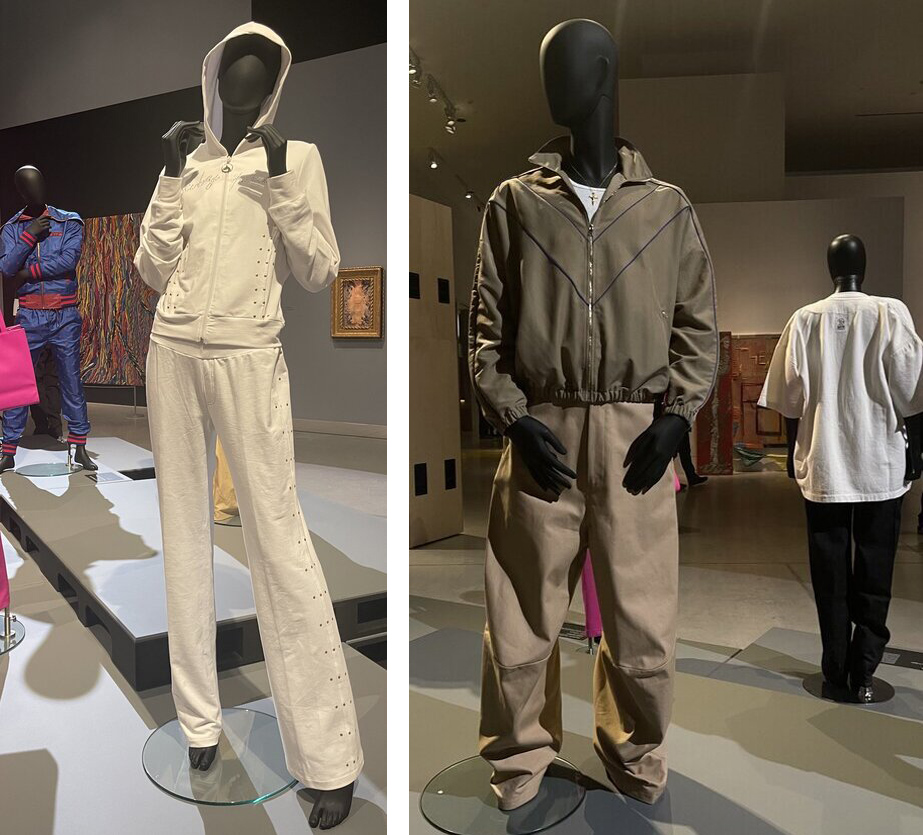
    Bordering the world of high art and its established mediums is fashion; a wearable manifestation of art. Within the realm of hip-hop, fashion is a proud form of identity and self-expression, usually baggy jeans, big t-shirts, and body-hugging tank tops, paired with loud accessories, hats and bandanas, and the trendiest sneakers. But as hip-hop grew and absorbed other ethnicities, each bringing their own customs and styles, the uniform was reinterpreted in various ways. Baby Phat by Kimora Lee Simmons, who was the wife of hip-hop mogul Russell Simmons, brought a touch of female empowerment, luxury, and street style to the iconic velour tracksuit in the late 1990s and early 2000s. Worn by celebrities such as Lil’ Kim, Missy Elliot, Alicia Keys, Foxy Brown, and Beyoncé, this tracksuit was a status symbol, establishing itself in high-end retail and pop culture. American designer Willy Chavarria, with roots in Mexico, brings a contemporary look to the bold and oversized aesthetics prized in hip-hop culture. This look blends streetwear with luxury and Chicano influences, modernizing ‘90s and 2000s baggy with freshness and tailoring.

    Kimora Lee Simmons, Baby Phat, around 2000, tracksuit, cotton (left)  and Willy Chavarria, Buffalo Track Jacket and Kickback Pant, spring/summer 2022, nylon satin (right)

    Clothes are not the only wearable art that hip-hop celebrates. Wigs, especially Dionne Alexander’s wigs, not only helped change hip-hop but evolved it into a category of its own. Bringing iconic rapper Lil’ Kim’s colorful personality to life, these wigs by Alexander helped create a chameleon that matched her provocative lyrics and monochromatic outfits. Brand logos are a big part of hip-hop culture, serving as symbols of status, and Alexander understood the assignment when she dyed, imprinted, and stenciled some of the biggest brand logos onto her wigs. She was, after all, styling the hair of one of the biggest hip-hop stars of her time. It was either be bold and be a trendsetter or stay hidden amongst other rising stars. These wigs cemented Lil’ Kim’s name in hip-hop history and established her identity on the world stage.

    L-R: Lil’ Kim photographed by David LaChapelle in Interview Magazine, November 1999, Dionne Alexander, Lil’ Kim Chanel Logo Wig, 2001, recreated 2022, human hair wig, Lil’ Kim Purple Wig from MTV VMAs, 1999, recreated 2022, synthetic hair wig, Lil’ Kim Versace Logo Wig, 2001, recreated 2022, human hair wig, Lil’ Kim Zipper Wig from MTV VMAs, 2001, recreated 2022, human hair wig, zipper and Lil’ Kim photographed by Clay Patrick McBride in XXL Magazine, May 2000

    Anthony Olubunmi Akinbola’s abstract durag work encompasses a collage of black durags cut, stretched, and stitched into a dynamic composition. This flexible headscarf is used to maintain hairstyles like waves and braids, becoming a symbol of Black self-care and grooming. It is a tool used for preservation of cultural hairstyles and a resistance to Eurocentric beauty standards. Traditionally associated with street culture, it was seen as a symbol of rebellion against systemic oppression with its defiant and criminal connotations. The work incorporates street culture onto a fine art canvas, creating a beautiful composition mirroring abstract oil on canvas works, breaking boundaries between high-end and low-end, bringing Black heritage to a traditionally European medium. Hip-hop icons such as Jay-Z, 50 Cent, Nelly, and Cam’ron made durags a staple in hip-hop fashion as a statement of confidence, swag, and status.

    Anthony Olubunmi Akinbola, CAMOUFLAGE #105 (Metropolis), 2020, durags and acrylic on wood panel

    In his showstopping piece, artist Aaron Fowler uses recycled car parts and other media to create this large sculpture of Nike Air Force 1 sneakers. Its monumental scale speaks to the power of these sneakers and their influence in hip-hop fashion, connecting his personal biography and Black cultural heritage. Nike Air Force 1 immediately became a staple in hip-hop fashion, embraced by rappers, streetwear enthusiasts, and sneakerheads. From rappers to high-end brands, Nike has collaborated with countless industry leaders on making variations of Air Force 1s. The innovative use of recycled car parts speaks to the artistry of black artists, finding inspiration from their personal life and the culture they grew up around. The white and blue splotches on the base emphasize the clean and simple silhouette of the sneakers, highlighting their versatility, which made them a perfect fit for any style: streetwear or luxury. It is seen as a cultural artifact of hip-hop, representing self-expression, street credibility, and timeless style, making them one of the most coveted shoes in hip-hop.

    Aaron Fowler, The Live Culture/Nike Air Force 1, 2022, car parts, mixed media (in front)

    The exhibition celebrates the 50th anniversary of Hip Hop culture. Featuring music, paintings, sculptures, photography, videos, everyday objects, multi-media installations and fashion, the show offers viewers a more complete understanding of that era. It also refers to political activism as well as racial and gender identities.

    Text and photo: Sherry Qin

    *Exhibition information: The Culture: Hip Hop and Contemporary Art in the 21st Century, until April 6, 2025, Art Gallery of Ontario, 317 Dundas Street West, Toronto. Museum hours: Tue and Thurs 10: 30 am – 5 pm, Wed and Fri 10:30 am – 9 pm, Sat and Sun 10:30 am – 5:30 pm.

  • The Celestial Collective at Gallery TPW

    The Celestial Collective at Gallery TPW

    Gallery TWP presents their own curatorial researcher, Jesse King, who introduces a group of artists and designers, a collective also known as The Celestial Collective. They are two-spirited, indigenous queer and non-conforming artists who invite the audience into a space of rarely heard voices surrounding the topics of gender and sexual expression through desire and despair.

    Every artist offers an element of unique ancestry and a sense of ownership, body and soul, as well as poetic narratives in treasured memories scattered in lost places. The stories told with each photograph, with each bead and match, honor their ancestors and their families with care, including care for themselves, giving the strength to survive in a new age, where the sense of family is needed more than ever. The exhibition showcases multiple cultural roots where gender identity and indigeneity weave a core of resilience from one ancestor’s branch to another, while inviting others to explore these branches.

    Kikki Guerard, You talked to me on the outside, 2025, wool, silk, fabric print, 55 x 28 inches

    When visitors enter the gallery space, they are facing a flame-like awakening, a journey of storytelling and rituals, rooted in the history of families who survived persecution as a nation and made it out even stronger.

    Kikki Guerard, Redbird, beaded box, 2025, D 2.3 D x W 2.5 x H 4.3 inches

    As for the central piece of this show, Constellation Spark, visitors are welcome to experience, as described by the collective, “touch and ritual,” and become one with the stories the artists tell. As the main foundation of the show, sound and video give visitors a tour inside multiple bodies of work made from beads, TV static, video and print.

    The Celestial Collective, Constellation Spark, video installation / Sound Scape, 2025

    Each TV is playing a video loop, filmed by each member of the collective striking a match from the Redbird box to spark a discussion very similar to the beginning of a sacred ceremony. Each element, such as the Redbird matches and beaded work, is a piece of memory the artists hold close, yet are brave enough to “throw into the fire” to share the story of resilience that will live on.

    The Celestial Collective, Constellation Spark, video installation / Sound Scape, 2025

    Text and photo: Polyna Alexseev

    *Exhibition information: Smoke Signals x Reflections by The Celestial Collective / Jesse King, Jake Kimble, Kikki Guerard, Melissa Johns, Megan Feheley, February 12 – March 30, 2025, Gallery TPW, 170 Saint Helens Avenue, Toronto. Gallery Hours: Wednesday – Saturday, 11 am – 5 pm.

  • Camille Turner at the Museum at U of T

    Witnessing the Otherworld as an Afronautic Traveller

    When we hear about the transatlantic slave trade, which took place from the 16th to the 19th century, we know millions of Africans were taken from their homeland, transported across the Atlantic Ocean, and sold into labor. During the Middle Passage, many enslaved Africans were faced with the horrors of captivity and attempted to escape by jumping overboard, choosing the unknown depths of the ocean over a life in bondage. Their resistance speaks to the great level of fear and desire for freedom that defined this painful journey.

    Artist and scholar Camille Turner explores an Afronautic journey through this powerful exhibition that blends art and research. Collaborating with many creatives such as artists, actors, and photographers, she creates an immersive experience that bears witness to the ancestral presence of those who were lost at sea. Using various materials, video installations, photographs, and an interactive research lab, the exhibit offers a profound message about memory, history, and the spiritual echoes that linger over the ocean’s rushing waters. Presented at the Art Museum at University of Toronto, the Otherworld exhibit invites viewers to engage with the past, present and future in a meaningful way.

    I interpret Otherworld as an alternative reality where the spirits of enslaved African ancestors return to land, stepping into a time where their presence makes a statement about their strength and unity. A space where history is no longer buried, but reclaimed—where the silenced find their voices, and the lost are no longer forgotten.

    The exhibit begins with four chairs arranged to resemble first-class seats on an airplane. A window-like display shows an image of the Earth slowly rotating. The narration is calming and meditative and urges visitors to rest, take deep breaths, and embrace the presence of their ancestors.

    Outerregion Collective and Camille Turner, Afronautic Research Lab, 2016 – ongoing

    The atmosphere was dark, with soft music filling the space, drawing me deeper into each room. As I moved through the exhibit, watching videos and examining archival materials, I was confronted with the weight of lost stories. Turner invites visitors to engage with archival materials: articles, books, photographs, and information about slave ships, along with magnifying glasses, Post-it notes, and pens. It’s a great conversation starter.

    Right next to the Research Lab was the video installation Afronautic Research Lab: Newfoundland 2019. As I watched Turner listen to the echoes of the ocean, I realized the importance of the ocean in hearing untold stories, remembering, and going to the source of loss. She sorted through books, maps, and scattered fragments—collecting pieces to bring back. Each item holds a story, a tribute to the ancestors who were forced to forget their names and history. By connecting archival materials, the installation encourages visitors to reflect, witness, and remember, not to stay harboured in the past but as a commitment to acknowledging it.

    Camille Turner, Afronautic Research Lab: Newfoundland 2019, video installation

    In the next room, 19 portals hung from the ceiling, which made a strong impression on me. Each one displayed different images, offering a glimpse of the past. The past is portrayed through images of slave ships, rocks along the ocean shore, and fire in what seems to be a plantation field. Other images showed deep waters, and some images were blurred and out of focus, with only a small window of light, alluding to the experience of being on a slave ship. These portals symbolized the journey of the Middle Passage, the trauma of being enslaved, the restraints on the ship, and the transition into an unfamiliar environment.

    Camille Turner, Portals, 2024, installation with nineteen images printed on fabric (middle) and details (left and right)

    As I continued through the exhibit, I entered a room filled with black-and-white photographs displayed on vinyl lightboxes. I was pleased to see another collaboration between Camal Pirbhai and Camille Turner. The images featured men, women and children, each using rock as an accessory. The ocean serves as witness to the Middle Passage, and the materials it holds—rocks, sticks, bones—carry many memories. These elements become reflections of Black identity and symbols of emotional baggage.

    Camel Pirbhai and Camille Turner, Rocks, 2021 – ongoing, black-and-white photography on vinyl lightbox, both 38 x 26 x 1.5 inches

    The memories are etched into Black identity. It’s not something you can escape but it’s something that can be cherished across many generations. Speaking of different generations, in the installation, Maria, the video portrays two hands coming from opposite sides of the screen to join in the middle as a connection to the enslaved children who were on the ships, some who were separated from their families. The installation references the 50-ton ship in Newfoundland that carried 75 children in 1785. It delivers a powerful message of loss, yet also of reconnection and resilience. The audio sheds light on three enslaved children’s autobiographical stories, Olaudah Equiano, Mary Prince, and Sophia Burthen Pooley.

    Camille Turner, Maria, 2023, video and 2 channel sound installation (10:59)

    In conclusion, Otherworld is more than a presentation of historical documents—it wants us to acknowledge, reflect, and act upon the findings of Turner’s exhibit. The interactive elements encourage visitors to move beyond passive observation, pushing them to engage in difficult truths and question how history continues to shape the present. Leaving the exhibit, I carried the weight of these stories with me—stories that demand recognition, accountability, and change.

    Text and photo: Abuk Lual

    *Exhibition information: Camille Turner, Otherworld, September 4, 2024 – March 22, 2025, Art Museum at the University of Toronto, 15 King’s College Circle, Toronto. Museum hours: Tue – Sat 12 – 5 pm, Wed 12 – 8 pm.

  • Elana Herzog at Koffler Arts

    Upon entering Elana Herzog’s solo exhibition, a striking installation captivates the viewer: a wall wrapped in a diverse array of fabrics, wallpapers, newspapers, and sequins, all stapled into the wall. This site-specific installation sets the tone for Herzog’s abstract works, characterized by disintegrating imagery and a destructive process, challenging traditional notions of modernist and domestic craft. Notably, most of her artworks remain untitled. Curator Jessica Stockholder observes that Herzog’s transformation from electrician to artist is reflected in her work. “We call them art ‘works,’” Stockholder notes, “because the labor-intensive process of creating art is integral to its meaning. The intersection of physical bodies with materials addresses fundamental human needs and sustains life.”

    Installation view of Elana Herzog’s exhibition at Koffler Arts. Photo credit: Jeremie Warshafsky

    Herzog combines familiar materials in unexpected ways to create two-and three-dimensional forms, using textiles and other domestic and building materials to make work that is raw, visceral, intimate, and tactile. Another intriguing piece, Cross Pollination, features a wood log and a curtain-like installation. Herzog worked with nylon, threading it through the ceiling in different patterns each time the piece is installed. Meredith, who assisted Herzog with the installation, revealed that the background wall color was decided spontaneously. The shadow of the nylon’s wavelike movement on the ceiling, hung through pipes, varies with each installation, adapting to the interior space and its unique characteristics.

    Elana Herzog, Cross Pollination 2, 2020, cut fragments of wooden crate, miscellaneous lamber, mixed textiles sourced in Norway, Russia and New York, embroidery floss, hardware, nylon cord, 144 x 88 x 45 inches (dimensions variable). Photo credit: Jeremie Warshafsky

    As a textile artist, Herzog’s use of fabric from different places is noteworthy. Her stitching intersects and alters the readymade fabrics she works with, highlighting the universal human impulse to create fabric while also honoring the unique cultural heritage embedded in each textile. Her research explores the intersection of plant life, cultural migration, and human experience. Terms like “uprooted” and “invasive” blur the lines between plants and people, revealing complex relationships between cultures and environments.

    Installation view of Elana Herzog’s exhibition at Koffler Arts. Photo credit: Jeremie Warshafsky

    On the floor, she displayed her collected fabrics on a pallet, alongside logs that she used as a gesture to show how trees grow, mirroring human growth and change. The logs also symbolize the connection between humans and their roots, emphasizing that even as people migrate and change, they remain connected to their cultural heritage.

    Installation view of Elana Herzog’s exhibition with textile pallet at Koffler Arts. Photo credit: Jeremie Warshafsky

    Herzog’s works are truly impressive and spectacular. Her art often transforms entire walls, showcasing her unique ability to turn everyday materials into extraordinary pieces. Notably, many of her works remain untitled, but one piece that stands out is the brocade bedspread material, a masterpiece featuring intricate motifs created with industrial-grade metal staples. Viewers are left wondering how such a delicate piece is installed and whether it will withstand movement. On the same wall, a pipe installation and deep scratch marks create a sense of tension, drawing the viewer’s attention. Her background as an electrician is evident in her work, where she skillfully combines technical expertise with artistic vision. In her movable panel pieces, Herzog re-inscribes selected patterns from fabrics, then deconstructs them through shredding, pulling, and cutting. The remaining fragments maintain the rectangular formats of their sources, dissolving the distinction between figure and ground in ghostly, afterimage-like forms.

    Installation view of Elana Herzog’s exhibition with wall hangers at Koffler Arts. Photo credit: Jeremie Warshafsky

    Ultimately, Elena Herzog’s work offers a powerful reflection on the human experience, weaving together threads of identity, culture, and resilience. Through her intricate, often unsettling creations, Herzog conveys the complexities of migration, the fragility of human connection, and the enduring power of art to express the unspoken. As a testament to the boundless potential of textile art, Herzog’s project stands as a poignant reminder of the beauty, complexity, and vulnerability that define us all.

    Nusrat Papia

    Images are courtesy of Koffler Arts.

    *Exhibition information: Elana Herzog solo exhibition, February 13 – May 11, 2025, Koffler Arts, 180 Shaw St., Toronto. Gallery hours: Wednesday 12 – 5 pm, Thursday 12 – 8 pm, Friday – Sunday 12 – 5 pm.

  • New Mineral Collective at Mercer Union

    New Mineral Collective: The Pleasure Report

    New Mineral Collective (NMC) is a collaborative art initiative by Tanya Busse and Emilija Škarnulytė, based in Ontario. This exhibition celebrates the artists’ tenth year of collective practice. Held at Mercer Union, this installation is a mixed media work that includes soothing narration, pink light and surrounding sounds blended with field recordings, printed textile and sculptural elements. We enter a reflective state in which we ask the question, how much has the mining industry of Canada continuously ground down these sacred lands, and for how long do we have to wait until there is no land to excavate, let alone to preserve? NMC challenges destructive mining practices through poetic activism, pushing visitors to see those behaviours through a fresh perspective on the scars of extraction and loss.

    New Mineral Collective, The Pleasure Report, 2025. Installation view: Mercer Union. Courtesy the artists. Photo: Vuk Dragojevic.

    NMC demonstrates a method called “counter prospecting,” an innovative act of claiming mineral rights to prevent mining. They call this new form “speculative fiction,” inspired from the term “geopoetics” by Scottish poet Kenneth White. Placing molds of unusual shapes of dried sand and hanging textiles of printed marble-like terrains, the work addresses past experiences of excavation disasters and encourages us to question the impact of mining. With the help of a guiding narrative voice and the combination of meditative sound filling the space (collaborated with artist Tuomas A. Laitinen), we are tuned in with these scars or “geotraumas” in a gentle, yet powerful way. This work is a form of activism, focusing on prevention by saving the land from excavation.

    New Mineral Collective, The Pleasure Report, 2025. Installation view: Mercer Union. Courtesy the artists. Photo: Vuk Dragojevic

    The exhibition also includes the collective’s recent publication, The Pleasure Report which summarizes NMC’s work over the past decade. It demonstrates the artists’ practices, skills and dedication through photographic images of landscapes, both physical and metaphorical, as resistance, but also the pleasure and memory of these spaces.

    New Mineral Collective, The Pleasure Report, 2025. Installation view: Mercer Union. Courtesy the artists. Photo: Vuk Dragojevic

    Polyna Alexseev

    *Exhibition information: New Mineral Collective, The Pleasure Report, January 25 – March 22, 2025, Mercer Union, 1286 Bloor Street West, Toronto. Gallery hours: Tuesday- Saturday, 11am – 6 pm.

  • Pardiss Amerian at Zalucky Contemporary

    Montreal-based Iranian artist, Pardiss Amerian’s work primarily draws from the cultural history and literature of Persia, exploring and recontextualizing its artifacts and folklore to create an imagined place of her own. Her second solo exhibition at Zalucky Contemporary titled Embrasure continues her exploration of the vast and ancient stories of the Persian world, this time, drawing inspiration from the historic site Taq Kasra, also known as the Arch of Ctesiphon, situated in present-day Iraq. Taq Kasra contains the remains of the palace of the ancient capital city of Ctesiphon, notable for its impressive architectural engineering of a monumental brick archway. In Embrasure, the arch is reproduced and reinterpreted throughout the paintings, alongside abstracted images of nature and human figures; Amerian constructs a fantastical world that transcends time, blurring the lines between the historical past and the present.

    Installation view of Pardiss Amerian, Embrasure, 2025 at Zalucky Contemporary

    Themes of temporality and transcending history can be seen evenly in Amerian’s unique method of painting. She builds up layers of paint and sands them down, not only producing a frayed, distressed texture like that of an excavated ancient fresco, but also revealing layers of colour, or at some places even the linen canvas underneath. The choice of using linen canvas, as opposed to the more popular cotton canvas, lends well to her painting process, with its organic and irregular textured weave. There is additionally some form of collage in her painting method; shapes and colours overlap each other through the sanded down layers. The exhibition text describes her process as “palimpsests of the present”, meaning the present still bears traces of the past. Amerian’s canvasses complicate our linear understanding of time; the past is never truly past.

    Pardiss Amerian, Caustic bend, 2025, oil on linen, 48 x 36 inches

    The painting named after the exhibition title Embrasure evokes much of the recurring themes that threads each artwork together. While the Taq Kasra archway is the primary source of inspiration for the exhibition, the human figure, instead, takes up most of the composition in this piece. However, slightly out of frame, an arched shape encompasses over the body of the figure, mirroring its hunched over pose, signalling the body’s strength and endurance. Indeed, the rendering of the human figure, despite the painting’s shallow space, accentuates its volume. The figure caresses indistinct geometric shapes, gathering them, as if in the midst of creating something. Amerian demonstrates that the monumental Taq Kasr and the legacy of Persian culture still exist through the strength of its people. The long-lasting power of ancient artifacts continues into the present because its core a human story.

    Pardiss Amerian, Embrasure, 2025, oil on linen, 36 x 30 inches, detail

    Nature also persists throughout the paintings. Blending into geometric forms or architectural motifs, water flows independently from gravity, cypress trees resemble shields, spears or fire, fish swim across walls or the sky, and flowers seem to burst from the figures’ hands like a ball of light. Amerian continues blurring lines, between abstraction and figuration. Familiar objects appear across the gallery but in simple, abstracted forms that they morph, fuse, or call for hybrid interpretations. The limited palette of pastel purples, greens, and yellows throughout the artworks further this amalgamation of melding figurations.

    Pardiss Amerian, Sending word, 2025, oil on linen, 36 x 30 inches

    Accompanied with the exhibition is an excerpt of a poem by the famous 12th century Persian poet Khaqani, writing about his visit to the Taq Kasra ruins. The excerpt includes similar imagery with Amerian’s paintings; “the foaming lips of the river”, or “the severing chain of justice”. Both Khaqani and Amerian, though separated by centuries, drew from their shared cultural past to create their own personal cultural expressions.

    The exhibition text reads, “the forces of nature and human activity are constantly in flux.” I’d like to add that these forces are also cyclical; one instance can affect another, or perhaps, they mutually affect each other, intrinsically interconnected liberated from time and space. In Embrasure, Amerian gathers seemingly disparate symbols together as building blocks for an imagined world, ultimately undoing the linearity of history, focusing instead on expressions of human endurance.

    Rebekah Barona

    Images are courtesy of Zalucky Contemporary.

    *Exhibition information: Pardiss Amerian, Embrasure, February 13, 2025 – March 29, 2025, Zalucky Contemporary, 3044 Dundas Street W. Toronto. Gallery hours: Thursday to Saturday, 12 – 5 pm or by appointment.

  • Vladimir Kanic at the Abbozzo Gallery

    Vladimir Kanic’s Garden of Hope exhibition at the Abbozzo Gallery presents a captivating blend of living art, environmental consciousness, and personal narrative. The exhibition highlights Kanic’s innovative approach to creation by using sustainable natural materials in his work. Kanic’s use of this concept has become increasingly significant as we continue to address nature and climate issues that have prominently influenced politics since the 1980s. Kanic raises awareness about climate issues through his work, believing that it can spark conversations about life, technology, ecology, and the future of art. In this way, his mixed media and algae biopolymer-based sculptures serve as a symbol of hope for change.

    Installation view of Vladimir Kanic, Garden of Hope at the Abbazzo Gallery, 2025 with LACE (Living Algae Cyborg Ecosystem), 2025, Algae Biopolymers/Living Algae Culture, 25 x 108 inches

    The artist uses dried algae biomass as well as living algae as a sculptural medium, allowing him to transform “waste” into art. Kanic actively contributes to environmentally friendly initiatives by incorporating a liquid blend of algae and spirulina into the composition of LACE (Living Algae Cyborg Ecosystem) (2025) and Book of Waves pt. 200 (2023), sculptures that help to remove carbon dioxide from the air. These living sculptures interact with the breath of spectators, transforming it into oxygen and creating an immersive environment. Through this procedure the sculpture changes shape and its colors deepen.

    Vladimir Kanic, Book of Waves pt. 200, 2023, Algae Biopolymers/Living Algae Culture, 92 x 21 x 21 inches (left)

    Additionally, through these sustainable works, the artist not only sets an example by introducing an effective method for the audience to consider as a possibility for reducing the impacts of the climate crisis but also builds a relationship with them in setting the example that small actions can enhance the standard of living for many. Kanic’s approach illustrates a thoughtful creative process that addresses environmental concerns.

    Kanic’s Garden of Hope also offers a captivating aesthetic and sensory experience through the vibrant energy of his sculptures. His algae sculptures unfold in their organic forms; the sculptures appear alive, featuring fluid shapes that defy rigid patterns and straight lines, reminiscent of natural, biomorphic designs. The works Everything That is Broken Can be Fixed (With a Needle and Thread) IV and VI (2025) are vibrant pieces that celebrate the wonders of nature. The artist’s use of vibrant and cheerful colors reflects the spirit of expressionism as they serve as a symbolic extension of Kanic’s connection to nature and the joy it brings him as both an artist and an environmentalist striving to create change. Additionally, he uses light in these works to emphasize the magnitude and dimensional perception of his creations and the influence of his co-creator, nature.

    L-R: Vladimir Kanic, Everything That is Broken Can be Fixed (With a Needle and Thread) IV, 39 x 22 inches; III, 38 x 25 inches and V, 17 x 12 inches; each 2025, Mixed-media/Algae Biopolymers

    Moreover, the interplay of warm sensations with visually cool lighting enhances the otherworldly atmosphere of the space. Each sculpture stands as an individual entity, celebrating the beautiful diversity found in nature and inviting viewers to immerse and connect themselves in its wonder. These wall installations also add to the dynamic environment as they extend outward, creating a striking three-dimensional effect that makes the audience aware of their space.

    Lastly, the Garden of Hope takes a personal approach in its inclusion of Vladimir Kanic’s native Croatia. The use of what appears to be family photographs in his Atmospheric Attunements (2025) collection depicts Kanic’s ancestors in coastline settings, highlighting the long relationship between the artist and nature, or more specifically, the ocean. This relationship also surfaces directly through the algae sculptures and their unique coral reef tones and the pseudo-organisms featured in the Future Tales of Long Ago (2025) and Photosynthetic Archives (2025) series.

    Installation view with Vladimir Kanic, Atmospheric Attunements series, 2025 (right) and Atmospheric Attunements Canvas, 2025, Mixed media/Algae Biopolymers 74 x 55 inches (left)

    The contrasting use of black-and-white photographs in the Atmospheric Attunements series (2025) highlights this special relationship to the ocean. One notable piece, titled Boy and the Sea (1990), is a large print that depicts a boy surrounded by nature’s power, with a huge wave crashing behind him. Despite this overwhelming force, he finds his place within the natural world. This image further emphasizes Kanic’s commentary on the vital relationship between humanity and nature. The second colored image, Atmospheric Attunements XVI (2024), depicts a single woman, who may symbolize humanity’s own biological role in bringing life into the world; and therefore, she relates herself to the rest of Kanic’s works through her very existence. Both photographs create a visual narrative that explores humanity’s connection to the natural world.

    Vladimir Kanic, Boy and the Sea, 1990, Fine Art Print, Hahnemuhle pearl 285gsm paper, 24 x 54 inches

    By integrating living organisms, personal history, and environmental activism, Vladimir Kanic’s Garden of Hope offers a multifaceted exploration of our relationship with nature. It invites viewers to consider their role in the ecosystem and the potential for art to inspire environmental stewardship.

    Text and photo: Antonella Pecora Ruiz

    *Exhibition information: Vladimir Kanic, Garden of Hope, February 28 – March 29, 2025, Abbozzo Gallery, 401 Richmond Street West, Suite 128, Toronto. Gallery hours: Tue – Fri 11am – 6pm, Sat 11am – 5pm.