Author: artoronto

  • Light: Visionary Perspectives / Aga Khan Museum

    The entire Aga Khan Museum was designed around light, so as its 10th anniversary approached the curators decided to celebrate it with an exhibition entirely about light.

    Light is central to the museum and visitors experience it right away upon entering the building. In the hallway, To Breathe, Korean artist Kimsooja’s site-specific installation takes us to a different dimension, a dimension of magical light. The windows are covered with diffraction grating film and as daylight passes through it reveals rainbows throughout the space. The magic of this work is in making the invisible visible. Coloured light always amazes and fills us with joy. This kind of play with light can be found on many levels of the museum, shining through windows and creating its own ‘artworks’ on walls and floors.

    Kimsooja, To Breathe, 2024. Site-specific installation consisting of diffraction grating film. Commissioned by the Aga Khan Museum. Photography credit: Toni Hafkenscheid.

    There is nothing better than light as the focus for the anniversary exhibition. There are so many kinds: the light of the sun, the moon and the light inside us, the light we absorb and the light we radiate. The exhibition titled, Light: Visionary Perspectives, is an amazing combination of scientific and spiritual approaches, involving both historical and contemporary visions.

    Tannis Nielsen’s, mazinibii’igan / a creation (2020) is the first piece I see. The Anishinaabemowin word ‘mazinibii’igan’ means “a drawing, a sketch, or a design.” It is a continuous video installation with many possible beginnings and endings. The installation is a result of Tannis Nielsen’s research into electromagnetic energies. She discovered that residual radiation stems from the Big Bang, believed to be the origin of the universe.

    Stepping into the installation I am enveloped by darkness. It must be the beginning of the universe when nothing existed. Then some weak light grows, and I hang on to it with hope, as any little light is better than total darkness. Suddenly bright lights with impressive soundtracks surround me and it is almost too much, but I lose myself in this otherworldly installation and stop thinking. It surrounds me. As the story told by Elder Marie Gaudet (Turtle Clan Anishinaabe from Wikwemikong), a knowledge keeper and practitioner of healing songs and ceremonies, the installation invites us to reimagine creation. So, it seems I am inside the process of the creation that started, as the narrative says, with a single light emerging from the darkness. Am I swallowed by this installation? I feel I’m in the middle of it, totally absorbed by the darkening and lightening universe. It is a very complex world where dark, light, sound, narrative and music work together perfectly as I become part of the creation. It feels so good, uplifting and I am happy and amazed. Will I ever be able to leave it or do I want to stay inside and see what comes next? It is pulsating with energy, and I feel absorbed in it, an almost physical sensation. It is also very spiritual and mesmerizing. It was hard to distance myself from this installation and I needed some time to re-enter reality.

    Tannis Nielsen, mazinibii’igan / a creation, 2020. Digital video, artist’s own footage and derivative. Story and narration by Marie Gaudet. Courtesy of Tannis Nielsen. Photography credit: Toni Hafkenscheid.

    What I saw next, I can barely call ‘reality’ as Anish Kapoor’s two mirrors, facing each other from opposite walls, playing a game with me, challenging my perception. It is about what we see or what we think we see. Long ago Muslim philosophers thought that the light came out from our eyes. In the main floor exhibition room, the book Opticae Thesaurus addresses this idea. The title of the book is a Latin translation of Kitab Al-Manazir (Book of Optics) by 10th-century Muslim scholar and mathematician Ibn al-Haytham. He revolutionized the field by arguing that sight is made possible by light traveling to the eye, rather than by light emanating from it. His discovery influenced the western world as well and led to the development of the camera obscura and, ultimately, the modern camera.

    Kapoor’s two mirrored disks, one made of steel and the other of wood and lacquer, remind me of our eyes. From their concave surface they show a view we don’t expect, seeing ourselves and the space in a different way. It is very complex. First, from a distance you see yourself upside down, then, as you get a closer look, you are standing on the ground again. The mirror is creating its own reality. Mirrors in art often denote self-reflection, so what’s happening here? Which one of the images is real or is all just visual illusion? As Bita Pourvash, Associate Curator, Aga Khan Museum says, “we also must understand that we don’t only see with our eyes but with our mind and heart and how they are connected in creating an image.”

    I visited the exhibition a day before it opened, and the light was somewhat erratic, some areas a little darker. Stepping out of the view of the mirrors and looking back as they were reflecting on each other I wondered if, somehow, they communicate with each other in the dark when no one is around, sharing their experiences of us and how their tricks confused us.

    Anish Kapoor, Mirror (Mipa Blue to Organic Green), 2016. Stainless steel and lacquer. On loan from George Yabu and Glenn Pushelberg. Photography credit: Connor Remus.

    The title A Thousand Silent Moments (Rain Forest) reminds me of Gabriel García Márquez’s book, “One Hundred Years of Solitude,” that also takes place in a rain forest. It is a magical story like Anila Quayyum Agha’s. Inspired by objects and paintings in the museum collections, American-Pakistani artist, Anila Quayyum Agha, created a lacquered steel and LED installation. On the walls, on the floor and on the ceiling, we see a series of laser cut patterns of flowers, leaves and animals from various cultures and historical periods projected from the glass box in the middle of the room. A bright green light surrounds me. At first, I thought, how peaceful. Indeed, it is beautiful; it is paradise or the garden of Eden — harmony is created. Then I recognize that my shadow becomes part of the installation, appearing on the floor and on the walls. The installation is built on contrasting elements: light and shadow. They play, they change as the movement continues. It reminds me of lying under a large tree on a summer day, looking at the light coming through the leaves. It is, like this installation, wonderful and peaceful; I could enjoy it all day long. However, we all know that where there is light, there is shadow, as shadow can’t exist without light. As I walk further into the room and look in every possible direction, I become even more aware of my shadow becoming an interactive part of this installation. There is a very intense movement of images and light, everything is changing. The harmony I felt at first, suddenly breaks. I feel the opposing forces, light and shadow, including my own, as though they are in a dialog. As Quayyum Agha says about her work, “light and pattern are intentionally utilized to create ‘perceptually’ soothing and conceptually challenging environments.”

    Anila Quayyum Agha, A Thousand Silent Moments (Rain Forest), 2024. Laser-cut resin-coated aluminum, Light Bulb. Lacquered steel and LED bulbs. Commissioned by the Aga Khan Museum. Photography Credit: Aly Manji.

    The tower-like installation, The Matriarch: Unraveled Threads, by Montreal-based Cameroonian-Belgian artist Mallory Lowe Mpoka contains more than 300 panels. The artist decided to create it when her grandmother passed away and she unexpectedly became the matriarch of her family.

    The lighthouse is built from various materials and uses many mediums, like analog photography, screen printing, photo transfer, embroidery on dyed cotton and linen with red earth pigments, acrylic, paper, and steel. The fabric came from her family’s workshop in Cameroon and was dyed there with the earth. The photographs come from different sources, combining self-portraits with images from ancestral archives as well as contemporary portraits. The stories created by them are hypothetical, and do not follow any linear timeline. Together they create a circle, much like a tribal circle, where the main idea is to be together, belonging to the tribe and its history. The artist addresses the idea of how family continues to live in you and in generations to come. Not just your genes but your memories and cultural inheritance include more of the past, present and future than your individual time allows you to experience. The responsibility is to remember, share and pass down your cultural and historical inheritance. As the lighthouse guides people safely to shore, your guidance can influence coming generations to remember who they are and to make the right choices. It also reminds me of the symbol of a single candle shining in the dark. While there may be other lit candles as well, they can’t take away the light from yours. The images are illuminated from inside the lighthouse. Light, besides being a physical element in this artwork, also becomes a metaphor for enlightenment of the heart and mind.

    Mallory Lowe Mpoka, The Matriarch: Unraveled Threads, 2021-2024. Analog photography, screen printing, photo transfer, embroidery on dyed cotton and linen with red earth pigments, acrylic, paper, and steel. Courtesy of the artist. Photography Credit: Rory Kearney-Fick.

    Phillip K. Smith III’s Two Corners is a 3D work of colour-choreographed large reflective panels placed in two opposing corners of the room. It is a very intensive experience as I become a part of it when stepping into its universal space, surrounded by its ever-changing colours and interplaying light. Infinity is the right word to describe this installation. When I turned from one wall to another it seemed to open, giving me the feeling that I could walk further without any limit. The desert-like landscape horizon is confusing. I think it made me understand what a mirage really is. The changing of colors further deepens this impression. There is a blue sky filling the room for a short time, then the redness of a sunset or the greenness of fields. Sometimes the colors appear at the same time overlapping and framing each other. This shiny orgy of colors is bigger than my ‘perception’ and addresses the unconscientious layers of my brain. They instill different moods and feelings, turning my attention to these underrated territories of our minds.

    Phillip K. Smith III, Two Corners, 2022. Aluminum, glass, LED lighting, electronic components, unique colour choreography. Courtesy of artist. Photography Credit: Aly Manji.

    As Marianne Fenton, Special Projects Curator, Aga Khan Museum summarized, “The installations and objects in the exhibition explore our shared humanity, encouraging us to experience light through the perspectives of these artists who have captured its emotional, spiritual, and physical presentations.” The exhibition, Light: Visionary Perspectives focuses on the power of light over darkness by exploring both historical and contemporary understanding and creative interpretations of light. It shows us the possibility of new, hopeful horizons.

    Emese Krunak-Hajagos

    Images are courtesy of Aga Khan Museum.

    *Exhibition information: Light: Visionary Perspectives, till April 21, 2025, Aga Khan Museum, 77 Wynford Drive, Toronto. Museum hours: Tue & Thu – Sun 10:30 am – 5:30 pm, Wed 10 am – 8 pm.

  • The Murray Show at Gallery 1313

    Installation view of the Murray show at Gallery 1313. Photo: Phil Anderson

    What is unusual about the exhibition currently running at Gallery 1313 is that it isn’t about the 46 artists participating, but rather it celebrates the life of the subject of all the artworks on display, namely the veteran artists’ model Murray McKay. McKay recently passed away at age 79 years. He had been a regular life model at many venues in and around Toronto, including OCAD, Toronto School of Art and many art clubs, for several decades. Growing up in Minetonnis, Manitoba, McKay studied theology in Winnipeg, before leading an itinerant lifestyle that took him variously to Toronto, Vancouver and St John, Nfld. Eventually he settled more or less permanently in Toronto. By all accounts, as well a having a penchant for wandering he was a free spirit involved in theatre and music. 

    The poster of the exhibition

    So modelling for artists was a natural vocation for Murray, as his many friends and associates simply referred to him as. What struck the countless artists and art students he posed for over the years was his professionalism. Both students and teachers alike noticed how attentive he was to their needs in terms of knowing how to pose, for how long and what anatomical details would be of interest to them. And anatomically speaking he was an ideal model – lithe in movement, slim and naturally athletic, so the students were able to learn a great deal about muscular and skeletal details looking at him. In turn he looked at them. As internationally renowned artist Evan Penny, who has several sculptures in the show, remarks: ‘Ever present and aware of the activities around him, I was often left feeling that I was the one being observed’.

    Installation view of the Murray show with Evan Penny, White Murray, hydro stone, 52 inches (centre)

    It is of course not a facetious remark that the show is not about the artists, but the subject of the artworks. The irony is that most of the artworks are the product of life drawing sessions, so they are largely viewed as a means to an end, rather than anything particularly deserving contemplation and attention in their own right. Who the model is, therefore, is usually incidental. Sometimes he did pose for professional artistic production such as Penny’s sculptures and Kagan McLeod’s graphic novel. But in general Murray’s modelling work was far more pedestrian, and so it is notable how nonetheless he took his own work very seriously. The ‘consummate professional’ as many describe him.

    Kagan McLeod, Excerpt from ‘Tentmaster’, Graphic Novel

    This fact is a reminder of how crucial attitude is with respect to so much of what we do. Especially in the arts it is always very challenging to be taken seriously. Taking one’s own work seriously, therefore, is vital. When something is done seriously, with care and attention, and competence, it is at least reciprocally amenable to due consideration. It seems to me that the artists who worked with Murray recognised and appreciated his seriousness. Even if the artworks he most often saw being produced around him were likely destined for a dusty cupboard or the waste bin, he understood the importance of their endeavours. He respected them. And they in turn respected him.

    Installation view of the Murray show at Gallery 1313

    It is fitting, therefore, that the venue for this show should be Gallery 1313. This gallery has lasted over twenty fives years because of the dedication and selfless service of countless number of people and the community at large, who have in various ways supported it. It too is testament to doing things seriously, understanding that that is what matters in the end. This show is truly a community effort, done purely out of respect for one of its treasured members. Murray’s departure is clearly felt by very many. Celebrating his life offers them an opportunity to acknowledge one another as well as Murray.

    Works by Paul McCusker (top and bottom left) and Helen McCuster (bottom right)

    There are so many works on display that they must be hung salon style. Over all the effect is of a sea of life drawings that can inundate you. Nonetheless there are some gems amongst them. A few sympathetic portraits are a highlight, for example, Kevin Bae’s drawing “Portrait of Murray”.

    Kevin Bae, Portrait of Murray, mixed media on paper, 24 x 18 inches

    Also, some of the life drawings have a finished quality that impresses. For example, Chris Landreth’s “Murray” and Peter Campbell’s “King of Models On an Imaginary Throne”. Particularly striking is an array of terracotta studies of Murray’s bust by Evan Penny, artfully mounted on a wall next to his imposing sculpture of Murray in stone. These studies were done shortly before Murray’s death, which gives them a poignancy, of course. I was also struck by Tom Campbell’s little oil studies, especially the one of his profile.

    Peter Campbell, King of Models on an Imaginary Throne, Conte on paper, 18 x 24 inches

    Chris Landreth, Murray, charcoal and pastel on paper, 18 x 24 inches

    There are many more modest but beautiful renditions of this much loved model. Murray has been described as a gentleman, a muse and an inspiration. And as Donna Metcalf notes, ‘He was a wonder and will be greatly missed’.

    Text and photo: Hugh Alcock

    *Exhibition information: Murray /Group show, organized by George Traini, March 5 – 16, 2025, Gallery 1313, 1313 Queen Street West, Toronto. Gallery hours: Wed – Sat 1 – 5 pm, Sun 1 – 4 pm.

  • Anna Torma at the Clint Roenisch Gallery

    The theme of this exhibition is the holy human habitat, the garden from which Adam and Eve were exiled. What else do we know about Eden? Anna Torma’s exhibition at the Clint Roenisch Gallery contemplates the site of Eden, its life forms, and the things that sustained and thwarted them. The Eden Project is comprised of large-scale textile collages and drawings by Torma, completed in 2024 and 2025.

    Installation view of Anna Torma, The Eden Project at Clint Roenisch Gallery

    The exhibition features a variety of works: hand-stitched, embroidered, drawn and coloured in pencil. Some pieces are framed while others are suspended from the ceiling or mounted on brackets along the walls. Displayed adjacent to the entrance of the gallery is “Colouring Book Details II” (2025). The surface of the work is crowded with a mass of creatures that seem to be moving across the paper. The swarm of faces have a languid energy to them, eyelids half-closed, while the figures presented as beasts appear hyperactive, smiles full of pointed teeth. There is one in the lower left corner with an effusive speech bubble, exclaiming ‘Thank you.’ This introduction to The Eden Project considers what might have been in that garden— what exactly did Adam and Eve miss?

    Anna Torma, Colouring Book Details II, 2025, mixed media on paper, 50 x 40 inches, framed

    Upon entering the gallery, I encountered panels of textile and paper populated with vibrant, vibrating figures. The subjects are difficult to identify at first glance. In “Cold Nights” (2025), they include cowboys in ponchos, serpentine creatures, and various avian species, among other forms, created out of patterned fabric. The suspended cloth also features a variety of words: ‘Love,’ ‘Mercy,’ ‘Star,’ and ‘Moon.’ Like a puzzle, the components fit together. A second facet to experience is the visible stitching on the back of the work.

    Anna Torma, Cold Nights, 2025, textile collage, hand sewing and embroidery on 2 layers of silk fabrics, silk thread, 52 x 75 inches

    Making my way counterclockwise through the gallery, I view “Love” (2024), a heavily embroidered piece with a cherry blossom pink background. The subjects here are reminiscent of amoebas or other tiny life forms. What does love look like under a microscope, or in a petri dish? This is an apt visualization of the self as an assemblage of experiences, interactions, and relationships stitched together. Embedded in this work is the artist’s name, ‘Anna Torma’, conjuring reflections about what a name contains. It is a brand, a person. It’s the people you are named after, an indication of one’s culture, something to give to another person—how one exists in the world. The rocket and spaceship paired with the words related to exploration reminds viewers about how otherworldly and transformative love can be. Like Eden, it can be a new frontier.

    Anna Torma, Love, 2024, textile collage, hand sewing and embroidery on 2 layers of silk fabrics, silk thread, 48 x 49 inches

    To the left there is another textile collage, titled “Backyard” (2024). The imagery includes line work and renderings of various flora, a bespectacled figure in a turtleneck and sport jacket making eye contact with viewers, and a variety of scenes with fountains and animals. The site of the backyard is a leisure space for growth and activity, though few have access. The birds coupled with the various plants remind viewers of the value of the natural world and the pleasure of watching what is out there.

    Anna Torma, Backyard, 2024, textile collage, hand sewing and embroidery on 2 layers of silk fabrics, silk thread, 48 x 49 inches

    Some of the works are filled with vibrant energy like “Green Hope I” (2025) and “Green Hope II” (2025). These two textile panels also feature silhouettes of flora and fauna: dinosaurs, lizards, sharks, and cats. The medley of prey and predator is further amplified with the militant elements of soldiers, skulls, and weaponry.

    Anna Torma, Green Hope I (left) and Green Hope II (right), both 2025, textile collage, hand sewing and embroidery on 2 layers of silk fabrics, silk thread, 72 x 54 inches

    Weaponry is also present in the series along the adjacent wall: “Eden I” (2025) and “Eden II” (2025). In “Eden II” Torma visualizes the development of weapons from clubs and maces to swords and guns, even featuring a dragon. There has always been an element or figure to fear — a foe to fight against. This progression also aligns with that of evolution and exploration, as signified by subjects traversing bodies of water. There are also several phallic and yonic forms incorporated in the works. The genitalia and textual components such as ‘SEX’ factor into the traditional narrative.

    Anna Torma, Eden II, 2025, mixed media on paper, 81 x 51 inches, framed.

    In “Eden I”, viewers can identify Latin terms, human figures, masks of drama, and the Earth’s colours in a maze. There are many symbols of the human figure and representations of Adam and Eve. Torma maintains the interstitial aspect of her practice through the reflections upon the duality in humanity: vice and virtue, science and humanities, history and the present, faith and fear, life and death. Even flora can be medicine or poison.

    Anna Torma, Eden I, 2025, mixed media on paper, 81 x 51 inches, framed.

    The final work I would like to talk about is “The Gardener” (2024). In the case of Adam and Eve tending to Eden, would they be both gardeners and explorers? The large serpentine figure is featured here once more, a consistent motif across the works in the exhibition. The artwork prompts reflections regarding the leviathan and how many of the beings and the ideas in scripture are different and how we interpret them. The subjects also encourage one to consider the deep sea and what lurks below. The ocean is vital for exploration, yet we know so little about it. It is a critical component of the planet’s health, covering most of the planet. How are we serving and sustaining this complex ecosystem from which we evolved?

    Anna Torma, The Gardener, 2024, hand embroidery with silk threads on 3 layers of linen fabrics, cotton flannel battling, 48 x 33 inches

    Torma successfully stitches together the biological, historical, scientific and religious aspects of our life in The Eden Project. Each piece of fabric has its own story, each stitch and line made with the intention to connect, an accumulation of things to be remembered.

    Rashana Youtzy

    Images are courtesy of Clint Roenisch Gallery.

    *Exhibition information: Anna Torma, The Eden Project, February 6 – March 22, 2025, Clint Roenisch Gallery, 190 St Helens Avenue, Toronto. Gallery hours: Wed – Sat 12 – 5 pm.

  • Elif Saydam: RAUS at Franz Kaka

    Elif Saydam’s RAUS at Franz Kaka is more akin to an installation or a conceptual artwork than a collection of new pieces like one would expect from an exhibition of paintings. The exhibition is a series of seven still life, each a variation of a bowl of pears, which is either full, empty or somewhere in between. An uncomplicated narrative of a fruit bowl gradually being emptied. It seems straightforward, but art never is that simple. RAUS, meaning “out” in German, is fraught with allusions that raise questions about border control, social mobility, and what truly constitutes as citizenship.

    Installation view of Elif Saydam, RAUS, 2025 at Franz Kaka

    Stepping into the gallery, one is first faced with “Marginalized!” hanging on the far, opposite wall of the entrance. This is the bowl at its fullest. In the background, there is a vertical red line threaded through the canvas, off-centre to the left, like the margins in a sheet of lined paper. One of the pears in the bowl is separated from the rest, literally placed in the margins over the red line, over a border that is embedded into the very structure of the canvas. This is the single instant we see the bowl full, except in “Aufenthaltstiel” and “Niederlassungserlaubnis”, though they each only show half of the bowl. They are hung side by side, but again they are separated, this time by actual physical space on the wall.

    Elif Saydam, Marginalized!, 2025, oil on linen and cotton, handwoven by artist, 6 x 15 inches

    Just a few feet from the entrance, two red threads are strung along the width of the room, high enough to be able to walk underneath. Even within the gallery space, we are moving through and across a delineated border. This border seems to segregate the paintings of bowls with pears from the one of the bowls emptied. “Zusatzblatt” has a different size canvas and point of view than the rest of the still life paintings, which are otherwise all the same in size and orientation. The empty bowl is shown from above, with just the grocery price look-up stickers left behind. Each sticker names a country or city from which the fruit came, the only things reminding us of what used to be there, ultimately branding them as foreign.

    Elif Saydam, Zusatzblatt, oil, acrylic and stickers on linen, 8 ½ x 11 inches

    Going beyond just the content of the paintings, and addressing even more the theme of borders, Saydam titles several of the still life pieces after German governmental papers that administrate immigration and work status. For example, Fiktionsbescheinigung, literally meaning “fictional certificate”, refers to the document that gives someone the temporary right to stay and work in Germany, while awaiting approval of a residency permit, or an Aufenthaltstiel. With these titles, the sequence of the emptying fruit bowl becomes one of being categorized, separated, and shut out, much like the policies of immigration and work status they are named after.

    Installation view of Elif Saydam, RAUS, 2025 at Franz Kaka

    Saydam reminds us that art can never stand on its own, and that it is always political. In a world embedded with social medias and information overload, RAUS asks us to deny neutral framings, or to go beyond our personal reactions to the images and surface-level news stories we are bombarded with every day. In a world where being politically aware may be more important than ever, nothing is ever just a bowl of fruit.

    Rebekah Barona

    Images are courtesy of Franz Kaka.

    *Exhibition information: Elif Saydam, RAUS, February 14 – March 15, 2025, Franz Kaka, 1485 Dupont St. #208, Toronto (access at 300 Campbell Ave). Gallery hours: Thursday – Saturday 12 – 5 pm.

  • Yōkai Netsuke at The Japan Foundation

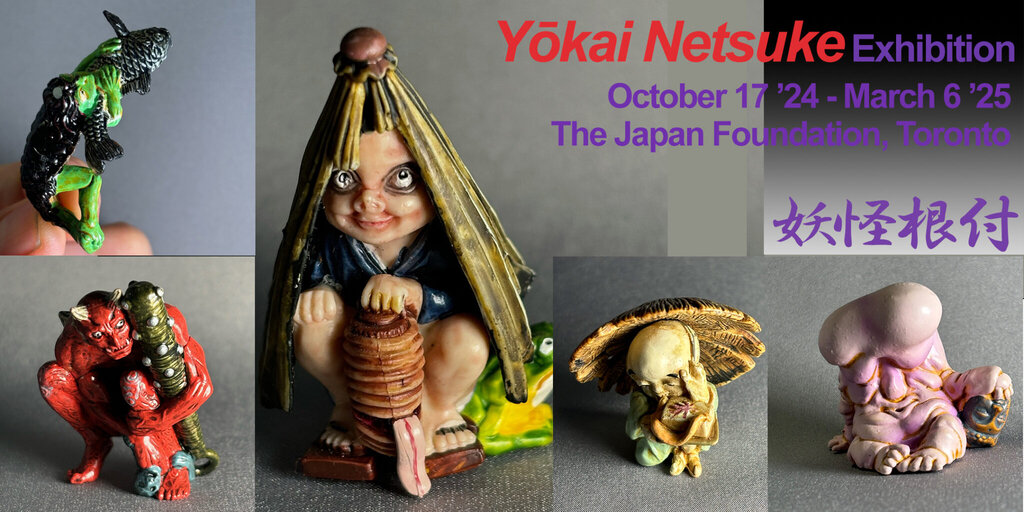
    The poster of the exhibition

    Down a narrow hallway, The Japan Foundation transports viewers to the realm of yōkai, displaying various species in the form of figures, flattened onto t-shirts and prints, and made into tokens and commodities. Yōkai, the Japanese word for demons, monsters, spirits, imaginative animals, and other-worldly creatures, stems from Japanese folklore and is often seen across anime, manga, books, and movies. Netsuke, the Japanese word for miniature sculpted figures or the personal items hung on an obi sash using toggles, is the medium that the exhibition focuses on. Illustrations and prints are shown alongside these figures, as variations in the interpretation of each species, unique to the individual artist creating them. This exhibit focuses on Kaiyōdō Co. Ltd.’s perception of yōkai.

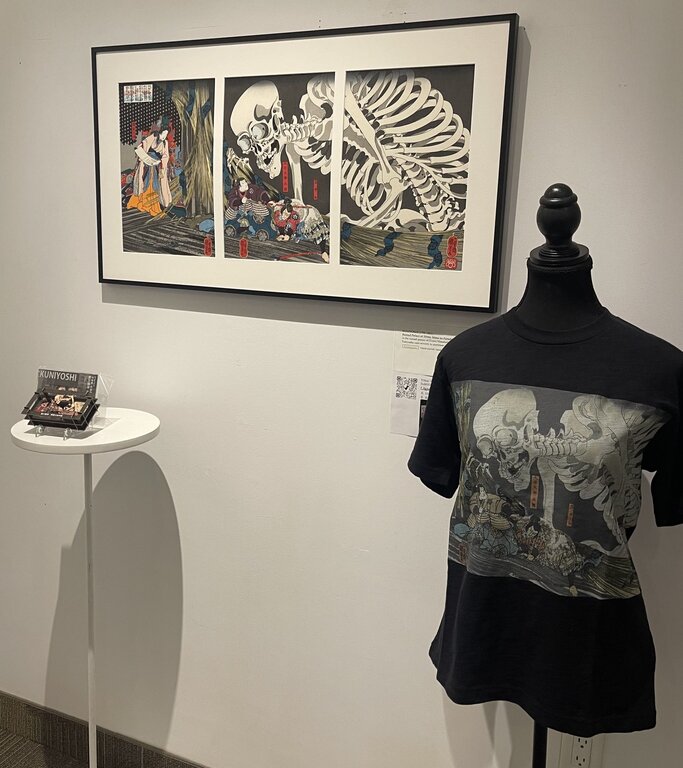
    Kuniyoshi (1798-1861), Ruined Palace of Sōma, Sōma no Furudairi, hand-carved, hand-printed, contemporary reproduction and T shirt

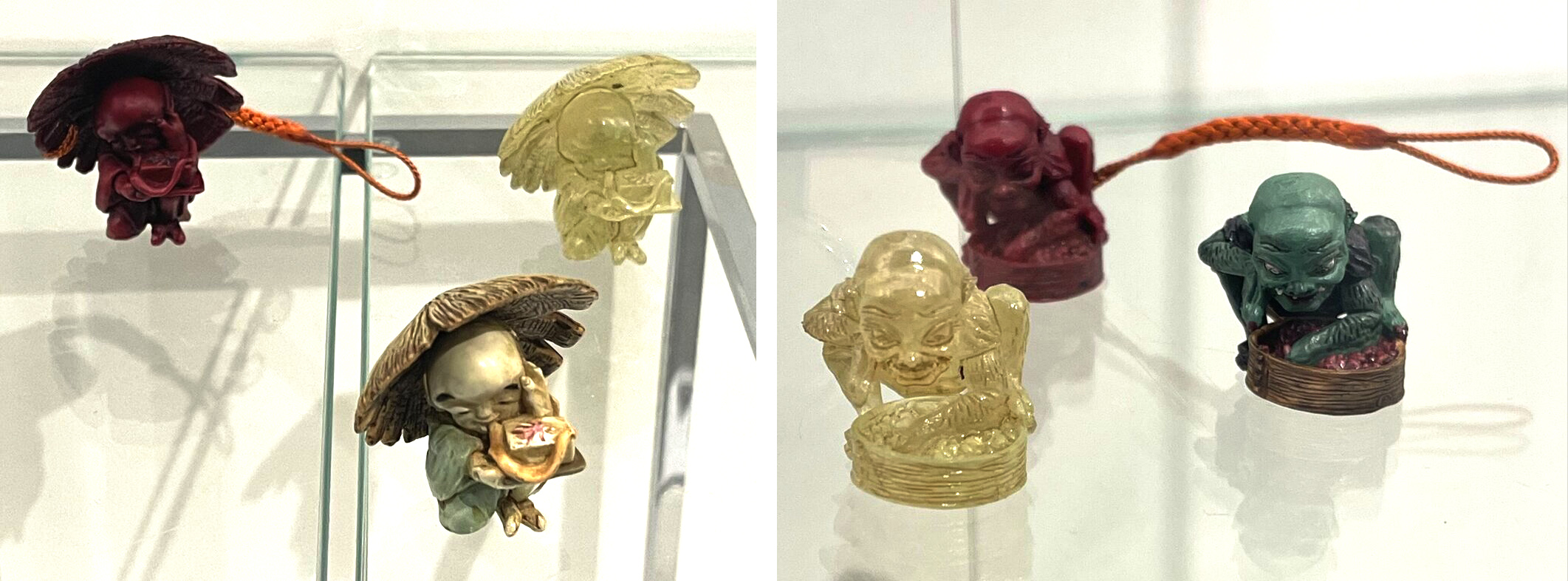
    Taken from the pages of the pictorial book series “Hyakkiyagyō (Demon Horde’s Night Parade)” published from 1776 to 1784, these characters are brought to life in three different styles: multi-colored, red-lacquer, and jade. These imaginative creatures, inspired by human activities and emotions, come from a world reflective of the one we live in, each with its counterpart in yōkai. For example, the “tofu boy” is a specie of yōkai that takes on the form of a human with an exceedingly large forehead, dressed in yukata robes, accessorized with a kasa, a Japanese straw hat, holding a piece of tofu. Similarly, the “red bean washer” hunches over a pot of red bean, guarding it with its boney elongated limbs, staring directly at the viewers with demonic eyes. Terrifying yet cute, the contrast between its miniature size and its grotesque features elicits a certain fascination rather than repulsiveness. With its exaggerated posture and devious smile, these netsukes embody a humorous sensibility that offsets the gruesomeness in their two-dimensional illustrative counterparts.

    GOTŌ Jun, Tōfu Kozō, Tōfu Boy, multi-colored, red-lacquer, and jade (left) and FUJIOKA Yukio, Azuki Arai, Red Bean Washer, multi-colored, red-lacquer, and jade (right)

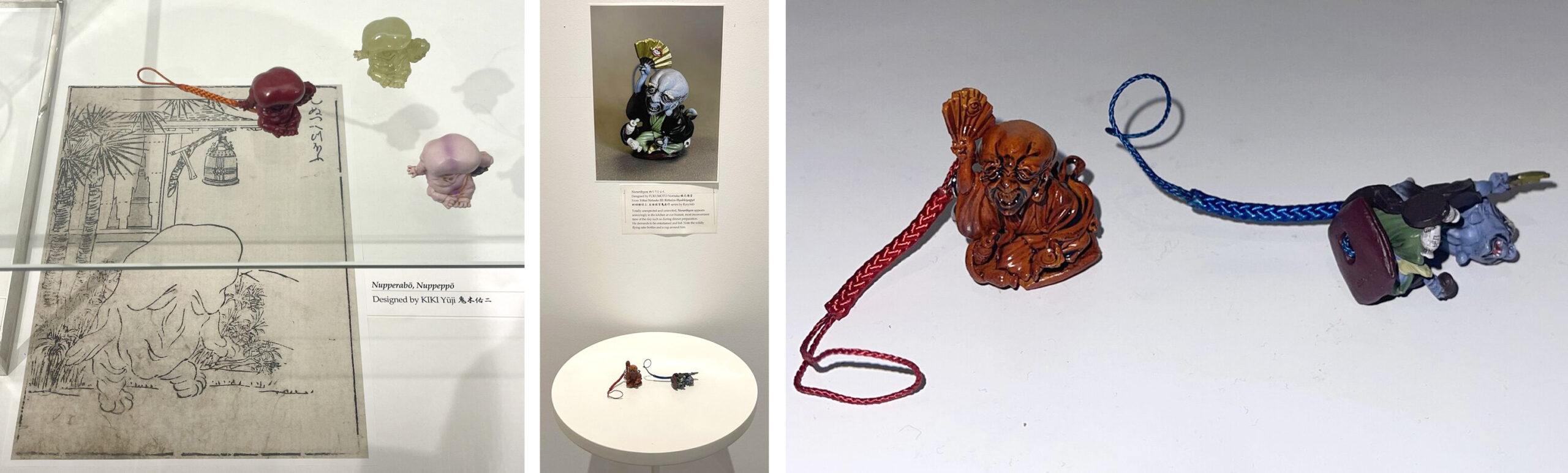
    Trinkets or “toys” such as these may not be viewed as art, but the inspiration and the production of these works are rooted in artistic practices. In their original form, they are illustrations that demonstrate skill and imagination. Moreover, the change from two-dimensional to three-dimensional space requires craftsmanship and design as they are seen from different  perspectives. Catering to the booming commercial culture, the transformation of these characters into commodities or collectibles, namely “gashapons”, which are vending-machine miniature figures, generates value and appreciation by allowing viewers to obtain a piece of the story and lore around these different characters in an enticing and accessible way. Some species are paired with a printed sketch from which these figures are inspired. This allows viewers into the creative process of the transformation of these yōkai species, imbuing them with life as they are molded in three-dimensions.

    KIKI Yūji, Nupperabō, Nuppeppō, multi-colored, red-lacquer, and jade (left) and FUKUMOTO Noritaka, Nurarihyon, from Yōkai Netsuke III: Rittaizu Hyakkiyagyō, series by Kaiyōdō (middle and right)

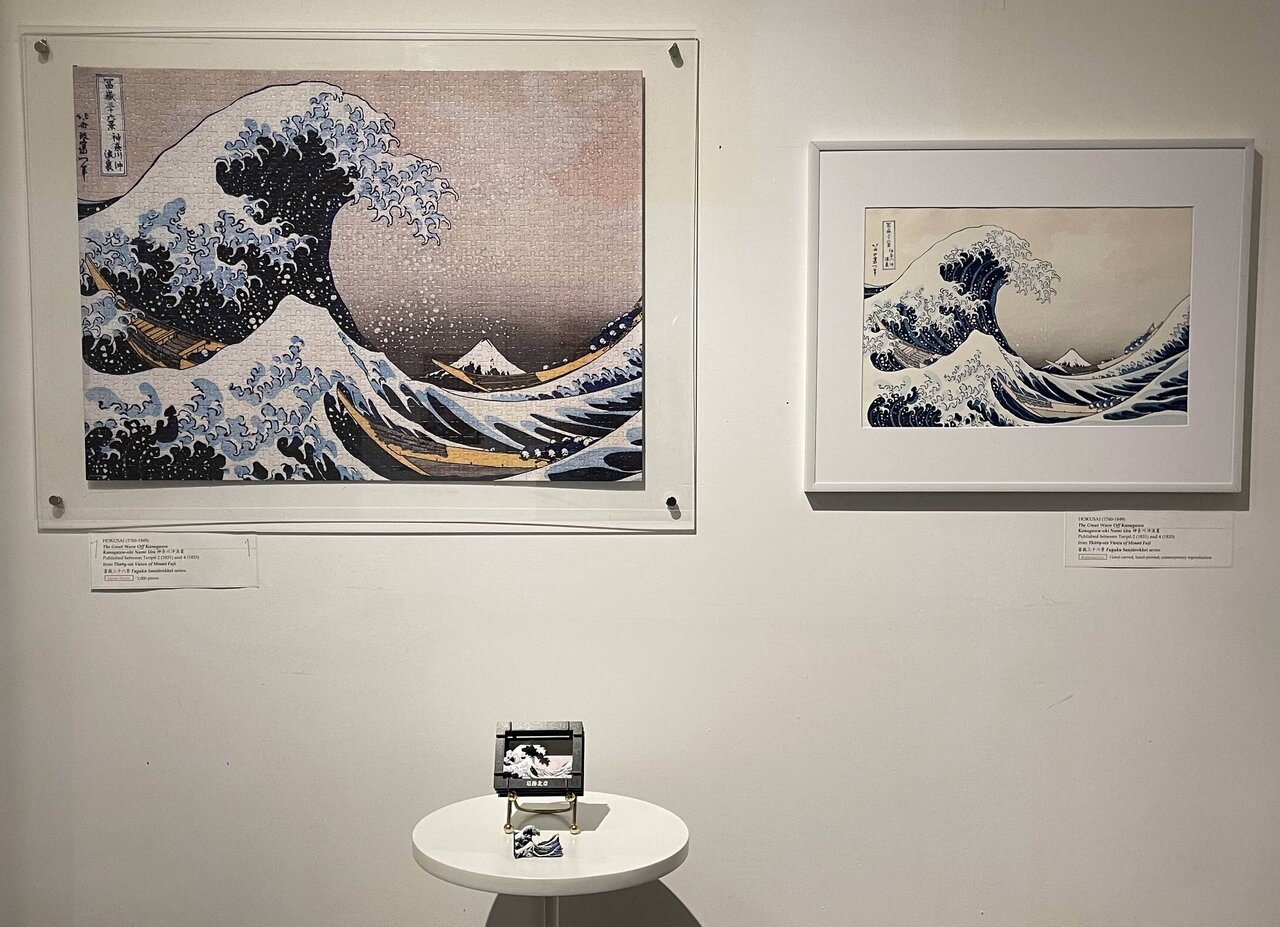
    Framed ukiyo-e prints by famous Japanese artists such as Hokusai and Hiroshige decorate the walls of the exhibition, offering insight into the creative minds of established woodblock print artists who have similarly made contributions to the world of yōkai. Moreover, it provides context for the stylistic practices distinctive to Japanese artists, separating yōkai from demons or spirits of other cultures. Famous for his ukiyo-e print, “The Great Wave off Kanagawa”, which is a part of his equally well-known “Thirty-Six Views of Mount Fuji” series, Hokusai also produced a series of prints, in his distinctive style, based on traditional ghost stories, known as “Hyakumonogatari.”

    Hokusai (1760-1849), Kanagawa-oki Nami Ura, The Great Wave Off Kanagawa, from Fugaku Sanjūrokkei series, Thirty-six Views of Mount Fuji, hand-carved, hand-printed, contemporary reproduction

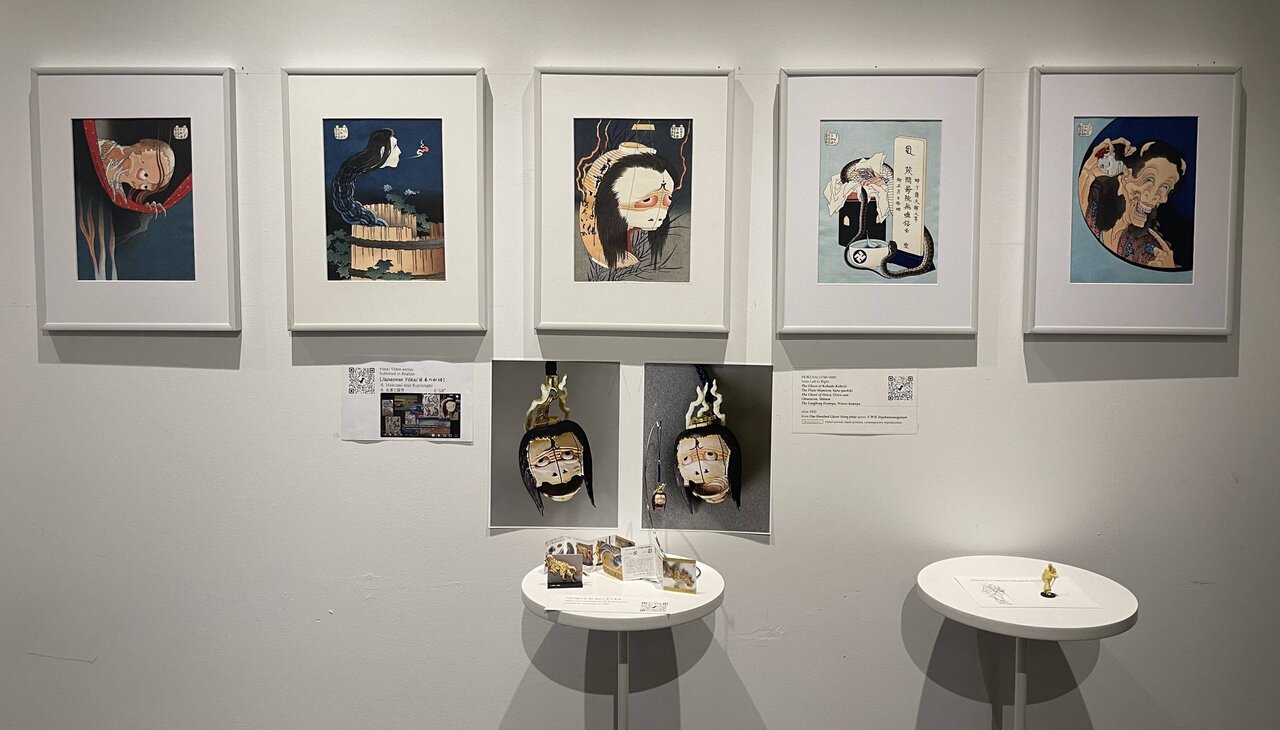
    Hokusai had particular interest in yōkai who were once human. Each one of his works on display is from the “Hyakumonogatari,” known as “One Hundred Ghost Stories.” “The Ghost of Oiwa, Oiwa-san” was the neglected wife of a samurai. Upon her death, her soul was trapped in a lantern with her face morphing into one with the lantern. Her sorrow is expressed through the redness of her eyes, the result of endless tears. The folds in the lantern emphasize the frown on her face and the wrinkles developed from sleepless nights of worry. Sounds of her wailing can be heard from her gaping mouth.

    The intensity of pain and suffering is embodied in the way these ghostly bodies are twisted in inconceivable ways, seeping through the gloomy and horrifying expressions on their faces. Tales of yōkai are deeply ingrained into Japanese culture and imagination, inspiring not only artworks but also acts as reference points to what Japanese culture entails. Images of yōkai are often seen on the walls of Japanese restaurants as well as life-sized sculptures, standing guard outside or netsukes lined up on ledges inside restaurants. This not only signals customers that they have entered a mysterious world of spirits and demons but also a Japanese establishment.

    Hokusai (1760-1849), (L-R) The Ghost of Kohada Koheiji, The Plate Mansion, Sara-yashiki, The Ghost of Oiwa, Oiwa-san, Obsession, Shûnen, The Laughing Hannya, Warai-hannya, from Hyakumonogatari, One Hundred Ghost Story print series, hand-carved, hand-printed, contemporary reproduction.

    Sherry Qin

    *Exhibition information: Yōkai Netsuke Exhibition, October 17, 2024 – March 6, 2025, Japan Foundation, Toronto, 2 Bloor St. East, 3rd Floor. Hours: Tuesday, Friday, Saturday: 11:30 am – 4:30 pm, Thursday: 11:30 am – 6:30 pm.

  • Drawing a Blank at Open Studio

    Rochelle Rubinstein and Jennifer Lindsay at Open Studio – A Journey Through Voicelessness and Resistance

    Spiral installation view at the hidden center of the display, mixed media including woodblock, ink drawing, painting, collaging, each book page 5.5” x 3.5”, 132” x 5.5” when open

    The concept of voicelessness—whether through the barriers of language, societal oppression, or internalized silence—finds its voice in the powerful installation Drawing a Blank by artists Rochelle Rubinstein and Jennifer Lindsay. This compelling exhibition at Open Studio invites visitors to navigate an immersive, labyrinthine environment, where the tangled threads of human experience are captured through a fusion of art, sound, and narrative. Through their collaborative efforts, Rubinstein and Lindsay conjure a multi-sensory experience that explores themes of delayed language recall, familial tensions, and the complexities of resistance in an era marked by “extreme censorship and self-censorship.” At the heart of Drawing a Blank is a spiral-shaped labyrinth made of suspended, accordion-folded books. Each book, which stretches ten feet in length, hangs from the ceiling in a manner that defies the traditional, linear experience of reading. This visual disorientation mirrors the thematic exploration of language and communication where the typical flow of thought and narrative is upended. Visitors are invited to step into a space where the usual rules of engagement are abandoned and they are free to explore Rubinstein’s mixed media works in any direction they choose, creating a fragmented yet intimate relationship with the artwork.

    Close-up view of the display books, mixed media including woodblock, ink drawing, painting, collaging, each book page 5.5” x 3.5”, 132” x 5.5” when open.

    The hanging books, with their intricate woodblock prints, ink drawings, paintings, and embroidered elements, speak to the vulnerability of human experience. Rubinstein’s hand-written text offers glimpses into the delicate and often painful inner worlds of her subjects—interwoven with depictions of human frailty and the haunting realities of displacement. The themes of repression, ritual, and desire, weave a beautiful display of personal and universal struggles.

    As visitors meander through the labyrinth, an evocative soundscape, created by Lindsay, adds another layer to the immersive experience. The looped soundscape features speakers sharing fragments of phrases, thoughts, and stories that reflect the silencing effects of voicelessness. Through Lindsay’s careful curation of sound, the audience is invited to experience the weight of unspoken words, the internal monologues that never fully surface, and the dissonance between thought and communication. It is in the center of the spiral that visitors are invited to sit, absorbing both the visual and auditory elements, and engage with the paradox of drawing a blank—where silence becomes a space for both reflection and revelation.

    “WAKE UP,” close-up view of the display books, mixed media including woodblock, ink drawing, painting, collaging, each book page 5.5” x 3.5”, 132” x 5.5” when open.

    Rubinstein and Lindsay bring together a convergence of personal history, artistic technique, and social commentary. Rubinstein, a Toronto-based printmaker, painter, fabric and book artist, brings her long-established practice of using mixed media to explore the complexity of human experience. As a facilitator of workshops for diverse populations—ranging from survivors of intimate partner violence to at-risk youth—Rubinstein’s art has become a tool for healing and personal expression. She continues this important work at Bela Farm in Hillsburgh, Ontario, where art and activism intersect.

    Jennifer Lindsay, an interdisciplinary artist and researcher, expands the scope of this collaboration with her exploration of social and psychological experiences. As a writer, director, producer, and sound artist, Lindsay’s work has examined the intersection of art and science, with particular emphasis on the impact of acquired brain injury and communication disorders. Her soundscapes, which have supported communities such as those with acquired brain injuries, serve to elevate the sensory aspects of Drawing a Blank, adding an emotional depth that engages both the intellect and the body.

    Together, Rubinstein and Lindsay have created an environment where language is both present and absent, inviting visitors to confront the complexities of communication. Whether through the tension of silence or the messiness of fragmented thought, the installation serves as a meditation on how we express, repress, and ultimately find our way back to voice.

    “I love you,” close-up view of the display books, mixed media including woodblock, ink drawing, painting, collaging, each book page 5.5” x 3.5”, 132” x 5.5” when open.

    As visitors step into the heart of the spiral, they are encouraged not only to see the intricate layers of Rubinstein’s visual art and to listen to the nuanced soundscape created by Lindsay, but also to consider their own relationships with voice, memory, and resistance. Drawing a Blank is not just an exhibition; it is an invitation to participate in an ongoing conversation about the ways in which we are all shaped by the silences, struggles, and the stories we carry.

    Text and photo: Yehyun Lee

    *Exhibition information: Drawing a Blank by Rochelle Rubinstein and Jennifer Lindsay, January 9 – March 8, 2025, Open Studio, 401 Richmond St West, Suite 104. Gallery hours: Tuesday – Friday 1 am – 5 pm, Saturday 12 – 5 pm.

  • Charles Campbell at The Power Plant

    Between the early 1500s and mid-1800s, millions of African men, women and children were stripped of their human status — thrust into an existence of slavery, traded as objects, not beings, across the Americas. Known as the Middle Passage, cargo ships travelled along triangular trade routes, a journey of roughly 21-90 days, taking goods like knives, guns and other ammunition from Europe to Africa, then Africans to work as slaves in the Americas and West Indies, and finally transporting raw materials such as sugar, tobacco, indigo and rum, back to Europe. Slave captains would anchor their ships off Africa’s Guinea Coast for up to a year to collect their cargo of anywhere from 150-600 slaves (who were kidnapped and forced to walk to the coast) to make the journey to the Americas. However, due to the ship’s horrific conditions below deck (lack of food, exercise, medicines, space, etc.), it is estimated that roughly 13% of African slaves died before reaching the American shorelines. The deceased were tossed into the ocean. Following the American revolution, and despite America’s slave trade’s official end in 1833, the African continent was divided up by colonizers for its raw materials. By the late 1800s to mid-1900s, almost every region of Africa was ruled by a colonial administration — Great Britain, France, Portugal, Germany and Italy, to name a few. The effects of colonialization and the slave trade left an ever-lasting mark on the African continent and the ancestors of its people.

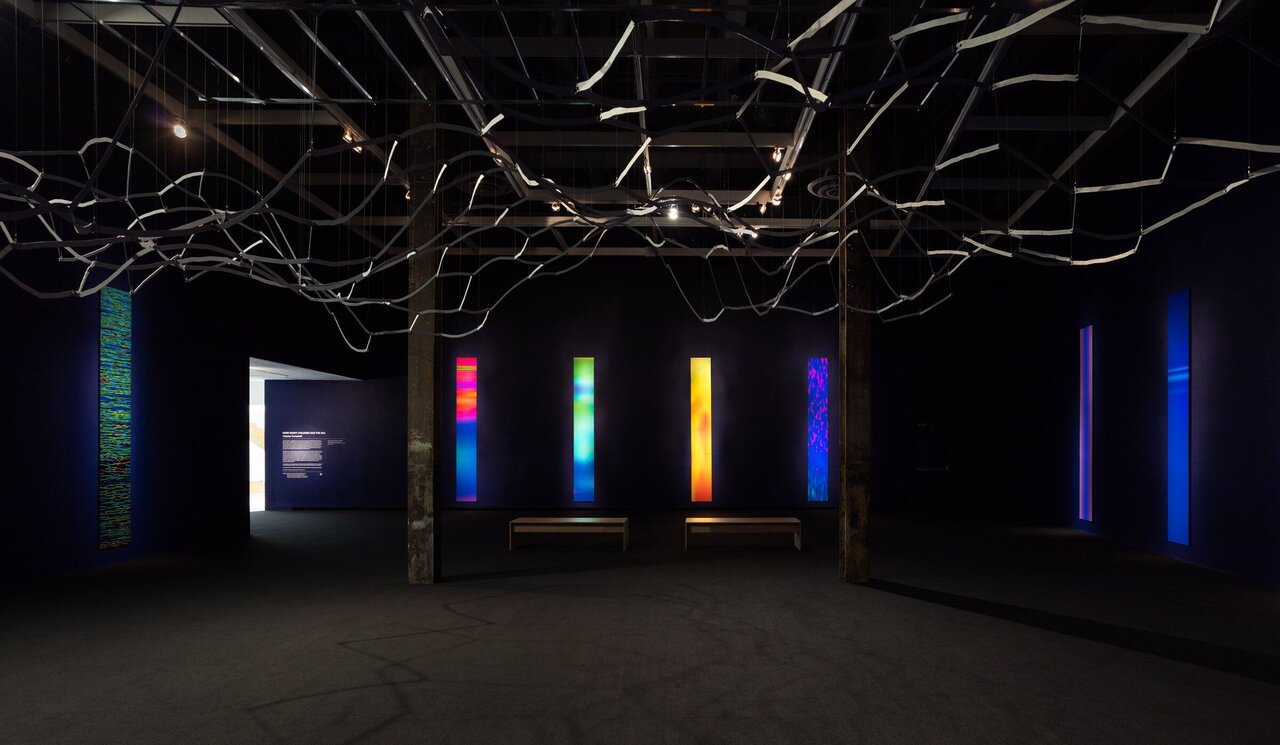
    Charles Campbell, How many colours has the sea, 2024. Co-commissioned by the Toronto Biennial of Art and the National Gallery of Canada. Installation view: The Power Plant, Toronto, 2024. Photo: LF Documentation

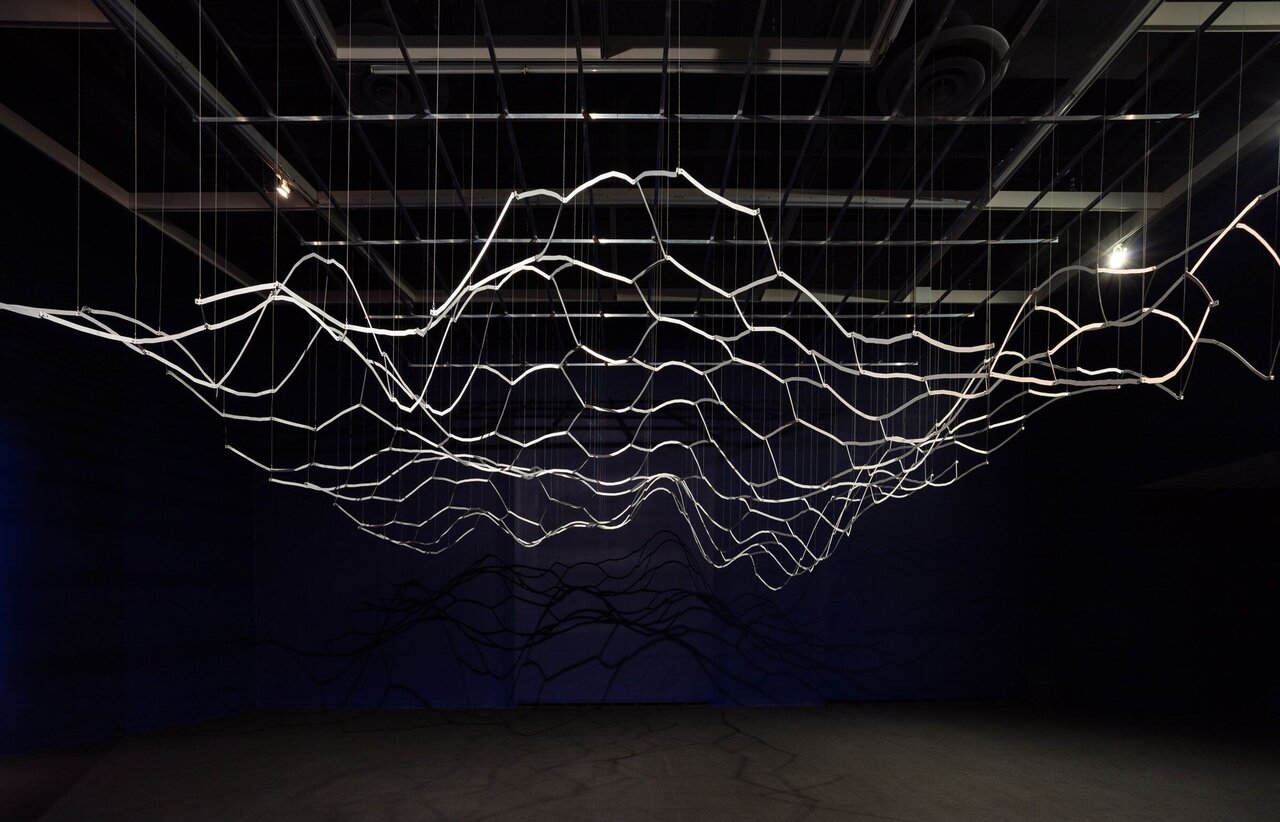
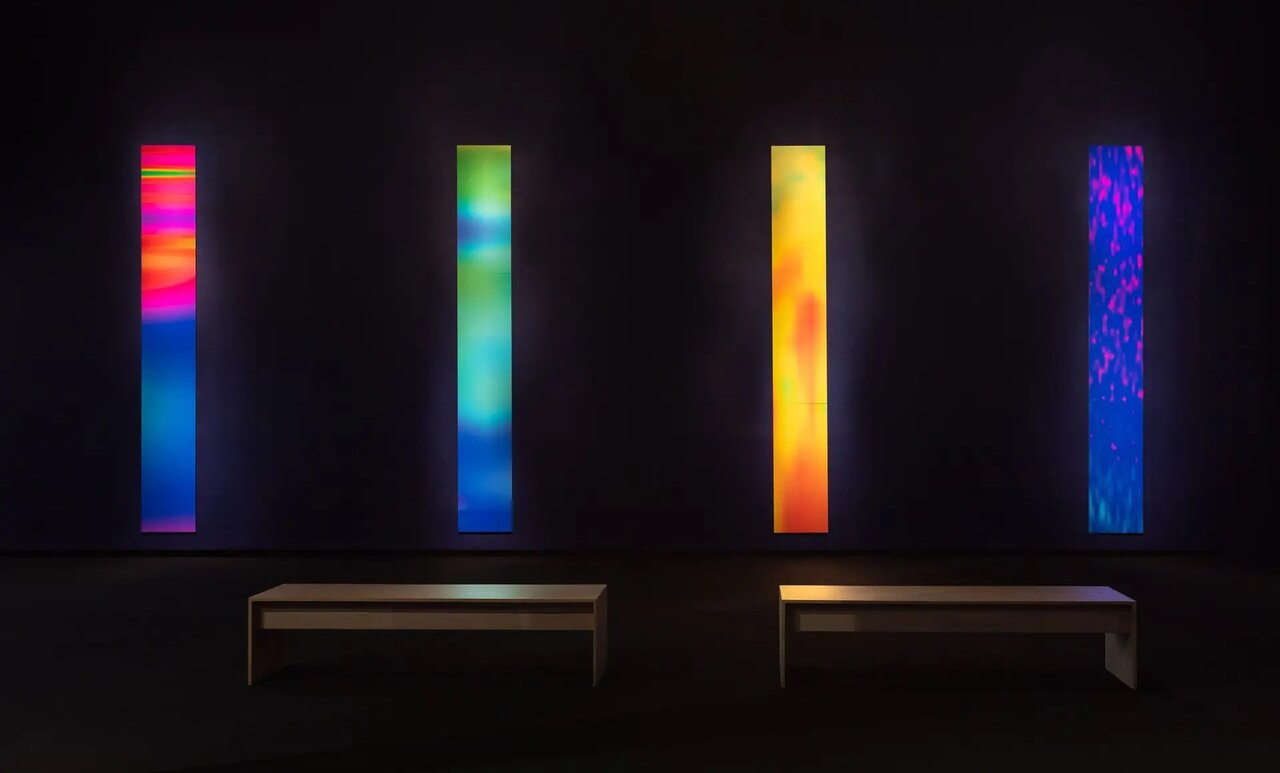
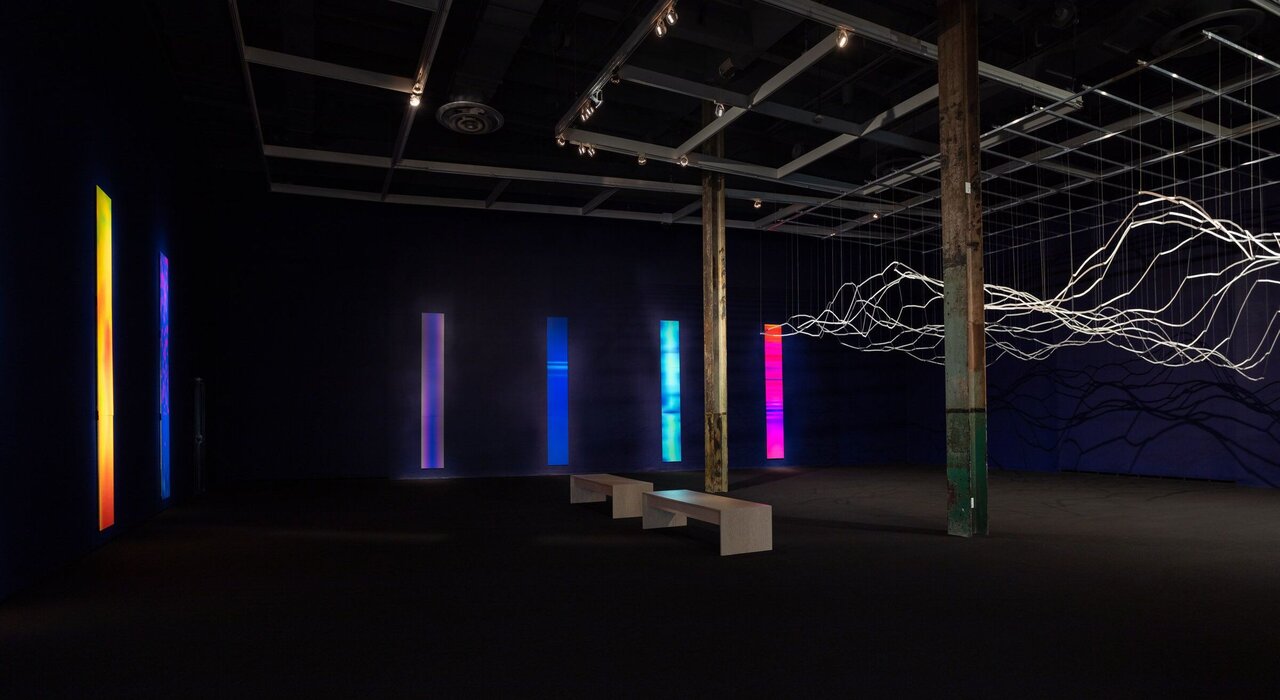
    Today, Jamaican born multidisciplinary artist, writer and curator, Charles Campbell, uses his art practice to reflect the effects of colonization and slavery through audio installations and sculptures. His latest exhibition, How many colors has the sea, currently featured at The Power Plant in Toronto, recreates the physical terrain of the tectonic plates below the Atlantic ocean, connecting the African and American continents. In conjunction, nine monolithic panels featured around the room, showcase an array of colorful sound waves — breath, represented in visual format, of members of the Black community.

    Upon entering the gallery space at The Power Plant, the first thing you observe is the darkness. If not for the echoing sounds of crashing waves and the bright colorful glow of the panels in the space, it would feel eerie. The artist’s statement is first on your left, with the room opening into a cube-like space on your right. A single bench sits before you as you walk forward, only to see a spider-web-like shadow appear in front of it on the floor. This is when you look up to the ceiling and see, hovering 10 feet overhead, a metal sculpture of the tectonic plates. As you walk underneath it, you start to make out shapes of underwater mountain ranges, valleys and hills, all of which remained hidden beneath the Atlantic. It makes you feel small to stare up from underneath at such a massive structure, hanging from wire attached to the high ceilings.

    Charles Campbell, How many colours has the sea, 2024. Co-commissioned by the Toronto Biennial of Art and the National Gallery of Canada. Installation view: The Power Plant, Toronto, 2024. Photo: LF Documentation

    Returning your gaze to eye level, you notice there are nine other structures in the room — each in a variety of colors and patterns, but very clearly visual sound waves. There are 4 on one wall, 4 on the opposing wall and one final one, on his own on a singular patch of wall next to the bench. There is no ignoring the magnitude of the elements throughout the space — the audio broadcast into the gallery creates a depth to both the visual breathworks and the tectonic plates that leave you feeling marveled. But what is the connection between it all?

    Charles Campbell, How many colours has the sea, 2024. Co-commissioned by the Toronto Biennial of Art and the National Gallery of Canada. Installation view: The Power Plant, Toronto, 2024. Photo: LF Documentation

    In 2021, another of Campbell’s works, “Black Breath Spectacle,” was featured at the Vancouver Art Gallery. It was a 45-minute audio installation created using breath recordings of Black artists and local community members. Varying in length and speed for inhalations and exhalations, the recordings were accompanied by visual representation of the breaths similar to the ones used for How many colors has the sea. Campbell described the work as a response to the Black Lives Matter movement and the brutal killings of Black individuals by law enforcement in the USA, stating, “[we should] put the focus on breath rather than death.” He invited each participant in the project to imagine being next to a loved one, a childhood friend or a passed relative as their breathing was recorded — he felt it emphasized the joyousness of life itself. Looking through history, it is very clear that not all creatures are treated with the level of respect and compassion they should be. Life is often seen as something to control, oppress and subjugate. Focusing on breath, however, removes all racial, social and political associations or stigmas from an individual — because it is an action we all do, even unconsciously, that connects each of us as human beings.

    Charles Campbell, How many colours has the sea, 2024. Co-commissioned by the Toronto Biennial of Art and the National Gallery of Canada. Installation view: The Power Plant, Toronto, 2024. Photo: LF Documentation

    Using the breath of Black individuals in both installations makes note of two key points — firstly, Black lives not only matter, but they continue to grow, represent and thrive in all conditions of life. Secondly, Black lives will not be controlled, they will not be oppressed, and they will not be forced into any conditions. Even an action as simple as breathing, can and will be heard by all those listening. How many colors has the sea is as depicted a sculptural and audio-visual representation of a journey through the Middle Passage, emphasizing the distance travelled by African men, women and children — knowing that with every inch closer they got to American soil, the sooner they would be sold as slaves to colonizers.

    Charles Campbell, How many colours has the sea, 2024. Co-commissioned by the Toronto Biennial of Art and the National Gallery of Canada. Installation view: The Power Plant, Toronto, 2024. Photo: LF Documentation

    However, it is also a representation of resilience, of life and of freedom. The visual breaths, displayed as monolithic panels, stand tall, strong, glowing in vibrant colors which cannot be ignored. So how many colors does the sea have? So long as there is breath in the human body, there will always be a colorful sea of differences between each of us — ones that make us individually unique, ones that give us power and ones that make us strong and united. In the words of Maya Angelou, “I rise…I rise…Up from a past that’s rooted in pain…I rise…I’m a black ocean, leaping and wide…Welling and swelling I bear in the tide…Bringing the gifts that my ancestors gave…I am the dream and the hope of the slave…I rise” (Still I Rise).

    Lex Barrie

    *Exhibition information: Charles Campbell, How many colors has the sea, September 21, 2024 – March 2, 2025, The Power Plant, 231 Queens Quay West, Toronto. Gallery hours: Wed – Sun 11 am – 6 pm, Thu 11 am – 8 pm.

  • Gwen Tooth and Parissa Daie at Propeller

    Distant Fruit by Gwen Tooth and A Dream Within A Dream by Parissa Daie, currently exhibited at Propeller Art Gallery, exemplifies distinct yet complementary artistic approaches. While Tooth’s work engages with themes of isolation, presence, and the physicality of mark-making, Daie’s paintings embody memory, imagination, and the fluidity between dreams and reality. Together, these exhibitions offer a compelling dialogue on perception, emotion, and the act of creation itself.

    Installation view of Distant Fruit by Gwen Tooth and A Dream Within A Dream by Parissa Daie at Propeller Art Gallery

    When viewed within the broader Distant Fruit series, the themes of isolation and connection become very pronounced. In “Distant Fruit 2”, Gwen Tooth presents three simple pears, their proportions evoking human figures. Each pear stands apart, reinforcing the significance of distance in the composition. The way they are positioned creates a subtle tension; an unspoken relationship between them that suggests something beyond the physical space they occupy. The negative space between the pears becomes just as expressive as the forms themselves, encouraging viewers to interpret the emotional or psychological dynamics at play. This separation aligns seamlessly with the themes Tooth explores in her artist statement. Her artistic practice is not merely about depicting fruit but about capturing her personal, emotional, and psychological states translated onto the canvas. The use of simple green lines in “Distant Fruit 2” mirrors her process of drawing with paint, where the act of holding the brush firmly and completing each line in one movement fosters a sense of continuity and immediacy. Just as she describes letting the paintings guide her, the viewer is drawn into an open-ended dialogue with the work, engaging with the imagery on a deeply personal level.

    Gwen Tooth, Distant Fruit 2, acrylic on canvas, 10 x 10 inches (left) and detail (right)

    Tooth’s own artist statement provides a critical lens through which to understand “Distant Fruit 10”. As an expressionist painter, she is deeply engaged with the physical and emotional resonance of her subjects, a connection that extends from her earlier explorations of water’s energy to her more recent investigations of fruit. Furthermore, when considering “Distant Fruit 10” within the larger Distant Fruit series, its connection to themes of abundance and feast becomes apparent. However, while the series may reference the harvest, these apples hold an intimate power. It is less about communal abundance and more about individual experience; the isolated objects speak volumes through their forms. Tooth’s approach to painting; allowing the work to lead, breaking conventions as needed, reinforces the expressive strength of this piece. The painting’s lines, its choice of color, and the very act of drawing without interruption suggest an urgency, an unbroken thought. The apple, then, is more than some fruit; it is a representation of desire and presence.

    Gwen Tooth, Distant Fruit 10, acrylic on canvas, 12 x 12 inches (left) and detail (right)

    “Conquer of Hope” by Parissa Daie is a mesmerizing journey into a dreamscape, a composition that feels as though it has been pulled from the depths of memory and suspended on canvas. The use of pinks, yellows, and vibrant shades of red creates an atmosphere that is deeply emotive. Looking at the painting, it feels as if stepping into a dream, a space where time dissolves, and emotions take precedence over form. What captivates me most about this piece is the way the colours interact, blending in a manner that suggests both control and spontaneity. The brushstrokes feel intuitive, guided by an internal rhythm that mirrors Daie’s connection to her work. This aligns with her description of painting as an act of unearthing, a process of reaching into the past and pulling forth fragments of experience, stitching them together to form something tangible. The dreamlike quality of “Conquer of Hope” is heightened by the way light and texture interact on the canvas. There are moments where the colours seem to pulse, as though infused with their own life force. For instance, the warmth of the reds and yellows is tempered by the softness of the pinks, creating a balance between passion and serenity. It is in this balance that the painting truly thrives, offering a sense of comfort in this dreamlike state.

    Parissa Daie, Conquer of Hope, acrylic, oil stick on canvas, 40 x 40 inches (left) and detail (right)

    Parissa Daie’s “Fall over Fire” is an evocative exploration of nature’s duality, capturing both its sombre stillness and its vibrant unpredictability. The painting immediately strikes me with its mix between muted tones and sudden bursts of luminous colour. It carries a depth, like a waterfall caught between dusk and dawn where its permanence and movement are an everlasting tension. Daie’s artistic approach, as revealed in her statement, is deeply rooted in memory, imagination, and the subconscious. She describes her process as one of retrieval, of resurrecting moments that exist between dream and reality. What draws me in most is the paradox of the piece; it feels both heavy and weightless. The darker hues envelop the scene in a kind of melancholic mystery, while the bursts of fiery colour hint at an unseen energy. I sense an eternal moment suspended in paint. It makes me wonder, are we witnessing something fading, or something being born? Is this a landscape of memory, or one waiting to be formed in our own minds?

    Parissa Daie, Fall over Fire, acrylic on canvas, 48 x 36 inches (left) and detail (right)

    Together, Distant Fruit and A Dream Within A Dream present two distinct yet interconnected artistic explorations. One is grounded in the contemplation of form and space, while the other is immersed in the fluidity of memory and imagination. Gwen Tooth’s paintings evoke a sense of wonder, where the spatial relationships between objects convey emotional depth. In contrast, Parissa Daie’s expressive compositions blur the boundaries between dreams and reality, creating a sense of movement. Through the juxtaposition of these exhibitions, Propeller Art Gallery fosters a thought-provoking dialogue that continues to resonate long after the viewer has left the gallery space.

    Kaya Meziane

    Images are courtesy of Propeller Art Gallery.

    *Exhibition information: Distant Fruit by Gwen Tooth and A Dream Within A Dream by Parissa Daie, February 12 – March 2, 2025, Propeller Art Gallery, 30 Abell St, Toronto. Gallery hours: Wed – Sat, 1 – 5:30pm, Sun 12 – 4pm.

  • Greg Hardy at Nicholas Metivier Gallery

    Nicholas Metivier Gallery presents Landscape and Memory, a collection of new paintings by Greg Hardy, one of Canada’s distinguished landscape painters, with a longstanding career beginning in the 1970s. Though an experienced traveller, Hardy paints his home province of Saskatchewan, capturing the rich and diverse northern landscapes and the vast prairies surrounding his studio on the outskirts of Saskatoon. His vibrant and monumental landscapes combine ephemeral emotion with representations of the physical land, creating something that is at once subjective, yet universal.

    A signature of Hardy’s landscapes is his unique way of expressing clouds. Among the flatlands and prairies of Saskatchewan that are evoked in the paintings, the sky dominates. Hardy captures the sky’s majesty with voluminous clouds. During the artist’s talk at the opening reception, Hardy compared the sky to a stage set, where the clouds are the actors themselves, moving around, with, or against each other. The clouds don’t statically stand above you, but they confront and approach you.

    Greg Hardy, Mid Day Laughter, 2024, acrylic on canvas, 90 x 68 ½ inches. ©Greg Hardy, courtesy of Nicholas Metivier Gallery.

    Hardy’s skillful and intuitive use of paint really shines through in these clouds. Half-mixed pigments, expressive brushstrokes, and the quick-drying qualities of acrylic paint—in which different layers dry at different rates creating a crackling effect that exposes layers of colour below—evoke a landscape that is alive; an entity, continually in motion. With no predetermined palette, and the ability to remove or add paint to the canvas as desired, Hardy displays the same intuitive and free-spirited characteristics as the nature he depicts. Even in landscapes with cloudless skies, there is still movement and life, achieved through his specific use of colour.

    Greg Hardy, Shoreline Glowing, 2024, acrylic on canvas, 30 x 84 inches. ©Greg Hardy, courtesy of Nicholas Metivier Gallery.

    Landscape and Memory takes its title from Simon Schama’s groundbreaking book about how human encounters with nature are manifested in our cultures. Hardy takes this idea to a more personal level, translating his own encounters with nature into a tangible representation of his memory and feeling of those experiences. His process involves spending time immersed in nature and creating studies or quick sketches of his surroundings, taking notes about the weather, light and, above all, his emotional response. He then takes these sketches and notes to the studio where he paints a landscape filtered through his own recollection of it. Indeed, his paintings are highly gestural and one can feel a sense of immediacy, as if recalling a memory over and over again in order to not forget it.

    Though Hardy is exclusively a landscape painter, it is difficult not to see some influence of abstract art in his work. His focus on expressing emotion through gestural brushstrokes and colour on large-scale canvasses are hallmarks of abstraction. One catches a glimpse of the Colour Field Movement when taking a closer look at “Down the Gravel Road”, or Abstract Expressionism in the clouds of “Out in the Kayak, Great Time of Day”.

    Greg Hardy, Out in the Kayak, Great Time of Day, 2024, acrylic on linen, 36 x 48 inches. ©Greg Hardy, courtesy of Nicholas Metivier Gallery.

    During his formative years as an artist in the 70s, Hardy participated in the renowned Emma Lake Artists’ Workshop, where various guest artists were invited to mentor dozens of other artists. This longstanding tradition at Emma Lake influenced the popularity of abstract art throughout the province, and undoubtedly continues to influence Hardy’s work today. His landscapes can be seen not only as a culmination of his relationship to nature, but also of his relationship to art and other artists. At the conclusion of the artist’s talk, John Geoghegan commented that the paintings are as much about Hardy as they are about the land. Standing amid his landscapes in the gallery, filled with pure emotion, colour and light, one can’t help but wholeheartedly agree.

    Greg Hardy, Down the Gravel Road, 2024, acrylic on linen, 30 x 48 inches. ©Greg Hardy, courtesy of Nicholas Metivier Gallery.

    Rebekah Barona

    *Exhibition information: Greg Hardy, Landscape and Memory, February 8 – March 8, 2025, Nicholas Metivier Gallery, 190 Richmond Street East, Toronto. Gallery hours: Tue – Sat, 10am – 5pm.

  • Howie Tsui at Patel Brown Gallery

    Exhibiting at the Patel Brown Gallery is Howie Tsui’s A Click Track for Pugilists. Each work on display engages with the exploration of macro and micro elements in our daily lives, searching for that metronomic beat that creates stability and consistency. Tsui’s works carry an eerie and gruesome undertone, exemplified by grotesque and demon like caricatures. There’s an illustrative quality to his works in which he creates a surrealist world that places these caricatures in fun and unusual contexts, adding a humorous touch. Tsui creates worlds within worlds, and characters within characters, where multiple narratives are carried out in each artwork. Each story unravels itself as you take a closer look at different sections of the piece, where even a character itself can be a story of its own.

    Howie Tsui, Veranda Pounce, 2024, paint pigment and ink on mulberry paper mounted on wood, 24 x 36 inches. Courtesy of Patel Brown Gallery

    At first glance, “Tavern Havoc” resembles a traditional Chinese hanging scroll painting where perspectives are stacked on top of each other. Within each level, mini narratives are occurring at the same time as if we are seeing multiple film scenes laid out on one surface. Working with varying planes and levels, the narrative in this work is an added western component that differs from the scenes captured in traditional Chinese paintings. This cinematic aspect is a common motif in Tsui’s works, where he takes the audience on a journey, giving it a storyboard like quality. Although seemingly separate stories, each narrative portrays a fight scene that Tsui has taken from contemporary Hong Kong kung fu or wuxia movies, specifically the Shaw Brothers Studio, which often sees this montage of multiple fights in a restaurant, hotel, or other public spaces, and in this specific work, a tavern. What makes it uniquely inspired by kung fu movies and not just any western movie fight scene is the details of the characters’ costumes, appearance, and props. These characters are illustrated with long and thin eyes which are distinctive Asian features, Qing dynasty hairstyle and hats with Chinese opera masks, bottle gourd, and swords. Taking inspiration from Qing dynasty ghost stories as prompts for his work, Tsui seamlessly merges the historic and the contemporary. He masterfully works with the negative space to create texture with these swirl-like brushstrokes often seen in Chinese ink on paper or silk paintings. His conviction and skill are demonstrated in his ability to work with the blank spaces as the Japanese paper used in his work makes it difficult to erase, leaving little to no space for error.

    Howie Tsui, Tavern Havoc, 2015, ink, paint pigment on mulberry paper, 82 ¼ x 42 7/8 inches. Photo: Sherry Qin

    Etched onto deerskin parchment is a five-part series of soldiers in varying degrees of suffering. Soldiers, who are usually seen as heroic figures, are shown to be mutilating themselves through injury and illness to prevent themselves from going to war. War has always been seen as black and white, winners and losers, murderers and innocents. But every individual contributes to both good and bad, acting in their own self-interest—whether driven by desperation, fear or the need to survive—yet not without compassion in their soul. Instead of this lofty expectation of heroism from the soldiers, Tsui offers a more realistic imagery of the internal conflicts that occur amongst the soldiers. These acts can be interpreted as being out of desperation and cowardice for their bleak outlook on life. Alternatively, this self-harm can be seen as attempts to stop themselves from inflicting harm on others. Despite the grim setting, Tsui adds a touch of comic relief by exaggerating facial features such as the pointy noses and widely spaced eyes that are popping out of their sockets. It allows a lightheartedness while being contemplative and sincere about subjects that may be hard to approach.

    Howie Tsui, Of Malingers, Skulkers and Dupes (1-5), 2012, acrylic ink on deerskin parchment, variable dimensions. Photo: Sherry Qin

    Aboard this ghostly floating restaurant (JUMBO) is a montage of characters Tsui has drawn over the course of his career with additional new characters, from Disney shows or movie crossovers. Drawn in the style of a Ming dynasty imperial palace, there’s a Chinatown quality that comes from the deliberate desire to imitate distinctively Chinese architecture and scenery. Chinatown is often seen as the identity of the Chinese diaspora and known for being created using the imagery of what is stereotypically thought of as Chinese, which Tsui draws from his own experiences growing up overseas.

    He continues to bring in a cinematic element through the layering of narratives that create depth in his works, where the audience will find themselves down a rabbit hole of various characters and stories. The different levels, rooms and characters, likewise, offer a video game quality to the work presenting the layout of each game level with its unique storyline and characters that the player must pass to win the game.

    Howie Tsui, Jumbo, 2024, digital art, 44 x 96 inches. Courtesy of Patel Brown Gallery

    Howie Tsui brings together scenes from Hong Kong cinema’s golden age to create this phenomenal collection of film GIFs in “GIF Roulette”. In this seemingly chaotic composition of GIFs, there are patterns to be found in these rows and columns. The patterns were not made with artistic intent but rather accidentally. Tsui made these discoveries going through his collection of film scenes, such as the common occurrence of snakes, circular objects and architecture. The setup can be seen as a replica of the control room where all the security camera footage is gathered onto one screen. No matter where you are standing, all the screens are visible to you, which alludes to the flatness that is seen in all of Tsui’s works. His multiple narratives are occurring on one plane. A Click Track for Pugilists explores the desire to seek consistency and stability within chaos and examine the micro and macro aspects of our daily lives.

    Howie Tsui, GIF Roulette, 2020-ongoing, 3-channel 4k video with stereo sound. Photo: Sherry Qin

    Sherry Qin

    *Exhibition information: Howie Tsui: A Click Track for Pugilists, January 11 – February 22, 2025, 21 Wade Ave, #2, Toronto. Gallery hours: Tue – Sat, 10 am – 6 pm.
  • Interface Remix by Tishan Hsu at MOCA

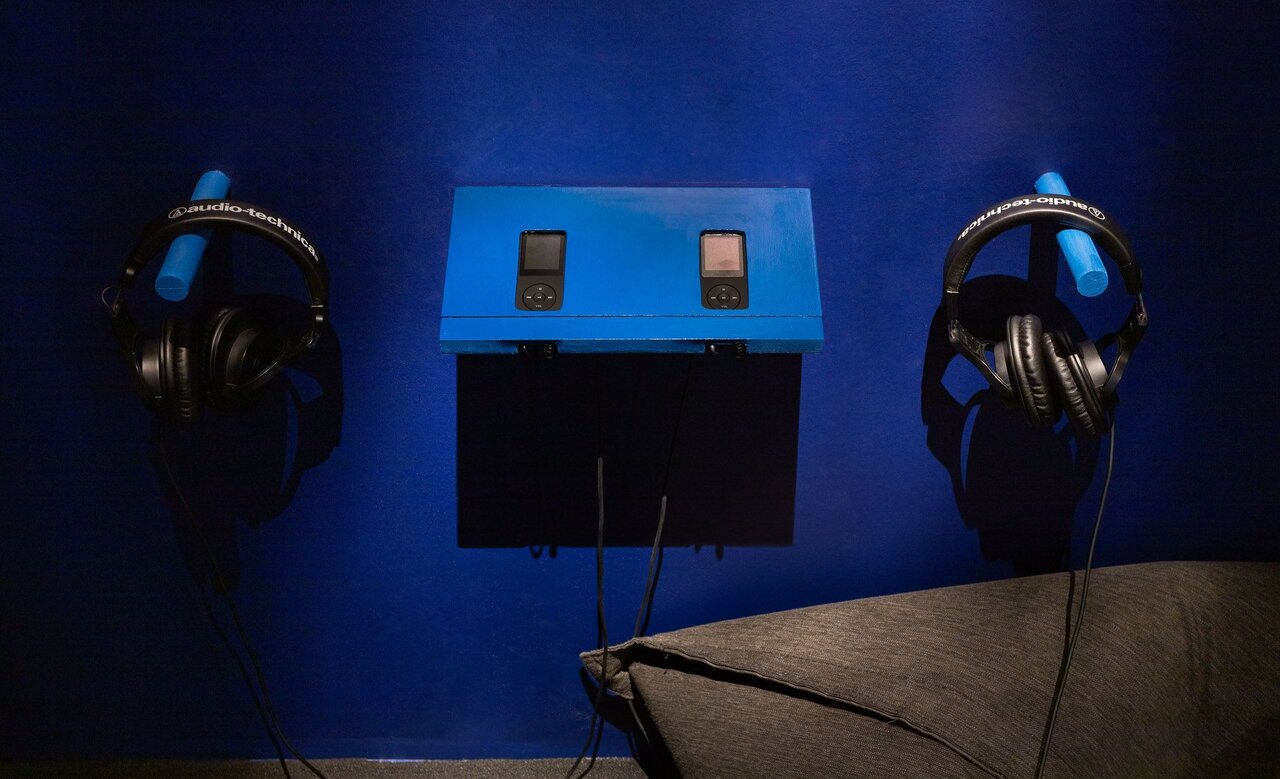
    Installation view of Tishan Hsu, Interface Remix at MOCA, 2025

    Undoubtedly, we could all make the claim that technology has reshaped human identity and experience. While it has effectively transformed our lives, these radical changes should prompt us to question how our highly technical and digitally connected world has altered our sense of self. Tishan Hsu’s Interface Remix at the Museum of Contemporary Art (MOCA) explores these questions in a brutally honest and avant-garde manner, offering a compelling look at the complexities of modern existence while providing commentary on what is to come.

    Close-up view of Tishan Hsu ear-screen-skin with casts: Toronto, 2024, inkjet on vinyl with acrylic

    Upon entering the exhibition, the enormous installation titled ear-screen-skin with casts: Toronto (2024) shocks the viewer. This newly commissioned piece merges technologies with human characteristics, giving it a life of its own. Its hazy flesh-coloured surface appears to incorporate footage from surgical procedures, along with x-ray images of an elongated, manipulated spine and lurid open wounds. These elements contrast sharply with the metallic and acrylic limb-like handles protruding from the installation. This hybrid creation symbolizes our modern time, not only through its innovative design, which utilizes Photoshop and curved forms but also in its reflection of the human body — a body which has been transformed by technology, allowing us to repair and reshape ourselves according to new inventions and standards like those used in the creation of “ear-screen-skin with casts: Toronto”.

    Tishan Hsu, Interface Remix, (2002), archival inkjet on canvas, two panels in total

    Another stand-out piece is the titular “Interface Remix” (2002). This piece presents a grid of cloned and distorted human features—lips, mouths, and eyes— simultaneously reducing the human form to its individual components while multiplying them. The result is a striking visual that eliminates individuality and creates what Hsu describes as “a conceptual image of biotechnology.” This work explores the profound consequences of technology’s integration into our daily lives, highlighting how becoming increasingly reliant on technology can limit our sense of independence and objectify our reality—forcing us to live an objective, unnatural and therefore distorted life. Furthermore, this fragmented yet repetitive display of human elements serves as a powerful commentary on technology’s aspirations and its impact on our natural identities. Other works like “Splits” (1996) and “mammal-screen” (2023), also explore the themes of bodily modification, identity in the digital age, and the blurred lines between the organic and the technological parts of our modern world.

    Installation view with Tishan Hsu, Splits, 1996, silkscreen ink, acrylic on canvas (left) and Cellular Automata 3.0, 1989/2018, silkscreen ink, acrylic on canvas (right)

    Tishan Hsu’s “Cellular Automata 3.0” (1989/2018) explores the limitations of the human body through a graphic black-and-white pattern featuring alternating close-ups of worn-out limbs. Hsu features heavy, glassy eyes that gaze upward and remain open despite their clear exhaustion, and dry, passive mouths that extend their tongues. Surrounding these natural facial features, there are more of Hsu’s subhuman body parts, including lumps and perfectly circular orifices. I believe this acrylic painting reflects our insatiable desire for entertainment and innovation in the digital age. “Cellular Automata 3.0” explores how the excessive use of technology has made us idle and drained our bodies, even though their use requires our minimal effort. Ultimately, this reliance on technology diminishes us, hindering the development of critical skills that could enrich our humanity and shape our unique identities.

    Installation view of Tishan Hsu, Interface Remix at MOCA, 2025

    Tishan Hsu’s Interface Remix presents a future that, while strange and disheartening, holds possibility. The artist invites us to explore the potential of the relationship between technology and human identity by exaggeratedly outlining the extent of our reliance on it and integration of it into our everyday lives. Interface Remix raises important questions about how technological advancements affect our understanding of individuality and existence in an increasingly interconnected world. Ultimately, Tishan Hsu’s work challenges us to consider whether technology’s ability to connect us and foster our development is ultimately beneficial. Tishan Hsu compels us to confront the illusions and perceptions that shape both modern art and our lives.

    Text and photo: Antonella Pecora Ruiz

    *Exhibition information: Tishan Hsu, Interface Remix, September 28, 2024 – February 23, 2025, Museum of Contemporary Art, 158 Sterling Rd, Toronto. Museum hours: Wed – Thu & Sat – Sun 11 am – 6 pm; Fri 11 am – 9 pm.
  • Kristine Moran at Daniel Faria Gallery

    After an event we sometimes feel a poignant sense of unfulfillment, and we dwell on what could have been done but wasn’t. Alternatively, we can look at past experiences and see their potential and possibilities by reimagining them as a starting point for different futures. This concept is beautifully captured by Kristine Moran’s solo exhibition, Not as it was but as it might be, at Daniel Faria Gallery. It is a great opportunity to experience Moran’s captivating works and rediscover the beauty of reimagined moments.

    Moran’s life journey has taken her to various cities, including a long trip across the United States, a stay in Bordeaux, France, and finally to her home in Owen Sound, Canada. Along the way, she sketched landscapes she encountered, capturing in quick lines and shapes national parks, topographies, public gardens, and evolving landscapes. In her studio, Moran reimagined these natural views, translating them into oil on canvas. This process stretched the original scenes away from their initial context, resulting in forms that collide and collapse into new arrangements. For Moran, sketching while moving through space allows her to capture multiple perspectives simultaneously, creating a layered, skewed effect. “It feels like being immersed in the garden and reconstructing it at the same time,” she said.

    Installation view of Kristine Moran, Not as it was but as it might be at Daniel Faria Gallery

    In Moran’s paintings there are moments when we feel something missing or a desire for more. We sense that something else—something different—is just out of reach. She defines this dissatisfaction as ‘Divine Dissatisfaction.’ It is not just a negative emotion, but a catalyst for transformation, inspiring us to reach beyond our current limitations and pursue our highest potential. This dissatisfaction is like nostalgia that can inspire new possibilities.

    Her paintings, “The centre holds” and “Towards the Unseen”, invite introspection. “The centre holds” is about how things fall apart. In the centre elements are static. It suggests resilience and a fragile hope that there is still something steady that exists in the middle of chaos. The waterfall is a symbol of transformation. Abstract forms build upon each other, creating a sensitive balance.

    Kristine Moran, The centre holds, 2024, oil on canvas, 72 x 60 inches

    The archway “Towards the unseen” suggests a journey towards the intangible. A screen/window at the center reinforces this idea, obscuring more than it reveals. The window serves as both barrier and curiosity spark. The composition interrupts perspective, juxtaposing natural and architectural elements.

    Kristine Moran, Towards the unseen, 2024, oil on canvas, 72 x 60 inches

    Kristine Moran’s abstract paintings invite observers to reimagine the gardens, parks, rugged shorelines, and waterfalls she’s encountered. Each garden holds a history of desire and idealization, striving for harmony between nature and its inhabitants. With a sense of urgency, Moran’s work embodies a utopic aspiration for contemplation and communion with nature. In her artwork, water represents transformation, constantly becoming, and reminding us of time’s passage. Archways symbolize the mysterious, promising magic on the other side. This ephemeral feeling slips away as one passes under the arch. In “Healing waters” and “The space between,” Moran explores the fleeting nature of life. Her paintings encourage us to appreciate the present moment and find solace in the beauty of the natural world.

    Kristine Moran, Healing waters, 2024, oil on canvas, 72 x 60 inches

    In “Light held twice” the viewer is invited to contemplate the fleeting moments of dawn and dusk. In the painting, the warm, golden light and the darker reflective shades seem to encourage introspection in the observer, raising questions about the horizon’s true nature: is it a sunrise or sunset on the shoreline?

    Kristine Moran, Light held twice, 2024, oil on canvas, 48 x 36 inches

    In the painting “Heat shimmer” Moran creates a mirage-like quality, as if the perspective is intentionally disjointed. The space appears to shift and settle, like a memory that refuses to solidify. A tree looks alive, almost animated, as if watching or leaning into the scene. Is it a figure disguised as a tree, or just the way memories infuse nature with human presence?

    Kristine Moran, Heat shimmer, 2024, oil on canvas, 72 x 60 inches

    In this exhibition, Moran conveys a powerful message: our past can be a source of inspiration, and as reimagined it can shape or reshape our world.

    Nusrat Papia

    Images are courtesy of Daniel Faria Gallery

    *Exhibition information: Kristine Moran, Not as it was but as it might be, January 9 – February 22, 2025, Daniel Faria Gallery, 188 St Helens Ave, Toronto. Gallery hours: Tue – Fri 11 am – 6 pm, Sat 10 am – 6 pm.