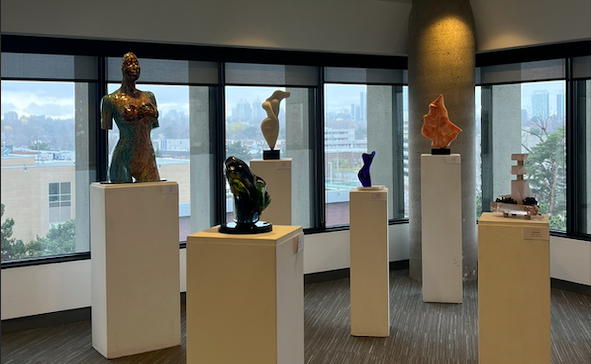
The Sculptors Society of Canada has been a cornerstone of the Toronto art community for decades. Presently, the gallery thrives within the Metro Toronto Multimedia College campus, a private design-focused institution located in North York. The exhibit, On the Edge, features a remarkable collection of sculptures that challenge the limits of form and dimension through the innovative use of natural stones and minerals. The Sculptors Society of Canada remains dedicated to showcasing and supporting both established and emerging artists. This exhibition exemplifies this commitment by offering a platform for sculptors to explore new techniques and concepts while inviting viewers to engage with the art in a meaningful way.
Installation view of On The Edge.
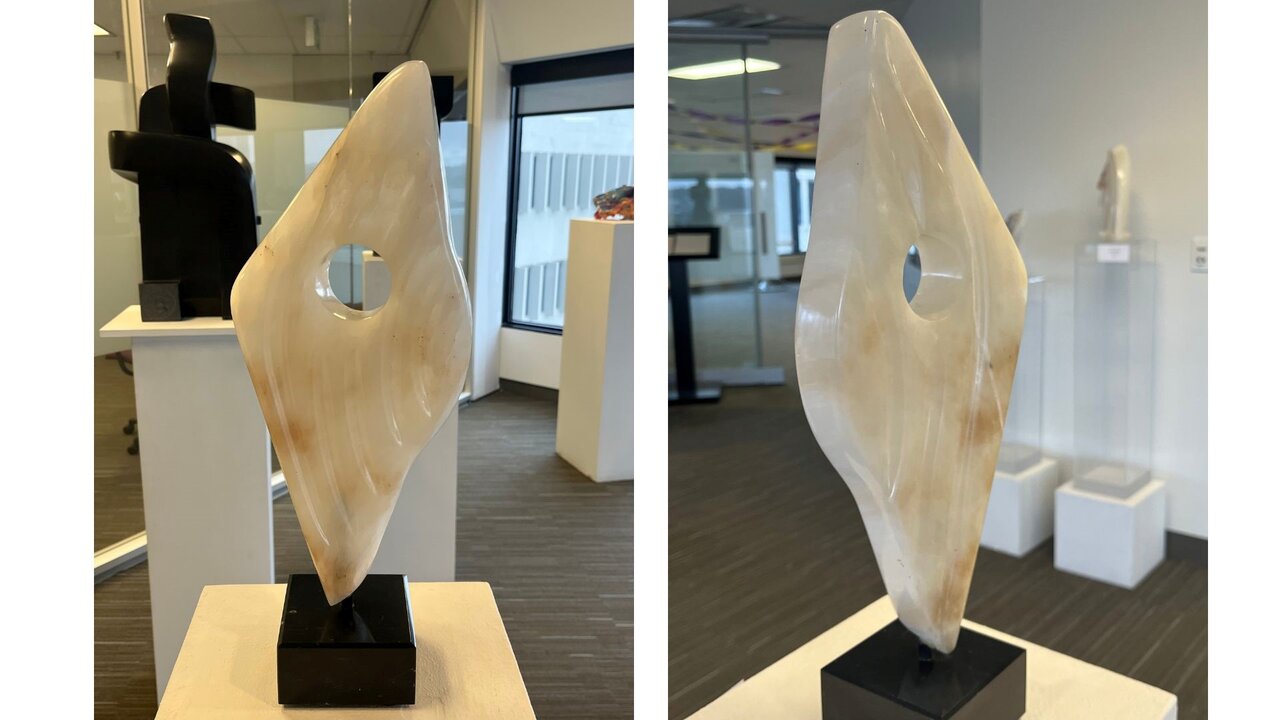
Tom Ashbourne is a self-taught sculptor who specializes in stone as a medium. Through the skillful manipulation of colour, shapes, and texture he created “The Dancer,” an innovative work that transcends the conventional constraints of sculptural techniques. Crafted from calcite, this sculpture exquisitely captures the dynamic essence of dance while simultaneously inviting viewers to engage with its abstract and thought-provoking elements, most notably the strategically carved central void that disrupts the fluidity of the piece and compels contemplation.
Tom Ashbourne, The Dancer, calcite and granite base
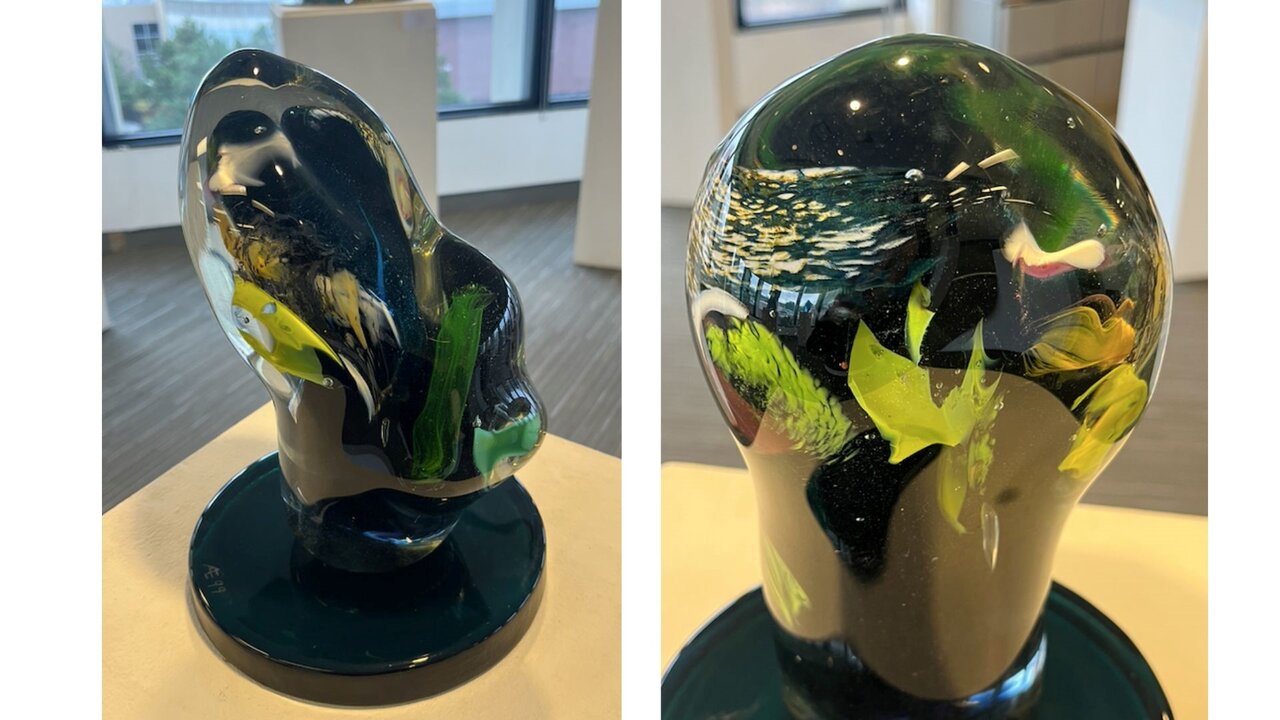
Alfred Engerer is a distinguished artist known for adeptly channelling personal experiences, historical insights, and emotional reflections into evocative sculptural works. In “Coral Garden,” Engerer masterfully employs solid worked glass to create a captivating coral-inspired sculpture that invites viewers to explore its intricate details. The artist’s use of a vibrant colour palette, featuring hues of green, yellow, blue, and red, accentuates the delicate layered complexity of the piece, reflecting Engerer’s deep connection to the natural world and its mesmerizing beauty.
Alfred Engerer, Coral Garden, Solid-worked glass and cast glass base (left) and detail (right)
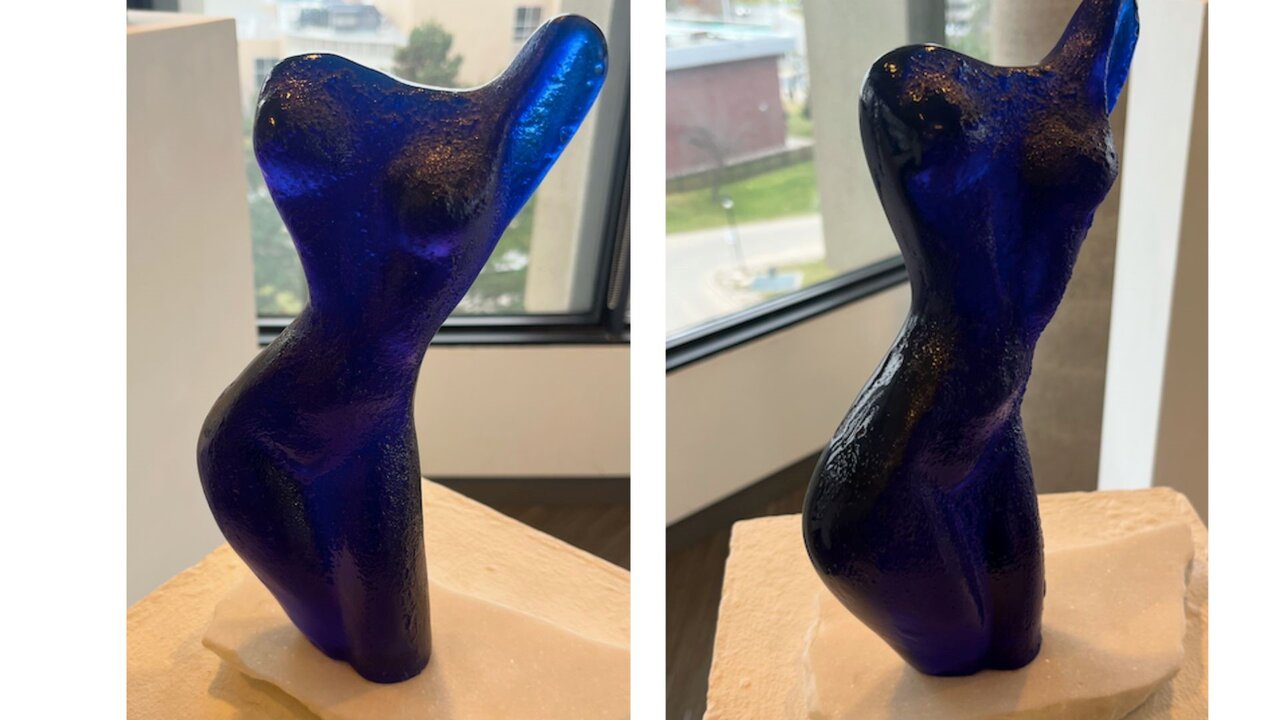
Elizabeth Merei’s exquisite glass sculpture, “Blue Torso,” offers a captivating representation of the female form that instantly draws the viewer’s attention. The deep blue hue of the glass imbues the piece with an emotive essence, heightening the resonance of the artwork. Despite its small size, the dynamic pose of the sculpture ensures that it stands out as a powerful testament to Merei’s artistic vision and technical mastery. In her artistic practice, Merei reveals a deep connection to the medium of stone, stemming from her European background and the rich architectural history of Hungary, Turkey, Italy, and Greece. The artist’s deft manipulation of proportion further enhances the visual impact of “Blue Torso,” showcasing her ability to balance elegance and potency within a single, compelling work.
Elizabeth Merei, Blue Torso, glass and alabaster base
The exhibition successfully highlights the extraordinary talents of both established and emerging artists, challenging viewers to engage with the art on a deeper level. The artists showcase their unique approaches to sculpting, demonstrating the versatility of materials like stone and glass in conveying powerful messages and emotions.
Text and photo: Kaya Meziane
*Exhibition information: On The Edge / Group show, curated by Judi Michelle Young, October 12, 2024 – January 10, 2025, Canadian Sculpture Centre, 95 Moatfield Drive, 5th Floor, North York. Gallery hours: Tue – Fri 12 – 5 pm.
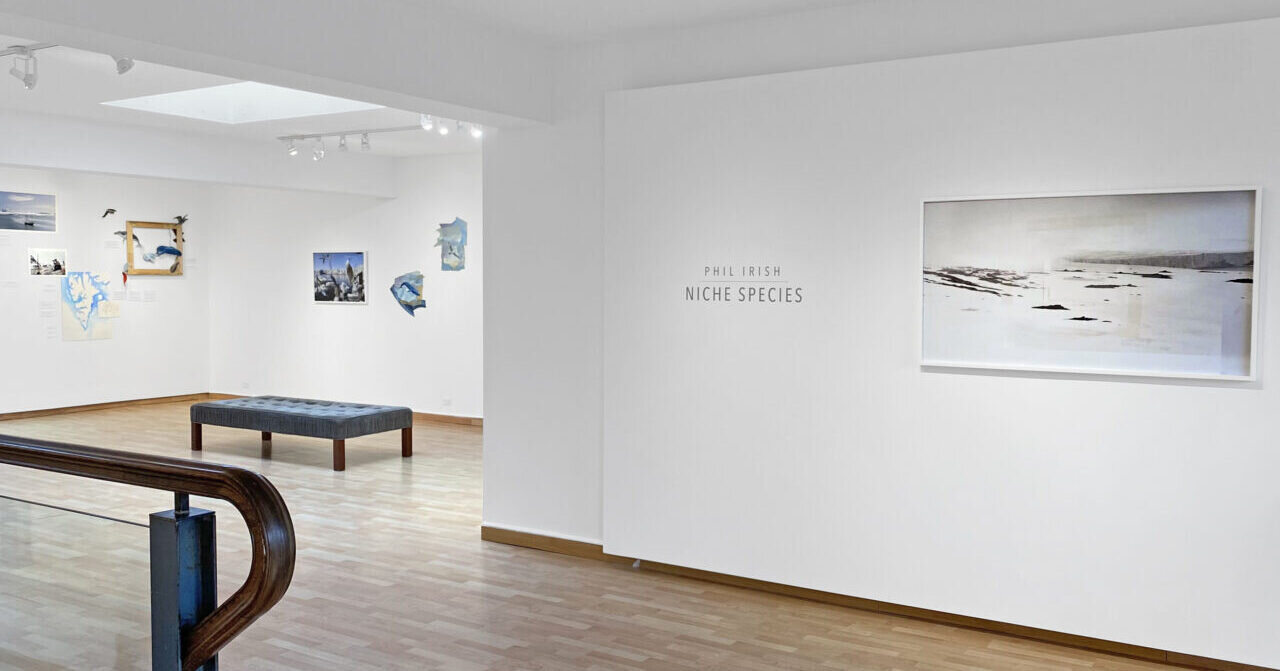
Niche Species, Phil Irish’s solo exhibition, showcases unique painted and photographed collage works of the Arctic. The artworks on display were produced during the artist’s expedition and residency in the Arctic Circle. Irish was able to visit and explore regions of Norway that regular tourists would not be able to access. Originally a painter, in this series of work Irish uses mixed media and photography to bring new perspectives on collage making. Entry to the exhibition is welcomed by “Of Unknowing”, a large piece with a calm white setting in the snow — creating a mysterious tone.
Installation view of Phil Irish, Niche Specieswith Of Unknowing (right) at Lonsdale Gallery. Courtesy of Lonsdale Gallery
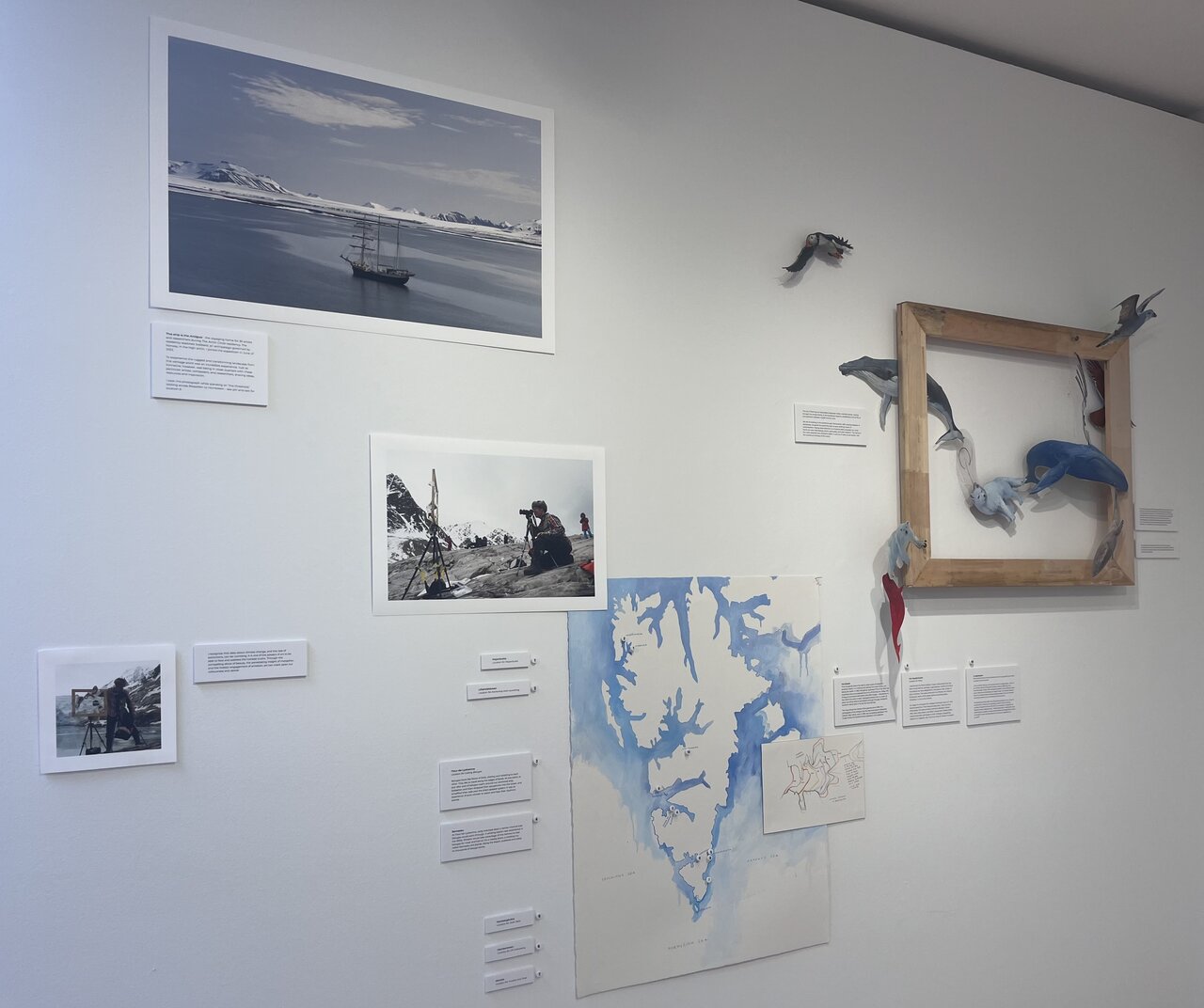
Walking into the gallery, we encounter a wall on the left, called the “didactic wall” that presents many photographs, notes, and a map introducing the visitor to the story behind and methods used in the exhibition.
Phil Irish, didactic wall. Photo: Nane Zadoorian
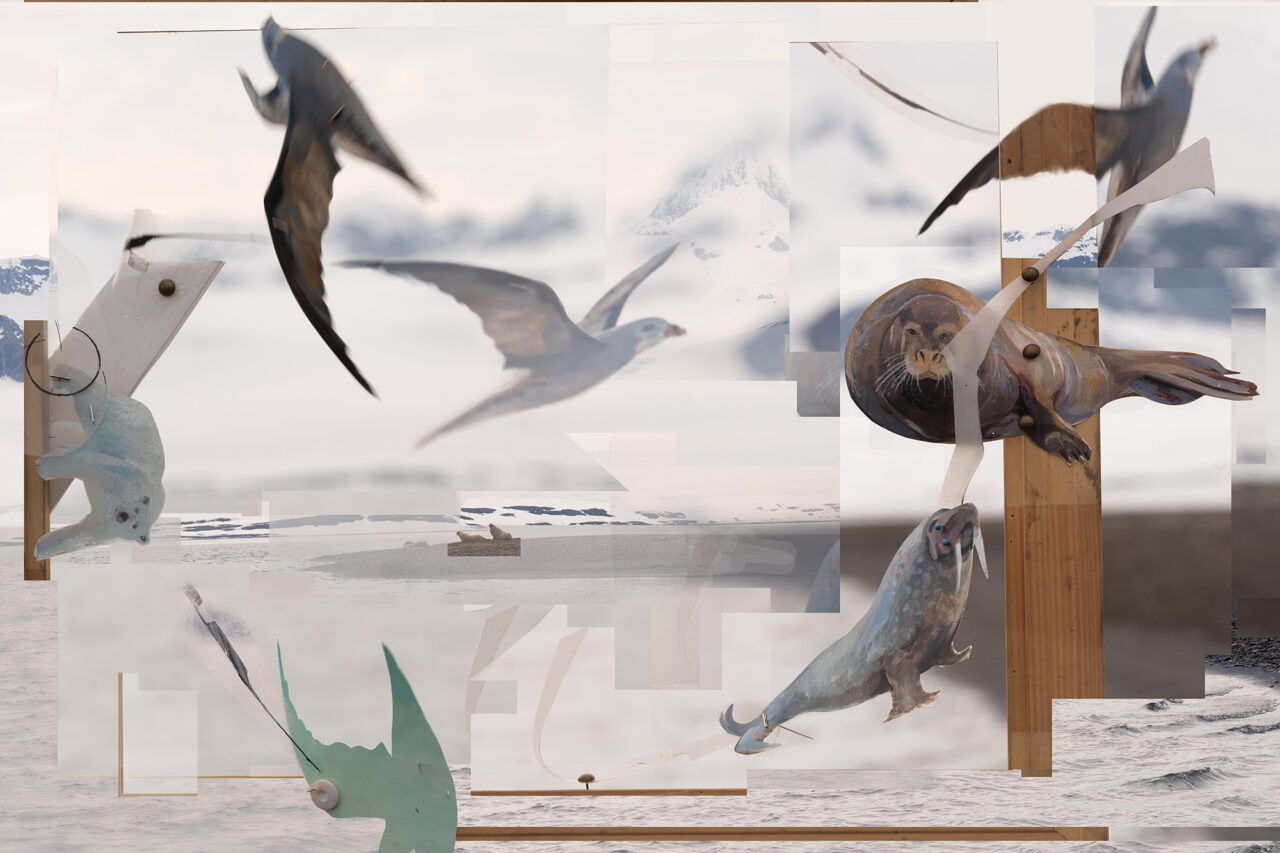
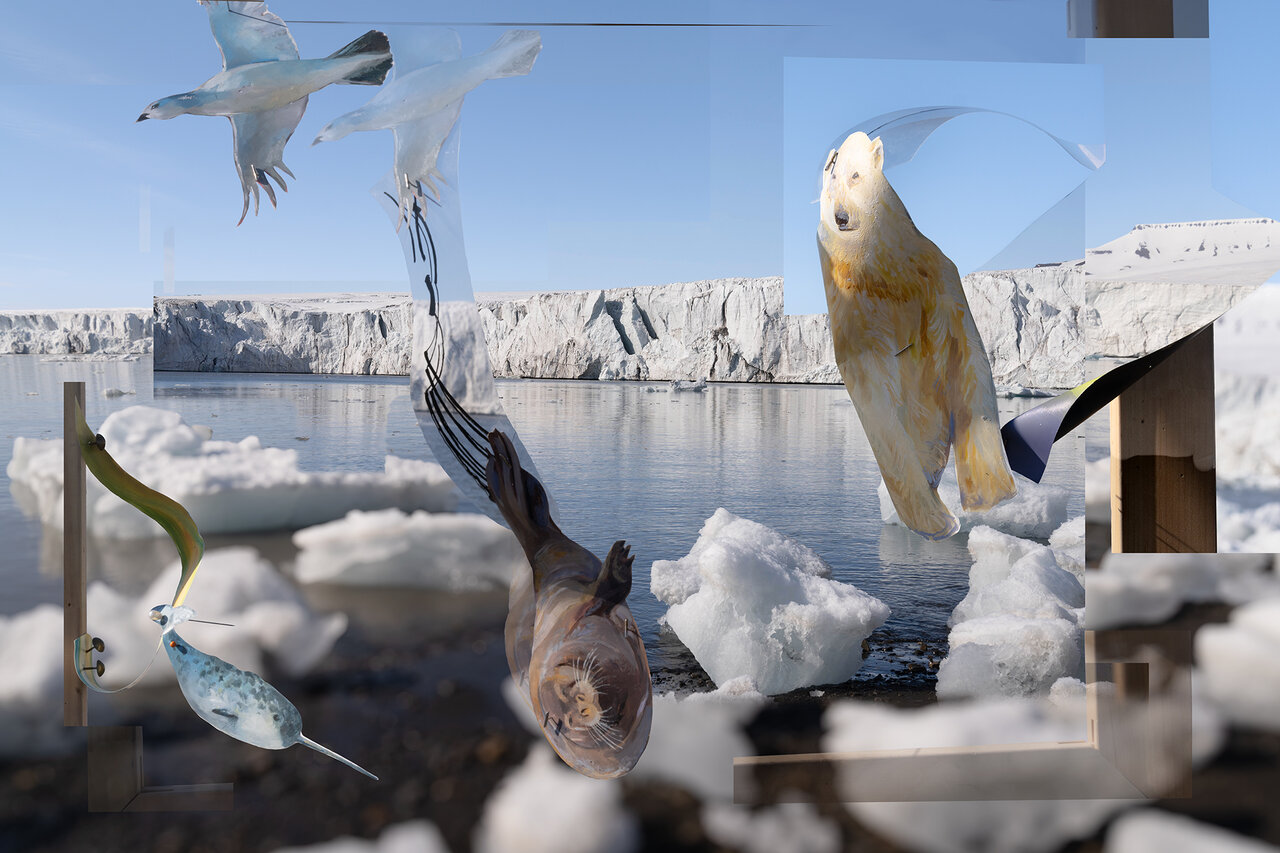
A frame with cutouts of painted animals pinned together also helps in understanding how the photographs were taken, and the many layers/processes of creation involved. The artist would set the frames in front of the natural landscape of Norway and take many photos, in and out of focus, to later collage in Photoshop. The results are reminiscent of geometric blurry or sharp images and shapes produced by kaleidoscopes. Although at first glance the animals in the works seem to have been cut out and placed on a background, the realization that they were photographed with the actual landscape makes the works all the more beautiful and special. Through this post-painterly collage technique, Irish is able to focus our attention on some elements like animals that appear clearer or less blurry than others. This gives his work a fragmented quality as we question our perception.
Phil Irish, Huddle and Twist, 2024, archival inkjet mounted on alupanel, 22 x 33 in. Courtesy of Lonsdale Gallery
Ideas of perspectives, frames, and layers arise not only physically through the collaged paintings, landscapes, and photographs, but also conceptually through narratives connecting these processes to climate change. Most of us don’t get to experience the subjects Irish depicts and only see them in books, so our frame of reference is different than the people who live there. Pinned down animals allow the artworks to be treated as a collection of scientific specimens for our observation. My interpretation of the pins was through a metaphorical representation of pain the pins cause the animals. I think that the pins conceptually act as a tool to direct our attention toward the animals by presenting them as something to be analyzed — a reminder of their existence and how we need to coexist.
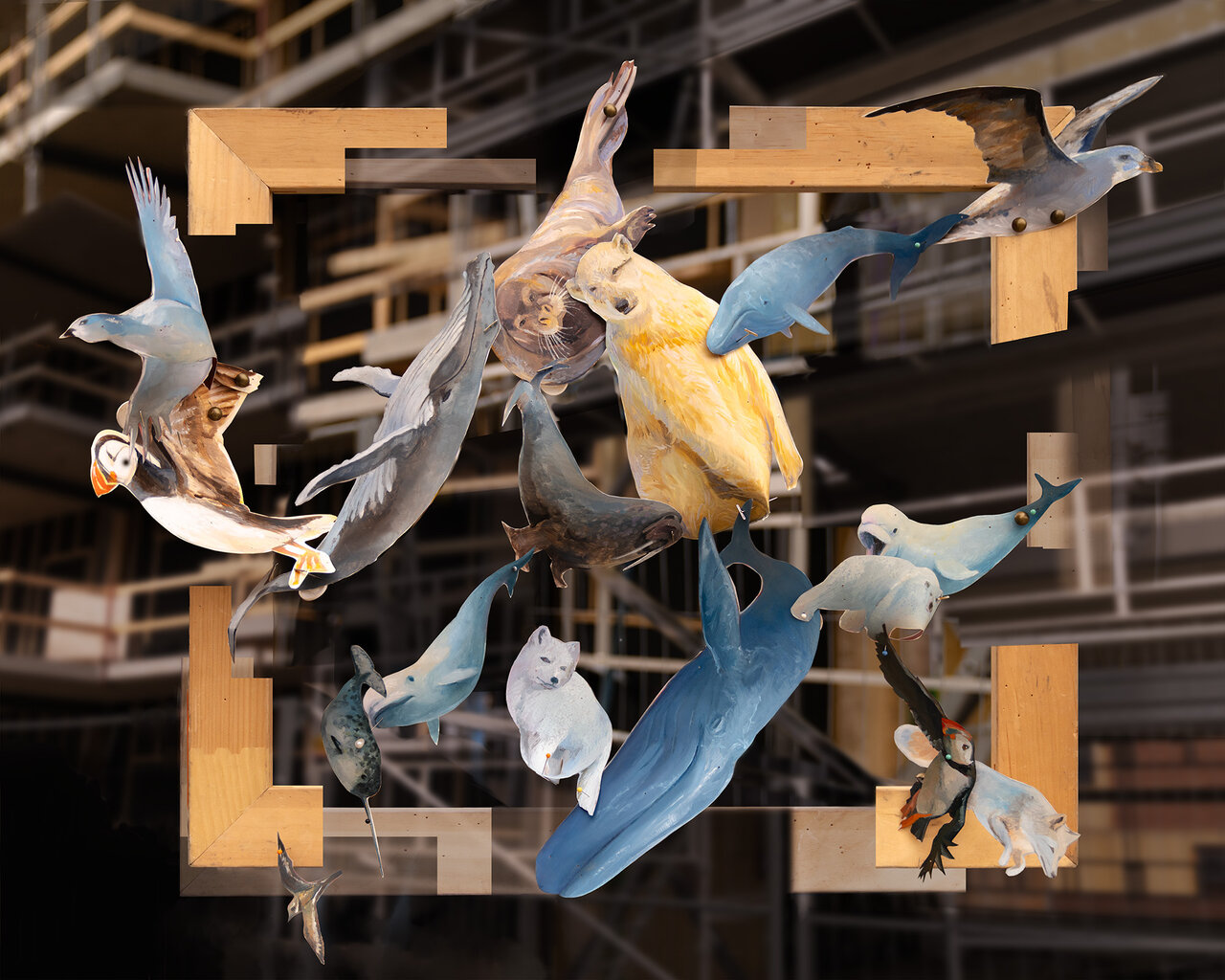
Irish also questions the effects of our actions in his pieces by thinking about “what we are building, and for whom”. In “Construction”, the idea of building is evident through its background of a construction site in Longyearbyen.
Phil Irish, Construction, 2024, archival inkjet mounted on alupanel, 28 x 35 in. Courtesy of Lonsdale Gallery
With the metal and wooden boards of the scaffolding the artist questions how our mental constructions relate to what we build, and whether we treat animals that live around us as our neighbours/part of our constructions. Irish paints his animals with love and attention, acknowledging that they may not exist for long. His mark is left on the pieces through brushstrokes, ripped paper, splashes or thick piles of paint, and visible red underpaintings, revealing his process and making the viewer picture how the images were made and feel as if they were there.
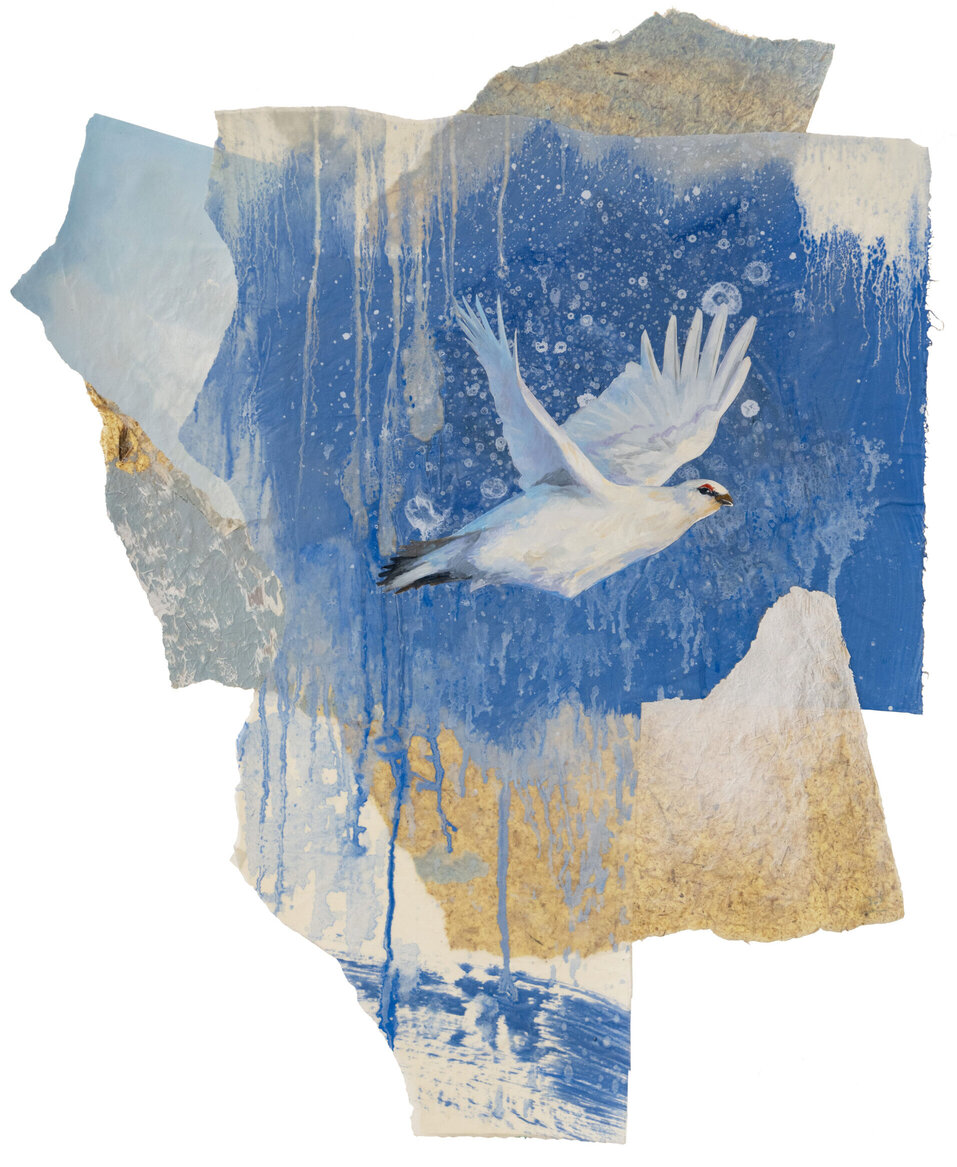
Phil Irish, Ptarmigan, 2024, oil and acrylic on paper, collaged, 22.5 x 18 in. Courtesy of Lonsdale Gallery
A small sign on one of the gallery’s walls reveals a quote by the guide in Norway, Sarah Gerats: “Don’t feel sorry for your plans, the weather decides”. The playful quote addresses unexpected weather conditions that complicated the art production process. Marks of the weather are sometimes seen in the paintings as the prints of snowflakes have dotted the painted surfaces. Details such as these add a special site-specific value to the paintings and remind us of the effort needed to create them.
Phil Irish, Solar Bear, 2024, archival inkjet mounted on alupanel, 22 x 33 in. Courtesy of Lonsdale Gallery
With intricate textures and creation processes, as well as thoughts about environmentalism, the level of care and affection that Phil Irish has put into these pieces is joyful to observe and ponder. These artworks address important issues that we have to face in our world.
Nane Zadoorian
*Exhibition information: Phil Irish, Niche Species, October 26 – December 21, 2024, Lonsdale Gallery, 410 Spadina Road, Toronto. Gallery hours: Wed – Sat 11 am – 5 pm.
The exhibition, titled A Porous Vessel, features pieces by seven artists who transform the idea and subject of the body using their own diverse mediums and forms. A Porous Vessel was curated by Ryan Van Der Hout, whose own exhibition stands adjacent to this group show. He said that the featured artists are friends or people he feels connected to because their artistic approach is similar to his.
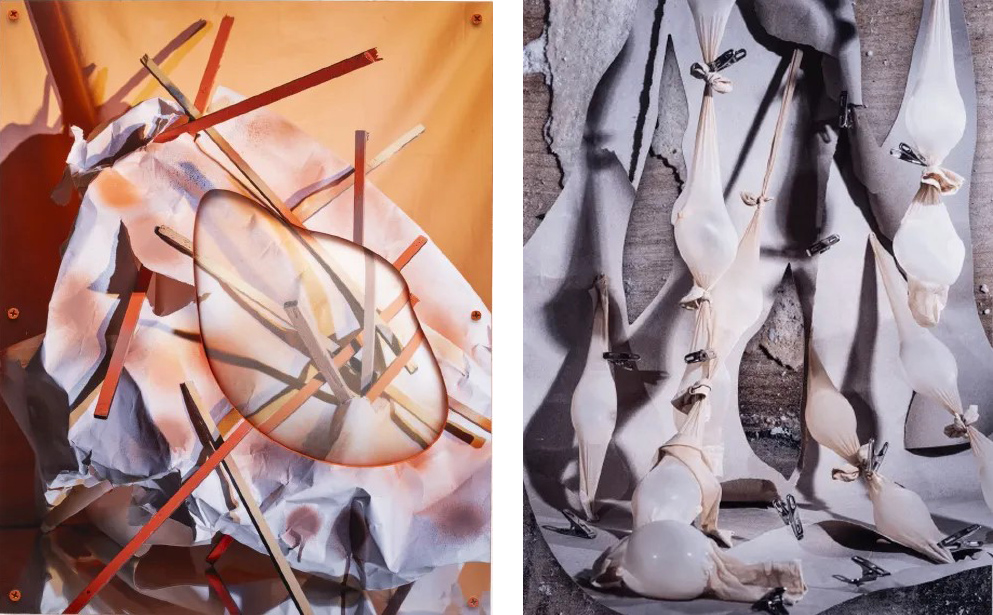
The body acts as the main theme of this exhibition, even in pieces where it is not obvious that the artist is employing the body as their protagonist. For instance, in the three mixed medium pieces by Yi Hsuan Lai, there is nothing about the human body but instead the artwork creates its own body. The elements of the work that push out or sink in, the abstract and amebic forms, the tension between the brusque and the supple objects, build what I think is an abstract essence of the interior workings of the body.
Yi Hsuan Lai, Avoid and Expansion #2, 2024, Dye sub print on aluminum mounted on sintra inkjet print on nylon lycra, paint, screws, polyester fibre, 15 x 12 x 0.75 in (left) and Cave, 2024, Dye Sub print on Aluminum mounted on sintra, 21.6 x 16.5 x 1 in. (right)
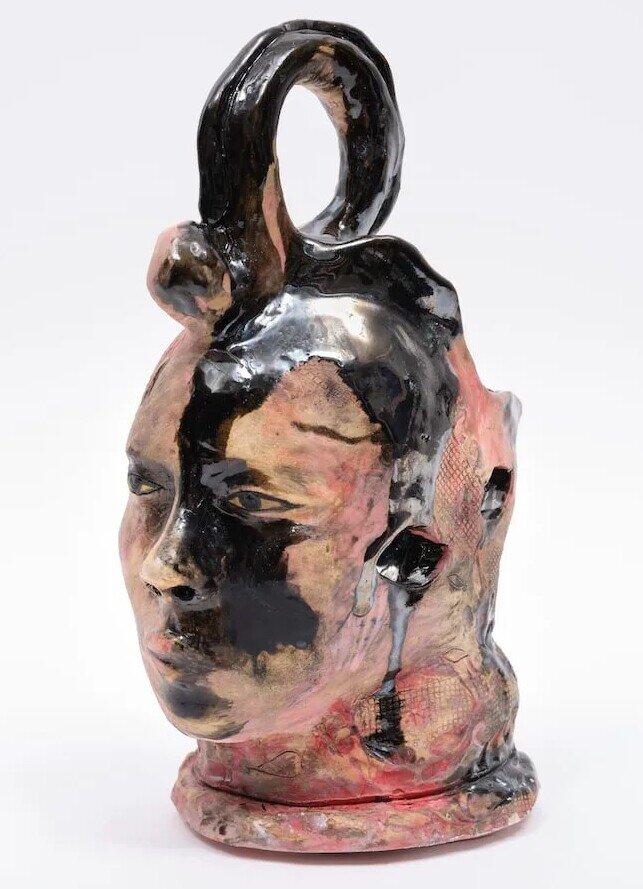
In her ceramic works Sara Jimenez recreates Filipino funerary urns. She explores the idea of the spiritual body and casts herself among her ancestors and family. The idea of the transformation and movement of the body is extremely prevalent in these pieces. At a closer look viewers are able to appreciate the intricate work and details. The most interesting details are the openings in the urns which enhance the idea that the spirits are free to move in and around the space. Jimenez’s artworks contemplate the spaces of ritual and how the body (both physical and spiritual) explores these spaces.
Sara Jimenez, Why must our bodies end at the skin, 2023, ceramic, 8.5 x 6 x 11.5 in.
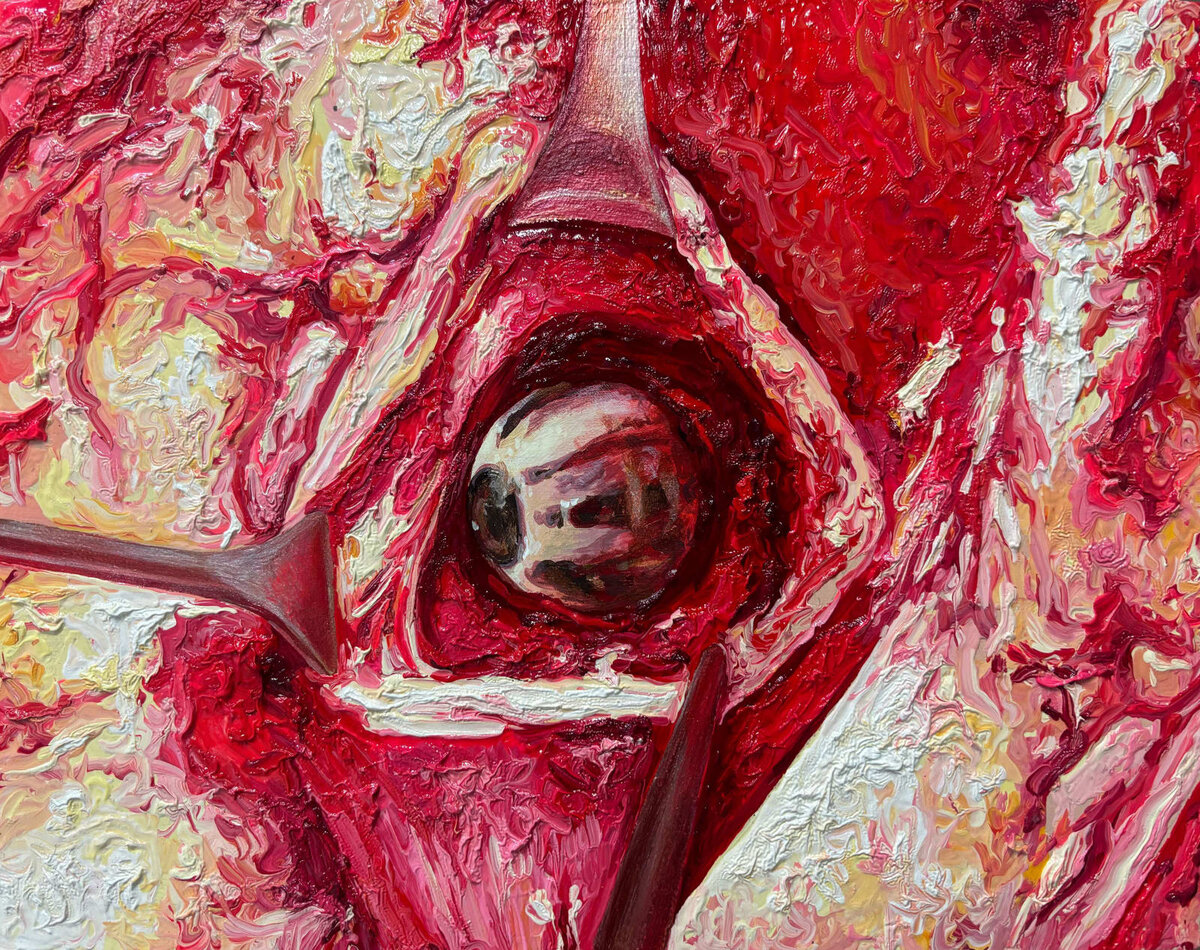
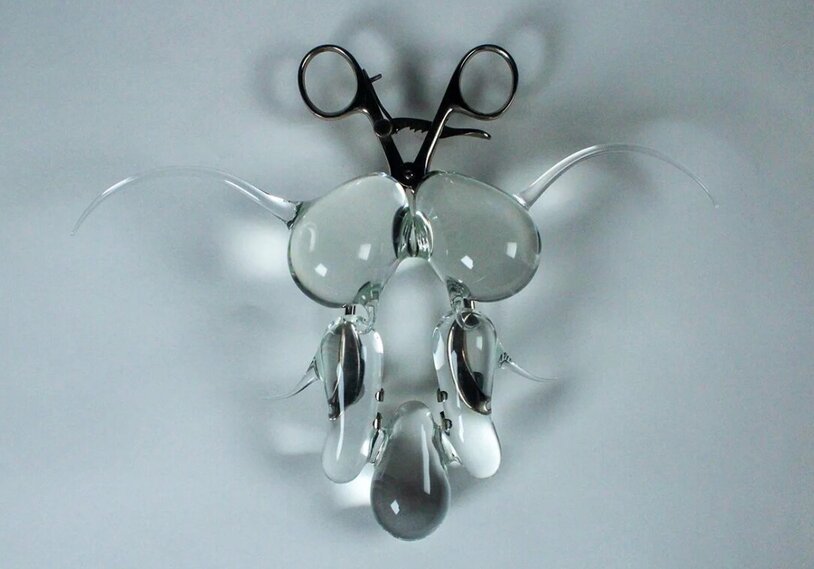
Some works in the show depict the body in a unique and intriguing way that catches the eye, like the intimate and gory experience of observing the work of Jordan Homstad, as well as the delicate and sharp pull that lives in Orchid Incision by Grace Wardlaw.
Jordan Homstad, (Foreign Body-01), 2024, oil, acrylic, mica powder on linen over wood cradle, 8 x 10 in.
Grace Wardlaw, Orchid Incision, 2024, glass, aluminum, steel medical tool, 10 x 6 x 4 in.
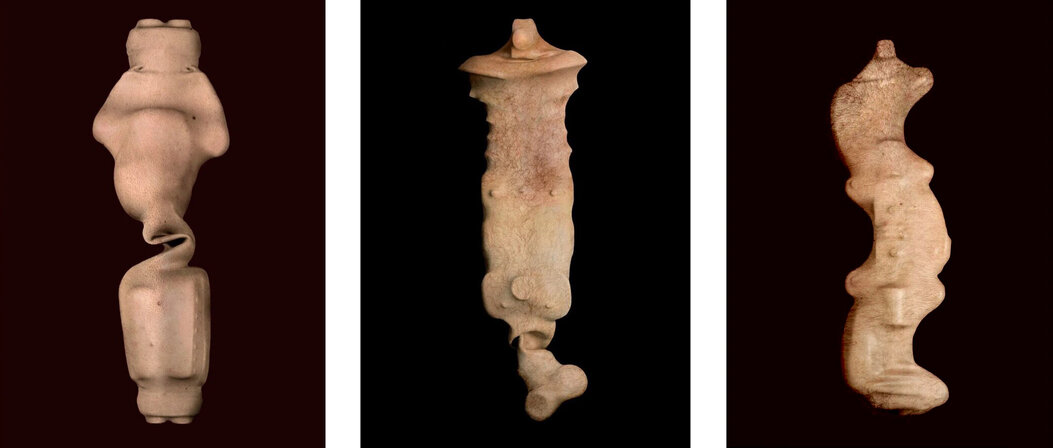
One will feel puzzled after viewing the prints by Aziz + Cucher. In the three Chimera prints it is notable that these pieces were made almost three decades ago and that they still feel open and hold conversations that are relevant today. Additionally, the use of the technology employed at that time to create them is staggering as the abstracted bodies look incredibly lifelike.
(L-R) Aziz + Cucher, Chimera #8, #1 and #3, each 1998, Light Jet c-print, 60 x 30 in.
In Jesse King’s photographs and in Leila Fatemi’s prints, fragments of the body are obscured in order to build a more powerful message. Jesse King employs this idea of composition in the form of a pink veil that wraps around the subject’s body in intimate, almost sensual, ways. The angles at which the photographs have been taken allow the viewer to get really close and personal with the artworks furthering the intimate energy that exists within the images. The veil clings to certain parts of the body and while covering those areas it also highlights them, drawing the viewer’s eye. An interesting conversation opens up with these ideas of sensuality, of what is and isn’t visible, especially with the adjoining fact that the model is a male figure that is posed and pictured in ways that are usually used to explore feminine beauty. The viewer is truly entranced by these photographs and the private aura as well as the illusion of movement given through the curves and creases of the veil, and with the play of light and colour.
Jesse King, Venus as a Boy 1 (left) and Venus as a Boy 2, each 2020, Chromogenic print, framed in walnut, 30 x 30 in
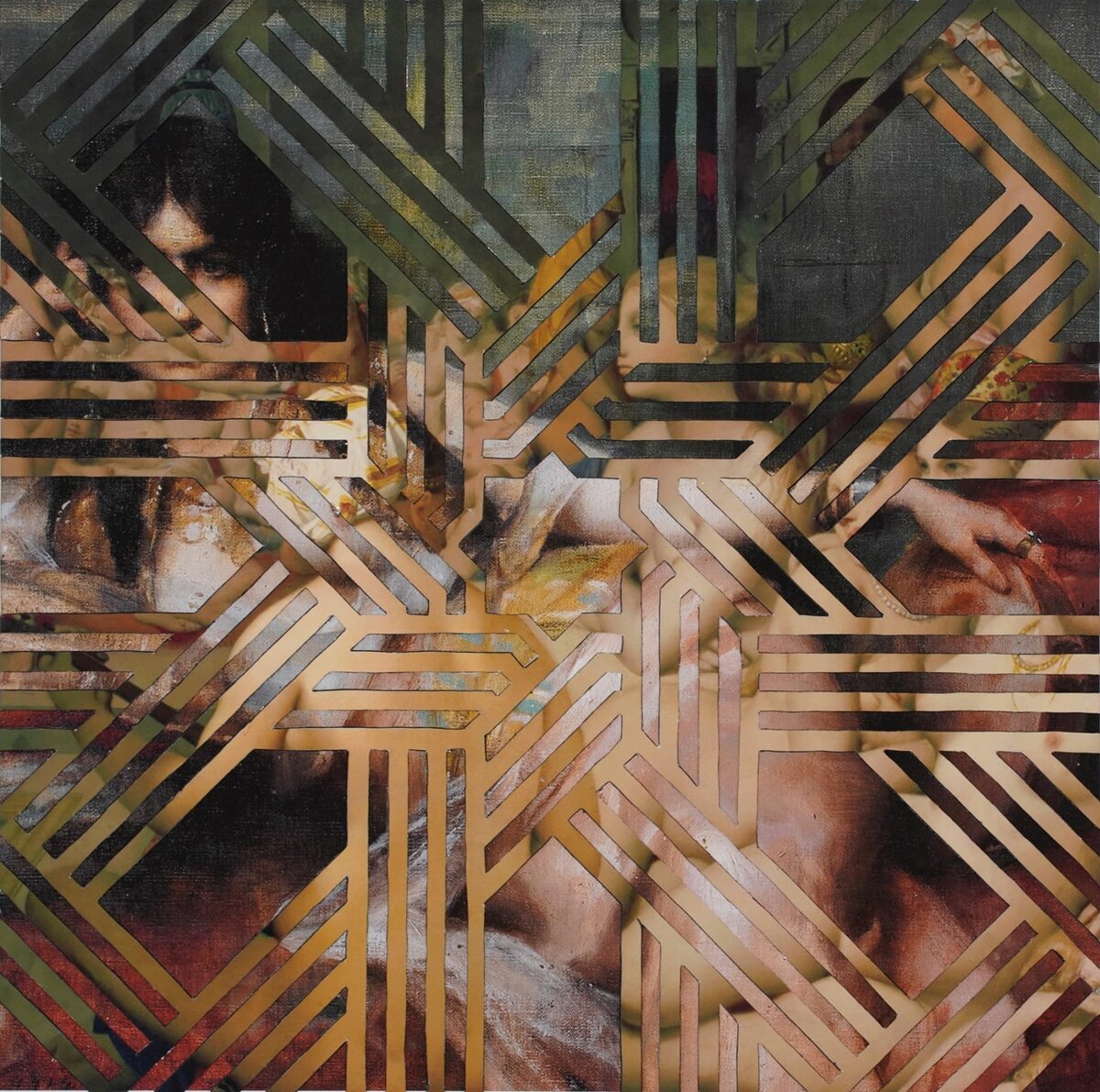
In contrast Leila Fatemi uses the concept of eliminating the original sensual energy of the nude women depicted in vintage images. The prints are titled Disorienting Orientalism, in reference to the artistic movement that was trending during the 18th and 19th century, when European male artists would represent images of the Eastern world, particularly the Middle East, that were highly fantasized. Oriental women were viewed as sexual objects, often posed in ways that highlighted certain parts of their bodies, reducing their humanity. Leila Fatemi places one Orientalist artwork on top of another and meticulously carves sacred geometry over them, covering specific parts of their bodies and creating a beautiful tension and movement between the artworks that cause us to land on neither.
Leila Fatemi, Untitled 2 from the series Disorienting Orientalism, 2024, hand cut inkjet prints, 10 x 10 in.
The conversation that flows between the artworks is captivating. The pieces are so distinct from one another but, still, they all allow the main idea to glide through them. Through a variety of mediums and forms, they still find a genuine common ground where one is really able to ponder and reflect on the idea of the body as a whole and its internal and external workings.
Sofia Diaz Aguilar
Images are courtesy of United Contemporary.
*Exhibition information: A Porous Vessel / Group Show: Aziz + Cucher, Jordan Homstad, Grace Wardlaw, Sara Jimenez, Yi Hsuan Lai, Leila Fatemi, Jesse King, November 14 – December 21, 2024, United Contemporary, 129 Tecumseth Street, Toronto. Gallery hours: Wed – Sat 11 am – 6 pm.
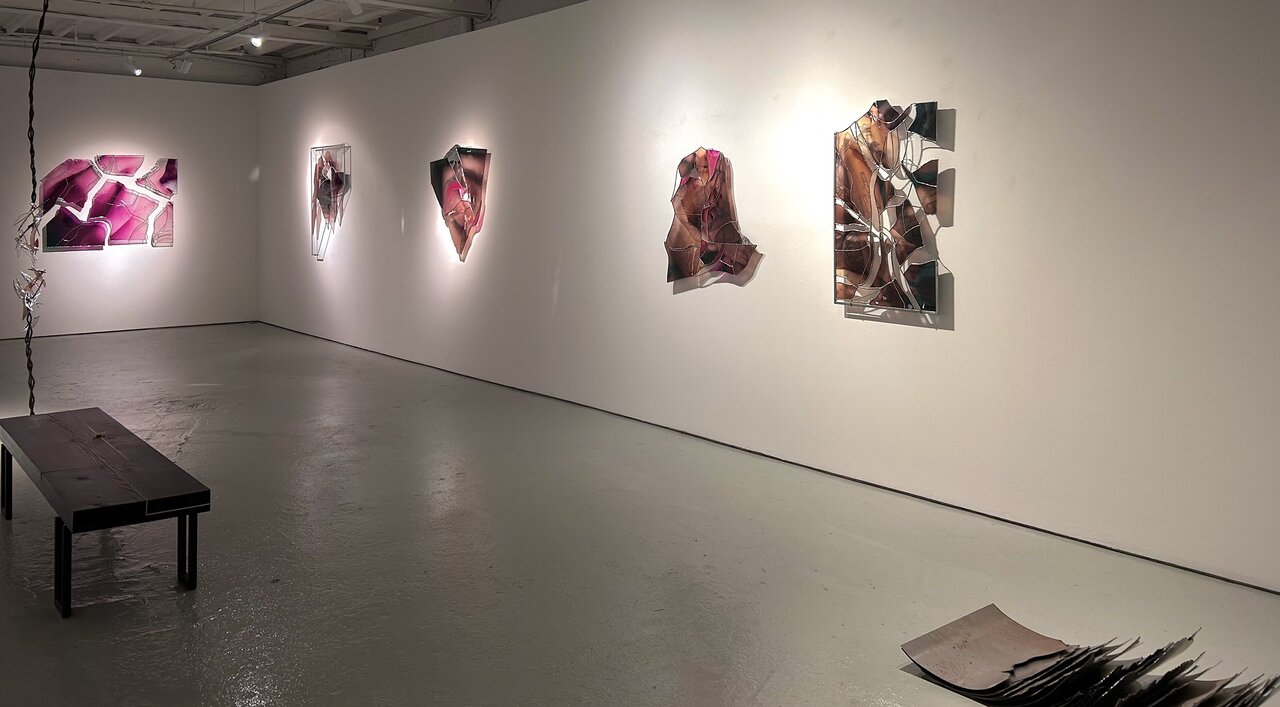
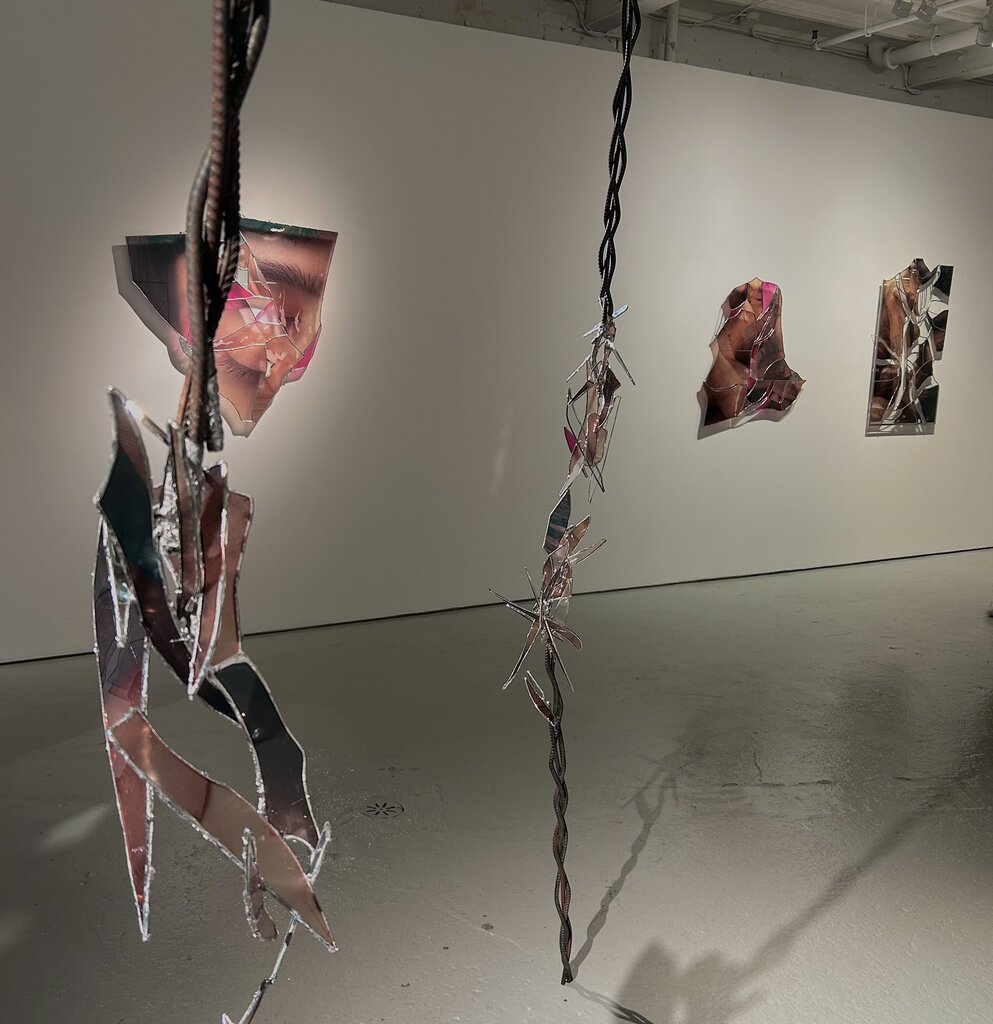
Ryan Van Der Hout’s exhibition, Mending Shards, at United Contemporary is an ode to the breakage and reconstruction of the self. The intricate and meticulous glass and metal works that animate the walls of the space incite a conversation surrounding personal transformation and growth. The show conveys a sense of intimacy and vulnerability. Each piece expresses emotional openness, and is rooted in an exquisite materiality through the photographs of captured intimacy and the intriguing composition and craftsmanship.
Installation view of Ryan Van Der Hout, Mending Shards in United Contemporary. Photo: Sofia Diaz Aguilar
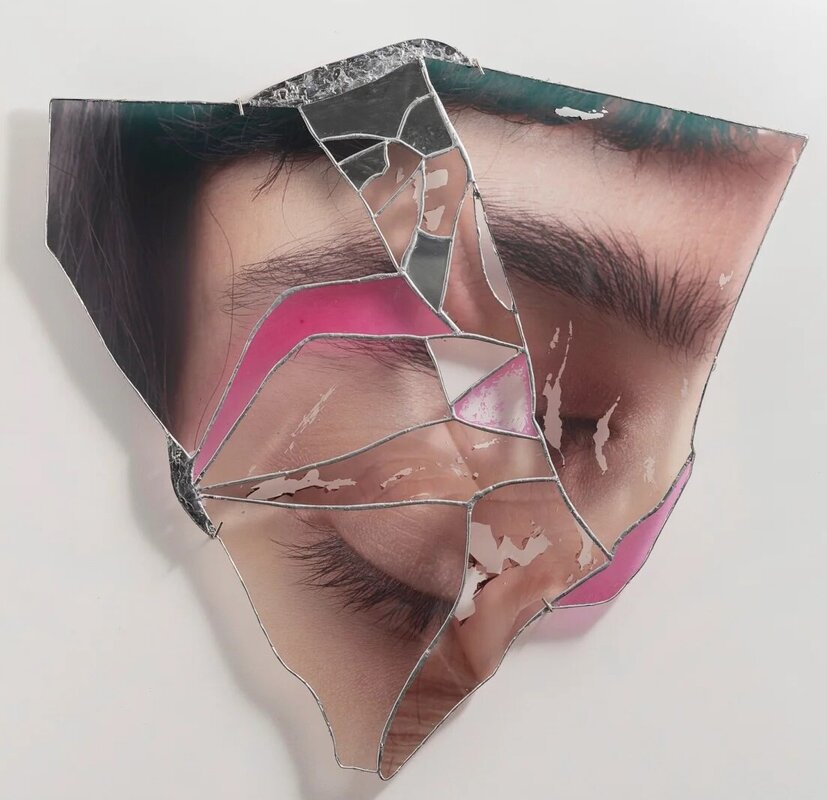
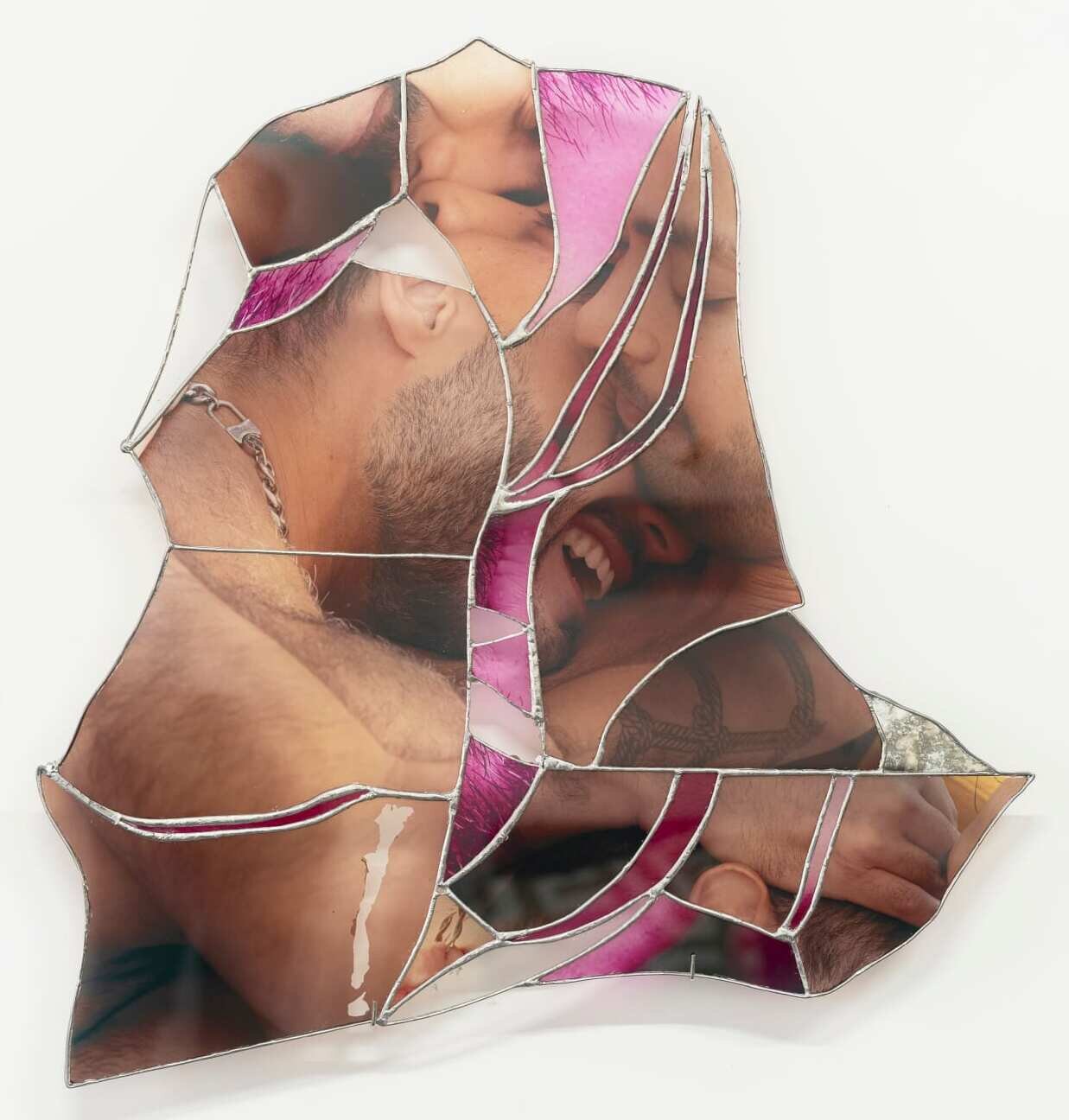
The artworks convey a sense of soft tension created by the tenderness of the photographs and the sharpness of the torn glass. This tension incites curiosity and, I think, invites the viewer to get closer to the works where one can appreciate the intricacy of it: every scratch on the glass, every dent of the welding, every layer of the image. Eventually, one steps back again, to contemplate the project in its wholeness. Because of the deliberate use of reflective surfaces such as glass, metals, and mirrors, the viewer finds themselves reflected in the work, becoming a part of the narrative, a fragment of the breaking and mending that the artist is exploring.
Ryan Van Der Hout, Held Memory, 2024, UV print on glass, solder, copper, stainless steel, varnish, 36 x 36 x 2 in. Courtesy of United Contemporary
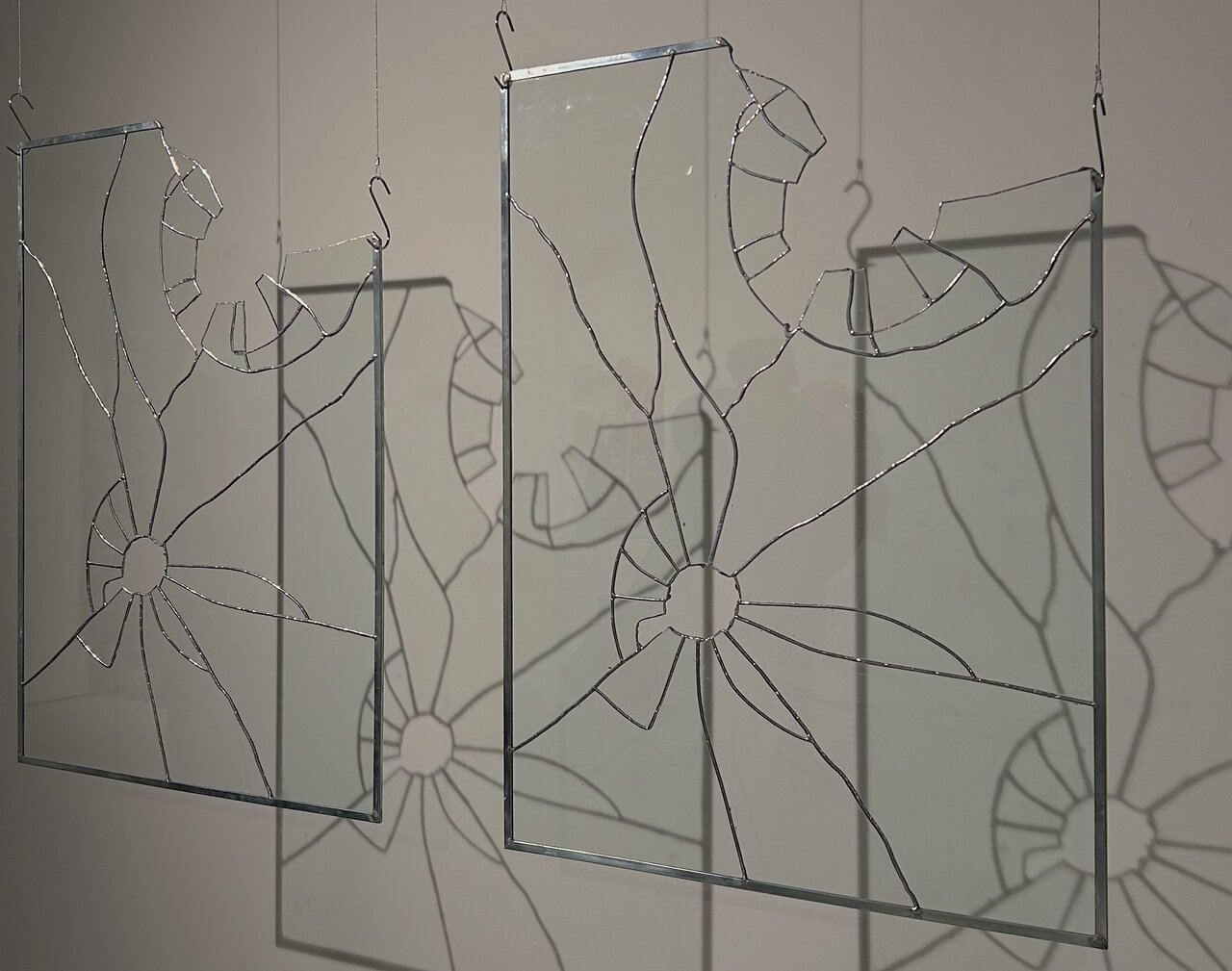
The process of shattering and repairing is a central theme, especially in one of these pieces, “twice broken glass” where two identically broken glass panels hang from the ceiling. To create this piece the artist randomly shattered one of the glass panels and proceeded to glue the salvageable pieces back together. Later he took the second panel and recreated the brokenness inflicted on the first one, resulting in two twin scarred panels. There is a compelling essence and conversation about the violence that exists within repair, and the repair that is present in violence, giving the work a tingling aura of hope.
Ryan Van Der Hout, twice broken glass, 2024, glass, solder, copper, stainless steel, zinc, 41 x 30.5 in (x 2). Photo: Sofia Diaz Aguilar
A new meaning of the term ‘full’ or ‘complete’ is born when the shards of glass and the metal reconnect, providing the artworks with the opportunity to be reframed. The artist employs pink stained glass and mirrors to act as scar tissue in the new format of the once full photograph, giving it a different version of fullness. The use of pink stained glass is notable, because, as the artist stated, it is a medium that only becomes full through its brokenness. The materials used in the pieces are not just a stage for the message, but they come together and hold a close-knit connection that in turn transmits a stronger narrative.
Ryan Van Der Hout, soft seam, 2024, UV print on glass, solder, copper, stainless steel, varnish, 31 x 31 x 2 in. Courtesy of United Contemporary
There is a piece titled “the shattering”, that stands in the center of the exhibition space as a lightning bolt that crashes through the room. It conveys movement and stillness at the same time with pieces of shattered glass suspended in the air held by welded metal and hefty metal rods that span from the floor to the ceiling, providing some stillness to the airiness of the glass. The work is inspired by the beginning of the universe and the artist said it was likely the most complicated piece to put together. He explained, that he had an idea of what the artwork should be, but it had its own mind and wanted to go in another direction. Van Der Hout had to relinquish his preconceptions of the piece and let it take control of the form it wanted to become, which, I think, goes perfectly well with the whole narrative that unveils in the exhibition.
Installation view of Ryan Van Der Hout, Mending Shards with “the shattering”, site specific installation, steel, UV print on glass, copper, solder, stainless steel, height 10ft (x2) and width of approximately 12 in (left) in United Contemporary. Photo: Sofia Diaz Aguilar
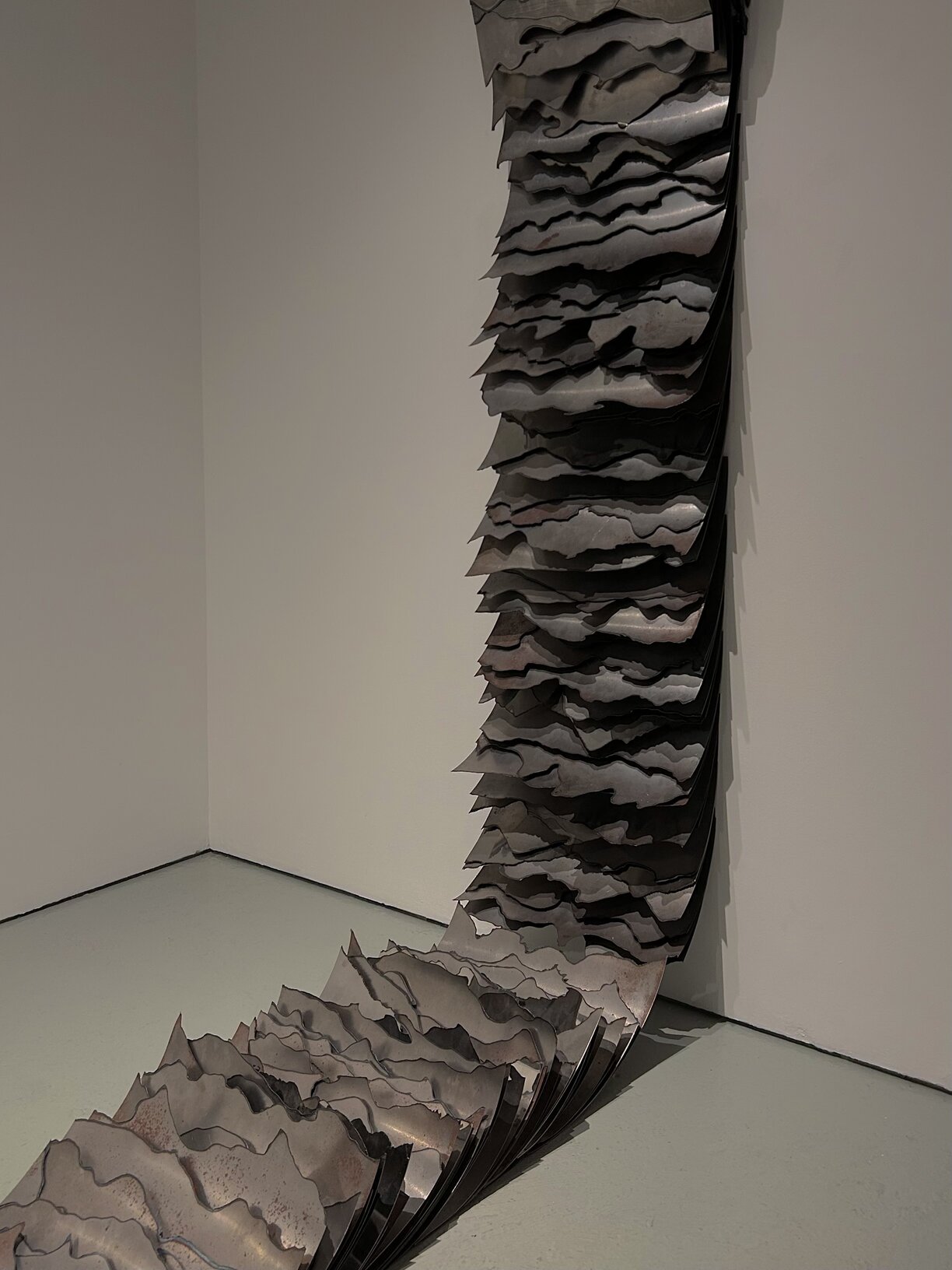
The most distinct piece in the show is “the sea will not open that way”, as it is the only one that does not employ glass. It is composed of rough cut sheets of metal mounted down the wall and onto the floor creating a still metal waterfall. In this piece, the daintiness and fragility of the glass is missing, but I find that these qualities are reflected in the movement that the edges of the ‘torn’ metal evoke. It is an extremely dynamic piece that stands out from the rest but it still fits perfectly into the conversation the show embraces.
Ryan Van Der Hout, the sea will not open that way, 2024, Steel and Mirror Finish Stainless Steel, 120 x 48 x 20 in, detail. Photo: Sofia Diaz Aguilar
Each piece in Ryan Van Der Hout’s show has a unique voice and tone that relates to the people captured in the pieces, the varying shards of glass and the distinct way of mending them. The intimate and vulnerable ambience and comfortable aura that fills the gallery space is a truly unique experience that springs from the artist, his community, the artworks and the public. Every part that constitutes this exhibition invites one to ponder about transformation through ruptures and healing.
Sofia Diaz Aguilar
*Exhibition information: Ryan Van Der Hout, Mending Shards, November 14 – December 21, 2024, United Contemporary, 129 Tecumseth Street, Toronto. Gallery hours: Wed – Sat 11 am – 6 pm.
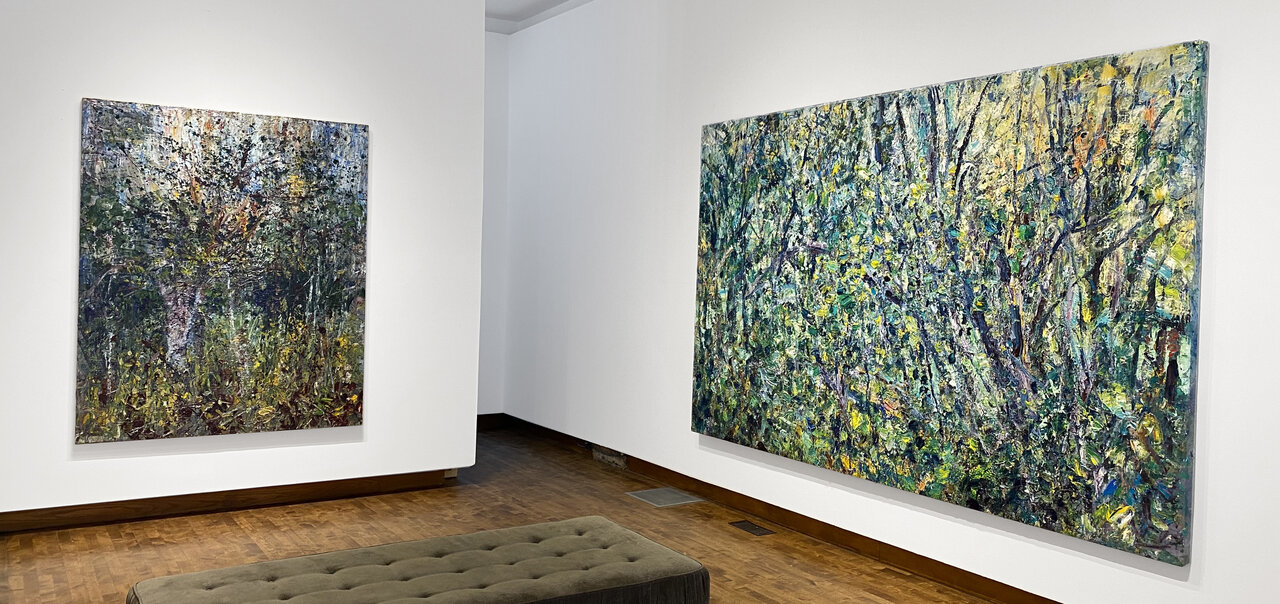
Jim Reid’s latest exhibition, Forgotten Places, on the main floor of Lonsdale Gallery features 17 paintings, which are mostly acrylic on canvas, but it includes several watercolour and pastels on paper. It may be more accurate, however, to describe the acrylic paintings as sculptures. They are so laden with paint that their surfaces read more as reliefs compared to the flat surfaces we are most accustomed to expect. Indeed, close up these works appear to be mad experiments in the accrual of paint on canvas. How much paint can a canvas hold? A lot it seems!
Installation view of Jim Reid, Forgotten Places at Lonsdale Gallery
It is only when the viewer stands back that she can begin to discern a landscape, or some detail thereof. Reid’s perennial subject matter is the land surrounding his home and studio. He lives in the Caledon area. The places that interest him mostly are those areas which unsuitable for farming have essentially been left or abandonned. These he refers to as forgotten places. All the same, most of this land has long since lost any of its original growth. It has been rewilded. And it is this process that particularly interests Reid.
For instance, his painting Feral Orchard 1-9-10 features apple trees that have become wild. Reid notes that these apple trees are not originally native to Canada, but rather were brought over in the nineteenth century from Europe. Indeed, in general humans have altered the landscape so extensively and for so long that barely any corner of the globe is pristine. As ecologist Bill McKibben remarks, nature in the sense of a natural environment untouched by human civilisation no longer exists. Reid acknowledges this fact.
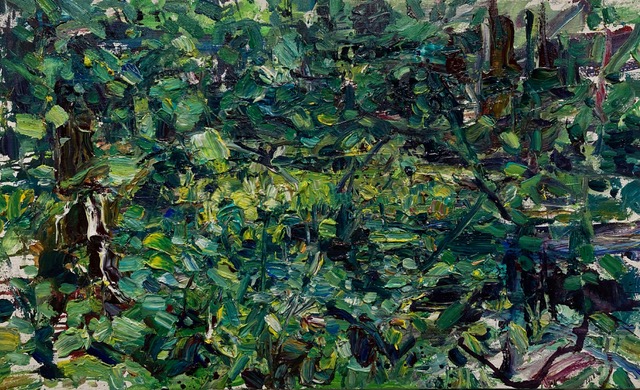
Feral Orchard 1-9-10, 2010, acrylic on canvas, 36 x 48 inches
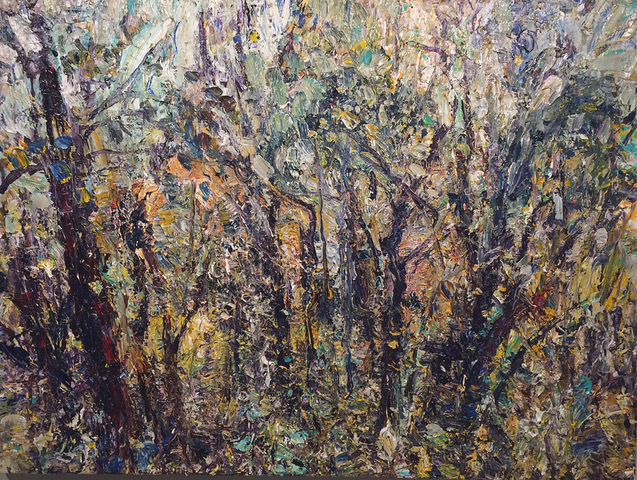
But his paintings are clearly not straightforward documents of this rewilding process given their abstract nature. What we encounter in front of each of his acrylic paintings is a study in impasto, with layer upon layer of scumbled, brushed and scraped paint. The surfaces are gorgeous in their own right. At times I wondered whether there was any need at all for these markings to represent anything, insofar as they do so. I was informed that in some of them, buried in the layers of paint, are residues of dirt. This is a result of the fact that at least in the initial stages Reid works in plein air, putting the canvas on the ground. I think Reid’s working method tells us the way in which his paintings relate to the ‘wilderness’ they putatively represent.
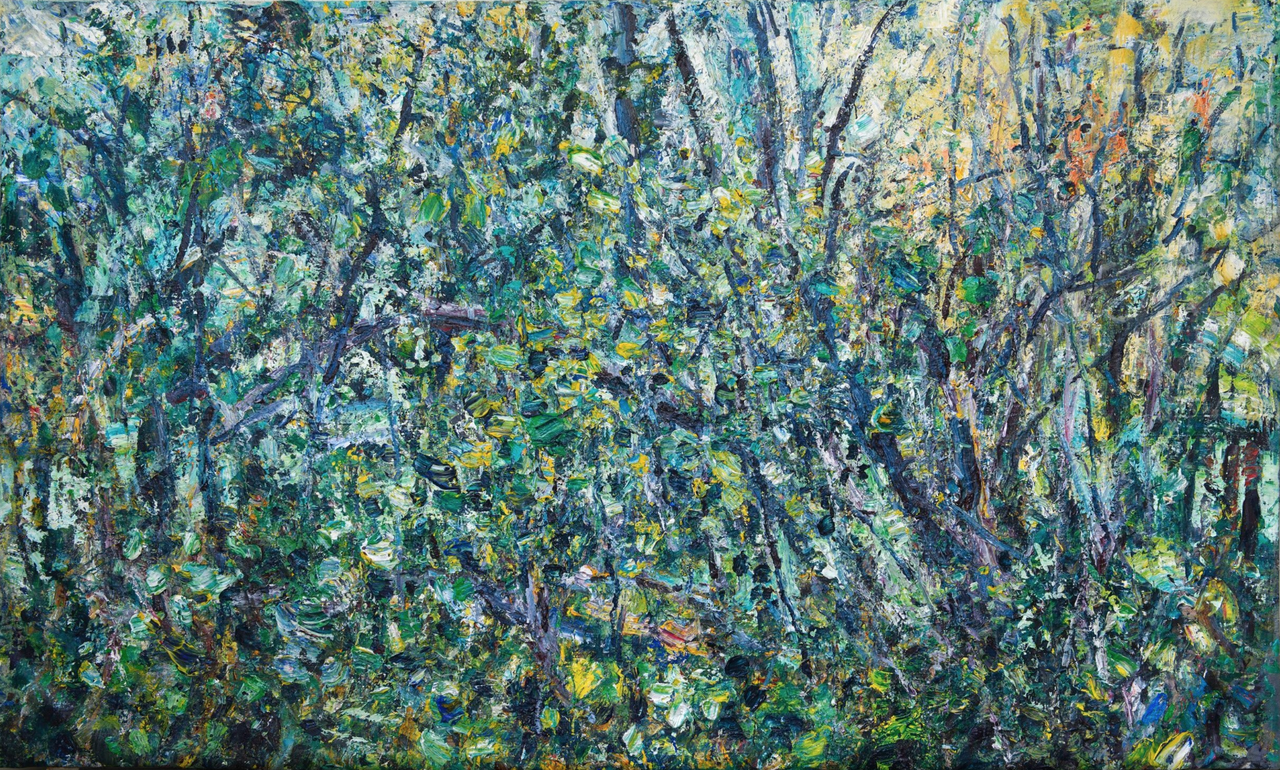
Forgotten Place, Field Ravine, 2024, acrylic on canvas, 72 x 120 inches
It is quinetessentially an immersive method of working. Reid is not recording these places at a particular time, but instead he is documenting his intimate interaction with the landscape over a very long period of time – decades in fact. So what he is interested in depicting are not the topographical details of the places around him, but the very history of the place of which he now is evidently part. In an erstwhile interview he described these places as marginal lands – what he calls in this show ‘forgotten’ – that he planned to continue visiting. This to me is a confession of his topophilia, that is, love of place. He is in love with the natural world around him, and has immersed himself in it.
Forgotten Place, July, 2024, acrylic on canvas, 76 x 120 inches
The consequence of this is his intoxication with the land that otherwise people largely pass by on their way to somewhere else. There is no elsewhere for Reid. This is truly his home. It is this that his paintings relate, namely, a deep pathos for this corner of the world. Just as the places we call home are not simply physical, so it is that Reid is not interested in representing these places merely in their physical details. Rather, he wants to express his emotional attachment, with all its cultural, historical and personal associations. Appreciating this helped me at least to make sense of what Reid is doing in these paintings.
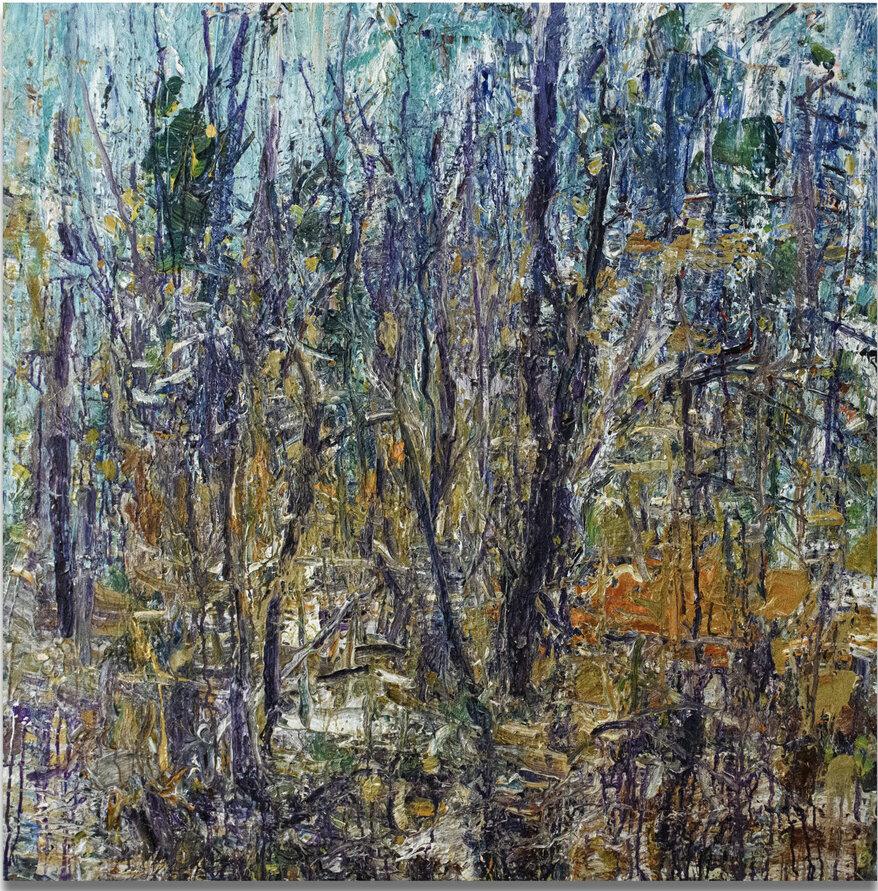
Early Spring Forest 6-04-19, 2019, acrylic on canvas, 48 x 48 inches
All the paintings are on a human scale. They depict the natural world from the walker’s point of view. This fact reminds me of a remark by Henry Thoreau: “My vicinity affords many good walks; and so for many years I have walked almost everyday…, I have not yet exhausted them. An absolutely new prospect is a great happiness, and I can still get this any afternoon.”(Walking) Part of what Reid’s pictures express is this inexhaustable joy in experiencing the endless variety in nature. He wants to share this sentiment with us. That explains the energy of these pictures. They are explosions of colour and texture, and yet one suspects that Reid himself feels that he never quite matches the sheer abundance he sees in the forest around him. He has to keep coming back.
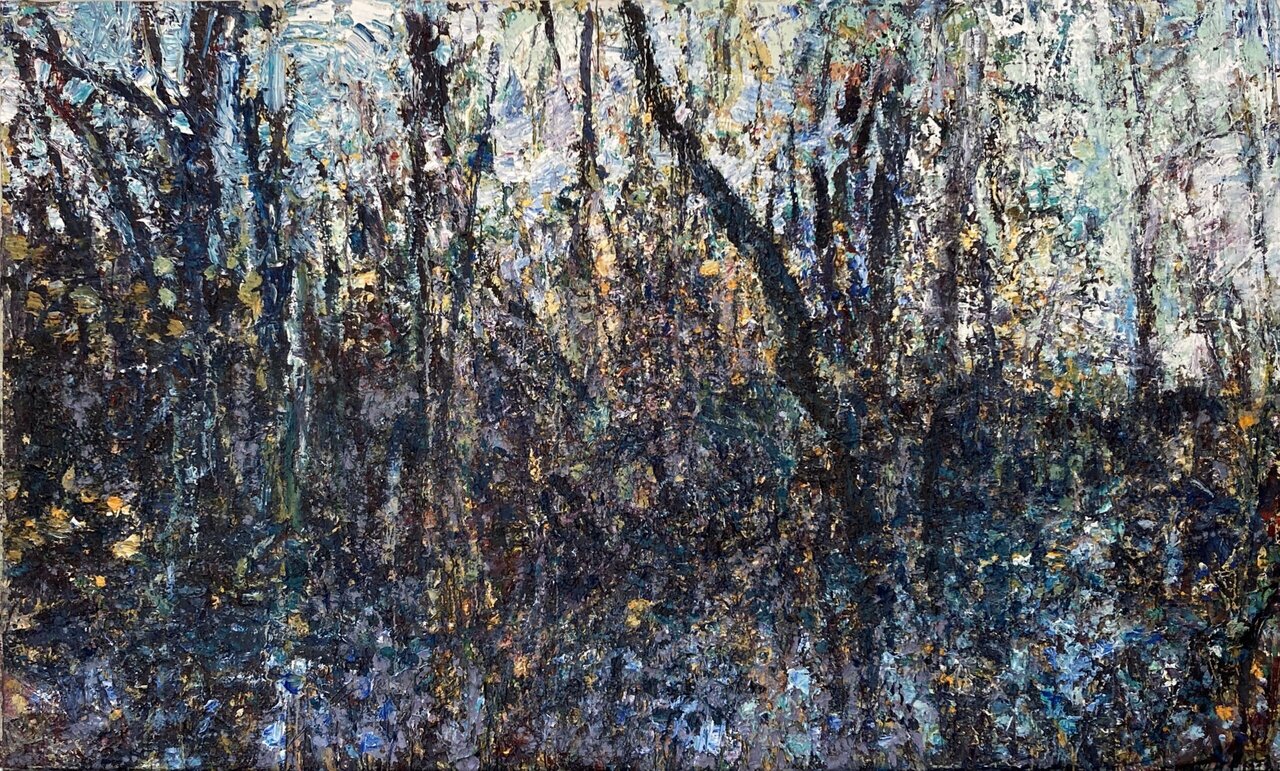
Forest Pool 21-7-23, 2023, acrylic on canvas, 24 x 40 inches
As noted, alongside Reid’s medium and large scale acrylic paintings hang several exquisite works on paper, executed on a much more intimate scale. One of the strengths of Reid’s style is the looseness of his adroit touch, the assured way he renders a branch or tangle of plants. This touch is manifested more directly in his works on paper. The energy he brings to his paintings is infectious. This show is a tonic.
Hugh Alcock
Images are courtesy of Lonsdale Gallery
*Exhibition information: Jim Reid, Forgotten Places, October 26 – December 21, 2024, Lonsdale Gallery, 410 Spadina Road, Toronto. Gallery hours: Wed – Sat 11 am – 5 pm.
Inside a bright room the somber colors of the oil paintings are presented in an atmosphere of contemplation. Emily Pope’s solo exhibition, Antidote for Yearning, presents a poignant exploration of human beings’ innate tendency to attach themselves to fleeting moments, despite knowing that time will inevitably render them impermanent.
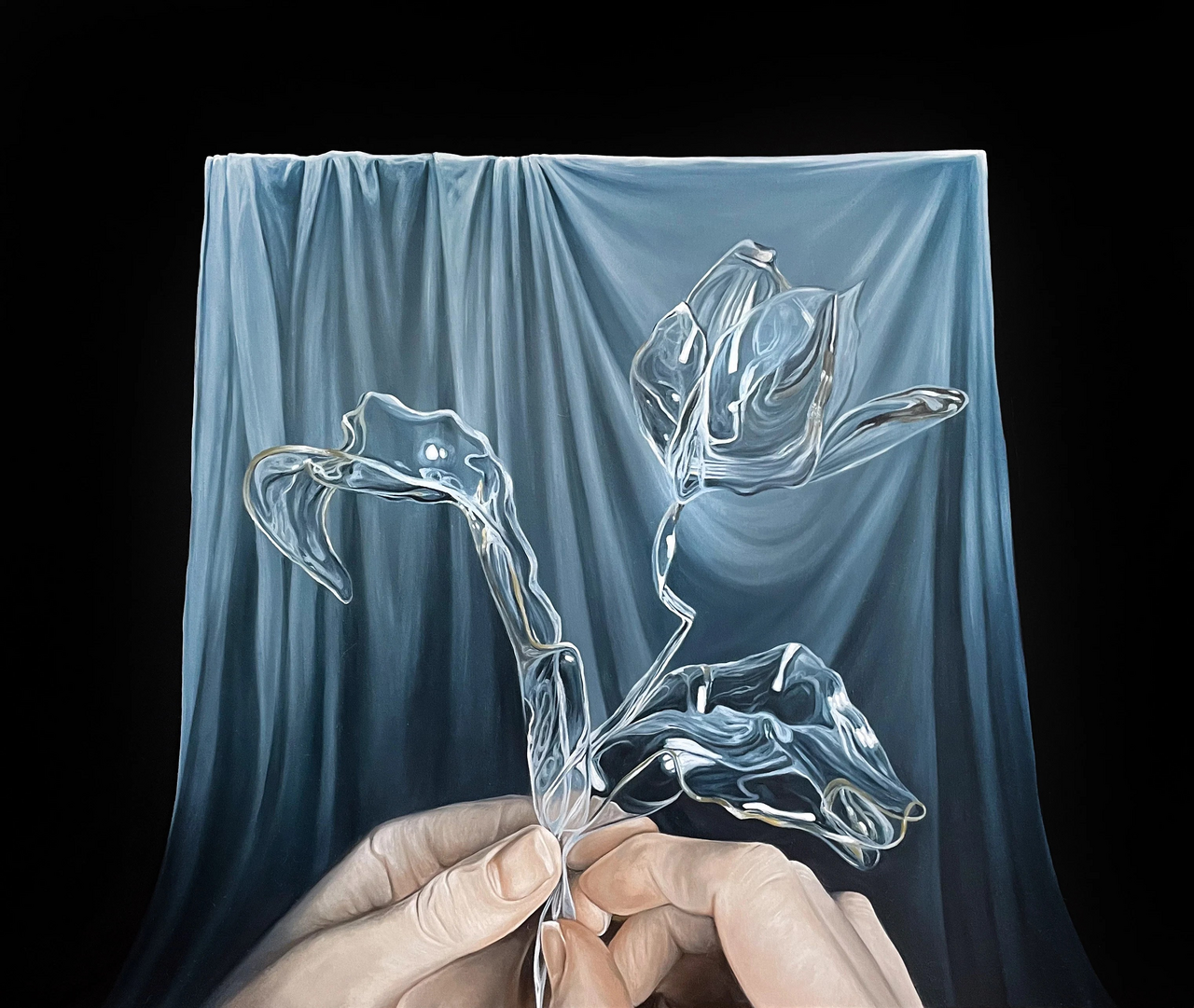
Through a collection of evocative paintings at Abbozzo Gallery, Pope’s work challenges traditional female representation, exploring the tension between societal expectations and personal identity. Pope, a Toronto-based painter, weaves together figurative elements, symbolic objects like curtains, glass flowers, bubbles, pearl beads, and still life to explore the complexities of womanhood and themes of longing, identity, and transformation. Her work offers personal antidotes to the passage of time, revealing the fragility and beauty of all attempts to hold onto what is momentary.
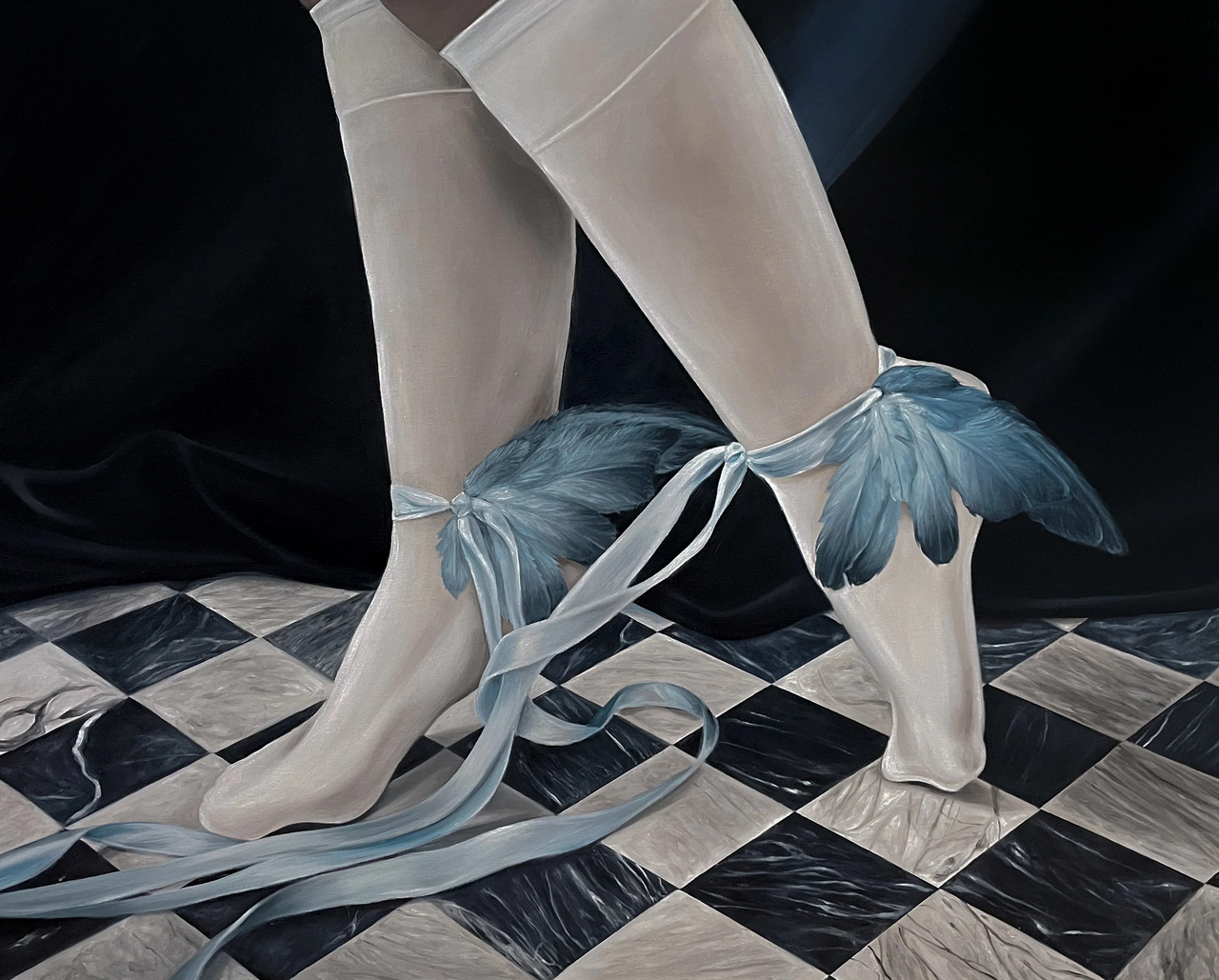
A distinctive visual language emerges, characterized by the recurring symbolism of curtains, stages, and floors. The curtain, in particular, serves as a leitmotif, appearing in various forms throughout the exhibition. This deliberate use of symbolic imagery invites the viewer to consider the ways in which human lives are shaped by the interplay between reality and performance. “A Lesson in Flying” depicts a ballerina’s feet, firmly grounded on a checkerboard patterned floor, which serves as a metaphor for the tension between structure and freedom. The ballerina’s feet, adorned with delicate ribbons and light blue feathers, appear poised between movement and stillness, reflecting the human experience of navigating desire and constraint. The dark blue curtain in the background highlights the contrast between the external world and the individual’s inner experience.
Emily Pope, A Lesson in Flying, 2024, oil on canvas, 24 x 30 in
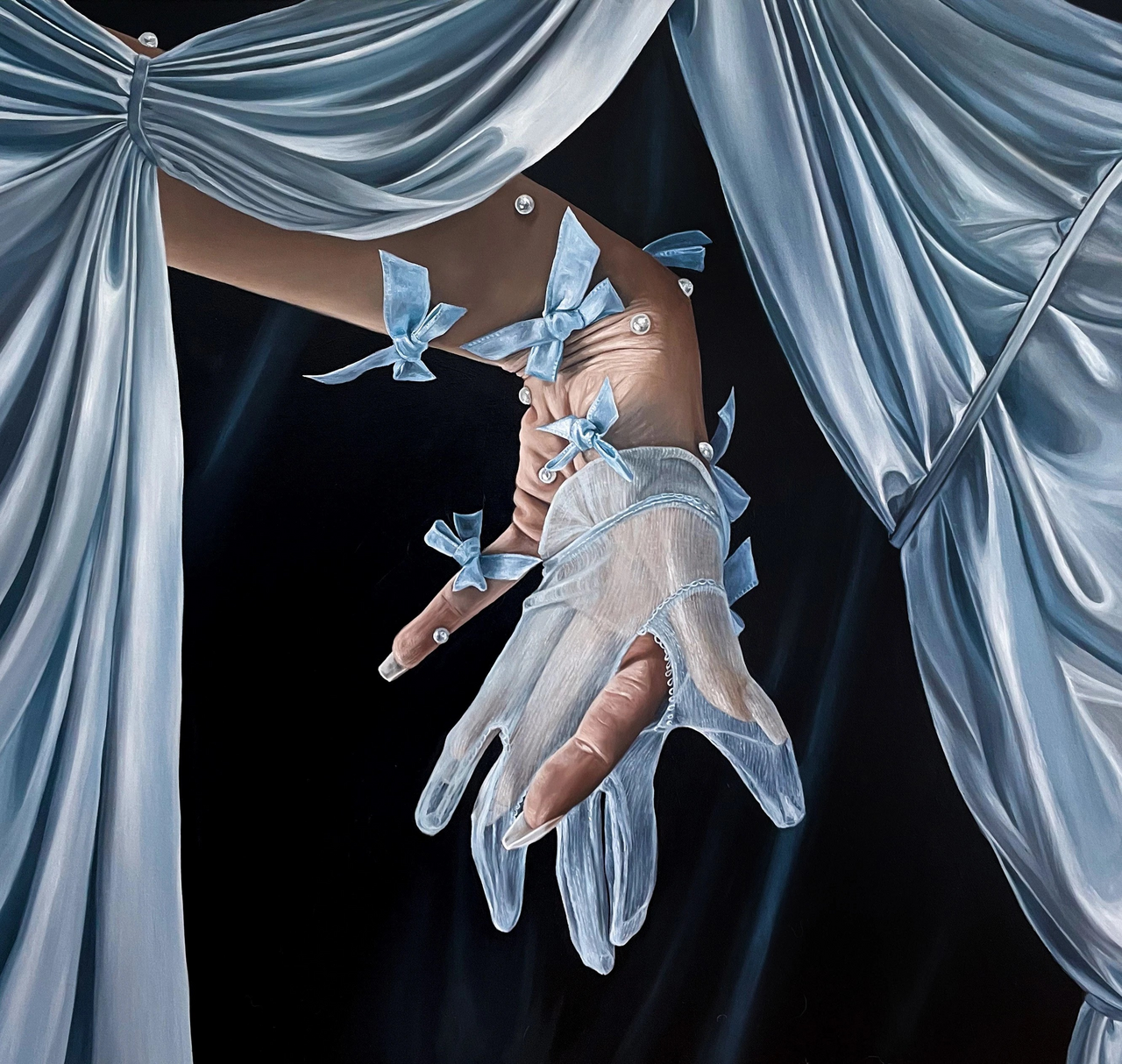
Nearby, “Curtain Call” captures the final moment of a performance, as a gloved hand, embellished with bows and pearls, emerges as the curtain falls, relinquishing its grasp on the spotlight. Neither the torn gloves nor all the bows and pearls matter anymore. This moment of transition and transformation speaks to Pope’s exploration of the emotional landscapes of identity, longing, and the human experience.
Emily Pope, Curtain Call, 2024, oil on canvas, 32 x 34 in
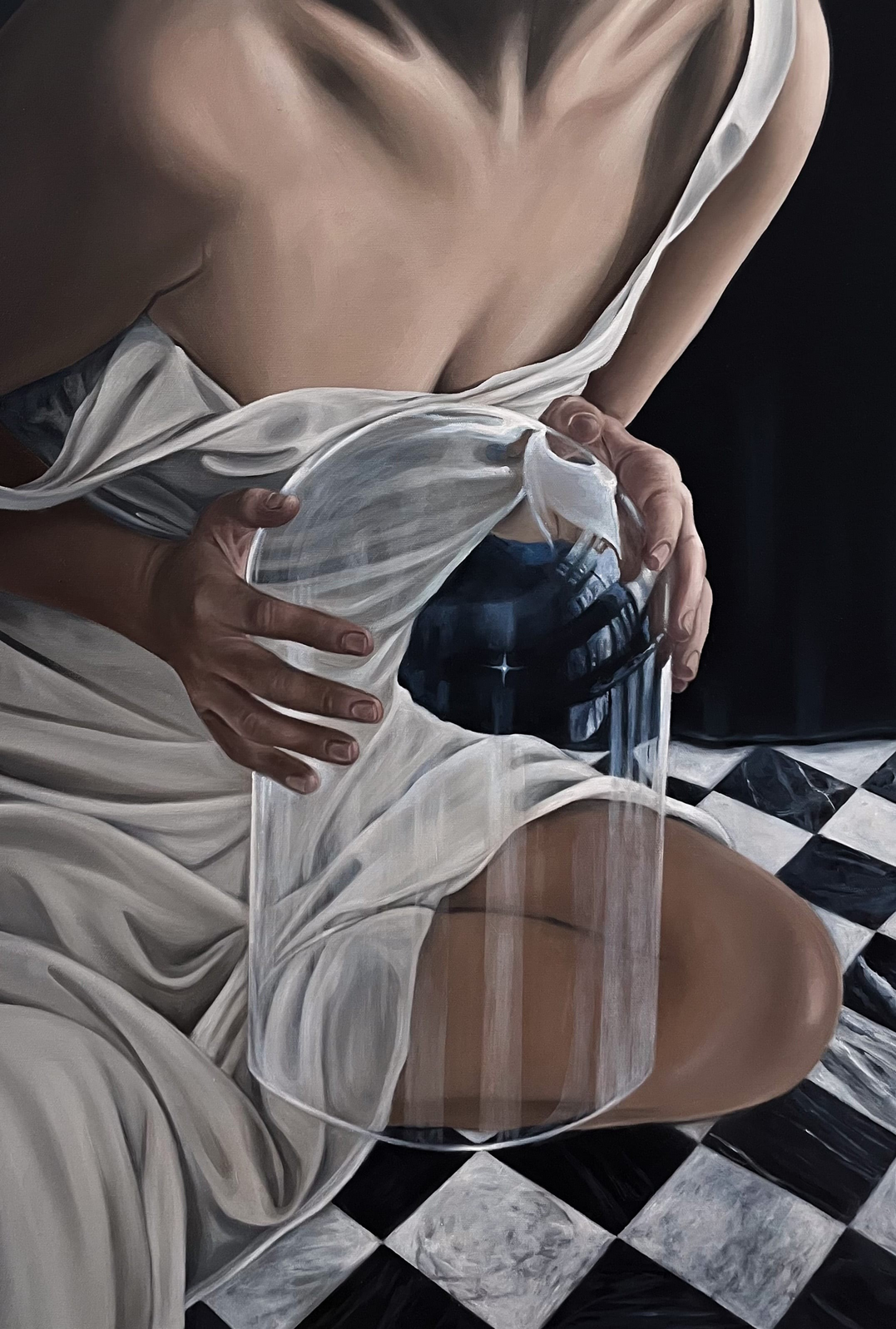
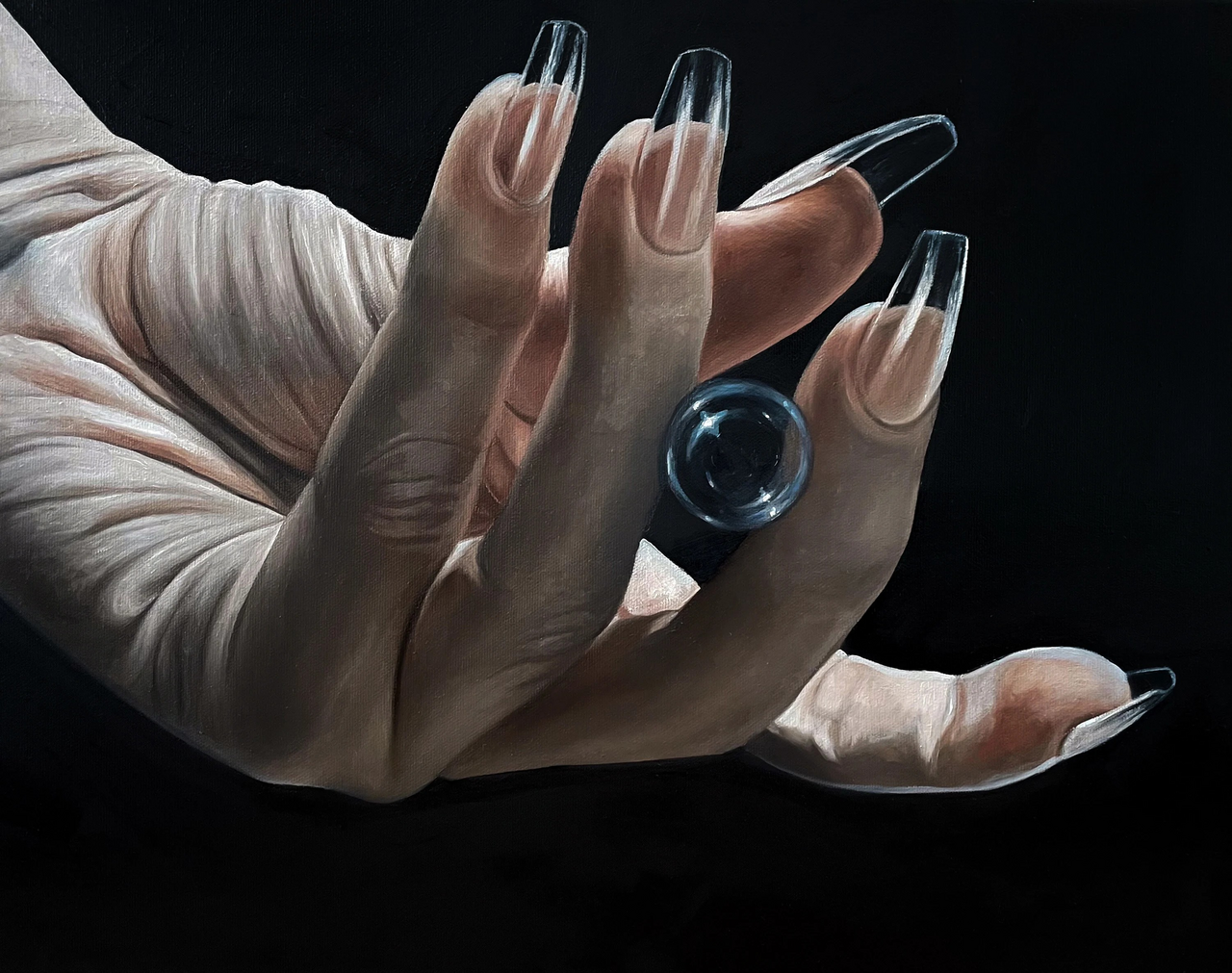
“Keeper of Nothing” and “First Word: Memento Mori” are two more thought-provoking pieces in the exhibition that offer insight into the artist’s personal reflections. For Pope, “Keeper of Nothing” was a long-held contemplation of what she could hold onto through her body of work. A glass dome, typically used to safeguard delicate objects, here holds nothing, prompting the viewer to consider the human longing for preservation and the inevitability of impermanence. The concept of “First word: Memento Mori” is deeply personal for Pope, evoking memories of her childhood and the inevitability of mortality. Knowing from her mother that ‘bubble’ was the first word she spoke became a memento. She put that idea into “Memento Mori” as a symbol that the artist holds her first word “bubble” in her fingers, reminding her of time she can’t get back. While the phrase “Memento Mori” is the recognition of death; the bubble, transparent nails, and the glass dome perfectly depict the longing for something that will never stay.
Emily Pope, Keeper of Nothing, 2024, oil on canvas, 28 x 20 in (above) and First Word: Memento Mori, 2024, oil on canvas, 14 x 18 in (below)
The center piece of Pope’s theme “I’ve Begged for Less” depicts a glass flower portraying a person’s illusion that life will remain as it is. In the dark, the curtain is a symbol of someone’s blindness from reality, wanting to freeze time and preserve life, in a delusional world.
Emily Pope, I’ve Begged for Less, 2024, oil on canvas, 32 x 38 in
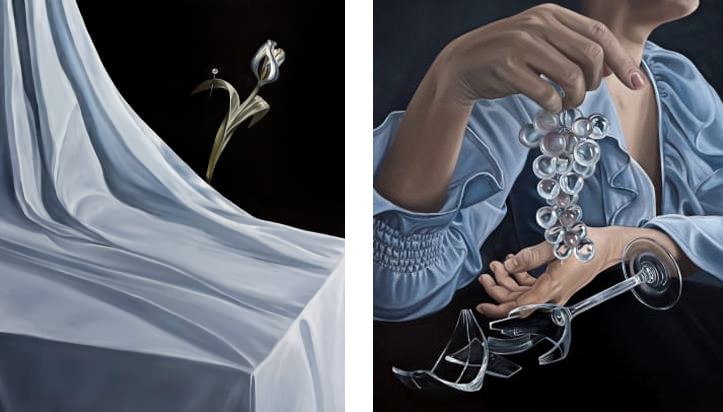
Pope highlights the futility of avoiding death by drawing the audience into the present. “Refusal to Rot” is a poignant painting that depicts a real flower pierced by a pin, its stem serving as a sharp reminder of how vulnerable life is. The floral element, which represents the passage from past to present, serves as a potent symbol of mortality, underscoring the inevitability of decay. In contrast, “Crying over Peeled Grapes” presents a paradoxical scene, where a delicate, bubble-like bunch of grapes is held alongside a broken wine glass on a table. Hopefully these glass bubble-like grapes will never be crushed to become wine and can remain as they are to prove that life is full of beauty and wonder.
Emily Pope Canadian, A Refusal to Rot, 2024, oil on canvas, 26 x 22 in (left) and Crying Over Peeled Grapes, 2024, oil on canvas, 28 x 24 in (right)
Using symbolism and still life, Emily Pope masterfully conveys the complexities of human emotions, inviting viewers to reflect on their own desires and identities, and how their relationships with reality are marked by longing, impermanence and the quest for meaning. Ultimately, Pope’s paintings serve as antidotes, providing a remedy through the process of thinking and spending time with these works, and how they encourage self-reliance and acceptance, as we navigate the intangible experiences of existence.
Nusrat Papia
Images are courtesy of Abbozzo Gallery
*Exhibition information: Emily Pope, Antidote for Yearning, November 8 – December 7, 2024, Abbozzo Gallery, 401 Richmond Street West, Suite 128, Toronto. Gallery hours: Tue – Fri 11am – 6pm, Sat 11am – 5pm.
When visiting the Dianna Witte Gallery, I thoroughly enjoyed exploring Isabella Vella’s latest show, The Performers. This compelling exhibition introduces Vella’s new series of paintings composed of assemblages of figures, stories, and objects. Drawing inspiration from her lived experiences as well as classical mythological, Vella transforms memory into deeply personal folklore. Her works use iconography as visual and narrative frameworks to create layered symbolism. In this collection, her female protagonists embody a spectrum of emotion—they dance, weep, desire, gaze, and embrace. Each figure enacts a complete narrative inhabiting richly imagined worlds. Suspended in their respective poses, these characters evoke the true essence of performers, frozen in the midst of a scene, allowing viewers to contemplate their stories.
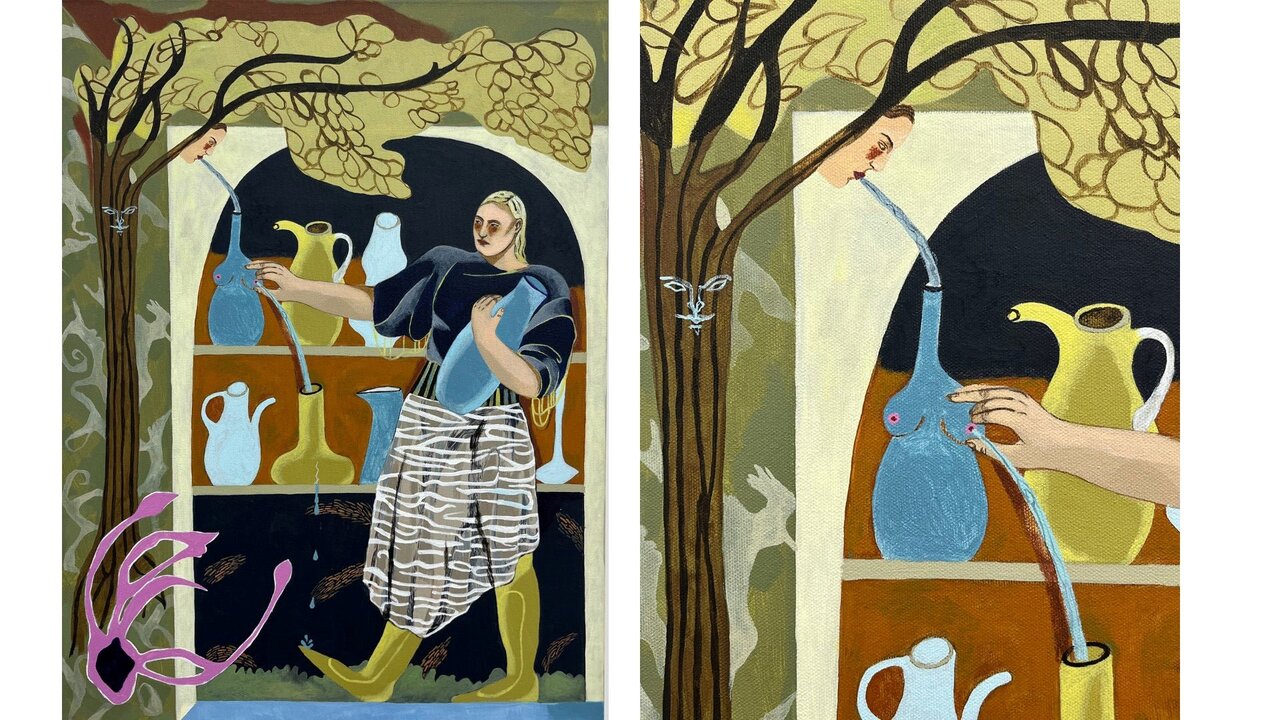
“Feminine Apothecary” captivated me with its evocative narrative. The tree is depicted in a minimalist way, with branches extended over a woman’s figure. The mouth of a face on the tree branch pours water into a female-shaped vase. The woman, standing in front, expresses water from the nipple that falls into another vase, then onto the woman’s foot and finally falls back to the ground watering it – so the circle is complete.
The tree with a human face could symbolise life, and the interconnectedness of nature and humanity. The vessel, shaped like a female body, could be a representation of fertility and nourishment. Further, the water flowing from the figure’s nipple suggests a maternal element, underscoring the feminine body as a source of creation. Meanwhile, the other, cracked vessel, allowing liquid to drop onto the figure’s foot, adds an understanding of fragility and imperfection. The contrast between fluid motion and stillness is the key element of this painting. While the cascading water conveys movement and life, the rooted stillness of the tree anchors the composition which creates a visual tension that mirrors the thematic balance between transformation and permanence. Overall, the painting appears to explore themes of femininity, positioning the female form as both the original giver and healer as well as the receiver of life and strength.
Isabella Vella, Feminine Apothecary, acrylic on canvas, 24 x 18 in (left) and detail (right)
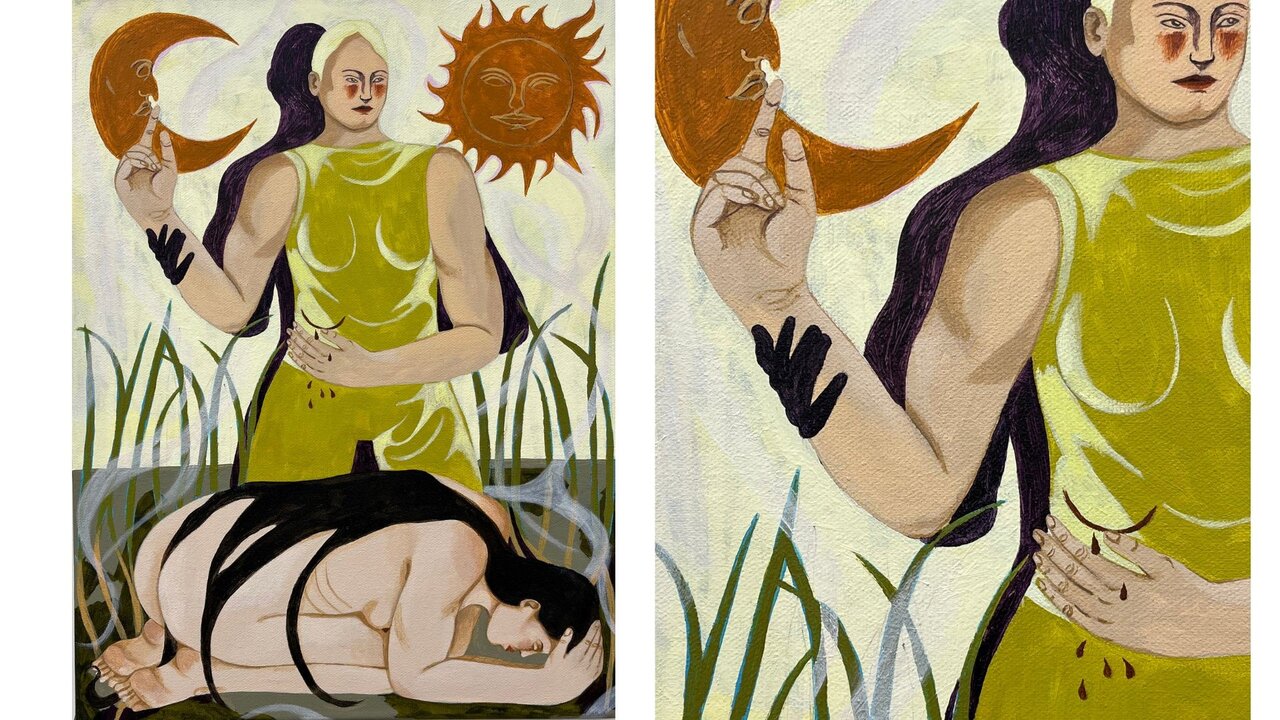
“Correct Attitude” got my attention because of its profound symbolism. Several details stand out, each contributing to its rich narrative that can be interpreted in many ways. The central figure, a woman, is enveloped by a dark shadow from behind, suggesting a sense of foreboding. There is a moon-shaped cut on her right side. With her left hand she tries to stop the bleeding, while her right hand points at the moon. A naked woman is lying at her feet, face down in a position of worship. It suggests that the woman dressed in gold could be a Goddess consecrated to the Moon, properly honoured by the human. The worshipper’s nakedness and her long hair spreading over her body brings sexuality into the composition.
The figure’s upraised right hand might symbolise elements from other religions as well. In Christian iconography, the right hand is considered the symbol of power and authority. The golden figure’s wound reminds us of the one Christ suffered on the cross. The right index finger pointed upward could relate to a direct connection to God or the divine, signifying a call for guidance. Moreover, the right index finger pointed toward the moon may allude to spiritual or existential longing. The moon on the left and the sun on the right represent a dynamic balance of opposing forces, often seen as complementary symbols, with the moon embodying cycles of life. Together, these elements could be suggesting a journey of self-reflection. Lastly, the title “Correct Attitude” emphasises the theme of spiritual yearning, and the pursuit of clarity amid existential turmoil.
Isabella Vella, Correct Attitude, acrylic on canvas, 16 x 12 in (left) and detail (right)
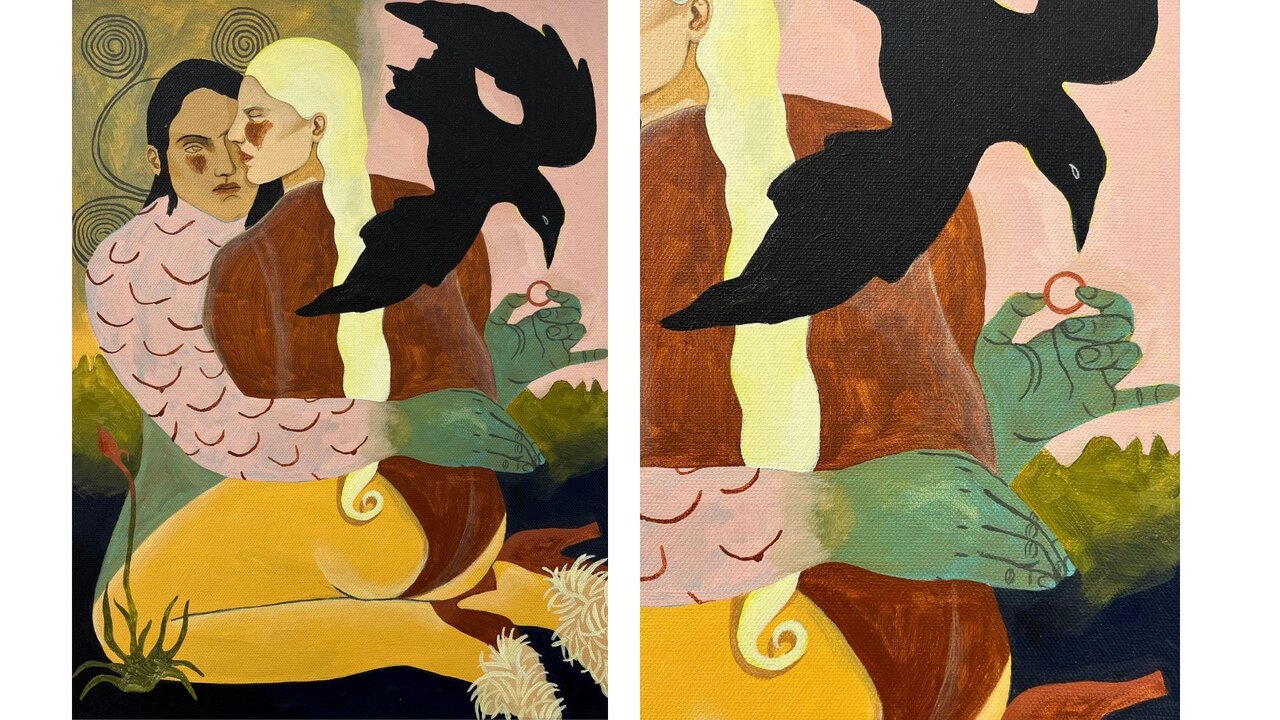
“In a Field near Hatfield House” features two figures appearing to embrace, each of them distinct in their symbolic representation. One of them has green hands, hips and arms and upper body covered with fish scales accompanied by hollow, open eyes – suggesting a sea-creature. The other figure, a human woman, dressed entirely in a striking red bodysuit with matching high heels, has her eyes closed. Adding to the intrigue, the figure with green hands holds a red ring concealed behind the woman’s back, while a black crow is flying toward it.
The red ring brings an air of withheld truth and secrets but also can be a hint of potential passion, commitment, or emotional intensity. The black crow flying toward it adds a foreboding element. Crows are powerful symbols, often associated with death or as bad omens in mythology and folklore. It’s dark presence contrasts with the vibrancy of the colours used in the composition. It is almost as if the crow is a harbinger of the consequences of this forbidden love.
Isabella Vella, In a Field near Hatfield House, acrylic on canvas, 16 x 12 in (left) and detail (right)
Isabella Vella’s The Performers perfectly blends myth, imagery, and the intricacies of the human condition. Through evocative symbolism and layered compositions, the works explore themes of femininity, existential yearning, and the interplay between vulnerability and strength. Each painting immerses the viewer in a moment of transformation. Vella’s mastery truly lies in her ability to balance the stillness of her figures with the dynamism of their emotional worlds.
Kaya Meziane
Images are courtesy of the artist and Dianna Witte Gallery.
*Exhibition information: Isabella Vella, The Performers, November 8 – 30, 2024, Dianna Witte Gallery, 1122 Dundas St. East, Toronto. Gallery hours: Wed – Sat 12 – 6 pm.
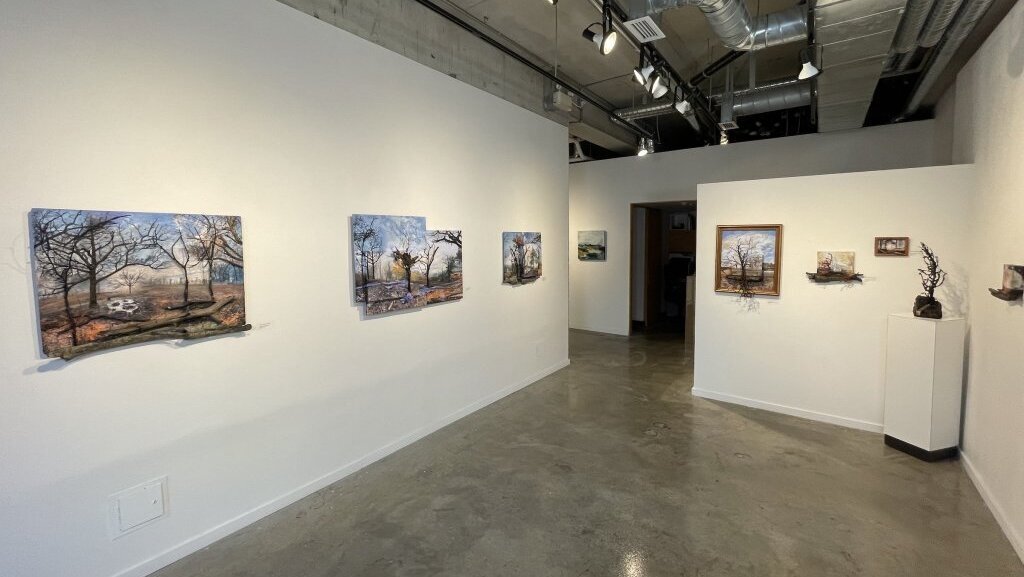
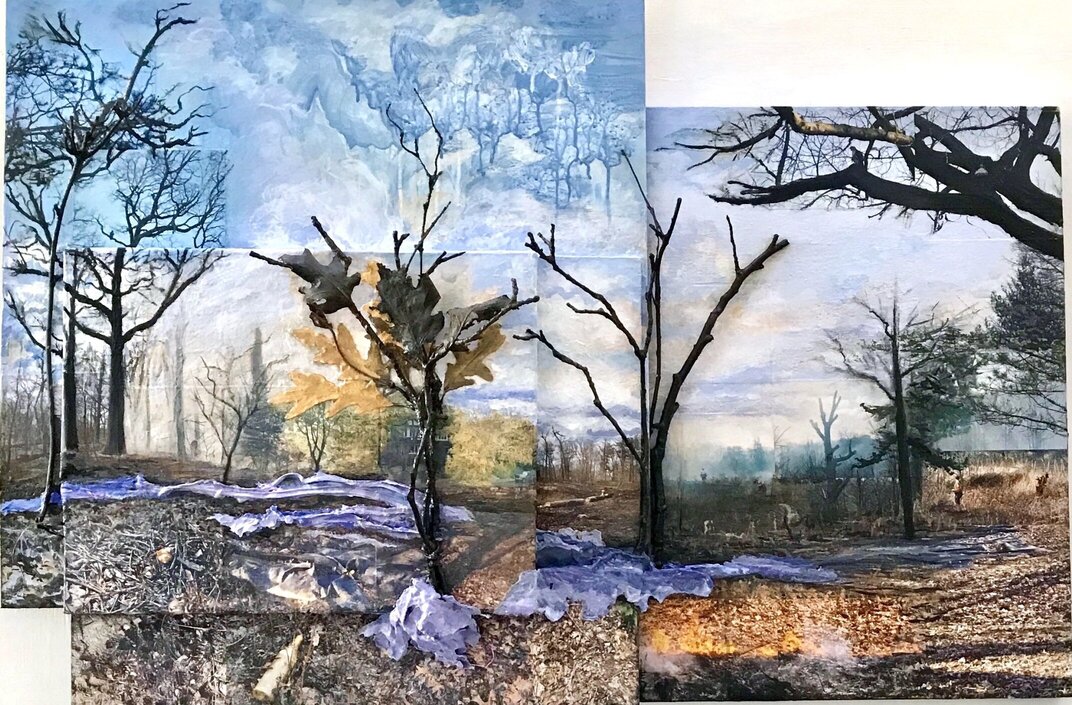
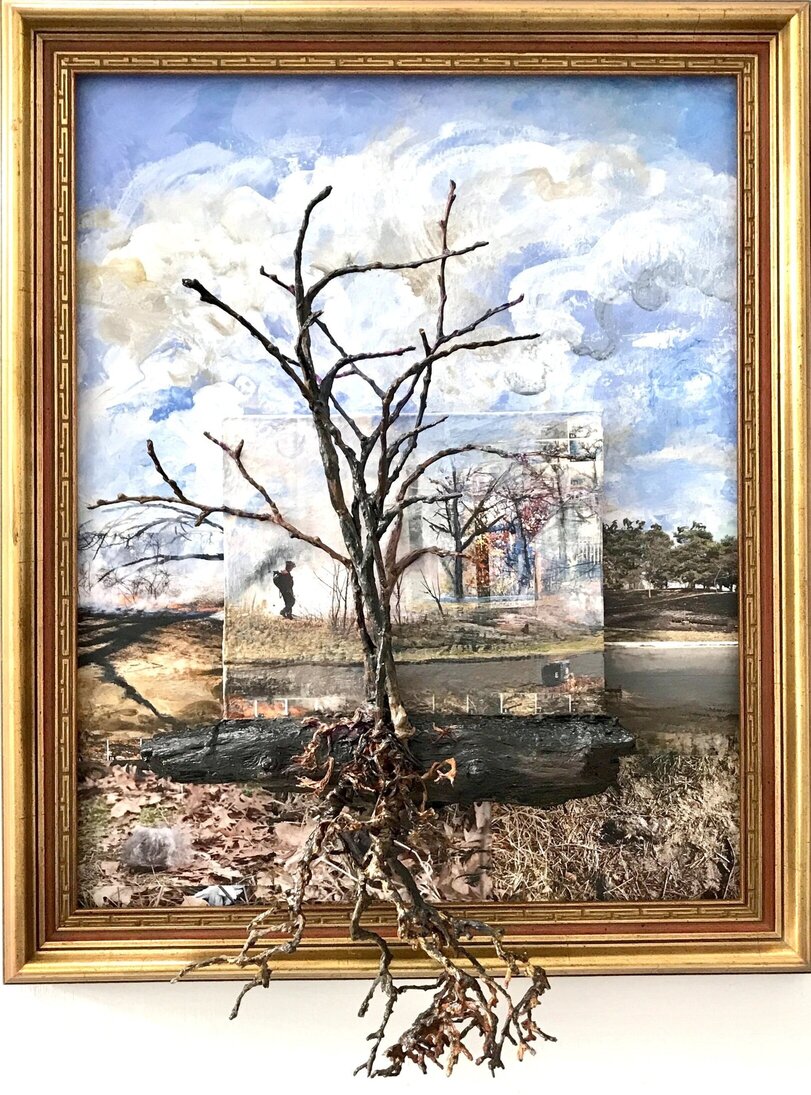
The sole subject of Frances Patella’s Fired Up at the Propeller Art Gallery is the Oak Savannas, whose homes reside in High Park. Typically, the savannas depend on natural wildfires, for instance lightning strikes, to maintain their ecosystem. The City of Toronto organizes prescribed burns in various areas around the park to revitalize this endangered plant community, utilizing the scorching heat from the fire to stimulate the germination of the oaks’ acorns. Patella documents this process in her photo-based mixed media artworks, layering wood panels and photographs akin to mosaics or tiles, and incorporating twigs, logs, and leaves from the prescribed burn sites themselves, creating an immersive three-dimensional landscape.
Installation view of Frances Patella, Fired Up at the Propeller Art Gallery
Patella’s work is first and foremost photography; she uses unconventional methods of photography in order to capture the ever-elusive nature of time. To create the images that are used as the foundation for her pieces, she revisits burn sites “over days, weeks, or years later” and “under different conditions or perspectives”, she writes in her artist’s statement. She often uses the technique of double exposure, where you expose the film twice over the same frame, combining the two shots into one. She would save the film she used at one shoot to use again later; in this way, it is completely up to chance how the photograph will turn out. Patella manages to capture both the powerful energy of fire and the changes of time itself by surrendering to their transformational processes.
Frances Patella, West Ravine, High Park, mixed media on wood panel, 28 x 42 in.
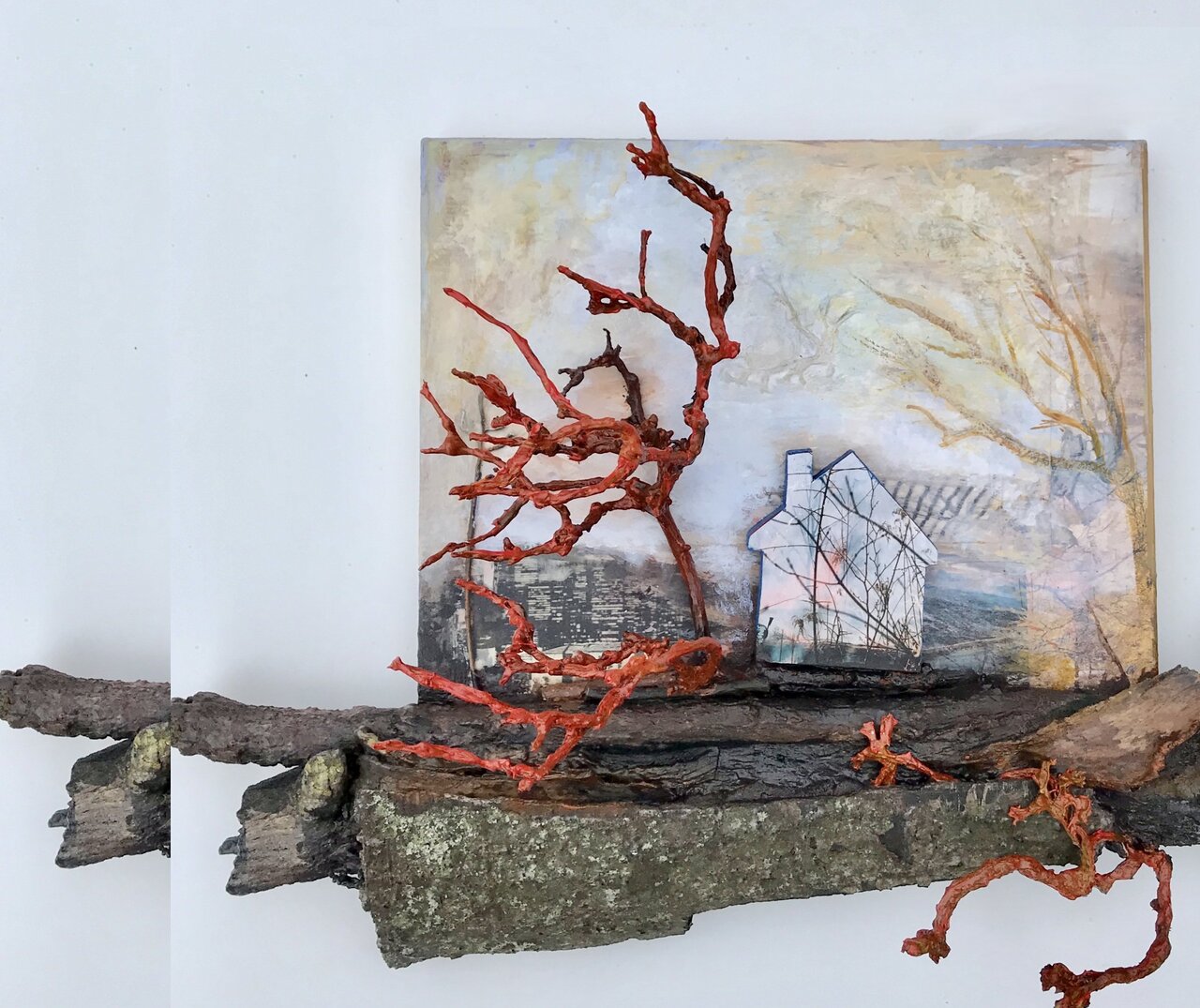
This is evidenced by the presence of the red-tailed hawks in the left side and top-right corner of “West Ravine, High Park.” Over the time Patella photographed this site, these hawks slowly began returning to these newly revitalized habitats. Moreover, scattered throughout the exhibition are a few tiny sculptures of homes. A photograph of a burn site overlays the simple shape of a triangle-roofed house with a chimney, sitting on top of burnt wood. A reminder that many other wildlife forms call these Oak Savannas home and will soon follow the red-tailed hawks to reclaim it.
Frances Patella, House, Lambton Park 2 (Front), mixed media, 5 x 3 in.
Each piece in the exhibition is an amalgamation of Patella’s time-warp photographs. The photos are decidedly laid out and layered onto wood panels like a puzzle. Several of the works use a number of these wood panels, which are also layered in varying arrangements that some areas either recede or reach out towards the viewer. By bringing together a collection of photos that each capture an individual moment into an array of facets and planes, Patella creatively makes a tangible representation of space and time. Viewers are able to experience the natural transformations of the Oak Savannas through time in one place.
Frances Patella, Hawk Hill Burn, mixed media on wood panel, 10 x 14 in.
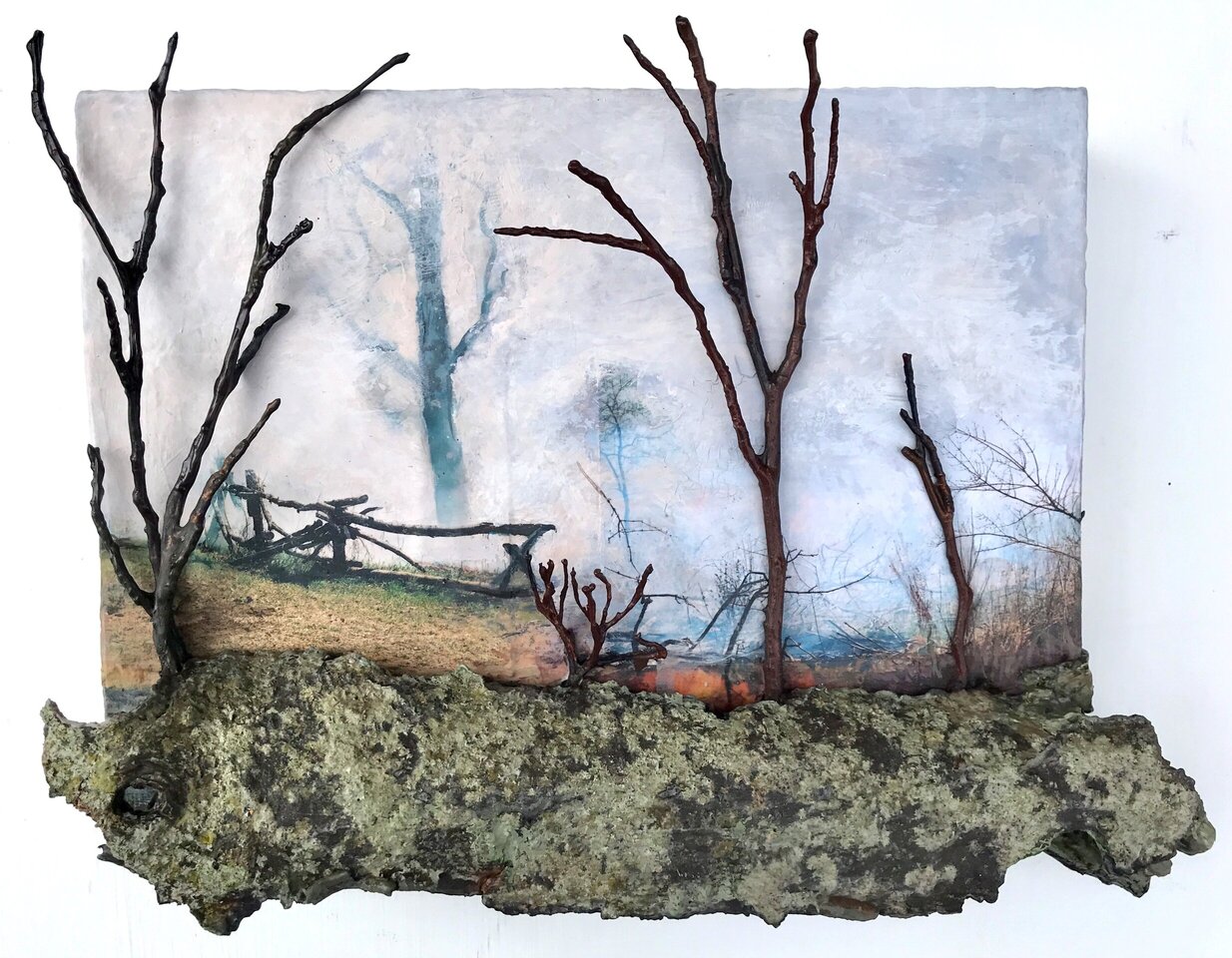
Patella cites Robert Rauschenberg as an inspiration for her unique photo-based mixed media practice. Rauschenberg is most known for what are called Combines; he would use found objects in his artwork, transforming everyday objects into something new by its change of context. Similarly, Patella would collect a myriad of things from the burn sites to integrate into her artwork. For example, a large piece of log is placed along the bottom frame of “Hawk Hill Burn” as if the photograph, along with some twigs, are growing right out of it. A log being used as a bottom frame is a motif that Patella repeats in many of her pieces. Sometimes, the log is positioned at the bottom of a wood panel already within a larger canvas, where a twig and its root are emerging from it, like in “West Rd., High Park with Forester”; an awe-inspiring metaphor for the cyclical quality of nature, that from the burnt wood, new life can arise.
Frances Patella, West Rd., High Park with Forester, mixed media on wood panel, 29 x 22 in.
In addition to photography, collaging, carpentry and the creative integration of nature, Patella paints directly onto the photos or the collected twigs and leaves. She delicately paints atmosphere into her scenes, like hazy smoke dissolving into a clear blue sky, or a majestic tree cloaked by the dancing fumes of a recently extinguished fire. In one piece, a twig is painted completely in a vibrant red, producing a stark contrast from the smoke-filled photographic backdrop, recalling the power that nature possesses. Patella blurs the lines between painting and three-dimensional sculpture that pulls viewers into her carefully-crafted reality where art is nature, and nature is art.
Frances Patella, House with Red Tree, mixed media on wood panel, 11 x 15 in.
Fire is more than just an element in nature. Fire is alive. It is energy. Fire breathes and transforms. Feed it too much, you might lose control. But not feeding it enough, it will disappear all on its own. Patella demonstrates a keen understanding of fire; that it is not always destructive, but can wield the ability to restore and breed new life.
Rebekah Barona
*Exhibition information: Frances Patella, Fired Up, November 13 – December 1, 2024, Propeller Art Gallery, 30 Abell St, Toronto. Gallery hours: Wed – Sat, 1 – 5:30pm, Sun 12 – 4pm.
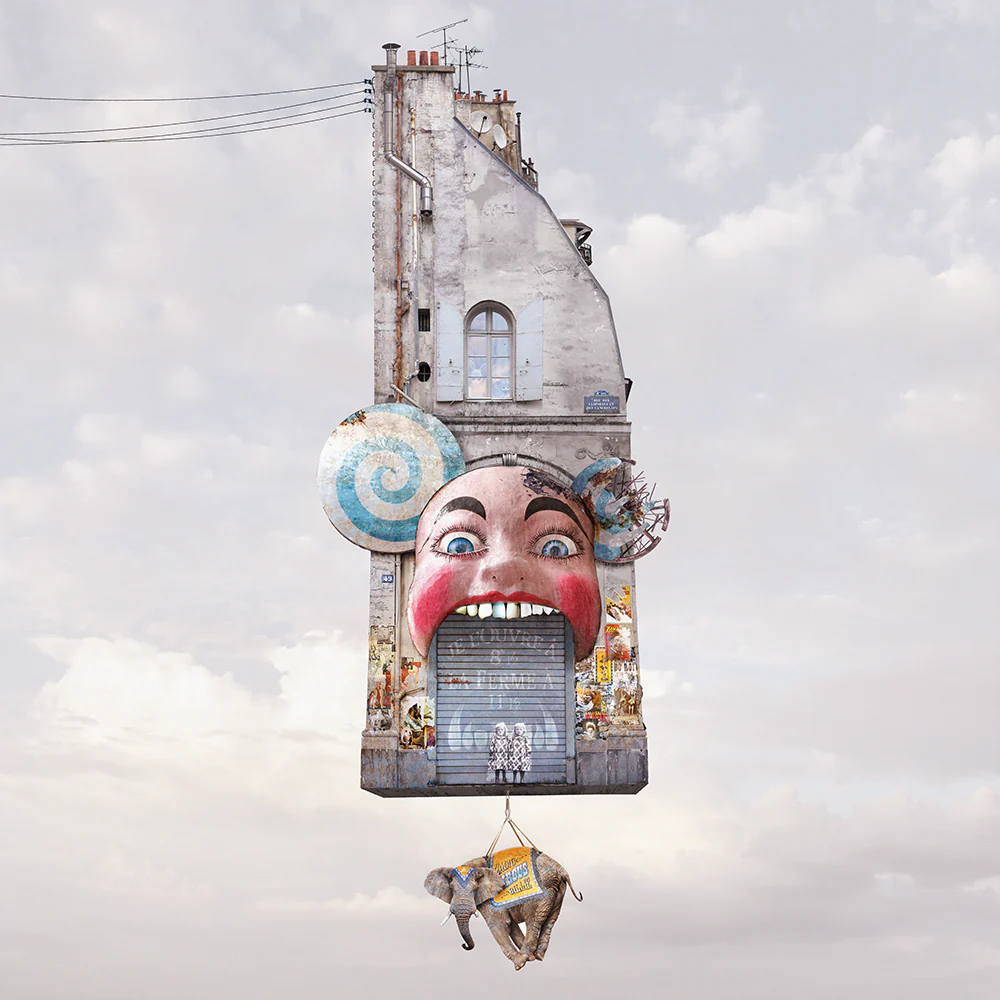
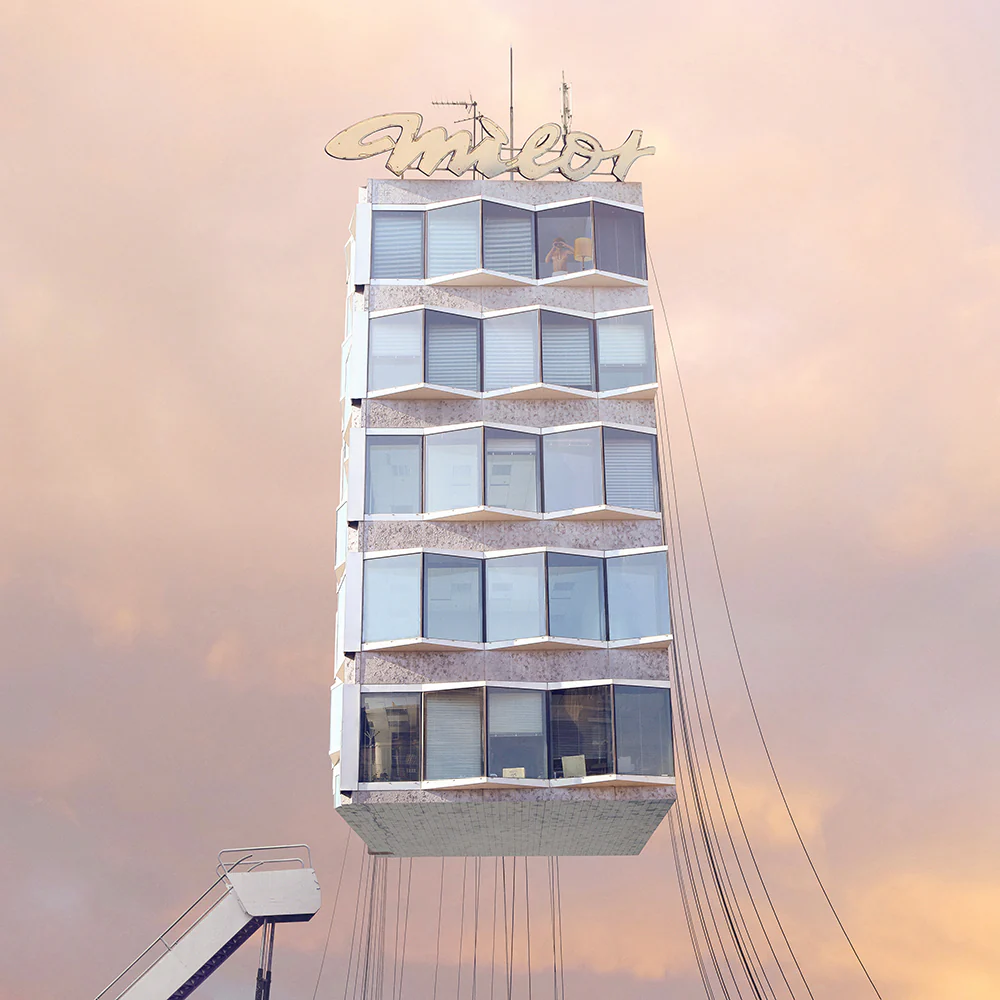
Laurent Chéhère’s Flying Houses series is a gently alluring exploration of urban landscapes suspended between reality and boundless reveries, where buildings float in the sky like silent witnesses to forgotten lives. In these surreal photomontages, Chéhère elevates the mundane, transforming everyday architecture into poetic narratives that invite us to reimagine the stories hidden in them. Drawing inspiration from visionaries such as Jules Verne, Hayao Miyazaki, and Robert Doisneau, Chéhère’s work is less about the structures themselves and more about the subtle, unspoken histories they contain. His photographs blur the boundaries between the known and the unknown, capturing the ephemeral nature of dreams and visions. The world Chéhère creates is one where the familiar becomes strange, and the ordinary reveals itself in extraordinary beauty. Flying Houses is not just a series of images but a meditation on the fragility of life and the hidden poetry that exists in the spaces we often overlook.
When I decided to write about Flying Houses, I was inevitably intrigued by Chéhère’s method of combining different artistic motifs. He uses the buildings and elements of cosmopolitan neighbourhoods of Paris as creative devices. His method is masterfully liberating the forgotten, abandoned, and once-lived-in buildings from their urban confines, allowing them to drift into otherworldly realms, where they transform into vessels of dream and wonder. To me, this is a declaration that in decay and ruin, there still a possibility of the preservation of art, of wonder, and the miraculous act of feeling it, even recreating it.
Laurent Chéhère, The Hell Cabaret & The Elephant, Ed.2/5, 2017. Archival Pigment Print on Hahnemuehle Photo, 48 X 48 in.
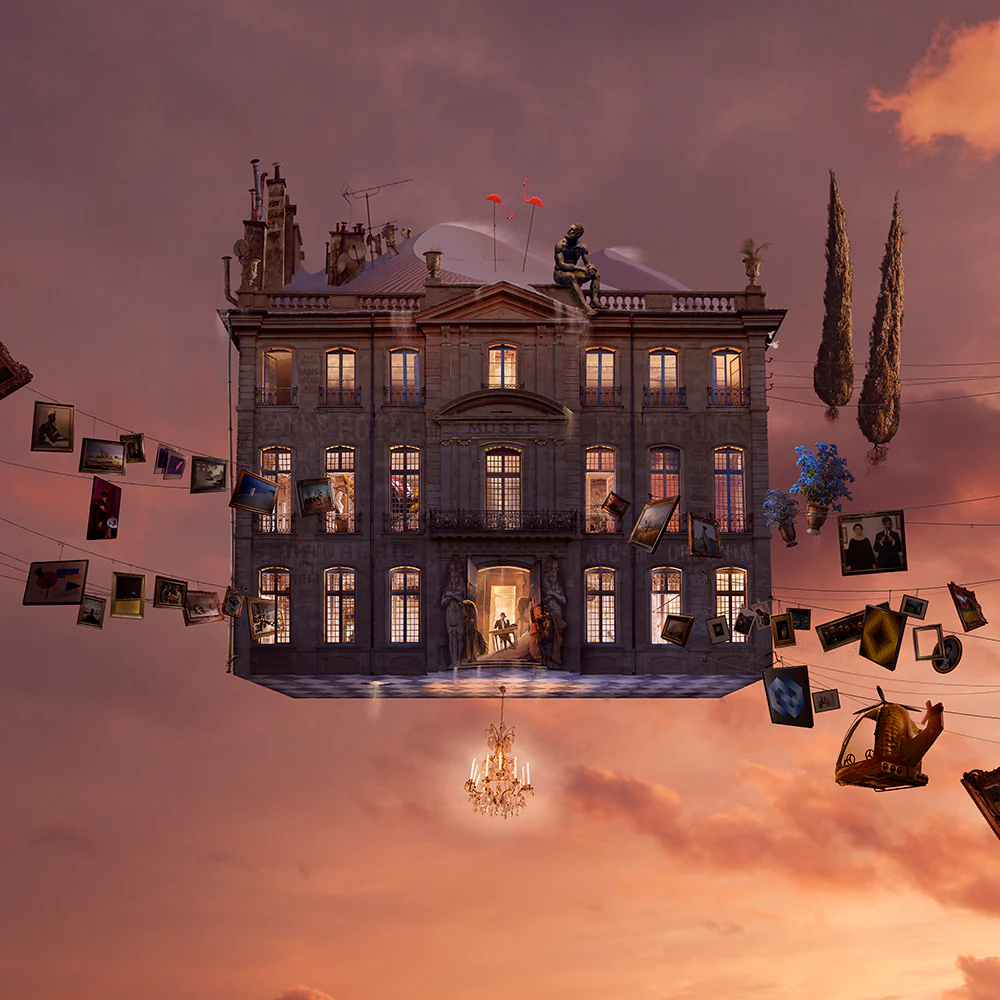
Flying Houses is a result of artistic intrigue. When visiting this exhibition, my tour guide Nicole King of Bau-Xi, Toronto suggested viewing the photographs at first from afar and noticing what you can. Then step closer, and closer again—observe all the hidden intricacies in what you could not see before. I understood then that Flying Houses is not merely about taking a transformative approach to what we deem as regular—but an act of discovering, of noticing; each piece is a puzzle. “Capernaum” is a good example of this. The photograph is packed with objects and symbols. It is like a film, a museum or a surrealist vision. There is a horseman at the door from a Cocteau movie, old masterpieces and contemporary artworks are flying out of the house and hanging on ropes likes clothes to put out to dry. Figures peek through windows, like traces of life that linger there. Sculptures adorn and sand dunes cover the roof, a chandelier falls of the ground, trees and flowers are flying in the air. Observing them we become part of the magic; able to sense what is hidden.
Laurent Chéhère, Capernaum, Ed.5/5, 2024. Archival Pigment Print on Hahnemuehle Photo, 48 X 48 in.
I found myself particularly drawn to “The Voyeur”—a piece that lingers in softness, like a quiet whisper, both distant and intimate. The pastel sky, in the colours of sunset, evokes a sense of something familiar yet elusive, a fleeting moment I could not grasp. Upon first glance the scene felt deceptively simple, almost too tranquil, with all the blinds drawn, sealing the world within. However, on the top floor, there is a solitary figure, standing in the window, watching us with an unwavering gaze. This made me question, “Who is truly observing who?” The person looks at us, but we, too, are caught in the act of observing—there is a dance between gazes, a quiet exchange between the artwork and the viewer. Then on a closer observation, I noticed that not all the windows are covered, the bottom floor is visible. A coat rack, a bookshelf, as if someone had been in it just moments ago. The building seems to be floating, tethered to the ground by power lines, holding onto the earth with a desperate grip.
Laurent Chéhère, The Voyeur, Ed.6/7, 2012. Archival Pigment Print on Hahnemuehle Photo, 36 X 36 in.
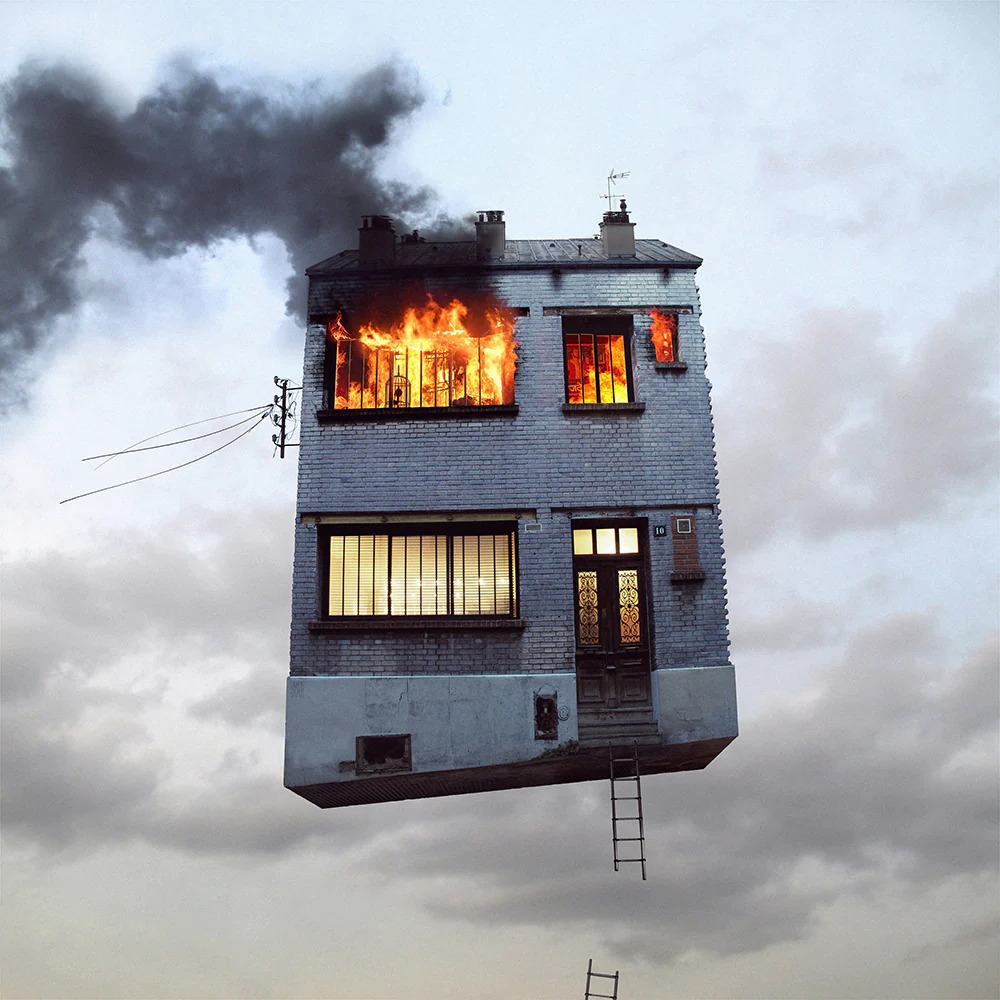
In stark contrast I also loved “Fire” because it is not quite like the others in this exhibition. A house set ablaze, smoke permeating the walls, leaking outside into the foggy grey air. There was no whimsy here—just some sort of unflinching portrayal of loss, of destruction. It is the most realistic piece in the show, therefore, when I was looking at this quiet tragedy, I recognized how it lingered between the fantastical and the real, striking and raw. It is terrible to see a home, whether detested or beloved, burn so brightly. Knowing it may eventually turn to ashes, yet for now suspended from that inevitable collapse, frozen within the frame.
Laurent Chéhère, Fire, Ed.3/5, 2012. Archival Pigment Print on Hahnemuehle Photo, 48 X 48 in.
I appreciate Chéhère’s attitude that lets viewers create their own narratives, uncovering hidden layers in his work, embracing the subjectivity of art. This series is a gift to our individual experiences, insights, and narratives which can be nothing but different from one another’s—each interpretation as unique as the viewer.
The photographs are mesmerizing and after you indulge yourself in creating your own narratives, you arrive at the question: How was all this created? How did the artist materialize his visions? Chéhère wrote, “The first ‘Flying Houses’ were photographed by chance in the street and the photomontage was rudimentary of about ten elements. My method has evolved into a gigantic puzzle, I photograph a facade in several pieces to have a sharp rendering. My latest works use hundreds of photos, sometimes containing 1500 layers.” He starts by drawing a shape, then makes hundreds of photographs of many angles of buildings, streets, gutters, dirt, snow, traces of time. He also searches the internet for interior design elements and for various characters of well known stories. He concludes by saying that his work is never finished.
Yehyun Lee
Images are courtesy of Bau-Xi Gallery, Toronto.
*Exhibition information: Laurent Chéhère, Flying Houses, November 7 – 28, 2024, Bau-Xi Gallery | Dufferin, Main Floor Gallery, 1384 Dufferin Street, Toronto. Gallery hours: Daily 10 am – 5:30 pm.
Sandwiched between the towering buildings of the financial district is the Collision Gallery, a multifunctional space bridging the gap between the financial and creative culture in Downtown Toronto. Destress and enter a world of mysticism and creativity in an exhibit that focuses on various ethnicities depicted through the stories of self-identity.
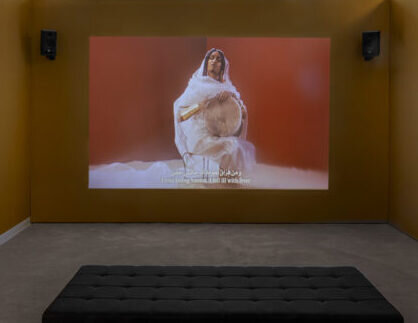
Tucked in the back corner is a separate space dedicated to the heartfelt truths of queer lovers. In the dimly lit area, vibrant colors echo off the walls as the video plays in a continuous loop. The secrecy of the space sheds light on the hidden love between queer lovers but the vibrancy of the colors expresses the strength of their emotions. A clandestine meeting to celebrate this form of emotions. Sitting on the black bench, it feels like we are eavesdropping on the whispers of love from one lover to the other. Three Sudanese songs speak the truths from the depth of the heart. The universal understanding of love and music transcends the language barrier. Envisioning the traditional musical instruments and poetic lyrics are pop culture visual aesthetics that take from music videos of famous contemporary artists in terms of color, styling, and camera work. Its bright and cheerful color palette juxtaposes the soft, bittersweet lyrics in describing the conflicting emotions of a secret love.
Ahmed Umar, Truth Bears No Scandal (in Arabic), 2024. Video, 11 minutes, 45 seconds. Courtesy of the artist and OSL Contemporary. Photo: Toni Hafkenscheid
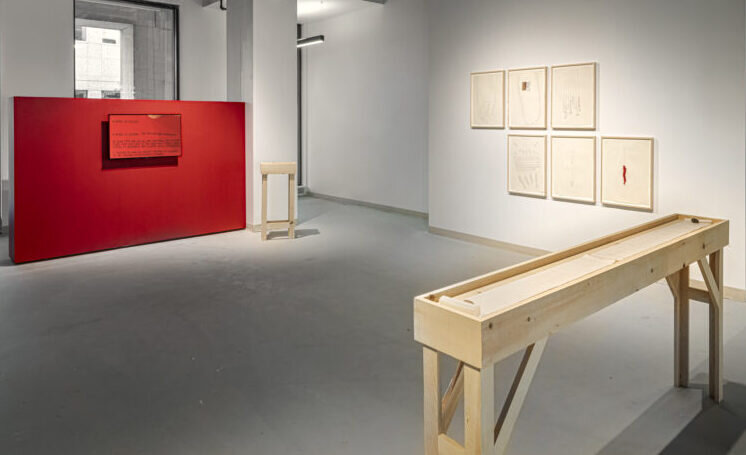
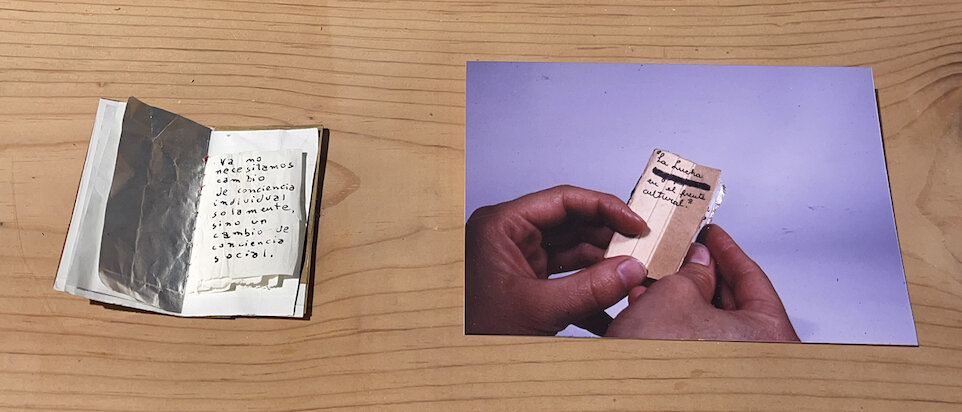
In the opposite corner of the gallery are several works by artist Cecilia Vicuña, who speaks on the topics of oppression and mind-control experiments that have created devastating chapters in our history books. The piece is an homage to Gail Kastner, an eighteen-year-old Canadian girl who endured 64 electroshocks and the forced ingestion of drugs to erase her memory. Kastner left her testimony on written cigarette boxes, that were recreated as part of the installation. Although addressing subjects of grave importance, Vicuña’s approach uses nostalgia, value of words, and abstractness of visual representations to serve as reminders of past cruelty that should not be repeated.
View of Cecilia Vicuña’s Futur.O (Futur.E), an installation in four parts. Courtesy of the artist and Lehmann Maupin, New York, Seoul, and London. Photo: Toni Hafkenscheid
Cecilia Vicuña, A Change of Consciousness, 2024. Little handmade book, made from a found cigarette box (exhibition copy, the original is at Tate Modern), 4.5 x 7.5 cm. Courtesy of the artist and Lehmann Maupin, New York, Seoul, and London. Photo: Sherry Qin
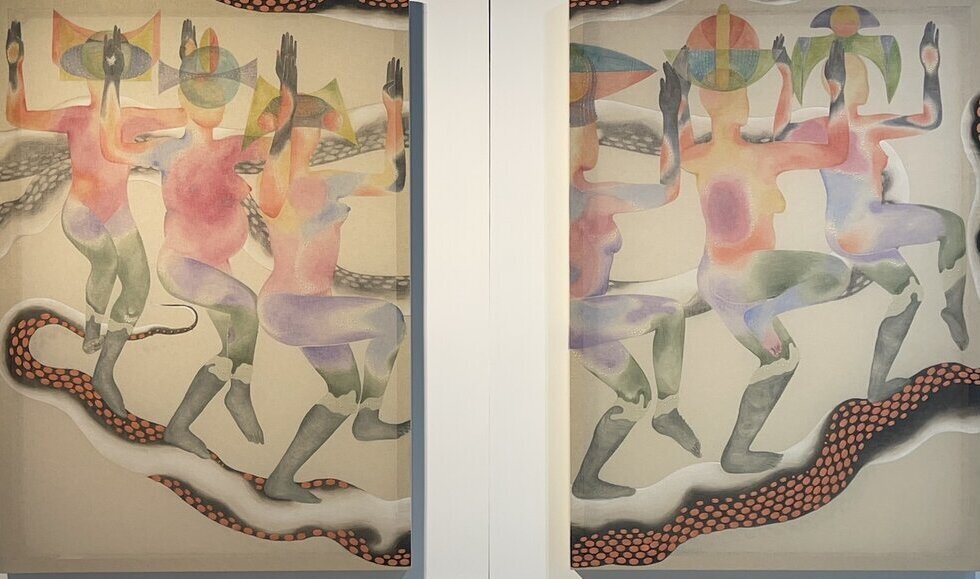
Divided into two separate canvases, Rajni Perera takes the viewer on a spiritual journey through her dreams on top of the serpent. In this ritualistic dance, these mythological creatures are colored in beautiful warm tones that fill up the head and torso contrasted with dark grey hues that highlight the legs, hands, and forearms. The combination of acrylic gouache, metallic thread on polyester fabric, glass and freshwater pearls emphasizes the spiritual and mythological essence of the artwork. Mixed into the work are earthy materials such as clay and charcoal, that connect the dream to the earth, grounding it to Perera’s childhood experiences with craftsmanship. Her grasp of materiality is evident in using numerous clay ovals that evoke the scales of a snake’s skin and pearls strategically placed on the body to emulate etherealness. The mixed media work creates a balance that allows the thin fabric of the canvas to sustain the materials physically and forms a bridge between one and one’s dream-state.
Rajni Perera, Joyous Procession/The Infinite Serpent, 2024. Acrylic gouache, polymer, clay, metallic thread on polyester fabric, glass and freshwater pearls, chalk, charcoal, 213.3 x 152.4 cm each. Courtesy of the artist and Patel Brown Gallery. Photo: Sherry Qin
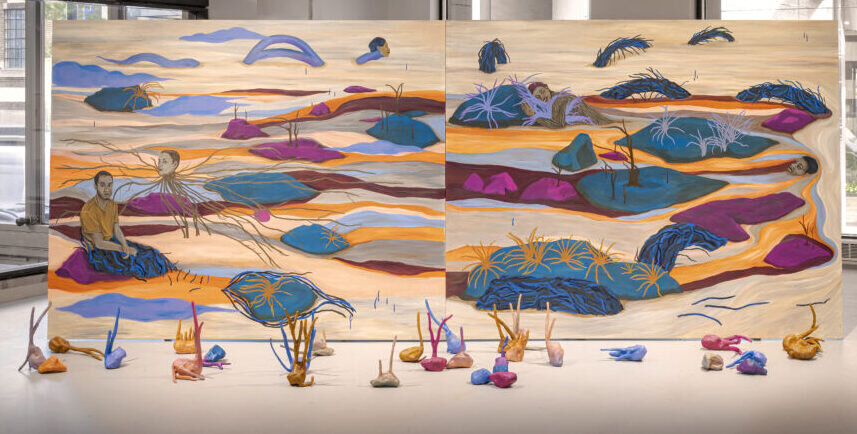
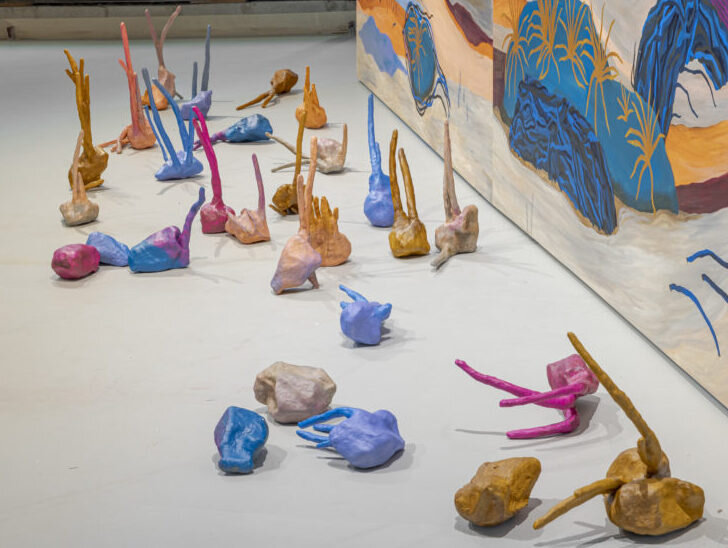
Tessa Mars explores the relation between the body and the land, focusing on the human impact on the environment and the damage to ecosystems. The heart-shaped papier-mâché objects laid out on the floor project the relationship between the body and the land, solidifying it in a three-dimensional world. Metamorphic transitions are depicted in the large canvas as human body parts merge with small islands floating on murky waters. Mars suggests to the viewers to reflect upon themselves and their destruction of nature. She encourages the audience to feel the urgency to undone the damage they caused and support the ecosystem.
Tessa Mars, All Islands Touch, 2024. Acrylic on canvas, and papier-mâché. Paintings: 200 x 250 cm each. Installation: dimensions variable. Courtesy of the artist. Photo: Toni Hafkenscheid
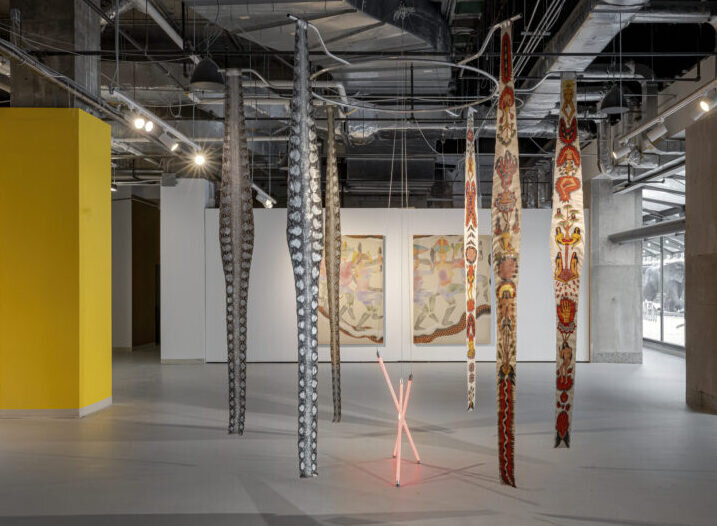
In her work Citra Sasmita integrates technological innovations into Balinese mythology and spirituality. She uses Kamasan-style painting, developed in the fifteenth century as one of the first painting method in Bali, to tackle themes of colonialism and patriarchy through traditional stories, whilst addressing the analogy that myths offer for modern science. The installation resembles a gathering around a campfire, where the metal holding the snakeskin continuously rotate back and forth, mimicking a ritualistic dance around the campfire. The neon red lamps position themselves in the center, huddling together like firewood, lighting up the surrounding space to create effects like that of a fire. Together with the metal, Sasmita seamlessly integrated technological advancements from the Western world into the world of Balinese mythology and traditional stories.
Citra Sasmita, Timur Merah Project XII: Light Speed and Revelation, 2024. Kamasan traditional canvas, Python Reticulatus snakeskin, metal, and neon lamps. Metalwork by Sparkers Fabrication. Courtesy of the artist. Photo: Toni Hafkenscheid
Sherry Quin
* Exhibition information: Toronto Biennial of Art, September 21 – December 1, 2024, 11 locations in the city. Collison Gallery, 30 Wellington Street W, Commerce Court Toronto. Gallery hours: Tue -Sat: 10 am – 6 pm. For TBA programming please click here.
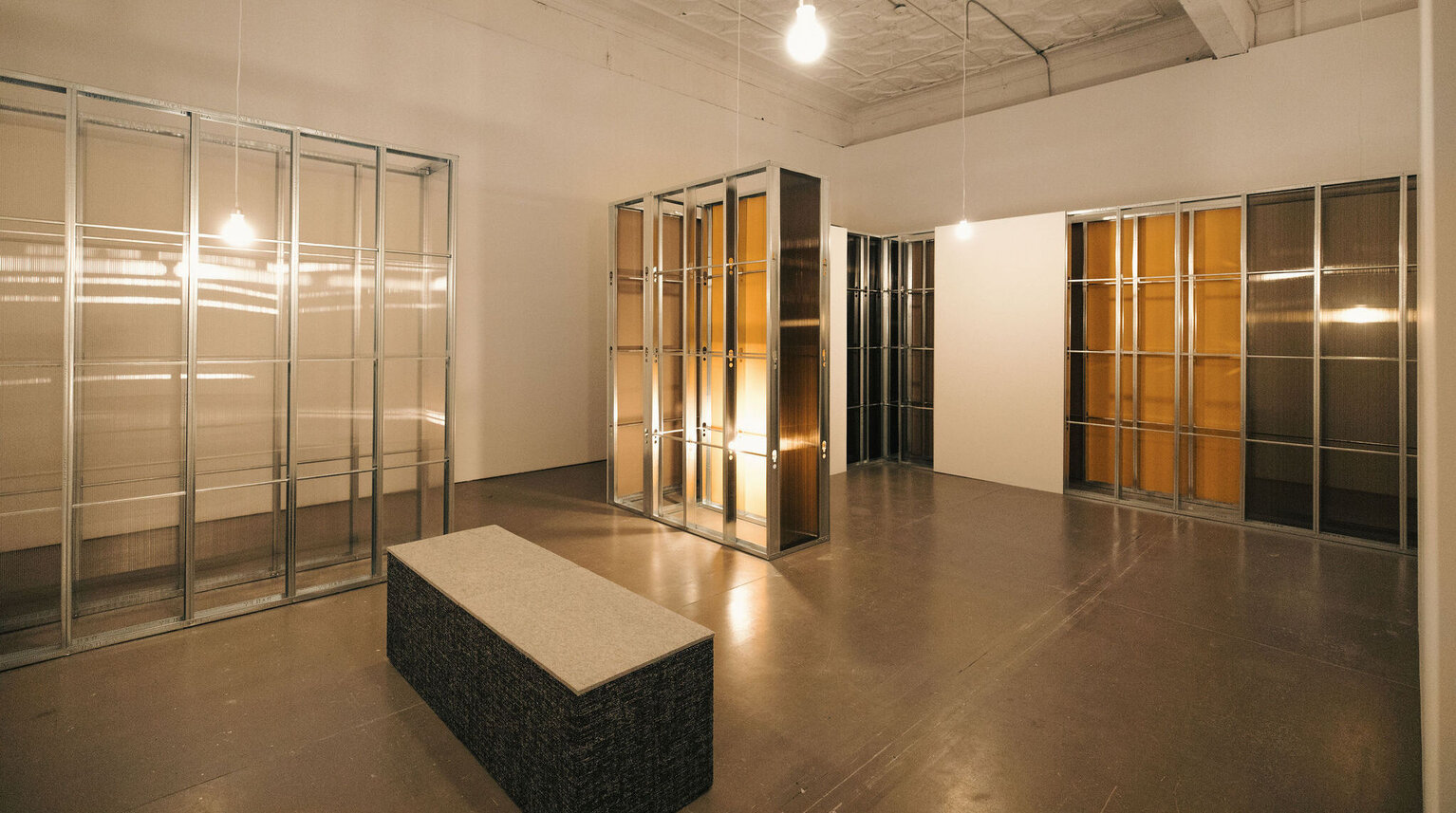
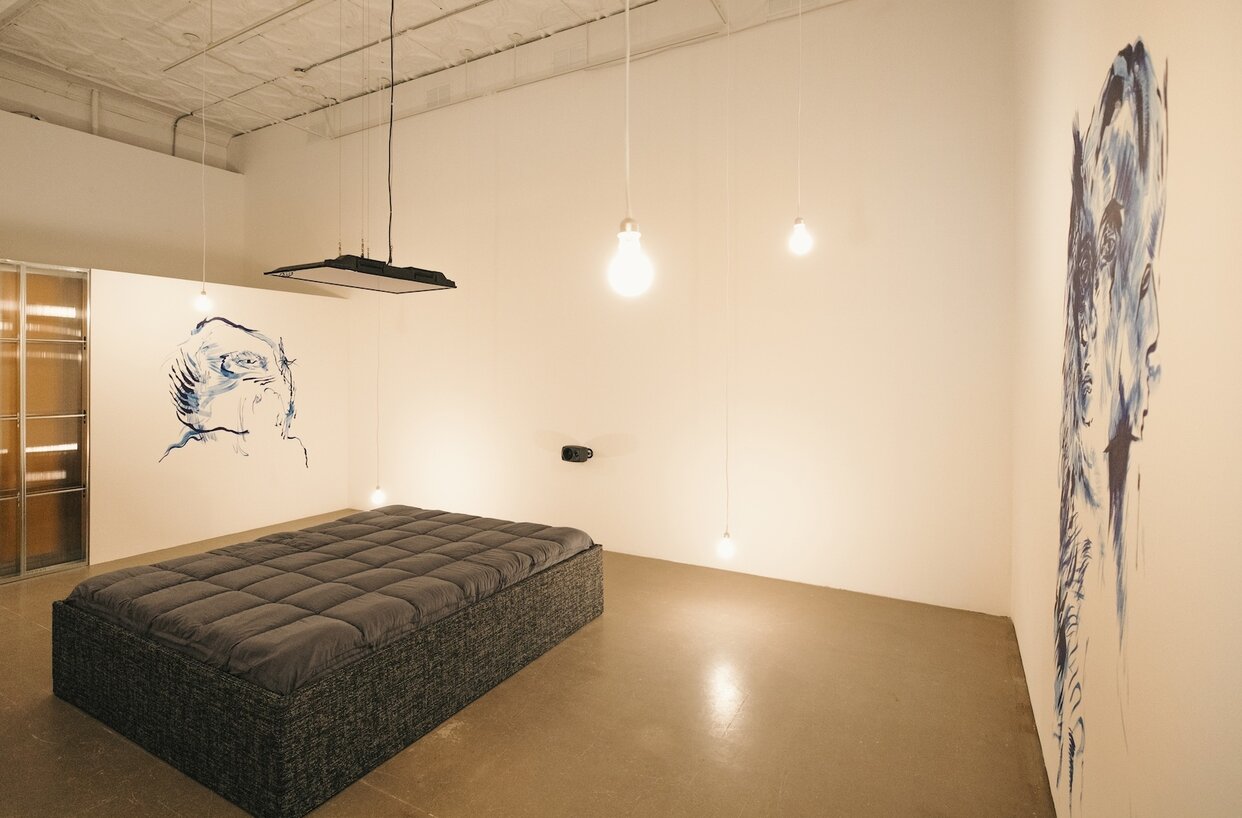
In spite of my desire to see you disappear by Paul Maheke is an installation at Mercer Union presented through sound, painting, and architectural forms. The artist’s previous work has explored bodily presence and desire to disappear with choreographed performances. In this installation, Maheke attempts to completely disappear from his work and only exist within sound. Upon entry to the gallery, one is immediately immersed in the intense sounds which evoke curiosity and draw you deeper into the surrounding space.
Paul Maheke, In spite of my own desire to see you disappear, 2024. Installation view: Mercer Union. Courtesy the artist. Photo: Vuk Dragojevic
Additionally, the 20-minute runtime of the show is unclear, allowing one to step in whenever they like but still understand and connect with the work. One’s perception of time also stops, and the end of the runtime is left to be interpreted by the visitor. The artist invites visitors to walk around and explore the space in any path they like. From reflective metal and plastic surfaces to areas for rest, every choice of material aids in creating an isolated space for reflection and contemplation.
Paul Maheke, In spite of my own desire to see you disappear, 2024. Installation view: Mercer Union. Courtesy the artist. Photo: Vuk Dragojevic
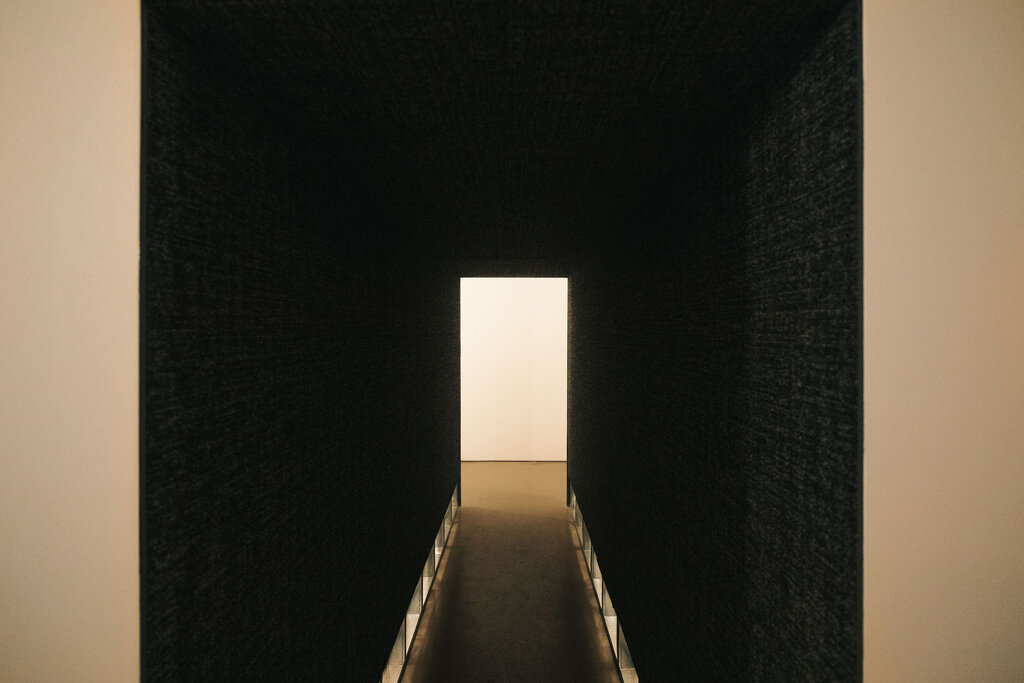
The experience of the space provides a feeling of safety, but also simultaneously makes one feel unsafe. Instrumental sounds gradually introduce verbal elements as male and female voices begin to narrate. Sometimes the narration is done in French, further fueling the visitor’s curiosity and desire to know the full story. The narration later dissolves into a gentle song sung by the female voice, where lyrics about the pain experienced from a relationship are accompanied by intensifying sounds. A tunnel separates the gallery space into two rooms.
Paul Maheke, In spite of my own desire to see you disappear, 2024. Installation view: Mercer Union. Courtesy the artist. Photo: Vuk Dragojevic
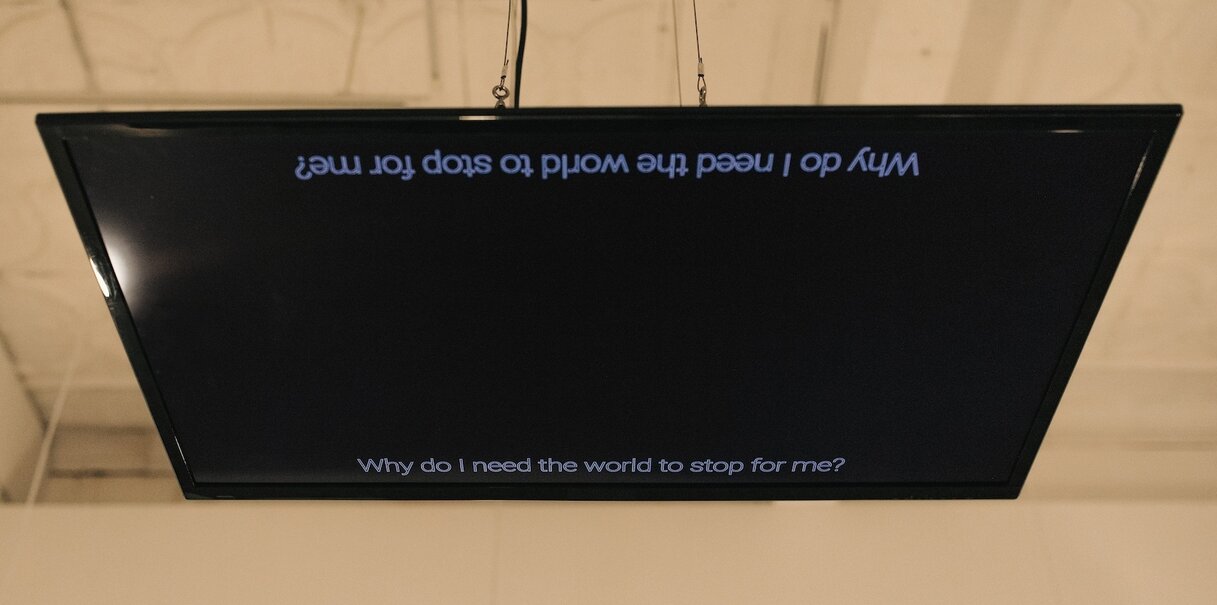
Inside the tunnel sounds are experienced more subtly, and the carpeted walls allow one to rest/lean against them. At the right side of the tunnel, an ottoman-like bench is placed near a wall with a speaker in front. At the left, a large, cushioned bed-like furniture allows seating in front of another speaker, or laying down and observing a television screen which has been hung facing down from the ceiling.
Paul Maheke, In spite of my own desire to see you disappear, 2024. Installation view: Mercer Union. Courtesy the artist. Photo: Vuk Dragojevic
The artist’s choice of placing those devices in front of the viewer where areas for rest are provided is a strong attempt of direct communication, like a face-to-face interaction. The television screen only displays subtitles for the narration on a black background, in ghostly hollow letters with white outlines.
Paul Maheke, In spite of my own desire to see you disappear, 2024. Installation view: Mercer Union. Courtesy the artist. Photo: Vuk Dragojevic
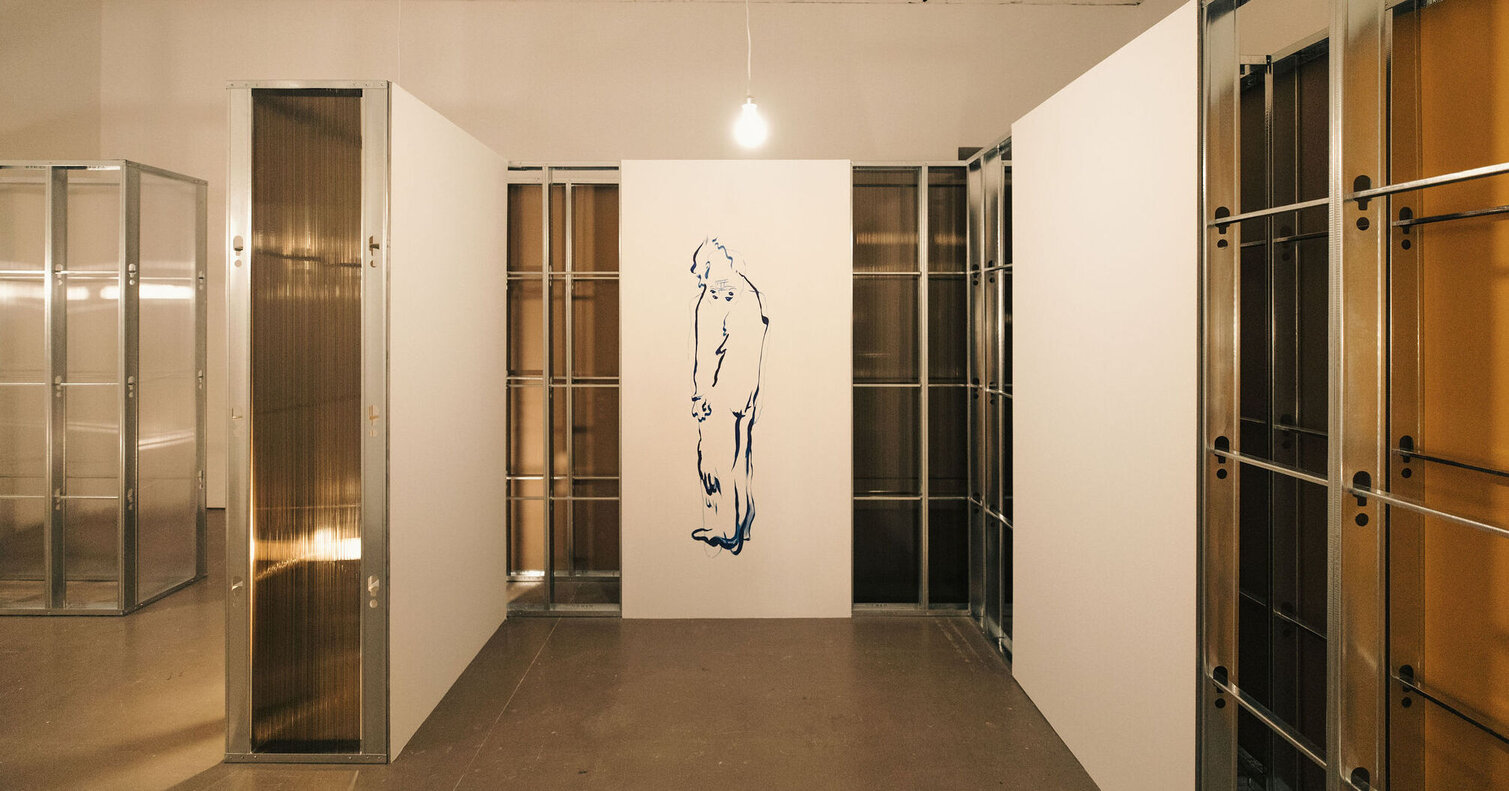
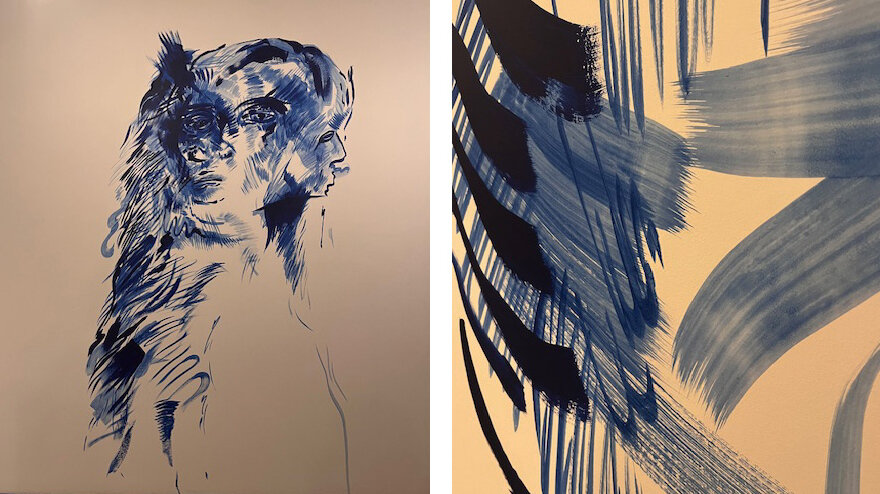
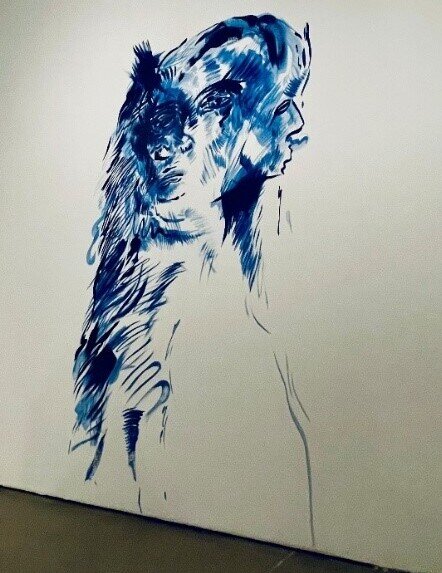
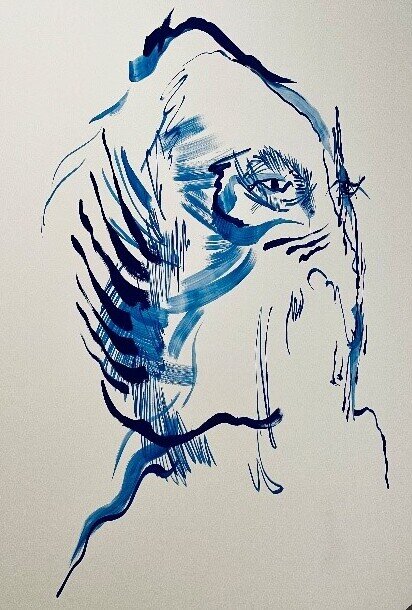
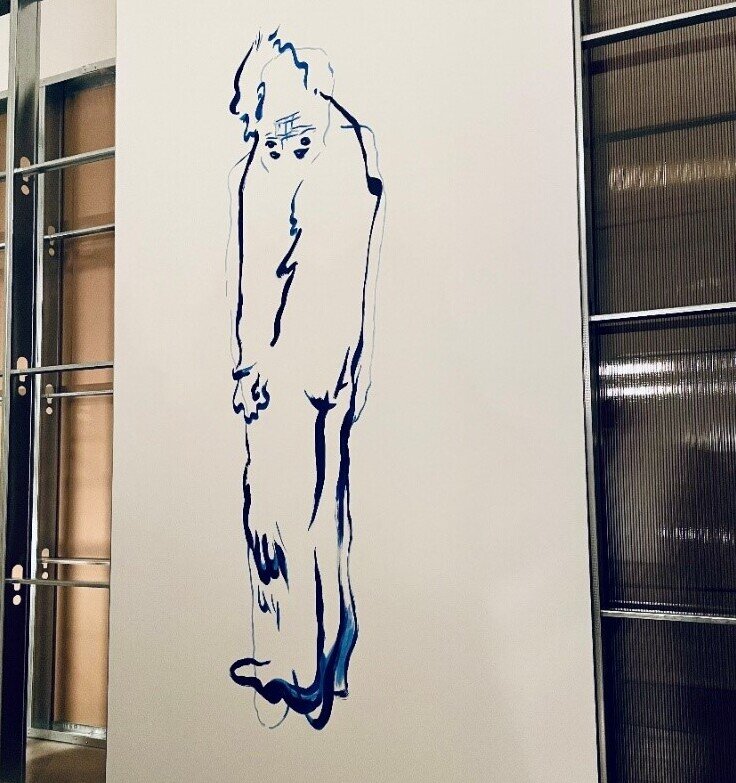
As the narration continues, sounds like whispers and footsteps can be heard from the other room, almost reminiscent of the feeling of being home alone. The theme of loneliness becomes evident as the narration itself mentions: “What to do with the feeling of being left alone?”. The idea of vulnerability has also taken form by the artist having handed over his personal diary entries from lockdown to a friend, Ndobo-emma, who has essentially appropriated his stories by using them for the sound work of the installation. Vulnerability is hence seen through the sharing of such fragile material with the public, but also by exploring the degree of resilience and the vulnerable state relationships themselves create. The artwork presents itself as being very real and existing within our world, or, being made of it. Although its inviting quality may form impressions of domesticity, ideas of violence presented through sound counter its tenderness and contribute to an eerie atmosphere”. A similar contradiction can be noticed in the architectural forms of the installation, where structures seem to be in the process of being built, but also of being deconstructed. Blue painted figures and faces on walls are also half-existent with their translucent quality of contour and hatched drawing techniques.
Paul Maheke, In spite of my own desire to see you disappear, 2024. A wall drawing (left) and its detail (right). Installation view: Mercer Union. Courtesy the artist. Photo: Nane Zadoorian
This constant suggestion of an in-between state, and the questioning of boundaries results in a unique and mysterious experience of the space and story. Paul Maheke has successfully created a very still yet dynamic environment formed by the experience of sound and physical surroundings. This exhibition is a must-see for its ability to display emotion in such a way that directly impacts the visitor. I visited the exhibition with my grandmother who does not understand English or French (or contemporary art for that matter), yet her awe and experience of this dynamic atmosphere was no less than mine.
Nane Zadoorian
Paul Maheke, In spite of my own desire to see you disappear by Polyna Alexseev
Paul Maheke brings a melodic, emotional, 20-minute sound and visual experience to Mercer Union that will allow visitors to cease existence for a little while. As a former public performer from Paris and a master’s degree graduate in art and installations, Maheke has gifted us with his personal stories of process and discovery between music, dance and drawings that weave into abstract and revolutionary storytelling.
The exhibition’s space has done wonderful justice to the concept of irony, and transparency of personal stories shared in a public space; an inviting chamber to oblivion. It provides many rooms to disappear into, as well as abstract characters to look at; that the viewer’s eyes cannot see but feel at first sight.
This exhibition is a fascinating dream-like stroll. When you walk through the tunnels of the chamber you are greeted with dialogues, sound and fragments of soulful drawings. You find yourself in a very vast, almost hallow space only to discover that the waves of sound create a vision of the presence of an invisible dancer, Paul Maheke. You are becoming part of Maheke’s installation and share his personal definition of “experience” in a public setting.
At the centre of the exhibition, you will see a large sofa as a sitting area, a chance to relax and enjoy the luminous figures on the walls, fading in and out like the music of an R&B busker in the middle of a busy city. It is also an opportunity to listen closely to the music, incorporated with R&B rhythms and bi-linguistic dialogue in the background by Maheke and his collaborators. R&B is (musically) often associated with struggle, heartbreak, passion, and pain. It is believed that when we are having a crisis in our creative thinking the metaphorical touch of art, music and dance can help or even resist. The more you hide, like Paul’s abstract figure drawings or the abstraction of sound, the more you reveal your discomfort and your conflicted relationship with the world. At that stage there is a strong desire to be seen and heard but also to vanish.
This chamber perhaps makes you feel isolated, but the body language on the walls and in the room speaks for itself; an invitation to disappear together.
Polyna Alexseev
All images are: Installation view of Paul Maheke, In Spite of My Own Desire to See You Disappear at Mercer Union. Photo: Polyna Alexseev
*Exhibition information: Paul Maheke, In spite of my desire to see you disappear, September 28 – November 30, 2024, Mercer Union, 1286 Bloor Street West, Toronto. Gallery hours: Tue – Sat, 11 am – 6 pm.
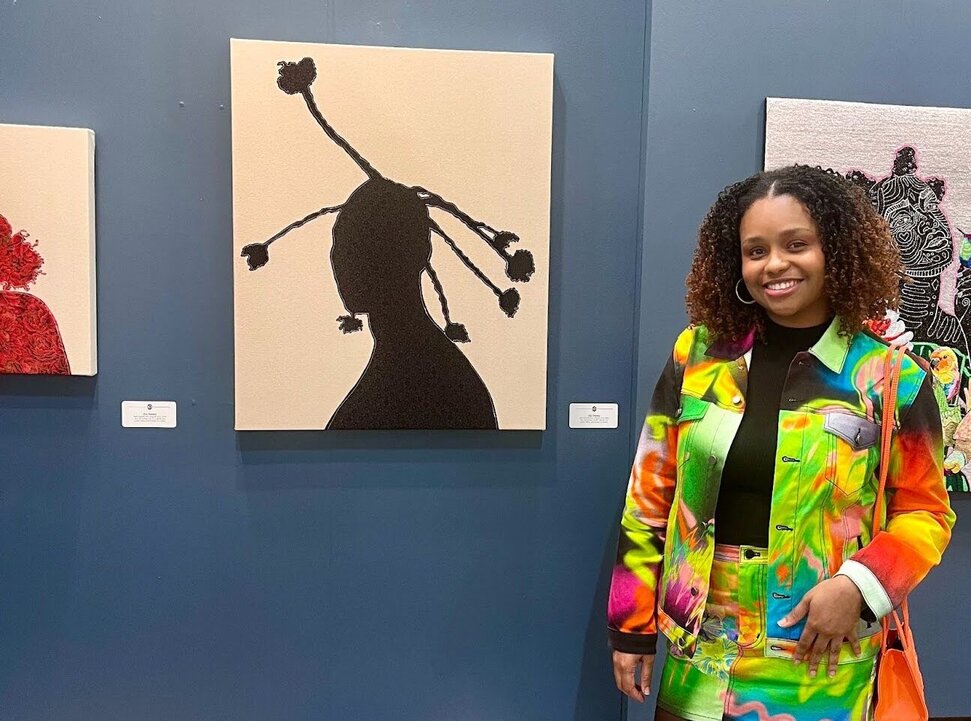
There’s no doubt that black representation in art institutions has been limited. However, as the art world progresses, more diverse artists are gaining recognition in these spaces. The well-known art fair, Art Toronto, is a platform that welcomes contemporary art galleries across Canada to showcase their artists’ recent work. Art Toronto was held from October 24th to 27th 2024 at the Metro Toronto Convention Centre, where the event featured artists like Gio Swaby, a Bahamian textile artist who is known for her focus on Black womanhood and individuality. She’s represented by Claire Oliver Gallery located in New York City. Their booth displayed Swaby’s self-portrait and textile silhouettes of Black women. Her body of work is a breath of fresh air and she creates a powerful space where Black individuals, especially Black women, can feel seen and heard.
Gio Swaby at Art Toronto 2024
Her creative process begins with an idea she wants to explore rather than beginning with the material. Once the concept is clear, she selects the materials that support her vision. Her practice is rooted in love, the skill of sewing was passed down to her from her family and she makes the effort to implement that in every piece she creates. She chooses textiles for their familiarity, which helps bridge the gap with the public, making her work approachable and relatable—especially for those who may feel intimidated in traditional art institutions.
She works closely with sitters, which are often family and friends, using photography to capture their poses. This collaborative process develops an authentic representation of each person. Conversations are central to her approach, as she engages with each sitter, seeking their permission, ensuring their comfort, and creating a safe and supportive space throughout the process.
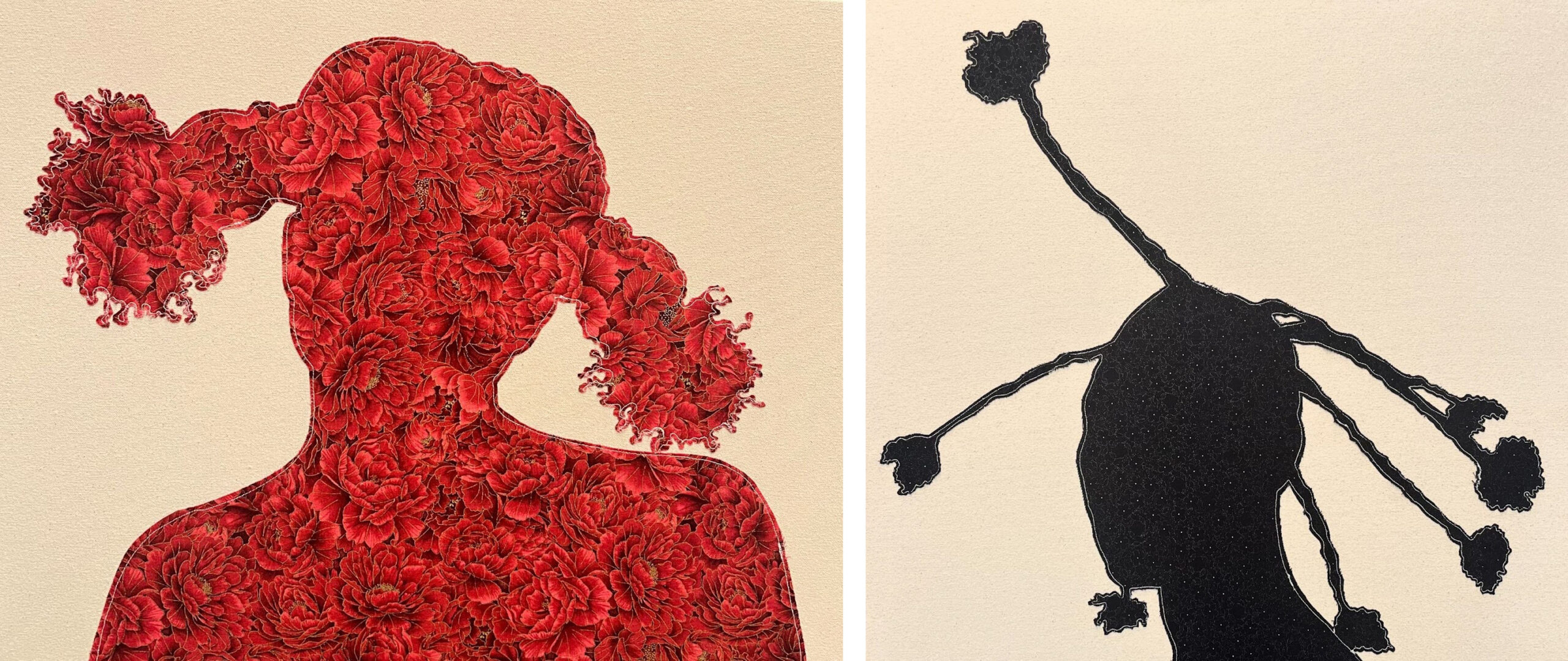
My first impression of her work is that the attention to detail and bold use of color bring out a sense of grace and delicate care for the portrayal of female identity. Black women are often seen as having a tough exterior, yet Swaby’s body of work reveals a softer side through its fine, intricate stitching, capturing the essence of Black hair in silhouette with floral and delicate patterns that convey a bold feminine energy. The visual softness exudes a tone of positivity and confidence. The raw canvas adds a balanced contrast to the vivid, dynamic textiles, emphasizing the organic quality of the work.
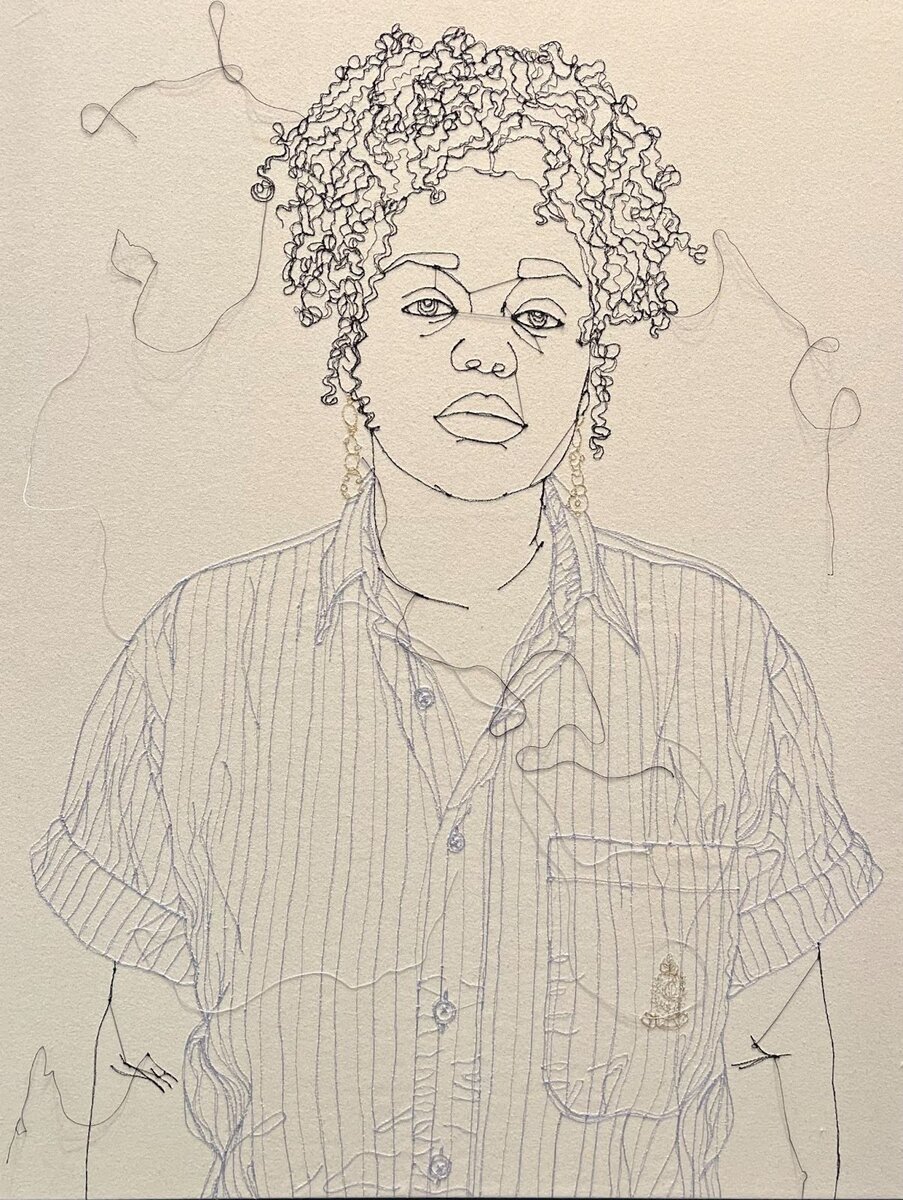
Gio Swaby, Self Portrait, thread and fabric sewn on canvas
In her self-portrait, the canvas reveals the embroidery’s backing, with exposed threads representing her evolving identity. By looking at the canvas this way, it conveys that the Self is always a work in progress. The piece embodies acceptance and self-love, embracing her imperfections as a Black woman and creating a sense of connection with viewers through honesty. The composition encourages viewers to observe and appreciate her entire presence, by taking a closer look at each detail. This dynamic self-portrait interacts with its surroundings, subtly shifting with the wind or the movement of people nearby. The interaction demonstrates how the people and things around us can shape who we are.
The silhouettes, titled “New Growth 2nd Chapter #12” and “New Growth 2nd Chapter #13”, convey warmth, love, and appreciation. Her work can be seen as ‘incomplete portraits’ because there are no facial features, inviting viewers to appreciate the beauty and allure of Black women. This approach celebrates the creativity of Black hair and captures self-expression and transformation. The colour and floral pattern of the textile is another thing that adds personality to the silhouette.
New Growth Second Chapter #12, 2024, 18 x 23 inches (left) and #13, 2024, 29 x 24 inches (right) both cotton fabric and thread on muslin
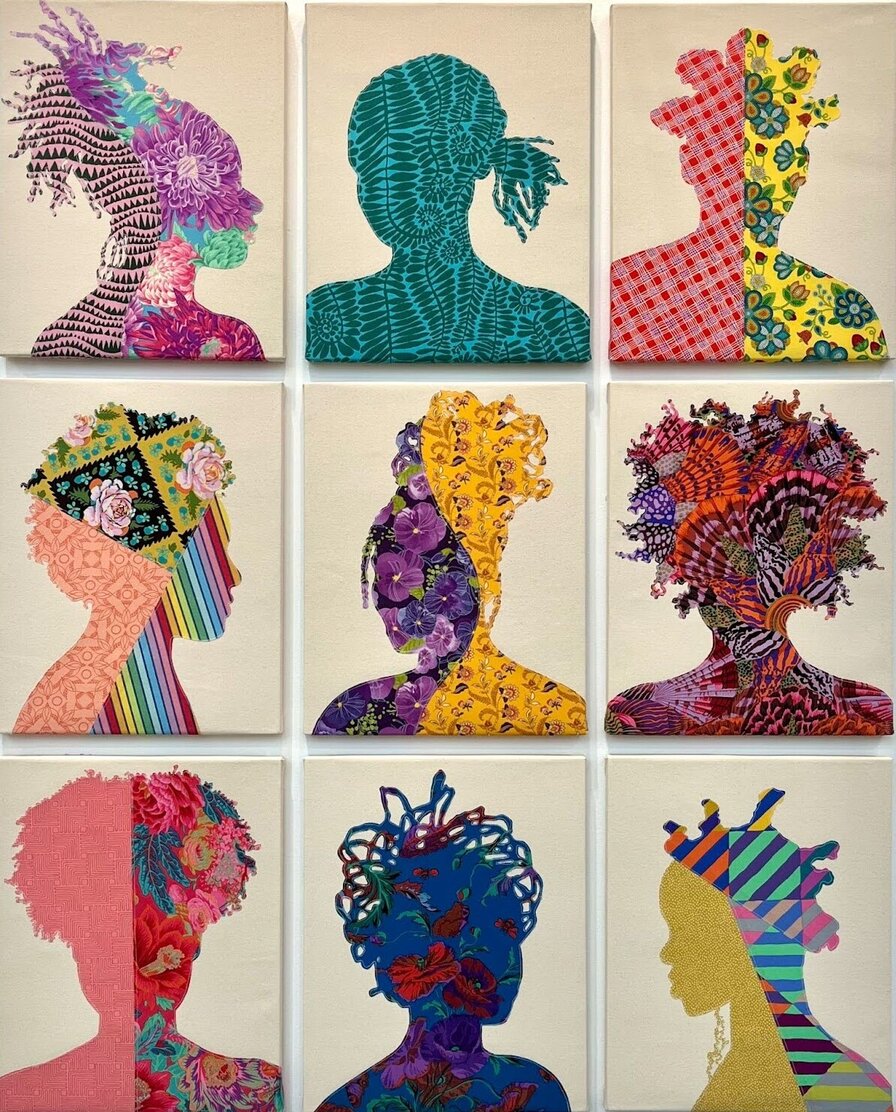
Gio Swaby was also featured in the FOCUS exhibition alongside 28 contemporary artists. Her piece, “Together We Bloom 5”, presents a grid of nine silhouette portraits that use bold, vibrant textiles to highlight the diversity and uniqueness of Black womanhood. These portraits reflect the multifaceted nature of Black identity, celebrating a broad spectrum of styles, personalities, and cultural backgrounds. Swaby is drawn to florals and nature because it reminds her of Caribbean culture and her upbringing. She describes Black hair as a form of art that is always evolving. Hairstyles hold layers of identity that defines different points in time, capturing the nuance and depth of Black culture.
Together We Bloom 5, 2024, muslin and cotton fabric and thread, 63 x 55 x 1.5 inches
With the intentionality of portraying the perspective of Black womanhood, Swaby doesn’t define Black womanhood as one thing. She continues to expand her understanding it by including queer and trans identities. She finds beauty in exploring the similarities of Black women across different geographies, cultures and styles. Swaby wants people to experience her art without hierarchy, inviting everyone to connect with it. Although, her primary audience are Black individuals, who are often excluded from traditional art spaces. She hopes they feel seen and recognized, and hopes her work has a meaningful impact on anyone who experiences it.
Gio Swaby explores individuality and diversity among Black women, offering true narratives that counter stereotypes rooted in historical depictions. By establishing her own path, she creates a space where Black women feel seen, understood, and safe, honoring their identities without limiting them to a single perspective.