Author: artoronto

  • Toronto Biennial of Art 2024 / 32 Lisgar St.

    32 Lisgar St. location

    Climbing the stairs to the second floor, some hanging masks caught my eye and then I saw other masks in sand on the floor. A closer look at this installation revealed multiple mythological beings. They are Uitoto deities and spirits of the forest and river; reminders of the interweaving dimensions of spiritual and immaterial territories with the physical world. Artist Nereyda Lopez made traditional Uitoto masks from vegetal fibers and tree bark that she found in the forest. She named them “El luger de los espiritus’’ (The Place of Spirits). Her work honors Uitoto beliefs and confronts the current environmental destruction.

    Nereyda López, El lugar de los espíritus (The Pace the Spirta) 2019 – 2023. Installation with eleven sculptures (left) and detail (right). Photo: Toni Hafkenscheid

    There are many artworks on this floor that encouraged me to think about the ancient people, their ancestral wisdom and environmental consciousness. One of the highlighted artists is Winsom Winsom, whose work creates a bridge between the spiritual and terrestrial worlds through the use of visions, symbols and dreams, creating an alternative perspective. “Travelling Time”, a mixed media installation, that stands as the centerpiece of her section, explores themes of wisdom, transformation and ancestral heritage. On the floor, she installed nine wooden sticks with snake-like structures, accompanied by five ritualistic wooden boards with metal snakes. The nine branches symbolize life reaching upward. Number 9 is dedicated to the Goddess Oya. Metal snakes depict rebirth. “Travelling Time” symbolizes a sacred journey in the universe. Her paintings portray different symbols, such as spiders, snakes, and the color red, conveying profound meanings.

    Winsom Winsom, Travelling Time, 2024, mixed media, 9 Magic Sticks, approx. 220 x 15 x 15 cm each. Courtesy of the artist and Clint Roenisch Gallery. Photo: Toni Hafkenscheid

    “Scent of Thunderbolts”, a spectacular installation, based on a Cantonese opera performance stage, left me breathless. Walking through the bamboo fabric installation, I was fascinated by the photographs on the wall that offered glimpses into the rich history of Cantonese opera in Montreal. These images also reflected the Montreal Yuet Sing Cantonese Music Club’s significant role in preserving and promoting this art form. The photographs, spanning from the 1960s to the 2010s, captured opera artists, musical gatherings, and community celebrations.

    Karen Tam, Scent of Thunderbolts, 2024, installation. Courtesy of the artist and Galerie Hugues Charbonneau, Montreal. Photo: Toni Hafkenscheid

    A large section containing a hallway and a room, is transformed by immersive Indigenous art installations, sharing powerful stories of resistance, cultural heritage, and connection to the land. “Three Songs” is a three-channel video installation featuring Indigenous women singing in their native languages at historic sites of struggle.

    Raven Chacon, Three Song, 2021, video installation, video stills. Photo: Nusrat Papia

    “For Zitkála-Sá” honors First Nations composers through graphic scores. Nearby, “The Supernatural Powers of Fabulous Panther (Biimskojiwan)” sculpturally embodies Anishinaabe oral tradition, invoking the majestic miszhibizhiw through spiraling industrial felt and resonant jingles. Together, these works weave a narrative of resilience, preserving Indigenous culture and highlighting its ongoing relevance, from the Trail of Tears to the present day.

    Maria Hupfield, The Supernatural Powers of Fabulous Panther (Biimskojiwan), 2024, Industrial felt, jingle bells, tin jingles, cotton fabric and polyester thread, Dimensions variable. Courtesy of the artist, Galerie Hugues Charbonneau, Montreal and Patel Brown, Toronto. Photo: Nusrat Papia

    “She Who Sees the Unknown” left me profoundly moved, my heart heavy with the weight of intergenerational trauma and resilience. As a woman, I felt a deep connection to the narratives of sisterhood, motherhood, and lineage, woven through the artist’s childhood room, sculptures, and immersive VR film. The presence of the Right Witness and Left Witness, mythical jinn figures, served as reminders of the unseen forces that shape our lives. This 12-minute VR installation stands out as a must-see experience.

    Morehshin Allahyari, She Who Sees the Unknown: Kabous, the Right Witness and The Left Witness, 2019, VR installation, Dimensions variable. Photo: Toni Hafkenscheid

    The Toronto Biennial of Art, Lisgar St. location is a masterful curation of artistic expressions. Every piece inspires awe. Don’t miss this free, 10-week exhibition, running across 11 locations until December 1, 2024. This year’s theme, “Precarious Joy,” explores connections between art and social/ecological issues. Artists effectively tackle key issues like sovereignty, diasporic sonic culture, self-representation, belonging, migration, sacred plant wisdom, feminist genealogies, and queer worldmaking.

    Nusrat Papia

    *Exhibition information: Toronto Biennial of Art, September 21 – December 1, 2024, 11 locations in the city. 32 Lisgar St and Park, Toronto. Gallery hours: Tue–Thurs & Sat – Sun 10 am – 6 pm, Fri 10 am–8 pm. For TBA programming, please click here.

  • Stephanie Comilang at Daniel Faria Gallery

    With her new installation, Bouquets for Paradise, Stephanie Comilang’s work is a testament to the history, survival, hardships and dreams of the people of the Philippines. Comilang honours the intense labour and overlooked artistic vision of the exploited people of the Philippines by highlighting their experiences through culture.

    The artist uses the monarch butterfly to lead the viewer through the exhibition at the Daniel Faria Gallery. Butterflies appear in both of the present editions of “Manton de Manila”, creating a dynamic sense of movement reminiscent of the waves and bold signs that the seafaring men, whom Stephanie Comilang aims to represent, rely on while out at sea.

    Installation view, Stephanie Comilang: Bouquets for Paradise at Daniel Faria Gallery, 2024.

    In her 2024 film, “Search for Life”, which is paired with this exhibition, the monarch butterfly serves as both a narrator and as a symbol of hope for two former seamen. In it, they share their stories and reflect on the abuse faced by the people of the Philippines under Spanish colonization. Having retired by the time of filming, one of the seafarers had turned to art and painted the figure which Comilang carefully adopts as the “Manton de Manila.”The fisherman’s vision is executed with the use of piña fabric, known for its delicate texture and breathability. Tens of pieces of fabric come together to veil a female mannequin, much like the traditional Filipino shawl with which the piña fabric is associated. The effects of colonization such as globalization and technological innovation are present in the butterfly’s pixilated design and use of machine embroidery, as well as the Chinese origin of the shawls which the Spanish appropriated and manufactured in Manila. Amid the layered history held by each of the piña fabric’s threads, the delicate and vibrant monarch butterfly emerges as a powerful symbol of resilience for the Filipino people. In rising out of its piña fabric-crafted background, the butterfly relates to the narrative of how the Philippines has held onto its complex history and cultural heritage through its perseverance and strength.

    Installation view of Stephanie Comilang: Bouquets for Paradise with Manton de Manila (left)

    The impact of modernization is also clearly reflected in pieces made from deconstructed denim and machine-embroidered designs. Stephanie Comilang uses women’s denim clothing—such as skirts, jeans, and jackets—and has reappropriated this attire to mirror the working class, acknowledging those who continue to be exploited for their labour. She has transformed these garments into unique forms that have been cut and re-assembled to create large, quasi-geometrical silhouettes. In addition, she incorporates the use of tea-dyed canvas as a background for the intricately rearranged denim pieces, with tea symbolizing Asian culture and reflecting the impact of trading in the 16th century.

    Stephanie Comilang, Cocoon Curcuma, 2024, embroidered denim on tea-stained canvas over board, 52½ x 53 in.

    Comilang is also blunt about historical reality through using the colour indigo. The colour indigo defines the exhibition and holds significance in having been used as a form of currency. Over the past five centuries, the Philippines, along with several Asian and African countries, has faced colonialization for their rich natural resources, including indigo plants. These resources were instrumental in the production of clothing that symbolized wealth and power among elites, but took these from the native people whose rich lands were used solely for colonizers’ vanity.

    Stephanie Comilang, Fragilis, 2024, embroidered denim on tea-stained canvas over board, 65 x 71 in.

    Comilang’s placement of the denim directly overshadowed the naturally sourced tea on the dyed canvas, obscuring it from the viewer’s gaze and suppressing its presence. This is reminiscent of how the powerful empires of Europe, such as Spain, imposed themselves on blank canvases — terra nullius — looking to obliterate the already established and harmonious societies that possessed their own rich culture. Moreover, her use of denim as a simultaneous symbol of both global powers and the working class furthers her fight for the awareness of the exploitation of Pilipino people by foreign powers for monetary gains.

    Still, upon viewing these denim pieces, one notices the embroidered flora that breaks apart the sea of indigo. Once again, Comilang conveys a message of perseverance by incorporating native flowers from the Philippines. The flowers are set to reclaim the tradition and space of the original tea-dyed canvas, as it competes against denim for dominance, striving to assert its ethnic identity despite its colonizer’s overwhelming presence.

    Stephanie Comilang, Akoya, 2024, embroidered denim on tea-stained canvas over board, 58¼ x 69 in.

    Stephanie Comilang’s Bouquets for Paradise advocates for awareness of the histories and ongoing challenges faced by Filipino communities and underscores the importance of preserving cultural heritage amid globalization and modernization.

    Installation view, Stephanie Comilang: Bouquets for Paradise at Daniel Faria Gallery, 2024

    Antonella Pecora Ruiz

    Images are courtesy of Daniel Faria Gallery. Photo: LF Documentation

    *Exhibition information: Stephanie Comilang: Bouquets for Paradise, October 22 – December 14, 2024, Daniel Faria Gallery, 188 St Helens Ave. Toronto. Gallery hours: Tue – Fri 11 am – 6 pm, Sat 10 am – 6 pm.

  • Sophia Lapres at Towards Gallery

    Nostalgia. An overly human feeling. Recalling happy, distant memories with fondness, but grieving that these are moments we can never return to. A mixed blessing.

    Installation view of Sophia Lapres, Mixed Blessings at Towards Gallery

    Sophia Lapres’s paintings are overcome with this wistful sentimental yearning. As a recent MFA graduate from the University of Guelph, Mixed Blessings is Lapres’s first solo exhibition, currently installed at Towards Gallery. This small intimate space works perfectly for her atmospheric, gestural art style, immersing the viewer in her romantic world of horses running wild through a lush field, a kissing couple tightly embracing, white lilies reflected through a mirror of lavender, an idyllic country house under a vibrant rainbow, and a fighter jet silhouetted by the setting sun. These saccharine vignettes hint at a larger narrative, inviting the viewer to engage with the paintings beyond their visual aesthetics and into their own personal reminiscence.

    Sophia Lapres, Live Forever, 2024, oil on aluminum panel, 17.5 x 12 inches

    Lapres has both a painting and a literary practice, where one consequently inspires her work in the other. The names of the paintings are taken from her own private writings, or named after novels; the exhibition title itself Mixed Blessings comes from a book of the same name by Danielle Steel. One can’t help but notice her paintings seem to whisper, suggest and gesture towards something more than what’s represented in the frame, as if a fragment of a story.

    For instance, there’s a painting of two women who turn their backs to the viewer and face the vast ocean and gloomy skies. One of the women is prominently centered; wearing a colourful, floral swimsuit, her bare back exposed. Upon reading the title, “He stared fondly at their freckled backs”, suddenly there is a third figure present whose place would be where the viewer is standing. We are then absorbed by his feelings of fondness towards these women. We begin to imagine perhaps a pleasant beach day spent with them. In realizing we are only spectators of a painting; we begin to long for more time with them. We feel nostalgia for this fleeting human moment that we didn’t actually experience ourselves.

    Sophia Lapres, He started fondly at their freckled backs, 2024, oil on aluminum, 44.5 x 26.75 inches

    Furthermore, the paintings are rendered on aluminum as opposed to the traditional canvas. The slick material resists the paint; it sits on the surface, pooling or dripping. Lapres must maintain a gentle hand while working to prevent picking paint back up. This also allows her loose and gestural brushstrokes to be visible. The finished paintings themselves hold the memory of her delicate actions. By painting on aluminum, the images glow like remembering a distant past dappled in soft light, furthering the longing nostalgia they fundamentally evoke.

    Sopia Lapres, I could hear the whirring of a black fly as it circled the room, 2024, oil on aluminum panel, 44.5 x 26.75 in.

    The installation references that of Wolfgang Tillmans’s exhibitions with the paintings sporadically yet deliberately placed at different heights on the wall. The larger pieces are set at eye level and in between are smaller, hand-sized paintings higher, lower or slightly askew from eye level, and with varying distances between them.

    Installation view of Sophia Lapres, Mixed Blessings at Towards Gallery

    One must look up towards a painting of a rocket taking off, then lower their gaze to see a young woman in contemplation, resting her chin on a pillow. It creates a sense of movement and dynamism, reminding us of the futile and ephemeral nature of time.

    Sophia Lapres, He lay his tongue deep and quiet inside her mouth, 2024, oil on aluminum, 7.5 x 5.5 inches

    In my brief conversation with the artist during my visit to the show, Lapres stated that her images are engaged in both “a sincerity and a criticality,” a sentiment that also wholly applies to life. Lapres captures the complex, arbitrary, and sometimes mundane aspects of life through her intimately framed images. Small gestures are portrayed in her paintings; hands with interlocked fingers resting on a lap – “And she winked back”, or a view through an airplane window of a morning sky – “I only travel with my credit card”.

    Sophia Lapres, And she winked back, 2024, oil on aluminum panel, 13.5 x 8.5 inches

    Lapres is able to articulate feelings of longing, desire, loss, and even boredom. Her work exposes the futility of life, but at the same time celebrates that futility. A mixed blessing is our brief time alive.

    Rebekah Barona

    Images are courtesy of Towards Gallery

    *Exhibition information: Sophia Lapres, Mixed Blessings, October 10 – November 16, 2024, Towards Gallery, 163 Sterling Road Unit 144, Toronto. Gallery hours: Thurs – Sat, 12 – 5pm.

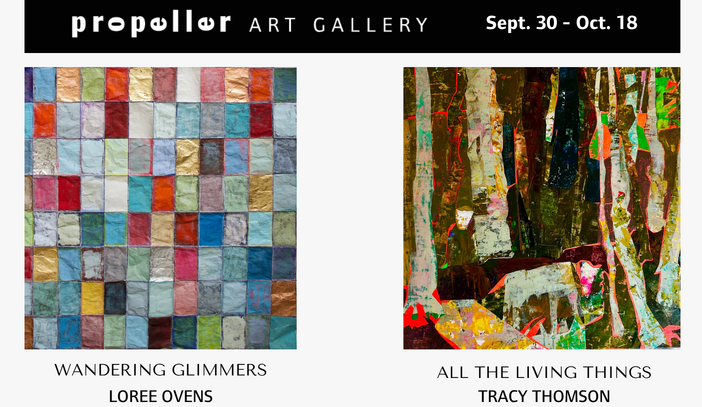
  • Experimental Intervention at Propeller Gallery

    I was delighted to explore Experimental Intervention curated by Leisa Rich at Propeller Art Gallery. This bold exhibition focuses on artistic experimentation and the courage required to step beyond familiar techniques or materials. It celebrates risk and reinvention in contemporary art, and challenges artists to push past traditional boundaries, embracing risk and the possibility of failure in pursuit of personal and professional growth. The curator selected works that reflect this journey of creative expansion with innovative narratives and that redefine traditional art-making, encouraging viewers to see art in a new light. By using unconventional materials, exploring new dimensions, and crafting pieces that provoke fresh perspectives, artists can redefine what art can be.

     Installation view of Experimental Intervention at Propeller Art Gallery

    “Lovers” by Lukas Mouka stood out, due to its large size and interesting narrative. I was drawn to the painting by its strong contrast and meticulous attention to detail, built upon light and darkness. The artist wrote, “When I looked at it closely, the images made a lot of sense; it was like magic where they ended up.” The closer I looked, the more I noticed the seamless blend of cut-up magazine papers and acrylic paint—almost imperceptible at first glance.

    The interplay of materials and potentially symbolic imagery creates a narrative that is thought-provoking. One aspect that captivated me was the depiction of men carrying a cross, seemingly emerging from beneath the figures’ legs, which evoked a powerful typological connection for me. This piece truly invites viewers into a layered experience, where each glance reveals new details and connections.

    Lukas Mouka, Lovers, collage, acrylic, charcoal, oil on canvas, 30 x 40 x 1 inches (left) and detail (right)

    Ruth Maude’s “Remnants of Decay” powerfully engages with themes of environmental degradation and industrial remnants, creating a piece that is both visually compelling and conceptually rich. The artist’s choice of materials—a rusted chain and discarded packaging—infuses the work with an authenticity and rawness that enhance the idea of decay and the persistence of waste. The encaustic-coated packaging and rusted chain break free from traditional two-dimensional constraints, evolving into a three-dimensional sculpture that casts shadows on the wall. Maude notes that it intensifies the tension between natural decay and human-induced degradation, reinforcing the piece’s message. Maude’s method, allowing the materials to dictate the form, effectively mirrors nature’s own processes of decomposition. The sculptural quality of the work breaks beyond traditional flat surfaces, allowing the viewer to engage with it from multiple angles and perspectives. Maude’s work beautifully encapsulates the dialogue between the environment and destruction, making it a powerful commentary on the consequences of human consumption.

    Ruth Maude, Remnants of Decay, mixed media: encaustic and rusty chain on paper packaging, 36 x 13.5 x 4.5 inches (left) and detail (right)

    Natalja Heybroek’s work demonstrates a fascinating exploration of both materiality and perception, bringing together traditional elements like wood and glass with modern mediums like epoxy resin to create eye-catching effects. Through the use of transparency, reflection, and intricate organic shapes, Heybroek achieves a depth that invites viewers to look beyond surface appearances. Details, such as ink drips and curled wood shavings, draws attention to the artwork’s organic roots, even as it ventures into abstract, otherworldly motives. This piece stands out with its vibrant colours and intricate details. The farther away you stand from the artwork, the clearer the larger picture becomes. “The Edge”, inspired by black holes, questions the nature of perception and explores the boundaries of human understanding and the illusions created by our senses. By addressing themes that blend science, philosophy, and nature, Heybroek’s work offers a powerful reminder of our limitations and the relativity of our realities. The artist’s integration of complex visual elements with profound concepts about perception and the unknown transforms her pieces into meditative experiences, encouraging viewers to ponder the extent of human knowledge.

    Natalja Heybroek, The Edge, ink, and epoxy, 38 x 38 x 1.25 inches (left) and detail (right)          

    Each work  in Experimental Intervention reflects a journey of creative exploration. Rich’s curation stands out, inviting deeper engagement with each piece.

    Kaya Meziane

    Images are courtesy of Propeller Art Gallery

    *Exhibition information: Experimental Intervention / Group show, October 23 – November 10, 2024, Propeller Art Gallery, 30 Abell St, Toronto. Gallery hours: Wed – Sat, 1 – 5:30pm, Sun 12 – 4pm.

  • Campfire / Ribbon Cutting

    Last Saturday (October 26th), on a crisp fall morning, the City of Toronto welcomed a new piece to its growing collection of public art. At the edge of Humber Bay, amidst the cool coastal breeze, it was the perfect day to gather around a campfire.

    Humber Bay on Saturday, October 26th, 2024

    Campfire is a new landmark sculpture by Michael Belmore and Herman Mejia. This collaboration between Belmore (an Anishinaabe artist) and Mejia (who was trained in landscape architecture) exemplifies the capacity of art to transform the built environment. As Campfire frames the city skyline within its silhouette, the liminal threshold between land and water becomes a place to linger and feel part of something bigger. Echoing a practice that many Indigenous communities have used for decades, the campfire at the water’s edge serves as a means of navigation and place-keeping, honoring the Mississaugas of the Credit First Nation’s ties to the land. “We found the right piece for the right place,” declares Belmore.

    Michael Belmore and Herman Mejia, Campfire, stainless steel, 12 foot tall

    Featuring animal drawings from children from the Jean Augustine Centre in its perforations, as well as a Story Rock handcrafted by Michael Belmore, Campfire is a space for storytelling – a theme that often stimulates Belmore’s work. This piece, he hopes, commemorates an “opportunity to be able to stay and sit in that place;” in those moments “where we sit around the campfire and tell stories and get lost in [them].”

    Close-up of perforations on Campfire

    Story Rock

    A symbolic hearth truly kindled by the warmth of community, Campfire brought together Indigenous leaders, city council members, artists, and community members alike for its unveiling.

    (L-R) Jeff Debosh, Garry Sault, Michael Belmore, Herman Mejia, Claire Sault, and Deputy Mayor Amber Morley at the Campfire Ribbon-cutting.

    Garry Sault, Ojibwe elder and knowledge-holder from the Mississaugas of the Credit, opened the ceremony with a steadfast song and drumbeat. “The doorway is open and the fire is lit,” he calls out, “the doorway is open, the doorway to understanding.”  

    Ojibwe Elder Garry Sault

    Fire, according to MCFN chief Claure Sault, is a sacred element; “a doorway that opens into the spiritual realm.” In many Indigenous cultures, Sacred Fire is used for spiritual gatherings, including celebration and prayer. Steel-clad and twelve-feet-tall, this fire – Campfire – is permanent. Not just a large monument, but a lasting place to gather. Fire-keeper Jeff Debosh, who has sometimes had to keep fire for three days, remarks that he is amazed to see the permanency of this art statement.

    Firekeeper Jeff Debosh of the Mississaugas of the Credit First Nation

    Campfire exhibits the enduring mark of Indigenous voices. Now a permanent fixture on the lakeshore, it also signals the ability of public art to alchemize and immortalize these stories.

    Athen Go

    Images are courtesy of Red Works Photography.

    Event information: CAMPFIRE, a new permanent public artwork by Michael Belmore and Herman Mejia, is an Indigenous-led project that stands as a new landmark and gathering place on the waterfront. Palace Pier (near 1 Palace Pier Court, Etobicoke ON), Saturday, October 26, 2024, Ribbon Cutting: 11 am.

  • Alex Da Corte: Ear Worm at MOCA

    Walking into Alex Da Corte’s exhibit on floor 2 of the MOCA was like walking into a childhood fever dream in the best way. You’re in a sunset-like environment with the blinds dimmed to a fleshy pink. Going in from the bright sun of the autumn and into a dimly lit room feels like being cocooned into your own childhood. Like a blanket had been placed over your memories and created a hazy image of the past. I was filled with a sense of nostalgia at the sight of familiar faces, but also, some sort of dread. And it made me realize this: nostalgia and dread are very much the same thing, and perhaps, we find ourselves stuck in it the further we grow from our childhood.

    Alex Da Corte, “Rubber Pencil Devil,” 2018. Ear Worm, Installation view MOCA, Toronto, 2024.©Alex Da Corte. Photo: LF Documentation

    “Rubber Pencil Devil”, the title of his 57-chapter film, seems to never end. Moving from screen to screen, watching different clips of this film, viewers see projections of recognizable images from pop culture stretched and warped into different versions of themselves. I found myself questioning whether or not I truly remembered these characters as they truly were – his Mr. Rogers’ costume was near-impeccable, and I found myself moved to tears at times when I would see him on the screen.

    Alex Da Corte, “Rubber Pencil Devil,” 2018 (still). Ear Worm, Installation view MOCA, Toronto, 2024.©Alex Da Corte. Photo: LF Documentation

    But there were other times where there was a sense of dread, like uncanny valley – his hyper-realistic portrayal of Popeye and Olive Oyl, Daffy Duck, and Bugs Bunny filled me with a sense of dread that I have only felt one other time in my life, and it was when I was a child at Chuck-E-Cheese waiting for one of the animatronics to close their metal jaws on me.

    Alex Da Corte, “Rubber Pencil Devil,” 2018 (still). Ear Worm, Installation view MOCA, Toronto, 2024.©Alex Da Corte. Photo: LF Documentation

    This distortion of memory made me truly question my own past and my own memories. Am I remembering it with rose-coloured glasses? Or is it profane and warped? Like a rubber pencil, our brains stretch and become almost elastic-like, reality and perception no longer a real thing. Da Corte brings us to a liminal space in this exhibit, one that I found myself returning to over and over again.

    Alex Da Corte, “Rubber Pencil Devil,” 2018, (still). Ear Worm, Installation view MOCA, Toronto, 2024.©Alex Da Corte. Photo: LF Documentation

    Da Corte uses memory as both a comfort and a disorienting facet of life. In a past exhibit titled “Die Hexe”, viewers were brought into a multi-storey installation akin to that of a house, but with something sinister happening. Tiles become warped, a credenza featuring glass objects now has hockey masks, there’s metal sculptures of a whale. Da Corte cited his grandmother’s dementia as an inspiration for this exhibit, and it seems to bleed into Ear Worm as well. Everything is recognizable, but something feels wrong. The film in itself does not follow a traditional storyline, repeating when you believe the story is moving forward, there’s a musical number put in there, and others are just plain sinister with Da Corte’s character staring right at the camera. This taps into the anxious instability of memory, unraveling the mind until the act of memory becomes a disorienting confrontation with something that can no longer be trusted. The sweetness of nostalgia curdles for the past that cannot return.

    As viewers move through the screens, they are then met with a strange, curving building toward the back of the gallery. This is Da Corte’s “Mouse Museum (Van Gogh Ear)”, which offers a glimpse into his creative mind by providing fragments of his collection of props and other personal artifacts.

    Alex Da Corte, “Mouse Museum (Van Gogh Ear)” 2024. Ear Worm, Installation view MOCA, Toronto, 2024.©Alex Da Corte. Photo: LF Documentation

    This piece references Claes Oldenburg’s Mouse Museum, however, Da Corte transforms it into a single ear as a nod to Van Gogh, who famously cut off one of his ears during a hallucinatory episode. The interior is dark, illuminated only by a vitrine, but it is peaceful. Sounds of the film are drowned out, and it is only you and these artifacts. It was like being cocooned in the technicoloured mind of Da Corte himself, with these small fragments of his life all coming together to make one narrative.

    This choice to make the “Mouse Museum” only one ear becomes a heavy metaphor for the relationship between creativity and the fragility of the mind. The ear, so close to the brain, serves as a gateway to audio perception while also sitting on the boundary between the outside and inner world. The brain has the power to generate creative thought and distort the memory, part of the tension in Da Corte’s work. This single ear becomes a symbol for how creativity and madness are often intertwined. Van Gogh, a genius of emotional expression of colour and form, suffered greatly from mental illness, leading his own reality to break down and warp. Similarly, Da Corte’s ear hints at how the mind, while capable of immense creativity, is also prone to lapses in perception of reality. The ear evokes this duality – it is a conduit of artistic expression, but also, a place where perception can become warped. This ear becomes a symbolic nod to the fine line between brilliance and chaos, between the artistic mind’s expansion yet its vulnerability to distortion.

    Alex Da Corte, “Mouse Museum (Van Gogh Ear)” 2024. Ear Worm, Installation view MOCA, Toronto, 2024.©Alex Da Corte. Photo: LF Documentation

    By engaging with bright colours, pop culture references, and playful forms, we feel this pull to nostalgia that verges on the line of unsettling terror that reminds us how fragile the past really is. The ear worm – a repetitive, inescapable thing that sticks in the tunnels of the mind – becomes a fitting metaphor for how memory loops endlessly, creating comfort and anxiety in equal measure. Ear Worm reflects the complexity of living with and without memories, offering a vivid portrayal of the dual forces of nostalgia and dread. We are invited to observe how memory, much like the objects in his “Mouse Museum”, is deeply personal and fragile. Ear Worm is an exhibit that fills the viewer with so much nostalgia and dread, but also, peace in knowing that the past cannot be changed, and the future is uncertain.

    Victoria Filippo

    Images are courtesy of MOCA

    *Exhibition information: Alex Da Corte, Ear Worm, September 8, 2024 – January 26, 2025, Museum of Contemporary Art, 158 Sterling Rd, Toronto. Museum hours: Wed – Thu & Sat – Sun 11 am – 6 pm; Fri 11 am – 9 pm.

  • An Engaging Stroll Through Art Toronto 2024

    Installation view of Art Toronto 2024

    As the art fair revealed itself bit by bit while being on the escalator, I felt excitement surge through my veins. Overstimulated by the numerous artworks, I was pulled in multiple directions as they intrigued me at every turn. This was my first time at an art fair of this size and was impressed with the selection of artworks, especially the variety of mediums. The massive art piece by Marigold Santos was a complete showstopper and invited lots of conversation. Its size, the bold yet warm and soothing yellow, and its extreme composition immediately pulls the visitors into the world of the art fair the moment they step off the escalators.

    Marigold Santos, Regrounding, 2011, acrylic, pigment, and gesso on canvas, 102 x 171 inches

    I was thrilled to see a gallery that focuses solely on artists of Asian descent, the SSEW Project, based in Markham. They just opened in April this year and made their first appearance at an art fair this weekend. Representing six artists at the art fair, three of which are based in the GTA and the other three are based in China and Japan.

    Anita Wei in front of a SSEW Project artist’s work

    The large size paintings on the right side of the SSEW Project installation infuses a modernistic approach to old Chinese style paintings that focuses on details, colors, and accuracy. There’s a sense of grandeur in the sheer size of the works contrasted with the acute intensity of each small detail, dignifying the commended subject matters that hail from the genre of bird-and-flower paintings.

    Hui Yu, Weightlessness 失重, 2023, Chinese ink and color on rice paper, 68 ½ x 36 inches

    On the left side, the vibrant colors of oils and acrylics embraces rich cultural heritage through a contemporary lens. Using a Western-based medium of oil on wood panel, Hayley Chi Hay Chiu, a second-generation Chinese Canadian, captures a feeling of home away from home in her references to Chinese culture such as a game of mahjong, the buddha on the altar, and hanging clothes to dry high above the ground.

    Hayley Chi Hay Chiu, Abode (top left), The happiest building, (top right), both 2023, oil on wood panel, 7 ½ x 10 inches, and Everybody wants to play, 2021, oil on canvas, 16 x 20 inches (bottom)

    This mesmerizing piece by Polish artist Eliza Kożurno from the Roberts Gallery in Toronto takes on a high-fashion outlook on still-life works. In her effort to bring excitement to the ‘boring’ still-life genre painting of the Renaissance, she adds elements of the glitz and glamor of modern culture such as the Tylenol pills and sunglasses mixed in with some elements of antiquity such as the tea set. For each one of her still-lives, Eliza Kożurno challenges herself to new compositions inspired by her studies in jewelry, textiles, and design. A play on the multiple reflective surfaces and various materials, it is seemingly chaotic and filled with items that leave no space to breath. But her talent for composition and the confidence she puts into each chosen piece of item creates a cohesiveness that makes the perfect recipe for a high-fashion magazine cover.

    Eliza Kożurno, Still-life with pills, 2024, acrylic on canvas, 48 x 48 inches.

    Warped in the blackness is a constellation made up of Canadian pennies covered in enamel. The pennies seemed to ground the pictorial frame from being sucked inward into a black hole with each individual penny pinning the canvas down. Represented by the TIAN Contemporain Gallery based in Montreal, artist Yen-Chao Lin laid out pennies on train tracks to have them flattened by the train, a unique process that adds another layer of depth to the work. Guided by spirituality and feng shui, Yen-Chao Lin created her own constellation as a reflection of herself and her heritage.

    Yen-Chao Lin, Paradis anonyme (instance), 2022, enameled train flattened Canadian pennies, steel, 48 x 96 inches

    As I was swerving through the crowds, I was caught by surprise as these dainty branch legs wearing cute black leather shoes stuck out of the Platforme Art Base exhibition stand, which focuses on Mexican artists, to greet me. An immediate smile came across my face as I made the connection between the title, “Branching-out” and the artwork. It is the literal embodiment of the title of the work. Erika Harrsch not only transformed the legs portion of the human body to literal branches, it also stuck out of the Platforme Art Base exhibition space to branch-out to oncoming visitors. Artworks like this remind me that art can be witty and fun and captures fleeting moments that may seem meaningless but make up the story of our life.

    Erika Harrsch, Branching-out series: I walked in on me (in black shoes), 2023, tridimensional wood ensemble with resin, oil, acrylic, lacquer, plastic feet with sand and black patent leather shoes, installation area: 20 x 26 x 50 inches, branch diameter approx: 2 ½ inches

    A grotesque figure that masks as a cute child by its baby-like gestures and chubby cheeks uses deformity, playfulness, and humor to address internal struggles of the passing of time. The intensity of the struggle is made exceedingly visible with the tense limbs stretched out in different directions, the visible veins popping out of its face, and the gaping mouth that I felt its frustration from far away.

    Sami Tsang, Bloodless wounds from poisonous roots, 2024, stoneware, color slip, glaze, clay, epoxy, acrylic, 75 x 32 x 32 inches

    Text and photo: Sherry Qin

  • Visiting Art Toronto 2024

    In the art fair’s brochure guest curator Mia Nielsen remarks that social media and other platforms ‘have simultaneously expanded and flattened (literally and figuratively) our conversations around contemporary art’. And so for her selection, titled Connecting, she has focused on works that demand physical interaction. Indeed, the art fair in general is an opportunity to get up close with artworks of every imaginable variety (well almost).

    Installation view of Art Toronto 2024

    There is, as usual, plenty of ‘non-flat’ sculpture on display. Two that caught my eye are Ken Lum’s furniture piece and Stephanie Comaling’s “Spirit Support”, both part of the Focus Exhibition located in the northwest corner of the hall.

    Ken Lum’s installation

    Stephanie Comaling, Spirit Support, 2024, PLA filament, paint, gold leaf

    As well, veteran artist Kim Adams has produced a Hieronymus Bosch inspired show-stopper of a
    sculpture titled “Arrived”, which is a miniature mountain populated with pigs and humans. It
    epitomizes the physicality that Nielsen speaks of. Nothing flat about this fantasy world of a piece.

    Kim Adams, Arrived, miniature models and faux rock

    Not far from this sculpture in the so-called verge exhibition area against the south wall I found a the booth of Markham based gallery SSEW Project. It features East Asian contemporary art. One of the beautiful pieces on display is Hui Yu’s “Weightlessness” – a delicate ink painting on rice paper. It is a reminder of the shifts in the ethnic make-up of Toronto, and Canada more generally. A good dose of less Euro-centric art.

    Hui Yu, Weightlessness, 2023, Chinese ink and color on rice paper, 68 ½ x 36 inches

    From Quebec I found more pieces on paper, namely, the ‘page’ drawings of Carole Baillargeon represented by Galerie Jano, Verdun. These four alluring drawing are stained with inks make from natural materials, e.g., oak. 

    ‘page’ drawings by Carole Baillargeon

    There’s plenty of good old fashioned painting of course. At Unit-17 (Vancouver) we find three pieces by the young Brooklyn based artist Geetha Thurairajah, who hails from Waterloo. Smart arresting work that reminds us that painting is never dead.

    Geetha Thurairajah, (L-R) Pride Before A Fall; It Was All A Dresm and  Double Sided, each 2024, acrylic on linen, 40 x 36 inches

    Ironically perhaps, photo-based art is frequently meant to be viewed in person, often because of the scale of the prints and their intrinsic richness. Here are two examples. At Blouin Division’s booth we find two colouful pieces by established artist Sarah Anne Johnson titled TIADIT (she normally provides these cryptic titles to her work). They are prints overlaid with paints and pigments. Also on display at Bau Xi’s booth is Kim Keever’s “Abstract 75604” (again the penchant for peculiar titles). Here we see a vertical composition featuring a cloudy tower-like structure – scintillating in its depth, glossiness and details.

    Sarah Anne Johnson, TIADIT

    Kim Keever, Abstract 75604

    As usual, there is too much to see at this art fair. Lots of treasures. As well, part of the fair’s attraction is the chance to ask questions to the gallerists, dealers and their assistants that populate the hall. Interaction with them is invariably rewarding.

    Text and photo: Hugh Alcock

    Art Toronto 2024, Installations / by Nusrat Papia

    As I entered the fair in the evening, I realized that exploring all the artworks in just a few hours would be impossible – a whole day was needed! The vast exhibition promised an immersive experience and from the entrance itself the art pieces hinted at an explosion of creativity waiting to be discovered. Here are some pieces that captivated me.

    Installation view of Art Toronto 2024

    The first installed art piece to capture my attention was “Bones” (described as “funny, wish, back”). It immediately brought to mind the quote, “In the end, you need only three bones to be successful: a wish bone, a backbone, and a funny bone.” Examining the wooden pieces closely, I realized the artist is successful to convey her message.

    Zoe Ann Cardinal Cire, Bones (funny, wish, back), 2023, oil, Cezech seed beads canvas, ric rac, home tanned hide, rabbit fur, and porcupine quills on wood, dimensions variable

    These art pieces made me squint to find out their message. A close look took me to Slocan Lake and World War II times. It’s the history of Japanese Canadians who were forced to relocate in that area. The frames hold miniature clothes with camp paintings, a beautifully lettered lake map, and dresses sewn for the people. There’s a sad story written in it!

    Emma Nishimura, Slocan Lake, 2013 Etching on gampi with wax and thread

    Walking through the exhibit I stopped in front of a breathtaking installation. Sarah Stevenson’s captivating artwork left me mesmerized, with its ethereal beauty and delicate fragility creating a profound sense of calm. The intricate, floating structures awe-inspiring, prompting reflection on the boundaries of presence and absence.

    Installation by Sarah Stevenson, 2024, wire, fishing line, acrylic paint

    Claudie Gagnon’s art piece, “Amulettes,” is quite enchanting. The name itself gives the idea that it carries mythical stories that somehow feel real. The glass-encased insects, not only shows how realistic the piece is, but also thought-provoking.

    Claudie Gagnon, Amulettes, 2023, glass, metal, insects, 91.4 x 40.6 x 40.6 cm

    “Le m sot Ayiti” deeply resonates with me, capturing the complexities of migration and resilience. Centering Afro-descendant women, this artwork celebrates struggle and determination. Silently yet profoundly, it conveyed the beauty and strength of those experiences.

    Michaëlle Sergile, Le m sot Ayiti, 2024, Jacquard weaving cotton threads, ash wood supports, cathode-ray TV monitor with 15 min 39 sec video loop, 305 x 889 cm

    Kelly Jazac, Time Scale (Jacket), 2022, salvaged billboards, thread, 224″ x 164″, Galerie Nicolas Robert

    Art Toronto’s 25th anniversary fair exceeded my expectations! The stunning artworks overwhelmed me. I cherished uncovering the profound meanings behind each piece.

  • Art Toronto 2024

    Art Toronto 2024 / Metro Convention Centre, North Building

    October 24 – 27, 2024

    Art Toronto celebrates its 25th anniversary this year with over 100 Canadian and international art galleries. This year’s Art Toronto has many installations scattered throughout the Fair as well as plenty of talks and programming. The Fair’s Director Mia Nielsen has curated an exhibition titled re: connecting in celebrating the 25th anniversary. It was a great opportunity to see some of our favourite Canadian artists under one roof.

    Installation view of Art Toronto 2024

    Near the entry way by the escalator was Nicholas Crombach’s installation titled “Chariot Burial” (2023) presented by Art Mur. Stepping off the escalator you see artist Sami Tsang’s “Bloodless Wounds From Poisonous Roots” (2024, 9 mixed media) presented by Cooper Cole.

    Nicholas Crombach’s installation, Chariot Burial, 2023

    Sami Tsang, Bloodless Wounds From Poisonous Roots, 2024

    Walking to the left you will see the National Gallery’s booth and work by Denyse Thomasos, “Rally” (1994, acrylic on canvas), in Olga Korper Gallery’s booth.

    Denyse Thomasos, Rally, 1994, acrylic on canvas

    I also saw some sales with red dots such as Melanie Authier’s “The Departure and Return” (2020, acrylic on canvas, Olga Korper Gallery), sold for $38,000. John Scott’s “Lost Boy” (mixed media) at Nicholas Metivier Gallery was also sold.

    Melanie Authier, The Departure and Return, 2020, acrylic on canvas

    John Scott, Lost Boy, mixed media

    There were some other familiar artists I had not seen in a while such as Attila Richard Lukacs and Kim Adams. Adams’ large work “Arrived” uses miniature models and faux rock. A fun piece.

    Attila Richard Lukacs, NYO, 2008 (top) and Untitled, 2007 (bottom)

    Kim Adams, Arrived, miniature models and faux rock

    I stumbled on Audie Murray’s “Consume” (2024), a cake like work with colourful beads for icing at Fazakas Gallery. I had to pass on Collectors in Conversation as I had only so much time but I would have liked to have stayed for the hour-long talk. I saw a few familiar gallery dealers in the thick of sales with potential clients. I thought it is best not to bother them. There is a lot of pressure at a commercial fair to make it worthwhile and pay all the bills.

    Audie Murray, Consume, 2024

    Collectors in Conversation

    Paul Petro of Paul Petro Gallery in his booth

    I noticed Art Metropole’s booth. Good to see them present at the Fair. I got a kick out of John Will’s “Old But Old” (2015) at Norberg Hall from Calgary. I saw Graham Gillmore’s “Lucky to Be Good” (2024, oil on panel). I have been a fan of his work for years.

    John Will, Old But Old, 2015

    Graham Gillmore, Lucky to Be Good, 2024, oil on panel

    One of the largest works at the Fair was “Studio Rat, Plastiscapes” (2024), presented by Blouin Division. The towering balloon like structure dwarfed the curious visitors. Douglas Coupland’s “Texaco Gasoline via other Voices Other Rooms” (resin on panel) was appealing.

    Studio Rat, Plastiscapes, 2024

    Douglas Coupland, Texaco Gasoline via other Voices Other Rooms, resin on panel

    Art Toronto is a commercial art fair but there were some works that were challenging and having the installations spread throughout the fair gave it a little edge. It was a quick visit and I will return to see more and have a longer engagement with some of the work. This year’s Art Toronto will not disappoint those who enjoy art and for those who can afford it… take some home. Not bad for 25 years of hosting 100 galleries and thousands of visitors and collectors.

    Text and photo: Phil Anderson

  • Scott Conarroe at Stephen Bulger Gallery

    In this exhibition we are treated to a miscellany of works by photographer/artist Scott Conarroe, produced over the last couple of decades. The theme, trees, is merely nominal in the sense that it does not present itself to the viewer. Indeed, in some of the urban-based photographs in the show there is barely a tree in sight. Trees, as Conarroe puts it, are a leitmotif. Overall the show is retrospective in tenor, insofar as it highlights a selection of images that are the result of a formula he has developed over many years, that he is now moving away from.

    Installation view of Scott Conarroe, About Trees at Stephen Bulger Gallery. Courtesy of Stephen Bulger Gallery

    The lead picture, that is, the most representative of the theme is “Big Tree & Small Tree, London, ON” that was produced back in 2006. Like many of the prints on display, it is conspicuously rich in colour. It reflects the way in which Conarroe choreographs the lighting. He explains how waiting for the right time of day in this regard is essential to his working method.

    Scott Conarroe, Big Tree & Small Tree, London ON, 2006 © Scott Conarroe / courtesy Stephen Bulger Gallery

    As well, the viewer quickly notices that the most of the pictures are taken from an elevated point of view, i.e., from up high. Again, Conarroe is careful to search out a highpoint in the landscape – a cliff or building, say, – from which to take his shots. Only after he has done so does he choose and compose his picture. This strategy is perhaps most obvious in his “Pedestrian Walkway, Santa Monica, CA”. Here we see a sandy beach foregrounded by a complex of buildings decorated with palm trees behind it. The viewer would be forgiven for assuming this picture was taken by a drone because of the flatness of the landscape it depicts. In fact the shot is taken from a cliff top, obviously out of sight.

    Scott Conarroe, Pedestrian Walkway, Santa Monica CA, 2010 © Scott Conarroe / courtesy Stephen Bulger Gallery

    Both his rich colours and elevated vantage point remind me of an iconic work of the American painter Thomas Moran, titled ‘Green River Cliffs, Wyoming’ (1881). This long horizontal painting depicts dramatic sunlit sandstone cliffs. Reputedly Moran built a scaffold from which to make the painting, in order to achieve the same elevated point of view.

    In Moran’s case, he deliberately edited out the railway that in fact occupied the site he had chosen. By contrast, Conarroe seeks out landscapes that very often feature the intersection of the natural and the urban, something that has been an abiding theme of his work. But like Moran he has travelled extensively across the continent to make his art. In Conarroe’s case he’s done this to record this intersection. That is especially so in his series of photographs titled ‘by Rail’ and ‘By Sea’ – some of which are featured in this show – that highlight the railways and ports instrumental in the construction of this continent’s ‘civilization’.

    Scott Conarroe, Courtyard, Marseille FR, 2012 © Scott Conarroe / courtesy Stephen Bulger Gallery

    From his own description of how he works, Conarroe is opportunistic. He is not conceptually driven in that, often he has wandered around the environment he has chosen with an open mind, waiting for something he sees to inspire him to make the effort to stage a photograph. He seems to possess an almost childlike joy in looking at the world, notwithstanding, of course, that his work is not naïve. It has a great deal of sophistication. As a consequence perhaps there is a lack of gravitas to his work. It is more entertainment than poetic. That is to say, it is not very concerned with interpretive depth, instead its primary aim is to be visually interesting. It appeals to the retinal rather than the intellectual, one might say.

    Scott Conarroe, Forest Fire Plume, Golden BC, 2008 © Scott Conarroe / courtesy Stephen Bulger Gallery

    Photography, of the sort practiced by Conarroe, is inclined to highlight that which is beautiful. As Susan Sontag remarks, regarding this tendency: “It is common for those who have glimpsed something beautiful to express regret at not having been able to photograph it.” (On Photography, p. 85) In other words, we tend to use photography to bring out that which we find beautiful in the world, to capture it. Ditto with Conarroe.

    Scott Conarroe, Sunday Morning, Genk BE, 2011 © Scott Conarroe / courtesy Stephen Bulger Gallery

    A danger in landscape photography in this regard is that the image is all retinal with little or no conceptual underpinning. By contrast, someone, who like Conarroe is interested in the intersection between nature and the urban, and whose works do illustrate such depth, is the well-known American photographer Robert Adams. In one of his iconic black and white shots the bottom two thirds of the composition details a litter-strewn scrubland to the side of a parking lot, while out of focus in the mid-distance is a diner (Denver, 1973-4). The beauty of the image surprises, and is thus enhanced, by its subject matter.

    Scott Conarroe, Aare Bank, Bern CH, 2023 © Scott Conarroe / courtesy Stephen Bulger Gallery

    Conarroe’s artistic preoccupations are clearly quite different from Adams’. He is his own photographer no doubt, and a very accomplished one. At their best his photographs are both grand in scope and enchanting, reminiscent of the paintings of the romantic period, such as some of those by Caspar David Friedrich. But a little more conceptual depth to challenge the viewer would not go amiss.

    Hugh Alcock

    *Exhibition information: Scott Conarroe, About Trees, September 14 – October 26, 2024, Stephen Bulger Gallery, 1356 Dundas Street West, Toronto. Gallery hours: Gallery hours: Tue – Sat 11am – 6 pm.

  • Art Toronto 2024

    Installation view of Art Toronto, 2023. Photo: Phil Anderson

    October 24 – 27, 2024 / METRO TORONTO CONVENTION CENTRE
    North Building, Exhibit Hall A & B, 255 Front Street West
    Hours: Fri – Sat 12 – 8 pm, Sun 12 – 6 pm

    In 2024, Art Toronto celebrates its 25th edition. Canada’s oldest and largest international art fair will host over 100 national and international galleries, installations, project spaces, and so much more!

    As you explore Art Toronto 2024, encounter striking installations from the moment you set foot in lobby and woven throughout the fair. These thought-provoking works invite you to engage with art in unexpected ways, adding dimension to your fair experience. Our multi-day passes let you enjoy early entry, unlimited re-entry and access to the VIP Lounge, giving you time to fully experience the artworks and installations, along with the fair’s programming. Take your time—explore, reflect, and return.

    This year’s lineup includes galleries from cities across Canada, as well as New York, London, Amsterdam, Reykjavík, Buenos Aires, Seoul and more.

    The programming involves:

    • Platform hosts insightful talks with leading voice in the art world.
    • Free guided tours are presented by experienced curators, collectors and artists.
    • Special projects, installations and the Focus exhibitions enrich your visit.

    For programming, ticketing and more information click here.

  • Viz Saraby’s “Conestruction” at Gallery 1313

    Destruction is Creation

    Walking into a construction area is not ideal. It’s overwhelming, filled with bright lights, loud machinery, and in a constant state of disorder. Viz Saraby brings this setting to Gallery 1313’s Cell Gallery, but with a purpose. Chaos is taken and reshaped into a creative force, encapsulating the philosophy of “Conefusionism”. Here, confusion, fragmentation, and ambiguity are not destructive forces, but rather, forces of creation.

    The cones, a recurring motif throughout the show (and perhaps different variants of the “Conefusionism” mascot simply named Cone), serves as a metaphor for this idea. They are more than just mere objects wearing different hats and coloured differently, but rather, they represent the disordered process by which new forms and ideas emerge. In “Conefusionism”, the cone’s inherent impermanence and workplace instability mirror the unpredictability of the creative process, but also, the city of Toronto itself. Many of Toronto’s safe spaces have been closed down in favour of more infrastructure and condos around the city. For instance, many LGBTQ+ post-pandemic have been closed down, either due to the crippling economic effects of the pandemic or the city’s relentless pursuit of more luxury condos. The instability that we face on a daily basis is brought to the forefront, and in a more controlled and “safe” environment, despite the fact that you have to sign a waiver before even entering the exhibit!

    Saraby seems to imbue each cone with a sense of humor and diversity. They are all characters in Cone’s narrative, where we follow it around the city where it falls into potholes or even looks “inward” on itself. One cone wears a teapot for a hat, blending domesticity with absurdity; another wears a wheel, evoking a sense of confusion that is almost Magritte-like. But what’s most interesting is the big fluffy orange cone in the center of the gallery, where viewers are invited to touch it, breaking the boundary between the observer and the object, but also, creating a clever commentary on safe spaces themselves. The fluffy cone evokes this–it’s comforting, but also raises questions about the intentions behind the system that put them in place.

    This playful engagement seemed to soften my sense of confusion, just like my brief conversation with Viz Saraby during the reception. I asked her about her piece right on the floor in front of the gallery that she deemed as “city checkers”; a black-and-white checkerboard with cones on one side and pieces of trash on the other. When I asked Viz about this piece, she simply said, “It’s a game between the two biggest issues in Toronto – who’s going to win? The overwhelming amount of construction, or the trash overflowing in our streets?”. The interactivity in this part of the exhibit is what I found fun. No matter what, you’re always going to get a different outcome when one side “wins”, but neither feels very victorious.

    The exhibit also features hand-crafted road signs that reinterpret the ones we encounter in everyday life. Instead of typical arrows, the cones now point the way. Stop signs, usually a command to halt, now become permissive and inviting, encouraging viewers to extend a hand rather than use it to push people away. One particular sign in this exhibit creates a sense of whimsy and serendipity, with its winding twists and turns on a sign that typically only portrays two different directions. This sign now has several twists, turns, and paths, encouraging viewers to follow their own unique path and embrace wherever it may lead. These signs transform the familiar into something fresh and cheeky, evoking a sense of community and belonging. This is just another way that Saraby has turned an everyday object into something new and playful.

    This exhibit becomes a meditation on how creation and destruction are not opposites, but rather, two sides of the same coin. It is playful and tongue-in-cheek goodness that everyone will enjoy interacting with. Whether you’re spinning the wheel trying to figure out which cone you are or watching the videos of Cone’s adventures, this exhibit challenges us to rethink our relationship with uncertainty around us. 

    Victoria Filippo

    Images are all Installation views of Viz Saraby, Conestruction. Courtesy of the artist.

    *Exhibition information: Viz Saraby, Conestruction, October 10 – 20, 2024, Gallery 1313, 1313 Queen Street West, Toronto. Gallery hours: Wed – Sat 1 – 5 pm, Sun 1 – 4 pm.