Author: artoronto

  • In Dimension / The Image Centre

    In Dimension is a group exhibition that combines different pieces from emerging artists involved in The Image Centre’s Poy Family Youth in Focus Program. Each of the featured artists participated in the IMC’s workshop, “Representation as You” (2021) and “Refaced: Photography and Collage” (2023). They use various forms of media to create their pieces, emphasizing self-reflection and exploring their understanding of cultures, social structures, and their own personal emotions. As the title of the show suggests, their artworks focus on collective and individual narratives.

    Alishah Ahmad has a knack for creatively exploring her potential with visual expression. Her work is inspired by her childhood filled with love and passion for drawing, painting, and using hand-prints to create collages. She believes that it is important to surround and immerse herself in nature as nature has the ability to guide her creativity. Her two pieces in this show are “Puzzle of Sentiments” and “Echoes of Times.” She explained that they are reflections of nostalgia based on her memories; the uncertainty of what she has to face in the future, and the simplicity of living in the present. She uses a variety of items and mediums in making these collages. Ahmad invites viewers to join her on her journey. Her pieces have a very personal appearance, taking you on an adventure that includes emotions such as love and emptiness. Her pieces tell a story, while also remaining open to interpretation, inviting the viewer to be vulnerable and to embrace the past, present, and future.

    Alishah Ahmad, Puzzle of Sentiments (detail), 2023, collage.

    Anne Balneg is a Filipino immigrant trying to find her way to a new life here in Canada on her journey to adulthood. Her art is a means of self-discovery with the underlying themes of Filipino culture, immigration, and the influence of social media and its effect on self-perception. She uses a variety of media and mediums to create her pieces, like “When Will I Learn?” and “Contemplating Everything.” Her inspiration comes from social issues but she also includes personal items like gifts and trinkets alongside photography. The two artworks in this show express the artist’s difficulties in everyday life, her worries for the future; the uncertainties of fate. These images also celebrate her new life, as her future is in her own hands and she is living the life she wants. Her compositions are chaotic; however, they expressively depict the haunting thoughts weighing on her mind.

    Anne Balneg, Contemplating Everything (detail), 2023, collage.

    Emiliya Volchenko is an OCAD University student studying for a bachelor’s degree in graphic design with a minor in photography. Her practice is based on a broad exploration of a variety of media. “Beyond The Pages” is her only piece in this show and it is a mixed-media collage that criticizes the harmful beauty standards set up by some magazines. She relied on personal experiences in creating this piece, including using hair gel, a common beauty product. This photograph aims to fight the harmful influences and expectations represented by beauty magazines and advocates for more empowering design approaches where these stereotypes are eradicated. This picture is a strong reminder of how beauty is an expectation and not a personal choice in today’s society. Volchenko’s photograph is an inspiring and motivating piece in a movement that wants to change this false image of generalized beauty.

    Emiliya Volchenko, Beyond The Pages (detail), 2023, collage (acrylic paint, colored pencils, acrylic gel transfer)

    Kardell McAfee is considered an artist who creates self-reflective stories that address one’s awareness of personal consciousness. His goal is to produce work that hold stories with layers, creating rich narratives. His two pieces in this show “Everyday Devices” and “Three iPhones” accomplish this through imagery that reflects him and his surroundings in fragmented parts using his life and feelings through devices we all use constantly, so it can be seen by everyone. The pieces explore the connection between digital media and its immediate effect on social interaction and self-perception. This process encourages him to think about his true self compared to the fantasy self that takes over in his virtual world. Both of his pieces are a wake-up call to identify and question our sense of reality. Having unrealistic expectations based on our virtual identity is always possible. Kardell is challenging both the real and fake world, while simultaneously exploring the different aspects of his life in his journey of creating a complex vision of himself that evokes self-reflecting emotions as well.

    Kardell McAfee, Everyday Devices (detail), 2023, collage (inkjet prints, acetate)

    Siena-heesoo Jang is an enigmatic multidisciplinary artist whose work is built on her multi-hyphenated identities. Her photographs reflect on her experiences with failure and the evolution of her identity, both physical and mental. Jang considers her art as a play, using her storytelling skills in photography and visual arts, among other art forms. Her pieces in this show express her constant state of curiosity. The theme of duality is presented through sexuality, gender, expectations, climate change, war, and pop culture. “The Inbetween (reimagining my gender)” focuses on herself, her navigation in gender fluidity and the social structures involved with ‘masculine’ and ‘feminine’. Both “The Cast of Fate” and “Ecosystem of Broken Trust” address her perspective of the world while reflecting on her importance in it. The artist explores true and fictional aspects of life and shows what she chooses to accept at any given time. She depicts shame, disappointment, ego, curiosity, and humor; making you question personal biases. Jang explores the emotions involved with discovering one’s true self and not just accepting other’s expectations. Her works make us wonder if we’ve been able to identify our real selves?

    Siena-heesoo Jang, The Inbetween (reimagining my gender) (detail), 2023 collage, (inkjet prints, gelatin silver prints, magazine spreads, acetate permanent marker)

    The Image Centre excelled in bringing together this strong group of emerging artists to represent the theme of the show In Dimension: Personal and Collective Narratives that included all forms of media. I strongly recommend viewing the show and attending it with an open mind. When looking at the thought-provoking photographs, you might discover a new side to yourself you never knew existed.

    Cassandra Johnson

    Images are courtesy of The Image Centre.

    *Exhibition information: In Dimension: Personal and Collective Narratives / featuring works by Alishah Ahmad, Anne Balneg, Siena-heesoo Jang, Kardell McAfee, and Emiliya Volchenko, guest curator: Bryce Julien, May 15 – August 3, 2024, The Image Centre, The Great Hall, 33 Gould St. Toronto. Gallery hours: Wed. 12 – 8 pm, Thurs – Sat 12 – 6 pm.

    The exhibition is part of CONTACT Photography Festival.

  • The Love that Remains / Art Museum, U of T

    In the summer many art exhibitions and programs are offered around the city. I felt the pull to visit The Love that Remains at the Art Museum, University of Toronto. There is something sentimental about summer as a season, whether it is the invigorating sunshine, the memories of vacations from youth, or simply the promise that summer holds. It is a popular time to gallery hop and escape from sweltering hot days. The Love that Remains offers all of this, in addition to a chance to reflect on love, legacies, and longing.

    The first piece I saw was a suspended tapestry, with the artists’ names stitched onto the surface. This sentiment of weaving yourself into the fabric of your culture and history is maintained throughout the exhibition. Each of the Toronto-based artists, Par Nair, Julie Gladstone, and Carol Ann Apilado pick up the thread within their families and address the metaphorical knots of hardship that they have to unknot while continuing to experience their intergenerational inheritance.

    Exhibition view detail of The Love that Remains at Art Museum, University of Toronto.

    People living in a diaspora always struggle to connect with their original culture and identity. Those who immigrate at a young age, find it difficult to remember their homeland or cultural heritage. However, the artists in this exhibition demonstrate their connection to their original culture and their ancestors. These textiles are testament to the care and labour involved in learning ancestral histories and connecting with previous generations. Textiles have historically been understood as the labour of women, one that is demanding but still undervalued. But textiles are valuable for the information they hold: the material sourced from various sites of production, technical skills passed down in regions, arrays of meaningful purpose (for ritual, for protection, to cloth, to house), they embody histories.

    Though death separates us from previous generations and cultures, we can continue to honour their memory and legacy. They can live on. We grieve those who have raised us and those we have never known. Gladstone’s “Nomadic Cemetery” (2019) depicts death and remembrance in the form of a transportable tombstone. The work consists of a pillow enclosed in a case, adorned with pockets and embroidered with imagery related to the Kabbalah’s Tree of Life, embodying the idea of how we are connected to each other.

    Julie Gladstone, Nomadic Cemetery, 2019. Embroidered lake stones on repurposed pillow and pillowcase, satchel with dirt from former Jewish cemetery in Béjar, Spain and Moss amulet from the Moss man parade. Tree of life altar with lake stones and cemetery offering, 28″ x 16″.

    Gladstone’s depiction reflects on the ten spheres representing spiritual principles, in addition to the inclusion of fine leaves framing the pockets in a border and a text noting ‘MOSS FROM BEJAR: JUNE 21, 2019’. Inside the pillowcase is an amulet and dirt from the site of a former Jewish cemetery in Béjar, Spain. Below the case is a plinth with ten stones collected from Lake Ontario, in the same formation as the stitched spheres. The display follows the tradition of leaving stones on a grave to show respect and indicate that they have been visited and remembered. Further, in the symmetry between the cloth component and the stones, there is a pattern of sites connecting Béjar, in which Gladstone’s displaced Sephardic ancestors lived, and Toronto, where Gladstone is currently based.

    The desire of connecting across generations, sites, and times is also evident in Gladstone’s “Portal into Dreamspace” (2022). Rather than a tactile textile, the artist has created a digital work of pulsating lace mandalas, echoing the Sephirot sphere of the Kabbalah. The embroidery was designed by Gladstone’s ancestor and has been reinvigorated in this hypnotizing display.

    Julie Gladstone, Portal into Dreamspace, 2022. Digital video and soundscape, 03:02.

    Gladstone’s “Ancestral Dress” (2023) continues the idea of fluidity in time by reusing remnants of the past to create something new. The draped form cascades towards a low plinth, an assemblage of patterns, textures, techniques, and colours. While some components are identifiable (stitched flowers, lace, pockets, bedazzled arrangements), the dress appears as a shifting, ever-growing form. It is as if another gradient circle might manifest or another row of stitches might materialize. As an homage to ancestors, it makes sense to depict the figure in motion, making it seemingly alive, as the generations will continue. Gladstone’s sculptural work utilizes the items of home (pillowcases, clothing, kitchen textiles etc.), amplifying the familiarity that comes with domestic spaces.

    Julie Gladstone, Ancestral Dress, 2023, repurposed clothing, textiles and lace remnants, lake stones, sugar, salt, dried rue, knit wool, and found metal scraps, 105″ x 24″

    The repurposing of family textiles forms the base of Nair’s “Letters of Haunting” (2022-23) series. Each work contains a poem stitched onto Kancheepuram silk sarees, wore by the artist’s mother and ancestors. There is always a generational gap that may affect how communication is carried out. Nair also contemplates memory, considering the power of remembering making us ask how many times an ancestor considered the same thought wandering in our minds right now? Experienced the same joy of jasmine flowers? Grieved a similar loss?

    Par Nair, Letters of Haunting, 2022- 23, hand embroidery on mother’s silk saree, 210″ x 45″

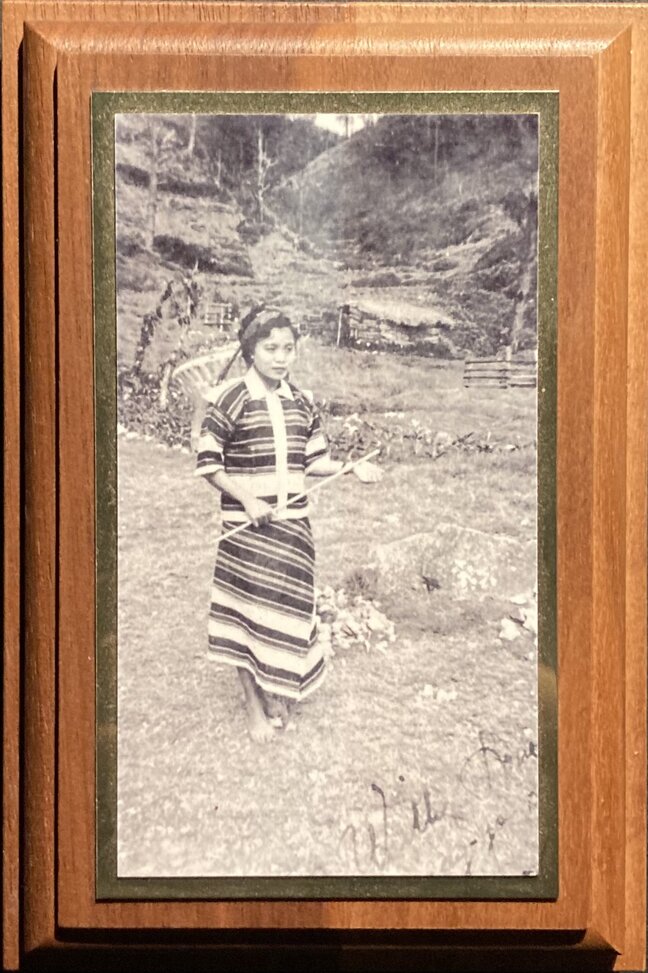
    Inheritance is a theme further emphasized in Apilado’s work reconciling with her Filipino heritage. Along the wall in the third gallery there is a monochrome portrait of a woman standing before a mountainous landscape. The subject is Lola Susana, the inspiration for Ilokano artist Apilado, to rekindle the art of loom-weaving. Apilado’s inclusion of the portrait marks a shift in how ancestors are remembered. Photos, names, and memories are lost between moves and generations. Family members are relegated to distant ancestors without names or faces or forgotten entirely. However, Lola Susana and her family of Ilocos weavers are remembered.

    Lola Susana’s portrait, c. 1954–56, photographer unknown, 4″ x 6″

    Apilado also included their Family Heirloom Blanket, a woven marker of the Apilado family and their weaving practices. Though the portrait of Apilado’s “Lola Susana” and the “Family Heirloom Blanket” were not created by the artist, both works are meaningful in her art.

    Carol Ann Apilado, Family Heirloom Blanket, 1980s to early 1990s. Handwoven cotton or polyester, 68″ x 96″.

    A dizzyingly patterned drape installation hangs from a hoop suspended at the ceiling, creating Apilado’s “Channel”. Each panel swoops downwards and is held on the ground by a stone, placed before the fringe. At the centre of the installation is a cushion, a simple place to hide as sounds from a speaker fill the space. The inabel textiles are woven in a binakul pattern. It successfully creates the illusion of movement. The artist’s intent is to create a piece that will ward off evil spirits. Apilado refers to the woven pattern as the kusikus (Ilokano word for “whirlpool”), in recognizing the wind spirit. There is a multiplicity in this work: the woven pattern represents waves of the sea, paired with the sound of waves from the speaker. “Channel” is the embodiment of the channels of waters, channels for frequencies of sound, channelling of spirits. This plurality is intricate and challenging as the artist prompts us to seat beneath the canopy: to meditate and reflect.

    Carol Ann Apilado, Channel, 2023, cotton and cottolin (cotton/linen), stones, pillow, approximately 4’ diameter, 12′ high.

    When dealing with cultural isolation, distance from your loved ones, and desires to remember your home, what could be better than cloaking yourself in a material version of that love? The Love that Remains is depicting the process of reconnecting with those who have lived before us in addition to those who will come after us. It is the passing of heirlooms, memories, language, and love. Lance’s curation is a thoughtful remembrance of peoples and their labours manifested in textiles. It also ensures that generations have the opportunity to connect with and through their ‘cultural fabric’.

    Text and photo: Rashana Youtzy

    *Exhibition information: The Love that Remains / featuring artists Par Nair, Julie Gladstone, and Carol Ann Apilado, May 1, 2024 – July 27, 2024, Art Museum at the University of Toronto, University of Toronto Art Centre, 15 King’s College Circle Toronto. Museum hours: Tue, Thu, Fri, Sat: 12 – 5 pm, Wed: 12 – 8 pm.

  • Toronto Gone Wild at the Museum of Toronto

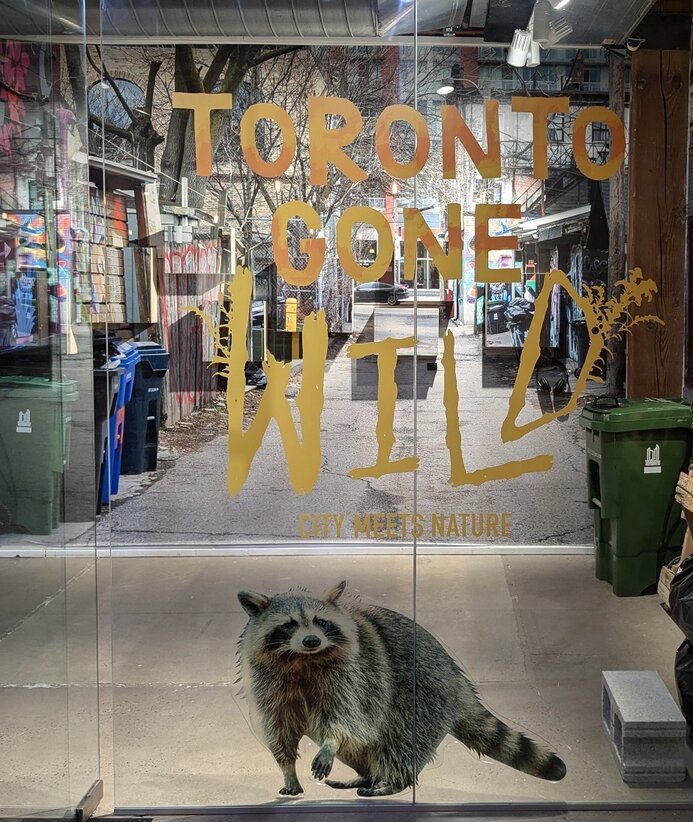
    At its modestly sized location on the ground floor of the 401 Richmond building, the Museum of Toronto is currently staging an exhibition that highlights the city’s wildlife, both flora and fauna. The curators have divided Toronto’s wildlife environment into three types: the shorelines of the rivers and lake, the ravines and parks, and the urban landscape of the streets. The exhibition is far from comprehensive. Nonetheless it features a great variety of plants and animals. They are mostly those we are conscious of, e.g., racoons, coyotes, pigeons and commonly found plants. 

    Entrance to the exhibition Toronto Gone Wild

    The overall theme of the exhibition is our relationship with our immediate natural environment, where the curators, for example, highlight some of the similarities we share with the wildlife, such as our common need to construct dwellings. On one of the many posters on display, titled ‘How We Dwell’, it is remarked that ‘many birds, insects and different types of mammals, like humans, live collectively’. This poster accompanies a wall-mounted display in the shape of a bee-hive, each compartment of which houses a picture or example of an animal’s habitat, e.g., a bird’s nest. As this instance suggests, there is a didacticism to the exhibition, which fits with perhaps one of its principal target audiences, namely children. All the same, the visitor is not treated as a school child. The overall tone of communication is suitable adult.

    Dwellings

    The animals we encounter, of course, are those who have adapted to the urban environment. Throughout there are hints at how radically we colonisers have altered the environment. For instance, we learn that the indigenous passenger pigeon, who once flew over the land in flocks numbering many millions, have been made extinct by us. The last recorded one died in 1914. All the pigeons we see today are descendants of pigeons brought over from Europe. As well, we learn that the honey is not indigenous to Canada. It too was imported.

    Pigeon Display

    One of the most impactful exhibits is a stuffed coyote. Lying in a mock-up of a den, this victim of the taxidermist is surrounded by posters offering factoids about this American species of wild dog. We learn why it has earned the epithet ‘wily’, viz., in virtue of the species’ capacity to adapt. We discover that after they almost met the same fate of the passenger pigeon, the coyote expanded their territory north-eastward, interbreeding with wolves en route. Now they are no longer an endangered species, despite their being a nuisance to farmers and pet owners alike. Indeed, their presence among us is beneficial in many ways, e.g., in keeping down the population of rats – one of their favourite prey.

    Coyote display

    In the far corner of the exhibition there is a nook. The visitor is encouraged to take a seat there, pick up a tag and write out a brief anecdote about her encounters with racoons in the city. Reading through some of the numerous contributions, I noticed a common theme to many of the anecdotes. Often the writer refers to racoons as thieves, as stealing this or that from them. I found this allusion both amusing and telling. Clearly a racoon is incapable of stealing given that it has no concept of property. But such comments demonstrate how we tend to anthropomorphise these creatures. We are inclined to see them through a human lens.

    The nook with writings about encounters with racoons

    Crafts station

    Indeed, the phrase ‘gone wild’ suggests a human-based view of wildlife as that which is uncontrolled, or uncontrollable. This idea reflects the biblical notion of nature as under our dominion. In this regard, nothing in our natural environment has escaped our influence. Those animals and plants that have survived have done so despite us. Nevertheless, the curators encourage the visitor to treat wildlife on its own terms. In one poster they write: ‘The phrase “all our relations” reflects the indigenous worldviews that understand plants and animals as “generous relatives” – family members who participate in reciprocal relations with people, and who are worthy of respect’. I take this to be aspirational, a suggestion about how we ought to treat wildlife. It certainly doesn’t reflect the predominant attitude, as evidenced throughout the exhibition.

    Installation view of Toronto Gone Wild

    The exhibition points out how we have accidentally created new environments for wildlife – in particular the construction of the Leslie Street Spit as a dumpsite for construction waste. Nature lovers and scientists have been keen to rewild such areas, that is, more precisely, to reintroduce endangered or near-extinct species of plants and animals.

    The Rewilding of Tommy Thompson Park

    The battle between native and introduced, or invasive, species of plants and animals are brought into focus. These forces, the curators emphasize, are out of balance. But it is not clear what to label a ‘weed’ plant in this respect. Some weeds are ‘out of control’ invasive species, while others, they remind us, are native plants that perhaps gardeners are not fond of.

    Installation view of Toronto Gone Wild

    Superficially, the exhibition could be described as a eulogy to the wildlife immediately surrounding us. But, on a deeper reading the visitor soon realizes that things are far more complicated. It becomes clear that many of our influences on nature generally has been pernicious, if not downright toxic. This well-curated and enlightening exhibition is well worth visiting. It is a chance to consider all those living things that are peripheral to our human sphere of interests.

    Text and photo: Hugh Alcock

    *Exhibition information: Toronto Gone Wild, April 10 – November 3, 2024, Museum of Toronto, 401 Richmond Street west, Eastern Entrance, Ll01, Toronto. Museum hours: Wed – Sat 12 – 6 pm.

  • At Face Value / Station Independent Projects

    This is my second time attending an art show by Station Independent Projects and both times I was blown away by the variety, passion, and vision of the artists. Face Value is a show that focuses on people. It brings the phrase “not everything is as it seems” to life by exploring deeper facial expressions and further challenging the traditional meaning of portraiture. The exhibition evokes raw emotions and examines perspectives based on something deeper that what we can see on the surface.

    Installation view of At Face Value

    Claudine Anrather has a strong sense of justice for those wronged in life. The women depicted in these images are transwomen who were murdered. They are surrounded by calla lilies which represent the death, rebirth, and also a touch of sexuality. Iris Santos, age 22, Marquiisha Lawrence, age 28, Brooklyn Deshuna age 20, and Nina Pop, age 28—all lost their lives tragically. Anrather’s pieces serve not only to protest against violence but to represent these women’s life by depicting their beauty and showing the cruelty of homophobia, racism, and transphobia that ended their lives prematurely. The portraits are also a beautiful tribute to these women. These pieces speak of a place where raw fear is everyday reality. Each of these women had hope in their eyes for a brighter future but unfortunately, they never had a chance to fulfill it. The message of these paintings is touching and terrorizing at the same time.

    Claudine Anrather, Marquiisha Lawrence, age 28, (top left) Iris Santos, age 22, (bottom left) and Brooklyn Deshuna age 20 (right), each 2021, oil on board, 11 x 16 inches

    D. Dominick Lombardi‘s Triptych is a delicate semi-abstract piece depicting time in order to show the aging process up to 96 years. He has a talent for ink-based work that is visually progressing into a chaotic composition. Rather than showing who he is at the moment, Lombardi is pushing past the surface and even trying to predict the future, showing his ability to grow and how he has changed over time. It is an inspiring and thought-provoking artwork that encourages you meditate about our journey as people.

    D. Dominick Lombardi, Triptych (L-R) D-25-21 (Self-Portrait at 17), 2021, D-20-21 (Self-Portrait at 35) and D-21-21 (Self-Portrait at 96) each 2021, permanent ink on acid free paper, 17 x 14 inches

    Andrew Owen AO1 has a talent for creating Photo-cubic Tableaux. These works are composed of many photographic prints, each individually shot and printed at life-size scale. They were taken when Owen worked with Fashion Art Toronto. The artist presents compositions with a profusion of angles, views, locations, diversity of ethnicities, sexualities, personas, genders, and ranges of moods. He captures moments in the lives of various individuals at different times and places and then creates a new reality for them. His unique works are beautiful and speak about diversity, giving the viewer something more than just a portrait. The real message is to love people no matter who they are or how they look. It is a powerful narrative that inspires people to keep an open mind and challenges them to push past society’s stereotypes and accept everyone for who they are.

    Andrew Owen AO1, United Diversity V (Feat.Winnie Harlow), 2013, 16 x 20 inches

    Marcy Brafman uses bright colours and flashy techniques to create graffiti-like images depicting mysterious personas. Her paintings consist of characters from American pop culture such as Medusa. With vibrant colours and rapid/chaotic brushstrokes, she evokes emotions not typically associated with the characters at hand. Brafman respects the original characters but doesn’t hesitate to make them her own. Her work is chaotic, but more than just lines and patches on a canvas. It captures elegance and beauty.

    Marcy Brafman, Medusa after Caravaggio, oil enamel & ink on canvas, (top left), Ugly Duckling Pieta, 2018, oil enamel and spray paint on canvas (top right) and Bazooka Joe Signet Ring, Xylene and oil paint on canvas (bottom), each 24 x 24 inches

    It is impossible to cover all the amazing artworks in this exhibition. I still want to mention a few other artists. Dana Nehdaran and Arlene Rush have similar approaches in their depiction of themselves from different perspectives. Noah Becker, Shantel Miller and Amy Hill explore portraiture as well, but stick to a much more traditional style.

    Noah Becker, Three Figures, 2023, oil on canvas, 24 x 18 inches (left) and Amy Hill, Woman in Orange Jean Jacket, 2016, oil on wood, 9 x 12 inches (right)

    Ruben Natal-San Miguel’s photographs display his subjects in a documentary-style setting. Sam Jackson references the UK punk and fetish scenes by creating traditional portraits, adorned with gestural symbols.

    Ruben Natal-San Miguel, Beauty Make Up Check (Jennifer) Crotona Park, The Bronx, NYC, 2019, Framed dye sublimation print on aluminum, 12 x 12 inches

    Chambliss Giobbi and Pierre St-Jacques select outside sources to create unique types of portraiture. Each piece in this show represents a new form of inspiration as they all have unique stories, worth looking at and thinking about.

    Installation view of At Face Value

    Station Independent Projects is a space for artist advocacy, specializing in discovering and showcasing new and up-and-coming artists. They give these artists a safe space to expand and grow. Leah Oates and Robert Curcio are doing something amazing for the artists involved. If you love artwork with deeper meanings and diversity be sure to attend this show.

    Cassandra Johnson

    Images are courtesy of Station Independent Projects

    *Exhibition information: At Face Value / group exhibition, July 5 – 27, 2024, Station Independent Projects, 220 Geary Avenue, #2B, Toronto. Gallery hours: Thurs – Sun 1 – 6 pm.

  • TOAF 2024

    July 12 – 14, 2024
    Nathan Phillips Square
    Fri & Sat 10 am – 7 pm, Sun 10 am – 5 pm

    The weather was cooperating for this year’s TOAF with over 350 artists set up at Nathan Philips Square, though it did rain around 5 pm. An art supply company had given out some complimentary gift bags to artists in their booths and part of the loot included a hand fan. Artists were making use of the fans and trying to cool off. A couple of young people had taken to going into the water at the square.

    Installation view of TOAF

    There was the usual mix of crafts and artists from all medias, plus community organizations and schools such as the Toronto School of Art. I managed to find the Executive Director Anahita Azrahimi, who was chatting with some media representatives. Art collector, curator and gallerist Flavio Belli was hamming it up with Anahita while I was getting my photo op. Flavio has been involved with TOAF for years and is always fun to talk to him.

    Flavio Belli with Executive Director Anahita Azrahimi

    Self taught artist Sandamali Angunawela, besides her acrylic paintings, makes pencil portraits and started practicing this art form during COVID. This was her third year at the fair. Its a long way from Halifax but artist Kevin McLean has been participating at TOAF since 1992. He finds driftwood and creates model submarine vessels that are unique and fun. He has won in competitions for his sculptures at TOAF. Emily Zou uses recycling objects to create her environmentally friendly works. She enjoys bringing new life to those found materials. It is her second year and she said that she has learned a lot from her first year in 2023. She knows now that small works sell well.

    Artist Sandamali Angunawela in front of her paintings

    Kevin McLean with his submarine models

    Emily Zou with her works

    India born artist Kulwant Singh Bhullar studied drawing and painting and has an MFA. He has been participating at TOAF for over 30 years. Tobias Luttmer from Calgary attending the fair for the first year and was happy to get so much attention from the general public as well as from art buyers. He uses stone for the main body of his sculptures and then stainless steel to create the heads of the animal figures.

    Kulwant Singh Bhullar, winner of the painting category, in front of his paintings

    Tobias Luttmer with one of his birds

    Jane Pike and Jeff Turner work together to create their pieces. They photograph objects and then alter them with digital paint giving the works a pop like look that was pleasing. Artist Ross Bonfanti started attending the fair after graduating from OCADU in 1996. His reasonably priced funny looking works were selling and he was happy to be back at TOAF. Photographer and filmmaker Nika Belianina described her work as magical realism. This was her second year at the fair.

    Jane Pike and Jeff Turner work together. Jane Pike in their booth

    Ross Bonfanti, surrounded by his pieces

    Nika Belianina with one of her magical photographs

    Artist Alex Millington thought TOAF was great this year, especially, experiencing it in person. He was accepted earlier, but then COVID came, so 2024 became his first year of participating in the fair. Kit Le draws her work by hand and then goes digital. I liked the work she did of the art building at Ossington and Dupont Streets. This was her first year at the fair. She described her work as “chaos within constraint”. Artist Colin Arthurs presented himself as a multidisciplinary artist whose subjects involve male behavior in various historical times.

    Alex Millington with his work

    Kit Le with her work that depicts the corner of Ossington and Dupont Streets

    Colin Arthurs in front of soldiers in trench

    Deirdre Wicks draws animals doing human things, such as eating chips. She had studied Fashion at TMU but found out that creating art worked better for her. She believes humor is necessary in making her pieces. Painter Zack Atticus creates small realistic paintings that are very appealing oil paints on wood. I think these should sell themselves very well.

    Deirdre Wicks in her booth

    Zack Atticus with his small cityscapes

    Amy Fitzgerald is a mixed media artist. This was her first year and she was pleased with the attention her work was getting. The next artist I visited was Breanna Gordon, a talented painter. She likes Italian Baroque art and you can see its influences in her work. She had sold one larger work. She had a really good start at the fair.

    Amy Fitzgerald in front of her works

    Breanna Gordon with one of her large paintings

    TOAF started in 1961 by the Koffler family and has always been a popular draw for people collecting art and the curious general public. For artists it means exposure and some sales to continue their art making. The only thing in the way this year seemed to be the weather with humidity and rain. Organizers made it all happen again and nothing but good things were said about this year’s TOAF. Tired and hot I found a food truck to end my trek at TOAF.

    Installation view of TOAF

    Text and photo: Phil Anderson

  • Meghan Price at United Contemporary

    In 2014 among the sweeping Scottish landscape, artist and weaver Meghan Price found herself interested in the layers of rocks which reminded her of Canada’s east coast. Despite being thousands of kilometres apart, and on different continents, Price paid attention to these geological similarities, which gave her the space to access the idea of time being evident through land and through, specifically, geology. The artist explained that “The strata of earth materials we understand often as a vertical timeline of the earth’s activities … weaving is very close to that as well: the cloth is built from the bottom up […] and it’s the actions of the body and incremental structuring of a line that is creating the object. So, the patterning in weaving can be associated with the patterning of the earth’s materials.” Thus, it would come as no surprise that when Orra White Hitchcock’s work revealed itself to her during the pandemic, Price was instantly interested; that interest grew into this exhibition, Through Line.   

    Orra White Hitchcock (March 8, 1796 – May 26, 1863) was a prolific illustrator, providing her husband – pastor and geologist Edward Hitchcock – with many scientific drawings for his classroom and research. A true Renaissance woman, Orra not only birthed eight children, ran the household, and taught decorative arts and watercolours, she also provided illustrations for her husband, cheered him up in his fits of melancholy, and filed his sermons. It has been quoted by their contemporaries that Edward Hitchcock “would not have been anything great, if [Orra Hitchcock] had not assisted him by her drawings of everything appertaining to his study of Geology” (Hitchcock, Orra White, and Robert L. Herbert. A Woman of Amherst: The Travel Diaries of Orra White Hitchcock, 1847 and 1850. iUniverse, Inc, 2008). Each image she made is rendered with an elegance befitting the Romantic Era, using a palette unique to the subject matter. Meghan Price’s exhibition at the United Contemporary provides viewers with an intimate look into Hitchcock’s bright and polychromatic designs. 

    Through Line is a macro-study of Hitchcock’s diagram of the stratigraphic makeup of valleys, each layer of earth painted in pastel colours: one layer is a cheerful yellow, the other a peachy pink. “I’ve never seen scientific diagrams made with watercolour on muslin, which is what [Hitchcock] was doing,” tells the artist during a phone interview. “I think what we’re used to in scientific representation is maybe just a very reduced palette, [or] one that is less soft, anyhow. And her material choice is kind of a soft thing as well and one that we would maybe associate more closely with domestic environments. [What’s] remarkable there is that she’s putting a line down, [and] the material interaction is going to cause that line to be kind of fuzzy: there’s that bleeding that’s happening. So as a person working in textiles, I’m very sensitive and interested in that world.”

    Orra White Hitchcock’s work from Hollander, Stacey, Charting the Divine Path: The Art of Orra White Hitchcock 1796-1863 (New York: American Museum of Folk Art in collaboration with Amherst College Archives & Special Projects, 2018), exhibition catalogue.

    Each of Price’s textiles are meticulously studied and then carefully planned – either on a draft or a computer – and programmed into her Jacquard Loom. This type of weaving is complicated and tricky; there are rigid parameters in which one must work. So, it was a “juicy technical challenge”, as she puts it, to translate the very fluid imagery of Orra White Hitchcock’s watercolour and ink diagrams into her own very structured methods of weaving.

    Installation view of Meghan Price (L-R) Convergence, Strata 1., and Ravine, 2024, woven cotton. Courtesy of United Contemporary.

    Price has expertly captured the texture and behaviour of Hitchcock’s muslin and watercolour diagram through very meticulous planning. Fascinated by the fabric’s qualities and mannerisms, and how that affects and interacts with the watercolour, Price provides a macro look into these interplays through her own woven artwork. Looking at “Ravine,” one would see ink seeping into the muslin, very slightly darkening the surrounding aqua, and then be stunned when reminded that this piece is not a wet medium but a textile. A closer look and one can even see the illusion of ink settling darkly into the wefts of the cotton cloth. When one considers how a loom can possibly achieve this, it becomes clear that everything about these reproductions is deliberate. That Price is able to not only capture the illusion of a wet medium through a weave but also include the features of that medium misbehaving is a striking display of dexterity.

    Meghan Price, Ravine, 2024, handwoven cotton, stitched to canvas, 51.5 x 41 in. Courtesy of United Contemporary

    “Convergence (Diptych)” provides the viewer with a closeup of where Hitchcock’s pen or brush meets multiple times, darkening the muslin further at each stroke and mixing with the watercolours. There are sections where the watercolours do not reach the ink lines, leaving a sliver of muslin exposed, and parts where the ink is caught between weft and warp. Clearly, these macro-takes focus on the idiosyncrasies of Hitchcock’s work, adding an intimacy to Price’s textiles. “When I’m following the stroke of [Orra’s] pen,” the artist said, “I’m thinking about her hand, but I’m also thinking about what was going on in the room where she was doing that work. I’m thinking about the demands that were placed on her that might have distracted her in a moment that would have caused her hand to create a very specific arc or to pause for a minute – whenever there’s a pause with that pen or that brush, we see more of the ink – so there’s some kind of clue there: a connection to her body and then a connection to the physical space that she was in.”

    Meghan Price, Convergence, 2024, each woven cotton 38.5 x 20 in. Courtesy of United Contemporary

    Looking at “Valleys Bleed (Diptych)” with Price’s imaginative lens, one might ask themselves what created such a smudge: was it Hitchcock’s finger? Did her sleeve catch the still-wet ink? What is a barely discernible error on a small scale offers, insights and stories become very visible on a large scale. 

    Meghan Price, Valleys Bleed (Diptych), 2024, each handwoven cotton, stitched to canvas, 32.5 x 20.5 in. Courtesy of United Contemporary.

    Further in the vein of the Earth’s geological layers representing the passing of time, Price contemplates the age of humans and their relationship to the Earth: “The Crust of the Earth After Orra White Hitchcock” is a take on a separate illustration by Hitchcock, and it has woven in found material: a cassette tape. A ring of plastic encasing the Earth’s crust is a modern and topical take, one that was chosen while Price was thinking about “the Earth that we’re living on and how we are transforming it, how it has been transformed, and continues to be transformed by human activity.” It makes sense, aesthetically as well, to crunch the tape into the cloth, as “it takes on a real kind of crystalline quality which is kind of like coal or other geologic materials. So, I think it does a good job of expressing a crustiness of the earth[.]”

    Meghan Price, The Crust of the Earth After Orra White Hitchcock, 2024, woven cloth and plastic waste, 40.5 x 40.25 in. Courtesy of United Contemporary.

    Weft upon weft, each line of thread entwines to create a small detail in Orra Hitchcock’s work that would have gone unnoticed without Meghan Price’s hand. To focus on the minute errors is to connect on a very human level with both artists: from Hitchcock’s hand to muslin, from Price’s eye to loom, these particularities have made their way through time to connect us together now.

    Installation view of Meghan Price, Through Line. Courtesy of United Contemporary.

    Elin MacRae

    *Exhibition information: Meghan Price, Through Line, May 23 – July 13, 2024, United Contemporary, 1444 Dupont Street, Unit 22, Toronto. Gallery hours: Wed – Sat, 11 am – 6 pm.

    Special thanks to Meghan Price for her time, and to United Contemporary Gallery Director Melanie Trojkovic for the tour.

  • Help to save Propeller Art Gallery

    ABOUT PROPELLER

    Propeller Art Gallery was established in August 1996 by a small group of Ontario College of Art and Design (OCAD) recent graduates. Their mission was to create an affordable community art gallery for emerging Canadian artists, offering a professional exhibition venue and necessary support in career building.

    Propeller continues to uphold this today, supporting artists from emerging to established, through a dynamic approach to arts programming, a venue to exhibit art, and education through member-assisted learning and collaboration.

    Propeller Gallery is part of the cultural community in Toronto’s vibrant Queen West Art & Design district. We actively foster artists’ creative pursuits by hosting curated, juried, and member exhibitions. Additionally, it provides platforms for networking and learning through lectures, workshops, and artist talks. Now in its 28th year, Propeller continues to thrive with a roster of 42 artist members who share their creative spirit, and embrace the local arts community. We continue to garner public interest and critical acclaim as an essential artist-run centre in Toronto.

    Help Propeller Art Gallery

    Buy Our Exhibition Space: $150K Goal

    In November 2023, Artscape Inc., our landlord, went into receivership. Since then, we have been fortunate enough to obtain financial assistance from Heritage Canada through the Canada Cultural Spaces Fund, and the City of Toronto. This funding will go directly towards our space purchase.

    We’re still $150,000 short. Help us reach our goal to Save Our Space at 30 Abell St, Toronto! Owning our space will offer long-term benefits to our members and the arts community by providing stability and opportunities for long-term planning. Meeting this target means your donation will have a considerable impact, as most funds are government-sourced.

    In the future, the City of Toronto will have the first right of refusal if Propeller needs to leave the space. Your donation is truly an investment in the Toronto Arts community, ensuring the space remains secured and dedicated to the arts well into the future.

    Peter Friedrichsen, Chair, Propeller Art Gallery

    We ask for your help to Save Our Space!

    Please DONATE

  • Sara Angelucci: Undergrowth at AGM

    Day and night represent different aspects for nature and humanity. Sara Angelucci’s work has captured this fascinating variety over the past ten years. She took already captivating imagery and turned it into something to question and consider. The show itself transports you into a world of mystery and intrigue. Her work transforms found photographs to create new images that explore cultural and historical facets outside those of the original image. It leads to morphing the picture and brings attention to the social standards that generated the language of photography. Angelucci’s works moved me from the traditional perspective of beauty and mystery; I found these unusual pieces beautiful on their own. The true meaning of these images, what they are derived from and what they aim to represent, is the real challenge of this show.

    Installation view of Sara Angelucci, Undergrowth with August 15, 2022 Cardinal flower, Mint, Joe Pye Weed (centre) at AGM. Courtesy of AGM

    The “Aviary” series (2013) is based on the idea of 19th century portrait photos. I found these compositions very intriguing and they also made me think about the artist’s intentions. The birds represented in these images are extinct. The artists merged them with anonymous nineteenth century cartes-de-visite portraits. Hunting and collecting unique things were in fashion at that time. People collected those birds; taxidermists preserved them so they could be presented as decoration or in scientific collections and now we recognize the power behind those human choices and how those decisions ultimately led to the loss of these impeccable species. The artist concluded in the Project Statement of Aviary, “what would it mean to embody another creature: Could one then see, feel, and understand its desire to live? Might we then imagine the Aviary portraits as chimera suspended in a state of empathy, and wonder what our treatment of other sentient beings might be if we could feel what they feel, or see what they see?”

    L-R: Aviary (Heath Hen/extirpated), 2013, Aviary (Red-headed Woodpecker/endangered), 2013 and Aviary (Barn Owl/endangered), 2013, both C-print, 22 x 33.5 inches. Courtesy of the artist.

    The artist’s love of birds is evident in this masterpiece of mockery, titled “Sightings” (2015). It depicts the Ivory-billed Woodpecker and pinpoints how the Singer Sewing machine and its creation were the reason they no longer grace us with their presence. The wall behind this installation is covered with replicas of vintage cards that depict native American songbirds. The piece is finely crafted and encourages awareness of situations such as the creation of the Singer sewing machines with its need for wood, which led to the collapse of the Ivory-billed Woodpecker’s habitat and led to its untimely extinction. It opens us up the idea that even cutting down a single tree can lead to the eradication of a whole community, and further addresses the issue that humans keep deepening the divide between themselves and nature.

    Installation view with Sightings (left, photo: Cassandra Johnson) and Sightings (Ivorybilled Woodpecker), 2015, 4 wooden Singer sewing machine cabinets, 3D printed bird – 11″ tall, sculpture 9.5′ detail (right, courtesy of the artist)

    The series of “Arboretum” (2016), “Black Flowers” (2021), and “The Twirl of a Butterfly’s Tongue” (2022) further focuses on colonial influences. The “Arboretum” series are Victorian-era cabinet card portraits with painted forest backdrops. Originally the concept was to portray humans using the forest as a backdrop, but in Angelucci’s photographs the people have become the backdrop. I find this idea very enticing and it gives me a feeling of harmony.

    Arboretum (Boy/Double Ash) & Arboretum (Man/Woman/Pines), both Inkjet print, 2016. Courtesy of the artist.

    The “Black Flowers” series uses compositions made with a discarded science collection of early 20th century glass lanterns from the Buffalo Society of Natural Sciences. It was once an educational tool and now represents Victorian mourning bouquets. The long-standing tradition of gifting flowers during times of love and loss has continued to today; they represent thoughts and feelings and offer a moment of bliss in good or bad situations.

    Black Flowers (Milkweed), 2017, Inkjet print, 82.04 x 69.14 cm. Courtesy of the artist.

    The “Twirl of a Butterfly’s Tongue” is a video that uses many more lantern slides. It targets our need for organization and to keep the world in order through categorization. It is a moment of influence and aims to spark the constant need to learn more about nature. Not only are these pieces beautiful but they also give new ideas and motivate us to look deeper into concepts we might not fully understand or even think about.

    The Twirl of a Butterfly’s Tongue, 2022, video 5:03 min. Courtesy of the artist.

    In “Nocturnal Botanical Ontario” (2019-on going), Angelucci depicts the plants surrounding her home and studio at Pretty River Valley. She tends to work mostly at night with a scanner that illuminates the environment around them. It puts focus on the plants and insects thriving under cover of darkness. The result of this evokes the acceptance of native and invasive wildlife residing in the world around us. This piece is double-sided and magically transports the viewer into the life of these plants, the shadows that surround them, and the air that cloaks them. These are powerful compositions and I can’t wait to see where this project will lead.

    Installation view with October 14, Milkweed #1, (left, photo: Cassandra Johnson) on one side of the panel and August 15, 2022 Cardinal flower, Mint, Joe Pye Weed (Courtesy of AGM) on the other side of the panel.

    “Ghost Orchard” (2022), holds great sentimental value to the artist as it represents her childhood, and an abandoned orchard from their old farm in Hamilton. From the farm only an old tree stands. The rest of the area is fenced up for construction. The video captures the moments before modern society and it’s need to demolish nature to further the economy. I admire Angelucci’s ability to create this narrative that speaks volumes without saying a word, to capture a personal longing and to protect memories while creating a ghost-like atmosphere.

    Ghost Orchard, 2022, Video. 7:05 min. Courtesy of the artist.

    Sara Angelucci has a talent for showing the reality of the divide between humans and nature. She makes the viewer contemplate our choices, such as how a decision to create a sewing machine was a fundamental cause in the extinction of a bird. I recommend attending this show as it was not only beautiful but educational and thought provoking as well. Also, the flyer you receive at the exhibition offers a special gift: it’s plantable — just plant it, water it, and watch it grow.

    Cassandra Johnson

    *Exhibition information: Sara Angelucci, Undergrowth, April 20 – July 7, 2024, Art Gallery of Mississauga, 300 City Centre Drive, Mississauga. Gallery hours: Tue, Wed & Fri: 10am – 5pm, Thu: 10am – 8pm, Sat & Sun: 12pm – 4pm

  • Roy Wong at Gallery 1313

    Impressions of Beauty is a captivating collection of landscape, still-life, and abstract work by Roy Wong, a member artist of Gallery 1313. Wong’s unique perspective captures the sublime essence of the natural world and the beauty in the space between seasons, as depicted in pieces such as “Autumn Leaves in the Fall” and “Red Barn in the Fall”. Wong’s palette is a striking contrast of fiery hues and muted tones. Bright oranges and reds cling desperately to branches, while hints of winter emerge as soft blues that creep into the shadows. This intense, yet balanced use of colour creates a captivating visual experience.

    Roy Wong, Autumn Leaves in the Fall, acrylic and oil on canvas

    Texture is a crucial aspect of Wong’s work, adding depth and complexity. A lake’s smooth surface contrasts with the rough, decaying foliage scattered about the ground. Bare branches, stripped of their finery, reach skyward, resilient, a reminder of transition and nature’s cycle of death and rebirth.

    Roy Wong, Red Barn in the Fall, acrylic and oil on canvas

    Wong’s still-life works, such as “Flowers in Vase and Red Book” and “Flowers in Vase Between Colours”, also draw upon these themes. The evocative pairing of vibrant reds and muted browns takes center stage in a collection of floral still-life paintings exploring beauty’s fleeting nature. These works transcend the simple depiction of blooms, transforming them into poignant transition narratives.

    Roy Wong, Flowers in Vase and Red Book, acrylic and oil on canvas

    The focus on light, as with “Flowers in Vase and Red Book”, further emphasizes the passage of time. A single ray might illuminate a particularly vibrant petal, momentarily highlighting its beauty before surrendering it to the encroaching shadows. This play of light and shadow creates a sense of drama, mirroring the internal struggle between holding onto the present and accepting the inevitable.

    These floral still-life works are not merely depictions of flowers but meditations on impermanence, capturing the bittersweet beauty of things in transition. The rich reds, a symbol of life’s vibrancy, are ultimately subdued by the muted browns, a reminder of its transience. Yet, even in the face of decay, there is a promise of renewal.

    In a captivating departure from the series’ focus, Wong’s Abstract Landscape emerges as a culmination, a vibrant tapestry woven from the artist’s exploration of nature. The familiar deep browns and fiery reds, seen previously, resurface here, almost as solitary elements.

    Roy Wong, Abstract Landscape, acrylic and oil on canvas

    Yet, this isn’t a somber reflection. Pops of bright yellow and blue traverse the canvas like unexpected wildflowers erupting through a weathered landscape. These bursts of colour bring a sense of vibrancy and life, reminiscent of the flowers in the still-life work. The composition feels dynamic, a swirling interplay of textures and hues.

    Panorama view of Impressions of Beauty at Gallery 1313, Cell Gallery

    Wong’s work is more than a representation of the beauty in the natural world. It is a poignant celebration of the impermanence of all things, a sentiment that resonates deeply within us. They celebrate the beauty of decay, the quiet solitude of a world preparing for slumber, and the promise of renewal that lies dormant beneath the winter snow or the dim light of dusk.

    Text and photo: B. James McCarthy

    *Exhibition information: Roy Wong, Impressions of Beauty, June 19 – 30, 2024, Gallery 1313, Cell Gallery, 1313 Queen St. West, Toronto. Gallery hours: Wed – Sat 1 – 5 pm, Sun 1 – 4 pm.

  • CACTUS CLUB Inaugural Show

    The exhibiting three artists were brought together by a common friend. Their art is connected by their appreciation of nature. The gallery is the backyard studio of Hugh Alcock who generously opened up his space to show his art along with fellow artists. Younger artists are looking for alternative spaces to show art whether it be their homes or backyards or a laneway garage. While these artists don’t necessarily fall into a younger crowd, they have adopted a fresh approach to sharing their art practice. The backyard studio, surrounded by greenery, seems fitting for this particular exhibit. All three artists studied at OCADU at one time or another.

    Installation view

    Harry Staples acrylic paintings are the most colourful of the three. He describes his work as abstract but there is a synchronicity to his work. His paintings with trees have bright lines of colour as a backdrop to the works, like “Spellbound”. As he describes, his paintings are “derived records of nature “. 

    Harry Staple, Spellbound 2024, acrylic on canvas, 36 x 20 inches

    Marie de Sousa, who perhaps has a longer exhibition history of the three of them, has painted portraits of plants from her home. The richly coloured portraits are assembled on a painted black wall. In her artist statement, Sousa expresses her belief that plants have an intelligence and capability to communicate with each other. She is not alone; scientific studies have been done to prove this point. So, she has painted these portraits as though they were individuals. Next to her statement is a map that tells the viewer which plant goes with which portrait. The work and the thought behind them is engaging as well as the way she shares her creative procedure.

    Marie de Sousa, Work in Progress, plant portraits, 2024, oil on canvas, 7 panels in various sizes

    Hugh Alcock describes his approach to nature as poetic and lyrical, and indeed it would appear so. His attention to detail is impressive and his use of materials give the work extra dimensions. His work seems almost tactile and it is difficult to resist the temptation to reach out and touch the canvas, like in “Oracle”. His use of charcoal and pastels produces a wonderful vision. It is interesting that the gallery is also the studio where he creates these works.

    Hugh Alcock, Oracle, 2024, charcoal and pastel on board, 56 x 40 inches

    The work of all three artists comes together well in this tiny space. They have enough space around them to breath and, while each is different, they share their vast love of nature. Nothing prickly at the Cactus Club, all very lush and pastoral and worth taking a journey off the beaten path.

    Installation view with Harry Staple, On Reflection 1 & 2, acrylic on canvas, 16 x 40 inches (left) and Hugh Alcock, Oracle, charcoal & pastel on board, 56 x 40 inches (right)

    Text and photo: Phil Anderson

    *Exhibition information: Cactus Club Inaugural Show / featuring Harry Staples, Marie de Sousa & Hugh Alcock, June 21 – July 7, 2024, 17 Moir Ave – back studio, Toronto. Gallery hours: Thu – Sun 1 – 5 pm.

  • The Toronto Show at Gallery 1313

    Gallery 1313’s The Toronto Show, is a captivating journey through the city as seen by twenty-six artists. Each has their own unique viewpoint on iconic landmarks, street corners, and diverse scenery, and paints a vivid and varied picture of Toronto that is genuinely remarkable. The range of these perspectives offer new views of the city, that will intrigue and engage any art enthusiast or curious visitor.

    Alex Salzmann, Hotdogs in the Concrete Jungle, acrylic, 16 x 16 inches

    Jarrod Bai’s “Chinatown” and “Neverland” are a testament to the emotional depth of Toronto’s cityscapes. With their rich, deep brushstrokes and warm, muted palettes, Bai’s work not only capture the iconic scenery of Toronto’s streetcar neighbourhoods but also infuses them with solitary, dreamlike reflections, and the melancholy glow of twilight.

    Jarrod Bai, Chinatown, oil on canvas, 36 x 12 inches

    This deep emotional connection to the city invites the viewer to feel the thrumming pulse of Toronto’s streets, displaying a sense of connection and love.

    Jarrod Bai, Neverland, oil on canvas, 60 x 24 inches

    Anshul Sharma’s “Why Wellesley,” takes us on a journey into the city’s underground, portraying the eerie stillness of Toronto’s subway system. This captivating artwork mesmerizes with its smooth, subtly textured surface. It provides the perfect backdrop for the striking contrast between the stark white and vibrant teal tiles on the subway platform.

    Anshul Sharma, Why Wellesley, oil on Masonite, 24 x 11 inches

    The station’s emptiness stands out as the most compelling element in this piece. Sharma adeptly captures the essence of liminal space—a transitional area devoid of its usual commotion and activity. Much like Bai’s “Chinatown,” the absence of human figures creates an unsettling calm that encourages the viewer to contemplate the reasons for the vacant platform.

    While a bustling metropolis, Toronto is surprisingly resplendent with pockets of nature woven into the urban fabric. Elnaz Hessami Pilehrood’s “No Frills Parking Lot” greets viewers with a thought-provoking scene: a supermarket parking lot framed by a backdrop of lush trees. Blunt asphalt and rows of parked cars represent the utilitarian side of Toronto’s urban environment. Yet, these elements are challenged by the vast expanse of vibrant greenery on the horizon.

    Elnaz Hessani Pilehrood, No Frills Parking Lot, acrylic on canvas, 30 x 40 inches

    The artist’s choice of a supermarket parking lot is a fascinating one. One wonders if the natural landscape in the background symbolizes hope, a reminder of the natural world persisting within the urban sprawl. Or perhaps it is a subtle critique highlighting the encroachment of development on natural spaces. This piece will surely spark a deeper look at the dichotomy of Toronto’s urban-nature.

    Collage works by Jesse Miletin “Humber Cinema” and “Crane on the Rooftop” depict two buildings, familiar to the West End, both buildings appear as in the past but feature elements of present-day development, such as the construction backing in one and the crane on the roof of the other. The two compositions seem to ask the viewer to compare them and consider what is on the horizon. Using photographic fragments, these collages capture the juxtaposition of urban development, decay, and the persistent spirit of the natural world. They prompt the viewer to reflect and contemplate on this delicate balance.

    Jesse Miletin, Humber Cinema, collage using archival pigment prints, 13 x 17 inches

    Jesse Miletin, Crane on the Rooftop, collage using archival pigment prints, 24 x 39 inches

    Through depicting elements of deconstructed but recognizable buildings, such as Bloor West Village’s long-gone Humber Theatre, artifacts of urban development and the recurring motif of the lone tree, whose branches stretch defiantly in the scene, Miletin urges the viewer to consider the future of Toronto’s ever-evolving landscape.

    Interlacing the diverse characteristics of the cityscape, “Journey in the City” by Sandra Franke boldly captures diverse perspectives of urban life. As a standout piece in The Toronto Show, this vivid painting immerses viewers in a dynamic exploration of the city. The bold use of blues, oranges, yellows, greens, and whites exudes the pulsating energy of urban environments. With its abstract nature, the piece demands various interpretations, possibly mirroring the multifaceted experiences of navigating bustling city streets.

    Sandra Franke, Journey in the City, acrylic on canvas, 20 x 20 inches

    More than an arrangement of diverse perspectives, The Toronto Show at Gallery 1313 is a vibrant conversation held in a cityscape. The artwork of these twenty-six artists present a delightful surprise, capturing the tranquility of Toronto’s hidden natural spaces as well as the frenetic movement of its bustling core. Moving from one piece to the next is like traversing the city itself. Each embodies a unique form and viewpoint, reflecting the diversity that permeates the city’s environment and culture.

    Panorama of The Toronto Show

    Text and photo: B. James McCarthy

    *Exhibition information: The Toronto Show / a group exhibition, curated by Phil Anderson, June 19 – 30, 2024, Gallery 1313, 1313 Queen St. West, Toronto. Gallery hours: Wed – Sat 1 – 5 pm, Sun 1 – 4 pm.

  • 95th LAUNCH at the Canadian Sculpture Centre

    As galleries are gradually being pushed out of the city, the Canadian Sculptors Society has been determined to maintain the dignity and accessibility of local art. Despite the uncertainty and fear surrounding the Canadian Sculpture Centre’s forced and sudden departure from the Distillery District, the Society has secured a space within the campus of Metro Toronto Multimedia College: a private design-focused college located in North York at 95 Moatfield Drive off Valleybrook. Artists and visitors joyfully gathered there for the Society’s 95th birthday and grand opening to show support for the gallery’s tenacity. Fittingly so, the first exhibit sees new and returning artists in an engrossing display of works that celebrate human resilience.

    Installation view of 95th LAUNCH. Photo: Tiffany Duong

    Gordon Becker’s life-sized wooden sculpture, “The Bow” invites visitors entering to reflect on the beauty, strength, and hardship of one’s artistic journey. While the curves of the ballet dancer’s features are rendered with delicacy, the vigorous, sharp lines of her hair and dress capture the swiftness and energy of her performance. The figure’s flexed pose is particularly difficult to sustain, requiring immense balance and strength, yet Becker preserves the dancer in this manner to emphasize her power—expressing the labor required in pursuit of mastering a creative endeavor.

    Gordon Becker, The Bow (left) and detail (right), wood, pigment. Photo: Tiffany Duong

    Employing a similar juxtaposition of careful and crude mark-making, Soheyl Bastami showcases the durability of the human body alongside human persistence. “Against the Wind #1” features a figure carved from a block of wood. Parts of the figure have been bluntly whittled away to convey the brute force of nature; however, it stands tall, calm, and contemplative, embracing the natural environment.

    Installation view with Soheyl Bastami, Against the Wind #1, wood, steel base (at front, detail). Photo: Tiffany Duong

    Patrick Bermingham’s bronze-casted figures compare the strength of human anatomy to machinery. With a background in construction, his figures are structured in an industrial manner— limbs resembling parts found within a building’s foundation. In “Royal Ease,” the artist depicts a figure in the titular pose that is frequent in the art of dharmic religions. Although the figures of divine art are representational, Bermingham simplifies the human body to a purely skeletal form. Sitting atop a plinth, the figure’s arms resemble metal beams; its torso similar to metal piping. In doing so, the artist emphasizes the strength of the human body as simultaneously relaxed, robust, and stable.

    Patrick Bermingham, Royal Ease, front and back view, bronze. Photo: Tiffany Duong

    Marlene Kawalez explores human interrelationships with nature as a way for us to find and regain inner strength. Her raku clay sculpture, “Far Away” was conceived amid the Covid-19 pandemic whereby quarantine made it difficult to be within and grounded by the natural environment. Here, Kawalez uses raku clay, a naturally-sourced material, to depict a smiling woman’s bust crowned by twine. The back of the sculpture is covered by leaves, and birds, urging us to seek out the freedom and joy that can be found within nature.

    Marlene Kawalez, Far Away, front and back view, raku clay, mixed media. Photo: Tiffany Duong

    Camie Geary-Martin’s sculptures consider the generational connections formed and furthered by art. Her bronze works are inspired by her grandmother’s textile illustrations of contemporary, fashion-forward women. “Woman with Cat,” for instance, resembles a Vogue illustration. The figure, sassy and humorous, models a matching turquoise outfit. Through these sculptures, the artist is able to respond to, honor, and preserve the works created by her grandmother using a different medium. Furthermore, her work highlights art — both in conversations about art and the expression thereof — as a way of strengthening our connection with the human past and present.

    Camie Geary-Martin, Woman with Cat (left) and Woman Looking Left (right), both bronzes. Courtesy of Canadian Sculpture Centre

    Ultimately, the works in this exhibit are insightful and impactful, offering viewers compelling discussion about the complexities of human power. As we commemorate and reflect on the Canadian Sculptors Society’s long, eventful past in the face of difficulty, the exhibit in the Canadian Sculpture Centre captures the gallery’s own strength and resolve — excitedly anticipating the future ahead.

    Installation view of 95th LAUNCH. Photo: Tiffany Duong

    Tiffany Duong

    *Exhibition information: 95th Launch, May 30 – June 27, 2024, Canadian Sculpture Centre, 95 Moatfield Drive, 5th Floor, North York. Gallery hours: Tue – Sat 11 am – 6 pm, Sun 12 – 5 pm.