Author: artoronto

  • Margaux Tartarotti & Heidi Leverty: Marée Noire at Walnut Contemporary

    The sea, with all its dynamic temperaments and inexhaustible stretches, has been engaged in a finicky relationship with humankind since the onslaught of the industrial revolution. Unfortunately, these vast water basins that give home to many vital ecosystems filled with an abundance of unique life forms, have become a breeding ground for toxic waste disposal and calamitous petroleum spills. Contemporary photography reveals the extent to which these unnatural disasters have strained the daily lives, mating habits, and health of those engaged with pelagic environments. Images of innocuous birds drenched in oil, where their lustrous feathers are seemingly marred by a thick opaque mass, encapsulate the global crisis of one of Earth’s oldest and most indispensible ecological structures.

    Throughout the history of art, artists have been known to align their painterly practices with the swellings, upsurges and capaciousness of the sea. This work, simply referred as the visualization of the philosophically charged notion of “The Sublime,” is most resonant on the canvases of J.M.W. Turner, Caspar David Friedrich and other nineteenth-century Romantics. In their paintings, oceanic landscapes were depicted as a robust natural force, an ironclad fist ready to deliberately pummel any humanly intruders brave enough to explore this potentially deadly terrain. However, in the hands of contemporary artists Margaux Tartarotti and Heidi Leverty, these once-ominous yet transcendent bodies of water are stripped of their foreboding nature and rendered futile and pained. “Marée Noire,” the twin sisters’ latest exhibition on-view at Walnut Contemporary, sees the artists allying themselves with modern day artistic forays into activist art, although in a more abstracted manner.

    Installation view of Marée Noire by Margaux Tartarotti  and Heidi Leverty at Walnut Contemporary, 2017. Courtesy of Walnut Contemporary

    While the identical twins may find many commonalities between themselves, personality and interest-wise, their artistic execution remains quite dissimilar from one another. Tartarotti presents her work in the form of painting and sculpture, while Leverty utilizes the photographic medium to manifest her sociopolitical ideas. However, both artists stick to a strictly brooding colour scheme, rarely rendering their works outside the realm of neutral tones and vivid blackness. In a dual exhibition, the sisters allow their distinct artistic endeavors to reflect, comment upon, and compliment each others’ oeuvres, showcasing a thematically-succinct sister act.

    Installation view of Marée Noire by Margaux Tartarotti (front) and Heidi Leverty (on the wall) at Walnut Contemporary, 2017. Courtesy of Walnut Contemporary

    Discussing Tartarotti’s contributions to Marée Noire will immediately strike a solemn chord amongst gallery attendees. Inspired by recent natural fiascos involving faulty sea vessels transporting oil, the artist concentrates her work on the helpless marine animals and aquatic landscapes affected by these unintentional spills. Tartarotti has crafted feathers that flank the exteriors of the gallery, illustrating the bevy of voiceless creatures whose livelihoods become submerged in a thick and often dangerous sludge of human necessity and greed. However, most notable is the series of large panels installed in the center of the exhibition, which act as an all-encompassing focal point. Visualized as aerial images of these specific sites of tragedy, the water’s free-flowing essence is rendered still by the viscous application of oily black, undermining the splendour of oceanic life.

    Installation view of Marée Noire with Margaux Tartarotti’s work at Walnut Contemporary, 2017. Courtesy of Walnut Contemporary

    Leverty’s photographic contributions are less recognizable in appearance, using a form of abstraction to demonstrate the collapse of natural beauty under industrialized means. However, Leverty’s work emits a meditative quality that soothes the more confrontational efforts of Tartarotti, providing a stark tranquility to the exhibition. 

    Heidi Leverty, Ominous series

    Gallery owner Ibérina Raquel Vilhena nullifies traditional modes of presentation through a more contemporary means of installation. The art is displayed in a method that warrants a more thorough phenomenological presence, as viewers assume a role as an explorer of these unfavorable terrains, uncovering the often-entropic destruction we inflict on our surrounding bionetworks. In an ever-escalating discourse on global climate change and human intervention, Tartarotti and Leverty confront such concerns as only an artist can, through a distinct visual acumen that is both telling and universal.

    David Saric

    *Exhibition information: January 21 – February 18, 2017,  Walnut Contemporary, 201 Niagara Street (side lane entrance) Toronto. Gallery hours: Wed to Sat, 1 – 6 pm.

  • Funding Announcement for The Museum of Contemporary Art

    The Museum of Contemporary Art, Toronto, Canada was awarded $5.1 million from Canada Cultural Spaces

    The Tower Automotive on 158 Sterling Rd, site of the new MOCA (first 5 floors) under renovations

    February 8, 2017
    Junction Gallery
    213 Sterling Road

    The Minister of Heritage, Mèlanie Joly’s announcement of 5.1 million dollars in funding for MOCA’s new site at the Tower Automotive Building (constructed 1919-1920) was received with enthusiasm from the arts and media crowd assembled at the Junction Gallery. Joly said the funding would go towards the infrastructure of the first 5 floors of the building and half the basement space that MOCA will occupy.

    Julia Ouellette, MOCA Board of Directors Chair expressed her own delight at the announcement and said that hiring will start soon and the search for a new CEO begin. The industrial style windows have been installed and a new Director of Programs, November Paynter, was hired in January. “We look forward to an exciting opening this fall”, said Ouellette.

    The Minister of Heritage, Mélanie Joly,  charmed the crowd with talking about how she had wandered around the arts community incognito with her husband. When interviewed, she said that everyone believes that MOCA would be the center of the arts hub in the Junction Triangle. Other funding announcements will be made in Toronto later this week, she said.

    The Minister of Heritage, Mèlanie Joly announces the funding

    Photographer, George Whiteside, who currently has an exhibition in the Junction Gallery, had started the event with welcoming the guests and introducing the speakers.

    Photographer, George Whiteside

    Julie Dzerowicz, Member of Parliament for the Davenport area, talked about the economic impact that this investment and MOCA would have for the area as she recognized the amount of cultural activity in her riding. Indeed  it is expected that about 46 full time jobs will be created at the new Museum with about $3 million in annual wages. Add to this the expected visitor traffic to the Museum and the area (estimated at about 2 million visitors in the first five years) – that promises a great economic impact.

    Julie Dzerowicz, Member of Parliament for the Davenport area (left) and The Minister of Heritage, Mèlanie Joly (right)

    Although  the funding was known for several months, MOCA staff and Board were anxious to make it public and share their contained joy. Indeed things are looking up for MOCA and the art community was thrilled to hear the news.

    Text and photo: Phil Anderson

  • Jasmine Reimer: Small Obstructions at Georgia Scherman Projects

    Promises and Threats: The Strange Other-worldliness of Jasmine Reimer

    I have always felt this feeling of a slow burn when in the room with Jasmine Reimer’s work. The burn is much like the love for a favourite music group, one who keeps inventing themselves over and over and each album you listen to, you love for completely different reasons. Yet you know that the essence of them remains the same throughout the ages.

    Small Obstructions, is Reimer’s second solo exhibition with Georgia Scherman Projects and her re-invention is complete with a haunting new array of sculptures. In her new work Reimer diverts from mixing the hard, smooth surface of Apoxie-sculpt with the contrasting surfaces of cushions and household objects to create a new world of sand and papier-mâché totems.

    Installation view of Jasmine Reimer, Small Obstructions at Georgia Scherman Project, 2017. Photo: Laura Findlay, Shawn Sagolili

    Throughout these various works there are cast fruits and delights protruding from the surfaces of some of sculptures. Slick ruby tomatoes emerge from black sand that looks like a dried lava stalagmite. Others have chocolates, blueberries and avocados, but do not betray their identities until you have spent an appropriate amount of time looking at them. These small pieces of fruits within the works and sculptures are the small obstructions that give the exhibition its title. Indeed, they offer points of interruption in the flesh and stone-like monoliths. I immediately was drawn to the science-fiction aesthetic created by these obstructions and the front space of the gallery that is stylishly painted in a complementary eigengrau grey, building the atmosphere of a post-apocalyptic beach scene. Accordingly, Reimer’s sculptures look like signposts of troubles and hopes from a time past.

    Jasmine Reimer, Gut Feelings (left) and Promises and Treats (right) at Georgia Scherman Project, 2017. Photo: Laura Findlay, Shawn Sagolili

    Ultimately, the most pleasant aspect of Reimer’s new work is the pronounced anthropomorphic quality of each sculpture. Like a good novel, Reimer sees herself in the work. She takes on the role of both the protagonist and the antagonist in searching for answers and self-actualization in this metaphorical and literal greyness between the various sculptures. Appropriately, the titles of the works are didactic, one being “Promises and Threats” for the two opposing black, cherry-tomato sculptures. However, she allows for the viewers to extract what they will from her immersive world and see as many layers to the work as they want. It is an amazing treat, since I find this increasingly hard to do in Toronto; many of the works exhibited in different galleries mean to trap the viewer’s head inside of a box, rather than set them free to make their own connections.

    Installation view of Jasmine Reimer, Small Obstructions at Georgia Scherman Project, 2017. Photo: Laura Findlay, Shawn Sagolili

    Luckily, Reimer allows you take it or leave it; you can buy a book with the images of the works accompanied by poems she has written, published by Swimmers Group in Toronto. I looked through this book, although being an artist myself means I have limited dollars to spend. However, I would recommend this publication. It is simple and not overpowering, but acts like a field guide as you walk through the strange and entrancing forms of this other world.

    Claire Scherzinger

    *Exhibition information: February 2 – March 2, 2017, Georgia Scherman Projects, 133 Tecumseth Street, Toronto. Gallery hours: Gallery hours: Wed – Fri 10 am – 5 pm, Sat 11 am – 5 pm.

  • Tony Romano, New Work: 2014-2016 at Clint Roenisch Gallery

    Installation view of Tony Romano New Work: 2014-2016 at Clint Roenisch Gallery, 2017. Courtesy of Clint Roenisch Gallery

    Several years ago Romano purchased the remains of a tank, more specifically, a Universal Carrier; a small, machine gun mounted vehicle used by the Canadian Army primarily in the Second World War. The artist, an experienced metal worker, took the dilapidated military vessel, dismantled it and reconstructed into works of art and/or functional objects. These objects are the focal point of the exhibition, New Work: 2014-2016, which has been broken into two separate but connected parts.

    In Carrier (2014), we witness the act of the dismantling of the tank through a video that is accompanied by a whimsical waltz scored by the artist that fills the air and sets the mood for the entire exhibition. On the wall is a hand-painted movie poster featuring a donkey-headed harlequin dancing atop an anvil advertising simply, “A Film by Tony Romano”. Viewers can sit on a black iron bench while watching the 9 minute film which is played through a monitor on a continuous loop. It largely consists of HD shots of a cluttered metal shop where the tank was taken apart. We see metal being pounded and twisted into the bars and finials used for such things as iron railings and as one learns by watching the film, for the iron bench in the gallery too. The music score and editing style of the film conjures magic, beauty, and elegance that juxtaposes the brute craft of metal smithing. The physicality of the labour remains the main focus of the film but in a somewhat abstracted and disembodied way. The appearance of the artist or of any people have been avoided, there is no dialogue – the human element kept minimal. The film is focusing on the tools used, so all we see is the tools doing the work on their own accord – as if in a metal shop Fantasia.

    Installation view of Tony Romano, New Work: 2014-2016 at Clint Roenisch Gallery, 2017. Courtesy of Clint Roenisch Gallery

    In the hallway between the front and back galleries, there is a small black and white picture of a Vet Legion facade with a railing that Romano had been smithing in the film. Gallery owner Clint Roenisch described Romano’s method as a kind of “war effort in reverse.” During the time of war everything made of steel was collected in order to be melted down for the war effort. Here, we see these same metals being re-recycled, this time into “objects of peace and art.” 

    Installation view of Tony Romano, New Work: 2014-2016 at Clint Roenisch Gallery, 2017. Courtesy of Clint Roenisch Gall

    In the large gallery space viewers find themselves audience to a theatrical diorama of abstracted figurative works, titled Kissed By A Mule (2014 – 2016), the black pieces among them are the re-recycled remains of the Universal Carrier. The cast of sculpture-characters are set within a rich blue dreamlike stage, and, as in a dream, there is no direct narrative at play. The qualities of the sculptures are strongly reminiscent of the work of modern masters (Picasso or David Smith among others), utilizing the language of modernist formalism in order to build objects that seem hyper-real in their setting. The sculptures have been placed in a separate space; one that we are not allowed to enter. They are kept at a distance from the viewer. We can not move around them, breaking the tradition from the common role of viewing a sculpture by being able to walk around it in a whole circle. Like in a theatre, we are given the opportunity only to participate as observers from the opposite side.

    Installation view of Tony Romano, New Work 2014-2016 at Clint Roenisch Gallery, 2017. Courtesy of Clint Roenisch Gall

    If there is a narrative being told by “characters” perhaps it is about the mythos of modernist sculpture itself. Though the exhibition favours nostalgia for modernist formalism; the artist has successfully taken it to the next level and put together a show that does not feel out of its time and place in 2017. Rather it reconstructs new ways for the viewer to re-encounter elements of history both cognitively and physically.

    Daniel Joyce

    *Exhibition information: January 14 – February 18, 2017, Clint Roenisch Gallery, 190 St Helens Avenue, Toronto. Gallery hours: Wed – Sat, 12 – 6 p.m.

  • W.W. Hung: Architectures of the Body

    Vitruvius, a Roman writer and architect, demanded all architecture to be in the likeness of humans who are the reflections of the perfect divine. Since Vitruvius, many classical Roman architecture were based on the principles of Order and Symmetry to reflect the proportions of the human body. Buildings from the ancient Roman and the early modern period thus synthesized the architectonic and the human proportion into a singular architectural form.

    W.W. Hung, Architectures of the Body and the Built Environment: Impressions, Sensations and Expressions, installation view. Courtesy of the artist

    In contrast, in his exhibition entitled Architectures of the Body and the Built Environment: Impressions, Sensations and Expressions, W.W. Hung separates the nature of the architectural and the human forms yet distinctively composes them together into a single piece. The exhibition showcases seven eccentric and profound sculptures, which all possess the opposing ideals of the concrete and the abstract forms, balance and asymmetry, and physicality and emotionality. By presenting his sculptures through the bilateral concepts, W.W. Hung formulates a dialog within the sculpture as seen in Shards (2013). A male figure gesticulates with his legs bent and back arched while his outstretched left arm grabs and pulls onto a burgundy thread that forms a triangular shape reflecting the triangle fragments upon which the figure stands. The expressiveness of his movement and his facial expression differs from the geometric triangular shape that acts as the support-system. Such tension between the human form and the abstract form is furthered by the materiality of the sculpture. Formed with two opposing materials, resin and stainless steel, the textured and the detailed resin sculpture contrasts with the cold and emotionless qualities of the steel. The intentional juxtaposition between the polarizing shapes and the materials adds to the emotionality and the fluidity of the figure in the center highlighting the essence of the human existence.

    W.W. Hung, Shards, 2013, resin, stainless steel, concrete, thread, 38 x 18 x 25 inches. Courtesy of the artist

    The tension between the shapes and the materials to express the human condition and human tenacity is exemplified in Pull (2012). It is an odd sculptural work that captures a woman taking a big stride with her muscular arms on her sides, yet she is connected to a steel wire and an arc as if to form a bow. No matter how fast she runs and tries to escape, she is in a constant state of running. Through the evident tension between the woman and the arc, the sculptor alludes to the realities of the world, where women strive to escape the inequalities within the male-driven society. The sculptor purposefully desexualized the female figure through the bald head, muscular arms and legs to object to the constant sexualization of the female form. 

    W.W. Hung, Pull, 2012, resin, limestone, marble, steel wire, 40 x 5.5 x 19.5 inches. Courtesy of the artist

    On a deeper level, W.W. Hung fuses a psychological aspect into the sculpture by embedding the notion of both physicality and the emotionality into his work seen in Aftermath (2011). Capturing the disturbing moment after death through the solemnity and the stillness of the human figure, the viewer can feel the pain and the agony the man endured during his crucifixion as evidenced by the tilted cross upon which he hangs.  The sculptor conveys in this single sculpture the essence of the human life as well as the termination of it.

    W.W. Hung, Aftermath, 2011, resin, wood, steel, nails, 60 x 12 x 32 inches. Courtesy of the artist

    W.W. Hung’s interest in the human form derives from his interest and passion for dance and choreography. In his Purge / Octahedron Redux (2015), the sculptor emphasizes the human form by stripping him of his clothes and leaving him with his bare skin. Consequently, the viewer can observe details of his muscles, tendons, and bone structures through which the figure exudes his frustration of being trapped within the boxed frame with strings surrounding him.

    W.W. Hung, Installation view with Purge/Octahedron Redux, 2015, resin, stainless steel, wood, monofilament thread, 37 x 37 x 37 inches (centre). Courtesy of the artist

    This exhibition that showcases the human form reflects the sculptor’s goal, that is, to create universal works. By juxtaposing the architectonic forms to the human forms, W.W. Hung emphasizes the human condition, what it means to be a human being. He is interested in exploring the human body and its forms as he ponders upon what the body can express. A quote by Martha Graham which Hung cited perfectly epitomizes what these sculptures are about: “body says what words cannot.”

    Katerina Bong

    *Exhibition information: January 11 – February 4, 2017, Alliance Francaise, 24 Spadina Road, Toronto. Gallery hours: Wed – Sat, 12 – 4 pm.

  • Gallery 1313 celebrates its 20 years

    2017 is the year that Gallery 1313, the artist run centre and non-profit gallery, celebrates 20 years of patronage and growth. A large space in the Queen-Lansdowne neighbourhood, it has become cherished by audiences and artists for its inclusive and nurturing approach, offering aspirants the chance to display their work and share their contributions with each other. Art institutions are infamous for their seemingly elitist and hegemonic influence, concerned only with prestige and profits. Gallery 1313 instead encourages people to pursue their passion and be part of something inspiring. According to Gilles Morin, a design and art instructor at George Brown College and relatively new member to the gallery, it proves to be a much more inviting place than professional galleries because it does not obsess over sales and reputation. Especially in Toronto, where the market for artwork is fairly small and highly competitive, it is refreshing to have a place that is more community-oriented; there is certainly a future here. Pat Rice, who has been a part of Gallery 1313 for over a decade, adds that it is a great environment to receive constructive feedback without that cutthroat mentality, which is especially important for aspiring artists.

    Gilles Morin with his works

    Pat Rice in front of his pieces

    The 20th anniversary celebration was a wonderful experience, with many of the artist members contributing their own selected works to commemorate the milestone. Paintings, photographs, and drawings encompassed the entire space, demonstrated the sheer diversity present within the community. There was even a performance piece conducted in the middle of the space: a faceless, black-and-white figure moved among the audience, eventually dancing to harrowing music.

    Thin(k) Blank Human: Metamorphosis, a performance piece by artist Lisa Anita Wegner (haus of dada) and musician Ray Cammaert (Pink Moth)

    None of what Gallery 1313 has accomplished would have ever occurred if not for the support of the community, as well as the tireless efforts of the curator and founder, Phil Anderson. He has dedicated so much to keep this precious establishment running and spurring unharnessed talent. Anderson said that his work as a gallery director wouldn’t be possible without all the volunteers, artist members and board members who have tirelessly supported his efforts. “I am proud”, he continued, “that the gallery has been able to support local exhibitions as well as international exhibitions such as STARTING NOW from Holland, curated by Richard Rhodes, former editor of Canadian Art, SuperDanish from Denmark curated by Patrick Macaulay, Director of Visual Arts, Harbourfront Centre and Nature In the Garage, curated by Janet Bellotto a local and international artist. The Gallery is host to many student exhibitions yearly from OCAD University, Ryerson University, York University, Sheridan College among others. These students are the future of the art community.”

    Phil Anderson, Executive Director of Gallery 1313 in front of his mixed media work

    Ella Day (in front of her work), an artist member and a member of the Board of Directors thanks Phil Anderson for his work (left) and a very tasty vanilla cake (right)

    People who had worked with him and participated in the gallery’s shows have commended his peerless contribution to the success and preservation of the gallery. Imre Hajagos remembered that he had a solo show here in 1998 and at that time Phil Anderson also ran Artery, a small, critical magazine. Five-year member John Ferri claims that Phil is an institution himself, whose work has a real and significant impact by creating such an open and welcoming space for everybody to be a part of.

    Imre Hajagos and his painting, U-turn

    John Ferri in front of his photograph

    In its two-decade span, Gallery 1313 has held over 1400 exhibitions – a new one every two weeks for an average of 70 shows per year – and showcased more than 8000 artists. Now city-and world-renowned artists, such as Julia Dault, had their first opportunities here. Despite all of the gallery’s success and exposure, it still remains true to its original goals of accessibility, inclusiveness, and sense of community. Artist Jane Theodore, who was first introduced to the gallery in a 2013 open call, says that the gallery – because of its importance to the community and to the arts – has become one of Toronto’s treasures.
    Jane Theodore with her painting

    Everyone – artist members new and old, visitors and long-time patrons, and foremost members of the Toronto art scene – agrees that Gallery 1313 is an important cornerstone of the communal identity and the city’s art culture. It holds a cherished place in our memories and our hearts, and hopefully we will have the chance to celebrate its 40th anniversary.

    Text and photo: Simon Termine

    *Exhibition information: January 18 – 29, 2017, Gallery 1313, 1313 Queen Street West, Toronto. Gallery hours: Wed – Sun, 1 – 6 pm.

  • The Personal Atmosphere of Patrick Howlett at Susan Hobbs Gallery

    Years ago, feeling good, the artist stumbled upon an old book at a Goodwill store: The Personal Atmosphere, by Frank Channing Haddock PhD. He bought it. Years later, feeling bad, he opened the book and used its questionable power to make this show.

    This, however, is not the first show Howlett built based on literature. His 2010 exhibition, also in Susan Hobbs Gallery, borrowed a title from an essay by French philosopher Henri Bergson, The possible and the real. Through his work, Howlett examined concepts related to Bergson’s interpretations of the “possible”, the “real” and the possible exchanges between pasts, presents and futures.

    Patrick Howlett, The Personal Atmosphere, installation view, 2016. Photo: Toni Hafkenscheid

    The Personal Atmosphere: Ten Studies in Poise and Power by Frank Channing Haddock (1908. J.F. Tapley CC, New York) is a self-help book of that time, that focuses on positive thinking and the mood changes caused by electro-magnetic vibrations.

    In psychology Personal Atmosphere, some might call it aura, is the energy a person exudes and the way people feel when they come into his/her orbit. It is unique for everyone and has a dominant theme and emotional tone, and it goes through stages. During depression, the personal atmosphere is under construction. The individual is in the process of re-evaluating life to allow a deeper expression of peculiarities and eccentricities. This is a procedure that is filled with tension that both the person and others around them will feel – and it may be inspiring. A perfect state of mind for starting a new painting series.

    Patrick Howlett, New Thoughts: Selfishly Altruistic, 2016, watercolour and gouache on paper, 28 x 37.5 cm. Photo: Toni Hafkenscheid

    Howlett posted a page full of quotations from Haddock’s book on Susan Hobbs website and I foolishly attempted to pair them up with his paintings – which is, of course, impossible. It wasn’t the power of the words but the power of the vision that the artist created from them that can give us some guidance. I decided to start with this one: “Begin by thinking beauty and good cheer (70).”

    I love to read and I love the alphabet. Growing up in Europe where education means focusing on letters at an early age, I have always been mesmerized by them. On entering the Susan Hobbs Gallery, and seeing half the walls covered by alphabet letters, I was immediately enveloped in a friendly atmosphere. The memory of picturesque codex letters that tell an entire story came up, followed by the more rational Guttenberg ABC and the opportunity that printing bought to us readers. Howlett’s letters don’t follow any traditions. They come from the artist’s personal history and imagery. He is the only one who knows their hidden meaning. A large, three-dimensional P captures a smaller P. The latter is comfortable sitting in a dark blue oval (an O maybe) surrounded by a lighter blue rectangular shape (Positive Space). It is very playful. I call it POP, pop, pop, pop – a movement, a sound. A NO, an N surrounded by an O (Negative Space) and O with a + sign in the middle (Positron) that I will also name Opus – there is an endless opportunity for guessing games.

    Patrick Howlett, The Personal Atmosphere, installation view, 2016. Photo: Toni Hafkenscheid

    A big O is the central element of Outlet or maybe it’s a circle or an open mouth. The motif and the composition bring Philip Guston’s paintings to mind. The blue shape in the centre might be a protruded tongue, like the Rolling Stones emblem cooled from its burning red to calm blue, or a little bag for treasures surrounded by stitches that form a string. Dotted lines and cut-out shapes create the compositions of the effort becomes confusing – showing the steps of creating the pieces. “The painting is teeming with clues and with traces that the artist has left here like signposts” (Françoise Barbe-Gall. How to Look at a Painting, London, Frances Lincoln Limited, 2010, p. 195) quotes Alex Bowron in his essay Frame Work 12/16, that accompanies Howlett’s show. Indeed, there are many possible interpretations for Howlett’s work, like for all abstract compositions.

    Patrick Howlett, Outlet, 2016, oil and distemper on linen on panel, painted frame, 37.5 x 30 cm. Photo: Toni Hafkenscheid

    Patrick Howlett, the effort becomes confusing, 2016, gouache and watercolour on paper, in 4 units, 42.5 x 192 cm. Photo: Toni Hafkenscheid

    Howlett’s paintings are layered with intellectual meaning. His symbols are sophisticated. Not just that he is well versed in literature and philosophy, familiar with modern art and the work of his contemporaries, and a music lover, but also that he is a critical thinker on his own. His compositions are unique and a product of a long meditation as well as compositional experimentation. He uses everything a contemporary artist can – from art history to the never-ending richness of internet images – to create his own work. “I make paintings that I hope are novel in some way. I like the transformative nature of making a painting, and I am conscious of that idea when creating an image.” – said Howlett in an interview (blogspot March 22, 2011).

    Patrick Howlett, soft, flabby and factice, 2016, distemper and oil on linen 213.5 x 152.5 cm. Photo: Toni Hafkenscheid

    In one of the largest painting of the exhibition, soft, flabby and factice, we can find all the painterly elements of the show concentrated into one. Like Paul Klee, Howlett brings together many elements into one composition. It is hard to know what it is about; the motifs are soft and hard, geometric and organic, seemingly kept together by factice, an oil used as a processing aid in rubber. From a distance the geometrical shapes stand out but looked at more closely the organic forms become stronger – creating harmony. The paint layers of the organic shapes give the illusion of transparencies while the straight and curved geometric lines are almost neon-like. The painting has a rich palette from the cold blues of water, surrounded by thin green lines of vegetation to the reds of sunsets and the deep browns of earth. The whole composition reminds us of aerial photographs when the plane is still close to the ground so the landmarks are still outlined but slowly disperse into shapes only. The overlapping geometrical structure must be man-made but entirely environmentally friendly as they follow the forms of the land. There is a lot of movement and an almost musical rhythm in this composition.

    Patrick Howlett, The Personal Atmosphere, installation view, 2016. Photo: Toni Hafkenscheid

    The installation of the exhibition is structured and site-specific but still feels intuitive. Visitors are compelled to look up and down, their eyes constantly shifting, because the works are hung at various heights and at uneven distances – emphasizing the show’s nonlinear nature.

    Let me finish with a Haddock quote, again from Howlett’s picks: “It is as if we had the more than Gorgon power of transmuting every object around us into forms beautiful or hideous, and of sending the transmuting process forward through time and eternity (53-54)” – and this is exactly what these paintings do.

    Emese Krunák-Hajagos

    *Exhibition information: December 1, 2016 – January 28, 2017, Susan Hobbs Gallery, 137 Tecumseth Street, Toronto. Gallery hours: Wed – Sat, 11 am – 5 pm.

  • Kudos III – Canadian Sculpture Center

    The Canadian Sculpture Center kicked off the New Year with launching of their Kudos III exhibition on January 14. The show was organized primarily as an expression of gratitude to the patrons, volunteers and artists of the Sculptors Society of Canada; hence the title ‘kudos’ which according to the Oxford Dictionary is the Greek term for ‘praise.’

    Installation view with Camie Geary-Martin, Man Waving & Man with Hand Raised, bronze. Courtesy of Canadian Sculpture Centre

    Kudos III is a mesmerizing collection focusing on artists’ personal histories. The attendees of the opening got to hear about the sources of inspirations and be able to converse with the artists about their thought while processing those pieces. Whether it be Judi Michelle Young’s conceptual work (A Bowl of Cherries?) about her family’s difficult history in Canada’s railway industry, or J. Mac’s abstract piece (Segment) inspired by the unfinished and destroyed art works she saw in her travels through Greece and Italy – there is a large piece of “self” in each one of the works which allows you to learn more about the person who created them. 

    Judi Michelle Young, A Bowl of Cherries?, stainless steel, glass, anodized aluminum, steel, & cotton. Photo: Elizaveta Mironova

    J. Mac’s abstract, Segment, nails, rope, resin form & Karen Stoskopf Harding, The Cyclopean Eye, bronze. Photo: Elizaveta Mironova

    The portrait of a young girl (Genesis) by Marlene Kawalez stopped me on my way by her sad eyes and strange facial expression. Kawalez explained to me that the sculpture was inspired by her brother who doesn’t talk too much, so it is hard to know what’s going on inside his mind and soul. That’s why the young girl all zipped up, over her heart, head and back,  but from her sad, radiant eyes, you feel that something is going on inside her mind and soul. There is something spiritual about her face. Then in Solace the back of the figure is opened up and you can see inside. I found these sculptures very impressive.
    Marlene Kawalez, Solace (left) and Genesis, clay, kiln-cast glass, wood, mixed-media (right). Photo: Elizaveta Mironova

    Peter Shoebridge’s figurative sculptures follow the classical traditions. He works after live models and successfully captures their nature and spirit. Richard  McNeill’s two portraits, a female and male, also address the dual power of the outside / inside of people. A piece of both faces are cut off showing that when they start thinking and turn their attention to their inner thoughts and feelings, their faces close up.

    Peter Shoebridge, Pause, ceramic. Photo: Elizaveta Mironova
     Richard  McNeill, Split Gazer 23 & 22, gypsum cement, resin colour, granite. Photo: Elizaveta Mironova

    Cesar Forero’s Budding Water 1 and 2. seems to be the only pieces in the show that not directly personal. It is not a reflection of a moment from his life, but a political statement about the harm that human cause to the planet. We blame jellyfish for contaminating the waters, but that only happens because of the rising water temperatures due to global warming. The only natural enemies of jellyfish are turtles and salmon but humans eat an overwhelming amount of those. Forero’s intention in his beautiful pieces is to point out how important it is to think about the harm we do to nature.

    Cesar Forero Budding Water I and II”, ceramic. Courtesy of Canadian Sculpture Centre

    The Artist Talks were very imformative and interesting and the athmosphere of the opening reception was really festive, as people welcomed 2017.

    Peter Shoebridge  talking about his work, Walk, ceramic. Courtesy of Canadian Sculpture Centre

    Elizaveta Mironova

    *Exhibition information: January 12 – February 3, 2017, Canadian Sculpture Centre, 500 Church Street. Gallery hours: Tue – Fri: 12 – 6, Sat: 11 – 4 pm.

  • Louise Noguchi & Sean Ross Stewart at Birch Contemporary

    The creation of art is a dynamic and experimental process, as it is always expanding into new forms and media in pursuit of something novel.  Furthermore, it draws from personal, interpersonal and environmental experiences to determine meaning and strategies. Admittedly, these are fairly broad and generalizable themes, however these characteristics seem to be embellished in Birch Contemporary’s two exhibitions: Searchers by Louise Noguchi and New Works by Sean Ross Stewart. Both artists have drastically different styles – Noguchi’s being largely representational and two-dimensional and Stewart’s being more decrepit (as part of the aesthetic) and textural – yet they emphasized structure and simplicity.

    Installation view of Louise Noguchi, Searchers at Birch Contemporary

    Noguchi’s Searchers actually includes two bodies of works thematically and stylistically combined. They address themes of “futility, determination, and hope” through minimalistic and mesmerizing images. The work Searchers is a projected film following the journey of tumbleweeds flowing through suburban winterscapes. The audience watches as these tumbleweeds get caught in brush and fences, playfully kicked around by children and bunted by dogs, and generally intervened by several other factors. As they try to navigate through this unfamiliar and seemingly harsh environment, the tumbleweeds become hopelessly obstructed with their only solace being that Noguchi is there to help it. The film is inherently subtle and yet oddly captivating. Despite the subject being inanimate and mundane, it nevertheless encourages you to sympathize with the journey.

    Louise Noguchi, Searchers, 2016, video, 12:52 minutes, video still

    The other component of Noguchi’s work is a series of large-scale graphite drawings of makeshift sculptures. Originally constructed by children out of nothing but dried spaghetti and marshmallows, these sketches depict the fragility and vulnerability of the structures and the materials they use. Though they may eventually deteriorate, Noguchi’s drawings luckily immortalize them in a solidified and sound state.

    Louise Noguchi, Holes In My Fence: Johnson, 2016, 50 ½” × 60″, graphite on Stonehenge paper

    Contrary to the apparently polished and definitive style of Noguchi, Stewart instead counters it with a more muddied and abstractive aesthetic, based on his own writing:

    Earlier than dawn,
    pathways of work delineated,
    manifested on memory,
    mildew and muck,
    stumbling block bucked,
    scaffolding scrapped,
    reconnected remapped.

     Sean Ross Stewart, New Works, installation view with Cavity I, 2016, 59″ × 10 ½” × 8 ¾”, cement, steel, wood (center) at Birch Contemporary

    His collection of works embody these words excellently: darkened, nondescript pieces with faint internal pathways and derelict colors. As he iterates, walking amongst his sculptures and paintings feels like wandering amongst fading and collapsing memories, with the audience attempting to reconstruct them through their own interpretation. His sculptures especially demonstrate this sentiment, as they are composed of assorted pieces of wood, concrete, and other debris with only vague semblances of their former selves. Or perhaps, they are desperate attempts to try and reconstruct the fading memories, resulting in very bare-boned and improvised frameworks.

    Sean Ross Stewart, The Sound of Birds, 2016, 48″ × 72″, oil, acrylic, wax, cement on linen

    Likewise, the paintings appear like thoughts distorted to the point of unrecognition. In some instances, the colors are blotched or bleed into one another, resulting in a derelict display. In others, they only consist of two colors that, similar to the sculptures, seem like simplistic renderings or the stripped substructure of memories long forgotten.

    Sean Ross Stewart, Guttered, 2016, 40″ × 60″, oil on linen

    To a certain extent, Stewart and Noguchi seem to share in the theme of futility and determination, though with regard to different subjects. Noguchi strives to protect against the passage of time that entangles the tumbleweed or will inevitably destroy the marshmallow structures, while Stewart is concerned with preserving and/or reconstructing fading memories.

    Text and photo: Simon Termine

    *Exhibition information: Louise Noguchi, Searchers & Sean Ross Stewart, New Works, December 1, 2016 – January 21, 2017,  Birch Contemporary, 129 Tecumseth Street, Toronto. Gallery hours: Wed–Fri 10 am – 6 pm, Sat 11 am – 5 pm.

  • Interview With Ashley Snook at Gallery 1313

    Ashley Snook with (Intra)terior Vessel at ECO ART 2017, Gallery 1313. Photo: Phil Anderson

    Interview With Ashley Snook (AS) by Phil Anderson (PA)

    Ashley Snook is a young emerging artist, a graduate of the Interdisplinary Masters In Art , Media and Design ( IAMD) Program at OCAD University. She is from the North Bay area in Ontario and did her BFA at Nipissing University. Currently she is exhibiting as part of the ECO ART 2017 at Gallery 1313, where I met her.

    PA: How would you describe your art practice?

    AS:  I describe my art practice as studio-based in where I predominantly work in sculpture and drawing. My art practice speaks to ideas that surround human and nonhuman species—within my practice, I like to experiment with organic and synthetic material.

    PA: What were the influences that shaped your current body of work?

    AS:  A few concepts I address in my work act as influence. One, is intraspeciation which is a term I use to position myself as an artist who embraces an embedded animality and the connections amongst species. Two, is the notion of biophilia—a term used by Edward O. Wilson which speaks to innate curiosity of other living organisms (animals, plants, etc.). On a more personal note, it is where I grew up and the experiences I endured in Northern Ontario that drive aspects of my practice.

    Ashley Snook, Interspecies Memoir, 2016, polyester resin, hair. Courtesy of the artist

    PA: Why do think it is important to acknowledge oneself’s animality?

    AS: I believe it is important to acknowledge one’s animality because—we, as humans, are animal. I propose a lost of affinity between human and animal and argue that we cannot survive as a species without the existence of other species (nonhuman). Like the environmental issues raised in ECO ART, it is important to take note of these radical misconceptions, and move past an anthropocentric viewpoint.

    PA: How has your art work evolved over the years since you started on your BFA?

    AS: My work, even in my undergrad, has always involved animals…I would say from the second year of my undergraduate experience, I was creating these humorous human/animal hybrids or incorporating animals in some way, whether that was through printmaking, drawing, painting or sculpture. It wasn’t until my last year of my undergrad where I wanted to address more political concerns regarding “the animal”. I found an extreme interest in sculpture in my forth year of my undergrad, which I really wanted to pursue with further academic study. On into my Master’s, I used my own curiosity of nonhuman species, and the notion of animality to shape my work.

    Ashley Snook, Cerebral Soil, 2015, Wax, dog fur, soil, pigment. Courtesy of the artist

    PA: One of your current works on view at Gallery 1313 uses dog fur on a body casting of your leg and torso. Can you describe why you used these materials and its significance?

    AS: (Intra)terior Vessel seeks to explore the disorientation of selfhood. By exploring the interior and exterior of my body, animality is brought to the surface by the incorporation of dog fur and manipulation of human form. By rendering my body ambiguous, the shape has been noted to look like a fish or whale.  I use dog fur as a medium. Removed from content, using the fur as a material has come to represent animality. I use wax within the interior to form drips within the tunnels of the form. I believe the wax I used gives the notion of fat, or flesh, which brings tactility to the work. 

    Ashley Snook, (Intra)terior Vessel, 2016, wax, dog fur and vessel. Photo: Phil Anderson

    PA: You also use drawing as another side of your art practice. What role does drawing play in your work?

    AS: I typically go back and forth from drawing to sculpture. When I return to drawing, I use it almost as a therapeutic tool—I have a higher level of concentration, or rather, I think more when I’m drawing because I am focusing on one thing at a time.

    PA: You use some yoga poses in the drawing Hydrid. What prompted that choice?

    AS: I’ve used a particular yoga pose in Hybrid (In)Synced to play with the connective aspect the two figures share. I’ve used yoga poses in previous drawings as I believe I subconsciously relate it to how drawing is a therapeutic/meditative tool for me. I also feel similarly about practicing yoga. I also find a lot of yoga poses use reference to nonhuman species (eagle, frog, cobra, tree, etc.)—I find this influential and relative to aspects of my work and the themes I address.

    Ashley Snook, Hybrid-Insynced, 2016, drawing with chia seeds and seed paper, 3′ x 4′. Courtesy of the artist

    PA: Chia seeds are attached to this drawing. Do you use these materials with other drawings as well and how does it play a part of your work?

    AS: This is currently the only drawing I’ve used chia seeds for as a medium and refer to the state of transformation. I have used chia seeds in the past for sculptural works in where I actually let the seeds grow and transform my work.

    PA: Talking about your roots you said than being surrounded by wilderness and animals shaped your work. Does the urban environment and your time spent here shape your work also?

    AS:  The urban environment doesn’t directly influence my work, although, it makes me long for nature—the nature that I am used to back home. I think the urban environment makes me think about how we continue to expand our concrete jungle and yet implement our own version of nature/biosphere.

    Ashley Snook, Becoming, 2014, Moss, clay, sheep wool, wax. Courtesy of the artist

    PA: Your thesis project was done at Allan Gardens. How did your work stand out in such a setting? Are you likely to look for alternative venues to present your work in the future?

    AS:  Using Allan Gardens Conservatory as a space to exhibit my thesis work, I believe, complimented it in such a way that it heightened the concepts that I was addressing and almost felt as though my work belonged there. I am interested in how space corresponds, and works with certain artwork. I would like to continue working with alternative spaces but also appreciate showing my work in a gallery setting.

    PA: What are you currently working on?

    AS: Currently I am working on some textile work, a project that involves plant growth and embroidery and seeing where that takes me.

    *Exhibition information: ECO ART 2017, Gallery 1313, 1313 Queen Street West, Toronto. Gallery hours: Wed – Sun:1 – 6 pm.

  • Jennifer Rose Sciarrino: Thrummer at Daniel Faria Gallery

    This is the final week to catch Jennifer Rose Sciarrino’s rousing solo exhibition Thrummer at Daniel Faria Gallery. Sciarrino’s most recent body of work combines digital animation, floor drawing, and hand-blown glass sculpture to examine the dynamic between technology and the material world. Microscopic aspects of plant and human biological matter—muscle tissue, pollen grain, and the gut—are magnified so as to make them more conceivable, tangible. What results is an encompassing experience wherein the viewer is invited to explore, high and low, the emblematic internal structure of living forms.

    Jennifer Rose Sciarrino, Thrummer, 2016, installation view at Daniel Faria Gallery. Courtesy of Daniel Faria Gallery

    The three channel video installation, Muscle Memory, suspends from the ceiling. In this work, Sciarrino digitally renders spun nylon fishing wire to create organic patterns that expand and contract. Over the course of the hypnotic loop, the animation speed alternates between rapid and slow, dictated by a recording of Sciarrino’s variously paced inhales and exhales. As the title suggests, the work references microscopic views of muscle tissue. In this way, the expanding and contracting motions in the animation refer to muscle memory, that is, the muscle’s ability to recall and assume a given action as a result of habit. This thoughtful work encourages the viewer to take note of their own breathing patterns and muscular actions, connecting the virtual movements on screen to the felt sensations within the body.

    Jennifer Rose Sciarrino, Thrummer, 2016, installation view at Daniel Faria Gallery. Courtesy of Daniel Faria Gallery

    Large scale floor drawings in pink chalk establish a curvilinear pathway through the space. These drawings come to represent the human gut. The artist cites an interest in the effects that the health status of micro-organisms lining the gut have on emotional states. Put plainly, if the microbiota are disrupted, a shift in mood—be it anxiety or joy—results. Photographs of the works upon completion demonstrate they were rendered with pristine uniformity. However, some weeks into the exhibition, shoe scuffs have caused the perimeters of the drawings to wear or disappear altogether. This progression can be read as a shift overtime from good to poor gut health. In turn, there is a presumed shift in emotional state. As the drawings deteriorate so do the attached sentiments of harmony and composure. It is the collective effort of visitors to the exhibition to maintain these sentiments, or not.

    Jennifer Rose Sciarrino, Thrummer, 2016, installation view at Daniel Faria Gallery. Courtesy of Daniel Faria Gallery

    Nestled throughout the gallery’s nooks is Sciarrino’s Pollen series composed of hand-blown glass sculptures. Modeled after microscopic views of pollen grains, these works are concerned with the micro-organism’s function which is to harbour reproductive information and, with the help of insects or wind, transfer that information to a nearby plant in an effort to provoke flowering. Sciarrino’s sculptures assume irregular rounded shapes and appear delicate and weightless upon the gallery floor. It is as if one gust of wind from the gallery door could send any number of them into flight.

    Jennifer Rose Sciarrino, Thrummer, 2016, installation view at Daniel Faria Gallery. Courtesy of Daniel Faria Gallery

    As viewers pass through the space, a gentle whirring is audible but its source is ambiguous. The sound calls to mind technological processes which do not seem to fit the very organic subject matter of the exhibition’s other works. In the adjacent gallery space, Sciarrino’s wall installation, Budding, concludes the show in the form of sporadically arranged computer fans covered in modelling compound. The title suggests that perhaps there is a link between this work and the Pollen series, that is, Budding shows the function of plants after being pollinated.

    Jennifer Rose Sciarrino, Thrummer, 2016, installation view at Daniel Faria Gallery. Photo: Vanessa Zeoli

    The amalgamation of biological theme and technological media in Sciarrino’s body of work speaks to humanity’s urge to improve upon the natural by unnatural means. This exhibition playfully inspires a serious contemplation on the not-so-fictional future of science.

    Vanessa Zeoli

    *Exhibition information: November 17, 2016 – January 14, 2017, Daniel Faria Gallery, June 9 – July 23, 2016, 188 St. Helen’s Avenue, Toronto. Gallery Hours: Tue – Fri, 11 – 6; Sat, 10 – 6 pm.

  • Libby Hague: Pattern Recognition at loop

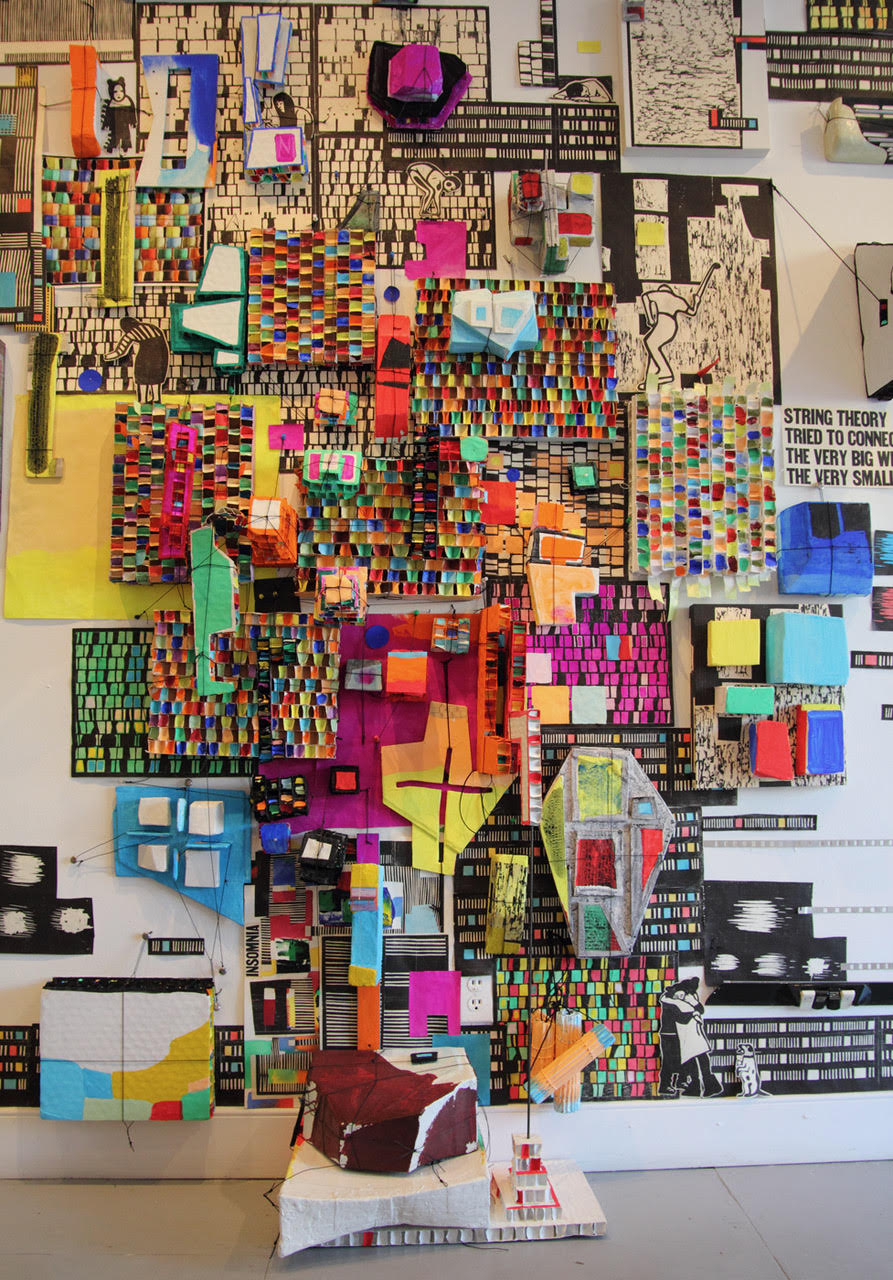
    Libby Hague, Pattern Recognition, 2017, installation view at loop Gallery. Courtesy of loop Gallery

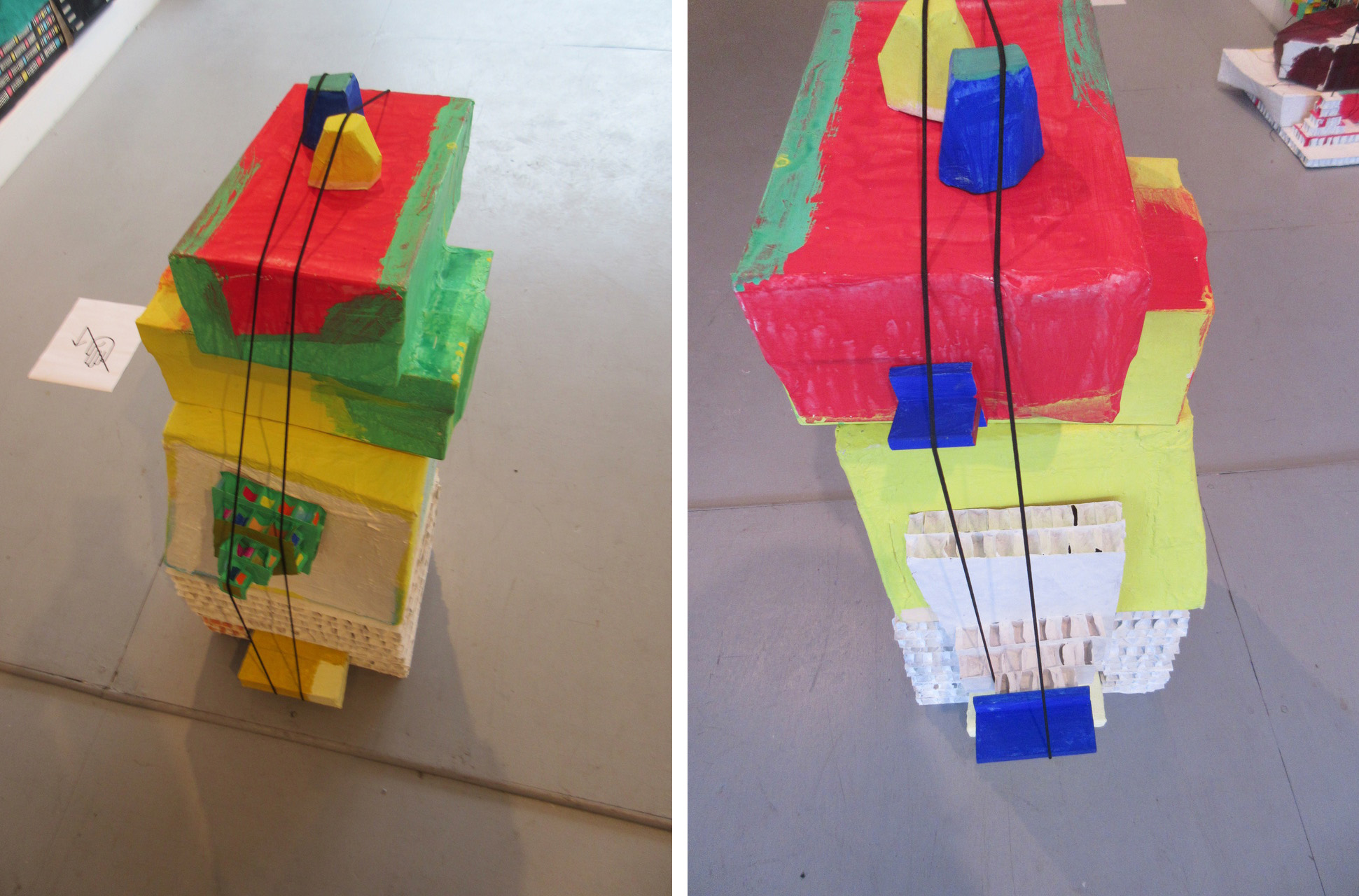
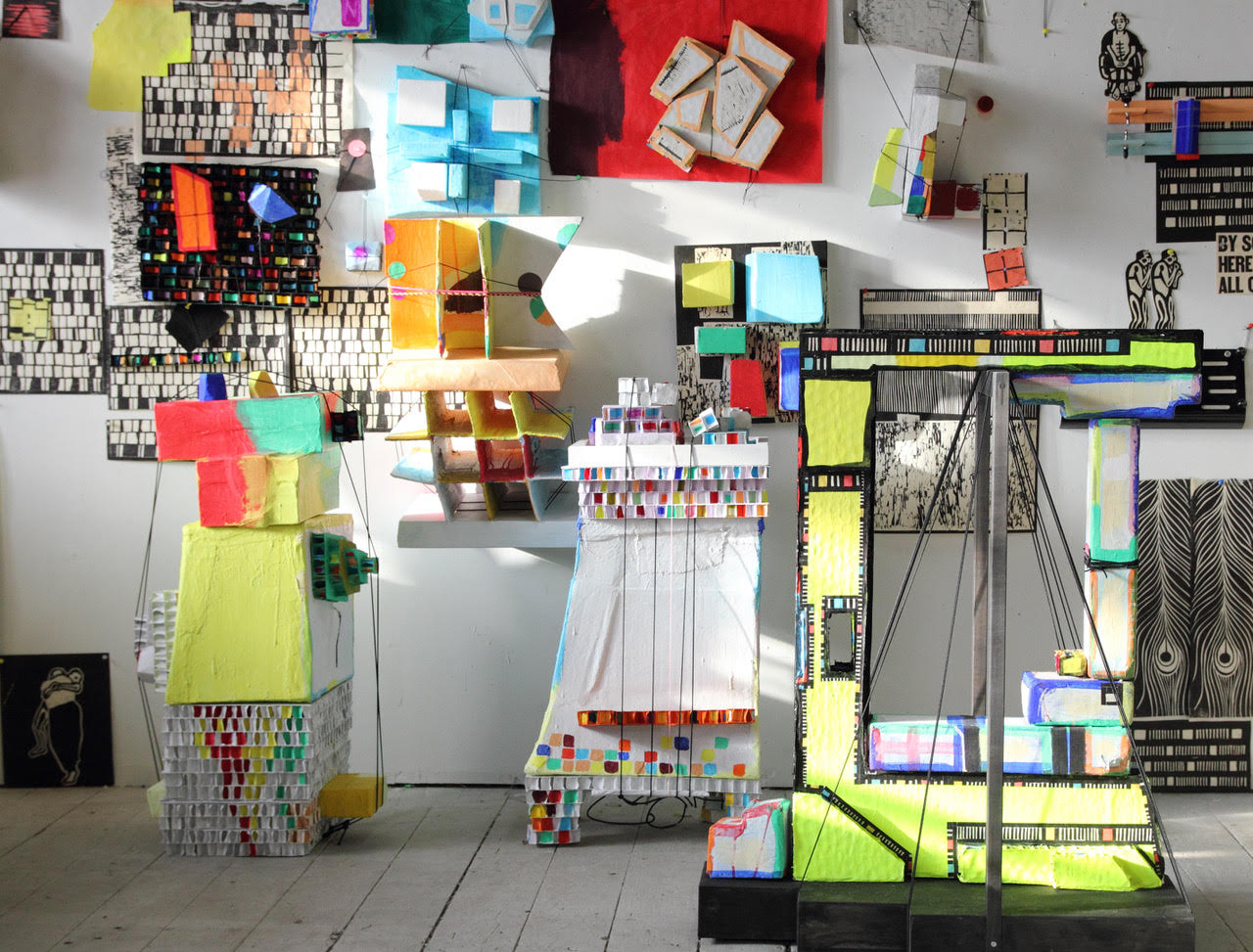
    One of the most fascinating aspects of Libby Hague’s Pattern Recognition is that it is not complete without the viewer. Hague’s exhibit, governed by notions of play, cannot exist without the viewer’s participation and cannot be complete without this integral element. Hague’s works are created from various forms of cardboard, paint, string, and other accouterments. Evocative of colourful musical instruments and toys, the works foster an experience of sensory overload for the viewer. Thus, just as Hague has synthesized materials such as honeycomb cardboard and string to create an ostensible musical instrument, so too is the viewer invited to synthesize the sensory overload and engage with its variegated elements.

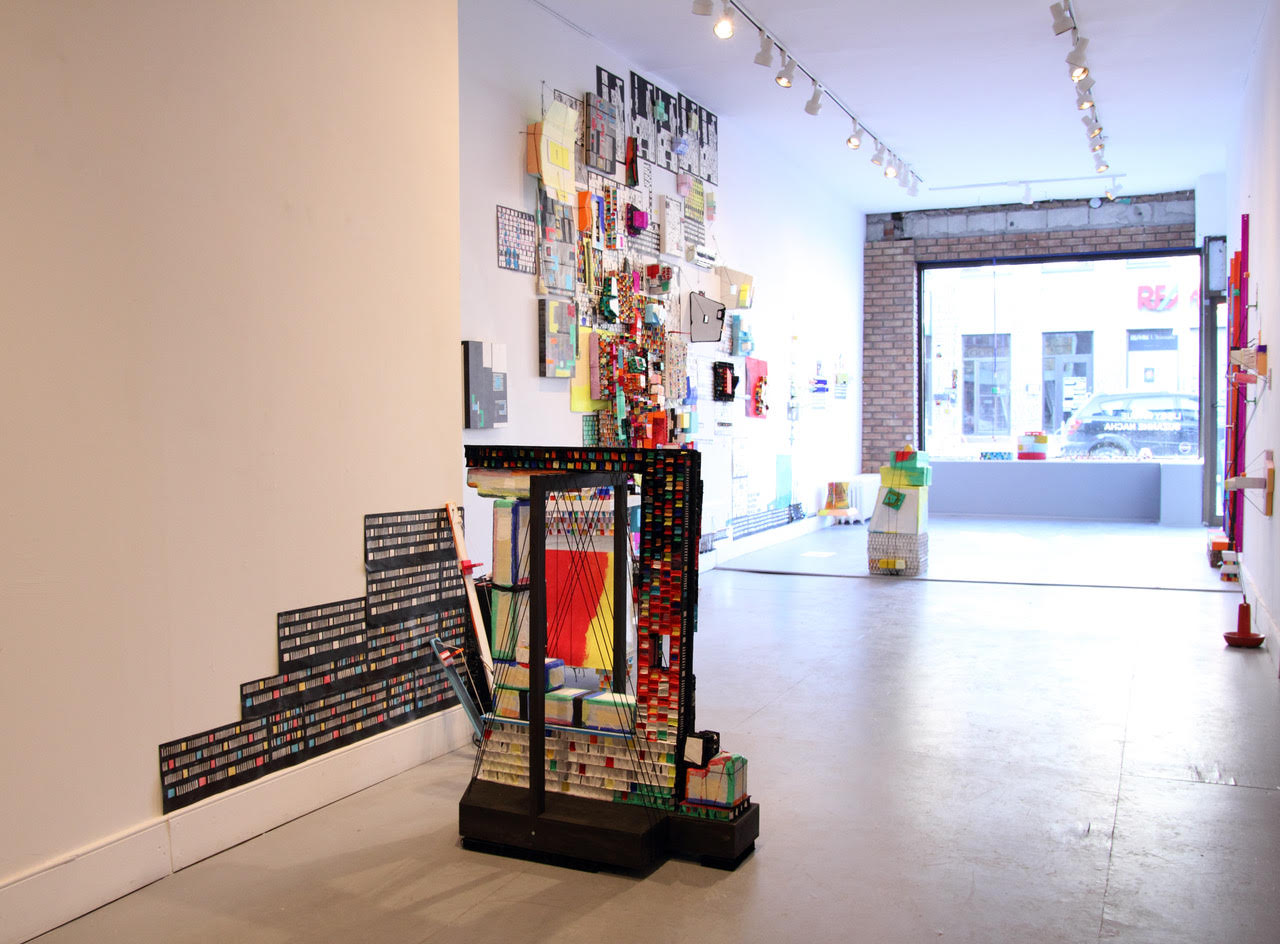
    Libby Hague, Pattern Recognition, 2017, installation view at loop Gallery. Courtesy of loop Gallery

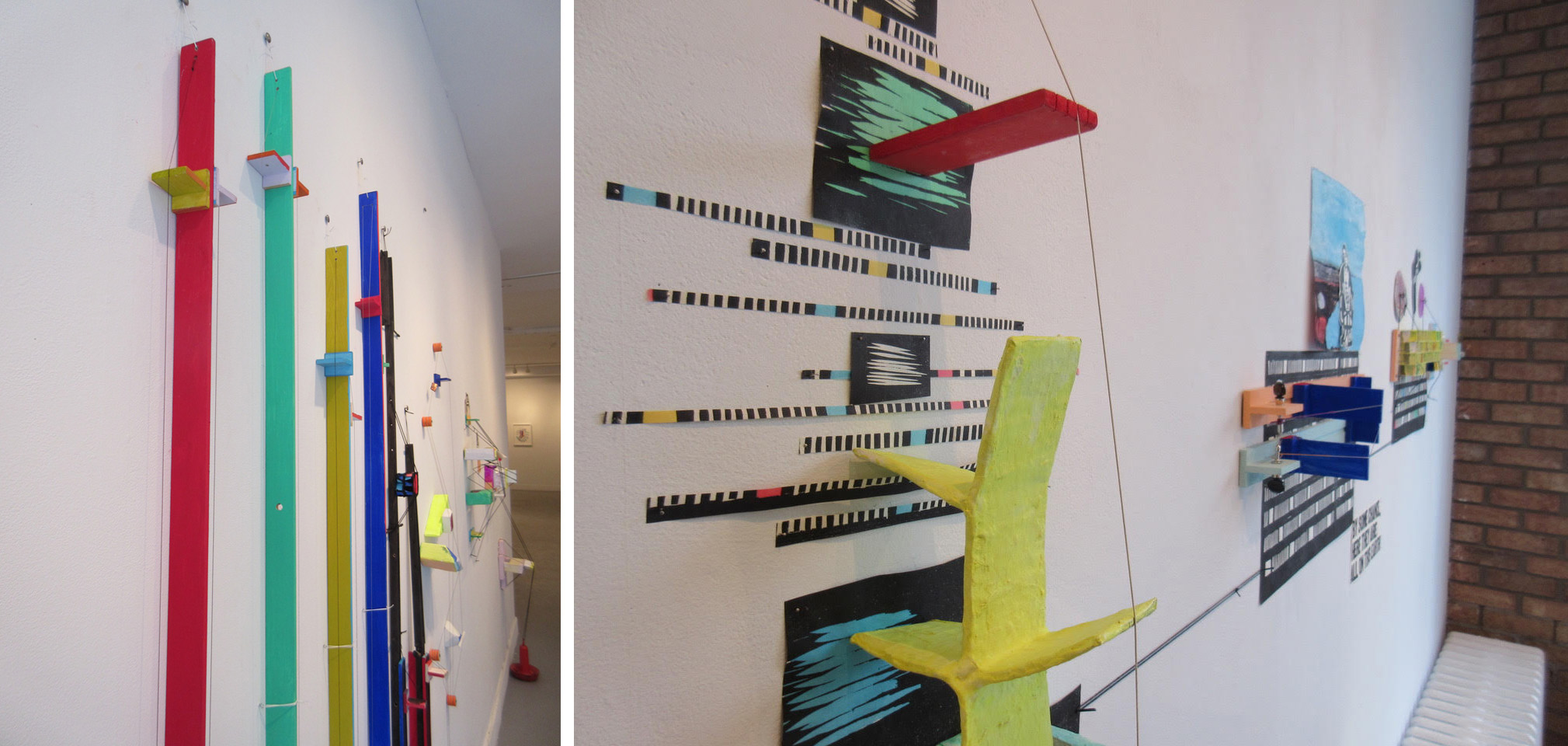
    The exhibit is designed to be accessible to all viewers, as well as to be anchored in its own reality. Hague’s works, which span the main wall at loop Gallery, deliberately extend to the floor, appealing to viewers of all ages. In fact – as Gallery Manager, Kelly McKenzie reminded me – Hague even scheduled a “Playdate” (Sunday, January 15, 2017) designed to facilitate viewers’ playing with the works. While some of the works cannot be touched, the exhibit is motivated by its desire to connect with the audience through tactile and spatial engagement. The positioning of the works within the space invites children to experience them, as does the exhibit’s brilliant colouring. Some works even hang in front of the window; so, the viewer experiences them before the backdrop of Dundas Street West, further situating the works in the gallery space as well as grounding the viewing experience in the present time and place.

    Libby Hague, Pattern Recognition, 2017, installation view at loop Gallery. Courtesy of loop Gallery

    Libby Hague, Pattern Recognition, 2017, installation view at loop Gallery. Photo: Laura Hutchingame

    Hague’s emphasis on structure is particularly interesting. The act of structuring and restructuring is central to the works, and, in a sense, this mimics the cognitive restructuring the viewer must engage in. The goal is synthesis. Just as the “instruments” are created with strings designed to mimic authentic musical strings, the strings themselves remain inauthentic. Similarly, the honeycomb cardboard evokes, but is not, an accordion. Following Hague’s theme, however, it is not about the authenticity of the individual components; rather, it is about what these individual components create together. Are these “instruments,” which function as instruments and contain the same elements as instruments, not instruments? Hague privileges the composite work and its promotion of play. After all, if the composite work can accomplish this fundamental goal, the individual components become less relevant.

    Libby Hague, Pattern Recognition, 2017, installation view at loop Gallery. Photo: Laura Hutchingame

    Libby Hague, Pattern Recognition, 2017, installation view at loop Gallery. Courtesy of loop Gallery

    While meditating on the exhibit, I was most struck by the relationship of the works themselves to the loop Gallery space. Given that structure was central to the exhibition, I asked McKenzie: “How much do you think the structure of the exhibit was dictated by the gallery space itself?.” McKenzie’s response profoundly illuminated the works for me, emphasizing that the specialty of Hague’s exhibition is its ability to be in any space. The brilliance of Pattern Recognition, then, must be its offering of the chance experience that cannot be replicated anywhere else as well as its inclusive embrace of the unique. Pattern Recognition makes us stop, look and, above all, play in the instant we inhabit.

    Laura Hutchingame

    *Exhibition information: December 31, 2016 – January 22, 2017, loop Gallery, 1273 Dundas Street West, Toronto. Gallery hours: Wed – Thur 12 – 5, Fri -Sat 12 – 6, Sun 1 – 4 pm.