Author: artoronto

  • Judy Raymer Ivkoff: Earthly Matters

    Walking on busy Church Street, surrounded by noisy crowds and then stepping into the Canadian Sculpture Centre is like entering a different world. Not just because you are leaving everyday life behind and entering an art gallery but because the silence inside is deep, a feeling of pure solitude greets you.

    Celebrating Earth Day, Earthly Matters explore elements of nature. The nature that inspires Judy Raymer Ivkoff’s work is the most ancient aspect of earth, the dark, all enveloping one. It can be nurturing with its fertile soil and threatening with its darkness both at the same time. All the works, regardless of the material the artist used, are monochromatic: earth colored, showing every shade of the ground.

    Judy Raymer Ivkoff, Wilderness, wood, steel (left) and Life Source, oxide glaze fired clay (right)

    In her artist statement Raymer Ivkoff writes: “My subject matter centres on elements of the natural physical environment within the context of movement, order, time, energy, rhythm and regeneration.” My overall feeling of the show was something very earthly. I could almost smell the richness of soil after a rain or ploughing, a sensation that goes back at the beginning of mankind.

    The exhibition contains of three series. “Forest” is an earlier series the artist began in 1998. Each sculpture is freestanding, narrow, linear and upright, approximately 7 feet high and made of hand hewn wood with metal detail. Each piece rests on a bedrock of unadorned limestone. Raymer Ivkoff depicts the amazing richness of a forest with its tall trees that try to reach even higher, closer to the sun, and the abundance of undergrowth. I could imagine many of those sculptures put close together like a real forest. Walking in between them, one easily could feel like you were entering the black forest of the Brother Grimm – welcoming and tricky at the same time. One of the clay figures from the Khivas series, a hooded one without a face, could easily be a creature in that forest.

    Judy Raymer Ivkoff, Forest  Series, wood, limestone base

    The entire exhibition seems to be curated around the forest and its flora. There is a piece dedicated to every stage of natural growth. “Sighting”, a relief, from the series with the same title, take us underground when we can peek at seeds hiding in their winter retreat, ready to spring into life. “Root Force” shows the amazing energy of the seed, growing into small roots, so fragile looking, but extremely strong that it can brake through rocks and stones until the plant rises out of the ground. Eventually they become roots of larger plants, even trees, connecting the plants to the nurturing earth. In some works surfaces are covered with various kinds of leaves, fragile and beautiful, rhythmically bending in the wind.

    Judy Raymer Ivkoff, Root Force, bronze, limestone

    Judy Raymer Ivkoff, Sightings, wood  steel

    My favourite piece, “Combined Forces” is a clay, boat-like structure filled with a lighter colored material, maybe sand, that gives a cradling home to some vegetation that looks like seaweed, made of metal strips. I can easily imagine an abandoned seaside where a forgotten boat slowly filled up by the sea.

    Judy Raymer Ivkoff, Combined Forces, bronze  oxide fired clay

    All the pieces are abstract, focusing on natural movement, rhythm and textures observed during the artist’s walks in the woods. 

    Judy Raymer Ivkoff, Khivas Series, oxide glaze fired clay

    Emese Krunák-Hajagos

    Images are courtesy of Canadian Sculpture Centre

    *Exhibition information: April 6 – 28, 2017,  Canadian Sculpture Centre, 500 Church Street. Gallery hours: Tue – Fri: 12 – 6, Sat: 11 – 4 p.m.

  • CONTACT 2017 / Artoronto picks

    This is the 21th Scotiabank Contact Photography Festival, the largest photography festival in the world. With so much choices, with well over 1500 Canadian and international artists and photographers exhibiting at more than 200 exhibitions throughout the Greater Toronto Area, it isn’t easy picking exhibits to see.

    We all look forward to seeing much more than the ones listed but these caught our interest and everyone is sure to have their own list as well.

    Phil Anderson, publisher/writer:

    The Past is Never Far / Summer Leigh
    May 7–September 17
    Mackenzie House
    82 Bond St.

    Summer Leigh, College Street from Yonge Street. Digital photograph through analog image. Toronto Archives Fonds: 1244, Item 1104, 2014 & 1916

    Fluid Beauty / Robert Mapplethorpe
    April 29–May 27
    Olga Korper Gallery
    17 Morrow Ave
    Robert Mapplethorpe, Lisa Lyon, 1982. Gelatin silver print, 20×16. © Robert Mapplethorpe Foundation. Used by permission

    The Marco Flow Perception, Luca Hiroyuki d’Addario
    May 2-June 2
    Provo Foodbar
    308 Dundas St. W.

    Emese Krunák-Hajagos, publisher/writer:

    night vision / Richard Kuzniak
    May 1–31
    Junction – Coolearth Architecture Inc.
    386 Pacific Ave

    Richard Kuzniak, Kensington Market, 2016
    BODY OF COLOUR / Stef Eleoff, Callen Schaub
    May 5–28
    Project Gallery Studios
    184 Munro St Unit 6

    Fallen Princesses / Dina Goldstein
    May 11–June 10
    Gallery House
    2068 Dundas St W

    Dina Goldstein, Rapunzel, 2007

    Steve Rockwell, publisher/writer:

    Suzy Lake
    April 29–August 13
    Ryerson Image Centre
    33 Gould Street Toronto
    Suzy Lake, Thin Green Line, 2001, chromogenic print. Courtesy of the artist and Georgia Scherman Projects

    dot-dot-dot / Jacob Whibley
    May 12–31
    8eleven
    233 Spadina Ave

    Bound, Hupfield 2017 / Maria Hupfield
    January 28–May 14
    The Power Plant Contemporary Art Gallery,  South Façade
    231 Queens Quay W.

    Maria Hupfield, Bound, Hupfield 2017, 2017. Inkjet print on vinyl, 19 × 31′. Courtesy of the artist.

    Andriy Bilenkyy, writer/photographer

    As Yet Untitled / Max Dean
    April 29–August 13
    Ryerson Image Centre
    33 Gould Street Toronto

    Blueberry Hill / Seth Fluker
    April 25–May 28
    Cross-Canada Billboard Locations
    Billboards on Lansdowne Ave at Dundas St W and College St

    Seth Fluker, Cowboy Trail Triptych, 2015. Courtesy of the artist.

    Deutsche Demokratische Republik: The Stasi Archives / Adrian Fish
    April 22–May 14
    loop Gallery
    1273 Dundas St W.

    Adrian Fish, Stasi Archives #3692, Archival pigment print, 36 x 24″

    Jordan Fee, writer/photographer:

    It’s All Happening So Fast: A Counter-History of the Modern Canadian Environment / Group Exhibition
    May 3–July 15
    Art Museum at the University of Toronto
    15 King’s College Circle

    Margo Pfeiff, Contaminated soil bags at Lower Base, Cape Dyer, 2013 © Margo Pfeiff

    A Survey of Photographs / Charles Gagnon
    May 13–June 17
    Stephen Bulger Gallery
    1026 Queen St W.

    Charles Gagnon, Fictions to Jorge Luis Borqes S2A, 1987. Gelatin silver print, 8×10.

    Don’t Forget to Wave / Tommy Keith
    May 4–14
    Unlovable General & Gallery
    1415 Dundas St W.

    Carolyn Peralta, writer/photographer:

    Pacifier / Petra Collins
    April 29–June 24
    CONTACT Gallery
    80 Spadina Ave Ste 205

    Petra Collins, Anna and Kathleen (Rainbow), 2016. Courtesy of the artist.

    Lindsi Beth Perspectives /Lindsi Hollend
    April 30–May 14
    Creeds Coffee Bar
    390 Dupont St

    Queen Street West / Dario Fresco
    May 1–28
    Century 21 Regal Realty
    1291 Queen St W.

    Dario Fresco, Queen Street West, 2016

    David Saric, writer/photographer:

    Newfoundlandings / Michael Snow
    May 5–July 22
    Prefix Institute of Contemporary Art
    401 Richmond Ste 124

    Michael Snow, Solar Breath (Northern Caryatids), Video still, 62 mins. Courtesy of the artist.

    As Yet Untitled / Max Dean
    April 29–August 13
    Ryerson Image Centre
    33 Gould Street Toronto

    Max Dean, As Yet Untitled, 1992-1995, View of robotic installation, Art Gallery of Ontario, Toronto, 1997. Courtesy of the artist and the Art Gallery of Ontario. © Max Dean

    Pacifier / Petra Collins
    April 29–June 24
    CONTACT Gallery
    80 Spadina Ave Ste 205

    Simon Termine, writer/photographer:

    Free Black North
    April 29–August 20
    Art Gallery of Ontario
    317 Dundas St W.

    Unknown photographer, Unhappy girl, 1870-1880. Tintype, 3.5 x 2.5”. Richard Bell Family Fonds, Brock University Archives. Courtesy of Brock University Archives. © 2017 Art Gallery of Ontario

    Size Matters / Finn O’Hara & Steve Driscoll
    March 11–August 20
    McMichael Canadian Art Collection
    10365 Islington Ave, Kleinburgsmartphonehoesjes-nlbest replica watch website

    Finn O’Hara & Steve Driscoll, For a Moment, 2014. Chromogenic print, 45 x 60″

  • Iris Häussler: Sophie La Rosière Project – Chapter III at Daniel Faria

    Installation view of Iris Häussler: The Sophie La Rosière Project – Chapter III, at Daniel Faria Gallery, 2017. Courtesy of Daniel Faria Gallery

    Secrecy and revelation are the dominant motifs of Iris Häussler’s Sophie La Rosière Project, an elaborate undertaking which presents a plethora of objects related to a fictional artist active in the late ninetieth – early twentieth century, including not only the paintings attributed to her creative efforts, but also the supposed articles from her workstation and living quarters, and even video installations where contemporary conservationists restore her artworks, critics place them within the Fin de siècle and modernist milieu, and psychoanalytics navigate members of the audience through crests and throughs of the artist’s tumultuous mental life. Sophie La Rosière’s preferred working surface was the rough wooden terrain of doors and shutters, later concealed by layers of black wax. Conceiving, producing and concealing La Rosière’s painting took the authorial mastery of Iris Häussler. To unveil and interpret the concealed, Häussler summoned outside parties, without, apparently, letting some of them in on the main secret behind the artifacts presented to them: fictionality of the artist that supposedly brought them to life. 

    Iris Häussler, The Sophie La Rosière Project (SLR-262, 1912), 2016. Oil paint on wood. 12″ x 37”, fragment. Photo: Andriy Bilenkyy

    Iris Häussler: The Sophie La Rosière Project – Chapter III. Courtesy of Daniel Faria Gallery

    Secrecy produces an “immense enlargement of life,” writes Georg Simmel, a German sociologist, philosopher, and critic most active at the beginning of the twentieth century, contemporaneously with the supposed heyday of La Rosière’s artistic career. “The secret,” Simmel notes, “offers, so to speak, the possibility of a second world alongside the manifest word: and the latter is decisively influenced by the former” (Soziologie, 1908). At the heart of secrecy, according to Simmel, lies a conflict between concealment and revelation, an external one, between the holder and the outsider, and, sometimes, an internal one, between the holder’s desire to keep something secret and her conflicting desire to divulge it. Finctionality, as always, complicates things; in case of Sophie La Rosière Project, the conflict is between the character’s desire for privacy and the author’s interest in showcasing her creation. 

    Installation view of Iris Häussler: The Sophie La Rosière Project – Chapter III, at Daniel Faria Gallery, 2017. Courtesy of Daniel Faria Gallery

    Installation view of Iris Häussler: The Sophie La Rosière Project – Chapter III, at Daniel Faria Gallery, 2017. Courtesy of Daniel Faria Gallery

    Installation view of Iris Häussler: The Sophie La Rosière Project – Chapter III, at Daniel Faria Gallery, 2017. Courtesy of Daniel Faria Gallery

    In Chapters I and II of the Project, presented earlier at The Art Gallery of York University and Scrap Metal Gallery, this conflict reached an uneasy stalemate, as Häussler took care not to extract La Rosière’s paintings completely from their supposed original environment. In Chapter III, showcased at the Daniel Faria Gallery, the author clearly prevails. The exhibition is an overview of the key elements of the Sophie La Rosière Project, not a presentation of La Rosière’s oeuvre; it’s a celebration of the author rather than an homage to her fictional character. The difference is subtle but noticeable. As one walks through the spacious premises of the gallery, looking at wax-covered doors, x-rays of what they once concealed, restored works and sketches – all arranged matter-of-factly, as works of a contemporary artist, without the meticulously constructed vintage ambiance of a recluse’s workstation or the austerity of a conservationist’s workshop, one can’t shake the impression that the author has triumphed over her creation, and that it wasn’t an easy victory. “The intention of hiding,” notes Simmel, “takes on a much greater intensity when it clashes with the intention of revealing.”  Here, “the intention of revealing,” has won the day. All the secrets are uncovered. Iris Häussler is ready to move on. 

    Andriy Bilenkyy

    *Exhibition information: March 9 – April 29, 2017, Daniel Faria Gallery, 188 St. Helen’s Avenue, Toronto. Gallery Hours: Tue – Fri, 11 – 6; Sat, 10 – 6 pm.

  • The Distance Between – Myron Jones at Lonsdale Gallery

    The exhibition of works on paper, The Distance Between, on now at Lonsdale Gallery offers a unique landscape painting perspective from the eyes of Myron Jones.

    Jones shared that these small works, inspired by his travels to France, Ireland, and Italy, are a deviation from the larger pieces he previously produced. Nonetheless, their impact is remarkable, as they invite the viewer to engage with the essence of their location that Jones translates to the paper. 

    Myron Jones, Charentes #60, 2015, watercolour on 300 lb arches cold press paper, 14 x 19 cm. Courtesy of Lonsdale Gallery

    From the way in which Jones describes his process, it is apparent that he is very methodological. Preferring to produce his compositions after looking through the photographs taken during his trip, he produces these works in a studio where he has the utmost control, which allows him to overcome feats of working in smaller scale and with the watercolour medium. However, the artist’s attention to detail and mindfulness with his material is evident without his explanation, as he successfully conveys the essence of his location abroad in an impactful manner. 

    Myron Jones, Collesalvetti #14, 2016, watercolour on 300 lb arches cold press paper, 14 x 19 cm. Courtesy of Lonsdale Gallery

    Jones’s form of landscape abstraction displays compositions that play with the relationship between foreground and background, through manipulations of perspective and alternation between geometrical and figurative representations of the land. Constantly struck by intersecting lines and lines that end abruptly – each piece demonstrates a careful combination of these elements – while also presenting repeated features of the landscape with unique forms. The muted colours act in accordance with the subtle qualities of the work. In the minimalist spirit, the landscapes by Jones have an air of simplicity despite their intricacy.

    Myron Jones, Royan #6, 2015, water colour on 300 lb arches cold press paper, 14 x 19 cm. Courtesy of Lonsdale Gallery

    These elements all come together in Royan #6 (2015) in a harmonious manner. The various horizontal and vertical lines, take slight angles that mimic the gradations in colour. The foreground’s dominance is emphasized by both the high horizon line and the receding vertical lines that play with traditional perspective. The general sections of colour also divide the composition in yet another way, while the more opaque and darker hues along the top and bottom balance it out.

    The Distance Between is a beautiful interpretation of the lands of France, Ireland, and Italy. With Jones’s next trip planned to Newfoundland, it will be hard to wait to see what he produces next.

    Carolyn Peralta

    *Exhibition information: April 1 – 23, 2017, Lonsdale Gallery, 410 Spadina Road, Toronto. Gallery hours: Wed – Sun, 11 am – 5 pm.

  • de Andrade, Echakhch, Hupfield & Kiwanga at The Power Plant

    Currently at The Power Plant, four solo installations address four distinct subjects. The immersive environments created in each uniquely engage the visitor, encouraging a critical re-evaluation of global realities and universal sentiments.

    Brazilian artist, Jonathas de Andrade exhibits uncanny events that confront the projected national identity of Northern Brazil and reveal a real power imbalance. He portrays intimate situations that form initial impressions of life. Simultaneously, he exhibits the circumstances in which these situations came to be. In this way he intertwines an alternative narrative, confusing initial impressions and illuminating more complex realities.

    Subtly obscuring the line between reality and fiction he is able to tell otherwise invisible stories. O peixe (The Fish), a fabricated expose shot on 16mm film, immerses the audience in an equally beautiful and unsettling ritual of fishermen cradling their catch. In the repetitive motions, sublime visuals, slow pace, and added natural sounds the scene becomes almost nostalgic. The film introduces the audience to de Andrade’s alternate method of educating; where the visitor becomes immersed in a constructed narrative and slowly begins to derive the embedded analogies.

    Jonathas de Andrade: On Fishes, Horses and Man. Installation view: The Power Plant, Toronto, 2017. Photo: Toni Hafkenscheid. Courtesy of The Power Plant

    For O Levante (The Uprising), the collection of framed correspondence documents, orienting maps, still images and documentary film, reveal a whole culture otherwise pushed to town’s borders. It becomes clear that the horse drawn cart race was really an exercise in maneuvering around an imposed system to bring forward a largely ostracized population.

    Jonathas de Andrade: On Fishes, Horses and Man. Installation view: The Power Plant, Toronto, 2017. Photo: Toni Hafkenscheid. Courtesy of The Power Plant

    Cartazes para o Museu do Homem do Nordeste (Posters for the Museum of the Man of the Northeast) encompasses the open space within the gallery. In sharing with the anthropological museum of Recife this work becomes an alternative museum that questions the reality of the projected racial democracy. Photographing the varied local population, through recruited newspapers adverts and chance meetings with workers in the streets of Recife, he captures a contrary selection. While de Andrade is an artist, in his pursuit he takes on the role of museum curator, documentarian, and film-maker. By personifying different professions he is able to reveal real contradictions with hometown’s projected identity.

    Jonathas de Andrade: On Fishes, Horses and Man. Installation view: The Power Plant, Toronto, 2017. Photo: Toni Hafkenscheid. Courtesy of The Power Plant

    The exhibitions that follow uniquely address other content. Maria Hupfield emphasises object, ritual and the significance of place in forming identity through her exhibition of personal objects and past performances.

    Maria Hupfield: The One Who Keeps On Giving. Installation view: The Power Plant, Toronto, 2017. Photo: Toni Hafkenscheid. Courtesy of The Power Plant

    Latifa Echakhch uses an accessible, universal subject and material; the sky rendered in cement, to create an atmospheric space for contemplation and interpretation.

    Latifa Echakhch: Cross Fade. Installation view: The Power Plant, Toronto, 2016. Photo: Toni Hafkenscheid. Courtesy of The Power Plant

    Kapwani Kiwanga isolates atmospheres and architectures to provoke the re-evaluation of spatial impact.

    Kapwani Kiwanga: A wall is just a wall. Installation view: The Power Plant, Toronto, 2017. Photo: Toni Hafkenscheid. Courtesy of The Power Plant

    These diverse exhibits, in experimenting with methods of communication, demonstrate interesting possibilities in educating about current global realities.

    Nika Teper

    *Exhibition information: Jonathas de Andrade, On Fishes Horses and Man; Maria Hupfield, The One Who Keeps On Giving; Kapwani Kiwanga, The wall is just a wall  & Latifa Echakhch, Cross Fade, January 28 – May 14, 2017, The Power Plant, 231 Queens Quay West, Toronto. Gallery hours: Tue – Sun, 10 am – 5 pm; Thur 10 am – 8 pm.

  • Isaac Julien: Other Destinies at the ROM

    The concept of space is explored as a physical location, a cultural, political or ethnic space and also as a place of displacement in many works by Isaac Julien—an award-winning British artist and filmmaker. The exhibition Isaac Julien: Other Destinies at the Royal Ontario Museum is curated by Dr. Silvia Forni—Curator of African Arts and Culture. It features two films from Julien’s multi-screen Expedition Trilogy. Western Union: Small Boats (2007) sheds light on the complex entanglement between Africa and Europe, and issues surrounding black diaspora, their identities, and migration. True North (2004) draws inspiration from the story of Robert Peary and Matthew Henson in the 1909 Polar Expedition, in which Julien evokes problems such as exploration, the impact of global warming, and displacement. Subjects explored in both films have strong contemporary relevance, thus this exhibition establishes its significance as it provokes thoughts and discourses surrounding some current events.

    Isaac Julien, True North, 2004, multi-screen film, Royal Ontario Museum, 2017. Photo: Yilong Liu

    The location of the exhibition greatly supports the context of the two films. It is installed in the Roman Gallery on the third floor, thus visitors go through rooms filled with western antiquity before they enter Julien’s exhibition. The artist himself appreciates the placement, as the art of the Roman Empire juxtaposes the space of contemporary Italy in Western Union: Small Boats. Both films are multi-screen and projected onto three large screens (six in total) in two separate rooms. The placement of the screens for each film is different and connected to the subject matter and the general sentiment of the film. To be specific, the three screens for Western Union are hung mid air, barely touching the ground thus reflecting the struggle and uncertainty of migration, and the lightness of the floating boats in vast sea. The three displays of True North are placed right on the floor, as if they are grounded by the subliminal scenes of nature, echoing the heaviness of the steps of the explorers.

    Isaac Julien, Western Union, Small Boats, 2007, multi-screen film, Royal Ontario Museum, 2017. Photo: Yilong Liu

    Julien’s aestheticization of histories makes his work outstanding with its uniqueness. In Western Union, he hired professional dancers to choreograph body movements that represent the physical struggles of migration. Their performance, highlighted with the presence of British actress Vanessa Myrie, create an experience that questions the Utopian and unreal fantasy that the migrants have about Europe. Through aestheticizing the bodies, their movements and the background, it becomes clear to the audience that this is not a real footage but a reiteration of history. Julien invites the viewer to think not only about the fact of migration, but also, the tropes that control its representation.

    Isaac Julien, Western Union, Small Boats, 2007, multi-screen film, Royal Ontario Museum, 2017. Photo: Yilong Liu

    It is safe to argue that Julien himself is aware of the issue of ‘realistic’ representation in documentary, and his refusal of it makes sense. He moves away from simple documentation and also deepens the idea of displacement through the appearance of Venassa Myrie in both pieces. As she appears in the central screen of Western Union, standing in the half-open metal gate of a palace, looking into distance; her confident and comfortable, yet almost ghostly, presence makes her both a witness and a survivor in the story of migrants, what Shelleen Greene calls a “survivor-witness” (a notion mentioned in Emma Chubb’s article titled: Small Boats, Slave Ship; or, Isaac Julien and the Beauty of Implied Catastrophe).

    Isaac Julien, Western Union Series No. 1 (Cast No Shadow), 2007. Duratrans image in lightbox, 120 x 120 cm. Courtesy the artist, Victoria Miro Gallery, London and Metro Pictures, New York.

    In True North, her appearance in the landscape of  Iceland is a visual and existential testament to the presence of black people in a space that was once deemed to be unsuitable for them to live in due to extreme coldness. Similar to Western Union, the highly aestheticized landscape, people and the subliminal nature constantly remind the audience that this is not a real footage nor a documentary for the Polar Expedition.

    Isaac Julien, True North, 2004, multi-screen film, Royal Ontario Museum, 2017. Photo: Yilong Liu

    Migration as a major theme in both Western Union and True North finds its contemporary resonance among the visitors. Julien’s work, although created years ago, invites the audience to think about migration as it is continue to persist and need to be addressed.

    Yilong Liu

    *Exhibition information: January 21 – April 23, 2017, Royal Ontario Museum, 100 Queen’s Park, Toronto. Museum hours: Mon – Sun, 10 am – 5:30 pm.

  • Alternative Histories / Division Gallery

    Alternative Histories, 2017, installation view with Nicolas Baier’s work at Division Gallery. Courtesy of Division Gallery Toronto

    The exhibit Alternative Histories at Division Gallery brings together artists Nicolas Baier, Patrick Coutu, Manon De Pauw, Miruna Dragan, Alex McLeod, John Monteith and Charles Stankievech, for a captivating show that contemplates what is fact and what is fiction, and the space in between and beyond. The show not only features this discourse, but also shines the light on us – as humans who are merely mediators in this complicated sphere – showing us that what we know to be true and what is true can be two completely different stories.

    John Monteith, All That We Seem Not To Be Able To Say, 2015, Archival giclee photographs on HP premium ID satin, 106″ × 142″. Courtesy of Division Gallery

    “Grotte” by Nicolas Baier steals the show with its warm amber glow both radiating out and enticing us in. Its installation is alluring; your gaze falling on the lightbox as you turn the corner into the exhibition space. Baier’s careful placement of light behind his inkjet print of a real grotto is paired with another one of his fascinating real life expedition shots from underwater, superimposed with a geometric element, “Sans titre (Cenote) 2/5.” These pieces not only test the limits of what we imagine to be real, but also stand in contrast with Bair’s “Photons (The World of the Mind),” the result of the artist’s adaptation of a man-made grotto that could easily fool many.

    Nicolas Baier, Grotte, 2012, inkjet print on translucide paper, light box, baked matt black paint, LED and black vinyl,  51″ × 76″. Courtesy of Division Gallery

    In fact, and fact shouldn’t be used lightly, many of these pieces are not what they seem at first glance. Although deceptively real and familiar looking, Alex McLeod’s 3D renderings, displayed here in one colour video, “Thunder Come,” and one inkjet print, “TILTED,” need a more contemplative look to realize the fabric of their make-up. 

    Alex McLeod, Thunder Come, 2016, Colour Video. Courtesy of Division Gallery

    Patrick Coutu’s sculpture, “Eruption,” demonstrates his continued interest in the natural and organic. His piece goes beyond its physicality while its story is continued through its shadow on the gallery wall. Here, and in many other cases in this show, you need to adopt to a different perspective. Composed of several pieces of cut brass, “Eruption” speaks to the several particles and DNA that comprises organic material.

    Patrick Coutu, Eruption, 2017, brass, 84” x 36” x 2”. Courtesy of Division Gallery

    The work presented by Charles Stankievech is probably the most captivating as it is a result of his experience at a military base camp on the most northern part of the Earth. His eerily sublime photograph, “The Wreck of Hope (from the series The Soniferous Æther)” challenges our idea of truth. The encapsulated artifacts in “Anbarium: A Transplanetary Comparative History of Metallurgical Exchange” create a reflexive exercise of how we look and treat things that are unbelievably real. The reference to scientific writing in his printed hexagon cards, also a part of this piece, can relate to the genre of writing which is close to the name of the exhibition, “alternate history”, where stories emerge that go against the historical record and create alternative histories.

    Charles Stankievech, The Wreck of Hope (from the series The Soniferous Æther), 2013, fine art print on Baryta paper on aluminum mounting, 39 ¼” × 59″. Courtesy of Division Gallery

    In Alternative Histories the works come together to demonstrate that fact can extend beyond our most creative imagination, and that fiction can appear deceptively familiar, dissolving the border between fact and fiction.

    Miruna Dragan, The Mountains Are Mirrors #2, #1 and #3, 2013, 24″ × 36″, Graphite on archival inkjet print. Courtesy of Division Gallery

     Manon De Pauw, Série Mes lunes, 2014, inkjet print on archival paper, Edition of 5, each 28″ × 28″. Courtesy of Division Gallery

    Carolyn Peralta

    *Exhibition Information: March 11 – April 17, 2017, Division Gallery,  45 Ernest Avenue, Toronto. Gallery hours: Tue – Sat, 10 – 6 pm.

  • Stanzie Tooth: The Distance of the Moon at General Hardware

    Throughout cultures, and within both the plastic and literary arts, colours have been ascribed qualities that help illuminate certain anthropomorphic occurrences. Historically speaking, red is almost always likened to heightened emotional states, encompassing the dichotomies of love and anger, while green conjures feelings of serenity or greed. Colours also play a significant role in traditional notions of gender and identity, as softer hues such as pastel pink or canary yellow are typically reserved for women, while a more opaque pigment such as navy is said to recall an essence of masculinity. As the gendering of colours becomes increasingly trivial in contemporary times, their descriptive and mystical powers remain relatively intact. Canadian painter and relative nomad Stanzie Tooth, in her third solo exhibition at General Hardware Contemporary, explores the endless sprawls and deep mysteries of the colour blue.

    Stanzie Tooth, Meeting the distant shore, 2016. Courtesy of General Hardware Contemporary

    Titled The Distance of the Moon, the collection of mixed-media paintings on display was conceived and executed throughout the artist’s European travels, whose itinerary included Greece, Italy, Berlin and Iceland. For Tooth, blue is reminiscent of a particular notion of roominess or transition, as it hinges upon a myriad of similar hues (green, violet, grey) or physical states of being. Blue, in the form of water, is what separates land, which grounds humans in a physical way; however, it also is suggestive of travel and infinite stretches, via oceans or the sky (vividly recalling Tooth’s own itinerant tendencies.)   

    Stanzie Tooth, Moon People, 2016, plaster, felt and pigment. Courtesy of General Hardware Contemporary

    Formally speaking, Tooth’s work depicts the concept of absence through abstraction, as figures and forms act as voids within a swath of blue, amassing to a form of recognition in absentia. The canvases are unassuming, and generously line the walls of the gallery, giving the viewer ample space to contemplate and decrypt these modest artistic curiosities. The selection of blue works that initially greet a visitor upon entering General Hardware are inspired by Tooth’s adventures throughout Greece’s Mediterranean topography, while visually resembling sundried domestic fresco paintings or antiquated interior tiling. The colour blue can signify the ocean that surrounds and provides sustenance the nation, or more rudimentarily, the predominant scheme used in the Greek national flag. However, the proceeding artistic efforts rely less on instant identification, but instead, rest solely on a metaphorical undertaking that may require less passivity when experiencing the exhibition. What Tooth may intend to yield is the deterioration of memories, which resemble fractured portions of a significant whole, or porousness within a concrete image, symbolically visualized through a present or deficient use of blue. 

    Stanzie Tooth, Moon People, (detail) 2016, plaster, felt and pigment. Courtesy of General Hardware Contemporary

    In The Distance of the Moon, lived experiences are akin to the human body; both succumb to a form of weathering and disfiguration as time progresses. However, photographs, videos, and in Tooth’s case, paintings, are strident efforts to prolong those images beyond the impermanence of memories and transform them into personal histories.

    David Saric

    *Exhibition information: March 9 – April 8, 2017, General Hardware Contemporary, 1520 Queen Street West, Toronto. Gallery hours: Wed – Sat, 12 – 6 pm.

  • Vessna Perunovich: Shifting Shelter at Angell Gallery

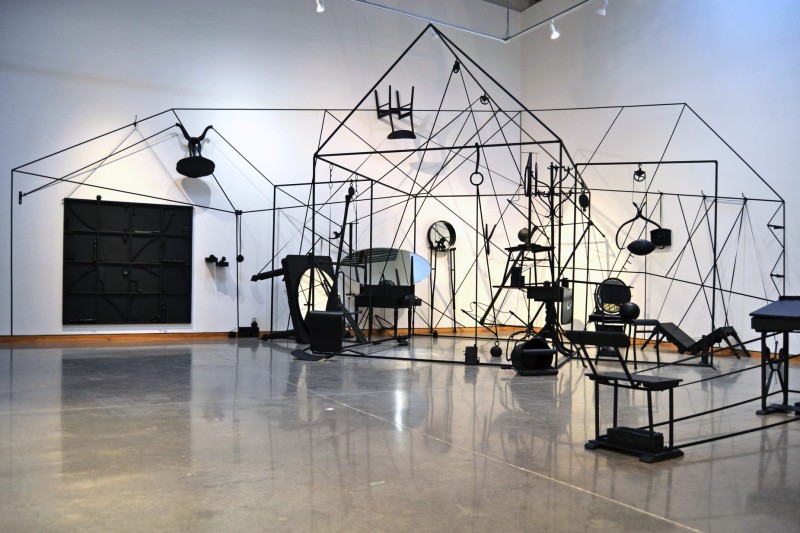
    Vessna Perunovich, Shifting Shelter, 2017, site-specific installation, house structure, various found objects, furniture, mirrors chalkboard paint, tape, elastic ribbon with Nothing to Lose, 2017, sculptural installation – small found objects, wooden board, chalkboard paint 60″ x 60″ (left) at Angell Gallery. Courtesy of Angell Gallery

    Shifting Shelter explores issues of displacement and uncertainty inherent to the immigrant experience. By force or choice, Perunovich examines the multitude of reasons people move across borders and the effects this can have on an individual’s relationship with time and space. Working with a variety of mediums, the artist has transformed the Angell Gallery into an immersive installation that effectively interrogates perceptions about immigration. 

    Vessna Perunovich, Shifting Shelter, 2017, site-specific installation, house structure, various found objects, furniture, mirrors chalkboard paint, tape, elastic ribbon. Photo: Alexis Moline

    Entering the gallery space, a disorienting mix of sound and visuals “welcomes” the visitor through a video piece of voices reciting the word in different languages. Set against a simple loop of the view through Perunovich’s studio window, the work is a meditation on the personal and universal nature of movement. This piece is positioned beside a globe, painted matte black like most of the objects in the exhibition. The visual impact of a blacked-out Earth brings into question the colonial purpose of borders, who they have been made for and why. This image also conjures up comparison to a black hole, a space of chaos and suspension that is not fixed in a time or place – a feeling that many immigrants can relate to when forced into upheaval.

    Vessna Perunovich, We Are Here Now, 2017, sculpture, globe, chalkboard paint, engraving, oil pastel, 12″ x 12″ x 15″. Courtesy of Angell Gallery

    However, the hectic mood turns to calm as more time is spent in the gallery digesting Perunovich’s work. Visitors are invited to contemplate and unpack visual cues and familiar objects that had at first impression been rendered sporadic and ambiguous. Mirroring the experience of an immigrant thrust into a new culture, the visitor must work through their surroundings and bring light to the dark.

    Vessna Perunovich, Shifting Shelter, 2017, site-specific installation, house structure, various found objects, furniture, mirrors chalkboard paint, tape, elastic ribbon. Photo: Alexis Moline

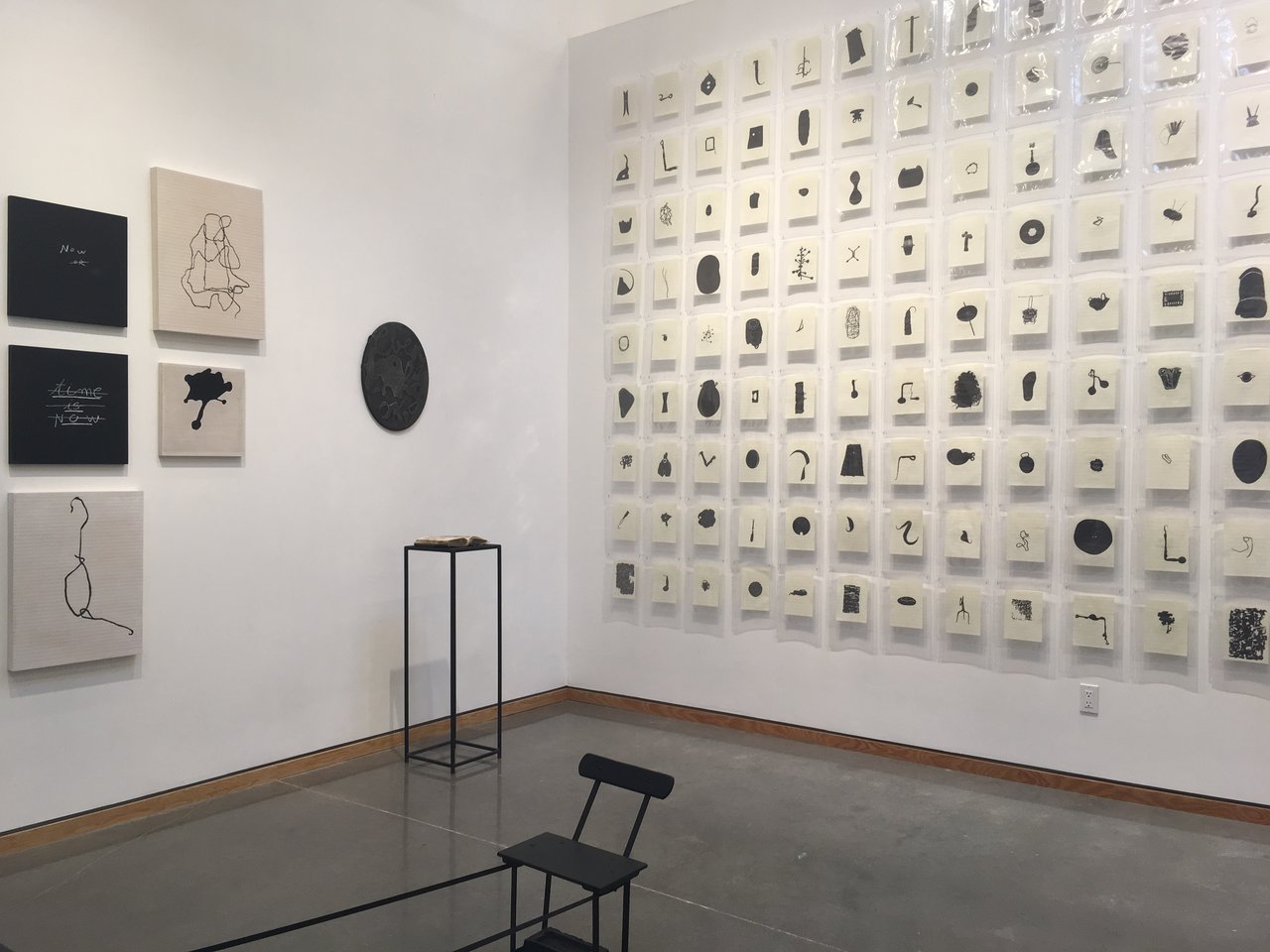
    Further into the gallery, “The Archive of Insignificant Loses” (2014-2017) occupies an entire wall. The piece is comprised of 126 drawings on notebook pages, keeping a record of lost objects found throughout Perunovich’s travels. Reduced to outlines, the subjects are decontextualized to shapes rendered unrecognizable. However, it is the act of documentation that gives them meaning. Objects often contain intense significance for those that are forced into movement, becoming symbols of a home that cannot easily be returned to. The notion of record keeping speaks to the inconsistent preservation of knowledge in times of conflict. When history has been told by the victor and the truth is increasingly in danger of being hijacked with “alternative facts”, the narratives of civilians directly impacted by domineering forces must be protected. This statement is carried on with “Close Proximity / 104550 Holes Too Many” (2012-2014), a journal with, as the title suggests, 104550 holes burned into it with a incense stick. A burned book, already an emotionally charged symbol, is a harrowing reminder of the erasure of marginalized voices.

    Vessna Perunovich, The Archive of Insignificant Loses (2014-2017) with Close Proximity / 104550 Holes Too Many, 2012-2014, artist book, incense, 11″ x 8″ (center). Photo: Alexis Moline

    Delving deep into the emotional and psychological consequences of exile, Perunovich’s exhibition bears witness to the lost, retelling essential stories in order to give them the recognition they deserve.

    Alexis Moline

    *Exhibition information: March 11 – April 1, 2017, Angell Gallery, 1444 Dupont St., Unit 15, Toronto. Gallery hours: Wednesday – Saturday, 12 – 5 pm.

  • Sculptors celebrate Canada 150

    Members of the SSC (Sculptors Society of Canada) and MASC (Medallic Art Society of Canada) have created new work in their distinctive and varied approaches in tribute of their country’s birthday.

    J.Mac, The List, mixed media

    Edward Falkenberg, Bocolic Canada 150 Years Ago, mixed-media (left) and Dina Torrans, Dreaming In Colour, mixed-media (right)

    Marianne Reim, ACCA_Immigrant / Das Buch, photo-transfer on steel; steel, stone

    Lorraine Wright, Windswept, soapstone (left) and Mary Ellen Farrow, Rivers to Oceans, Indiana limestone, copper (right)

    Magdalena Lesniak, Totem, leather, hemp, glass

    Marlene Kawalez, Wynono, fired clay, wood

    Peter Alexander Por, Interdependence, bronze

    Geert Maas, Canada Rapsody, bronze (left) and Dora dePédery-Hunt, Confederation, bronze (right)

    Photo: Peter Virün

    *Exhibition information: March 9 – 31, 2017, Canadian Sculpture Centre, 500 Church Street. Gallery hours: Tue – Fri: 12 – 6, Sat: 11 – 4 p.m.

  • Shogo Okada: Reality Ain’t Always the Truth at Wil Kucey Gallery

    Installation view of Shogo Okada, Reality Ain’t Always the Truth, Wil Kucey Gallery, 2017

    Shogo Okada’s bright, geometric works invite viewers to play a guessing game. Referencing cartoons and everyday objects from his childhood, Okada uses his wit to evoke feelings of nostalgia alongside modern, direct visuals. This contrast of emotions and graphics aligns with Okada’s own diverse background growing up in 1980s Japan with a preference for classic American imagery such as Schulz characters and ice cream truck windows. This declaration of collaboration found in his work challenges the notion of art as a singular, untouchable genius on top of an ivory tower, inviting other mediums and histories to overlap and converse. The intersection of colourful, pixelated Japanese pop aesthetics and wholesome American Dream icons allow Okada’s work to be light-hearted and fun – a refreshing and necessary contrast to the heavy nature of art produced in today’s toxic and uncertain political climate.

    Work by Shogo Okada

    Okada’s work aims to engage with collective memory, diverse artforms and the viewer themself. Familiarity is mixed with the surreal, asking viewers to unpack their unconscious personal archives of images to find out which references he is making. A circular canvas mirrors the installation work painted on the wall of the Wil Kucey Gallery using a simple blue and white wave, at first appearing to tribute vibrant 1960s California surf culture or an incisive view from a submarine window, but upon closer consideration viewers may notice the pattern is plucked from the collar of Lucy van Pelt’s dress. Drawing his audience in with the promise of recognition and the satisfaction felt from figuring out a clever puzzle, Okada keeps his work interesting and unexpected while retaining the same bold visual style throughout.

    Installation view of Shogo Okada, Reality Ain’t Always the Truth, Wil Kucey Gallery, 2017

    Urging us to have fun with and think deeper about the visual culture we encounter everyday, Okada revives pop art values for the 21st century. The blending of the usually divided “high” and “low” art questions the hierarchies of these distinctions. Okada declares the tie that Curious George’s friend The Man in the Yellow Hat wears has just as much validity as traditional Japanese Ukiyo-e, a radical idea that challenges alienating power structures that too often dominate the art world.

    Installation view of Shogo Okada, Reality Ain’t Always the Truth, Wil Kucey Gallery, 2017

    Text and photo: Alexis Moline

    *Exhibition Information: March 10 – 25, 2017, Wil Kucey Gallery, 1183 Dundas Street West, Toronto, Wed – Sat, 11 am – 6 pm.

  • Yael Brotman & Kim Stanford at loop

    In her current show at loop, Yael Brotman exhibits her new installation, Time. Story. Tree. When Brotman attended an artist residency at Haida Gwaii in the summer of 2016 she wanted to get as close to the ancient sacred trees as possible, without touching them, since it is forbidden. The way she accomplished this and created her works was through direct textural rubbings of the barks of the sacred trees. These rubbings are mainly on Mylar or paper, then transferred onto silkscreens and used to construct her sculptural pieces through the process of folding and connecting them with tape.

    Brotman explained that she was enchanted by the legends she heard and read in Haida Gwaii about magic animals like turtles, ravens and eagles and by the one about Foamwoman. She was surprised to recognize some parallels between this tales and Western mythology. Her sculpture, titled Big Woman, is a representation of the legend of Foamwoman who is reminiscent of Diana of Ephesus from the Greco-Roman mythology. Both women possessed multiple breasts that were meant to feed and nurture the earth. Brotman used theatre gels to emphasize the shape of the woman and to add some colors to the sculpture.

    Yael Brotman, Big Woman, silkscreen on Mylar, graphite, tape, and theatre gels, 2017. Courtesy of the artist

    Her second sculpture, In the house of saving things, is also produced through the process of silkscreen on Mylar. However, she has left this work up for open interpretation. As she witnessed a few times, viewers often interpreted this piece as seeing a horse or some kind of wild animal. Brotman also designed the bases of the sculptures that enables them to turn around. As part of her artist residency, after the exhibition, the sculptures will be shipped to Haida Gwaii where they will be used to tell creation myths of the land.

    Installation view of Yael Brotman, Time. Story. Tree with In the house of saving things (left), loop Gallery 2017. Courtesy of the artist

    Kim Stanford’s exhibition, You knocked my teeth out, displays a reflection of the domestic realm while allowing domestic fantasy to show through. Through her works the artist displays the struggle of trying to keep a family together with and against of all the dysfunctional elements that accompany it. The idyllic image of a functioning, happy, easy-going family is a dream that doesn’t work in everyday life. While trying to keep a family together the members often have to compromise and self-censorship tends to occur, creating frustration and psychosis.

    Installation view of Kim Stanford, You knocked my teeth out, loop Gallery, 2017. Photo: Victoria DeChellis

    Stanford uses both sculpture and collage. Her single sculpture piece is composed of general household items, including a duster, lids, knitted scarf, and plastic containers. When looking at the sculpture closely one can see a row of six teeth – maybe the ones that have been knocked out in some domestic dispute that turned violent – embedded in the central wooden piece. Stanford’s collages change patterns as she is saying different stories of this family saga and her sculptural piece seems to be the three-dimensional summary that embodies the essence of all. Looking at them the viewer has the unsettling and familiar feeling that something is just not right, that something bad might happen.

    Installation view of Kim Stanford, You knocked my teeth out, loop Gallery, 2017.  Photo: Victoria DeChellis

    The exhibitions of Brotman and Stanford, however different their themes and artistic approach, work intricately well together.

    Victoria De Chellis

    *Exhibition information: Yael Brotman, Time. Story. Tree. and Kim Stanford, You knocked my teeth out, February 25 – March 19, 2017, loop Gallery, 1273 Dundas Street West, Toronto. Gallery hours: Wed – Thur 12 – 5, Fri -Sat 12 – 6, Sun 1 – 4 pm.