Author: artoronto

  • We are safe and all is well in our world / Scrap Metal Gallery

    Entering the sterile space of the Scrap Metal Gallery can cause visitors to dismiss and disengage with the content as if it were just another white cube, impenetrable contemporary art gallery.However, We are safe and all is well in our world not only uses this impression to enhance its theme but challenges us to think deeper about practice, curation and display. Focusing on just four key artists that have been affected by AIDS crisis of the 1980s to some degree, this exhibition explores ideas of abstinence, sexuality and pain. Through the exhibition booklet and accompanying mini-bookstore at the gallery entrance, tools are available that provide deeper insight that greatly enhances the experience of the show.

    Installation view of We are safe and all is well in our world with Chris Curreri’s Red Vase Collection (front), Scrap Metal Gallery, 2017

    Sterility is used as a form of communication, the floor is covered in plastic – a choice made by curator Rui Mateus Amaral to explore the medical approach to the crisis in the 1980s.Plastic wrap is also used to protect fragile things, and this choice by Amaral to become a creative collaborator with the exhibit seems to put the historic responsibility of care back into curatorial practice.The space wants you to be aware of your body, stepping on plastic in such a quiet space forces you to hypersensitivity.Time and meditation is encouraged, inviting you to consider what is commonly overlooked.The commonly unused dimension of the floor challenges us to also utilize all tools we have at our disposal, our time and ability to reflect.

    Installation view of We are safe and all is well in our world with Robert Gober, Drawing for the Slanted Sink (1985), Scrap Metal Gallery, 2017

    This concept manifests in an exploration of flowers and bouquets, a common motif to symbolize sympathy and loss brought to people on their deathbeds.Paul P.’s Untitled  (2004) quotes Manet’s series of bouquets that he completed during the last months of his life where he was confined in the French countryside in an attempt to ease his loneliness and confrontation with mortality.Recontextualizing the history of bouquets, transience and death, Paul P. begins to unpack what this gesture means to communicate.Robert Mapplethorpe’s Calla Lily (1984) located at the back of the gallery further interrogates what we do for the dead and dying and how the fleeting life of flowers has become a stand in for spending time with and connecting to vulnerable loved ones.

    Installation view of We are safe and all is well in our world with Paul P., Untitled, 2004, Scrap Metal Gallery, 2017

    Installation view of We are safe and all is well in our world with Robert Mapplethorpe’s Calla Lily, 1984 (on the wall) and Chris Curreri’s installation, Proud Flesh, 2011 (front) Scrap Metal Gallery, 2017

    Amaral uses the phrase “imagined by” instead of the commonly used “curated by”, which seems to also build on the idea of utilizing uncommon dimensions to move beyond typical languages.Queer artists have produced significant works through significant periods in history, and the art world has only scratched the surface in exposing and exploring their meaning.This task requires work and care, an active and engaged curator to elevate voices that have been overlooked and underappreciated.Curators must bring together objects into a space to exhilarate ideas, objects that have been hidden or exposed through different times and spaces.This exhibition explores these themes successfully, guiding visitors through a story to engage and reveal.A time and a place is presented, revealing how the AIDS epidemic produced a vast body of art and humanity and new ways to communicate that are still not entirely understood.

    Installation view of We are safe and all is well in our world with Chris Curreri, Red Vase Collection, Scrap Metal Gallery, 2017

    As Amaral states in the exhibition catalogue:“Words do not always adequately communicate ambiance and emotional texture.Sometimes, there are so many words, or so much to say, it overpowers one.”

    Text and photo:Alexis Moline

    *Exhibition information:We are safe and all is well in our world, s group show by Chris Curreri, Robert Gober, Robert Mapplethorpe & Paul P., January 20 – April 15, 2017, Scrap Metal Gallery, 11 Dublin Street, Toronto. Gallery hours: Fri & Sat 12 – 5 pm.

  • Leopold Plotek: No Work, Nor Device, Nor Knowledge, Nor Wisdom

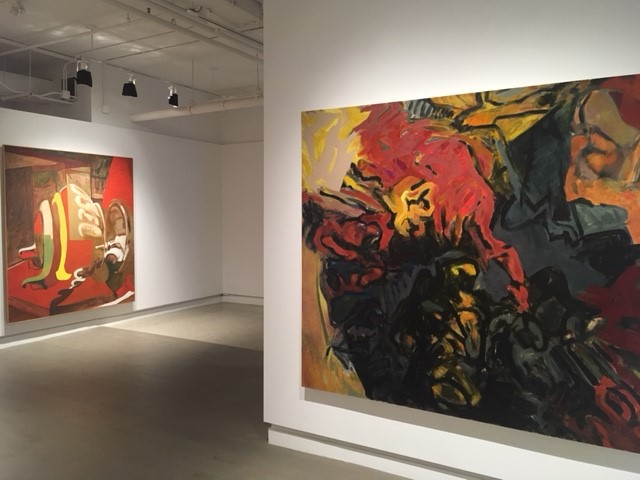
    In 1986 Frank Stella published his book Working Space, in which he supported the sustainability of modern, abstract art through the creation of its own autonomous space. In his eyes, the creation of space was art’s primary purpose and it was the role of artists to find new ways of creating and depicting this space, even in the post-Barnett Newman world of the 1970’s. Today, Leopold Plotek – whose career has been based out of Montreal since the 1960’s – is upholding this interest in space. In his first ever retrospective at the Koffler Gallery, Plotek exhibits three series of paintings, each of which serve as thematic and figurative snapshots of a certain time in the artist’s career. In No Work, Nor Device, Nor Knowledge, Nor Wisdom, we are presented with the works of a mature artist who makes the viewer think in a way that is not easily defined. Plotek’s paintings are not immediately comprehensible but the pleasures offered by his refined visual language instill a desire in the viewer to return to them again and again.

     Installation view showing Leopold Plotek, What’s the Spanish Word for Hombre, 1988 (left) and Caprice, on a theme on Delacroix, 2008 (right). Photo: Jordan Fee

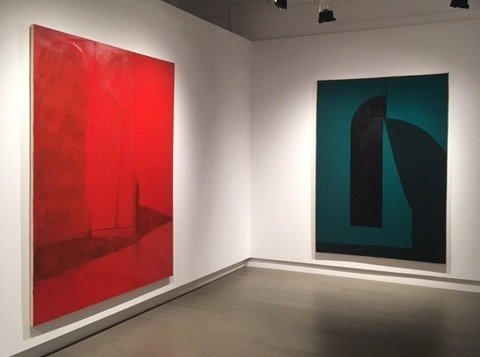
    Curated by Eric Woodley – who is himself a renowned Canadian artist and composer – this solo exhibition shows the work of a man who is constantly searching for something specific, but consistently finding something else. In a conversation between Woodley and Plotek, the artist spoke of the first trip that he took to Italy and the surprising realization that he came to while staying there: it seemed to him that he was more infatuated with Italian architecture than with the Italian art that he had sought in travelling there. This attraction to the villas and cathedrals of Italy inspired him to produce Il Frullino and Galgenlied, both of which recall the mathematical simplicity of the Roman arch. In these paintings, as well as in The Exilarch, it seems as though the artist is attempting to subvert our traditional understanding of perspectival space by creating a sense of infinite depth rather than establishing a definitive point of reference.

    Installation view with Leopold Plotek, Galgenlied, 1979 (left) and Il Frulino, 1979 (right). Photo: Jordan Fee

    However, while Leopold Plotek is unquestionably concerned with the construction of space in his paintings, he is also very clearly interested in creating an experience for the viewer. In the exhibition’s second room, one encounters a series of historical paintings that were produced after the architecturally informed works of Plotek’s earlier years. While some of these paintings have been referred to as dark and obscure – something that the artist himself acknowledges – they also offer striking glimpses into the artist’s mind.

    The concept of liminality seems to characterize these history paintings, as many of them depict moments between moments – that is to say, decisive moments. In The Death of Siseria, evidently a reworking of Palma the Younger`s painting of the same subject, Plotek chooses to represent the moment just before the hammer has fallen. When asked about the intellectual heavy-handedness of many of his works, the artist stated that he never meant for his subjects to be indecipherable but rather intended to provide the viewer with a complete description of the subject that inspired each work.

    Leopold Plotek, The Killing of Siseria, 1991, oil on canvas, 76″ x 88”. Photo: Jordan Fee

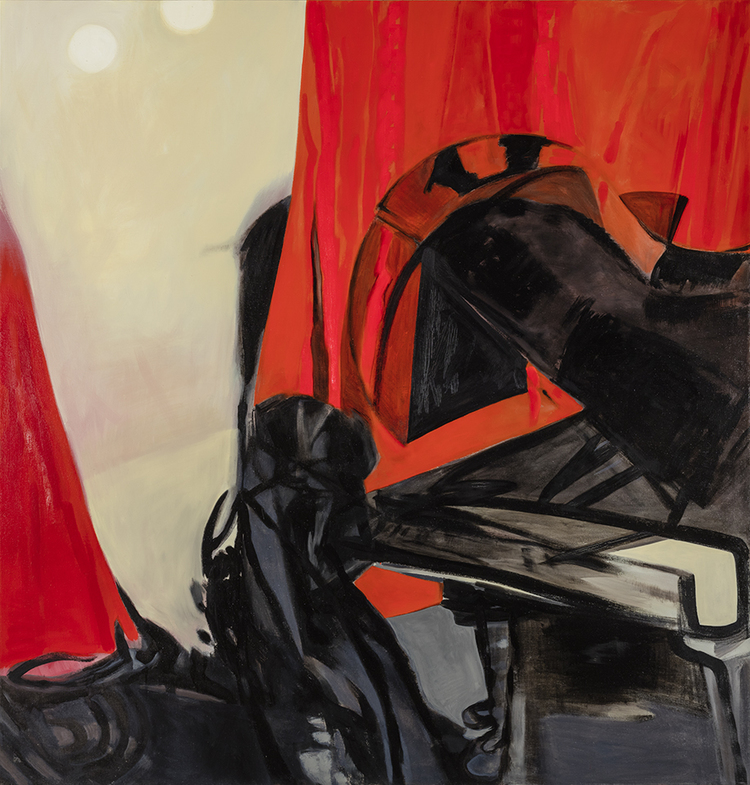
    Shame also seems to be a key element of many of these historic compositions; in the painting At Uxetter Fair, we are presented with a solemn depiction of 18th century writer Samuel Johnson standing in front of the book-cart that his now-deceased father once owned. And in one of the newer paintings, titled Teddy and Benny, we are given a chance to glimpse into the racially segregated south in the 1930’s. The reds and blacks in this painting create a sweeping scene of dynamic movement that truly does recall the concert-halls played by 20th century band-leader Benny Goodman. The presence of a hidden figure behind the curtain serves as grounding but also makes the viewer to recognize the emotional and moral depth of the painting. 

    Leopold Plotek, Teddy and Benny, 2015, oil on canvas, 75″ x 79”. Courtesy of Koffler Gallery

    Nevertheless, Plotek does not see things in such one-sided terms. To him, painting is never just good or bad. During a conversation with the curator of the exhibition, Plotek was asked if he considered his artistic process to be an agon (ie. the greek word for struggle or contest). In response he chose to highlight the ludic quality of artistic creation, citing the game of chess: “When you look back on those great chess games, it is never one versus another; it is rather a complex dance. One could consider painting in the same way: it is not necessarily an agon, but there is certainly a definitive effort involved. It may be largely improvised, but you know it when you have it.”

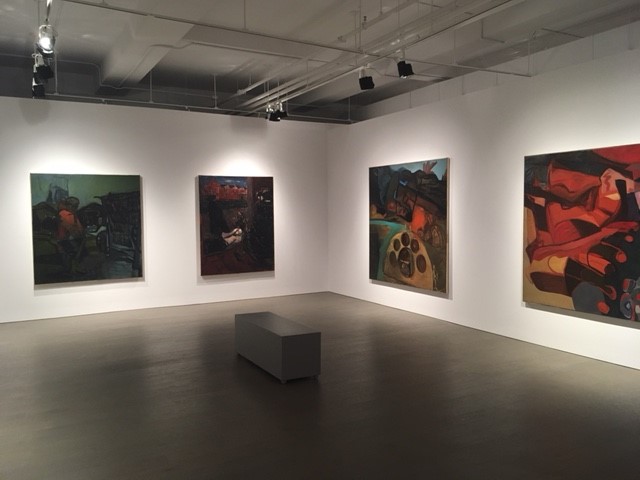
    Installation View of  Leopold Plotek: No Work, Nor Device, Nor Knowledge, Nor Wisdom at Koffler Gallery, 2017. Photo: Jordan Fee

    Jordan Fee

    *Exhibition information: January 19 – March 19, 2017, Koffler Gallery, 180 Shaw Street, Toronto. Gallery Hours: Tue – Fri, 12 – 6, Sat & Sun 11 – 5 pm.

  • Digital Futures OPEN SHOW at OCAD U

    March 2 – 4, 2017
    Opening Night: Thursday, March 2, 5 – 8 pm
    Panel Discussion: Friday, March 3, 2 pm
    Exhibition hours: Fri – Sat, 2 – 5 pm
    49 McCaul Street, Toronto

    Digital Futures is an undergraduate and graduate program at OCAD University that combines creative approaches to emerging technologies and critical thinking to prototype possible futures. Digital Futures faculty and students are world leaders in physical computing, data visualization, digital entertainment, wearable technology, smart materials, music technology and games.

    The Open Show is about showcasing our best and most interesting work that’s happening RIGHT NOW. The collection of work presented represents a survey of current ideas, concepts, theories, tools, trends being explored by the Digital Futures community. OPEN comes from the fact that this exhibition represents our whole community. It will include work from Digital Futures undergraduate students, graduate students, and faculty.

  • Kent Monkman – Shame and Prejudice: A Story of Resilience

    Commemorating Canada’s 150th Anniversary, artist and curator Kent Monkman presents an evocative, humorous and deeply heartfelt exhibition entitled Shame and Prejudice: A Story of Resilience. In nine distinct “chapters,” Monkman rewrites Canadian history through a First Nation’s lens, shedding light on the atrocities of starvation, residential schools, sexual abuse and poverty. He utilizes a variety of artistic media – including painting, print, and installation – to critique colonization and place the Indigenous population in an appropriate historical framework.

    Kent Monkman, The Bears of Confederation, 2016, acrylic on canvas, 376″ x 132″. Courtesy of the artist

    Monkman’s artistic prowess lies in his ability to combine art historical references to contemporary history, he explains that “the last hundred and fifty years in Canada are concurrent with the rise of European Modernism and the emergence of Modern Art.” Le dejeuner sur l’herbe  is one of Manet’s most famous masterpieces depicting two bourgeoisie men lounging with a naked woman on the shore of a river. Monkman borrows the title and the prostitution theme and recreates the scene with a cheap hotel in Winnipeg with female nudes in the foreground. The expensive car parked on the side of the road perhaps implies that there is a man upstairs. The second layer of art historical reference is in the female nudes themselves, which are styled after Picasso’s cubist Les Demoiselles d’Avingon. In the foreword to the exhibition, Monkman compares Primitivism to the diminishing culture and languages of the Indigenous peoples due to residential schools. 

    Kent Monkman, Le dejeuner sur l’herbe, 2014,  acrylic on canvas, 84″ x 126″. Courtesy of the artist

    The installation Scent of a Beaver continues on, cultivating a relationship between Modern Art and Indigenous history. Inspired by Rococo artist Jean Honore Fragonard’s The Swing, Scent of a Beaver portrays Miss Chief Eagle Testickle swinging between a French and a British man. This is a metaphor for the balancing of relations between the French and the British, who both wanted a monopoly in the lucrative fur trade industry.

    Kent Monkman, Scent of a Beaver, 2016, mixed media installation. Courtesy of the artist

    Miss Chief Eagle Testickle is a recurring character in Monkman’s work. In the painting The Subjugation of Truth, she is hidden in a royal style portrait of Queen Victoria in the background, juxtaposed with the shackled native chiefs who are having their freedom taken away from them. The minister and officials seem to be fully engaged in the creation of a treaty, but the melancholic and silent expressions of the chiefs show that the matter at hand is not a negotiation at all. 

    Kent Monkman, The Subjugation of Truth, 2016, acrylic on canvas, 72” x 51”. Courtesy of the artist

    Miss Chief is the artist’s drag alter ego who bluntly embodies homosexuality and strength. Her presence brings a playfully sexual atmosphere and helps contrast heavy and tragic events. She is also present in the ‘negotiation’ meetings depicted by the painting, The Daddies. The beautiful young man in high heels, sitting naked on a Hudson Bay blanket, is in the centre of attention of fully dressed men, politicians, law makers or other men of importance, who established the state of Canada. This meeting takes place in the same room as The Subjugation of Truth – but it is seemingly Miss Chief who challenges the audience, who has the upper hand, in the process of rewriting history.

    Kent Monkman, The Daddies, 2016, acrylic on Canvas 60” x 112.5”. Courtesy of the artist

    Miss Chief is totally absent from the works that pertain to children being taken away to residential schools. At the beginning of the exhibition, there is a nativity scene installation featuring two men praying over a newborn child. The references to western corruption are easily noticeable – specifically on the Hudson’s Bay blanket the child is laying on – but what is more interesting is the background scene. If you look closely, you can see four small figures – a nun, a policeman, and a mother and child. The nun is pulling the child away while the policeman holds the crying mother. Residential schools are one of the central themes of Monkman’s paintings.

    Kent Monkman, The Scream, 2017, acrylic on Canvas, 84″ x 132″. Courtesy of the artist

    The Scream is placed in a dimmed room – a space that requires contemplation. The life size painting depicts the chaos of children being taken away from their loving families to residential schools. The facial expressions of the children and mothers evoke a sense of extreme sorrow and the composition is strikingly dynamic due to the push and pull actions of the various characters. The scene creates an aura of hysteria, violence, and absurdity. According to Monkman, it was only the 2015 report form the Committee of Truth and Reconciliation that brought attention to the trauma of the native children. His own grandmother, to whom the exhibition is dedicated to, suffered through this kind of trauma and inspired Monkman to highlight those obscured events of Canadian history.

    Monkman’s technical attention to details juxtaposed with broader, contemplative themes produces a one of a kind exhibition. Great paintings always provide new knowledge and perspectives – Shame and Prejudice accomplished just that and leaves the viewer’s mind fully occupied with questions about history and truth.

    Elizaveta Mironova

    *Exhibition information: January 26 – March 5, 2017, Art Museum at the University of Toronto, 15 King’s College Circle. Gallery hours: Tue – Sat, 12 – 5 pm, Wed, 12 – 8 pm.

    ** Note: The exhibition will tour across Canada in the coming years.

  • Nasty at Daniel Faria Gallery

    Installation view of Nasty with with Kara Hamilton, Tonka 2016 (in front) at Daniel Faria Gallery, 2017. Courtesy of Daniel Faria Gallery

    Nasty at Daniel Faria Gallery showcases a captivating assemblage of works in different media that presents the viewer with defacement, inaccessibility and interference patterns. Although the exhibit is replete with talking points, these three themes appeared most prominent.

    Defacement

    Closer to the central space of the exhibit, Jennifer Murphy’s collage works command the viewer’s attention along the far wall. In each work, flora and fauna supplant the faces of human figures. The viewer is acutely aware that an external component has taken the place of what is expected. One is reminded of Anthropology Professor Michael Taussig’s reflections on defacement (Defacement, 1999). Taussig (among other scholars) discerns that, by defacing any object in an attempt to deactivate it, the object will infallibly become more potent as a result; so, Murphy’s defacement in her collages invests the fragmented figures with greater agency. The collages are visually startling due to their array of colour, serpentine arrangement and undulating form. On Elizabeth Zvonar’s pieces the defaced figures become more perceptible than complete ones, more activated by the virtue of the way that they defaced; rather, they become activated because they are defaced.

    Elizabeth Zvonar, Banana! Stick! Ice-Cream! Dick!, 2016, Inkjet print on Kodak Semi-Matte, mounted on dibond, bronze, 60” x 43″. Courtesy of Daniel Faria Gallery

    Jennifer Murphy, Orchid Spider, 2015, collage, 24 x 15″ (left) and Iris Wolf, 2015, collage 17” x 16” (right). Courtesy of Daniel Faria Gallery

    Inaccessibility

    In the central exhibit space, Nadia Belerique’s glass shelf works provide an unexpected focal point. Although the shelves and their contents are less overtly jarring than Zvonar’s or Murphy’s works, the sheer height of the shelves is not. In fact, it is the physical and bodily process the viewer must engage in in order to view the objects on the shelves that is most intriguing. Even though the objects sit on a pane of glass, allowing the viewer to discern the contents of the shelves, the viewer must still look up to see this. And, even when looking up through the glass, the shelf and its contents remain inaccessible. Like a classic narrative trope, the shelf contents are far enough out of reach to be seen and thereby to render the viewer aware of their physical presence. Echoing  the defaced intensity of Zvonar’s works and Murphy’s wall, Belerique’s transparent shelves function as a tool of inaccessibility. It seems that they can only exist at this intimate distance from the viewer, and that they delight in this choreographed play.

    Nadia Belerique, Wet Pillow (Snake), 2017, Glass, steel, assorted objects, 8” x 48” x 10”. Courtesy of Daniel Faria Gallery

    Interference Patterns

    The rear section is a secluded space delineated by a wall that boasts two-tone green vertical stripes. Along the far corner of this space, against the green striped wall, two television sets display Aleesa Cohene’s Like, Like (2009) video installation on a continuous loop. At first glance, the televisions resemble speakers since they are elevated by a wide, rectangular pedestal. Interestingly, the televisions are accompanied by speakers; yet, the speakers are small and are not instantly discernible. The significance of the speakers, though, is that they are there. As a result, the viewer watches the loop on the television, hears the audio that accompanies the video, and presumes that the source of the audio is the television; however, it is the inconspicuous speakers that emit the sound. The viewer is presented with visual and audio phenomena that are in sync. The people on the two television sets are speaking to one another, creating interference.

    Aleesa Cohene, Like, Like, 2009, Two-channel video (7 minute loop), wall painting, scent. Courtesy of Daniel Faria Gallery

    Laura Hutchingame

    Featured image: Elizabeth Zvonar, Origin of the World, 2010, Inkjet print on Kodak Semi-Matte, mounted on dibond, 22” x 26”, detail. Courtesy of Daniel Faria Gallery

    *Exhibition information: Nasty, a group show by Nadia Belerique, Valérie Blass, Shannon Bool, Aleesa Cohene, Kara Hamilton, Kristine Moran, Jennifer Murphy & Elizabeth Zvonar, January 21 – March 4, 2017,  Daniel Faria Gallery, 188 St. Helen’s Avenue, Toronto. Gallery Hours: Tue – Fri, 11 – 6; Sat, 10 – 6 pm.

  • Scott Treleaven & Georgia Dickie at Cooper Cole Gallery

    In its current exhibitions Cooper Cole Gallery host two Toronto based artists, Scott Treleaven and Georgia Dickie. The main floor and upper level of the gallery is occupied by Scott Treleaven’s paintings, under the title Not Palaces.

    Installation view of Scott Treleaven, Not Palaces at Cooper Cole Gallery, 2017. Courtesy of Cooper Cole Gallery

    Abstract art always give a lot of opportunity for interpretations and various narratives imagined by the viewer. For guidance we turn to the essay printed on the gallery’s website. The one accompanying Treleaven’s show is a literature piece by itself, written by Emmanuel Guy, a Paris based art and literature historian. Guy starts with quoting the Italian poet, Pier Paolo Pasolini, walking in the forest with his male companions in 1941, near Milan, surrounded by fireflies. “There are no fireflies in Paris where I live, where I met Scott a few years ago” Guy continues, but “Some things flicker in the night if you look carefully, and if you are in the right place. The tip of a cigarette glowing in the dark at night in the hedge maze of the Tuileries garden for instance. These hedges shelter men – from the cameras of tourists and the headlights of passing cars – as they cruise through the night. The maze is right at the center of the city, between the two wings of the Louvre – that is, the palace of the power, be it that of the kings in the years before the Revolution, or that of cultural power and hegemony since it was repurposed as a museum, not to mention the glittering luxury mall that now squats beneath it. Here is only the red of the cigarette tip, the blue of the smoke, and above us not palaces, but the whales and the night.” There is were the title of the show, Not Palaces, comes from.

    Installation view of Scott Treleaven, Not Palaces at Cooper Cole Gallery, 2017. Courtesy of Cooper Cole Gallery

    Treleaven’s paintings depict the atmosphere of those places in the dark, filled with the energy of desire. In front of the darkness of the night blue cigarette smoke curl, that sometimes outline a moving figure, while orange cigarette tips, yellow and white moons shine. Treleaven is an internationally acclaimed film maker, so it is not a surprise that the black backgrounds of his paintings represent a role of film. The compositions explore various collage elements in conjunction with matte paint, and an unglazed finish. The paintings are most commonly presented as diptychs; producing the effect of an open book, creating a cohesive installation. Some of the works, located directly to the left of the entrance, hung above eye level as they are representative of Tibetan prayer flags, maybe quietly praying for those night cruisers. The works are pleasing to the eye with their style and throughout a closer analysis the collage elements, both abstract, and representational, become apparent. The way the exhibition is curated gives a sense of connectivity, as if it were installed in a circular room where the end of the installation would remain undetermined. 

    Scott Treleaven, Not Palaces at Cooper Cole Gallery, 2017. Courtesy of Cooper Cole Gallery

    Georgia Dickie’s installation is located in the small basement space of the gallery where Simon Cooper Cole invites artists to produce site-specific works. It focuses on the use of found objects that are familiar and allow the viewer to make connections. Dickie is deeply concerned with the materiality of the pieces she uses, and her works are pregnant with the many possible lives that hidden in those objects.

    Georgia Dickie, How Many Antennae at Cooper Cole Gallery, 2017. Courtesy of Cooper Cole Gallery

    The installation, How Many Antennae, is not only the largest one she has made so far, but is also the first one with a defined front and back; producing a formal sculptural piece. Cooper Cole describes it as “the most fantastic bedside table.” The large gestural piece is created from various elements, found wood, metal, plastic, forgotten toys and, indeed, a few antennae. A wooden door (or rainbow) above a door-bookshelf accompanied by a plastic container and cornered by an antennae. The center elements reminds us for an old machinery that becomes more like a fantastic creature by its flag, connected to two other antennae from the side that look like spider legs. At a closer observation we find personal mementos us well. At the lower right hand side Dickie has included a photo of the Barbara Hepworth Sculpture Garden in the UK where she was awarded a residency. This big bug-toy-structure is encapsulating by its playfulness as the viewer keep discovering its many elements. 

    Georgia Dickie, How Many Antennae at Cooper Cole Gallery, 2017. Photo: Victoria DeChellis

    Scott Treleaven, Not Palaces and Georgia Dickie, How Many Antennae are exciting shows, not to be missed.

    Victoria De Chellis

    *Exhibition information: Scott Treleaven, Not Palaces & Georgia Dickie, How Many Antennae, January 20 – March 11, 2017, Cooper Cole Gallery, 1134 Dupont Street, Toronto. Gallery hours: Wed – Fri: 1 – 6 p.m., Sat: 11 a.m. – 6 p.m.

  • The Artist Project 2017

    February 23 – 26, 2017
    Better Living Center
    195 Princes’ Boulevard, Exhibition Place, Toronto

    On what was turning out to be one of the nicest evenings yet this year, the Better Living Center opened its doors to the public for a sneak-peek at this year’s Artist Project. Guests were offered small snacks and cocktails as they perused the wide range of pieces that were being displayed in the sprawling, industrial space. Ranging from small hand-drawings to large installations, the artworks shown in this annual exhibition displayed much of the talent that exists today in Toronto. By offering the viewers a chance to enter directly into a dialogue with the artists who were displaying their works, the Artist Project truly provided a unique experience to anyone who chose to walk through its doors.

    The Artist Project celebrates its 10th anniversary this year with a 100 foot-long mural by L.A artist Tracy Hiner

    One of the main attractions of the fair is Kevin Holliday’s performance project, titled Rub, where the artist has chosen to transform himself into a living statue of the Laughing Buddha. Viewers are invited to interact with the statue in any way that they see fit, thus forming a sort of echo chamber for their actions: by interacting with the statue, they are essentially performing two different acts at once, each with their own prescribed set of customs. The work was done in collaboration with OCAD University’s Center for Emerging Artists and Designers.

    Kevin Holliday’s Installation piece Rub, done in collaboration with OCAD University’s Center for Emerging Artists and Designers

    However, one of the standout artists from the more independent section of the fair was Ludmila Schnaider, who uses photography to capture the everlasting essence of humanity in cleverly staged poses that mirror great paintings of the past. Proserpine, which recalls the great Romantic painting of the same name by Dante Gabriel Rossetti, shows a contemporary young woman reimagining of the mythological figure. The young Israeli soldier holds the ‘fatal fruit’ in her hands close to her heart in the same position as Rossetti’s model, but instead of a pomegranate it is a grenade. These photographs serve to show that great composition and artistic control will always succeed in producing an interesting picture. 

    Proserpine by artist Ludmila Schnaider. Image courtesy of The Artist Project

    One thing was certain about this large scale art-fair: it serves as a place for artists, young and old, to display their love for the city of Toronto. Many of the lanes were peppered with paintings of the familiar streetcars that pass – and sometimes stop abruptly – on our busy streets, and of the city’s iconic skyline. Artists old and young alike provided their visions of what the city means to them, many adding elements of their own story to their works. Lorie Slater, who is displaying her series of photographs of Toronto mounted on wood panels, was not born in the city but rather fell in love with it at the age of 17 when she was passing through to London. She then moved here at the earliest chance she could get.

    Photographs by artist Lorie Slater

    The Artist Project will be open for the entire weekend, so make sure to stop in and see all of the interesting artworks that are being displayed there. You might even get lucky and arrive at a time when one of the special events is taking place; the Art Battle will offer to artists and spectators alike the chance to participate in a live painting contest, where the final works are then submitted to a silent auction. Fifty percent of these proceeds will be donated to SickKids, and a portion of all of the proceeds from the Artist Project will be donated to Artbound’s Creative Deeds Programs.

    Text and photo: Jordan Fee

    The most fascinating aspect of The Artist Project is in the title: the artist. The reason to visit this contemporary art fair is not the art on its own; rather, it is the pairing of the artist beside his or her work. The Artist Project provides the rare and unmatched experience of viewing a selection of each artist’s oeuvre in his or her presence, all the while asking questions, making observations, and discussing with the artist. Each work becomes activated through this experience, just as every booth offers a thoughtful and unique artistic inflection. The Artist Project’s brilliance lies in its fostering of this enriching conversation between viewer and artist, thereby blurring the lines between participant and spectator.

    Michelle Winters’ booth

    Collages by Nicole Moss

    L.A based artist, Tracy Hiner’s mural

    When I asked each artist where their ideas for the displayed works originated, without exception, each response was illuminating. Whether the artist’s source was grappling with notions of “home” and personal identity (Alice Zilberberg, Jeannie Papas), challenging and exploring the aesthetic of the photograph (Nicole Moss, Ksenya von Shlezinger, Laura Kay Keeling), capturing the psychological emanations represented by the subjects (Adam Giroux, Michelle Winters), “drawing with metal” (Joel Sullivan) or replicating the scintillations of light in water (Ianitza Vassileva), each artist that I met offered unique insights into their work. They are insights that I would not have gleaned from studying the work on my own in a gallery.

    There are two sections, the Installation Zone and Untapped Emerging Artists that break the rhythm of the booth.

    WW Hung’s work, The Girl with Paper Boats opens the Installation Zone. Image courtesy of the artist

    Installation by Ryan Pechnick

    Julia White’s installation

    Installations by Tibor Hargitai (back) and Victoria Chin (front)

    The Untapped section with Ed Batista’s work (left)

    The Artist Project offers an equally accessible platform for both artists and art enthusiasts. Through the Artists in the Project, any work can become enlivened — the viewer must only choose which one.

    Text and photo: Laura Hutchingame

    Artist Project – WRAP UP

    I decided to go to the Artist Project on its final day and see how the artists had done in this, the 10th, year of the annual fair. As I approached the Better Living Center I saw a couple navigating an art work into the back truck of their car. When I inquired – yes it was an art sale. This seemed like a very positive start. Indeed, it was. When I talked to artist, Michelle Winters, she said that she was feeling very positive about the fair and had covered her costs with sales and still hopeful for one more to put into profits. She said she would be back next year, as did former Montreal native Jacques Pilon. He was also happy with the response to his work and hoping that some contacts he had made might get back to him for more sales. For him it was not just the first year at the Artist Project but the first time exhibiting his work at all. Artist, Simon Schneiderman felt that the buying crowd might be different this year from prior years. Lots of traffic but not the sales he had hoped for.

    Artist, Michelle Winters

    Artist, Jacques Pilon

    Artist, Simon Schneiderman

    Of course every year is going to be a little different; and for the final Sunday it seemed that there was a good crowd and several artists I tried to talk to couldn’t, as they were in the middle of completing a sale.

    In all, I talked to over 30 artists of the 250 at the fair and the overall vibe was very positive. Some good sales and lots of foot traffic. Sculpture artist, Rod Mireau from Peterborough was happy with the results. He had made a few sales and lots of connections. His works were large an his target audience a little different – more designers and industry people so his expectations were in perspective. Encaustic artist , Liz Rae Dalton had her sculptural works in a good location and was pretty happy with the fairs appeal. She came from Kingston and it was her first time at the Project.

    Sculpture artist, Rod Mireau

    Encaustic artist , Liz Rae Dalton

    Tape artist Emanuel Pavao was exhausted from explaining his process even though he had tried to make it seem pretty evident. He had lots of sales for his unique work and told me a story of one of the pieces with the Dollar Store in Parkdale. As he described it, while documenting the location a pigeon was run over by traffic and he dedicated the work  to this unfortunate accident.

    Tape artist Emanuel Pavao

    Artists Kiel and Amanda of KIAM were thrilled with the four days of the fair. Their work looks at urban landscape and one of the old Honest Ed’s caught my eye. Tel Aviv artist Orit Fuchs had her colourful works on display and said she was getting lots of hugs from Canadians. She was on top of her marketing game giving out gift  cloth bags and chocolates. Indeed she was one of the few artists from outside Canada that I noticed. Realist painter Mary Ann Slater was another happy artist and I liked her ZIPPO painting.

    Kiel and Amanda of KIAM

    Tel Aviv artist Orit Fuchs

    Painter Mary Ann Slater

    Again this year there was the UNTAPPED ARTIST Booths and I talked briefly to artist Laura Chakravorty who was happy to get her work out to the public. For her it wasn’t so much about sales as just getting her work seem. I checked out artists Justin Blayney’s portrait of Donald Trump that could only be seen through the lenses of a camera or a phone camera.

    Laura Chakravorty

    Justin Blayney

    There was some bolder work by younger artists such as Adam Giroux and Harv Glazer. Glazer had been at the Project for 6 years an started as an Untapped Emerging Artist. Giroux enjoyed getting feedback from visitors. His work is really contemporary. Hamilton artist, Florian Holzinger’s works were bold and colourful; he was enjoying talking to people.

    Harv Glazer

    I talked to artist Mikael Sandblom whose work uses photography and painting on metal. He had a few sales and was generally happy. Artist Paul Brandejs was tired after four days and hoping for some last minute sales. He wasn’t sure his unique works on sculpted canvases were in the right spot to sell. He though more traditional works were getting bought up.

    Mikael Sandblom

    Painter, Paul Brandejs

    Twenty one year old painter Ryan A Sobkovich stood in front of his huge painting and told me he had been painting since the age of nine and was taking his work to Ireland. He has an impressive exhibition history plan and his landscapes were great. Painter Susan Gale’s work was urban and lush. It was her first year at the Project. Tick Tock Tom had scrap metal sculptures that moved. He had gotten a good response to his work and said that he hadn’t had high expectations but had sales that day. Tony Taylor’s work was back at the fair for the 5th time and I have always been a fan of his tongue in cheek humor – business suits with reptile heads. Mike Smalley is a veteran of the Artist Project, having participated for nine of its ten years. If you are back this often something has to be working.

    Painter, Ryan A Sobkovich

    Painter, Susan Gale

    Sculpture, Tick Tock Tom

    Artist, Tony Taylor

    Mike Smalley

    Artists have to be selected by a jury, spend $3000 for a booth and man and talk to the public for four days, so this is no easy task. Kudos to all those artists and organizers for making it all work. Fair Director, Claire Taylor who was happy with this year’s  outcome. She has been director for 7 of the Project’s ten years and said that they change artists to keep it dynamic and fresh. With over 15,000 visitors the Artist Project has a good draw and serves up a good selection of art works for the buying public. The artists come from across  Ontario to participate and get their work out there. Taylor and her team can be pleased with this year’s Project  and are no doubt will be soon thinking about 2018.

    Artist Project Director, Claire Taylor

    Text and photo: Phil Anderson

    *Exhibition information:  February 23 – 26, 2017, Better Living Center, 195 Princes’ Boulevard, Exhibition Place, Toronto. Hours: Friday: 11 – 10, Saturday: 11 – 8, Sunday: 11 – 6 p.m.

  • Tim Noonan: Abstract Urban Nature at Yumart

    Drawing inspiration from early twentieth century masters like Henri Matisse and Andre Derain, Tim Noonan’s Abstract Urban Nature brings forth worlds full of sweeping movement and radiant energy. Consisting mostly of works painted by Noonan in 2016, this exhibition serves as yet another example of how an artist can capture the explosive vivacity and sometimes vibrant stillness of the urban atmosphere. Like those before him, Tim Noonan combines energetic and dynamic brushwork with an unapologetically bright array of tones to depict scenes that seem common to us on our daily walks through the city. However, that is certainly not to say that these paintings are banal or common; they are anything but that. In many of them, one can find traces of a hand that clearly understands the minute transformations that can occur at any moment in nature.

    In Urban Orchid Rising – one of the only paintings characterized by darker hues of blue and purple – the viewer is presented with what seems to be an expressionistic take on the juxtaposition of manufactured and natural forms in the urban landscape. Fluid, wisp-like shapes fill the foreground of the painting, recalling the eponymous species of flower while in the background looms the dark and almost repetitious normality of the skyscrapers that tower over us as we pass through the city.

    Tim Noonan, Urban Orchid Rising 2012, acrylic on canvas, 40 x 40 inches. Courtesy of Yumart

    Nevertheless, Tim Noonan does not only depict this relationship between the natural and the manufactured in such an ominous manner; sometimes they are depicted in a bond that borders on the symbiotic, where each feeds off of the energy and life-force of the other. In fact, there are even some paintings where the two become indistinguishable from one another, blending into a frenzied pastiche of movement and change.  Downtown Lights on a Rainy Night depicts an urban landscape reminiscent of Pollock’s Blue Poles where the human, the urban and the natural all seem to bleed into each other. However, this painting is far from being overly dramatic or bombastic; there is a clear sense of line and direction that carries the viewers eye from one side to the next, creating a sense of clarity that seems to represent the grid-like geography of modern cities.

    Tim Noonan, Downtown Lights on the Rainy Night, 2017, acrylic on canvas, 18 x 24 inches. Courtesy of Yumart

    Another painting where the urban and the natural work in harmony is Urban Winter Trees, which is characterized by a very refined pallet of blue, yellow and purple. In this painting the trees become part of the gridded shapes that line modern skyscrapers, while the radiant halos that emanate from office lights and streetlamps help to break up the monotony of these rectangular shapes by creating a sense of almost bubbling frivolity.

    Tim Noonan, Urban Winter Trees 2015, acrylic on canvas, 24 x 18 inches. Courtesy of Yumart

    The most exciting – and largest – painting in the exhibition comes in the form of a sweeping garden scene, which is penetrated by planes of flat colour and fluid abstractions that are borderline psychedelic. Garden Swoosh is one of Noonan’s more ambitious pieces, standing out amongst paintings like Spring Blossoms and Mimico, where the artist adopts a more objective point of view. Here, the level of abstraction is much higher than in many of the other paintings in the exhibition. By adding these colour planes to the scene, Noonan both underlines and breaks down the solidity of the painting by forcing the viewer to focus on particular sections of the canvas, which are all divided by clear and definitive lines. It is in this painting that we see Noonan going above and beyond, achieving a level of abstract clarity that is uniquely his.

    Tim Noonan, Garden Swoosh 2013, acrylic on canvas, 40 x 40 inches. Courtesy of Yumart

    Jordan Fee

    Exhibition Information: February 4 – 25, 2017, Yumart Gallery, 401 Richmond Street West Suite B20, Toronto. Gallery Hours: Tue -Sat, 12 – 6 pm.

  • Felix Kalmenson как всегда / As Always at Pari Nadimi

    Oppressive regimes rarely cultivate good art; and, as a consequence, artistic responses to political oppression tend to be conceptualist in nature, as they oppose the ideology of oppression rather than its aesthetics. This is particularly true of the anti-oppressive art produced in close proximity to its targets, where urgency tramples fastidiousness. Take, for instance, contemporary artists from Eastern Europe that respond to the regime of Russia’s Vladimir Putin, authoritarian and aggressive yet supported by the majority of its population. Individuals like Petr Pavlensky, Lena Hades, and Oleg Mavromati, or artistic collectives such as Pussy Riot, tend to produce works that address shifts in policy and ideology rather than events within the art world; their installations and performances are forceful and subversive yet often straightforwardly propagandist or allegorical, lacking in subtlety and nuance.  

    Felix Kalmenson and guests at the Opening Reception of Felix Kalmenson, как всегда / As Always, February 9, 2017, Pari Nadimi Gallery . Courtesy of Pari Nadimi Gallery

    In contrast, émigré artists, who are under no pressure to put out their message before someone comes knocking on their door, and who are better attuned to contemporary Western artistic scene, can respond to oppression in their homelands with art that is richer in interpretative possibilities. Felix Kalmenson’s как всегда / As Always, which opened on February 9 in Toronto’s Pari Nadimi Gallery, offers an example of such a response. Its author left his native St. Petersburg as a child, and went back recently to collect material for a project that comments both on the artistic reconstruction of one’s personal past and the political reconstruction of the Russia’s imperial and Soviet past. The result is rife with political connotations, and only tangentially nostalgic. 

    Installation view of Felix Kalmenson, как всегда / As Always, 2017, Pari Nadimi Gallery. Courtesy of Pari Nadimi Gallery

    On pain of sounding gimmicky, one could describe this exhibition as a deconstruction of a reconstruction; a particular focus, as Kalmenson himself pointed out in our conversation, is on gender issues. On one side of the room, two video installations expose and mock traits associated with Putin’s cult of masculinity: on one of them, a rooster, cocky and brute, pokes the air in preventative aggression, while across from it, positioned within a construct reminiscent of scaffolding used to restore the domes of St. Petersburg’s cathedrals, another video installation shows an enlarged figurine of a caveman holding a boulder over his head, across from a wristwatch which frozen in the year 2000, a mocking reference to the time when Vladimir Putin came to power, promising to restore Russia’s patriarchal order and imperial glory.

    Installation view of Felix Kalmenson, как всегда / As Always, 2017, Pari Nadimi Gallery. Courtesy of Pari Nadimi Gallery

    On the opposite side of the room, another video installation depicts a character’s painful struggle to find the portrait of a grandmother in a major art gallery in Russia; here, in the realm of Russia’s Kafkaesque bureaucracy, the patriarchal state manages to undermine an artistic attempt at breathing life into one’s past, particularly – in a reminder of the installation’s emphasis on gender – a woman’s past. Other objects, including installations and computer-generated photographs, are also entangled in a web of politically charged relations, ready to reveal themselves to a patient and perspicacious viewer.

    Installation view of Felix Kalmenson, как всегда / As Always, 2017, Pari Nadimi Gallery. Courtesy of Pari Nadimi Gallery

    Artists responding to oppressive regimes are seldom blessed with artistically engaging foes; more often than not, they have to aim their critical effort not at a rare avant-gardist enamoured by an oppressive state, but at half-baked ideological entities or mass-produced objects of material culture engendered by artistically barren regimes. The result is a politically engaged conceptual art, thoughtful and witty, as in Kalmenson’s show, which, nevertheless, leaves the viewer with an impression of the artist’s longing for an artistic, not merely ideological, adversary worthy of being deconstructed.

    Installation view of Felix Kalmenson, как всегда / As Always, 2017, Pari Nadimi Gallery. Courtesy of Pari Nadimi Gallery

    Andriy Bilenkyy

    Artist Talk: Friday, February 24, talk starts at 6 pm, Q&A 7 – 7:45 pm.

    *Exhibition information: February 9 – March 25, 2017, Pari Nadimi Gallery, 254 Niagara Street, Toronto. Gallery hours: Wed – Sat, 12 – 5 pm.

  • New Members of the Sculptures Society of Canada

    New Members (from left to right): Art DiLella (Toronto, ON), Jonathan Edwin Simpson (Toronto, ON), Paul Duval (Saint-Georges, QC) and Marie-Josée Roy (Trois-Rivères, QC)

    The Sculptors Society of Canada welcomed four new members. Each of the new additions brought interesting and unique perspectives along with them. Works by three new members focus on the human body. By incorporating various media – their visual statements are extremely diverse – yet rejoice in the human spirit. The fourth new member presents a more cerebral approach: human thoughts hand-stamped on natural elements.

    Art DiLella’s work focuses on anatomy; the evolution of portraiture from classical to contemporary in order to depict the true identity of his models in a super realistic way – sometimes even delving into satire or parody.

    Art DiLella, Anon #1, silicone, hair, mixed-media

    Art DiLella, Anon #2, silicone, hair, mixed-media

    Integrating recycled materials and paper pulp, Duval’s “body narrations” are transitions from fantasy to reality – witnessing human daily lives.

    Paul Duval, Orange Break, pulp, metal

    Paul Duval, Broken Man with Blue Eyes, pulp, metal, wood

    As Roy acknowledges – her expression is “physical”. Inspired by the fusional properties of metal and human resilience, her forged steel, bronze and aluminum castings imbue feminine poetic intensity.

    Marie-Josée Roy, Structure identitaire 3, steel

    Marie-Josée Roy, L’integrale de chemin, bronze, steel

    Simpson’s “dendron/tree parts” – transforms forgotten thought patterns with embedded text: letter by letter – paradoxically forming a fictional narrative within the reality of their recollected dream imagery.

    Jonathan Edwin Simpson, Origami Cosmos, wood, marble

    Jonathan Edwin Simpson, Scope, mixed-media

    The exhibition is worth a look as each of the new members bring with them their own individual voices, communicated through various mediums.

    Images are courtesy of Sculptors Society of Canada

    *Exhibition information: February 9 – March 3, 2017, Canadian Sculpture Centre, 500 Church Street. Gallery hours: Tue – Fri: 12 – 6, Sat: 11 – 4 p.m.

  • The Artist Project 2017

    Walking and Talking Stones, a performance work by Adam Filek, The Artist Project, 2016. Photo: Alice Pelot

    February 23 – 26, 2017
    Better Living Center
    195 Princes’ Boulevard, Exhibition Place, Toronto

    Exhibition hours: Early Access Preview: February 23, Thursday 5 – 10 pm; Opening Night Party: Thursday: 7 – 10 p.m.
    Friday: 11 – 10, Saturday: 11 – 8, Sunday: 11 – 6 p.m.

    From seasoned collectors and first-time art buyers, to gallery dealers and interior designers, visitors can explore and discover works of art from over 250 top contemporary artists from Canada and abroad. This is a unique opportunity to meet and buy art directly from artists at Toronto’s most celebrated contemporary art fair.

    The Artist Project celebrates its 10th year with another exciting show from February 23 to 26, 2017 at the Better Living Center, Exhibition Place, Toronto.

    Opening Night Party: Thursday, February 23, 2017 / 7 – 10 p.m.

    Celebrate the launch of our 10th show and be among the first to see 5,000+ works of art from over 250 top contemporary artists. Music provided by DJ Lissa Monet and DEEJAY_LING, and an art performance OCAD U’s Kevin Holliday.

    Art Battle #494

    Art Battle Canada and Artist Project team up!
    On the evening of Friday, February 24 from 7 – 10 pm, AB#494 will be held on the show floor.

    There will be Art Chats Seminar Series and other interesting programs.

    For more information please check http://www.theartistproject.com.

  • Elizabeth Babyn and Ester Pugliese at loop

    As always, loop Gallery has two shows on view in their Dundas West boutique space: Elizabeth Babyn’s Plastopia and Ester Pugliese’s Measured Calm. As you walk into the gallery, you are welcomed by a vivid splurge of color radiating from Pugliese’s paintings, yet as you make your way further inside, the room gets darker and more mysterious as sound and video images creep in from the back. You are wondering what awaits you, as you approach Babyn’s grand installation that covers every inch of the front desk and the walls across from it.

    Installation view of Elizabeth Babyn, Plastopia, loop, 2017

    Elizabeth Babyn’s installation Plastopia is a fully immersive visual and sound experience. For her MFA thesis, she imagines a serene dystopian world created from the plastic refuse of our current one. Thousands of strips of plastic and miles of saran wrap are the main building material for this new world: a windmill, a waterfall, and a mythic creature. The windmill is located on the left side of the installation. There is a fan right behind it, which startles the viewer the first time it turns on and makes the plastic strips rustle. The right side has a beautifully designed plastic waterfall, back-lit with colorful lights and accompanied by a very rough, tsunami-like audio recording. A mythical creature, resembling a bull, is placed in the center, with his torso and head turning away from the viewer toward the video projected on the wall.

    Installation view of Elizabeth Babyn, Plastopia, detail (windmill) loop, 2017

    The composition of these elements in the installation, however confusing, most definitely entrap the gaze of the onlooker. The overwhelming presence of plastic envelops the viewers and leads them to ask questions about our society’s excessive consumption. Babyn, on the other hand, illustrates her idea by creating another world where this waste is re-configured into something useful and totally new.

    Ester Pugliese, Thunderstorms will likely occur across the region, 2016, acrylic, soft pastel, carbon pencil, and chalkboard paint on wood panel

    Ester Pugliese’s exhibition, Measured Calm, juxtaposes Babyn’s installation both in medium and meaning. While Babyn’s installation is striking and exciting, Pugliese’s paintings take the viewer into a tranquil pleasure state. The colors of the abstracts paintings resemble flowers and coral reefs. They are inspired by endangered species and Italian folk songs. Large patches of colors are contrasted by geometric shapes, depicting different elements that happily coexist – creating a unique beauty. “Moderate to strong northwest winds will persist through the weekend” is a stunning example of the artist’s method. Orange, red, and purple hues are erupting in the background then covered with drawing to form something between a flower and a firework. It’s electrifying but the longer you look at it, the happier and more peaceful your mind becomes.

    Ester Pugliese, Moderate to strong northwest winds will persist through the weekend, 2016, acrylic, soft pastel, carbon pencil, and chalkboard paint on wood panel, 30 x 30 inches

    Both exhibitions are playful in their own ways. Their different styles – Babyn’s conceptual and contemplative installation and Pugliese’s emotional and tranquil paintings – are greatly complement each other.

    Text and photo: Elizaveta Mironova

    *Exhibition information: Elizabeth Babyn’s Plastopia and Ester Pugliese’s Measured Calm, January 28 – February 19, 2017,  loop Gallery, 1273 Dundas Street West, Toronto. Gallery hours: Wed – Thur 12 – 5, Fri -Sat 12 – 6, Sun 1 – 4 pm.