Author: artoronto

  • Simon Hughes at Blouin Division Gallery

    The Blouin Division Gallery is like the tardis, Doctor Who’s spacebending time travelling machine. On the outside it is a nondescript modest industrial building. Inside the visitor is surprised by a collection of high-ceiling rooms. Almost anything would look good on these pristine white walls. I can imagine a banal everyday object from around the house, e.g., my tattered thesaurus, artfully displayed on the wall. How handsome and precious it would appear, – uncluttered and effulgent under the soft spotlights. This is one’s experience in any high-end gallery of course. But it reminds me how manipulated our experience of looking at artwork is in such an environment.

    Installation view of Simon Hughes, The Fire, The Flood and All the Feelings, 2025 at Blouin Division Gallery

    Currently on display are the paintings of Simon Hughes, a resident of Winnipeg, where he was born, and who has been trained at the University of Manitoba and the University of California, Irvine. He presents twelve large watercolour paintings, with elements of collage, on paper, eight of which comprise panels of two works, that are referred to as quadraptychs (or tetraptychs). These are on the theme of environmental disaster, – titled Flood Plain and Evacuation. The remaining four paintings, collectively titled Suburban Thought-Forms, are inspired rather by theosophy (a spiritual movement dating back to the fin de siècle period).

    The two tetraptychs are each, according to the press release, ‘a statement on the environmental chaos, both terrible and beautiful, that is western North America’ – this being the region of the world where Hughes has lived and worked. I must admit that looking at these works, neither communicates a sense of terror in particular.
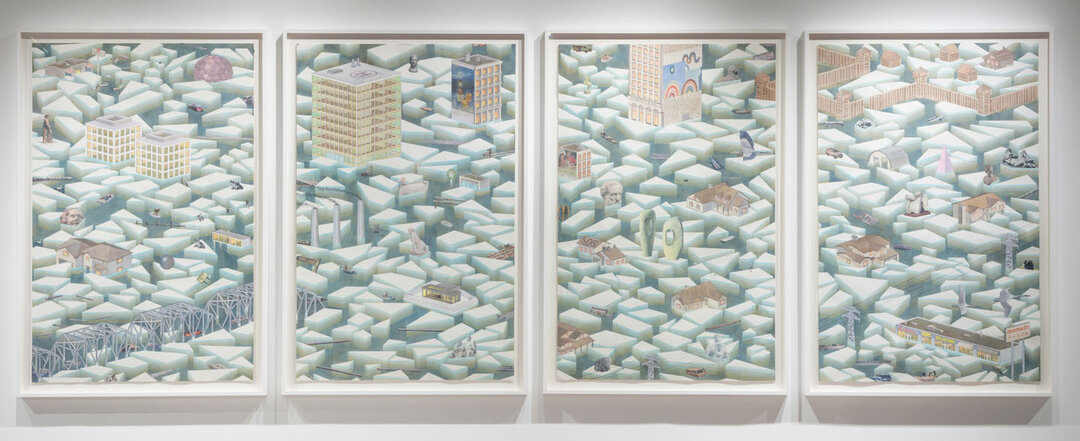
    Simon Hughes, Flood Plain 1-4, 2024, watercolor, graphite and collage on paper, 65 x 168 inches

    In the case of Flood Plain, for instance, one observes a legoland-like landscape in isometric perspective, where everything on the picture plane is at the same scale, creating a sense of naivety. Granted the picture shows a devastated urban landscape that includes various Ozymandias-like elements, – fragments of statues that suggest the collapse of a civilization. But above all I was entertained by the picture. Its beautiful design and palette are simply delightful.
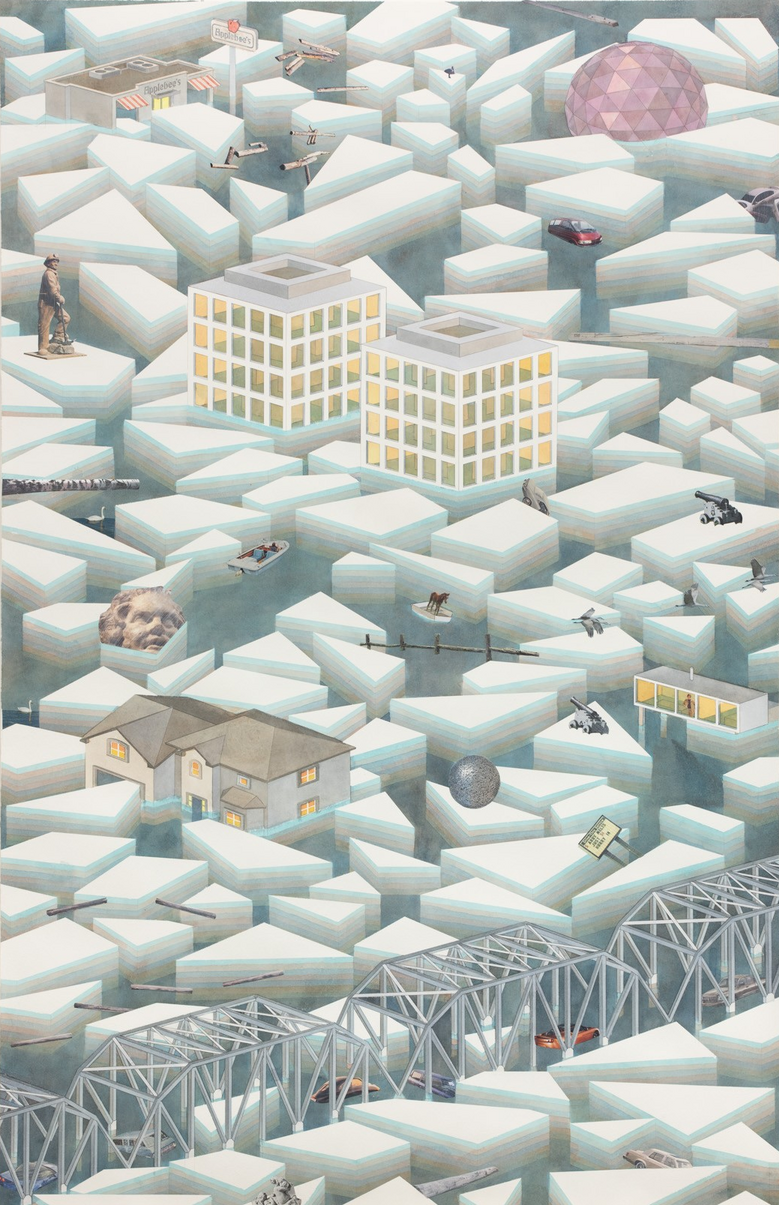
    Simon Hughes, Flood Plain #1, 2024, watercolor, graphite and collage on paper, 65 x 42 inches

    Of course, there is an undeniable beauty often to be found in environmentally ruined landscapes, that these two works perhaps allude to. Edward Burtynsky’s photographs are testament to this fact, for instance. Hughes’ second tetraptych, Evacuation, is on the surface more violent. He depicts the scene of an inferno on the edge of town in pumpkin orange, and with layers of buildings and hills rendered in two-dimensions. But this treatment is so comic book that its difficult to see past the picture. Here, I think, Hughes betrays an aesthetic that is commonplace among artists today, namely, the depiction of a simulacrum of nature rather than nature itself. It is as if what he intends to paint is not the world, i.e., that which we experience directly, but a screen-image whose content alludes to the world. More precisely, the mediated world of the screen has become so ubiquitous that many experience it as the world period. And this tendency has infected art.
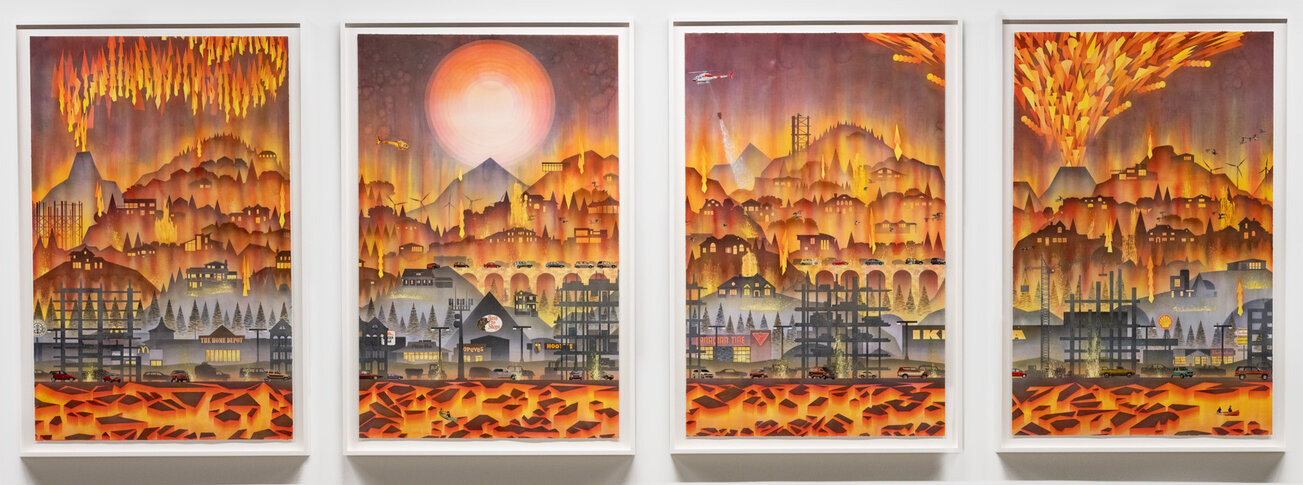
    Simon Hughes, Evacuation 1-4, 2024, watercolour and mixed media on paper, 65 x 168 inches

    But it would be unfair to judge Hughes’ work simply in terms of his putative intentions. In and of themselves these are beautiful paintings. All told his Flood Plain displays a mastery of colour and composition, and a refreshing playfulness. In purely aesthetic terms my favourite in the show is Suburban Thought-Forms. The original idea for these paintings Hughes took from a book titled Thought-Forms: A Clairvoyant Investigation (1905), by theosophists Charles Leadbeater and Annie Besant.

    Simon Hughes, Suburban Thought-Form 1-4, each 2024, watercolor and collage on paper, 55 x 35 inches

    Indeed, Hughes’ paintings are very similar to some of the illustrations in the book, e.g., Suburban Thought-Form #4 is remarkably like one illustration titled The Music of Gounod – A thought-Form (p. 80), showing a church spewing out, like a volcano, a cloud-like flourish of colourful shapes. According to theosophy, thoughts, as entities on a mental plane, have underlying shapes and colours, but these are only apprehensible by the properly trained clairvoyant. They are invisible to mere ‘muggles’ like us, so to speak.
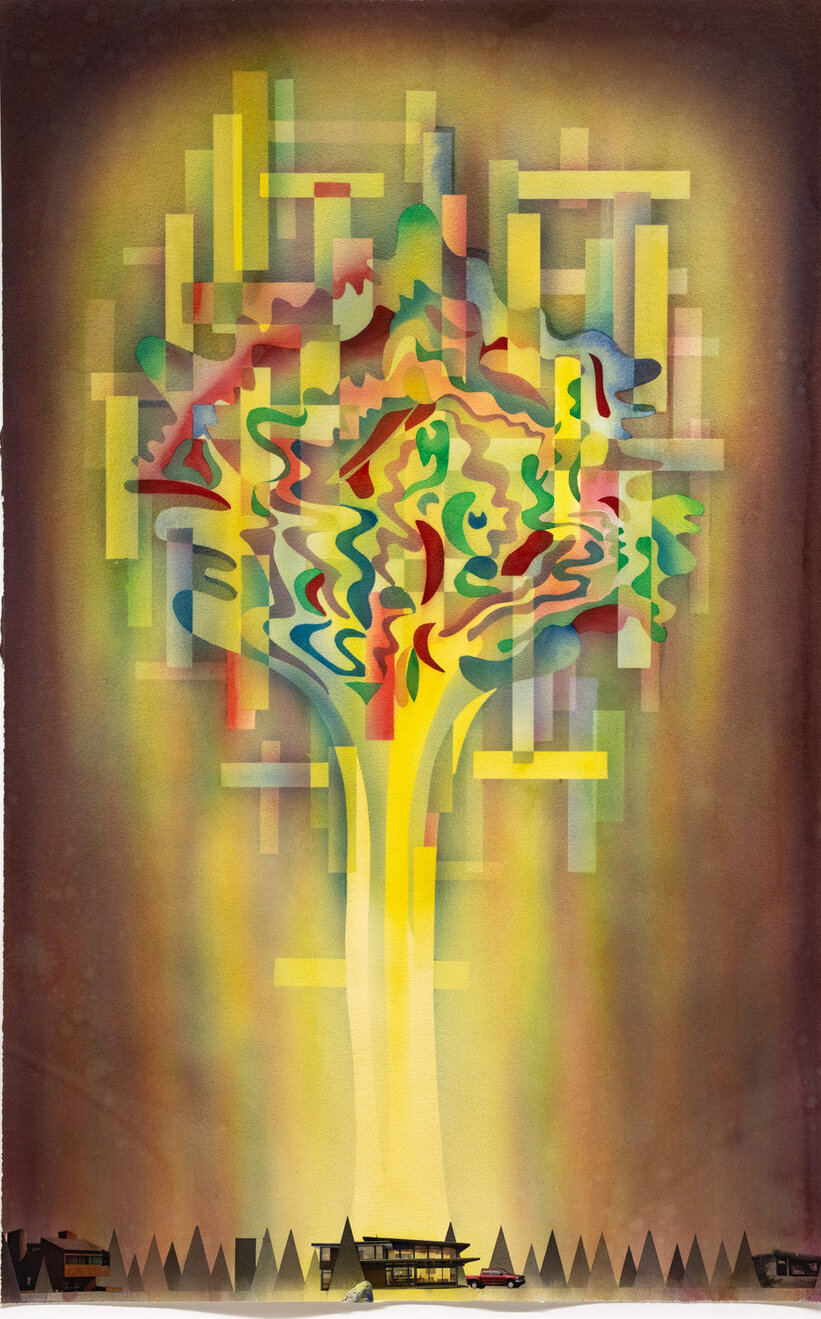
    Simon Hughes, Suburban Thought-Form #4, 2024, watercolor and collage on paper, 55 x 35 inches

    This notion of clairvoyance was central to Paul Klee’s work – an artist who has influenced Hughes. Klee once remarked: ‘Art does not reproduce the visible, it makes visible’. In other words, he saw the role of the artist as someone who makes visible an underlying reality, as opposed to mere appearance. It seems that these four watercolours by Hughes attempt to do just that. Like Klee, Hughes has developed a geometry of form and colour which he uses to express, i.e., make visible, the poetic, or spiritual if you prefer.
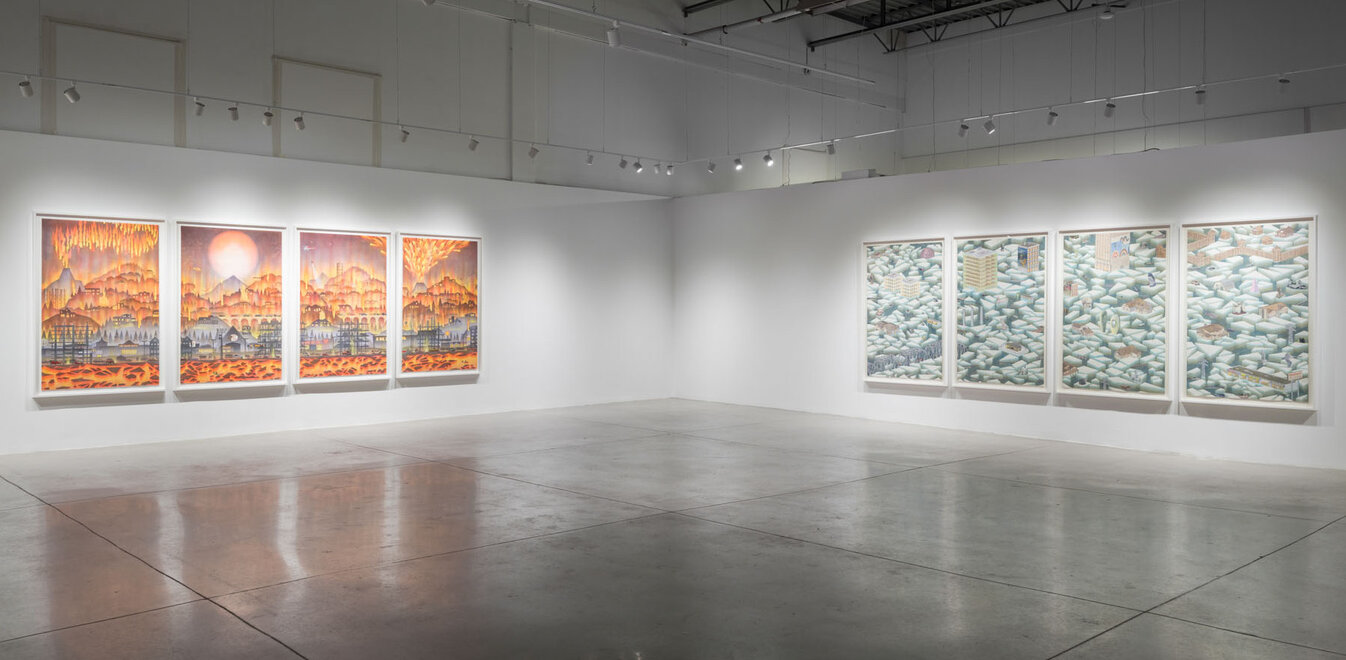
    Installation view of Simon Hughes, The Fire, The Flood and All the Feelings, 2025 at Blouin Division Gallery

    As I noted at the beginning, a gallery setting like that of Blouin Division is manipulative. It is designed to entice someone to buy the work. That is a truism, but worth reiterating. It works by creating a sense of exclusivity vis-à-vis the work on display, and hence making it more desirable. The perceived exclusivity, – specialness, – of the work seduces the viewer to see it as intrinsically virtuous in artistic terms, namely, that quality, whatever it is, that Klee’s work often has, – call it poetic. But these two things are not the same. And the confounding of exclusivity with the poetic vexes the artist as well as the viewer like myself. Is Hughes making a luxury good, something that in the end is just slick and alluring? Or is he, as I hope and suspect, making art that is of intrinsic worth. The question, I fear, is unanswerable, – that it makes no sense in today’s art market. 

    Hugh Alcock

    Images are courtesy of Blouin Division Gallery.

    *Exhibition information: Simon Hughes, The Fire, the Flood and All the Feelings, September 11 – October 18, 2025, Blouin Division Gallery, 45 Ernest Ave, Toronto. Gallery hours: Wed – Sat 11am – 6pm.

  • Present. Tense. at United Contemporary

    As the name suggests, Present. Tense. by Huy Lam and Rod Mireau was ignited by a conversation between presence, tension, and balance. The walls at United Contemporary are graced by sculptures, canvases, and paper collages made largely out of wood and metal. Lam’s sculptures are inspired by traditional medicinal Chinese weighing scales and by his daily meditation practice. This meditative approach is complemented by Mireau’s exploration of the tensions between the natural and the industrial world. Mireau’s work is informed by the abandoned farm equipment he saw overtaken by the landscape during his childhood in Saskatchewan.

    Installation view of Present. Tense. at United Contemporary. Courtesy of United Contemporary

    Lam’s contemplative approach to contemporary life reflects the tension and chaos of it all with elegance and a certain tranquility. The Exposed series includes seven floating metalworks that subtly and softly interacts with one another and with the viewers. The contrast between steel, that is a rough and tough material, and its gentle and svelte curves makes these pieces entrancing. Lam’s photography background is highlighted by the way he uses light in this installation, and the traveling shadows the metalwork creates on the wall.

    Installation view with Huy Lam, Exposed 1-7, 2025, steel. Courtesy of United Contemporary

    The collages present an intricate, vibrant, and delicate artistry. The repetition of intertwining forms with changing colours provides a sense of mellow peace. The works expel fluidity, patience, and persistence in a visually stunning manner.

    Huy Lam, Spaces to Celebrate I, 2025, collage on cotton rag paper, framed in maple, 16 x 12 inches. Courtesy of United Contemporary

    Lam’s other sculptures, Precipice and Yield, also show an exceptional mastery of balance. The two sculptures break the laws of physical barriers. I thought the pieces in Yield were welded together before I realized they were balancing; one piece perfectly sitting on top of the other. The exquisite attention to detail, the materials, the form, and the magic in balance make this sculpture the central point of the show.

    Installation view with Huy Lam, Yield, 2024, brass, copper, Navajo skipper, 15 x 51 x 4 inches (in front). Courtesy of United Contemporary

    The series Too Many Tears, consist of five metal and wood mobiles. These were also my favourites. The slimness and gracefulness of the pieces make them almost appear to be floating. Constructed from elaborate geometric forms, the mix between metals, along with the different wood types and wood grains, result in minimalist pieces that are a pleasure to behold. Despite their apparent simple nature, the more time spent appreciating and observing the works, the more detail, craftsmanship, and artistry the viewer discovers. The tension that holds up the pieces transforms them into truly beautiful forms.

    Huy Lam, Too Many Tears (Tomorrow) (left) and Too Many Tears (Last Month) (right), 2025, stainless steel, aluminum and walnut or brass and maple, wire, 42 x 27 x 14.5 in, 37.5 x 20 x 1 inches. Photo: Sofia Diaz Aguilar

    Moving into Rod Mireau’s world of textures, grains, sturdiness and worldbuilding, I find the most astonishing pieces to be four large canvases that combine oil paint, ink, and charred wood. Mireau enjoys the concept of a fragmentary fabrication: tearing something apart and putting it back together through his artistic construction. His piece In the Folds repurposes burnt wood and takes advantage of the variety of grains, traces and patterns left on the lumber. The employment of a ‘destructed’ material to make the beautiful mountain top landscapes is quite poetic. The result of this use of materiality is not only visually elaborate, but also tactile.

    Rod Mireau, In the Folds, 2025, oil paint, ink, charred wood, 60 x 60 x 5 inches. Courtesy of United Contemporary

    Mireau’s piece Machine Artifacts: Loops presents an intricateness, tension, and fluidity similar to Huy Lam’s work, but the tone varies tremendously. The material achieves a misleading sense of identicality; misleading because none of the pieces look the same, but they feel like they look the same. The rusted steel that forms the structural support adds a nice golden textural element to the piece. The rest of the artwork is composed of what I initially thought was bent steel but is bent walnut. Once again, an example of the mastery of craft that is present in every single piece in this show.

    Rod Mireau, Machine Artifacts: Loops, 2025, steel, walnut, ink, 32 x 48 x 6 inches. Courtesy of United Contemporary

    Finally, Machine Artifacts: Rings merges wood, stones and resin. A particular element that I appreciate from these pieces is that the viewer can interact by looking through the holes in the rings or playing with the reflections in the resin. The bending and mixing of wood forms reaffirms the persistence and patience embedded into all the artworks. The ebony shades of the works let the form and materials shine for themselves, like the minimalist effect in Huy Lam’s Exposed.

    Rod Mireau, Machine Artifacts: Rings, 2025, wood, ink, resin, sandblasting media, each 12 x 4 x 7 inches. Courtesy of United Contemporary

    When looking at the rings individually, it may not be clear why the pieces are presented in a group, since they have different visual weights and compositions. However, they find a meeting point in the artist’s use of material. Both Lam and Mireau appreciate material exploration, they enjoy limiting themselves to working with scrap and readily available materials, creating a whole new set of possibilities: an evolution from organic materials into mechanical forms or the other way around. The pieces find connection in their beautiful artistry, intricate details, and dedicated craftsmanship.

    Sofia Diaz Aguilar

    *Exhibition information: Huy Lam and Rod Mireau, Present. Tense., September 4 – October 11, 2025, United Contemporary, 129 Tecumseth Street, Toronto. Gallery hours: Wed – Sat 11am – 6pm.

  • Liminal Spaces at Ignite Gallery

    Liminal Spaces at Ignite Gallery brings together Callum Donovan-Grujicich, Firouzeh Saremi Far, Ro Dalzell, and Wang Zi, four emerging artists whose works resonate through themes of alienation, fragility, and identity. Ro Dalzell’s In Between Skins (2024) immediately set the tone: a torn silicone surface marked like tiled walls, suggesting both the vulnerability and resilience of the body. Installed nearby, Wang Zi’s Inside Travel Land (2024) and Cancanvan (2025) added their own dialogue on migration and belonging—two works that bridge the deeply personal with the profoundly communal.

    Installation view with Wang Zi: Inside Travel Land, 2024 (center) and Ro Dalzell: In Between Skins 2024 (right)

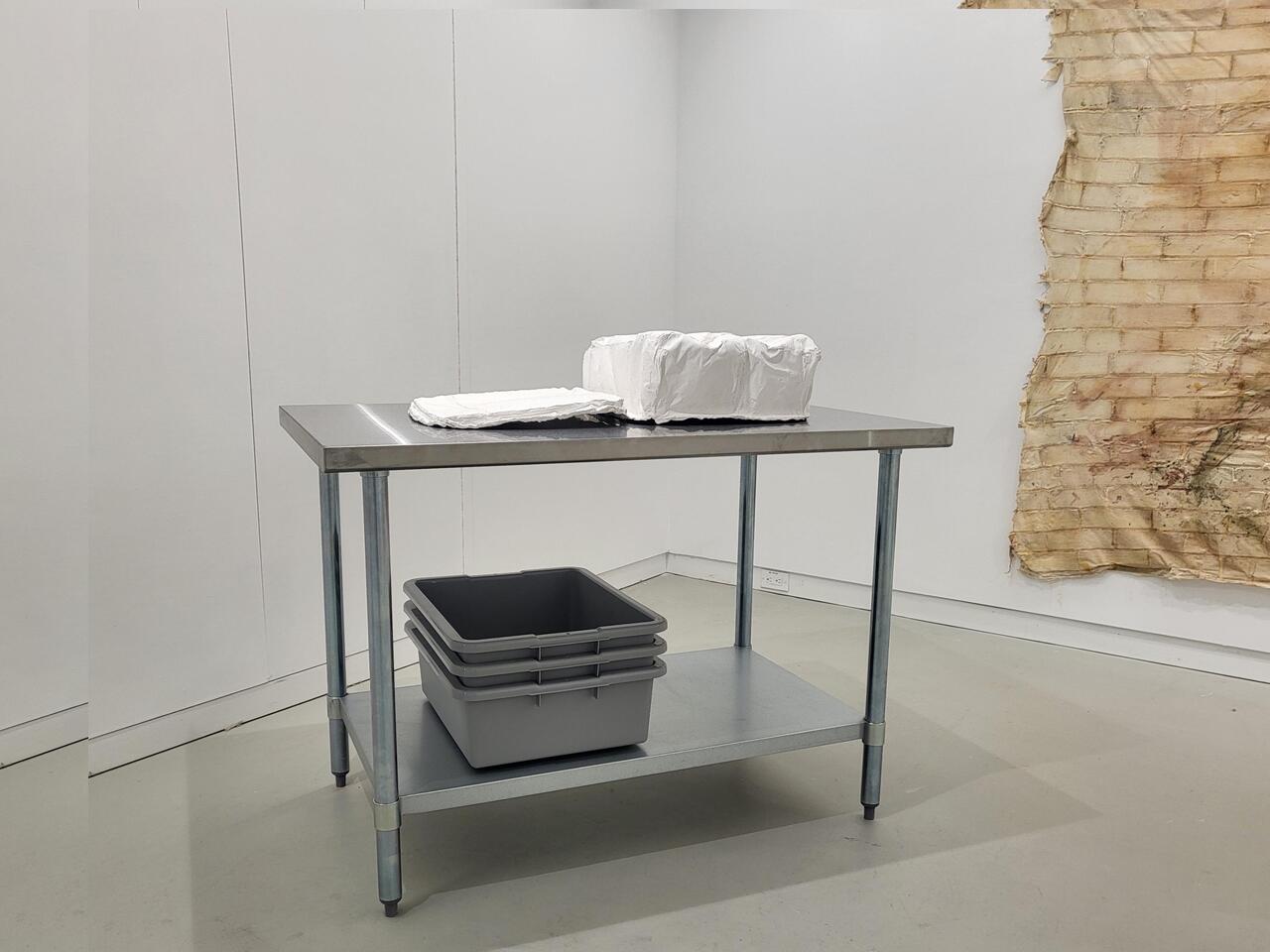
    Inside Travel Land presents a cold, steel airport security table with stacked plastic trays beneath and, on top, a plaster cast of the hollow interior of a suitcase. At first glance, it reads like an ordinary border checkpoint. But as Wang explained, the quick decisions made at these tables—what to keep, what to discard—can be laden with memory and loss. She recalled her sadness at surrendering a pair of childhood scissors to security. The plaster cast, fragile yet firm, embodies this paradox: absence as presence, and vulnerability as strength.

    Wang Zi, Cancanvan, 2025

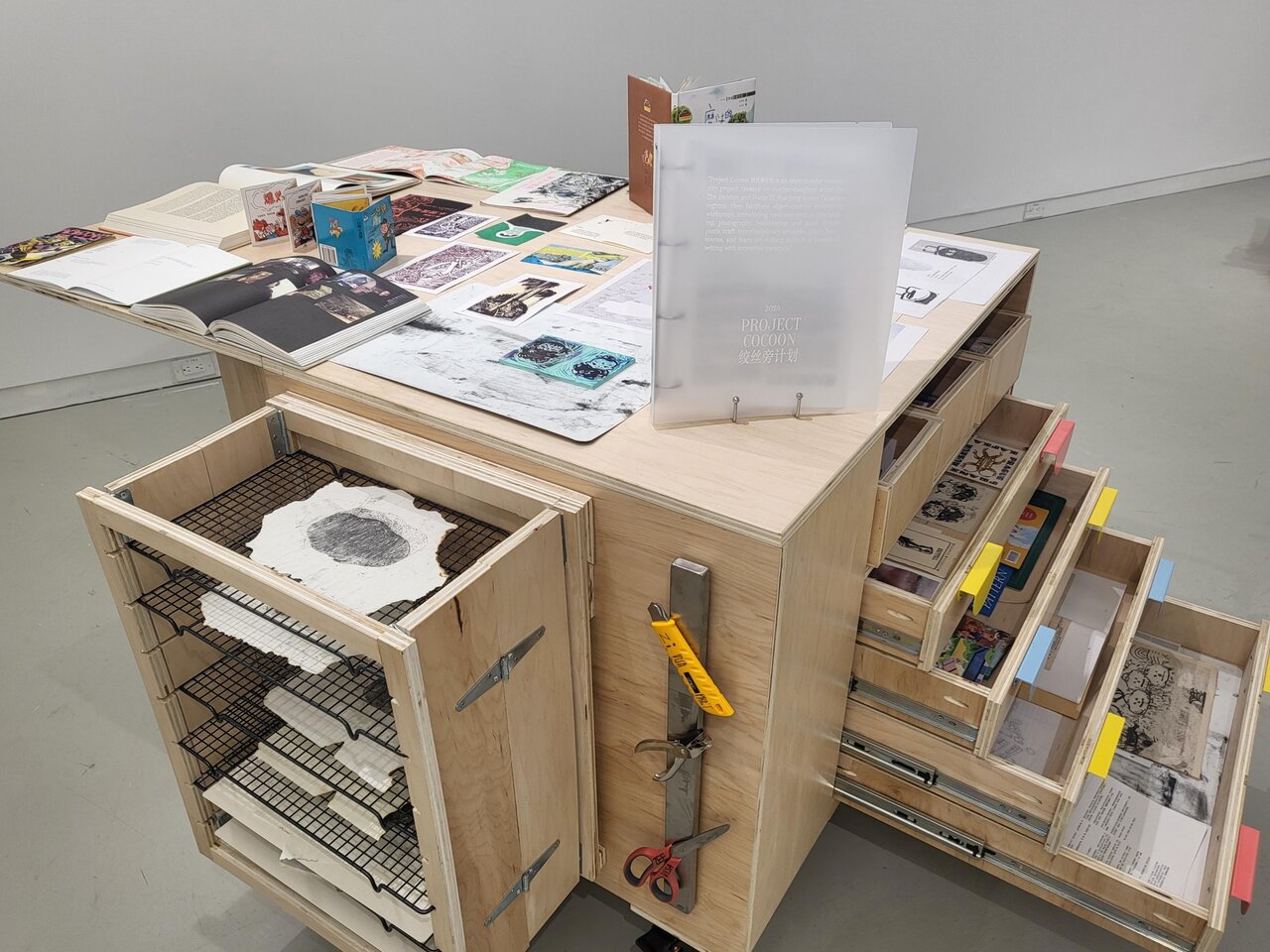
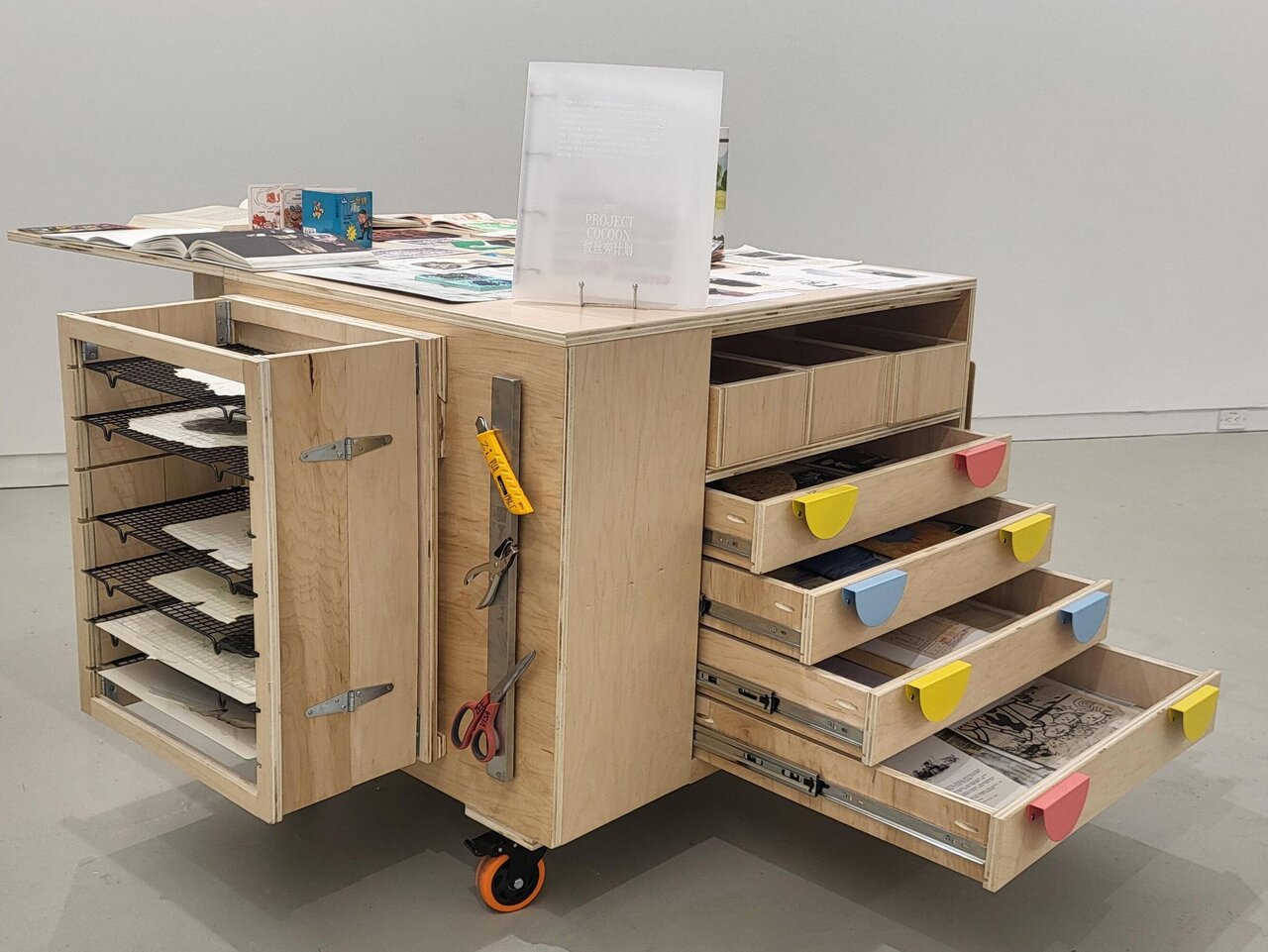
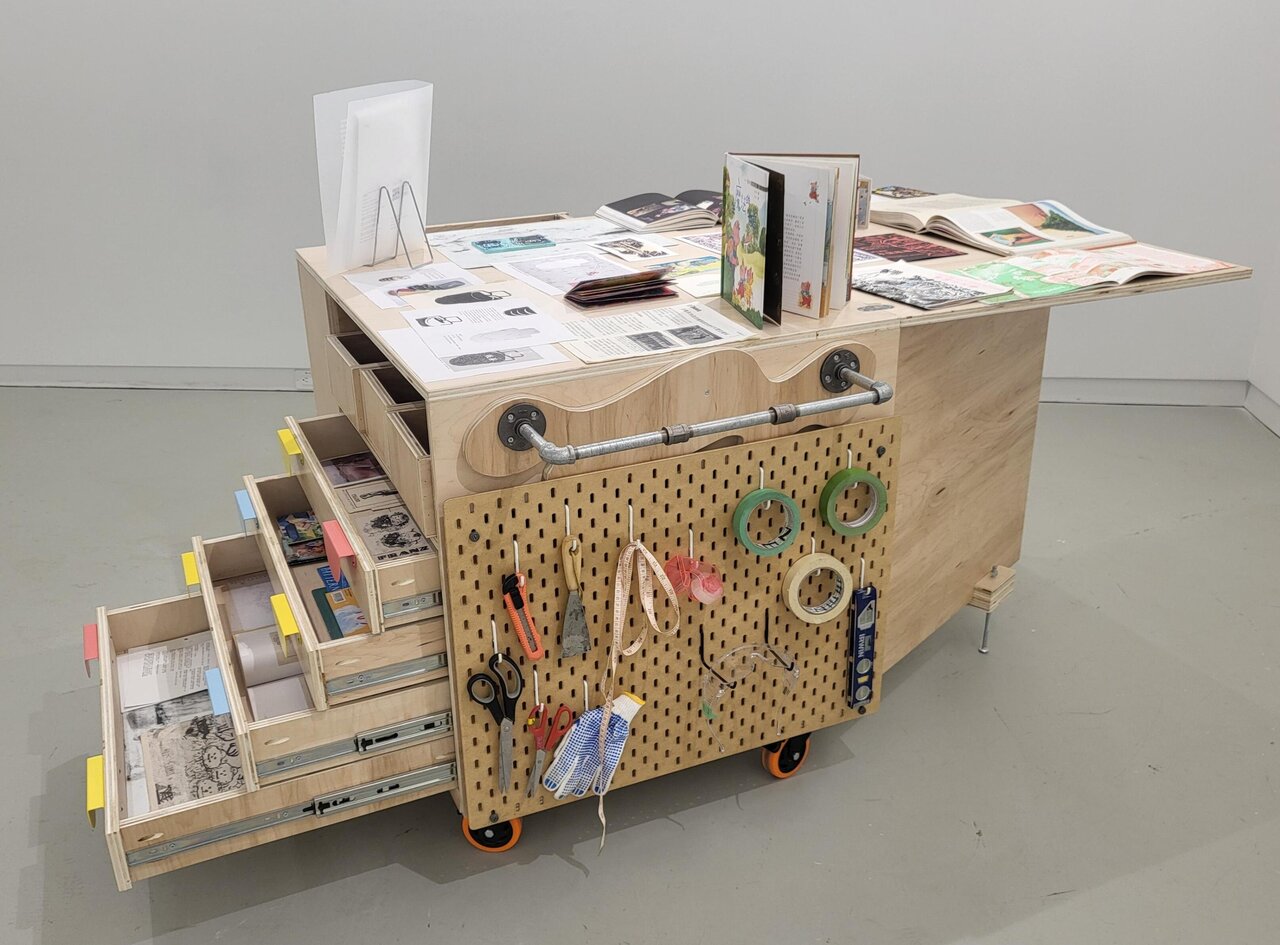
    If Inside Travel Land holds the weight of individual migration stories, Cancanvan turns outward to collective practice. Designed as a mobile workshop cart built from Canadian maple and metal, it folds and unfolds with ingenuity: drawers for stools, a pegboard for tools, a collapsible drying rack, and a surface that doubles in size to display artist publications. Compact enough to pass through most doors and vans, it functions both as a portable print studio and as a traveling gallery.

    Wang Zi, Cancanvan, 2025

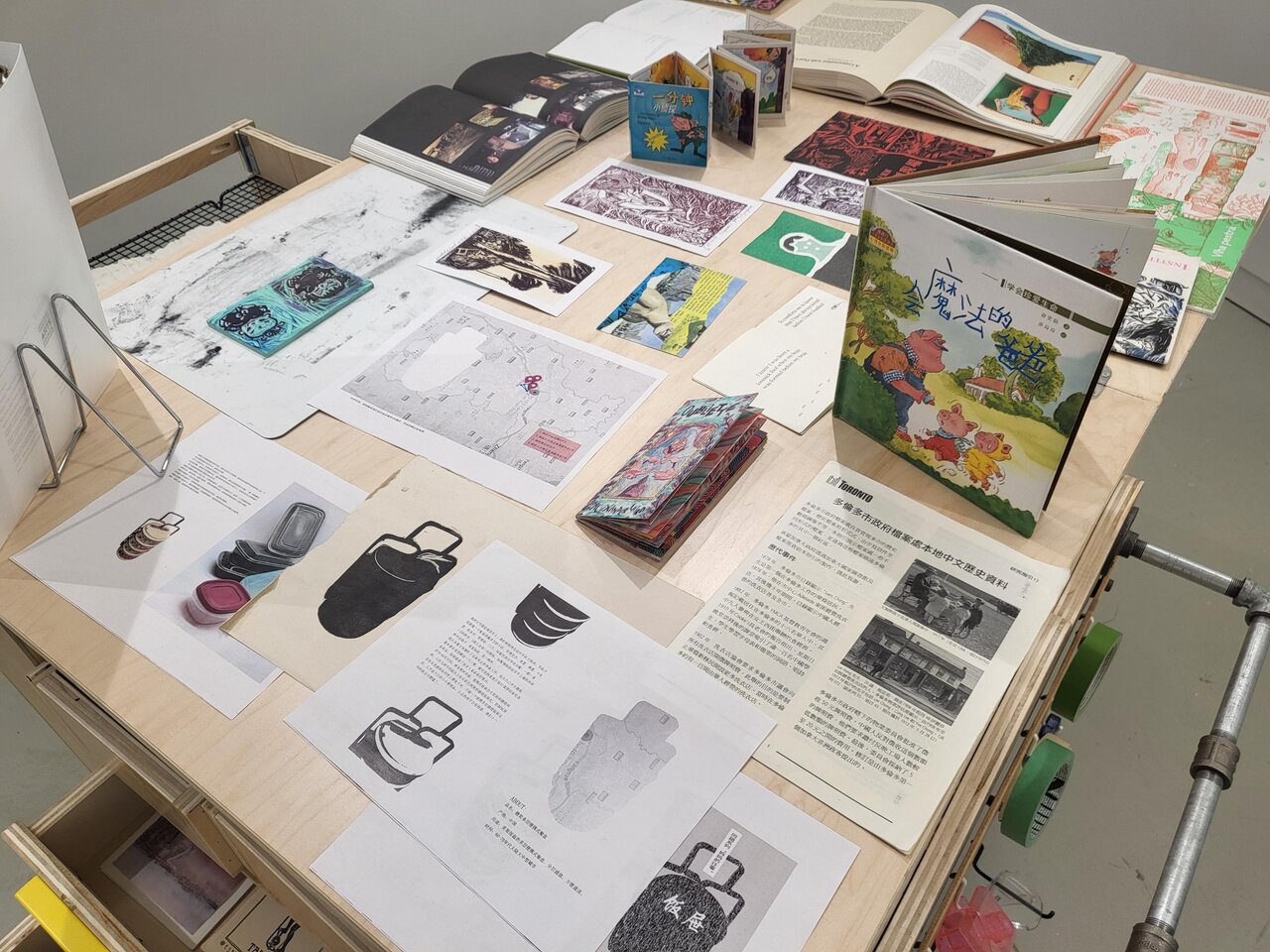
    The cart grew out of Wang’s years of leading zine and printmaking workshops, and it carries the imprint of those encounters. On display were publications from her community projects, including an artist-in-residence initiative at the Richmond Hill Public Library, collaborations with her mother, artist Dandan Zhu, and her own artist book collection. The range from zines and illustrated books to more experimental formats underscored the accessibility and diversity of print culture.

    Wang Zi, Cancanvan, 2025, installation detail

    Wang shared stories of workshop participants: newcomers mapping their migration routes on Google Maps, or professionals from non-art fields who discovered a new passion for creativity. One participant even continued to explore dancing as a form of self-expression after finding joy in making. These workshops often extended beyond the studio, sparking friendships and self-organized communities.

    Wang Zi, Cancanvan, 2025

    Through projects like Inside Travel Land and Cancanvan, Wang and Zhu weave their own diasporic experiences into larger networks of collective storytelling. Their recent collaboration, Project Cocoon, similarly archives migration narratives while fostering space for others to share their own. In this way, Cancanvan is more than an object—it materializes the often-temporary bonds created in community art, carrying them forward in tangible form.

    In a world that moves too quickly for many stories to be told, Wang’s practice insists on slowing down, gathering, and remembering. Her works at Liminal Spaces reveal how the intimate can become collective, and how community-based art sustains the fragile yet enduring act of storytelling.

    Text and photo: Sherry Chunqing Liu

    *Exhibition information: Liminal Spaces / Group show, September 3 – 27, 2025, Ignite Gallery at OCAD University, 100 Mccaul Street, Toronto. Gallery hours: Monday – Saturday 8:30am – 7pm.

  • Moses Salihou at Nicholas Metivier Gallery

    The show by Moses Salihou at Nicholas Metivier Gallery, Rencontres Émotionnelles is a heartfelt work of art that grows from a sense of community. The paintings are inspired by a recent trip the artist took to Cameroon, his home country. The exhibit twists the traditional conceptions of what a portrait should be by incorporating and interlacing abstract and figurative styles. The colourful paintings depict intimate familial and homey scenes; these spaces, with the help of Salihou’s abstract style, manage to feel private and personal while still allowing visitors to see themselves reflected in the anonymous figures.

    Installation view of Moses Salihou: Rencontres Émotionnelles at Nicholas Metivier Gallery

    The swirling textural strokes of paint afford the paintings a dynamic movement and fluidity. The bright colours and varying brushstrokes are a visual reflection of all the different parts and fabrics that build up every single figure. There is a wonderful maximalism in every brushstroke that paints the narrative of the individual depicted. While the brushstrokes may appear random upon first look, after engaging more deeply with each subject, viewers come to realize that every brushstroke, every colour chosen, was deliberately placed and intentionally set.

    Moses Salihou, Portrait Number 4, 2025, oil on canvas, 48 x 36 inches

    The scenes depict intimate settings, often representing time among friends and family in moments of quiet resemblance and connection. The anonymity of the figures represented in each portrait allow the narratives to maintain the purity of intimacy of these encounters. The form of every individual is clearly discernible, but their facial features are not. The figures are obscured by the intense and thick brush strokes that conform their shape. The anonymity of the subjects allows for the paintings to act as mirrors and for viewers to see themselves represented in the scenes.

    Installation view with Moses Salihou, Le Dernier Jour

    The works range from extremely personal works, like those that depict Salihou’s parents, to more community and culture-based pieces. I particularly enjoyed the work titled Special Day where two women braid the hair of two girls. There are so much culture and identity embedded into the work and still it manages to be relatable and to represent a variety of different people.

    Moses Salihou, Special Day, 2025, oil and acrylic on canvas, 60 x 60 inches

    Other works that I found particularly beautiful were L’Amour D’une Mere and Chaleur Maternelle 2 that both deal with the warmth found in the love and embrace of mothers. The narrative is based on culture and identity, but people from different realms of life can relate to it too.

    Moses Salihou, L’Amour D’une Mere, 2025, oil on canvas, 24 x 18 in

    The pieces that I admired the most were Dada and Baba, the two large portraits that represent the artist’s parents. Together they form one image, but Salihou chose to represent them in two different compositions. It is a common familial scene where a mother and father sit side by side with their kids in front of them. The colours with which Salihou dresses the figures and the variety of hues that fill the background make the works visually delightful. I particularly appreciated that you could discern the various patterns in the fabrics. It amazed me how much emphasis and care seems to be placed on every stroke, every movement.

    Installation view with Moses Salihou, Dada (left) and Baba (right), both 2025, acrylic on paper, 40 x 32 inches

    Despite being abstract forms, the culture and care Salihou has embedded into the works is still very much appreciated. The paintings tell a story of culture through the subjects and through the fabrics worn by the individuals. Every brush stroke gives a narrative of home and community that Salihou is trying to relate to the public.

    Colour, texture, community, culture and intimacy would be the words I would use to describe the show with just a few words.

    Text and photo: Sofia Diaz Aguilar

    *Exhibition information: Moses Salihou, Rencontres Émotionnelles, September 6 – 27, 2025, Nicholas Metivier Gallery, 190 Richmond Street East, Toronto. Gallery hours: Tue – Sat, 10am – 5pm.

  • Nithikul Nimkulrat at Craft Ontario

    Watching the movement of a pen becoming a signature. Evenings filled with karaoke serenades. Hearing the whirr of a tape rewinding. These replayed memories are scenes in Nithikul Nimkulrat‘s show Remembered & Forgotten at Craft Ontario. The show is the first curated exhibition at their new space at 401 Richmond.

    Installation view of Nithikul Nimkulrat, Remembered & Forgotten at Craft Ontario

    Nimkulrat contemplates the reality of forgetting and the fragile relationship one holds with memory. This rumination grew because of witnessing her father experience Alzheimer’s disease and the way in which his memory and recognition were affected. Nimkulrat recreated objects associated with their relationship — a microphone, stationary, and a pen among others — as black and white paper creations, carefully crafted using knots. The first object I engaged with was a capped pen raised ever so slightly with a pin upon a plinth, The Scheaffer Fountain Pen, 2025. I thought about how often I use a pen; a daily necessity for notes, tasks I do not want to forget, thoughts I want to remember. Here the tool is created out of paper, crafted out of the very material it is intended to write on.

    Nithikul Nimkulrat., The Scheaffer Fountain Pen, 2025, hand-knotted string, 6-1/2 x 5/8 x 7/8 inches

    The knots used to recreate the objects are carried out with a precision that memory cannot attempt. The negative space and gaps symbolize the reality of remembering and forgetting. In The VHS, 2024, Nimkulrat uses the white paper string to recreate the labels and reel mechanism. The black plastic housing has also been recreated with knotted paper. Nimkulrat uses a variety of knots, some tied and coiled tightly to create bolded sections outlining the cassette, while the circle-diamond knots present a lighter feel, providing a contrasting depth for the tape.

    Nithikul Nimkulrat, The VHS, 2024, hand-knotted paper string, 8 x 1-1/4 x 4 inches

    As I considered the construction of these objects, I aimed to identify the kinds of knots used. I compared diagrams of mathematical knots with the objects in a feeble attempt to recognize the differences between the simple and trifoil knots. While I could not determine which were used, I came across the method of projecting knots onto a plane surface. The diagram reduces the knot to a shadow, a simpler version of itself in which the order of the strands is omitted. This made me consider the shadows created by the objects on surrounding surfaces and how the works are echoed in them.

    Nimkulrat’s The Corded Microphone, 2025, is a good example as the shadow of the object cannot be ignored. The plug at the left edge is repeated in five shadows cast in different directions as the shadows project erratically along the wall. Whereas the microphone itself has shadows concentrated on the wall immediately below the object. It prompts one to reflect on how a voice can live on and resonate in one’s head.

    Nithikul Nimkulrat., The Corded Microphone, 2025, hand-knotted paper string, 12 x 2-1/4 x 11 inches

    Meanwhile, in the section housing The Video Camera, 2025, one can see the object and its shadow shift slowly, slightly, in a sweeping arc. The shadows of the camera appear like a fan of cards, drifting in darkness. This component of the installation plays into the notion that memories of one another can live on, as a shadow of oneself.

    Nithikul Nimkulrat, The Video Camera, 2025, hand-knotted paper string, 14-1/2 x 9 x 8 inches

    In this experience of remembering and forgetting, there is the underlying theme of grieving. Mourning the one you love as an ambiguous loss, witnessing a disease like Alzheimer’s progress and deprive you of the person you knew. In Nimkulrat’s reflection, there is also anticipatory grief, considering the artist’s own future loss of memory and sense of self. Nimkulrat’s The Letter in the Envelope, 2024, makes one consider the things left unsaid, the events and moments one wants to record. Like the camera, video tape, pen, and microphone, these tools underline the desire for remembering and keeping the memories instead of forgetting them.

    Nithikul Nimkulrat. The Letter in the Envelope, 2024, hand-knotted paper string, 14 x 12 x 4 inches

    Nimkulrat’s exhibition considers the fundamental aspect of human culture, one that is essential in fostering relationships, passing on traditions, and building skills required for survival. Memory is at the core of our functional existence, which makes the reality of forgetting distressing. Nimkulrat’s labour to remember through these objects with carefully crafted knots makes this gallery exhibition remarkable.

    On that note, the new space at 401 Richmond holds many memories of the cultural sector in Toronto. The hub functions as a vessel for artistic production, tying together a variety of artists and workers in a larger network. Hopefully Craft Ontario’s Remembered & Forgotten will be one of many engaging exhibitions in this new space.

    Text and photo: Rashana Youtzy

    *Exhibition information: Nithikul Nimkulrat, Remembered & Forgotten, August 16 – September 28, 2025, Craft Ontario, 401 Richmond St. W. Unit 108, Toronto. Gallery hours: Tuesday – Saturday 11am – 6:30pm, Sunday 12-5pm.

  • David Liss: Land/Mind II at Rail Gallery

    Tucked away in an industrial complex at 1444 Dupont Unit 10 is the Rail Gallery where artist, curator, writer Daivid Liss exhibits his works from 2024 and 2025. This is the first of several exhibitions presented by Collective City showing works of an artist who has contributed so much to the local art community. The exhibition is a follow up to Liss’s earlier show in May – June 2025 at Blouin Division Gallery in Toronto. It continues his series of works in oils, acrylic, watercolour and mixed media.

    David Liss in front of his works

    The paintings do not represent any particular scene or location. They are landscapes, mostly created in Liss’s backyard which also became his studio. Working in water colours took place inside his house. As Liss says “They reference the earthly and the terrestrial but from a different world. I aspire to conjure atmosphere or ambience – an energy or pulse that resonates poetically within the spirit or the imagination.”

    Installation view of David Liss: Land/Mind II

    As an art student in Concordia University Liss studied print making and painting in Montreal in the 1980’s. In those days large studio spaces were cheap to rent and Liss got a reputation for creating huge warehouse exhibitions. They were called the NOMAD Exhibitions which moved across Montreal and featured artists who were to make a name for themselves, such as Peter Doig. As word got out of Liss, as a young curator the Saidye Bronfman Centre for the Arts scooped him up and he worked for them between 1995 and 2000. Liss brought a lot of his energy with him and the centre became a hub for the Montreal art scene. MOCA lured him to Toronto, where he became an important figure in the city’s active art community. Departing as an art administrator, Liss has had more time to devote to creating his art though, he is quick to add, he never gave it up. He has thousands of water colour studies, prints and works stored away. He is working toward creating larger pieces on bigger canvases.

    David Liss, Untitled, 2025, oil on canvas, 20 x 18 inches

    The works in this new exhibit demonstrate Liss’s knowledge of colour and composition. After years of presenting and curating other artists, he has put these recent works on display. There are framed watercolours, mixed media works with spray paint as well as oil paintings depicting landscapes.

    David Liss: Untitled, 2021, Acrylic on canvas, 16 x 12inches

    Some of my personal favourites were the mixed media works with spray paint, but I was also drawn to the landscapes done with oils.

    David Liss: Untitled, 2024, acrylic and enamel spray paint on canvas, 30 x 40 inches

    The exhibition is a treat for anyone who enjoys skillful contemporary artworks and no doubt more than a few of these works will find a new home.

    David Liss is a practicing artist, an independent curator and writer living in Toronto.

    Text and photo: Phil Anderson

    *Exhibition information: David Liss, Land/Mind II, September 24 – October 5, 2025, DUPONT RAIL, 1444 Dupont St. Unit 10. Presented by Collective City. Gallery hours: Wednesday – Sunday 12 – 5pm.

  • Hugh Alcock at Yorkminster Park Gallery

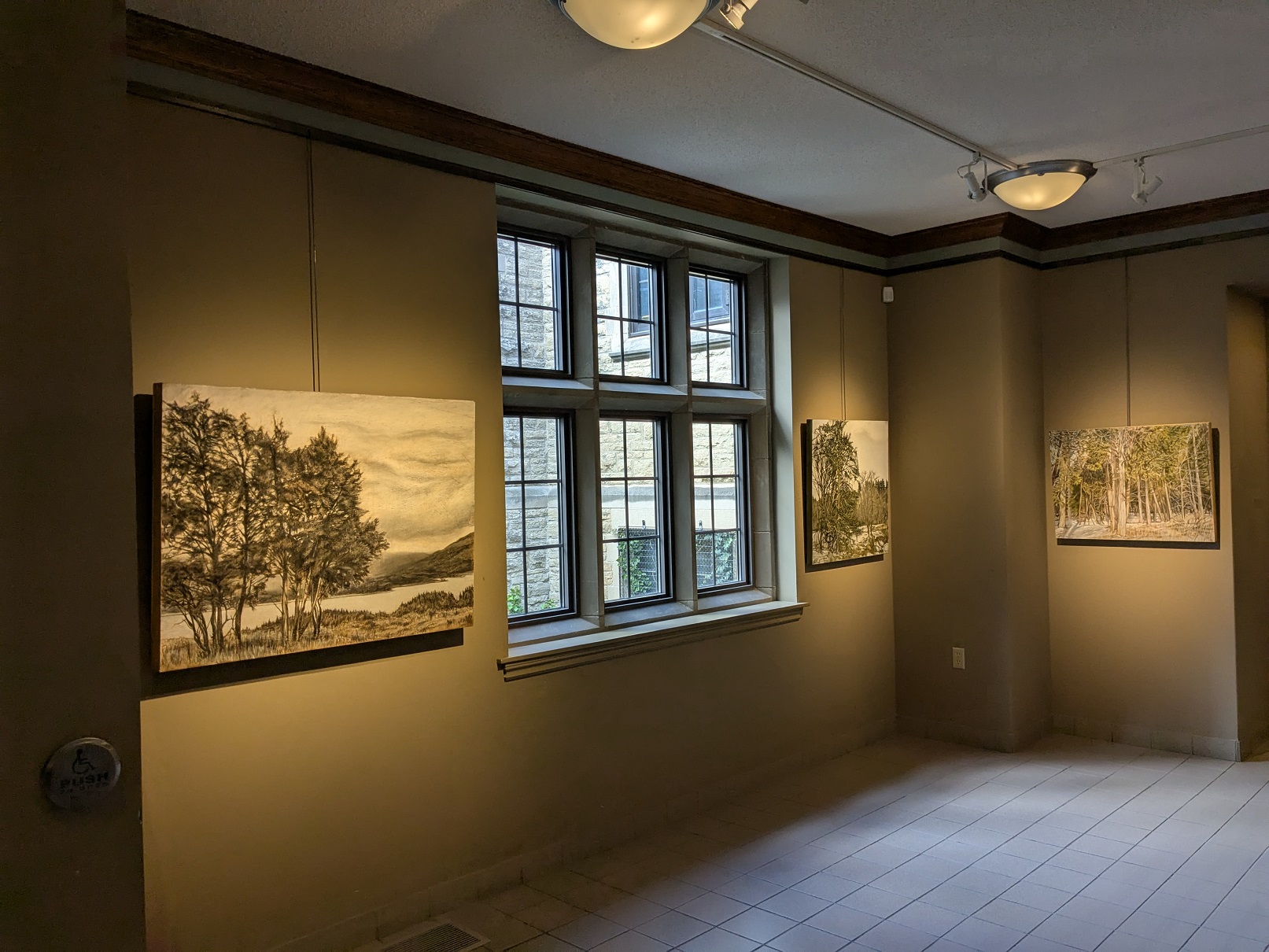
    To reach Yorkminster Park Gallery you leave busy Yonge Street and pass through a small garden. The heavy doors of the stone-clad building further muffle the sound of the city.  Inside this quiet space you’ll find Hugh Alcock’s aptly named Into the Clearing. You’re surrounded by Alcock’s subtle forest images.

    Installation view of Hugh Alcock, Into the Clearing at Yorkminster Park Gallery

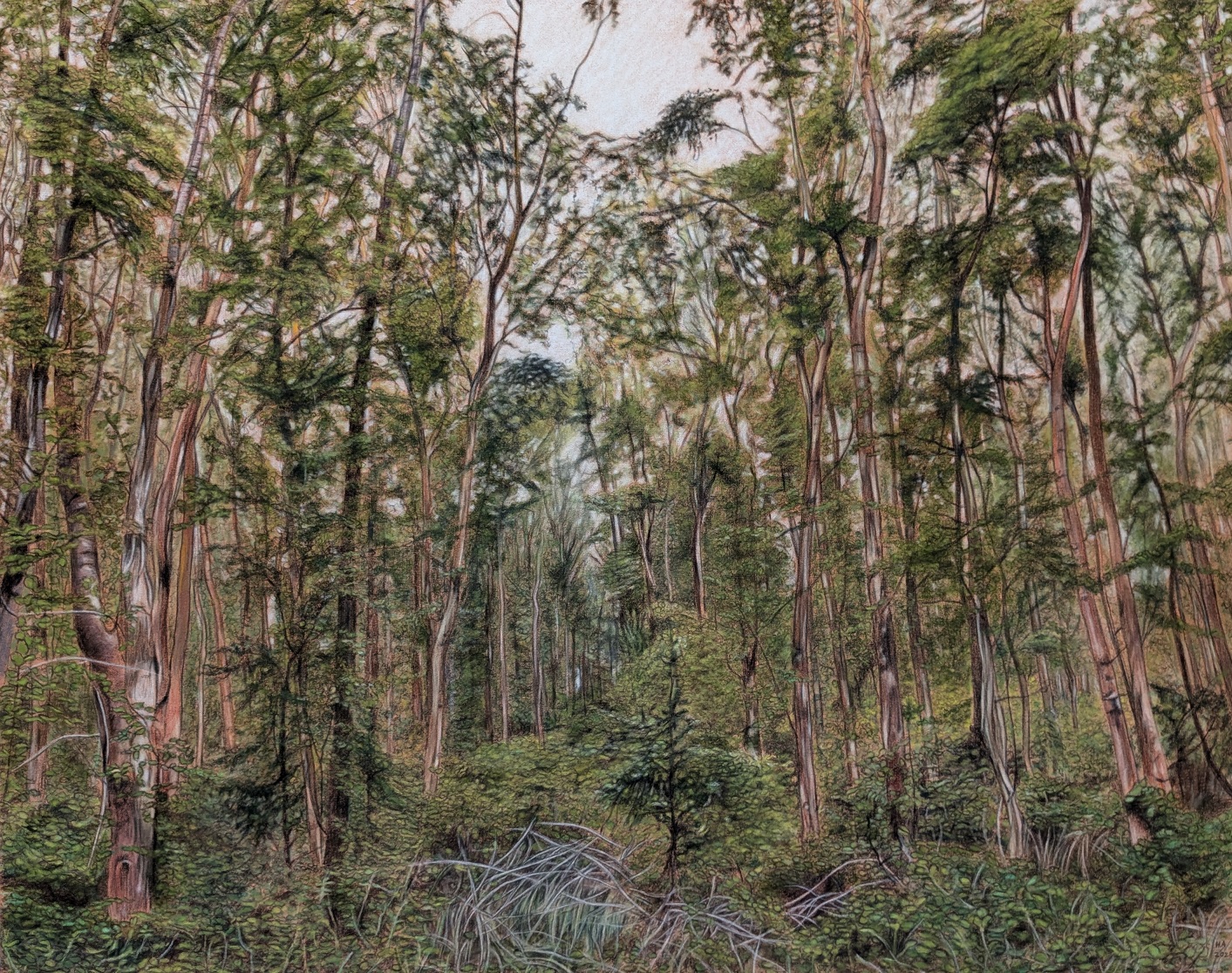
    Alcock does not offer the kind of landscapes we have grown accustomed to; no expansive vistas, no theatrical skies. Instead, he gives us the thickets landscape, with the bark, the undergrowth. He brings us face to face with the density of the forest, with its entanglements and obscurities. He draws our eyes in to linger on trunks, on roots, on the places where one branch splits into two, then two into four, proliferating geometries that threaten to overwhelm. Yet his hand is careful. These are drawings, not paintings. Built up with lines upon line, they become a structure of attention made visible.

    Woodland, 2025, pastel and charcoal on canvas, 48 in x 60 inches

    The artworks are made with charcoal and pastel on canvas and board.  The technique results in lines that are softer than pen or pencil but more linear than paint. Alcock uses a restrained palette. Browns like earth, greys like weathered stone, greens so subdued they almost vanish. Alcock is not interested in seducing us with colour. He wants us to notice form, rhythm, pattern, the slow architectures of nature.

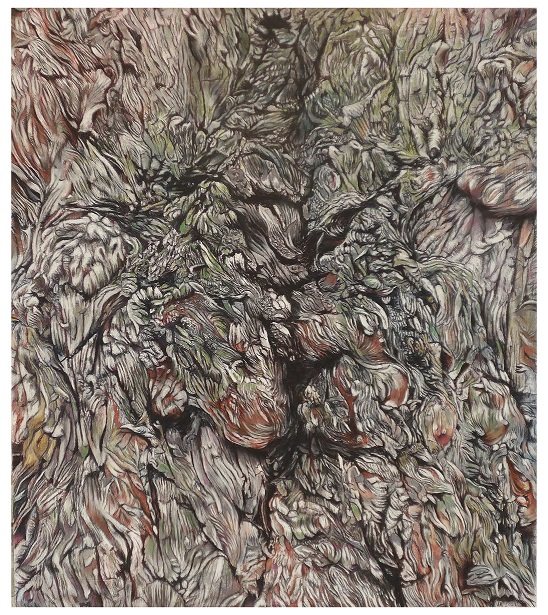
    Trees are what is depicted in Alcock’s artwork. But perhaps we can say that the true subject of the work is the contemplation of these trees. The artwork not only describes what the trees look like, but what it’s like to look at trees. In his artist’s statement, he writes of their quiet presence, their infinite variety, their capacity to shift appearance with light, season, and weather. Their bark is rendered as ridged lattices, their branches as unfolding networks. One can trace his attention as it moves through these structures. The drawings record not only what he saw, but the act of seeing itself.

    Study of Willow Bark: In Memoriam, 2020, pastel and charcoal on wood panel, 48 x 42 inches

    These intricate drawings invite us to experience a sensory dimension that extends beyond the visual. Alcock has written that he hopes viewers not only see but also “listen for the rustle of the trees, smell the fragrances in the air, and feel the spikiness all around or the cold ground underfoot.” This synesthetic invitation reverberates through the work. The density of mark-making makes one think of sound textures of tactile resistance, of rough and irregular surfaces. You almost catch the dampness of moss, the chill of shaded soil, the faint resinous odor of pine.

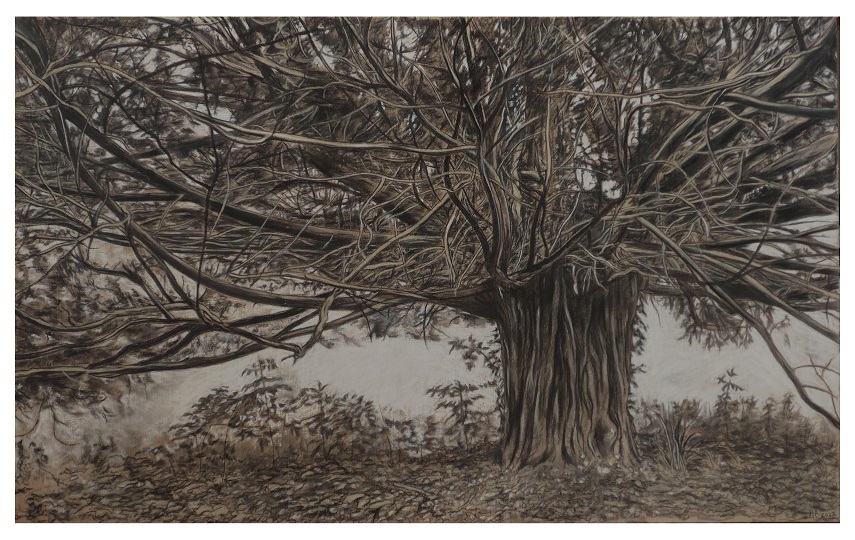
    There is tension in these works. They oscillate between enclosure and release, between the density of the underbrush and the promise of air. Often what is most powerful is what is barely there: the space between branches, the fragment of light beyond, the suggestion of depth that dissolves into shadow. Alcock makes absence as present as substance. The viewer senses both the weight of the forest and the fragile openings within it.

    Yew, Churchyard, 2022, pastel and charcoal on wood panel, 30 x 48 inches

    What makes Alcock’s work unusual in our current climate of overstimulation is its insistence on patience. These are not images you can skim. They resist the instant hit of spectacle. They require time, the way a forest requires wandering. If you give that time, the reward is real. You begin to see how each branch moves, how bark curves and cracks, how form is never static but always unfolding.

    Mikael Sandblom

    Images are courtesy of the artist.

    *Exhibition information: Hugh Alcock, Into the Clearing, September 13 – October 30, 2025, Yorkminster Park Gallery, 1585 Yonge Street, Toronto. Gallery hours: Saturday 12 – 3pm, Sunday 10am – 11am and 12:15 – 1pm.

  • Shelagh Keeley at The Power Plant

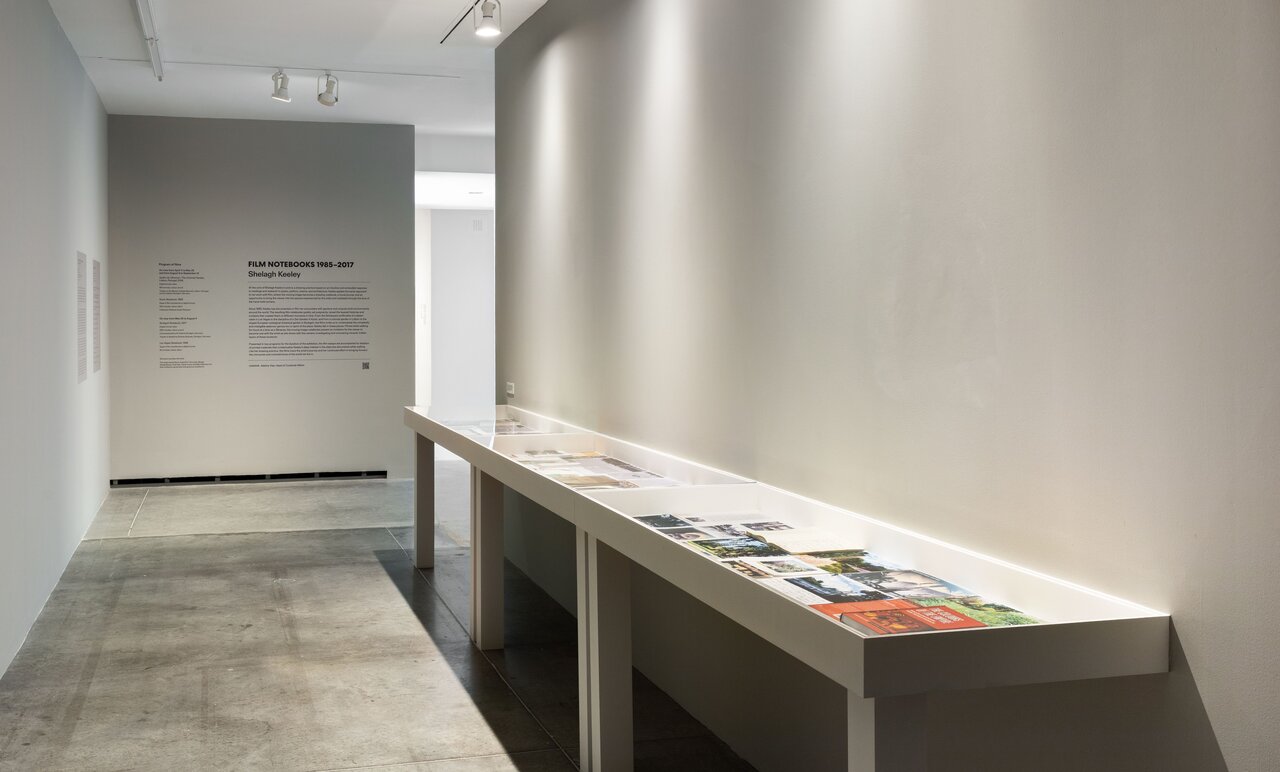
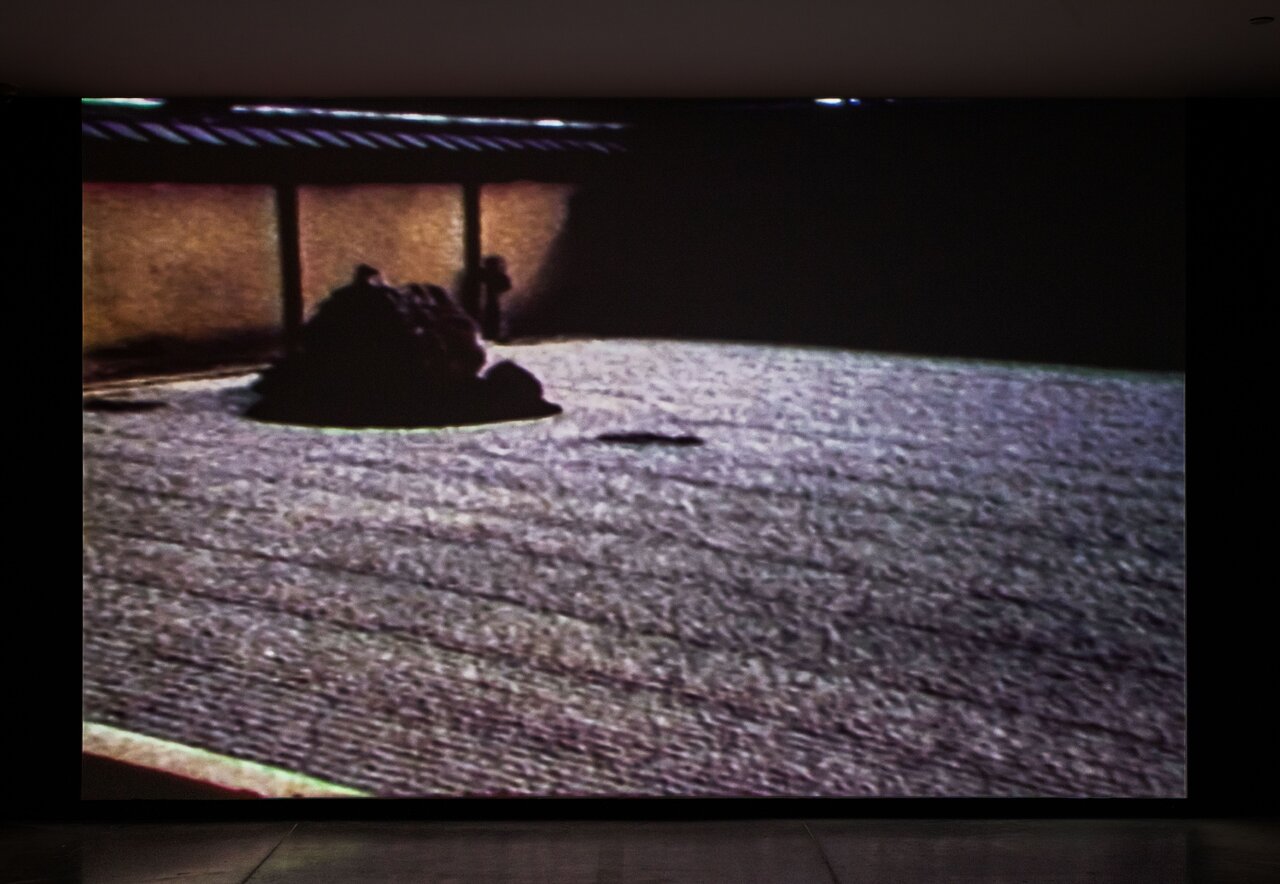
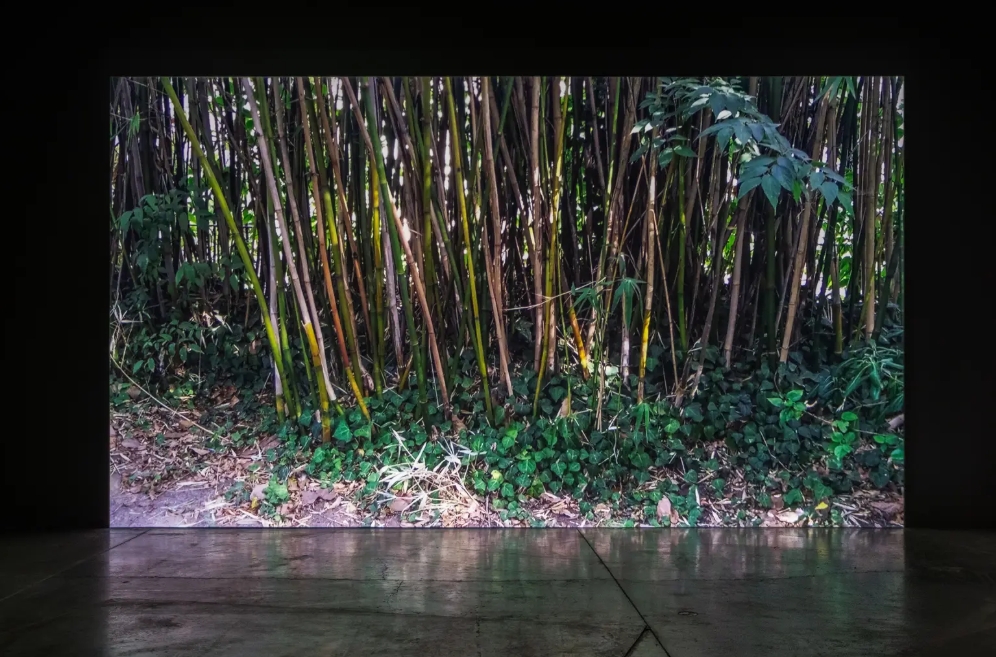
    Slowness is the priority in Shelagh Keeley’s Film Notebooks; the films stimulate an unhurried and leisurely sense of appreciation. In a world that values immediacy, the patience and tranquility in Keeley’s film is both important and greatly appreciated. Keeley filmed a Zen Garden in Kyoto, Japan, The Colonial Garden in Lisbon, Portugal, a desert oasis in Las Vegas and the largest European zoological-botanical garden in Stuttgart. When I visited the gallery, I saw the Zen Garden and The Colonial Garden. While both films exude a different energy and story, they converge in the gentle demeanor of their exploration. As visitors approach the installation, they become engulfed in darkness as the video plays in front of them. The artist, the viewer, and the camera almost become one through this experience; in these moments of slowness, they all look through the same lens. 

    The sets of booklets that welcome visitors as they approach the screening rooms offer more information on Keeley’s process and story. They include sketches, books, notes, photographs, and paintings all related to the videos inside. It offers visitors insight into what happens prior to the creation of Keeley’s art. 

    Shelagh Keeley, Film Notebooks 1985-2017, 2025. Installation view: The Power Plant, Toronto, 2025. Photo: LF Documentation.

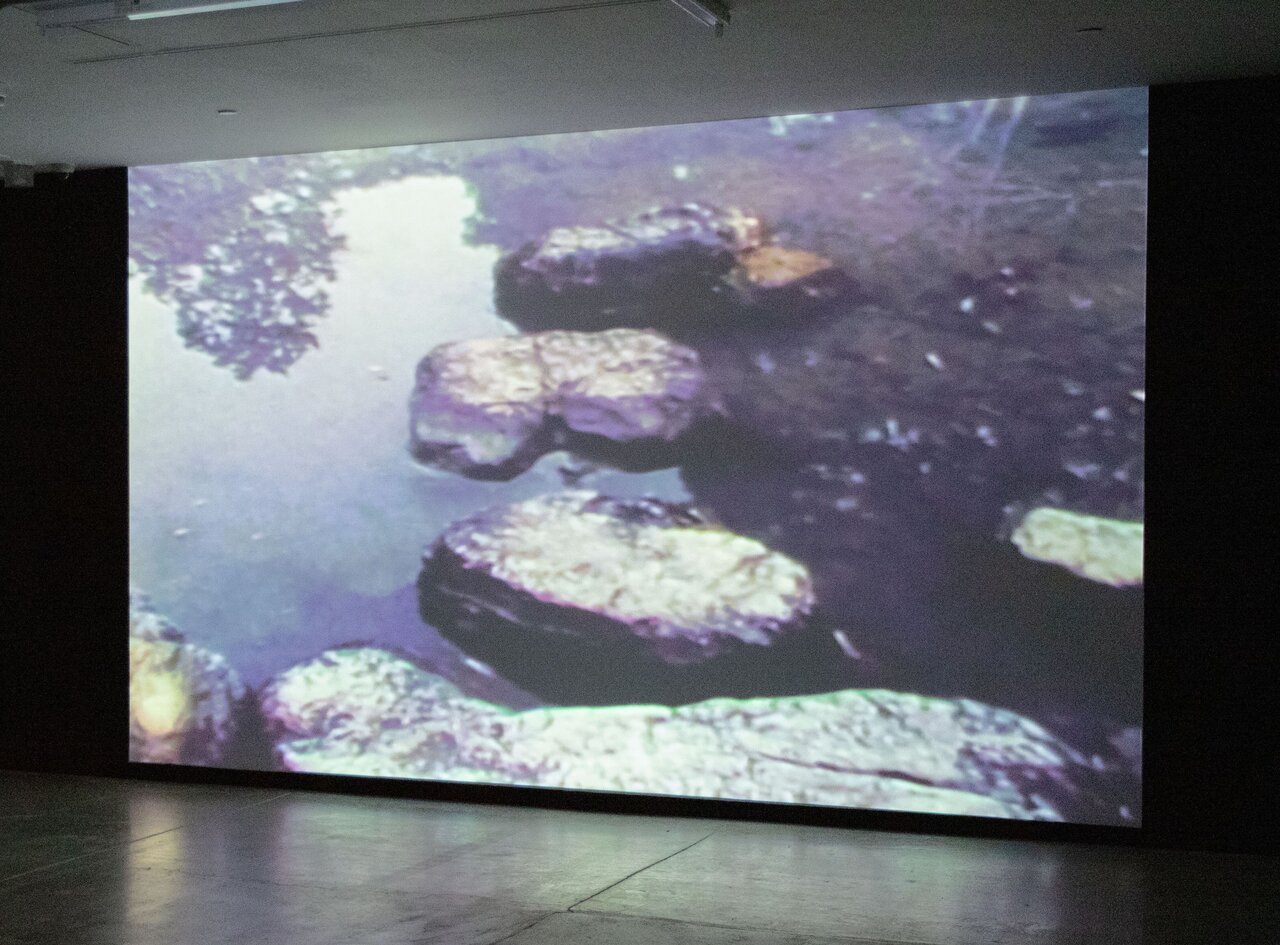
    The first of the two videos takes place in the Zen Garden in Kyoto, Japan. This is the first film Keeley ever shot. A sense of nostalgia floods the video. The film is full of a childlike wonder, marvelling and obsessing over all the small details of the garden. The camera travels through every texture and environmental elements found in the garden: rocks, soil, wood, plants and more.

    Shelagh Keeley, Kyoto Notebook, 1985. Super 8 film transferred to digital format. 108 minutes, colour, silent. Collection Peabody Essex Museum. Installation view: Film Notebooks 1985-2017, The Power Plant, Toronto, 2025. Photo: LF Documentation.

    The work draws visitors into the garden. The film is quiet; the artist and the images are the only company we have. The camera moves slowly in and out of focus, it zooms in, zooms out, in and out; so viewers become entranced in this cycle. And at the end, a strong white light flashes us out of the calm and gentle garden. It is an experience that requires patience and attention. If you can give the artwork the time it needs, you are rewarded with a sense of culture involving luscious and tranquil spaces. It feels like an ephemeral moment in the Zen Garden.  

    Shelagh Keeley, Kyoto Notebook, 1985. Super 8 film transferred to digital format. 108 minutes, colour, silent. Collection Peabody Essex Museum. Installation view: Film Notebooks 1985-2017, The Power Plant, Toronto, 2025. Photo: LF Documentation.

    The second film transports visitors to The Colonial Garden in Lisbon, Portugal. The views are filled with beautiful nature spaces and dynamic colour contrasts. This film is less silent than its counterpart; you can appreciate the sound flooding over the trees, dancing in the wind, and birds chirping.

    Shelagh Keeley, Jardim do Ultramar / The Colonial Garden, Lisbon, Portugal, 2016. Digital format video. 180 minutes, colour, sound. Thanks to the Museu Coleção Berardo, Lisbon, Portugal and ifa-Galerie Stuttgart, Germany. Courtesy the artist. Installation view: Film Notebooks 1985-2017, The Power Plant, Toronto, 2025. Photo: LF Documentation.

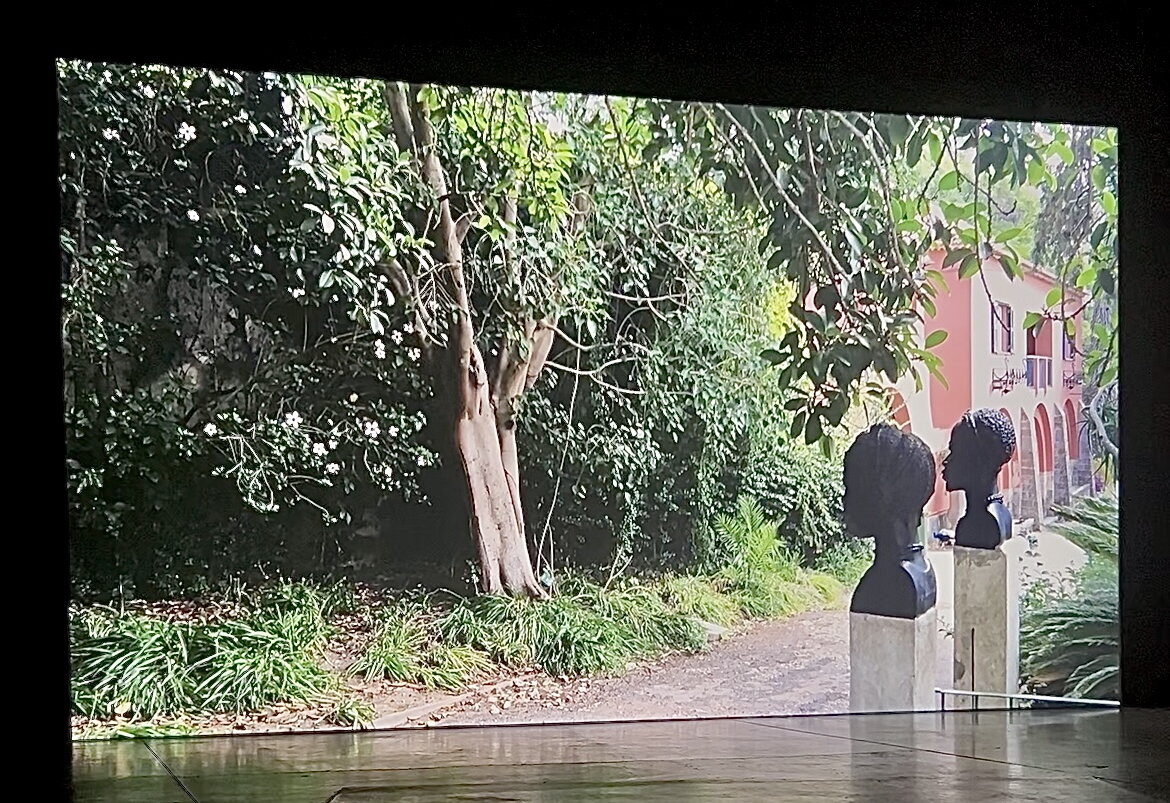
    When walking through The Colonial Garden the focus is less on the textural experience and more on the experience of the space. The name itself suggests a tumultuous history, and Keeley is not one to ignore that. The garden was sponsored by Antonio de Oliveira Salazar, Portugal’s dictator during the early 20th century, and for some years it functioned as a “human zoo.” The narrative suggests that people from the colonies in Asia and Africa were exotic and a “different species” than the Portuguese. Instead of hiding the dark colonial and violent history of the space, Keeley highlights it, focusing the camera on various chest statues that represent people from the Portuguese colonies. The focus of the film allows visitors to question themselves and the everyday places they interact that may have similar, disturbing stories. Keeley’s work encourages viewers to reflect on people who walked in this space before. 

    Shelagh Keeley, Jardim do Ultramar / The Colonial Garden, Lisbon, Portugal, 2016. Digital format video. 180 minutes, colour, sound. Photo: Sofia Diaz Aguilar

    Keeley holds the camera with one hand and with the other she leads viewers through the spaces. She allows us to see the places through her eyes, her mind and her lens; she opens the perspective of what a garden can hold. In a slow, quiet, and tranquil experience, the rushed modern world slows down, allowing visitors to have a moment of calmness and reflection.

    Sofia Diaz Aguilar

    *Exhibition information: Shelagh Keeley, Film Notebooks 1985-2017, April 11 – September 21, 2025, The Power Plant, 231 Queens Quay West, Toronto. Gallery hours: Wednesday – Thursday & Saturday – Sunday 10am – 6pm. Friday 10am – 8pm.
  • Yayoi Kusama at the AGO

    Yayoi Kusama’s Infinity Mirrored Room Entrance, AGO, 2025.

    Yayoi Kusama’s Infinity Mirrored Room – Let’s Survive Forever, offers an immersive encounter with one of the artist’s most iconic installations. Within the mirrored space, silver spheres are suspended from the ceiling and arranged on the floor, creating a disorienting yet meditative environment where reflections extend in all directions. At the centre of the installation, a mirrored column invites viewers to peer into a seemingly endless field of floating orbs. The effect is both spatial and psychological, echoing Kusama’s long-standing interest in repetition, perception, and the dissolving boundary between the self and the environment.

    Yayoi Kusama’s Infinity Mirrored Room, inside view of the column.

    First created in 2018 and now extended at the AGO through May 2026, Let’s Survive Forever is both an artwork and a phenomenon. It installed within the AGO thanks to the generosity of over 4,700 #InfinityAGO donors and the support of the David Yuile & Mary Elizabeth Hodgson Fund—a gesture that speaks to the collective power of Kusama’s vision, and the public’s deep longing to dwell within it.

    Over more than seven decades, Yayoi Kusama has reshaped the landscape of contemporary art by collapsing the boundaries between inner world and outer cosmos, object and environment, repetition and rupture. Born in 1929 in Matsumoto, Japan, and active since the early 1950s, she has moved between continents and disciplines with unwavering intensity, producing paintings, performances, immersive installations, films, writings, and public art that defy containment. Her influence spans movements such as Pop, Minimalism, and Psychedelia, yet exceeds any of them. Kusama does not merely work within art history; she transforms it.
    Installation view of Yayoi Kusama’s Infinity Mirror Room Installation, AGO, 2025.

    It was in 1965 that she created her first Infinity Mirror Room, a radical spatial experiment that built upon the repetitive gestures of her paintings and sculptures. With mirrors, she found not only a material but a metaphysical medium, one that allowed her to render infinity tangible, to confront both the vastness of the universe and the collapse of the self. Since then, she has created over twenty unique rooms, each a meditation on limitlessness, each a confrontation with mortality, madness, wonder, and the unknown.

    In Let’s Survive Forever, this confrontation is distilled into an experience at once intimate and infinite. The mirror does not lie, but it multiplies. Standing within the room, we see ourselves again and again and again until the line between self and space begins to blur. We are offered the illusion of endlessness, but also the gentle disquiet that such illusions can bring. It is this paradox—joy and vertigo, presence and erasure—that Kusama has explored throughout her life.

    Installation view of Yayoi Kusama’s Infinity Mirror Room, AGO, 2025.

    The title, Let’s Survive Forever, sounds like a contradiction. Survival is temporal; forever is not. And yet it is precisely in that tension that Kusama’s work takes root. Her mirrored worlds do not offer permanence as fact, but as hope, as an act of imagination against despair. For an artist who has lived through war, exile, mental illness, and the slow burn of cultural erasure, the question is not whether survival is possible, but how we might dream it into our existence. Infinity, for Kusama, is not cold math; it is a luminous refusal to vanish.

    Now in her 90s, Kusama continues to create with an urgency that belies age. Her recent works of vivid paintings, towering polka-dot sculptures, and ever-expanding rooms continue to represent the endurance of her ecstatic vision. To step inside her Infinity Mirrored Room is to participate in that vision, to be surrounded by the radiant residue of a life spent looking into the beyond.

    Installation view of Yayoi Kusama’s Infinity Mirror Room, AGO, 2025.

    Let’s Survive Forever does not ask us to forget ourselves, but to see ourselves differently, to understand that our singularity is never separate from the collective. We are each a sphere among spheres, a reflection within reflections, a fleeting image in a room that will outlast us. And yet in that image, doubled, dissolved, dazzling—there is something true. Something that points to the enduring capacity of art to hold us, to mirror us, and to remind us that to survive is already an act of infinite imagination.

    Text and photo: Yehyun Lee

    *Exhibition information: Yayoi Kusama, Infinity Mirror Room – Let’s Survive Forever, until May 1, 2026, Art Gallery of Ontario, 317 Dundas Street West, Toronto. Museum hours: Tue and Thurs 10:30am – 5pm, Wed and Fri 10:30am – 9pm, Sat and Sun 10:30am – 5:30pm.

  • Sage Szkabarnicki-Stuart at Koffler Arts

    Baby goats are the stars of Sage Szkabarnicki-Stuart’s camera. From repetitive daily farm routines of mowing grass and caring for farm animals, the artist stages performative acts of rural actions with a touch of humour. Baby goats are displayed in backdrop-like nature or in human spaces such as offices. The artist, through dramatic compositions, pantomimes her farm fantasies in a series of still photographs and short videos.

    Sage Szkabarnicki-Stuart, Office, 2025, color digital photograph on vinyl, 102 x 68 inches. Photo: Sherry Qin

    Her satirical images of living in rural areas embrace comedic yet chic interpretations of a 21st century girl. She creates images depicting cocktail nights in the trees with tree elves (Absinthe, 2025) or a figure wearing a blue checkered dress shooting a sky-blue rifle while perched on a newly painted fence (Centrist, 2025). These are whimsical fantasies of a foreign world in a familiar land.

    Sage Szkabarnicki-Stuart, Absinthe, 2025, color digital photograph on vinyl, 84 x 60 inches (left), courtesy of Rukaj Gallery and detail (right), photo: Sherry Qin

    Sage Szkabarnicki-Stuart, Centrist, 2025, color digital photograph on vinyl, 84 x 60 inches. Courtesy of Rukaj Gallery

    A staged theme is set for each photograph or series of photographs with motifs taken from the artist’s personal life using consistent, repetitive color palettes. Szkabarnicki-Stuart is emphasizing the figurative elements of the subjects in the picture even when the person is physically hiding in plain sight. It’s like a guessing game. Her spotlighting directs the viewer to her central focus without draining curiosity for other details in the work that come into view over longer periods of observation.

    Sage Szkabarnicki-Stuart, Tree, 2018, archival pigment print, 30 x 37.5 inches. Photo: Sherry Qin

    In a life emersed in nature, Szkabarnicki-Stuart pays tribute to the imagery of her surroundings with the very things that are sabotaging them. A woman wrapped in plastic and waste seems to be in danger of drowning. We are touched by her suffering in this alluring photograph.

    A woman sits on a tree trunk during a windy day at a stony beach in Pt. Roberts (2019) surrounded by water. Her veil is flying in the wind, while two black birds and bare tree trunks add a foreboding feeling to the image. Szkabarnicki-Stuart puts emphasis on audience interactions through direct eye contact with viewers and spotlighting, engaging viewers with characteristics of the cinema of attractions movement that used low-budget effects and optical illusions.

    Sage Szkabarnicki-Stuart, Pt. Roberts, 2019, archival pigment print, 30 x 42 inches. Photo: Sherry Qin

    Szkabarnicki-Stuart’s trompe l’oeil brings the adorable baby goats into the cityscape and the gallery space. What would life be like in the city with baby goats roaming about like dogs and cats? Do they show the same curiosity and enjoyment? Or do they feel claustrophobic and scared? A glimpse of this possibility is given to us through the candid lens of their experience in the gallery space. These photographs demonstrate Szkabarnicki-Stuart’s ability to incorporate a wide range of techniques from various movements and mediums, using optical illusions and stunts as well as lighting and color to bring an element of surprise in the form of out-of-context details in each work.

    Installation views with Sage Szkabarnicki-Stuart, Window 1, 2025, colour digital photograph on vinyl, 44.25 x 108 inches (left) & Bench, 2025, colour digital photograph on vinyl, 118.5 x 134 inches (right). Photo: Sherry Qin

    In the peculiar acts of farm fantasies and her exploration of mutable identities, she finds consistency with a singular cigarette, burned, and smoked repeatedly, acting as the medium for grounding her changing self. The short and repetitive visual images flash at viewers like advertisements, signaling and persuading onlookers to buy their product through lifestyle association. Images offer euphoric sensations dipped in nostalgia and romanticism. As the artist spotlights herself against a shadow-filled backdrop, she sets the tone for a day reflecting on her soul as a heavenly being accompanied by the spirit of judgement (the goat) in Farm Cigarette. Here, the cigarette is the bridge between the physical world and the spiritual, connecting the senses to the soul.

    Sage Szkabarnicki-Stuart, Farm Cigarette, 2024, video still part of a video projection, total run time: 1 minute 56 seconds. Photo: Sherry Qin

    In a cozy bubbly bath, she finds herself drowning in her own comfort only to resurface for a puff of cigarette in Bath Cigarette. Here, the cigarette is her savior, the light at the end of the tunnel, the only thing keeping her afloat in her stale and yet comfortable state.

    Sage Szkabarnicki-Stuart, Bath Cigarette, 2024, video still part of a video projection, total run time: 1 minute 56 seconds. Photo: Sherry Qin

    Originally wanting to work in advertisement, Szkabarnicki-Stuart’s work takes on a billboard quality through bold colors, dramatic compositions, and satirical interpretations of rural day-to-day activities. Her works are eye-catching with a certain degree of absurdity, a modern take on vaudeville. There is never a dull moment in her images, and her magical farm fantasies are worthy of applause.

    Sherry Qin

    *Exhibition information: Sage Szkabarnicki-Stuart, Wonder, May 29 – Jul 27, 2025, Koffler Arts, 180 Shaw St., #104, Toronto. Gallery hours: Wed & Fri – Sun 12:30 – 5pm, Thurs 12:30 – 8pm.

  • Hayley Axelrad at Alison Milne Co.

    Hayley Axelrad is a Toronto-based oil painter whose body of work blends contemporary figurative art with expressionist influences. Her solo show, Monte Carlo, is currently on view at Alison Milne Co. Axelrad creates bold, colourful pieces that explore themes around luxury, wealth, and status. Her approach is not necessarily celebrating glamour, but instead, she pulls apart the layers of the world of the rich.

    Installation view of Hayley Axelrad, Monte Carlo collection with Snake Eyes, 2025, oil on canvas 60 x 60 inches (right) at Alison Milne Co. 2025

    Axelrad introduces familiar symbols like yachts, casinos, and high-end nightlife scenes to dissect what the idea of wealth and success is. Looks can be deceiving, and she has challenged the idea of perfection. She created a space where dialogue is welcomed and allows us to think about what’s behind the image of success. What’s missing from the picture? Through her layered figures and loose, expressive brushstrokes, she creates moments that feel playful but also insightful.

    My first impression of her work is that it’s vibrant and playful, but there’s an underlying sense of mystery. As you spend more time with the paintings, you notice the lack of human emotion and facial expressions. This world is grand, but there’s a loss of connection, loss of relationships, and community. Her collection depicts social environments that are typically dynamic and eventful. Although you get the sense that these figures have everything except a real connection. The paintings convey emotional disconnection; the figures are physically present but mentally or emotionally elsewhere. Surrounded by glitz, glamour, and sophistication, but there’s no one to share it with.

    Hayley Axelrad, The Lobby, 2025, oil on canvas, 40 x 40 inches

    The Lobby has a variety of characters from the hotel staff to the guests. Although it doesn’t portray that different personalities can exist in the same world of wealth. The figures appear to be flat or one-dimensional, not offering complexity or depth. Lobby Bar portrays a woman sitting alone, enjoying a drink. Her hand holds up her face, indicating signs of boredom, or maybe loneliness. Her body language conveys a void, the need to fill in the gap with drinking.

    Hayley Axelrad, Lobby Bar, 2025, oil on canvas, 48 x 36 inches 

    The painting, Trophy Wife, shows a couple who seem like they should have it all, but their connection isn’t portrayed. Viewers can feel how far apart they are even while being in the same space. Which raises the question: have they ever learned how to be present for one another? It makes you wonder if they ever learned how to be there for each other. Instead of enjoying the scenery, they’re indulging in smoking and drinking, attempting to feel something or fill the emptiness between them.

    Hayley Axelrad, Trophy Wife, 2025, oil on canvas, 24 x18 inches

    Hayley Axelrad’s Monte Carlo series invites you into the glamorous, high-end world. It slowly peels back the layers to reveal what’s really going on underneath. There is a tension between appearance and reality, success and emotional disconnection. One detail that stands out across the collection is the consistent use of green tones. These shades appear in every painting, acting as a visual thread that unifies the body of work. Green may symbolize envy or luxury, adding depth to the emotionally distant scenes. It could also be the artist’s subtle way of suggesting that the grass isn’t always greener on the other side. Overall, the collection is playful and insightful, a vivid reminder that luxury doesn’t necessarily equate to happiness.

    Abuk Lual

    Images are courtesy of Alison Milne Co.

    *Exhibition information: Hayley Axelrad, Monte Carlo collection. May 23 – July 25, 2025, Alison Milne Co, #2-3, 134 Osler Street, Toronto. Gallery hours: Wed – Sat, 12 – 6 pm.

  • Grandmother and Balancing Bitter at United Contemporary

    What do we learn from our family? What attitudes and approaches to life do we inherit? The current exhibitions at United Contemporary focus on these questions. At the curatorial tour and artist talk, I had the chance to hear firsthand about the choices curator Rebecca Travis made for the group show, and about Karen Kar Yen Law’s practice and exhibition Balancing Bitter.

    Installation view of Grandmother at United Contemporary, 2025. Courtesy of United Contemporary

    The event took place on a balmy sunlit evening, drawing visitors to look in through the windows and join the crowd. The curatorial tour commenced with Rebecca Travis speaking about her experience joining the United Contemporary team in February 2025. The exhibition Grandmother: Nonna; Setsuné; Ahma; Madar joon; Baachan; Po po contains work by gallery artists and focuses on the human figure as a source of learning, joy, humour, and connection. Fitting for the introduction was Jake Kimble’s piece Funny Bones (2021) on the wall in the background.

    Jake Kimble. Funny Bones, 2021, archival inkjet print mounted on dibond, 25 x 25 inches x 4. Courtesy of United Contemporary

    Kimble’s grandmother is a frequent collaborator, who also participated in DNA Holy You Ever Act Like Granny (2023). In Funny Bones there are four photographs, each containing Kimble and his grandmother, both holding pies. Progressively through the series, the pies are pressed against both Kimble’s and the grandmother’s faces. The fourth image in the bottom right displays their joy, barely contained and identifiable among the meringue.

    The figure of the grandmother has also been a source to contemplate aging, memory, inheritance, and trauma. Works such as those of Emma Nishimura and Marzieh Miri consider this aspect of family history. The delicate dress work of Nishimura reflects on her family’s experience in Japanese internment camps.

    Emma Nishimura. Shikata ga nai: It is what it is, 2025, photo etching on gampi with thread, framed in white, 24 x 24.5 inches. Courtesy of United Contemporary

    Miri utilizes layers in to carry one’s home #1-3 (2017-2024) with palimpsests of images created through a polaroid emulsion lift on glass. The works are stacked on the surface of a shelf to create further depth. This installation is across the room from an extension of this series: to carry one’s home #1-9 (2017-2024), containing the photographs framed rather than having the image on glass. In this series, Miri remembers her grandparents’ home and their migration, navigating their memories and dreams in parallel stories.

    Marzieh Miri, to carry one’s home #2, 2017-2024, polaroid emulsion lift on plexiglass, 5 x 9 inches. Courtesy of United Contemporary

    Marzieh Miri, to carry one’s home #6 (left) and #1 (right), both 2017-2024, polaroid emulsion lift, 4 x 4 inches. Courtesy of United Contemporary

    There is a piece that functions as a transition from the exhibition about grandmothers to Karen Kar Yen Law’s show Bitter Melon in which she shares a video of a FaceTime call with her grandma. The artist spoke about her experience learning to cook and how having multiple generations living in the same home, in a largely Chinese community, made a difference in connecting culturally. The process of learning how to cook presented an opportunity to connect with nourishment, care, and communication that is essential in cooking together and understanding each other.

    Karen Kar Yen Law is speaking at her Artist Talk (left) with curator Rebecca Travis (right). Photo: Rashana Youtzy

    The works in Law’s solo exhibition Balancing Bitter evolved out of this fundamental relationship with food, considering bitter melon and what it represents: good health, the stoicism of taking in stride things that are difficult, engaging with cuisine in one’s culture, and exploring the familiar in new ways.

    Karen Kar Yen Law, Melon Render No. 3, (left) and Melon Render No. 4 (right) both 2024, acrylic, oil, and aerosol paint, with photosensitive dye on canvas, 48 x 36 inches. Courtesy of United Contemporary

    Law’s painting-print hybrid replicates the ridges and mounds of a bitter melon in saturated hues reminiscent of the acridity of bile, while also layering magenta and arctic blues to strike a balance. Law’s canvases are large, filling the gallery with imagery of bumps and drifts like those of a landscape.

    Karen Kar Yen Law, Melon Render No. 7, 2024, acrylic, oil, and aerosol paint, with photosensitive dye on canvas, 60 x 72 inches. Courtesy of United Contemporary

    As patrons sampled the prepared bitter melon to literally consume the paintings’ motif, they were surprised to connect with the artist in a culinary way. Some grew up eating bitter melon, while for others it was their first time. While people came from many different backgrounds, they found solace in the tenderness with which Law spoke to her grandmother. The conversation about being understood, seen, and loved in one’s mother tongue was especially touching as it is a struggle to maintain languages in diasporic communities. United Contemporary and the artists involved in the exhibitions facilitated those moments of connection, across cultures and generations alike.

    Rashana Youtzy

    *Exhibition information: Grandmother / Group show and Karen Kar Yen Law, Balancing Bitter, June 12 – July 19, 2025, United Contemporary, 129 Tecumseth Street, Toronto. Gallery hours: Wed – Sat 11am – 6pm.