Author: artoronto

  • Emergence – A Contemporary Chinese Art Exhibition

    Emergence – A Contemporary Chinese Art Exhibition is a collective show hosted by Emerging Young Artists (EYA), a non-profit Toronto-based organization, in co-operation with the Beijing Hanwei International Art Centre. This exhibition presents 19 works by eight high-profile Chinese artists in multiple mediums: Zhang Chunhua, Zhou Song, Li Hongbo, Wang Fei, Li Wang, Jia Shanguo, Jia Xinyu, Yang Shuwen. Zhang Siyong, the curator of the show, stated that they attempt to provide a new and unconventional view of art from modern China to the Canadian audiences. The exhibition focuses on interpreting the idea of ‘emergence’ by exploring multiple possibilities of contemporary Chinese art.
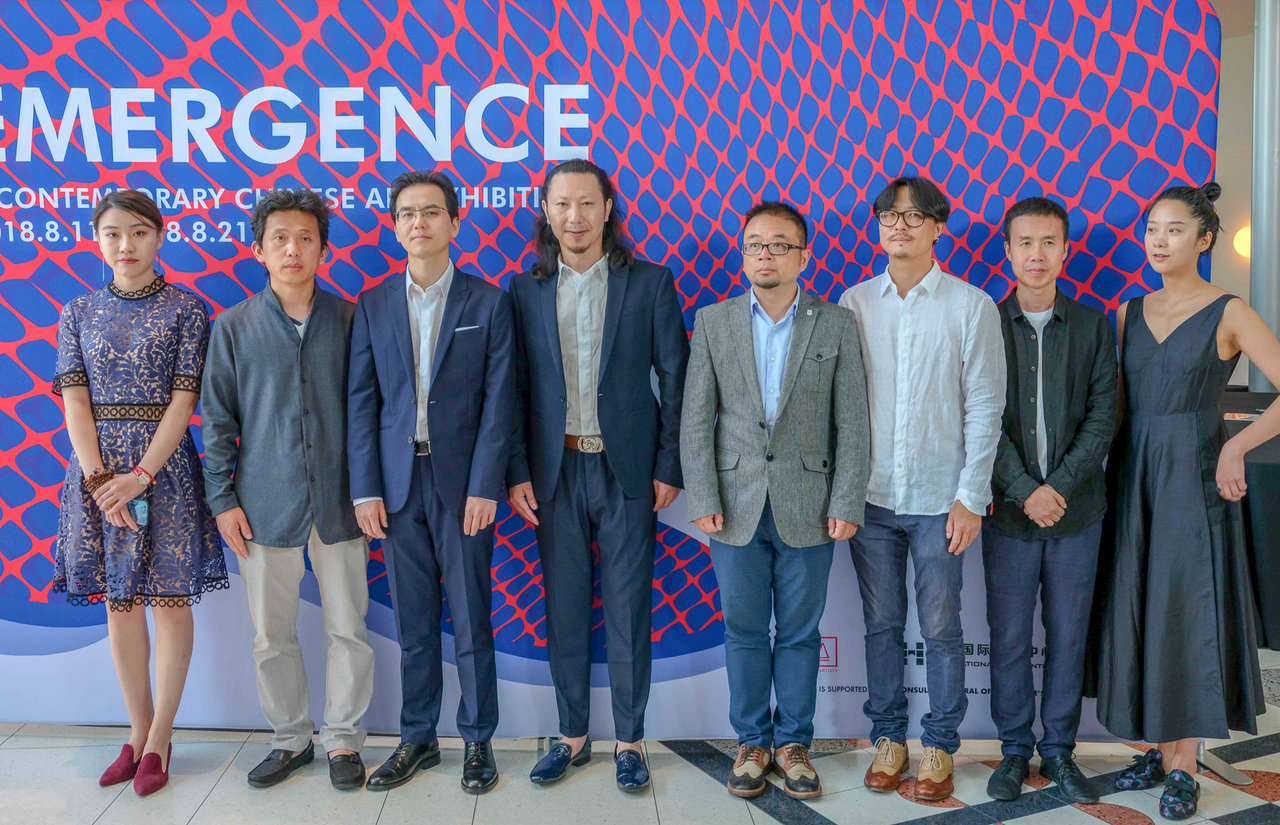
    Artists (L-R): Yang Shuwen, Jia Shanguo, Zhou Song, Zhang Siyong (curator), Wu Hongbin (academic advisor), Zhang Chunhua, Li Hongbo, Jia Xinyu. Photo: Iris Wu

    Though the exact word has never appeared on any of the exhibited artworks, ‘identity’ turns out to be the major subject of this show. Some works directly reveal the Oriental identity by either depicting a Chinese subject matter or using materials that can only be found there. Li Wang, whose works are internationally exhibited, is a professor at Tianjin Academy of Fine Arts, specialized in printmaking. Li stated, that in his works he wants to show how the traditional cultural elements influence the life in modern China. Xiang depicts a fictional scene where three men are watching some creatures on the table: crickets, horses, bird and birdcage, lotus seed pod – that might belong to fairy tales. A small skyscraper on the bottom of the painting brings the present time in; showing that past and present can coexist in harmony.
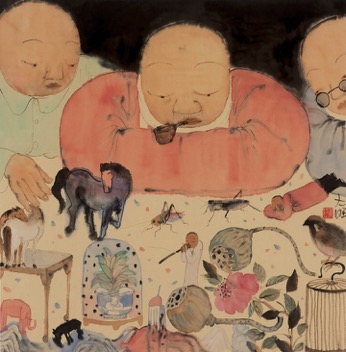
    Li Wang, Xiang, 2018, ink on paper, 69 x 68 cm. Courtesy of EYA

    Jia Shanguo turned back to a historical literary tradition when he selected the Tao Te Ching in Song Ke Ma Sha Version, magnified and re-carved it. He treasured the Chinese traditions when he used the original philosophical idea and writing and rubbing methods – that in this much larger size becomes monumental.
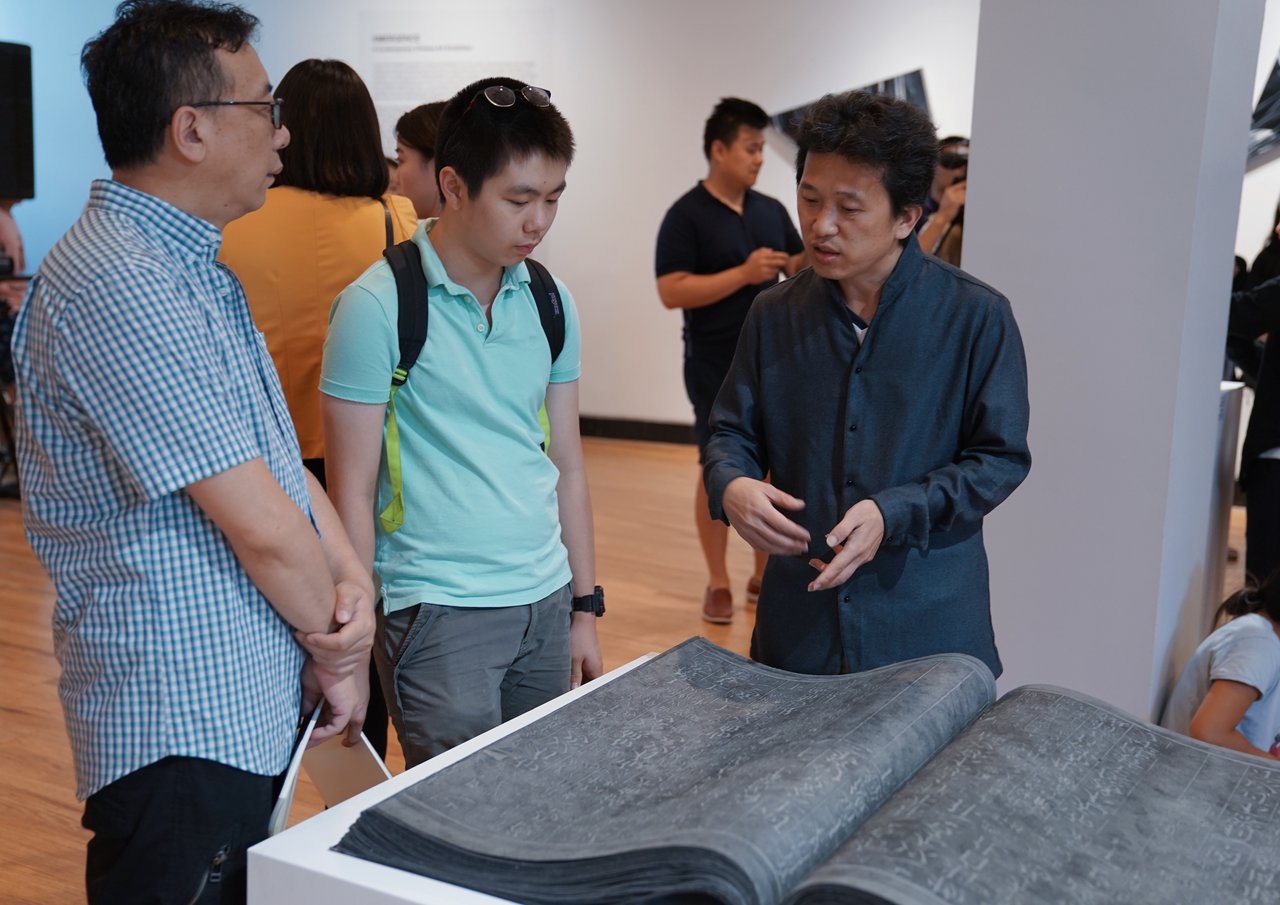
    Yin and Yang is called dao as the artist Jia Shanguo explained it to guests. Photo: Iris Wu

    Zhou Song also addresses technology but from the opposite view point of human spirituality and tradition, from the future of artificial intelligence and pure mechanical development – looking at a new world we can’t even imagine, as yet.
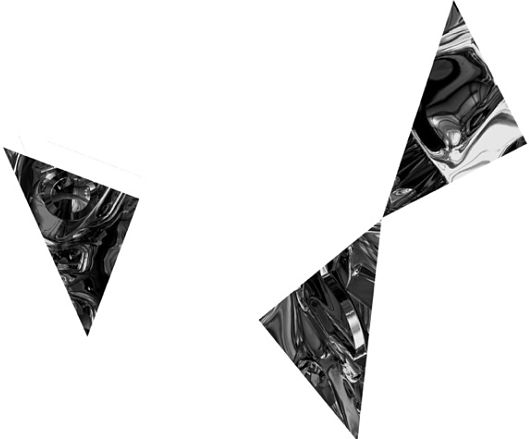
    Zhou Song, Entropy No.8, 2018, oil on canvas, 100 x 100 x 141 cm. Courtesy of EYA

    Wang Fei on his two panels, This World, combines mythological creatures with geographical features, constructing a continuous narrative. When you take a closer look, you will be surprised to find some words on the body of the wounded man: ‘Will v.s. Will’, and ‘2012’. As art critic, Peng Feng pointed out: Wang Fei’s works filled with a “surreal sense of fantasy, of vitality, of a strong power, and a super sense of sanctity“ as he “transforms reality into ideal, and freezes the temporary as eternity …” The work also reminds me of an ‘apocalypse’ – past or coming.
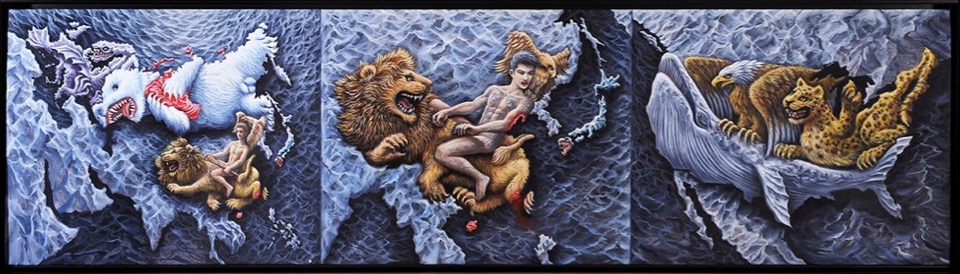
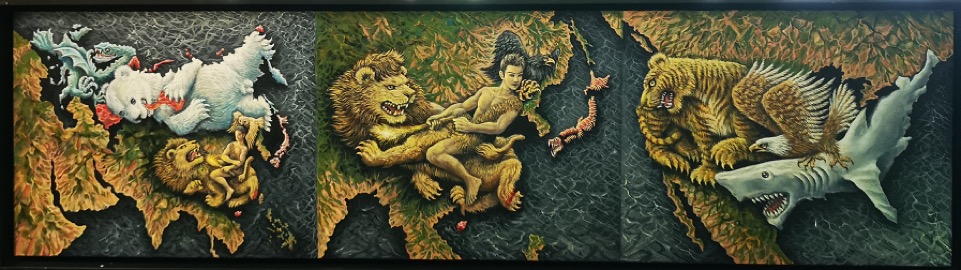
    Wang Fei, This World , (top) and This World 2, both 2012 acrylic on canvas, 150 x 40 cm. Courtesy of EYA

    While Wang Fei is focusing on universal issues of human kind, Zang Chunhua turns his attention to personal impressions and memories of art; to an era that part of the past. Even those times would never come back and the distance between our time and of those can’t be bridged – they live forever in the artist’s mind.
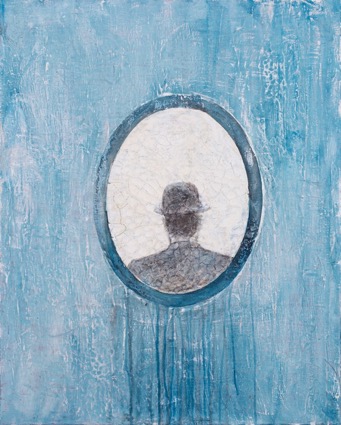
    Zang Chunhua, The sight of his back, 2017, mixed media on canvas, 100 x 80 cm. Courtesy of EYA

    I found Li Hongbo’s paper sculpture, Tools of Study – Voltaire, very interesting. The head of Voltaire can be transformed into an abstract paper toy by stretching the material out.
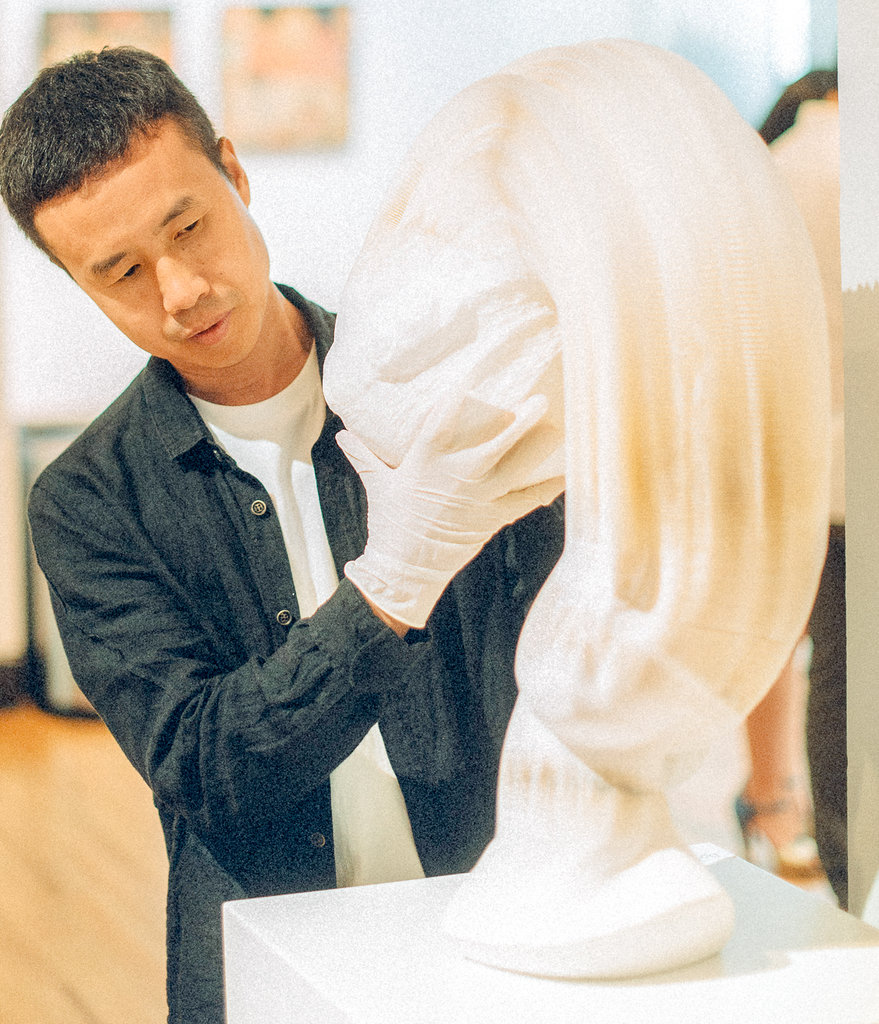
    Li Hongbo with Tools of study – Voltaire, 2015, paper sculpture, dimensions variable. Courtesy of EYA

    Yang Shuwen’s oil painting Heaven Eyes is mesmerizing. The artist plays with the idea of different dimensions in space and time as she captures the busy cityscape, where rich and poor share the environment, with shining colors.
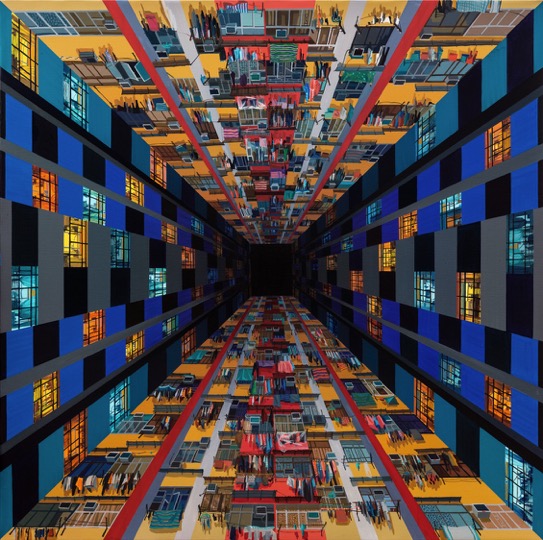
    Yang Shuwen, Heaven Eyes, 2018, oil on canvas, 160 x 160 cm. Courtesy of EYA

    Ambiguity is the main element of Jia Xinyu’s semi-abstract paintings. As she stated they have no beginning or ending but aim to capture a “vague betweenness.”
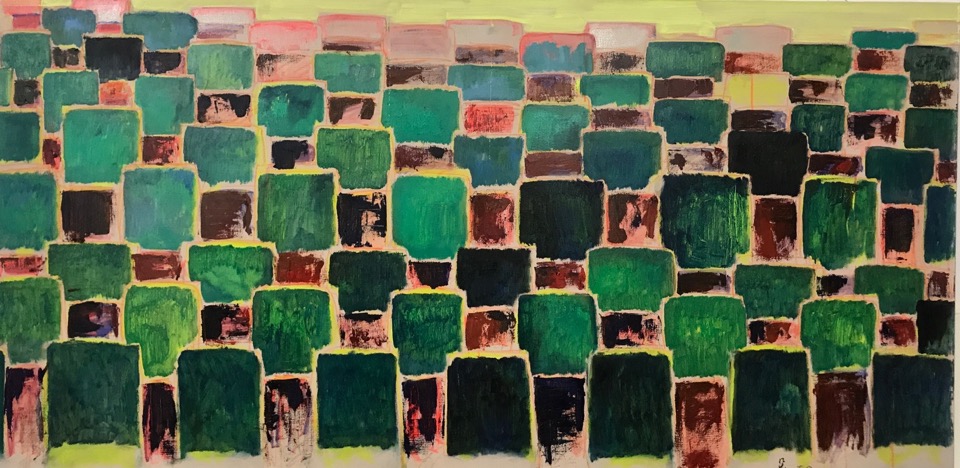
    Jia Xinyu, Square game, 2018, oil on canvas, 100 x 200 cm. Courtesy of EYA

    For the eight Chinese exhibiting artists, ‘Emergence’ is the first Canadian exhibition they were invited to present their works. By sharing their cultural traditions, exposing their artistic ideas in new forms, those artists provide us with a wide view of contemporary Chinese art.

    Iris Wu

    Featured image: Opening reception, August 11, 2018. Courtesy of EYA

    *Exhibition information: August 11 – 21, 2018, Toronto Center for the Arts, Lower Gallery, 5040 Young Street, Toronto.
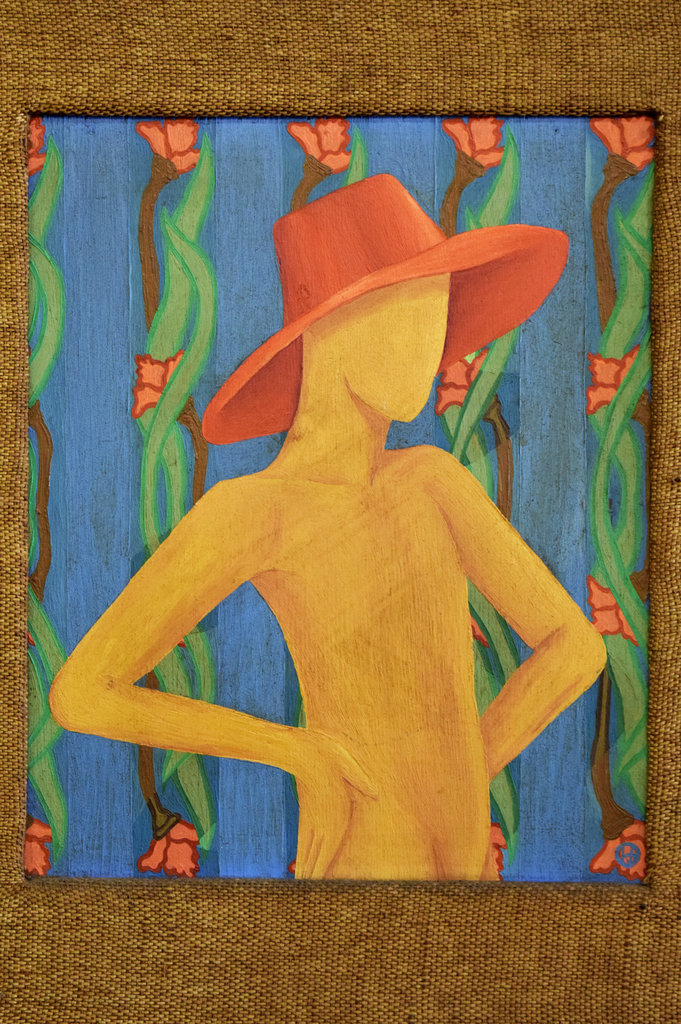
  • Hudinilson Jr. at Scrap Metal Gallery

    Throughout the history of art, there has been contention between its deemed higher and lower forms. Embodiments of revered classical art, which stressed high naturalism, idealization, motifs from the bygone era of Antiquity, and surpassing technical skill in sculpting and painting, have been celebrated by cultural institutions as being prestigious. Meanwhile, newer concepts that developed over the centuries – realism, abstraction, readymade sculpture, photography, minimalism, mechanization, and other artistic phenomena – were regarded as undesirable and indecorous. As such, there has existed a schism between these two groups, which often inspires the so-called “lower” artists to push institutional boundaries and elevate their work towards or beyond the established foundation of art.

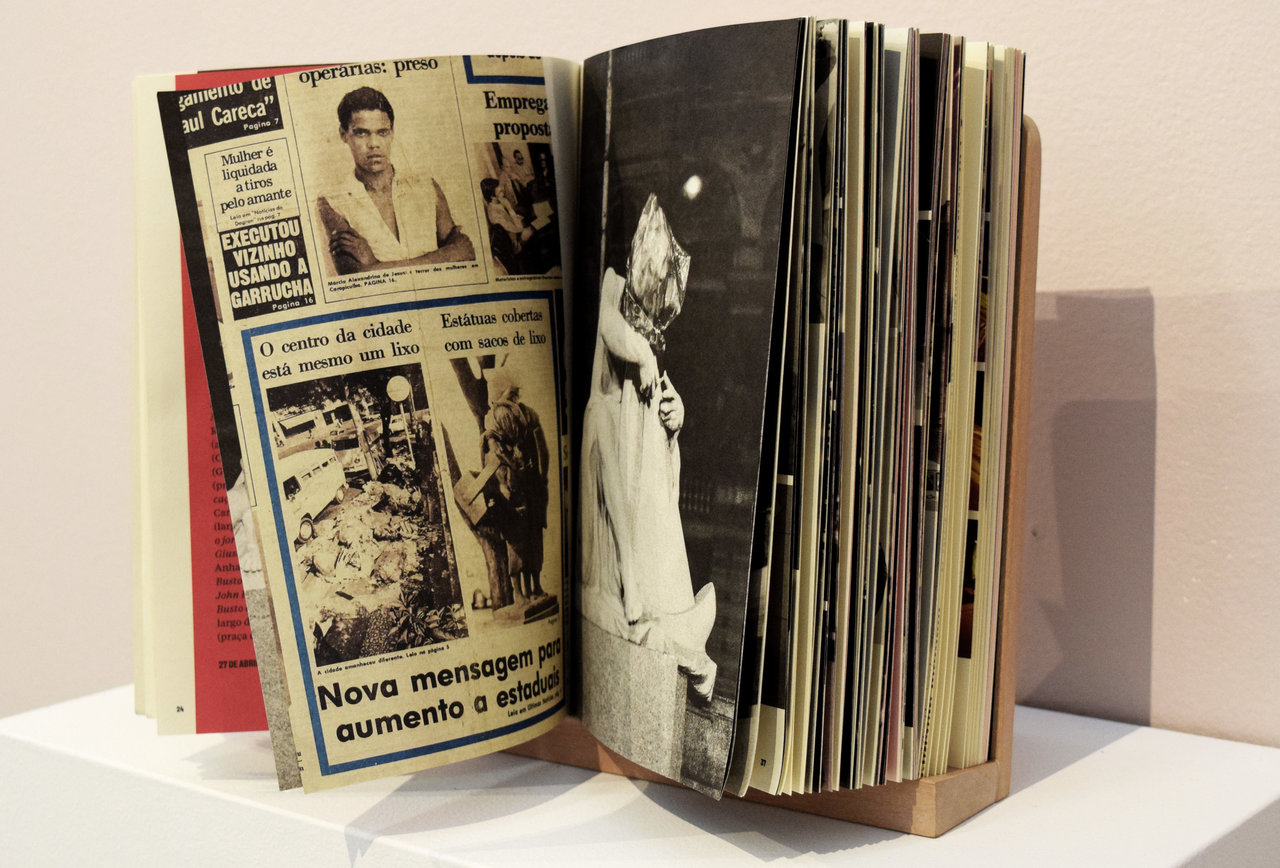
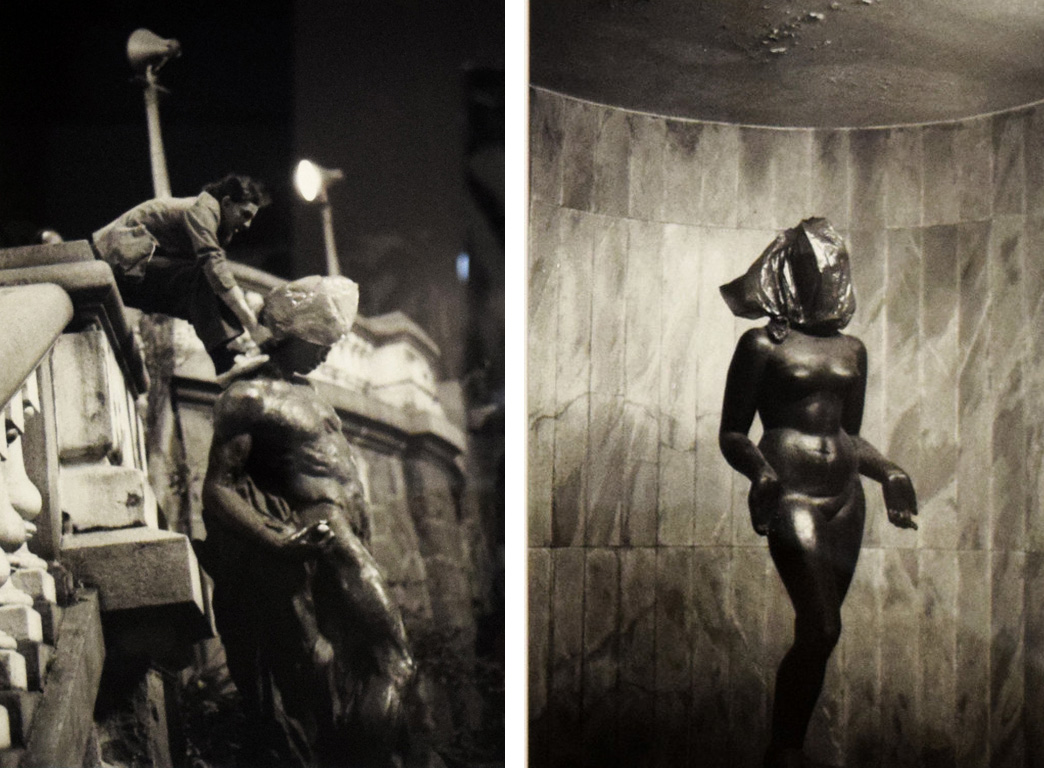
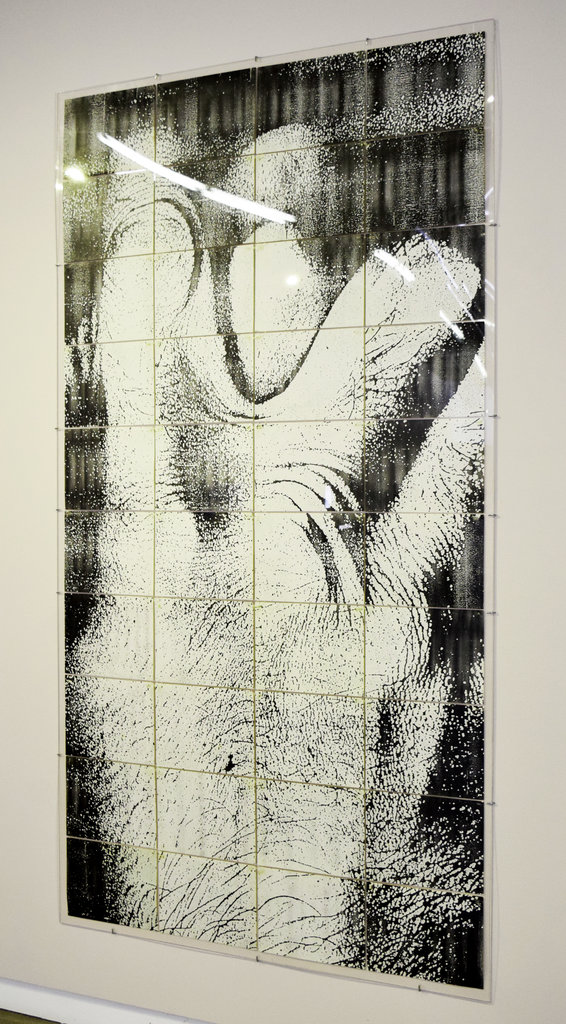
    Hudinilson Jr.(1957 – 2013), born and raised in Sao Paolo, Brazil during the military dictatorship, embraced new technologies and art forms that contradicted traditionalist ideals. The Scrap Metal Gallery presents a collection of his photographs, assemblages, and Xerox prints that explore the narcissistic studies of his physical self, his critique of societal and cultural fixations, and his fascination with alternative modes of representation.

    The autocracy that enveloped Brazilian society emphasized the prominence of romanticized classical artforms while implicitly and explicitly censoring other means of cultural expression targeted by the state for subverting the government’s authority. Likewise, the art market adopted the same priorities and limited its tastes. Hudinilson Jr. sought to deviate from these antiquated views by instead working with ephemeral materials: photography, photocopies, multiples, assembled journals, and open discourse. His works dived into issues often demonized by authorities, including queer pornography, compromising forms, and critical propaganda.

    Once the regime collapsed in 1985, when Hudinilson Jr. was 28 years old, he incorporated bureaucratic objects – stamps, labels, forms, etc. – that were emblematic of the ruthlessly pragmatic system. Coinciding with David Hockney’s layered photo-collages, Hudinilson Jr. quickly emerged as one of Brazil’s prominent mail artists, utilizing tools reminiscent of an order-obsessed, puritanical society to undermine its now decaying foundations.

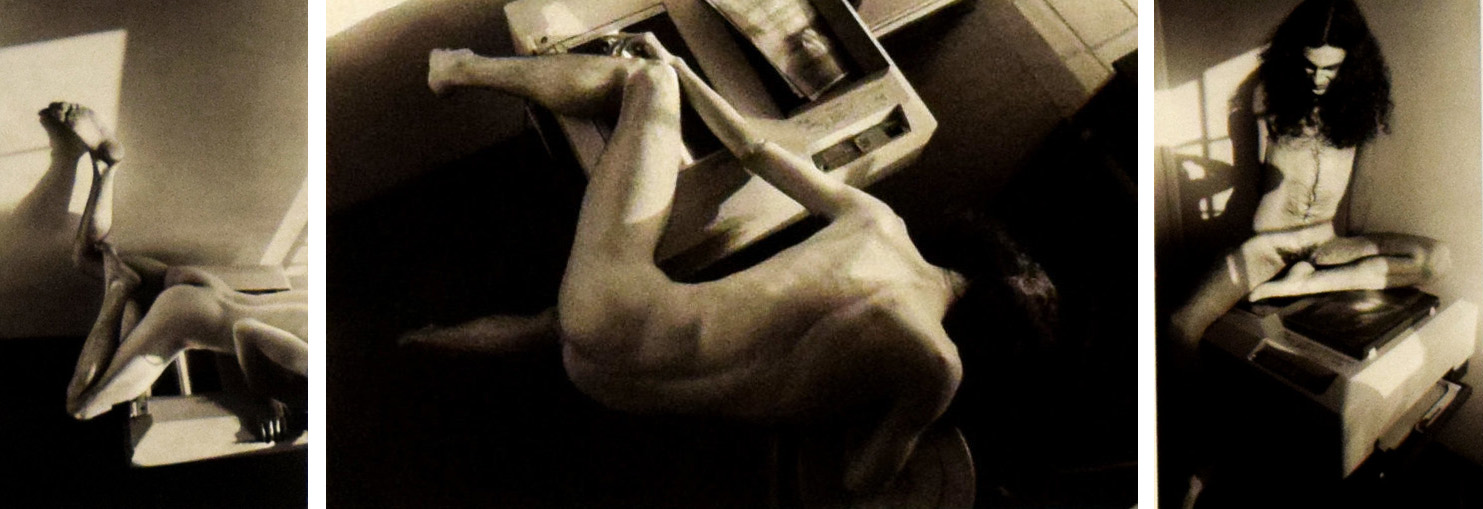
    From there, he transitioned to Xerox art, recognizing the inherent limitations of lens photography. Through photocopying technology, he could enlarge subjects to enhance their laden yet overlooked qualities. Obsessive studies of his own body portray the network of creases in his hands, the subtleties of his internal systems revealed in x-rays, and the mechanisms controlling the contortions of his body. He even thoroughly documented his artistic process, with numerous self-portraits revealing his interactions with the Xerox machine that birthed his other works. These highly personal and often erotic pieces concurred with Robert Mapplethorpe’s notoriously provocative portraits. Through their work, both artists demonstrated their courage and persistence in representing the body to an extent that is often shamed and scandalized.

    Throughout his career, Hudinilson Jr. sought to distance himself from the traditions of the political and cultural regimes that undermined free expression. In retaliation, he embraced alternative forms of art and representation to express his own passions and encourage dialogue. As he continued to excel artistically, he ironically founded his own school to teach artists the potential of Xerox art and continue the legacy of open, unoppressed creativity.

    Text and photo: Simon Termine

    *Exhibition information: Hudinilson Jr., Cut Up The World, June 27 – September 16, 2018, Scrap Metal Gallery, 11 Dublin Street, Toronto. Gallery hours: Fri & Sat 12 – 5 pm.
  • Kent Monkman at Project Gallery

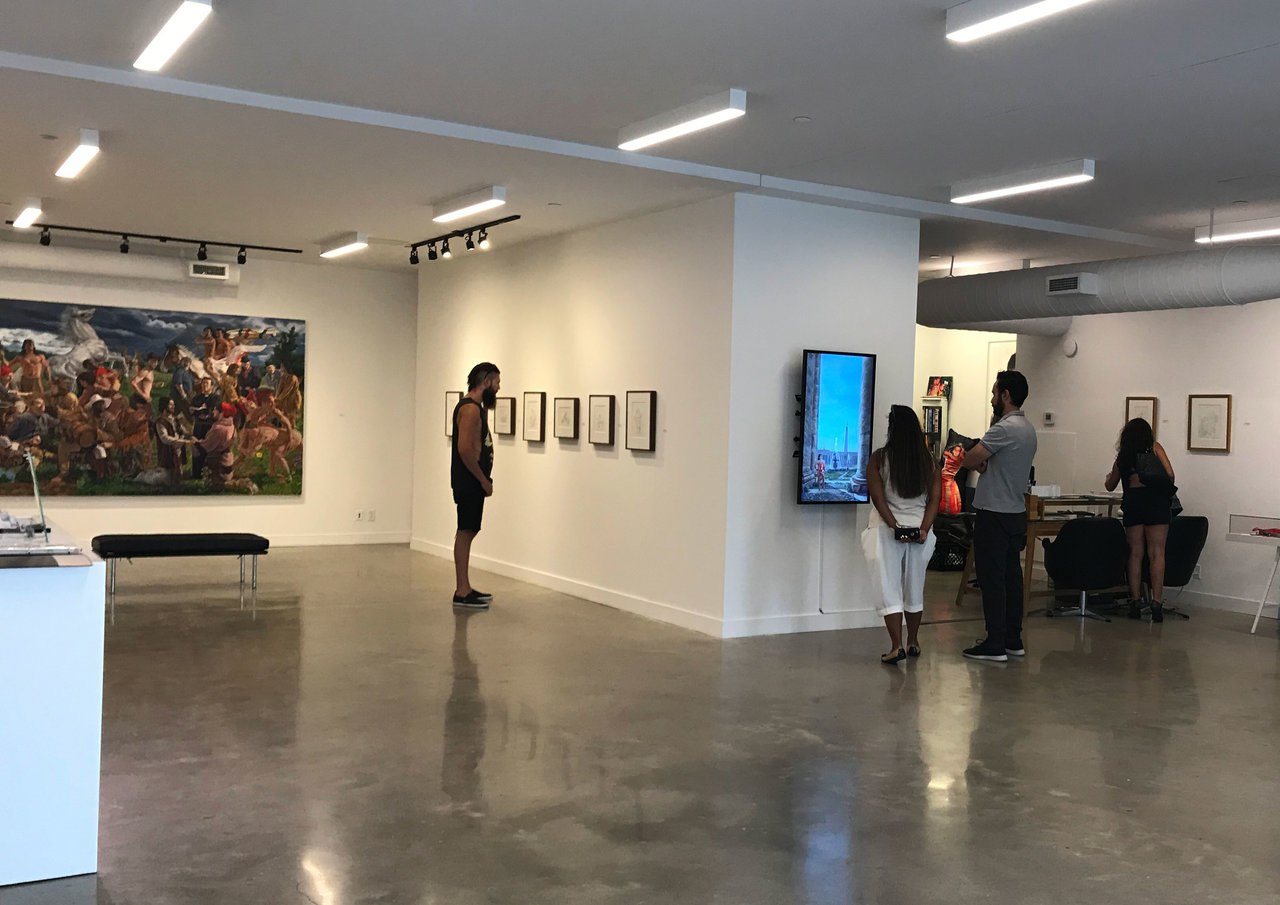
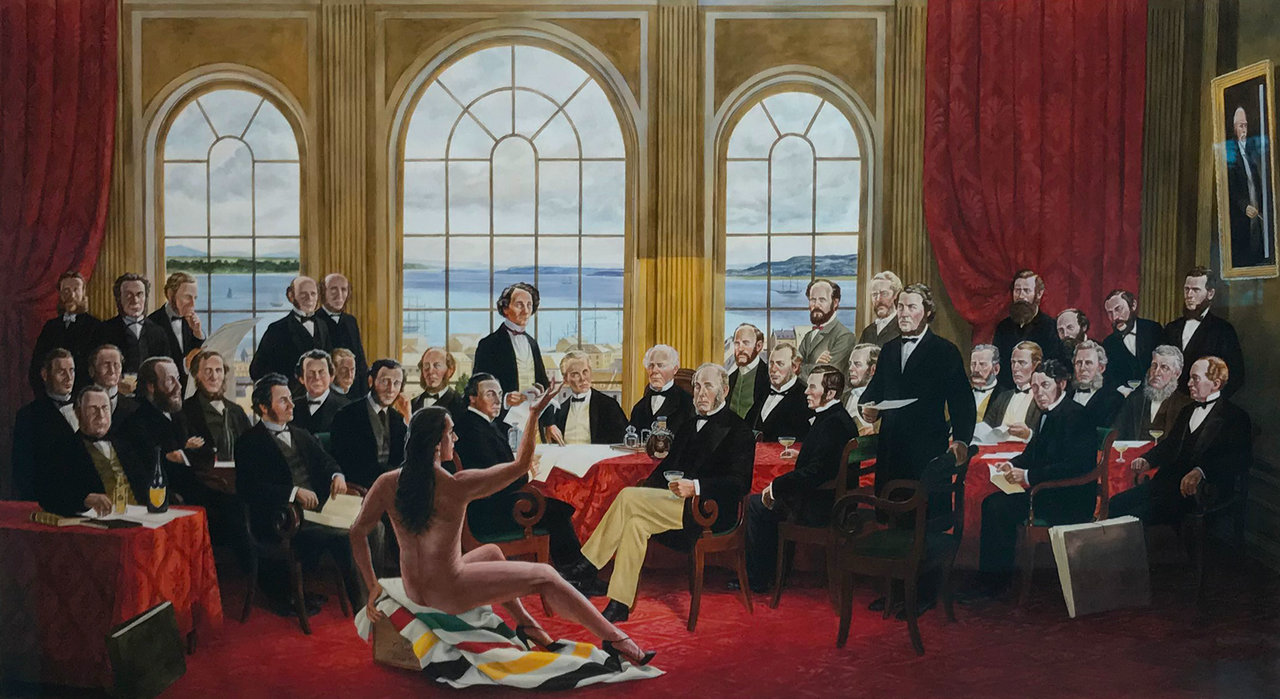
    Earlier this month, Project gallery hosted a busy opening night for Kent Monkman’s new show, Miss Chief’s Praying Hands. Monkman is a Canadian multi-disciplinary artist of Cree and Irish descent who is best known for challenging traditional Eurocentric depiction of North American history by using an academic and Romantically influenced painting style to create an alternate perspective. He often juxtaposes classical European painting references with contemporary figures inserted inside, often with sublime landscapes and biblical allegories. This most recent show is focused on Miss Chief Eagle Testikle, Monkman’s alter-ego, a gender fluid and playful performer. Miss Chief works to deconstruct the way in which settler art history and institutions have created European norms on Native lands and this method of intertwining history with fiction is what makes Monkman’s work interesting and relevant.

    Installation view of Kent Monkman, Miss Chief’s Praying Hands, Project Gallery, 2018

    The resulting effect often brings attention to power dynamics and societal norms both historically and in contemporary life. Miss Chief is empowered and often ends up reversing this dynamic or highlighting in such an obvious way that the viewer can’t help but question the legitimacy of the allegory or painting it is referencing. Many of the pieces in this show are prints and studies of older paintings or series, and they are brought together to create an appreciation for Miss Chief and her ability to join opposing sides in a coy way while offering a softer narrative than is expected.

    Kent Monkman, The Daddies, archival giclée print on Epson Legacy Fibre paper, 11″ x 21″, edition of 100

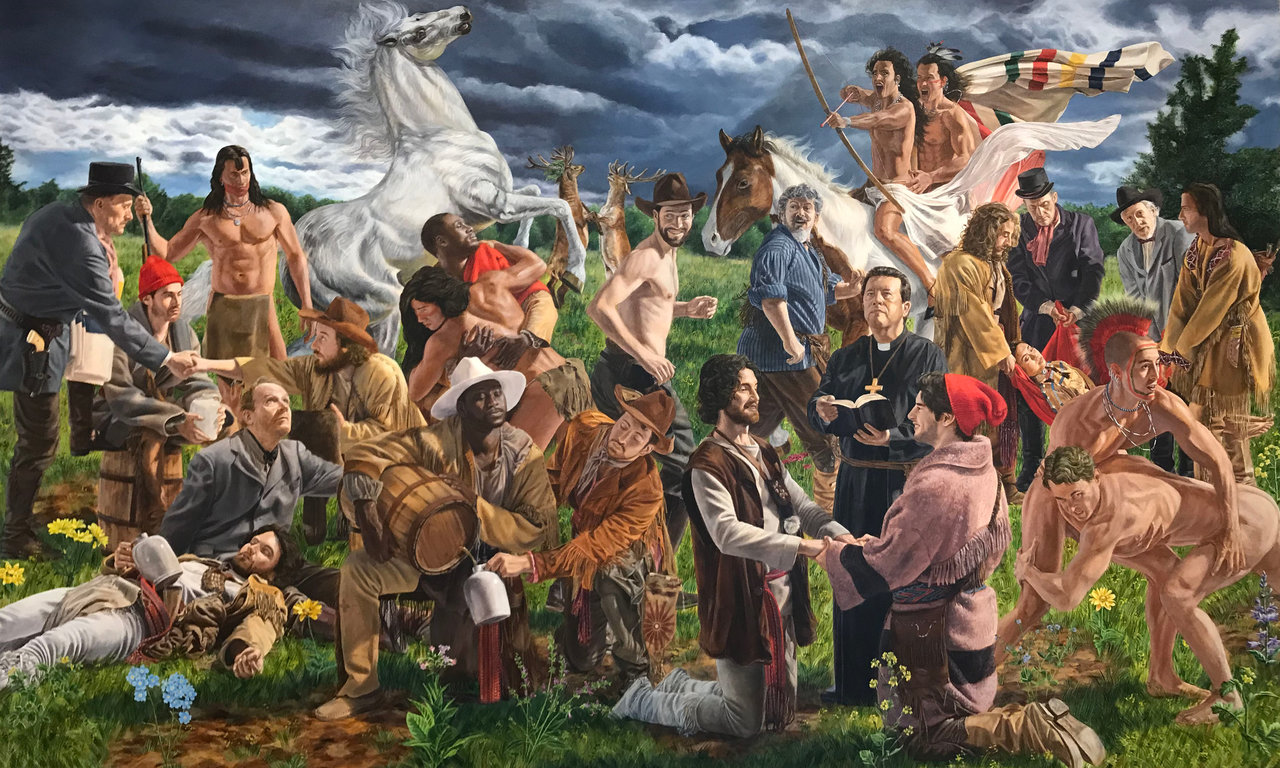
    The exhibition fills the gallery with a range pieces that include digital prints, etchings, sculptures, drawings, film, and various art objects. But arguably the most interesting piece and the piece to go for is the large acrylic painting titled Wedding at Sodom. This 2017 painting shows a wedding amidst a chaotic scene in the city of Sodom, referring to the biblical story of the city of Sodom and Ghomorra, wherein the cities were destroyed by God for their sins which are believed to be of a sexual nature. To this day sodomy refers to the act of non-procreative or anal sex. Amidst the chaos of Sodom, a minister officiates a marriage between two young men. Among the other figures, we see a somewhat erotic depiction of some naked men wrestling. A young black male pours ale into the jug of a young while male. Monkman often uses significant historical symbolism and allegory to call attention to societal norms and historical accuracy. What makes this painting interesting is that it speaks a language that we know but offers an alternative emphatic message which is both beautiful and tragic.

    Kent Monkman, Wedding at Sodom, from the ‘Rendezvous’ series, 2017, acrylic on canvas, 72”x120”

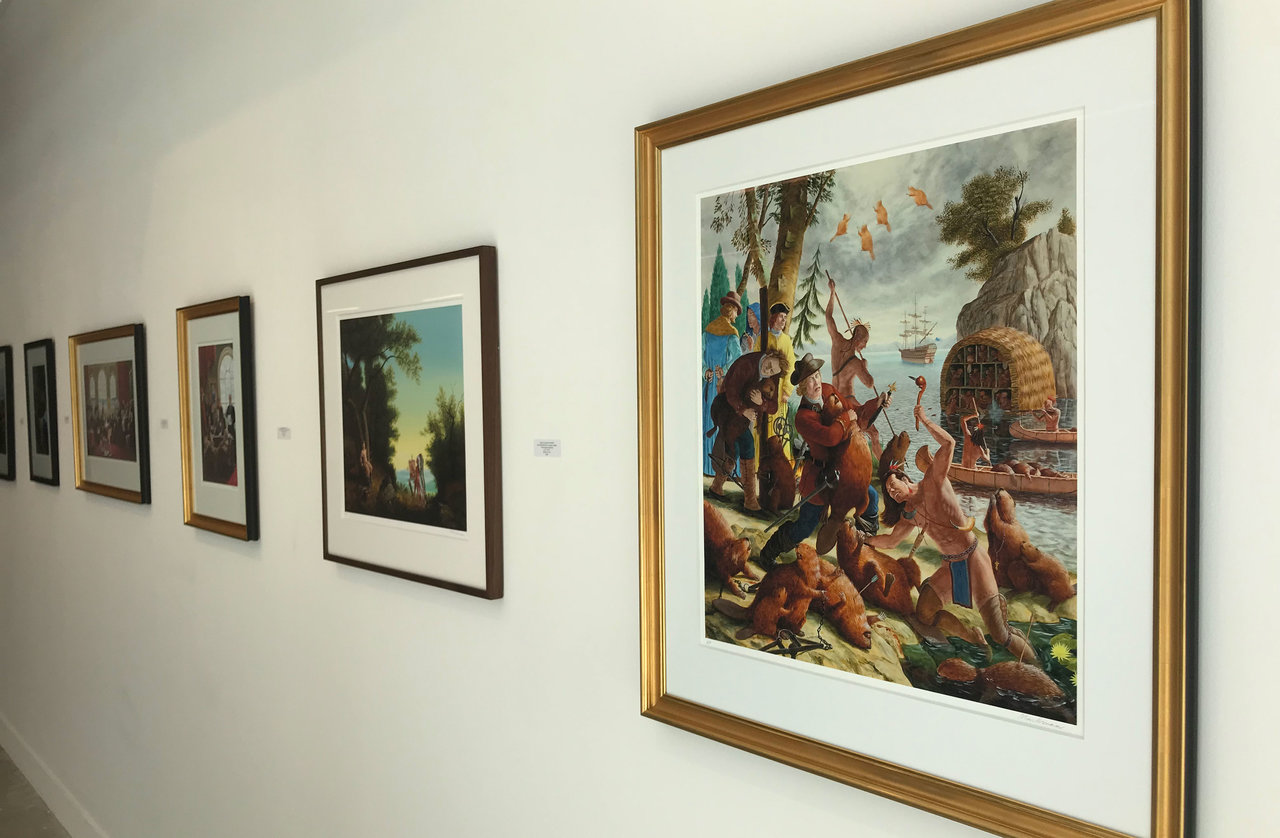
    Along the adjacent walls are framed drawings and studies for larger paintings in various ornate frames. These are more intimate scenes and ideas which feature Miss Chief as well bison and a very comfortable beaver. Some scenes are depicting Miss Chief in full glam while others portray her on horseback or aiding an injured man. Other walls contain copper plate etchings in ornate frames, and digital prints of Monkman’s Rendezvous Series.

    Installation view of prints of ‘Rendezvous’ series

    Another unique experience of this show are two video paintings on display which are part of the Human Zoo series. In these videos Monkman has animated a historical painting with Miss Chief and other various moving characters. In the Human Zoo, George Catlin has set up a gallery in a German city. Catlin himself was a painter, known best for his portraits of Indigenous peoples and tribesmen in the 1800s. He produced hundreds of paintings for his Indian Gallery which he toured to various cities in the hopes of attracting buyers. He was a showman and a performer, delivering public lectures based on his experience living with American Indians and eventually sought to sell his Indian Gallery to the U.S. government. In Monkman’s video, the Human Zoo, he beckons the audience and ramps up for a performance and starts drumming to get Miss Chief to dance to his music. Miss chief reluctantly dances and then slowly begins to enjoy it. The crowd cheers and claps for the performance and tosses coins into Catlin’s hat. At the end, Catlin collects the change given by the audience and refuses to share it with Miss Chief who is then visibly annoyed and the video loops back to the beginning.

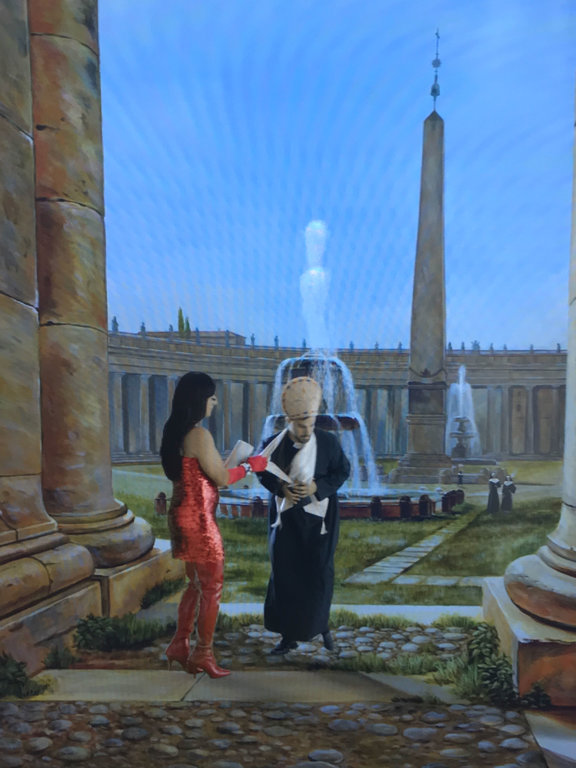
    The second video, the Immortal Woman, shows Miss chief standing inside of C.W. Eckersberg’s 1813 painting. In it a cardinal shyly approaches Miss Chief who is dressed in her signature full red glam look. The young man is excited but continuously leaves Miss Chief hanging when he gets too close.

    Film still of ‘the Immortal Woman’, Edition of 5, 2015

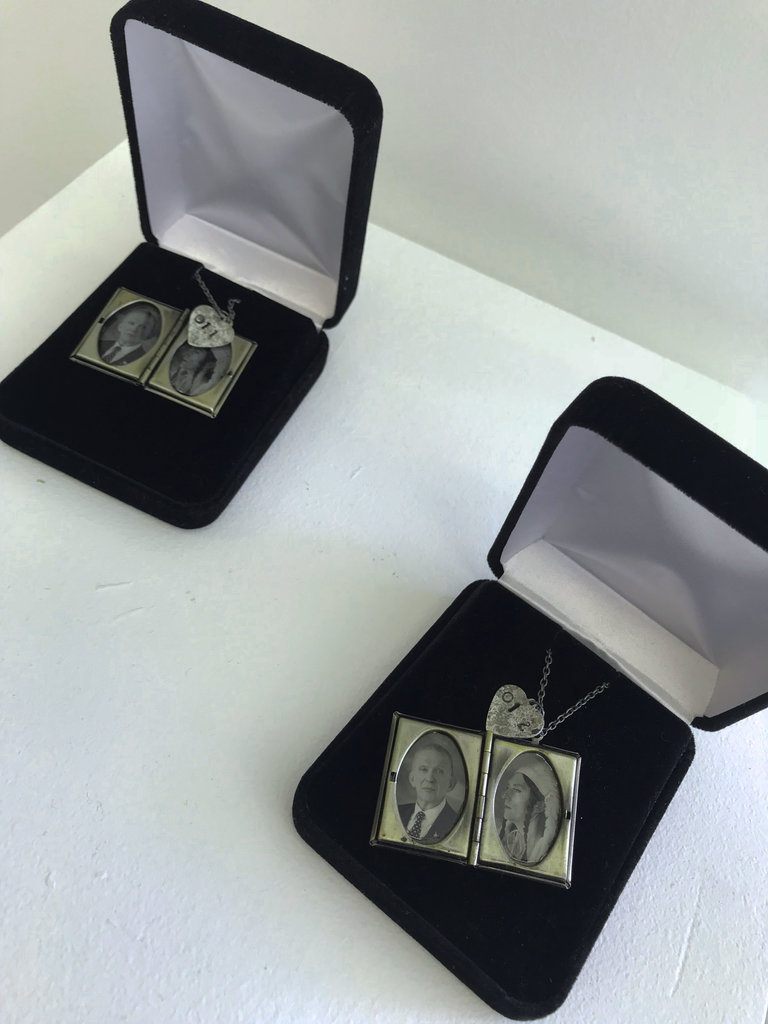
    In another piece, Miss Chief appears in a photograph made in collaboration with Chris Chapman. The photo is black and white and is styled to look ancient, perhaps from the time of the first settlers. Miss Chief stands alongside her male partner hand in his shoulder like a classical husband and wife portrait. Below this are love lockets with the same photograph inside. Her love connection with her colonial partners wonderfully personifies the twisted history of indigenous peoples and colonialism.

    ‘A Promise is Forever’ Kent Monkman in collaboration with Chris Chapman, edition 100 + 5 AP

    Everybody seems to want a piece of Miss Chief and this theme is certainty capitalized on. The show is chock full of a variety of art objects ready for purchase to any wealthy and virtuous persons wanting to own a piece of the artist. Most objects are one of many editions. Items on sale include her fire red boots, skateboards, a ceramic plate, a few hand carved limestone pieces, locket necklaces and of course Miss Chief’s Praying Hands.

    Kent Monkman, Miss Chief’s Praying Hands, silicone rubber, 4.5″ x 10.5″, edition of 10 + 1AP

    Monkman is undoubtedly one of the most dynamic contemporary artists in Canada. He is able to live prolifically between the institution of fine art as well as the commercial sector. What is it that makes his work so desirable both to cultural curators as well as art buyers? He has been able to fill a gap in Canadian art culture that is unique and at the same time universally understood.

    Text and photo: Nazli Nahidi

    *Exhibition information: Kent Monkman, Miss Chief’s Praying Hands, August 2 – September 1, 2018, Project Gallery, 1210 Dundas Street East, Toronto. Gallery hours: Tue – Sat, 11 am – 6 pm.

  • You + Me = Us / Canadian Sculpture Centre

    The Sculptor’s Society of Canada presents their collaborative exhibition, You + Me = Us, which assembles the works of twelve sculptors that strive to encapsulate their unique notions of human identity and contemporary culture. Each artist masterfully shapes their chosen medium – which consists of bronze, plaster, steel, clay, silicon, or other materials that are likewise treated through a wide variety of methods and techniques – into distinctive figures that evoke different personalities and sentiments.

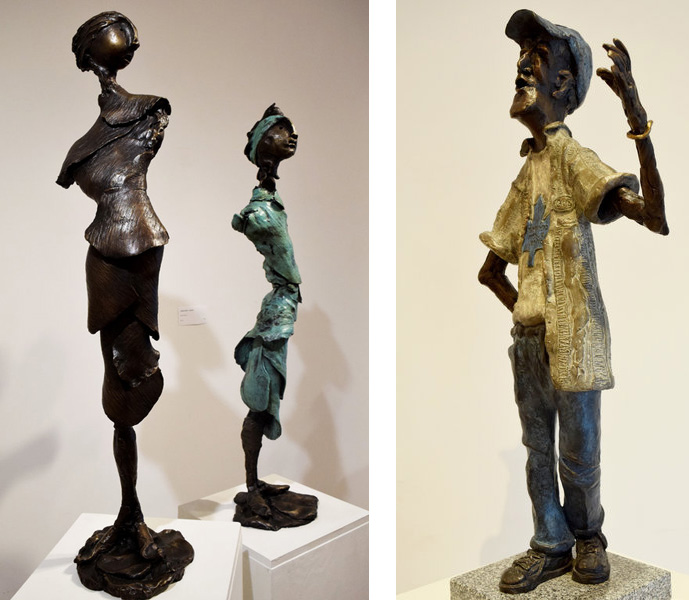
    Upon entering the space, audiences are greeted by John Clinton’s bronze statuettes: Gus and Lunch Break. Having always focused his sculpture on portrayal, Clinton utilizes a myriad of techniques to treat the surface and texture of his figures, effectively altering their outward personality. Working with wood, stone, and metal throughout his career has subsequently influenced his transition to bronze forging, as he strives to emulate their qualities in the metal to tell his personal stories.

    Camie Geary-Martin, Woman Looking Left & Woman with Cat (left) & John Clinton, Gus (right)

    Stemming from a plethora of experience with clay, mold making, casting wax, bronzing, and patina, Camie Geary-Martin’s latest works reflect her transition from representational to semi-abstract forms. Concerned with the portrayal of the human figure, abstraction permits her to explore the materials more sensitively, emphasizing its compositional and physical attributes.

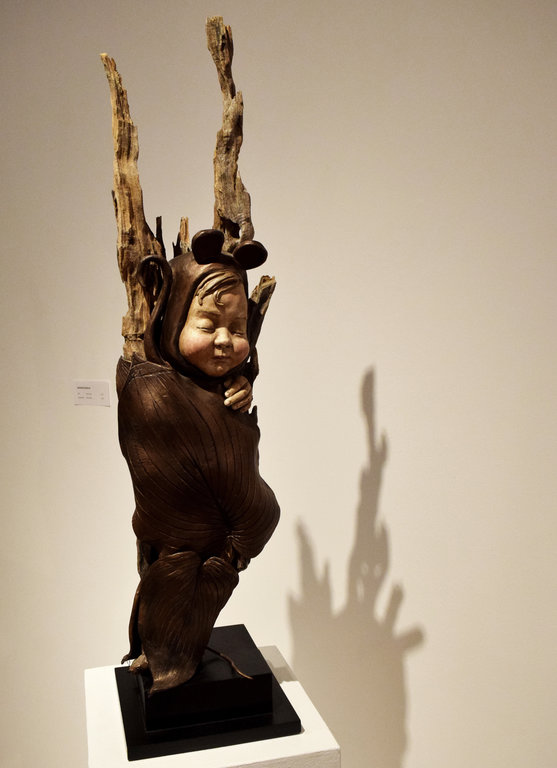
    Marlene Kawalez intent on capturing the moment when the material presents its implanted narrative.She juxtaposes found wood and clay to create harmonic figures that visualize their laden qualities and the stories they unravel.

    Marlene Kawalez, Dreaming

    Believing in the potential societal and philosophical impact of art, Eamon employs sculpture and other media as means to communicate complex, contradicting, and captivating themes. His works are deliberately elusive, for his intent is not to provide concrete answers but rather stimulate interpersonal discussion and introspective contemplation.

    Eamon, Me, Myself & I

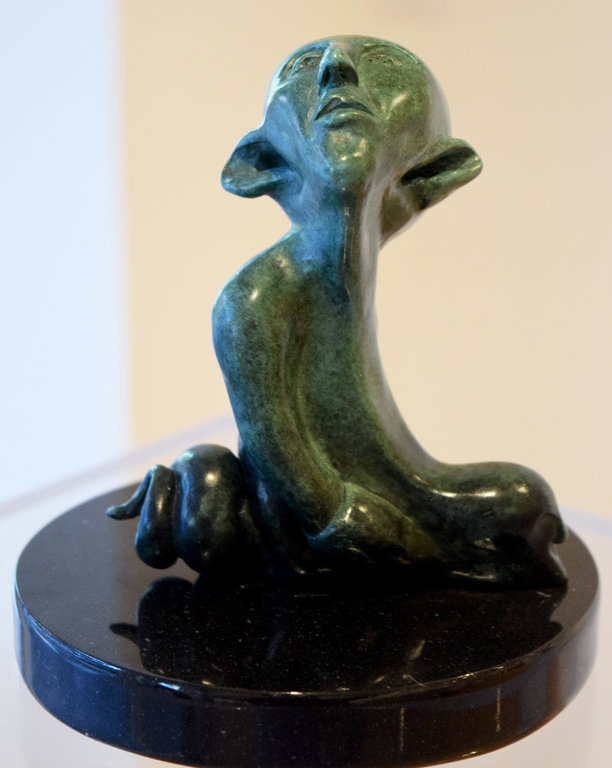
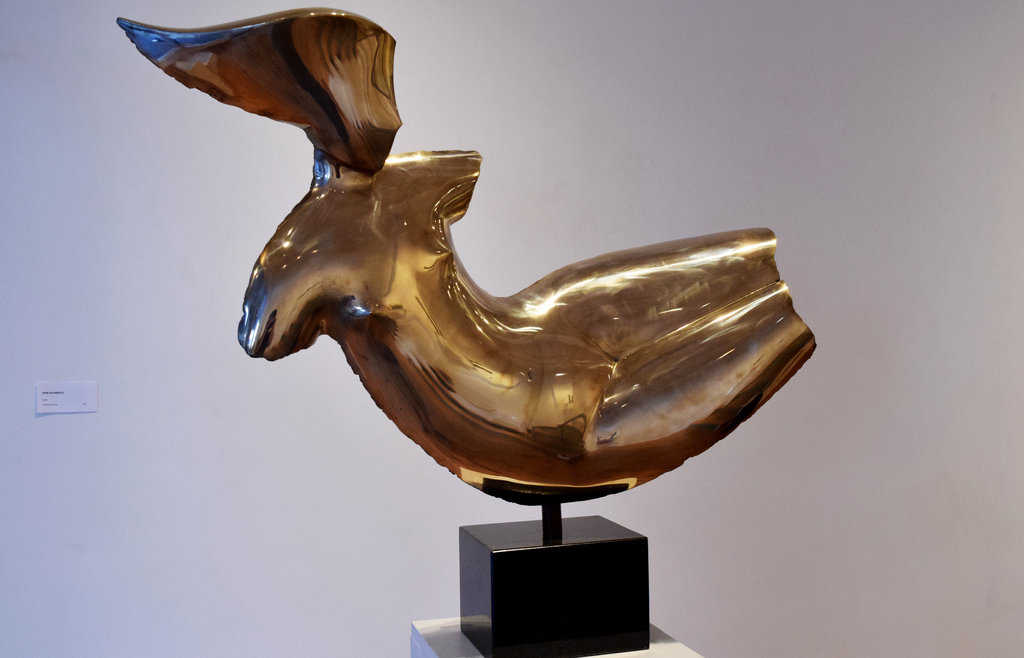
    Peter Shoebridge believes that despite the perceived lifelessness of sculpture, the deliberate manipulation of the medium’s form and figure can assume lifelike and existential characteristics. Drawing from his interest in portraiture, his work Icara seeks to imitate organic subjects to capture the vitality of the human spirit and of nature.

    Peter Shoebridge, Icara

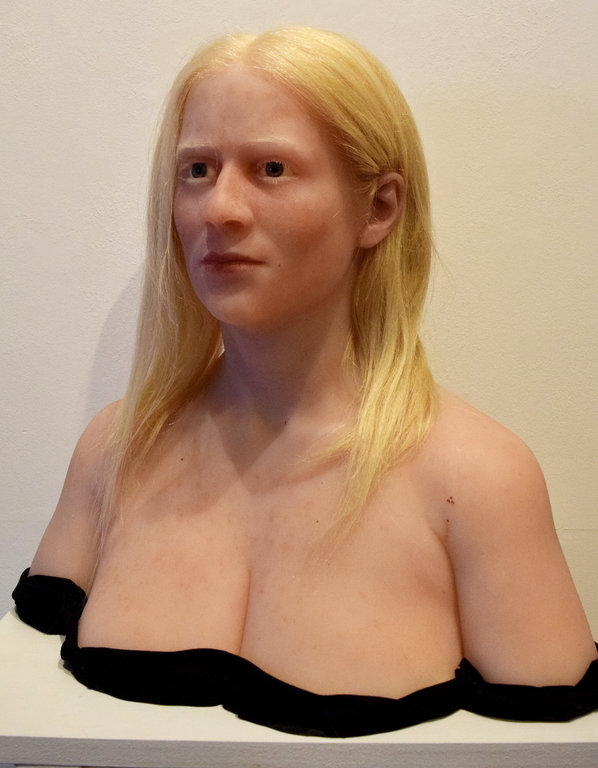
    As a commissioned mould maker, Art DiLella demonstrates his mastery of silicon and photorealism to deceive the audience’s perceptions. Through intensive detail, Alanna represents a stunningly realistic portrait that draws in its viewers and challenges their notions of reality.

    Art DiLella – Alanna

    Richard McNeill utilizes an interesting blend of fired clay, fibreglass & steel alumina cement, & an oil encaustic finish to create enticing textures and vibrant colors. This combined with his organic forms and contemplative subject offer a profound and exciting experience for audiences.

    Richard McNeill, Memory Stream (Reverie)

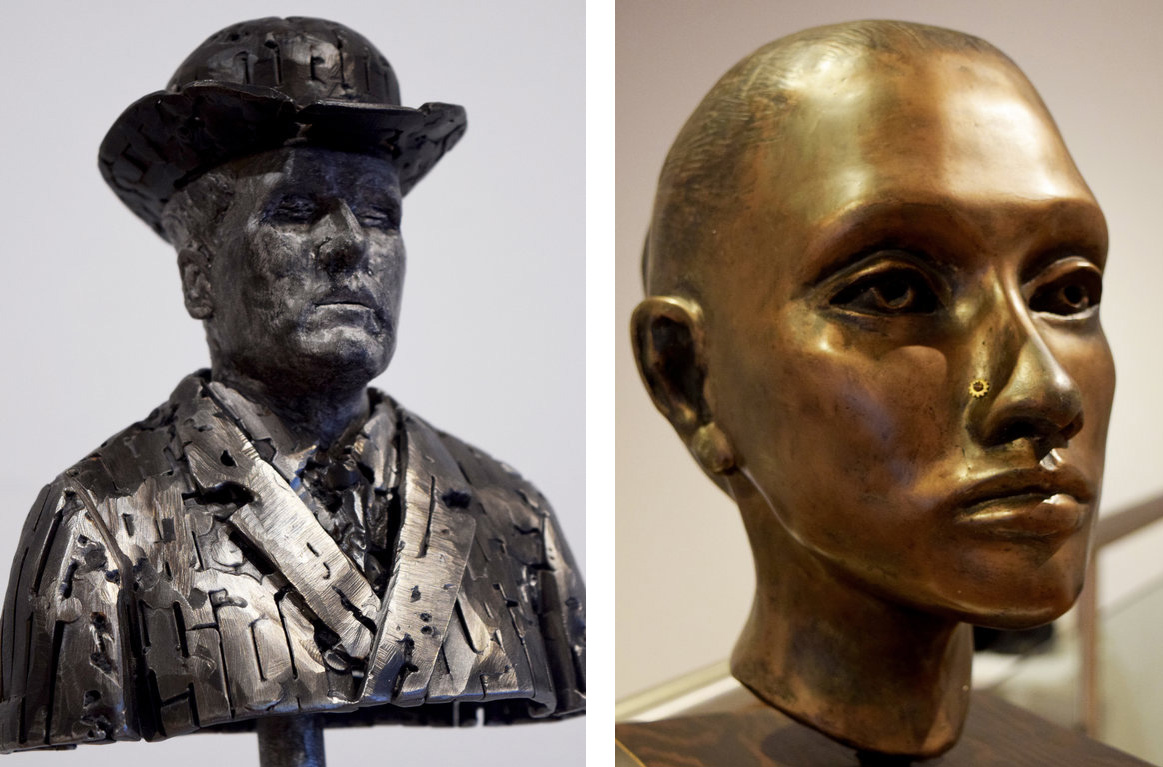
    Bastien Martel brings forth some works from his ongoing series that explores the anonymity and subjectivity of the human condition. He is welding cut square shaped pieces of steel together; as in a three-dimensional mosaic.

    Bastien Martel, Reconnu & Karen Stoskopf Harding, The Princess

    Karen Stoskopf Harding focuses intensely on the fascinating details of human face as they can reflect rich experiences and narratives. Using plaster and pigmented with an antique finish, The Princess is intended as a face of “national identity” and memorialization.

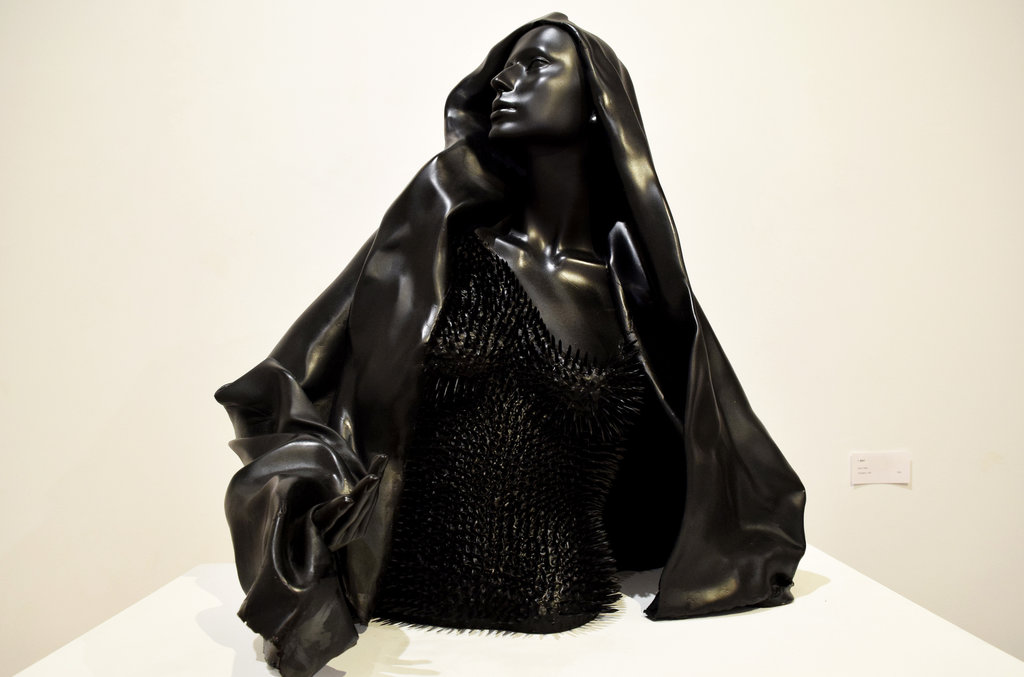
    The sculptures of J. Mac are iconographically and emotionally powerful, emulating religious and spiritual motifs in order to navigate the politics of living, the societal implications of our contemporary contexts, and our inherent vulnerabilities as humans.

    J. Mac, Black Virgin

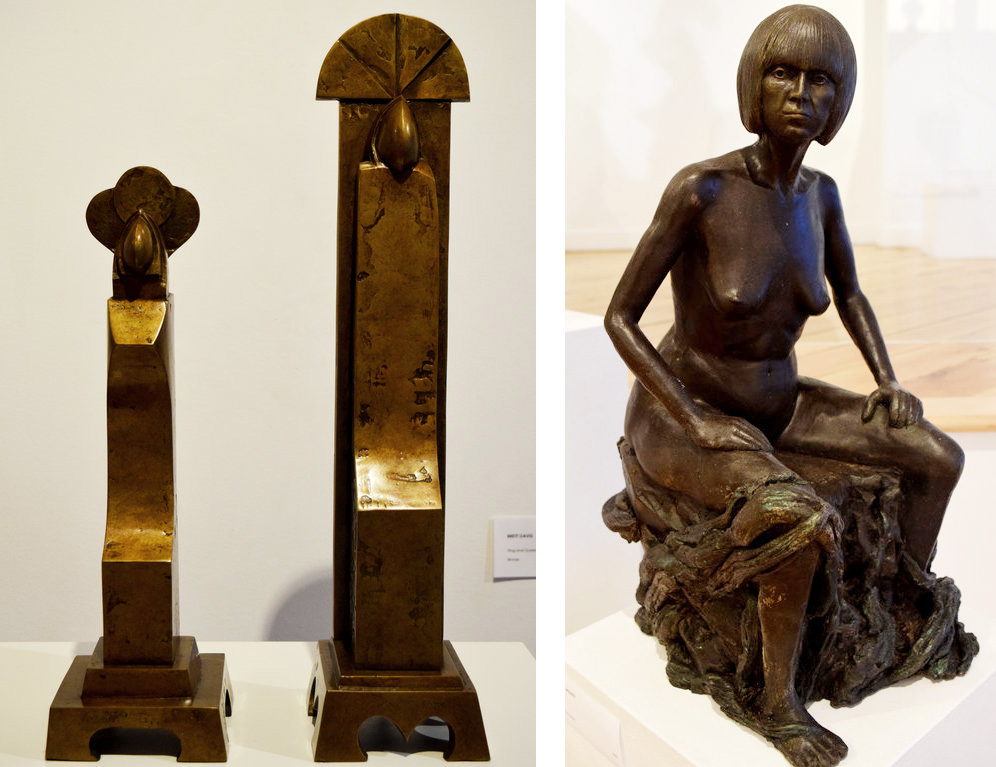
    Brett Davis draws his inspirations from historical ingenuity, as our ancestors – particularly from Gothic architects – were successful in marrying the human form with structural features and spatial concepts. His works minimize detail to its basest shapes and contours in order to unify them symbolically to emphasize the beauty of art and architecture.

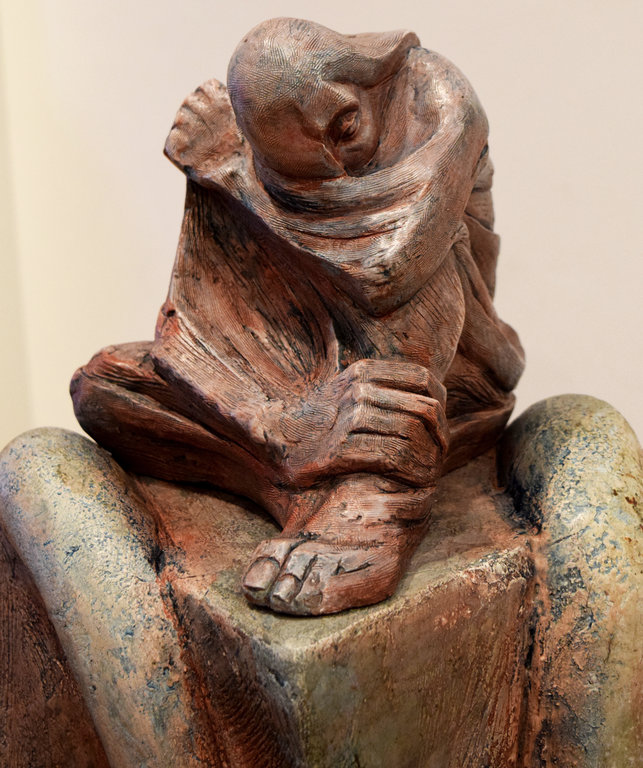
    Brett Davis, King and Queen (left) & Elaine Jaques, Rooted (right)

    Elaine Jaques, deviating from the niched depiction of the human face, focuses on the authentic portrayal of gesture, which in of itself holds deeply ingrained connotations. Her seated figures seek to evoke intrinsically multi-faceted and individualized responses in the viewers, stressing the subtlety and nuance of form.

    From the contemplatively sombre to the delightfully candid, You + Me = Us showcases the sheer diversity and talent of the SSC membership, offering much to appreciate.

    Text and photo: Simon Termine

    *Exhibition information: July 24 – September 7, 2018, Canadian Sculpture Centre, 500 Church Street. Gallery hours: Tue – Fri, 12 – 6; Sat, 11 – 4 pm.

  • The new space of Nicholas Metivier Gallery

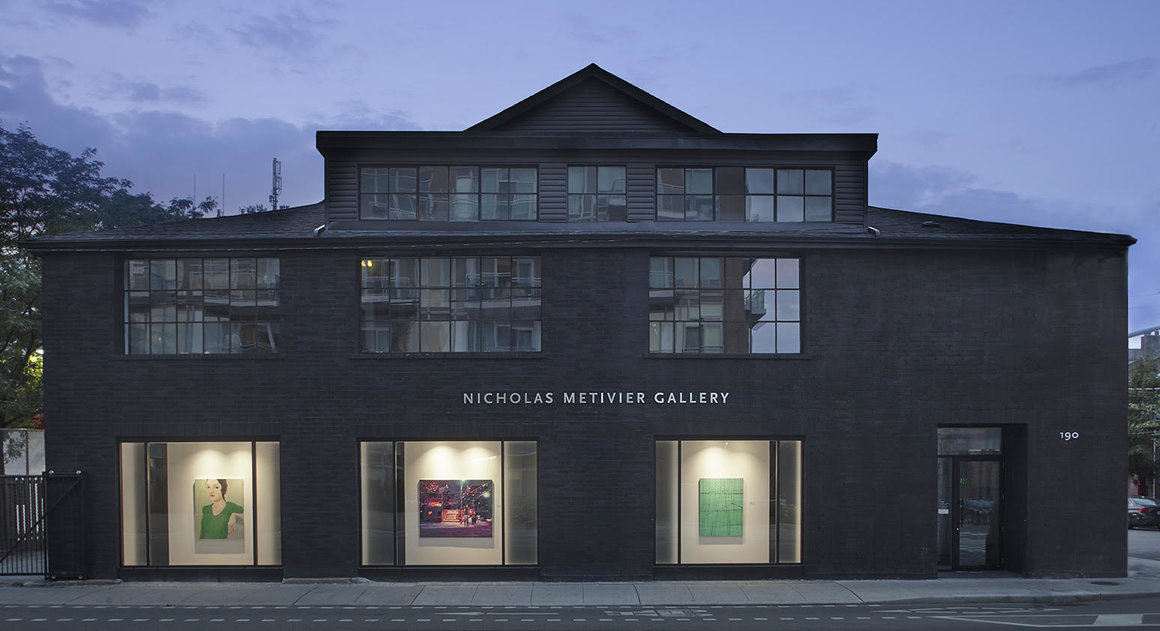
    The Toronto art scene has witnessed a slew of prominent repositories for contemporary practice relocating across the vast expanses of the city. Stephen Bulger, Angell Gallery, and the Museum of Contemporary Art are just a few recognizable names that have found greener pastures elsewhere. Former King Street West mainstay Nicholas Metivier Gallery has followed suit by recently uprooting their operations several blocks east on Richmond Street, decentralizing itself from the hustle and hedonism of its former setting. With it comes the loss of a swanky space that oozed sophistication and modernity; however, the move was wholly intentional.

    The new place of Nicholas Metivier Gallery at 190 Richmond Street East, Toronto

    Staff member Caroline Pearson notes how the gallery’s namesake owner had been on the hunt for a more expansive dwelling for some time. While the King West location sparkled with a heightened sense of refinement, its modest square-footage often limited the scope of the exhibitions put on display. Metivier ultimately struck gold when 190 Richmond Street East was released onto the sellers’ market.

    The old garage before the renovation

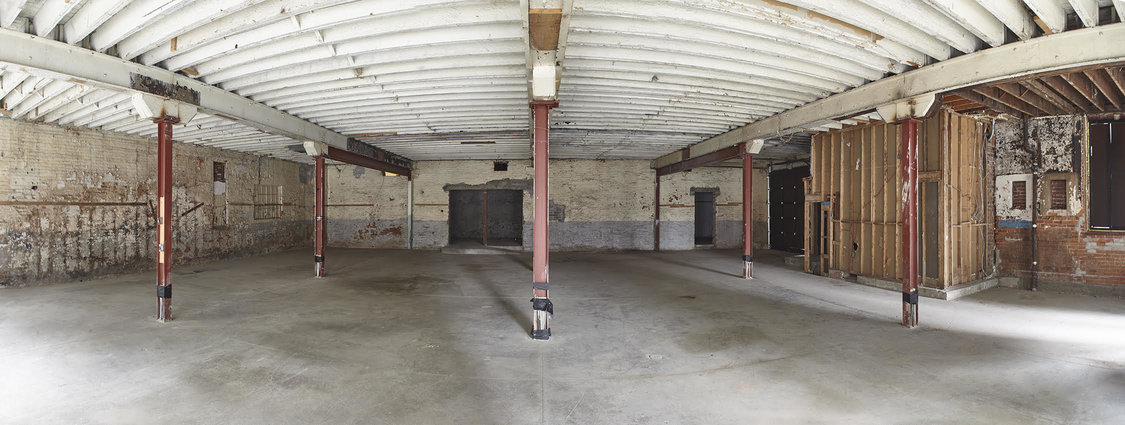
    Formerly a commercial car garage, this vacant space is considerably larger upon first inspection. However, an extensive, yet speedy renovation process essentially renders its erstwhile operations obsolete, save for the concrete flooring that was deliberately left untouched. The gargantuan windows that lead up to the gallery’s entrance functioned as garage doors that allowed automobiles to enter and exit at one point in time, while large red columns that once pierced through the interior have become incased in serene white walls for functional purposes. Pearson notes how in the future the gallery will host various concurrent showcases of contemporary art, as the multi-room setting effectively enables for more ambitious projects. Metivier and co. acquired the space in April, and opened their doors in July.

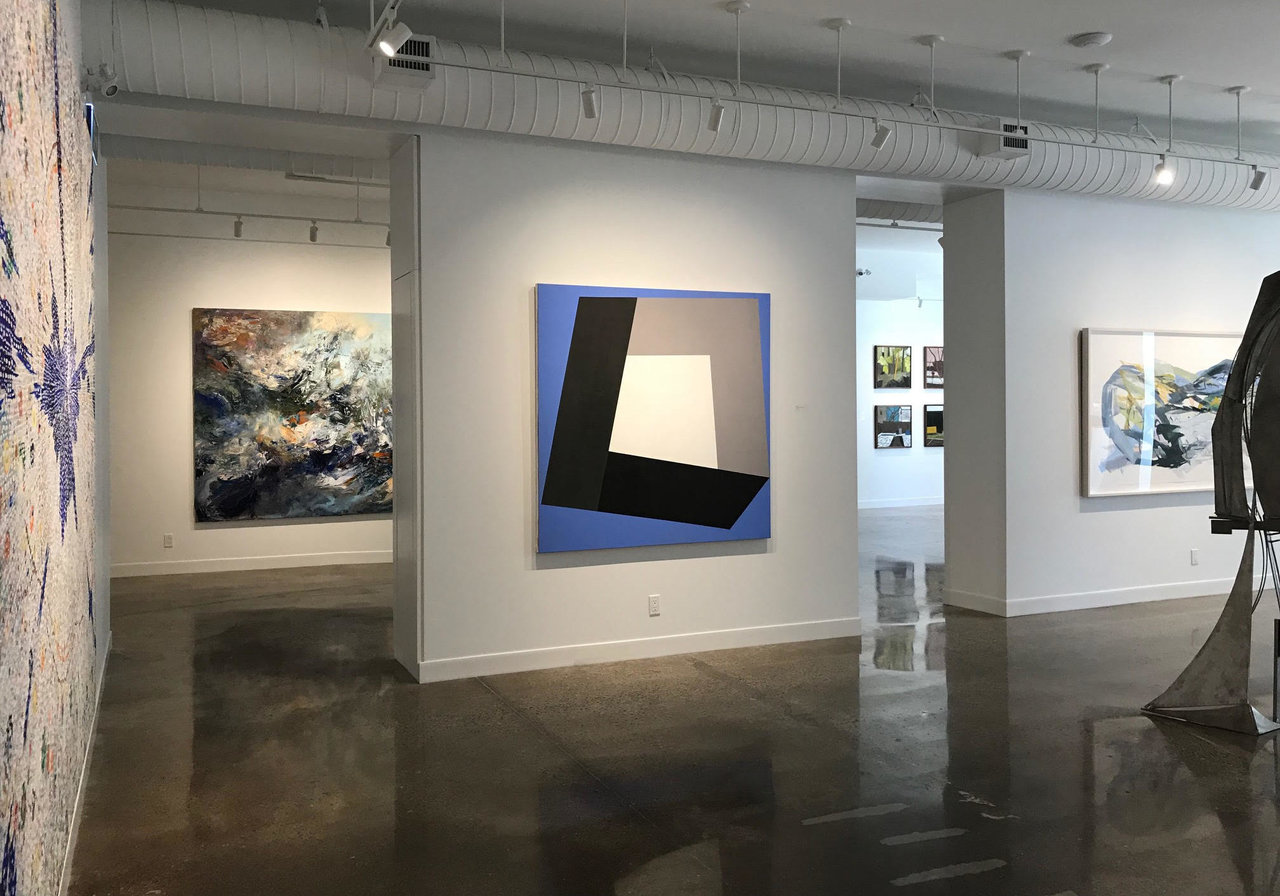
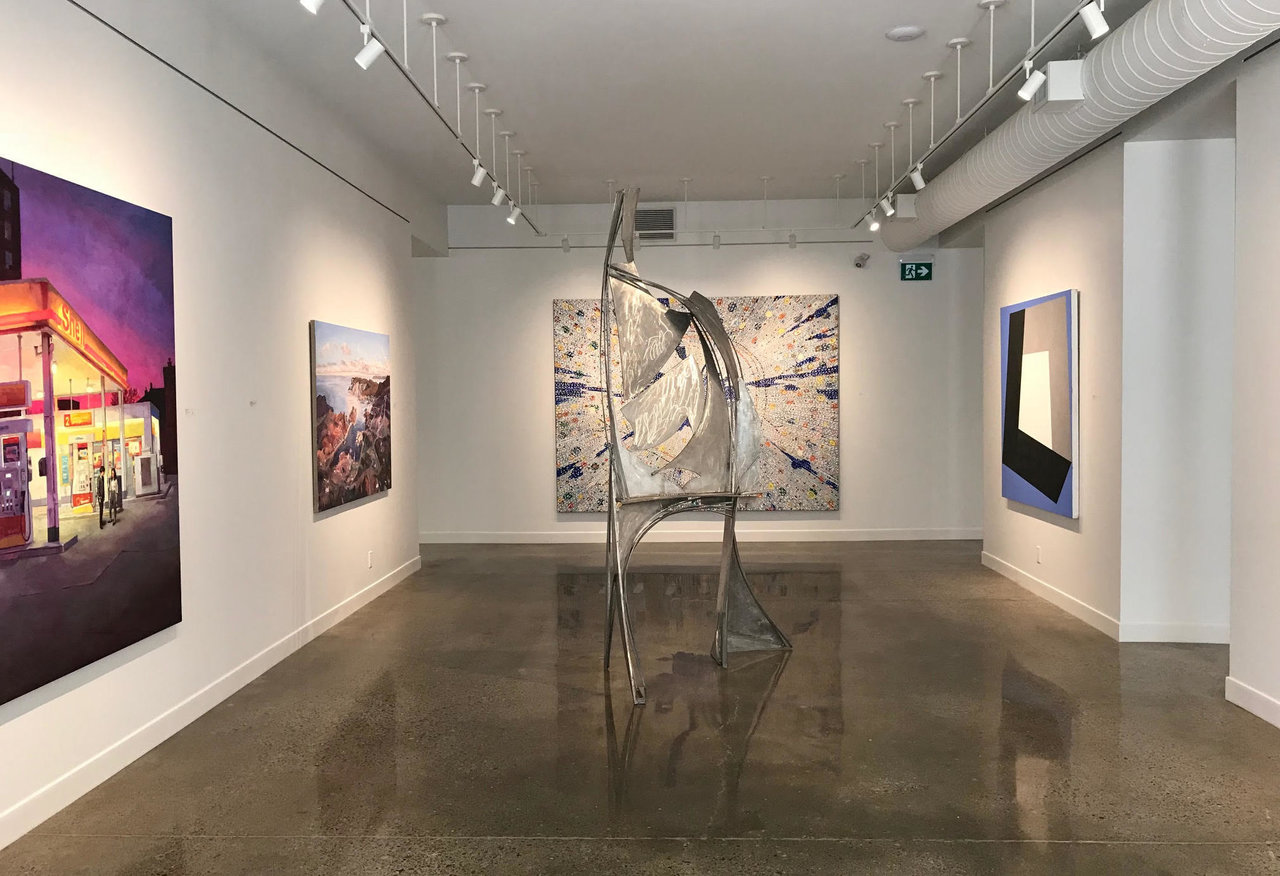
    Installation view of The Big Picture, Nicholas Metivier Gallery, 2018

    For the inaugural presentation, The Big Picture, the gallery has decided to put on a group exhibition featuring an assortment of media including collage, painting, photography and sculpture. Most of the artworks have not been previously exhibited by Metivier, giving the selection a more exclusive feel.

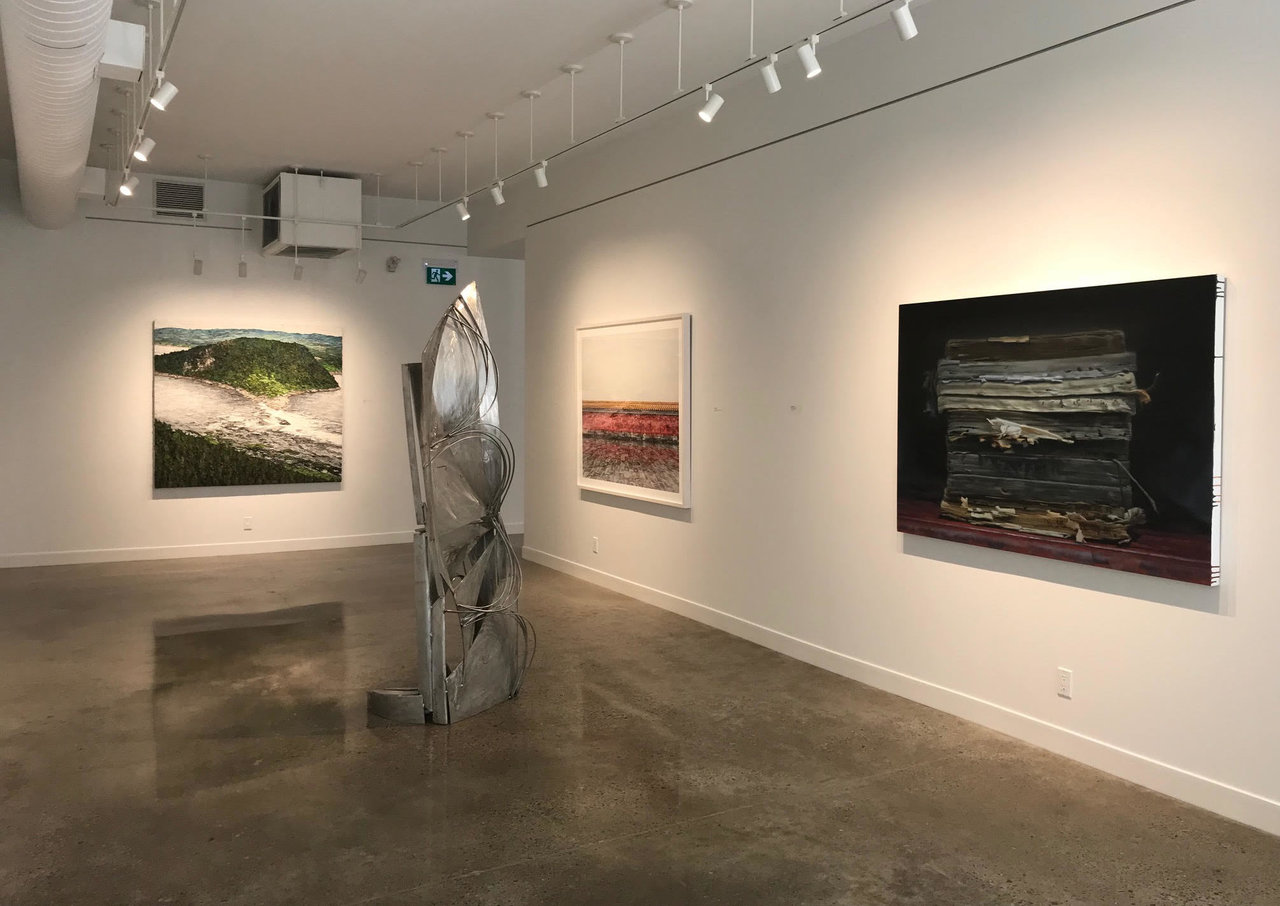
    Installation view of The Big Picture, with Keita Morimoto, Filling Up (left), Douglas Bentham, Swinger of Birches (After Robert Frost) sculpture (middle) and Ric Evans, The Harmony of Appearance (right)

    Frequent collaborators such as Stephen Appleby-Barr, Erik Madigan Heck, Joanne Tod, and Matthew Schofield make a welcomed appearance with their instantly recognizable oeuvres. Elsewhere, The Big Picture also features a few new artists who are beginning to formulate a working relationship with the gallery. Douglas Bentham is a Saskatoon-based sculptor whose industrially-tinged works of abstraction make a prominent appearance throughout. Similarly, Landon Mackenzie, who hails from Vancouver, is also given her debut within this showcase, as her large-scale cosmological composition “Night Sky and Blue Moon” (2009) takes up almost an entire wall.

    Installation view of The Big Picture, with (L-R) Matt Bahen, Some Things Are Better Not Put To The Test, Douglas Bentham, Espalier X-Ariadne (sculpture), Ljubodrag Andric, Beijing 4, and  Xiaoze Xie, Chinese Library No. 61

    With this new location, Nicholas Metivier promises to curate and manifest more grandiose exhibitions and events than ever before; the community is waiting with breath that is bated.

    David Saric

    Images are courtesy of Nicholas Metivier Gallery

    *Exhibition information: The Bid Picture, July 19 – August 25, 2018, 190 Richmond Street East, Toronto. Gallery hours: Tue – Fri, 10 am – 6 pm; Sat, 12 – 5 pm.

  • Kelly Cade & Sheryl Dudley / loop Gallery

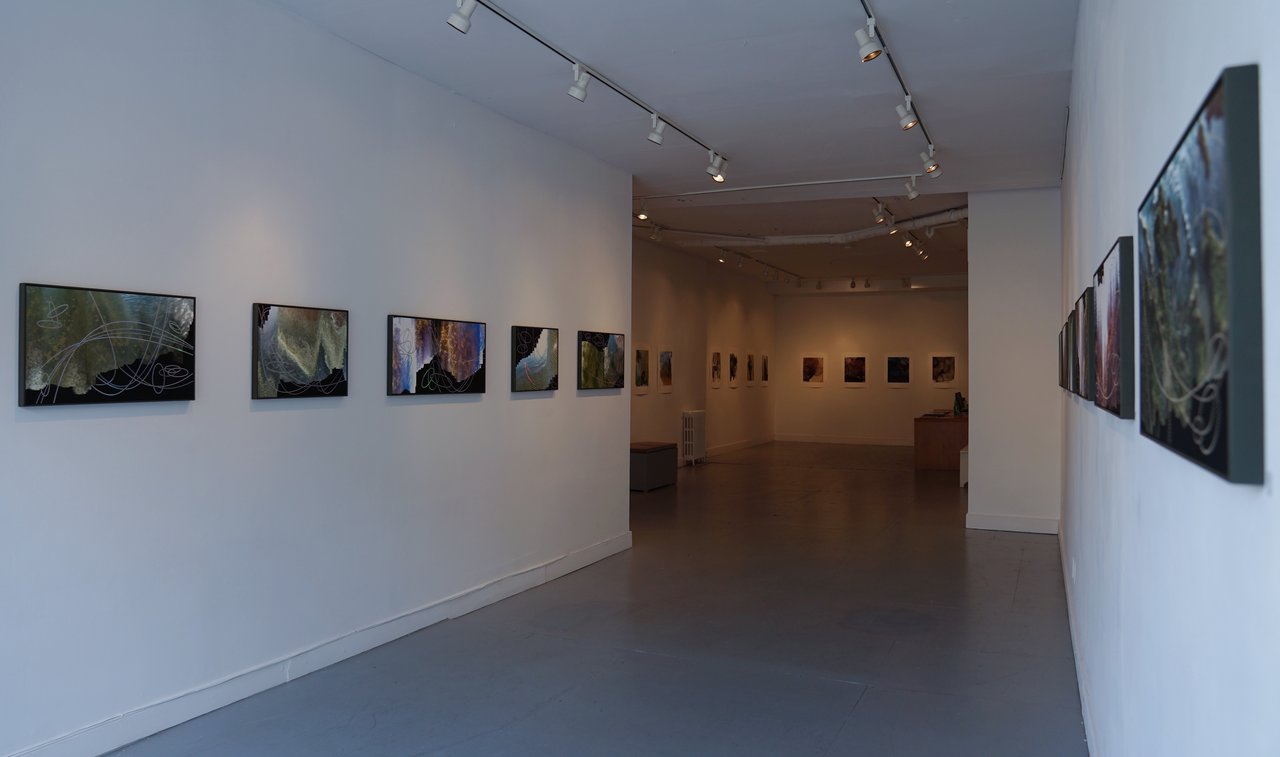
    Installation view of Kelly Cade, BioIntervals & Sheryl Dudley, The Sea Was Never Blue, 2018, loop Gallery

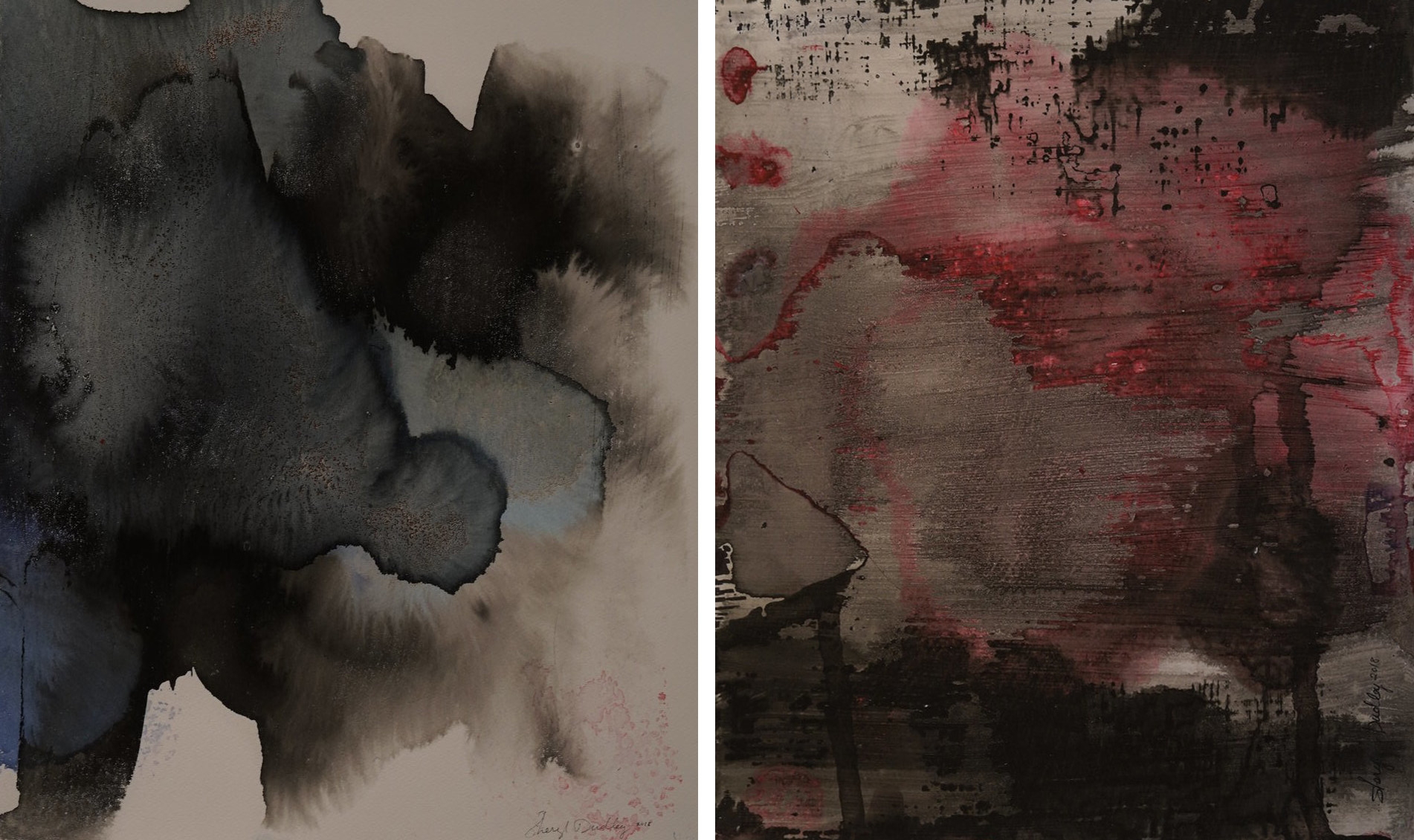
    Upon entering loop Gallery, I overheard Sheryl Dudley talking to her friend in her solo show The Sea Was Never Blue. As a Toronto based artist, Dudley has been a member of loop, an artist-run gallery, for a long time. As she said, most of her work focus on expressing both the physical and emotional responses to the world around her, especially to nature, and sometimes, to documents.

    Dudley, in her series of new work, wanted to depict the “incidental moments” of life, that are otherwise too ephemeral to capture. This show is a continuation of her previous series, especially Skirting Damocles and Once ‘The World’ Arrives, inspired by her trip to Greenland. Dudley was amazed by the nature of the Arctic and decided to dedicate a series of work to the wonders she had witnessed. Expanded from this original idea, The Sea Was Never Blue includes several abstract pieces. A sense of ambiguity is intentional, as the artist encourages the viewers to create their own narratives rather than guiding their thoughts to specific interpretations.

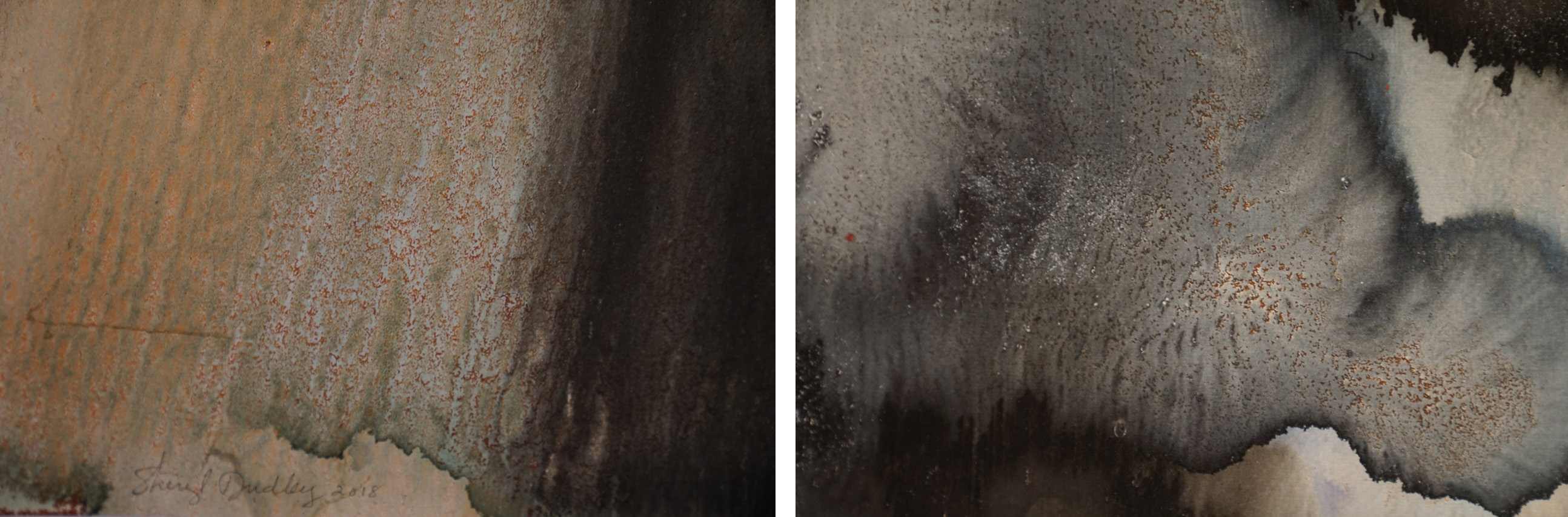
    Sheryl Dudley, Untitled #4 (left) and Untitled #5 (right) both archival giclée monoprint with graphite, coloured pencil and pastel, 40.5 x 48.5 cm, 2018

    I found the complexity of texture enchanting. The constant changing of strokes has endowed these artworks with various visual effects: some are highly saturated and contrasted, while others are entirely the opposite. Under such collisions, a type of “metallic particle” appears in some work, that further enriches the texture of the painting.

    Sheryl Dudley, Untitled #11 (left) and  Untitled #9 (right), both archival giclée monoprint with graphite, coloured pencil and pastel, 40.5 x 48.5 cm, 2018, close up details

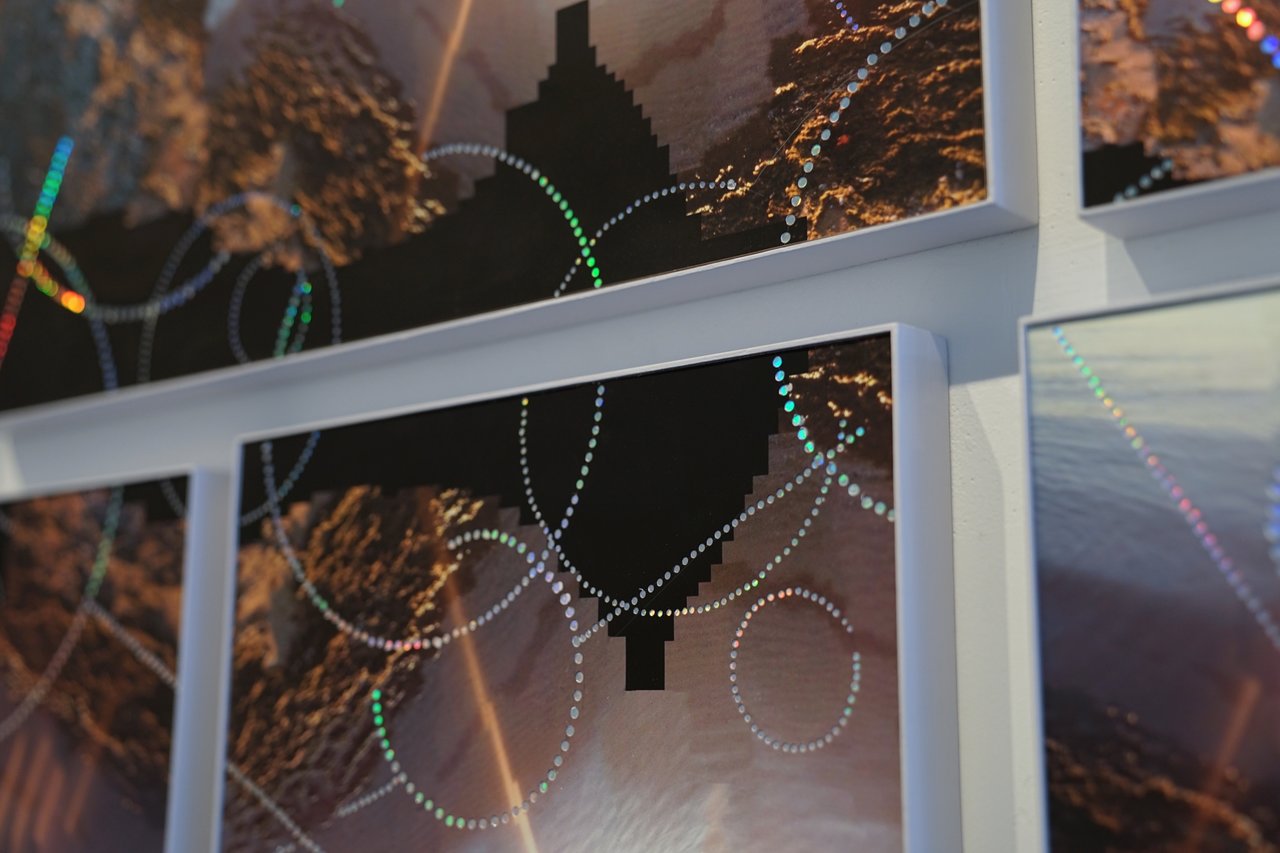
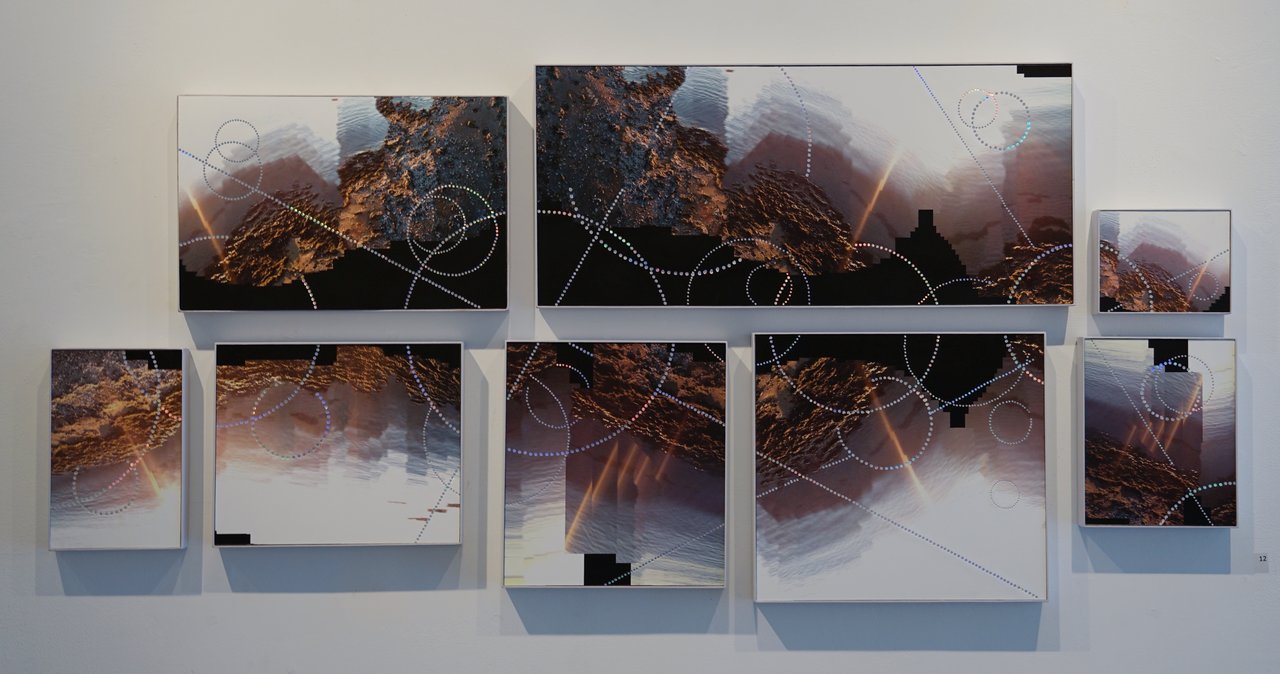
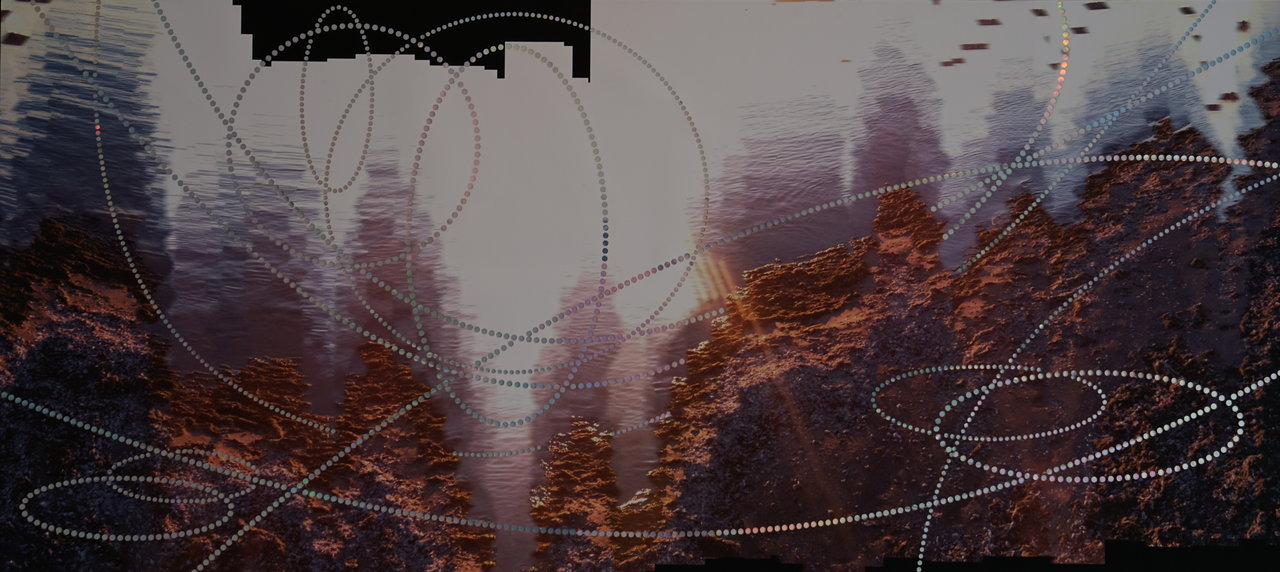
    BioIntervals by Kelly Cade is a series of abstract photography. Cade started her art career as a painter and you can see the painterly values in her work, even when she is experimenting with different mediums. In BioIntervals she aimed to capture the wind rippling across the surface of the water. She made a series of photographs, then she worked on composing the image by sections, putting them together, until she found the final one, which she enriched with a linear pattern of iridescent circles. Cade’s works are displayed by the glass window, so they reflect the fluctuating light and the cityscape from outside; making them even more dynamic. When evening comes, and cars will be driving by, their colored lights would smoothly blend in with the photographic imagery; causing the artwork to go through a metamorphosis and become a perfect fusion of art and nature, statics and dynamics.

    Kelly Cade, BioIntervals #12, 12 x 59 inches and details (top)

    Cade stated, that in BioIntervals she wants to encourage the audience to think about the conventional way we examine nature, the intervals we created by logical means, “our systems of measurement.” That reminds me of the philosophical theory from Kant, that our perceptions of things are not recognition of the things themselves, but instead what we experience when they appear to us. More specifically, our minds have a consistent way of restructuring our experiences and through this programming system, anything can be “translated” into information that would be perceived subjectively. In her work Cade challenges the viewers to re-examine the way we understand intervals and offers an entry to other possible dimensions that may coexist with the one we used to.

    Kelly Cade, BioIntervals #5, 17 x 37 inches

    The Sea Was Never Blue by Sheryl Dudley and Kelly Cade’s BioIntervals are two remarkable exhibitions, where the artworks are complementing each other. If you are wandering in town and looking forward to enjoy some abstract art – do not miss this show.

    Text and photo: Iris Wu

    Exhibition information: Kelly Cade, BioIntervals & Sheryl Dudley, The Sea Was Never Blue, July 21- August 12, 2018, loop Gallery, 1273 Dundas Street West, Toronto. Gallery hours: Wed & Thur, 12 – 5 pm; Fri & Sat, 12 – 6 pm; Sun, 1 – 4 pm.

  • Robert Kananaj Gallery – 7th Anniversary

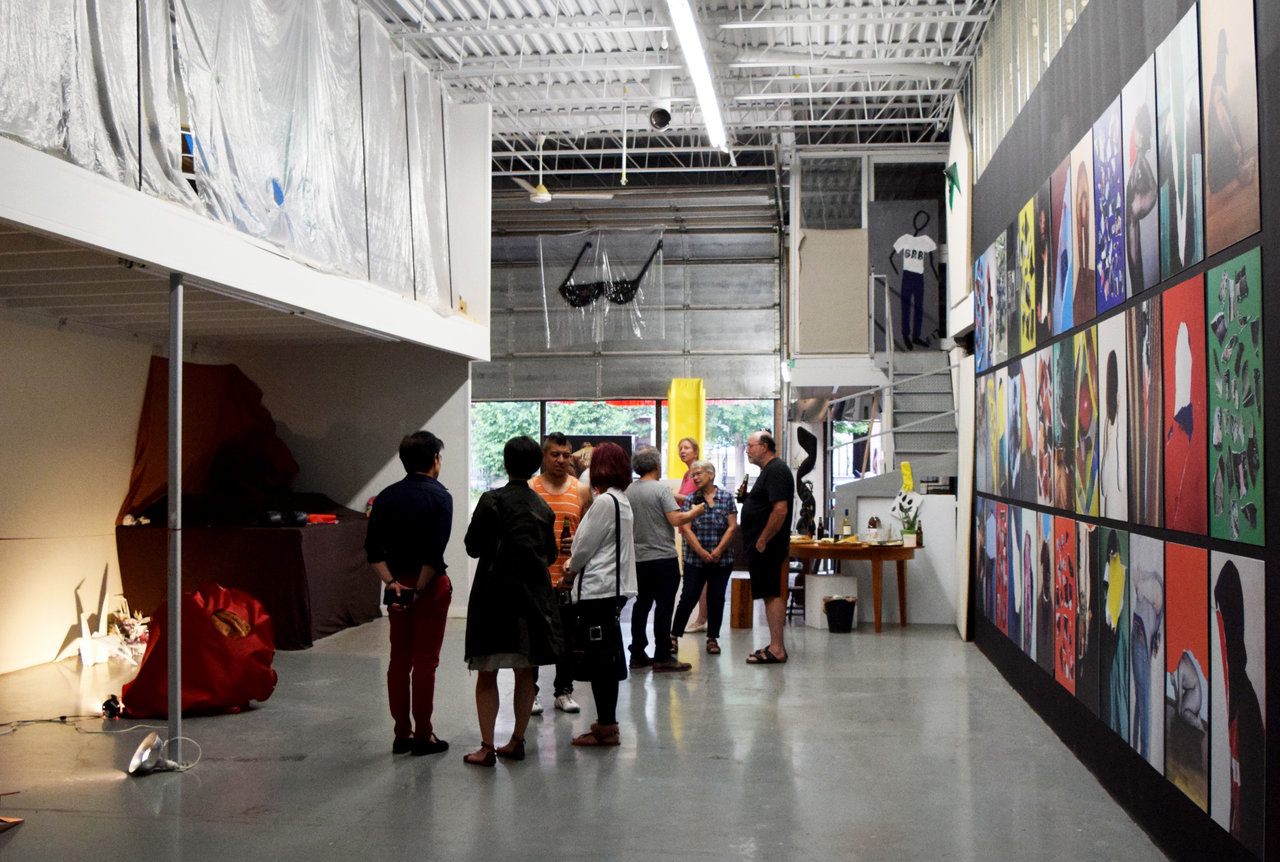
    The Robert Kananaj Gallery celebrates its seventh anniversary this year with a group exhibition showcasing some of the many featuring and resident artists that have contributed their unique works over the gallery’s history. Since its inception in 2011, its directive has always been to promote contemporary Canadian and international artists who explore a diverse range of media and influences. The works are portrayed as experiential objects, offering audiences the opportunity to delve into unique themes and interpret new ideas. Although each artist and each artwork is distinct, they are unified by a common spatial experience and a shared emphasis on composition and artistic values that are proudly fostered by Robert Kananaj.

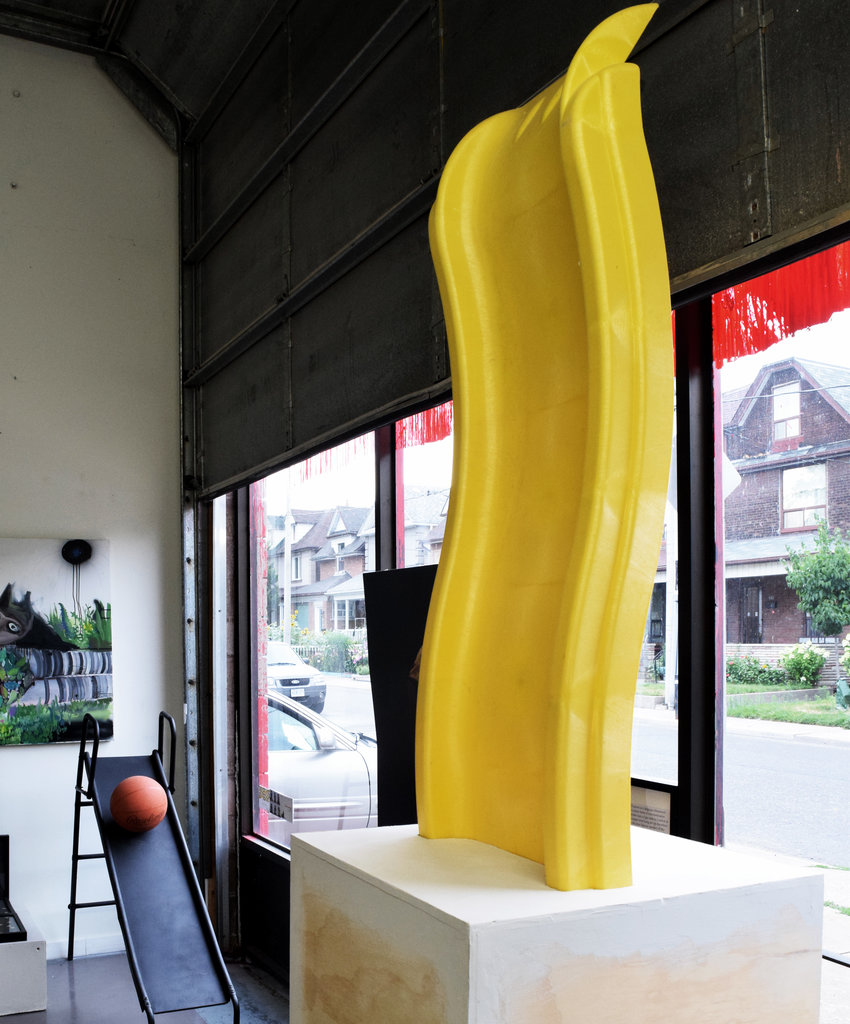
    Though the anniversary celebrates the accomplishments of every artist that has supported the gallery, the event prominently features some of the most recent and ongoing contributors. Firstly, there is Oscar Figueroa and his collection of Slides. This body of work explores the notion of movement and how, despite its dynamacy and fluidity, its portrayal in art and visual culture is often fragmented, stagnant, and disjointed, being essentially stripped of its core elements. Figueroa uses the playful motif of slides to delve into the more intrinsic aspects of movement, namely where it begins, where it inevitably ends, and how it is perceived gesturally.

    Oscar Figueroa’s collection of Slides

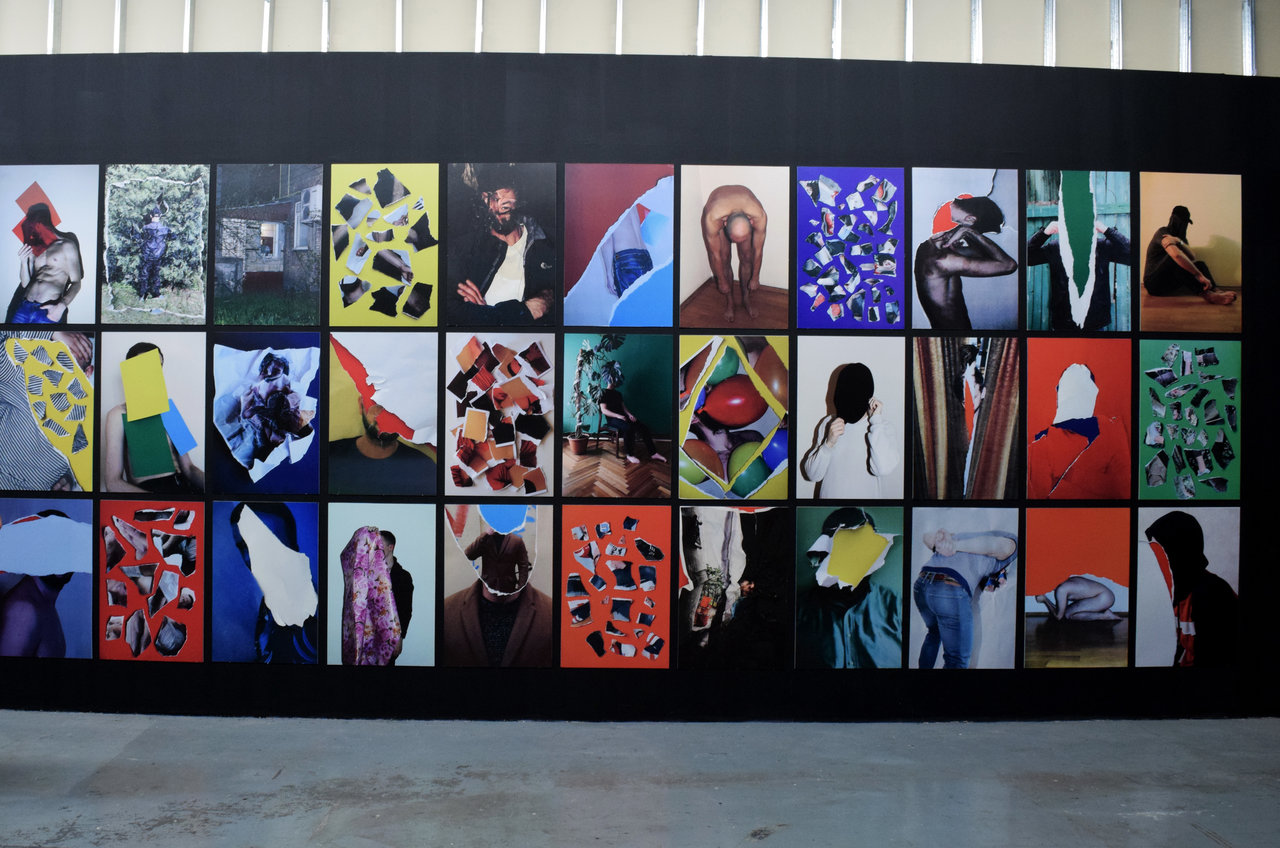
    Alongside Figueroa’s playfulness, Anton Shebetko brings Common People, an enormous assortment of distorted photographic portraits that delve into the contentious identities of “Ukranian closeted gays”. Although Ukraine does not explicitly criminalize homosexuality, its latent stigmatization implicitly forces LGBTQ individuals into hiding, even going so far as to adopt homophobic rhetoric and attitudes to conceal their sexuality. The photographic portraits are historically and conceptually honest, giving viewers a true glimpse into the personality of the subject. Here however, the identities remain censored from the audience and consequently subverted by the subject as well.

    Anton Shebetko, Common People

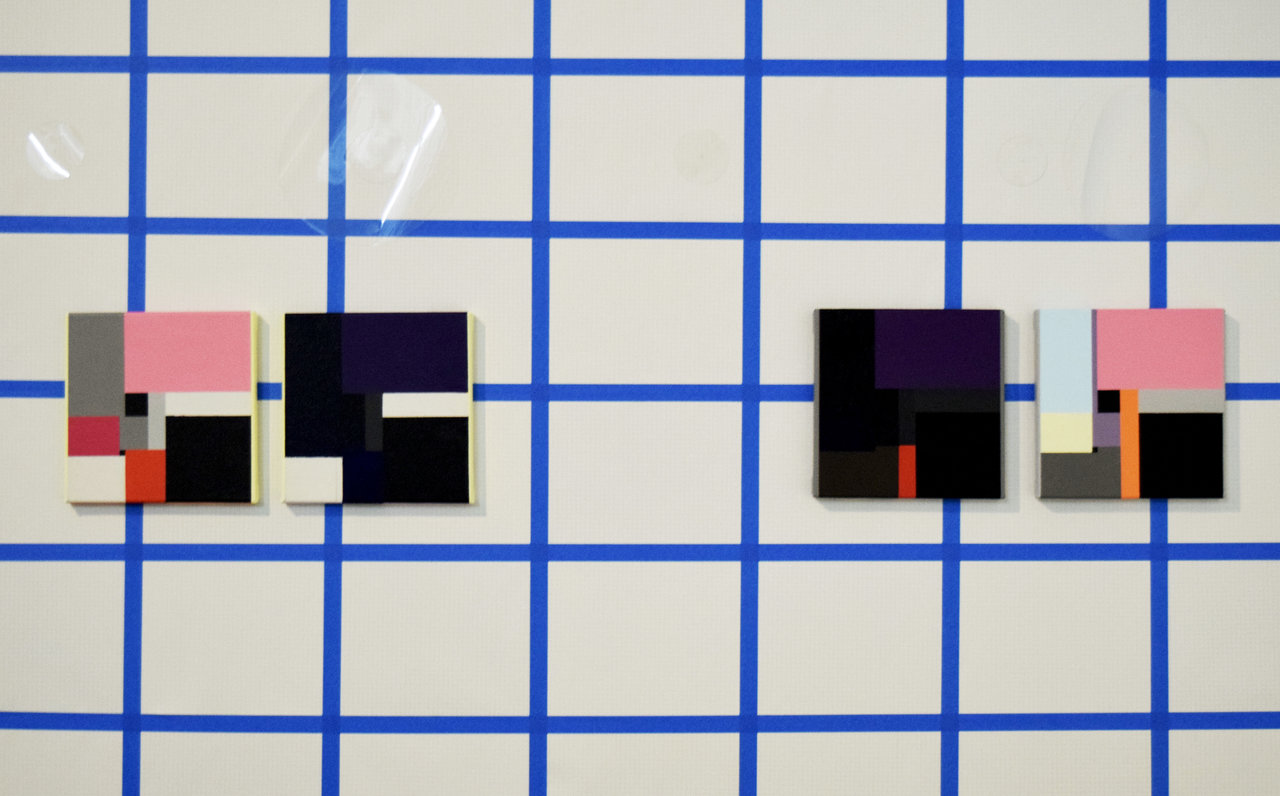
    Art and mathematics have been closely intertwined throughout the history of aesthetics, with artists of Antiquity and the Renaissance utilizing geometry and grids to map their compositions to ensure naturalistic proportions. In response, Kee Ip amalgamates these two fields, depicting the 9 Squares concept that accentuates colour and non-colour fields as well as the Riemann Zeta 2 function that sequences the seemingly random colours.

    Kee Ip, 9 Squares

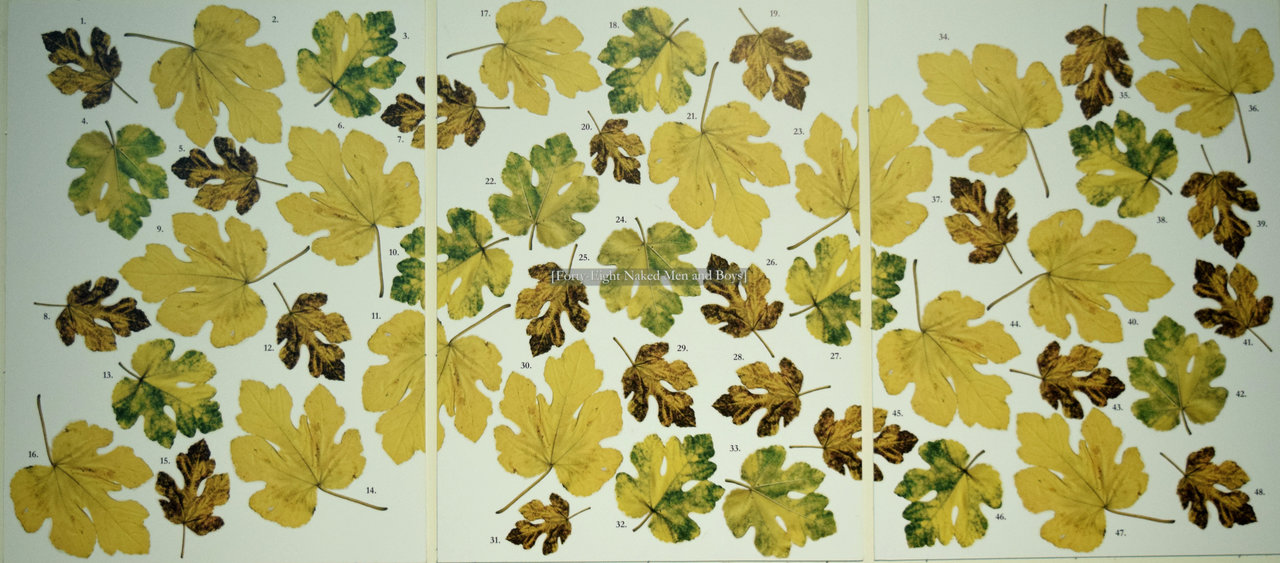
    Naturalism has always been a strong influence for pre-modern and modern artists. Inspired by Matisse’s late-period and Warhol’s early works, Bruce Eves uses the imagery of the fig leaf – a common erotophobic motif in art employed to censor genitals and other sexual themes – to challenge long-established notions surrounding the frame of reference. What has often been used to subvert erotic subject matter is instead brought to the forefront for everyone to acknowledge.

    Bruce Eves, Work #1000 – Some Things Hidden (Fig Leaves)

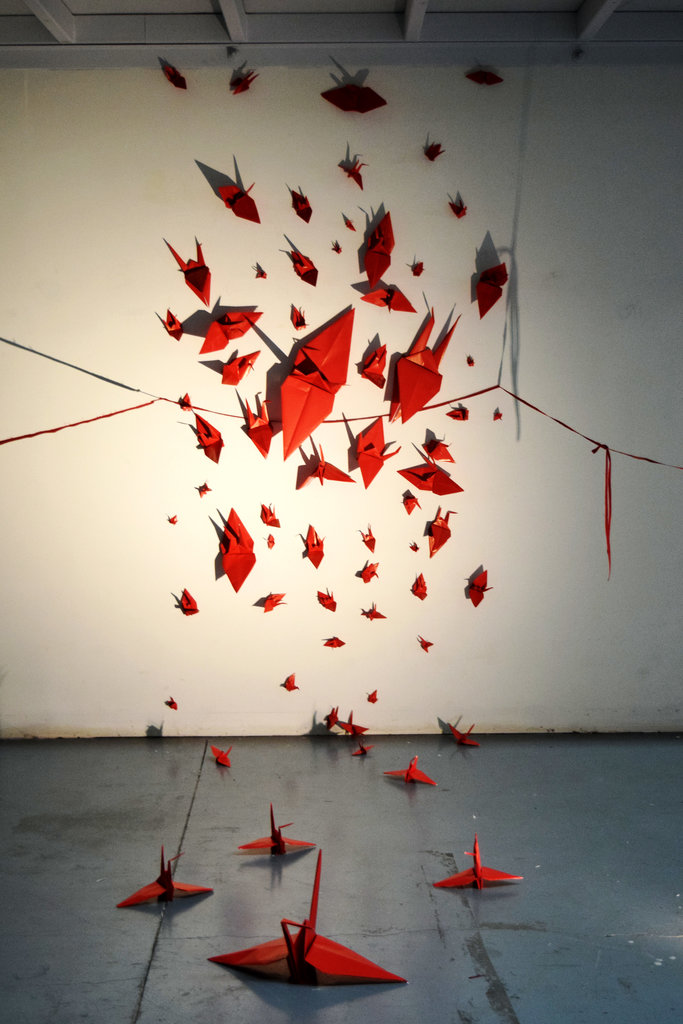
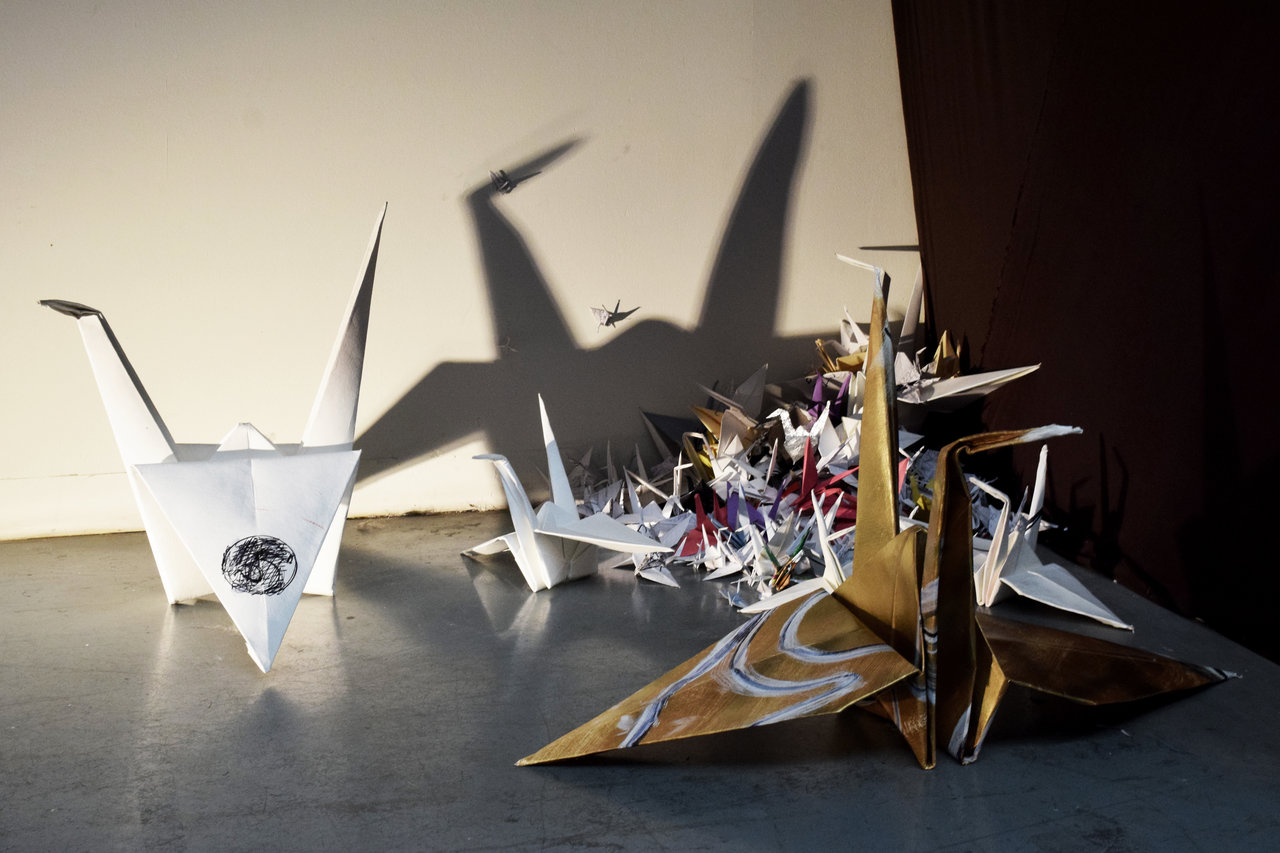
    Last but certainly not least, the current resident artist Raffael Antonio Iglesias features some of his developing and finished works. Through multimedia, he encapsulates many of the highly tragic events that have recently befallen him, using handcrafted paper cranes, synthetic materials, and sentimental objects to create stunning and emotionally-charged installations.

    Installation by Raffael Antonio Iglesias

    Over these past years, the Robert Kananaj Gallery has attracted a wide array of artists that draw from strong, diverse experiences. In the years to come, it will surely continue to uphold these values and support international and local artistic communities.

    Text and photo: Simon Termine

    *Exhibition information: July 26 – August 18, Robert Kananaj Gallery, 172 St Helens Avenue, Toronto. Gallery hours: Tue – Sat, 11 – 6 p.m.

  • José Luis Torres: Question d’adaptation

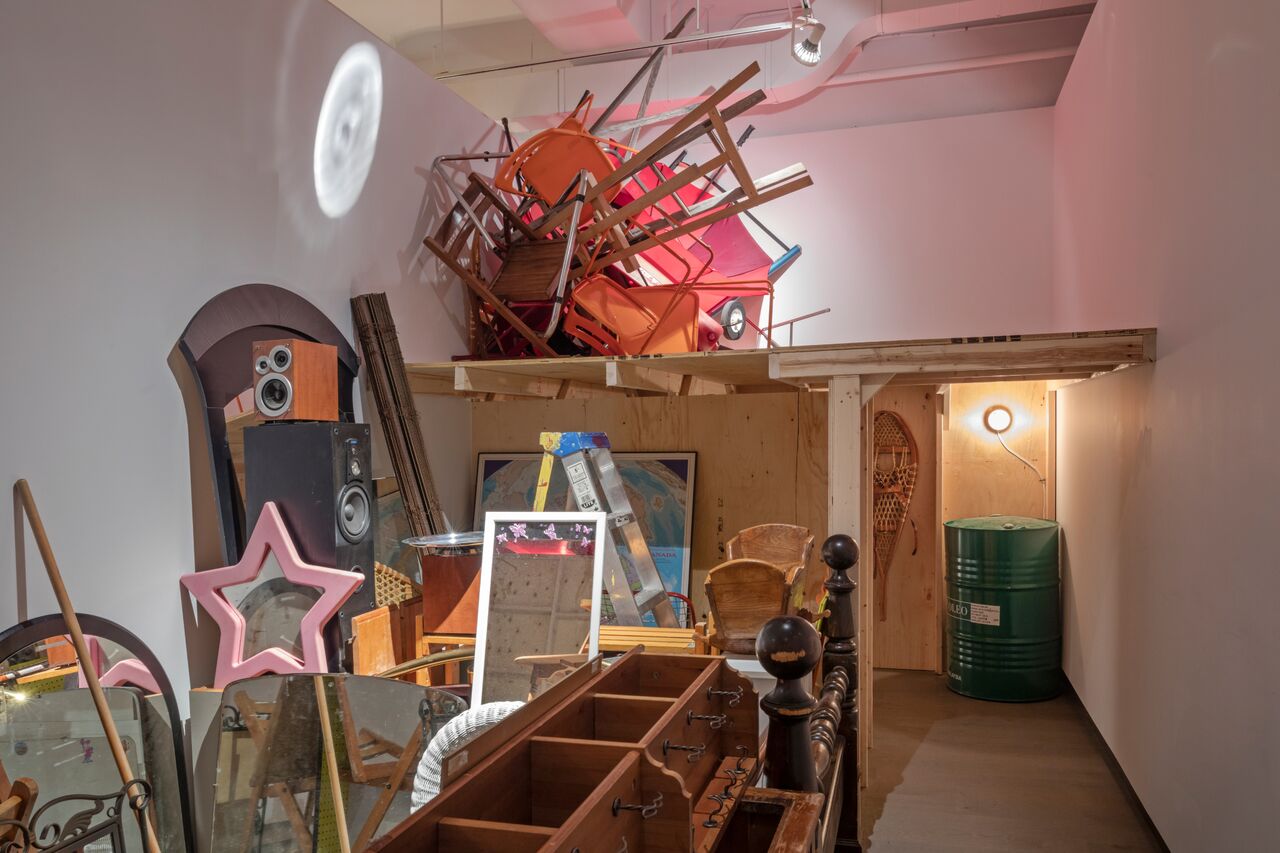
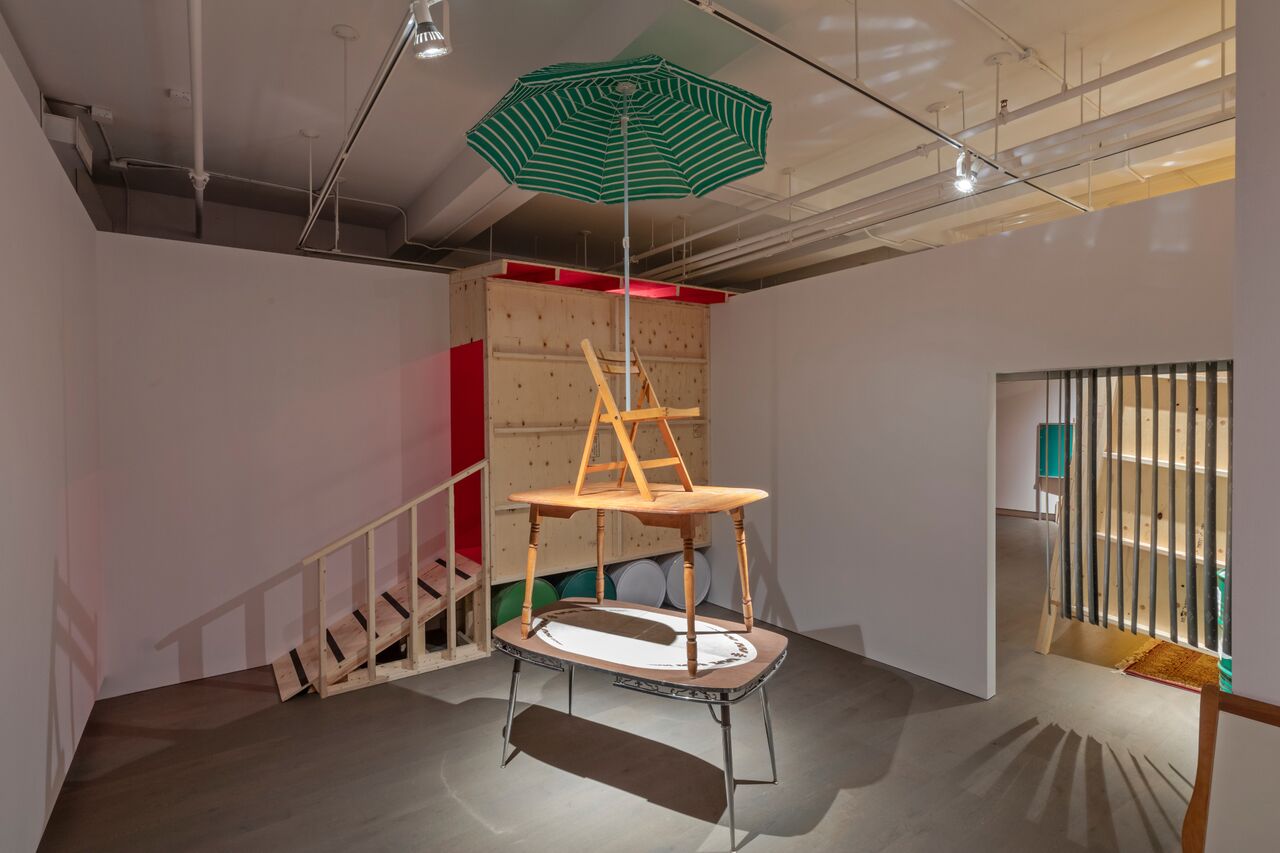
    If my mother’s basement exploded, it would look like Torres’s new exhibition at the Koffler Gallery. Hoarding seems to be a common pattern among immigrant mothers, especially Asian ones. Everything and anything might be useful someday so why throw anything out? It took my father 20 trips to the garbage disposal in our old Toyota to clean out that basement, seemingly disposing of our history, past, and memories. But what good is a memorabilia if it’s stored away, instead of remembered about?

    José Luis Torres, Question d’adaptation (Koffler Gallery installation detail), 2018. Photo: Toni Hafkenscheid

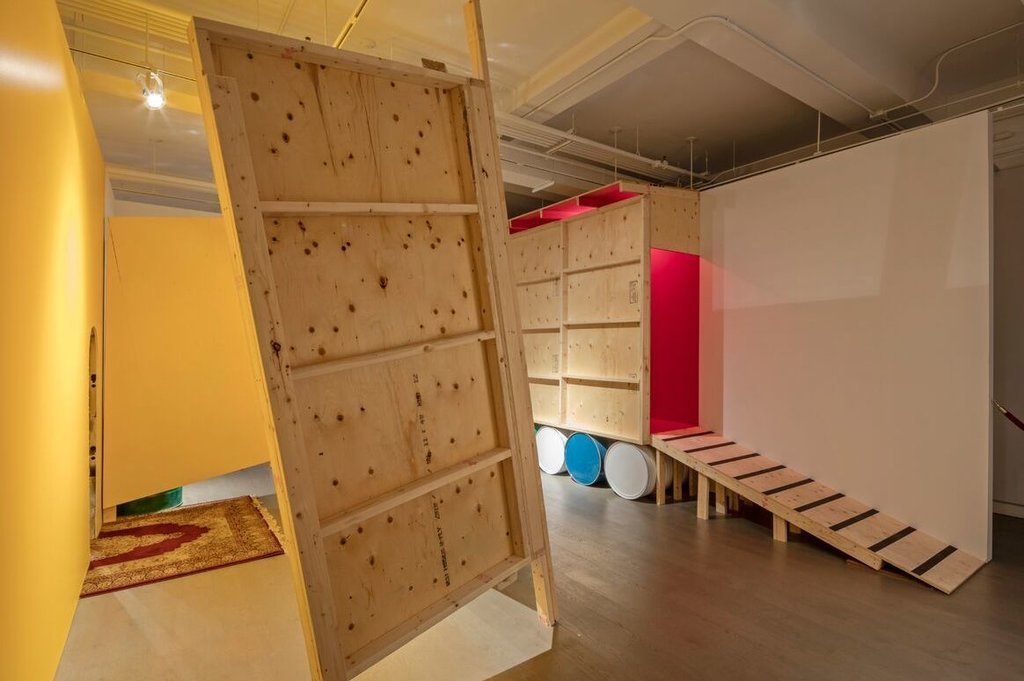
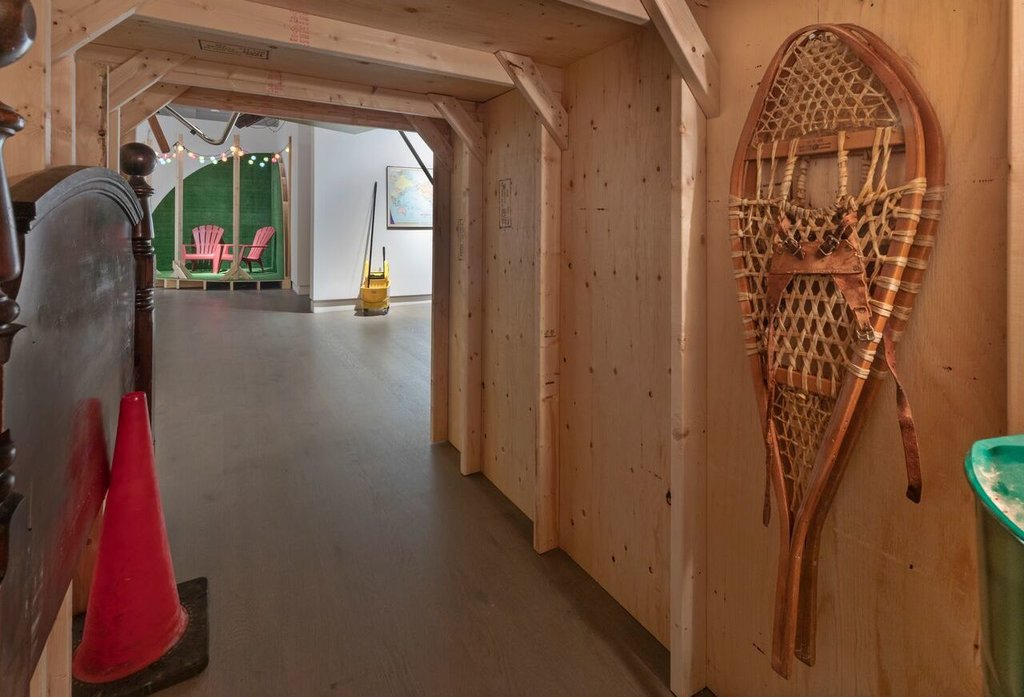
    As per the title Question d’adaptation, we are invited to not only think about our experiences of adaptation, but actively experience adaptation at the exhibition. We are made to crouch down, climb, and walk through openings that are too small. The act of straightening your spine to witness what’s upon the other side is a significant one, forcing us to quickly adapt to different perspectives and surroundings.

    José Luis Torres, Question d’adaptation (Koffler Gallery installation detail), 2018. Photo: Toni Hafkenscheid

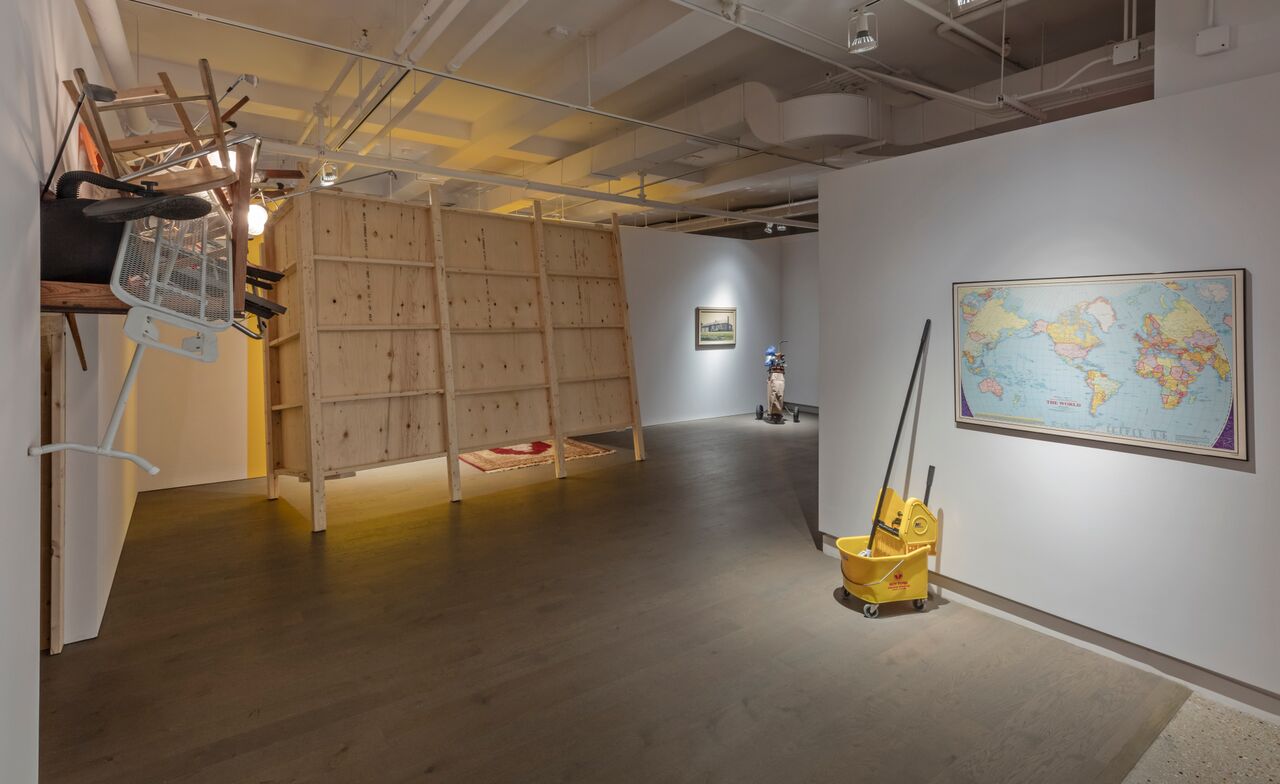
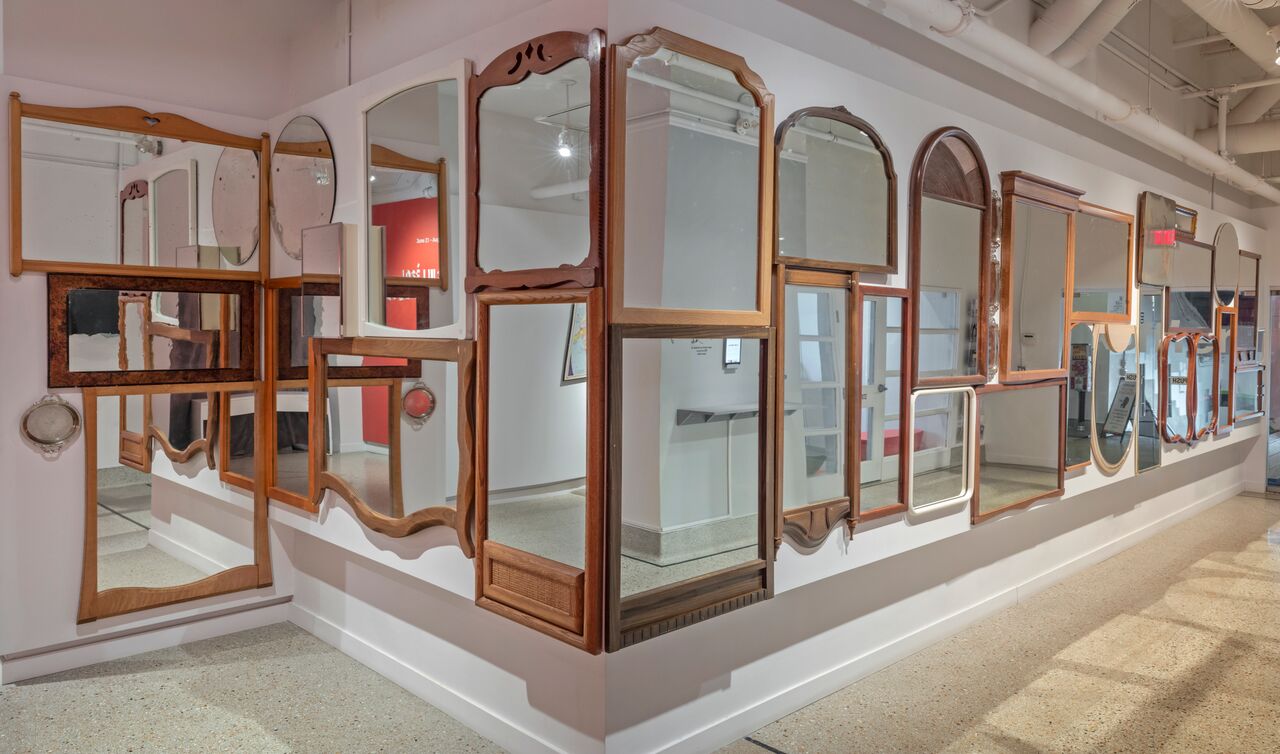
    We constantly have to adjust ourselves in this space, like a chameleon. The red hallway at the back of the exhibition turns us into a shade of red and prompts us to squeeze through a small opening in order to reach the other side. The blind attached to one of the entrances are almost shut, having to rub against the wall in order to pass without disturbing the blinds. The askew wooden structure across from the red hallway not only turns us into a hue of yellow, but also leads us back to the wall of old mirrors by the entrance, where we are confronted with distorted versions of ourselves. Mirror before entering and after – to show us the transformations we went through.


    José Luis Torres, Question d’adaptation (Koffler Gallery installation detail), 2018. Photo: Toni Hafkenscheid

    Countering the dislocating and distorting effects of the crude, bona fide indoor playground, are maps. Among the first items to be seen is a world map, with Canada in the centre of the map. Through the the wooden passageway underneath the explosion of furnitures, is another map, featuring just Canada this time. We’ve migrated.

    José Luis Torres, Question d’adaptation (Koffler Gallery installation detail), 2018. Photo: Toni Hafkenscheid

    Just like the exhibition, maybe our immigrant mothers were attempting to resist the pressures of assimilation and hold onto the past pieces of their identity. Passageways become increasingly inconvenient to comfortably pass through, and the amount of ‘stuff’ carried through the spaces become less and less, until we have seemingly come back to the same place, but it all looks different now, and so do we.

    José Luis Torres, Question d’adaptation (Koffler Gallery installation detail), 2018. Photo: Toni Hafkenscheid

    Sunny Kim

    Images are courtesy of Koffler Gallery

    *Exhibition information: June 21 – August 26, 2018, Koffler Gallery, Artscape Youngplace, 180 Shaw Street, Toronto. Gallery hours: Tues – Fri 12 – 6 pm, Sat & Sun 11 am – 5 pm.
  • Refiguring Worlds / Birch Contemporary

    Refiguring Worlds, curated by Rebecca Travis transports us to a space in transition where uncanny objects and scenes are caught shifting from the familiar to the peculiar. Each work of art is a fragment from a different realm, where their respective artist has formulated some form of intervention to develop or unpack the common and banal into the spectacular and strange.

    The show features five captivating artists, practicing in a wide variety of different mediums.

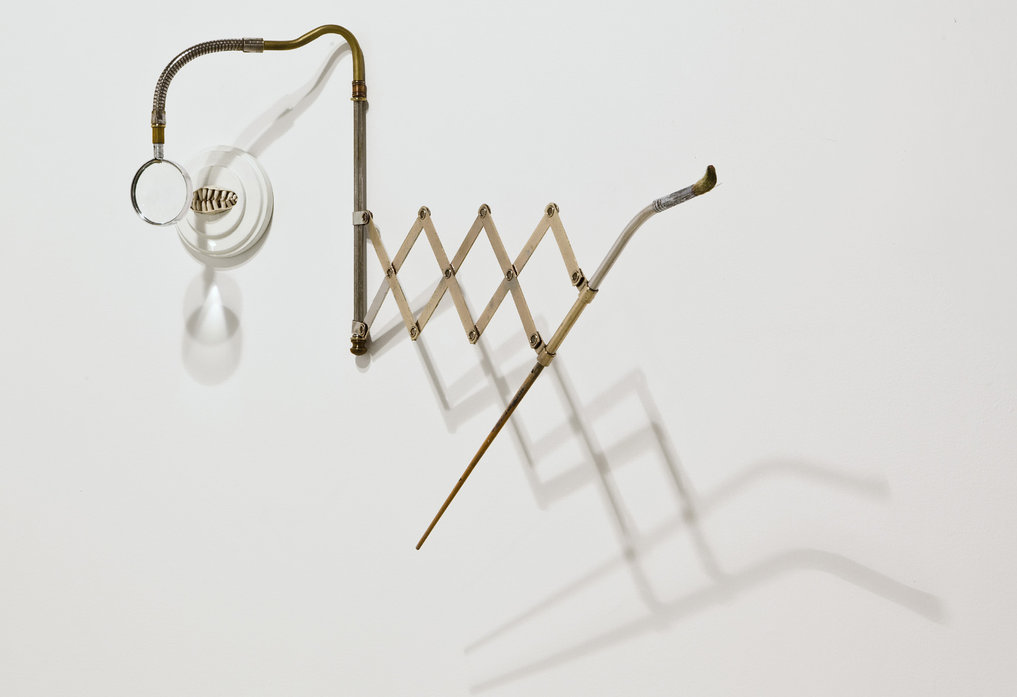
    The work of Ginette Legaré are assemblages of found objects and materials, that radically transform, often mundane, components into bizarre sculptures that evoke elements of living creatures or surreal hybrids between object and organism. Close-up is a mechanical contraption that, with its extended magnifying glass, invites the viewer to inspect it closely, only to be confronted with a visually enlarged set of menacing jagged teeth emerging from an architectural circular moulding attached to the gallery’s wall. The piece is visceral and nightmarish, yet nostalgic in its industrial design and physicality.

    Ginette Legaré, Close-up (Painter’s Stroke series), 2004, 14 ¼” × 22″ × 10 ½”, metal, wood, rubber, magnifying lens and customized paintbrush. Courtesy of the artist and Birch Contemporary

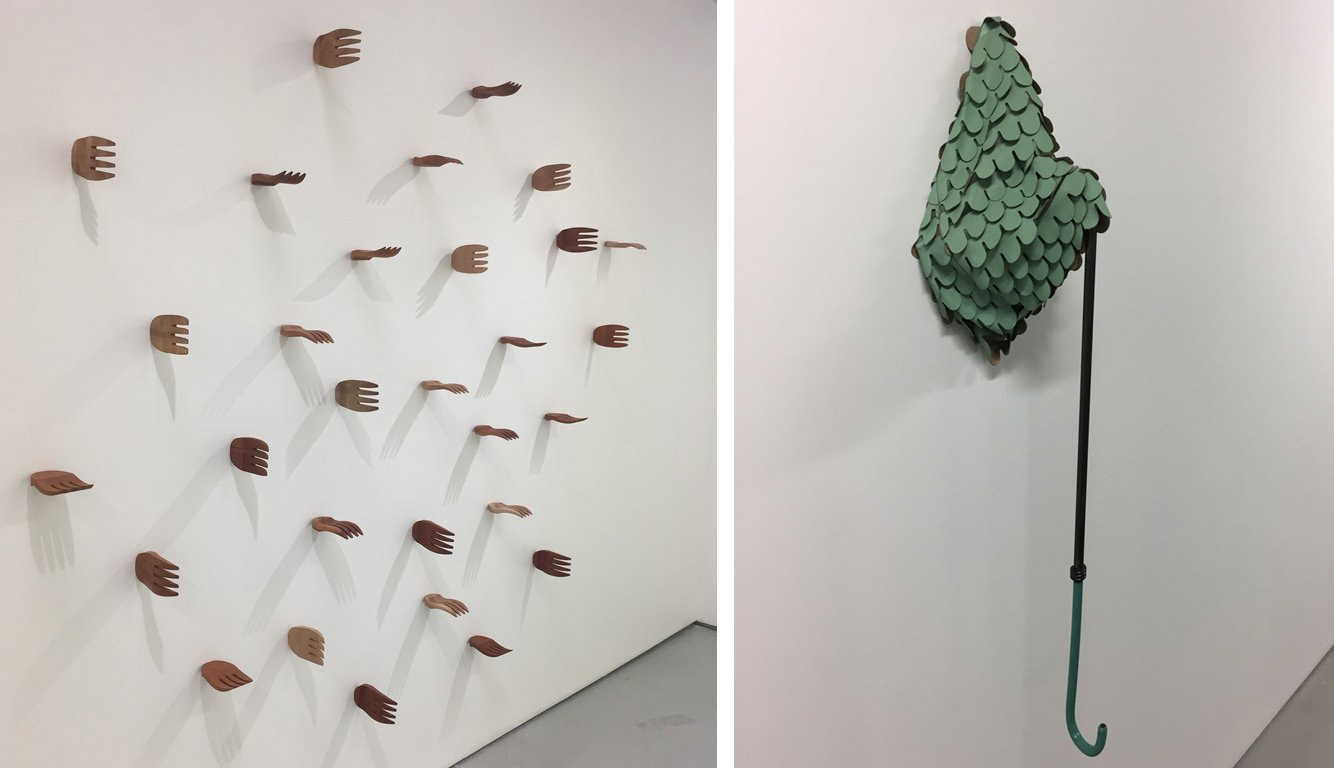
    Another work of Legaré, Démantelée, is an elegant piece that simply combines a long umbrella handle and green, leather, sequin fabric, and by merging them manages to draw out both of the elements of reptilian or fish-like features, transforming it into a bourgeois-looking abstract lizard. Recount is an installation that takes what appears to be a domestic and culinary utensil, the salad serving fork, and extrapolates it into an ornamental design that dissolves the single functional object, through multiplication, into an abstract pattern of wooden prongs that sometimes remind us of upturned palms.

    Ginette Legaré, Recount, 2004, cherry wood and screws, 96″ × 102″ × 6″ and Démantelée (Complements direct series), 2018, leatherette on tulle, metal, plastic umbrella handle, 38″ x 12” x 9”. Photo: Nathan Flint

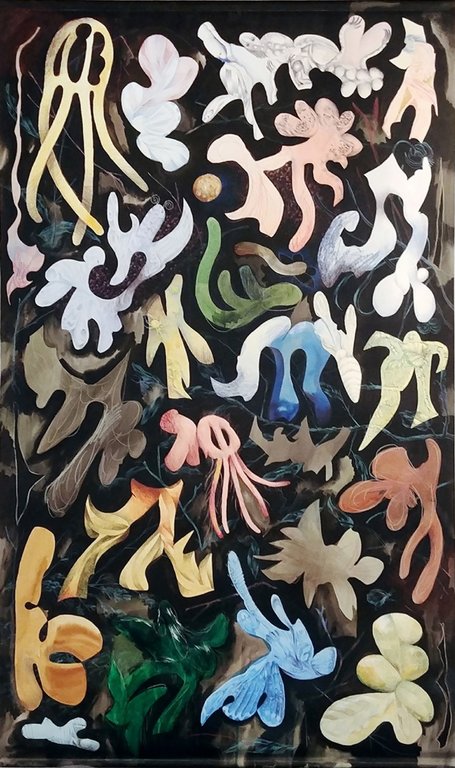
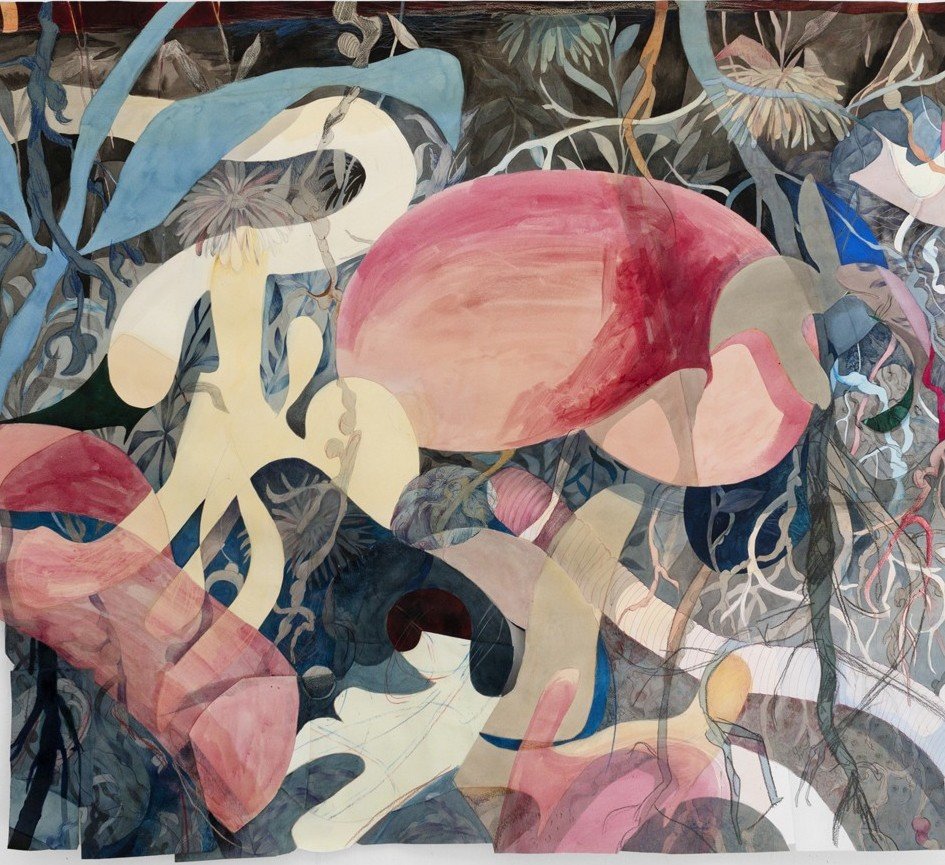
    The works of Sarah Davidson combine otherworldly botanical or amoebic forms and abstract decor pattern. From afar the edge effects resembles cut out paper collages suspended on parchment like a large vertical banner, but upon closer inspection you discover that the pieces are mixed media paintings filled with intricate details that depict organic textures and animalistic features. A beautiful depiction of a microscopic, fantasy world; the piece plays with the clinical depictions of botanical samples and diagrams by adding whimsical creatures and shapes.

    Sarah Davidson, edge effects, 2017, watercolour, ink and pencil crayon on paper, 62″ × 35″. Courtesy of Birch Contemporary

    Similarly, in hide and seek, Davidson uses her masterful skills of wet and dry mediums to depict dense vegetation that overlaps and entangles itself. The inclusion and transparency of amorphic forms adds a level of surrealism where these flat geometric shapes are penetrating their way through the image. The use of flatness and depth makes the work exciting to explore.

    Sarah Davidson, hide and seek, 2018 ink, watercolour, flashe, graphite, pencil crayon on paper, 46″ × 51″. Courtesy of Birch Contemporary

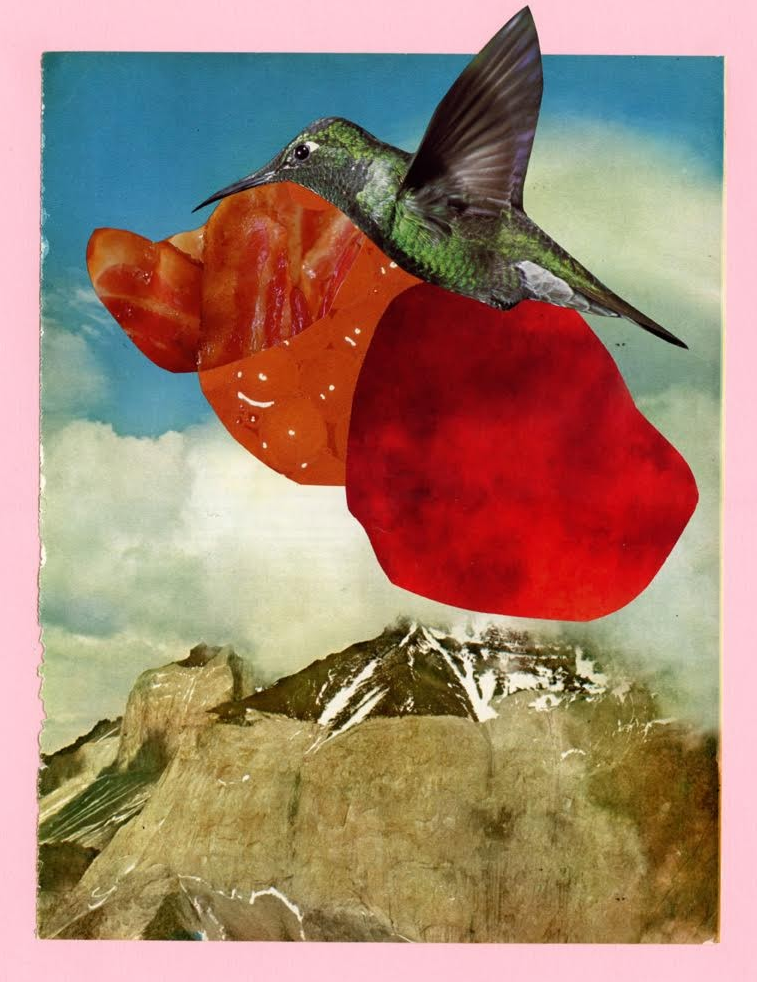
    Visually comparable to the work of Davidson are the analogue collages of Maryse Larivière. Using a traditional cut and paste technique, Larivière composes surreal landscapes that predominantly feature her main subject of the collection, the hummingbird. Accompanying her framed artworks is her collection of poetry and prose, Hummzinger, that was inspired by the Royal Ontario Museum’s hummingbird collection.

    Maryse Larivière, Red Mountain, 2017, collage, 16 ½” × 11 ½”. Photo: Nathan Flint

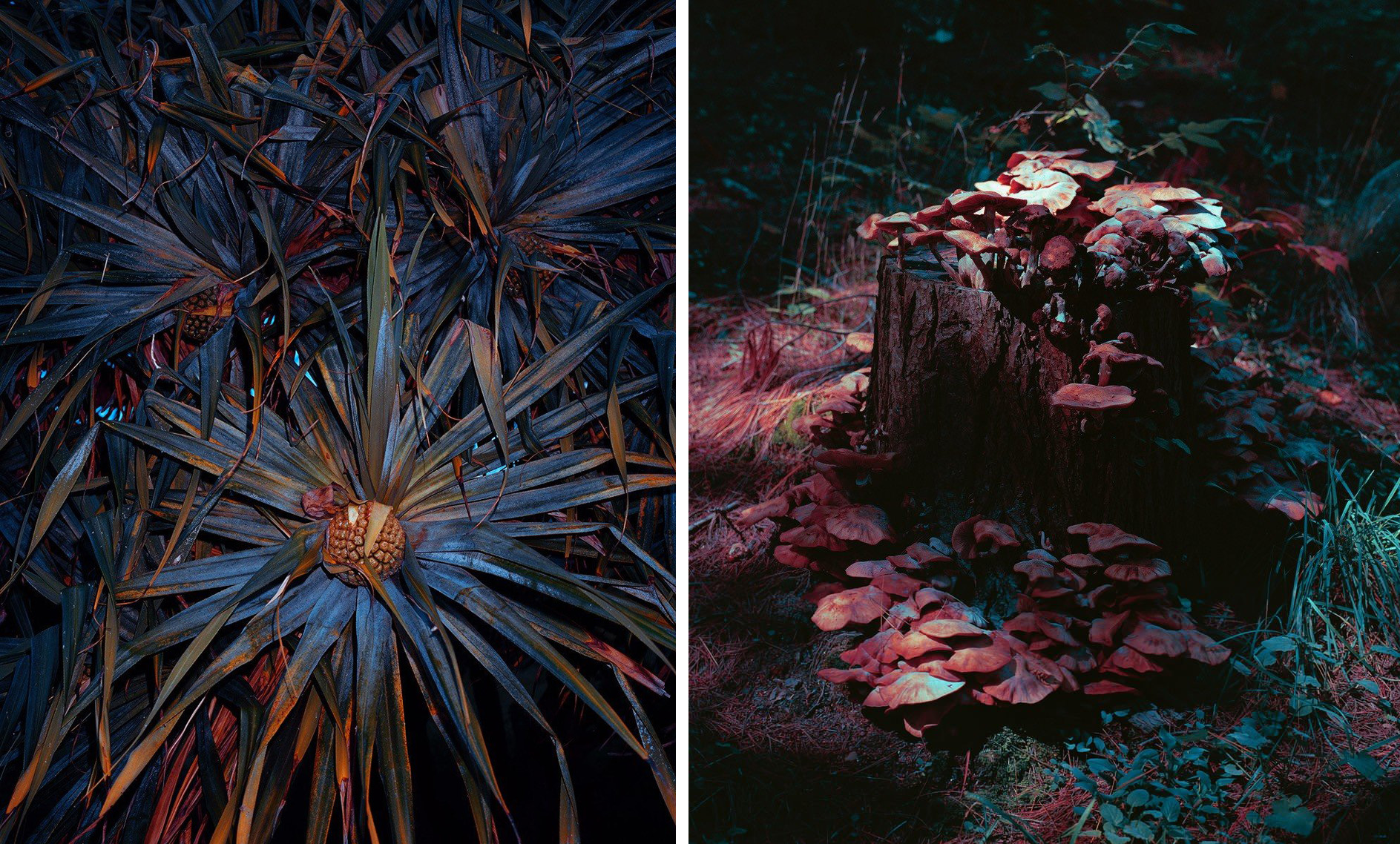
    Continuing with the exhibition’s theme of reforming places and things, Brendan George Ko’s photography takes two distinct and distant locations, Hawai’i and Toronto, and places them beside each other to create an imaginary landscape in between adjacent frames. Ko’s style is reminiscent of a cinematic dreamscape with its unnatural lighting palette and deceives the audience into believing the images were taken in similar locations and time, despite the reality of their vast differences. The work proves to be a fun challenge for viewers to guess which photo came from which country and questions our knowledge of indigenous species.

    Brendan George Ko, Lauhala Pattern, from Scrapbook IV: strangerintwoworlds (left) and The Day The Fungi Took Over, from WIP Scrapbook V (right) both 2017, C-print, 24″ × 20″. Photo: Nathan Flint

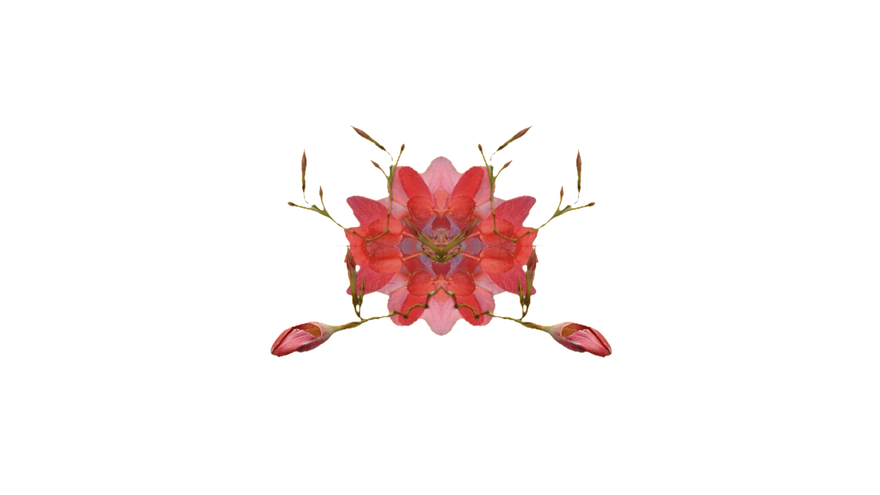
    The exhibition contains a video screened on a television monitor by artist Ed Pien. The work, titled Wallpaper, abstracts flowers and other flora into kaleidoscopic images that oscillate in fluid movements, as if breathing. The piece is constantly taking new forms in short vignettes of moving patterns and configurations. The arrangements are beautiful and captivating, compelling the viewers’ eyes to deconstruct the mirrored imagery in order to figure out what the source of the original image might be.

    Ed Pien, Wallpaper, 2012, video stills, 16:00. Courtesy of the artist and Birch Contemporary

    Overall, the exhibition is a well curated show that creates fascinating conversations between artists working in a variety of mediums. It approaches to a unique subject matter that is evidently relevant to each of their practices and creates a challenge to the eyes of the beholder.

    Nathan Flint

    Featured image: Sarah Davidson, detail of edge effects, 2017, watercolour, ink and pencil crayon on paper, 62″ × 35″. Courtesy of Birch Contemporary

    *Exhibition information: REFIGURING WORLDS: SARAH DAVIDSON, BRENDAN GEORGE KO, GINETTE LEGARÉ, MARYSE LARIVIÈRE, ED PIEN, July 19 – August 25, 2018, Birch Contemporary, 129 Tecumseth Street, Toronto. Gallery hours: Wed–Fri 10 am – 6 pm, Sat 11 am – 5 pm.
  • Aleksandra Panić: The Red Enigma / Gallery 1313

    Aleksandra Panić with her paintings at the opening reception. Photo: Rachel Brandrick

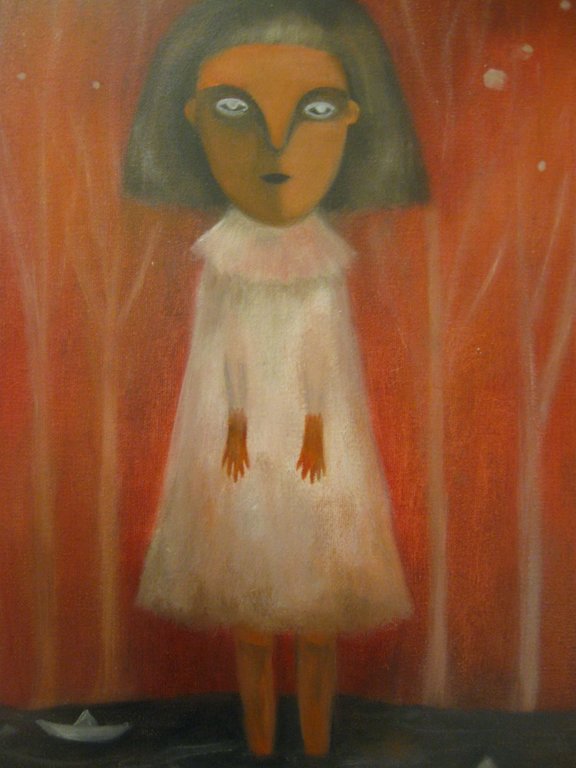
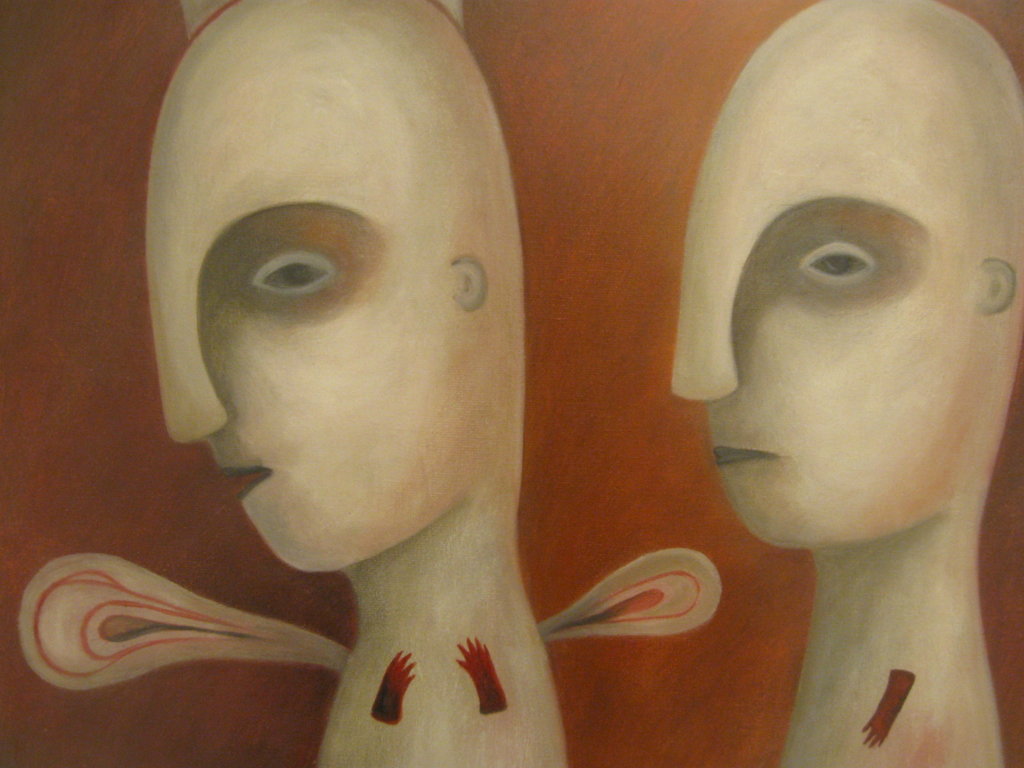
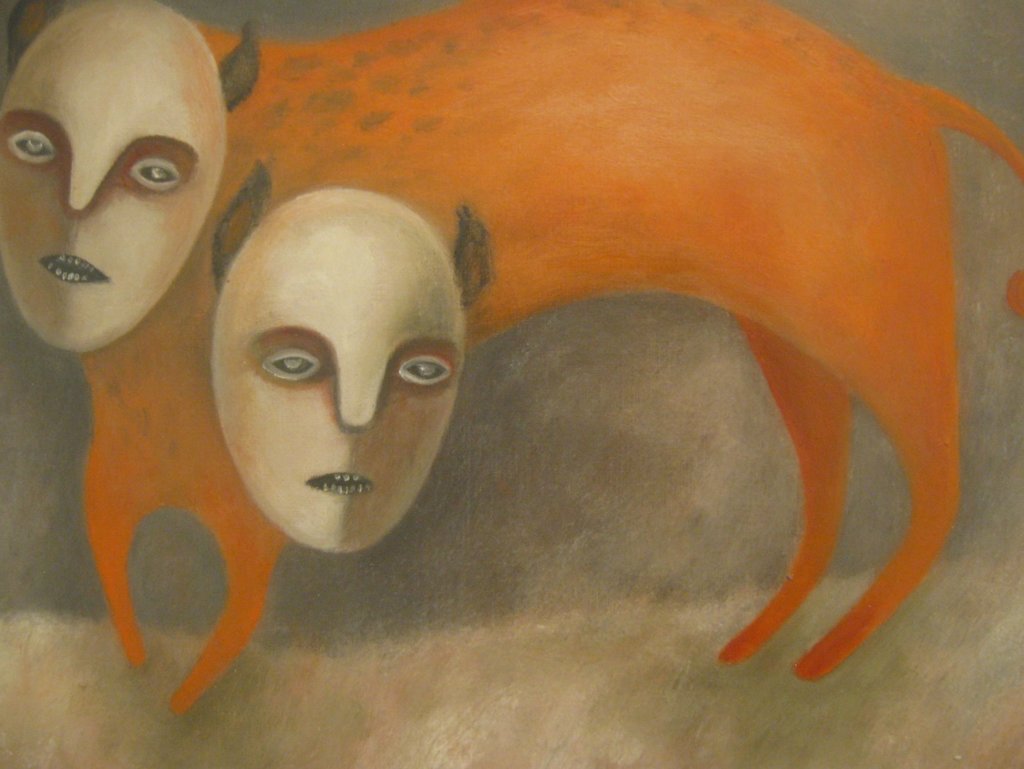
    Aleksandra Panić (pronounced Panich), a young Montreal artist, has ten works at Process Gallery in Gallery 1313. They fill the room with dark whimsy that captivates the viewers and also gives them the feeling of revisiting fairy tales from their childhood. The paintings are small, using oil on paper or on canvas and the colour palette remains somewhat constant, dominated by deep reds and soft greys. The figures seem animated in a unique world the artist has created. She is fascinated by this fantasy world of mystical figures with dark, haunted eyes and tiny limbs. This surrealistic touch makes the work even more appealing.

    Aleksandra Panić, The white boats, oil on paper, 8 x 10 inches

    As her statement reads, “I have been always interested in the dark side. Since I could remember myself I was fascinated by grim legends, fairy tales, ghost stories and mystery novels. Growing up, I kept wondering till what extend these stories were real, where the fantasy was ending, and the reality was beginning.

    Aleksandra Panić, Dancing Souls, oil on canvas, 11 x 14 inches

    Later on, all the ghosts, fairies and fantastic creatures that were surrounding me in my childhood found their reflection in my paintings. Through my spirits, ghosts and deities I am trying to explore controversial human nature, its duality, as well as the experiences and emotions we face during our life path. My artworks are some sort invitation to the viewer to take a journey inside his own soul.”

    Aleksandra Panić, La Chien Rouge, oil on paper, 8 x 10 inches

    I have seen Panić s work a few times now and I think she will become quite collectable and I look forward to seeing more work from her.

    Phil Anderson

    Images are courtesy of Gallery 1313

    *Exhibition Information: July 18 – 29, 2018, Gallery 1313, Process Gallery, 1313 Queen Street West, Toronto. Gallery hours: Tue – Sun, 1 – 6 pm.
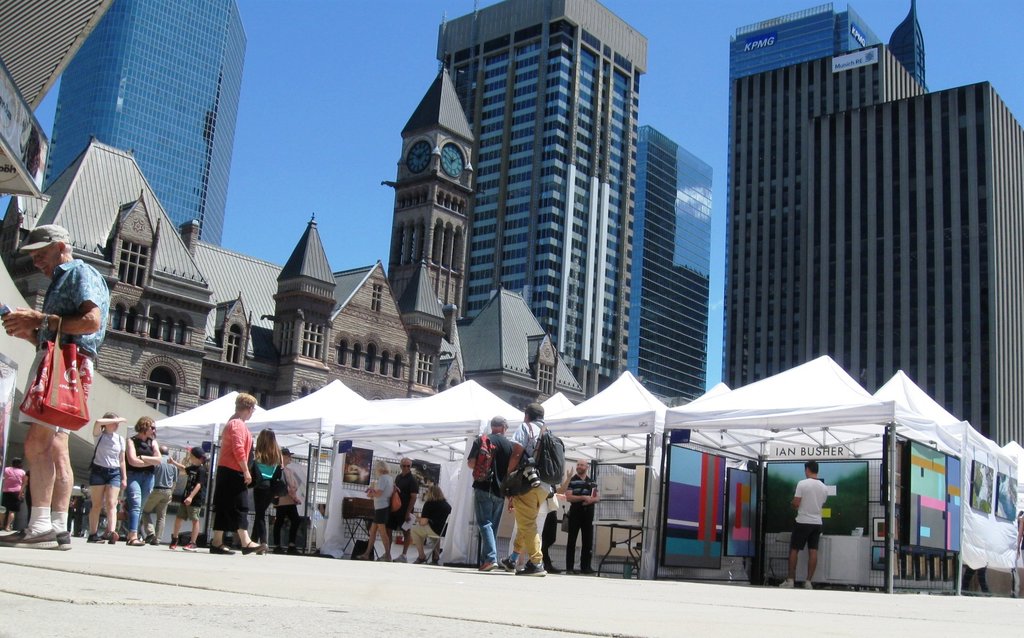
  • 57th Toronto Outdoor Art Fair 2018

    July 6 – 8, 2018
    Nathan Phillips Square

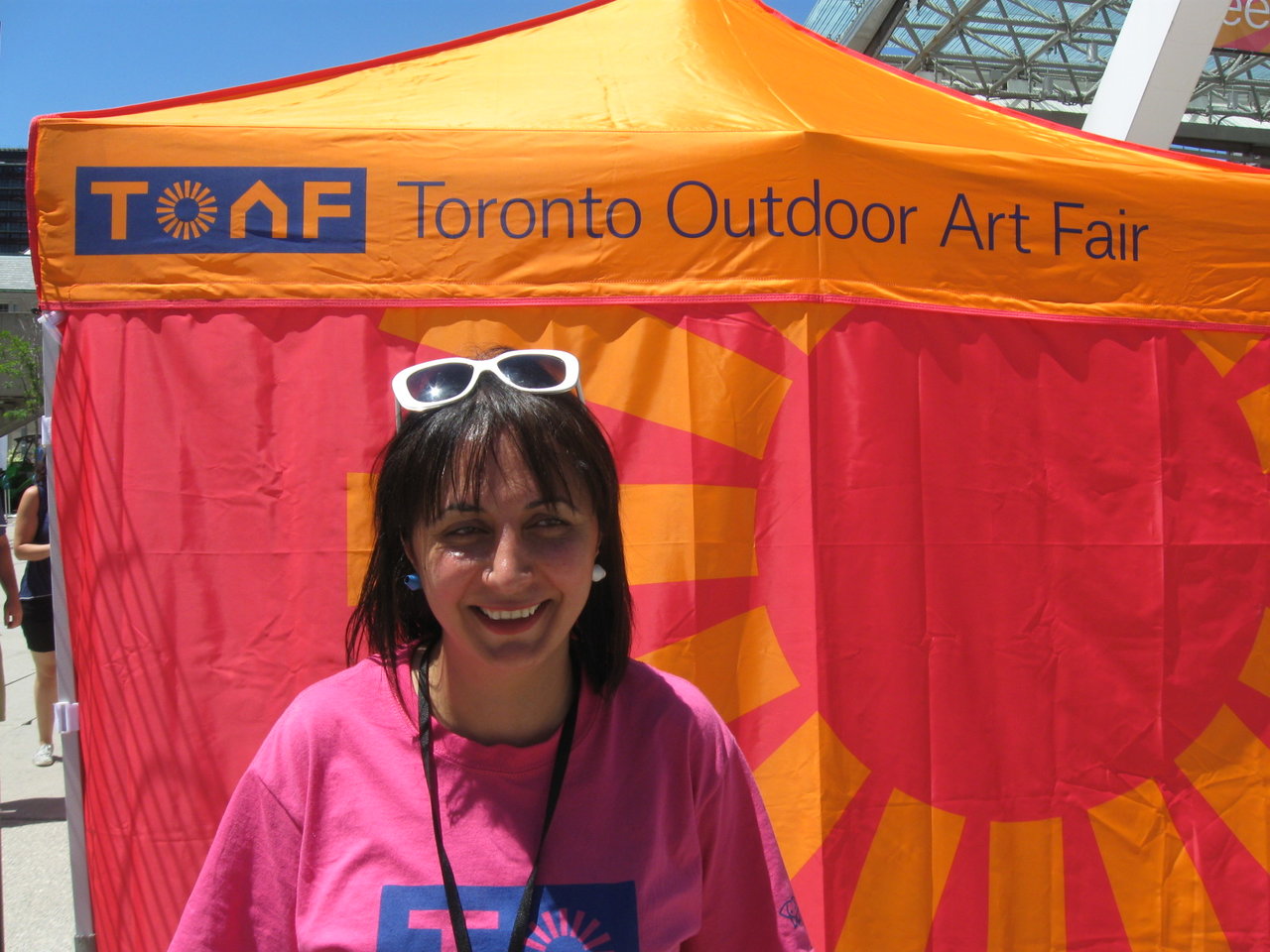
    Change is usually good and a change in the weather was certainly welcomed by the artists at the newly branded Toronto Outdoor Art Fair. Artists were happy the humidity was gone, and last night’s rain had cooled off things. Executive & Creative Director Anahita Azrahimi talked at length about the new changes and partnerships with galleries and organizations, the new programming designed to attract and engage visitors and of course the new branding, a new look for an event with a long history.

    Executive & Creative Director Anahita Azrahimi

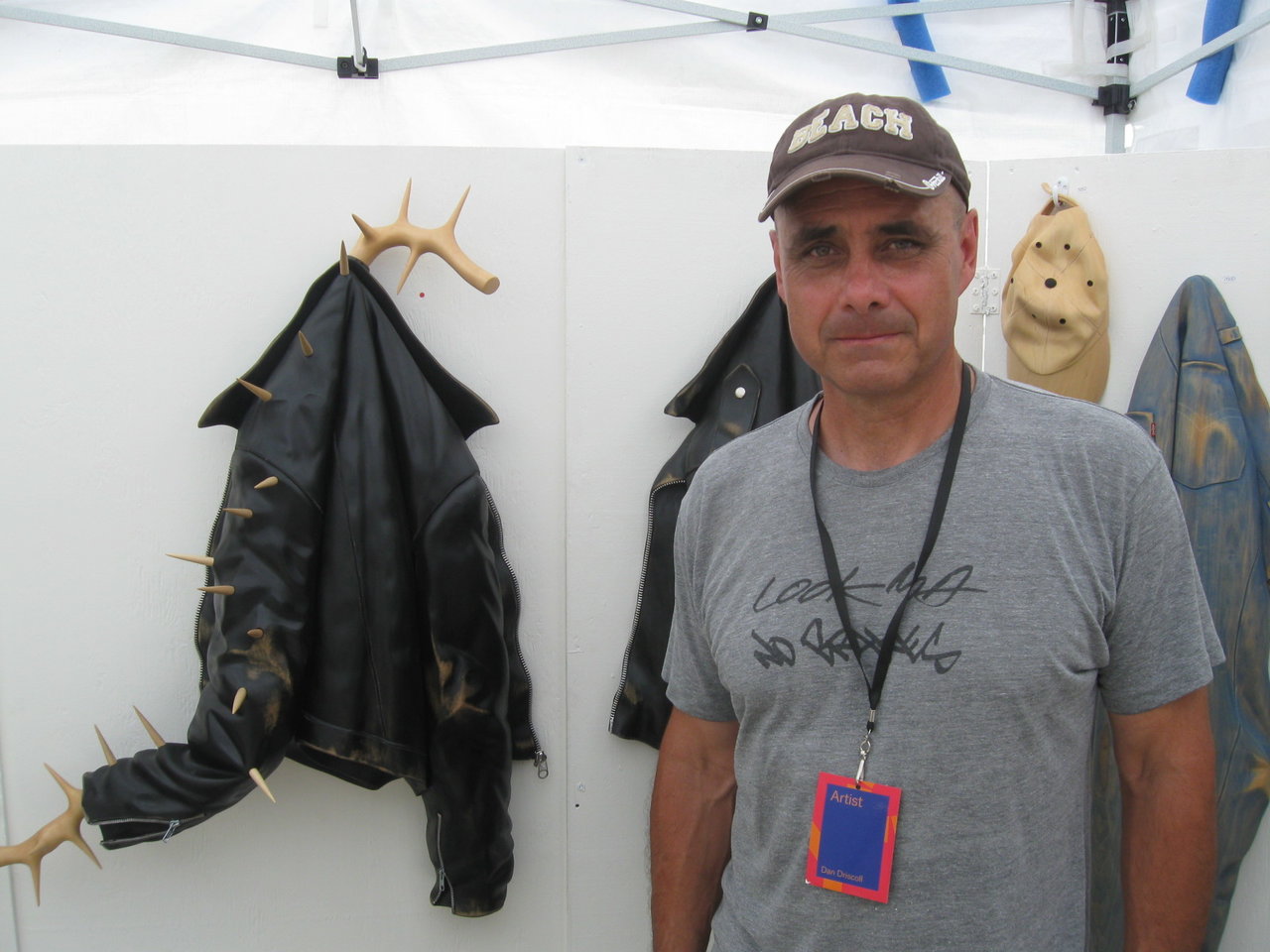
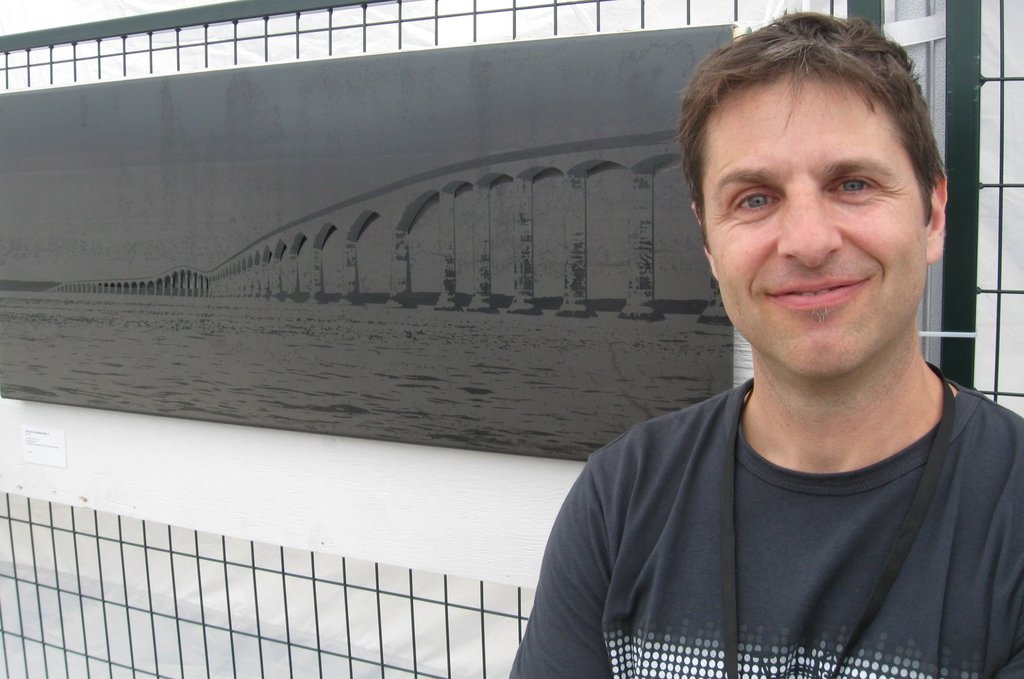
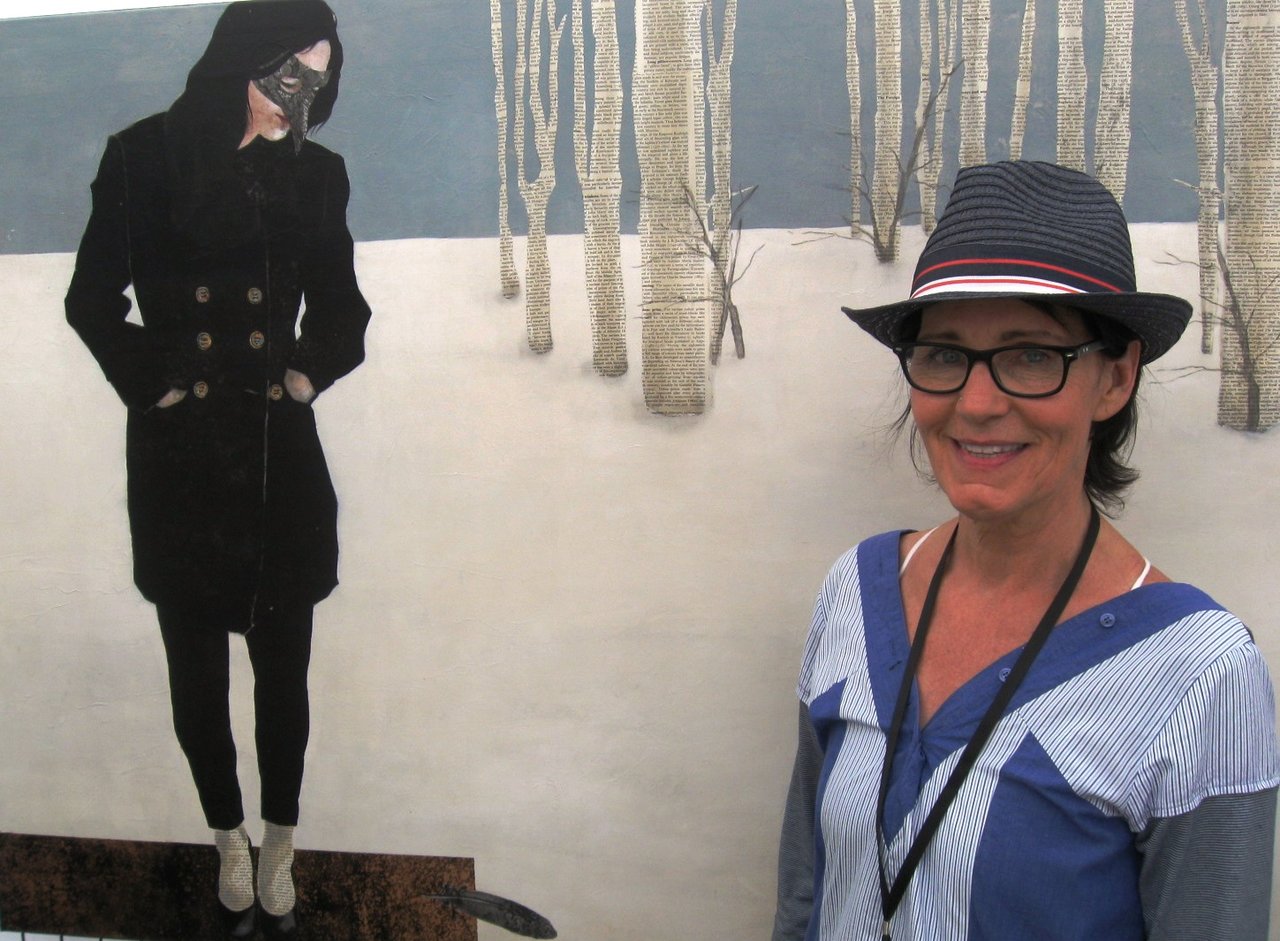
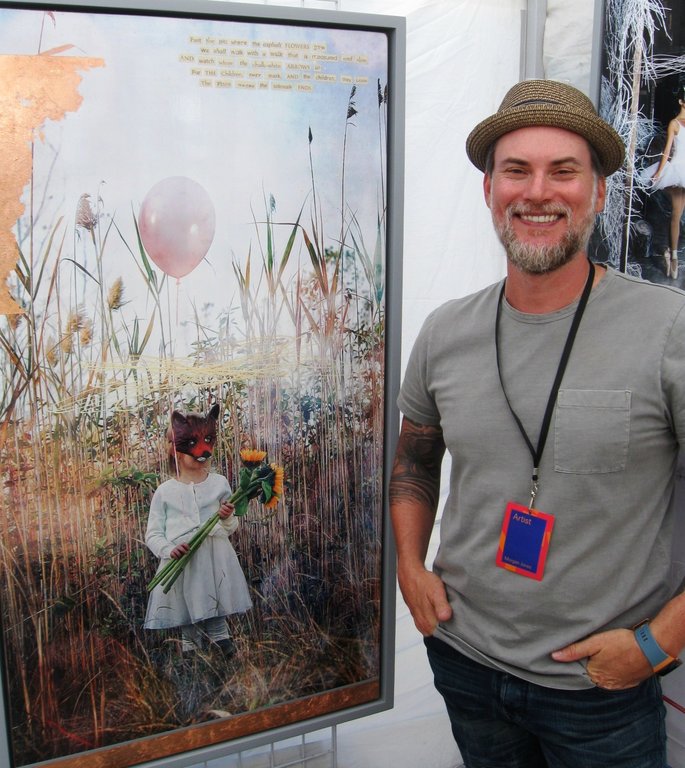
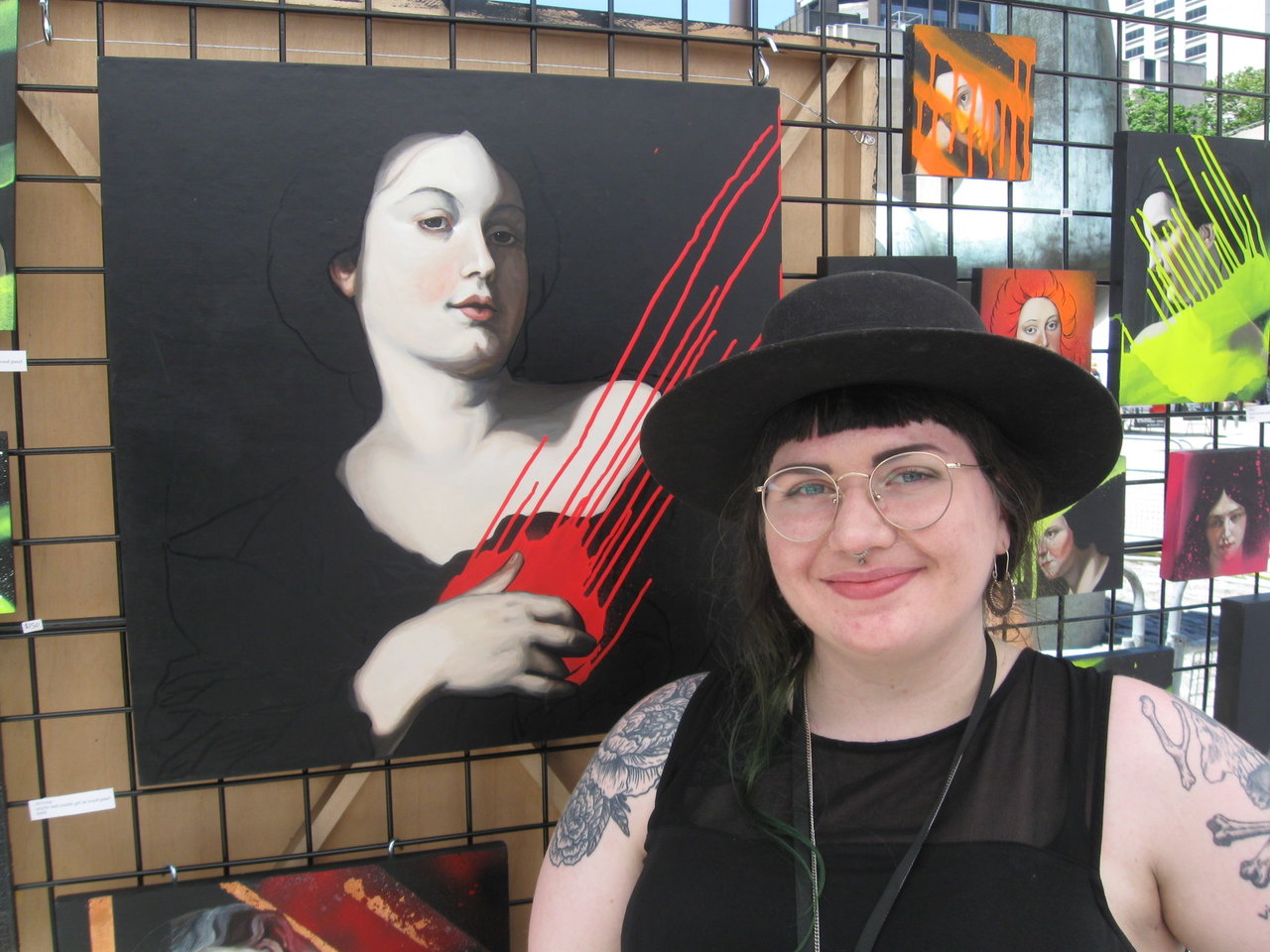
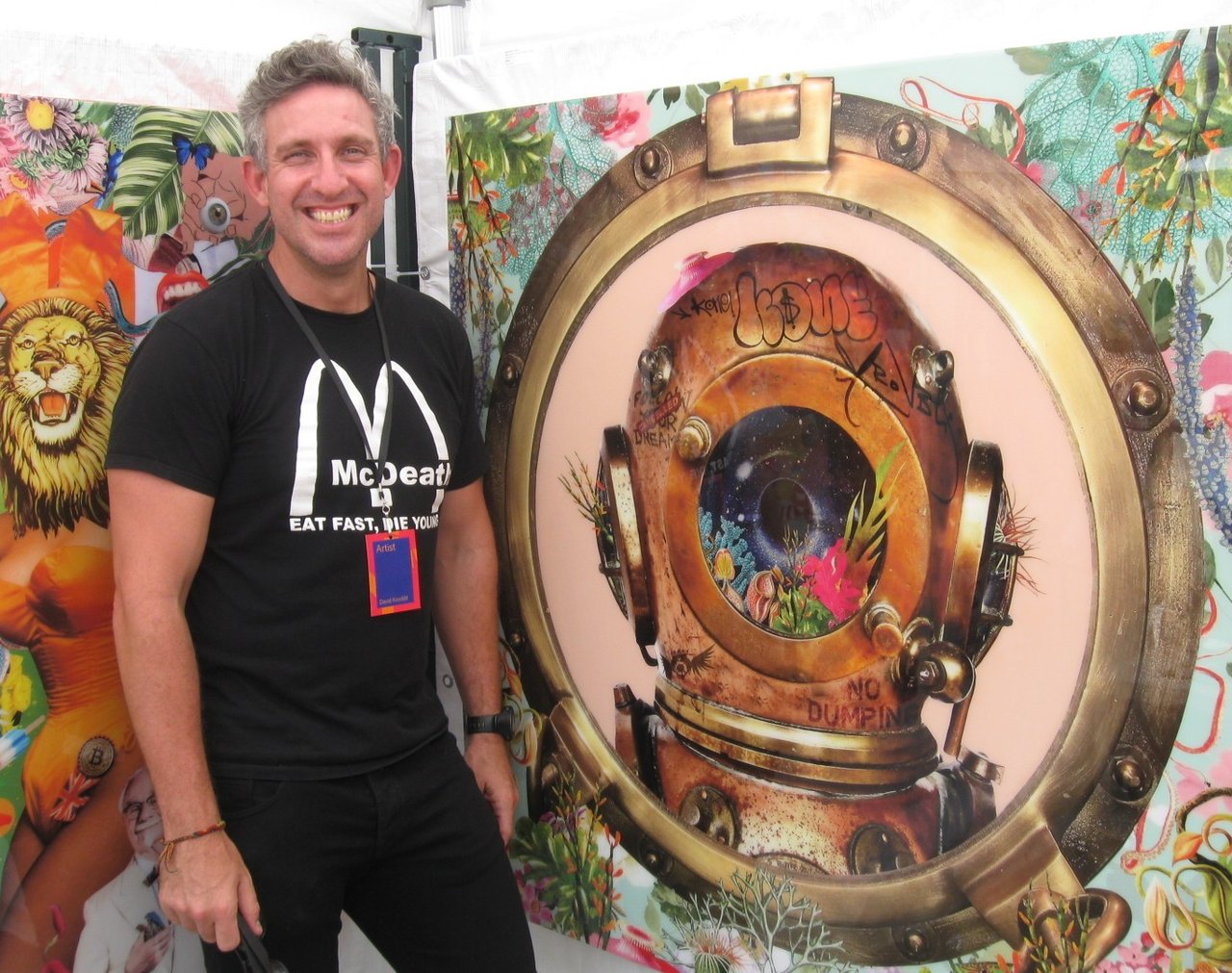
    The artists I talked to seemed pleased with the changes and additions. Dan Driscoll, a wood carver, was having a lot of attention and sales with his carved realistic jackets. Artists with different or unique works seemed to get more attention. James Kennedy, with his metal series of bridges made of using acids and occasionally laser cuts, was spending time explaining his technique to visitors. Glass maker Claire Anderson, from Niagara, was trying the fair for the first time. Some of artists are veterans, having done the fair for ten or twenty years.

    Dan Driscoll

    James Kennedy

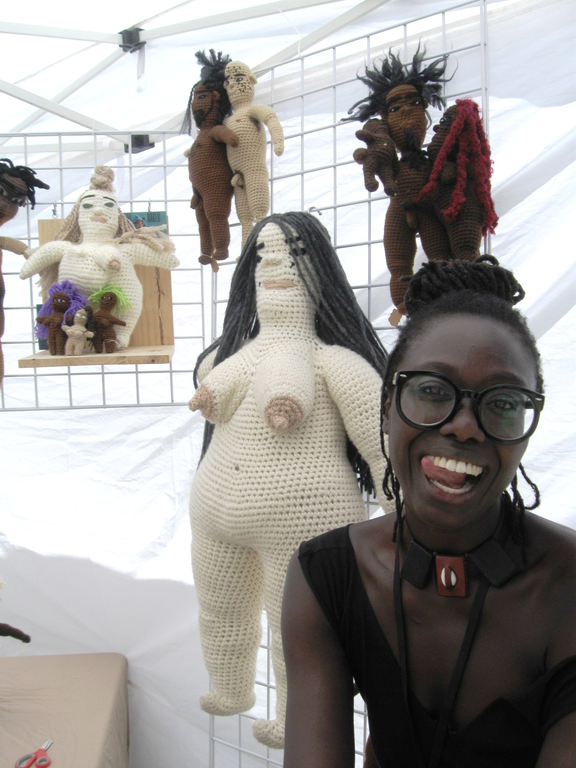
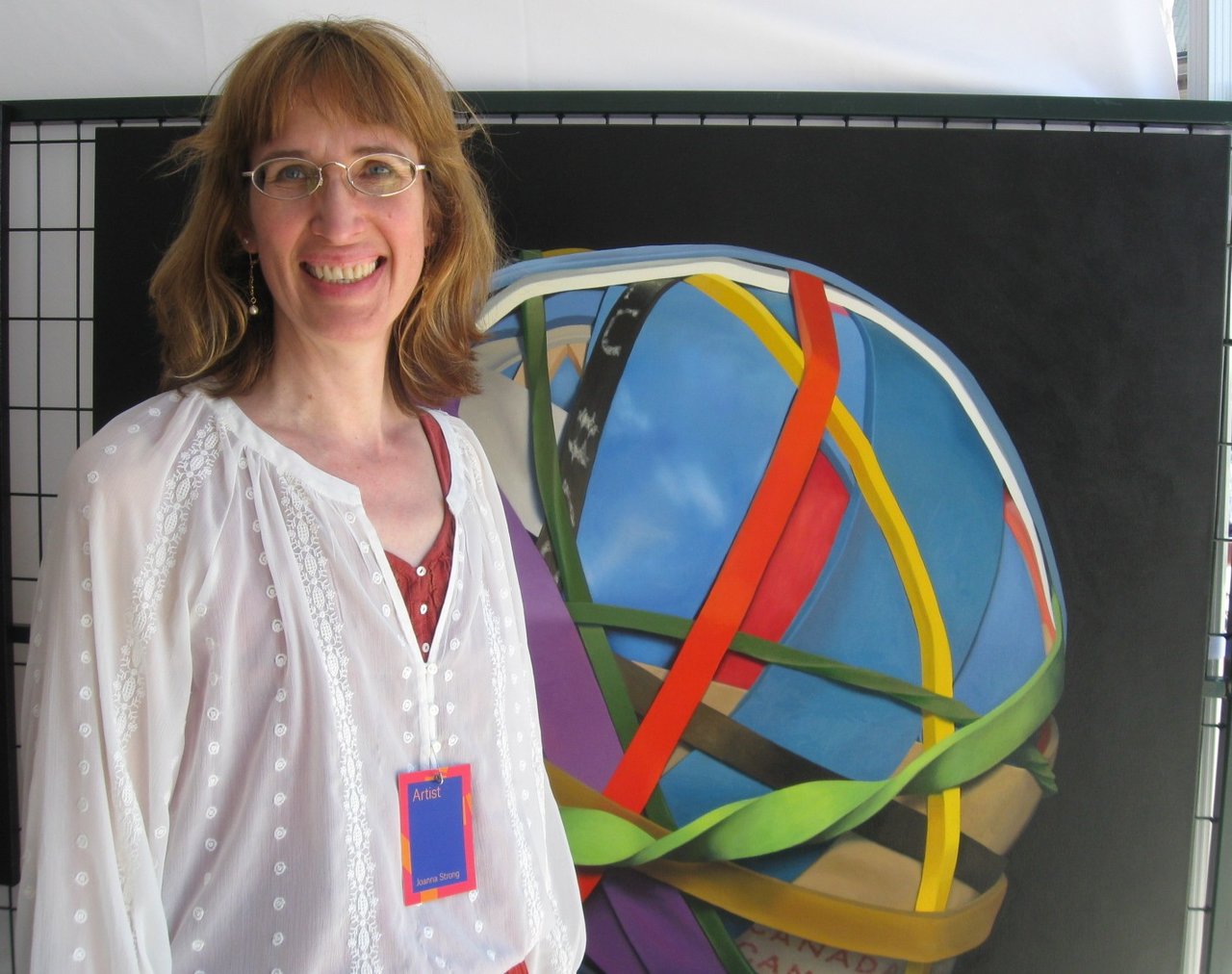
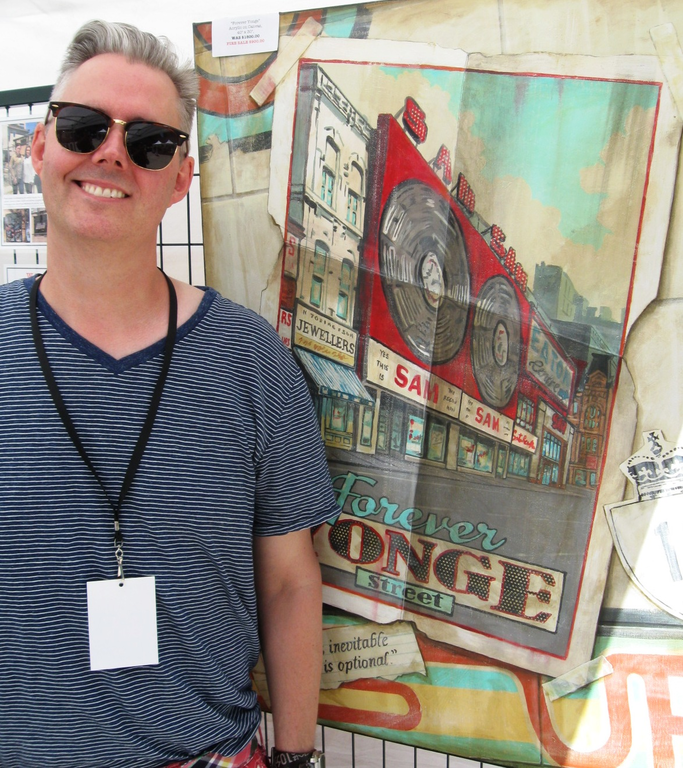
    Montreal artists were telling me of the heat they endured last week. Chason Yeboah, creator of Knot Naked, was sharing her textile works with visitors. East end artists such as Joanna Strong and Rob Croxford were encouraged by the crowds and Strong had just sold a painting. In fact, there were plenty of sales going on so occasionally I missed talking to an artist who was engaged in a sale.

    Chason Yeboah

    Joanna Strong

    Rob Croxford

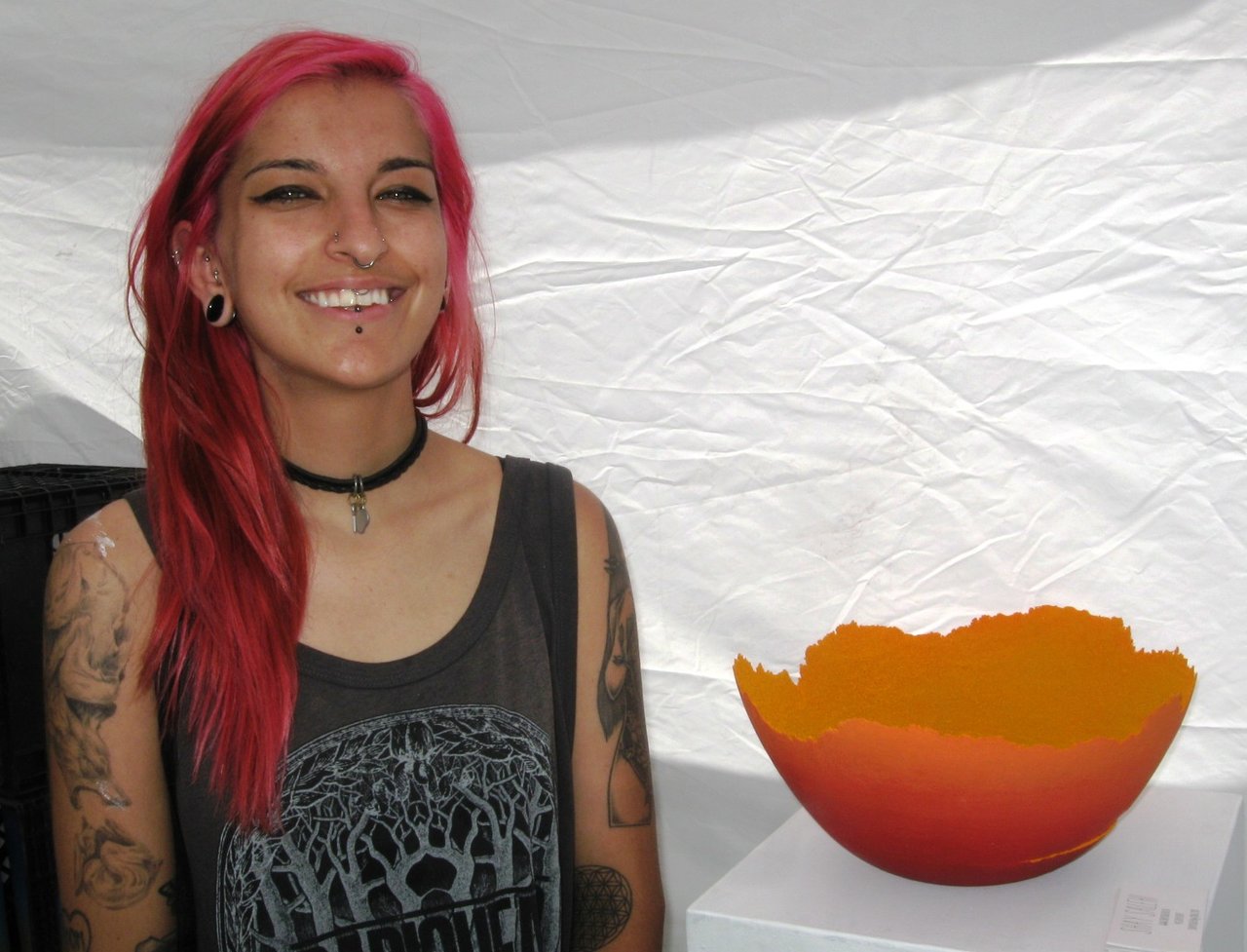
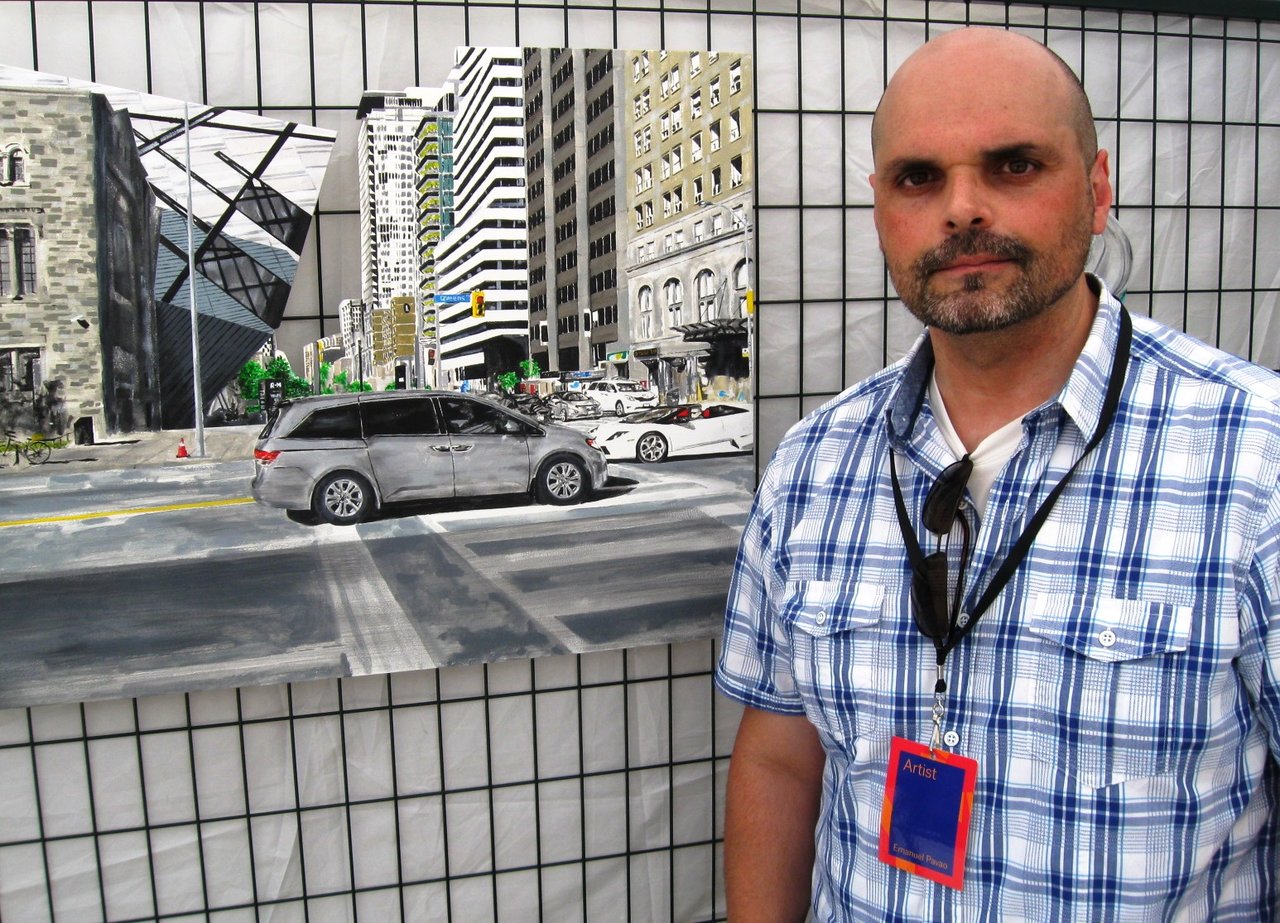
    Shay Salehi had ceramic works and was happy with the new set up at the fair. Artist Emanuel Pavao was branching out from his tape creations that looked like paintings. He is now painting on router cut birch plywood with urban scenes and my favourite is a can of Labatts 50; a homage to his father.

    Shay Salehi

    Emanuel Pavao

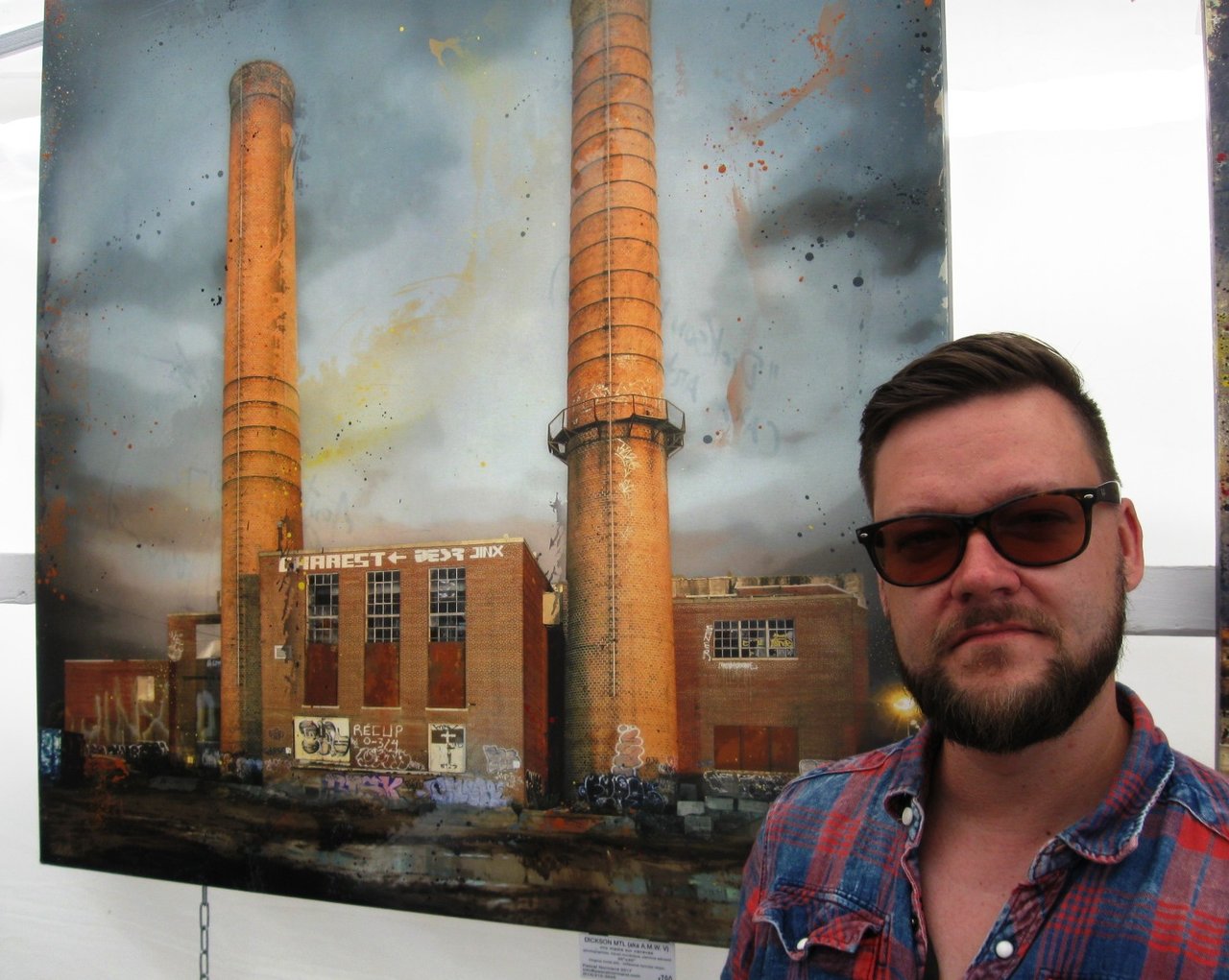
    Pascal Normand

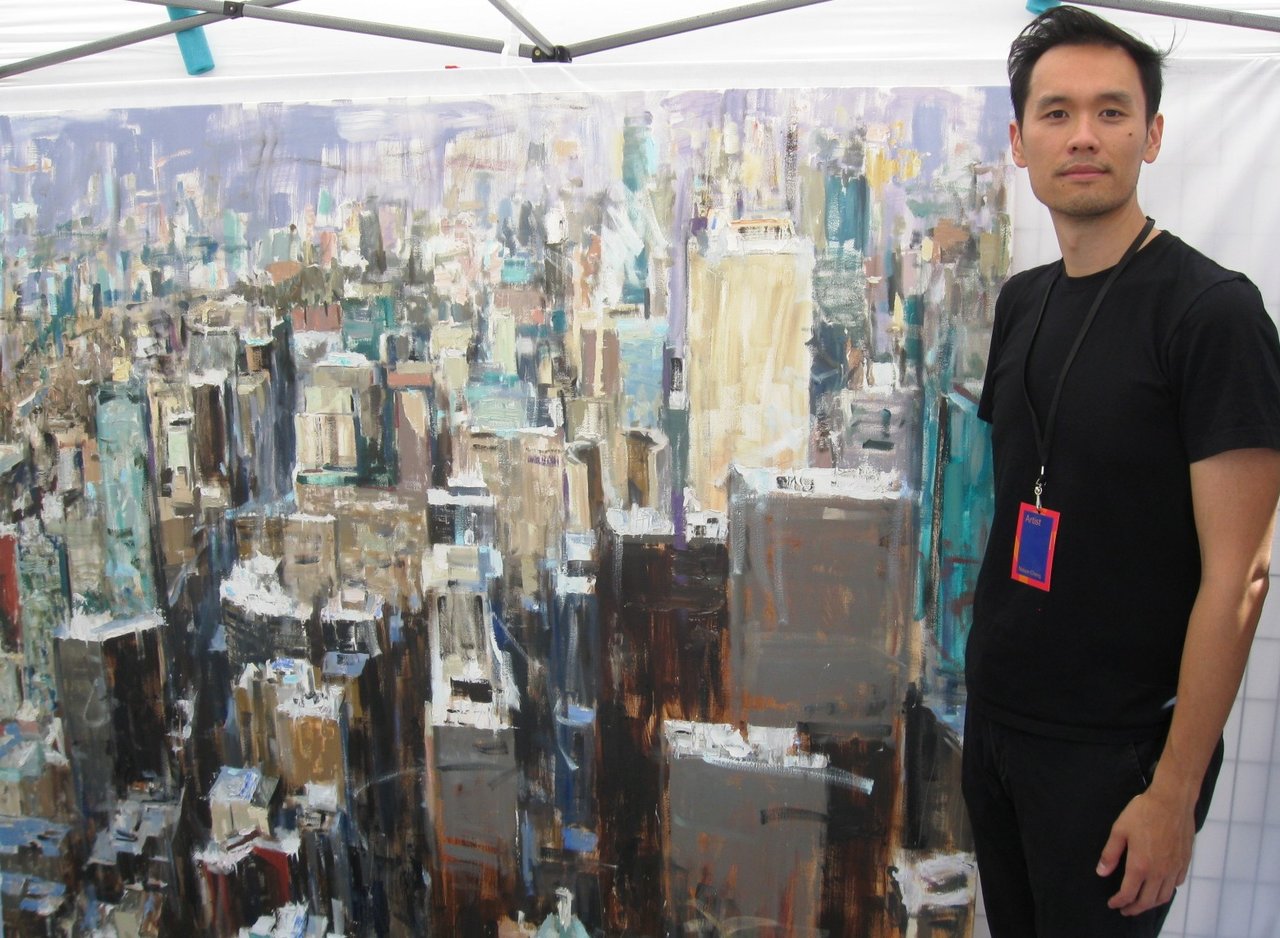
    Nelson Cheng

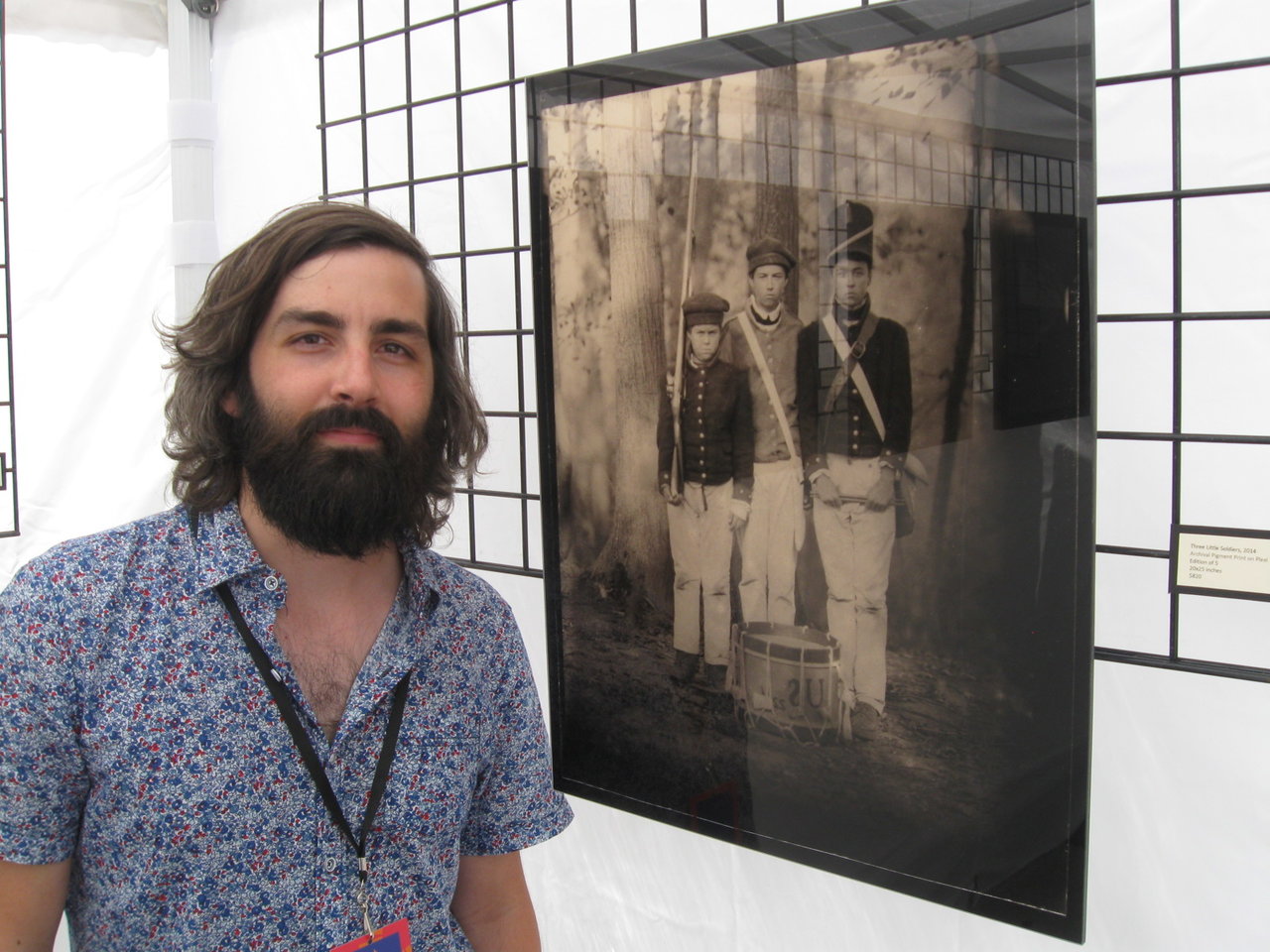
    Stephen Brule

    It might be hard to put a new spin on something that has been around for 57 years, but organizers have done a good job of making some new changes but keeping what works going. From my short visit I would say the artists are happy too and so are those shopping for some new art.

    Beverly Hawksley

    Morgan Jones

    Keight MacLean

    David Krovblit

    Text and photo: Phil Anderson

    *Exhibition information: July 6 – 8, 2018, Nathan Phillips Square, Fri & Sat: 10 am – 7 pm, Sun 10 am – 5 pm. Free admission

  • Graduating Sculpture Student Exhibition

    Opening Reception / Award Presentation:
    June 14, 2018 at 6:30 pm
    Canadian Sculpture Centre

    The Sculptors Society of Canada is pleased to present the 22nd Bi-Annual Juried GRADUATING SCULPTURE STUDENT EXHIBITION. Since it’s now a bi-annual exhibition, graduates from 2017 and 2018 were included. The jury viewed 147 images of fifty-five works submitted from six institutions. After much discussion, the jurors selected fourteen works by eight students for this exhibition.

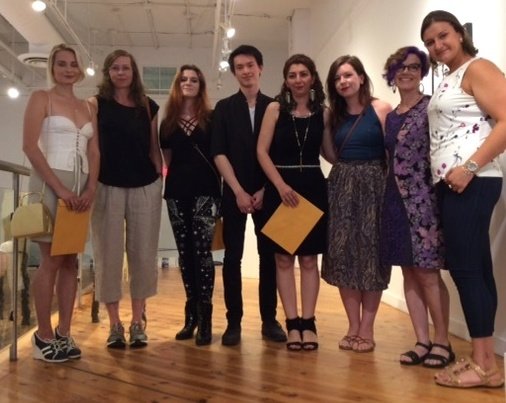
    The Graduating Students (from left to right) Lesia Szyca, D’Andrea Bowie, Malina Sintnicolaas, Jia Sheng Lu, Maryam Zaraimajin, Randi Pert, Diane Mohan, Monica Bujas

    The jurors: Kelly McCray, Joshua Burston, Barbara Fletcher selected the following students:
    D’Andrea Bowie (2017), Ontario College of Art & Design University
    Monica Bujas (2017), University of Toronto (Mississauga)
    Jia Sheng Lu (2018), Ontario College of Art & Design University
    Diane Mohan (2017), The Art Centre, Central Technical School
    Randi Pert (2018), Ontario College of Art & Design University
    Malina Sintnicolaas (2018), York University
    Lesia Szyca (2017), York University
    Maryam Zaraimajin (2018), Ontario College of Art & Design University

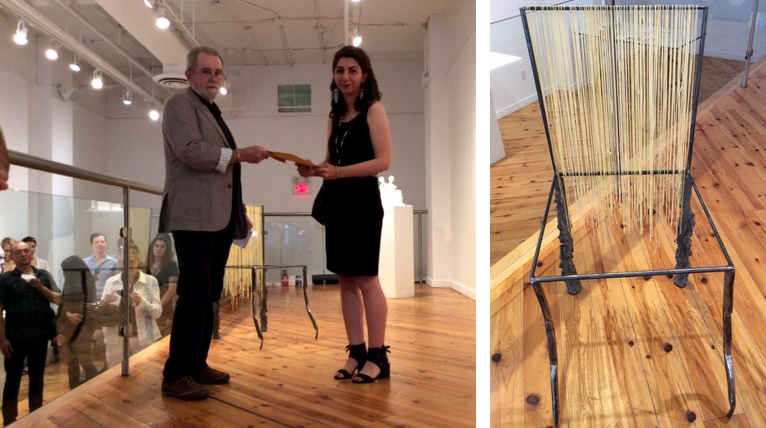
    Richard McNeill presents Maryam Zaraimajin with the Greenrock Charitable Trust Award (left) and her work, Survival of Who?, stainless steel, cimont fondue, cast latex (right)

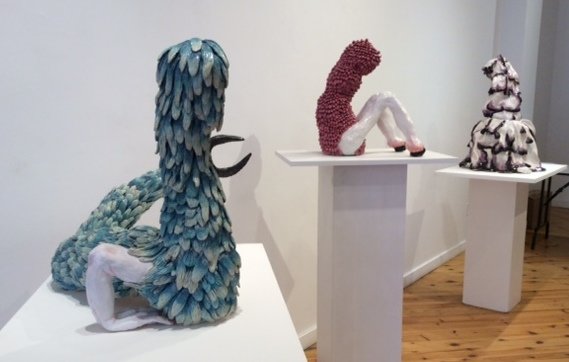
    Malina Sintnicolaas is the recipient of the Won Lee Fellowship Award for her ceramic, Faceless – My Imaginary Friend (in front)

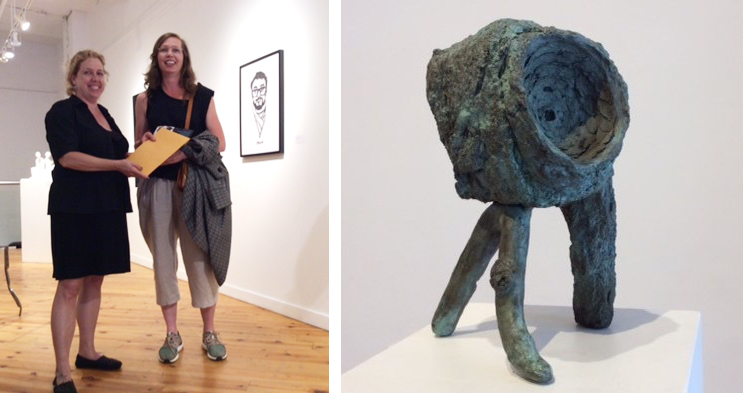
    D’Andrea Bowie was presented with the Artcast Inc Award by Cathy Knoespel (left) for her bronze sculpture, Container for Consciousness (right)

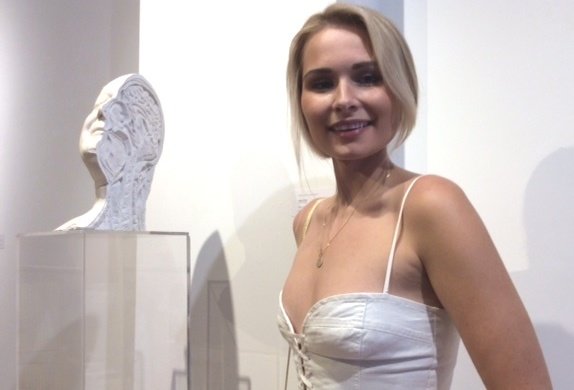
    Lesia Szyca won the MST Bronze Ltd Award with her work: I Want Dissect You Like You Dissect Me

    The other works were very interesting and engaging as well.

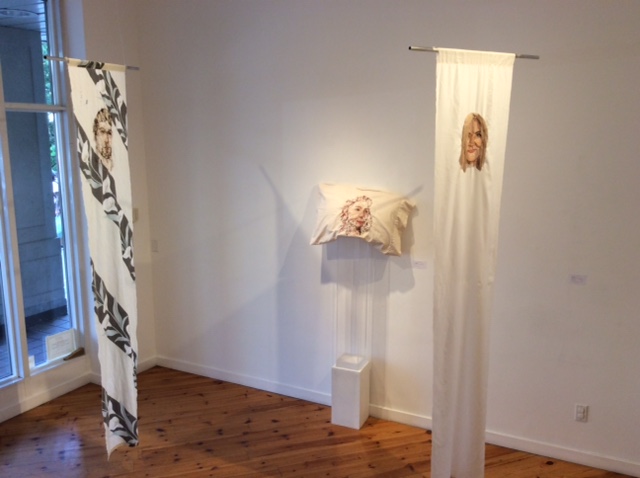
    Randi Pert, (from left to right) Lived In (Tanner), Mother and Lived In (Amanda), found textiles, embroidery

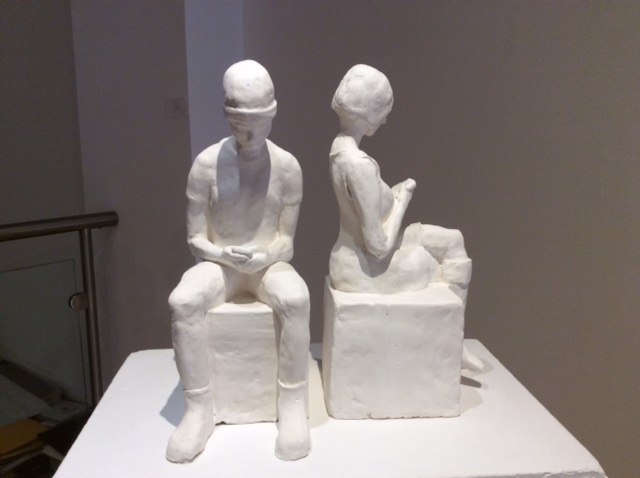
    Diane Mohan, In Conversation, hydrocal

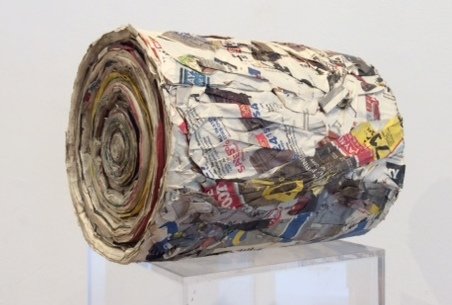
    Monica Bujas, Circa, found newspaper, methylcellulose

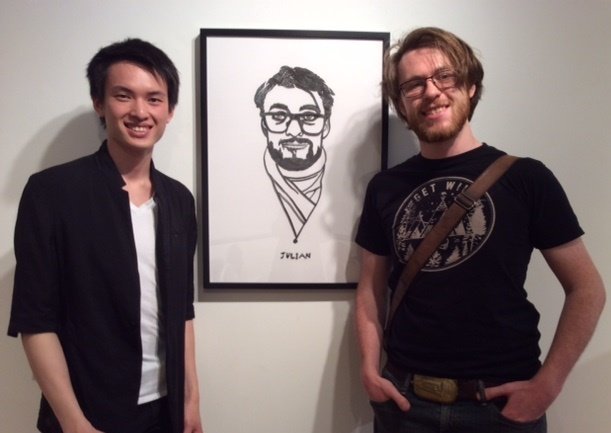
    Jia Sheng Lu & his friend Julian, with his forged metal work, titled Julian

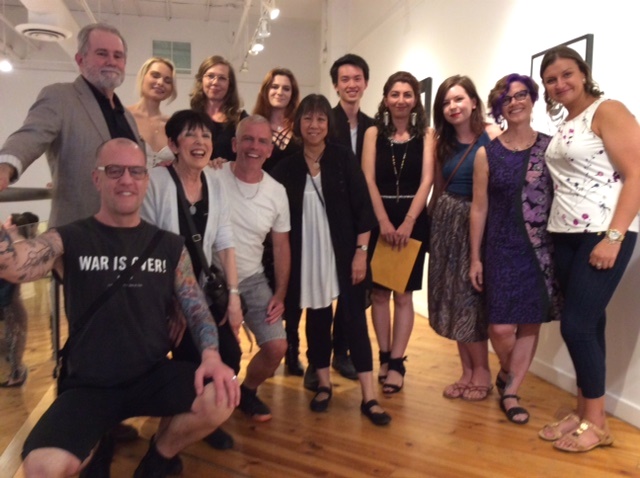
    From left to right: Josh Burston, Richard McNeill, Barbara Fletcher, Kelly McCray, Judi Michelle Young & the students

    Images are courtesy of the Canadian Sculpture Centre

    *Exhibition information: June 14 – July 20, 2018, Canadian Sculpture Centre, 500 Church Street. Gallery hours: Tue – Fri, 12 – 6; Sat, 11 – 4 pm.