Author: artoronto

  • The Imaginary World of Veronika Holcová

    The visitor to Christopher Cutts Gallery encounters a treasure of vibrantly coloured drawings and paintings. On the walls of the two spacious rooms are two arrays of dozens of small works on paper and canvas. There are as well fourteen other paintings, most of which are both in oil and acrylic. It is a struggle to make sense of them all. The works consist of both figures and landscapes that are perhaps most readily described as surrealist. They variously lie somewhere between illustrations of fairy tales in the traditional German Märchen of brothers Grimm – set in forested landscapes – and intimate automatic drawings extracted from Holcová’s unconscious.

    Installation view of Veronika Holcová, Fantasmagoria,2018 at Christopher Cutts Gallery

    Holcová hails from the Czech Republic. She has exhibited extensively there and in other countries in Europe. And so she brings a less familiar aesthetic to her work from a Canadian perspective. Her principal influences are surrealism and German romanticism. Her surrealist influences, it seems, also derive from literature. Some of her previous works have alluded to the Japanese magical realist author Haruki Murakami, for example. At its core Holcová’s work falls within the tradition of symbolism, an art movement that reached its height during the last decades of the nineteenth century. Symbolism is defined by its rejection of the objectively based depiction of the world in favour of creating works of art that depict the imaginary world of the artist – springing from her dreams, spiritual experiences etc. I emphasise the word ‘world’ because each artist, as a distinct subject, of course depicts her own interior one. So there are as many worlds as artists. The struggle in making sense of her work in the exhibition, therefore, involves being confronted by Holcová’s particular world with all its idiosyncrasies.

    Veronika Holcová, Handspring, 2017 Acrylic on panel 16 x 12 inches

    In a way, however, the artist does not intend for the viewer to make sense of her works at all. Her stated aim is to make art in an indeliberate manner, and instead to channel whatever ‘comes out’. In this sense, following surrealism, she embraces the irrational. In an earlier artist talk she explains how making her drawings is a kind of therapy. Holcová sees herself as clearing out the private contents of her unconscious – bringing out, à la Freudian psychoanalysis, what was hidden from her. The result is consequently often erotic in nature, e.g., her Handspring. Even she is surprised by what she produces.

    Veronika Holcová, Waterman, 2018, oil and acrylic on canvas. 85 x 61 inches

    Yet, the largest paintings in this exhibition – Waterman and Fantasmagoria – are executed over a long period of time, and as a result are much more worked out. Each of these two paintings is extremely detailed. She appears to begin by applying a thin layer of diluted paint that in places drips down the canvas, producing a delicately mottled surface. On top of this she applies a variety of more or less opaque layers. In addition she adds fine details of trees, plants and tiny figures over the surface. The result is a rich beautiful image, one suited to slow contemplation.

    Veronika Holcová, Fantasmagoria, 2018 Oil and acrylic on canvas 61 x 86 inches

    The experience of looking at these two paintings, especially, reminds me of that of viewing the paintings of the German romanticist artist Caspar David Friedrich – someone that Holcová is no doubt influenced by. Friedrich’s paintings are likewise meticulously detailed and his imagery is largely invented. The resulting artifice I find falls short in that it lacks the surprise of form that nature throws up. His trees in particular look stiff. I have a similar reaction to Holcová’s works. But this is in the end a quibble. Friedrich’s paintings are still masterpieces. Likewise, Holcová has produced a series of stunning works. Her subjectively based imagery produces its own surprises for the viewer.

    Hugh Alcock

    Images are courtesy of Christopher Cutts Gallery

    *Exhibition information: Veronika Holcová, Fantasmagoria, November 24 – December 22, 2018, Christopher Cutts Gallery, 21 Morrow Ave, Toronto. Gallery hours: Tue – Sat 10 am – 6 pm.

  • Toronto Biennial of Art 2019

    A conversation with Executive Director Patrizia Libralato with input from team members Ilana Shamoon and Tairone Bastien by Phil Anderson

    (L-R) Curator Tairone Bastien, Executive Director Patrizia Libralato and Director of Programming Ilana Shamoon. Courtesy of TBA

    PA: Toronto has for some years entertained the idea of having a Biennial of Contemporary Art (TBA). Why do you think the time is right for the city to have this event?

    TBA: There is strong support for starting a biennial in Toronto now for several reasons. Creating a moment with international visibility for the visual arts to shine in the city will: increase visibility for artists, arts professionals, festivals, commercial galleries, collectors and robust collections, as well as cultural institutions, organizations, initiatives and academic programs; help us forge fruitful and lasting creative relationships here and abroad; invite us to lead and participate in global conversations on contemporary art and exhibition making; create a moment of solidarity and unity within the local arts community, where resources are pooled towards collaborative projects.

    Toronto Biennial of Art, at the Art Spin Kajama Boat Tour, August 2018, Credit: Priam Thomas from Art Spin, 2018

    Beyond local impacts, international cultural leaders and producers are “looking for an excuse” to visit Toronto, as curiosity about our cultural landscape is far-reaching. In frequent conversations with colleagues around the world, we’re being told repeatedly that offering entry points for deeper insights on our city at large, a place with complex histories and innovative cultural initiatives and artistic production, will bring artists, arts professionals, and collectors to Toronto in fall 2019.

    PA: What do you see as your vision for this event? What will it look like? I understand much of it will embrace Toronto’s shoreline.

    TBA: Our vision for this event is to explore what it means to be “in relation.” The curators are bringing together artists who are reconsidering our relationship with the world, not only with other humans, but also human relationships with animals, the earth, inanimate objects, and even the divine. One could argue that these ideas are a response to increasing nationalism, xenophobia and entrenched borders around the world, not to mention climate change and its terrifying impact. The Biennial will feature artworks that are informed by ancient ideas, alternative histories, sacred belief systems, and ways of knowing. And by tethering ourselves to more interconnected world-views, the Biennial will also point to alternative futures.

    Participatory flags at Toronto Biennial of Art booth at Art Toronto, 2017. Courtesy of TBA

    The Biennial will consist of site-specific commissions and recent artworks by these artists. These works will be sited in buildings and outdoor spaces along Toronto’s waterfront, focusing on a span of shoreline from Ashbridges Bay to Etobicoke Creek. Although we didn’t set out do this, we realized only after securing sites at either end that we trace the original boundaries of the so-called Toronto Purchase. This is important for us to think about, as one layer of history upon many. We also know that the First Peoples maintained a presence here for over 15,000 years. The waterfront is a site of spiritual healing, trade, treaty, and gathering, but it is also deeply inscribed by settler, slave and immigrant narratives. Unpacking all of these histories means we see this landscape “in relation” and our role in a multitude of ecosystems.

    Map of locations for Toronto Art Biennial, Fall 2019. Courtesy of TBA

    PA: What do you see as the biggest challenge of putting together such a big event?

    TBA: Launching a new event is always challenging. There is a fair amount of groundwork that needs to be laid, education that needs to take place and support that needs to built – political, philanthropic and community. Building a structure from the ground up and getting it funded is so small feat, but we have been working on this project for years and have put in the hard work of commissioning and authoring various plans and frameworks that are integral to the project.

    Art Toronto Talk on Toronto Art Biennial, October 2018. Courtesy of TBA

    As we build our biennial community, connecting with other events around the world, we are told, however, that this is the case for most new and comparable initiatives! Space in general is a challenge in this city. We are animating the waterfront and looking for unique, mainly non-institutional spaces for our exhibitions, and working towards confirming the most interesting and unexpected sites by the end of this year. What has made this project a success to-date is our overall team. We have some of the city’s greatest cultural leaders and minds supporting us and we have built an amazing core staff team and will continue expanding it in the early new year.

    (L-R) Tairone Bastine Curator. Patrizia Libralato Executive Director, Sabrina Maher Development Manager, Ilana Shamoon Director of Programming and Myung-Sun Kim Assistant Curator, Public Programming and Learning. Courtesy of TBA

    PA: How has it been received internationally? Will there be a lot of international participation?

    TBA: International colleagues are excited by the Biennial for several reasons. First, there seems to be a growing interest in Toronto given its acclaim as the most diverse city in the world. The Biennial will definitely reflect this, featuring artists from diverse backgrounds both living in Canada and internationally.

    PA System, Alexa and Patrick. Photo: Tyler Anderson

    New Mineral Collective, Emilija Skarnulyte and Tanya Busse. Photo: Micheal Miller

    Naufus Ramirez-Figueroa, Bananos. Photo: Isaac Martinez

    Second, our country is at the forefront of the global conversation on Indigenous rights. The Toronto Biennial is rooted by what we’ve titled the “Indigenous Context Brief” written by Ange Loft, that describes in great detail the complex Indigenous histories and narratives of the waterfront. This was shared with our curators and they’ve passed it on to the artists they’re working with. It has informed their curatorial thesis and will influence the Biennial’s programming. This sets our Biennial apart from other Biennials around the world, and is a strong lure for people interested in seeing work by artists invested in these issues.

    Ange Loft, Advisory Council. Photo: Liam Coo

    The Biennial will involve a lot of international artists, alongside Canadian artists. We are focused on presenting a biennial that tackles global topics and narratives that stem from and are deeply connected to concerns and issues, on the ground, in Toronto and across Canada.

    PA: Are there Indigenous artists participating in the Biennial? Are they included in the programming?

    TBA: Yes, there will be a number of Indigenous artists participating, both Indigenous to Canada but also Indigenous folk from other parts of the world. Among the artists we just announced, for instance, are Caroline Monnet, a multidisciplinary artist from Outaouais, Quebec who is of Algonquin and French heritage; Ange Loft, a multi-disciplinary artist and performer from Kahnawake Mohawk Territory; and Embassy of Imagination, a collaborative and socially-engaged project in the high arctic that involves Inuit youth in Kinngait, Cape Dorset, Nunavut.

    Embassy of Imagination. Photo: Joseph Pinguartuk and EOI

    PA: Are other cultural institutions participating as venues or in programming, i.e. the AGO, MOCA and the Power Plant?

    TBA: We are partnering with several institutions, like MOCA, the Power Plant, the Art Museum at the University of Toronto, and the Ryerson Image Centre, to create closely connected programming. These spaces will present exhibitions of work by artists also participating in the Biennial along the waterfront, encouraging visitors to go to these partner spaces to get a fuller picture of a given artist’s work.

    (L-R) Power Plant, Harbourfront, Art Museum of University of Toronto and MOCA

    For example, MOCA, along with the Biennial, Fogo Island Arts, and A Tale of a Tub (Rotterdam), will be co-commissioning a work by Shezad Dawood that will be shown at both MOCA and a Biennial location as part of two different but related installations, inciting visitors to move from one cultural space to another.

    Shezad Dawood. Photo: Sue Parkhill

    PA: How might Toronto’s Biennial differ from others? What will make it unique?

    TBA: Toronto’s biennial has two important distinctions. First, is the fact that the curators have been invited to curate over the course of two iterations. This allows the curators to think more long-term about projects, and to allow works to develop over time. Some projects will be presented iteratively, with elements exhibited in 2019 and others exhibited in 2021. The model is ideal for artists with research-heavy practices, who take a deep dive into a topic.

    Toronto-based artist and curator Luis Jacob has been commissioned to create the first Toronto Biennial Artist Edition, entitled The Riddle. The artist at Art Toronto, 2018

    Luis Jacob, The Riddle, 2018, Epoxy resin and marble dust, approximately 24 x 12 x 4 inches.Courtesy of Birch Contemporary, Toronto.

    Secondly, the curators are based in the city, rather than flying in temporarily to organize the Biennial. Being based here enables the curators to be more integrated into the Toronto arts scene. It’s enabled things like our partnership with OCADU in which we are integrating the biennial into the curriculum, working with students, alumni and professors. In addition, one of our curators, Candice Hopkins will be teaching a course there in the spring.

    Candice Hopkins. Courtesy of TBA

    PA: What has been the reaction in terms of support (financial and other wise) for this cultural event?

    TBA: We have received considerable support to date, both in terms of financial contributions and other forms of partnership. We previously spoke about our creative partnerships with cultural institutions – and there are many more. We are also connected to OCAD University through a deep partnership that sees OCAD embedding the Biennial into its curriculum cross-departmentally. In terms of venue partners, Harbourfront Centre, Ontario Place, Artscape, the Small Arms Inspection Building (through the generous support of the City of Mississauga), and more have come on board offering space. Financially, banks like TD Bank Group and CIBC have supported us early on and developers like Castlepoint Numa and Menkes Developments are strong supporters. We are also grateful for the funding we’ve received from the City of Toronto and the Government of Ontario that have kept us working towards our launch.

    Mayor John Tory at the Toronto Biennial of Art launch event November 2017. Courtesy of TBA

    PA: Have you used other Biennial events to try and shape Toronto’s? If so, how?

    TBA: Many projects have informed how the Toronto Biennial has taken shape. However, the Liverpool Biennial, through its fierce and generous leader, Sally Tallant, has been the most significant influence. Sally’s voice has been a constant in our research from the outset, and continues today. She has transformed the Liverpool model into one that is deeply connected to her city, with year-round programming – the “perennial biennial,” as she says. Beyond Liverpool, she’s extended her project internationally with co-commissions, co-productions, and staff exchanges. Her commitment to supporting local artists, and sharing information and resources is inspirational and will remain her legacy as she moves on next year to lead the Queens Museum.

    Sally Tallant (left) and Kitty Scott (right) Talk co-presented by Toronto Biennial of Art and the Art Gallery of Ontario, May 2018. Courtesy of TBA

    PA: Toronto’s Nuit Blanche started out for the first 5 years to be well received by the public but seems to have decreased in popularity. How do you think Toronto’s first Biennial will be received and how might the interest be maintained?

    TBA: Nuit Blanche has been an extremely important model for us – without Nuit Blanche, we could not have gained as much traction as we have around the Biennial. It has shown the city how valuable a large scale, free contemporary art event is. It has also trained young curators to work in public space; in fact, both our curators, Candice Hopkins and Tairone Bastien, have curated Toronto Nuit Blanche events in the past. Nuit Blanche has evolved over the years, and its recent presence in Scarborough was very successful. We are partnering with Nuit Blanche in various ways, as our events overlap in terms of timing. Like Nuit Blanche, we are thinking carefully about sustainability and audience engagement. Key to our project is year-round programming and continuity between Biennial events. Each event will build from what has come before it, and will be closely connected to the specific context of the city, encouraging visitors to understand Toronto in new ways, through new lenses. We expect this continued engagement, coupled with excellent curatorial choices and innovative public programming, to maintain interest in our project.

    Shalak Attack, Universal Language, 2016, Part of Mirrors of Babel, a mural at Lawrence East Station, Nuit Blanche 2018, form The things they carried, curated by Tirone Bastien. Photo: Clandestinos

    PA: Is there any one part of the event or programming that excites you the most?

    TBA: There are too many to talk about and not everything has been announced yet! But for now, I can say that I am excited for people to explore the waterfront in a new way, thinking deeply about its history and its future.

    *For more information and update please go to https://torontobiennial.org/

  • Richard McNeill at Canadian Sculpture Centre

    Opening reception / November 17, 2018
    Canadian Sculpture Centre

    David Lieberman for Richard McNeill

    David Lieberman is reading his opening remarks. Photo: Xiaotong Cao

    CONTINUA

    a continuous extent, series, or whole … in mathematics, a continuous sequence in which adjacent elements are not perceptively different from each other, although the extremes are quite distinct …

    I have been privileged to walk the fields in Brighton and to navigate the ordered chaos of Richard’s studio at Whitsend …

    to share the space of the verdant and sometimes wild and untamed landscape and the space of making in the cyclical thoughts and ideas of conception and evolution …

    Installation view of Richard McNeill, Continua 3. Courtesy of Canadian Sculpture Centre

    today marks the publication of the second book in the series, GAZERS following the previous edition of STREAMS

    an early painting, Vinculum (1973) following the first use of Continuum, a painting in the previous year, clarifies the significance of the PODFLOW series in its exploration of streams and of lifeforce …

    it somewhat uniquely included a knot, a manipulation, an intentionality of pause … it also suggested a horizontality of the earth, and yet removed from the source, in resting on an articulate and spare planea knockout posttry this out

    I am reminded of the evolution of dance and the role of gravity … classical ballet looks to lightness in its verticality and in its subtle and airy technique … modern dance, in reference to the horizontal, looks to the energy of the earth beneath …

    Installation view of Richard McNeill, Continua 3. Courtesy of Canadian Sculpture Centre

    the work rose from the context of its site to assume a verticality and totemic presence evidenced by most, if not all, of the work in this show …

    at times, I am reminded of the megaliths of the outer islands of the Orkneys and the remote reaches of Ireland … timeless in their rich patina and textured surface, with whispered stories of times past and the fictive archaeologies of yet to be written histories of the future …

    Installation view of Richard McNeill, Continua 3. Courtesy of Canadian Sculpture Centre

    is Richard referencing his Celtic roots, or simply investigating the narratives of experience with the richness of aurality and visual tactility …

    these sensibilities are increasingly intense as the work develops in the incorporation of multiple, often surprising, materiality, in its origins, its manipulations, and its hybridity, questioning that which we think we know and that which we assume to be familiar …

    the GAZERS and the STREAMS appear and reappear, among the women …

    Installation view of Richard McNeill, Continua 3. Courtesy of Canadian Sculpture Centre

    from the figural, or at least referential, in their evocation of the traditions of modern sculpture, the GAZERS begin with a sense of calm, a reflective contemplation, sometimes distanced, and at other times, intimately engaged …

    in the gaze of exchange, silent and intensely moving …

    Installation view of Richard McNeill, Continua 3. Courtesy of Canadian Sculpture Centre

    the pieces, again, become totemic in their repositioning, inviting and resisting, they form gates, portals, and thresholds …

    do we observe from afar, do we listen, do we contribute to the discussion,

    the compressed space of the gallery leaves us little choice …

    to return to the idea of gate and invitation, to explore and to investigate the TORII in a Japanese garden
    I ask a brief indulgence as I recount a few personal moments:

    The aged gardener took a favoured stone, a stone selected not for its current shape or colour, selected rather for the knowledge that from within would emerge forms and figures, granular aggregate, chromatic narrative, folds, both seamed and sensual …

    he took them to a rocky coast … he spoke to the waves … their rhythms welcomed his gift …

    Installation view of Richard McNeill, Continua 3. Courtesy of Canadian Sculpture Centre

    many years later, long after his own ashes had been scattered in the same surf, or was it, another location …

    my great grand daughter opened the carefully written scroll and journeyed to the shore navigating the map to retrieve that stone …

    its shape was perfect, its colour and its surface silently spoke of the years of conversation and immersion within the waves …

    she new exactly where to place it …

    only a few days later it cast shadows in the gravel of a dry rock garden, the light retelling the geology of its origins, the craft of its making, and the memories of its stories …

    knowing that others would hear their own versions of those ideas as they danced with the rock and listened to the gentle sounds as they lightly touched the gravel surface.

    Installation view of Richard McNeill, Continua 3. Courtesy of Canadian Sculpture Centre

    many years ago, we wandered in to a temple courtyard … snowflakes, the delicate shapes of wood block prints like lace mantillas draped over the stones … the ancient wooden doors creaked, young girls in white robes with twig brooms swept the snow, for a brief moment, the dampness of memory and its patterns adorned the surface.

    that evening over tea, in the crackled glaze of my cup … I read, and I listened to the patterns …
    moments in Japan, or was it Brighton … only yesterday, or anticipation of promises of tomorrow …

    thank you, Richard, for your thoughts, for your friendship, and for the work …

    I will continue to follow the streams and gaze with wonder.

    Richard McNeill, Continua 3, opening reception. Photo: Xiaotong Cao

    David J. Lieberman artist architect professor

    *Transcript of a text as delivered at the opening reception of Richard McNeill, Continua 3, November 17, 2018, Canadian Sculpture Centre, 500 Church Street. The exhibition is open till December 7, 2018. Gallery hours: Tue – Fri, 12 – 6; Sat, 11 – 4 pm.

    fplane

  • John Hartman at Nicholas Metivier Gallery

    John Hartman is a painter and a storyteller. Ask him, and he’ll tell you about every detail in his paintings. Each pictorial element helps describe a place and the people connected to it. His latest body of work is focused on other Canadian storytellers and the places that are important to them.

    “These are the most realistic paintings I can make”, says Hartman of his new portrait / landscape paintings. Realistic in this case is not the ‘realism’ of photography or renaissance perspective. These paintings are realistic in the sense that they express the character of people and their relationship to special places.

    John Hartman explains Ian Brown, Go Home Bay. Photo: Mikael Sandblom

    In the People and Place paintings, Hartman has painted the portraits of several Canadian writers including Ian Brown, David Adams Richards, Esi Edugyan, Lisa Moore, Linden MacIntyre, to name a few. Each author appears to float in the air above a landscape that Hartman has asked them to choose: a place that may not necessarily be their home town but inspires them and restores them.

    John Hartman, Linden MacIntyre Above Little Judique Harbour, 2018, oil on linen, 60” x 66”. Courtesy of Nicholas Metivier Gallery

    Hartman starts by documenting both his subject and their chosen place. A series of photos of the writer are lit from various angles to allow him to match the direction of light in the landscape. In addition to making sketches, he photographs the landscape location with a drone to get the aerial perspectives that are so pervasive in his work. He’s careful to record all the aspects of the place that are meaningful to his subject.

    Hartman plans the painting with red outlines on the canvas. Typically, the view is from above, the horizon is in the upper quarter of the painting, and the figure is shown below the horizon. He distorts the landscape around the figure to emphasize important features, ensuring meaningful details are not hidden. In some paintings there are additional elements that float in the space behind the foreground figure such as the devil falling to earth in David Adams Richards above the Bartibog and Miramachi Rivers. Hartman works and rearranges this line drawing until he is satisfied with the composition and the narrative.

    Detail from John Hartman, David Adams Richards above the Bartibog and Miramachi Rivers. Photo: Mikael Sandblom

    Once he has finalized the composition the colours are applied. He paints in oils with energetic and expressive brushwork. He starts at the top of the canvas and works his way down, painting wet-on-wet allowing the colours to blend with the brushstrokes. Using the same colour palette in the figure and the background establishes a visual connection between the two. He’ll adjust tone and colour in the background to ensure there is always a clear edge between the figure and the landscape.

    Detail from John Hartman, Lisa Moore Broad Cove. Photo: Mikael Sandblom

    The figures are larger than life, brightly lit and delineated in broad brush strokes. Hartman likes to paint people older than 45 when “your face tells the whole story and you can’t pretend to be anyone other than who you are”. These are not always flattering portraits, but they express personality and mood. David Adams Richards looks out to the space behind us. Esi Edugyan looks upward and to the side. The impression is of deep thought, as though they have let their minds wander and fly out over the landscape of their imagination.

    John Hartman, Esi Edugyan, Victoria, 2018, oil on linen, 48″ x 54″. Courtesy of Nicholas Metivier Gallery

    Once a painting is completed, he sends a photo to the writer and asks them for a short text describing the place and its meaning. These companion texts have been mounted on the wall next to the paintings. The descriptions will appear on the facing page of each image in a book that is being planned in conjunction with a traveling museum exhibition, which is scheduled to start in November 2019.

    Hartman sees his paintings as part of an effort to re-establish the narrative and descriptive role of painting that he feels was conceded to film and photography in the last century. He has been working on this project for three years and he feels that he’s found a direction that opens more possibilities the further he pursues it.

    Mikael Sandblom

    *Exhibition information: John Hartman, People and place, November 8 – December 8, 2018, Nicholas Metivier Gallery, 190 Richmond Street East, Toronto. Gallery hours: Tue – Fri, 10 am – 6 pm; Sat, 12 – 5 pm.

  • Wild Inside / Clint Roenisch Gallery

    Installation view of Wild Inside at Clint Roenisch Gallery. Photo: Nathan Flint

    Wild Inside at Clint Roenisch Gallery is a group exhibition inspired by the broad potential and specific act of guerrilla gardening in an urban environment undertaken by the gallerist in front of their location on St. Helens Avenue.

    The entrance to Clint Roenisch Gallery. Photo: Nathan Flint

    Before entering the gallery and seeing the current show, guests see the facade of the building, a former commercial facility with a large retractable overhead door, now featuring numerous natural wood structures, benches and logs that house garden beds and growing foliage. This area is as much a site of production as it is aesthetic since it generates vegetation growth, artistic inspiration and potential for reclaiming environments from the hard, brutal landscape of the modern urban dwelling.

    Upon entering, we pass the lounge area which maintains a similar aesthetic of reclaimed materials and eco-design.

    The foyer of Clint Roenisch Gallery. Photo: Nathan Flint

    Under the vinyl sign Wild Inside, Vanessa Brown’s Ovule sits on a plinth. A plaster cast of a hand is grasping a dried sprig of an unidentified plant referred to in the exhibition catalogue as “flowers”. Ovule is the word for an immature germ cell that becomes a seed after fertilization. The hand seems mutated or interdimensional, either like it has grown new fingers or it is an image locked between two states of movement or maybe multiple hands are overlapping while grasping for the same thing. The piece could be interpreted allegorically as an imagined, post-apocalyptic mutant picking what may be some scarce plant for nutrition, or perhaps it speaks about the desperation of the current times or for how we all are so quick to pluck native weeds to maintain our unnatural and finely groomed lawns and gardens. Regardless of interpretation, it is a great beginning of the rest of the exhibition.

    Vanessa Brown, Ovule 2018. Photo: Nathan Flint

    In the front gallery space, we see a collection of work by artist HaeAhn Kwon, featuring a peculiar material; baked bread. The flour used to make the bread was mixed with dirt and is shown alongside or as a part of found objects. Kwon manages to incorporate the physical materiality of both the urban and garden aspects of the exhibition’s theme through their use as reclaimed or up-cycled objects. Her sculptures meld the discarded elements of culinary arts with the discarded pieces of industrial design. The end results are assemblages that surprisingly either share or contrast textures. In Bleed Water, bread, dirt, stone and a garden hose nozzle are all rendered with the same Sienna textured spray paint to homogenize the sculpture. The uniform colour and texture draws a comparison between the materials beneath the paint as well as suggests exposure to the outdoor elements. In Femme Vital the bread is mounded to prominently feature a circular hole in the middle and is adorned with thin gold chains reminiscent of necklaces. This work demonstrates a stark juxtaposition between the rather grotesque mound of the dirty bread-like substance and the elegance and femininity associated with the jewelry. Kwon’s pieces come across simultaneously as a mere novelty or playful use of the materials, and also as elusive poetry.

    HaeAhn Kwon, Bleed Water 2018. Photo: Nathan Flint

    HaeAhn Kwon, Femme Vital (left) and Untitled (right), 2018. Photo: Nathan Flint

    HaeAhn Kwon, Pollutable, Polluted and Polluting in Several Ways at Once, 2018. Photo: Nathan Flint

    Tania Kitchell’s Sideroad Plantain is a collection of sculptures humbly placed in the corner of the white cube gallery with their own monochromatic white palette nearly blending into the background. Upon close examination, the pieces are a beautiful rendering of plants. They are 3D printed and made of ABS plastic. The work is uncanny and verges on disturbing, since they bear such a strong likeness to real plants, but also deviate from the real with fragments of computer rendering and unnatural colouring. Other versions of this work, exhibited in other contexts and forms, reveal the artist’s intent to model species of plants that have been discovered in Arctic territories where they not native but populating the area due to human activities. The alien-like aesthetic of the all-white plants are intentional as we associate the Arctic with white snow. Introducing foreign species can be detrimental to the balance of nature but can also be hopeful in the dead, greyness of urban environments, where plants manage to penetrate and change in order to maintain their presence in habitats that we think of as uninhabitable.

    Tania Kitchell, Sideroad Plantain, 2012. Photo: Nathan Flint

    Tania Kitchell’s work also demonstrates the resilience and strength of plant life. In the series titled after various rooms, we see weeds, grasses and flowers growing in tiny patches of domestic spaces. To me, the work seems to suggest a necessity of cohabitation with nature, instead of dominating or ostracizing it. The work ties itself beautifully to the inspiration of Clint Roenish’s sidewalk garden and brings the idea and importance of gardening to a very personal and accessible space – the home.

    Tania Kitchell, (L-R) Living Room 1, Bedroom, Studio and Living Room 2, both 2018. Courtesy of Clint Roenisch Gallery

    Lorna Bauer has a suspended sculpture titled Bromeliad (Margaret Mee), in the corner of the gallery. The piece is a representation of a plant from the bromeliad family (the same as the pineapple) and features a long, spiraled root made from pink glass. A common air plant, the bromeliad is cast in bronze and glass, two dense, heavy materials which are a complete inversion from the typical lightness of the real plant. The title of the work pays homage to the late botanical artist Margaret Mee whose work had a significant role in environmentalism, particularly in the Amazon. Some members of the bromeliad family have adapted to extremely harsh climates, from rainforests to deserts and even man-made environments, such as growing on telephone poles and other structures for support.

    Lorna Bauer, Bromeliad (Margaret Mee) #1, 2018. Photo: Nathan Flint

    In her photographic series Sitio Roberto Burle Marx, Bauer has captured beautiful images that use glass reflections to create double images of architecture and the gardens of Sitio Roberto Burle Marx in Brazil. The significance of Roberto Burle Marx and this UNESCO Heritage site named after him is profound, since the park hosts over 3,500 species of plants from the Brazilian rainforests. Burle Marx is an activist for conservation of the rainforest and, as a landscape designer, has left an indelible mark on public gardens throughout the world. The photos themselves are beautiful pictures that show how gardens and architecture can so easily meld into and complement each other, creating beauty, function and sustainability.

    Lorna Bauer, (L-R) Sitio Roberto Burle Marx #1, Sitio Roberto Burle Marx #2, Sitio Roberto Burle Marx #3 and Sitio Roberto Burle Marx #4, both 2018. Courtesy of Clint Roenisch Gallery

    Maryanne Casasanta’s video piece Morning And Its Summer is a 7 minute 23-second long video that features a hand tracing the patterns formed by woodworms under the bark of trees. The tree trunk the artist is engaging with is presumably the same that audiences passed by in front of the gallery, an integral part of the gallery’s sidewalk garden. The work is mesmerizing and simulates the haptic, tactile senses of navigating through touch. The gesture of tracing the lines in the wood demonstrates the performative potential of using naturally generated forms as a blueprint for directing human movement.

    Maryanne Casasanta, Morning And Its Summer, 2018. Photo: Nathan Flint

    Casasanta’s remaining pieces are a set of four archival prints that depict a woman’s shadow on a peach-coloured backdrop with a flower in the foreground covering either the nipple or crotch of the figure. The titles of the pieces are Italian words for rose, sun, honey and violet. The figure casts a very strong silhouette, reminiscent of commercial models in magazines and advertisements, and emphasize the traditionally feminine features and curves. The plucked flowers and their placement on the body may signify the puritanical notion of virginity and the act of being “deflowered” by the viewers gaze. The ambiguity of meaning, its soft aesthetic and the use of stock imagery gives the series elegance and charm.

    Maryanne Casasanta, (L-R) Rosa, Sole (Sun), Miele (Honey), and Violette, both 2018. Courtesy of Clint Roenisch Gallery

    In the central space of the gallery are Vanessa Brown’s Robe for Sleepwalking and Robe for Daydreaming. The two pieces stand side by side facing the guests as they walk in. Situated on circular plinths and hung on black wire dress forms, the works are the most significant pieces in the room. They resemble invisible or disembodied twin figures in night robes waiting patiently to be approached. Robe for Sleepwalking is adorned with beads, shells and copper, while Robe for Daydreaming is decorated with dried, plastic and pressed flowers. Both pieces are presented as sculptures but feel like remnants of wearable art or costumes from performances. One can imagine wearing the pieces and attempting to enact the activities suggested by the titles. Together they seem to evoke a desire to remain between the waking life and the dream world, never fully in either and never fully removed. The decorations on the robes are presumably charms to respectively promote wakefulness or sleep, such as alchemical symbols or flowers from alternative medicine practices.

    Vanessa Brown, Robe for Sleepwalking (left) and Robe for Daydreaming (right), details, both 2018. Courtesy of Clint Roenisch Gallery

    Vanessa Brown, Robe for Sleepwalking (left) and Robe for Daydreaming (right), 2018. Photo: Nathan Flint

    The exhibition is a wonderful collection of artworks that demonstrates how small acts, such as building a garden and taking care of plants, can be used to reflect the broader cultural and environmental issues we face today. No small act of resistance or kindness goes unnoticed and the exhibition celebrates this fact with enthusiasm, intelligence and fascinating aesthetic explorations.

    Nathan Flint

    *Exhibition information: Wild Inside / Lorna Bauer, Diane Borsato, Vanessa Brown, Maryanne Casasanta, Tania Kitchell, HaeAhn Kwon, organized by Pamela Meredith, October 26 ~ November 24, 2018. Clint Roenisch Gallery, 190 St Helens Avenue, Toronto. Gallery hours: Wed – Sat, 12 – 6 p.m.

  • John Clinton at Canadian Sculpture Centre

    Artist Talk: October 27, 2018 / 2 pm
    Canadian Sculpture Centre

    Clinton’s past work explored the power of bronze within story-telling through textural nuances. His current solo exhibition brings him full-circle back to the fundamentals of wood and metal. Captivated by the enormous waste of natural materials, Clinton’s new body of work further defined his story-telling focus within the challenges of textural-ingrained reclaimed plywood and metal.

    As Clinton wrote “Working in bronze and wood I have found that the surface works to define the piece – in effect becoming the texture of the story. I am fascinated that by altering the surface or the texture I can change the mood, the feeling and the emotion of the subject or story. Unlike bronze where I can create any texture, the reclaimed plywood forces me to deal with the texture I am given, creating a wonderful new challenge.”

    Imposing (left) and Inside Looking out (right), both reclaimed plywood, steel

    Installation view with wood sculptures

    John Clinton with Regal, Eyes Wild Shut, bronze

    All Knowing (left) and The Eyes Have it (right), both bronzeBig West Coast, bronze

    John Clinton explaining Solemn (in the middle), reclaimed plywood, steel

    Images are courtesy of Canadian Sculpture Centre

    *Exhibition information: Inside Looking Out: Metal and Wood, John Clinton | Solo exhibition, October 18 – November 9, 2018, Canadian Sculpture Centre, 500 Church Street. Gallery hours: Tue – Fri, 12 – 6; Sat, 11 – 4 pm.

  • Melanie Authier’s Alchemical Paintings

    On entering the exhibition space the visitor is immediately struck by the seductive beauty of the nine medium-sized paintings on display. Each one draws you in. But on closer inspection you are thrown back out onto the surface. Every attempt to interpret the piece is frustrated. At first glance the grey-toned compostion titled Staggered Acts, for example, is suggestive of a mountain view. But this image soon dissolves before your eyes, bringing you back to the thinly applied acrylic paint on the canvas. Other interpretations cross your mind but none of them stick. This experience heightens the paintings’ allure. These are games Authier deliberately plays with the viewer. In a published interview she explicitly states that that is her strategy.

    Melanie Authier, Staggered Acts, 2018, acrylic on canvas, 36 x 32 inches

    Her approach is greatly influenced by the ideas of art historian James Elkins. Elkins offers a radical interpretation of painting as alchemy. It is alchemical in the sense that the painter aims to turn liquid into Stone, i.e., something solid (see his What Painting Is, 2000). And just as real alchemists necessarily got their hands dirty transforming substances, so the painter must by trial and error manipulate liquid paint to transform it, to create the illusion of space among other effects. Authier consciously perceives herself as doing just that. It is this physically-grounded process that is her central concern as a painter. Paint is her prima materia.

    Yet Authier also claims that she paints far more pictures in her head than she actually produces. How is this possible if painting is for her an ineluctably physical process? Here she is telling us that her starting point is some mental image. Her attempts to realize it physically quickly encounter the material reality of the painting process. As a result the painted image will inevitably stray from her preconceptions. This description of the painting process recalls that of Italian philosopher Benedetto Croce. But Croce makes the stronger assertion that the painter does not possess locked inside her head a fully formed mental image, one from which she will stray. An image exists insofar as it is an expression in paint. The painter starts with a feeling and struggles to express it, and she knows when she has succeeded. It is feeling – the result of reflecting on one’s overall interaction with the world – that the painter aims to express. The painter, then, has our attention to the degree that the feelings she expresses hold us. We are gripped by Picasso’s Guernica, for example, in virtue of the power of his feelings, his moral outrage, his sense of tragedy etc., as well as because of his success in expressing them.

    Melanie Authier, Ten Arm Tango, 2018, acrylic on canvas, 28 x 24 inches

    Of course, abstract paintings too can express feeling in this sense. But I’m not sure what Authier’s paintings are an expression of. She characterises her working method as involving a conversation between herself and the process of painting. As such she deliberately isolates herself from outside distractions during the times when she is immersed in her work. What inspires her, it seems, are her visual experiences in all their variety – the mundane and the extraordinary. She describes how her attention was particularly caught by the sight resulting from a wine glass falling from her hand and smashing on the floor. More generally she is arrested by textures, patterns, reflections and so on. Indeed, a painting such as her Ten Arm Tango does relate to such experiences. There is a wonderful sense of texture, light and colour produced by the layering of diaphanous veils of paint, folding in on each other. But what feelings do we glean from looking at this painting? It is not clear.

    Melanie Authier, Sentinel, 2018, acrylic on canvas, 36 x 32 inches

    There is little doubt that her principal concerns are formal – colour, the illusion of space and texture – these are the things that appear to excite her interest. She is an alchemist enthralled by the processes themselves by which she hopes to turn liquid into solid. As such she is a technical master. This mastery is evidenced by her ability to render formal qualities into a beautiful whole. When looking at a painting like Sentinel one cannot help but delight in its symphony of painted illusion. Her paintings are all about surface in this sense. That is where their lyricism lies.

    Hugh Alcock

    Images are courtesy of Georgia Scherman Project

    *Exhibition information: Melanie Authier, Amplitude of the Infinite, October 19 – November 17, 2018, Georgia Scherman Projects, 133 Tecumseth St, Toronto. Gallery hours: Tue – Fri 10 am – 5 pm, Sat 11 am – 5 pm.

  • The Apostle – Astronauts / Thomas Ackermann at Gallery 1313

    The photo of Buzz Aldrin on the moon is one of the iconic images of the 20th century. The astronaut faces us. His white suite contrasts against the grey lunar surface and dark space behind him. The head of the astronaut is hidden behind the reflective cycloptic visor. In the absence of a face, we see a reflection of the landing site and the horizon beyond.

    Installation view of Thomas Ackermann, The Apostle – Astronauts at Gallery 1313

    In his show, The Apostle – Astronauts, artist Thomas Ackermann has used this famous image as a framework for a series of paintings. The paintings are large; the figures are life size. Elevated within the frame, they look down on the viewer. Although the source image is the same for each painting, there is a great variety in their colours and textures

    (L-R) John – Irwin, Bartholomew – Cenon, Simon the Cananaean – Duke, acrylic, oil and ink jet on paper mounted on canvas

    Ackermann has a long history of developing and adapting art making processes. The techniques used in this series are particularly interesting. The background is painted on paper. Acrylic paint has been made to flow and swirl into organic patterns reminiscent of marbled paper. Ackerman does this on the floor of the studio – evidenced by a few well-placed boot prints in the paint. The astronauts themselves are painted in a kaleidoscope of oil paint. They’re not painted directly onto the paper, but rather onto a plastic material that is then turned face down onto the paper. When the oil paint is partially dry, the plastic is peeled away leaving some of the paint flat and smooth and other areas smeared and disturbed. Ackermann has bonded these heavily worked paper surfaces onto stretched canvas with a technique that has returned the paper to a smooth and flat state.

    John – Irwin, detail

    The visors of the astronauts are the focal points of the paintings and are filled with images that have been transferred from digital prints and then partially painted over with oil. Ackermann has replaced the original reflected moonscape with a series of loaded images: the Trinity nuclear blast, the Beatles on the Abbey Road crosswalk, US marines raising the flag at Iwo Jima, among others. The images are mirror versions of the originals. The Beatles are walking to the left rather than to the right; the Iwo Jima flag tilts in the opposite direction than at the original photo.

    Bartholemew – Cernon, detail

    There are twelve paintings in the series – corresponding to the twelve astronauts who walked on the moon. Ackerman also makes a connection to the twelve biblical apostles and has given each painting a hyphenated name – part apostle, part astronaut. As apostles, are they bringing us a message? We look for a face to judge the intent of these figures but are met only with a reflective surface and these enigmatic images.

    James Alpheus – Bean, detail

    Is this what the apostle/astronaut sees when he looks at us? Is this our own reflection? Do we see ourselves? As through a visor darkly? Ackermann remains coy on how one should interpret this. He suggests that it’s up to the viewer to find a personal meaning. He says “The ability to bear frustration when you don’t really know something is really important in order to get something from a work of art.”

    (L-R) James Zebadee – Young, Thadaeas – Conrad, Judas – Scott

    The Apostle – Astronauts are the kind of paintings that you want to look at again and again. They appear simple at first but are harder to pin down the longer you look at them.

    Text and photo: Mikael Sandblom

    *Exhibition information:October 24 – November 4, 2018, Gallery 1313, Process Gallery, 1313 Queen Street West, Toronto. Gallery hours: Tue – Sun, 1 – 6 pm.

  • Art Toronto 2018 / The artworks

    This year marks the fair’s 19th year and with an incredible 102 exhibitors showcasing their collections of a vast assortment of modern and contemporary art for audiences and patrons to enjoy.

    The title INDOOR/OUTDOOR (Focus: California) seems evocative of the text The Culture of Nature (1992) by Alexander Wilson, who describes how humans, through the advent of the ‘home’, have created a dichotomy of the indoor and outdoor space. This notion is expanded to become a complete “Othering” of natural phenomenon and a false hierarchical position of human beings above nature.

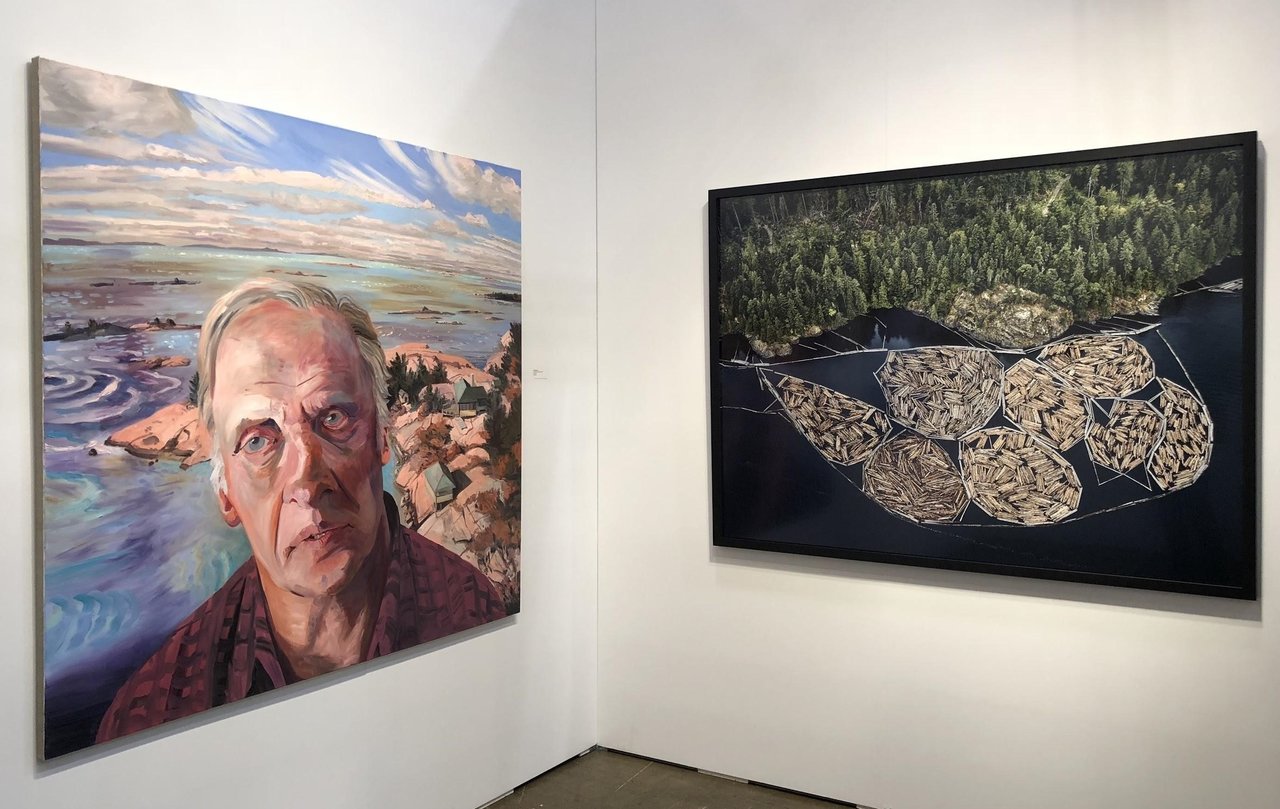
    John Hartman, Ian Brown, Go Home Bay 2017 (left) and Edward Burtynsky, Log Booms #1 (right)

    Taking this idea further, the concept of the Anthropocene is relevant in interpreting the themes and concerns emphasized throughout the fair. The meaning of the term is the proposed title for the current period of time where humanity has eclipsed all other forces in effecting the climate and geography of the planet. These notions of the subjugation of nature have deep and critical connections to consumer culture, ecological catastrophe and violent histories of segregation, which many artists have addressed in their artworks.

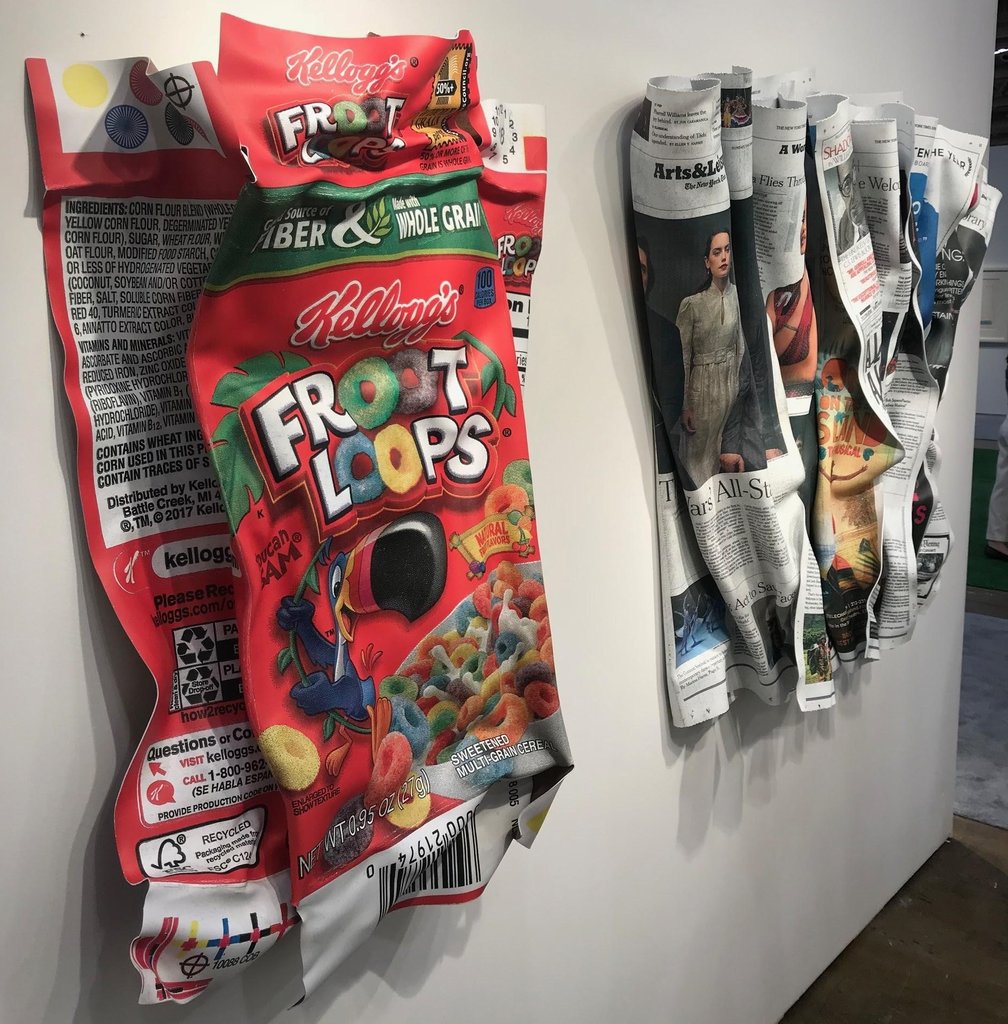
    Froot Loops Fun Size #4 and New York Times Arts & Leisure 12-17-17, 2018 by Paul Rousso

    Further theoretical frameworks that influenced my reading of Art Toronto include John Berger’s seminal text About Looking, especially a chapter titled, “Why Look at Animals?”. It points out the inverse relationship between the disappearance of animals and their increased representations in art. People create more and more simulations of nature as that very nature is disappearing.

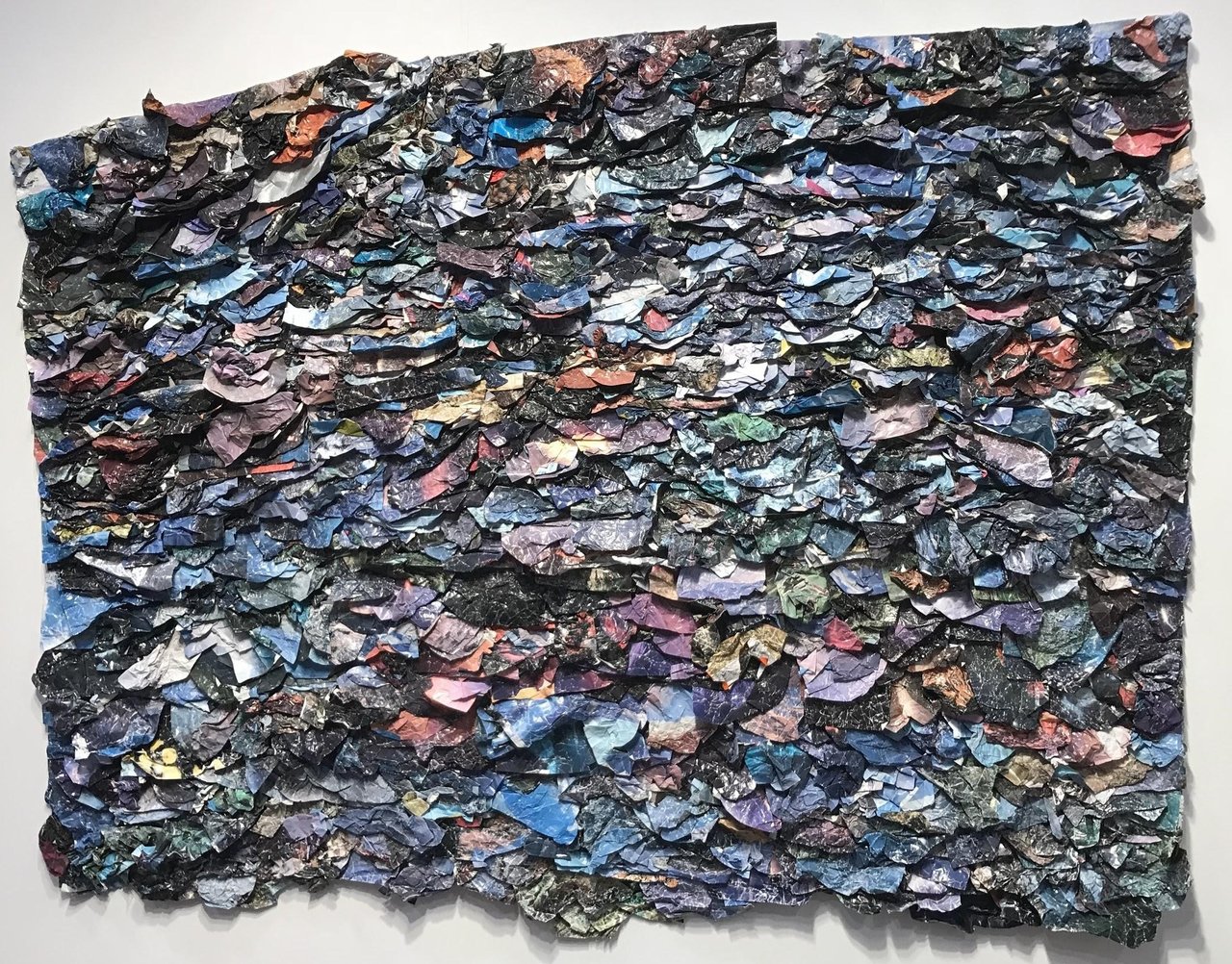
    Suné Woods in From Here We Go Nowhere collaged together pieces of crumpled magazine pages that picture idyllic water bodies, devoid of human presence or interference as an environment of immense beauty and calmness but also a symbol of racism. Pools, beaches and fountains were significant attractions in the mid-20th century that were intentionally segregated because of the white myths of contamination. The crumpling of landscapes seems to reject the original meaning of simplicity and replaces it with a new landscape of chaotic complexity.

    From Here We Go Nowhere 2015 by Suné Woods

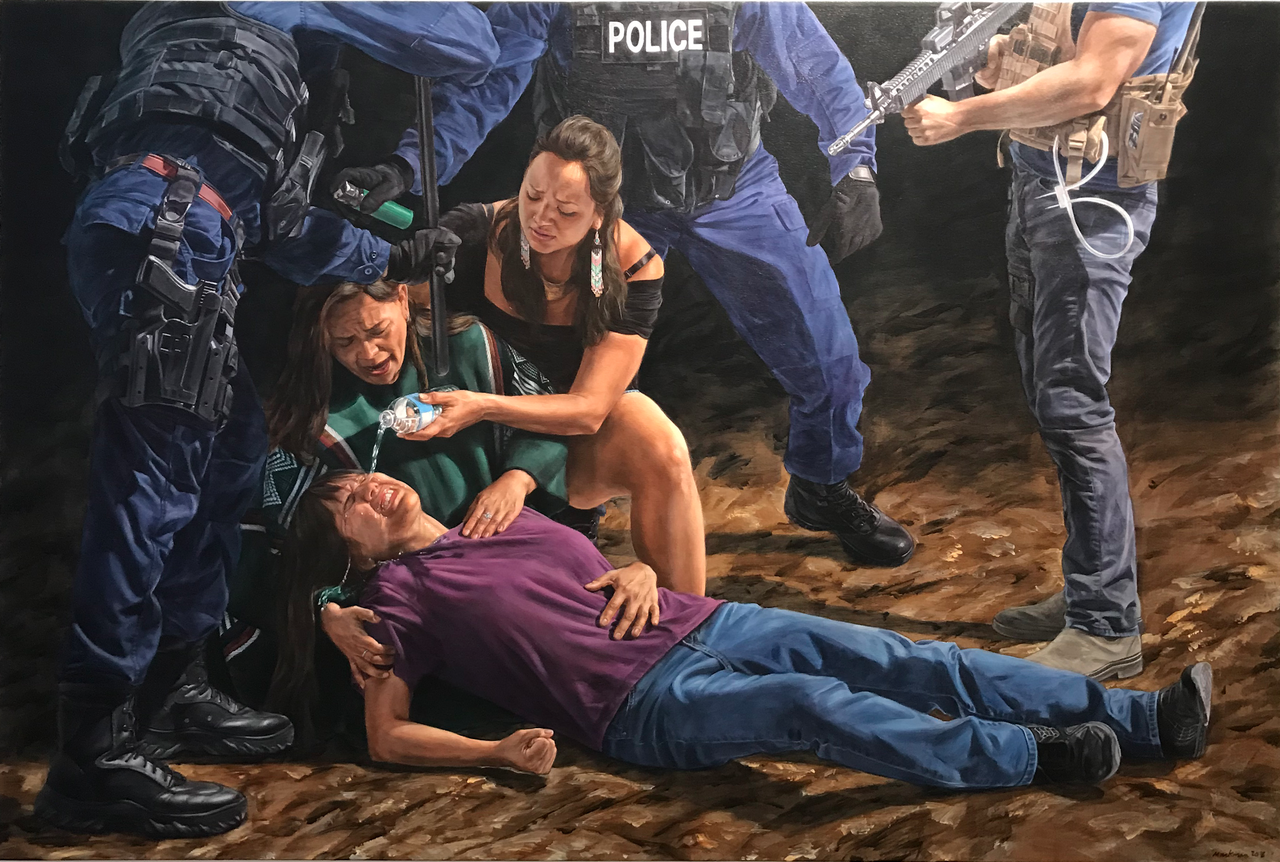
    In Kent Monkman’s Washing Mary’s Tears, we see a contemporary event of police violence against Indigenous women. Three faceless and heavily armed policemen point their weapons at an already subdued woman writhing in pain, while two other women attempt to aid her, washing over her tears caused by pepper spray. The scene is potentially about the Standing Rock protests the DAPL Pipeline, and illustrates an extremely tragic time for environmental, Indigenous and human rights. This scene is also an allegory for the forced reliance on capitalist products, such as bottled water, because the hegemonic powers have crippled the very natural resources that the people in the painting are trying to protect. The work is highly effective and technically brilliant, with the fear, injustice and pain emanating from the canvas.

    Kent Monkman, Washing Mary’s Tears, 2018 at the Pierre-Francois Ouellete Art Contemporain

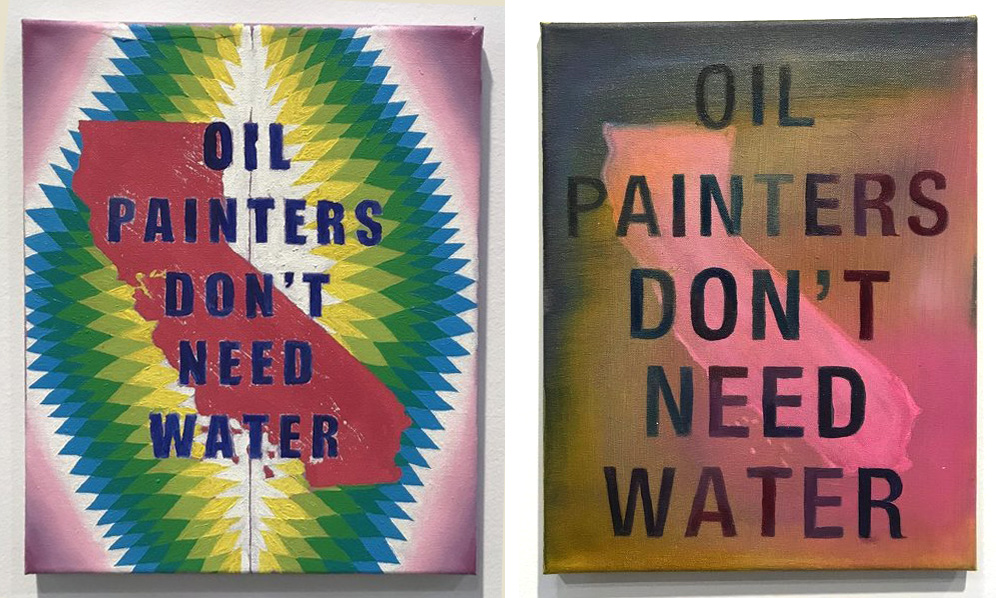
    Christine Wang’s series (from Focus: California) use stenciled writing that reads “OIL PAINTERS DON’T NEED WATER” overlaid by a map of California. The work is a joke or a cynical statement, as oil paint is not water soluble, but also addresses the looming fear of drought and water-shortage in California.

    Christine Wang, California Painting #6 (left) and California Painting #15 (right)

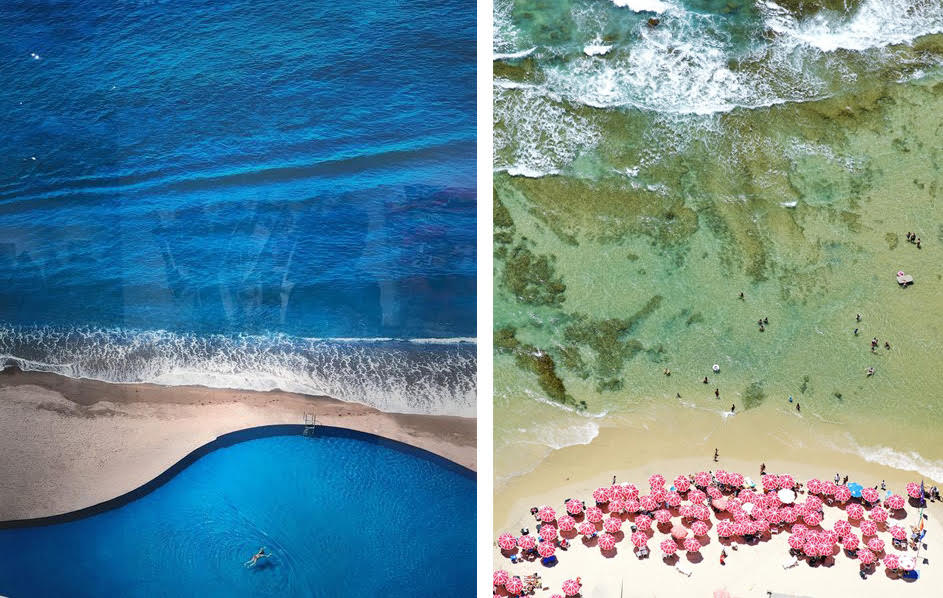
    In David Drebin’s Blue Dream, we see a deep blue sea and an inground swimming pool with a single figure swimming in it. This choice of an artificial environment over the natural one, just metres away from each other, yet maintaining the need for a distinction, shows humanity’s need for control. Unlike Drebin’s piece where a single isolated figure illustrates humanity’s greed, in Joshua Jensen-Nagle’s Strength in Memories we are reminded of our competition over nature. The photo is an aerial view of a beach where identical umbrellas crowd the shoreline, turning it into suburbia, homogenic and dense.

    David Drebin, Blue Dream, 2018, detail (left) and Joshua Jensen-Nagle Strength in Memories, 2017 at the Galerie de Bellefeuille (right)

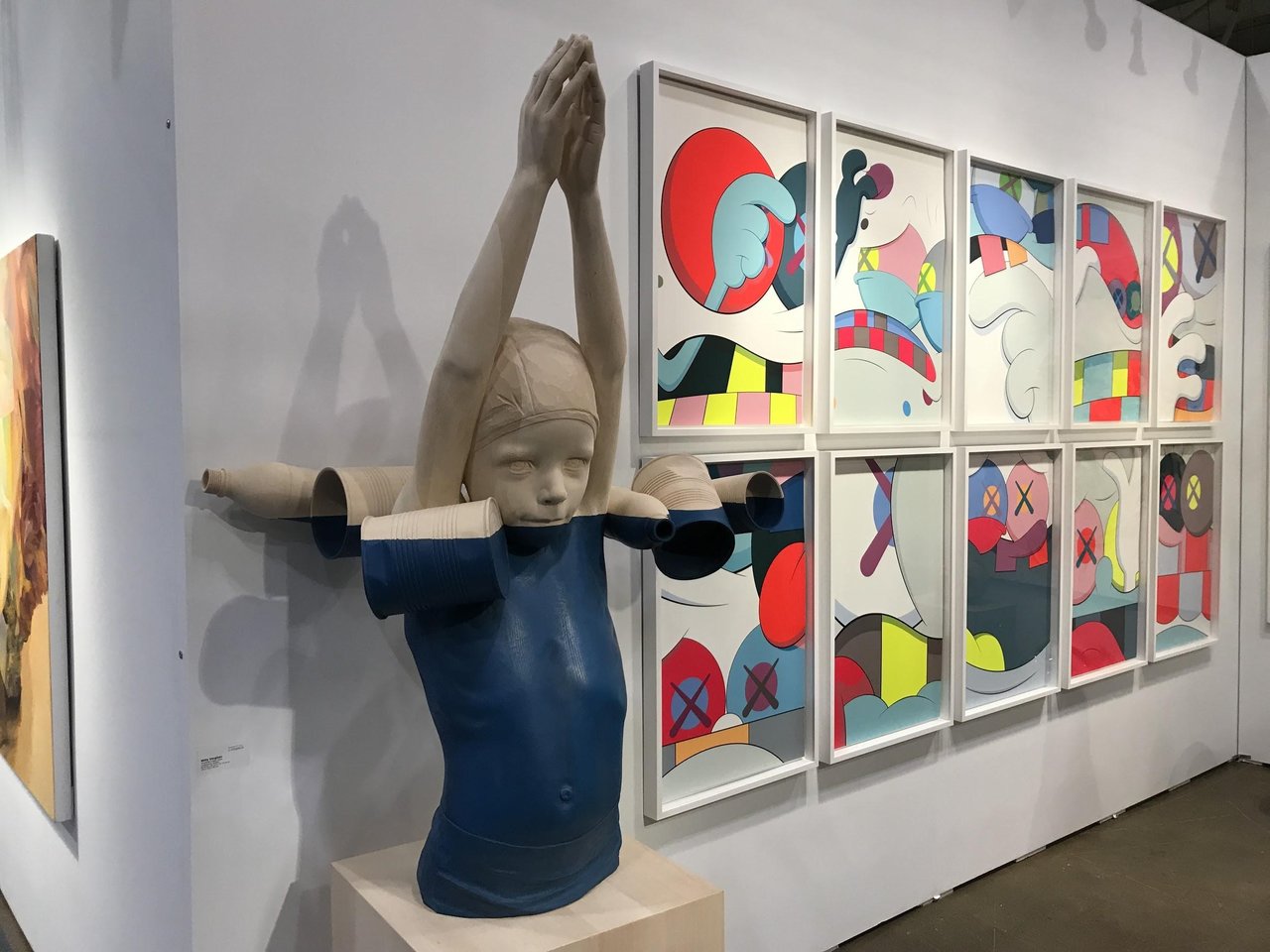
    Bathed in a deep blue up to the figure’s chin and surrounded by floating debris, Willy Verginer’s wooden sculpture Dumbries tl ega is a powerful statement about water pollution and how consumer capitalism is directly corrupting even the most innocent or nostalgic experiences of swimming in a lake as a child.

    Willy Verginer, Dumbries tl ega, 2018, Zamack Contemporary, Tel Aviv

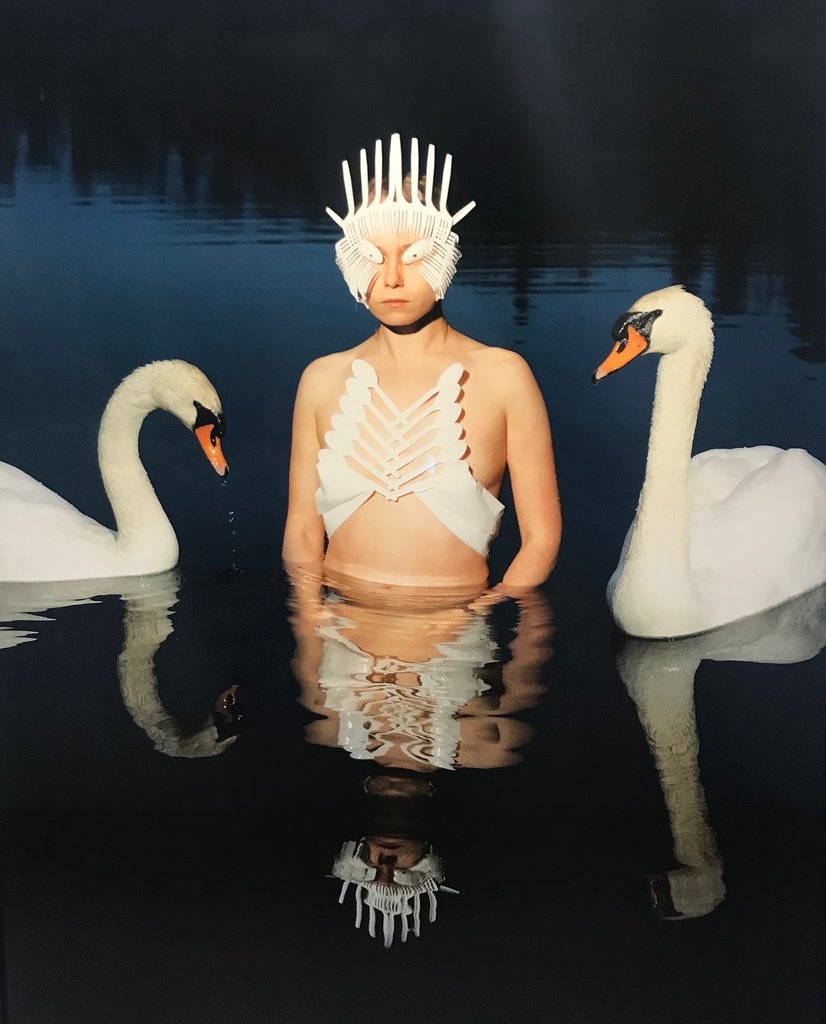
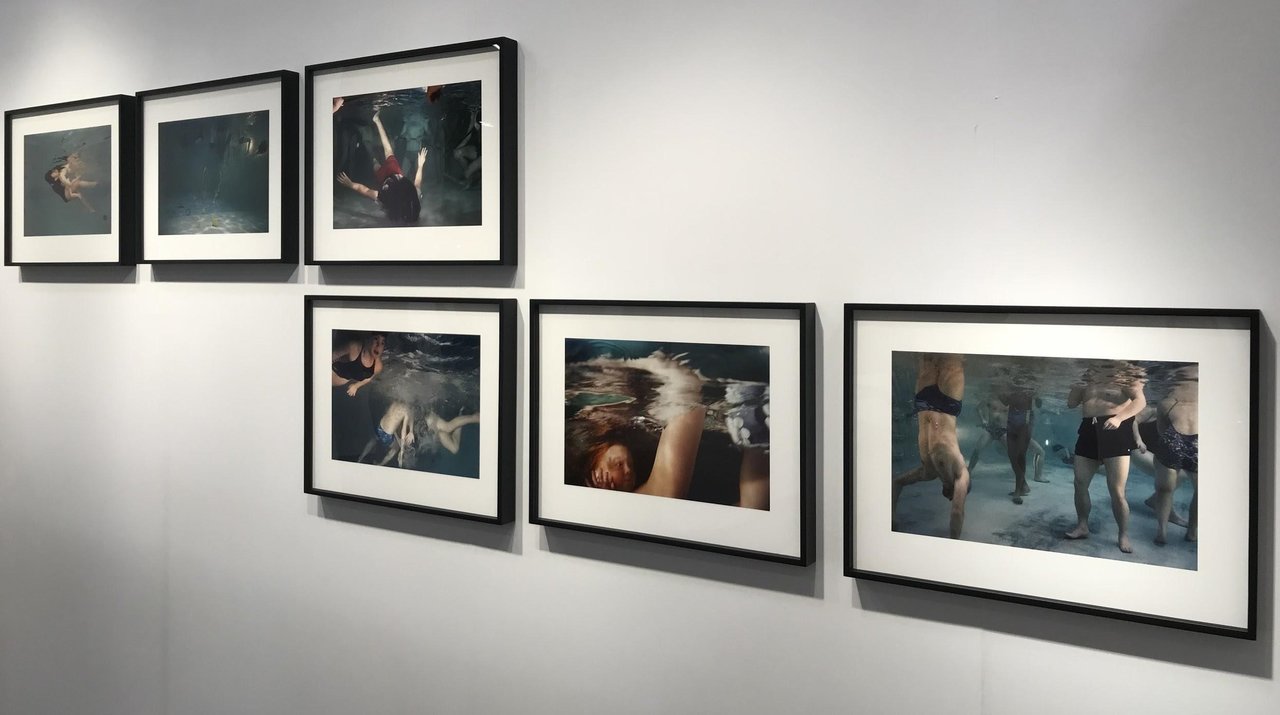
    The swimmer is a recurring character throughout Art Toronto. The underwater imagery of headless bodies hidden by the reflection of light against the surface of the water and the inverted depictions of just a torso and head emerging from the water in quiet moments of relaxation recur within different mediums, galleries and by very different artists. This trend could be a sense of escapism into the mysterious and cleansing water, or an exploration of advancements in technology that make underwater photography more accessible, or perhaps it is a farewell to a time when water was plentiful and leisurely.

    Sage Szkabarnicki-Stuart, Urban Bath at Gibson Gallery

    Larry Sultan, Untitled from The Swimmers (1978-1982)

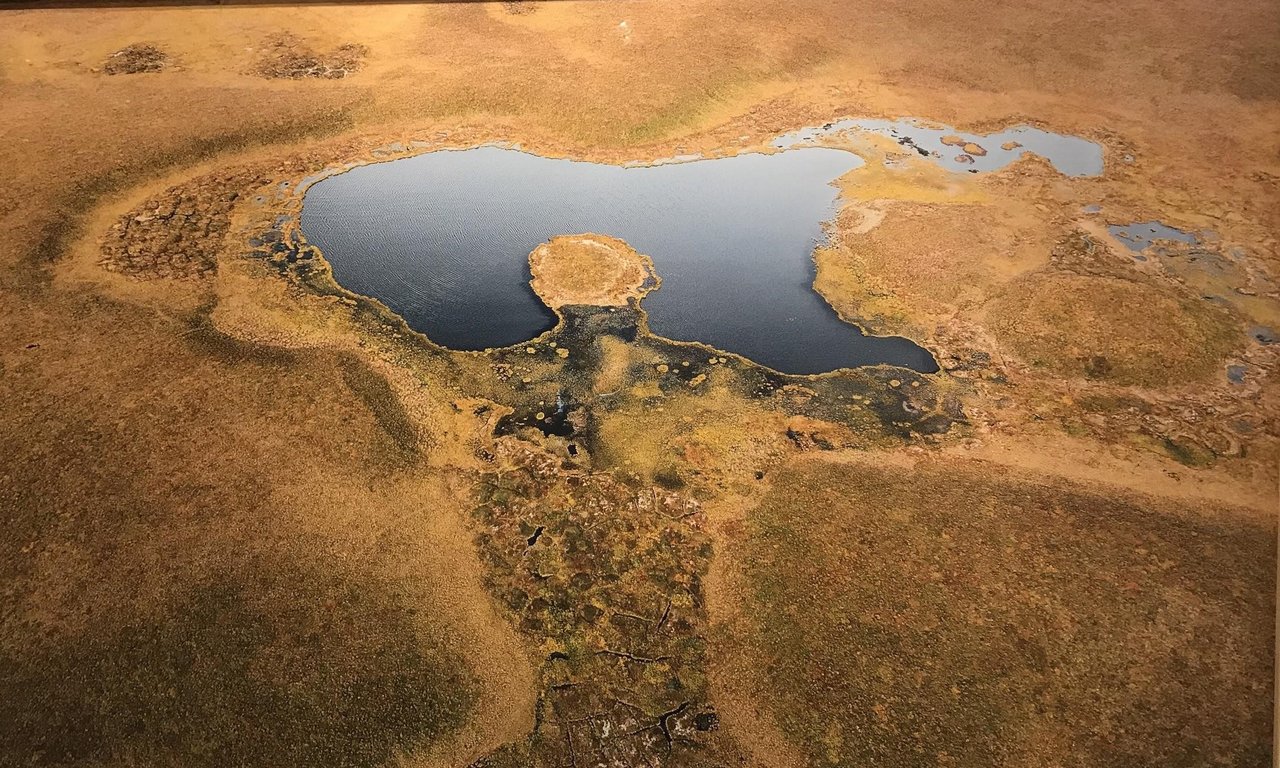
    Guy Lavigueur’s L’Homme (Man) shows a birds-eye view of a lake with the appearance of a natural formation that resembles a human body, with its head as a small rounded peninsula. The work can be read as some mythological, god-like figure emerging from the ground around the lake, or simply as the prehistoric parts of our brain projecting or searching for images of ourselves or predators in everything around us, a phenomenon known as pareidolia. The work could also be a reminder that humanity and landscape are deeply entangled and shape each other.

    Guy Lavigueur’s Series Unprotected L’Homme (Man)

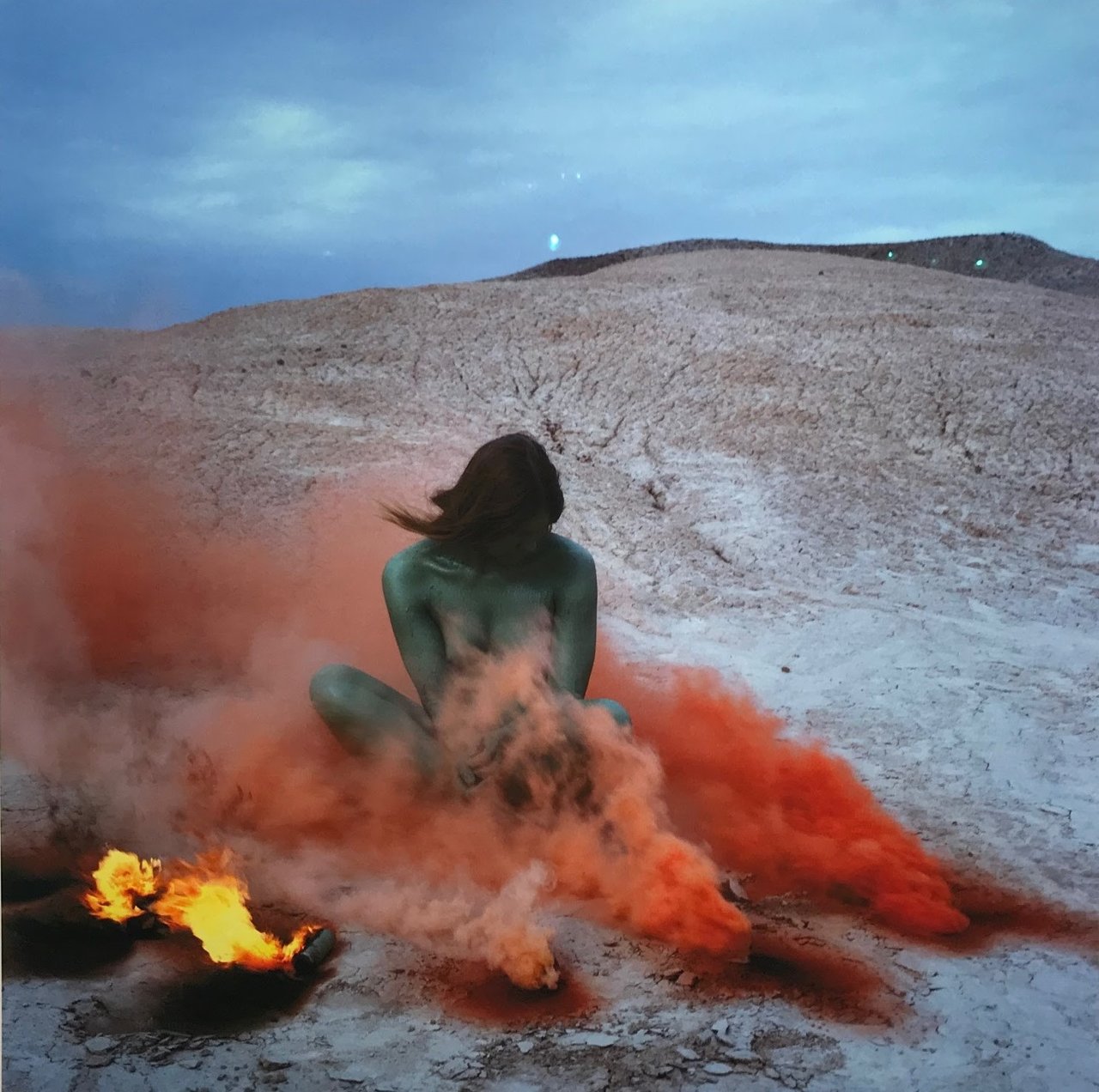
    The photograph, Immolation, by Judy Chicago was taken back in 1972, however it seems as if it was taken today. Originally created during a time when Buddhist monks were self-immolating to protest the Vietnam war, and when the artist was researching the Indian cultural and mythic practice of widows throwing themselves into funeral fires – now the work could to be a statement about the human body in an apocalyptic time of desolation.

    Judy Chicago, Immolation, 1972; from Woman and Smoke. Printed 2018

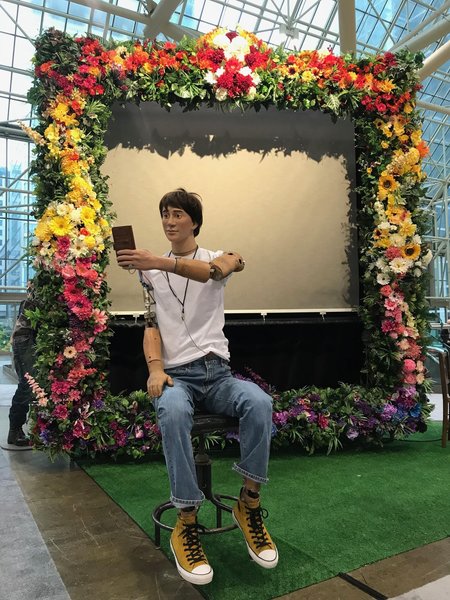
    Still – Framed by Max Dean was a large, central installation. One of only a few mechanic new media projects at the fair, the work included a moving screen that produces a bubbly film from soapy water, as well as mannequins with active smartphones used to submit selfies to a live Instagram feed online. The work is very complex and the meaning behind it seems both poignant and superficial depending on how you unpack its process and conceptual framework. The installation seems post-ironic, mocking both participants and itself with its flagrant description and the vapid narcissism associated with selfie culture.

    Still – Framed (2018) by Max Dean

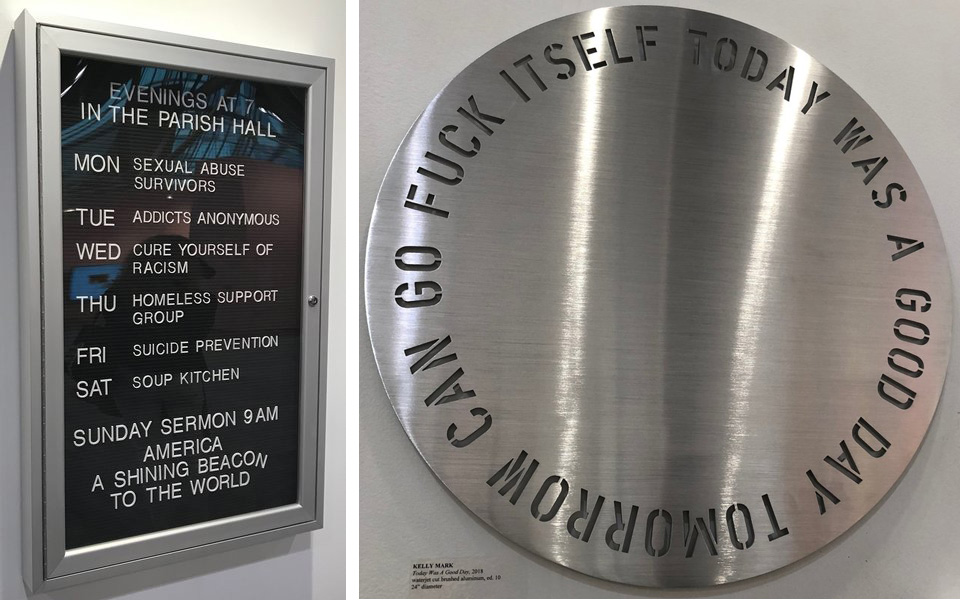
    Despair and cynicism have always held a special place in the arts and culture realms, works such as Erika Rothenberg’s America A Shining Beacon and Kelly Mark’s Today Was A Good Day, demonstrate a contemporary ethos of pessimism and rejection of false ideals of hope.

    Erika Rothenberg’s America A Shining Beacon (left) and Kelly Mark’s Today Was A Good Day, 2018 (right)

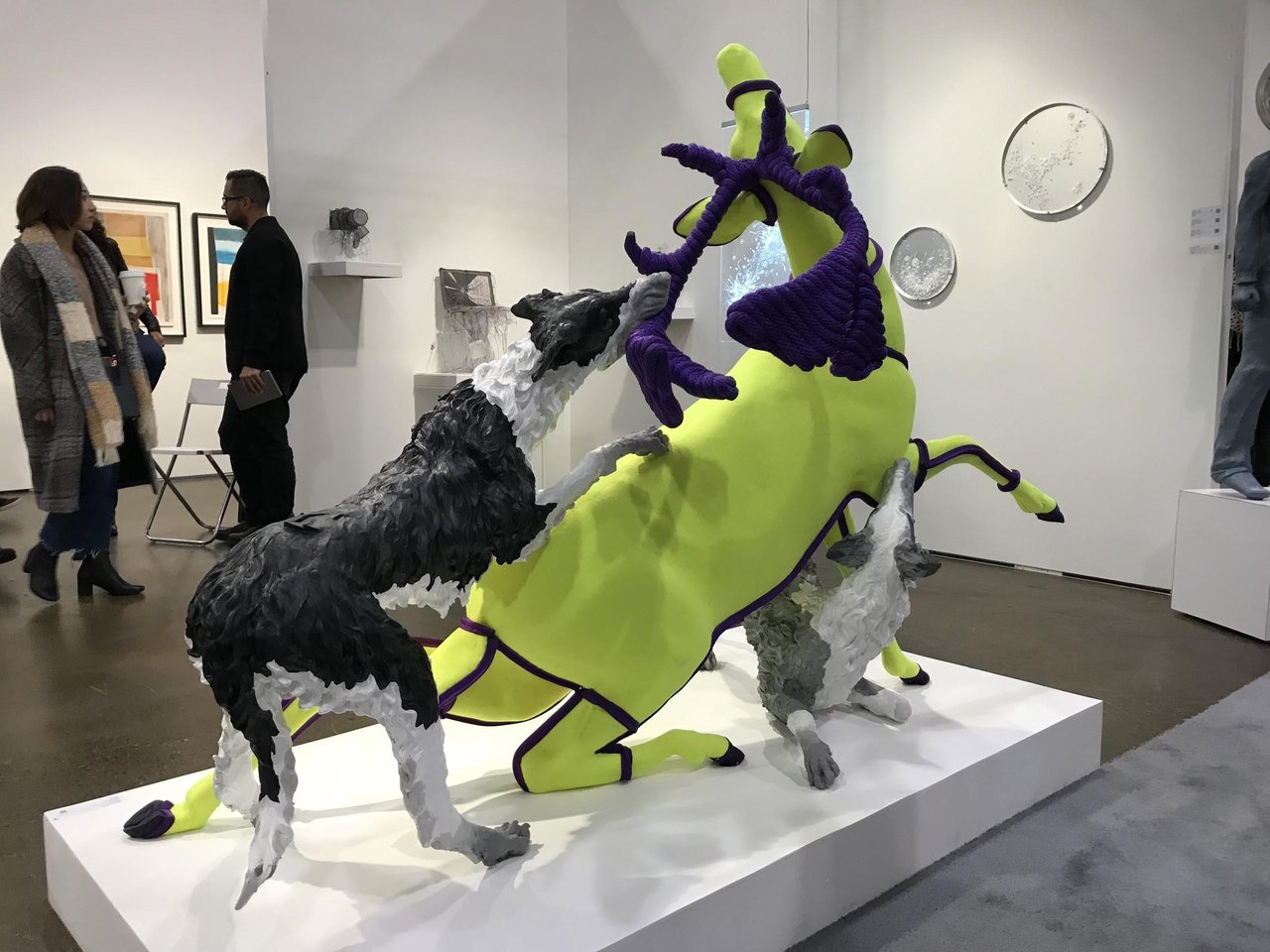
    Many other works demonstrated the cruelty of nature and our companion species in the current age of scarcity and technological acceleration. The Edge of Chaos by Nicholas Crombach appears to be a glimpse into the mind of a domesticated pet dog that imagines his play with his toys as a violent hunting of a deer with his pack mates, when in fact he has been domesticated and bred to be a harmless accessory to a home.

    The Edge of the Chase, 2018 by Nicholas Crombach

    Overall, the Art Toronto 2018 show was spectacular and robust with crowds gathering at nearly every booth and red dots denoting sales scattered beside countless placards. The gallerists were friendly, the curators were knowledgeable, and the art was beautiful and meaningful in so many new and thoughtful ways.

    Text and photo: Nathan Flint

  • ART TORONTO 2018

    Art Toronto 2018 by Steve Rockwell

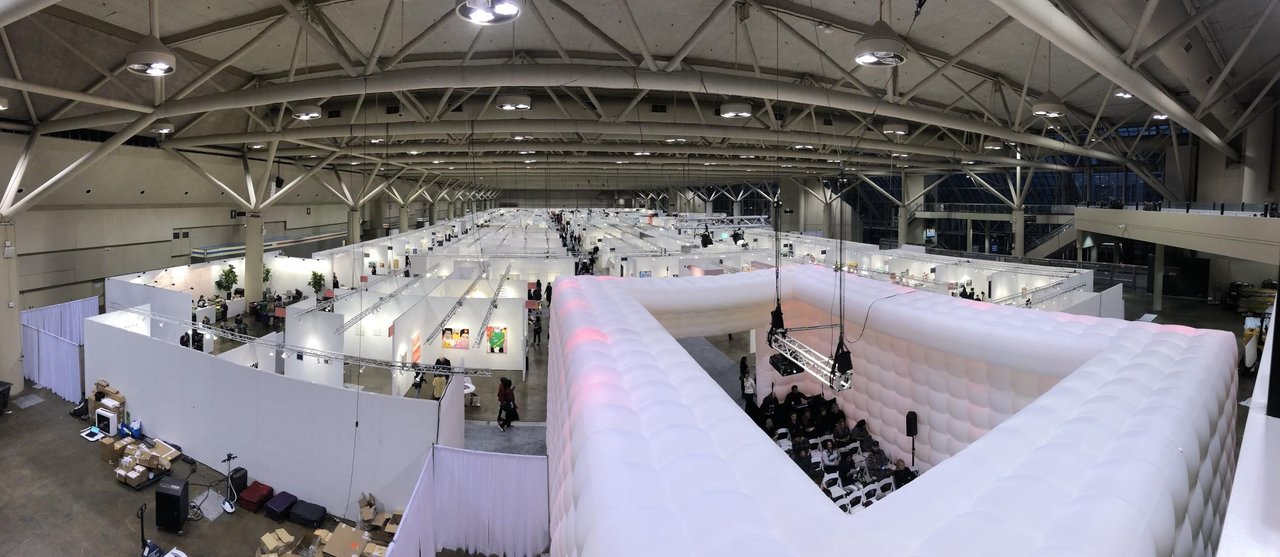
    Art Toronto bills itself as “Canada’s international contemporary and modern art fair.” As usual it set itself up at the Metro Toronto Convention Centre, the base of the city’s downtown, just west of Union Station. Generally, there is some sense of wonderment at its longevity, even with its regular exhibitors. “Is it really in its 19th year!” Globally, art fairs have been around for a long time, but had their growth spurt in North America with the Art Basel Miami Beach art fair in 2002.

    Installation view. Photo: Emese Krunák-Hajagos

    Was it just me, or did the layout of Art Toronto this year make for easy run-through, with somewhat more space in the criss-crossing aisles between booth sections? I’ve come to see walking through fairs as flipping through catalogue pages, albeit with greater detail, and high-def 3D.

    Installation view. Photo: Emese Krunák-Hajagos

    Wether its a hasty skim or a lazy saunter, we slow to focus when moved by interest. Looking over this year’s exhibitor list shows it to have just half of the number of countries represented to the 2016 listing, down from 14 to just 7. Even with its Focus: California component, it’s a Canadian content-heavy fair. Branded initially as the Toronto International Fair, the monicker change may have had something to do with the change in perception.

    Gabriel Bitterman, director of Quimera Galeria, Buenos Aires. Photo: Steve Rockwell

    Zamack Contemporary Art, Tel Aviv. Photo: Emese Krunák-Hajagos

    Installation view with Art Mûr, Berlin and Montreal. Photo: Emese Krunák-Hajagos

    Without question, art fairs have come of age. Well-curated booths weave veteran artists seamlessly with emerging younger talents. A kind of stasis has set in. Edgier new art blurs with modern masters, just bricks in the postmodern art Babel, held together by the mortar of art fair commerce. Perhaps the exhibition is less kitschy than ones of years past. In any case, the gloss over of low brow and high brow might be a symptom of fair fatigue. By the use of the word “fatigue,” I mean it less as disparagement, than the case of reflexive conditioning that comes years of art fair attendance.

    Taiga Lipson, assistant director and director, Shelli Cassidy-McIntosh of Olga Korper Gallery, Toronto. Photo: Steve Rockwell

    Niki Dracos, director of General Hardware Contemporary, Toronto. Photo: Steve Rockwell

    Daniel Faria of Daniel Faria Gallery, Toronto is explaining an artwork to visitors. Photo: Emese Krunák-Hajagos

    Devan Patel, owner & director of Project Gallery, Toronto. Photo: Emese Krunák-Hajagos

    Canadian Art’s booth. Photo: Emese Krunák-Hajagos

    Focus: California is a fitting theme for Art Toronto. In my past travels to Los Angeles, well before Toronto had been established as Hollywood North, I found Lotusland and the Great White North to have a restless symbiosis. We have the film industry in common, as exemplified by the Toronto International Film Festival, and all the film production here. Equivalencies between the populations and economies of California and Canada as a whole have often been made. The geographies, however, of each could not be more different. Landscape art has had a habit of generationally seeping out of the Canadian pores. For a fair attendee, a suggested exercise might be to compare how each respective habitat informs and insinuates itself into its art, a CA to CA comparison, Canada to California, that is.


    A Photo Journal by Xiaotong Cao


    The Entrance, a favourite meeting place

    Installation view with Christopher Cutts Gallery, Toronto (right)

    Todd Merrill Studio, New York

    Installation view with Miriam Shiell Fine Art, Toronto (left)

    Installation view with Solo Section, Tessar Lo from Project Gallery, Toronto (first on right)

    Installation view with Karen Tam’s Project

    Installation view of the middle section

    Installation view at Focus: California

    Installation view with Hosfelt Gallery, San Francisco

    A very busy area with videos

    Installation view with Angell Gallery, Toronto (left)

    Installation view

    Galerie de Bellefeuille, Montreal

    Oeno Gallery, Prince Edward County

    Thomas Scoon and Tobias Mohl


    Media Preview / October 25, 2018 by Phil Anderson

    Canada’s largest and most prestigious art fair was gearing up as I attended the early media preview and guided tour. With over 100 art galleries it is certainly the biggest in Canada and with plenty of international galleries participating.

    This year featured Focus California which was curated by Glen Helfand and Kim Nguyen. As curator Glen Helfand explained ”the shifting terrain and cultural landscape of California“ was inspiration for much of this exhibit. Alan Roth’s Fa Fa Fe work (courtesy of Hosfelt Gallery) was one example of tech art in this section as the moving ostrich feathers were mechanically driven. There were plenty of other media at play in Focus California.

    Focus California curator Glen Helfand

    Karen Tam uses some found objects, like Chinese vases and creates others that are similar but made with paper and paste. Her work deals with consumerism and the replication of cultural objects. The blue decorate mat used in the installation was an early example of Chinese Art Deco.

    Karen Tam with her installation, How Chinese Morning Blossums Plucked At Dusk

    The landscape played a part in many works such as the installation Ancestor Rocks by Curtis Santiago who was exploring transculturism. The work using mounted painted rocks shaped by Lake Ontario to “imagine his ancestors and the landscape that traced their lives.” Robert Wein’s sculpture Sugar Maple at Paul Petro Gallery also brought us back to our landscape and nature.

    Ancestor Rocks by Curtis Santiago

    Robert Wein, Sugar Maple at Paul Petro Gallery

    I talked with Elizabeth Levinson of Winchester Galleries who was featuring some works by Jean Paul Riopelle such as Sans Titre (Iceberg Series) as well as paintings from David Blackwood. Bill Clarke of Angell Gallery showed me some works the Gallery promoted by indigenous women artists such as Jessica Thalimann and her Perigee and Apogee, archival print on steel.

    Elizabeth Levinson of Winchester Galleries, Victoria BC

    Bill Clarke, associate director of Angell Gallery in front of Jessica Thalimann, Perigee and Apogee

    There were numerous Galleries from Montreal from the more established Galerie de Bellefeuille and Division Gallery to Projet Pangée which was focusing on emerging artists. There were solo artists featured as well such as Micah Lexier from Birch Contemporary, Toronto. The fair had lots of returning galleries and new ones like Toronto’s Project Gallery and the gallery director Devon Patel was excited to be part of this annual event.

    Solo artist Micah Lexier from Birch Contemporary

    The Toronto Biennial of Art 2019 had a both as did the Power Plant and the newly relocated MOCA. A great series of speakers has been lined up, so visitors can take in panel talks and video presentations as well as grab refreshments at the Art Bistro X The Drake. Downstairs the Art Book Fair is happening for its third year and I talked briefly with Wil Aballe of WAAP from Vancouver who presented several art books and objects. Aballe was excited to be back.

    Wil Aballe of WAAP from Vancouver

    This year’s fair seemed very well organized with lots of different programming to offer visitors. It is a great event to lead up to 2019 when they will celebrate their 20th year.

    *Exhibition information: October 26 – 29, 2018, Metro Toronto Convention Centre, North Building, Exhibit Hall A & B, 255 Front Street West. Hours: Fri & Sat, 12 – 8 pm., Sun & Mon, 12 – 6 pm.

  • Marian Wihak & Yael Brotman at loop

    The study of physical geography teaches the value of stone and wood in recording natural history. Both current exhibitions at Loop Gallery, Marking Time and The Wormwood Series, examine the concept of natural or found materials as indication of storytelling, image-making and conceptual framing.

    The first half of the gallery is dedicated to Marian Wihak’s work. On one wall, we are greeted with, and immersed within, the artist’s large-scale painting Archipelago, a merging of abstraction and landscape, based on the artist’s observations during her residency on Fogo Island. The colours and textures feel organic: the greenish blues of the North Atlantic waters or the depictions of the cracks and fissures from the rocky shoreline.

    Marian Wihak, Archipelago (Fogo), 2011, oil on plywood, 8ft x 15ft. Courtesy of the artist

    On the opposite wall, we have a series of graphite work titled and numbered Rupture, Slide and Fissure. Additionally, there are three large rocks with relatively flat tops stationed in the centre of the gallery to accompany the work. The drawings are uniform, unframed and placed against a large black stripe of wall. Their contents are renderings of geological phenomenon, however, there is a tension between the pieces – as to whether the scale is micro or macro. What could be a crack in a rock simultaneously could be an aerial view of a canyon, or what appears to be a flyover view of fields, may, in fact, be tiny patterns formed on the ground. The completely unsaturated palette of the greyscale drawings and slate coloured rocks create a juxtaposition against the more colourful Archipelago painting that faces it.

    Installation views of Marian Wihak, Marking Time. Photo: Nathan Flint

    These dualities continue throughout Wihak’s work since the simulated textures of the drawing are in fact flat and relatively textureless. The simulation and the real become distinct through our haptic senses, despite the uncanny visual perception. Further contrast is found by placing the real rocks within the gallery context. Conventionally, these objects are perceived as sculptural elements meant for aesthetic considerations and therefore the codes and conventions of the white cube gallery suggest that they are not to be interacted with, however, the artist’s intention was utilitarian. Wihak invites the audience to use the stones as benches to sit on while engaging with the art on the walls. Offering this vantage point for the work aids in the artist’s concept of blurring the haptic phenomenon with the visual simulation.

    Marian Wihak, Synergetic Form, 2009, graphic on BFK, 22” x 33”. Photo: Nathan Flint

    The second half of the gallery is dedicated to exhibiting The Wormwood Series by Yael Brotman. Frottage is the term used in image making when you rub paper with a drawing medium over a surface to produce a relief like depiction of the texture underneath. Brotman has utilized this technique as a foundation for her artworks. Using the patterns formed from woodworm infestations burrowing through trees, the artist converts these winding patterns woven into the fabric of the wood onto paper using graphite. From this starting point, Brotman utilizes several techniques, such as watercolour, transferring processes and collage to reassemble the drawings while she also adds realist details of man-made structures to enrich the image.

    Installation view of Yael Brotman, Untitled, 2018. Photo: Nathan Flint

    The depictions of large-scale industrial architectural details contrast the tiny organic lines created by the worms. This contrast seems to suggest a shift in perspective about the scale of human’s feats compared to the grandiose feats of nature. The work hopes to tap into the sublime and inspire us with awe when examining both the miniscule and the massive.

    Yael Brotman, Bird’s Eye (⅓).  Photo: Nathan Flint

    In the gallery, there is also one of Brotman’s sculptures titled Worm’s Progress. It is a large, neon orange, tube-like shape that branches off and twists towards the ceiling. Situated at its base, is a small white boat and two pieces of clear blue plastic that seems to suggest water. The work feels completely aligned with the rest of her series, except that it has manifested itself 3-dimensionally instead of on paper. The wormwood tunnel has become inverted to be a filled in tree-like statue, while the scale of the piece has been expanded to surreal heights.

    Yael Brotman, Worm’s Progress, 2018.  Photo: Nathan Flint

    Both Wihak and Brotman captured moments within the natural cycle of destruction and creation and managed to use their artistic vision and conceptual views to radically alter or expunge meaning from otherwise overlooked phenomena that help to form the textured fabric of our world.

    Opening reception on October 13, 2018 at loop Gallery.  Photo: Nathan Flint

    Nathan Flint

    *Exhibition information: Marian Wihak, Marking Time & Yael Brotman, The Wormwood Series, October 13 – November 4, 2018, loop Gallery, 1273 Dundas Street West, Toronto. Gallery hours: Wed & Thu, 12 – 5 pm; Fri & Sat, 12 – 6 pm; Sun, 1 – 4 pm.

  • ART TORONTO 2018

    Art Toronto installation view with MOCA’s and superkül’s seating structure, 2017. Photo: Emese Krunák-Hajagos

    October 26 – 29, 2018
    METRO TORONTO CONVENTION CENTRE
    North Building, Exhibit Hall A & B
    255 Front Street West
    Hours: Fri & Sat, 12 – 8 pm., Sun & Mon, 12 – 6 pm.

    Founded in 2000, Art Toronto is Canada’s international contemporary and modern art fair, located at the Metro Toronto Convention Centre in the city’s downtown core. Providing unique access to the Canadian art market, the fair is one of the most important annual art events in Canada. Now in its 19th year, Art Toronto presents important artwork from leading Canadian and international galleries combined with PLATFORM, our engaging series of lectures and panel discussions from prominent art world figures, curated projects, an extensive VIP Program, and top-tier cultural offerings throughout the city.

    FOCUS: California is a curated section of the fair highlighting galleries and projects from California. The interactive exhibit featuring galleries from California will be curated by Kim Nguyen (Curator and Head of Programs at the CCA Wattis Institute, San Francisco) and Glen Helfand (Associate Professor at California College of the Arts, San Francisco, independent writer and curator based in Oakland, California).

    PLATFORM SPEAKER SERIES:

    PLATFORM is Art Toronto’s original series of lectures and panel discussions from prominent art world figures. Included within PLATFORM are POWER TALKS, a series of lectures organized in partnership with the Power Plant Contemporary Art Gallery.

    Find out what’s trending and happening in the international scene from artists, writers and curators and immerse yourself in all things art in this comprehensive line up of talks on the PLATFORM stage.

    SOLO section:

    The SOLO section includes 12 galleries, each presenting a highly‐curated body of work by a single artist.

    WEST-END GALLERY HOP:

    Friday, October 26, 2018 / 6 – 10 pm

    Art Toronto invites you to gallery hop across 17 top contemporary galleries in Toronto’s west end. The following galleries will be welcoming all art enthusiasts for a night of refreshments, cocktails and incredible art! This event is open to the public and free of charge.

    For programming and more information please go to http://arttoronto.ca/.