Author: artoronto

  • Emmanuel Monzon at Robert Kananaj Gallery

    Solitude surrounds the guest when entering Emmanuel Monzon’s exhibition at Robert Kananaj Gallery. All the photographs seem similar at first glance in their quiet compositions and monochrome colours. Taking a closer look, one recognizes their nuances – and becomes mesmerised by their magical beauty. They radiate an ephemeral, almost surreal tension that captivates the viewer.

    Installation view of Emmanuel Monzon,   Urban Sprawl Emptiness

    Monzon, a French born artist graduated from the Académie des Beaux-Arts in Paris and started his career with painting, and his painterly values still dominate his photographs. They look like watercolours and are printed on watercolour paper. Moving to Seattle was a turning point in his life. As he said, “I had the feeling that my work could only be photographic for this space, which creates its own mythology.” Indeed, it did, as Monzon’s photographs are very unique in their themes, depictions and colouring.

    Urban Sprawl 167

    Monzon travels a lot in the American West, around the deserts where urban settlements, surrounded by suburbs, meet industrial areas and a no-man’s lands of rocks and sand. All his images are entirely devoid of humans. Some suggest human occupation such as Urban Sprawl 167, with a parked trailer, parking spots, a strong outline of a building. The grey surface of asphalt ends abruptly at a rock and the landscape takes over. The pervasive colour is burnt sand – the whole area is covered with it, even the building seems to be made from bricks carved from the rock. There are traces of people, the neon sign at Jazzercise is on, there is a light inside the shop and in the building in the background, cars are in the parking lot – but not a single person or animal is around (Urban Sprawl 165). The only living thing is the large cactus, standing in front of a traffic light. The light has turned green – but for whom. Who had to stop and why at the stop sign (Urban Sprawl 164) and walk over the pedestrian crossing? As far as the eye can see there is nothing in that flat landscape that surrounds a sand rock – except emptiness. One can almost hear the moan of the soil cracked by heat, beaten and barren, or the silent cry of a lonely tree fenced out of the garden behind it (Urban Sprawl 185).

    Urban Sprawl 165
    Urban Sprawl 164

    Where are these places? Where are the people and animals? Even the shadows are not there. What’s happening? Did the people leave or is this a post-apocalyptic world? Maybe none of these. Rather I think it is a landscape with its “own mythology.” Monzon captures moments that can best be described as “in-between” moments, in which the activities of the town stopped for the day and haven’t started for a new one, where everyone sleeps or hides, where the place is left by itself.

    Monzon’s landscapes are heavily modified, desecrated even destroyed by our hunger for expansion, making the land banal and ugly. Still we can’t deny the beauty in these photographs, but such a cruel beauty it is. As Monson stated in his latest interview, “the American natural landscape has redefined this space and has become itself a ‘non-place’. The transition from one site to the next: You have arrived and at the same time you have never left.” Whatever this place is, it is not the place you want to be. French anthropologist Marc Augè defined “non-place” as a place of anonymous solitude, like airports, motorways, parking lots where people meet in an illusion that they can be socially engaged, but actually it is not possible. Monzon photographs depict these “non-places” in their true nature: as timeless places where there are no sounds, only emptiness.

    However beautifully depicted, this emptiness is sad, even painful. Urban Sprawl 162 portrays a dinosaur figure that would be more appropriately found in Disneyland. In its poor surroundings he almost smiles rather than snarls, his maker must be an amateur. He is definitely in limbo here, no one looks at him, he is totally isolated and his being is meaningless.

    Urban Sprawl 162

    Urban Sprawl 182 reminds me of an ancient outdoor shrine in an old landscape, something like Stonehenge. Surrounded by ageless rocks there is an altar. That altar is made of concrete and an asphalt road leads to it. What kind of cruel joke is this? However, there is still a spiritual power surge about it. What God is worshipped here? Will he or she lift or destroy the soul? There is something sacramental in this uneasy emptiness and the unconscious mind resonates with the spirits occupying the shimmering whiteness of this place.

    Urban Sprawl 182

    Monzon captures the moment of eternity and the eternity in the moment at the same time. His photographs show a void, a void that can not be filled.

    Emese Krunák-Hajagos

    Images are all: 30 x 30 inches, Digital print on Canson Arches Infinity Watercolor Paper (acid free), framed, Limited edition (1/3 ed of 3 +1AP), 2018. Courtesy of Robert Kananaj Gallery and the artist.

    *Exhibition information: Emmanuel Monzon, Urban Sprawl Emptiness, March 16 – May 18, 2019, Robert Kananaj Gallery, 172 St Helens Avenue, Toronto. Gallery hours: Tue – Sat, 11 – 6 pm.

  • Young Abstractionists at Christopher Cutts

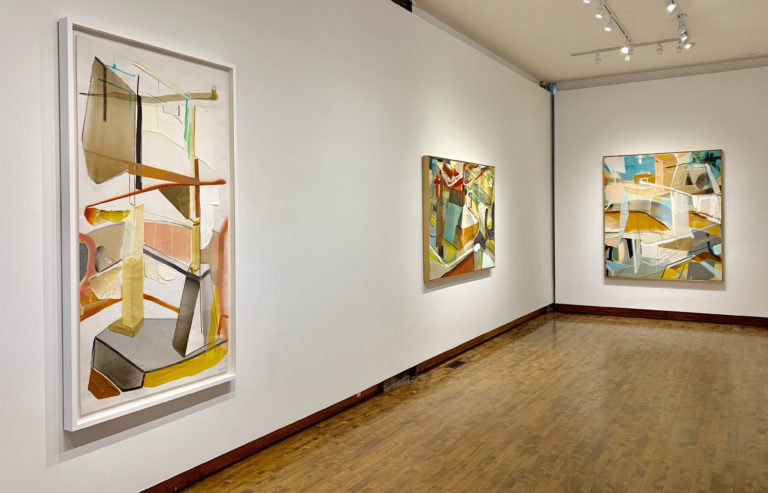
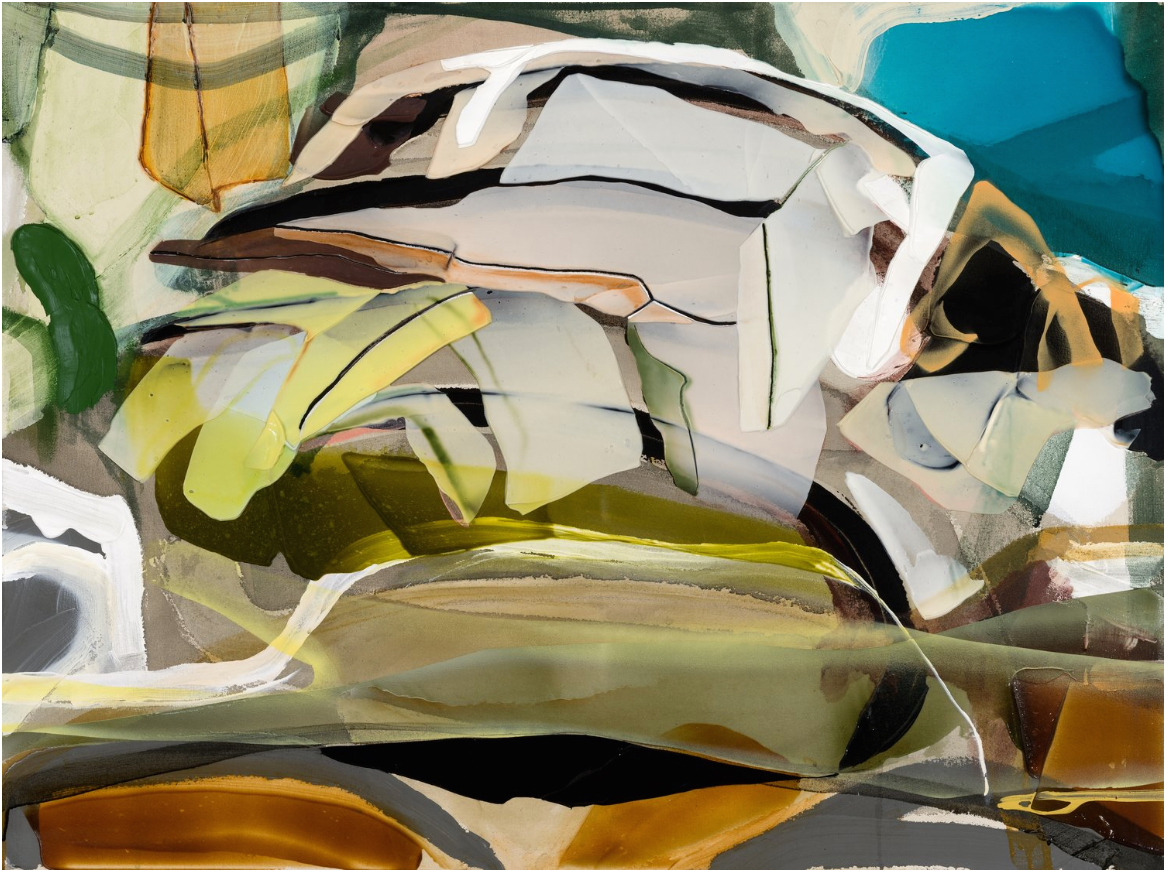
    Christopher Cutts Gallery is currently showcasing two young independent abstract painters described as being at the start of a journey. The south end of the gallery houses the works of Alexander Rasmussen. The north end is displaying works by Kristín Morthens. Morthens is a very recent graduate from OCAD University. Her seven paintings on display range in size from around 50 cm square to just over 2 m square. They are complex compositions that use a muted palette.

    Installation view of the North Gallery with works by
    Kristín Morthens

    By comparison Rasmussen uses either primary colours directly or blends of them to produce rippled greys and browns using a palette knife. His seven oil and acrylic paintings on wooden boards are of similar sizes to Morthens. About a decade ago Rasmussen studied at Emily Carr University. He lives and works in the Niagara peninsula region. Morthens, originally from Iceland, now lives and works in Toronto. At first glance these artists’ works complement each other fairly well. Nonetheless they represent very different bodies of work.

    Installation view of the South Gallery with works by
    Alexander Rasmussen

    One might say that abstraction is the easiest type of painting to do but the hardest to pull off. Historically it first flowered in the early twentieth century, driven by a desire to express the spiritual. Its originating artists such as Vassily Kandinsky and Hilma af Klimt were inspired by the theosophy of Helena Blavatsky. Early abstract artists wanted to paint what they saw as pure reality, which they generally took to be spiritual as opposed to material in nature. This is the world of perceptions, comprised in essence of the shapes, forms and colours by which we construct the external material world. It is in these formal qualities themselves that reality exists, not in the things they represent.

    But a century or so later in our secular age, this religio-philosophical underpinning of abstract painting has largely disappeared. Nowadays all that remains for the abstract painter to do is to explore these formal qualities by means of technique. But an ineluctable truth about painting is that whatever the painter produces it will instil some sort of feeling or emotion in the painter or viewer more generally. It is this fact that the abstract expressionists, for example, exploited and that led to the masterpieces of the likes of Pollock and Rothko. But what is it about a painting like Pollock’s Number 32, with its violent splashes of black paint, that so enthrals the viewer? No one can know. An artist like Pollock could not explain how he achieved it. He fumbled in the dark in this respect, simply trusting the intuitive processes that guided his painting. It is this reliance on blind intuition that makes abstract painting so difficult to pull off. The two young abstractionists introduced to us in this show, therefore, have a tough row to hoe.

    It is clear that Rasmussen is already some way on his journey into figuring out those techniques that give his paintings the desired emotional content. He juggles seemingly random applications of paint to produce an overall coherent composition. In part this is achieved by his first creating in the background a square grid pattern. On top of each grid he produces delectable passages of paint that almost shimmer. The most successful of these paintings is perhaps his Fat Chance with its strong colours and variedly textured surface.

    Alexander Rasmussen, Fat Chance, 2019, acrylic, oil and pencil on wood panel, 79 x 79 inches

    The compositions in some of his paintings are less successful, I feel, because the beautiful scramblings of overpainting sit too tightly in the centre of his boards, making them rather static. And so a smaller painting titled Left Slide is more successful because the paint is scraped over to the very left edge of the board. At any rate Rasmussen is definitely on to something. These are riveting works of art.

    Alexander Rasmussen, left Slide, 2019, acrylic, oil and pencil on wood panel,
    20 x 20 inches

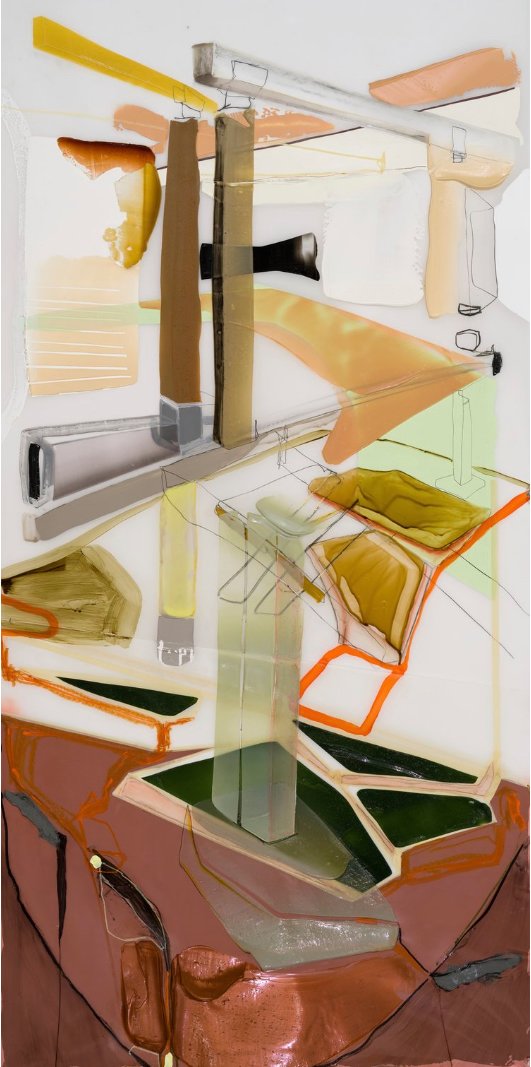
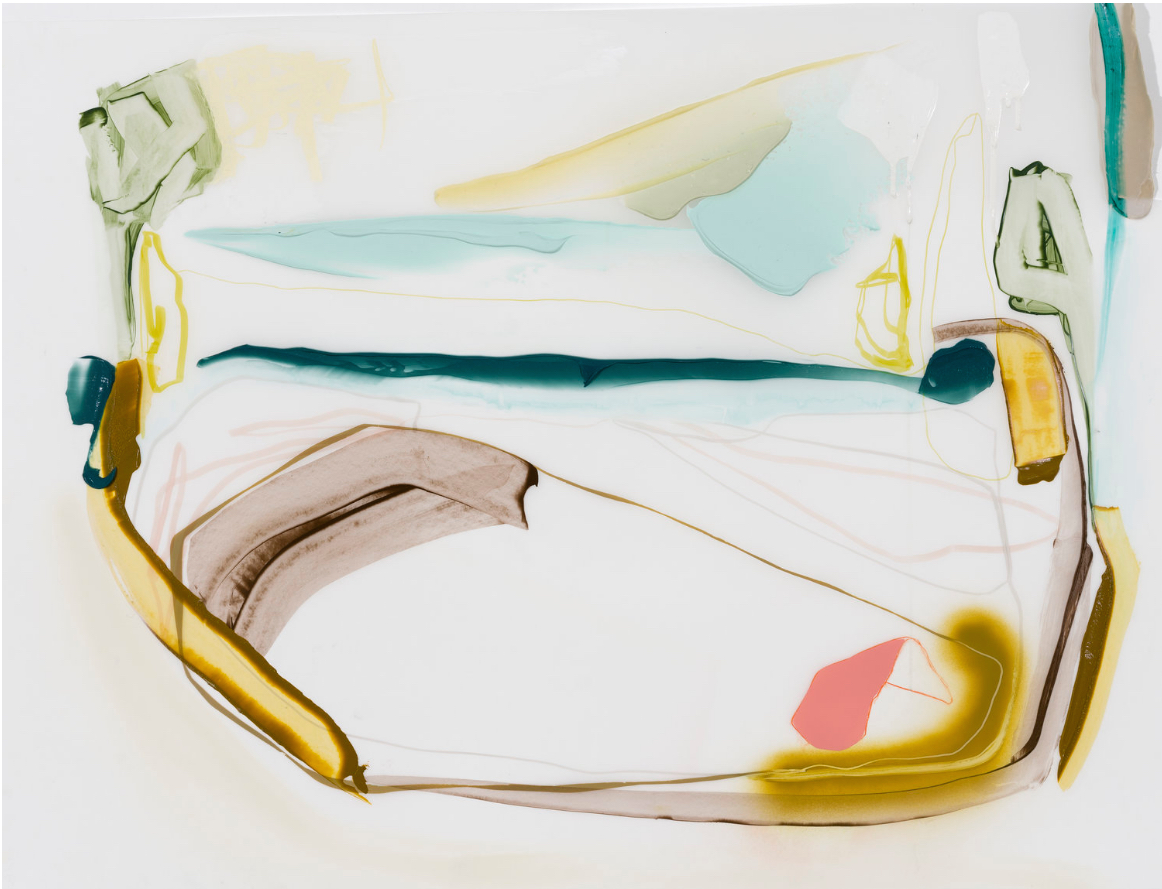
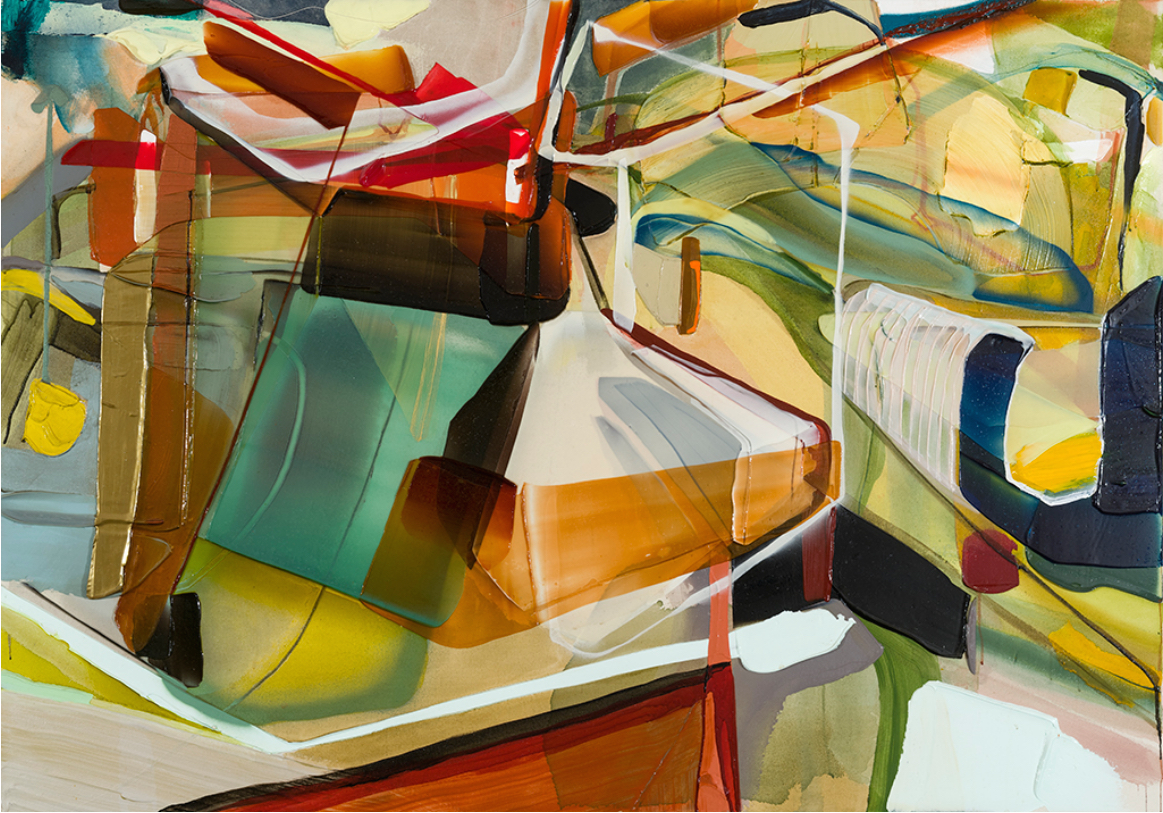
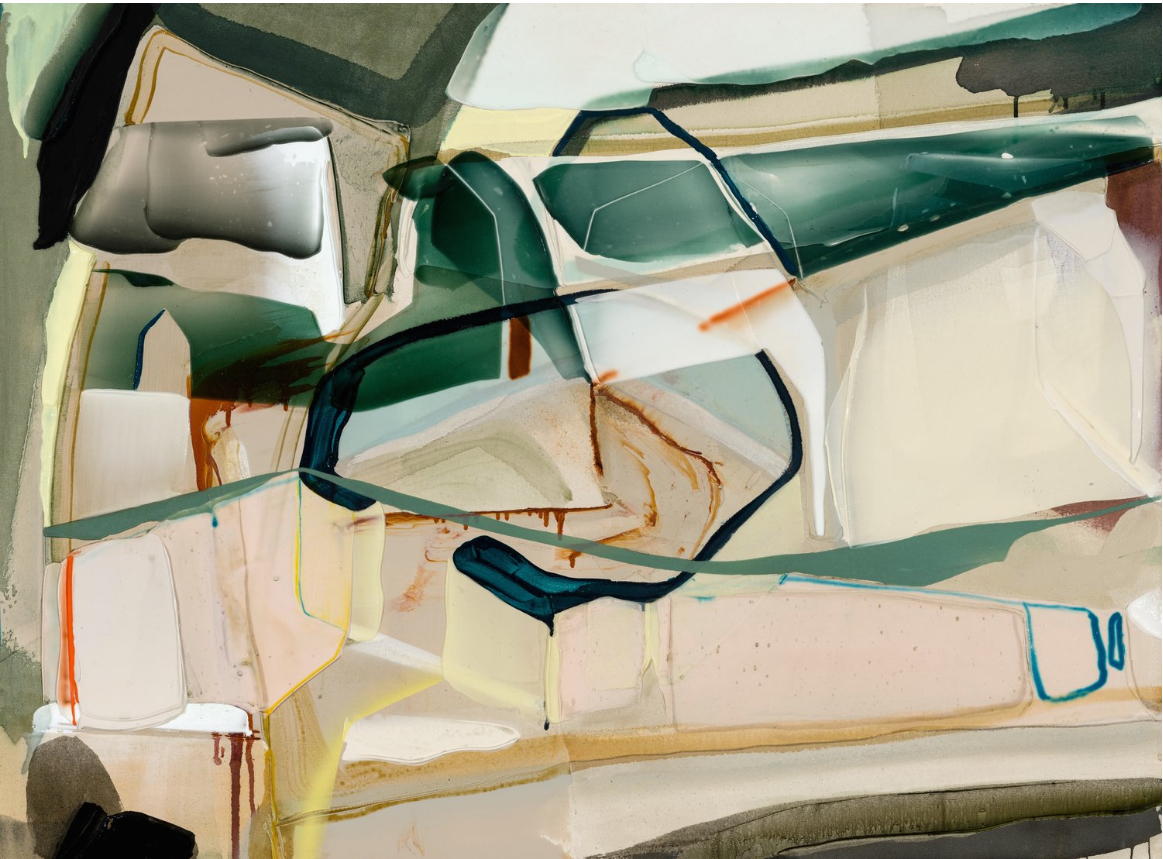
    There is little doubt that Morthens’ works are at an earlier stage in their evolution compared to Rasmussen. There is a rawness to her works. The characteristic feature of her paintings in this show is the translucency of the paint that results from its application on top of a glue-based ground. She first sketches the compositional outline with charcoal and pastel, and then applies oils and occasionally spray paint. She has an eye for composition. Her compositions are somewhat reminiscent of Kandinsky’s with bold arches and judiciously placed flat areas. A good example of this compositional intelligence is found in her Finder.

    Kristín Morthens, Finder, 2019,
    oil, dry pastel, charcoal and acrylic on canvas, 49 x 46 inches

    There is a wonderful playfulness to these works. Her two large paintings in particular seem a little overblown, as if they were straightforward enlargements of smaller works. Her work is refreshingly original. It is exciting to think of what she will produce in the future.

    Kristín Morthens, Vital Burn, 2019, oil, dry pastel, oil stick and acrylic on canvas, 46 x 46 inches

    This is a wonderfully energetic exhibition of the works of two very talented young abstract painters. It bodes well for the future. Long live abstract painting.

    Hugh Alcock

    Images are courtesy of Christopher Cutts Gallery

    *Exhibition information: Introducing Kristín Morthens and Alexander Rasmussen, March 30 – April 27, 2019, Christopher Cutts Gallery, 21 Morrow Ave, Toronto. Gallery hours: Tue – Sat 10 am – 6 pm.

  • Interview with Brandon Steen

    Brandon Steen with gallery owner Elaine Fleck

    Interview with Brandon Steen (BS) by Mikael Sandblom (MS)

    Brandon Steen was interviewed on the occasion of his solo show, Waking Up, at Elaine Fleck Gallery

    MS: I see that your current body of work has been very consistent since late 2016 but it is quite different from what you were doing before. Was there a particular painting that was a breakthrough for you?

    BS: Great question. There is such a painting titled Milk Truck and it isn’t one of mine, it was painted in 1959 by the late great Alex Colville. I have long admired Colville’s art going back to my first introduction to him in my high school art classes and came upon the painting on a visit to the McMichael Gallery in 2015. It resonated so deep within me on that visit that as I walked through the remainder of the gallery and out to my car it was all I could think of.  I had to scratch that itch in me, turn a page on my pop surrealism art and paint realism. Soon after that day I had the great fortune of meeting gallerist and gallery owner Elaine Fleck for the first time by chance and I happily haven’t looked back.

    The Street Cleaner, 2019, acrylic on birch panel,
    60″ x 40″

    MS: You take a great deal of care in painting the architecture of these old buildings. You paint every single brick! The fine detail makes me pay more attention to what otherwise blends into the background of urban life. Could you tell me your thoughts on the buildings you select to paint?

    BS: Thanks for noticing and I am grateful my art has made you more aware of the architecture around the city. Sir Winston Churchill said once “We shape our buildings and afterwards our buildings shape us.” I for one feel quite strongly that our city has a rich and storied architectural lineage, shaped by its buildings that must be preserved. I am documenting them as I create my paintings before they are torn down or facaded without their souls intact.  Perhaps I will become in time historical artist of Toronto’s past.

    Lucy on Portland, 2019, acrylic on birch panel, 36″ x 48″

    MS: What is your painting process? Do you make sketches first? Do you work from photographs?

    BS: My process begins with me sleuthing the cities architecture on the internet, I take notes and screen shot buildings for future reference. Once I decide on a structure I go on location to see if there is a composition to paint. If I am inspired I will arrange to photograph the building usually at sunrise as the streets are clear of pedestrians and vehicles that otherwise would block my view. I return to my studio, download my shoot, select a photo to construct my composition digitally as I work strictly from my photos. From that composition I will transfer it to either a birch or maple panel that is sanded twice and crack on with buttering the paint around into a finished painting.

    MS: The way you paint the sky is very interesting. Could you tell me about your method for this?

    BS: Sure, yes, I get asked about my sky treatment a lot. I want all the focus to be on the structure, stripping out the background focuses the patron onto the building so that is why my paintings have white skies. Except a pure white background is flat and uninteresting to me. I have developed a technique that involves layers of painting under the painting to give texture and depth. I then measure out a grid and paint what I call individual tiles various colours that I hand mix up and then when they are painted I treat the sky with a series of white washes. I paint over the tiles and allow some colour to peak through to give a unique and dynamic layer to my paintings.

    Meet me Under the Clock, 2019, acrylic on birch panel, 40″ x 60″

    MS: Your paintings are devoid of people, but they always contain birds and animals. How do you think these creatures change the meaning of the paintings?

    BS: There are no people in my paintings on purpose, as I want the focus on the strictly on the structure. The birds are there because they represent calmness and I have heard they do to others as well from the patrons’ comments they have shared with me be it in the Elaine Fleck Gallery, online or in person. As for the animals they are in my art because I care about animal conservation, the habitat we influence on them especially here in the city. A noted conservationist, Torontonian named E.T. Seaton asserted “we and the beasts are kin” to which I concur. Perhaps my hope is that when people see the animals they will see them as a conduit of sorts to their own desire to champion an awareness to the animals’ equal right to our city.

    The Queen and the Babe, 2019, acrylic on birch panel, 30″ x 40″

    MS: I see that graffiti is an important component of your paintings. But when I compare your work to the actual sites, I see that you’ve also added your own! Could you tell me about the graffiti that you add?

    BS: Graffiti is here to stay and ubiquitous with downtown architecture it would seem. In some instances, it is there on a particular building or structure and in some cases, it is terrible graffiti, so I create my own. The graffiti I create has meaning because it tells a unique tidbit of the building’s history and in some instances, I might work in the music playing in my studio or iconography that is personal to me. Such as two characters that hit up my art which are a carryover from my career as a pop surrealist, Happy the bull terrier and Abe Weiner.

    The Tank, 2019, acrylic on birch panel, 40″ x 60″

    MS: What’s next for you? Are you planning to continue this series, or will we see a change in your next paintings?

    BS: Oh, that’s a great question. What’s next is a road show of sorts that my gallerist Elaine Fleck is taking me on. She and the gallery will be showcasing my art in a fall show in September at the Evergreen Brick Works. That show is going to be amazing and I have been tirelessly preparing for and I will be so proud to share it with the public. At this point I will say that show will be about five Toronto Saints and lots and lots and lots of painted bricks.

    Mikael Sandblom

    Images are courtesy of Elaine Fleck Gallery

    *Exhibition information: Brandon Steen, Waking Up, Solo Exhibition, April 2019, Elaine Fleck Gallery, 1351 Queen St. West, Toronto. Gallery hours: Wed – Sun,  12 – 5 pm (closed on Easter Sunday)

  • How to Breathe Forever at Onsite Gallery

    How to Breathe Forever at Onsite Gallery is an exhibition that explores the relationship between contemporary environmental issues and their effects on the body. The show is simultaneously a beautiful display of artistic practice and a call to action to preserve the balance between nature and humanity and to establish sustainable ideologies to maintain life.

    The curator Lisa Deanne Smith, in the exhibition catalogue, describes the show as a response to the question, “can we breathe forever?” Through various forms of artistic experimentation she attempts to demonstrate the problems involved and propose some solutions.

    While breathing is a natural phenomenon that is required for most organisms to live, this relationship between the body and the environment is far more complex than the automated process would imply. The quality of the air depends on the plants and phytoplankton. The quality of our land and water depend on the air. Mankind’s violent approach in harnessing those resources, dictated by the ideologies of Late Capitalism, set in motion the demand for constant economic growth at the cost of both natural and human assets. Ecosystems risk collapse, animals try to adapt to new modes of survival in the wake of scarcity and relocation and human labourers are subject to illnesses. The artists address many of these problems that disrupt the chain of events that allow us to continue to breathe.

    Naufus Ramírez-Figueroa’s Concrete Poem Documentation (2011)and Cantos de Pajaros Extintos Previamente Desconocidos Por la Ciencia, Pero Recuperados Por El Espiritismo, 2 (Songs of Extinct Birds Previously Unknown by Science, but Recovered in Spiritualism, 2) (2015) is a series of five digital prints depicting bird-shaped designs of letters and words, accompanied by an audio piece of a person making bird-like sounds on a loop. The work attempts to commune with long lost animals through the performance of seances. The prints act as translations from these performances, depicting the phonetic sounds of extinct species. Through this spiritual method, the artist has attempted to breathe new life into these extinct birds and give them a chance to be heard again.

    Naufus Ramírez-Figueroa’s Concrete Poem Documentation, 2011

    Mary Anne Barkhouse, Treats for Coyotes places sculptures of animals, indigenous to the area and the greater Boreal forests, juxtaposed against European colonial interior décor. The work speaks directly about the influence of colonial settlers on the habitats of Canada. When the settlers took the lands from the Indigenous peoples, they abandoned the forms of land stewardship in favour of the European tradition of domination. The work also addresses how certain creatures have found ways to adapt and thrive in the man-made world. Animals such as the urban coyote, coywolf and raccoons now live and thrive alongside us in cities and towns, having lost or foregone their natural habitats in favour of ours. The work seems to celebrate the resilience of animals to adapt to the unnatural world we have imposed on them, while simultaneously hinting at a darker truth that we have forever altered the ecological path of these species. Whether you see the installation as an idyllic scene from a Disney movie, where animals and people are in perfect harmony or a struggle to heal, there is an undeniable beauty and craftsmanship in Barkhouse’s pieces.

    Mary Anne Barkhouse, Treats for Coyotes

    Elsewhere in the gallery, Barkhouse also exhibits three portraits of wolves in elegant bronze frames. The frames are traditionally used to hold paintings of royalty, a deliberate choice to try to depict the regal quality and status of these wolves. Within the wolf pack hierarchy, these three animals would be considered the king, queen and another sovereign figure.

    Mary Anne Barkhouse, Alpha I, Alpha II and Omega

    Not unlike animals, humans also try to survive in their environments, as we witness in the work, I want to breathe by Li Xinmo in collaboration with Zhange Minjie. A small scale, close-up video portrays a Guangxi gold miner afflicted with silicosis as a result of dust inhalation. The piece is intimate and unsettling, as the figure repeatedly coughs and struggles to breathe for the entire looped duration. The ethical questions raised in the piece refer to issues surrounding both human rights and contamination of the land through mining practices. As technologies advance and demands for natural resources increase, it is easy to ignore the vulnerability of the human body. It is hard not to empathize with the pain the miner is going through, and the inherent desire for the body to keep breathing. 

    I want to breathe, 2008 by Li Xinmo in collaboration with Zhange Minjie.

    The single piece by Flora Wesistche in the gallery is a beaded tapestry of Caribou hide. The work depicts the Indigenous creation story of life spawning from the back of a sea turtle. The story behind the work is one of sustainability. When the artist’s father noticed the decline in caribou populations, he swore he would stop hunting and passed on this last hide to his daughter. The work’s story also involves the power of dreams, where listening and being in tune with the sleeping world can be creative and hopeful.

    Flora Wesistche, My Grandmother’s Garden, 2018

    Two artists, Qavavau Manumie and Ningiukulu Teevee from Cape Dorset, Nunavut showcase their prints and drawings that each incorporate Inuit heritage and spiritual beliefs by depicting folklore and allegorical symbolism. They celebrate the culture of the Inuit people, and present us with an alternative way of life that cherishes the land and water, and believes in sustainability.

    Qavavau Manumie, Breath of Life, 2017 (left) and Song of Abundance, 2018 (right)
    Ningiukulu Teevee. Sea Mistress, 2008 (left) and Sedna’s Wonder, 2009 (right)

    Maryanne Casasanta offers us refuge from our environmental catastrophes through a shift from patriarchal to feminist ideology. The process of capturing the image and the proportions of their contents are more important than the final outcome. The work appears gentle and humble, with no harsh criticisms of the world, but instead reminds us that approaching life with softness and delicacy, can provide solutions to our contemporary problems.

    Maryanne Casasanta, Everything Everyday, 2013 (left) and Our Friend, the Winter Citrus, 2017

    The works by DaveandJenn are the highlight of the exhibition. Their sculptures and installations transport audiences to a fantastical and tropical otherworld of hybrid creatures. They combine the elegance of precious treasures with a parasitic base, creatures that are deformed by the pollution that threatens our seas. These sculptures of imaginary adaptations are aggressive and violent, such as hermit crabs living inside decapitated parrots and sea monsters destroying ships – a real warning to us.

    DaveandJenn, The Wellspring, 2017
    DaveandJenn, The House Guest, 2017

    The gallery is also screening Weak Enough to Hear by Pejvak. The video features six acts showing the landscape of the Euphrates River in Turkey. Various characters including an engineer, an architect, some children, an Islamic leader and smugglers take turns discussing the history of the river from both human and geographic perspectives. Even the ground gives us impressions that help to paint a portrait of the river.

    Weak Enough to Hear A Deluge in Six Acts, 2019 by Pejvak (Rouzbeh Akhbari + Felix Kalmenson)

    How to Breathe Forever at Onsite Gallery is a splendid exhibition that explores important issues surrounding wildlife, pollution and the future of both our health and the planet’s.

    Text and photo: Nathan Flint

    *Exhibition information: January 16 – April 14, 2019, Onsite Gallery, 199 Richmond St. West, Toronto. Gallery hours: Wed 12 – 8 pm, Thurs – Fri 12 – 7 pm, Sat – Sun 12 – 5 pm.

  • Canadian Sculpture Centre Reopening

    The Opening Reception on March 30, 2019

    The coming of spring breathes new life for the Sculptor’s Society of Canada with the reopening of the Canadian Sculpture Centre. Located at 39 Parliament Street within the Distillery District, the new atmosphere provides new opportunities for the members to display their works, with the space itself being considerably larger and brighter than their previous location on Church Street.

    The opening speech (L-R) Richard McNeill,
    Judi Michelle Young and Flavio Belli

    As you enter the space, light floods in from the surrounding array of windows to illuminate the expanse of works. To celebrate, the exhibition features many of the Society’s artists and their latest creations. Rather than being unified with a central guiding theme, the gallery puts its best foot forward with a tonally and aesthetically diverse collection to commemorate the organization members and community supporters that have stood strong with the SSC throughout its long history.

    Members and relatives of the Canadian Sculpture Centre at the opening reception on March 30, 2019

    Beginning as early as 1928, the Centre has seen multiple relocations and conceptualizations in order to face the challenges of the day while also expanding their mandate to nurture contemporary Canadian sculptors in their passion. Now, the new location marks another chapter in that longstanding and fulfilling journey.

    Guest with W. W. Hung, Frontside Rocker (left) and Desmond Scott, Come and Go (right)
    Oliver Tiura, Tempest
    Camie Geary-Martin, Woman Raising hand (left) and
    Karen Stoskopf Harding, Galaxiana (right)
    Marianne Reim, Dac Buch XVIII
    Mac, Remnant (left) and Bastien Martel, Destin Incognito & Cocon (right)

    The array of works itself is absolutely staggering. The artistic roster includes sculptures from many of the Society’s members: Gordon Becker, Andrew Benyei, Andy Berg, John Clinton, Edward Falkenberg, Mary Ellen Farrow, Barbara Fletcher, Cesar Forero, Camie Geary-Martin, Karen Stoskopf Harding, W.W. Hung, Judy Raymer Ivkoff, Elaine Jacques, Saulius Jaskus, Marlene Kawalez, Won Lee, J. Mac, Bastien Martel, Richard McNeill, Lilly Otasevic, David Ruben Piqtoukun, Marianne Reim, Desmond Scott, Peter Shoebridge, Oliver Tiura, Dina Torrans, Angela Verlaeckt Clark, Peter Wirun, and last but not least, Judi Michelle Young. It seemed that every artist from Society rallied to generate a comprehensive experience that was truly unique to the new setting.

    Andrew Benyei, Lady On A Pillow
    Saulius Jaskus, Juan Daydreaming
    Ruben Piqtoukun, Spring Spirits
    Lilly Otasevic, Kaleidoscope
    Richard McNeill, Gazer Sentinel (left) and Peter Shoebridge, Pause & Walk (right)
    Barbara Fletcher, Complimentary Couple (left) and Angela Verlaeckt Clark, Stone Clouds (right)
    Judi Michelle Young, Bowl of Cherries

    The plan for the current space is temporary with the prospect of a few years within this location. In that time, several large-scale exhibitions are anticipated with the ongoing potential for other programming. It will be exciting to see what the new Canadian Sculpture Centre will offer Toronto. Regardless, if this relaunch is any indication – to which it definitely is – then there is certainly more brilliance to come. Congratulations to the SSC!

    Text and photo: Simon Termine

    *Exhibition information: Launch. March 30 – April 28, 2019. Canadian Sculpture Centre, 39 Parliament Street, in the Distillery District. Gallery hours: Mon – Sat: 11am – 6pm; Sun: 12noon – 5pm. 

  • Iris Häussler: Lost Gazes / Daniel Faria Gallery

    Iris Häussler: Lost Gazes: Wax Works From the 1990s

    Humans have always wanted to save their memories. From the beginning of history, they carved them into stones, wrote them on parchments, made millions of photographs or selfies. Iris Häussler buried the items that hold her memories in wax – literally. You might think: a nice try, but it won’t hold, it’ll melt – but you’re wrong. A wax object, like a candle, doesn’t melt that easily, not even on a window sill or on a mantle above a fireplace. Unless you put a torch directly in front of it Häussler’s work would hardly melt or drip, not even the smaller pieces and especially not the larger ones ‑ they’re so heavy that more than one person is needed to move these blocks of solid wax.

    Wax has been used in encaustic painting for a long time but Häussler uses wax in a very unique way. She melts the wax, pours it into containers of various shapes and sizes then put clothes in it like you would put them in warm water to wash them. Her original idea, as she mentioned in an interview, came from looking at laundry, at very ordinary objects such as bed sheets, curtains and clothes we wear. However, these objects, that we usually ignore, have much more to them than we can see at first sight. Bedclothes for example, save your shape and warmth for about half an hour after you abandon them. Undergarments are very intimate as they touch the skin on the surface, but on a deeper level they absorb the perspiration and the scent of the body, getting under the skin as well. Clothes are also personal, their style and colour tell a whole story about the person, their age and social status. Häussler mentioned, that she focuses more on the relationship to the people whose clothes she uses, and not on memories, but of course the two easily overlap each other. Her works are open to multiple interpretations as they are heavily loaded with narratives.

    Installation view of Iris Häussler at Daniel Faria Gallery, 2019

    Iris Häussler, a German born artist who presently lives in Toronto, has had numerous exhibitions worldwide. This is her second show at Daniel Faria Gallery. Upon entering the gallery, we are welcomed by Häussler’s larger pieces. Natural wax has a special colour, the color of candles. Indeed, these works radiate solitude, the silence of candles placed in churches. As the show’s title Lost Gazes suggests, you need to look deeply at them to actually see what lays beneath the surface. Verlorene Blicke (Lost Gazes, 2000) uses a curtain, its texture recognizable if you study them long enough and have a clue what to look for. They reminded me at first of antique friezes that the artist might have studied at the Pergamon Museum in Berlin as they have the same delicate surface pattern of weathered stone. The curved parts of these “friezes” cast an almost white shadow, hardly visible, making them sculptural. Even though they are large, they look very vulnerable in their beauty and that’s the moment when we recognize that they are actually made of wax.

    Verlorene Blicke (Lost Gazes), 2000
    curtain, wax, 31 ½” x 21 ½”

    Most of Häussler’s works are titled after a relative such as mother, sister, great aunt. Two works are titled Schwester (Sister) however they are very different in their colouring and possible narratives. The one in the main space of the gallery is lighter in color and more abstract. Even though we know that clothes are the essence of the image, it looks like a child’s broken kaleidoscope, where all the colorful shapes have escaped and become frozen in wax. The back space of the gallery displays smaller, more intimate pieces dedicated to relatives. They all favour clothes that cover the body and it may be symbolic as the wax is the color of skin. Schwester (Sister, 1998) is so red, that at first sight you can’t see anything else, just that color of blood, reminding you of blood in real life, that you can associate with blood ties. It immediately brought to my mind my “bloody” sister Ilona, her temper, her tantrums, her love, all her wonderful, overwhelming self. Stepping closer and looking harder I discovered pieces of vividly colored, happy patterned, flowery or red dotted girl’s dresses in a carrousel like cavalcade.

    Schwester (Sister), fabric, wax,
    12 ¾” x 10 ¼”
    Schwester (Sister), 1998, fabric, wax,
    12 ¼” x 15 ¾”

    The two pieces dedicated to Mutter (Mother) are very contrasting. One is soft like a watercolor, pinkish and dreamlike, so abstract that we can’t even guess what kind of garment is hidden in the wax. The other is colorful, composed mainly of greens and reds, and has a happy, almost dance-like movement, like playing with a child.

    Mutter (Mother), 1998, fabric, wax,
    12 ¾” x 10 ¼”
    Mutter (Mother), 1998, fabric, wax,
    12 ¼” x 15 ¾”

    Gross-Tante (Great Aunt)’s dress is close to the surface and very recognizable with all the little flower patterns. My grandmother used to wear very similar ones. The clothes mostly disappear into the deepness of the wax, giving the artwork a hazy, mystical look. As Häussler stated, her works are biographies that come to her and build up in her mind. The stories emerge in relationship to the clothes she casts in wax as they disappear and reappear again and again – a fragment of a human life – briefly touching the surface, “emerging and submerging.”

    Gross-tante (Great Aunt), fabric, wax,
    12 ¼” x 15 ¾

    It might sound like an improvised procedure but Häussler plans her pieces painstakingly. From previous experience she calculates how the textile, cotton or synthetic, will interact with the wax and how the colours will blend into it. Then she shapes the clothes, sinking them or trying to keep them closer to the surface – but, of course, there is still a role for happenstance. The final product is seen after three days when the wax has solidified and the pieces turned upside down then released from the boxes in which they were cast. The reveal  holds many surprises. The most prominent of them is how painterly they are. Despite the pieces being very planned in the artist’s mind, there is always a chance through the transitioning period inside the wax that the final piece will turn out differently. Häussler starts with a concept that is mainly sculptural but ends up in the realm of painting, sometimes even in the abstract.

    The central issue in her work is the person, their “fictive legacies” – as Häussler says – and not herself. She interprets her work as conservation, even as a kind of mummification that protects, stopping the movement of life. As she says, “the work I do lays in the field of associations where death is again and again very close.” It can be frightening, leading us into the territory of the unknown, the mysterious. Häussler creates a strange balance in between those worlds when ordinary objects go through a metamorphosis, breaking into pieces as the wax swallows some of their parts but their original substance is still there, buried deeply but still holding their entire essence.

    Emese Krunák-Hajagos

    Images are courtesy of Daniel Faria Gallery – to see their details better please go to the gallery’s website, click on full image and use the magnifying glass: https://danielfariagallery.com/exhibition/iris-haussler-lost-gazes-wax-works-from-the-1990s 

    *Exhibition information: February 13 – April 13. 2019, Daniel Faria Gallery, 188 St. Helen’s Avenue, Toronto. Gallery Hours: Tue – Fri, 11 – 6; Sat, 10 – 6 pm.

  • Patrice Charbonneau at Lonsdale Gallery

    This exhibition is titled In Medias Res, which translates from latin as in the middle of things. As with a novel, therefore, we are encouraged to see Charbonneau’s paintings as part of a narrative not at its inception but already in full swing. As such the viewer is dropped into the middle of the action with no introduction. This also aptly describes the viewer’s experience on first encountering these complex acrylic paintings, with hints of spray paint, on canvas and mylar. At first glance the paintings are difficult to work out. I struggled to see beyond the richly coloured variegated surfaces ranging from patches of stained bare canvas to passages of thick impasto paint. Yes, I thought, they are gorgeous to look at, but how, I asked myself, does one enter these paintings? Slowly it turns out. It takes work, but it is very much worth it.   

    Installation view of Patrice Charbonneau, In Medias Res

    What is immediately clear is that these paintings are depictions of spaces from a personal perspective. There are sketchily drawn architectural elements, pieces of furniture and snatches of landscapes. The sketchiness is best characterised as the economical rendering of space, in the same way as Francis Bacon often rendered space by putting down just a few thin lines of paint over a flat area of colour. Such rendering is on full display in Charbonneau’s study on mylar titled Vertical Stress I, for example. The way he renders space more generally gives his paintings a psychological dimension. They are psychological maps one might say. Places are represented from a multiplicity of angles – in a way that is faithful to his experiences of them over time.   

    Patrice Charbonneau, Vertical Stress I, 2017, acrylic and aerosol on mylar, 70 x 36 inches

    What is the motivation for Charbonneau’s subject matter? He depicts, in his quasi-abstract style, schoolyards, baseball fields (as in his painting Camp de Base), stores and offices. He is influenced by his training and a proclivity to reflect on his own experiences of living in the city of Montreal. He trained as an architect, though from the beginning of his studies he took art classes. The program he was enrolled in was based on the Bauhaus approach, that is, a comprehensive training in the arts and design. While this helps to explain the urban themes in his work it is not the whole story.

    Patrice Charbonneau, Camp de base, 2017, acrylic and aerosol on mylar, 36 x 47 inches

    In addition, Charbonneau cites as a major influence the ideas of the Situationist International. This diverse collecton of politically motivated artists and writers were active mainly in the 1950s and 60s and centred on Paris. The situationists maintained that modern capitalist society aims to substitute genuine human interaction with ersatz social relations that promote uninhibited consumption. Autonomous human action is thus replaced by passive consumption. The urban environment, accordingly, is shaped to facilitate this consumerism. The free spirit – the artist, writer, poet and so on – is urged to resist this encroachment on the possibility of true lived experiences by creating what the situationists called situations. These are spontaneously created events that express freedom of action and genuine social interaction. One type of event or action that the situationists practised, in the urban centre of Paris especially, was to go for extended walks without having any predetermined destination. This process they called dérive. These were acts aimed at taking back control of their city – to redraw its map rather than blindly adhering to the predictable routes laid out by the consumer way of life. The urban environment, therefore, is reimagined as an arena of free play. This is one of the key ideas, I hazard, that guides Charbonneau’s creative acts as a painter. He aims to take possession of his own environment by recreating it in paint. 

    Patrice Charbonneau, Strip-Mall, 2018, acrylic and aerosol on canvas, 47 x 67 inches

    By way of illustration, consider the account he offered me of how he came to produce the pair of paintings titled Silencia I and Silencia II. One day, while staying in Paris, he was watching a television news report about an earthquake in Mexico City. On the screen he saw the scene of a flattened building through which rescue workers were searching for survivors. There appeared on the site at that moment a man who held aloft a hand written sign that read ‘Silencia’. Immediately, Charbonneau observed, the noise around subsided leading to a poignant silence. At this same moment Charbonneau picked up the sounds, outside his own apartment, of children playing in a schoolyard. This spontaneous juxtaposition struck him deeply and inspired the two images of these paintings, namely of a flattened building and of a schoolyard.

    Patrice Charbonneau, Silencia I, diptych, 2018, acrylic and aerosol on canvas, 35 x 47 inches
    Patrice Charbonneau, Silencia II, diptych, 2018, acrylic and aerosol on canvas, 35 x 47 inches

    There is a depth to Charbonneau’s work that is perhaps at first easy to overlook. It is a depth both in the thinking behind it and in the painting techniques he has assiduously developed over many years. But once you have found your way into these paintings you will appreciate just how rich and rewarding they are.

    Hugh Alcock

    Images are courtesy of Lonsdale Gallery

    *Exhibition information: Patrice Charbonneau, In Medias Res, March 23 – April 28, 2019, Lonsdale Gallery, 410 Spadina Rd. Toronto. Gallery hours: Gallery hours: Wed–Sun 11 am – 5 pm.

  • Chantal Akerman at MOCA

    Chantal Akerman’s untimely death in 2015 left a significant void within European arthouse cinema. With a career that spanned nearly five decades, the Belgian auteur’s innovative storytelling acumen and her flair for quotidian and feminist themes have become significant milestones within a particularly patriarchal practice. Most notably, Akerman’s 1975 film Jeanne Dielman, 23 Quai du Commerce, 1080 Bruxelles subverted traditional notions of female domesticity and docility through an intense character study that spans the course of three days. Clocking in at 3 hours and 21 minutes, the film fastidiously illustrates Dielman’s methodical daily routine, which includes caring for her son, all whilst performing her duties as a prostitute to ensure financial stability. However, when the protagonist’s routine becomes significantly compromised through subtle disruptions, Dielman betrays her conventional femininity in favour of satisfying more devious instincts. Since its induction into the illustrious film festival circuit, Jeanne Dielman, and subsequent Akerman titles, have carved a permanent space within academic studies focusing on gender, identity, and human sexuality.

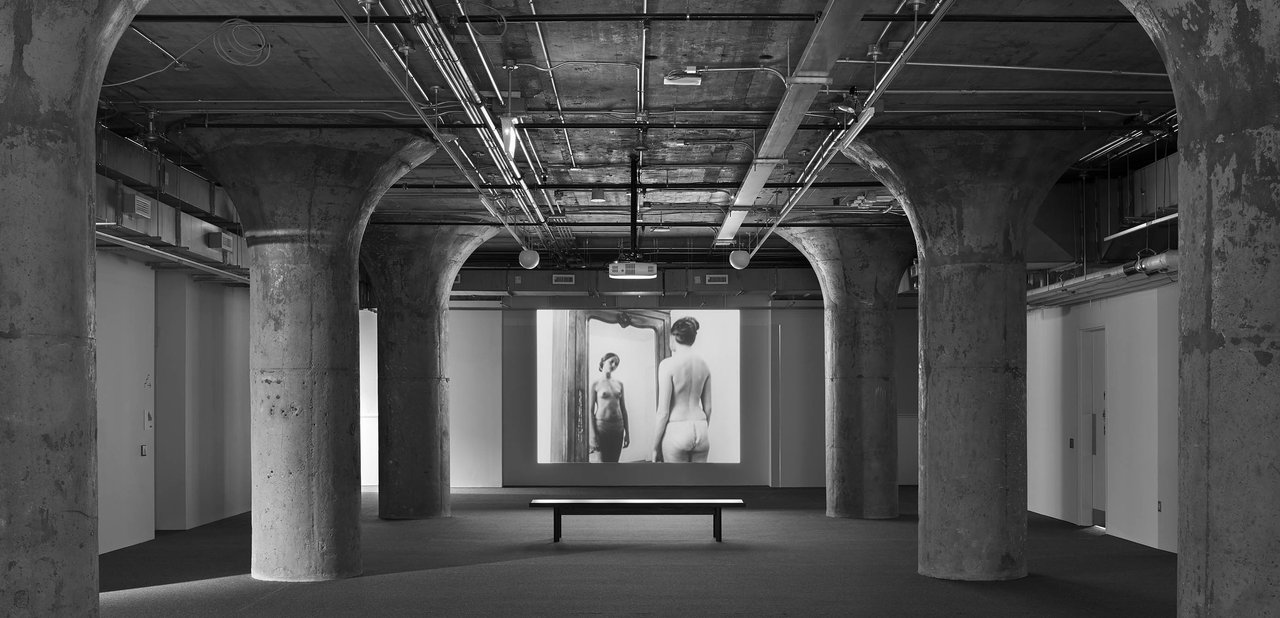
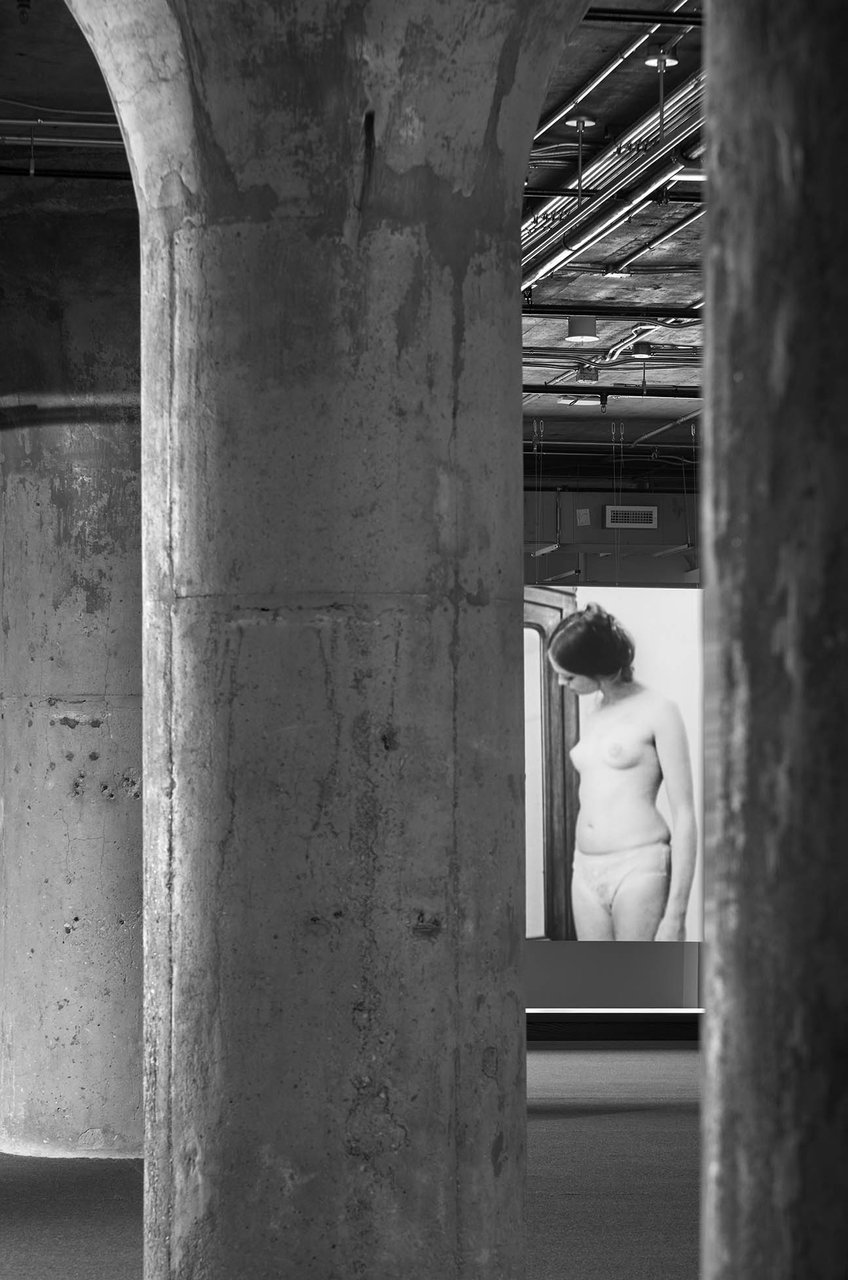
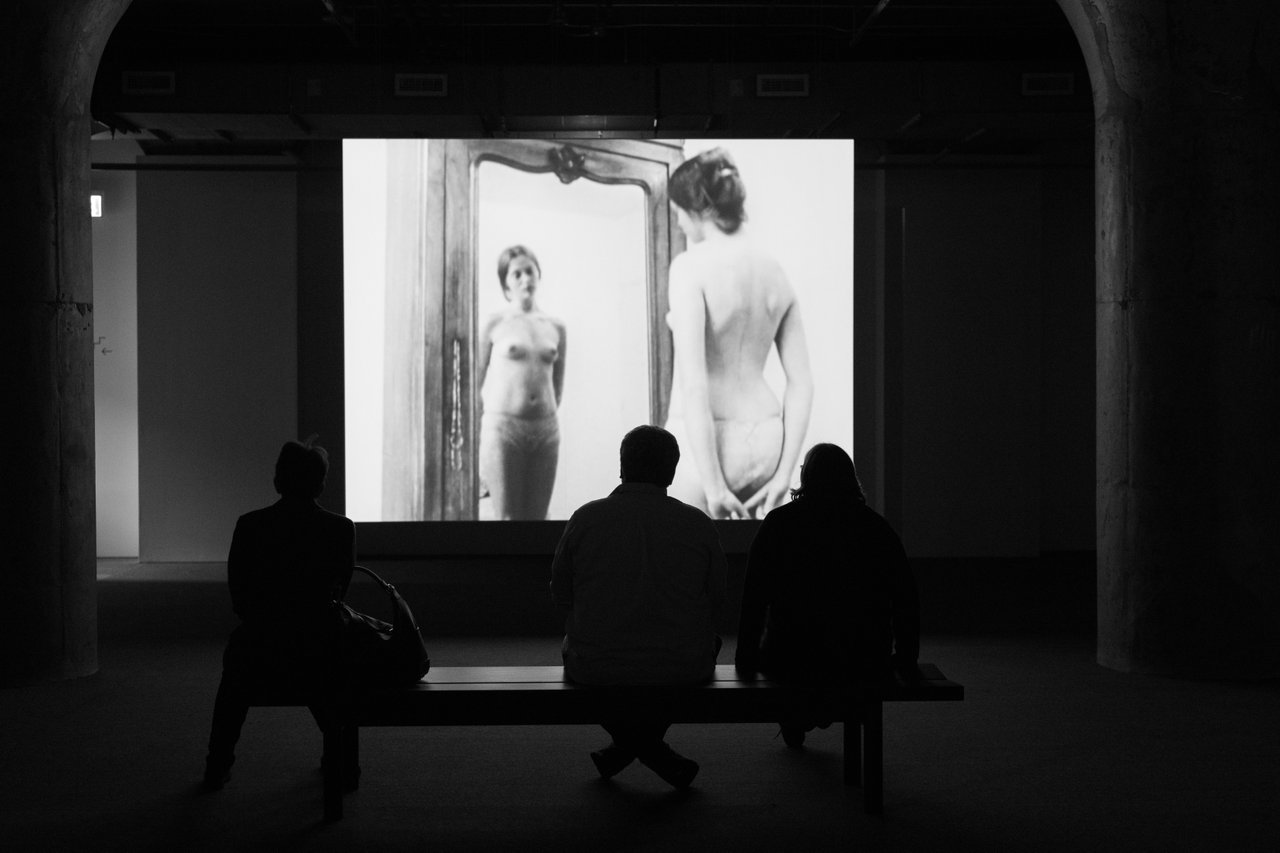
    Chantal Akerman, In the Mirror, 2007, Installation view. Photo: Tom Arban Photography Inc.

    Alongside establishing a disruptive presence within cinema, Akerman also infiltrated the art world through a series of installations beginning in the 1990s. The works were conceived for more standardized gallery and museum spaces, but have only been showcased within the UK scantly, or throughout select expositions. However, a major retrospective put on by London’s Ambika P3 saw curators Michael Maziere and Joanna Hogg closely collaborate with Akerman to translate her work within the confines of a white-cubed institution. Titled NOW, the exhibition premiered weeks after the celebrated filmmaker committed suicide at age 65, and featured a piece originally showcased at the 2015 Venice Biennale. Following this inaugural curatorial effort, which eventually was shown at Marian Goodman Gallery in New York, Akerman’s work has also been showcased at the Fondation Louis Vuitton in Paris and the Jewish Museum.

    Toronto’s newly relocated and revamped Museum of Contemporary Art has similarly staged a space for Akerman’s installation efforts to flourish within a larger context. Featuring the aforementioned NOW, as well as an additional piece In the Mirror (2007), the presentation aims to encompass a myriad of themes present in the filmmaker’s oeuvre.

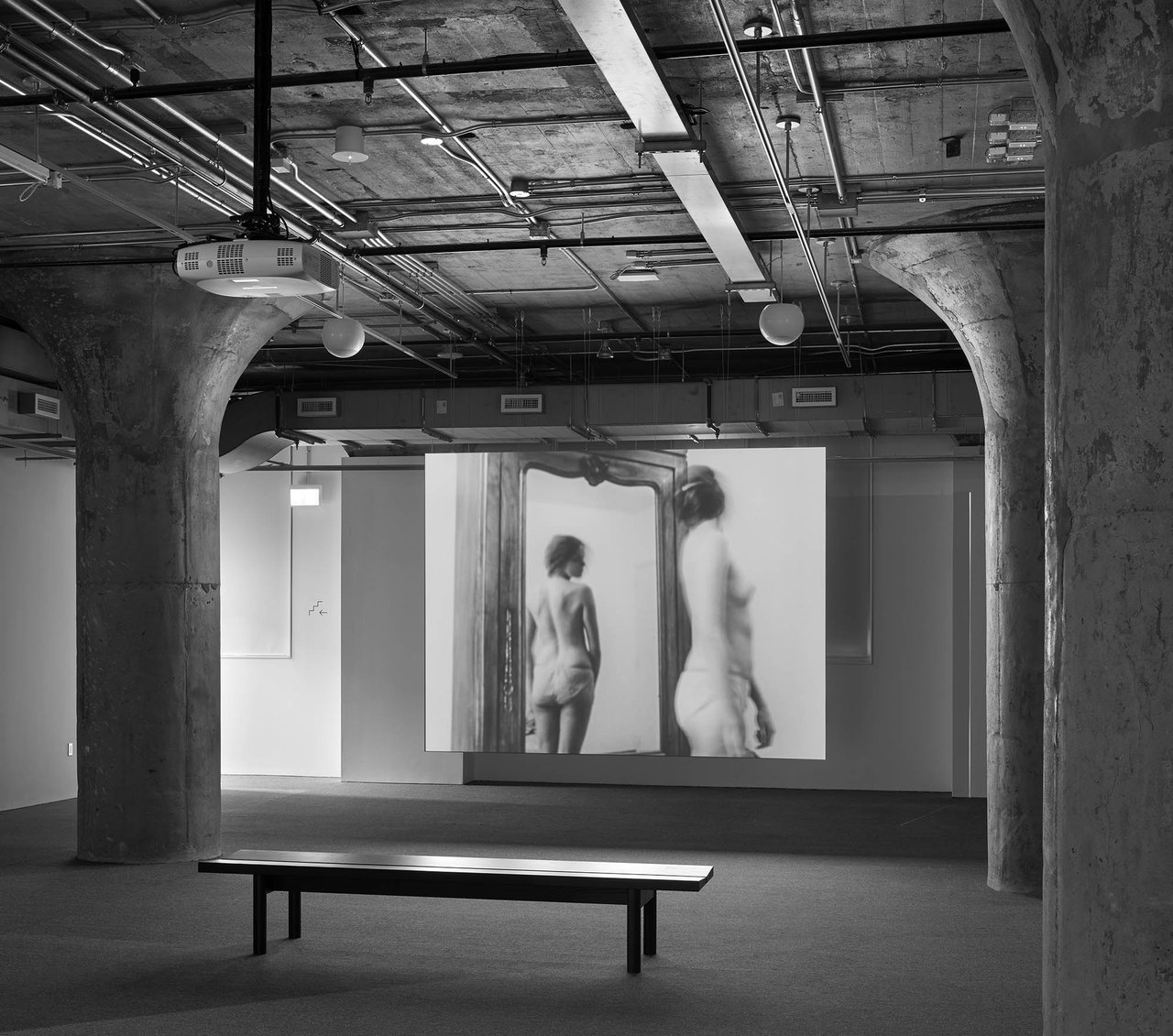
    Chantal Akerman, In the Mirror, 2007. installation view. Photo: Tom Arban Photography Inc.

    Displayed in two separate rooms, visitors are given an ability to confront the work individually. In the Mirror pointedly deals with themes that have persisted throughout Akerman’s career, as the camera depicts a young woman staring at herself in a mirror whilst making observations about her perceived aesthetic flaws. A poorly defined waist, blemishes, awkwardly shaped ears and smaller than average head are all outlined for the viewer. Throughout, the young subject showcases an awareness of gender and beauty norms, which perpetuate and ultimately garble one’s sense of self as a physical entity. The clip candidly mirrors the immense pressure placed on women to appear as idealized and socially-constructed versions of themselves.

    Chantal Akerman, In the Mirror, 2007, installation view. Photo: Tom Arban Photography Inc.
    Chantal Akerman, In the Mirror, 2007, installation view. Photo: Costabile Carpinelli. MOCA Toronto

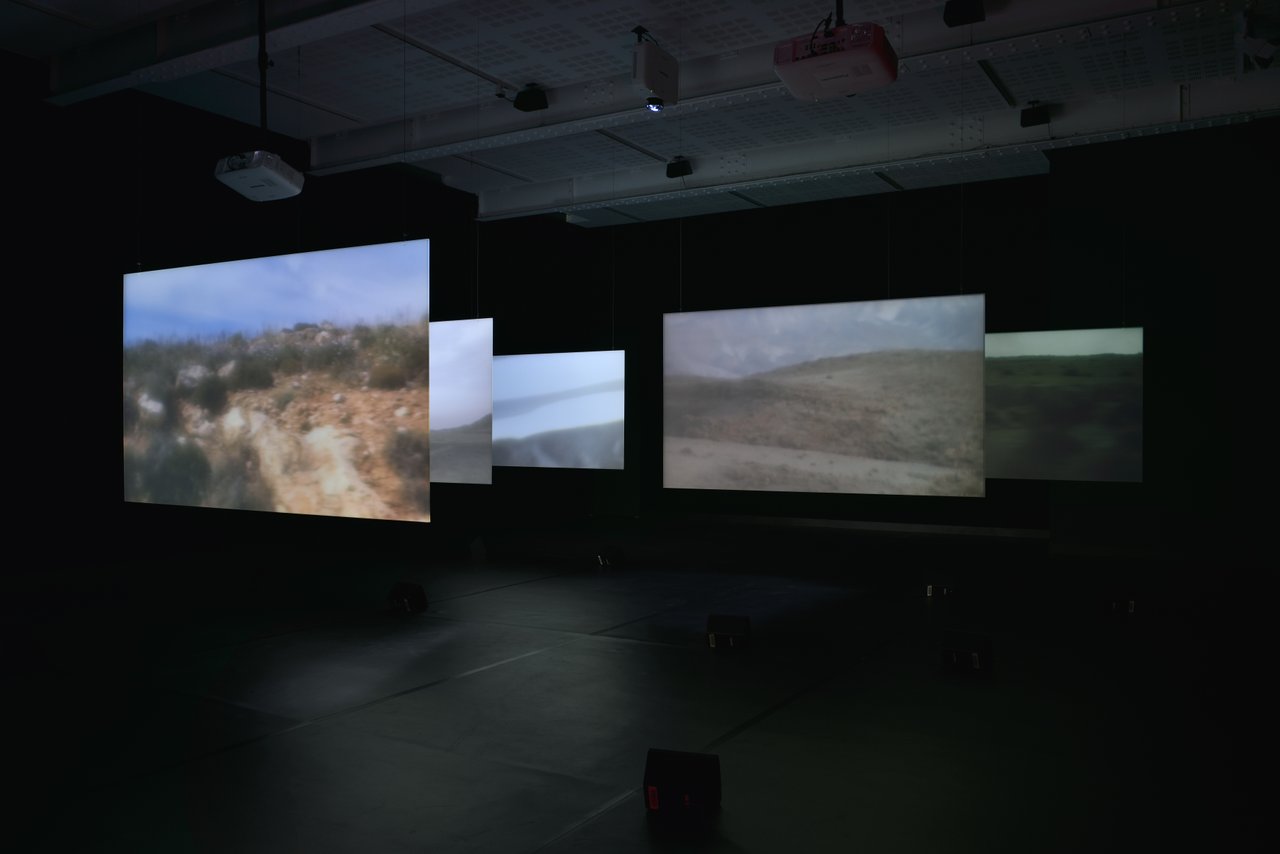
    Upon encountering NOW, a visitor will immediately be drawn towards the immense physicality of the installation. Spread across five screens in a dimly lit room, the videos layer image and sound in an often beguiling manner. Depicting a barren desert landscape and sound tracked by a mélange of juxtaposing sounds, including gunshots, a speeding car, and birds chirping, the piece is more existential in context. Viewers may contemplate the essence of human existence, and our perpetual inclination to resort to violence and other destructive behaviour. A sense of chaos pervades, which is reinforced by the often jittery use of tracking shots.

    NOW, 2015, installation view. Courtesy Chantal Akerman Foundation and Marian Goodman Gallery, New York, Paris, London. Photo: Rebecca Fanuele

    With a forthcoming retrospective to be showcased this fall at the TIFF Cinematheque by Andrea Picard, who lent a helping hand to the MOCA’s exhibition, it is safe to say Akerman mania has infiltrated and proliferated across Toronto.

    David Saric

    *Exhibition information: February 14 – April 14, 2019, Museum of Contemporary Art, 2nd floor, 158 Sterling Road, Toronto. Museum hours: Mon, Wed, Thurs, Sat and Sun 10 am – 5 pm, Fri 10 am – 9 pm, Tue closed.

  • Paul Collins: Marginalia / General Hardware

    Paul Collins’ show at General Hardware Contemporary represents an interesting new direction for the artist. Building on his earlier processes and techniques, he takes the work into fresh territory, offering subtle surprises along the way.

    Installation view of Paul Collins Marginalia. Photo: Mikael Sandblom

    On first impression, these eight paintings seem to be inspired by modernist abstraction. There are geometric connections to cubist works by artists such as Juan Gris. The arrangement of rectangular and curved shapes recalls the compositions of Ben Nicholson. One is tempted to ‘decipher’ the images.  Are there figures in these shapes? Or objects? Typography? The paintings don’t willingly resolve to a depiction of subject matter; they remain abstract, non-representational compositions.

    Untitled (Felix’s Magic Bag), 2019, acrylic on Linen, 39” x 32”.  full image on left, detail on right. Courtesy of General Hardware Contemporary

    On closer inspection, patterns emerge within the fields of colour.  In some areas there are textures reminiscent of wood grain or, as in Untitled (Felix’s Magic Bag) soft lattice patterns. You’re drawn in to examine the materiality of the surface. Close up, you discover that the shapes are made up of fine grids. The hazy, gossamer patterns are the result of stacked grids that create interference, or moiré patterns. It looks almost like fabric, but it’s all paint, applied in a special print-like method developed by the artist.  

    Untitled (Bingo), 2019, acrylic on linen, 39” x 32”.  Full image on left, detail on right. Courtesy of General Hardware Contemporary

    While still up close, there’s another surprise to be discovered. Each painting has a small rubber-stamped image strategically placed on the surface. Had they been larger elements within the compositions, these little cartoons would read as pop-art references, but their small size makes the experience very different. Marginalia, the title of the show, refers to comments or marks made in the margin of a text. Like a margin note, these images have the effect of adding to, as well as disrupting the main narrative of the image. They add humour to the pieces, and they may send you off again, trying to decipher meaning in these enigmatic paintings. 

    Collins’ unique process is a result of continual experimentation.  Throughout his career, his work has spanned media and techniques from photography, printmaking, painting and music. Printing as painting is something that he has investigated before. In the nineties he developed a process of mono-print painting where he would create images with bubble wrap. Popped and un-popped bubbles acted as pixels when run through a printing press.

    A common thread shared with his earlier work is what Collins calls ‘distanced’ painting. The idea is that there is a mediating element between the hand of the artist and the paint on the canvas. The materials that produce the image: the bubble-wrap, the width of masking tape and now the screens, stand between the artist and the image that is generated.

    Six untitled collages, 2017, collage and ink on paper, 12 ” x 9″ each. Photo: Mikael Sandblom

    Collins sees this new body of work as a breakthrough. It started with small collages produced in the summer while away from the studio. Made with a canvas patterned rubber stamp, they combine rectangles of overlapping coloured ink with collaged images from an illustrated book from the 60’s: Atomic Energy by Matthew J. Gaines (1969).

    Searching for a method to scale things up, Collins tried ‘printing’ with various types of rough fabric onto canvas. He eventually settled on fly-screen mesh.  His process involves gently gluing cut-out mesh to the canvas, stenciling paint through it, and then pulling the mesh away. Further research went into determining the timing of the process, the requisite viscosity of the paint and the influence of other factors such as room temperature and humidity.

    Untitled (Un bon fauteuil), 2019, acrylic on linen, 39” x 32”.  Full image on left, detail on right. Courtesy of General Hardware Contemporary

    The process of making each piece involves giving up some control. The artist alternates between making decisions about what to do and reacting to what the paint does. To start a piece, Collins decides on the first shape and paints through it. When he pulls the mesh off, he discovers how the capillary action has moved the paint around. He then arranges the next piece and decides on a colour. If the piece overlaps the first shape, he has some control of the moiré pattern as he rotates the mesh. As the paint penetrates the mesh, random factors determine how dense and opaque the colour is. The result then informs the artist’s next move. Collins keeps going until he determines that the composition is finished. As a last step, the little rubber stamp image is added. The choice of stamp and its placement might be related to visual elements in the painting or to the creative act itself.

    Installation view of Paul Collins, Marginalia.Photo: Mikael Sandblom

    Collins’ Marginalia series is the result of a methodical process that is paradoxically balanced between intent and randomness. He describes his earlier work as having a defined set of steps, whereas of the Marginalia work he says, “for the first time in decades, I don’t know what is happening.” The work is disciplined by the constraints that the artist has put around the process: the consistent canvas size and background, the use of mesh for every shape and single stamped image. Within this system, the artist must react to the image as it evolves. Collins has designed a generative system where the results can not be imagined at the start of the process; where the happy accidents of technique help build the painting.

    Mikael Sandblom

    *Exhibition information: March 2 – 31, 2019, General Hardware Contemporary, Front Gallery, 1520 Queen Street West, Toronto. Gallery hours: Wed – Sat, 12 – 6 pm.

  • Salon 44 / Gallery 44

    Opening Reception: March 8, 6 – 10 pm

    Salon 44 is Gallery 44’s annual fundraising exhibition in support of the gallery’s education and exhibition programs.

    Representing the best in Canadian photography, Salon 44  is a feast of photographs, an incredible collection of over 100 established and emerging artists. With an exciting selection of artwork, affordable editions, and one-of-a-kind photo and lens-based pieces, you can treat your walls to a new artwork. 

    John Faragher, Fall Colours Algonquin Park, 2018, (left) and Janne Reuss, Open Window, 2018 (right)
    Susy Oliveira, Afternoon Light No.14, 2016, (left) & Luther Konadu, Untitled (Portrait), 2018 (right)
    Nam Phi Dang, Somewhere Else, 2015, 2016 (middle)

    Every photograph on display was up for sale and is likely to go fast. The energy in the room at the opening was electric. Images, barring no relation to one another, are arranged in a salon style display. Allot yourself quite some time if dropping in. There is no shortage on what to view. I found myself moving almost in a figure eight through the crowd, heading back to certain areas to look at a piece again and again.

    L-R: Kotama Bouabane, Worker #3, 2018; Shelley Niro, Mr. Ambidextrous, 2017; Morris Lum, PA-1599-114-31, 2018L(top) and Ruth Kaplan, Mineral Pool, Marienbad, Czech Republic, 1994, 2019
    April Hickox, Untitled from Synthesis, 2018, (left) & Camille Rojas, Sothebae’s #9, 2018 (right)
    Nadia Belerique, Web (Candle), 2016 (left) & Alvin Luong, me as a beijing boy, 2018

    Gallery 44’s walls offered an assortment of color, subject matter, hue, composition and general creativity. No one photograph was quite like the other. If in the area during its week you must step in to see what Salon 44 has to offer.

    Right Anique Jordan, Masquerader 1, 2016-2018 (right)
    Joseph Hartman, Sara MacCulloch, 2015
    Daniel Fast, Route 1, Iceland , 2017 (left) & Fred Lum, Pearl, 2018
    L-R: Natta Summerky, The Dance, 2018, (top); Brian St. Denis, Hostellerie du Suroît, 2018, (bottom); Lise Beaudry, Préoccupation no. 1 francophonie, 2019 & Alicia Nauta, Seed Vault, 2018

    The opening reception was bursting with visitors still. The turn up comes as no surprise seeing as the Gallery/Non-profit Centre has been up and running since 1979. It is a staple on Toronto’s art scene for its initiative in the realm of photography.

    Xiaotong Cao

    *Exhibition information: March 8 – 16, 2019,  Gallery 44 | Centre for Contemporary Photography, 401 Richmond Street West, Toronto. Gallery hours: Tue – Sat, 11 – 5 pm.

  • The Collective @ 1313

    An Exhibition by VISA 4090 Visual Arts (BFA) Majors

    This time of the year is abundant with student exhibitions from various art schools. It is a good way to get a reading of what kind of artists and art works will shape the future of the city. This exhibit at Gallery 1313 from York University mixes up painting, sculpture and installation in a busy but fun exhibition.

    Featuring the works of the students in the 4090 painting and installation classes, The Collective focuses on the exploration of contemporary concerns regarding the body, the environment, urbanity, and cross-cultural overlays. A space for experimentation and new discoveries, The Collective invites you to ask critical questions of the art and of yourself and open up to a collection of work that is both completely unique and yet wholly connected.

    Installation view with Where She Is by Kristen Elizabeth Donoghue-Stanford (in front)

    The 4090 painting and installation classes provide a focused practicum for senior students that examines contemporary practices in painting and sculpture. These courses are structured around self-initiated projects under the direction of the instructor. Through the coupling of theoretical and practical explorations, the course facilitates students’ ability to develop their individual projects within the contemporary context of representational and abstract art, popular culture and mass media.

    One of the first installations you see upon entering the gallery is Leather and Hide, a rather innocent looking chair and rug until you realize that the chair is built from sewn together pieces of silicone and the rug is made of human hair.

    Leather and hide by Robyn Burns

    Stephanie Romeo’s Trapped, a 12-foot sculpture of inflatables is hard to miss soaring downwards from the 14-foot ceiling.

    Stephanie Romeo with Trapped

    Esther Kim had a heavy steel sculpture Severed Tongue that protruded into the gallery space, challenging the visitors’ sense of humour. Found objects made up the work titled Digest by Catherine Hois, picturing the rather bloody work of our digestive system, not very appetising but still remarkable in its chaotic way.

    Esther Kim and her sculpture, Severed Tongue
    Catherine Hois, Digest (left) and detail (right)

    Another large work is Affliction by Heather Smith, a large acrylic work on unprimed wood, where part of the wood is charred from burning. Rock Surface Growth by Olivia Williams, a large graphite work on paper, is very appealing with its details.

    Olivia Williams in front of Rock Surface Growth (left) & Heather Smith with Affliction (right)

    Lesel Picou’s painting New Atlantis is an acrylic work on plywood, with the CN Tower is the center, as a vision of the future, under a mass of water surrounded by jellyfish. Like Picou Mollia Weidman takes us into unknown places, real or imagined, creating a dark and thoughtful atmosphere.

    Mollia Weidman with her apintings and Lesel Picou, New Atlantis

    Another impressive painting was Little Reminders by Rebecca Levy, depicting a young woman’s face in a mysterious state, that might be a dream or an ecstasy.

    Rebecca Levy, Little Reminder

    Old Saddar, Karachi, Pakistan, a mostly figurative acrylic composition by Samina Shroff might be a treasured memory of past times from home. The horse is depicted in realistic details, like the most important participant, while the faces of the figures riding the coach become unrecognizable under white patches of paint.

    Samina Shroff in front of Old Saddar, Karachi, Pakistan

    Creation and Desire by Krystle Sukhu with its vibrant colours reminded us of beautiful depictions of goddesses from India, continuing a very rich tradition that seems to survive the passing centuries.

    Krystle Sukhu with Creation and Desire

    With some 36 artists in the exhibit it was hard to navigate at times, as the reception was busy with visitors exploring each new work and chatting with the artists. Faculty members Janet Jones and Michel Daigneault were there to congratulate the students.

    Faculty members Michel Daigneault and Janet Jones

    The evening reception ended slowly as students headed off into the night with some guest to continue their celebration.

    Opening reception

    Ashley Rowe Flick

    Images are courtesy of Gallery 1313 and the artists

    *Exhibition information:  February 28 – March 9, 2019, Gallery 1313, 1313 Queen Street West, Toronto. Gallery hours: Tue – Sun, 1 – 6 pm.  

    **A group exhibition by artists: Afifa Bari, Adriana Monteleone, Amanda Coplen, Catherine Hois, Cassandra Jesik, Dani De Angelis, Daniela Miranda-Fernandez, Elizabeth Downes-Thom, Elisa Iacono, Erica Ed Cinatis, Esther Kim, Felicia Chinwe Anulude, Heather Smith, Hong Gu, Julia Morgan, Kristen Donoghue-Stanford, Krystle Sukhu, Lesel Picou, Maria Calautti, Maria Ness, Melanie Delamorandiere, Mollia Weidman, Nahren Youkhana, Olivia Williams, Rebecca Levy, Robyn Burns, Samina Shroff, Serena Kobayashi-Lebel, Stephanie Romeo, Vaiva Slapsys, Victoria Mihalis & Young Ji Ko.

  • Museum II

    There is a quiet sense of discomfort upon entering Museum II’s Airport and Bedroom at Toronto Media Arts Centre. Novka Ćosović and Andres Bautista invite you into everyday domestic and communal spaces that dramatically altered by war. You are also asked to consider the inter-generational trauma that gets embedded into otherwise banal places.

    The installations are abstract yet eerily provocative and impactful. They provide insights into the experiences immigrant and refugee families have when leaving war-torn countries for the safety of Toronto, or elsewhere in Canada or the world.

    Interior view of Bedroom

    Bedroom is an example of a domestic space transformed, or, as the artists suggest, ‘perverted’ by acts of war. The room design based upon images and videos of war-torn apartments and bedrooms, often with floral patterned wallpaper. That soothing decoration became the backdrop of news and civilian coverage of conflicts, mortar shelling and sniper lookouts – creating a strong contrast between domestic life and history.


    Installation views of Airport and Bedroom at the Toronto Media Arts Centre

    Airport depicts a communal space transformed with little efforts into a house, or perhaps just a hide, for refugee groups stopped and held in transit. The installation is based on images of the corridors and hallways where people with their luggage and worldly belongings live behind bed sheets, separated from other travellers.

    Bedsheets of Airport

    Airport and Bedroom present spaces as dimensions of trauma as well as areas of recovery where individuals and families face the challenges of the aftermath of violence.

    How do you begin to share the complexities of war and traumatic experiences with people who haven’t lived them through? How do you engage those individuals who only know war through a Baudrilliard-like lens of distorted non-reality?

    View of Bedroom

    Airport and Bedroom create “real” places for visitors to sense these emotions and the nuances of war. With these installations the artists start a conversation that needs to be continued.

    The project is personal for Ćosović and Bautista, who are partners of Bau & Ćos Studio. They met as architecture graduate students at the University of Toronto and share common experiences, including childhood ones set against (and within) the violent backdrop(s) of political and military conflicts.

    Installation view of Airport

    Ćosović’s first installation, The Museum, was a must-see, mentioned in top ten lists of Nuit Blanche, 2016. Museum II began to outline when images from the Syrian civil war brought back childhood and ‘screen memories’ (in Freudian terminology) for Ćosović.

    Museum II is a spatial exploration of terror and the tension that follows. In resilient survivors the struggle for peace often becomes a personal journey, a journey that can last for a lifetime.

    Antoinette di Michele

    Sponsored by Ontario Arts Council, Myseum of Toronto, Toja Grids, and Anex Carpentry

    Images are courtesy of the artists

    *Exhibition information: Novka Ćosović and Andres Bautista, Museum II, March 2 – 29, 2019, Toronto Media Arts Centre, 32 Lisgar Street West, Toronto. Gallery hours: Tue – Sat: 10 am – 7pm; Sun: 12 – 5 pm.