Author: artoronto

  • 4-Person exhibition at Canadian Sculpture Centre

    Four members of the Sculptors Society of Canada, Elaine Jaques, Elizabeth Merei, Marianne Reim and Peter Shoebridge show their works at the Canadian Sculpture Centre in June. However, this exhibition is so much more than a group show, as each artist is displaying numerous sculptures from their oeuvre – it’s more like four solo exhibitions that happen to be in the same place. Each artist has a large area and the high ceiling makes it feel even more spacious.

    The four artists (L-R): Elizabeth Merei, Elaine Jaques, Peter Shoebridge and Marianne Reim with her work. Courtesy of Canadian Sculpture Centre

    Entering the gallery from the Distillery District’s busy street, the visitor is greeted by Elizabeth Merei’s beautiful sculptures. In front of the dark background her figures and semi-abstract works come alive. Merei is enchanted by the human form and the emotions hidden inside. Penelope, an alabaster bust, looks a bit like the artist herself, maybe by accident as she never uses models. Merei carves directly into the stone, using its imperfection and variations to strengthen the expression. In Penelope, the face – even the eyes – remain half hidden in the rough block of the stone. Part of the hair, the jaw line with a beautifully carved, sensual mouth and a pretty curving neck emerge from the pink radiance of the stone. Some of Merei’s sculptures are created from white alabaster like the semi-abstract Twins or Song. The lovely singing girl in Song is going through a metamorphosis and becomes music itself as she surrenders her entire being to the melody. Her neck is elongated to give the sound a better way to emerge, her face turned to the sky while she is singing her heart out. The figure is surrounded by the natural stone creating a tension between the smooth surface of the girl and the rough background.

    Elizabeth Merei, Penelope, alabaster

    Elizabeth Merei, Song, Italian alabaster

    Marianne Reim’s steel sculptures take us into the territory of books, enlarged into monumental forms but still filled with words. It seems a rather strange choice of material but as the artist states, “My work attempts to look into the many ways steel and stone can be translated to obtain a more humanistic metamorphosis.” Since 1984 Reim has been working on her Book (DAS BUCH) series that now contains 52 pieces. Like real books, they are bound and contain steel pages that can be turned and read. They are created through a process of cutting, burning and welding the letters onto steel sheets. The content comes from the artist’s historical and cultural background as well as her experiences. Some depict pages from books or were inspired by a visit to the Berlin Wall, while others are diary entries. One of the latest pieces depicts hieroglyphs, commemorating Egyptian texts. Their beauty is highlighted by coloured lights shining through their cut-out shapes – and you can still turn the pages. It is truly mesmerizing looking and reading these “books.”

    Marianne Reim, Tablet, Indiana limestone, steel

    Marianne Reim, XLV, (detail) steel

    Elaine Jaques examines the power of nuanced gestures within the human form. In Focus Point the artist depicts a female figure in a yoga pose. The seated body is perfectly positioned, her face uplifted as she stares into the distance, radiating peacefulness. Angela, another bronze portrait by Jacques, has the same staring eyes but a very different expression. This face is rather unpleasant with a hole in the middle, as the cheeks are missing. The head seems to be covered with a scarf. Her nose is too large, only her mouth and long neck are truly attractive. Still, the fragmentation of the rough surface seems to hide an inner, spiritual beauty. The circular wood panel used as part of the figure’s cloth and the background as well, enhances the mystique of the sculpture. In Venus Rising Jaques mixes wood pieces – in the exact form in which she found them – with bronze, in a way that makes it hard to know what part’s made of bronze or wood as it all seems very natural and not man-made at all.

    Elaine Jaques, Angela, bronze / wood base

    Installation view with Elaine Jaques, Venus Rising, bronze / driftwood base

    Peter Shoebridge’s figurative works are the most eclectic in the show because of their style, technique and material use. His female portraits, Icara Head, Clea, A Model capture the attention not only for what is depicted in the faces but even more for what is missing. They explore a certain kind of semi-abstraction of the human face and even with parts ripped away, they are beautiful, if a bit melancholy. They appear to be in constant communication with one another as each piece seems to float in their own spiritual worlds. Juxtaposing the movements of those portraits, Shoebridge’s other sculptures follow a more classical tradition with a rather steady composition. Shoebridge works with live models and makes sketches, even large sized ones, close to the finished size of the sculptures. Then he transfers the sketch to clay, from which he makes a mold that he retouches to modify the outcome. The mold is then cast in different materials and sometimes sent to the foundry. Many of the portraits in the exhibition were created using this procedure, including the life size Two.

    Installation view with Peter Shoebridge’s scultures Icara Head, Clea, both bronze and A Model, iron tinted cement

    Peter Schoebridge, Two, life-size cement fondue

    Through their sculptures each artist examines the power of nuanced gestures – capturing the human spirit in clay, bronze and stone.

    Victoria Rainoff

    *Exhibition information: June 8 – July 7, 2019, Canadian Sculpture Centre, 39 Parliament Street, in the Distillery District. Gallery hours: Mon – Sat 11 am – 6 pm, Sun 12 – 5 pm. 

  • Thelma Rosner & Kim Stanford at loop

    Showcasing two very different installations, the loop Gallery celebrated the opening of Thelma Rosner’s Recipes from Auschwitz and Kim Stanford’s KimystreeLoves Imaginal on June 1st.

    Thelma Rosner is talking about her work at the Opening Reception

    Creating pieces from a diverse array of found objects, Stanford’s works seek to develop new forms of reality and understanding by melding different textures and materials together. Employing the value of wabi sabi, the artist emphasizes the restored quality of her works rather than hiding its assembly, stating that the repair in itself becomes part of the object’s beauty.

    Artist, Kim Stanford

    Installation view with Kim Stanford’s work

    Installation view with Kim Stanford’s work

    Thelma Rosner emphasizes the significance of one’s journey by bringing one woman’s experiences to life. Inspired by a tiny recipe book that a young Hungarian woman, Elisabeth Raab Yanowski, made during her time as a prisoner of the Nazis. Rosner’s works highlights resilience, hope and survival. The artist asserts that the book in itself was created as a means to deal with starvation and a way of remembering humanity that victims of the Auschwitz have lost, in the face of their tragedy. Emulating pages from a book, Rosner’s pieces seemingly flutter together in one side of the gallery’s wall, creating a sense of whimsicality as ‘pages’ of vegetable representations emerge.

    Artist, Thelma Rosner

    The recipe book of Elisabeth Raab Yanowski from Thelma Rosner’s installation

    Installation view with Thelma Rosner’s work

    The Opening Reception was packed with an audience enthusiastically responding to both installations.

    Text and photo: Maria Mendoza Camba

    Exhibition information: June 1 – 23, 2019, loop Gallery, 1273 Dundas Street West, Toronto. Gallery hours: Wed & Thu, 12 – 5 pm; Fri & Sat, 12 – 6 pm; Sun, 1 – 4 pm.

  • Alex McLeod: Ghost Stories

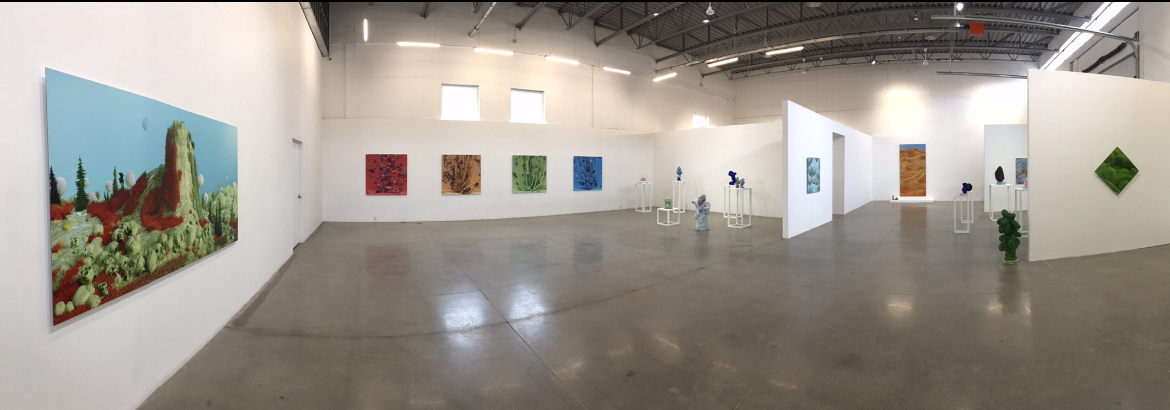
    Ghost stories are often told around a campfire, but for Alex McLeod, they are told basking around the glow of a computer screen. Ghost Stories at Division Gallery is an impressive undertaking that significantly adds to the artist’s body of work, both in terms of new artworks and conceptual underpinnings.

    Installation view of Alex McLeod, Ghost Stories at Division Gallery. Photo: Nathan Flint

    McLeod’s artistic practice has often been associated with post-internet aesthetics and a self-reflexivity of the media he has used to generate his work. Inspired by the fragments, remnants and subtle elements of computer-generated imagery, McLeod explored and celebrated the ephemera that traditional 3D animators and video game designers would overlook.

    In Ghost Stories, McLeod pushes this exploration closer to its logical conclusion; what does the end look like for these digital artifacts? Can data experience death? What are the connections and disconnections between the simulation and what is being simulated? How can we memorialize the code that has been deleted, abandoned or lost? Do pixels believe that we are their divine creators? These are the questions that this exhibition asks its audience to ponder while being captivated by the mesmerizing movement and psychedelic palette of McLeod’s latest body of work.

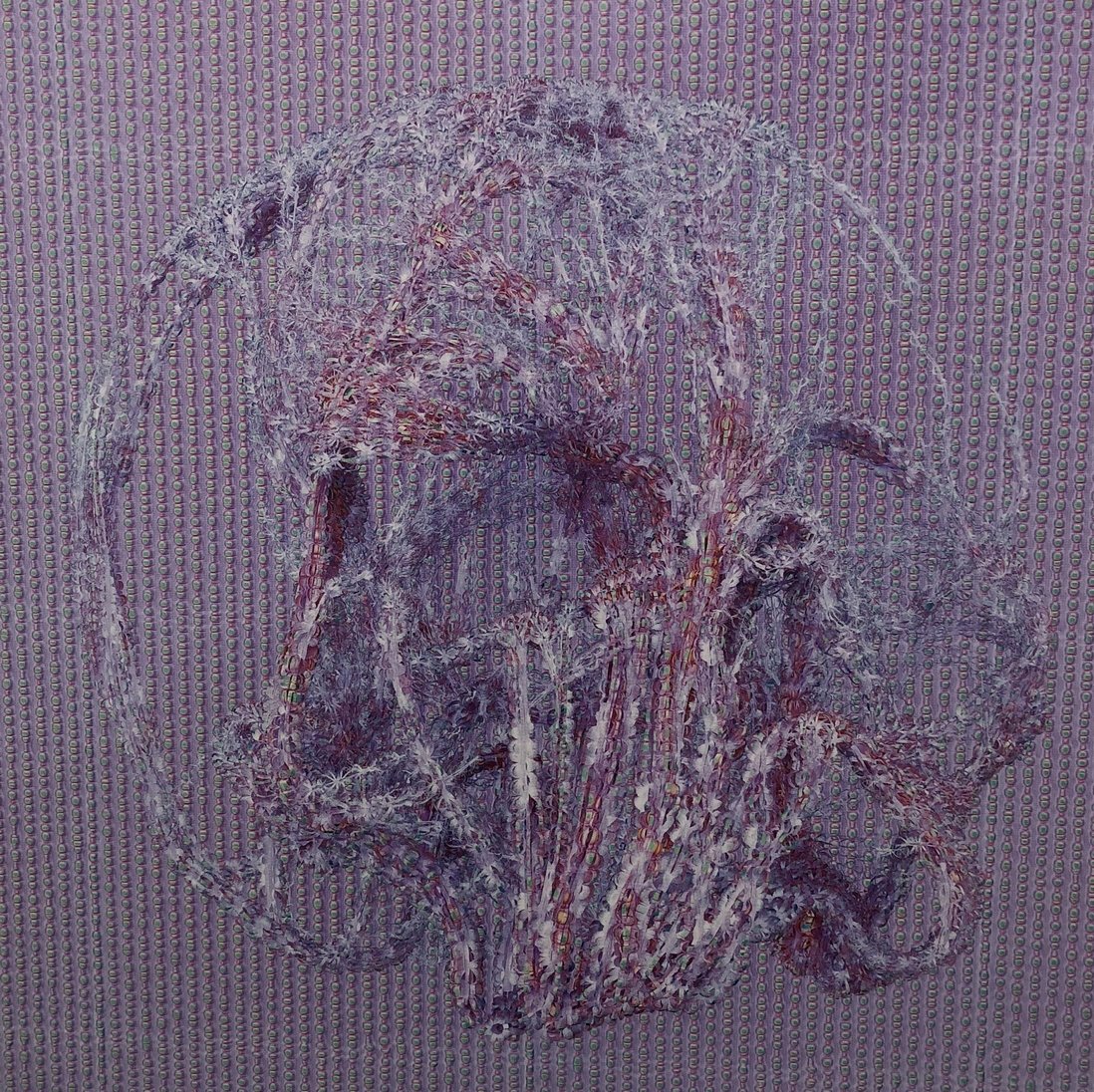
    Alex McLeod, Skull, 2019. Photo: Nathan Flint

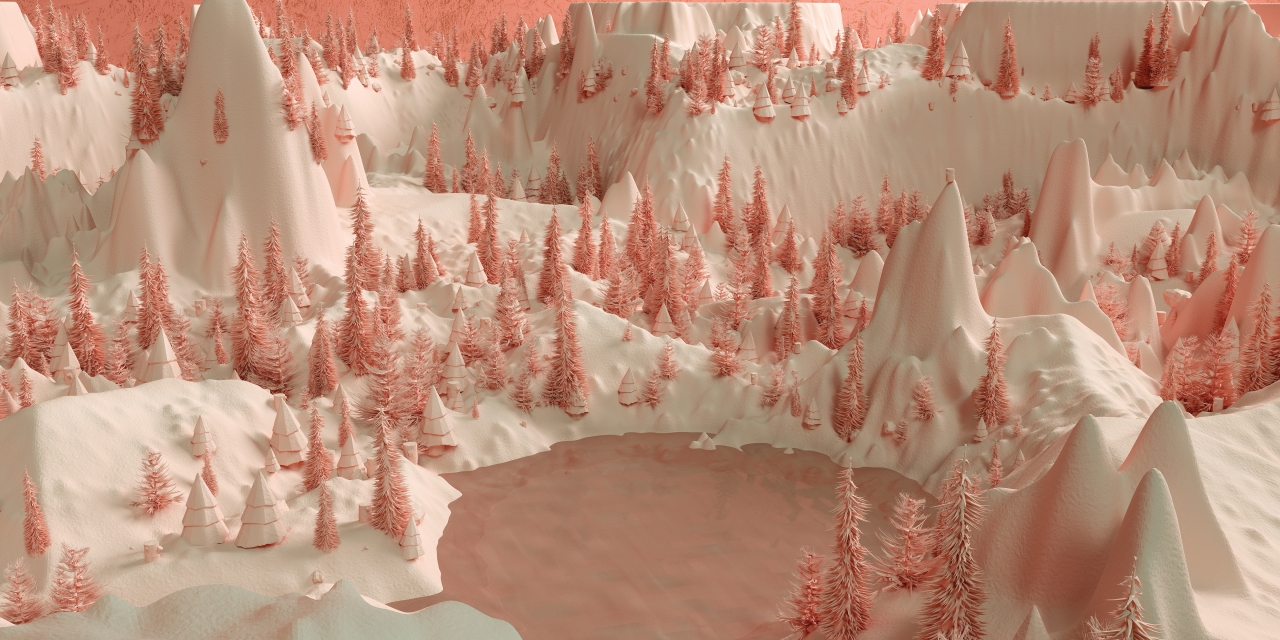
    The first piece that drew my attention in the exhibition was Pinkhills, a large scale C-print of a monochrome pink landscape. The topographical features, such as the hills in the image, are simultaneously too smooth and erratic to feel real, while one of the two forms of trees scattered throughout the image resembles toy-like models, and the remaining trees are generated with naturalistic realism. The variety of styles adds a dimension to the simulation as there are both canny and uncanny elements, which create both tension and a spectrum between reality and virtual. The landscape felt evocative of photographer Richard Mosse’s series Infra from 2011, where the artist took infrared photography of the Congo to draw attention to the conflicts the country has been facing. Similarly, this particular work of McLeod’s felt like an homage to the hidden histories of landscapes, but within a CGI context. This cotton-candy fairyland could have been the site of violence or massacres in a first-person shooter game or could be a remote location in a map that was never explored in a role-playing game.

    Alex McLeod. Pinkhills, 2019. Courtesy of Contact Photography Festival

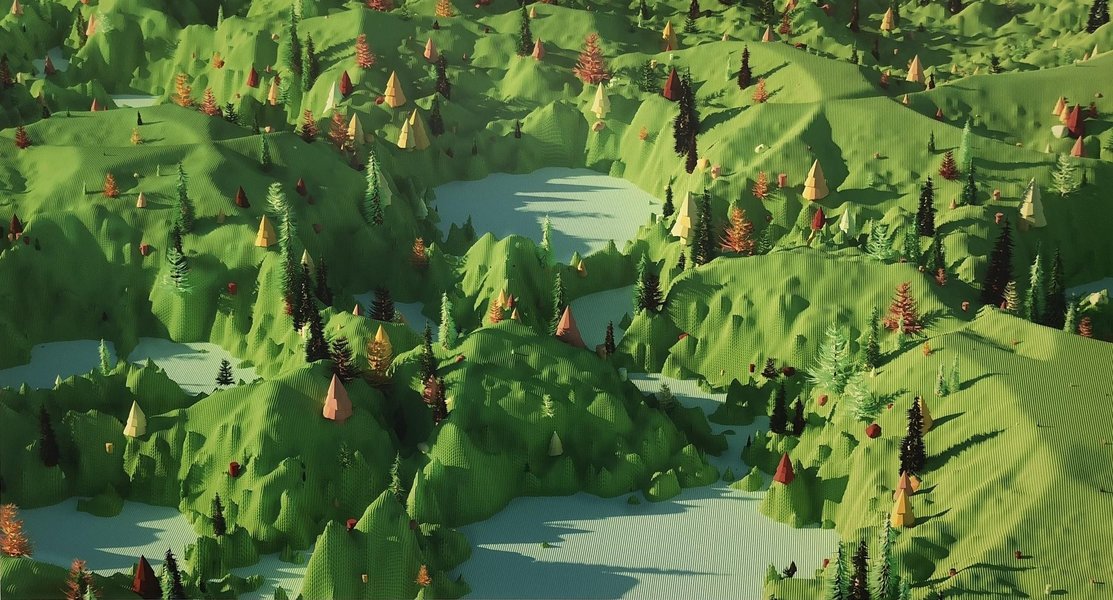
    Another piece titled Green Landscape uses similar aesthetics, contents and perspective, with the notable exception that it contains multiple colours. The vibrant pink, oranges and red pop in contrast against the bright green and blue of the grassy hills and lake. The image is a fun and whimsical fantasy world that feels like a blend between a LEGO playset, the popular video game Minecraft and the set of a Claymation feature film. Each of these large landscapes tap into the sublime feeling of a digital world too vast to comprehend, as well as the nostalgia of an early Millennial’s youth.

    Alex McLeod, Green Landscape, 2019

    All of these images are absent of humans or animals. This choice seems deliberate as if to imply all the users and Non-Player Characters (NPCs) are gone, in a digital post-apocalyptic vision of a virtual world. If people no longer exist in the real world, it seems obvious to assume that the natural environment would thrive, but can the same be said about a digital environment? Might these artificial lifeforms evolve or perish, and what would each of these scenarios look like for them? Digital environmentalism could become part of the critical discourse of the future as the seemingly infinite expanse of the Internet and technology reach finality, making preservation, sustainability and diversify new priorities.

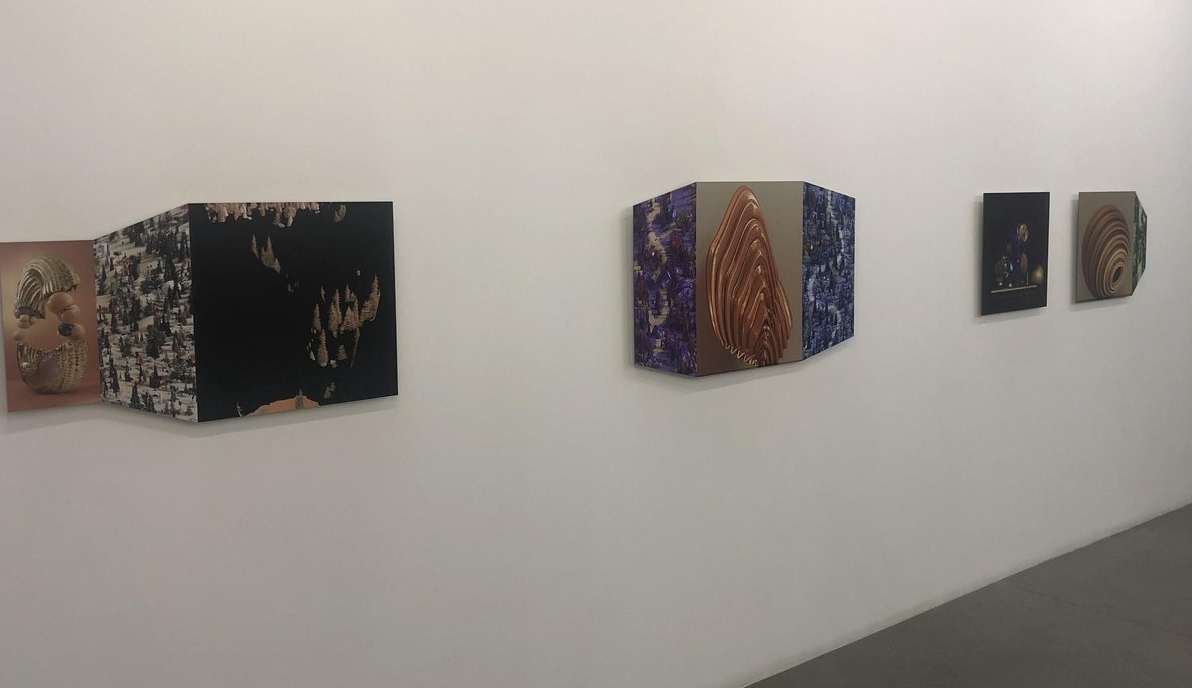
    The next set of works are Illusion #1, #2 and #3. These challenge perspective through their unconventional canvas shape and warping of the image. The close ups of 3D objects are on a flat natural plane, while the expansive landscapes are stretched into rhombuses and quadrilaterals to create the perception of depth from a one-point perspective. The expansive landscapes look miniscule while the 3D objects appear macroscopic. The juxtaposition of size and perspective create an optical illusion that these flat canvases are in fact jutting away from the wall. This optical illusion is self-reflective in the medium being employed since what we refer to as 3D objects in virtual space are just illusions of depth from a 2D screen.

    Installation view with Alex McLeod, Illusion #1, Illusion #2, and Illusion #3, 2019. Photo: Nathan Flint

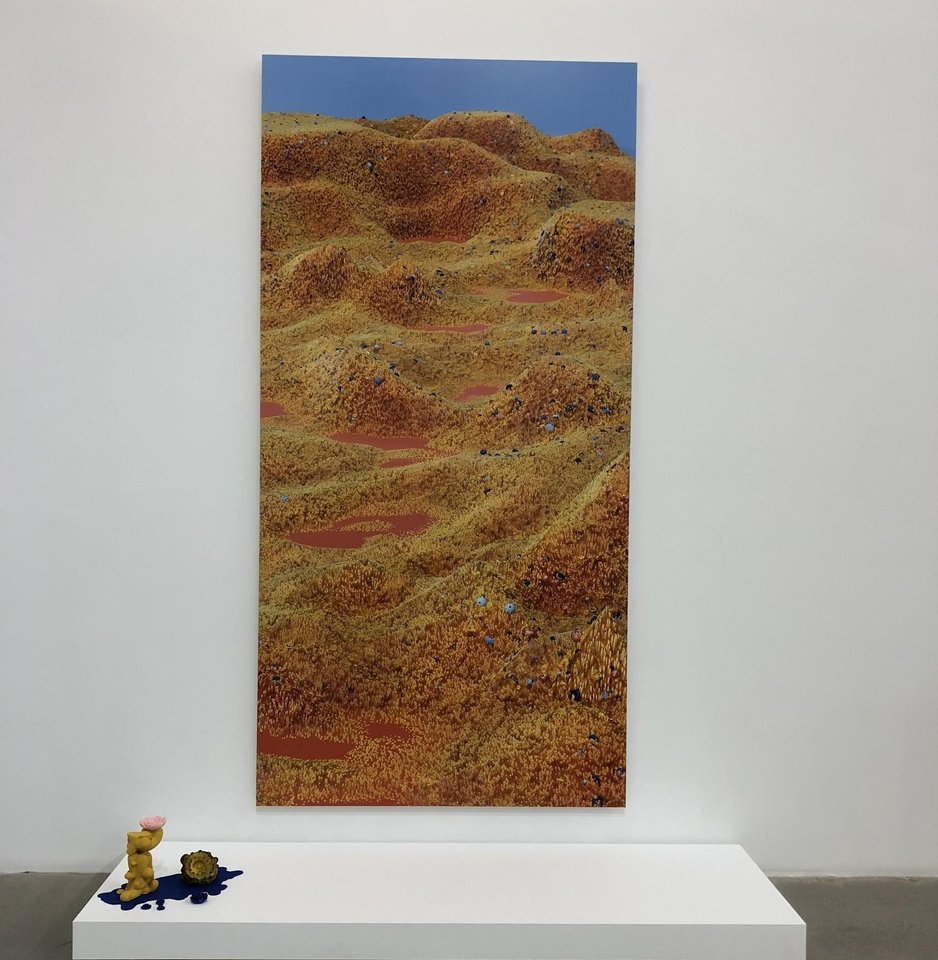
    This notion of the 3D object in virtual and real space, continues in the exhibition, particularly with the work Coral Lands and accompanying sculpture Friends. Coral Lands is a large vertical image that acts as an imaginary window in the gallery looking out onto a vast rendering of orange hills covered in tiny polyps. Just in front of this work, sits Friends, a synthetic sculpture of one of these polyps with a pink flower on top, as well as a round shell-like object, both on top of a flat, blue puddle-like shape. The sculptures in the group in front of the picture provide a translation from the real into the imaginary and simulate the environment of Coral Lands penetrating into the gallery space by Friends.

    Installation view of Alex McLeod, Coral Land and Friends. Photo: Nathan Flint

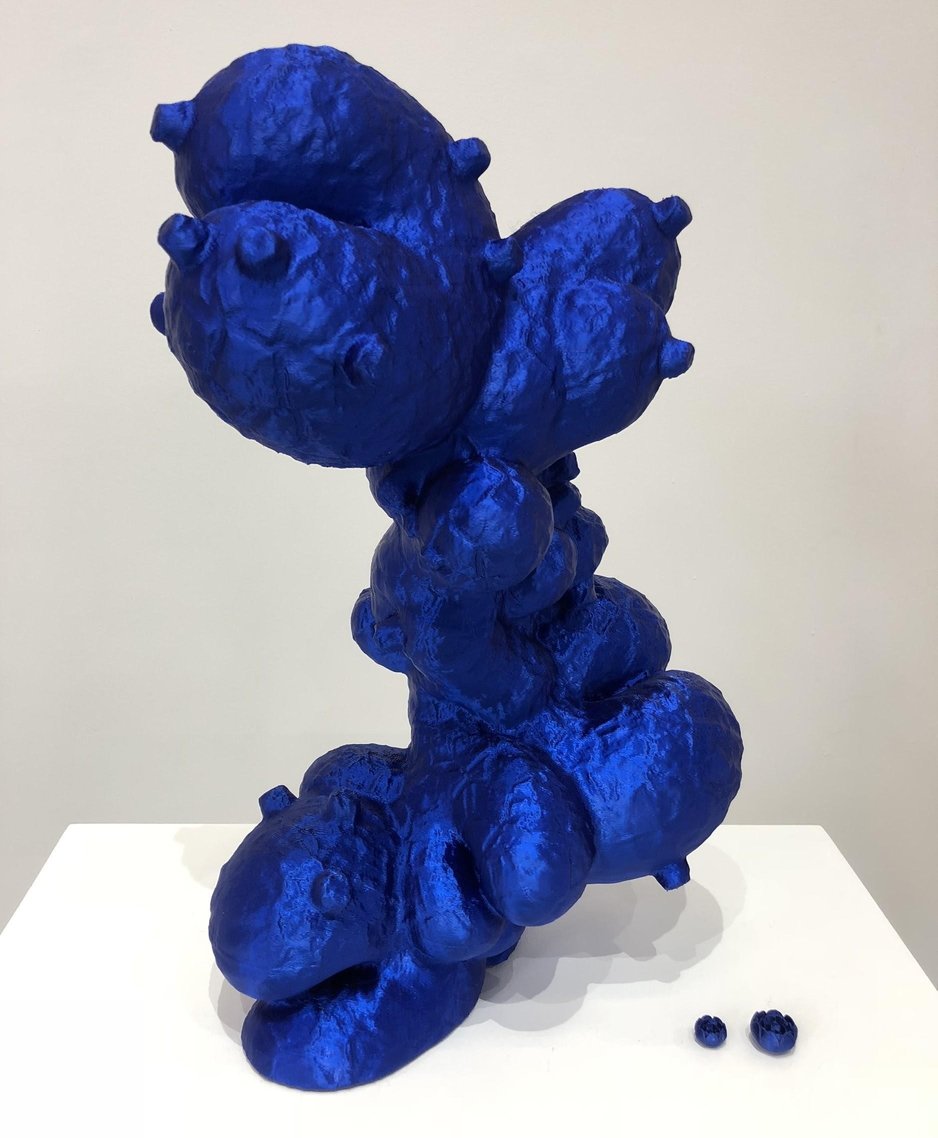
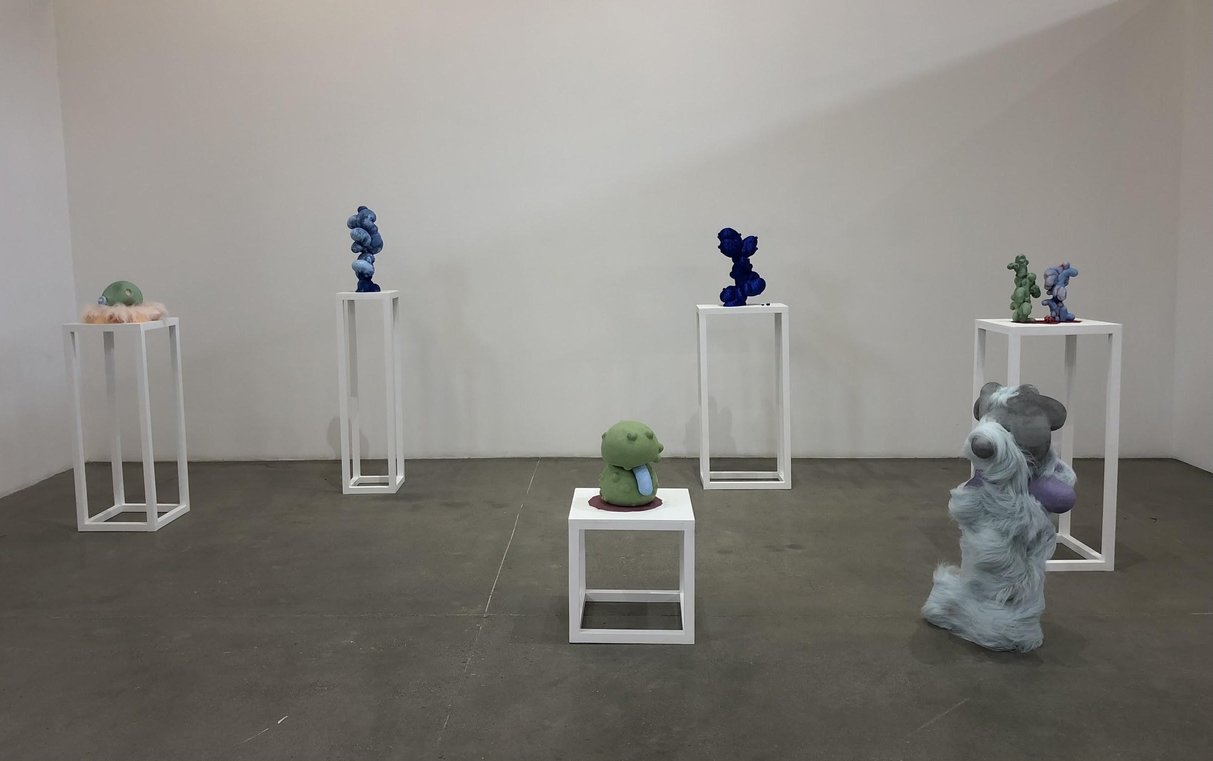
    Elsewhere in the gallery are a collection of sculptures similar to Friends, but individually placed on plinths. Each of these objects have a materiality reminiscent of the common texture settings within 3D modelling software, such as highly reflective or flowing fur. These objects are normal when seen through the mediation of a screen, but to see them in real life gives them a different form of agency where they beg to be touched just to prove that they are real.

    Alex McLeod, Studded Cloudstack, 2019. Photo: Nathan Flint

    Installation view. Photo: Nathan Flint

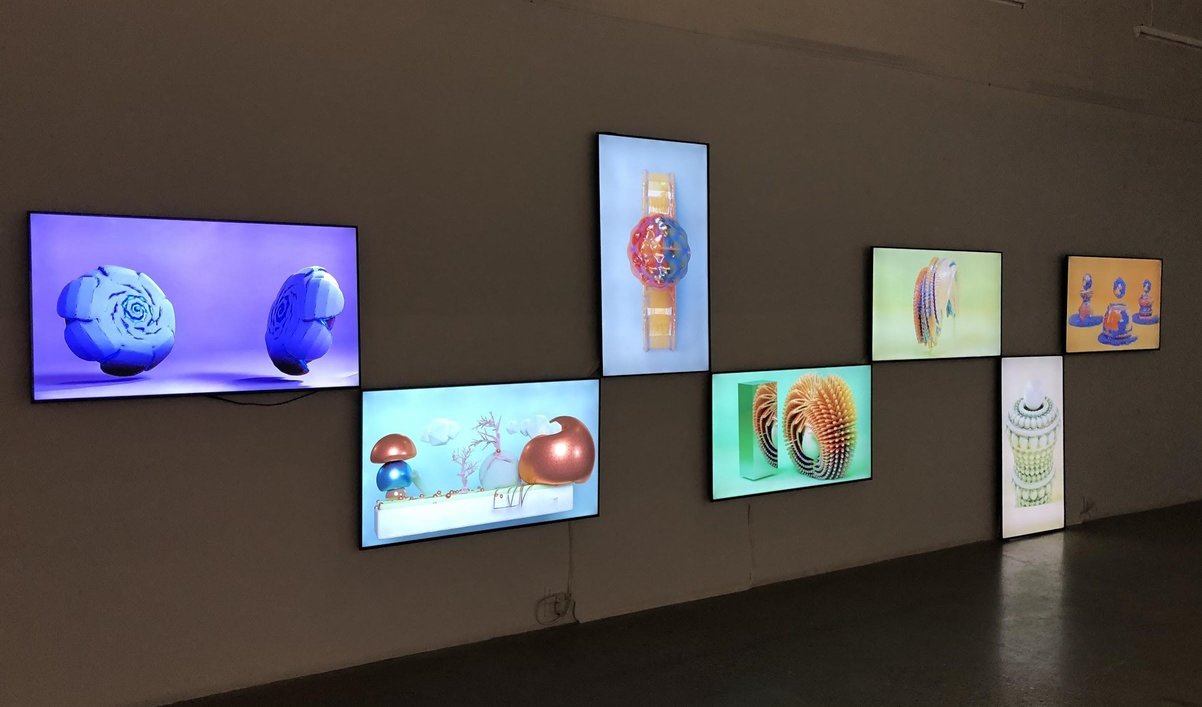
    Last, a collection of video screens adorn the wall in a horizontal pattern of monitors alternating between landscape and portrait orientations. Displayed are short looping videos of computer-generated animations. These animations are seamless loops that ebb and flow infinitely. Some seem to reference organic shapes. Others appear like pottery moving on an invisible lathe or a stroboscopic sculpture with a shape that could be a result of our eye being unable to process the subtle movements fast enough but still producing something solid. There are several references to the Fibonacci sequence throughout the videos, perhaps due to the nature of the hidden mathematics within computer animations. Each video feels as though they began as experiments within the software and then became refined and produced beautiful and satisfying content that hypnotizes with its colour palettes and continuous movement.

    Installation view with video screens. Photo: Nathan Flint

    Within the context of the CONTACT Photography Festival, the show seemed to propose that we as a culture have reached a point of acceptance of the virtual camera rig built into computer software as a fair competitor or rival for the traditional or digital camera that we can hold in our hands.

    Ghost Stories by Alex McLeod is riddled with momenta mori that remind us that while new media technologies may still be in their infancies, we must never forget that everything dies and we hope to learn in time how to prevent it. Visiting this exhibition was like to travelling into an imaginary world filled with bright colours and eerie themes, where the virtual and the real felt as seamless as a looping animated.

    Nathan Flint

    *Exhibition information: April 11 – June 8, 2019, Division Gallery, 45 Ernest Avenue, Toronto. Gallery hours: Tue – Sat, 10 – 6 pm.

    Part of Scotiabank CONTACT Photography Festival

  • Configurations by Mike Hoolboom & Jorge Lozano

    Nestled in 401 Richmond’s mystifying halls is A Space Gallery and their featured exhibition for the Contact Photography Festival: Configurations by Mike Hoolboom and Jorge Lozano, two Canadian pioneers of contemporary photography that have mastered impure cinema. Drawing from the artists’ diverse experiences and idiosyncrasies, this two-person exhibition converges their works to stimulate discussion on the unique, thought-provoking juxtapositions between their themes. The works explore many socio-cultural and technological developments, most prominently the pervasive and problematic hegemony of medical science in society.

    Mike Hoolboom, Aftermath. Photo: Simon Termine

    The passion that Hoolbloom and Lozano demonstrate is wholly evident, given the sheer quantity and thematic depth of their works. Visitors are constantly flanked by different films that, while fully functioning independently, complement and embolden each other. Antiquated moving images, current news clips, social media, sampled movie scenes, candid films, abstract animations, and medical advertisements are all collaged into each piece. This becomes even more diverse with the various editing strategies and videographic effects that construct those collages, including superimpositions, deteriorated film, and audio looping. The variety is comprehensive – almost overwhelmingly so – yet it is appropriate in order to sufficiently convey the complex message.

    Jorge Lozano, Mode of Production, 2009, film still. Courtesy of the artists

    Medical science and human anatomy comprised are among the main focal points of the artists’ works. More specifically, it is how those elements influence and are influenced by the political. Hoolbloom’s Scrapbook, for instance, delves into pharmacopornography (coined by Paul B. Precaido in his book, Testo Junkie) and how medicine has been economically and socially fetishized for the purpose of regulating bodies. Healing practice has increasingly shifted towards a practice of biological enhancement and control, with unforeseen, or possibly neglected and ignored, consequences. Scrapbook portrays this concept by weaving a pharmacological, erotic, and abstract video into an eerie critique of society and lingering sources of marginalization.

    Installation view with Mike Hoolboom, Scrapbook. Photo: Simon Termine

    Another facet that the artists explore is the notion of public violence, often drawing from their personal experiences for deeper resonance. Lozano presents here a host of works that delve into violence pervading in his hometown of Cali, Columbia, expertly employing documentary and news clips that offer a multi-faceted perspective on those circumstances. Bold and insightful, his aim for the audience is to empathize and educate.

    Installation view with Jorge Lozano Thoughts from below. Photo: Simon Termine

    While Hoolbloom and Lozano approach different issues, it is wholly apparent how their works are in constant discourse with one another and, consequently, why they are interdependent as much as they are. Just as with the issues they explore, there is an inherent complexity to their films that requires patience and contemplation, yet it effectively presents a forum for the discussions that must be had.

    Simon Termine

    *Exhibition information: May 3 – June 29, 2019, A Space Gallery, 401 Richmond Street West, #110, Toronto. Gallery hours: Tue – Fri, 11 am – 5 pm, Sat, 12 – 5 pm.
    Part of Scotiabank CONTACT Photography Festival

  • Naomi Harris: Hollywood Furever

    Animal photography has grown substantially in popularity in recent years with the rise of social media and the subsuming of pets into twenty first century’s influencer/celebrity culture. Though there is an abundance of depictions of animals in art history, within the past several decades, the concept of the “pet” as subject has become a cultural phenomenon that requires new critical considerations.

    Hollywood Furever by Naomi Harris is part of the Contact Photography Festival showing at Stackt Market. Within this exhibition and programming series, Harris has appropriated the stylistic techniques of famous classical Hollywood photographer George Hurrell and applied them to our domesticated animal friends in order to capture them as celebrities.

    Naomi Harris, Weston and Fira, 2018

    The exhibition features large scale vinyl installations on the walls, a series of pet portraits. The photos are characterized by soft focus, warm lighting, a vignette border and glamourous, thespian decor. The models for these portraits are the famous pets that the artist followed on social media, such as Popeye the Foodie Dog (366K followers), Weston and Fira the French Bulldogs (135K followers) and Shrampton the Scottish Fold Cat (52.1K followers). The images attempt to illustrate their distinguished status through the traditional photography style suited for Hollywood stars in the 1930s.

    Naomi Harris, Popeye, 2018

    A dominant aspect of this exhibition is the affiliated programming of Harris’ portrait studio for local dogs. Several days throughout the show, dog owners were able to sign up for a free photography session for their pets. The process was easy and Harris and her assistant worked well with the animals to coerce the pets into modelling for the camera.

    Through the history of pets within the modelling and fashion world, the animals have traditionally been used as an accessory to their human counterparts. Walter Benjamin in The Arcade Project references the flaneur and the spectacle, as well as how exotic or lavish animals, such as turtles or particular breeds of dogs, were a way to co-opt the gaze of viewers within an urban landscape, while simultaneously expressing detachment and alienation from the modern city.

    This concept has evolved in the last century to recently, according to theorist Heidi J. Nast, to pathologize people without animal companions, or who express anything less than enthusiasm and love for pets, particularly dogs. This can be reflected in the contemporary concept of emotional support animals, who fulfill people with a need for attachment in a world that is riddled with alienation. The blank canvas of a dependent animal allows us to project or anthropomorphize these creatures to suit our own internal needs, such as purpose, love and companionship.

    Naomi Harris, Bo, 2018

    The anthropomorphizing of animals is also a historically significant theme in art history. The evolution from gods and monsters to tools and friends has taken many different forms over time. Currently we seem to have begun a shift from animals as subject towards an animal-oriented focus where the pet is seen as ethically superior to man and in some cases a form of identity for some subcultures.

    Another significant concept within Harris’ work is the fact that these animals were discovered and connections were made through social media. For the vast majority of these pets’ followers these animals are mediated entirely through technology. This cybernetic gaze on animals has become as dominant as the routine of vicariously living through the rich and famous, but offers us a reprieve from the sullied drama that pervades celebrity culture. This voyeurism towards animals is a way to achieve some of the joy of having a pet without the responsibility, financial costs, time or physical space needed to take care of them.

    The fact that the most famous pets on social media are typically the clearest examples of artificial selection in breeding practices, such as French Bulldogs and Scottish Fold cats, is not insignificant. These animals were bred for their mutations and now their unnatural characteristics grant them significant agency over how we view them. We sublimate our pathos or ‘cute aggression’, emphasizing how we have rendered these creatures incapable of survival without us and thus maximizing how much they need us.

    Naomi Harris, Shrampton, 2018

    Harris’ work is a reflection of sociocultural trends. Retrieving the elevated status of the classical Hollywood actors and applying them to pets reveals how the modern person has begun to view our companion species. Beyond the complicated philosophical underpinnings, the works in Hollywood Furever are funny, campy and beautiful. As animal lovers, we rejoice in seeing our pets having a chance to play dress-up and look their best!

    Nathan Flint

    Images are courtesy of the artist and Contact Photography Festival

    *Exhibition information: May 12 – 26, 2019, Stackt Market, 28 Bathurst St, Toronto. Hours: Mon–Sat 11 am – 7 pm, Sun 11 am – 6 pm.

    Part of Scotiabank Contact Photography Festival

  • Interview with Pengkuei “Ben” Huang

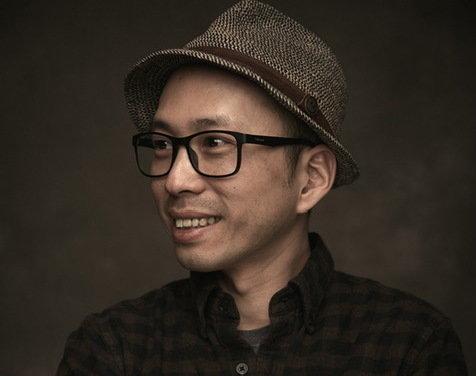
    Pengkuei “Ben” Huang. Photo: Matz Rios

    Interview with Pengkuei “Ben” Huang (BH) by Maria Mendoza Camba (MMC) in the occasion of his solo show at Urban Gallery

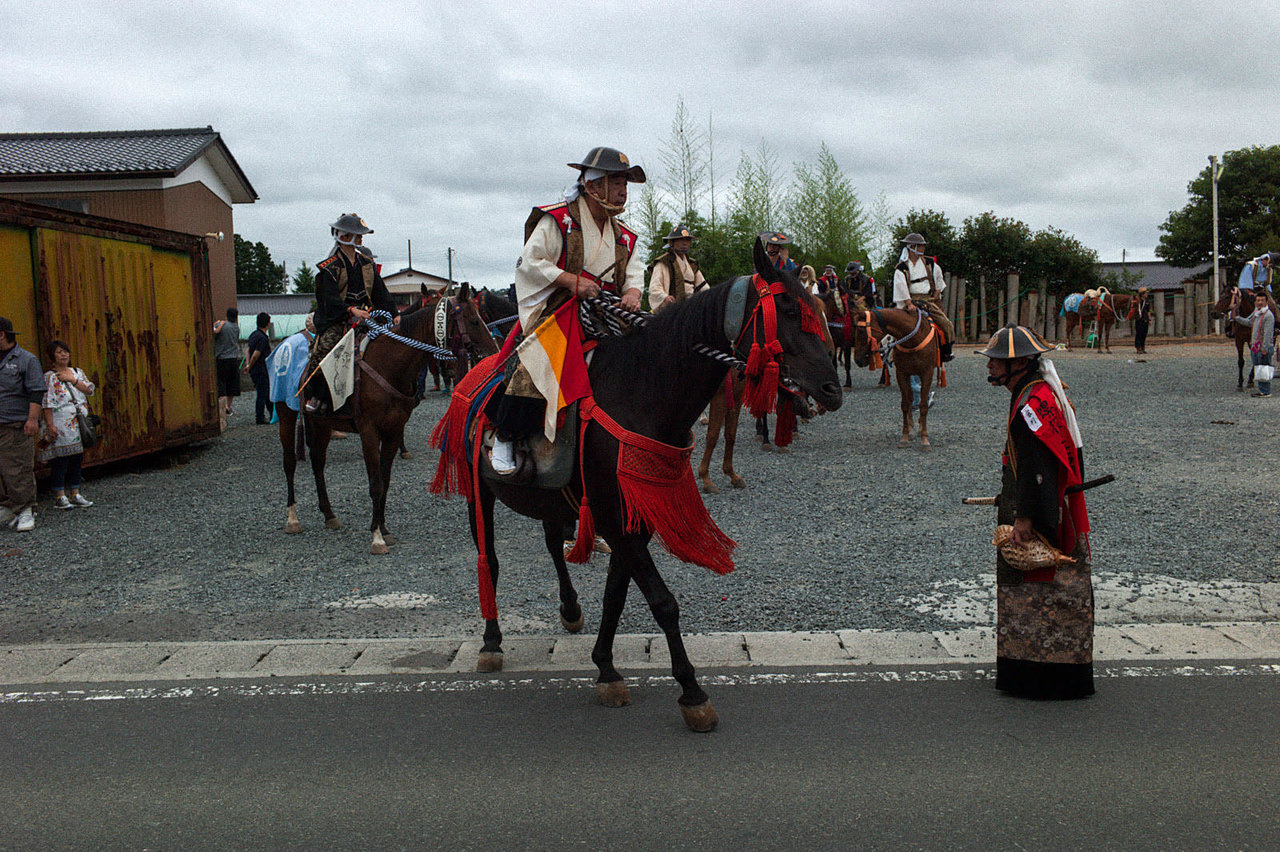
    In the wake of the Tōhoku tsunami and the Fukushima nuclear disaster that devastated Japan in 2011, Ben Huang forays into documenting the nation’s survival amidst the tragedies’ profound impact. Photographing spaces that were ravaged most over the course of seven years; Huang’s photographs embodied the inhabitants’ resilience and hope despite the inevitable reality of bearing the calamities’ grim aftermath. Here, Huang talks about his process, and his realizations as he recounts the nation’s recovery through his photographic lens.

    MMC: How did you conceptualize this project? Where and how did you begin?

    BH: It started when I connected with my friends from high school who were originally from Japan. The idea was born out of my curiosity to know how the nation was going to recover from these tragedies.

    My dad is also Indonesian-born Chinese and so this tragedy hits me in some ways because of the 2004 Indian Ocean tsunami. This was another reason why I wanted to document Japan’s recovery.

    Rikuzentakata, 2017

    MMC: Did you have any expectations on your journey of documenting the aftermath of the tsunami and the Fukushima explosion?

    BH: Not really, it was a fairly open project. I did some preliminary research about the places I wanted to visit so I knew that it might be difficult to get to those places, especially when you are not an accredited photojournalist. Also, for a short period of time, there was a language barrier. But other than that, I just went with the flow.

    MMC: Some of your photos show places that have been impacted by the Fukushima explosion, how did you manage to capture those?

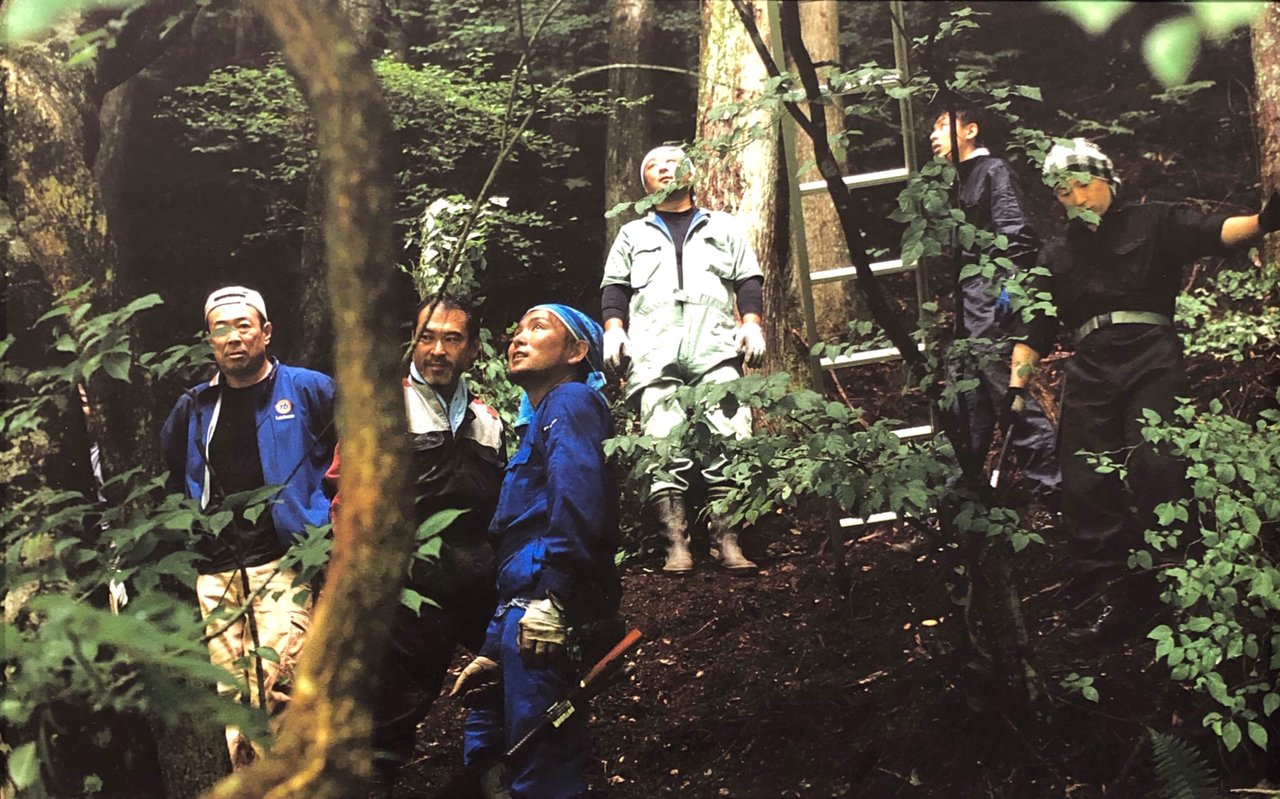
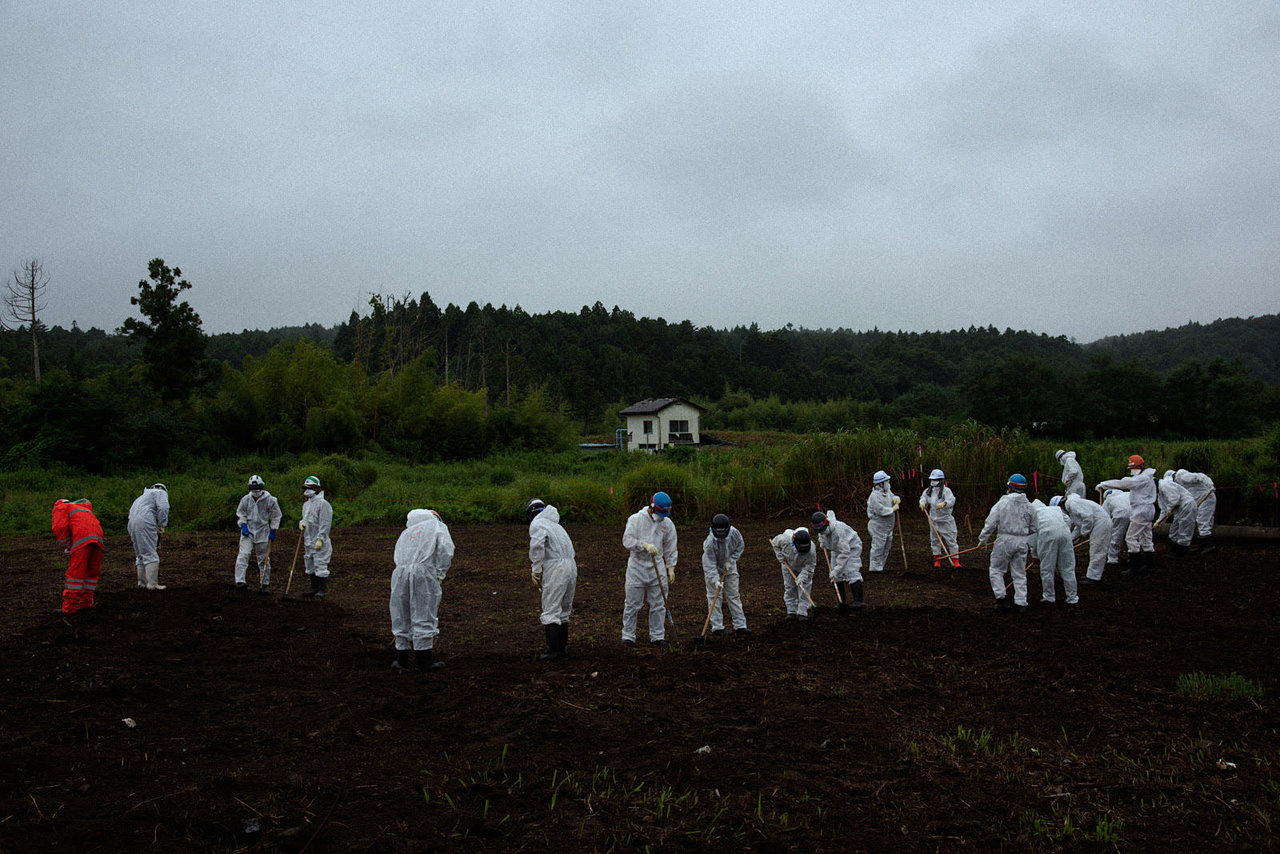
    BH: As the time went by, I became friends with photographers from that area who were doing similar projects. Some of them have introduced me to the locals. Through them, I was able to build relationships and document the work they were doing in the aftermath, like searching for missing bodies, and gaining access to the places affected by the tragedies.

    The Search Party. Okuma, 2018

    MMC: Your work shows juxtaposition between the corporeal effects of the tragedies and the inhabitants who seem to be in the process of rebuilding their lives. What was your aim when putting these images together?

    BH: While I was on the ground, I could sense sombreness despite the locals’ hope for the future. So yes, there was a conscious decision to demonstrate a sense of uncertainty.

    MMC: In terms of your process, were your photographs accompanied by dialogues or interviews with the locals? Did those aid you in constructing the images?

    BH: There were a lot of conversations with the locals. One of the things I ended up doing was to help with a local festival. It was funny how much information I got from having drinks with those people and staying in their houses.

    Nomaoi Festival. Minamisoma, 2016

    MCC: How did you choose the photographs you would show in this exhibition?

    BH: That’s a very good question. It is always diffcult to figure out what to show out of thousands of images. The process is to go through all the photographs first, narrow them down, and then see which ones goes best together. For this project, I started with developing the title.

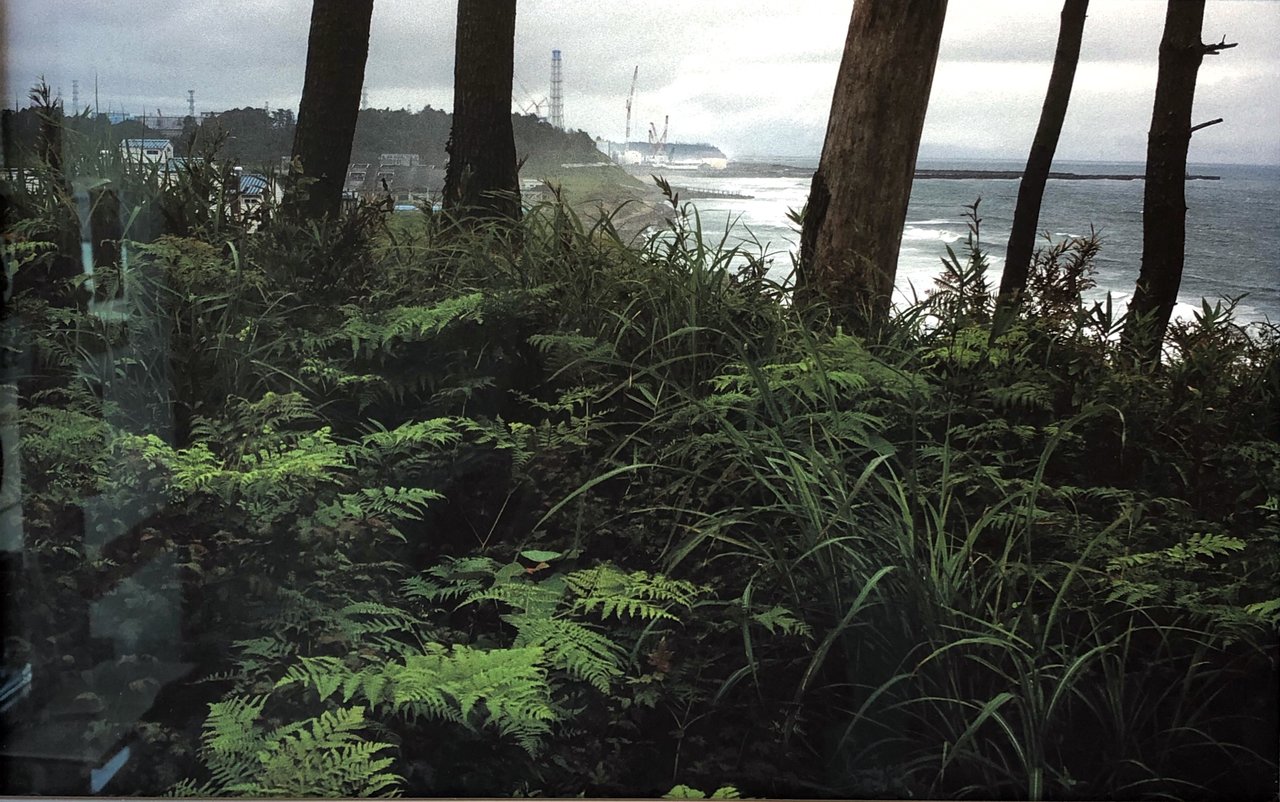
    When I went through the images from my journey, I found that there were a lot of surviving pines in the area that endured the 14-meter wave from the tsunami. I saw quite a few of them when I drove along the coast. That area was a well known landmark to the locals. So I choose the idea of Solemn Pines, Fading Things as the title for my show. It captured the combination of things destroyed and others that survived. I felt a strong nostalgia for the past in the locals. Once I figured out the title, I started working on the prints that would convey the idea.

    Fukushima No. 1. Okuma, 2017

    MCC: Please tell us more about Relics. Okuma, 2016, the photograph that depicts a multitude of clothing.

    BH: I was introduced to this man, Norio Kimura, whose house was only 5 kilometers from Fukushima No. 1. He lost three members of his family to the tsunami including a seven-year-old daughter; a well-known story for those who were following the disaster. It was only until two years ago when he found partial remains of his daughter, a piece of her jaw. A friend of mine, a well-known photographer, documented it. On Relics, Okuma those are the clothes that Kimura found along the coast with his daughter’s remains. He decided to live in a nearby temple, built this ‘mountain’ of clothes and in a way it became a memorial site.

    Relics. Okuma, 2016

    MCC: Was this your first foray into documenting an aftermath of a tragedy?

    BH: Yes this was my first project of documenting an aftermath of a tragedy. In terms of nostalgia, it has a certain common thread with my previous projects. For example Fantasyland, my first project, was about theme parks in the States. That idea was born out of my horrible experience. In high school, every year, we had trips to amusement parks. These parks sell a fantasy world but the reality of being there is very different with long lines or kids dating. In some ways, it depicted controlled happiness.

    MCC: How do you feel about the progress of your photography, culminating in this project, Solemn Pines, Fading Things?

    BH: I learned a lot doing this project, in terms of how I see things visually and how I feel about life. You talk to people, you see things but it was at a different level when I, myself, witnessed and experienced the struggle of the survivors to recover. It definitely transformed me as an individual, as a photojournalist and as a storyteller.

    Okirai Port. Ofunato, 2012

    Images are all Archival Pigment Print, 16 x 24 inches, courtesy of the artist and Urban Gallery

    *Exhibition information: Solemn Pines, Fading Things, May 2 – 31, 2019, Urban Gallery, 400 Queen Street East, Toronto. Gallery hours: Tue – Fri 12 – 5 pm, Thu 12 – 8 pm, Sat 1 – 5 pm.

    Part of Scotiabank Contact Photography Festival 2019

  • Ayana V. Jackson at Campbell House Museum

    Jackson’s Fissure, presented by Scotiabank Contact Photography Festival in partnership with Campbell House Museum, exhibits a selection of photographs from her two earlier series Intimate Justice in the Stolen Moment (2017) and Dear Sarah (2016). Jackson’s art is the materialization of activism against what she describes as the “hyper-sexualisation and objectification” of black bodies, and explores black identity by deconstructing racial and gender stereotypes embedded in her reference material – 19th and 20th century archival photographs.

    Jackson’s studio-based portraiture involves using a camera attached to a computer screen in a process that she describes as “performing characters” in a mirror and playfully dancing women.

    Ayana V. Jackson, Seeking the Source of Perfection, from the series Intimate Justice in the Stolen Moment, 2017

    As Jackson’s first exhibit in Canada, Fissure is loaded with socio-political connotations that challenge the role of colonial racism and transatlantic slavery in the construction of black identity within fine art and photographic portraiture. As an extension of her earlier series Archival Impulse and Poverty Pornography (2013), Intimate Justice in the Stolen Moment represents the black female body not as the enslaved, abused or colonized but as women in ‘stolen moments,’ in respite, far away from captivity. Jackson’s art interrupts the colonial-ethnographic stereotype of black identity by breaking the false narrative paradigm of the angry, unrestrained black woman and replacing it with a calm weightless vulnerability and sensuality for the public’s gaze.

    Ayana V. Jackson, Saffronia, from the series Intimate Justice in the Stolen Moment, 2017

    The subjects of Jackson’s self-portraits merely seek a moment of solitude, intimacy and fragility which the viewer can relate to. In visiting Campbell House, the reality of colonial racism resonates with the knowledge that the heritage house was built in 1822 before slavery was abolished in Canada in 1834. The importance of Jackson’s self-portraits Saffronia and Sarah Forbes above the mantelpieces alongside the stern portraits of Sir William Campbell and his wife cannot be over-stated as a literal step toward the reconstruction of black identity within the contemporary international art world.

    Ayana V. Jackson, Sarah Forbes, from the series Dear Sarah, 2016

    In questioning gender and racial stereotypes through self-portraits, Jackson described how she has become “less guarded” to the representations of violence and nudeness. Explaining her process, Jackson stated that “because I’m dealing with images that are politically complex and problematic, I felt that I had to use my body.” Jackson maintains that she is “not giving permission to objectify,” but rather trying to bring attention to the true nature of black women in their elaborate characters and beauty.

    Ayana V. Jackson, Lucy, from the series Intimate Justice in the Stolen Moment, 2017

    Jackson’s work in the Intimate Justice series also captures those cherished seconds of comfort, joy, sweet tenderness and kindness unrelated to slavery, servitude or hardship. Moments of Sweet Reprieve intimates compassion and calmness, a humanity that Jackson’s work communicates in order to change societal preconceptions of slavery and black identity.

    Ayana V. Jackson, Moments of Sweet Reprieve, from the series Intimate Justice in the Stolen Moment, 2017

    Samples of Jackson’s Dear Sarah series that appear in Fissure document the life of a young 19th century Yoruba princess named Aina (renamed Sarah Forbes Bonetta) who was liberated from captivity with the help of the British, and later became the goddaughter of Queen Victoria of Great Britain. Jackson recreates archival images of Sarah by imagining and recreating her playfulness and joy in S. Bonetta and her noble ancestry as an African princess (as recognized by Queen Victoria) in Sarah Forbes.

    Printed on fabric the Dear Sarah series hang from the ceiling of the Ballroom in Campbell House Museum swaying to the movement of visitors, inviting the viewer to identify with the vulnerability of “being a black woman in white spaces…grappling with blackness.”

    Ayana V. Jackson, S. Bonetta, (left) and Etta from the series Dear Sarah, 2016

    With a degree in sociology, Jackson utilizes the study of iconography, African and European adornment, portraiture and the transatlantic voyage of slaves to the Americas in order to develop her oeuvre in questioning and challenging the existing theories. Jackson’s work embodies a sensitive, emotional reality of endurance and resilience in the black female body, which she described as “A movement study. Everything that I am doing at the moment is about that. I am looking for motion and weightlessness. I want to shake the load off. My work has always been quite political. It is perhaps aesthetic, but it is ultimately a form of activism. I want to liberate the black body.”

    Keren Sedmina

    Images are courtesy of Scotiabank Contact Photography Festival, Ayana V. Jackson, and Galerie Baudoin Lebon.

    *Exhibition information: Ayana V. Jackson, Fissure, May 1 – June 2, 2019, Campbell House Museum, 160 Queen St. West, Toronto. Gallery hours: Tue – Fri 9:30 am – 4:30 pm, Sat – Sun  12 – 4:30pm.

  • Sputnik Photos of a Fallen Empire

    It is difficult to top the grandeur of the space that houses this collection of documentary photographs by Sputnik Photos, a photographers’ collective based in Poland. It is a self-proclaimed gleaming cathedral to corporate power. The exhibition consists in two sets of pairs of photographs back-to-back on temporary walls around seven feet or so in height, and of varying width. The first set is met on entering Brookfield Place from Bay Street, and the second set is located at the other end of the naturally lit galleria, towards Yonge Street.

    The show’s subject is the recent histories of many of the former Soviet republics – included are photographs from Armenia, Azerbaijan, Belarus, Estonia, Georgia, Kazakhstan, Latvia, Tajikistan, Ukraine and Uzbekistan. It aims to tell a story about the geographical, socioeconomic and cultural changes that have taken place in this vast and diverse region since the Soviet Union’s collapse in 1991. What we see here is a very small selection from a collection of thousands of photographs in Sputnik Photos’ Lost Territories Archive.

    The underlying theme is one of dereliction. Scattered around the various former republics of the Soviet Union are the ruins of failed utopian projects. The very idea induces in the viewer a sense of melancholy. This feeling, in turn, colours the viewer’s experience looking at these photographs. The first image you set eyes on, titled Anaklia, Georgia, shows a recently abandoned tower on the Black Sea coast. The label explains that it was part of a project, started in 2011 by then US-supported Georgian president Mikheil Saakashvili, to build a luxury resort. After his electoral defeat in 2013 the project was stopped and fell quickly into disrepair.

    Installation view with Sputnik Photos, Anaklia, Georgia, 2013 (right)

    There is a sense of abandonment and decay in most of the pictures. We see a dilapidated diorama displayed in a museum in the Pushcha forest region of Belarus. The stuffed deers in the diorama have sadly fallen over. It echoes, we are told, the neglect of the ancient forest itself by the Belorussian state. Incidentally, half of this forest is in Sputnik Photos’ native Poland and is under increasing threat from development and industry. As well, there is a photograph of the Semipalatynsk nuclear test site. This was the Soviet Union’s version of the Nevada test site near Las Vegas. There was little regard for the local population around this area of Kazakhstan affected by the resulting radiation over the years. It speaks to us of the corruption and misrule by the authorities.

    Installation view with Sputnik Photos, Diorama from a museum in the Pushcha forest region of Belarus (left) and Kazakhstan, Semipalatynsk Nuclear Test Site, 2016 (right)

    Otherwise we find, for example, pictures of a disused bridge and border post, and a tottery straw monument erected as a commentary on the shoddy construction of the buildings destroyed in a major earthquake in Armenia. The sense of abandonment is only heightened by an almost complete absence of people in the pictures.

    Installation view with Sputnik Photos, border post at Latvia and Estonia

    Installation view with Sputnik Photos, Broken bridge, Uzbekistan

    The collective’s stated aim is to show the “continuing consequences” of this post-soviet region’s failed utopian plans. The overall feeling one gets from these photographs is one of emptiness and malaise. The commentaries that accompany each picture, again, reinforce this. Certainly the legacy of soviet rule has not been positive in terms of the subsequent political and economic upheavals. But what purpose is ultimately served by documenting such things as the homelessness of earthquake victims and bad propagandistic art? I’m not sure.

    Installation view with Sputnik Photos, Pyramid monument, Armenia

    Finally, I cannot help thinking that despite our own relative political and economic security, there are plenty of failures documented here. There are, among other things, the decline of urban centres, such as Detroit, and the damage we inflict on the environment, e.g., the razing of vast tracts of forest to extract oil from the tar sands in Alberta. That is not to suggest that Sputnik Photos ought to have documented the west’s illnesses as well, in some sort of misguided attempt to be balanced. No, I mention this because of a specific comment written on the introductory label for this exhibition. It reads: “The galleria’s open atrium, often described as a ‘crystal cathedral of commerce’, epitomizes a thriving financial environment, one at odds with these images of a fallen empire.” I detect a degree of Schadenfreude here, or at least a self-congratulatory tone. History is messy and often tragic, and that includes our own.

    Text and photo: Hugh Alcock

    *Exhibition information: Sputnik Photos Collective, LTA 10: Palimpsest, April 29 – May 31, 2019, Allen Lambert Galleria, Brookfield Place, 181 Bay Street, Toronto. Gallery hours: Mon – Sat 6 am – 2 am, Sun 9 am – 2 am.

  • Nadia Belerique at Castle Frank bus station

    A picture doesn’t always tell the whole story.

    I first came across Nadia Belerique‘s artwork above and below and so on forever in the Contact website and catalog. It’s a single image, an elegant composition of objects floating in water: bottles, flowers, leaves, string and bits of paper. It recalls 17th century Dutch still-lives, with their dark backgrounds, flattened perspective, and flowers a little beyond their prime.

    above and below and so on forever as it appears in the CONTACT catalog

    But the picture in the catalogue is a by-product: a means to an end. This image is part of a series of five photographic murals designed with a specific site in mind. The finished pieces are installed as a set of translucent images applied over the glass dividers at the Castle Frank bus station.

    above and below and so on forever as it appeared for a moment at Castle Frank Station

    The Castle Frank bus platform is, as far as bus stations go, a nice one. It’s a low-slung pavilion from the 60’s. It’s generous in scale with an abundance of green space. A wall of windows encloses one side of the arcade that protects passengers as they wait for their buses. It’s on these windows that the artwork is installed. 

    The Castle Frank Station bus terminal showing the installation of above and below and so on forever

    The photos are applied to the glass as translucent overlays. Their appearance is dependent on the light, the weather, and time of day. In the shade, the images almost disappear but when the light goes through them, they glow with warm colour. These transparencies are clear in areas that are white in the photographs and dark and opaque in the shadows. The background view appears hazily through the images and reflections add yet another visual layer.

    Detail view. Reflections, shadows and the background blend into a single image

    The station sits at the edge of the Don Valley, a verdant ravine that carves through the city with the Don River at its centre. For this project, Belerique used the river as the source of ideas and images. Her aim was to make the river’s presence felt by bringing it up to the station. The work evolved through her exploration of the river from both the shoreline and from a canoe. Along with filmmaker Seth Scriver, she fished through the mud to uncover various objects and trash that she then arranged as props along with leaves and flowers in the water. These arrangements were the subjects of her initial photos which also captured the reflection of the sky and structures above.

    One of five murals from above and below and so on forever

    Later in the studio, Belerique expanded on the idea of reflection by re-shooting her photographs. She printed the river pictures and mounted them on the wall with a sheet of glass a few inches in front. Stickers and leaves were then placed on this glass. Sunlight, and the shadows cast by these applied objects, played across the surface of the photos and became part of an integrated image that Belerique captured in a set of new photos.

    This second iteration of manipulation is what is published online and in print. These are already complex, layered photographs. When they are mounted on the glass wall of the bus station, further complexity occurs. Light and shadow from the front and back changes them. The background bleeds through and, along with reflections, blend with the image. 

    The Castle Frank Station bus terminal showing the installation from outside the station

    In her recent body of work, Belerique encourages us to think about how we look at images by making our experience a little complicated. At first, we perceive the images horizontally as a view through a window.But then we’re flipped around: the orientation of the view in the image is vertical: down through the ambiguous depth of water and up into the sky. There is no ‘front’ or ‘back’ because the images work equally well from either side of the pavilion. And due to the semi-transparent and reflective qualities of the images, the background and surrounding environment are brought into the experience as well.

    These days, so much art is first experienced through media. Often it’s enough. The only difference between the screen and gallery versions might be the size.  But that’s not the case here. The location within the city and the interaction with the local environment make the experience of this art installation very different from just seeing the source images. It’s well worth a visit to Castle Frank before the installation comes down on June 9. 

    Belerique’s above and below and so on forever is a temporary artwork and will only be on display until June 9, 2019. It’s part of the Don River Valley Park Art Program, which is a series of temporary, site-specific public art projects sited along the Lower Don River, curated by Kari Cwynar.

    Mikael Sandblom

    Photo: Marc Crabtree

  • CONTACT 2019 / Artoronto picks

    It is the 23rd Scotiabank Contact Photography Festival, the largest photography festival in the world. With so much choices of Canadian and international artists exhibiting throughout the Greater Toronto Area, it isn’t easy picking exhibits to see. We all look forward to seeing much more than the ones listed but these caught our interest and everyone is sure to have their own list as well.

    PHIL ANDERSON, publisher/writer:

    Meryl McMaster: As Immense as the Sky
    May 1– August 4, 2019
    Ryerson Image Centre

    Meryl McMaster, On The Edge of This Immensit, 2019.

    Shari Kasman: Memories of the Galleria Mall
    May 3–5, 2019
    Geary Lane

    Sarah Anne Johnson: THIS LAND
    May 4 – June 15, 2019
    Stephen Bulger Gallery

    Sarah Anne Johnson, Sunset #2 (Bedazzled), 2018

    EMESE KRUNÁK-HAJAGOS, publisher/writer:

    Michael Tsegaye: Future Memories
    April 25 – June 2, 2019
    BAND Gallery

    Michael Tsegaye, Chasms of the Soul: XXVIII, 2010.

    Moira Ness, Sage Szkabarnicki-Stuart: Revelation
    May 1 – June 9, 2019
    Gladstone Hotel

    Sage Szkabarnicki-Stuart, Urban Stream, 2018

    Caroline Monnet: A Whole Made of Many Parts
    April 11 – June 8, 2019
    Arsenal Contemporary Toronto

    STEVE ROCKWELL, publisher/writer:

    Carrie Mae Weems: Blending the Blues
    May 1 – July 27, 2019
    CONTACT Gallery

    Carrie Mae Weems, Color Real and Imagined, 2014

    Scotiabank Photography Award: Moyra Davey
    May 1 – August 4, 2019
    Ryerson Image Centre

    Moyra Davey, Subway Writers (detail), 2011/2014

    HUGH ALCOCK, writer

    Sputnik Photos LTA10: Palimpsest
    April 29 – May 31, 2019
    Brookfield Place, Allen Lambert Galleria

    Sputnik Photos, Kazakhstan, Semipalatynsk Nuclear Test Site, 2016.

    Jessica Thalmann, An endless, formless ruin
    May 4 – June 1, 2019
    Angell Gallery

    Jessica Thalmann, Such Places as Memory (Seattle I), 2019.

    XIAOTONG CAO, writer/photographer:

    Zinnia Naqvi: Yours to Discover
    May 2 – October 20, 2019
    Peel Art Gallery Museum and Archives

    Zinnia Naqvi, A Whole New World – CN Tower, 1988, 2019

    Developing Historical Negatives / Group Exhibition
    May 3 – June 1, 2019
    Gallery 44

    Jacqueline Hoàng Nguyễn, Untitled, from the series Presence in Absentia, 2018-2019

    NATHAN FLINT writer/photographer:

    Naomi Harris: Hollywood Furever
    May 11 – 26, 2019
    Stackt

    Naomi Harris, Weston Fira, 2018 

    Beatrice Gibson: Plural Dreams of Social Life
    April 13 – June 1, 2019
    Mercer Union

    Beatrice Gibson, I Hope I’m Loud When I’m Dead, 2018. Film still. 

    ELENA IOURTAEVA, writer /photographer

    Photography Collection: Women in Focus 1920s to 1940s
    April 27 – November 10, 2019
    AGO

    Lotte Jacobi, Portrait of Claire Bauroff, Berlin, around 1928.

    MARIA MENDOZA CAMBA writer:

    Sondra Meszaros: two blazing glares, for her pierce
    April 27 – June 30, 2019
    Corkin Gallery

    Sondra Meszaros, it’s damned if you don’t and it’s damned if you do, 2018

    Roger LeMoyne: The Republic of Port-au-Prince
    May 1 – 31, 2019
    Nikola Rukaj Gallery

    Roger LeMoyne, La République de Port-au-Prince: Marché en Fer, January 2010, 2010

    MIKAEL SANDBLOM writer/photographer:

    Nadia Belerique: above and below and so on forever
    April 15 – June 8, 2019
    Public Installation at Castle Frank Bus Station

    Nadia Belerique, from the series, above and below and so on forever, 2019

    Alina Holodov: I am Cuba
    May 1 – 25, 2019
    Elaine Fleck Gallery

    Alina Holodov, Model Prison (interior), Isle of Youth, 2016

    KEREN SEDMINA, writer/photogrher:

    Ayana V. Jackson: Fissure
    May 1 – June 2, 2019
    Campbell House Museum

    Ayana V. Jackson, Moments of Sweet Reprieve, from the series Intimate Justice in the Stolen Moment, 2017

    Günes-Hélène Isitan: Idea Projects
    May 1 – 31, 2019
    Ontario Science Centre

    Günes-Hélène Isitan, New World, 2018. Image grown on photographic film from skin bacteria

    SIMON TERMINE, writer/photographer:

    Mike Hoolboom & Jorge Lozano: Configurations
    May 3 – June 29, 2019
    A Space Gallery

    Jorge Lozano, Black Box, 2016. Film still.

    Carrie Mae Weems: Heave
    May 4 – June 24, 2019
    Art Museum of University of Toronto

    Carrie Mae Weems, A Class Ponders the Future, 2008.

    Images are courtesy of Scotiabank Contact Photography Festival

  • CONTACT 2019

    May – July, 2019

    Various locations in Toronto

    CONTACT 2019 showcases an outstanding selection of Canadian and international lens-based artists. The Festival’s Core Exhibitions are comprised of collaborations with major museums, galleries, and artist-run centres as well as site-specific public art projects. These are cultivated through partnerships and commissions, and frame the cultural, social, and political events of our times.

    The Featured and Open Call Exhibitions present a range of works by local and international artists at leading galleries and alternative spaces across the city. The Festival also includes a wide range of Programs including a book fair, a symposium, lectures, talks, panels, and workshops. CONTACT exhibitions and programs are free and open to the public, with some exceptions at major museums.

    For more information please go https://scotiabankcontactphoto.com/

  • Dorian FitzGerald at Clint Roenisch Gallery

    FitzGerald’s New Paintings exhibition continues to explore seductive objects for traces of labour in the service of wealthy and powerful patrons. A Toronto artist, FitzGerald is dedicated to his own style of painting, a technique practised and refined over the past ten years that has met with success and recognition. New Paintings is FitzGerald’s fifth solo show at the Clint Roenisch Gallery.

    New Paintings identifies an explicit representation of and curiosity with craftsmanship and history through an association with wealth and power. FitzGerald’s work is also a luxury item, a process that resists perfection composed of a rich application of paint which we are encouraged to view as a story. Utilizing computer software to enhance selected images, FitzGerald then transfers the resulting image onto his canvas and applies paint using a pouring technique. It is a painstakingly slow procedure, and some of the largest canvases take years to finish. FitzGerald puts extended amounts of time into researching and then painting them – literally living with them.

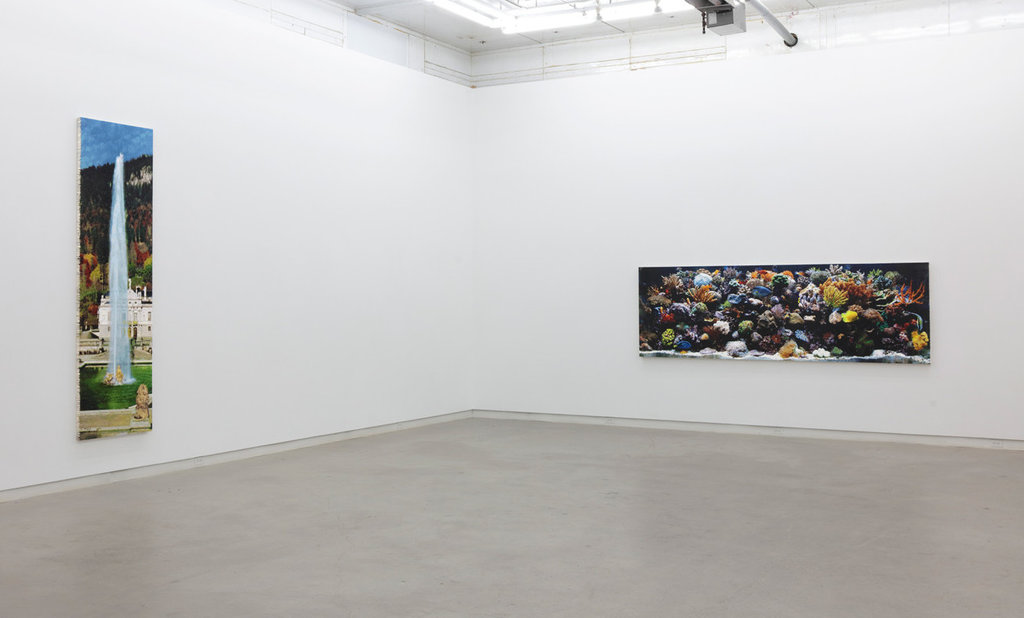
    Installation view of Dorian FitzGerald: New Paintings

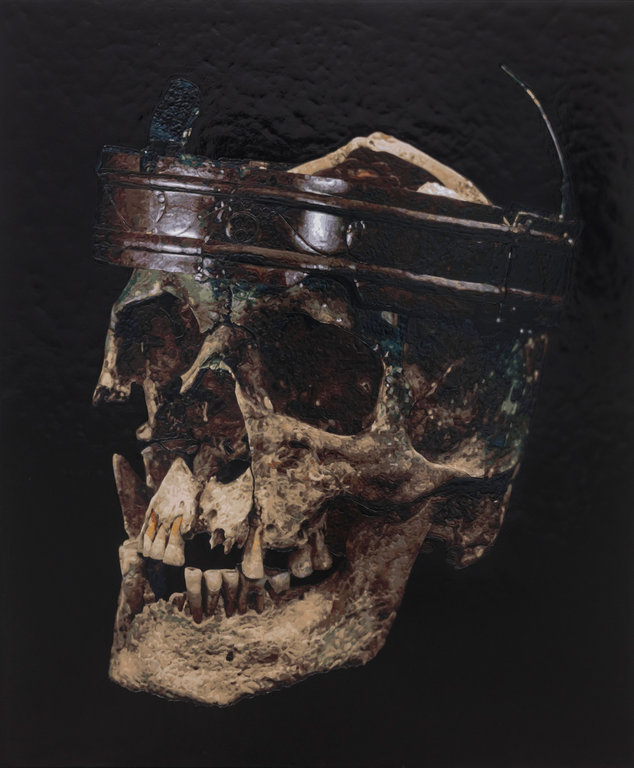
    Immediately upon entering the Gallery space we are confronted by the Iron Age Skull and Crown, a very large canvas that stands out due to a rippling effect which is a product of FitzGerald’s pouring technique. The skull itself originated from a Celtic burial site excavated in modern day Kent, U.K. and dated to approximately 250-150 B.C. The skull might be of a druid, an ancient priest and a person of knowledge. Though not ostentatious on its surface, the bronze crown indicates to scholars the relative importance and high status of this individual from Britain’s antiquity, a fragment of historical significance that scholars continue to explore with interest.

    Iron Age Skull and Crown (Warrior or Druid), Kent, United Kingdom. 2017. Acrylic on canvas mounted to board. 78 x 68 inches.

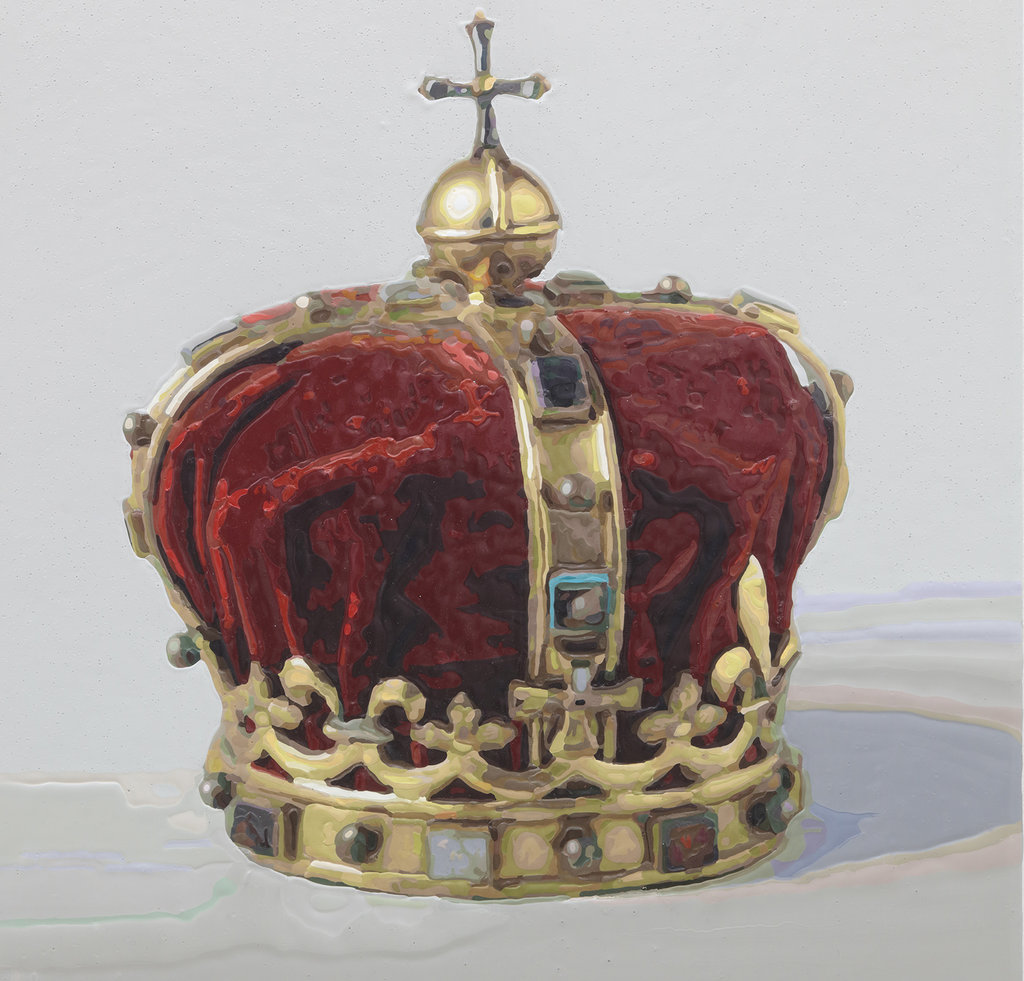
    Unlike the Iron Age Skull, the Crown for the King of Adra, circa 1664, doesn’t represent kingship, wealth or prestige but rather the deceit of privileged men in history. The crown itself, made of highly polished brass and inlaid glass, was gifted by a British peer serving as Governor of the Royal African Company to the King of Adra in an effort to advance British interests in slavery as well as his own personal fortunes as facilitator. Through this parsimonious gift-giving, FitzGerald identifies that the wealthy are not and will not be exempt from scrutiny when their greed and deceit is exposed.

    Crown for the King of Adra, circa 1664. 2019. Acrylic on canvas mounted to board. 16 x 16 inches.

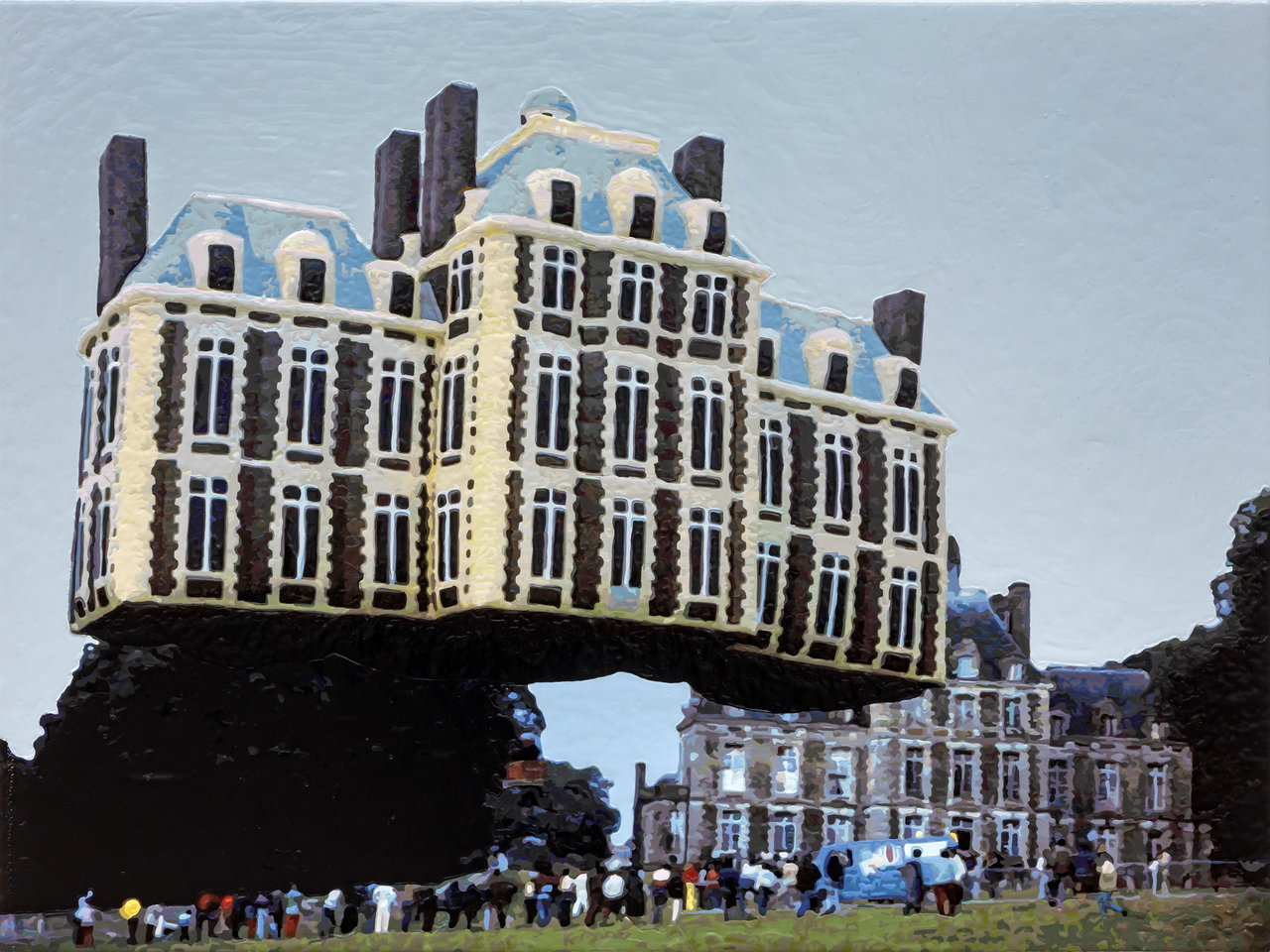
    Malcolm Forbes’ Balloon, perfectly exemplifies frivolous ostentatious displays. The painting depicts the Forbes family estate, the 17th century Château de Balleroy in Normandy, France, alongside a massive hot air balloon replica of the Forbes’ country mansion. A prime representation of excessive wealth and power, FitzGerald underscores the epitome of 20th century eccentricity and vanity by a man whose claim to fame was inheriting his father’s vast business empire. There is something absurd about the way the huge balloon overshadows the real building in the background. It feels abnormal that a crowd moves underneath it unaware of its monstrous presence. The whole image is a big show-off from the extremely rich to amuse the poor.

    Malcolm Forbes’ Balloon, Château de Balleroy, Normandy, France. 2019. Acrylic on canvas mounted to board. 36 x 48 inches.

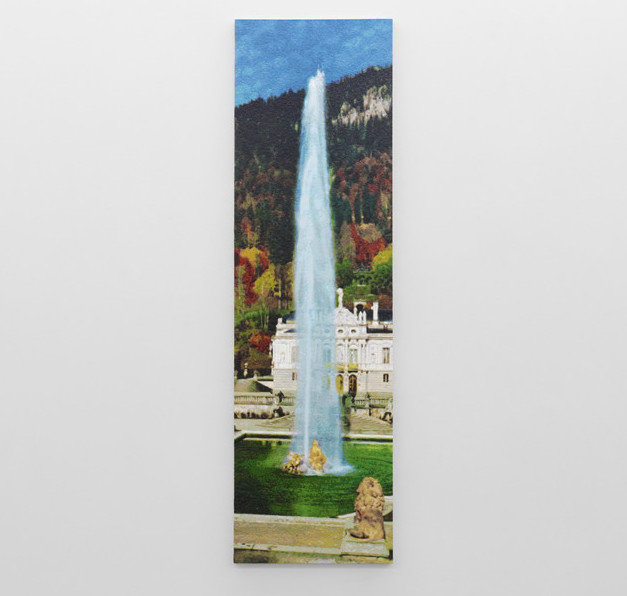
    Fountain in Bavaria, depicting the neo-French Rococo style Linderhof Castle and Venus grotto, is in fact a tribute to the labours of the craftsmen and engineers who oversaw its construction for the wealthy 19th century King of Bavaria, Ludwig II. The luminous green of the water in the pool of the fountain is a product of an electrical installation, powered by one of the first plants in Bavaria at great expense – one of many architectural extravagances carried out by Ludwig II and paid for by the people of Bavaria. The Fountain is also a statement about seizing power away from the corrupt and self-serving greed of the rich, just as Ludwig II was removed from power. The very narrow format of this canvas cuts out almost everything and focuses on the water, framing its shape as it bullets toward the sky.

    Fountain in Bavaria, Schloss Linderhof, for Ludwig II. 2019. Acrylic on canvas mounted to board. 103 x 30 inches.

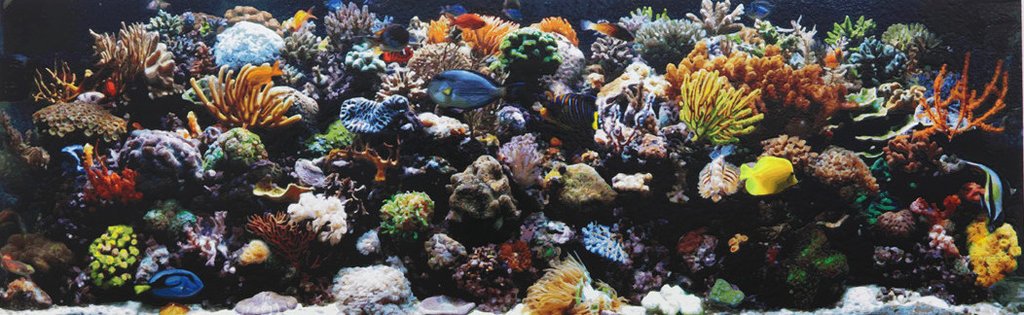
    On the main wall of the larger gallery, Aquarium commands the viewer’s attention due to its size, beautiful colouring and high photo realism. It is all about forms. It is not one single image but a sequence of forms against the backdrop. In a 240-gallon tank there are 53 exotic species crowded in with rare corals. There is hardly any space to move. All living things are doomed in this “paradise.” Looking at the stunning, vivid colors, the rich, almost three-dimensional paint application and listening to the peaceful, soft music from the background – you almost believe in this beauty. But the harsh reality behind this amusement is that private wealth, for the sake of ownership and aestheticism, endangers rare animals by removing them from their natural ecosystem.

    Aquarium (Taboo). 2018. Acrylic on canvas mounted to board. 30 x 128 inches.

    As the press release states, FitzGerald’s work can be compared to a contemporary court painter, documenting the irresponsible extravagancies of the wealthy and powerful but through the socio-political sensitivity of a 21th century artist.

    Keren Sedmina

    Images are courtesy of Clint Roenisch Gallery

    *Exhibition information: Dorian FitzGerald, New Paintings, April 4 – May 18, 2019, Clint Roenisch Gallery, 190 St. Helens Avenue, Toronto. Gallery hours: Wed – Sun 12 – 6 pm.