Author: artoronto

  • Michael Smith at Nicholas Metivier Gallery

    A Fresh Take on an Old Theme

    Installation view of Michael Smith The Eye of the Storm. Photo: Elena Iourtaeva

    The maritime theme certainly comes with its unique set of challenges, being a subject matter with a rich tradition of highly acclaimed painters. It is practically impossible to compete with J.M.W. Turner’s light-filled paintings of the sea storms. Conveying the sublime constitutes an elusive and noble goal. However, in the 21st century, it might be fair to give the old approaches a rest and indulge in the amazing hues offered by the acrylic paintings by Michael Smith.

    Michael Smith, Migration, 2018, acrylic on canvas, 70 x 94 inches. Courtesy of Nicholas Metivier Gallery

    Surprisingly, the exhibition statement on the Nicholas Metivier Gallery’s website offers a very traditional description, filled with pathos and gravitas. Yet, pink, orange and cyan seem an odd choice to convey a “visceral” effect. Don’t get me wrong. The Eye of the Storm features some very delightful paintings. The bright, saturated colors and the thick texture of the brushstrokes make these maritime scenes look almost too beautiful and I love them.

    Michael Smith, Crossing, 2018, acrylic on canvas, triptych, 90 x 246 inches. Courtesy of Nicholas Metivier Gallery

    We need more of that subversive joy when approaching the dead-serious historical topics such as the Franklin expedition. Michael Smith successfully achieved this fresh take on an old theme.

    Elena Iourtaeva

    Featured image: Michael Smith, Atlantic, 2018, acrylic on canvas, 59 1/2 x 96 inches. Courtesy of Nicholas Metivier Gallery

    *Exhibition information: February 7 – March 2, 2019, Nicholas Metivier Gallery, 190 Richmond Street East, Toronto. Gallery hours: Tue – Fri, 10 am – 6 pm; Sat, 12 – 5 pm.

  • Jaan Poldaas at Birch Contemporary

    A Canadian Master Colorist

    Last chance to see the retrospective of Jaan Poldaas’s work at Birch Contemporary – and you know you should go see it now. Here is why.

    Installation view. Photo: Elena Iourtaeva

    ‘Oh, more geometric abstraction’ – you might say. Fair enough. But here’s the thing. It is not every day you get to see a full chronological overview of an abstractionist’s work, complete with sketches and video interviews. Patrick Barfoot’s film combines footage of the creative process, interviews with the artist and curators’ commentary. This thoroughness holds a tremendous value when it comes to offering a glimpse of the artistic evolution of an individual over decades, a rare privilege for the viewer.

    Documents of the artist’s life. Photo: Elena Iourtaeva
    Visitors looking at the documents. Photo: Elena Iourtaeva

    A Colourful Life represents a first retrospective of the artist’s body of work since his passing in 2018. The exhibition includes some of his latest, not previously exhibited, works, thus painting a full picture of a lifetime’s achievement.

    Jaan Poldaas, Perasequ, 2017, enamel on canvas, 121 x 121 cm. Courtesy of Birch Contemporary

    Jaan Poldaas is undeniably a master colorist. So do yourself a favor and go immerse yourself in these delicate variations of hues. Behold these paintings up close, discerning every little detail of the production process, or delight in the perfect balance of color from a distance. This is a show not to be missed.

    Installation view of Jaan Poldaas, A Colourful Life. Photo: Elena Iourtaeva

    Elena Iourtaeva

    *Exhibition information: Jaan Poldaas: A Colourful Life, February 7 – March 2, 2019, Birch Contemporary, 129 Tecumseth Street, Toronto. Gallery hours: Wed–Fri 10 am – 6 pm, Sat 11 am – 5 pm.

  • The Artist Project 2019

    The Artist Project 2019 returned to the Better Living Centre this year to host the annual art fair. This year marks the 12th iteration of the exhibition and features over 300 emerging or established Canadian and international artists. The opening night featured music by LUXELIFE SOUND and numerous vendors offering free samples of cocktails, snacks and sneak peaks into upcoming programming.

    Greeting audiences entering the space is a large-scale artwork by artist Pauline Loctin’s, also known as Miss Cloudy, Ancestrale II (2019). This mixed-media installation piece is vibrant and acts as a backdrop for photo opportunities for guests. The artist’s intent is to the celebrate the intergenerational energy and ancestral spirits through colour, volume and values such as beauty, feminity and strength. The aesthetic evokes the colourful, squiggly, geometric designs and patterns of the 1990’s, rendered in origami paper structures and large simple shapes painted or cut out of reflective materials.

    Pauline Loctin. Ancestrale II

    The theme of this year’s art competition is Self Portrait. All the participating artists were invited to submit or produce a work within. Most of the works depicted a figure, typically a face, in the artists personal style, but on some occasions the artists took liberties to reflect on their inner self or replaced their image with something more symbolic. Audiences could submit ballots to vote for their favourite piece. In the area in front of the competition, were various artists creating a live mural painting or hand drawing on shoes.

    Self-portraits

    Along the main spine of the booths, as well as a few satellite locations within the building, were standalone artworks, a part of the Installation Zone. A total of 12 artists exhibited their art installations in order to add more dynamic and interactive elements into the audience’s experience of the fair.

    Quahtan Alameen’s installation

    Chris Harms’ Proposed Heights (2019) contrasts the childhood levity of play with the adult reality of ambition, and how the desire for both seems endless. The act of swinging higher and higher in a playground, is parallels with the heavy machinery of industrial construction. It also suggests that the same carefree ethics is being applied to things such as building condos higher and higher, in order to produce profits that also increase higher and higher. Aesthetically, the work is fascinating with its use of various plastics to play with transparency, colour and texture. At the start of the night, artist Chris Harms’ activated the work by continually pushing the swings to make the work more performative.

    Installation by Chris Harms

    Mirrors of Colour (2018) by Dania Al-Obaidi is a collection of wooden blocks painted with encaustic wax. The installation is intended to act as a self-reflective experiment in which your attraction to particular objects – based on their colour or story – is revealing some ambiguous aspect of your hidden personality.

    Mirrors of Colourby Dania Al-Obaidi

    A new addition to this year’s show was the section dedicated to Zines. These small art publications were humble, charming and very engaging. Toronto has an extremely vibrant subculture of illustrators, poets, activists and other forms of zine makers, so to see this reflected in this year’s Artist Project was a delightful inclusion.

    Cassidy van Leeuwen, Do you like dogs? (left) and Patrick Kyle(right)

    Inspired by the colourful aluminum of Nespresso coffee pods and a dissatisfaction with producing unnecessary garbage, Annette Gaffney has incorporated these common household objects into a series of work that beautifully depicts coffee cups and plantations in picturesque ways. The pods add a 3D aspect to the paintings as well as a reflective quality that rarifies the colours towards a more jewel toned palette.

    Annette Gaffney, Whimsical & Artcycling
    Heather Fraser (left) and Catherine Mcmillan (right)

    After becoming a mother, Arwynn Davey got attracted to the seed head of the dandelion flower. Whether it was seeing her son’s joyful exuberance when he would play with the plant by blowing its seeds into the wind, or the symbolism of reproduction and sending your offspring into the world, or even the cultural belief that dandelions can send your thoughts and dreams to your loved ones – Davey was fixated with the seed. Through her exploration she created a brilliant and unpretentious collection of work, all centralized on the dandelion. Her work includes several small-scale paintings, larger circular canvases and even a mobile/wind-chime that encases her paintings of seeds in clear resin. The work demonstrates how a common thing like a flower can generate lovely artworks that supplement its charm through its simplicity.

    Arwynn Davey’s booth

    Bryan Wilcox’s photographs of marbles beautifully display a quaint and unpretentious obsession with the miniscule and the playful. His photographs emphasize the easily overlooked yet remarkable beauty hidden within the details of these children’s game toys.

    Bryan Wilcox talks about his work
    Paintings by Court Swartz

    Through the manipulation of glass pouring mediums on canvases, Renu D’Cunha has shifted the usually abstract formations of the medium towards figurative representation. Pouring mediums are commonly used as an art therapy practice. D’Cunha, who was a watercolorist, discovered this new artistic practice after surviving cancer and a stroke, as she wanted to depict the soulful energy inside of herself and her family. The result is the Survivor Series, a huge collection of beautiful, vibrant and glossy forms that are skillfully manipulated using nothing but gravity and the occasional toothpick.

    Renu D’Cunha in her booth

    Justin Blayney uses mathematics to create paintings of dots in cyclical spirals that toy with our perception. When looking directly at the work with the naked eye, the dots are colourful and at best vaguely reveal a blurred image. However, when looked through a camera the rescaling of the paintings immediately reveals the picture within the work. A wonderful use of digital optics/the cyborg’s gaze to engage audiences with a clearly defined revelation and satisfying moment. The work that I felt fully utilized this technique was Blayney’s painting of a nude male sitting down with his legs crossed, staring directly at the viewer. This work seemed to parallel the technical exercise of revealing a hidden space, with the subject’s vulnerability of being naked, while simultaneously confronting the viewer.

    Works by Justin Blayney
    Works by Carlos Delgado
    Sophie Falconer, The Other and The Decent

    In the UNTAPPED Emerging Artist section, there were several brilliantly creative exhibitors. The work by Allana Cooper was particularly engaging. She uses the same wax and primary colours in both her sculptural and wall mounted pieces. The colours seem to elude to early childhood since primary colours are so readily used in kindergarten classes. The wax also feels youthful since it is soft and mushy like Playdough. When you take these elements and apply them to liquor bottles and sharp industrial materials like metal mesh screens, you get a tension between innocence and harsh environments.

    Works by Allana Cooper
    Sculpture by Jill Smith
    Installation by Anne-Sophie Vallee

    Text and photo: Nathan Flint

  • The Artist Project 2019 / A photo journal

    Opening Night Party: Thursday, February 21, 2019, 7 – 11 pm
    Better Living Center
    195 Princes’ Boulevard, Exhibition Place, Toronto

    At the Opening Night Party of The Artist Project the large building was so crowded that sometimes it was hard to move. All the artist talked happily to visitors. Many of the guests were dressed up as it should be for a vernissage. It was a great meeting place for friends were elegance met culture. Even at the early hours some red dots have already appeared, some works were sold. The atmosphere was filled with energy as the guest enjoyed the beauty of art.

    The wall of self-portraits, this year’s theme, greeted the visitors
    Another wall, created by Pauline Loctin, a popular meeting place
    Guests were amazed by Alex Garant’s portraits
    Paintings by Eleanor Lowden
    Paintings by Katrina Jurjans
    Nelson Cheng is listening to a guest analyzing his painting
    Sleeping apart, an installation by Adam Giroux and Shay Salehi
    Janette Hayhouse’s booth
    Hugh Alcock surrounded by his pastels
    Sculptures by Lauren Blakey
    MontanArts
    Dania Al-Obaidi, Mirrors of Colour, Untapped zone

    A photo journal by Xiaotong Cao

    Photographs by Elena Iourtaeva

    Hot debate at Hugo Cantin’s booth
    Lana Filippone submerged in attention
    Daniel St-Amant presenting his paintings to visitors
    Vanessa McKernan
    Alex R.M. Thompson

    *Exhibition information: February 21 – 24, 2019, Better Living Center, 195 Princes’ Boulevard, Exhibition Place, Toronto. Friday: 11 – 10, Saturday: 11 – 8, Sunday: 11 – 6 p.m.

  • The Sex Show 2019

    This group exhibition at Gallery 1313, curated by the director Phil Anderson, is a brave and somewhat pleasing exhibition by some 23 artists. More than half of the artists are women and the works seem centred on the female experience. A few of the artists are from outside Ontario such as Yvette Tang (Vancouver) and Kelsey Vaughan (Edmonton).

    Installation view of The Sex Show at Gallery 1313

    The works were selected online, and Anderson was surprised that artists didn’t embrace the me-too movement or have very little to say politically. The quality of work was even and there were certain favorites for everyone. Grace Dam’s painting The Blackberry is powerful in its quiet way, showing how cellphone interrupts even the most intimate moments of our lives.

    Grace Dam, The Blackberry

    Photographer, Ravi Persaud’s One Night Stand stood out with its mystical loneliness, created by the soft warm light and the crumpled bed. Painter Nora House’s work, Selfie had a nude figure holding a phone camera for a pose. John Nobrega’s video animation works, The Failed Seducer, were dark and wonderful.

    Ravi Persaud with his photograph One Night Stand
    John Nobrega, The Failed Seducer, video still

    Photographer Steve Socha used an overlay technique in his photo works while Vancouver photographer Trint Thomas’s Purity, a silver gelatin print, seemed like it was from another era of more innocence.

    Steve Socha, Licking Lips
    Raffi Anderian (right) in front of The Seduction
    Fei Lu (right) and her painting Succubus

    Vancouver queer artist Yvette Tang’s bold, dark photographs, The Punisher, express a fascination with fetish sex.

    Yvette Tang, The Punisher

    The Cell Gallery artist, Shawn Postoff’s work, though not part of the Sex Show, provided an appropriate match looking at the male figure.

    Shawn Postoff, Toxic Masku-Liminalities

    The Sex Show 2019 at Gallery 1313 was not as offensive as the sign outside the door warned but none the less an eclectic mix of works with a sexual theme from a variety of artists that made the exhibit worthwhile. In these times it seems few people are willing to celebrate this subject matter that is usually only heard about in the media in negative tones.

    Guest in front of Mark Gleberon”s work

    Ashley Rowe Flick

    Images are courtesy of Gallery 1313 and the artists

    *Exhibition information: February 13 – 24, 2019, Gallery 1313, 1313 Queen Street West, Toronto. Gallery hours: Tue – Sun, 1 – 6 pm.

  • Artist Project 2019

    The Artist Project, Untapped area, 2018. Photo: Sophie Wang

    February 21 – 24, 2019
    Better Living Center
    195 Princes’ Boulevard, Exhibition Place, Toronto
    Opening Night Party: Thursday: 7 – 11, Friday: 11 – 10, Saturday: 11 – 8, Sunday: 11 – 6 p.m.

    From seasoned collectors and first-time art buyers, to gallery dealers and interior designers, visitors can explore and discover works of art from over 300 top contemporary artists from Canada and abroad. This is a unique opportunity to meet and buy art directly from artists at Toronto’s most celebrated contemporary art fair.

    The Artist Project celebrates its 12th year with another exciting show from February 21 to 24, 2019 at the Better Living Center, Exhibition Place, Toronto.

    Opening Night Party: Thursday, February 21, 2019 / 7 – 11 pm.

    Celebrate the launch of our 12th show and be among the first to see 5,000+ works of art from over 300 emerging and established contemporary Canadian and international artists.

    Art Battle #764
    Art Battle Canada and Artist Project team up!
    On the evening of Friday, February 22 from 7 – 10 pm, it will be held on the show floor.

    There will also be Art Chats, Art Walks and other interesting programs.

    For more information please check http://www.theartistproject.com/.

  • Leah Oates ephemeral photographs

    Leah Oates: Photographic Monuments to the Ephemeral in Nature

    Earlier in February photographer Leah Oates opened her Transitory Space # 9 exhibition at Black Cat Artspace, a small storefront gallery near Dundas and Roncesvalles in Toronto. Now a resident of the city, Oates had founded and run Station Independent Projects, a Lower East Side gallery in New York City. Her recent work centers on Toronto’s Cedarvale Ravine and Don Valley, the ninth in the Transitory Space group of works. Other sites have ranged from Nova Scotia, Pelham Bay, the Bronx, and Jamaica Bay, Queens, to as far away as Beijing, China. She has stated her intention to observe, “urban and natural locations that are transforming due to the passage of time, altered natural conditions and a continual human imprint. In everyone and in everything there are daily changes and this series articulates fluctuation in the photographic image and captures movement through time and space.”

    Installation view of Leah Oates, Transitory Space # 9

    A persistent motif for Oates, the tree, anchors her exploration of the effects of light and colour in the photographic and printing process much as Monet fixated on specific subjects. His attention might have fallen on haystacks, the Rouen Cathedral or his Giverny pool. Regardless, it allowed for an in-depth investigation of the nuanced transit of time from daylight to dusk. In corralling her subject, Oates frames her gaze where best to record the intricate lattice play between a blood vessel burst of branch with sky. The Don Valley suite of works in particular, take us to an acid-soaked Kubrick kind of hyper-space, as much inner as outer. There is a restless, kinetic quality to the work. Where exactly do these images reside? Solarized circles appear to telescope, moving from the human cornea to camera lens, cupping the subject in a hazy biosphere, orbs favouring flora over fauna. More drama-infused than placid, the spaces arrested by the eye of the camera, nevertheless, convey an idyllic of unspoiled innocence at times, particularly the images eschewed of human traces.

    Leah Oates, Don Valley 2 # 15, 2018-2019

    The observed impressions that Oates presents to the viewer is less a detached, dispassionate record of the visible world, than an attempt to come to terms with and perhaps reconcile “contradictory realities.” To achieve this, it’s helpful to understand her working process, and while it may appear to be digital at first sight, it has its basis originally in film, “then either printed as its with some tweaking of color in the darkroom or the negative is scanned, altered and colour corrected digitally, then printed as a pigment print. Whatever the final print process, there is always a connection to location, place and yet a playful randomness and flux.”

    Leah Oates, Don Valley 2, #10, 2018-2019

    The over-arching ethos animating the Transitory Spaces of Oates must fall on the side of beauty. While she admits that the human energy tends to be messy, her chosen spaces “are endlessly interesting, alive places,” and there is more than hint of an idealizing imperative in her summarization of the work as ”temporary monuments to the ephemeral nature of existence.”

    Leah Oates, Don Valley # 15, 2018-2019

    Steve Rockwell

    Images are courtesy of the artist

    *Exhibition information: Leah Oates, Transitory Space # 9, February 7 – 20, 2019, Black Cat Artspace, 2186 Dundas Street West, Toronto. Gallery hours: Thurs – Sun, 2 – 7 pm.

  • Tim Whiten’s Spiritual Objects / Olga Korper Gallery

    Suspend: Tim Whiten’s Spiritual Objects

    Entering the Olga Korper gallery is akin to stepping into a sun-drenched church. You push through oversized heavy metal doors into a cavernous skylit space. This is an appropriate venue for exhibiting the idiocratic creations of Tim Whiten, with all their spiritual aura. On display are ten beautifully crafted objects – five wall-mounted and five self-standing. Each is made using primarily natural materials that include glass, wooden branches, leather, shark teeth and human remains.

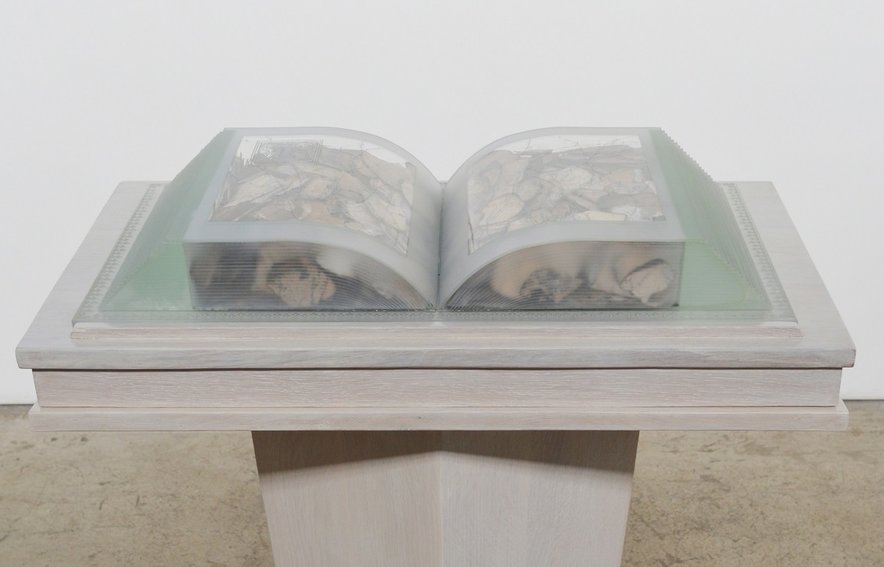
    Book of Light: Containing Poetry from the Heart of God, 2015-2019, handcrafted crystal clear glass, fragments of drawings, oak, 46.5” x 28” x 15”

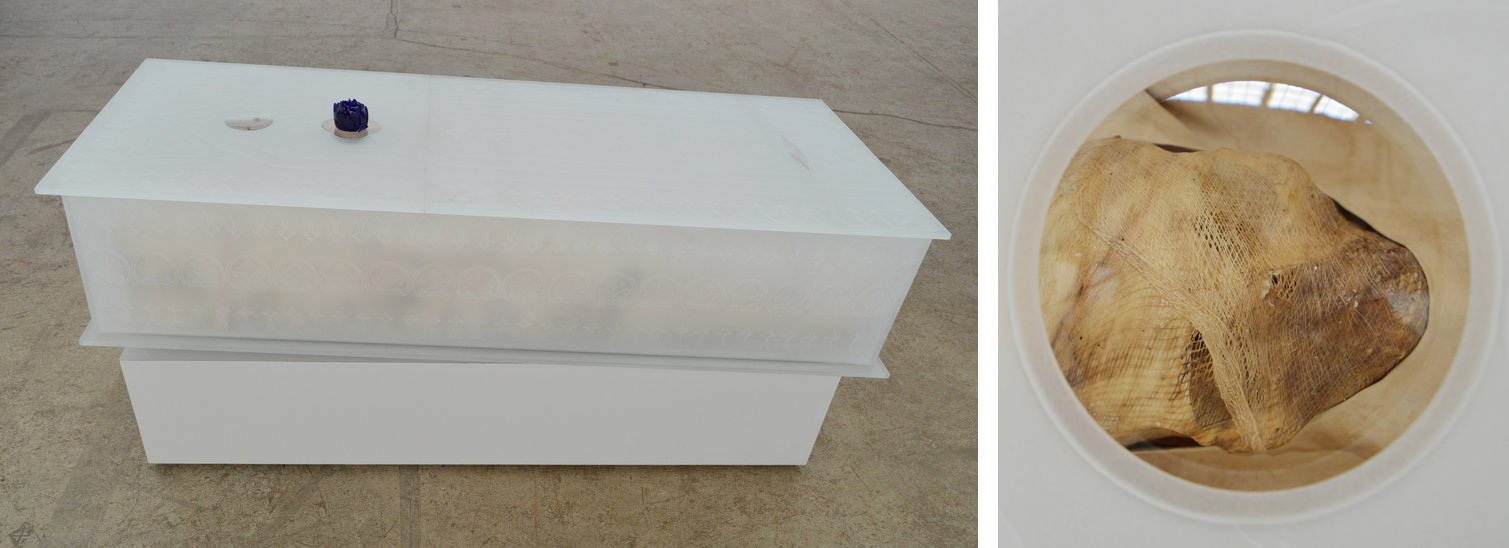
    The centrepiece of the show is a semi-opaque glass coffin titled Who-Man/Amen. I describe it as a coffin not only because it takes the form of one but also because it contains the skeleton of a small person, wrapped carefully in delicate cloth. This can be glanced through two portals of clear glass on top. At first I recoiled at learning that these are real human remains. But this involuntary response immediately led me to wonder about the nature of art itself. Whiten’s work induces such questioning. It challenges the very concept of artmaking. Indeed, he is reluctant to characterise himself as an artist, preferring to describe himself as a maker of cultural artefacts.

    Who-Man/Amen (detail), 2015-2016, handcrafted crystal clear glass, mixed media with human skeleton, 18.5” x 66.5” x 26.5” (left) and detail of the inside (right)

    The human remains were legally procured. I learned that in India in particular there is a vibrant trade in human skeletons because all medical students in the country must invest in a real skeleton. Synthetic copies are deemed inadequate (‘Booming Business in Bones’, The National, United Arab Emirates, 28 Dec. 2015). But while it is excusable to use real skeletons to ensure proper training of medical doctors, it seems unsavory to treat such remains as a prop in an artwork. I put it in these harsh terms to stress a commonplace attitude toward art. As a rule artists do not make art as a form of devotion, as an expression of deeply held religious beliefs. Any artist who alludes to religiosity usually does so from the outside. Churches sometimes house reliquaries containing the bones of some saint, for example, but when an artist makes a similar object it is normally seen as ersatz – a profane facsimile at best.

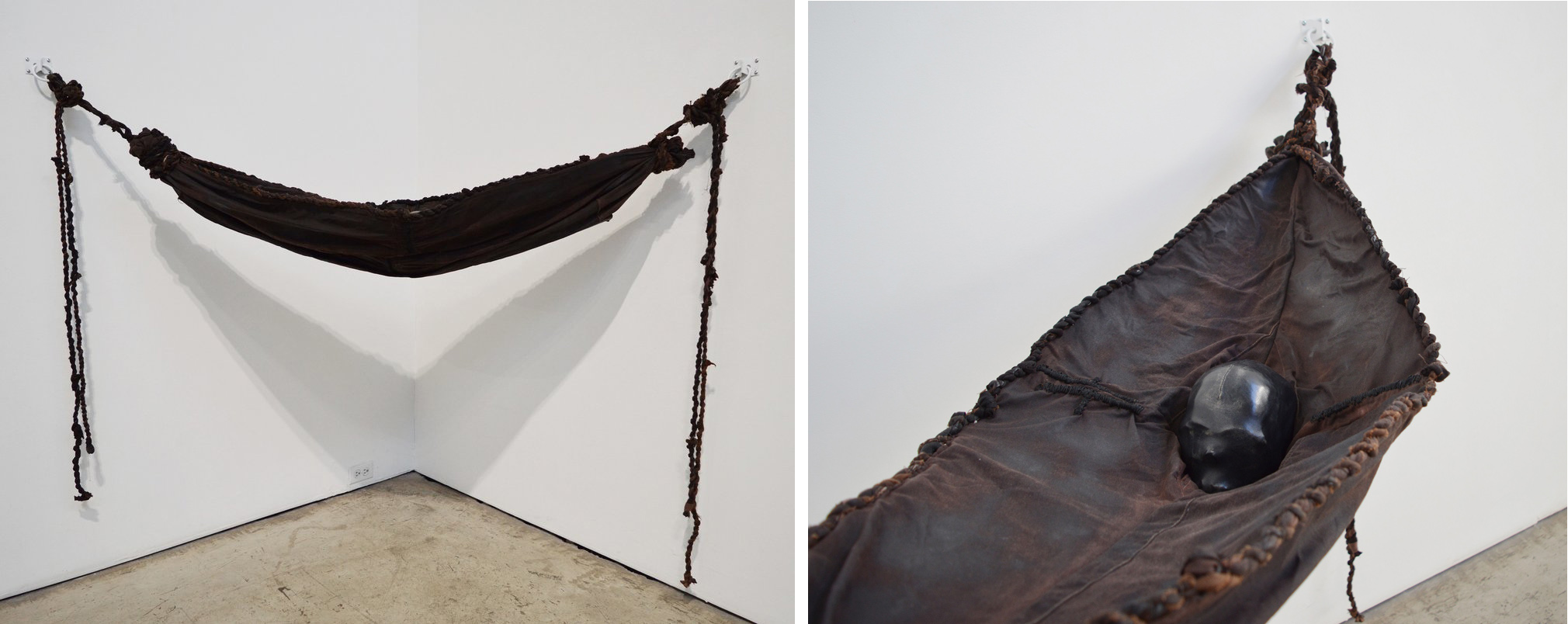
    What precisely Whiten’s own religious beliefs are is not clear. What can be said, however, is that he takes seriously a wide range of beliefs and mythologies across history. For example, another piece in the exhibition is titled Horus Negotiating the Waters. This consists in waxed textile formed in the shape of a boat that is suspended hammock-like at a corner of the gallery. Inside the boat sits a leather-bound human skull. According to Egyptian mythology Horus was the posthumously conceived son of Osiris, who was killed by his brother Seth. Horus was destined to grow up to avenge his father’s death by killing his uncle, who was then metamorphised into a boat. And by boat Horus journeyed into the underworld to bring his father back to the world of the living.

    Horus Negotiating the Waters, 2016-2017, textiles, leather-covered human skull, 10” x 60” x 18″ (left) and detail of the inside (right)

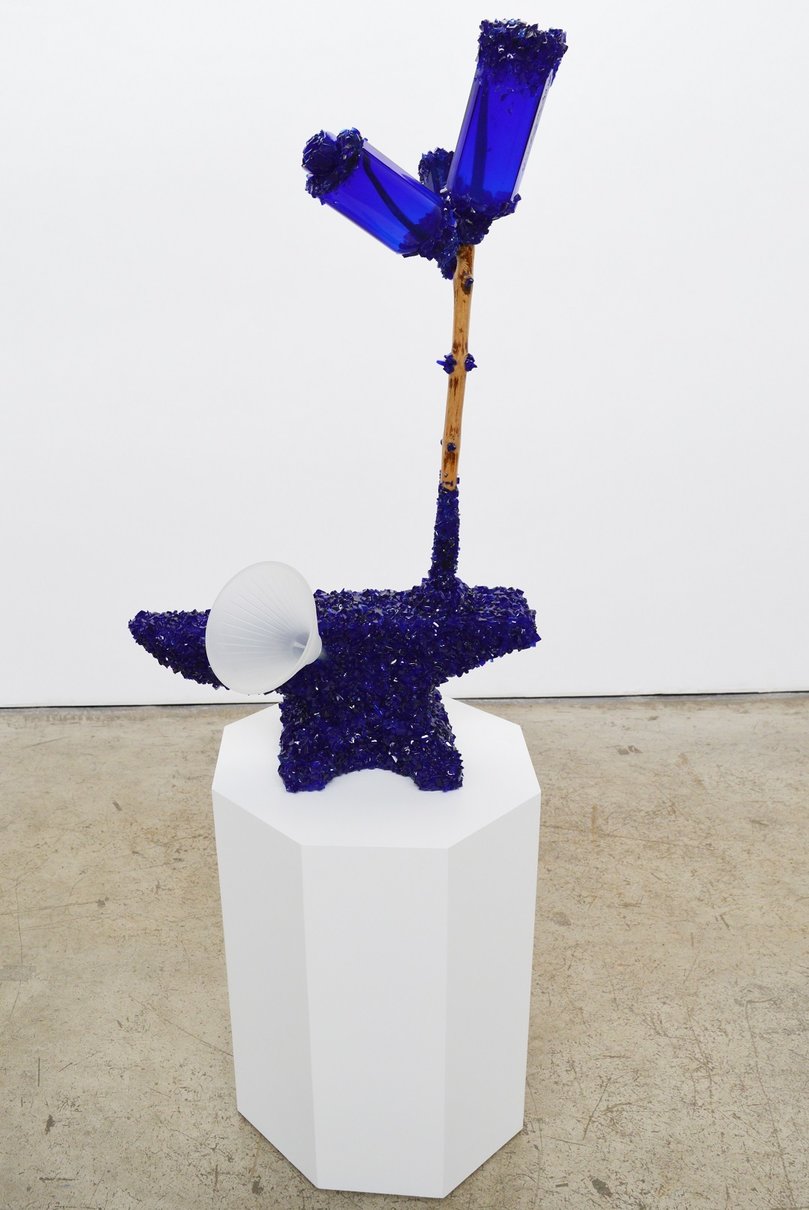
    Whiten understands the making of objects as an essentially spiritual activity, reasoning that since we are God’s creations all our work is ultimately toward a divine end (see Claude Meurehg, Art and Theology: Concerning the Spiritual in Art, 2011). As well, he alludes to prehistoric beliefs about object-making based around metallurgy. The arch-metallurgist is the divine smith, who is a shamanic figure in Iron Age societies. The smith has the divine power to hasten by means of fire the development of objects, that were believed otherwise to grow at a glacial rate in the ground. It is these sorts of beliefs, most likely, that Whiten had in mind when creating the piece titled Chasing Cobald. This takes the form of an anvil covered in shards of cobalt blue glass. Miners, in pursuit of arsenic-laced cobalt compounds used to smelt blue glass, equated this substance with mischievous goblins. (Its name derives from the German word Kobold, meaning goblin.)

    Chasing Cobald, 2016-2018, glass, wood (ash, basswood, maple), found glass (crushed), 64” x 19” x 19”

    Whiten is more shaman than artist. Like the divine smith, he invests his artefacts with a spiritual aura. His work couldn’t be characterised as devotional in any straightforward way, but it is certainly informed by a spiritual attitude. He is not merely intellectually curious about a wide range of mythologies, he also lives them through his work. There is, as a result, an honesty to his works. In addition, there is a wonderful poetry in his treatment of natural objects – as for example in his two Hallelujah pieces, each consisting in an object hanging from a lilac tree branch. Over all his work transcends the physical, wrapping itself in tantalising mystery.

    Hallelujah II, 2015, handcrafted crystal clear glass, brass fittings, lilac branches, 60” x 84” x 19”

    Hugh Alcock

    Images are courtesy of the artist and Olga Korper Gallery

    *Exhibition information: Tim Whiten, Suspend, January 17 – February 16, 2019, Olga Korper Gallery, 17 Morrow Ave, Toronto. Gallery hours: Tue – Sat, 10 am – 6 pm.

  • Kudos V at Canadian Sculpture Centre

    Installation view of Kudos V. Courtesy of the Canadian Sculpture Centre

    As a continuation to their longstanding KUDOS series, the Canadian Sculpture Centre brings their latest group exhibition showcasing the work of the Sculptors Society’s membership. The content is less defined by any overarching themes, but rather celebrates the multi-faceted interests and extraordinary talent that the individual artists possess. Featured in this show are pieces by returning artists Edward Falkenberg, Barbara Fletcher, Camie Geary-Martin, Karen Stoskopf Harding, Elaine Jacques, Saulius Jaskus, Marlene Kawalez, J. Mac, Richard McNeill, Peter Shoebridge, Dina Torrans, and Judi Michelle Young. There is also a debut piece for the Society’s newest member: Chippie Kennedy.

    New member, Chippie Kennedy with Gaea, bronze. Photo: Simon Termine

    The sheer diversity in this collection is truly impressive. It encompasses busts, full- and partial-body portrayals, constructed pieces, readymades, and even sculptural landscapes. Likewise, they range from the purely abstractive to the purely representational, with plenty of compromises in between. Mediums include metalwork, woodcraft, plaster techniques, concrete casting, and richly varied assemblages. The culmination of these idiosyncratic works truly evinces the passion that these artists dedicate to their work, drawing from deeply personal experiences and/or socio-cultural themes that are brilliantly encapsulated in their sculptures.

    Installation view of Kudos V. Courtesy of the Canadian Sculpture Centre

    Artists Jaskus, Shoebridge, Harding, Geary-Martin and Kennedy present their intricate, semi-naturalistic busts. This sculptural genre has been a timeless artistic tradition, yet their particular approaches strive to diminish those pervasive norms and instead portray unique characteristics. Despite the inherently static quality of sculpture, their works evoke strong emotional resonances that lend to their lifelike quality.

    Saulius Jaskus with Jean Marquis and Elena at Rest, both plaster. Photo: Simon Termine

    Peter Shoebridge, Clea, bronze. Photo: Simon Termine

    Camie Geary-Martin with Head Study, bronze. Photo: Simon Termine

    Karen Stoskopf Harding with Mohawk Mask and Mayan Mask, both bronze. Photo: Simon Termine

    Meanwhile, Mac, Kawalez, and Jacques shift their focus to full or partial bodily forms. Here, the representation of gesture is the main instrument used to portray the intrinsic themes. The forms tend towards the representational, yet the choices in how they are positioned, composed, and presented add new enticing complexities.

    J. Mac with her sculptures. Photo: Simon Termine

    Marlene Kawalez with Secrets of Secrets, fired clay, metal, and mixed media. Photo: Simon Termine

    Elaine Jacques, Moon Bath, alumina cement. Photo: Simon Termine

    Lastly – but certainly not least – there are the works of Fletcher, Falkenberg, Torrans, Young, and McNeill, which almost completely subvert the concepts of representation and realism. They instead emphasize suggestions of form with more elusive qualities that are all the more curious.

    Edward Falkenberg with TerraForm and Elysian, both wood and mixed media. Photo: Simon Termine

    Barbara Flecther with Hinged and Open, cast aluminum and mirror & Power Struggle, cast bronze and mirror. Photo: Simon Termine

    Dina Torrans with Forest Warrier Artefact, metal, stone, and mixed media. Photo: Simon Termine

    Richard McNeill, Summit Gazer 2, bronze, steel, alumina cement (left) & Judi Michelle Young, Tears of Hope, andonized aluminum, glass, copper, and cotton. Photo: Simon Termine

    Sadly, this will the final exhibition for the Canadian Sculpture Centre, at its Church Street location. Throughout its history, it has served as an outlet for artists to portray their body of work, hone their craft, and experiment with new ideas. They have time and time again demonstrated the thematic and emotional gravitas that sculptural mediums can elicit, as well as its unwavering ability to master and challenge the physical form. More importantly, the space offered a hub for countless artists, enthusiasts, and visitors to engage in the community it fostered. Hopefully we can look forward to an eventual reopening, but for now, let us take this opportunity to show our support for institution and revel in the experiences they helped to generate

    Simon Termine

    *Exhibition information: January 17 – February 8, 2019, Canadian Sculpture Centre, 500 Church Street. The exhibition is open till December 7, 2018. Gallery hours: Tue – Fri, 12 – 6; Sat, 11 – 4 pm.

  • Miguel Caba: Text Repetition 3740

    Miguel Caba in front of Window Box Gallery at Gallery 1313

    Phil Anderson (PA) interviewing Miguel Caba (MC)

    PA: The installation you have on display in the Window Box at Gallery 1313 is very conceptual and contemporary, perhaps not something the public would assume came from a young person in Grade 10. What inspired this work, Text Repetition 3740?

    MC: I’m very interested in the possibilities of infinity and I wanted to be able to make a non-conventional type of infinity. There is a visual type of infinity, but I also wanted to create a mental infinity that reflect humans. I understand the limitation of people, a universal one, how we (usually) have 2 arms with a dominant one that enacts more complex movements. Although we have these complex muscles, we mainly use a small amount of motions and I simplified that even more to get a slight movement of the wrist and arm. I took inspiration from the way many contemporary artists made art pieces built upon movement and repetition. Repetition isn’t necessarily the central part of my piece, I would rather say I am very meticulous in my work. I care a lot about the aesthetics, how my idea materialised, how it looks as a finished product.

    PA: Do you have art courses at your school?

    MC: Yes, I attend the Etobicoke School of the Arts, studying Contemporary Art. The program is heavily focused on conceptual contemporary art and we learn about successful contemporary artists and what makes them successful. It’s a different type of program as we’re taught how to become successful artists instead of how to solely make art. All the pieces we make expresses us and our creative ideas.

    PA: Do you visit the art galleries of the city?

    MC: I try to visit a Toronto art gallery at least once a month. They give me much stronger understanding of art as I get to see amazing pieces. Vivian Suter who recently showed hanging stained fabrics from the ceiling at the Power Plant that looked beautiful and inspired me in making Text Repetition.

    PA: How did you get introduced to the Carpos Collective?

    MC: I was looking at exhibition opportunities that my teachers posted in an Art Facebook. There was a call for artists by Carpos Collective for the Art In A Box exhibit. I entered my piece with a sketch showing how it will fit perfectly into the box with the mirrors and light, among information about the piece and myself.

    Installation view of Miguel Caba, Text Repetition 3740, fabric, Window Box at Gallery 1313

    PA: Do you use fabric in your other work and what its appeal to you?

    MC: I’ve only used fabric in another piece as an experiment for this one. It’s obvious how the garment factory job is always looked down as mindless. I wanted to strip the preconceptions of that and simplify it to something universal without judgment. I also find that the way the fabric looks so delicate hanging on the dowel is very appealing. It’s an actual representation of how delicately we are expected to treat art. I will probably continue with similar pieces in larger size to make it feel more extended.

    Photo: Phil Anderson

    *Exhibition information: January 16 – February 10, 2019, Window Box Gallery, Gallery 1313, 1313 Queen Street West, Toronto. Gallery hours: Tue – Sun, 1 – 6 pm.

  • Tim Whiten at Olga Korper Gallery

    Tim Whiten in front of Hallelujah II

    Coffin? Treasure chest? Space cube? The exhibition of the latest works by Tim Whiten leaves one intrigued, inspired and introspective. The dazzling Chasing Cobald and Arisearose anchor the room with their intricate geometric presence, bold ultramarine color and sharp edges. The lighter, seemingly floating Hallelujah I and II expand the horizon of the imagination.

    Chasing Cobald

    Arisearose, the top part

    The intricately decorated sculptures Reliquaire (II) and Who-Man/Amen possess a striking ability to draw the viewer in, make them bow and contort in an attempt to peak at the enigmatic contents. Yet, no matter how hard one tries, the insides remain a mystery. Whiten’s face radiates with delight when asked about the engaging aspect of his work: he is glad that the public would “take something away” from his objects.

    Reliquaire (II)

    Visitors engaging with the piece Who-Man/Amen

    Re-cognizing Asterion and Hallelujah I

    Text and photo: Elena Iourtaeva

    *Exhibition information: Tim Whiten, Suspend, January 17 – February 16, 2019, Olga Korper Gallery, 17 Morrow Avenue, Toronto. Gallery hours: Tue – Sat, 10 am – 6 pm.

  • Nicole Jenny at Gallery 1313

    Nicole Jenny draws inspiration from the natural world – not necessarily the world we see with the naked eye but the natural world that’s been revealed through the microscope, the telescope, by spacecraft, and by the particle accelerator.

    In her show at Gallery 1313, Jenny presents a series of richly painted abstracts. The exhibition includes several decentralized, ‘all-over’ compositions made up of swirls, star shapes, and other marks as well as a few multi-coloured tunnel-like paintings that converge to a central point.

    Although there are no overt references to specific subject matter, the imagery feels familiar. Have we seen something like this in Scientific American or Astronomy magazine? The visual language is loosely based on scientific subject matter. Crystals under a microscope, organic details, nebulae and galaxies, the surface of other planets and moons, and views of the earth from space – you can find hints of all these within this body of work.

    She says of her work “I’m interested in straddling the perception that we have of the world around us with our evolving understanding of the universe beyond our daily reach and experience.”

    The title of the show The Beauty of Mathematics: The Nature of Reality provides another clue to Jenny’s thinking. Throughout history artists have been interested in how numbers and proportion underpin what is considered to be beautiful and harmonious. Concepts such as the Fibonacci sequence, the golden mean and fractal geometry have their basis in nature and occur in crystals, organic patterns and in the growth and proportion of living things. The beauty of mathematics – the rules that seem to underlie beauty in the world – is a hidden structure that artists have sought to illuminate. It’s in this sense of uncovering hidden worlds that we can’t see directly; of exploring images related to things that technology has revealed that Jenny is probing in the beauty of mathematics.

    Installation view of Nicole Jenny, The Beauty of Mathematics: The Nature of Reality, Gallery 1313

    Now on to the specifics. There’s a generous amount of paint on these surfaces. It’s been applied in several ways: with conventional brushstrokes, with stippled brush marks, and in some cases, it looks as if colours have been blended on the surface with a palette knife although only brushes have been used. Often the same canvas will go through several iterations – unsatisfactory paintings are simply overpainted and added to until the artist is happy with them.

    In Solid Rain the surface is full of finely detailed smears that, up-close, look like photos of the earth’s surface from space. The crisp edges between colours also evokes something crystalline, bearing a resemblance to images of basalt under a microscope.

    Nicole Jenny, Solid Rain, 2018, acrylic on canvas, 18” x 24”

    In Spiral, the colours are applied thickly with a brush. The vortex geometry and diminishing brushstroke size suggests depth while the even brightness and surface texture pull us back to the materiality of the surface. The image reminds one of photos of the interior of the CERN Hadron collider, a far-off galaxy or an illustration of the distortion around a black hole.

    Nicole Jenny, Spiral, 2018, acrylic on canvas, 24” x 30″

    In ‘Swirls’ the paint has been built up in several layers. The image shifts and changes. One can imagine seeing a vibrant coral reef or perhaps the layered, colourful clouds in Jupiter’s atmosphere.

    Nicole Jenny, Swirl, 2018, acrylic on canvas, 30” x 36”

    Nicole Jenny’s interest in science provides her with a fresh new visual language to explore. The ideas and images that modern science produces will continue to be a rich and sustainable seam to mine. Jenny emphasizes that these are paintings inspired by science, they are not scientific illustrations. Her work is first and foremost rooted in the act of painting. It’s the traces of the action and the fun of making them that really lights them up.

    Text and photo: Mikael Sandblom

    *Exhibition information: Nicole Jenny, The Beauty of Mathematics: The Nature of Reality, January 2 – 13, 2019, Gallery 1313, 1313 Queen Street West, Toronto. Gallery hours: Tue – Sun, 1 – 6 pm.