Author: artoronto

  • Virtual Tour of Lumír Hladík: Cozy Venom at Darren Gallery

    Thursday, June 4, 2020
    6 – 7 pm Toronto / 7 – 8 pm Montreal
    Online Event / Register

    Pour yourself a glass of wine and join us via ZOOM for a virtual curator-led art tour of Cozy Venom, featuring artist Lumir Hladik. This private art tour includes the current exhibtion at Darren Gallery, followed by an exclusive virtual studio visit with the artist.

    Lumír Hladík is a Toronto based, Czech born, post WWII neo-Avant-garde artist, one of the pioneering creators of the 70s East European installation, action and performance art movement. He has developed a very distinctive form of ar
    After moving to Canada, the artist spent decades studying natural entropy in the Canadian wilderness. His practice expanded to include gestural drawings, mixed media, video and bio interventions involving living wildlife such as black bears, birds and insects. His current work is exploring notions of immortality and celebrity, cultural amnesia and anthropomorphic arrogance. It is riddled with symbolism and historical contexts. His work responds to today’s society’s ubiquitously ridiculous “rational” defence of its irrationality. He asserts that, “disrespect for death is killing life”.

    After moving to Canada, the artist spent decades studying natural entropy in the Canadian wilderness. His practice expanded to include gestural drawings, mixed media, video and bio interventions involving living wildlife such as black bears, birds and insects. His current work is exploring notions of immortality and celebrity, cultural amnesia and anthropomorphic arrogance. It is riddled with symbolism and historical contexts. His work responds to today’s society’s ubiquitously ridiculous “rational” defence of its irrationality. He asserts that, “disrespect for death is killing life”.

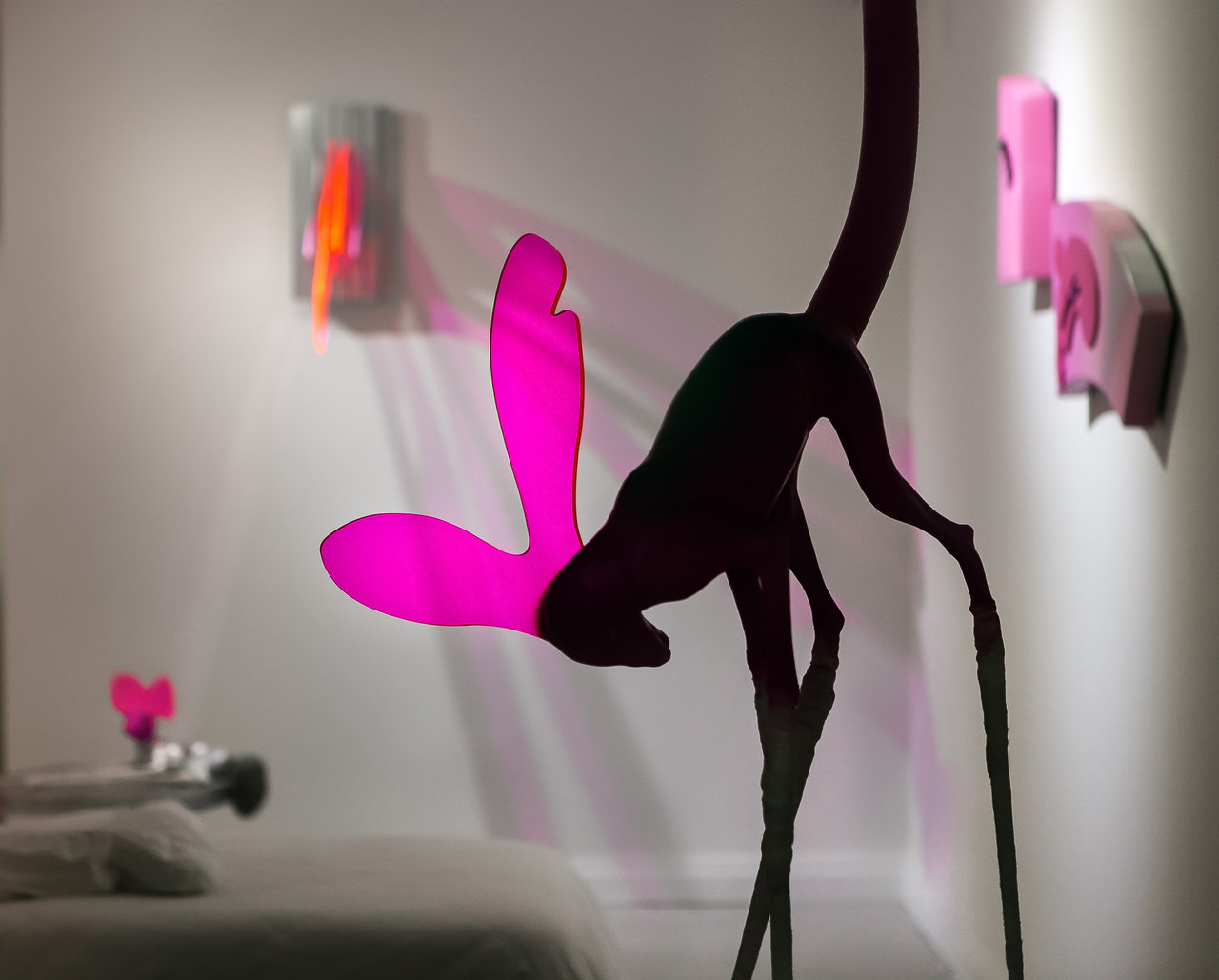
    Installation view of Lumír Hladík’s Cozy Venom. Photo: Yianni Tong

    Please also check our interview with Apollonia Vanova, director of Darren Gallery.

  • Eduardo Basualdo at Scrap Metal

    My experience of Argentinian artist Eduardo Basualdo’s installations is secondary; my words capture only my imagined voyage through the artist’s monumental light-absorbing installations. The Scrap Metal Gallery has provided photos and a press release as a virtual experience of the show, though, as I flipped through the photo gallery, my eyes longed for more material, my belly’s still not quite full.

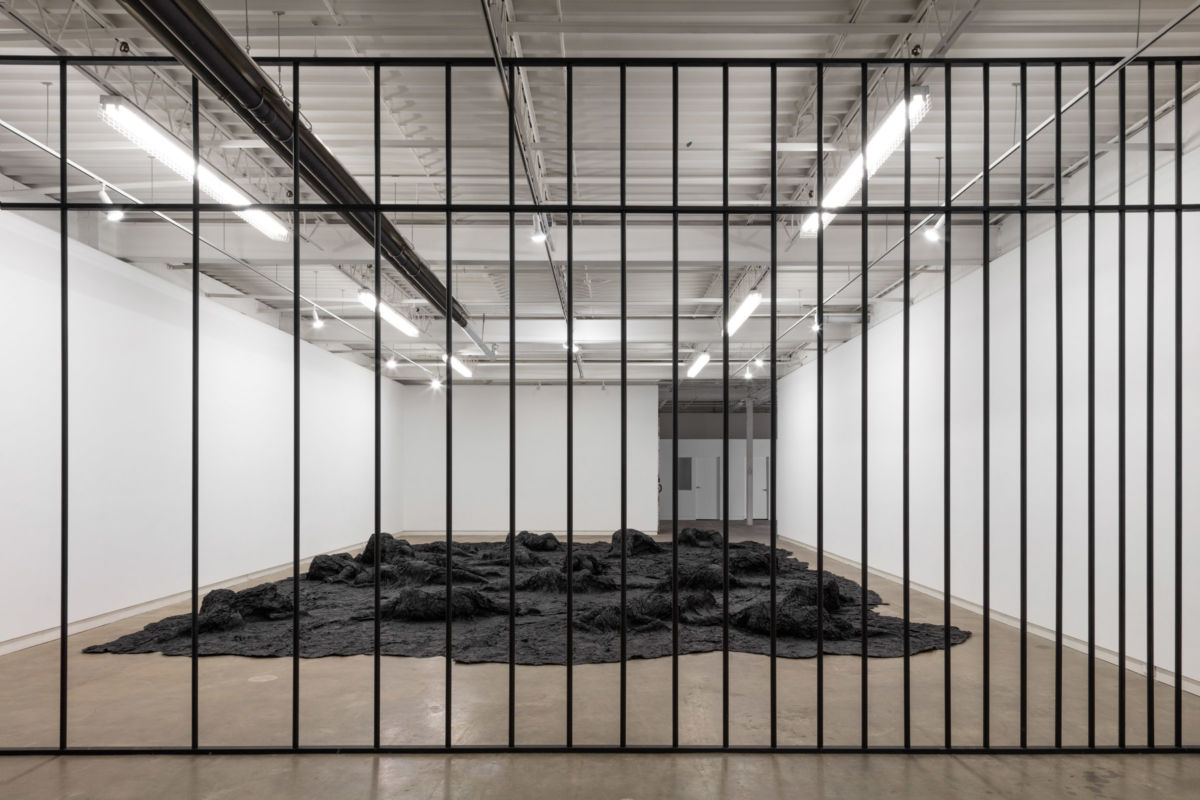
    Installation view of Eduardo Basualdo, Shedding at Scrap Metal

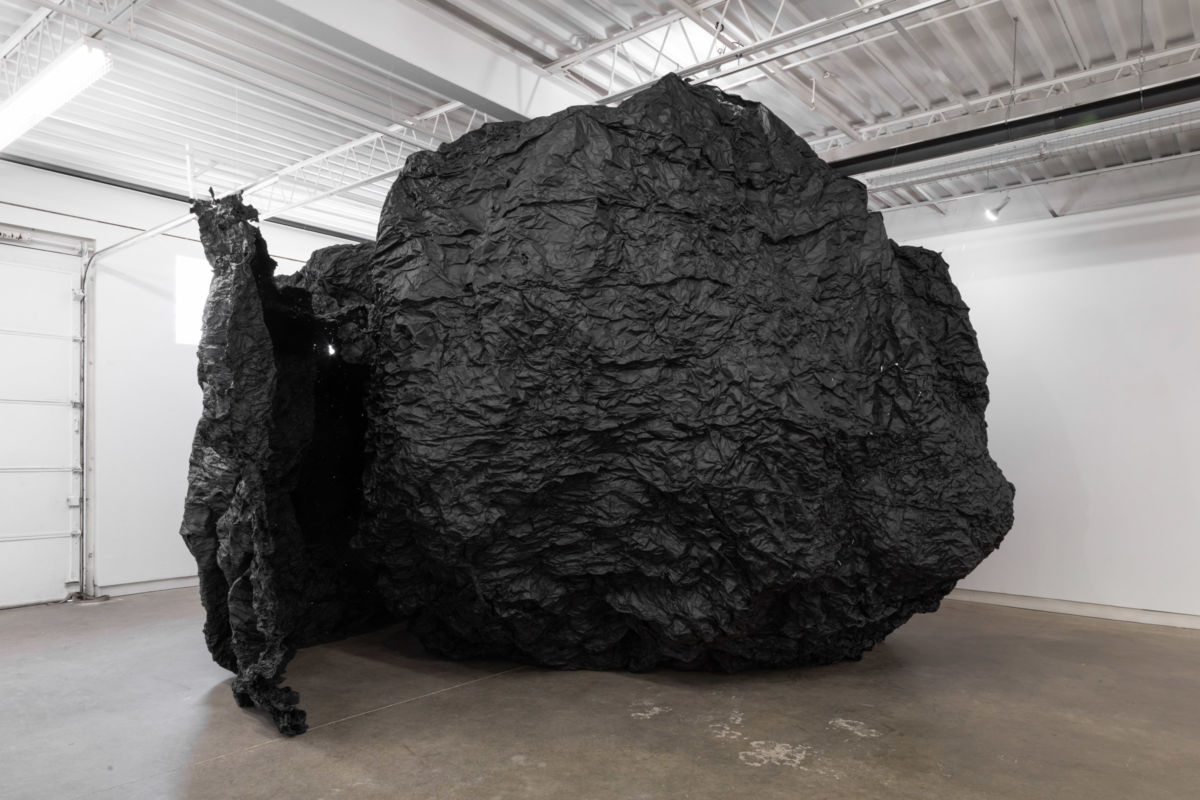
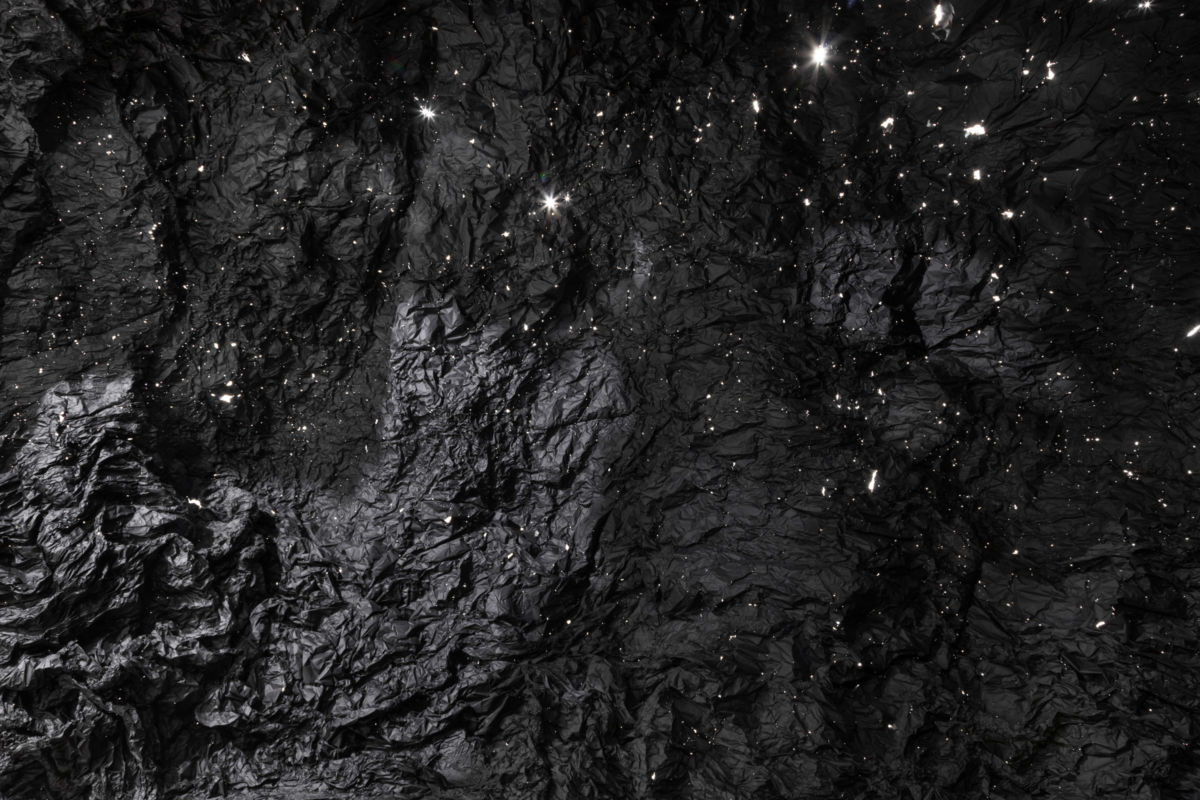
    Though reduced in size by the photographs, the actual exhibition aims to depict the fascination with the “sublime sense of one’s smallness” that Basualdo addresses in his installations. The viewer is faced with a towering boulder. The form is jagged and organic with sedimentary layers that seem earth-like, yet it is entirely matte black which, according to the press release, gives the undertone that the form is alien. The boulders are described as, “landed meteorites still eclipsing light and space”. It has an organic opening that has seemingly been carved away by the elements, large enough for the viewer to enter. Once inside, contrary to the look from the outside, there are holes that allow openings for white light. The pinpricks of light resemble constellations which gives the viewer the feeling of being surrounded by the Earth yet simultaneously encircled by the sky. The meteorites themselves are as much part of the Earth’s landscape as they are beyond the atmosphere.

    Installation view of Eduardo Basualdo, Shedding with the outside and inside view of the boulder at Scrap Metal

    The light consuming, monumental organic forms seem immovable to the viewer but are deceptive. The shapes are created by using Cinefoil, a light weight and matte-black aluminum foil which absorbs light. The use of the material is inspired by the artist’s background as an actor and puppeteer. The installations mimic the state of being in a black box theatre. The black box theatre allows the viewer to be completely immersed in the action on the stage yet there is a paradox. The dark and quiet atmosphere makes the audience extremely aware of their bodies since any noise will disrupt the performance. The effect of the black box feeling heightens one’s own physical presence while the mind is carried to other realities.

    Installation view of Eduardo Basualdo, Shedding at Scrap Metal

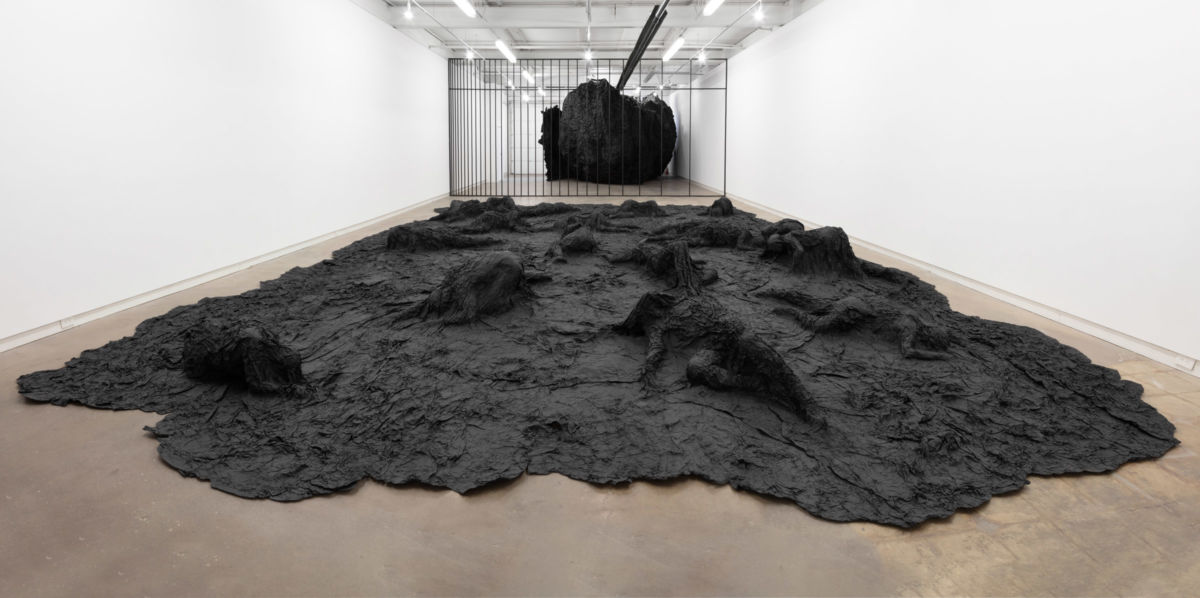
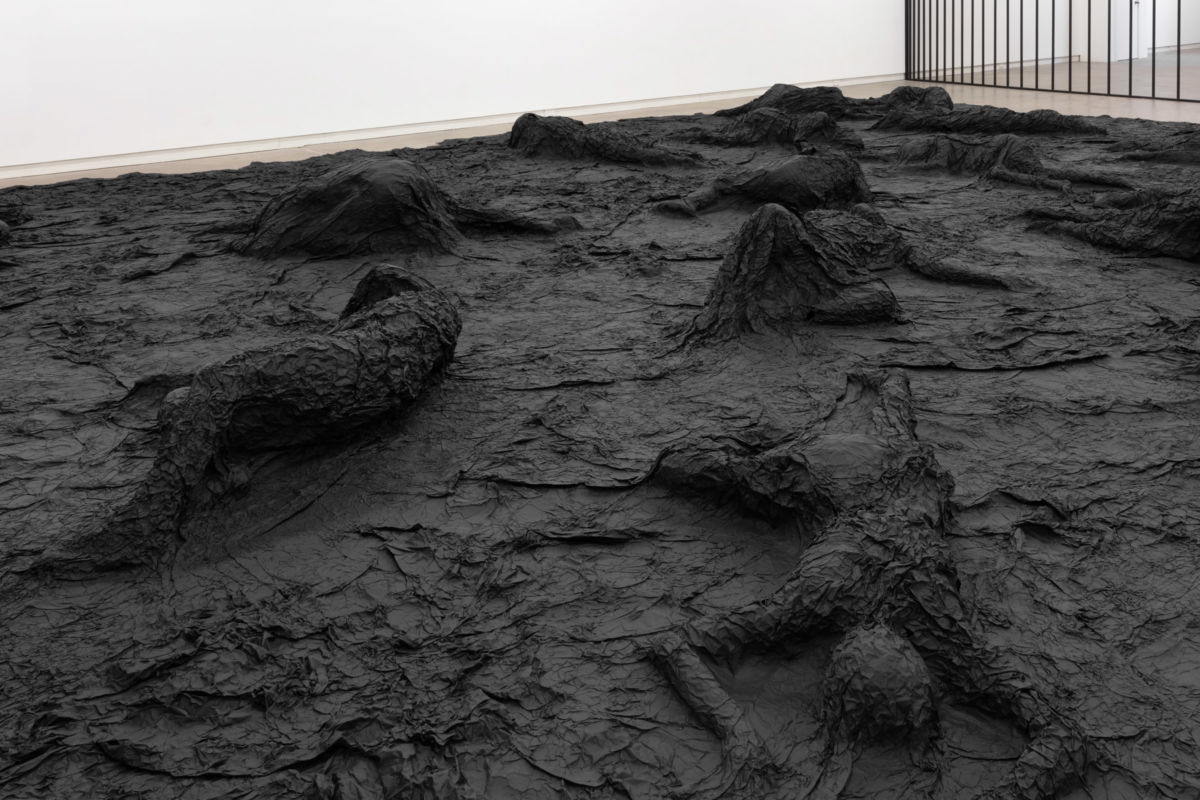
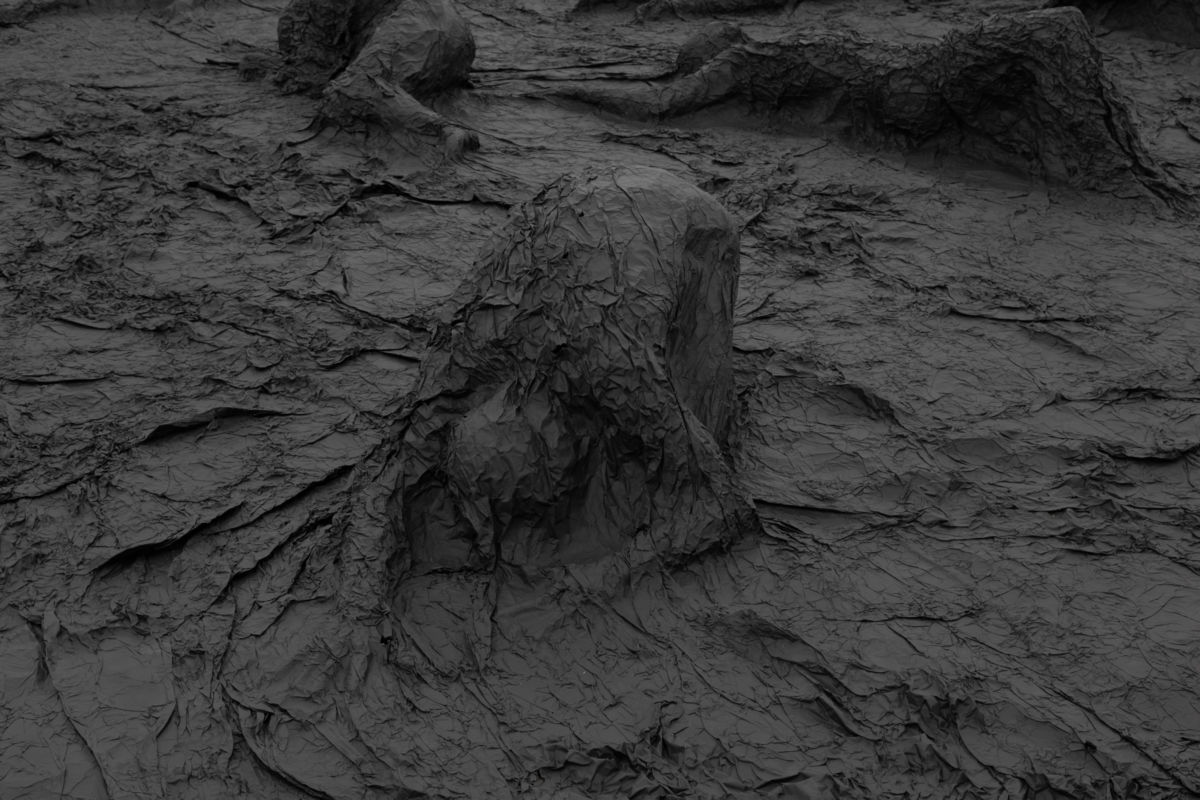
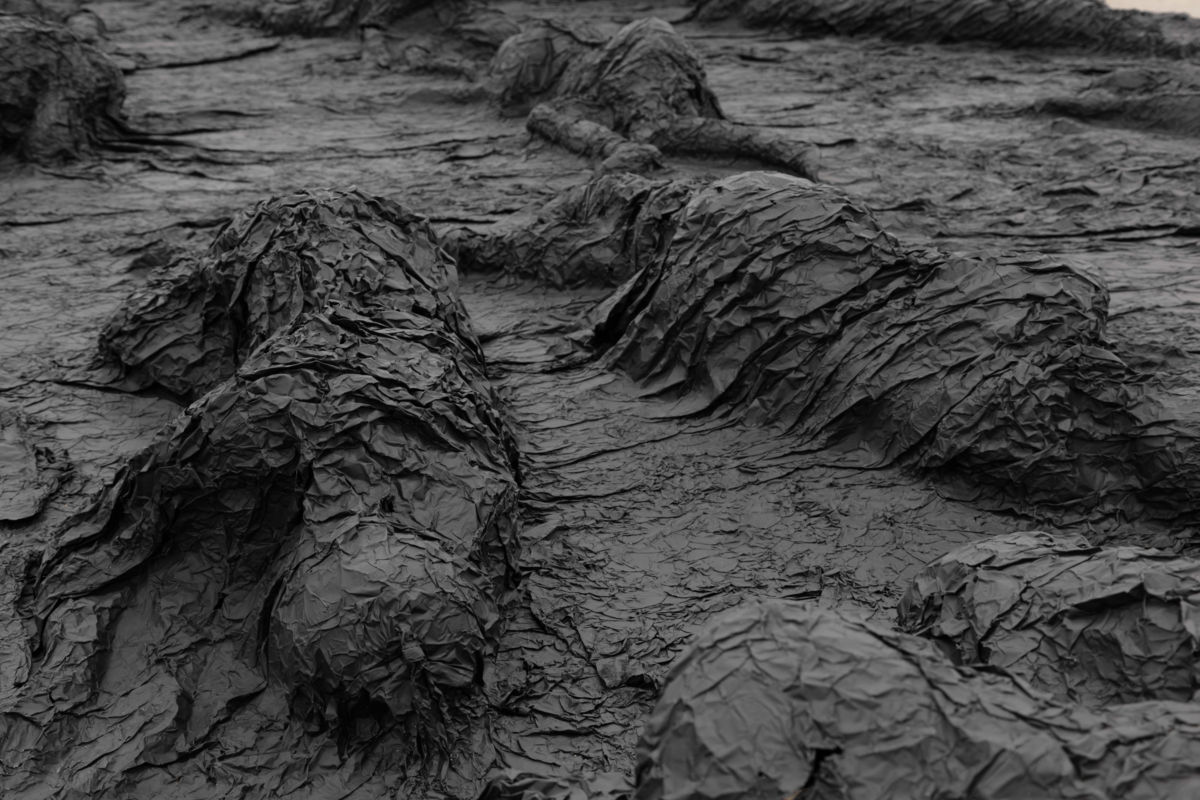
    Another installation lays low on the ground, the Cinefoil resembling a scorched earth. Encrusted by the ash, human bodies lay haphazardly on the ground, fossilized. Some were petrified while still trying to move, some were captured groveling over the earth, while others laid still as if they had given up and settled down to sleep forever. The site unsettles the viewer as it’s like looking at an archaeological excavation that reminds us of the fate of Pompei. The uniform black material gives the impression of a futuristic event of a meteorite hitting Earth and decimating the land and its people yet the figures come from the faraway past. The scene is terrifying and reminds the viewers of their own physical form and how it is the only body through which they can experience the world. The existence of people is fragile, especially in the presence of such monumental and destructive forces. Looking at the installation make us feel a sense of the sublime indeed; but it is also such a cruel vision.

    Installation view of Eduardo Basualdo, Shedding at Scrap Metal

    The two Cinefoil installations that share the same room, are interrupted by metal bars that appear to be a blockade but as you have a closer look you recognize that there is enough space in between them for a grown person to pass through. Basualdo in his “world of permeable gates” makes us aware of the absurdity of institutional structures and their function in limiting the freedom of individuals. Purposeful barriers seem to be a part of the aesthetic landscape (such as fences and architecture) until they need to be crossed, when they become controlling devices. One can still find a way to overcome them, as Josi Smit mentions in her introducing essay: “The limits have limitations.”

    Installation view of Eduardo Basualdo, Shedding at Scrap Metal

    In an interview with Adratus Collection, Basualdo speaks of what this exhibition may mean in the context of the current pandemic, “In relation to this moment we live, I think that it colors everything we see, it cannot be otherwise. We could relate anything we see to what is happening to us today…This work indeed focuses on a collective catastrophe, but hundreds of them happen all the time at all times. They are part of our history and obviously of our future too”. Extreme and uncontrollable situations cause people to step back from their daily routines and look at their lives with more attention. Amidst these artworks, viewers shed their original bodily experience and replace it with a new, more dramatic one, that strips back the layers of institutions for critical review.

    Like the props on a stage, Basualdo creates a fictional world set so the viewer can contemplate their lives and bodies. He creates a space for a humbling experience, forcing one to acknowledge their own limitations.

    Olivia Musselwhite

    Images are courtesy of Scrap Metal Gallery.

    *Exhibition information: Eduardo Basualdo, Shedding, February 20 – May 30, 2020, Scrap Metal Gallery, 11 Dublin Street, Toronto. The gallery is temporary closed.

  • Sarah Sze: Images in Debris at MOCA

    The Remains of the Day / Sarah Sze: Images in Debris

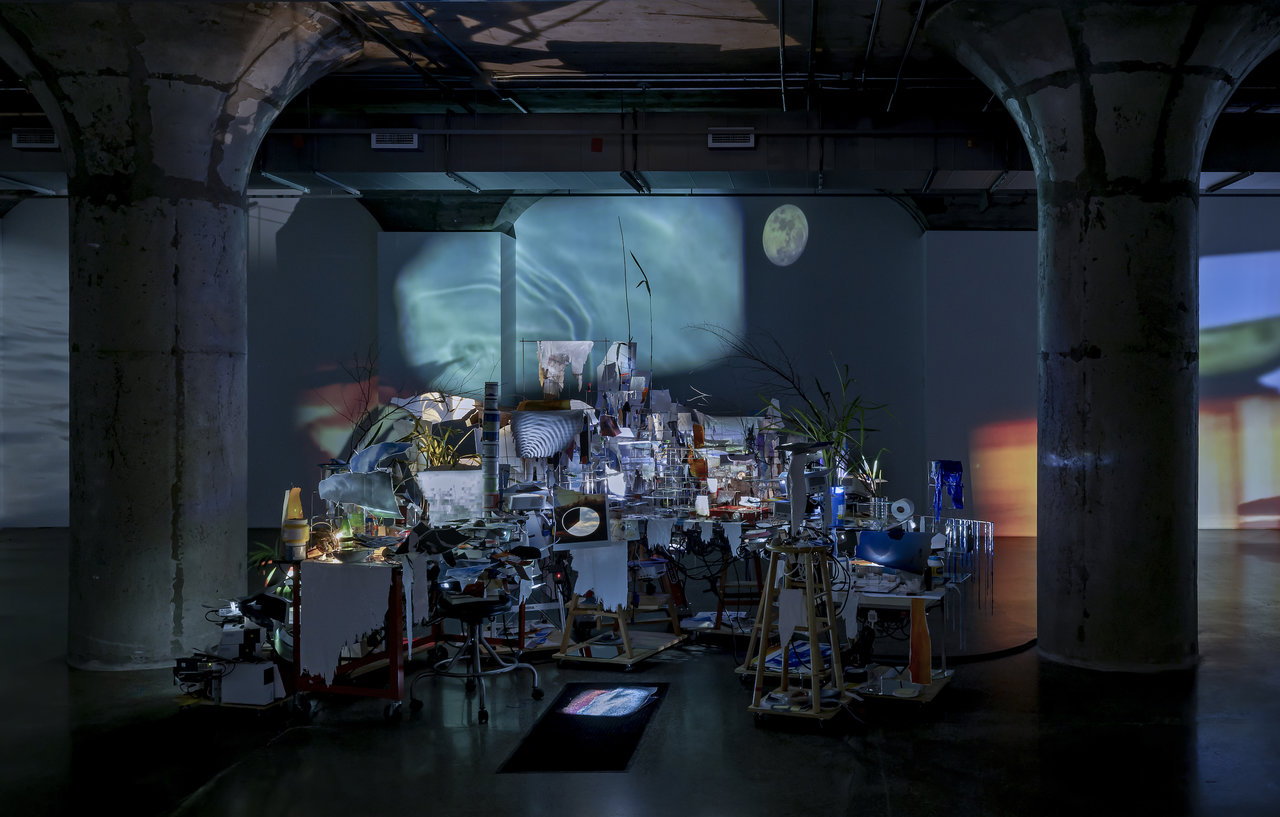
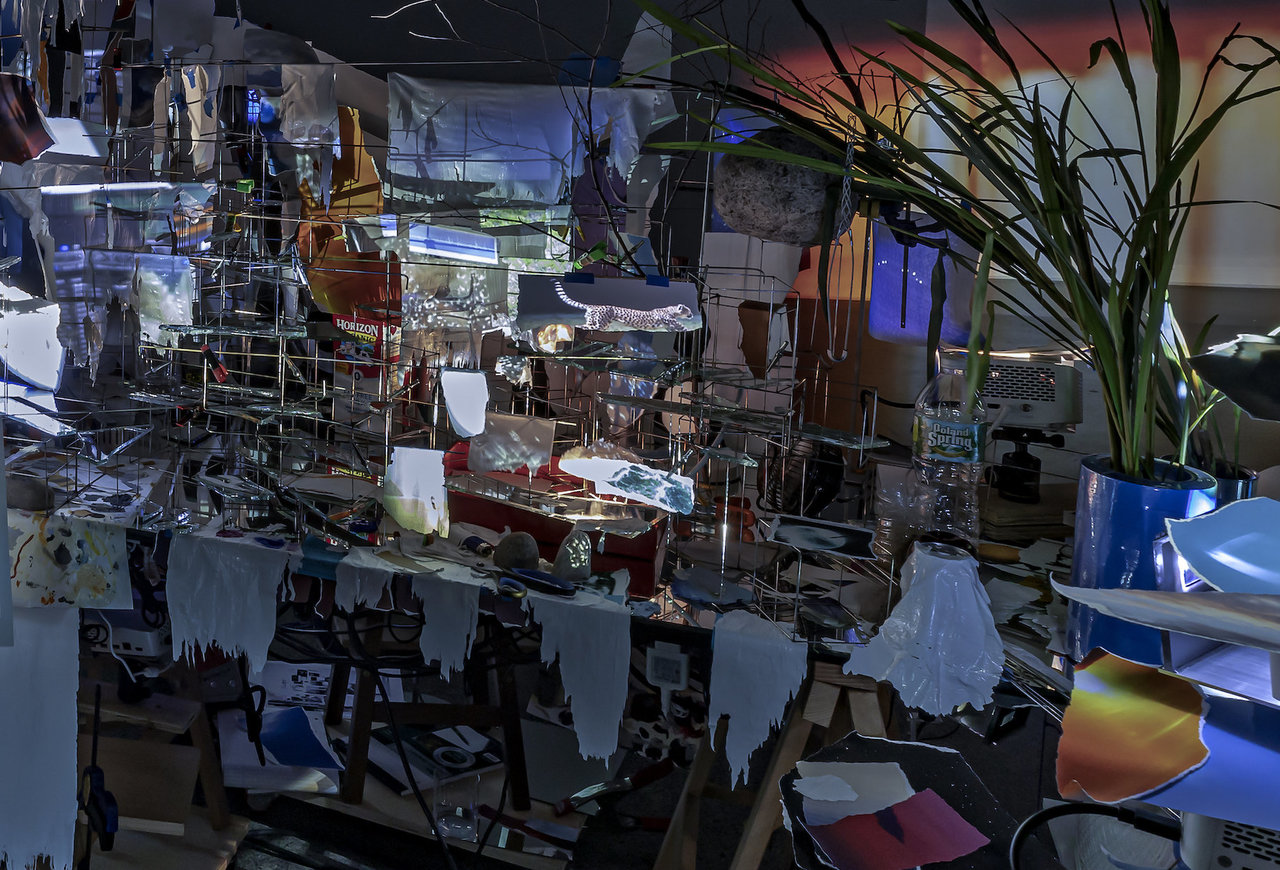
    Entering the back room of the 2nd floor at MOCA from the brightly lit exhibition of Carlos Bunga’s A Sudden Beginning with its network of boxes, the darkness envelops us, a darkness that blinds. Is what we see real or just a mirage that gives the illusion of an installation? The eye and the mind both have to adjust to the magic world of Sarah Sze’s work, a universe in itself.

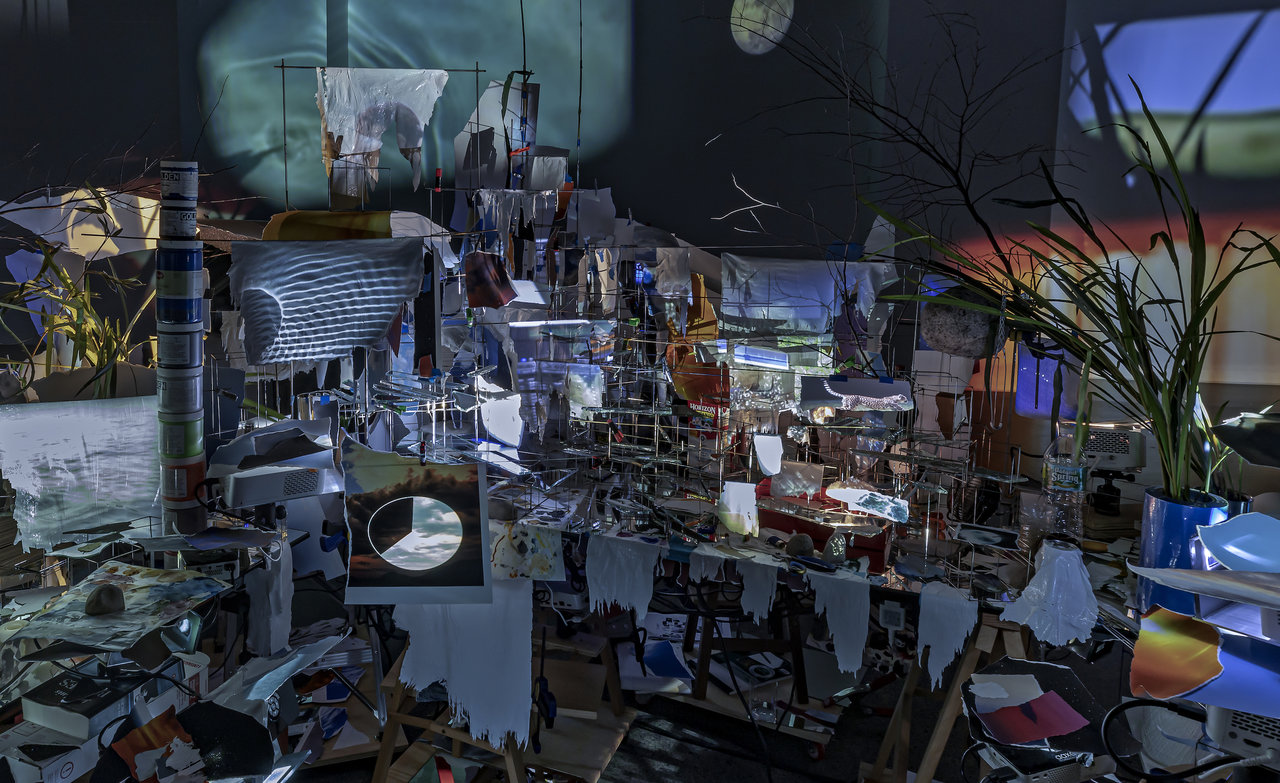
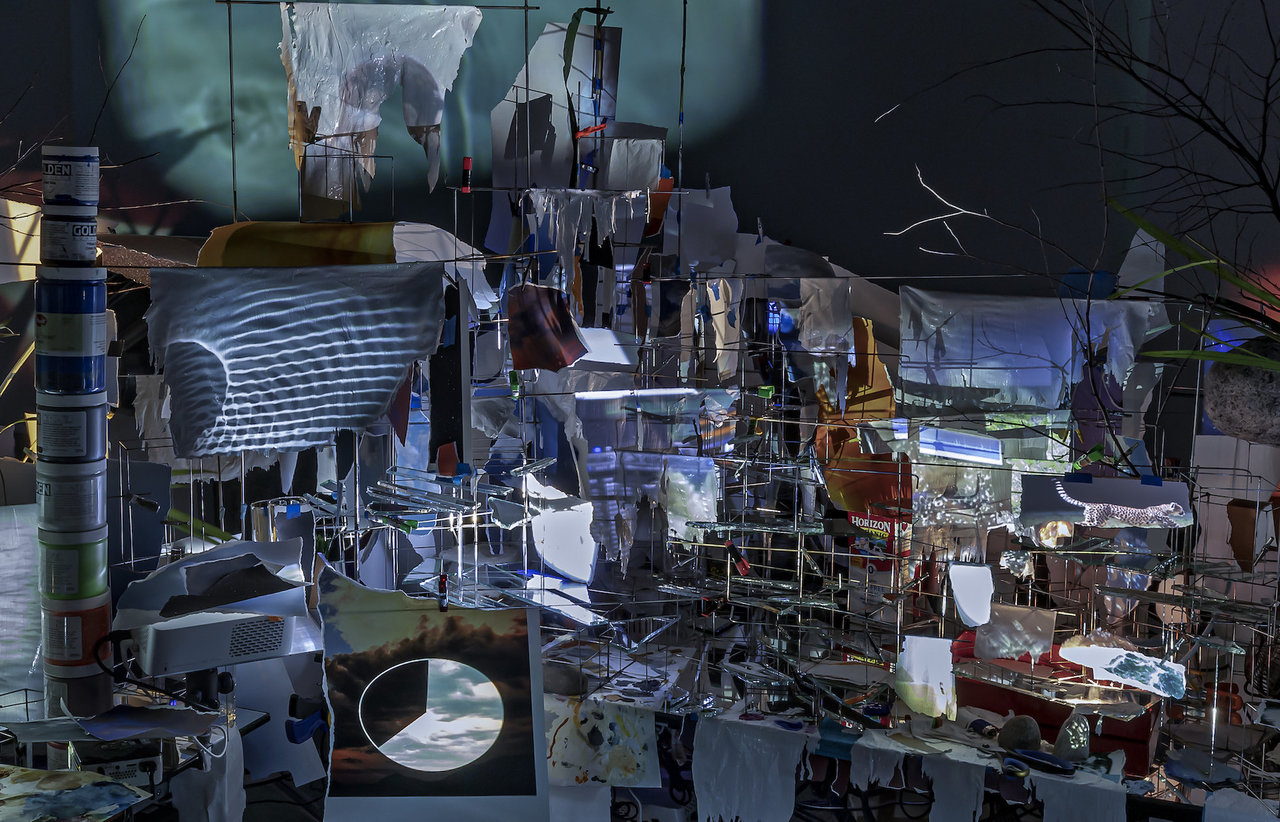
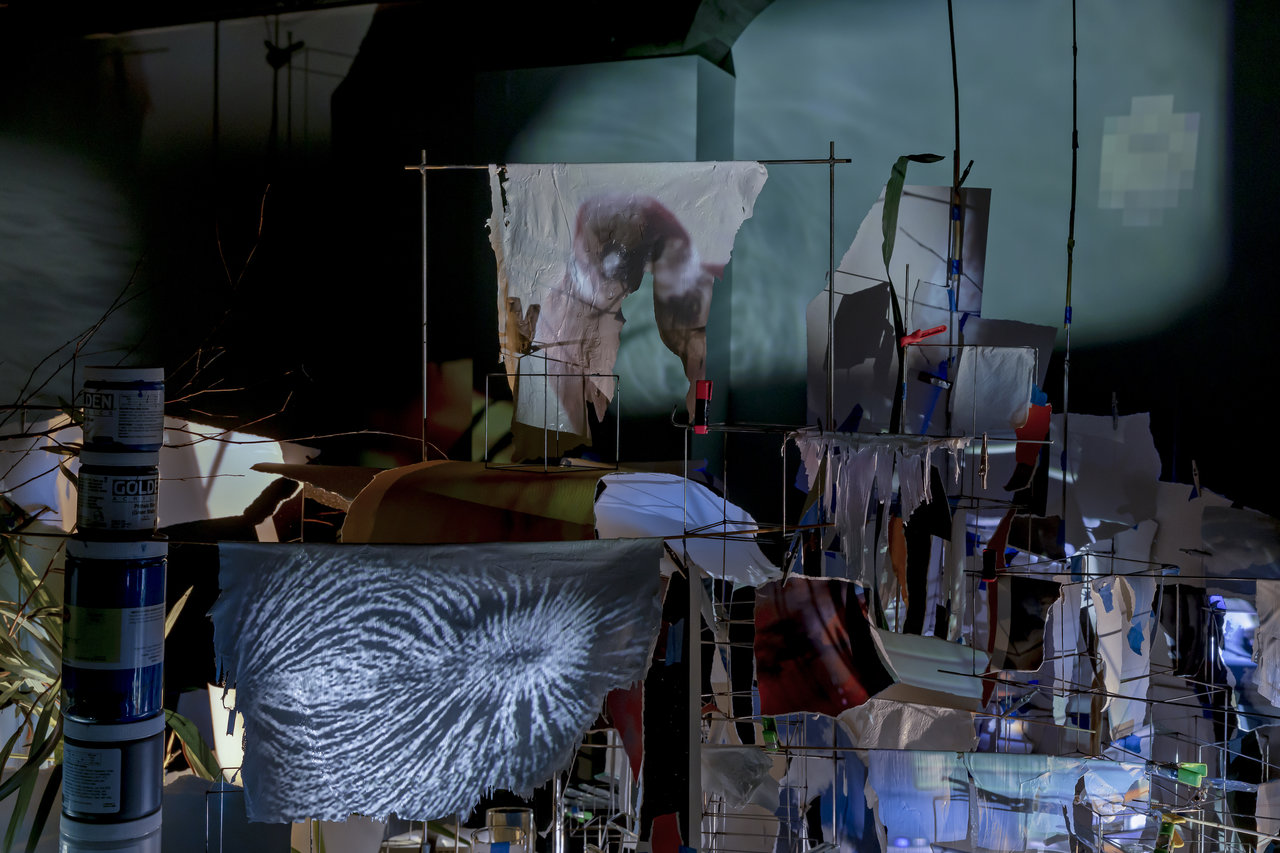
    Images in Debris was created in 2018 and purchased at its only exhibition at the Victoria Miro Gallery, London by Toronto collectors Audrey and David Mirvish who have loaned it to MOCA. It is the younger sister of Timekeeper from 2016, an installation that travelled the world’s most famous museums and is part of the collection of the Solomon R. Guggenheim Museum, New York. Their structures are similar, each with a central point from where an abundance of objects and effects is organized on wire scaffolding and the surrounding walls. Some motifs are recurring like a moving image of a running cheetah, a plant, a moon and its pixelated images, pieces of painted and then ripped paper, and the very special handling of light and darkness.

    It is impossible to describe the installation itself – and Sze’s work in general – so everyone who writes about it speaks of a personal journey. As Sze said in Art:21 her goal is to maintain the viewer’s attention and challenge them, so the experience of viewing becomes a discovery. It is more about time and space and our relations to them than about the objects in front of us. Contemporary life is overwhelming and as a result our senses are overloaded, and our memories become fragmented. Time is subjective. Some moments stay with us for decades, remembered vividly, while others fall into the abyss never to resurface. The so-called ordinary moments of our lives stay in greyness forever. What is time, really? The present we live in becomes the past before we recognize it. The past is only memories, and all depends on how we select and store them. The future is a vision or a dream at best. Once Yoko Ono collected little stones on her morning walk and titled them with the exact time she found them to have a reminder of each moment. Sze tries to reconstruct time by keeping and putting together various objects of daily life and images she has searched, found and photographed. As time is never linear, her work mirrors that nature, not telling us her story but leaving us with the opportunity to create our own narratives.

    There is no time without space. Images in Debris works with fragments as if trying to reconstruct a building that is falling apart by picking up some stones. Sze is influenced by architecture but she considers her work sculptural. As she said in Conversation with Okwui Enwezor in 2016, “I am more interested is how defining the idea of sculpture leads to breaking it down. I am more interested in the idea that film can be a sculpture, a drawing can be a sculpture, music can be a sculpture.” In Images in Debris she puts all the above together, as video clips and movies projected on the walls and on the objects while an otherworldly, ethereal music plays – like noises from the universe or underwater – that reminds me of the sound effects of Matthew Ritchie’s installation The Morning Line (Andalusian Center for Contemporary Art, Seville, 2008).

    All the objects are cheap, ordinary pieces like empty plastic bottles, paint containers, used paper, glass or metal containers – but when Sze puts them in her installation, they suddenly gain value, the value of art. Ripped pieces of painted paper move by means of an unseen fan, while projected images occupy their surfaces, like a running cheetah, a young woman or a pie-graph. Beside a roll of toilet paper a real plant grows in a container, supported by full spectrum lights. Milliards of objects, papers and textiles create a crowded structure. A mirror placed in a container and covered with water goes through a metamorphosis under a sharp light and becomes the frozen ocean in Tarkovky’s Solaris when the astronaut sees the small lake of his youth in it. It also looks like mercury and changes the light effects on the ceiling. The debris in this installation is more than a collection of objects left around to annoy us. It has unlimited possibilities since all our encounters are unique. Our debris tells a lot about us, our tastes, culture, likings, personalities – our entire life is witnessed by those objects and encapsulated in them. They are an important part of our life. Without recognizing it we become intimately and emotionally attached to the objects we surround ourselves with, regardless of whether they are useful or not. It is this mixture of the psychological and physical, where memories share the platform with physical objects, that makes this installation so attractive.

    I was standing in front of the installation, very close. I must have zoned out for a few seconds like when you fall into that half-dream state. Then one piece of painted paper, part of the installation, moved slightly, touching me. I came to with a sudden shock, worried that I ruined the piece. What happened? What might have happened if I had fallen into this installation, like Alice through the rabbit hole? Will I, my being, be submerged into it? Will my remains, my memories become part of it? Does the possibility of it scare or delight me? Are we consuming the art or is it consuming us? It was a strange moment and I knew for sure that the magic had already happened and some invisible part of me remained on the piece of paper I had accidentally touched – and visa-versa. The hidden camera of my mind took a thousand shots and now stores them both in the conscious and subconscious.

    Then a blinding light came out from some hidden pocket of this installation and my shadow suddenly appeared on it. To be precise, the shadow of my lower body, from the waist down. It remained there until, as fast as it came, it disappeared again. Then another shadow of me, this time my upper body, appeared enlarged on one of the walls. So, wanting it or not, being paranoid about it or not, I was becoming part of the installation. You step into it; you step out of it, depending on the light, without your control; reminding us that our mind is not entirely our own. It is impossible not to be aware of your body’s reaction to this work. A panel from the Age of You, MOCA’s previous exhibition, came to my mind about panic and anxiety. Am I panicking as my generation should or experiencing anxiety like the Millennials? This installation is definitely anxiety inducing.

    Sze’s “sculptures” are very complicated structures, that vibrate with projected images and light that fills them with life, making them a living thing that breathes and moves. Through this metamorphosis, mundane objects from daily life become otherworldly. Scale and size matter, lighting and projections matter. I wonder how something this complex could be created and then re-installed? We only can guess the artist’s thinking process behind it while we try to puzzle out the pieces in the exhibition. The installing of the work is specific and follows the original plan. Two people from Sarah Sze’s studio came to MOCA to install Images in Debris. They also involved some of MOCA’s staff and trained them to be able to maintain the piece as water would evaporate and need to be refilled. Sze was repeatedly in video conversation with the team and she changed certain parts and effects to adjust them to MOCA’s space – so the installation became site specific as well.

    One of the best things about this installation is its complexity, its thousand little parts, related or unrelated to each other, their different medias, dark or shiny surfaces, vibrating with life or challenging the eye to see – making you walk around it or step closer to see its details. There’s so much to take in the eyes and ears are constantly multitasking, feeling overwhelmed. When I was a child, I fantasized about being locked in a museum, in my case the Fine Arts Museum in Budapest. To be surrounded by all the artwork in the semi-darkness and have everything right there to discover. Of course, that never happened but Sarah Sze’s installation gave me a real sense of how that would feel and I treasured every moment of it.

    Emese Krunák-Hajagos

    Images: Sarah Sze, Images in Debris, 2018, MOCA Toronto. Courtesy the artist, Victoria Miro Gallery, London and Tanya Bonakdar Gallery (New York and Los Angeles). Photo: Toni Hafkenscheid

    *Exhibition information: February 6 – until further notice, 2020, Museum of Contemporary Art, 158 Sterling Road, Toronto. The Museum is temporary closed because of Covid-19.

  • CONTACT Photography Festival 2020

    Scotiabank CONTACT Photography Festival 2020
    presents a new Online Program beginning May 1

    Scotiabank CONTACT Photography Festival, the popular annual presentation of lens-based art, announced an online platform to present new works and initiatives by Festival artists, participants and partners, including photo essays and books, videos, and a variety of conversations recorded in living rooms, studios and exhibitions. 

    Typically spanning the month of May, an exceptional range of lens-based works by Canadian and international artists was selected for a diverse array of exhibitions at museums, galleries, public sites, and alternative spaces throughout Toronto in 2020. While many venues will remain closed for the foreseeable future due to the impact of COVID-19, some of the Festival’s exhibitions, public installations, and programs will eventually open on a case-by-case basis, once public safety is assured and schedules are confirmed.

    To acknowledge the enormous efforts of everyone involved in the Festival and to celebrate their many accomplishments, information about all of the original programming is presented on the CONTACT 2020 website. Visitors will discover a rich and diverse range of content with individual profiles dedicated to each of the more than 150 exhibitions and public installations originally planned for sites across the city in May.

    CONTACT is presenting a series of online programs, many in collaboration with their partners, which will roll out on the CONTACT website starting May 1. The selection listed below reveals the scope of programs that reflect and enhance the Festival’s exhibitions.

    In Focus profiles existing and new works, plus initiatives including videos and other timely iterations of photo-based projects.

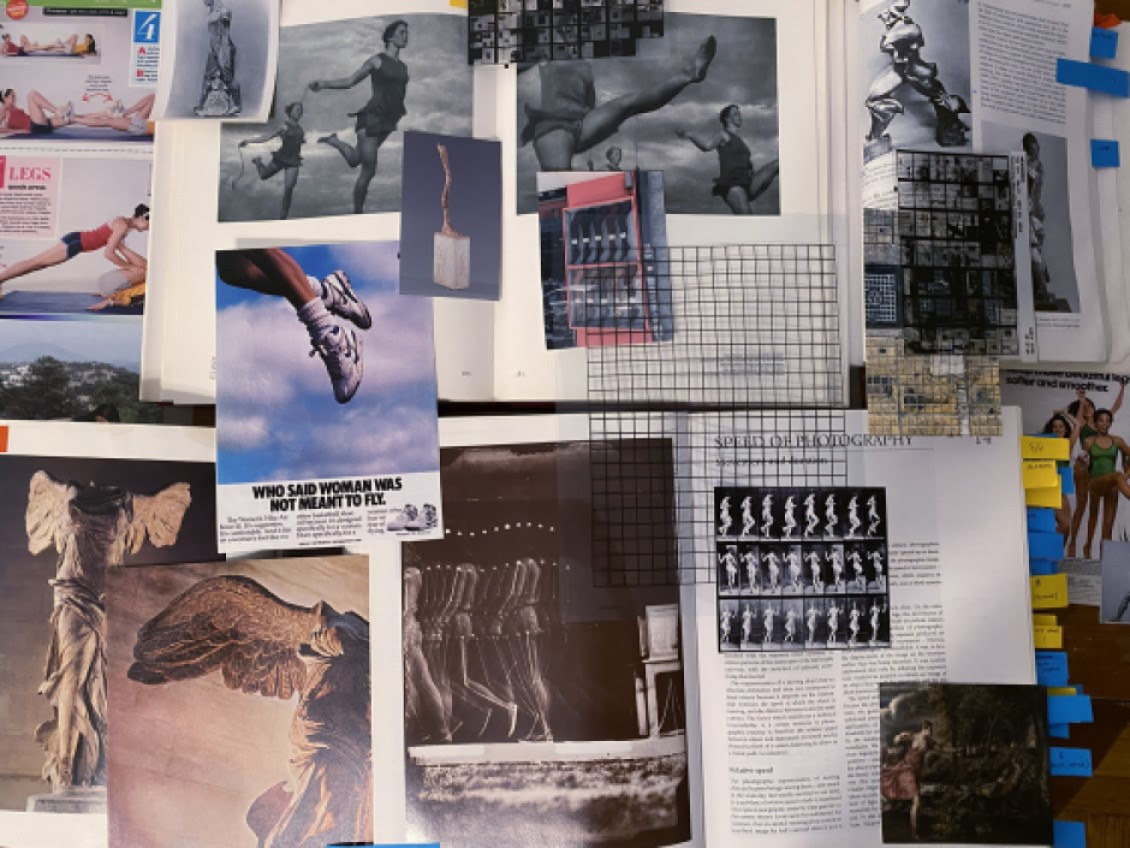
    Artist Kim Hoeckele presents a new video where she takes a deep dive into her computer’s research folder. Comprising hundreds of photographs, it reveals visual interconnections and the complexity of reference materials used for her planned Public Installation billboard project epoch, stage, shell.

    Kim Hoeckele, Nike or Nike, 2020. Courtesy of the artist.

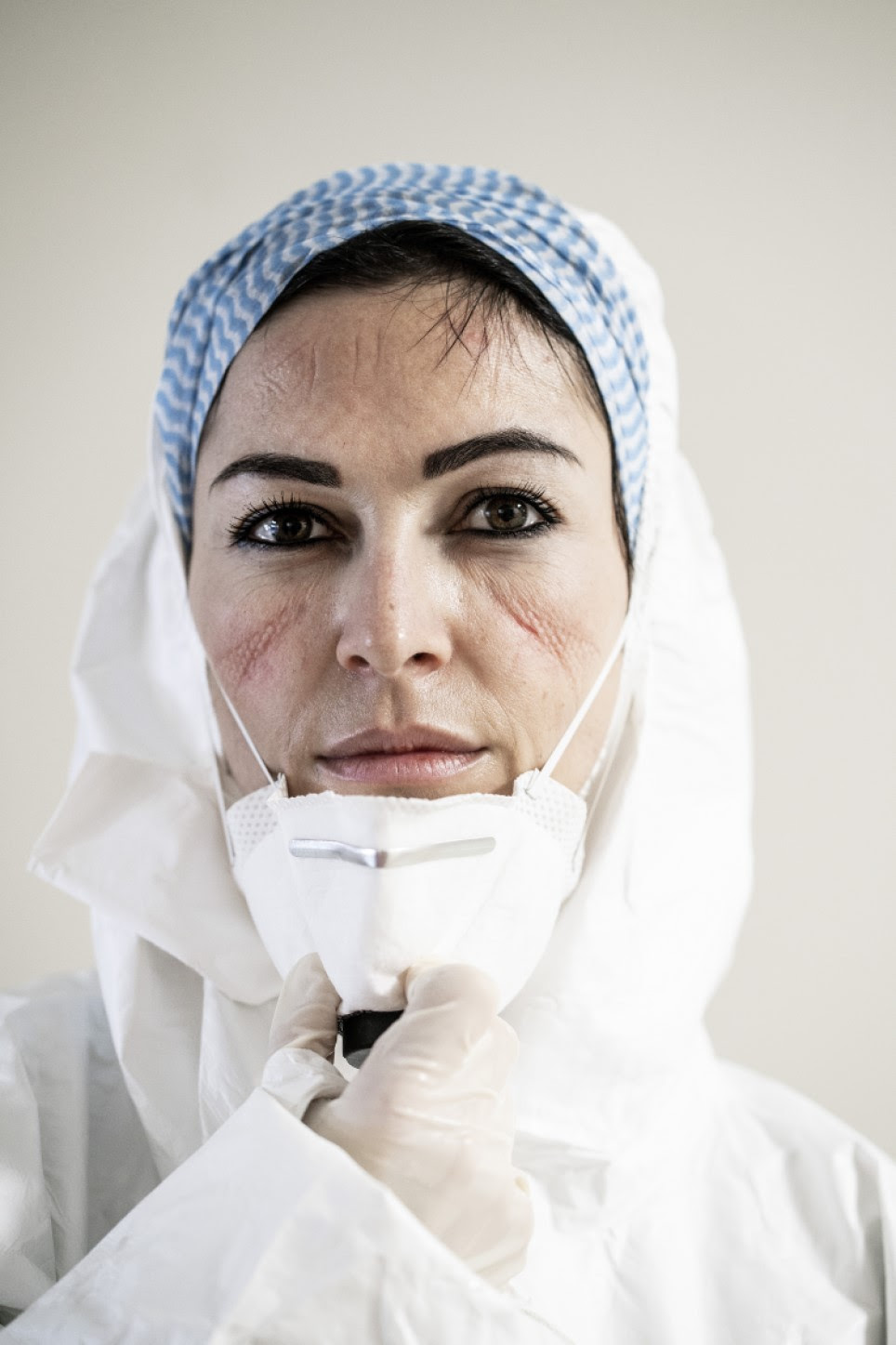
    Photographer and journalist Alberto Giuliani presents an on-going series of images documenting front-line workers at the San Salvatore Hospital in his hometown of Pesaro, Italy, an epicenter of the ongoing Covid-19 crisis. Select portraits are accompanied by reflections from the doctors and nurses pictured, speaking to the unfathomable circumstances within which they find themselves.

    Alberto Giuliani, Untitled, 2020, Francesca Palumbo, Intensive Care Unit Nurse. Courtesy of the artist.

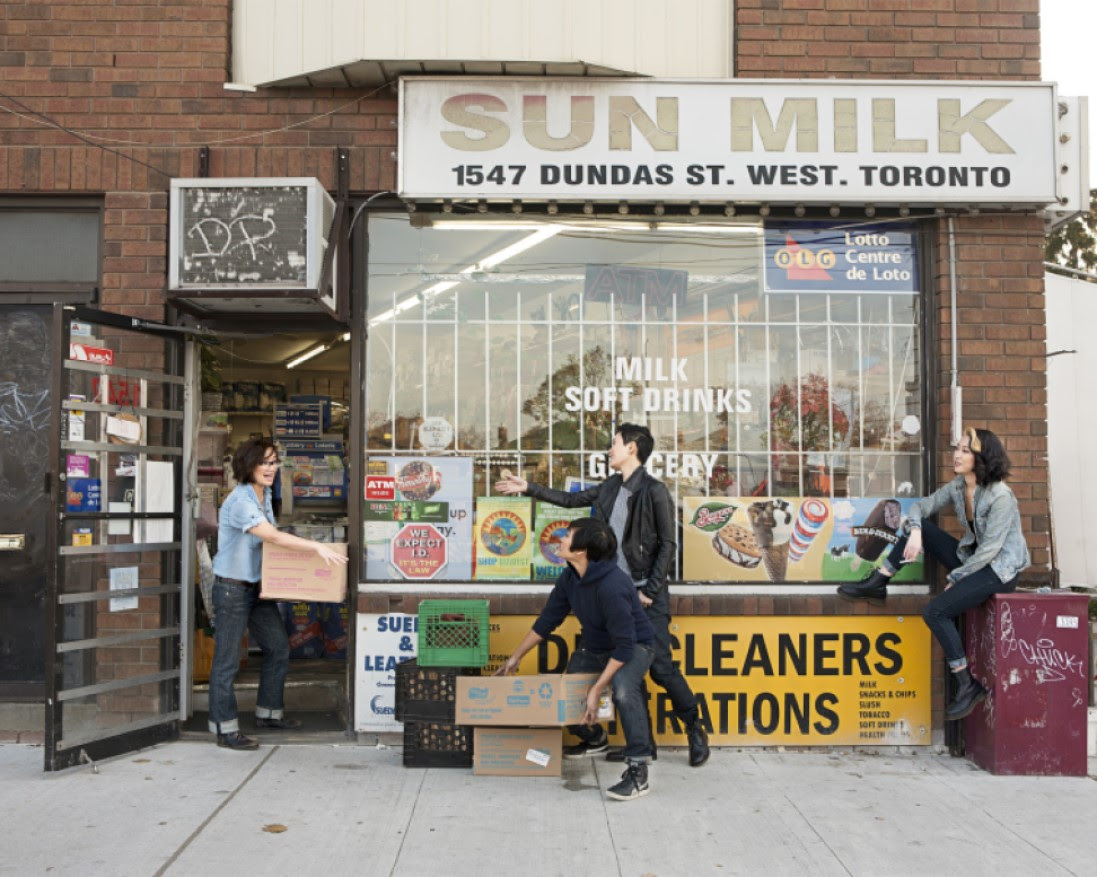
    Trinity Square Video presents the group exhibition Performing Lives on a new online platform. Curated by Zoë Chan, the exhibition sheds light on alternative forms of storytelling and strategies for viewer engagement.

    May Truong, The Outsiders (video still), 2016. Courtesy of the artist.

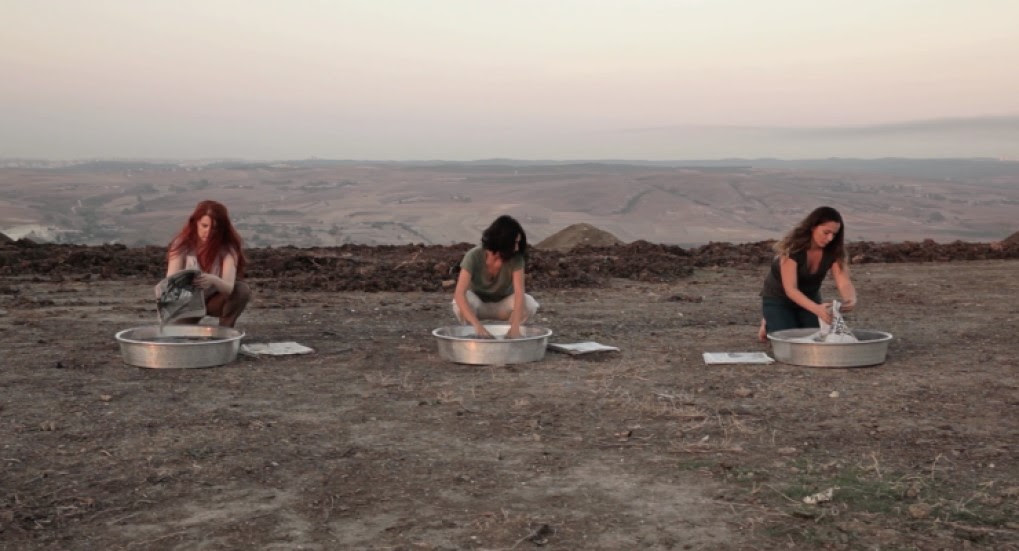
    Museum of Contemporary Art Toronto (MOCA) has partnered with CONTACT to jointly present Scouring the Press, a video performance by artist Fatma Bucak, as a complement to the upcoming two-person exhibition with Krista Belle Stewart, titled Acts of Erasure, scheduled for MOCA later this summer.

    Fatma Bucak, Scouring the press (video still), Courtesy of the artist.

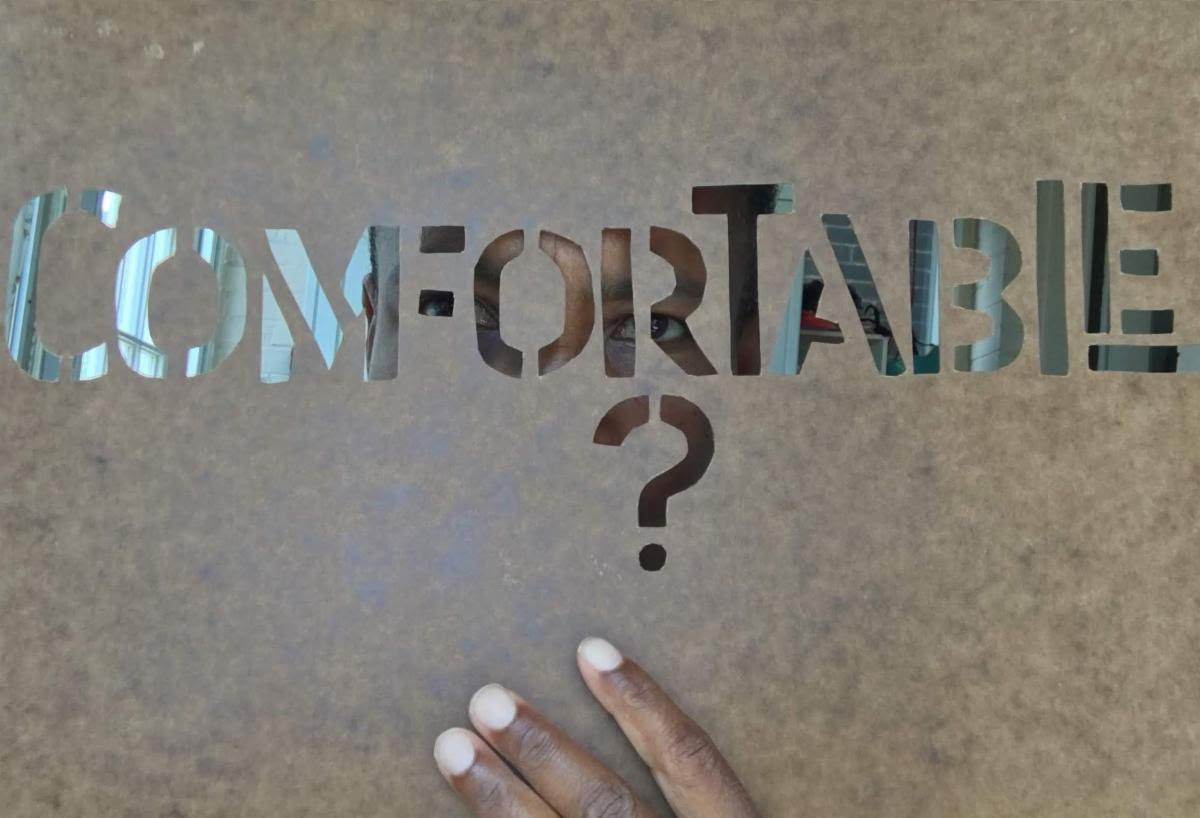
    Touched by a Soucouyant, a video by Trinidadian-born, Toronto-based artist Natalie Wood, is a potent example of the works to be shown in Wood’s solo exhibition Performing Change which is scheduled to open at John B. Aird Gallery and Charles Street Video this fall.

    Natalie Wood, Comfortable, 2018. Courtesy of the artist.

    Artist Profiles feature conversations, writings, images, and explorations focused on Festival artists.

    Artist Tereza Zelenkova discusses her past work and new series commissioned by CONTACT for the upcoming solo exhibition The Double Room at Campbell House Museum, with editor and producer of the podcast Nearest Truth, Brad Feuerhelm.

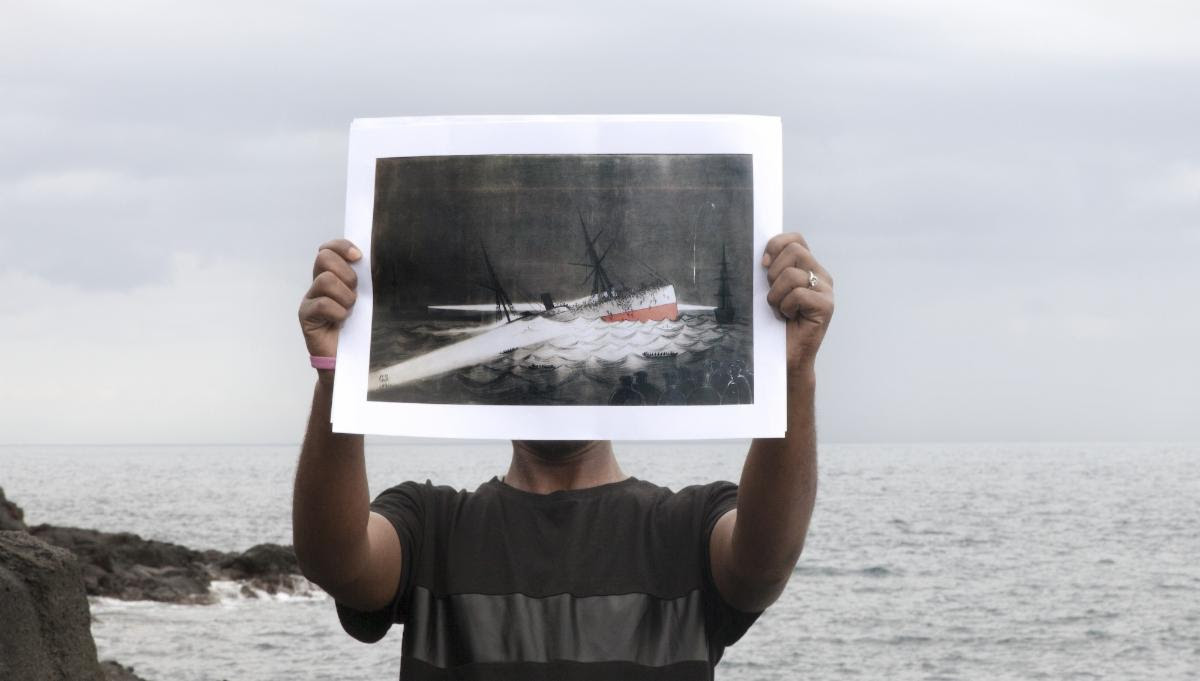
    A video produced by The Power Plant Contemporary Art Gallery offers insight into Dawit L. Petros’ solo exhibition Spazio Disponibile and provides context for his CONTACT 2020 Public Installation Untitled (Overlapping and intertwined territories that fall from view III).

    Dawit L. Petros, Untitled (Overlapping and intertwined territories that fall from view III), Catania, Italy, 2019. Courtesy of the artist

    Upcoming profiles on artists in CONTACT’s Core Exhibitions include Diane Arbus, Aaron Jones, Christina Leslie, Ebti Nabag, Taiyo Onorato & Nico Krebs, and Małgorzata Stankiewicz. 

    Curator’s Reading Lists share texts recommended by curators related to their CONTACT 2020 Core Exhibitions.

    Curator and writer Sara Knelman shares some readings that informed her approach to the upcoming Public Installation of Thirza Schapp’s work Plastic Ocean at Dupont Subway Station.

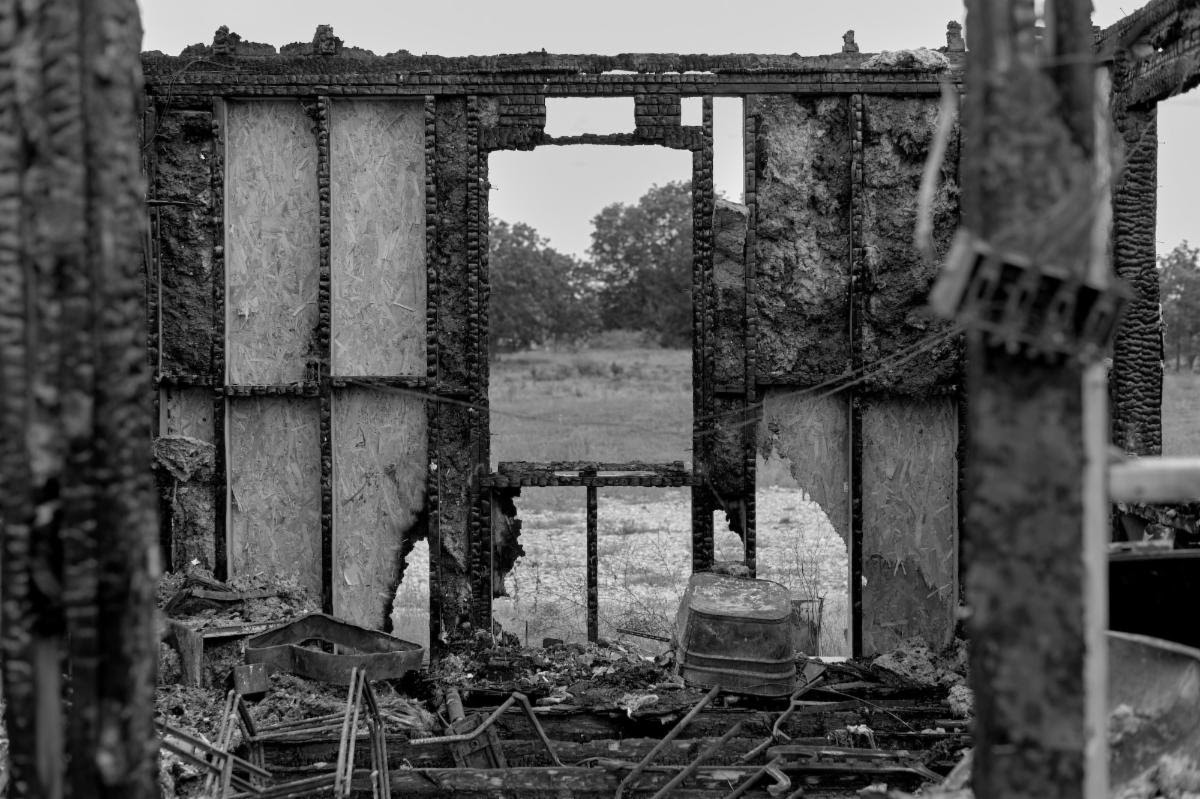
    Philip Monk, curator of the public installation of works by Greg Staats at Todmorden Mills Heritage Site for at least one day, you should continue to breathe clearly, suggests readings that informed his involvement with the project and shares insights about the artist’s practice.

    Greg Staats, Transformation, 2019. Courtesy of the artist

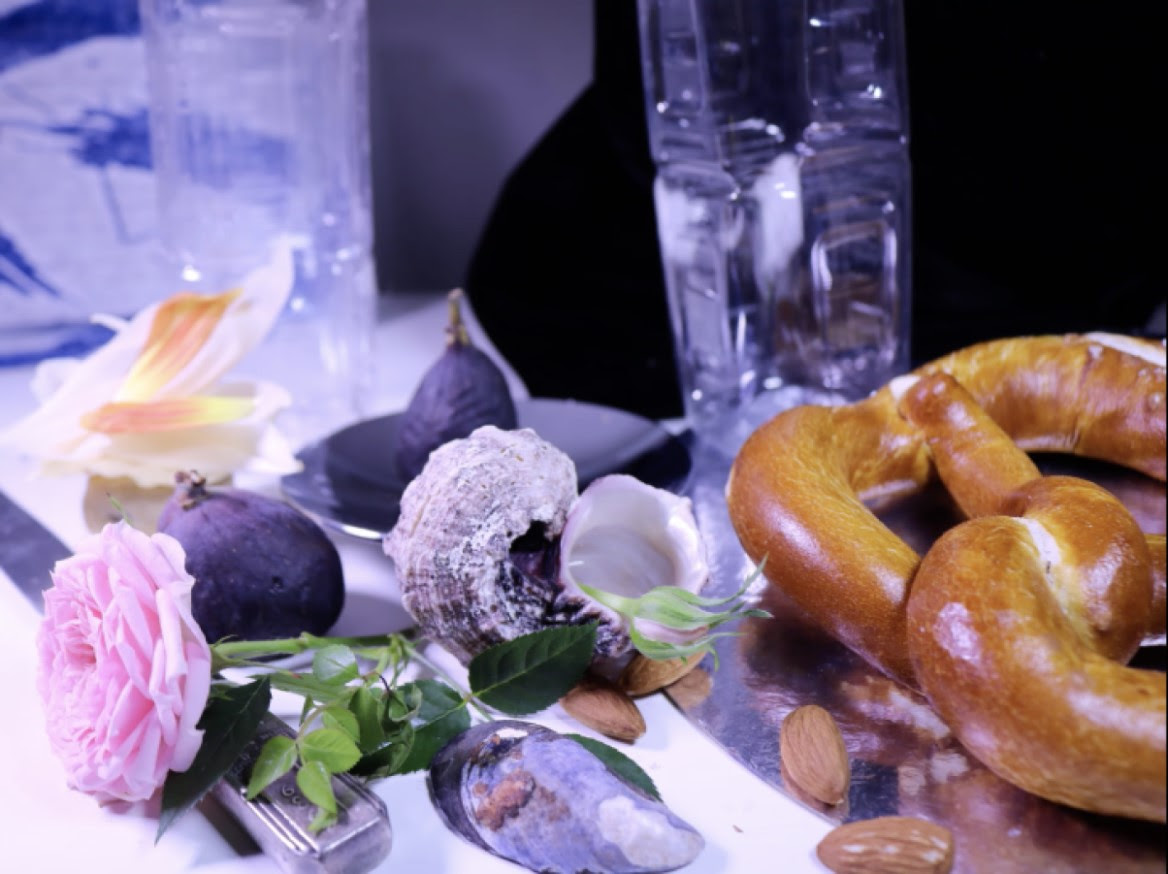
    Curator Heather Rigg presents select readings related to Alone in the House (Still Life with Clarice Lispector), the exhibition of Elisabeth Belliveau’s work that will be presented at Gallery 44 in the fall.

    Elisabeth Belliveau, Still Life with Pretzel (After Clara Peeters), 2019. Courtesy of the artist

    Forthcoming reading lists from exhibition curators will be featured including Zoë Chan, Benjamin Freedman, Sophie Hackett, Anique Jordan, Bonnie Rubenstein and Tara Smith.

    Photobook Lab showcases recent publications by artists and photographers.

    While the 2020 Photobook Lab is currently postponed, a selection of books will be featured online. This year’s initiative is inspired by Spanish artist Laia Abril’s exhibition A History of Misogyny Chapter Two: On Rape, to be presented in the CONTACT Gallery later this year. The first iteration of the virtual Photobook Lab features Abril’s book A History of Misogyny Chapter One: On Abortion (2017).

    Books by Genevieve Allison and Elliot Ross, Hannah Darabi, David Hartt, and Donald Weber will be highlighted in the coming weeks.

    Sponsor Initiatives

    # ScotiaGallery

    In previous years, Scotiabank presented #ScotiaGallery at bank locations across Toronto. This year, the open entry program encourages participants to come together by sharing their views from home. People are encouraged to take a photo and use the tag #ScotiaGallery to share it on Instagram. Scotiabank will select photos from entries to be featured on the CONTACT website throughout May.

    Nikon: Stay Inspired Lecture Series

    Nikon will present a series of weekly lectures streamed on Facebook Live during May by international guests including Taku Kumabe: Shifting Perspectives for a New Look (May 6); Viktoria Haack: Navigating the World of Social Media (May 13); Michelle Valberg: For the Love of Wildlife (May 21) and Kristian Bogner: Intention, Vision, Creation (May 27). All presentations are scheduled for 3:00pm EDT.

    The Festival’s weekly newsletter will announce new online content while CONTACT’s Instagram account @contactphoto will highlight related features daily.

  • Charles Bierk at Nicholas Metivier Gallery

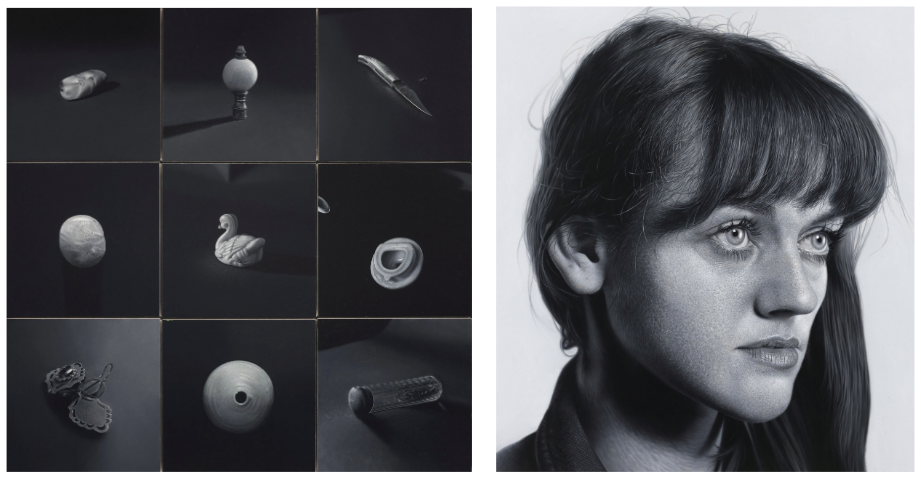
    “Can you believe it’s not a photograph!?” Toronto artist Charles Bierk has garnered media attention for his strikingly realistic portraiture before. Now, in his show What Was Not Lost at Nicholas Metivier Gallery, Bierk debuts a new approach to portraiture and further invests his knack for life-like painting into capturing human depth.

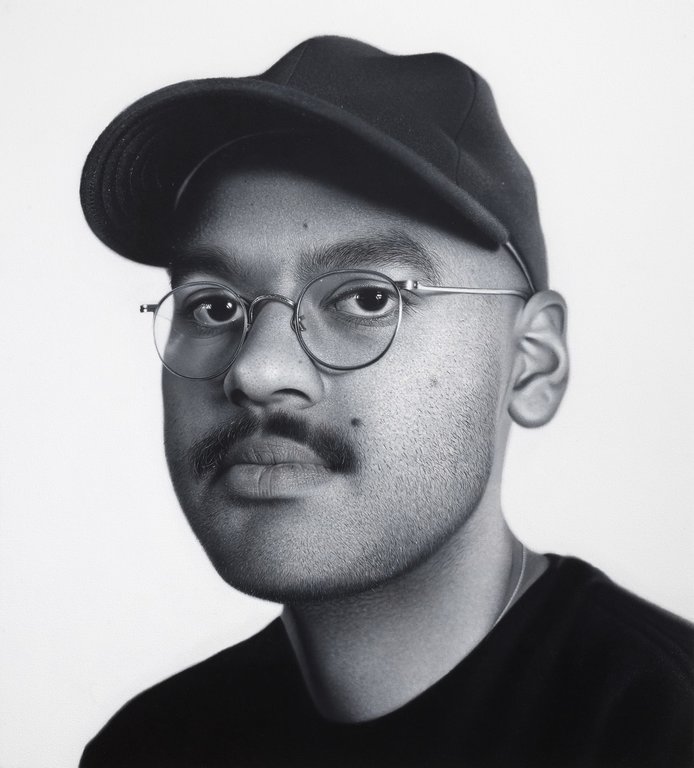
    From a large black and white canvas, a young man peers directly at us. The surface minutia of his face is expanded beyond a comfortable size. The painting is Jalil by Charles Bierk, and the sitter is the artist’s friend. I am accessing the painting online in a filmed walkthrough of the exhibition. The camera continues along the wall where we meet the similarly rendered Amika and Richard. Each painting pulls viewers into a haunting intimacy with the person depicted.

    Charles Bierk, Jalil, 2020, oil on canvas, 40 x 36 in.

    Bierk has made a successful practice of documenting his peers – young creatives in Toronto. Like Jalil, Amika and Richard, his body of work consists mainly of large scale, photorealistic, black and white portraiture. “Charles’ paintings transfix the viewer not merely due to his technical facility or their often massive scale but, above all, by virtue of their inherent humanity” says Daniel Strong, Associate Director and Curator at Grinnell College Museum of Art.

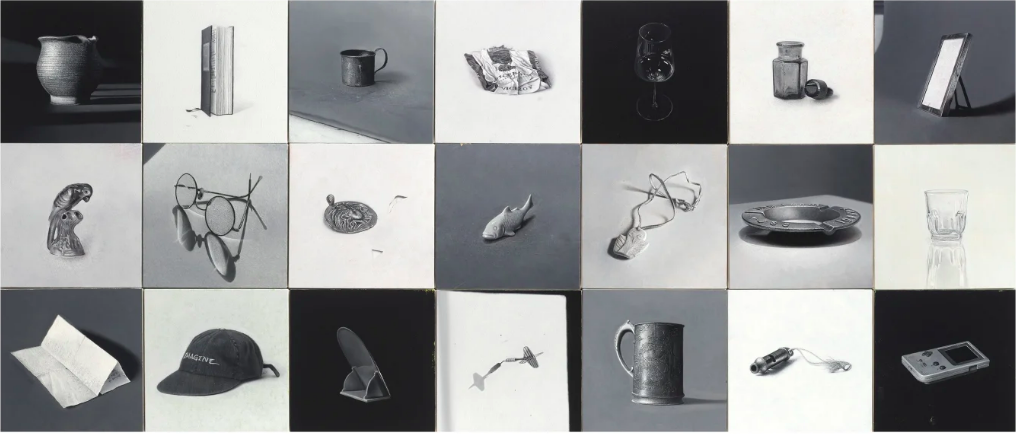
    What Was Not Lost represents a partial deviation from this work, in form though not in concept. For the first time, alongside his signature portraits, the show contains multi-paneled paintings of objects which Bierk has been developing since 2017.

    Charles Bierk, What Was Not Lost, 2019, oil on canvas, 36 x 84 in.

    In an interview with Metivier Gallery Bierk explains that the titular work “What Was Not Lost… contains my own keepsakes…. I purposefully chose objects that represent a person, place or time that I was missing in that moment. Together, the painting is this sort of altar upon which I place the most sentimental things I have carried with me.”

    After his own objects, Bierk returned to his circle of friends and began painting their selected mementos. In doing so he continues the work of documenting people, but in an approach mediated by their collected objects. In 2019, Bierk painted Katie, and in 2020, in Remembrance #3 he depicts twelve nostalgic, personal objects of her choosing – each one carries a story or a link to a loved one.

    Charles Bierk, Remembrance #3, 2020, oil on canvas, 36 x 36 in. (left) and Katie, 2019, oil on canvas, 40 x 36 in. (right)

    In conversation with the portraits, these series of emotive objects zero in, similarly, on the humanity of their subjects.

    I was once rummaging through a friend’s drawer when a bar of Body Shop soap interrupted my search for the perfect outfit. It was the same hand soap that my mother had bought when I was a kid, and not since. It reminded me of a bygone time. Stories of this transportive sensation are well precedented in art. Bierk’s objects embody Proust’s Madeleine. In explaining the title for the show, he recalls a conversation with his brother, “Casually, he said something about the fact that these objects are the leftovers or the things that were not lost, unlike the people who they once belonged to.” (Nicholas Metivier Gallery Website).

    What Was Not Lost is heavy with a sentiment that remains intact online, and even takes on new, thematically relevant significance. This distanced approach to the exhibit is conditioned by the same circumstances which currently separate us from the people in our own lives. We can access traces of them through telecommunications, through images, and now, as Bierk offers, through the objects they have loved and touched and shared with us.

    Maya Burns

    Images are courtesy of Nicholas Metivier Gallery.

    *Exhibition information: April 2 – 25, 2020, Nicholas Metivier Gallery, 190 Richmond Street East, Toronto. View it online at https://metiviergallery.com/viewing-room/4-charles-bierk-what-was-not-lost/

  • New Members & Spirit of Spring

    Opening Reception: March 7, 2020 / 2 – 5 pm
    19 Mill Street, Toronto

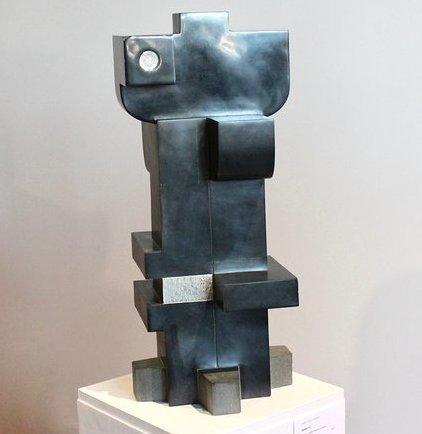
    The Sculptors Society of Canada welcomed two New Members:

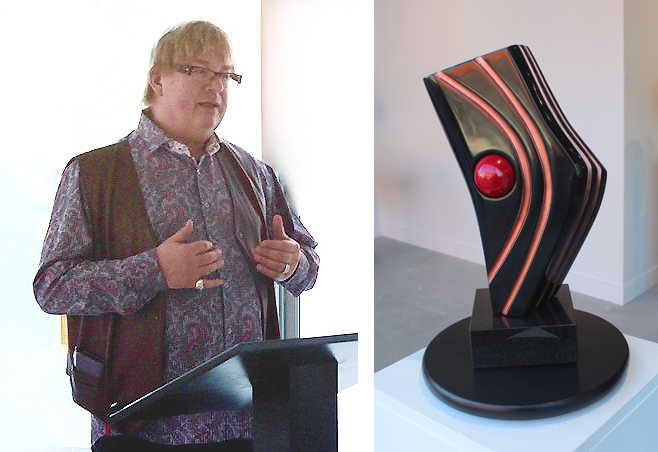
    TOM ASHBOURNE, Wellington ON 

    His conceptual stonework reveals thought-provoking narrations by incorporating textural elements of pigment, silver and gold gilt and iridescent glass.

    Tom Ashbourne (left) and his sculpture Echo, chlorite, billiard ball, copper/silver gilding, granite base, 37 x 21 x 13 cm (right)

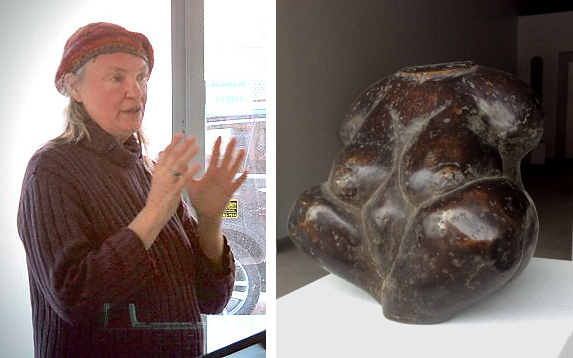
    BRITT-MARIE LINDGREN, Bruce Mines ON 

    Her fascination of ancient cultures and the feminine form focuses on bronze castings of intriguing fertility goddesses.

    Britt-Marie Lindgren (left) and her work Eartha, bronze, 24 x 24 x 24 cm (right)

    Celebrating Spirit of Spring – is a second simultaneous show of eight members’ approaches – working with elements of wood, stone, ceramic, bronze, metals and lucite – in welcoming new beginnings, new energy and new signs of Spring.

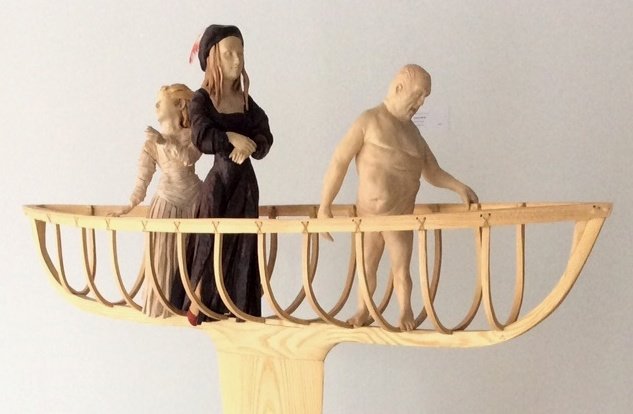
    GORDON BECKER’s sculptures are reflecting the precarious times we live in.

    Gordon Becker, Three On A Boat, wood, pigment, 148 x 127 x 33 cm

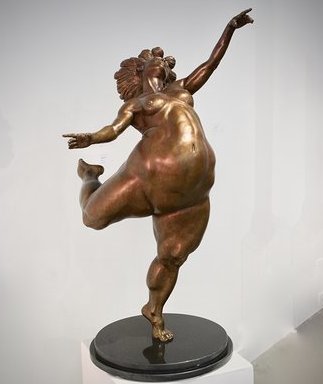
    ANDREW BENYEI is inspired by real situations: “a slice in time”.

    Andrew Benyei, Pirouette, bronze, 89 x 53 x 41 cm

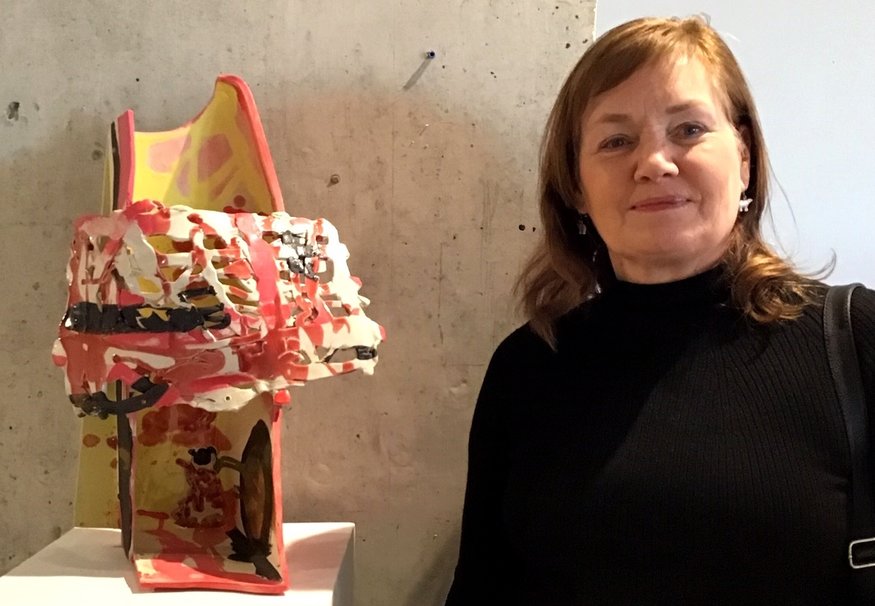
    ANDY BERG’s abstract stoneware structure is homage to Lee Krasner and abstract expressionism.

    Andy Berg and The Eye Has It Krasner, stoneware, polymer, 26 x 51 x 26 cm

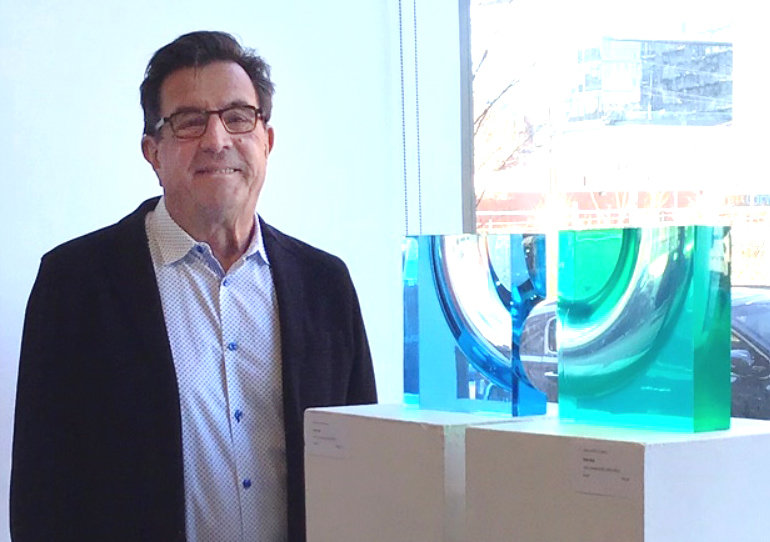
    PAUL ELIA is Influenced by architecture – his work incorporates smooth and flowing elements creating a sense of forward motion.

    Paul Elia with Arco Azzurro & Arco Verde, lucite, 23 x 23 x 7 cm each

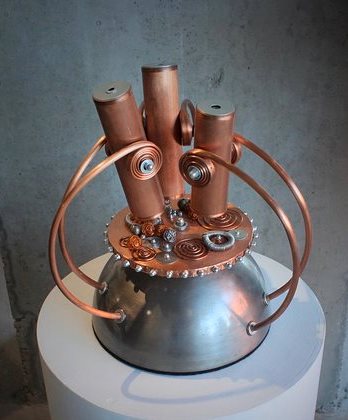
    LILLY OTASEVIC is symbolizing a childhood fantasy of far away places in her metal piece.

    Lilly Otasevic, Kaleidoscope, copper, aluminum, 43 x 38 x 38 cm

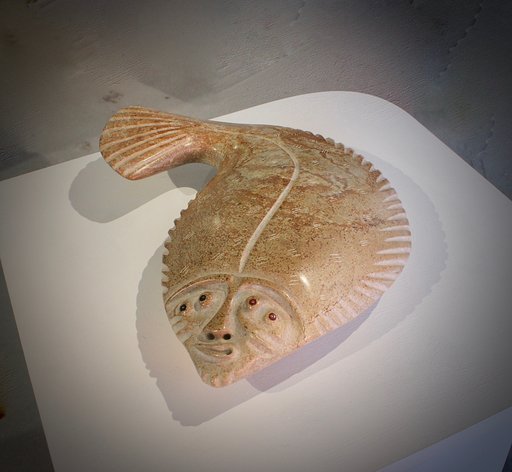
    DAVID RUBEN PIQTOUKUN, an Inuit artist from Paulatuk, NW Territories, uses materials and imagery that link modern and traditional elements in a personal vision.

    David Ruben Piqtoukun, Bottom Fish Man, Brazilian soapstone, red pipe stone, black pearl stone, 4 x 36 x 46 cm

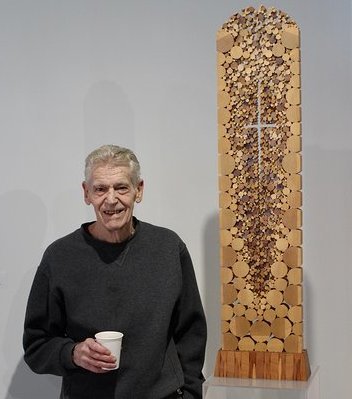
    GORD SMITH says about his method: “It just happens. A work of art does not need interpretation.”

    Gord Smith with his sculpture, Spirit, wood dowels, 112 x 26 x 10 cm

    DANIEL YU’s work is inspired by the human condition and desires.

    Daniel Yu, Totem – Three Minds of Man, chlorite, pigment, 58 x 25 x 23 cm

    Images are courtesy of Canadian Sculpture Centre

    *Exhibition information: New Members & SPIRIT OF SPRING, March 7 – April, 2020, Canadian Sculpture Centre, 19 Mill Street, Distillery District. The gallery is closed until further notice.

  • Rae Johnson at Christopher Cutts

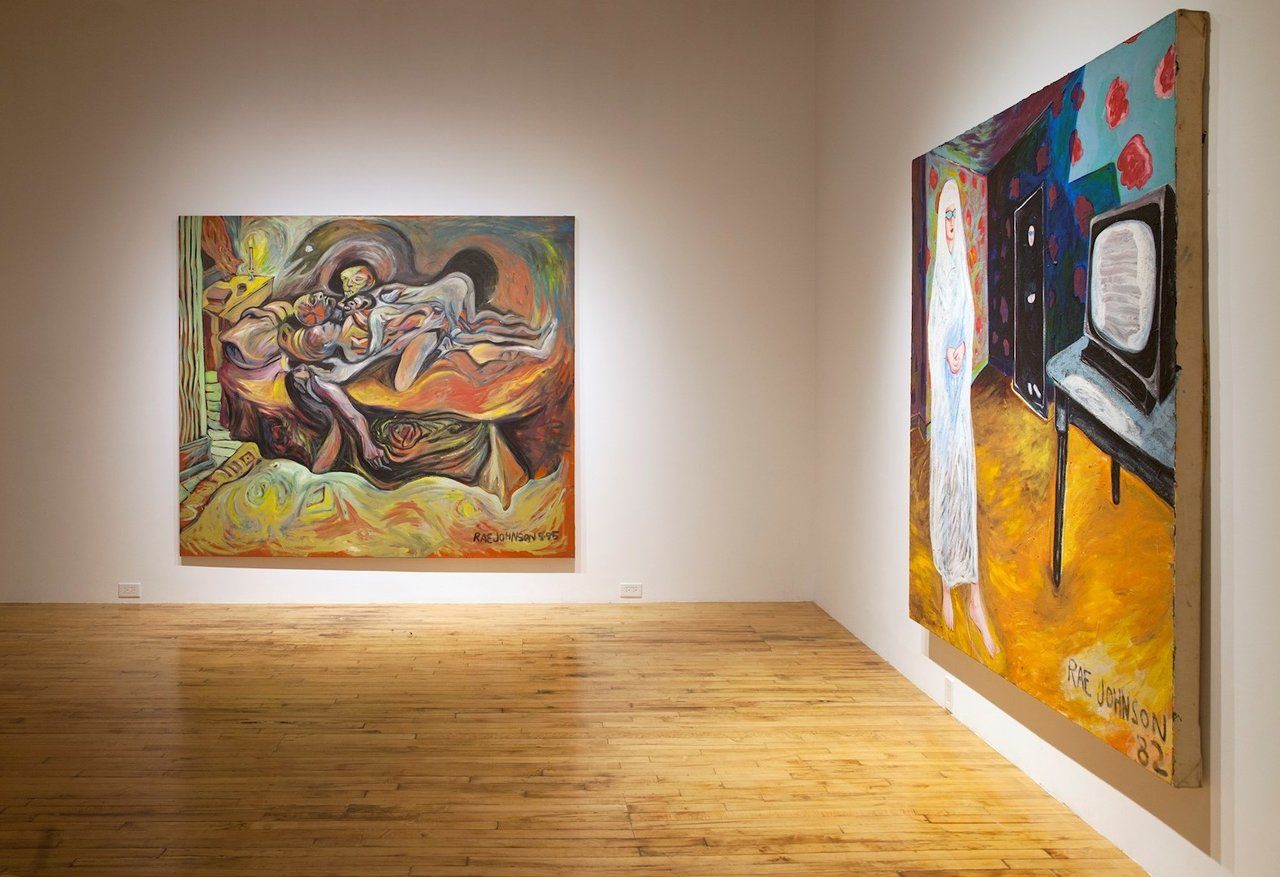
    Currently on display at Christopher Cutts Gallery are some of the key paintings of Rae Johnson under the title Angels and Monsters: A Selection of Paintings from 1979 to 2019. Alas, due to the health crisis they are not on public view. Viewings are by appointment only. This is not only an inconvenience but also very regrettable given the importance of the show. Johnson is a veteran of the Toronto art scene, having studied, lived, worked or shown in the city since 1975. She was also a professor at OCAD U for many years, where long ago she was my teacher. In the 1980s she played a central role in promoting and reinvigorating figurative painting as a founding member of the influential collective ChromaZone. But what makes this exhibition especially poignant is the fact that she has been stricken by a serious illness which has ended her ability to make art any more. This show – along with a possible second part later in the year – is, in other words, a retrospective of her long and distinguished career.

    Installation view with Death of the Child (left) and Madonna TV (right)

    While the paintings date from 1979 – the year prior to her graduation from OCA – to last year, they all belong to either the first six years of her professional career or her output over the last three years or so. Johnson has been a prolific painter whose work has spanned all of these four decades, and many of the works during the intervening period will hopefully be on display as part of a second instalment. What we see here is a selection of works that represent her early career, which was a particularly turbulent time in her life. The later works are included because Johnson feels that they point to a closure. Her work, she believes, ‘has come full circle’ as she puts it. Indeed, there is a detectable kinship between these early and late works.

    Installation view with (L-R): Two Women Night, Angels in the Palace and Angel in the Rivoli

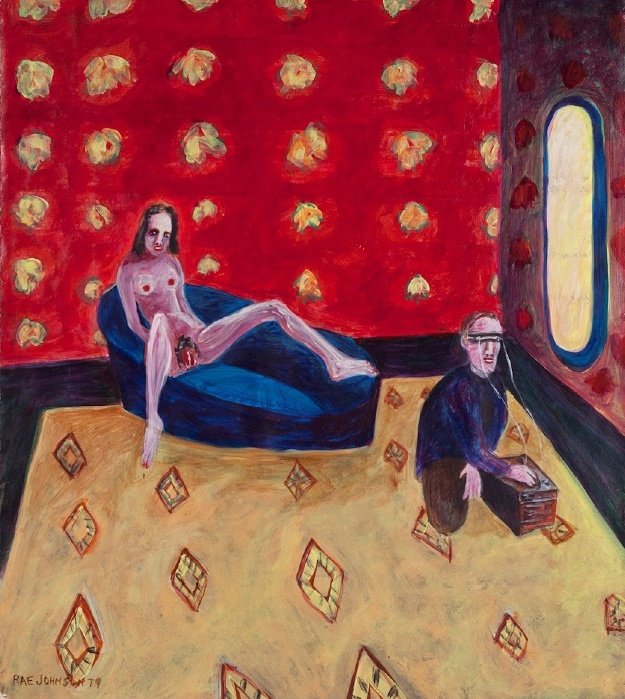
    Johnson’s first sustained foray into painting was on the theme of pornography. She began producing these works while she was still a student, inspired by her time in New York city as part of OCA’s erstwhile independent study program there. She became preoccupied with pornography because of its violent debasement of women. She attacked the subject with immense energy, producing a great many studies in acrylic in a short period of time. One example is her Empire State that depicts the antagonists as alienated souls in absurd juxtaposition. As with all these works it possesses a disturbing psychological aura. And this psychological dimension soon became the overarching ethos of her work quite generally.

    Empire State, 1979, acrylic on paper, 28.5 x 25.5 inches

    Around this time Johnson avidly studied the writings of Austrian psychologist Carl Jung. She was particularly impressed by Jung’s notion of the archetype, that is, a fundamental mental image – idea –  innately shared by us all. As well, she was very sympathetic with his notion that there is no real distinction between the psychic and the physical – both are aspects of the world we live in. These two notions have guided her approach to image making ever since. A great deal of the time she has aimed to bring out the psychic, to show what lies behind the physical world of appearances.

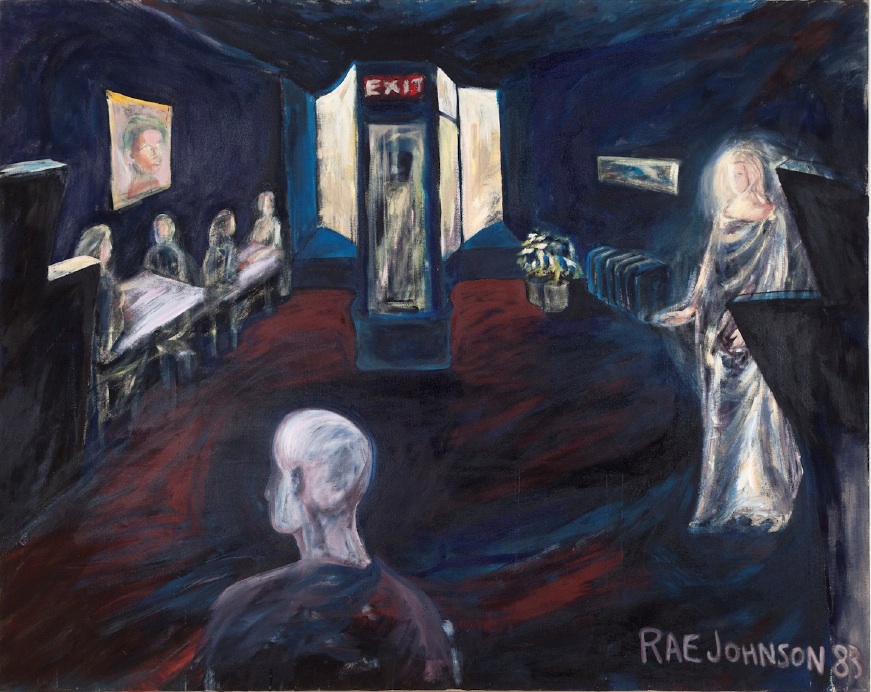
    Angel in the Rivoli, 1983, oil on canvas, 66 x 84 inches

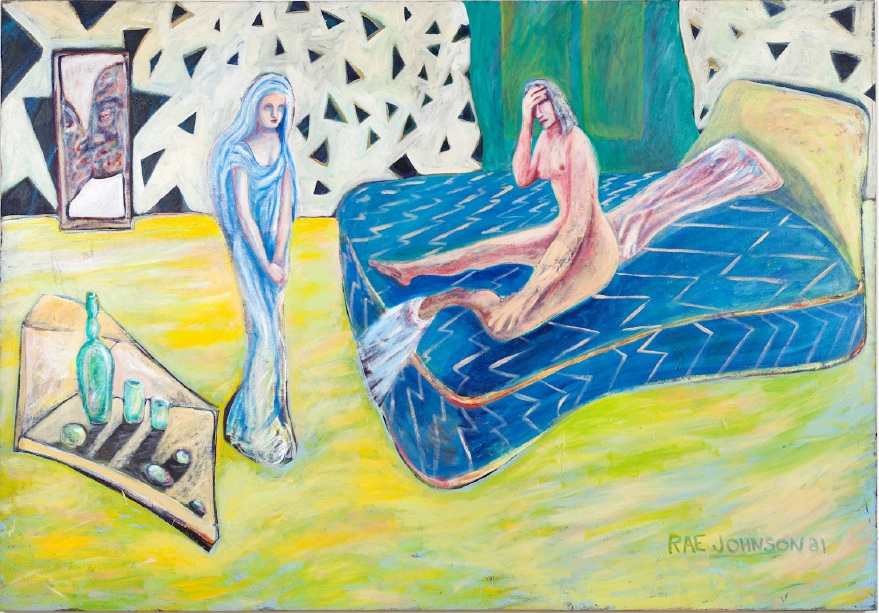
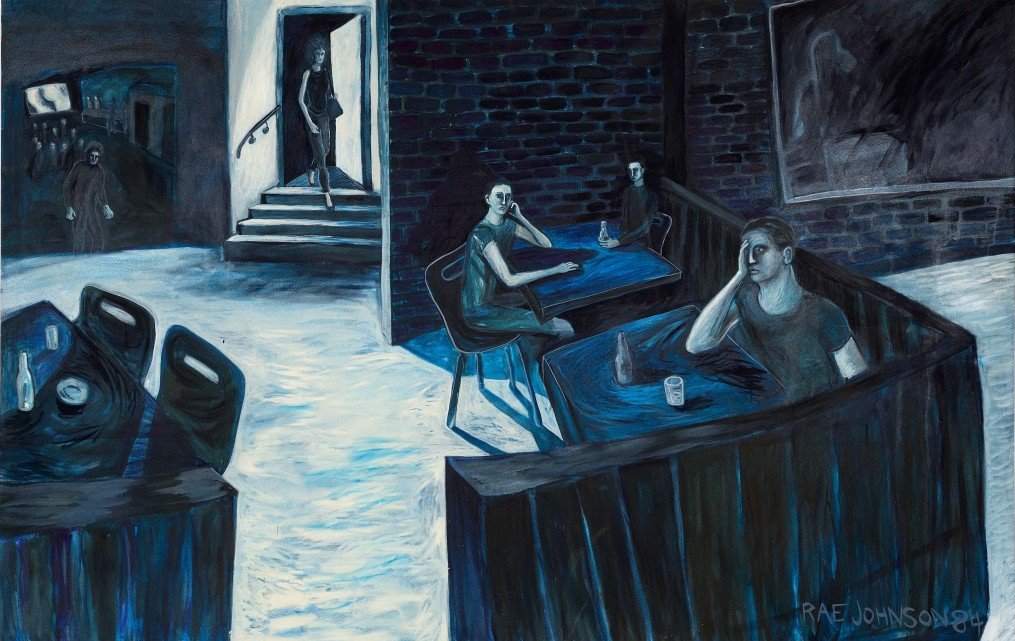
    The one archetype Johnson adopted above all has been that of the madonna or the female angel that represents woman as sacred. She contrasted this image with that of the profane world of the everyday. Hence we see the madonna-like figure appear in bars, e.g., in Angel in the Rivoli or at the foot of the lovers’ bed in Anima, Animus. In this latter painting, the male lover is depicted as wrapped in plastic, echoing the theme of the often unspoken violence of sexuality.

    Anima, Animus, 1981, oil on canvas, 67 x 97.5 inches

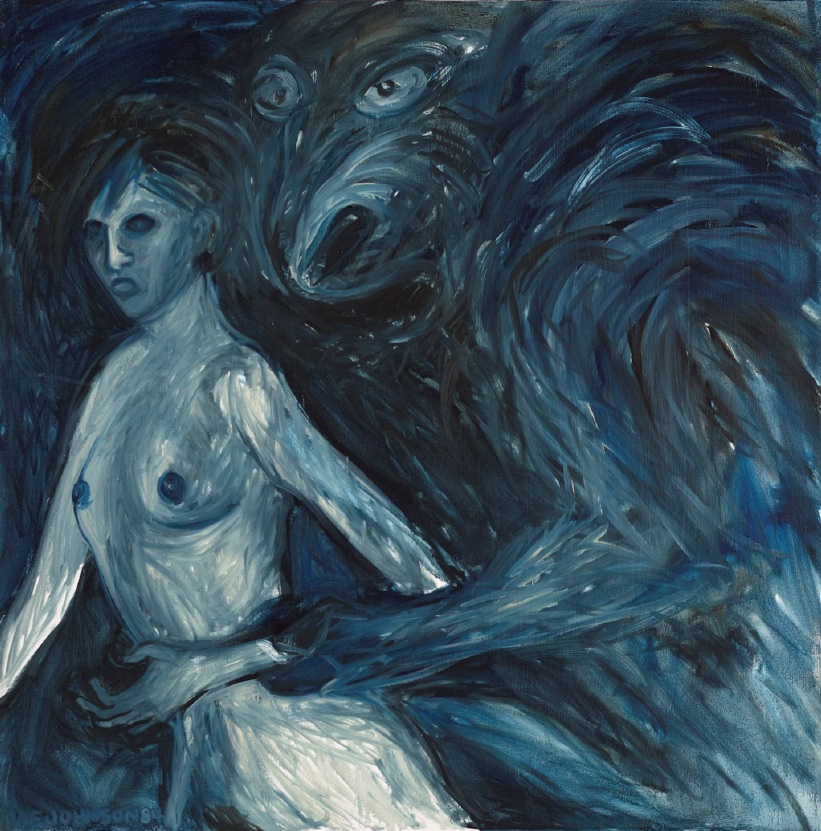
    This violent undertone is most notably brought out in a series of works done in 1984, e.g., I Can Hear It Breathing. These are based on a vivid dream she experienced in which she is chased by a dark predatory monster that seems intent on raping her.

    I Can Hear it Breathing, 1984, oil on canvas, 32 x 32 inches

    What is particularly pronounced in these paintings is her agitated fluid brushwork. She paints with urgency, as if racing to get down the evanescent image before her mind. Here she renounces any concern with verisimilitude or ornamentation. As a result many of her paintings cannot be described as beautiful in the classical sense of being deliberately pleasing to the eye. Rather she has always aimed for an honesty – to show how life feels in all its rawness. What draws the viewer in is the paintings’ psychological energy. And her rendering of the psychical cannot be achieved by strictly copying the physical. At the same time, however, she cannot discard physical appearance. In this sense her work has been a constant struggle to balance these two elements. It is this tension that often makes her work gripping. Hers is a powerful unique voice, wonderfully showcased by Christopher Cutts’ judicious selection.

    Night Games at the Paradise, 1984, oil on canvas, 84 x 132 inches

    Hugh Alcock

    Images are courtesy of Christopher Cutts Gallery

    *Exhibition information: Rae Johnson, Angels and Monsters: A Selection of Paintings from 1979 to 2019, March 21 – April, 2020, Christopher Cutts Gallery, 21 Morrow Ave, Toronto. By appointment only. View it online http://www.cuttsgallery.com/

  • How COVID-19 is Impacting the Art Galleries in Toronto

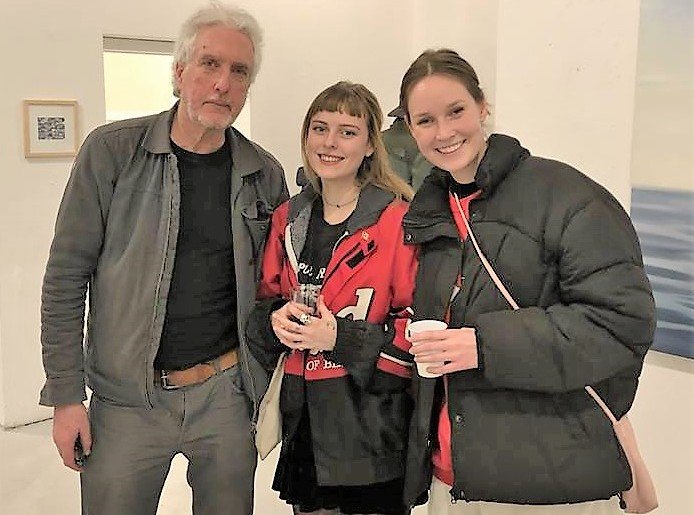
    Phil Anderson, Executive Director of Gallery 1313 (left) with gallery artist Erin Williamson (middle) and Emma White, the artist’s friend

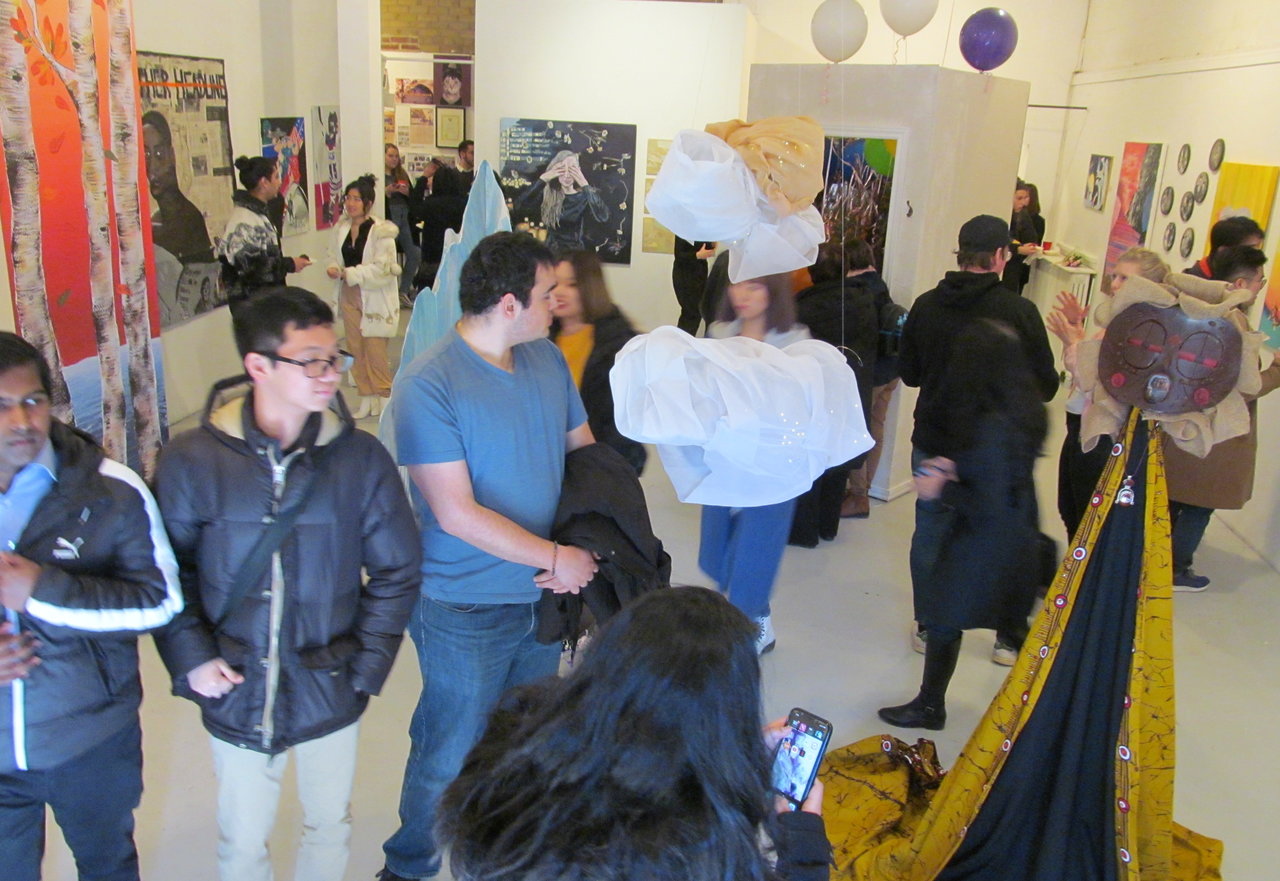
    At the last reception I attended at Gallery 1313 on March 7th I had no idea of how things would change in the coming weeks. An artist, Emily Huang, one of 40 students from York University in the graduation exhibit called NOISE, brought in a painting in the last minute to be hung. It had been left behind on campus and she drove back to get it. It was titled Whistlebower and portrayed Dr. Li Wenliang who first discovered the Coronavirus in China back in November 2019. He tried to warn the Chinese authorities of an upcoming pandemic. He was ignored and died in January 2020. I didn’t realize the significance of the art work at that time and how our world would soon change.

    Emily Huang with her painting Whistlebower, portraying Dr. Li Wenliang

    Change it did, and on March 15, 2020 Gallery 1313 closed as York University cancelled its next GRAD exhibition. Likewise, OCADU cancelled its April thesis exhibition for the sculpture and installation program. On March 11 an artist from Gallery 44 in the upcoming Scotiabank Contact Photography Festival exhibit was talking to me about details for their upcoming reception. Some participants wanted a table with food in the middle of the Gallery. I tried to discourage it as I like the focus to be on the art and not on bit size snacks. I also told him that with the upcoming situation of COVID-19 the food table might be the least of their problems. That Contact exhibit has been postponed till November 2020.

    Darcy Killeen, Executive Director of Scotiabank Contact Photography Festival, at Gallery 44 members show at Gallery 1313, in front of a photograph by Janne Reuss, May 2019

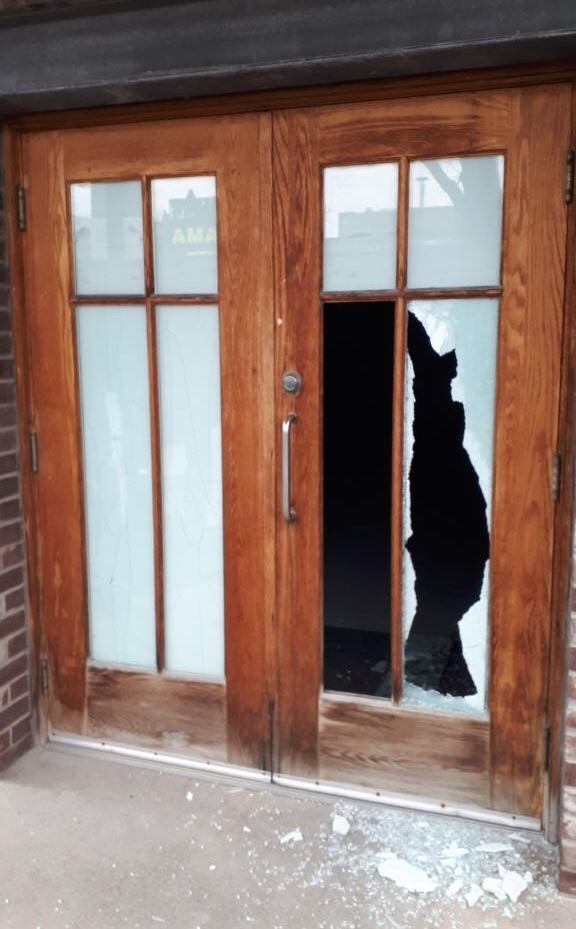
    On March 26 I received news that the building had been accessed by thieves and later I found out they had broken into the Gallery. Artscape, who manages the building, had repaired the damage to the doors where they had broken in. Later that evening, I came in to survey the damage and see what was stolen. The thieves must have been desperate as they broke into the donation box too and stole $5 plus a few pesos and an American dollar. They ran off with a few old laptops as well. It was good that I had taken my work laptop and some hard drives home when I closed the gallery prior to this. I took everything they missed home with me. They didn’t steal any artwork that was around; at least to my knowledge. The media covered it for their news of COVID-19 effects. When I posted the news of the break in many people were not just sad but angry that thieves had targeted a small not for profit art gallery during these times of vulnerability.

    Break in at Gallery 1313. Courtesy of Artscape

    The impact is felt by many art galleries as people can’t visit and sales for art would be difficult as the whole economy is now in tatters. The City Hall Outdoor exhibit, on which many artists depend on, will likely be cancelled or at least postponed from its annual July date. The AGO, MOCA and artist run centres are all closed. The Scotiabank Contact Photography Festival tried to adapt with online content but it is pretty much not happening, at least, as usual. Commercial galleries struggled to stay open but as people were encouraged to stay home it became more difficult. Galleries try and post works online along with artist profiles. Artists are usually poor to start with, making less than $29.000 annually and most of that come from some other jobs that allows them money to feed their art habit. Some artists stay at home making masks to donate to places that need them. Others are making art in the streets and trying to find outlets for their creations.

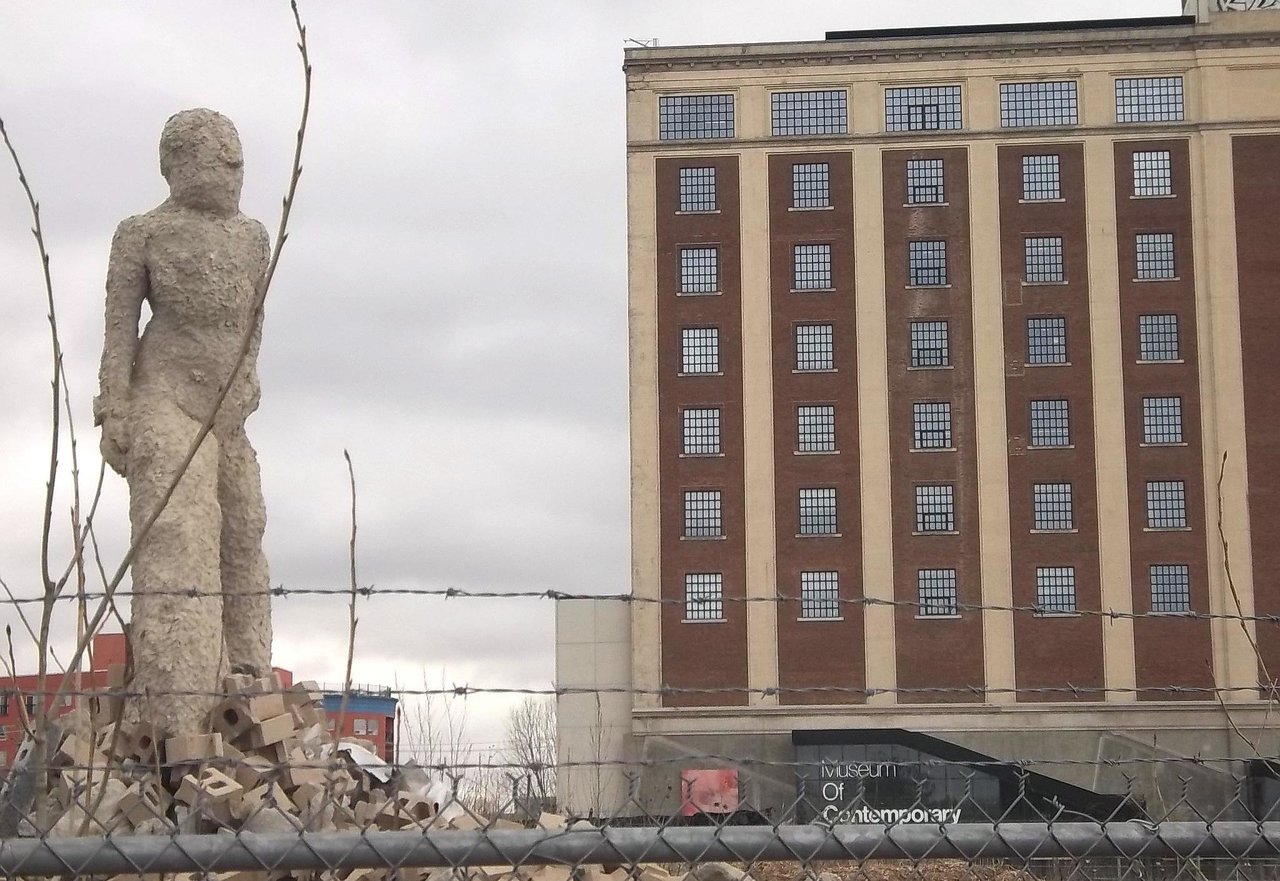
    Random sculpture created near MOCA

    It will be interesting to see what new art comes out of this COVID-19 world and see what kind of hopeful messages are being produced by the artists now. The art community is already looking at incentive packages that the government, both provincial and federal, will offer to bring the arts back from the COVID-19 oblivion. Will it ever be the same? The art community is very social. Every two weeks at Gallery 1313 there would be a reception for art exhibitions opening at the gallery. People came out to see the new works, support the artists and network with other artists. They were largely social events that are very much missed. Similar events also happened across the city in over 150 galleries. How will all this look like in a post COVID-19 world? What will later events like the Queen West Crawl and Art Toronto look like this Fall? Will we use social distancing out of habit or perhaps thinking of the next pandemic to strike?

    Opening reception of NOISE at March 7, 2020

    I am hopeful that the arts community will pull together and offer the public new insights to this new world and have something important to say. Art is usually described as a mirror of time and society so in time we will no doubt see how artists record these times through their art. Something to look forward to, indeed.  

    Text and photo: Phil Anderson, Executive Director of Gallery 1313

  • Eli Langer at Clint Roenisch

    Just before this show was to open, Toronto shut down. We suddenly became familiar with living in a mode of social distancing. So now Eli Langer’s carefully arranged work sits in an empty, locked space. We have only photos, which we look at as through windows, back into the happy, noontime light of those free-mobility days…  Did you ever expect to feel nostalgia for February?

    We’re missing a lot by not seeing this show in person because the work involves the material, and craft of painting. It’s the kind of work you want to get up close to. How thick is the paint; how was it applied? Which colours are underneath and which on top? Is it shiny or flat? What do the edges look like?

    We’ll have to wait to find out.

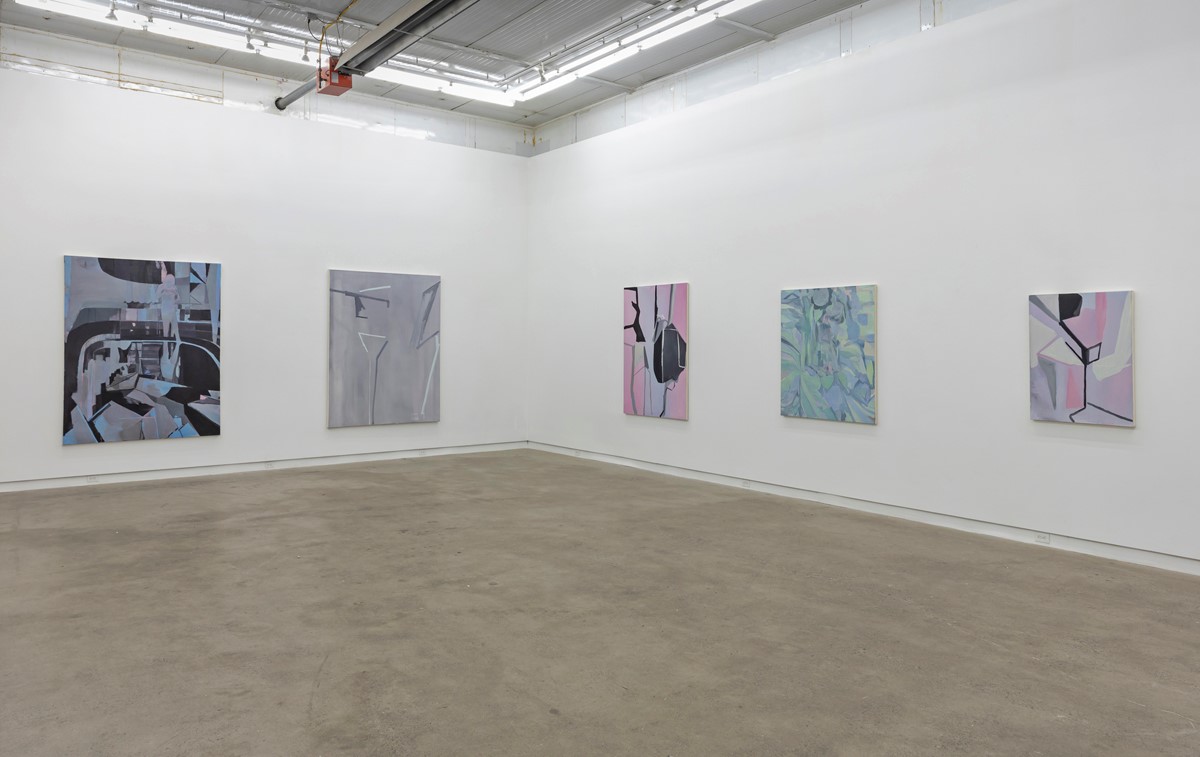
    The installation views give a consistent, integrated impression but on closer inspection the work is far from homogeneous. It spans several years, from 2004 to 2008. Langer describes it as a micro-survey show.

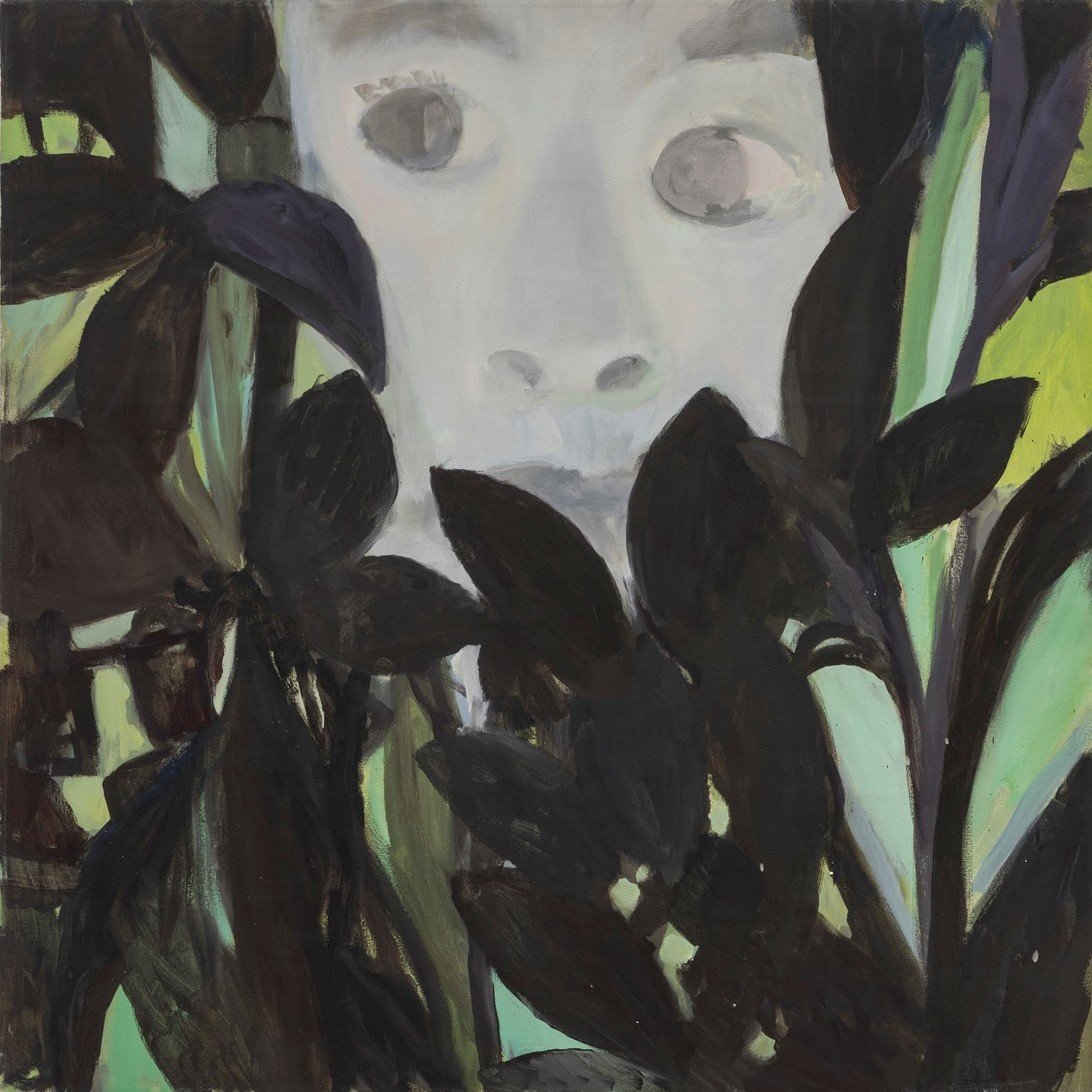
    The earliest painting on display is RSVP which depicts a face looking through thick leaves. She’s not looking directly at us. Our eyes don’t meet. The darkness of the leaves suggest that we may be hidden in shadow and not visible to her. Langer writes: “Although she has stepped up to look through the window, she is not ready to step out … nor to fully confront whatever she sees beyond the foliage.”

    The image is rendered in simple, unambiguous brushwork. The face is painted in light, thin paint whereas the closest leaves are defined in heavy sinewy strokes. The paint handling conveys the narrative of its creation.  You can play it back in your mind: the motion of arm, wrist and brush.

    Langer painted RSVP when he had just moved to California. He feels that it reflects the shyness and apprehension of the newly arrived outsider. But don’t you recognize that expression now? It’s the look of the persistent, low-grade fear we direct at our neighbours now. Keep your distance.  

    RSVP, oil on canvas, 42 x 42 inches

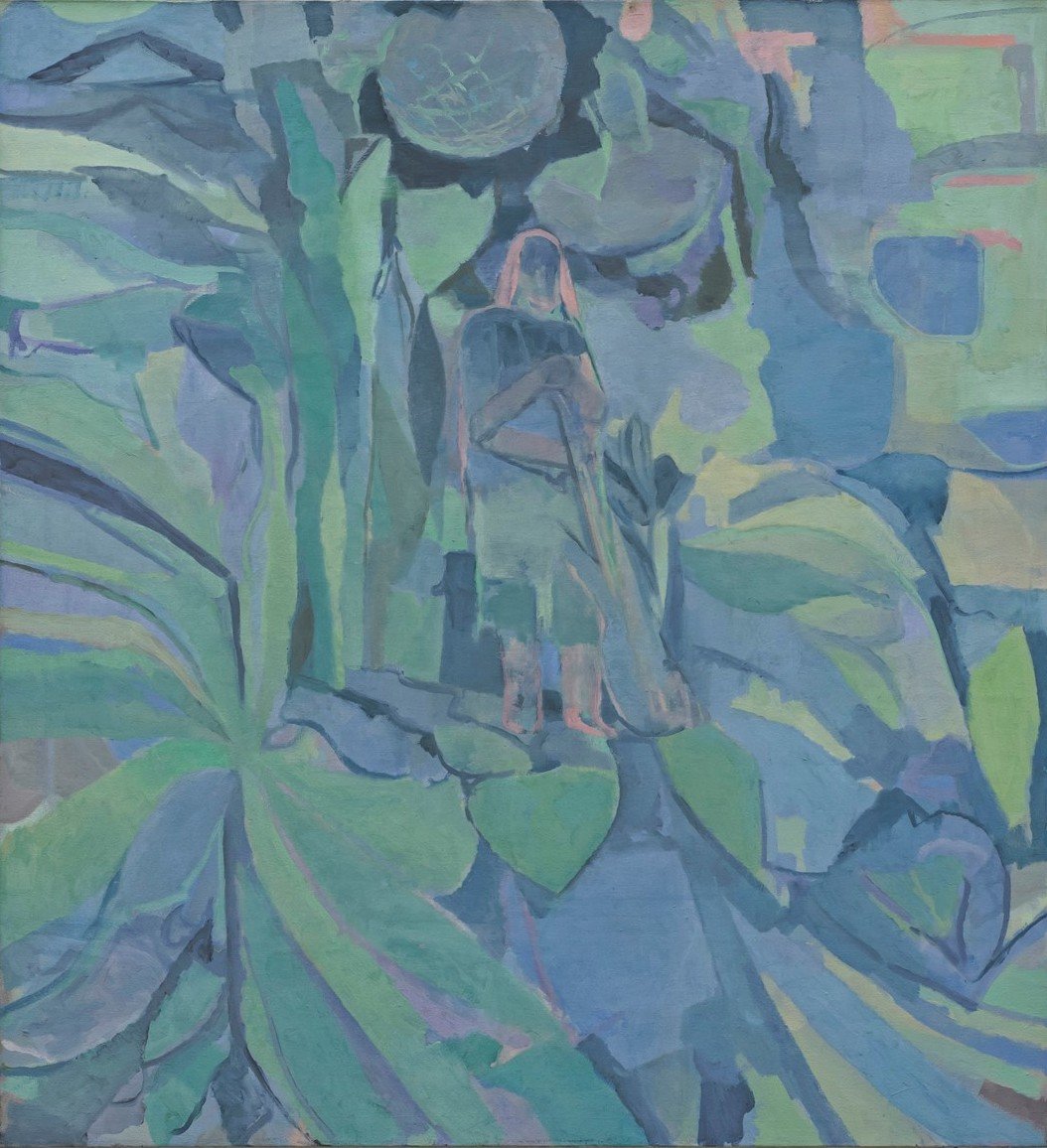
    With organic shapes in languorous greens and blues, Untitled (figure and foliage) looks at first to be a nonrepresentational painting. Until you discover the figure standing at the centre of the image. It gave me a little jolt. Suddenly the centre of the painting has perspective and depth. The figure generates an odd tension. My eye keeps moving; switching between seeing illusional space behind, and the flat shapes on the surface.

    Langer starts his paintings ‘fresh’ by which he means without a precise plan. The paintings develop as he works on them. Langer says “…there is always a relationship between my drawings and paintings, but I never draw out or plan paintings from drawings because it won’t work. Painting breaks away from every intention or preconception this painter might have had going in to it…”

    Untitled (figure and foliage), oil on canvas, 50 x 46 inches

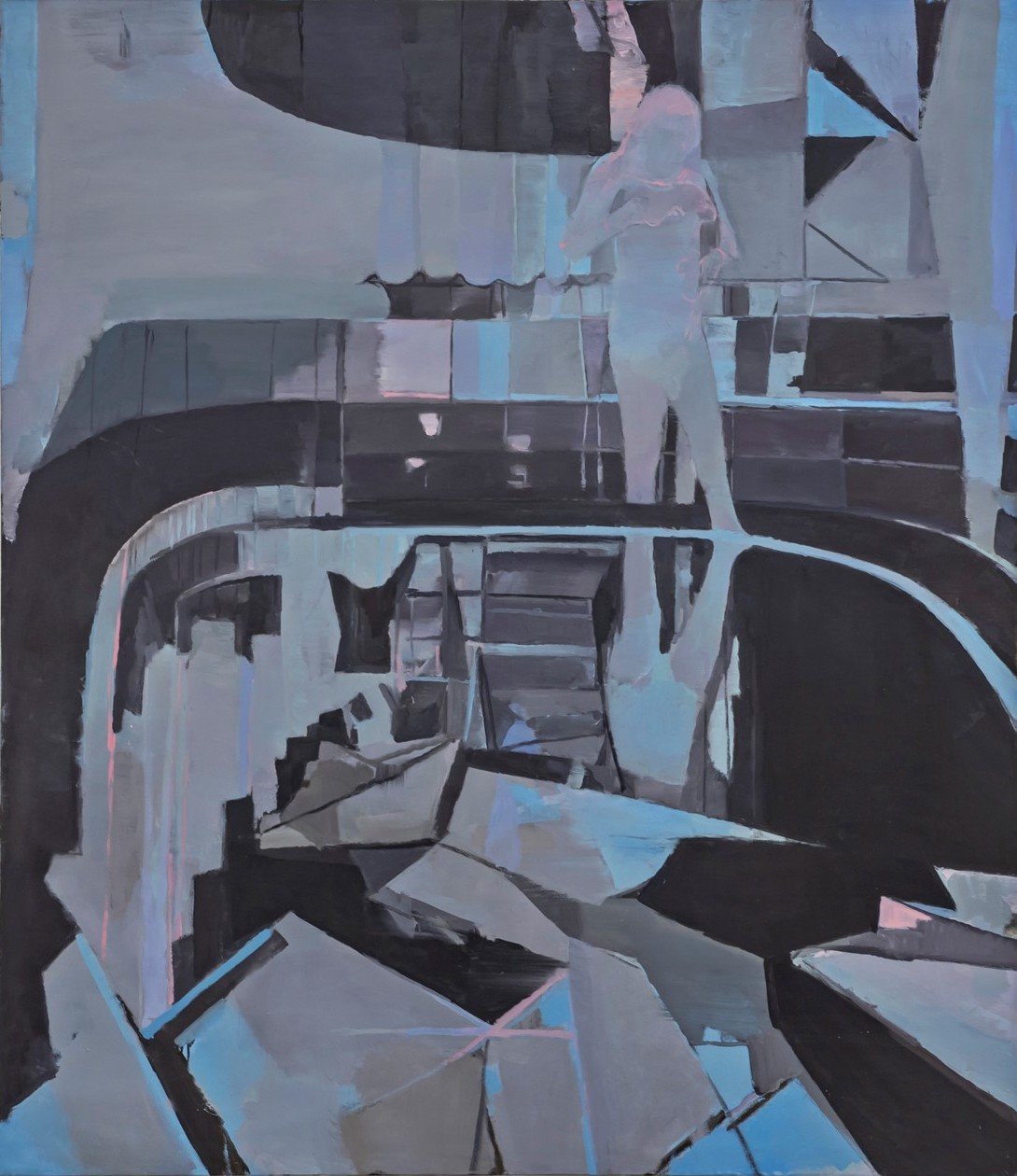
    Bathyscape is another painting that bridges representational and abstract imagery. The blacks, blues and greys are energized by little details of pink that create metallic coruscation as in an ancient faded daguerreotype. I noticed the figure first; its reflection in a still pool. But everything else is confusion. What is this space? The background and reflections in the liquid’s surface don’t agree. What are these shards and shapes in the foreground? The space breaks apart and again the eye keeps moving; trying to piece it all back together again.

    Langer writes: “as the imagery developed over several sessions, I saw what I was painting was a moment of self reflection, in a post catastrophic world…having somehow endured the ordeals.” It’s like a premonition of how we suddenly feel in this time of lock-down: disoriented and confused.

    Bathyscape, oil on canvas, 78 x 67.5 inches

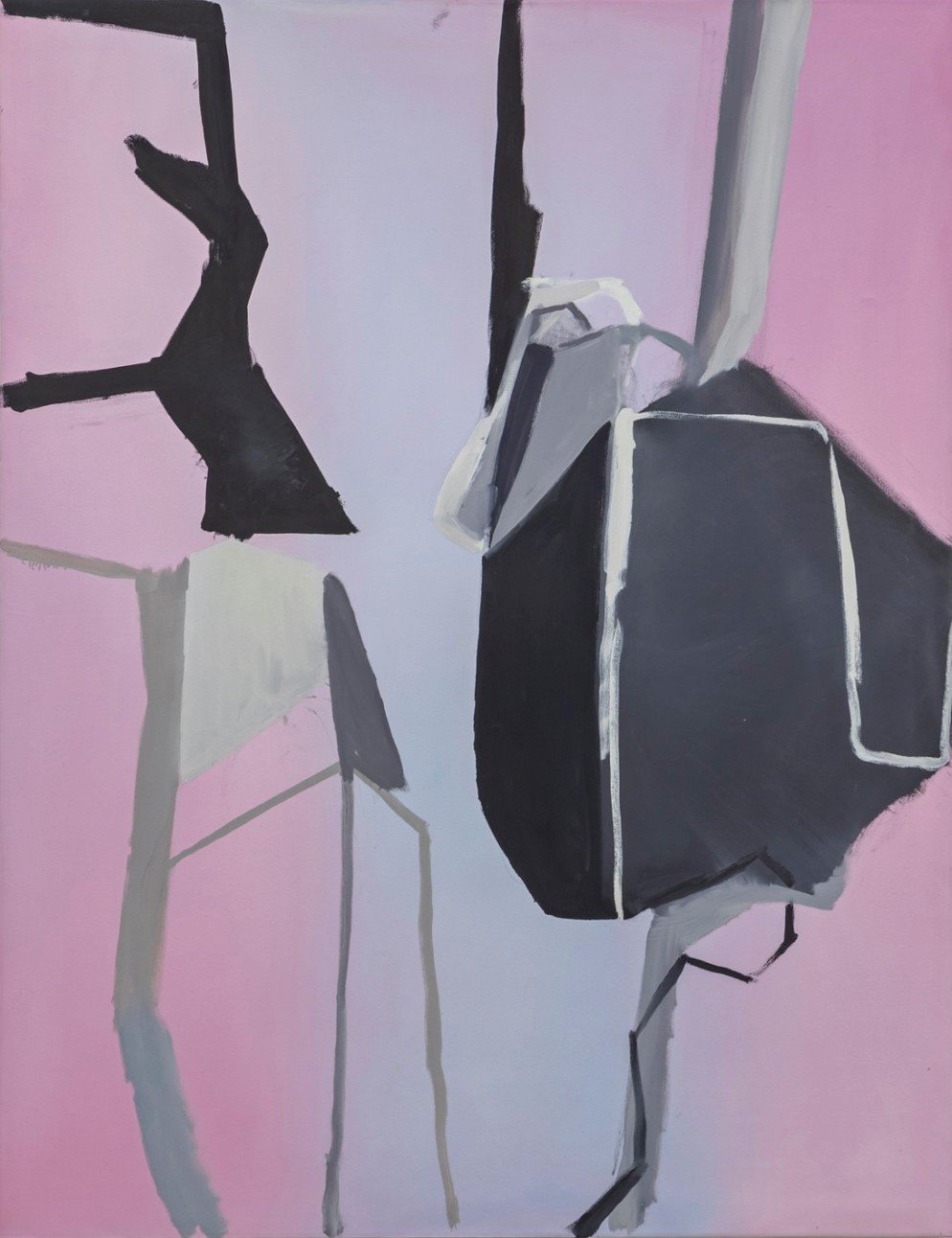
    Large Configuration is one of the more recent paintings in the show. A diffuse background gradates from zingy pink at the edges to grey blue in the centre. In the foreground are shapes in shades of grey that have a shallow, three-dimensional modeling. They are defined in simple and confident brushwork – there is no fussiness or hesitation in their making. The lines are painted once and that’s that.

    Large Configuration, oil on canvas, 62 x 47.5 inches

    In these later paintings there are no longer any human figures at all. Langer describes the paintings as being in the first person rather than third person. No longer a depiction of a character inside the picture, but something more direct between the artist and the viewer. 

    “The first person tense only required my being present for the painting…it was clear that I was marking, imprinting and affecting, effectively.”

    These paintings tell you about the process of painting: how shapes and colours relate and how the artist has responded and added each element in a specific sequence. I find these engaging and restful. Just pure painting: music without words!

    There’s no objectivity in art. We react emotionally. There’s a pandemic and I’m feeling frazzled; it colours my thinking. As I see them now, the figures in the paintings are isolated, dealing with a world that no longer makes sense. But how much of that is my own projection? Langer’s paintings are open ended and ambiguous and can accommodate many different interpretations. What will my impression be in a happier, more confident world?

    I’ll have to wait to find out.

    Mikael Sandblom

    Images are courtesy of Clint Roenisch Gallery

    *Exhibition information: March 19 – mid July, 2020, Clint Roenisch Gallery, 190 St. Helens Avenue, Toronto. This is an online exhibition at
    https://clintroenisch.com/archive/2020-2/paintings/

  • Sadko Hadzihasanovic at Paul Petro

    “As an artist, I like to explore the construction of identity, and its cultural and social implications.”

    Sadko Hadzihasanovic

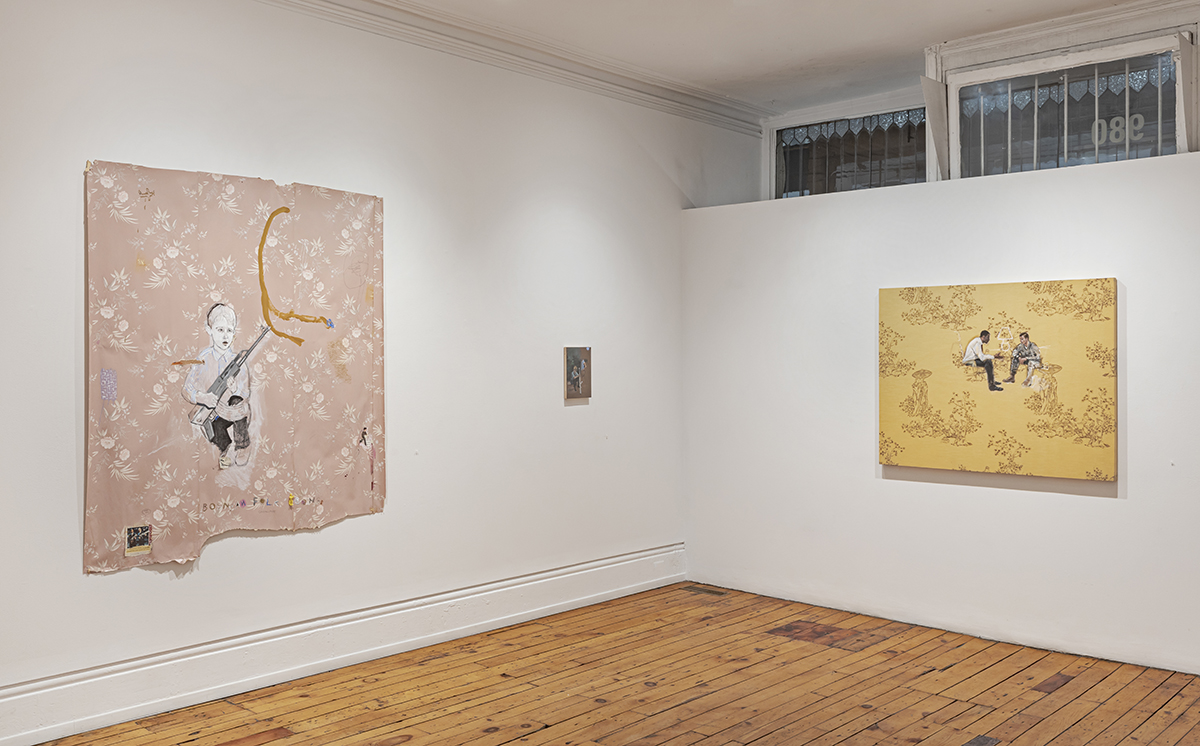
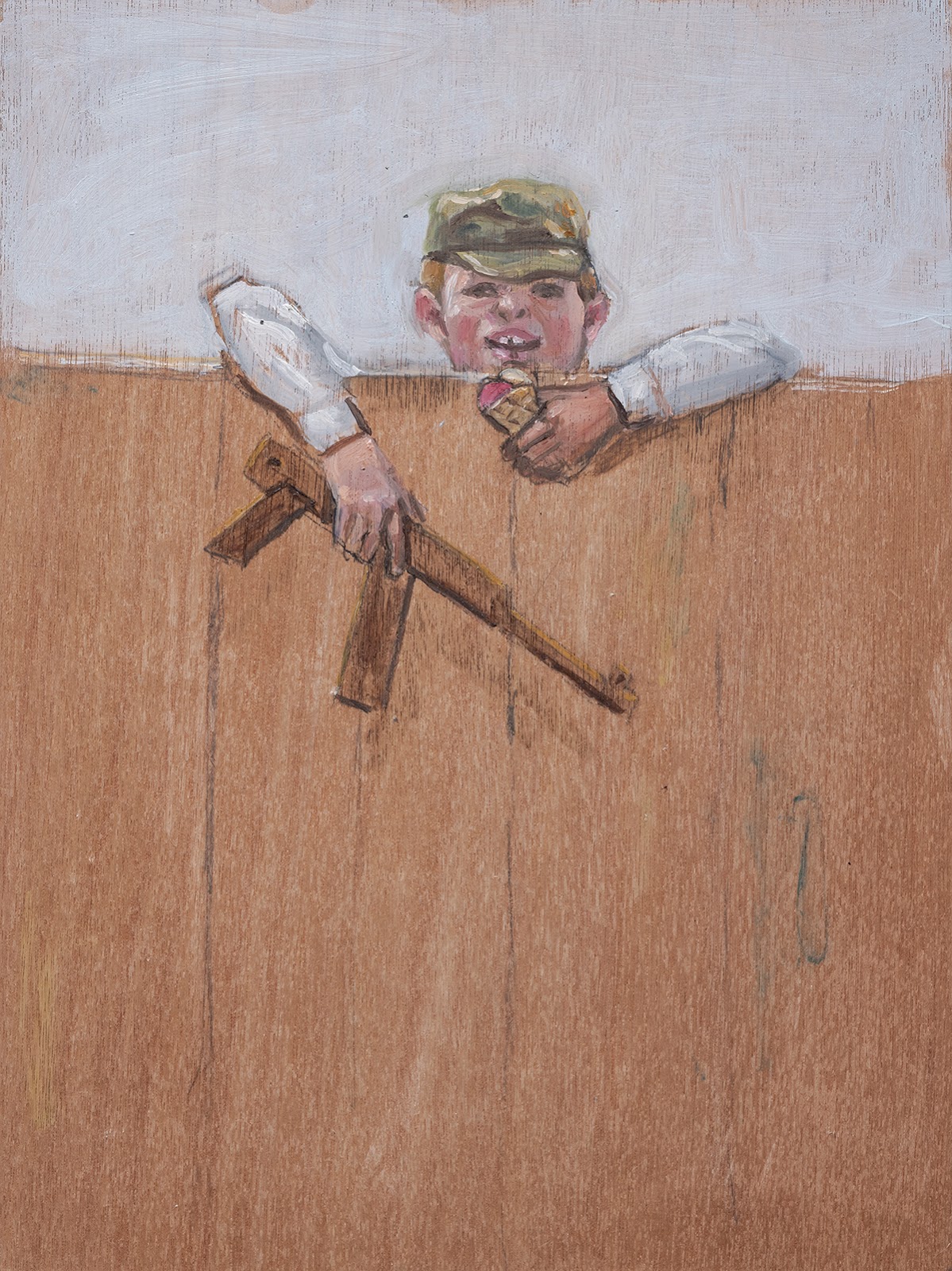
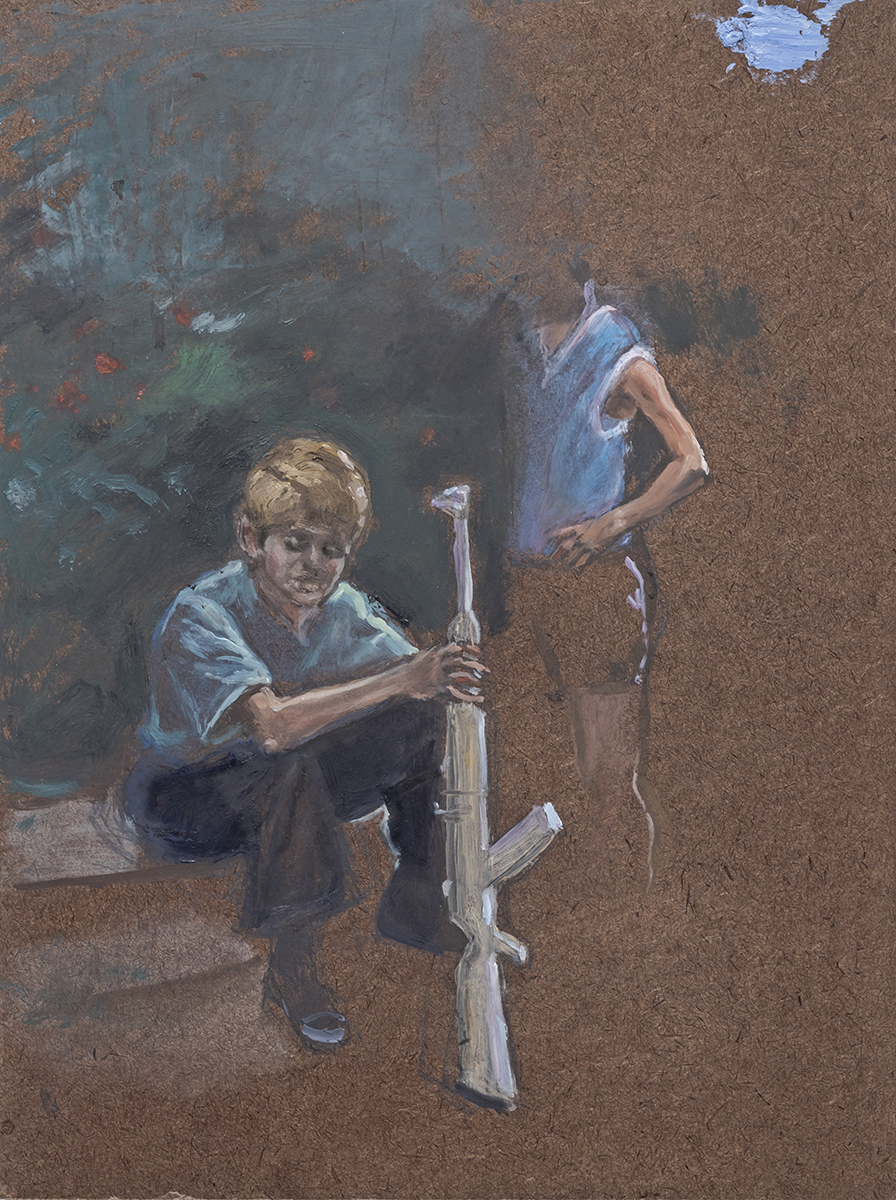
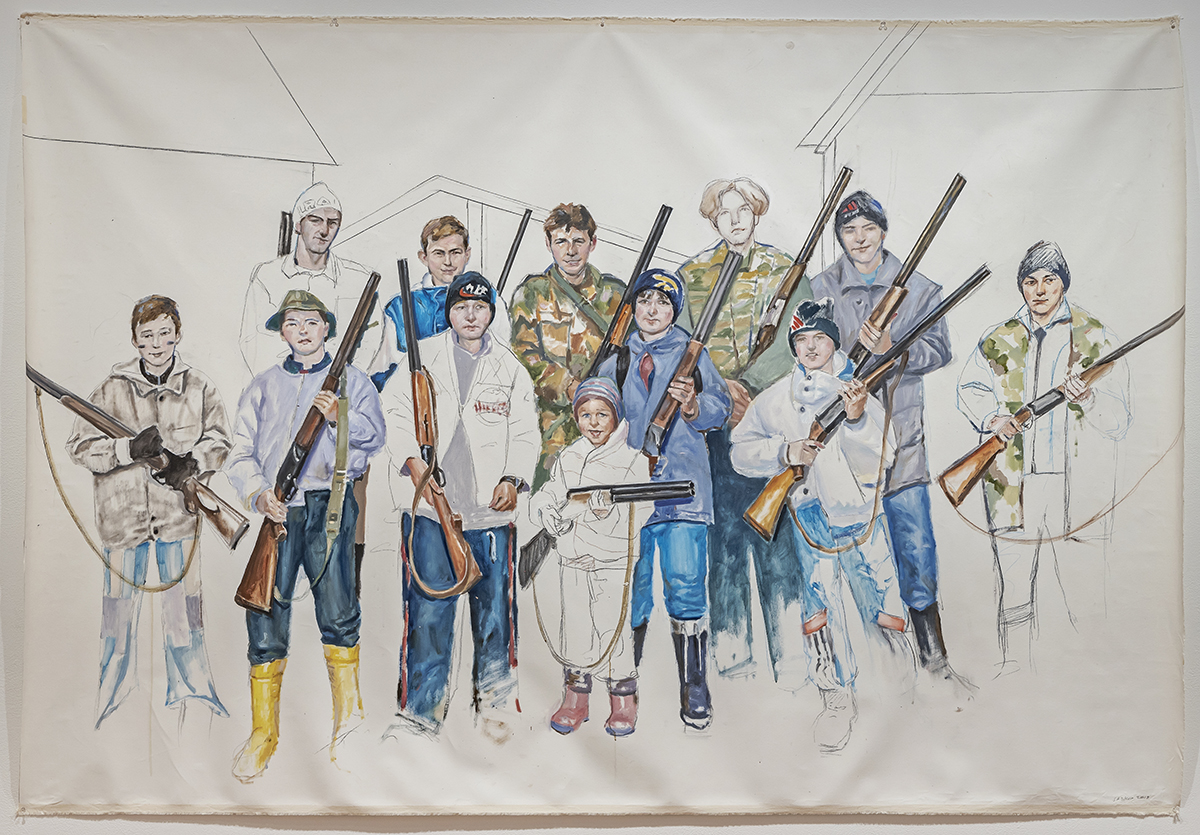
    As a reflection of Sadko Hadzihasanovic’s artistic agenda, the exhibition Kids with guns at Paul Petro Contemporary Art Gallery showcases a selection of work that exposes and surveys the social engagements of children in weaponized violence. The show covers more than a decade in Hadzihasanovic’s deliberation on the theme Kids with guns and includes 24 works from 1995 to 2020.

    Installation view of Sadko Hadzihasanovic, Kids with guns

    The title of the show was inspired by the song “Kids with Guns” released by British band Gorillaz in 2006. One of the songwriters Damon Albarn shared his inspiration behind the lyrics recalling his personal experience. A nice boy, a child at his daughter’s school arrived at school one day with a knife and decided to show it to his friends at lunchtime. As he said: “It’s a very real problem, but I’m not treating it as a problem. It’s part of the brutalization of a generation that’s going on at the moment.” As Albarn’s statement blames the society for encouraging children to play with lethal weapons, Hadzihasanovic’s show provokes viewers to further explore the issue with a great variety of portraiture-based illustrations.

    Ice cream, 2020, oil on wood veneer, 12 x 9 inches

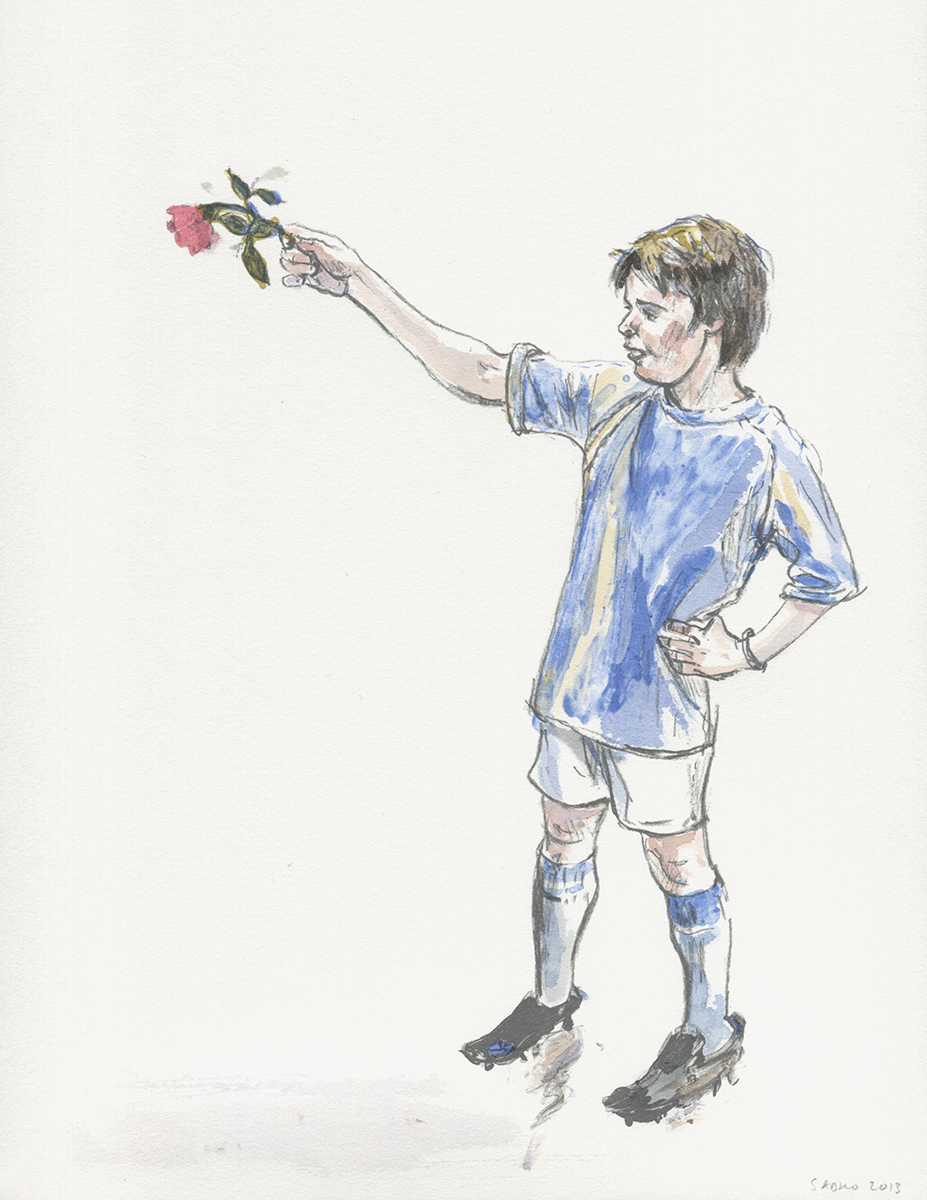
    The lithography Boy with a Rose (2013), published in a renowned printing house in Poligrafa, Barcelona, recalls Hadzihasanovic’s passion with soccer as a kid growing up in Europe. In this piece the artist wishes to emphasize the game’s different meaning, that focuses on love instead of fight.

    Boy with a Rose, 2013, lithograph with watercolour, 11 x 9 inches

    Hadzihasanovic’s works have a humorous undertone. He juxtaposes a sense of brightness in his pictorial language with the heaviness of the issues he depicts. These contrasts appear throughout Kids with guns. particularly in the works portraying young boys with a layer of grief that calls for empathy. It is not fair to grow up under these circumstances. What might these boys do as adults?!

    In Rose Garden, 2020, oil on Masonite, 12 x 9 inches

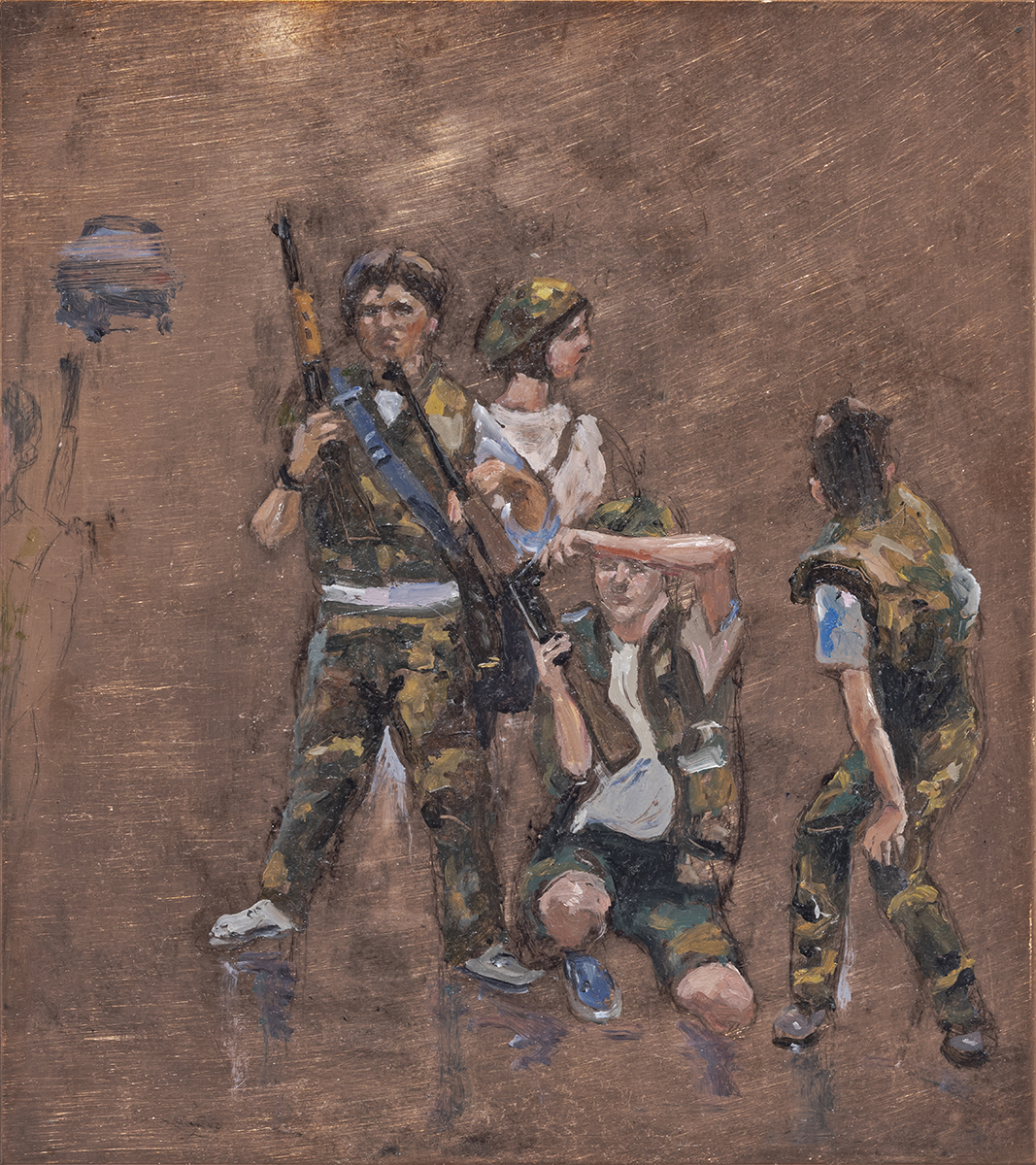
    The featured artworks meticulously avoid any historical, geographical or cultural references. As the artist wrote: “I have noticed the constant presence of guns as a subject in my work since I have arrived in Canada, but I have never made an exhibition which focused entirely on the theme of weapons. I reflect upon the disturbing North American phenomenon, of young boys playing with toy guns, that seemingly condone and glorify violence.”

    Night Watch 2, 2019, oil on copper, 9 x 8 inches

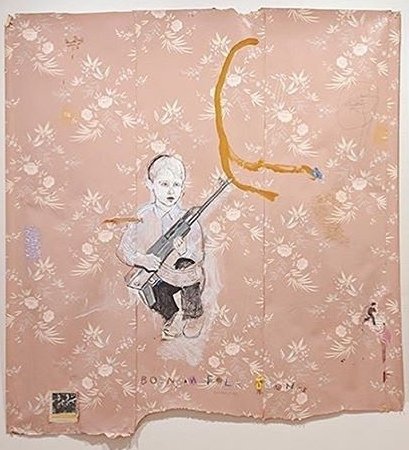
    In Bosnian Folk Songs (1999), a child holds a plastic gun in hand. He is alone and unsupervised. Reminiscent of the aftermath of the war in his native Bosnia, Hadzihasanovic emphasizes the challenges faced by children on the streets who had known war at a very early age.

    Bosnian Folk Song, 1999, oil, graphite, gouache, hair and collage on found wallpaper, 66 x 62 inches

    When Hadzihasanovic first moved to Canada in 1993, he was fascinated by pop-culture and consumerism very different from the ethnic conflict and war in his native country. Over the years, he has found the nature of “the inherent violence of masculinity” troubling. These things motivated him to put together this exhibition as a means to provoke answers to his concerns: “the role of government in controlling weapons, how we educate children about guns, the role profit plays as well as how we contribute to the resolution of the problem that we face.”

    Night Watch 1, 2018 oil and graphite on unstretched canvas, 66 x 98 inches

    Kexin Wu

    Images are courtesy of Paul Petro Contemporary Art. Photo: Toni Hafkenscheid.

    *Exhibition information: Sadko Hadzihasanovic, Kids with guns, March 27 – April 25, Paul Petro Contemporary Art, 980 Queen Street W, Toronto. The exhibition is online at
    http://paulpetro.com/exhibitions/559-Kids-With-Guns

  • Oscar Figueroa’s BLUE at Robert Kananaj Gallery

    “Receive the Blue…” begins a small text pinned to the wall at the entrance to Oscar Figueroa’s interdisciplinary exhibit BLUE at Robert Kananaj Gallery. A poetic continuation of the show itself, the text concludes with an apt survey of the work inside: “…anything is blue”. Figueroa invites audiences in to reacquaint themselves with the familiar and the colour that he has cloaked it in.

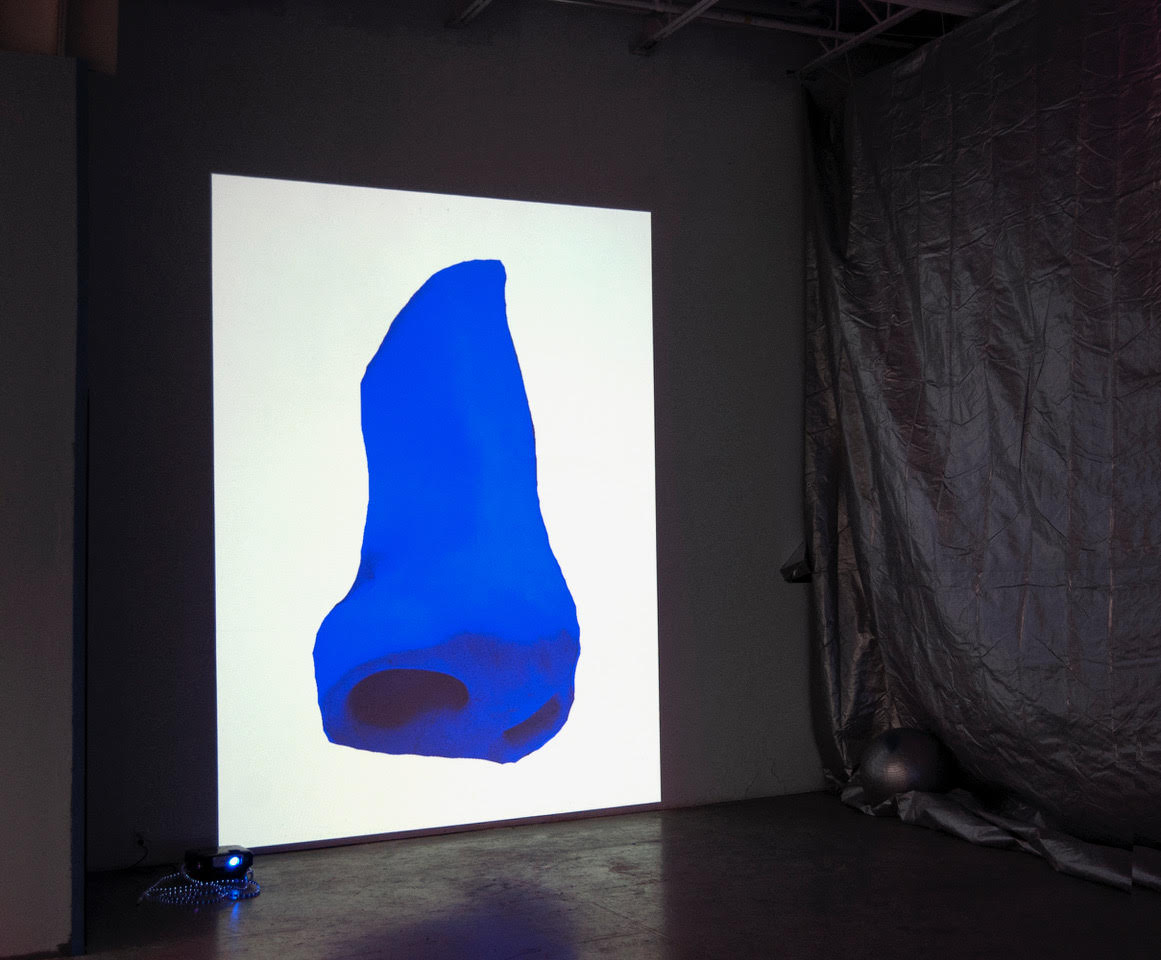
    Blue Nose, excerpt from Blue Nose. Courtesy of Robert Kananaj Gallery

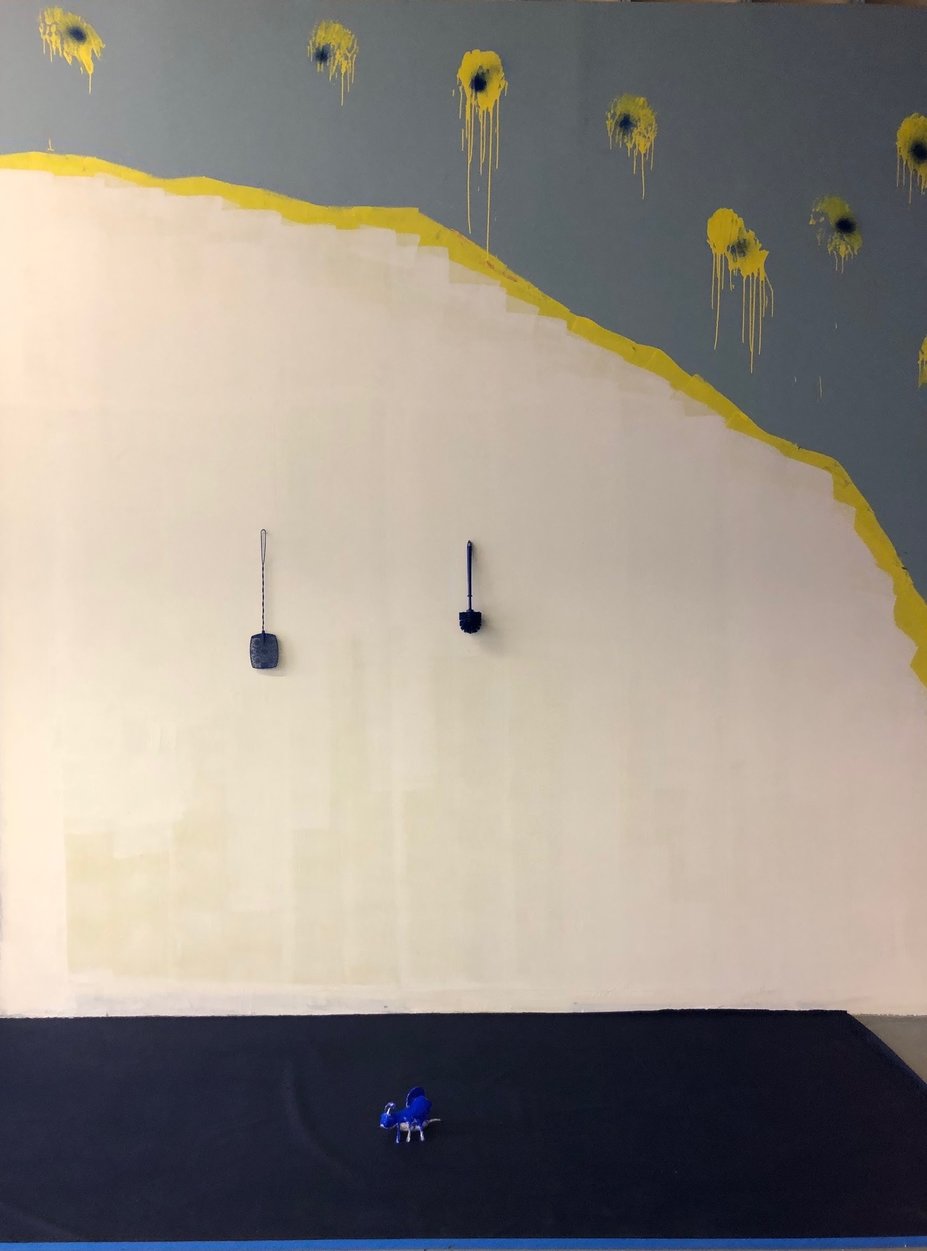
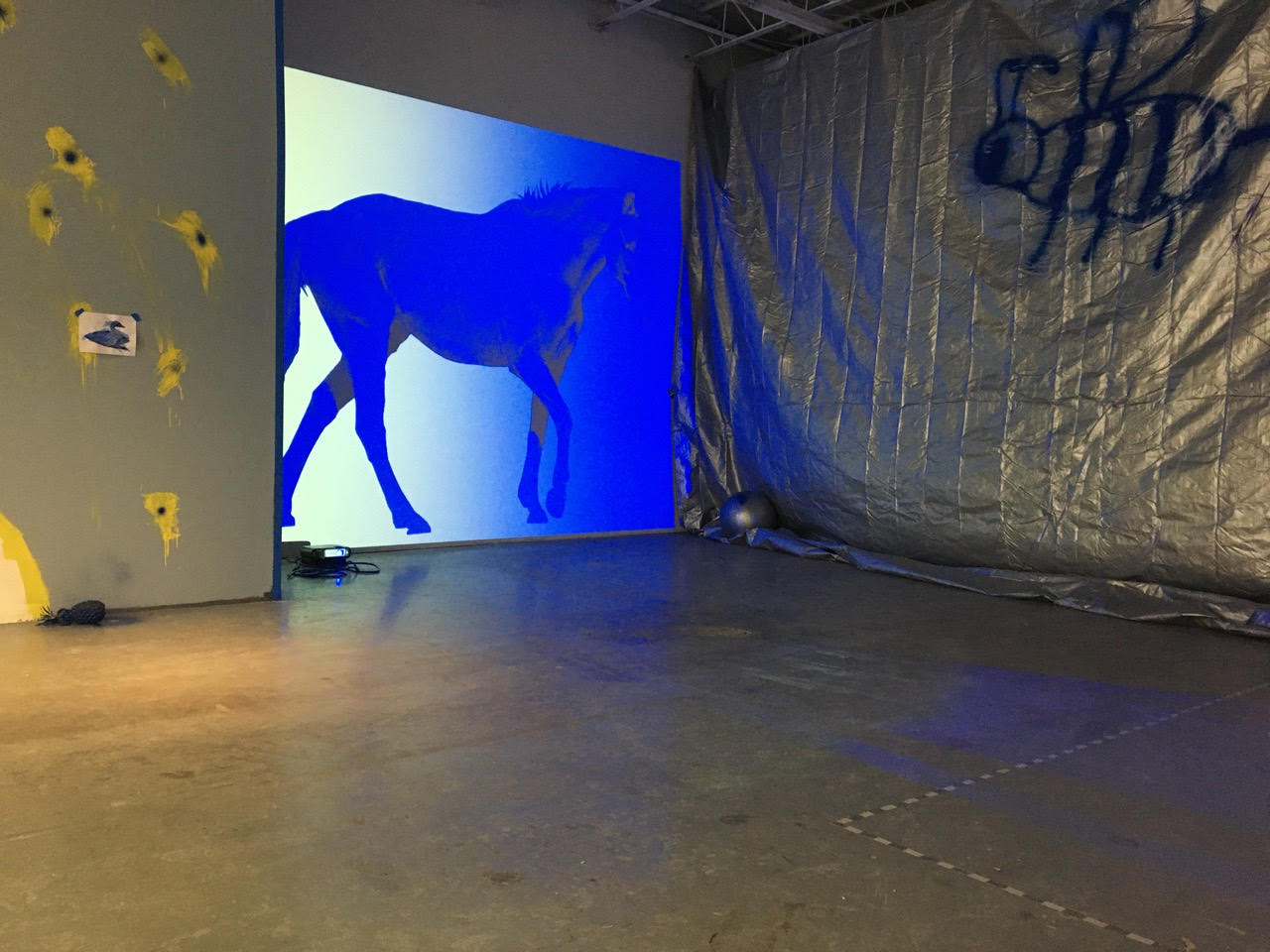
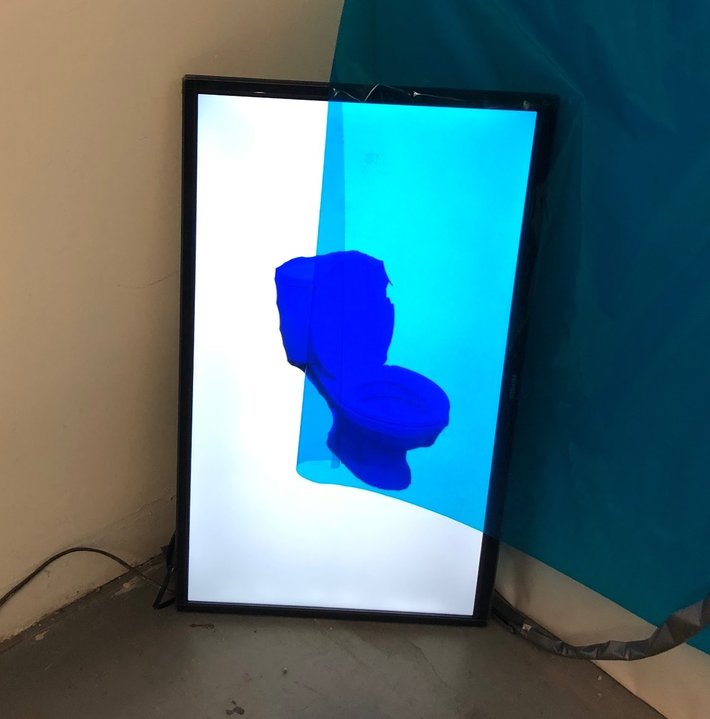
    The stanza ushers audiences from the cozy foyer of Robert Kananaj into an open gallery space flush with a medley of blue objects, animals and indeterminants. Among them, repeat motifs include a bee and a toilet – counterbalanced by the presence of a fly swatter and a toilet brush – as well as several food items, a gorilla, a seagull and a disembodied human nose. On paper, and on screens, or physically present in the gallery, these figures are absurdist transplants, excised from their own contexts. Using paints, cellophane, powder and computer effects, Figueroa has overlain all entities in a blue designed to imitate a luminous, digitally emitted hue, explained gallery Co-Director Roberta Laking Kananaj. 

    From top left: Blue Fly Swatter, Blue Toilet Brush; bottom: Bee Under Blue. Photo: Maya Burns

    When I asked Robert Kananaj about the apparently consequential dynamic between natural and artificial content, his response cut short my follow-up line of questioning: it’s not meant to be decoded.

    As the exhibition package explains, “The poetry of Oscar’s art practice is not for intellectual comfort, nor is it an attempt to compensate for anything. The artwork and the artist become the object, the witnessed moment, which in return invites curiosity that grows in the viewer beyond the artist’s intent.”

    Installation view of Oscar Figueroa, BLUE, 2020. Courtesy of Robert Kananaj Gallery

    To experience the show, is simultaneously to arrive at its purpose. Although it was tempting to admit certain obvious, if irrelevant art historical references (the colour itself is not without precedence, and the nose, which occupies the show’s promotional material belongs to Michelangelo’s David), this was another false avenue I followed in trying to grasp a coherent read.

    Untitled, unlisted. Photo: Maya Burns

    These hollow citations indicate an interesting point of entry into the show’s spirit of unpretentiousness. Figueroa eschews the traditional status that attends the artistic process with a commitment to documenting obvious and familiar things, “that don’t require any sophistication to interact with” as Kananaj pointed out. The artist presents them as they are – save for the blue applique. And yet the resulting work is still personal. As an excited Kananaj explained to me, there is no desired take away, but the artist has made a series of choices for us to observe. Parceled in to process and product is a revelation about the artist’s individual preoccupation with things. It is as intimate and as revealing as the inside of one’s own fridge.

    To return to the accompanying text: “Be suspended in the blue” and “Witness the blue”. These are proscriptive, but not dogmatic statements. Figueroa uses familiarity, rather than esoteric referents to mediate his individual experience of things with ours. He offers his subjects to the audience so that we may sustain his work by being with them.

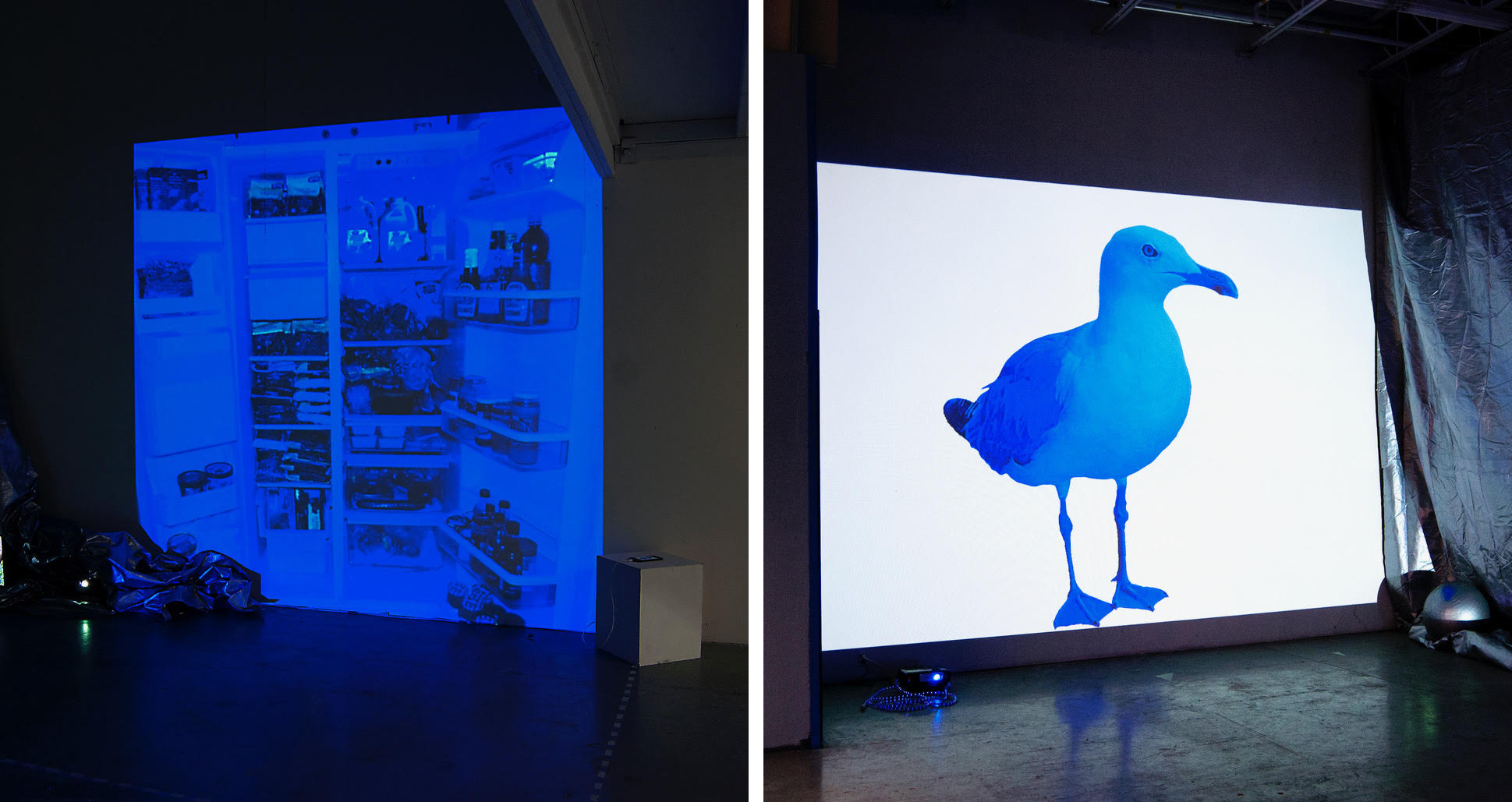
    Blue Fridge (left) and excerpt from Blue Nose (right). Courtesy of Robert Kananaj Gallery

    One of the most literal experiences of viewer implication occurs between two pieces tucked to either side of the gallery’s widened back end. Blue Fridge is a static image projection of a stocked refrigerator interior. Blue Nose is a slide show. It cycles through nose, seagull, toilet, gorilla and horse on loop. Because these projections are directly opposite to each other, their source projectors share a wall with the opposite work. When you stand and look at either piece you obscure it with your shadow; moreover you are partially blinded by the light from the projector producing its alternate. While taking in the work, you enter into a mutually influential experience with it. You alter it.

    In BLUE Oscar Figueroa sustains the Robert Kananaj Gallery’s ethos as a gallery approximating an artist’s studio. The gallery self identifies as “A space where the work-in-progress may be displayed, and new ideas may be collected”. In BLUE, Figueroa’s process of attraction to things continues to unfold, or rather replicates, as viewers are “greeted by the blue”. We continue the creative process in our experience of the blue by generating our own meaning and our own attachments.

    Maya Burns

    *Exhibition information: February 4 – March 28, 2020, Robert Kananaj Gallery, 172 St Helens Avenue, Toronto. The gallery is closed.

  • Interview with Gordon Shadrach at United Contemporary

    Interview with Gordon Shadrach (GS) by Phil Anderson (PA)

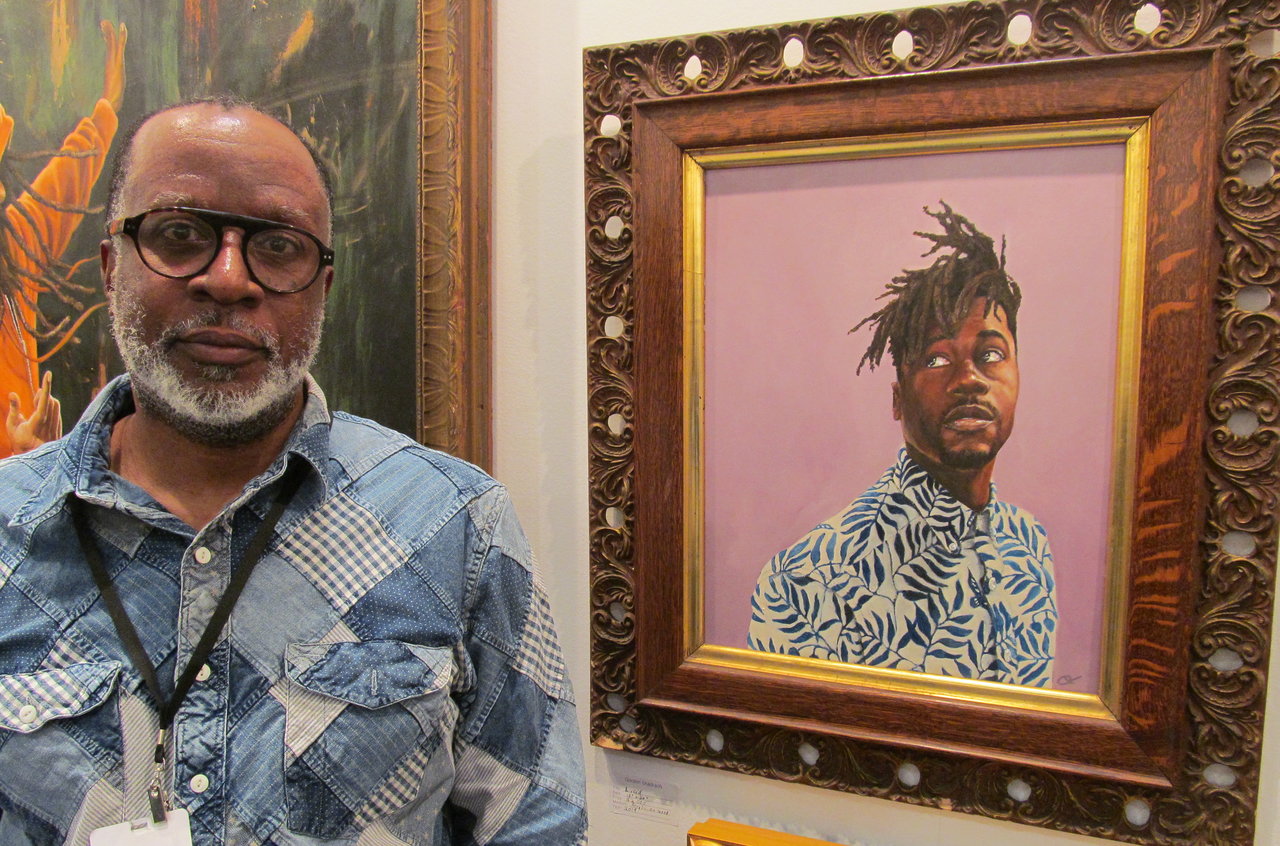
    Gordon Shadrach at the Artist Project, 2020. Photo: Phil Anderson

    Shadrach presents a powerful exhibition of works titled NET WORTH at United Contemporary Gallery.

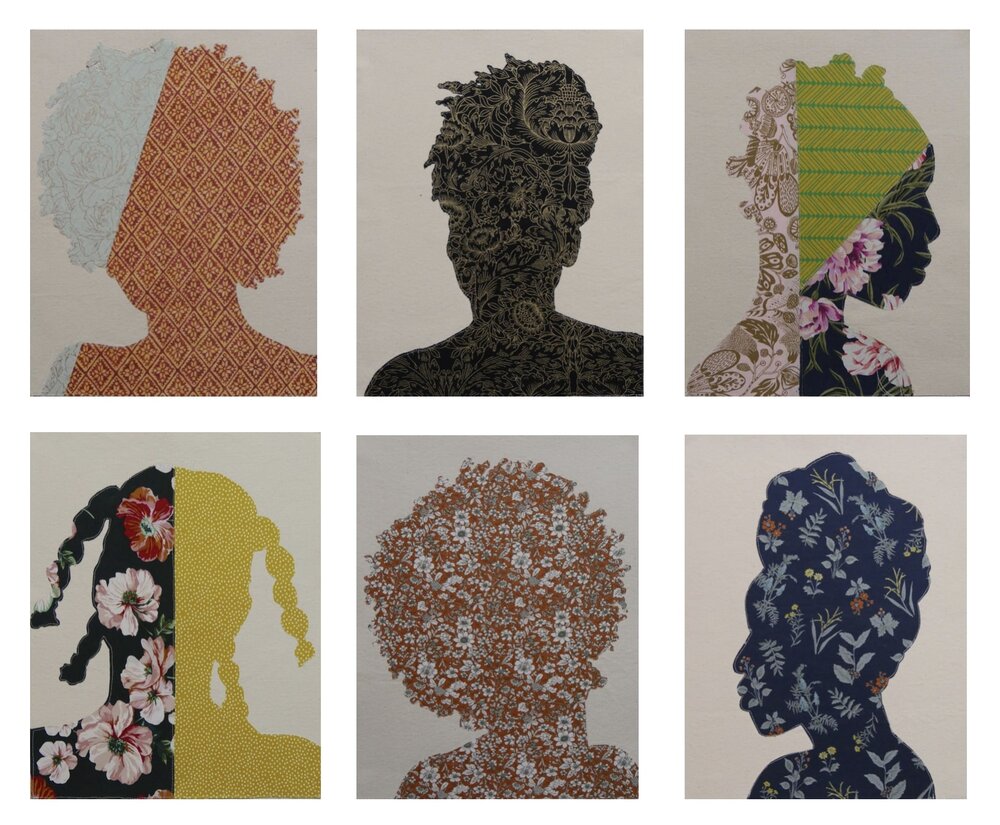
    The combination of oil paintings (on birch or wood) and mixed media works look at the relationship between fashion and black masculinity from both a contemporary and historical perspective. The exhibition is coupled with works by artist Gio Swaby who originally is from Nassau, Bahamas and studied at Emily Carr University of Art and Design. Swaby’s delicate textile works (fabric and thread on canvas) are a wonderful match to Shadrach’s depiction of the black males in his works.

    Gio Swaby, Study of Self, 2020, fabric and thread on canvas, 11” x 14” each

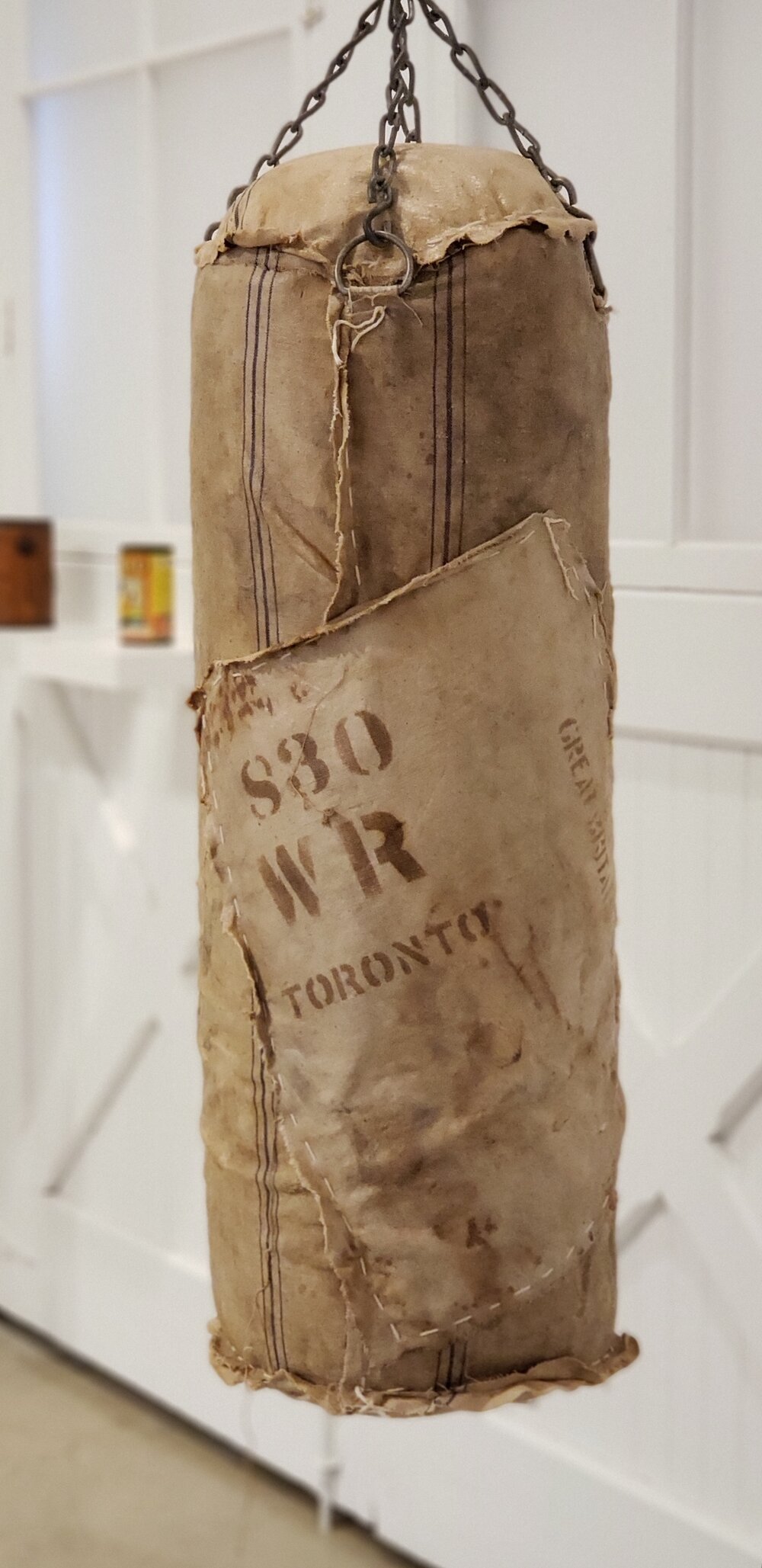
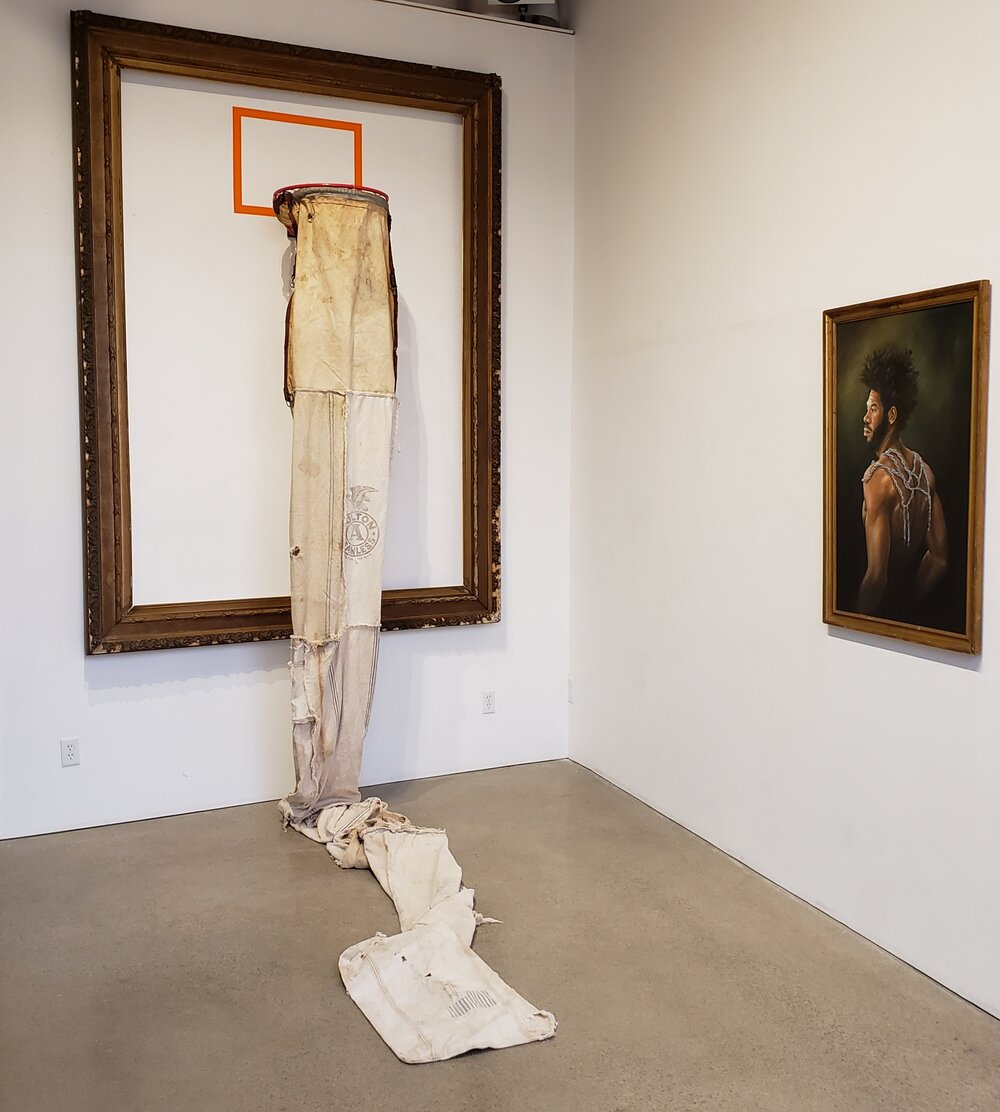
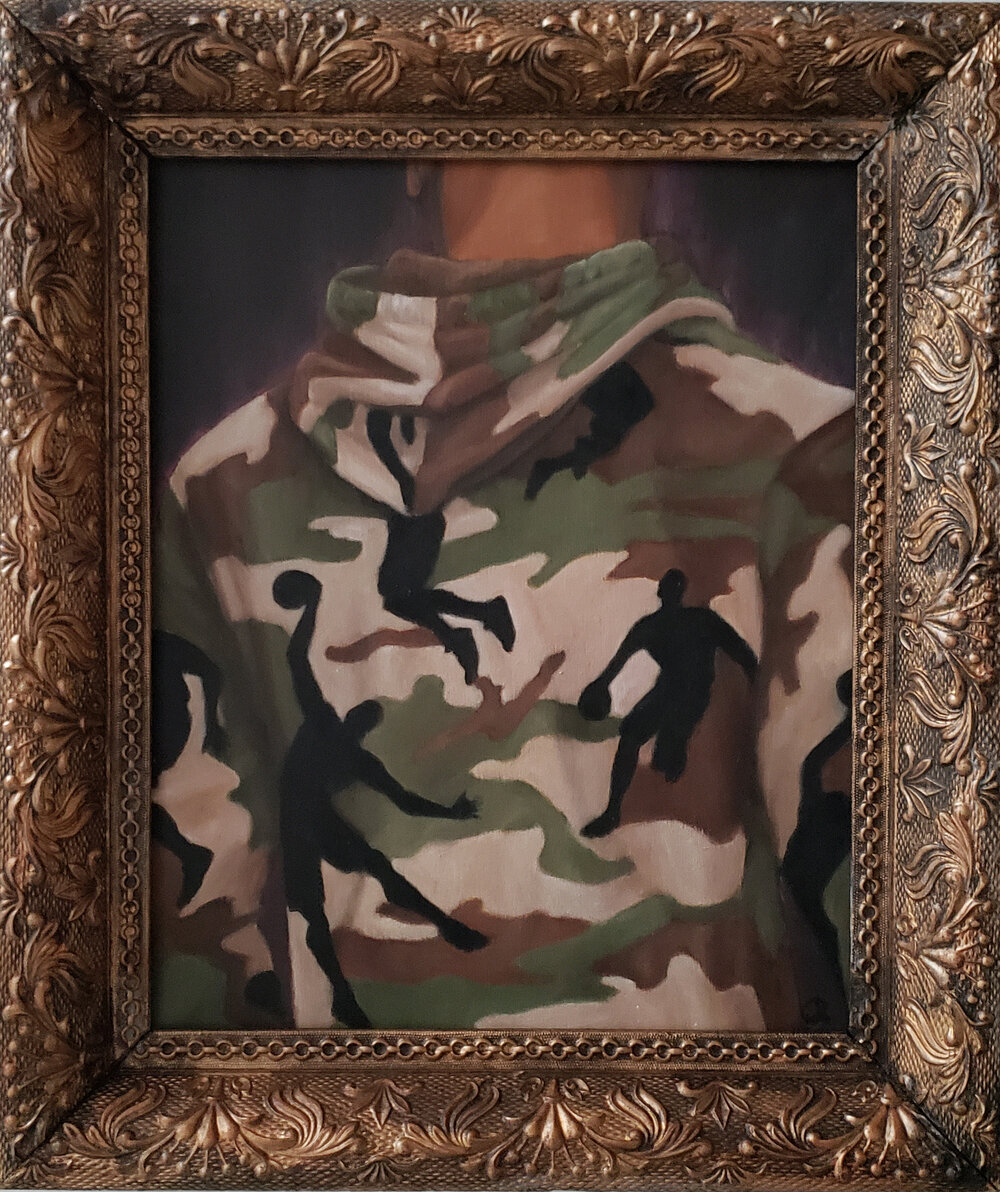
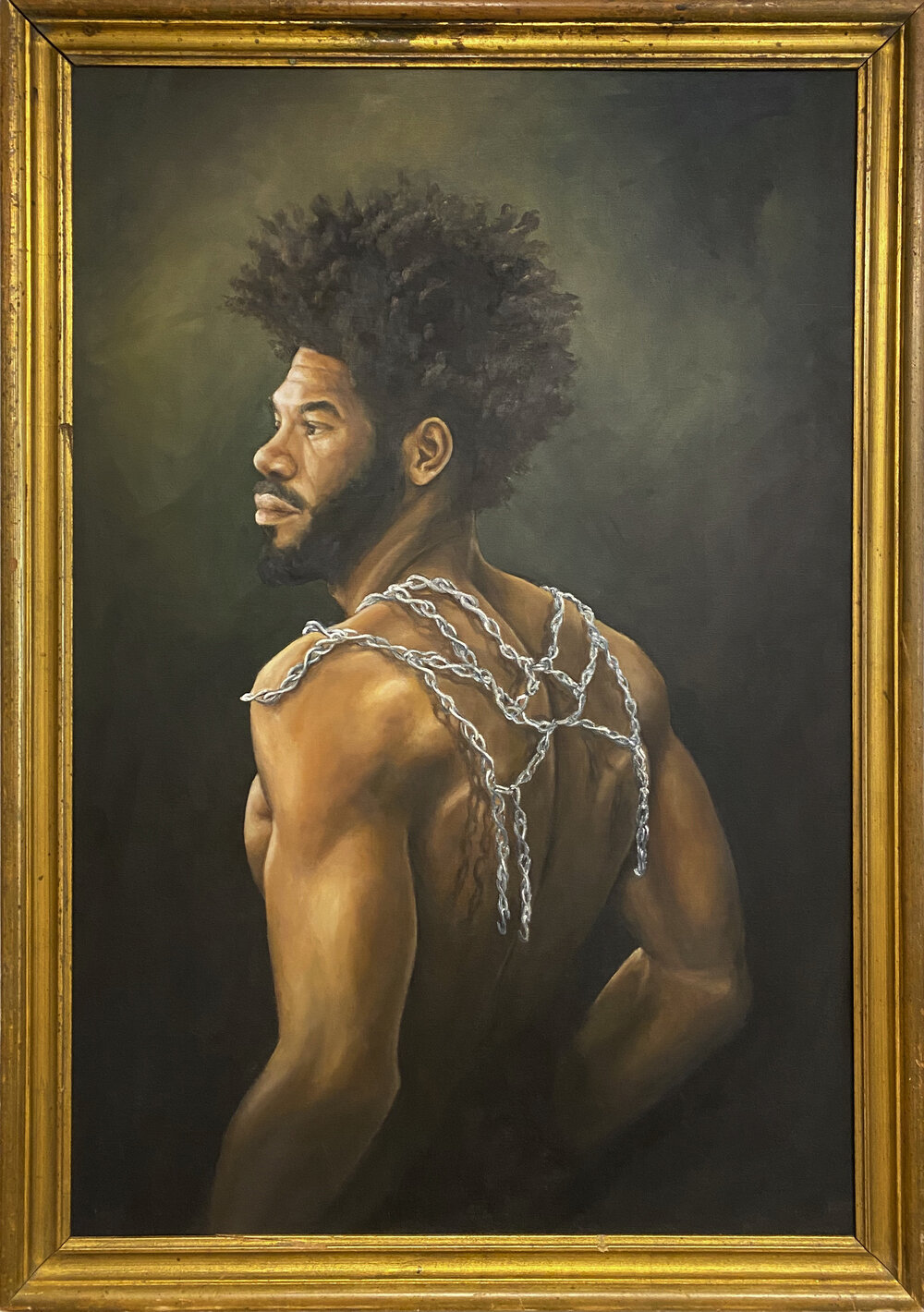
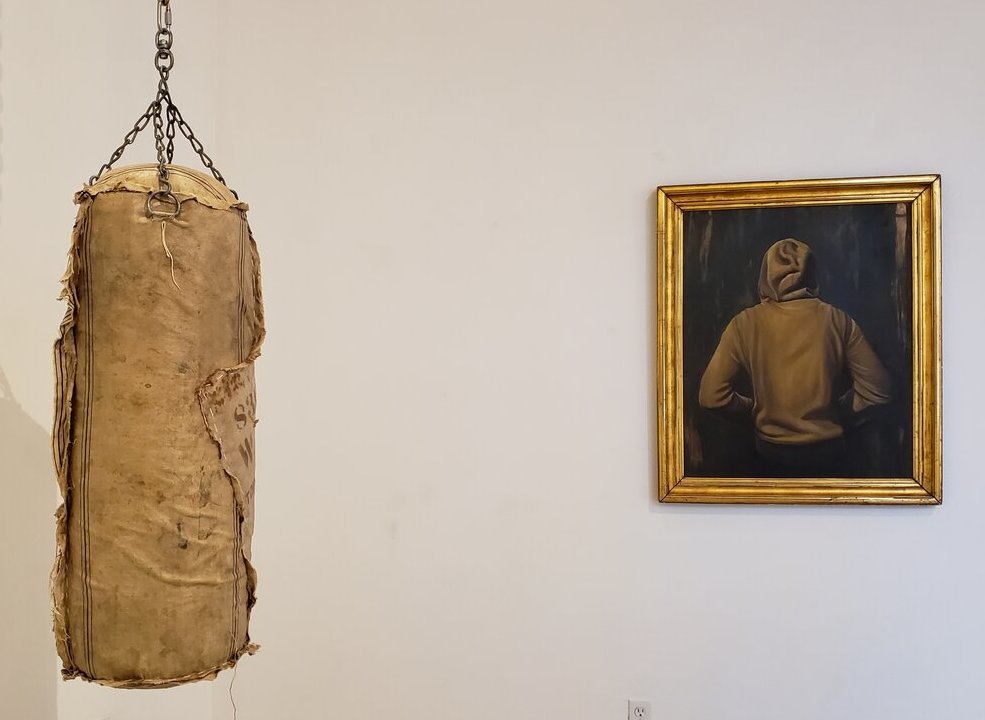
    Shadrach portraits represent black males in general; he avoided choosing celebrities as the subjects of his works. There are references to sport such as basketball in the mixed media work Nothing But Net and boxing with the work Contend. Both are sport activities which black males are known to excel at. He uses antique frames to present his modern images in a historical context. The exhibition has a lot to say and proves Shadrach to be an accomplished artist to watch and listen to.

    Gordon Shadrach, Contend, 2020, vintage cotton cloth farm sacks, vinyl boxing bag, steel chain, 49” x 15”

    PA: You originally studied textile art at OCADU. What made you transition to painting as your primary medium of expression?

    GS: I really started painting on a dare by my partner. He encouraged me to paint my own version of a bow tie print that I admired instead of buying it. I had some student grade paint lying around and gave it a shot. I had no intention of becoming a painter let alone a portrait painter. I really enjoyed challenging myself and pushing beyond my comfort zone in order to try to improve my skills. The more I painted, the more I realized that I could convey meaning in my work as well as develop my technical ability.

    Gordon Shadrach, Vim and Vigour, 2020, oil and acrylic on birch panel, antique frame, 28” x 22”

    PA: In your works you explore the connection between black masculinity and fashion. Do you thing this differs from black femininity and fashion?

    GS: This question is difficult to answer since my point of view is based on my experiences and observations as a Black man. I think that there has been a fetishization of Black masculinity based on perceptions of strength and virility. This in turn has impacted the images of Black men that dominate our culture which has resulted in the perpetuation of stereotypes. In my opinion, there is a narrow standard of beauty in Western culture that has had its impact on Black women and fashion. This is particularly interesting because we now live in a time when styles that began and are popular within Black culture are being appropriated by White celebrities and design houses.

    Gordon Shadrach, Crosshairs, 2019, acrylic on birch panel, antique frame, 31.5” x 23.5”

    PA: Are their other artists that you known of that explore this theme?

    GS: I think there are many artists that explore this theme. The concept boils down to creating art that depicts Black people the way others have been shown in Western art and culture for hundreds of years; that there is no monolithic way to be Black, and that by diversifying subjects and context in our work we show that we are all worthy of being celebrated. Artists like Jordan Casteel, Devan Shimoyama, Lynette Yiadom-Boakye, Toyin Ojih-Odutola and Kehinde Wiley.

    Gordon Shadrach, Lucid, 2018, acrylic on wood, antique frame, 16” x 20”

    PA: What were your earlier works like prior to this body of work?

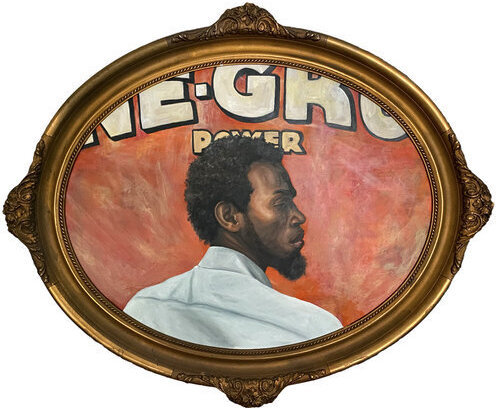
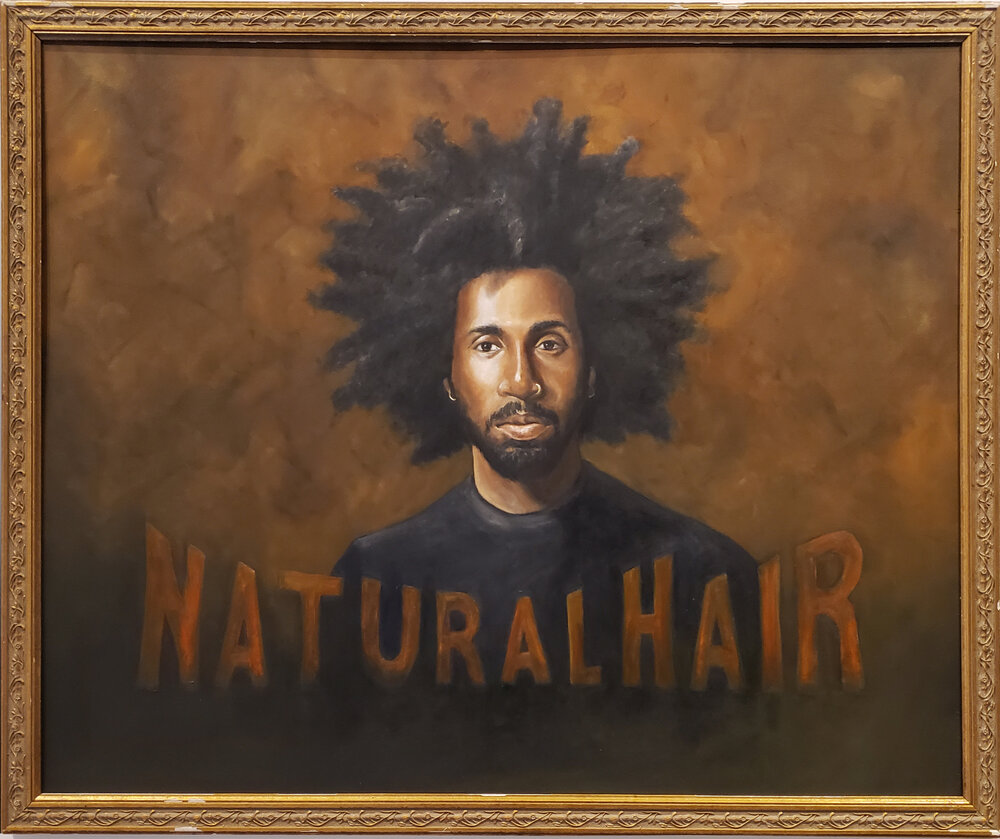
    GS: I explore many themes that centre on Black masculinity, but originally, my paintings were “fashion portraits” where I started to develop as an artist. Moving into more traditional portraiture, I started to paint Black men as Victorian and Edwardian dandies as a way to reinsert ourselves historically when Black men weren’t often depicted in Western art. These portraits were painted so that the sitter would have hair natural to our culture such as afros or dreadlocks in order to correct the forced assimilation of Black people to match the looks of their oppressors.

    Gordon Shadrach, Steadfast, 2020, oil and acrylic on birch panel, antique frame, 12” x 14”

    I did a series called Visceral which depicted my sitters in various states of emotions based on dealing with racism in everyday life. But the common thread through most of my work is the depiction of Black men in non-stereotypical portrayals.

    Gordon Shadrach, Yield, 2020, oil and acrylic on wood, antique frame, 25” x 31.25”

    PA: How does sport play a role in your depiction of black masculinity?

    GS: This show is really my first time directly depicting sport related imagery with my work. I think that I have matured as an artist to develop concepts around sport that I could execute that wouldn’t diminish the importance of sport as a way to better one’s life and also allow reflection on how athletics can also limit how Black men are perceived. The critical question being that when one doesn’t fit that idea of what Black masculinity is supposed to be and you are part of that marginalized group, how do you find your place within that group? Another question is where did the concept of the strength of Black men come from?

    Gordon Shadrach, Nothing But Net, 2020, antique frame, vintage cotton cloth farm sacks, basketball net, leather, 11 ft x 79”

    PA: What have been the reaction to your exhibitions from black males?

    GS: I am happy to say that in the times I was able to meet and discuss my exhibitions with Black men, the reactions were very positive. A lot of the men said that the exhibit depicted how they themselves feel; that the stereotype of athleticism and strength is one that they aren’t comfortable with and has impacted them through life. It’s challenging going through life feeling the pressure that people will expect you to perform a certain way simply because of how you look. I also heard that like myself, some played sports only because they felt pressured to in order to meet other people’s expectations. There were a lot of shared feelings and experiences.

    Gordon Shadrach, Air, 2019, oil and acrylic on birch panel, antique frame, 11.25” x 14.25”

    PA: How do you choose your subjects for the portraits?

    GS: I try to look for a range of what “Blackness” means through skin tones and features. There is a political element to Black hair that refuses to die, so I think it is important to depict hair that isn’t typically shown in Western portraiture. Often, it’s about who I feel can express the mood of feeling that I can project. I work from photos and often will shoot friends and acquaintances spontaneously when we are out for later references.

    Gordon Shadrach, Smoke or Chew, 2020, oil and acrylic on birch panel, antique frame, 31.5” x 29”

    PA: How did you come up with the title Net Worth?

    GS: Net Worth seemed like the appropriate title to me because the exhibit is about the value placed on the Black man in western society and nets obvious connection to sports. I’m drawn to titles that have multiple meanings. A net can be used to trap others, and the allure of success within the sports world is inescapable for some. How is one’s self-worth connected to their net worth?

    Gordon Shadrach, Net Worth, 2020, oil on birch panel, antique frame, 37.5 “ x 24.5 “

    PA: What message do you want the viewer to come away with from this body of work?

    GS: I would like people to consider how others are valued in our community and to check their biases. My hope is that we will continue to examine current pathways to success and who can be considered successful given historic and systemic barriers that have been in place for hundreds of years. I would like viewers consider the historic context that developed this connection between strength and Black masculinity.

    PA: What is in the future for your next body of work?

    GS: I love the direction of Net Worth. I am thrilled that I decided to include textile pieces along with paintings in this show and I am eager to develop more textile work for my next exhibit.

    Installation view of Gordon Shadrach, NET WORTH

    Images are courtesy of United Contemporary.

    *Exhibition information: March 5 – March 28, 2020, United Contemporary Gallery, 1444 Dupont Street, Unit 22, Toronto. The gallery is closed now due to Coronavirus. You can view the show at their website https://www.unitedcontemporary.com/#/new-gallery-1/