Author: artoronto

  • The Artist Project 2020 / Opening Night

    February 20, 2020
    Better Living Center
    195 Princes’ Boulevard, Exhibition Place, Toronto
    Opening Night Party: Thursday: 7 – 11

    The Artist Project – one of Toronto’s most favourite art fair returned to the Better Living Centre in the Exhibition Place with an exciting opening night party on February 20th 2020. This year’s Artist Project showcases over 300 top contemporary artists from Canada and abroad presenting a variety of artistic agendas of manifold interests. The returning featured parts of the programming that excites all art lovers includes Art Chats, Art Battle, Art Walks and the Untapped emerging artists competition.

    Art Lounge

    Finalists’ work of the Untapped Emerging Artists Competition

    As suggested by the welcoming notes, this year’s Artist Project is dedicated to providing its visitors “a more personal experience with art through enriching conversation, participatory installations and discovery of the new, bold and exciting”. Alongside the visual feast brought by the wonderful selection of artworks, the opening night party also welcomes its comers with vibrant music and various vendors offering tasty cocktails and snacks. Every features of the art fair collaborate cohesively to render an atmosphere that provokes meaningful communications between artists and art enthusiasts as well as a stronger sense of connection to art for each individual.

    Betsy Miller’s friends happily join her in a photo

    Speaking of the personal experience that the art fair wishes to trigger, right by the entrance of the show and across from the Art Lounge, visitors could find the display of a wall of artworks created by aspiring artists that awaits their appreciations. The displayed artworks are winners of the 20/20 Artist Competition selected by a panel of jurors and the winning artwork that received most votes from the public general will be entitled Artist Competition’s People’s Choice Award. The 20/20 Artist Competition asks competing artists to create artistic illustrations that shows their vision of the new decade.

    Artworks from the 20/20 Artist Competition

    Interestingly, echoing the intention of the 20/20 Artist Competition to bridge the future and the past as we enter a new decade, many exhibiting artists at the Artist Project 2020 also project close intentions in their artistic manifestations. For instance, Osvaldo Napoli’s wire sculptures, while reflect on the interconnections between technology and city life in the past decades, also triggers viewers to reflect on the impact of the growing dominating role of technology in society.

    Wire Sculptures by Osvaldo Napoli

    The illuminating light boxes by Hugo Cantin are certainly eye catchers of the show. Through the medium of light and linear-patterned collages, Cantin vividly re-illustrates mid-century figures and icons in contemporary context. Cantin’s works retrospect the essence of the past in a futuristic tone and vividly render the idea of time on two-dimensional surfaces.

    Hugo Cantin and his light boxes

    With the multicultural backdrop of Toronto, visitors of the Artist Project could always expect to see global customs vividly integrated into artists’ creative blueprints. By blending Japanese tradition and ceremony with modern techniques, artist Denise Buisman Pilger exquisitely infuses her globetrotting experience into her artistic aspirations.

    Denise Buisman Pilger, Performance, mixed media on washi

    In Kejie Lin’s Spring Scenery, the artist combines traditional Chinese, Japanese ukiyoe and western painting techniques, harmoniously rendering a strong Oriental artistic atmosphere on the three-panel painting.

    Spring Scenery by Kejie Lin, Chinese rice paper

    Numerous artists at the fair are dedicated to the explorations of solo objects or categories of materials which instantly trigger an intimate relationship with art enthusiasts of similar interests. Anna Gruca invites viewers into her world with meticulous portraits of the different characteristics of crystals, mineral and other precious stones.

    Anna Gruca and her paintings of crystals and minerals

    This year’s Untapped Emerging Artists showcases numerous works of excellence by emerging artists with distinct styles. While Celine Gabrielle strikes her viewers with strong, clear figures in bright, contrasting colours, Diana Bahr provokes her viewers to think about memories with ambiguous, black and white representations.

    Diana Bahr at the Untapped Emerging Artists’ section

    The finalists’ work of the Untapped Emerging Artists Competition

    The Opening Night Party of the Artist Project 2020 was filled with art enthusiasms and fascinations which truly light up this year’s art fair and guarantees a promising prospect of the upcoming programming. 

    Text and photo: Kexin Wu

    *Exhibition information: February 20 – 23, 2020, Better Living Centre, 195 Princes’ Boulevard, Exhibition Place, Toronto. Fair hours: Friday: 11 am – 10 pm, Saturday: 11 am – 8 pm, Sunday: 11 am – 6 pm.

  • The Artist Project 2020

    The Artist Project, 2019. Photo: Xiaotong Cao

    February 20 – 23, 2020
    Better Living Center
    195 Princes’ Boulevard, Exhibition Place, Toronto
    Opening Night Party: Thursday: 7 – 11, Friday: 11 am – 10 pm, Saturday: 11 am – 8 pm, Sunday: 11 am – 6 pm.

    From seasoned collectors and first-time art buyers, to gallery dealers and interior designers, visitors can explore and discover works of art from 300 contemporary artists from Canada and abroad. This is a unique opportunity to meet and buy art directly from artists at Toronto’s most celebrated contemporary art fair.

    The Artist Project celebrates its 13th year with another exciting show from February 20 to 23, 2020 at the Better Living Center, Exhibition Place, Toronto.

    Opening Night Party: Thursday, February 20, 2020 / 7 – 11 pm.

    Expect music, drinks, food while you experience an incredible array of artwork, installations and more! 

    Telegenic

    New to the fair, this exclusive fair feature will showcase six multi-media, video and VR installations.

    Art Battle

    Art Battle is live competitive painting where artists selected from the fair will create the best work they can in 20 minutes. On the evening of Friday, February 21 / 7 – 10 pm, it will be held on the show floor.

    There will also be Art Chats, Art Walks and other interesting programs.

    For more information please check http://www.theartistproject.com/.

  • Lorenza Böttner at the Art Museum of U of T

    Overcoming History’s Limitations: Lorenza Böttner’s, Requiem for the Norm

    Lorenza Böttner’s work rejects conformity to normality by using her own body as the main subject of her artwork. She uses it as a performative space. Her skin is a canvas on which to paint, her frame is a space on which to drape costume, and her form is a mode of movement which expresses meaning.

    I had the opportunity to be a Gallery Attendant for the opening night of this exhibit of drawings and photographs, which resulted in me having a lot of time to peruse the work. While making one’s way through the gallery, one notices that the works are laid out in a linear path through time, showing the progression of the artist’s life and artistic career. While I was there, it became evident that Böttner was happy in her body and her joy was communicated through the works to the viewer, with happiness evident in portraits of Böttner where the shutter closed just before a laugh, her eyes crinkling with joy.

    Lorenza Böttner and Johanes Koch, Untitled, 1983, black and white photograph

    Lorenza Böttner knew hardship well. She was born as Ernst Lorenz Böttner in Chile in 1959. He lost both arms up to the shoulders at eight years of age after falling from an electricity pylon while trying to reach a bird’s nest, which caused a severe electric shock. Ernst Lorenz adapted to his new body, using his mouth and feet to retain autonomy. In art school, Ernst Lorenz began identifying as female and assumed the name Lorenza.

    Lorenza Böttner, Untitled, n.d. 35.5 x 27.9 cm

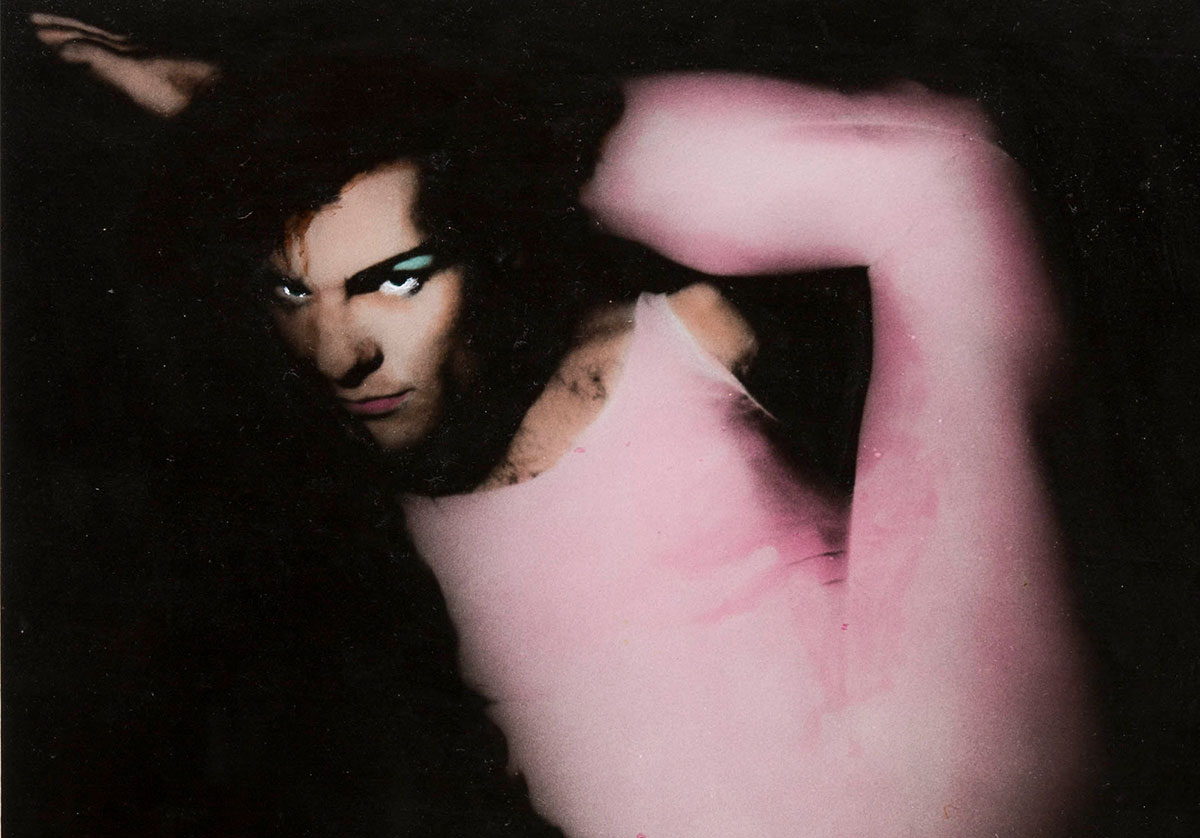
    Face Art, 1983, is a series of close-up, black and white portraits of Böttner. Each photo shows a different version of Böttner creating a diverse range of constructed identities by applying pigment to her face. Some of the portraits show heavy pigmentation, with make-up creating darkness around the eyes in the form of masquerade masks, but in other instances embracing a more natural look and incorporates her beard and eyebrows. The variation of the photos, according to the curator Paul B. Preciado, makes the face “an operator of relentless metamorphosis.” The photos are diverse and Böttner turns her head in different directions for each photo. The looks for the self-portraits were made by holding delicate make-up brushes and pencils with her feet and her mouth, using care and steady precision to paint her face. The portraits are close-up shots against a white background that resemble mug shots. Lorenza’s technique used self-portrait as a resistance against, according to Preciado, colonial, medical and police identification photography that assigns assumed identities to people.

    Lorenza Böttner, Face Art, Kassel 1983. digital C-print 40 x 29.8 cm

    Installation view with Lorenza Böttner, Face Art, 1983, black and white photographs

    Dispersed through the gallery are other black and white photographs with Böttner as the subject, wearing different garments. In Untitled, n.d., the artist is the only figure in a plain room with a single chair. One leg is propped up on the chair with her head facing away and twisting towards the viewer, making eye contact. She is wearing a masquerade mask shaped like a sparrow flying downwards towards her nose, alongside sparkling earrings. She wears a tinsel boa around her shoulders which continues to wrap around her upper-torso and a skirt, of the same material, going down to her knees. Kitten heels adorn her feet. Her dark, painted lips are shaped upward and are separated in a wide and genuine smile. Her happiness is evident in this photograph, and this same energy appears many times throughout the exhibit. Böttner creates an identity in the clothes she chooses to put on her body and, in this instance, she looks more feminine. In this photo, Böttner occupies what the curator, Paul B. Preciado, terms a “plurality of positions” as she was interested in the “simultaneity of embodiments rather than identity being a ‘static’ place”. In the variety of works, Böttner’s skin switches between being heavily painted or being natural. In some cases, she chooses to be nude and in other cases cloaks her body with a variety of styles, switching between time periods and traditionally masculine and feminine garments.

    Lorenza Böttner, Untitled, n.d., black and white photograph

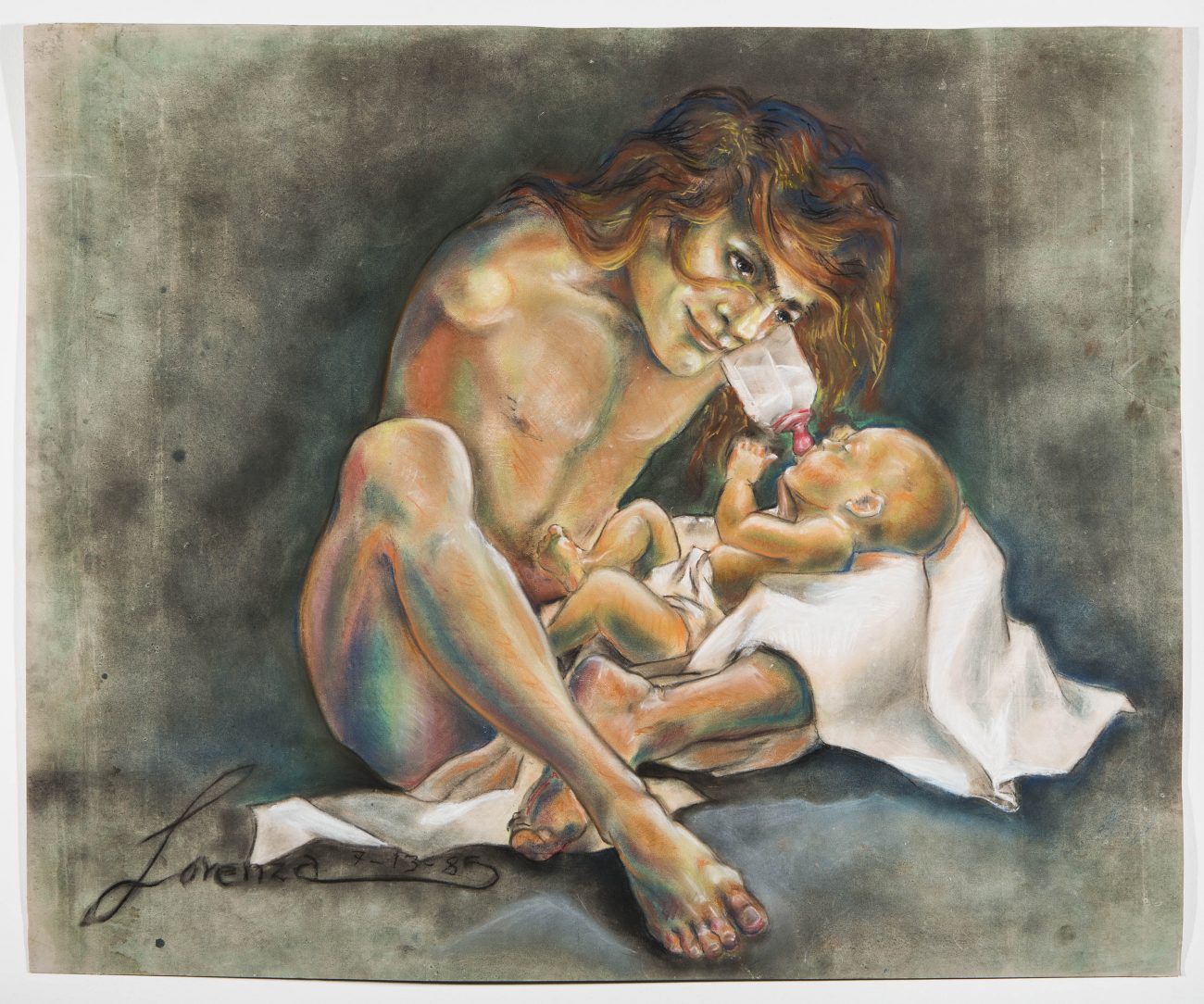
    Böttner’s identity seeks another form in, Untitled, 1980. In this pastel drawing she depicted herself nude and seated on the ground, supporting a swaddled infant in the crook of her crossed left leg with her right leg propped up to counter-balance the weight of the child. She balances a bottle of milk in the crook of her neck as the child suckles on it. Böttner’s hair is pushed to one side, flowing down in waves to her shoulders. The figures are brightly colored, contrasting against a non-descript and dark background.

    Lorenza Böttner, Untitled, 1980, pastel on paper.

    In Untitled, 1985, Böttner has drawn, in pastels, her body in the likeness of the famous Greek sculpture, Venus de Milo, as both that sculpture and Böttner are without upper limbs. She is exploring the tension between different types of bodies and the ideals of beauty. According to an information plate in the gallery, Böttner commented on the work saying, “I saw that many Greek statues without arms were admired for their beauty. I wanted to show the beauty of the crippled body.” In the drawing, Böttner’s body follows the same form as the sculpture, displayed against an earthy, pink background. The rendition of the body is in grisaille, contorted in an ‘s’ shape with her head looking off the right side. Both the original Venus de Milo sculpture and this drawing have drapery precariously hanging around their hips and their hair is pulled back in a neat bun. The rendering of the face is clearly in the likeness of Böttner. The drawing is about four feet across and four feet tall, which is much larger than other photographs in the gallery, giving the drawing an air of monumentality. The immediate recognition of the Venus de Milo reference captures the viewers’ attention, and, as Preciado said, expands the canon to include those who identify beyond the white, cis-gender, heterosexual body.

    Lorenza Böttner, Untitled, 1985, pastel on paper.

    Böttner used to pair her works with performances where she would go to venues and the public street, covering her body in a fine layer of plaster and posing as still as an actual statue on a podium until she stepped down and asked, “What would you think if art came to life?”, and would then proceed to dance. For her, dance was a mode of expression by the body that allows social empowerment, and, as Preciado points out, works against the passive nature imposed on the body with functional diversity.

    Lorenza Böttner, Untitled n.d., 30.3 x 31.1 cm

    Böttner created a great number of works by the time her health declined due to HIV. She passed away in 1994 due to AIDS-related complications at the age of thirty-four but her vibrancy is remembered, with her work expanding the definition of ‘normality’, composing a requiem for outdated norms and limitations set by society. Böttner’s work is a discourse on embracing and accepting different types of bodies and has brought to light the ability to use bodies as a mode of expression, demonstrating how happiness can be achieved through using one’s physical form, even if it is deformed.

    Olivia Musselwhite

    *Exhibition information: January 25 – March 21, 2020 Art Museum University of Toronto, University of Toronto Art Centre, 15 King’s College Circle Toronto. Museum hours: Tue to Sat 12 – 5 pm.

  • Sex Show 2020 @ Gallery 1313

    Installation view of the Sex Show. Photo: Olivia Musselwhite

    Opening reception: February 6, 2020, 8 pm
    Gallery 1313, 1313 Queen St W, Toronto

    In time for Valentine’s day there is a light-hearted and playful exhibition about the topic of sexuality and its diverse range. A light tone permeates throughout the show. A variety of mediums explore the theme with paintings, drawings, collage, installations and videos.

    The collection is not only high-spirited, but also brings to the forefront some important, relevant topics. To list a few, the show can be viewed through a feminist and a queer lens while it also brings up the newly realized anxieties of online dating. The exhibition is curated online by Phil Anderson, Executive Director of Gallery 1313 from submissions to encapsulate the expansive range that the theme of sexuality has the potential to cover.

    Mishka Peachka with her work Misster Dress Up (top) and Misster Dress Up (bottom). Photo: Phil Anderson


    Ravi Persaud, SWIPE RIGHT. Photo: Phil Anderson

    Installation view with MUSE by Kelly O’Neil (front). Photo: Phil Anderson

    Zoë Joyall brings personalities to the female anatomy with eyes and long lashes in her brightly colored cartoon-like illustration, I Can Feel That. Joyall states that her works are the product of being frustrated by lack of control of the gaze of viewers. Her series of vulvas challenge the gaze, active in their relationship with the viewer, asserting themselves against those who are attempting to sexualize or objectify them.

    Installation view with Nora House, Belfie and Zoë Joyall, Vulvas with Eyes from the series I Can Feel That (right). Photo: Phil Anderson

    Stephen Dunn creates videos recounting the mishaps and comical situations that come in online dating in the work, Pop Up Pornos. The stories of different people fold out from pop-up books where the narrator’s hands open the pages, candidly telling their dating experiences visualized on the pages. The viewer feels for the characters, who are stumbling through social interactions.

    Guess in front of the video Pop Up Pornos by Stephen Dunn. Photo: Phil Anderson

    The Sex Show delivers an exhibit that leaves one feeling amused along with the sense of a higher awareness of what sex and sexuality means in the 21st century.

    Visitors looking at EKR Schlegel’s works. Photo: Phil Anderson

    Guests at the opening reception. Photo: Phil Anderson

    Olivia Musselwhite

    *Exhibition information: February 5 – 16, 2020, Gallery 1313, 1313 Queen St W, Toronto. Gallery hours: Wed – Sun, 1 – 6 pm.

  • Fossil Record at General Hardware Contemporary

    For their current exhibition, General Hardware Contemporary’s director Niki Dracos has invited the writer Tatum Dooley to act as guest curator. Dooley has selected work rooted in the conventions of two-dimensional wall art such as painting and photography, but which also manipulates surfaces and materials to push them beyond these conventions. 

    The show is titled Fossil Record. Think of fossils: they contain within them the narrative of how they came to be; they’re discovered through the exposure of sedimentary layers; they are things that once were pulpy and soft and are now solid and fixed. The title is metaphoric for the curatorial theme, for the ideas that stitch this show together.

    At the front of the gallery are works by Margaux Smith. Their small scale, intricate detail, and generous spacing all work together to draw you in close. It’s an intimate experience. They’re telling a story just to you, rather than broadcasting across the room.

    Installation view with paintings by Margaux Smith. Photo: Mikael Sandblom

    The paintings are dense, rich, and layered. Strata of paint and collage partially reveal the process of how they were made. The pictures bridge abstraction and figuration. In some pieces you can see arms and legs or parts of faces; in others it’s hard to see any particular subject. I found myself switching between trying to decipher the content and enjoying the lush surfaces of the work

    Margaux Smith, Shelter, 2019, mixed media on linen over panel, 16” x 12”.

    Smith has also produced a series of engaging portrait paintings on paper. Only a few of these are shown on the walls but there are more, kept in a portfolio in the office. You should ask to see those!

    Margaux Smith, Red Portrait, 2019, water colour on paper, 9” x 5.75”

    Moving on to the second gallery, you’ll find a couple of pieces by Stanzie Tooth. The larger one, called Mondgebrut is a felt wall hanging with other fabric elements sewn on. It is loosely draped in front of the wall, attached by nails through a row of heavy-duty grommets along the top edge. This hardware gives a sense of weight to the piece which is augmented by a subtle but important aural effect. The gallery has concrete floors. You normally hear your own footsteps, but as you approach this piece you walk into an auditory dead-zone. Everything grows quieter. The prominent ears of the crouching figure are telling you that this is a piece that you need to listen to as well as look at.  

    Stanzie Tooth, Mondgebrut, 2020, fibre (hand-stitched), 64” x 42”

    Rooting Up is another piece by Tooth. As in the felt hanging, there is an outline of a figure reaching down to a field of flowers and some of the same fabric has been used. On close inspection, you’ll discover similar sewn details on the flowers. In this piece however, the fabric is held together from behind by pink tinted plaster. Tooth’s casting process leads to interesting effects whereby the plaster bleeds through and flows around the front of the fabric, making the figure vague and randomly defined.

    Stanzie Tooth, Rooting Up, 2019, plaster, felt (hand-stitched) and pigment, 22” x 20” x .75”

    At the far end of the gallery are several works by Gillian King. At first, it’s unclear what they are made of. Are they blocks of stone or perhaps large encaustics? As you approach, you discover that they are not paint on canvas but rather pigment in canvas.

    Installation view with Gillian King, Cecropia, 2019, acrylic and various plant materials on canvas, 72″ x 60″ (facing). Photo: Mikael Sandblom

    King has developed a unique method to create these surfaces. She arranges dirt, rusty metal and plant material over the canvas surface, folds and ties it into a package and then lets the whole thing ‘cook’, creating the stains. Her method of wrapping and folding imparts an almost symmetrical patterning in the material. The canvases are taut, smoothly stretched, and the edges are left exposed which contributes to their solid slab-of-material quality. Picking up from the geometry in the stains, King has added small, crisp, organically shaped painted elements that seem to float up over the surface.

    Gillian King, Acleris, 2019, acrylic, rust sediments and various plant materials on canvas, 30″ x 26″

    Also, in the rear gallery space, are works by Fiona Freemark. Her work consists of photographs that have been carefully cut and hung inside shadowboxes. They hang loosely in their frames making one aware of the thin, fragile nature of photographic paper. If they had been mounted flat, much of their impact would be lost.  

    Fiona Freemark Sunset/Window (+ Space), 2019. hand-cut photograph on Arches paper, 15” x 12”

    The shapes of the cuts are defined by the geometry of another image that is not shown. Sometimes, as in the piece Apple Tree / Clouds (Fool’s Paradise), we can readily identify the cutout geometry. But, regarding the other four pieces, I’ve hunted for a solution, trying one idea after another, attempting to decipher what these shapes could be, and remained stumped. They offer a sprightly resistance to interpretation.

    Installation view with Fiona Freemark’s hand-cut photographs on Arches paper. Photo: Mikael Sandblom

    For most of us, the art we encounter is predominantly online or in print. It’s easy to believe that what we see through the medium is the full extent of the experience. Fossil Record is a show that underscores the value of seeing the work firsthand. How big is it? What are the surfaces like? How does it change at various distances and angles? Is it reflective or flat? How does it engage our other senses?  When we rely on perfectly flat images scaled to equal sizes, we are not aware of all the other aspects that the artist intended for us to experience.

    What we see on screens is not the full experience! Photo: Mikael Sandblom

    Mikael Sandblom

    Featured image: Margaux Smith, Shelter, 2019, mixed media on linen over panel, 16” x 12” – detail

    *Exhibition information: January 18 – February 22, 2020, General Hardware Contemporary, Front Gallery, 1520 Queen Street West, Toronto. Gallery hours: Wed – Sat, 12 – 6 pm.

  • Interview with Apollonia Vanova about her new Sleepover Art Gallery

    Apollonia Vanova, director of Darren Gallery

    Interview with Apollonia Vanova, director of Darren Gallery (AV) by Emese Krunák-Hajagos (EKH)

    EKH: Darren Gallery is reopening after, as you’ve said, a long and painful renovation with a new concept: Sleepover Art Gallery. Where did this idea come from?

    AV: The sleepover gallery concept came about from a variety of factors. It’s difficult to sell art, as it’s not a life necessity and not a surprise when galleries close down after a few years. This is not exclusive to commercial art galleries – retail stores are going out of business all the time due to online shopping. People are also living in smaller spaces and not buying as much stuff. If one walks by a commercial art gallery, chances are it’s always stark and devoid of people, except the director sitting by their desk on the computer. If one musters up the courage to actually walk in, the feeling is usually cold, intimidating and uninviting. I wanted this gallery to be something different, different from the traditional ‘pictures on the wall’ gallery that’s devoid of people and empty of life. At Darren Gallery, I want the viewer to feel comfortable by providing a space where they can relax, sit down, lounge on a sofa, contemplate the work, read about the work and even sleep in its vicinity.

    There is one significant phenomenon that stands out in our culture: people are always looking to experience new and interesting things – more so than ever before. This idea is confirmed by our online presence and Instagram culture, where we want to be seen at the most unique places, we want to experience unusual things etc. I would like to provide for my guests a unique art-fueled experience. Moreover, maybe it is time to break the old conventions. Why don’t we try to observe the art alone with no witnesses, at 3 am, in the middle of a sleeping city. Make it a fully immersive and memorable experience!

    Installation view of the Sleepover Art Gallery

    EKH: Could you please tell us more about the sleepover part?

    AV: The gallery is on street level, with huge storefront windows covered with thick velvet blackout curtains for your privacy. The main gallery and exhibition space is punctuated by a couple of discreet (comfortable Twin XL high end memory foam) Murphy beds, surrounded by the art installation. The kitchenette, shower, closet and bathroom are located in the bright, newly renovated basement, where you will find towels, coffee, tea, for your overnight stay. Sorry – no TV, unless it’s part of the installation as the focus is on the art.

    EKH: How will you select the people who will sleep in the gallery?

    AV: Every person is welcome and one doesn’t even have to be an art lover, but it would help if you were curious with an open mind. Overnight stays are limited to 2 guests per night as the gallery has only two beds. Obviously, there are the standard rules of: no smoking, vaping or partying. The gallery does take a refundable damage deposit to protect the artwork. The overnight stays can be booked by contacting the gallery directly, through our website as well as through AirBnb.

    EKH: Will the bed remain in the gallery through the day? Won’t the place look more like a hotel room than a gallery?

    AV: Murphy beds are great: so discreet, and virtually blend into the wall.  They can also be used as “walls” to break up the room and incorporate into the exhibition. The typical hotel room feeling comes from the ‘typical hotel’ décor. The gallery is nothing like a hotel. At Darren Gallery – artwork dominates the space and the furniture is minimal. If anything, the challenge has been more the other way around – that it doesn’t feel enough like a hotel. How do you make a gallery with concrete floors and white walls feel warm, comfortable and inviting enough to sleep over? I am hoping, with selective furniture for lounging, comfortable mattress, ambiance and with a unique art exhibition, I can transform the space.

    Installation view of Lumír Hladík’s Cozy Venom

    EKH: Your first show, titled Cozy Venom features Lumír Hladík’s work. How does this show fit into your concept? 

    AV: Lumir is a Toronto based, Czech born, post WWII neo-Avant-garde artist, one of the pioneering creators of the 70s East European installation, action and performance art movement. Lumir’s current work has a lot of unprecedented and unpredictable aspects. His material combinations are totally unique. He also collaborates with living Canadian wildlife, such as Black bears or fishers or birds… At his studio visit a few years ago, I was absolutely mesmerized by the work – the symbolism, craftsmanship, attention to detail, quality was unbelievable. We spent a few hours talking about it: it’s so full of layers – including aspects of religion, science, quantum physics, sex, life, death, innocence, vulnerability…. The work is surreal and one can draw a multitude of conclusions from one piece.

    Cozy Venom has a dreamy quality that fits nicely with the sleep over aspect.  Lumir is a museum caliber international artist and it’s a wonderful opportunity to be able to spend time with the work on such an intimate level.

    Installation view of Lumír Hladík’s Cozy Venom

    EKH: How does the artist feel about people sleeping in his exhibition?

    AV: The artists I have talked to have been very open minded to the idea. They like the concept of people experiencing their work on a more intimate level. It can start a new relationship, a dialog. Each individual show is 3 months long – which is also nice as their work will be seen by more people. Shared revenue from overnight stays is also a good thing. It supports their work by putting some money back in their pockets, without the pressure of having to sell anything. All the pieces are available for sale and while it would be wonderful to sell them, that’s not the main purpose. 

    EKH: What is your method in selecting artists for future exhibitions? Do you follow a theory, a theme or create one around the artist’s work?

    AV: Darren Gallery is interested in national as well as international artists with a strong body of work and exhibition history. Installations with a time element would be ideal, where something happens over a course of time, but we’re open to anything that is visually groundbreaking, mesmerizing, interesting and transformative for the space. Darren Gallery would like to invite and encourage guest curators to reach out with exhibition submissions.

    Photo: Yianni Tong

    *Exhibition information: February 6 – July 16, 2020, Opening night: February 5, 2020, 6 – 10 pm, Darren Gallery, 346 Margueretta Street, Toronto. Gallery hours: Sunday 12 – 6 pm or by appointment only.

  • Four Artists at Wychwood Barns

    Opening Sunday, February 2, 2020 / 4 – 6 pm

    Peter MacKendrick Community Gallery, Wychwood Barns

    Organized by Leah Oates

    Featuring work by four Toronto based Artists: Pamela Dodds, Leah Oates, Steve Rockwell and Pierre St-Jacques.

    Installation view with works by Steve Rockwell (left) and Pamela Dodds (right). Photo: Leah Oates

    Pamela Dodds in her prints, paintings and drawings explores “the complexities of our human relationships, engaging with and exploring the inter-connectedness of humanity across time and space, with a focus on women and women’s agency as a core perspective.”

    Pamela Dodds, Respiration Masks / Mascarillas respiradores, 2018. graphite & watercolour drawing on paper, 19 x 27 in, Courtesy of the artist

    Steve Rockwell’s exhibits pieces of his “Color Match Game.” Created in 1987, the game was first played competitively in 1999, when it was introduced to resident artists at Omi International Arts Center in Upstate New York. Over the years, tournaments have been held in New York City, Miami Beach, Los Angeles, and Toronto.

    Steve Rockwell, Color Match Game #6, 2019, acrylic on board, image size 7.5 x 7.5 in (left), frame 9.75 x 9.75, 2 in (right) with view of box inside. Courtesy of the artist

    Although the playing of Color Match is inherently no more complicated than a colorized tic-tac-toe, the resulting variables of each played game, are infinitely more complex. Each game board records a specific moment in time and place between two players. They constitute, in effect, “a conversation in color.” 

    Leah Oates in front of her works. Photo: Pierre St-Jacques

    The Transitory Space series by Leah Oates deals with urban and natural locations that are transforming due to the passage of time, altered natural conditions and a continual human imprint. In everyone and in everything there are daily changes and this series articulates fluctuation in the photographic image and captures movement through time and space.

    Leah Oates, Transitory Space, Nova Scotia # 135, Color Photography, 2015-2016. Courtesy of the artist

    Transitory spaces have a messy human energy that is perpetually in the present yet continually altering. They are endlessly interesting, alive places where there is a great deal of beauty and fragility.

    Pierre St-Jacques, A Gathering Of Shifts, still from the video installation, 2011-2012, Courtesy of the artist

    Pierre St-Jacques wrote: “A few years ago, I would have said that my work was about structure, or more specifically about how one constructed one’s world. Over time this has changed to a simpler and more basic premise for my work. I want to explore these little daily moments that we all experience, these glances or gestures, in which there is a connection made with another. In these moments a small door opens up into a large new world that, if only for a second, makes us glimpse as what it means to be human.”

    Installation view with Leah Oates, Nova Scotia # 135 (left) and the video of Pierre St-Jacques (right). Photo: Leah Oates

    *Exhibition information: Group Show #1, February 2 – 9, 2020, Peter MacKendrick Community Gallery, Wychwood Barns, 76 Wychwood Avenue, Toronto. Gallery hours: Mon – Sat 12 – 6 pm.

  • Hito Steyerl: This is the Future at the AGO


    I am not from here.

    My home is outer space.

    I run through your veins.

    I am liquidity incorporated.

    Be water!

    • An extraterrestrial narrator in Liquidity Inc.

    Red Alert, 2007. Installation view at the AGO 2019/2020

    In 2007, Hito Steyerl declared the ‘end of video’: “It [has] reached its boundaries. What we see is not an image but the medium itself. The medium is an information filter and it influences our perception.” No longer able to portray ‘the real’, video is bereft of meaning. Through moving image works such as Red Alert and Duty Free Art, Steyerl injects the absent virtual space with speculation and experiment. Generated amidst the collective state of confusion – in place of determinate reality – is individual and collective agency.

    Duty Free Art, 2015. Installation view at the AGO, 2019-20

    Steyerl’s exhibition at AGO sprawls across the entirety of the building’s fifth floor and is a dynamic entanglement of videos, sculpture, multi-media works, planters, installation, and many more. One area of the space is flooded with deep pink lights; near this is an expansive room with black vinyl words racing across the walls; on the opposite end is an industrial installation with “benches,” which are actually huge block letters spelling “HELL; YEAH; FUCK; DIE.” Couched in between these areas are black-box screening rooms for some of Steyerl’s single-channel works as well.

    Hell Yeah We Fuck Die, 2016, Video installation, environment, three-channel HD video file: 4 minutes, 35 seconds. Robots Today: Single-channel HD video file: 8 minutes, 2 seconds. Installation view at the AGO, 2019-20

    Steyerl’s works are complex and some may even say undecipherable. However, what makes her a favorite among scholars and the general public alike is her ability to produce works that do not necessarily have to be theoretically dissected in order for them to be enjoyed. Of course, cultural theorists can and do perform research about Steyerl’s works, but a key thread in her works is the approachable intersection between pop culture, politics, and philosophy.

    Free Plots, 2019, installation at the AGO.

    Nevertheless, visitors may become frustrated while attempting to absorb dense works such as Duty Free Art, in which a recorded lecture and a montage of news articles and footages are coupled with a projection of a secondary montage against a large box of sand; or The City of Broken Windows, where a portion of the words on the walls states, “Should any window break, a painter will be called in for a secret ritual to paint a series of windows to replace the broken ones. These paintings are able to deflect taxation, destruction, and in some cases, have been said to avert actual death by way of mimetic magic.”

    The City of Broken Windows, 2018. Installation view at the AGO, 2019-20

    At the same time, however, what they will also encounter are clips of goofy 3D-rendered robots being abused in the Hell Yeah We Fuck Die installation; or the unusual seating arrangement to watch Liquidity Inc. Over the years, humour has been increasingly incorporated into Steryerl’s works, perhaps to increase approachability towards the works as well as the future.

    Visitors watching Liquidity Inc., 2019, Video (color, sound; 30 min.) and architectural environment. Installation view at the AGO 2019-20

    With this exhibition, Steyerl seems to have already deciphered the future for us. As the E.T. narrator suggests, we must become water! Fluid, iterative, and reflective. And it’s what This is the Future causes us to do, both physically and mentally; we can’t help but adapt not only our movements and postures to the installations, but also our minds to the dizzying and eclectic montages of images. Thanks to Steyerl, we are now ready for the future.

    Text and photo: Sunny Kim

    *Exhibition information: October 24, 2019 – February 23, 2020, Art Gallery of Ontario, 317 Dundas Street West, Toronto. Gallery hours: Tue & Thur, 10:30 am – 5 pm, Wed &  Fri, 10:30 am – 9 pm, Sat & Sun, 10:30 am – 5:30 pm.

  • Jack Butler’s Fatemaps at the Red Head Gallery

    Jack Butler’s Fatemaps exhibited at the Red Head Gallery features a collection of performative installation drawings and digital prints demonstrating his highly collaborative, science-driven, cross-cultural interdisciplinary practice as a visual artist with a foundation in medical research emphasizing in human embryogenesis. The scientific meaning of fate mapping in human biology refers to the developmental stages of the embryo in the production of specific tissues and structures.

    Fatemaps represents a collection of Butler’s works from three distinctive installations spanning his career, Genesis (1982), The Body as Camera (1993), and Vortex (2019), and in which Butler expands upon paradigms of transformation, symbolic and diagrammatic reductions, the Skin Ego, the human biology and developmental research.

    The corner installation Genesis is an aggregate of drawings in which Butler follows “an expressive aesthetic trajectory away from my scientific research practice as a medical model builder in human embryological development.” Focusing on drawing images and symbols, these shapes undergo a transformative metamorphosis similar in nature to the embryological stages of development of mammalian and aquatic species and represented on a collage space or mural-like ‘tapestry’.

    Genesis, 1982-2019, gouache on cut/torn Okawara paper, 12 x 12 feet

    Butler’s The Body as Camera prints exhibited are selected from a collection of drawings representing diagrammatic reductions of embryological research, a distinctive theoretical approach that focuses on drawings on the body rather than of the body. These prints produced in collaboration with other visual artists approaches “issues of identity and mimicry, invoking the theory of The Skin Ego – the bodily ego experienced on the skin.”

    The Body as Camera Sketchbook, 1993. Dennis W. (left) & Butler (right), digital print from sketchbook.

    The Body as Camera Sketchbook, 1993. Sex is encoded in the Genes.digital print from sketchbook.

    The Body as Camera Sketchbook, 1993, Drawings and polaroid images of embryological research drawn onto the body.

    Butler’s most recent material exhibited at the Red Head Gallery includes installations of the Vortex that “enacts the biological pull into being, a new life, and the drive to death.” The diptych Drawing the Vortex (2019) demonstrates a convergence between two stylistically distinctive presentations of the vortex: the first (at left), is Butler’s representation of life and death (the vortex) over a print of sexual divergence during the embryological development process, and the second is Johannes Zits’ performance in studio creating a vortex in white sand onto the black floor in the nude.

    Drawing the Vortex, 2019, diptych. gouache over woodcut print.

    Butler’s Fatemaps is an expansive collection of work derived from his scientific interests, visual artistry and collaboration with community. His interdisciplinary method as a visual artist continues to shape our perception of human biological life and death cycles through the medium of performative drawings and representations of medical models.

    Text and photo: Keren Sedmina

    *Exhibition information: January 2 – 25, 2020, The Red Head Gallery, 401 Richmond Street West. Gallery hours: Wed – Sat: 12 – 5pm

  • GALA 1313

    Thursday, January 16, 2020

    Gallery 1313
    1313 Queen Street West

    Gallery 1313 kicked off the start of the year with the fundraiser GALA 1313. It proved to be a fun event with a lot of heart.

    Just the previous night the gallery hosted a panel talk Grow Your Art with 70 artists in attendance. That event was organized by the Artists Network. 

    GALA 1313 was a silent art auction along with entertainment. New member Sandra Baron gave a concert playing some Bach pieces on her violin. She is a member of the Canada Opera Company and the recital was impressive.

    New member, violinist Sandra Baron

    More entertainment was provided by up and coming singer, guitarist Sean Bertram. Writer and journalist Russell Smith acted as MC and interviewed some of the artists who had donated art works.

    Artist, Gwen Tooth & Russel Smith

    Artist Eva Lewarne (left) with her son & his partner

    Artist Shawn Postoff with MC Russell Smith

    Several members of Artscape came out to support the event.

    LoriAnn Girvan (left) and Gloria Wallace (right) from Artscape

    Many Gallery 1313 members donated works for the silent auction. Items that didn’t sell will be kept for the next event and become part of Gallery 1313’s art collection. Board Members organized this successful event which will likely return next year. Local businesses had also donated items to bid on including jewellery from MADE YOU LOOK as well as various items and services from other businesses. 

    Allison Martin Board Member & Catriona Reid intern

    Board Member Allison Martin (in centre) with friends

    Art works were sold and last-minute bids came in. A mugshot selfie station was popular celebrating the gallery’s history as the site of the former holding cells when the building was Police Station City of Toronto Division 6. Performance artist István Kántor attended this section as well.

    Performance artist István Kántor (left) and film editor Chris Mutton (right)

    Money raised will help the Gallery continue to offer visitors the best in contemporary art programming. The Gallery currently doesn’t receive any core funding and like other artist run centres struggles to keep running. 

    Text and photo: Phil Anderson

  • Kudos VI at Canadian Sculpture Centre

    The Kudos VI group exhibition is currently taking place at Canadian Sculpture Centre’s newest location at 19 Mill Street within the Distillery District. This year’s show continues the tradition of excellence of the longstanding KUDOS series and showcases a total of 33 latest works by 17 members.

    An inside-out view of the gallery space. Photo: Kexin Wu

    The artworks explore a variety of themes from various sources. The inspiration for artistic creation could be as grand and aspiring as the artist’s ultimate deliberation of social history, like in Bastien Martel’s Lassitude, that evokes thinking of social class. It could be delicate and emotional like Janine Lindgren’s La Petite Chatelaine depicting the artist’s unconditional love for her beloved child.

    Bastien Martel explaining his work, Lassitude, steel. Photo: Kexin Wu

    Janine Lindgren in front of La Petite Chatelaine, plaster, wood. Photo: Kexin Wu

    While Yeon-Tak Chang’s stone sculptures entails his spiritual exploration of the relationship between man and nature, J. Mac’s Inner Strength challenges its viewers to reflect on the potential strength of oneself.

    J. Mac and her sculpture, Inner Strength, mixed media. Photo: Kexin Wu

    Judi Michelle Young / Tsui Yiin, president of the Sculptors Society of Canada also showcases one of her ready-mades Searching…  which specifically meant to reveal the history associated with first generation Chinese Canadians.

    Judi Michelle Young / Tsui Yiin, Searching…, mixed-media. Photo: Kexin Wu

    Despite indication of manifold interests, the 33 pieces of artworks also encompass an utter diversity of materials including rare marble types, bronze, steel, drystone plaster cast, terra cotta, clay, plaster, wood, ceramic, books, rust patina, cement, rust patina, LED, resin and mirrored acrylic. To a certain degree, the final modality of a sculpture is dependent on the approach that the sculptor chooses to interact with his or her chosen material.

    Peter Shoebridge with his Trishanna, ceramic. Photo: Kexin Wu

    Barbara Fletcher and View From Within, bronze, mirror. Photo: Kexin Wu

    Saulius Jaskus with Iona, terra cotta (left) & Reflections, drystone plaster cast (right). Photo: Kexin Wu

    Italian High Renaissance sculptor Michelangelo once said: “Every block of stone has a statue inside it and it is the task of the sculptor to discover it.” Like-mind Artist Yeon-Tak Chang describes his creative process as the following: “At the beginning of my creative process, I humbly stand in front of the stone with few detailed sketches or models. There is an inexplicable but intuitive urging that wells deep within me; a sense of longing and anticipation that something would surely appear or be freed if I continue to have this conversation with the stone.”

    Yeon-Tak Chang with Elapse (left) & Journey I, (right) both black Belgium marble. Photo: Kexin Wu

    A special room of the gallery space was particularly dedicated to the presentation of several light sculptures coinciding with this year’s Festival of Light in the Distillery District which truly adds an unconventional hue to the overall momentum of the show.

    W. W. Hung, Indy Grab, LED, resin, mirrored acrylic. Photo: the artist

    Sergey Ragozin, Power House, mixed-media, LED. Courtesy of Canadian Sculpture Centre

    Artists at the openings of the exhibition all appeared to be pleased with the new space that the Canadian Sculpture Centre relocated in. With the enchantment of both natural daylight and thoughtfully arranged indoor lighting, all the art pieces get to be presented in their best appearance to their viewers.

    Kexin Wu

    * Featured artists: Yeon-Tak Chang, John Clinton, Barbara Fletcher, Camie Geary-Martin, Karen Stoskopf Harding, Saulius Jaskus, Marlene Kawalez, Won Lee, Janine Lindgren, J. Mac, Bastien Martel, Peter Shoebridge, Dina Torrans, Peter Wirun, W. W. Hung, Sergrey Ragozin and Judi Michelle Young.

    *Exhibition information: January 11 – March 1, 2020, Canadian Sculpture Centre, 19 Mill Street, Distillery District. Gallery hours: Mon – Sat 11am – 6pm, Sun 12 – 5pm.

  • Interview with Vikka at Urban Gallery

    Interview with Vikka (V) by Victoria Rainoff (VR)

    Vikka. Photo: Bénédicte Dolny

    The interview took place at Urban Gallery at Vikka’s first Canadian exhibition in December, 2019.

    Installation view. Photo: Victoria Rainoff

    VR: You are a French born artist living in the Basque Country in Anglet, France. How did you get the idea to exhibit in Toronto?

    V: I wanted to see Street Art internationally. Toronto is a perfect city for that, renowned for its Street Art. I discovered fantastic walls with street art, beyond my imagination, it was a great surprise. I think my artworks were well placed in a city like Toronto.

    Street Scene No 1, print, pastel, acrylic, resin, aerosol, 35 x 57 in. Courtesy of Urban Gallery

    VR: The title of the exhibition In Memory of Witold and Max is a tribute to your grandfathers. Why did you dedicate this show to their memory?

    V: My first exhibition was a tribute to my grandfathers, who themselves have an undeniable talent in the field of painting. They were also the first fans of my creations: the first to recognize my talent. Grandfather Max also claims that I inherited my artistic ability.

    Installation view with smaller artworks. Photo: Victoria Rainoff

    VR: Your artist name Vikka comes from your sons’ first names; a lovely idea. Did they influence your art in any ways, like the themes and style of it?

    V: The birth of my first son brought me back to my childhood. The cartoons he watches stimulate my imagination. My sons are a fundamental influence in the development of my art. They represent a part of childhood that I wish to transmit to a wide audience.

    Best Friend, print, pastel, acrylic, resin, aerosol on canvas, 51 x 35 in. Courtesy of Urban Gallery

    VR: It seems that Street Art, Pop Art and especially cartoons have a great impact on your art. How did that happen and how do you apply their elements in your work?

    V: I have always been fond of art and especially of all the movements of the Street Art scene and Pop Art. I consider artists like Ron English or Buff Monster masters in the field.

    My works are inspired by the new ideas of our time, products of my imagination, and tributes to the great artists who have had an impact on my art.

    Selfie No 1, print, pastel, acrylic, resin, 43 x 4 in. Courtesy of Urban Gallery

    I use various materials, such as aerosol bomb, acrylic, resin, collage, print and pastel in order to create harmony in my work. The colors and the surreal elements are the most important factors in my compositions.

    I enjoy versatility in my work and that’s why my characters move freely between paintings, sculptures and photographs.

    Sculpture (pink), resin, acrylic, aerosol, print, 11 x 19 x 7 in. Photo: Victoria Rainoff

    VR: American artists, like Warhol, Basquiat and Keith Haring greatly inspired you. You even dedicated paintings to them. Can you tell us more about it?

    V: They are the greatest masters of Pop Art and Street Art. It is a tribute to them to commemorate their work in my paintings. A real pleasure to bring my characters to life through their motifs.

    Tribute to Keith Haring, pastel, acrylic, resin, stencil on canvas, 39 x 39 in. Courtesy of Urban Gallery

    VR: There are returning elements and characters in your paintings, sculptures and photographs like bubbles, rainbows, bombs and characters appearing in bubbles. What do these symbols represent?

    V: The bubbles represent round shapes, soothing and liberating, reminders of the peculiar lightness of childhood.

    The colors are the colors of the rainbow, with an additional one, the rose. Colors have always been essential in my work; they bring my characters to life.

    My characters, the bomb and the slug, came out of my imagination! Both appeared in a boom!

    Rainbow Bubbles, pastel, acrylic, aerosol, 35 x 57 in. Courtesy of Urban Gallery

    VR: What do you wish to express though your art?

    V: I wish to arouse interest and raise awareness among others. Art has no limit. It is synonymous with freedom—a way of expressing oneself and revealing the child who is in us.

    VR: What are your future plans?

    V: New exhibitions in France, in Lyon or even Biarritz. And exhibitions abroad, in Belgium and in Italy.

    I am working on a new series of paintings in tribute to the Forever 27 Club—talents who disappeared too soon.