Author: artoronto

  • Joseph Muscat at Propeller Gallery

    Currently on display at the Propeller Gallery are the graphic works – painting and drawings – of Joseph Muscat. The theme, as Muscat describes it, centres on the issue of ‘the effect of the digital revolution on human behaviour and on the planet’. This is indeed an ambitious subject. More narrowly, Muscat aims to produce works in the style of the graphic novel (though without text), that mimic our internet activities, such as browsing and chatting online.

    Installation view of Joseph Muscat, Graphic Chats at Propeller Art Gallery.

    What we see are about fifteen works, the majority of which are horizontal compositions in which are placed various individually executed drawings. So each work is meant to read like a story board. What are they about, given there is no text? Muscat deliberately makes this ambiguous. He intends for the viewer to interpret them for herself. To this end, all these images are largely created by the artist spontaneously, ‘from his subconscious’ one might say. This reflects, as Muscat puts it, how he often works. His assumption seems to be that the viewer will be able to recognize or pick up on his subconscious thinking, as expressed in these works, in virtue of the imagery being shared by us all in some sort of Jungian archetypal sense.

    Graphic Chat 25, Info Nympho, 2020, Acrylic and enamel on paper on board, 24 x 66 in

    The imagery he produces, then, is not immediately recognisable as that most often encountered online, e.g., from pet videos, celebrity stories, movie promotions, slick graphics for science videos or news stories and so on. Rather we get fairly generic images of human figures, fragments of scenes, animals etc., all rendered in a rudimentary style. It is through the titles of these works that Muscat points to the digital world. The titles – themselves plays on words – include, for example, Streetview, Info Nimpho, In Con Troll and Abductive Reasoning.

    Graphic Chat 27, Abductive Reasoning, 2020, Acrylic and enamel on paper on board, 12 x 10 in

    Graphic Chat 13, Streetview, 2019, Acrylic on paper on board, 17.5 x 61 in

    But I’m not sure that even with the aid of these titles it is clear that his works are illustrations of the digital world. Part of the problem here is that the visual imagery that fills the online world is extremely diverse. Unless one literally lifts images from the screen, it is impossible to see how any arbitrary image points to the digital universe as such. I aver that if he’d mimicked the graphic formats found online, e.g., grids with buttons and taskbars, then the viewer would have had an easier time of placing his subjectively derived images in a ‘digital context’. But I recognise that Muscat wants to make his compositions more interesting, less predictable.

    Graphic Chat 22, Variation on a MEME, 2020, Acrylic on paper on board, 29 x 24 in

    The boards in themselves are graphically strong. Many of the images grab one’s attention.  That said, the long horizontal compositions seem to lend themselves to being read as scrolls rather than as story boards. The squarer compositions are more coherent, more easily viewed holistically. For example, I found his Variation on a MEME to be very satisfying in these terms. Nonetheless, Muscat has a real knack for pulling together diverse images. The best of these works are impactful. There is a lyricism to his work that I enjoyed.

    Graphic Chat 19, In Con Troll, 2019, Acrylic on paper on board, 7 x 34 in

    Hugh Alcock

    Images are courtesy of the artist

    *Exhibition information: Graphic Chats, September 16 – October 4, 2020, Propeller Art Gallery, 30 Abell St, Toronto. Gallery hours: Wed – Sun 1 – 5:30 pm.

  • Propeller Art Gallery turns 25

    Interview with Frances Patella (FP), Partnerships Chair & Artscape Liaison in the occasion of PAG 25 by Emese Krunak-Hajagos (EKH)

    Frances Patella at 20/20, March 24, 2016. Photo: Meghan O’Callaghan

    I remember visiting the newly opened Propeller Gallery on Spadina one sunny Saturday afternoon in 1996. The light from the window made the place hot and it was so small that the attendant sat halfway out in the hallway. Through its 25 years the gallery came a long way in terms of location, membership and artistic improvement.

    Late 90s members L-R: (first row) Alberto E. Martorana, Carlos G. Navia, Orna Gang, Pearl Van Geest, (second row) Yeche Gagnon, Maja Kulenovic, Marija Barac-Jandric and Solomon Thurman. Courtesy of Propeller Art GalleryEKH: What was your original vision of the gallery in 1996? Do you think you fulfilled it?

    EKH: What was your original vision of the gallery in 1996? Do you think you fulfilled it?

    FP: I was not one of the originals, but the vision was to have a space to show your work and have support from other artists of the group.  I think that vision has been fulfilled and then some!

    EKH: The first sentence in your mission statement: Artists empowering Artists emphasizes an active artists’ community where members exchange ideas and help each other grow artistically. Please explain the meaning of the mission statement and give some examples of how it is realized.

    FP: “Artists empowering artists” came out of a session where Propeller members were invited to set the stage for the next few years – a bit of a polish to our brand, so to speak.  We realized that we had numerous members who had years of experience in the arts and we wanted to share that experience in order to help “propel” artists to succeed in their endeavours.  We wanted to give artists who didn’t have experience in gallery showings a place where they would be supported, from curatorial selection, to hanging a show, to having a successful opening and show. There were many members who had shown in commercial and public galleries and knew the challenges that come with those venues. We wanted a place where we didn’t have to conform to the commercial galleries visions of what was art that sells. But we also wanted to encourage artists to go out and have commercial representation, especially once they got their feet wet at Propeller, which numerous artists were able to do. We didn’t want to limit what artists could do as numerous commercial galleries did have restrictions.

    L-R: Pieter Bakker, Miru Kim, Heather Gentleman and Keijo Tapanainen at Heather Gentleman’s exhibition at the Queen Street West location. Courtesy of Propeller Art Gallery

    Faye Mullen installation / Performance by Faye Mullen from the Im/AGE: From “Bust” to “Boom” to Zoom” Exhibition, January 21 – February 1, 2009. Photo: Joseph Muscat

    EKH: How do you select your members? What do you think is about the gallery that draws young artists to apply?

    FP: We have developed criteria to select members – basically we look at the originality of the work, the technical aspects and the overall quality of a series of work. We have a group of members, different for every selection meeting, who view and vote. I think our approachability, our gallery space, our paid Director and our members draw other artists to apply.

    EKH: How do the exhibitions get organized as you hardly ever have solo shows? How do you select the two artists for a dual show? 

    FP: We do have solo shows, however many artists choose to exhibit with one or two other artists, mainly for financial reasons, or more exposure to different people. The artist who signs up for a solo show has the option of inviting others to show with them. If it’s a group show, the lead artist(s) would then submit a proposal for the selection members to consider.

    Michelle Letarte: Malta & Gozo and Philip Hare XoXoX, November 5 – 16, 2014 (left) and Ross Winter: Through a Glass Darkly and Photo Works 3, May 7 -18, 2014 (right). Courtesy of Propeller Art Gallery

    EKH: Could you please tell us more about your collaborations with other galleries and art organizations? 

    FP: We have had numerous collaborations and that comes about due to an artist member having the initiative to approach other galleries or venues, submitting a proposal and carrying it out.  We have shown as a selection of our members in art fairs, including Art Toronto, galleries outside Toronto, for example in Oakville, other venues, like the Metro Condo, the Theatre Centre, the Zoomer conference, restaurants among others.

    Zoomer at CNE, curated by Moses Znaimer (right), October 31 – November 1, 2009. Photo: Joseph Muscat

    Frances Patella and Gwen Tooth are installing Propeller’s booth at Art Toronto, October, 2014. Courtesy of Propeller Art Gallery

    EKH: Propeller Gallery was a great place on Queen Street West (2001-2014) with many wonderful exhibitions. One of my best memories are of the annual Black and White Balls. What are yours? What shows were the most outstanding at that location in your opinion?

    FP: I also loved the Black and White Balls, initiated by former member Heather Gentleman, the dressing up, the fun. I also loved our annual Salon shows, initiated by myself and Keijo Tapanainen. We had so many people attend the Salons and B&W that we spilled onto to the street.

    Queen Street West entrance with Salon 4, January, 2010. Courtesy of Propeller Art Gallery

    Black and White Ball, February 7, 2013. Photo: Fox Martindale

    I was also fond of the annual curated exhibitions – those were the most outstanding as guest curators initiated numerous themes that were very well received by the community. One example was the exhibition curated by Moses Znaimer where we had champagne in real champagne glasses (Moses later donated the glasses to Propeller).

    TAKE 5 SHOW (L-R): Lisa Johnson, W.W. Hung, Keijo Tapanainen, Pieter Bakker, Jim Bourke. Courtesy of Propeller Art Gallery

    Love Art show artists (L-R): Peter Barelkowski, Jane Murdoch Adams, Dan Dodds, Keijo Tapanainen, Pat Dumas-Hudecki, Frances Patella and Dominique Prevost. Courtesy of Propeller Art Gallery

    EKH: Abell Street wasn’t the best location at first because of the ongoing construction on the street. What did you do in order to overcome that disadvantage and in spite of it run a successful gallery? I am sure the Off the Wall auctions is one of your most successful events to draw interest to the Abell Street location.

    Abell Street entrance, Off the Wall Gala, December 12, 2019. Photo: Xiaotong Cao

    Abell Street location, installation view with the double rooms. Courtesy of Propeller Art Gallery

    FP: We lost quite a few members when we moved to the Abell location as the street outside the gallery was closed and a bit of a mud pit. Thanks to Joseph Muscat, who was able to initiate a huge rent reduction from Artscape, (who had promised us a clear and open street) we were able to hang on until the construction was done.

    Joseph Muscat at 20/20, March 24, 2016. Photo: Meghan O’Callaghan

    We then had a members’ drive and encouraged numerous artists to join us.  Off the Wall was initiated by myself, after I attended a fundraiser organized by my daughter, Simone Collins, at Queens university. That initiative was called Cezanne’s Closet and students and teachers donated their work to the cause. Last year was one of Propeller’s most successful Off The Wall, thanks to the hard work of the OTW committee.

    Visitors at the Off the Wall Gala, December 12, 2019. Photo: Xiaotong Cao

    Unmade / Group show curated Jill Price, June 26 – July 14, 2019. Courtesy of Propeller Art Gallery

    Salon 14, January 22 – February 2, 2020. Courtesy of Frances Patella

    EKH: Hopefully everything will go back to normal or the “new normal” as the gallery reopens on August 5th. What are your future plans?

    FP: We have had a couple of successful zoom openings and we have just opened to the public again. Propeller keeps going because there is a real need in the community as more commercial galleries close their doors. We are adding services to the membership, like the online openings and online store. New members bring new ideas and hopefully we will be able to keep going for another 25 years.

    Installation view of Elizabeth Greisman, After The Fact is Emotion, August 26 – September 13. 2020. Courtesy of Propeller Art Gallery

    *Propeller Art Gallery, 30 Abell Street Toronto. Gallery hours: Wed – Sun 1 – 5:30 pm. Social distancing will be observed.

    **For more information about the rich history of Propeller Art Gallery please visit: PAG 25 Living History at https://www.propellerartgallery.ca/pag25-living-history.html

  • Alberto Giuliani’s San Salvatore

    Alberto Giuliani, Annalisa Silvestri, Anesthesiologist, 2020. From the series San Salvatore.

    This year has been one of the most challenging moments in recent history, in largest part due to the worldwide spread of COVID-19. Beginning in autumn 2019, the virus rapidly spread across the globe. People were urged to self-isolate and remain at home while governments scrambled to respond, some more successful in containing the pandemic than others. Now, in Canada and several other countries, the quarantine measures are being slowly rescinded as the infection slows. It is still important to note the virus is still very much present and capable of resurging in coming months, and it is worth considering the efforts and sacrifices many had to make in order to get to where we are today.

    Alberto Giuliani, Annalisa Silvestri, Anaesthesiologist (left) & Francesca Palumbo, Intensive Care Unit Nurse (right), 2020. From the series San Salvatore

    Canada was fortunate considering how disastrous the virus could have been. Among those most severely hit was Italy, with casualties reaching over 35,000 as of today. In the earliest months, hospitals became overwhelmed by the tide of new infections, and severe lockdowns were implemented to try and flatten the curve. Amidst that panic, doctors and nurses dedicated themselves to helping those infected and fighting back against the spread. Their tireless efforts were vital in saving lives and reducing the cases to its now manageable level. Fear, fatigue, depression, and even the virus itself plagued healthcare staff as those numbers surged. The viral load they faced even caused many to lose their lives. Their persistence should never be neglected, something which Alberto Giuliani strives to immortalize in his photographic essay, San Salvatore.

    Alberto Giuliani, Giulio Mensi, Anaesthesiologist (left) & Margherita Lambertini, First Aid Surgeon (right), 2020. From the series San Salvatore

    San Salvatore Hospital is in the city of Pesaro, Italy, a place heavily hit by COVID-19 and which so happens to be Giuliani’s hometown. Given his career in ecological and societal storytelling through visual media, he saw it essential to document the grueling challenges that doctors, nurses, and specialists faced in containing the spread. Beginning with the artist’s brief reflection on the hospital’s frantic atmosphere, the essay then gives way to the personal experiences of the staff. They speak of the pervasive sense of fear, the surmounting uncertainty wrought by the novel virus, the strides to muster the courage and strength to carry forth. Even in trying to inspire hope, they cannot help but admit the sense of helplessness. The photographs Giuliani took to accompany the stories are portraits illustrating the very toil the hospital staff confronted every day. Their expressions show diligence and exhaustion, while their flesh is scarred by the constant necessity to wear personal protective equipment.

    Alberto Giuliani, Eleonora Hulsof, Nurse Anaesthesiologist (left) & Federico Paolin, Intensive Care Doctor and Anaesthesiologist (right), 2020. From the series San Salvatore

    Giuliani’s essay tells an important story: one of ongoing heroism and of exhortation. As the world (perceivably) recovers from COVID-19, we must not forget who was responsible for that recovery and what human costs it took. San Salvatore is both a memorialization of the very doctors and nurses who saved so many lives from ruin, and a cautionary tale of what will happen should we once again become complacent and take those efforts for granted.

    Alberto Giuliani, Maria Trillini, Intensive Care Unit Nurse (left) & Vincenzo Siciliano, Intensive Care Unit Nurse (right), 2020. From the series San Salvatore

    Simon Termine

    Images are courtesy of Scotiabank Contact Photography Festival

    *Exhibition information: May 1 – December 31, 2020. Part of Scotiabank Contact Photography Festival Co-presented with the Istituto Italiano di Cultura, Toronto. View it online https://scotiabankcontactphoto.com/alberto-giuliani-san-salvatore/

  • Propeller celebrates its 25th anniversary

    Propeller launches PAG 25: Celebrating 25 Years of Propeller Artists 1996 — 2020  featuring its own artists, both past and present. The gallery reached out to the numerous artists who were members of the collective and offered them a virtual showing of their current work. PAG25  features 68 artists and over 175 works opening July 25th online at 
    https://www.propellerartgallery.ca/pag-25-exhibition.html

    Zoom Opening reception & Artists’ Talk: August 1, 2020, 4 – 6pm
    Click for Eventbrite ZOOM Registration

    Exhibiting Artists: Doug Adams, Jane Adams, Rebecca Anweiler, Steve Armstrong, Peter Barelkowski, Anastessia Bettas, Michael Black, Robert Caspary, David Cheung, North Clark, Jane Cousens, Anna Cyan, Gabrielle de Montmollin, Sharon Dembo, Maria Paola Denegri, Jacques Descoteaux, DNA Dodds, Chris Domanski, Teri Donovan, Maggie Doswell, Sharron Corrigan Forrest, Pat Dumas-Hudecki, Mahshid Farhoudi, Peter Friedrichsen, Yechel Gagnon, Daphne Gerou, Phyllis Gordon, Elizabeth Greisman, David Griffin, Philip Hare, Astid Ho, John Hoyt, Tatjuana Hutinec, Lisa Johnson, Gertrude Kearns, Margie Kelk, Kate Maura Kilty, Tai Kim, Robin Kingsburgh, Wayne Kodje, Maya Kulenovic, Michelle Letarte, Meagan Mallough, Joseph Muscat, Nancy Newton, Frances Patella, Dominique Prevost, Doris Purchase, Janet Read, Barbara Rehus, Anthony F. SAAD, Kendra Sartorelli, Rachel Stableford, Keijo Tapanainen, Jane Theodore, Gwen Tooth, Jacqueline Treloar, Pearl Van Geest, Dori Vanderheyden, Andres Vosu, Silvana Waniuk, C.A. Way, Jack Wayne, Elaine Whittaker, Ross Winter, Doreen Wittenbols, and Michael Zaharuk.

  • Patel Brown Gallery’s Inaugural Exhibitions

    The brand new Patel Brown Gallery is the result of a partnership between two established curators and gallery directors, Devan Patel and Gareth Brown-Jowett. Previously Patel ran the Patel Gallery, in the east end of the city. Brown was director of Division Gallery in Toronto and co-founder of the Toronto International Art Book Fair.

    Devan Patel (left) and Gareth Brown-Jowett (right)

    The opening of the gallery, of course, occurs at an inauspicious time. All the same, they have staged an impressive pair of inaugural exhibitions, titled Fair Adaptation and Adapt and Pivot, each packed with great art.

    Installation view with works by (L-R) Vanessa Brown, Kim Dorland and Shaheer Zazai

    The first of these exhibitions, Fair Adaptation, seizes on an opportunity resulting from the building’s renovation. Artist Nicolas Fleming had originally designed a similar space to house artworks as part of Montreal’s Papier Art Fair, scheduled for this June. But the pandemic meant the show could only be presented online. Patel Brown has allowed Fleming to realise his design physically after all. The installation is built around the works of Shaheer Zazai, Mia Sandhu, Kim Dorland, Luke Painter, Vanessa Brown, Shellie Zhang and Maya Fuhr. In addition Fleming has modelled from construction materials forms resembling various domestic items including a bench and a shop vac. The art pieces are intimately scaled, largely inspired by the crafts, e.g., stain-glass windows, curtains and carpets. These are set in several small rooms and portals. Fleming’s installation, I think, is a sucessful work of Gestalt, that is, he has produced something more engaging than the sum of its parts.

    Installation view with Luke Painter’s drawings with From Floral to Geometric, 2020, ink on paper 60 x 80 in (diptych)

    The back half of the gallery hosts the larger exhibition, Adapt and Pivot. This features the works of Shary Boyle, Vanessa Brown, Nicholas Galanin, Alexa Hatanaka, Anique Jordan, Rajni Perera, Nep Sidhu, Howie Tsui, & Naama Tsabar. As Jenna Faye Powell explains in her accompanying essay, the title is “a loose thematic to illustrate key tenets of the new gallery.” These are to be vigilant and flexible in addressing topical issues. And especially topical today, of course, are protests against anti-black and anti-indigenous racism. So the viewer is encouraged to consider the works – most of which were produced several years back – in terms of these themes. This is not much of a stretch given that many of the artists are already immersed in the identity politics centred around the issue of racism in particular, e.g., Jordan’s photographic self-portaiture titled Darkie and Boyle’s White Privilege.

    Installation view with Anique Jordan’s series Darkie (below) and Darkie, 2018, archival print Hahnemühle, 23 x 27 in. Photo: Rag Baryta (above)

    Shary Boyle, Red Rope, 2019, porcelain, underglaze, silver lustre, 7.9 x 7.1 x 11 in

    Interestingly the influence of craft is carried over to many of these works too. Clothing, beads, fabrics, ceramics and glass are all media featured in the exhibition. The theme of craft is addressed directly by Vanessa Brown who presents oversized earrings made from steel and glass titled Semaphore. She is highlighting the contrast between traditionally masculine industrial materials like steel and the traditionally feminine interest in jewelry. Hatanaka offers up delicately stitched garments made from pieces of Japanese paper, all hand printed in beautiful colours.

    Earring by Vanessa Brown

    Alexa Hatanaka, Hematite Haori, 2019, hand printed linocut print with iron ore ink (hand-made with iron ore from Nunavut), on sewn Shoji paper treat with Konnyaku, with copper hanger, 48 x 72 in

    Why is there this preponderance of craft-inspired work? Powell suggests that it reflects the growing influence of female artists, who historically as outsiders have been more receptive to craft. But I think there is something else at work as well. Most of these artists produce objects whose function is to make some statement or other. They are propositional, to paraphrase conceptual artist Joseph Kosuth. It is in this sense that the works are craft-like, that is, function-based. More precisely, as Powell claims: “no art is apolitical, especially now,… artists have been long-present in the campaign against racially based inequities.” I take Powell to be saying that the artist now is drawn, perhaps by moral imperative, to address issues around race and identity above all.

    Installation view with works by (L-R) Anique Jordan, Nicholas Galanin and Vanessa Brown

    There is no doubt an urgency in facing up to the racial inequities of society. But this emphasis shifts the focus of artmaking to giving voice to particular groups, as we witness in much of this show. Artists take on a voice specific to their race, gender, ethnicity and so on. This in itself is a good thing of course, but taken to its logical end it entails a fragmentation of our visual culture. Art that speaks across all of society, that addresses universal themes, recedes; it narrows, instead, to commentary on contemporary injustices, both in society as a whole and in the context of the representation of minority groups in the gallery itself.

    Naama Tsabar, Work on Felt (Variation 15) Black

    Maybe my lament is misplaced, in that present political conditions make such preoccupations in art inevitable, given the importance of these issues. Perhaps also the notion of a universal voice is a myth, long since busted. But there are works in this exhibition that hint at this possibility. These are Naama Tsabar’s Work on Felt (Variation 15) Black and Tsui’s prints located together in one room. The former is simply a large piece of black felt with wires pulling two of its corners away from the wall. Plucked, the wires’ sound is amplified by a speaker. It is beautiful in that hard-to-pin-down minimalist sense. The latter, Tsui’s slightly ghoulish drawings and print, reverberate in their own quiet way.

    Howie Tsui, Literati Mech #1 (apercore), 2018, digital print, Epson Ultrachrome pigmented ink on Epson cold press natural paper, 36 x 27 in (above) and installation view with it and drawings (below)

    Hugh Alcock

    Images are courtesy of Patel Brown Gallery

    *Exhibition information: Fair Adaptation and Adapt and Pivot. June 28 – Aug 8, 2020, Patel Brown Gallery, 21 Wade Avenue, Toronto. Gallery is open Tue – Fri by appointment only: https://patelbrownappointments.as.me/inauguralview

  • EARTH WORKS at Canadian Sculpture Centre

    Canadian Sculpture Centre reopened its door to the public on June 20th with EARTH WORKS, a group show by eleven Ontario and Quebec artists, dedicated to nature and environmental issues. They invite the visitor to examine our planet’s natural vulnerabilities and celebrate the vitality of life.

    The best thing about group shows is that everyone can find something to love.

    Angela Verlaeckt Clark’s abstract sculptures reference our shorelines with their blue colors and wave-like movements. Through the plight of a captured Orca she wants us to understand that “Our spirits, man and beast are united by the mystery of a breath…”

    Installation view with Angela Verlaeckt Clark, Blue Shadowlines, blue anhydrite, quartz base, 25.5 x 53.5 x 23 cm (left) and Breathe, brucite, stainless steel base, 23 x 71 x 2 3 cm (right in front)

    Cesar Forero, who is also a dancer, twists bronze into root-like shapes in The Underworld until it reminds us of a dancing figure. His other sculpture, Blowing the World, stands out with its humorous composition as the tractor seems headed to fall off the wooded world. As Forero said, his intent was “to create awareness on how intrinsic is the relation of plants, animals and humans, and how dependable we are on this network.”

    Installation view with Cesar Forero, Blowing the World, bronze, wood, 48 x36 x 25 cm (in front)

    Camie Geary-Martin’s abstract portraits invite the viewer to enjoy the uncertainties of the shapes, associating them with nervous or ecstatic feelings, and misplaced or vulnerable energies. It is a surprise to see these called Landscape but there’s a reason. Geary-Martin wrote that during her residency at the Vermont Studio Centre, she collected sticks, very selectively, while walking along the river, and the effect of water and wind on the landscape influenced her so strongly that she departed from her usual figurative style. She experimented with the sticks, beat the clay and created six of these pieces. It was later that she recognized that they were “figures of the landscape.”

    Camie Geary-Martin, (L-R) Landscape #1, bronze, 28 x 30 x 28 cm, Landscape #2, bronze, 30 x 28 x 23cm, Landscape #3, bronze, 46 x 25 x 25 cm

    When visiting the show Uzair Mehmood talked to three artists: Marlene Kawalez, Dina Torrans and Janine Lindgren about their exhibited works.

    Kawalez said that through her 30 years experience as a sculptor she always loved the endless possibilities that clay provided. She talked very passionately about nature and what it means to her. Debating city vs nature, she found that in the city we are not really in touch with other people. On the other hand, nature accepts all kinds. While in the city we have no control over changes and it can be very chaotic and disturbing, nature is calm and complex. Talking about Link she said that those are the keys to nature held by a caring hand. It is not an easy task to keep and use them since they are heavy. It is also a reflection on the fact that we are getting further and further away from nature.

    Marlene Kawalez, Link, clay, metal, stone, 20 x 15 x 20 cm

    Kawalez’s two other pieces are less dramatic and more poetic. Once depicts a woman’s face with a melancholic expression emerging from (or disappearing into) a tree trunk. Maybe she is trying to escape it, reminding us for the old man, even a god, in the TV series Game of Thrones, who was trapped in a tree for life. Silence reveals the artist’s state of mind when she escapes into nature, closing her eyes so the positive spiritual energy can embrace her. Both figures’ facial expressions are beautiful, showing excellent craftsmanship. As Kawalez stated, “I have always found when the world ceases to make sense to me, I retreat back into Mother Nature. It is there that I find solace and comfort to rejuvenate my spirit.”

    Marlene Kawalez with her sculptures Silent, clay, mixed-media, 46 x 18 x 15 cm (left) and Once, clay, mixed-media, 59 x 41 x 18 cm (right)

    As far as Dina Torrans can remember she has always worked with her hands. Her father was an illustrator, her mother a musician, so it runs in the family. She was in high school when she knew for sure that she would become an artist. She always enjoyed working with materials like clay and bronze; mixing and assembling them. Seven years ago, she got interested in stone, cutting and carving it, and including it in her sculptures. Into the Wildwoods depicts a bunch of fungi-like mushrooms growing on a rock, much as we can find in every forest. Attached to it there is a conical shape of a flower. As Torrans explained, the contrast of the two motifs show how nature combines with whatever is thrown at her. She had fun working on this piece.

    Dina Torrans: Into the Wildwoods, bronze, stone, 13 x 18 x 30 cm

    In the series Torrans uses found objects from “nature-culture,” that may have existed in the past, parallel-exist now or will exist in the future. She incorporates a trumpet into a forest in Listen, further emphasizing her message with plastic letters forming ‘Listen’, coming out of the trumpet. She created this sculpture to protest clear cutting, to draw more attention to environmental problems by urging us to Listen to nature, and to re-establish the balance in it. Forest Warrior Artefact was originally a helmet and also a watering can. Here it becomes part of the uniform of a forest warrior who fights to preserve and maintain nature. The trees crowning the helmet are meant to give honor to the warrior. Torrans wrote about her themes that they “tend to be inspired by Nature, our human belief systems, personal & planetary evolution, and inter-connectedness.”

    Dina Torrans with Listen, mixed-media, 22 x 45 x 35 cm (left) and Forest Warrior Artefact, mixed-media, 49 x 36 x 27 cm (right)

    One of the most touching works in the exhibition is Tree Hugger by Janine Lindgren. The artist worked on this sculpture for a year, returning to it many times. She is interested in figure modelling and involving other elements to make a statement. In this case it is the environmental movement that started in the 1980s concerned about trees being cut down. Tree huggers are individuals who deeply respect and strive to protect and sustain forests. A girl hugs a fallen tree whose roots still struggle to reach the soil, trying to reconnect with earth. The figure is gently cradling the tree trunk with such intimacy that it shows how deeply she cares for it – drawing sympathy from the viewers. Lindgren clarifies that “By focusing on one human figure with a lone tree, I hope each individual viewer could relate in some way, invoking thought on the issue and the power of the individual to combat the climate crisis. I’m proud to be a “tree hugger” and by creating this work, which is a reflection of my values, pays homage to environmentalists, and I hope – speaks to viewers in a way that reaches their hearts, creating empathy for the cause.”

    Janine Lindgren with Tree Hugger, bronze, 25 x 29 x 27 cm

    Judy Rayner Ivkoff also addresses the natural physical environment as she explores energy, movement, time and regeneration. Each of her works are tall, linear and arboreal – and when viewed together they create a forest. Edward Falkenberg’s words accompanying his sculptures are very concerning and at the same time sardonic, “The quiet of the plaza and the world temperatures are rising at an alarming rate!!”

    (L-R) Edward Falkenberg, The Plaza at Midnight, wood, copper, slate, 60 x 20 x 23 cm (left) and Temperature Rising, wood, plastic, 99 x 20 x 18 cm (right) & Judy Raymer Ivkoff, Forest #16 and #17, both wood, limestone, bronze, 210 x 30 x 13 cm

    Laura Santini’s Artichoke Basket is a pleasant surprise, bringing back memories of painted and real fruit baskets – but without colors, adding the heaviness of metal. In a basket there are artichokes looking so real that it is almost scary. Santini mentioned that with picking everyday organic objects and transforming them into durable materials, a new language of expression seems to emerge.

    Laura Santini, Artichoke Basket, bronze, 51 x 75 x 52 cm

    Both Mary Ellen Farrow and Tsuii Yiin aim to find peace and balance. The soft beauty of the Italian alabaster head in Farrow’s sculpture (Serenity) brings the peace of a Buddha. Having the head resting on the hands makes it seems even more relaxed.

    Mary Ellen Farrow, Serenity, Italian alabaster, 20 x 20 x 10 cm

    Tsuii Yiin wrote that A Sense of Balance“…is my earth statement dedicated to my Mother who believed whole-heartedly in “earth’s karma” and the “Yin/Yang” philosophy.” The artist analyzes balance according to traditional Chinese beliefs and symbols where everything has its place and meaning. Copper, for example, is synonymous to wiring, representing life’s energy, while wood, a symbol of growth, supports the continuity of life. The balance created by all these elements still seems vulnerable, as the bowl can overturn and the fine metal rods might not be able to balance it. But it stands now like an altar for that little living grass in the middle.

    Tsuii Yiin, A Sense of Balance, mixed-media, 27 x 90 x 90 cm

    Earth Works is a wonderful exhibition to view with many interesting and thought-provoking works, worth of every minute of your time.

    Installation view of EARTH WORKS

    Kexin Wu, Uzair Mehmood and Emese Krunák-Hajagos

    Images are courtesy of Canadian Sculpture Centre

    *Exhibition information: June 20 – July 26, 2020, Canadian Sculpture Centre, 19 Mill Street, Distillery District. Gallery hours: Mon – Sat, 11 am – 5 pm; Sun, 12 – 5 pm.

  • Douglas Coupland’s Slogans at Daniel Faria

    There are no rose-colored glasses provided for viewers of Douglas Coupland’s slogans. Upon clicking to Daniel Faria Gallery’s website, Coupland’s online exhibition opens up in the format of an Instagram grid layout, familiar to app users. Each slogan is on a brightly colored surface contrasting with bold font, projecting pessimistic words that unapologetically call out the world for how it is. The gallery says that the phrases work as an outlet for a collective voice representing the cultural majority.

    Coupland is a Canadian artist and a writer. According to the Canadian Encyclopedia, Coupland is one of the first original commentators on late 20th and early 21st century mass culture, having published written works with attention to the different experiences of particular generations, including their anxieties and their adaptations to the culture of their time. Despite Coupland being part Generation X, which he uses to describe those born in the late 1950’s and the 60’s, his knowledge of different generations allows him to reach a broad audience in his work.

    CCA Montreal, 2019

    Coupland’s slogan project began in 2011, promoting a YouTube event at a Vancouver nightclub by plastering posters around the city, including on plywood fences and telephone poles. The slogans were inspired by questioning, “What could I tell myself ten years ago that would make no sense to that old ‘me’?” Since then, there have been hundreds more slogans created and displayed in outdoor public spaces, in museum exhibitions and, now, online. According to the gallery’s website, the slogans are meant to reflect their contemporary cultural climate, with older slogans becoming significant again in current times and new slogans added to reflect recent news.

    Installation view of Douglas Coupland’s Slogans, Daniel Faria Gallery, 2012

    The slogans are comprised of clean and simple designs meant to break through competing stimulants. Social media posts use the same algorithm to attract as much attention as possible on their sites. In earlier versions of the project, the design was effective for physical posters on the streets and now this format translates to powerful digital viewing. The format of these slogans is known especially by young people, who process vast information and images through the internet at rapid speed.

    Coupland is the friend that tells you exactly how things are, dropping all facades of romantic language for abrupt and starkly straight forward statements. The pessimism of Coupland’s slogans is all too familiar for Generation Z’s, who have a taste for cynical humor. The slogan, They’re Just Old People follows suit with the recent phrase that went viral, ‘Ok, Boomer’, created by Gen Z’s as a taunt to the Baby Boomer generation when protesting their ‘old-fashioned’ mindsets.

    We’re Actually a Pretty Useless Species is a slogan that youth would nod their heads at, having an overall lack of idyllic allusion about the state of the world. A Plague Without Wi-fi Would Be Truly Horrible and The Cloud Is the New Infinity are statements that link a range of generations who all share the same digital spaces.

    Coupland directly addresses contemporary concerns including, Hi! I’m that margarine tub you threw out in 1989 and Hi! I’m All That Toxic Shit You Store Beneath your Kitchen Sink, which is directed towards the actions of older generations and the resulting climate change problem that the new generation faces.

    According to Daniel Faria Gallery, Coupland’s work takes on new relevance and vitality in the current global pandemic, demonstrating the potency and versatility of language. The collective voice states what many people are thinking during this time. He uses general statements such as, Yes.This Is Really Happening and I Sure Hope This Isn’t What Retirement Feels Like which are endlessly and universally relevant.

    Some slogans, on the other hand, are very specific, announcing, 2020: The Doingness of Nothing and If Sick People Were Zombies This Whole Thing Would be More Clear Cut, which uses a pop culture reference to describe the world’s current circumstance.

    Slogans for the 21st Century holds an unrelenting mirror up to the condition of the world, unapologetically commenting on society which perhaps seem obvious when read, but are rarely put into such direct words. Coupland’s candy bowl of delectable phrases is endlessly entertaining, making one raise their eyebrows and nod, acting as a platform to expand one’s thoughts.

    Olivia Musselwhite

    Images are courtesy of Daniel Faria Gallery

    *Exhibition information: Douglas Coupland, Slogans for the 21st Century / Online Exhibition, April 4, 2020 – July 31, 2020, Daniel Faria Gallery https://danielfariagallery.com/exhibition/douglas-coupland-slogans

  • Sean Yelland: Lazy Boy at Ingram Gallery

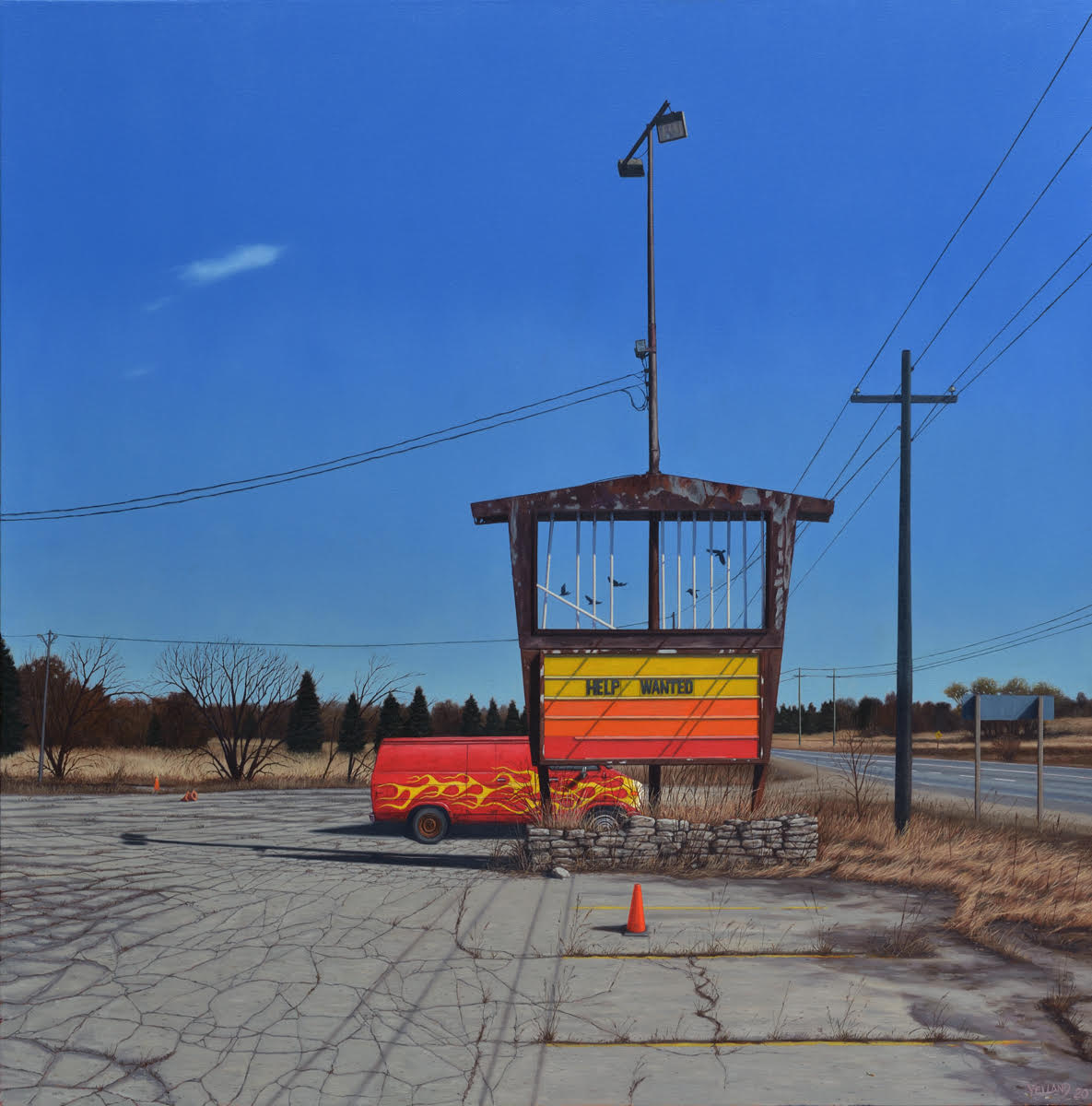
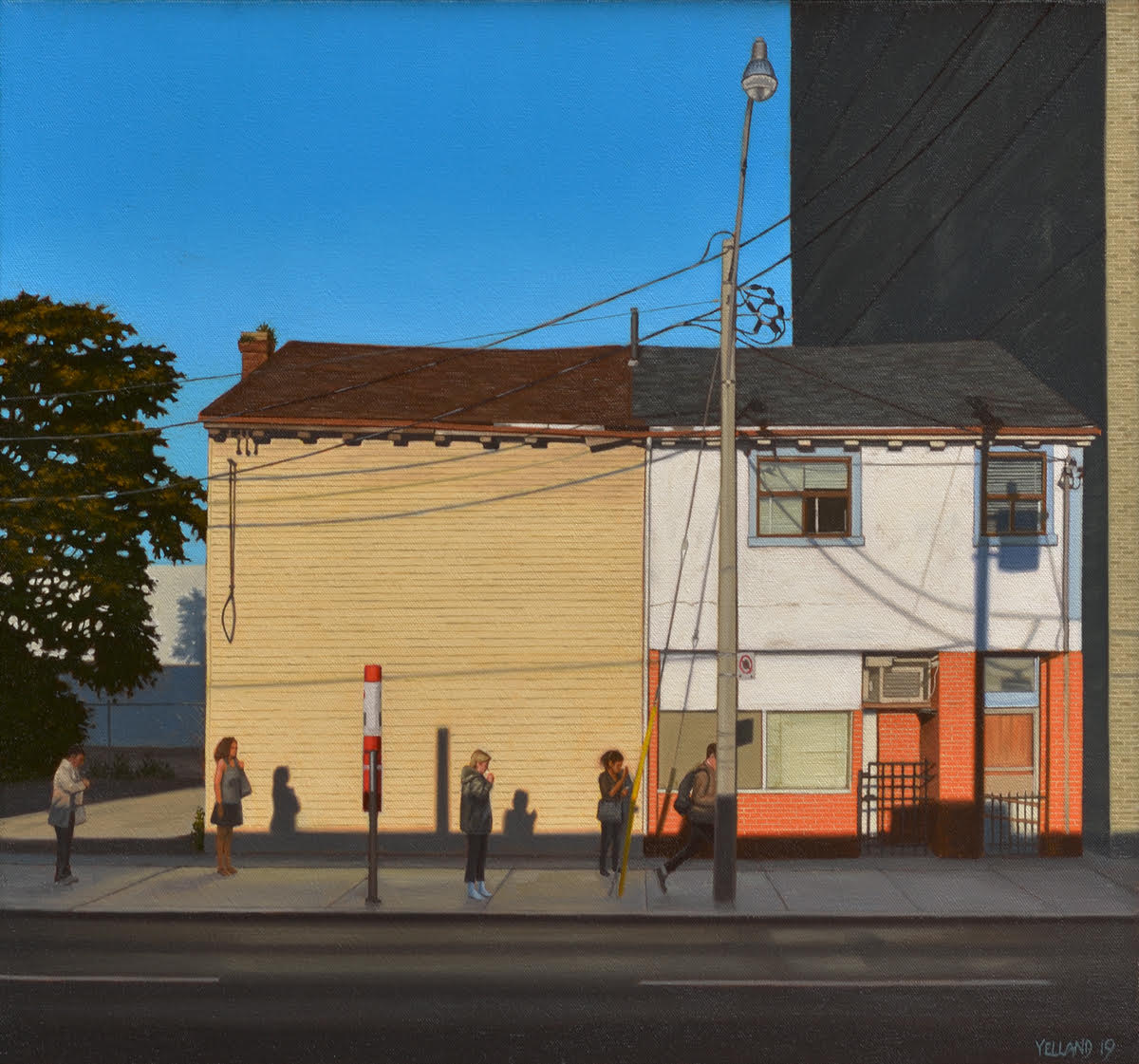
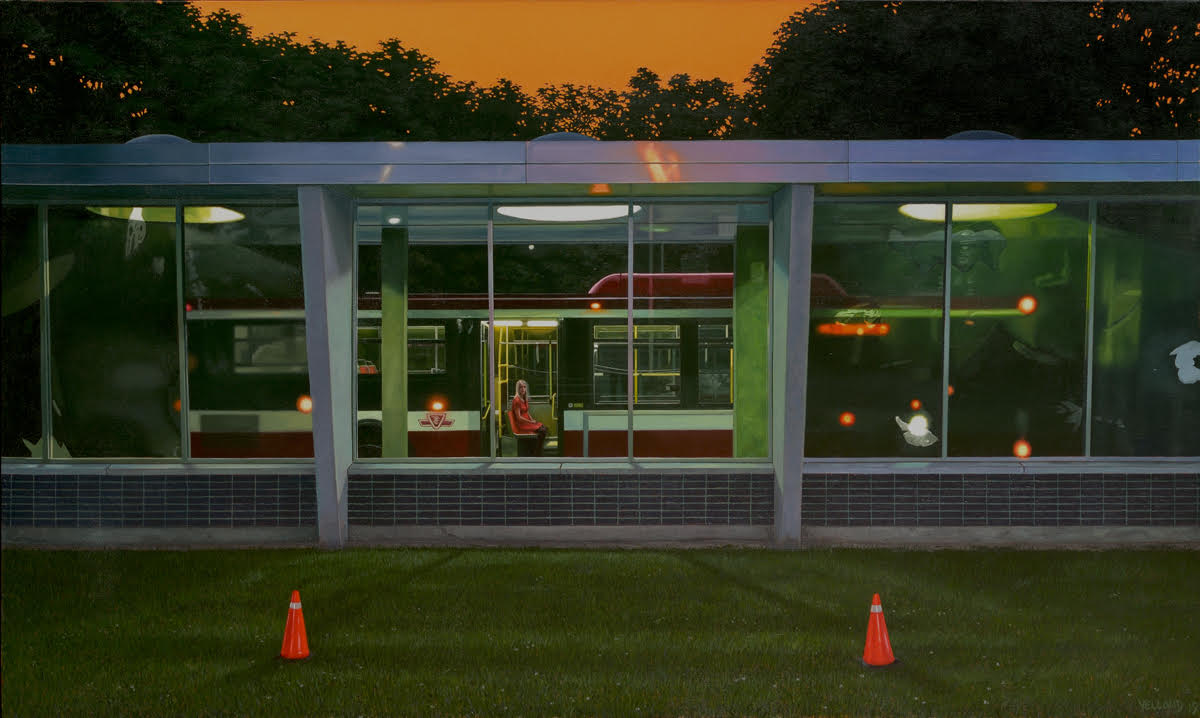
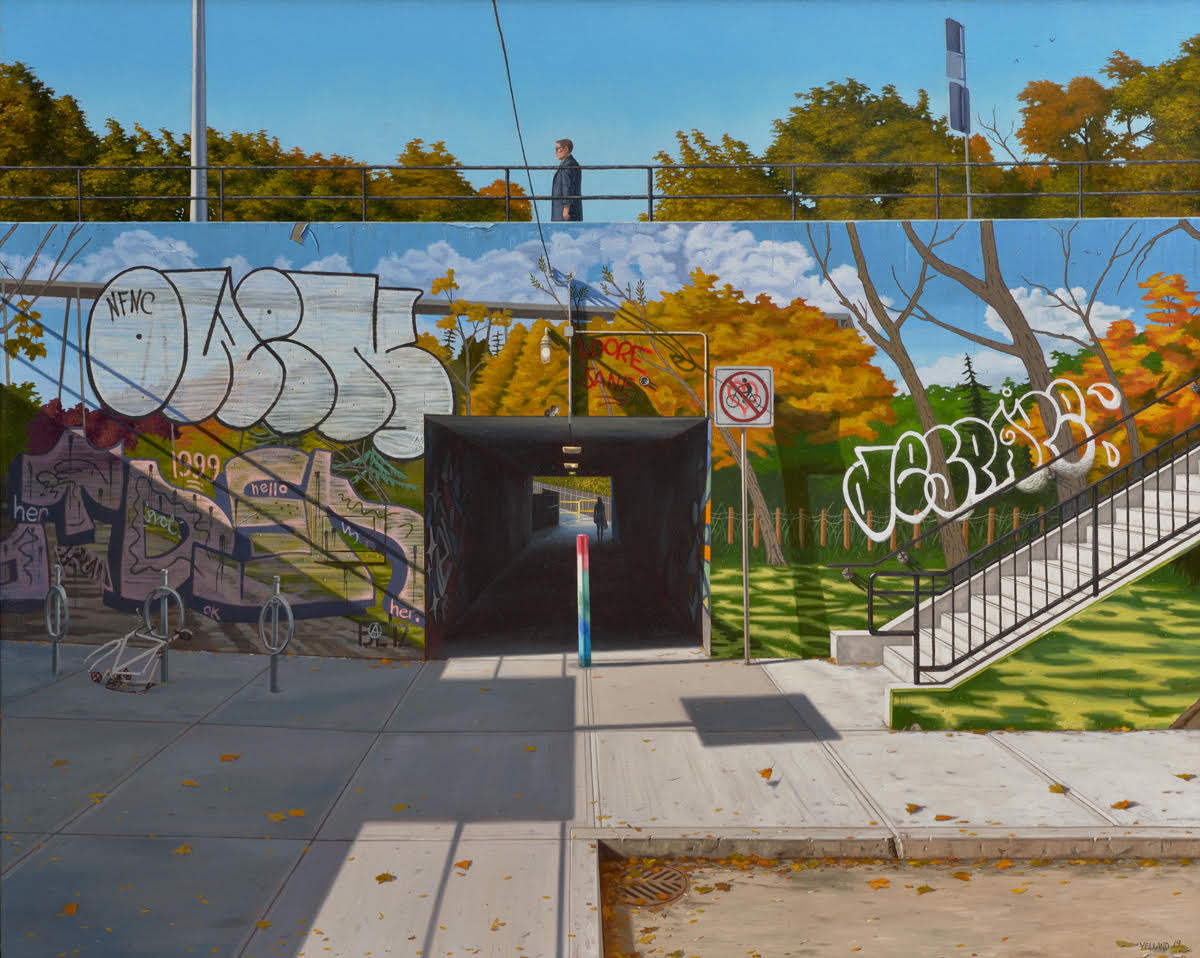
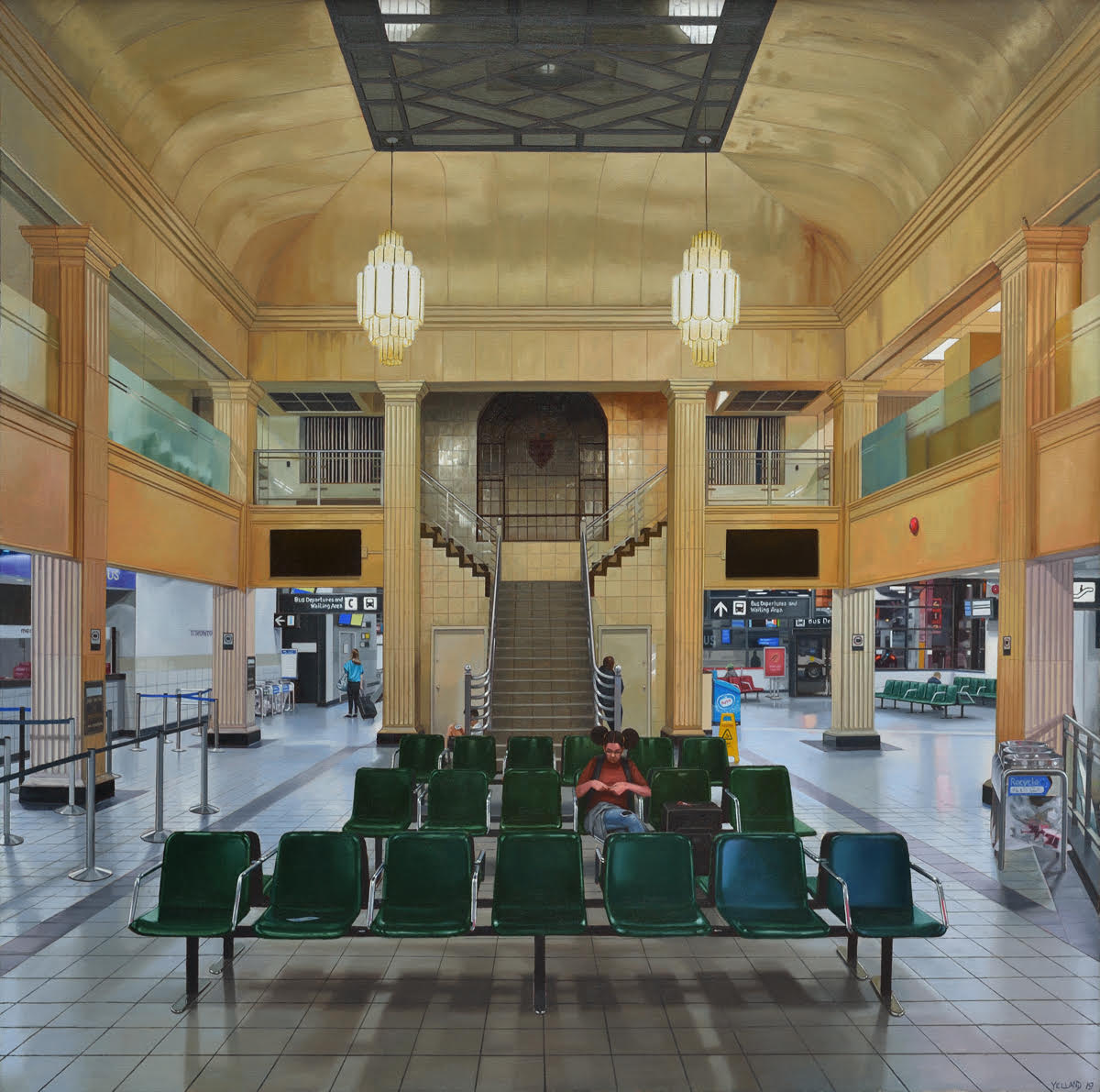
    This show, featuring nineteen seductively colourful oil paintings by Sean Yelland, takes up the main floor of Ingram Gallery in Yorkville. They are photorealist in style. The subject matter is the urban landscape, mainly focused on various Toronto neighbourhoods. They are recent works – all done in the last year or so.

    Yelland explains that his works are not merely essays in photo- or super-realism. He is not primarily motivated by the traditional concerns of photorealism. These are to make explicit art’s employment of technology, that goes back centuries through the use of the camera obscura for example, and the objective of contrasting the photographic, i.e., mechanical, image with how we naturally see things in the world. Rather, he tells me, he uses the photograph as an aid in creating a narrative. Narrative is the central theme of his work.

    Beyond Help, 2020, oil on canvas, 48 x 48 inches

    Indeed, the titles of his paintings are an integral part of each of them. For example the title of his painting Beyond Help is a play on the wording on the sign on a hoarding that reads ‘HELP WANTED’, and which ironically sits in a largely disused parking lot. Or again, his painting titled Neighbours shows several people waiting at a bus stop who stand at a marked distance from one another (painted before the COVID-19 crisis). It can be understood, therefore, as a commentary on Torontonians’ social alienation – we live in close proximity to one another but often lead relatively solitary lives.

    Neighbours, 2019, oil on canvas, 20 x 22 inches

    A mood of alienation is shared by most of Yelland’s paintings. By and large the streets and corners of the city he paints are empty of people. Even when there are people they are alone. A sense of loneliness is felt in his painting Connection, for example, where in the centre of the picture a woman sits on a bus in the evening dusk. On the other hand, cars and other vehicles are frequent inhabitants of Yelland’s urbanscapes. Their presence creates a feeling of melancholic abandonment – reminders of people who are elsewhere. The occasional dog or bird accentuates this feeling.

    Connection, 2019, oil on canvas, 36 x 60 inches

    But while Yelland is disinclined to view his works as straightforwardly photorealistic, I cannot help but feel photorealism plays a central role. His earlier paintings include, for example, a series of images based on layered reflections in storefront windows. This was a favourite motif of many of the original photorealists such as Ralph Goings and Richard Estes. More generally his subject matter is very much in the vein of photorealism which, growing out of pop art in particular, has had a predilection for images of everyday objects and scenes, such as urban streets, storefronts, cars etc. His appears to be a photorealist aesthetic at its core.

    What some see as a limitation of this style is that it ineluctably refers back to the mechanically mediated image. The viewer, in other words, never sees the scene and objects the painting depicts themselves but sees instead the photograph of them. The viewer is always thrown back to the surface of the painting, to how the painter is able to create the ‘convincing’ illusion of the objects’ being before the eye. This is not a problem for the photorealist painter insofar as it is what she wants to emphasise or celebrate. But that apparently is not Yelland’s main goal.  

    Over / Under, 2019, oil on canvas, 40 x 50 inches

    Standing directly in front of the paintings, Yelland points out that their surfaces are obviously painted. Also, he sometimes makes the colours in the paintings more saturated than they appear in the original photograph. As well he is apt to alter the image in some way or other, e.g., add a moon to the night sky or a passenger to the bus, or again to edit out a person as he did in his One Way Ticket. All these suggest that photographic accuracy is ultimately subservient to his objective of creating a particular narrative.

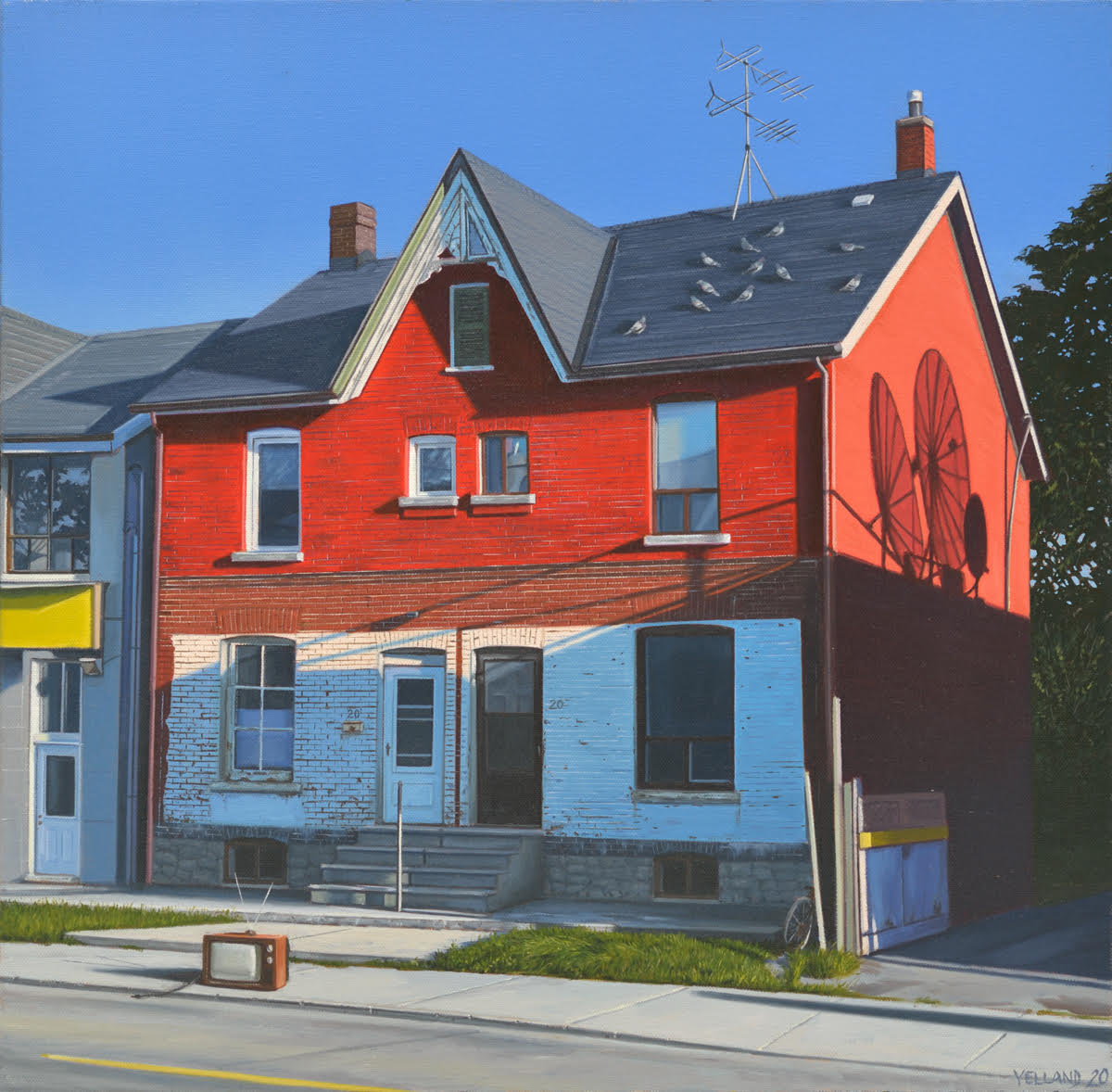
    Still, his works are so photographically realistic that it is difficult to interpret them as deliberately manipulated in these ways. The viewer is inclined to read them as literal rather than as metaphorical in this sense. For example, the old television set he depicts outside the front of the house in his No News Is Good News seems to have happened to have been there – accepting its relative prominence in the picture – hence its narrative importance may be missed. Then the title, of course, becomes the entry point for the narrative.

    No News is Good News, 2020, oil on canvas, 20 x 20 inches

    Undoubtedly Yelland’s paintings are alluring in their compositions and colours. He has a wonderful eye for the abstract details in an image. Moreover, as a long-time resident of Toronto I recognise his works collectively as a love-letter to the city. He tenderly captures the essence of the place.

    Hugh Alcock

    Images are courtesy of Ingram Gallery.

    *Exhibition information: June 6 – July 11, 2020, Ingram Gallery, 24 Hazleton Lane, Toronto. Gallery hours: Tue – Sat, 10 am – 5 pm.

  • Charity Auction at Heffel with Metivier Gallery

    June 9 – 23, 2020

    Heffel Fine Art Auction House has partnered with Nicholas Metivier Gallery to host an online charity art auction to benefit Canadians impacted by the spread of COVID-19. 100% of sale proceeds from the auction will be donated to food centres providing emergency relief, with additional generous support provided by the RBC Foundation.

    Nicholas Metivier Gallery. Courtesy of Nicholas Metivier Gallery

    The charity auction takes place on Heffel’s Online Auction Partnerships (HO2) platform from June 9 – 23, 2020, includes 28 works donated by Nicholas Metivier Gallery and a group of well-known artists including Edward Burtynsky, Bobbie Burgers, John Hartman and others. According to presale estimates for the works, the auction is expected to raise between $170,000 and $230,000 to benefit the charities.

    Edward Burtynsky, Grasses, Bruce Peninsula, Ontario, Canada, 1981, chromogenic print, 39 x 49 inches, 5/9

    “Canadian food banks are in desperate need of assistance to help those most vulnerable as a result of COVID-19, and demand has grown exponentially in recent months,” said Nicholas Metivier, Founder and Owner of Nicholas Metivier Gallery. “When we suggested the idea of an auction to support food banks, our artists responded with tremendous generosity and enthusiasm. We are also pleased to partner with Heffel and utilize their online auction platform to execute this important initiative.” To give interested buyers an opportunity to view the available works, the auction catalogue and virtual auction previews are available on Heffel’s website https://www.heffel.com/. Works are also available for preview by appointment at Nicholas Metivier Gallery (190 Richmond St E, Toronto,
    https://metiviergallery.com/).

  • Luminato Festival goes Virtual in 2020

    Luminato, 2020 / Online
    June 11 – 13. 2020

    The visual art programming includes:

    Museum of Water: A Conversation
    June 12, 2020 at 6:45pm

    Amy Sharrocks. Photo: Ruth Corney

    2020 marks the beginning of the creation of Museum of Water, a three-year project with UK artist Amy Sharrocks, which is a collection of publicly donated water and accompanying stories. During Luminato’s virtual festival, Amy will be joined online by Mark Calzavara from the Council of Canadians to delve into some of the major water issues facing communities across Toronto and Ontario.

    Photo: Bo Wong

    What Art Has to Offer Immigration
    June 13, 2020 at 1pm

    The Laboratory for Artistic Intelligence shares original music, video art and performances created in collaboration with artists lo bil, Mark Campbell, Sharada Eswar, Tom Kuo and Nava Waxman. Dive deeper into The Lab with a short, behind-the-scenes film made by visual artist Claudia Arana, followed by an artistic statement from Founder and Chief Artistic Officer Helen Yung speaking to what art has to offer Immigration.

    Gopi Chimmaraju and Judie Plaza (Laboratory for Artistic Intelligence). Photo: Chris Katsarov Luna

    For more programs please go to Luminato, 2020.

    Images are courtesy of Luminato, 2020

  • COVID 19 Portraits – Online Exhibitions at Gallery 1313

    Talking about COVID 19’s possible impacts on art galleries, Phil Anderson, Executive Director of Gallery 1313 said: “Art is usually described as a mirror of time and society so in time we will no doubt see how artists record these times through their art.” Missing the gallery and shows that used to change every two weeks, along with the social life of crowded opening receptions, Anderson reached out to artists and friends to find out how they are coping with this new, sad world. He posted a call for submissions for COVID 19 Portraits through social media and reached out to people he knew in Germany, Italy, France and Japan among other countries. Artists answered the call and sent their work, not only gallery members and friends but artists outside the province and even outside the country. Then he curated the online shows and Mikael Sandblom organized the portraits into wonderful Portrait tableauxs with pulsating images that give the illusion of life.

    COVID-19 PORTRAITS I

    We may never know what caused the pandemic. Could it be military research for a biological weapon that went wrong and leaked out of the laboratory? The Earth reacting to overpopulation by eliminating the elderly? The guessing goes on – but it doesn’t really matter now. What does matter is our reaction to it, how our governments are handling it and how we, as individuals live through it.

    telefoonhoesjes meidenbuy

    Many of us had the same reaction at the beginning of our isolation: it’s not so bad now as we have time to do what we want (write an article in my case), create more artwork, read, watch all the movies we planned to see but had no time for before. We have also come to know that time is not everything. Personally, I finished my article in early May about the Sarah Sze’s show I saw in late February. I was very enthusiastic about it and collected all the material I needed, but the desire to write it just wasn’t enough. Somehow, I think we’ve all become discouraged. We are social animals, and isolation is hard. We cannot go to galleries, can’t discuss our ideas with friends in a cafe or over a glass of wine – using Messenger or Skype is just not the same. So, we didn’t do that much at first, stayed in front of our computers, got stressed out by bad news, overwhelmed by tragedies and deaths happening all over the planet. But deep inside we still had the strength to overcome those difficulties and continue to do what we believe in, what we love the most – and so we did.

    COVID- 19 Portraits II

    Even though they say they work in isolation most of the time, artists are creative creatures who must show and share their work. The portraits that are exhibited online are wonderful manifestations of art itself, how artists can survive anything to fulfill their mission in holding mirror up to all the times, good and bad. Most of the participating artists accompanied their image with a few, meaningful words – so the exhibition became more than a portrait gallery, it became storytelling, documenting their feelings, thoughts and lives under these unusual circumstances. Ramona Pavilionis, thinking of the spirit of life, quotes Henry Miller: “There is nothing wrong with life itself. It is the ocean in which we swim and we either adapt to it or sink to the bottom. But it is in our power as human beings not to pollute the waters of life, not to destroy the spirit which animates us.” Good Spirit is what we need now and those artists who sent their work in, have it for sure — they even have enough to share with others.

    Ramona Pavilionis

    People reacted to the treat of the pandemic in different ways. I think at first, we feared the illness itself, — the danger we knew from our history with plagues and the Spanish Flu — and the fear of all the unknown ways this novel virus would impact us. These portrait exhibitions reflect the current times in many ways: the anxiety, the fear, the sadness, the unspoken.

    Eva Lewarne compares the darkness of the pandemic to the plague in Plague I. The figure is dressed in dark clothes, even her head is covered with a scarf, with only one eye and the surrounding skin visible. Is she already infected or are these just precautions like wearing masks are now? Mikael Sandblom in his short video recalls his dreams of the city buildings being disintegrated into smoke and water – giving voice to our fears that our living spaces will never be the same again.

    Eva Lewarne, Plague 1

    Mikael Sandblom, Dream, video still

    Nika Belianina in Dare to Grasp portrays herself at the entrance to a deep cave. In other times it might have been an invitation to new adventures, but now it represents danger. As the artist writes, “I tried to escape reality only to be confronted by the unknown forces.” It is so beautifully photographed that we tend to forget the scary circumstances, even if just for a moment.

    Nika Belianina, Dare to Grasp

    Physical Distance 3, a manipulated photograph by Lois Schklar, transforms burlap covered bushes into figures that remind us of the statues on Easter Island. As the stone figures are lonely there, these burlap sacks seem isolated too, powerful and vulnerable at the same time. The “positive” side of social distancing is more space for all of us — almost too much space — so Phil Anderson can photograph himself in the middle of a totally empty Lansdowne Avenue, where, in normal times, standing there would mean certain death.

    Lois Schklar, Physical Distance 3

    Phil Anderson, Self portrait

    While we can go out occasionally as long as we practise social distancing, we’re mostly supposed to stay at home in isolation and that’s the most difficult part. Steve Stober portrays himself safe in the distance, wearing a scarf for mask and standing outside his building with a cardboard sign like those usually held by the homeless begging for money, saying: I AM BORED. For sure, he is not alone in that feeling.

    Steve Stober, Self portrait

    Locked inside we do things that we would otherwise ignore. Lisa Anita Wegner’s Madonna of Debris: Junk Drawer Icon shows an open drawer that reveal all the treasures we forgot, leaving them to became junk. Some will curl up in despair as Tae Ess Uxmal painting demonstrates or study their gloved hands endlessly like Lilianne Schneider does and turn the documentation of it into artwork.

    Lisa Anita Wegner, Madonna of Debris: Junk Drawer Icon

    Tae Ess Uxmal, Reigniting Passion

    Lilianne Schneider, Moving hand with latex

    Social distancing and isolation also mean staying away from family members and friends. Maybe that is the part that has hit me the hardest. Walking and talking 2 m apart is no big deal. Keeping contact with relatives and friends when geographical distance is involved is more complicated, since we can’t travel now. Marie Estebanez tells a wonderful story about friendship. Three of the black and white photographs shot by homemade pinhole cameras were made in April in Paris with the same building in the background. The portraits depict the gestures of Estabenez’s friends, as they sit at a café table. Her own “portrait” without a figure, shows a different building, more likely here in Toronto, with an empty bed. All the images express the passing of time and melancholia. Estebanez was worried that the pandemic might end her relationship with her friends but, on the contrary, it became even stronger through this state of emergency. John Hryniuk brings to our attention that the pandemic has no prejudice. He depicts a gay couple as warriors fighting the virus together with all their combined strengths.

    Marie Estebanez, Milena (left) and Marie (right)

    John Hryniuk, Couple

    Even when we have to cover our faces with masks, we look for ways to meet the impossible challenge of keeping our unique identities. In his drawing, Sadko Hadzihasanovic wears a scarf with Che Guevara’s smiling portrait printed on it, titled Che Against Corona, suggesting that the political hero would stand up against all wrongs. Kat Hz, who lost her full-time position as an art teacher because of the pandemic, still gets up at 7am each day and continues to make art. Honestly, I admire her dedication.

    Sadko Hadzihasanovic, Che Against Corona

    Kat Hz, Self portrait

    Many artworks address the state of the artists’ mind and the complexity of their feelings. Shohreh Edalat expresses her confusion well both in her artwork and words: “I’m full of wondering, fear, sadness, anger, dull, hope, calm, dialectic, patient, stress, … strange mixed feelings… I’m in the blind vision.”

    Shohreh Edalat

    Polat Canpolat, from Turkey, creates a portrait that is all artificial, titled Freeky. An altered gasmask covers her mouth, another papier-mâché mask hides her face with metal slots for the eyes, her head is covered with something a scarecrow would wear with rug ribbons replacing the hair. A smiling face on the gasmask tries to add some fun, while the word ‘freeky’ is written on it – and indeed, freaky it is. Churls Mitchell’s piece is the most beautiful. Fabrics of all colors and patterns turned artfully into mask, headdress and what seems to be a warm coat with a hood. It is much more than what a cold spring day calls for. It is a royal outfit for an indigenous princess, a wonderful product of folklore and artistic fantasy. Time well spent in making it.

    Polat CANPOLAT, Freeky

    Churls Mitchell 

    At the end of the day our last hopes are for the professional caregivers, the doctors and nurses. Christina Damianos, an artist and a nurse, quotes Florence Nightingale, comparing art making to taking care of the living body, “the temple of God’s spirit.” There are portraits of overworked, dead-tired nurses with red eyes, leaving the bedside of one patient who has just died to go on to care for the next one (Kimberley Whitchurch, New York City Nurse). These healthcare workers can’t be thanked enough for the unimaginable hardship they’re going through; they are the heroes and heroines of these sorrowful times.

    Christina Damianos, Nurse

    Kimberley Whitchurch, New York City Nurse

    COVID-19 Portraits are very meaningful online exhibitions that we hope will generate an ongoing dialogue. As Anderson wrote, “Not sure what that might look like with social distancing and Covid-19 protocols but I am ready to adapt and embrace the future.” Aren’t we all?

    Images are courtesy of the artists and Gallery 1313.

    *Exhibition information: COVID-19 PORTRAIDS I, II and the recently posted III are online exhibitions, to see all images please go to Gallery 1313’s website:
    http://g1313.org/category/exhibitions/current-exhibitions/

  • Toronto galleries that are currently open to the public

    Angell Gallery: How Dark Does It Get When The Lights Go Out? / Group Show till September 12, 2020, 1444 Dupont St., Unit 15,
    by appointment only, info@angellgallery.com or 416 530 0444

    Erika DIt Starts in an Inhale, 2018, Chromogenic print, 40 x 32 in

    Art Gallery of Ontario: reopened its doors July 2 to Members and Annual Pass Holders, and will reopen to the Public July 23. Book your timed-entry ticket online and in advance https://ago.ca/visit. Help us keep everyone healthy!

    Akasha Art Projects: Illuminated Muse, held over through the summer, 204D Carlton St, Toronto. By appointment only info@akashaart.com

    L-R: Aliene Devries, Sonja Scharf, Keight Maclean

    Canadian Sculpture Centre: Look Here / Group Show, Aug 8 – October 12, 2020, 19 Mill Street, The Distillery District. New Gallery hours: Mon – Sat, 11 am – 5 pm: Sun, 12 – 5 pm.

    All visitors must wear masks. Only 5 visitors will be permitted to enter at a time. Please line up 6ft apart.

    Clint Roenisch: Eli Langer solo exhibition, till mid July, 2020, 190 St. Helens Avenue, Toronto. Gallery hours: Fri and Sat, 12 – 5 pm. Private viewings outside these hours happily accommodated ( yes@clintroenisch.com )

    Eli Langer, Bathyscape, oil on canvas, 78 x 67.5 inches

    Please also see our review by Mikael Sandblom https://www.artoronto.ca/?p=45209

    Cooper Cole: There are more than four, curated by Jacob Korczynski, featuring artists Andy Fabo, Robert Flack, Tim Jocelyn, and Chrysanne Stathacos continues until June 27, 2020, 1134 Dupont Street, Toronto. New hours of operation: Wed, 12 – 6 pm and Sat, 11 am – 6 pm. Mon, Tue, Thurs, Fri: by appointment only
    info@coopercolegallery.com  or 416.531.8000.

    Installation view of There are more than four

    Visitors are required to wear disposable or fabric face masks while in the gallery. Maximum of four visitors for 30 minutes of viewing time. Must practice physical distancing in the gallery. The gallery recommends booking an appointment to ensure you don’t have to wait.

    Dianna Witte Gallery: Jeff Depner’s recent solo show, Weights & Measures, till June 20, 2020. 1142 Queen St. East, Toronto, Thurs – Sat, 12 – 6 pm.

    Installation view of Jeff Depner, Weights & Measures

    Our new safety measures include hosting a maximum of 5 people in the gallery at one time and we will increase sanitizing frequency. We will be wearing face masks, and encourage you to do the same if possible, as well as maintaining social distancing measures. Private viewing appointments will still be available by phone or email (416.465.8500 or info@diannawitte.com)

    Elaine Fleck Gallery: Todd Lawson, 1351 Queen Street West Toronto. Open by appointment only Wed – Sun 12 – 3 pm. Contact the gallery by email garyrayrush@rogers.com or phone: 416 469 8005. Social distancing and cleaning of common surfaces are being practised.

    Todd Lawson, Idol Woody, 2020, acrylic on birch board, 60 x 40 inches

    Franz Kaka: Laurie Kang, Her Own Devices, June 29 – July 18, 2020, 87 Wade, Unit B1, Toronto. Gallery hours: Fri & Sat 12 – 6 pm and by appointment info@franzkaka.com

    Gallery House: Debra Tate Sears, Solo Show and New Works, 2068 Dundas Street West Toronto, June 6 on. Opening: June 6, 2020, 9 am – 6 pm. You have to ask for a ticket as limited people are allowed in the gallery at 30 minutes time slots. Social distancing will apply.

    Debra Tate Sears Rise & Shine, 2020, egg tempera on “True Gesso” cradled birch panel, 36 x 24 inches

    Alternatively, if you can’t make it out to this special opening, please inquire via email or phone for a PDF of the works. To receive a complimentary ticketed time slot, please contact info@galleryhouse.ca or call 416 587 0057.

    Gardiner Museum: reopened exclusively to Gardiner Friends & Get Acquainted cardholders, and we’ll reopen to the public with two days of free admission on  July 11 and 12. Regular admission rates resume on July 13.

    We can’t wait to welcome you back! Please read our new health and safety policies before you visit https://www.gardinermuseum.on.ca/

    General Hardware Contemporary: Kate Wilson, Exoplanet & Lila Rye, Blaze, June 20 – August 18, 2020, 1520 Queen Street West, Toronto. Open by appointment only please email info@generalhardware.ca  or call 416 821 3060.

    Kate Wilson, Chemosphere, Judith & Norman Alix Art Gallery, Sarnia. Photo:
    Shelly Mallon

    Ingram Gallery: Sean Yelland, Lazy Boy, June 6 – July 11, 2020, 24 Hazelton Avenue, Toronto. Gallery hours: Tue – Sat, 10 am – 5 pm.

    Sean Yelland, Over / Under, 2019, oil on canvas. 40 x 50 inches

    MKJ 127: Strength in Numbers / Group Show, till June 20, 2020, 1445 Dundas St. W, Toronto, by appointment only 647.435.7682 or info@mkg127.com

    Laurel Woodcock, Untitled 2 (Leaving the Movie Theatre – for Roland Barthes), colour photographs mounted on dibond, 47 x 31 inches, 

    Muse Gallery:  Elizabeth Lennie, Aqua vita, 1230 Yonge St Toronto, Gallery hours: Tue – Sat, 11 am – 4 pm.

    Museum of Contemporary Art (MOCA): has reopened. From July 9–12 arts community, donors, members and frontline workers can visit for free. Starting July 16, we will be open to all. For more information please check:
    https://moca.ca/visit/

    Shelagh Keeley, An Embodied Haptic Place, till September 27, 2020

    Nicholas Metivier Gallery:   Landon Mackenzie, The Moon is the Message, till July 4, 2020, 190 Richmond Street East, Toronto, Tue – Sat, 10 am – 6 pm.

    Landon Mackenzie, Noja #1 (Blue + Wind), 2019

    While appointments are not mandatory as of June 4, 2020 we strongly encourage setting up a private viewing in advance so that you can enjoy your visit safely. If you would like to book an appointment, please contact us at (416) 205-9000 or info@metiviergallery.com

    Nikola Rukaj: Gestural Hands / Women Painters, 384 Eglinton Ave West, Toronto, Wed – Sat, 12 – 4 pm. They enforce social distancing, also be offering masks and gloves, as well as hand sanitizer at our front entrance. Plexiglass barriers have also been installed

    Miriam Schapiro, earth, 1959, oil on canvas, 1959, 60 x 50 inches

    patelbrown: Inaugural Exhibition, Adapt and Pivot, June 26 – August 8, 2020, 21 Wade Avenue, Toronto. Open by appointment only
    https://patelbrownappointments.as.me/inauguralview

    Robert Kananaj Gallery: Silvia Argiolas, till July 26, 2020. Gallery hours:
    Thurs – Sat, 12 – 5 pm.

    ROM excited to open their doors once again and welcome you back to the Museum. They’ll be re-opening Thursday, July 9 to Members and Saturday, July 11 to the public. Time-based tickets are now on sale. 

    Scrap Metal: Eduardo Basualdo, Shedding, 11 Dublin Street, Unit E Toronto, beginning June 6, 2020 the gallery is open on Saturdays 10 am-6 pm.

    Installation view of Eduardo Basualdo, Shedding

    Stephen Bulger Gallery: Select photographs by gallery artists, as well as photographs from the gallery’s inventory and consignments, 1356 Dundas Street West, Toronto. Open by appointment, or by chance. Current hours: Tue – Sat, 11 am – 4 pm. To make an appointment please book on our appointment scheduler or call 416 504 0575. Upon arrival, please knock or call 416 504 0575 to enter. For spontaneous appointments (whenever the gallery isn’t in the midst of an appointment), please knock or call 516 504 0575.

    One group with maximum of 5 persons at a time. Visitors must bring and wear masks at all times while in the gallery. Staff will maintain social distancing, will wear masks, and will sterilize the gallery space after each visit

    United Contemporary: Gordon Shadrach, Net Worth, July 2 – August 1, 2020, 1444 Dupont Street Unit 22. Gallery hours: Thu – Sat, 12 – 6 pm. Special hours for opening weekend: July 2 – 4, with COVID measures in place: Thursday, July 2: 12 – 8pm, artist present 4 – 8pm: Friday, July 3: 12 – 8pm, artist present 4 – 8 pm: Saturday, July 4: 12 – 6pm. From 1 – 5pm the artist will be present, and DJ Keita Juma will be set up outside the gallery, entertaining attendees block party style, while we limit the numbers of guests into the exhibition for everyone’s safety. Please bring a mask to wear when in the gallery.

    Installation view

    This might not be the full list of Toronto galleries that are currently open to the public. 

    Please check all the museum and galleries you are interested in as they might reopen.

    Images are courtesy of the museums and galleries.