Author: artoronto

  • Personal Space at Patel Brown Gallery

    Fanciful patterns, dreamy interiors, and architectural motifs are all at home at Patel Brown Gallery’s exhibition Personal Space. The group exhibition, at the Patel Brown East location, showcases intricate and vivid ink drawings by Luke Painter, vibrant, surreal watercolours by Tristram Lansdowne, and muted, abstracted oil paintings by Ella Gonzales. Each work centres on the exhibition’s theme, ‘personal space’, depicting varying interior spaces in various styles and media. Nostalgic, wistful, and whimsical all at once, these works evoke a series of strong reaction in the viewer, each setting at once familiar and unfamiliar.

    Installation view of Personal Space at Patel Brown Gallery, 2021

    Devoid of human depiction, this exhibition uses background as its protagonist. Contemporary interiors, architectural designs, aesthetically pleasing furniture, intricately patterned textiles, and decorative objects are not simply atmospheric details, but rather the subjects of these works. The avoidance of human depiction is poignant in these very human spaces brings to mind ideas of solitude or absence, reflecting the emotions of many amidst COVID-19-era isolation. With each of these pieces, one feels as though they are inside these interiors themselves.

    Ella Gonzales’ blurry, muted oil paintings are painted in thin layers on an unprimed canvas, allowing her subjects to soak through the canvas, becoming part of the material itself. Her pastel, linear interiors exist on a plane between abstraction, figuration, and architectural plans. Based on photographs and memories of previous childhood homes, she uses 3D modelling software to recreate interiors from her past on which to base her paintings. At once personal and familiar, impersonal and desolate, these scenes feel like distant memories of past lives lived.

    Ella Gonzales, Reflection of a window, 2020, oil on unprimed canvas and limewood support, 24 x 20 in. (front and back)

    In “Following Sinopia”, Gonzales depicts a doorway or window that opens to another room or outdoor space. The hazy color and line of this picture feels dreamlike and nostalgic, and the subtle color and shade hints at stone or concrete textures.

    Ella Gonzales, Following Sinopia, 2021, oil on unprimed canvas, 24 x 20 in

    Artist Luke Painter’s vibrant, intricate ink drawings contrast with Gonzales’ subtle, muted paintings. Painter’s flat, patterned surfaces and bold figurative style create complex, captivating patterns. His work is informed by real and imaginary sources, and his designs are both narrative and textile. In “Fabricland Fabricland” using strong lines, a wide array of colours, and contrasting form, he combines landscape, interior, and still life all in the same composition.

    Luke Painter, Fabricland Fabricland 01, 2021, ink on paper, 33 x 24 in.

    “The Solitary Summer/Winter Sunshine” depicts two books, with detailed, stylized covers. One shows a sunny sky over flowers and leaves, the other a winter landscape with deep snow and barren trees and a barn in the distance. On top of these books is a case with a snake inside it. Painter plays with contrasting tones, textures, and light when picturing these seemingly ordinary household objects. The titles and photographic covers of these two books evoke feelings of wistfulness and nostalgia, reminiscent of distant, bittersweet memories.

    Luke Painter, The Solitary Summer/Winter Sunshine, 2021, ink on paper, 12 x 15 in

    In keeping with Painter’s natural motifs, watercolorist Tristram Lansdowne creates bold paintings depicting spaces that are at once domestic and wild, urban and tropical.

    Tristram Lansdowne, Pool at Dusk, 2020, watercolour on paper, 23½ x 42 in

    Part verdant jungle, part Art Deco wallpaper, Lansdowne’s interiors combine the comforts of modern furniture with the adventure and intrigue of imaginative plant life. His sources draw from design websites, real estate listings, and product advertisements, modified in a way that produces exciting and intricate settings. His interiors are both inviting and unwelcoming, appealing and foreboding; critiquing the superficial nature of luxury real estate.

    “Wet Wipe II” displays an interior scene of a stylish, comfortable armchair and footstool, set against a background of flowers and plants that seem to be both design features and living entities. While the setting is stylish and charming, it appears almost unlivable, as particles are flying everywhere and the flowers are invading the domestic space, disrupting the stillness of the room. 

    Tristram Lansdowne, Wet Wipe II, watercolour on paper 25½ x 21½ in

    The variety of styles in Personal Space might seem mismatched at first, but within the exhibition space, they interact with one another so harmoniously it is natural to place them together. Each artist’s unique style both stands out alone and compliments the others. This timely exhibition addresses isolation and confinement, and provides comfort to many people grappling with these feelings at this time.

    Installation view of Personal Space at Patel Brown Gallery, 2021

    Bronwen Cox

    Images are courtesy of Patel Brown Gallery.

    *Exhibition information: Personal Space / Ella Gonzales, Tristram Lansdowne, Luke Painter, April 2 – May 8, 2021, Patel Brown Gallery, 184 Munro St, Toronto. You can book an appointment for your visit.


  • Inter/Ruptures at United Contemporary

    Togetherness, intimacy, and inspiration are on display at United Contemporary’s group show Inter/Ruptures. This exhibition features a motley group of artists selected by the gallery’s own artists. United Contemporary writes, “We asked each of our represented artists to put forward the name of an artist whose practice inspires and excites them[…] Curating a show this way allows the body of work to shape and determine the exhibition theme as it comes together.” The consequence of this is a group of artworks that naturally fall in and away from shared patterns and themes.

    Installation view of Samantha Dennis, Rayne (left) and Max Lester, When I End I Begin Again, 2021, latex, plastic mesh, silhouette temporary tattoo paper, chain, giant rubber bands, shower curtain rings (above and right)

    Inter/Ruptures, like many recent exhibitions, was cut short by another stay-at-home order. Thankfully, the individual pieces can be viewed in photographs online, yet this does seem like a loss. From the installation view photos on the gallery’s Instagram page, these works appear to play surprisingly well together in the space and I would have been interested to experience this for myself.

    Installation view of (L-R) Miles Ingrassia, Tree Line. 2020, oil on panel, 48” x 48”, Samantha Dennis, Focus and Rayne (right) each 2018, oil on canvas, 36” x 48”. Photo: United Contemporary’s Instagram

    It is clear that the artists of Inter/Ruptures are those powerhouses who have a near-indefinable quality that makes them particularly inspirational to others. The works of Bidemi Oloyede stand out in this regard. His two pieces are black and white photographs from Toronto’s Caribana, showcasing love, joy, pride, respect, and all those overwhelming emotions that arise out of a shared celebration. Oloyede captures people in mid-movement with sunny women in the centre of the compositions. These are photographs proper, with all the weighty significance of the word. The black and white medium lends the monumental force of a historical document. Yet, some of the beauty is in the everyday. In these photographs, joy and belonging are commonplace and there is so much beauty in that.

    Bidemi Oloyede, Caribana Scene, Toronto, 2018. No.1. photography (35mm), 16” x 20”

    Painter Karim Machado-Aman also exhibits portrait works. Much like the photographs of Oloyede, these painted portraits display an intimacy between the artist and the sitter. Machado-Aman also imbues his work with historical influences. While Oloyede’s black and white photographs call to the historic black and white captures of the past, Machado-Aman’s portraits call back even further to the grand portraits of the Renaissance. Dark backgrounds, elaborate frames, and richly painted fabrics whisper to us about the merchant and aristocratic sitters of the Renaissance. Broad brushstrokes hint at the styles of great painters in the 19th century. But there is something deeper in these portraits as the poses and facial expressions capture the sitter’s psychology. The viewer feels connected to them while contemplating their situation and state of mind.

    Karim Machado-Aman, Saint Serenade (FKA Twigs), 2020. oil on linen, antique frame layered with 22k gold leaf, 18” x 24”

    Karim Machado-Aman, Day Off, 2020. oil on canvas, 48” x 48”

    Linda Sormin’s “Lai Cha-Lu”, well represents the rather complex nature of the assemblage of artists and works in Inter/Ruptures. Pieces of cut watercolour on paper circle around the centre of the composition, diverging in thin strips away to the edges. Much like the dynamic of this diverse collection of works, Sormin’s composition shows all the interruptions and ruptures that could and do occur in a collective.

    Linda Sormin, Lai Cha-Lu, 2020, cut watercolour on paper, 37” x 28”

    This medium of cut watercolour on paper works wonderfully well in this exhibition by connecting the eclectic group of two dimensional and three-dimensional works. In the space, Linda Sormin’s “Lai Cha-Lu” compliments Marc Egan’s “Shift” series by juxtaposing the coloured movement of lines with the three dimensionalities of the ceramics. Sormin’s “Lai Cha-Lu” is so honest in its fragility, appearing almost translucent like sugar candies. Next to Egan’s work, it looks like pieces of a bigger puzzle.

    Installation view of Marc Egan, Shift #1-3, 2020, each 11.5” x 12.5” x 3/4”, ceramic (stoneware) with polychrome glaze (left) & Linda Sormin, Lai Cha-Lu (right). Photo: United Contemporary’s Instagram

    I have a not-so-secret love for improvisations, accidental connections, and artistic happenstance in exhibitions. To me, it centres the viewer’s experience in art. More than that, it is the universe’s way of making art through the convergence of choices, environments, and intentions. It is this part of Inter/Ruptures that appeals to me in particular.

    Miles Ingrassia, Lattice Window, 2020, oil on canvas, 36” x 48”

    The works in this exhibition appear to have slipped into common themes of emotional intimacy and human connection. I like to think that the environment of invitation has resulted in these themes, that the atmosphere of togetherness has pushed Inter/Ruptures in this direction. It is remarkable how well this collection of diverse works fit together. I only wish I could have seen them together in-person.

    Olivia Mariko Hsuen-Ferris

    Featured image: Miles Ingrassia, Tree Line, 2020, oil on panel, 48” x 48” (detail)

    Images are courtesy of United Contemporary

    *Exhibition information: Inter/Ruptures, featuring works by Samantha Dennis, Marc Egan, Mel Hayes, Miles Ingrassia, Max Lester, Karim Machado-Aman, Bidemi Oloyede, Colin Rogers, and Linda Sormin, March 28 – April 17, 2021, United Contemporary, 1444 Dupont Street, Unit 22, Toronto. The artworks can be viewed on the United Contemporary website.

  • New member / Earth Day at Canadian Sculpture Centre

    There is only one new member of the Sculptors Society of Canada (SSC) this year. Patrick Bermingham is a semi-abstract sculptor who works in metal at his Dundas, Ontario studio. He writes in his artist statement, “I love to engage and inspire the public in this ancient discourse with dynamic and dramatic works which reveal more to the viewer with each new visit. I like to explore historical context and blend old ideas with new and innovative techniques.” Bermingham’s pieces depict women in yoga poses that radiate energy and movement, even when the pose is supposed to be relaxed and still.

    Patrick Bermingham at the exhibition

    Patrick Bermingham, Yoga Pose Tree, steel, 66 x 20 x 20 cm

    Patrick Bermingham, Yoga Pose Crow, steel, 40 x 53 x 30 cm

    In its group exhibition Earth Day • Springs Forth, the SSC presents visual narratives focusing on global awareness and the vulnerabilities of Mother Earth. The Earth Day exhibition is a tradition for the Canadian Sculpture Centre, as they present a show organized around this theme each year. It always addresses spring, the rebirth of nature, when everything turns green and swells with the promise of new life and new beginnings.

    In Barbara Fletcher’s mixed media work “In the Cradle” an “egg-like form is delicately held – representing the precariousness and fragility of infancy – simultaneously nurtured in comfort.” And based on its spherical shape, it also could be our Earth, protected by an ethereal universe.

    Barbara Fletcher, In the Cradle, cast acrylic, mixed media, 14 x 19 x 38 cm

    “Gestation” by Bastien Martel is also about the power of nurturing. The head of a middle-aged man rests in a bird’s nest. His white face seems relaxed and not yet alive, waiting for an awakening.

    Bastien Martel, Gestation, steel, hydrostone, 10 x 13 x 13 cm

    Nature is awakening. New flowers and plants fight their way out of the ground as depicted in Judy Raymer Ivkoff, “Germination”, and hibernating insects come to life in Laura Santini’s piece “Praying Mantis”.

    Judy Raymer Ivkoff, Germination, clay, bronze, wood, 17 x 44 x 18 cm

    Laura Santini, Praying Mantis, bronze

    This spring is very different from the SPRING we experienced earlier in our lives when we were free as birds, went anywhere we wanted, met easily with friends and strangers, and did anything we desired. This is the second spring we are in lockdown, such a sad, discouraging thing. Humans are powerful creatures, and deal with these restrictions in many different ways. Marc André J. Fortier in his sculpture “Smile in a Box” tries to send the message that “even though we’re ‘boxed in’ we have to keep smiling through these challenging times.” Somehow it doesn’t feel like a real smile, rather like the model of a denture, or, as it can be wound up with a key, a forced grin – that makes it an even truer depiction of our feelings.

    Marc André J. Fortier, Smile in a Box, bronze 1/8, 46 x 35 x 30 cm

    As a stay-at-home order has been issued again, we have to learn to treasure the inside of our homes, especially those who live in apartments. A single small cactus can become a goddess on a pedestal given all the light and care in the world to keep it alive, as it’s the only living thing we have right now.

    Sergey Ragozin, “Urban Garden”, mixed-media, LED, 33 x 33 x 33 cm

    What becomes of us humans under these circumstances? Art DiLella suggests that, that as we can’t walk anywhere, maybe we can become a “Sleep Walker”. But his sculpture suggests more as the figure has the features of a Neanderthal, bringing the history of evolution into present day.

    Installation view with Art DiLella, Sleep Walker #3, mixed-media, 183 x 52 x 60 cm (left)

    Until better times return, we must visit online exhibitions. It is especially hard to be content with the virtual when it comes to 3D sculptures. We can only hope that when the spring floods are over, we can be as free as a wave in the ocean.

    Paul Elia, Pacifico (blue), lucite

    Emese Krunák-Hajagos

    Images are courtesy of Canadian Sculpture Centre

    *Exhibition information: Earth Day • Springs Forth, an online group show, March 13 – May 2, 2021, Canadian Sculpture Centre, 19 Mill Street, The Distillery District.

  • Tasman Richardson at Arsenal Contemporary Art

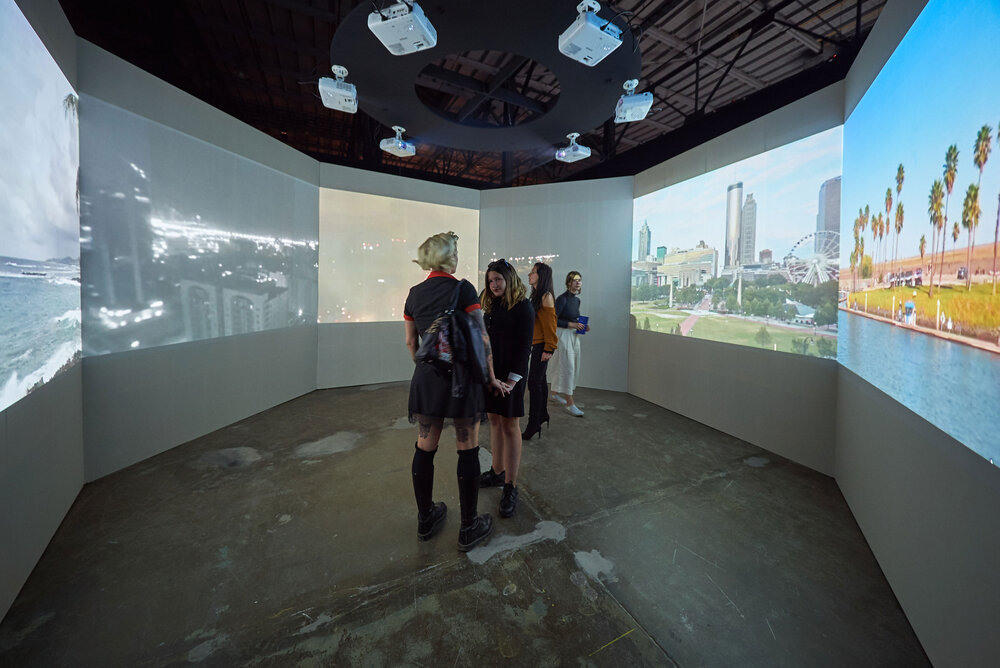
    Behind a heavy curtain in the spacious Arsenal Contemporary Art lies a set of six video installations titled Kali Yuga. The phrase refers to a Hindu myth and translates from Sanskrit as the ‘Age of Vice’. Its creator, Tasman Richardson, is a Toronto-based media artist who exhibits internationally. The Vedic myth offers a version of the theory that the world is cyclical, that is, characterised by an unending process of creation and destruction. Our current age is the last, at which point the creator awakens from a dream state and thereby brings about the end of the world. It is an age defined by degeneration and corruption. The one sin of ours that Richardson focuses on especially is the obsession with the self, i.e., narcissicism.

    Tasman Richardson, Ouroboros, 2019, Digital8 camcorders, projectors, Arduino robotic pieces, custom code, speakers, MacBook, external audio interface, wood, plastic, Variable dimensions

    A parallel is drawn between this mythical age and our era of technological disruption. Here Richardson points to the writings of such luminaries as J.G. Ballard and Aldous Huxley, and their literary predictions of a dystopian future. According to both these authors the rise of technologically fueled capitalism leads to the deadening of our emotions, as our lives become increasingly banal. For Ballard one possible effect of this is to become sexually aroused by machines – cars in particular. This idea is explored in his famous novel Crash, where the protagonists gain their thrills by seeking out the immediate aftermaths of violent car crashes. He understands capitalism as tapping into our latent death drive.

    He sees technology as conspiring to make us spectators of our selves. Society is transforming into a virtual panopticon, where we act as both the inmates being observed and the guards observing. Our online lives have made us both ‘voyeurist and exhibitionist’, as Richardson puts it. This duality is directly addressed in his installation titled ‘Sphere of Influence, Circle of Protection’. You enter a space to be surrounded by screens projecting crashes filmed on dash cams. These images originate from postings of the video footage online. Why would anyone wish to share such traumatic imagery online? It is, curator Shauna Jean Doherty suggests, an extension of “our willingness to report constantly on our own location, consumer habits, and demographic information often in exchange for a free wifi signal – that connects us to a system that feeds off of an insatiable need it has manufactured.”

    Tasman Richardson, Sphere of Influence, Circle of Protection, 2015-2019, Video multiplier, projectors, broken mirrors, camera strobe flash, midi to voltage converter, speakers, MacBook, external audio interface, wood, cloth, paint, Variable dimensions

    Technology, it is implied, is leading to a sort of obliteration of the self. This idea is illustrated by his installation ‘The Cave’. It consists of the silhouette of an amorous couple behind which are a series of receding and increasingly degenerate video projections of themselves, which is the result of their projecting a video recording of their last sexual encounter each time they meet. By observing themselves observing themselves and so on, they ‘shift from self to object’. Slats placed in front of this video display put the gallery viewers in the position of voyeur, making them conscious of trying to spy on the scene through the gaps. The lovers on the screen too are voyeurs, that is, of what used to be themselves.

    Tasman Richardson, The Cave, 2019, Caméscope VHS, magnétoscope, projecteur à portée ultra courte, matelas, haut-parleurs, MacBook, cable DVI-I vers HDMI, bois, peinture / VHS camcorder, VCR, ultra short throw projector, mattress, speakers, MacBook, DVI-I to HDMI cable, wood, paint

    The installation ‘Fire and Theft’ is inspired by the myth of Prometheus who, having stolen fire from the gods and given it to humans, is cruelly punished. His fate is to be chained to a rock and have his liver pecked out. The liver immediately regenerates to be pecked out again the next day ad infinitum. What you see is a panoramic surround of screens projecting scenes of the rising and setting of the sun at various points on the earth. If you were to stand there for a few hours, we are told, you would see this phenomenon from the convenience of one spot. We have effectively captured the sun. The power of technology corrupts us. Our technologically inspired hubris is condemning us.

    Tasman Richardson, Fire and Theft, 2009, Live EarthCam, Mac mini, projectors, wood, cloth, paint, Google Chrome plugins, Variable dimensions

    All these ideas are explained in the exhibition catalogue, without which the viewer is largely at sea. It is striking how Freudian these themes are – narcissicism, the death and life instincts. Richardson’s assumption appears to be that technologies such as social media foster these Freudian instincts and pathologies, and that this is a threat to civilisation. But there is little evidence that we are becoming more pathologically narcissistic for example. Most of us remain psychologically balanced over all.

    Tasman Richardson, Going Gray, 2019, Digital8 camcorders, CRT televisions, RCA to RF convertors, 4K flat screen, HD camcorder, live optical rescan, wood, paint, glass mirror, Variable dimensions

    Richardson is clearly intellectually ‘aroused’ by the idea of our collective death, that is, the apocalyptic end of our society. It is more exciting to believe that we live at the dramatic close of history rather than somewhere on its continuum. To be charitable, there’s no doubt that technology is revolutionising how we interact with one another, and many of the changes are troubling. The drama of dystopian fictional visions like Ballard’s is a useful device to point out how troubling they are, even if they don’t in themselves spell the end of civilisation or some comprehensively hellish future.

    Nihilistic forebodings aside, Richardson is a master of technological aesthetics. Walking into the installation ‘Sands Stand Still’ for example, you peer through surveillance mirrors into a box that is sporadically bombarded by cathode rays. This produces specks of light that are endlessly reflected out in every direction by the mirrored walls. The illuminations are converted into an accompanying hypnotic soundscape. The effect is mesmerising.

    Tasman Richardson, Sands Stand Still, 2017-2019, Glass surveillance mirror, wood, paint, micro projectors, DullTech media players, induction sound, CRT static, vellum, speakers, aircraft cable, Variable dimensions

    Hugh Alcock

    Images are courtesy of Arsenal Contemporary Art. Photo credit: Romain Guilbault

    *Exhibition information: Tasman Richardson: Kali Yuga, March 9 – May 22, 2021, Arsenal Contemporary Art, 45 Ernest Avenue, Toronto, please book your visit.

  • Luminosity on the Beach

    March 13 – April 11, 2021

    Luminosity is a COVID-safe outdoor art exhibition which supports the local business and artist community.

    Installations will be installed across 3km of Queen Street, from Coxwell Avenue to Neville Park, allowing for visitors to explore the neighbourhood, in a socially distanced and safe way.

    The installations will transform familiar spaces into unique works of urban art and will welcome Torontonians to explore their city. They will allow visitors to experience the warmth of the light, through artist interpretation, and act as a ‘light at the end of the tunnel’, following a difficult winter with COVID-19.

    Luminosity features 8 diverse light art installations along Queen Street East and will be lit until midnight every night.

    The installations are:

    1/ 88 Keys of Light by Kristyn Waterworth and Edward Platero

    2/ Chee-Win by Jungle Ling

    3/ Headlights by Collective Memory

    4/ Light Tree by the Opus Art Projects Group

    5/ Sugar Mountain by Rhonda Weppler & Trevor Mahovsky

    6/ Beacon Silo by Christ Foster

    7/ Out From Under the Shadows by Bryan Faubert

    8/ Share the Love by Thelia Sanders Shelton

    Headlights by Collective Memory, Image courtesy of Beach Metro

  • Acts of Erasure at MOCA

    Acts of Erasure at the Museum of Contemporary Art (MOCA), Toronto is a stunning installation that brings two prominent artistic practises together into a dialog. Fatma Bucak and Krista Belle Stewart come from different geographical areas and heritages. Bucak was born in Iskenderun, on the Turkish-Syrian border and identifies as both Kurdish and Turkish. She now resides in London, UK. Stewart is a member of the Okanagan Nation in British Columbia. Their thoughtful work integrates interlocking layers of the historical, the political and the emotional.

     Installation view: Acts of Erasure, MOCA Toronto, 2020 With works by artists Fatma Bucak and Krista Belle Stewart Photo: Toni Hafkenscheid

    Stepping into the warehouse-like exhibition hall at MOCA, Fatma Bucak’s installation caught my eye immediately. Titled And so we were told (2020) is mounted on fifteen curving layers with nine images in each row. It gives the impression that it might rotate so the images would come up to eye level. However, that proves to be an illusion. I have to kneel to see the pictures. They each show the artist’s arms holding a glass jar containing dirty water. The work itself doesn’t send a clear message, so it seems that we need to uncover the layered narratives within. The stained water from the washed-out ink of 84 Turkish newspapers – published in the days following the “basement massacre” without talking about it — is bottled and held for all to witness. Bucak said she wanted to turn the government propaganda into liquid, to transform it into different layers, showing how intimidating she finds the way propaganda manipulates society.

    Fatma Bucak, And so we were told, 2020 (installation from the series Remains of what has not been said, 2016) Installation view: Acts of Erasure, MOCA Toronto, 2020 Photo: Toni Hafkenscheid

    Bucak’s works are often poetic and beautiful. As she explained, she is not afraid of beauty and talking of politics doesn’t require ugliness as the stories are already ugly. A Study of Eight Landscapes (2012 – 2016) is a photo series where Bucak reconsiders how some governments use borders to physically suppress people from certain national, ethnic or gender backgrounds. Her images capture experiences she shared with people who lived at borders or tried to cross them, often facing political and military violence.

    The series depicts discarded objects found along the borderlands of Turkey-Armenia, Syria-Turkey and US-Mexico. Bucak collected and organized them into sculptural compositions in her studio. The depicted items seem real at first but they are more abstract and layered. An incomplete history (2014), shows a bread beside the stone in which it was baked. The cracked stone form has been used many times — a history in itself. Bucak treats her subjects with such respect, their silence is so meditative that it feels like a prayer. Regardless of the absence of people, these artifacts talk about human lives and objects sometimes unveil aspects of history that humans can’t. Beyond their aesthetic appearance we still keep wondering about the hidden narrative.

    Fatma Bucak, An incomplete history, 2014 Installation view: Acts of Erasure, MOCA Toronto, 2020 Photo: Toni Hafkenscheid

    There is a rich and sorrowful story behind De Silencio. The artist travelled the path of Latin-American migrants across the US-Mexico border in August, 2015. These people were pressured into leaving their country and entering a state of limbo. It is a difficult journey and people often discard their unnecessary belongings, especially clothes, along the road. Bucak collected many of them and a Mexican migrant woman cut them into small pieces and sewed them together into a patchwork quilt. The quilt is colorful and happy looking, the stories behind it are not. Together they create a juxtaposing, cruel beauty.

     Fatma Bucak, De Silencio, 2015. Installation view: Acts of Erasure, MOCA Toronto, 2020 Photo: Toni Hafkenscheid

    Blessed are you who come, a video performance (2012, 8’42”), takes place in a Turkish border village; a place of a contentious genocide. There is a lot of tension in this complex scenario. A young woman dressed in black performs the ritual of breaking bread and passing the pieces around. Her actions remind us of the Catholic ceremony of communion. In front of a bombed-out Christian church thirteen old men stand expressing confusion over the woman’s gestures. We can feel the estrangement of the participants, the mistrust between Armenians and Turks, the vulnerability of the young woman who couldn’t predict the reactions of these traditional Muslim men. This performance is very disquieting, but it also gives us the hope of human reconnection.

    Fatma Bucak, Blessed are you who come – Conversation on the Turkish-Armenian border (detail), 2012 Installation view: Acts of Erasure, MOCA Toronto, 2020. Photo: Toni Hafkenscheid

    Krista Belle Stewart also addresses rituals, however very different ones. Truth to Material (2019 – ongoing) is a project that involves two artifacts, a video and a series of large photographs printed on vinyl, covering the concrete floor. As a European the respect for art is deeply rooted in me and stepping on artwork is a taboo. Stewart’s work was a challenge for me that I could not overcome without knowing how and where these images were taken and the cultural and ethical layers within them. Understanding this work, with its complex context, was the real challenge.

    Stewart visited Germany in 2006 and 2007 when she started to research a subcultural group calling themselves “Indianers”. The “Indianers” belong to a cult built around Karl May, a 19th century writer who created an idealized vision of First Nations people. May’s series of novels depict the adventures of Winnetou, an Apache youth and his German advisor Old Shatterhand – two fictional characters. May’s stories were created under the influence of German romanticism. He was looking for innocent and heroic people, so he invented them and put them into a past before colonialization would ruin them. These ‘bands’ imitate North American Indigenous nations, painstakingly copying their costumes and living in teepees for a week while re-enacting their rituals. I wonder why these invented ‘heroes’ are so popular in Europe even these days. What is it that people appreciate so much in these stories? Honestly, I don’t get it; I guess it’s a boy thing.

    Krista Belle Stewart, Truth to Material, 2019-ongoing. Installation view: Acts of Erasure, MOCA Toronto, 2020. Photo: Toni Hafkenscheid

    Stewart attended a summer gathering with the “Indianers” in 2019. Returning to Germany after thirteen years she still found their ceremonies challenging. As an artist, she wanted to witness what these “Indianers” do and found it very difficult emotionally. “What’s weird about the experience,” she told Philip J. Deloria in an interview for Aperture (2019) “is that they are real . . . but I can’t quite believe it. Because we are real too.” It is a contradiction she still hasn’t overcome. But no matter how uncomfortable she felt in the situation, she has always engaged her subject in good faith and with an open mind.

    The title of the project Truth to Material comes from Susan Hiller’s theory of ‘truth to materials’ indicating a complex negotiation between an artist’s idea and the one, very particular way it could be realized. Stewart found the true way of presenting her photographs by mounting them on the floor of MOCA. The viewers have to walk on the photographs, scuffing the surface with their feet. The cracks caused by their steps become symbolic as images of faces and rituals of the Indianers become blurry – an act of erasure.

    Krista Belle Stewart, Truth to Material, 2019-ongoing. Installation view: Acts of Erasure, MOCA Toronto, 2020. Photo: Toni Hafkenscheid

    In 2019 she was presented with a dress made by a friend she met in 2007 specifically for Stewart. The Gift (2019) is displayed in a vitrine, so much like regalia in a museum but here it is clearly a faux relic. For Stewart it involves the past, present and future of Indigenous people with all their historical and political issues – not an easy thing to bear or wear.

    What makes German people dress up like Indians and try to copy their ways for a week? It is much more than a summer camp, as the Indianers have 40,000 members in 40 groups. A “hobbyist” group could be considered innocent. The truth behind Indianers is less faultless. Their enactments are built upon their fantasies and truly misrepresent the old and rich cultures and nations who faced colonial displacement and undergo racism even now. There is also a danger that their false representation will overshadow or even replace the true history and present life of these Indigenous people. For those German “Indianers” their own history is difficult to face too. Their present life may be boring and taxing. Their desire for escapism is understandable. But as Stewart concluded in her conversation with Gabrielle Moser of MOCA (October, 2020), what the Indianers do “is not funny, it is not OK. They should find a different hobby.”

    Emese Krunák-Hajagos

    *Exhibition information: Acts of Erasure, Perceptions of heritage, indigeneity, and political identity, Fatma Bucak / Krista Belle Stewart at Museum of Contemporary Art, Toronto, October 1, 2020 – May 2, 2021. The Museum is temporarily closed due to COVID-19 restrictions. The exhibition is organized in partnership with Scotiabank CONTACT Photography Festival.

  • Mist, Foam, Drainage Ditch at Franz Kaka

    Franz Kaka’s new exhibition, Mist, Foam, Drainage Ditch, is about the body – however, its artworks are not of the body, but what is around it; the pieces in the show encircle the body, and their materials act as “skeins of tactile interaction”.

    The gallery’s website writes about the theme of the exhibition: “Chinese Medicine recognizes an extra organ called the San Jiao, translating to ‘Triple Burner’. Three cavities divided into Upper, Middle and Lower, each burner enacting differing processes of refinement and elimination. Rather than a closed, singular organ, it is a mesh-like network that spans the entirety of the body, acting as a conduit for fluids and Qi. More recently, it’s been likened to fascia. Our connective tissue – the interstitial space around all our viscera, under our skin, between our vessels, cushioning and holding our cells … The body is both a sedimentation and a scatter – a mist, a foam, a drainage ditch.”

    Laurie Kang, Fascia, 2021.

    In the newly reopened gallery, this show is contained within a single room. The room is small, with white walls, concrete floors, and exposed piping. A quiet, plain space that showcases the exhibition’s vibrant, distinctive works, made in different media, colors, and styles, expertly arranged around the room. Photographs, audio works, prints, installations, and paintings are all at home in this space.

    Installation view of Mist, Foam, Drainage Ditch at Franz Kaka, 2021

    As soon as you walk into the small gallery space, you notice the bright colors and striking shapes of each different work. The first artwork you come across is Eileen Quinlan’s black and white photograph of a nude woman, or perhaps a mannequin, in a studio, surrounded by glass cases that reflect the camera flash.

    Eileen Quinlan, Element, 2019, Courtesy the artist and Miguel Abreu, New York.

    Beside this photograph hangs Raque Ford’s installation, made of two connected chains, with plastic add-ons of different colours and shapes: a clear, painted purple and grey panel, pink and purple peace signs, and a gray double spiral motif. This work is both playful and sombre, its colourful, lively plastic pieces contrasting with the heavy, dark grey, somewhat ominous chain.

    Raque Ford, evol, detail, 2021, Courtesy the artist, New York

    In a corner of the room is a small photograph by Rosa Aiello depicting a burning candle, zoomed in to show just the top of the candle’s melting wax and the flame. Beside it is a list of words related to fire: “crackling”, “flames”, “people screaming”, “black smoke” and so on. Above this list is an infrared motion-activated speaker, that plays a recording of a woman saying insignificant words. The combination of the robotic, emotionless, disembodied voice with these troubling printed words gives this section of the gallery a foreboding atmosphere.

    Rosa Aiello, A-Z Soup (fire version), 2021.

    The gallery also features Brandon Ndife’s re-creation of compost, with soil and decomposing gourds. Made of wood, cast foam, pigment, and various other materials, it is very life-like. Without close inspection, it is difficult to tell, that this is not made of organic materials. The rotting matter and dark soil are harmoniously and purposefully arranged within the frame, creating a visually pleasing composition that is at odds with the rather grotesque content.

    Brandon Ndife, Compost From Weeks Ago, 2021, Courtesy the artist and Bureau, New York

    On the other end of the room Laurie Kang’s installation involves a thin thread, hanging from the ceiling and trailing along the floor, with delicate silver metal fish and rubber orange balls attached to it. The fish suspended in the air appear to be flowing along the string as they would in water, while the prone position of the fish on the floor makes them appear lifeless, and limp.

    Laurie Kang, Chyme (details), 2021.

    Franz Kaka’s Mist, Foam, Drainage Ditch is both ethereal and corporeal. Each of these works are striking, enigmatic, and tactile, each evoking in the viewer their own individual set of reactions and sensations, and creating a unique, varied narrative within the gallery. Despite the wide array of styles and media, these pieces exist together in harmony, just as the different organs and tissues of the body work together as one.

    Bronwen Cox

    Images are courtesy of Franz Kaka

    *Exhibition information: Mist, Foam, Drainage Ditch / Organized by Laurie Kang / Rosa Aiello, Raque Ford, Laurie Kang, Annabeth Marks, Brandon Ndife, Eileen Quinlan, March 2 – April 3, 2021, Franz Kaka, 1485 Dupont St, #208, Toronto. Visit online or book an appointment

  • SLUMBER at Patel Brown

    When I entered the exhibition space for Vanessa Brown’s solo show SLUMBER at Patel Brown, I found myself wholly surprised by an exhibition I had already ‘walked through’ online. In fact, ‘surprise’ is a word I used over and over during my half-hour viewing.

    With only a few weeks left, SLUMBER reopened to the public on March 9th, offering limited viewing appointments after Toronto lifted its lockdown restrictions. SLUMBER is Vanessa Brown’s first solo exhibition with Patel Brown, featuring five large-scale sculptures in the main gallery space and a few smaller works in a side room. In this exhibition, Brown “engages a slowness in the viewer’s eyes” in wood and steel sculptures that reveal themselves to viewers in delayed layers.

    Installation view of Vanessa Brown’s SLUMBER, Feb 23 – Mar 28, 2021. Courtesy of Patel Brown and the Artist. Photo: Laura Findlay.

    The first sculpture that is visible from the gallery entrance, “Mantle” (2021), hits with the full force of its monumentality, the scale of which is difficult to capture through photographs and online exhibitions. Steel lines of black, blue, brown, and ochre, swim their way above the curved platform on which they sit. Behind them, a tall and dark black triangle is painted on the wall, popping off the gallery wall with such strength that I initially thought it too was a steel piece independent of the wall—one of many surprises. The largely black lines take refuge in this deep black background, only revealing themselves in short bursts of colour or through careful searching. The longer you look, the easier it is to trace the trajectories.

    Mantle, 2021. Installation view of Vanessa Brown’s SLUMBER, Feb 23 – Mar 28, 2021. Courtesy of Patel Brown and the Artist. Photo: Laura Findlay.

    In “Sun Lethargy” (2020) two figures lay under a lusciously hot sun. The wood sculptures, of solid blue and orange, are all soft curves, sometimes ambiguous and sometimes clear about the human features they model. The solid colours, green, blue, orange, and yellow, serve to make the elements independent of each other; they all inhabit the same universe but don’t bleed into each other. Rather, one can peer through the negative space of one figure to glimpse a piece of the other. There is something that is extraordinarily alluring and soothing about these figures. The ease with which they fill the space—maybe due to their lethargic poses and the sultry climate—lures you in and begs you to join them in their world of slow sunbathing.

    Sun Lethargy, 2020. Installation view of Vanessa Brown’s SLUMBER, Feb 23 – Mar 28, 2021. Courtesy of Patel Brown and the Artist. Photo: Laura Findlay.

    As with all of the sculptures, “Fugitive Pond” (2021) plays around with its negative space, featuring droplet-shaped holes that from a distance appear like painted white elements—another delayed reveal. Yet, unlike the others in the main room, “Fugitive Pond” is without a painted backdrop, and thus, looks lonely. Even the silhouette it forms screams loneliness, somehow resembling the figure of a shawled woman stooped over in grief. This sculpture requires company, asking its viewers to crouch—or stoop, as it does—and gaze through the negative spaces.

    Fugitive Pond, 2021. Installation view of Vanessa Brown’s SLUMBER, Feb 23 – Mar 28, 2021. Courtesy of Patel Brown and the Artist. Photo: Laura Findlay.

    A dimly lit second room, equipped with a curtain to shut out the bright light that floods the main space, is yet another gifted surprise. In a corner is a series of steel sculptures with candles, titled “Mnemonics” (2020-2021), casting shadows of cats and whales that dance across the floor and walls—though this took a moment to notice. It would be another two minutes until I observed that each one of these steel sculptures had a real candle and that these were the only sources of light in the room. The idea that someone had the task of lighting and replacing these candles was so delightful to me. Perhaps this delight was a product of our current automated, distanced world in which the evidence of labour is a sweet rarity. The title “Mnemonics” is particularly engaging—what are we trying to remember? Or is it that the “Mnemonics” carry their own independent memories? The candles themselves, too, suggest something about memory and time. They burn slowly, and over time they recede, leaving record of the time they spent lit. As members of the exhibition, they serve as a record of the hours that gallery visitors filter in and out. I wondered how different this room looked during the city lockdown, and then, enjoyed imagining the ceremonial lighting of the candles once the gallery reopened for visitors—like a celebration of rebirth.

    Mnemonics, 2020-2021. Installation view of Vanessa Brown’s SLUMBER, Feb 23 – Mar 28, 2021. Courtesy of Patel Brown and the Artist. Photo: Laura Findlay.

    Brown’s sculptures surprise viewers in their use of scale, negative space, and hidden gems—or not so much ‘hidden’ as ‘obscured’. They are meant to be peered at from all angles and thoroughly searched. Ultimately, this exhibition succeeds in stopping viewers from slipping into states of ‘gallery fatigue,’ refreshing them over and over again. Small, sweet surprises are generously scattered in SLUMBER, rewarding viewers who gaze slowly and rigorously. Vanessa Brown‘s solo exhibition provides unexpected small delights and, if you can safely make it to a gallery appointment, should be viewed in person even by those who have already seen the online exhibition.

    Installation view of Vanessa Brown’s SLUMBER, Feb 23 – Mar 28, 2021. Courtesy of Patel Brown and the Artist. Photo: Laura Findlay.

    Olivia Mariko Hsuen-Ferris

    *Exhibition information: Vanessa Brown, SLUMBER, (extended dates) February 23 to March 28, 2021, Patel Brown, 21 Wade Ave, Toronto. The online exhibition is available on the Patel Brown website. Patel Brown is offering viewing appointments that can be booked for the remainder of the exhibition.

  • June Clark: Unrequited Love at Daniel Faria Gallery

    In the advent of Black Lives Matter and the United States 2020 presidential election, there could be no better time for June Clark’s solo exhibition, Unrequited Love, at Daniel Faria Gallery. The show explores Clark’s relationship with the American flag, in a display of various quotations of the flag made in different media and styles.

    The gallery’s website states, “As a young Black girl in America, Clark was taught to love something that would not love her back in return, but knowledge of that imbalance doesn’t rid someone of their desire for a mutual relationship. It’s an imbalance that is not specific to America; unrequited love is one of the oldest tools of colonialism.”  

    Inherent, 2017

    The flag is an instantly recognizable, very conflicted symbol, evoking different reactions and associations for everyone. For Canadians, who will be the majority of this exhibition’s viewers, the flag is a familiar symbol, but it is likely not as personal to us as it is to the artist. For Clark, a black woman who spent her childhood in Harlem, the relationship with this symbol is fraught, to say the least.

    Clark expresses, “As a child, my heart would become full whenever I saw the flag waving in the breeze. I was proud and it was my understanding that all who saw ‘our’ flag could and should only love it as citizens and, if not of our country, envy those who were protected by it. I was taught that all citizens, under this flag, would enjoy all rights and freedoms under the constitution.” The American flag has been a part of Clark’s artistic vocabulary for the last 20 years, and these works are a way for her to come to terms with the “unrequited love” she feels for it.

    Dirge, 2003

    The show, though now moved online, takes place in a stark, monochrome room, with walls, floors, and a display table all sparsely occupied with different iterations of the American flag. The neutral tones and unadorned nature of the gallery space allow these works to stand out and become independent from one another.

    Installation view of June Clark Unrequited Love at Daniel Faria Gallery, 2020

    The flags are constructed in different materials, styles, and varying levels of completion: some are ripped and threadbare, some burnt, and some are stylistic recreations of the design. Looking through the works, the criminal implications of these defaced flags instantly came to mind, making the show all the more defiant and shocking. Repetition becomes an art form even if at a closer look none of the flags are the same.

    A particularly striking piece is a flag that hangs diagonally from the wall, completely disassembled. It is made up of unwoven vertical threads that form the colors of the flag, with the blue square and stars ripped and full of holes. On top of the flagpole lies a cross made of rusty barbed wire. Its lifelessness and raggedness give it a melancholy, pitiful quality.

    Moral Disengagement, 2014-17 and detail (right)

    Clarke has dedicated this exhibition to Colin Rand Kaepernick, the football quarterback famed for kneeling during the national anthem in 2016 protesting the ongoing violence and discrimination towards Black people in the United States and worldwide. The exhibition was planned in the months leading up to the 2020 US presidential election. During this time, and up to more recent months, the United States has been in a period of turmoil, and many devastating events have occurred in the country, especially those related to racism. I know many of our associations with the symbol of the American flag have been marred by these events, making this show all the more relevant.

    From Harlem, 1997

    A representation of a flag lies on the gallery floor, in the form of strips of fabric: long thin white and red pieces and a square navy piece with tiny stars resting upon it. Another flag, this one more traditional and undamaged, likely an actual flag Clark has repurposed, is affixed to a blank cream-coloured canvas. The flag is bunched-up and sewn onto the canvas with bright green threads that read “irony” in cursive.

    Untitled (irony), 2010 and detail (right)

    June Clark’s solo exhibition Unrequited Love is a fascinating, radical collection of works. Its exploration of patriotism, race, and identity, is unique and mesmerising. Clark’s ability to rework a well-known symbol into intimate, autobiographical art is impressive. These works are incredibly poignant, defiant, and relevant to the world we live in – this exhibition couldn’t have come at a better time.

    Bronwen Cox

    Images are courtesy of Daniel Faria Gallery

    *Exhibition information: June Clark: Unrequited Love, November 6, 2020 – March 27, 2021, Daniel Faria Gallery, 188 St Helens Ave, Toronto.


  • Jacob Robert Whibley at Zalucky Contemporary

    “This book is about entanglements.” Thus begins the preface of Meeting the Universe Halfway, the 2007 book of theoretical physicist and feminist theorist Karen Barad. I can easily remodel their opening line to describe Jacob Robert Whibley’s current exhibition, beige mint, at Zalucky Contemporary: This exhibition is about entanglements.

    Installation view of beige mint at Zalucky Contemporary

    Inspired by the writings of Barad, beige mint explores the possibilities of multiple coexisting times and places, and entanglement—“to lack an independent, self-contained existence” as Barad describes it (in its most brief definition). Through a collection of sculptures and collages, beige mint tells the story of what Whibley describes as “a conspiracy between the past, present, and future.” Employing materials that have been collected over nearly twenty years, he explores the lives of these objects and reveals ghostly traces of his own past.

    Even the exhibition name beige mint—an anagram for ‘time being’—is a cheeky representation of something that can exist in multiple states. The joke continues to play off of the artworks in the exhibition which (either through careful planning or happy coincidence) feature variations of beige and mint. Though the title regularly reminds us of the complex theoretical physics at work, the playfulness with which Whibley employs the title is reassurance that we need not always take ourselves so seriously, that we can enjoy ourselves even in the face of spatiotemporal exploration.

    Installation view of beige mint at Zalucky Contemporary

    The line sculpture, “precious meddles” (2020) was inspired by a collection of wires found by Whibley around Toronto construction sites. White lines contrast the dark navy gallery wall, forging clear paths that wander off and collide. The round organic shapes that fuse the lines together are less clearly defined against the navy background in shades of blues, yellows, and greens. Some lines split and diverge, others are nearly unbroken from start to finish. All lines connect eventually at junctions that give “precious meddles” the appearance of a warped subway map. This comparison makes for a surprisingly apt embodiment of entanglement. Multiple states of subway maps exist in imagined expansion projects that will never be and in the construction plans that have taken so long to complete they seem to have always been in construction. Transit and urban planning are worlds of colluding pasts, presents, and futures.

    precious meddles, 2020, wood, sand, oil, and acrylic paint, 24” x 25” x 4.5”

    The other line sculpture, “the ten of wands works best as a coaster for a mug half full” (2020) is composed of similar materials. This sculpture’s white lines intertwine around circular areas, revealing three approximate circles of negative space as satisfying to focus on as the lines themselves. A few identifiable patterns give the sculpture a near-humanoid appearance. A face-like shape appears on the top. A hand or a foot can be discerned in the line that juts out to the right and points to the adjacent artwork. But the intertwined lines don’t always form expected patterns, reminding us that this is not really a human but perhaps grouped traces of human movement.

    the ten of wands works best as a coaster for a mug half full, 2020, wood, sand, oil, and acrylic paint, 29” x 23.5” x 6”

    “water closes around a sinking object like an eyelid” (2020) is composed of gold strips of paper threaded over and through a mint-coloured field. Two other works in this series feature similar long, thin pieces of paper that track and tangle around the surface. With entanglements in mind, some questions arise: do these lines represent the traces of paths taken, possible paths, or desired paths? Could they represent all of these at once?

    water closes around a sinking object like an eyelid, 2020, paper ephemera on panel, 24” x 22”

    A series of four collages show Whibley’s collected materials densely packed together, off-shooting fissures of negative space. All four works have familial traits of circular caverns, shared materials, and hues of mint and beige. The materials used in these collages—an envelope, denim, scraps of stationary—lend the works a lived-in appearance. By grouping these materials together, Whibley has recontextualized them, linking them to the places, times, and memories of their neighbours. In this way, we see before our eyes that a single entity can exist in multiple times and spaces at once.

    cities sink so oceans can rise, 2019, paper ephemera on panel, 15.5” x 12.5”

    the earth has guilt, the earth has care, unquiet are its graves (top left), we will take turns with the sun (top right), cities sink so oceans can rise (bottom left), when you till a field you’ll find a lot of stones (bottom right), all 2019, paper ephemera on panel, 15.5” x 12.5”

    Whibley’s exhibition offers us a glimpse at the entanglement of space, time, and human existence, but it goes so much further. It is not just a playful exploration, but a record of the human desire to understand the workings of space and time. We are usually unhappy to be the mere vessels through which time and space operate, we would rather make something of it and anchor it in digestible accounts. beige mint reconciles us to an entangled world, even when viewed from home.

    Installation view of beige mint at Zalucky Contemporary

    Olivia Mariko Hsuen-Ferris

    Images are courtesy of Zalucky Contemporary

    *Exhibition information: Jacob Robert Whibley, beige mint, November 14, 2020 – March 27, 2021, Zalucky Contemporary, 3044 Dundas St. W, Toronto. Exhibition images, text, and video can be viewed on the Zalucky Contemporary website.

  • The Time Being at Angell Gallery

    In these days of social distance, Instagram has become a primary medium for accessing art. For works intended for walls and galleries, the platform has limitations. Small, square images do not convey the full physical experience. The bottomless scroll dissuades us from spending the time required to see beyond the superficial. We have access to more art than ever, but what we have gained in breadth of scope, we have lost in depth of attention.

    What if we thought of Instagram as a medium unto itself, rather than as a conduit through which to access other media? This is what artists Eva Kolcze and Jessica Thalmann have done with their The Time Being project. They’ve used Instagram as a vehicle to document their experiences during the pandemic. Working within the constraints of the platform, they’ve been able to expand its potential as an artistic medium. They use Instagram not simply as a mechanism through which to transmit art, but as an integrated foundation of their work.  

    Eva Kolcze and Jessica Thalmann, images in The Time Being feed

    The Time Being is art in the form of an Instagram account. Set up during the summer, it contains regular posts by the artists and guest contributors including Jennifer Lee, Isabel M. Martínez, Miryam Charles, Laura Grier and Meera Margaret Singh. The collection of images and short videos continues to grow with the steady addition of new posts. There are weekly themes within the stream such as ‘site and destination / spaces not normally visited’ or ‘passageways, alleyways and hallways’.  

    Working collaboratively, the artists have curated a collection that reflects the eerie tranquility of lockdown. Here are some examples of what they’ve discovered while the frenetic pace of city life has been paused. 

    House Without a Roof is a short video that captures a window reflection, a fleeting moment visible only from a particular angle. The reflected clouds create the illusion of a different sky behind the glass from the one above the building.

    Eva Kolcze, House Without a Roof video

     ✨? ? (which I read as ‘sparkling sun video’) is a short clip of slow-moving water. Leaves float on the surface and we see down into the water and up into reflected trees, through which the sun glints. The shifting focus of the camera takes us from the trees in the background to a small insect fliting through the air and then back to the surface of the water. It takes a moment to realize that if the trees are the right way up in the reflection, the video itself must be inverted. 

    Eva Kolcze,✨? ? video

    Grass and leaves under a layer of ice is a video that captures a moment when water, over grass, moss and leaves is at the threshold of freezing and thawing. Small bubbles come up from below and travel under the thin ice.

    Grass and leaves under a layer of ice, video

    Peeling back the layers. After years of wear and tear, painted storefronts reveal the brick bones underneath. is the text next to a set of photos of similar building corners. We’re shown the parallel patterns of decay next to these various doorways.

    Peeling back the layers. After years of wear and tear, painted storefronts reveal the brick bones underneath

    These are just a few examples of what you will find on the feed. Would the artists have discovered these poetic moments if not for the pandemic? Perhaps. But I think empty streets, and an elevated sense of vigilance primed the artists to notice more. The images are directly linked to the unique circumstances of our current time.

    Images by Isabel M. Martínez, Eva Kolcze and Jessica Thalmann in The Time Being feed

    Kolcze and Thalmann leverage the constraints within the platform to their advantage. Instagram is designed for phone camera photos, so they use their phones. It calls for square formats and short videos, so this is what they do. It allows for short text and comments and they make the best use of these to complement the images. They go with the technology rather than against it, and by doing so they are opening new possibilities for others to be inspired by, and to expand upon.

    The Time Being provides a compelling example of how Instagram can be used for art. The account does not show little photos of art that exists as a richer experience somewhere else. The account is the art. The pictures, videos and text and the relationships between them is a whole, integrated, online artwork.  

    Mikael Sandblom

    *Exhibition information: The Time Being, a project by Eva Kolcze and Jessica Thalmann, an Instagram exhibition, January 13 – February 13, 2021, Angell Gallery, 1444 Dupont Ave, Unit 15, Toronto.

  • Absent Friends at Birch Contemporary

    What does it mean to create a dining room in a gallery space? Furniture has its place in nearly every part of our lives, yet is overlooked in its role of manipulating the way we interact with space and with other people. When given more thought, the dinner table is a center of unity for individuals. The surface is a communal area and hovering over it is conversation, laughter, and debate. The dinner table is a peaceful place as when fighting starts seats are typically abandoned. The COVID-19 pandemic no longer allows for these interactions over tables due to social distancing. Instead, people eat alone at their desk, in their bed, or over the kitchen sink with crumbs falling into the basin.

    Curated by Ross/Hafiz Lalani-Jennings Birch Contemporary has set up a functional dining room space in their gallery with a six-placement table positioned in the middle of the room. Amongst plates and utensils, the surface is filled with ceramics including vessels and candelabras, artificial plant vines, and a bronze mouse. Even though the artists could not be present in person at this dinner, their works stand in for them. According to the gallery’s website, it is an English tradition to acknowledge those who could not be present at events. Birch Contemporary explains that Absent Friends is “a toast to our resilience, our courage, our hope, and our support to one another during this most remarkable of years”. The preface continues saying that, “[This show] is a celebration of unity, bringing together a selection of artists whose work’s trace connections between their own personal histories and a larger, collective and shared, understanding of ourselves. Our uniqueness, our beliefs, our fears, and our imaginations”.

    Installation view of Absent Friends

    Not only are the invitees of this dinner party not present, but neither are the viewers of this installation, as this show is being delivered through photographs. I can only imagine that if I walked into the space, I would feel the urge to tip toe carefully through the area, sure not to disrupt the room full of breakables. It is interesting to note that the side table has puzzle pieces thrown across the surface, seeming as if there were people occupying the space earlier, yet the candles in the candelabras on the main table are unlit. Did guests leave before dinner could be started? The work becomes a medial space that is waiting for action, similar to many aspects of life that have been put on pause until later notice.

    Installation views with puzzle pieces & Noah J. Brown’s Porcelain Boy (left) and candelabra by Julie Moon (right)

    In spite of the absence of people, the space is still vibrant, filled with exciting color and flowing, bulbous forms. In lieu of physical bodies, Noah J. Brown’s paintings of people embracing and touching hands adorn the walls.

    Installation view with Noah J. Brown’s felt tapestries

    Mitsuo Kimura’s many ceramics fill the main table, with organic creatures that are both monstrous and adorable, looking back at you with distraught expressions. Mitch Robertson’s Dying Mouse is the sole bronze piece on the table, standing out amongst the other artworks. The work has a somber title yet it is contradictory as it seems the mouse has been impaled by a suction cup arrow.

    Mitsuo Kimura, Fairy Bubble Red, 2018-2019, ceramic and glaze, 4″ × 4″ × 4″ (left) and Mitch Robertson, Dying Mouse, bronze

    Despite the broad range of the artworks, they are incorporated together into one show. For example, one of Ness Lee’s ceramic bowls, which depicts a nude woman whose legs are sculpted in a circular pattern that finishes the shape of the bowl, holds ceramic fruits with hollow facial features by
    Mitsuo Kimura. Without this dinner party setup none of these works would have interacted with one another at all, let alone so intimately. Many of the artworks also feature faces, giving Absent Friends life despite being completely comprised of man-made and inanimate objects.

    Ceramic bowl by Ness Lee with Mitsuo Kimura’s works

    Absent Friends buzzes with activity that is emitted from this expansive collection of artworks. The artworks co-exist together, sharing space and mingling with each other, just as the artists would if this dinner party could have been in person.

    Olivia Musselwhite

    Images are courtesy of Birch Contemporary

    *Exhibition information: Absent Friends / Catherine Heard, Micah Lexier, Julie Moon, Martin Pearce, Ed Pien, Mitch Robertson, November 26, 2020 – February 20, 2021, Birch Contemporary, 129 Tecumseth Street, Toronto.