Author: artoronto

  • Conversation at Mayten’s Projects

    As I walked through Conversation at Mayten’s Projects, the wisdom of looking at multiculturalism through the lens of conversation struck me repeatedly. As I commuted home, the notion settled nicely in my skull. Curator Farnoosh Talaee says it well, “I realized that on a fundamental level, multiculturalism in Toronto and Canada as a whole means segmentation…Without cultural intersection and the ensuing cross-cultural conversations, is there really diversity?”

    External view of Mayten’s Projects. Lauren Pirie, Dawn 4, 2021, Hand-dyed fabric stuffing and high-quality LED

    Conversation is a group exhibition composed of a series of partnerships. Artists of various backgrounds, genders, and ideologies come together to forge connections that are new, old, emotionally intimate, physically distant, and everything in between.

    It is particularly satisfying to note how Talaee and the artists embody conversation in all aspects of the exhibition. Conversation is subject, medium, and message. It threads the gallery space together and weaves a single message, like a tapestry made of many threads; each thread having a self-possessed colour and texture but meaning more when woven next to many others.

    Installation view of Conversation at Mayten’s Projects, Jah Grey and Lauren Pirie, 2021

    Portals to our Liberated Futures is well-placed by the gallery doors, echoing the physical entrance as a philosophical entrance into the space. A collaboration between artists Eva Birhanu and Khadijah Morley, this collection of works is the product of a call-and-response conversation from opposite ends of the country, both artists having a hand in all works.

    Eva Birhanu and Khadijah Morley, Portals to Our Liberated Futures, 2021, Kozuke Paper, ink, gold thread, 8.5″ x 11” (left) & Portals to Our Liberated Futures, 2021, Strathmore 300 lightweight paper, ink, red thread, 9″ x 12” (right)

    In pieces composed of print and textile, Birhanu and Morley explore their shared experiences and complex identities as Black Canadians. “Liberation before Repatriation,” the idea of dismantling Western colonial oppressions before returning to the origins of one’s ancestors, is given weight in a long black, red, and gold hand-woven textile piece; the weight of the message emphasized by the labour of creation. In Portals to our Liberated Futures, doorways appear over and over again, connecting us to conversations across time and space.

    Eva Birhanu and Khadijah Morley, Portals to Our Liberated Futures, 2021, handwoven cotton, gold ink, hair, cowrie shells, 25″ x 61”

    In a series of portraits, artists Barirouche Feddal and Preston Pavlis examine self-conversation and isolation. This collection is another call-and-response but these artists worked separately, yet still in response to each other.

    Pavlis and Feddal, show their tonal distinctions as well as their similarities. Both create with thick, emotional strokes and use the motif of cigarettes as “tools of conversation.” But Pavlis’ portraits manifest in heavier ways—intimate portraits on full, dark backgrounds make for a thick, weighty permanence—and Feddal’s are lighter—empty canvas and distanced subjects make for a wispy, ephemeral feeling.

    Installation view of Conversation at Mayten’s Projects, Preston Pavlis and Berirouche Feddal, 2021

    The criminal artist No.3 by Berirouche Feddal, is a stand-out piece in Conversation. At some distance, a man sits on a kind of stone ledge, wearing a gold hat, smoking a cigarette, and staring out at the viewer. Colourful paint strokes, in this work and others, nod to Fauvism and hints of Orientalism sneak through in the posture and clothing of the figure. As a piece of the larger collaboration, together these portraits can read like a conversation between Pavlis’ created present and Feddal’s created past, each character sharing stories that are as dissimilar as they are alike.

    Berirouche Feddal, The criminal artist No. 3, 2021, Screen-print on 280gm paper, fibre, gold leaf and oil pastel, 25″ x 19″

    Preston Pavlis, Untitled 1, 2021, charcoal, acrylic, and oil on unstretched canvas, 21″ x 21.75”

    Art school peers, Guillaume Saur and Matty Flader, examine the opposing forces of the internet: the extremely universal and extremely niche experiences it provides. Most viewers will recognize the background of Saur and Flader’s collaboration piece; the most generic of generic Windows desktop images, green fields under a cloudy blue sky. On top of this backdrop are four red and grey prints, created by feeding photography to an AI algorithm to combine the works of Saur and Flader. Selected for the AI were previously under-appreciated works from the archives of the artists. The result is a series of final images that are largely unrecognizable to us—a private conversation in which only Saur and Flader know the spoken languages.

    Installation view of Conversation at Mayten’s Projects, Guillaume Saur and Matty Flader, 2021

    Talking Drums, by artists Christopher Dela Cruz and Eric Slyfield, stands apart conceptually from the other works as a “kinetic sound sculpture.” The drums are inspired by the cultural backgrounds of Dela Cruz and Slyfield, in both aesthetics and sound, modelled after the drums of their ancestors in the Philippines and West Africa. Talking Drums puts cross-cultural sharing into action quite literally. Just like how in life drums are used to communicate messages nonverbally and over distances, Talking Drums symbolizes art and its ability to communicate across physical and mental boundaries.

    Christopher Dela Cruz and Eric Slyfield, Talking Drums, 2021, kinetic sculpture, 16″ x 8″ x 17″

    Conversation, as a concept, is a surprisingly apt metaphor for a truly multicultural society—at least, surprising to me because I hadn’t considered it before. As a viewer, Conversation provided much fodder for examining my own cultural identity as a person of mixed heritage living in ‘multicultural Toronto.’ My beliefs, my culture, the food I eat, the languages I speak, the media I consume, all stem from an internal conversation between the parts of me. I’m not a mosaic or a melting pot, but a continuous exchange. Sometimes one voice is above the others but all parts are made stronger by the whole.

    Conversation at Mayten’s introduces a world where constant and varied exchange is the norm and suggests that a multicultural society is made more successful by its cross-cultural connections. All this is punctuated by the method of delivery: a gallery exhibition. Art is a tool of conversation and of sharing in its ability to transcend barriers. Like the pounding rhythm of a drum, art can bridge the distances words cannot.

    Installation view of Conversation at Mayten’s Projects, 2021

    Olivia Mariko Hsuen-Ferris

    Images are courtesy of Mayten’s Projects.

    *Exhibition Information: Conversation, September 10 – October 23, 2021, Mayten’s Projects, 165 Niagara Street, Toronto. Gallery hours: Tues – Sat, 11 am – 6 pm.

  • Collins and Patella at Propeller Gallery

    In keeping with Propeller Gallery’s tradition, two artists: Simone Collins and Frances Patella are showing their latest works at the same time. At first sight these two artists seem very different both in their artistic approaches and their methods of creation. However, I recognized surrealistic allusions in both Collins’ and Patella’s exhibited work. The combining of the collage technique with various materials that flourished during the Dada movement, gives their pieces a variability and pluralism that still characterizes modern art.

    In the front exhibition hall, we enter Simone Collins’ show, Crescive. The artist boldly used different materials and multi-dimensional convergence; her works break through the flat canvas and enter the viewer’s vision as three-dimensional forms. Her sculptures and collages encapsulate a combination of real and fairytale characters interacting with often strange animals, surrounded by natural elements. This creates a mysterious aesthetic; a one-of-a kind fantasy world. Her beautiful pieces radiate harmony.

    Installation view of Simone Collins, Crescive at Propeller Gallery, 2021

    Jewelry, animals, children and embryos are popular elements in her art, bringing to mind the phrase “ontogeny recapitulates phylogeny” that prevailed in 20th-century Berlin Dadaism. This concept emphasizes the commonality and parallelism in all living things. The title Crescive is originally coming from Italian and means growth marked by gradual, spontaneous development. In Collins’ works human beings are not superior to other creatures, but coexist with them in creating a new, different ecosystem. In Gem Face Girl Carrying her Pets the little girl’s hat and dress suggest a late 18th-century stage, her face is replaced by a hollow gem. She lovingly hugs two rabbits and a chameleon—a rather strange combination of pets. The chameleon here might be a symbol of interchangeability. 

    Simone Collins, Gem Face Girl Carrying her Pets, 2020, mixed media on wood panel, 10 x 8 inches

    Frances Patella is a photo-based artist, whose canvases in the second room of the gallery also give us a sense of virtually intersecting aesthetics by blending the boundaries between illusion and reality. The gallery’s website explains her unique method, “Using a carpenter’s plane, Patella shaves off layers of photographs and paint, using the plane as another tool, to reveal the slow passage of time.”

    Installation view of Frances Patella, Plane to See at Propeller Gallery, 2021

    Most of her works are related to the woods, controlled burns, and ruins. Mixing and layering those visual elements create a melancholy undertone in her pieces. Burn with Yellow Leaves seems to take us back to German romanticism of the nineteenth century, with the burning of fires in the foreground and crumbling arches in the background, the only bystander is a red tailed hawk in a dead tree.

    Frances Patella, Burn with Yellow Leaves, 2021, mixed media on wood panel, 12 x 12 inches

    Nevertheless, the airplanes, cars and metal structures that appear from time to time in her classically-inspired compositions, remind viewers that these are 21st-century artworks.

    Vivian Sun

    Images are courtesy of Propeller Gallery

    *Exhibition information: Simone Collins, Crescive & Frances Patella, Plane to See, September 22 – October 10, 2021, Propeller Art Gallery, 30 Abell St, Toronto.

  • Gallery Weekend at Corkin Gallery

    Gallery Weekend at Corkin Gallery / September 25, 2021, 2 – 3 pm

    This year, the Contemporary Art Gallery Association decided to participate in the international event Gallery Weekend. From September 23-26, contemporary art galleries extended programming and gallery hours, presenting exhibitions and an opportunity to connect with Toronto’s art scene, categorizing three routes: Junction Triangle, Wallace Emerson and Lower Toronto.

    The first ever Gallery Weekend Toronto included largely self-taught artist Christian Butterfield’s debut solo exhibition, Green Light. This exhibition was held at the captivating Corkin Gallery, in the heart of the Distillery District. Green Light portrays the evolution of an early career artist, revealing an exploration of human relationships through mass media, popular culture, and a fascination with the human body. This exhibition’s journey travels from abstract portraiture collages (made from analog media) to surrealist landscapes, informing work that is both strident and controlled, mysterious and surprising. Green Light is comprised of works from Butterfield’s Cheeks and Cold series, Apology Flowers, as well as two new monumental paintings.

    Installation view of Christian Butterfield’s Green Light at Corkin Gallery. Courtesy of Corkin Gallery

    In conjunction with Gallery Weekend, Corkin Gallery facilitated the exhibition’s roundtable discussion. Christian Butterfield spoke with artist, writer, and curator Anique Jordan, art historian and U of T Professor Dr. Sarah Stanners, AGO’s Assistant Curator Dr. Renata Azevedo Moreira, and gallery owner, Jane Corkin. This discussion was free of charge to the public, and gave Toronto’s arts enthusiasts’ a deeper insight into the deliberation and inspirations of the artist.

    L-R: Artist, Anique Jordan (who attended virtually on that screen), Dr. Sarah Stanners, Christian Butterfield, Dr. Renata Azevedo Moreira, and Jane Corkin. Photo: Georgia Gardner

    In this discussion, Butterfield disclosed that each of his paintings are a reflection of someone he was thinking of at the time, as he recalls his relationship with that given subject, whether that be a family member, friend, current, or former partner – using past conversations and words gone unsaid. He admits he does not ask permission before starting a specific work, and he does not necessarily want to reveal the identity of that given person. However, if those individuals looked closely, he thinks, they would recognize themselves and elements of their relationship history.

    Christian Butterfield, Cold #2, 2020, acrylic and collage on canvas, 48 x 36 in. Courtesy of Corkin Gallery

    Relationships are at the core of Butterfield’s work. His Apology Flowers series originally started as apology gifts to friends, lovers and acquaintances, inspired by his grandmother who asked him to paint flowers for her.

    Christian Butterfield in front of Apology Flower #8 (across the bay), 2021, acrylic on linen, 84 x 72. Photo: Georgia Gardner

    In terms of artistic process, he uses newspaper clippings as a way to respond to the oversaturation of media that has bombarded his generation, as someone who has grown up alongside the digital age. He layers selected newsprint clippings and fragments from publications, frequently sourced from the pages of Time Magazine, onto his painted canvas. The results are works that contrast order and disorder. The placement of the media is purposeful, and his painting style is a meticulous endeavor of sculpted geometric shapes and colours. Each media element is a declaration of consumer culture, societal pressure, or strain in an interpersonal relationship, engaging viewers in a process of vulnerability and reflection.

    Christian Butterfield, Randoms, 2019, acrylic and collage on canvas, 48 x 36 in. Courtesy of Corkin Gallery

    Butterfield’s composition capabilities are palpable in equal measure as his ability for introspection. His approach to art is that it should speak for itself, and he would not object to the ways in which it is interpreted. In a way, this allows Green Light to occupy a space that is light-hearted, and at times humorous. His personal ethos is one that does not place his art in one category, instead patiently allowing his art practice to obtain a natural progression. In conversation, Butterfield presents as soft spoken and measured. His artwork provide an exploration of the human psychological condition.

    Christian Butterfield, Cheeks III and IV, 2019, acrylic and collage on canvas, 60 x 96 in. Courtesy of Corkin Gallery

    Gallery Weekend Toronto has allowed for an enjoyable and thoughtful experience within Toronto’s art scene, joining the global event that inspires creativity, shows support for the arts, and allows for networking opportunities and exhibition discoveries. Christian Butterfield’s Green Light was one of the best exhibitions of the event and you can still visit it till October 9th.

    Georgia Gardner

    *Exhibition information: Christian Butterfield, Green Light, September 11 – October 9, 2021, Corkin Gallery, 7 Tank House Lane in the Distillery District. Gallery hours: Tue – Sat 10 am – 6 pm.

  • Interview with Jamie Angell

    Jamie Angell, Director of Angell Gallery. Photo: Richard Storms

    Interview with Jamie Angell (JA) on the occasion of the 25th anniversary of his gallery and its closing by Emese Krunák-Hajagos (EKH)

    EKH: What do you think has made you the successful gallery owner that you are? What is your secret?

    JA: What has made me successful as a dealer is the enthusiasm I have for the artists I represent. Clients know that I fully support the artists and therefore trust me, they hear it in my voice. Also, communicating with our clients with regular email newsletters and an active Social Media presence certainly adds value.

    EKH: Regarding the selection of your artists, you said in an earlier interview with us, “My mission statement has always been the same: to show artists who take risks in their work.” Later you added, “Well, if I believe in something, I’ll make it work.” And you have by showing digital art since 1998 along with another non-traditional artwork. What will happen to your artists now?

    Mitchell Chan in his installation, Art & Inactivism, December, 2016. Image courtesy of Angell Gallery

    JA: I made it a point to contact galleries which I think may be interested in some of my artists. So far, six have found new galleries, I’m thrilled for this!

    EKH:  What was the most difficult situation you’ve faced during these 25 years? How did you overcome it?

    JA: The most difficult situations have been the 3 recessions I’ve endured. Having said that, I’ve always looked at difficult times as opportunities to dig deep in my reservoir to find the strength to grow even stronger. I’ve always prided myself on being resourceful, nibble and not afraid to take risks. During the 2009 recession I secured a new lease for a 4000 sq ft gallery on Ossington Avenue which opened in early 2010.

    Daniel Hutchinson, When The Lighthouse is Dark Between Flashes, September, 2014 at 12 Ossington Ave. Photo: Brinae Bain

    EKH: Looking back at those years what was your greatest accomplishment?

    JA: My greatest accomplishment is fulfilling my personal and business mandate which I articulated leading up to opening the gallery.

    It was most important to Make a Difference in the world, to be part of something greater than myself, to invigorate the visual arts community and the community at large. Looking back, this has been the most fulfilling time of my life.

    Vessna Perunovich, Shifting Shelter, site-specific installation, March, 2017. Photo Alexis Moline

    EKH: What was your most ambitious dream for the gallery? Have you fulfilled it?

    JA: My most ambitious dream was to purchase a building for the gallery and a place to live. 

    As in most ambitious plans I’ve taken on, it took 10 years to fulfill. I never stopped thinking about it, created a business plan so I can generate higher revenues, lived at my gallery and did whatever it took to move closer to this goal. In 2015 it became a reality.

    Installation view of Steve Driscoll, Just a Sliver of the Room with Recovered Shore, May, 2016 at 1444 Dupont Street, Unit 15. Image courtesy of Angell Gallery

    EKH: You have been very intuitive when giving emerging artists like Kim Dorland, Steve Driscoll and Gavin Lynch a chance to show their work. They have all become very successful. Your thematic shows like I Love Paint or The Anxious Body, and your participation in international art fairs have made your presence very visible in Toronto’s visual art scene. We will miss you terribly! What made you decide to close the gallery?

    Installation view of the The Anxious Body at Angell Gallery, October – November, 2017. Photo Simon Termine

    JA: I decided two years ago to close the gallery after I saw the writing on the wall with my mother’s aging. I made a decision back then to ensure her health and well being in her final years. I’m fortunate to be in the position to spend such quality time with her.

    EKH: What advice do you have for other gallery owners?

    JA: My advice to gallery owners is to take business courses, have a plan (you can always alter it), create an advisory board of people who specialize in business, marketing, public relations, people who you can turn to for advice.

    Find yourself a mentor, don’t be afraid to turn to others for advice, especially fellow gallerists. 

    Angell Group Show, November 28, 2009 – January 2, 2010, in the old gallery on 890 Queen Street West at Crawford. Image courtesy of Angell Gallery

    The number of times I’ve turned to fellow gallerists, especially early on, saved me much time. Why reinvent the wheel? Save yourself the time, put your pride aside by turning to others for their expertise. From my experience successful people like to give advice.

    Don’t be afraid to make mistakes, they usually turn out to be immeasurable learning experiences.

    EKH: What are your future plans?

    JA: I’ve moved into another unit in the complex where the gallery was located and I will use it as a home / private gallery. It’s a great unit with lots of natural light and 20’ ceilings to profile my collection, which includes an 8’ x 10’ painting by Kim Dorland which I acquired from his studio in 2008. I’ve never had a home with a wall large enough to install the piece. Funnily, when I unwrapped the painting after years in storage, I saw that it was never signed. Kim came by a couple weeks ago to sign it.

    Kim Dorland’s painting, Dead End in Jamie Angell’s loft at 1444 Dupont St Unit 29

    After 25 years in business, I’ve built up a substantial client base in which I will advise.

    For more information and to schedule a consultation, please contact: info@angellgallery.com

    Featured image: Jamie Angell at Art Toronto in front of Steve Driscoll’s painting, October, 2019. Photo: Phil Anderson

  • GTA21 at MOCA / Press Preview

    Greater Toronto Art 2021 / MOCA Toronto’s Inaugural Triennial Survey Exhibition

    This ambitious and wonderful project brings together 21 artists and collectives from across the GTA and thus the title of the exhibition. The curators spent a year and a half visiting over 40 studios of artists in an effort to pull together an eclectic mix of diverse artists whose work reflects the City of Toronto with work exhibited on MOCA’s three floors.

    The artists successfully integrated their works within the architecture of the building and rather than looking at the building’s structural elements as impeding the art, turned around and complimented it. All the works have stories to tell and messaging that makes them even more attractive. The show is up for three months and is one of the strongest exhibits displayed at MOCA in its history. What also makes this MOCA exhibit unique is that most of the work in the exhibit were commissioned new works so the artists could work with the space allotted. Allow plenty of time to engage the entire display and read all the accompanying text. There is a hefty catalogue which gives additional information and is available for purchase.

    GTA21 Installation view, MOCA, Toronto, 2021

    At the media release presentation, MOCA Director Kathleen Bartels welcomed the press and introduced the exhibition as well as acknowledging the sponsors and thanking all the curators, artists and others who helped with its presentation.

    Deputy Mayor and City Councilor Ana Bailao reminded us all that through the pandemic artists have suffered and that this exhibition was a good way to celebrate the work of Toronto artists while thinking of the importance of culture and MOCA to the fabric of the city.

    Deputy Mayor and City Councilor Ana Bailao

    BMO’s contribution of $1,000,000.00 certainly helped make such a great project possible. There were many partnerships that also helped shape the exhibit. Many of the works, such as Sahar Te’s Listening Attends (with a Toyota Tacoma), were not without their challenges as curator Rui told me. First sourcing such a vehicle and then getting it onto the floor of the gallery came with difficulties. The installation looks at the issue of how aggressive vehicles are used to control crowds. The artist uses her own voice as she explores how objects might sound.

    Sahar Te, Listening Attends, 2003 Toyota Tacoma, speakers, black satin cover. Courtesy the artist. Installation view, MOCA, Toronto, 2021

    One pleasant surprise was seeing Julia Dault’s work. I expected to see just painting but she had some large curtain-like pieces that could be pulled across the wall like some immense shower curtain (Final Call). One of the pieces was a digital version of a painting of hers on display on another floor and the others were photographic digital works. I was first introduced to her work when it was photographic and cleverly produced. I thought at the time that she was going to be an artist to watch.

    Julia Dault, Through the Looking-Glass, 2021, acrylic and oil on canvas in painted wood frame. Courtesy Bradley Ertaskiran, Montreal; Marianne Boesky Gallery, New York and Aspen, CO; and China Art Objects, Mérida, Mexico. Installation view, MOCA, Toronto, 2021

    In Huddled Sign by Jennifer Rose Sciarrino steel, limestone and marble is hand carved into the cells of yeast and displayed in steel baskets. It focuses our attention on wild yeast that is everywhere in foods and also can be the cause of infection. Tony Romano uses traditional carving and contemporary pieces to explore themes of secrecy.

    Tony Romano, Between the Lilies and the Birds, 2021, found objects, wood, steel, ceramic tile. Courtesy of the artist. Installation view, MOCA, Toronto, 2021

    Ploughing Liberty by Oluseye, uses found farm tools and hockey sticks. This work is a representation of the research the artist did on Black Loyalists and enslaved people who left New York to farm in Nova Scotia in 1783 – 1785. These works explore cultural icons and identity.

    Oluseye, Ploughing Liberty, 2021, found farm tools, hockey sticks, brass dowels. Courtesy Patel Brown Gallery, Toronto. Installation view, MOCA, Toronto, 2021

    The installation Double Gazebo (MOCA) by Native Art Department International explores a normal public place that is now cordoned off just like parks during the pandemic.

    Native Art Department International, Double Gazebo (MOCA), 2021, painted steel and wood. Courtesy the artists. Installation view MOCA Toronto, 2021. Installation view, MOCA, Toronto, 2021

    Fade into the sun by Azza El Siddique resembling a Nubian Burial Chamber encompassing MOCA’s concrete columns.

    Azza El Siddique, Fade into the Sun, 2021, steel, bukhoor, sandaliya, slip cast ceramic, water. Courtesy the artist. Installation view, MOCA, Toronto, 2021

    The entire exhibition is thoughtful, compelling and attractive in its presentation. A great recognition of Toronto’s artists and an exhibition worth visiting more than once to delve into its many parts.   

    Text and photo: Phil Anderson

    *Exhibition information: GTA21, September 29, 2021 – January 9, 2022, MOCA, 158 Sterling Rd. Toronto. Museum hours: Wed, Thu, Sat and Sun 11 am – 6pm, Fri 11 am – 5 pm. Curated by guest curator Daisy Desrosiers, Adjunct Curator Rui Mateus Amaral, and MOCA Artistic Director November Paynter. The contributing artists include: Ashoona Ashoona and Alexa Hatanaka, Ghazaleh Avarzamani, Nour Bishouty, Jesse Chun, Tom Chung, Common Accounts – Igor Bragado and Miles Gertler, Julia Dault, Azza El Siddique, Kareem-Anthony Ferreira, Aaron Jones, Pamila Matharu, Native Art Department International – Maria Hupfield and Jason Lujan, Oluseye, Pamela Phatsimo Sunstrum, Jagdeep Raina, Tony Romano, Jennifer Rose Sciarrino, Walter Scott, Kara Springer, Sahar Te, and the collective of Parastoo Anoushahpour, Faraz Anoushahpour, and Ryan Ferko.

  • Interview with Robert Kananaj and Roberta Laking Kananaj

    Robert Kananaj and Roberta Laking Kananaj, Directors of Robert Kananaj Gallery

    Interview with Robert Kananaj (RK) and Roberta Laking Kananaj (RLK) on the occasion of the 10th anniversary of Robert Kananaj Gallery by Emese Krunák-Hajagos (EKH)

    EKH: You first opened your doors in the summer of 2011. Ten years is a long time in a gallery’s life. Looking back at it what do you think was your greatest accomplishment?

    RK: Giving and receiving as we morph in sharing brings up the gallery’s vision.

    EKH: In an earlier interview you said that the gallery was intended to be the extension of the artists’ studios. Does that still apply?

    RK: That has always been very much so, to the point now that the artists have the upper hand of the gallery’s extension.

    Bruce Eves in front of his Work #901/Seven Days in February, 2018

    EKH: Your choice of artists seems to be very unique. Most of the installations you show are one-of-a-kind, like Oscar Figueroa’s collection of Slides (2018) or his multimedia exhibition BLUE (2020), the installation by Raffael Antonio Iglesias (2018), Bruce Eves’s works, Istvan Kantor’s mural on the exterior wall of the building as part of his exhibition Etude To Asylum (2015) and his performances, among others. How did you get to know these artists and curate their shows?

    RK: It’s the easiest part to find artists in the endless pool of artists in the city and beyond. The only sensitive work is to place certain emphasis as the gallery carves a path moving along.

    Installation view of Oscar Figueroa, Slides, 2018

    EKH: You are a sculptor and your installations like Garbage Heaven (2014) or State of Being (2016) fit well into your programming, as they are challenging. Please tell us more about yourself as an artist.

    RK: I think of the artist in me as being always present in the gallerist as we morph into being. Life schools us via art to ease our existence, with its unpredictable pulse.

    Being in service of the gallery has been an art form to me. I treat the gallery’s life as an art project in itself; the only thing is, you can’t claim it as an object, but as an experience in the making. It has been the activism that incorporates many elements in my artistic vision that had been suppressed in my upbringing as an artist: liberating me traditionally, conceptually, allegorically, metaphorically — elements always present in my object-making.

    Installation view of Robert Kananaj State of Being, 2016

    The running of the gallery has taught me quite a bit about both simplicity and complexity within the environment that we all share. With the gallery, I have revisited the same places and states of mind, taking a chance to break from certain traditional ways not only of thinking, but of doing and perceiving as an artist.

    EKH: You had an artist-in-residence program during which Francesco Albano’s workshop was placed on the top floor, above your show, followed by his amazing exhibition After Grünewald (2016). Will you continue this practice?

    Installation view of Francesco Albano After Grünewald, 2016

    RK & RLK: Since then, we have had residencies involving artists from within Ontario: Raffael Antonio Iglesias, Tess Martens, Natalia Laluq. They camped out at the gallery for periods of time and worked in the space during and after hours to mount their shows.

    The future is loaded with uncertainties brought by the pandemic, so we move with the new normal as that “maybe.”

    Installation of Tess Martens, Living Diary, 2019,

    EKH: You moved into this spacious gallery space on St. Helens Ave before this area became an artistic hub. In September 2018, MOCA reopened nearby and many galleries have now relocated to the Lansdowne/Dufferin area. How has this affected you?

    RLK: We saw a noticeable increase in weekend traffic as people came to see MOCA and then explored the surrounding area. Pre-pandemic, there were also a lot of visitors from outside Toronto, and from outside Canada.

    Since 2020, many people moved into the area and now work from home. They were surprised to discover that there are many art galleries within walking distance. Because of the lockdowns, they had seen only the closed doors of industrial spaces.

    Many people now pass by during the day, and with our roll-up door open and an ongoing garage sale project — “Social Commentary”, they feel comfortable coming in to see, experience, and buy the works on display.

    Installation view of Robert Kananaj, local light 2020-21

    EKH: What was the most difficult situation you faced during these 10 years? How did you overcome it?

    RLK: When it became clear that our first location wouldn’t work long-term, we needed to find a new space — preferably larger and still in the same area. Many of the old industrial spaces were being snapped up by developers and big tech firms. It was a blessing when Robert biked past this building and spotted the ‘For Lease’ sign, and the door standing open. We have been here ever since.

    Installation view of Anton Shebetko, common people, 2018

    EKH: What is your most ambitious dream for your gallery? Have you fulfilled it?

    RK: I didn’t have any dreams for the gallery, but I have created and fulfilled quite a few dreams during the gallery’s existence, revealing to myself a project that lives independently, as an artwork does, from the artist who creates it.

    EKH: It is said that if a gallery survives the first 10 years it will last for a long time. What are your future plans?

    RK: We never considered the gallery as a means to anything. The gallery has a life of its own and we just provide that. Curiosity and openness are as they were when we initially opened the gallery.

    From the beginning it has been a gesture of goodwill.

    RLK: For now, we keep the door rolled up when the weather permits, and welcome people in.

    Images are courtesy of Robert Kananaj Gallery

    Robert Kananaj Gallery, 172 St Helens Avenue, Toronto. Gallery hours: Tue-Sat 1 – 6 pm.

  • Spectra 2 & Spectra 1

    Alongside Scotiabank CONTACT 2021 Photography Festival, members of Gallery 44 Centre for Contemporary Photography present two upcoming group shows featuring distinct artists whose work encourages a stretching of perception and empathy. Showing first on September 15–26 at Gallery 1313, Spectra 2 challenges conceptions of the urban sphere, revealing patterns and connection in a myriad of environments. The next show, Spectra 1, takes place on October 13–31 at Artscape Youngplace and leaves the gates of subject matter open, yet the artworks align to reveal a deep and shared compassion.

    Installation view of Spectra 2 at Gallery 1313. Photo: Phil Anderson

    Postponed from 2020, Spectra 2 (Visible or Invisible Cities) represents an open yet intentional motif relating to our current reality. Curator Jessica Thalmann drew inspiration from Italo Calvino’s Invisible Cities (1972), an anti-novel offering expansive renditions of metropolis based in ideas such as memory and desire. For Calvino, cities can be infinite, intertwining, conceptual, and secret. Such malleable city forms may be more pertinent to the contemporary atomized landscape than when the book was originally published, and Thalmann clearly sees this parallel. “I was interested in how the works in the show meditate on the ways we see, embody, and remember the places around us, often making visible what cannot literally be seen in the urban and natural landscape,” she explains. While human presence is not the central focus of this collection, there appears a familiar soothing resonance. The exposure and framing of Lilianne Schneider’s Caral Invisible (2020) series resembles the settings of Judy Dater’s entrancing selfportraits from the early 80s. In some of Scheider’s pictures, an anthropomorphic quality presents itself in the earth.

    Lilianne Schneider, Caral Invisible, 2020

    Grace Wang’ photos are also striking, ranging from faraway, emotive, and candid portraits to strangely angled shots of remote landscapes. The subject in Mary (2020), slyly crouched in a body of water, looks directly into the audience’s eyes, suggesting the interconnectedness between the psychic and the physical as well as the possibility of full integration between human and habitat. Wang’s least content-rich photo, Daydreamers (2020), does not require human subjects to capture the emotionality of recollecting presence. Its humble and obscure presentation functions like an impressionist painting.

    Grace Wang, Daydreamers, 2020

    Spectra 1 is a thematically free yet connectively thought-provoking collection of images. Together these photos speak from a place of slow change. Unintentionally, almost every artist in this group portrays aspects of unlearning and learning to adapt—to finding solace and voice in the many confusingly contradictory and randomized scenarios of today. The photos reveal a new appreciation of sanctuary and a new understanding of the public sphere. In this exhibition, pieces of introspection look interestedly toward a matured uncertainty.

    Two notable artists in this group investigate tensions between time and place. Shaney Herrmann’s Sale Agreed (2018) details a significant moment of loss and exploration that took place before the pandemic, yet speaks volumes to this shared historical moment and its consequences. Sale Agreed is an intimate study of a home in transition. Herrmann describes planning to visit her grandmother in Dublin who passed away shortly before her arrival. The project takes place in the days Herrmann spent alone in her grandmother’s home before it was sold. Awash in sentimentality and memory, the collection feels like a cross between a grounded familial visit and a dream—uncanny in nature, yet highly personal and belonging to only you. A warmth hovers over the space as pastel pinks dress the home and yard in flowers and light. Pieces of hair, sheets on the line, and private views give access to a relatable day-to-day pace, yet remain oddly mysterious in their sacred detachment. Herrmann is extremely generous and sincere to share such a delicate point of view.

    Shaney Herrmann, Nana’s, 2018

    Almost similar in the appreciation of a meaningful and changing space, David Scriven’s art looks toward the personalized public domain in Alexandra Park (2020). Silver tinsel sits unassuming on a metal fence and coral morning glory flowers pour from low windows, seeming to represent the ability to call upon agency and nesting in an unpredictable world. For the past year, Scriven captured a park sentenced to demolition, making way for a new housing development. Clearly, a special public domesticity will be lost in this action but forever preserved in Scriven’s work. The series points to the process of adorning and all its simple yet significant joys—doing the best with what one has. The solitude of these photos is poignant, yet celebratory of all things. With this perspective, even a fire hydrant in construction deserves the perfectly placed spotlight of the sun.

    David Scriven, Alexandra Park 2, 2020

    Another two significant artists centre around relationships between humanity and environment: from the sublime to the minute. Fred Lum’s series, ranging from 2016 to 2020, makes the night sky feel as close as bed blankets. The clarity of these skyscapes gives a glimpse of the natural abundance hiding behind airborne pollution. A complex relationship and clear attachment exist between humanity and the ethereal infinite. Developing a narrative between windows and the universe, frames become highly significant and provide not only perspective but required distance from the utterly unknowable. Lum’s photos hint toward a certain accessibility through distillation.

    Fred Lum, Looking for comet NEOWISE, 2020

    Perhaps missed at first blush, Courtney Fairweather’s work also elevates fundamental aspects of nature. Her series calls upon a pertinent Italian avant-garde art group of the ‘60s and ‘70s called Arte Povera. The movement rejected capitalism, bourgeois values, and intellectual control over experience in favour of the inherent anarchical power of imagination. The artists sought to pare down art objects to elemental and organic states, and Fairweather cleverly continues this practice today. This series displays a sense of limitless possibility within arm’s reach. Such a lens maximizes the experience of beauty with nominal interruption and extraction. The sensitivity, attention, and skill required to make fingernail clippings look artful comes from a type of minimalistic point of view that could collectively impact Earth for the better.

    Courtney Fairweather, Horizons

    Cayden Johnson

    Images are courtesy of Spectra

    *Exhibition information: Spectra 2 – Visible and Invisible Cities, September 15 – 26, 2021, Gallery 1313, 1313 Queen Street West, Toronto. Gallery hours: Wed – Sun 1 – 6 pm; Spectra 1, October 13 – 31, 2021, Artscape Youngplace, Hallways Galleries, 180 Shaw Street, Toronto. Gallery hours: Mon – Sun 8 am – 9 pm. Both exhibitions are part of Scotiabank CONTACT Photography Festival, 2021.

  • Photography is Hard at Daniel Faria Gallery

    Photography is Hard at Daniel Faria Gallery

    Photography is hard? It’s never been easier to take pictures. No settings, no focus. Point. Shoot. Done. We take so many that three quarters of digital photos are never looked at again. For the one quarter that are keepers, easy to use filters elevate the mundane closer to perfection. Taking photos is not hard. 

    But, making photographs that are engaging, making images that attract a viewer’s full attention, making something that stands out in an oceanic flow of images – now that is hard.

    Photography is Hard at Daniel Faria Gallery showcases work that transcends this difficult threshold. It presents photo-based work that manages to be engaging and enigmatic. It’s a show that starts you off thinking you know what we’re about to see and then trips you up, leaving you wondering: what exactly are you looking at?

    Installation view of Photography is Hard at Daniel Faria Gallery

    In Shannon Bool’s series of images, you first see silhouettes of mannequin-like figures. The images are from fashion illustrations, but the models and their clothes have been replaced by images of dense cityscapes. At first impression you might think this to be a Photoshop collage. Only when you look very closely do you perceive how they’ve been put together. The images are physically layered. The fashion images are printed on paper and the urban images are overlaid on transparent film. The layers are held together by delicate, tiny stitches of thread. It’s only at the edges and the corners that you find clues to the construction of these collages.

    Shannon Bool, St. Manilla, 2021, fine art print on Baryta, fine art print on transparency photo film, 13.2 x 9 in

    In Chris Curreri’s large tryptic, three images of a body are revealed in sharp chiaroscuro. In each image, the face is turned away from the camera and the shapes and geometry of the contorted body are the primary focus. It takes a while before you notice some curious anomalies. Does that arm in the left image seem to go through the body? And in the central frame, can we see through the black circle to the back of the room? Surely some digital manipulation is at play here. But no, the model, a simple black tube, and the camera have been aligned in such a way that it only appears to be impossible. The unadorned studio setting underscores the lack of technical artifice.

    Chris Curreri, Model in the Sculptor’s Studio, 2010, chromogenic prints, 56.4 x 41.4 in (each)

    In Steven Beckly’s The Rescue the star shaped pendant is not in the photograph but is a physical object suspended in front of it on a silver chain. Like a cat chasing a shiny bauble, we’re drawn into the image. Behind the picture plane, we follow a hand behind the pendant. We’re flipped around through another frame, this time a mirror, to follow the arm further in. Over the shoulder there is yet another frame, this time a window to the outside. The experience feels cinematic and animated even though we’re looking at a still image. 

    Steven Beckly, The Rescue, 2020, framed photograph, silver chain, crystal, 42.75 x 30.75 in.

    The title of the show borrows its name from a photo collage by Elizabeth Zvonar. The central image of Photography is Hard is a reproduction of a drawing by Lucian Freud. One eye gazes diagonally past us while the other eye is darkened. The drawing has been cropped and placed over a background image of three arms outlined by the thin sharp shadows of a camera flash. Obscured by the collaged face and a white blur, two of the arms may be holding a camera while the third hand appears to focus the lens. Or are the two central arms manipulating the head, controlling the direction of the gaze? Is the raised finger and the lens drawing attention in a different direction? The image simultaneously invites and frustrates interpretation. 

    Elizabeth Zvonar, Photography is Hard, 2019, digital inkjet print on Baryta, mounted on dibond, 58.5 x 46 in.

    Viewed on a screen, you might assume that the shadows and reflections in Nadia Belerique’s work are the inadvertent result of documenting the piece in a daylit space. But those spectral artefacts are part of the image. Light, reflections of the background, and the artist herself become compositional elements. In her studio, Belerique has staged an assemblage of images and stickers mounted on a wall, as well as on a piece of glass in front of the wall. Up close, the artist shows you how it’s all been put together. Some of the stickers are reversed and you can see the glue side. There’s tape visible and the image with the mice curls away from the wall. Shadows reveal the distance between wall and glass. But even with the process exposed, the illusion persists. From across the room, the photograph looks three dimensional, like layers of glass or resin.

    Nadia Belerique, In The Belly of a Cat Part 2, or Run, 2018, inkjet print on dibond, 34 x 49 x in.

    Try and see this show in person. There’s more to these works than an online preview can convey. The work is rooted in photography, but the pieces have physical and material qualities that extend beyond what can be experienced on a screen. As varied as the practices of these artists are, one thing they have in common is that their work tells the story of its making. We don’t just see the finished pieces, in addition to the implied presence of a camera, you also perceive the presence of the artist. 

    Mikael Sandblom

    Images are courtesy of Daniel Faria Gallery

    *Exhibition information: Photography is Hard Group exhibition showing artworks by Steven Beckly, Nadia Belerique, Shannon Bool, Chris Curreri and Elizabeth Zvonar, August 7 – September 25, 2021, Daniel Faria Gallery, 188 St Helens Ave. Toronto. Gallery hours: Tue – Fri 11 am – 6 pm, Sat 10 am – 6 pm.

  • A Temple Most August at Clint Roenisch

    I was looking for exhibitions to visit when one of the artworks on the Clint Roenisch website caught my eye. At the gallery, Roenisch told me that the exhibition actually started with that image. He had seen it in an auction in New York. It was a photographic work by Willard van Dyke, a famous photographer and documentary filmmaker. He was also the director of the film department at MOMA between 1965 and 1974, where he started two programs for showing the art of avant-garde and documentary filmmakers. The influence of avant-garde is unmistakable in the composition of Performance by the Hanya Holm School of Dance. In addition to being figurative, as both Hanya and the group of dancers are actually photographed and the image was not manipulated in any way – the picture is surrealistic. The shallow indentation of the building makes it a kind of a stage set. The shadow of the building precisely points to Hanya and continues in her own shadow on the ground. She stays there in the bright light in a dance pose as a priestess might in front her acolytes, the group of dancers kneeling and bending their heads. Hanya Holm, a German-American dancer, was also a choreographer and dance educator, and one of the “Big Four” founders of American modern dance. Her technique emphasized the freedom and flowing quality of the torso and back but also involved the emotions of the dancers that led to improvised, rather than choreographed, performances. I expected this to be a very large-scale photograph, so I was really surprised seeing that it was a tiny, 6 x 8.75-inch print – yet so monumental and surprising with its layered composition. It is a mesmerizing piece.

    Willard van Dyke, Performance by the Hanya Holm School of Dance, vintage gelatin silver print, 6 x 8.75 in

    Night at St. Anne’s by Heather Goodchild, depicts the Byzantine revival Anglican church on Gladstone Ave in Toronto, five buildings away from the artist’s house. She looks at it as a portal to another realm. She was thinking about her father who had recently died and was a Scorpio – so she combined the image of the church and the sign of Scorpio in honor of his memory.

    Heather Goodchild, Night at St. Anne’s, 2020, wool and burlap, 33 x 53 in

    Anna Torma was watching her grandmother working on embroidery and that inspired her to become a textile artist. She comes from a Hungarian background and draws from folklore and children’s stories. Green Saga (2021) is a recollection of childhood tales. As Torma pointed out in conversation about her solo exhibition, Permanent Danger at the Textile Museum of Canada (2020), these stories have a real influence on a human being and it is also important to tell your story with your own method, in your own tune. Her tune is the textile arts. Many motifs in Green Saga go back to bedtime stories, from nice fairytales to Prince Árgyélus, a favourite Hungarian character, as well as to a good king who lets a bird use his crown as a nest but also scary ghosts, creatures wearing more than one animal features with sharp teeth – not a happy company.

    Anna Torma, Green Saga, 2021, 2 layers of linen with silk threads, appliqué and reverse appliqué, hand embroidered collage, 39 x 55 in

    Torma collects pieces of textile from the past as representations of history and includes them in her embroidered works. As an immigrant, she went through difficult times and lived in many places. The series Abandoned Details reflects her diasporic experience and fragments of memories from the past she had to leave behind. All the motifs in her compositions are represented equally as the outcome of a very intuitive process.

    Anna Torma, Abandoned Details VI, 2008, hand embroidery with silk threads and appliqué on linen, 58 x 58 in. Produced with support of the Esker Foundation Commission Fund.

    Two paintings on silk by British artist Emma Talbot, address ecological mourning, the destabilization and instability of our time, in which social systems are breaking down. Talbot quotes Arundhati Roy who describes capitalism as a train wreck and we have to decide to fix it or “look for a better engine”. As Talbot states, “It’s the idea of a portal to a different, more caring, responsible future that seems visionary to me.” She envisions a new, female empowered culture. Faceless female characters occupy her work. They are simultaneously abstract and figurative; body parts sometimes disconnected from their bodies to resurface over ornamental elements.

    Emma Talbot, Island Of Grief, Don’t Let Your Dreams Die, 2021, acrylic on silk, 75 x 57 in

    Brussels-based painter/artist Sarah Cale also addresses the female figure but in a different way. Her works are very eye-catching. They are a mixture of sculptural and painterly motifs. In Buffer, the string hanging in a 3D space could easily be just a paint flow. In Inversion the hands are emphasized with oil paint while jute flows freely representing the hair. There is a sense of humour in these pieces in the way the figures are built up, especially in Buffer where the breasts are empty and remind me of ruined pantyhose juxtaposed against the covered hands. Movement plays a role as well, as the woman holds her hand in a gesture of rejection in Buffer or bends in Inversion. There is a collage aspect in Cale’s work and here the way the jute behaves is dictating the way the figure turns out.

    Sarah Cale, Buffer, 2021, jute, oil, linen on linen over panel; 39.7 x 31.5 in

    Abdul Sharif Baruwa created seven new paintings for this exhibition. He is a London-born artist who lives in Vienna but often spends summers in the Alps tending cows. The series record an afternoon spent in a forest outside of Salzburg, but it could be anywhere in Canada. The artist just stapled the pieces to the wall so it is some kind of footage. These pastel drawings are very ephemeral; what is left out of the composition is just as important as the elements actually depicted. For example, in Swimmer the body of the man is hardly visible, the human body and the element of water presented equally. The postures of the figures and the surrounding landscapes are very peaceful and meditative – creating a harmony between man and nature, a rare occurrence in our turbulent times.

    Abdul Sharif Baruwa, Standing (in the summer on a river), 2021, pastel on cotton textile, 83 x 56 in

    The glass bottles in the middle of the room are by Lorna Bauer from Montreal. She had a residency in Rio de Janeiro (2017-18). She was really struck by the amount of plastic water bottles littering the streets or scattered on the beaches. But she was also inspired, slightly more positively, by the way people were growing orchids in them or using them to provide water for stray cats. She took the plastic water bottles as a motif to make these mold-blown glass vessels. She was hoping that they might reflect the shape of the lung that give them existence. Bauer wrote, “The blowing lung that created the vessels themselves is meant to be a visual analogue for the bottles as life form and form of life.” She incorporated stoppers inserted into them loosely based on the botanical illustrations of Margaret Mee.

    A series of glassworks by Lorna Bauer from her Sitio Bottles, 2018- 2021

    A Month of Single Frames by Lynne Sachs is a 14 min coloured film made with and for Barbara Hammer (2019). In 1998, filmmaker Barbara Hammer had a one-month artist residency in the C Scape Duneshack in Cape Cod, Massachusetts. The shack had no running water or electricity. In her solitude, as she says in the film, she tried in the dark shadow of the shack to project coloured lights on the dunes. She wanted to try a steady image on the sand dunes. Try a moving image, the sea. In 2018, Hammer began her own process of dying by revisiting her personal archive and she gave all of her Duneshack material to filmmaker Lynne Sachs who edited it into this film, on display now at Clint Roenisch.

    Lynne Sachs, A Month of Single Frames (made with and for Barbara Hammer), 2019, 14 min colour film with sound

    A Temple Most August brings together international and Canadian artists presenting their ideas in various medias. However eclectic the artwork, they all address similar issues regarding the social and emotional conditions of our human race, whether distressing or harmonious. The artists tell stories about ecological or social disfunctions and their dreams about a better, more caring future. They share their joy of nature and the peace of meditation. I highly recommend a visit to this Temple.

    Installation view of the A Temple Most August at Clint Roenisch Gallery

    Emese Krunák-Hajagos

    Images are courtesy of Clint Roenisch Gallery

    *Exhibition information: A Temple Most August / Group Exhibition showing artworks by Abdul Sharif Baruwa, Anna Torma, Emma Talbot, Heather Goodchild, Jennifer Murphy, Lorna Bauer, Lynne Sachs, Sarah Cale and Willard van Dyke, June 12 – September 11, 2021, Clint Roenisch Gallery, 190 Saint Helens Ave, Toronto. By chance or by appointment. View the works online

  • Rajni Perera and Nep Sidhu at Patel Brown

    Past and future are often at odds with one another, seen as two opposing forces and distinct time frames. In the Realm of Lightning, Patel Brown’s new exhibition, past and future work as themes and influences, preoccupations and inspirations, captured in an infinite universe. This exhibition features a collaborative body of work between artists Rajni Perera (b. Dehiwela, Sri Lanka) and Nep Sidhu (b. Maidenhead, UK).

    Installation view, In the Realm of Lightning, Rajni Perera & Nep Sidhu

    According to the gallery, these works were created throughout an “extended and connected trajectory of instinctual practice” over the course of two years. The show is comprised of large-scale hanging textiles, abstract sculptures, and installations. With an artistic practice that tapped into the artists’ Buddhist and Sikh origins, as well as their interests in cosmic energy, spirituality, and intuition, Perera’s and Sidhu’s work is expressive, transcendent, and dynamic.

    Rajni Perera and Nep Sidhu, A Raag for RA, 2021, sharpie on Butcher paper, string, stone beads, marbled washi, 59 x 77 in.

    Walking into the exhibition feels like entering another universe, with vibrant color, never-ending action, and magical energy. These works depict otherworldly characters and settings, fusing abstraction and figuration, and juxtaposing colourful textiles with monochrome metals. Taking inspiration from visionaries such as Sun Ra and religious figures such as Sri Guru Nanak Dev Ji, this body of work departs from the Eurocentric narratives of futurism into which art is so often forced. In the artists’ interview with AGOInsider Perera  explained In the Realm of Lightning as a “super-expanded situation, or situations repeating infinite times in infinite places, where the action of going within enables us to visualize and manifest Revolution”. For example, Nep Sidhu in An ortho praxis existence. No being more supreme than you & I. This song is  dedicated to Nature’s god, uses an old plow, along with more abstract forms, to salute the hard workers of the past. The textile above the sculptural pieces brings the night sky (dark blue) and the day (sun yellow) into the composition, creating an even more complex artwork. The ephemeral music makes it truly universal. 

    Nep Sidhu, An ortho praxis existence. No being more supreme than you & I. This song is dedicated to Nature’s god, 2021, metals and various materials, approximately 66.5H x 108L x 90.75W

    Tradition and modernity intertwine in Nep Sidhu’s installation, If they ask you, were we running, you tell them we were flying. With figures clad in traditional clothing and modern tech alike, they are posed in motion, mid-stride, and beg the question: are they running toward the future, or from the past? Richly designed textiles are painstakingly arranged and propped up to appear windswept and dynamic. Perera beautifully embroidered their clothes, depicting traditional and abstract motives, as well as writings in her original language. The two figures are clad in orange and blue respectively, opposite shades, with small details of the other’s primary color as a headband, a jacket detail, yet again bringing ideas of the interconnectedness of opposing forces.

    Installation views, In the Realm of Lightning, Rajni Perera & Nep Sidhu, with Nep Sidhu’s If they ask you, were we running, you tell them we were flying (orange) and (blue) above and detail view below, collaboration with Rajni Perera, 2021, various textiles and dimensions

    The exhibition also features large-scale, hand-marbled textiles depicting fantastical scenes by Rajni Perera. In one of her wall hangings, I speak of everything, a human figure (a veiled naked woman) crouches under a reclining leopard in front of a background of deep blue with bright floral patterns. It brings to mind old legends of when animals and humans lived together and human tribes believed that they originated from animals. It was also a possibility that those animals bred with humans, further deepening the connection and making the tribe even stronger with their freshly infused blood.

    Rajni Perera, I speak of everything, 2021, hand marbled and dyed textile, acrylic-gouache, stone and wooden beads, 107 x 80½ in.

    Another textile, In-case the seed breaks/In case the seed is open, is more abstract as we can only guess what is happening in front of the deep red background. Red represents life and it is heavy with a promise of harvest as the seed (also red) opens or breaks giving us the fruit of its shell. The shell itself is a strange mechanical structure seemingly made of metal. Its two parts are kept together with natural looking vines through metal nuts; a unique mixture of natural elements and man-made fabrications.

    Rajni Perera, In-case the seed breaks/In case the seed is open, 2021, hand marbled and dyed textile, acrylic-gouache, stone beads, freshwater pearls, 87 x 87 in.

    These textiles are immersive and inviting due to their scale and vibrancy. Richly hued swathes of color give way to bright, delicate lines. The lines of abstraction and figuration blur to create otherworldly, intriguing scenes. The wooden frames, created by Sidhu make the textiles even more attractive.

    Nep Sidhu’s sombre, monochromatic sculptures provide an interesting juxtaposition to the otherwise, colourful body of Perera’s work. These industrial metal works are reminiscent of minimalist or cubist sculpture but with a contemporary twist. With their sharp edges and menacing energy, they seem powerful and unsettling. Wait for me / and / I wait for you could be a historical scene where warriors with lances guard a castle and the cubistic shapes could represent architectural elements or it could all be a modernist dream of a fantastic world.

    Nep Sidhu, Wait for me / and / I’ll wait for you, 2021, metals and various materials,
    approximately 60H x 57L x 47.5W

    The exhibition also has a room dedicated to the artistic process itself: the scrap fabrics, source materials, mock-ups and preliminary sketches are all works of art themselves. This room gives fascinating insight into Perera’s and Sidhu’s creative process.

    Rajni Perera’s and Nep Sidhu’s work create a fantastical, otherworldly and futuristic narrative within In the Realm of Lightning. With each painstakingly and intuitively created, radically unique work, the artists create their own universe of infinite progress and revolution.

    Installation view, In the Realm of Lightning, Rajni Perera & Nep Sidhu

    Bronwen Cox

    Images are courtesy of Patel Brown

    *Exhibition information: In the Realm of Lightning, Rajni Perera and Nep Sidhu, August 7 – September 18, 2021, Patel Brown Gallery, 21 Wade Ave, Toronto. Book your appointment

  • Propeller Art Gallery Celebrates 25 Years

    There are very many works by talented artists but few venues in which to show them in Toronto. One solution is for these artists to get together and create their own opportunities for showing. But of course this is easier said than done. The organisational skills and collective effort required to do this is rare to find. Occcasionally, however, it has happened. Indeed, in the mid-1990s quite a few collectives were formed with this aim in mind.

    In 1996 one particular group of recent graduates from the then OCA staged a show of their works at 96 Spadina Ave – then a haven for emerging artists. The show was so successful that they decided to make the arrangement permanent. They recruited enough artists who were willing to put up some capital and take on the task of running a gallery full time. They called themselves the Propeller Art Gallery (though originally their name was ‘the Propeller Centre for the Visual Arts’), as a nod to their ambition to propel emerging artists into art careers.

    Installation view of Collective Experience at Propeller Art Gallery, August, 2021

    Many of the collectives from this time, e.g., Painting Disorders, Nether Mind, MUD, Posse and Impure, to name a few, shied away from the commitment of running a gallery full-time. They chose instead to stage shows periodically at different locations, in guerilla-like fashion. Almost inevitably all these collectives have since disappeared. So Propeller is a rare bird indeed to have survived this long.

    To celebrate their twenty-fifth anniversary the gallery has staged a group show at its latest location on Abell Street. As well there is an online exhibition of these works and more by 59 past and present members, with some showing several works. As one might expect from such a large group show the viewer is a little overwhelmed. As a result it is difficult to focus on particular works – something that is exacerbated by the high quality of the works over all. There are many delightful pieces on display in a slew of genres including traditional abstract painting, conceptual art, photography, landscapes and so on.  

    Installation view of Collective Experience at Propeller Art Gallery, August, 2021

    In no particular order the works include The Red-Clover Walking by César Forero. In this whimsical fairytale-like painting the figure doesn’t so much walk as float across a colourful landscape. In her October, Blueberry Field, Lisa Johnson displays her masterful handling of oil paint. It is a landscape brimming with atmosphere.

    Cesar Forero, The Red-Clover Walking, oil on panel, 16 x 12 in.

    Lisa Johnson, October, Blueberry Field, oil on canvas, 30 x 30 in.

    By contrast, Both Peter Friedrichsen and Susan Ruptash display beautifully quiet abstractions. Friedrichsen’s Interference 24 is a cyanotype made using what seems like a fine metallic mesh. Ruptash’s Interstices is a delicate and delectable weave of fabric paper. 

    Peter Friedrichsen, Interference 24, Cyanotype photogram on Hahnemühle platinum rag, 16 x 16 in.

    Susan Ruptash, Interstices, Kurotani #16 small with kakishibu, 28 x 21.5 in.

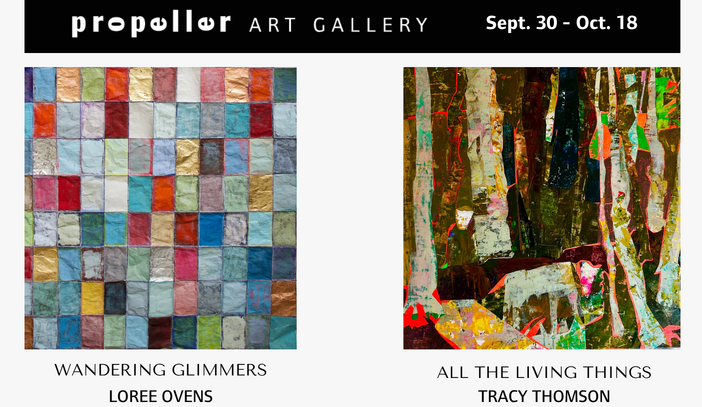
    Abstraction of a different kind is found in Tracy Thomson’s painting In Every Dreamhome A Heartache. It is a delicious balance of colour and composition. In Burn with Reflection Frances Patella crafts an evocative landscape using acrylic paint and photographs. A man seemingly on a stroll through High Park walks towards flames and ash.

    Tracy Thomson, In Every Dreamhome A Heartache, oil on canvas, 48 x 36 in.

    Frances Patella, Burn with Reflection, mixed, photography and acrylic paint on canvas, 18 x 24 in.

    As mentioned, over all the quality of the work is high. There is plenty of talent on display here. It is not truly reflective of the art the gallery has shown over its twenty five years in its three locations – that would be impossible to do. There are also two new members in the exhibition, freshly graduated from OCADU, Leah Probst and Par Nair.

    Par Nair, Hair Etiquette, oil paint on canvas, 40 x 30 in.

    During these years Propeller has had close to 540 exhibitions, so the number of artists who have shown there and the variety of their work is staggering. The current show is reflective of the economic pressures faced by artist-run galleries in general. The Abell Street location is a gem of a place but costly to run in this hypercapitalist world of ours. Consequently they usually have group shows or shows featuring at least two or three artists. So there is little room for risky or theatrical art – nothing in the least throw-away and brazen. One of the reasons why these other collectives I mentioned have died out is that they, at their best, sought out this type of work – unpolished versions of which are easily found among recent art graduates. In other words, by sticking around and founding a permanent gallery Propeller chose a path distinct from these collectives.

    Installation view of Collective Experience at Propeller Art Gallery, August, 2021

    Nonetheless, we have much to be grateful for their success. They are a wonderful resource. May they prosper for the next twenty five years! 

    Hugh Alcock

    Images are courtesy of Propeller Art Gallery

    *Exhibition information: Collective Experience, August 5 – August 29, 2021, The Propeller Art Gallery, 30 Abell St., Toronto. Gallery hours: Wed – Sun 1 – 5:30 pm, and online until November 5, 2021.

  • Beyond Monet

    There’s a new art experience in town: Beyond Monet boasts a “three parts multi-sensory experience anchored in the unbridled pursuit of light that drove this leading figure of Impressionism”. This dazzling exhibition showcases hundreds of works by renowned Impressionist Claude Monet in an immersive format: animated sequences of paintings, a recreation of Monet’s garden in Giverny, and engaging music and sound effects. Visitors feel as if they themselves are inside a Monet painting. Combining instantly recognizable classics with the artist’s lesser-known work, the show brings viewers on a captivating, unique tour of the artist’s magical, iconic oeuvre.

    The entrance of the exhibition is designed to mimic Monet’s garden, with hanging florals and bridges suspended over reflective “pools”. Entering this room felt like stepping into one of Monet’s Water Lily Pond paintings.

    As you walk through the corridor leading you to the next room, the color and light changes around you, capturing the effervescent, ephemeral quality of Monet’s paintings. 

    The final room has a panoramic projection of Monet’s paintings in an animated sequence. One can sit in the pavilion at the centre of the room and watch the paintings move and change around them.

    Bronwen Cox spoke with Fanny Curtat, Art History Consultant, about the behind-the-scenes process of Beyond Monet.

    Fanny Curtat, Art History Consultant at Beyond Monet

    BC: How did you decide to create an exhibition in this format? How did the concept first originate?

    FC: This is the second time we’re taking a crack at this type of exhibit. These kinds of shows have been going on for at least a decade, and I think it’s gaining steam. It’s a great way to immerse the audience, and provide a different access point into the art world for people who might think museums are intimidating. This is a great opportunity to bridge different experiences of the art world. Not necessarily in opposition to a museum; for me, it’s a complimentary experience. People might be hesitant to go to a museum, but here, they may develop a connection with Monet. Next time they’re in a museum, they might be curious to see the original artwork, and enjoy its aura. These experiences have a lot going for them. Especially now, with the pandemic, it’s a great way to see something and be part of a cultural event, while still being spaced out and taking all the precautions. 

    When we created the original Van Gogh exhibition it was during the pandemic. It was very much in the back of our minds to be able to provide an experience for people to have some sense of relief, and to be inspired by artists. Both Van Gogh and Monet, went through struggles and incredible hardship, but that doesn’t show up in their art.

    BC: In what ways do interactive exhibits allow people to engage with art that traditional museums can not? What are the main advantages and disadvantages of this exhibition format?

    FC: The main disadvantage is not having the object, the original painting, not being surrounded by its aura, or able to feel its energy, see the texture and the brushstrokes. What we do have is a great tool to animate the works, to combine many artworks that we couldn’t afford to have in one room. We have over 400 in this exhibition. These experiences allow the audience to see themselves in the art; instead of going toward the artwork, it’s coming toward you. That’s the way it’s helping to bridge that gap between a 19th century body of work and a 21st century audience. It’s also providing a very good experience for visitors to share on social media. They can really be in it.

    BC: How has the pandemic affected this process?

    FC: This is actually the first time I’ve met the team! We’ve been working remotely. The pandemic also affected the presentation format. That’s why the first room, the garden, is meant to be really spread out, like a true garden where you can just wander around and have your own space.

    BC: Did you come across any difficulties that weren’t COVID-related, that you didn’t expect?

    FC: There are a lot of artworks. Monet painted over 2000 oil paintings. Getting through them, accessing high-quality reproductions, getting the rights for them, and the right colors — balancing all of this was a gauntlet. It was worth it, and we knew we were getting into a very prolific body of work, but once you’re in it, you realize there’s so much to choose from. It was a great opportunity but also very challenging. 

    BC: What drew you to Van Gogh and Monet as artists? Since they’re both Impressionists, or Post-impressionists, what was it about that style that drew you to these artists and periods?

    FC: Actually, it’s called Beyond Monet because it’s about going beyond that notoriety. In the case of Van Gogh it’s about going beyond the darkness of the myth. People know more about the ear-cutting incident than his work itself, which shows none of the darkness we attribute to his life. It’s there, but that’s not what he wanted to show us. With Monet, we sort of have this ease with his work. We are so accustomed to it: it’s so beautiful and easily accessible that we forget how radical he was, the sense of freedom in his work, the non-conformism and self-expression, and the pure subjectivity that’s imbued in all his work. Both of them are also easy to animate, because they are already so animated themselves — the brushstrokes, the colors — which are not blended but juxtaposed. All of this is very dynamic, so it’s a very easy fit. 

    Bronwen Cox

    All images are titled, Installation view of Beyond Monet, 2021 and courtesy of Beyond Monet

    *Exhibition information: Beyond Monet, August, 2021 – February 6, 2022, Metro Toronto Convention Centre, North Building, 255 Front St W, Toronto. Exhibition hours: Sun – Thurs 10am – 10pm, Fri – Sat 10am – 11pm.