Author: artoronto

  • Max Dean at Stephen Bulger Gallery

    On the wall of the main gallery and its ante-room hangs a series of photographic tableaux. In the middle of the floor of the main gallery sits an installation sculpture in varying states of disassembly. As well, at the back there is another series of photographic tableaux, together with several mannequins, – or ‘animatronic figures’ as Dean calls them, – which are featured in these photographs. The theme of the show is Dean’s decade-long journey with prostate cancer.

    In a humorous tone, Dean writes that his team – the gang from Ontario Place’s erstwhile Wilderness Ride, i.e., his animatronic figures rescued from there – have been enlisted to help him to explore possible cancer treatments. The figures appear alongside Dean and others in various of the photographs (which are done in collaboration with Andrew Savery-Whiteway). For example, they stand in as the audience in the centerpiece photograph Still – Agnew Clinic, based on a painting by Thomas Eakin of a surgeon’s demonstration. As well, in Meeting the Team, Dean is seen to be about to shake the hand of one of the figures while holding a bloodied replica of his prostate gland behind his back. The replica, made by a plastic 3D-printer and modelled on a scan of his actual prostate, is the central element in the works in the show.   

    Max Dean, Still – Agnew Clinic, 2020, pigment print on archival paper19 ¼ x 28 ¾ in

    Max Dean, Meeting the Team, 2020, pigment print on archival paper, 19 ¼ x 28 ¾ in

    In the centre of the room the visitor walks through the parts of the disassembled sculpture. When assembled the sculpture appears as a large boulder, in virtue of a painted tarpaulin cover. Underneath are several layers of construction. At its very heart sits a replica of the prostate surrounded by twigs and plastic plants. These are deposited in a bin which is cut down in the middle and placed on wheels. The outside of the bin is covered in bouquets of plastic flowers. And around this are placed a couple of domes, again on wheels. The inner dome is comprised mainly of draped clothes, and the outer one of books and cardboard boxes, along with other domestic items. There is online a video featuring Dean and his assistant, McAlister Zeller-Newman, taking off the cover and wheeling the sculpture apart. This room-sized sculpture, Dean tells us, represents his tumor. Clearly it does so as a psychological phenomenon rather than physically, reflecting the fact that the show’s theme is Dean’s coming to terms with the disease.

    Installation view of Max Dean: Still – Living Through Cancer and Covid at Stephen Bulger Gallery

    Through the exhibition Dean relates his personal journey with cancer, and as such the work is autobiographical. He is upfront about his disease and is willing to pose in uncomfortable situations in the photographs, e.g., in Suppository. He leaves little distance between the viewer and himself in this respect. Why is he so candid? Certainly, in conceptual art the body often plays a central role, and indeed that is true of other works by Dean. But more generally, one needs to appreciate that Dean’s art and his life cannot be separated.

    Max Dean, Suppository, 2020, pigment print on archival paper, 19 ¼ x 28 ¾ in

    Even a cursory survey of his career reveals that he is constitutively compelled to make art. The creative process is innate to him. He incessantly turns his life into art. The only way I understand this compulsion is by relating it to Friedrich Nietzsche’s notion of art as life affirming. As he saw it, artists are intoxicated by life – an intoxication (Rausch) through the senses. The artist as such instinctively aims at life, embraces it. For Nietzsche this drive defines the artist – the artist’s exercising of his will.

    Like living itself, Dean understands art to be inherently risky. An introduction to a previous exhibition (I’m Late, I’m Late at Stephen Bulger Gallery, 2016) reads: “Come and join Dean’s journey to the edge of his jungle, ride along perilous mountain roads, walk to the edge of cliffs, and cross vast bodies of water teaming (sic) with ravenous creatures.” Life’s adventures for Dean are through the artistic process. But as he admits, cancer is of a different order. It is, as he puts it, ‘thrust upon us’. Indeed the notion of aleatoric chance as something outside of our own control, of our willing, is addressed by Dean in his Rolling Dice For a Prostate. Even so, Dean aims to conquer the disease psychologically by his art – ‘bringing it over to the positive side’ as he puts it.

    Max Dean, Rolling Dice For a Prostate, 2020, pigment print on archival paper, 19 ¼ x 28 ¾ in

    His intoxication with life helps to explain the optimistic tenor of his show despite its theme. Dean recounts that his doctor told him that he is likely to die of something else before the cancer kills him. Nonetheless, the diagnosis augurs his end, albeit not imminently. In a soon-to-be-released film, Max Still, produced by Katherine Knight, that documents the making of the pieces for this show, Dean reveals this optimism by his very struggle to express it. He observes that every film has a temporal ending: “the projector is going to get turned off, there’s no more footage and the story is over.” But he then adds that he doesn’t want it to end, that somehow he won’t end it. There is no ending, he concludes. While this thought is literally self-contradictory it still expresses a genuine feeling.

    Installation view of Max Dean: Still – Living Through Cancer and Covid with Caged, 2021, collaboration with Andrew Savery-Whiteway (in the center)

    Hugh Alcock

    Images are copyrighted Max Dean/courtesy Stephen Bulger Gallery

    *Exhibition information: Max Dean: Still – Living Through Cancer and Covid, May 1 – August 28, 2021, Stephen Bulger Gallery, 1356 Dundas St. W., Toronto. Gallery hours: Tue – Sat 11 am – 6 pm or by appointment. The exhibition is part of Scotiabank CONTACT Photography Festival.

  • Lisa Johnson at Lonsdale Gallery

    Lisa Johnson’s journey, The Road So Far, has taken her from West Newfoundland to Lake Superior’s Algoma Hills. The proof of its 18-month passage are her oils on canvas at Lonsdale Gallery. Unlike a photographic account, however, the act of painting may compress the memory of 20 years of impressions into the works. Her expressionistic approach also makes the distance between paint palette and canvas significant – as literal and psychological spaces. Johnson’s ability to weave easily between these inner and outer dimensions grounds her work, making the message of her medium equal to its content.

    Installation view of Lisa Johnson, The Road So Far at Lonsdale Gallery

    An example of this dimensional tug of war is one of her larger works, Foothold. We might infer from the title that the rocky perch that yielded the sketch had been precarious, if not dangerous. Equally plausible is that the painting, as it developed in the studio, was pushed to the brink of abstraction without losing its “foothold” of the literal landscape. Here, sky, foliage, and rock are roped into a knotted matrix of tans, reds, and oranges, aided by twisted strings of coniferous trees. Still reading as a landscape, an equivalency of forms has been achieved, permitting a free association in the reading of its parts. Foothold is as much a mental landscape as a literal one. As a Rorschach, viewers are free to supply their own associations.

    Foothold, 2020, oil on canvas, 40 x 60 inches

    The expanding vista of Into the Wild presents a banquet of colour. Its panorama is a jigsaw of inter-locking forms. Here, the distance from palette to canvas seems immediate, spontaneous daubs and patches having little correspondence with what it depicted. Like an enormous layer cake, the painting rises gently at its midpoint. In the freshness of its application, the artist seems to have made the painting perpetually ready to serve for the viewer.

    Into the Wild, 2020, oil on canvas, 48 x 72 inches

    With the cool, steel greys and pale brown of The Bay, Johnson captures a gusty moment on a rocky outcrop. Its a vibrant transcription of the pleasures of the Canadian wilds. The work is a validation of the painterly ground that the Group of Seven so successfully mined – the French Impressionists before them. From generation to generation, the landscape continues as a trusted lodestone for artists. The genre has been generous enough to provide a seat at its canvas-stretched table for all comers.

    The Bay, 2020, oil on canvas, 30 x 36 inches

    Steve Rockwell

    Images are courtesy of Lonsdale Gallery

    *Exhibition information: Lisa Johnson, The Road So Far, July 2 – August 21, 2021, Lonsdale Gallery, 410 Spadina Road, Toronto. Gallery hours: Wed – Sat, 11 am – 5 pm or by appointment.

  • Geoff McFetridge at Cooper Cole Gallery

    In times of isolation, even the most mundane of interactions feels significant and exceptional. Geoff McFetridge’s solo exhibition, Us As A Landscape, Recent Figures for the Film My Blue Suit, displays the artist’s paintings of people in public spaces. In elevating everyday moments as visual art, McFetridge’s figures explore the connectedness and unfamiliarity of strangers. Bringing them to the gallery’s space gives visitors a chance to meet them and build their own narratives.

    Geoff McFetridge: Us As A Landscape, Recent Figures for the Film My Blue Suit. Installation view, Cooper Cole Gallery, Toronto, 2021

    The exhibition is comprised of a series of images of people featured in My Blue Suit, a short film made by McFetridge, depicting stylized, painted figures in still settings. The figures inhabit various interiors or landscapes, and their unique, expressive poses mimic the shape of the backgrounds in which they are placed.

    The artist’s style is bold and colorful, using simplified, flat forms and stylized details. His figures are inspired by the film’s landscape and the folds of their clothes resemble its outlines. By skirting around figuration and individualized features, the figures are painterly and dynamic, dreamy and peaceful. Set against blank backgrounds, they jump out at the viewer, instantly catching their attention.

    Geoff McFetridge: Us As A Landscape, Recent Figures for the Film My Blue Suit. Installation view, Cooper Cole Gallery, Toronto, 2021

    The blank backgrounds evoke feelings of introspection, and their starkness simultaneously suggests isolation and separation. Many of McFetridge’s subjects are positioned horizontally, creating incredibly intimate and candid moments juxtaposed with unfamiliar faceless figures.

    McFetridge’s work explores how images exist “in-between or outside of language, …. [encouraging] more open-minded approaches to cognition”. Fusing poetry and form, playing up the ambiguity of subject matter, the artist’s work highlights the interconnectedness of people in public spaces.

    Geoff McFetridge: Us As A Landscape, Recent Figures for the Film My Blue Suit. Installation view, Cooper Cole Gallery, Toronto, 2021

    McFetridge’s practice is built upon memory and quick sketches and gouache paintings made in his sketchbook. He starts by drawing shapes of bodies and experimenting with how they interact with one another. Through this artistic method he gradually refines and simplifies his compositions. Cooper Cole Gallery describes his practice: “To look at his studies and paintings is to witness a process of adjusting and fitting forms with one another visually and conceptually. McFetridge sees this as an almost mechanical process, whereby the components of his images are functional pieces that come together into something that is highly legible to a broad audience, though without a specific narrative.”

    Geoff McFetridge, In The Cracks of a Dream We See The Waking World, 2021

    By playing with stylization and abstraction, McFetridge’s work becomes self-referential, drawing attention to its two-dimensionality and painterly construction. The folds in the figures’ clothing are not real folding of fabrics, but a painting thereof. McFetridge does not enchant or deceive, but confronts the viewer instantly with frankness.

    Bronwen Cox

    Images are courtesy of Cooper Cole Gallery

    *Exhibition information: Geoff McFetridge, Us As A Landscape, Recent Figures for the Film My Blue Suit, June 18 – July 24, 2021, Cooper Cole Gallery, 1136 Dupont St, Toronto.

  • FIRE AND DUST at United Contemporary

    Browsing through Scotiabank CONTACT Photography Festival’s website Fire and Dust caught my eye at first glance. What strange pictures! Ryan Van Der Hout’s dark, monochromatic photographs create an inescapable mood of death and sadness, but having Amanda Arcuri’s colorful pieces displayed with them gives hope—at least for a short time, until we see what it’s all about. Fire and death – again. After looking at the whole exhibit it is hard to decide whose photographs are more disturbing.

    Burke Paterson, Director of United Contemporary curated this show and pinpointed its connection to our current situation with COVID, as a period of great upheaval. He starts the gallery’s introduction to the exhibition with a question, “What happens to the artifacts of the civilized world when they no longer serve a purpose? Are they burned to the ground or left to collect dust?” This question goes back centuries and is not an easy one to answer. However, in their exhibition, Arcuri and Van Der Hout give a “unique yet complementary interpretation of destruction as a form of creation”.

    Installation view of Fire and Dust at United Contemporary, 2021

    The two Toronto based artists met through their education and as Van Der Hout said recently on United Contemporary’s Instagram, they were brought together by similar subject matter: the darkness, the lightness and destruction. Their processes are related and Van Der Hout was interested in how their work would show together.

    Fire in the title of the show stands for Amanda Arcuri’s work as each piece depicts flowers on fire. All the images are beautiful in their vivid colors but looking at them still gives me mixed feelings. Fire is an ambiguous symbol. Humans have always been amazed by it. We give the flames the status of a god, and admire it more than fear it. But fire is a two-faced god, giving life on one hand, but also taking it. It also has a cleansing power; in some places people burn the undergrowth and unwanted vegetation each year so it will enrich the soil for next year’s crops. Fire is also a metaphor for death and rebirth. One of the best examples of it is the phoenix, a mythological bird that dies in flames and then is reborn from its own ashes.

    Amanda Arcuri, A Shot in the Dark 17 (The Rianbow), 2020, dibond mounted, C-Print, 30” x 24”

    A major part of Arcuri’s exhibited work is the series A Shot in the Dark, that won her the Best Photography and Digital Media Award at the Toronto Outdoor Show in 2019. This work began in 2018 when she was still able to collaborate with a lab. Arcuri said that this series she worked “through failed hopes and rituals of letting go or bringing new life”. When some of the flowers she received as birthday gifts withered, she wrote on Instagram that sometimes you just need to let some things die. The tulips (A Shot in the Dark 07) and irises (A Shot in the Dark 15) are still beautiful even as they decline. They seem to be dying with such grace. In another photograph (A Shot in the Dark 02), the leaves of a plant and the fire consuming it create a rather attractive, imaginary flower.

    Amanda Arcuri, A Shot in the Dark 02, 2018, C-Print, White Shadow Box Frame. 12” x 15”; 17” x 20″ with frame

    In A Shot in the Dark series dead floral bouquets or plants are ignited by flame in darkness and then lit through a stained-glass window to contemplate transcendence. Arcuri only makes two shots of each on large format film. She said about her subject matter that “there is something about the texture of dried or dying plants that gets me every-time.” Her place is filled with flowers waiting to be photographed and she finds herself attached to them—she just can’t let them go. When asked if she arranges the flowers for the shots, she said, that she never touches them but leaves them in the same position they were when they died. She admires the hand of nature in their wilting and thinks it “shows more emotion and heaviness” than she could impose on them.

    Each flower is unique and they react to fire in different ways. For example, dried roses burn at the tips of their petals and leaves and water droplets hidden in them explode in little stars. She also finds it very interesting how flowers move slightly from the first burn to the second, creating a real vs. not real, sometimes even surrealistic look. A Shot in the Dark 11 is a wonderful example of this. The dried-out bouquet is a beautiful arrangement of roses, wild flowers and decorative plants—very life-like with their vibrant colors. However, the flames burn brighter than any of the colors, since it has a different, living quality. This particular photograph captures movements in the flames of the fire and the fall of some flowers, caused by the burning.

    Amanda Arcuri, A Shot in the Dark 11, 2019, C-Print with Plexi Pink Frame, 50” x 40”

    The Remix series was created during the COVID lockdown, so Arcuri had to invent a different method. It is a continuation of the work in A Shot in the Dark series, but re-worked as the title suggests. “Remixing” two negatives of her older shots created colours that mimicked oil paintings, and, as she said, almost look infected. Comparing the images of A Shot in the Dark 11 and Remix 01, we can see the differences clearly. The colours of flowers in the earlier piece look real, even when touched by the fire, while in the second they are metallic, almost ice-like colours, even though the fire is consuming them. They are further from real, almost to the point of being abstract. In Arcuri’s work, as Burke Paterson commented in the Artist Talk (June 29, 2021), fire is disturbing the peace but the light brings it back.

    Amanda Arcuri, Remix 01, 2020, Archival Digital Print on Rag Paper, White Shadow Box Frame, 12” x 12”; 17” x 17” with frame

    Van Der Hout works are philosophical questions of life and death, focusing on the afterlife. Does it exist at all? What happens after falling into the abyss? His images depict objects that are already dead and covered with black dust. Death is unmistakable and final here. As the gallery introduction states, they remind us of the relics of Pompeii. The artists explains that he was six years old when his parents went to Pompeii and brought back “photos of a society encapsulated in rock and dust”. Those dramatic depictions stayed with him and influenced his latest series Collecting dust where he tries to “imagine what art looks like after us, what is time after time” and what future generations will see in his work. This series was created during the COVID lockdown and that explains their dark vision.

    Ryan Van Der Hout, Ascension, 2021, Archival Pigment Print, 24” x 20”

    Van Der Hout’s work indeed reminds us of Pompeii’s remains. These images are manifestations of how everything perishes and enters the afterlife (if there is one) or remains dusty and overlooked, considered as memento moris. They are nothing like a classical still-life, but more like, as the gallery states, ”natures morte”. They tell a story about the passage from past and present to the future, and we are looking at these images as though we are part of the future. Beyond their aesthetic appearance, we still keep wondering about their hidden narrative.

    Ryan Van Der Hout, Extinguished, 2021, Archival Pigment Print, 50” x 40”

    Van Der Hout’s compositions are reminiscent of Dutch vanitas paintings as they are very layered and heavy with symbolism. Feast (2021) is one of his most still-life-looking images, including many meaningful symbols. The skull represents death and mortality, as we all die, but without death life would be meaningless. Grapes are for fertility, so life will go on. Roses are more complex symbols as they combine death and renewal, while butterflies promise rebirth. All covered with black dust they are, without any doubt, dead, but some hide a hint of hope.

    Ryan Van Der Hout, Feast, 2021, Archival Pigment Print, 24” x 20”

    Three Graces (2021) is different from the other photographs since it is centralized around a sculpture of the three graces. Talking about his composing method in the Artist Talk, Van Der Hout said that handling an art object (even a copy) is very important for him, not just because of what it embodies but also the feelings it evokes in him. In this photograph the bust on the left side and the three graces represent beauty and show how art is timeless. There is a book for knowledge, as printed words survive the ages, grapes for fertility and a pitcher and glass bottle for drinks in good times.

    Ryan Van Der Hout, Three Graces, 2021, Archival Pigment Print, 10” x 8”

    As the artist mentioned, his works are all about transformation and, often, destruction. However, while the objects in his photographs are transformed from life to death, from light to dark, they are still not destroyed as they forever encapsulate their meanings and beauty.

    In United Contemporary’s exhibition, Arcuri’s and Van Der Hout’s images hang side by side, mixed together instead of separated by artists. Arcuri’s brilliant colors pop out when paired with Van Der Hout’s monochromatic compositions. Together they generate a dynamic opposition, that both unites and highlights their themes.

    Installation view of Fire and Dust with Ryan Van Der Hout, Extinguished (left) and Amanda Arcuri, A Shot in the Dark 11 (right)

    Our outlook on life has been rather dark throughout the last year and a few months. COVID has caused more harm to the mental health of people than in its death toll. Fear is difficult enough, but being locked down, kept away from our loved ones and not being able to live our lives to the fullest has been even more dreadful. The quality of our lives has been reduced. Our cultural entertainment became virtual like an online exhibition. Arcuri’s and Van Der Hout’s work resonate with our state of mind—depression, repression and confusion—wonderfully well. Their photographs engage our minds and shake us to the core – and will stay with us for a long time.

    Emese Krunák-Hajagos

    Images are courtesy of United Contemporary

    *Exhibition information: Amanda Arcuri, Ryan Van Der Hout, Fire and Dust, featured exhibition of Scotiabank CONTACT Photography Festival, June 11 – July 3, 2021, United Contemporary, 1444 Dupont Street, Unit 22, Toronto. Gallery hours: Thursday – Saturday 12 – 6 pm. The artworks can be viewed on the United Contemporary website or you can book a gallery visit

  • Howie Tsui at The Power Plant

    Howie Tsui’s first institutional solo show in Toronto is a partial continuation from the 2020 exhibition, From swelling shadows, we draw our bows. The exhibition features a variety of Tsui’s works, many addressing the artist’s experience growing up between Chinese and Colonial cultures: Hong Kong, Lagos, and Thunder Bay. Tsui’s works incorporate Hongkongese aesthetics and forms of Chinese modern and traditional art, particularly wuxia, to “examine the complexities of diasporic experience and question Chinese monoculturalism”.

    Howie Tsui, Retainers of Anarchy, 2017, 5-channel algorithmic animation sequence, 6-channel audio, 11’1 x 79’ 4 in.

    As soon as you walk into the exhibition, your attention is immediately drawn to Retainers of Anarchy (2017), a five-channel algorithmic animation spanning two full gallery walls. This animation is made of various hand-painted ink drawings, with a background inspired by the animated scroll River of Wisdom (2010). Instead of River of Wisdom’s idyllic marketplace setting, this work is placed in the Kowloon Walled City, a tenement in the fringes of British-occupied Hong Kong from 1898 to 1994, once considered the densest place on Earth and known by locals as the “city of darkness”. Besides its enormous scale, this work is detailed and complex, presenting various narratives simultaneously through its animation. With its juxtaposed inspiration and subject material, Tsui creates a dialogue between China’s Golden Age and current regime, characterized by civil unrest and oppression, especially in Hong Kong.

    Howie Tsui, detail from Retainers of Anarchy, 2017, 5-channel algorithmic animation sequence, 6-channel audio, 11’1 x 79’ 4 in.

    One of Tsui’s lightbox works, The peel, the bark, the tome (White Camel Mountain), incorporates tactile materials to allude to traditional practices. Here, the artist uses goat parchment to bring to mind the parchment used for sacred texts, ancient manuscripts, and war manuals. In particular, this references Nine Yin Manual, a fictional martial arts manual said to have been etched onto human skin. The work depicts a scene of human and animal-human figures, drawn in the wuxia style, a form of martial arts literature popular in 20th-century China. The brushstrokes, delicate and light, are reminiscent of traditional calligraphy. This artwork blends contemporary and historic Chinese styles to create a timeless, unique piece.

    Howie Tsui, The peel, the bark, the tome (White Camel Mountain), 2019, acrylic ink on goat parchment in lightbox, 55 x 43.5 x 3 in. Courtesy the artist and Patel Brown Gallery, Toronto.

    Other methods of experimentation Tsui uses are those of smoke staining, impression making, and automatic drawing techniques. These practices result in haunting, transient characters in A Geomantic Corridor, where the figures are said to “suggest persecuted and disappearing dissidents, haunting Hong Kong streets”.

    Howie Tsui, A Geomantic Corridor, 2020, calligraphy ink, acrylic paint, xuan paper, matches, joss sticks, incense coils, bagua mirrors

    Parallax Chambers (2018-ongoing), a single-channel animation, depicts characters from Retainers of Anarchy. In this work, unlike Retainers of Anarchy, the artist utilizes darker, bolder colours and a smaller frame, squeezing the action into one small channel. These effects, coupled with the intense, emotive depictions, create a more dramatic, unsettling narrative.

    Howie Tsui, Parallax Chambers, 2018-ongoing, single-channel algorithmic animation sequence, audio, dimensions variable. Courtesy the artist and Patel Brown Gallery, Toronto.

    One of the artist’s lenticular prints, Three Greats, as well as Joyride and Winged Assassin, are painted in TV-esque shape, tone, and glow, influenced by his source material of martial arts movies. Like Parallax Chambers, each painting depicts characters found in various channels of Retainers of Anarchy. These scenes are captivating and dynamic, picturing their heroes in a variety of styles. The most colorful of the three, Three Greats is disconcerting and intense, inviting the viewer into a surreal, shadowy world.

    Howie Tsui, Three Greats, 2018, lenticular print in lightbox, 25 x 25 x 2.5 in. Courtesy the artist and Patel Brown Gallery, Toronto.

    From swelling shadows, we draw our bows invites the viewer to enter a world on the fringe of reality and imagination. Tsui’s ability to involve history, life experience, and imagination simultaneously through various medias, creates an intriguing exhibition at The Power Plant.

    Howie Tsui, Retainers of Anarchy, 2017, 5-channel algorithmic animation sequence, 6-channel audio, 11’1 x 79’ 4 in.

    Bronwen Cox

    Images are courtesy of The Power Plant and Installation views: From swelling shadows, we draw our bows, The Power Plant, Toronto, 2020. Photo: Toni Hafkenscheid.

    *Exhibition information: Howie Tsui, From swelling shadows, we draw our bows, September 26, 2020 – Summer, 2021, The Power Plant, 231 Queens Quay West Toronto.

  • Urban life and the pandemic @ CONTACT

    Will life return to how it was before 2020? How will it feel to be in a city next year, and subsequent years? Our relationship to the urban environment has been completely upended during the pandemic. I found three photo exhibits, part of the Scotiabank CONTACT Photography Festival, that spur reflection on this changed relationship to the city. 

    The shows present three different perspectives on the urban experience, perspectives impacted and altered by COVID. First, in the absence of people, the material qualities of the city have moved to the forefront of our experience. Second, in empty spaces, we share a romanticized longing for jostling crowds. Finally, due to the necessity of physical distancing, there has been a profound change in how we interact with others.

    For a while, Toronto was a ghost town. Early in the pandemic, once bustling places became eerily vacant. In the absence of people, materials and structures become the salient features of the city. Notice the surfaces, and you see the history of wear and weathering. You see that everything is somewhere on the path to dissolution. Gordon Wenzel’s series ‘globanomics’ explores the colours and textures of scarred materials that make up much of the urban environment. Wenzel’s work focuses on the broken and disused. As Wenzel puts it: “time’s erosion of natural elements ultimately has the final word on progress”.

    Gordon Wenzel, vapor trails, 2021, giclee print, 23.98” x 23.98”

    Each piece in the globanomics series is comprised of three photos. The constituent images relate to each other through colour and geometry and draw our attention to textures and patterns. The close cropping and variation in scale focuses our gaze on the surfaces. It is the worn materials that become the story – the story that the city tells when people are absent.

    Gordon Wenzel, airborne #3, 2021, giclee print, 23.98” x 23.98”

    Do you miss crowds? Even if a throng of people was not your thing, a wistful glow now surrounds the idea of busy urban life. Our shared sense of nostalgia is reflected in Shaleen Ladha’s photographs. Her collection A Tale of Two Cities explores the urban centres of New York and Tokyo. It is not just the subject matter that makes these pictures nostalgic, it’s also the technique. The images have the high contrast, shaky feel of old snapshots. Notably, these are the kind of pictures modern phones and cameras with automatic settings are too ‘smart’ to let us easily produce. Manual settings are required to produce this spontaneous snapshot appearance. These blurred, bright and colourful photos capture the frenetic energy of busy streets, the life that so many of us yearn to return to. 

    Shaleen Ladha, Times Square – New York, 20” x 16”

    Shaleen Ladha, Shibuya Crossing – Shibuya, Tokyo, 20” x 16”

    Stathis Vlahos also uses long exposures to distort images and blur subjects. But in his case, the result is very different. Vlahos uses the blurs and smears of motion to convey a sense of mystery and in some cases fear and anxiety. The motion of the camera and the movement of people cause figures to dissolve into their surroundings. He calls this collection of images City Spirits – an apt title as his subjects often appear semi-transparent and ephemeral.

    Stathis Vlahos, Untitled 9, 2020

    Vlahos’ images are evocative and can be interpreted in several ways. Do these spirits represent the fear and distance we have been putting between ourselves and others? Do they represent lost relationships? Lost lives? Or do they perhaps reflect our own transitory existence? They remain compelling yet mysterious.

    Stathis Vlahos, Untitled 3, 2020

    We don’t know the degree to which the pandemic will impact urban life in the long run. Will there be permanent changes, or will things revert to how they were in 2019? Right now, COVID permeates most of what we see and do – and how we think. It affects the meaning of these photographs regardless of the intention of the artists. In the future, these images may evoke different associations and reactions. It is the nature of art that it does not simply convey one message. The ambiguity in art nudges us to challenge our preconceptions. It allows us to see the world with fresh eyes. 

    Mikael Sandblom

    Images are courtesy of Scotiabank CONTACT Photography Festival

    *Exhibition information: this year’s Scotiabank CONTACT Photography Festival has mostly moved online. A small consolation is that the work will be viewable for longer. This article covers three virtual exhibitions: Gordon Wenzel, globanomics, Shaleen Ladha, A tale of two cities and Stathis Vlahos, City spirits.

  • Manuel Mathieu at The Power Plant

    The Power Plant presents World Discovered Under Other Skies, Manuel Mathieu’s first institutional exhibition in Toronto. This exhibition, largely comprised of the artist’s complex, larger-than-life paintings, features media less commonly exhibited by Mathieu, including drawings, ceramics and textiles created over the course of his career. “Underlining common links and struggles that unite us despite national borders, [Mathieu] invites us to enter a world discovered under other skies.”

    Manuel Mathieu: World Discovered Under Other Skies. Installation view: The Power Plant, Toronto, 2020-21.

    Born in Port-au-Prince and based in Montreal, Manuel Mathieu studied at Universitè du Québec à Montréal and Goldsmiths, University of London. He has participated in various group and solo exhibitions all over the world, including the Montreal Museum of Fine Arts, HDM Gallery, Beijing, Grand Palais, Paris, and Art Basel among others. Most of Mathieu’s work draw inspiration from his homeland, Haiti, depicting political, personal, and historical subjects. His style lies between abstraction and figuration, combining bold shapes and lines with muted, earthy tones. His works are powerful and expressive, emotional and narrative.

    Manuel Mathieu: World Discovered Under Other Skies. Installation view: The Power Plant, Toronto, 2020-21.

    Mathieu’s works reflect universal ideas of yearning for liberation and resistance to imperialism and capitalism, concepts epitomized by Haiti’s past and present. The exhibition reveals Haiti’s relationship to the world, its rich, complex history, and its current state. Within his works, Mathieu explores themes such as the lasting effects of Haiti’s revolt in 1791, American and European neo-colonial presence within the country, and the Duvalier dictatorships (1957-86). Mathieu connects history with present day, politics with personal life, peace and violence, evoking a sense of unity and interconnectedness that defies national borders and the passing of time.

    Manuel Mathieu: World Discovered Under Other Skies. Installation view: The Power Plant, Toronto, 2020-21.

    This exhibition features several of Mathieu’s drawings. These dynamic, hazy works are non-narrative and rather experimentational, as explained by The Power Plant. With these sketches, Mathieu explores various motifs, techniques, and materials. In Somatic (2020), he attempts to convey the motion of a body on paper, using his hands to smear pigment over paper to evoke dancing and the sound of drums, that are, as he explains “integral to Haitian culture”.

    Manuel Mathieu: World Discovered Under Other Skies. Installation view: The Power Plant, Toronto, 2020-21.

    In Resilience – a Landscape of Desire, Mathieu departs from his usual medium of painting and uses the canvas as a found object. This piece conveys the idea of resilience: “taking inventory of what remains of oneself, a place after surviving adversity”. This work, fragile and hardy, brings to mind both strength and suffering, its material ripped, stained, and barely connected, but still holding together.

    Manuel Mathieu, Resilience – a Landscape of Desire, 2020-21.

    World Discovered Under Other Skies also features the artist’s ceramic works, publicly exhibited the first time. These works are largely influenced by Haitian ceramic artists such as Georges Liautaud and Murat Berriere, in their two-dimensionality and stylized designs. The majority of Mathieu’s ceramics are monochromatic, allowing for emphasis on their bold, abstracted shapes. Their forms are ambiguous, and each work exists both as an individual piece and as part of a collection. They vary from animal and human forms, natural motifs, and geographical shapes. While first appearing quite simple, these works are complex and surreal, defying any easy interpretation.

    Manuel Mathieu: World Discovered Under Other Skies. Installation view: The Power Plant, Toronto, 2020-21.

    This exhibitionis an extensive overview of some of Mathieu’s most fascinating works. Combining global and personal experience, simple and complex designs, and figurative and abstracted subjects, Mathieu’s multimedia solo exhibition invites viewers to enter a “world discovered under other skies”.

    Bronwen Cox

    Images are courtesy of The Power Plant. Photo: Toni Hafkenscheid

    *Exhibition information: Manuel Mathieu: World Discovered Under Other Skies, September 26, 2020 – Summer 2021, The Power Plant, 231 Queens Quay West, Toronto.

  • Georgia Dickie at Cooper Cole Gallery

    The exact moment that an object becomes art is highly subjective and is without a definitive or singular answer. Is it when an object is chosen with artistic purpose in mind? Or is it when the object’s original function is abandoned? Could the final transition be the labeling of the object as ‘sculpture’? And if so, who has the authority to do this labeling? The questions go on. Magdalyn Asimakis asks in her conversation with Georgia Dickie, the artist of Jerky Out, Gnar In, “Where does an object stop and the sculpture begin?”

    Cooper Cole Gallery states that Dickie’s artistic practice starts with the collection of discarded objects and the assembly of these found materials to create her art. Among these objects, the most surprising for me in this show are plastic crow’s feet, measuring spoons, a tiny plastic foot, a prescription bottle, an Air Canada sticker, and a laundry basket. According to Cooper Cole Gallery, the objects in Dickie’s assemblages ignore the original values assigned to them and this purposefully creates new relationships between materials. The press release continues explaining that Dickie’s works appear physically and conceptually precarious and that the works remain liminal, as the objects are continually being adjusted over periods of time including during their installation.

    Georgia Dickie, Privet, 2021, found objects, metal, ceramic plate, shop towel, apple core, paper bag, plastic bin, plastic bag, metronome, foam, and glue, dimensions variable

    Dickie explains that she brings the found materials to her studio space and that she lets them, “come to room temperature” as they need to settle within the new space. She continues saying that sometimes the objects will come into a work quickly and other times they can wait for over ten years. Dickie mentioned that her artistic practice is heavily based on intuition and that she cannot pinpoint exactly how she makes decisions but that they can be based on her mood, the news, and other factors that she may not even be aware of.

    Dickie says that themes emerge from the work rather than being planned out beforehand. Cooper Cole Gallery points to the rejection of linear narratives, of essentializing categories, and of capitalist growth models; emphasizing Dickie’s use of the discarded products of hyper-consumerist culture. This methodology embodies a deep environmental consciousness.

    Installation view of Georgia Dickie, Jerky Out, Gnar In at Cooper Cole Gallery

    Jerky Out, Gnar In was assembled during the COVID-19 pandemic. Dickie mentioned that she primarily traveled from her apartment to her studio which led her to pay closer attention to her familiar route. She became more aware of her own neighborhood and the kinds of objects in her vicinity that she had been overlooking.

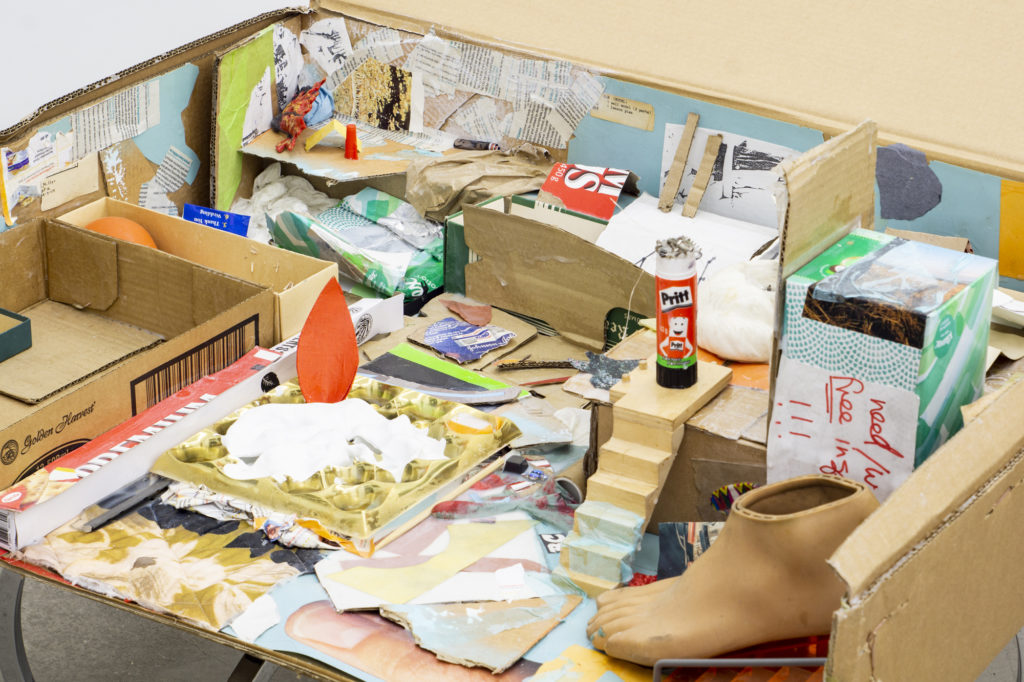
    Dickie said that Maquette for Dream Home was her way of getting as close to the feeling of playing make-believe as possible. A maquette is a model for a larger piece of sculpture, created to aid in the planning of how a final piece will be assembled and how it will look when it is finished (tate.org.uk). Dickie creates a surreal world on top of the table, an escape from reality made up of the remnants of the world that actually exists. The process-based aspect of her practice is apparent in this piece as the final installation includes the hi hat cymbals that held up the piece while she was working on it. She felt as though it was part of the piece and should not be separated.

    Georgia Dickie, Maquette for Dream Home, 2021, cardboard box, found objects, glue, hi-hat cymbal and stand, and found metal base. Cardboard box: 12 x 37.5 x 29 inches Base: 16 x 33 x 33 inches Hi-hat and stand: 41 x 22 x 25 inches (above) and detail (below)

    Some of the works shows Dickie’s engagement with chaos, entropy, containment, and impermanence, as Cooper Cole Gallery explains. When she chooses flimsy materials, that would not stand by their own, Dickie applies layers of adhesive which makes their forms permanent. Maintenance appears as a ripped and taped up paper bag overfilled with papers that will spill over any moment but the work is solidified with glue. The title gives the viewer more to ponder than what can be seen, as maintenance is the process of maintaining or preserving something, perhaps speaking more to Dickie’s process of gluing rather than to the unchangeable final product.

    Georgia Dickie, Maintenance, 2020, Paper bag with mixed media contents and glue, 8″ X 14.75″ X 10.5″

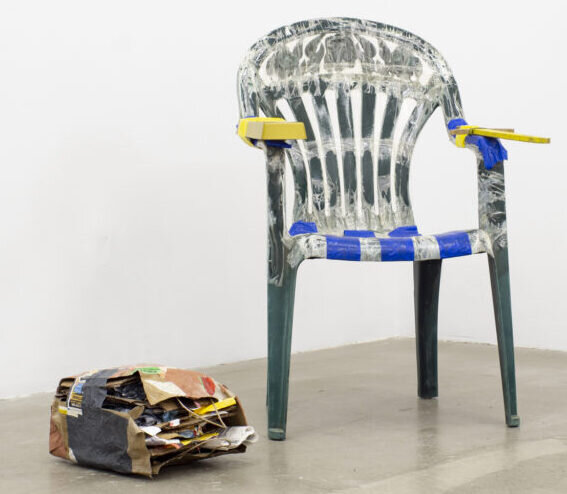
    A readymade plastic chair and its added parts, named Moment of Serious Poignancy (Throne), is captivating because of its title. Dickie explained that the naming of her works is similar to writing poems which are primarily based on how certain words sound and look good together. Reading the titles of the works while viewing this show gave these assemblages added charm.

    Georgia Dickie, Moment of Serious Poignancy (Throne), 2021, Found objects, plastic, chair, and tape, 37″ X 24″ X 32″ (with Maintenance, on the left)

    Dickie’s works are stimulating both visually and conceptually. Wood, metal, plastic, paper, among various other materials create dynamic pieces. In the modern world where there is a rapidly inclining amount of discarded items these kinds of materials are taletellers of our experiences of everyday life, unveiling our expectations of the items that we quickly consume and then discard. Dickie’s works, as Cooper Cole Gallery states, subverts the way that we relate to objects and what we think sculpture is.

    Olivia Musselwhite

    Images are courtesy of Cooper Cole Gallery

    *Exhibition information: Georgia Dickie, Jerky Out, Gnar In, March 6 – June 12, 2021, 1134 Dupont Street, Toronto.

  • Three Photographers at Elaine Fleck Gallery

    Online and in its front gallery the Elaine Fleck Gallery has featured the work of Three Photographers, one of whom is Gary Ray Rush, whose work will be our focus. The other two are Bill Hornbostel and Ben Huang. Hornbostel has produced beautiful lush colour photographs of Toronto landmarks, e.g., Kensington Market.

    Bill Hornbostel, Kensington Market

    Huang’s photographs are the result of several trips to Japan. They document 400 km of seawalls whose construction was motivated by the devastating tsunami that hit Fukushima in 2011. They possess a haunting starkness in their austerity.

    Ben Huang, Seawall #4, Rikuzentakata

    Rush is a veteran photographer who has made a living from the trade as well as teaching. All the time he has dedicated himself to photography as an artform as well. Here he showcases several bodies of artwork. First and foremost, there are around nine black and white prints of various views of the largely mothballed Ontario Place. The second is a series of high resolution colour photographs of vintage cameras. Thirdly, there is a miscellany of other scenes ranging in subject matter from Toronto’s skyline to the pier at La Jolla, California. The exhibitions primary focus is on the first of these bodies of work.
    Gary Ray Rush, Cinesphere 2, 2021, archival ink pigment print, 30 x 40 inches, edition 1/10

    Rush’s choice of Ontario Place is not accidental. He explains that in his youth he went with his family to visit the newly opened facility down by the waterfront in Toronto. Ontario Place opened in May 1971. Recently Rush came across photos from that visit and this rekindled his interest in the site. He ended up spending a day there this past January, and then returned to the site several more times in February and March to take the shots that we see in the show.

    All the pictures are in black and white. He centred his gaze on several of the site’s signature structures, such as the geodesic dome which houses the IMAX cinesphere. He also chose to shoot the so-called ‘pier one’ on the lake. The latter subject has produced some especially atmospheric images, e.g., Pier Ship. The atmosphere is partly explained by the conspicuous softness of the water and sky. This results from Rush’s technique of using very long exposure times – several minutes long in fact. The effect is to smooth out anything that moves, and that of course includes the clouds and the lake’s surface.

    Gary Ray Rush, Pier Ship, 2021, archival ink pigment print, 30 x 60 inches, edition 1/10

    This same technique and effect are evident in his shots of the site’s buildings, where the clouds behind them lose their definition and appear as smears across the sky. But the craft does not end there. Once Rush has the raw photographs he uses software to manipulate the images. He subtly darkens or lightens certain areas of the images, thereby emphasizing or downplaying certain details. Indeed, this addition of software manipulation has moved photography one step closer to painting. The photographer adopts the painter’s role of controlling the overall composition by means of emphasis in this manner. One can imagine how the same considerations would have been entertained by the classical landscape painter Claude Lorrain, for example, when deciding how much detail he added to the foliage in various regions of his complex compositions. 

    Gary Ray Rush, Ontario Place Is The Place To Be, 2021, archival ink pigment print, 30 x 60 inches, edition 1/10

    What strikes me about Rush’s work is the centrality of the theme of time. His images of Ontario Place derive their significance from the past, from his childhood recollections of it. The great filmmaker Andrei Tarkovsky explained this idea beautifully. He wrote: “In a sense the past is far more real, or at least at any rate more stable, more resilient than the present. The present slips and vanishes like sand between our fingers, acquiring material weight only in recollection.” (Sculpting in Time, p. 58). The fact that the buildings he shoots, e.g., in his Ontario Place Is The Place To Be and Two Pods, are erstwhile attempts at futuristic architecture adds poignancy to this idea. What Rush gives us is his perspective on the present Ontario Place, as determined by his memories of it.

    Gary Ray Rush, Two Pods, 2021, archival ink pigment print, 30 x 40 inches, edition 1/10

    As well his long exposure shots effectively illustrate the present slipping away like sand through one’s fingers. It reflects more accurately our lived experience, where we can never fix on nature that it continually changes from moment to moment. Ordinarily with fast shutter speeds the camera can fix each moment, but then that moment is no longer alive – it becomes a dead vestige of the evanescent present. Slowing down the shutter speed so dramatically enables Rush to suggest the passage of time, to gesture at our subjective experience of time. And there is nothing more subjective than our memories.

    Gary Ray Rush, Toronto City Hall Iconized, 2021, archival ink pigment print, 26.7 x 48 inches, edition 1/10

    All told these are masterful works of photography. While focusing on his personal experience Rush has nevertheless managed to express something of universal significance. The exhibition is well worth visiting on the gallery’s website.

    Hugh Alcock

    Images are courtesy of Elaine Fleck Gallery

    *Exhibition information: Three Photographers, May 2021, Elaine Fleck Gallery, 1351 Queen Street West, Toronto.

  • Diana Lynn VanderMeulen at Sky Fine Foods

    How do you keep art fun when it feels so out of reach, locked behind pandemic restrictions and gallery doors? This seemingly impossible question has been answered by Shimmer of a Petal, Now a Mountain Stream, Diana Lynn VanderMeulen’s solo exhibition. Presented by Sky Fine Foods, Shimmer of a Petal is available in a buffet of delivery systems, reflective of current pandemic-related needs as well as the spirit of the exhibition. Twitch streams, the virtual gallery in ArtGate VR, Youtube videos, still images on their Instagram and website, and even glimpses through the windows at Sky Fine Foods are available to the viewer.

    In the mediums of collage, painting, motion graphics, and 3D modelling tools, VanderMeulen’s artworks belong to the same semi-recognizable fantasy planet—the end result being much like studying the Earth through the lens of a funhouse carnival ride. VanderMeulen’s landscapes are proud members of the uncanny valley. Bright pink skies and lime-green mists are the norms. In colours and textures reminiscent of plastic children’s toys, flowers, plants, rocky terrain, and whimsical baubles form unexpected ecosystems.

    Installation view of Shimmer of a Petal, Now a Mountain Stream, Sky Fine Foods

    The video works of Shimmer of a Petal, in particular, pull the imagination and stretch Earthly limitations. Among the video displays is liquid mirror, a comfortably hypnotic bend of reality. I could stare and stare for hours at the waterscape of liquid mirror—the water a curious viscosity between Jell-O and ocean waves—captivated by the flowing liquid that creeps across the screen. The laws of physics don’t appear to apply here and it is difficult to tell exactly from what perspective the audience views the scene. Normal landscapes are familiar and predictable; the Earthly world is known to us and often represented in works of art. Refreshingly, liquid mirror sheds its predictability and opts for impossibility.

    liquid mirror, HD Video loop, Edition of 10, video still

    Playful, fizzy, sweet, and bright is the addictive delight of Bloom formation I. Neon spritzes of mist float around a handful of large flowers, rocks, and spheres. Dancing among the mist are tiny versions of these flowers, rocks, and spheres—shiny and appealing—so small I want to reach out and grab them to see how small they would look in my palm. One viewer on the artist’s Instagram commented, “i want to drink this pls,” and I think that is the perfect summation.

    Bloom formation I, Giclee on Epson Hot Press, 22″ x 28″, Edition of 10

    Collecting pearls is a particularly playful work, the objects having the smooth plastic-like appeal of children’s toys or the metallic sheen of foil balloons. The pinkish hue of the flowers, water, and sky adds joy to the atmosphere. It is an inventive landscape, yet the angle of the viewer—peering out from between weeds—is faintly familiar and grounds the fanciful scene in Earthly recognition.

    collecting pearls, Giclee on Epson Hot Press, 30” x 22”, Edition of 10.

    From a work with a title like day glow, I had expected a yellowy-golden sunlit surface and a bright sky, but I should have known better than to expect the familiar. The foreground of day glow is coated in a dark substance, that is somehow the texture of solid rock, flowing water, and fog. In a way, the background has that golden light I expected to find in a day glow, with a delicious peachy sunset in the sky. This is a day glow. Not our Earthly kind but this world’s.

    day glow, Giclee on Epson Hot Press, 30” x 22”, Edition of 10.

    It feels to me that since the start of the pandemic I’ve seen a lot of exhibitions and art about invented worlds. Un-Earthly planets, parallel universes, paradisiacal worlds, and shifting ecosystems; these examinations in contemporary art seem to crop up more and more everyday. Could I be the one imposing this viewpoint on the artworks I look at? Or are artists, motivated by a pandemic, consciously reexamining this world through invented ones? Maybe it is the whole of society, reeling from the unreckonable transformation of the globe, unable to consider any subject but this.

    I would certainly include Shimmer of a Petal on my list of such imagined-worlds. Where it differs from the rest is in its lighthearted, whimsical telling of the alarming story that is embracing the unknown. Unpredictable perspectives and limitless landscapes cue our instincts to fear what we don’t know. Yet, I don’t really fear it, not here. In fact, I would love to spend a day in one of these scenes, disconnecting from my Earthly stresses and immersing myself in the new and unfamiliar sights of VanderMeulen’s world.

    seaweed garden, Giclee on Epson Hot Press, 30” x 22”, Edition of 10.

    Olivia Mariko Hsuen-Ferris

    Images are courtesy of Sky Fine Foods

    *Exhibition information: Diana Lynn VanderMeulen, ??????? ?? ? ?????, ??? ? ???????? ??????, April 15 – July 15 202, Sky Fine Foods, 1867 Davenport Rd, Toronto.

  • Iris Häussler at Daniel Faria Gallery

    Archiving is sterile work, with its goal typically being to isolate objects from people’s hands and from other agents of deterioration, encapsulating them in pristine conditions such as plastic sleeves and glass cases and assigned a place in a strict organizational system. These methods preserve physical materials but can also create barriers between people and artifacts, inhibiting viewer interactions with the physical past. Having worked as an archival technician myself, the way that Iris Häussler archives materials peaks my interest as it opens up alternative methods of recording tangible history.

    Installation view of Iris Häussler, Archivio Milano 1991, at Daniel Faria Gallery

    According to Daniel Faria Gallery, Häussler’s wax inclusion project started in 1991. The project was initiated when Häussler was invited to be part of the festival Milano Poesia in Milano, Italy where she turned a former industrial building into a studio. For the project she purchased newspapers from around the world and cut out reports of news items that would typically be deemed unimportant and not worth remembering, along with accounts of natural disasters and politics. She then cut out and encased these articles in wax tablets made from used votive candles. It’s important to note that she used the wax from old votive candles as these works seem to act as a recognition and commemoration of the individuals and events that are encased, respecting their memory.

    Installation view of Iris Häussler, Archivio Milano 1991, at Daniel Faria Gallery

    Häussler continued this encapsulation process, reaching nearly 500 tablets which were stored on metal shelves in chronological order. Daniel Faria Gallery states that this chronological order of accumulating tablets marks the unfolding of time around the world and the process-driven, temporal nature of the project. Initially, visitors could watch Häussler work and could examine the tablets by pulling them from the shelves and holding them up to the light to try and read the articles underneath with more clarity. The highly interactive aspect of this project meant that the tablets that were taken and returned to the shelves were rearranged until any order was unrecognizable. The result of this mingling by visitors is that the articles from all over the world become entwined, creating one collective story.

    Installation view of Iris Häussler, Archivio Milano 1991, at Daniel Faria Gallery

    Archivio Milano 1991 at Daniel Faria Gallery is made up of just over 200 of these wax tablets which are mainly propped up in rows on tiny ledges along a stark white wall. To see this in the gallery space, it seems you would need to crane your neck to peak at the top rows, with an overwhelming number of tablets looming over you. With the way that the tablets are set up it would be impossible to carefully examine each of the tablets, especially those that are higher up. Daniel Faria Gallery explains that their display is non-hierarchal and does not give more emphasis to any one of the tablets with, “birthdays and deaths coinciding with earthquakes and wars”. Viewers of this archive are seeing both personal and collective histories, without individual stories being prioritized over large-scale events.

    Installation view of Iris Häussler, Archivio Milano 1991, at Daniel Faria Gallery

    Installation view of Iris Häussler, Archivio Milano 1991, at Daniel Faria Gallery

    Daniel Faria Gallery describes the quality of the wax covered clippings as being, “unstable as memories”. Looking closely at the encased clippings, faces are blurred and any text is often overlaid or inverted. It makes sense that viewers would hold these to the light as the tablets are layered with details that are inhibited by wax.

    Installation view of Iris Häussler, Archivio Milano 1991, at Daniel Faria Gallery

    Sinking newspaper articles into wax changes the quality of their preservation drastically. In a video conversation between Häussler and June Clarke held by Daniel Faria Gallery, Häussler stated, “When I look at these wax works, I think that there is a play with preciseness and opaqueness. Because when you immerse something in wax and it slowly, slowly goes down and you watch it, it’s exactly the different process than making a photograph where you look into the liquid and the photo becomes clear. When you dip something in wax it becomes opaque and it disappears almost. And I think that this has a relation to my experience of the past”. In the virtual walkthrough of the exhibit, Häussler describes the work as exhibiting the process of forgetting while also giving the freedom to reconstruct memory.

    Installation view of Iris Häussler, Archivio Milano 1991, at Daniel Faria Gallery

    Though the initial display of these tablets was accessible for handling, these tablets are untouchable as this exhibition is solely online. This format does not allow viewers to interact with the works directly and I feel a loss for not being able to hold these tablets up to the light. This is still an intriguing and atypical archive. Rather than being a far-removed encapsulation of history, these tablets embody what it’s like for people to recall history through memories. The articles are blurred and milky, clearer in some sections and almost unidentifiable in others. The quality of the articles disappears into the ghostly yellow and off-white wax, as if those documented moments come in and out of existence.

    Installation view of Iris Häussler, Archivio Milano 1991, at Daniel Faria Gallery

    Olivia Musselwhite

    Images are courtesy of Daniel Faria Gallery

    *Exhibition information: Iris Häussler: Archivio Milano 1991, April 10 – May 22, 2021, Daniel Faria Gallery, 188 St Helens Ave, Toronto. View the exhibition online

  • The Thawing of the Great Bear at Clint Roenisch

    Clint Roenisch Gallery has put on a group show titled The Thawing of the Great Bear. The aim, as Roenisch describes it, is to present “a dialogue around transformation and flux, the mutability of myth across geographies, the maw of time and of geological forces, of the regenerative power of nature, of the passing down of wisdom…and of our tenuous place in the cosmos…” These are grand themes indeed. In terms of the works themselves, on display is a range of pieces from very different cultures. They roughly divide into two groups – native American artefacts (by west-coast and arctic peoples specifically) and works by local Ontario artists. They date from the mid – to late twentieth century up to the present. It is an eclectic mix, artfully arranged in one large room.

    Installation view of The Thawing of the Great Bear at Clint Roenisch Gallery with Amos Kaganak (Scammon Bay, Alaska), Mask, carved and painted wood with applied fur; unique, 9 x 9 inches approx. (right)

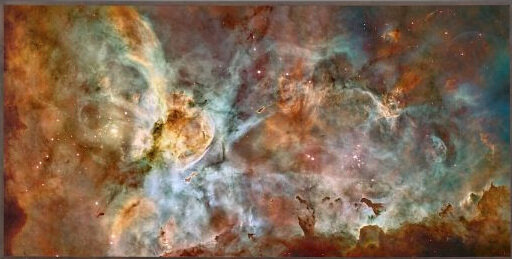
    On the far wall hangs an enhanced colour photograph of a nebula in the Carina constellation, though it is another constellation that is central to the show’s themes, namely Ursa Major. This constellation makes up part of what is known as the big dipper, that is, a configuration of stars in the northern sky that outlines of a plough, or frying pan. In classical mythology, the constellation itself has the shape of a she-bear (ursa) because it consists of one of Jupiter’s lovers, Callisto, who was transformed into a bear by his jealous wife, Juno, and later thrown out into the heavens by Jupiter in order to save her from being hunted by her own son who was unaware of her identity.

    Dorian FitzGerald, The Eta Carinae Nebula, NGC 3372, 2010, archival light jet print, edition number 2 of 3, 48 x 96 inches

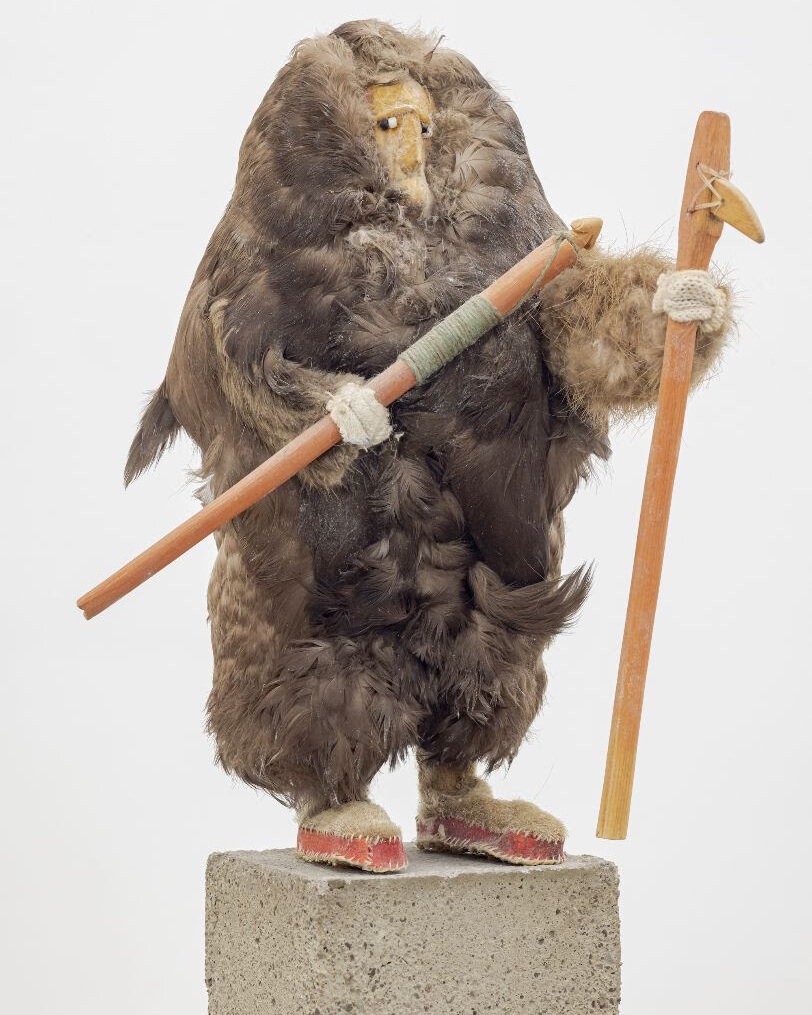
    Other cultures share hunting myths around the big dipper that date back many millennia. The Alaskan Yup’ik people, for example, see the shape of a caribou. Often in ancient North American cultures these stars are understood to show a wounded bear or deer being pursued by hunters. Several of the native works depict hunters, e.g., Yup’ik Doll Made from a Bird (artist unknown) and Mannumi Shaqu’s acrylic painting Fox Hunter and Family. The subject matter is no accident in the sense that these far-northern peoples do not so much form hunter-gatherer societies as hunter societies, given the relative scarcity of vegetation in these regions.

    Artist Unknown (Bethel, Alaska), Yup’ik Doll Made From A Bird (Standing Hunter with Harpoon and Gaff), hide and feathers of a willow ptarmigan, wooden implements; unique, late 20th century, 11 inches tall

    Mannumi Shaqu (1917 – 2000), Cape Dorset / Kinngait, Fox Hunter And Family, c. 1975, acrylic on paper, 20 x 26 inches

    Roenisch explains that the masks on display originally played a strictly ceremonial role, so that when a ritual was over the mask was discarded. However, visitors from the south took interest in these artefacts as aesthetic objects. These artefacts soon became desirable items to collectors. Subsequently, many of these societies have developed artistic communities that supply this collectors’ market while attempting to promote and preserve their traditional hunting-based culture. There is an irony here in the sense that by making artefacts with the aim of showcasing their culture their culture is changed, since the original reasons for making the artefacts dissolves. This fact tallies with the show’s overall theme, namely the inherent mutability of the world and nature.

    Artist Unknown (Bethel, Alaska), Spirit Mask, painted hide on woven basketry oval placket; unique, 11.5 x 9 inches (left) & Justus Mekiana (Anaktuvuk Pass, Alaska (1929 – 2009), Inuit Death Mask, caribou hide with fur trim, beard and eyebrows; unique, 10 x 8 inches approx. (right)

    Stan Greene (b. 1953, Salish / Nez Perce), Eagle Crest Mask, alder, bark, paint; unique, 9 x 7 x 4 inches (left) & Old Lady With Labret, cedar, bark, hair, abalone inlay, paint; unique, 9.5 x 8 x 4 inches (right)

    One of Jason de Haan’s works, Free and easy Wanderer (Yellow River), is a meditation on this theme. The work comprises a fossilised turtle carefully placed on top of a humidifier. De Haan notes that even something as seemingly permanent as a fossil is fugitive. It will react with the water in the atmosphere to incrementally dissolve and evaporate the minerals it is made of. So even this fossil is subject to change. Nothing lasts. Still, this idea of flux – call it Heracleitean – is itself somewhat paradoxical. For if everything is in constant state of flux then it seems impossible to detect change, for change can only be measured against those things that remain constant. One such constant is the stars. Ancient peoples all over the world thought of the firmament as eternal and outside of nature and temporality. That is why they imagined that casting characters like Callisto and hunted animal spirits into the heavens led to their permanence. Indeed, it is this permanent backdrop that enabled these peoples to pass on the stories of gods, spirits and hunters from generation to generation over thousands of years.

    Jason de Haan, Free and Easy Wanderer (Yellow River), 2014, found fossil, humidifier (white), concrete, 12 x 10 x 17 inches (detail)

    In general, themed group shows face two challenges. First, they can seem ad hoc, that is, invented in order to present what is in fact a disparate collection of works. The theme thus appears to be an afterthought. Second, they can make the artwork subservient to the curation. In other words, the artworks can sometimes be treated as props rather than showcased in their own right. I think Roenisch has avoided both these pitfalls.

    The themes span these two groups of works in various ways. For example, we have Toronto artist Kathleen Graham’s painting of an arctic landscape, Arctic Thaw in June. Roenisch tells me that on her visits to the arctic region Graham helped introduce the inuit to acrylic painting, offering a direct connection to Shaqu’s painting of the fox hunters which was done on a few years later.

    Kathleen Margaret Graham (1932 – 2008), Arctic Thaw In June, 1990, acrylic on canvas, 60 x 80 inches

    Others focus on the processes of making art and their links to geological forces of nature, e.g., Niall McClelland’s untitled work that consist in a canvas that has been scraped and dragged on the ground before being painted.

    Installation view with Niall McClelland, Untitled, mixed media on canvas laid down over canvas, 60 x 72 inches (left)

    Over all, the works share an ineffable aesthetics that Roenisch has managed to grasp. A delightful show.

    Hugh Alcock

    Images are courtesy of Clint Roenisch Gallery.

    *Exhibition information: The Thawing of the Great Bear / Group Show, March 10 – May 15, 2021, Clint Roenisch Gallery, 190 Saint Helens Ave, Toronto. View the exhibition online