Author: artoronto

  • Andrzej Tarasiuk at YYZ

    In the window of YYZ Artists-run Centre are displayed columns of subtly marked works on paper. Together they are an attractive array, but individually they are difficult to interpret. The viewer can readily identify the outlines of trees in a forest setting. But the thinking that guides their making is intricate and involved. The overarching idea behind the work is what its creator, Andrzej Tarasiuk, describes as the attempt to “convey the dynamic nature of place, not as a collection of individual elements but a complex interrelated network of relationships of which we are a part of.” This he does through what he calls the ‘lens of process’.

    Installation view of Andrzej Tarasiuk. Broken Trees at YYZ Vindow

    As he sees it, the reality he aims to depict is a dance of ‘actual entities’ – a term coined by the English mathematician and philosopher Alfred North Whitehead. Whitehead saw the schools of rationalism and empiricism as conflicting views. According to rationalism our knowledge of the world ultimately derives from self-evident truths that we intuit, e.g., that two and two is four. By contrast empiricism holds that the only route to knowledge of the world is through our senses. Whitehead sought to create a metaphysical view that wedded these two schools of thought, that connected the outside world as we perceive it with the world as it is governed by reason, and hence amenable to our rational intuitions. To this end he invented the idea of actual entities.

    Installation view of Andrzej Tarasiuk. Broken Trees, detail

    Tarasiuk’s starting point is watercolour painting. While on a artist’s residency at Labverde in the Brazilian Amazon he began to mark his watercolour paper with the natural materials around him – mud, leaves and even river water. These marks became the grounds for his paintings. Back in Toronto Tarasiuk made visits to Etobicoke creek, and carried on this experimental process. He chose the theme of fallen or broken trees because he saw it as a manifestation of the perpetual life-cycle of the forest. The death of trees is as much a part of ‘life’ as the living ones. What’s more, in line with his Whiteheadian perspective, he sees the living forest as being autonomous. Everything in nature, by this measure, consists of actual entities which are defined by their autonomy. He writes: “Thinking about landscape as ‘becoming’ made me think about the agency land has in shaping itself, and human/personal agency in shaping the landscape.”
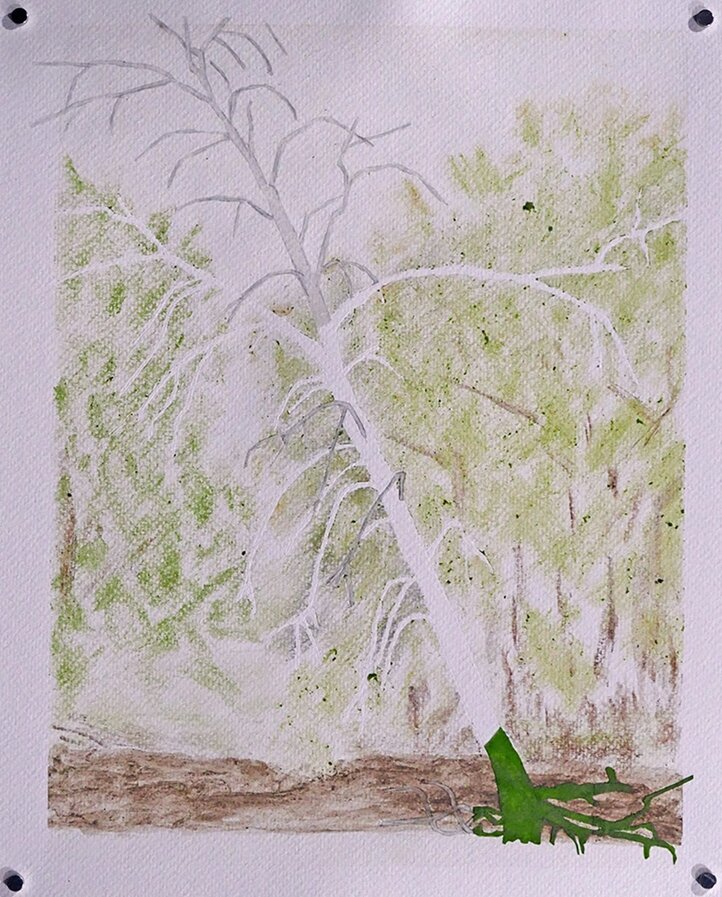
    Etobicoke creek, 2019, chlorophyll, water, dirt, bark, art mask, tape on paper, 22cm x 36cm

    The actual entities that Whitehead hypothesised are thought to ‘grasp’ the world both conceptually and sensually. Reality itself is described by the relations between all actual entities. Crucially, these relations are never fixed – they are always in a state of flux. That is, as he puts it, an actual entity “ always in the process of becoming and perishing…” (Process and Reality, p. 126). All told Whitehead’s view is rather implausible. For example, it assumes that even rocks are autonomous and have the capacity to relate to other entities both physically and conceptually. Nonetheless, from an ecological perspective Whitehead’s metaphysics is very attractive. It helps us to think of nature as a living whole, as Tarasiuk clearly does.

    Broken Tree #24, 2019, chlorophyll, water, dirt, bark, art mask, tape on paper. 36cm x 22cm

    His agential conception of natural phenomena leads Tarasiuk to think of forests as engineering their environment. For example, he learned in Brazil that trees can each release into the atmosphere up to a thousand litres of water per day. The whole forest, therefore, acts as what he describes as a biotic pump, transforming the climate. He imagined a whole ‘forest’ of mechanical pumps that might transform, say, a desert into a lush landscape.

    Perhaps mirroring nature itself Tarasiuk’s artmaking is process driven. A stencil is made using masking tape on each piece of paper. It is then stained with creek water and various other natural materials found at hand, e.g., rubbed leaves. Then the stencil is partially removed. The results are beautiful images built from subtle layers of stain. The residual masking tape gives the image some visual impact. Tarasiuk confesses that he has been surprised how well the stains have lasted, given that he deliberately used fugitive materials in line with the idea of the continual flow of change in nature.

    Broken Tree #4, Etobicoke creek water, Spring, 2019, art mask, tape on paper. 36cm x 22cm

    While the defined process of using the natural materials around him provides the parameters that create the overall look of the images, what makes the images themselves captivating is Tarasiuk’s judicious choice of stencilling. As I have emphasized, Tarasiuk’s art is conceptual – his artmaking processes follow from how reality, as he puts it, is ‘constructed’ by us, by how we perceive the world. Nonetheless, much of what draws the viewer in are his personal aesthetic decisions. His use of a traditional watercolour-based medium points to the importance of the aesthetic here. This in the end, I think, is the greatest strength of his work.

    Hugh Alcock

    Images are courtesy of YYZ.

    *Exhibition information: Andrzej Tarasiuk, Broken Trees, September 18 – November 27, 2021, YYZ Artists Outlet, 401 Richmond Street., #140, Toronto. Gallery hours: 7 days, 24 hours

  • Christian Eckart at General Hardware

    On a grey October day, colour was mostly drained from the city as it prepared for winter hibernation. How glorious it was then, to come upon Christian Eckart’s work at General Hardware Contemporary. The paintings are so bright, so saturated, that they illuminate the walls and ceiling with reflected colour.

    Three large artworks depict forest scenes that have been digitally distorted and overlaid with bright rectangular fields of colour. Photos of the work do not do justice to the density and intensity of colour that these paintings project.

    I describe them as paintings. A stickler may quibble. Paintings? They are not made with brushes and paint. Are these not mere software manipulations? The catalogue text refers to them by the neutral term ‘works’. But in many ways, they are very much like paintings. Each one is unique and not produced as multiples. They are presented on stretched Belgian linen. Up close, they have the quality of painted surfaces and layered silkscreens. At least from the point of view of the audience, they play the part of paintings.

    Installation view of Christian Eckart, New works at General Hardware

    Eckart creates images using photo editing and ‘glitching’ software. Just as a traditional painter may rely on a combination of technical skill and happy accidents that occur in the medium, Eckart conducts a parallel process in the digital realm. Distortions make some areas hard to focus on, like a 3D movie without the glasses. In other places, the background forest images look like they’ve been painted in watercolour or very thin glazes. Thin coloured lines between the larger fields look like registration errors on silkscreen prints. The digital nature of image manipulation becomes a prominent feature. The eye switches back and forth between seeing the abstract shapes, colours, and patterns on the surface and seeing the image of the trees in the illusionary space beyond.

    Dominating the surfaces are translucent fields of brilliant colour. Reminiscent of colour-field painting, these bright rectangles cover most of the image, but we can see past them at the edges and through their diaphanous surfaces.

    Christian Eckart, Forest, 2020, unique, aqueous ink digital print on Belgian linen, 55” x 78.5”

    The forest subject matter harkens back to Northern Romantic painting, such as the birch forest paintings by Gustav Klimt. In common with the Romantic painters, Eckart re-presents rather than represents the experience of nature. The Romantics strove to recreate the sense of awe and grandeur that they experienced in nature through the medium of their art. It was not enough to record the outward appearance, Romantics sought to recreate the exhilarating power of the encounter with the landscape. Eckart uses contemporary visual language and technology to set up an experience on the canvas that has the same emotive feel as the impact of nature.

    Eckart has maintained a long-standing interest in sacred and historical religious art. It’s not hard to see the symmetrical forest in Forest 2 as a cathedral of trees. The interweaving of branches looks like the ribs of gothic arches over a central knave. Being in a forest like this, with tall trees and a high canopy, does feel like having entered a special, even sacred place. 

    Christian Eckart, Forest 2, 2021, unique aqueous ink digital print on Belgian linen, 48” x 104”

    The climate crisis has added to the associations that trees evoke. The red and orange in Forest 1 suggests the brilliant colours of fall leaves. But it’s also the colour of flames. We’ve seen forests destroyed by fire, by drought, and by commercial deforestation. At the same time, we’ve come to understand that they are the ‘lungs of the earth’, and that healthy, abundant forests can go a long way towards saving the earth from the mess we’ve made.

    Christian Eckart, Forest 1, 2021, unique aqueous ink digital print on Belgian linen, 60” x 79.75”

    Eckart’s work reflects a search for new ways to create images. It erodes the boundaries between the disciplines of photography, digital art and painting. It references historical art precedents of several periods; it explores the expressive possibilities of new visual languages made possible by digital tools. It touches on contemporary issues about our environment, technology and our complicated relationship to these things.  

    As rich and complex as the content is, it was the initial visual impact that first drew me to these pieces. They have the visual pazazz to grab your attention and the complexity that rewards closer scrutiny. A perfect antidote to grey days.

    Mikael Sandblom

    Images are courtesy of General Hardware Contemporary.

    *Exhibition information: Christian Eckart, New works, October 16 – November 13, 2021, General Hardware Contemporary, Back Gallery, 1520 Queen Street West, Toronto. Gallery hours: Wed – Sat, 12 – 6 pm.

  • Mike Smalley at Helio Gallery

    Helio Gallery endured a long pandemic closure and has just reopened with Mike Smalley’s new works.

    The opening night of multi-media artist Mike Smalley’s solo show gave me the opportunity to talk with him about his past and present work, his latest inspirations, and what makes this exhibition a successful and radical representation of his “new” artistic direction.

    The opening reception of Mike Smalley’s solo show, October 29, 2021 at Helio Gallery

    After a four-decade long career as an art director in advertising, Smalley left the precision that was required in advertising for an artistic practice as an abstract artist. He is now able to create works organically and whimsically, measuring the caliber if his work predominantly by his level of enjoyment.

    Smalley is most recognized for his abstract calligraphy that integrates disconnected fragments and forms. He explains that this current exhibition is very different, jokingly mentioning that many people who are familiar with his previous work were shocked and surprised to see what he had been up to during the Covid-19 pandemic.

    Installation view of Mike Smalley’s solo show at Helio Gallery

    Elements of nature have always held a fascination for Smalley, but it was through the isolation and lockdowns of the Covid-19 pandemic that he found a way to represent nature less figuratively in his art. These new works present sweeping landscapes, seascapes and mountain scenes, paving the way for elements of the natural world to personify emotions. He describes his method as one that incorporating binaries of storms and stillness while he humbly and casually refers to his process as “play”. He explained that creating his artwork is also “a learning procedure of the architecture of clouds, as there are a lot of dimensions to it, a lot of depth, and lots of anger”.

    Installation view with (L-R) Mike Smalley, Shadowland #1, #2 & #3

    Smalley stated that he is most interested in discovering how he can take abstracted elements from nature and then merge them with realistic ones, while combining them in his new style. For example, he sees expressive connections between rocks and water. The new work, he believes, presents a transformation built upon this discovery. Seascape #1, is an entirely abstract painting, composed with amorphous forms that he explored further in other works.

    Mike Smalley, Seascape #1, archival pigment print, 22 x 22 inch

    Smalley notes that the drastic change in his style came from the limited stimulation caused by pandemic life. Talking about his creative process, he admits that he looks down a lot at the ground and rocks as they are as interesting to him as the birds, the wildlife and the sky outside his window.

    Smalley has an appreciation for portraying the more complicated side of nature. For example, he feels his best pieces in the exhibition are the ones that layer darkness and light, are spatially ambiguous, and have enough mystery. However, he notes that this can happen accidentally, at times even just leaving the paint to drip down the canvas as part of his process. While pointing at the middle section of Shadowland #2, Smalley elaborates, “I keep focusing in this one bit here and you don’t know whether it is a mountain, or sunlight. That is the sweet spot of the division of abstracted and natural reality.”

    Mike Smalley in front of Shadowland #2, oil on canvas, 42 x 42 inch

    Smalley says choosing the medium to work with depends on his mood, but that he particularly likes pastels as well as oil painting on large canvases. This exhibition is the first time he tried oil on paper.

    Installation view with Skyline #2 (center)

    In regards to the style and subject matter of his future work, Smalley says, “I’ve ordered canvases, so I have got about six weeks to decide what to do with them.” Fans of the artist will have to keep up, because Smalley doesn’t want to stick with doing one thing for too long. He’s already looking for what to springboard to next.

    Text: Georgia Gardner

    Photo: Cathy Liu

    *Exhibition information: Mike Smalley solo exhibition, October 29 – November 21, 2021, Helio Gallery, 1256 Queen Street East, Toronto. Gallery hours: Wed – Thurs   12 – 5pm, Fri 12 – 6 pm, Sat – Sun 12 – 4 pm.

  • Lisa Matthias at the Birch Contemporary

    It is easy to get swept up in the intricate patterns and organic forms that dance across Lisa Matthias’ prints, featured in her solo exhibition Ecological Constructs, at the Birch Contemporary. The exhibition features fourteen of Matthias’ large woodcut prints—all in striking black ink—which explore the natural world at different scales. The prints demonstrate how Matthias’ work as an ecologist is integral to her artistic practice, which begins with examining organisms through a microscope, then abstracting and magnifying them. The resulting prints draw viewers into a unique, chaotic, and often whimsical, representation of the natural world.

    Installation views of Lisa Matthias, Ecological Constructs, at Birch Contemporary. Photo: Jennifer Boothby

    Matthias’ craftsmanship is evident in the prints, and it further evokes the natural world. The black backgrounds are patchy, textured, and give the prints an earthy quality. Rough parallel hatching resembles tree bark. Translucent paper makes the prints appear more organic.

    This earthy-quality is evident in Matthias’ Stem Leaves and Hyaline Cells, which is one of the largest, and most engaging, pieces in the exhibition. Examining the piece close-up viewers can see the texture of the woodblock used, and the coarse hatching throughout the print. It also demonstrates Matthias’ interest in portraying nature at different scales. The top of the artwork features amorphous shapes that resemble the hyaline—transparent or translucent—cells referred to in the print’s title. Under these shapes, an intricate network of lines draws the viewer’s eye up and through the composition. As I stepped back and examined the print as a whole, I saw the individual elements come together in a type of abstract landscape. I could imagine animals emerging from foliage. The cells on the upper left resemble a bird-like shape, while others seem to depict tangled reeds.

    Lisa Matthias, Stem Leaves and Hyaline Cells, 2021, woodblock print, 60” x 96”. Courtesy of Birch Contemporary

    As I walked through Ecological Constructs, I was struck by the tension between technological and natural themes in Matthias’ work. Nowhere is this more evident than in her series of Diatom Construction, which explore microscopic views of diatoms—single-celled algae. The exhibit contains five of the Diatom Constructions, which simultaneously capture the chaos of nature and the modern world. Walking through the exhibit clockwise, visitors first encounter Diatom Construction 3, that features an extremely intricate network of lines and chain-link forms. From close-up the forms resemble something out of a biology textbook—like overlapping translucent cells, each containing several minuscule parts. I could imagine Matthias translating and abstracting her microscopic views of diatoms. Despite this basis in ecology, however, the print also evokes something distinctly technological. Examining the print from farther back, it begins to resemble a city-scape. I could imagine the vertically-oriented ‘cells’ as high-rises; the lines as street networks with cars whizzing past.

    Lisa Matthias, Diatom Construction 3, 2021, woodblock print, 52” x 35”. Courtesy of Birch Contemporary

    Just before exiting the exhibit, viewers encounter two more Diatom Constructions side-by-side. Like Diatom Construction 3, Diatom Construction 1 evokes the interaction (and perhaps clash) between nature and the modern world. While the print is still grounded in Matthias’ microscopic views of diatoms, the throughout coarse cross hatching and minute shapes made me think of wires or computer chip components.

    Diatom Construction 1 features less of the rounded or swirling forms that populate many of the other works in the exhibit. Instead, it stands out due to its larger, more angular, shapes and solid white areas interspersed among the minute details. It is also particularly engaging due to the visual movement created through the repeated use of patterns. For example, the checkerboard pattern at the upper left, creates a visual rhythm that bounces the viewer’s eye around the print. The hatching in the upper right reminds rain in the wind.

    Lisa Matthias, Diatom Construction 1, (left) & Diatom Construction 2, (right), both 2021, woodblock print, 52” x 35”. Courtesy of Birch Contemporary

    Ecological Constructs provides a unique representation of nature at different scales, beginning with the microscopic. Each of Matthias’ prints provide a new world of intricate shapes and lines for viewers to get lost in, and encourages them to think about the interactions between humans, the natural world, and technology.

    Jennifer Boothby

    *Exhibition information: Lisa Matthias, Ecological Constructs, September 9 – October 16, 2021, Birch Contemporary, 129 Tecumseth Street, Toronto.

  • Mathew Borrett at Red Head Gallery

    In Mathew Borrett’s solo exhibition at The Red Head Gallery, A Break In The Clouds, archival inkjet prints of landscape views are combine the real world with unreal elements and perspectives. Densely packed architecture and thriving natural environments are the fundamental components, but the perspectives give viewers a sense of an apocalypse. In fact, there are no human beings or animals in most of his works. The well-built cities and the endless railways seem more likely a relic from human civilization.

    Installation view of Mathew Borrett, A Break In The Clouds at the Red Head Gallery. Photo: Vivian Sun

    Borrett combines distinctive architectural styles from various historical eras and faraway countries in his imaginative landscapes. Ancient Greek temples, high Gothic-style towers and oriental buildings are captured in the midst of being torn apart and recomposed into new, fantastical sites. Every cityscape is rendered like an isolated island, the infinite water connecting high-density urban areas. The honeycombed-like architecture frequently appears in his work. The ‘compacting’ sensation of space closely resembles our existence in the real world. We are all like worker bees who are being packed in skyscrapers.

    Mathew Borrett, Dinas Y Goedwig, 2021, archival inkjet print, 30’’ x 22’’. Image courtesy of the artist

    Gibraltar Cove depicts a small town on a bay surrounded by dead coral. This work seems to be different from the others with its melancholic atmosphere. There are also more realistic details like the lighthouse and the warm light radiating from the houses, as well as the grounded fishing boat. The nature in Borrett’s Hypernurnia series is always formidable. This one provides the viewers with a possibility for the co-existence of man and nature.

    Mathew Borrett, Gibraltar Cove, 2021, archival inkjet print, 23’’ x 17’’. Image courtesy of the artist

    Working for the TV and film industry, Borrett’s work contains a strong sense of the cinematic view. I believe that his illustrations could be a continuous narrative about the decay of mankind, as the huge amount of water and infinite greenery may imply no humans are present. In Ynys Sfferau, an enormous extraterrestrial sphere has landed on earth in distinct contrast to a small town next to it. The sphere itself reminds me of the biblical Third Day when the Earth was no more than a sphere before it was covered by soil so plants could root and grow. It is like a womb, pregnant with many possibilities as well as dangers. The shadow on the water is also out of context in this otherwise realistic looking landscape that we are seeing from above, as though from the spaceship that just dropped this sphere. The oppression from the details and the endless landscape view is compelling.

    Mathew Borrett, Sfferau, 2021, archival inkjet print, 30’’ x 35’’. Image courtesy of the artist

    In Between The Storms, the layering architecture seems to be built on an isolated island in the middle of the sea, and the moss coats everything, even the outer walls of the buildings. The collapsed rusty signal tower at the lower end of the small island, among other details, seem to suggest that this place may frequently be completely covered by water and what we see now is the scene at low tide. Borrett’s series of digital renderings is a manifestation that no matter how cities are manufactured by mankind, nature will not remain repressed.

    Mathew Borrett, Between The Storms, 2021, archival inkjet print, 30″ x 35″. Image courtesy of the artist

    In Stranded, the outlandish stone construction with two huge trees at the top is more overwhelming with the deep undertone Borrett set for the work. This is one of the few works that have a human-like creature as the focal point, with a glowing body, standing silently on a pier extended from the island. I can not tell if he is a real human being, a lost soul or an alien who is trapped in this isolated island — the only expression it brings to me is of infinite loneliness.

    Mathew Borrett, Stranded, 2021, archival inkjet print, 35’’ x 25’’. Image courtesy of the artist

    Throughout his series, with his unmistakable style, Borrett tells stories where all the details are important. His emotive and unique perspectives are powerful, as it creates a new dimension of our original world.

    Vivian Sun

    *Exhibition information: Mathew Borrett, A Break In The Clouds, September 22 – October 16, 2021, 401 Richmond Street West, Toronto

  • Views of Art Toronto 2021

    Views of Art Toronto 2021

    A Small Sampling of Interesting Things

    Seeing work in person lets you discover all the subtle material qualities of an artist’s process that is otherwise easily lost in reproduction. It’s great to have the opportunity to get up close to so much interesting art all in one place! On the outer wall of Daniel Faria Gallery hangs a large tapestry by Shannon Bool. Bool has reproduced one of her small photo collages as a large woven Jacquard tapestry. On close inspection, you’ll find fine hand embroidered details that harken back to the way the original smaller works are stitched together.

    Shannon Bool, The Borderline, 2021, tapestry with silk and hand embroidery, 102” x 67”, Daniel Faria Gallery, Toronto

    Miriam Shiell Fine Art have on display a painting by Graham Gillmore. Gillmore uses power tools to router words into the surface before applying layers of paint. The drips and washes create beautiful, complex textures. The piece is from 2005 but the bright wet glossiness of the surface makes it appear as though it could have been finished less than an hour ago.

    Graham Gillmore, Back to the Motherload, 2005, oil and enamel on panel, 72” x 60”, Miriam Shiell Fine Art, Toronto

    The show has an area dedicated to artist books and multiples. Gallery 44 presented books created by their artist members as well as show catalogues.

    Gallery 44 – Centre for Contemporary Photography’ table at Art Toronto, 2021

    The Sandra Ainsley Gallery specializes in glass art. Near the front of the booth is a cube of glass by Wilfried Grootens that seems to contain an organic spherical object. The piece is made up of flat images on layers of glass that have been fused together. When you look from the side, the object within seems to vanish.

    Anemone By Wilfried Grootens, 8.5” x 8” x 8”, Sandra Ainsley Gallery, Toronto

    At the RBC booth (RBC is a sponsor of the fair) there are four photographs by Nadia Belerique (represented by Daniel Faria Gallery).  At first glance they are compositions of mostly recognizable objects, but it gets more confusing on closer inspection. How are these things physically composed and arranged? You will have to look closely to figure it out!

    Nadia Belerique, Buoys 1, 3, 7, & 10, 2016, Inkjet photograph mounted on dibond and plexiglas, 65cm x 43.2cm, RBC booth

    The Nikola Rukaj Gallery has two works by McKay Otto. These are subtle pale paintings built up from translucent layers of paint. The effect is one of shallow depth. Are they flat or are they actually three dimensional behind a milky surface? 

    McKay Otto, Ever Flicker into Harmony Ever, 2019, acrylic and mixed media on wood, 35” x 35”, Nikola Rukaj Gallery, Toronto

    Galerie Mur have two concrete sculptures by artist David Umemoto. They are complex miniature architecture made from cast concrete.  They allude to buildings but remain abstract and enigmatic. They make you move around and look at them from all sides.

    David Umemoto, Cubic Geometry Twelve: 5 Oxidized, 2019, Concrete, 30cm x 30cm x 30cm, Galerie Mur, Montreal

    Zhuang Hong Yi’s sculptural painting Flowerbed 140 at Galerie Le Royer creates an intriguing visual effect as you move around. The surface is made up of coils and tubes that are covered in subtle washes of paint. Light and colour shift with each slight change of viewing angle. 

    Zhuang Hong Yi, Flowerbed 140, Ink, acrylic and rice paper on canvas, 47.25” x 71”, Galerie Le Royer, Montreal

    Text and photo: Mikael Sandblom

    Walking around in Art Toronto

    This year’s fair was a more spaced-out affair, affected of course by COVID guidelines. There was an amazing range of art of all media, shape and size. As a first-time visitor, it was almost overwhelming attempting to take it all in, but each gallery had amazing works and it was well worth taking the time to see it all. The fair had lots of artworks by contemporary Indigenous artists from many nations across North America.

    Shawn Hunt, Whispers from the Spirit World, 2020 at Equinox Gallery

    Tim Pitsiulak, 186-0638, 2015 at Patel Brown Gallery 

    I spoke to gallerist, Federico Rosario, from K Art Gallery, Buffalo, who were at Art Toronto for the first time. The native-owned gallery champions work by indigenous artists, such as Luzene Hill’s, whose effortless sketches take inspiration from cave drawings. Evoking ideas of femininity and anatomy, but also nature and landscape, Hill’s style stems from a reflexive, instinctive practice that relinquishes control to the subconscious. 

    Installation view, Luzene Hill at K Art Gallery

    Edgar Heap of Birds, a Cheyenne/Arapaho artist collaborating with K Art Gallery, spoke about his practice. The gallery included a scaled-down version of one of his pieces, as well various signs which he has exhibited at numerous university campuses. His work highlights the importance of indigenous identity and sovereignty within colonial contexts. He also spoke about the difficulties young artists face in the beginnings of their careers, and his own decision to represent himself as an artist. 

    Installation view, Edgar Heap of Birds at K Art Gallery

    Marion Scott Gallery had works by Inuit artists, both traditional and contemporary, including prints, painting, and sculpture. 

    Installation views at Marion Scott Gallery 

    In many galleries, pastel tones reigned supreme this year. Swirling pale shades, pastel landscapes and mesmerizing abstract compositions were present at various galleries. 

    Rosi Maria di Meglio, Casa d’Ischia, 2019 at Corkin Gallery 

    Francois Lacasse, Spectres II, 2020 at Blouin Division

    Kym Greeley, I Would Do Anything, 2021 at Christina Parker Gallery. 

    Text and photo: Bronwen Cox

  • ART TORONTO 2021

    This year’s art fair was in person and a welcome sign that things were returning to something called normal. As one visitor, Kelly McRae, a curator and artist himself said it was smaller, more intimate but there was some good work and it was easy to navigate. This year there about 60 galleries compared to the usual 100 +.

    I talked with some representatives from RBC, the key sponsor of the fair about their booth with emerging artists. RBC has over 6000 works in its collection and they are from emerging artists in order to help them become established artists. There were four emerging artists with works on display for the Art Fair including my favorite Glorious Bones by Esma Mohamoud using old football helmets and African wax print textile.

    Glorious Bones by Esma Mohamoud, RBC Emerging Artists section

    Many Toronto galleries had returned and I visited a few Clint Roenisch, Corkin Gallery, MKG127, Patel Brown, Paul Petro Contemporary art and Sandra Ainsley to name a few. There were a number of Montreal Galleries at this year’s fair.

    Clint Roenisch Gallery, Toronto

    Sandra Ainsley Gallery, Toronto

    Kevin Boothe of Towards Gallery, Toronto with work by Jacob Broussard

    Gallerist, Juno Youn, Gallery Youn, Montreal (left) and photographer George Whiteside (right)

    There were also a dozen project spaces as well. The book fair was now on the same floor and with lots of publications big and small. I talked with Eldon Garnet there and was tempted to purchase a compilation of interviews in his publication Impulse Magazine but decided to forgo the purchase as I was travelling by bike. Some textile books by Olivia Mae Sinclair caught my eye.

    Olivia Mae Sinclair and her textile books

    Buyers were there early making purchases which was encouraging for galleries to participate. I witnessed several people with art works under their arms.

    Buyers leaving Galerie Robertson Arés, Montreal

    The usual Gala fundraiser opening was postponed to 2022. The panel talks were also online this year. People were all masked and checked at the door for their vaccinations. Visitors were bumping into friends as they recognized them despite the masks. I stopped by Patel Brown Gallery and saw a beautiful piece of porcelain by Shary Boyle and Lido Pimienta.

    Caminos y Capas, a path through the layers Shary Boyle, Lido Pimenta, porcelain, underglaze, gouache, gold-leaf, Patel Brown Gallery, Toronto

    At the McMichael I took in Margaux Williamson’s FIre (oil on canvas). There were some great art works at the fair and it felt great connecting with so many galleries and artists.

    FIRE by Margaux Williamson, oil on canvas, McMichael Canadian Art Collection, Kleinburg

    One of my last stops was at a new gallery K Art from Buffalo. They specialize in Native Contemporary Art and have been open just over a year in Buffalo’s historic district. One of the works that caught my eye was Dine Body Bag by Edgar Heap of Birds – a series of mono prints.

    Dine Body Bag by Edgar Heap of Birds, mono prints K ART Gallery, Buffalo

    Every which way you looked at this year’s fair there was another piece of work that drew you in. Just what you need to start your recovery from this COVID-19 mess. Artists for the most part seem to have been busy creating new works for us to enjoy and the fair is the perfect venue to take it all in. It may be smaller but it works just fine.

    TAGLIALATELLA Galleries, Toronto, New York City, Palm Beach, Paris

    Text and photo: Phil Anderson

  • Art Toronto 2021 / Photo Journal

    Photo Journal by Megan Kammerer

    Jason Baerg, Optimal Futures, acrylic and tempera on laser cut canvas over ladder; Acrylic on wood, Fazakas Gallery, Vancouver

    Installation View of Patel Brown, Toronto (Front Right: featuring Nep Sidhu and Nicolas Galanin, “No Pigs in Paradise,” 2016, mixed media, textiles by Sidhu and adornment by Galanin; Back Centre: Michael Dumontier and Neil Farber, “Library,” 2021, Acrylic and ink on MDF)

    Installation View of Galerie Robertson Arés, Montreal (right to left: featuring work by Lina Lago, Ryan Crotty, & Troy Emery)

    Installation View of Galerie LeRoyer, Montreal (Left: Willy Verginer, “Quello che io non ho è una camicia bianca,” 2015, Lindenwood and acrylic; Right: Rock Therrien, “Dancing Queen,” 2021, Mixed media on canvas, neon)

    Photo Journal by Cathy Liu

    Sam Francis, (left) and works by Takashi Murakami at Galerie Raphael, Frankfurt

    Ceremonial/Art, Vancouver

    Janna Watson, Blue Moon at Bau-Xi Gallery, Toronto

    Galerie LeRoyer, Quebec, Toronto

    Bobbie Burgers, Immersed, 2021 at Equinox Gallery, Vancouver

    Galerie LeRoyer, Montreal

    Lina Lago, Fake Abstract (after Nattier), Galerie Robertson Arés, Montreal

    Kim Dorland, Yellow, 2021 at Patel Brown Gallery, Toronto

  • Plastic heart at Art Museum at the U of T

    Plastic heart: Surface All the Way Through at Art Museum at the University of Toronto

    As the name would suggest, Plastic Heart is an experimental exhibition that features plastic at its heart. What comes to mind when you hear the word plastic? Plastic is a lasting material and takes an unknown amount of time to decompose, but it can easily break into smaller pieces and exists as microplastic. It is therefore often considered as immortal. We use plastic as art material; we manufacture plastic into all kinds of products; and we wear plastic every single day. It is undeniably inseparable from our daily experience “with its beauty and toxicity, its helpfulness and ubiquity.”

    Installation view of Plastic Heart: Surface All the Way Through at Art Museum at the University of Toronto, 2021

    The exhibition features the works of the Synthetic Collective which has recently done a study of microplastics pollution on 67 beaches around the Great Lakes. The research is displayed using data visualizations as well as art creations done by members of the Synthetic Collective. In addition, the exhibition has both historical and contemporary artworks relating to plastic as an effort to demonstrate the history of plastic in art and how plastic has challenged museums’ conventions.

    The first thing you see in the exhibition is a row of plastic bottles split in half with fruits inside. Lan Tuazon has been collecting plastic containers and objects which she then made into open nested containers that act like an archive, the “future fossils” that represent our consumer culture. False Fruits is a series of sculptures that resemble fruits, and they are laid out like open books and remind us of the blurring boundary between food and plastic.

    Lan Tuazon, False Fruits, 2020, found nested containers

    Meghan Price’s artwork, New Balance, is made of layers of old running shoes surrounded by striated forms. This illustrates how synthetic products and plastic landfill have become part of the Earth’s upper crust. It is a visual alert that human-made synthetic waste has entered the rock record. The wire frame is usually used for product display, and it is used here to identify people’s consumer behaviors as one of the causes.

    Meghan Price, New Balance, 2020, used athletic shoes, painted steel grid

    Relating the environmental discussion to museums, have you thought about the environmental impact of an exhibition? In one corner of the room sits several trash bags filled with water bottles, tapes, and other plastic miscellaneous. These are the plastic waste produced while preparing for and installing the artworks. It is interesting to include them as part of the exhibition as viewers are normally unaware of the works behind the scenes. It asks us to think about the possibility of curating a zero-carbon exhibition.

    Catherine Telford-Keogh’s work has a very long and descriptive title that can potentially give you some clues for interpretation. It describes a fantasy life of Hal where everything is consumable and in easy reach. The yellow liquid in the plastic bag reminds me of decayed liquid food or polluted water. And the plastic bag here acts like a hygienic barrier but also a breeding ground for bacteria and germs. The sculpture is about the complex interactions that “blend distinctions between chemical, consumable, and contaminated identities.”

    Catherine Telford-Keogh, the democratic model of upward mobility saturated his fantasies of the good life, where Hal could languish in bed for years at the Holiday Inn watching National Geographic on piles of damp laundry and money, 2017, Mr.Clean Multi-Surface Antibacterial Cleaner with Summer Citrus, Honey-Can-Do Vacuum Space Bag, Digital Print on Vinyl, Plexiglas

    In the same room, Amy Brener’s Flexi-Shield immediately caught my eye. If you look closely, there are combs, cotton swabs, paper clips, pins, etc. inside it, all sealed in this shield like insects trapped in resin. The objects are frozen in time, evoking the questions of preservation of plastic in museums. Speaking of which, many of the historical artworks made in the 1960s and 1970s displayed at the exhibition, such as IAIN BAXTER’s Bagged Place, are starting to degrade. The constant tension between humans’ desire for preservation and immortality and the ever-changing reality is seen throughout the exhibition.

    Amy Brener, Flexi-Shield (Empress), 2018, Platinum silicone, pigment, larkspur and chrysanthemum, flowers, fern leaves, miscellaneous objects.

    Overall, this exhibition is intriguing and aesthetically appealing in that it investigates plastic as an art material, a result of cultural production, and an artifact that is intertwined with human body. It not only raises important environmental concerns and considers our relationship with plastic but also questions the future of art and exhibition making.

    Installation view of Plastic Heart: Surface All the Way Through at Art Museum at the University of Toronto, 2021

    Zhiyi Fang

    Images are courtesy of Art Museum at the University of Toronto

    *Exhibition information: Plastic Heart: Surface All the Way Through, September 8 – November 20, 2021, University of Toronto Art Centre, 15 King’s College Circle, Toronto. Gallery hours: Mon & Thu – Sat 12 – 5 pm, Tue 12 – 8 pm.

  • Interview with November Paynter

    MOCA artistic director and curator of GTA21 November Paynter. Photo by Worker Bee Supply

    Interview with MOCA artistic director November Paynter, MOCA (NP) curator of Greater Toronto Art 2021 – MOCA (GTA21) by Phil Anderson (PA)

    PA: Congratulations on putting together this grand art exhibition of local Toronto artists. I am sure that organizing this ambitious project during a pandemic has had its challenges. What was the process of the selection of artists like?

    NP: Thank you. The curatorial team started meeting with artists and doing studio visits virtually in the summer of 2020. There was also a brief period in the fall when we could meet with a few artists in person. In each instance at least two of the curators aimed to be present and if we were excited about the potential to work together the third curator would then book a time to meet the artist as well. We were interested in understanding what the artists were working on at that moment, or what they were thinking about producing. We asked everyone ‘what feels urgent to you today’ and also ‘how their connection to Toronto and the GTA has informed their work’. The selection was quite intuitive; often there was a clear sense of urgency around an idea that we were excited to pursue together.

    The other curators: MOCA adjunct curator Rui Mateus Amaral. Photo by Gun Roze (left) & guest curator of GTA21 Daisy Desrosiers, Director, Gund Gallery. Photo by Gabe Souza (right)

    PA: As I understand it, 21 of the most exciting artists and art collectives working in relation to the city today were selected. Following their selection, did the artists submit proposals for inclusion in the exhibition?

    NP: Most of the works developed organically from an initial idea as we spent months talking together – the artists and the curators. Some of the artworks were projects that the artists had started developing during lockdown that they then built further upon. Other works started with a discussion around an existing piece that then inspired a new direction responsive to the MOCA space. So, no one really submitted a proposal per se, really the process was one of discussion and collaboration.

    Native Art Department International, Double Gazebo (MOCA), 2021, painted steel and wood. Courtesy the artists. Photo Toni Hafkenscheid (installation view MOCA Toronto, 2021). On the third floor, theme: Mutation

    PA: It must have been difficult at times working with together as three curators. How did that process work on the selection of artists? 

    NP: We worked together really well and would always connect when there was something to resolve or think through.

    PA: There are over 25 artists involved (counting those in collectives) ranging in age from 20 to 40 and with a diverse mix of cultures and backgrounds. That in itself paints a picture of the GTA. How important a role does that play in this exhibition?

    NP: There are 26 artists in total, as well as the identity and publication designers, the editor, the many fabricators that helped with certain projects, the prep team and the MOCA team etc. You can imagine the exhibition as a holistic program driven and supported by many relationships, nearly all of which pivot around living and working in the GTA. In terms of the artists and art works, the exhibition expresses, or gives a sense, of the urgencies and contemporary condition of a specific moment in time in relation to a specific place. But it also shows how internationally connected and relative a local condition is. All in all, the exhibition is both rooted in the local, but is also expansive in its reach and references.

    Pamela Phatsimo Sunstrum, Dynasty, 2021, pencil, acrylic and oil on wood, linen and canvas. Courtesy Goodman Gallery Johannesburg, Cape Town and London. Photo Toni Hafkenscheid (installation view MOCA Toronto, 2021). On the second floor, theme: Inheritance

    PA: The exhibition spans three floors of MOCA. How difficult was it to determine which pieces went on each floor?

    NP: As we started to understand better what each artist was working on for the exhibition, we began to build out the rhythm and structure of each floor. At the same time, we were doing interviews with the artists for the accompanying publication and these conversations helped inform more of a structure for both the book and the exhibition.

    PA: There are three thematic groupings Ambivalence, Inheritance and Mutation – each having their own floor. Were artists selected for these groupings from the beginning?

    NP: While there was never an overarching theme for the exhibition as a whole, we developed these three sub structures to help articulate common threads of interest and research between works. The floors of the museum also helped define these groupings, especially in the case of Ambivalence – wherein the ground floor of the museum is a composite of different functions and artworks installed here have to be considered in relation to a condition that is more informal.

    Aaron Jones, Conscious Energy on the Sea, 2021, collage, light box. Courtesy Zalucky Contemporary, Toronto. Photo Toni Hafkenscheid (installation view MOCA Toronto, 2021). On the first floor, theme: Ambivalence

    PA: There are several public artworks displayed on the grounds of MOCA. Can you tell us more about these works and their selection?

    NP: One of the artists we invited to participate in GTA21, Ghazaleh Avaramani, had been looking at the MOCA building for years with an idea in mind. The idea was refined to become Mashrabiya, a sculptural installation that hangs on the facade of the building and was produced in partnership with ArtworxTO. Mashrabiya invites us to question the public accessibility of museums like MOCA through modes of open and obscured visibility. Offering a play on Islamic window screens, which permit views from inside out but not from outside in, this piece stands as an observation deck and a confessional; some visitors become observers, some are observed, but they cannot assume both roles at once.

    Ghazaleh Avarzamani, Mashrabiya, 2021, painted steel. Courtesy Galerie Nicolas Robert, Montreal and Toronto. Avarzamani’s projects are part of ArtworxTO: Toronto’s Year of Public Art 2021 – 2022. Photo Toni Hafkenscheid (installation view MOCA Toronto, 2021).

    We also worked with the National Film Board on a production with the artists Parastoo Anoushahpour, Faraz Anoushahpour and Ryan Ferko. The result is a digital project, but we approached our discussions around this production as a public art work commission, given it is online and accessible to anyone with wifi and a computer. You can see the final work ‘Charity’ here: https://www.nfb.ca/interactive/charity.

    The collective of Parastoo Anoushahpour, Faraz Anoushahpour and Ryan Ferko, Surface Rites, 2021. Single-channel video, 16mm. Courtesy the artists. Photo Toni Hafkenscheid (installation view MOCA Toronto, 2021).

    PA: The press release mentions some responsive digital components. What might the public expect to see? Are they interactive?

    NP: In addition to the collaboration with the NFB we also commissioned a special web platform for GTA21. Designed by Andy Bako and Niko McGlashan, the platform shares a page of information on every artist in the exhibition. We also worked with them to create a GTA360 virtual environment that hosts digital commissions by a number of the artists. https://moca.ca/gta2021-gta360/

    Then there are the digital extensions of Common Accounts’ work ‘Parade of All the Feels’ which offer Museum visitors the opportunity to launch Instagram filters via a series of QR codes. Finally, we will gradually share videos of the artists talking about their works, along with other online materials, throughout the exhibition run via the website.

    Image of the digital GTA360 platform designed by Andy Bako and Niko McGlashan

    PA: Looking forward, there are plans for GTA 2024 with new curators. Can you elaborate on the importance of engaging young Toronto artists for future exhibitions and the role of MOCA in doing so?

    NP: MOCA is committed to supporting the local art community of Toronto by working closely with artists to produce new work and giving them space to develop their practice. The discussions that we shared with artists during this exhibition-making process made it clear that there is more to be done and we felt it important to state that it is our intent to work in this way again and hence committed to a triennial programme that evolves from this year’s exhibition. It will be incredibly interesting to see how a fresh ‘reading’ of the city in three years continues this conversation.

    *Exhibition information: Greater Toronto Art 2021 / MOCA Toronto’s Inaugural Triennial Survey Exhibition, September 29, 2021 – January 9, 2022, MOCA, 158 Sterling Rd. Toronto. Museum hours: Wed, Thu, Sat and Sun 11 am – 6pm, Fri 11 am – 5 pm.

  • ART TORONTO 2021

    Art Toronto installation view, 2019. Photo: Xiaotong Cao

    October 29 – 31, 2021 / In person
    METRO TORONTO CONVENTION CENTRE
    North Building, Exhibit Hall A & B
    255 Front Street West
    Hours: Fri 12 – 8 pm., Sat 12 – 8 pm, Sun 11 am – 7 pm

    Art Toronto returns in person this fall with 60+ galleries focusing on contemporary art from across Canada, with notable historic works and international galleries, creating a context for the art of our time. 

    Immerse yourself in exhibitions in-person and explore the /edition art book fair at the Metro Toronto Convention Centre. Check out the fair’s Platform program of talks online and VR exhibitions powered by Artland, and visit participating galleries across Toronto.

    To ensure a safe and enjoyable experience for all, the show has some notable changes this year, including a new design with wider aisles and more open space to enjoy site-specific installations. The fair’s Platform series of panel discussions will take place exclusively online this year, so you can enjoy them at your leisure.

    Since 2000, the Toronto International Art Fair has been dedicated to supporting art in Canada, connecting audiences to local, national and international galleries, and promoting diverse creative practices. Art Toronto 2021 is evolving  to include both an event at the Metro Toronto Convention Centre and a virtual exhibition (October 29 – November 7, 2021), open to galleries and audiences across the country and beyond. 

    For programming, ticketing and more information click here.

  • Hangama Amiri at Cooper Cole

    What is the feeling of “home”? How do we know when we’ve found it? Textile artist Hangama Amiri, in her first exhibition at Cooper Cole gallery, reflects on the aspects of life that make up what home is: the banalities, the human connection, and our relationship to nature. 

    This exhibition entitled Mirrors and Faces is an exploration of the diaspora identity, which includes the deeply personal experience of loneliness and love. Specifically, Mirrors and Faces is about migration, and the conflicted journey to find inner peace while discovering a new identity. As a woman, Amiri’s artwork reflects on the cultural issues around gender in her homeland, Afghanistan, fragility, childhood, the refugee experience and our bond with intimacy amidst the Covid-19 pandemic.

    Installation view of Hangama Amiri, Mirrors and Faces at Cooper Cole Gallery

    The show displays eleven large scale textiles that have a painterly approach, featuring bold and vivid colours. These works are immersive and imaginative, with fantastical elements and dreamlike motifs comprising foliage, domestic space, and metaphors for cultural memory, such as poured wine, parrots, tears and arrows. Similar to a mosaic, Amiri allows for everyday objects to tell her story, weaving together representations of life — believing that fabric has a generosity and “touch” that allows her to produce what paint and other mediums cannot.

    Hangama Amiri, The lovers I / The Chanting Storks, 2021, chiffon muslin, cotton, polyester, silk, acrylic paint, suede, and found fabric, 69″ x 78″

    Cooper Cole Gallery presented a virtual artist talk (October 12, 2021), “In Conversation with Hangama Amiri and Muheb Esmat”. Esmat — who is a curator with focused efforts in contemporary visual culture from Afghanistan — and Amiri discussed memory, diaspora, symbolism, isolation, intimacy, self-portraiture, and breaking taboos of representation. In conversation, Amiri reflects on her relocation to the United States as a self-identified Afghan artist. In her migration, memories of home were filtered through, for example, New York kebab and fabric shops. She cites that these pangs of nostalgia in the United States allowed her to have a self-actualized communication with her migration story and how it has helped her find an identity.

    Installation view of Hangama Amiri, Mirrors and Faces at Cooper Cole Gallery

    At the heart of Mirrors and Faces is the relationship between East and West, observing connectivity, especially spaces and ways we can connect with each other and ourselves. Amiri poses the question of most immigrants: what do you leave behind when moving from one country to another? What part of yourself and your belongings? What do you keep? Amiri and Esmat describe how Amiri’s work is both individual and collective, acting on the public and private sphere, as she celebrates who she is in her art but in a way that others can relate to. Her work is both self-biographical and also a shared experience.

    Installation view of Hangama Amiri, Mirrors and Faces at Cooper Cole Gallery

    Symbolism has an important role in her work. Mirrors and Faces presents cultural metaphors that emote nostalgia for Afghanistan. Additionally, like many others during the Covid-19 pandemic, she found that spending time outdoors provided self-soothing periods during hardship. As her relationship with nature became more intimate, she began to use elements of the natural world as symbols for protection and shields against harm.

    Hangama Amiri, Self-portrait with the Croton Petra Plants, 2021, Chiffon, muslin, cotton, polyester, silk, velvet, net mesh, colour pencil, and found fabric, 80″ x 58″ (left) & The Fallen Dream, 2021, Chiffon, muslin, cotton, polyester, and silk, 69.5″ x 56″ (right)

    She explains, for example, that birds in Afghanistan have a rich cultural history as feminine healers that tell stories and are often representations of the human soul. In her own work, sometimes she depicts herself as a bird, representing a calm self-protection.

    Hangama Amiri, Self-portrait with Tooti Parrot, 2021, chiffon, muslin, cotton, polyester, silk, net mesh, suede, colour pencil, velvet, and found fabric, 58.5″ x 44.5″

    In Wounded Deer, Amiri depicts herself looking at an arrow aimed at her eyes. At her side, a deer has also been punctured by the weapon. Amiri explains that this is an expression of her relationship to her homeland and also a self-portrait. The deer is a symbol of hope. This work articulates the artist’s feelings of vulnerability and betrayal as an Afghan woman, negotiating desires to occupy, dominate, and assert power in reference to Amiri’s hometown of Kabul being taken over by the Taliban. One may deduce from her previous sentiments about nature that she is bonding the deer and herself by sewing them in a similar style. The hands of the hunter which are in natural colour, may represent “the other” that invite grievance. 

    Hangama Amiri, Wounded Deer, 2021, chiffon, muslin, cotton, polyester, silk, suede, net mesh, and found fabric, 98″ x 75”

    The exhibition, Mirrors and Faces, has a translucent quality as it produces a figurative reflection. Who are you seeing when you look at these fabricated mirrors? Is that your face? Hangama Amiri knows only you have the answer.

    Installation view of Hangama Amiri, Mirrors and Faces at Cooper Cole Gallery

    Georgia Gardner

    Images are courtesy of Cooper Cole Gallery

    *Exhibition information: Mirrors and Faces, September 24 – November 6, 2021, Cooper Cole, Cooper Cole Gallery, 1136 Dupont St, Toronto. Gallery hours: Wed – Sat 12 – 6 pm.