Christian McLeod’s solo exhibition Future Perfectat Toronto’s Gallery 133 transcribes in oils a state of expectation. Over the course of his career, McLeod has codified the staccato rhythms of his paint application into shorthand, much like a stenographer moving quickly to record in compressed form an unfolding narrative, the threads of which here remain largely encrypted.
His Am I Still Dreaming? melds past, present, and the hastening future as a hallucinatory combat. The burst of day’s approach is not a passive illumination, but the wrestling of night’s residual patch into the ground in agitated, icy stabs. Am I Still Dreaming is a depiction of reverie. With the dissolution of the visibly material world, distinctions between objective fact and the imaginary erode. The painted gesture converts nouns into verbs. Expectation as an attitude becomes a funnel through which the seeming chaos of life’s passage is formed into a meaningful structure. It records a memory that readies itself for the day to come.
Christian McLeod, Am I Still Dreaming, 2021, oil on canvas, 48” x 60″
The artist’s Window Fabrics bring to mind the veil that separates that which we can know from the unknowable. The painting is a deliberately plotted façade, gleaming “through the glass darkly” like broken gemstones. While suggestive of weave, morsels of pigment make up letters of words strung into lines of text. The canvas asks to be read, but provides no literal translation. Its beauty as a work comes with our acceptance of it as muted silence.
Christian McLeod, Window Fabrics 2021, oil on canvas, 48” x 36″
What is resoundingly legible in Early Arrival of Light, for instance, is the scaffolding of pigmentation that form an edifice of concrete painted events. The first breaking of light is captured in paint as a rupture of night’s shadow. The objects of illumination, whether mineral or organic undergo a tumult, energized as if by radio-activity. What’s at work is the accumulation of surplus energy, charging the canvas like a battery.
Christian McLeod, The Early Arrival of Light, 2021, oil on canvas, 36” x 60″
McLeod’s Sun Towers may be read as a repository of this psychic charge into which the viewer may tap. How it is ordered into the mind of the receiver is an individual act of cognition, creative in its own way. The artist provides us a template into which we may write our own narratives.
Christian McLeod, Sun Towers, oil on canvas, 24” x 24″
Steve Rockwell
Images are courtesy of Gallery 133.
*Exhibition information: Christian McLeod, Future Perfect, November 13 – December 4. 2021, Gallery 133, 1260, Castlefield Ave, Toronto. Gallery hours: Tue – Sat 10 am – 5 pm.
Proof 27, at Gallery 44, is an annual exhibition showcasing photography and lens-based media by emerging Canadian artists.
This is an excellent opportunity to discover new talents and dive deep into the world of contemporary art.
Proof 27 features photographs by four artists: Shirin Fathi, Shohreh GolAzad, Karishma Pranjivan and Xan Shian.
Installation view of Proof 27 with works by Karishma Pranjivan at Gallery 44
Karishma Pranjivan, photograph from Private Spaces photo series, 2021
Karishma Pranjivan, photograph from Private Spaces photo series, 2021
Karishma Pranjivan, photograph from Private Spaces photo series, 2021
Installation view of Proof 27 with photographs by Shirin Fathi at Gallery 44
Shirin Fathi, Blonde Colonel, 2015
Shirin Fathi, Man Bride, 2015
Shirin Fathi, Cherry Blossom, 2015
Installation view of Shohreh GolAzad, The Mirror Room, 2013
Installation by Xan Shian, 2020
Cathy Liu
*Exhibition information: Proof 27, October 29 – December 11, 2021, Gallery 44 | Centre for Contemporary Photography, 401 Richmond St W. Suite 120, Toronto. Gallery hours: Tue – Fri, 11 am – 5 pm, Sat, 12 – 5 pm.
“I live, for the most part, in silence. Or, at least the kind of silence peppered by ambient sound.” Thus begins the written paragraph in Notebook (2021), a photographic print in Michelle Forsyth’s solo exhibition at Open Studio. Titled In this moment, there is no sound, Forsyth’s exhibition features ten photographs that reflect her solitary experience of the pandemic by documenting “her performative engagement with objects made and collected during [it].”
Notebook (from the series Easily Overlooked, yet carefully arranged), 2021, archival pigment print, edition 1/3, 24” x 24”. Image courtesy of Open Studio
As an artist living with a progressive disease, Forsyth examines this anomalous point of history through the lens of time and change. Textiles, found objects, notebooks, photographs—these are the diaries Forsyth uses to document life. Irregularities and imperfections in the artworks aren’t mistakes but treasured for their own sake. Time is precious, but change is inevitable.
Installation view of In this moment, there is no sound. Image courtesy of Open Studio
Notebook, a photograph of a lined notebook with a single paragraph of written text, introduces audiences to the lonesome headspace of Forsyth’s pandemic. Lines such as, “I no longer go beyond the walls of my apartment very often,” are painfully familiar. Herringbone Jacket (2021) introduces the next fundamental element of the exhibition: herringbone pattern. In this image, a folded herringbone jacket sits on a painted herringbone backdrop. The resulting visual is reminiscent of the “Magic Eye” illusion books — ‘unfocus your eyes and the picture will appear.’
Herringbone Jacket (from the series Easily Overlooked, yet carefully arranged), 2021, archival pigment print, edition 1/3, 24” x 24”. Image courtesy of Michelle Forsyth.
Like in most of the works in this exhibition, from afar one can only see repetitions of herringbone. Up close, the details reveal the story. The uneven stitching, imperfectly painted backdrop, tiny wisps off the surface of the material; these are reminders of the artist’s hands and the living, breathing, changing human being behind the artwork.
Dried Flowers on Herringbone Backdrop 1 (2021) is an image of orange-yellow flowers, drooped in various stages of life. Against the hand-painted backdrop, the flowers are strikingly hyperreal in comparison. Yet, they too are products of the artist creation; dried and preserved, positioned into various stages of life, and then preserved again by photographic design. These dried flowers appear again in Dried Flowers on Herringbone Backdrop 2 (2021), this time up close and in crisp focus against a blurred herringbone background.
Dried Flowers on Herringbone Backdrop 1 (from the series Easily Overlooked, yet carefully arranged), 2021, archival pigment print, edition 1/3, 24” x 24”. Image courtesy of Michelle Forsyth.
Dried Flowers on Herringbone Backdrop 2 (from the series Easily Overlooked, yet carefully arranged), 2021, archival pigment print, edition 1/3, 24” x 24”. Image courtesy of Michelle Forsyth.
In Improvisation 3: Herringbone Jacket #1 (2021), the artist stands against the herringbone backdrop wearing the herringbone jacket. The only visible parts of Forsyth are her hands, holding a black and white patterned textile in a bundle to obscure her head. In this image, the face is not the symbol of identity; only the hands have that privilege.
Once again, hidden treasures are in the details. The stitches on the cuff are mere centimeters away from the hands, closely connecting the creator and the created. The patterns on the jacket and on the backdrop, as before, are imperfect. A tattoo on the artist’s wrist peeks through the cuff—accidental or planned—adding another handcrafted artwork to the mix.
Improvisation 3: Herringbone Jacket #1, 2021, archival pigment print, edition 1/3, 24” x 24. Image courtesy of Michelle Forsyth.
Repetitions are in every facet of the exhibition. The herringbone pattern is repeated on the jacket and the backdrop. Objects are shared across photographs. The pattern itself is a repetition. Even Improvisation 3: Herringbone Jacket #1 is presented twice, once in a white frame and once in a black frame. These frames call attention to the light and dark elements of the works, respectively, a reminder that art does not exist in a vacuum.
Installation view of In this moment, there is no sound. Image courtesy of Open Studio.
In this moment, there is no sound is both a documentary and an exploration. Forsyth records a specific range of time while also examining the concept of time as a finite resource. She captures the ephemeral, literally grasping and exhibiting a moment in her hands. She then completes the documentary ritual by photographing the performance.
We often mark the passing of time by the development of our worlds: the sun, the weather, the workplace, the people around us. But when the external world is on hold, we are left with only the changes in ourselves which loom large in comparison. In this moment, there is no sound is a space to digest these ideas and see them digested in turn.
Time is precious, and change is inevitable.
Installation view of In this moment, there is no sound. Image courtesy of Open Studio.
Olivia Mariko Hsuen-Ferris
*Exhibition Information: In this moment, there is no sound, October 29 – December 18, 2021, Open Studio, 104-401 Richmond St W, Toronto. Gallery hours are Tue to Sat, 11 am – 5 pm. Michelle Forsyth would like to thank the support of the City of Toronto through Toronto Arts Council.
Propeller’s renowned OFF THE WALL Fundraiser returns!
We’ve received some stunning artwork for our annual gallery fundraiser – thank you, artist donors! With the event fast approaching, you’ll want to buy your tickets now before they run out.
Preview exhibition: All works will hang in the gallery from December 8th to the 15th.
Online event: The live Zoom event will begin at 6:30 pm on Wednesday, December 15th until all the works are gone!
Here’s How it Works:
Buy Your Ticket via Eventbrite for $140 plus HST, one artwork per ticket. Select your favourite artworks: Visit the gallery in person, or review the online exhibition below or the Selection Catalogue. All works have a value in excess of the ticket price; some have a much higher value.
Join our Zoom event at 6:30 pm on December 15th. The link will be emailed to you after you purchase your ticket.
Names of ticket holders will be drawn at random by our MCs, Doris Purchase and Joseph Muscat.
When your name is called, you’ll have 30 seconds to make your selection – you can select from all the works still available.
Pick up your selected artwork at the gallery from December 16th to 19th. If shipping is required, it will be at the expense of the purchaser.
*Exhibition information: December 8 – 15, 2021, Online event: December 15, 6:30 pm, Propeller Art Gallery, 30 Abell Street, Toronto. Gallery hours: Wed – Sun, 1 – 5:30 pm.
Gallery TPW’s annual fundraising exhibition Photorama returns for its 35th year with a not-to-miss collection of contemporary photography and lens-based art by over 50 artists.
Sales from Photorama directly support the gallery’s charitable mandate of exhibiting underrepresented artistic and curatorial practices that push the boundaries of lens-based work.
NEW this year is Photorama Editions – a curated collection of ten small works each priced at $120 or $1,000 for the full collection by Isabel Okoro, Eve Tagny, Elizabeth Milton, Juan Ortiz-Apuy, Celia Perrin Sidarous, Ananna Rafa, Kotama Bouabane, Christopher Lacroix, Chris Shepherd and Jocelyn Reynolds.
Tag along with me on this tour at Gallery TPW’s Photorama 35.
Katherine Melancon, Nature Morte – Champs des Possibles, 2017
Scott Benesiinaabandan, newlandia: fragment, 2018
Juan Ortiz-Apuy, Midnight Poison, inkjet print, 2020, Photorama Editions
Graeme Wahn, Lazy V Bouquet, 2017
Elizabeth Milton, The Bottom of the Fountain is Painted Turquoise, 2019, PhotoramaEditions
Christopher Lacroix, Hold tight, I have a story (I am sorry), inkjet prints, 2019, Photorama Editions
Jennifer Murphy, Mallow, collage, 2021, 22 x 22 inches
Xuan Ye, Deep Aware Triads—vivirvivirvivir no.1, mounted giclee print, 2020-2021, 24 inches in diameter
Alison Postma, August Swim, archival pigment print, 2020, 16 x 20 inches
Tom Hsu, Blue Roo, 2017 & Red Glows Behind, 2020, both inkjet print, 8 x14 inches
Blair Swann (L-R) Wrist (a list of things I can’t hold onto) & Palm (a list of things I can’t hold onto), both 2021, collage, 4 x 5 inches
Ryan Van Der Hout, Ascension, pigment print, 2021, 24 x 20 inches
Bidemi Oloyede, Bay Street, Toronto, inkjet print, 2018, 28 x 20 inches
Photo Journal by Cathy Liu
*Exhibition information: Photorama 35, in-gallery and online exhibition and sale, November 19 – December 4, 2021, Gallery TPW, 170 St. Helens Ave Toronto. Gallery hours: Wed – Sat, 11 am – 5 pm.
“It’s like you just can’t look away!” I overheard a visitor exclaim as she moved to get a better look at one of the photos in the Edward Burtynsky & Sebastião Salgado exhibit at the Nicholas Metivier Gallery. It’s true, both Burtynsky’s and Salgado’s photos are captivating and present beautiful—if unsettling—images of the natural world.
Burtynsky and Salgado are long-time friends and colleagues, who have both spent their careers photographing the natural world. This exhibit features images from both of their newest series—three from Burtynsky’s series depicting the industrialization of Africa, and five from Salgado’s newest series Amazônia, portraying the landscapes and inhabitants of the Amazonian rainforest in Brazil. While Burtynsky’s prints are large, abstract, and burst with colour, Salgado’s smaller black and white prints draw viewers into ethereal landscapes and rituals of Indigenous communities.
Installation views with works by Edward Burtynsky (left) & Sebastião Salgado (right) at the Nicholas Metivier Gallery. Photo: Jennifer Boothby
Burtynsky is based in Toronto, but has travelled the world producing aerial images of human interventions in the landscape, namely infrastructure and resource extraction. His work is characterized by abstract aerial views, which are often brightly coloured, highly detailed, and employ an innovative use of scale. By portraying the landscape from above—photographing from helicopters, planes, or drones—Burtynsky is able to capture the large-scale impacts of human activity on the planet. At the same time, his images are incredibly detailed, and capture the minute textures of the landscape, which draw viewers in and ground the otherwise surreal photos.
Perhaps the most captivating aspect of Burtynsky’s work is the tension between the beauty of his photos, and the environmental destruction presented. The vibrant colours and textures that make his work so engaging are often results of mining and fossil fuel production, which makes his work somewhat unsettling.
This tension between visual beauty and environmental destruction is evident in Burtynsky’s striking Sulfur Springs #2, which shows a sulfur spring in Dallol, Ethiopia—one of the hottest locations on earth. On first glance, the print appears abstract—due to the aerial view and large scale—however, there is clearly an encounter between the natural and the unnatural. Viewers’ eyes are immediately drawn to the vibrant chemical hues of yellow, brown, and green, that seem to creep up from the bottom of the photo and encroach on the pristine blue water above. The vivid colours are as unsettling as they are beautiful. Specifically, the bright yellow colour—though likely due to salt and sulfur deposits—evokes toxicity and looks like a chemical spill bleeding into the water.
This print also features the incredible detail that characterizes much of Burtynsky’s work. Examining the photo up close, I was captivated by the lush visual textures. An intricate network of fissures run through the rock, and small rounded shapes, resembling coral, dance across the edges of the photo.
Edward Burtynsky, Sulfur Springs #2, Dallol, Danakil Depression, Ethiopia, 2018, pigment inkjet print on Kodak Professional Photo Paper, 48” x 64”. Courtesy of Nicholas Metivier Gallery
Likewise, Burtynsky’s Tailings Pond #2 balances the beauty of the landscape, with the destructive impacts of resource extraction. As the sole photo displayed on the north wall of the gallery, this is perhaps the most visually striking of Burtynsky’s three prints. It features the tailings pond of a diamond mine in South Africa, with alternating radial bands of grey and white, that splay out from the centre. On first glance, this image looks like an abstract painting, as different shades of grey and white swirl towards the outer edges, resembling paintbrush strokes or a pattern of marble veins. On closer examination, however, it is clear that the beautiful patterns in the landscape have resulted from damaging mining practices. Looking closely, viewers can see that the tailings—waste products of diamond mining— emanate from a small facility at the centre of the photo. The aerial view and framing truly convey the scale at which human activities impact the environment; the small facility at the centre has transformed the entire landscape.
Edward Burtynsky, Tailings Pond #2, Wesselton Diamond Mine, Kimberley, Northern Cape, South Africa, 2018, pigment inkjet print on Kodak Professional Photo Paper, 48” x 64”. Photo: Jennifer Boothby
Salgado’s photos, displayed on the east and south walls of the gallery, explore the natural world and its human inhabitants. Based in Paris, the Brazilian photographer produces black-and-white gelatin sliver prints of pristine landscapes and the communities that populate them. This exhibit features five photos from Salgado’s Amazônia series, which took six years to produce, during which Salgado settled for weeks at a time in different villages throughout the Brazilian Amazon, photographing the rainforest and its Indigenous people.
Although Salgado’s prints are smaller and more subdued than Burtynsky’s colourful works—they are no less striking in their impact. One of Salgado’s most significant photographs in the exhibit features a girl from Kampa do Rio Indigenous Territory, applying paint to her face while gazing into a hand-mirror. The image illustrates Salgado’s impressive use of light and framing. The stark black background and the girl’s plain black dress remove any context and emphasize the ritual of applying the paint. Viewers’ eyes are drawn directly to her illuminated face, and follow her concentrated gaze into her hand mirror.
Sebastião Salgado, Luísa, daughter of Moisés Piyãko Asháninka, paints herself in the mirror, Kampa do Rio Amônea Indigenous Territory, state of Acre, 2016, gelatin silver print, 24” x 20”. Courtesy of Nicholas Metivier Gallery
Salgado’s photos of human subjects posed against black backgrounds are juxtaposed with his exquisite photos of unrestrained landscape. Positioned right at the end of the exhibit, Marauiá mountain range depicts a series of rough mountain peaks that recede into the distance and reach up towards billowing clouds. Like Burtynsky’s work, this photo contains an incredible amount of detail that grounds the otherwise ethereal landscape. From up close, viewers can see individual light rays pouring through the clouds and emphasizing the rough texture of the mountains in the left foreground. Unlike Burtynsky’s work however, there is no evidence of human intervention in the mountain landscape. Rather, the mountains appear intact—outside the human epoch.
Sebastião Salgado, Marauiá mountain range, Yanomami Indigenous Territory, Municipality of São Gabriel da Cachoeira, state of Amazonas, 2018, gelatin silver print, 24” x 35”. Courtesy of Nicholas Metivier Gallery
Between the unsettling abstract beauty of Burtynsky’s works and the ethereal appearance of Salgado’s photos, this exhibit prompts us to contemplate human impacts on the landscape, and how we think about our relationships with the natural world.
Jennifer Boothby
*Exhibition information: Edward Burtynsky & Sebastião Salgado, November4 – 27, 2021, Nicholas Metivier Gallery, 190 Richmond Street East, Toronto. Gallery hours: Tue – Sat, 10 am – 6 pm.
During the COVID-19 pandemic, the act of mourning has been challenged. Thousands around the globe have not been able to be in the presence of sick friends, relatives, and loved ones. Reimagining Mourningat the Sur Gallery represents just this: the change of rituals, funerals, vigils, ceremonies, and congregations due to the pandemic. What’s presented is a powerful exhibition that explores new possibilities and perspectives about the human process of mourning. Through photographs and large multimedia installations, artists Paolo Almario, Laura Barrón, Claudia Chagoya, and Rafael Lozano-Hemmer, offer new insights into the way we mourn.
Claudia Chagoya is a Calgary-based artist. Working with textiles, she utilizes our sense of sight and smell to transport us into the grieving rituals of Mexico. Chagoya’s Unweaving foundations (2018) and Novem (2019) allude to the incitement of gender violence and femicide. The central motif of Unweaving Foundations is the “rebozo”, a shawl used from birth to death in Mexican culture. Chagoya unweaves the rebozo shawl piece by piece to create the map of Mexico. On her map, gaps highlight the highly populated areas where women are missing and murdered regularly — so it has become a portrait of the missing and the dead. An element of scent is also included in this piece. Laced with different herbs used to honor people on the day of the dead, the artist takes us into the tradition of commemorating and mourning.
In Novem, Chagoya uses the rebozo again but with the element of salt. The crystallized salt on the rebozos resembles bones, while the fibers of the shawl correspond to women’s hair — referencing the subjects and their decomposition. This powerful piece, clearly denounces the inexplicable acts on women’s bodies. To both cleanse, freeze, decompose and preserve, the component of salt is indispensable in the process of mourning.
Claudia Chagoya, Unweaving Foundations, unraveled rebozo 2018, 7 x 9 inches (left) & Novem, 2019, Installation composed of rayon rebozos and salt, 8 x 2 inches (right)
Mexican-born Montreal-based artist Rafael Lozano-Hemmer primarily works with mixed-media elements — he calls his works anti-monuments to pay tribute to missing persons in a nontraditional manner. Level of Confidence (2015) remembers the mass kidnapping of 43 students in a rural town in Mexico. Military and police forces were accused of being involved. As a form of irony, Lozano-Hemmer uses the same biometric surveillance algorithms as the police forces and tirelessly searches for the faces of the missing students. Level of Confidence is interactive. An individual can stand in front of the camera to activate the screen and, using artificial intelligence profiling, the algorithms find which student’s facial features look most similar to the viewer’s face—providing a “level of confidence” about how accurate the identification is. Of course, the “levels of confidence” will never be 100%. Lozano-Hemmer’s multi-media work is an ironic, heart-wrenching piece.
Rafael Lozano-Hemmer, Level of Confidence, 2015, Interactive installation, 64 inches in height, detail
Taking center stage at the Sur Gallery stands Chicoutimi-based artist Paolo Almario’s Réformé (2021). In a compelling and personal digital installation, Almario uses three automated, ephemeral, self-destructive panels that depict the portraits of the three magistrates who falsely accused his father and detained him as a political prisoner in Columbia. The portraits are made up of pixelated snapshots of Almario’s attacked home (by the Revolutionary Armed Forces of Colombia) and his father’s jail cell in which he spent nine years. In addition, the automated machine physically destroys the “pixelated” panels making the installation go beyond just the false accusations of his father to uncover a dark and corrupt system. Pieces of the panels line the gallery floors, representing Almario’s quest to have his father released from prison and his own process of mourning. One truly needs to see for him/herself just how striking this installation is.
Paolo Almario, Réformé, 2021, detail of the three magistrates (left) & Installation view (right)
Installation views of Paolo Almario, Réformé, 2021
Toronto-based artist Laura Barrón offers the photographic series, Palimpsest (2012). The title alludes to the nature of the subject, a sublime landscape covered with the ashes of the artist’s father. As a way to grieve and commemorate her late father, Laura Barrón imbeds her father’s ashes directly into her photographic practice and life’s work. She offers her way of mourning for a loved one inthis series, bringing together the living with the dead.
Laura Barrón, Landscape # 1, (left) & Landscape # 3, (right) both from the Palimpsest series, C-Type digital print, 50” x 33.3 inches
Laura Barrón, Landscape # 7, (left) & Landscape # 2, (right) both from the Palimpsest series, C-Type digital print, 50” x 33.3 inches
Reimagining Mourning at the Sur Gallery exhibits powerful, often very personal, works of art that offer a place for grieving and closure. Chagoya, Lozano-Hemmer, Almario, and Barrón capture spaces made for revisiting, reimagining, and remembering narratives of sudden loss while trying to overcome uncertainty and unpredictability in the present world.
Text and photo: Cathy Liu
*Exhibition information: Reimagining Mourning / Paolo Almario, Laura Barrón, Claudia Chagoya, and Rafael Lozano-Hemmer, September 30 – November 27, 2021, Sur Gallery, 100-39 Queens Quay East, Toronto. Gallery hours: Fri 12 – 6 pm, Sat 11 – 5 pm or by appointment.
Clint Roenisch has a knack for attracting great talent, and this time is no exception. On display in his gallery are works by the Dutch artist Marcel van Eeden – an artist who has shown in very many prestigious venues around the world.
As Shakespeare’s Prospero famously describes it, our ‘little lives’ are “rounded with a sleep” (The Tempest, 4.1). In general, one might say that we were asleep before our birth and return to sleep upon our death. Following from this thought van Eeden understands history as the time before he was alive, namely before his birth on 22nd November 1965. Moreover, van Eeden has chosen to make art only about the world before his time. He has, for thirty years or so, excluded any references to events that have occurred since this date. Why? He defines the time before his birth as non-existence, and explains that he works with this non-existence as a way of becoming accustomed to the idea of there coming a time when he will ‘non-exist’ again. That, he claims, gives him comfort.
Marcel van Eeden, Stolen Pictures, exhibition view, Clint Roenisch Gallery
This saturnine attitude to artmaking is reflected in the look of his work, which mainly consists of dark charcoal drawings. His sources, fittingly, are graphic materials from newspapers, books etc., which are predominantly black and white, given that they predate the ubiquitous use of colour images. Interestingly, his focus is on the decades immediately preceding his birth. As he admits, there is a lot of material concerning the time before his birth, and so he tries to make his task manageable in this respect. Further, he is influenced by film noir genre of this period. No doubt the genre chimes with his own predispositions.
Marcel van Eeden, Untitled, 2020, compressed charcoal on canvas, 165 x 255 cm
Van Eeden has also mimicked film noir by incorporating crime stories into his work. More precisely, he has invented characters around which he has constructed stories the materials from which were originally lifted from books, magazines etc. Two of his fictional characters go by the names K. M. Wiegand and Oswald Sollmann, for example. Both are based on real people. Wiegand was a botanist and Sollmann is based jointly on a pharmacologist, Todd Sollmann, and John F. Kennedy’s assassin Lee Harvey Oswald no less. Each leads a swashbuckling life full of crime and adventure. Often van Eeden has published books, loosely describable as graphic novels, that depict their adventures using short quotes and drawings.
Marcel van Eeden, Untitled, 2020, compressed charcoal on canvas, 165 x 258 cm
The works in this exhibition centre around a protagonist by the name of Dr Mac Intosch. He has acquired a device known as ‘Zigmund’s machine’, named for its inventor Gert Zigmund (his name is an anagram of the names of two actual electronic companies originating in Fürth, Germany – Grundig and Metz). This machine is designed to extract the Will from various objects. In this exhibition the story goes that Dr Mac Intosch steals two paintings, one by Rembrandt and the other by van Ruisdael, from the Rijksmuseum in Amsterdam, in the belief that the extraction of the Will from artworks is easier.
Marcel van Eeden, Untitled, 2020, compressed charcoal on canvas, 165 x 251 cm
Here van Eeden bases his story on the metaphysical theory of Arthur Schopenhauer as presented in his book The World as Will and Idea. In it Schopenhauer advances a secular idealism. Idealism is the view that the world as we perceive it is entirely the product of our own minds – nothing exists beyond our perceptions. Originally it was assumed that God is ultimately responsible for ‘causing’ the perceptions we each have. But according to Schopenhauer’s idealism what guarantees that your and my perceptions are about the same world, so to speak, is not God, but is instead the driving force behind the world, namely the Will, which we all share. He chooses to use this term because it denotes what we each apprehend as that which animates our bodies. We both see our behaviour of drinking a glass of water, for example, and directly experience thirst and a desire to drink etc. The latter is a private episode that describes the Will. But this Will, for Schopenhauer, belongs to everything in the world – from each of us to trees to rocks. It is the driving force of existence one might say.
Marcel van Eeden, Stolen Pictures, exhibition view, Clint Roenisch Gallery, Front Gallery
So in the story Dr. MacIntosch possesses this diabolical machine that can extract the Will from any object, where the Will is here thought of as energy essentially. The idea of Will as energy is a misrepresentation of Schopenhauer’s theory, but all the same van Eeden uses it to good effect in his story. In the exhibition we are treated to a series of five large charcoal drawings depicting various scenes connected with this art theft. Each drawing includes a caption related to the story. As well, in the front gallery hang a series of smaller drawings on the theme of art thefts.
Marcel van Eeden, Untitled, 2020, compressed charcoal on canvas, 165 x 399 cm
It is perhaps no accident that van Eeden portrays his protagonist as stealing artworks. Schopenhauer indeed thought of art, or its contemplation more exactly, as the nearest we get to understanding the Will, construed as the world as Idea. Here, Idea refers to the world independent of our perceptions, so the Idea of a rose, for example, is its essence in the sense of being stripped of all the incidental properties that the roses we perceive have. Ironically, we can understand van Eeden’s work in this way. Van Eeden aims to depict that which he could never have perceived, i.e., the world before his time. Insofar as he does depict it he reaches for the Ideas behind these events. At least I see this as a useful way of appreciating van Eeden’s work.
Hugh Alcock
Photography: Toni Hafenscheid / all images copyright and courtesy of the artist and Clint Roenisch Gallery
*Exhibition information: Marcel van Eeden, Stolen Pictures, September 23 – November 27, 2021, Clint Roenisch Gallery, 190 St Helens Ave, Toronto. Gallery hours: Wed – Sat 12 – 5 pm.
K8N Collective– comprised of Steve Armstrong, Elizabeth Fearon, and Rupen – is an artist collective interested in issues around the ongoing influence of Modernism and Post-minimalism. This includes the human scale, the human touch, and evidence of our personal existence.
Installation view of K8N Collective at Gallery 1313, 2021
The exhibition is fresh and minimalist, containing textured and mixed media works. Displayed in the main gallery space are a varied collection of geometric shaped stone sculptures, metal works, and a celebration of wood artworks along the walls – repurposing construction materials to commemorate these resources in their truest form.
Installation view of K8N Collective with Elizabeth Fearon’s Untitled 2 (in front) and Rupen’s works (in the back) at Gallery 1313, 2021
Environmentalism is a feature element of the exhibition. An example of this is the use of MDF (medium density fibre board) made from leftover wood. Additionally, other works use materials such as acid free paper and repurposed plastic. In this exhibition, the materials that are used to create the art pieces are as important as the artworks themselves.
Rupen, in Rebounding Energy, has depicted an angular wall hung sculpture, highlighting the use of negative space. The result of his efforts is movement of vigorous force, cultivated by his skills in carpentry and cabinet making, as a self-taught artist.
Rupen, Rebounding Energy, 2020, architectural paint on primed MDF, 45” X 45’
Elizabeth Fearon’swork has been realized through many mediums over the years, from video installations to the simplified alabaster depicted in Untitled 1. In this collective exhibition, she uses elements of the Earth to colour contrast light and dark.
Elizabeth Fearon, Untitled 1, alabaster, 8” x 6 ¼”v x 6 ¼”
Steve Armstrong’s Untitled works appear as if the blue hues from planet Earth were projected onto textured plastic. He is primarily concerned with surfaces and creating an illusion of depth within such an exterior as corrugated plastic. Armstrong’s works encourage ambiguity, through his unconventional method of paint application.
Steve Armstrong Untitled, 2000, acrylic on canvas mounted on corrugated plastic, 25” x 56″
While Armstrong, Fearon and Rupen individually have their unique style and artistic purpose, cohesively, the three artists share a commonality: an appreciation for raw material, as well as a modern design focused aesthetic. For those wondering what K8N stands for, it’s the postal code for Bellville – where Steve Armstrong and Elizabeth Fearon are from, which serves as a reminder of the importance “place” plays in human connection.
Installation view of K8N Collective at Gallery 1313, 2021
Ultimately, K8N Collective has a powerful-shared vision by projecting the idea that minimalism can also be maximal, expansive, layered and fancifully complicated.
Georgia Gardner
Images are courtesy of Gallery 1313
*Exhibition information: November 10 – 21, 2021, Gallery 1313, 1313 Queen St West, Toronto. Gallery hours: Wed – Sat 1 – 5 pm.
Harmony Between Man & Nature / David Ruben Piqtoukun and Yeon-Tak Chang at the Canadian Sculpture Centre
These two artists, who are good friends, spent two years planning this joint exhibition and chose harmony as its central theme as they both deeply believe that man and nature are interconnected.
David Ruben Piqtoukun (left) and Yeon-Tak Chang (right) at the Opening Reception of their exhibition in Sculpture Gallery on October 16, 2021
David Ruben Piqtoukun combines traditional Inuit art and abstract elements in his artwork. As he said in a documentary video (Color and Vision) he collects a lot of stories from the Inuit people and tells them in his own way. He feels he is gifted in the way he sees things other people might not necessarily see.
David Ruben Piqtoukun, Owl Transformation with Guide, Brazilian soapstone, red pipestone, black pearl stone
In his Artist Statement he wrote that “early recollections of living in a nomadic and semi-primitive existence have instilled within me a deep and lasting love for the raw and rugged beauty of land and nature, which is often reflected in my work.
As my parents insisted: ‘Be honest, be careful, be the best you can; never give up at whatever you attempt, but most important, call home once in a while, David’. My work continues to call home.”
Installation view with David Ruben Piqtoukun, Raven Steals the Moon, Brazilian soapstone, steel base
Fresh Water Spirit, depicts a spirit who engages people who have drowned in fresh waters. It becomes a spirit-helper for all those people and restores life to them in the Spirit World.
David Ruben Piqtoukun, Fresh Water Spirit, Brazilian soapstone, black pearl stone
In his work he constantly travels between two worlds – the real and the spirit ones – searching for harmony.
Yeon-Tak Chang is also on a spiritual journey, however different it is, as he says the rhythms and patterns created through the process of carving symbolize a timeless space and energy.
Installation view with Yeon-Tak Chang, Harmony, Carrara marble
In the Spring of 1996, Chang wrote, “How can I express the many mysterious harmonies occurring in nature, reflecting the relationship between nature and myself. Nature makes me realize the meaning of my existence and offers me the wings of my dream to fly; it opens the gate to an unknown world” and concluded, “I cannot know the result. Will it be possible to express my feelings? But my endless inner pursuits of myself drive me toward uncertainty…”
Yeon-Tak Chang, Nebula, black Belgium marble
What is really the difference between certainty and uncertainty? It sounds like a philosophical question that is almost impossible to answer. Impossible until it comes to sculpture. Sculpture is always real in some aspect, as it appears in stone or wood – something you can touch. But never forget that you might not be able to fully decipher the meaning that hides in it, the mysteries it enraptures.
This exhibition teaches us again that every sculpture is Janus-faced: the surface you can see and the meaning behind it you only can guess. That’s were the mysteries begin.
Images are courtesy of Sculpture Gallery.
*Exhibition info: Harmony Between Man & Nature / David Ruben Piqtoukun and Yeon-Tak Chang, October 16 – November 28, 2021, Canadian Sculpture Centre, 19 Mill Street, Distillery District. Gallery hours: Mon – Sat, 11 am – 6 pm; Sun, 12 – 5 pm.
Imaginary Interiors: Tracy Thomson at Propeller Gallery
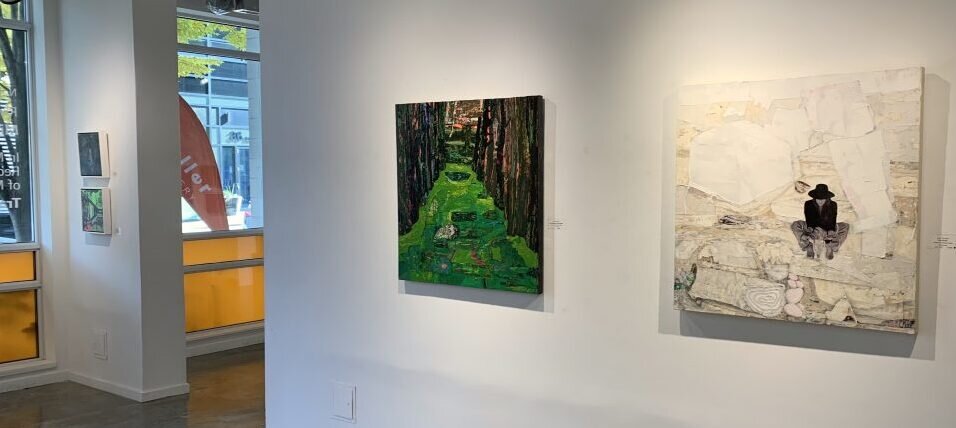
The word room, for many of us, has a different significance after the past year. Encapsulating feelings of isolation and claustrophobia, but also safety and familiarity, our interiors will never feel the same after COVID-19. In My Room: The Reconstruction of Memory, Tracy Thomson’s solo show at Propeller Gallery, explores various imagined interior scenes through mixed media. Each complex image is drastically different from the next, conveying a multitude of emotions, ideas and questions. These works are built up of layers of mixed media and acrylic oil, with vibrant colors and strange shapes. Varying in size from small-scale to larger-than-life, each interior provides an intimate look into Thomson’s imagination and reality. Each room conveys a different mood, on a spectrum from dark to light.
Installation view of Tracy Thomson, In My Room: The Reconstruction of Memory at Propeller Gallery
Tracy Thomson is a Toronto-based painter and mixed media artist. Her practice aims to “create works that allow her mind into unknown territory”. As opposed to collage, she calls her compositions “reconstructions”; pulling apart painted paper and various materials, images are slowly and methodically turned into complete scenes. In the gallery’s exhibition statement, she described her process, “In my reconstructions, I created imaginary rooms by making little dioramas, pieced together with paint, paper, glue…and a healthy dose of love and hope! Decorated with objects that would pertain to the person inhabiting the room or simply experiencing that room, from a distance.”
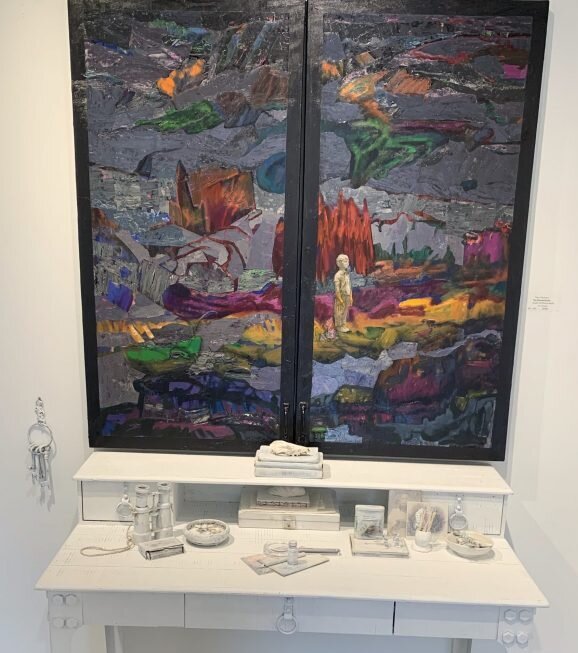
Installation view of Tracy Thomson, In My Room: The Reconstruction of Memory at Propeller Gallery
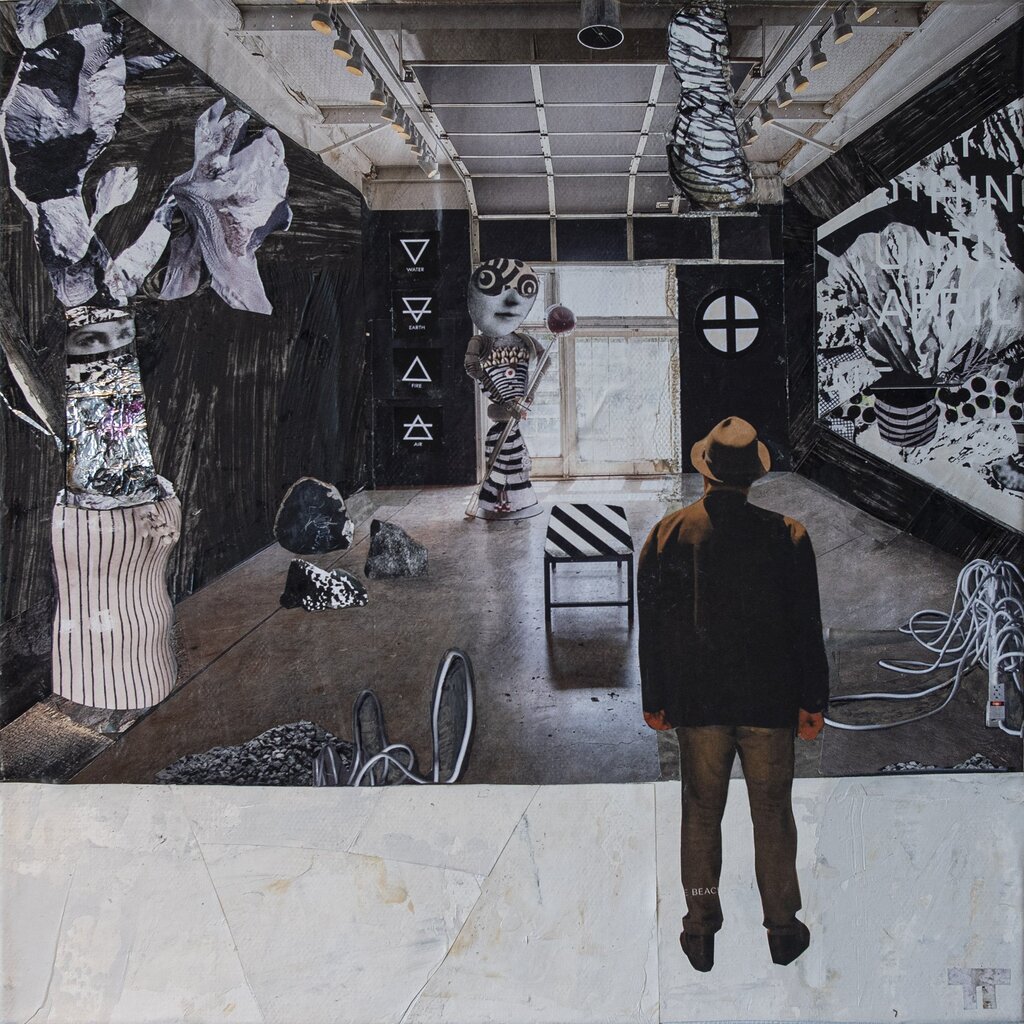
One of the most captivating works in the exhibition is The Manichaean, a figurative piece, in a mostly black-and-white setting with eerie, colourless wallpaper, alchemical symbols on the wall and cold, industrial flooring. A male figure in a jacket and hat stands at the entrance, his back to the viewer, standing on ground that is lighter than the rest of the floor, as if suspended in a space between canvas and reality. Before him are surreal, organic shapes, rocks, an isolated table, and a vase with eyes. In front of the window, a figure with a woman’s face, half covered with stripes and eyes made of spirals looms over the scene, reminiscent of a hermetic Hannah Höch. The image is haunting, and terrifyingly inviting.
Tracy Thomson, The Manichaean, 2021, acrylic oil mixed media on canvas, 12” x 12”
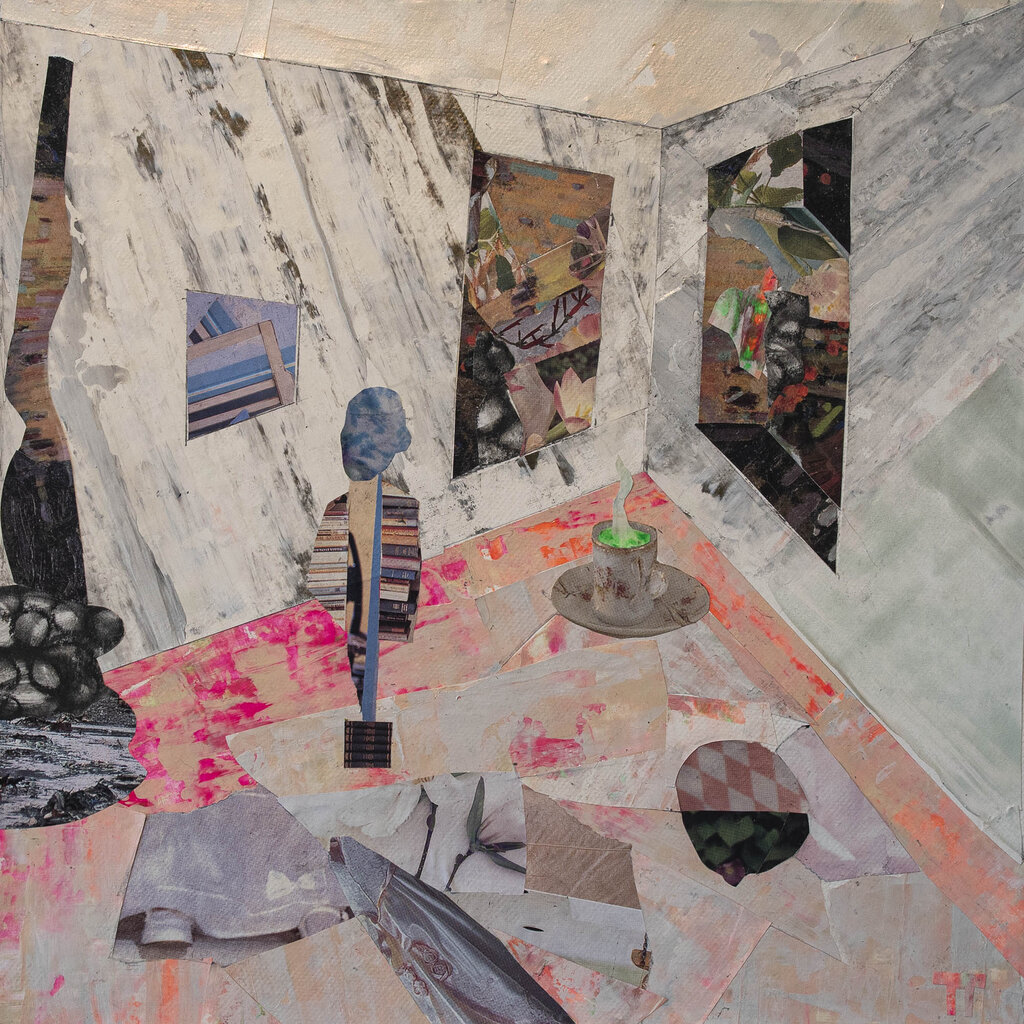
The Gallerist is a much less foreboding, though no less intriguing image. Here, the interior is brighter, with fun, neon hues of pink and orange splashed across the floor, and beautifully textured white marbled walls. The gallerist is at first barely noticeably a human figure; has a head-shaped cut-out that looks like clouds, and the body is composed of books. On the walls, there are paintings reminiscent of Thomson’s own and an abstract sculptural form. In the corner there is a steaming mug on a saucer filled with neon green liquid: perhaps it’s a trendy cup of matcha, but its unnatural hue suggests something otherworldly and powerful.
Tracy Thomson, The Gallerist, 2021, acrylic oil mixed media on canvas, 12” x 12”
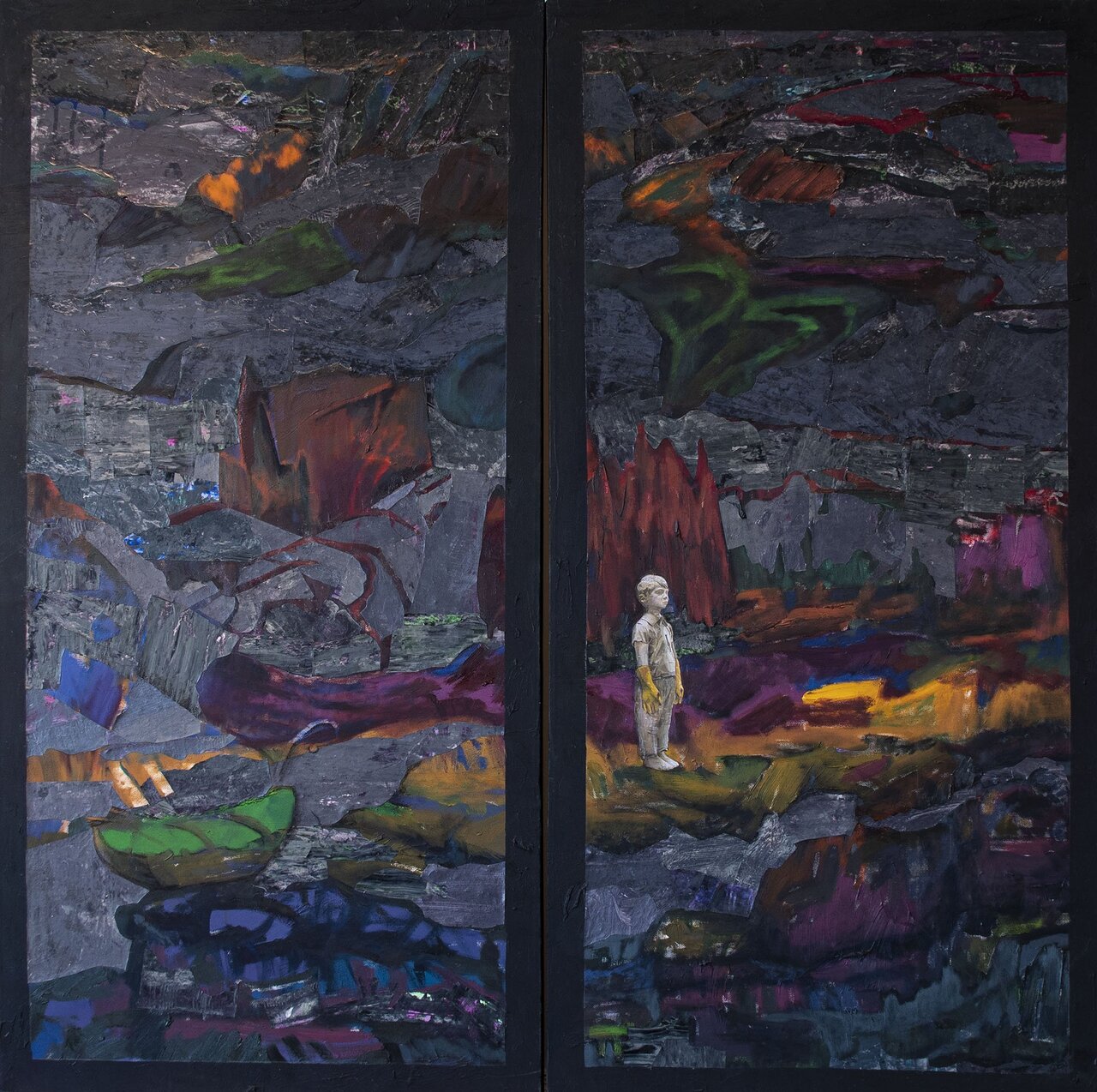
One of the few large-scale works in the show, The Somnambulist, depicts a complex, dark and fantastical dream-scape, framed as if the viewer is looking out of a window. The darkness and vastness of the landscape dwarfs the figure within, a pale, monochrome boy with yellow gloves standing alone and on guard; he appears not of this world, a mere passerby. Near him is a boat – is he coming, or going? The canvas is filled with colourful, abstract shapes and hints of rich, jewel-like textures.
Tracy Thomson, The Somnambulist, 2021, acrylic oil mixed media on canvas, 48” x 48”
Thomson’s solo show is a fantastical escape from the quotidian interiors of reality. Each canvas has its own unique and amazing narrative. One could get easily lost for hours in these mesmerizing reconstructions, imagining themselves as the figures in the work, enriching their own imagination.
Bronwen Cox
Featured image: Tracy Thomson, The Diviner, 2021, acrylic oil mixed media on canvas, 30″ x 30″, Detail
Images are courtesy of Propeller Art Gallery.
*Exhibition information: Tracy Thomson, In My Room: The Reconstruction of Memory, November 3 – 21, 2021, Propeller Art Gallery, 30 Abell Street, Toronto. Gallery hours: Wed – Sun, 1 – 5:30 pm.
An auto-biography of the unNatural, an exhibition, both public and online, at the Christopher Cutts Gallery, featuring artist Janieta Eyre’s three decades of work. Janieta Eyre herself describes the exhibition as: “Inspired by the writings of Elena Ferrante and the sculpture of Patricia Piccinini, both of whom examine themes of disappearance and the monstrous, An auto-biography of the unNatural is an examination of the female as strange and stranger.”
North Gallery Installation
Eyre’s bold and elaborate style is undoubtedly one of a kind. Her wild imagination is shown through the settings, costumes, makeup, and props of her self-portraits. A lot of the patterns on her costumes match exactly with the ones on the wallpapers which creates a unique sense of dimensionality and continuity. Vibrant colours and geometric shapes can be chaotic for the viewer, but Eyre does an excellent job of putting them together in a meaningful way. The result becomes her own storytelling visual device that explores themes of identity, motherhood, and women.
Untitled #3 from my terrible loneliness, 2018, C-print, Edition of 5, 27.5 x 39.5 inches
From the installation views, I notice that there is no labels or descriptions of these images which make them challenging for the viewers to interpret. Luckily, there are titles in the exhibition catalogue, and some of the images include texts in them. In Untitled #2 from my terrible loneliness, there is a line of text at the bottom that says: “There has always been more than one of me. Don’t be misled by your eyes. Get your calculator. Add up the days, the hours and the minutes I’ve been alive. I’ve left the skins of my selves everywhere. It’s not my fault you haven’t noticed.” There is also one in between the figures: “So you too can see my guru.” The idea that Eyre has a double of herself is a recurring theme in her works.
Untitled #2 from my terrible loneliness, 2018, C-print, Edition of 5, 40 x 26.6 inches
Eyre is shown twice in a lot of the images in different postures or wearing different costumes. It makes me think about how sometimes people wish that they are not alone, and they would imagine having a friend. Eyre’s works could be a variation of self or illustrating that there is someone like her in the world. In fact, in her artist statement, Eyre states that she had a Siamese twin sister who died during the separation surgery. Though her sister no longer exists in real life, Eyre is perhaps trying to portray the presence of her sister on these images by showing herself as a twin. Her images, a form of autobiography, are not about the physical world but a way to complete her narrative beyond true experiences. Eyre says: “while discarding my everyday life, I document an invisible one … and so begin to construct an autobiography that depends less on reality than possibility.”
Untitled #13 from my terrible loneliness, 2018, C-print, Edition of 5, 28.6 x 40 inches
Eyre also says: “as an adult I no longer know if I have genuine memories or if all I really possess is what I’ve elaborated from my parents’ arbitrary documentation of my infancy.” I very much relate to her idea of fleeting and unreliable memory. In a series of images titled In the Scream of Things, Eyre depicts herself as a child in places filled with butterflies, flying dishes, cats, couches, picture books and other common household objects.
In the Scream of Things #1, 2007, C-print, Edition of 5, 8.25 x 7 inches (21 x 17.7 cm)
Parts of them are probably real objects from her childhood, while others are added later. The vivid circles in her eyes and on these images convey a sense of unnaturalness and show the viewer that she does not have all the exact memories. Again, these images are not a documentation of what really happened at that time but Eyre’s odd and almost unreal memories of the past.
South Gallery Installation
Zhiyi Fang
Images are courtesy of Janieta Eyre.
*Exhibition information:An auto-biography of the unNatural, October 16 – November 13, 2021, the Christopher Cutts Gallery, 21 Morrow Ave, Toronto. Gallery hours: Tue – Sat, 10 – 6pm. You can also learn more about the artist here.