Author: artoronto

  • I am land that remembers

    Set in bustling Union Station, west of the Great Hall, I Am Land is a three-part exhibition series showing for ArtworxTO: Toronto’s Year of Public Art, 2021–2022, a year-long celebration of Toronto’s exceptional public art collection and the creative community behind it.

    Installation view of I am land that remembers

    The current exhibition, I am land that remembers is about how contemporary artists take up the role of chronicler, and how collective history is created in pubic spaces. Curator of ArtworxTO South Hub, Maya Wilson-Sanchez has grouped together artists who confront questions of history-making. What kind of stories do we remember? What stories are left out and forgotten because of class, gender or race?

    Curator, Maya Wilson- Sanchez introduces the exhibition. Photo: Mirna Chacin

    Wilson- Sanchez walked me through the exhibition space, where I, and hundreds of others in transit that day, got to experience the impermanence of a changing history, and reflect on the untold stories of our culture’s past.

    Artist Miles Rufelds’ work Annotations on a Profitable Enterprise (It spans the world) was commissioned for this exhibition specifically. The artist critically analyzes an important part of Canada’s archival history through his extensive research into the Canadian Pacific Railway. On the floor, like a scattering of archives, are a collection of images and posters used throughout the railway’s history, including historic union strikes, Canada’s history of mining, and propaganda posters enticing white settlers to travel to the western provinces. Maya Wilson-Sanchez explains, “it’s all here, truth is all on the surface for you to see, it is a thorough and story-like look at capitalism and colonization which are two sides of the same coin”.

    Miles Rufelds, Annotations on a Profitable Enterprise (It spans the world)

    Nour Bishouty’s untitled work focuses on impermanence and family history. After the loss of her father, an artist who made souvenirs in Amman, Jordan during the 1990’s, she remembers him by recreating his art practice with ice, documented through photograph in the exhibition space. This work is about love, intimacy and memory as the art pieces, made originally of wood, but recreated with ice that is melting when contacted with Bishouty’s body. It holds the ephemeral meaning of the passing of time, of family and cultural history – all suspended in a temporary existence.

    Nour Bishouty, Untitled, detail

    In another poignant display of family history, Sarhuina Women and their Intangible Cultural Heritage presents Peruvian artist Venuca Evanán Vivanco, with her own Sarhuina paintings on display. Sarhuina is a style of painting that is traditionally a male practice, but Venuca teaches this kind of painting method to other women in her community. She encourages women to take part in the creation and economic gains enabled by this skill set, arguing that this is also part of their cultural birthright.

    Sarhuina paintings by Venuca Evanán Vivanco

    During my time in I am land that remembers, I was reminded that identity loss is directly linked to land that is taken away – and also that this trauma is universal. I am land that remembers showcases the reclamation of culture and empowerment.

    Tania Willard, Carrying memories of the land

    I think the success of the exhibition series I am Land comes from its clear delivery of its message. Maya Wilson-Sanchez concludes the tour with explaining her intent, “As a curator, I’m interested in historiography, and who gets a say, how it gets created, what gets shared. I love working with artists who are thinking in historical terms, but are always bringing that into the contemporary.”

    Installation view of I am land that remembers with work by Iván Argote (left), Amber Webb (right) and Miles Rufelds (on the floor)

    Georgia Gardner

    Images are courtesy of ArtworxTO. Photo: Toni Hafkenscheid

    *Exhibition information: I am land that remembers / including artists Iván Argote, Nour Bishouty, Glenna Cardinal, Miles Rufelds, South African duo MADEYOULOOK, Venuca Evanán Vivanco, Amber Webb, Tania Willard and Shellie Zhang, March 2 – May 29, 2022, Union Station west of the Great Hall. The third part of this series, I am land that speaks will take place June 6 – October 2, 2022.

  • Artist Project 2022

    April 21 – 24, 2022
    Queen Elizabeth Building, Exhibition Place
    195 Princes’ Boulevard, Toronto
    Hours: Thursday: 4 – 9 pm, Friday & Saturday: 12 – 8 pm, Sunday: 12 – 6 pm.

    Discover original works of art from over 240 contemporary artists from across Canada and join collectors and curators, gallerists and designers, who make Artist Project their destination for new talent. Here you can meet and buy art directly from the artists and support the next generation of Canadian artists.

    Artist Project X Fashion Art Toronto Preview

    Unique to this year’s Artist Project, Fashion Art Toronto will debut collections from 2 emerging designers during a live fashion show on opening day, Thursday, April 21, 7 and 9 pm.

    Art Walk

    Meet near the Info Desk to tour the fair with an art expert and discover Artist Project through their eyes. For the schedule please click here

    There are also Untapped Emerging Artist Competition and other interesting programs. For more information please click here.

    The Artist Project, 2020. Photo: Phil Anderson

  • Toronto Biennial of Art 2022 / Press Preview

    Toronto Biennial of Art / Press Preview, March 23, 2022

    Theme: WHAT THE WATER KNOWS, THE LAND REMEMBERS

    The pandemic put many of us on pause and the Toronto Biennial of Art (TBA) scheduled for 2021 was not spared. Fortunately, it has re-emerged in 2022 with artistic vigour. This year’s Biennial offers generous portions of captivating and thoughtful artworks to feed our appetites after enduring a two-year period of hibernation. A welcome event as we long for spring and post-pandemic recovery. Visitors can go to nine sites in Toronto as well as Mississauga. There are over 100 works from more than 65 participants, both Canadian and international, including 23 new commissioned artworks. The TBA celebrates the cultural diversity of Toronto with one third of the artists being indigenous. The organizers even came up with their own Land Recognition statement after consultations over a two-year period.

    The curators and organizers (L-R): Curator Katie Lawson; Curator Exhibitions Tairone Bastien; Deputy Director & Director of Exhibitions Susannah Rosenstock; Senior Curator Candice Hopkins; Deputy Director & Director of Programs Ilana Shamoon; Executive Director Patrizia Libralato and Director, Development Leah MacNeil.

    Besides the actual artworks, there are performances, workshops and other programming with information all accessible from their web site. On June 4th, Judy Chicago will end the TBA with a Smoke Sculpture from a barge floating in the lake near Sugar Beach. Many of the artists will be accessible through artist talks or exhibition tours, so viewers can learn more about their art. Curators Candice Hopkins, Katie Lawson and Tairone Bastien explored this second biennial as a continuation of the first in analyzing the relationship between land and water. Where the 2019 Biennial was about the waterfront, this biennial has sites that have water running below the ground or in creeks above it. Both water and land are seen as archives of history.

    The entrance of 72 Perth Avenue

    An old Pentecostal church at 72 Perth Avenue (Bloor and Lansdowne area) is ground-zero for this year’s Biennial, and that was where we met for our day long tour at 9:30 in the morning. The building will become a condo site but was donated by Castlepoint Properties for the exhibition. Here one can see several installations, sound and video works as well as the impressive piece by Iranian artist Ghazaleh Avarzamani Forced Afloat consisting of 7,000 square feet of rubber mulch from old tires. It looks like a big blue sandbox. Artist Jeffrey Gibson has a sculptural work, Speak to me in your own way so I can hear you, made from driftwood, canvas, beading and other materials. The piece is reminiscent of totems and the mystical rituals surrounding them. Andrea Carlson’s (Ojibwe) works, Cast a shadow (mixed media on paper) and Never Ending (with 28 wood columns), stand out with their monumentality.

    Andrea Carlson, Never-Ending Monument, 2022, 28 wood columns. Each column 18 cm diameter, up to 304 cm tall. Courtesy of the artist. Co-commissioned by the TBA and FRONT International Cleveland Triennial for Contemporary Art

    Paul Pfeiffer (NY, USA) has a group of sculptural objects titled, Incarnator, that resemble Catholic icons.

    Installation view of Paul Pfeiffer, Incarnator, 2018 – 2022, series of wood sculptures

    Torontonian artist Nadia Belerique’s large installation Holdings is comprised of stacked white, plastic barrels containing found objects and stained glass. These barrels were used to transport goods back and forth to her family in Portugal. There is much more to see at 72 Perth and it even has a reference centre where one can look through books.

    Installation view with Nadia Belerique, Holdings, detail, 2020 – ongoing, plastic barrels, stained glass, copper, lead, etched glass, acrylic sheeting, rainwater, paint, steel, various food objects, photographs, wood

    Nearby is Arsenal Contemporary Art at 45 Ernest Avenue. One of the most striking works there is Kaokao #1 by the Mata Aho Collective (four Maori women artists), a huge sculptural work, created from 200 meters of reflective tape; a larger version of matting used in their culture.

    Installation view with Kaokao #1 by the Mata Aho Collective, 2014, reflective safety trim, cotton, 12 x 2.2 m

    Also on view is Kahkiyaw Kikway (All of everything) by artist Amy Malbeuf made with tanned moose and deer hides. And there’s lots more to see at Arsenal Contemporary.

    Installation view with Amy Malbeuf, Kahkiyaw Kikway (All of everything), 2019 – 2022, home tanned moose and deer hide

    Jeffrey Gibson‘s colourful and clever site-specific installation I am your relative is situated in the main floor lobby of MOCA. Its movable platforms engage the public to participate in creating an interactive work by using Gibson’s posters, textiles and stickers covering walls and even doors. This work was commissioned by MOCA and the TBA. It is supposed to create a one-of-a-kind visual archive.

    Installation view of Jeffrey Gibson, I am your relative, 2022. Courtesy Jeffrey Gibson Studio, Kavi Gupta Gallery, Roberts Projects, Sikkema Jenkins & Co. and Stephen Friedman Gallery, co-commissioned by MOCA and the TBA

    Then we went on to Mercer Union to see The 45th Parallel by artist Abu Hamdan that includes an installation of two large backdrops and a video work by Hamdan as well as a monologue by filmmaker Mahdi Fleifel. It is about the Haskell Free Library and Opera House which straddles the Canada and US border. A fascinating story.

    Abu Hamdan, The 45th Parallel, 2022, video still

    In High Park at Colborne Lodge there are some smaller works to take in by artists Eduardo Navarro, who presents an Untitled series of coloured postcards, and artist Marguerite Humeau who was commissioned to create a series of site-specific sculptural pieces, titled Energy Flows about the tragic story of Jemina Howard, who lived and died in this building.

    Eduardo Navarro, Untitled series, coloured postcards

    The video installation Dish Dances by Ange Loft can be seen even from the outside at Fort York National Historic Site. It addresses issues of land sustainability.

    Installation view of Small Arms Inspection Building, Mississauga

    In Mississauga at the Small Arms Inspection Building, a former munitions factory with 18,000 square feet, there are numerous installations, videos and artworks. The space is immense and sometimes the works are somewhat comprised by the light coming from the windows and skylights but everything is very assessable and worth checking out. I liked LAIR, a mobile music ensemble. Nave by Camille Turner is a powerful 3-channel video installation that looks at the slave trade in Canada.

    LAIR, a clay music ensemble with sound artists from the art collective, Jatiwangi art Factory (JaF), based in Jatisura, West Java, Indonesia

    Works at 5 Lower Jarvis Street include the sculpture series Plague Masks, created by artist Brian Jungen using Air Jordan sneakers. Artists Ts̱ēmā Igharas and Erin Siddall created a multimedia installation, Great Bear Money Rock, using a projector with a film loop, a bottle of water and glass bubbles placed on the floor. The work explores the “traumas of colonial extraction.”

    Brian Jungen, Plague Mask, 2020, nike air jordans, 34.3 x 69 x 40 cm

    At our last stop at the Textile Museum, we viewed some great works by Indigenous artists Jessie Oonark, Janet Kiqusiuq and Victoria Mamnguqsualuk. Titled, Double Vision Double Regard, the textile pieces include colourful fabrics and is more of a gallery setting.

    Jessie Oonark, Untitled, 1977, embroidery and appliqué on felt

    The TBA treats us to 10 weeks of great art and programming (all free) and some relief from the pandemic. Back in April 2010 at the former site of MOCA there was a public forum on whether Toronto needed to have its own Biennial (there are some 200 around the world). There was vigorous debate on who would organize it, who would pay for it, and what it might look like. TBA Executive Director and Founder, Patrizia Libralato and her team gave us the first edition of the Biennial in 2019 and now with the second TBA it looks like the bi-annual event will become something to look forward to and another good reason for us to celebrate the arts in Toronto.

    Text and photo: Phil Anderson

    *Exhibition information: March 26 – June 5, 2022, in nine exhibition sites, including, 72 Perth Avenue, Arsenal Contemporary Art Toronto (45 Ernest Ave.), Mercer Union (1286 Bloor St. West) Museum of Contemporary Art (158 Sterling Ave), Colborne Lodge (11 Colborne Lodge Dr., High Park), Small Arms Inspection Building (1352 Lakeshore Rd. East, Mississauga), Fort York National Historic Site (250 Fort York Blvd), 5 Lower Jarvis Street, Textile Museum of Canada (55 Centre Ave), For more information about TBA please click here.

  • As Immense As the Sky at Harbourfront Centre

    You have probably walked past the Harbourfront Centre and saw these three installations near the parking lot and around the main entrance. The exhibition As Immense As the Sky has been on view since June in 2021, and it is a selection of three photography works by indigenous artist Meryl McMaster.

    The exhibition originally contains nineteen photographs and took three years to make and has exhibited in Canada, the UK, Australia, and France. The photographs capture McMaster’s journey of visiting places where her ancestors have lived and deeply connected with. She tries to trace her ancestral roots and find her personal connections with the lands.

    Meryl McMaster grew up in both indigenous and Western culture, Siksika First Nation on her father’s side and British and Dutch on her mother’s side. She constantly experiences the intersection of different worlds and different ideas due to this upbringing. However, because of climate change, she is worried that these ancestral lands would be negatively impacted. She felt an urge to visit these places in search of the lands’ wisdom and knowledge.

    McMaster states on her website that she sees “these landscapes as immense time capsules of buried knowledge.” The exhibition is about “walking these ancient paths, experiencing the diversity of panoramas, and learning about my ancestors’ wisdom.”

    My Destiny is Entwined With Yours, 2019, Digital C-Print, 40″ x 60″

    In the photograph My Destiny is Entwined with Yours, Meryl McMaster is pictured at the top of the Conglomerate Cliffs at Cypress Hills, Saskatchewan. She is looking down at the waterways and trails where indigenous peoples of the Plains would hunt, gather, and travel to sacred locations. It shows that people have always relied on nature and the exploitation of natural resources would inevitably impact our future as well, suggesting that our destinies are entwined with our environment.

    What Will I Say to the Sky and the Earth II is taken in Lake Erie in Crystal Beach, Ontario. McMaster is dressed in semi-transparent white garment that blends in with the snow-covered environment. As a result, the red and magnified mayflies and dragonflies really stand out and convey a main message here. In recent years, the number of these water insects have drastically declined, making the local ecosystem of birds and fish unstable. McMaster positions herself in the center trying to protect these water insects and rebalance the equilibrium between the water, the sky, and the Earth.

    What Will I Say to the Sky and the Earth II, 2019, Digital C-Print, 40″ x 60″

    The backdrop of On the Edge of This immensity is Gore Bay, Manitoulin Island, Ontario. In this picture, McMaster is standing on the edge of the water in this area. Her mother’s ancestors from Holland lived here for a while in the late eighteenth century before eventually settling in Saskatchewan. Contrast to the serene background, the artist carries a boat filled with black birds, perhaps as an attempt to protect them, and looks into the distance beyond the frame. There is a sense of anxiety about the future of these landscapes throughout the exhibition.

    On The Edge Of This Immensity, 2019, Digital C-Print, 40″ x 60″

    Overall, the exhibition captures McMaster’s reflections on the beautiful and resourceful landscapes of her ancestors. The history and knowledge of the lands are truly immeasurable and invaluable.

    Zhiyi Fang

    Images are courtesy of Harbourfront Centre

    *Exhibition information: Meryl McMaster, As Immense As the Sky, June 22, 2021 – March 27, 2022, Harbourfront Centre Parking – Main Entrance at 235 Queens Quay West, East Side. You can find the complete series on Meryl McMaster’s website

  • Toronto Biennial of Art 2022

    March 26 – June 5, 2022 / Various locations in Toronto and Mississauga

    The Toronto Biennial of Art’s mission is to make contemporary art accessible to everyone. For 10 weeks every two years, local, national, and international Biennial artists transform Toronto and its partner regions with free exhibitions, performances, and learning opportunities. Grounded in diverse local contexts, the Biennial’s city-wide programming inspires individuals, engages communities, and contributes to global conversations. More than 70 Canadian and international participants will be featured responding to and expanding on resonant ideas through artworks and programming.

    The Toronto Biennial of Art launched in 2019 and was a popular and critical success. The Biennial provides expanded understandings of contemporary art practices and is building a legacy of free, inclusive, and accessible contemporary arts programming in Toronto, Mississauga, and their surrounding communities.

    As conversations about Truth and Reconciliation as well as inclusion, equity, and accessibility continue to evolve, the Biennial is committed to developing new ways of seeing and listening.

    For more information about the theme, the locations, the exhibitions and the programming please click here

    Jeffrey Gibson, I AM YOUR RELATIVE, 2022. Installation view, MOCA Toronto. Courtesy Jeffrey Gibson Studio, Kavi Gupta Gallery, Roberts Projects, Sikkema Jenkins & Co. and Stephen Friedman Gallery. I AM YOUR RELATIVE is co-commissioned by MOCA and the Toronto Biennial of Art

  • Lyla Rye at General Hardware Contemporary

    Lyla Rye’s art practice invites us to be aware of how we see what we see. Her work encourages us to be active in our looking, to become conscious that perception is not passive, to realize that we actually construct what we see.

    Rye’s show at General Hardware Contemporary is crisp and sleek. The show consists of three bodies of work: a pair of large digital prints with colourful flecks of images over a dark background, a set of notebooks filled with collaborative work, and fifteen prints reminiscent of architectural presentations.   

    Installation view of Lyla Rye, Deviations at General Hardware Contemporary

    Suspended Meditation – Horizontal is a wide, panoramic digital print. Colorful image fragments float over a black background, aligned to an invisible isometric grid. The effect is like delicately stacked cards or intricately folded paper. Each shape contains an image of nature: sunset, vegetation, coastline, etc. Rye has taken these images from online meditation videos, videos that often contain idealized visions of nature; scenes that are carefully composed and colour enhanced. Because these images are skewed to conform to the isometric geometry, they do not appear as windows that we see through, but as floating two-dimensional membranes within the three-dimensional space. The orientation deflects our gaze, the pictorial illusion is thwarted. They remain as posters, wallpaper, or screens.

    Drawn in to read these fragments, I realized that the images were partially occluded by black shapes. For me, this discovery was sudden: a visual finger-snap. Abruptly, I could see a dense field of black rectangles, only revealed as they covered the bright images. Elsewhere, they blended in with the background. I was confronted with ‘dark matter’ that I had not seen before.

    Suspended Meditation, Horizontal, 2020, archival print mounted to aluminum, 20” x 60”

    The other large piece, Suspended Meditation – Vertical is a tall image that contains the same kind of isometrically skewed scenes as in its horizontal sibling. In this case, gravity has taken hold and the colourful images are clustered towards the bottom while the top of the image is mostly empty. The densely packed images in the lower section are again taken from the found meditation nature footage. The images at the upper end of the frame are less colourful and depict nature tainted with trash and litter. The polluted images can be seen as falling over the idealized images. Rye is fascinated by how we sooth ourselves through the contemplation of aesthetic images of nature while we collectively treat the natural world in ways that are exploitive and far from reverential.

    Suspended Meditation, Vertical, 2020, archival print, 60” x 20”

    Laid out on a table are a series of grid paper notebooks. Rye calls this body of work Catch and Release – they are a series of collaborations between her and other artists. Each artist starts an image in the book and sends it to their colleague, who can then add to, and alter the work. Each artist catches work from their colleague, adds to it, and then must release it to be reworked again. These notebooks are fascinating to look through. They provided the artists with the opportunity for remote collaboration and interaction during a time when social distance was necessary.  

    Catch and Release, notebook with mixed media collage and drawing

    The Deviations are a set of prints of collage / drawings produced on isometric grid paper. This kind of grid, and the drawings they are designed to support, are typically used in architecture and engineering to represent three dimensional views of objects.

    The grid is a set of rules – guides that the paper wants the artist to follow. Rye plays with these rules: sometimes she plays along, sometimes against. Each drawing includes a set of mouse-maze like walls seen from above, architecture that obediently follows the grid. But in other places Rye defies it. Pieces of geometry twist off in odd directions. Other grids, maps and printed patterns are collaged in, breaking the illusional space of the axial grid geometry.   

    Deviation, Red Grids, 2021, Archival Digital Print, 16” x 24”

    In Deviation, Green Grid the collage process is fully revealed.  The green masking tape holding various pieces together plays a central role in the composition and the grid of the green cutting mat becomes the dominant surface in the image where areas have been cut away.

    Deviation, Green Grid, 2021, Archival Digital Print on Canson Infinity Rag, 16” x 24”

    The representation of three-dimensional space on a flat surface involves shared conventions between the creator of an image and the audience. Whether perspective or isometric, we as viewers are habituated to the illusion of depth such that we are not consciously aware that we are re-constructing the space behind the surface in our minds. These self-contradicting collages make one aware of this process as the image switches between depth and flatness.

    Deviation, Mapping Boundaries, 2021, Archival Digital Print, 16″ x 24″

    Rye’s work puts a little wedge between what we think we know and what else may be possible. In the Meditation pieces she exposes the cleft between our aesthetic love of nature and our collective mistreatment and neglect of the natural world. In the Catch and Release notebooks she allows the unpredictable actions of other artists to knock the creative process in new directions. In the Deviations, she engages in a framework with a given set of rules and then allows herself to change those rules. Rye makes us work a little harder at seeing and the result is rewarding!

    Mikael Sandblom

    Images are courtesy of General Hardware Contemporary

    *Exhibition information: Lyla Rye, Deviations, February 12 – March 12, 2022, General Hardware Contemporary, 1520 Queen Street West, Toronto. Gallery hours: Wed – Sat, 12 – 6 pm.

  • Sherri Hay at Christopher Cutts Gallery

    Entering her exhibition at Christopher Cutts Gallery, Sherri Hay confronts us with a simple request: “Let’s not go back to normal.” I admit that the plea triggered an instant compulsion in me, not unlike the response to a host whose house you’ve entered, wishing you to take your shoes off. What did the artist mean by normal, and what is it that we must continue to do? As a gumshoe, I would have to tread where the evidence led me.

    The dominant work on the facing wall from the entrance is Hay’s wall installation Never more stable than a rainbow. The shroud-like assemblage of sheer curtain, rope, and rod, true to its title personified evanescence – held in view here for the duration of the exhibit by a handful of hooks and screws. Like the flush of arching bands of colour in the sky after a storm, a positive nailing of the piece might be, “The Ghost of Pestilence Past.”

    Never more stable than a rainbow, 2022, sheer curtain, rope, and curtain rod, variable dimensions

    Less hopeful is Just as soon as a verb, the installation on the wall of the adjoining gallery – similarly ghostly, but a spectre tumbling into the ominous. Our deference is to Hay’s artist statement and “bardos,” a Tibetan Buddhist word describing the period of chaos, shock, change and fear that a person experiences when they die. Just as soon as a verb is a skeletal hangman on life-support, its bleached Styrofoam bones splayed between ceiling, wall, and floor by ropes and sand bags. Its dying wishes are nursed by the gallery attendant as sand bucket pours at four-hour intervals – cycles of imperceptible heaves and sags. Sand is ingested in the cranial head bucket and disgorged down the spinal column gullet to the bucket on the floor like granules of time in a bifurcated hourglass. Might this be the artist’s response to “these days of incipient ecological collapse,” her expression of “urgency to the question of how we relate to the objects around us?”

    Just as soon as a verb, 2022, rope, sand, fabric, and repurposed styrofoam, variable dimensions

    The artist’s Bardo boxes serve as vitrines displaying cuts resembling highly-magnified animal and vegetable tissue. Pale pink, red, blue, green layers of watercolour and gouache in the foreground are suggestive of the chlorophyll of leaf and under-the-skin flesh, vein, and corpuscle. The meandered looped strings of layered paper form a sealed labyrinthine chamber – visible, but impenetrable somehow. The expressionism of Edvard Munch comes to mind. As the word suggests, “Bardo!” might be the incantatory scream of the soul in the transit from life as it crosses to death.

    Bardo 2 (left) and Bardo 3 (right) both 2022, hand cut paper, watercolour, and gouache 24.75 x 20 x 2.75 inches

    The Dreams of awakening here in this brightness series of diminutive wall sculptures hint at a new life form altogether – leafy flecks of vegetable with the animal, revealing cotton roots and tendrils with the polymer clay and painted bronze. Would these sprigs be the imagined after life of Hay’s humankind – life after civilization’s bardo? In Hay’s imagined life as a tree, souls might find themselves counting tree rings for a thousand years or more.

    Dreams of awakening here in this brightness (L-R) No.17, No.18 and No.20 each 2022, watercolour, paper, polymer clay, painted bronze, and cotton 15.75 x 4 x 4 inches

    Hay’s Let’s not go back to normal exhibition has furnished us with a bucketful of seed for thought.

    Steve Rockwell

    Images are courtesy of Christopher Cutts Gallery

    *Exhibition information: Sherri Hay, Let’s not go back to normal, January 22 – March 5, 2022, Christopher Cutts Gallery, 21 Morrow Ave, Toronto. Gallery hours: Tue – Sat, 10 – 6pm.

  • Prévost and Dembo in Propeller Art Gallery

    There are two shows currently at Propeller Gallery: Circles by Dominique Prévost, and In Motion by Sharon Dembo. I am very happy to be in a warm, welcoming gallery on a cold winter’s day.

    Installation view of Sharon Dembo, In Motion at Propeller Art Gallery

    The first show we see is Sharon Dembo’s In Motion. It is a series of work using printmaking techniques that seems to be ‘simple’ but in reality rely on a complicated process.

    Sharon Dembo, Graceful, (left) and Feathery Form (right) both 2022, encaustic monotype on ink print, 11” x 8.5”

    Dembo was inspired by a metal mannequin she prepared for her previous exhibition – on display again in this show. She began to think about how she could convey movement with it. So, she made sketches on paper of the mannequin in various positions and then added colours. Dembo told me that she loves playing with colours. Indeed, her colours are amazing. She generally uses one colour for the background and its variations for the composition. For example, some pieces are red-based while others are blue-based. Usually, her colours are not very loud, giving the feeling of calmness and peace; capturing you on the spot, so you want to stay longer and see more.

    Sharon Dembo, Let’s Dance I, 2022, monoprint and ink, 15” x 22” (left) and Let’s Dance II, 2022, monoprint and encaustic printing, 15” x 30”

    Usually when people say ‘dance’ we associate it with human bodies, but Dembo turns it around. Her choice of using a dressed-up mannequin to represent dance and motion is very interesting and unique.

    Installation view of Circles by Dominique Prévost at Propeller Art Gallery

    Entering the second room, we see works by Dominique Prévost. She loves paper, colour, and the idea of both ‘travelling’ freely beyond the frame. In her show Circles, there are many mesmerizing lines, showing that everything is moving; whether it is landscape, water, or music. To me the different circles show the surface of the Earth, moon, and other planets.

    Dominique Prévost, Circle XVIII zebra (left) and Circle XXI (right) both 2022, washi and stock paper, ink and crayons, 30” x 40”

    This perfect blend of different colours shows fluidity and movement. Prévost uses an ancient Japanese technique called Suminagashi, which means floating ink, to create these pieces. Some are big, depicting many circles with various patterns on one pure white surface, so you can focus on the circles without the interruptions of a background. Amazingly, you can see the texture of the paper and ink in each image. When you look very closely, you notice numerous amazing differences between the circles.

    Dominique Prévost, (L-R) Burnt Sienna, 2022, heritage washi, graphite and ink, 5 x 5″, Yellow Orange, 2022, washi paper and ink, 5 x 5″ and Salmon Turquoise, 2022, Kitakata washi and ink, 12” x 12″

    Both Prévost’ and Dembo’s work have a relationship with movement. Dembo shows the swinging of clothes in dance, while Prévost depicts the movement of ink in water.

    Lina Weng

    Images are courtesy of Propeller Art Gallery

    *Exhibition information: Sharon Dembo, In Motion, Monoprints and Encaustic Monotypes and Dominique Prévost, Circles, February 16 – March 6, 2022, Propeller Art Gallery, 30 Abell Street, Toronto. Gallery hours: Wednesday to Sunday, 1 – 5:30 pm. Online until May.

  • Anna Binta Diallo at Towards Gallery

    The exhibition Voyageur/Almanacs is Anna Binta Diallo’s second solo exhibition in the Towards Gallery. Diallo has a strong interest in folklore and in the natural world. She creates her artwork through a process of deconstructing and reconstructing the human body while mixing it with fragments of historical relics.

    Towards Gallery brought Diallo’s digital collages together to create an immersive space of installation art. The larger-than-life silhouettes of figures seems as though they exist beyond our dimension—even our universe. Visitors encounter these pieces by slowly moving through the exhibition hall, during which they have a chance to sense the interconnection between the metaphorical figures and themselves.

    Installation views of Anna Binta Diallo, Voyageur/Almanacs at Towards Gallery

    In Anna Binta Diallo’s collage Boy with Lamb, scraps of various fragments, that not related by any means, have been collected and harmonized into a composition. The shepherd is walking straight ahead with his cape flying in the wind. He turns his face towards the viewer with a little black lamb laying in his arms. The robe and the face of the shepherd is made of an early heliocentric illustration. His thighs are covered in parts of the map of Arabia. Diallo combines different geographical and cosmic motifs in her work, involving elements from both the past and the present. Sacrificing animals has a long history. The shepherd’s boots are ancient Egyptian frescos showing men leading a lamb on a leash or carrying it over his shoulder. In Christianity, the lamb is a sacrificial animal, symbolizing our sins and our cleansing by its blood sacrifice. The lamb is a complex symbol that also can stand for the possibility of life, riches and peace. This collage uses various religious elements, showing Diallo’s migration history.

    Anna Binta Diallo, Boy with Lamb (Shepherd), digital collage printed on hemp fabric, 58 x 44 inches

    Seed Girl is an extremely complex, sophisticated image. At first sight we recognize the protractor in the girl’s head. Then we are attracted by her multi-coloured dress. The imagery immediately suggests geographical connections. The body is patterned by the latitudes and longitudes lines over a map of Africa. Diallo was born in Dakar, Senegal where the official language is French, so it comes as little surprise that the inscription in the middle of the composition is in French, describing aerography climate conditions. Those conditions highly affect the agriculture. The head and the hands of the figure are based on an image of the lunar chiaroscuro and the tracks formed by orbiting asteroids. Corresponding to the title of the collage, the plant located on the girl’s hand looks like a combination of a half open planet and a seed. The girl’s hair is made of an inserted engraving depicting the rural life of farmers in the past.

    Anna Binta Diallo, Seed Girl, digital collage printed on hemp fabric, 58 x 44 inches

    Diallo further addresses the concept of agriculture and astronomical knowledge in Harvest Orbit and Solar Orbit. They both use three circular images overlapping to create a structure, showing the interconnection between orbital movements, geological knowledge and human activities. The elements of zodiac signs and the agricultural symbolism in Diallo’s work, could be connected to the Renaissance art practice of The Labours of the months (1450-56) by Luca Della Robbia. They depict both the cycle of day-night and the relationship between astronomical knowledge and agriculture. The usage of earlier century engravings by Diallo is also a way of linking our present voyage to the past. 

    Anna Binta Diallo, Harvest Orbit (left) & Solar Orbit (right) both, digital collage printed on hemp, 44 x 44 inches

    By using folk stories and local materials Diallo created a series of collages that depict people’s lives from all around the world. In Two fishermen the Chinese fishermen figures are aesthetically broken into pieces and composed in a montage of local patterning. They are barefooted, the water waves are depicted in the covering of their bag. The patterns of their clothes show French-made, nautical charts of China (left) and an oriental etching of the local fishing industry (right). The fascinating colour palette of the work makes it even more alluring.

    Anna Binta Diallo, Two fishermen, digital collage printed on hemp, 54 x 41 inches

    In Voyageur/Almanacs, Anna Binta Diallo uses fragments of cultures and civilizations to create her unique subjects. Her collages provide a new perspective in viewing the world around us.

    Vivian Sun

    Images are courtesy of Towards Gallery.

    *Exhibition information: Anna Binta Diallo, Voyageur/Almanacs, January 21 – March 5, 2022, Towards Gallery, 163 Sterling Road, Unit 144, Toronto. Gallery hours: Thurs – Sat, 12 – 6 pm.

  • Interview with Phil Anderson

    Interview with Phil Anderson, Executive Director of Gallery 1313 (PA) on the occasion of Gallery 1313’s 25th Anniversary by Emese Krunák-Hajagos (EKH)

    EKH: You have worn many hats: a filmmaker, writer for many publications, a curator, a board member in various organizations and you are also a photo based visual artist. How did you become the director of an art gallery?

    PA: Living in Parkdale I had joined an art collective, the Parkdale Village Arts Collective and was Chair of the Board for that organization. I had helped organize and hang many exhibitions with the art collective so when I stepped down from the Board, they asked me if I wanted to be director of the new gallery, Gallery 1313, we had just moved into. I had also helped to get the space and so I was excited to try this new adventure. We even started a little art publication, Artery that covered the art scene in Toronto for years. It was a fun project with many writers and designers putting it together.

    Outdoor view of Gallery 1313, at 1313 Queen St W (left) and the cover of Artery Winter issue, 2000-2001 (right)

    EKH: Did you ever imagine you would be a director of an art gallery for 25 years?

    PA: I had no idea that I would last in this new job as long as I have. I had another part time job in social services and was looking to become a film director/writer of independent films. I learned from other gallery directors and enjoyed the constant challenge working with different artists, putting up a new show every two weeks, I enjoyed the variety of it. I have never had a job performance review in 25 years so I figured I did something right.

    Gallery 1313 celebrates its 20th anniversary, Opening Reception, January 19, 2017

    Installation view of The Sex Show, February 14 – 25, 2018

    EKH: 25 years is a long time in a gallery’s life. Looking back at it what do you think was your greatest accomplishment?

    PA: I hope that many young artists have enjoyed having their first exhibition at Gallery 1313. Some artists still remind me that the gallery was their start. I also am proud that families and residents have had a place to see contemporary art that was welcoming. We have produced or hosted over 1,600 exhibitions with probably over 9,000 artists and welcomed over 500,000 visitors over the years.

    Installation view of The Collective, Visual Arts (BFA) Majors, York University, February 28 – March 9, 2019

    1st Emerging Artists Show, Opening reception, January 5, 2012

    EKH: What was the most difficult situation you faced during these 25 years? How did you overcome it?

    PA: In the beginning I had a difficult artist who was trying to create a scene calling media and police because he claimed he couldn’t access his exhibit. It was a misunderstanding and I quickly defused the situation. Media and police left without incident. The artist continued his show and I figured it was all easy after that.

    EK: What are the most important things you learned about running an art gallery over the years?

    PA: I have learned to keep things relaxed and make sure that everyone felt welcome in the gallery. No pretense. No attitude.

    Opening Reception of Between Tradition and Concrete, Deja Shapiro-Innis (left) and Hawk Mason (right), June 26, 2014

    EKH: Who typically are the artists who are drawn to exhibit at Gallery 1313? What do you think attracts them?

    PA: We get local, national and international artists. The Gallery‘s strength is its support of emerging artists young and old. I think word of mouth has been the greatest way people have discovered the gallery. If everyone has a good experience then it all just grows better.

    Darcia Labrosse, Beautiful corpses, September 16 – 27, 2015

    SuperDanish, water lily installation by Nikolaj Recke, curated by Patrick Macaulay, Director of Harbourfront Galleries, 2004

    EKH: Gallery 1313 is more than just a gallery; it is a community as the board of directors and the member artists also have an impact on the programming and the running of the gallery. How does it work?

    PA: Gallery 1313 also has a community mandate to embrace and reflect the community in Parkdale and Toronto. We have over 50 active artist members from across the GTA who show on a regular basis especially in the Cell Gallery which is dedicated to members. Our Board of Directors is mostly comprised of artists and I work with them to help decide the direction of the Gallery. It is a shared governance board model. Running a gallery with over 70 exhibitions a year in four exhibition spaces with a tiny budget requires more that one person so with a volunteer board of directors, artist members and volunteer-interns the work load becomes manageable. Working together we all make it work. Though sometimes people feel that as I have been there forever, I can steer the ship in the right direction.

    Installation view of Thomas Ackermann, The Apostle – Astronauts, Main Gallery, October 24 – November 4, 2018

    Asma Sultana, Constellationscape, Cell Gallery, February 14 – 25, 2018

    EKH: What do think the impact of Gallery 1313 has been in Parkdale and in the city? Where do you see the gallery’s place in Toronto?

    PA: The Gallery has become a cultural hub with not just a diverse range of exhibitions but with performances and other events.

    Fantasy Fashion Show, May 23, 2017

    Rest In Peace Morgan Freeman, OCADU exhibition, dance performance at the Opening Reception, performed by Montreal Dance Troup, 2013

    We also hosting book launches, community fundraisers, film and video screenings as well as panel talks and professional development workshops for artists. We do some community outreach as well. I think the gallery gets some most deserved respect in the arts community.

    Collecting Art, A Panel Discussion, June 3, 2014

    EKH: What was your most ambitious dream for the gallery? Has it been fulfilled?

    PA: Sometimes just surviving as an organization for 25 years with little funding seems like an accomplishment. Hosting some international exhibitions has been exciting and developing many partnerships has been valuable. Not knowing what lies around the corner is exciting. Getting through a two-year pandemic is good. I hope that the gallery has helped others see their dreams come true.

    Installation view of Art Parkdale Fair International, October 29 – November 8, 2020

    Eco Art, Opening Reception, January 9, 2014

    EKH: Gallery 1313 is very successful. What are your secrets to make it so? What advice do you have for other artists run galleries?

    PA: The Gallery has achieved some success and it has not always been easy. I think it is always important to be ready to try new things and try to approach problems with an open mind. We don’t have the financial support of some artist run centres but sometimes it gives us the opportunity to be more spontaneous and take more chances.

    COVID-19 Portraits I-III, an online exhibition, 2020

    EKH: Gallery 1313 has established itself. You survived the pandemic. What is your vision of the future of Gallery 1313 in the next 5-10 years?

    PA: I hope that the gallery will continue to do what it has done in the past and perhaps with more capacity and more staff it can do even more in the future. We may be faced with a move in the future to another nearby location so I hope that works smoothly and that we continue to present a space that welcomes people, helps artists and enriches the community.

    Images are courtesy of Gallery 1313 and Artoronto.ca

  • Gallery 1313 – 25th Anniversary Exhibit

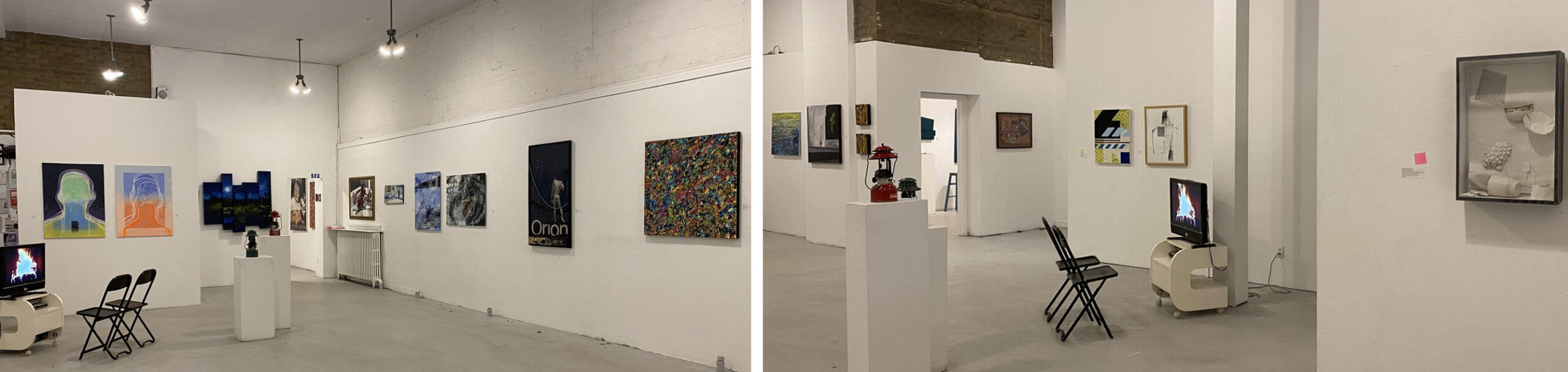
    This year, Gallery 1313 celebrates its 25th anniversary as a dynamic exhibition space, resource centre, and art hub—by bringing together artworks from over 30 of the gallery’s members, in a diverse and engaging exhibition. Located in the heart of Parkdale, the non-profit gallery occupies a beautiful art-deco style building that was formerly a City of Toronto Police Station. For 25 years, the gallery has held hundreds of exhibits featuring every type of artistic media, and has supported both local and international artists.

    Installation views of Gallery 1313’s 25th Anniversary Exhibit. Courtesy of Gallery 1313 (left) and Photo: Jennifer Boothby (right)

    Featuring a broad range of artistic styles and mediums, this 25th anniversary exhibit is truly a celebration of the art community Gallery 1313 has fostered over the years. From abstract paintings with vibrant explosions of colour, to subdued and thought-provoking photographs, to nostalgic shadow-box sculptures—the exhibit is a treat for the eyes and the mind. The show contains 28 works displayed in the gallery and online, as well as 33 additional works displayed online only.

    Even with the huge amount of variety among the works in the exhibit, I noticed some common themes emerge. I found that several of the works balance imagery of nature, with dream-like elements.

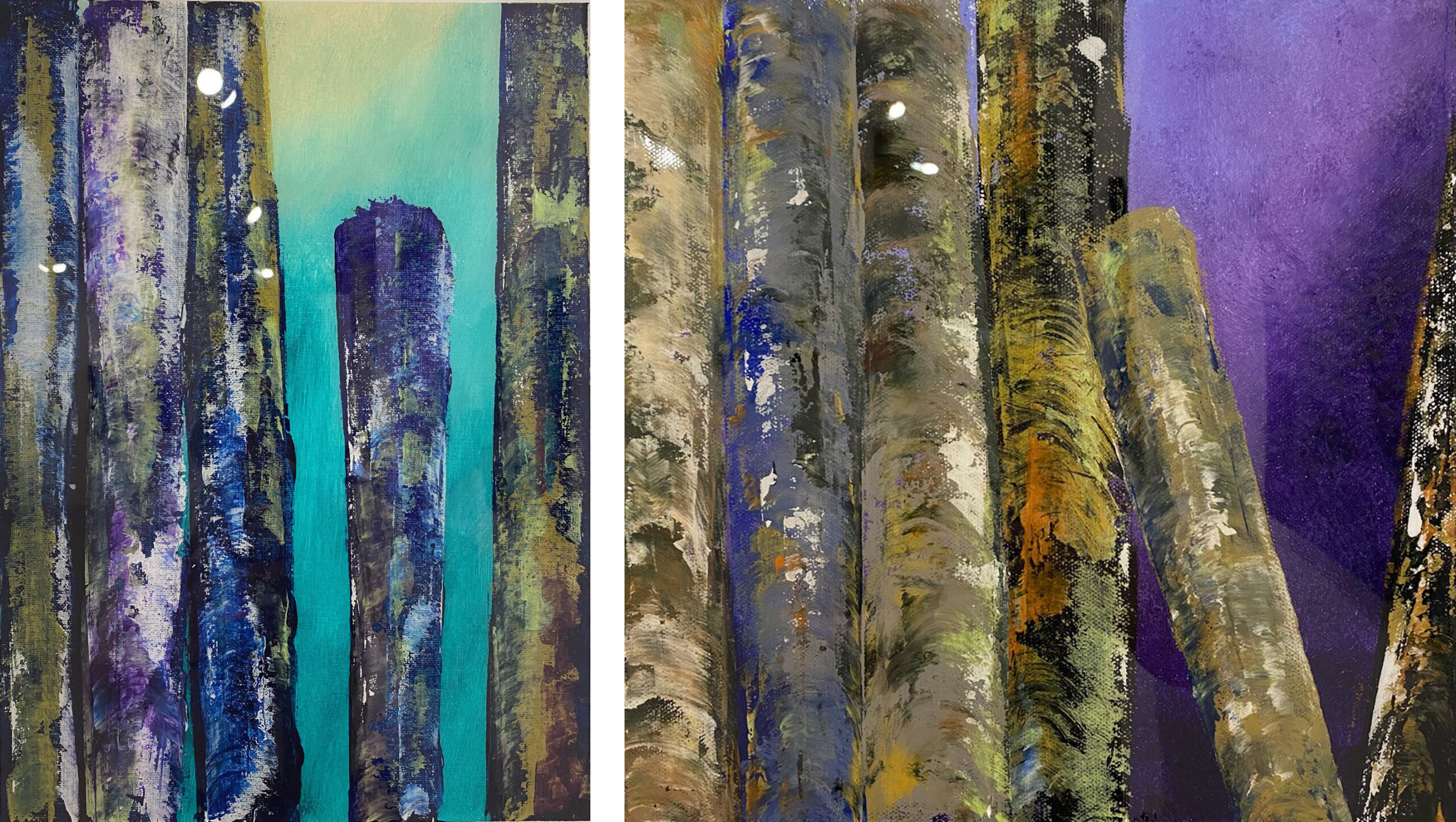
    For example, Toronto-based artist Chris Siems’ paintings Poplars and Borealis, feature groupings of dense tree trunks against vibrant otherworldly skies. These small acrylic and resin paintings portray the interplay between colour and emotion that characterizes much of Siems’ work, and makes them so captivating. Poplars, features five tree trunks rendered in rough brushstrokes of deep blues, purples, browns, and greens—against a bright teal sky. Likewise, Borealis features tree trunks rendered in slightly warmer brown and orange tones, against a rich purple sky. In both paintings, the rough texture of the tree trunks, grounds the trees in reality, while the smooth backgrounds evoke the surreal.

    While contemplating the paintings, I found a sense of peace and serenity wash over me, as I imagined standing alone among the trees at twilight, listening to the sounds of the forest, and looking upwards to glimpse the sky through the dense trunks. The cool tones of the teal and purple skies might prompt viewers to imagine a breeze gently whistling through the trees.

    Chris Siems, Poplars, 2021, acrylic & resin on canvas, 12” x 16” (left) & Borealis, 2021, acrylic & resin on canvas, 12” x 12”. Photo: Jennifer Boothby

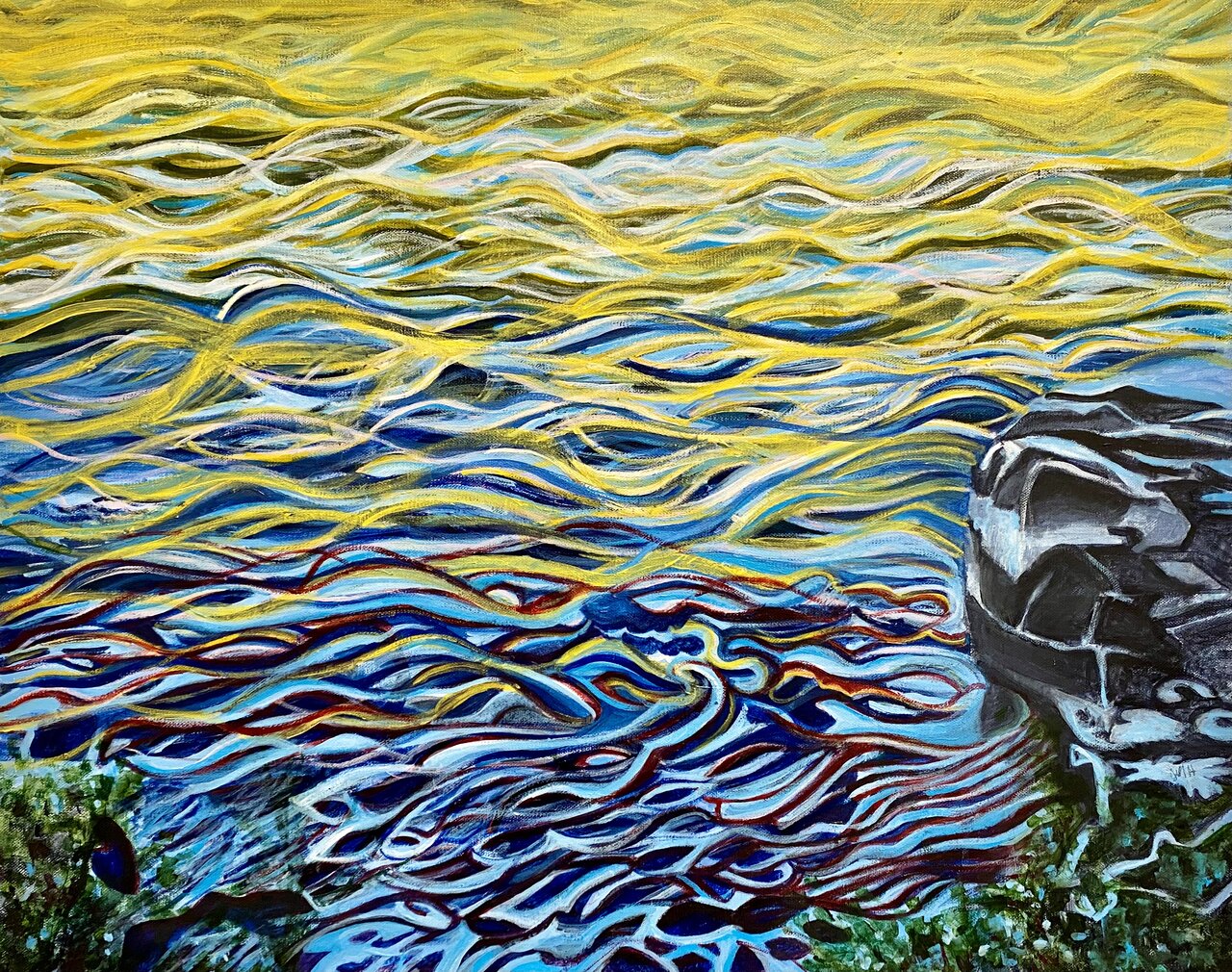
    Similarly, in Dancing Water No. 2, Joan Haberman has created a dream-like waterscape, using vibrant colours and playful brushstrokes. From afar, the yellows at the top of the painting evoke sun reflecting off the waves on a clear day, while the dark blues near the bottom recall shadows closer to the viewer standing on shore. As viewers move closer to the painting, however, a much more varied colour palette emerges. Haberman has woven an intricate pattern of reds, pinks, and browns through the water—creating a sense of depth, and making the waves appear to dance across the canvas.

    Haberman has also used repetitive undulating lines to create a dynamic sense of movement. While looking at the painting, I found my eyes moving with the water, following the rhythmic lines horizontally across the piece. At the bottom of the painting, subtle disruptions in the rhythm imply the movement of sea life below the water. Irregular brushstrokes and swirls suggest that viewers are catching glimpses of fish among the waves.

    The longer I examined this waterscape, the more I felt a sense of freedom emanating from the dream-like colour palette and undulating movement. The waves extend past the top and sides of the canvas, suggesting a boundless sea stretched out before the viewers.

    Joan Haberman, Dancing Water No. 2. Photo: Jennifer Boothby

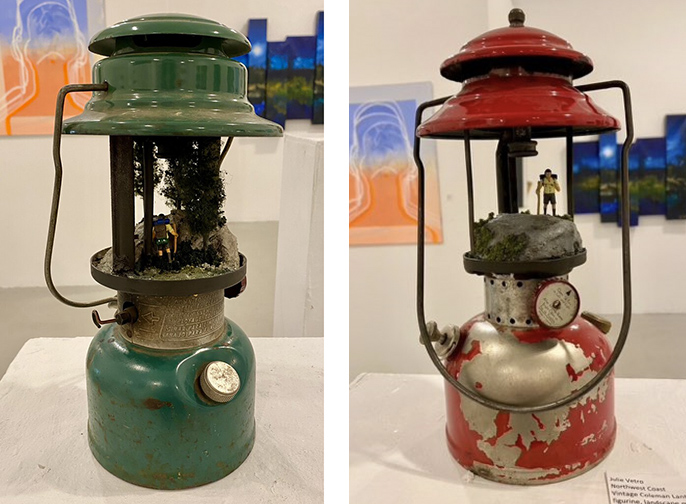
    In the centre of the gallery, elevated on two white podiums, Julie Vetro’s eye-catching sculptural pieces, Northwest and Arctic, alsobalance nature imagery with dream-like elements. The lanterns are pieces from Vetro’s six-part series, Vintage Coleman Lanterns. They were inspired by drummer Harry Vetro’s travels to the six Indigenous cultural areas of Canada in 2017—during Canada’s 150th anniversary of Confederation. Through his travels Harry made an effort to connect with musicians and artists from across Canada. Each of the six lanterns in the series seems to document a piece of Harry’s journey through a particular Indigenous cultural area.

    These lantern-sculptures prompt viewers to lean in and examine the incredibly detailed worlds Vetro has created. Examining the deep green lantern, Northwest Coast up close, viewers can’t help but extrapolate the miniature scene of trees and rocks, into an entire forest. The vertical metal pieces of the lantern stand in for tree trunks, while the top of the lantern makes the scene seem dark and closed-in, as though the hiker is traversing a dense forest. In contrast the miniature in the red lantern, Arctic, is much more open. The hiker figurine stands proudly atop a rock, as though he has just reached the peak of a mountain.

    Contemplating these two pieces—and the ways in which Vetro has blended the natural with the artificial—made me consider the relationship between commercialization and nature. The lanterns themselves evoke the natural, through the rust, dirt, and peeling paint evident on the

    bases. However, the sculptures also contain distinctly artificial elements such as the miniature plastic hiker figurines and the Coleman logos still visible on the lanterns.

    Further, the sculptures evoke a certain nostalgia. The lanterns are well-worn relics of the past, and could evoke childhood camping trips, while the miniatures and figurines recall childhood play sets.

    Julie Vetro, Northwest Coast (left) & Arctic (right) both 2018, Vintage Coleman Lantern, miniature hiker figurine, landscape materials, 5” x 5” x 12”. Photo: Jennifer Boothby

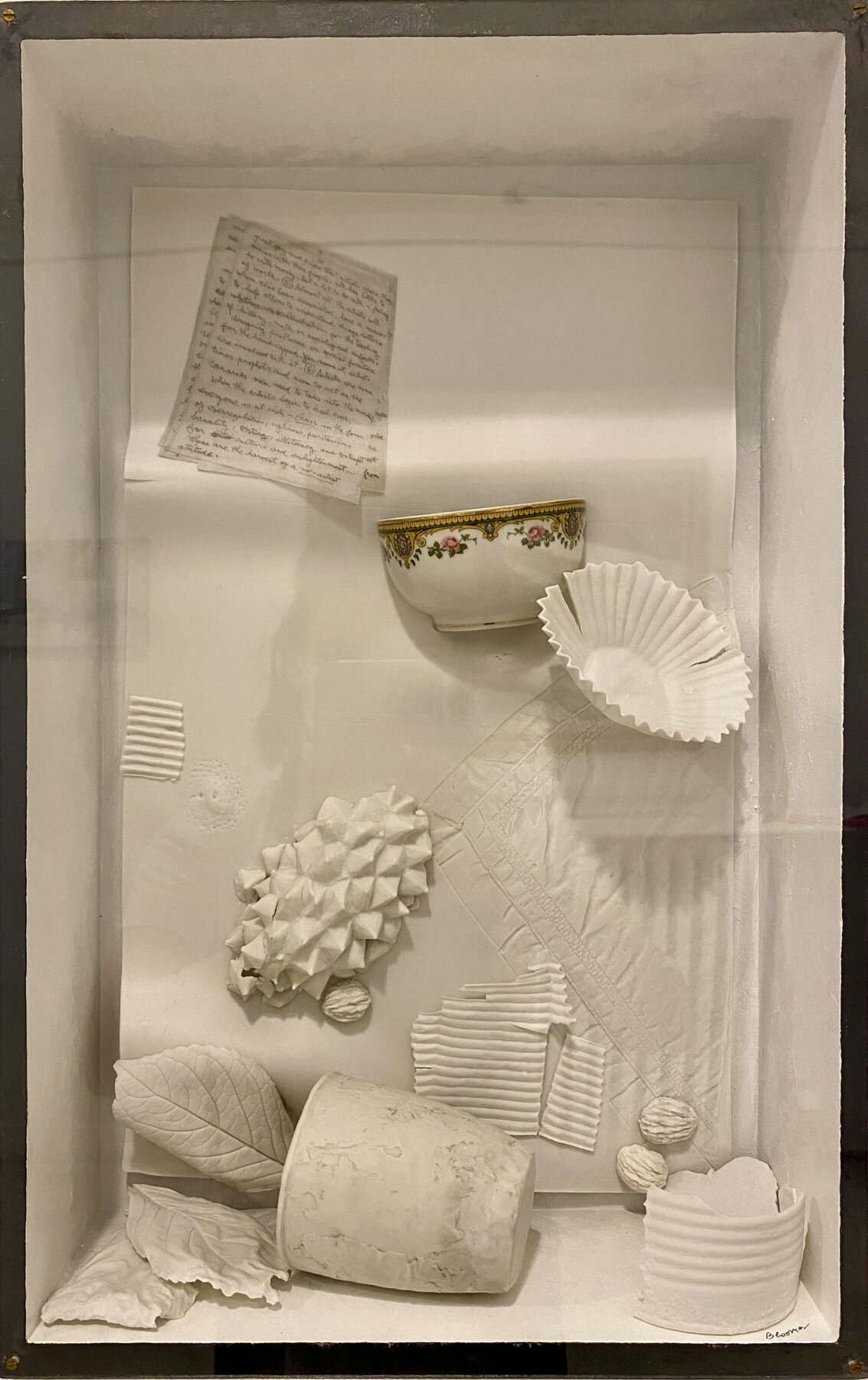
    Another sculptural piece that evokes nostalgia is the wall-mounted Family Gatherings, by mixed-media and ceramics artist Carolyn Bloomer. In her artistic practice, Bloomer creates both functional tableware and sculptural pieces that incorporate found objects. This unique combination of ceramics and found objects is evident in the array of items strewn across Family Gatherings, which include a tumbler, autumn leaves, a cupcake paper, some handwritten notes, and a dainty teacup.

    Surrounded by a deep grey frame and covered with a sheet of acrylic like a shadow box, the piece conveys a sense of stillness and preservation. The objects contained in the frame appear to be relics of the past; objects one might find at a grandmother’s house. They are also appear to be frozen in a state between decay and preservation. The autumn leaves are half-withered, the notes half-smudged, and the tumbler crumbling.

    Alongside themes of nostalgia and preservation, the sculpture evokes the surreal. Each object has been slightly distorted, leaving viewers with a sense that something is not quite right. The tumbler at the bottom of the frame lies on its side, decaying. The handwritten notes appear to have been shrunken. The teacup’s interior is lined with 24 carat gold leaf and is embedded in the background. Even the paper lining the background of the frame is slightly crumpled. Additionally, most of the objects have been made of white porcelain, which enhances the sense of preservation, but also makes the entire arrangement seem unnatural.

    While reflecting on Family Gatherings, I found this tension between nostalgia and distortion deeply thought-provoking and unsettling. Through a skillful arrangement of elements, Bloomer’s composition encourages viewers to reflect on the past and the nature of nostalgia, and question why we preserve certain elements of the past.

    Carolyn Bloomer, Family Gatherings, porcelain, bone china, gold leaf, paint, acrylic; painted wood frame., H 47.5 cm x W 30 cm x D 12 cm. Photo: Jennifer Boothby

    As I walked around the exhibit, I noticed that several of the works expressed themes of isolation. Though these works do not specifically reference the global COVID pandemic, they capture the deep sense of loneliness that has characterized the last few years for many people.

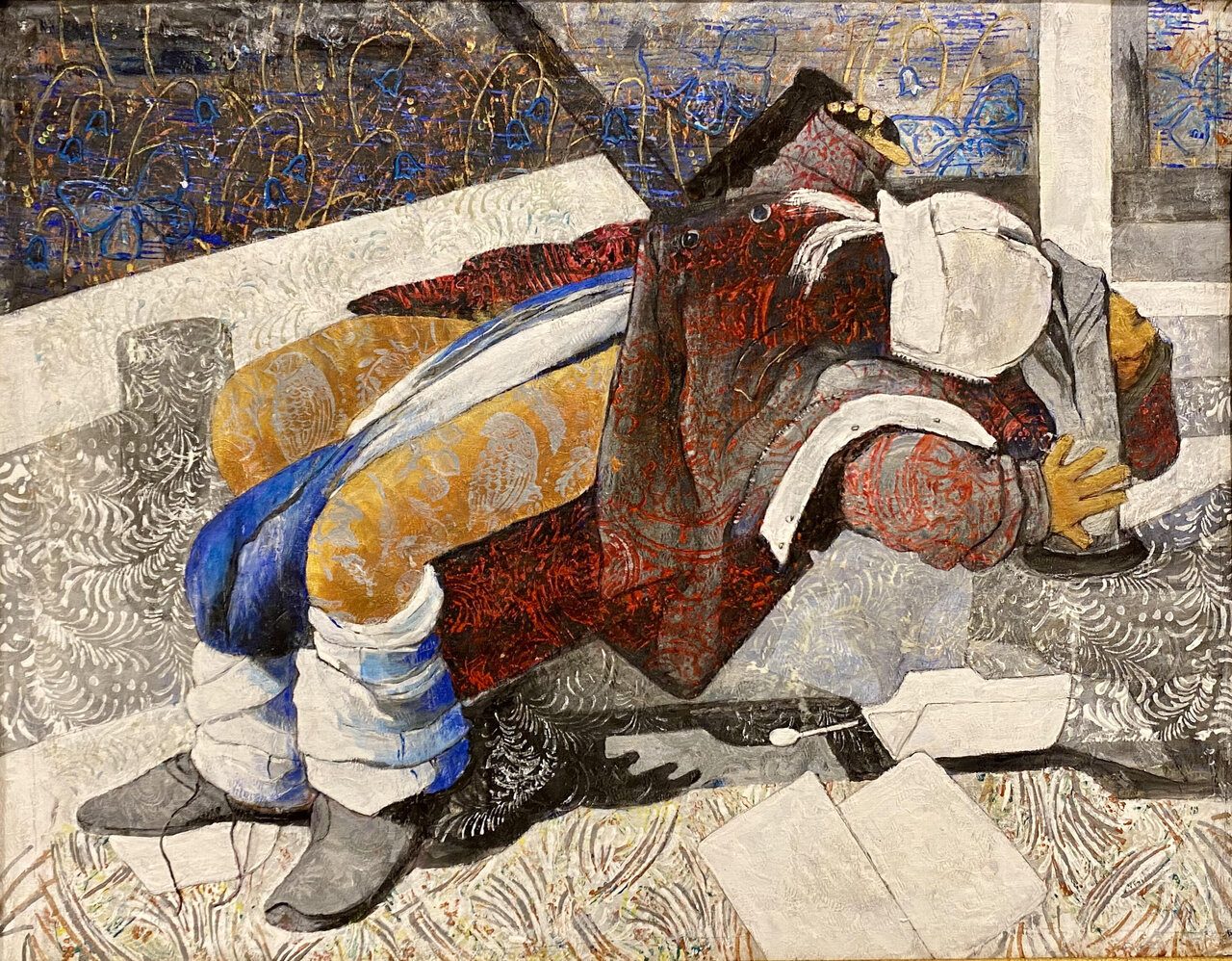
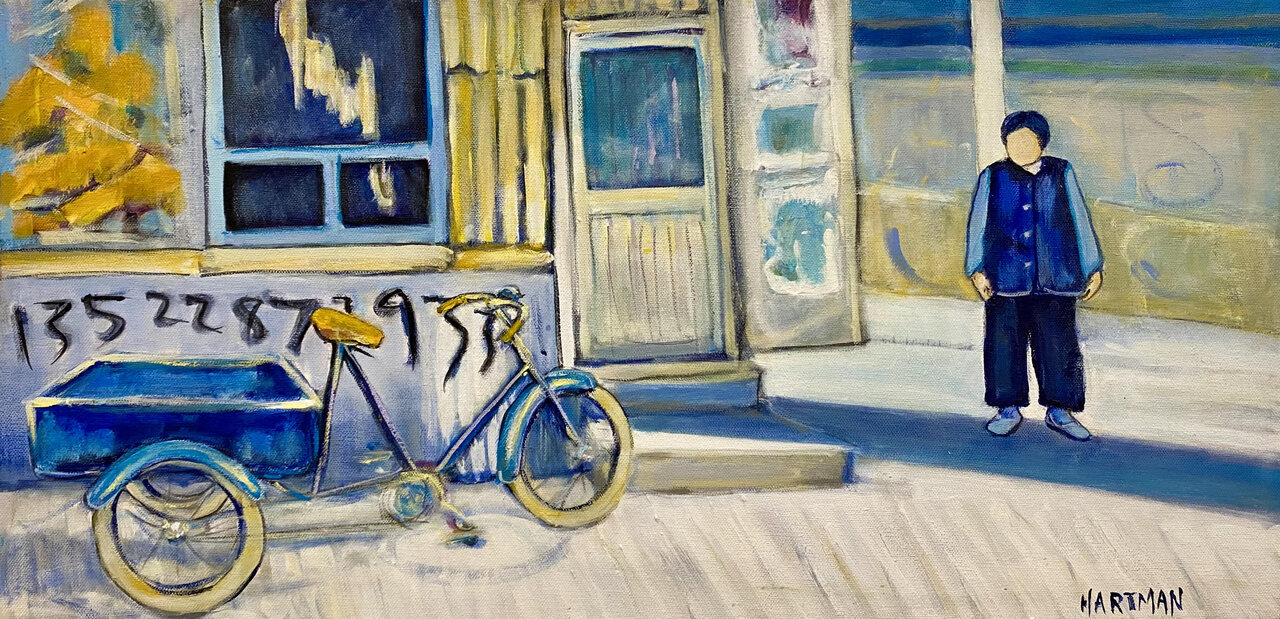
    I was particularly struck by the solitude emanating from two paintings displayed side-by-side in the gallery: Jacqueline Treloar’s TTC Shelter, and Ruth Hartman’s Beijing Blue. Together these paintings capture the universality of solitude, portraying similarly faceless figures located on opposite sides of the world.

    Treloar’s TTC Shelter portrays a familiar image of a person lying alone on a subway bench, debris strewn at his feet. The figure is bundled up in winter clothing, but appears disheveled, with his coat blown open and shoelaces undone. In the everyday hustle and bustle of the subway, a person lying on a bench would not typically draw our eyes, however, Treloar has monumentalized the scene through her use of colour and fabric. The figure’s vibrant red, blue, and gold clothing contrasts his bleak grey and white surroundings, and makes the figure stand out. Additionally, Treloar’s incorporation of fabric creates an interesting clash between the figure’s disheveled appearance and the luxurious fabric patterns that adorn his clothing.

    While TTC Shelter prompts viewers to contemplate the social isolation of the figure—a theme that has taken on new significance in the context of the COVID pandemic. Through the figure’s obscured face, the piece invites viewers to transpose themselves onto the figure, sharing in his solitude. In this way, it speaks to our shared experiences of loneliness and isolation over the last few years.

    Jacqueline Treloar, TTC Shelter, acrylic on textured fabric, 32 x 39 framed. Photo: Jennifer Boothby

    Similarly, Ruth Hartman’s painting Beijing Blue, conveys a sense of isolation through the colour palette and solitary figure. Viewers can again transpose themselves onto the faceless figure, evoking what Hartman refers to as the, “universal within the individual.” Additionally, the predominantly blue colour palette heightens the sense of loneliness.

    Ruth Hartman, Beijing Blue, acrylic on canvas, 12” x 24″, Photo Courtesy of Gallery 1313

    The 25th Anniversary Exhibit at Gallery 1313 captures the diversity of artistic styles among the gallery’s members, and provides visitors an opportunity to experience innovative, often compelling works by local artists. While the exhibit is a chance to celebrate all Gallery 1313 has accomplished in the past 25, the artworks also provide a glimpse into an exciting future for the gallery. 

    Jennifer Boothby

    *Exhibition information: The 25th Anniversary Exhibit, January 19 – February 28, 2022, Gallery 1313, 1313 Queen St West, Toronto. Gallery hours: Wed – Sat 1 – 5 pm. Participating artists include Carolynn Bloomer, Chris Siems, Cindy Y Lam, David Brown, Elizabeth Greisman, Gerda Wekerle, Gert Anckaert, Gwen Tooth, Hugh Alcock, Jacqueline Treloar, Janne Reuss, Jerome McNicholl, Joan Haberman, Joanne Shenfeld, Joanna Black, John Ferri, Jose Cifuentes, Julie Vetro, Leena Raudvee, Marie Finkelstein, Mikael Sandblom, Mirren Hinchley, Pam Patterson, Paul Kilbertus, Ruth Hartman, Sandra Nicole Franke, Sharon Erlichman, Shawn Postoff, Stephanie McLean, Zoraida Anaya, Sonia Langer, among others.

  • Separate/Together at Cooper Cole Gallery

    Installation View of Separate/Together at Cooper Cole Gallery

    The title of the exhibition at Cooper Cole Gallery, Separate/Together, calls to mind the feeling of being separated but together, a feeling that all of us have experienced during the pandemic lockdown. What happens when separate materials are combined in a new way? Cooper Cole Gallery presents the group exhibition Separate/Together, featuring both Canadian and international aritsts: Gaëlle Choisne, Sharona Franklin, ektor garcia, Maureen Gruben, Raven Halfmoon, Gabrielle L’Hirondelle Hill, Jennie Jieun Lee, Brie Ruais, Fin Simonetti, Eve Tagny, and Sami Tsang.

    Installation view Separate/Together with Raven Halfmoon, Sah-Cooh II, 2022, Stoneware, glaze, 9″ x 7″ x 6″ (left) and Sah-Cooh I, 2022, Stoneware, glaze, 12″ x 8″ x 7″ (right)

    When you walk into the gallery, there is a life-size human-like bunny made of tobacco wrapped in pantyhose lying on a table. As you turn to the back, you would be surprised that it wears a pair of old running shoes, a staple for a busy mom. The bunny has feminine characteristics with eight nipples, red lipstick, and two long ears resembling long hair. This sculptural work is made by Gabrielle L’Hirondelle Hill whose “works have used found and readily-sourced materials to address concepts such as private property, exchange, and black-market economics.”

    The title Counterblaste references to a treatise called “Counterbalste to Tobacco” written by King James VI and I in 1604. The treatise criticized tobacco for its negative impact on health and blamed the colonies for bringing tobacco to England, when people under England’s colonization were exploited and enslaved to grow the crop with lands taken away from them. In fact, tobacco is celebrated and used for “gifting and ceremony” in the indigenous community that L’Hirondelle Hill grew up in. She tries to understand how traditions can somehow survive colonization and capitalism. The artist asks the viewer to remove the hatred and stigma associated with tobacco and reconsider the meaning of tobacco as the flowers bloom in the bunny’s eyes.

    Gabrielle L’Hirondelle Hill, Counterblaste, 2021, Pantyhose, tobacco, beer can tabs, plastic flowers, dried flowers, earring beaded by Cheryl L’Hirondelle, thread, charms, running shoes, rabbit-fur earrings, nail polish, 9.5″ X 79″ X 26″ (above) and back view (below)

    In the basement of the gallery, you will find a video of Maureen Gruben performing a large-scale land art. From above, the vividly red broadcloth arranged in a zigzag pattern against the white snow looks like the land is sewn together with a zigzag stitch. Making the artwork is undoubtedly labor-intensive. According to Gruben’s website, three hundred meters of broadcloth is placed in 111 ice holes, stretching nearly a thousand feet long on the frozen ocean of Ibyuq Pingo. In most of the video, you can only see the broadcloth, but the footprints beside it suggest an invisible artist. There is a sense of vastness of the land and one’s intimate connection to it.

    “Ibyuq has been a site of profound comfort and healing throughout Gruben’s life.” Kyra Kordoski wrote that “the work simultaneously evokes suggestions of traditional clothing and means of subsistence; the strength of family and community; and the potential for healing, and for being healed by, the land.” 

    Maureen Gruben, Stitching My Landscape, 2017, video, edition of 3 + 2AP, commissioned by Partners In Art for LandMarks2017

    Speaking of body and labour, Brie Ruais’s series of Star Made by Punching the Sky sends a more powerful message. The silver color of the stoneware adds a hard texture like a steel which not only represents the shiny star but also makes the punch full of energy and action. Ruais always pays attention to her weight and its reaction on the clay that sometimes resists or takes in her movement. Ruais says that “the work is about what happens when one’s body is overcome by a physically demanding process…We are forced to remember that making something sometimes requires the laborious use of the body.” As everything is felt through a screen, the physicality of this piece is a reminder of the ability of our physical body to create materials.

    Brie Ruais, Star Made by Punching the Sky (18), 2021, glazed stoneware, 10’’ x 9’’ x 1’’

    Sami Tsang’s Still We Rise is a rather disturbing sculpture that materializes the artist’s “internal questions and traumas,” mainly her conflicting identities and experiences of growing up in both Chinese and Western cultures. The sculpture’s hair looks like queue which is a hairstyle in the Qing dynasty. The front portion of the head is shaved while the back is a single braid worn very long to the hip.

    Tsang was born in Canada and raised in Hong Kong. After Tsang moved back to Canada at the age of 12, the artist began to resist her traditional and conservative role. She tries to confront her family shame that is not allowed to talk about in Chinese culture. Tsang says that “when my heart allows, I convert these stories through the work of cartoon-like gesture into bearable, yet straightforward imagery to reveal the raw emotional experiences we share.”

    Sami Tsang, Still We Rise, 2020, stoneware, glaze, underglaze, resin, clay epoxy, polymer clay, ballpoint pen, pencil, fabric, 31’’x 20’’ x 14”

    Saparate/Together at Cooper Cole Gallery incorporates a range of sculptures and videos, all exploring the issue of materiality and the artists’ interpretations of it. The artists have deeply thought about objects’ origins, how objects are used in politics and activism, and their connections to the greater material culture.

    Installation View of Separate/Together with Gaëlle Choisne, Language of Birds, 2017, video (in front) at Cooper Cole Gallery

    Zhiyi Fang

    Images are courtesy of Cooper Cole Gallery

    *Exhibition information: Separate/Together, January 22, 2022 – February 26, 2022, Cooper Cole Gallery, 1134 + 1136 Dupont Street, Toronto. Gallery hours: Wednesday – Saturday 12 – 6 pm.