Author: artoronto

  • Jorian Charlton, Kadine Lindsay: fi di gyal dem at CONTACT

    “I remember being punished as a child for staring, for those hard intense direct looks children would give grown-ups, looks that were seen as confrontational, as gestures of resistance, challenges to authority… there is power in looking.” – bell hooks, Black Looks: Race and Representation

    On the site page for Jorian Charlton’s and Kadine Lindsay’s collaborative exhibition, fi di gyal dem, reads this quote, bold and centered. In Charlton’s and Lindsay’s energetic and intimate portraits, their Black female figures stare powerfully at the viewer, forcing us to question who is looking and who is being looked at. Each woman, painted or photographed, meets our gaze with vigor and confidence, charisma and power; unlike the many depicted women and Black women of art history, they are certainly more subject than object, neither shying away from nor inviting our gaze, but reciprocating it with energy and unwavering self-assurance.

    The majority of works in fi di gyal dem consists of intimate, alluring, and empowering portraits of Black women, sometimes the artists themselves, in interior settings photographed by Charlton. Then, these photographs are often embellished with surreal and stylized illustrated Black female figures painted by Lindsay. Besides photography, the exhibition consists of paintings, animation, and other mixed media works. The artists’ style, approach, and practice are heavily influenced by their shared Jamaican heritage.

    Kadine Lindsay and Jorian Charlton, Driva, 2021, mixed media

    Charlton’s and Lindsay’s work embodies a spirit of celebration, but also of defiance: their figures refuse to “lower their gaze, tone down their sexuality, or to become less vibrant or nurturing in a world that conditions them to be anything but”. Depicting a multitude of Black women, including themselves, these artists’ collaborative work conveys a powerful message of rebelliousness and refusal. The show’s online presentation situates Charlton’s and Lindsay’s work besides “user-generated meme content that embodies this spirit of refusal”, a nod to our current cultural climate, but also to the long history of Black women’s cultural production and Black cultural innovation.

    In Under Me Sensei (2021), Lindsay poses for Charlton, reclining on a couch and smoking a joint in soft, bright sunlight. Beside the photographed Lindsay, two female figures are painted onto the photograph by Lindsay to appear as if sitting on the floor next to her, both smoking as well. These figures, stylized and dynamic, recall Bratz or anime characters with their glamourous appearances and huge cartoonish eyes. Each figure, painted or photographed, wears matching lingerie. The setting is a stylish room, with vibrant patterned rugs, an ornate standing ashtray, and bright red curtains from which sunlight emanates.

    Kadine Lindsay and Jorian Charlton, Under Me Sensei, 2021, mixed media

    Charlton’s photography, reminiscent both of documentary and fashion photography, places Black women at its center. Glamourous shots, sharp compositions, unique angles, and bold subjects appear in her work. Charlton brings the interiority of her subjects to the forefront of her photographed world, empowering her subjects with the click of a shutter. Her addition of her depicted women’s names to the titles of her work emphasizes their role in the creative process, as subjects rather than simply objects in Charlton’s photography. In the online exhibition two images are often paired to highlight or juxtapose their message.

    Jorian Charlton, Untitled (Georgia), 2020 (left) and Kadine Lindsay, Bodacious Babe, 2020 (right)

    Charlton’s photograph Untitled (Sydné & Keverine) (2020) takes place in a similarly sunbathed interior setting and depicts two women with colourful hair and sunglasses. The two poses, holding each other close, as if looking at the camera over their shoulder.

    Jorian Charlton, Untitled (Nevine & Nyabel), 2021, (left) and Untitled (Sydné & Keverine), 2020 (right)

    On the other hand, Lindsay’s paintings blend the surreal and real to create portraits of Black women that live in a world that both appears magical and speaks to her own experience. Her use of bright colours is a nod to her Jamaican upbringing. Her imagined worlds, luxurious, bright, and women-dominated, allow her subjects to exist without the constraints of the outside world, enjoying rest, sensuality, and beauty alone or with other women.  

    Lindsay’s painting Pon Di Pole (2021) depicts a pole dancer with otherworldly blue skin and a long, coiling purple braid, dancing on a pole within a fantastical, super-natural setting. Here, Lindsay blurs the boundaries between interior and exterior, placing her poles on cut tree trunks as if they are growing from them, covered with leaves and vines. Here, the dancer is solitary, and any allure or eroticism her dance may suggest is for her pleasure alone.

    Kadine Lindsay, Pon Di Pole, 2021, acrylic on canvas

    Both Lindsay and Charlton’s portraits evoke sensuality, confidence, and self-exploration, eschewing harmful myths about Black women and their sexuality for more intimate, self-possessed and autonomous visions of personal sexual awakening and sensuality. In Charlton’s Untitled (Miki) (2021), a woman lies alone on a bed, staring into the camera, dressed only in very little lingerie and extremely high heels, accompanied by a pink teddy bear. Like in Pon Di Pole, hints of pop culture erotica and sexual entertainment are disrupted by the figures’ isolation, confidence, interiority and agency.

    Jorian Charlton, Untitled (Miki), 2021

    Jorian Charlton’s and Kadine Lindsay’s approaches to depicting Black women are radically different in style and media, yet their effect feels harmoniously correspondent. Charlton’s and Lindsay’s collaborative work is an exaltation of everyday life and luxury: glamourous hair, clothing, and makeup, glittering, colourful, cozy interiors, rest, relaxation, companionship. Fi di gyal dem is, as the site expresses, an “intimate celebration of the interior lives of Black women”; an ode to self-love, female friendship, artistic collaboration, and Black womanhood.

    Bronwen Cox

    Images are courtesy of the artists.

    *Exhibition information: Jorian Charlton and Kadine Lindsay, fi di gyal dem, May 5 – December 10, 2022, online exhibition, Doris McCarthy Gallery. Part of Scotiabank Contact Photography Festival 2022.
  • Brendan George Ko at CONTACT

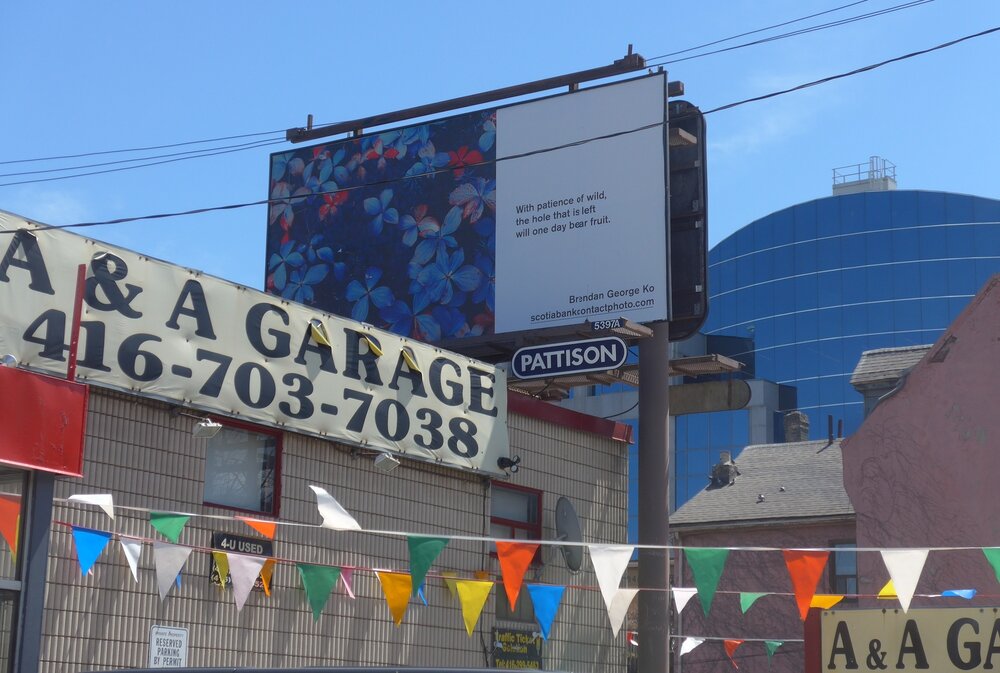
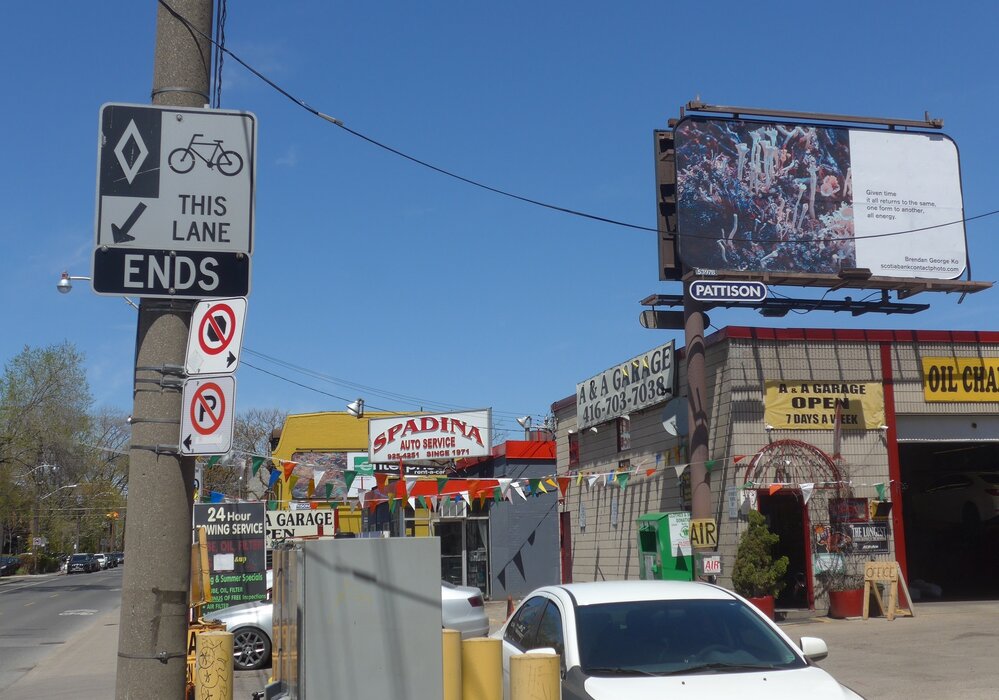
    The contrast couldn’t be greater. Three billboards located by an automobile repairshop display photographic compositions by Toronto-based artist Brendan George Ko. The works’ theme can be characterized as the sacredness of nature. They each highlight the beauty of various plant-forms. We have an ode to nature in a starkly industrial setting. These billboards are part of a set of twenty five located across the breadth of the country.

    Brendan George Ko, The Wild Carpet, 2021, billboard north of the intersection of King St, W and Strachan Ave, Toronto. Photo: Hugh Alcock

    Ko graduated from OCAD some twelve years ago. He has since developed an art practice based on photography and video, which sometimes incorporates poetry, as in this instance. As is explained on the CONTACT website, the billboards are inspired by his assignment for the New York Times that took him to Nelson, BC to meet Suzanne Simard.

    Simard is a scientist who has uncovered how trees in natural settings cooperate with one another to aid their survival, a cooperation that is often cross-species even. An article detailing her research was published in 1997 in the prestigious journal Nature. The article employs the term ‘the wood-wide web’, which has since gained popular currency. Essentially Simard explains how trees are not isolated dumb organisms that simply compete with one another. Rather, it turns out that under the forest floor there is a vast network of fungi and roots that enable the rapid exchange of chemicals between trees. In other words, trees communicate with one another, manifesting an intelligence of some sort, albeit of a different order to our own.  

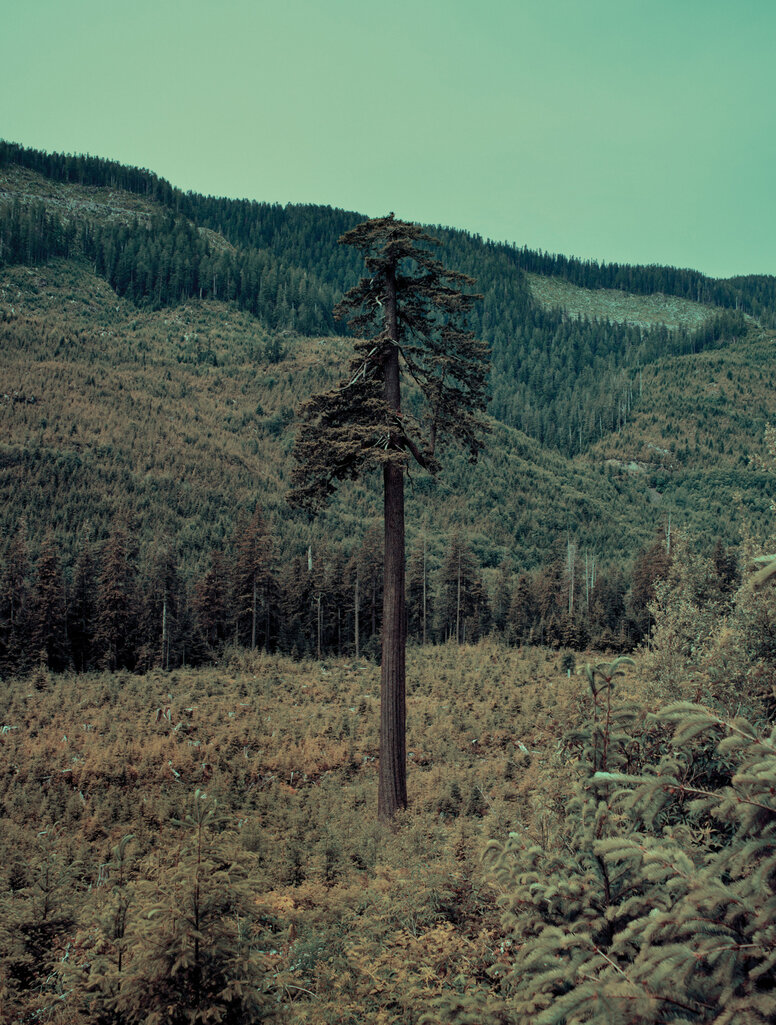
    Brendan George Ko, Big Lonely Doug I, 2019. Courtesy of the artist

    Ko explains that during his formative years he came to appreciate what he calls the spirit of the landscape. And so he was primed to feel the ‘spiritual connections’ of the trees and forest, as he puts it, while on assignment in BC. It is these connections that he aims to communicate to his viewers. His talk of the spiritual betrays an attitude towards nature that sees it as sacred. This is the attitude, many of us recognize, that is shared by the indigenous peoples of the continent. It is a form of animinism, wherein the distinction between animate and so-called inanimate organisms is blurred – everything that is alive merits respect and consideration, one might say.

    Ironically science has traditionally encouraged a mechanical anti-animisitic view of nature. Organisms are understood to be at bottom a complex set of biochemical reactions, that is, machines. There is no room for spirit. It amounts to the disenchantment of nature. Consequently, society is licenced to treat trees as lumber and pulp factories. As well, we have no compunction in turning woods and grasslands into monoculture industrial farms, to rip down forests in order to extract tar sands underneath them, and so on. Indeed, Canada cuts down its forests at an alarming rate – one million acres every year – where much of it is used to supply Americans with toilet paper.   

    It is ironic in that Simard, a scientist, is helping to reshape this mechanistic view of nature that science has hitherto facilitated. She encourages us to see trees, and plants more generally, as sentient beings. She writes: “By understanding their sentient qualities, our empathy and our love for trees, plants and forests will naturally deepen…” (Finding the Mother Tree, p. 305). Hers, then, is a secular mission to reappraise nature, in contrast to Ko’s quasi-religious appeal to the spirit of nature. Ko’s objective is to enthrall us with the beauty of nature, and thereby ‘reconnect us to it’, as he puts it. He does this by heightening the colours of the photographed imagery and placing it alongside verse. A good example is the image of fungi, titled Pixie Cup, together with the following words: “Given time it all returns to the same, one form to another, all energy.” Nature, he is pointing out, is a wonder to behold. He wants to enchant us by it.

    Brendan George Ko, Pyxie Cup Lichen I, 2019, billboard in north of the intersection of King St, W and Strachan Ave, Toronto. Photo: Hugh Alcock

    Brendan George Ko, Pyxie Cup Lichen I, 2019. Courtesy of the artist

    A problem with his approach, as I see it, is that he borrows the devices of advertising in a venue outside the traditional gallery setting. Not only is the work displayed on advertising billboards, but its format is familiar to most of us. It is a common tactic of advertisers to juxtapose a beautiful image from nature beside some product message, e.g., in order to entice tourists to New Foundland or to sell upscale clothing in a mall. We are so bombarded with images from nature exploited in this way that we have become largely inured to it. That is not Ko’s fault of course. But his aim of highlighting the serenity and beauty of nature, while immersed in the cacophony of our hyperbolic media environment, is extremely challenging. All the same, Ko makes a noble attempt – something that ought to be commended.

    Brendan George Ko, Mixed Ferns of British Columbia, 2020. Courtesy of the artist

    As well, the overconsumption Ko is commenting on is central to the production of his very own artwork. In general, his predicament epitomises that of many artists today. How one can comment critically on our unbridled consumer society, when the artworks themselves are in essence products to be consumed by the capitalist machine, for which nature is treated as a resource.

    Hugh Alcock

    *Exhibition information: Brendan George Ko, The Forest Is Wired for Wisdom, billboards north of the intersection of King St, W and Strachan Ave, Toronto, April 29 – May 30, 2022. Part of Scotiabank CONTACT Photography Festival 2022.

  • Spectra: Gallery 44 Members Exhibition at CONTACT

    Over the last few years, people have become more and more aware of our proximity to—and distance from—the world around us. As much of our lives moved online, it changed our understanding of the simple act of witnessing, what it means to see and be seen. What medium can better confront this shifting relationship than photography, which is, in many ways, the art of bearing witness.

    Each of the artists in the Spectra: Gallery 44 Members Exhibition group show grapple with shifting placements of self—online, in our world, in our communities and with each other. In various, and distinctly personal ways, each artist explores our undeniable interconnectedness amid our growing sense of isolation. Collectively, these artists show us glimpses of longing. A longing for belonging and closeness shimmers through the bittersweet sunshine and shadows of works by Bessy Lustiva-Espina, Shaney Hermann and Ana Šaśić.

    Bessy Lustiva-Espina, Seaton Village, 2020, Gicliee print from digitized film scan, 18” x 24”

    The details and closeness of these shots are balanced by the distance explored in the photographs of Ivan Rupeš, Adrian Amaricucai and Ismayil Atmaca stretching light and shadow between isolated figures. A sense of isolation is fully realized in Monica Gupta’s series Aging in Place, which captures the bare realities of a shelter for seniors, one of the communities hit hardest by the COVID-19 pandemic.

    Adrian Amaricucai, Together/Apart #9, 2022, Film on Inkjet print, 11” x 14”

    In the description of his work, Ross Stockwell says he wants to explore “life, decay and what falls between the two”. I found myself asking if we could separate the two. This collection asks: can we manufacture this space if we try hard enough or are both processes—life and decay—continual and inextricable? Linda Briskin references Ariel’s song in The Tempest when she talks about “sea change”. She includes a few lines in her own artist statement, but she leaves the first few lines out. In those lines there is living decay. “Of his bones are coral made, /Those are pearls that were his eyes, /Nothing of him that doth fade, /But doth suffer a sea change, /into something rich and strange.” A constant shift—life evolving and persevering.

    Linda Briskin, Sea Change, 2021, Archival Pigment Print, 20” x 16”

    Like the strength and stillness that perseveres through time and space in his vivid photographs, Glacial Erratics – Georgian Bay Fred Lum explores rocks shifted by the end of the last glacial period of the Pleistocene epoch. Although the term ‘glacial erratics’ specifically refers to rocks displaced by shifting ice formations, the apparent contradiction of the words themselves creates a wonderful sense of time and place that beautifully compliments the work by each of the artists in this exhibit. 

    Fred Lum, Glacial Erratics – Georgian Bay 1, 2021, silver fiber contact print, selenium toned, 15” x 26”

    Their relationships to place are very important to these artists. Both in their awareness of the world and the people around them and in their understanding of how we shape that world. Whether documenting the decay of man-made objects—and with them a moment in their own life—like Huw Morgan, or embracing the changing relationship of art and technology while longing for more connection to nature like Richelle Forsey’s AI gardens; or Lilianne Schneider’s images overlapping nature with digitally generated traditional Peruvian tocapu. 

    Richelle Forsey, AI Garden (3), 2022, photograph on cold press photo rag, 19” x 13”

    Each series stands on its own as a precise individual perspective, a slight shift, a whispered invitation to notice the world around you a little differently. Together they build something that feels very current and hopeful, encouraging us all to find new ways of looking and building—to find life in decay.

    Lily Scriven

    Images are courtesy of Spectra: Gallery 44.

    Artist talk and tour: Saturday, May 21, 2022 / 11am for the 2nd floor artists & 1pm for the 3rd floor artists.

    *Exhibition information: Spectra: Gallery 44 Members Exhibition, a group show organized by Danielle Goshay and David Scriven with layout curation by Holly Chang, May 18 – June 5, 2022, Artscape Youngplace, 180 Shaw St, Toronto. Gallery hours: Mon–Fri, 9am–5pm; Sat–Sun, 9am–6pm. Part of the Scotiabank CONTACT Photography Festival 2022.

  • Fiona Freemark at Dianna Witte Gallery

    Photo-based artist Fiona Freemark’s exhibition Sunset Watch, presented at the Dianna Witte Gallery is an ode to the East End of Toronto and a celebration of the mundane act of walking, presenting viewers with a more thoughtful way of life.

    One of the privileges of living in a big city like Toronto is that the visual experience of living in a neighborhood is different depending on where you are. Sunset Watch is part of the 2022 Scotiabank CONTACT Photography Festival and explores the contrasts, motifs, and dichotomy of space in Fiona Freemark’s Scarborough neighbourhood.

    Fiona Freemark, Blackbird at Sunrise, Hand-cut photograph, 26.75” x 40”

    During the pandemic, in a time when daily walks have become, and still are, a large part of daily activity, Fiona Freemark’s photographs show what it means to perceive and capture changes in the surrounding nature in an otherwise repetitive landscape.

    Through the use of printmaking techniques and processes, such as by cutting and weaving, Freemark challenges viewer’s perceptions of photography. By layering photographs together, the artist explores motion in her photographs. She mimics the double exposure in analogue photography and the pixilation of digital photographs. She experiments with movement, as her layering technique mimics speed, while the weaving details within these works add a methodical structure to her works.

    In the process of interweaving, many of her works have a pixilated effect, such as October Sunset. This fuses technology and nature, an often binary contrast, making the sunset seem like a tangible object.

    Fiona Freemark, October Sunset, Woven photographs, 20” x 30”

    Freemark captures what is often over looked in her neighborhood. She plays with the concept of giving banality importance with a focused study on what is seen versus unseen and overlooked about an area she knows well. In Gradient/ Lake ON (Fog), Freemark plays with the idea of being seen. While shadows are contrasted in her other works, here the chain linked fence is grey and almost translucent, blending into its surrounding sky.

    Fiona Freemark, Gradient/Lake ON Fog, Hand-cut photograph, 20” x 30”

    Fiona Freemark’s Sunset Watch is a study of the passage of time and the nostalgia of change in one’s own neighborhood. She archives Scarborough as seen through her own eyes and lens. From capturing the aftermath of rainfall to a building being demolished, Freemark evokes agency in her lived experience during a time when the world seemed to come to a stand still. If there’s anything to learn from Sunset Watch it’s that the pandemic has taught us to show gratitude for the minute and that change is always imminent if you’re looking close enough.

    Georgia Gardner

    Images are courtesy of Dianna Witte Gallery.

    *Exhibition information: Fiona Freeman, Sunset Watch, May 5 – 28, 2022, Dianna Witte Gallery, 1142 Queen St E, Toronto. Gallery hours: Wed – Sat, 12 – 6 pm. Part of Scotiabank CONTACT Photography Festival 2022.

  • Alberto Giuliani: Surviving Humanity at CONTACT

    Surviving Humanity, as Alberto Giuliani stated, ‘tells a story’ more than it requests interpretation. The artist travelled around the world to photograph places where efforts to safeguard human survival are underway.

    Each of these science-based attempts are interesting in their own right. As presented and annotated by Giuliani, the story, guided by the probing question of his four-year-old son — “How will the world be when I’m big?” —  makes me wonder too.

    Entering the Allen Lambert Galleria at Brookfield Place, sunlight penetrates and illuminates the exhibition through the beautifully designed Santiago Calatrava structure. Ambient music weaves quietly through the cavernous space.

    Installation view of Alberto Giuliani, Surviving Humanity. Photo: Andrew Colebeck

    However, this is not a cathedral, rather we are in a massive real estate development in a centre of the Canadian commercial banking world. It is easy to be awestruck at the juxtaposition of financial wealth and a photography exhibit about species’ survival.

    The juxtaposition of subject matter and exhibition location was made clear in the image of the world’s most luxurious survivalist bunker complex. The first ‘sold out’ silo of 15 apartments hosts 75 people. The expanding complex is described as being outfitted with a shopping mall and dog park. As a real estate development, if interested, it is located in the geographic centre of the United States, Kansas, home to Dorothy and Toto. As a pet owner, it seemed thoughtful to me, that the developers considered bringing the family dog along to the bunker.

    I had a feeling we weren’t in Kansas anymore.

    Installation view with Alberto Giuliani, Survival Condo, Kansas, USA, 2017 (dog park). Photo: Andrew Colebeck

    In high school, we were fortunate to be encouraged to engage in current affairs debates in our World Issues class. The issue of the day happened to be South Africa just before the end of apartheid. Way, way, way back before our current efforts at social justice, truth and reconciliation, inclusion and readjustment — evidenced by the overall Contact 2022 exhibition selections — I remember one classmate, on the subject of apartheid, stating “It could never happen here”. Obviously, it did. South Africa took Canada’s model of managing indigenous peoples and effectively yoked a majority of them for almost 100 years.

    A second survival option, a little further north in South Dakota, where presumably the weather is harsher, is the worlds largest bunker community. Buried underground are 572 bunkers able to support 5000 people. Memberships were still available in 2017, notes Giuliani.

    Installation view with Alberto Giuliani, Vivos XPoint, South Dakota, USA, 2017. Photo: Andrew Colebeck

    I’m not sure why I was reminded of this high school memory but I appreciate the message in the context of CONTACT 2022. This year’s festival is exceptional for the preponderance of photography exhibitions forcing public conversations, hopefully forward.

    We were kids… our social media consisted of connecting at the corner Friday after school to see where the weekend party would be. Back then we didn’t know any better.

    But if your condition is grim, survival might include being frozen cryogenically.

    Alberto Giuliani, Alcor Life Extension Foundation in Scottsdale, Arizona, USA, 2017. Courtesy of the artist

    Some of the seed specimens being collected and stored for humanity’s survival, via protecting biodiversity, can be found in the tundra in Norway, at the Global Seed Vault in Longyearbyen, Svalbard. With a capacity to store 4.5 million seed samples, and buried 150 metres underground, the design was supposed to be foolproof. Melting permafrost has caused floods recently.

    Alberto Giuliani, Global Seed Vault, Longyearbyen, Svalbard, Norway. 2017. Courtesy of the artist

    A visit to this exhibition is highly recommended. Other subjects include rare images of the China National GeneBank near Shenzhen, the Mauna Loa, Hawaii lava flows used by NASA and others for simulated training of astronauts preparing to visit Mars, and the geodesic structures built to preserve threatened vegetative species.

    Alberto Giuliani, Eden Project, Cornwall, UK, 2017. Courtesy of the artist

    A fitting conclusion to the Surviving Humanity exhibition and project is the stark photograph Giuliani took standing alone on a deserted street in Pesaro, Italy where he resides. It was day one of the Italian lockdown due to the COVID-19 pandemic. Pesaro, Italy was particularly hard hit in the early stages of the pandemic.

    Alberto Giuliani, Pesaro, Italy, March 10, 2020, first day of lockdown. Courtesy of the artist

    But back to my high school memory… it could never happen here. Yet, here is where we are.

    Andrew Colebeck

    Featured image: Alberto Giuliani, Survival Condo, Kansas, USA, 2017, detail.

    *Exhibition information: Alberto Giuliani, Surviving Humanity, May 1 – 31, 2022, Brookfield Place, Allan Lambert Galleria, 181 Bay Street, Toronto. Hours: Mon – Fri, 9am – 6pm. The exhibition is part of Scotiabank Contact Photography Festival 2022.
  • The Toronto Biennial of Art at Arsenal

    The Toronto Biennial of Art (TBA), one of Canada’s leading visual arts events, focuses exclusively on contemporary art from around the world. The biennial’s city-wide programming aims to inspire individuals, engage communities, and contribute to global conversations.

    TBA’s second edition theme, What Water Knows, Land Remembers is a mixed-media nature-orientated group show exploring the uses of the natural world, “revealing entangled narratives and ecologies across time and space”.

    At Arsenal Contemporary Art Toronto, the exhibition also emphasizes — through foraging native plants, creating fabrics, and ultimately celebrating the authenticity of native produce and culture — the oppression and triumphs these artists faced in their respective homelands.

    Installation view at Arsenal Contemporary Art Toronto as part of the Toronto Biennial of Art (2022). Photo: Toni Hafkenscheid

    Jumana Manna’s Foragers (2022) weaves fiction, documentary and archival footage into a film that depicts the problematic issues around the practice of foraging for wild edible plants in Palestine/Israel. The impact of nature protection laws is prevalent in all aspects of the film. It documents how the changes in laws affects people who have lived on that land for centuries, as it forces them to change their cultural and dietary habits. The restrictions prohibit the collection of Akkoub and Za’atar and have resulted in fines and trials for hundreds of disadvantaged natives, mainly Arabs, caught collecting these plants.

    Jumana Manna, Foragers, 2022, video with audio, 65 minutes.  On view at Arsenal Contemporary Art Toronto as part of the Toronto Biennial of Art (2022). Photo: Toni Hafkenscheid.

    A striking artwork that fills the largest space in the room is Kaokao #1 from The Mata Aho Collective, based in Aotearoa New Zealand. The installation is made from 200 meters of reflective tape, sewn together in a tukutuku lattice pattern. “Through their work, the act of coming together, the many hours of piecing a work by hand, is emphasized as integral to their process and calls attention to the Maori concept of whanau, or extended family, this time on a monumental scale.”

    Mata Aho Collective, Kaokao #1, 2014, reflective fabric, cotton thread, 1200 x 220 cm. On view at Arsenal Contemporary Art Toronto as part of the Toronto Biennial of Art (2022). Photo: Toni Hafkenscheid. Courtesy of the artist and TBA

    Similarly, Amy Malbeuf ‘s Kahkiyaw kikway (All of Everything), is a large-scale installation made from combination of moose and deer hide sewn together. The artist continues the traditions of northern Alberta’s regional aesthetics in skin preparation and cloth fashioning. She leaves her work unembellished on purpose. Both large scale pieces highlight the labour that has gone into its making, featuring themes that include strength and unity.

    Amy Malbeuf, Kahkiyaw kikway (All of Everything), 2019 – 2022, smoked tanned moose and deer hide, raw deer hide, nylon thread, cotton thread, dimensions variable. On view at Arsenal Contemporary Art Toronto as part of the Toronto Biennial of Art (2022). Photo: Toni Hafkenscheid.

    TBA’s exhibits at Arsenal Contemporary Art Toronto include a variety of subject matters and artistic mediums in the work of 7 artists or groups, from videography to painting, to large scale structures. Ultimately, they present an arsenal of shared experience — which stems from a return, and exploration of nature.

    Georgia Gardner

    Images are courtesy of the TBA.

    *Exhibition information: What Water Knows, Land Remembers includes artists Abel Rodriguez, Amy Malbeuf, Aycoobo/Wilson Rodriguez, Buhlebezwe Siwani, Jumana Manna, Mata Aho Collective, Waqas Khan, March 26 – June 5, 2022, Arsenal Contemporary Art Toronto, 45 Ernest Ave, Toronto. Gallery hours: Tues – Sun, 10am – 6pm.

  • Shary Boyle at the Gardiner Museum

    Shary Boyle borrowed the title of this exhibition, Outside the Palace of Me, from UK poet Kae Tempest’s 2017 song “Europe Is Lost”. With the immersive curatorial plan throughout the exhibition hall, Boyle has assembled her ever-mounting anxieties about global crises in the setting of identity theatre.

    In this unique multi-sensory art installation that involves contemporary costume as well as stage design and effects, Boyle analyzes how we see ourselves and our relations with others. In her work, social, political and personal issues, such us economics, colonialism, gender and identity conflicts, and the environmental crisis, go through a metamorphosis. Boyle addresses societal pressures, while also testing the human capacity for empathy. To further modify the experience of the exhibition, visitors can sit down and choose a song from the artist’s playlist as background music. Boyle believes that music changes everything and rhythm and lyrics can make pain bearable and lives more euphoric.

    While visitors walk through the long, dark hallway, the first items they encounter are ceramic portraits placed in front of a two-way mirror. The place is seemingly a representation of a dressing room, bringing the interconnection between the object and the observer into focus. Lens (2020), a dark-toned, stoneware bust depicts a woman in front of a mirror. There are holes replacing her eyes, allowing the visitors to look through her empty eye sockets and see themselves inside the reflection. Meanwhile, since this is a two-way mirror, others can observe the entire action from the back side of the mirror. It creates a juxtaposed relationship between object and subject, encouraging visitors to rethink their self-identity, as well as their perception of the outer world.

    Lens, 2020, stoneware, two-way mirror. Photo: Vivian Sun

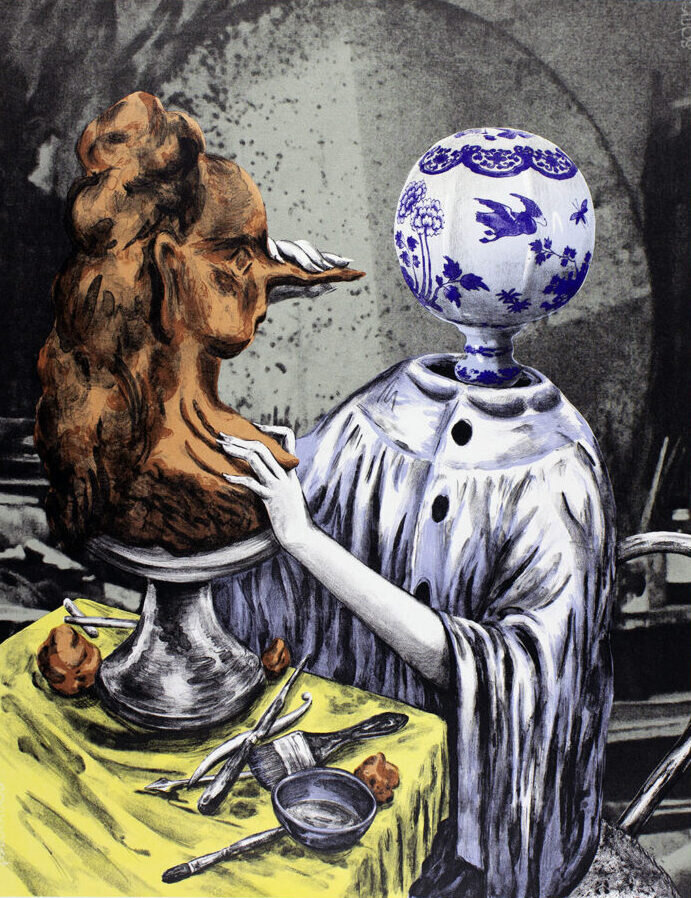
    Next there is a colour lithograph, Cephalophoric Saint (2018), showing a Chinese porcelain-headed figure moulding a terracotta bust. The word ‘cephalophore’ comes from Greek, translated as ‘head-carrier’. It is often used in describing beheaded Christian saints who carry their own severed heads. Yet, this work seems to have very little to do with martyrdom. The figure is more likely just creating a mask for an upcoming performance. We can see a narrative in it, a connection with our everyday life, as we have all become performers for an invisible audience. We often change our self-image on social media in order to fit into our ever-changing society, regardless of our true identity. We play, we change and we hide behind our masks.

    Cephalophoric Saint, 2018, colour lithograph with opalescent pigment on Somerset Satin paper, 71 × 56 cm. Collaborating printer: Jill Graham. Image courtesy of the artist

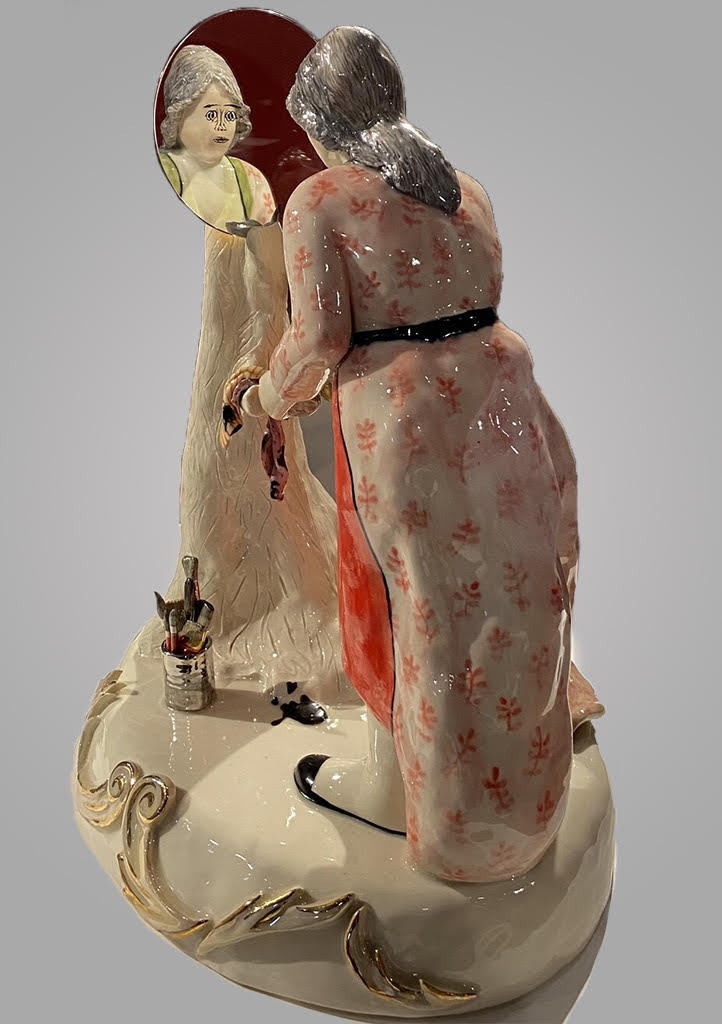
    Entering a bright room after the dark hallway, we encounter a large, spotlit ‘stage’ and our role changes from observer into active participant. The Painter (2019) is one of the small freestanding porcelain works placed on the edge of the stage. It depicts a faceless woman trying to draw her facial features on the mirror in front of her. She tries so hard to create a face for herself, but the inked fabric in her left hand seems to indicate that she has erased and re-drawn her expression many times. She is in the painful process of creating her self-identity, while being pressured by contemporary social aesthetics that force people to change their appearances again and again for the sake of acceptance. 

    The Painter (2019), porcelain, underglaze, china paint, lustre, enamel, mirror. Photo: Vivian Sun

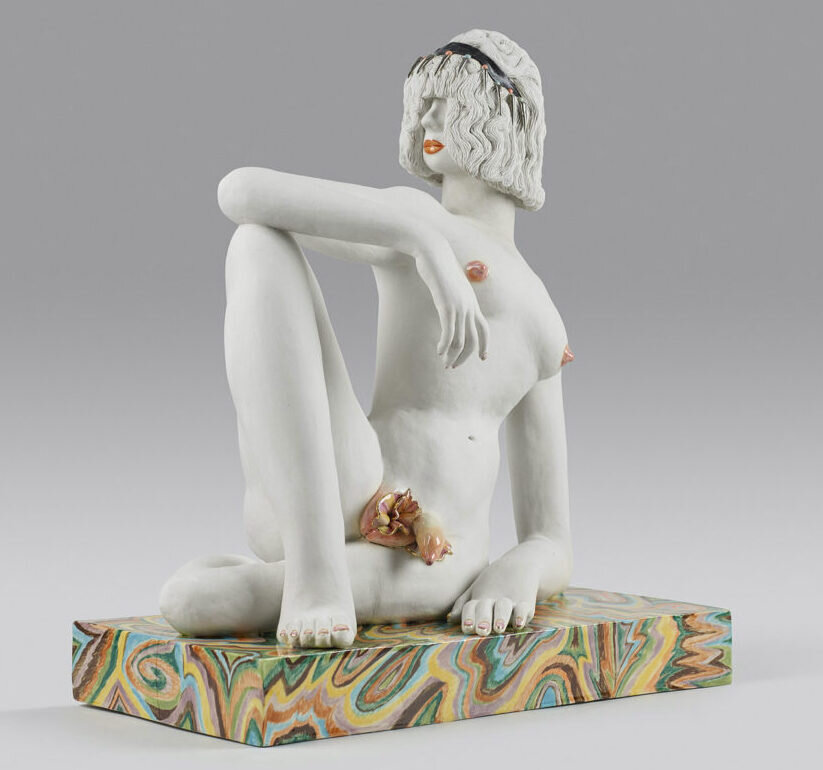
    Oasis (2019), another porcelain work, addresses gender and self-identity. Boyle depicts a figure with both male and female genitals, sitting gracefully on the psychedelic base. The figure is snow-white, the colourful glazing only applied to the sexual organs, emphasizing the combined identity of him/her. In art history, artists often used the pomegranate flower in referring to sexual organs. Boyle follows this tradition in the delicate rendering of the genitalia, reminding me of a blossoming flower. The artist may indicate a connection with the social status of the LGBTQ community, as the sculpture gallantly and proudly displays its different body characteristics. As the figure’s face is mostly covered by hair, we can interpret him/her to be anyone, suggesting that the person is still in the process of finding his/her sense of self and acceptance. In this oasis, he/she is away from the critical gaze and judgment of other people.

    Oasis, 2019, porcelain, underglaze, china paint, gold and silver lustre, 50 x 42 x 24 cm. Image courtesy of the artist

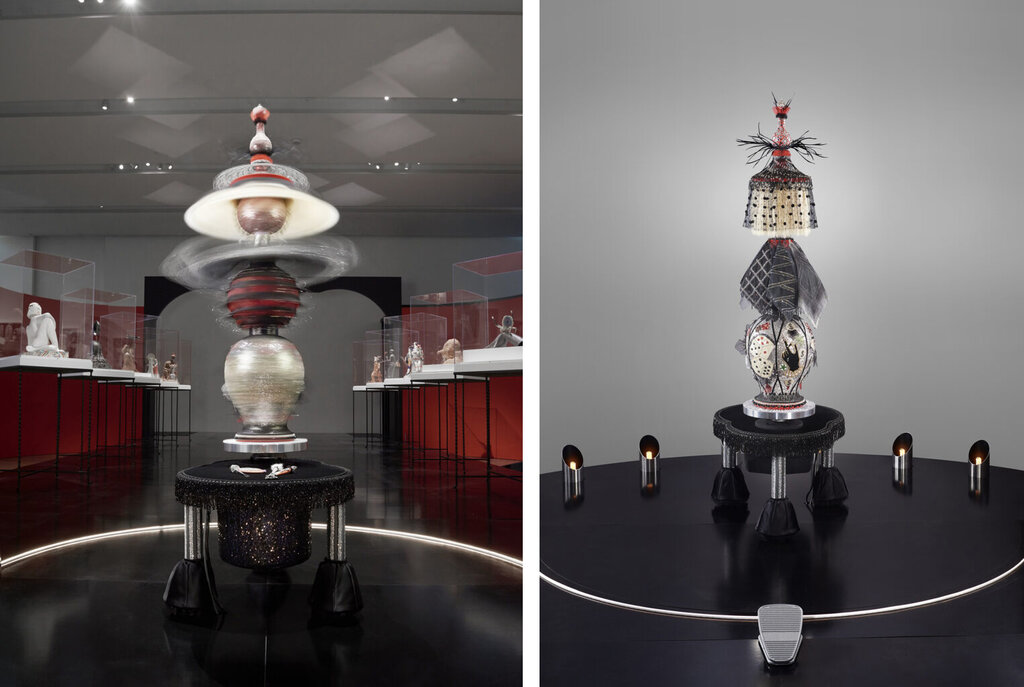
    Moving along to the centre of the stage, visitors meet the star of this ‘performance’, a coin-operated, multi-media artwork named the Centering (2021). Its appearance is flamboyant, as it is decorated with numerous glittering paillettes and multiple layers of voile and fabric. When someone drops a $2-coin into the slot and steps on its pedal, the Centering will start spinning for a few seconds, much like a performer on a stage. These kinds of installations seem to be very popular in pop culture with their glamourous appearance and entertaining movements. Others criticize them as money-eaters because they collect money for their owners. I found the several well-ornamented makeup tools placed at the base of the installation sarcastic, suggesting that appearance is more important than inner beauty. Under this influence people are becoming machines, performing for rewards instead of fulfillment.

    Centering, 2021, coin-operated pottery wheel, wood, textiles, beads, crystals, feathers, human hair, sequins, mirror, electronics, foot pedal. Textile collaboration with Grant Heaps. 117 x 66 x 56 cm. Image courtesy of the artist

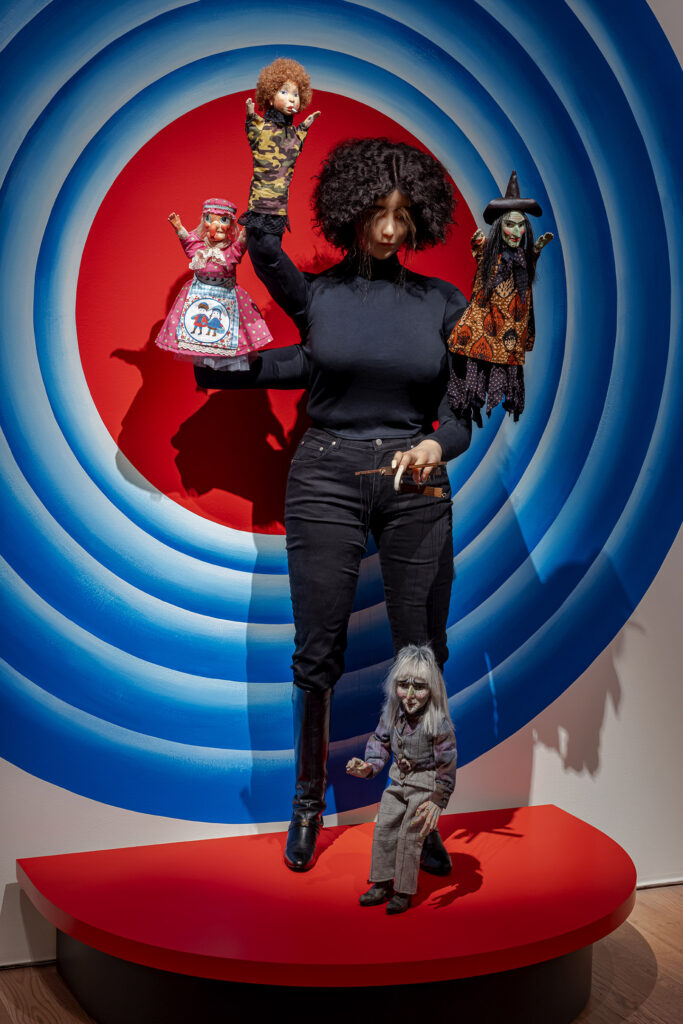
    Then there are pieces grouped around the theme of a puppet show with wax figures placed near the walls. Boyle studied different feminine archetypes in order to recreate them. The most outstanding one is Judy (2021), a woman puppeteer. She has four arms. Each one of her hands is manipulating a different puppet. The circuitry inside the sculpture allows a slight movement of her left hand that activates a small marionette show for the audience. As Boyle wrote in the accompanying introduction, this work is an embodiment of maternal anxiety. It is a critical look at the number of roles a woman is required to play during her lifespan. Judy, in her mutant appearance, with her four arms (definitely an advantage in her occupation), seems to be very focused and totally involved in her show. I am just wondering how many of us have been disfigured, physically or mentally, by our occupations or roles in society.

    Judy, 2021, steel, foam, wood, electronics, motor, textiles, wax head, oil paint, human, synthetic, llama and horse hair, silicone hand, stoneware and porcelain puppet heads, 183 x 96 x 66 cm. Animatronic sculpture rotates wrist when motion detector is activated, operating functional marionette. Image courtesy of the artist

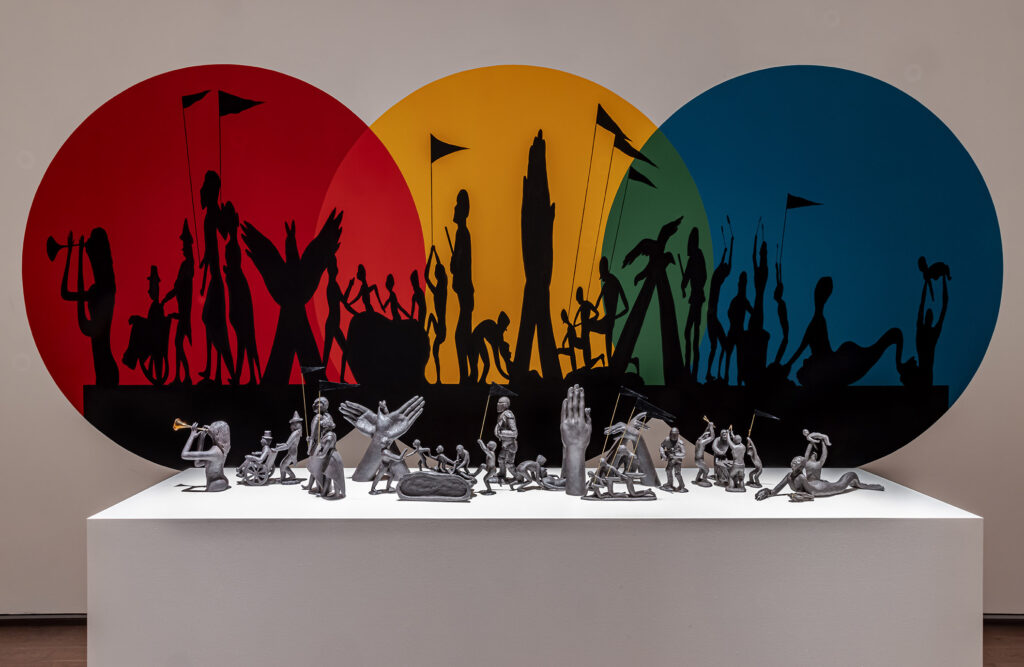
    The Procession (2022), a large stoneware installation, is a one-of-a-kind parade celebrating our hope for peace. In front of three circular panels with totem animals and scenes from tribal wars a trumpeter is leading this strange parade. Some people are trying to help others get through their difficulties, such us pushing a wheelchair. Hand gestures, symbolizing peace and hope or clasped in prayer are interspersed with people carrying flags of freedom. Yet, there are still fully armed soldiers moving among this street troop. As Boyle points out, “One person’s parade is another’s riot.” At the very end of the possession a man holds up a newborn baby birthed by a mermaid, indicating a close relationship with nature and the hope for a new order in our world. A strong message indeed.       

    The Procession, 2021, twenty-eight stoneware and bronze figures, installation dimensions variable (group approximately 96cm in length). Wall painting behind sculptures is custom and variable. Image courtesy of the artist

    Vivian Sun

    *Exhibition information: Shary Boyle, Outside the Palace of Me, February 4 – May 15, 2022, Gardiner Museum, 111 Queen’s Park, Toronto. Museum hours: Mon – Tue & Thu – Friday 10 am – 6 pm, Wed 10 am – 9 pm (free admission 4 – 9 pm), Sat – Sun & Holidays 10 am – 5 pm.

  • I AM YOUR RELATIVE at MOCA (TBA)

    I had the fortune of immersing myself in Jeffrey Gibson’s I AM YOUR RELATIVE on a bright spring morning. My energy was high as I strolled from Lansdowne Station to the MOCA, winding my way through that specific brand of west-end side street familiar to locals. You know the type; residential brownstones, geometric condos, industrial buildings—not to forget art studios and art galleries.

    My walk was diverted a few times, thanks to the all too common city construction, but it wasn’t unpleasant. Instead, thanks to the temperate weather and the architectural harmony, I meditated on the past, present, and future of the Toronto art community. What role does the Toronto Biennial of Art (TBA) play in it? Whose stories have been told? How do we draw in global connections while being sure diverse voices at home are being heard?

    MOCA Toronto exterior. Courtesy of MOCA

    Co-commissioned by the Toronto Biennial of Art and the Museum of Contemporary Art Toronto, I AM YOUR RELATIVE is located in the lobby of the MOCA, though perhaps ‘located’ is the wrong word. It is the lobby; open for free viewing to all who pass through, making it both symbolically and physically accessible to the public. Neon green walls have been plastered with posters and stickers in vibrant pinks, purples, reds, blues, and just about every other colour. These designs are also detailed on the fifteen moveable platforms and cushions that provide seating for the community, storage for locally sourced children’s books, and flexible stages for performances and community programming.

    Jeffrey Gibson, I AM YOUR RELATIVE, 2022. Installation view. MOCA Toronto. Courtesy of Jeffrey Gibson Studio, Kavi Gupta Gallery, Roberts Projects, Sikkema Jenkins & Co. and Stephen Friedman Gallery. Courtesy of TBA

    Jeffrey Gibson, a member of the Mississippi Band of Choctaw Indians and also half Cherokee, is an interdisciplinary artist based out of Hudson, New York. I AM YOUR RELATIVE draws inspiration and imagery from the artist’s past works as well as from community-sourced submissions, prioritizing Black, Brown, Indigenous and queer imagery. Gibson’s space is perfect for the thoughtful observer. Hours could be spent walking through the space to spot details, peer through cut-outs, read the books, and lie back against the patterned cushions. Slow-lookers will see stickers of beaded bird sculptures, stills from past video projects, children’s books about city planning, and phrases like “HE DRUMS IN THEIR FACE,” “RESPECT INDIGENOUS LAND,” and “KNOW YOU ARE LOVED.”

    Jeffrey Gibson, I AM YOUR RELATIVE, 2022. Installation details. MOCA Toronto. Courtesy of Jeffrey Gibson Studio, Kavi Gupta Gallery, Roberts Projects, Sikkema Jenkins & Co. and Stephen Friedman Gallery. Photo: Olivia Mariko Hsuen-Ferris.

    The result is a space that is of and for the community. A welcoming place of convergence where citizens can mingle, rest, work, play, and feel safe. I AM YOUR RELATIVE is “open to change over time,” with a flexible design of moving pieces. From the platforms on wheels to the children’s books and cushions they store, nothing is nailed down. The site-specific exhibition is a living member of the community. It reminds me of those wooden walls on bustling streets plastered with posters, advertisements, and local art; an archive of community life over a period of time.

    Jeffrey Gibson, I AM YOUR RELATIVE, 2022. Installation view. MOCA Toronto. Courtesy of Jeffrey Gibson Studio, Kavi Gupta Gallery, Roberts Projects, Sikkema Jenkins & Co. and Stephen Friedman Gallery. Photo: Olivia Mariko Hsuen-Ferris.

    In many ways, the location is ideal. Accessible without a museum ticket, the exhibit is advantageously placed in the lobby of a well-known local institution. The only disadvantage to this location is its distance from the city core. Though by no means totally inaccessible, it sits a busy ten to fifteen-minute walk from Lansdowne Station. This is not so much a critique but rather a lament over the general push of our arts spaces further and further outwards, often north-west. The benefit of this location, however, is its place around similar establishments amidst a community bursting with artistic purpose.

    I AM YOUR RELATIVE underscores the significance of the Toronto Biennial of Art, which is now only in its second year. The connection of our arts community to the international stage and the highlighting of the diverse voices within is vital now more than ever in light of a difficult pandemic and the ever-present need for more support for artists. The prioritizing of Black, Brown, Indigenous, and queer voices is vitally important too, not only now with extra eyes on social justice and human rights issues, but for all events moving forward. In a diverse, multi-cultural city such as ours that sits on Indigenous land, it is not and should not be possible to do otherwise.

    Jeffrey Gibson, I AM YOUR RELATIVE, 2022. Installation view. MOCA Toronto. Courtesy of Jeffrey Gibson Studio, Kavi Gupta Gallery, Roberts Projects, Sikkema Jenkins & Co. and Stephen Friedman Gallery. Courtesy of TBA.

    I AM YOUR RELATIVE speaks to the past and the future, to what has happened and what has the potential to happen. In that way, it’s representative of our city, a vibrant artistic hub of all that has and could happen. To those who may pass through the area, plan to visit all Biennial exhibits, or even just need a little respite from life, I highly recommend you spend some time in the lobby of the MOCA. Go flip through the books, grab a seat, read the posters, and take your time gazing at the walls.

    Jeffrey Gibson, I AM YOUR RELATIVE, 2022. Installation view. MOCA Toronto. Courtesy of Jeffrey Gibson Studio, Kavi Gupta Gallery, Roberts Projects, Sikkema Jenkins & Co. and Stephen Friedman Gallery. Photo: Olivia Mariko Hsuen-Ferris.

    Olivia Mariko Hsuen-Ferris

    *Exhibition information: Jeffrey Gibson, I AM YOUR RELATIVE, March 10 – July 31, 2022, co-curated by the Museum of Contemporary Art and the Toronto Biennial of Art. MOCA, 158 Sterling Ave, Toronto. Museum hours: Wed – Thu & Sat – Sun 11 am – 6pm; Fri 11 am – 9 pm.

  • CONTACT 2022 / Artoronto picks

    In its 26th Edition, Scotiabank CONTACT Photography Festival features over 140 exhibitions and outdoor installations by Canadian and International artists throughout the Greater Toronto Area. So it won’t easy to pick exhibits to see. We all look forward to seeing much more than the ones listed but these caught our interest and everyone is sure to have their own list as well.

    PHIL ANDERSON, publisher/writer/photographer:

    Jimmy Manning: Floe / Flow
    May 15 – September 30
    Ryerson University Devonian Square, Gould St & Victoria

    Jimmy Manning, Icebergs, August, 2012. Courtesy of the artist

    Aida Muluneh: Water Life
    April 27 – September 25
    Textile Museum of Canada, 55 Centre Ave, Toronto

    Aida Muluneh, Star Shine, Moon Glow, 2018. Courtesy of the artist

    EMESE KRUNÁK-HAJAGOS, publisher/writer:

    Carlos & Jason Sanchez: New Work
    April 30 – May 28
    Christopher Cutts Gallery, 21 Morrow Ave, Toronto

    Carlos & Jason Sanchez, Charlotte’s Hallucination, 2022. Courtesy of the artist and Christopher Cutts Gallery

    Atong Atem: Surat
    April 29 – May 30
    Billboards, Lansdowne Ave at Dundas St W and College St

    Atong Atem, from the series Surat, 2022

    STEVE ROCKWELL, publisher/writer:

    Shirin Neshat: Land of Dreams
    March 10 – July 31
    MOCA, 158 Sterling Rd, Toronto

    Shirin Neshat, Land of Dreams, 2019, video still. Courtesy of the artist

    Angela Grauerholz: Instant Resemblances
    April 30 – May 28
    Olga Korper Gallery, 17 Morrow Ave, Toronto

    Angela Grauerholz, Red Chair in Red Room. 2022. Courtesy of the artist and Olga Korper Gallery

    HUGH ALCOCK, writer

    Brendan George Ko: The Forest is Wired for Wisdom
    April 29 – May 30
    Billboards at King and Strachan Ave, Toronto

    Brendan George Ko, Big Lonely Doug I, 2019. Courtesy of the artist

    JENNIFER BOOTHBY, writer/photographer:

    Ryan Van Der Hout: Collecting Dust
    May 5 – 28
    United Contemporary, 1444 Dupont St, Unit 22, Toronto

    Ryan Van Der Hout, Stress Test, 2021. Courtesy of the artist and United Contemporary

    ANDREW COLEBECK, writer/photographer:

    Alberto Giuliani: Surviving Humanity
    May 1 – 31
    Brookfield Place, 181 Bay St, Toronto

    Alberto Giuliani, Survival Condo, Kansas, US, 2017. Courtesy of the artist

    BRONWEN COX, writer/photographer:

    Jorian Charlton, Kadine Lindsay: fi di gyal dem
    May 5 – August 26
    University of Toronto, Scarborough, Virtual exhibition, Online

    Jorian Charlton, Untitled (Sidne and Kaverine), 2020. Courtesy of the artist

    ZHIYI FANG, writer/photographer:

    Steven Laurie, Virginia Mak: Ghosts of Home
    May 1 – August 31
    Gladstone House, 1214 Queen St W, Toronto

    Virginia Mak, Tai Nan Street 03, from the series of Tai Nan Street. Courtesy of the artist

    GEORGIA GARDNER, writer:

    Fiona Freemark: Sunset Watch
    May 5 – 28
    Dianna Witte Gallery, 1142 Queen St E, Toronto

    Fiona Freemark, Blackbird at Sunrise, 2022, hand cut photograph. Courtesy of the artist

    OLIVIA MARIKO HSUEN-FERRIS, writer/photographer

    Bidemi Oloyede: I Am Hu(e)Man
    April 29 – August 31
    PAMA, 9 Wellington St E, Brampton

    Bidemi Oloyede, Shaquone Blake, 2020. Courtesy of the artist and Nicholas Metivier Gallery

    MEGAN KAMMERER, writer:

    OF THE SACRED
    Apr 21 – June 5
    Critical Distance Centre, 401 Richmond St W, Ste 122, Toronto

    Yelaine Rodriguez, EBBÓ (Sacrifice): Orula, The Witness, 2021. Courtesy of the artist

    CATHY LIU, photographer:

    Whitney Lewis-Smith: Biophilia
    May 5 – 28
    Bau-Xi Gallery, 350 Dundas St W, Toronto

    Whitney Lewis-Smith, Chimera Fukinagashi Bonsai, 2021

    LINA WENG, writer:

    Sandra Brewster: Roots
    May 1 – October 31
    Evergreen Brick Works, 550 Bayview Ave, Ste 300, Toronto

    Sandra Brewster, Roots 1, 2021 – 22, gel transfer on pressure treated wood. Courtesy of the artist

    Images are courtesy of Scotiabank CONTACT Photography Festival.

    To make your own selection of exhibition visits please click here.

  • STREET / Summer at The Bentway

    Media Launch on April 20, 2022 at The Bentway Studio 55

    The Bentway is nestled beneath the Gardiner Expressway, stretching from Strachan Ave. to Fort York Blvd. It opened in 2018 with The Bentway Skate Trail and was created through the collaboration of a number of urban partners and funders. The Bentway connects neighborhoods and follows the original shoreline of Lake Ontario. It is also a member of the High Line Network which is an international network of different projects recreating the urban landscape.

    This summer The Bentway programming will offer a variety of activities including a Summit (May 27 – 28), a convergence of artists and urbanists, and another event with dancers that will lead visitors on a tour of the city. There will be Night Walks (July 14 -16) with young teens, And With (Sound Walk, June 25 and 26) with a choir and musicians, and an Audio Walk with sound installations (partnered with Sketch).

    Bodies in Urban Spaces by Willie Dorner, (from a prior performance) Vilnius, 2017. Photo: Lisa Rastl

    Night walk with Teenagers, (from a prior performance), Amsterdam, 2018. Photo: Ryan Lewis

    The Bentway’s summer activities will end with a Bentway Block Party (August 14). Sounds like a full calendar of happenings and a lot of fun.

    The Bentway Block Party, 2018. Photo: Andrew Williamson

    STREET is part of the summer programming intended to make us look at our streets in a new light. As Anna Gallagher-Ross, Senior Manager of Programming, explains, “The Bentway was founded on the idea that the street is not only a path from point A to point B but a destination in its own right”.

    STREET is comprised of three public art installations.

    Parade by Mimi Lien utilizes a suspended track with colourful assemblages of urban sculptures that will — just like the street — have a continuous movement of objects surprising the viewer. The kinetic work will celebrate the street. Mimi Lien, originally from New York, has created a number of urban projects such The Green – a green welcoming space in a sea of concrete — at Lincoln Centre, New York City and The Tree in Philadelphia in 2016. Her background is in architecture and she has done commissioned designs for live performances winning a Tony Award for her design.

    Parade by Mimi Lien, rendering, 2022

    There were content challenges in coming up with an installation that would be equally playful and engaging for pedestrians. The design for a suspended group of works had some engineering challenges. Depicting Toronto’s population diversity was done by pulling together a creative palette of colours and objects one might normally encounter on the streets. A company familiar with industrial track systems will be creating that element of the piece and another company will put together the objects. It all comes to life on May 26 and will run until August 21. This is Mimi Len’s first time exploring Toronto and she has created a great art work for us to gaze upon while walking The Bentway.

    Another installation is Weweni Bizindan (Listen Carefully) by the Ogimana Mikana Project (Susan Blight and Hayden King) uses a series of words presenting language and space in a “poetic way”. The words are all connected to the concept of echo that is created by call and response. There is a break in the poem indicated by marks on the beams rising from the ground. This is their largest project since working together in 2013. They continue their practice of place by naming paths and roads with Anishinaabe words. They stated that with the sounds of the Gardiner and the wind you “listen and respond to the sounds of Anishiaabe life”.

    Ogimaa Mikana by Ogimaa Mikana Project (Susan Blight & Hayden King), 2013.

    Installation in collaboration ArtworxTO, Future Perfect (photoshopped version). The billboard itself is in Calgary. Image credit: Action Hero & Mia+Eric. 

    Running from May 26 to July 24 is Moko Jumbie Mas Camp by Michael Lee Poy. It will engage youth with lessons in stilt walking and costume making built upon Michael’s roots in Trinidad and Tobago. It will conclude in a parade of some fifty youths on stilts at Canoe Landing — with tie dye banners that will add another layer of colour to this fun project (July 17). Michael teaches at OCADU and is an artist and architect as well as an educator.

    Moko Jumbie, Queens Park Savannah, Trinidad & Tobago, 2018. Photo: Lisa Fernandez

    The STREET promises to engage the public with these three installations, as well as many other programs and will give people an opportunity to embrace their urban environment in different ways. This will be a great way to celebrate our city with renewed wonder and curiosity.

    Phil Anderson

    Images are courtesy of The Bentway.

    *Program information: May 26 – July 24, The Bentway, 250 Fort York Blvd, Toronto. For detailed program information please click here

  • Artist Project 2022

    The Artist Project Toronto is the first indoor public art exhibition since the beginning of the pandemic I’ve attended. It proved to be an interesting opportunity to survey the creative landscape, chat with attendees and note some impressions.

    I’m curious to see whether the visual arts have evolved during the past few years and where artists intend to take their process in the future. While artists have not ceased being creative and productive—some even more so—during the periods of isolation, the essential feedback from an audience has been unavailable to many. I am interested to discover whether this has also meant difficult times intellectually and commercially.

    The 2022 Artist Project is an important milestone for the arts community as Toronto removes its pandemic face mask and the shared experience of creative immersion returns. Special features at this year’s event include the Fashion Art Toronto live fashion show, the Untapped Emerging Artists Competition, the OCAD/RBC Centre Career Launchers Initiative program installation Evolving Maps: A Collective Memory and the launch of the Deserres Artist Prize.

    The Artist Project Toronto has been operating for fifteen years. Previous events were very well attended with more participants displaying their creations over a four days period. This year’s event is scaled back slightly with the disappearance of the popular opening night soiree and just 200 artist booths. Artist talks were cancelled this year but replaced by tours. As in the past, local and regional artists are in attendance but not international ones.

    The installation work by Hajer Mustafa displays colourful “seated” clothed figures having plants or flower arrangements nestled in their chests. The idea originated while she was looking at her laundry resting on a chair. For personal inspiration, this vivid presentation invites contemplation.

    Installation by Hajer Mustafa

    Blady + Van Mil were formerly architectural model builders. Caused to reconsider their independently made art during the pandemic, the couple have evolved their pieces into three-dimensions, formed by dissecting previously painted artworks and rearranging them in a built form. The resulting representations combine as striking collages.

    Blady + Van Mil’s booth

    Local artist Morgan Sheardown brought his Raining Cows exhibition to the Artist Project. When asked how the pandemic influenced his last few years, he reflected that anxiety and observation have been ingredients that many artists have long drawn upon for inspiration.

    Morgan Sheardown, Sentiment of colour from the Raining Cows series, mixed media with multi-layered resin, 18 x 18 inches

    Lena Kaia’s black and off-white paintings reflect a somber tone. Assuming that this was a pandemic related artist response, I was delighted to learn that Lena’s artistic process began long before the lockdowns. Her desire to uncomplicate when painting led her to narrowing down the colour selection and focusing on the emotional representation. The paintings individually, and as presented, are engaging.

    Lena Kaia’s booth

    Polish-Canadian artist Mirek Bialy, brought numerous paintings inlaid with copper ribbons to the show. Mirek offers a positive commentary on the times, noting how the recent conflict bordering his native homeland dates back centuries. His optimistic artworks reflect his hopeful outlook for the future.

    Mirek Bialy’s mixed media work

    Completing a tour of the Artist Project, it was nice to see some familiar faces and artists who have been part of the community for many years. The show, overall, has retained its flavour for selecting a mixture of emerging and established artists specializing in photography, painting, sculpture and mixed media. Numerous earlier presenters have returned in 2022.

    The enthusiastic Fashion Art Toronto live runway experience added to the energy of the opening day. Young Canadian designers Meesh and Ayimach staged their creations in two early evening shows to an appreciative audience. Many of us, myself included, haven’t been out much lately. It was good to see what the younger generation are up to. Their innovative, contemporary spirit of design doesn’t seem burdened by the previous two years.

    Meesh Fashion Show by Micheline Wedderburn

    Leaving the Artist Project event to the warm sunny early spring evening reminded me that art, the arts community and life generally continues in its creative walk forward despite, or because of, the times we live in.

    Text and photo Andrew Colebeck

    *Exhibition information: Artist Project, April 21 – 24, 2022, Queen Elizabeth Building, Exhibition Place, 195 Princes’ Boulevard, Toronto. Hours: Thursday: 4 – 9 pm, Friday & Saturday: 12 – 8 pm, Sunday: 12 – 6 pm.

  • Artist Project 2022 / Opening Night

    Artist Project Opening Night / April 21, 2022
    Queen Elizabeth Building, Exhibition Place

    There were people lined up to get into this year’s Artist Project after its absence in 2021, and they were greeted by attendants in what looked like white lab coats—a little tongue-in-cheek post-COVID humour. People might have thought they were lined up for another shot in the arm! Visitors were anxious to return to normal and enjoy actually walking through the Artist Project.

    Emma Fried, Exhibitor Relations manager for Informa, explained the change of venue from the Better Living Centre to the Queen Elizabeth building. Apparently, the Home Show had already booked the Better Living venue. The Artist Project had been held in the Queen Elizabeth Building in its past, so the place was familiar. The Project is curated by a combination of organizers and guest curators and they try to achieve a mix of art that will reflect the diverse appetites of collectors. Emma said that the panel talks had disappeared due to a lingering wariness about COVID, though they had been replaced somewhat by walking tours with art professionals. The Artist Project also partnered with FAT , the Fashion group and, as Emma explained, it was a good mix as art often cosies up to fashion. There were two designers with a small runway show and people attending seemed to love the mix.

    Art Project Director, Mia Nielsen (left) and Emma Fried, Exhibitor Relations manager (right) at the Opening Night

    Art Project Director, Mia Nielsen was busy with last minute fixes. She works at the Art Toronto Fair as well and said she enjoys working with the artists just as much as working with galleries at the Fair. For some artists, this is their first time participating in such a big event and Mia said she enjoyed seeing emerging artists have this great opportunity for exposure.

    Portuguese-Canadian artist, Tania Costa had references to her culture in her work. She graduated from OCADU and I like her colour palette. I talked with Chloe Chlumecky, an art graduate from Windsor, Ontario. It is her first show ever.

    Tania Costa with her painting

    Grace Qian in her booth

    Chloe Chlumecky in front of her work

    This year’s crop of artists included some from the Maritimes, some from Quebec, such as Stephanie Rivet, and some from the West, but not any international artists due to COVID. Metal artist Joel Sullivan of Halifax said he and his wife enjoy coming to Toronto. He drives here and his wife flies in.

    Stephanie Rivet in front of her work

    Metal artist Joel Sullivan

    I also talked with Alexandrya Eaton from Sackville, New Brunswick. She likes the new location of the Project. Her colourful works use feminine iconography. Artist Marianne Enhörning came all the way from Vancouver Island and has been a participant of the Artist Project several times and sold many works in the past. Stephanie Avery’s work includes repurposed ad posters with playful parodies of culture. The Project offers a good mix of traditional, contemporary and unique art works with something to please everybody.

    Alexandrya Eaton in her booth

    Stephanie Avery with one of her repurposed ad posters

    I liked Zoey Zoric’s unique portraits on old iPhone 8, and iPhone X screens. They were priced right and she joked they will last longer than the phones. There was even a tablet version. I stopped by Laurie Skantzos’ booth just as she was completing a sale. The Guelph artist paints on sculpted wood and the works were getting lots of good attention. Laurie told me she had started out painting on canvas and these new works just evolved lately. I liked Mary Philpott’s sculptural ceramics that centred around myths and folklore.

    Zoey Zoric with one of her unique portraits on old iPhone

    Laurie Skantzos in het booth

    Mary Philpott and her sculptural ceramics

    Sculptor, Morris Wazney uses bronze and was looking forward to more days at the Project and connecting with collectors. Painter, Jacques Descoteaux is back as part of the Project. I last saw him in the 2020 Artist Project. His paintings of skies are mesmerizing. Paul Brandejs combines sculpture and painting in his sculpted works. Artist Sandra Tarantino participated in the Project in the past and was already getting some sales. I talked with Amy Shackleton, a talented painter who moved to Oshawa from Toronto with her husband and family. She was having a good time being back in the Toronto art scene and had already made a few sales.

    Sculptor, Morris Wazney

    Painter, Jacques Descoteaux

    Sandra Tarantino with her sculptural pieces

    Amy Shackleton in front of her painting

    The Artist Project has brought back some of its regular attractions, such as the Untapped Emerging Artists and the venue was very easy to navigate. Though this year’s Artist Project might be a little smaller, with over 200 artists, as compared with previous 300+ artists in the larger Better Living Centre, but people and artists seemed to be happy with this year’s edition. Indeed, after living through COVID, just being in a large venue with hundreds of expressive artists and many colourful works plus thousands of art-deprived individuals, one cannot help but feel uplifted and almost overwhelmed. It feels good.

    Text and photo Phil Anderson

    *Exhibition information: April 21 – 24, 2022, Queen Elizabeth Building, Exhibition Place, 195 Princes’ Boulevard, Toronto. Hours: Thursday: 4 – 9 pm, Friday & Saturday: 12 – 8 pm, Sunday: 12 – 6 pm.