Author: artoronto

  • Stephen Appleby-Barr at Nicholas Metivier Gallery

    The Window to Other Worlds

    Stephen Appleby-Barr is an artist, traveller, and creator of worlds. Above the Clouds, Below the Sky, currently being exhibited at the Nicholas Metivier Gallery. is a display of the beauty of the real world intertwined with the fantastical. Appleby-Barr has been greatly influenced by the architecture seen during his travels including the Duomo in Florence and the Arc de Triomphe in Paris. He sculpts small fantasy figures and flora and then puts them into marquettes, so he can shift them around to explore and find the image to paint, creating a world between fantasy and reality. These paintings include the absurd, the unseen; they dare you to desire them, to step closer, to dissolve into the unknown.

    Stephen Appleby-Barr, The Anatomy of Trees, 2019, oil on linen, 60 x 72 in.

    Above the Clouds, Below the Sky, is an exhibition of painted escapes into either utopias or dystopias that are worlds far away from this one. While Leon Battista Alberti’s “De Pictura,” states that a painting should be a window into the world, Appleby-Barr creates windows into other worlds, the unknown worlds we desire. This exhibition of oils on linen, favours the colours of white with splashes of ember-like orange that flicker with life.

    Stephen Appleby-Barr, Procession, 2019, oil on linen, 60 x 72 in.

    In his 2019 piece, Debating the Walker’s Wisdom, he portrays a landscape washed in white with a cascading night sky glittering with silver stars. There is something ephemeral about these pieces. They are captured moments, suspended in time that could change at any moment. The black and white cat Bumpy, could decide to get up and walk straight off the canvas, leaving the landscape blank.

    Stephen Appleby-Barr, Debating the Walker’s Wisdom, 2019, oil on linen, 36 x 30 in.

    The rider in Dark Messenger with a Burning City, pauses in a world that is on fire, his face unknown to us, swallowed in shadows. He may have set the city on fire or maybe he’s one of the riders of the apocalypse. He is captured, suspended in this ephemeral moment, but he is on a horse, ready to escape the city that blazes behind him. 

    Stephen Appleby-Barr, Dark Messenger with a Burning City, 2019 oil on linen, 71 x 59 in.

    Stephen Appleby-Barr, originally from Toronto, now resides in London, England, where he continues to exhibit his work throughout Canada, the United States, and Europe. Above the Clouds, Below the Sky, is a glimpse into what the world could look like with a touch of fantasy. Seen through the artist’s looking glass, these pieces reflect worlds made of fire, worlds made of snow and clouds. To say the least, this is an exhibition of worlds, so pick your favourite, and dive right in.

    Rachel Williams

    Images are courtesy of Nicholas Metivier Gallery

    *Exhibition information: November 14 – December 6, 2019, Nicholas Metivier Gallery, 190 Richmond Street East, Toronto. Gallery hours: Tue – Fri, 10 am – 6 pm; Sat, 12 – 5 pm.

  • Photorama 2019 / TPW

    Opening Reception: November 21, 2019

    This year marks the 33rd anniversary of Gallery TPW’s annual Photorama fundraising exhibition, featuring over 80 artists exhibiting contemporary photography and lens-based work. Photorama features work by some of Canada’s most accomplished artists and promising young photographers.

    The event celebrates the community of artists that inspires and sustains the gallery, from the widely celebrated to promising recent art-school graduates. Photorama offers arts enthusiasts—both seasoned collectors and first-time buyers—a great opportunity to purchase affordable lens-based artworks by exceptional artists.

    The public sale and reception will be the first opportunity to purchase artworks by exciting artists such as Steven Beckly, Anique Jordan, Paul Butler, Maggie Groat, Isabel M. Martinez, Jennifer Murphy and Edward Burtynsky.

    Top L-R: Liana Schmidt, Aaron Jones and Isabel M. Martinez; Paul Butler
    bottom left

    L-R: top Alex Kisilevich, Alison Postma, Jennifer Murphy, Shellie Zhang; bottom Amanda Arcuri, Tyrell Gough, Robyn Cumming and Maggie Groat (right)

    Renée Munn

    Callum Schuster (top), Micah Lexier (bottom) and Sophia Oppel (right)

    L-R: top Clea Christakos-Gee and Liza Eurich; Virginia Mak (bottom)

    L-R: Derek Coulombe, Zeesy Powers, Kelly Jazvac (top right) and Patrick Cruz (bottom right)

    L-R: Jessica Thalmann, Nathan Cyprys (top), bottom: Darren Rigo and Holly Chang

    L-R: Jackson Klie, Brendan George Ko (top middle) Susy Oliveira (bottom middle) and Wynne Neilly (right)

    Each sale from Photorama directly assists with the operations and programming at Gallery TPW, while also supporting local artists and culture in Toronto. 

    Xiaotong Cao

    Featured image: Maggie Groat, psychic cost > power variations (2017) detail, Courtesy of Photorama

    *Exhibition information: November 21 – December 7, 2019, Gallery TPW, 170 St. Helens Avenue, Toronto. Gallery hours: Tue – Sat 12 – 5 pm.

  • BMO 1st Art Competition

    Opening reception: November 20, 2019

    MOCA / 158   Sterling Rd. 

    Students in their last year of the undergraduate level art programs from 100 institutions across the country were invited to submit work in this competition sponsored by BMO. Twelve regional winners and one national winner were selected and their work is on display at MOCA. Regional winners are awarded $7,500 while the National winner receives $15,000. This funding can help students further their careers and establish their art practise.

    Works are chosen by a selection committee including Marie-Eve Beaupré (Curator Musée d’art de Montreal), Cheyanne Turions (Curator SFU Galleries), Adriana Kuiper (artist & associate professor of Mount Allison University) and Sarah Robayo Sheridan (Curator Art Museum at the University of Toronto).

    (L-R) Rebecca Belmore, artist, Marie-Eve Beaupré, juror and David Liss, Adjunct Curator of MOCA

    Works in the exhibit represented an eclectic mix using a variety of media from painting to installation, mixed media, caribou bone, fibre works and use of technology. All the student artists were excited to receive recognition and be awarded for their hard work. Kudos for BMO to help in the development of these artists’ careers.

    National winner, Luther Konadu, University of Manitoba

    Preston Pavlis, Alberta winner, MacEwan University

    Clara Patterson. New Brunswick winner, Mount Allison University

    Christopher Dela Cruz, Ontario winner, University of Toronto, Scarborough

    Charline Dally, Quebec winner, Université du Québec à Montréal

    Jimuel Belarmino, Saskatchewan winner, University of Regina

    Many artists and faculty were in attendance. The evening went well and one can only hope that these events recognizing artists can continue and grow to help nourish young artists. 

    Text and photo: Phil Anderson

    *Exhibition information: November 21 – December 16, 2019, Museum of Contemporary Art, 158 Sterling Road, Toronto. Museum hours: Mon, Wed, Thurs, Sat and Sun 10 am – 5 pm, Fri 10 am – 9 pm, Tue closed.

  • Weather Amnesia at Jackman Humanities Institute

    Weather Amnesia, curated by Yuluo Wei, is on display at the University of Toronto’s Jackman Humanities Institute at 107 St. George Street. The Jackman Humanities Institute (JHI) chooses an annual theme to explore and the 2019-2020 theme is ‘Strange Weather’ which focuses on the environment.

    The exhibit is comprised of various artists, both classical and modern, with works surrounding the increasingly unavoidable issue of global climate change. The exhibition essay states that weather is becoming more extreme and unpredictable around the globe. Tradition is being threatened and new ways of living must be developed in order to restore the environment; demanding changes from local farmers, industrial giants and people in their homes.

    Florence Vale, Pregnant bird, 1961, watercolour and collage, 15.2 x 12.1 cm.
    Photo: Toni Hafkenscheid. Courtesy of JHI

    While change is required to restore order, ‘strangeness [is becoming] the new normal’ as unpredictable weather is perceived as what is expected rather than what is feared. As a result of the ‘urban nature’ of the 20th century people became detached from the changes in nature, feeling safe in their artificial world. The climate-controlled atmosphere in homes and the easy accessibility of goods and services from around the globe allow us to ignore climate change and the result is a kind of ‘amnesia’. Humans have, therefore, become ‘insulated’ from the natural world, allowing the declining health of the Earth to continue.

    Lisa Hirmer, Watching, White Ibis, 2019, archival pigment print on aluminium panel, 60.96 x 91.44 cm, triptych. Courtesy of the artist

    The gallery space is untraditional, with the art being incorporated into an office environment. The works are placed on coffee tables in seating areas, hung on the walls of conference rooms and installations are fit around books in bookcases. There is a subtle intrusion of the exhibit’s content in the daily corporate lives of those who work in, and visit, the office, conveying a meaning within a functional space. The exhibit’s strategic placement forces the viewer to think about the state of the natural environment in the very place that the issue of insulation, leading to denial, permeates daily life.

    Office interior with installation. Photo: Olivia Musselwhite

    Occupy, 2012,by Tania Kitchell is an installation that occupies the empty sections of an existing book shelf. Kitchell creates models of wild flowers sculpted with 3D-printed ABS plastic. The structures are pure, bleached white contrasting with their true colors. The pieces are contradictory to nature, as the plants have been created with synthetic materials, made possible by technology.

    Installation views of Tania Kitchell, Occupy. Photo: Olivia Musselwhite

    Lisa Hirmer’s Watching, Dull Edges (the northern hemisphere of a 23°27’ tilt), 2017, is a photographic series which depicts the stages of snow melting in sealed, horizontal test tubes which are set floating against a black background. The progression in the photographs, as the snow reaches its fully melted state within the controlled atmosphere of test tubes, reflects the environmental change that is happening on a larger scale.

    Lisa Hirmer’s Watching, Dull Edges (the northern hemisphere of a 23°27’ tilt). Photo: Olivia Musselwhite

    Only one wall in the space holds a classic painting among the contemporary works of the exhibit. Birches, Rockcliffe, 1922, by Graham Noble Norwell is a classic oil painting of a calm Canadian landscape that is covered in fresh snowfall. This type of scene will become a part of history, encapsulated for new generations as untraditional weather becomes what is expected.

    Installation view with Birches, Rockcliffe, 1922, by Graham Noble Norwell. Photo: Olivia Musselwhite

    People of the 21st century are now facing ‘newness’ at an increasingly rapid rate as the climate continues to become less recognizable on the other side of our windows. Reality is changing and this exhibit pushes the viewer to face the issue of the declining environment, which has been so easily ignored.

    Olivia Musselwhite

    *Exhibition information: Weather Amnesia / Works by Lisa Hirmer, Tania Kitchell, Doris McCarthy, Rick McCarthy, David Milne, Graham Noble Norwell, Walter Phillips, Florence Vale, Mass Timber Institute with Fiona Lu, a Live Bird Migration Map, and a hygrothermograph, September 18, 2019 – June 26, 2020, University of Toronto’s Jackman Humanities Institute at 107 St. George Street. 10th floor. Gallery hours: Mon – Fri 9 am – 4 pm.

  • 40 Forward: Stellar Living 2019 / Auction at Mercer Union

    AUCTION NIGHT: November 14, 2019 | Doors at 6pm | Auction at 7pm
    Mercer Union | 1286 Bloor St. West

    Tickets $100

    Mercer Union’s signature fundraising auction returns in celebration of our 40th Anniversary. Proceeds from the event contribute essential funds to support exhibitions and programs at Mercer Union, and help maintain our position as Canada’s leading artist-run centre.

    Mercer Union’s mission and history have positioned the organization as a leader in the advancement of contemporary art. Over the past 40 Years, we have established ourselves as an essential part of a thriving local contemporary arts community, a national history of artist-run culture and an international network of peer organizations committed to supporting experimental, research-based and process-driven art projects. We distinguish ourselves through our focus on commissioning and supporting the production of new and experimental work, often facilitating first exhibition opportunities for artists who then come to prominence in a wider international sphere.

    Join us this landmark year to celebrate four decades of contemporary art, and many more to come!

    Shelley Niro, Resting Warrior Dreams Of Not Fighting Anymore. 2014. Digital Photography, 17 x 22 inches

    View the artwork collection at stellar.mercerunion.org

  • Birch Contemporary: 1989 – 2019

    Robert Birch has been celebrating thirty years of operating an art gallery this year.

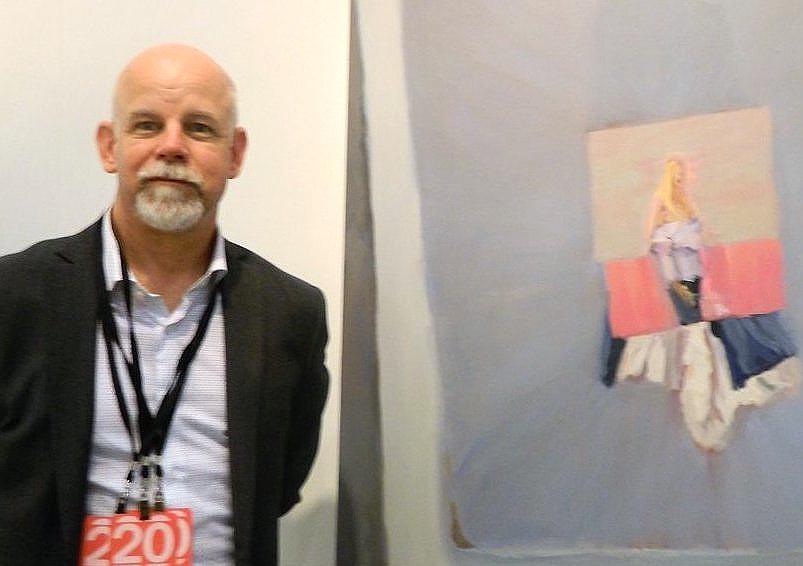
    Robert Birch at Art Toronto, 2019. Photo: Phil Anderson

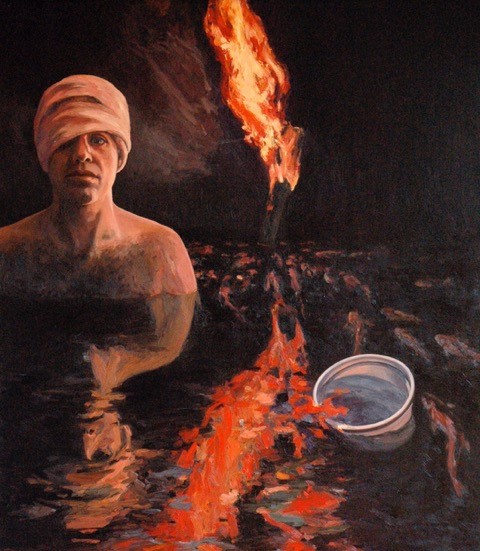
    Thirty Years, Thirty Artists, was the theme for his booth at the Art Toronto fair. His September exhibition, 1989 – 2019 featured some of those artists. I asked Robert about the Will Gorlitz painting Bad Faith at the back of the gallery and learned that it was after seeing the work of this artist that he stopped making art. In his estimation, Gorlitz was just too good a painter. Birch had been studying to be a medical illustrator at the University of Toronto, but would hence devote his love of art to its exhibition rather than its making. The Gorlitz painting in the show is enigmatic. A dead-pan self-portrait with the head bandaged had been a recurring theme for the artist at that time. Here he is chest-deep in dark water illuminated by a flaming branch, teeming fish, and a plastic container. I take the figurative elements in Bad Faith to signify a catastrophe of some kind. We can’t know for certain. To me, the loosely wrapped head covering the artist’s right eye point less to a physical wound, than something psychological, and with some detective work the implied drama may reveal itself. The swami-like Gorlitz, reflected into the inky bath as a playing card knave, has given us the clues and it falls to the viewer to ‘unwrap’ a possible scenario.

    Will Gorlitz, Bad Faith, 1987, oil on board, 86 x 80 in

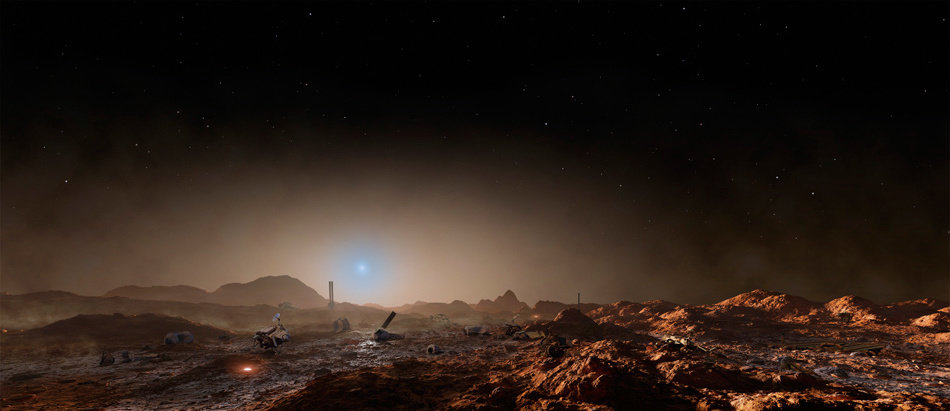
    The Kelly Richardson print, Mariner 9 is eerie. Since it chronicles something literally out of this world, the image is disconcerting and seemingly impossible. Even knowing that Richardson used data provided by NASA to ‘construct’ her image, from data provided by the Mariner 9 space probe, doesn’t make it any less surreal. Her fastidious rendering of the Martian landscape places her on the Red Planet essentially as an eyewitness, allowing the viewer to vicariously share in her experience. The historical precedent to what Richardson has done actually dates back 400 years. Galileo witnessed details of lunar craters that until then were unseen by the naked eye. He pioneered the use of the telescope in his scientific investigations, well before the advent of photography. It meant that Galileo had to transcribe the visual data transmitted by the telescope from retina to paper much like a digital scanner. The ensuing technologies that we now live with are merely added layers between eye and object, the complexity of which having progressively multiplied over the centuries. The rusty wrinkle that Richardson has furnished to the process is a ‘futurization.’ It is an imagined spectacle of what the litter of 200 years of spent probes might look like on a dry and dusty landscape without the benefit of a Martian janitor.

    Kelly Richardson, Mariner 9, 2012, C-print, 69 x 30 in, edition of 5.

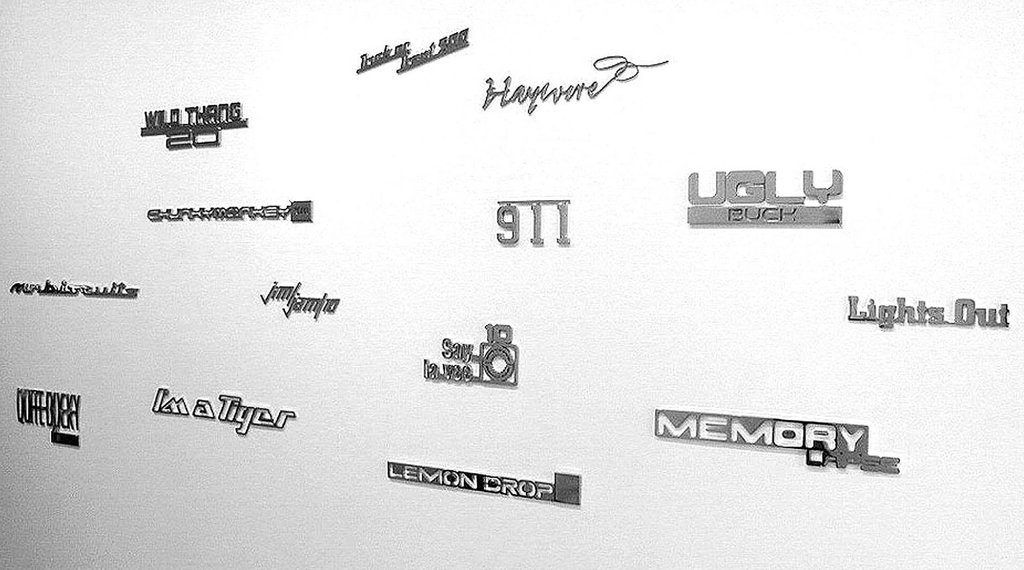
    If I refer to Louise Noguchi’s chrome plated steel pieces as synthetic, I don’t mean that they are fake. If her Broncos and Bucking Bulls works are funny, it’s a molten humour that she has not had to melt from her own cauldron. Noguchi has developed a working method with a broad thematic reach, a leap frog from one disparate subject to another through a process of synthesis. Her chrome plated steel pieces combine the names of rodeo animals that buck, with the logos of the vehicles that their riders might own. Rendered as gleaming chrome word marks, Chunky Monkey, Haywire, and Say La Vee are fun as gallery art, reflecting their aw-shucks western origins, cornball as the oater wit might be. Her Broncos and Bucking Bulls pieces may seem whimsical at first sight, but what is at work here has more kick than meets the eye. When the indigenous peoples of North America first saw a steam-powered train, they called it an iron horse, a synthesis of the known with the unknown. Ownership and identity are entwined in the trade mark. A ranch brand was seared into the cow’s hindquarters by a red-hot branding iron. When horseless carriages started pouring off the assembly line, the metal logos themselves were bolted into the boots and bonnets of each vehicle. In her art, Noguchi has made the cultural and linguistic threads that link these objects visible again.

    Louise Noguchi, Broncos and Bucking Bulls, 2002, chromed steel, various sizes, edition of 5

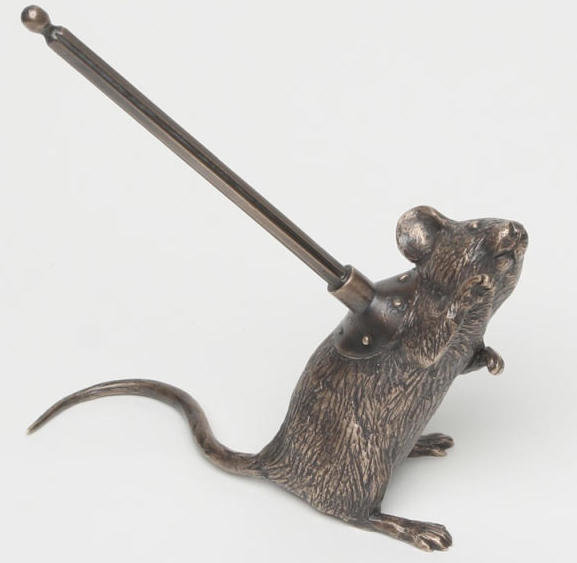
    Mitch Robertson’s Dying Mouse (in the style of Remington) is an illustration of the persistence and power of myth. In parodying the cowpuncher art of Frederic Remington, he stirs the sleeping ghosts of the Old West, ones that periodically get a dusting off by Hollywood. Robertson’s Dying Mouse was inspired by a myth of the artist’s own making. He had repeated a story of firing suction darts stuck with pins at mice enough times to blur his own memory of it. No longer able to distinguish fact from fiction, he had on his hands a ready-made myth. In Remington’s case, the western artist’s success as an illustrator arrived at the point when the actual Old West was slipping into mythology. His paintings and sculptures were active agents in the transition from reality to romance. Privately, he adopted a “pseudo-cowboy” speaking manner, and allowed his biographers to perpetuate myths of his own Western experiences. The cartoon violence of Robertson’s Dying Mouse collapses some of the brutal realities of our cultural past into his parody. The suction cup dart is a stand-in for work that the arrow, lance, six-shooter, and buffalo rifle had done in the actual west. We live in their residual aftermath.

    Mitch Robertson Dying Mouse (in the style of Remington), 2013, lost-wax cast bronze, edition of 15

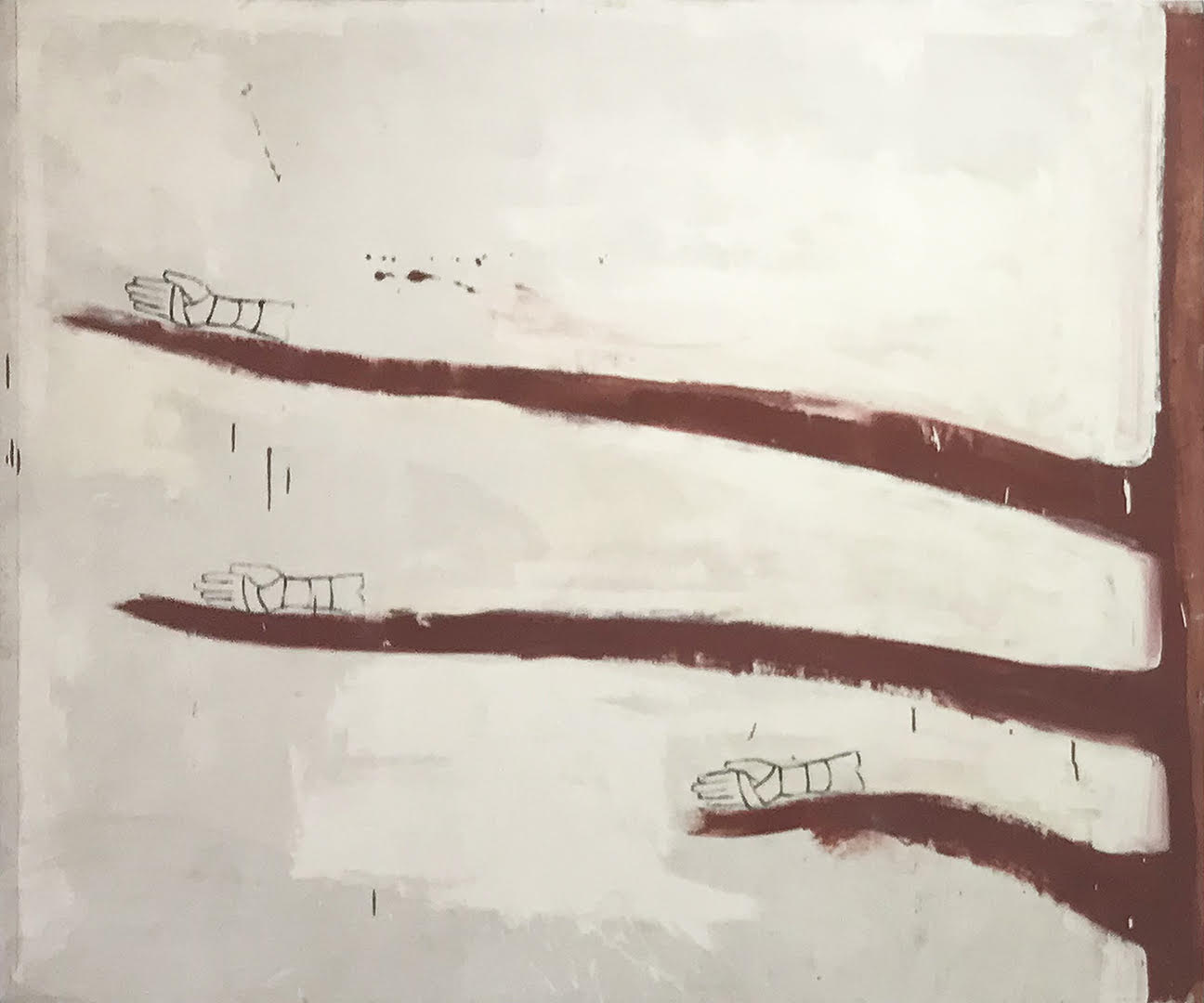
    Birch sites Euan Macdonald, now a Los Angeles resident, as the first superstar at his gallery. His loosely painted tree and bandaged hands belie a painstakingly precise conceptual bent. The artist is making a visual analogy in very simple terms. Trees are like people in that they have a trunk and branches as we have torso and arms that branch from hand to finger. The painting has the limbs stretching from one edge of the canvas to the other, the canvas being its medium of transport. We might continue in this vein of inference, but need to know something further. “Why the bandaged hands?” It turns out that they are about a tendon injury that Macdonald sustained at a job. He needed the support that the swaddling provided in order to keep working. The graphic depiction of it in the painting draws on a historical bit of datum. The knights of yore bandaged their hands with leather before donning their gauntlets. With metaphor and analogy at a gallop, we may attribute sensitivity and touch from the tender buds and shoots of trees to our very own fingertips.

    Euan Macdonald, Untitled, 1990, paint on canvas

    Peter Smith’s carving of a tree trunk section made a great complement to Euan Macdonald’s tree painting. Having a slight tilt and displayed on a nearby plinth it rounded out the exhibition’s human identification with our pulpy pals. The placement of the bitty log sculpture was curatorial catnip, one work feeding off the other. Its subject, carved in relief around the circumference of the wood was not obvious at first. It depicted, in fact, the arms and hands of transit riders, clinging to straps and bars of the car, ringing the piece of unpainted wood. As a symbol and emblem of dependency, the tree has no botanical equal. It’s a transit system all of its own, ferrying minerals and nutrients from root to branch, thereby feeding, housing, and enriching the biosphere with the necessities of breath and life. Releasing our grip of its tendrils is done at our peril.

    Peter Smith, Untitled (Subway series), c. 1994, carved wood, paint and cigarette ash

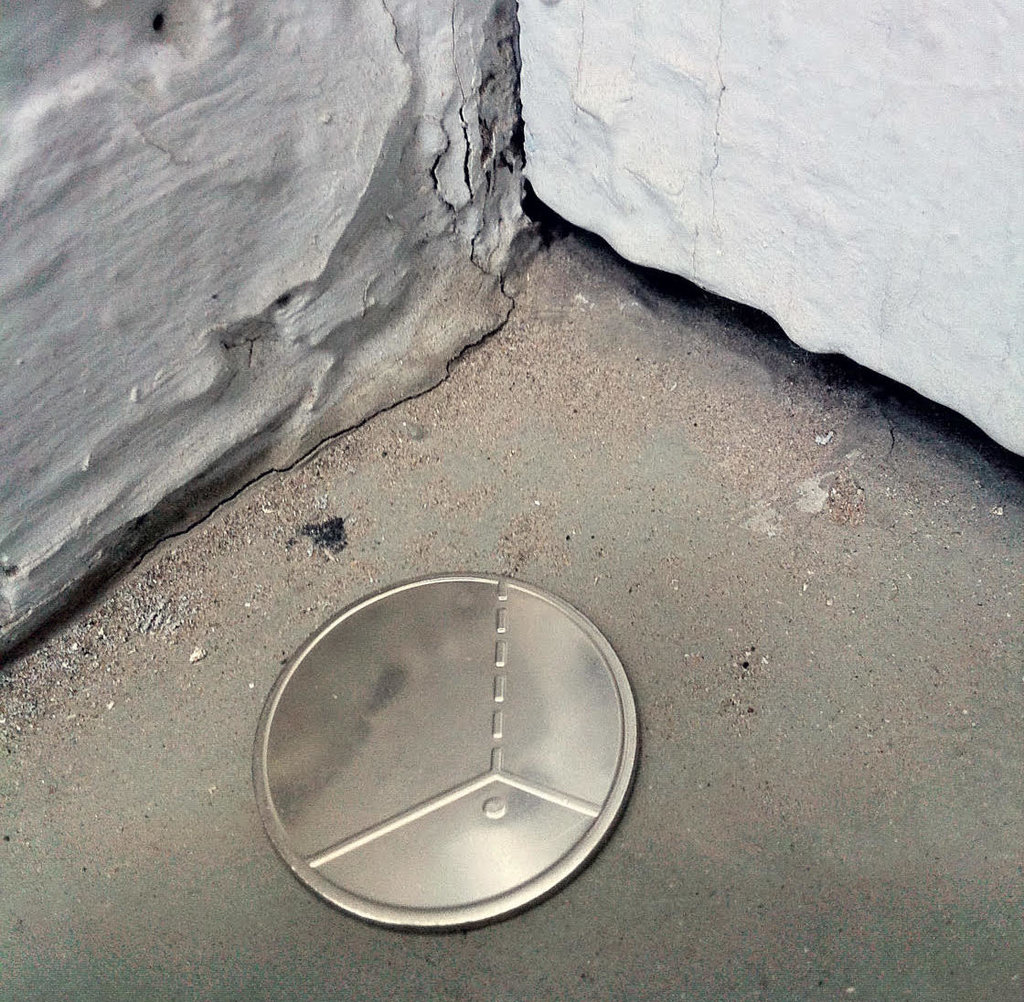
    To enter Birch Contemporary, one necessarily passes under the tip of a Micah Lexier arrow sculpture, the artist who now has a solo exhibition in the gallery. Affixed to the building’s exterior, the work is a functional piece of conceptual art, directing visitors to the correct gallery entrance. A laser-cut steel enlargement of a casually-drawn arrow bears an inscribed affirmation, “This is an arrow…” On the wall behind the desk near the entrance, was another Lexier metal sculpture from his A Minute of My Time series. Like the arrow, its graphic content has been scaled up from note pad doodle-size. These are the kind of unconscious expressions that are generally deemed time-wasters, things done between important things. By transforming doodles into durable art, Lexier has monetized them, reminding us that regardless how we spend it, time is valuable. His coin work floor piece in the corner opposite the desk is to size. It makes use of perspective to give it a sense of scaling down, the negative space created by the coin’s placement forming a pyramid. Renaissance artists referred to the converging lines of perspective as the pyramid of sight. These lines are represented on the coin graphically as well as the coin itself. When photographed, the magnification of the corner of the gallery represented here comes across as crude, highlighting its imperfections. The enlarged arrow and A Minute of My Time works were similarly granular in appearance. As our bitmap world is enlarged, it progressively atomizes into finer particles.

    Micah Lexier, Coin in the corner, 2012, Unlimited edition, custom stamped coin, welded rod, 1 1/8” diameter

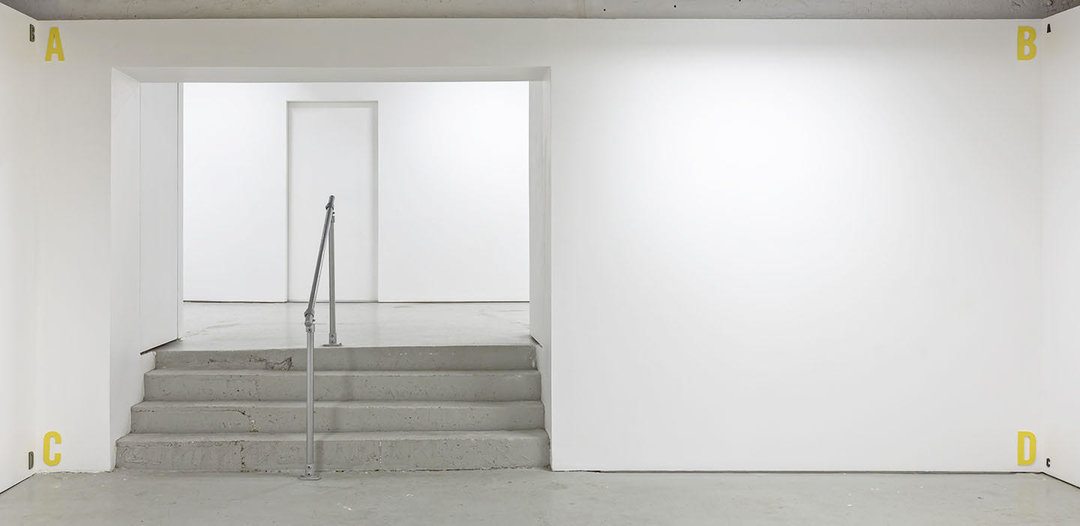
    Showing currently at Birch Contemporary is Micah Lexier’s To Each Corner Its Own Letter. Walking casually into the gallery, it’s easy to miss the exhibition altogether, as I did at first. Our eyes habitually go to walls to find the art, not the corners. The letters that Lexier has installed has in fact magnified the gallery’s emptiness. Once we catch on that the artist has situated the block letters as cues, we are able to ‘read’ the space. We become aware of how floors, walls, ceilings, doors, and stairs fit together in a particular way to create a singular entity. It’s a reversal of our normal perception of figure and ground. The walls as ground has been made hyper-real, the capital letters becoming the phonic soldiers that enforce their emptiness. The A, B, C, Ds wear their metal jackets in primary regimental colours and black. They form a nomadic troupe and may be pegged to any assigned space. It’s a mistake to regard them as merely the magnetized kiddy alphabet aids, which they resemble. Tutoring young Alexander, Aristotle managed to inculcate enough letters into the lad to forge an ambition to empire. By his early twenties, Alexander had hammered his ‘phonic’ digits into battle-hardened phalanxes that conquered the then known world, dragging Hellenic culture with it. Aristotle himself cast a shadow long enough to help in the founding of universities and learning in the West. Its adepts became known as men of letters, or as we would say people of letters. What Lexier has brought to light is an awareness of how conceptualized diagraming is at the heart of, not just building and structure, but of anything that can possibly be made.

    Installation view of Micah Lexier, To each corner its own letter, 2019, waterjet-cut painted aluminum

    Steve Rockwell

    Images are courtesy of Birch Contemporary

    *Exhibition information: Micah Lexier, To each corner its own letter, October 12 – November 9, 2019, Birch Contemporary, 129 Tecumseth Street, Toronto. Gallery hours: Wed–Fri 10 am – 6 pm, Sat 11 am – 5 pm.

  • Rajni Perera’s Traveler at Patel Division Projects

    Installation view of Rajni Perera, Traveler at Patel Division Projects

    Rajni Perera’s solo exhibition Traveler is held by Patel X Division Projects, which is a new collaborative space shared by Patel Gallery and Division Montreal at 45 Ernest Ave in Toronto. Perera’s ‘travelling beings’ are the subject of this exhibition, displayed in painted and sculptural portraits as well as in installations. The ‘travelers’ are the embodiment of third culture people living within diaspora, who have evolved to survive in their new environments, even during a time where the Earth itself fights to overcome environmental destruction. The figures highlight the struggle of marginalized people resisting the ‘trappings of colonialization and oppression’. They are travelers because they do not belong in any one place, having a fluidity in where they are located. They have made roots in each place they live, which are holds that are strong enough to withstand even the Earth’s physical decline.

    Installation view of Rajni Perera, Traveler at Patel Division Projects

    Experiencing Perera’s works cannot be encapsulated by photographs. One must physically see the works to appreciate the strong presence of the travelers. The figures, clad in richly ornamented fabrics and crisp metals serving as armor, are inspired by Sri Lankan culture and the Chinese animated TV shows that Perera watched as a child. The rich colors of their armor float on the surface of the canvases as the viewer passes by. The colors are “reminiscent of all the colors found in the center of the deepest, oldest forests, the highest altitudes of the sky, and the deepest depths of the oceans.”

    Painting from Rajni Perera, Traveler at Patel Division Projects

    Each figure is unaware of the viewer’s gaze, overlooking those in the gallery space. These individuals are of nature, emphasized by natural colors and shapes. Their depiction is focused on the materiality of their armors in contrast to the faces which are typically covered, not giving the viewer any information. The travelers are androgynous but lean towards the female. When closely examined, we notice, that some of the beings have six eyes, marking them not quite of the Earth’s natural world. They rather are a result of the merging of human and ‘reptilian, floral, riparian, or insect qualities’ which gives them versatility to live in any type of environment, whether it be water, forest, or mountains.

    Paintings of Rajni Perera, Traveler series, each mixed media on stretched paper, at Patel Division Projects

    Perera incorporates a sculpture titled Rings of Truth, an installation of ‘elongated finger adornments’ which are weapons evoking the talons of a bird of prey. The gold talons are three-times the length of an index finger and become thinner as they go up, sharpening to a point. One of them is displayed on an orange clay hand, fitting around a finger like a ring. Beside the hand there is an assortment of claws lined up on a pillow, as if in an armory, ready to be utilized. The gold talons are a reference to the Yoruba of Southwestern Nigeria, where they are associated with Ìyàmi Àjé, a women’s society that carries out justice when order is disrupted. These metal claws are a mode of protection adding to the travelers’ armor because “if people are to survive a massive event of global scale such as climate change, inevitably protecting one’s self and defending one’s place becomes a necessity”.

    Installation view with Rings of Truth of Rajni Perera, Traveler at Patel Division Projects

    Perera’s striking travelers are a beautiful sight, both of this world while simultaneously otherworldly, clad in armor and equipped with defensive weapons to face the threats of the present, and of those unforetold in the future.

    Text and photo: Olivia Musselwhite

    *Exhibition information: September 19 – November 2, 2019, Patel Division Projects, 45 Ernest Avenue, Toronto. Gallery hours: Tue – Sat 11 am – 6 pm

  • Interview with Mia Nielsen / Art Toronto

    Mia Nielsen, the new director of Art Toronto. Photo: Phil Anderson

    Interview with Mia Nielsen (MN) the new director of Art Toronto (artTO) on the occasion of the fair’s 20th anniversary by Phil Anderson (PA)

    PA: First of all, congratulations on being chosen to become director of Art Toronto as it goes into its 20th year. How do you feel the fair has evolved over the years since its beginning in 2000?

    MN: 20 years ago, the fair opened with 60 (mostly) local galleries, since then it’s doubled in size to 120 exhibitors (including institutions and arts publications) from across Canada as well as Europe, US and South America. In addition, we’ve developed special projects including speaking events from international artists and curators, collection visits around town and new this year, a program of large-scale art works in the lobby, open to the public. 

    Installation view of Art Toronto, 2019. Photo: Phil Anderson

    PA: Are there any changes you would like to see in the fair perhaps not this year but maybe next year?

    MN: Oh yes, there are a number of ways I’d like to evolve the fair, for instance, I hope to present more public art in the future. We’re in conversation with some new exhibition partners, but it’s too early to give away details, you’ll have to stay tuned!

    PA: Of the 100 galleries participating there seem to be only about a dozen or so from outside of Canada, apart from Focus: Portugal. Why has there not been more international presence at the fair?

    Francie Hester of Susan Eley Fine Art, London, UK. Photo Phil Anderson

    MN: What makes ArtTO so special is that it allows visitors to immediately immerse themselves in the Canadian art scene. Very few fairs allow for that national snapshot. We welcome a handful of International galleries and it’s great to have some international context, but this fair presents collectors and those curious about art to see the best of what is made in Canada. Considering how well Canadian artists do on the international stage, it’s really a treat to be able to take in so much of that work in one place.


    Shary Boyle, Red Rope. Patel Gallery, Toronto. Photo Phil Anderson

    PA: Does the fair attract many notable collectors? What kind of efforts are made to cater to them?

    MN: Yes, notable collectors come to the fair from across the country, this year there’s a great group from Western Canada and it was wonderful to see them here, acquiring works from galleries based in other regions of the country. Through our VIP program we offer collection tours and talks that are tailored to seasoned collectors, but of course, we welcome collectors who are just starting out too.

    Collectors’ Preview, Art Toronto, 2018. Courtesy of Art Toronto

    PA: How does having the Toronto Biennial impact Art Toronto 2019 in terms of its international presence? Or does it at all?

    MN: The Biennial is an exciting addition to visual culture in Toronto and we’re so lucky to have such an extraordinary program run concurrently to the fair. It’s attracting a lot of attention from the international art scene and we’ve seen more curators from other parts of the word timing their visit so they can take in the fair and the Biennial at the same time.

    Harbourfront site of the Toronto Biennial. Courtesy of Toronto Biennial

    PA: How do you feel the 12 years of working at the Drake of Art and Culture has helped prepare you for this position?

    MN: At the Drake my programming was geared towards presenting world-class visual art to wide and diverse audiences, I’m happy to build on those ideas here at the fair. Some of my favourite days at the Drake had me touring a museum director from half-way around the world and then speaking to guests about the collection who had never been to a museum before. ArtTO has similar diversity in the audience. Also, I programmed so many events from performances to magazine launches, talks and panel discussions, I look forward to building out more of those events in the future for the fair.

    PA: Is there any particular part of this year’s fair that excites you?

    MN: The public art program is really exciting, the generosity from the galleries that supported that program blew me away.

    Jeremy Holmes, INFINITE, 2019, presented the artist and Galerie Isabelle Lesmeister. Photo: Phil Anderson

    PA: How are selections made for the Focus series annually?

    MN: We work with different curators on the Focus section, this year João Ribas did an incredible job to bring together so many fantastic Portuguese galleries.

    Focus: Portugal curator João Ribas. Courtesy of Art Toronto

    Rita Ferreira, Queria morrer anonimamente no deserto, 2017. Photo: Francisco Ferreira. Courtesy of the artist and 3+1 Arte Contemporânea

    PA: There are over 25 Toronto galleries participating in this year’s fair so they must feel its importance to the artists they represent. Have any Toronto artists participating in Art Toronto received international attention as a result of their works having been collected at the fair?

    MN: Over the years, participating in fairs has become increasing important for galleries everywhere. Even for local galleries, ArtTo presents important opportunities to connect with new audiences, many of whom live and work in the city. Seeing so many galleries in one place is a great way for guests to discover new (and sometimes new to them) galleries close to home – whether they are seasoned collectors or just here to appreciate the work on exhibition. Not only collectors, it’s a great way for curators, museum directors and the media to discover new artists. That leads to all kinds of opportunities to exhibit in new places, or be discovered by new audiences through media coverage. It’s different for each artist, but showing at Art Toronto is definitely an important platform for Canadian artists.

    Tobin Gibson of Unit 17, Vancouver. Photo: Phil Anderson

    PA: What do you think needs to happen to make Art Toronto grow in the future?

    MN: I have so many concepts in development to grow the fair; you’ll just have to come back next year to see those plans start to unfold.

  • Interview with Jane Corkin of Corkin Gallery

    Jane Corkin, owner of Corkin Gallery in the 40th Anniversary Exhibition,
    When the sun departs for a new horizon, October, 2019. Photo: Simon Termine

    Interview with Jane Corkin (JC) on the occasion of celebrating the 40th Anniversary of Corkin Gallery by Simon Termine (ST)

    ST: First and foremost, thank you for agreeing to sit down with me and discuss the Corkin Gallery anniversary. The exhibition When the sun departs for a new horizon is absolutely amazing with such a rich variety of work, especially from vintage photography and contemporary artists. The Corkin Gallery has been such a huge part of artists’ careers… and here, there is so much talent.

    JC: Thank you, too. This is exciting to have an exhibition of emerging artists, mid-career artists, and senior artists speaking to historical precedents. Yes, the rich variety emanates from having so many years of thinking about art, seeing an enormous amount of art around the world and collecting art. 

    Installation view with works by Thaddeus Holownia (left), Andrés Marroquin Winkelmann (right) and Miles Gertler (centre). Photo: Simon Termine

    It is impossible to separate the historical from the contemporary because they are in a continuous dialogue. I have had the privilege and the advantage of seeing so much to be able to establish connections. 

    We started working with young artists 40 years ago and helped them to establish their careers. They are no longer emerging artists. They now have a prominent place in Canadian history. This is the challenge with each emerging artist we bring into the gallery. We are excited about our current emerging program.

    Gina Rorai, Montara, 2015, oil on canvas, 10 x 8 ft. Courtesy of Corkin Gallery

    ST: From everything you just described, was that part of your initial vision when you started all those years ago?

    JC: It has certainly been a journey since I started. Somehow I was a kind of “renegade” 40 years ago doing something different in Toronto, showing photographs, ceramics and even furniture. At that time, there were not many collections in town; my vision was to have people interested in what the artists were making, then finally to build collections with purpose. The artworks became part of their home, workspaces, in a private sphere.

    Michelle Forsyth, Grey Stack, 2015, 18 x 18 x 14 in. (left) and Blue and Red Stack, 2018, 18 x 18 x 15 in. (right) both sculpture, mixed media. Photo: Simon Termine


    My vision has been transformed by time. In 2000, I imagined a space that allows artists to play and experiment with it. Our beautiful gallery in the Distillery District allows us to exhibit large-scale paintings, installations and more, which is enormously stimulating. I feel like I have gone back to my roots. We are engaged with artists because they are thinking and making work related to issues that are important at a specific time. Eventually the artwork becomes timeless. This is what art is. Or at least, how I think about it. 

    Various Artists When the sun departs for a new horizon, 2019. Installation at Corkin Gallery. Courtesy of Corkin Gallery

    ST: You work to cultivate relationships between the artists themselves and prospective buyers. Are there any challenges that come with that?

    JC: We try to create collections. We don’t want to just sell art. We want to inspire people to think about the artists’ practices. We are focused on supporting our community by engaging viewers with themes that resonate today such as identity, the preservation of our environment or the importance of revisiting history. 

    There are always challenges to attract audiences or find collectors who are interested in a larger or complex exchange. We are thinking about the artists who live and work here in Toronto within a context of international artists. The exhibition we have up now – When the sun departs for a new horizon – has about 30 works from artists all over the world. What is important is that we put together a conversation between artists from different places like Peru, Germany, Russia and Canada, producing work at different moments but with similar questions. 

    Jota Castro, Here Comes the Rain Again, 2013, stone and butterfly, Dimensions variable. Photo: Simon Termine

    The final goal is to build something more than just decorative artwork. An art piece that reaches your soul is something that you respond to, ultimately enhancing life experience. 

    ST: In your gallery, you have covered a myriad of social issues: for example, the Peruvian works that cover the country’s economic failure and the German photographs that deal with degenerates during World War II. Was there any difficulty in portraying those works?

    JC: All art comes out of a social time and place. Artists reflect upon their context. I think you are speaking about the Gerhard Richter. While he is focusing on bringing our attention to a historical moment, the work itself is not aggressive. It is intriguing. In this case, the artist wants to be sure we remember history. Maybe the art responds to difficult themes but the subcontext of the work is beautiful. I don’t have any problem showing work engaging with social issues and engaging the viewer with the issues.

    Gerhard Richter, 4.5.89, from the series: 2.5 – 7.5.89 Sechs Fotos, 1989  
    gelatin silver print, 13 3/4 x 20 in. Courtesy of Corkin Gallery

    In the end, the great pleasure is to be involved with inspirational artists and to bring different visions to the city. In the early days, I developed exhibitions with photographers like André Kertész, Harry Callahan, Irving Penn, Richard Avedon, Arnold Newman, Nan Goldin, Giselle Freund, and Diane Arbus. When I was beginning my career, photographers were mainly ignored by the mainstream and they required spokespeople. Even Nan Goldin or Diane Arbus was part of the outsider movement. There were not many people who understand the art I was showing. Photography was considered a new media but not art and I was lucky to be part of the movement that defined how we see photography today. My personal collection is rich with great historical photographs.

    André Kertész, Stairs of Montmartre, Paris, 1925, print made 1975, gelatin silver print, 11 x 14 in. Courtesy of Corkin Gallery

    ST: Especially with the track record that the gallery has in supporting the photography that it has, participating in art fairs in New York, Hong Kong, Basel, Miami, Paris, LA, just as a few examples. Can you talk about your participation in international Art Fairs?

    JC: We’ve done art fairs all over the world. There were years when we did ten or twelve a year!

    Corkin Gallery’s booth at Art Toronto, 2019. Courtesy of Corkin Gallery

    We love it, and we don’t love it. Art dealers and artists are the same, in this way. We are spoiled in a way because we get to see great artwork privately every day. There is something wonderful about that. When there is a lot of public, noise, and fanfare, you have to give into that atmosphere because you’re addressing a different kind of public. So, the art fairs serve a purpose: gather people together in highly spirited, very social ways. Art fairs are ways of engaging with different kinds of people, such as curators, collectors, and academics. It’s not just about selling art, but about passing on the information to as broad an audience as possible.

    ST: And speaking to that, what would you say are some of the key milestones in the history of the Corkin Gallery? What is coming in the future?

    JC: As for the future, you’ll just have to wait and see…. There’s so much to do. We represented photographers when people thought photography wasn’t art. And now, we need to support other movements because the lines are so blurred. Painters, installation artists, photographers – are redefining the medium. The boundaries are loose in terms of what actual materials are and it’s exciting! The gallery has always been interested in working with emerging artists and we strongly believe in integrating contemporary ideas from our community in an international arena.

    Sondra Meszaros, Camouflage Net #1, 2019, hand torn digital print on mulberry paper (rice), 52 1/2 x 40 1/2 in. Courtesy of Corkin Gallery

    Regarding the key milestones of the gallery history, I will start by saying it hasn’t been easy to own a gallery for 40 years as a woman. It is a tough business and looking at this achievement is a personal success. Since the beginning, the gallery developed an audience for vintage photography and helped to create the market for it. Many of the vintage photography works you see at the AGO, the National Gallery or other international museums originally came from Corkin Gallery. To have been involved with the gallery where people think about art and to have been able to create an audience who follow and support our artists’ career, is magical. 

    Yakov Gakkel, untitled, from the 16 epreuves series, c.1937, gelatin silve print 4 1/2 x 6 7/8 in. Courtesy of Corkin Gallery

    We are a bridge between ideas and creativity and the people who can support those ideas economically. It is our job to make sure the interchange can continue because, in the end, it would be a sad society without art.

    Corkin Gallery’s team (L-R): Nicole Stawikowski; Jane Corkin, Owner; Eric Watters, Registrar & Art Handler and Magdalena Arellano, Exhibitions Coordinator. Photo: Simon Termine

    *Corkin Gallery is located at 7 Tank House Lane, Distillery District, Toronto.

  • A Photo Journal of Art Toronto 2019

    Metivier Gallery, Toronto with Aida Muluneh’s work

    Stephen Waddele, Berlin Tiergarten (diptych), 2010 at Monte Clark, Vancouver

    Parisian Laundry, Montreal

    Will Gill, Open Ocean series at Christina Parker from St. John’s

    Daniel Faria of Daniel Faria Gallery, Toronto

    United Contemporary, Toronto

    Quimera, Buenos Aires, Brazil

    Cooper Cole, Toronto

    Franz Kaka, Toronto

    Devan Patel, owner of Patel Gallery, Toronto in front of Rajni Perera’s work, that was purchased by the AGO at the opening night

    Pierre-Francois Oulette Art Contemporain, Montreal with Dil Hildrbrand’s sculptural work, Pocession

    Olga Korper, owner of Olga Korper Gallery, Toronto

    Installation view with Jannick Deslauriers, Sentences from Art Mur, Montreal

    Jane Corkin, owner of Corkin Gallery, Toronto (right) and Magdalena Arellano, Exhibitions Coordinator (left)

    Punkbuddha, a fiberglass sculpture by Metis Atash at Galerie Bellefeuille, Montreal

    Installation view with Mersuka Dopazo’s painting, Olga from Rebecca Hossack Art Gallery, London UK (in front) and Todd Meril Studio, New York, US (left)

    Dianna Witte Gallery, Toronto

    The Solo section

    Xiaotong Cao


    *Exhibition information: October 25 – 27, 2019, METRO TORONTO CONVENTION CENTRE, North Building, Exhibit Hall A & B, 255 Front Street West. Hours: Fri 12 – 8 pm., Sat 11 am – 8 pm, Sun 11 am – 6 pm

  • ART TORONTO 2019

    Phil Anderson:

    Canada’s premier art fair in Toronto was busy with crowds and enthusiastic gallery participants in its 20th year. A new director, Mia Nielsen was at the reins, no stranger to managing large projects. The fair changed its name a few years ago from Toronto International Art Fair to Art Toronto to reflect the change in their direction, which seems to be less on international art galleries. There had been a drop in the number of participating international galleries which can be explained by a few factors such as a lower value of the Canadian dollar, a small Canadian art market and perhaps the difficulties of bringing art overseas, over the US border and custom duties.

    Whatever the reasons are, the few international galleries that had participated seemed happy to be there. Director Susan Eisner Eley of Susan Eley Fine Art, New York was back for her 5th year and talked about having good years and not so good years in terms of sales.

    Director Susan Eley of Susan Eley Fine Art, New York

    Bill Jackson of Jill George Gallery, London, England said they came back for each of the last 20 years because they liked the fair, liked Toronto and have clients buying art here. He wished there were more international galleries as well. They also represented a Canadian artist who they had hoped would have been considered for the AGO purchase but being a non-Canadian gallery excluded them.

    Bill Jackson (left) & Jill George (right) of Jill George Gallery, London, UK

    I talked to an artist from Vellum Projects, Brooklyn and she was having a good experience at the fair. Likewise, associate and artist from Projet Pangée in Montreal were equally pleased with the fair. This was the second year for Projet Pangée and it is only a two-year project.

    Artist Diana Verge from Vellum Projects, Brooklyn, N.Y.

    Schine Latovche from Projet Pangée with artist Michelle Bui

    Robert Birch, of Birch Contemporary, Toronto has been participating for 12 years and said the layout and the quality of the art was better but thought it was a little conservative and the fair could perhaps do a better job attracting international buyers. Gallery Director Raphael Petrov of Galerie Raphael, Frankfurt & Paris, was glad since he sold many prints and works on paper for entry level buyers. He participates in other fairs as well such as Art Miami.

    Robert Birch of Birch Contemporary, Toronto

    Raphael Petrov of Galerie Raphael, Frankfurt & Paris

    Director Nikola Rukaj has been a participant for 20 years and appreciated the improvements to the fair in its design to create better traffic flow. He said, sometimes you need to spent money to make a fair more successful. Everyone seemed also agree that the fair had grown and improved in overall.

    Nikola Rukaj of Rukaj Gallery, Toronto

    At Jones Gallery from Vancouver I talked with directors Mark Reddekopp and Anita Cirillo who believed the fair had grown steadily and matured well. I recognized the work of a Toronto artist in their booth, Jen Mann. Jones Gallery has been working the fair for 8 years.

    Anita Cirillo & Mark Reddekopp from Gallery Jones, Vancouver, work by Jen Mann

    Claudia LALA of LA LA Contemporary in Toronto paired up with two galleries from Argentina, Galeria Rubbers and Gachi Prieto of arte contemporano latinoamericano. They were all very busy with visitors.
    Claudia LALA of LA LA Contemporary, Toronto (right) with artist Vivian Galban (left)

    Galeria Gachi Prieto, Buenos Aires, Argentina

    Mariana Povarche from galeria Rubbers, Buenos Aires, Argentina

    Clint Roenisch of Clint Roenisch Gallery, Toronto was in conversation with an artist he was showing at his gallery, Claire Greenshaw. David Liss of MOCA, Toronto was there as well and now he is also working at ARSENAL Gallery; always a busy man. Jamie Angell of Angell Gallery was happy with some red dots already on the wall beside the works. Stephen Bulger of Stephen Bulger Gallery was satisfied with the fair’s progress. Most people I talked to thought that the fair was well balanced offering contemporary pieces but also some traditional art works as well.

    (L-R): Clint Roenisch, artist Claire Greenshaw & David Liss

    Jamie Angell of Angell Gallery, Toronto

    Stephen Bulger of Gallery Stephen Bulger, Toronto

    There was plenty of art to take in and you would likely need more than one day to appreciate it all. The fair stopped being open on Mondays as they were not getting the attendance on that day that made it worthwhile. The new director, Mia Nielsen is off to a good start and Art Toronto continues to be Canada’s best contemporary art fair.

    Text and photo: Phil Anderson

    Mikael Sandblom:

    Art Toronto is a big show and it’s hard to take it all in. Even if you spend several hours, you’ll likely feel that you haven’t given most of the pieces the attention they deserve. The vast range of work on offer demonstrates how wide open and diverse contemporary art has become. It’s a vibrant and exciting event, even if a bit overwhelming. Below is a sample of some of the work that appealed to me.

    Axel Pairon Gallery from Knokke-Heist, Belgium showed the work of Regine Schumann, a minimalist light artist who builds works out of specially pigmented acrylic. These pieces change and shift in the light. The booth was set up with extra lighting so that the work could be shown in several different lighting conditions. A cool feature was that they glowed brightly when exposed to UV light.

    Lightboxes by Regine Schumann at Axel Pairon Gallery from Belgium

    Deborah Carver, the director of Studio 21 from Halifax brought several of her east coast artists to the fair. The booth included work by Charley Young, Brian Burke, Sara MacCulloch, Jack Bishop, Sara Caracristi, Richard Thomas Davis, Kizi Spielmann Rose and Raymond Martin.

    Deborah Carver in her booth in front of Sara Caracristi’s work

    Galerie Isabelle Lesmeister from Regensburg, Germany presented several pieces by artist Mathias Hornung. Large blocks of wood were painted and scored with a saw, creating a grid pattern. As the wood was partially chipped away, interesting colours and patterns emerged reminiscent of cities and buildings.

    Mathias Hornung’s work at Galerie Isabelle Lesmeister

    Niki Dracos, director of General Hardware Contemporary, Toronto showed a beautifully curated selection of her gallery artists: Alex Bierk, Agathe de Bailliencourt, Jordan Broadworth, Paul Collins, John Armstrong, Mark Crofton Bell, Matt Crookshank, Scott Everingham, Joe Fleming, Christian Gonzenbach, Caroline Larsen, Maslen & Mehra, Celia Neubauer, Sarah Sands Phillips, Julie Voyce, Stanzie Tooth, Kate Wilson, Lyla Rye, Clint Neufeld, Stacey Tyrell, Clara Couzino and PA System (Alexa Hatanaka and Patrick Thompson).

    General Hardware Contemporary’s booth with paintings by Jordan Broadworth (detail, left) and Scott Everingham (right)

    Rukaj Gallery, Toronto showed several pieces by Eberhard Ross. At first these appear to be simple colour field paintings but on closer inspection, one discovers that the surfaces are richly textured and an ingenious colour treatment on the sides and back make the piece reflect a radiating glow on the wall.

    Rukaj Gallery showed several pieces by Eberhard Ross

    The Sandra Ainsley Gallery from Toronto showcases glass artists and their booth had many beautiful examples of what is possible in this medium. Wilfried Grootens creates his colourful organic work by painting and then bonding several layers of glass together. John Kiley has allowed the cracking and breaking of glass to help develop his forms. A work that struck me most was a glass tower by Peter Bremers, Ascending Spirit.

    Glass work by Wilfried Grootens at Sandra Ainsley Gallery

    Peter Bremers, Ascending Spirit at Sandra Ainsley Gallery

    Ellephant Gallery from Montreal had several digital works by Adam Basanta. The artist uses historical landscape art from museum collections and manipulates them with his own digital processes to create new images.

    Adam Basanta’s work at Ellephant Gallery

    The Angell Gallery had a vibrant booth focused on modern landscapes. They range from the exuberant expressive work of Steve Driscoll to the quiet white sand and acrylic painting of Gavin Lynch.

    Installation view of Angell Gallery’s booth with Steve Driscoll’s paintings

    Text and photo: Mikael Sandblom

    *Exhibition information: October 25 – 27, 2019, METRO TORONTO CONVENTION CENTRE, North Building, Exhibit Hall A & B, 255 Front Street West. Hours: Fri 12 – 8 pm., Sat 11 am – 8 pm, Sun 11 am – 6 pm

  • Art Toronto 2019

    Art Toronto installation view at Focus: California, 2018. Photo: Xiaotong Cao

    October 25 – 27, 2019
    METRO TORONTO CONVENTION CENTRE
    North Building, Exhibit Hall A & B
    255 Front Street West
    Hours: Fri 12 – 8 pm., Sat 11 am – 8 pm, Sun 11 am – 6 pm

    Founded in 2000, Art Toronto is Canada’s international contemporary and modern art fair, located at the Metro Toronto Convention Centre in the city’s downtown core. Providing unique access to the Canadian art market, the fair is one of the most important annual art events in Canada. Now in its 20th year, Art Toronto presents important artwork from leading Canadian and international galleries combined with PLATFORM, our engaging series of lectures and panel discussions from prominent art world figures, curated projects, an extensive VIP Program, and top-tier cultural offerings throughout the city.

    FOCUS:

    Portugal presents a selection of works by artists from the participating Portuguese galleries of Art Toronto 2019, representing some of the most significant artists and galleries in the current vibrant Portuguese arts scene.

    PLATFORM SPEAKER SERIES 2019:

    PLATFORM is Art Toronto’s comprehensive lineup of talks and panel discussions where listeners will hear from influential art world figures on important and trending topics. Included within PLATFORM are POWER TALKS, a series of lectures organized in partnership with the Power Plant Art Gallery.

    These complimentary talks are held on the Art Toronto stage and last approximately one hour. For details click here.

    SOLO Salon Art Talks:

    Join a selection of Art Toronto’s SOLO artists as they discuss their work through the lens of shared themes. The SOLO section includes 12 galleries, each presenting a highly‐curated body of work by a single artist.

    Tours are included with admission and last approximately 45 minutes.

    Please meet in the middle of the SOLO Section, between booths S05 and S08 to participate. For more information click here.

    West End Gallery Hop / Friday, October 25, 6 – 10 pm

    Art Toronto invites you to gallery hop across 13 top contemporary galleries in Toronto’s west end. The following galleries will be welcoming all art enthusiasts for a night of refreshments, cocktails and incredible art! This event is open to the public and free of charge. For details click here

    For programming, ticketing and more information click here.