
Author: artoronto
-
HEARTH opens with New Strata
Consider this video clip, a CTV News report from March 16, 2015: Nick Lambrinos, middle-aged, wears a black leather jacket, oatmeal turtleneck, and dark tinted glasses. He’s talking with a police officer, gesturing at a property that’s just been demolished by a house fire. “No rooming house, my friend,” Lambrinos says to a reporter now. “That’s the neighbors’ jealousy. And I was nice. Whatever they want, I give them.” He rambles on, his voice a note sterner: “It’s jealousy. That’s all they have, and that’s why the whole city—from people talking, jealous of one another.” The clip abruptly cuts off. A reporter pontificates about the cause of fire. The property has numerous illegal additions, included a detached garage. This house has been operating as an illegal rooming house, he informs us. At least three tenants have been rendered homeless. We’re told they shouldn’t have lived there in the first place.
November 23, 2019: I’m at the opening reception for New Strata, the first exhibition at HEARTH, a new artist-run space here in this garage on Lambrinos’ old property. “Works within the opening exhibition embrace fire’s generative potential as much as its destructive qualities,” the exhibition package explains. A hearth, the base of a fireplace, is supposed to symbolize community. A hearth is the part of the home around which people gather. We’re drawn together for warmth. Fire has generative potential as much as it has destructive qualities.
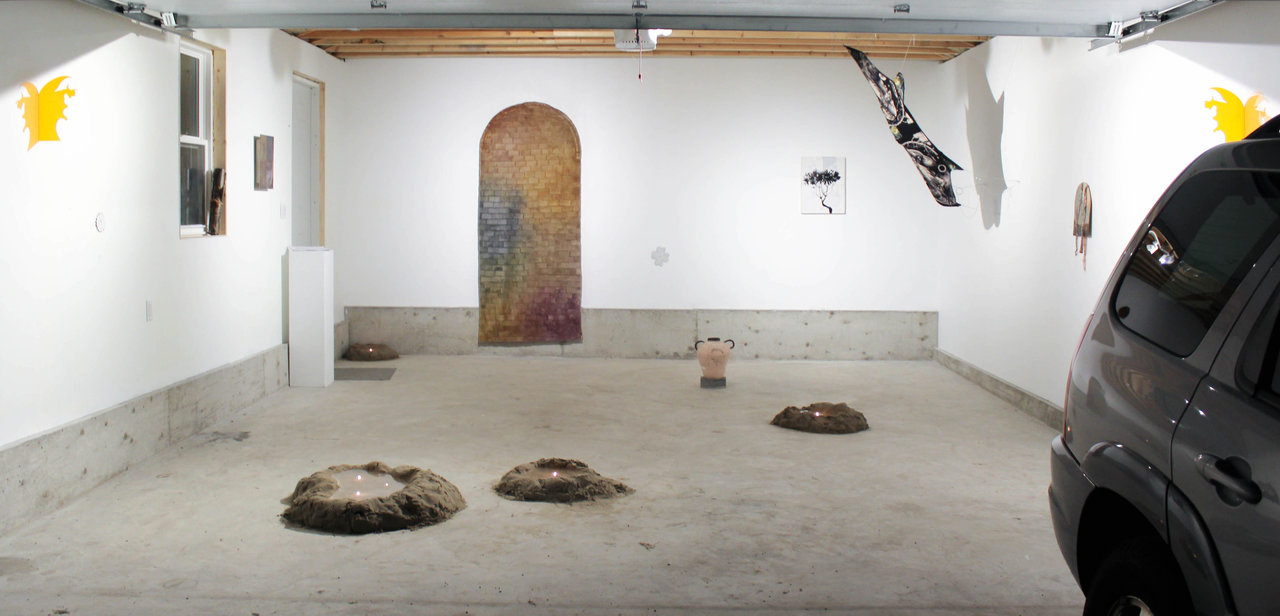
Exhibition view of New Strata
HEARTH is the latest plot in a constellation of weird spaces that make up Toronto’s milieu of artist-run centres. To name only a few, this includes the basement spaces of Sibling and Franz Kaka, the other garage Crutch CAC, and the literal bunker that is Bunker 2. Typical to this DIY gallery model is a mandate that rejects institutional bureaucracies, and their attended deference to private and public funders, exclusionary power structures, and gentrifying efforts that often piggyback galleries’ spring-up. In short, the artist run-centre establishes itself as an antidote to a commercial art world that is oft more aptly categorized as a market than a community.
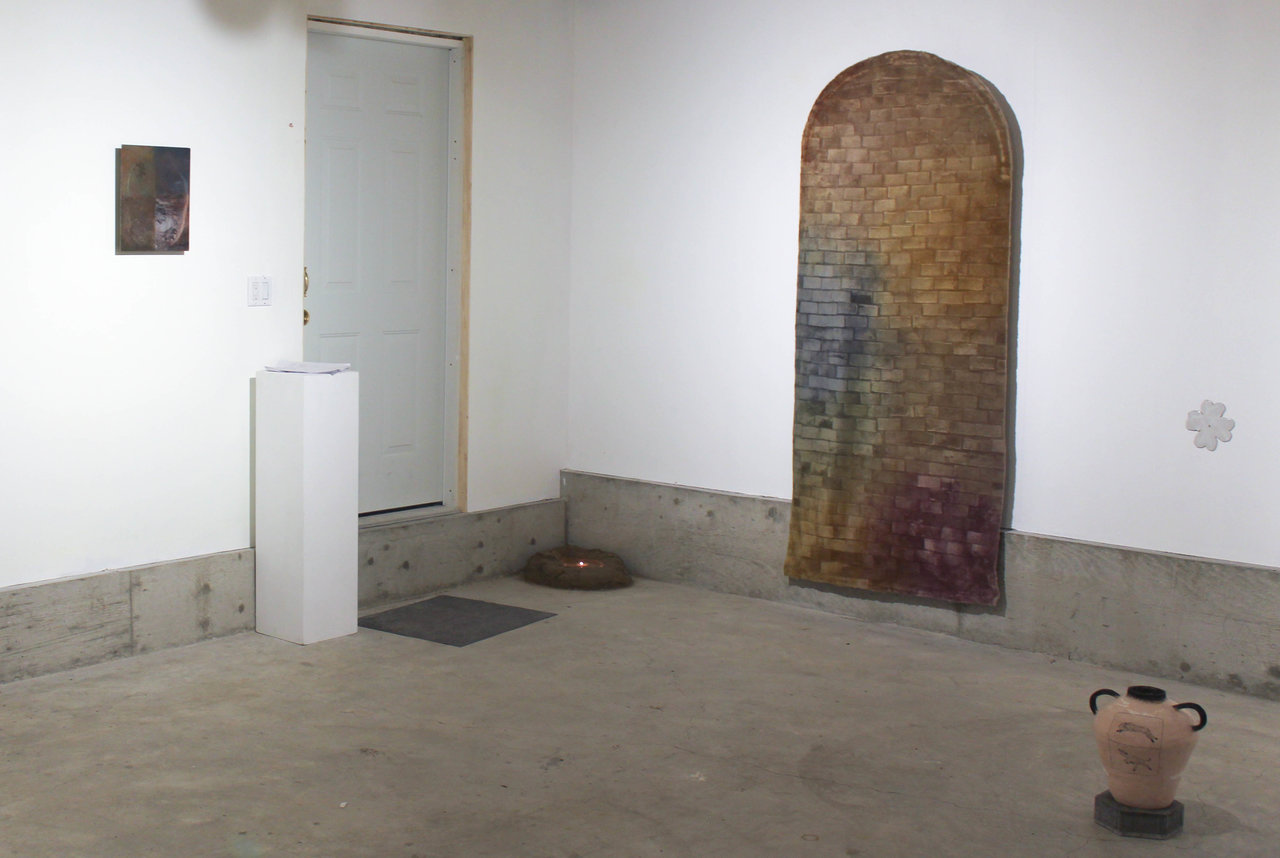
Installation view with (L-R) Cadence Planthara, Untitled (quadrant painting), Shannon Garden-Smith, Sand Candle & Curtain Wall (Tending Toward) and Misbah Ahmed, Dalmation Running
The artist-run M.O. in Toronto dates back, in part, to General Idea’s establishment of Art Metropole, one of the city’s first artist run centres, and A.A. Bronson’s now canonical manifesto for the Association of National Non-Profit Artist Centres (ANNAC) “The Humiliation of the Bureaucrat: Artist-Run Centres as Museums by Artist” (1986), which characterizes the artist-run centre as “a sort of self-determining method of bypassing the gallery system, the artist’s office as museum reaching into the corporate pocketbooks of big business,” and champions the artist-run centre as “a connective tissue” between an emergent egalitarian arts community. HEARTH’s own mission statement says that it seeks to “provide a reprieve from limitations imposed by many larger artistic operating bodies, and the city itself,” and that it “is committed to working towards an anti-oppressive, queer positive environment, and welcoming marginalized, radicalized and indigenous folks.” The make-do ethic (and aesthetic—think space heaters, bad beer and donation jars) make artist-run spaces feel special, or somehow exempt from the typical hierarchies that make a city hard to live in, and its arts scene tough to participate in. But HEARTH’s inception on this site reminds us that no place is really exempt, but actually stands for its position in a city’s ecosystem, even as it carves out refuge. Steeped in HEARTH’s inception are questions about private property, ownership and community. It is a space for those who can’t rely on existing institutional structures to provide a home for their artwork on a site that once belonged to those who can’t rely on existing institutional structures to provide a home for them at all.
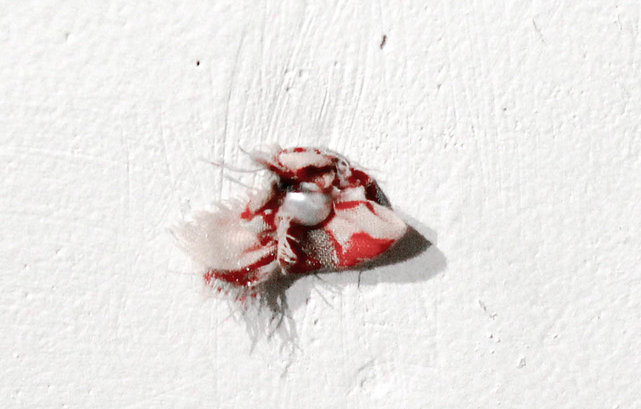
Cadence Planthara, in the wall: freshwater pearls, cotton, peppercorn, glazed stoneware
In their opening exhibition New Strata, artists attend to those questions about place, which HEARTH’s cite seems to provoke. Cadence Planthara tucks tiny pearls and peppercorn into HEARTH’s corners and cracks in the drywall. This is a kind of christening gesture, endowing the space with symbols of good luck. Peppercorn, a common household spice, is something of a wish for this garage to become a home, like a housewarming gift. It also speaks to one of fire’s most generative purposes: cooking, which is a form of community building. Planthara’s work “Untitled (pearls inlay painting)” (2019) includes pearls again, as well as silk and cotton, and loose threads. These materials allude to the domestic. Hanging her artwork feels a lot like decorating a home.
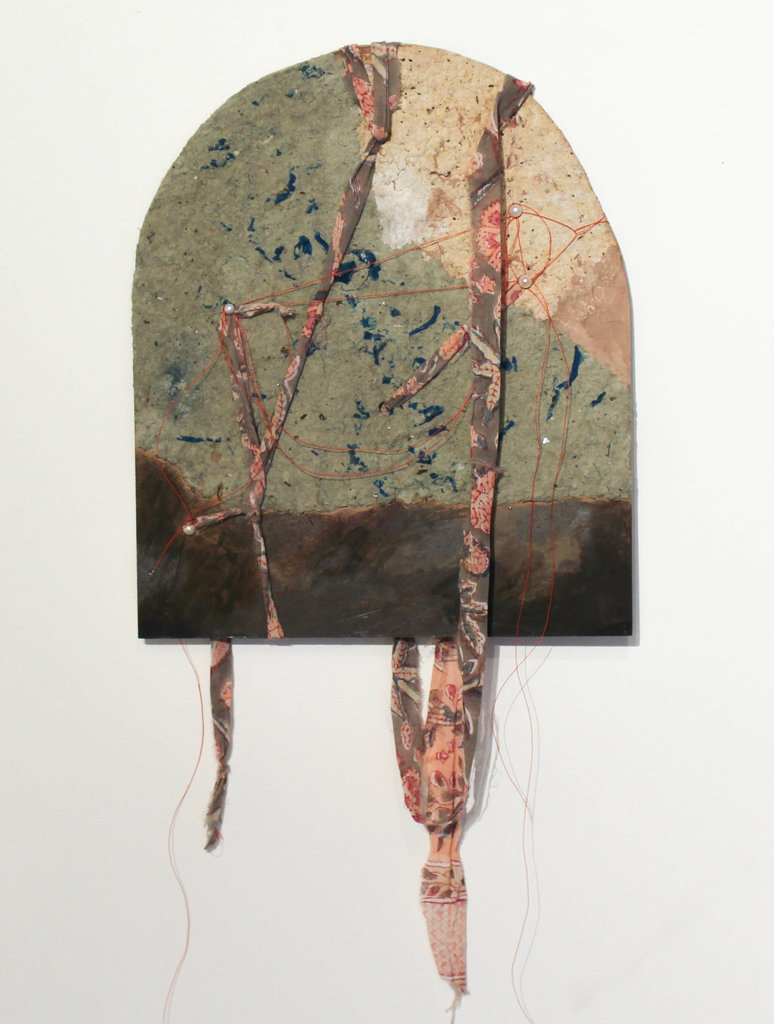
Cadence Planthara, Untitled (pearls inlay painting), acrylic, paper, silk, cotton (LaCache by April Cornell), plantago, calendula, clay, graphite on hardboard, 4 freshwater pearls, 2019
Andrew Harding’s artwork also offers symbolic efforts to make HEARTH a home. “Untitled (tribute)” (2019), are laser-cut orange gargoyles. Gargoyles are mythological guards, symbols of protection. “Urban Hide” (2019) reads like a coy attempt at reclaiming cultural sovereignty. The “hide” is made from trippy graphic t-shirts, which feature cartoonish abstractions of indigenous iconography, including far-out looking caricatures of headdresses and eagles. It is iconoclasm—which, like a fire, is also a way to destroy a home—to render symbols meaningless by placing them on something as banal as a cheap t-shirt. Hanging these shirts in the form of a hide is, perhaps, a symbolic return home from the whiplash of displacement and assimilation, which had been feebly addressed in our popular imagination through random cultural fetishes.
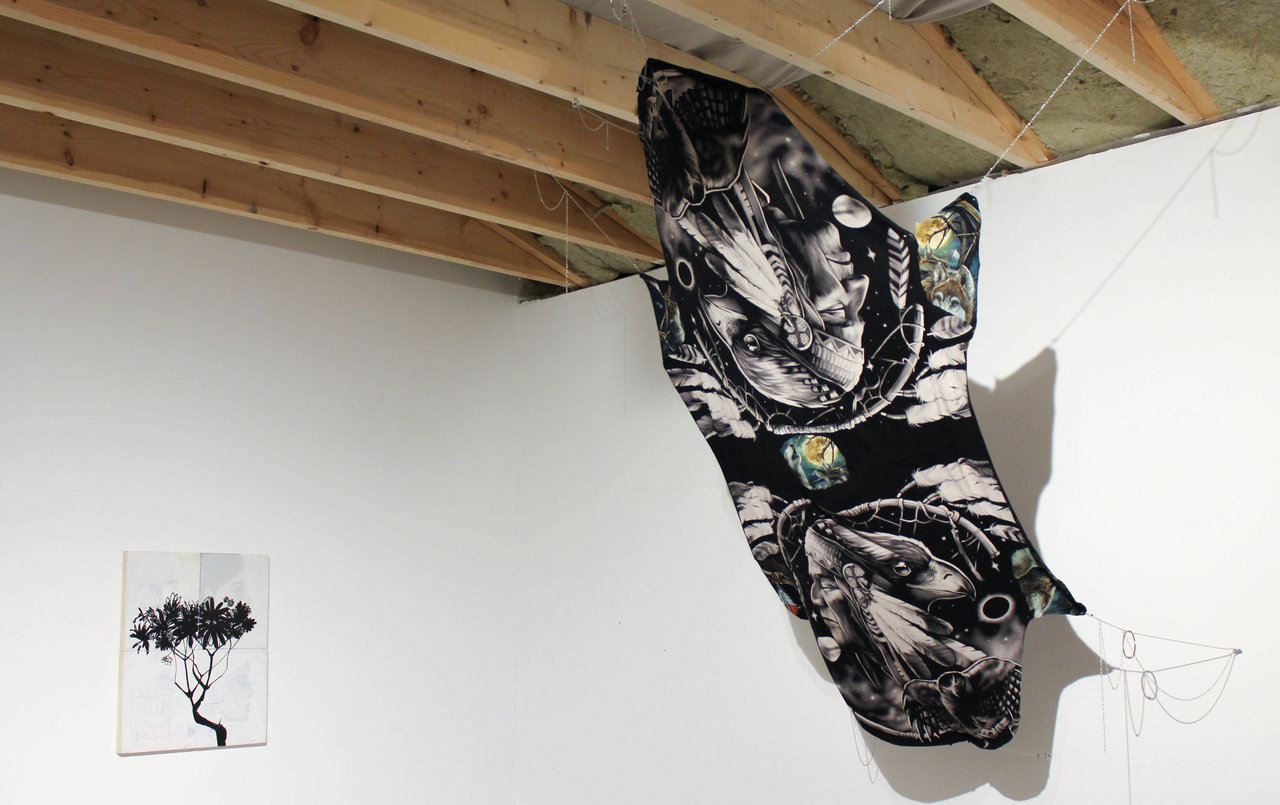
L-R Misbah Ahmed, Champa, wood panel, oil, acrylic and graphite, 2019. Andrew Harding, Urban Hide, tshirts, silver plated chain, 2019
Perhaps the most site-specific artwork in New Strata is Shannon Garden-Smith’s “Sand Candle” (2019). Mounds of sand, built on the garage’s concrete floor, form a collection of basins. Burning tea lights float inside each. Garden-Smith made “Sand Candle” as a direct response to the space. When I visit HEARTH for the first time, I don’t know about Nick Lambrinos and the house fire and the displaced tenants. Now that I do, “Sand Candle” reminds me of a candlelight vigil. It looks like a memorial.
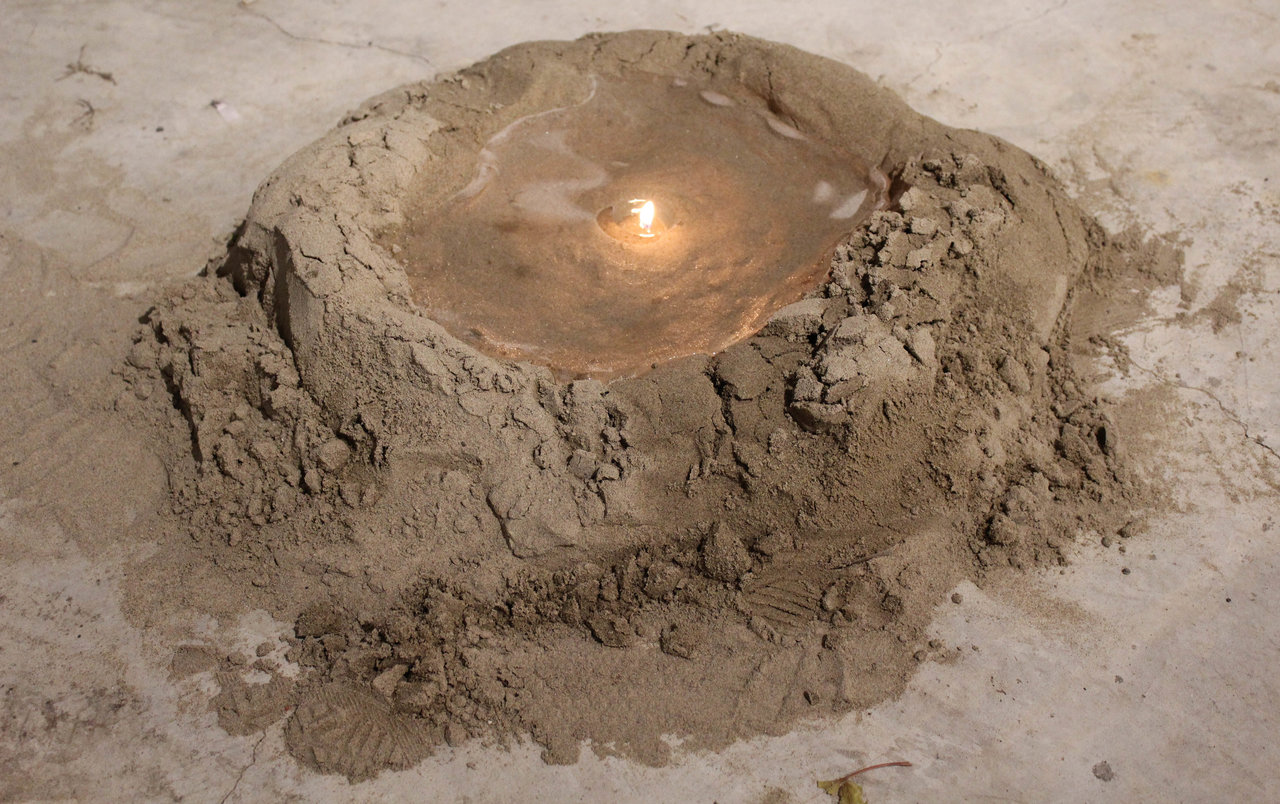
Shannon Garden-Smith, Sand Candle, sand, candle gel wax, dimensions variable, 2019
Chelsea Rozansky
Images are courtesy of HEARTH. Photo: Philip Ocampo
*Exhibition information: New Strata / Group exhibition with work by Misbah Ahmed, Shannon Garden-Smith, Andrew Harding, and Cadence Planthara, November 23 – December 28, 2019, HEARTH, Ulster St. just east of Three Star Variety (621 Bathurst, Toronto). It is an accessible venue with a large garage door at ground level. Gallery hours: Monday & Saturday 11 – 5 pm.
-
Jagdeep Raina: I Promise / Cooper Cole
Two women and four men, one older than the rest, lounge atop a picnic blanket over bright green grass. They’re holding glasses, dressed in flowing garments of blues and pink. They look serene. This is surely a family portrait. The easy way about this cartoonish crew is too good – it’s gotta be a memory. In the distance, out behind the yard, there’s a building with the title “I PROMISE” stitched on its roof. The house on the right says “PARADISE LOST,” with a few shotty frowny faces done underneath for good measure. It’s never written right there explicitly, but you recognize this is a home left behind.
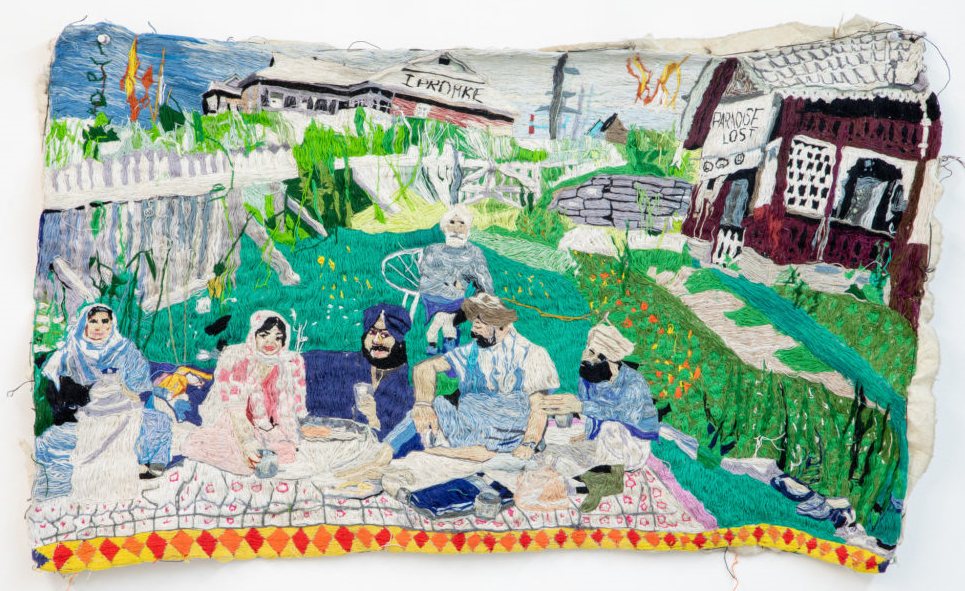
Jagdeep Raina, Paradise Lost, 2019, embroidered tapestry and
Punjabi phulkari border on muslin, 18 x 30 in. Courtesy of Cooper Cole“Paradise Lost” (2019), an embroidered tapestry made with Punjabi phulkari is the first work you see when you walk into Jagdeep Raina’s exhibition I Promise at Cooper Cole. Phulkari, meaning floral work, is type of South Asian garment, textiles embroidered with flowers made for everyday wear, like scarves and shawls. Phulkaris from the Punjabi region have wide edges, as in the diamond pattern dancing underneath this picnic scene. The material signifies its regional origin, establishing setting. “Paradise Lost”, this image of a family before the rest of Raina’s exhibition, which are mostly pictures of cityscapes, situates us in a story about migration, the feeling of moving away from home. Clothing is cultural, but it’s personally meaningful too, symbols of private sentiment (this is what I wore when X happened, etc.) “In dressing myself, I embellish that which, by desire, will be spoiled,” writes Roland Barthes in A Lover’s Discourse (1977). Dressing myself transports me elsewhere, like to a family picnic in my old backyard, a time I was probably happy. But the edges of “I PROMISE” are frayed, like the whole picture could unravel if you aren’t careful.
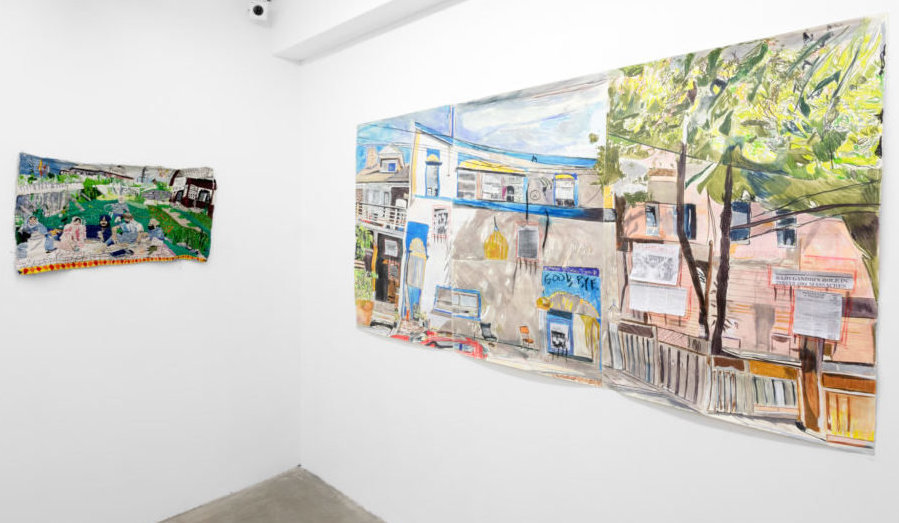
Installation view with Jagdeep Raina, Paradise Lost (left) and You migrate, we migrate, you displace, we displace (right). Courtesy of Cooper Cole
Why would you ever make a promise? “I promise,” is one of those horrible declarations that, once spoken, foreshadows its own let down. You probably meant it when you said it. A set up for failure. In promise there’s hope, trust, futurity, what Lauren Berlant calls cruel optimism.
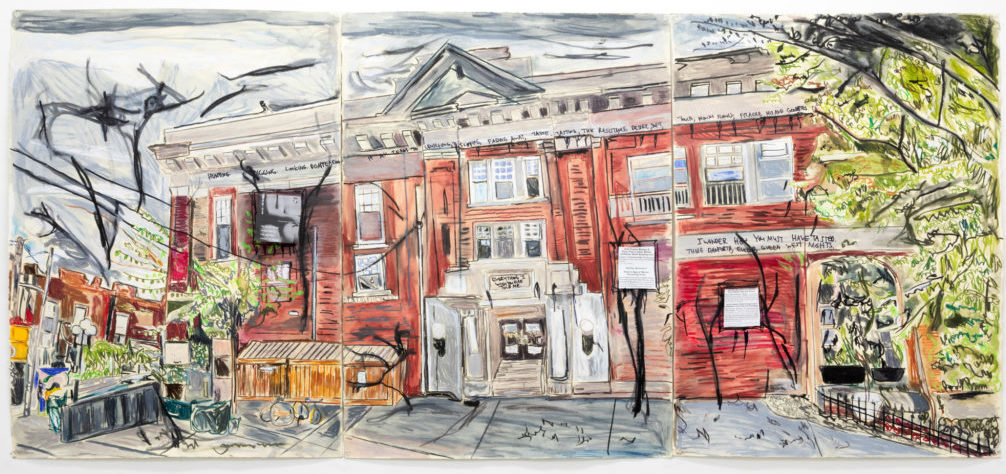
Jagdeep Raina, Everything I Wish You Had Told Me, 2019,mixed media on paper, 30 x 66.5 in. Courtesy of Cooper Cole
Well if you’re sentimental about clothing, you probably feel the same about place (this is where I was standing when you said X, and so on). “Everything I Wish You Had Told Me”(2019) is a painting of a building, on three sheets of paper. Found texts from flyers, pamphlets, and programs are pasted on as if they belong to this building like windows. They say things like: A presentation looking at the construction of identities by South Asian lesbians and gay men and how we use personal, social, and archeological histories in order to construct who we are and our desire for communities. They’re headlines about the AIDS crisis, and programmes from a queer film festival. You collect images of yourself, clues of a personal history found in tokens from public programming and clippings about politics. These are, to borrow a cliché, of course also personal. Collage is the sentimentalist’s natural medium. The sentimentalist pockets things like flyers, movie-stubs, wrappers. And the sentimentalist, prone to endowing objects with magic, can be a fetishist. Written on the right side of the building is the phrase “I WONDER HOW YOU MUST HAVE TASTED. THOSE DANFORTH, EUCLID, QUEEN WEST NIGHTS.” I have streets too: Bathurst looking south, College facing east where the clock tower looks like the moon, the northwest corner of Bloor and Spadina.
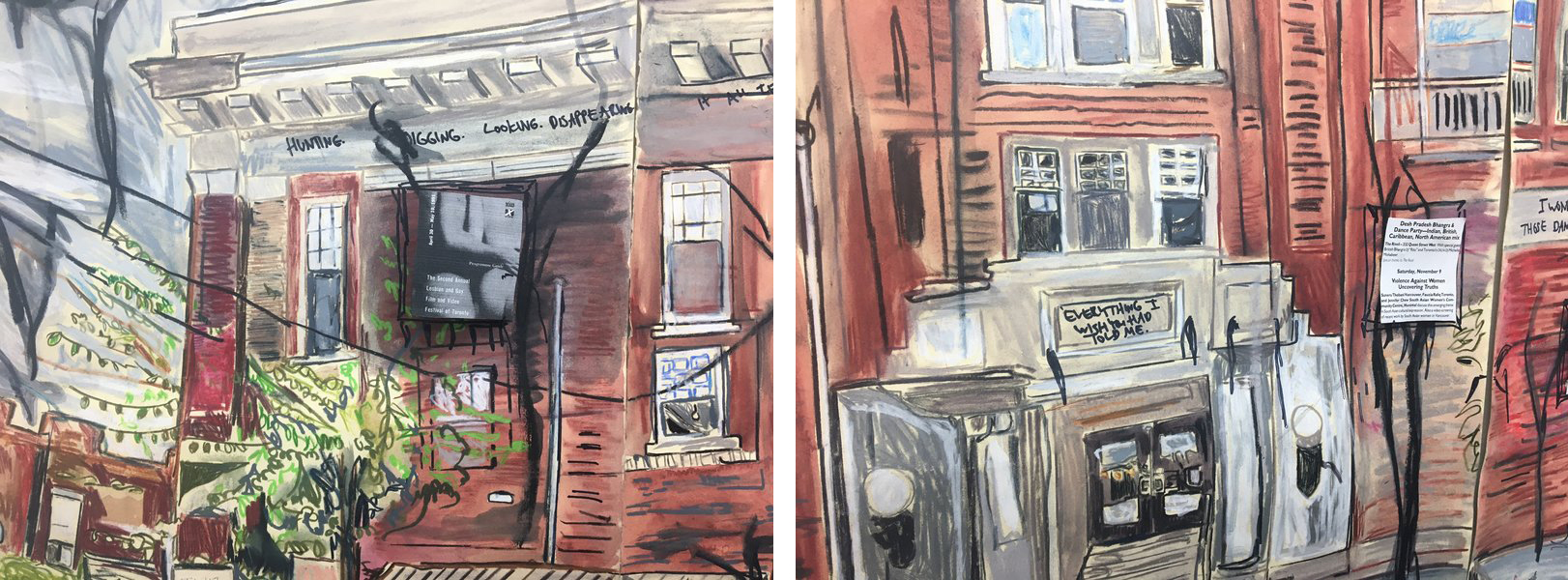
Jagdeep Raina, Everything I Wish You Had Told Me, 2019,mixed media on paper, 30 x 66.5 in, details. Photo: Chelsea Rozansky
“& I’ve seen Paradise and it had four walls & man, we used to dance all night,” writes Cameron Granger in his exhibition text. “Used-to-bes atop of used-to-bes,” Granger writes, naming buildings that have been torn down, places long gone. For instance “The park where I had my first kiss is a used-to-be now.”
One summer, now a long time ago, I kissed a boy at a construction site that used to be a playground attached to my elementary school. “This is weird place,” he said, by betrayal. “Yeah,” I jokingly agreed, “my childhood is ruined.” One year later, I ran into him as I was on my way home to my parents’ house. It was late at night and I was wearing my favorite pants and riding my old bike. We stayed up all night talking and laughing and making imaginary plans, and the whole time I felt so sad because I knew that night would end.
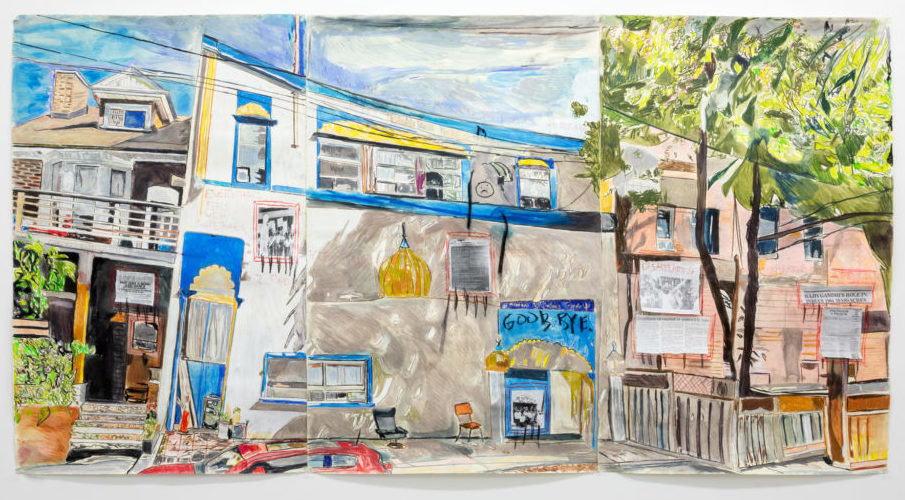
Jagdeep Raina, You migrate, we migrate, you displace, we displace, 2019, mixed media on paper, 40 x 77.5 in. Courtesy of Cooper Cole
“& that place isn’t our place anymore & I’m not sure I could even find my way back, writes Granger, about paradise. So what does it mean if you’ve seen paradise and it tasted so good, but you knew it’s a promise about to break, already lost?
Chelsea Rozansky
*Exhibition information: October 25 – December 21, 2019, 1134 Dupont Street, Toronto, Gallery hours: Wed – Fri, 12 – 6 pm, Sat 11 – 6 pm.
-
Off the Wall Gala 2019 @ Propeller

Fundraiser Gala: December 12, 2019 / 7 – 11 pm
Propeller Gallery / 30 Abell Street, TorontoPropeller Gallery in the Queen West area, in the middle of the artistic hub of Toronto, is an artist-run gallery. It is dedicatee to the empowerment of local and international artists’ creative agendas while also fulfilling the public’s interest in art. This year’s Off the Wall Fundraiser and Gala was a delightful event to end 2019.

This year’s Off the Wall was among the most successful. Over 100 artworks by 93 Propeller and invited artists were exhibited in the space. The two rooms of the gallery were packed with art enthusiasts. Every ticket holder at the event got 30 seconds to choose a piece of artwork they wanted to take home after their number was drawn. You could feel the excitement in the air as they waited.


The over 100 artworks provided a great selection and were done in a variety of medias. As Joseph Muscat, the Partnerships Chair of the gallery, drew the numbers, the lucky attendees ran to claim the work they loved.

Joseph Muscat announces a winning number
Frances Patella who is the Co-chair of the gallery, is among the most active participating artists of this event since the first Off the Wall in 2011. Patella’s “Columns at Metaponto, Italy” (acrylic and photography) was among the first ones to be taken off the wall.

Frances Patella: “Columns at Metaponto, Italy”. Courtesy of Propeller Gallery
The quality of the exhibited artworks was remarkable, regardless of whether it was made by young artists who were participating for the first time or more established members of Propeller. Some contributing artists were attendees as well who also got to pick their favourite artwork. Doris Purchase unhesitatingly claimed ownership of the painting “Autumn” by artist and art educator Svetlana Swinimer after her number was called.

Matt Jenkins with his photograph “Red Canoe”

Doris Purchase with her work, “Nest”, 2016, mixed media – canvas, wood and alloys

Doris Purchase’s chosen work: Svetlana Swinimer, “Autumn”, 2019 silk screen on Sekishu Washi. Courtesy of Propeller Gallery
In the two-room space of the gallery, in addition to seeing the engagement of the artists and the public, there were passionate exchanges of ideas everywhere. The winners happily showed their new purchase.

A happy winner with Daniel Anthony Yu’s “Untitled”, cast, permastone

Mazarine Memon’s mixed media work “In the heat of the moment”, 2019 found a good home
Given the great success that Off the Wall achieved this year through the works and enthusiasm of participating artists and the excellent organization, Off the Wall 2020 will certainly be another great event that art lovers won’t want to miss.

Kexin Wu. Photo: Xiaotong Cao
-
Florilegium by Daniel Hutchinson at Angell Gallery
In Florilegium by Daniel Hutchinson at Angell Gallery, black, shimmering paintings are displayed that give the impression that, within the gallery space, the viewer is seeing mirages of serene rural spaces. The thick application of black paint in ridge and furrow patterns creates the illusion of etching which makes up the design, replacing the need for color. These heavy brushstrokes with thick paint create a textured surface that is matte or shiny depending on the viewer’s position. The spaces portrayed in Hutchinson’s paintings are flooded with lush flora, simultaneously giving the impression that the viewer could be looking into an interior or looking out to an exterior.

Installation view of Daniel Hutchinson: Florilegium. Photo: Alex Fischer
Hutchinson moved his studio from downtown Hamilton to an old factory in a residential neighborhood in the same city. There, he noticed the evolution of old commercial buildings being turned to private homes. In the exhibition essay, he describes these spaces saying, “large storefront windows that once displayed products now contained decorative objects, screens or overgrown plants…provided privacy and reflected the inhabitants’ personalities.” He reproduces the qualities of these spaces in his work.

Daniel Hutchinson. “Rustic Chair with Watermelons”, 2019, oil on canvas over panel, 48 inches diameter
In his monumental work, “A Window Garden with Figs, Watermelon, Sunflowers, and Squash”, 2019, Hutchinson creates the illusion that the viewer could step into the space of the painting. The space looks enclosed yet the plants are unruly and wild, with different fruit-bearing species overlapping with each other having outgrown the compact space. The structure of a bench with a trellis backing made of natural branches is covered by unruly foliage, taking over the rigid forms of the room. A trailing plant hangs down from the ceiling of the space just as a chandelier would. Sunflowers reach from the bottom to the top of the work, the heads bending with the weight of their seeds. There is a combination of domestic, potted plants and growth that appears to be emerging from the ground of an interior space.

Daniel Hutchinson: “A Window Garden with Figs, Watermelon, Sunflowers, and Squash”, 2019, oil and acrylic on canvas over panel, 96 x 77 in
The composition, titled “Florilegium”, 2019, cuts through the pure black paintings with bright pastels that are starkly matte compared to the fluid and shining qualities forming the paintings. The panel consists of large, black lush leaves with ridges that shine against the gallery lighting, giving them the illusion of movement and life. Dispersed randomly are petals of pastel color that appear to be floating on top of the surface of the canvas. These bright swatches of color mimic the experience of seeing the ‘after image’ which is a ‘fleeting perceptual imprint of an object on the retina’. This is the experience of seeing traveling flashes of color perceived against the darkness on the back of closed eyelids after looking upon a bright subject.

Daniel Hutchinson: “Florilegium”, 2019, oil and acrylic on canvas over panel, 60 x 48 in
The pastoral quality of Hutchinson’s paintings brings repose to the mind with shimmering scenes that could disappear at a next glance.
Olivia Musselwhite
Images are courtesy of Angell Gallery
*Exhibition information: November 16, 2019 – January 25, 2020, Angell Gallery, 1444 Dupont St., Unit 15, Toronto. Gallery hours: Wed – Sat, 12 – 5 pm.
-
Hugh Alcock: In the Dusk of the Woods / Gallery 1313
‘They can’t see the forest for the trees’ is an expression applied to someone who can’t understand the whole because they’re too engrossed in the parts. This conventional wisdom elevates the understanding of patterns over the focus on particulars. Hugh Alcock’s work suggests the opposite: he argues for the virtue of detail. In his show at Gallery 1313, he brings out attention to bear on the intricate patterns and textures within forests.

Installation view of Hugh Alcock, In the Dusk of the Woods in the Cell Gallery at Gallery 1313
Alcock’s installation asks us to follow the artist in looking very closely at trees. Large drawings adorn the walls of the gallery and a wood and burlap sculptural figure stands on the floor. The drawings are heavily worked with several layers of chalk, charcoal, and subtle hints of colour. In these images, we are in the midst of dense thickets and undergrowth. It’s the kind of forest where we push through branches that reach out to scratch skin and catch clothes. We’re deep inside the forest, only glimpsing fragments of sky while dense vegetation limits our vision to foreground details.

“Glen Nevis, Scotland”, 2019, pastel and charcoal on paper, 40 x 64 in
There is a serenity and stillness in these images and yet the linework and geometry in Alcock’s depictions illustrate that there’s a dynamic living process at work, if at a pace and timescale that we cannot perceive.
Alcock bases these drawings on photographs taken during walks in the woods. Often, elements from different photos have been combined into one drawing. Each drawing starts with a thin wash of pigment over thick watercolour paper. This background sets the general colour cast of the image and informs some of the layout. In “Dead Tree, Rouge Valley” for example, drips and streaks in the pigment determine the arrangement of the trees and branches. He builds up detail with dark charcoal lines and white pastel as well as a restrained application of greens and browns.

“Dead Tree, Rouge Valley”, 2019, pastel and charcoal on paper, 40 x 60 in
Alcock explains that his work reflects a careful study of the forest rather than an expression of personal artistic intent. His work closely examines the shape and texture of branches, bark and leaves while resisting the conventional constructs of what we might expect ‘beautiful landscapes’ to be. Alcock see trees as “emblematic of the natural world, that is, the world independent of us and our narrow interests and preoccupations.”

“Devon Woods”, 2018, pastel and charcoal on paper, 36 x 50 in
More recently, Alcock has extended his interest in trees to the production of sculptures, one of which occupies the floor of the gallery. Alcock collects sticks and small branches that he finds interesting. He feels that each fragmentary piece tells a story – it shows the history of its growth and development; it hints at how it fit into the larger system of a tree. He arranges these individual sticks into groups and assemblies according to his own particular aesthetic and structural rules. The structures are held together with simple hardware and are then fleshed out with burlap fabric and baling twine. Of these assemblies, the artist says that they “resemble animated creatures. Maybe they are manifestations of what in mythology are called ‘tree spirits’ or ‘drayads’.”

“Sculpture, Untitled # 2”, 2019, wood burlap and twine, 34 x 36 x 64 in
Again, as in the drawings, the work evolves through the careful study of trees and branches. The sculptures are the result of the materials and the rules of the process. The artist acts more like the editor rather than simply the author of the work.

“Forest, Dorset”, 2018, pastel and charcoal on paper, 36 x 72 in
Alcock acknowledges the irony of presenting an experience of nature in the mediated and sanitized environment of a gallery. He emphasizes that the work is not intended as a simulation of nature, but rather a study of it. Unlike photography, a drawing gives us insight into how an artist has experienced a scene. As we follow the lines and marks, we’re following the perception of the artist and for a moment we can see the world through somebody else’s eyes. This aspect of drawings, this borrowed vision, can only help enrich our own experience and bring us closer to see the world as it exists “independent of us.”
Text and photo: Mikael Sandblom
*Exhibition information: December 4 – 15, 2019, Gallery 1313, 1313 Queen St W, Toronto. Gallery hours: Tue – Sun, 1 – 6 pm.
-
On the Wall / Off the Wall @ Propeller

ON THE WALL / OFF THE WALL is Propeller’s annual fundraising event in support of its ongoing commitment to innovative exhibitions and programming.
OFF THE WALL: December 12, 6:30 pm
OFF THE WALL event will be held @ Propeller, 30 Abell Street and will feature, hor d’oeuvres, beverages, and live music with guitar duo Ajit Muzumdar & Dave Wilson. Upon entry, you will be assigned a number. When your number is drawn you will have 30 seconds to claim your favourite piece of art, taking it “Off the Wall”!With the purchase of a OFF THE WALL ticket you are guaranteed a piece of original artwork! All artworks have been donated over 100 works by 93 artists. Art is appraised at much higher than the price of a $145 ticket.
You can also choose your art work from the online catalogue.

-
Age of You / MOCA
Toronto’s Museum of Contemporary Art has chosen an apt exhibition to usher in the 2020s – a decade we face with a degree of foreboding. Ten years ago Facebook was quickly approaching a billion subscribers. Mark Zuckerberg declared that people no longer have an expectation of privacy – they have become more comfortable with sharing information with others. Indeed, the idea of the unrestricted sharing of personal information seemed liberating to many. It was felt that social media are a tool for good. For example, Jessi Hempel in Wired magazine observed: “The Arab Spring [that began in 2011] carried the promise that social media and the Internet were going to unleash a new wave of positive social change.” (26 Jan, 2016) But, as Hempel immediately noted, the promise soon faded. Now, ten years on, any inkling of an edenic vision of a global village has been replaced by fear of a dystopian future.
This descent into dystopia is a central theme of the exhibition, curated by Douglas Coupland, Shumon Basar and Hans Ulrich Obrist. Coupland is a Canadian author and visual artist who needs little introduction. Basar is a British cultural director. Obrist is a Swiss curator loosely based in London, where he is director of the Serpentine Gallery. After bumping into each other in Dubai, they determined to write a book which they titled The Age of Earthquakes (2015). The book was a response to the precipitous pace of change in this new information age. One of the environmental impacts of information technologies, they claim, has been an increase in earthquakes no less. Subsequently MOCA commissioned the trio to produce an exhibition based on their planned sequel, to be titled The Extreme Self. They describe the exhibition as a preview of this yet-to-be-published book.

Installation view, Age of You, MOCA Toronto with Extreme Self (right side panels). Photo by Tom Arban Photography Inc.
Located on both the second and third floors of the museum, Age of You features the work of seventy artists and designers. But when visitors enter the space they are immediately confronted by an array of large mainly double-sided posters suspended from the ceiling. These are organised into thirteen ‘chapters’. The works of the visual artists, on the other hand, are dotted around the periphery.

Installation view: Agnieszka Kurant, “A.A.I.”, 2014-17 (centre); Age of You, MOCA Toronto. Photo by Tom Arban Photography Inc.
The introductory panel explains: “In your digital interactions, a large part of you is extracted from you, and now exists everywhere and nowhere.” Their thesis is that we suddenly find ourselves the subjects of a new incarnation of economic, political and social hegemony known as surveillance capitalism (as coined by Shoshana Zuboff in her book titled the Age of Surveillance Capitalism). We have been transformed from consumers to the consumed. Capitalism’s profits are increasingly made by selling data they collect about us. These data are consequently extracted from us ad libitum by giant tech firms like Google, Facebook, and their subsidiaries, as well as governments. The end result, they claim, is that our identities are migrating to intelligent machines. Our agency has slipped away from us and is now in the hands of the machines themselves.

Michael Stipe “3-D SCAN, EARLY TECHNOLOGY”, with Michael Oliveri, Athens
According to Coupland, Basar and Obrist technological progress has become so rapid that the future has collapsed into the present. Every day we wake up to this or that new discovery or invention. Hence we live in what they call the ‘extreme present’. The experience of time is reduced to that primitively determined by our neurology, namely a sliver of time that is two to two-and-a-half seconds in duration. And for this very reason they decided to limit the texts printed on the posters to a length that can be consumed within this narrow timeframe. While the resulting snippets of text have an oracular feel to them, the downside is that the viewer/reader is seldom challenged. Under the chapter titled ‘The End of Democracy’ one reads, for example, that “We’re now deep into the terminal phase of democracy.” This is thought provoking, but what do we do with it? It suggests so much but gives one very little in terms of tangible ideas. Many of these aphorisms and quotes can seem like mere intellectual titillation in the end.

Installation view, Age of You, MOCA Toronto. Photo by Tom Arban Photography Inc.
The artists’ contributions to the exhibition themselves are often poignant and powerful. One video installation by Trevor Paglen, titled Behold These Glorious Times!, stands out in particular. The images used come from a vast digital library supplied to a machine, which processes them in order to gain the capability of recognising various objects and human emotions in faces etc. We see a dramatic rendering of the machine’s inner workings as it learns to imitate these very human skills. Knowing this makes the experience of watching the video display of flashing imagery rather disturbing.

Trevor Paglen “Behold these Glorious Times!”, 2017 Courtesy the artist and Metro Pictures, New York.
Another major installation is Sophia Al-Maria’s Mirror Cookie. The elaborate symmetrical set consists in a large vertical screen at its centre with a dressing table and chair underneath. The screen is reflected in a range of mirrors on either side. It displays a video of an American-Chinese actress, Bai Ling, that is a mashup of her short instagram videos that she calls ‘cookies’. To an eerie soundtrack Bai Ling pronounces her love of, and affection for, her viewer, who we understand to be herself since she is depicted as a reflection, as if she were seated at the chair and dressing table. Al-Maria aims to highlight the challenge of maintaining one’s self-love in the face of the aggressive and often poisonous online culture.

Sophia Al-Maria “Mirror Cookie”, 2018 Courtesy the artist, Fondazione Arnaldo Pomodoro Milan and Project Native Informant, London.
There isn’t the space to list them all in detail, but there are also works by Sara Cwymar, Craig Green, Agnieszka Kurant, Yuri Pattison and Victoria Sin among others.

Victoria Sin, “Tell me everything you saw, and what you think it means”, 2018, film still. Courtesy the artist.

Installation view: Satoshi Fujiwara, “Crowd Landscape”, 2019; Age of You, MOCA Toronto. Photo by Tom Arban Photography Inc.
At its heart the show centres on the curators’ claim that the nature of what it is to be, our identity under the moniker ‘the self’, has been fundamentally changed. But what is the self they imagine is being extracted from each of us? It is not very clear. In an interview Coupland, seemingly exasperated, notes that it is difficult ‘to access the true self’. In this information age this quest seems to him to have become almost quixotic. Centuries ago the Scottish enlightenment philosopher David Hume famously remarked that however hard he introspects and tries to observe the self behind his experiences, it remains stubbornly elusive. Hume concluded that the idea of the self as a thing is mistaken. There is nothing more than the sequence of images that is the theatre of our experiences. As Hume intimates, talk of the self being here or there, extracted and so on is all rather vague. It is in danger of ultimately amounting to mere hand waving. It is perhaps best to think of such talk in this context as a dramatic device for highlighting the ways in which surveillance capitalism threatens to disempower us, ironically under the guise of personal empowerment, by manipulating our behaviour.

Installation view, Age of You, MOCA Toronto. Photo by Tom Arban Photography Inc.
So long as you take the curators’ prognostications with a pinch of salt, there is plenty to think about upon seeing this exhibition. It is provocative, intelligently thought out and brimming with great art. MOCA has provided a grand exhibition to reflect on all the disruptive changes our society is experiencing. Let’s hope the coming years are not as inauspicious as feared.
Hugh Alcock
*Exhibition information: September 5, 2019 – January 5, 2020, Museum of Contemporary Art, 158 Sterling Road, Toronto. Museum hours: Mon, Wed, Thurs, Sat and Sun 10 am – 5 pm, Fri 10 am – 9 pm, Tue closed.





