Author: artoronto

  • Alanis Obomsawin at the Art Museum at U of T

    Alanis Obomsawin: The Children Have to Hear Another Story – Not just a story

    Imagine this: A small girl, the only one of Indigenous blood in a grade room class, being taught lies about her Abenaki heritage. It’s the mid-1930s, and the residential school system ranges across Canada with a single goal: destroy the Indigenous cultures, languages and beliefs and replace them with those of Christian values. Imagine that little girl witnessing the collective rights of her community members being removed. Her people being denied the right to vote, sing, dance, tell stories or marry whom they loved. Imagine the stories that little girl would have been told to replace those of her ancestors.

    Alanis Obomsawin (born August 31st 1932) is a documentary filmmaker, singer, artist and storyteller who has, since her own youth, strived to educate to correct the social, epistemic and ontological assumptions made against the Indigenous communities across Canada and the United States. Obomsawin means “pathfinder” and she is a member of the Abenaki tribe and lived on the Odanak reserve (near Sorel, Quebec) from the time she was six months to five years old. Some time later her family moved to Trois-Rivière, where she remained until her early 20s. The death of her father during this time pushed Obomsawin to pursue a career in education and caused her to rebel against the colonial teachings of her classes. Obomsawin’s works focus on ensuring that children, Indigenous and non-Indigenous, hear the other side to the colonial narratives so often told in Canadian and American history. In an effort to spread these messages she chose to visit local Scout troops, telling them stories, eventually touring classrooms. By the early 1960s, Obomsawin began appearing occasionally on CBC/Radio-Canada television programs, speaking to Indigenous issues, and singing traditional songs for a wide-viewing public. She made it her goal to spread the knowledge she retained from her heritage and from then on, produced and directed films, participated in interviews and collected artifacts from the children of Indigenous communities.

    Alanis Obomsawin filming Richard Cardinal: Cry from a Diary of a Métis Child, 1986. Courtesy of the National Film Board of Canada and the artist.

    It is this life story and goal that has evolved into Obomsawin’s current exhibition, The Children Have to Hear Another Story, at the Art Museum on the University of Toronto campus until November 25th, 2023. Upon entering the exhibit, voices fill the air from black & white as well as color televisions and projectors that are on in various rooms, enveloping viewers. A person behind the front desk offers personal headphones so you can listen to the individual stories being told as you walk between several dimly lit rooms.

    Among the video works however, off to the right of the entrance on a single couch, are two handmade animal stuffies. When Obomsawin was sixteen years old, she reflected on her childhood hardships and bullying by striving to aid in similar experiences of the Indigenous youth of the Abenaki tribe. In doing so, she taught herself to sew and from the collected drawings of local children, became inspired to create handmade dolls out of polyester and nylon. Following that year, each Christmas and Easter, Obomsawin returns to the community and hands out dolls to each child, initiating a tradition of gift giving and bringing about a sense of solidarity and connectedness among the Indigenous youth.
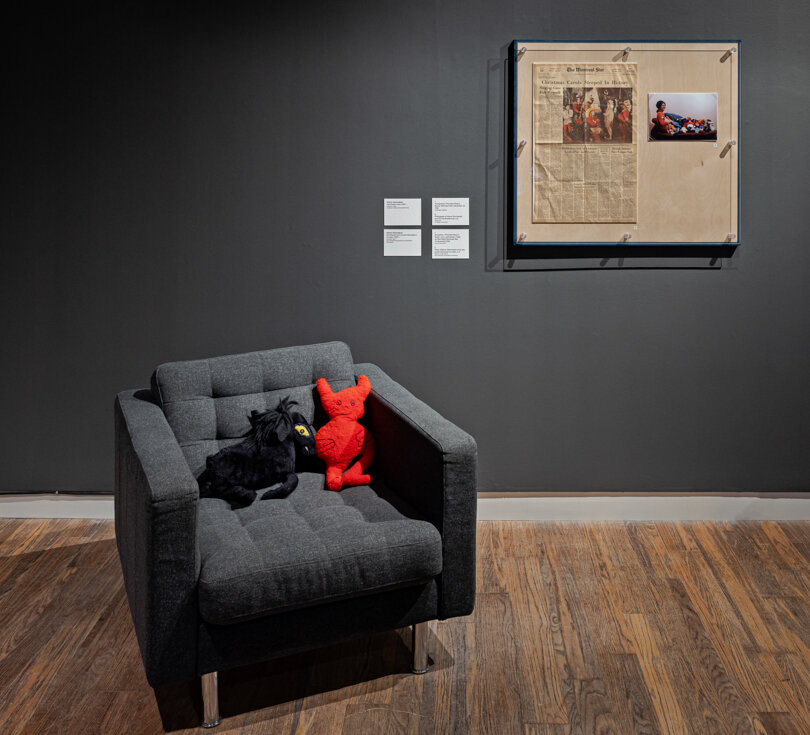
    Installation view with handmade toys, The Children Have to Hear Another Story: Alanis Obomsawin, Art Museum at the University of Toronto. Photo: Toni Hafkenscheid.

    In the first of the adjoining rooms, a series of drawings can be found arrayed along the far wall. Two films, one projected to the left and one to the right, depict the visual stories of these drawings. Across from the drawings, film stills are also shared. The drawings were made by children of the Cree community of Moose Factory in northeastern Ontario. It was around Christmas time in 1971 that the drawings and the accompanying film titled, “Christmas at Moose Factory” were documented. All of the documentation provides a rich and unique perspective on the children of this community, including their family life but also the experiences of residential school students and those who attended the local village schools. They are representations of previously untold versions of Moose Factory history, as told by the children who lived there. Meanwhile, the film stills act as a record of Obomsawin’s relationship to these children. After having established a relationship of listening and playing, she encouraged the sharing of their perspectives and ideas through art. This gave the children a space to express themselves in their environments, an opportunity that Obomsawin was never given in her youth.

    Installation view with Christmas at Moose Factory, children’s drawings, The Children Have to Hear Another Story: Alanis Obomsawin, Art Museum at the University of Toronto. Photo: Toni Hafkenscheid

    Obomsawin’s first full-length documentary film in 1977 was titled, “Mother of Many Children” and was shot in Burns Lake, British Columbia. The perspective of this film shifted focus to Indigenous women in various communities as they shared their insights and generational experiences. The focus was on the strength of these Indigenous women from within these communities and how they acted as the upholders of Indigenous values and teachings to youth. Within the Indigenous communities, the late 1970s to 80s reflected a period of activist movements to uphold Treaty Rights formed previously with government officials. This shift was represented in several of Obomsawin’s films, including “Mother of Many Children.” It was important during this time period to bring awareness back to the rights and land ownership of the Indigenous peoples via protest and the continuation of Indigenous storytelling to younger generations. Allowing children to engage with their birthright, while also seeing the women of their communities partake, allowed them to feel they too could stand up for the preservation of their heritage.
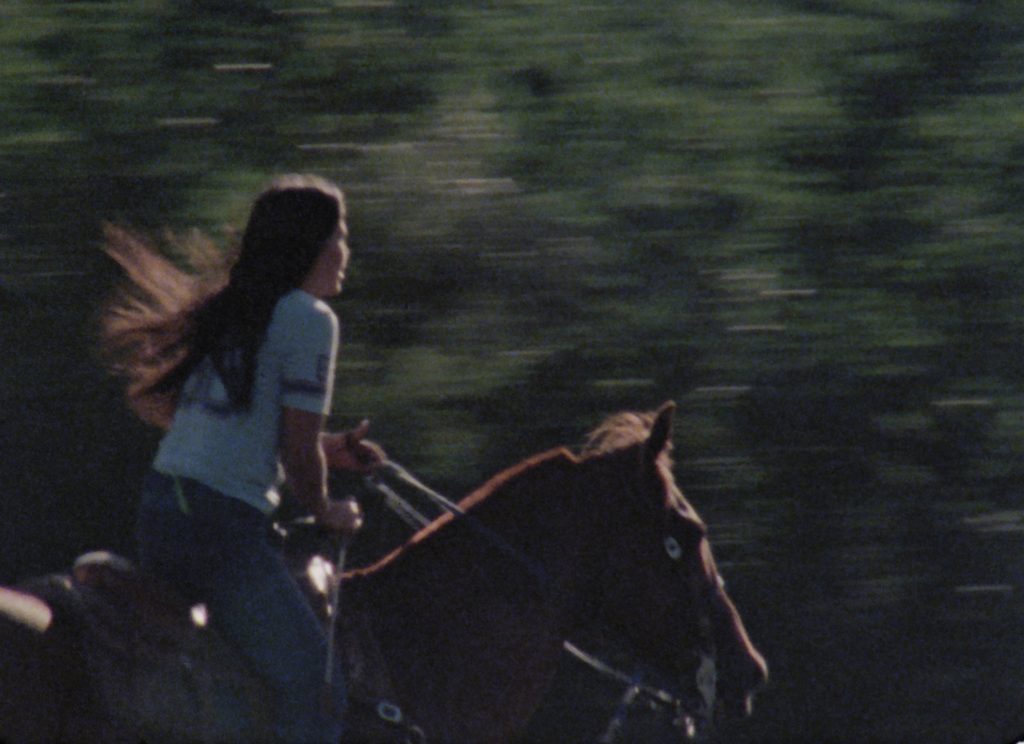
    Alanis Obomsawin, Mother of Many Children (still), 1977. 16 mm film, colour, sound, 58 mins. Courtesy of the National Film Board of Canada.

    During this time, Obomsawin also released a musical album with the title track “Bush Lady.” The vinyl, first recorded by CBC/Radio-Canada in 1985, is on display behind glass casings within the elongated gallery space. This track was later remastered and re-recorded by Obomsawin in 2018. The story is told by two distinctly recognizable voices, one male and one female. The young woman is Indigenous and has just moved to a large city from a reserve, only to face victimization and racism by the male voice, who refers to her as the “bush lady.” Throughout the song, the woman’s voice is heard attempting to reply to these comments and articulate an emotive response that is never heard by its intended recipient. There is a clear contrast within the film and this song: one is indicative of a sharing of cultural and political understandings between generations, the other is a one-sided conversation. The Indigenous communities are rooted in the re-telling of histories from their ancestors to engage with their culture, language, medicinal knowledge and laws, among others. Without these conversations, their experiences become lost and unrecognized, or in some cases completely ignored by those who do not wish to listen.
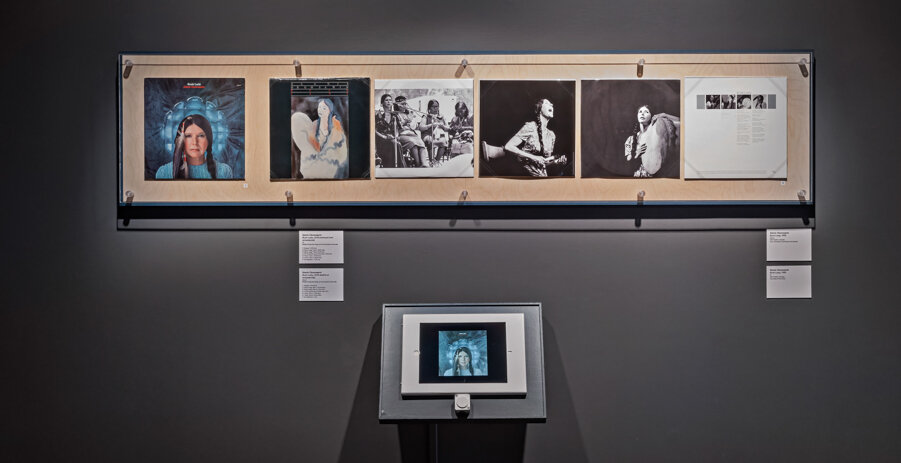
    Installation view with Bush Lady, The Children Have to Hear Another Story: Alanis Obomsawin, Art Museum at the University of Toronto. Photo: Toni Hafkenscheid.

    At the very end of the hallway, there is a three walled space with the farthest wall having been painted red and a projected film playing directly over top. The film “Kanehsatake: 270 Years of Resistance” (1993) depicting the causes and effects of the standoff, became the primary focus of Obomsawin’s filmmaking in the 90s. The almost two-hour documentary was filmed onsite during the Kanehsatà:ke Resistance on the territory of the Mohawk people, when the Quebecois provincial police (the SQ), and later the Canadian military, attempted to forcibly remove, and then starve, the Indigenous peoples off their land. This took place over the course of seventy-eight days, between July 11th and September 26, 1990 following the SQ attacking the Indigenous peoples with grenades and tear gas before retreating. Obomsawin remained onsite during the entirety of the standoff, documenting the long mistreatment of the Mohawk peoples on their land. She interviewed and attempted to engage with both sides of the conflict, collecting the facts behind the seemingly sudden outbursts of military force. The reason behind this confrontation was that the Quebecois government wanted to build a golf course on the territory of the Mohawk peoples, but the community refused to vacate their land. The events reached national coverage and many Indigenous tribes stood in solidarity and protested against the mistreatment of their peoples. Unfortunately, it also resulted in the emergence of various other conflicts, ones of hate and powerful backlash which led to extreme hostility against neighbouring tribes by non-Indigenous settlers. This film, and all the coverage taken during the seventy-eight days broke the national illusion that the Indigenous populations were being treated in fairness by governments and law enforcement. It told the story behind the struggles on the reserves, the torment of the Indigenous populations, opening the eyes of hundreds of thousands of people.

    Installation views with Kanehsatake: 270 Years of Resistance, 1993. 16 mm, colour, sound, 119 min. Courtesy of the National Film Board of Canada. The Children Have to Hear Another Story: Alanis Obomsawin, Art Museum at the University of Toronto. Photo: Toni Hafkenscheid.

    In an extreme contrast, Obomsawin provides an exhibition that reveals the perspectives and stories, both from that of the Indigenous and the non-Indigenous settlers, she encountered. This exhibition not only marks her continued reflection on her own mistreatment in her youth, but that of all Indigenous children who needed the space to be heard and to hear their stories being told. It also showcases how generations pass on the traditions of their ancestors to ensure their continued preservation among the younger generations that follow. Finally, it responds and re-tells the story of the struggles the Indigenous communities have in telling their stories, as they are constantly trying to re-establish non-colonial versions of their heritage.

    This exhibition is about more than a young girl with a story to tell. It’s about the stories themselves and the communities those stories represent.

    Lex Barrie

    Images are courtesy of the Art Museum at the University of Toronto. Photo: Toni Hafkenscheid.

    *Exhibition information: The Children Have to Hear Another Story by Alanis Obomsawin, September 7 – November 25, 2023, Art Museum at the University of Toronto, University of Toronto Art Centre, 15 King’s College Circle, Toronto. Museum hours: Tue – Sat 12 – 5 pm, Wed 12 – 8 pm.

  • Bacon at Worth Gallery

    “Are we creating new Gods?” – a question by Alex, also known as Bacon, is urging the audience to ask themselves the same. A philosophical debate between humanity and artificial intelligence has been on a constant rise. The dilemma we are facing is: are we, as humans, ready to handle such a great responsibility? With technology expanding beyond human capabilities, Bacon’s work challenges us to recognize how far we are willing to let technology manifest a greater power, and whether it will consume us as we are no longer in control of our creation. What is real becomes the “unreal” while the complexity of the “uncertain” grows on humanity.

    Bacon’s works are not easy to find, as they are quite rare. It was worth the stop at the Worth Gallery for a look at the opening reception last Thursday. Finally, seeing a few of Bacon’s new works all in one place was a pleasurable experience. These works remind me of the massive murals and other graffiti work on buildings around downtown, including one of Bacon’s.

    Anjou V2, spray paint on canvas, 48” x 72” (left) and Rising Sun V1, spray paint on canvas 84” x 84” (right)

    Bacon was one of the first artists to be featured at Worth Gallery when it opened up in 2022. His work cover various objects and subjects, from still life to portraits and human anatomy parts with aerosol can techniques.

    Bartlett V1, spray paint on canvas 84” x 48” (right) and Anjou V2, spray paint on canvas, 48” x 72” (left)

    Bacon’s method demonstrates clean-cut strokes with metallic colour palettes that keep disconnecting our minds from our human and artificial subjects. The artist visually depicts artificial life in a way that provokes the question of whether this begins to form within us, or will we create something that will take us over.

    Child of Phanes, oil on canvas 30” x 40” (left) and Look Within V2, spray paint on canvas, 60” x 72” (right)

    The Bacon Bitz 2 show continues in downstairs of the gallery with a large screen showcasing over 40 works, from murals to sketches including some work in progress of portraits and figures by Bacon.

    Installation view of Bacon Bitz 2 by Bacon

    Bacon Bitz 2 is curated by Adrian Hayles, Director of the Worth Gallery.

    Polyna Alexseev

    Images are courtesy of Worth Gallery. Photo: Mark Segal.

    *Exhibition information: Bacon Bitz 2 by Bacon, November 9 – 19, 2023, Worth Gallery, 830 Dundas Street West, Toronto. Gallery hours: Tue – Fri 4 – 8 pm, Sat – Sun 2 – 8 pm.

  • Interview with Gina D’Aloisio

    Interview with artist Gina D’Aloisio (GA) by Phil Anderson (PA)

    Gina D’Aloisio with mould in her studio

    Having seen Gina’s work at the Artist Project 2023 I asked her to exhibit in Gallery 1313’s Window Box Gallery. Her installation “Ignorance is Bliss” captured a lot of attention … sometimes jarring.

    Her Artist Statement describes her work: “Toronto-based artist, Gina D’Aloisio (BFA) utilizes interdisciplinary sculpture and installation, her primary material focuses are hyperreal mould making and found objects. The replication of flesh and the body using silicone, in combination with found objects explore the human relationship with the material world. Her work is a reflection of the times, employing satire and irony to both poke fun at, and seriously contemplate our world.”

    I did a studio visit to find out more about Gina D’Aloisio. The following is a conversation with her.

    PA: You went to OCADU in 2021 in the Sculpture and Installation program. When did you decide that this is what you wanted to do?

    GA: Yes, I graduated in 2021. I first started off in the industrial design program, but quickly realized that my “designs” were actually just artworks. So, I made the switch into the Sculpture and Installation program and it was the mould-making class that cemented this decision for me. When I performed my first lifecast on a fellow classmate’s foot, the studio-monitor at the time looked at me and said to the room “look at Gina’s face, she’s going to do this forever”. I don’t know if I had a particular expression of satisfaction or excitement, but she was right, I just fell in love with the process in that moment.

    PA: How did you learn all the techniques involved in making these hyper real replications?

    GA: Other than the intro to mould making class I had taken during my BFA, I would consider myself completely self taught. I did an independent study, and taught myself the entire process from beginning to end, using the internet, online forums, YouTube and of course my own trial and error.

    PA: Can you describe the stages that are needed to construct these works?

    GA: Well, it differs greatly from project to project but there is a general formula that I typically follow; life casting, casting, seaming, paint, and then hair punching.

    Mould 1 and 2

    PA: What would be the biggest challenges in making the finished product?

    GA: Hmmm, its tough to say exactly, in terms of the actual process. Perhaps the hair punching for me is the least enjoyable and thus the most difficult and very time consuming. However, if I am really honest the difficulties surrounding my art practice are more around money and time. The entire thing is very labour intensive and the materials I am working with are very costly.

    Foot cast (above) and leg cast with hair (below)

    PA: You add a little fun to the work with satire. Does this come right from the start of the work?

    GA: Yes, definitely. My process is not as intuitive or free flowing as many other artists. I always start with a very clear idea of my finished piece; you have to have it with this type of work. This also fits me well as I am naturally a very analytical thinker, but also see a lot of irony in everyday life.

    Gina D’Aloisio, Ignorance is Bliss

    PA: Why do you think people are so much attracted to these replicated figures?

    GA: I think people are fascinated by the uncanny valley. Anything that refers to our flesh and bodies has a greater sense of abjectness, and creates a physical and maybe even visceral response in people. I think people are fascinated with themselves in a way and are able to see themselves in the replicated figures I create.

    Gina D’Aloisio, Deep Breath at the Artist Project, 2023

    PA: You must have had a few curious stares transporting these silicone pieces. Can you share any moments?

    GA: Oh, yes, definitely. I do make sure to cover the bodies up when transporting them to a gallery for example. Not too long ago I moved apartments and did have to prewarn my movers so that no one was startled.

    Ready to ship

    PA: What exhibitions do you have lined up?

    I will be attending the Re-wilding The Body residency at the Banff Arts Centre, and I will also have a solo show at The Forrest City Gallery, London, Ontario from March 9 – April 20, 2024. I am also having my work featured in the Positive Masculinity show at Maison Depoivre in Prince Edward County.

    PA: I understand you will have a collaboration with a metal worker soon. What is your idea about the outcome?

    GA: I will be collaborating with my close friend Shay Salehi during the Banff residency to create a piece which incorporates my silicone work and her metal fabrication.

    PA: Are there other artists that you feel have influenced your practice?

    GA: Certainly, I have been influenced by many artists along the way, to name a few, Evan Penny, Sarah Sitkin, Marie Munk, Josh Klein among others. There are so many amazing artists in this field!

    Photo: Phil Anderson

  • Walking Art Toronto 2023

    Walking Art Toronto 2023

    I arrived at the fair around noon on Friday. The place was already crowded and the booths shone with light and the glory of good art.

    Installation view with All Fall Down by Martha Sturdy

    The fair seemed larger with more booths than ever. My first visit was Paul Petro’s booth. I know Petro for about 20 years and visited many of his exhibitions in the past. He told me that Paul Petro Gallery turned 30 this year, so this is a kind of anniversary celebration.

    Paul Petro in his booth

    As I left Petro I heard the announcement of an Artist Talk coming up at 12:30 and I was lucky to attend the Curators in Conversation with Kitty Scott, the curator of FOCUS exhibition in the fair and Connie Butler, Director of MoMA PSI.

    Curators in Conversation, Kitty Scott (left) and Connie Butler (right)

    It is impossible to see everything in the fair, the number of artworks seems infinite. There are endless variations in ideas, themes, styles and medias – so everyone can find something to love. It turned out that my favourite things to look at this time was figurative art. On the outside wall of Catriona Jeffries Gallery (Vancouver), I had to stop at Brenda Draney’s oil painting, depicting two motorcycle riders, one of them naked. The semi-abstract composition radiates an atmosphere that reminded me of Peter Fonda’s Easy Rider and the motorcycle culture that followed from the 1970’s.

    Brenda Draney, Chrome, 2023, oil on linen, 64 x 79 inches

    A woman sits on a very big fish in the large composition, titled Immersed by Jia Lu in the main wall of Involute Fine Art’s (Richmond Hill) booth. The artists wrote that “this painting delves into the essence of surreal coexistence, where the enigmatic fish symbolizes endless freedom and silent strength, while the figure of the woman represents the vulnerability of terrestrial life.” For me, there is also something ethereal in it, like in a fairy tale, where a fish can fly and take you to another reality.

    Jia Lu, Immersed, 2019, oil on canvas, tree panels, 72 x 144 inches

    I love Aida Muluneh’s photographs, and also wrote an article about her Contact exhibition show last year at the Textile Museum, so I was happy to see her portraits in Viviane Art (Calgary). We see the same woman from the front and from the back. Her face and body painted white, only her hair remains black. She always addresses her Ethiopian roots, as the body decoration shows with paint and dots on the front of her face and on her back. What make me think more about these images are the blood red hands. Whose blood is it? Is it coming from hurting someone or being hurt? On the first image there is an extra hand coming from the back – whose hand is that? There might be no answers for these questions but the images are very thought provoking and dramatic.

    Aida Muluneh, 99 series, (Part Two), 2014, archival digital print, 31.5 x 31.5 inches

    Kriss Munsya’s photography in Robertson Arès Gallery also addresses tribal roots in a symbolic, surrealistic way.

    Kriss Munsya, Dark Paradise, (Genetic Bomb), 2022, photography, 35 x 43.75 inches

    Pabli Stein’s paintings in the booth of Quinera (Buenos Aires) also depict women, showing their backs. There is a contrast between the realistic depiction of the women and their abstracted burden.

    Paintings by Pabli Stein

    There are interesting installations all over the fair. One of the most amazing involve these ghost boats made of gauze you can see through and have a feeling of moving water at the same time.

    Melissa Morgan Fine Art from El Paseo Palm Desert presents a large scale photography by David Yarrow depicting the Western world so perfectly well with its characters lining up in a bar on both side of a wolf. I can hear in my mind the howling of the wolf in the night. Looking at the figures it would be easy to write a story about their life or make a black-and-white movie where they can move, talk, dance and fight.

    David Yarrow, Breaking Bad, photography, 63 x 118 inches

    Melissa Morgan Art also has a magic tunnel created by Anthony James that takes you somewhere far, far away in the Galaxy. You can look into it from numerous windows and lose yourself into the dimensions of infinity. Very beautiful and enjoyable.

    Anthony James, Triacontahedron, powder-coated brushed stainless steel, specialized glass, LED, 60″

    After all this walk and watching my eyes are tired, so I can’t take in anything more. But there is much, much more.

    Text and photo: Emese Krunak-Hajagos

    *Exhibition information: Art Toronto, 255 Front Street West, North Building, Toronto, Hours: Fri 12 – 8 pm, Sat 12 – 8 pm, Sun 12 – 6 pm.

  • Art Toronto, Toronto’s International Art Fair

    Visitors were so still while staring at Carole Feuerman’s sculpted realistic bodies. It was very interesting to witness how many stood there and glared for more than a minute, becoming one with the object; to many, it felt uncomfortable after a few seconds.

    There was another miniature version of an edition called “miniature Serena” with a pearl white tube and clear crystal cap (oil on resin). Feuerman fascinated us with what is surreal and what is real with such extraordinary detail and athleticism for both body and mind.

    Carole Feuerman, Midpoint, with champagne painted suit and Palladium Leaf Cap (left) and miniature Serena (right) both life-size sculptures, 2023

    This installation by Bayuaji is part of an ongoing series (Weaving the Ocean) which started in 2020, where the artist transforms discarded fishermen’s ropes from Indonesia’s coastline into captivating tapestries, drawing inspiration from weaving traditions, not only from home but also from other countries. Bayuaji has a great passion for his homeland’s rich textiles as well as for other countries and their unique weaving techniques.

    This installation showcased seven textiles composed of plastic threads and found objects with six sculptures created from Indonesian boat paddles from Kalimantan, Bali, and Java. These paddles symbolize the interconnectedness of the human body, the vessel, and the water – originally a crucial fishing tool that tells the nation’s history of “harmonious coexistence with the sea.”

    Ari Bayuaji, Floating on the Waves, installation, 2023.

    Nicolas Baier’s “Retro”, a large print, an insanely detailed piece, has captivated so many because there was so much to observe. From afar, it looks like an entire dystopian city, but the closer you get you begin to see wires, electricity, and microchips as if you were looking inside a machine. The extraordinary details make you literally walk into the image itself and fall down into a deep mechanical “rabbit hole”. 

    Nicolas Baier’s Retro, 2023. Represented by Blouin Division.

    Art Toronto presented eight new works from the “Flowers series” by Benjamin Langford, made of many photographically printed canvas panels and sewn together with wax thread. A quote by Andy Warhol in the artist’s statement “I always notice flowers” definitely made these beautifully hovering flowers noticeable and even more sense once the technique and the larger-than-life intention behind them were revealed. Langford uses a technique called focus-stacking, a process that originated from commercial product photography. Making visitors attracted to this solo exhibition was the exact intention. We are no longer humans, but bees who are seduced by the sexual organs of the flower and our gaze becomes the pollinator.

    Benjamin Langford, Flowers series, 2023. Represented by Baader-Meinhof, Omaha.

    In “Paquebot”, an installation by Jannick Deslauriers, the ghostly boats hovering beautifully with delicate materials were quite an eerie attraction, but also a touching reminder to take care of ourselves, because our relationship with time is very sensitive. According to the artist’s statement, it’s a reflection of care, work, and exploitation of bodies. As well as questions about vulnerability, obsolescence, repair, disappearance and (re)appearance. Watching visitors carefully walk around the ships was living up to the intent of this installation; some even dared to peek underneath. If only most of us were as careful with our bodies as with these beautiful, wrecked ships.

    Paquebot, 2019 by Jannick Deslauriers. Represented by Chiguer art contemporain.

    It was an incredible privilege to witness this mesmerizing 3D portrait built by Korean artist, Young-Deok Seo. Completely made out of bicycle chains attached to each other so tightly, it gives a puzzle-like texture. Although unclear how the features of these portraits are so realistically done, it makes you wonder how such sculpture could have not possibly been cast from a real human face. This mask-like sculpture drew in many photo-ops and children who had incredible fun stepping into the mask sculpture and experiencing the exhibition from a unique perspective.

    3D portrait built by Korean artist, Young-Deok Seo

    Looking at the interactive installation by Jia Lu and Geoffrey Bonnycastle, “Injured Icoseed”, visitors would take a pen, sign, and tape their name on the shape to become a part of a healing world. Due to war and global conflict and the failing health of our planet, the artists wanted to unite as many guests as possible to stand in solidarity with the casualties of conflict and natural disasters. The Icoseed was inspired by a series of seed paintings by Lu, reflecting her emotional journey of taking care of her mother at a nursing home over many years.

    The shape is based on a regular polyhedron with fifteen pentagonal and hexagonal faces, made up of strips of paper hand-cut and assembled by volunteers over a week preceding Art Toronto.

    Jia Lu and Geoffrey Bonnycastle, Injured Icoseed, 2023, hand-cut paper

    Text and photo: Polyna Alexseev

    Once again Toronto’s Art Fair has rolled into town. There is something perverse about people gathering to buy art, discussing which picture might fit in the living room etc. when the news is full of tragedy – wars, massacres, and human misery. Anyhow, life goes on.

    Like all art fairs the viewer quickly drowns in a sea of images, mostly decorative paintings. Just about keeping my head above water, still I found much to admire. One artist with a distinctive style who drew my attention was Brenda Draney, whose painting Split Pea was both slightly disturbing and humorous at the same time.

    Brenda Draney, Split Pea, 2023, oil on canvas

    She is featured in a curated exhibition to the northwest of the building titled ‘Good Foot Forward’. Her paintings are on display as well at Catriona Jeffries’s booth. Also featured in this exhibition is a sculpture, Nothing is Wild, by Kara Hamilton. Sculptures are refreshing in this context given that they thankfully tend to be less decorative in nature, understanding that the fair necessarily caters to those who want a piece which they can live with. Another sculpture featuring three sacks of dirt no less, that coincidentally echoes Hamilton’s, is by Maria Trabulo.

    Kara Hamilton, Nothing is Wild, 2019

    Installation by Maria Trabulo

    Trabulo is one of the exciting young artists shown by Towards Gallery, along with Sophia Lapres who is currently a student at Guelph University. Lapres has two lovely little paintings, artfully cropped.

    Paintings by Sophia Lapres

    Exciting young artists are also featured at Clint Roenisch Gallery. For example, there is a colourful textile (hooked rug) by Heather Goodchild titled Through to Paradise. It depicts a place, we are told, where ‘those who have gone on will be’.

    Heather Goodchild, Through to Paradise, hooked rugs

    Textiles are similarly on show at Paul Petro. Established collective Fastwürm present two playful, almost childlike, depictions of erupting volcanoes. The colours positively sing.

    Textiles by Fastwürm

    There’s of course plenty of work by established artists – including dead ones – to be found. A landscape titled Byway Trees A XII by West coast painter Gordon Smith (d. 2020) is on display at Equinox Gallery’s booth, for example. It commands a handsome price for a less stellar example of Smith’s work. But that is what reputation does to prices! You’ll need approaching a six figure sum to afford this one.

    Byway Trees A XII, 2001, acrylic on canvas by Gordon Smith

    Some of the booth are so well curated that the display is a work of art in its own right. That is the case with Zalucky Contemporary for example. On its feature wall is a gorgeous painting inspired by ancient Chinese tradition by Lan “Florence” Yee, titled After Liu Songnian. Also shown here is a lovely understated stained canvas by emerging artist Brett Edwardz.

    Painting by Brett Edwardz

    Lan “Florence” Yee, After Liu Songnian, 2023, 0il on canvas

    Lots to choose from in this supermarket of fine art. Good to know there is space for many emerging and young artists. Okay, the work tends to the decorative, again necessarily given that many buyers are looking for a nice picture rather than investing in some future hall-of-famer so to speak. But you’ll not be disappointed, once you’ve learned to swim through it all.

    Text and photo: Hugh Alcock

    *Exhibition information: Art Toronto, 255 Front Street West, North Building, Toronto, Hours: Fri 12 – 8 pm, Sat 12 – 8 pm, Sun 12 – 6 pm.

  • Up Close at Art Toronto

    Around ten minutes into my walk through the Art Toronto show it struck me how lucky we are to live in an age of artistic plurality. There is no dominant theory; no historical arrow of progress along which art is meant to strive. Artists are free. Free to explore any intellectual or aesthetic avenue that appeals to them, and there are galleries that’ll support them. You probably won’t like everything in this show, but you’re sure to find more than a few things of interest.

    The show is vast so it’s only possible to describe a small sample. What I found most interesting was work that upon close inspection, made you completely re-evaluate your first impression.

    At Trepanier Baer’s booth a large multipaneled piece by Ryan Sluggett covered an entire wall. Arranged like giant dominos, it’s graphically punchy artwork. But up close, I sensed that there was an odd depth to the image. There’s crisp paint on the surface but there’s also fuzzy imagery somehow behind or inside. It’s as though my eyes couldn’t quite focus.

    Ryan Sluggett, William Morris Tank, 2023, oil and gouache on organza over collage in Plexiglas frame

    Ryan Sluggett, William Morris Tank, Detail

    Even a detailed closeup photo cannot fully explain what this looks like!  The paint is applied to organza, a type of gauze, and between the painted elements we can see through to collaged elements behind.

    Blain-Division Gallery presented several works by Nicolas Baier. Touches is a silver glittering rectangle with a gridded surface. It scatters light like the white noise of a blank tv channel. As I walked up close, there was a jolt of recognition: these chromed shapes are actually keyboard keys.

    Nicolas Baier, Touches, 2023

    Nicolas Baier, Touches, 2023, detail

    As an interesting aside, this piece made me realize that the space bar is always convex while all other keys are concave. They reflect differently.

    Another work by Nicolas Bair, Lounge, presents us with a colourful computer generated wireframe.  There is a sense of an interior space, but it remains ambiguous.  Trying to figure out the image I suddenly realized that the visible pixels in the image are not printed but woven. The image is rendered in wool!

    Nicolas Baier, Lounge, 2022

    Nicolas Baier, Lounge, 2022, Detail

    Galerie Robertson Arès had a piece by Francois Arès. It’s an abstract image on a glossy surface. I assumed it was a computer-generated work but up close I was surprised to find tiny hand painted dots. These are on a transparent surface and cast subtle shadows onto the surface behind which creates a shimmering effect as you move around.

    Francois Arès, Without which, it would not exist, 2023

    Francois Arès, Without which, it would not exist, 2023, Detail

    At General Hardware Contemporary there’s a piece by Joe Fleming on polycarbonate. It made me think of old masters’ paintings that have been x-rayed to show the changes and revisions that led to the final image. In Fleming’s case all the layers are visible at once. He uses both sides of the transparent surface, in some cases carving directly into it.

    Joe Fleming, Steak, 2023, enamel, collage and polycarbonate

    Joe Fleming, Steak, 2023, enamel, collage and polycarbonate, detail

    Over at Monica Reyes Gallery, Andrew Kent has a dark piece in which you can glean the image of water waves that look photographic. Only on very close inspection did I realize that this is all handmade: graphite on paper.

    Andrew Kent, Impossible Monsters, 2023

    Andrew Kent, Impossible Monsters, 2023, Graphite on paper, detail

    Myta Sayo Gallery presented a piece by Jill Paz. The image is of tropical vegetation in a rainbow of colours. I quickly recognized that the surface is made from corrugated cardboard. But the image is not printed or painted. As I looked closer, a filigree dot screen emerged. The image has been laser etched into the cardboard. In some parts the top layer has been completely burned away.

    Jill Paz, Eventide, 2023

    Jill Paz, Eventide, 2023, Detail

    This is but a small sample of the show. I doubt one could spend too much time at this exhibition. There’s always more to see – even in work you’ve already looked at!

    Text and photo: Mikael Sandblom

    *Exhibition information: Art Toronto, 255 Front Street West, North Building, Toronto, Hours: Fri 12 – 8 pm, Sat 12 – 8 pm, Sun 12 – 6 pm.

  • ART TORONTO 2023

    October 26 – 29, 2023 / METRO TORONTO CONVENTION CENTRE

    Over 110 plus art galleries are participating this year in Canada’s largest art fair, including 17 galleries for which it is their debut at the fair. The majority of galleries are from Canada with many local Toronto galleries. Going to the media preview before the evening gala I found there were very few people as it hadn’t opened to the public. I ran into some other media people and we both felt like kids left alone in the candy store. Gallerists were doing final touches to their booth before the public were allowed in.

    Installation view of Art Toronto at the media preview, October 26

    The McMichael Art Gallery was my first stop upon entering the fair. Works on display including “Before the Flood After the Fire” (2023), mixed media on paper by Marcel Dzama. Opening Night revenues were to go to the McMichael Canada Art Foundation.

    Installation view of McMichael Art Gallery’s booth with Flood After the Fire, 2023, mixed media on paper by Marcel Dzama

    I chatted with Robert Steven of the Canadian Portrait Gallery which featured textile works by Nova Scotia artist Letitia Fraser. She lives in Preston, near Halifax. We were joined by David Liss of MOCA and Arsenal Gallery and we talked about the local Toronto art scene. The Portrait Gallery is currently without a home.

    Textile works by Nova Scotia artist Letitia Fraser

    Robert Steven of the Canadian Portrait Gallery (left) and David Liss of MOCA and Arsenal Gallery (right)

    I met Art Toronto Director Mia Neilsen, who was busy moving tables. She told me about some of the highlights of this year’s fair including respected curator, Kitty Scott’s special group Focus exhibit of Canadian artists, titled GOOD FOOT FORWARD. The works by the 15 artists addressed “speak to the contradictions of contemporary life and prompt questions about the land, issues of sovereignty, ancestral knowledge, healing, care, the political economy of real estate and the undersides of domesticity.” The fair had its usual tours and panel talks, as regular events.

    Art Toronto Director, Mia Neilsen

    I wandered into a display of Arcana with an “iconic cabin from Muskoka”. The cabin was brought into the fair on a flatbed. There are three cabins up near Collingwood and they plan to put 23 on a Muskoka property. The idea is to create a seasonal residency for artists from across the country. The cabins are self contained with a kitchen, bathroom and a sleeping area facing the lake. The bed looked inviting especially after a full day at the fair. Individuals could also buy a cabin with its oak interior and put it on their own property.

    Arcana cabin interior

    At IOTA Studios, a Creative Agency representing artists, I talked to Mireille Bourgeois, Founder and Artistic Director and Amanda Shore, Arts Manager who showed in their booth several artists who exhibit internationally but are based in the East Coast. I liked the bead works by artist Carrie Allison especially “Pleasure Moon, Blue One”.

    Amanda Shore (left) & Mireille Bourgeois (right), IOTA, Lower Sackville, Halifax

    Carrie Allison, Pleasure Moon, Blue One, rabbit fur, Charlotte beads, wood frame

    Exploring the Focus exhibit curated by Kitty Scott I saw the work of artist Kara Hamilton, “Nothing is Wild” (2019), mixed media. She is represented by Cooper Cole Gallery. There were works by 14 other artists as well in this Focus Exhibit. All impressive.

    Kara Hamilton, Nothing is Wild, 2019, mixed media.

    While talking to gallerist, Clint Roenisch of Clint Roenisch Gallery I recognized several artists’ works such as Margaux Smith’s “Mycelial Network” as well as others from the local Toronto art scene. Nearby as the gala evening approached, I talked with Burke Paterson of United Contemporary and artist Jeremy Kimbell.

    Clint Roenisch in front of Margaux Smith’s painting, Mycelial Network

    Jane Corkin of Corkin Gallery talked about the importance of having art publications at the Fair and missed seeing Border Crossings Magazine and C Magazine with a booth at the fair. She gave me a tour and told me about David Urban’s painting, “The Butterfly”, which was done just for the fair and arrived crated just in time. I looked at Barbara Astman’s “Woven Stories #34” (2023) and Corkin explained how the textile work was made. Astman had been featured in a recent issue of Artforum. Jane Corkin had a great roster of artists, young and old.

    Jane Corkin in front of David Urban’s painting, The Butterfly

    Woven Stories #34 by Barbara Astman

    Wandering about I saw some familiar works such as John Scott’s, “Alpha Male” (2008), mixed media on canvas in the booth of the Nicholas Metivier Gallery and Mary Pratt’s “Donna Kneeling”, oil on canvas, Equinox Gallery, Vancouver. Another work that attracted my eye was Kobe Bryant – Mamba Forever (2023) by Stikka Peaches from Taglialatella Gallery, Toronto, New York City, Palm Beach, Paris.

    John Scott, Alpha Male, 2008, mixed media on canvas

    Mary Pratt, Donna Kneeling, oil on canvas

    Kobe Bryant – Mamba Forever, 2023 by Stikka Peaches

    Art Metropole Executive Director, Jonathan Middleton told me about their new space on College Street.

    Art Metropole Executive Director, Jonathan Middleton

    As fan of Kent Monkman I was happy to see his work featured at Art Canada Institute in the booth B34.

    Installation view with Kent Monkman’s work

    At the Andrew Rafacz Gallery of Chicago, I talked with Jenal Dolson. She explained that this was their first year participating in the fair. Turned out she had been an artist exhibiting in Toronto before moving to the US to do her undergrad studies.

    Jenal Dolson of Andrew Rafacz Gallery, Chicago

    After only a few hours I was a little tired but adamant about returning to the fair another day. Much to see in this 24th edition of Art Toronto and a wonderful variety of works – a feast for the eyes – cliché as that may sound.

    Text and photo: Phil Anderson

    *Exhibition information: Art Toronto, 255 Front Street West, North Building, Toronto, Hours: Fri 12 – 8 pm, Sat 12 – 8 pm, Sun 12 – 6 pm.

  • Renaissance des Refusés at RKG / A tour

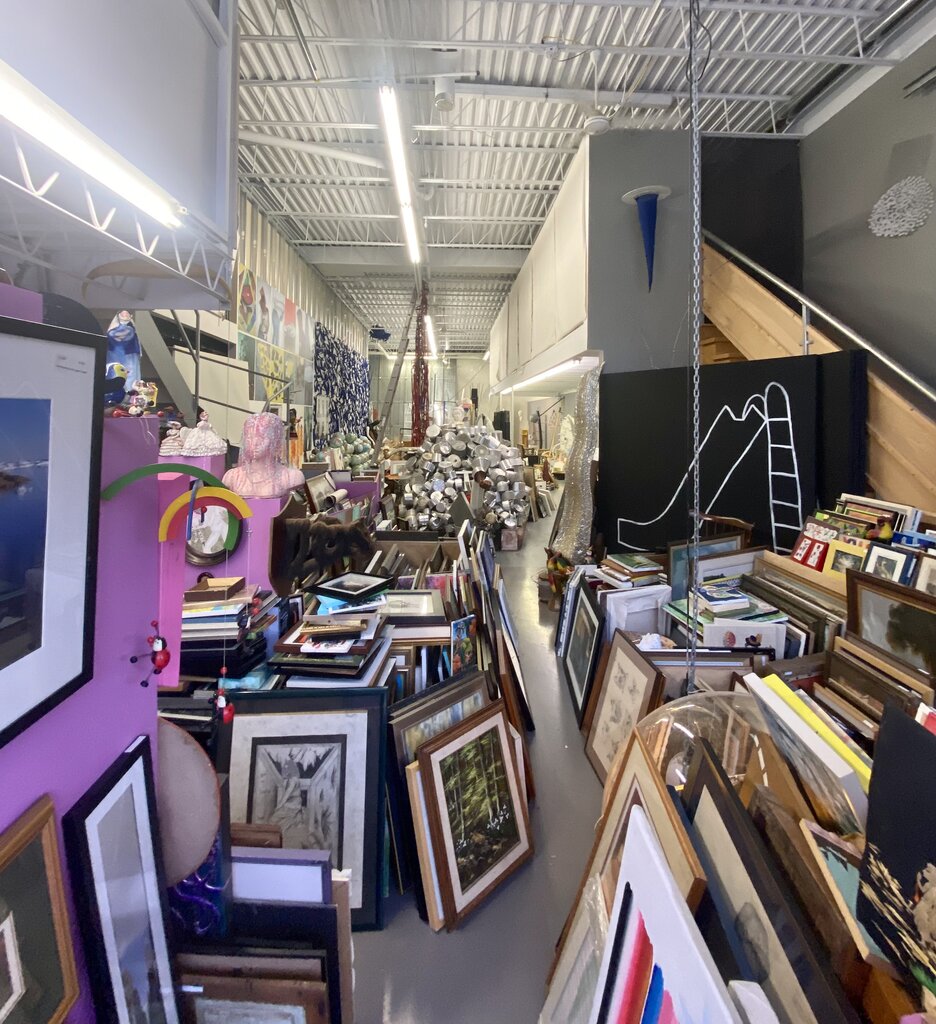
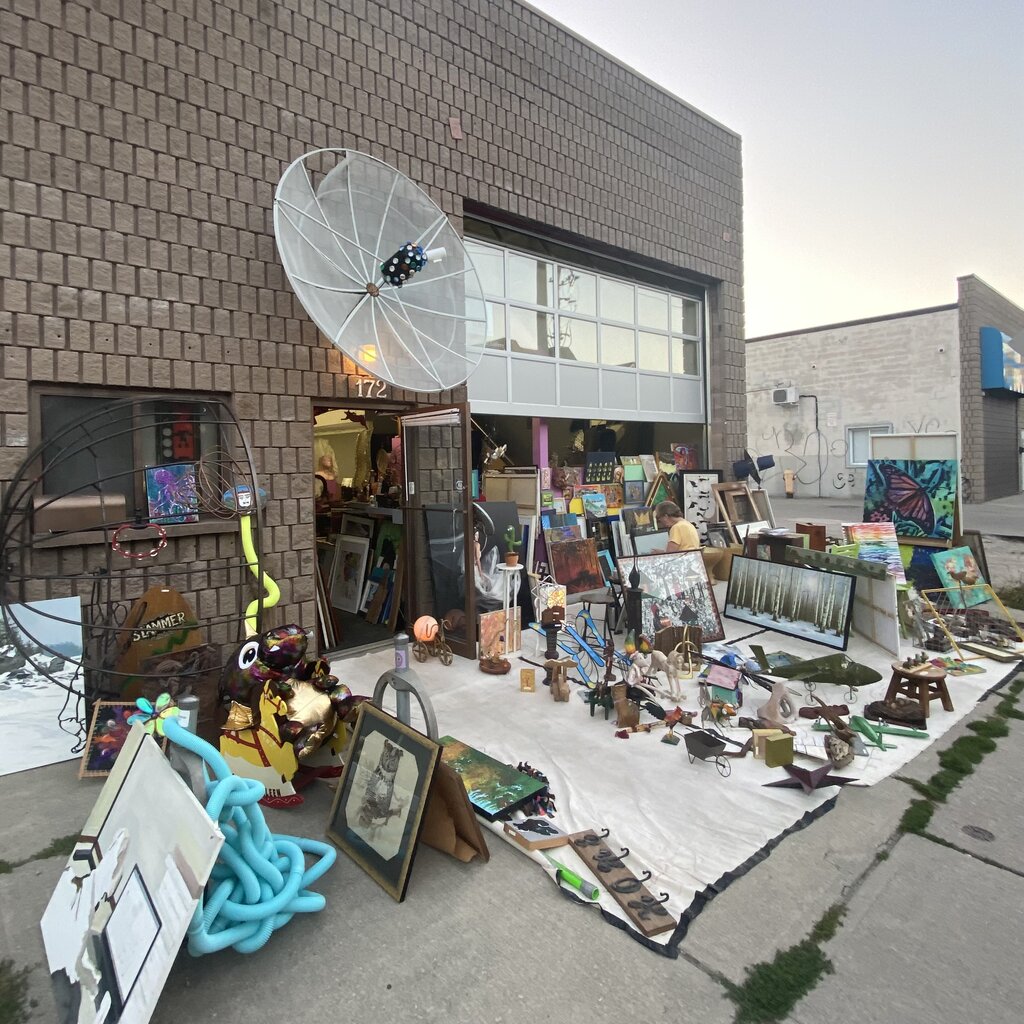
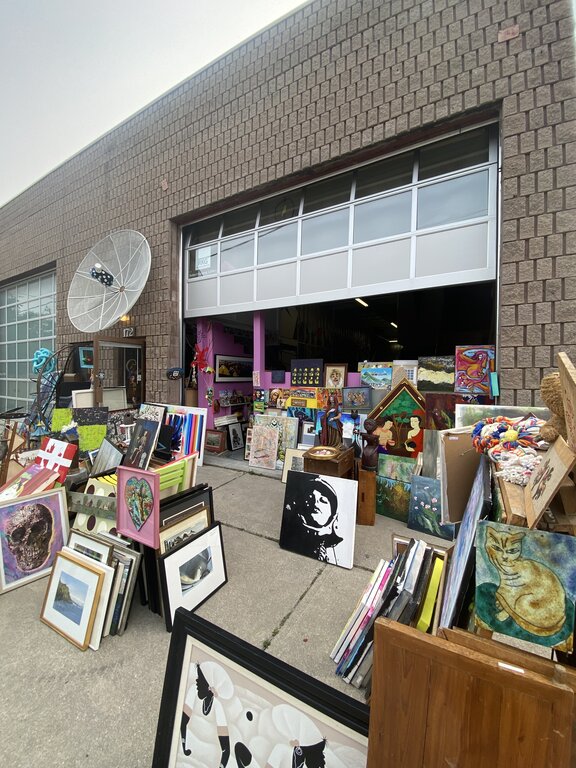
    Trying to enter the Robert Kananaj Gallery (RKG) on St. Helens Avenue, for this exhibition presents the visitor with a challenge. The gallery is filled with so many artworks — close to 4000 pieces — piled up layer upon layer, leaving a very narrow pathway to navigate all the way to the back of the space.

    Installation view inside of the gallery

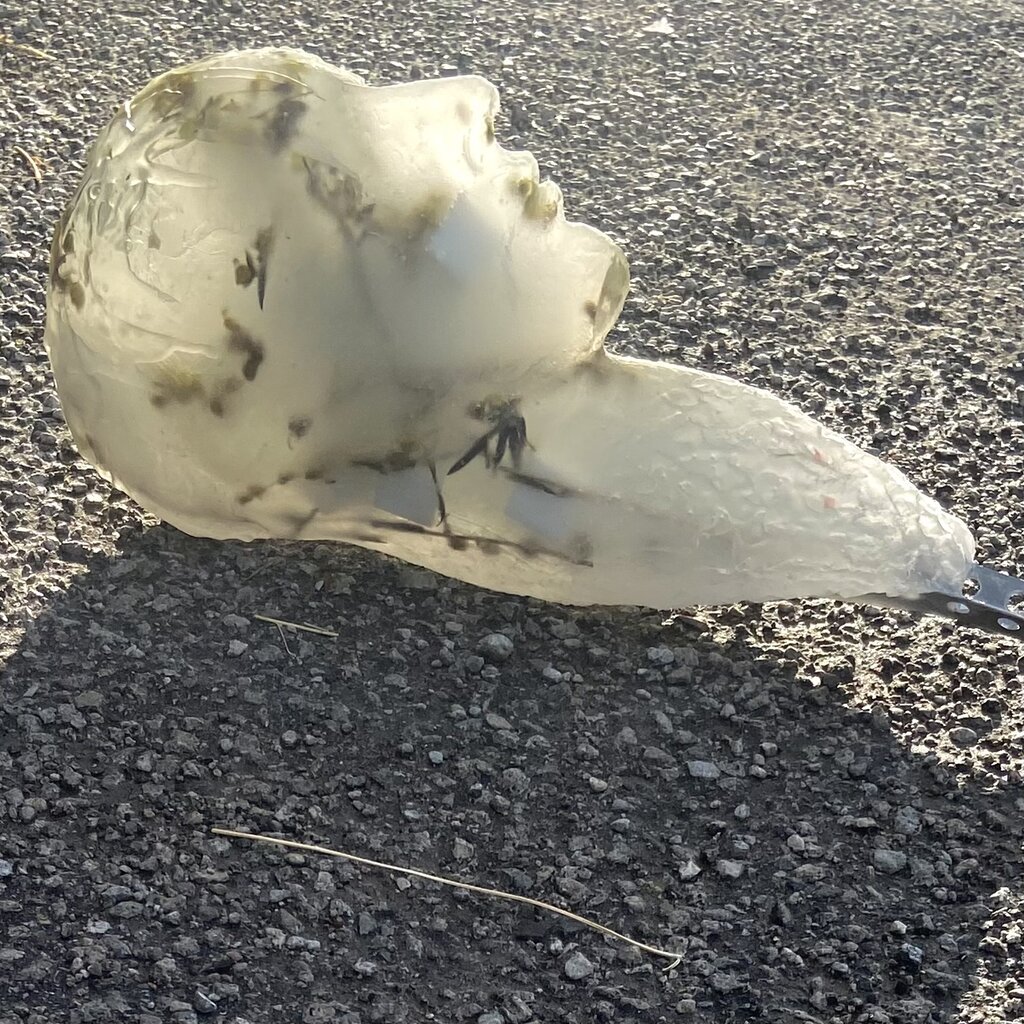
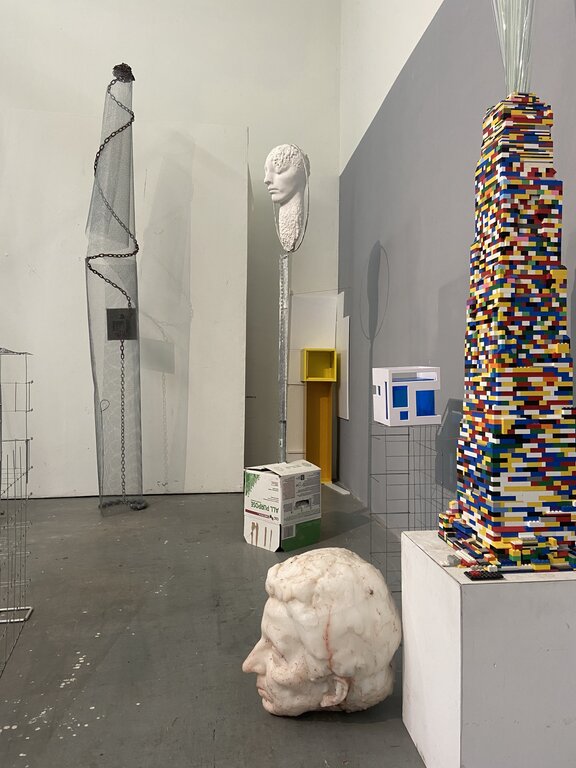
    Inside the gallery you still can see the previous exhibition, Times of Reflection. What you experience here is Robert Kananaj’s “all-one project”. Times of Reflection is Kananaj’s biggest forthcoming body of artwork, filling the entire gallery. Talking about the project, Kananaj said: “When the gallery had to shut down for months, because of the pandemic, I decided to step in and create unusual big installations, so letting coexistence in unusual company of unknown to us.” He created sculptures both in figurative and abstracted styles. Some of them are large busts of heads on the floor or full-figure depictions hanging from the ceiling or placed on spikes.

    Installation view Times of Reflection, 2023 by Robert Kananaj

    Memory is Blind, Memory is Deaf, sculpture, resin, 2023, by Robert Kananaj

    Sculpture, installation view, 2023, by Robert Kananaj

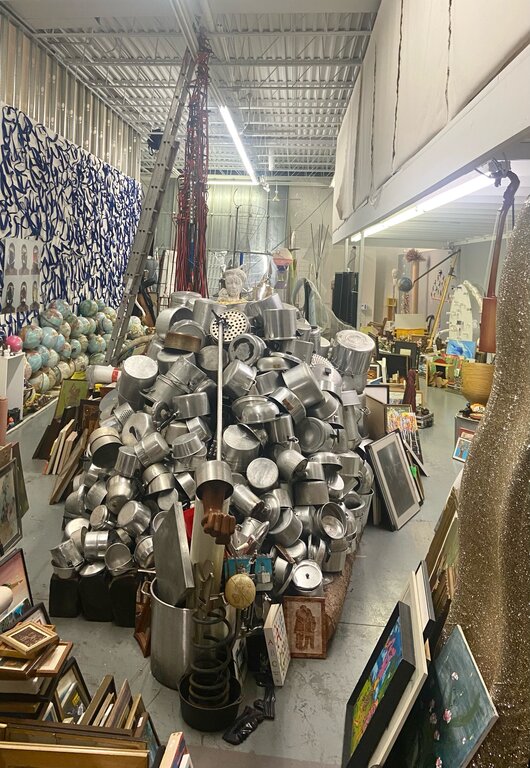
    There are also large installations like the numerous cooking pots creating a hill in the middle of the gallery (Cooking pot society). Another one, Tribute to the Ukrainian Flag, covers the entire left wall

    Installation view with Cooking pot society, 2022 by Robert Kananaj

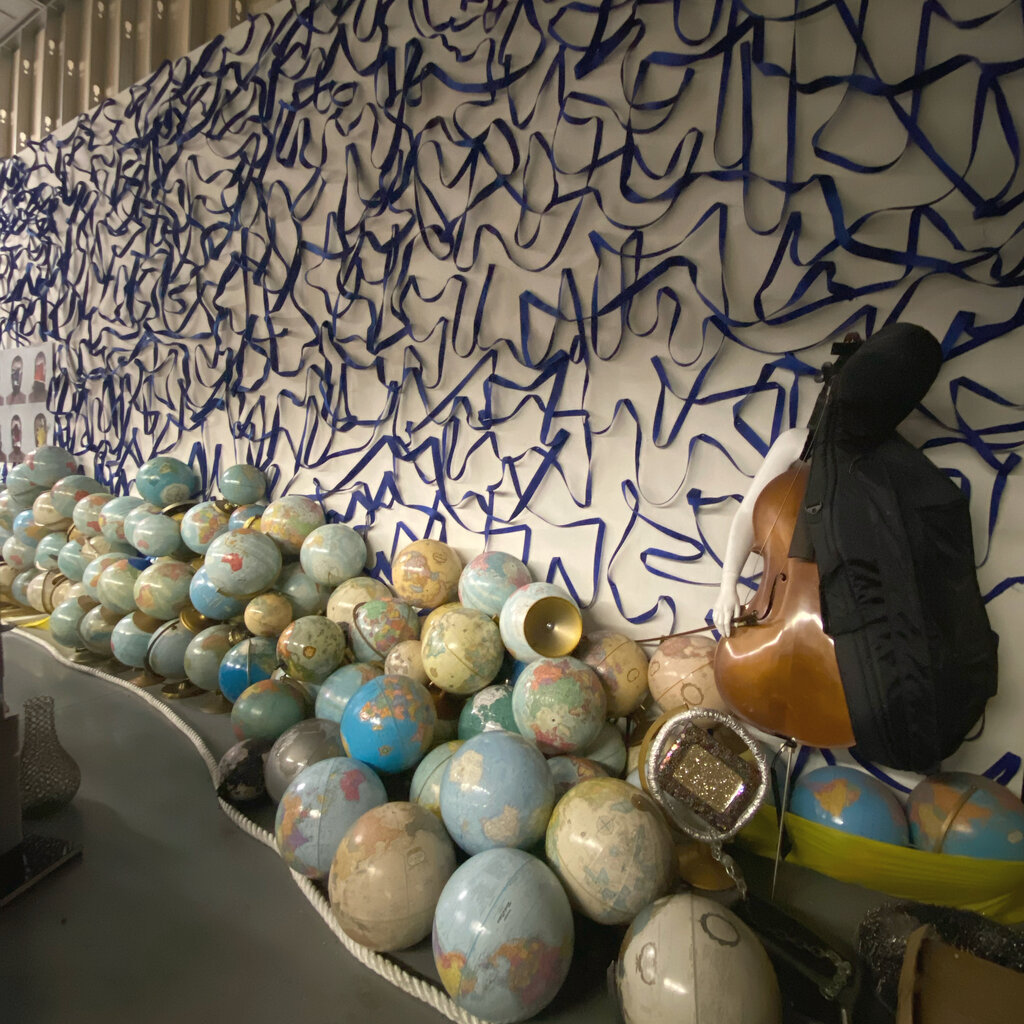
    Installation view with Tribute to Ukrainian Flag, 2022-23, (on the wall) and globes and cello by Robert Kananaj

    “Times of Reflection is always within change, studio experience and gallery experience merge in to an unconventional one. The one of the visitors’ take.” – points out Kananaj, and adds that the visitor’s exclusivity is very important for him.

    Roberta Laking Kananaj, co-director of RKG, explains that when the pandemic happened it was hard to have exhibitions as no one wanted to come inside the gallery. So, Robert Kananaj, the director of the gallery thought that they needed to figure out something else. The gallery had always collected random things from unknown artists so the idea of organizing an installation around them was born. They started to put together an Installation outside the gallery as a continuation of the inside show and called it Salon des Refuses, later Renaissans des Refusés. While the pieces in Times of Reflection are original and unique artwork created by Robert Kananaj, Renaissance des Refusés addresses anonymity.

    More than a century ago, the original Salon des Refusés was created in protest against the Paris Salon of the Academy of Fine Arts that had held themselves out as the judges of the epitome of status. After the liberation of the Academy, those refusés became the new benchmark of status. “In contrast, and long overdue, RKG’s Salon des Refusés says Enough — Status is overrated!” – wrote Kananaj. Then he continued: “Salon/Renaissance des Refusés is about refusal. Models are by the very nature exclusive. Not everyone can fit in a model. Models are failing, historically, to vast majority of people, all walks of life. That’s why it started as a Social Commentary Project, installation with unknown makers and artworks, not for sale. So, creating status out of status-less. We are conditioned all to serve the status, and the status can’t accommodate us all. Models are destined to fail, but no one individual can afford to overlook one self’s status. Status is in out, individual, and not out in. Rejected (art and individuals) are individually recognized rather than by a model.

    The gallery gives in for the unknown visitor. The gallery is to be what the visitor makes of it, in the presence of maximal information by unpredictable known disorderly presentation we have individual minimal take. The order comes from the individual context, artwork or individual person.

    That’s why I say status is overrated, referring to the models’ limitations to accommodate us all.

    So, the status is individual.

    It’s more about what is going on at RKG situation, besides disturbing or comforting. It is readymade not for any status, other than letting the visitor, for the first time in our 12 years serving as a gallery, to be where they are always: living proof of our individual unique life.”

    Roberta Laking Kananaj added: “The installation inside and outside the gallery contains pieces that someone abandoned, but it doesn’t mean that they are worthless. Somebody might be interested in them and want to buy them.”

    As the introduction of the show states: “RKG’s Salon des Refusés is about the visitor and art. Pieces with little chance to become part of institutions of the status-building kind, have taken over the gallery space. We may look down on this invasion, or be tempted by it. A successful individual in whatever walk of life doesn’t seek status, as excelling and becoming are unique for everyone. Here the refused are given status by the status-less, and so the Salon des Refusés of status-seeking has come full circle. Receiving is giving.”

    Roberta Laking Kananaj added: “The installation never looks the same as Robert Kananaj picks different items every day and arrange them in a different order. People can touch them, move them, have fun with them. RKG became a popular destination during the pandemic and after, as people who worked from home, or children after school, or someone trying to find a last-minute present came to browse around till 11 pm or even midnight. It became a fancy place to visit for locals and artists, as well as tourists.”

    Images are all installation views and courtesy of Robert Kananaj Gallery

    *Exhibition information: Renaissans des Refusés, ongoing, Robert Kananaj Gallery, 172 St Helens Avenue, Toronto. Gallery hours: Wed – Sat 1 – 5 pm or into the night if weather permits.

  • 40 x 40 at Gallery 1313

    Looking back 40 years is a little trippy for most of us, but for 49 former students of the Ontario College of Art (ACO) it is great to get together to display old and new art works, compare hair colour—various shades of grey and white with a little purple for braver souls—and remember old haunts and good times. The reception was a little like a school reunion and lots of trading stories surrounded by friends, family and the curious.

    The Opening Reception on October 14, 2023 at Gallery 1313

    The exhibition, curated by Adrienne Trent (who also had work in the show), was jam packed with an eclectic mix and many gems among them. Photographer and former OCA student George Whiteside came to the opening reception despite a recent stroke. His work Painted Doodle, a digital laminated print, shared a wall with Frank Perna’s acrylic on canvas piece, There is no Monsanity Clause. In front of these works on the floor was Simon Muscat’s Canoe Headstone made from South African granite. It weighs in at about 500 pounds and is a focal point.

    George Whiteside with Painted Doodle, digital laminated print

    Frank Perna in front of his work There is no Monsanity Clause, acrylic on canvas

    Simon Muscat and his sculpture Canoe Headstone, South African granite

    Just around the corner is Adrienne Trent’s Heads Together, a mixed media work of plaster foam heads. Artist Rirkrit Tiravanija has a cocktail tray with mock cocktails. On the tray are the words ‘Fear Eats the Soul.’ He was absent from the reception as he had an opening at MOMA in New York. Success has its obligations.

    Adrienne Trent with Heads Together, a mixed media work of plaster foam heads

    Installation work by Rirkrit Tiravanija

    There are a few video works, such as Janet Bellotto’s Coral Grief, a one-minute digital video. Steev Morgan had an interactive video work Retroflective video, Hands and Faces (1979, 1985, 2023). Ian Carr Harris, one of his former instructors, came to the reception.

    Steev Morgan with his video, Hands and Faces, 1979, 1985, 2023

    Ian Carr Harris (left)

    A few artists had QR codes such as Douglas Walker. His print work UNtitled R915 (1985) made references to Gallery 76 which was near OCA on McCaul. Later he caught my attention when telling stories of the old days at Gallery 76. There was also a print that included the Sandy Simpson Gallery on Queen St. West near Spadina, gone by now, but a sample of the 80s period.

    Douglas Walker with his prints

    I liked Owen Ford’s Untitled canvas from 2015. I remember Denise Cooper from Loop Gallery when it was on Queen St. near Gladstone. Her recent work from 2023 Beloved Earth from Sky is oil on masonite. Cathy McNeil’s Ontario Place, a pencil drawing on paper, was another favourite.

    Owen Ford, Untitled, painting on canvas, 2015

    Denise Cooper, Beloved Earth from Sky, 2013, oil on Masonite

    Cathy McNeil with her work Ontario Place, pencil drawing on paper

    Nestled in a corner was glass maker Alfred Engerer’s work, Madonna (1996) a sculptural piece of solid hot worked glass. John Redekop’s Tablet #11 is a round work using newspaper, varnish, wood and paint. A striking piece.

    John Redekop with Tablet #11, newspaper, varnish, wood and paint

    There is certainly no shortage of different mediums used in the exhibit. Fashion designer, Kingi Carpenter has a silk-screened work that visitors could try on as well as individual T-shirts themed by participating artists. Artist Joe McClean even has some streaming audio titled, A Friend in both Worlds. Carolyn White’s artwork from 1980, X Marks the Spot, is definitely a period piece.

    Kingi Carpenter showing her silk-screened works

    Installation view with Joe McClean’s A Friend in both Worlds

    John Abrams painting Late Nature (Walking Wolf), oil on panel, is very impressive. In fact, everything in the exhibit seems to be placed well and to hold its own.

    John Abrams with his paintings

    Thanks to the curator, Adrienne Trent, her friend Natalie Olanick and gallerist, Carla Garnet, who positioned the works, a challenge with so many styles and mediums.

    (L-R) Carla Garnet gallerist, friend Natalie Olanick and curator, Adrienne Trent

    Beyond the gathering of old friends, the 40 x 40 seemed a good marker of the artists that came out of OCA forty years ago. Perhaps you can’t always go home again but you can have a little fun connecting with old friends and put on a great exhibition of art at the same time.

    Text and photo: Phil Anderson

    *Exhibition information: 40 x 40 / Group exhibition, October 11 – 22, 2023, Gallery 1313, 1313 Queen St. West, Toronto. Gallery hours: Wed – Sat 1 – 5pm, Sun 1 – 4 pm.

  • Rupen at Yumart Gallery

    On the lower level of the 401 Richmond complex you walk into the inviting space aptly called Yumart Gallery. On its beautifully lit walls sits a set of constructions, fifteen in all, by an artist who simply goes by the name Rupen. His art is difficult to categorize. That is a good thing since, as a result, the viewer cannot file it under this or that movement or style and quickly move on. Rather, the viewer is immediately challenged. That is a principal aim of Rupen’s – to make the viewer do some work. Ironic given the works are rather spare, and ought to be easily digestible.

    Installation view of Rupen, Sequential Vision at Yumart Gallery

    At the risk of contradicting myself, the artist is comfortable calling his own work minimalist. And indeed, it shares a great deal with minimalism. Like the original minimalists of the 1960s Rupen eschews painting. As much as these works, at first glance, appear to be straightforward geometric abstractions they are not paintings. At least, they are not canvases, but rather shaped industrial wood. The pioneer of minimalism, Donald Judd, famously renounced painting, and embraced ‘sculpture’, because, as he saw it, painting lends itself to representation even if only in a formal sense, and a principal aim of minimalism was to eradicate all allusions to illusionism in this sense. But Rupen’s reason for disowning painting is more prosaic. He trained as a carpenter, and as a self-taught artist he naturally applied these skills to his artmaking. So painting was never on the table so to speak.

    (L-R) Deliniation #3, #2, and #4, each 2023, wall sculpture, 19×19 inches

    The primary quality of sculpture, arguably, is shape or form, and this is certainly central to Rupen’s concerns. As art theorist Michael Fried once observed, minimal [literalist] art “stakes everything on shape as a given property of objects, if not indeed, as a kind of object in its own right. It aspires, not to defeat or suspend its own objecthood, but on the contrary to discover and project objecthood as such.” And that holds true for Rupen’s work. The overall flatness of these constructions aids in highlighting the shapes of their edges, with their signature curved corners. The resulting softness of the pieces is enhanced by the colour of each, which Rupen endeavours to match with what he already has in his mind’s eye. Indeed, as we see in his Outline Series, colour and shape seem to be in perfect harmony.

    Outline series (L-R) #1, #2 and # 3, 2023 wall sculpture

    I described his work as flat. That is not entirely true insofar all the pieces incorporate texture to some degree. Sometimes it is realized through a random array of shallow holes in their surfaces, at other times it appears as grooves. As well, Rupen chooses on occasion either to nail into the wood, leaving just their heads flush to the surface, or to nail from the back so that their sharp points stick out towards the viewer, giving the artwork a slightly menacing edge. This understated use of the third dimension – everything about Rupen’s work is subtle – appears more as cast shadow than anything substantive.

    RWB/11GL/W, 2023, wall sculpture, 15.5×15.5 inches (left) and 14GL/RCB/P, 2023, wall sculpture, 15.5×15.5 inches (right)

    Rupen’s artworks are minimalist, then, to the extent that he reduces them to their essential elements, namely, shape, colour and texture. Everything else is expunged. What he doesn’t share with the traditional minimalists is their ideology. The movement arose out of a belief in artistic progress that was seen as entailing what critic Clement Greenberg called a ‘process of self-purification’. This involved eliminating all ‘expendable conventions’ in art. The results are familiar to us – an artform that denied any subject matter except itself, and crucially repudiated all aesthetic considerations in favour of the conceptual. Accordingly it seems to most cold and authoritarian. By contrast Rupen has, over a period of three decades, developed a way of exploring beauty within the elemental constraints listed above.

    His art in this sense is a visual form of litotes, that is, an articulation of beauty by the denial of its negation. (An example of a verbal litotes is the phrase ‘a not ugly rendition’, meaning of course a beautiful rendition.) Likewise, Rupen manages to render his artworks beautiful by denying himself all the traditional strategies by which it is achieved. That is not an easy row to hoe. And in this regard, some may complain that his work is too tight, in contrast to the artworks of Japanese/American sculptor Hiroyuki Hamada, for example. Where Hamada allows himself the use of a great many materials and processes. But there is something to be said for the relatively austere beauty of Rupen’s work. It is quiet, but nonetheless it sings.

    Dovetail Series #1, 2023, wall sculpture, 21.5×19 inches (left) and Dovetail Series #2, 2023, wall sculpture, 19×19 inches

    The post-minimalist movement arose out of a reaction to the overwhelming formal constraints imposed by the minimalists, while sharing an interest in pared down sculpture very broadly construed, to include performance. Consequently, the post-minimalists embraced many of the formal elements renounced by minimalism. Rupen, on the other hand, has embraced many of these constraints, but has nevertheless shown us how there is room for much lyricism. And his artworks only seems to get better. A most rewarding show to visit, so long as you come with an open mind and a willingness to do some work.

    Hugh Alcock

    Images are courtesy of Yumart Gallery.

    *Exhibition information: Rupen, Sequential Vision, October 7 – 28, 2023, Yumart Gallery, Suite B20, 401 Richmond St, W., Toronto. Gallery hours: Wed – Sat 12 – 6 pm.

  • Mike Hansen: Spot-o-fi at Lonsdale Gallery

    Mike Hansen, Off Minor, Big Band (Jazz Series), 2021, acrylic on canvas, 36 x 36 inches

    Classical music and contemporary jazz is wound tightly into every thread of the weave of Mike Hansen’s Spot-o-fi installation of watercolours, canvases, and plaster sculptures at Lonsdale Gallery. Scan the QR code on the exhibition labels, and hear the music that gave life to the artist’s visual output. Yet, there is no necessary chain here that binds one to the other. Hansen admits that his painterly output amounts to a critique on abstract expressionism and its latter day emotional hangover, a purely visual art conversation between modernism and its post-painterly derivations. Consequently, the Spot-o-fi visual wall art stands alone against the welter of Hansen’s “wall of sound” references.

    Mike Hansen Spot-o-fi installation view

    If Hansen has a go at abstract expressionism’s watered down derivatives, he also manages to save some powder for the music streaming platforms of our day. His exhibition title, Spot-o-fi is a dig at the prevalent algorithms, encouraging a type of lazy listening that tend ultimately to denigrate the sonic masterpieces he references to background noise.

    No better example of a modernist painter steeped in music, who succeeded in as tight a threading of sound and image as anyone, was of course, Paul Klee. The 2008 Melody and Rhythm exhibition at Museum der Moderne in Salzburg, Austria was a tribute to the Swiss artist’s uncanny ability to evoke “sound composition” from colour, line, and texture. 

    Mike Hansen, Reflections on Gnossienne No 3, 2023, acrylic on epoxy, 27 x 11 x 8 inches

    I make the Klee reference since the painted forms of Hansen’s four-panel A Love Supreme (Jazz Series), for instance, a tribute to Coltrane’s opus, draw no obvious parallel to the music that may have inspired them. Brightly coloured, amorphic cutout shapes that waft and melt in airy layers, possess a graphic life independent of sound – unless of course, a conscious inference is made to connect them.

    Mike Hansen, A Love Supreme (Jazz Series), 2021, acrylic on canvas, 74 x 74 inches (four canvases)

    The positive for Hansen plays to the materially visual art in the exhibition, and that the gloss-candied surfaces of his sculpture production appear good enough to eat, can’t be held against the artist.

    Steve Rockwell

    Images are courtesy of Lonsdale Gallery

    *Exhibition information: Mike Hansen: spot-o-fi, September 8 – October 14, 2023, Lonsdale Gallery, 410 Spadina Road, Toronto, Gallery hours: Wed – Sat 11 am – 5 pm.

  • Sculptors Society of Canada is 95

    The Sculptors Society of Canada (SSC) celebrated its 95th anniversary with two shows in the Canadian Sculpture Centre, titled 95 – and still going strong.

    Founded by some of the most prestigious sculptors in Canadian art history, the SSC has been exhibiting and raising the profile of sculpture in Canada for 95 years. The mandate of this society is firmly established by a collective belief in education, partnership, cooperation and support regarding sculpture; to discover and foster young talent, to raise the profile of Canadian sculpture and to rally and encourage sculptors working at a professional level.

    The opening reception at the new location of the gallery at 18 Gristmill Lane, in the Distillery District was well attended with artists and visitors talking about the sculptures and listening to music. The exhibitions involved all imaginable style from traditional representative to abstract. Part I was on display from June 29 to August 18, 2023.

    Opening Reception on June 29, 2023 with visitors looking at Peter Wirün, Canada Mothers Three, steel, fiberglass, rust patina

    Façade Signage with Camie Geary-Martin’s Alice, bronze

    Façade left: (L-R) Yeon-Tak Chang, Vertical Sienna, Sienna marble, Peter Schoebridge, Icara, polished bronze and Tom Ashbourne, Energy & Light, bronze

    Façade right: (L-R) Carl Schantz, Hexo series HGF 6g, laminated glazed ceramic, glass vitrolite, wood base, Renato Foti, Water Buffalo, skull, gold epoxy, glass and Laura Santini, Oranges_Arance, bronze

    J Mac with her work, Segments, nails. rope, fiberglass

    95 – and still going strong Part II

    The second part of the exhibition displays sculptural work by 25 artists with various styles.

    Opening Reception on August 26, 2023

    This show includes works that catch your eye with their unique appearance. Art DiLella’s bust looks like a living human being, who just closed his eyes for a second. Everything is so real in it; the illusion is so perfect. However, the sculpture came purely from the imagination of the artist. He didn’t use a model. The only real thing is the human hair, each hair having been inserted by hand.

    Art DiLella, Anon 2, silicone, human hair, cotton

    Outstanding by Edward Falkenberg is really ‘outstanding’ because of its colours. He usually doesn’t paint his sculptures. In this mainly abstract composition, the yellow-green body of a figure with its red hand seems to reach out to a blue stick. There is movement in the wood structure itself with its curved and edgy form but the colours enrich them deeply. Maunder’s Intervention reminds me of a poppy’s spherical capsule fatally hurt by nails.

    Edward Falkenberg, Outstanding, wood, pigment (left) and Jim Maunder, Intervention, wood, steel, nails (right)

    Colours have the main role in Alfred Engerer’s piece. It is a glass sculpture, a new sculpting method in Canada. Just looking at it you would never know that it is glass as it is very textural. It is extremely powerful with the contrast of vivid blue and red.

    Alfred Engerer, The Edge of Modern, glass, slate, oil paint

    All of W. W. Hung’s sculptures are about movement. The young man atop his skateboard in the sculpture balances in the air, with the his body curving right and left, creating a perfect balance choreographed like a dance.

    W.W. Hung, Frontside Rocker, bronze, limestone

    Patrick Burmingham was one of the award winners in the Florence Biennial last year. His bronze sculpture AT-TI-TUDE, an abstract piece, also involves movement reminding us of someone reaching out to the sky.

    Patrick Bermingham, AT-TI-TUDE, bronze, steel base

    Piqtoukun is a prestigious artist who won the 2022 Governor General’s Award. His works are in the collections of the National Gallery in Ottawa and the Art Gallery of Ontario in Toronto. Shaman Teaching Apprentice is an excellent example of his method. Layers of culture and magic are encapsulated in the stone. The shaman facing right holding a circular object, the symbol of the universe, is looking into spheres that are not open to everyone. He is not fully human with two heads and two mouths; he is transformed into other realities. From his back a younger face looks at us. Is he the apprentice or a spirit called upon by the shaman? Hard to know, but we can’t miss the spirituality radiating from the sculpture.

    David Ruben Piqtoukun, Shaman Teaching Apprentice, Brazilian soapstone, red pipestone, wood, metal

    The portraits of Karen Stoskopf Harding and Marlene Kawalez are beautiful and ethereal. Kavalez painted her clay piece white giving it an angelic appearance. Stoskopf Harding uses strips of metal to create the woman’s face, involving air as an element, giving us the feeling of light shining through. The little bird on the top of the head invites the light with its song.

    Karen Stoskopf Harding, The Revelation of The Light, bronze, BC cedar base (left) and Marlene Kawalez, Willow, raku clay, mirror (right)

    Angela Verlaeckt Clark and Daniel Yu capture our attention with the dark beauty of their sculptures. While Verlaeckt Clark’s composition is smooth and curvy, Yu’s is edgy but both have movement in them.

    Angela Verlaeckt Clark, Passageway, brucite, steel base (left) and Daniel Yu, Totem – Three Minds of Man, chlorite (right)

    Congratulations to the Sculptors Society of Canada on their 95th anniversary and good luck to its members in their future careers.

    Emese Krunak-Hajagos

    Images are courtesy of Canadian Sculpture Centre

    *Exhibition information: 95 – and still going strong, Part I June 29 to August 18, 2023, Part II August 26 – October 13, 2023, Canadian Sculpture Centre, 18 Gristmill Lane, in the Distillery District, Toronto. Gallery hours: Tue – Sat 11 am – 6 pm, Sun 12 – 5 pm.