GUISES, the Exhibit & Book by Photographer Christa Pauwels
A commercial photographer by trade, Christa Pauwels takes the viewer into a world of nostalgia and fantasy, occasionally delving into the provocative, with her solo exhibition, Guises, at Gallery 1313. With people overwhelmed by weighty issues like climate change, inflation and war, Pauwels’ exhibition looks at how we present ourselves to the world.
Installation view of Christa Pauwels, Guises at Gallery 1313. Photo: Phil Anderson
Pauwels herself has taken on many roles including mother, songwriter, commercial photographer and artist. Her work as a commercial photographer is contemporary portraiture where the subjects are encouraged to reflect their story in creative portraits mixing style and fashion.
Christa Pauwels, Around Red, 2013. photography, 18 x 24 inches
Talking about her own art, Pauwels says that her work is all about the women trapped inside of her and the personalities she has collected along the way, through what she has seen, felt, learned, and sometimes, completely imagined. She feels taking on different guises helps us navigate through the various spaces and places we inhabit. By using herself in the portraits, she explores alternate personae to create different characters in this conceptual exhibition.
Christa Pauwels, Behind, 2013, photography, 20 x 20 inches
Pauwels, is an admitted fan of American conceptual photographer Cindy Sherman, and we can see the comparison. Pauwels’ work examines the way media depicts the roles of women. In contemporary society people are obsessed with the way they present themselves to the world through selfies. Pauwels in her photographs follows the same method and has fun with her poses and costumes.
Christa Pauwels, Titanium, 2017, photography, 18 x 24 inches
A Toronto Metropolitan University photography graduate herself; she uses storytelling in both her commercial and art photography, turning the camera lenses on herself. Fashion, hairstyling and make-up all become part of the mix to transport the viewer into different scenarios. Whether playing the stenographer at her typewriter or acting as a steamy seductress, Pauwels seems to enjoy this journey of exploring her identity. We all wear different costumes at times and can identify with Pauwels’ guises.
Christa Pauwels, Identity, 2013, photography, 24 x 36 inches
This Markham-based photographer has presented us with an escape into her world of personas — and perhaps an opportunity to re-examine our own identities.
Installation view of Christa Pauwels, Guises at Gallery 1313. Photo: Phil Anderson
By Ashley Rowe Flick
Images are courtesy of the artist and Gallery 1313
*Exhibition information: Christa Pauwels, Guises, Curated by Stacey MacNevin, July 19 – 30, 2023, Gallery 1313, 1313 Queen St. West, Toronto. Gallery hours: Wed – Sat 1 – 5 pm, Sun 1 – 4 pm.
Jean-François Bouchard’s exhibition Exile from Babylon at Arsenal Contemporary Art is part of Toronto’s Scotiabank CONTACT Photography Festival. CONTACT is the largest photography festival in the world, showcasing more than 180 exhibitions in the GTA from May to August.
In this solo show, Montreal-born, New York City-based artist Jean-François Bouchard documents a squatters’ camp in the Sonoran Desert in California. People who live here reject modern American society – Babylon as they call it – and are looking for alternative ways of survival in the face of homelessness and addiction, escaping the legal system or pursing libertarian ideals. They live in a very unfriendly land without running water, electricity or garbage removal in tents, shanties, shipping containers, crumbling recreational vehicles and even dens dug into the ground. They know each other by nicknames only, and appear and disappear under strange circumstances. Their search for fulfillment and absolute freedom comes at the cost of great personal sacrifice.
Jean-François Bouchard, Desert Life, Quadriptych C, 2022, from the series Exile from Babylon
The seemingly straightforward narrative is misleading as the photographs are challenging. The first few images that depict the community in this vastly empty landscape in daylight, are very bright, even blinding as they are presented in lightboxes. These pieces are almost white because of the extreme heat and the absence of any vegetation. The barren land has a few dying trees and the residents are wandering, mostly by themselves or with dogs, seemingly as wild as their owners, surrounded by debris – creating a post-apocalyptic scene. These people’s lives are no longer supported or even tolerated by society, so they are forced to live on the periphery. The photographs are brutally true – but the documentation ends here.
Jean-François Bouchard, Desert Life, Quadriptych B, 2022, from the series Exile from Babylon
The rest of the photographs in the larger section of the exhibition, depict trees at night – and Bouchard abandons documentation and continues telling the story of the cruel reality metaphorically. The contrast of the bright daylight images and the darkness of the night shots is very dramatic. These mostly dying trees, decorated with thrown out objects and debris that either residents or the harsh desert wind have placed around them and on their branches, create ugly – sometimes even creepy – images that are still beautiful. The metamorphosis trees go through in the night is indeed magical and mesmerizing. What we look at are no longer dying trees with bare branches and useless objects or garbage around them. Everything changes into something different, like in a fairy tale, the creepy becomes eerie.
Jean-François Bouchard, Tree of Life #1, 2022. From the series Exile from Babylon
These dying trees become mystical at night, under the magic touch of sunset or twilight, the starry or stormy sky or the total darkness. Because of the light box technology, both the strong orange of the sunset and the shiny brightness of the stars catch our eyes and for a moment we enjoy their peace. In Tree of Life #1 blue, a night colour, highlights the tree and the rugs flying in the wind. The atmosphere is sad and lonely juxtaposed against the rather beautiful sunset. In Tree of Life #2 the artist lights the tree in white, that reminds us of the pureness of snow. It is already night and the stars are coming up, while the dying sunset lingers on the horizon. Trees always tell us a story about many things. This is an old tree having lived a harsh life in the desert, heavily abused by the strong winds and burdened with debris. It has been badly treated by both nature and humans. A hard life, much like that of the people there.
Jean-François Bouchard, Tree of Life #2, 2022. From the series Exile from Babylon.
The absence of people is important in these photographs as the trees are the focal points. Treeof Life #9 is a little bit different with the addition of an elegant cupboard in front of the tree that somewhat modifies the atmosphere. It seems to be twilight; we can see stars but the sky is not dark and a little orange light of sunset lingers. The light coming from the front lights up only the top of the tree but strongly reflects off the glass doors of the cupboard. Where did this furniture come from? Although it has seen better days, it is beautifully crafted and antique. How did it get here and who left it? Surely, like the people who live here, it didn’t deserve this terrible fate.
Jean-François Bouchard, Tree of Life #9, 2022. From the series Exile from Babylon
Trees are very important creatures both in our lives and in myths. We usually associate trees with natural beauty, relaxation, peace — their fresh air nurtures us. In mythology they have a more complex meaning. Some tribes considered them sacred, and even looked on them as gods. They believed that trees could tell stories, see into the future and cause miracles. Old Celtic legends talk about putting a priest in a young tree so the trunk enclosed him in time and fed him with its syrup. The priest became part of the tree, spoke for the tree, creating a sacred communication between nature and human. And, of course, there is the Tree of Life, the symbol of every living thing.
It is also a scientific fact now that trees have a strong communication system and support each other in difficult times, be it natural disaster or illness (Susanne Simard: Finding the mother tree, Penguin Random House, 2021). The death of a tree indicates something has gone wrong in their community.
Jean-François Bouchard, Tree of Life #6, 2022. From the series Exile from Babylon
In Bouchard’s photograph the Tree of Life #6, the tree is dead. Similarly, the people living in the Sonora Desert are as good as dead to the American society.
Emese Krunak-Hajagos
Images are courtesy of the artist and Arsenal Contemporary Art Toronto
*Exhibition information: Jean-François Bouchard, Exile from Babylon, April 27 – July 15, 2023, Arsenal Contemporary Art, 45 Ernest Ave, Toronto. Gallery hours: Wed–Sat 11am – 6pm.
July 7 – 9, 2023 Nathan Phillips Square Fri & Sat 10 am – 7 pm, Sun 10 am – 5 pm
The weather cooperated with this years TOAF, although it was still hot but pleasantly so, attracting a crowd of visitors.
Executive and Creative Director, Anahita Azrahimi said that setting up on the Thursday had proved difficult at times. This is her 8th year running TOAF and so she has had challenges over the years. As she explained the 350+ booths included some community organizations and galleries. Indeed, I saw booths from StreetArt, Arts Brampton, Gallery 44, the ROM, The Toronto School of art and others. Azahimi said they felt it important to reach out to community organizations to enhance the fair. Add to that Dance Performances, Art Talks, Musical Performances and Live Painting, as well as numerous awards and art tours, and there seemed no end to what TOAF could offer.
https://www.high-endrolex.com/15
Executive and Creative Director, Anahita Azrahimi
I chatted with Paul Aloisi at his booth and he was enthusiastic. Artists Anastasia Eve and Marge Creswell from StreetArt had their work on display. Creswell a grad from OCAD 1994 is an accomplished muralist with many public murals around the city.
Paul Aloisi
Anastasia Eve
Marge Creswell
There were a number of Quebec artists and I stopped to chat with several. Pascal Normand had a booth in TOAF before and had his work online during COVID. He preferred the live Fair rather than the virtual one. All artists are online now and the costs of participating have gone up.
Pascal Normand
Quinn Henderson
Peterborough scratch artist, Lisa Martini-Dunk had done well before in TOAF and had switched booth locations to see how it might impact sales. Her work was quite unique as was Halifax artist’s K. McLean who used found objects to create imaginary submarines. An enthusiastic visitor requested a certain model of submarine and the artist replied that all his creations were imaginary.
Lisa Martini-Dunk
K. McLean
Artist Sandra Tarantino had just sold a work when I approached. She has done the Fair for many years and even advises newbies on how to set up their display. Her display was impressive. Sculptural Collage artist Sara Petroff was doing well at the Fair attracting visitors and selling plenty of art works. She uses “discarded materials to reframe history “. The works were appealing.
Sandra Tarantino
Sara Petroff
Artist Moses Salihou was new to TOAF and happy to show his work to visitors. He, like many artists were using QR Codes for people to get more info on their phones while scanning. Artist Ali Rahimi was using technology including 3D printing to create his sculptural works and also used technology to create moving works for screens.
Moses Salihou
Ali Rahimi
This years TOAF has lots to offer to any visitor and what more can you ask for, including good weather. Anahita and her team and the Board have crafted another successful fair. And of course, thanks to the many sponsors who make it all possible. Visiting the Fair will make your weekend special and enjoyable.
July 7 – 9, 2023 Nathan Phillips Square Friday & Saturday: 10 am – 7 pm, Sunday 10 am – 5 pm. Free admission
Toronto Outdoor Art Fair (TOAF) is the charitable non-profit organization behind Canada’s largest and longest-running annual contemporary art fair. Established in 1961 to connect Canadian artists directly to the public, TOAF showcases 400+ emerging and established visual artists, including painters, photographers, sculptors and artists working in ceramics, textiles, jewellery and more. The event brings together 150,000 art lovers and enthusiasts who spend over 2 million dollars on art during the Fair.
The Fair offers something for everyone: talks, tours, digital studio visits, curated collections, kids workshops, live painting, dance, music, art installations and food and drink experiences.
Toronto Outdoor Art Fair, 2022. Photo: Phil Anderson
In the Forest with Persijn Broersen and Margit Lukács
A Space Gallery is showing two video installations under the title Man is in the Forest, by the duo Persijn Broersen and Margit Lukács from the Netherlands. The videos, each about twelve minutes in length, are themselves titled Forest in Location (2018) and Mastering Bambi (2010). They are played simultaneously in abutting rooms. As a result, however, the soundtracks of the videos interfere with one another slightly. Although the effect, in an odd way, is to enhance the viewing of each.
In the accompanying literature for the show it is stated that both videos ‘take nature as their subject matter and work to unhinge hegemonic ways of looking at landscape’. I guess this is to say that the artists encourage the viewer to question, or reflect on, the dominant views of natural landscapes. Both videos feature the forest.
Installation view of Persijn Broersen and Margit Lukács, Forest on Location, 2018 (HD Video and Sound, 11:45 minutes). Photo: Selina Whittaker. Courtesy of A Space Gallery, Toronto
In Forest on Location they have created a pared down, dark simulacrum of a forest modelled on photographs from the famous Białowieża forest that spans Poland and Belarus. It features a ghostly avatar of Iranian opera singer Shahram Yazdani passing through fragments of trees, soil and rock, while singing a haunting version of ‘Nature Boy’ in Farsi – a song made famous by Nat King Cole in 1948. In Mastering Bambi Broersen and Lukács use similar digital technology to create an eerie version of scenes from the Disney animated film Bambi (1942). Its eeriness derives from the absence of any fauna in the forest, in contrast to the original Bambi film which features countless cute animals bounding through the woods.
Persijn Broersen and Margit Lukács, Forest on Location, 2018 (HD Video and Sound, 11:45 minutes). Photo: Selina Whittaker. Courtesy of A Space Gallery, Toronto
Both videos depict a forest landscape that is dark and brooding in atmosphere. One might describe it as enchanted or magical, but with a sinister edge. As noted, this characterization of forests has a long tradition, made famous by the fairytales of the brothers Grimm, e.g., the children Hansel and Gretel abandoned in the forest, and held captive there by an evil witch. Białowieża is one of the last patches of primeval forest in Europe that inspired such stories.
Persijn Broersen & Margit Lukács, Forest on Location, 2018 (HD Video and Sound, 11:45 mins). Courtesy of the artists and AKINCI, Amsterdam
Noted as well, in curator Vicky Maufawad-Paul’s accompanying essay, is how Broersen and Lukacs chose Disney’s Bambi and the Białowieża forest because they are two key cultural references that constitute our understanding of the ecosystem. But these cultural references also happen to share a deep connection to the tragic history of Europe, especially with respect to the Jews. And it is these connections that strike me as more pertinent vis-à-vis the contents of the videos.
Until the mid-nineteenth century Białowieża was a part of what was known as the Pale, namely the western edges of the Russian empire to where Jewish settlement was restricted. Later this territory would become the scene of the pogroms – the murder or expulsion of many thousands of Jews. The composer of the Yiddish song ‘Shvayg mayn Harts’ (Hush My Heart), Herman Yablokoff, on which the tune and theme of Eden Ahbez’s song ‘Nature Boy’ is based, emigrated from this region of Belarus and Poland to the United States to escape persecution. His song tells the story of a young man – ‘as lonely as a stone’ – wandering around Russia before settling in the US, but who never overcomes the persecution suffered in his youth. It clearly has an autobiographical element to it.
Persijn Broersen & Margit Lukács, Forest on Location, 2018 (HD Video and Sound, 11:45 mins). Courtesy of the artists and AKINCI, Amsterdam
Coincidentally the person who wrote the original story of Bambi, Bambi: The Story of a Life in the Forest (Bambi, eine Lebensgeschichte aus dem Wald), on which the Disney film is based, Felix Salten, was also a Jew who sought a better life with the background of persecution. And this story too is about loneliness in the face of a persecutory world (see Jack Zipe’s recent translation, The Original Bambi, Princeton Univ. Press). Salten chose, instead of emigrating, to pursue a career of writing in his hometown of Vienna by unmarking himself as Jewish that involved changing his name and attempting to integrate into non-Jewish Viennese society in the early twentieth century.
Persijn Broersen & Margit Lukács, Mastering Bambi, 2010 (HD Video and Sound, 12:30 mins). Courtesy of the artists and AKINCI, Amsterdam
Salten had a successful career as a journalist and writer. He began to spend his summers on the edge of a forest. He developed a keen interest in the animals there, and strangely enough identified with them in an important sense. More exactly, he saw the animals as helpless in the face of the arbitrary violence inflicted on them by local hunters. Their situation was not unlike his own as a Jew. Thus the story of Bambi can be understood as parallel to his own life story. In this original story Bambi does not settle down with the doe Faline and ‘have children’ – as the Disney version of the story has it – but instead, to aid his survival, he leaves her to lead a lonely life.
Persijn Broersen & Margit Lukács, Mastering Bambi, 2010 (HD Video and Sound, 12:30 mins). Courtesy of the artists and AKINCI, Amsterdam
I think this common theme of loneliness and persecution is amply reflected in the sombre and melancholic mood of Broersen and Lukács’s videos. The artists, we are told, remind us that the current climate crisis highlights the urgency in exposing people’s fantasies about nature. But what they do in focussing on these two references is also highlight our cruelty to one another. Indeed, recently the Białowieża forest was the very place where thousands of desperate refugees ended up trapped on the Polish border, some of whom died of exposure.
Hugh Alcock
*Exhibition information: Persijn Broersen and Margit Lukács, Man is in the Forest, May 5 – July 15, 2023, A Space Gallery, 401 Richmond St. W., suite 110, Toronto. Gallery hours: Tue – Fri 11am – 5pm, Sat 12 – 5pm.
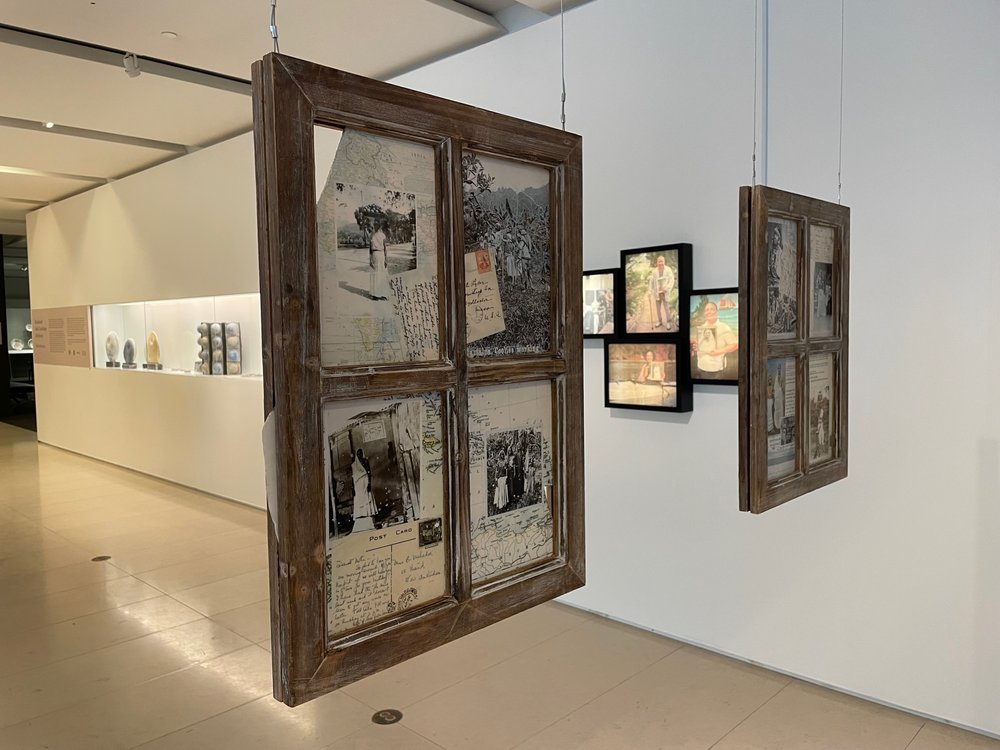
“Dear Mother…” reads one of the many sepia-toned postcards Heidi Mckenzie includes in her photo collage series Looking Back. The collages, framed using porcelain window panes, hang on invisible wires and glow as though warmly lit from within. The frame of the window creates the impression that we are literally looking back through time.
Heidi Mckenzie, Looking Back No 2 (detail), 2023, ceramic pigment photo decals fired onto hand rolled porcelain, cedar frame, hardware.
Viewers walk in a circle around the double-sided works, drawn in closer to read the postcards and see the portraits of “Coolie Belles.” Coolie Belles, as they called Indo women on the Caribbean sugar and tobacco plantations, are the focus of Mckenzie’s show at the Gardiner Museum. Known for her ceramic creations, Heidi Mckenzie’s inclusion in the Scotiabank CONTACT Photography Festival gently tows the line between photography’s ephemerality and ceramic’s solid, fleshy presence. Placed in the lobby of the Gardiner, a distinctly contemporary space with its cool white floors, grey cement, and clear glass cases, the natural tones and textures of her work find a perfect space.
Installation view of Heidi Mckenzie, RECLAIMED: Indo-Caribbean HerStories
Looking Back features swaths of colonial maps, records, posed portraits, postcards, letters, and photographs of plantation life, puzzled together to create four collages. A caption on one of the postcards reads “Jamaica, coolies working.” These images were composed and taken by colonial photographers and reflect their perspective. The figures are made into just a subject, a commodity, an object for photographing. The “idyllic” postcards too were made by and for the metropolitan eye; exoticized and sanitised to ignore the violence implicit in these images. Mckenzie’s collages literally reframe these items from the colonial records, reclaiming the images within, to shed light on the stories that are deliberately cut off by the colonial frame of perception.
Heidi Mckenzie, Looking Back No 1 (left) & No 2, (right), 2023, ceramic pigment photo decals fired onto hand rolled porcelain, cedar frame, hardware
Of the half a million Indians who were enslaved in the Caribbean, twenty-percent were women. Their presence is felt in these archival photographs, wearing layers and layers of crafted jewellery as a form of cultural expression. Mckenzie depicts these bangles, necklaces, and earrings in blue, lightly washed grey, and white ceramic; odes to the lives of these women whose history is unwritten. The artist makes them larger than life by making their presence felt. The sculptures are placed next to still extant pieces of jewelry. To the artist, the jewelry worn by Coolie Belles symbolizes defiance; they were constructed from their melted earnings, worn to hold their savings on their person and also to express the cultures the colonial powers attempted to sever them from. Where the colonial postcard or portrait refuses the self-expression of the sitter, these pieces of jewelry represent their true identity.
Heidi Mckenzie, Coinage, 2023, stoneware, dry brush porcelain, steel stand
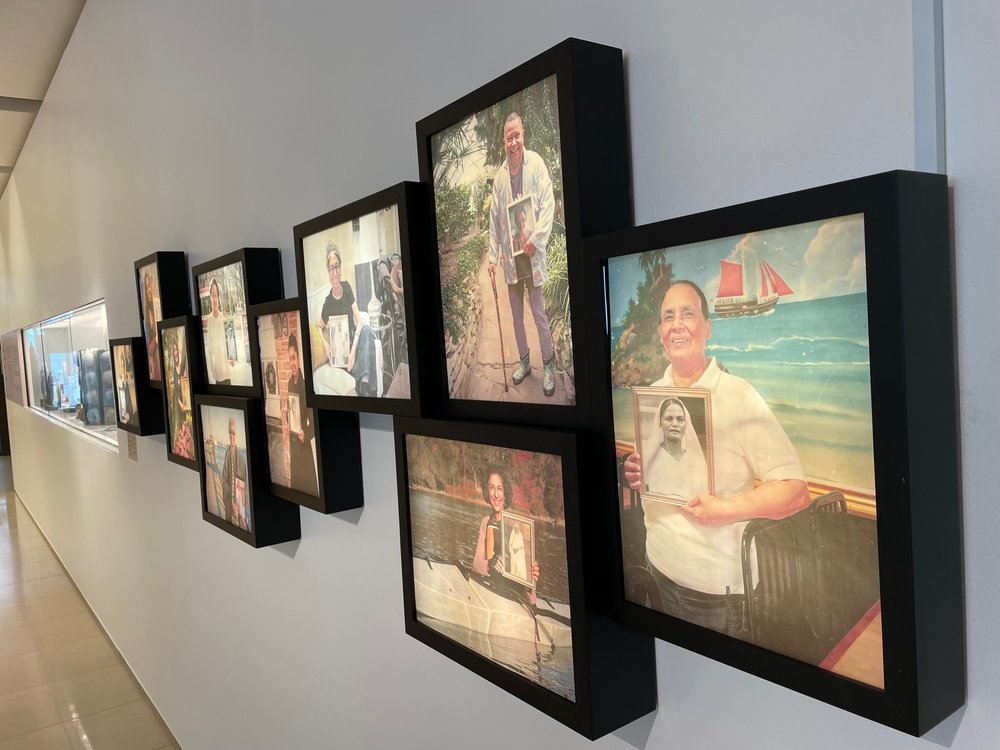
The uniquely matrilineal connection that Indo-Caribbean descendants in Toronto today hold with their ancestors is the main theme of this mixed media show. In the most moving photographic series in the exhibit, Holding Ancestry, Torontonians hold framed photographs of their ancestors. These portraits are printed on ceramic surfaces. They are fitted with LED lights and lit from behind, creating an ephemerality that teeters between warning us of the fragility of these stories and their undeniable presence.
Mckenzie’s show is intimate and focused. The works are visually expressive without the need for extensive text and data that might usually characterize shows like these. The artist, herself of Indo-Trinidadian descent, is using her practice to learn more about her ancestors. Writing our own histories, for some of us, is an ongoing process that requires recovery and reclamation. Heidi Mckenzie’s — and her broader practice— shows us that this does not have to be done through the sanctioned modes of text and narrative, but can be done through the visual and the emotive.
Shakuntala Fernandopulle
Images are courtesy of the artist and Scotiabank CONTACT Photography Festival
*Exhibition Information: Heidi Mckenzie, RECLAIMED: Indo-Caribbean HerStories,, May 4 – August 27, 2023, Gardiner Museum, 111 Queen’s Park, Toronto. Museum hours: Mon–Fri 10am–6pm, Wed 10am–9pm, Sat–Sun 10am–5pm.
There is an artist talk by Heidi McKenzie about this exhibition at the Gardiner on Sunday July 9th at 1pm, please contact the artist directly to rsvp @heidi_art. Free admission for participants.
For the 27th Edition of the Scotiabank CONTACT Photography Festival, museums, galleries, coffeeshops, and site-specific locations are featuring the artwork of photographers from all walks of life. And tucked away on Roncesvalles at Westminster Avenue is Extra Butter Coffee, featuring the exhibition Ephemeral Light by Margaret Gdyczynski.
Installation view of Margaret Gdyczynski, Ephemeral Light, 2023, digital photo composites. Photo: Elin MacRae
Gdyczynski’s digital compositions use the film process of double exposure: by repeatedly exposing different images to light, a ghost-like effect is rendered into one overall image. Mentioned in her Exhibition Note, this mirrors how our memories form and behave. The unpredictability of this method proves essential in capturing the transitory feel of Gdyczynski’s photographs. In this exhibition, both photographer and light are the artists. The pictures are a dreamy yet cohesive interplay of permanence and impermanence within Toronto spaces.
Each photograph has one exposure as an identifier, which captures the main setting of the space. Then, in aggregation, other impressions of the interior layer on top. These layers display the space’s distinct characteristics: there is the French-inspired interior design of Maison Selby; the classic copper espresso machine in Tango Palace; and the vintage furniture in The Sonndr Café. Together, these combined images blend – the way our memories do – into one moment captured in time. The slight ambiguity created from these multiple exposures suggests fleeting and vague moments, but warm ones. This is what elicits such pleasant nostalgia in the viewer. True to the explorations in her work, Gdyczynski’s exhibition echoes how memories are conjured in the mind: details drift across unrelated events, faint particulars wave in and out of focus. The permanence of indoor lighting, juxtaposed with the impermanence of daylight, parallel the workings of memory; simultaneously fixed yet fleeting.
Margaret Gdyczynski, The Sonndr Café, 2023, digital photo composite on inkjet paper, 12 x 16 inches
Eataly shimmers with transient light, capturing what it is to fondly recall a space as charming as Eataly’s Il Gran Caffè. Parts of the salon wall of Art Deco posters translucently hover over (or under) rows of the modern light bulbs and abandoned coffee cups, eliciting a peaceful recollection for even those who have yet to visit the space. Margaret Gdyczynski’s inspiration behind her photography stems from the richly decorated interiors of old basilicas in Florence, where she studied art. Now, she explores the spaces Toronto has to offer while searching for the perfect cappuccino. How fitting it is, then, that her exhibit is presented proudly on the wall in the comfortable atmosphere of Extra Butter Coffee.
Margaret Gdyczynski, Eataly – Yorkville, 2023, digital photo composite on inkjet paper, 12 x 16 inches
Posting under the handle CoffeeCoreConfession, Gdyczynski has been exploring double exposures and the elusive play of light since 2017, and has participated in Scotiabank CONTACT Photography Festival for three consecutive years. Staring at this exhibition’s photos, with my own coffee in hand, I am delighted to find images of spaces familiar to me. Under the lens of Ephemeral Light, we have not only shared a space, we have now shared memories of it. Each photograph encourages reflection, inviting the viewer to pause a moment and notice the interplay of light in Gdyczynski’s work before pulling back to notice the light in the viewer’s own physical surroundings. According to the Ephemeral Light exhibition proposal, in reflecting on these qualities of past and current surroundings, we create spaces that “alter states of mind, change moods, or shift perspectives.”
Margaret Gdyczynski, Tango Palace, 2023, digital photo composite on inkjet paper, 12 x 16 inches
Margaret Gdyczynski’s photography conveys the importance of reflection, not only in one’s own life, but in appreciating the spaces (and coffee) Toronto has to offer. Her portfolio contains dossiers of interior spaces of this city that provide opportunities for contemplation, or even meditation. Surrounded by coffee ambience – quiet conversation, cups clinking – and the collection Ephemeral Light, it is not difficult to understand why gems like this café have inspired such an exhibition.
Elin MacRae
Images are courtesy of the artist and Scotiabank Photography Festival
*Exhibition information: Margaret Gdyczynski, Ephemeral Light, May 1 – June 30, 2023, Extra Butter Coffee, 283 Roncesvalles Ave, Toronto. Hours: Mon–Sun 7am – 6pm.
As part of the Scotiabank CONTACT Photography Festival, the Stephen Bulger Gallery is showcasing recent works by Sarah Anne Johnson, in a show titled Woodland. Johnson produces photographic works with a lyric twist. That’s to say, she manipulates the bare photographic image to infuse it with feeling, or as she puts it, by depicting ‘not just what I saw, but how I feel about what I saw.’
Installation view of Sarah Anne Johnson, Woodland with (L to R:) ACITR, PTODG and CPIP3
Johnson’s primary vehicle for her lyricism is colour. In these works we are confronted by images of Manitoba woodlands in full sunshine, which is emphasised by her use of highly saturated colours. As well, she has added painted shapes using various materials including oils and photo-spotting ink. Some, e.g., her piece titled PITFD2, are reminiscent of the early fauvist paintings of Henri Matisse. I have in mind, in particular, his Luxe, Calme et Volupté (1904), with its mixture of strident colours and a coarse form of pointillism, that depicts nude bathers on a beach. Fauvism, a movement at the very beginning of the twentieth century, is defined by its artists’ brash use of colour and decorative form.
PITFD2, 2020, Unique Pigment print with hand-applied photo-spotting ink mounted to Stonehenge on Aluminum Composite Panel, 40 x 60 inch
Johnson’s techniques and preoccupations are in the main quite different from those of the fauvists. Nonetheless, there is a parallel here. Fauvist André Derain, for instance, said that ‘colours became charges of dynamite. They were supposed to discharge light.’ (Concepts of Modern Art, London: Thames and Hudson, p. 26). This idea – central to fauvism – that colour can transcend mere pigment, is echoed in Johnson’s own work. In her series titled, Arctic Wonderland (2011), for example, she altered photographs of various scenes taken on a trip to the arctic by crudely painting fireworks in the sky using photo-spotting ink. She remarks that she used the colours, ironically, to point to the natural beauty of the desolate arctic landscape itself. The following year she produced a series featuring overhead sculptures based, again, on fireworks. These sculptures included various coloured lights.
In this show most of the eleven works feature photographs of the woods with numerous translucent shapes, either floating, bubble-like, in the foreground or woven between the angular interstices of the branches. The effect is similar to that of stained glass windows, which gives some of the pictures a religious connotation by mere association. But surprisingly, for me two of the pictures that stand out in the show (PTODG and PTMW, as she strangely titles them) sparingly use only earthy greys in the interstices. These understated images sing in a quiet way.
PTMW, 2020, Unique Pigment print with hand-applied oil paint mounted to Stonehenge on Aluminum Composite Panel
Perhaps the most haunting image of all, PTST consists of a relatively muted photograph of a stand of about half a dozen trees on top of which Johnson has added hundred of light-coloured dots of photo-spotting ink. The pointillist effect is so pronounced that the image resembles a strange infestation of insects. This effect is, again, quite beautiful. It is these quieter pieces that, to my mind, are most successful in terms of lyricism – less pizazz than their more colourful counterparts, but more soulful.
PTST, 2021, Pigment print on archival paper with photo-spotting ink mounted to Stonehenge on Aluminum Composite Panel
As already noted, Johnson’s photographs were taken in full sunshine, creating the appearance of their being backlit. It is this fact that makes the coloured patterns painted on the surface resemble those of stained glass. And this again echoes the fauvism of Matisse especially, who designed several well known stained glass windows. This is an interesting medium insofar as it lies somewhere between craft and ‘fine’ art, to use a rather dated term. Many contemporary stained glass windows fall under the category of craft in virtue of being purely decoration. But, as many stained glass windows featured in cathedrals and churches attest, the medium can be used not merely to please the eye, but also didactically, namely, to illustrate biblical stories in a dramatic fashion. And I think this tension between art and craft, vis-à-vis the decorative, is found in Johnson’s pictures.
MBFR, 2021, Set of three Pigment prints on archival paper with oil paint, each mounted to Stonehenge on Aluminum Composite Panel, each 69 ¾ x 34 ⅞ inch
The didacticism of these pictures is not immediately detectable. But they are clearly designed to project a certain aura, to emanate a feeling of a sort. And this feeling, I assume, relates to her own comment that her work ‘is informed by scientific research on the ability of trees to communicate intelligently, traditional indigenous knowledge about nature and the influence of ancient trees on sacred architecture.’ She wants to relate a reverance for trees, to intimate their interconnectedness to one another, and to us perhaps.
CPIP3, 2021, Pigment print on archival paper with acrylic paint mounted to Stonehenge on Aluminum Composite Panel, 40 x 60 inc
Her use of coloured patches borders on the decorative, to the extent that at times it is hard to experience anything other than the sensual delight the images produce. It seems as if we are looking at a land of dappled sunshine and butterflies. But more often she transcends such hedonism, to produce pictures with a magical atmosphere that hints at the sacred architecture she speaks of. There is a fine balance between art and craft in this sense, given that the decorative can play a vital aesthetic role – a way of elevating art, as Matisse once suggested – that Johnson, in the end, succeeds in doing.
Hugh Alcock
Images are courtesy of Stephen Bulger Gallery.
*Exhibition information: Sarah Anne Johnson, Woodland, May 1 – June 24, 2023. Stephen Bulger Gallery, 1356 Dundas St. W., Toronto. Gallery hours: Tue – Sat 11am – 6pm.
Visitors of the Justina M. Barnicke Gallery at the Art Museum at the University of Toronto are forced to ponder the age-old existential question: what will happen after we die? Tumbling in Harness abandons the corporeality of death and turns towards the digital self: what will happen to our Instagram accounts after we die? Curated by Erin Reznick, this show exhibits works by international artists that delve into the topic of online death and digital memorialization. The temporality of the physical self is confronted with the seemingly immortal online presence. The capitalistic nature of social media’s algorithms and controlled distribution is emphasized by online death, making space for the commodification of death services like the distribution of personalized messages from deceased loved ones.
Installation view of Tumbling in Harness
Upon entering the exhibition, the visitor is confronted with two unapologetic, black body bags, lying next to each other on the light wooden floor. Untitled (The traffic noise arched over a bubbling mass of public conversation and pattering footsteps on concrete) (2021) by Vunkwan Tam is a visual simplification of the concept of death, referring to our society’s desensitization towards death. The event is made marketable on social media, a victim to the algorithms that control and govern the online social world and resulting in unfathomable corporeality, or “digital disembodiment”. The palpable death of the physical being, as represented by the work of Tam, is juxtaposed with Suspended Vision (2019) by Stine Deja, a video work placed above the body bags of Tam. A video of an upside-down human face blinking literally exemplifies the suspension and disassociation of the self (and digital presence) from the physical body. As if the digital soul is literally removed from the physical body and suspended above, in a digital medium, Suspended Vision continues the story told by Tam’s body bags. This video work also introduces the commodification of immortality and preservation services, such as cryogenic freezing. Death and grief’s adoption into an economic system tie in issues around access and privilege, where only the wealthy can afford to have their bodies cryogenically frozen. Symptomatic of the human desire to preserve life and strive for immortality, Suspended Vision presents the option of being ‘frozen’ in the digital world.
Installation view with Stine Deja, Suspended Vision, 2019, video, Vunkwan Tam, Untitled (The traffic noise arched over a bubbling mass of public conversation and pattering footsteps on concrete, 2021, body bags
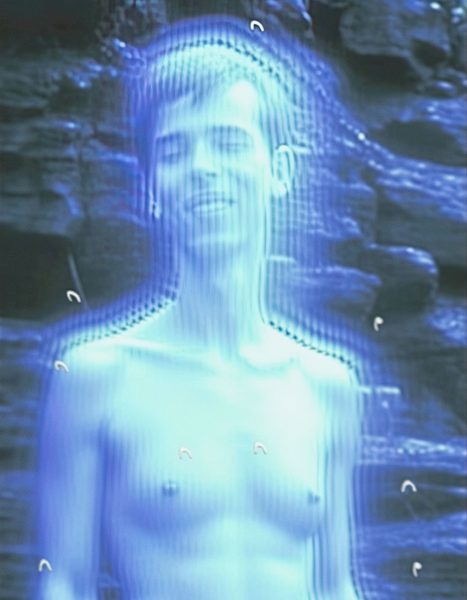
Adjacent to the two works hang Charlie Engman’s photographic interventions. Using a digital software to transform prompts into a visual death-vocabulary of sorts, Engman transforms the concept of digital death into a consumable photograph. Resulting in a visual representation of the separation of the spirit and the body, he captures the spirit of the deceased in an eerie image. The photographs incorporate glowing hazes of light, bodies morphing into a digitized abstracted representation. This transience is scattered with imagery of white avian parts such as feathers and wings, bringing in a heavenly sense to the ghostly photographs as seen in Owl Gate (2023).
Charlie Engman, Halo, 2023. AI-generated image on archival foam
The next room is dedicated to Russell Perkins’ sound work, The Future Tense (2021). A conceptual auditory experience, it plays an AI-intervened version of Johannes Ockeghem’s Requiem from 1460, a polyphonic mass commonly associated with religious, funerary practices. Using an AI software, Perkins incorporates “mobility insights” from data tracking movements of populations during the pandemic. Most impactful in this sound work is the extended rest, a period of no sound, referencing the lack of data and movement. The visitors are invited to seat themselves on muted blue chairs, taking the appearance of benches found at airport gates. The clinical, empty walls and off-white colour of speakers interact with the airport chairs to create a space of transience and unsettlement, referencing the in-between state of the digital presence of a deceased person.
Russell Perkins, The Future Tense, 2021, sound work, speakers, airport chairs
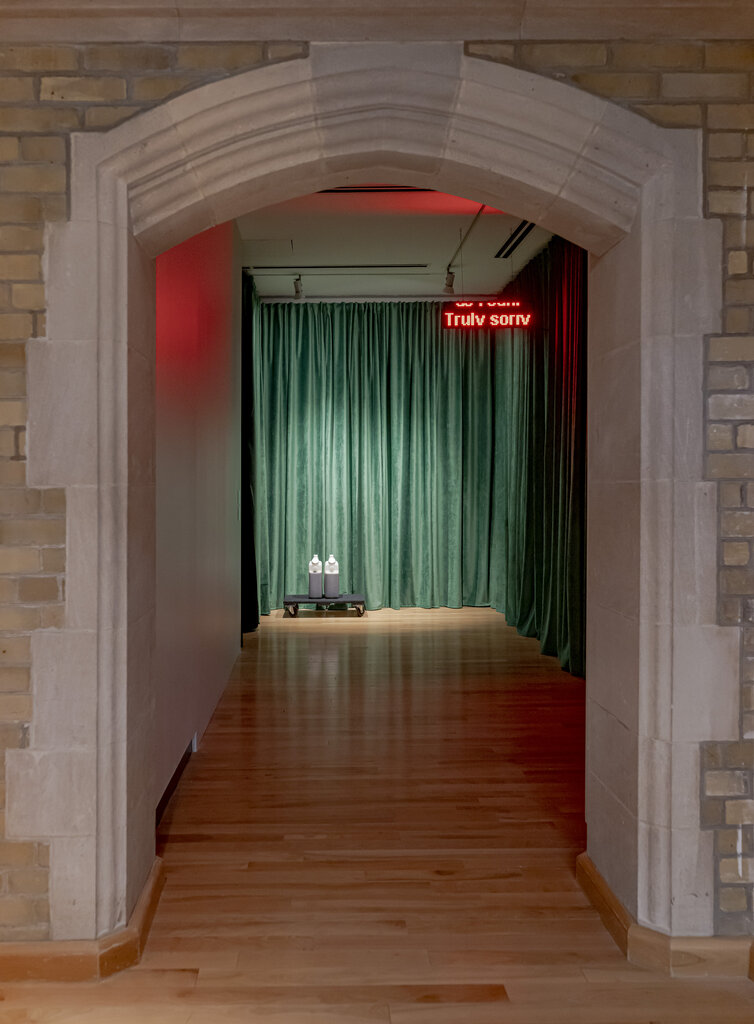
The next two works are located in a room whose walls are draped with thick, forest green curtains. As the viewer steps in, the coldness of the previous room is juxtaposed with this lush, intimate parlour, an installation by Common Accounts, a duo composed of Igor Bragado and Miles Gertler. You’re Well Liked in Your Community (2023), a multi-media installation features two plastic jugs of alkaline hydrolysis fluid remains, placed on a rolling platform and illuminated by a spotlight. In the top right corner hangs a red LED sign from the ceiling with text taken from YouTube comments and “death-care industry slogans” scrolling across the screen. Common Accounts is investigating the digitization of memorialization through virtual afterlives and caring for one’s digital presence post-death. Essentially, one’s presence exists on in the cloud, making it a quasi-digital heaven, or afterlife. The plastic jugs reintroduce the body, the physical, to this digital death concept and present an alternative to body disposal services, emphasizing the transference of oneself from their physical state to a digital one. The LED sign brings in notions of memorialization and the digital space as a site of information, and data, a continuation or prolongation of digital life activated by mourners.
Common Accounts (Igor Bragado and Miles Gertler), You’re Well Liked in Your Community, 2023. Multi-media installation, alkaline hydrolysis fluid remains, heavy duty polyethylene, curtains, single-colour LED sign.
The conclusion of the exhibition is a video by Oreet Ashery, Revisiting Genesis – Episode 8: Bambi, Death Online (2016). The notion of memorialization is continued in this web-series documentary of the management of the digital self after death. Ashery presents services that capitalize on the distribution of messages from a deceased person’s digital self. This commodification of memory exemplifies our society’s progression to a world where the self does not stop with the physical, rather transcends corporeality and exists digitally, therefore companies must capitalize that realm of existence as well.
Tumbling in Harness successfully confronts online death through its diverse works that engage with the digital at the same time as critiquing the progression of our society. This exhibition answers the question “what happens when we die” and presents new avenues to explore surrounding death, such as digital memorialization, anti-corporeality, and capitalistic control over death. This exhibition leaves a lasting impression promoting the contemplation of the intersection of (im)mortality and the digital realm.
Nina Ankisetty
All images Installation view: Tumbling in Harness / Group exhibition, May 3–July 22, 2023, Art Museum at the University of Toronto. Photo: Toni Hafkenscheid. Courtesy of the Art Museum at the University of Toronto.
*Exhibition information: Tumbling in Harness, May 3 – July 22, 2023, Art Museum at the University of Toronto, Justina M. Barnicke Gallery (in Hart House) 7 Hart House Circle, Toronto. Museum hours: Tue, Thurs, Fri, Sat 12 – 5 pm, Wed 12 – 8 pm.
Installation view of All that Glitters Isn’t at Myta Sayo Gallery
Light, as much as colour and form, is central to Kal Mansur’s art. The glow of reflected colour, the diffusion of detail through translucent surfaces, as well as the play of shadows are all integral to the impact of his work.
Kal Mansur, Search, acrylic on panel 30″ x 30″ – two views
In this new series, Mansur distills the interplay of light and surface to a succinct, minimal expression. The work in the exhibition All that Glitters Isn’t consists of glossy, gold-coloured panels. On first impression, the surfaces appear to be divided into geometric fields of varying shades of gold, some more yellow; some more brown. But move around and you will see the lighter and darker areas swap places. The colours shift depending on your point of view and the angle of light. Move in close and you’ll notice that the sharply defined geometry is textured with prominent brush marks. You’ll also notice that the paintings are completely monochrome. The appearance of different shades is solely due to the textured surface.
Installation view of All that Glitters Isn’t at Myta Sayo Gallery
The materials used are conventional. Acrylic paint is applied to birch plywood panels with a large, course bristled house painting brush. The resulting deep grooves create surfaces that reflect more light perpendicular to the brush strokes and less light in other directions. When light strikes parallel to the grooves, the surface appears darker; when the angle of the light is perpendicular, the surface is brighter.
The brush marks are varied due to the bristles of the brush and the movement of the artist’s hand resulting in a texture almost like wood grain. Mansur has employed a special formulation of acrylic medium to preserve the deep textures in the paint. Normally, it would be hard to maintain such depth of relief once the paint has cured. The various fields of paint are often separated by thin raised ridges which are the result of meticulous masking. There is an intriguing tension between the crisp, hard edge arrangement of the geometry and the looser, hand-crafted quality of the surfaces themselves.
Kal Mansur, Beacon, acrylic on panel, 30″ x 30″ (detail closeup view)
The shapes of the geometric fields invite an interpretation of perspective space within the image. But no single view is resolved. Whereas some elements suggest receding depth, other elements contradict this reading. We are left with a kind of fragmented space that folds back and forth and eventually leads back to the flat surface of the artwork.
Multiple views of Open, acrylic on panel, 48″ x 48″ x 2″
These paintings are difficult to photograph. Since the images change at every angle of view and variation in lighting, there can be no definitive photographic representation. It is impossible to capture in a single image the experience of seeing them in a room where you can move around and observe the changes. On the gallery’s website there are photos from multiple angles for each piece as well as videos which give you a good approximation of what the physical encounter is like.
Kal Mansur, Monument, acrylic on panel, 30″ x 30″
Modern abstract art has been practiced for over a century and yet it has more than its fair share of sceptics. On one hand there are the people whose ‘kids could do it’, and on the other hand critics who are more interested in the ‘cerebral’ intent than ‘retinal’ aesthetic experiences – to use Duchampian terms. For all these detractors, the belief is that abstract art came to a dead end long ago.
Scepticism is further fuelled by the fact that abstract art is hard to talk about. How much can you say that would be objectively true when the viewing experience is mostly subjective and specific to the person looking at the work? A viewer’s response is neither fixed nor universal, but rather elusive and open ended. There is no particular meaning to be decoded. The best approach to work like this is to ask yourself how it makes you feel, rather than what you think it means.
Kal Mansur, Beacon, acrylic on panel, 30″ x 30″
The intent of the abstract artist, the ideas that inspired the work, may remain hidden but this can open wider possibilities for the viewer. Mansur’s work draws on his personal background, but knowledge of his history is not required to engage with the work. What a viewer of the work gets out of it may or may not correlate with what motivated the artist. The ambiguity allows for a wider and more sustained engagement. As Kal Mansur says of his work, “If you just change the way you view something you might completely alter your perception of it.” Mansur’s ongoing technical and visual innovations demonstrate that there’s no imminent dead end here. So don’t give up on abstract art!
Mikael Sandblom
Images are courtesy of Myta Sayo Gallery.
*Exhibition information: Kal Mansur, All that Glitters Isn’t, May 15 – July 1, 2023, Myta Sayo Gallery, 1518 Dundas St West, Toronto. Gallery hours: Wed – Sat 12 – 7pm.
Gallery Arcturus is a not-for-profit contemporary art gallery and education centre on Gerrard Street East. Housed in a more than 150-year-old building, nestled amid, and somewhat obscured by, newer, taller buildings, the gallery offers a space to contemplate what may otherwise go unnoticed in the busy urban landscape.
Those who visit the gallery are encouraged to witness the whole process of presentation, exhibition and exploration. The Scotiabank CONTACT Photography Festival show in the Genesis Gallery is curated by Deborah Harris, aiming to create a series of exhibitions that flow between the two rooms. This place appears to me to be the perfect home for Gustavo Jabbaz and Joachim Oepkes’ joint show—Looking for Sky and Stilled Moments as both artists are deeply rooted in their experiences of life in the city.
Over the years, Gustavo Jabbaz has developed a unique style of urban photography. In his own words, he finds a spot that appeals to him and amplifies it across the viewers field of vision. Instead of capturing space in a particular moment in time these images capture time through a particular space.
Gustavo Jabbaz, Looking for Sky, Panel 3
Stepping into the gallery the piece that captures our immediate attention is a sixteen-foot collage of buildings around the city—an almost recognizable stretch of the downtown core that has never existed. The images are presented in an arched shape reminiscent of renaissance chapels, but the effect is closer to Gaudi’s work—pulling the viewer into a manufactured environment around us. In its own distinctly urban way this artwork imitates a canopy of trees refracting light in a way that has been scientifically considered by the artist. The composition itself covers an entire wall of the gallery giving viewers the perspective of lying in the middle of a downtown road. While moving around the room, the piece seem to be playing with our senses and our perception of proximity.
Installation view of Gustavo Jabbaz, Looking for Sky
Across from this photograph, images of pedestrians printed on transparencies are hung. The building in these images becomes a faint whisper around the people passing through these urban places—the temporary becomes the central point. This focus on movement and the momentary is further emphasized by the ability of the panels of the collage to move within the space.
Installation view of Gustavo Jabbaz, Looking for Sky
Stepping through a doorway into the next room you enter a ‘gallery of faces.’ Joachim Oepkes has three installations on display as part of his series, Stilled Moments. His work, as he says, appropriates images he finds around world and then pulls them out of context; forcing the viewer to create their own interpretations and re-examine their knowledge. Two of his pieces are from a recent trip to London, England.
Installation view of Joachim Oepkes, Stilled Moments, Faces
Another shows a pandemic narrative of Toronto, filtered through several lenses and then presented back to us, creating a sort of visual broken telephone and challenging our understanding of collective narratives.
Joachim Oepkes, Stilled Moments, Face the Truth
When walking through the gallery he told me about his trip to the final resting place of many Knights Templar, the inspiration for his artwork Grotesques. He was looking at the graves when he noticed distorted, agitated sculptured heads staring out at him from the walls—representations of a purgatorial state. This story, among other pieces of his art, illustrates how our perception is shaped by narratives.
Joachim Oepkes, Stilled Moments, Grotesques
Jabbaz and Oepkes give us images of everyday city life, stretched and sorted in ways that challenge our habits of engaging with the world around us. Instead of following the narrative placed before us we must interrogate it in different ways. Together these bodies of work make us think about our own perceptions and presumptions. How can we find clarity in a world of constant motion?
Lily Scriven
Images are courtesy of the artists
*Exhibition information: Gustavo Jabbaz, Looking for Sky and Joachim Oepkes, Stilled Moments, May 6 – June 24, 2023, Gallery Arcturus, 80 Gerrard St E, Toronto. Gallery hours: Tue – Sat 12 – 5:30pm. The exhibition is part of the Scotiabank CONTACT Photography Festival
To celebrate its new location, the Sculptors Society of Canada hosted its inaugural exhibit On New Groundon May 20th at 18 Gristmill Lane in the Distillery District. The show brings together twelve artists with different approaches to sculpture, using ceramic, wood and bronze, and acrylic. I was fortunate to get to chat in detail with two artists about their work at the opening reception.
Window view of On New Ground with sculptures of Edward Falkenberg (left) and Camie Geary-Martin (right). Courtesy of the Canadian Sculpture Centre
Judy Raymer Ivkoff’s work investigates the unbridled energy that exists in natural materials like limestone. In Root Force, Ivkoff uses the remnants of bronze castings she discovered in the dumpster outside Central Technical School in Toronto. The cast-offs, known as vents and spews, she tells me, have acquired incidental texture from failed castings. She tells me about travelling in Algonquin and observing the way roots force their way through rocks, causing them to crack and splinter, laying net-like patterns across their surfaces. The castaway pieces of bronze resemble these thick, bursting roots. “Energy, energy, energy” — she says. Ivkoff uses a singular block of limestone that she has cut into three sectors in Root Force. When looking at the sculpture, viewers can sense the energy that vibrates between the separate parts of the whole as they balance on top of one another, hovering over each other. She tells me that as a practice, sculpting requires the engagement of the whole body. Physical strength is required to work a drill press. Mindfulness is also involved as the soul becomes imbedded in the work throughout the process of creation. Other than the necessary drill press, Ivkoff believes in filling her studio solely with hand-held tools. The softly etched limestone lends a contemporary feel to her work, and yet we can feel that something ancient is hidden in her sculptures.
Judy Raymer Ivkoff with her sculpture Root Force, bronze and limestone (above) and details of Root Force (below). Photo: Shakuntala Fernandopulle
Where Ivkoff draws from nature, Gordon Becker’s work reflects a personal narrative. Dance of Generations is a wood sculpture that commemorates Becker’s mother who passed away. Becker hoped that the work would capture his mother’s strength and grace. As he lovingly carved his mother’s face from the wood, he began to see his sister, and then his niece — hence the title. The work is dynamic, as Becker follows the grain of the wood in connecting multiple pieces together to articulate movement. The woman is depicted in motion as her body leaps gracefully over a dance bar, representing her passing from one phase of life to the next. Becker allowed me to touch the work, feeling the soft texture of the wood. He includes every texture of his mother’s skin, the way her flesh softly folds around her wrist where her hand clutches the bar and where her ankle touches the bar ready to leap over.
Gordon Becker with his work Dance of Generations, wood, pigment, steel, stone (above) and details of Dance of Generations (below). Photo: Shakuntala Fernandopulle
Barbara Fletcher’s work, a strikingly blue duo of acrylic sculptures, dazzles in the light that streams in through the windows of the Sculptors Society’s new gallery space. The pair seem fluid as we view them at different angles, the oxygen bubbles in them seem to move and bob through the sculptures. Streaks of blue dye shoot through the figures.
Barbara Fletcher, A Complimentary Couple, handcast acrylic. Courtesy of the Canadian Sculpture Centre
Other artists in the show included Sunmi Jung, Saulius Jaskus, Marlene Kawalez and Dina Torrans’ powerful creations. Arranged on white plinths across the room, On New Ground casts an array of themes, like various episodes of human existence, in and around nature and family lives.
Marlene Kawalez, Hunter, Raku clay, mixed-media. Courtesy of the Canadian Sculpture Centre
Dina Torrans, Dreamscape, steel. Courtesy of the Canadian Sculpture Centre
The Sculptors Society of Canada believes in fostering dialogue between “the art and non-art” community, and with its new location at the heart of the Distillery District, you can feel this ethos fully come to life. Guests flooded in, intrigued by the sculptures in the window display, discussing the sculptures among themselves, chatting with the artists, and leaving with a new understanding of contemporary sculpture — I know I certainly did.
Shakuntala Fernandopulle
*Exhibition information: On New Ground / Group exhibition, May 20 – June 16, 2023, Canadian Sculpture Centre, 18 Gristmill Lane in the Distillery District, Toronto. Gallery hours: Tue – Sat 11 am – 6 pm, , Sun 12 – 5 pm.