Author: artoronto

  • Two Shows at the Plumb Gallery

    If you want to know what art is emerging, you can do no better than to visit the Plumb Gallery. Mind you, its opening hours are limited to the weekends and it’s tricky to find. It is located in a basement whose entrance is in an alley of Dufferin Ave, on the east side just south St Clair Ave West. All told, this collective, who regularly curate shows of artists who submit their work by open invitation, is deservedly garnering attention. It’s a venue that is invariably brimming over with engaging art.

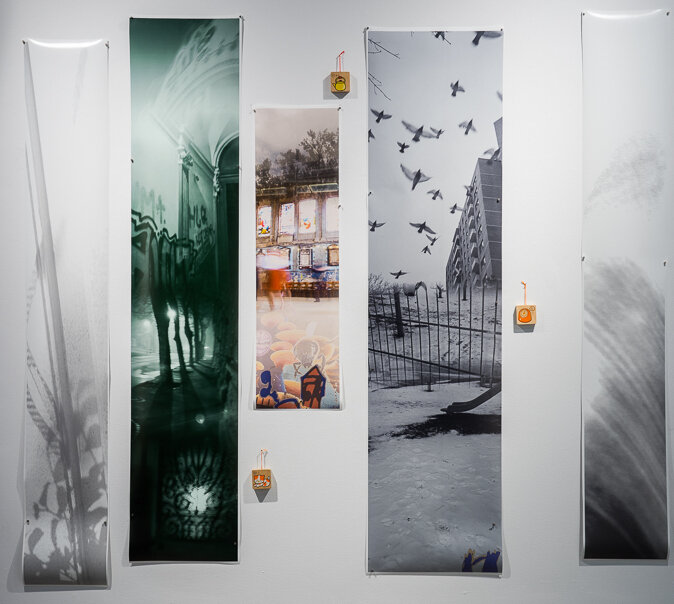
    The gallery’s existence is testament to the sheer number of serious emerging artists to be found in the Toronto area, that is, artists who are highly trained, ambitious and disciplined. Currently on the menu are two separately curated group shows. One is titled Line Tracing, Shadow Chasing, curated by artist Amanda Boulos (one of the fifteen members of the collective), that features five artists: Mary Dyja, Leila Fatemi, Nicole Ji Soo Kim, Sukaina Kubba and Metha Oz. The other, titled House of Mirrors, is curated by Erin Storus, and features the works of two artists: Sophia Escobar and Brett Eduardz.

    In her introductory remarks Boulos laments what she calls ‘the growing obsession with material goods’.  She intones that making art is an antidote to this materialism. While the concerns of the five artists in the show are disparate, their work shares a certain aesthetic. Many of their pieces can be charitably construed as drawings, using a variety of materials. For instance, Kubba’s wall pieces are made from PLA – a biodegradable industrial plastic-like substance. Mary Dyja’s chosen material is discarded fabrics, which she has used to construct an installation inside a closed-off stairwell.

    Mary Dyja, Installation with Viceral and Vine, 2023, recycled crochet yarn and wire, variable sizes

    Overall the work might be described as prosaic, both in look and materially. In this way it is reminiscent of much of the artwork produced by the arte povera movement. The  most colourful work is Fatemi’s temple-like construction, Common Thread, which features vintage postcards of religious buildings with geometrical designs stitched into them using coloured thread.

    Leila Fatemi, Common Thread, 2019-ongoing, vintage postcards with embroidered details

    My emotional response to the show was somewhat muted. While beauty can often be found in the unembellished, it seems to me that it is not the primary concern of most of these artists. Yes, much of the work is engaging on an intellectual level, but little of it excited me visually, sensuously. That is not to suggest that the works in this show are ugly. Rather, overall they are aesthetically underwhelming. But one thing I have learned is that beauty, by virtue of its senusuous basis, is generally regarded as anti-intellectual.

    This prioritising of the conceptual over the sensuous is indicative of the materialist culture that Boulos, ironically, laments. Consumerism, as the grounds for materialism, thrives on turning cultural products into consumables. This is best achieved by making their production as easy as possible. The coup de grâce in this respect was Marcel Duchamp’s ready-mades, namely, the deployment of everyday products as artworks. Famously, he presented a signed urinal in an exhibition in New York. Later we had the example of Andy Warhol’s Brillo boxes. (In this show we have Oz’s band aids, for instance.) This banalisation, critic Arthur Danto has suggested, tells us that what qualifies as art is not determined by its intrinsic properties. Anything can be art, so long as it is sanctioned by the art establishment. The broadening of art to include almost any object leaves little room for judging artworks in aesthetic terms.

    Metha Oz, Where are you From?, 2021, plexiglases, band-aid, ink (by self-inking toy stamps), 16.5 × 5 inches

    This banalisation of art production naturally leads to the banalisation of artistic ideas. It has signalled a move away from a religious or spiritual attitude towards art-making, replaced by a set of more prosaic concerns. That is not to suggest that the subject matter of each one’s work is trivial. Ji Soo Kim’s work Hatching amid my own exhaustion, we are told for instance, concerns her working through her mourning the loss of two of her family members. My point is that current art practices lead to making art that lacks spiritual depth. Now of course, society as a whole tends to dismiss the very idea of the spiritual or the soul. Such talk is regarded as romantic claptrap. This attitude, however, simply reflects the materialism of which we speak.

    Nicole Ji Soo Kim, Hatching amid my own exhaustion, 2022, mixed media, paper, Graphite, 3 x 5 ft.

    There is nonetheless beauty to found in this show. Kubba’s piece La Brioche, for instance, has an understated visual impact.
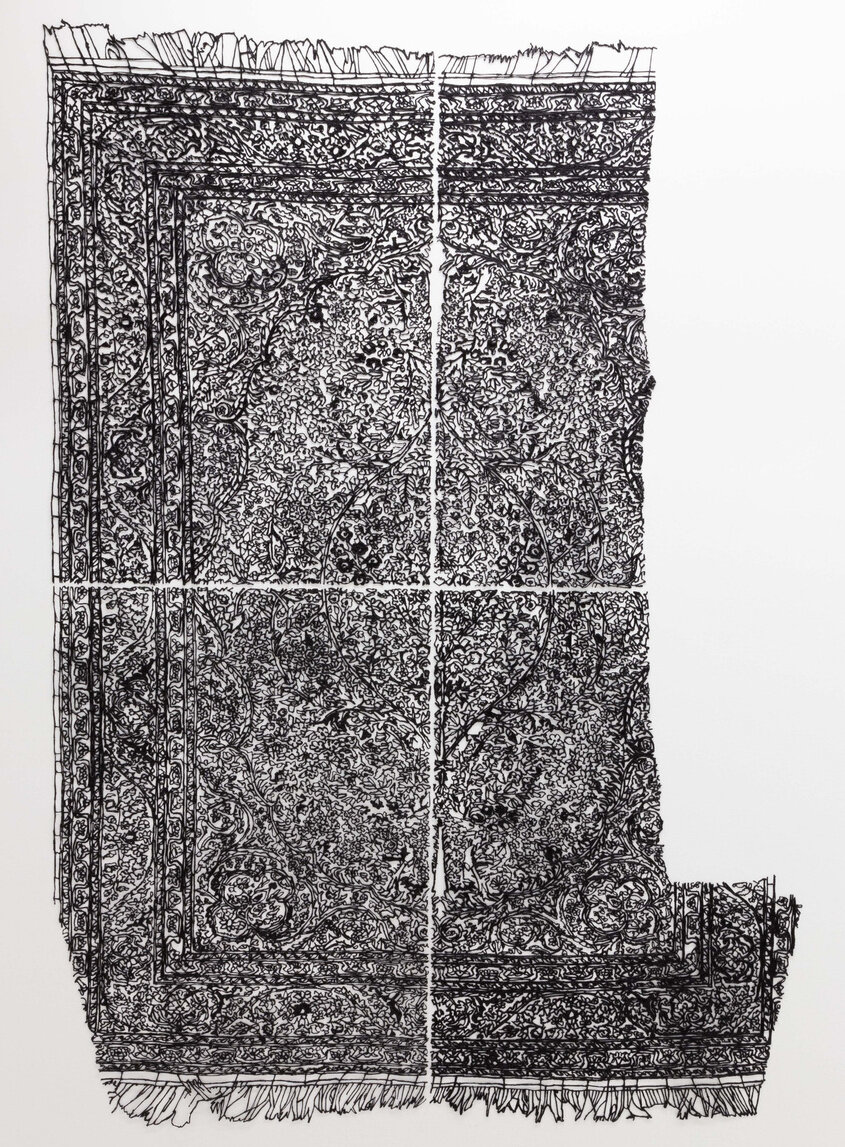
    Sukaina Kubba, La Brioche, CMC, 2023, hand-drawn with PLA filament, 44 x 66 inches.

    Most of the artworks on display in Storus’s show, House of Mirrors, can be described as beautiful. Beauty, I aver, concerns that which is sensuously captivating, engaging. As an end in itself it leads to prettiness, a quality in nature that can be described  as ‘look-at-me’, as with a flower. But in art it can also be a vehicle for expressing the spiritual – carrying us elsewhere. Eduardz’s abstract paintings are visually engaging. Some are reminiscent of the works of Vasily Kandinsky and Joan Miró. These works are very playful and deftly executed. That said, they tend towards stylistic pastiches insofar as he makes no effort to extend their practices. Storus suggests that underlying the work is a prefiguring of content by form, but I’m not sure what she means by this. Escobar has produced a series of eye-catching hanging scultpures made of thread. Artfully illuminated they cast ghostly shadows on the walls. They have a quiet presence that is calming.
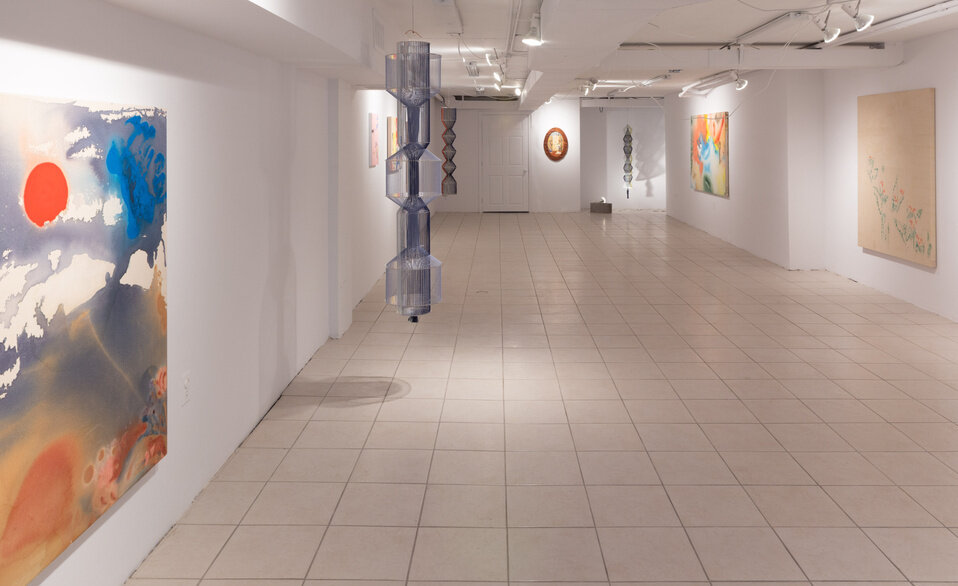
    Installation view of the House of Mirrors exhibition

    Hugh Alcock

    Images are curtesy of The Plumb Gallery

    *Exhibition information: Line Tracing, Shadow Chasing and House of Mirrors, April 29 – May 28, 2023, The Plumb Gallery, 1655 Dufferin Street, Toronto. Gallery hours: Sat – Sun 2 – 5 pm.
  • Spectra 2023

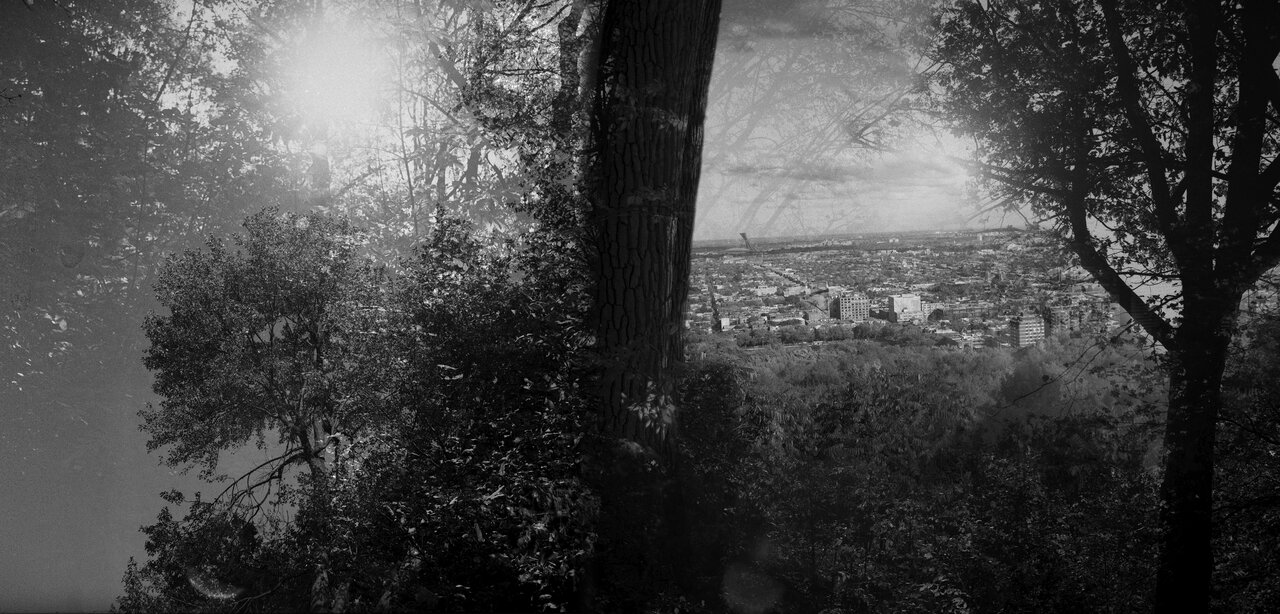
    Spectra has been an active part of the Scotiabank CONTACT Photography Festival since its inception, highlighting the work of members of Gallery 44 Centre for Contemporary Photography. By focusing on the collective, rather than any given theme, the exhibit allows each artist to share projects they are passionate about. This year’s exhibition features 23 artists at Artscape Youngplace. 

    Emma Juliette Sherland’s subtly manipulated photo series about the pulling apart and coming together of internal and external worlds is called Collision. To me, collision became a central idea weaving its way through the diverse images in this show. In unexpected, thought-provoking ways, these artists explore the different ways we tie all the little moments of life together—how we tie ourselves to a place, to an object, to another. Each of these explorations has its own distinctive perspective, but there is a shared recognition of continued motion. The photographs depict the constant collision of individuals, ideas and perspectives—some harsh, some gentle, some fiercely intimate. Each of these moments of contact creates spaces for conversation. Sherland’s works highlight the fear of, and the longing for, that separated, isolated place. Lilianne Schneider finds peace and beauty in a similar setting. The two artists are presented together, but not in direct relationship to one another, creating a delicate balance, as well, as some contradictory elements.

    Emma Juliette Sherland, Collision (Left), 2020, laminated matte print on Dibond, 24″ x 48”

    Lilianne Schneider: Time Capsule 4, 2022, digital print w/ museum glass, 20″ x 13.25” framed

    Throughout this exhibition, we see the artists entering into new and familiar worlds while trying to situate themselves within a larger context. Zoi de la Peña revisits her grandfather’s home in Alexandria, presenting images that capture both distance and intimacy. David Scriven visits places where his family once lived, searching for some indication of their presence.

    David Scriven, This is where he lived, 2022, Inkjet on archival matte paper, 24″ x 24″

    Both Ana Šašić and Atia Pokorny try to capture not just memories but the feeling of memory itself through unexpected scenes of life. However static the image is, it seems to move like a carousel.

    Atia Pokorny, A look in between, 2023, archival print, 14″ x 18”

    Installation view with Ana Šašić’s work. Photo: Eric Garsonnin

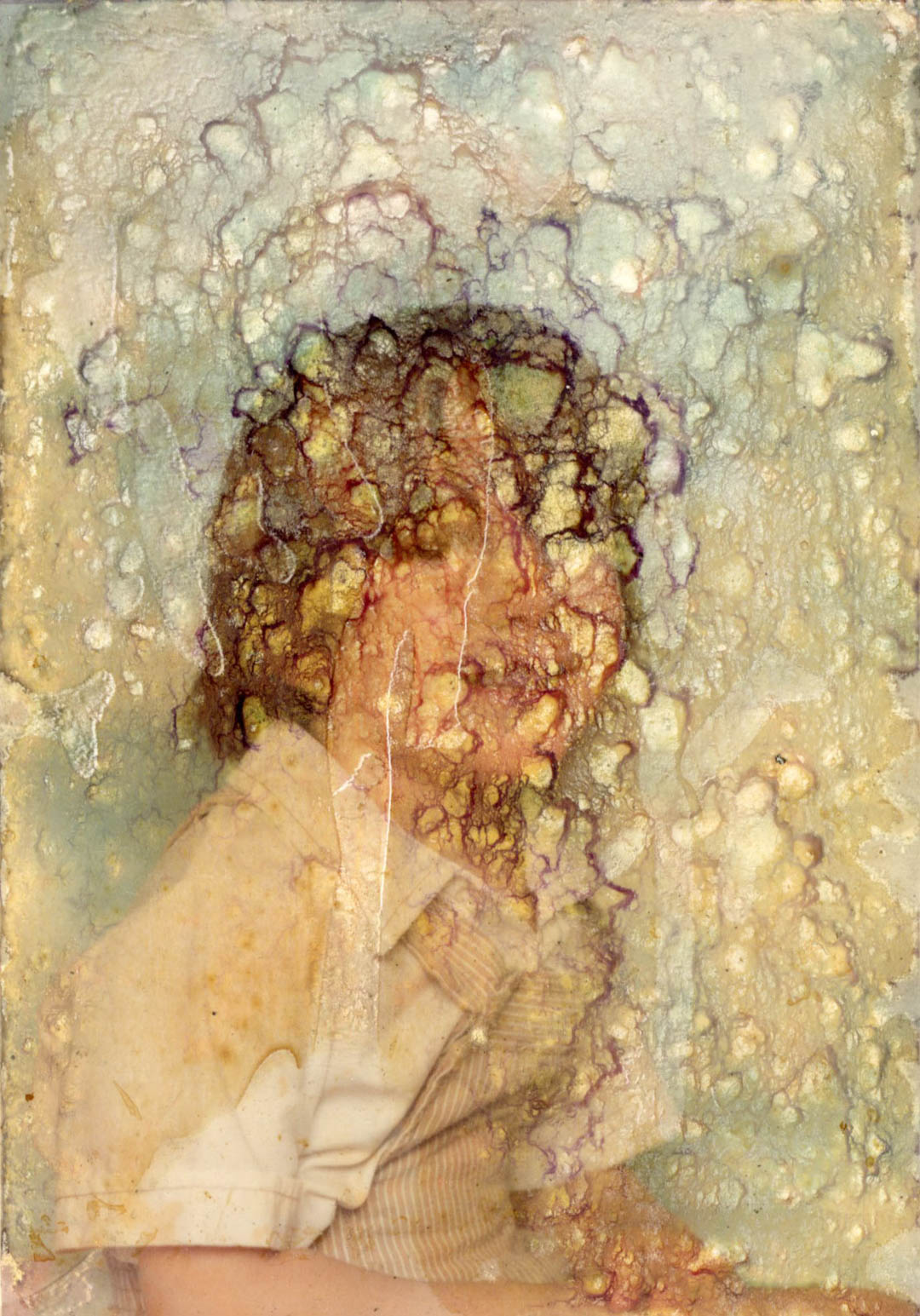
    This show also presents works about dreams and decay. Danielle Goshay’s images of waterlogged photographs capture both our desire to preserve time and the futility of these endeavors in a strikingly beautiful way.

    Danielle Goshay, Page of Wands, 2023 laser print, 11″ x 17”

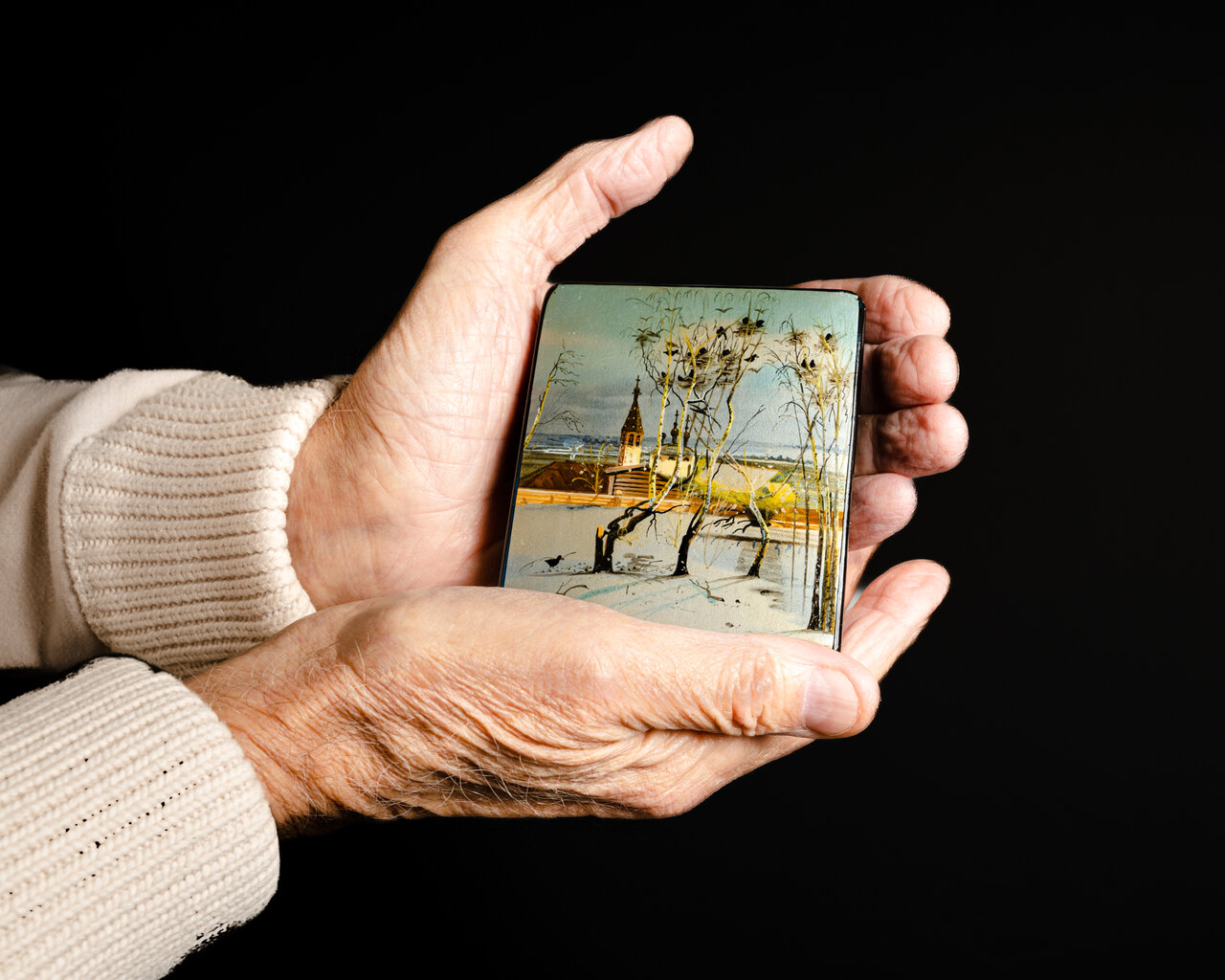
    Many of the photographs like Katherine KY Cheng’s musings on dreams, Changhao Li’s meditation on the transient nature of life, Huw Morgan’s depictions of hands holding objects with personal meaning—are revelations of things we cling to and offer up to the viewer through the lenses of portraiture. Together these artists create collisions like waves, an unending motion, that is almost impossible to capture.

    Huw Morgan, Lacquer box, 1700s, Fedoskino, 2023

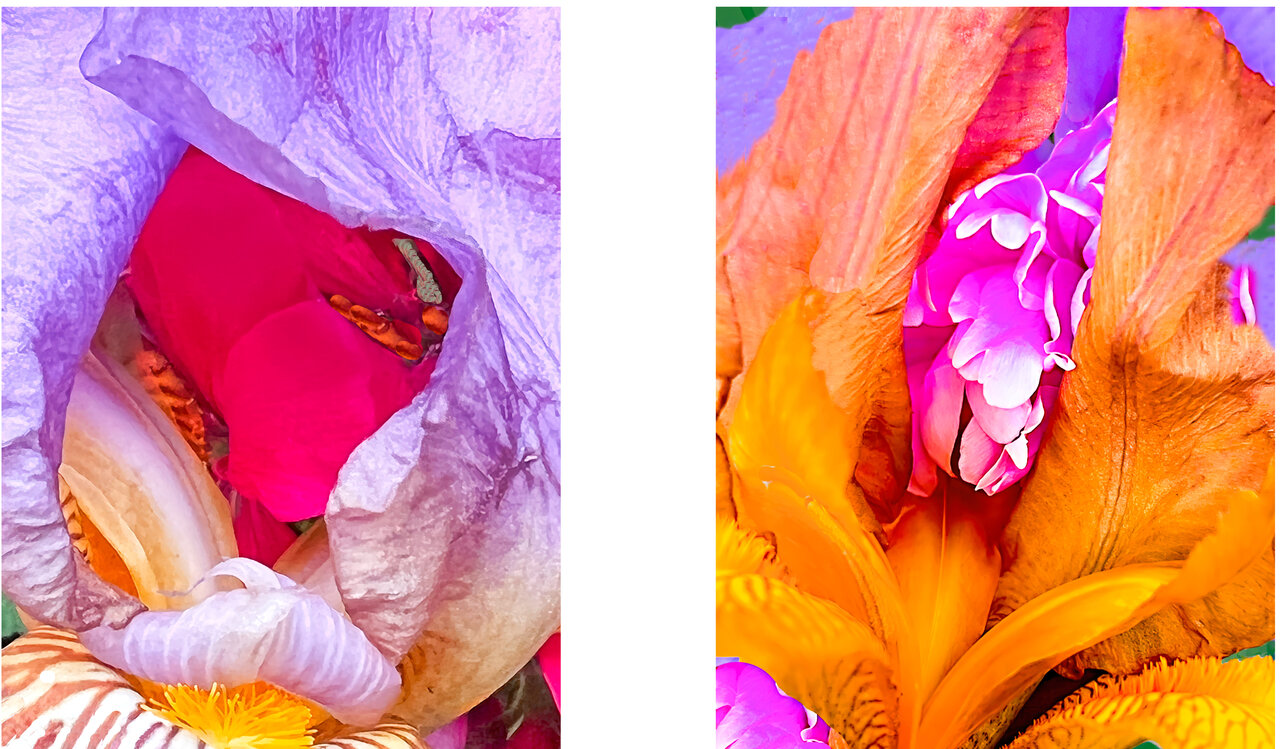
    Kye Marshall’s images are intimate depictions of irises and other flowers. As Marshall tells us, Iris, the messenger of the gods, leaves flowers in her wake. She also symbolically represents a link—between the real and the imaginary, the living and the dead. Laura Honsberger’s photographs of people screaming into each other’s mouths offer a delicate contrast of intimacy and defiance.

    Kye Marshall, Iris Intimates (ii), 2021, archival pigment print, 24″ x 17″

    In a description of their photographic method, Atia Pokorny draws our attention to the Czech word “momentka” meaning “snapshot”—a brief transient instant in time. Although a snapshot is a still an image, the English word “moment” comes from the Latin momentum—movement. Both parts that make up the word ‘snapshot’ also contain motion. Maybe it feels contradictory to look at something still—a moment forever paused—and see motion. For me, these still images will remain forever in motion.

    Lily Scriven

    Images are courtesy of the artists and Spectra

    *Exhibition information: Spectra 2023 / Group Exhibition, May 6 – 28, 2023, Artscape Youngplace, 180 Shaw St, Toronto. Gallery hours: Mon–Fri 9am – 5pm, Sat–Sun 9am – 6pm. The exhibition is part of the Scotiabank CONTACT Photography Festival.

  • Public Art at CONTACT 2023

    Interview with Heather Canlas Rigg (HCR), Artistic Director of Scotiabank Contact Photography Festival (CONTACT) about Public Art by Phil Anderson (PA)

    PA: This year the Scotiabank CONTACT Photography Festival has 21 Core Outdoor Installations. What has been the public reaction to these outdoor works in the past? Is this a growing trend?

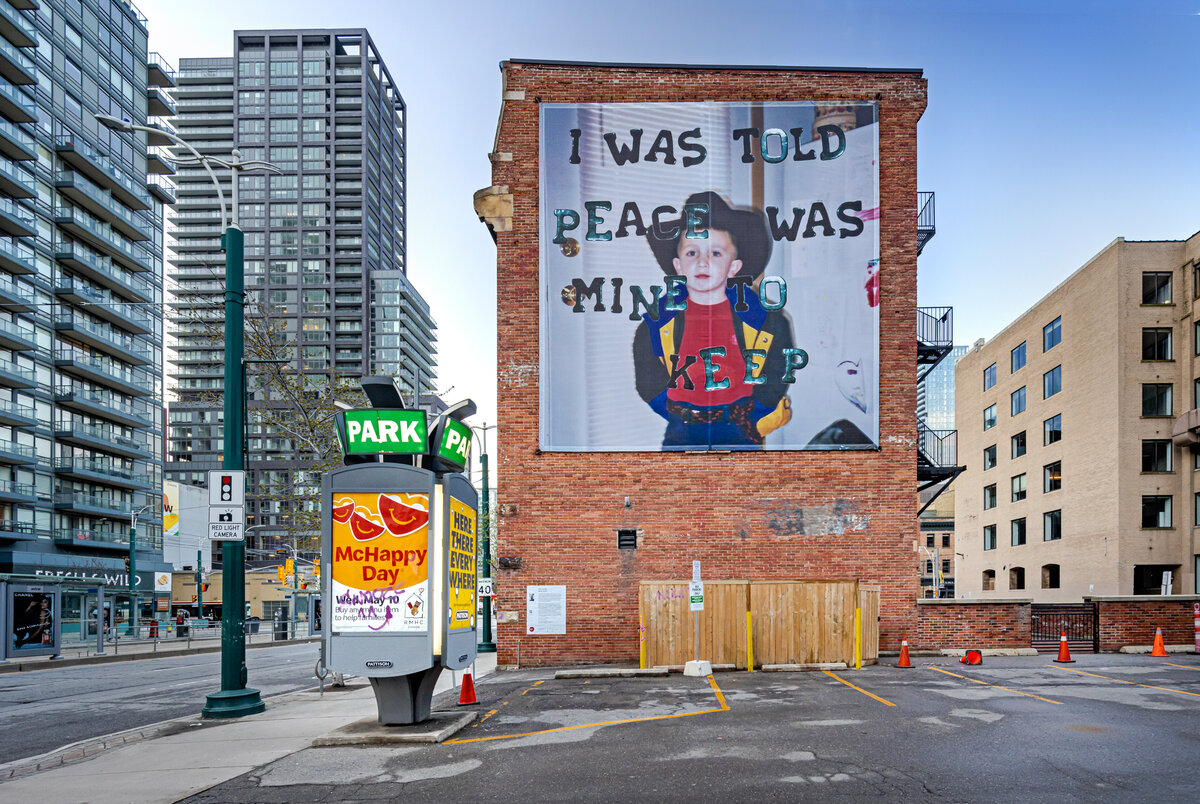
    HCR: This year marks 21 years of CONTACT’s public art program, and the response to our public installation program has always been really positive. It presents a unique opportunity to take over advertising space, such as billboards, and building facades, and to share artwork with the public. It’s a completely different conversation when working with artists to place their work within a public context, as it requires many nuanced considerations, and generates a particular kind of conversation with a public audience. This is in contrast to exhibiting art in white-cube-style gallery spaces, which garner specific audiences and therefore a certain type of experience.

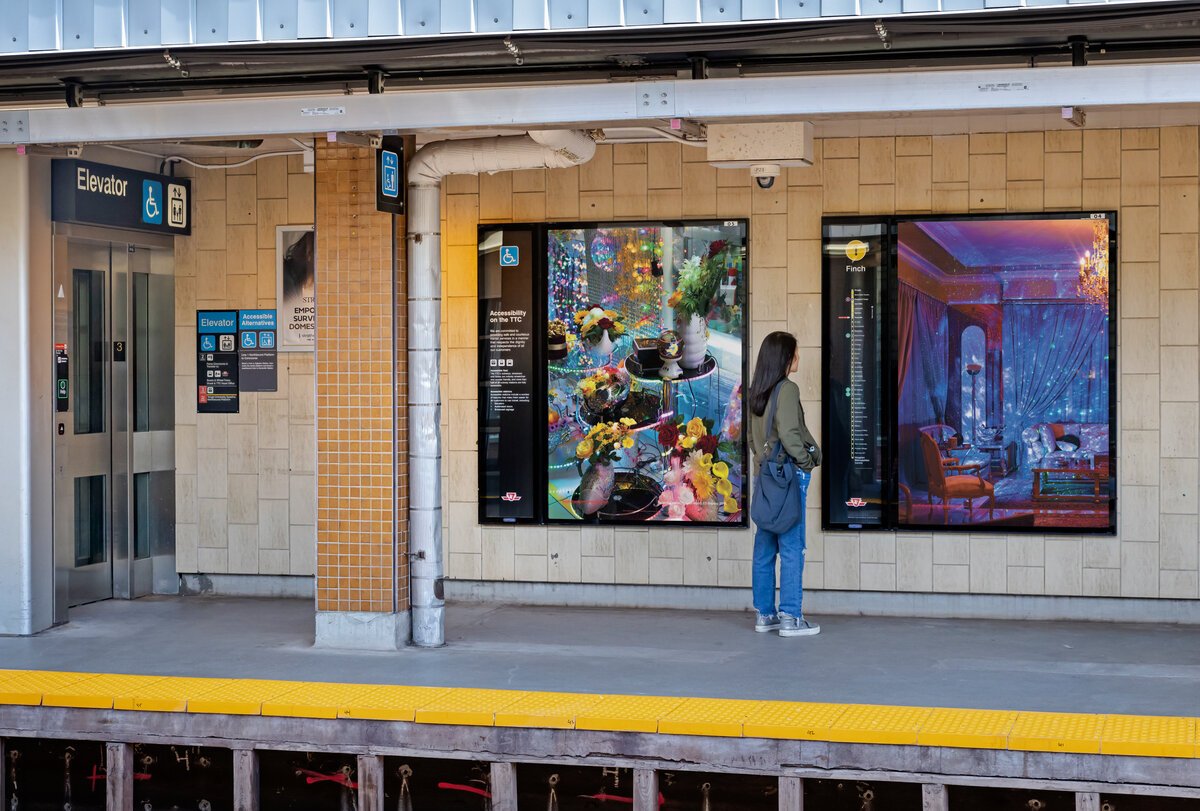
    Farah Al Qasimi, Night Swimming, 2023, installation view, Davisville Subway Station, Toronto. Courtesy of the artist and Scotiabank CONTACT Photography Festival. Photo: Toni Hafkenscheid

    I wouldn’t say it’s a trend, as artists have been using public spaces for a long time – there’s an argument to be made that artists have been creating public art for longer than gallery spaces have existed. Photography has changed the way images and art can be publicly viewed and contextualized, and artists taking over spaces traditionally consigned to advertisements and commercial concerns disrupts what viewers expect to see in that space.

    PA: How do you find artists for this program? Do you seek them or do they mostly apply?

    HCR: CONTACT and its guest curators seek out local and international artists whose practices could develop in new ways by being adapted to a public art context. It is important to CONTACT to continue to provide both artists and curators with the opportunity to work in a public setting, as it gives them the chance to think about how their work can be understood within new environments and contexts, and how it may be received by broader audiences than they are used to.

    Maïmouna Guerresi, Sebaätou Rijal & Villes Nouvelles and Ancient Shadows, installation view of the series Villes Nouvelles & Ancient Shadows, Aga Khan Park, Toronto, 2023. Courtesy of the artist and the Aga Khan Museum. Photo: © Salina Kassam

    PA: Are there difficulties with the logistics of these kinds of works?

    HCR: Thinking through how an artwork will be contextualized in a specific public setting is the first and most important step. I suppose this is more of a conceptual step than a logistical one, but in many ways, it is the most important one. As mentioned, the audience for these installations is the general public, not the art-seeking audience you get in a gallery context, because those viewers are choosing to go to see art. We have to consider how an artwork, which in our case is most often an image or a set of images, will be received by absolutely everyone! If folks respond negatively to a public art project, we have to think through what our response is, and take in this feedback to share with the artists, the curator, and among ourselves, to reference in the future and make sure that we take the most sensitive approach that we can, going forward.

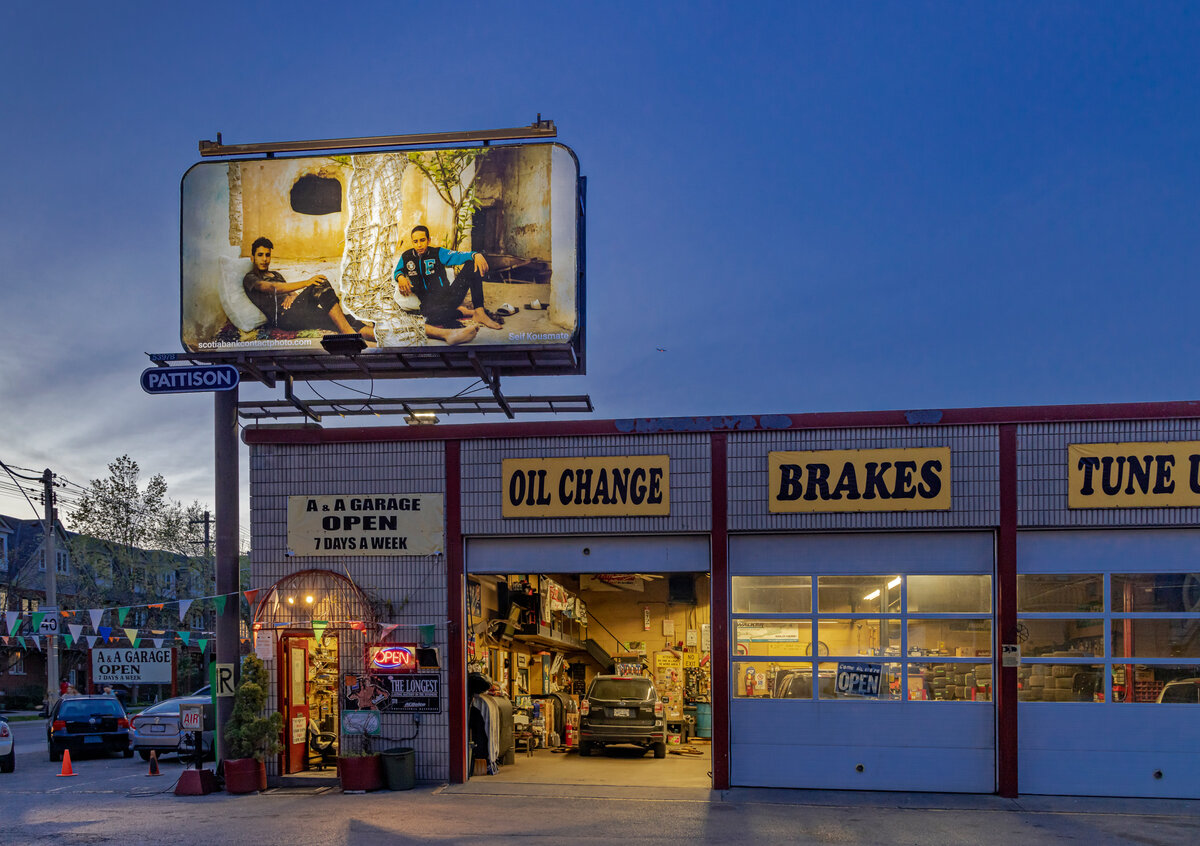
    Seif Kousmate, Waha (Oasis), 2023, installation view, billboards at King St W and at Strachan Ave, Toronto. Courtesy of the artists and Scotiabank CONTACT Photography Festival. Photo: Toni Hafkenscheid

    Another important logistical step is construction. Billboard projects are quite easy, in a logistical sense, because the infrastructure for installing two-dimensional images is already in place. When sculpture is being fabricated as part of an installation, or a structure is being built, we need to consult with engineers and installers to make sure everything will stay in place and that our projects meet public building codes. This is inevitably a long and complex process involving many parties.

    PA: Has this kind of public display added to the awareness of the Festival? How do you measure this?

    HCR: Our outdoor installations definitely increase our audience numbers and public awareness of the festival. The number of folks who see our billboard projects, for example, is unprecedented compared to the number of visitors who will go to a gallery. Most billboards have thousands of people drive, walk, or other, past them every day, so when our projects are on view for at least four weeks, the number of people we’re able to reach adds up very quickly, and exposes vast new audiences to artists’ work they may otherwise never have known of or have seen before.

    The impact is measured through various sources. Pattison Outdoor Advertising keeps track of how many people walk, drive, cycle, etc., past their billboards, so we receive data regarding the number of “viewer impressions” from them. We also have projects installed, for instance, along King Street West in the Entertainment District, and on the side of a building at King Street West and Spadina Avenue. The City of Toronto and specific property managers keep track of the various modes of public engagement and number of impressions at these and other installation sites across the city.

    Jake Kimble, Grow Up #1, 2022, installation view, 460 King St W, Toronto, 2023. Courtesy of the artist and Scotiabank CONTACT Photography Festival. Photo: Toni Hafkenscheid

    PA: How long has the Festival had the support of Pattison Outdoor Advertising? This must play a strong role in this part of the program.

    HCR: CONTACT has been working with Pattison for over 15 years, and they have been very supportive of the festival’s public art program throughout our partnership.

    PA: What draws curators to this part of the Festivals Program?

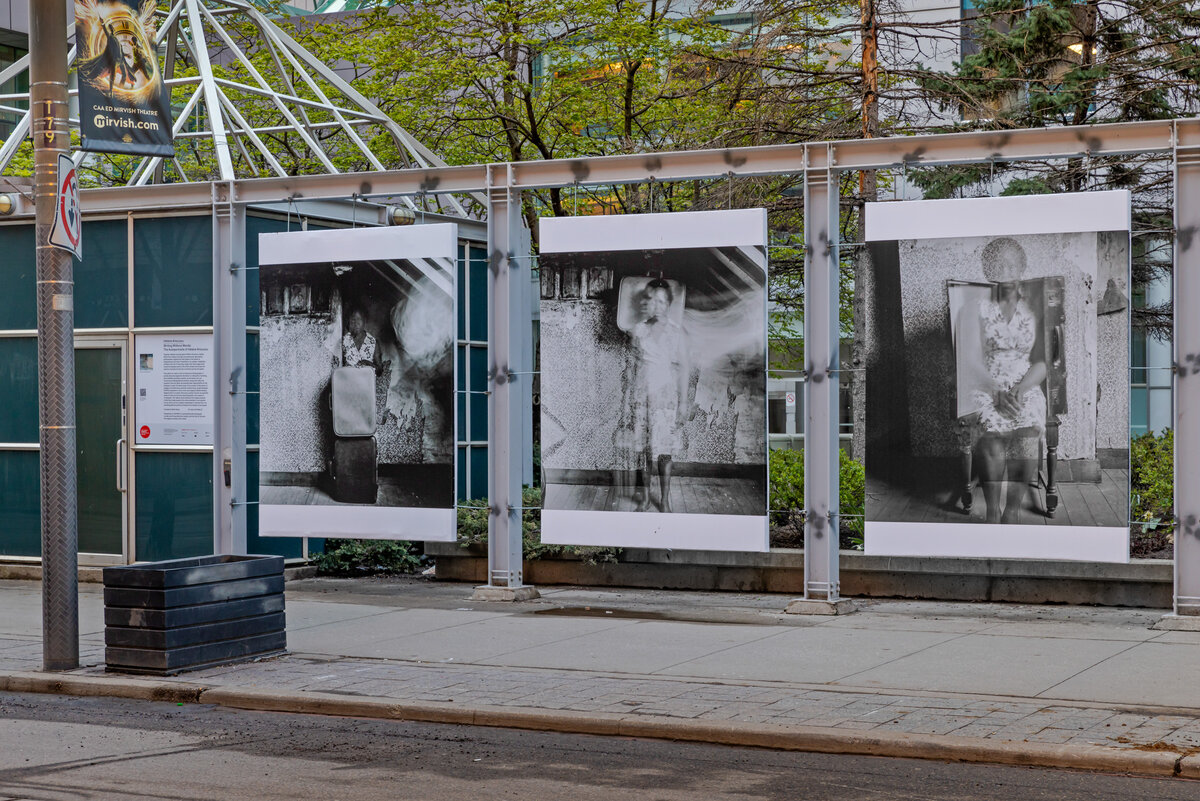
    HCR: Over the last few years we have been developing a more robust guest curator program for our public art projects. Through this initiative we invite selected local and international curators to work with us for three consecutive festivals. This brings new voices, both curatorial and artistic, to CONTACT. It provides curators with a unique and extensive experience, curating projects specifically for a public context. For example, London (UK)-based curator Mark Sealy, also the founder of Autograph ABP (Association of Black Photographers), has curated our 13-panel installation at Metro Hall (along King Street West) for the 2022 and 2023 Festivals.

    Hélène Amouzou, Writing Without Words: The Autoportraits of Hélène Amouzou, installation view, Metro Hall along King St W, Toronto, 2023. Courtesy of the artist and Scotiabank CONTACT Photography Festival. Photo: Toni Hafkenscheid

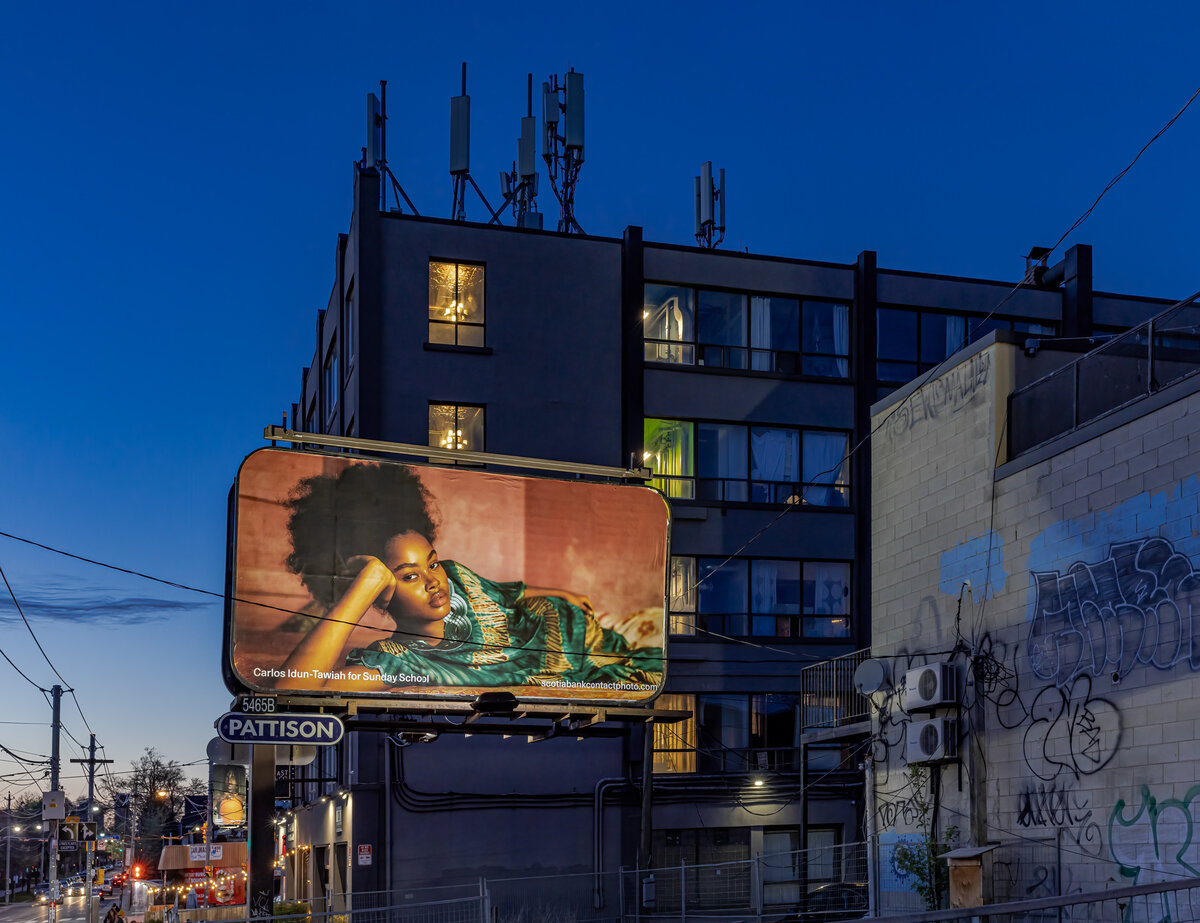
    This year he worked with Togolese-Belgian artist Hélène Amouzou, Toronto-based independent curator Emilie Croning, and Curatorial Assistant, Arts of Global Africa & the Diaspora at the Art Gallery of Ontario, worked with Sunday School, a creative agency that brings together the work of artists from Africa and its diaspora in a billboard project featuring six images at Lansdowne Avenue and Dundas Street West.

    Sunday School, Feels Like HOME, 2023, installation view, billboards at Lansdowne Ave at Dundas St W and at College St, Toronto. Courtesy of the artists and Scotiabank CONTACT Photography Festival. Photo: Toni Hafkenscheid

    PA: Is there a particular installation or work that is especially unique this year?

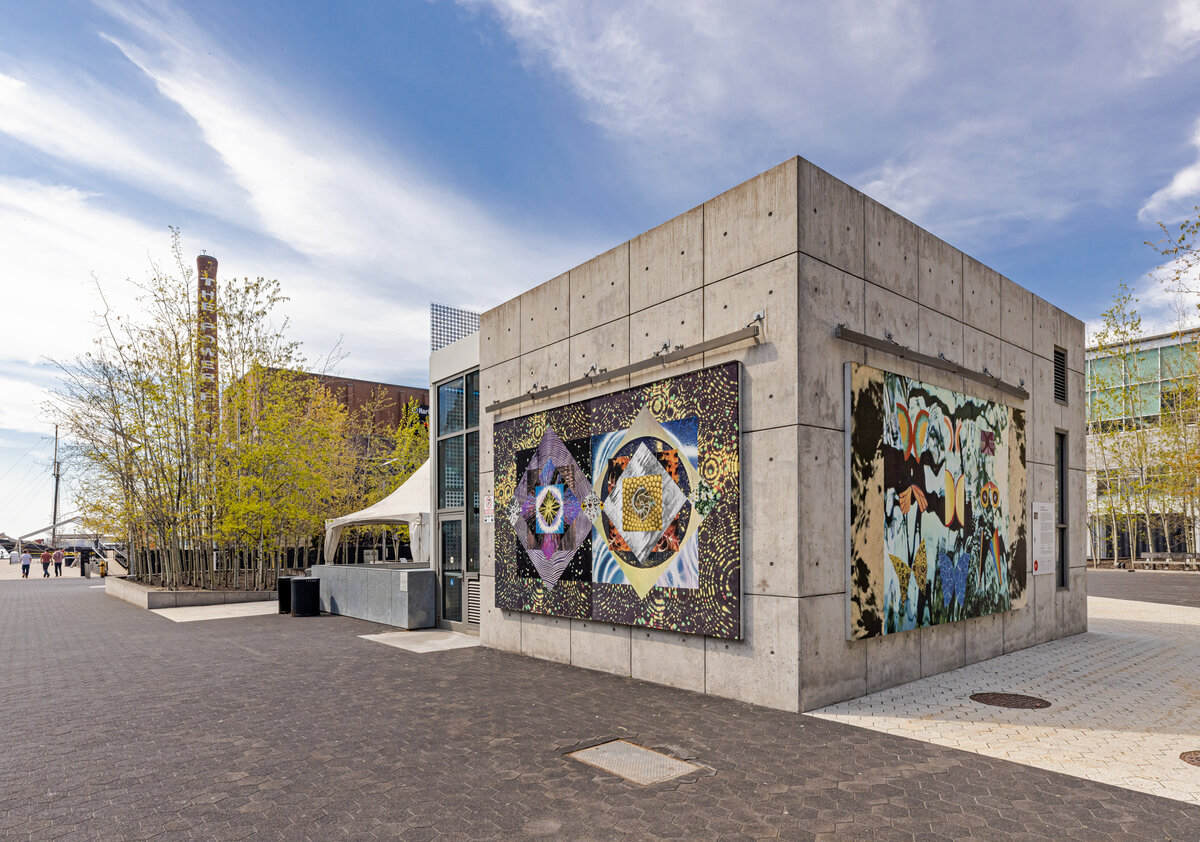
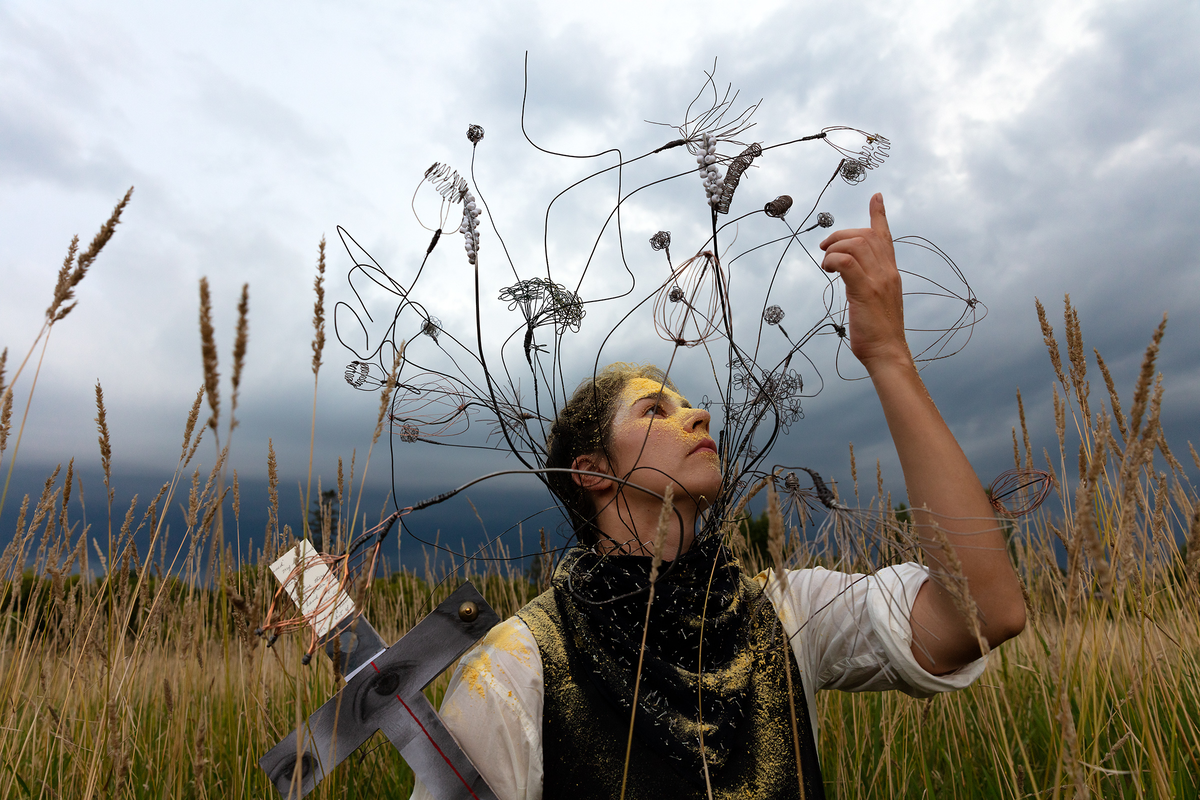
    HCR: Since they are each site-specific in some manner, each of our outdoor projects feel unique in their own ways. This year artist Maggie Groat’s work is on view in both indoor and outdoor settings. Entitled DOUBLE PENDULUM, her collage- and found-object-installation-based work is on view at CONTACT Gallery, and speaks to the artist’s interest in doubling, mirroring, collecting, and salvaging. Her two outdoor installations extend to multiple shorelinessouth of the gallery at Harbourfront Centre, three of Groat’s images are installed as wheat-pasted paper prints, eschewing the vinyl traditionally used for installations at this site. The images selected for this site speak to the human-altered waterfront of Lake Ontario. Northward, at the intersection of Dovercourt Road and Dupont Street, are two vertical billboards, which invoke a dialogue going back in time to the ancient glacial shorelines of the area.

    Maggie Groat, DOUBLE PENDULUM, 2023, installation view, wheat-pasted images at Harbourfront Centre parking pavilion, Toronto. Courtesy of the artist and Scotiabank CONTACT Photography Festival. Photo: Toni Hafkenscheid

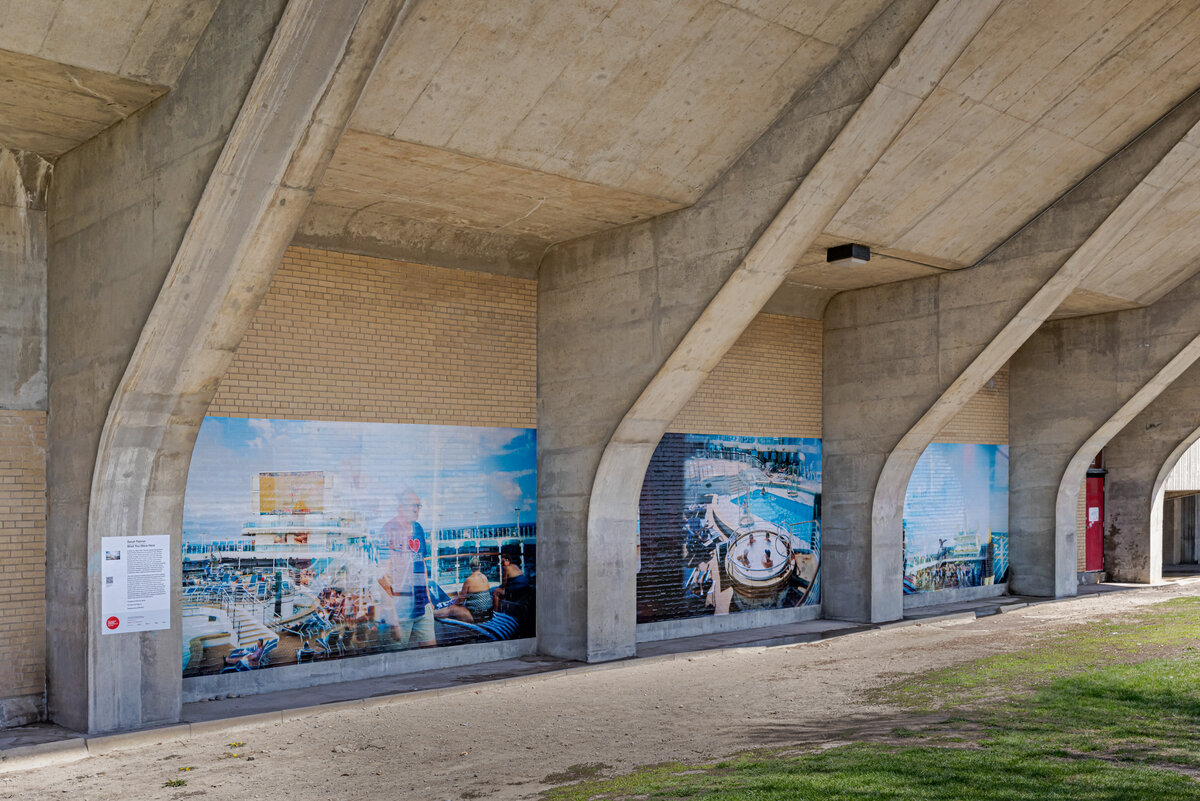
    We also have a new outdoor installation in the east end of the city this year – the Donald D. Summerville Olympic Pools’ south façade features three images from Sarah Palmer’s series Wish You Were Here.

    Sarah Palmer, Wish You Were Here, 2018, installation view, Donald D. Summerville Olympic Pools, south façade, Toronto, 2023. Courtesy of the artist and Scotiabank CONTACT Photography Festival. Photo: Toni Hafkenscheid

    PA: Are you already thinking about next year’s Outdoor Program? Will it be even bigger?

    HCR: We can’t say for sure whether it will be bigger, as it is already immense, but we are definitely already thinking about it. Stay tuned for updates in the fall of 2023!

    Images are courtesy of the Scotiabank CONTACT Photography Festival

  • CONTACT 2023 / Artoronto picks

    Its 27th Edition, Scotiabank CONTACT Photography Festival features over 180 exhibitions and outdoor installations by Canadian and International artists throughout the Greater Toronto Area. So, it won’t easy to pick exhibits to see. We all look forward to seeing much more than the ones listed but these caught our interest and everyone is sure to have their own list as well.

    EMESE KRUNAK-HAJAGOS / publisher, writer

    Meryl McMaster: Bloodline
    Feb 4–May 28
    The McMichael Canadian Museum

    Meryl McMaster, Remember The Sky You Were Born Under, 2022, from the series ôhkominak âcimowina / Stories of my Grandmothers. Courtesy of the artist, Stephen Bulger Gallery, and Pierre-François Ouellette art contemporain

    Jean-François Bouchard: Exile from Babylon
    Apr 27–Jul 1
    Arsenal Contemporary

    Jean-François Bouchard, Tree of Life #2, 2022. From the series Exile from Babylon. Courtesy of the artist and Arsenal Contemporary Art Toronto

    PHIL ANDERSON / publisher, writer, photographer

    Maïmouna Guerresi: Sebaätou Rijal & Villes Nouvelles and Ancient Shadows
    Apr 29–Sep 4
    Aga Khan Museum

    Maïmouna Guerresi, VN&AS N20, from the series Villes Nouvelles & Ancient Shadows. Courtesy of the artist and Mariane Ibrahim Gallery ©Maïmouna Guerresi

    Wolfgang Tillmans: To look without fear
    Apr 7–Oct 1
    Art Gallery of Ontario

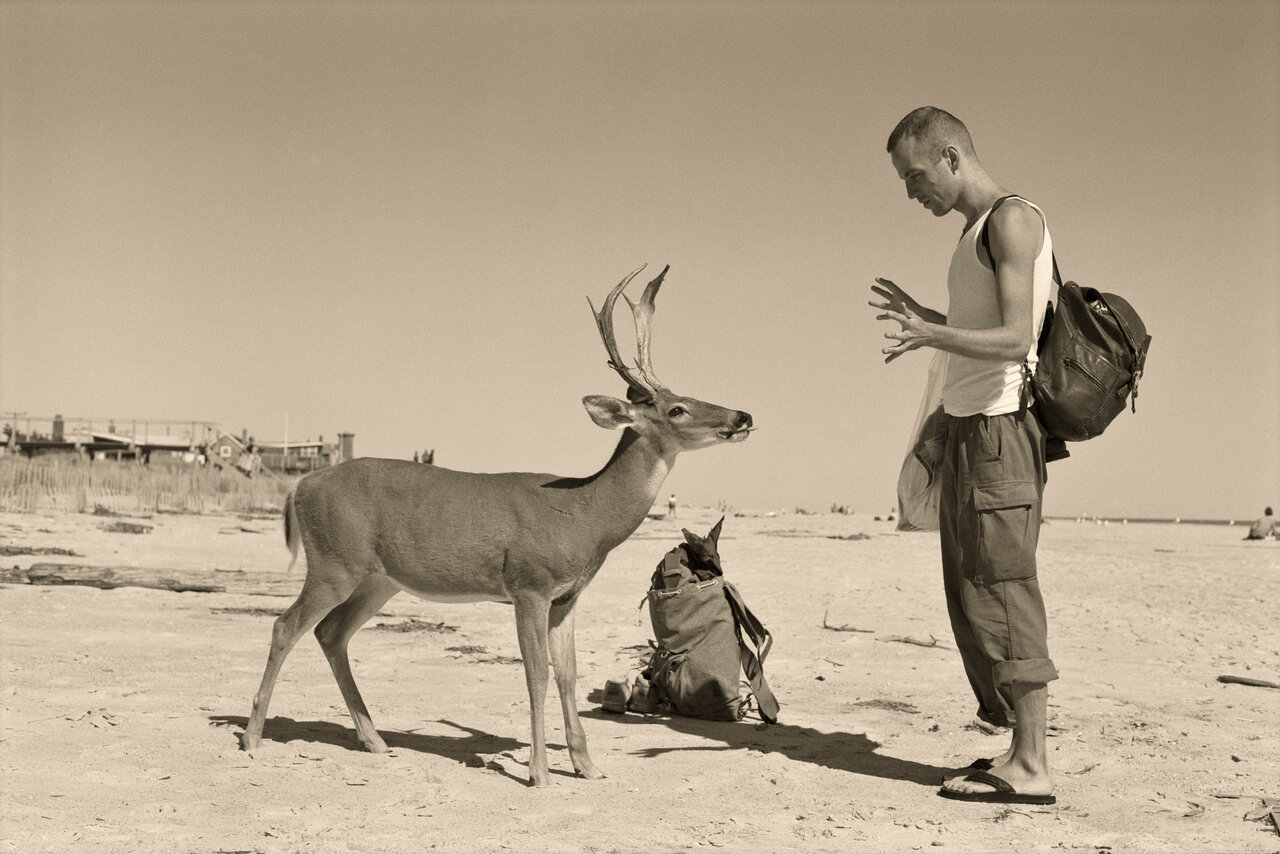
    Wolfgang Tillmans, Deer Hirsch, 1995. Courtesy of the artist, David Zwirner, New York/Hong Kong, Galerie Buchholz, Berlin/Cologne, Maureen Paley, London.

    CATHY LIU / media

    Christine Flynn: WAVES
    May 4–27
    Dianna Witte Gallery

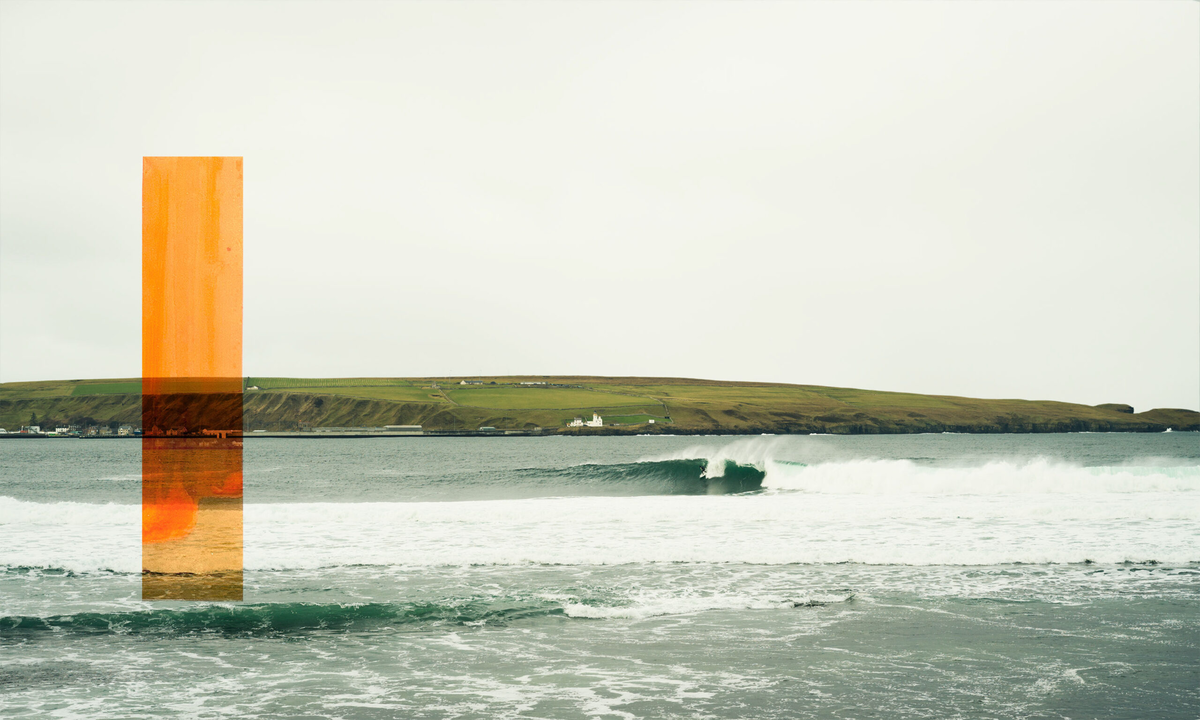
    Christine Flynn, Scottish Surfer, 2023, (photograph with mixed media; 36x60in). Courtesy of the artist and Dianna Witte Gallery

    Linh VH Nguyen: Quay lại, Xem lại – Landscapes of Northwest Vietnam
    May 4–Jun 7
    Dzô Viet Eatery

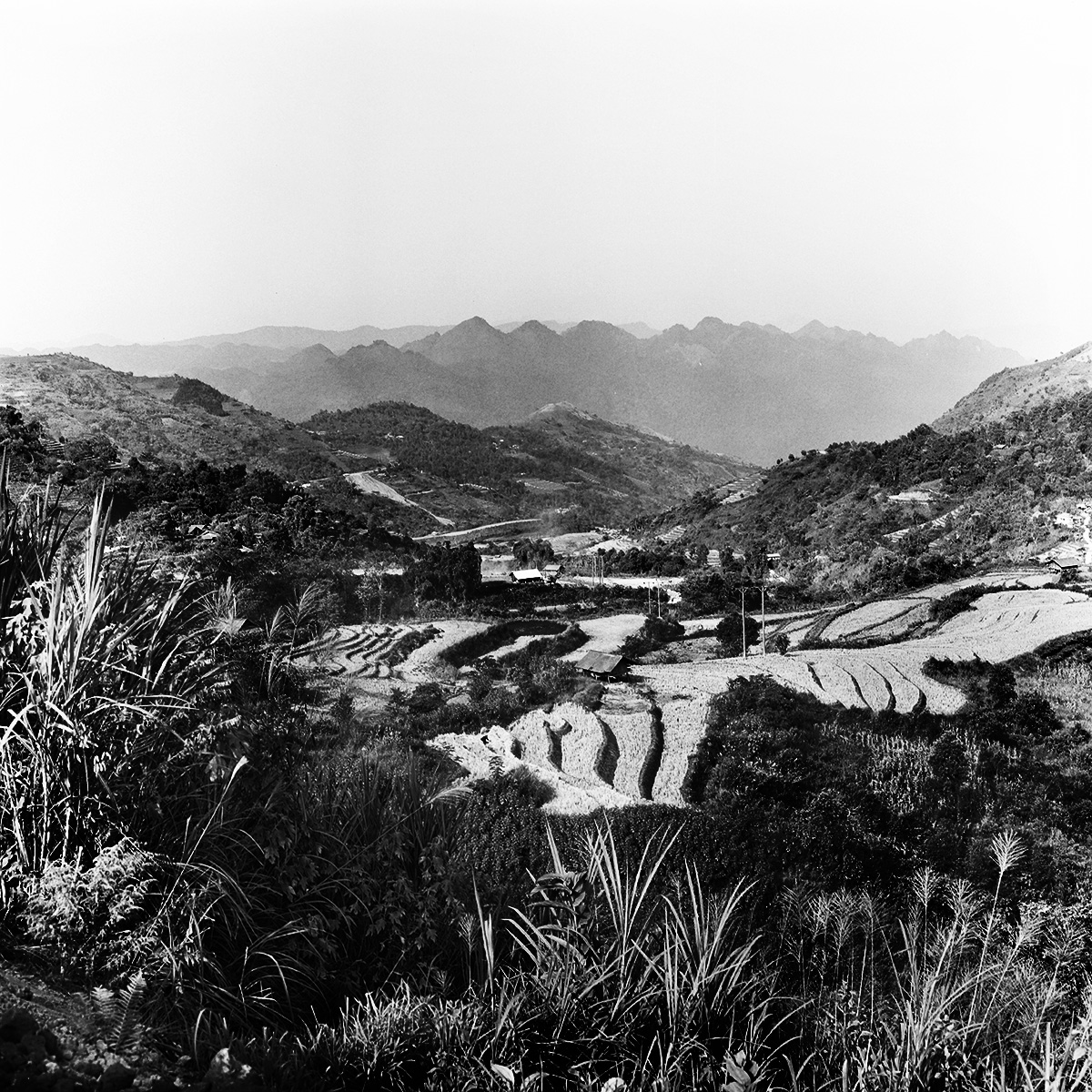
    Linh VH Nguyen, Step ladder fields in Sin Suoi Ho – Ruộng ở Sìn Suối Hồ, 2023

    ELIN MACRAE / writer

    Margaret Gdyczynski: Ephemeral Light
    May 1–Jun 30
    Extra Butter Coffee

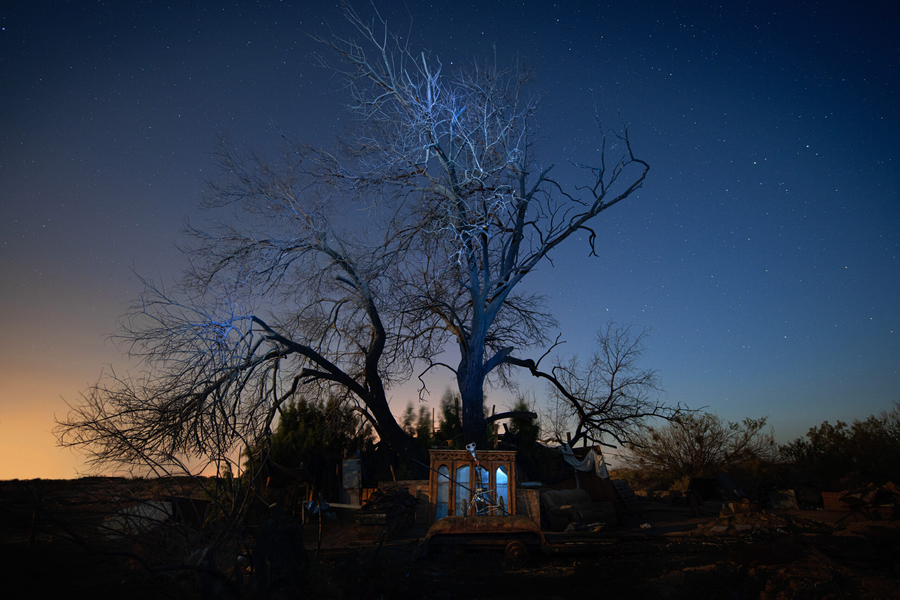
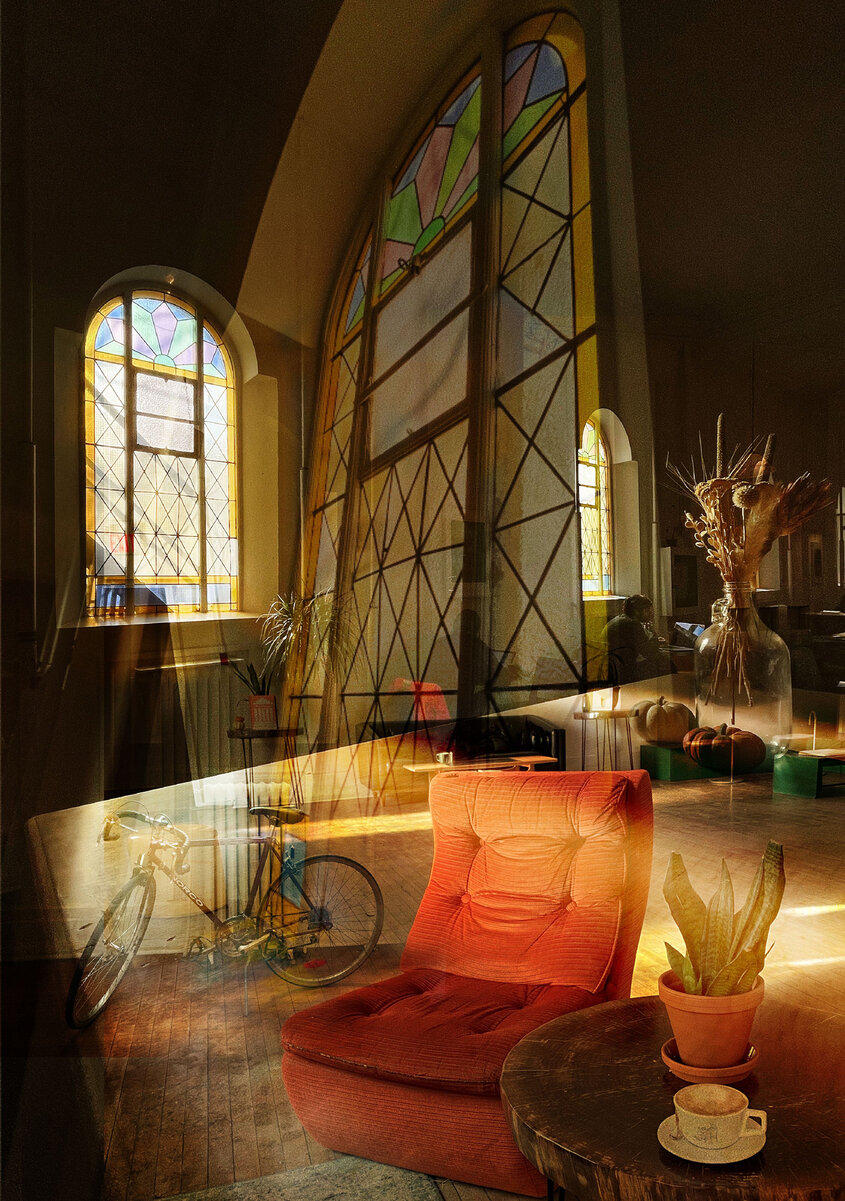
    Margaret Gdyczynski, The Sonndr, 2023

    Scott McFarland: Night Ship
    Apr 27–Jul 15
    Blouin Division

    Scott McFarland, Untitled #1 (Night Ship), 2021. Courtesy of the artist and Blouin Division Gallery

    HUGH ALCOCK /writer

    Persijn Broersen and Margit Lukacs: Man is in the Forest
    May 5–July 1
    A Space Gallery

    Persijn Broersen & Margit Lukács, Forest on Location, 2018 (HD Video and Sound, 11:45 mins). Courtesy of the artists and AKINCI, Amsterdam

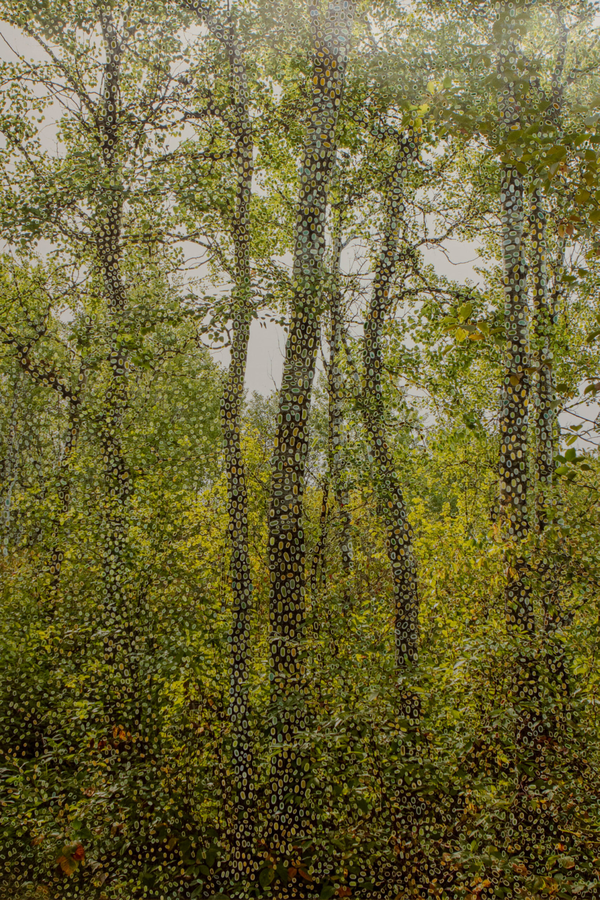
    Sarah Anne Johnson: Woodland
    May 6–Jun 25
    Stephen Bulger Gallery

    Sarah Anne Johnson, PTST, 2022 (unique pigment print with hand-applied photo-spotting ink). Courtesy of the artist, Stephen Bulger Gallery, Toronto, and Yossi Milo Gallery, New York.

    MARIA MENDOZA CAMBA / writer

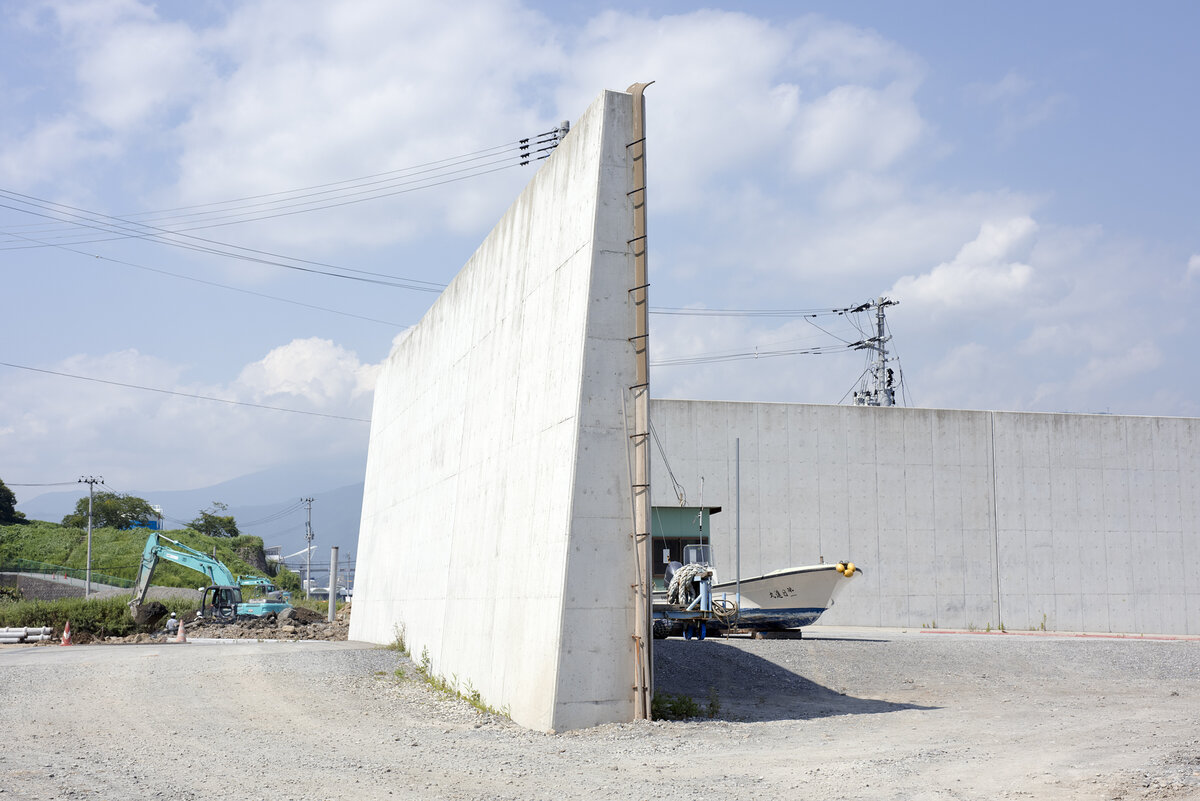
    Pengkuei Ben Huang, Coastal Mammoth: The Great Sea Wall Of Japan
    May 3–27
    Elaine Fleck Gallery

    Pengkuei Ben Huang, Seawall #2, Ofunato, 2019

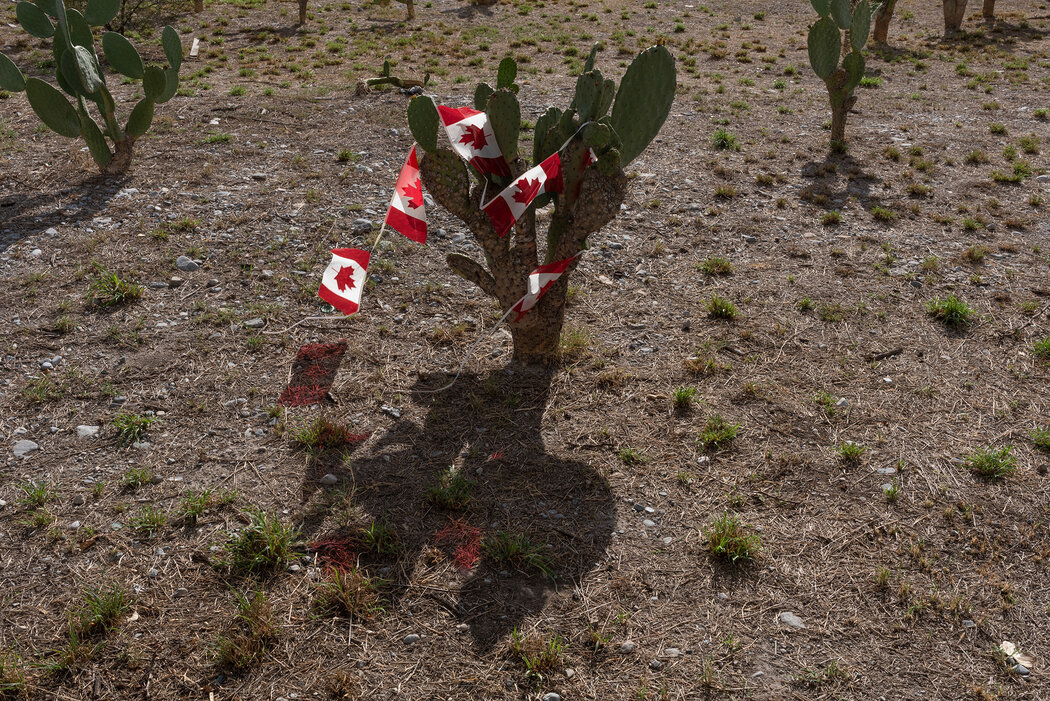
    Anahí González: Hacia Arriba / Upward
    May 26–Jul 8
    Xpace Cultural Centre

    Anahí González, Atrapado, 2022, from the series Allá Más Al Norte. Courtesy of the artist

    NINA ANKISETTI / writer

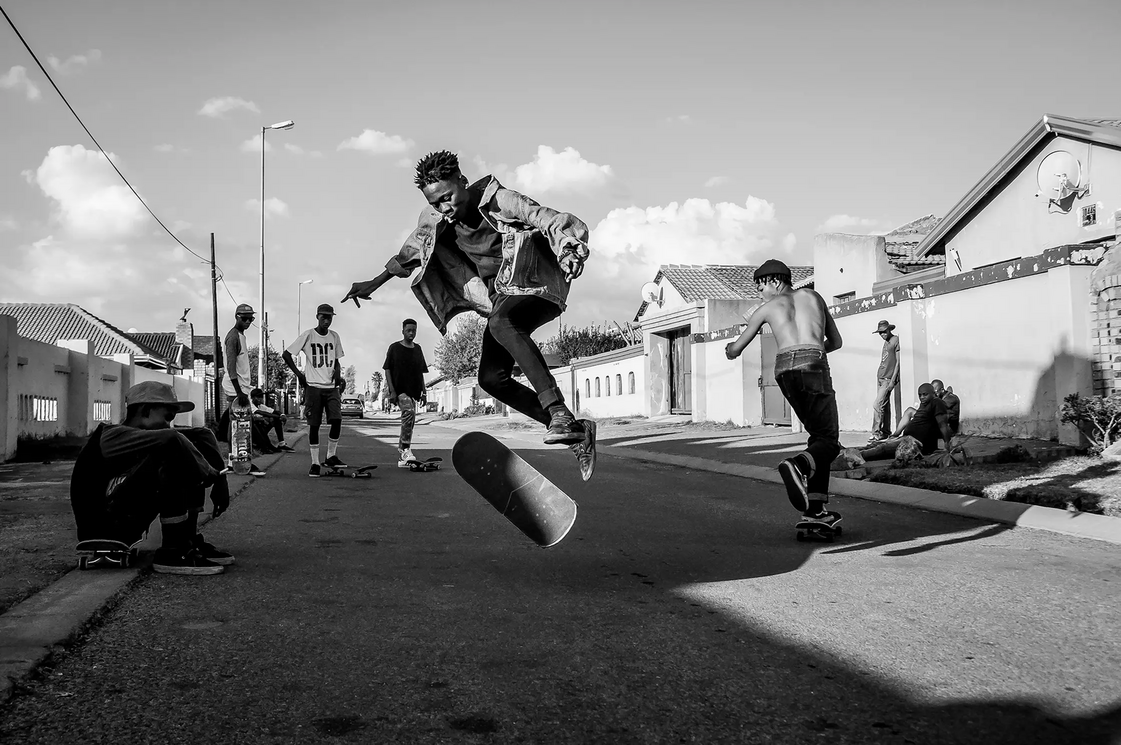
    Karabo Mooki: Dogg Pound Days
    April 27 – May 28
    Meridian Arts Centre

    Karabo Mooki, Fatherless Kids, 2016, Courtesy of the artist

    Group Exhibition: Tumbling in Harness
    May 3 – July 22
    Art Museum U of T

    Vunkwan Tam, Untitled (The traffic noise arched over a bubbling mass of public conversation and pattering footsteps on concrete), 2021 (readymade sculpture; installation view: F, 2022). Courtesy of the artist and Empty Gallery. Photo: Michael Yu

    SHAKUNTALA FERNANDOPULLE

    Heidi McKenzie, Reclaimed: Indo-Caribbean HerStories
    May 4 – Aug 27
    Gardiner Museum

    Heidi McKenzie, Looking Back: No. 2, Ceramic pigment photo decals fired onto hand rolled porcelain, cedar frame, hardware, 2023

    Sunday School: Feels Like Home
    May 6, 2023 – May 31, 2024
    Art Gallery of Ontario

    Sunday School, from the series Jump Ball, 2019, from the series Jump Ball. Courtesy of Sunday School. ©Sunday School

    Images are courtesy of Scotiabank CONTACT Photography Festival.

    To make your own selection of exhibition visits please click here.

  • Spring Exhibitions at MOCA

    The cluster of Spring 2023 exhibitions at the Museum of Contemporary Art in Toronto (MOCA), might best be viewed as a bouquet of sorts, its vase the Auto Building, a 10-storey architectural industrial heritage building on Sterling Road. Built in 1919 by the Northern Aluminum Company, the building is characterized by its exposed concrete framing and used as an aluminum foundry and manufacturing plant that was operational as recently as 2006. Its adaptive reuse for the creative and digital sector, as well as its museum venue, seems still to be in the process of completion, and the “landmark structure” as a whole might fully be appreciated when its grounds and architectural nesting are complete.

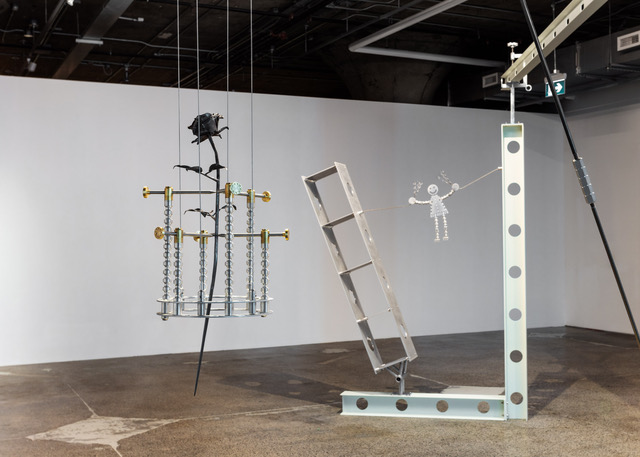
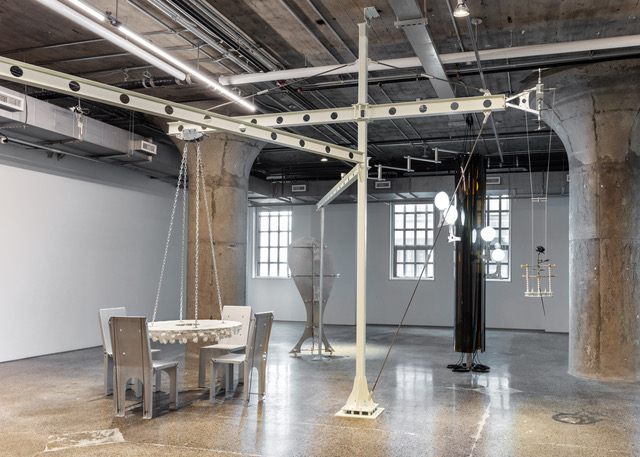
    Exhibitor Susan For Susan, the collaborative design team of brothers John and Kevin Watts, in their Trade Show exhibit, delivers the bridge between the cultural practices of art, architecture, and design. Central to the exhibit is an elaborate gantry – a system for moving heavy loads across warehouse floors.

    Susan For Susan, Trade Show, 2023. Installation view at MOCA Toronto. Courtesy the artist. Photo: Laura Findlay

    Trade Show is essentially one big sculpture broken into separate parts: a concrete table suspended by chains with a set of box-pan chairs, an accordion movable metal mirror, a lamp column structure, and a tilting metal bookcase held in place by the out-stretched arms of an aluminum puppet. An ironically creepy component of Trade Show is a lizarov frame holding a handcrafted black rose made of steel. The lizarov method is used in surgery for limb reconstruction and reshaping bones, but its use here inevitably brings to mind the iron maiden, a medieval torture device with spikes that enclose a human being.

    Susan For Susan, Trade Show, 2023. Installation view at MOCA Toronto. Courtesy the artist. Photo: Laura Findlay

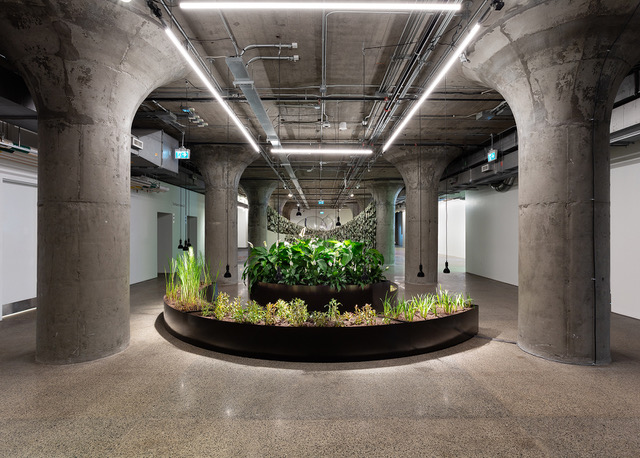
    Canadian-French artist Kapwani Kiwanga is presented at MOCA with her first major survey exhibition in Canada. Her Remediation exhibit is the product of researches into the tensions between toxicity and regeneration of our environment. She studied anthropology and comparative religion at McGill University, but her focus had been medical anthropology. In view of the violent convulsions that the earth has undergone over time, Kiwanga has been interested in how nature and humankind have variously responded to these phenomena.

    Kapwani Kiwanga, Keyhole, 2023. Steel structure, plants, water, soil, pea gravel, LED grow lights, air pump. Installation View, Remediation, at MOCA Toronto. Courtesy the artist; Galerie Poggi, Paris; Galerie Tanja Wagner, Berlin; and Goodman Gallery, Cape Town, Johannesburg, and London. © ADAGP, Paris / SOCAN, Montreal (2022). Photo: Laura Findlay

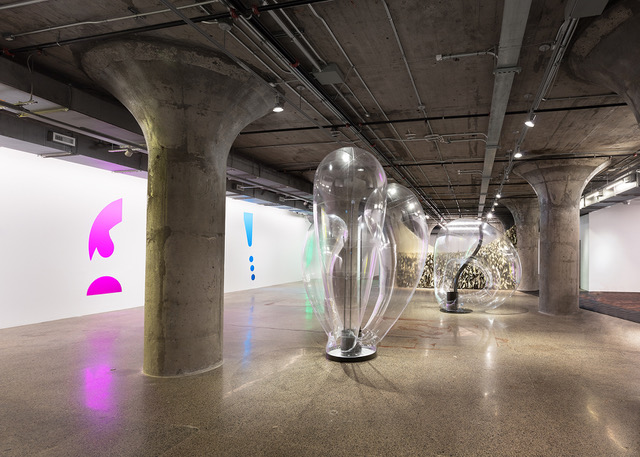
    MOCA’s industrial past inspired the artist to produce many new site-specific works such as flooring and window interventions and inflatable vivariums. In natural settings, plant life has found a way to fight back from contaminated environments. On the other hand, Kiwanga has succeeded here in seeding MOCA’s brutalist interior.

    Kapwani Kiwanga, Vivarium: Apomixis, 2023 (foreground), Vivarium: Adventitious, 2023 (background). PVC transparent, steel, colour, MDF. Installation View, Remediation, at MOCA Toronto. Courtesy the artist; Galerie Poggi, Paris; Galerie Tanja Wagner, Berlin; and Goodman Gallery, Cape Town, Johannesburg, and London. © ADAGP, Paris / SOCAN, Montreal (2022). Photo: Laura Findlay

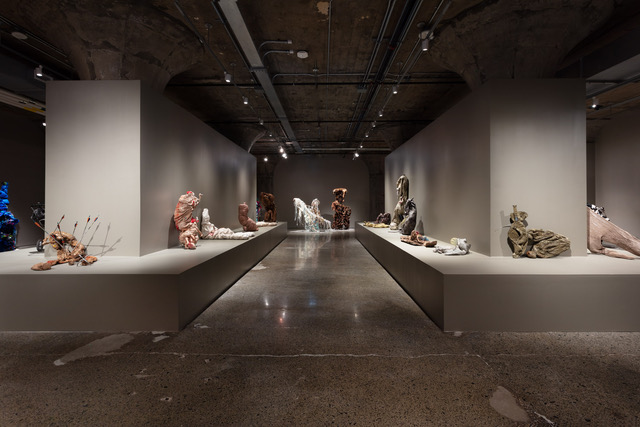
    Commissioned by MOCA Toronto, Greek/Canadian artist Athena Papadopoulos produced her large-scale sculptural works The New Alphabet in response to the isolation of the past two years of the pandemic. The first of two bodies of work, Bones for Time makes use of hospital and wool blankets that mime the artist’s body shape into letters.

    Athena Papadopoulos, 2023. Installation View, The New Alphabet, at MOCA Toronto. Courtesy the artist. Photo: Laura Findlay

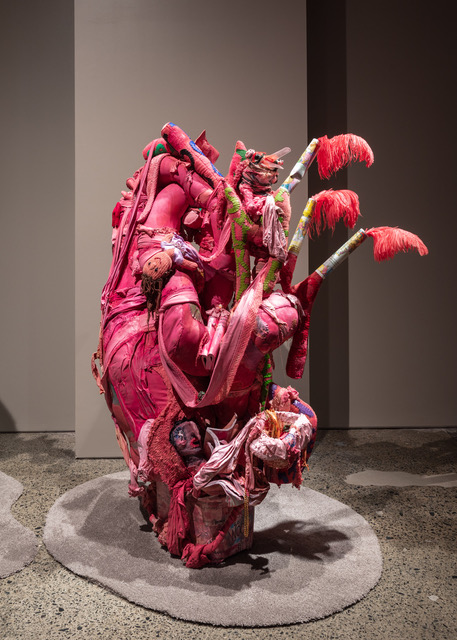
    With Trees with No Sound, Papadopoulos finds new use for unwanted furniture, clothing and stuffed objects. It seems that almost anything may grace a Papadopoulos tableau, from hair dye, lipstick, red wine, bleach, shoe polish, and iodine tincture to nuts and bolts. The artist’s working process is an exultation in the breadth of cultural effuse and its subsequent regurgitation creatively. She has stated that “The works are not meant to be moving upwards towards a point of precision, they are of a world that is downward and sprawling.”

    Athena Papadopoulos, Trees with no sound: Manzanilla de la Muerte, (Little Apple of Death), 2023. Installation View, The New Alphabet, at MOCA Toronto. Courtesy the artist. Photo: Laura Findlay

    The ground floor of MOCA’s North End Gallery features Turkish conceptual artist Serkan Özkaya’s installation ni4ni v.3, or as it would be read when sounded out, “An Eye for an Eye.” The artist combines digital technology with a massive, mirrored sphere for a truly immersive experience, a sense of having been shrunk to the size of a blood vessel, an experience not unlike the 1966 sci-fi adventure Fantastic Voyage. Here it’s a journey toward an all-seeing eye that casts a 360-degree image. The technology has roots that date to 100 A.D., with scientist and astronomer Ptolemy, who had developed an equirectangular projection method able to translate a spherical surface onto a plane.

    Serkan Özkaya, ni4ni v.3, 2023. Installation view at MOCA Toronto. Courtesy the artist. Photo: Laura Findlay

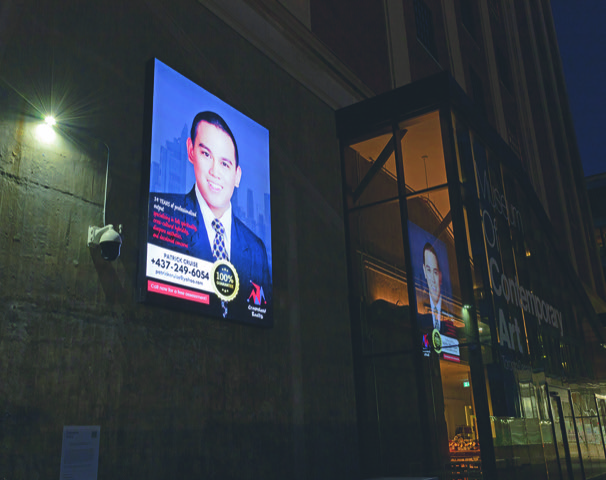
    Approaching the MOCA Auto Building from the rear and seeing a billboard for an apparent real estate advertisement seemed peculiar for an art museum, but less so having exited the museum. Crownland is, in fact, a portrait of Philippine-born artist Patrick Cruz at age fifteen, appearing in the sign as a realtor. If the Cruz lightbox signals an implied entanglement of art world with real estate, and there might be some truth to it, in terms of the present cluster of exhibitions, the connective threads between building, museum, installation, and individual artist, coalesce nicely here into a cohesive whole.

    Patrick Cruz, Crownland, 2023. Installation view at MOCA Toronto. Courtesy the artist. Photo: MOCA Toronto

    Steve Rockwell

    Images are courtesy of the Museum of Contemporary Art Toronto

    *MOCA is located at 158 Sterling Ave, Toronto. Museum hours: Wed – Thu & Sat – Sun 11 am – 6pm; Fri 11 am – 9 pm.

  • The Next Contemporary / Inaugural Exhibition

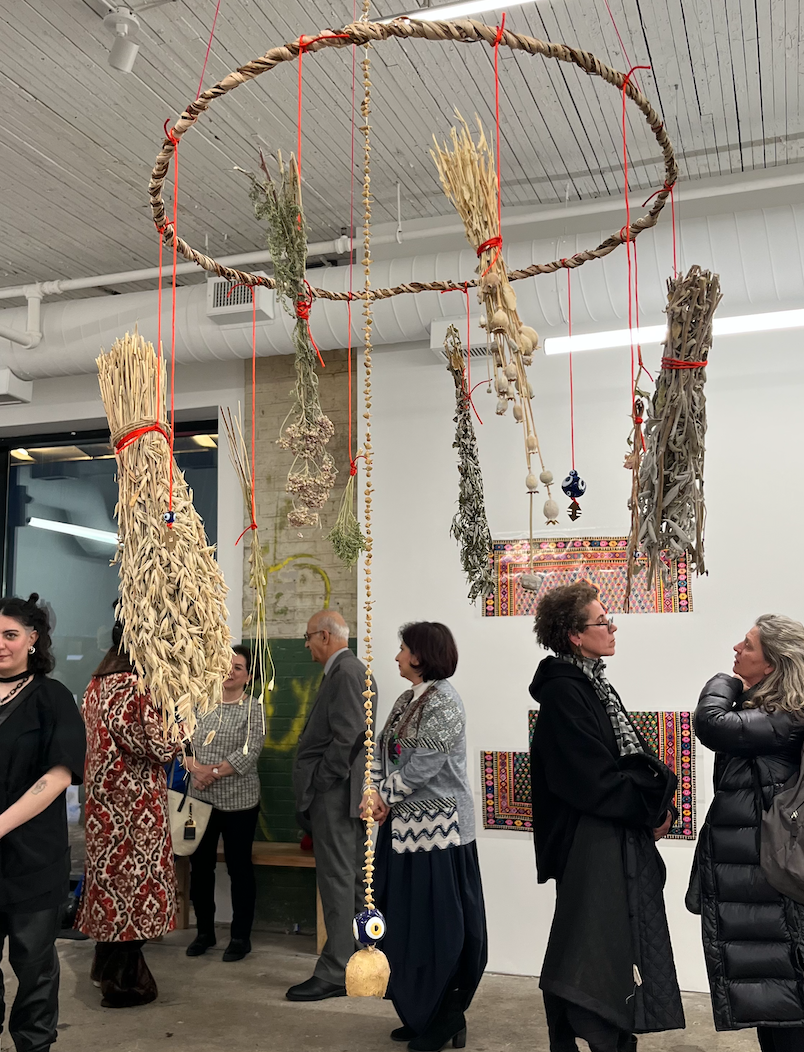
    On the floor at the centre of The Next Contemporary’s fresh industrial space at 1655 Dupont Street are a series of rugs by Alize Zorlutuna arranged in a circle. Hanging above them is a chandelier created from dried herbs and plants, strung together with flowers and beads. Visitors radiate around this central exhibit, slowly moving between the exposed pillars that break up the space.

    Something Like Arriving, Opening Reception, February 25, 2023, Photo: Shakuntala Fernandopulle

    Iranian-Canadian curator, Farnoosh Talaee, opened the gallery with the intention of providing a platform for BIPOC artists typically neglected by mainstream institutions.

    Something Like Arriving, the gallery’s inaugural exhibit, featuring artists Alize Zorlutuna, Diyar Mayil and Sukaina Kubba, explores the idea of comfort as something broader than a physical state of being. Across the gallery floor and on its walls, the idea of home is constructed and deconstructed. The items we most closely associate with home – rakes, rags, vases, carpets, sticks of sage and lavender – are placed throughout the space in curious combinations and enlarged to odd sizes.

    A series of deconstructed carpets by Iraqi-Canadian artist Sukaina Kubba are hung around the room. Another series of her carpet works, this time printed with a 3D-pen using an ephemeral clear filament, almost disappears against the wall. Kubba’s practice revolves around what she categorizes as ’travelling objects,’ like rugs. To Kubba, these objects are vessels of cross-cultural histories and narratives. She is also obsessed with packing materials. Even the carpets featured in the show are placed inside deliberately obvious plastic sheets, drawing attention to how these cultural artefacts are transported across boundaries with migrating families. Once removed from the packaging and placed on the floor, the objects have the ability to reconstruct a place as a home. In Something Like Arriving, they remain behind the plastic, suspended on the walls – conveying an uncomfortable sense of unsettledness.

    Sukaina Kubba, T77.0160, recycled U-Haul blankets, thread and embroidery thread from Value Village, and butcher’s twine, 2020

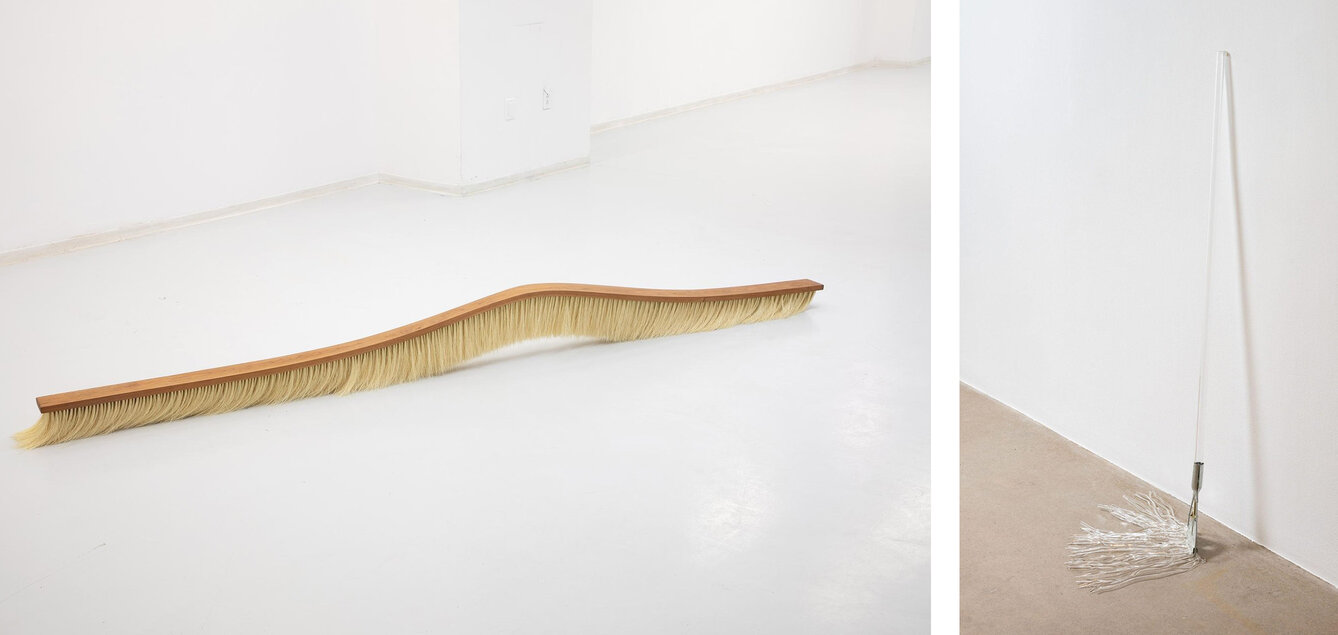
    This feeling is matched by Diyar Mayil’s powerful work. Mayil recreates every day domestic objects and disturbs them: the bristles of a broom constructed of plastic makes this tool totally useless. This purposeful dysfunction forms the core of her work. In Sweep, a brush is warped and swollen to resemble a wooden caterpillar. It is placed awkwardly in the gallery’s space – disrupting the movement of the visitors. We are constantly confronted by these objects in our path. As Mayil writes, “my hope is to create an intuitive dialogue between the viewer and my work that might translate into new bodily orientations and sensibilities.” Our bodies, as viewers, are forced to adapt to the spaces she creates – as immigrants do when moving to new countries.

    L-R: Diyar Mayil, Sweep, cherry wood, natural fibers, 2022 & Dustpan, glass, gold, 2021

    On the wall by the entrance, a series of jugs, vases, and other receptacles are rendered flat by Turkish artist Alize Zorlutuna. The paper works, titled Carrying Seas, are created from hand marbled paper. The specific shapes of these objects are taken from the archaeological record of Anatolian ceramics. Zorlutuna uses them to symbolize the objects we carry with us when we migrate or are displaced from our lands. Similarly, Kubba uses her carpets to echo the movement of people across borders. Like Zorlutuna’s forms, which derive from vessels held in museum collections in the UK, Germany, Turkey, Canada, and the US, Kubba’s specific carpet motifs are inspired by carpets held in collections like the Aga Khan and Textile museums in Toronto. They represent unique cultures and communities.

    Alize Zorlutuna, Carrying Seas, hand cut, hand marbled paper, 2023

    The intricacy of the materials each artist uses and the narrative of their work speak not only about art but the human condition as well. The paper marbling technique utilized by Zorlutuna, known as ‘Ebru,’ is a form of traditional art-making practiced in Anatolia – a piece of ancestral inheritance. The same can be said of Kubba’s practice – Islamic carpet making is a form of specialized knowledge passed down. Apart from the objects we bring with us when we leave our ancestral lands, we also carry the knowledge hidden in them: wrapped in plastic or flattened in our suitcase.

    Shakuntala Fernandopulle

    Images are courtesy of The Next Contemporary and the artists

    *Exhibition information: Something Like Arriving / Alize Zorlutuna, Diyar Mayil, Sukaina Kubba, February 25 – April 22, 2023, The Next Contemporary, Unit #103, 1655 Dupont St, Toronto. Gallery hours: Wed – Sat 12 – 6 pm.

  • CONTACT 2023

    May – July, 2023

    Various locations in Toronto and the GTA

    During the month of May experience over 180 lens-based exhibitions, site-specific installations, and commissioned projects by artists and photographers at museums, galleries, and public spaces throughout Toronto.

    Scotiabank CONTACT Photography Festival 2023 showcases an outstanding selection of Canadian and international lens-based artists. The Festival’s Core Exhibitions are comprised of collaborations with major museums, galleries, and artist-run centres as well as site-specific public art projects. These are cultivated through partnerships and commissions, and frame the cultural, social, and political events of our times.

    The Open Call Exhibitions and Outdoor Exhibitions present a range of works by local and international artists at leading galleries and alternative spaces across the city.

    The Festival also includes a wide range of Programs including a book fair, artist talks, tours, workshops and screenings. CONTACT exhibitions and programs are free and open to the public, with some exceptions at major museums.

    For more information please check their website.

    Featured image: Maggie Groat, twins, webs, ripples, shifts, sounds, 2022 (found paper). Courtesy of the artist. The same image will be exhibited, titled Pendulum at Harbourfront Centre, parking pavilion, May 1-31, 2023

  • Walking the Artist Project 2023

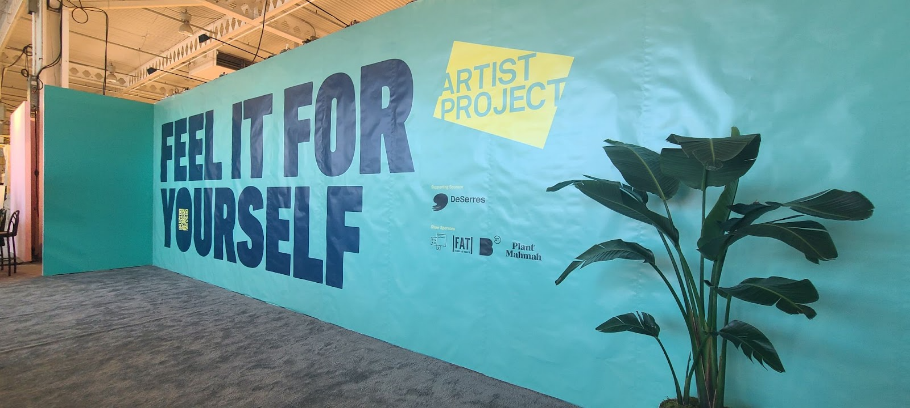
    Entrance of The Artist Project, board of sponsors and partners featured with the caption: Feel It For Yourself

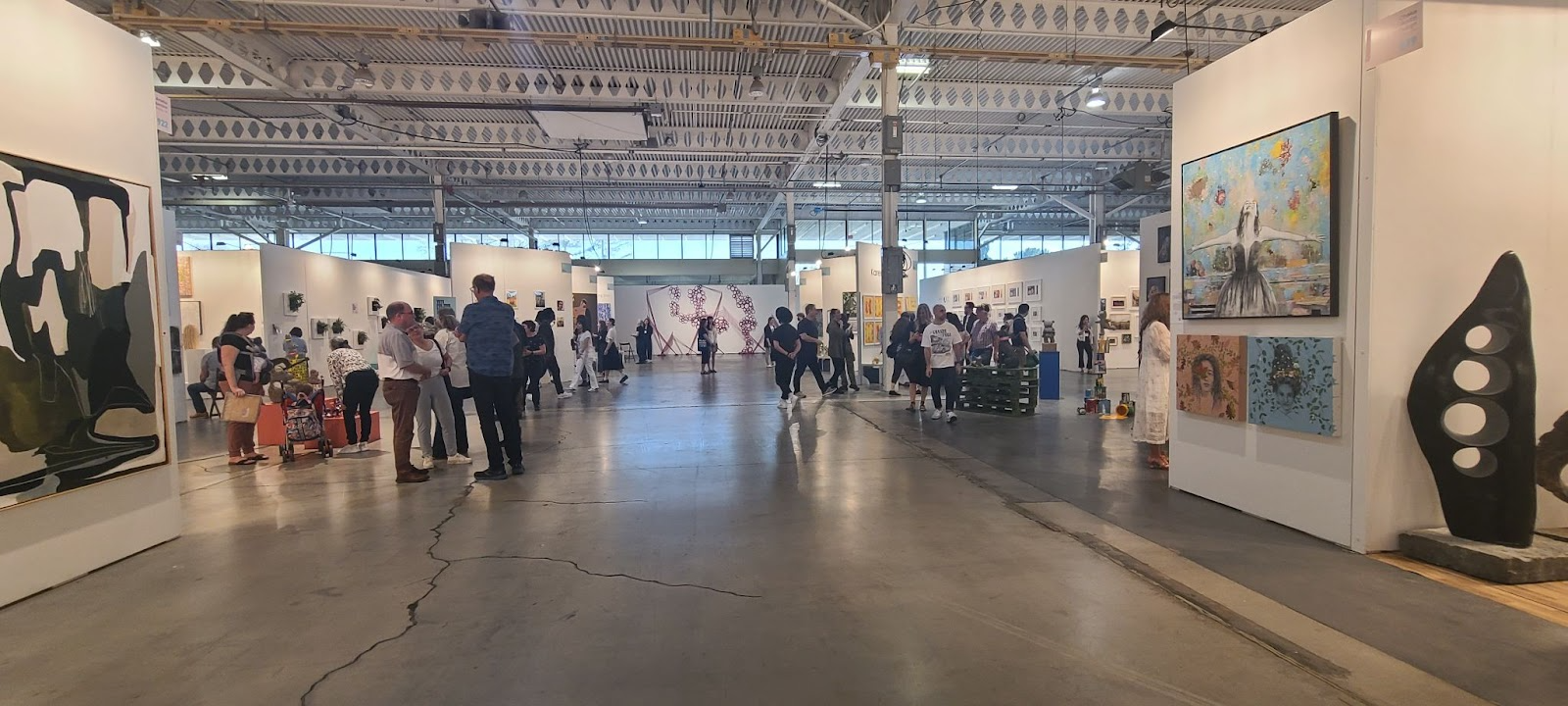
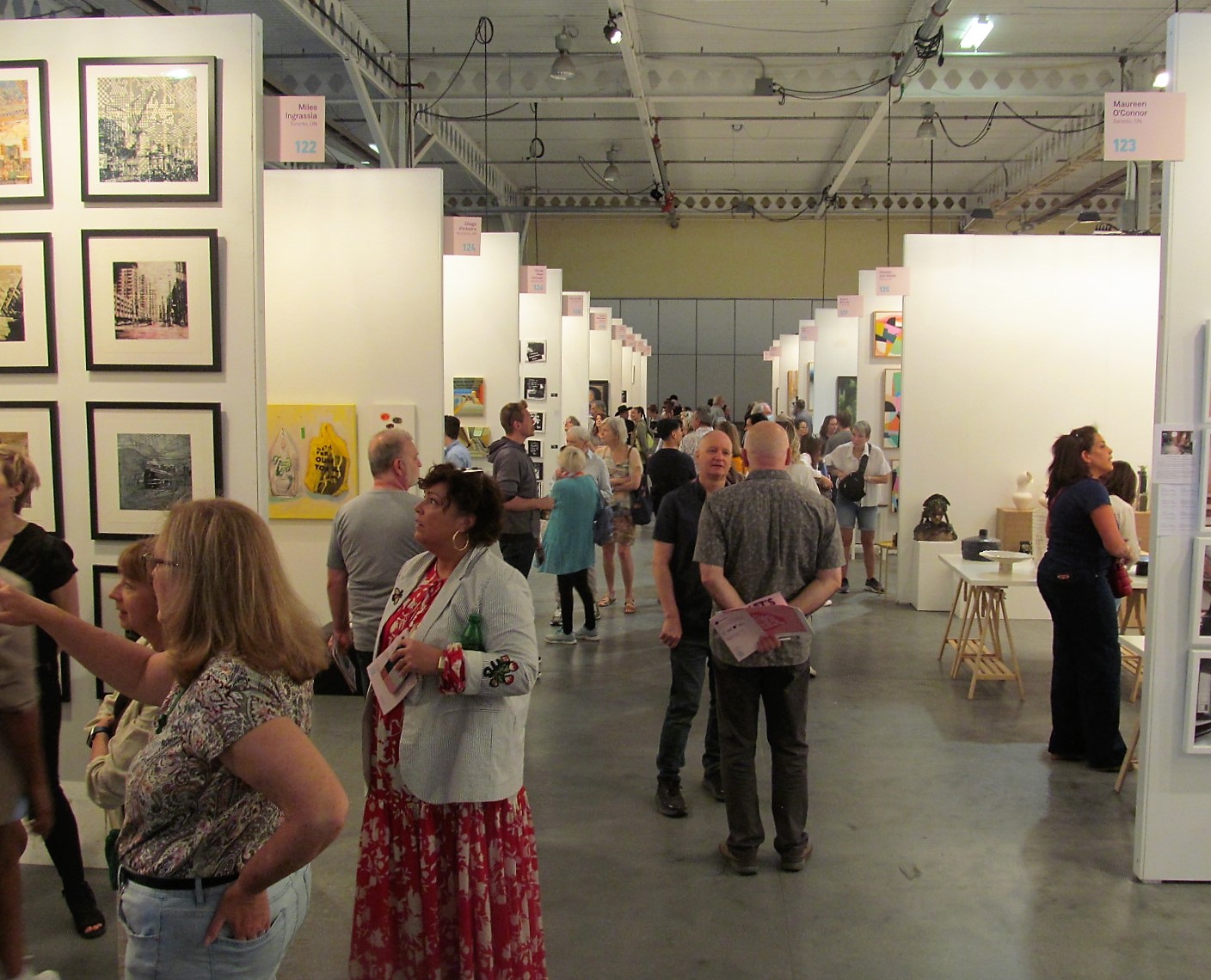
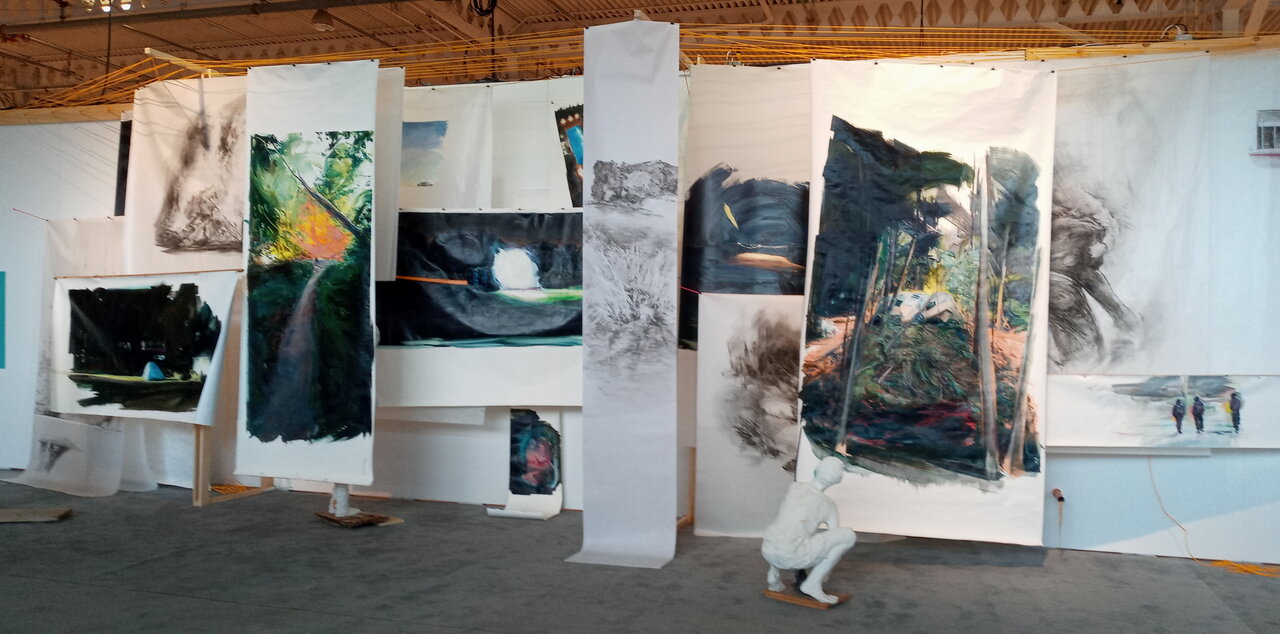
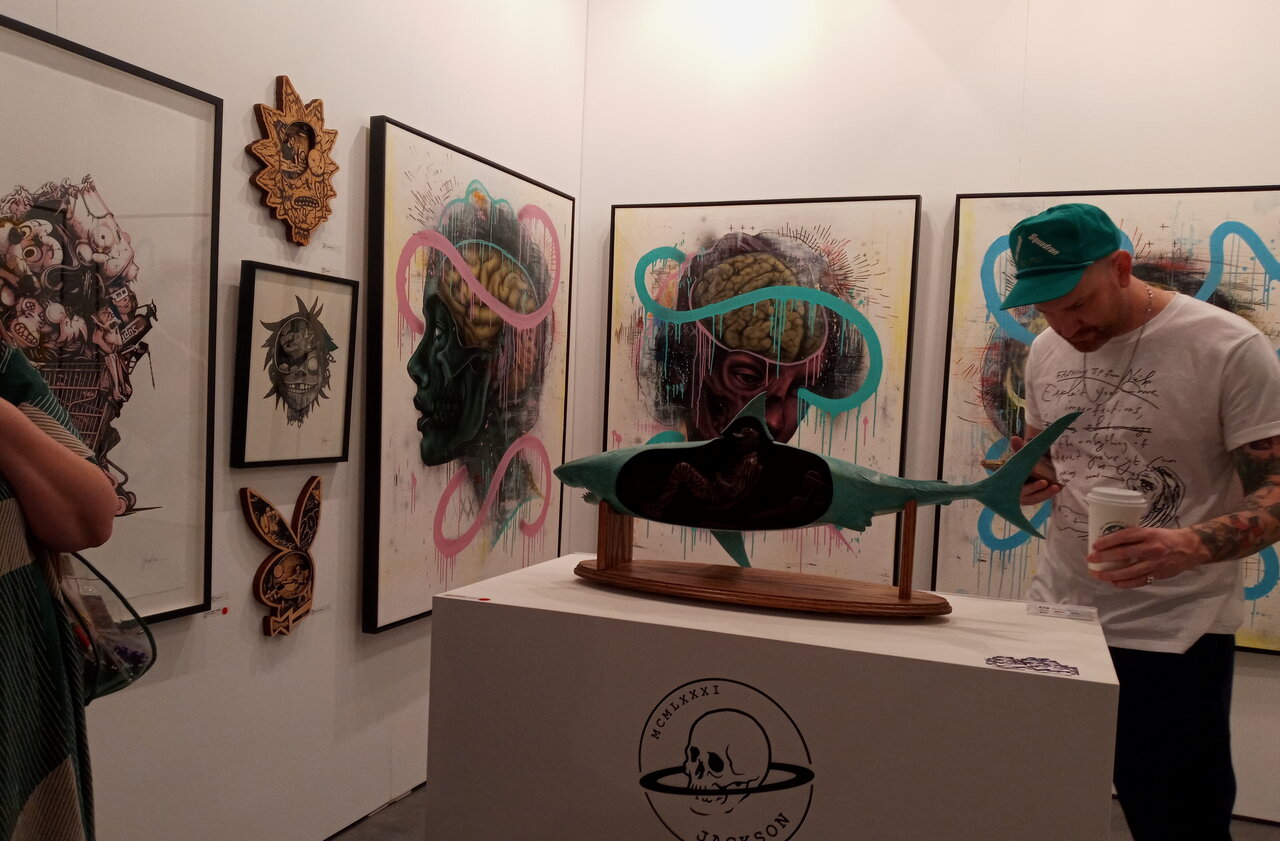
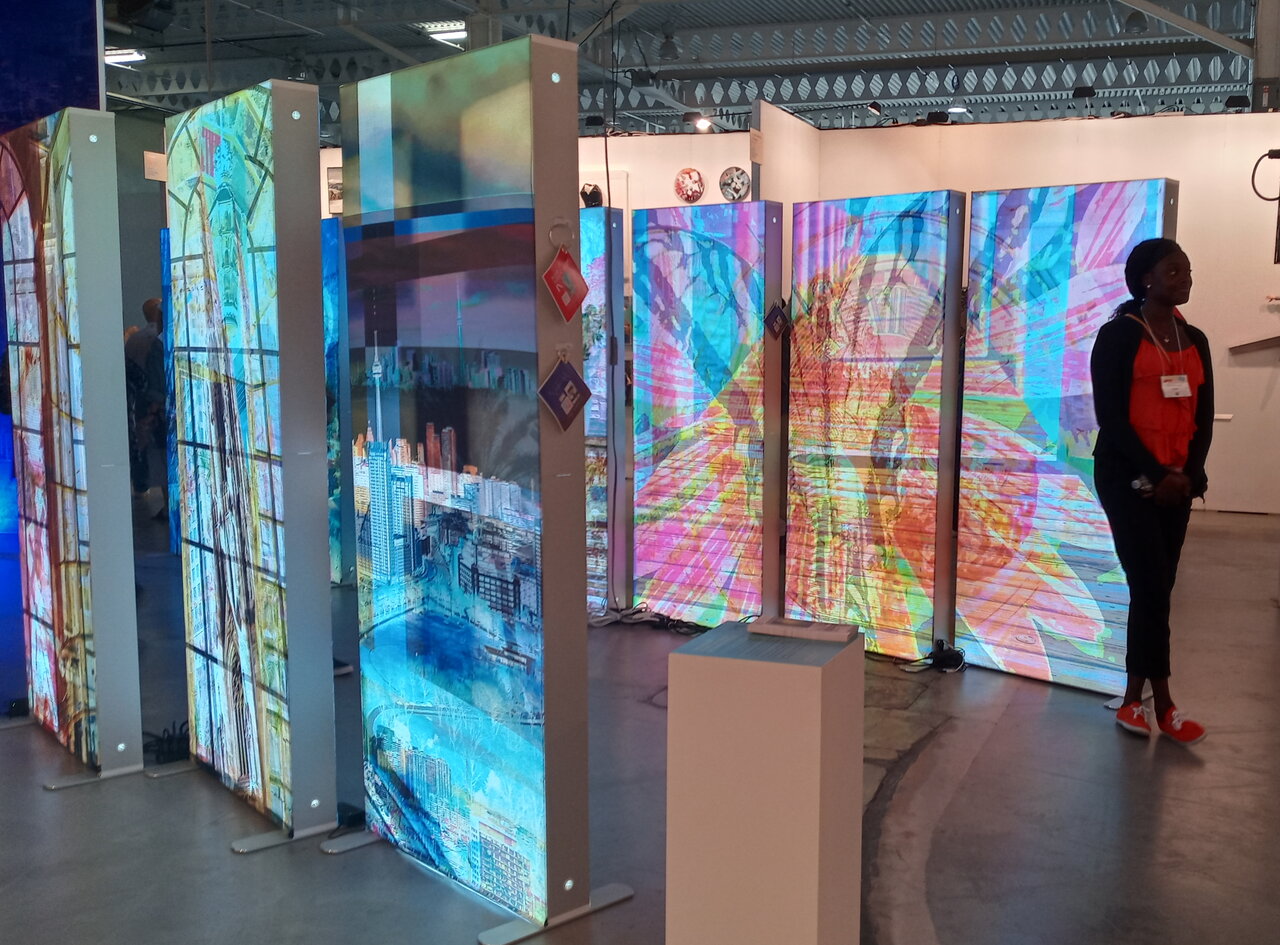
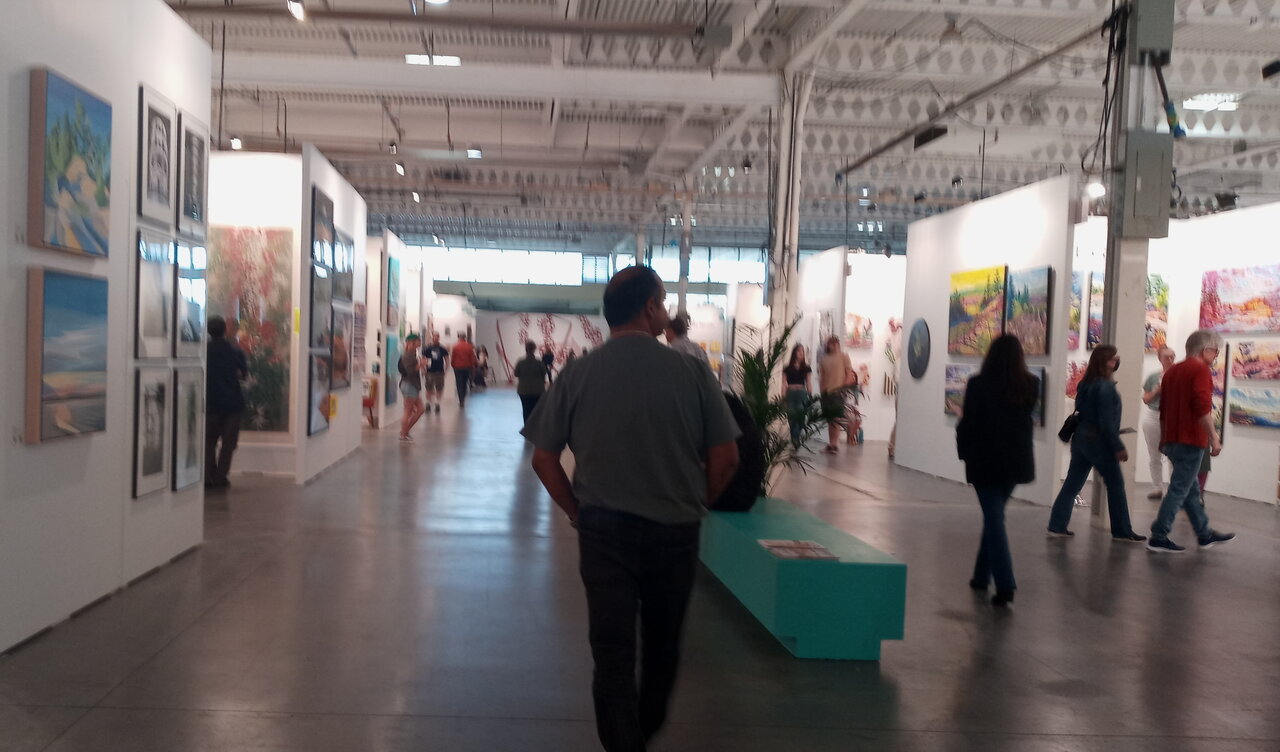
    The Artist Project held its annual showing of 250+ independent artists in the second weekend of April (13-16) at the Better Living Centre on the Exhibition grounds in Toronto. While also featuring installations and presentations by local artist-run centers, the Artist Project is a cacophony of artistic styles, forms, frames, colors and stories, lined by the hundreds as three walled pockets per artist, filled from floor to ceiling with artworks. On the one hand, it proves an overwhelming collection of wide-ranging talents and conversations. On the other, it is a coordination of emerging and established artists in one showroom, each celebrating their professional careers and goals through art.

    To add to the everlasting array of visual stimuli one can intake, the smell of freshly squeezed lemonade and burgers can be found at the various food stands and trucks parked at the far corners. Each corner also had its opened doors, allowing for fresh air to waft into the heated building. I wouldn’t have called it crowded; I would have described the atmosphere as interactive and intriguing, based on the sheer number of people wandering between stalls to speak to the artists themselves. A few families could be seen handing out snacks and drinks to them as they spoke, in congratulation for another successful year of art production and presentation.

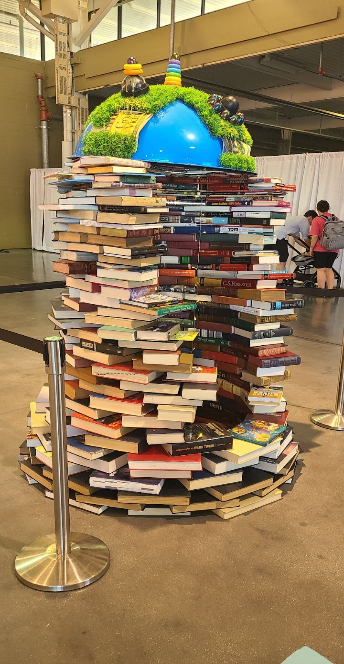
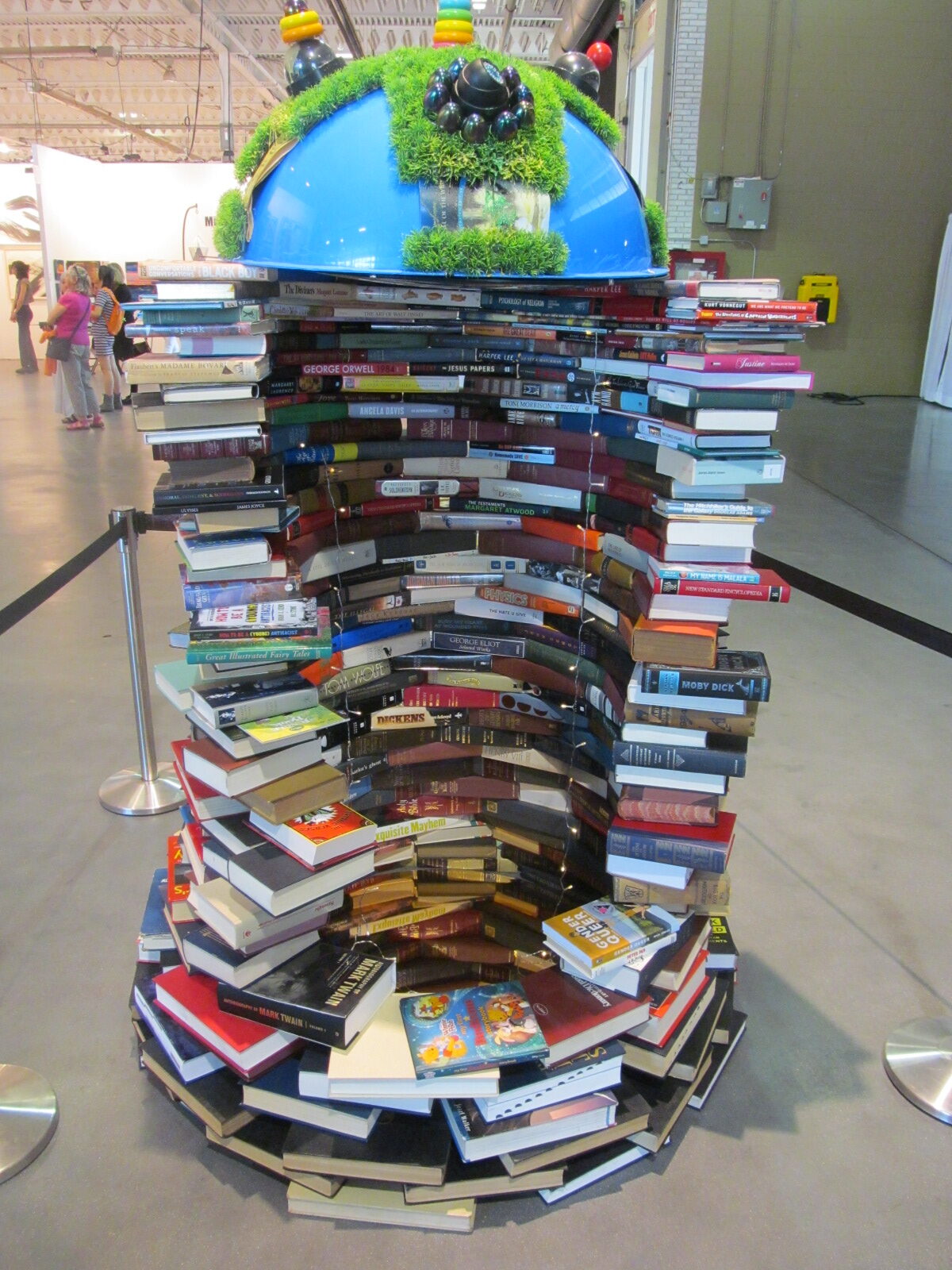
    One of the first installations to view was Kelly McCray’s Tower of Banned Books, a sculptural work of roughly 400-450 used hardcover books, all listed at some point in North America as “banned or censored” from public view.

    Kelly McCray, Tower of Banned Books, 2023, 400-450 used hardcover books, 136” flat round mirror, 130” convex mirror

    The work is somewhat interactive, allowing guests to poke their heads into the front opening of the tower to view a set of two mirrors: one above their head and one below their chin. This positioning of the mirrors is meant to further display the books as spreading outward into infinity when stared into. A quote from Chinese contemporary artist Ai Weiwei can be read in the artist statement: “censorship robs a person of self-perception that one needs in order to maintain an independent existence”. In other words, removing an opinion or a story, like those found in books, removes a chance for human existence to reflect upon itself. Weiwei was arrested and detained in Beijing in 2011 following allegations of “economic crimes” after he spoke out against the Chinese government online.

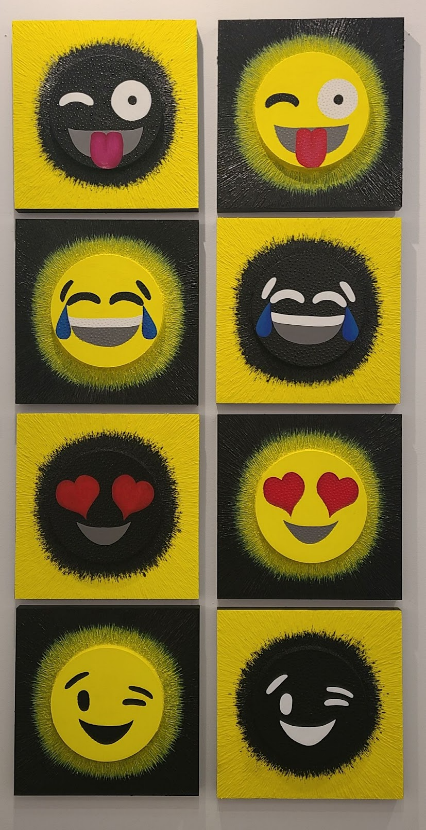
    Amongst the many stalls, one probably came in contact with the brightly colored works of artist Mais Al-Sheikhly. One, titled Bright and Dark side of Emojis, emanated a true style. Originally from Baghdad, Iraq, Al-Sheikhly immigrated to Canada as a teenager, regaining a sense of confidence and control through art making. She was inspired by her studies in cubism and of Picasso’s style of abstraction. She has since been back and forth from Jordan to Canada, featured by galleries and festivals in both countries. She transmits her cultural background into colourful and playful series of artworks, combining the traditional and the contemporary.

    Mais Al-Sheikhly, Bright and Dark side of Emojis, acrylic & mixed media on wood panels, 20″ x 20″ each

    Row after row of artist’s booths all connect via a long hallway created at the centre, branching off into extended arm hallways on either side. When looking down this hallway, one can engage with two artists’ works at once, like Amelia Valentine’s Lush and Sandra Iafrate’s Bliss and Pygmalion series installed on opposite sides.

    Centre hallway view: Amelia Valentine’s Lush on left hand wall & Sandra Iafrate’s Bliss (right hand wall, largest blue work on top) and Pygmalion Series (right hand wall, two smaller red and blue works below)

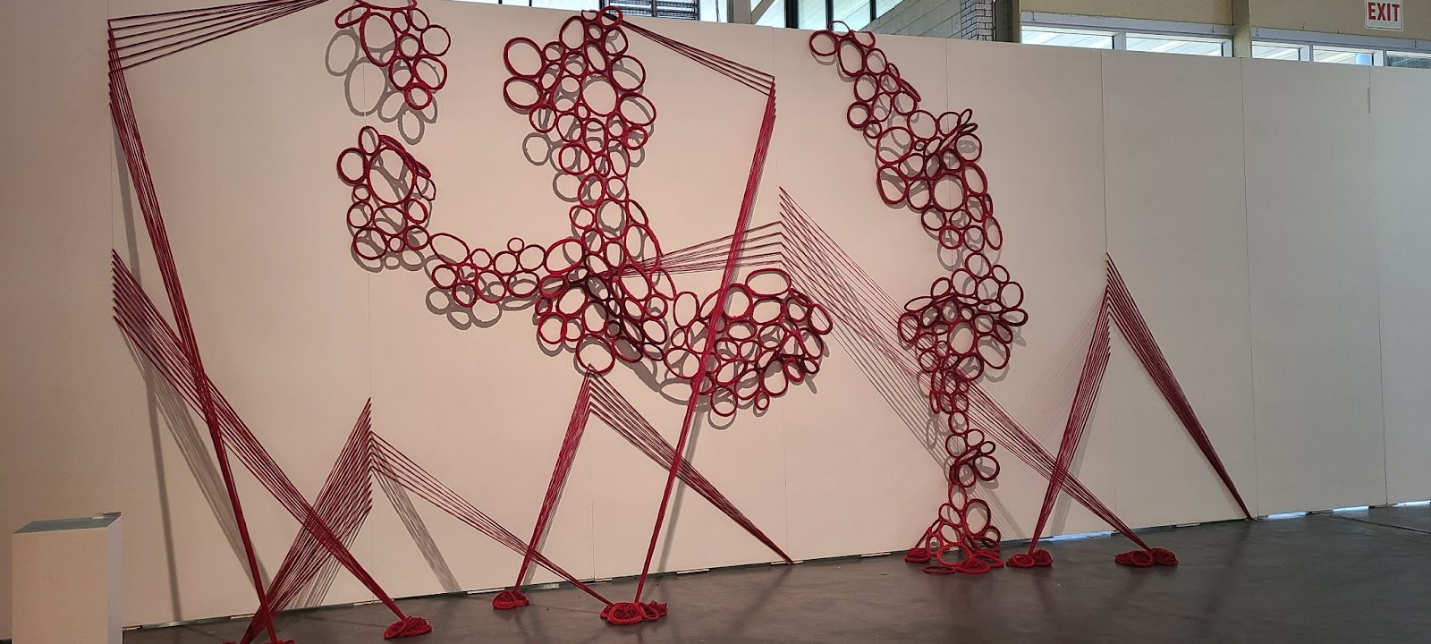
    At the end of this hallway however is a larger installation by Metis artist Tracey Mae Chambers, who has created over 100 similar installations across the US and Canada of cotton, silk, wool and copper at residential school historical sites under the titles #hopeandhealingcanada and #hopeandhealingus.

    Tracey Mae Chambers, #hopeandhealingcanada, 2023, cotton, silk, wool, copper

    The goal of these installations is to begin a conversation about decolonization, connecting settlers with the Indigenous, Metis and Inuit peoples of the land in an approachable and non-confrontational way. In her artist statement regarding the choice of colour in her installations, Chambers writes, “Red is the colour of blood. Red is the slur against Indigenous people. Red is the colour of passion and anger, danger and power, courage and love”. As an individual who is part Metis and part European, Chambers also makes note of her privilege in society, being aware of her “whiteness”. She uses this conscious ideal as fuel to bridge the gap of her dual identities through self-education and self healing.

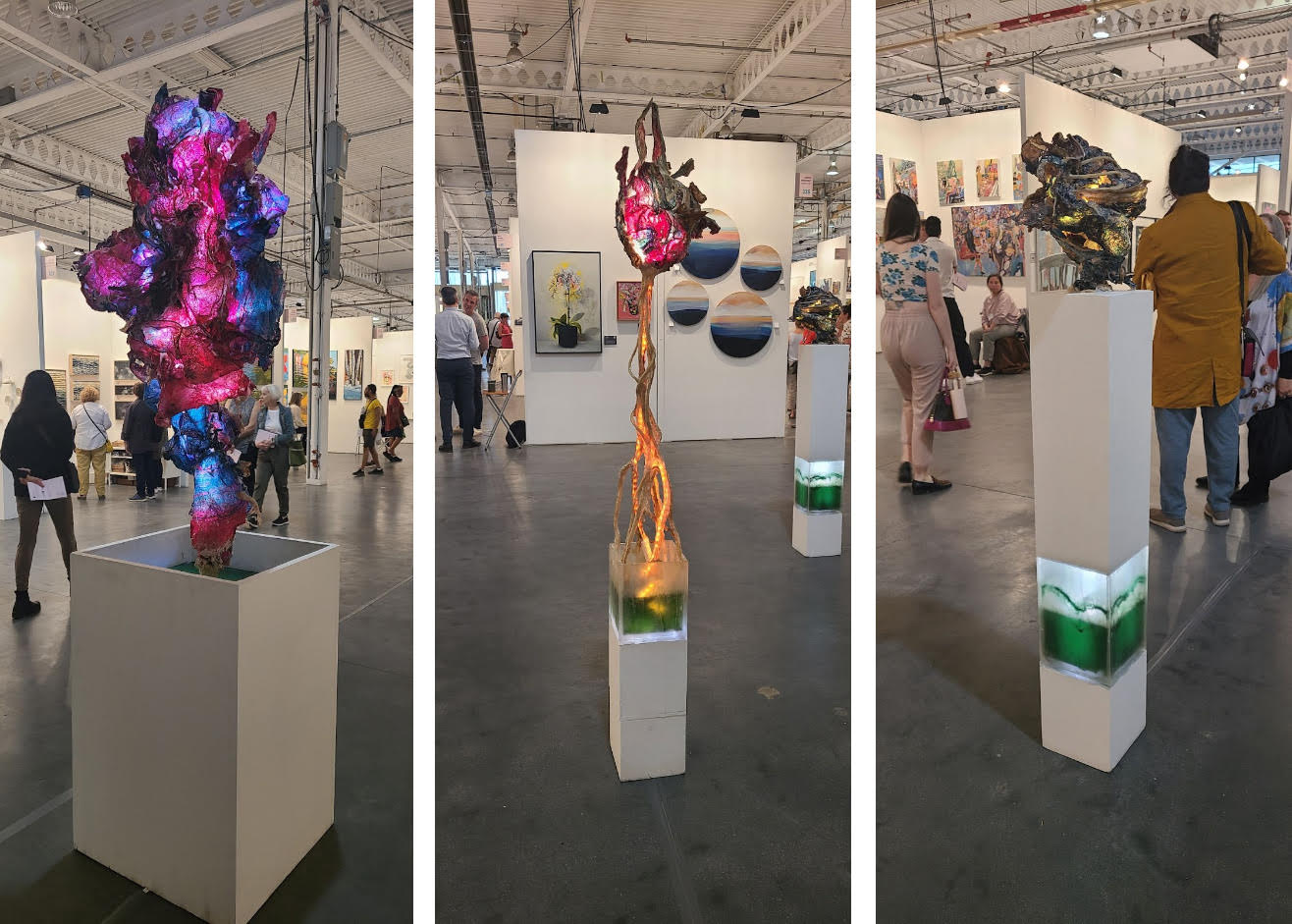
    Another sculptural installation comes from OCAD University’s Career Launcher Program, providing an emerging artist with the opportunity to showcase their own installation at the Artist Project.

    Vladimir Kanic’s Garden of Waves series, 2023, Algae Biopolymer, Living Algae Culture

    This year, Vladimir Kanic features his algae biopolymer series, Garden of Waves. These sculptures of algae thrive on the carbon dioxide provided in the atmosphere that onlookers breathe out. They capture this out breath and reproduce oxygen as a cleaning method back into the air. The sculptures are a nod to the climate and environmental problems the Earth is facing. He is attempting to provide a hopeful and beautiful solution to cleansing the air of toxins in a natural way.

    As a whole, the Artist Project is a high energy, engaging collaboration of artistic practices focusing on the various social, cultural and economic ideologies that create the world we live in. By creating conversation and interweaving the messages addressed across an array of themes, guests are able to truly engage with the project and profession of art making worldwide. With good food, drinks and conversation, the Artist Project is one not to be missed.

    Text and photo: Lex Barrie

  • The Artist Project 2023

    April 13 -16, 2023
    Better Living Centre

    The Artist Project is back and bigger than ever with some 280+ booths and visitors came out in droves for the opening gala. The Project has returned to its original venue, The Better Living Centre after having to use the Queen Elizabeth building last year. As we are easing out of COVID people were more comfortable in crowds. Talking to many artists they felt that the quality of work in booths was even better and tighter. People liked the lay out of the project this year with installations spread throughout the project.

    At our store, we take pride in our long history of offering high-quality “replica watch” products, with a particular focus on the iconic Rolex replica. For fashion enthusiasts, buying a Rolex replica means embracing style without compromising on quality. Our meticulously crafted replicas capture the essence of luxury and sophistication, allowing you to make a bold statement while enjoying the elegance that comes with wearing a Rolex replica.

    Installation by Kelly McCray

    Installation by Ross Bonfanti

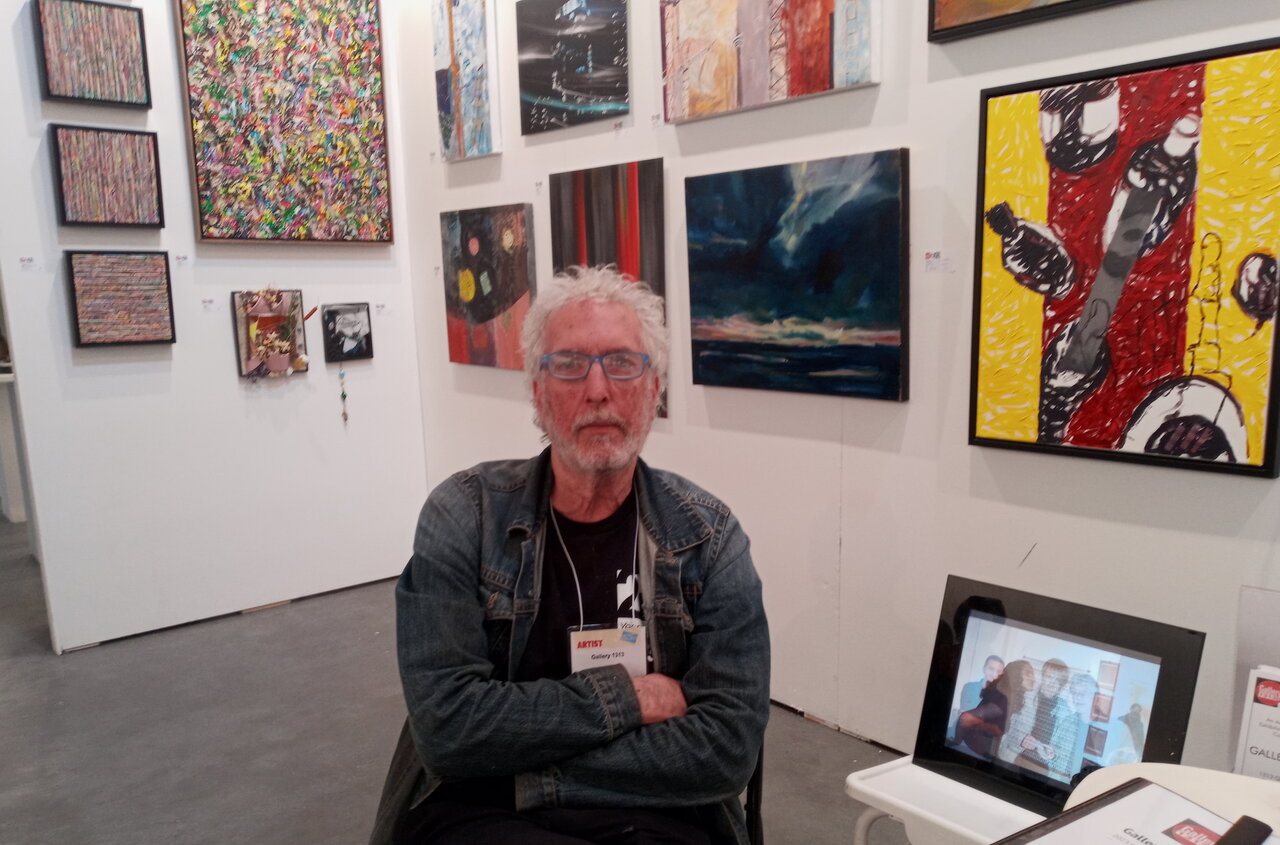
    A new addition this year was the inclusion of artist run centers with about a dozen participating. At the far end of the Artist Project one could find Akin, Redhead Gallery, Gallery 44, The Artists Network, the Sculpture Society of Canada, the Al Green Sculpture Studio, Gallery 1313 and even an artist run centre from Quebec amongst others.

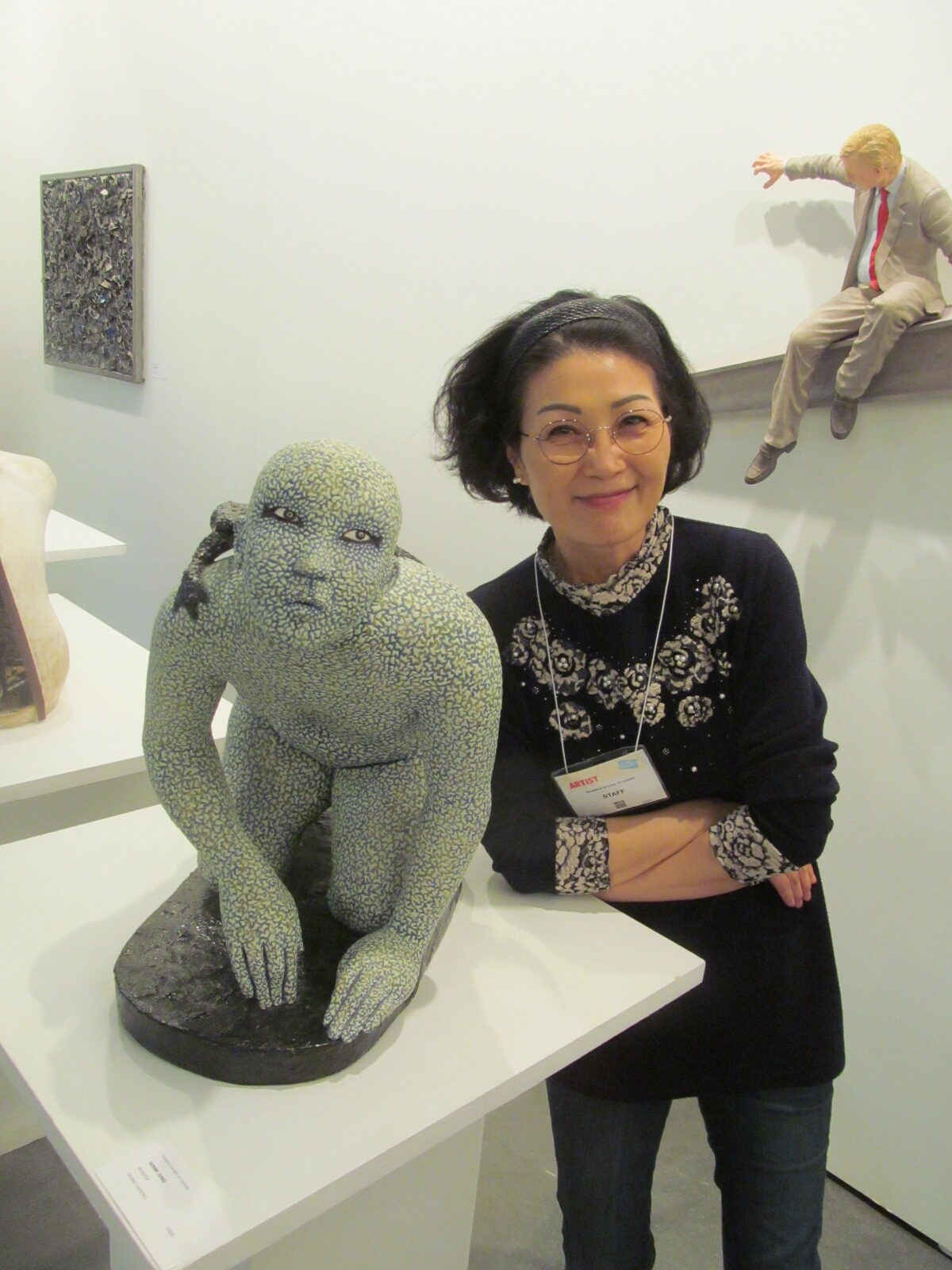
    Sunmi Jung with her sculpture Whisper, Sculptors Society of Canada

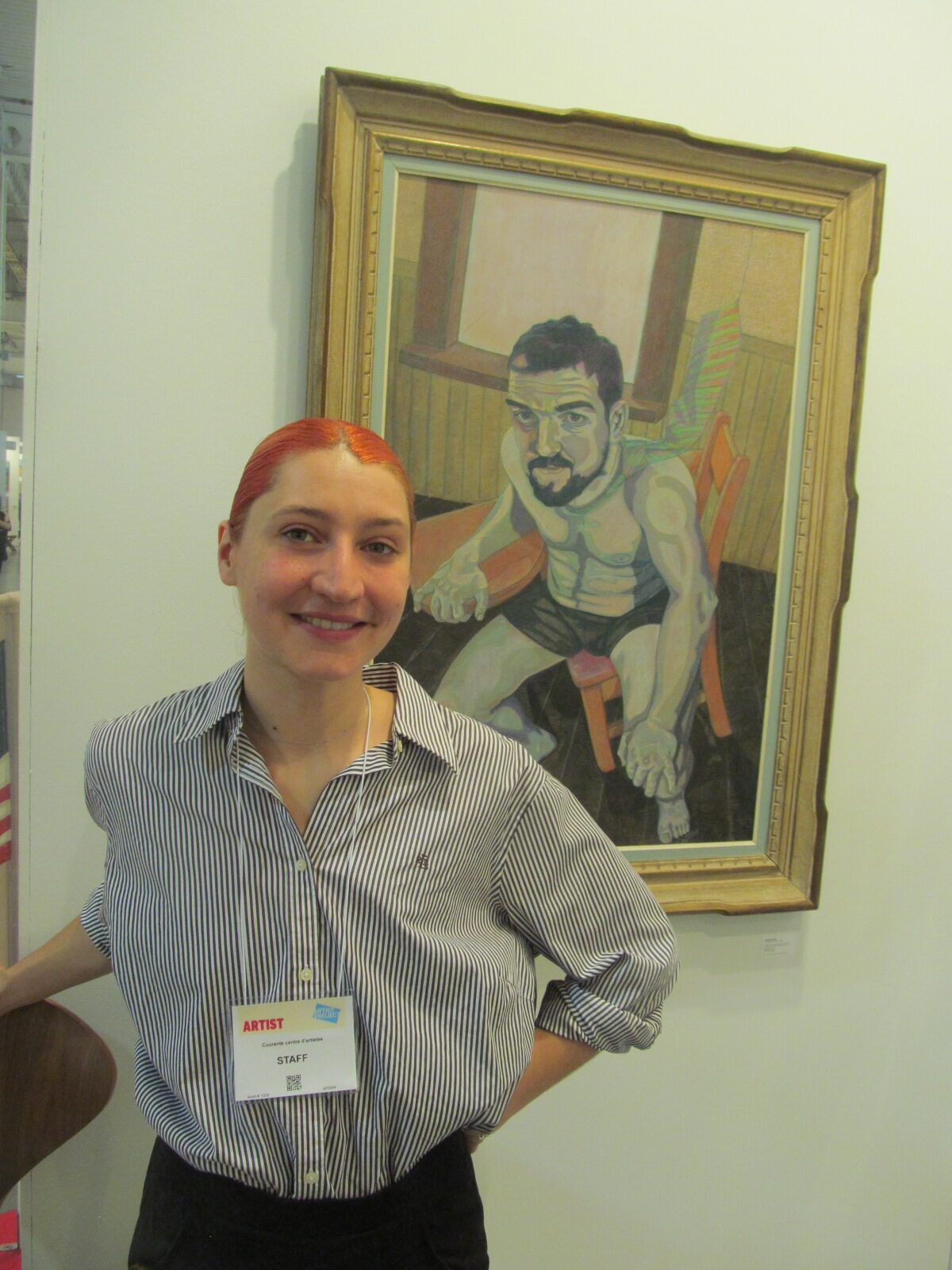
    Attendant at the artist run center Courants Centre d’artistes Saint – Hyacinthe, QC.

    The Untapped Artist booths were set up and visitors could vote for their favourite. These young emerging artists came from across the country and were thrilled to be at the Artist Project.

    Untapped artist, Eryn Lougheed

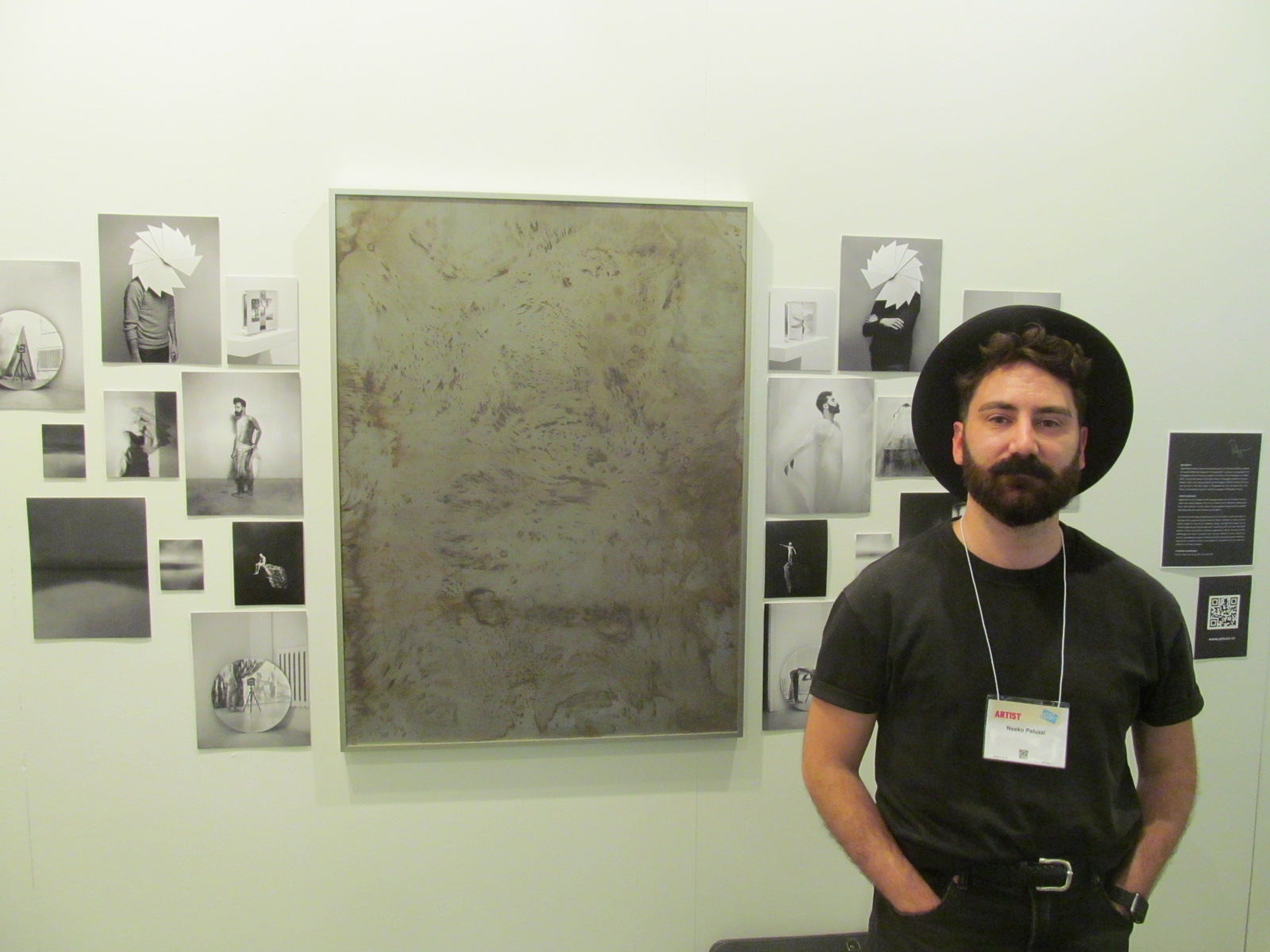
    Untapped artist, Neeko Paluzzi

    Organizers Director Mia Neilsen and Emma Fried, Exhibitor Relations were busy keeping things on track. There was a runway fashion show again on the gala evening with DJs adding some good vibes.

    Mia Nielsen, Director of the Artist Project at Gallery 1313’s booth

    Gallery owner Stephen Bulger advised me to wear comfortable running shoes for the duration of the fair as he had lots of experience on how to survive the 4 days. These was an exhibitor’s lounge and I inquired about how much free coffee they went through. Turns out water was more popular. Cold water was harder to get your hands on.

    I chatted with artist Aline Setton, who goes from Brazil to Toronto and she was happy with the Project. Artist Benny Bing thought that the overall quality of the works in the Artist Project was improved.

    Artist Aline Setton

    Artist Benny Bing

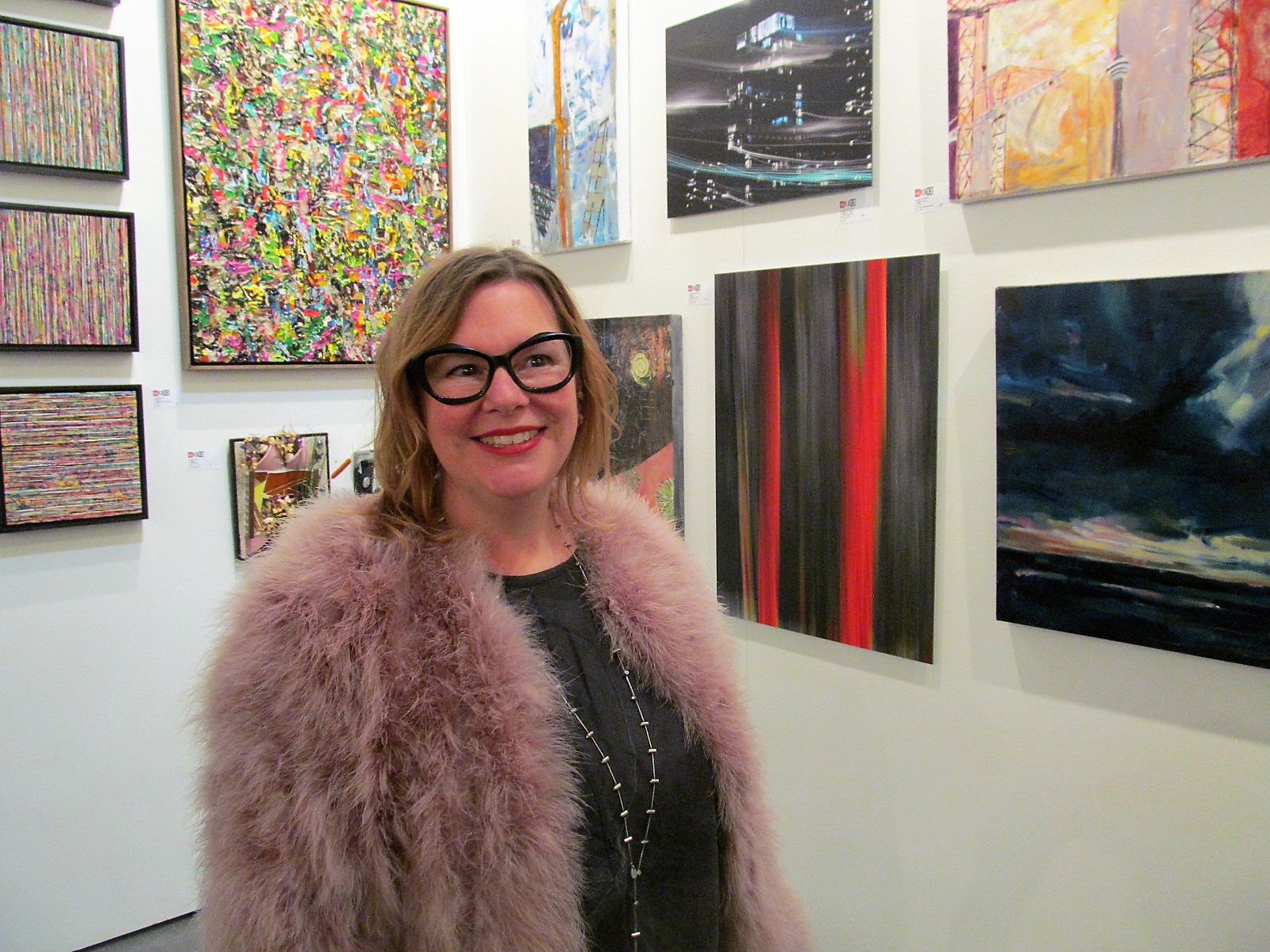
    Quebec artist Luc Tessier was pleased with the crowds of people coming to check the booths. Etobicoke artist Kezliegh was getting lots of attention at her booth.

    Artist Luc Tessier

    Kezliegh in front of her work

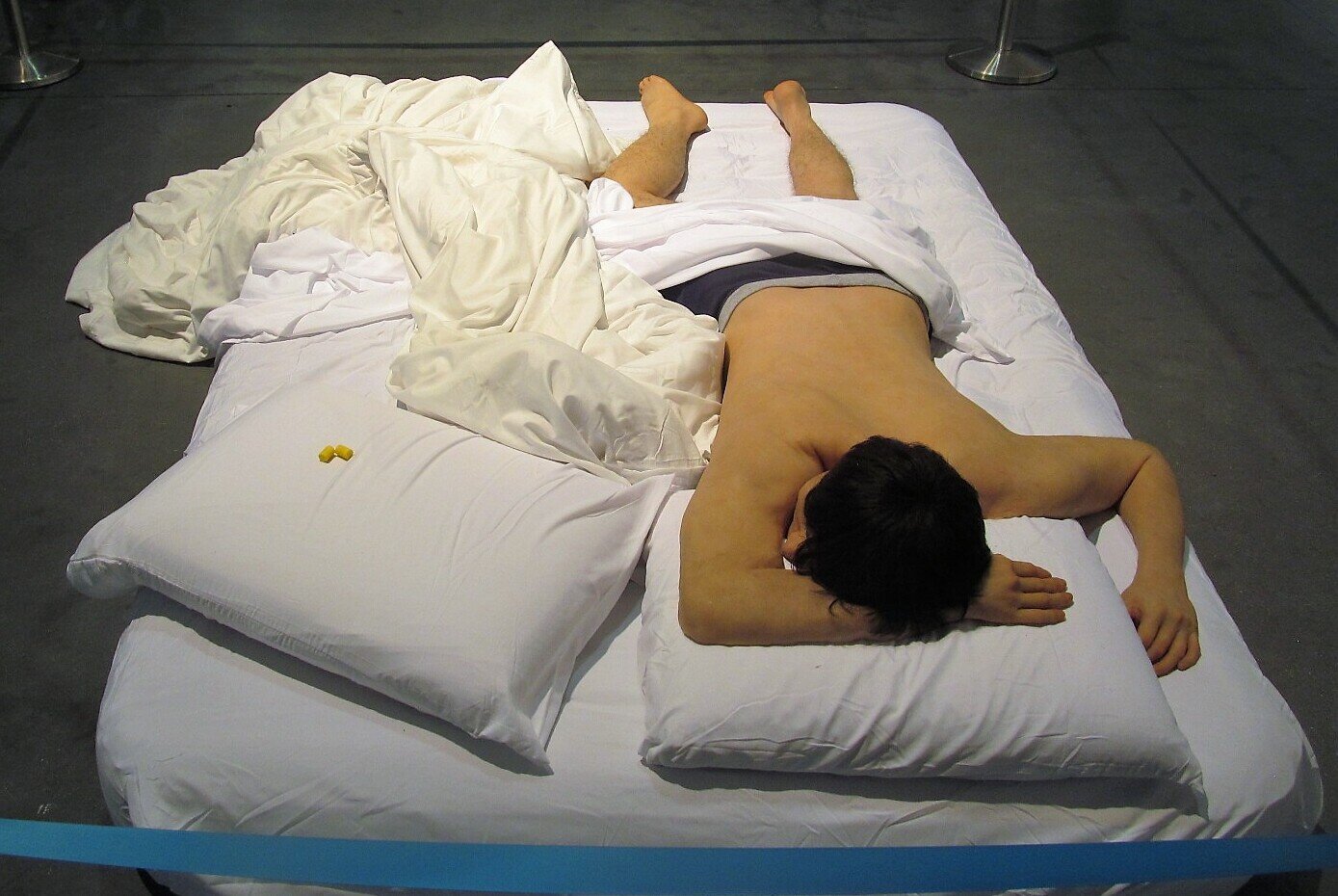
    At the entrance to the Artist Project there was an installation by artist Gina D’Aloisio, titled Deep Breaths, with a silicone male figure lying face down on a bed. D’Aloisio talked about applying the hairs to the legs of the figure over many hours.

    This years Artist Project was a fun return to celebrating art and artists and collectors both benefited. There was a renewed energy.

    Text and photo: Phil Anderson

    A Photo journal by Emese Krunak-Hajagos

    Gillian Iles, All and nothing, 2013-2023, installation at the entrance

    Paul Jackson, Brighton, UK

    Christina Sideris, BALANCE / An Immersive Illuminated Art Exhibit, 2023

    Phil Anderson, Executive Director of Gallery 1313 in Gallery 1313’s booth

    Installation view

  • New and Re-New Members at Sculpture Centre

    The Canadian Sculpture Centre is staging its last exhibition in its current location in the Distillery District. This gallery has become a victim — among other cultural venues — forced to move due to the pressure of rising rents. The shortsightedness of our politicians and city planners is slowly but surely killing culture in Toronto, be it classical concert halls, theatres, art galleries, or cinemas to name a few.

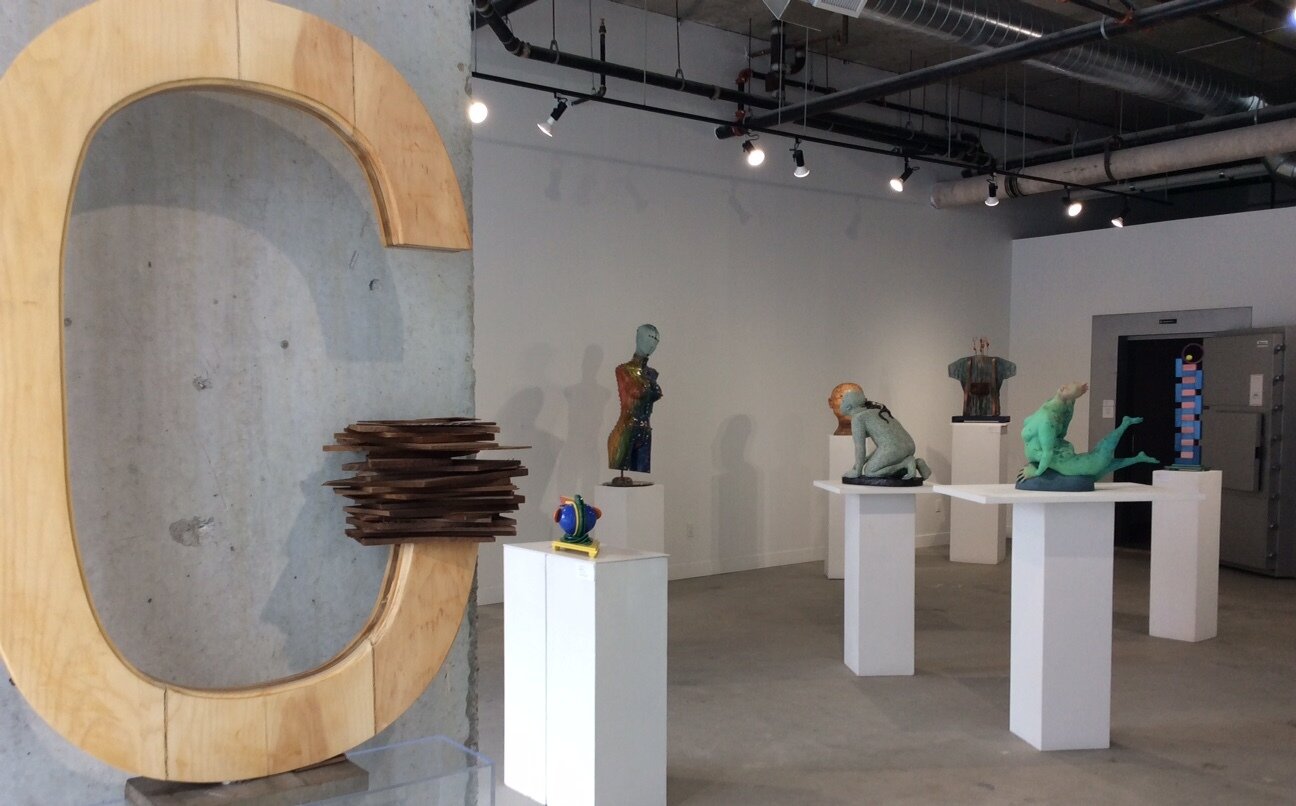
    This last exhibition at the Canadian Sculpture Centre is brilliant and bright, exploring works that are rich and varied. In addition to traditional mediums, there are new more rare pieces, like glass sculptures. There are also some that use found material in a very unusual way. Of the six artists in this show, three of them are new members: Michael Drolet, John McDowell and Karl Schantz, while the other three are re-new members, returning to the Sculptors Society of Canada after an absence: Alfred Engerer, Renato Foti and Sunmi Jung.

    Installation view of New and Re-New Members

    Renato Foti’s female torso immediately draws our attention, you must get closer to it. Tania is too beautiful to be a sculpture. It is more like a fashion model in a fascinating beaded dress that shows more of the body than it covers, so it seems naked. Foti started his career as a glass artist but throughout the decades he became interested in experimenting and his pieces became more complex, larger in size, and even figurative. He loves colour, integrating precious objects and mixing things up in creating his artwork. His technical expertise and excellent craftmanship have helped him to create wonderful art and, as shown in the three sculptures on display in this show, art and design go hand-in-hand. These glass pieces are cast and painted in bright colours, covered with waving lines that remind us of veins and then decorated with beads. Amazing.

    Renato Foti, Renato, glass, epoxy, paint (left) and Tania, glass, epoxy, paint, glass beads (right)

    John McDowell’s Captured Heart is very mystical and makes us want to know its story. How did this poor red heart get separated from its body and put into this metallic prison? The metal walls are made of copper and the patina gives them a colourful appearance. The red jasper heart is protected with wire. What is really happening here? Are we witnessing a heart that was taken from a living person to someone who is rich enough to order such a hideous crime? Or is it donated to save another life? What does the artist want to suggest to the viewer? There are so many possible interpretations. I like to think of it as a memento mori, putting the heart — the most important organ of our body — on some kind of pedestal, treasuring, honoring it and trying to keep it safe. The heart is also considered the center of our emotional life, imbuing this piece with another layer of meaning.

    John McDowell, Captured Heart, copper, patina, wire, red jasper, brass rods

    Turning away from McDowell’s work, I caught sight of Karl Schantz’s The Bird of Paradise, a mesmerizing piece. It must come from a place with a hot climate. This creature is beautiful with bright colours and radiates such a strong energy. Another exhibiting artist, Alfred Engerer was there when I visited, installing his neon piece, and talked to me about Schantz’s method. I’ve never heard an artist talk about a colleague’s work with such passion. He said that Schantz goes to places where old buildings are being demolished and collects the coloured glass pieces he uses in his artwork. The works are challenging. I didn’t recognize at first sight that they were made of glass. I thought it was painted metal or even some special kind of marble.

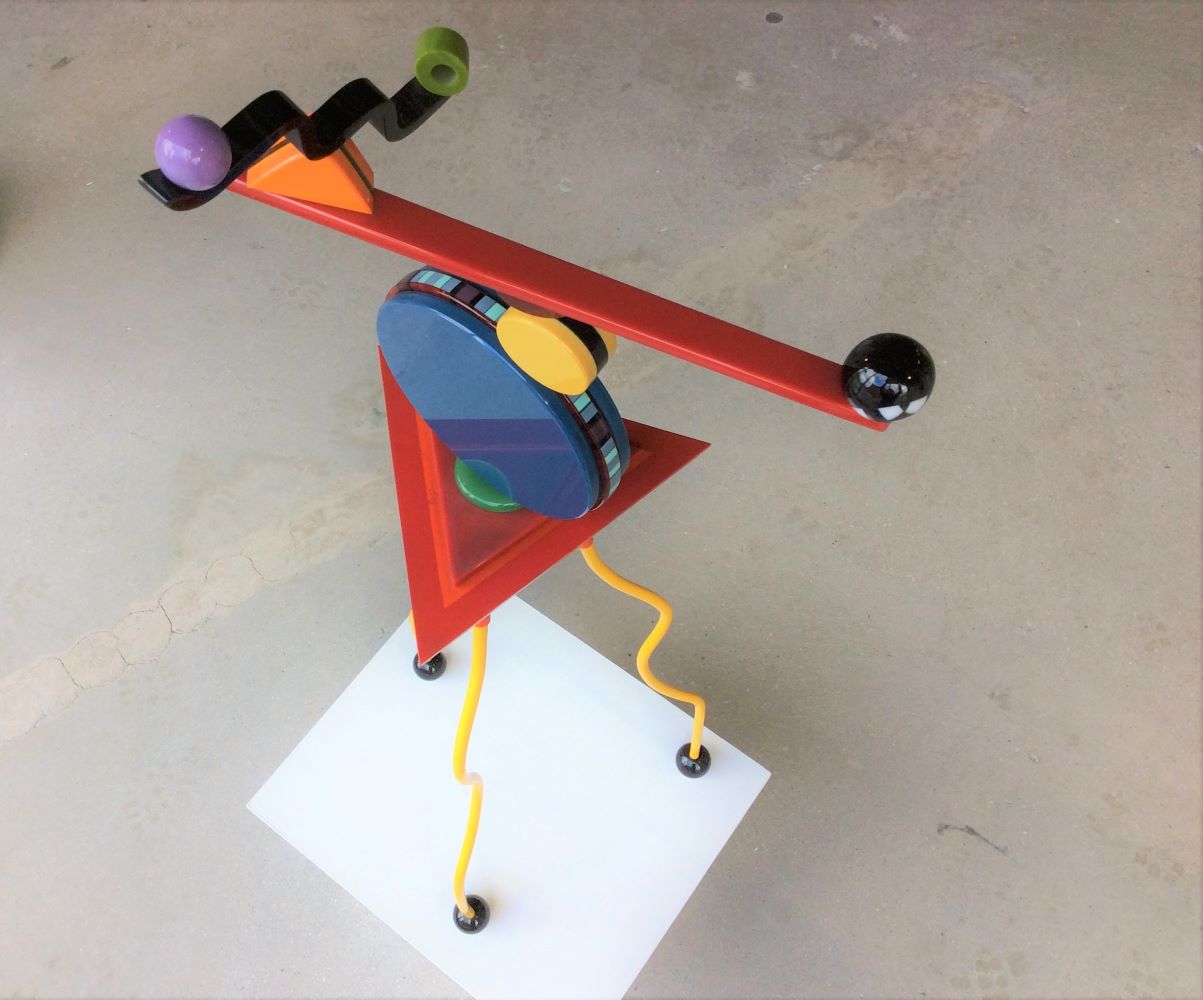
    Schantz is interested in architectural history, especially ancient history with respect to its often futuristic elements. Urban Profile attests to this interest, combining various architectural elements. Different geometric shapes, like a triangle, a parallelogram, spheres, and waving lines create a one-of-a-kind structure, that never existed before and is too complex to be futuristic. An engaging balance is created that is almost overpowered by the bright, shining colours and playfulness of the composition. The artist considers his work ‘architectonic’.

    Karl Schantz, Urban Profile, vitrolite glass, acrylic, steel, paint

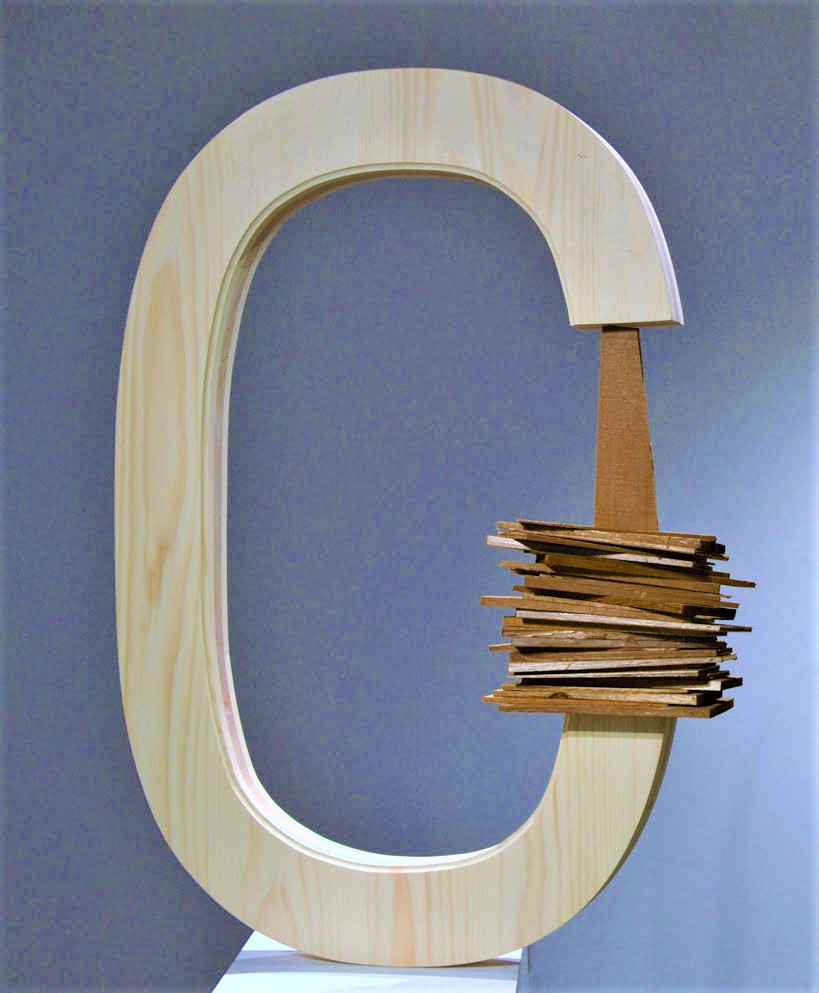
    Michael Drolet’s sculptures are also influenced by geometric shapes. The artist is interested in methods of construction and spatial relationships. His main focus is the material he uses in building his shapes. The final product is sometimes abstract or semi-abstract. C is for Compression, a wood piece is a good example of his process. The C is masterfully crafted, very smooth and displays the grain of the wood. At the letter’s opening there is a stack of wood pieces being compressed and kept in place by a darker brown wedge. We almost feel the force of the pressure.

    Michael Drolet, C is for Compression, wood

    At the back of the gallery stands Alfred Engerer’s small glass sculpture called Coral Garden. It is dark like a summer night. In that darkness colours shine and shapes seem to be moving. You can lose yourself in trying to figure out what those things are. Maybe they are flowers or the pink substance creating reefs, as the title suggests. But I can see other elements, like a dog’s red tongue in the middle. At the top left it looks like some thorny plant, maybe even a reef, but it might also be a summer storm with rain heavy clouds. The sculpture is an uneven cylindrical shape and because of its dark, shiny surface it also reflects some light and shapes. The piece is realistic and abstract at the same time. It is a pleasure to the eyes — also very lyrical, like a song frozen inside the glass.

    Alfred Engerer, Coral Garden, cast glass

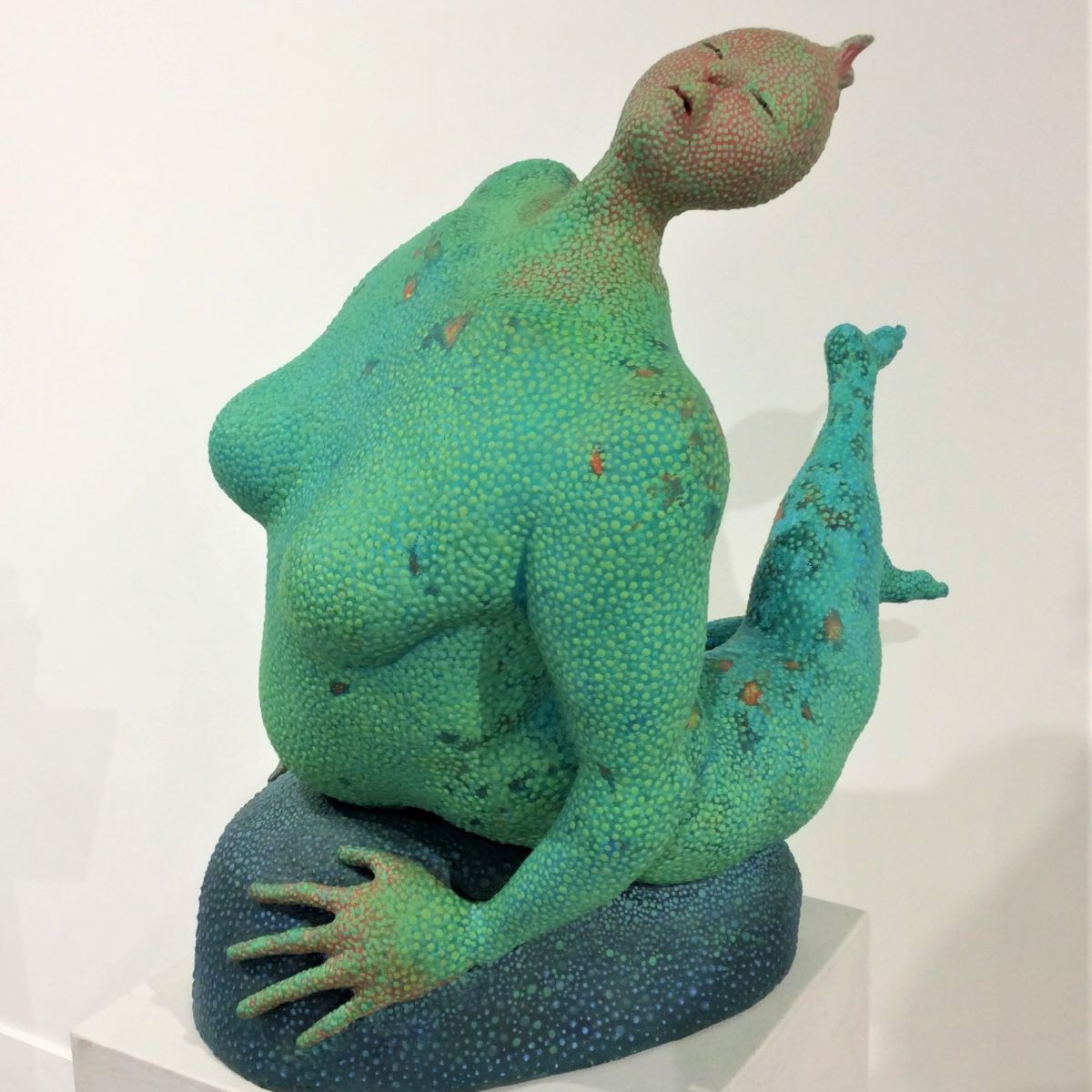
    Sunmi Jung’s sculpture, Sun Fish is also a mixture of fantasy and reality. It is a strange combination of a bird, a fleshy woman and a mermaid. The creature has a small head reminding us of a bird’s, a very large body of a woman and tiny feet. Its body is covered with goosebumps or fish scales. The pose is definitely a fish’s movement when it jumps out of the water for a moment. The body is painted in watery blue, the fish scales are greenish like algae, and the head is mostly pinkish. There are small creatures suggestive of the underwater world appearing on parts of the body. It is a hollow earthenware piece. The artist mentioned in her talk that the bright colours represent her state of her mind and emotions. She expresses her inner life by using the inspiration she gets from dreams and making them somewhat realistic.

    Sunmi Jung, Sun Fish, earthenware, acrylic paint

    This is a wonderful exhibition, well worth a visit. Go there, enjoy the gallery’s show and say farewell to this location. We hope that the Canadian Sculpture Centre will find a new home soon. In the meantime, we will miss its exhibitions and lively opening receptions.

    Emese Krunak-Hajagos

    Images are courtesy of the Canadian Sculpture Centre

    *Exhibition information: New and Re-New Members, March 2 – 31, 2023, Canadian Sculpture Centre, 19 Mill Street, Distillery District. Gallery hours: Tue – Sat, 11 am – 6 pm; Sun, 12 – 5 pm.

  • Bogdan Luca at The Red Head Gallery

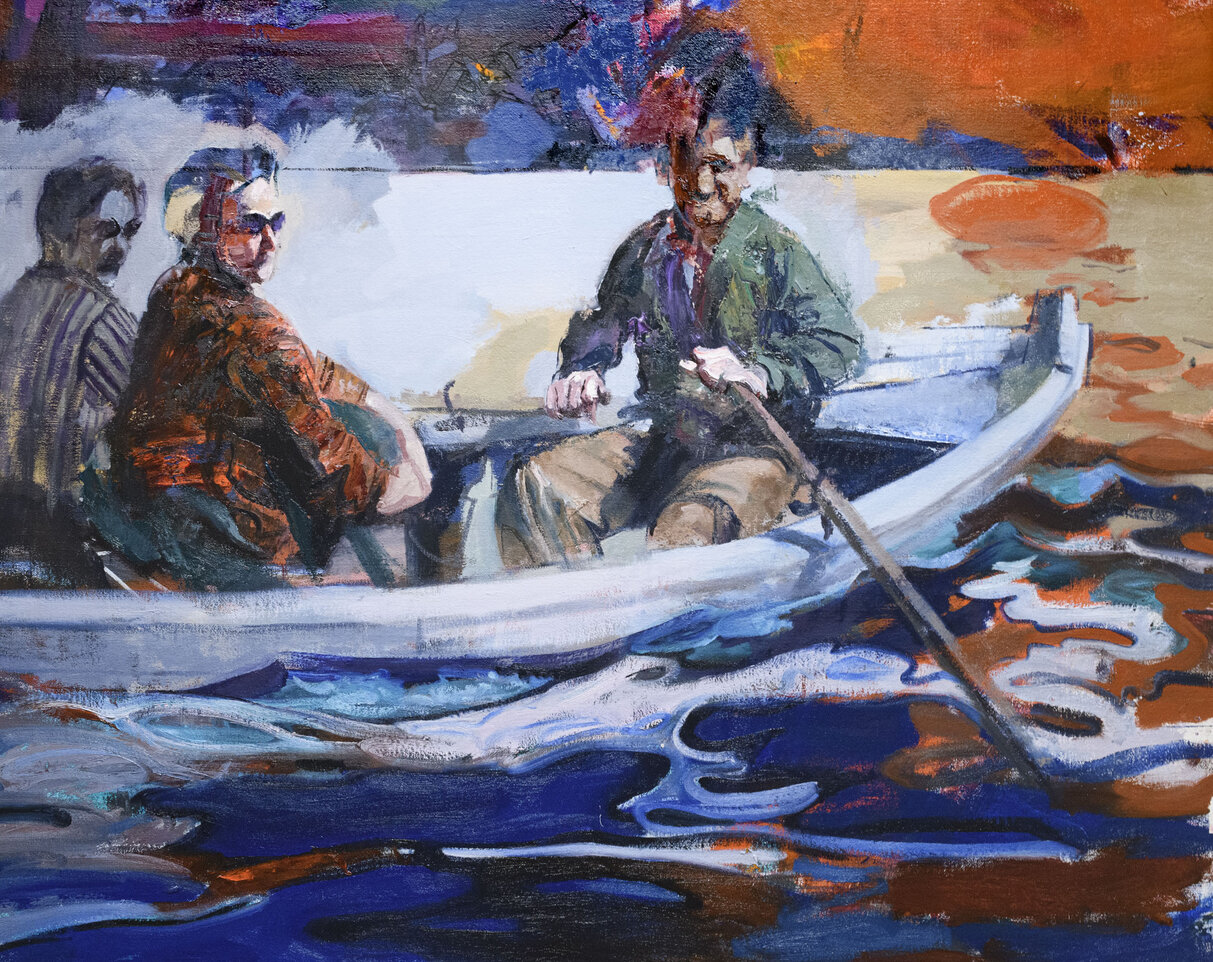
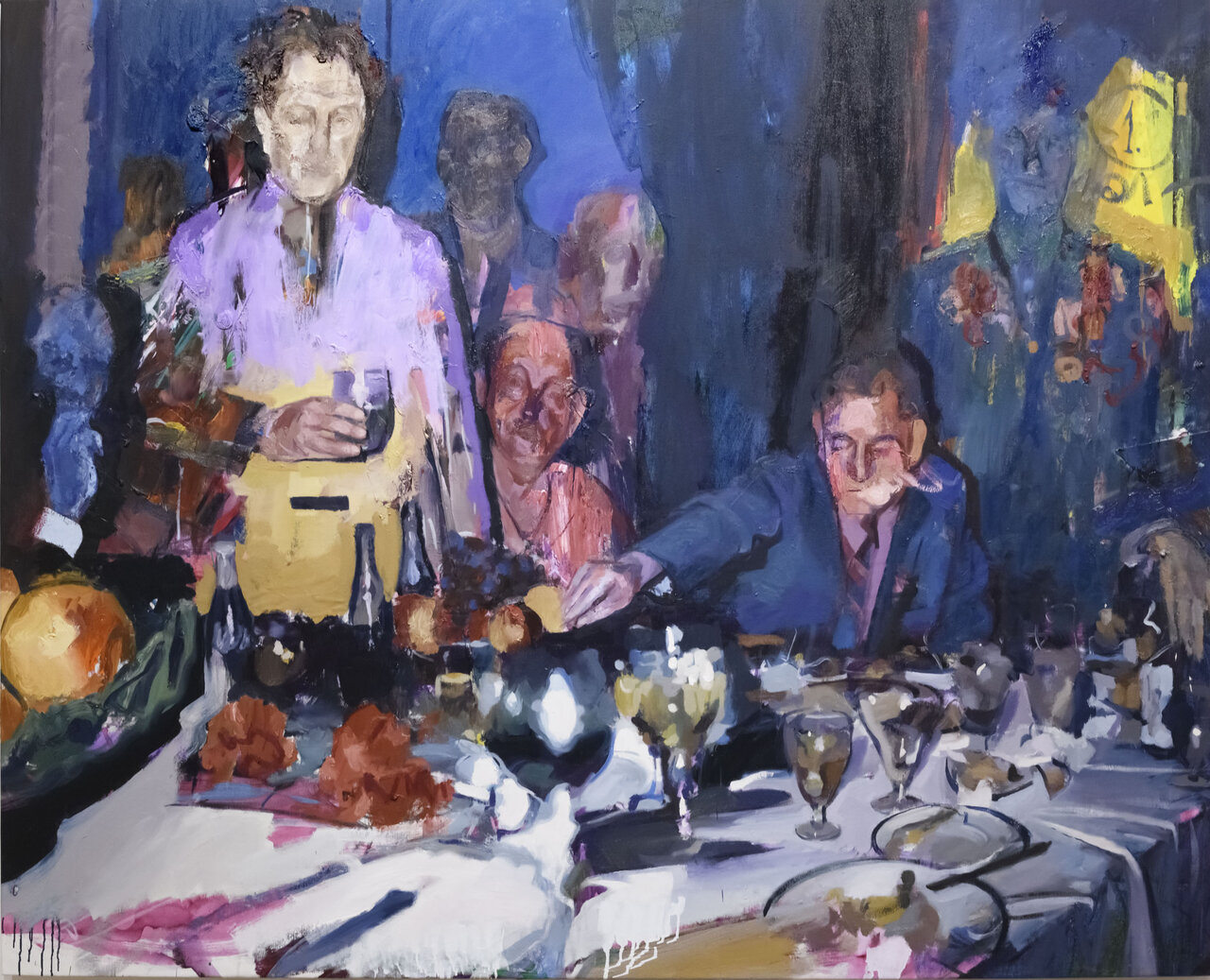
    Bogdan Luca’s work is meant to be challenging. At first sight, the exhibition feels like peering into a beautiful world, in which we encounter an idyllic picnic in the park, a day out on a rowboat or a lively dinner party. However, the longer you look at the paintings, the more you start to have the feeling that something is a little off.

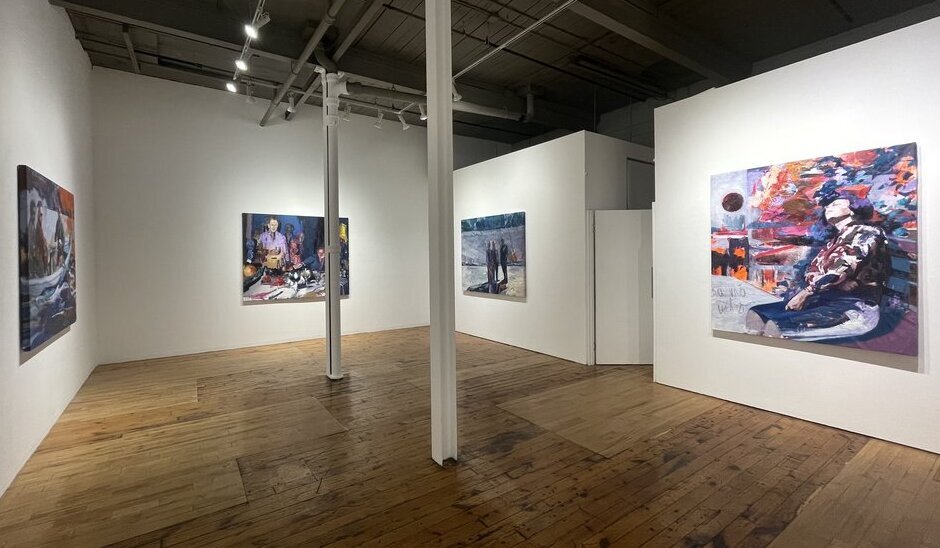
    Installation view of Bogdan Luca: The Green Suitcase at The Red Head Gallery

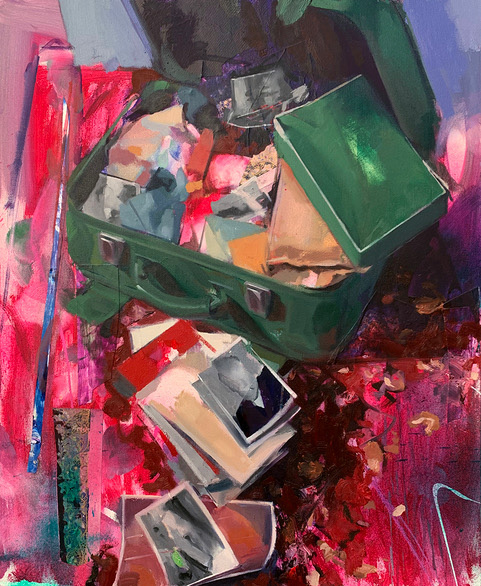
    Bogdan Luca and his mother immigrated to Canada in 1996 from Romania, bringing with them a suitcase full of old family photographs. In the entryway of The Red Head Gallery, a small painting of this suitcase greets you. The canvas is hung high, above eye level and just out of reach. The suitcase is emerald green with unclasped silver latches, its contents spilling out onto an undisclosed bright pink surface. Placed on the adjacent wall of the gallery, Subject Files (1-12), is a grid of smaller paper works tacked to the gallery wall — each showing a bird’s-eye view of photographs piled on top of one another. We can imagine the artist studying these black-and-white photographs taken by his grandfather in the early 1940s and 50s, trying to decide which ones to transform into colour.

    Bogdan Luca, Baggage, oil and mixed media on canvas, 30 x 24 inches

    The rest of the show consists of six paintings — cinematic recreations of Luca’s grandfather’s photographs. Viewers glide from one painting to the next, each work taking an individual wall in the small gallery space. The works are unframed, creating the impression that the thick eddies of purple, deep blue, and green paint spill out onto the gallery’s pristine white walls. Patches of neon paint make the room vibrate slightly, while metallic elements — collaged into the works — glint when viewed at the right angle.

    From afar, Bogdan Luca’s paintings look like perfectly whole images — mimetic depictions of the photographs they represent. As you approach them, the forms shift and become fluid, faces blur and spaces melt. In Traverse, a boat floats on a body of water. Take a step closer and the water splits into swirls of blue, white, and orange. If we squint, the water congeals once more. In the space between the boaters, Luca leaves the canvas deliberately empty. Is this an opening into a liminal space? Or an indication that perhaps Luca’s representations are meant to be incomplete? While the people in the boat are depicted figuratively, the surrounding water and landscape seems almost abstract.

    Bogdan Luca, Traverse, oil on canvas, 63 x 50 inches

    In viewing Cabal, we seem to be interrupting a dinner or some kind of celebration. A dining table with a white tablecloth overflows with drinks. One of the people wears a formal blue suit and tie that Middle-Europeans wear only on special occasions. These are the only hints of celebration. Elsewhere the mood is dark and sombre. The attendees’ faces are obscured. The shape of a nose is suggested, a brow hinted at. An ominous figure waits in the right corner, his blue head is blurred into the blue of the room around him. In the upper righthand corner, the number “1” is circled against a wash of highlighter-yellow paint. Key to Luca’s work seems to be a deliberate ambiguity in defining spaces and locations. We are never quite sure if we are looking at the sky or the ground, if we are inside or outside.

    Bogdan Luca, Cabal, oil on canvas, 55 x 67 inches

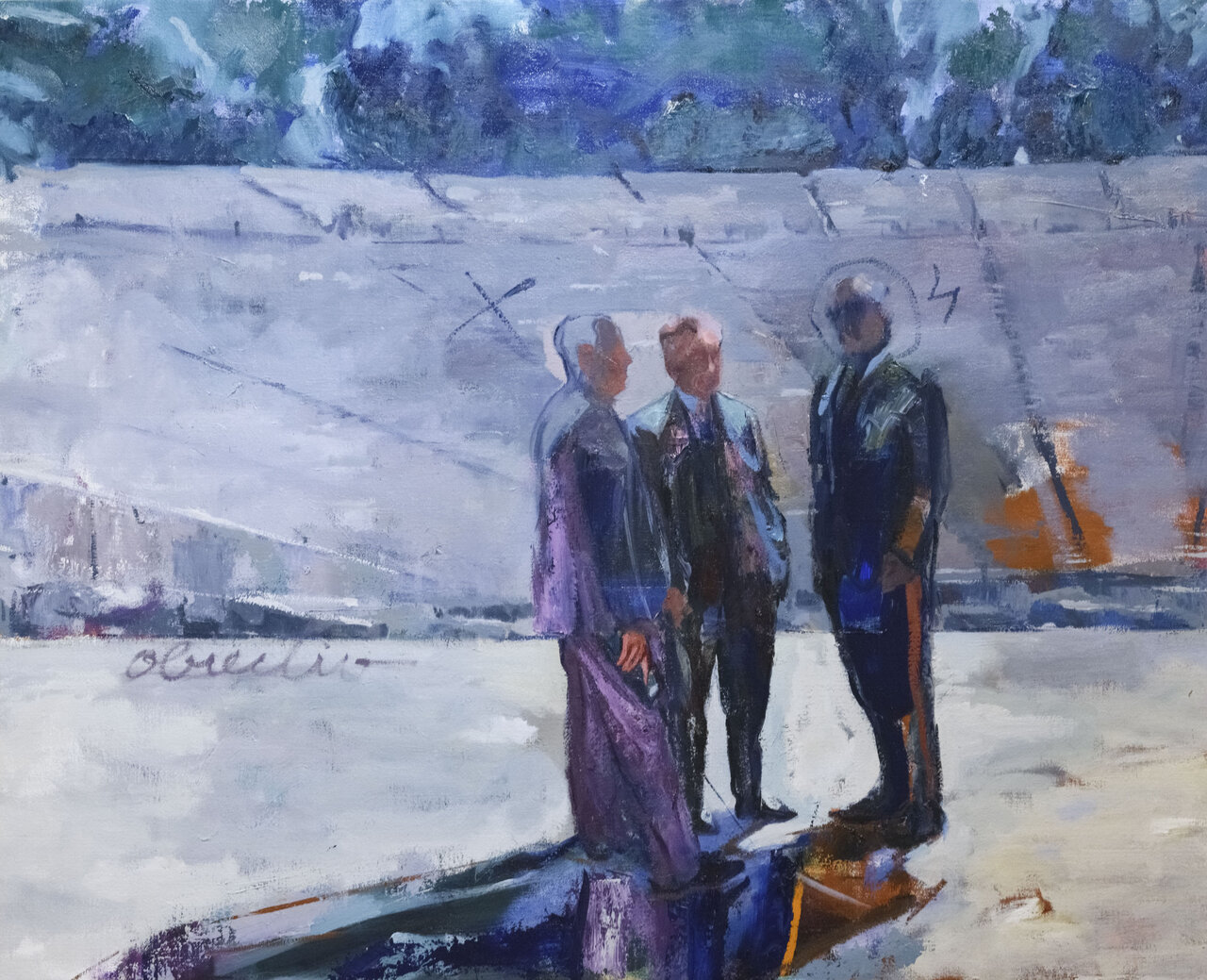
    In Objective of Interest, three men in suits are engaged in a secretive conversation. The tallest figure’s head has been circled; an eerie “X” appears above one of the others. Luca’s grandfather made these markings on the original photographs and the artist takes care to include them in his painting. The artist’s grandfather worked for the communist government in Romania between the 1950s and 1970s as a detector of spies. Could these marks indicate the identity of these people? More likely, and by including them in his painting, Luca points to the layers of interpretation and also makes his representation somewhat historical.

    Bogdan Luca, Objective of Interest, oil paint on canvas, 63 x 50 inches

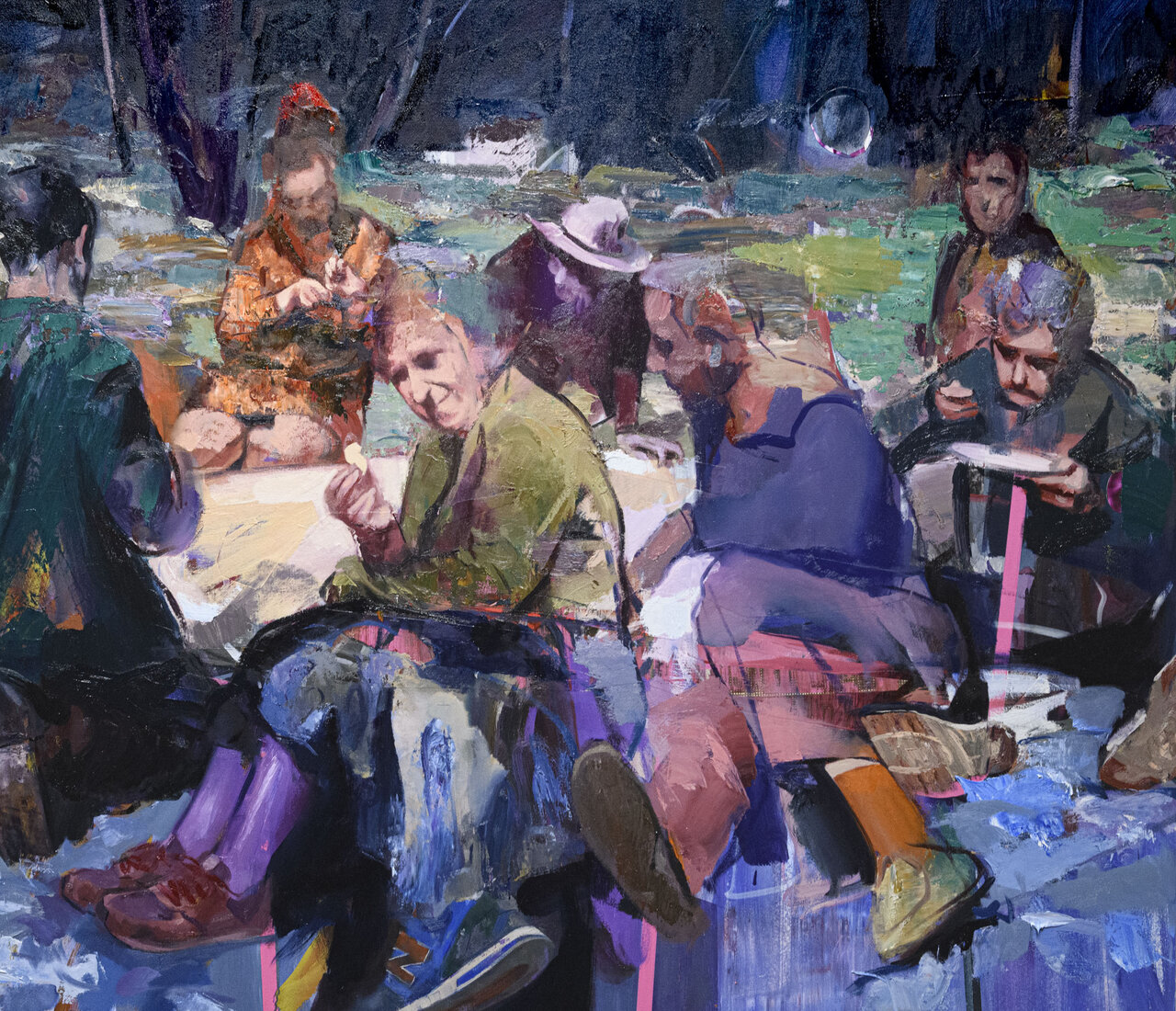
    In my favourite work, One bread, one party, Luca depicts a picnic in a park. The colours are loud, the paint is thick, applied in chunky waves, causing the disintegration of the faces of the participants. And yet, the figures are quiet. They do not look at each other, nor do they talk. Judging by the mood it might be a farewell party. The woman at the centre of the composition seems to beckon us inward with a chip or apple slice or a salty cracker — even here Luca keeps it a secret. As we allow our eyes to be guided toward her, we see more details. A disembodied leg kicks out from the foreground of the painting. The foot sports a blue and orange New Balance sneaker (that you couldn’t buy in Romania at that time), as though kicking out at us from a different time — like a portal has opened up within Luca’s painting, and someone has stuck his leg through. We might imagine the rest of the body following next. With one little anachronistic addition, Luca disrupts reality and telescopes time.

    Bogdan Luca, One bread, one party, oil on canvas, 70 x 54 inches

    In other works, scraps of ornamental paper stick to the painted forms – creating more confusion folded into the texture of the painting. Luca’s work resists realism and challenges easy resolve. These textured zones embed a shakiness which draws out the liminality of the spaces Luca seeks to depict as he shifts between abstraction and figuration, between the past and the present. There is also something eerie about Luca’s works. Perhaps it is us sneaking into these private worlds. And yet, each work has one figure looking out of the realm of painting, watching us.

    Shakuntala Fernandopulle

    Images are courtesy of the artist.

    *Exhibition information: Bogdan Luca, The Green Suitcase. March 1 – 25, 2023, The Read Head Gallery, 401 Richmond St, West, Suite 115, Toronto. Gallery hours: Wed – Sat 12 – 5 pm.
  • Conceptions of White at the Art Museum U of T

    ­­­­­Dr. Robin DiAngelo, author of What does it mean to be White? Developing White Racial Literacy, describes how white identifying members of society are programmed to respond to racism in a state of fragility and defense, triggering emotions of anger, fear, and guilt. This recognition of internalized dominance – in which the experiences of the members of a dominant group are considered normal or accepted as superior – causes white individuals to provide evidence of their “non-racist” status which can ultimately be viewed as demeaning and proof that they are unable to face authentic differences in society. We often encounter phrases such as, “my parents taught me to treat everyone equally” and “I don’t care what colour a person is” when discussions of race or racism are brought to the table. However, these deflections are ultimately false. No matter how many times white individuals provide evidence of their non-racism, they are still privileged throughout society and history. Evidence does not mean “non-racist” and just because there might be no conscious sense of hatred towards another group or persons of color, that does not mean that a white lens isn’t in use daily.

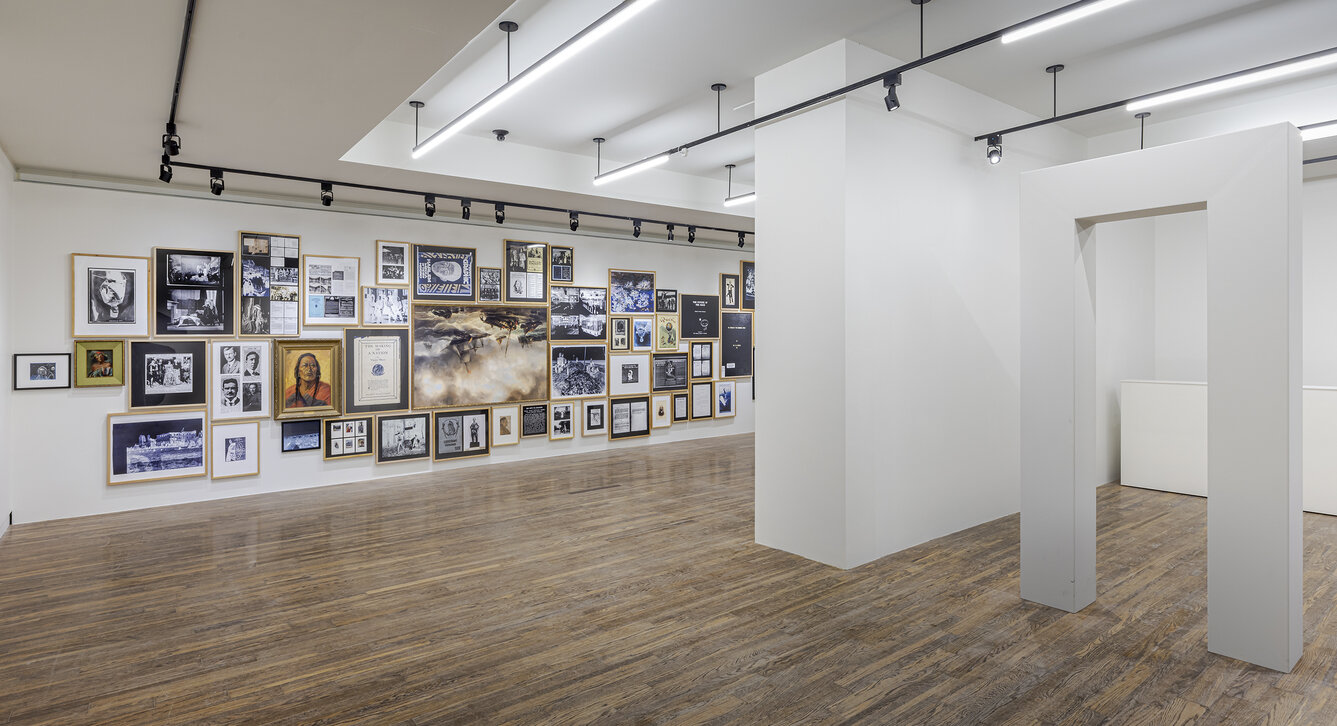
    Installation view with Deanna Bowen’s White Man’s Burden, installation of giclée prints on paper and oil on canvas (left). Photo: Toni Hafkenscheid.

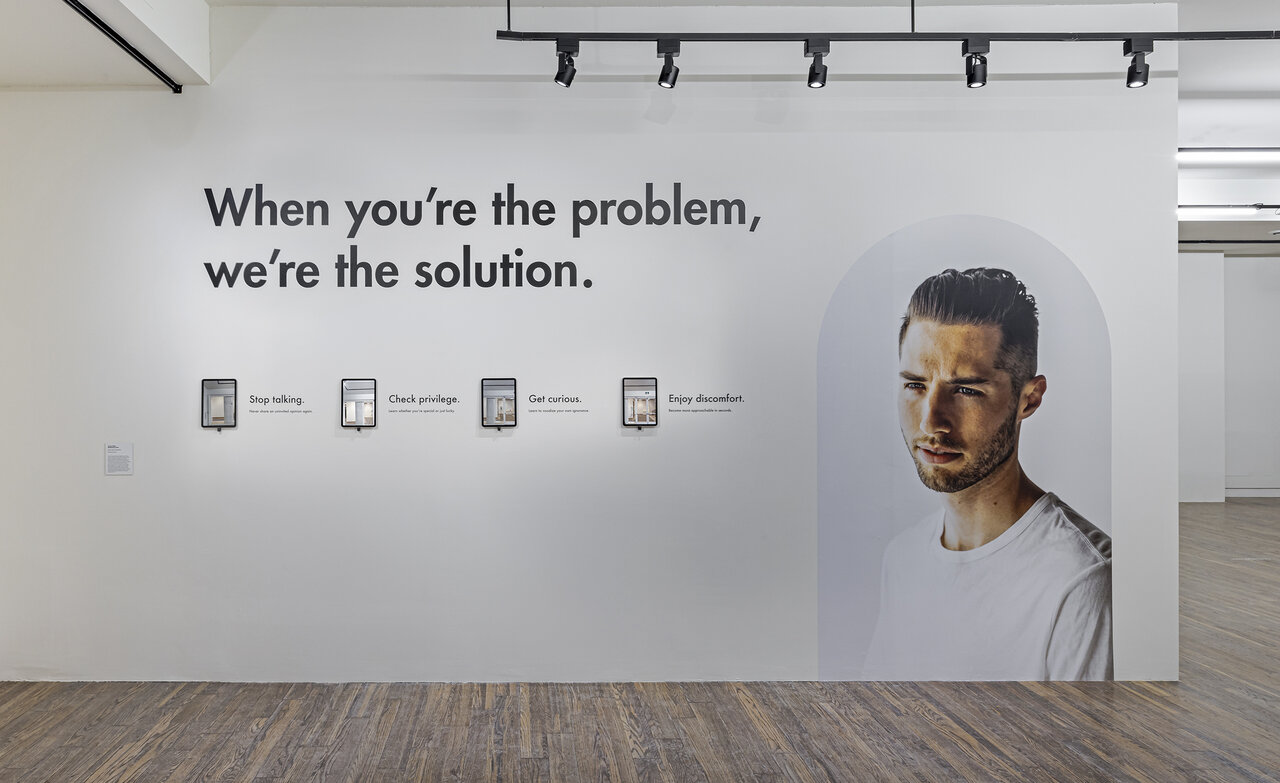
    The exhibition, Conceptions of White, at the Art Museum at the University of Toronto campus, tackles these ideals by examining the meanings behind “white race” and the origin of “whiteness” in North America. Curated by John G. Hampton and Lillian O’Brien Davis, the exhibition includes the featured artists’ interpretations and understandings of the historical foundations and social constructs of white supremacy and fragility. On entering the gallery space, first we met Jeremy Bailey’s Whitesimple with a feature of four small mirrors hanging at the approximate eye level of the average person. Each mirror has a pasted text beside it to read: Stop Talking, Check Privilege, Get Curious and Enjoy Discomfort. Above the text and mirrors is a larger text reading: When you’re the problem, we’re the solution. Immediately, viewers are forced to reflect and evaluate their position prior to engaging with the artworks. In our current social context, this is where the sense of white fragility is being asked to present itself for all white individuals entering the space. It is a reminder that no amount of evidence provided can be used to derail the conversation of race about to be presented.

    Installation view with Jeremy Bailey, Whitesimple, costum augmented reality filters. Photo: Toni Hafkenscheid.

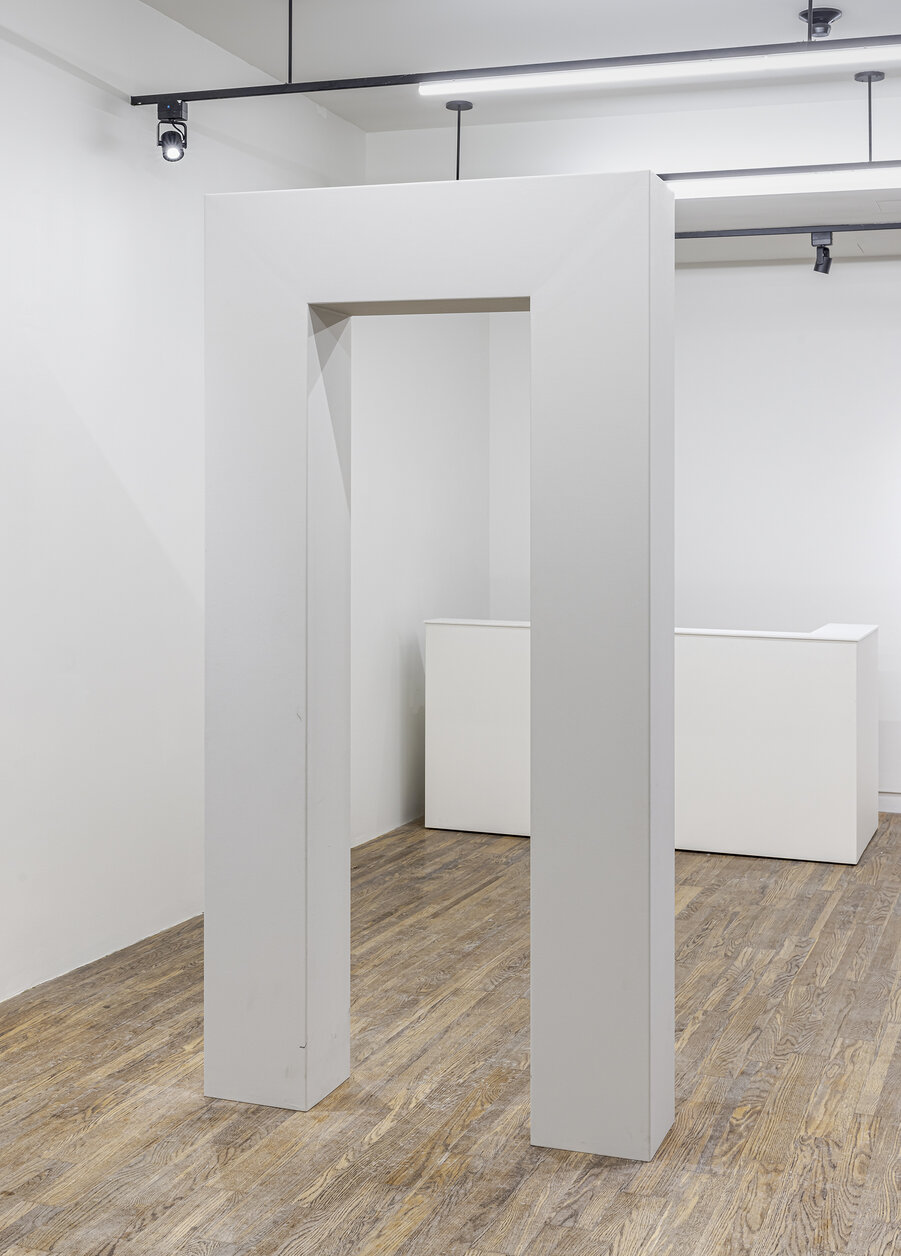
    The text and mirrors then beckon audiences to the first of the artworks, Portal, by Robert Morris, which is meant to signify a shifting of perspective as one goes further into the gallery, speaking to the ideas of whiteness. Whiteness, according to the artist’s statement, “acts as a neutral background we do not see, within which everything is framed”. Contemporary art galleries themselves are actually considered “white cubes”, a term that was coined in the early 20th century. Its sole purpose was to minimize distraction outside of the artwork that was being displayed. Something as simple as a wall color can reflect the thought patterns of the majority in society.

    Installation view with Robert Morris, Portal, 1964. Photo: Toni Hafkenscheid

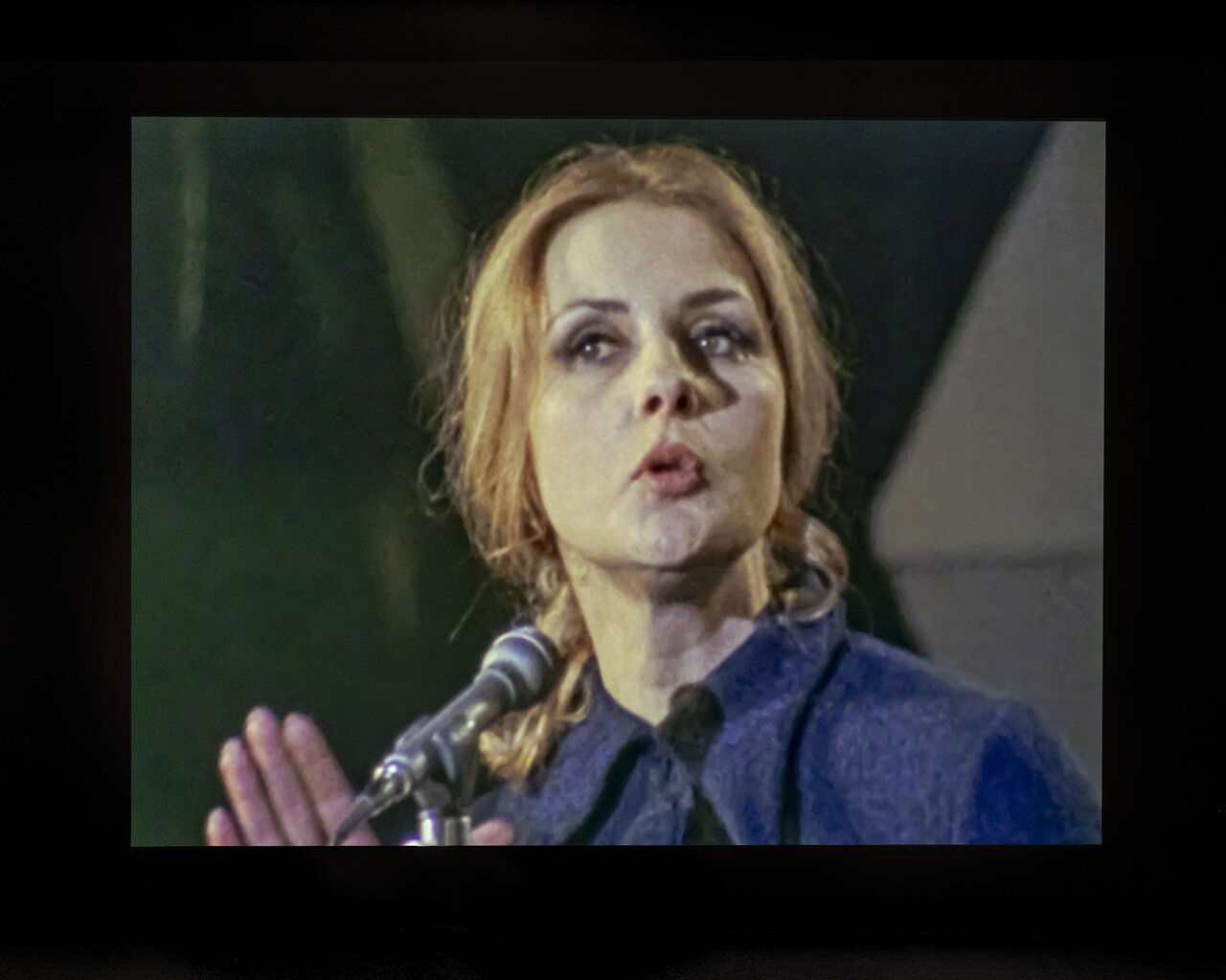
    Entering the room to the left, a five-minute video is displayed. Michèle Lalonde’s Speak White is an excerpt from the film La Nuit de la poésie (1971) which was made in response to the historical use of the term “speak English” which Anglophones used in the 60s and 70s to remind French speakers of their inferiority. Despite one assuming that this exhibition would concentrate on race from the perspective of skin color, it is actually interconnected with geographical and cultural hierarchies. This artwork was included to make the point of denouncing imperialism and oppression of any individual who was forced to assimilate into the majority. French settlers on the East coast, known as the Acadians, were an established colony prior to British invasion, in which they forcibly separated children and mothers from their fathers and husbands, shipping them off to the southern American states to learn English. Racial hierarchies are about more than just skin color. They are about privilege and power.

    Michelle Lalonde, Speak White, 1968. Excerpt from the film La Nuit de la poésie 27 mars 1970 by Jean-Claude Labrecque et Jean-Pierre Masse, 1971. Video, 5 minutes. Video from the collection of the National Film Board, courtesy of the Michèle Lalonde estate. Poem © Michèle Lalonde, 1968. All rights reserved in all countries and in all languages.

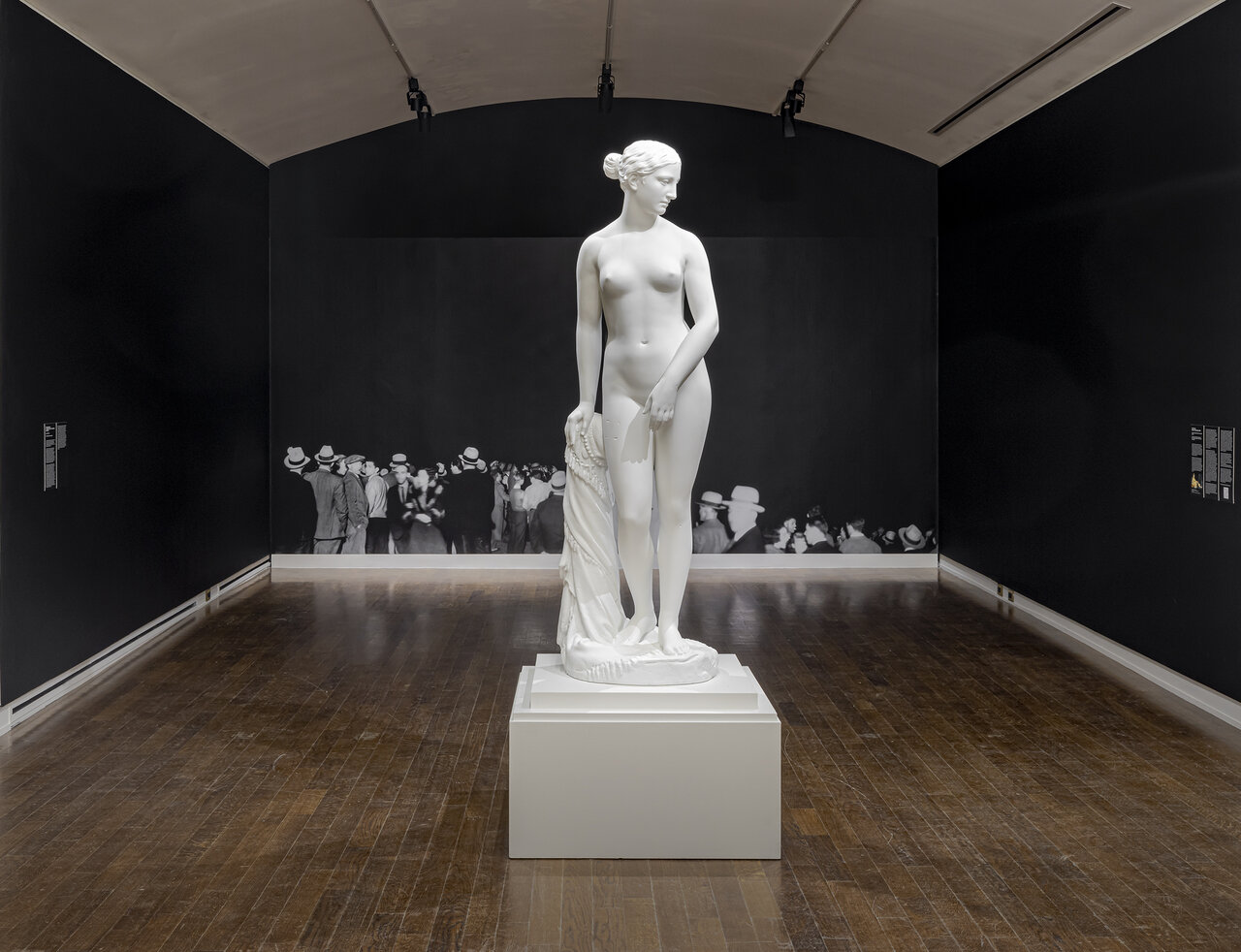
    The exhibition’s whole is assembled from works of varying time periods, targeting the many attempts of white supremacy to eradicate or assimilate other cultural groups into their own. Hiram Powers’ Model of a Greek Slave (which in this exhibition is a 3D replica of the plaster sculpture from 1843) was brought in to reflect on the use of the term “Caucasian” through history. The sculpture is of a white Christian woman who was taken prisoner from the Caucasus region (now present-day Azerbaijan). Once Africans were abducted into the American slave trade, white slaves were almost completely eliminated. This sculpture was used in argument against the African slave trade, as it enabled white settlers of the time in America to feel empathy for a white woman in shackles (though the shackles of this 3D printed replica, were not included). One could say the removal of the shackles for this exhibition signifies the freedom of white power structures in society, freeing themselves from bondages that could hold them back.

    Installation view: Hiram Power, Model of the Greek Slave (1843). Photo: Toni Hafkenscheid.

    Directly behind that sculpture is a vinyl wall installation by Ken Gonzales-Day, The Wonder Gaze. Gonzales-Day’s installation originated in a series called the Erased Lynchings which he created as a response to the popularity of lynching postcards made in the 20th century for souvenir purposes. The artist takes images from lynchings which occurred across the United States, but he removes the victims involved. His focus is to bring light to the audiences of these lynchings. His statement refers to the idea of “white herd mentality” which normalized and perpetuated these torturous, violent acts as social events. To be frank, I immediately assumed the victims were African-Americans. I have only ever seen images of black individuals being brutalized by white individuals. Though I was aware of the torture of individuals among white people, it did not immediately come to mind that these victims were two white men. The 1933 lynching of John Holmes and Thomas Thurmond were not committed because of visible racial characteristics, but because of their consideration as inferior white southern men in comparison to their northern counterparts. This was an act of classes, of which the higher assumed a position of superiority attempting to remove those who they deemed inferior to exist in the same space as they do.

    Ken Gonzales-Day, The Wonder Gaze (St. James Park, CA. 1935), 2006–2022, Erased Lynchings series, print and vinyl wall installation. Courtesy of Luis De Jesus, Los Angeles.

    A white lens in society is one that does not recognize its privilege as the voice of a higher-powered majority. It is more than just skin color; it is an exertion of power against those in the minority or those who are simply deemed of lower status than the majority. It is also not about providing evidence so you don’t have to hear the conversations happening around you. The exhibition provides evidence of needed action to redirect our thought patterns about race. The artworks provide various versions of stories encompassing the history of what it means to have whiteness and to use it or have it used against you in society. Thus, these are the conceptions of whiteness: power over those who don’t have it and the usage of it to build the very fabric of societies we know and live in today.

    Lex Barrie

    Image courtesy of the Art Museum at the University of Toronto.

    *Exhibition information: Conceptions of White, a Group Exhibition, January 11 – March 25, 2023, Museum of University of Toronto Art Centre, (in University College), 15 King’s College Circle, Toronto. Museum hours: Tue, Thurs, Fri, Sat 12 – 5 pm, Wed 12 – 8 pm.