Author: artoronto

  • Touching Strangers

    Since 2007, New York-based photographer Richard Renaldi has been working on a series of photographs that involve asking complete strangers to engage in a physical interaction while posing together for a portrait. Renaldi would ask two individuals to come together and carefully construct their positioning, creating falsely intimate moments typically reserved for close friends or family members. 

    Touching Strangers now makes its way to Toronto as part of this year’s Scotiabank CONTACT Photography Festival. The location of the photographs is perhaps the most interesting component of the exhibition. Curated by Bonnie Rubenstein, a selection of thirteen photographs from the series has been placed on a busy sidewalk just outside of Metro Hall. Rubinstein has done well in selecting images that complement the surrounding urban setting as well as the diversity of Toronto’s populace.

    As I observed countless people pass the exhibition, the vast majority walked by giving little more than a transient glance to the life-sized portraits staring out at them. A select few would briefly stop to take note of a specific image, or catch a momentary glimpse from the window seat of a passing streetcar before carrying on with their day. One gentleman however, upon seeing me taking notes about the exhibition, mentioned to me how much he enjoyed the photographs. We struck up a conversation for a few short minutes, shook hands, and went our separate ways. For that brief moment though, I like to think that we became more than touching strangers.

    To the many people passing by, Renaldi’s photographs serve as little more than an ephemeral memory of two individuals touching, another photograph added to the countless visual images we see each day. To some, however, Touching Strangers holds the potential to establish a dialogue about breaking down social barriers and to shape meaningful connections with the diverse society of individuals proud to call Toronto their home.  

    Text and photo: Mitch Billinkoff

    *Exhibition information: April 30- June 1, 2014 at Metro Hall, King Street West and John Street

  • The Purists / The Manipulators – Opening Reception

    May 10, 2014 / 5 – 8 p.m.
    Akasha Art Projects

    The Purists/The Manipulators – Group Exhibition

    More so than ever, many photographers are divided between technological advances and tradition. The Purist/The Manipulators reflects this divide by showcasing the contrasting works of “the purists”—film and darkroom devotees—and “the manipulators”—those who embrace digital media. The exhibition includes eight artists who champion their respective crafts and equally push the limits of these two parallel photographic ideologies.

    Artist Thomas Brasch

    Artist  Dale M. Reid

    Artist Alexei Rebrov

    Artists:  Thomas Brasch, Osheen Harruthoonyan, V. Tony Hauser, Wayne Hoecherl, Lissy Larrichia, Alexei Rebrov, Dale M. Reid and Sonja Scharf who also is the curator of the show.

    Artist and curator Sonja Scharf

    The Opening Reception was packed. Artists and visitors were discussing the works, many of them is intriguing in their theme, artistic ideas and technique.

    Artist Alexei Rebrov with guests

    Photo: Elena Iourtaeva

    * Exhibition information: May 1 – 31, 2014, Akasha Art Projects, 511 Church St #200, Toronto. Gallery hours: Mon–Wed 10–6, Thu–Fri, 10–7, Sat 11–5 p.m.

  • Sochi project: An Atlas of War and Tourism

    The Sochi Project: An Atlas of War and Tourism in the Caucasus conceptualised and spearheaded by multi-media journalists Rob Hornstra and Arnold Van Bruggen, is by far the most intriguing and important show in this year’s Scotiabank CONTACT Photography Festival. The Weiweis of the Sochi Olympics, Hornstra and Van Bruggen attempt to lift the veil on economic and human rights disparities. The duo shed light on the atrocities occurring in the north through interviews locals, who reveal the sheer ubiquity of abductions of young males and other violations. This multimedia project is clearly depicting the difference between the nature of the tourist-haven south, and the cold and sparsely populated north Caucasus.

    Rob Hornstra, The Beach, Adler, Sochi Region, 2011, © Rob Hornstra / Flatland Gallery. From: An Atlas of War and Tourism in the Caucasus (Aperture, 2013)

    Rob Hornstra, Gimry, Dagestan, 2012, © Rob Hornstra / Flatland Gallery. From: An Atlas of War and Tourism in the Caucasus (Aperture, 2013)

    Rob Hornstra and Arnold van Bruggen have been working together since 2009 to tell the story of Sochi, Russia, site of the 2014 Winter Olympic Games. They have returned repeatedly to this region as committed practitioners of “slow journalism,” establishing a solid foundation of research on and engagement with this small yet incredibly complicated place before it finds itself in the glare of international media attention. As Van Bruggen writes, “Never before have the Olympic Games been held in a region that contrasts more strongly with the glamour of the event than Sochi. Just twenty kilometres away is the conflict zone Abkhazia. To the east the Caucasus Mountains stretch into obscure and impoverished republics such as North Ossetia and Chechnya.”

    Rob Hornstra at Scotiabank CONTACT Photography Festival’s press preview, April 30, 2014, Mocca. Photo: Elena Iourtaeva

    Hornstra said at the CONTACT press preview that for him the exhibition only serves as an introduction to the bigger issue, as a place to start before going out to get the bigger story. He is very articulate in his social consciousness. He does not shy away from speaking about Russia’s affinity to “show the world how powerful they are.” Russian president Putin poured in 2.5 billion dollars, towards the grand spectacle, a display of Russia as a nation of great prestige and international stature, as a way to distract from their gross human rights violations.

    Rob Hornstra, Adler, Sochi Region, 2012, © Rob Hornstra / Flatland Gallery. From: An Atlas of War and Tourism in the Caucasus (Aperture, 2013)

    It is clear from the exhibition that the photographs evolve from a larger human tactile exploration. Both artists are literally walking the streets of the city collecting these “completely coincidental” personal stories. When asked what Hornstra found most shocking from his visit, the artist pauses for a moment. It was not about what was happening, he admits, “of course we knew there were human right violations” but more alarming was the frequency, so that “every second story” was marred with a connection to loss. Both Hornstra and Van Bruggen are banned from Russia – a clear sign that they are doing something right.

    Rob Hornstra, Hamzad Ivloev, Nazran, Ingushetia, 2012, © Rob Hornstra / Flatland Gallery. From: An Atlas of War and Tourism in the Caucasus (Aperture, 2013).

    Through the publishing of numerous books pertaining to the Sochi Project, including On the Other Side of the Mountains and more recently The Secret History of Khava Gaisanova: and the North Caucasus Hornstra and Van Bruggen appear determined to nurture a global awareness, not only within the intellectuals but also among the greater public, of the dichotomy that is Sochi – a glamorous Olympic arena and tourist hotspot that is also bereft of many civil liberties.

    Aliya Bhatia and Gagan Sandhu

    *Exhition information: May 1 – 31, 2014, CONTACT Gallery, 80 Spadina Ave. Gallery hours: Mon–Fri, 10 – 5, Sat 11 – 5 p.m.

  • I ♥ Paint / Opening Reception

    Thursday, May 8, 2014, 6 – 9 p.m.
    Angell Gallery

    A painting-focused group exhibition curated by Kim Dorland I ♥ Paint is a refreshing island in the ocean of  Scotiabank CONTACT Photography Festival.

    I love paintings too. After about 20-30 years when conceptual and installation art dominated the artistic world, painting came back into focus in the 1990s with artists like Daniel Richter, Eric Fischl or Peter Doig. Through the last ten years or so painting regained its importance and became a leading medium again. Kim Dorland, who had an amazing show in the McMichael Canadian Art Collection (You are here: Kim Dorland and the return to painting), also wanted to curate a painting exhibition. He has nurtured the idea for a while then started to talk about it to other painters and they passsed the world down until 18 artists got together from Toronto, Montreal, Ottawa, London, Dublin, Berlin and New York for this exhibition.

    Artist Kim Dorland and his painting Bay Blanket #2 

    “I wanted to bring together a group of people immersed in the medium of my obsession to create a dialogue about paint – across different styles, approaches and career levels – that showcases the medium’s possibilities. No matter the battle cry of the moment, these painters show that painting is alive and well, current, compelling and relevant”, said Dorland in his curatorial letter. And indeed the works are very different.

    Artist Bradley Wood (right) and his painting Cigar Room

    Echo Eggebrecht, Bird and Music

    Jeanie Riddle, Spill (Pinks)

    At the Opening Reception the gallery was packed to its capacity and the guests were very exited about the works on display.


     Many of the artists were in attendence, while others from far away places couldn’t make it. 

    Artist Gavin Lynch with Lake of the woods (Midnight Version)

    The show is a success. As Gallery Associate, Emma Clough told us, they sold a few pieces already at the opening. Gavin Lynch, Lake of the woods (Midnight Version) was the first among them and they sold three more of his  paintings by now. It seems that this exhibition could be a turning point for the Ottawa based artist in his carrier, making him famous. There is a remarkable collection of  paintings in this exhibition both figurative and abstract. The prices are very affordable and it is a good time to buy from these artists since many of them will make it in the art market and soon.


    Painting is really “alive and well” at Angell Gallery.

    Text: Emese Krunák-Hajagos
    Photo: Summer Sun

    *Exhibition information: May 8 – June 7, 2014, Angell Gallery, 12 Ossington Avenue, Toronto. Gallery hours: Wed – Sat 12 – 5 p.m.

  • Interview with Stephen Bulger

    Interview with Stephen Bulger(S.B) by Emese Krunák-Hajagos(E.K-H)
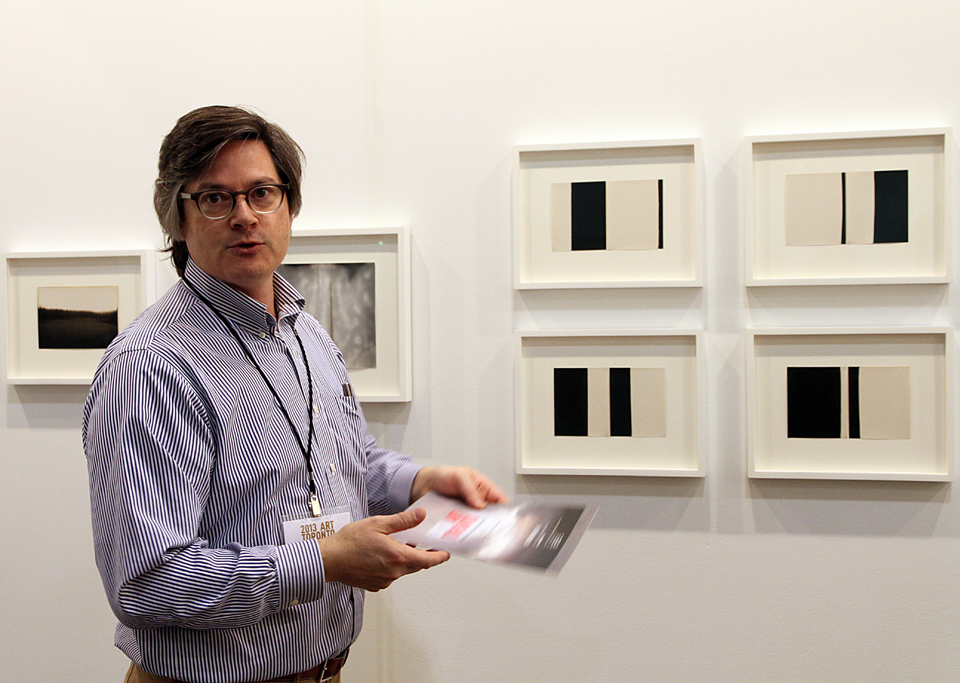
    Stephen Bulger  introduces Alison Rossiter’s work in Art Toronto, 2013. Photo: Margaret Irving

    E.K-H: I remember when critics were arguing in the 1980’s about whether photography was an art form or not. What made you decide to open a Photography Gallery in March, 1995?

    S.B: I started as a photographer expecting to have my work seen in galleries. When I went to Ryerson I started curating student exhibitions, and then in my third year we opened the Ryerson gallery at 80 Spadina and I was its first manager for about two or three years. During that time there were lots of things I liked about the gallery, but also things I thought were shortcomings. So I started to fantasize, if I had my own gallery, what would I do? I went as far as putting together a business plan. Luckily I have older siblings that were trained in business practices, so I could learn from them. Their guidance was crucial to me being able to open a gallery that was able to sustain itself. I think there are a lot of great ideas out there, but if you don’t have a business plan behind it, it’s difficult to sustain that dream. There [was] a lack of appreciation for photography in Toronto. I thought I might be in a position where I could do something about that.
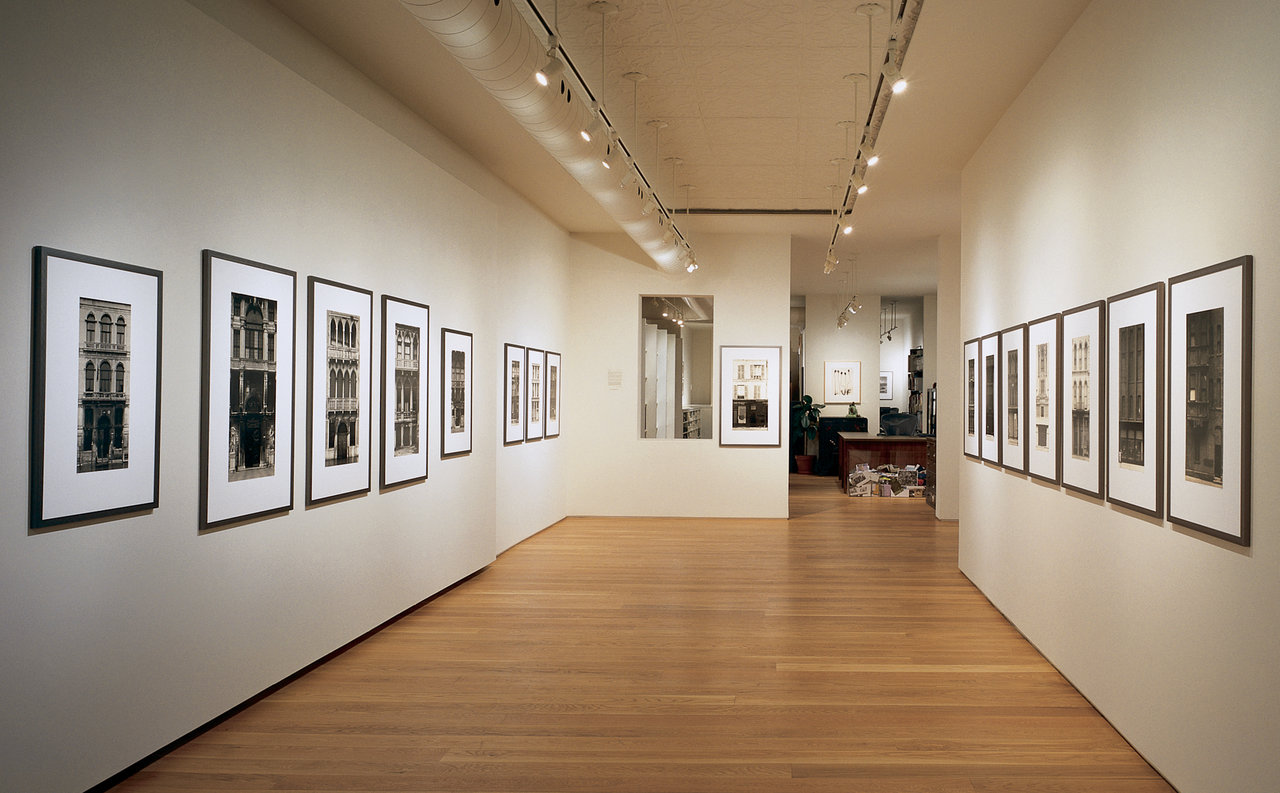
    Installation view of Volker Seding’s show. Courtesy of Stephen Bulger Gallery

    E.K-H: A few years after I came to Toronto, Volker Seding introduced me to Stephen Bulger Gallery and I was amazed by the quality of the art displayed. How did you get your inventory of 15,000 photographs and how do you select your artists?

    S.B: I built it slowly. When I opened the gallery, I owned maybe a dozen photographs that I was willing to sell. I traded with a lot of people when I was at Ryerson, and bought some photographs by students, staff and faculty. In terms of having an inventory, it probably started in 1994, when I was consciously working towards the opening of the gallery and realizing that I needed inventory. Sometimes I bought groups of photographs, and other times just one at a time. In terms of selecting them I am looking for fascinating images. I like artists who are different from the main stream, and if I am interested in their point of view and I see a consistency and a dedication in their career, then I represent them. I also decide whether I can actually help them or not, because if I just like the work but I don’t think I can sell it, there might be other galleries I think they would be better with, then I don’t get involved.
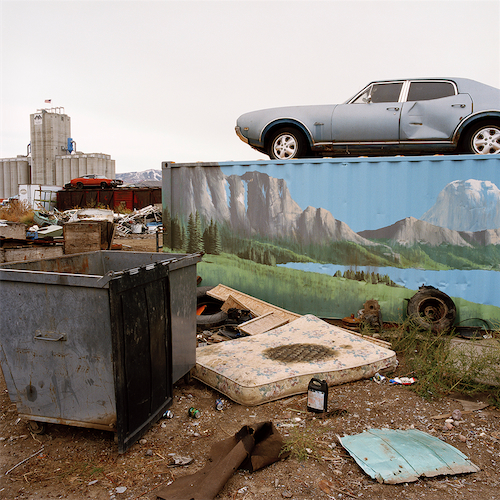
    Phil Bergerson: American Artifacts, Pocatella, Idaho, 2007. © Phil Bergerson / Courtesy of Stephen Bulger Gallery. A book was also published under the same title by Ryerson Image Centre, 2014.

    E.K-H: You mentioned that you deal with first and second time buyers. Could you please give us some details about the process?

    S.B: My gallery deals in both the primary and secondary markets and caters to all types of buyers. The primary market is when you receive works on consignment from the person who made them, and when I sell them I keep a share and remit a share to the photographer. That is the primary market because I’m selling something for the very first time. The secondary market is works being sold for the second, third, or maybe the twentieth time. Works that are coming back onto the market are referred to as secondary market, which is what you see at auctions houses, paper shows, and a lot of the older photographs we deal with here. The gallery attracts many people who are interested in purchasing artwork but they’ve never done it before. I think the reason for buying photography is that people feel comfortable around it. They’ve taken pictures themselves and think they can analyze whether a photograph is good or not. It is something I do myself too when I am looking at a new work, and if I think I could have done it then I am certainly not interested in representing it. When people are wowed by a photograph, they are coming from a very informed decision because they know that they have tried to take pictures like that but failed and here is someone who has succeeded. In terms of first time buyers, we wait for them to get a sense of what it is they are really looking for because often they don’t know what they really want. They might come in looking for colour landscape and they walk away with black and white architecture. Many times they might have narrowed their selection down to five works by three different artists that we have shown them. If they are novice buyers they’ll tend to act on impulse and look at something that is graphically the strongest. Whereas what we really want them to do is concentrate on those which are emotionally stronger. We usually like them to take a bit of a break and walk away from the works and wait and see which one they are thinking about more when they are not actually staring at them. In many cases they buy the one they might have dismissed earlier, the one that somehow intrigues their psyche, and they will continue to be interested in it. If they pick something based on its graphic qualities that tends to wear away after a short time, because it is just graphic design in the end and doesn’t fit their emotions as much as a piece of art does.
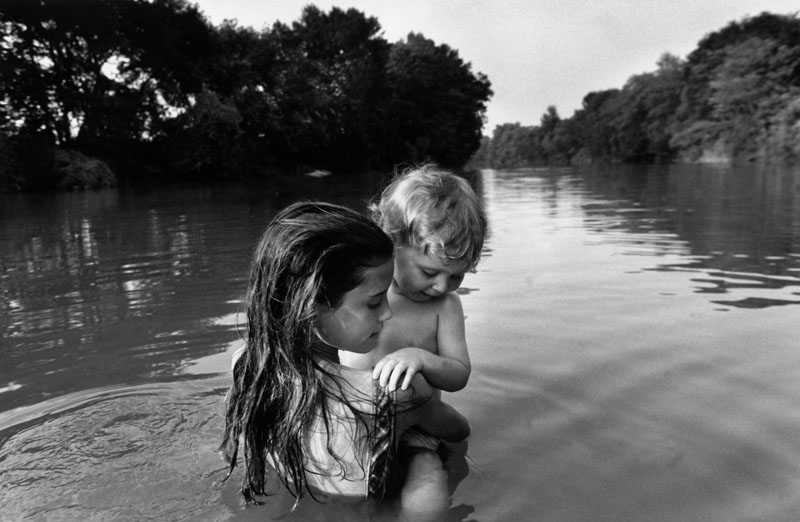
    Larry Towel, Isaac’s First Swim, Lambton County, Ontario, Canada, from The World from My Front Porch series, 1996, Gelatin Silver Print. © Larry Towell / Magnum Photos. Courtesy of Stephen Bulger Gallery

    E.K-H: Your gallery has grown and become famous — and not just in Toronto. What is the secret of making a gallery so successful?

    S.B: The most important thing is to be committed to what you show. Galleries that are interesting are the ones that have a personality. I think the personality of the gallery should reflect the owner—the one person making all the decisions, like selecting the artists and artwork. Good galleries have a point of view, and if you’re interested in their point of view then you’ll be interested in what they present. The other thing is to recognize the international market. When I was first developing this business plan, the simplest thing to do was to survey galleries in New York where there is a large concentration of photography galleries. I would walk in and if I saw something that I liked and could afford I purchased it. I would watch the whole transaction and see what I liked and didn’t like about it. I analyzed the whole process and at the same time I created a network. After buying a piece I felt that I could ask them something, so I’d say, “by the way, I am going to open a gallery in Toronto and I have a few questions.” Then they saw me as a colleague and they were supportive and willing to talk about the business. It has worked out and I still have good relations with those galleries.

    E. K-H: Stephen Bulger Gallery is internationally known. You just came back from Montreal where you attended the Papier show. How was it? How is your representation in other international shows and art fairs?

    S.B: Papier was a very good show. It had very good material on display. It was the right size in a good venue at a good location. It went really well. Like every art fair that I do, I try to put a booth together that I think is suited for that art fair and I try to display interesting material presented with a strong sense of design. I like putting exhibitions together in a manner that is pleasing to the eye. When I first started doing art fairs, I didn’t do that. I remember doing one in Chicago in 1997 or 1998, and what I did at the time was show one work from everybody—displaying it in a salon style.
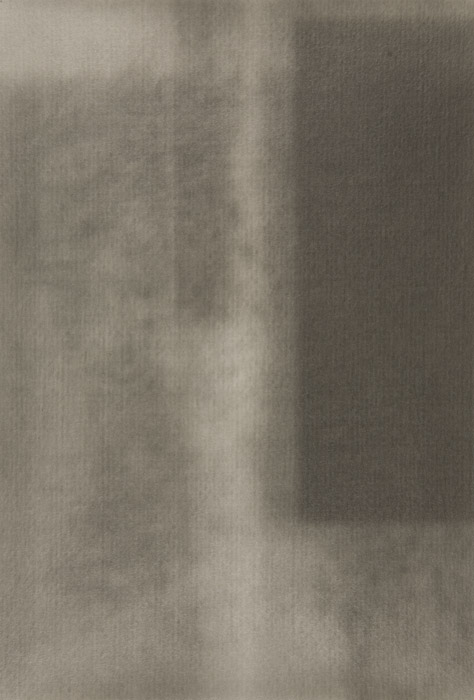
    Alison Rossiter, Lament, Dassonville Charcoal Black, expired May 1946, processed 2009, Gelatin Silver Print, 7 x 5 inches.  Courtesy of Stephen Bulger Gallery

    There were two things that led me to change that. A buyer had purchased something from me, and he asked “Where are you from?” When I said “Toronto, Canada,” he replied, “Wow, I just assumed you were American. There is nothing about your booth that strikes me as being different from these American dealers.” And when I looked at the art fair in general, I realized it was exhausting for people because every one of the forty or fifty booths looked like mine— where there was tons of stuff on the walls and more things than you can flip through, almost a bit of a garage sale where the objects were just more expensive. I didn’t think it was a very sophisticated. It was very different from my gallery where I really do just one idea at a time. I started to change how I presented at art fairs, and use the opportunity to display what I show and how I like to show it. It is very much about building relationships. I may not sell anything at the time but I want to impress upon them how important photography is.

    Wright Morris, Silverware, 1946, gelatin silver print, 7½ x 9 3/8 inches. Courtesy of Stephen Bulger Gallery

    E.K-H: You are a man of many ideas. As the years have passed it’s become more than just the gallery. It’s also bookstore and you added Camera, a lounge, screening room and gallery venue. You have new plans all the time. As the media of photography changes, how do you see the gallery changing?

    S.B: I think it has been changing all along. Initially most photography was black and white and no bigger than 16 x 20 inches. I am interested in a documentary approach, or what I now call information-based photographs. A documentary approach can have a completely different meaning for each person. I boil it down to an interest in visual information about the world we live in and the medium of photography. 90% of those images used to be fairly small and taken in black and white.
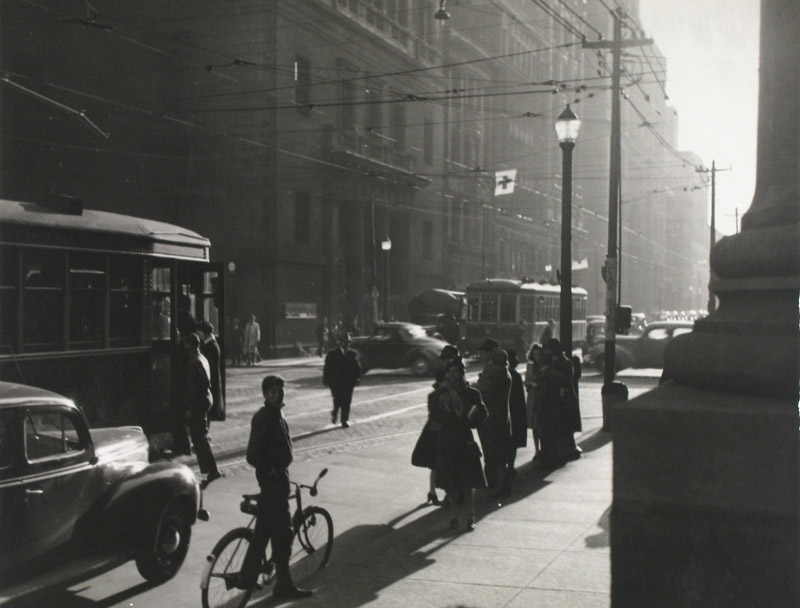
    Charles Devenish Woodley, Downtown at the corner of King & Yonge Sts., 5:30PM, 1940, Gelatin Silver Print, 7.5 x 9.5 inches.  © Estate of C.D. Woodley / Courtesy of Stephen Bulger Gallery

    Over the years the approach changed. People started using colour, digital instead of film, and making sizes that are much larger than we were used to dealing with twenty years ago. As I am introduced to new approaches, I become a fan of work that I probably would have dismissed twenty years ago. With contemporary art there are a lot of new practices like Sarah Anne Johnson’s. She takes a photograph and then manipulates the surface either digitally or by hand (by gouging parts of the paper or applying gold leaf etc.). In the past I would have considered it crazy stuff, but now I am a complete fan since the photograph tells a much more complete story after she’s dealt with it. I am quite excited about change. We’ve started working with artists like Clive Holden or Sanaz Mazinani who are very involved in using all of the technology they can put their hands on to create all types of experiences including the moving image, which I find quite fascinating. I look forward to having a black box in the gallery to best show this type of work.
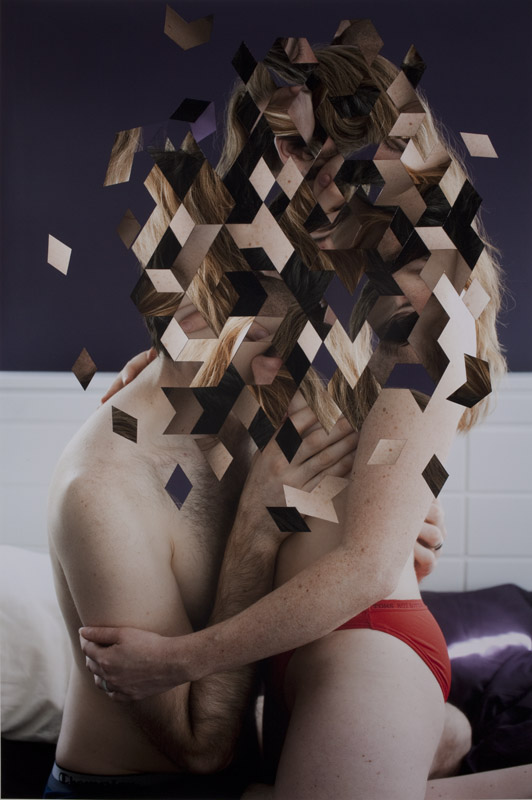
    Sarah Anne Johnson, Red Undies, 2013, Unique collaged chromogenic print. Courtesy of Stephen Bulger Gallery and Julie Saul Gallery, New York

    E.K-H: Your gallery is so established and highly regarded by art lovers in Toronto. I am sure wherever you go people will follow. Do you plan to move?

    S.B: Eventually the gallery will move. There were compromises that I made to locate it here. The gallery is narrower and smaller than what I was looking for, and the storage space is small but it was attached to this great facility where Camera was built. I think in the next few years I want to move but I want this next place to be good for twenty years. I don’t feel the need to remain on a busy retail strip anymore. My ideal for a new gallery would be to have a wide space that is also deep where I can design the interior, a loading dock at the back, a lot more storage space for bigger pieces of work and parking. I want a space that serves my vision.

  • Jérôme Nadeau: RUINS

    May 2 – June 7, 2014
    Gallery 44 Vitrines

    With the focus on materiality, disintegration, and the gesture of the artist, Jérôme  Nadeau uses photography to contextually create what he refers to as “paintings”. The medium is the message, memory, and in turn, the memory is the message. Nadeau has built his practice around the usually undetected production process.

    In RUINS, Nadeau creates artworks using an extracting process. He uses a technique that extracts the dyes and inks from images printed on chromogenic paper. It is then directly transferred to a sheet of undeveloped Fujicolour Chrystal Archive Paper and Kodak Endure paper. The result is an image that only exists in a visceral space and time. With an ephemeral notion, Nadeau creates images that only exist in a certain space where an object represents the past, but is also defiant of the indexical properties of the present image.

    Jérôme Nadeau, Untitled from the series RUINS, 40 x 50 inches, 2014

    In Foreseen and Unforeseen Uncertainty, Nadeau works with the chromogenic print process. All pigments are present in the paper before the exposure to light. The colour print process works through subtractive colour theory, meaning that white is created through the absence of pigment, and black through all pigments being present. The result is an image built directly on the paper, with no clear outcome. The abstraction of these images is what separates them from traditional capture-based method photography.

    Maddy Tripp

    *Exhibition information:  May 2 – June 7, 2014. Gallery 44 Vitrines, 401 Richmond Street West, Toronto. Gallery hours: Tues – Sat 11 – 5 p.m.

  • Steven Beckly: Reunions

    May 1 – 31, 2014
    Toronto Image Works Gallery
    80 Spadina Ave #207

    Artist Steven Beckly

    Steven Beckly’s Reunions at the Toronto Image Works is based on photographs found at flee-markets and antique stores, dating from the 1880s to the 1980s, and featuring pairs of the same sex, although not necessarily lovers. The artist, drawn by the intimacy that emanates from these images, has been hunting for such photographs for about four years and has gathered over a hundred of them, some of which are now displayed at the exhibition.

     Steven Beckly, Untitled, 2013

    Beckly explains that he arranged these photographs by two or three and printed them on newsprint in order to create a narrative based on juxtapositions and similarities or differences between the images in respect to gender, race and class. He decided not to perform the standard manipulations that artists usually apply to found images, such as collage or addition of markings, for he felt the need to respect the sensitivity inherent in these objects.

    Steven Beckly, Reunions, installation view

    With this repossession of photographs, Beckly’s aim was to reference the “impermanence and ephemerality” of the past, a feeling that he reinforced with a display of empty antique photographic frames.  The display is designed to “give space” for the viewer to project new narratives, inspired and informed by the pairings.

    Steven Beckly, Reunions, installation view

    Steven Beckly, Reunions, installation view

    Beckly gives the writing on the back of the photographs their own space by retracing them separately and displaying them on a table,  transforming them into individual works in their own right. Through the retracing process, the words, some in foreign languages that Beckly does not speak, fade and gain a nostalgic dimension. The viewer is caught in a mesmerizing reflection of meanings between the three components of the exhibition: the found photographs, the empty frames and the almost undecipherable writings from the past.

    Text and photo: Elena Iourtaeva

    *Exhibition information: May 1 – 31, 2014, Toronto Image Works Gallery, 80 Spadina Ave #207. Gallery hours: Mon–Fri 9 – 7, Sat 11 – 3 p.m.

  • 40 Years of Hip Hop

    From left to right: Johnathan Mannion’s Yasiin Bey aka Mos Def, Lauryn Hill, Outkast, and Nicki Minaj.

    May 2 – 31, 2014
    The Gladstone Hotel, 2nd and 3rd Floor
    1214 Queen Street West, Toronto

    Curators Che Kothari and Ryan Paterson present a group exhibition with the aim “to celebrate a collection of iconic portraits that serve as vital contributions to the immortalization of some of the legends of Hip Hop – and the legend of Hip Hop itself.”

    Charlie Ahearn, Rhythm Den with owner Ritchie T who also owned the T-Connection (see above) with The Fantastic with Grand Wizard Theodore East Tremont, The Bronx, 1980,

    Indeed, opening night was a celebration of one of the most energetic movements in recent history. Needless to say, rap music, harmoniously matched its setting among iconic images of Hip Hop’s most renowned and recognized figures. The movement, born out of the South Bronx, acted as a means of self-expression/a voice for denigrated youth that has now become a worldwide phenomenon. It has been said to be comprised of four elements: rap, DJing, graffiti/tagging, and breakdancing.

    Jamel Shabazz, Subway Love

    On the walls of the Gladstone Hotel hang candid shots and portraits of each of these elements. A shot of the Japanese tour of cult classic “Wild Style” as well as American icons such as DJ Kool Herc, Slick Rick, EMPD, Ice Cube, and Lauryn Hill were featured on the second floor, while the third floor featured a large section of Canadian rappers such as Toronto natives Drake and k-os, and Saukrates.

    Charlie Ahearn, The Chief Rocker, Busy Bee, Crazy Legs, KK Rockwell, Lady Pink, Wild Style Japan Tour, 1983

    Che Kothari, KRS-ONE

    Che Kothari, k-os

    The show, however, did not comment on some of the popular thoughts (and scrutiny) surrounding the movement over the past 40 years. The latter includes male centeredness, the promotion of social/political consciousness, the urban decay in inner cities, swagger, parental advisory, conspicuous consumption, and the, sometimes, misogynistic attitude of male rappers.

    Matt Barnes, Azalea Banks

    Many of these popular images of contemporary Hip Hop were, and will remain, visible in these photographs, even though they were not addressed in the didactic material or photographs. Instead, Kothari and Paterson provided a lighthearted exhibition that gives super-fans the nostalgic satisfaction of seeing some of their favorites while, for those who may be less familiar, it remains enjoyable (and educational) experience to find out more about the movement.

    Text and photo: Leanne Simaan
    assistant: Ella Gorevalov

    *Exhition information: May 1 – 31, 2014, The Gladstone Hotel, 1214 Queen Street West, Toronto. Gallery Hours: Mon–Sun, 12 – 5 p.m.

  • Heffel Spring Auction 2014 / Preview

    A.Y. Jackson, Mazinaw Lake, March, Bon Echo.

    May 15 – 17, 2014
    Heffel Gallery, Toronto
    13 Hazelton Ave.
    Hours: 10 a.m. – 6 p.m.

    Heffel Fine Art Auction House has announced a remarkable collection of masterworks for the upcoming Spring 2014 live auction. This season’s diverse lineup, exhibits the breadth of Canadian artistic talent, and is expected to reach sales of six to eight million dollars, according to conservative estimates.

    This season brings with it influential works illustrative of each of the country’s major regions and truly captures and spans the rich artistic fabric of Canada, ranging from rare early illustrations of Emily Carr’s native British Columbia, to William Kurelek’s depictions of childhood on the Prairies, to classics by the world-famous Group of Seven – breathtakingly representative of the Canadian countryside – to Quebec City master Jean Paul Lemieux’s portrayal of everyday life in Quebec, and finally, the rich,colourful Maritimes-inspired paintings of David Blackwood.

    The live auction will take place in Vancouver on May 28, 2014.

  • Intimate yet universal: Chinese women’s experiences

    Intimate yet universal: Chinese women’s experiences artistically explored at Contact 2014

    Through the Body: Lens Based Works by Chinese Women Artists is an exhibition which sets as its premise the Chinese concept of Ti Shi, learning through bodily experiences, and in this case particularly those of women with lived experience in China. Following a guided tour and discussions with the curators Zhou Yan, Matthew Brower and Fu Xiaodong, several insights into this show and its importance came to light.

    Curators (from left) Fu Xiaodong, Zhou Yan and Matthew Brower at Lin Tianmiaos Garden

    Whilst surveying a specific cultural milieu (young, women, Chinese artists), the curators carefully chose works for the show that could transcend cultural boundaries. The work of Ye Funa, for instance, in which she recreated old family photographs with the family member lip synching a narrative to the photo, resonates across audiences as we can all reflect on our own family histories.  In comparing the show to other exhibitions in the Contact festival, Brower pointed out the similarities of Ye Funa’s work and that of Adad Hannah’s, who traced his family tree across generations and places. Both artists seek to form a line of communication between generations, a real riddle in many cultures in our fast-changing world. This comparison across cultures is felt in almost every work of this show, as artists confront us with their experiences through personal and universal journeys of shame, loneliness, love, loss and searching for an identity in a fast changing world.

    Ye Funa, Grandparents, 2010

    Yet they also tell diverse stories of life lived in the transitional China of today. Zhou describes the specific cultural references of several works along the way. Fang Lu’s work explores how art is like love in that both are transformative experiences. In Fang Lu’s performance video, artist Guan Xiao is buying food at a typical market and then playing hopscotch on pancakes. In doing so, she has depicted traces of common Chinese life, including traditional hutong houses which are fast disappearing and pancake streetfood which remain popular and accessible on many street corners. 

    Fang Lu, Lovers Are Artists (Part 1), video still, 2012

    Another artist, Jin Hua, emigrated to study and live in Canada. Upon the death of her mother she returned to China to reconnect with her parents’ family. She took photos of what is really happening in China, showing the clash of tradition and change in simple household goods and family pastimes. The curators have selected works which, whilst not attempting to define China, provide a window onto the diversity and complexity of contemporary Chinese women’s’ lives.

    Li Xinmo, The Death of the Xinkai River, 2008

    As curator Matthew Brower pointed out, these lens-based artists employ allegory as their choice method for presentation. Allegory has a long and popular tradition in Chinese art. Li Xinmo, for instance, shows herself entering the highly aesthetic green but polluted, dying lake. Zhou explains that behind this image is the specific story of paying tribute to the death of a murdered woman, rebelling against the suffering and unfairness of a woman’s life. All of the artists in this show use their story-telling method both fluidly and poetically, enriching each piece with such multiple layers of meaning.

    Chen Zhe, The Bearable: Birthday, 2010

    Several works in the show confront the audience with images of intense and painful bodily experience. Ma Quisha gives a monologue about how her parents sacrificed for her to be what they wanted first, a musician, and later sacrificed even more for what she wanted to be, an artist. She is speaking with a razor blade in her mouth, swallowing blood, only noticed when she removes the blade towards the conclusion and by close observation of the pink of her teeth. The video is dedicated to her parents, showing the complicated dynamics of parent-child relationship in today’s Chinese families. In another striking series, Chen Zhe depicts herself cutting her own arm, a painful practice, that many others share. She is very brave in her way of facing self-harm and sharing the truth with the world. Fu explains how, due to the relative upheaval in China over the past few decades, many Chinese artists tend to express themselves in a more intense and sometimes violent manner than artists in the west. 

    Ladybird Theatre, Riding a Roller Coaster Flying into the Future , video still, 2013

    Several of the artists participating in the show define themselves as feminist, including Li Xinmo and Ladybird theatre. Ladybird theatre enacts poetry written by women exploring gender relationships in themes such as child prostitution, women as objects, rape and labour. Bower describes how this piece was inspired by the scandal of a young, female poet who had an affair with an older married poet but found all the pressure and criticism came in only her direction, eventually leading to her suicide. Zhou and Fu note that other works in the show, such as those by Fan Xi, Chen Zhen and Chun Hua Catherine Dong explore feminism in territories similar to thinkers like Judith Butler and Susan Sontag. They go on to say that feminism as a movement has not successfully rooted in China. However, they believe that it is a topic that still needs to be faced.

    The curators have seamlessly brought together a group of talented artists in a tightly woven tapestry of personal experiences derived from life lived as women in China today. Juxtaposed to other recent exhibitions of art from China, this is an important show which will give audiences in Toronto a much more detailed and complex vision of what artists are producing in relation to contemporary Chinese experience. Moreover, it is a poetic and powerful show that crosses cultural boundaries and will resonate with many audiences.

    Christine Platt
    assistant: Liuyi Zhang

    *Exhibition information: April 29 – June 28, 2014, University of Toronto Art Centre,15 King’s College Circle, Toronto. Gallery hours: Tue–Fri, 12 – 5, Wed, 12– 8, Sat, 12 – 4 p.m.

  • Love Art 2014

    Photo: Mitch Billinkoff

    May 7 – 11, 2014
    Heritage Court, Direct Energy Centre
    100 Princes’ Boulevard, Exhibition Place, Toronto
    Hours: Thur 11-6, Fri & Sat 11-7, Sun 11-6pm; Free: Fri 5-7pm

    Love Art has a strong art-loving history behind it, fuelled by founder Will Ramsay’s desire to democratize the art-world. Way back when, in 1996, Will opened Will’s Art Warehouse in southwest London to bridge the increasing interest in contemporary art and the London gallery scene. Today, Will’s Art Warehouse still stands and the Affordable Art Fair has become something of a global phenomenon.

    Will Ramsay founder of Affordable Art Fair. Photo: Elena Iourtaeva

    Will, said in the Private Preview that he really likes Toronto and the airy setting of the fair in Direct Energy Centre. This is his first fair in Toronto but globally the 99th and it has brought good luck, since some pieces are already sold. He tried to buy his name Affordable Art Fair, but it was already taken here, so they had to pick another name and decided on Love Art. Love Art will carry the same friendly and accessible concept as the Affordable Art Fair, with art priced between $100 to $10,000, so that the only difference is in the name.

    Matthew Del Degan, Lovebot, 2014 greeted the visitors. Photo: Summer Sun

    Guests fill the narrow alleys behind Justin Pierce, Canadian Lifestyle, Cedar Strip Canoe, 2014. Photo: Mitch Billinkoff

    Bruce Lurie Art Gallery, Los Angeles. Photo: Elena Iourtaeva

    #Hashtag Gallery, Toronto. Photo: Elena Iourtaeva

    This year’s Love Art Fair incorporates thirty eight exhibitors with hundreds of eye catching pieces of art mostly from Toronto based galleries, but also bringing in a scatter of visiting galleries  from Montreal, the United States, Uganda, Beijing, France and the United Kingdom.

    Evan Lurie Gallery, Indianna, USA. Photo: Elena Iourtaeva

    China Print Art Gallery, Beijing, China. Photo: Elena Iourtaeva

    The aim of the show is to provide a venue where both emerging and established artists could come together with new buyers in a space where affordable pieces could bridge the gap between these two groups. Love Art created a welcoming environment; gallery owners and artists are keen to answer questions, the crowd is diverse, and local non-for-profit community art initiative SKETCH makes an appearance too.

    Feral Fine Art, Edmonton. Photo: Summer Sun

    Hayley Hoskins, Sketch Gallery, Toronto. Photo: Summer Sun

    Rosa Mindreau demonstrates printmaking. Photo: Elena Iourtaeva

     Wednesday night’s opening of the first edition of Love Art was a colourful and joyful event. The Heritage Court at Exhibition Place was a great venue and comfortably filled with potential collectors, artists, and, of course, art. It was certainly a varied exhibition and there was a good vibe in the place. Painting, photography, sculpture, glass work, collage. Everything was represented. I found lots I liked in the $1,000 to $8,500 range, but just a few that were less than $200. There was work by several artists I like: Virginia Mak’s soft focus figures; a lovely landscape by Eamon MacMahon, neat images of transformed books by Cara Barer, and both older and newer works (& someday I’m going to buy a piece) by Ronald Boaks. I enjoyed myself. And I loved the scent of beeswax from the encaustic works.

    Wills Art Warehouse, London, UK. Photo: Summer Sun

    Photo: Summer Sun

    Love Art was a lot like the Toronto Outdoor Art Show but without the oppresive heat. Whenever I go to an event like this, I’m reminded that there are lots of people in this city that are interested in art. Maybe some go to galleries on a regular basis, but there are many more who need to be coaxed into feeling that art is for them too. Occasions where artists are approachable, as they are here, help bridge the gap and turn browsers into collectors.

     Text: Julie McNeill and Ella Gorevalov

  • Contact 2014 / Festival Launch

    Scotiabank Contact Photography Festival 2014 / Festival Launch
    May 2, 2014, 7 – 10 p.m.
    Museum of Contemporary Canadian Art

    Photographic works will be on display at 175 venues all around the city of Toronto throughout the month of May. Within Contact’s eighteen-year history, the festival has grown to become the largest photographic festival in the world. Contact brings together both international and Toronto based photographers with the community in both public exhibitions and installations.

    David Liss, Artistic Director & Curator of Mocca in his opening remarks said that the main exhibition in Mocca, titled, Material Self: Performing the Other Within is reflecting Mocca’s mission statement:  ” … to exhibit, research, collect, and promote innovative art by Canadian and international artists whose works engage and address challenging issues and themes relevant to our times”

    Tomoko Sawada’s vitrin  

    Works by Namsa Leuba

    Artist David Favrod in front of  Vent divin, 2013. Favrod came here from Spain to promote his photographic installation, Gaijin. 

    Works by Mary Sibande

    Bonnie Rubenstein, Artistic Director of Scotiabank Contact Photography Festival and curator of  the exhibition, discussed the thematic program of “identity” and how the exhibition itself explores the idea of shifting identities, performative gestures, and the  uses of clothing and “costume” in creating these identities/roles.  The exhibition collapses cultural boundaries, exploring role playing,  as well as social, cultural, historical, sexual and political issues (intersectionality of gender, race and sexuality). In overall, the exhibitions demonstrates  photography’s ability or “power” to engage and enrich our own sense of self. 

    Bonnie Rubenstein, Artistic Director of Scotiabank Contact Photography Festival  

    In Character: Self-Portrait of the Artist as Another co-curator Jonathan Shaughnessy pinpointed how  Material Self revolves around the work of Rodney Graham who is renowned for his exploration of  roles, character, and constructed (enacted)  identity in his self portraits.

    Artist Meryl McMaster

    Works by Charles Fréger

    Artist Dominique Rey

    Rodney Graham , The Gifted Amateur, Nov. 10th, 1962, 2007, National Gallery of Canada, Ottawa. Courtesy of the artist and Lisson Gallery.

    The role of the community, both as participants and viewers in Contact, has been integral to the success of the festival. Darcy Killeen, the festivals executive director believes that the “function of art is to inspire the community.” Contact has enabled a closer relationship between photographers and the community, bringing to light ideas about the world and the city in which we inhabit. He also expressed his hope that the festival can become an international tourist attraction.

    Darcy Killeen, Executive Director of Scotiabank Contact Photography Festival

     
    The launch drew a mass of visitors to the MOCCA of both photographers and admirers of photography. The large gallery spaces as well as the courtyard were filled with guest discussing the works on display and enjoying a drink into the night.

    Visitors with Hendrik Kernstens’ work

    Visitors with Meryl McMaster’s works

    Text: Melina Rymberg
    Photo: Elena Iourtaeva





