Author: artoronto

  • Between Tradition and Concrete / Opening Reception


    June 26, 2014 / 7 – 10 p.m.
    Gallery 1313

    Between Tradition and Concrete: Indigenizing Resistance through Art is the result of the First Nation, Métis and Inuit Secondary School Pilot Project offered by the TDSB Aboriginal Education Centre and funded by the Ministry of Education. The aim of this project is to create a holistic framework that supports and encourages Aboriginal students and their culture. The amount of people who checked out the exhibition showed that the student’s expression of their culture is one way to take the mutual understanding a step further. Ed Sackaney mentioned this during his traditional opening ceremony at the beginning of the reception, honoring the work of the students. Donna Quan, the Director of Education from the Toronto District School Board also stated that much has been done but there was much more to do.

    Ed Sackaney

    Debra Cormier from the Ministry of Education & Donna Quan, Director of TDSB

    Louise Azzarello, the centrally assigned teacher, gave the students the opportunity to work with seven guest artists throughout the program. The experience to work with these artists visibly influenced the works of the students. Performance artist Vanessa Dion Fletcher encouraged the students to write pieces about an object that has a meaning to them. Working from his writing, Hawk Mason created a multi-media piece, entitled Echoes of Genocide. Deja Shapiro-Innis created a film Flower and wrote a performance piece I am who I am, which she presented at the opening reception.

     Hawk Mason

    Deja Shapiro-Innis

    Discussions during classes about representation and stereotypes and the task to photograph a common object and telling a different story about it inspired Zhaawani Mack to create his piece Scarf. Josh Bluebird reflects on the concepts of Identity, on stereotypes and on the Resistance in his piece multi-media piece The Majestic.

    Josh Bluebird

    Dakota Splude

    The reception proved that these workshops not only inspired the students in their work but it had also let a friendship grow between them and the guest artists. It also showed the young people that, although they could hardly imagine to exhibit at an art gallery, their art works were highly honored and seen as a strong contribution to their cultural heritage. It was inspiring to all who attended.

    Text and photo: Melina Bigler

    *Exhibition information: June 26 – July 6, 2014, Gallery 1313, 1313 Queen Street West, Toronto. Gallery hours: Wed – Sun: 1 – 6 p.m.

  • [sh]OUT by Jane Hook

    Artist Jane Hook speaks in front of her series Full Circle: Evolving Family Studies

    Opening Reception: Saturday, June 21, 2014, 2 p.m.
    Canadian Sculpture Centre

    This is the first year for the Canadian Sculpture Centre to participate in Pride.

    The pieces of [sh]OUT are from four previous shows by Hook, which fit into the themes Full Circle: Evolving Family Studies, Mother Earth, Once Upon an I Con, and WANNABEs: Portraits of An Imagined History. It is a great pleasure to discover Hook’s various sculptures and the stories behind them. While each theme differs from one another, they connect by their assessment of the iconic.

    Artist Jane Hook with WANNABEs

    It is recognized quickly when exploring the exhibition that Hook has quite a sense of humour. Each work brought a smile to my face whether it was the hilariously delightful WANNABEs or the simple truths that resonate behind her eco pieces. As the artist herself said in her speech at the gallery opening, “the pieces are at once very simple in their meaning but if you know more about them they are very complex.” I certainly found this held true for every piece. There is depth in each piece that makes them so much more than just attractive to the eye.

    Jane Hook, Big Baby

    Jane Hook, Viewpoints @ 360

    Hook analyzes common concepts in our society and presents them in three-dimensional form, which asks the viewer to examine them from a new viewpoint. The artist’s extensive schooling in psychology and social work emanates from her sculptures.

    Jane Hook, Venus de Here and Now

    Jane Hook, Brigitte Always Wanted to Be a Superhero

    The opening reception also felt like a gathering of friends. The WANNABEs and Full Circle sculptures are based on real people in Hook’s life and she knows them intimately. Some of them were in attendance at the opening and it seemed as if they were celebrities in the crowd.

    Models for WANNABEs in front of their sculptures: Dr. A. M. Superman, Angela/the Virgin Mary, and Randall/Zorro

    The Canadian Sculpture Centre provides a perfect space to showcase Hook’s various pieces. If you are out enjoying the sunshine and fun activities that World Pride brings this week it is also a must to stop by this exhibition. Hook is the perfect artist to be represented during this celebration; her incredible warmth and intelligence transfers flawlessly to her art and thus to the viewer.

    Text and photo: Carter Brown

    *Exhibition information: June 18 – July 11, 2014, Canadian Sculpture Centre, 500 Church Street. Gallery hours: Tue – Fri: 12 – 6, Sat: 11 – 4 p.m. Extended hours for World Pride 2014.

  • NUIT ROSE

     Church Street

    June 21, 7 p.m. – 3 a.m. of June 22, 2014
    Church Wellesley Village and Queen Street West

    This year marked the inaugural launching of Nuit Rose, a queer contemporary art event celebrating WorldPride 2014 in Toronto. Being its first year of production, the affair understandably experienced a few hiccups. Traffic was closed off at portions of the Church Wellesley Village, though the sparsely attended happenings made one question whether this was even necessary.

    A colourful presence on Church Street

    I meandered through the Village hoping to find something that grabbed my attention, but after realizing this was a hollow pursuit, decided to board the free art shuttle bus to a different location. The bus ride featured a performance by the Toronto mission of the Sisters of Perpetual Indulgence, an interactive theatre piece that involved sing-alongs and a healthy serving of sexual innuendo. The performance was enjoyable at first, but the ride was long, nobody really seemed to know where we were heading, and near the end even the queer nuns seemed to grow tired.

    The Abbey of the Divine Wood performing on the shuttle bus

    Finally, after a couple fruitless stops, we arrived at Artscape Youngplace. The space was poorly attended as well, possibly due to the late posting of the events or the alternative NXNE shows occurring nearby.

    Christos Pantieras, Say What You Mean, at Artscape Youngplace

    A pink pop up gallery on Queen Street

    After leaving Artscape I headed towards MOCCA, the clear highlight of the evening. The show displayed holdings from the private collection of Salah Bachir and Jacob Yerex, including artwork by Stephen Andrews, Betty Goodwin, General Idea and Keith Haring. Many of the works were presented in a manner reminiscent of the salon, bunched together in large groupings that made for an interesting display.

    Visitors at MOCCA’s  Over the Rainbow: Seduction and Identity

    Then I decided to head towards the Gladstone Hotel for one final stop.

    Erin Finley and Heather Saunders, Riotous, at Propeller Gallery

    As I walked down Queen Street I passed multiple long lines of people waiting to get in to bars and concerts, before easily walking right in to the hotel, supposedly a marquee venue of the event. The site was however, more of the same. Empty of people and empty of art, a fitting finale to a disappointing evening.

    Hazel Meyer, Intestinal Anarchy (City Champs), at The Gladstone Hotel

    Text and photo: Mitch Billinkoff

    The crowd was flowing between the exquisite shows at MOCCA and the warm embraces of a festive summer night. Over the Rainbow: Seduction and Identity, arranged in a salon-style display, comprises artworks from the collection of Salah Bachir and Jacob Yerex. Gorgeous drawings, photographs and paintings surround the visitors that are at times bold and playful, at other times sensual and nostalgic kaleidoscope.

    Visitors at Over the Rainbow: Seduction and Identity at Mocca

    Visitors at Over the Rainbow: Seduction and Identity at Mocca

    Visitors at  Over the Rainbow: Seduction and Identity at Mocca

    Visitors at Over the Rainbow: Seduction and Identity at Mocca

    The athmospere is more intimate in Par Amour/Paramour exhibition, which engages with the themes of “gay male sexuality and beauty in the face of mortality”.

    Visitors in from of artworks by Stephen Andrews

    Visitors at  Par Amour/Paramour at Mocca

    Nuit Rose continued beyond the museum, along Queen Street, buzzing with vibrant late night parties which were punctuated by overworldly displays in the vitrines of private galleries.

    Text and photo: Elena Iourtaeva

  • Peter G. Ray: Confidential

    Installation view. Photo: Summer Sun

    June 14 – July 5, 2014
    De Luca Fine Art / Gallery

    Peter G. Ray’s first solo show in Toronto in De Luca Gallery, titled Confidential, is exploring the unlimited potential of the universe and the place of human beings in the cosmological order. He presents intricate paintings that capture the attention through hyper-detailed and carefully orchestrated abstractions, but yet leave the visitor with a sense of uncertainty.

    Peter G. Ray, Five Angels Surrounding the Ultimate Reality, 2014, acrylic on canvas, 60 x 48 inches. Courtesy of De Luca Fine Art / Gallery

    Working exclusively with paint on canvas, Ray aims at carrying on the tradition of the medium and at creating hyper-illusionistic images without the assistance of electronic and digital tools. “I want to continue the tradition of painting, real painting, with paint, brush and other tools… but at the same time, I want to achieve this kind of images which are like photography or computer work.” His works present sceneries that explore traditional and classical subject matters but that are carefully constructed in the language of modern and contemporary art.

    Peter G. Ray, Polarizing the Innocence of the Colour Violet, 2014, acrylic on canvas, 60 x 80 inches. Courtesy of De Luca Fine Art / Gallery

    Some of his canvases are inhabited by the same dynamism and energy present in the work of artists such as Jackson Pollock and Max Ernst (although Ray denies any other artistic influence than that of the Old Masters). His images, abstract yet highly detailed and described by himself as “hyper-illusionistic” invite for contemplation and thorough observation, and unfold themselves on new levels at each inspection.

    From left to right: Peter G. Ray, The Tropic of a New Born Hope, 2014, Acrylic on canvas, 60 x 48 inches, Swan Lake, 2014, Acrylic on canvas, 60 x 48 inches.  Photo: Summer Sun

    Finding his inspiration in everyday life as well as in images of the cosmos, Ray is interested in the likeness between microscopic representations of living beings and macroscopic images of the universe: “It’s just so similar when you see a picture from a microscope and next to it a picture from the cosmos. It’s the same thing. It means we are part of the universe.” Pushing this idea further, he sees every human being as a universe itself with its own mode of representation and visual language, and thus develops his own artistic techniques to create images that reflect his personal vision of specific themes.

    Peter G. Ray, In the Eye of a Category Five Hallucination, 2014, acrylic on canvas, 60 x 80 inches.  Courtesy of De Luca Fine Art / Gallery

    Leaving the visitors with the task to elaborate their own interpretation of his works, Ray presents a set of appealing and fascinating canvases that show his technical prowess, but that yet asks for a more systematic conceptualization of his work. As interesting as the theme of cosmic-human interconnectedness may be, it is nonetheless a much explored question that would here necessitate a more in-depth account of the artist’s personal approach to the subject. A more comprehensive rationalization would only give more authority to these already visually powerful works.

    Artist Peter G. Ray in front of De Luca Gallery. Photo: Summer Sun

    *Exhibition information: June 14 – July 5, 2014, De Luca Fine Art / Gallery, 217 Avenue Road, Toronto. Gallery hours: Wed – Sat: 11 – 6 p.m.

  • Over the Rainbow / Speaker Series

    Attila Richard Lukacs, Coo coo ka-choo, Mr. Robinson (detail), 1999. Collection of Salah Bachir and Jacob Yerex. Photo: Toni Hafkensheid

    Thursday, June 26, 2014  / 7  – 8 p.m.
    Museum of Contemporary Canadian Art
    952 Queen Street West

    Over the Rainbow /  Speaker Series

    Exhibiting artists Stephen Andrews, Andy Fabo, Elle Flanders, and Attila Richard Lukacs will join Artistic Director and Curator David Liss to discuss themes of seduction and identity.

    The exhibition represents a modest selection of works from the collection of Salah Bachir and Jacob Yerex, by both queer and heterosexual artists, broadly assembled around the themes of seduction and identity. Grouped together the exhibition presents works, mostly in drawing, painting and photography, which acknowledge certain archetypes associated with Queer Culture, drawing relationships between a historically marginalized culture and mainstream culture, and ways in which these have influenced each other. By focusing on reciprocal influences and relationships, and presented within the context of WorldPride 2014 Toronto, the thematic approach is meant to consider commonalities of human experience over opposition and difference.

  • Étienne Gélinas: Systemic Complexity

    The Thompson Landry Gallery only exhibits Quebec artists. If the work of Étienne Gélinas is any indication of other art by Quebecers then it is easy to understand why the gallery chose to focus on this province’s artists. Gélinas’ present exhibition at the Thompson Landry Gallery, entitled Systemic Complexity, offers a different way of approaching art as well as academic pursuits.

    Installation view

    His paintings combine spontaneity of layers and patterns with more rigid mathematical equations, grids, and architectural elements. What is so wonderful about Gélinas’ work is the complexity that is embedded within each painting. The paintings viewed at a distance as an entire piece  presents a curious image of abstract shapes and designs but upon closer inspection, you can truly grasp their intricacy.

    Étienne Gélinas, Composition 388, Mixed media on canvas, 60 x 96 inches.

    Étienne Gélinas, Composition 357, Mixed media on wood, 36 x 84 inches.

    When zooming in on one region of one painting you are able to see the extensive detail the artist has incorporated: varying layers of paint, hidden mathematical equations (literally equations written out), and minute texts that seem like instructions on an architectural plan. It is once you have gotten up close and personal with the paintings that the ambiguity present is fully recognized. You find yourself getting lost in the mysterious scientific codes themselves but also their unique interaction with the drippings and splotches of paint that freely covers their surface.

    Étienne Gélinas, Composition 368, Detail, Mixed media on wood, 36 x 36 inches.

    Gélinas plays with the idea of engaging both sides of the viewer’s brain, the right, which deals more with visual imagery, and the left, which handles logic and mathematical reckoning. Close examination of the art simultaneously brings the viewer back to their school days of math and art class. Though all of Gélinas’ pieces contain the similar juxtaposition of order and freedom, each painting is unique in its own way, which can keep you at the gallery for hours. But who would protest to an afternoon of stimulating art located in the charming Distillery District?

    Text and photo: Carter Brown

    *Exhibition information: June 12 – July 6, 2014, Thompson Landry Gallery, The Distillery District, 6 Trinity Street, Toronto. Gallery hours: Tue – Sat: 11 – 6, Sun: 12 – 5 p.m.

  • Relationship

    Zackary-Drucker & Rhys Ernst, The Longest Day of the Year (Relationship-#23), 2008-13,  C-print, 13 x 20-inches

    June 16 – June 29, 2014
    once every 10 minutes
    PATTISON Onestop subway platform screens across the city

    PATTISON Onestop celebrates WorldPride 2014 with a special presentation of Relationship, a series of 45-second slideshows revealing intimate snapshots depicting the arc of the real-life love story of transgender couple, Zackary Drucker and Rhys Ernst.

    From June 16 – June 29, 2014, Relationship will appear once every 10 minutes on PATTISON Onestop subway platform screens across the city reaching over one million daily commuters. Relationship is a WorldPride 2014 Major Partner Event, and is part of PATTISON’s ongoing Art in Transit programme.

    Relationship is a record of the transgender couple during a period when their bodies were transitioning in opposite directions (for Drucker from male to female, and for Ernst from female to male), offering an intimate voyeuristic view into their private relationship. These photographs convey a specific time and place – the sexuality of two people in love and living in Los Angeles, who have opted for a non-operative transition into an altered gender existence on hormones.

    The project, which was a highlight of the recent Whitney Biennial, has been covered by major art and news outlets from Flash Art to the New York Times. Toronto subway commuters will see an edit of Relationship that includes 40 photographs taken by Zackary Drucker and Rhys Ernst from 2008-2013. Collectively the photographs in Relationship become a cinematic version of the couple’s romantic and creative collaboration, simultaneously fact and fiction, revealing the pair as self-consciously and conspicuously presenting themselves, offering autobiography as ambiguity and unravelling identity as a construction.

    “WorldPride is an opportunity to continue breaking down stereotypes, pushing boundaries, and expanding our capacity for acceptance and understanding,” says Sharon Switzer, National Arts Programmer and Curator for PATTISON Onestop. “It’s my hope that by presenting a Trans* love story to millions of people on the subway screens, we are contributing to the ethos and energy of
    WorldPride 2014.”

    “You can never underestimate the power of seeing yourself reflected in art and how important that is to a feeling of belonging. WorldPride 2014 Toronto will showcase a rich range of LGBTQ art and voices from across the world in a once-in-a-lifetime event,” says Chrystal Dean, WorldPride Manager. “We are delighted to partner with PATTISON’s Art in Transit programme to bring this
    important exhibition to Toronto and citywide visibility to Trans* communities.”

    Relationship is curated by Jean-Paul Kelly, Lori Newdick, and Sharon Switzer. Artwork courtesy of Luis De Jesus Los Angeles.

  • Dear City Canada

    Love your city? Or perhaps your feelings are more complex.

    Tweet your pride, joy, opinions, criticisms and suggestions about your city to @DearCityCanada by June 30th.

    PATTISON Outdoor Advertising and Spacing Magazine present the 2nd annual Dear City Canada, the highly successful cross-country, public art project about the cities we inhabit from July 14 to August 10, 2014.

    Dear City Canada is part of PATTISON’s ongoing Art in Transit programme.

    Join other urbanists in a public dialogue about the issues affecting our daily lives in the cities we inhabit.  True love or tough love, we will share your tweeted love letter (140 characters) with the rest of Canada. Start your tweet by indicating your city, “@DearCityCanada Dear [name of your city] .”

    The deadline to tweet your urban love letter to @DearCityCanada is June 30, 2014.

    “Dear City Canada was such a success last year that we couldn’t wait to bring it back and expand the project beyond billboards. This year Dear City Canada will appear across the country on digital billboards, as well as on screens in shopping malls and office buildings, on two transit systems, and the Calgary Airport. Spacing is the perfect partner for this project because of their commitment to civic dialogue and creative approach into civic engagement.

    “Spacing is pleased to partner with Art in Transit to present the 2nd annual Dear City Canada art project, which successfully demonstrates an alternative use of screens in public spaces and presents an innovative means to communicate peoples’ ideas about their hometown or adopted city of residence. Dear City Canada complements Spacing’s vision to create a forum of positive dialogue about cities in which people express their civic affection,” said Matthew Blackett, Publisher and Editor, Spacing.

    For more information contact: Marie Nazar, Arts Publicist, PATTISON Onestop – 416-762-7702 or  mailto:mnazar@idirect.ca.

  • The Art of Marcelo Suaznabar

    Art has many faces and artists find their voices through explorations in prevailing aesthetic traditions, art historical culture and personal circumstances. In some cases the resulting art reflects where they came from and their early life experiences. Marcelo Suaznabar is an artist who began his life in the Altiplano region of Southern Bolivia. This area is marked by large, inhospitable tracts of rugged scrub and bush, much like a desert. His father had a farm there so Marcelo has an instinctive relationship with animals and landscape.
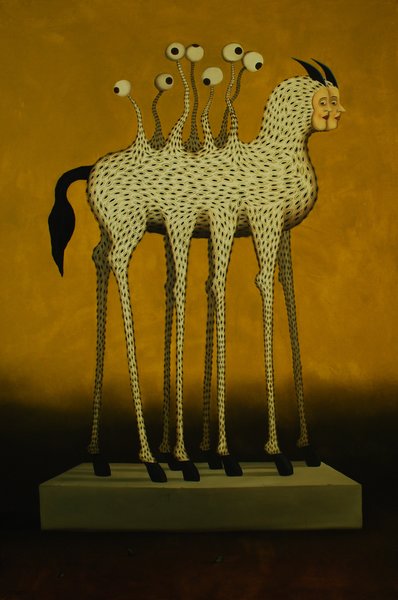
    Marcelo Suaznabar, The observer (El observador), 2014, oil on canvas, 60 x 4o inches. Courtesy of the artist and Articsok Gallery.

    Latin America has a complicated relationship with Christianity. The Spanish invaders who exported it, used it as a tool to subjugate and control the indigenous peoples. In the Colonial era, commerce, Christianity and civilization were philanthropic goals but the reality for the recipients was a form of slavery and servitude. Despite the professed ‘good intentions’, conquering nations also brought greed and lack of respect with them. It was logically expedient for indigenous folk to take on the mantle of Christianity to survive, and in a subtle way, they began to colonize it with their own belief systems. Thus the Christianity in Latin America is an amalgam of prevailing beliefs. It is marked by a sense of magic and mysticism that adds a richness which is not echoed in the dour, homicidal mentality of the Spanish Inquisition.
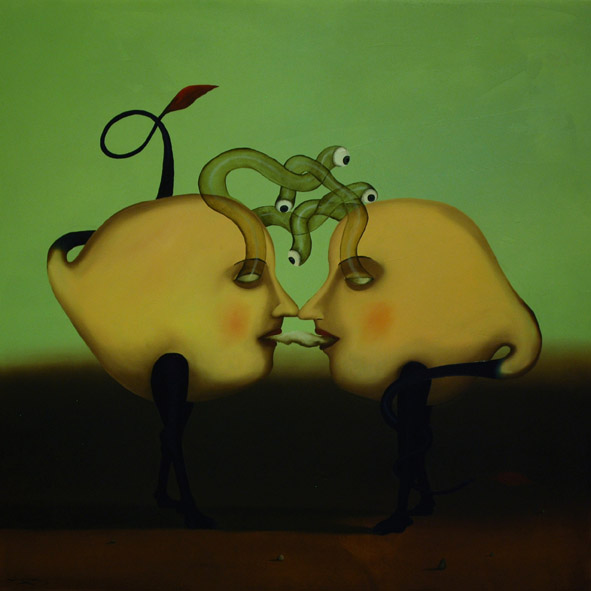
    Marcelo Suaznabar, Political conversation (Conversacion politica), 2013, oil on board, 28 x28 inches. Courtesy of the artist and Articsok Gallery.

    Suaznabar is also painting in the 21st century, which brings its own urgencies. Overpopulation and the decimation of the environment, the media-enraptured global audience who fawn over irrelevant celebrities while consuming unnecessary goods in ever-increasing quantities, ignoring the fact that global warming becomes ever more obvious and entire nations are sinking into extreme poverty. As a matter of conscience, Suaznabar is compelled to speak out through his paintings and try to alert or awaken viewers. Thus, he is a didactic painter in the tradition of Hieronymus Bosch. This is quite rare in contemporary art, where most artists are content to produce work that is in line with prevailing aesthetic trends.
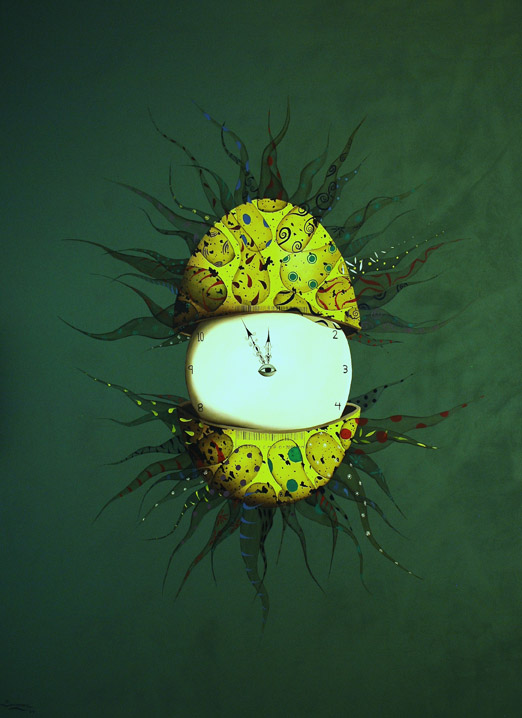
    Marcelo Suaznabar, Still fragile (Naturaleza fragil), 2014, oil on canvas, 48 x 36 inches. Courtesy of the artist and Articsok Gallery.

    In fact, Suaznabar is engrossed in his life’s work and returns to the same themes quite obsessively; notably the Apocalypse. As one might expect, these paintings have a complex relationship with Christianity. Suaznabar recognizes the arrogance of the conqueror in the Christian message but also finds solace in the injunction that humanity is responsible for the planet’s wellbeing. In pagan mythology, Mother Earth, or Gaia, is a nurturing organism wherein all life forms are inter-dependent and none are pre-eminent. Christian mythology posits another world which chosen penitents reap a Heavenly reward after leading a ‘good’ (biblically prescribed) life on this earth. Entranced by the spiritual mystery of what could lie beyond, Suaznabar amalgamates the Christian perspective with an environmentally pagan view. As a visual messenger, he is obliged to use a metaphorical language that his viewers are familiar with, which in this case is the teleological interpretation of existence. 
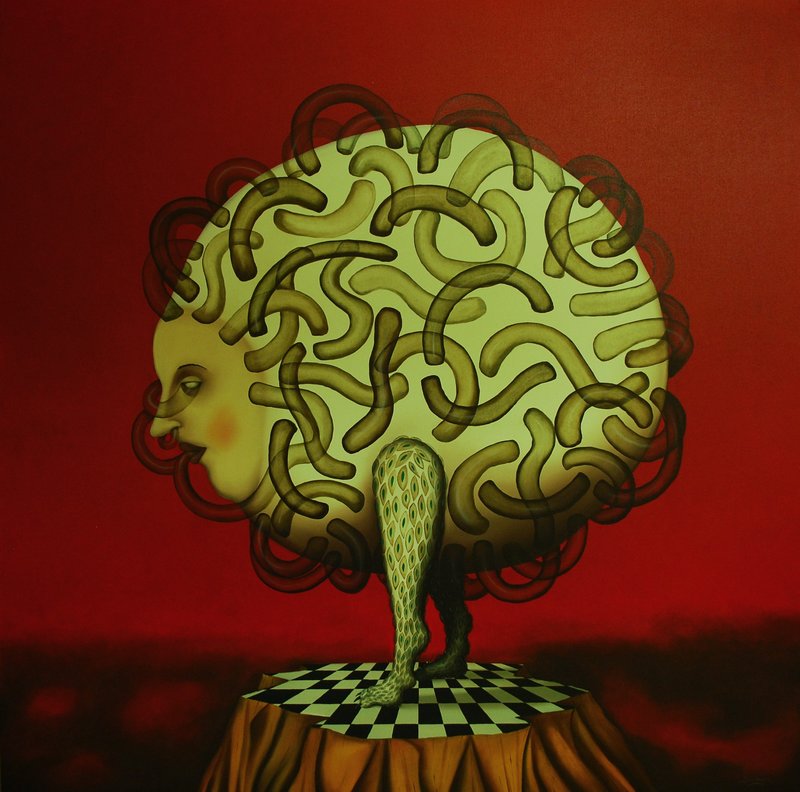
    Marcelo Suaznabar, Wordless (Sin palabras), 2014, oil on canvas, 48 x 48 inches. Courtesy of the artist and Articsok Gallery.

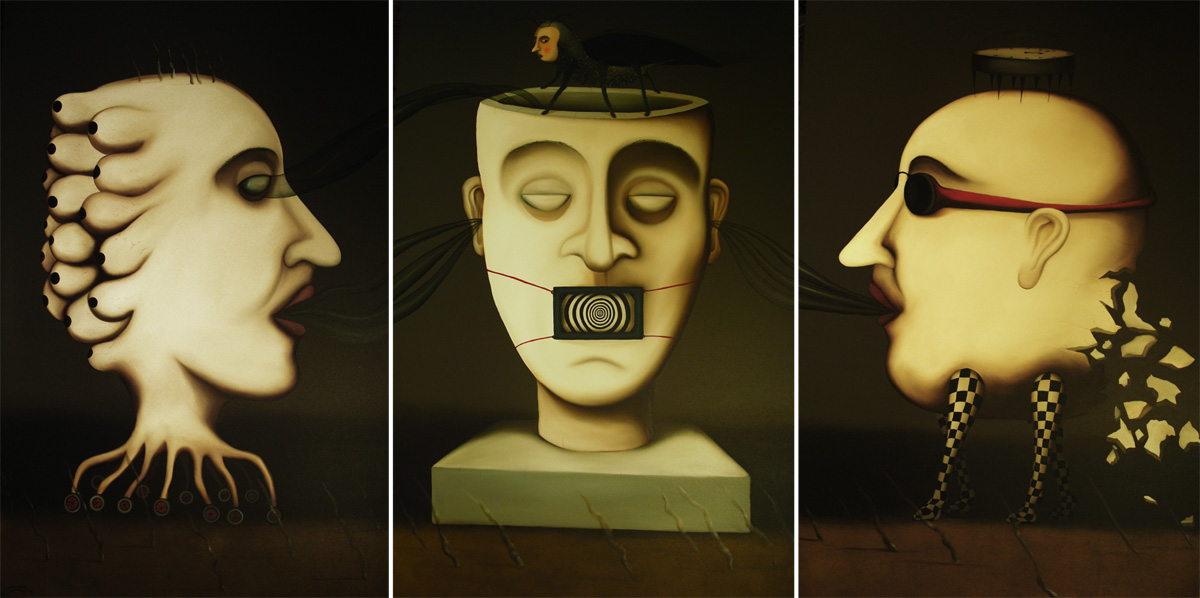
    Thus, clocks are a persistent theme in his work and often replace faces. Salvador Dali, who was one of the most influential Surrealists, also used clocks. Dali’s brand of Surrealism was a hysterical, hyperactive realism that went through and beyond appearances to reach a truer reality; the Surreal. Thus form was just a membrane and ‘true’ reality was more like a dream where the usual laws of perception no longer applied. Suaznabar’s paintings have a Dali-esque flavour, in that form is always subverted leaving elements like roots or rivulets of blood sprouting from the ears of granite faces. Monolithic female forms stand like stone sculptures while small human figures deport themselves decadently. Hybrid animals and strange flying mermaids mingle with the human hordes. Sometimes their intention is malign and they consume their human prey but at other instances they tempt humans into folly.

    Marcelo Suaznabar, Out of sing, out of mind (Ojos que no ven, corazón que no siente), 2014, oil on canvas, 76 x 46 inches. Courtesy of the artist and Articsok Gallery.

    Suaznabar’s painting style is naive realist and as a consequence he can introduce humour too. Some of the animals are quite comical in their malign intention or languorous lounge, like the lobster-television that lies in wait for its prey, the woman (Contranatura). He delights in transforming and making unusual allusions. Thus a tree stands uprooted on a table. Furniture is used as a prop to present absurd ideas, like a four poster bed so high only a giraffe could reach it. Often he layers his canvases so there is a sense of the other world. He uses chiaroscuro to darken areas creating a nocturnal setting but with adjacent areas lit from another source, indicating a realm beyond.

    Veneration for certain art historical characters like Frida Kahlo and Pablo Picasso is expressed in his Archangel series. Fragments of their work are woven into the structures, dominated by the ornate religious garments adorning the archangels. These works present an idealized pantheon of heroes who are respected for their contribution to art and humanity.

    His Altiplano landscape series affirms the magical qualities that are transmitted through even seemingly desolate places. Fishlike creatures metaphorical of the strange and incomprehensible are immobilized on stands placed in the desert, evoking a psychological tension. Bright, swirling, otherworldly colours rip through the forms, contrasting an intense red with a celestial ultramarine blue or a green that is almost alien. Darkness suffuses throughout and the viewer peers anxiously into these crepuscular desert landscapes. Sometimes they are populated by figures from a circus like jugglers or harlequins riding elongated monocycles, sometimes by strange, multi legged beasts that slouch towards Bethlehem.
    Marcelo Suaznabar, There is always something more (Siempre hay algo mas), 2014, oil on canvas, 72 x 144 inches. Courtesy of the artist and Articsok Gallery.

    Suaznabar makes use of the Renaissance convention; the banner, through which he presents poetic text like “labyrinth of the passions”, indicating the meaning of the work. Language is transformed into a physical substance and pours out of mouths like ribbons. Certain symbols recur as in the egg, symbolizing the fragility of life or the cube which represents the constructed or manmade. Chequerboard of black and white squares take the place of landscape in many works, indicating human colonization of nature. The mechanical nature of human invention invades the natural order of things. The bar code becomes a ubiquitous presence, like a strip of duct tape over the mouth preventing a prisoner from speaking.

    Ultimately, Suaznabar communicates at a vital level, since humanity seems to be on the brink of calamity. One can salute the intention of the artist to maintain a moral integrity and to present art with a social message. That he also creates mysterious and intriguing work is an added blessing.

    Ashley Johnson

    *Exhibition information: Marcelo Suaznabar: Beyond Appearance, June 19 – July 26, 2014, Articsok Gallery, 1697 St. Clair Avenue West, Toronto. Gallery hours: Wed – Sat 12 – 6 p.m.

  • Proof 21 / Artists’ Talk & Opening Reception

     
    Walk through with the artists: June 20, 2014, 5 – 6 p.m.
    Opening Reception: June 20, 2014, 6 – 8 p.m.
    Gallery 44

    Proof 21 exhibition at Gallery 44 is an annual event aimed at showcasing emerging artists. This year’s show, for the first time in Proof’s history, is based on a single theme, inspired by the issues of identity, representation and, more specifically, politics of representation, which stem from topics raised at WorldPride. Prior to the opening the artists briefly introduced their works.

    Artist Aidan Cowling discusses his work

    With a series of collages, Aidan Cowling explores ways of interaction with and within queer space. Aidan characterizes the digital world as an “archive of queer experience” from which he draws his own visual archive, collected from craigslist personal advertisements. He rearranges these images, which represent desire through symbolic objects, into “anonymous portraits”, aesthetically unified through the transfer process.

    Artist Megan Morman in front of her work

    Detail of Megan Morman’s work

    Megan Morman uses plastic beads to create vibrant and joyful portraits of queer performing artists. Megan’s previous art practice involved needlepoint with which she created pixelated portraits of artists, and now plastic beads grant her the freedom to make larger and more colorful works. The playful character of Megan’s work, to which she refers as “my ideal party”, gains a kinky mood through variously colored rhombuses which reference the hanky code.

    Detail of Michelle O’Byrne’s work

    Michelle O’Byrne’s work is best understood through her process. Michelle starts with a stock photograph, on which she reflects, notes her associations, and collects objects which remind her of the initial image. Some of these objects will become part of her final work.

    Artist Michelle O’Byrne explains her work

    She works with no more than two stock images at a time, for the process requires deep intellectual focus. Michelle smiles gently when describing how many objects are stored in her studio, in contrast to the minimalistic aesthetic of her installations.  

    For two years in Mexico, Brett Gundlock has been documenting the citizens’ fight against the cartel. With a background in photojournalism, Brett is particularly interested in global society with Mexico as a country bordering the United States, and yet far from reaching a comparable level of security and quality of life. 

    Artist Brett Gundlock discusses his series

    Figures in most photographs, intentionally non-identifiable, serve a symbolic role. Brett’s goal is to show not just what the situation is, as is typically reported in the media, but also why the situation has reached such a high level of violence.

    Photographs by Brett Gundlock

    Lindsay Fisher describes the Internet as the realm of the contemporary portrait. Her video work explores the issues of queer bodies and disability, as well as the concept of performing beauty.

    Artist Lindsay Fisher

    Visitors with Lindsay Fisher’s video installation

    The series is based on instructional videos, such as how to apply make-up, which Lindsay recreates with herself and her friends performing the script. Lindsay maintains that the animated quality of these works has the impression of portraiture, for even though the image is ongoing, it remains contained.

    Visitors in front of Danika Zandboer’s work We are Monoliths

    Not to be missed, Gallery 44 has added Danika Zandboer’s works as a bonus, in the Vitrines. Danika’s photographs are a reflection on “cues and signifiers which bring a subculture together”, here – the heavy metal subculture. Danika explains that its vastness can generate a feeling of alienation from the scene. By dislocating signs relevant to that subculture, she explores the issue of identity politics.

    After the artists’ talk the Opening Reception proceeded in a cheerful atmosphere.


    Text and photo: Elena Iourtaeva

    *Exhibition information: June 20 – July 26, 2014, Gallery 44, 401 Richmond St W #120. Gallery hours: Tue – Sat 11 – 5 p.m.

  • Eldon Garnet: Shadows and Shades

    Christopher Cutts Gallery exhibition Shadows and Shades is a display of new and earlier work by Eldon Garnet. Included in the show is the video If Only For A Moment (2007), small bronzes, stainless steel text sculptures, and photo-based works. Garnet’s literary publications are also displayed, including the 2013 release Categories of Disappearance. The novel is typical of the artist’s work, a vantage point from life’s extremities. The hues of Garnet’s shades were aptly foreshadowed by Thomas Hobbes in his Leviathan, when he painted the life of man without central government as solitary, poor, nasty, brutish, and short.

    The Melodious Child, 2002, chromogenic colour print 40.25 x 140.25 inches. Ed. of 2. Courtesy of Christopher Cutts Gallery.

    Short, nasty, and solitary are words with a modern equivalence to existentialism. As in Kafka’s Metamorphosis, what could better convey this than a cockroach? Insects, of course, are prevalent enough in Garnet’s photography (The Melodious Child, 2002 and Categories of Disappearance #1-66, 2009) to serve as leitmotifs analogous to the human condition in general. A bug’s eye view has life as uniform, ephemeral, and as a consequence pointless. The 1992 bronze works Untitled (Prone Man in Enclosure), and Untitled (man on island), scales the subject down to size of an insect, in the process generalizing features into anonymity. The metal freezes and binds the man into a fixed relationship with his immediate environment. It’s life in a windowless prison of a room or a hopelessly tiny island. The bronzes, in their severity, are not entirely statements of denial, but rather barbed reminders of life’s strict limits.

    Untitled (Prone Man in Enclosure), 1992, bronze, 10 x 10 x 3 inches. Ed. 2 of 10. Courtesy of Christopher Cutts Gallery.

    As mammals go in the stock market of existence, humans are trading high at the moment. Garnet’s Categories of Disappearance is a fictional fly in the earth’s ointment. He documents the collapse of earth’s biosphere into 55 fragments, or categories as he calls his chapters. In Garnet’s scenario microbes and bugs swallow the same bitter pill as quadrupeds in the form of a mysterious illness. It’s this pathogen that tugs the domino that very quickly topples the entire chain of being, in short, annihilation of life on earth. The crisis manifests itself globally as the inability of oxygen breathers to ingest food. Violent retching ensues, and as starvation sets in, the social fabric quickly unravels. From this point, after the resignation to death has gelled, it’s a cool skate into the final hours of life. If this sounds like the setting of the stage for the ultimate human tragedy (spoiler alert), there is a hint that Garnet backs away from the precipice with parting words such as “slapstick”, “snicker,” and “joke.”

    Categories of Disappearance. Courtesy of Christopher Cutts Gallery.

    Categories of Disappearance #6, #55, #20, #43, 2009, Chromogenic Colour print, each 10 x 8 inches. Ed. of 5. Courtesy of Christopher Cutts Gallery.

    The delineation here is the thin gulf between life and art. Why else would a small band of friends mount a play in their final hours of life, as they do in this story? In this theatre of the absurd, it’s less a case of re-arranging deck chairs, than the rehearsal of a death scene that actually takes place. For this troupe, in their view of a pointless universe, the play becomes the vehicle for a last ditch run at life’s meaning, with art as the ark of transcendence in the shape of the only possible hope of immortality.

    Untitled (man on island), 1992, bronze, 3.5 x12 x14 inches. Ed. 2 of 10. Courtesy of Christopher Cutts Gallery.

    If Garnet wears his pessimism on his sleeve, it serves to expose the bur under the saddle of all who are at ease in Zion at their peril. It’s not so much the artist’s disparage of the good life, as it is a reminder that life on earth hasn’t been all sunshine and lollipops. This is also true of the aeon, big picture perspective. As the bones of dinosaurs past attest, earth personified is a crusty old demiurge with a volcanic temper that has tended to use species as so much snuff. Art may serve its purpose as an easy chair, as it did for Matisse, or a seat of unease as it does here in Garnet’s Shadows and Shades.

    Steve Rockwell

    *Exhibition information: June 5 – Jul 5, 2014, Christopher Cutts Gallery, 21 Morrow Ave, Toronto. Gallery hours: Hours: Tues – Sat 10 – 6 p.m.

  • Nuit Rose

    June 21, 2014 / 7 p.m. – 3 a.m.
    Church Wellesley Village and Queen Street West

    Nuit Rose is a queer focused contemporary art event in celebration of World Pride 2014 in Toronto. This late night event will be held on Saturday, June 21st, 2014 from 7pm until 3am in two areas: Queen Street West & Church Wellesley Village.

    Fed, Joel, Omar & Seb by Nigel Nolan

    Events include:

    • art installations
    • artist exhibitions
    • art marketplace
    • performance, theatre and music
    • film, video and digital art
    • audience participation

    For a full run-down of events for the evening, please visit our Events listing.

    You can also click here to download the Zone Map PDF.

    With our easy-to-read schedule, you can start planning your night right away. We look forward to seeing everyone and don’t forget to share your schedule and photos with the #nuitrose hashtag!





