Author: artoronto

  • Power Ball: Old New World


    June 5, 2014 
    The Power Plant Contemporary Art Gallery 
    231 Queens Quay West 

    This year the annual fundraiser’s theme was Old New World celebrating the transition to digital technology from the analogue world. This included works by local and international artists as well as reflections of the theme in fashion and food. This year the weather co-operated and many guests hung outside enjoying the warm summer breeze from the lake. It also made the inside a little more easy to navigate. As you entered in the entrance you were faced with a large display of candy treats. 

    British artist, Naomi Kashiwagi produced some clever sounds from her performance, Gramophinca using a live performance glitching 78rpm records on a gramophone. The appearance of Kashiwagi made you think of trying to mix and scratch records before the modern turntable came along. 

    Artist Naomi Kashiwagi

    Outside people were munching away on hotdogs and drinking cocktails. The crowd was a mix as usual of the fashion crowd such as Glen Baxter from Fashion Television, the financial world and many of course from the art world. Philip Monk, director and curator from the Art Gallery of York University with the assistant director and curator Emelie Chhangur were mingling in the art crowd. Clint Roenisch of the Clint Roenisch Gallery on Queen West was there as well. His gallery is on the move to 190 St Helens St. near the Daniel Faria Gallery and Scrap Metal Gallery, the first show in the new space slated to open in the summer. Also spotted at the Ball were director and co owner of the Neubacher Shor Gallery in Parkdale, Manny Neubacher and his partner Anya Shor co-director and co-owner of the gallery. 

    Glen Baxter & Friend

    Gallery owner Stephen Bulger was chatting with marketing director of Porter airlines, Michael Macaulay before both headed  over to sample the food out doors. Peter Kingstone from the Toronto Arts Council was also there making his way through the festive crowd. Inside artist Lori Ann talked to me about her upcoming exhibition and Kelly McCray updated me on the happenings of Art Barrage which he co-founded. He told me that they are doing consultations with artists and buyers of art. 

    Artist Lori Anne and curator Kelly McCray

    In another Gallery space BYOB ( Bring Your Own Beamer ) was a series of mobile projections. The walls were covered in different images and text projected like a look into the future. The series of exhibitions was started by Rafael Rozendaal and has travelled internationally. Toronto artist Asmna Muzaffar organized this portion of the BYOB display. 

    BYOB Projections

    A traditional installation

    Other participating artists included Montrealer Jon Rafman and his humorous take on technology. VJ Oli Sorenson, another Montrealer originally from L.A., is a multimedia and performance artist who uses sampling and sharing. Also on view wre works by New York based Toronto artist Christine Davis. Her work examines the present through the past. 

    New technology: creating images through using a blow torch

    Some people were just arriving as I left and the tunes were getting to the over 1500 guests ready to party some more. Another successful evening for one of the best parties and fundraisers in town. 

    Text and photo: Phil Anderson

  • Collecting Art / A Panel Discussion

    June 3 , 2014  7 – 9 p.m. 
    Gallery 1313

    While another debate for the provincial election was going on television and radio – a great panel of experts in contemporary art discussed the various aspects of collecting art. It was very timely as the visual arts critic for the Toronto Star, Murray Whyte, had just written a piece on the donation of 279 images to the Art Gallery of  Ontario by Harry Malcolmson and his wife Ann. Harry just happened to be one of our panellists and he gave us an inside glimpse into the world of a collector. 98 of those art pieces are on display at the AGO till September 7, 2014.

    The Panel (from left to right): Harry Malcolmson, David Liss, Jessica Bradley, Stephen Ranger, Flavio Belli and  Richard Rhodes

    Richard Rhodes, editor of Canadian Art, skilfully moderated the discussion and kept the panel engaged. The panel included Jessica Bradley of Jessica Bradley Projects, David Liss, the curator and director of the Museum of Contemporary Canadian Art, Flavio Belli, currently a co-curator at the Al Green Gallery and an artist and collector himself, Stephen Ranger  the Vice President of Development at Waddington Auctions and the creator of Concrete Contemporary and Harry Malcolmson  collector and former art critic for the Toronto Telegram. Topics of discussion ranged from what made an art work collectible and on the other hand what made people collect art.  Did people graduate from collecting other objects and art just became their new passion? Was it enterprise or people want to use art as a commodity?  Did an art collection raise the social stature for some people who would try and impress others with their collection? Harry Malcolmson brought up the hunter gather as a collector and Jessica Bradley read a quote which reaffirmed that the importance was on the art itself. There was common agreement here. 

    From left to right: David Liss, Jessica Bradley (speaking), Stephen Ranger and Flavio Belli

    It was declared that a serious collector was one who collected for more than just the walls of his or her domain. Indeed Flavio said he had 300 art works displayed on his walls and another 3,000 squireled away safely stored. Likewise Liss admitted to storing away art works he collected. He compared his art collection to his book collection which he treasured equally refusing to part with certain books that he might not re-read. It was suggested  that owners of large collections  rotate their works on display to enjoy them all. 

    Stephen Ranger gave insights into some of the attitudes of some buyers at art auctions. There were distinctions made for people that just bought art to make a dollar by flipping it and those serious collectors who hung onto the art works they purchased. It was also discussed on what made  up an art collection itself. 

    From left to right: Harry Malcolmson, David Liss, Jessica Bradley, Stephen Ranger (speaking) and Flavio Belli

    David Liss of MOCCA  declared that while MOCCA was an institution that had a mandate to collect art  it was still rather early in its development and there was hope for the institution to have the means to collect more art in the future. Flavio Belli confessed to having collected a series of winter scenes and discovered the Sunday painter’s pleasure in creating these works.

    From left to right: Harry Malcolmson, Jessica Bradley, Stephen Ranger, Flavio Belli (speaking) and  Richard Rhodes

    The audience was treated to a number of insights, not all encouraging for the artists in attendance. Those in attendance came up with some probing thoughts and questions. The panel was asked where did they go to seek out art and again there were a variety of responses from outdoor exhibitions where people could converse directly to the artists to galleries and consultants where other opinions could influence a potential buyer.

    Toronto was declared a healthy site for art collectors and perhaps better than Montreal and other Canadian centres . It was agreed upon as well that is a wealth of talent in Canada still untapped and unknown for a large part outside of Canada. There was a healthy conversation as well about if local art could be supported more through municipal intervention and support. It was agreed that while  it was not a good idea to become dependent on government support at any level however any support would help. At the end of the discussion panellists and those in attendance seemed to feel that having discussions like this was a good first step in looking at and examining  the art collecting climate locally and nationally and finding possible solutions to increasing it through arts education and appreciation of our cultural heritage. There were  no clear answers but some great ideas and insights at the end of the evening unlike that other debate where hopeful provincial leaders squared off.

    Text and photo: Phil Anderson

  • AGO First Thursday

    June 5, 2014, 8 p.m. – midnight
    Art Gallery of Ontario

    This First Thursday in June at the AGO was one to remember as guests were treated to a celebration of all things Canadian. The evening offered an array of activities to partygoers including pop-up talks, performative tours and one-night-only installations.

    Artist Bonnie Devine gives a pop-up talk

    Artist Bonnie Devine and curator of Canadian Art, Andrew Hunter conversed before a small audience in the Molly & George Gilmour Gallery before Hunter departed to deliver a second talk in the Marvin Gelber Print & Drawing Centre. Hunter offered a “behind-the-scenes tour” of a few select works by Canadian artists including Christopher Pratt, Joyce Wieland and Christiane Pflug, pulled from the vaults of the AGO.

    Curator of Canadian Art Andrew Hunter speaks in the Marvin Gelber Print and Drawing Center

    Guests could also enjoy the ongoing contemporary art exhibition Elevated in the AGO tower, and those willing to spend an extra ten dollars were able to experience Francis Bacon and Henry Moore: Terror and Beauty. Unfortunately, as I was sternly informed by a guard, no photography is allowed in the Bacon and Moore exhibit due to copyright laws, though I suppose this lets the viewer focus on the art.

    Guests take in some contemporary art in the AGO tower

     Guests appreciate Canadian icon Norval Morisseau’s paintings 

    Guests crammed into the beautiful Galleria Italia for drinks, reggae music and art making but when 10 o’clock came around everyone packed into Walker Court for a headlining performance by Canadian rock legends Sloan. Those who planted themselves early enough were able to get a good view while hundreds of others jostled just to get a glimpse of the band. Frontman (and occasional drummer) Chris Murphy, who could be seen chatting earlier near the iconic Lawren Harris collection, led the Juno-winning band through a performance that did not disappoint the sold-out crowd.

    Guests fill the Galleria Italia

     Sloan frontman Chris Murphy chatting in the Thomson Collection of Canadian Art

    A packed Walker Court rock out with Sloan

    The next First Thursday takes place July 3 and will feature a celebration of World Pride with a musical headlining performance by SSION.

    Text and photo: Mitch Billinkoff

  • Jacqueline Treloar: Exaltation

    We live in an inglorious time, one that does not trade comfortably in exaltation.

    Artists have traditionally worked against the tenor of their times, as harbingers of our accumulating cultural truths—frequently unacknowledged—that flow like underground rivers beneath whatever we are. Artists have traditionally been the expediters of those truths: bringers of the light of insight and, if possible, the radiance of revelation. As poet William Blake wrote, in his The Marriage of Heaven and Hell (1793), “If the doors of perception were cleansed every thing would appear to man as it is, Infinite. For man has closed himself up, till he sees all things thro’ narrow chinks of his cavern.”

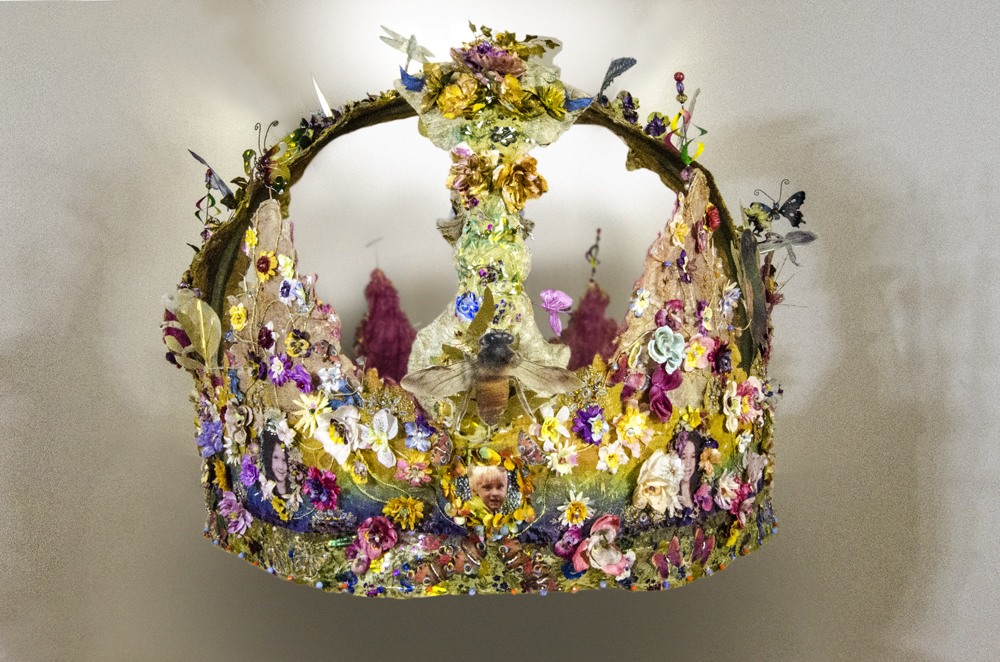
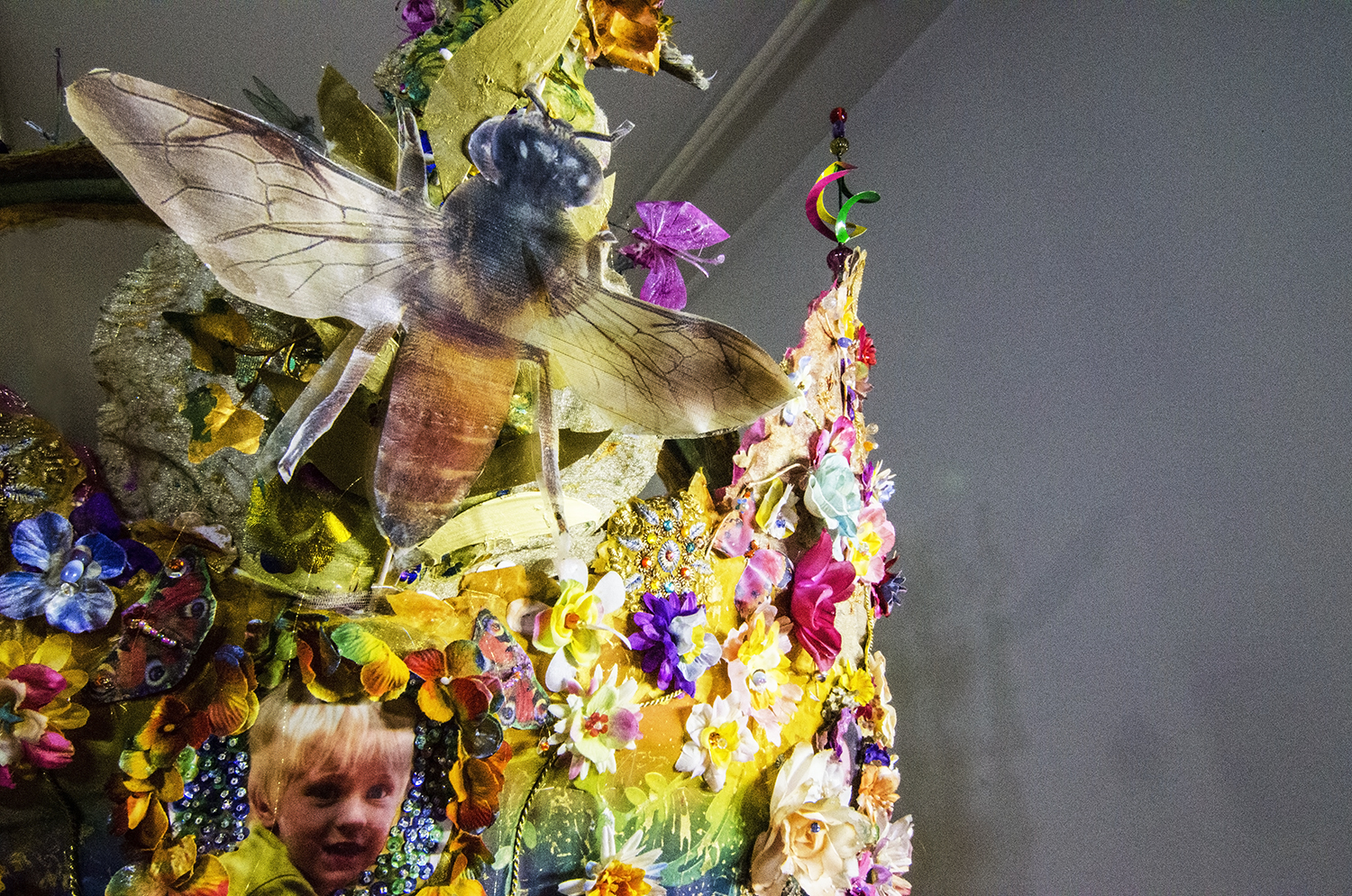
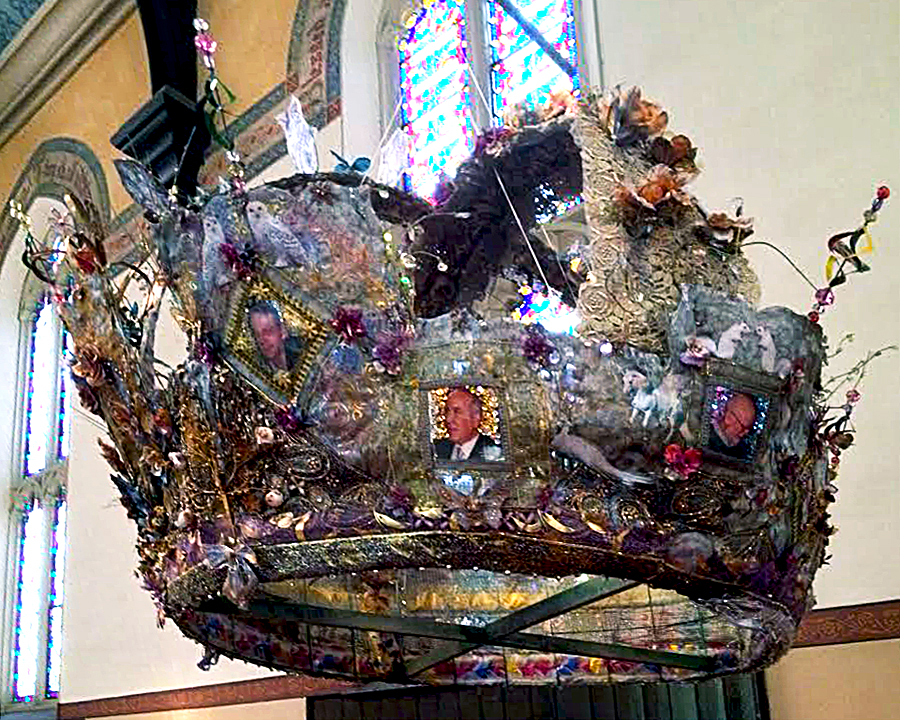
    Jacqueline Treloar, Great Children’s Crown (Corona Magna Puerorum), 2013, detail, fabric and mixed media, 4 x 5 foot. Photo: Lumir Hladik. Courtesy of the artist.

    This is the kind of artist Jacqueline Treloar is. She strives to open up what has been closed in us. She is a diligent housekeeper of the Infinite, making sure her allotted panels of the doors of perception swing to and fro as smoothly as possible.

    This is the kind of artist Treloar is. Which means she inhabits a more-or-less embattled, confrontational role. “It is not news, “writes poet Ann Lauterbach in her The Night Sky: Writings on the Poetics of Experience (Viking, 2005), “that we are in a dispiriting time, one of personal and political cynicism, of unproductive doubt” (p.190). In this age of the bureaucrat-artist, the committee-artist, the media-artist, the dogged sociologist-as-artist, Treloar is committedly, stubbornly, a visionary artist, unashamedly in thrall to the energies of the transcendental.

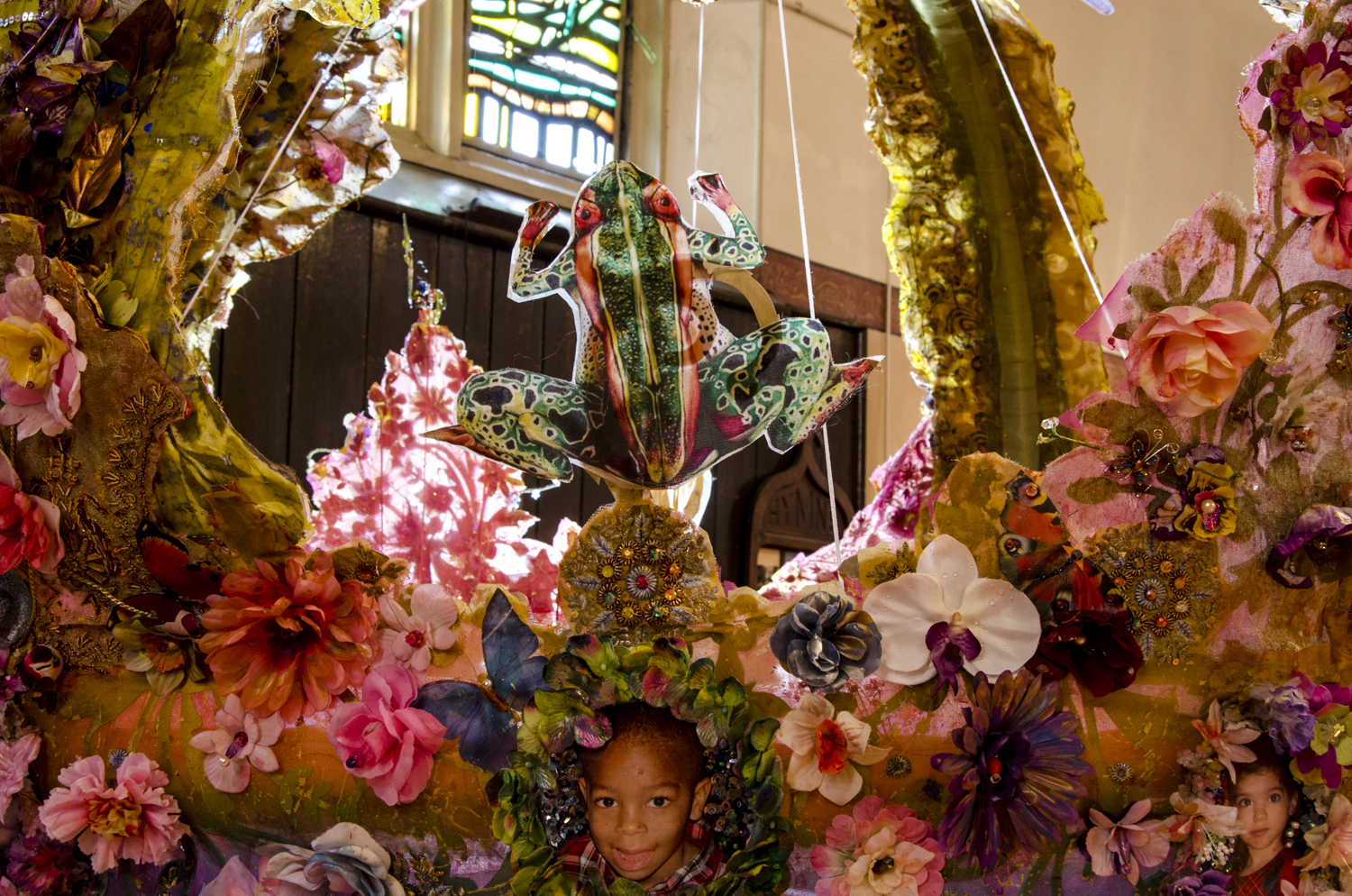
    Jacqueline Treloar, Great Children’s Crown (Corona Magna Puerorum), 2013, detail with Jaden, fabric and mixed media, 4 x 5 foot. Photo: Lumir Hladik. Courtesy of the artist.

    Her tools are desire, passion, memory, humility and reverence. She wields them with both tenderness and verve, valourizing, in her researches and constructions, in recourse to her jewels, beads, laces, swatches, toys, trinkets, tschotskes, photographs and assorted talismanic objects, what she refers to as “the implicit power in the people we care for and who, in so many ways, have changed our paths and whose presence has altered [us] and enabled us to go forward….”

    Treloar pays attention, exquisite endless attention. She pays attention to history, to the arcing of the trajectory of humanist and devotional thought (those noble, august, crowned Madonnas, those elevated Marys) and she pays attention to our little (but not unimportant) places in that great—sometimes almost forgotten—hierarchical pageant. And, as Walter Benjamin noted in his essay, Some Reflections on Kafka (Schocken Books, 1968), “attention is the natural prayer of the soul.”

    Jacqueline Treloar, Great Children’s Crown (Corona Magna Puerorum), 2013, detail with Conrad, fabric and mixed media, 4 x 5 foot. Photo: Lumir Hladik. Courtesy of the artist.

    Treloar is, in her way, a lavish participant in the epic spirit, a modern-day Mnemosyne, the rememberer. She is a historian and enshriner (her Great Crowns are levitating shrines). Her works memorialize what needs to be memorialized. This is why her work is opulent but not extravagant (extravagance meaning—as “extra-vagant,” going outside of the lines, as it were).

    It’s sort of silly, perhaps, but every time I gaze upon Treloar’s exquisite, hovering crowns, I think about a nest holding newborn birds (maybe “an exaltation of larks”), all of them lifting their open beaks upwards towards the light.

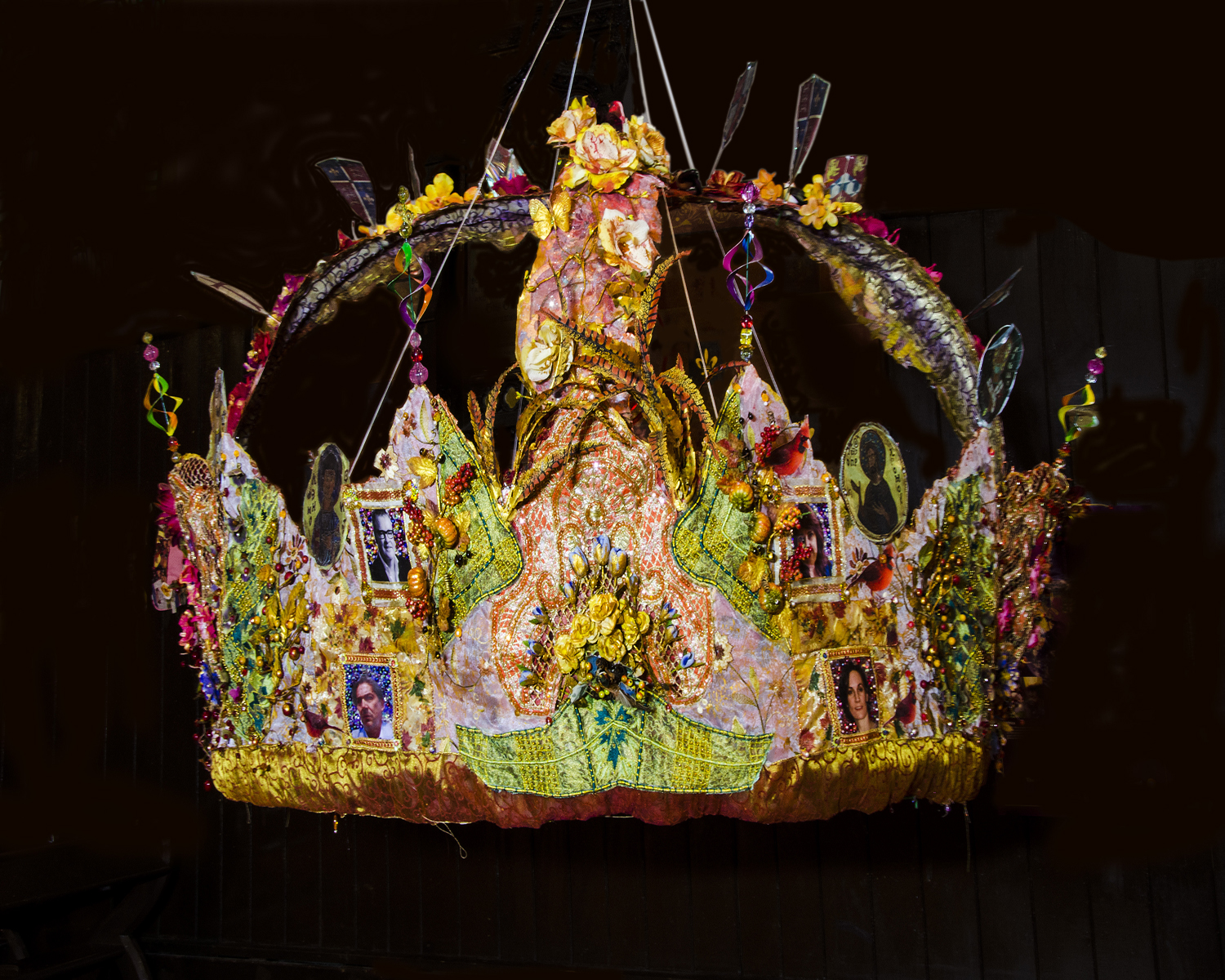
    Jacqueline Treloar, Great Adult Crown (Corona Magna Adultorum), 2014, fabric and mixed media, 60 x 48 inches. Photo: Lumir Hladik. Courtesy of the artist.

    Crowns are ascentional objects. The Madonnas they evoke—as they generously evoke our own sublunary lives as well—live high above the earth: on thrones, hillsides, on a pillar (see the Virgin’s first century appearance on a pillar in Zaragoza, Spain, a visitation enshrined within the cathedral, the Nuestra Señora del Pilar (Our Lady of the Pillar), and honoured by the city’s annual flower offering, its Ofrenda de Flores, a mighty cloak of woven flowers for the Virgin).

    The Virgin is The Lark Ascending.

    I love the fact that Treloar’s majestic crowns are suspended in the air, held there by wires, dependent from wires (that is to say, sus-pended from wires, pendular, pendulum-like, hanging down). The paradox lurking for me in this depending, inhabits the fiction I have allowed myself that these acensional crowns may, if cut loose, if suddenly left without restraint, will rise, not fall. For me—and I insist on seeing it this way—the wires holding the crowns up are actually guy wires—holding them down.

    Jacqueline Treloar, Great Elder Crown (Corona Magna Senium), 2014, in the Holy Trinity Church, Toronto, mixed media, feathers and glass on nylon and plastic mesh base, 60 x 48 inches. Courtesy of the artist.

    Treloar’s Madonna crowns are rising after Her.

    It’s funny how affixed we remain (living on a sphere) to the idea that heaven (the site of The Good) is up, and hell (the residence of evil) is down. Maybe it’s all because of the structure of the human body, with the head—as the locus of perception and consciousness—at the top, and our ignoble feet way down below, at the bottom, in contact with the earth (as “feet of clay”). What is good, or what aspires to the good, rises (vectoring church steeples point up, birds fly up and away, our sensibilities yearn, when we are joyful—or hopeful—or aspiring) for upward mobility (one recalls Wordsworth’s soul leaving his body in delight, when confronted by a field of waving daffodils: “…and then my heart with pleasure fills / and dances with the daffodils….”).

    Jacqueline Treloar, The Great Children’s Crown (Corona Magna Puerorum), 2014, in the Holy Trinity Church, Toronto, fabric and mixed media, 60 x 48 inches. Photo: Lumir Hladik. Courtesy of the artist.

    Treloar’s crowns are lush, lustrous, buoyant museums of iconographic plenitude. The whole world (local, global) is addressed somewhere within them, by accumulation or proliferation or by the artist’s generous, flowering will. When they are filled, they rise like the sun. A sun that never, however, sets.

    Gary Michael Dault, May 15, 2014

    *Exhibition information: Coronas Magnas Reginae Caeli by JACQUELINE TRELOAR, May 21 – August 15, 2014 at The Church of the Holy Trinity, 10 Trinity Square, Toronto. Hours: Mon – Fri 11 – 3, Sun 8 – 4 pm.

  • SKETCH has a new home

    Interview with Rudy Ruttimann (R.R), Executive Director of SKETCH by Ella Gorevalov (E.G)

    The Staff of SKETCH

    SKETCH is a community art organization engaging Toronto’s homeless and marginalized youth. It provides studio spaces to participate in a variety of activities such as textile art, culinary arts, music production, dance, theater, digital media, printmaking and fine arts. May, 2014 marks the completion of construction of SKETCH’s new 7,500 square-foot studio space in the heart of Queen West at 180 Shaw Street. Rudy Ruttimann, the Executive Director of SKETCH, gives us a tour of the new facilities and tells us about how after 17 years in Toronto’s art scene, SKETCH is ready to move on.

    The entrance at 180 Shaw Street. Photo: Carter Brown

    E.G: SKETCH is an organization which has spent almost two decades breaking through a mold of community partnership in the arts by starting on a grassroots level to target those who typically do not have access to art. Can you tell us about the history and the roots of SKETCH; how did the initiative grow to be what it is now?

    R.R: It started all as a small pilot project at the Yonge Street Mission. Artistic Director, Phyllis Novak, a graduate of York University’s theater degree program, started SKETCH in 1996. She had a real interest in youth and a passion for art, so she was volunteering at the Mission. It was there that she came up with the concept of using art to engage young people who were living with poverty and facing immense social barriers. She created a three-day art festival, called the Fix Festival, with the young people she had met at the Mission. It involved a parade down Yonge Street and some workshops in an old empty factory on Lakeshore Blvd.

    An activity room. Photo: Carter Brown

    E.G: How did Fix Festival helped SKETCH to have a studio space?

    R.R: Novak decided that there needed to be a space somewhere for the youth to engage in programs, and was able to secure a 900 square foot space at Dovercourt and Queen, which was really just a little storefront space. It was there where the project has really began. She and a group of  participants came together to combine their passion of theater and visual art. They began to look into issues surrounding addiction and homelessness,  the main problems of the youth they worked with. Eventually one of artists came up with the concept of “artist in residence”. Novak developed a program for her, so she could become a peer facilitator while she was simultaneously developing her own body of work in order to have her own show. It was really then that the door opened to the public.

    Life Drawing class. Courtesy of SKETCH.

    E.G: You have came from a 900 square foot space to a 7500 square foot space. How did that happen?

    R.R: After the Artists in Residence and the daily programs were established, the energy really took off. Three days a week we held an open studio. One day was around visual arts, the next called metal-morphosis [working with sculpture and metal], and the third day people could work on whatever they wanted. Soon we were running art programs all over the city. We moved to King Street, to a space that were very community oriented. It was good for us to spend ten years developing what we wanted, what we see now as our methodology. The space we’re in now is brand new at Queen and Shaw.

    E.G:  It seems that SKETCH is ready to stretch in this new space. Can you tell me more about your programs?

    R.R: “Upping our profile” allows us to bring a lot more people into our space but we also want to remain faithful to the roots and the principles of our original intentions.

    The “future” Gallery. Photo: Carter Brown

    This is a space with many possibilities. It has an industrial kitchen, studios for music production, spaces to produce art work in any medium, and a gallery space to showcase it. There are three layers in our programs, such as SKETCH programming; Community engagement – in which members of the community come in and run workshops or our youth are leading workshops; and finally rentals, a new opportunity that allows us to rent out the space when it is not being used. Participants hear about SKETCH primarily through word of mouth and through referrals from other community organizations that provide direct primary services such as shelter systems, health care, and legal aid.

    A volunteer is leading a textile making group. Courtesy of SKETCH.

    E.G: In your ideal world, what do you see SKETCH becoming? What are your goals?

    R.R: One of our dreams is to see SKETCH grow provincially. We are already working in Ontario with different groups that are looking at the concepts we use and are implementing the idea of building a program for troubled youth within their communities. I would love to see somebody to adopt us, somebody who really understands and loves what we do and could invest in the vision and be a champion.  The way that we are running SKETCH is very similar to an alternative school. People get a chance here to play and to explore but it is also a place of learning. We are in a discussion with a few post-secondary institutions and hope to get an accreditation system set up between our programs and their credit system.

  • The Purists / The Manipulators

    Installation view with Alexei Rebrov, #4266 (right). Courtesy of Akasha Art Projects

    “Pushing the limits of parallel photographic ideologies,” is the theme that Scotiabank CONTACT Photography Festival Open Exhibition at Akasha Art Projects successfully explores. Conceived and curated by artist and gallery owner Sonja Scharf, the group exhibition  compares, contrasts, and blurs the line between film photography and digital media, two distinct yet parallel methods.

    Sonja Scharf, Impermanence, Chromogenic Print, 9.5 x 18.5 inches. Courtesy of Akasha Art Projects

    Sonja Scharf has been actively involved in traditional picture making and darkroom techniques since 1982. She has been aware of the debate and discussion taking place in the world of fine art photography, as analog techniques have become less available in an era that increasingly relies on the digital. Owner of a framing business and gallery space specializing in photography for over five years now, she has gradually come to accept digital techniques as a different but valuable approach to the medium. For this year’s CONTACT, she has organized a show that brings together the best of both worlds, and breaks the preconceptions to which the two ideologies are commonly subjected. Four analog and four digital photographers were selected for this group exhibition, and their combined work challenge our understanding of the possibilities each medium offers. Alternating between abstract, marvellous, fleeting, meticulous or puzzling, the photographs on display and the scenes represent by them reveal the multifaceted nature of photography, as well as the complex relationship between its two branches. With works that push the boundaries of each medium to new levels, we are left to wonder which exactly of the artists are the ‘purists’ and which are the ‘manipulators.’

    Wayne Hoecherl, The Queen of New York, giclee print,24 x 24 inches. Courtesy of Akasha Art Projects

    V. Tony Hauser, Narcissus, Hiawatha Portfolio, Hand coated platinum print from original camera negative, 9 x 19 inches. Courtesy of Akasha Art Projects 

    Indeed as analog photography is at times denied its straightforwardness and truth to nature, the definition of manipulation itself is challenged and new worlds are created, limited only by the artist’s and viewer’s imagination. Such is the work of Osheen Harruthoonyan who, exclusively working with traditional darkroom techniques, creates stunning images. Their compositional complexity and emphasis on manual craft are reminiscent of early pictorial photographic movements and prove that traditional photography is equally capable of creating intricate compositions just as digital manipulations are.

    Osheen Harruthoonyan, Pour Étienne et Son Ciel, 2013,sepia slenium toned gelatin silver print, 24 x 24 inches. Courtesy of Akasha Art Projects

    Conversely, Lissy Larrichia’s ethereal and dreamlike images surprise and baffle the viewer through their complex spatial representations. While the presence of digital manipulation is obvious in her work, we are left to wonder where and how the artist intervened in the making of the image. Her vaporous figures, suspended in empty rooms, create a new space-time continuum and challenge our conception of spatial representations. The manipulation not only happens in the picture, but also extends to the viewer through a disorienting but delightful loss of visual references.

    Lissy Larrichia, Up In The Air, photoshop,20 x 20 inches. Courtesy of Akasha Art Projects.

    The Purists/The Manipulators displays an array of works that successfully represent the two branches of contemporary photography and the unlimited possibilities they both offer. However, instead of simply contrasting the two, it cleverly thinks outside the box and emphasizes the complex interconnectedness that characterizes the dialogue between the two medium.

    Aurore Mathys

    *Exhibition information: May 1 – 31, 2014, Akasha Art Projects, 511 Church Street. Gallery hours: Mon-Wed 10-6, Thu-Fri 10-7, Sat 11-5pm.

  • I ♥ Paint

    Painting does not usually grapple with the “is it really art” question, posed by viewers. In general, a rich history has granted painting a pass, where even the most abstracted work on canvas have de Kooning and Pollock stand by them. Of course some gallery owners and curators would wave their hands and declare that all things are possible in art. The subjective-objective art debate is a well-trodden ground, perhaps even stamped to death by now. The exhibition titled I ♥ Paint is a celebratory showing of paint’s infinite potential. As artist Kim Dorland declared in his curatorial statement, the show “is not interested in the rules,” promising a variety across styles.

    Echo Eggebrecht, Bird, 2012, oil on panel, 12 x 9 inches. Courtesy of Angell Gallery

    Then, perhaps, the mark of a good show is simply one that elicits engagement. This show does that, with the sectional space of Angell Gallery beautifully utilized to present the work. Not all of the pieces were admired equally by the guests, but that is to be expected from a group show that gives you a bit of everything. Individual tastes to be accounted, the venue was bustling with people in the opening reception.

    Kim Dorland, Bay Blanket #2, 2014, oil and acrylic on linen over wood panel, 40 x 30 inches. Courtesy of Angell Gallery

    Kim Dorland’s work is easy to identify, and one of the most visually arresting. The smeared body, leaps from the grey toned background, anchored by small static rectangular frames. The raised hand somehow possesses a soulful dimension that breaks out of the pictorial field as if protecting an intimate part of the figure.

    Bradley Wood, Cigar Room, 2014, oil on canvas, 65 x 63 inches. Courtesy of Angell Gallery

    The highlight of the evening was the possibility to speak with the artists in person and debate with a wide array of people ranging from fellow art enthusiasts to wanderers from the street. A random comment spurred a lengthy debate with artist Bradley Wood about art fairs and the changing landscape of the art business. Wood is delightfully exuberant and surprisingly honest. He has been in the business for a long time and it shows; his work does exactly what he says it does. He paints two figures reclining in leather chairs, one of them is smoking a cigar, in a space of traditional masculine antiquity.

    Bradley Harms, Mini Scrambler, 2014, acrylic on canvas over wood panel, 12 x 16 inches. Courtesy of Angell Gallery

    Bradley Harms’s work inspired a discussion about the alchemy of painting. His pieces focus on linear plane motions. To interpret them the viewer is shifting between accepting clear abstraction or making anthropomorphist connections. When asked about his method, Harms led me to the back of the gallery to his sculpture, tucked in the corner. While not strictly in the show, the sculpture was the physical manifestation of his intent; the layered lines produce a density that can only be untangled by moving around it in the space.

    Gavin Lynch, Lake of the woods (Midnight Version), 2014, oil on canvas over wood panel, 36 x 48 inches. Courtesy of Angell Gallery

    Gavin Lynch’s method of painting is especially fascinating. He describes a process of making paintings where each successive work becomes the reference picture for the next one. His work most clearly pays homage to traditional Canadian landscape painting, made current with hard edges and a liking of graphic design.

    Dorland states that  painting is still “alive and well, current, compelling and relevant” and the success of this medium-specific show tells us that it is true.

    Gagan Sandhu

    *Exhibition information: May 8 – June 7, 2014, Angell Gallery, 12 Ossington Avenue, Toronto. Gallery hours: Wed – Sat 12 – 5 p.m.

  • Tracing Identity with Namsa Leuba

    Namsa Leuba’s Ya Kala Ben photographic series are part of Scotiabank CONTACT Photography Festival, 2014 primary exhibition, Material Self: Performing the Other Within, at MOCCA

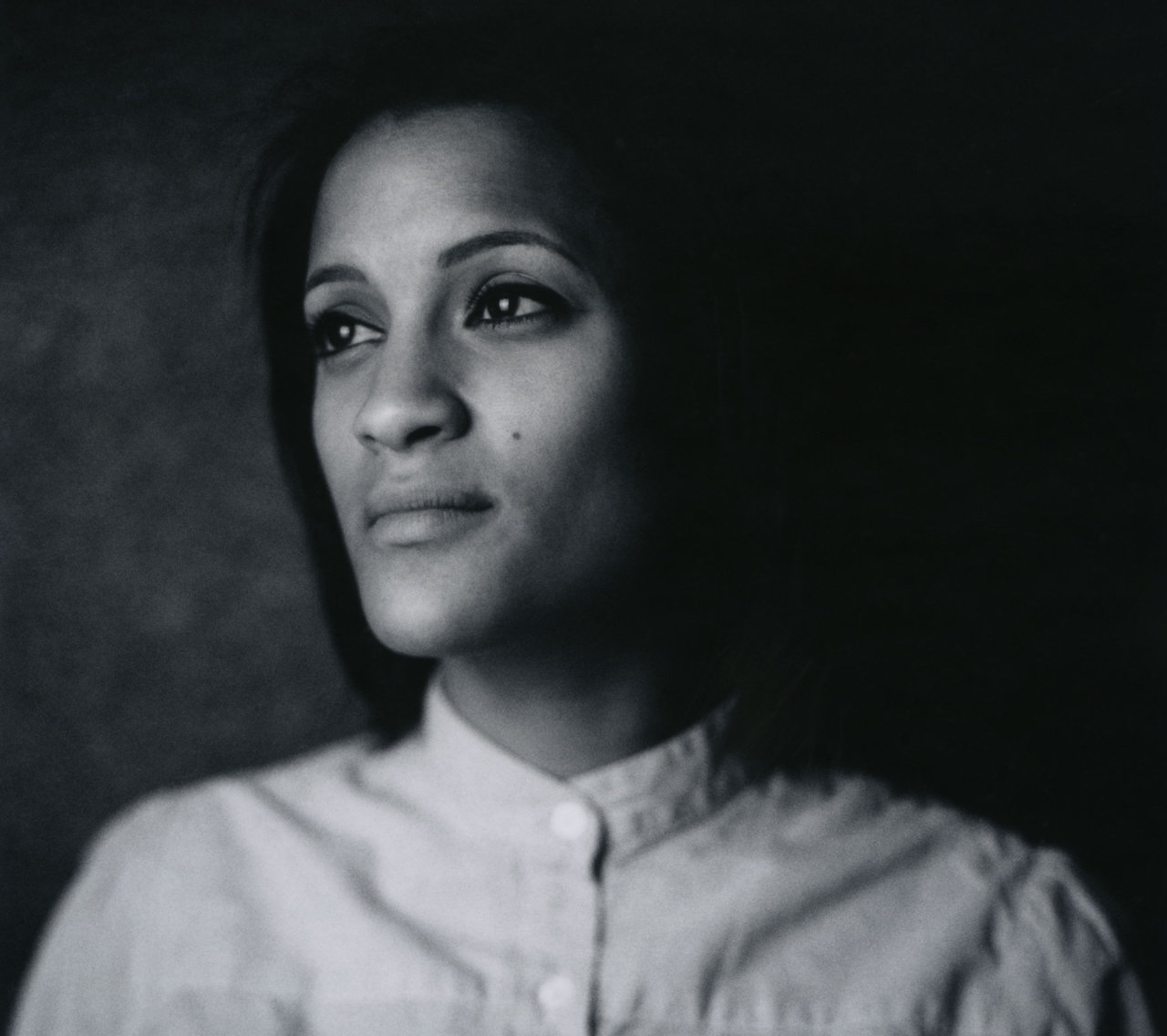
    Namsa Leuba. Photo: Chris Mettraux

    Interview with photographer Namsa Leuba (N.L) by Emese Krunák-Hajagos (E.K-H)

    E.K-H: The topic for this year’s Contact Festival is Identity, involving ancestry, history and society and how the individual’s sense of self is shaped by them. How do you fell about your mixed African-European background?

    N.L: I think to be a mix of cultures is a great wealth. I am an African-European, born in Switzerland. My parents instilled in me both cultures and shared their history as well. When I began at ECAL University of Art and Design, I knew that I wanted to deepen my knowledge about my African heritage and I decided to focus my work on African culture.

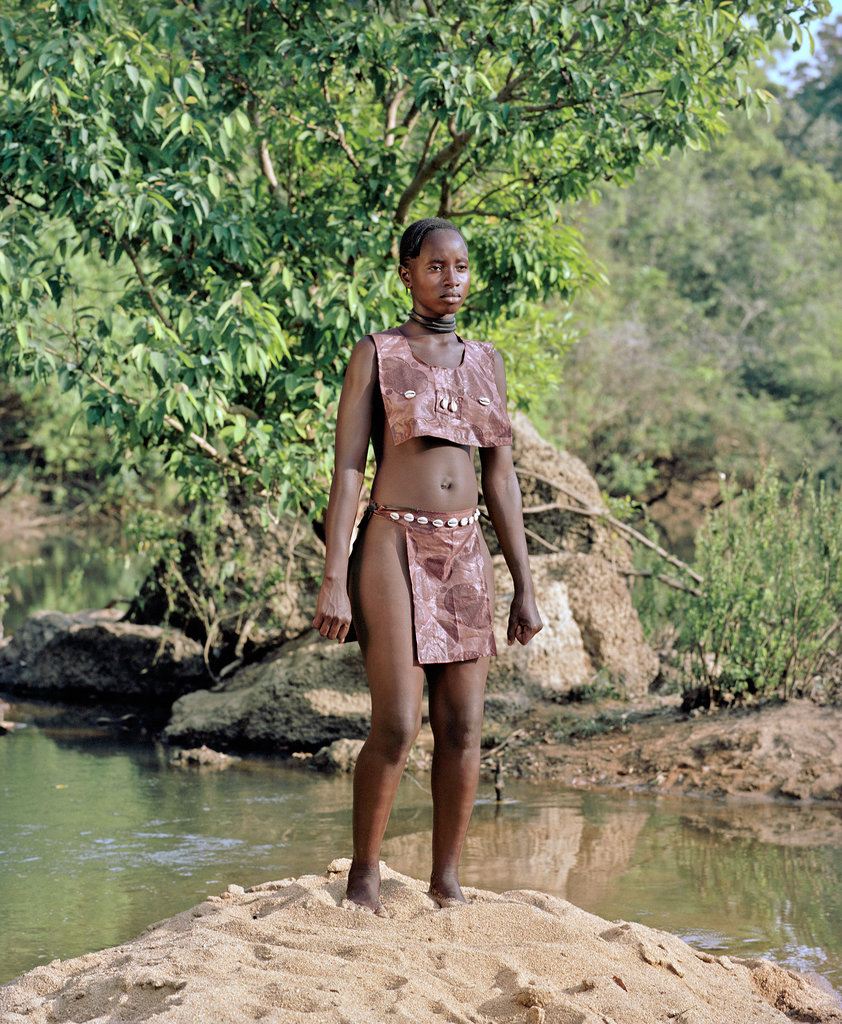
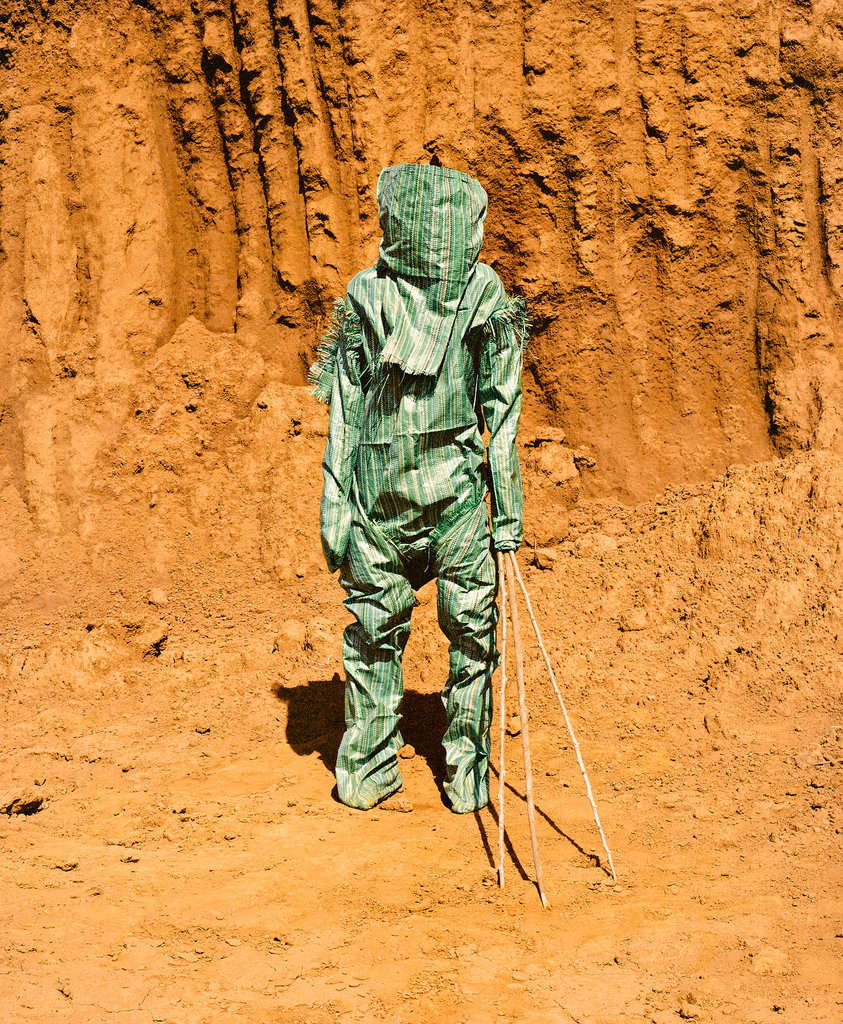
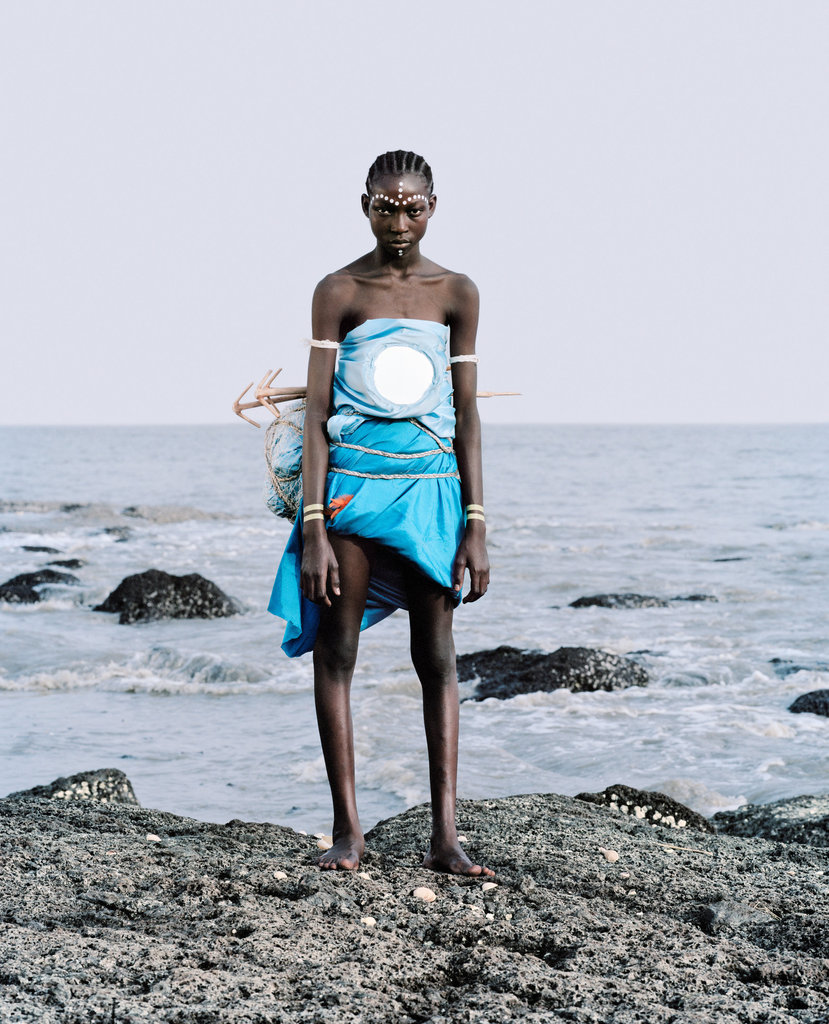
    Namsa Leuba, Statuette Zoo Foret Guinee, from the series Ya Kala Ben, 2011. Courtesy of the artist.

    E.K-H: This project, called Ya Kala Ben, was shot in your mother’s home county of Guinea. How does the idea of origins and heritage influence your work?

    N.L: For the last few years, my research has been focused on African identity through Western eyes. All I knew before the trip was that my mother is Muslim and that my father is Protestant. Having travelled to Guinea, other religious aspects of my mother’s country became very important to me. I discovered an animist side to the Guinean culture based on people’s respect for nature. I had been exposed to the supernatural part of Guinea ever since I was a child and I had visited ‘marabouts’ (a type of witch doctor). During this trip I took part in many ceremonies and rituals. It enabled me to be more aware of the existence and the intricacies of a parallel world to ours—the world of spirits. 

    The art of photography allows me to exteriorize my emotions and my past, telling my story through different shots, in some kind of syncretism.

    Namsa Leuba, Statuette Kafigeledio Prince Guinee, from the series Ya Kala Ben, 2011. Courtesy of the artist.

    E.K-H: Many of the objects you use in your images are considered sacred. How did your models feel about the customs, the postures and you photographing them?

    N.L: They were stressed most of the time because they were not used to being models and would become serious and quiet. They knew what they were representing, and they knew they had to respect the holy tools. When I got ready to shoot, I did not waste time, because my human models were recreating something holy and many times they felt uneasy. Sometimes I had to deal with violent reactions from Guineans who viewed my practises and procedures as a form of sacrilege.

    Namsa Leuba, Statuette Vodun Alimmamadou Guinee, from the series Ya Kala Ben, 2011. Courtesy of the artist.

    E.K-H: Where is your imagery coming from, especially something like Statuette Ndobi? The figure seems to be twisted, pregnant and imprisoned in those wooden sticks. Please tell me more about that image, the symbols and historical issues behind it and your intensions with it?

    N.L: In this work, I was interested in the construction and deconstruction of the body as well as the depiction of the invisible. I studied ritual artifacts common to Guineans; statuettes that are part of a ceremonial structure. They are from another world. They are the roots of the living. Thereby, I sought to touch the untouchable.

    I traveled through Guinea and observed different rituals and ceremonies to to find the ones I was looking for to create the series and to choose the right models. I am particularly interested the attribution of religious or mystical qualities to inanimate objects known as fetishes. The myths, the force of nature, and the deep, intuitive, impulsive culture of Africa offered me a lot of creative inspiration. My approach was to separate those sacred statuettes from their religious context in order to immortalize them in a Western framework.

    Namsa Leuba, Statuette Ndoki, Saléou Guinee, from the series Ya Kala Ben, 2011. Courtesy of the artist.

    Ya Kala Ben in Malinke dialect means crossed look. Inspired by fetish statuettes, my photographs recreate the figures using models. The final image is always layered and shows not only the picture but what is behind it historically and religiously, as well as my experience. Statuette Ndobi is a fetish statuette. I put in her some medicine, magic words, and things that belong to me. I created my own ritual in assembling all my statuettes and I became the feticheur who could animate them with my mind.

    E.K-H: How was your experience of reconnecting with your origins? What was it that surprised you the most?

    N.L: I have always wanted to explore and share the African culture that is part of me. I knew that the best way to do that would be to visit the village founded by my great-grandfather. This pilgrimage to the land of some of my ancestors inevitably raised the sensitive question of “origin” or “origins”: mine, that of my parents, of others (my subjects) and of my approach.

    What surprised me the most was the pace at which people in Guinea got things done. Everything took a long time. I found myself wasting a day waiting for people to show up. I took off my watch in order to be able to relate and learn how to work at the Guinean pace. The systemic lateness of models posed some technical problems, for instance the changing of light during the day, at certain times, made it harder to photograph.

    Namsa Leuba, Statuette Vili Fanta Guinee, from the series Ya Kala Ben, 2011. Courtesy of the artist.

    E.K-H: You write on your website that the “photographic eye…makes [the objects] speak differently.” What does a viewer—unfamiliar with Guinean culture—understand from your work?

    N.L: The fetish objects I used as inspriation are part of a collective belief. They must not be separated from it without the risk of losing their power. They are not the gods of this community but their prayers. They are ritual tools that I have animated by staging live models and in a way desecrated by giving them another meaning—an unfamiliar meaning in the Guinean context. In reconstructing these sacred objects through the lens, I brought them into a framework meant for Western aesthetic choices and taste.

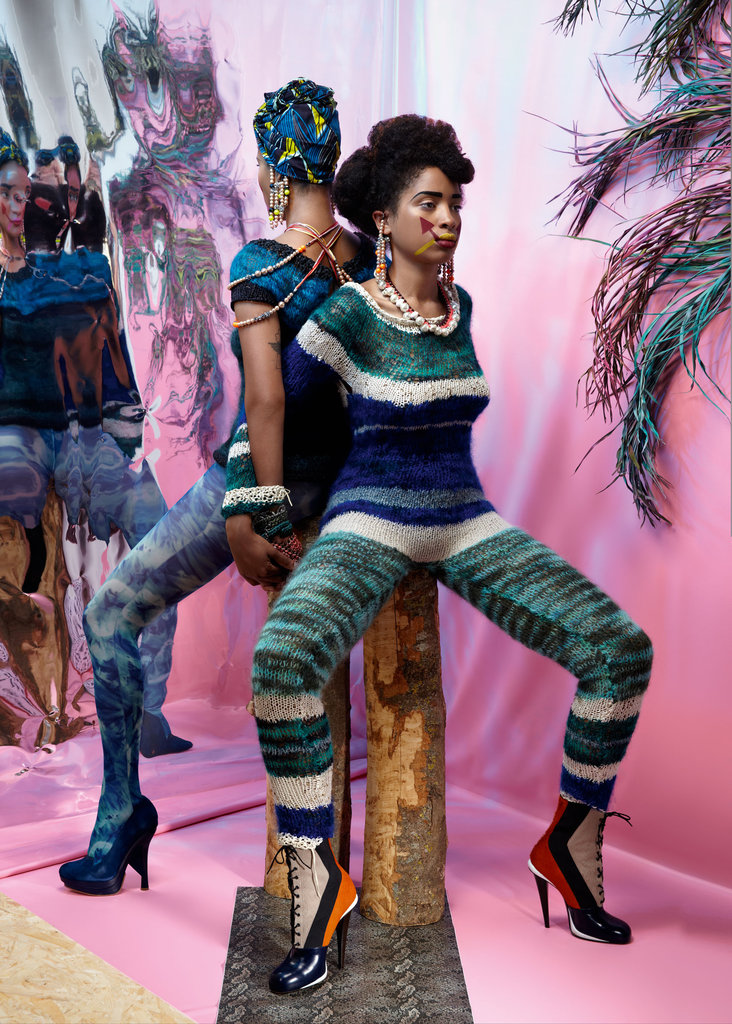
    Namsa Leuba, The African Queens #7, 2012. Courtesy of the artist.

    I analyze myself through the lens of my camera and I constantly question myself – which is very challenging. I travel from a spiritual ground to create the plasticity of the picture. For me spirituality is tradition; plasticity is modernism.

    *Exhibition information: May 1 – June 1, 2014, Museum of Contemporary Canadian Art, 952 Queen Street West, Toronto. Gallery hours: Tue – Sun, 11-6pm.

    Assistants: Aliya Bhatia and Gagan Sandhu

  • Instant Stints of Intervals / Opening Reception

    May 13, 2014 / 6 – 8 p.m.
    Casa Loma

    Liss Gallery is featuring a Scotiabank Contact Photography Exhibition at Casa Loma during the month of May.
    Instant Stints of Intervals is an exhibition of photographs by nine artists. When seen together in the exhibition, their works form a journey into the varied landscapes of Canada and the United States. The photographs reference past moments and evoke emotions from the artist’s personal experiences, reflecting the beauty of a fleeting moment

    From left to right:  Artists Brad Walsh, Alexander Rocco, Simeon Posen, Gallery owner Brian Liss, Artist Johnathan Ball (behind Liss)Alice Zilberberg, Jeff Turner, Peter McLennan (in the back) and Tanja Tiziana

    Artist Alice Zilberberg  with Untitled VI

    Artist Sim Posen and his Midway Lights Series

    Artist Brad Walsh explaining his work Muted Industrialism.

     Artist Peter McLennan and his photo New York Nights#2.

    Artist Tanja Tiziana in front of her photos Shoot the freak (left) and Wonder Wheel (right).

    Artist Alexander Rocco with Couture3

    Artist Jeff Turner and TTC

    Also featuring photography by world famous rock and roll photographers Bob Gruen and Harry Benson.

    Harry Benson, Berlin Kiss on Bicycle, 1996.

    The opening reception was well attended and visitors enjoyed the different styles of artwork. All of the seven artists were present and happily discussed their work with the guests.


    Photo: Summer Sun

    *Exhibition information: May 1 – 31, 2014, Casa Loma, 1 Austin Terr, Toronto. Gallery hours: Mon–Sun, 9:30–4pm.

  • Ebrahim Noroozi

    Photo Essays of World Press Prize-Winning Photographer Ebrahim Noroozi

    On a morning that suggested the beginning of spring, after a long Canadian winter, I entered the Nikola Rukaj Gallery knowing that I would not be leaving with the same pep in my step as I did when I arrived. As expected, having read about Noroozi’s photographs before visiting the show, it is impossible not to be moved by his subjects and their lives. Each image has a strong, captivating expression.  The four series that lined the walls were powerful in ways that I have never experienced through photography before. Exploring the effects of war, the traditions of mourning, and the heart wrenching and monstrous aftermath of young Iranian woman’s divorce, Noroozi does not portray the world through rose colored glasses. Instead, he opens the eyes of his viewers to the pain and injustices of those living across the globe.

    Ebrahim Noroozi, War Is Not Over IV-Hassan, 2013. Pigment print, 20 x 30 inches

    Upon entry, the first two series were War is Not Over which presented men, some proud, others solemn, after losing their limbs and, what I initially thought was a sea of red smoke, Hydrotherapy, where veterans were communally undergoing rehabilitation. The full-frontal portraits of wounded soldiers attest both the lonesome and the collective pain felt after the war.

    Ebrahim Noroozi, Mourners I and II, 2013. Pigment print, 16 x 20 inches each

    Ebrahim Noroozi, Mournful Women XI, 2013. Pigment print, 20 x 30 inches

    Two series dealt with the subject of mourning in two different perspectives. Mournful Women set in front of colorful printed backdrops while Mourners features men grieving by clothing themselves in mud and ashes. Though they differ in their approach to mourning, both are penetratingly powerful. Though the women are posed, in what looks like an interior space, we still get the feeling that we are involved in an intimate and impromptu interaction that makes us empathize with them. Their clothing, and gaze demonstrate their personalities. On the other hand, the men are outdoors and are captured candidly surrounded by flames, producing a visceral intensity. The silent, static portraits of women are starkly contrasted by the dynamic and active scenes of the men.

    Ebrahim Noroozi, Victims of Forced Love VIII-Rana Looks In The Mirror, 2013. Pigment print, 16 x 20 inches

    Ebrahim Noroozi, Victims of Forced Love IV-Mother and Child, 2013. Pigment print, 20 x 30 inches

    Lastly, and by far, the most outstanding collection of images was the narrative of Somayeh and daughter Rana. The monstrous incident occurred after Somayeh persistently asked her husband, Amir Mehri, for a divorce, after having been physically abused. As retaliation, Mehri poured acid on his wife and daughter as they slept leaving them permanently disfigured. Noroozi’s Victims of Forced Love series narrates the aftermath and agonizing effects of this atrocious attack on the mother and daughter duo. Though horrifying, there is an underlying beauty in each series, a humanity that Noroozi accesses with style, compassion, and grace. It is an emotionally taxing show with a strong photographic body of work that you won’t be able to forget.

    Text and photo: Leanne Simaan

    *Exhibition details: May 10- June 3, 2014, Nikola Rukaj Gallery, 384 Eglinton Avenue West, Toronto. Gallery hours: Mon–Sat, 10–6; Sun, 12–6pm.

  • Pictures from Paradise

    Pictures from Paradise: A Survey of Contemporary Caribbean Photography 

    The works are presented within four adjoining shipping containers alongside Lake Ontario, inviting contemplation about issues of consumerism, globalization, tourism, migration, and the ever-present legacy of slavery in Caribbean history. Placing the works outside of the typical exhibition space of a gallery also signals a different type of storytelling, one that responds to, and moves beyond the limited narratives around a Caribbean “paradise.” It explores Caribbean identity in a way that addresses the important question posed by Stuart Hall, the celebrated Jamaican/British cultural theorist: “If you are not that, who are you?”

    Radcliffe Roye, Red Cap, 2010

    O’Neil Lawrence, Re-Identified

    Installation view with Gerard H. Gaskin’s work (left)

     Portraits by Gerard H. Gaskin

    Installation view with Marvin Bartley’s photographs

    Work by Marvin Bartley

    Holly Bynoe, Imperial , 2010

    Works by Rodell Warner (left) and Ebony G. Patterson (right)

    Visitor in front of Ebony G Patterson, Entourage

    Photo: Summer Sun

    *Exhibition information: May 1 – 25, 2014, Shipping Containers behind the Power Plant Contemporary Art Gallery, 231 Queens Quay West, Toronto. Gallery hours: Tue–Sun 10 – 5, Thu 10 – 8 p.m.