Author: artoronto

  • Gallery Hop 2015

    Lynn Marsh, Anna and the Tower, video at Scrap Metal Gallery, Gallery Hop 2014. Photo: Elena Iourtaeva

    September 26 -27, 2015
    Toronto, Various Locations

    Join Canadian Art for their annual Gallery Hop Day in Toronto!

    Presented in partnership with RBC, our Gallery Hop Days will be held on September 26 – 27, 2015. Gallery Hop Days are free and includes shows, talks and tours happening at galleries throughout the city. The day begins with a panel conversation, continues with tours and talks. Don’t miss these exciting events!

    PANEL DISCUSSION: THE COLLECTORS
    Saturday, September 26, 2015 /10:30–11:45 a.m.
    The Underground, Drake Hotel, 1150 Queen Street West

    The collector plays a vital role in the art world, acting as a patron of artists and institutions as well as a cultural commentator whose choices and actions influence the shape of the art market.
    Join Canadian Art associate editor Nicholas Brown as he kicks off the Gallery Hop with a panel that looks at the role of collecting at the intersection of public institutions, private collections, art dealers and artists (collected and collectors in their own right).
    Space is limited at the panel discussion; please RSVP by registering online at canadianart.ca/galleryhopregister before you arrive.

    OFF-TOUR TALK
    Saturday, September 26, 2015 / 12:30–1:00 p.m.
    General Hardware Contemporary,* 1520 Queen Street West
    Head to General Hardware Contemporary for an artist talk with Joe Fleming as he walks participants through his solo exhibition “Stockyard Rumble.” Fleming will discuss his experimentation with form, texture, materiality, perspectival confusion and possibility within his most recent works.

    TOURS AND TALKS:

    Saturday, September 26, 2015
    1 – 5:30 p.m. / Various locations in Toronto

    The Hop Tours and talks are programmed with the goal of creating an interesting, challenging and enjoyable experience for everyone. Our tour guides are collectors, critics and other arts professionals, making them the ultimate portal into the arts.

    Yorkville Tour
    1:00–3:00 p.m.
    Meeting Point: Kinsman Robinson Galleries, 108 Cumberland Street

    Kinsman Robinson Galleries, 108 Cumberland Street
    Mayberry Fine Art, 110 Yorkville Avenue
    Gallery Gevik, 12 Hazelton Avenue
    Mira Godard Gallery,* 22 Hazelton Avenue
    Ingram Gallery, 24 Hazelton Avenue
    Odon Wagner Gallery, 198 Davenport Road
    Also in the neighbourhood:
    Navillus Gallery, 110 Davenport Road
    Liss Gallery, 140 Yorkville Avenue
    Marcia Rafelman Fine Arts, 10 Clarendon Avenue

    Dundas West/Morrow Tour
    1:30–3:00 P.m.
    Meeting Point: TheBlackCat Artspace, 2186 Dundas Street West

    TheBlackCat Artspace, 2186 Dundas Street West
    Narwhal, 2104 Dundas Street West
    Olga Korper Gallery,* 17 Morrow Avenue
    Christopher Cutts Gallery,* 21 Morrow Avenue

    West Queen West Tour
    1:30–3:00 p.m.
    Meeting Point: MULHERIN, 1086 Queen Street West

    MULHERIN,* 1086 Queen Street West
    Stephen Bulger Gallery, 1026 Queen Street West
    InterAccess, 9 Ossington Avenue
    Craft Ontario, 990 Queen Street West
    Paul Petro Contemporary Art,* 980 Queen Street West
    Also in the neighbourhood: Akin Collective, 444 Dufferin Street

    401 Richmond/King West Tour
    1:30–3:00 p.m.
    Meeting Point: Inside lobby at 401 Richmond Street West

    Trinity Square Video, 376–401 Richmond Street West
    Open Studio, 104–401 Richmond Street West
    Abbozzo Gallery, 128–401 Richmond Street West
    YYZ Artists’ Outlet, 140–401 Richmond Street West
    Nicholas Metivier Gallery, 451 King Street West
    Also in the neighbourhood:
    Coldstream Fine Art, 208–80 Spadina Avenue
    Whippersnapper Gallery, 594B Dundas Street West

    Dupont/Miller Tour
    3:30–5:45 p.m.
    Meeting point: Barbara Edwards Contemporary, 1069 Bathurst Street
    A bus will drive participants along this Hop. To reserve a spot on the bus please write to contact@canadianart.ca.

    Barbara Edwards Contemporary, 1069 Bathurst Street
    Katzman Contemporary,* 86 Miller Street
    Track and Field Gallery, 76 Miller Street
    ESP | Erin Stump Projects,* 1558 Dupont Street
    p|m Gallery,* 1485 Dupont Street (entrance at 300 Campbell, Suite 301)
    Cooper Cole,* 1134 Dupont Street
    Angell Gallery,* 1444 Dupont Street, Unit 15
    Also in the neighbourhood:
    Neubacher Shor Contemporary, 250 Emerson Avenue

    Bloordale Tour
    4:00–5:30 p.m.
    Meeting point: Gallery TPW, 170 Saint Helens Avenue

    Gallery TPW, 170 Saint Helens Avenue
    Daniel Faria Gallery,* 188 Saint Helens Avenue
    Clint Roenisch Gallery,* 190 Saint Helens Avenue
    Mercer Union, 1286 Bloor Street West
    Division Gallery, 45 Ernest Avenue
    Also in the neighbourhood: Scrap Metal, 11 Dublin Street, Unit E

    Dundas West/Ossington Tour
    4:00–5:30 p.m.
    Meeting point: G Gallery, 134 Ossington Avenue

    G Gallery, 134 Ossington Avenue
    LE Gallery,* 1183 Dundas Street West
    Loop Gallery, 1273 Dundas Street West
    MKG127, 1445 Dundas Street West
    Xpace Cultural Centre, 303 Lansdowne Avenue, Unit 2

    Niagara/Tecumseth Tour
    4:00–5:30 p.m.
    Meeting point: Diaz Contemporary, 100 Niagara Street
    Birch Contemporary,* 129 Tecumseth Street
    Susan Hobbs Gallery,* 137 Tecumseth Street
    Pari Nadimi Gallery, 254 Niagara Street
    Diaz Contemporary,* 100 Niagara Street
    Also in the neighbourhood:
    Georgia Scherman Projects,* 133 Tecumseth Street

    Sunday, September 27, 2015

    180 Shaw/West Queen West Tour
    12:00–1:30 p.m.
    Meeting point: Ryerson Artspace, 1214 Queen Street West

    Ryerson Artspace, 1214 Queen Street West
    David Kaye Gallery, 1092 Queen Street West
    TYPOLOGY Projects, 180 Shaw Street
    Artscape Youngplace Hallway Galleries, 180 Shaw Street
    Koffler Gallery, 180 Shaw Street
    Also in the neighbourhood: Elaine Fleck Gallery, 888 Queen Street West

    King East/Distillery Tour
    2:30–4:00 p.m.
    Meeting Point: Beauchamp Art Gallery, 167 King Street East
    Beauchamp Art Gallery, 167 King Street East
    Julie M. Gallery,* 15 Mill Street
    Thompson Landry Gallery, 32 Distillery Lane
    Proof Studio Gallery, 15 Case Goods Lane, Studio 104
    Corkin Gallery, 7 Tank House Lane
    Also in the neighbourhood:
    Feheley Fine Arts, 65 George Street
    Visual Arts at Harbourfront Centre, 235 Queens Quay West

    WRAP PARTY
    Saturday, September 26, 2015 / 6:00–8:00 p.m.
    Angell Gallery, 1444 Dupont Street, Unit 15
    Finish your Gallery Hop at the Canadian Art wrap party at Angell Gallery. Join us for Bradley Wood’s solo exhibition at Angell’s new location. Richard Rhodes, editor of Canadian Art, will introduce the Fall 2015 issue of the magazine, and subscriptions will be available at a special Hop rate.

    For more information please check: http://www.canadianart.ca/cafevents/toronto-gallery-hop-day/.
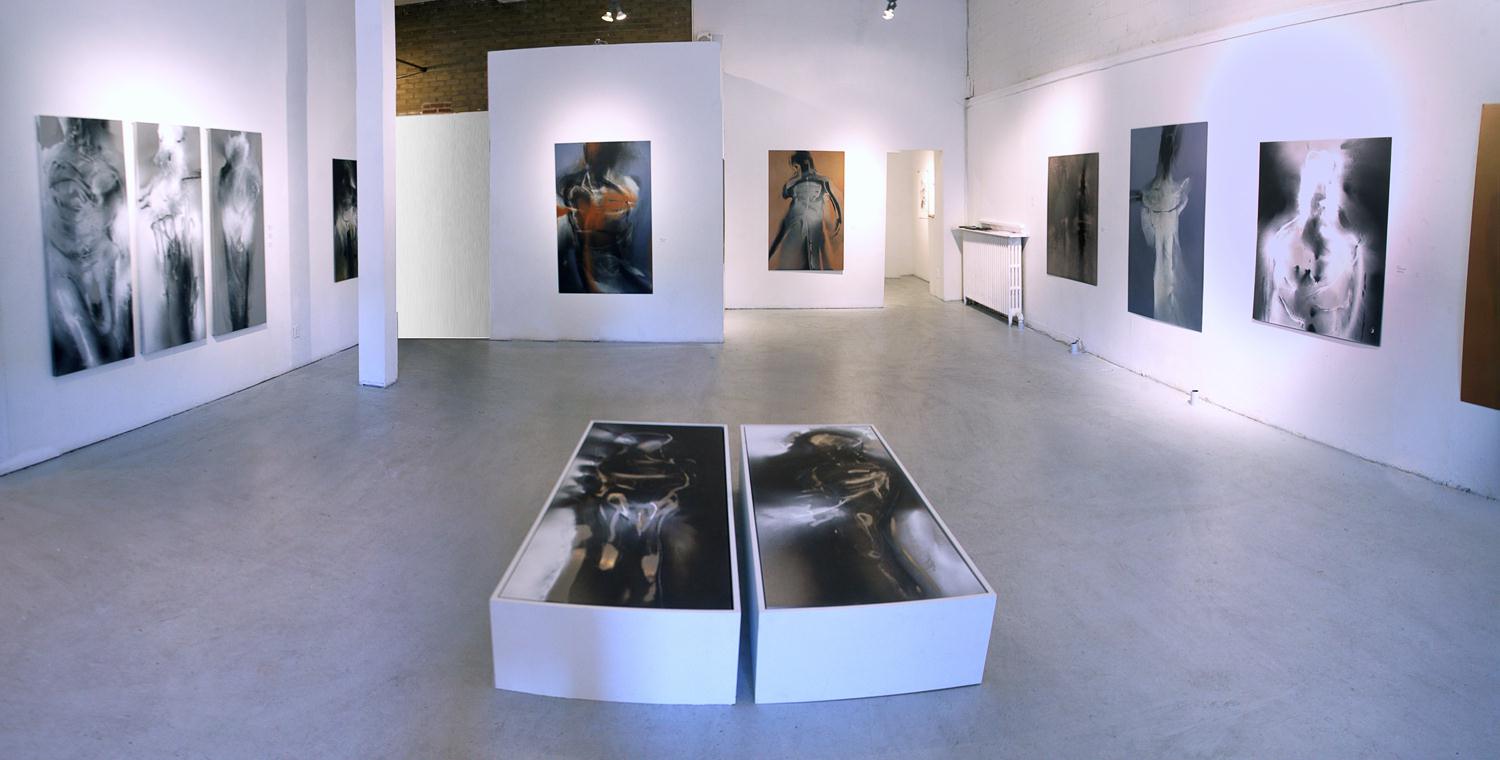
  • Darcia Labrosse’s beautiful corpses at Gallery 1313

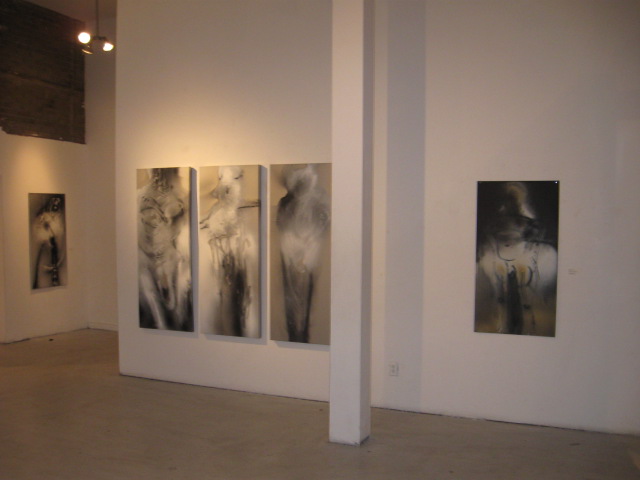
    Installation view. Photo: Miklos Legrady

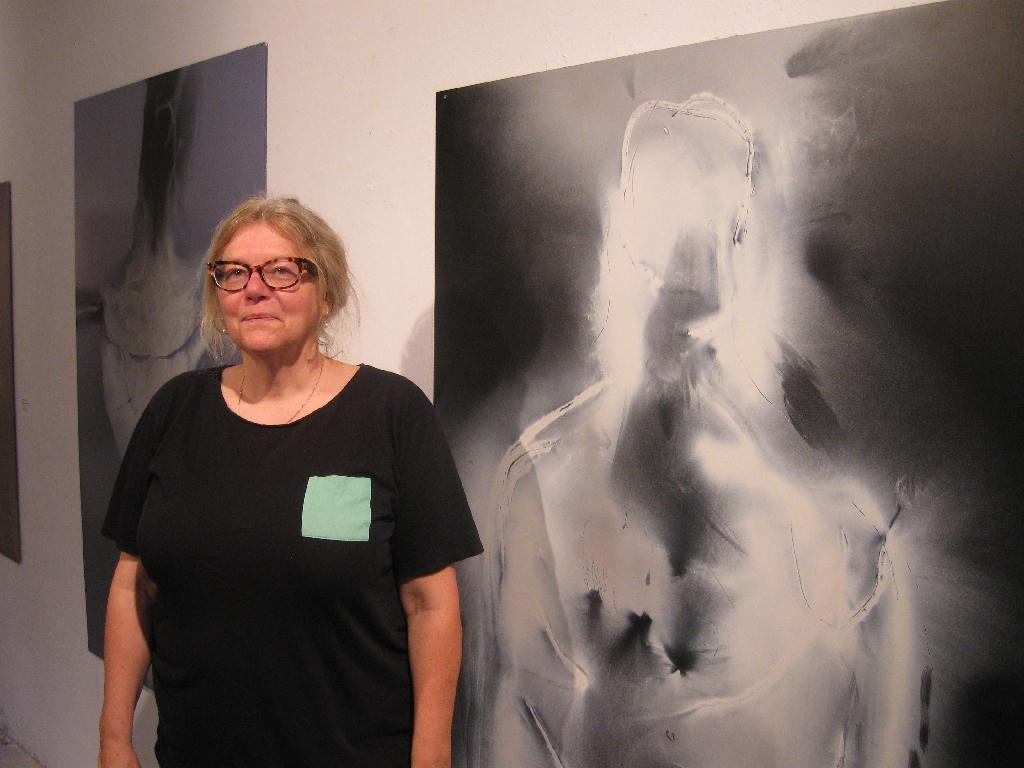
    Stepping into Gallery 1313 you have a ‘wow’ feeling. Both the theme and the medium of these works are unusual. It takes some time to recognize that you are looking at metal pieces and a unique technology. Electrostatic paint on aluminum is a technique that has been used in the industrial world for colour finishing and protecting architectural siding for a while, but it is rare in art world. In our age of short attention spans and endless hunger for new things, artists try to find new forms of expression that will surprise the viewer. As Jackson Pollock stated, “My opinion is that we need new techniques. And the modern artists have found new ways and new means of making their statements. It seems to me that the modern painter cannot express his age, the airplane, the atom bomb, the radio, in the old forms of the Renaissance or of any past culture. Each age finds its own technique…” (New York, 1950). It seems that Canadian artists are leading this search for new mediums: Steve Driscoll uses industrial urethane for his landscapes and David Altmejd recreates the magic of decay as a beginning of new life in his large Plexiglas display cases.

    Darcia Labrosse at the opening reception. Photo: Phil Anderson

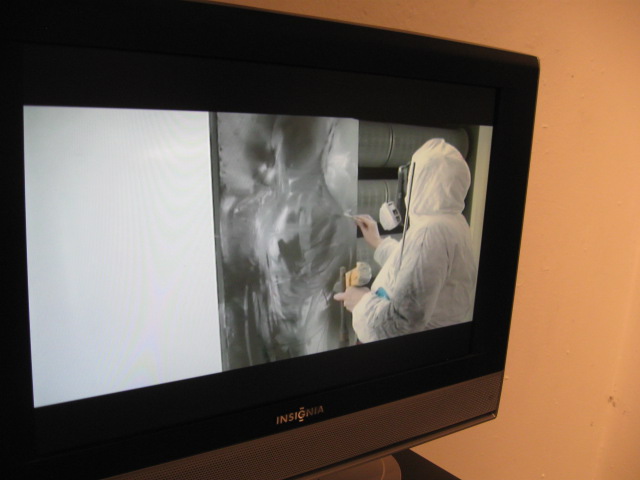
    For Labrosse, as the title of the show, Metal language III, suggests, the medium is very important. She chose her medium for its endless possibilities in producing fine art and for its vibrant pigment and robustness. I almost get dizzy watching the short video of the artist making these pieces. The term “electrostatic painting” describes a process by which the properties of electricity are used to apply a high-solids coating to any conductive material. Using the “opposites attract” principle, the painting equipment is charged with one electrical polarity while the metal objects to be painted are charged with the reverse polarity. The coating is attracted to the metal surface and electronically bonds to that substrate.

    Darcia Labrosse’s video showing the procedure of electrostatic painting. Photo: Phil Anderson

    The procedure is toxic, so it happens in an industrial setting, and Labrosse wears a protective suite like an astronaut. She works at an amazing speed with different spray guns and a large brush. The procedure is very intuitive—she doesn’t use sketches. Colours cannot be mixed to make other colours, but can be added, one on top of another, to produce varying hues. Matte and glossy varnishes can also be used for visual effect. A final firing in an oversized, high-temperature oven cures the pigments to the metal surface, very much like an enamel finish. The final work can be displayed on a stand as sculpture or hang on walls in a gallery. Despite being metal, the work is very ethereal.

    Installation view. Photo: Phil Anderson

    In her artist statement, Labrosse writes, “Overcoming the gravity of representation, automatism and acquired reflexes, I mix brute force and translucid emotions to paint an ontological, disquieting, enigmatic human figure free from artifice, universal in its expression.” Labrosse mentions her fascination with the “distorted human body” like the five-thousand-year-old Iceman, the victims of the Holocaust, the mercury poisoned residents in Minamata and the mummies of the Capuchin Catacombs of Palermo, among others. It’s easy to connect this to the Baroque theme of Vanitas or Memento Mori, the warning that all will die. The people in the Capuchin Catacombs gave serious thought to death, deciding how they should be displayed—their clothing, their posture. The rich ones wanted to be put in glass coffins. They left detailed instructions in their wills. Those catacombs look like a museum of death. Most of the residents’ faces show their death struggle, making a rather scary display. However, a few of them, mostly children, are beautiful—in a terrifying but fascinating way.

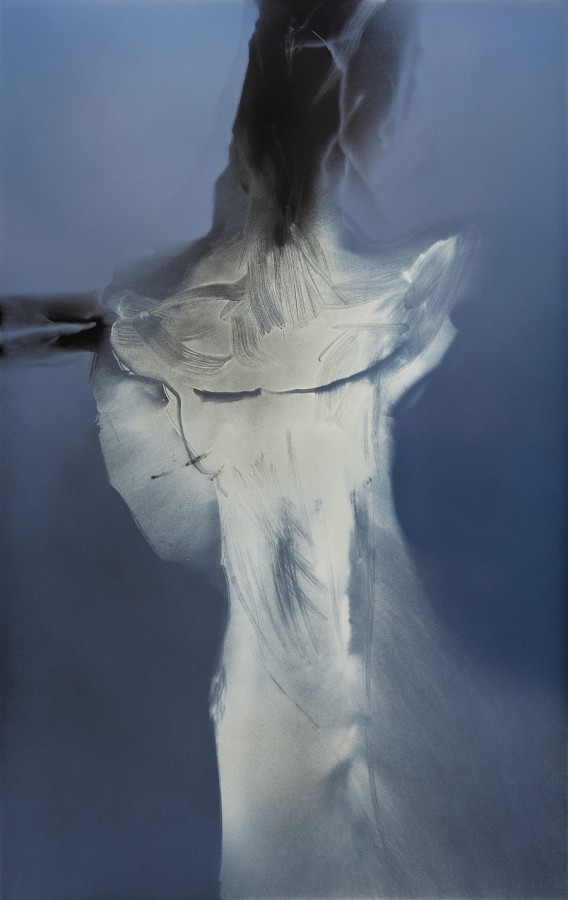
    Darcia Labrosse, Industrial No.16, 2013, Powdercoated aluminum, 60 x 38 inches. Courtesy of the artist

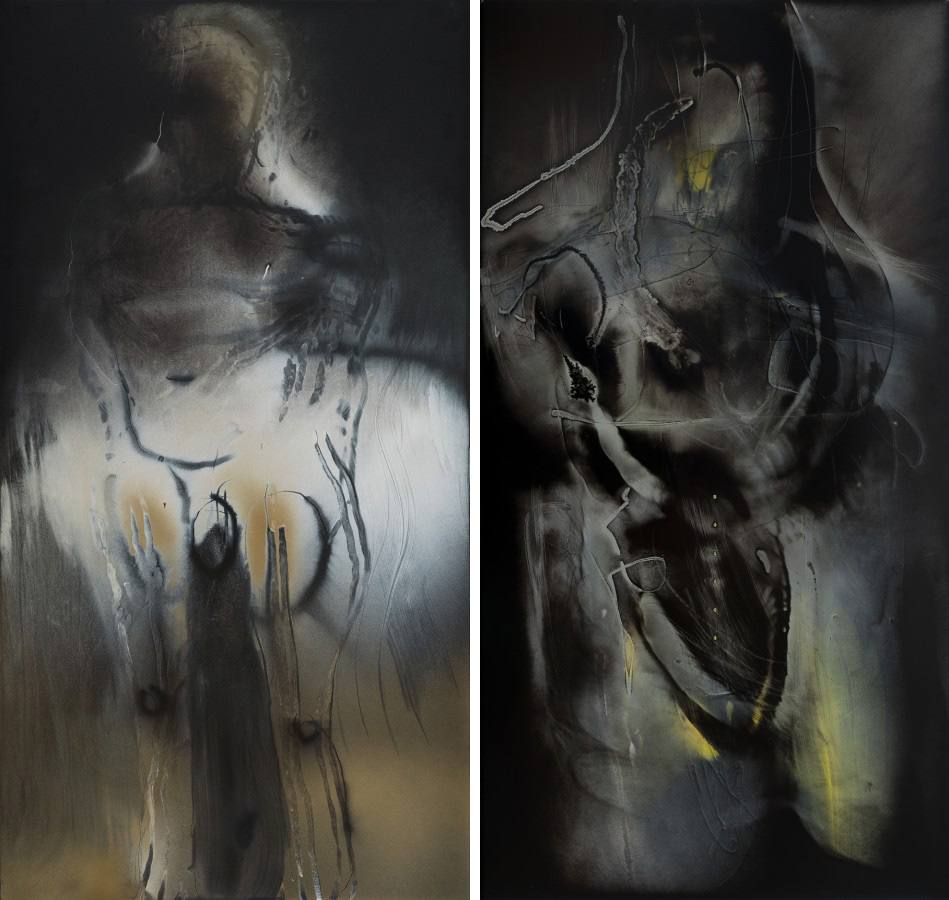
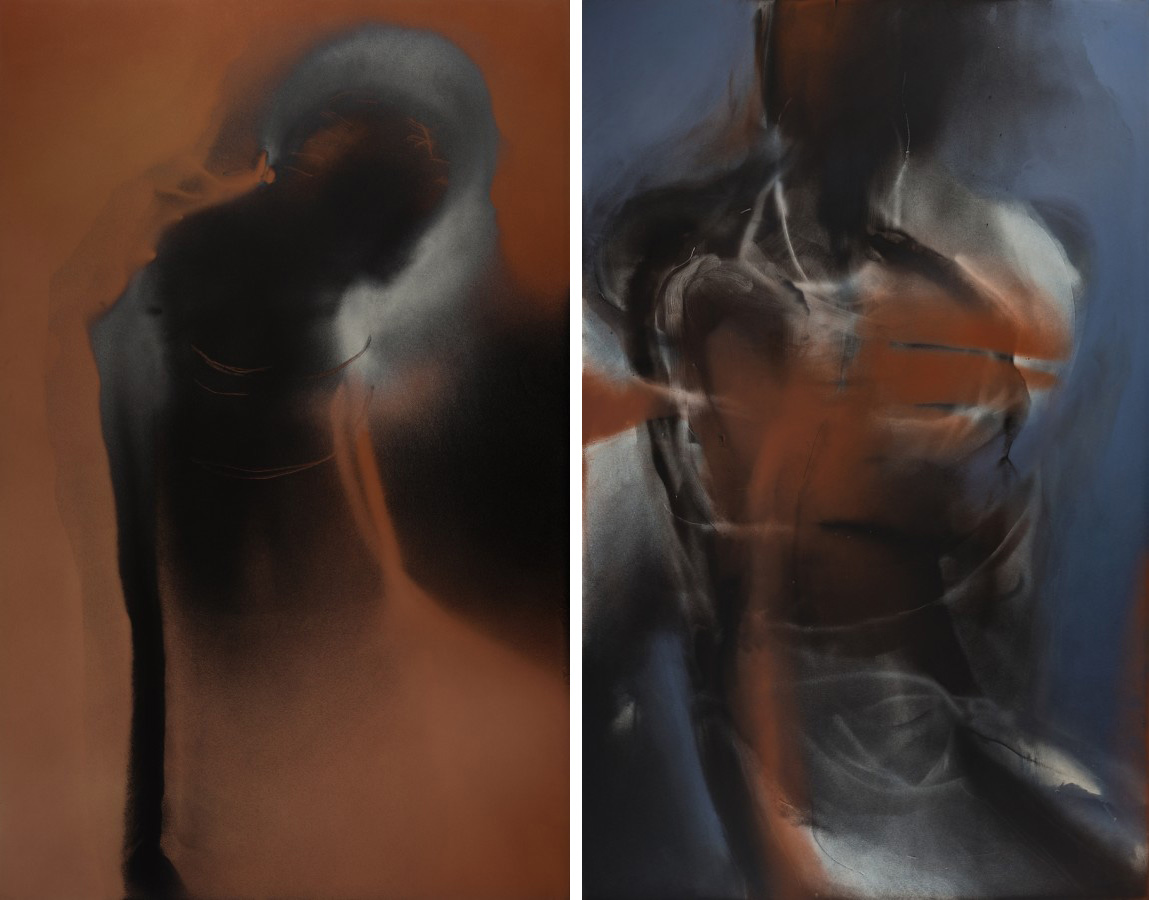
    There is nothing scary or terrifying in Labrosse’s work. Light is a major element in her composition and it must be the celestial light people who have experienced clinical death tell of,  that shines from Labrosse’s ghostly figures, or rather shines through them (“Industrial No.16”). Their suffering, if there was any, doesn’t show. Most of them, like “Industrial Brass No.10”, actually don’t seem to be fully dead – they appear in the midst of a transformation – they still have flesh, but have no eyes, so they can’t see anymore. Their bones are visible but claws are also creeping out of them. “Industrial No.12” also shows the process of decomposition. The front of a female’s cadaver is open so we can see the internal organs—the large intestines like crawling worms, the spinal cord curving on the left side, and the genitals still recognizable. A yellow light radiates through the throat and genitals – like those chakras are still alive. Yellow seems to represent the life energy that used to inhabit the bodies when they were still alive. Red surrounds the figures like a comforting blanket for their fearful journey (Industrial Coffer No.15), or splashes inside and around them like the blood they lost in their struggle against death (Industrial No.19).

    Darcia Labrosse, Industrial Brass No.10, 2013, Powdercoated aluminum, 48 x 25 inches & Industrial No.12, 2013, Powdercoated aluminum, gold-plated screws, 48 x 25 inches. Courtesy of the artist

    Darcia Labrosse, Industrial Copper No.15, 2013, Powdercoated aluminum, 60 x 38 inches & Industrial No.19, 2013, Powdercoated aluminum, 60 x 38 inches. Courtesy of the artist

    About her style, Labrosse says, “With its figurative undertones, my work is an oscillation between two worlds with the abstract constantly feeding the tension figure/ground. In the last decade, the Metal Language corpus I have labelled Existential Expressionism, is wilfully branching out from the Abstract Expressionist tradition, primarily because of  [as Robert Atkins pinpointed in ART Speaks] ‘its fierce attachment to psychic self-expression…less a style than an attitude.’”

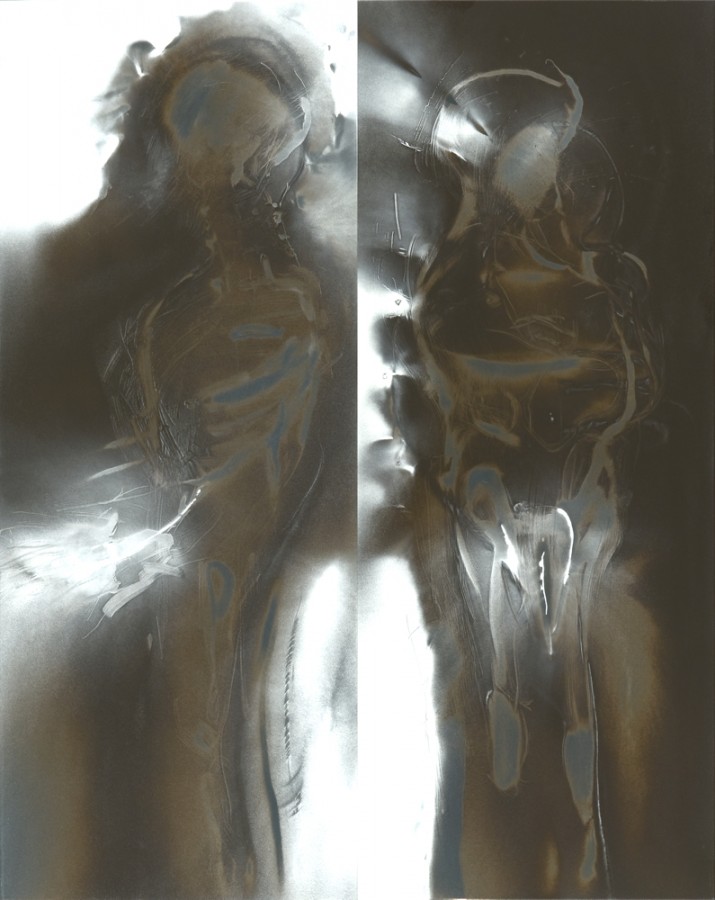
    Darcia Labrosse, Untitled Diptych No.48, 2012, Powder coated raw aluminum, 60 x 48 inches. Courtesy of the artist

    Labrosse’s bodies are not skeletons, they are occupying both the physical and eternal world. Still, it is obvious that these bodies belong to a different world, the world of darkness. They have passed into the deepness of the Abyss. This after-world, however, doesn’t scare us. They are beautiful corpses. Death here becomes a ritual, The Final Ritual, as Pierre Lévy called it his article in 2011. They are in constant movement, performing a strange kind of Dance of the Dead. They can’t be identified. Their faces are no longer recognizable but they still radiate the luminous light of their spirits and their auras still surround them. Their bodies still remember suffering and happiness. These are special “portraits” where the conscience and the unconscience, the real and the transcendental world, merge, making human existence come full circle. The images are mystical. They are powerful and, instead of showing the deepness of death, they stand to prove the deepness of human existence. These bodies are here in the real world with us and at the same time looking down at us from their spiritual height – and Labrosse helps us witness their transformation. Shadows of the after-world filled with light. What is left from their physical life is still shining along with eternal light. They are mesmerizing. You can’t help but love them.

    Emese Krunák-Hajagos

    *Exhibition information: Darcia Labrosse: Metal language III, September 16 – 27,  2015, Gallery 1313, 1313 Queen Street West, Toronto. Gallery hours: Wed – Sun, 1 – 6 p.m.

  • Toronto Outdoor Art Exhibition

    September 18 – 20, 2015
    Nathan Phillips Square
    Hours: Fri – Sun 10:30 a.m. – 6:30 p.m.

    This year’s Toronto Outdoor Art Exhibition was number 54 with 316 participating artists displaying a wide range of works. The outdoor exhibition was originally planned to be in July at Queen’s Park but because of the possible traffic gridlock it might cause was moved to September back at City Hall.

    Artists I talked with last year seemed unhappy with the prospects of it moving to Queen’s Park because of the Pan Am Games. I think some of them thought they might be set up in the grass which if it rained would become a lot of mud. This kind of date change happened before, years ago when David Miller was mayor, the Outdoor Exhibit got moved to September due to the garbage strike that summer. The weather seemed just as hot this September as in July so it probably won’t make too much difference.

    Marketing & Communications Coordinator Matthew Volpe told me the Outdoor Exhibit is smaller because they wanted better quality but  Executive Director Mark Temple told me last year that it was mostly due to the renovations of the City Square. They had planned to make it bigger if it moved to Queen’s Park. Mark Teeple was also working at TIFF and must have had his hands full. Even the information booth seemed smaller and harder to find. When I arrived Assistant To The Executive Director, Simone Rojas-Pick gave me a VIP collar and then retrieved it when she realized she had mistaken me for someone else. It was a short lived status. In the past she had worked at Propeller Gallery and helped curate the Window Box Gallery at Gallery 1313.The program looked well put together but I wondered why there was no welcoming remarks from Toronto’s Mayor but instead from Judy Josefowicz, the Chair of the Board of Directors and Mark Teeple, the Executive Director.

    I met a few Quebec artists including James Kennedy with his metal works and Audrey D‘Astous and her sock sculptures. Painter, Jacques Descoteaux was having his first City Hall Art show experience and pleased as well. There was more sculpture that I noticed  this year including works from Jason Grant-Henley. I chatted with urban painter couple Kiel & Amanda Wilson–Ciocci who seemed pleased with the set up this year. Painter Brock Irwin had captured some summer deck chairs which seemed a fitting painting for the end of our summer. Painter Laurie De Camillis had some paintings with fall colours on her canvases.

    Artist James Kennedy

    Audrey D‘Astous with her sock sculptures

    Sculptor Jason Grant-Henley

    KIAM Collaborative Art Keil & Amanda Wilson-Ciocci

    Tape artist Emanuel Pavao had some great works of street cars on Queen Street West, one with the Drake Hotel caught my eye. Artist, Kelly Grace had just gotten her first sale. Young artist Mike Rachlis had been in the student section a few years ago and was back as a regular artist. The student section is no more and there had been a significant drop in student submissions according to organizers.

    Artist Emanuel Pavao

    Kelly Grace in front of her paintings

    Painter Mike Rachlis

    I liked artist Vanessa Mckernan’s paintings and they seemed to be getting attention from the crowd. Artist, Miyoshi Kondo was keeping busy as was visual artist Maya Foltyn, explaining her series of moons. Julia Hacker was doing well with her illustrative collage art works.

    Vanessa Mckernan in her booth

    Maya Foltyn and her moons

    Painter Julie Hawkins

    There were a number of art talks and installations also in the program which I didn’t get to as I had a limited time to see as much as possible. As I write this dark clouds are moving in and the predicted rain is likely on its way.

    I know a lot of artists count on this show for sales and their income. Some Gallery Directors and art consultants usually take the time to check out the work. It takes a lot of people to put together such a huge event and kudos to all of you. Board Members, staff, jurors, volunteers and most importantly the artists who work all year around to prepare for this exhibition, get up early, set up and explain their work to countless masses of people. They are the real stars of this exhibition, looking at their work and conversing with them will provide a very enjoyable weekend entertainment for art lovers and visitors.

    Text and photo: Phil Anderson

  • Angell Gallery opens in its new location

    Entrance of Angell Gallery’s at the new location. Photo: Carter Brown

    The opening reception on September 11th at Angell Gallery was an exciting one. Not only were two talented artists showcased but it was the début of the gallery’s new location. The new space is raw and stripped down. All white walls with wood accents, Douglas fir as Jamie Angell, the gallery owner tells me, and an exposed ceiling 22 feet high.

    Guests at the Opening Reception. Photo: Carter Brown

    My friend dropped me off at Angell’s new address and I found myself wandering in a dark parking lot just as it began to rain. As I hurriedly walked around I saw in a back corner a large garage door open erupting with lights, music, and much chatter. This space is Jamie Angell’s new home. It is exactly the spot for cool people to meet up and absorb very cool art. Angell expressed to me: “It is vital when people walk into the gallery they feel comfortable and at ease.” This goal was certainly achieved. Despite the gallery bursting with attendees when I arrived, I felt a sense of ease as I entered.

    Guests at the Opening Reception. Photo: Carter Brown

    The gallery welcomes its guests to a pleasurable experience with the art, space, and fellow visitors. I walked in and was greeted by the large, bright, energetic canvases of Bradley Wood’s Armchair Tableaux. Looking at his pieces, stylish figures occupying lavish interiors, I was instantly lost and transformed into a cooler version of me. Wood’s relaxed technique, using both brush and fingers, gives his work a playful vibe. Adding to the glam and fun are the spot-on titles of his pieces, such as “Dad’s House”, bringing a huge smile to my face. How I enjoyed being transported to this world of decadence through Wood’s exhibition.

    Artist Bradley Wood in front of  his painting, Dad’s House, 2015, oil on canvas, 100″ x 80″. Photo: Carter Brown

    Bradley Wood , Still Water Perch, oil on canvas, 100″ x 80″. Courtesy of Angell Gallery

    While Wood occupies the main space when you enter, it was as if Napoleon Brousseau’s exhibition was custom fit to a smaller place of the gallery. The locations of the two exhibitions perfectly enhance your experience with each artist’s work. You want to be enveloped in the chic fascination of Armchair Tableaux. As you move into the smaller space the vast enthrallment that was just felt is slightly modified with Brousseau’s In The Black. This smaller room allows for a more intimate reflection that seems necessary. Brousseau’s charcoal drawings have an eerie feeling about them. I found myself lost again but this time the crowd around me disappeared and I was completely absorbed in the shadowy pieces. These smaller drawings, all composed (with the exception of one) in black and white with smudges of grey, captivate you with their haunting mystery.

    Napoleon Brousseau, Tobacco Woman, Siberian charcoal on paper, 31″ x 21″. Courtesy of Angell Gallery

    Artist Napoleon Brousseau in front of  his drawing, The Dreamer, Siberian charcoal on paper, 31″ x 21″. Photo: Carter Brown

    Opposite emotions were awoken within me as I explored the works of Brousseau compared to those by Wood. The juxtaposition of the two exhibitions and the way in which you interact with them in their respective spaces makes for a striking pairing. My trip to Angell Gallery’s new location was an extremely gratifying one.

    Guests at the Opening Reception. Photo: Carter Brown

    Carter Brown

    *Exhibition Information: Bradley Wood: Armchair Tableaux and Napoleon Brousseau: In The Black, September 11–October 10, 2015, Angell Gallery, 1444 Dupont Street, Unit 15, Toronto. Gallery hours: Wed – Sat, 12 – 5 p.m.

  • Queen West Crawl 2015

    September 11 – 13, 2015
    Trinity Bellwoods Park
    Hours: Fri – Sun, 11 a.m. – 6 p.m.

    The weather outlook wasn’t good as I started out a quick tour of the Crawl Saturday morning around 10:30 a.m. Many of the 200 artists were still setting up and hoping that the rain would let up – which it did. The Crawl has gotten new sponsors and seems to be revived and a little fresher. Many of the artists I talked to had returned to the Crawl some like Phil Taylor after a little hiatus. He had moved back to the city from a little Ontario town called Athens. I witnessed my first sale as artist Wil Wong sold a small work.

    Artist Phil Taylor

    Artist Meghan Monaghan

    Artist Wil Wong

    The Queen West Crawl was originally started by Artscape over a dozen years ago and in its beginnings had events and activities stretching from Parkdale to Trinity Bellowoods Park. Todays Crawl is pretty much allocated to the Park and things do change.

    Trinity Bellwoods Park is a great place teaming with a long history. I read that many years ago people came to area by canoe taking the Garrison Creek. It was also home to Trinity College before it became a park and the gates to the college are still there as entrance to the park. It was good to see it teeming with artists and they didn’t need a canoe…

    Sculptor Irene Sirko

    Artist Paul Brandejs

    Artist Rick Worthington

    Painter Kate Taylor

    Some artists were apprehensive about the numbers of people out but I thought that in this weather they might encounter the more serious buyers or interested viewers. New this year is a beer garden with craft breweries and the return of lots of good food. The Viewpoints Exhibit includes 15 installations from QWAC artists at the ARTSCAPE Youngplace.

    Photo artist Allison Morris

    Artist Brian Belanger

    Artist Shinya Kumazawa

    Some new partnerships such as the one with OCADU to display works by 8 top graduates seem promising. Kids were entertained by Zoossccle. More visitors to the Crawl were just starting to come out as I left. This annual event still has a lot of draw even with the competition of next week’s City Hall Outdoor Art Exhibit and the Toronto International Film Festival. The weather will hopefully settle and artists in the Crawl will have a chance to sell some work or at least talk to some interested viewers.

     The Toronto School of Art  Booth

    Artscape Tenants Art Work Booth Display

    Zoossccle

    Text and photo: Phil Anderson

  • SURFACE

    September 19 & 20, 2015
    Opening Night Party: September 19, 2015 / 7 p.m.
    Exhibition: Sunday September 20, 2015 / 11 a.m. – 6 p.m.
    99 Sudbury, Toronto

    5 RISING TORONTO GALLERIES JOIN FORCES FOR SURFACE, AN ALTERNATIVE ART FAIR & PARTY

    Get to know five of Toronto’s best independent art galleries as they join forces for SURFACE, an exclusive alternative art fair and party at Toronto’s 99 Sudbury the weekend of September 19-20, 2015.

    This newly launched event is a celebration of young contemporary visual talent in Toronto, collectively presented by The Black Cat Artspace, Creative Blueprint, Graven Feather, # Hashtag Gallery, and Project Gallery.

    This unique collective initiative reveals a collaborative vision of the independent gallery movement.

    With five of Toronto’s top new galleries under one roof, SURFACE features five unique series of curated works by emerging local artists. Every work selected for display will be available for sale.

    At the opening night party for SURFACE on Saturday, September 19, visitors will experience a captivating site-specific art installation, live performances, and music.

    The fair continues on Sunday, September 20, with the exhibition open to the public from 11 a.m. – 6 p.m.

  • Toronto Outdoor Art Exhibition 2015

    September 18, 19 & 20, 2015
    Nathan Phillips Square
    Hours: Fri – Sun 10:30 – 6:30 p.m.
    Opening Party: September 17, 2015 / 6 – 10 p.m.

    The Toronto Outdoor Art Exhibition [TOAE] is a juried showcase featuring contemporary fine art and craft that takes place annually on Nathan Phillips Square.

    As the largest juried outdoor art exhibition in Canada, TOAE offers a fresh-air alternative to conventional art shows and galleries. An estimated 100,000 visitors attend the exhibition every year looking at the work of  352 artists. The Toronto Outdoor Art Exhibition prides itself on creating an environment which gives artists the chance to interact directly with the public in an informal setting – removing the barriers to access, and dispelling the formality of a traditional gallery or art fair experience. Side by side, established artists, undiscovered talents and innovative students sell their work directly to the public and make lasting connections with art dealers and collectors.

    For  more information please go to http://www.torontooutdoorart.org

  • Sculptural “Approaches”

    Approaches is a milestone. Celebrating its 87th anniversary, the Sculptors Society of Canada collected pieces from its members for a crowded night at the John B. Aird Gallery. It was quite a full opening with thirty two pieces and thirty two artists.

    Participating artists from left to right: Desmond Scott, Andrew Pawlowski (hidden), Daniel Yu, Barbara Fletcher, Iain Downie (behind), Elaine Jaques, Judy Raymer Ivkoff, Brett Davies, Camie Geary-Martin (hidden), Gordon Becker (behind), Mary Ellen Farrow, Judi Michelle Young, Richard McNeill, Tim Manalo, j. Mac (hidden), John Clinton, Peter Shoebridge.

    There is such a variety in the styles from traditional to contemporary, it feels as if looking at a book titled something like, “Sculpture Since 1900”. I started my round from the back and the first piece I spotted was a gorgeous portrait, titled Staff Sargent Minnit by Gordon Becker. It is carved with such skill that she looks so alive and young, as if wind is still blowing through her hair. The different texture between her face and uniform is important, highlighting her military uniform and the significance as the first female Staff Sargent. 

    Gordon Becker, Staff Sargeant Minnit, walnut, maple wood

    Near that is Gordian Knot – Greek Dilemma by Peter Wirün. It is a grotesque piece, in which a pair of legs stand bandaged to crutch, standing on a bundle of rope with a long knife stabbing through. On top of the legs is a smaller headless and armless body, with a dragon figurine going through across the arms. From the ceiling hangs a pointed weight that swings about 5 inches from the small body. It’s a highly complex sculpture containing numerous parts. It seems to be about discontent and frustration – perhaps a political commentary.

    Peter Wirün with his Gordian Knot – Greek Dilemma, mixed media

    Even though at first this quantity of works can be overwhelming, the works have been grouped accordingly. Figures, abstract, portraits, etc. After I saw the figures, I moved my way to the abstract. Iain Downie’s Starburst was quite a change of pace from the figures. Its lightheartedness and playfulness made the work seem quite out of place, even among the abstracts. Using yarn covered multi-pointed sticks, each of the separate pieces were placed on top of one another spontaneously and impermanently. It was reminiscent of the children’s game Knucklebones, both in aesthetics and the manner in which it was put together.

    Iain Downie’s Starburst, wood, yarn

    In the Wind by Tyzo David Taccalino is a large vertical metal piece with leaf-like panels broken by  holes melded together. It is intriguing because the shadow of the piece was more interesting than the piece itself. The original, unfortunately, is suppressed and repetitive. However, the lighting creates such a dynamic and lyrical qualities to the shadow, qualities lacking from the original.

    Tyzo David Taccalino, In the Wind, metal

    Past the abstracts is a group of small works, such as Eternity by Octavia Proca. It’s a very emotional piece where two small figures are embracing. However one of the figures is more abstract than the other. It looks as if either it is withering away, or being absorbed by the other. Regardless, it’s clear that it is eternity of the sad kind – a forever goodbye. Similarly emotional is Night by Marlene Kawalez, a delicate piece, portraying a translucent beauty sitting down gently on a beautifully tangled piece of grey wood. The palette is quite spectacular, and does not mute the piece at all.

    Octavis Proca, Eternity, mexican alabaster

    Dark Cloud by Daniel Yu shares this monotone palette, but like Kawalez’s, the piece is not reduced in effect. It is a very small carved piece of a cloud. It is pleasantly bulbous and the texture helps the piece stay afloat.

    Marlene Kawalez, Night, wood, glass, quartz

    Dark Cloud and its creator, Daniel Yu

    Near the entrance is Peter Shoebridge’s Run greeting visitors. It is quite a statement, consisting of a small terracotta figurine attached to a wood panel. The tall and vertical wood grounds the whole piece while the female figure flies through with wind in her hair. The piece is quite liberating actually, as the figure leaves whatever is behind her, sprinting forward, away from negativity and the past. It is fitting as the theme of the show, as the Sculptors Society of Canada celebrates its anniversary, but at the same time moves continuously forward into its 88th year, bringing new ideas and aesthetics.

    Peter Shoebridge with his terracotta sculpture, Run 

    Sunny Kim

    *Exhibition information: August 25 – September 25, 2015. The Sculptors Society of Canada celebrates its 87th Anniversary Members’ Exhibition. John B. Aird Gallery, Macdonald Block, 900 Bay St (at Wellesley). Gallery hours: Mon – Friday, 10 a.m – 6 p.m.

  • Post Mythology in Blake Ward’s sculptures

    Post Mythology: A State of Dematerialization

    Bodies in metamorphosis, balanced between Apocalypse and the Postmodern, steeped in a lost classical age, echoed through an ever-evolving Renaissance, in vibrant tension or torsion as they head toward some future Utopia. Undeniably endowed as sculptor and Neoclassicist, with his wandering, ambiguous forms, Blake questions the anthropological concepts of a heart-rending humanity, suspended between past and future.

    Blake Ward, Ushabtis Hetheru, 2015, bronze, H: 31.5″, W: 6.7″, D: 6.3″(left) & Hathor, 2015, bronze, H: 28.7″, W: 3.5″, D: 6.7″. Courtesy of the artist and Articsók Gallery

    Blake’s strongly dynamic bodies – at once powerful and fleeting and gesturing violently, fixed in bronze in a state of dematerialization, somewhere between being and nothingness – appear to seek a dialogue with the absolute. They are inexplicably solid and light, conceived to last in tome and space, destined to become a mythology of our digitalized, computerized present, and have a great emotional and visual impact. Blake places the human (and especially female) body at the center of what he is seeking, with its expressive, metaphorical potential as a subject of investigation and contemplation of the human condition, using sculpture to give plastic form to our otherwise imperceptible inner realm, in a potent almost Michaelangelesque physical presence.

    Blake Ward, Angel Angthal (Angel of peace), 2014, bronze, detail. Courtesy of the artist and Articsók Gallery

    Calmly, these bodies ooze with anxiety, and seem to express a dialogue between skin and flesh, spirit and matter, in a coupling of physical and spiritual entities: recognition of interior and exterior to be seen and touched, seductive and irremediably tragic in the celebration of the power of the body. They are goddesses and heroes, myths about everything or nothing – bodies that symbolize the loss of the transcendent from its perfect imperfection.

    Blake Ward, Ushabti Renenet, 2015, bronze, H: 32.7″, W: 8.7″, D: 9.8″ &  Ushabti Heqet, 2015, bronze, H: 33.1″, W: 6.7″, D: 8.7″. Courtesy of the artist and Articsók Gallery

    Jacqueline Ceresoli

    *Exhibition information: Blake Ward: Depth of Perception, August 27 – September 19, 2015, Opening Reception: Thursday, Augustus 27, 2015 / 6-9 p.m., Articsók Gallery, 1697 St. Clair Avenue West, Toronto. Gallery hours: Wed – Sat, 12 – 6 p.m.

  • 15th Annual Juried Emerging Sculptors Exhibition

    Opening Reception and Award Celebration: August 13, 2015 / 6:30 p.m.
    Canadian Sculpture Centre

    The Sculptors Society of Canada celebrated its 15th Annual Juried Emerging Sculptors Exhibition. Flavio Belli talked on the behalf of the jury and welcomed the emerging artists of the exhibition.

    Emerging Artists (form left to right): Nurielle Stern, Sergey Ragozin, W.W. Hung, Mary Cartmel

    From left to right: Richard McNeill (VP), Flavio Belli (juror), Judi Michelle Young (President), J.Mac (juror), Phil Anderson (juror)

    Mary Cartmel’s amazing soapstone and bronze works focus on the primal interaction of birds. Pushing the limits of dense stone, her transformation conveys the wonders of nature that is light and uplifting defining her unique skill as well as the translucency of soapstone.

    Mary Cartmel, Dive, soapstone, bronze

    W.W. Hung – winner of the Al & Malka Green Award for his work” “The Abyss” – an installation of a traditional figure suspended within a less conventional setting. His body of work explores the vulnerability and tenacity of the human psyche.

    Flavio Belli presenting Al & Malka Green Award to W.W. Hung

    W.W. Hung, The Abyss, mixed media

    Sergey Ragozin works with an array of “urban materials” – combining copper, aluminum, brass, wood, and computer elements with LEDs. His subconscious visions of “light as a source of life” is influenced by classical – yet futuristic architectural elements.

    Sergey Ragozin, Urban Fantasy, mixed media, copper, aluminum, brass, wood, led

    Nurielle Stern persistently pushes the envelope in her exploration of ceramic works. Her current visual narration integrates video projections within textural tree bark offering dialectical images of nature onto mirrored surfaces.

    Nurielle Stern, Cambium, ceramic with video projection

    Photo: Peter Wirün

    *Exhibition information: August 13 – September 2, 2015,  Canadian Sculpture Centre, 500 Church Street. Gallery hours: Tue – Fri: 12 – 6, Sat: 11 – 4 p.m.

  • Parabolic: Toronto Exhibition of Pop Surrealism at Red Head

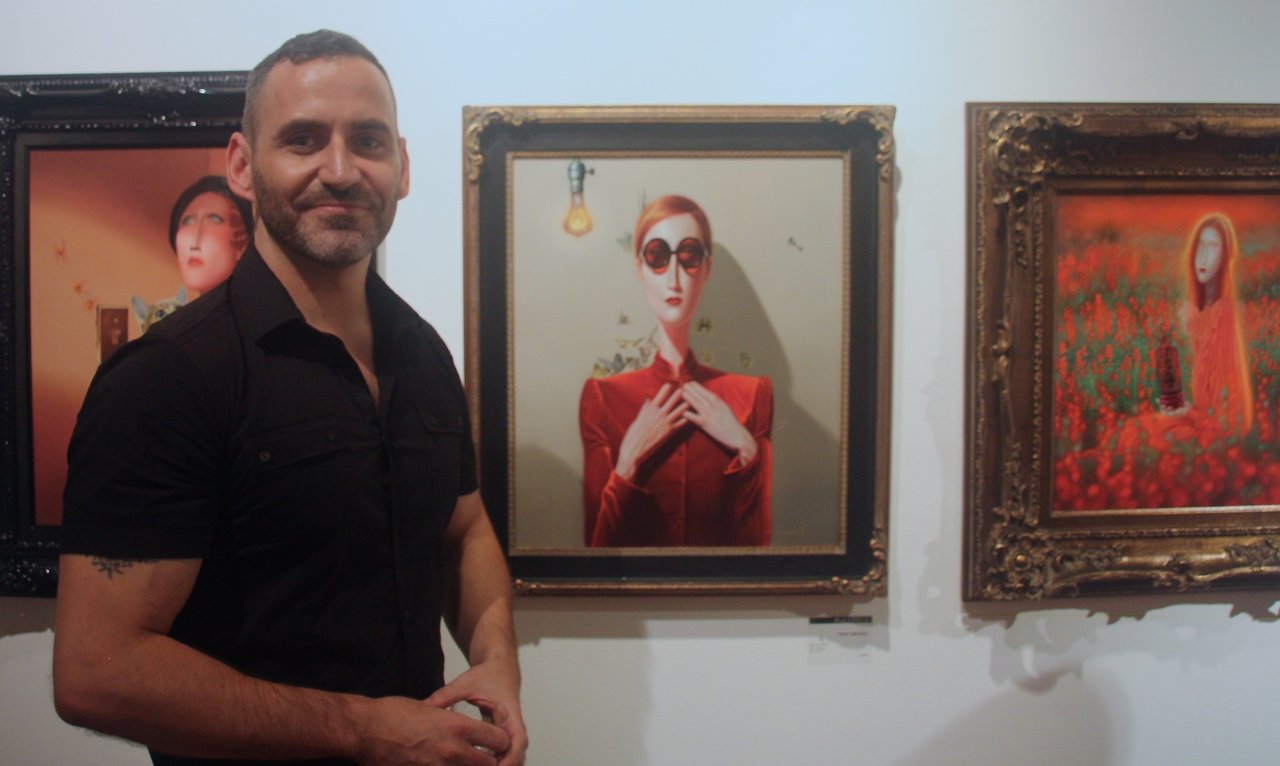
    Troy Brooks is frustrated. Since he began showing his work in 2010, the Toronto-based painter has received little support from the city’s art establishment. Despite commercial success, including a sold-out show at Pentimento Gallery in Leslieville, Brooks has had difficulty having his work shown or represented on the Toronto scene. No longer content to sit on the sidelines, this summer Brooks decided to seize the snub as an opportunity and set about assembling a group exhibition of Toronto artists under the banner of Pop Surrealism. The result, Parabolic: Toronto Exhibition of Pop Surrealism — on until August 28th — as part of the summer rental program at the Red Head Gallery—brings together work of varied artistic styles and media into a seductively strange dream world, equal parts whimsical and unnerving, hyper-realistic and fantastical.

    Artist and curator, Troy Brooks, stands with his work

    The show, like Pop Surrealism generally—occasionally referred to as lowbrow art—draws from a heterogeneous set of practices. These include illustration, comic books, graphic design, and fine art movements like photorealism, mannerism and, of course, surrealism. Though it tends most strongly toward painting, Parabolic and its broader genre also incorporate a variety of media that includes sculpture and photography. At the Red Head, the result of these disparate genres and media is a space that is playful and carnivalesque, with a Baroque flare for ornamentation. Viewers can expect to peer into technically masterful oil-painted dreamscapes by Kyle Stewart, Paul Saari, Troy Brooks, and Yang Cao and similarly imaginative photographs and drawings by Genevieve Blais and Stephanie MacLean. They will also also share the room with Christopher Hayes’ oversized matchbooks and Marjorie Campbell’s beautifully lifelike unicorn, felted sparrows, and six-foot fibre heron. 

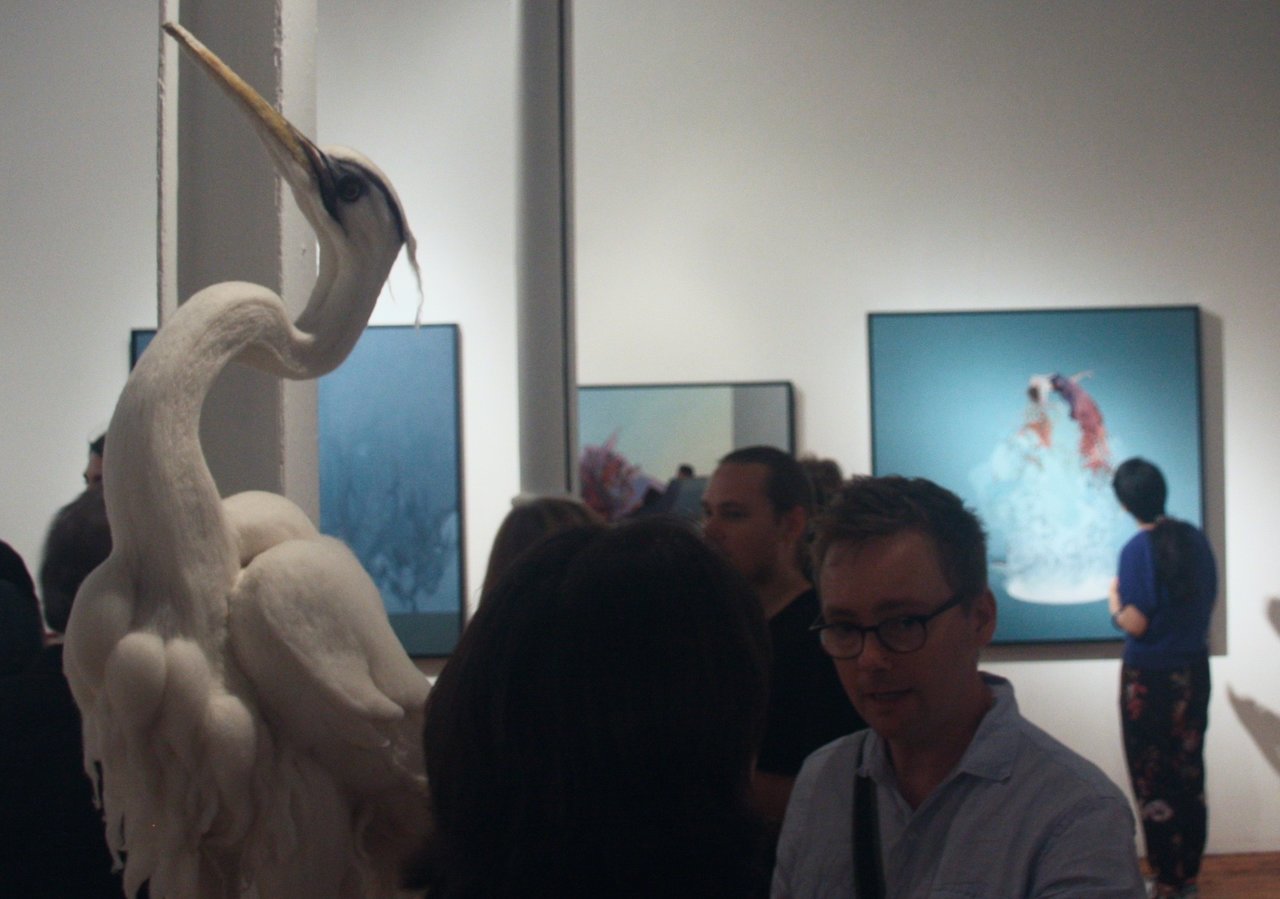
    Guests at the Opening Reception mingle alongside Marjorie Campbell’s Heron, 2015, wool, wire, thread, rebar, epoxy, cement, 66.25″ x 23.5″

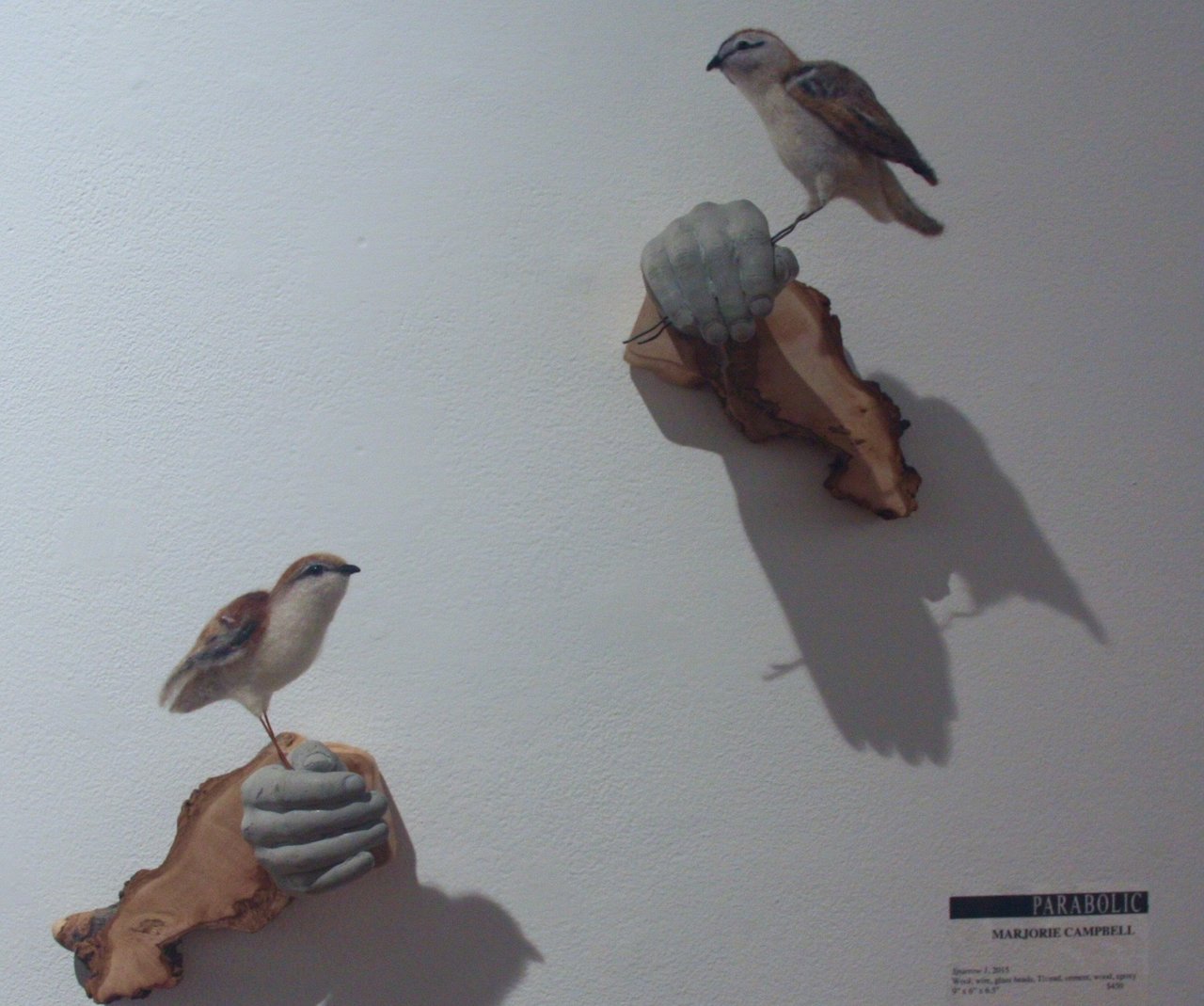
    What unites these works is a turn toward figuration, a characteristic common to the genre. In Parabolic, this turn manifests as stylized human or animal figures in legible, if imaginative, spaces: Brooks’ exquisitely spectral femme fatales in unsettling interiors, for instance; or Kyle Stewart’s stunningly rendered discontented city dwellers, longing for a natural world that seeps into the urban environment. Even Paul Saari’s turbulent landscapes, a far remove from the real, bear reality’s recognizable traces: houses, grass, water, sky. These works are not abstract in the strict sense. Yet, they do tread somewhere between the abstract and the concrete. Indeed, as a whole, the show consistently balances razor sharp precision with something much more vague, fey and ethereal. Marjorie Campbell’s delicate felted wool sparrows perch inquisitively on cold cement hands, for example. Saari’s pastel houses stand out in near relief from the picture plane, yet also blend into the surrounding tempest. Yang Cao’s vividly naturalistic figure stands blinded by a low-flying cotton candy pink cloud. The effect is a sense that reality and fantasy are not distinct categories of experience. And while this often bears a sense of the sinister, it is also not without a sense of humour. Christopher Hayes’ cheeky ‘flat sculptures,’ bearing advertisements for the TTC and “Girls! Girls! Girls!” provide the prime example. The aesthetic result is a curious miasma of play, irony, fantasy and foreboding. Above all, the show, like its broader genre, does not take itself too seriously. This is surprisingly refreshing. 

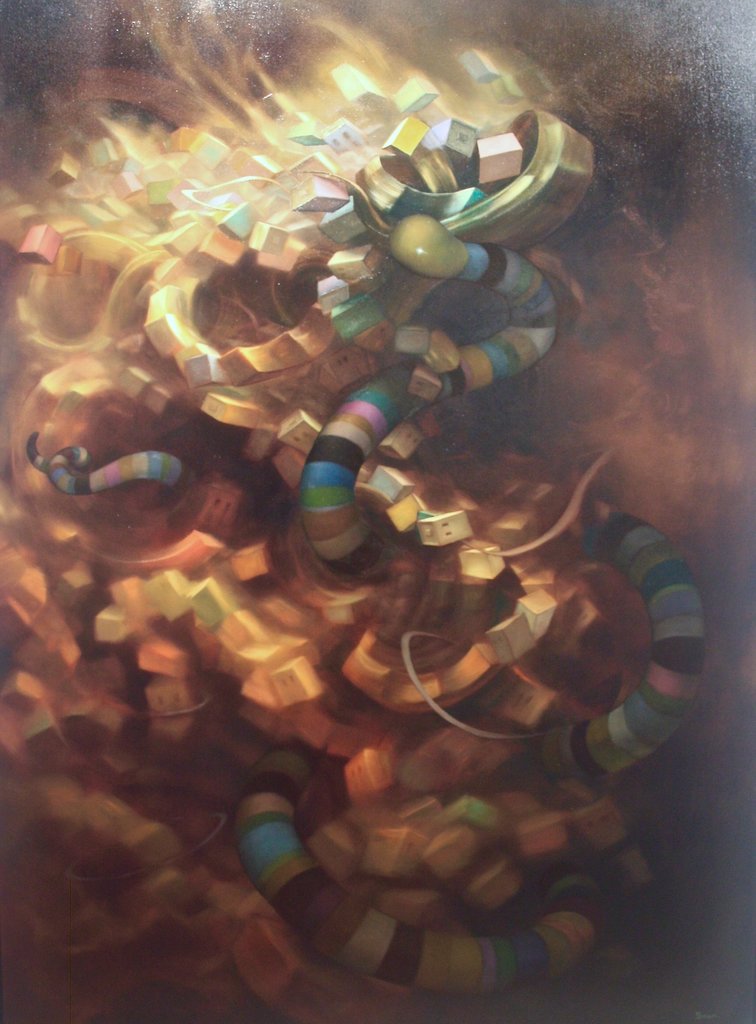
    Paul Saari, Axis Mundi, oil on canvas, 63″ x 46″

    Marjorie Campbell, Sparrow I and Sparrow II, 2015, wool, wire, glass beads, thread, cement, wood, epoxy, 9″ x 6″ x 6.5″ (each)

    Artist Yang Cao with his work Liminal XV, oil on canvas, 48″ x 48″

    Artist Christopher Hayes and his work The Better Way, 2015, mixed media, 60″ x 32

    Like Toronto’s reception of Brooks’ work, however, the response to Pop Surrealism has been far from unanimously positive. Despite the commercial and critical acceptance of some of the genre’s most famous creators—artists like John Currin, Lisa Yuskavage, and Mark Ryden—and the runaway success of the lowbrow publication, Juxtapoz, the movement has spent much of its life defending itself from critics. The work is often viewed as conceptually unsophisticated, populist, and linked—through comic books, graphic design, and illustration—to the tawdry realm of commerce. What is more, much of it has been panned as blatantly misogynistic (John Currin has been particularly accused of this). And certainly, some works in Parabolic may be accused of these types of criticisms. Though the work avoids the brazenly sexualized representations of women created by artists like Currin, there are traces of the original Surrealist misogyny in the way fantasy tends to be grafted onto female, rather than male, figures. And, surely, some of the work in the show falls back on well-worn visual tropes of gothic horror and other genres. It is just such concerns that have art critics and scholars confused, attempting to reconcile technical mastery and savvy art historical referencing with bizarre, kitschy, even offensive subject matter, brazen use of colour, and a turn away from the abstract and conceptual work the artworld has come to love. Many critics simply do not know what to make of it. And Toronto is no different. As Brooks has commented, the Pop Surrealist community in the city has been largely underground. Most artists working within the genre do so in isolation and all but one artist in the show (Kyle Stewart) are unrepresented by commercial galleries.

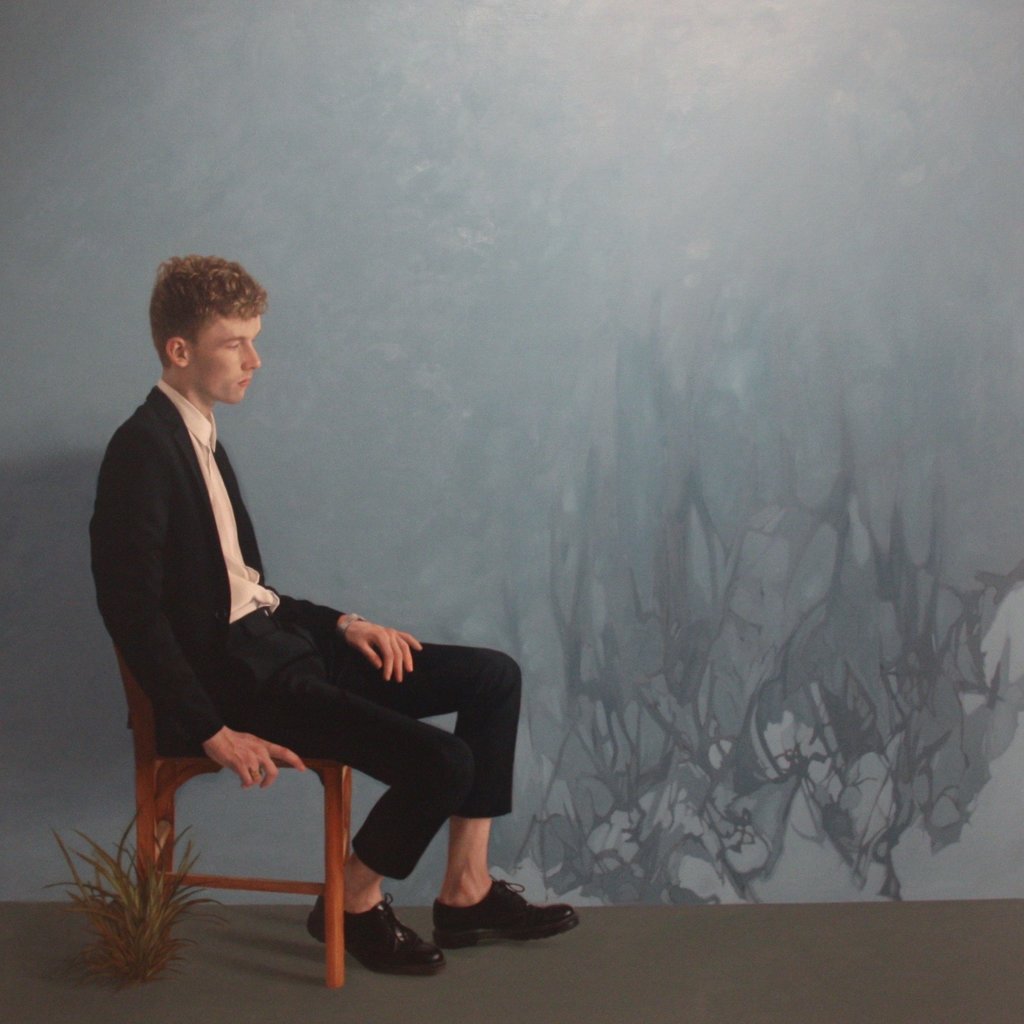
    Kyle Stewart, Wallflower, oil on canvas, 48″ x 48″

    Yet, many of the qualities that make the work questionable to the art establishment are what the artists—and their patrons—like about the genre. As Brooks has stated, the work is accessible. It does not ask its viewers for complicated artspeak or graduate degrees in art history. And most of all, it engenders narrative. It achieves this partially through its figuration and depiction of space, but also largely through its inclusion of small, often disquieting details—a nail hanging out of an otherwise blank wall (Troy Brooks, “Still Life”), a painting-within-a-drawing hung sideways (Stephanie MacLean, “Twenty-First Year”), a few errant blades of grass in an otherwise sterile environment (Kyle Stewart, “Wallflower”). For Brooks, this narrative capacity is the crux of of the work; it is narrative that draws viewers in and incites immediate emotional responses. And it is this element that Brooks chose to emphasize through the exhibition title, Parabolic—taken from one of Brooks’ paintings—referring to the narrative arc.

    Troy Brooks, Still Life, 2014, oil on canvas, 20″ by 24″

    Artist Stephanie MacLean with her works, Silver Lining, 2015, coloured pencil on Stonehenge paper, 24″ x 30″ (left) and Twenty-First Year, 2015, coloured pencil on Stonehenge paper, 24″ x 30″ (right)

    Ultimately, the jury may still be out on the critical role and importance of the Pop Surrealist/lowbrow genre(s) in the Toronto art world. It may be a while before this work makes it into city’s artistic mainstream. But it is here and it is making an impact: Brooks and other artists in Parabolic had already sold several pieces well before the end of the opening reception; meanwhile, in the broader artworld, Juxtapoz has a wider circulation than both ArtForum and Art in America and paintings by Ryden and Currin sell for six, even seven, figures. Artists and curators like Brooks are helping to push this work into the public discussion in Toronto—long after it has already been shown and discussed in cities like New York and Los Angeles. This pushing out is necessary so that a fair critical evaluation can take place. And Parabolic does this pushing out very successfully. Brooks has represented the multifarious, almost unwieldy genre well. In doing so, he has helped bring together a community of artists who may have otherwise failed to see their work recognized in the broader conversation. True, there are elements of the work that may be brash, lowbrow, overly kitschy, and veering ‘uncomfortably close’ to the commercial. But, to quote New Yorker art critic Peter Schjeldahl’s writing on John Currin, “to be frankly unlovable seems a prerequisite for meaning anything vital.” Unlovable as some may find it, there is a lot that is seductive about this work. About its unapologetic invitation to play, to forget art world posturing and simply look. I suggest you try it.

    Installation view with Christopher Hayes’ matchbooks and  Marjorie Campbell’s Unicorn

    Text and photo: Catherine MacArthur Falls

    *Exhibition information: August 14 – 28, 2015, The Red Head Gallery, 401 Richmond Street West, Toronto. Gallery hours: Wed – Sat, 12 – 5 p.m.

  • Duarte Vitória: The Chemistry at Walnut Contemporary

    A human being’s capacity to emote extends beyond the effectiveness of speech and other direct forms of communication. The human body, with all its idiosyncratic gestures and mannerisms, possesses an uncanny ability to express what words cannot fully capture. Surfaces can be just as impactful as the thoughts and feelings that lie beneath them, an idea Duarte Vitória explores in his solo exhibition The Chemistry on view now at Walnut Contemporary. Throughout the exhibition, the artist utilizes the power of pantomime in order to create enigmatic images of eccentric and confrontational female figures.

    Duarte Vitória, Black Ego, 2015, oil on linen, 67″ x 59″. Courtesy of Walnut Contemporary

    Compositionally, Vitória’s nude subjects are confined to the strict rigidity of the canvas’s frame, contorting their poses to fit within the rectilinear support. Figures are often piled on top of one another with subtle differentiation between bodies, which further emphasizes the often-claustrophobic nature of the images on display. Their menacing physiognomies place the viewer in the position of an intrusive voyeur peeping into a private scenario, creating an uncomfortable relationship between spectator and subject. The tenseness in the figures’ limbs, evident in their forceful and exaggerated embrace of one another, underlines their displeasing countenances and creates a greater sense of unease within each painting.

    Duarte Vitória, Revolution, 2014, oil on linen, 63″ x 79″. Courtesy of Walnut Contemporary

    Duarte Vitória, Into the Dark, 2014, oil on linen, 73″ x 98″. Courtesy of Walnut Contemporary

    The Chemistry also includes three portraits directly inspired by Alexander McQueen’s Fall 2009 collection. Vitória recreates the ominous air of the runway presentation, where models donned theatrically Romantic couture mixed with artful, yet ghastly makeup. The artist chooses to solely focus on the models’ bloodstained faces, injecting them with a frightening intensity resembling vengeful villainesses tinged with a psychological heft.

    Duarte Vitória, Ambiguous, 2015, oil on linen, 79″ x 71″. Courtesy of Walnut Contemporary

    Duarte Vitória, Absorption, 2015, oil on linen, 67″ x 51″. Courtesy of Walnut Contemporary

    Vitória’s Expressionist technique animates his figures with his lively brushwork, giving an optical allure to these confrontational artworks. The intimate gallery setting allows the viewer to closely contemplate each painting as they become entangled in the puzzling melodrama within each scenario. Textual explanations need not apply to this collection of paintings, as the expressive visages and body language reveal more than words ever could.

    David Saric

    *Exhibition information: July 30 – August 29, 2015.  Walnut Contemporary Gallery, 201 Niagara Street West, Toronto. Gallery hours: Wed – Sat, 1 – 6 p.m.