Author: artoronto

  • Propeller Gallery Gala Launch

    The new Propeller Gallery at 30 Abell Street

    Gallery Gala Launch: Saturday, January 17, 2015 / 6 – 10 p.m.

    With a new space to reveal, Propeller Gallery had quite an evening to celebrate on the January 17, 2015. The sounds of live jazz from saxophonist Bill Prouton, guitarist Henrique Matulis and a chattering crowd filled the two-room gallery at 30 Abell Street.

    Live jazz from saxophonist Bill Prouton and the guitarist Henrique Matulis

    Gallery view with its two rooms

    Chosen works from several of the gallery’s artists decorated the event; colorful paintings, photographs, drawings, and even some sculpture complimented the cheery evening. It is evident that Propeller’s new space provides a greater sense of agency to the works, giving them opportunity to interact with the viewer. Propeller artist Heather Gentleman described the new space as “organic” providing guests with a greater sense of flow. I think that was distinct in the space’s design. Guests circulated between the two rooms with ease. Joseph Muscat, Propeller’s Chair, was excited about the new space and the prospective of a lot of future success at the Artscape Loft location.

    Guest with Sharron Forrest, ” Leaves Light and Shadow” (left) and Tatjana Hutinec “Renaissance Woman” (right)

    Propeller artists Heather Gentleman and Philip Hare with Gentlemen’s work “Innana” (on left)

    Propeller Chair, artist, Joseph Muscat

    Installation view

    Guest looking at Anthony Saad’s “Aurora Megalopolis

    The gallery is soon hosting their annual “Black and White Ball V” on January 29th, an event coordinated by Gentleman, who seemed excited for the event’s success in the new space. With many new faces and a great turnout from the Opening Gala, future events at Propeller should be a great success. It is with great excitement that I look forward to future shows at Propeller!

    Text and photo: Brinae Bain

    *Exhibition information: January 15 – 25, 2015, 30 Abell Street, Toronto. Gallery hours: Wed – Sat: 12 – 6, Sun: 12 – 5 p.m.

  • Red Rum Tut by Fastwürms at Paul Petro

    Red Rum Tut Opening Reception on January 16, 2015

    The allure of witchcraft and the occult has become increasingly popular moving into the modern era. Once feared and persecuted, it has since become a near-global phenomenon perpetuated by cinema, music, art, and literature. Despite the common perception that witchcraft is associated with satanic worship – most likely due to its condemnation from Christians – witchcraft is actually more concerned with the natural elements. The ancient Celtic traditions of druidism, which itself is recognized for its spiritual reverence of nature, were reintroduced in the modern context through the development of the Wicca religion. Wicca in fact has very little to do with the demons or Christianity for that matter. Though magic is an integral part of their beliefs, it is not a supernatural concept; rather it is, as MacGregor Mathers clarifies, “the science of the control of the secret forces of nature.” For instance, the pentacle, one of the most iconic symbols associated with the unholy, is terribly misconstrued. Each of the five points aligns with one of the five elements: fire, earth, air, water, and spirit which unify them all.

    Fastwürms artists Kim Kozzi and Dai Skuse

    However, with society’s modern obsession with advanced technology and our artificial concrete jungles, could the worship of nature cohesively reconcile? Perhaps, it could with a change of context, after all many couldn’t conceive a world without our current innovations.  Red Rum Tut is a collaborative exhibition by Fastwürms (artists Kim Kozzi and Dai Skuse) that explores the impact of technology on the creation of a modern pseudo-religion. They free the pedagogical aspect of art and the simplified dialogue of social media from “the tyranny of instrumental and institutional reason” (Paul Petro Gallery website).

    Red Rum Tut installation view

    Unlike the calm, meditative atmosphere of traditional exhibitions, Red Rum Tut is exceptionally vibrant and lively. The walls are adorned with vividly-colored pieces with an abundance of equally-expressive text: certain panels contain simple three-letter words and acronyms, while others are longer samples of social media jargon (i.e. lol, omg, etc.). In the centre of the room, large speakers are set up to engross the spectators with music as they enter.

    Artist, Kim Kozzi on top of one of the speakers at the Opening Reception on January 16, 2015

    At the opening reception atop these speakers, one of the artists, dressed in hunting camouflage, dances to the rhythm. Oftentimes, the artists interact directly with the audience, encouraging them to dance along. Despite the jovial nature of the entire exhibit, the decrepit, naturally-colored aesthetic of the camouflage interrupts the scene. To introduce an obscure and almost-earthly being into an otherwise artificial environment seems rather interjecting, as if the being is alien to its new habitat and seems obligated to adapt. Next to them is a table that, suggesting by the overlooking pentacle and the mystifying crystal ball, is a modern Wiccan shrine. However, what might have once contained natural reagents needed for a ritual, instead contains decorative minerals, knitted thread, arrows, and blackened, almost sickly, wood.

    Red Rum Tut installation view

    In its totality, the exhibit seems to be a constant juxtaposition of the natural and the artificial; the supernatural and the mundane; Wiccan theology with contemporary culture.

    Text and photo: Simon Termine

    Exhibition information: January 16 – February 14, 2015, Paul Petro Contemporary Art, 980 Queen St West, Toronto. Gallery hours: Wed – Sat, 11 – 5 p.m.

  • The Disappeared / Gallery 44

    The Disappeared, a new show at Gallery 44, features works by Tatiana Grigorenko and Zoë Heyn-Jones. The two artists discussed their projects during a brunch talk on January 17, 2015.

    Artists Zoë Heyn-Jones (left) and Tatiana Grigorenko (right)

    Tatiana Grigorenko’s family history is closely tied to the big historical narrative, with the flight to the United States of her grand-father Petro Grigorenko, a famous Soviet dissident, shaping the future of her upbringing. Imitating and transcending the way of reshaping historical narrative by removing individuals who fell into disrepute from official photographs, Grigorenko explores the effects of disappearance of her own body in photographs from family archives. She uses an analog retouching method because of her appreciation for the imperfections inherent in it. The ghostly remains of the excised bodies prompt the viewer to seek to reconstruct the original, a process which draws attention to surprising details and generates a new narrative. The memory of the event is skewed, reshaped, reinvented.

     Tatiana Grigorenko, Confederate Flag, 16.5 x 11.5 inch archival inkjet print on cotton rag paper and collage, 2010-2012. Courtesy of Gallery 44

    Works by Tatiana Grigorenko

    Memory is also a major focus of the visual explorations of Zoë Heyn-Jones. She tries to “get to the bottom of a memory”, namely her own childhood in a predominantly white settlement in Guatemala close to Santiago Atitlán, a town plagued by violence during the Guatemalan civil war. Heyn-Jones feels she has a “debt to the indigenous people”, which she aims to repay by exploring the history of Guatemala and expressing her finds visually. By shooting a film footage in single frames, she withdraws from the didactic nature of documentaries to produce a disorienting, scattered record, which she describes as true to her impression of the road, the town and its environs.

    Video by Zoë Heyn-Jones

    Zoë Heyn-Jones, Atitlán 5, 12 x 18 inch inkjet print on fibrous paper; from scanned Super 8 film stills, 2013. Courtesy of Gallery 44

    While the questions raised by Grigorenko and Heyn-Jones certainly are important and worth considering, the means offered to the viewers for exploration do not seem to be quite as effective as the artists describe them to be. The overall methods are rather standard and some avenues for further visual explorations are not fully developed.  For example, in a few images from Grigorenko’s series, the absent body influences the remaining body and transforms its gestures, for it now functions as an isolated compositional unit alienated from its original purpose. Aesthetically and conceptually, the change is tremendous. Yet, the effect is attenuated by other more straight-forward transformations, such as the cliché obscuring of the face in a portrait. Similarly, Heyn-Jones claims that her film has an “abstract” quality, which, in truth, is hardly manifest, for the footage retains a certain continuity which can be easily apprehended by the contemporary eye, used to fast-changing images. The Disappeared art show is hardly rescued by the historical significance of the events and figures present in its background.

    Text and photo: Elena Iourtaeva

    *Exhibition information: January 16 – February 21, 2015,  Gallery 44 | Centre for Contemporary Photography, 401 Richmond Street West, Toronto. Gallery hours: Tue – Sat 11 – 5 p.m.

  • Symbols and Symbolism in art / Lecture & Workshop

    Noelle Elia: Gallo de Oro, 2001,  digital print. Detail.

    SYMBOLS AND SYMBOLISM IN ART a Lecture & Workshop by Cesar Forero.

    Place: Articsok Gallery, 1697 St.Clair Aneue West, Toronto.

    Dates: Saturday, January 24 and February 21, 2015 / 11 – 3 p.m.
    Fee: $40/Session to be paid at the door
    Space is limited – R.S.V.P. info@articsokgallery.com

    Symbolism

    In this seminar we will study symbols as they are related to and appearing in artwork. It may also be called a review of ‘iconography’ since symbols will be examined in the context of artistic expression. Iconography was concisely defined early in the 20thcentury by the German art historian Erwin Panofsky who systematized its study and interpretation not only to examine and describe iconography but also to gain a deeper comprehension of it in artwork. 

    This seminar will present artwork with iconography elements both in painting and sculpture. We will go through many examples including religious art, political art plus art in the business world.  Seminar participants will be given contemporary examples.

    Our focus will be on contemporary art, which does not function purely in religious or political areas since viewers do not passively receive a single message from each artwork. Discussions will also center on the role of art as a catalyst for public engagement and for further critical reflection on particular topics and issues.

    Cesar Forero is a Colombian-born Canadian with a background in architecture, sculpture, painting, and public performance.  He holds a MA from the Minnesota State University and a MFA from the University of Waterloo, Ontario. He has taught architecture, design and art at university level in Colombia, United States, and Canada.

    His ongoing artistic practice focuses on the creation of multimedia installations incorporating two and three-dimensional elements, plus dance and music performance into the context of haptic experience. His intent is to create a liminal space in which the viewer stands inside the environment as a participant, and is transported from everyday reality into a symbolic experience.

  • The Festival of the Body at OCAD University

    In honour of the Pan Am games and the launching of a new undergraduate specialization: Life Studies, OCAD University is hosting a month long exhibition dedicated to figuration. The Festival of the Body officially opened on January 12, and will continue to run until February 12, 2015. The work on display addresses the figure and the human body in relation to contemporary art and social issues. Both current and alumni students were asked to submit relevant work for the exhibition. The pieces featured in the show were selected following a juried curatorial process. Paintings make up the majority of the exhibition, although sculptural, mixed media, and photographic works also make an appearance. While the emphasis of the exhibition is on figuration, both abstract and representational works that address the human body are presented.

    Sam Nolan, “Untitled”

    The painting in the middle: Sarah Letovsky, “You Remind me of Someone”

    Selected works from Life Studies students (from left to right): Hannah Kaplan, “I won’t tell you a thing” 2014, Mercedes Campagna, “Eric (june 10, 2009)” 2014, Renee Hayward, “Fight/Flight”, Sheldon Storey, “Hold me Up (she made me feel so small when she said the things she did)” 2014.

    The Festival of the Body is installed in OCAD University’s Great Hall at 100 McCaul Street. The exhibition itself will be open to the public for a full month, with panel discussions every other week. On Thursday, January 29th from 6:30 to 9:30 p.m. a performance and video event entitled “Festival of the Body Part II: Speculative Bodies” will be held in OCAD University’s Great Hall and Central Hall (Room 230, 100 McCaul) as part of the exhibition. On Thursday, January 15th, participating artists and curators are available to address the show and the work at the “Festival of the Body: From the Figure to the Body” panel discussion. This panel is free to attend, and is open to the general public from 6:30 to 8:30 pm. Visitors are also welcome to attend the “Whose Body?”  panel discussion on January 22nd, and “The Festival of the Body: Science” panel on February 5th. Both panels run from 6:30 to 8:30 p.m. in OCADU’s Great Hall. 

    Text and photo: Madeleine Till

    *Exhibition information:  January 12 – February 12, 2015, OCAD University, 100 McCaul Street, Toronto.

  • Politics of Fashion | Fashion of Politics

    Politics of Fashion | Fashion of Politicsat the Design Exchange is an obvious treat for fashion lovers, the show also offers a great deal for art lovers too to mull over.

    Installation view.

    Guest curated by the legendary Canadian fashion generalist, Jeanne Beker, and DX curator Sara Nickleson, Politics of Fashion | Fashion of Politics examines the increasingly communicative role of fashion in a modern society where politics, art and fashion interact with fervour. The curatorial statement emphasises fashion as a vehicle for social change, a platform for ideological assertions, and the act of dressing as a means for the expression of communal values. Fashion’s evolving treatment of themes including consumerism, activism, gender, sexuality, ethics, and power are documented here in this show.

    Moschino, “McDonalds Dress, 2014”.  From the collection of Moschino.

    There is feminist art from FEMEN Quebec, Nick Knight addresses race on the runways in a short fashion film, and the English Mod and Skinhead subcultures are examined. Hybrid pieces from Rad Hourani’s gender neutral line sheds gendered clothing traditions with designs rich in geometric shapes, solid colors, and strong, clear lines. Samples from Vivienne Westwood’s post-apocalyptic collection predict fashion in a future where climate change and environmental degradation continues. Outfits feature gasmasks, bleak colours, repurposed material and scraps, army surplus, and unfinished and jagged hems.

    FEMEN, “Crown”, 2013. FEMEN Quebec. From the collection of FEMEN Quebec.

    Rad Hourani, “Looks from Collection #12”. From the collection of Rad Hourani.

    Vivienne Westwood, “Climate Revolution Cape”, 2013. . From the collection of Pearl Westwood.

    A highlight was the collection of vintage paper dresses on display. These A-line minis reek of the 1960s; they are boldly patterned or else they are vibrantly coloured in addition to being incredibly short! The dresses feature popular political figures of the era such as Pierre Trudeau and Richard Nixon.

    A product of the media-image loving post-war consumer society of 1960s America, disposable paper dress fashion embodied ideologies of consumption, mass-production, and commercialism. Scott’s “Paper Caper” dress pitch ran: “Won’t last forever…who cares? Wear it for kicks—then give it the air.” Wearers displayed overt support of specific politicians, but more importantly, alliance with popular consumerist ideologies.

    From left to right: Dress 1, 2, 3: Paper dresses created for the Republican Party National Convention. 1968. Printed and bonded cellulose fibre, Dress 4: Paper dress created for the Liberal Party Leadership Convention. 1968. Printed and bonded cellulose fibre. Collection of the Fashion History Museum.

    Like the pop-art that erupted during the same era, these paper dresses were for the masses. They are a form of pop-art in and of themselves, incorporating representational campaign images from the media and functioning as wearable advertisements. These paper dresses mark an overt merger and interaction between popular fashion, art, and politics.

    Text and photo: Emily Kovacs

    *Exhibition information: September 18, 2014 – January 25, 2015, Design Exchange, 234 Bay Street, Toronto. Gallery hours: Mon & Wed-Sun: 11 – 6 p.m., Tue: 11 – 9 p.m.

  • Propeller! Gala Opening

    Propeller! Gala Opening | January 15 – 25, 2015

    Gallery Gala Launch: Saturday, January 17, 2015 / 6 – 10 p.m.

    Join us for the inaugural exhibition at 30 Abell Street, a member’s-only show celebrating Propeller and our new gallery space.

    Propeller Gallery has moved and is now located at 30 Abell Street, in the Artscape Triangle Lofts building.

    To celebrate our new Gallery, we are hosting a Gala Launch event to coincide with our inaugural exhibition, Propeller! – a multidisciplinary show featuring Propeller members exclusively – on view from January 15 -2 5, 2015.

    We invite you to join us for food and drink, music and conversation, and of course, an exceptional selection of artworks.

    Feel free to bring your friends, and come to celebrate our exciting new home!

  • Interview with Stella Cade

    Interview with Stella Cade (S.C) by Madeleine Till (M.T)

    Stella Cade in her studio in front of her painting, “The Great”. Courtesy of the artist.

    Stella Cade uses portraiture to explore themes of identity, sexuality, and inter-personal relationships. In the past, Cade’s gestural paintings made an appearance in the Artist Project. Presently, Cade is a member and co-founder of Toronto based Nest Collective, and is preparing to undertake a residency with Artscape Youngplace in 2015.

    Stella Cade, “The One You Love”, 2014, oil on canvas, 60″ x 40″. Courtesy of the artist.

    M.T: Can you give me a brief description of your practice, what you’re invested in conceptually, and what sort of work you’re interested in producing?

    S.C: My work revolves around very broad themes of power and vulnerability. I work in oil paint, and have generally worked on a larger scale. 6′ by 4’ is my favourite. I’ve worked a lot with self-portraiture and that is rooted out of my background in feminist theory and women’s studies. I became fixated on using personal experience as a source. I think that it wouldn’t be fair to try and represent the experiences of others however sensitive I feel towards them – so I address everything through self-portrait. I’m at a crossroads, now. I want to discuss larger themes by accessing others and giving them space to share their stories with me through my paintings. I think that will broaden the horizons of my work. That is the new direction where I’m venturing into now.

    Stella Cade, “Cigarettes and Douche Bags”, 2011, oil on canvas, 90″ x 60″. Courtesy of the artist.

    M.T: Do you know all the people that you paint before-hand?

    S.C: Yes, I know them.

    M.T: You have any relationship with them?

    S.C: Yes, and I think that’s important. I have done a couple of shoots with people that I didn’t know very well. People whose work I’ve found to be inspiring or people I knew in some other way, but I haven’t ever felt that those really translated into an image that I wanted. I think that by knowing the subjects of my paintings it helps to create a level of intimacy in the piece.

    M.T: Do you think that meeting up with these people and having a relationship with them is as important as painting them?

    S.C: I do, I think so. When I paint someone I try to work with them throughout the whole process. We go through some photos together and I make sure there is nothing that I would be using that would make them feel uncomfortable. I think it’s important that the subject of the portraits has a voice in them. That being said, it can be a hindrance because people don’t want to look “ugly”. The beauty of working intimately with my subjects is that I get to sit down and study the face of a person I care about. In real life you don’t sit down and figure out what an eye socket on a person you love looks like, do you? For me, it’s a really intimate experience.

    Stella Cade, “Suzette (oh! that fire)”, 2012, oil on canvas, 72″ x 48″. Courtesy of the artist.

    M.T: Are you always taking [reference] photos or do you paint from life as well?

    SC: I like working from photographs, playing with the composition of it, playing with the lighting. It isn’t always easy to direct the subject of your painting to keep the same posture for hours and days. It is a lot easier to achieve a sense of movement or muscular tension in a photograph because you only need somebody to be sitting there for maybe five minutes.

    M.T: Most of your paintings are not photorealistic at all. Can you talk about how they are painted and the handling of the paint?

    S.C: I’ve had a lot of training. I spent some time at Concordia studying fine arts, and then I studied at the Art Students League in New York, and then I completed my Bachelors of Fine Arts at OCAD University. So, there is a skill set that I’ve learned and honed, and then rejected. I love colour and I think of it like sculpting. Instead of necessarily looking at shading or colour value in a cheek, I would think of it like a plane.

    M.T: You mean like using model clay?

    S.C: Exactly like clay! I do that with the paint. If I can make a cheek in two strokes, that makes me happy. That’s what feels exciting to me. I am really interested in how little I can actually render things, and still make them “pop”. With portraiture especially, you have to have a reason to paint, because you could take a photograph, and it’s going to be faster and better than you could ever paint it. I really want the medium to be present in the portraits that I do, and I really want people to know that it is paint, and feel the movement of that brush and feel my hand in that portrait.

    Stella Cade, “Sneezy”, 2011, oil on canvas, 90″ x 60″. Courtesy of the artist.

    M.T: Maybe we can talk a little bit more about self-portraiture, and why you moved away from that?

    S.C: I started with self-portraiture when I was in my first year of university, in 2006 at Concordia. Part of it is accessibility, you’re always there, and you can do anything for your art. It started with the need for some deep self-analysis, and then that grew into a comfort level with self-portraiture because I didn’t need to make it pretty. I could take an ugly face and make that beautiful in a different way, and really push my boundaries because I wasn’t going to get mad at myself. There was a freedom in that which I really enjoyed exploring. I think it is a strange space that we live in. We have so much control over how we are perceived and in the instant gratification of seeing that through technology.

    M.T: Like social networking with all the control over your self-image.

    S.C: Right, because you can know your best angle and your best lighting and all of that stuff, and I think that that really hinders self-acceptance and creates really messed up body images. That was one of the roots of my self-portraiture, and I haven’t retired from it yet, it’s just that when you do something for almost ten years you need to shake it up a little and explore new challenges.

    Stella Cade, “This is the History of Embarassment”, 2012, oil on canvas, 72″ x 48″. Courtesy of the artist.

    M.T: When you’re painting other people, are you still working with those same themes then or is it something different?

    S.C: Yes, I am. Most recently I have been working on some portraits of my partner. They are exciting for me, because I think that I’ve actually captured him. He’s a really quiet and private person in a lot of ways, but I feel like I see sides of him that other people don’t necessarily see. It was the first time I felt that I was being as honest with a portrait of someone else as with my own self-portraits. Maintaining the vulnerability in the piece. Those specific insecurities are important because that’s how I look at art, at myself, and at the world.

    Stella Cade, “Ovation”, 2014, oil on canvas, 6′ x 4′. Courtesy of the artist.

    M.T: What are you working on now?

    S.C: NEST, our collective, is going to be a resident exhibitor at Artscape in 2015, so I’m aiming to have a solo show in their galleries, probably in the fall. I’ve also got one of the portraits of my partner in a show at OCADU for the Festival of the Body (January 15 – February12, 2015). Currently, I am working on a site specific solo exhibition that will include elements of sculpture and performance in conjunction with painting. I’m excited to take some time to experiment and play.

  • Art Spiegelman’s CO-MIX: A Retrospective

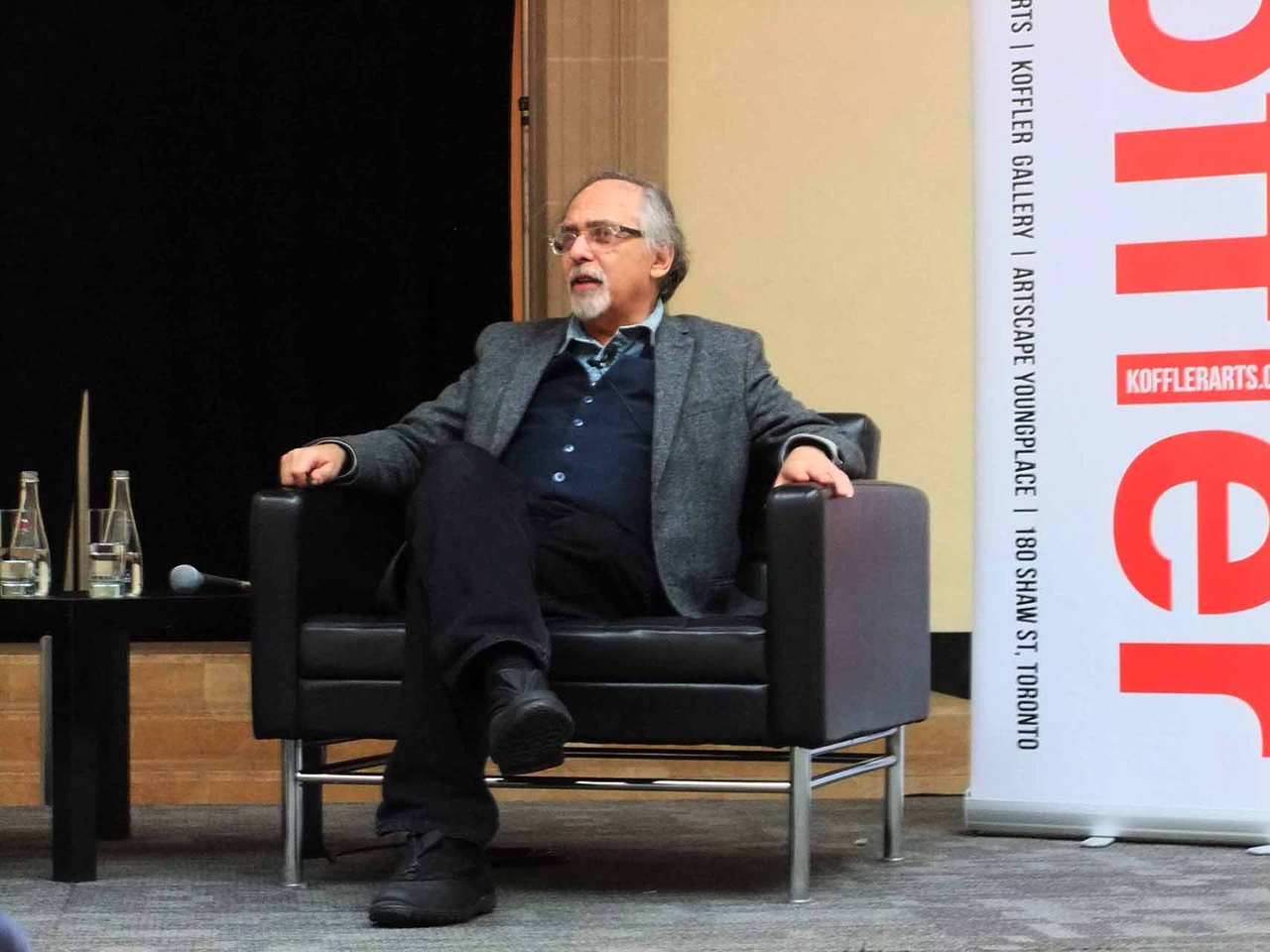
    Art Spiegelman at the press preview on December 17, 2014. Photo: Joséphine Mwanvua

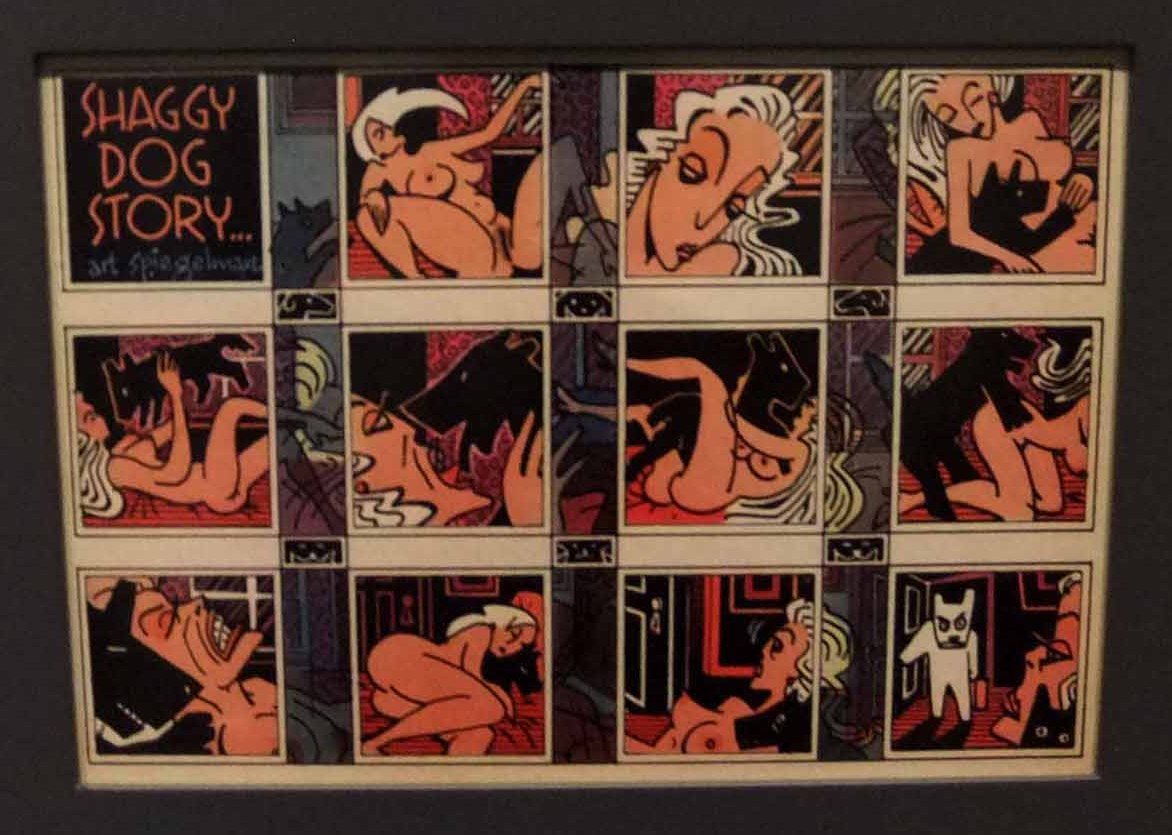
    We arrived an hour early at the AGO for the Art Spiegelman press preview on December 17th. I looked forward to this exciting experience and honor, because he is a legend in the world of comics. We had the opportunity to see the exhibition before the talk began. It is an extensive exhibition, in a large space, and with so many things to look at. I took my time to savour it methodically—by taking in the contents of a few comic strips and cover art at a time, and then moving on to find their sketches, so I could appreciate the time and dedication the artist put into them. While exploring, I came across certain pieces that made me laugh, and occasionally heard others laugh beside me as well. Art Spiegelman’s comix are humorous, strange – as a lot of underground comix are – but it also can become serious when he deals with sexual or political content.
    Art Spiegelman, “Shaggy Dog Story…”, Playboy magazine, Artist’s proof, 1979. Photo: Joséphine Mwanvua

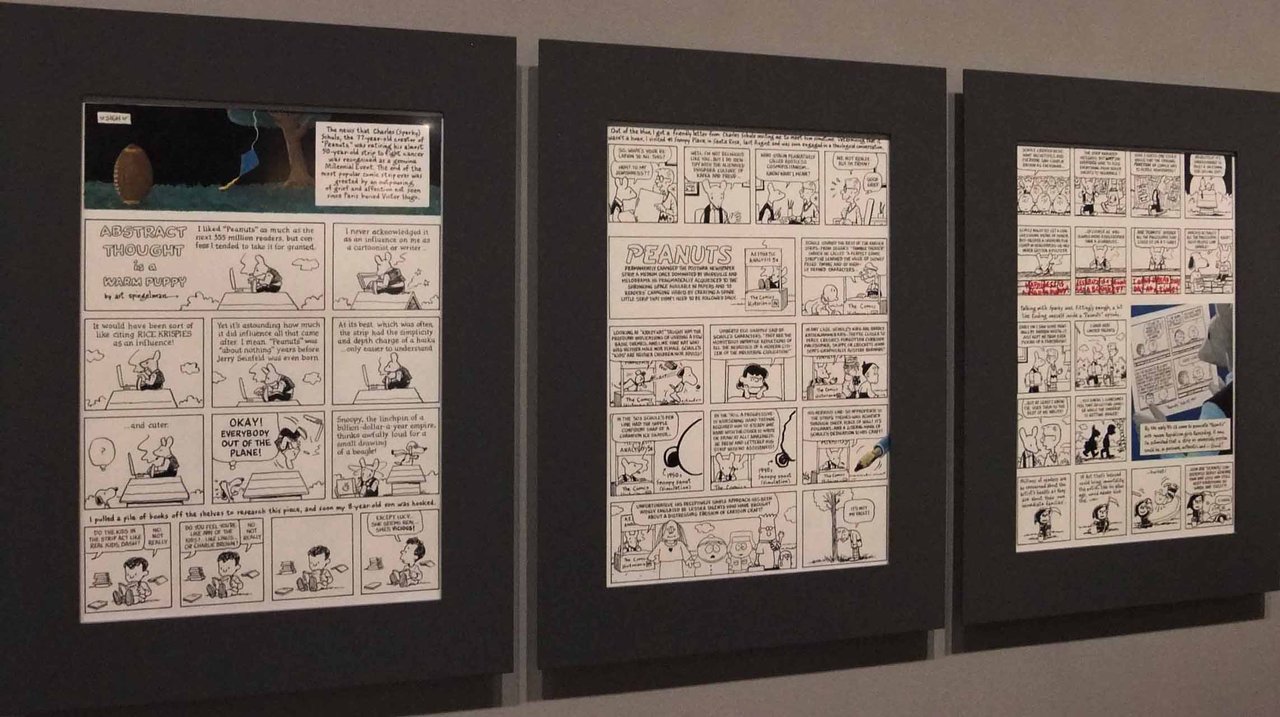
     There is a difference between “comics” and “comix”: the word “comics” is used when describing mainstream comic art or comics in general, while the term “comix” is used specifically when speaking of underground (also known as alternative) comic art. Being an underground comix enthusiast I can’t help but notice the great similarities of Spiegelman’s work with that of Japanese alternative comic artists, those who produced work throughout the 70s -80s just like he did, such as Suehiro Maruo, Osamu Tezuka, or Katsuhiro Otomo. Later, during his talk, Spiegelman mentioned that throughout the phases in comic cultures, they all tend to look the same. As an homage to Charles Schulz “Peanuts” he drew, “Abstract Though is a Warm Puppy”, and he pinpointed how Charles Schulz’ work became some of pop culture’s most iconic artifacts.

    Art Spiegelman, “Abstract Thought is a Warm Puppy”, The New Yorker, February 2000. Photo: Joséphine Mwanvua

    During the talk, Spiegelman – who happens to have a very metaphorical way of speaking, and who is just as funny as his comics- sat comfortably, talking with the host, AGO’s Director and CEO, Matthew Teitelbaum about how the culture of comics changed society’s relationship to media. He remembered the early phase in the 60’s when comics were wordless and relief printed with woodcut pieces. He mostly spoke about what art means to him and his anxious battles with modernism, and whether comic books are art. He gave very long answers to Teitelbaum’s short questions, that contained a multitude of issues and stories. It was very  interesting to hear him speak about how comics are treated nowadays: that comics can now be seen in museums next to Picasso, or studied in classrooms. This is highly unusual for this type of culture because, Spiegelman says, comic culture has a different energy than high class culture,  what  are originally, and essentially, collector’s items.

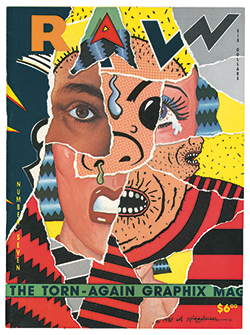
    Art Spiegelman, “RAW no.7, The Torn-Again Graphix Magazine”, 1985. Courtesy of AGO.

    It’s true: comics, especially alternative comix, sit lower in the hierarchy of cultural class. It’s not regarded in the same way as ballet, the opera or classical music. The hobby of comic book collecting has always been seen as “nerdy”, or strange to a lot of those who don’t identify with that culture. However, although it’s still rather common to get negative reactions when we enthusiasts express our love for the hobby – comic book conventions have recently become mainstream. Take San Diego Comic Con for example: SDCC is the holy grail of all comic book conventions, and since last year, it’s been deemed as “mainstream” and gets a lot of attention in the media. Let’s not forget the fact that some of Hollywood’s biggest box office titles as of late are movies based on Marvel and DC comics. A lot of the people who attend these screenings are those who have never picked up a comic book in their lives and who even might have made fun of that kid in school who did.

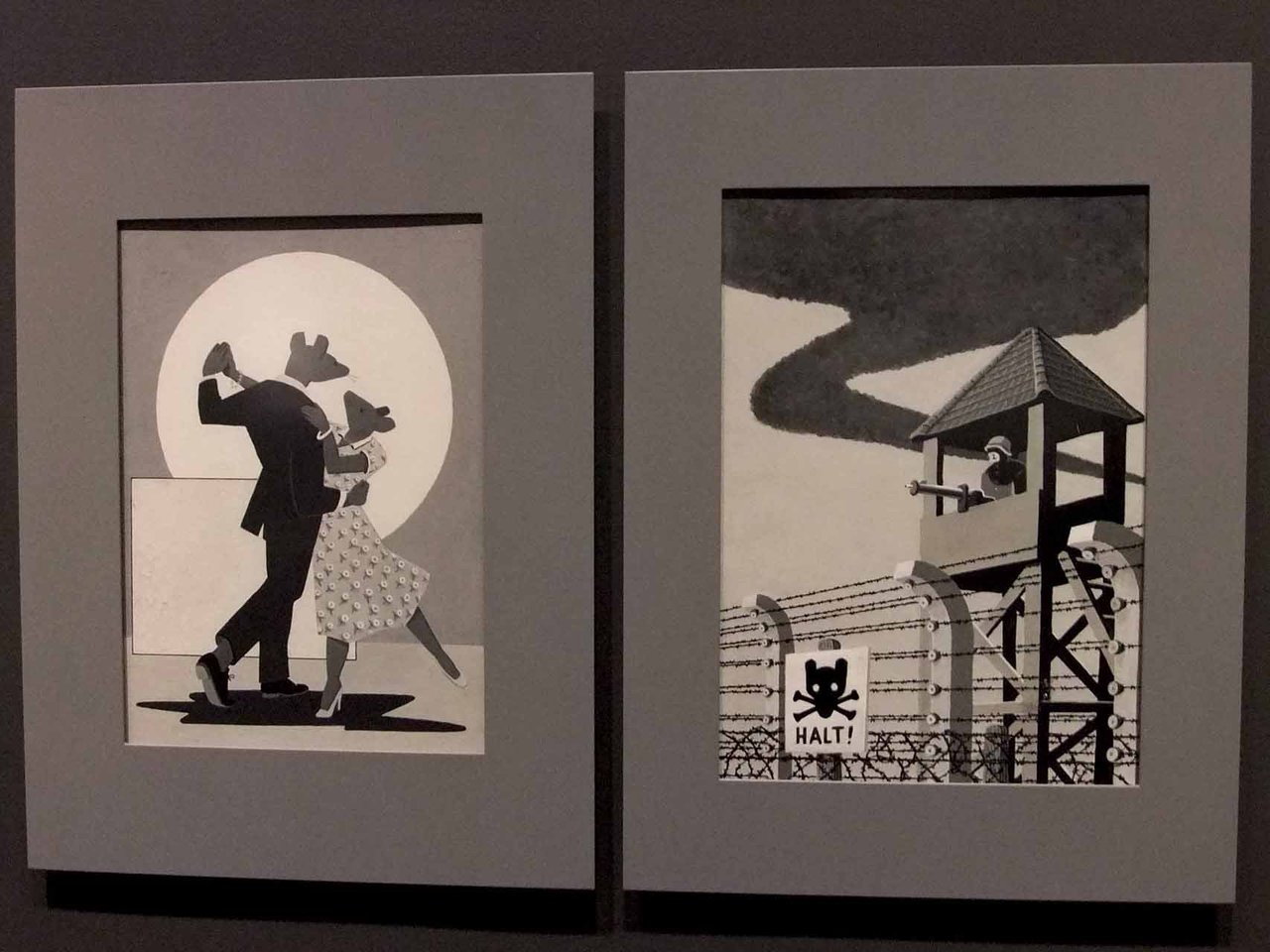
    Art Spiegelman, contents pages of “Maus 1”, gouache and ink on paper, 1986; contents pages of “Maus II”, gouache on paper, 1991. Photo: Joséphine Mwanvua

    Then Teitelbaum, asked Spiegelman to talk about “Maus”, his most praised work to date. The artist spoke about the inspiration behind it: the Jewish identity, and his ambitions at the time, which were in line with the fact that he was turning 30 and going to “become an adult”. He states that the idea came from wanting to depict anthropomorphic animals, and creating a comic in the form of a bedtime story that told the tale of his parents’ experiences in Auschwitz. He also wanted to make a comic that was long enough to need a bookmark – Spiegelman wasn’t familiar with the idea of graphic novels yet.

    I haven’t had enough of his comics history lessons yet; I’m going to see Art Spiegelman give another talk, “What the %@&*! Happened to Comics?”, at Bloor Hot Docs Cinema on January 26, 2015, where he will school the audience on the chronological history of comic art and the importance of it as a medium.

    Joséphine Mwanvua

    *Exhibition information: December 17 – March 15, 2015, Art Gallery of Ontario, 317 Dundas Street West, Toronto. Gallery hours: Tue & Thur – Sun: 10  – 5:30, Wed 10 – 8:30 p.m.

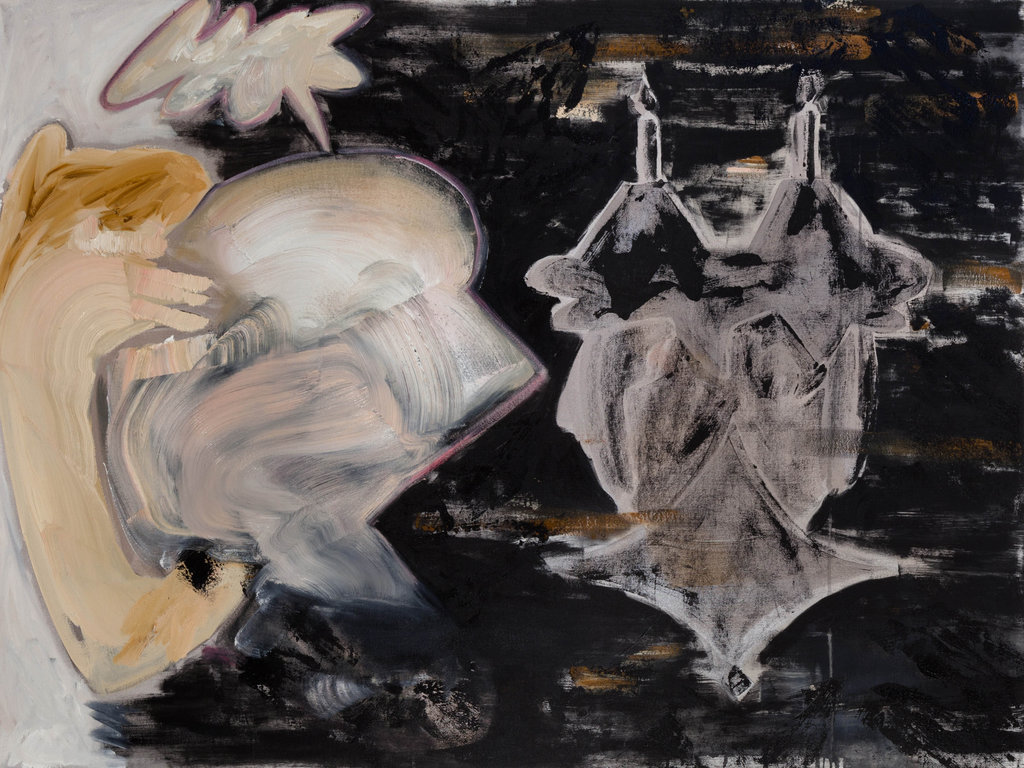
  • Kristine Moran: Affairs and Ceremonies / Daniel Faria Gallery

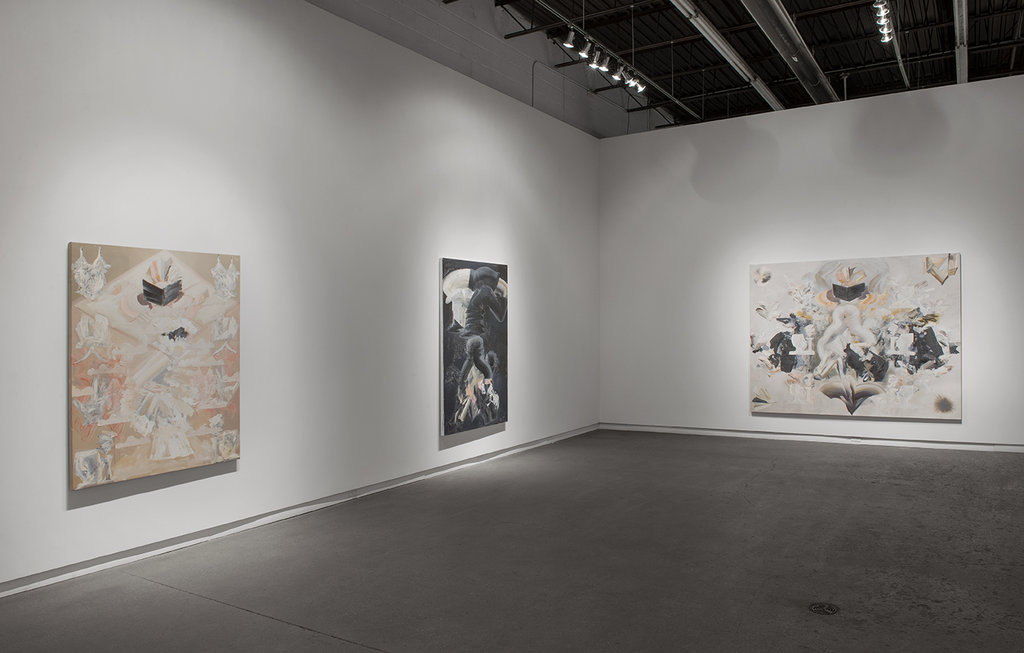
    Installation View of Kristine Moran: Affairs and Ceremonies at Daniel Faria Gallery, 2014. Courtesy of Daniel Faria Gallery

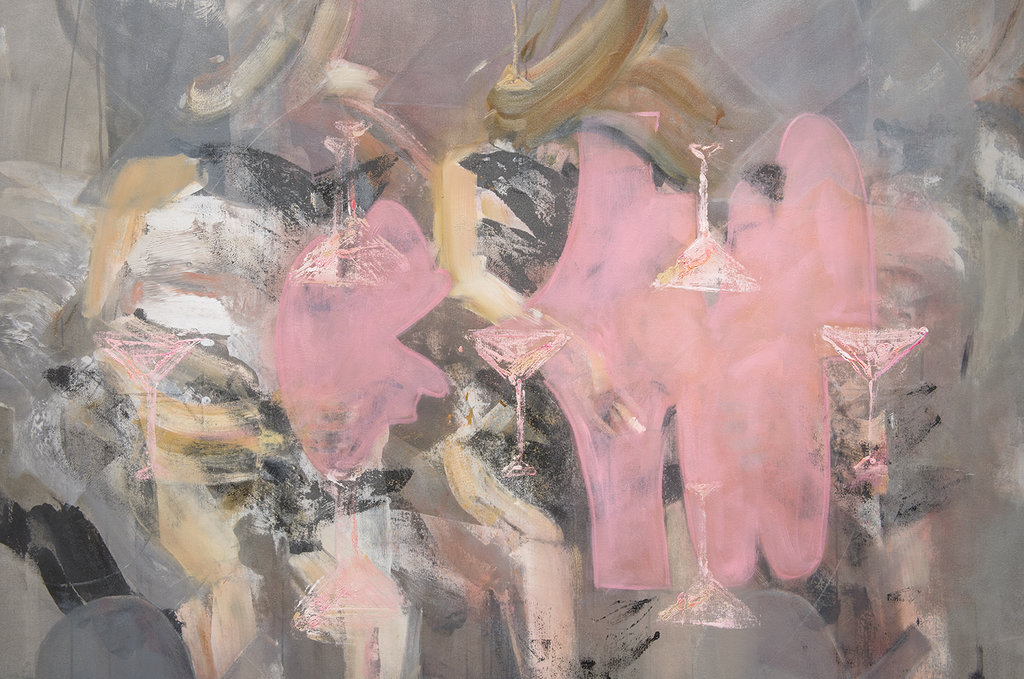
    Every ritual can reserve a certain sense of spirituality, varying from religious practices to more secular interactions and routines. On the surface, the disparity between the two seems to favor the pious ceremonies for being more obligatory and consecrated, but the opposite interpretation can occur when considered on a more personal level. Funerals and marriages, séances and love affairs, can all be considered transcendent experiences to a person, regardless of how others prioritize them. Moran’s exhibition, Affairs and Ceremonies, concerns the mystical connotations behind such events, abstracting them with largely-gestural brushstrokes and cryptic symbols to allude to their emotional impact while distorting the meaning. The subject matter, and therefore the inherent interpretation, remains essentially ambiguous in her large-scale paintings, becoming visual riddles to be deciphered.

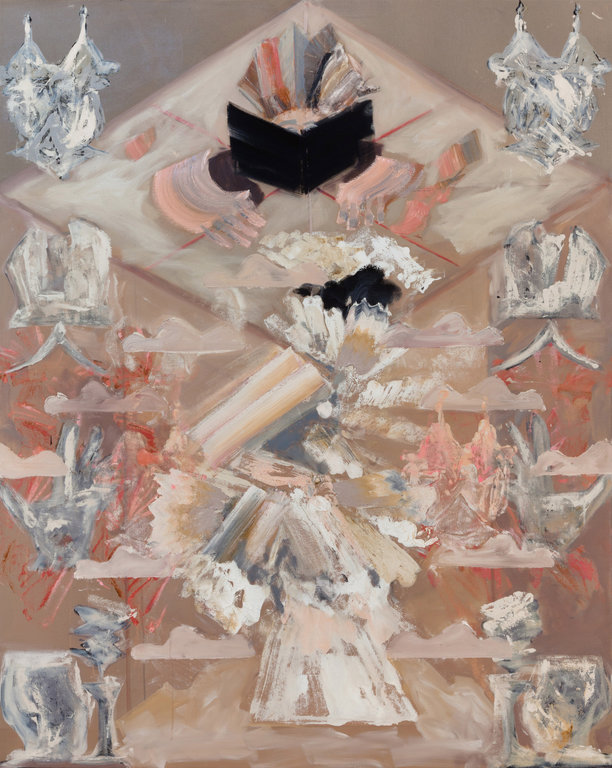
    Kristine Moran, “Funeral Procession”, 2014, oil on canvas, 78″ x 94″. Courtesy of Daniel Faria Gallery

    Moran’s work employs a variety of historical and modern artistic influences. As contemporary artist Anna Schachte describes, the works utilize the sharp light-and-dark contrasts (otherwise known as chiaroscuro) and “voluptuous forms” of the Baroque period combined with the bold, gestural layering of paint associated with the Abstract Expressionist movement. Furthermore, Moran shares the compositional organization of the Swiss abstract artist, Hilna af Klint, and the repetitive imagery of Jasper Johns. The combination of these aesthetic influences cloaks the narrative of these works behind her own set of symbols and characters. 

    Kristine Moran, “Affair”, 2014, detail. Courtesy of Daniel Faria Gallery

    Kristine Moran, “Mistaken Bride”, 2014, oil on canvas, 60″ x 48″. Courtesy of Daniel Faria Gallery

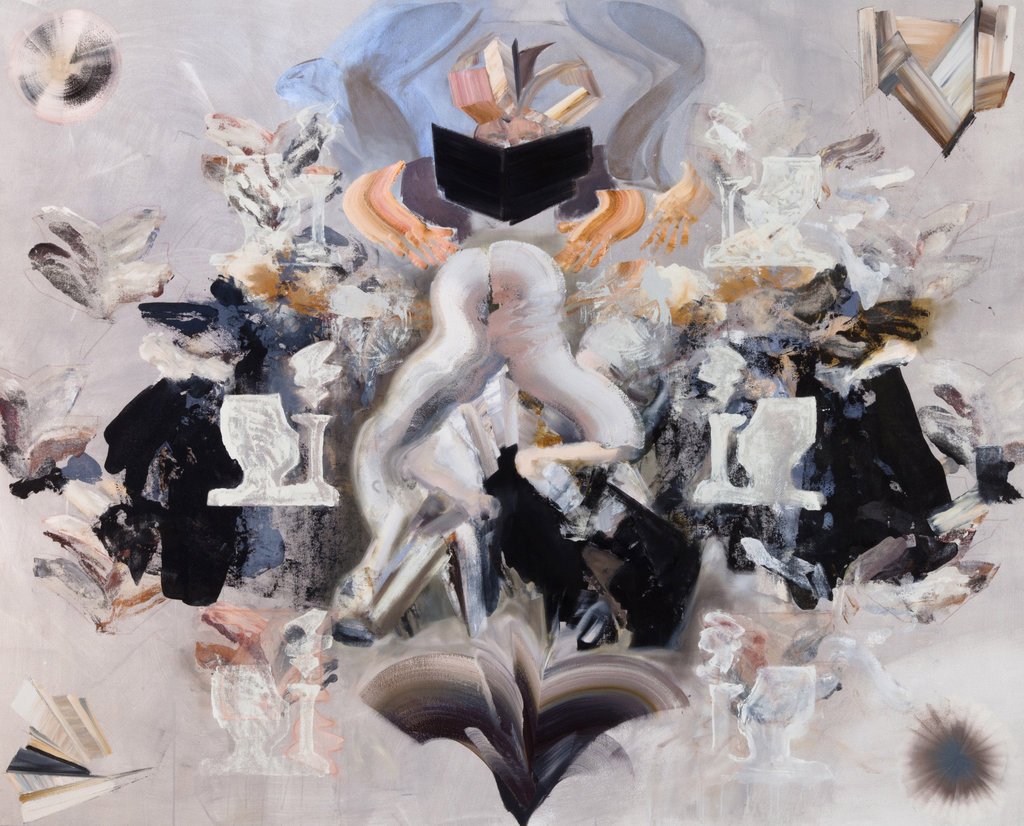
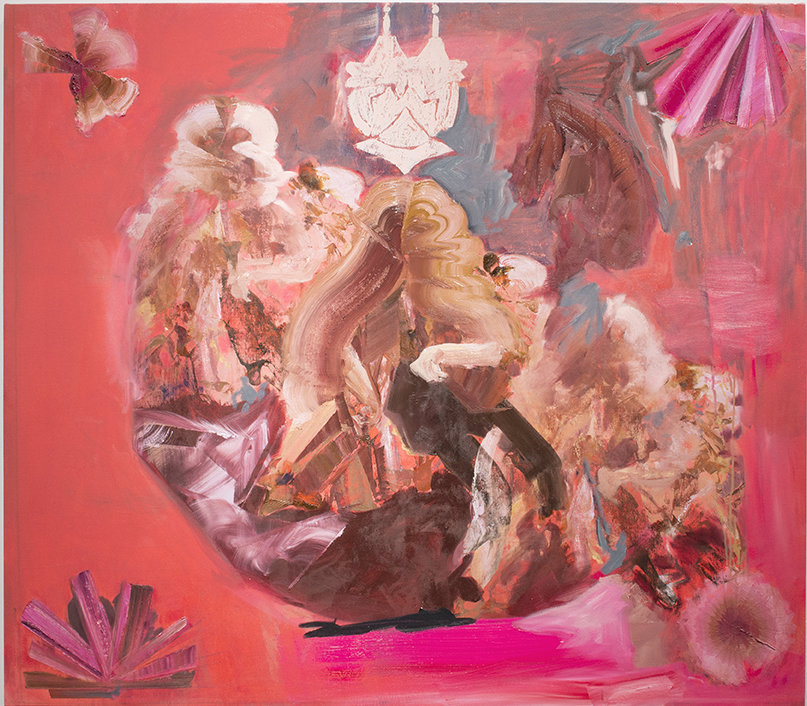
    With respect to Jasper Johns’ influence, certain images, that are either painted freehand or directly translated from a template, reoccur throughout Moran’s works. For the most part, they share in the abstract nature of her style with only subtle references to what they actually represent. For example, one of her most commonly-used symbols – seen in her works “Mistaken Bride”, “Empty Receptacle 1”, and “Séance” – seems to resemble a chandelier or candelabra, an object usually often associated with mysticism and ritualism. However, its actual purpose appropriates itself with the entirety of its respective work. In the “Mistaken Bride”, the image is repeated twice, flanking the figure holding the darkened book and wearing the large headpiece, thus suggesting the presence of an altar and consequently a priest.  Whereas, in “Séance”, the same image looms over the central figure as would most likely be the arrangement when the medium contacts lingering spirits. The image not only serves as a visual cue or encrypted diagram hinting to the work’s actual meaning, but also as a display of the relationship between the subject matter. The juxtaposition between these ceremonies, one associated with strict religious doctrine and the other considered to be a superstitious practice of the occult, is recognized but is still interconnected through Moran’s symbols and their encoded semiotics.

    Kristine Moran, “Seance”, 2014, flashe, oil on canvas, 54″ x 60″. Courtesy of Daniel Faria Gallery

    Kristine Moran, “Empty Receptacle”, 2014, flashe, oil on canvas, 36″ x 48″. Courtesy of Daniel Faria Gallery

    Yet, much like any good riddle, its true meaning cannot rely on solely one factor; rather one discovery leads to another and the same pattern continues until the true answer is found. The symbols are simply serve as another clue to determine the subject hinted by the title of the work. There is still much to consider, and Moran’s mysteries are not so simple to deconstruct and solve, like the meanings behind religious texts or Tarot cards for instance. Understanding the significance and spirituality of Moran’s works requires a deeper examination of its constituents as well as its entirety as a composition. Most part of the exhibition is looking past the objective into subjects that mere language cannot simply pronounce.

    Simon Termine

    *Exhibition information: November 13, 2014 – January 10, 2015, Daniel Faria Gallery, 188 St Helens Avenue, Toronto. Gallery hours: Tue – Fri 11 – 6, Sat, 10 – 6 p.m. The Gallery is closed from December 21, 2014 – January 5, 2015.

  • Vera Frenkel: Ways of Telling at MOCCA

    It’s five o’clock on a Saturday, the regular crowd rushes in. There is in fact an old man sitting next to me, though he’s ordered a scotch on the rocks as the limited selection at the bar doesn’t offer any tonic and gin. The place to which I’m referring is of course the “Transit Bar”, the iconic centerpiece of the Vera Frenkel exhibition currently on display at MOCCA. Originally built in 1992 for the inaugural documenta, Germany’s most prestigious quinquennial art fair, here “…from the Transit Bar“ has ambitiously been remounted for the first time in nearly twenty years. The installation not only offers a functional bar but on some nights guests are entertained by acclaimed jazz pianist Tom Szczesniak. This is not an ordinary bar however, as visitors are also surrounded by video monitors that play testimonials of immigrants who describe their crushing experiences with displacement. The stories, which are dubbed in Yiddish and Polish while subtitles in English, French and German scroll along the screen are hard to follow. There is a significant amount of noise in the bar, generated by the piano and conversations of visiting patrons. The duality of the stories of unbelonging mixed with the trivial stories of guests conversing at nearby tables reminds us of the vastly different reasons one may find themselves at a bar.

    Vera Frenkel, “…from the Transit Bar”, 1992, reconstructed 2014, installation, Museum of Contemporary Canadian Art, 2014

    The “Transit Bar“ undoubtedly acts as the centerpiece of the exhibition, making itself apparent throughout the gallery space via exposed construction materials and holes in the wall which reveal part of the bar. The exposed dry wall melds well with the scaffolding materials that accompany “Once Near Water: Notes from the Scaffolding Archive“, a video work which details the growing disconnect between Toronto and its relationship to the lake. The video tells the story of a recently deceased archivist who has documented every scaffold in the city and is passing that information on to another archivist. The dying archivist’s wish is for us to remember our city was once near water, a subtle criticism of the seemingly constant and unstoppable flow of urban development.

    Vera Frenkel, “ONCE NEAR WATER: Notes from the Scaffolding Archive”, 2008, installation, Museum of Contemporary Canadian Art, 2014

    Vera Frenkel, “ONCE NEAR WATER: Notes from the Scaffolding Archive”, video still, 2008. Courtesy of Museum of Contemporary Canadian Art, 2014

    In many instances in the exhibition, elements from certain installations bleed into surrounding works. This is at times effective, such as the exposed fragments of the “Transit Bar“ that seep into other areas of the gallery space but it can also be distracting. Such is the case when it comes to the 1977 mixed media installation “The Storyteller’s Device”, one of Frenkel’s early works composed of cinder blocks, surgical gloves, wooden beams and a cassette player featuring a recording that is rendered inaudible due to the nearby piano playing. Elements from the bar (in the form of palm trees) are also present in “Mad for Bliss”, a video installation of performance works from the late 1980’s. These reemerging elements serve to highlight certain continuities within Frenkel’s vast and extensive oeuvre.

    Vera Frenkel, “Mad for Bliss”, 1987, installation, Museum of Contemporary Canadian Art, 2014

    In all, Ways of Telling is an effectively condense survey of Frenkel’s body of work. Her interdisciplinary practice surely offers something to any prospective visitor, be they interested in video, installation, text, performance or sound. The clear highlight, however, is the “Transit Bar”, not only for its offering of whiskey but due to its tremendous historical importance. For those wishing to visit MOCCA, the exhibition is on display until December 28th.

    Mitch Billinkoff

    *Exhibition information: November 15 – December 28, 2014. Museum of Contemporary Canadian Art, 952 Queen Street West, Toronto. Gallery hours: Tue – Sun, 11 – 6 p.m. Transit Bar / Bartending hours: Tue – Wed 4 – 6, Thur – Sat 4 – 9, Sun 4 – 6 p.m.

  • A new museum in Toronto: Aga Khan Museum

    Aga Khan Museum

    Aga Khan Museum, ceiling design.

     Henry S. Kim, Director and CEO of the Aga Khan Museum.

     Aga Khan Museum, main exhibition hall.

    The architect Fumihiko Maki, of Maki and Associates, Tokyo, created a majestic building, where architectural elements are echoed by matching window blinds, sophisticated ceiling design and curated wall decorations. Following a request by His Highness the Aga Khan, light is the central feature of the space and of the exhibitions. A rich collection of stunningly decorated and wonderfully preserved illuminated manuscripts is the most unique feature of the museum. The space is activated with contemporary installations by Pakistani artists, part of The Garden of Ideas exhibition.

     Aisha Khalid, “Your Way Begins on the Other Side“, 2014, installation view.

    Aisha Khalid, “Your Way Begins on the Other Side”, 2014, detail.

     Alan Chong, Director of the Asian Civilizations Museum and the Peranakan Museum.

    From December 13, 2014 to April 26, 2015 the Aga Khan Museum is hosting the North American premiere of The Lost Dhow: A Discovery from the Maritime Silk Route exhibition, from the collection of the Asian Civilizations Museum in Singapore. The ninth-century artifacts, from a ship discovered near the Belitung Island in the Java Sea, are organized around a life-size outline of the boat, which allows appreciating the relatively small space in which the traders and their riches were crammed. The narratives and questions engendered by the display focus on cultural exchange between the Abbasid caliphate and China.

    John Vollmer, guest curator of The Lost Dhow exhibition.

    The Lost Dhow, temporary exhibition, installation view.

    Various artifacts in The Lost Dhow exhibition.

    The aesthetic dimension is enhanced with the human story that is revealed through a section dedicated to sailors’ personal items and through the cargo itself, representing the entire spectrum of wealth: from crudely painted clay plates to exquisite gold, silver and bronze objects. Even for dishware which at first glance is prominent for its aesthetic characteristics, the exhibition offers a human perspective, such as with these most peculiar cups, designed for drinking water through a small tube (the water enters the tube through a hole, concealed by the figurines). As the explanatory note indicates, according to a twelfth-century poet Fan Chengda, this way of water dispensing makes the drinking process more pleasant. Was that a rich man’s version of drinking from a straw?

     Stem Cups, probably Gongxing kilns, Henan Province, China, 825-50.

    The temporary exhibition supplements wonderfully the main collection, which dazzles the viewer with finely drawn miniatures, stunning metalwork and various luxury items. The journey generated by the historical artifacts and contemporary artworks is enriched through lectures and artistic events happening at the Aga Khan Museum, of which I would like to highlight the Wu Man and Sanubar Tursun Ensemble’s performances on February 13 and 14, in which the musicians will be exploring the interactions between Chinese and Central Asian cultures, inspired by The Lost Dhow exhibition.

    A thirteenth-century manuscript, from the main exhibition.

    Detail of metalwork, from the main exhibition.

    Text and photo: Elena Iourtaeva

    *Exhibition information: The Garden of Ideas: contemporary art from Pakistan, September 18, 2014 – January 18, 2015; The Lost Dhow: a discovery from the maritime silk route, December 13, 2014 – April 26, 2015. The Aga Khan Museum, 77 Wynford Drive at Don Mills and Eglinton, Toronto. Museum hours: Tue – Sun, 10 a.m. – 6 p.m.