Author: artoronto

  • Istvan Kantor’s Asylum

    Istvan Kantor in his show, Etude to Asylum. Photo: Sandy Baron

    The favorite medium of the revolutionary art mastermind, Istvan Kantor, is blood. In his performances he often uses his own blood to create art, like at the Theatre Centre Pop Up on July 11, 2013 in Toronto. Kantor laid down a map of North America on the floor, directly under two hanging gymnastic hoops. Pulling himself up and putting his legs through the hoops, he injected a needle into his left arm. This produced blood that dropped onto the map as he hung upside down and created a drawing with his blood over the map. In August, 2014, he painted a blood-red “X” using his own blood behind Jeff Koons’s famous Rabbit sculpture at the Whitney Museum of American Art, through Koons’ retrospective exhibition. He was arrested on the spot by the New York Police and taken to a mental hospital for examination. In 2015 he dripped his blood into the Yellow River, the “Mother River” for Chinese people, in order to achieve a mixture “between his inner spirits and Chinese culture.”

    Installation view of Etude to Asylum. Photo: Sandy Baron

    In his solo exhibition Etude to Asylumin in the Robert Kananaj Gallery, curated by Robert Kananaj, Kantor fills the space with a lot of red. One wall is covered with a huge red poster, “I AM THE REVOLUTION”” written on it. As Kantor said it “is pointing to the fact that indivisual power is the most important and should have more marks on society than corporate power. On the other hand it is also the cry of a lunatic-genius who imagines him/herself to be the king or the master of the universe.” It is always more than one possible interpretations of these works. In his installations red objects like clothes, paint and plastic toys are frequently used. On the exterior wall of the gallery there is a giant red cross scrawled by the artist himself several days before the opening. The big “graffiti” sign reveals the truth of our society: “EVERYTHING IS UNDER CONTROL!” All the red objects and paintings inside and outside of the gallery remind the viewers of blood and violence.

    The outside wall of Robert Kananaj Gallery, painted by Istvan Kantor. Photo: Daisy Li Meng

    Kantor never hides his opinion. He has always expressed his strong, even extreme, disappointment with the commercial-oriented system of today’s art scene, the lack of government support for local artists as well as the uneven distribution of resources among art practitioners. He includes noises, strong colors and lights in his installations and sculptures in order to display the tension between money and art, dominance and subordination, illusion and reality.

    Installation view of Etude to Asylum. Photo: Sandy Baron

    Deeply influenced by Joseph Beuys, the famous German theorist and performance artist, Kantor also believes that anyone could be an artist, and any material, no matter what it is, could be utilized by artists and displayed in art galleries. There are a large number of those objects in Robert Kananaj Gallery, such as a cart, paper boxes, two gymnastic hoops hanging in the middle of the space, as well as several plastic mannequins covered with archivival products made from original leftover flyers, notes, posters, cards the artist accumulated since the late 70s.

    Installation view of Etude to Asylum. Photo: Sandy Baron

    Kantor’s work reminds me of the art of Theaster Gates, an American artist and social activist. Both Gates and Kantor have a strong social sensitivity and prefer to use abandoned and discarded materials. Kantor uses stronger colors and his compositions are often collage-like. His messages scream from the walls – it is impossible to ignore them.

    Most of the work displayed in the exhibition were actually created in 2015 here and in China. Kantor’s brotherhood with Ai Weiwei and the similarity in their lives is also important. Weiwei is considered a revolutionary artist in the West but only a troublemaker for the government in China. Kantor is banned here in Canada from the AGO and the National Gallery but are welcomed in many prestigeous European and Asian media-and performance art events and exhibitions.

    Istvan Kantor with the Red Book of Chairman Mao. Photo: Daisy Li Meng

    To some extent, the space of Robert Kananaj Gallery should seem like an asylum for Kantor but instead of escaping the political turmoil of the world, he brings it inside the gallery. He soldiers on with holding a shovel in his right hand and the Red Book of Chairman Mao in his left.

    Daisy Li Meng

    *Exhibition information: Etude to Asylum by Istvan Kantor, May 5 – June 6, 2015, Robert Kananaj Gallery, 172 St Helens Avenue Toronto. Gallery hours: Tue – Sat 11 – 6 p.m.

  • Rita Leistner’s Quest for Marshall McLuhan in Afghanistan

    Rita Leistner, Easy target, 2011, digital c-print © Rita Leistner / Basetrack

    When Toronto-based photojournalist and war photographer Rita Leistner embarked on a military embed in the Hemland province of Afghanistan in 2010, she brought with her an iPhone – one of the first of its kind. She wanted to experience the perils of war in Afghanistan first-hand, and perhaps most crucially, to understand the twenty-first century need to be part of a ‘digital tribe’. She went to Afghanistan as a member of the experimental social media initiative, Basetrack. During her time overseas, Leistner adapted to taking photographs with smartphone alone. She produced images of breathtaking mountainous landscapes flanked by military camps and impactful reminders of the Taliban’s presence in the form of barren villages and handwritten signs of caution. The rapid editing of these photographs with the super-heightened Hipstamatic application and ensuing posting to twitter for all the world to see, left Leistner dissatisfied with the ephemeral nature of the project, finding herself desperately craving the “process” traditionally associated with developing photographs. 

     Rita Leistner, Proceed at your own risk, 2011, digital c-print text panel © Rita Leistner / Basetrack

    And so process she did.  Her current exhibit Looking for Marshall McLuhan in Afghanistan, is a convergence of old and new technologies, effectively working to preserve the visual history of mankind. With the help of printer-extraordinaire Bob Carnie, thirty of Leistner’s original smartphone photographs are made tangible and permanent through a nineteenth century palladium printing technique with applied tri-colour gum bichromate. Panels depicting the palladium printing process are also included in the exhibition. These prints are the first of their kind, having the capacity to survive as many as twenty generations. For centuries to come they will continue to serve as some of the artefacts of the war in Afghanistan. Leistner explains how all technology, when pushed to its extreme, reverts to old technology. While the Hipstamatic application is merely an algorithm referencing traditional photography through its retro and antique filters, Leistner and Carnie’s prints offer spectators an authentic and tangible sense of nostalgia.

    Rita Leistner, Afghanistan, 2011, digital c-print © Rita Leistner / Basetrack

    What I find to be most striking about the collection of prints is the unique interplay between the technology and the war they portray. Marshall McLuhan is known to have said, “Every new technology necessitates a new war,” and when one experiences Leistner’s series of photographs it becomes evident that the smartphone has itself become a piece of military technology. There is a remarkable element of honesty in her works which points out all parties’ uncertainty around working within this new technological context. The military’s hesitancy, for example, to allow journalists to instantaneously post images on social media sites is coupled with Leistner’s unfamiliarity with the iPhone’s amateur camera. Moreover, the subjects captured in a number of her works are required to learn how to engage with this new military equipment. The photograph depicting two American marines alongside two Afghan National Army soldiers exemplifies the different relationships that are to be had with the smartphone. While the Afghan soldiers deliberately pose square to the picture’s frame, signifying an absolute awareness of the technology, the American marines turn away so as to appear nonchalant, but are, in effect, posing nonetheless.

    Rita Leistner, Different ways of posing for the camera, 2011, palladium print © Rita Leistner / Basetrack

    And while one could argue that the evolution of technology has only hindered the possibility of authentic human connection, that posting to twitter images of makeshift petrol stations on the Afghan roadside only serves to, what Leistner calls, “Feed the beast,” the photographic series reveals an unexpected exchange between the Afghan and the American. Photographs taken from inside a mud spattered military vehicle accurately capture the conventional American perception of war and those who live among it. Amidst the dirt, two young Afghan children, eyes full of curiosity, peer into the windows of an equally unkempt  perception of America. Such an image reveals how very little difference there is between people, that although the outlook of both sides has been tainted by the failed war in Afghanistan, beauty persists — here, in the inextinguishable spirit of childhood. Leistner’s collection demonstrates that human connection ultimately prevails, even in our high-tech world.

    Rita Leistner, Through the windows of an armored vehicle, 2011, digital c-print © Rita Leistner / Basetrack

    Vanessa Zeoli

    *Exhibition information: Looking for Marshall McLuhan in Afghanistan by Rita Leistner, April 15 – May 13, 2015, Dylan Ellis Gallery, 1840 Danforth Ave, Toronto. Gallery hours: Mon – Fri 9 – 5, Sat – Sun 10 – 4 p.m. “Talk Redux”, Rita Leistner will give a final talk on May 12, 6:30 p.m.

  • Timothy Nash Johnston: Chemical Compositions

    Installation view of Chemical Compositions at Arepa Café. Photo: Sunny Kim

    All galleries should smell of freshly fried arepas and coffee. Held at a vibrant café, the setting of Chemical Compositions is the opposite of the usual gallery atmosphere. Arepa Café is loud, crowded, lively music playing, and bursting with energy. The photographs are enhanced by this atmosphere. Displayed against brick walls on the west and east side of the café, these fifteen photographs lack any didactic panels. Even though the venue had quite a high ceiling, the photographs were hung low by design, so the visitors would be forced to sit down and look around. Except for the inconspicuous postcards on tables, no sign, that an art reception was happening, existed.

    Installation view of Chemical Compositions at Arepa Café. Photo: Sunny Kim

    In fact, while sitting down with a cup of tea, I witnessed few visitors, holding the pamphlets of the festival and coming into the cafe. However, there were no empty tables or spaces to walk around in this small and busy café, so the confused guests looked around briefly and left. However, give it a chance: change the way we are supposed to view art, sit down, and relax with coffee and snacks. The art work and the atmosphere blend so well together that after a while the choice of the venue feels intentional. These photographs will look clinical and scientific in a white walled gallery setting. Here, the music seems to flow through the photos, making them move and play. Playfulness is what shines through this exhibition. Johnston’s photographs are funky, playful, and organic.

    Tim Johnston, Hydrogen #3, 2014, digital print, 22″ x 32″. Courtesy of the artist

    Created through a spontaneous yet intuitive process of combining dark room chemicals and light on paper, even the creation of Chemical Compositions invite playful experimentation. #3 from the “Blue Series” hangs on the west wall, and contains colours that cause trickery. The background colour is a deep and clear blue that evokes the sky, and the darker, turquoise blue with black patterns in the foreground make us think of an ocean with islands. So many layers exist in this photograph. Representational qualities are quickly thrown out the window and what remains are combinations of movements that are hard to label as photographs. The organic patterns made by the chemicals are intoxicating; they are as pleasing to the eye as they are complex. It is impossible to tell the scale of the subject. It could be the tiniest of spills of chemicals, or it could be a bird’s eye view of vast lands and oceans. It is hard to belive that all this vastness was created through a few spills of chemicals on a piece of paper.

    Tim Johnston, #3  from the “Blue Series”, 2014, digital print, 22″ x 32″. Courtesy of the artist

    It is also interesting that, according to Johnston, these stains will continue to change shapes and colours through time. Photographs are only evidences of one particular moment of reaction; after the picture is taken, the pattern morphs, constantly shifting to create an infinite number of compositions. One might think that the real subjects of Johnston’s art are the ever-changing spills of chemicals and the photographs only witnesses of the procedure. These photographs, for sure, capture a certain, aesthetically-fortunate moment.

    “Metal #2” also contains the vastness of land and ocean through its colours and composition. It is predominantly yellow with bits of shining metal blue. Compared to #3 from the “Blue Series”, the chemicals on “Metal #2” perhaps has been left to morph on the paper for longer, causing the stains and spills to spread more; it contains more complex marks and more overallness in terms of composition.

    Tim Johnston, Metal #2, 2014, digital print, 32” x 22″. Courtesy of the artist

    Visitors expecting a peaceful gallery to study these photographs undisturbed may be unprepared for this lively Venezuelan café setting. But try to think of it as an experience: try new foods while exploring a new kind of photographs. It is hard to separate the venue from the works; nor should they be separated because it is amusingly well-incorporated with one another.

    Sunny Kim

    *Exhibition information: May 1 – 29, 2015, Arepa Café, 492 Queen Street West, Toronto. Hours: Mon–Fri 10:30 – 9, Sat 10 – 10, Sun 11 –8 p.m.

  • Trophy: the Inverted Carousel

    Walking into the Pari Nadimi Gallery, the viewer is immediately drawn into Matilda Aslizadeh’s riveting world. Very dimly lit, the sole source of light is coming from the only work of art displayed in the room, Trophy, a tall white semi circle upon which is projected a series of images masterfully put together by the artist.

    Starring at Aslizadeh’s digital collage of images she found on the Internet, one doesn’t know whether to feel enchanted or disturbed. Like a carousel rotating around its platform with its wooden horses and circus animals, there is something rather playful and addictive about Trophy that will make viewers feel like they could look at the work for hours, as though waiting to see their favourite horse reappearing over and over again. Aslizadeh’s carousel however, is so oversaturated with images that it is hard to know which one you’re not seeing for the very first time.

    Matilda Aslizadeh, Trophy, video installation, 2014, installation view at Pari Nadimi Gallery (https://vimeo.com/127236963). Photo: Courtesy of Pari Nadimi Gallery

    Indeed, rotating around the semi circle is Aslizadeh’s own circus: a peculiar cluster of humanity’s vestiges. Trapped in a spider web of lost arches, golden pillars, baroque altars, and fluorescent angels, the viewer can make out what could be described as societal exquisite corpse: a mix and match of various Buddhist, Egyptian, Greek, Hindu, pre-Columbian, and Roman gods and deities. Copy-pasted together, the result is both surprising and conflicting. Trophy is also punctuated by glitters and sparkles. For instance, the eyes of certain mythical Gods have been replaced by colourful diamond, leaving them with bright, but empty gazes. When asked the reason behind her sparkling chaos, the artist shared that she wanted to display society’s kitsch and its constant need for entertainment.

    Matilda Aslizadeh, Trophy, video installation, detail, 2014. Photo: Courtesy of Pari Nadimi Gallery

    While the work possesses a captivating and soothing quality that is almost troubling, the music the artist chose to accompany her piece is the element that will start to make you feel uneasy about what you’re seeing. From powerful hymns to war chants; from gunshots to the sound of casino machines; from cheering and applauses to voices in distress, as the images rotate, they always seem to be juxtaposed with a new sound, its constant shifting making it very hard to interpret their meaning. 

    Matilda Aslizadeh, Trophy, video installation, detail, 2014. Photo: Courtesy of Pari Nadimi Gallery

    Interpreting Trophy feels very similar to waking up from a particularly perplexing dream; your mind is processing a lot of broken information without quite knowing how to put the pieces back together in a way that makes sense. Like the projection of a surrealist dream, what Aslizadeh seems to have unearth, is nothing less than society’s unconscious. Unearth, as in many ways, as we are looking at the ruins of our society, a youtube cemetery, something that Marinetti would have certainly labelled as a futurist party. 

    Matilda Aslizadeh, Trophy, video installation, detail, 2014. Photo: Courtesy of Pari Nadimi Gallery

    The semi circle installation is also not without reminding one of a naked Greek base column, as if Aslizadeh’s ruins were also exposed on a ruin. The images are moving up and down the column, as do the horses on the carousel. This movement gives life to the inhabitants of the artist’s deitic disorder and brings them out of their two-dimension condition until they disappear behind the carousel, inviting the viewers to venture behind the work.

    Matilda Aslizadeh, Trophy, video installation, detail, 2014. Photo: Courtesy of Pari Nadimi Gallery

    When I came out the inverted part of the carousel, I saw something that had until then escaped my eye. On the upper corner of the wall, facing Trophy, is a small projection that looks like a window. Aslizadeh told me that for her it was a kind of shrine. In dialogue with Trophy, it is of course a very atypical kind of shrine. To what or whom is the shrine dedicated? And how does the shifting image provide tribute? Finding an answer to this question becomes even more complex when considering the title of the work.

    The Pari Nadimi Gallery is perhaps the best display for Aslizadeh’s challenging work. Small and intimate, it is as though the artist created Trophy with this space in mind. While it is the only work displayed, it will capture your attention and continue to puzzle your mind long after you will have left the gallery.

    Marina Dumont

    *Exhibition information: Matilda Aslizadeh, Trophy, April 23 – July 18, 2015,  Pari Nadimi Gallery, 254 Niagara Street, Toronto. Gallery hours: Wed – Sat 12 – 5 p.m.


  • CONTACT Photography Festival 2015 / Launch Party

    Installation view with Mariah Robertson’s photo-sculpture

    Scotiabank CONTACT Photography Festival Launch Party 
    May 1, 2015 / 7 – 10 p.m.
    Museum of Contemporary Canadian Art
    952 Queen Street West

    A party was held at MOCCA launching this year’s Scotiabank’s CONTACT Photography Festival, in conjunction with the opening receptions for Part Picture, and Past Picture: Photography and The Chemistry of Intention, with Demolition Site on view in the MOCCA courtyard.

    Jihyun Jung, Demolition Site 14, Outside, 2013. Photo: Courtesy of the artist.

    As the visitors entered from Queen Street West, they were greeted with a new violent mural on the east side of the court, made by Jihyun Jung.   The harsh spotlights during the warm sunset made the mural, titled Demolition Site, scream. The Korean artist was commissioned to create this work on a 1 to 1 ratio, of a building being ripped apart, deconstructed, and on its way to ashes. A foreshadowing event for MOCCA’s current home, in anticipation for demolition, making space for new condos. Like each year, photography lovers came to celebrate the festival, crowded the courtyard in front of the museum and overpacked the interior. The artistic vision and technical processes expressed by the photographers in Past Picture continue to amuse and influence us even in this digital age with Photoshop.

    Installation view of  Past Picture with photographs by Man Ray (in front)

    Installation view of  Past Picture with Anna Atkins, Polypodium crenatum, Norway, 1854

    Curated by Chris Wiley, the collection of contemporary North American photographers sprawled throughout the museum, while Torontonian musician, Bahamas, stole the crowd with his solo performance. The title Part Picture was chosen to compliment the artists’ experimentation with mediums and variations on photography, often resulting in hybrids of photo-painting and photo-sculpture.

    Elad Lassry’s photo-sculptures in Part Picture

    Installation view of Part Picture with photographs by Ryan Foerster

     Guests of Part Picture with Barbara Kasten, Studio Construct 8, 2007 (right)

    Guests of Part Picture in front of  Hiroshi Sugimoto’s work

    Part Picture is also the perfect title for the opening night, as the performance by Bahamas, the mural, and the excited crowd overpowered the art work itself. Most of the pieces were inaccessible during the opening night. The long photo-sculpture by Mariah Robertson hung in the middle of the gallery, in front of the stage. The metallic paper with bursts of colour, its scrolls rolling from the ceiling and continuing on the floor, were tripped over and accidentally stepped on by fans. The stage was set up in front of John Houck’s large grid prints, and the rest of the audience acted as a buffer between the viewers and the art.

    Part Picture, work by Jan Groover

    Work by Lucas Blalock from Part Picture

    The opening was a party, where the aura of change hung heavy in the air. You’ve got to come back to experience this new, expressionistic quality of photography, that is addressing a new turn in defining what photography is in the art world.

    Text: Tetyana Herych. Photo: Elena Iourtaeva

    *Exhibition information: May 2 – 31, 2015, Museum of Contemporary Canadian Art, 952 Queen Street West, Toronto. Gallery hours: Tue – Sun 11 – 6 p.m.

  • Contacting Toronto: Expanding Cities

    Contacting Toronto: Expanding Cities / Alejandro Cartagena, Julia Krolik & Owen Fernley

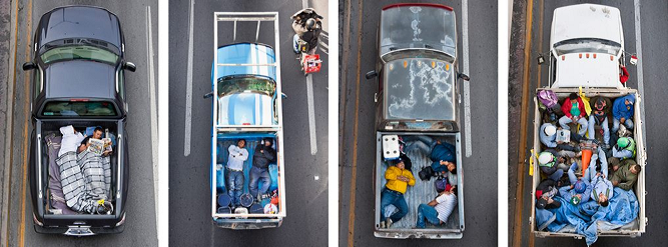
    Alejandro Cartagena, Carpoolers, 2011. Courtesy of Contacting Toronto

    To understand the cultural phenomenon of urban sprawl, one must consider both the progress and regression that comes with it. While the offer of more space, fresher air and reduced traffic congestion in suburban areas boasts a certain appeal for many, urban city centres still receive greater investment opportunities and consequently offer more growth potential for their residents. However, the tendency to leave behind densely populated cities in favour of the suburbs is often justified and sustained by the prevalence of transit hubs such as major bus and subway stations.

    Situated within Warden subway station in Scarborough, the exhibition Contacting Toronto: Expanding Cities explores the geographical, social, and political composition of suburban life, of communities on the periphery and the people who inhabit them, and the seemingly never-ending rows of cookie-cutter homes. Just outside the bounds of Toronto’s eastern limits, Warden station is a marker of hybridity – simultaneously urban and suburban – and serves as a crucial link for tens of thousands of commuters traveling to and from the city on a daily basis. Such transit lines facilitate an aesthetic shift from condominiums to cul de sacs and make car-less commuting a viable option, however it is not a luxury afforded to all people in other parts of the world.

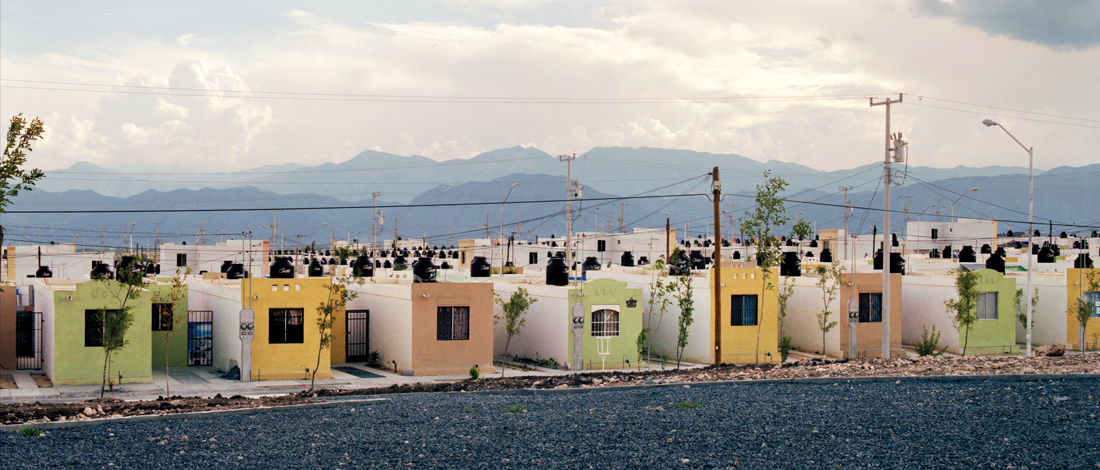
    The notion of mobility figures highly within the exhibition, specifically in the work of Mexican photographer Alejandro Cartagena, whose large-scale prints of outlying towns and the workers who build them line the station’s bus bays and subway platforms. Cartagena’s Suburbia Mexicana series (2006–2010) addresses the political and cultural effects of suburban expansion away from municipalities like Monterrey, Mexico’s third largest metropolitan area, and how the construction of less affluent adjoining towns makes living more difficult for the people who come to reside there. The towns featured in Fragmented Cities lack the necessary public transit systems and infrastructure to sustain a fully functioning community, yet property developers continually disregard issues of increased vehicular activity and environmental damage in favour of turning a profit.

    Alejandro Cartagena, Suburbia Mexicana: Fragmented Cities, 2006 – 2010. Courtesy of Contacting Toronto

    Cartagena’s photographs “shed light on the implemented neo-liberal economic strategies made by the Mexican government since 2001 that have pushed urban growth out of the regulation of the metropolitan urban plan,” and this decision by the government to allow the “urbanization” of land outside the bounds of major city centres continues to alienate inhabitants of these regions. Particularly in light of the lingering effects of the recession felt all over the world for the past number of years – from government bailouts to sliding currencies to layoffs by the tens of thousands – there has been a changing economic landscape on a global scale, and yet in certain parts of rural Mexico, money continues to be questionably invested into the building of hundreds of houses with limited surrounding amenities and services. The rows of houses pictured in Fragmented Cities feel frozen in time, as if they are abandoned ghost towns that are no longer functioning. An uncertainty exists whether or not the homes are even occupied, as the deserted streets fail to show any trace of domestication.

    However, Cartagena offers his audience a glimpse into the lives of the people who populate towns such as Juarez and Apodaca through People of Suburbia, another sub-series of Suburbia Mexicana. The artist captures images of families enjoying each other’s company outside of their homes, others returning home after a day of shopping or from a night out in Monterrey, and also partaking in activities of leisure and labour. While some portraits communicate the challenges and hard work associated with this lifestyle, others convey happiness and the pride of all that these townspeople do possess.

    Cartagena’s recent project, Carpoolers (2011–2012), adds another dimension to the debate surrounding transportation and sustainability, as it depicts the construction workers who build the housing units that make up these isolated suburban towns. The majority of these workers live in the poorer suburbs of Mexico, yet they are the same men who also build homes in wealthier suburban neighbourhoods. In a blur of public and private, the men are candidly seen from above as pickup trucks transport the workers to their respective construction sites – some sprawled haphazardly across the exposed flatbed among a detritus of tools and blankets, while others huddle together in an act of camaraderie to create more space for one another. Cartagena photographed his subjects from the same location and time atop a highway overpass over the course of a year, often showing the same men and boys on their way to work – much like the tens of thousands of commuters crowding together on the TTC each day. Despite the illegality of the Mexican workers’ transportation arrangements, lack of public transit and significant distance between their homes and their jobs leave the workers with little choice; when faced with the reality of an ongoing drug war ravaging northern Mexico, a minor moving violation seems well worth the risk in order to make an honest living for their families.

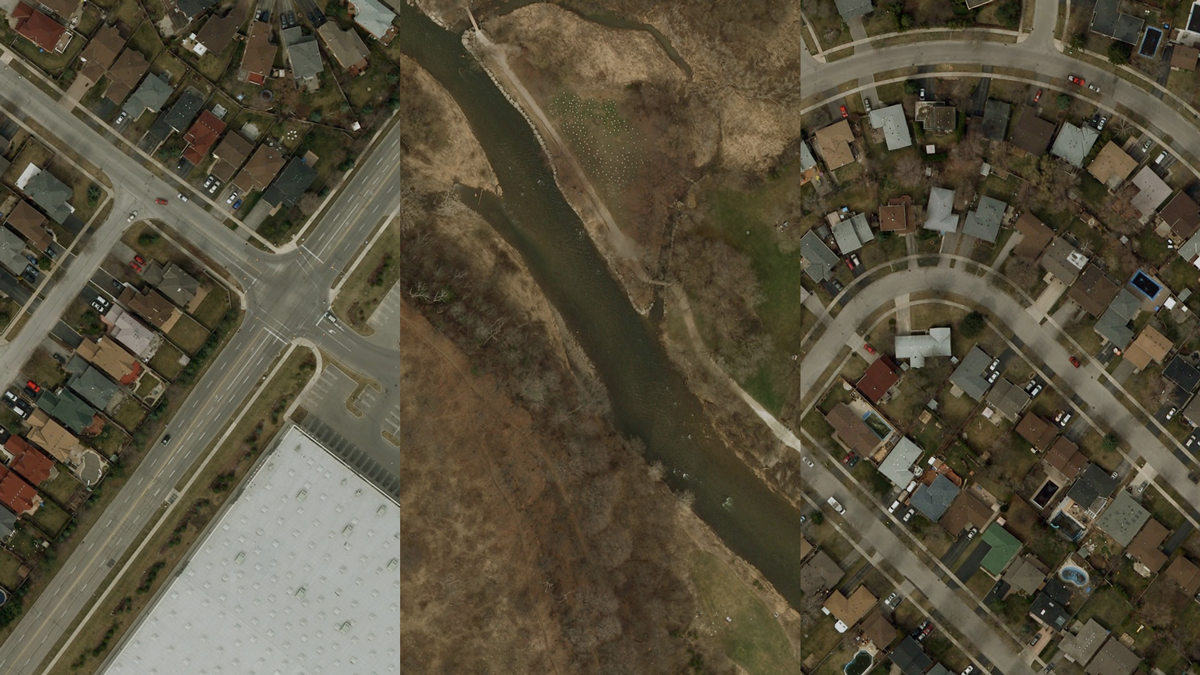
    Julia Krolik & Owen Fernley, Intersection, 2015. Courtesy of Contacting Toronto

    The changing landscape experienced by the carpoolers on their commute finds parallels with the work of Kingston, Ontario duo Julia Krolik and Owen Fernley, whose video series emphasizes a clockwork repetition across various suburban landscapes. Winner of the “Canadian Urbanism Award” at the Toronto Urban Film Festival in 2014, Intersection (2015) appropriates (with permission) Ministry of Natural Resources’ orthophotography of suburban areas north of the GTA (Greater Toronto Area). In a new iteration of an ongoing project, the artists programmed a glitch using HTML5 code to overlay images across one another in a flickering succession of seemingly identical geometric topographies. The project draws similarities with the technology of Google Earth, a virtually endless database of map-like images captured via satellite, and while Krolik and Fernley’s own potential combinations amount to over three million unique variations, the random selection of images nevertheless produces a highly uniform result consistent with the virtually identical roads, parking lots and homes across the suburbs of the GTA.

    Playing on a loop across subway platform screens throughout the station, Intersection functions exactly as its name suggests; Krolik and Fernley’s representation of suburban Ontario brings the outside environs into Warden station, while Cartagena’s representations of suburban Mexico suggest what is lacking in terms of development, sustainability and transportation. “Some cities make you lose your head, endless suburbs stretched out thin and dead,” a line from Arcade Fire’s “Wasted Hours” off of their 2010 album The Suburbs, aptly describes this pervasive phenomenon of (sub)urban sprawl, at once both alleviatory and restrictive. Rural expanses become less and less visible as townhouse developments expand into the periphery of large metropolitan areas and dominate the landscape, blurring any distinguishing features that may have once existed in favour of a new field of homogeny. However, a “blandscape” is much less of a concern than lacking infrastructure and community resources. 

    Warden station serves as a reminder for what could one day be implemented between Mexico’s major urban centres and their neighbouring suburbs, in the hope of serving communities better and providing them with the tools to become self-sustaining.

    Nives Hajdin

    *Exhibition information: PATTISON Onestop and Art for Commuters present Contacting Toronto: Expanding Cities, featuring noted Mexican artist, Alejandro Cartagena’s images on 55 advertising posters, converting Toronto’s Warden subway station into a distinctive exhibition space from May 1 to 31, 2015. Curated by Sharon Switzer.  Contacting Toronto: Expanding Cities is co-produced by PATTISON Onestop and Art for Commuters, in partnership with Scotiabank CONTACT Photography Festival, with financial support from the Ontario Arts Council and PATTISON Outdoor’s Art in Transit program.

  • Gallery TPW / Opening Party

    Thursday, April 30, 2015 / 8:00 p.m.
    Gallery TPW
    170 St Helens Avenue, Toronto

    On Thursday night Gallery TPW, the Toronto Photographers Workshop, opened their new gallery space located at 170 St. Helen’s Avenue. With a wide open door, the former warehouse welcomed several guests to large gallery spaces ready to be filled with future photographic and video art.

    For their opening, the gallery hosted one interactive exhibit, in which guests answered survey questions regarding art and contemporary display. The answers were projected onto the wall, with real-time results. With full rooms, the gallery’s opening night seemed to be a great success.

    Gallery TPW’s first exhibition is part of the Scotiabank CONTACT Photography Festival, hosting Lonnie van Brummelen and Siebren de Haan’s Episode of the Sea showing May 2- 23, 2015.

    Text and photo: Brinae Bain

  • Adrian Fish and David Holt at loop gallery

    It has long been the case that humans, and in fact all life, have a vital dependency on water for survival. However, to humans, the function of water has since extended beyond this basic need, as we use it as a resource to uphold our commodious and modernized living. Adrian Fish, in his Aquaphilia Project IV: Critical Infrastructure, explores this very relationship between humanity and this vital resource as it becomes progressively more integral to not only our health and proliferation as a species, but also to our acquired quality of living. In his more recent Aquaphilia works, he portrays the ways in which water is used for the purpose of entertainment, namely through a swimming pool, a water park, and an aquarium. Similarly, his current exhibition at the loop Gallery explores the mechanical devices and processes behind a water-waste management plant, focusing more on its aesthetic quality rather than seeking to visually explain the various components and their place in an overall schema.

    Adrian Fish, Aquaphilia #1215, 2014, Archival Inkjet print, 34 x 48 in

    Adrian Fish, Aquaphilia #1277, 2014, Archival Inkjet print, 34 x 48 in

    What is immediately noticeable about his works is the symmetrical and linear-perspectival arrangement. Upon first glance, one would believe that these works are meticulously organized by the artist to create an intentionally ordered space suited for a perfect photograph. Though this is effect, it is certainly not the case, as Adrian Fish himself said that this is how the plant is always laid out; nothing was manipulated, added, or removed. Instead, the photograph was planned to supplement the mechanical aesthetic, focusing on the visual depiction of the infrastructure. It is not meant to be an explanation of how this machines work within a grand process, which is actually supposed to be kept elusive from the viewer so that it can be considered for its value as an artistic subject and not for its function(s).

    Adrian Fish, Aquaphilia #1254, 2014, Archival Inkjet print, 34 x 48 in

     Aquaphilia IV: Critical Infrastructure #1251, 2014, Archival Inkjet Print, 36 x 50 in

    Also part of the loop Gallery exhibition are David Holt’s works collectively entitled Arcadia: a series of small-scale paintings that “playfully depict idyllic landscapes, bathers, and ancient architecture,” while combining several stylistic influences. His subject matter includes ancient Roman buildings, such as temples and old governmental institutions, and traditional Italian landscapes that feature nudes socializing or appearing to pose for a family photograph.

    David Holt, Fifteen Ancient Buildings, 2014, Acrylic on canvas/wood, varied dimensions

    To further encapsulate this candid quality, the works are generally small in scale and therefore seem more reminiscent of a memento one would carry on their person or display in their home, and the entirety of his exhibit appears as an album of select personal experiences. Moreover, there is also inspiration from Japanese literati landscapes paintings, which emphasize the natural world indefinitely while the human presence is consequently minimal and inferior.

    David Holt, Four paintings, all titled, Figure Pair, 2015, Acrylic on canvas, each 10 x 8 in but the bottom left: 10 x 9 in

    The same occurs in his works, as many of the paintings feature the calm yet dominant presence of nature in relation to the people, which is achieved by either miniaturizing the human subjects so they pale in comparison to the forests and plains and/or accentuating the color contrast between the two. However, unlike the Japanese literati images, the sense of atmospheric perspective becomes flattened to seem more like a still moment in time, thereby furthering the appearance of a photographed scene.

    Text and photo: Simon Termine

    *Exhibition information: Adrian Fish: The Aquaphilia Project IV – Critical Infrastructure (Part of Scotiabank CONTACT Photography Festival) & David Holt: Arcadia, April 25 – May 17, 2015, loop gallery, 1273 Dundas Street West, Toronto, (three doors west of Dovercourt). Gallery hours: Wed – Sat 12 – 5, Sun 1 – 4 p.m.

  • Interview with Frank Rodick

    Frank Rodick in front of Parade in Petticoat Lane (detail), April, 2015. Courtesy of the artist

    Interview with Frank Rodick (F.R) by Emese Krunák-Hajagos (E.K-H)

    E.K-H: You are an internationally acclaimed Toronto artist with many exhibitions to your credit and numerous articles about your photographs. This one is your first solo show in the city. Why have there not been any shows of your work earlier. How did you and Articsok Gallery find each other?

    F.R: Actually, it’s not my first solo show in Toronto, but it is the first in ten years. The simplest reason for that is I’ve been busy with exhibitions outside the country, mostly in the US and Latin America, also in Europe and elsewhere. I’ve generally shown where I’ve been invited. Articsók Gallery found me through LinkedIn and my website.

    E.K-H: Your show Everything Will Be Forgotten is about the past, your mother and your child-self.  Why did you decide to dedicate a whole exhibition to that theme?

    F.R: It’s because that’s my most recent work and I’ve never shown it in Canada. I did this work – in particular the portraits of my mother – in response to my mother’s death in 2010. What compelled me most were her life, her death and our relationship. As for the self-portraits – and there are self-portraits of myself as both an adult and as a child – they followed, I suppose, because of this reflective frame of mind. The death of a parent – especially one’s last surviving parent – is a seminal event for most people and it gets you thinking, more and perhaps differently, about your own life. Fates cooperated because I found a lot of old photographs and documents in family archives.

    Frank Rodick, 97532, no. 1, 2011, archival pigment print,100 x 63.9 cm.

    E.K-H: On Parade in Petticoat Lane your young mother seems to be walking down Memory Lane with a small wicker basket in her hand. She could be in any old European city but the blind musician hints at an American one. Why did you choose those elements for this photomontage?

    F.R: This image is based on an old photograph taken by my father in 1952, I believe. My parents really were in London’s Petticoat Lane according to what’s written on the back of the photograph. It’s a great picture, the best photo my father – an amateur photographer – ever did. All the figures are in the original photograph: my mother, the woman behind her, the veteran with medals and the chained monkey on his shoulder, and the blind musician. It’s really brilliant on its own. What I did was transform the image, push and pull it into the shape I wanted it to have. So I injected formal elements like the colours (the original is black and white), the over- and underlaid textures. I scratched over the monkey. I exaggerated and de-emphasized things like facial features: eyes, the shapes of mouths. The little changes – that when you put them all together can mean a radical changing of the overall image – are a version of what R Crumb called cheating – little things you do to push the image in the direction you want.

    Frank Rodick, Parade in Petticoat Lane (my mother holds her basket), 2014, archival pigment print, 100 x 152 cm. Courtesy of the artist and Articsók Gallery

    When I look at it I feel like the image is a fantastic harvest of humanity as well as part of my mother’s story. There are these tragic characters: the veteran, the blind trumpet player, and that sad chained monkey looking down. The monkey is my favourite; he slays me with his pathos. There’s the woman behind my mother who towers above her with this knowing, ominous look directly at the viewer. And there’s my mother, also looking into the camera, with what’s to me an almost mystified look, a deer in the headlights. For me, it speaks to her anxieties about life and her future – that the world would be too much for her, that its unyielding, violent reality would overtake and crush her. It’s like an apocalypse of the everyday, a sad and dark carnival.

    E.K-H: All the images are touched up and aged. They look even older than their historical time would insist, almost daguerreotype like. Why?

    F.R: My intention in manipulating the images isn’t necessarily to make them look more aged. What I’m trying to do is make the image represent something more real to me, not less. More real as an expression of something passed through my subjective self. I often quote Céline, who is maybe my favourite twentieth century writer. Céline said he wanted to create hallucinations that were more real than everyday life and carry the reader to a deeper and more compelling subjective and personal reality. I get that completely.

    Frank Rodick, Portrait, Frances Rodick (red pearls), 2012, archival pigment print, 100 x 81 cm. Courtesy of the artist and Articsók Gallery

    E.K-H: Your mother was truly beautiful but in many of her portraits her face is destroyed. It reminds me of the damage that sometimes resulted when the glass plate, photographers used, got dirt stuck on it or some acid ran on it. It looks like something similar happened to the photos of your mother’s face. The image appears cut or eroded by acids or smashed by some dirt and these attacks wiped off her identity (Portrait, Frances Rodick series). What did you intend to express with this method?

    F.R: There are a number of things going on simultaneously here for me. What I do is just start trying a lot of things and seeing what they look like, and those things that appeal to me visually, well, I work with those some more.

    Frank Rodick, Portrait, Frances Rodick (stone cold), 2012, archival pigment print, 100 x 81 cm. Courtesy of the artist and Articsók Gallery

    When I look at the obfuscations on my mother’s face I see different things. There’s the damage of Alzheimer’s disease, which is something my mother lived with longer than any human should: well over 15 years. That’s a disease that’s a personality destroyer. There’s the damage caused by not only her experiences but also the way I think she internalized some of those experiences, how she processed her hardships and also the hardships of others, in particular, the personal consequences of anti-Semitism, which, of course, found its ultimate expression in the Nazi extermination. There’s also the obfuscation caused by my own perceptions and memories, which “get in the way,” carry their own blockages and blind alleys, and prevent me from knowing her, just as they get in the way of anyone knowing anyone else. That obfuscation runs two ways – it runs from my own self to my mother, just as it ran from my mother out into the world. I mean, really, when it comes to knowing the world, knowing each other, knowing ourselves, we’re all far more blind than we are sighted. That’s the reality that I see. Another point about the markings over my mother’s face: I think they’re an expression of my anger, which, sadly, is a tendency I share with my mother, although our respective angers expressed themselves differently and in different directions.

    Frank Rodick, Portrait, Frances Rodick (you console me), 2012, archival pigment print, 100 x 81 cm. Courtesy of the artist and Articsók Gallery

    E.K-H: The other day we ran to each other at Starbucks and you mentioned that your work is currently on display at the Baltic Biennale of Photography in Kaliningrad and there is “trouble” around it. It touched a nerve of a politician who wants to remove your pieces, as he finds your depiction of your mother in that way “disrespectful”. I don’t think it has anything to do with your mother. It is a very expressive montage that addresses suffering. Death is one thing, suffering is another. Middle Europeans know suffering too well, its stages, the distortions it can make to their faces. People may relate to your works there in many different levels. There is a layered meaning in them, and a very strong one. I am sure people in Kaliningrad who go and see your photographs appreciate them more than you can imagine. Art is a political act there. Are you aware of the possibilities of different interpretations of your work? How do you feel about it?

    Frank Rodick, Portrait, Frances Rodick (from left to right: Sex, Disposal, Time), 2012, archival pigment print, each: 190 x 95 cm. Installation view from the Baltic Biennale of Photography in Kaliningrad, April 2015. Photo: Dmitry Kuryshev. Courtesy of the artist.

    F.R: The problem in Kaliningrad has to do with politics and religion. Of course, I totally accept that there will be different interpretations of my work. Subjectivity’s inherent to the whole thing. I’ve always said that the longer view of the creative act winds up being a fusion between three elements: the artist, the artwork, and the audience that interprets the work. That fusion is dynamic, largely because of the changing audience, and the changing experience of the audience. No problem there at all. In fact, I can find it very exciting when I hear interpretations of my work that I didn’t expect. When I showed my early work, Liquid City, in Latin America, the Argentines would often interpret it in light of their own recent history. They’d talk about the similarities between the blurred, anonymous figures in Liquid City and their own tragic Desaparecidos, those people murdered anonymously en masse in Argentina’s Dirty War. Obviously, that wasn’t my intention in creating the work, but that doesn’t mean the interpretation wasn’t insightful, interesting, or ultimately valid. It was all of those things, and those people did me the generous honour of taking the time to place my work closely next to their own intimate experiences.

    What I object to is careless, lazy, cynical, or pig-headed interpretation. That is, you have people who can barely be bothered to look, never mind think or feel, before they start talking about the work. Unfortunately, there’s nothing I can do about it.

    I just make pictures. I make pictures to flesh out my personal obsessions and ruminations, to amuse myself, to have something to do that doesn’t bore me and doesn’t feel like a waste of time, to do something rather than nothing, sometimes to share something of myself with others, sometimes to scratch a nasty itch. What other people choose to do with the things I make isn’t up to me.

    E.K-H: Your childhood, grotto like, images are very disturbing. They all pose a young boy’s body without limbs, mutilated (Everything Will Be Forgotten, self-portrait as child series). Why? Didn’t you have a happy childhood?

    F.R: There were times I remember as happy. When a person suffers greatly, that suffering is often visited upon their children in some way. Perhaps not every single time, but usually – it depends a great deal on how the parent deals with their own suffering. And when there’s a background of historical trauma, this pain carries a cross-generational quality that can take generations to burn itself out.

    I’ll tell you something I’m grateful for. Whatever the suffering I endured, I at least had some of the resources – whether they be external or internal – to try to make something out of that suffering that, I hope, isn’t destructive. My mother didn’t have the resources I had.

    Frank Rodick, Everything Will Be Forgotten, self-portrait as child, no. 1.2, (left) and no. 2.1 (right), 2014, archival pigment print, 100 x 70 cm. Courtesy of the artist and Articsók Gallery

    E.K-H: There is so much pain and suffering in your photographs. As Nancy Brokaw said in her essay about your work, Sex, Death and Videotape, “I take one look and ask Do I really want these images lodged in my brain? Once you’ve crossed over into the mysteries of life and death, can you get a return ticket?” Why is your view so dark? How can you live with your images?

    F.R: I don’t see my view as dark. It’s the world that’s dark. Not always, but when it is, and when it slams into you and yours, it’s transformative. I often think other people spend an awful lot of time and energy kidding themselves about the world, about other people, and about themselves. Sometimes I wonder how they live with that, especially when a crack in the carapace starts opening up. There are times when one gets a little more closely acquainted with reality’s cudgel and, after that, I’m sure the world’s never quite the same place. That’s the part where there’s no return ticket.

    Mostly, I live with my images just fine — better than I live with the world around me if you really want to know. As for the pictures, here’s what I think and don’t think. I don’t think they’re the result of compromise, or other people’s opinions. They’re not hand-me-downs, pleas for acceptance, or chips in a game where I’m trying to get ahead. They’re not propped up with a wink and a smile. They feel like they’re mine. And in this world, how many things feel like they actually belong to you? There’s comfort there.

    Frank Rodick, Three Studies for a Mouth (Explorations in statecraft, love, and the passing of woes), 2010, digital chromogenic print on metallic paper, 10.1 x 18.4 cm. Courtesy of the artist and Articsók Gallery

    Emese Krunák-Hajagos

    *Exhibition information: Everything Will Be Forgotten by Frank Rodick, April 30 – May 31, 2015, as part of Scotiabank Contact Photography Festival, Articsók Gallery, 1697 St. Clair Avenue West, Toronto. Gallery hours: Wed – Sat, 12 – 6 p.m.

    *Note: A dialogue with Frank Rodick On sons and mothers, love, hate, and death… and why we make pictures even though Everything Will Be Forgotten is accompanying Frank Rodick’s show at Articsok Gallery on Thursday, May 7, 2015 / 7 p.m.

  • a dialogue with Frank Rodick

    Frank Rodick, Parade in Petticoat Lane (my mother holds her basket), 2014, archival pigment print, 100 x 152 cm. Courtesy of the artist and Articsok Gallery

    Thursday, May 7, 2015 / 7 p.m.
    Articsok Gallery
    1697 St.Clair West

    The artist talk is accompanying Frank Rodick solo show, titled, Everything Will Be Forgotten at Articsok Gallery. The exhibition is part of Toronto’s Scotiabank CONTACT Photography Festival 2015 and is on display April 30 – May 31, 2015.

    On sons and mothers, love, hate, and death… and why we make pictures even though Everything Will Be Forgotten: a dialogue with Frank Rodick

    “For this work, I started at the end. That is, on June 15th 2010, the day Frances Rodick, my mother, died.” …

    “People make photographs, they make art, for all kinds of reasons. They do it to remember. They do it to forget. They do it because they believe in an ideal. They do it because they want to tell someone how the world is changing.

    As for me, I do it mainly because I find our internal, subjective world—which exists in our minds and bodies—the most compelling thing there is. It’s a world that’s somehow both close and far, where the darkest corners are mostly forbidden. It’s inside us but it resists discovery. That makes the whole experience of opening up this world perilous but also powerful, intoxicating. And when everything is taken away from us, up to that very last point this world is what we’re left with. Of course, the internal world I have the most access to is my own, so that’s where I dredge when I’m making pictures.” …

    “I sometimes call all these images “hallucinatory memoirs.” I don’t know how accurate they are as a record of the past. But what I can say is that they’re a candid reconstruction of my present memories and feelings of that past—hazy and seeping as they may be. And ultimately that’s all I have.” – Frank Rodick

    For more information please contact: info@articsokgallery.com

  • MONTREAL SCULPTURE TOUR

    MONTREAL SCULPTURE TOUR

     June 16 – 18, 2015

                    3 Days / 2 Nights    Double: $569.    Single: $749.

    Tuesday, June 16

    8:00am                                                 

    Depart: Canadian Sculpture Centre, 500 Church Street, Toronto

    Coffee Stop enroute to Kingston (on own – based on available time)

    11:30am – 1:00pm                         

    Agnes Etherington Art Centre at Queen’s (Admission & Guided Tour)

    ○  I’m Not Myself At All –  Deirdre Logue & Allyson Mitchell

    1:15pm – 2:45pm                               

    Buffet Lunch at University Club, Queen’s University (included)

    6:00pm                                                 

    Hotel Check-In: Hotel Alt Montreal – Griffintown

    120 Rue Peel, Montreal, QC H3C 0L8  (Tel: 855.823.8120)

    Evening: FREE

    ________________________________________________________________________________________________________

    Wednesday, June 17

    Breakfast in Coco Loco Restaurant in Hotel Alt  (not included)

    9:00am                                                 

    Depart hotel

    9:30am – 11:30am                            

    Rene Levesque Park / Musee de Lachine (Admission & Guided Tour)

    1 Chemin du Musee, Lachine, QC  H8S 4L9 (Tel: 514.634.3478)

    ○  Tour of The Collection

    Lunch (not included)

    1:30pm – 2:30pm                              

    Montreal Museum of Contemporary Art (Admission & Guided Tour)

    185 Rue Ste-Catherine, Montreal, QC  H2X 3X5 (Tel: 514.847.6226)

    ○  Point of View On The Collection – Curated by Genevieve Cadieux

    •  Lunch Option: Museum Restaurant 12pm – 2pm (not included)

    •  Museum closes at 9pm

    Afternoon: FREE

    Evening: FREE

    _______________________________________________________________________________________________________

    Thursday, June 18

    Breakfast in Coco Loco Restaurant in Hotel Alt  (not included)

    9:30am                                                 

    Hotel Check-Out & Departure

    10:00am – 11:00am                        

    Museum of Fine Arts (Admission & Guided Tour)

    1380 Rue Sherbrooke, Montreal QC H3G 1J5  (Tel: 514.285.2000)

     Metamorphoses in Rodin’s Studio

    Lunch Option:  Museum Restaurant  11:30am – 2:30pm  (not included)

    Afternoon: FREE

    4:30pm                                                 

    Depart Montreal  +  Dinner / Coffee Stops en route (not included)

    11:00pm                                               

     Toronto Drop-Off: Canadian Sculpture Centre, 500 Church Street 

    Tour designed / coordinated by Richard McNeill with Tripsetter Inc.

    Tour facilitated by Richard McNeill & Judi Michelle Young

    Please note: If interested – we have limited space and are subject to very strict hotel booking conditions – we invite you to register as soon as possible. Deposit of $369, by April 30. Balance $200, by May 20.

    Info / RSVP: 647.435.5858 / gallery@cansculpt.org.

  • GrabEx: OCAD University’s 100th

    April 29 – May 3, 2015
    Opening Night: Wednesday, April 29, 6:30 – 11 p.m.
    100 McCaul Street, Toronto

    More than 900 promising young artists and designers are exhibiting at the biggest GradEx ever — OCAD University’s 100th! This year, GradEx expands to a five-day exhibition spread across four buildings on campus including the iconic Sharp Centre for Design. The university will throw open its doors, inviting the community to see works by the creative minds of OCAD U’s Class of 2015.

    Students from undergraduate and graduate programs will show their final thesis work to an audience, some of whom attend the show to recruit new talent for their own galleries and firms.

    This is a great opportunity to check out some great OCAD talent!

    GradEx Schedule: Thursday, April 30, 9:30 a.m. – 5 p.m., Friday, May 1, 9:30 a.m. – 8 p.m., Saturday, May 2, 11 a.m. – 5 p.m., Sunday, May 3, 11 a.m. – 5 p.m.