Author: artoronto

  • Advice for the Living

    July 15 –  28, 2013
    Pattison Onestop
    screening 30 second spot every 10 minutes throughout Toronto on Pattison Onestop’s digital subway platforms screens

    Revealing, funny, candid and heartfelt nuggets of wisdom from seniors (over the age of 70) and children (under the age of 7) are set to capture the attention of more than one million daily TTC subway commuters.

    Advice for the Living is a social experiment, public intervention and video art project developed by artists John Loerchner & Laura Mendes, Co-Directors of Labspace Studio. The project explores the elusive and interrelated themes of wisdom, knowledge, and the ongoing search for happiness.

    Advice was gathered from the ‘portable advice stand’ which was built by Loerchner and Mendes, and travelled with the artists to various Toronto senior citizen residences and children’s classrooms. The pair also took their advice stand to street corners and public parks in Savannah, Georgia; and Ashville, North Carolina, as well as a senior citizen residence in Florida.

    “We wanted to solicit unconventional wisdom on happiness from two very different demographics in society often ignored for their intellectual contributions,” said John Loerchner, Co-Director of Labspace Studio. “What we hoped to discover was common ground between the seemingly naive thoughts of children and the age-old wisdom of seniors. And that’s exactly what we discovered.”

    Advice for the Living is a Labspace Studio project, produced in association with Pattison Onestop for their Art in Transit program. For more information on the project please visit http://advicefortheliving.ca//

  • Istvan Kantor’s Fame & Fortune

    Istvan Kantor performed to a packed room at The Theatre Centre Pop Up on Thursday July 11, 2013. With the entrance to the exhibition and performance open to anyone passing by on Queen West, people on the street stopped to push their faces through the doorway to see what the big deal is all about. And whether they knew it or not, what was happening in downtown Toronto’s west end was a big deal.


    Surrounded by paintings, sculpture, signs and performance artifacts that span the artist’s 40+ years of work, Istvan began his performance by playing songs he recorded in the 1980s. With a giant boom box in his hands and using the front window seat as stage, Istvan sang along to his own recordings and was joined by artist Alexander Sasha Braun who alternated between reading the book on Neoism and waving the red flag.  With lyrics “I am today, you are tomorrow”, I felt that Istvan was not only speaking to the audience and the next generation of artists, but to his past self and his past self was singing to him in the present. Known for his arrows of non-linear time and declaring its always 6 o’clock, this additional reference to time was a fine mind bend.

    What I really enjoy about Istvan is that he never succumbs to the adage and societal pressure to “act ones age”. The artist is youthfully energetic and physically fit which his performances demand of him. Moving from the window stage to the centre of the room, Istvan laid down a map of North America on the floor, directly under two hanging gymnastic hoops. Pulling himself up and putting his legs through the hoops, Istvan injected a needle into his left arm. This produced blood that dropped onto the map as he hung upside down. Like the Hanged Man on a tarot card, the artist hung there of his own will, bringing humanity through the destruction of self. And there is a lot of destruction in Istvan’s work.  He is an artist who has embraced revolution his entire career.


    As I witnessed this performance in the pop up theatre, surrounded by the artist’s life work and artifacts, I thought about the difference between this established artist’s performance and that of Marina Abramovic’s Life and Death that played at the Bluma Appel Theatre mid June. Both artists come from the same part of the world, both artists are about the same age, and I later found out that Istvan brought Marina and Uwe Laysiepen to Canada to perform for the first time when Istvan ran a gallery in Montreal. While Marina’s play was directed by another artist and had her lifted up into the clouds on wires with angel wings, Istvan climbed a rope and swung around while singing and performing with Brechtian vigor and none of the predictable theatrical pretension.

    Istvan’s exhibition, described as “Accumulated Masterpieces and Genuine Crap from Kantor’s own collection Ex Post Facto Opera Omnia Exhibition-Theater in Constant Disorder” is on display until July 28 and open daily from 3pm to 10pm. On any given day you will experience a different exhibit than the day before, as this is an inventory project. Each piece of work is being documented with the help of artist Melissa Eluik whose work is also on display.


    Istvan and Melissa are both engaging, articulate artists and very easy to talk with. Go there before the month is up, experience the art and artifacts, talk to the artists and take advantage of this opportunity to speak with a living artist who has made a huge impact on performance art not only in Canada, but on the world.

    Istvan Kantor’s Fame & Fortune Inventory runs till July 28, 2013, daily 3 – 10 p.m. at the Theatre Centre Pop Up, 1095 Queen Street West, Toronto.

  • Interview with Phil Anderson Executive Director of Gallery 1313

    Interview with Phil Anderson (P. A), Executive Director of Gallery 1313 by Veronica Scarpati (V. S)

    Gallery 1313 Executive Director Phil Anderson

    V. S: Gallery 1313 is unique in many ways: a not-for-profit artist run gallery with a board, dedicated to exhibiting local, national and international contemporary art…how did the idea for this kind of structure come about?

    P. A: Gallery 1313 is a bit of a hybrid gallery in the way that it is set up as an artist run centre but does not have core funding from the art councils, so we rely on rental income, membership dues, donations from patron members and project funding from art councils. To be a tenant in an Artscape building we were required to become a not-for-profit, and we decided to get our charitable  status in order to better allow for fundraising. Our programming reflects the diversity of the community while focusing on supporting artists by offering  contemporary art exhibitions and educational art programs. Of course, part of our mandate is that we serve as a community art gallery, and we have really become a local cultural hub over the years, taking on local projects and doing outreach projects with youth from the Parkdale area.

    Gallery 1313 at 1313 Queen Street West

    Models dressed in metal work by artists Iner Souster. Fantasy Fashion Show, 20o1

    The Grey Area, Opening Reception, December 2, 2011

    V. S: I’ve heard that you started this gallery by yourself, riding your bike from artist to artist, organizing the shows, hanging the works, doing everything yourself. How did the gallery grow into its current form and how have you evolved into your role as director?

    P. A: The idea that I started the gallery by myself is  a Parkdale urban myth, as there were many other artists and community partners involved. Perhaps I was the most persistent – but it required many people!

    Although I always enjoyed organizing and curating exhibitions, I was pursuing a career as a film director when the Board made me director of the gallery, and I slowly found myself on a different career path.   I learned by  through trial and error, and by looking to other galleries to see how they worked.

    Phil Anderson is being interviewed by Artsync host Tali Dudin

    Eco Art Exhibition, Opening Reception, January 26, 2012

    V. S: Why was choosing Parkdale particularly important?

    P. A: It basically happened that the space became available just as the Parkdale Village Arts Collective was starting back in 1994 and there were many artists in the area. You can say it was something of being in the right place at the right time, but even today the area has the highest concentration of cultural workers in the country.

    Courvoisier Opening and award celebration Wednesday, August 10, 2011. Camilla Singh, one of the show curators. On the wall, Katie Prettie: Heaven knows (No Need To Fear) 2. Photo: Zach Slootsky

    V. S: The gallery advocates stronger cultural and community involvement in the arts; what has the cultural development of the area been like since you first opened your doors?

    P. A: The area has been in transition for many years, shaking off its rough and tumble reputation for drugs and prostitution to become somewhat hip, with new entrepreneurs opening up cafes, restaurants, and as well as  a few commercial galleries. As the area became more  desirable, fewer artists could afford to remain, and many galleries have come and gone in the struggle to survive financially. It’s evolved; when Gallery 1313 set up in Parkdale there were perhaps three galleries between Roncesvalles and Bathurst along Queen St. West. Now there are over thirty.

    The Sex Show. February 6 -17, 2013. Installation view

    V. S: As you look back over the years, is there an artist’s career you’ve watched grow with particular affection?

    P.A: Recently I ran into Julia Dault, an arts writer and artist now living in Brooklyn. She was at an opening at Jessica Bradley’s new gallery where she was participating in a group exhibit, and she reminded me that her first show had been in Gallery 1313’s Process Gallery. As I recall the works were digital prints and the show pretty much sold out. I remember as well watching Shary Boyle doing a performance with Super 8 film in the gallery back in 1998 as part of a Parkdale film screening and then reading about her at the Venice Biennale. I have to say that over there years there have definitely been many precious moments where exhibits have really connected with the public and received widespread recognition.

    Shary Boyle’s installation at the Venice Biennale, Canadian Pavilion, 2013

    V. S: How many members does Gallery 1313 have? How can someone become a member?

    P. A: Gallery 1313’s membership currently numbers around fifty, with members spread out across the GTA and beyond. Each member is accepted by a selection committee according to the criteria set up and our members vary in experience and practice, so that they are able to learn from each other. But if someone is looking to apply they can certainly find the information online.

    Light Bringers, Opening Reception, July 25, 2012, guests wearing masks

    James Gardner: Frank, Window Box, May 30 – June 9, 2013

    1st Emerging Artists Show, Opening reception, January 5, 2012

    V. S: What are some of the challenges you have to face looking towards the future of the gallery?

    P. A: The gallery has had a good history and continues to build upon its local and international reputation. Like many centres it struggles to provide a variety of services as costs rise, but we continue to grow and seek to help artists along the way. In an ideal world, there would be lots of funding available to us and we would be able to expand on all that we offer.

  • Louise Bourgeois at Mocca

    When she passed away in 2010, Louise Bourgeois left behind one of the most varied and distinct artistic oeuvres of the last century. Paying homage to this long and remarkable career, the Museum of Contemporary Canadian Art (MOCCA) is currently showing a retrospective of the artist titled Louise Bourgeois 1911-2010. The exhibition is compact, featuring selected pieces from four distinct bodies of work. But even in its brevity, the retrospective offers an insightful glimpse into the fecundity of Bourgeois’ imagination and the unabashed intimacy of her art.

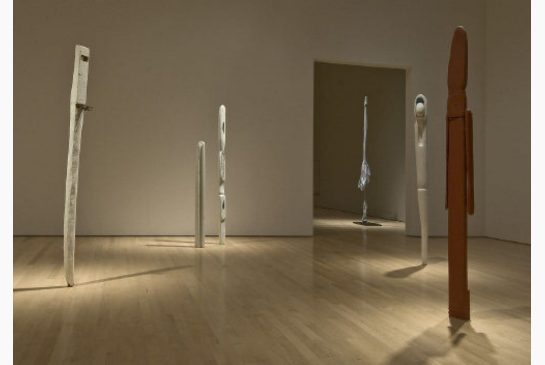
    Installation view of Louise Bourgeois (1911-2010): works from the Personages series and Forêt (Night Garden). Collections NGC and Louise Bourgeois Trust, courtesy Cheim & Read Gallery, New York, and Hauser & Wirth Gallery, London. © Louise Bourgeois Trust. Photo © NGC.

    The exhibition opens with over a dozen slender, wooden totems from Bourgeois’ early career. These slender creations are part of over 80 sculptures she produced in the late 1940s and early 1950s, after her move to the United States. Referred to as “personages,” these wooden characters are embodiments of the people she left behind in Europe, and those whom she came to know in New York. Many of these personages are psychologically charged, and not all of them are friendly. In the anthropomorphic Portrait of C.Y., for example, multiple nails have been driven into its chest area, eliciting a silent scream from a rectangular opening in the upper part of the totem.

    These animistic sculptures suggest the influence of “primitivism” – particularly wooden African fetishes – but they also evoke ties with various other European sculptural developments of the early twentieth century. Growing up in an affluent family in the outskirts of Paris, Bourgeois was surrounded by a rich visual culture of neo-classical garden sculptures, trendy decorative arts, and nineteenth century masterpieces by the Romantics to the Post-Impressionists. While she assimilated these early sources of inspiration and was always responsive to new artistic developments, she resisted being engulfed into any one style or movement. Bourgeois spoke with a visual language unique to herself, and which was continually evolving but always according to her own rules.

    Installation view of Louise Bourgeois (1911-2010): works from the Personages series and Forêt (Night Garden). Collections NGC and Louise Bourgeois Trust, courtesy Cheim & Read Gallery, New York, and Hauser & Wirth Gallery, London. © Louise Bourgeois Trust. Photo © NGC

    It is worth noting that this MOCCA exhibition displays the personages as they were originally intended to be, rather than on metal bases as they often are; each of the wooden sculptures are installed directly onto the floor without visible support, some congregating in clusters and others standing on their own. The curator has thus transformed the space into a cocktail party of zany characters, inviting the viewer to snake through the social gathering and interact with the wooden guests. Bourgeois’ interactive arrangement of these sculptures was certainly ahead of its time, preceding similar queries undertaken by Minimalism and installation art later on.

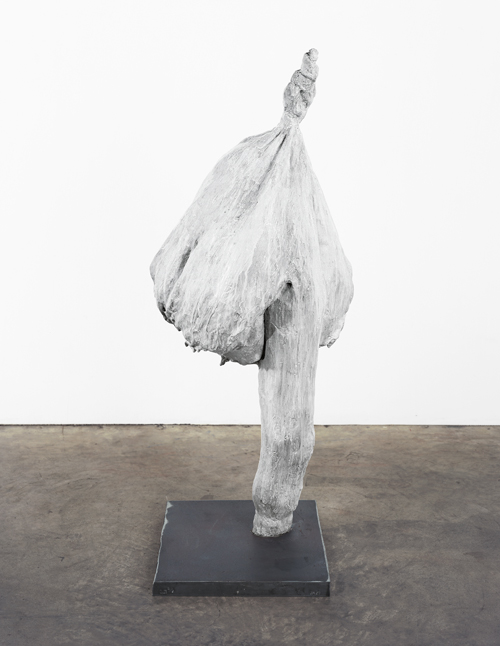
    Louise Bourgeois, Echo IV,  2007, Bronze, painted white, and steel, Collection Louise Bourgeois Trust, courtesy Cheim & Read Gallery, New York and Hauser & Wirth Gallery, London. © Louise Bourgeois Trust. Photo: Christopher Burks.

    The next body of work on display fast-forwards fifty years. These half a dozen grey, biomorphic sculptures are part of the Echoes series executed in her late career in 2007. These sculptures are bronze casts of her old clothing, stretched and reconfigured into strange formations, some cocoon-like, others slender and taught. Bourgeois wrote of the past, “you have to tell your story, and you have to forget your story.” The bronze casts “echo” her personal garments and are frozen embodiments of the memories entwined in them. These works make palpable the artist’s compulsion to create and the cathartic liberation she derived from it.

    The last work in the exhibition is also the latest work. The 2008 sculpture Cell (The Last Climb) is placed singly in a spacious room, creating an airy atmosphere for contemplation. This work is one among over twenty sculptures in the Cell series, which she produced over three decades starting in the 1980s. Compared to others in the series, The Last Climb is more serene than impassioned, and more reflective than effusive. This is not to say that Bourgeois’ creative drive had at all simmered, as this cell is as inventive and multifarious in its signification as some of her best work.

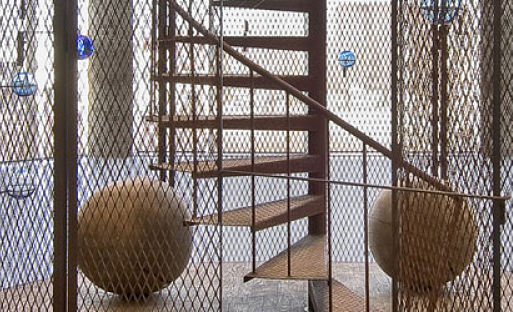
    Louise Bourgeois, Cell (The Last Climb), 2008 National Gallery of Canada, Ottawa. © Louise Bourgeois Trust. Photo © National Gallery of Canada

    The Last Climb consists of a large-scale, cylindrical wired cage housing a variety of personal and symbolic elements. The staircase spiralling up the centre of the cage is taken from her Brooklyn studio, literally transporting a part of her intimate and creative life inside the cell. A large, wooden teardrop hangs from the ceiling with numerous threads attached to it, each linked like a spider’s silk to an over-sized spool. Threads make a personal allusion to her family’s tapestry business, but they are also a classic metaphor for life and its precariousness. But while threads are helpless in the hands of the Fates, to be spun and cut, spools are also bundles of possibility awaiting creative activity. Bourgeois’ thread imagery thus reads as a moving expression of the creative potentiality of life, which is at the same time fragile and imminently breakable.

    Louise Bourgeois, Cell (The Last Climb) Detail, 2008 National Gallery of Canada, Ottawa. © Louise Bourgeois Trust. Photo © National Gallery of Canada

    The word “cell” itself, while also evoking associations with a prison, makes reference to the simplest form of biological life. In The Last Climb, Bourgeois has borne a visual microcosm of her personal life, filled with feelings and memories most pungent and intimate. As the artist herself put it tersely, “Art is a way of recognizing oneself.” The artist who is recognized in this MOCCA exhibition, however, is one whose identity is as multiform and slippery as her artistic style. Even as it distils her creative output into four sets of work, the exhibition doesn’t so much unveil Louise Bourgeois as it presents her as a complex enigma. Yet amid the dense metaphors and personal symbolism, the works on show reveal brief moments of clarity, as the viewer stumbles unexpectedly into the Heideggerian forest clearing (Lichtung). And so according to Heidegger, it is only in losing one’s way can we find the sunlit clearing.

    Amy Luo

    * The exhibition is on display till August 11, 2013 at the Museum of Contemporary Canadian Art, located at 952 Queen St W. Gallery hours: Tues–Sun 11:00–6:00 p.m.

  • Ancient Cradles and Modern Wars

    Mesopotamia and  Catastrophe! The Looting and Destruction of Iraq’s Past at the Royal Ontario Museum

    In April 2003 the ancient site of Babylon in present day Iraq, which once housed the hanging gardens and inspired the tower of Babel, was chosen as a US military site at the onset of the US-Iraq war. The following was inevitable.
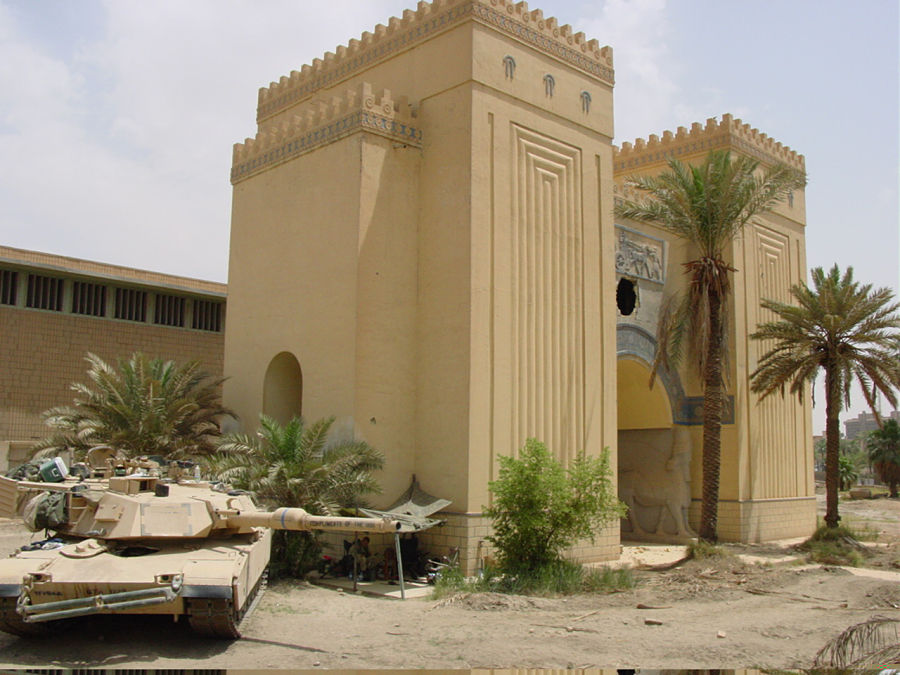
    Iraq National Museum: Damage to museum’s façade. Photo: Joanne Farchakh-Bajjaly. A U.S. tank outside the children’s section of the Iraq National Museum. On April 8, 2003, a gaping hole in the façade of this gateway was made by a U.S. tank round. The Assyrian winged bull in the gateway is similar to the one on display in the Yelda Khorsabad Court in the Oriental Institute Museum. From the special companion exhibit from the Oriental Institute of the University of Chicago: Catastrophe! The Looting and Destruction of Iraq’s Past

    Destruction and looting had always been consequences of war, very much from 4000 BC, during the time of the first settlements in the region now known as Mesopotamia. But in the 21st century we regard these sites on a world heritage level, they belong to the history of our race, they are the cradle of our civilisation. This is why the British Museum’s internationally touring exhibition, Mesopotamia, with its North American premiere in the Royal Ontario Museum of Toronto, comes at a crucial time, or is it a decade too late?
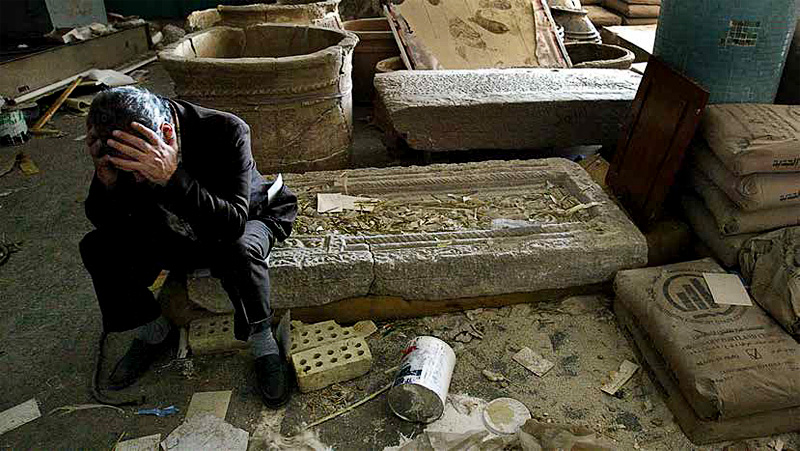
    Looting. Ten years ago, looters ran wild through the Iraq National Museum. Then they moved on to ransack the country’s unrivalled array of archaeological digs, flooding global antiquities markets with irreplaceable ancient artifacts. Now—finally—experts from Iraq and around the world are returning to the scene of the crime. From the article by Clemens Reichel as it appeared in ROM Magazine, Spring 2013

    From June 22, 2013 to January 5, 2014, museum visitors will find themselves pleasantly surprised at the level of indebtedness we owe to the fertile land between the Tigris and Euphrates rivers (Mesopotamia translates in Greek to ‘land between rivers’). Over 3500 years have been encompassed in the exhibition. Beginning from the first urban civilisations in Sumer from about 4000 to 2000 BC, to the daunting supremacy of the Assyrian Empire, 1000 to 600 BC, and ending with the short-lived but majestic dynasty of Babylon, 600 to 540 BC. The beginnings of grand narrative writing, economy, administrative trade, and empire are only some of the focal points, with objects such as clay tablets with cuneiform inscriptions (as compared to today’s iPad tablets) and cylinder seals (the first formal signatures) scattered throughout the showrooms.
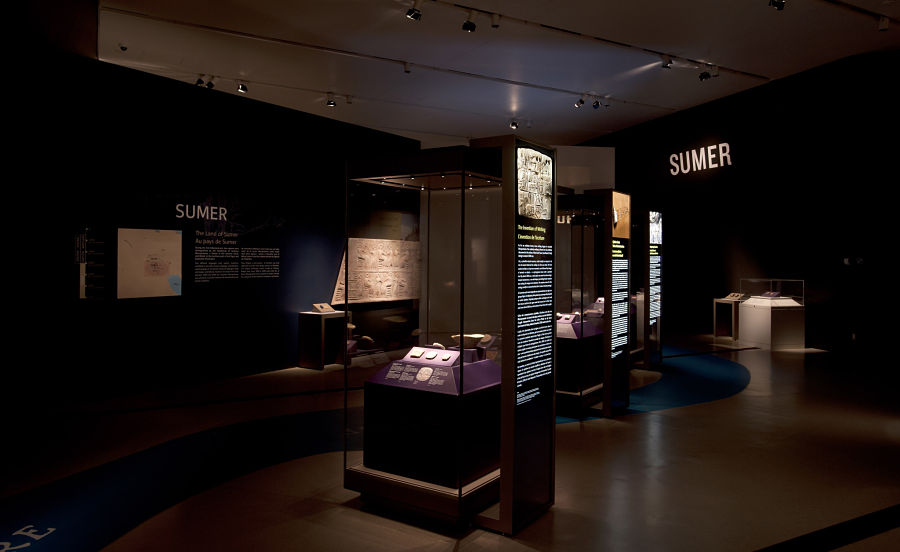
    Installation view. Photo: Brian Boyle © ROM, 2013.

    The exhibition endeavours to teach as well as entice its audience. In the Sumerian rooms from the city of Ur in southern Iraq stands a sculpture of a Ram in the Thicket on its hind legs (one of a pair from c. 2500 BC), held up by a branch to which it hopes to feed on. The modern word ‘bling’ is no-where near describing its radiance. Made of gold, lapis lazuli, shells, silver, and copper this small sculpture was once a base of a tabletop, or may have held a bowl above its head. Making it clear that luxurious objects were once used rather casually in royal homes. The archaeologist who discovered the ram as well as many more lavish grave-goods, British Leonard Woolley in 1928-9, is given a spotlight in the show.
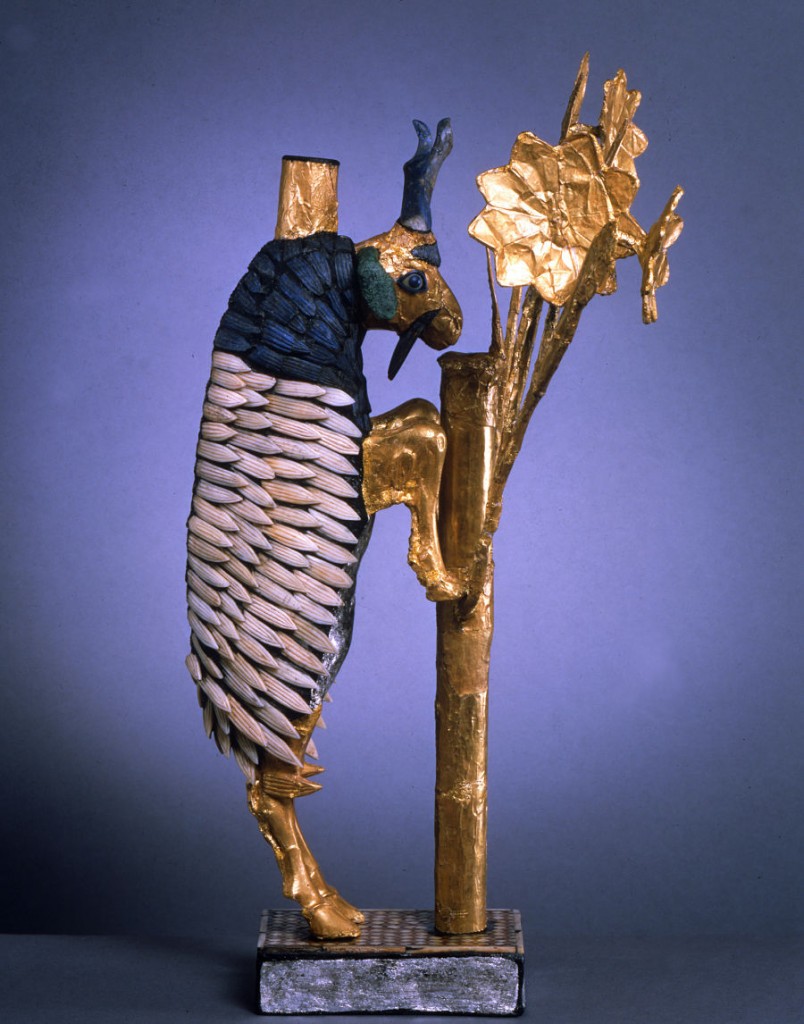
    Ram in the Thicket (side view) On display for the first half of the engagement of Mesopotamia at the ROM. Gold, silver, lapis lazuli, copper, shell, red limestone, bitumen, c. 2650-2550 BCE Iraq, Ur. H: 42.5cm; W: 28cm. Section: Sumer. Courtesy of the University of Pennsylvania Museum of Archaeology and Anthropology, Philadelphia, P.A.

    In-fact the exhibition is cram-packed with information on much of later excavators and modern interpretations of Near Eastern antiquity. It also does not shy away from describing the loss of artefacts and destruction that came about with the US invasion (as well as the previous Gulf War and WWII), through interactive videos spread across the exhibition.
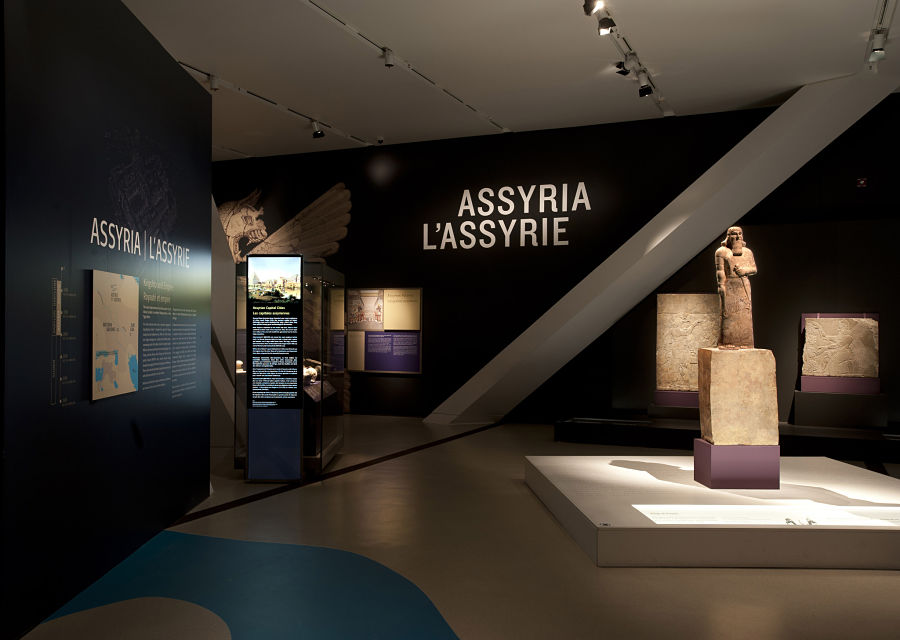
    Installation view. Photo: Brian Boyle © ROM, 2013.

    The Assyrian Empire rooms following Sumer immediately bring one word to mind, monumental. Though the largest objects from the British Museum (for example the four metered human-headed winged lions from Nimrud) could not possibly have moved, other objects stand to express the colossal stature of Assyrian palace complexes.
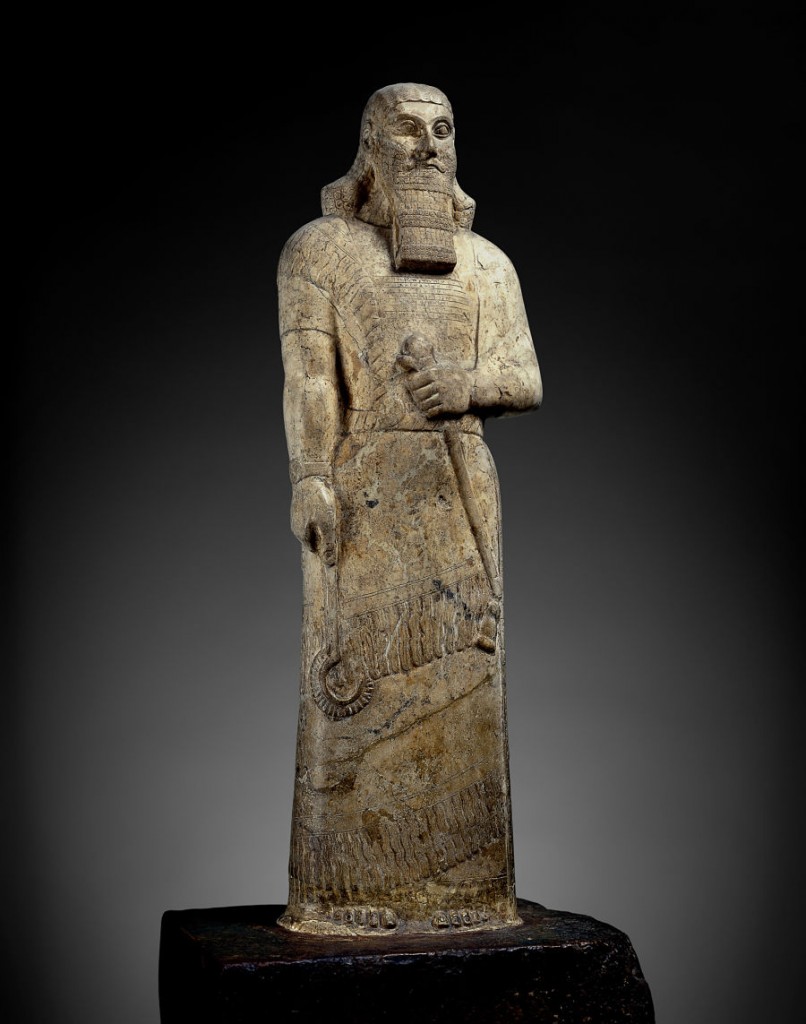
    Statue of Ashurnasirpal II. Magnesite (statue), red limestone (base), Nimrud, Temple of Ishtar Sharrat-niphi 875 – 860 BCE. Statue H : 113cm, W : 32cm, D : 15cm, Base H : 77.5cm, W : 56.5cm, D : 37cm BM 118871. Section : Assyria. © The Trustees of the British Museum

    Other than the statue of king Ashurnasirpal II (883-859 BC), which is carved in the round, the rooms are covered with shallow limestone wall reliefs with religious, historical, and lion-hunting narratives. The most impressive and largest of these is one that depicts the Battle of Til Tuba (c. 658 BC), a massive victory for Assyria against the Iranian State of Elam (though let it be known that the Assyrians never depicted a defeat, even when sources proved otherwise). The rather perplexing and clustered storyline becomes comprehensible when used with the interactive tablets placed at either side of the relief, where separate scenes are described at a tap of the finger, including many executions by beheading.
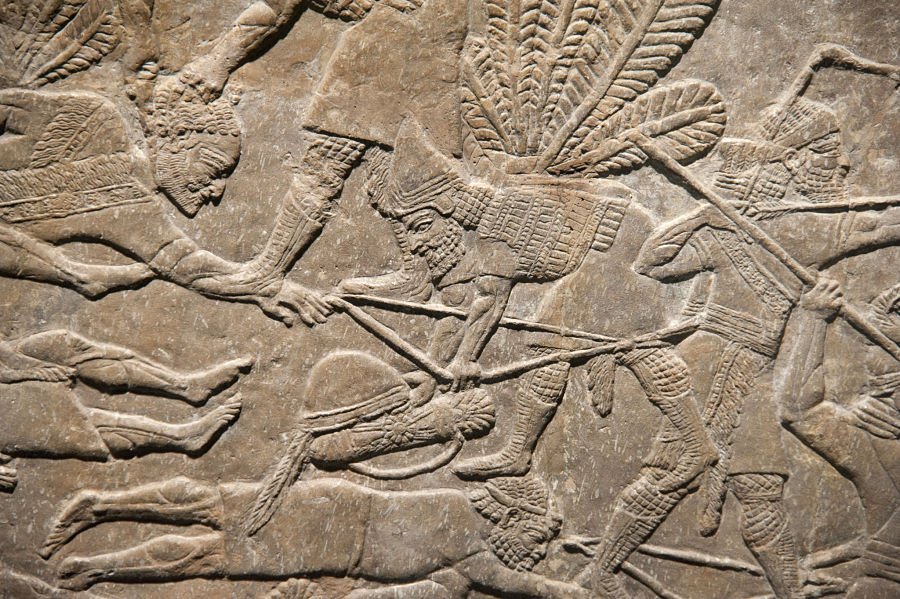
    TheBattleof Til-Tuba (detail): killing and beheading of the Elamite king by Assyrian soldiers, Limestone, 660-650 BCE, Neo-Assyrian From Nineveh, Southwest Palace, Room XXXIII. From the Collections of theBritishMuseum. BM 124801. Photo: Clemens Reichel. © ROM 2013

    The final dynasty of Mesopotamia and the most widely remembered, before Persian armies followed by Alexander the Great conquered the land, was Babylon. It also stands to be the room you will never forget in the ROM’s Mesopotamia exhibition.
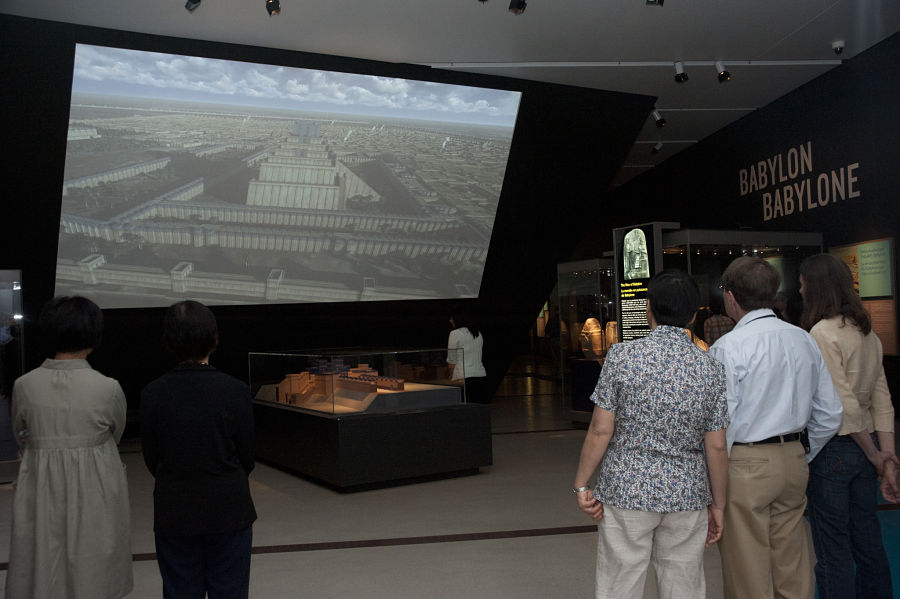
    Installation view. Photo: Brian Boyle © ROM, 2013.

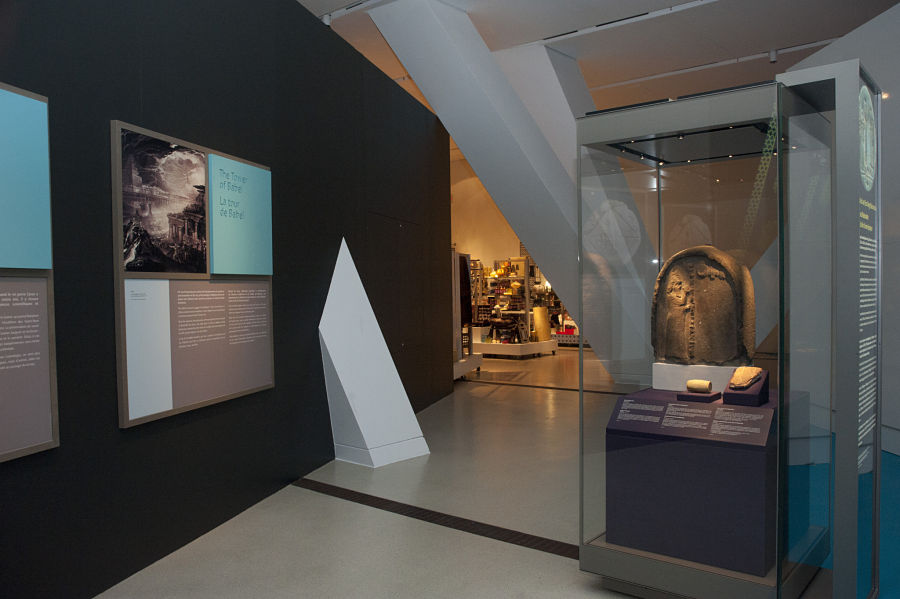
    Walking in visitors find themselves across a cinematic size projection of an animation depicting what Babylon may have been like. Meticulously and elegantly produced, the looping video compliments a large model of Nebuchadnezzar’s monumental ziggurat (Mesopotamian step-pyramid complexes) where you can find the Gates of Ishtar. It was this ziggurat that inspired the story around the tower of Babel, it could well have been the tallest human structure on earth at the time, reminding us that we still have not stopped looking up.
    Installation view. Photo: Brian Boyle © ROM, 2013.

    The very last panel in the exhibition brings visitors back to today, telling of the small excavations starting again in and around Iraq. As well as touching one more time upon the loss of information and history that can come with war, stating that knowledge is our only tool against it. Though your ethnic background may not necessarily come from the region of Mesopotamia, it is nevertheless their inventions and system advancements that pertain how we live today. Embrace it.

    Saba Askary

    *Note: The first two images are from the special exhibit from the Oriental Institute of the University of Chicago: Catastrophe! The Looting and Destruction of Iraq’s Past. It is a not part of the Mesopotamia exhibition but a separate companion show.

  • 52nd Annual Toronto Outdoor Art Exhibition

    52nd Annual Toronto Outdoor Art Exhibition
    July 5, 6 & 7, 2013
    Nathan Phillips Square
    Hours: Fri – Sat 10:30 – 7:30, Sun 10:30 – 6:30 p.m.

    Photo: Julia Hendrickson

    This year’s Toronto Outdoor Art Exhibition (TOAE) is off to a great start with Nathan Phillips Square full of artists with a variety of art works for the public to view and hopefully purchase. Last year I remember the extreme heat and this years TOAE started with some rain with more forecast for the rest of the weekend.

    Taliaferro Jones, the Director of Development and Operations had her hands full trouble shooting last minute details for the exhibition.

    TOAE  Director of Development  and Operations Taliaferro Jones. Photo: Phil Anderson

    Scores of volunteers were also busy greeting visitors and making sure they had a program. The artists were looking at the sky wondering whether to wrap or unwrap their art. The rain tapered off at least for a while.

    Photo: Phil Anderson

    I talked with artists as I visited as many booths as possible. One Ottawa based artist of Tick Tock Tom was saying how Toronto offered so much more for artists in terms of opportunities. He worked constructing some robotics from found items.

     Artist Sean Galbraith. Photo: Phil Anderson

    Artist Sean Galbraith once ran a gallery in Parkdale, Gallery DK with some fellow photographers. Sean had been part of TOAE before and was very positive about the event.

    Some young artists were having their very first time showing of their work.

    Artist Elly Smallwood. Photo: Julia Hendrickson

    The site of TOAE seemed a little smaller with the new permanent stage at Nathan Phillips Square.

    Artist Anne Cavanagh. Photo: Phil Anderson

    Artist Anya Droug. Photo Phil Anderson

    Artist Michael Rennick. Photo Phil Anderson

    There are some installations and performance works I didn’t have a chance to see. The 13 Projects were curated by guest curator Rafi Ghanaghounian and board members Rui Pimenta and Elise Hodson. This years theme was a “choice of current of issues shaping the commercialization of art, or the idea of art relief “ – relief through art, relief through the art world, or relief in the context of an outdoor show “. Best to get a program to look at the schedule of these Art Now Projects. This was supported by the Toronto Arts Council and the absolute Tent and Services.

    Artist Anne-Yvonne Jouan. Photo: Julia Hendrickson

    Artist Daniel St. Amant.  Photo Phil Anderson

     Artist Adam Colangelo. Photo: Julia Hendrickson

    There are also about $25,000 in cash awards are to given out. Art professionals will have the dire job of selecting the best in different art practices and categories. Kudos go to the 20 member volunteer board of Directors and their President, Flavio Belli for all their hard work along with the director, staff and volunteers of TOAE.

    Fibre Artist, Lizz Aston. Photo: Phil Anderson

    Just A Jar / Design Press. Photo: Julia Hendrickson

     Photo: Phil Anderson

    And to all the artists keep dry and best of luck though luck has little do with it as the art usually sells itself.

    Phil Anderson

  • MAI (Marina Abramović Institute) – Prototype

    Having been familiar with her work as an artist as well as the HBO documentary “The Artist is Present” I wasn’t surprised to hear that Abramović took over a section of Trinity Bellwoods Park to gain feedback from participants who were going to experience the Prototype MAI’s “Abramović method” over the course of the Luminato Festival (June 14 – 23, 2013).

    As stated by Abramović, her intention, with the Abramović method, is to “give the public the possibility to experience and to reflect upon emptiness, time, space, luminosity and void…in three basic positions: standing, sitting and lying down.” The input of the participants would be collected at the end of the experience and kept by the institute for the goal of refining the “Marina Abramović method.”

    The experience took part in 7 different stages:
    1/ getting dressed in white lab coats and soft silver boots and signing the MAI contract

    Orientation Chamber

    2/ physical/mental preparation: relaxation exercises (ex: massaging the face, rubbing our hands together for energy and transferring the energy to different parts of the body (ex: eyes, ears)),
    3/ water drinking chambers (drinking water that had been infused with crystals/crystal energy) (ex:rose quartz, tourmaline quartz)

    Water Drinking Chamber

    4/ eye gazing chamber

    Eye Gazing Chamber

    5/ electricity chamber (feeling electric current run through rod-shaped lightbulbs)
    6/ luminosity chamber (lying on a wooden bed and quartz pillow with eyes closed). All six rooms lent themselves to Abramović’s intention, leaving us with the last room
    7/ recording our experience (comments, critiques, concerns, etc.) on a sheet of blank white paper.

    As a participant, particularly at the beginning my Prototype journey, I remember myself over-thinking. With headphones giving us instructions, what to do and when to move on to the next room, I found myself battling my inner, judgmental, voice. For example, in the water drinking chamber, I had the searing desire to overthink, analyze and make judgments about what I was being asked to do rather than completely giving into the experience and be subjected to nothingness.

    Water Drinking Chamber

    As I moved into the subsequent rooms I began to relax and stay in the moment without overthinking. Although there were moments of discomfort (i.e.: lying on the quartz pillow and staring into my friend’s eyes for what seemed like half an hour) the challenge was to overcome the uneasiness and reflect on nothingness, to live in that moment and be open with one another, and open to our surroundings. Moreover, for those reasons, prototype has the potential to be an incredible bonding experience for both friends and strangers. It is also an opportunity to gain insight into our reservations, particularly our inability to be vulnerable with others, our environment and ourselves.

    Luminosity Chamber

    After removing my lab coat and soft silver boots, I left Trinity Bellwoods Park feeling as if I dreamt the past 2 hours of my life (unlike the 6 hours on the document shown below). This was mostly because the white walls, chairs, lab coats etc. reminded me of Tim Burton’s interpretation of Willy Wonka’s factory if it were transformed into a participatory contemporary art exhibit/happening. All joking aside, beyond the surrealistic atmosphere, it served as a moment of reflection and it exposed areas of my relationships with others/myself that need to be improved upon. Marina Abramović Institute’s Prototype made for a place of calm and contemplation that contrasted the hustle and bustle of Queen Street West.

    Leanne Simaan

    Photographs from Luminato Live stream

  • Arthur S. Goss: Works and Days

    For many years, some images by Arthur Goss, Toronto’s official photographer from 1911 until his death in 1940, have been broadly familiar to Toronto gallery-goers and people busy with local history and tradition. The pictures most often chosen for public display have been of two kinds: first, poignant portrayals of slum-dwellers that Goss did for the city’s health department; and, second, images that document the construction of heroic public monuments such as the Prince Edward Viaduct.

    Arthur S. Goss, Bloor Street Viaduct Photographs, General View – Railway Tracks, October 18, 1912. City of Toronto Archives, series 372, sub-series 10, item 48.

    So it is that, over the years, a certain impression about Goss has been created by his curators–that he was, on one hand, an dauntless exposer of urban blight in the tradition of Jacob Riis and Lewis Hine; or, on the other, that he was an enthusiastic celebrant of Torontos architectural transformation from a large Victorian city into a 20th century metropolis. To the best of our knowledge, he was neither.

    Arthur S. Goss, Pier, 1928. City of Toronto Archives, series 372, subseries 1, item 898.

    The pictures he took were done on assignments by this or that department in the municipal government, and their intention appears to have been nothing more glamorous than the capture of some quotidian fact in the visual environment for circulation in the city bureaucracy.

    Arthur S. Goss, Telephone Pole, Victoria Lane, March 14, 1912. City of Toronto Archives, series 372, subseries 58, item 105.

    What interested Blake and me most from the outset of this project was the highly routinized practice that produced the vast majority of Goss images in the City of Toronto Archives–images that embody perfectly the cool, rational urgencies typical of the institutions (such as city governments) created by cultural and social modernity.

    Arthur S. Goss, News stand, Northeast Corner of Gerrard and Jones, 1937. City of Toronto Archives, series 372, subseries 58, item 1457.

    I do not mean to suggest that there is anything ordinary, apart from the subject-matter, about these photographs. On the contrary: we found them fascinating documents of what happens when the ideological gaze of official power is turned on the city fabric, and the shutter clicks. Things that are below the threshold of artistic subject-matter become visible for the first time. Things and situations and places that one might think unworthy of representation become compelling. Blake and I invite you to share the intellectual and sensuous adventure that has resulted in Arthur S. Goss: Works and Days.

    John Bentley Mays

    *From the Opening Remarks, June 18th, 2013. The show is open June 19 – August 25, 2013 at Ryerson Image Centre, University Gallery, located at 33 Gould Street, Toronto. Gallery hours: Tuesday, Thursday & Friday 11 – 6, Wednesday 11 – 8, Saturday & Sunday 12 – 5 p.m.

  • Toronto Outdoor Art Exhibition

    52nd Annual Exhibition
    July 5, 6 & 7, 2013
    Nathan Phillips Square
    Hours: Fri – Sat 10:30 – 7:30, Sun 10:30 – 6:30 p.m.
    http://www.torontooutdoorart.org

    The Toronto Outdoor Art Exhibition [TOAE] is a juried showcase featuring contemporary fine art and craft that takes place annually on Nathan Phillips Square, every July.

    As the largest juried outdoor art exhibition in Canada, TOAE offers a fresh-air alternative to conventional art shows and galleries. Hundreds of artists participate and an estimated 100,000 visitors attend the exhibition every year. Side by side, established artists, undiscovered talents and innovative students sell their work directly to the public and make lasting connections with art dealers and collectors.

    The Toronto Outdoor Art Exhibition is also presents Art Now, a program that celebrates the diversity and vibrancy of Toronto’s art community through installations, performances, video, sound and other media that have traditionally fallen outside the parameters of TOAE. Now in its third year, the program features more artists than ever in a new, dedicated space on and beside the stage. Guest curator Rafi Ghanaghounian, with board members Elise Hodson and Rui Pimenta, formed the curatorial committee that selected 13 projects from an open call.

    Artists were invited to respond to a choice of themes: current issues shaping contemporary art; the role of the art fair and the commercialization of art; or the idea of “art relief” – relief through art, relief from the art world, or relief in the context of an outdoor art show.

  • WHAT IS EMERGING?

    The Panel discussion is part of the exhibition: Summer Emerging Artist Exhibition 2013 in the Main, Process & Cell Gallery on display June 26 – July 7, 2013.

    Gallery 1313 is located at 1313 Queen Street West. Gallery hours: Wed – Sun 1-6 p.m.

  • STROLL CITY

    June 24 – July 7, 2013
    Shawn Micallef
    Pattison Onestop
    screening 30 second spot every 10 minutes throughout Toronto on Pattison Onestop’s digital subway platforms screens

    Explore Toronto on the TTC subway screens with Stroll City!

    Add your tweets to Shawn Micallef’s urban reports and observations. Pattison Onestop and Shawn Micallef have teamed up for a fourth year to present the popular city-wide, interactive media-art project, Stroll City from June 24 to July 7, 2013 on the network of Pattison Onestop’s TTC subway platform screens throughout Toronto. Starting June 24, Toronto flaneur, Shawn Micallef will tweet his discoveries at the Twitter handle @StrollCity (in addition to his personal feed @shawnmicallef), and invites all Torontonians to respond with their own comments, replies and findings. Share your on-the-spot discoveries and observations with the @StrollCity account, which will then appear as part of a rotating, 30-second spot every 10 minutes throughout the day on the TTC platform screens in over 60 stations across Toronto. “Each year we do Stroll City more people have participated and the observations get even better,” says Shawn Micallef. “This year I hope we get tweets from the edges of Etobicoke and Scarborough, and everything in-between.”Join, follow and discover Toronto with Shawn Micallef @StrollCity.

  • Yigal Ozeri: Territory

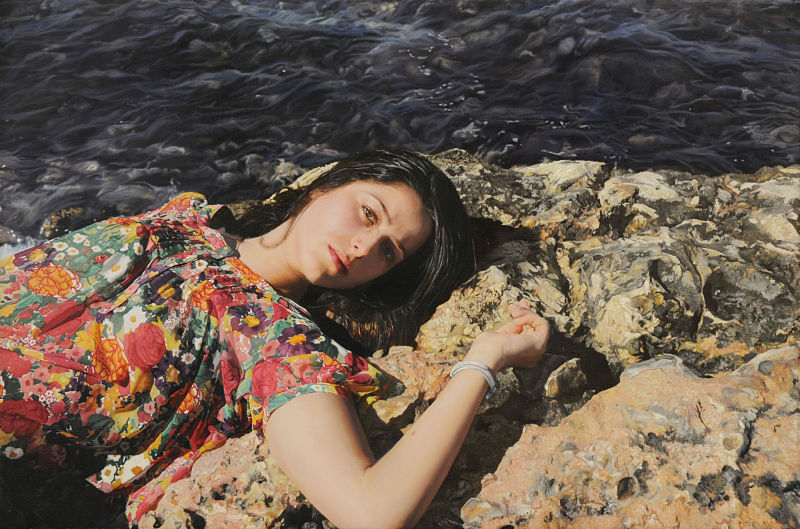
    In his first Canadian solo show presented by Angell Gallery, Yigal Ozeri makes a sensory impact. The Israeli-born and New York-based artist is showing a new series of lush photorealist paintings titled Territory, alongside photographs and a video. Staying within his characteristic domain, this body of work presents Pre-Raphaelite-inspired portraits of beautiful young women in bucolic settings. But Ozeri explores a more complex subject in this series, casting young female Israeli soldiers as the protagonists of his work.

    Yigal Ozeri, Untitled, Territory; 2013, oil on canvas, 60 x 90 inches. Courtesy of Angell Gallery

    Ozeri’s painted portraits on canvas and paper have a mesmerizing photo-like finish. His high-definition style follows from the lineage of the postmodern return to illusionism spurred by a group of American painters in the 1960s. These artists exploited photography and trompe l’oeil devices to create life-like images that taunted you to look twice – is it a photo or is it a painting? Such flagrant disregard for modernist tenets puzzled critics at the time; in parallel with the rise of conceptual, land, and performance art – all of which sought to abandon object-making and the studio – illusionistic art seemed downright counterrevolutionary. But by the1970s, these paintings were being exhibited widely and to warm public reception. There was clearly a thirst for art that was once again visually pleasing and, well, collectible. In that decade, several interchangeable terms were coined to reify this tendency, among them “Photorealism,” “Super Realism,” and “Hyper Realism.”

    Yigal Ozeri, Untitled; Territory, 2013, oil on canvas, 20 x 30 inches. Courtesy of Angell Gallery

    Ozeri’s photorealist paintings reveal impressive craftsmanship and disciplined dedication. Executed meticulously after photographs, the painted surfaces of his works are precise yet sensual. They adeptly capture various idiosyncratic sensory qualities – the glow of moist skin under sunlight, the weight of a wet dress clamping onto the body, and the brutal force of waves crashing into rugged rocks. Much like in a photograph, areas of detailed, sharp focus are seamlessly integrated with more painterly zones of soft focus. But Ozeri seems not be concerned with just replicating the photograph, nor just replicating real life. Instead, his work takes reality and transports it into a dreamlike and mythical realm.

    Yigal Ozeri, Untitled, Territory, 2013, oil on canvas, 42 x 60 inches. Courtesy of Angell Gallery

    The majority of the series is comprised of portraits of a beautiful young woman in a floral dress. She lies half-submerged in water, her skin covered in a soft veil of sunlight. This dreamy idyll, however, is tempered by a hint of the ominous, as her repose and long brown hair spur an immediate association with John Everett Millais’ tragic Ophelia. The theme of death asserts its presence even more when the viewer recalls the subject is not just a beautiful woman and a mythical nymph, but also a soldier serving in the Israel Defense Forces (IDF). In several works, the woman’s expressive gaze falls directly on the viewer. Her eyes become a portal from the idyllic dream world to the disquieting realities of political conflict and violence. When a woman comes of age in Israel, she is required to give two years of military service in the IDF. The knowing but vulnerable gaze of this young soldier reveals a girl who’s had to grow up too fast. The ambivalent tone of Ozeri’s paintings reflects the ambivalence of lived reality for soldiers in the IDF. Just as his art tethers between the real and the ideal, individual actions are fraught by the tension between agency and duty, between national defense and violent offense, and between land rights and human rights.

    Yigal Ozeri, Untitled, Territory, 2013, oil on canvas, 60 x 90 inches. Courtesy of Angell Gallery

     Amy Luo

    * The exhibition is on display till August 10, 2013 at Angell Gallery, 12 Ossington Avenue. Gallery hours: Wed – Sat 12 – 5 p.m.