Category: FEATURES

  • Photography is Hard at Daniel Faria Gallery

    Photography is Hard at Daniel Faria Gallery

    Photography is hard? It’s never been easier to take pictures. No settings, no focus. Point. Shoot. Done. We take so many that three quarters of digital photos are never looked at again. For the one quarter that are keepers, easy to use filters elevate the mundane closer to perfection. Taking photos is not hard. 

    But, making photographs that are engaging, making images that attract a viewer’s full attention, making something that stands out in an oceanic flow of images – now that is hard.

    Photography is Hard at Daniel Faria Gallery showcases work that transcends this difficult threshold. It presents photo-based work that manages to be engaging and enigmatic. It’s a show that starts you off thinking you know what we’re about to see and then trips you up, leaving you wondering: what exactly are you looking at?

    Installation view of Photography is Hard at Daniel Faria Gallery

    In Shannon Bool’s series of images, you first see silhouettes of mannequin-like figures. The images are from fashion illustrations, but the models and their clothes have been replaced by images of dense cityscapes. At first impression you might think this to be a Photoshop collage. Only when you look very closely do you perceive how they’ve been put together. The images are physically layered. The fashion images are printed on paper and the urban images are overlaid on transparent film. The layers are held together by delicate, tiny stitches of thread. It’s only at the edges and the corners that you find clues to the construction of these collages.

    Shannon Bool, St. Manilla, 2021, fine art print on Baryta, fine art print on transparency photo film, 13.2 x 9 in

    In Chris Curreri’s large tryptic, three images of a body are revealed in sharp chiaroscuro. In each image, the face is turned away from the camera and the shapes and geometry of the contorted body are the primary focus. It takes a while before you notice some curious anomalies. Does that arm in the left image seem to go through the body? And in the central frame, can we see through the black circle to the back of the room? Surely some digital manipulation is at play here. But no, the model, a simple black tube, and the camera have been aligned in such a way that it only appears to be impossible. The unadorned studio setting underscores the lack of technical artifice.

    Chris Curreri, Model in the Sculptor’s Studio, 2010, chromogenic prints, 56.4 x 41.4 in (each)

    In Steven Beckly’s The Rescue the star shaped pendant is not in the photograph but is a physical object suspended in front of it on a silver chain. Like a cat chasing a shiny bauble, we’re drawn into the image. Behind the picture plane, we follow a hand behind the pendant. We’re flipped around through another frame, this time a mirror, to follow the arm further in. Over the shoulder there is yet another frame, this time a window to the outside. The experience feels cinematic and animated even though we’re looking at a still image. 

    Steven Beckly, The Rescue, 2020, framed photograph, silver chain, crystal, 42.75 x 30.75 in.

    The title of the show borrows its name from a photo collage by Elizabeth Zvonar. The central image of Photography is Hard is a reproduction of a drawing by Lucian Freud. One eye gazes diagonally past us while the other eye is darkened. The drawing has been cropped and placed over a background image of three arms outlined by the thin sharp shadows of a camera flash. Obscured by the collaged face and a white blur, two of the arms may be holding a camera while the third hand appears to focus the lens. Or are the two central arms manipulating the head, controlling the direction of the gaze? Is the raised finger and the lens drawing attention in a different direction? The image simultaneously invites and frustrates interpretation. 

    Elizabeth Zvonar, Photography is Hard, 2019, digital inkjet print on Baryta, mounted on dibond, 58.5 x 46 in.

    Viewed on a screen, you might assume that the shadows and reflections in Nadia Belerique’s work are the inadvertent result of documenting the piece in a daylit space. But those spectral artefacts are part of the image. Light, reflections of the background, and the artist herself become compositional elements. In her studio, Belerique has staged an assemblage of images and stickers mounted on a wall, as well as on a piece of glass in front of the wall. Up close, the artist shows you how it’s all been put together. Some of the stickers are reversed and you can see the glue side. There’s tape visible and the image with the mice curls away from the wall. Shadows reveal the distance between wall and glass. But even with the process exposed, the illusion persists. From across the room, the photograph looks three dimensional, like layers of glass or resin.

    Nadia Belerique, In The Belly of a Cat Part 2, or Run, 2018, inkjet print on dibond, 34 x 49 x in.

    Try and see this show in person. There’s more to these works than an online preview can convey. The work is rooted in photography, but the pieces have physical and material qualities that extend beyond what can be experienced on a screen. As varied as the practices of these artists are, one thing they have in common is that their work tells the story of its making. We don’t just see the finished pieces, in addition to the implied presence of a camera, you also perceive the presence of the artist. 

    Mikael Sandblom

    Images are courtesy of Daniel Faria Gallery

    *Exhibition information: Photography is Hard Group exhibition showing artworks by Steven Beckly, Nadia Belerique, Shannon Bool, Chris Curreri and Elizabeth Zvonar, August 7 – September 25, 2021, Daniel Faria Gallery, 188 St Helens Ave. Toronto. Gallery hours: Tue – Fri 11 am – 6 pm, Sat 10 am – 6 pm.

  • Howie Tsui at The Power Plant

    Howie Tsui’s first institutional solo show in Toronto is a partial continuation from the 2020 exhibition, From swelling shadows, we draw our bows. The exhibition features a variety of Tsui’s works, many addressing the artist’s experience growing up between Chinese and Colonial cultures: Hong Kong, Lagos, and Thunder Bay. Tsui’s works incorporate Hongkongese aesthetics and forms of Chinese modern and traditional art, particularly wuxia, to “examine the complexities of diasporic experience and question Chinese monoculturalism”.

    Howie Tsui, Retainers of Anarchy, 2017, 5-channel algorithmic animation sequence, 6-channel audio, 11’1 x 79’ 4 in.

    As soon as you walk into the exhibition, your attention is immediately drawn to Retainers of Anarchy (2017), a five-channel algorithmic animation spanning two full gallery walls. This animation is made of various hand-painted ink drawings, with a background inspired by the animated scroll River of Wisdom (2010). Instead of River of Wisdom’s idyllic marketplace setting, this work is placed in the Kowloon Walled City, a tenement in the fringes of British-occupied Hong Kong from 1898 to 1994, once considered the densest place on Earth and known by locals as the “city of darkness”. Besides its enormous scale, this work is detailed and complex, presenting various narratives simultaneously through its animation. With its juxtaposed inspiration and subject material, Tsui creates a dialogue between China’s Golden Age and current regime, characterized by civil unrest and oppression, especially in Hong Kong.

    Howie Tsui, detail from Retainers of Anarchy, 2017, 5-channel algorithmic animation sequence, 6-channel audio, 11’1 x 79’ 4 in.

    One of Tsui’s lightbox works, The peel, the bark, the tome (White Camel Mountain), incorporates tactile materials to allude to traditional practices. Here, the artist uses goat parchment to bring to mind the parchment used for sacred texts, ancient manuscripts, and war manuals. In particular, this references Nine Yin Manual, a fictional martial arts manual said to have been etched onto human skin. The work depicts a scene of human and animal-human figures, drawn in the wuxia style, a form of martial arts literature popular in 20th-century China. The brushstrokes, delicate and light, are reminiscent of traditional calligraphy. This artwork blends contemporary and historic Chinese styles to create a timeless, unique piece.

    Howie Tsui, The peel, the bark, the tome (White Camel Mountain), 2019, acrylic ink on goat parchment in lightbox, 55 x 43.5 x 3 in. Courtesy the artist and Patel Brown Gallery, Toronto.

    Other methods of experimentation Tsui uses are those of smoke staining, impression making, and automatic drawing techniques. These practices result in haunting, transient characters in A Geomantic Corridor, where the figures are said to “suggest persecuted and disappearing dissidents, haunting Hong Kong streets”.

    Howie Tsui, A Geomantic Corridor, 2020, calligraphy ink, acrylic paint, xuan paper, matches, joss sticks, incense coils, bagua mirrors

    Parallax Chambers (2018-ongoing), a single-channel animation, depicts characters from Retainers of Anarchy. In this work, unlike Retainers of Anarchy, the artist utilizes darker, bolder colours and a smaller frame, squeezing the action into one small channel. These effects, coupled with the intense, emotive depictions, create a more dramatic, unsettling narrative.

    Howie Tsui, Parallax Chambers, 2018-ongoing, single-channel algorithmic animation sequence, audio, dimensions variable. Courtesy the artist and Patel Brown Gallery, Toronto.

    One of the artist’s lenticular prints, Three Greats, as well as Joyride and Winged Assassin, are painted in TV-esque shape, tone, and glow, influenced by his source material of martial arts movies. Like Parallax Chambers, each painting depicts characters found in various channels of Retainers of Anarchy. These scenes are captivating and dynamic, picturing their heroes in a variety of styles. The most colorful of the three, Three Greats is disconcerting and intense, inviting the viewer into a surreal, shadowy world.

    Howie Tsui, Three Greats, 2018, lenticular print in lightbox, 25 x 25 x 2.5 in. Courtesy the artist and Patel Brown Gallery, Toronto.

    From swelling shadows, we draw our bows invites the viewer to enter a world on the fringe of reality and imagination. Tsui’s ability to involve history, life experience, and imagination simultaneously through various medias, creates an intriguing exhibition at The Power Plant.

    Howie Tsui, Retainers of Anarchy, 2017, 5-channel algorithmic animation sequence, 6-channel audio, 11’1 x 79’ 4 in.

    Bronwen Cox

    Images are courtesy of The Power Plant and Installation views: From swelling shadows, we draw our bows, The Power Plant, Toronto, 2020. Photo: Toni Hafkenscheid.

    *Exhibition information: Howie Tsui, From swelling shadows, we draw our bows, September 26, 2020 – Summer, 2021, The Power Plant, 231 Queens Quay West Toronto.

  • Bursting Bubbles

    Bursting Bubbles

    More and more, Toronto’s Media Arts festivals are incorporating Virtual Reality into their programming. And rightly so: the new medium has the potential to push media arts into unprecedented bounds. In Bursting Bubbles, part of the Rendezvous with Madness Festival presented by Workman Arts, Wendy Whaley presents an interactive, biometric VR piece

    Nestled in a simple cube of a room, Coenesthesia takes the interactive component of a VR experience a step further. I was greeted by an attendant who instructed me to stick on electrodes onto my body (like an EKG test). Once I connected to the electrodes and the headset, I was instructed to face the fuzzy ball on the floor (another piece called Frisson Portal which visitors are encouraged to hug!), after which I was promptly plunged into Coenesthesia’s universe.

    Wendy Whaley, Coenesthesia VR video still. Courtesy of Bustling Bubbles

    It’s quite hard to describe everything in this universe. Massive planet-like objects float in outer space, surrounded by an even more massive ring made up of waves. I put my arms out and twist it in order to fly forward, and the first stop I make is to the red heart that is beating to the beat of my own heart, due to the electrodes. I fly into the heart, which is so giant it envelops me whole, and watch and hear my own heart beat – in my own heart. It’s an indescribably surreal sensation – to be outside and inside my heart at the same time. Embodied by my own heart, the extension of my body becomes hazy.

    Installation view with Wendy Whaley, Coenesthesia VR video still and Frisson Portal (right). Photo: Sunny Kim

    I fly through the other objects. Some are vague spheres of moving water, some are abstract shapes. There’s even a brain I can fly through. If not for the motion sickness and tired arms, I would have explored this universe for hours. In this universe, I am simultaneously my original physical body, a fellow planet, and a soaring star. Fragmentation in the most intriguing sense.

    Installation view with Kat Singer’s sculptures (in the middle). Photo: Sunny Kim

    The main exhibition space is not without its merit as well. Presented are more poignant works about the confusing nebula that is the mind-body relationship. On the wall facing the entrance, notes written by those living with mental illnesses are displayed along with their prescription medication bottles. Kat Singer’s Message in a Bottle is a collaborative project about the stigma of mental illness, but in a broader sense it comments on the common human condition. The emotions underlying the writers’ personal stories are things that everyone feels in a lifetime – isolation, hopelessness, pain, and shame.

    Kat Singer’s Message in a Bottle. Photo: Sunny Kim

    Through these shared emotions, these messages connect the readers to not only the writers, but also the people in the reader’s lives. In a small but significant step, Message in a Bottle gently soothes the helplessness, impatience, and misunderstanding that comes from seeing loved ones suffer, but not being to help, running out of sympathy, and lacking compassion because it blurs the dichotomy between self/other; those living with/without mental illness.

    Installation view with Kat Singer’s Message in a Bottle (in the back). Photo: Sunny Kim

    Bursting Bubbles collectively work to cultivate empathy and blur this dichotomy. Investigations into identification, embodiment, codependency, autonomy are explored in this dynamic group exhibition. Thanks to these investigations, we are able to gain a deeper understanding of others’ madness – as well as our own.

    Sunny Kim

    *Exhibition information: Bursting Bubbles / Creative Context for Evolving Solitudes, October 12 – 21, 2018,Toronto Media Arts Centre (TMAC), 32 Lisgar Street, Toronto. Gallery hours: daily 12 – 6 pm

  • Joan Kaufman: Surface Tension II at Lonsdale Gallery

    The anthropocene epoch, an unofficial offspring of the current Holocene era, essentially defines a period of time in Earth’s history that emphasizes the significant impact of human beings on the natural world. Modern geologists have coined this term in response to the massive destabilization of environmental phenomena via industrialization, poaching, deforestation, and other entropic interventions caused by mankind. Whether informed by capitalist logic, or a result scientific nescience, Earth has undergone a colossal metamorphosis from a bio-diverse Arcadia to an increasingly bleak concrete jungle. While not as immediate, Joan Kaufman’s latest exhibition at Lonsdale Gallery tackles similar environmental concerns, albeit in a more meditative and visually sumptuous manner.

    Joan Kaufman, Surface Tension II, 2017, installation view at Lonsdale Gallery

    This current body of work is an extension of the artist’s exploration of anthropocentric matters that have persisted throughout her distinct oeuvre. Using the photograph as her primary medium, Kaufman’s kaleidoscopic work resembles images of a subterranean landscape removed from any real-world referent. Shot primarily in a South African forest, these artworks are repeatedly stripped of denotation through a rigorous studio process that involves textile screens and alternative lighting techniques as a means of manipulating her source material. This insistent trickery deftly recalls Man Ray’s fascinating studio experiments, as well as Stan Brakhage’s celluloid mutations. Furthermore, a series of photographs that are lined in procession in the upper gallery recall decorated friezes on Greek temples from antiquity, inviting historical iconography into her modern abstractions. Kaufman’s photographic interventions transform her organic subject matter into alien images of biomorphic proportions. Large root systems that comprise her Roots and Radicles series resemble arteries of a fantastical creature, while the figures present in the Night Procession sequence are given moth-like appendages.

    Joan Kaufman, Roosts and Radicles 1, 2017, C-print, 17 x 22 inches

    Joan Kaufman, Roosts and Radicles 3, 2017, 13 x 18 inches

    Joan Kaufman, Roosts and Radicles 12, 2017, C-print, 40 x 60 inches

    As a viewer moves throughout the gallery space, it becomes evident that the artist approaches her socially conscious body of work in a more symbolic manner. While artists such as Olafur Eliasson and Naziha Mestaoui wear their activist tendencies on their proverbial sleeves, Kaufman allows her art to elicit a more contemplative response. Her photographs do not immediately confront; but instead, slowly percolate throughout a viewer’s consciousness as they slowly digest the contextual implications hidden throughout these compositions. While it may not seem obvious at first, when considering the human activity involved in creating these pieces, a viewer will begin to find a correlation between the artist’s anthropocentric concerns and these unique images.

    Joan Kaufman, Night Procession 1, 2017, C-print, 18 x 40.5 inches

    Throughout the exhibition, Kaufman brings attention to increasingly fraught relationship between mortals and the natural world, as the human mind can create images of wonder, but also significantly contribute to the rampant deterioration of a once-thriving global ecosystem. This inherent dichotomy enlivens the work beyond its gallery setting into more cerebral territory.

    David Saric

    Images are courtesy of Lonsdale Gallery

    *Exhibition information: November 17, 2017 – January 21, 2018, Lonsdale Gallery, 410 Spadina Road, Toronto. Gallery hours: Wed–Sun 11 am – 5 pm.

  • FOCUS: Los Angeles / Art Toronto 2017

    FOCUS: Los Angeles / Art Toronto 2017

    Two days should have been enough to cover FOCUS LA at Art Toronto. Blame interruptions by well-meaning friends, lazy feet, and occasionally getting lost in the art fair weeds. Ferreting out all the pieces to the Santi Vernetti-curated LA Project Series: And the Sky is Grey would have been great. What I did manage, was spend some time with the eight FOCUS LA participating galleries, and snatch about half the panel discussion LA Talk: Beyond the Hype. My own familiarity with LA art scene begins to thin out somewhat in the middle of the 2010 decade. So much has happened in Los Angeles since. What I managed to glean was merely a core sample of a vital, if not explosively dynamic arts community.

    Santi Vernetti, Curator of FOCUS: Los Angeles said, “The best thing about LA are the artist-run galleries. Hundreds of artists are moving here. These artist-run spaces are often extensions of the schools, such as Cal Arts. LA is welcoming. There are spaces here. With the shifting geography of the city’s cultural landscape the lack of funding for re-development is a problem, however. While a dozen major international galleries may set up here, there is a lack of dialogue with the community.” He sees the lack of support and funding as a crisis, not only in Los Angeles, but across the U.S.

    Santi Vernetti, Curator of FOCUS: Los Angeles 2017. Courtesy of Art Toronto

    Anat Ebgi

    Gallery director Stefano di Paola studied art history at University of Southern California with an interest in academics and research. He likes working in a gallery because he gets to work directly with the artist and their work. Every six weeks there is something new. It is Anat Ebgi’s first time at Art Toronto. They were invited by curator Santi Vernetti to come here. It turns out that Stefano and Santi were at college together in different programs. The gallery brought Montreal artist Magalie Guérin here as a way of introducing her to collectors and curators here.

    Gallery director Stefano di Paola

    BBQLA

    BBQLA describes itself as a migrating installation, rather than a gallery. Conceived by Timo Fahler, Thomas Linder, and Adam Beris, who went to school together in Kansas City, they host BBQ’s that might be attended by 200 people. “The Gallery” evolved, 2-1/2 years ago from back yard and shed, to a temporary studio space, with BBQ’s of course. It was, and is, very casual. Timo Fahler said, “It’s been great. We’ve sold work.” I spoke with BBQLA artist, Daniel Gibson, who describes his performance as doing a public service, a spirituality. He invited me to take part. This turned out to be Cee-lo, a gambling game with three dice. First throw, I rolled a perfect 4-5-6, winning the bank.

    BBQLA comes to Toronto

    Club PrCo Los Angeles

    Kyle Roberts of Club Pro Los Angeles said, “There is so much art happening in Los Angeles, that there is tension, artists making work and trying to fit with the politics. It’s a mixture of dog shit and lavender.”  Sitting with Kyle was artist, Adam Stamp who created the working bar at Art Toronto, called Sorry’s. I tested it out. It serves wine like any other bar. Adam is a bit disappointed that people don’t get that it’s art.

    Artist Adam Stamp (left) and club Pro Los Angeles gallerist Kyle Roberts (right)

    Adam Stamp’s Art bar, Sorry’s

    Luis De Jesus Los Angeles

    Luis De Jesus represents three Canadian artists, so he decided to come to Art Toronto. He was part of the Speaker Series Power Talks, FOCUS: Los Angeles: Beyond the Hype. His gallery is located in the Culver City gallery district, a new gallery area where there were previously no galleries. The change occurred after Chinatown as a gallery district began to decline, with the departure of Perez Projects for instance. The ebb and flow of culture in urban areas has become a sensitive community issue. De Jesus maintains that it’s not the artists and galleries that are driving gentrification, it’s the developers.

    Luis De Jesus (standing) at his booth with Jay Wingate (seating).

    ltd los angeles

    Gallery owner Shirley Morales of ltd Los Angeles was away in Dallas when I stopped by the booth. I spoke, however, with Kendra Popelas who said, “It’s been very successful. We sold three of John Edmonds’silk prints to the AGO. TD Bank bought five of Esmaa Mohamoud’s basketballs. Her work is about masculinity and race, particularly as they relate to athleticism.”

    Kendra Popelas of ltd Los Angeles

    Moskowitz Bayse

    Meredith Bayse operates the gallery with partner Adam Moskowitz in Hollywood. She noted, “The Melrose/LaBrea gallery district of Los Angeles emerged when post production in film went digital and these great spaces became available.” Adam admits that it was risk to bring only one artist to the fair, but said, “It was worth for us to be here. There have been some sales.” The artist, Kim Shoen was part of the FOCUS Los Angeles panel. She brought up the fact that a lot artist-run galleries are apartment galleries, as well as store fronts and garages. Her empty book works have an analogy to the city of Los Angeles as a site, spaces where things could take place, emptiness as possibility. She was surprised that issue didn’t crop up during the panel discussion.

    Artist Kim Shown and Adam Moskowitz of Moskowitz Bayse

    Night Gallery

    Davida Nemeroff of Night Gallery is from Toronto, but moved to Los Angeles eight years ago, opening her gallery after six months. She represents mainly L.A. artists. Her gallery is located in the downtown warehouse district. She said, “People are really drawn to the work. FOCUS LA has given momentum and interest in LA galleries.”

    Night Gallery artist Josh Callaghan with his deconstructed refrigerator behind him.

    Royale Projects

    Gallerist Rick Royale wanted to show an aesthetic through-line between four different artists at display at Art Toronto. Their only similarity is that they have lived and worked in Los Angeles for about ten years. He set out to expose a formal connection to surface, colour, and light, aspects associated with the geography of Los Angeles.

    Paige Moss and Rick Royale of Royale Projects

    FLOAT Museum, a future-facing virtual institution from Kate Parsons, was part of  the FOCUS LA  Project series.

    Kate Parsons VR installation at FLOAT Gallery

    Text and photo: Steve Rockwell

  • Scott Treleaven & Georgia Dickie at Cooper Cole Gallery

    In its current exhibitions Cooper Cole Gallery host two Toronto based artists, Scott Treleaven and Georgia Dickie. The main floor and upper level of the gallery is occupied by Scott Treleaven’s paintings, under the title Not Palaces.

    Installation view of Scott Treleaven, Not Palaces at Cooper Cole Gallery, 2017. Courtesy of Cooper Cole Gallery

    Abstract art always give a lot of opportunity for interpretations and various narratives imagined by the viewer. For guidance we turn to the essay printed on the gallery’s website. The one accompanying Treleaven’s show is a literature piece by itself, written by Emmanuel Guy, a Paris based art and literature historian. Guy starts with quoting the Italian poet, Pier Paolo Pasolini, walking in the forest with his male companions in 1941, near Milan, surrounded by fireflies. “There are no fireflies in Paris where I live, where I met Scott a few years ago” Guy continues, but “Some things flicker in the night if you look carefully, and if you are in the right place. The tip of a cigarette glowing in the dark at night in the hedge maze of the Tuileries garden for instance. These hedges shelter men – from the cameras of tourists and the headlights of passing cars – as they cruise through the night. The maze is right at the center of the city, between the two wings of the Louvre – that is, the palace of the power, be it that of the kings in the years before the Revolution, or that of cultural power and hegemony since it was repurposed as a museum, not to mention the glittering luxury mall that now squats beneath it. Here is only the red of the cigarette tip, the blue of the smoke, and above us not palaces, but the whales and the night.” There is were the title of the show, Not Palaces, comes from.

    Installation view of Scott Treleaven, Not Palaces at Cooper Cole Gallery, 2017. Courtesy of Cooper Cole Gallery

    Treleaven’s paintings depict the atmosphere of those places in the dark, filled with the energy of desire. In front of the darkness of the night blue cigarette smoke curl, that sometimes outline a moving figure, while orange cigarette tips, yellow and white moons shine. Treleaven is an internationally acclaimed film maker, so it is not a surprise that the black backgrounds of his paintings represent a role of film. The compositions explore various collage elements in conjunction with matte paint, and an unglazed finish. The paintings are most commonly presented as diptychs; producing the effect of an open book, creating a cohesive installation. Some of the works, located directly to the left of the entrance, hung above eye level as they are representative of Tibetan prayer flags, maybe quietly praying for those night cruisers. The works are pleasing to the eye with their style and throughout a closer analysis the collage elements, both abstract, and representational, become apparent. The way the exhibition is curated gives a sense of connectivity, as if it were installed in a circular room where the end of the installation would remain undetermined. 

    Scott Treleaven, Not Palaces at Cooper Cole Gallery, 2017. Courtesy of Cooper Cole Gallery

    Georgia Dickie’s installation is located in the small basement space of the gallery where Simon Cooper Cole invites artists to produce site-specific works. It focuses on the use of found objects that are familiar and allow the viewer to make connections. Dickie is deeply concerned with the materiality of the pieces she uses, and her works are pregnant with the many possible lives that hidden in those objects.

    Georgia Dickie, How Many Antennae at Cooper Cole Gallery, 2017. Courtesy of Cooper Cole Gallery

    The installation, How Many Antennae, is not only the largest one she has made so far, but is also the first one with a defined front and back; producing a formal sculptural piece. Cooper Cole describes it as “the most fantastic bedside table.” The large gestural piece is created from various elements, found wood, metal, plastic, forgotten toys and, indeed, a few antennae. A wooden door (or rainbow) above a door-bookshelf accompanied by a plastic container and cornered by an antennae. The center elements reminds us for an old machinery that becomes more like a fantastic creature by its flag, connected to two other antennae from the side that look like spider legs. At a closer observation we find personal mementos us well. At the lower right hand side Dickie has included a photo of the Barbara Hepworth Sculpture Garden in the UK where she was awarded a residency. This big bug-toy-structure is encapsulating by its playfulness as the viewer keep discovering its many elements. 

    Georgia Dickie, How Many Antennae at Cooper Cole Gallery, 2017. Photo: Victoria DeChellis

    Scott Treleaven, Not Palaces and Georgia Dickie, How Many Antennae are exciting shows, not to be missed.

    Victoria De Chellis

    *Exhibition information: Scott Treleaven, Not Palaces & Georgia Dickie, How Many Antennae, January 20 – March 11, 2017, Cooper Cole Gallery, 1134 Dupont Street, Toronto. Gallery hours: Wed – Fri: 1 – 6 p.m., Sat: 11 a.m. – 6 p.m.

  • Jim Reid: Field of Vision at Lonsdale Gallery

    Interview with Jim Reid (JR) by Nika Teper (NT)

    Jim Reid’s chaotic brush strokes enable atmospheric renderings that are especially provocative when slowly approached from a distance. His representations aim to convey the tensions of space in time. The contentious theme of land use becomes a conversation about conservation and development. To communicate the interaction of natural and human histories, he employs the method of onsite work derived from late 19th/early 20th century Plein Air painting. Peel Plain Farms, a locale northwest of Toronto, is a historic agricultural area facing development. This series presents the transience of nature, the uncontrollability of space; nature’s fragility and resilience, order and chaos. Up close his work appears to be energetic, chaotic, magnetic brushstrokes that interact and exchange. From afar his work becomes cohesive representations that recede in space.

    Jim Reid, Peel Plain 7-4-16: north from King Street west of Sloan Road, 2016, acrylic on canvas, 76″ x 114″

    NT: How does changing atmosphere and weather influence your work? Can you expand upon your process of Plein Air painting? Are the artworks in their entirety completed in the outdoors? How does this method influence the outcome?

    JR: For centuries, Western culture and science have sought to demystify and control nature. Today, no corner of the earth is unaltered by technology, yet nature remains beyond our control, infinitely complex and enigmatic. The fragility and resilience of nature, its order and chaos fascinate me. As a plein-air painter, I seek a complete involvement with the site. Working outdoors on the land, I am immersed in the vagaries of wind, rain, snow and sun. Depending on the site, I may also be buffeted by passing transport trucks or tormented by black flies. Plein-air painters believe that these various sensations of experience can be translated through paint. Many of my paintings are small-scale studies, which are easily transported and depict the landscape with immediacy. I also work on a monumental scale, which presents different challenges. Earlier work from my “Terraforms” series was based on fibreglass casts of the forest floor or Canadian Shield granite. These panels could be constructed on-site and left outside for many months during the process of work. Paintings from the “Forest” series were painted within hiking-distance of my studio, and plywood panels or stretched canvases were portaged to the sites and remained there during the painting process. The “Peel Plain” sites are more public, on roadsides or the edges of fields, and so must be more mobile. I may carry sectional panels tied to the roof of my car, or just unroll a large canvas directly onto the ground.

    2016, site #1, Peel Plain

    NT: Your work is rooted in real landscapes. Do you aim to convey a layered composition of different moments in time simultaneously? How long does it take to complete a piece?

    JR: The large paintings may take many months to complete. I often have several works in progress, and may move them to different sites during their development. The final stages of work are completed on a single site and day, and the works are titled by their completion date and location. The completed work is layered with place and time, be that from dusk until darkness, or through seasons. I use watercolour or acrylic paint, both of which are affected by temperature and humidity. Random “paint events” are allowed to occur, influenced by both the climate and the nature of the materials.

    NT: Your work thematically deals with the collision of nature and mankind and the result reveals many dichotomies. What is your personal opinion about urban expansion and humans’ lack of knowledge about nature?

    JR: On a trip to the south of France a few years ago I was struck by the respect shown to the history of landuse. Ancient towns were continuing to expand, but within boundaries and with architectural consistency. The agricultural land between them remained intact, revealing topography dating back to the Middle Ages. In North America we have held to an expansionist mentality, and we are spiritually poorer because of that.

    Jim Reid, Peel Plain 3-7-16, 2016, acrylic on canvas, 72″ x 108″

    NT: Will your future work also deal with the consequences of urban expansion?

    JR: The work is part of an ongoing observation of the Peel Plain. The Peel Plain is a historic agricultural area north-west of Toronto, defined by Brampton to the south and the Niagara Escarpment to the north. It’s farms reveal a time-layered working of the land, many going back 5 generations. Small sections of woodland date back to the pre-colonial era, when the land was part of the Mississauga First Nation. I have a long familiarity with the area, having frequently travelled through it since the 1960’s. My present studio is just north of the Peel Plain. From 1999 to 2002, at a time when I was working in Toronto and making a daily commute from rural Caledon to the GO station in Brampton, I created a photographic archive of over 2,000 images of the Peel Plain. These were panoramic photos taken from a moving car using a low-tech camera. They documented the transition from rural to suburban land-use at a time when the recent expansion of Brampton was just beginning. A selection from the series, titled “Marginal Lands” was shown at Lonsdale Gallery, and is now in the collection of the Peel Art Gallery. The work in “Field of Vision” revisits many of the sites photographed in “Marginal Lands”. Many other sites have since been built-over. I plan to continue painting and drawing in the Peel Plain in the years to come.

    *Exhibition information: August 24 – October 7, 2016, Lonsdale Gallery, 410 Spadina Road, Toronto. Gallery hours: Wed – Sun, 11 – 5 pm.

  • Mary Catherine Newcomb and Maria Gabankova at loop

    Two artists exhibit their solo shows in the simple and neat Loop Gallery. Mary Catherine Newcomb and Maria Gabankova are both art professors as well as veteran artists. The space is more or less divided into two, the front space displaying Newcomb’s works, and the back Gabankova’s.

    Newcomb’s works are entirely sculptural, utilizing animal remains as well as the edible parts, pondering the identity and belonging of animals that exist both as domesticated and in the wild: frogs, hares, cows, and bees. Two tables greet the visitors: one with cattle bones painted with decorative blue paint, and the other with clay toads, jars, a pot, and dirty paintbrushes. The curation proves to be quite effective here. On the wall are bees pinned in a circular pattern, leading the eye to the work around the corner: a hare skeleton positioned on a glossy black surface. The cattle bones have decorative patterns similar to that of heirloom china one might see displayed in a cabinet. Icons like home, portraits, flora, fauna are painted on the bones. These two tables exist in opposition to each other. Whereas one is organized and neat, displayed on a clean white table, the other is unruly, disorganized, messy, and dirty on an unfinished wooden table.

    Mary Catherine Newcomb, Miss Real Silver, detail, watercolour on cattle bones, dimensions variable

    The dirty table looks like the work table for all of Newcomb’s works in the show. It has the jar of honey and honeycomb for the bees, blue paint for the bones, and clay remains for the frogs. The pot on the table is definitely one of the more interesting thing here, filled with congealed wax, leftover clay, with metal and wire sticking out of it, that produce a fascinating abstracted visual.

    Mary Catherine Newcomb, Augury 1, Plasticine, dried currants, and honeycomb, dimensions variable

    Furthermore, her exhibition as a whole has a fascinating visual to it. The hare skeleton arranged with edible ‘organs’ made of Plasticine, dried currants, and honeycomb.

    Mary Catherine Newcomb, Augury  2, detail, Plasticine, dried currants, and honeycomb, dimensions variable

    Mary Catherine Newcomb, Augury  2, mixed media, dimensions variable

    Past the hare is the beginning of Gabankova’s exhibit. Two large building facades, portrait paintings, as well as sketches of faces adorn the walls. While Gabankova has certainly proved her skills in rendering a face with paint, her pencil/charcoal sketches are where the power really is. In one of the Residents section, four works are hung, two paintings on top and two sketches on the bottom. On the paintings the faces are effectively painted, but their rough sketches grab our attention immediately. The sketches are fast, rough, gestural, and powerful. They focus on the face and the expression; the ‘essence of the moment’.

    Maria Gabankova, House without Home I, charcoal and encaustic on paper, 64″ x 57″.

    The overall theme of the show is fairly clear. These dissidents have been displaced from their home, just like the nursing home residents. However, while the residents are portrayed in their moment of action, either walking or being fed; the dissidents are grouped together in an incongruent manner. Certainly paintings by no means require a ‘finished look’, and they do not have to be painted with the same style or colours. In this show each painting is different. One is half finished with conte, one is a black and white face overlaid with bright rainbow-like colours, one is a traditional portraiture with a splash of glossy black around the face, and one is an off-green portrait that shares none of the same palette with the rest. They are not connected in any other way than the theme of the show, depicting people who are displaced and removed from their original place. 

    Maria Gabankova, Dissidents, 2016, acrylic on canvas

    Maria Gabankova, Resident feeding, 2016, acrylic on canvas, 20″ x 30″

    In the corner of the space there is a little sketch of two people walking away accompanied with a quote from Vincent van Gogh about a heavenly journey. This dialectical presentation, along with the quick but powerful sketch, remained most in my head afterwards.

    Maria Gabankova, Coming home, pencil on paper, 10″ x 8″

    Text and photo: Sunny Kim

    *Exhibition information: Mary Catherine Newcomb, Augury & Maria Gabankova, Home / Residents & Dissidents, June 18 – July 10, 2016, loop Gallery, 1273 Dundas Street West, Toronto, (three doors west of Dovercourt). Gallery hours: Wed – Sat 12 – 5, Sun 1 – 4 p.m.

  • Kristopher Karklin at Barbara Edwards Contemporary

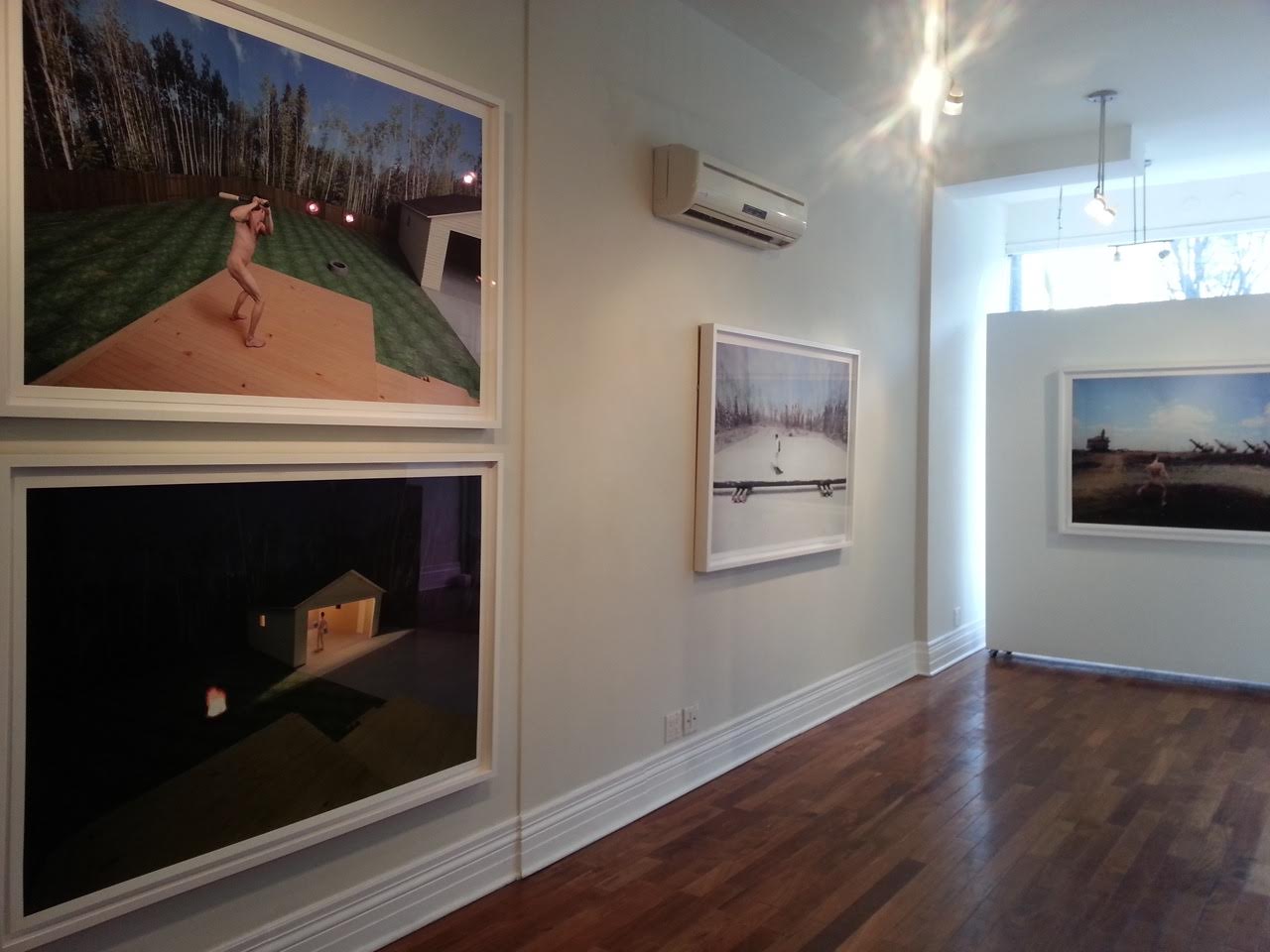
    For those who have yet to see the work of Alberta-based photographer Kristopher Karklin, you may want to pay attention. On the vast spectrum of emerging-to-mid-career artists on the Canadian contemporary scene, he is most certainly one to watch. His most recent work, the subject of a solo exhibition currently on display at Barbara Edwards Contemporary, has not only generated a considerable amount of buzz, but has also piqued the interest of a number of high profile collectors, both individual and institutional. And for good reason. His newest series, a combination of photography and sculpture, strikes with uncanny accuracy not only at the northern Alberta landscape by which it was inspired, but also at many of the confining and alienating elements of contemporary rural and suburban life.

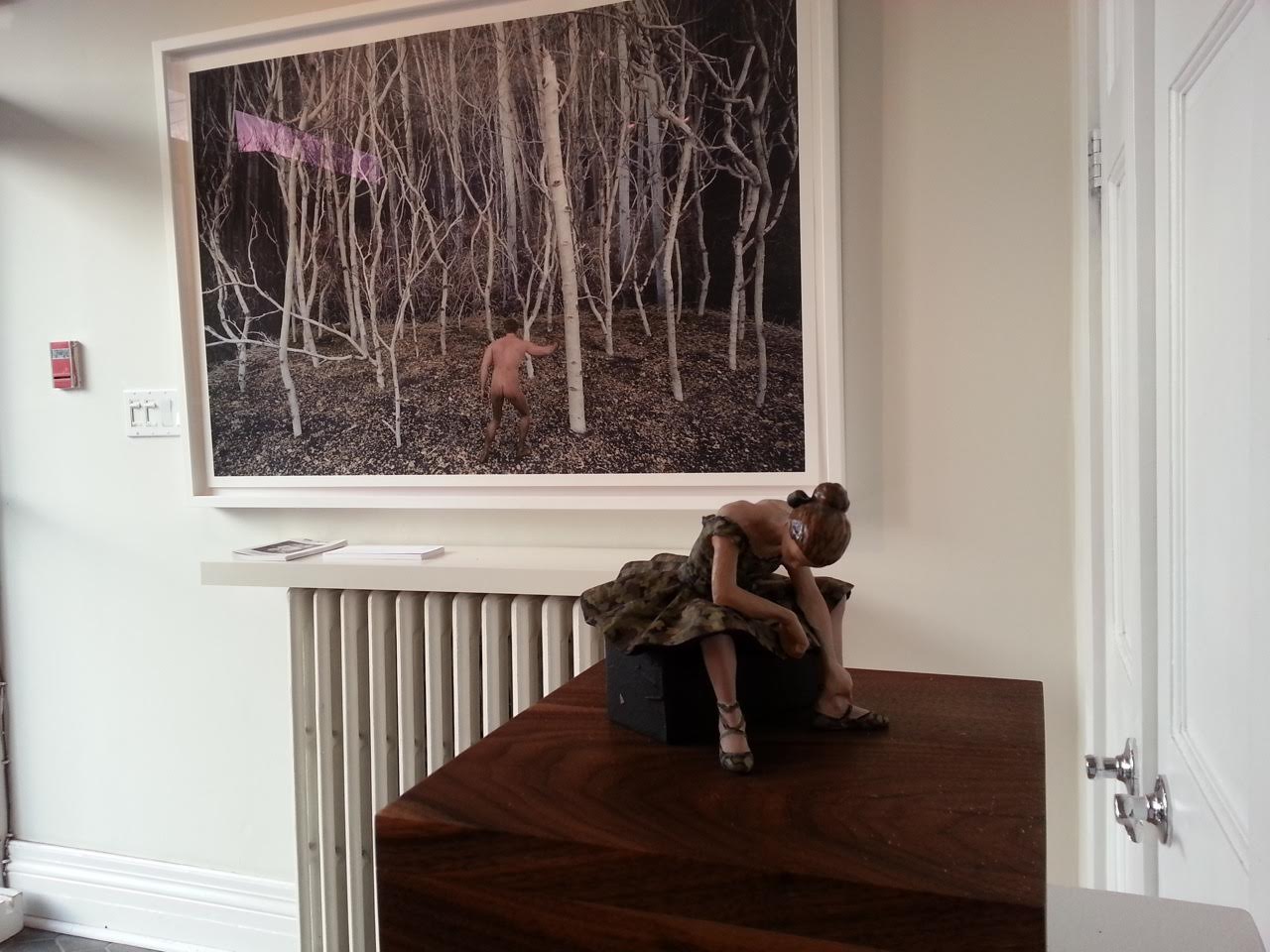
    Installation view. Photo courtesy of Barbara Edwards Contemporary

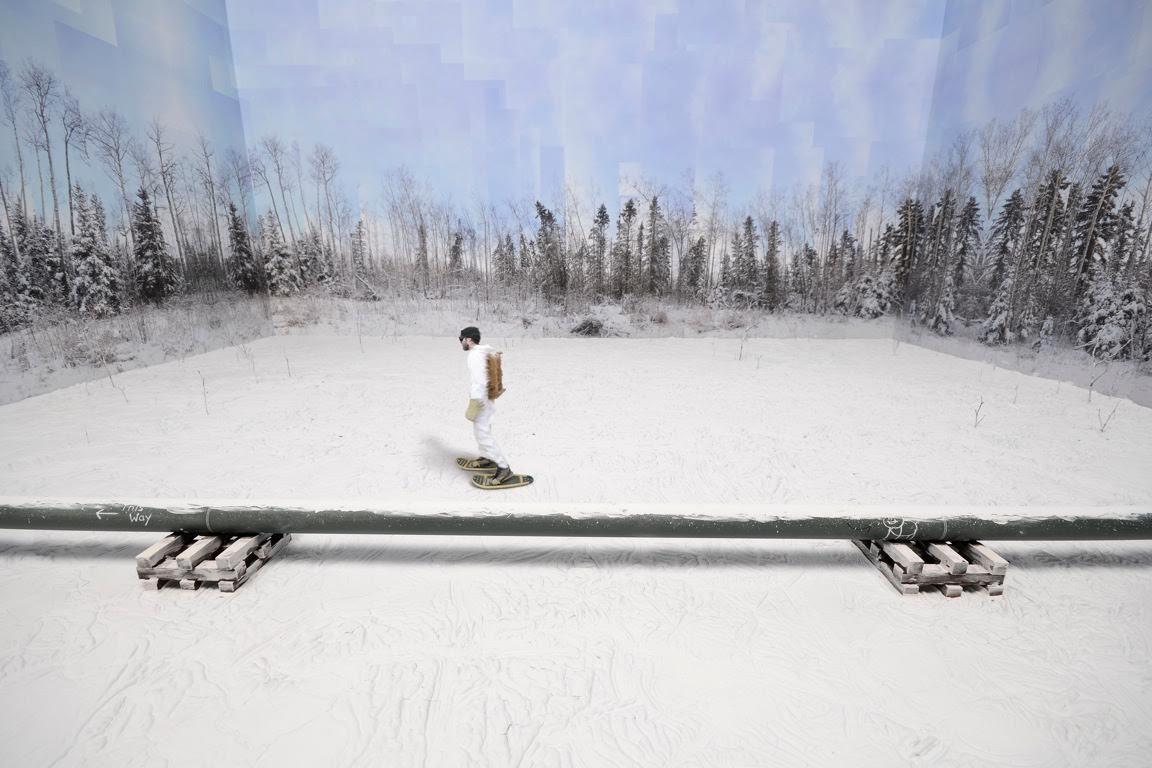
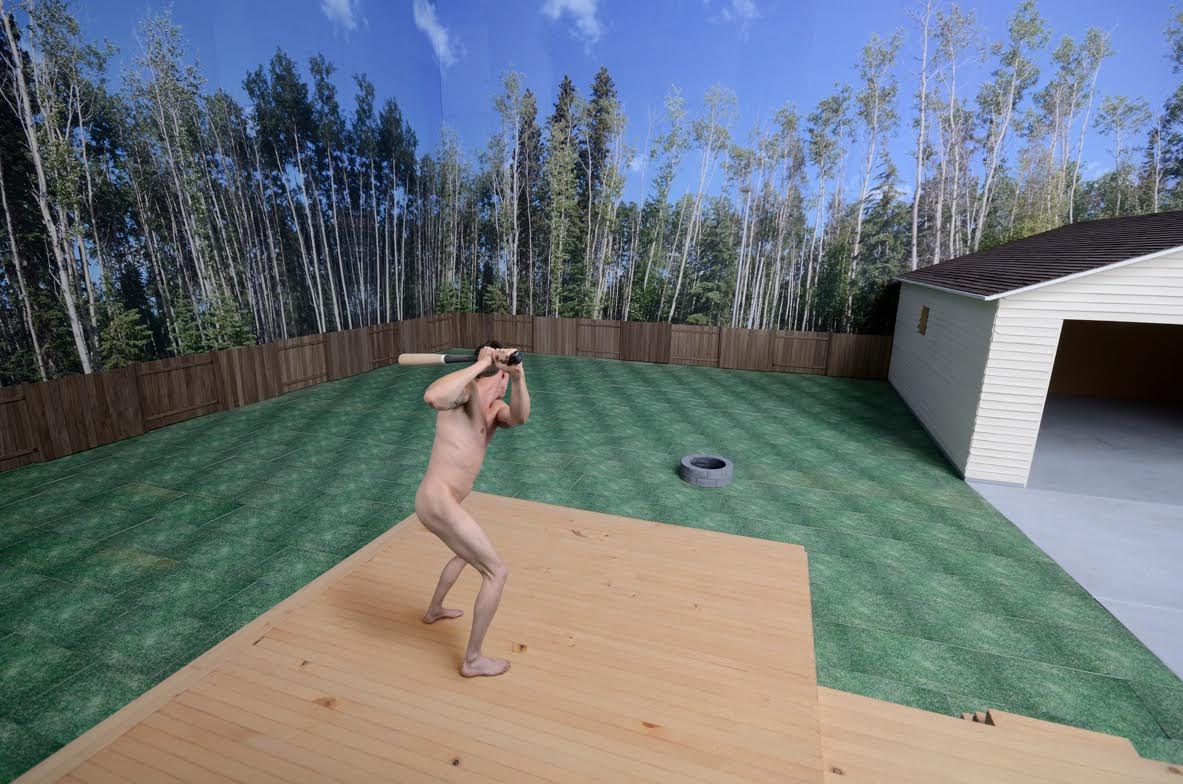
    When, years ago, Karklin began working in Fort McMurray, Alberta – a community now infamously known for its connection to the oil sands — he had no specific intention to create art from his experience. Yet, as he described in a recent interview, he was immediately captivated by what he saw there and simply started taking photographs. “It was like being on the moon or in the middle of the Arctic,” Karklin recollects. The experience was, for him, powerfully surreal. It is a feeling Karklin is remarkably effective at capturing. Building on his previous work, this newest series consists of figures set in strangely pristine, manufactured settings — an aesthetic result of an uncommon and very labour-intensive process. Like Berlin-based artist Thomas Demand, Karklin first creates his landscapes from meticulously constructed scale models — not unlike theatre or architectural maquettes — which he then photographs. Yet, in a departure from Demand, whose images tend to be uninhabited, Karklin also photographs human figures and transposes these into his scenes. The result is a thrillingly disjointed meeting of human and environment, set among layers of photographic and sculptural mediation. 

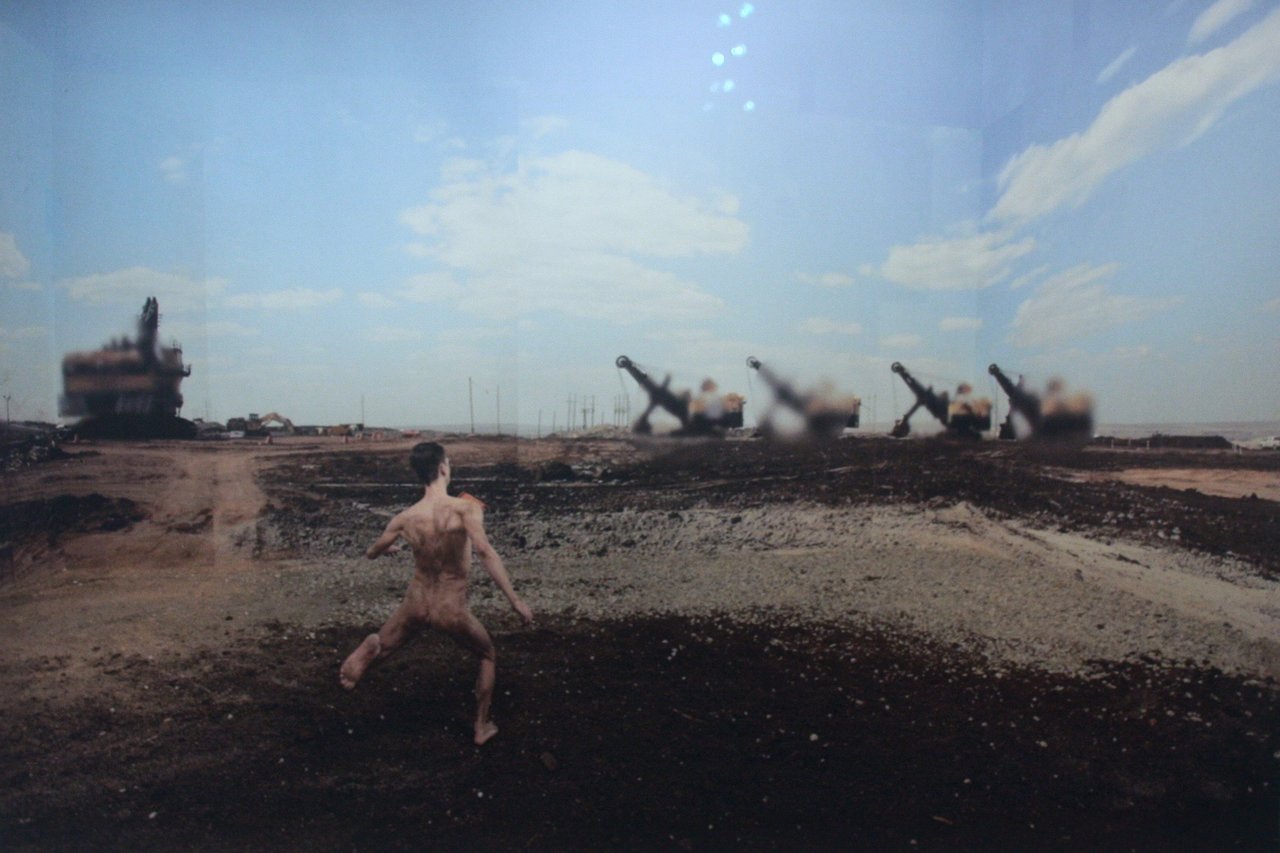
    Kristopher Karklin, Runner, 2015, inkjet print, edition of 7, 36″ x 54 “. Photo: Catherine MacArthur Falls

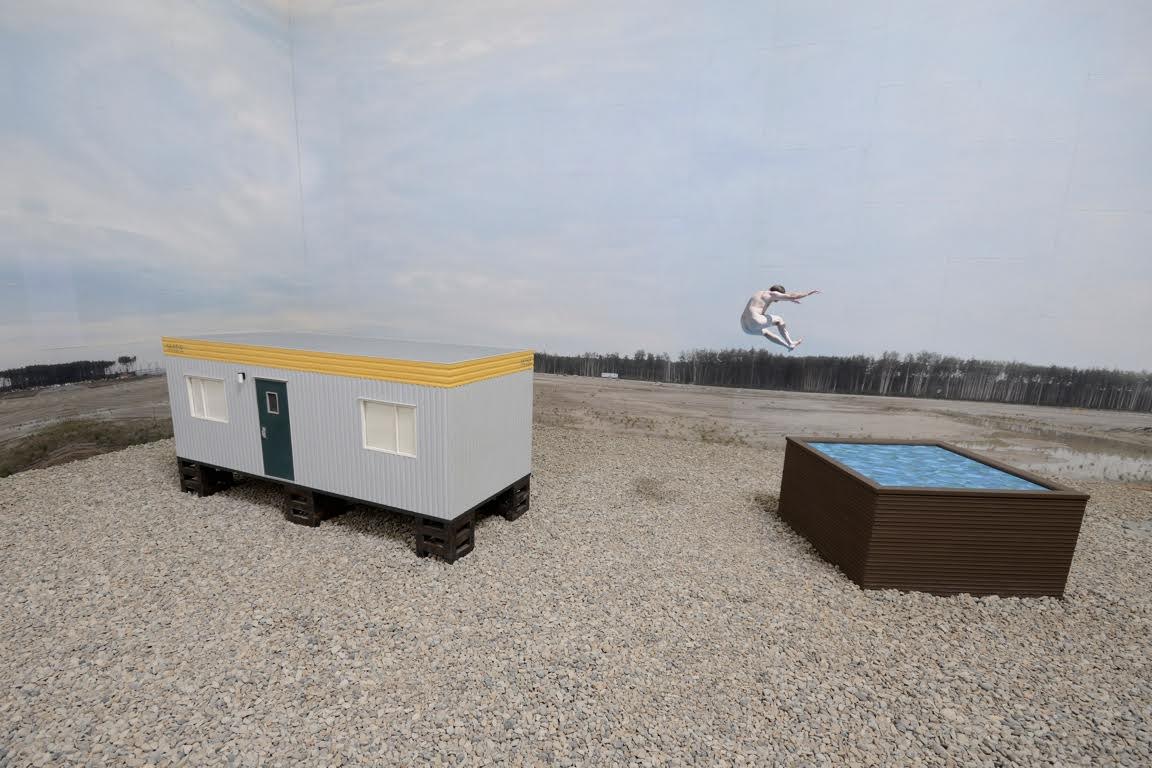
    This mediating effect stems in part from Karklin’s use of photocollage. The backdrops of sky, forest, and field we see in his images are Karklin’s original snapshots of the landscape, which he has pasted like wallpaper to the inside of his scale models and then re-photographed as part of the whole scene. The works are thus not only photographs of built environments, but also photographs of photographs. As the viewer, our distance from the ‘real’ landscape — the landscape that is up there, in northern Alberta, right now — is very far indeed. This distanciation mirrors that of the figures, who are separated from their environment in a number of ways. The most obvious of these, of course, is that the figures represent real people, while the environments are fake on almost every level. But there is also separation by process. Photographed independently, the figures and their environments never inhabit the same space or moment in time — wherever and whenever that might be — until Karklin artificially stitches them together. The snowshoer in “Pipeline” never actually snowshoed past the pipeline; the runner in “Runner” never really ran through the industrial site. The place and time captured in the image never existed. It is a disjuncture that reveals itself in the uneasy, often incongruous, positioning of each figure within his space. The awkward gait of the runner, for instance. The implausible physics of the jumper in “Reclaimed Tub”. The asynchronicity of the snowshoer, whose blurred edges suggest movement, but whose posture is rather still, wooden. It all adds up to a very clear sense of alienation between the figures and their environment, one that Karklin says was a palpable component of his experience in northern Alberta. 

    Kristopher Karklin, Pipeline, 2015, inkjet print, edition of 7, 36″ x 54″. Photo courtesy of Barbara Edwards Contemporary

    It is an effect that is somewhat complicated by Karklin’s enclosure of his environments within the interior space of the model. This seemingly small move to bring the outdoors in constitutes a shift from his previous work, which involved maquettes of solely interior spaces. Of his new work, Karklin recalls that, while working in Alberta, he spent much of his time outdoors. The result was that the landscape became more his home than any indoor space. The series, he claims, is an attempt to capture this feeling. Yet, the work also creates a startling sense of un-hominess. By bringing the outside in, Karklin curtails an Alberta landscape known for its expansiveness, rendering it finite, enclosing. This has a surprising effect: the figures are distant from, yet confined by, their surroundings. Far from appearing at home, they seem trapped, in a way, by their rural or suburban environments. It is, perhaps, a feeling many rural, small town and suburban dwellers can relate to. Having myself grown up in suburban Alberta, I can say with certainty that it is a sense I am deeply familiar with.

    Kristopher Karklin, Backyard (Daytime), 2014, inkjet print, edition of 7, 36″ x 54″. Photo courtesy of Barbara Edwards Contemporary

    Karklin at least partially exposes the interiority of his outdoor spaces by allowing signs of his work’s construction to remain visible. A sky will have clearly discernable corners, for example; a forest will have conspicuous seams. Shadows will appear where none should be. It is a display of artifice that also manifests in the materials and textures used—in the hard, plaster-like snow in “Pipeline”, the flat graphic water surface in “Reclaimed Tub”, or the tiled grass in “Backyard (Daytime)”. As Karklin explains, he uses such techniques to emphasize the fakeness of the environment, to bring the landscape into focus, to preclude it from blending into the background. Such details force us to consider the landscape and its relationship to its inhabitants. And, while these details are allowed to show through, many others are conspicuously erased. In all but one photo, for instance, the figures are photographed nude. Karklin thus strips them of much of the information that differentiates one individual from another. The landscape is similarly stripped. In Karklin’s backyard scenes, no toys or lawn equipment are left on the grass, no pots of flowers beautify wooden decks, no Christmas decorations, tools, or sporting goods wait patiently in the garage. There is no sense that anyone really lives in these spaces at all. These are places, persons, and lives that are eerily generic, replicable.

    Kristopher Karklin, Reclaimed Tub, 2014, inkjet print, edition of 7, 36″ x 54″. Photo courtesy of Barbara Edwards Contemporary

    The series is, all in all, full of tensions and provoking contradictions, not unlike the real landscape that inspired it. And though it is hard not to read Karklin’s work as a critique — particularly of a place that continues to receive so much negative attention — he is careful to note that he did not set out to produce political art. He was, rather, simply attempting to document the often-surreal place in which he was living, in all of its ambiguities. In this and many other respects, the work is spectacularly successful. But don’t take my word for it. Even this early in his career, Karklin’s sales history speaks for itself. Many of his pieces currently reside in the collection of Sir Elton John, for instance. Meanwhile, the entire set currently on display at BEC has been purchased by a major yet-to-be-announced Canadian museum. This means — fingers crossed — that it would be available for public viewing for many years to come. We should be so lucky.

    Installation view with Kristopher Karklin, Hunter, 2015, inkjet print, edition of 7, 36″ x 54″. Photo courtesy of Barbara Edwards Contemporary

    Catherine MacArthur Falls

    *Exhibition information: November 20, 2015 – January 9, 2016, Barbara Edwards Contemporary, 1069 Bathurst Street, Toronto. Gallery hours: Tue to Sat, 11 am – 6 pm (or by appointment).


  • Propeller Gallery Gala Launch

    The new Propeller Gallery at 30 Abell Street

    Gallery Gala Launch: Saturday, January 17, 2015 / 6 – 10 p.m.

    With a new space to reveal, Propeller Gallery had quite an evening to celebrate on the January 17, 2015. The sounds of live jazz from saxophonist Bill Prouton, guitarist Henrique Matulis and a chattering crowd filled the two-room gallery at 30 Abell Street.

    Live jazz from saxophonist Bill Prouton and the guitarist Henrique Matulis

    Gallery view with its two rooms

    Chosen works from several of the gallery’s artists decorated the event; colorful paintings, photographs, drawings, and even some sculpture complimented the cheery evening. It is evident that Propeller’s new space provides a greater sense of agency to the works, giving them opportunity to interact with the viewer. Propeller artist Heather Gentleman described the new space as “organic” providing guests with a greater sense of flow. I think that was distinct in the space’s design. Guests circulated between the two rooms with ease. Joseph Muscat, Propeller’s Chair, was excited about the new space and the prospective of a lot of future success at the Artscape Loft location.

    Guest with Sharron Forrest, ” Leaves Light and Shadow” (left) and Tatjana Hutinec “Renaissance Woman” (right)

    Propeller artists Heather Gentleman and Philip Hare with Gentlemen’s work “Innana” (on left)

    Propeller Chair, artist, Joseph Muscat

    Installation view

    Guest looking at Anthony Saad’s “Aurora Megalopolis

    The gallery is soon hosting their annual “Black and White Ball V” on January 29th, an event coordinated by Gentleman, who seemed excited for the event’s success in the new space. With many new faces and a great turnout from the Opening Gala, future events at Propeller should be a great success. It is with great excitement that I look forward to future shows at Propeller!

    Text and photo: Brinae Bain

    *Exhibition information: January 15 – 25, 2015, 30 Abell Street, Toronto. Gallery hours: Wed – Sat: 12 – 6, Sun: 12 – 5 p.m.

  • Yangyang Pan: Inside Out

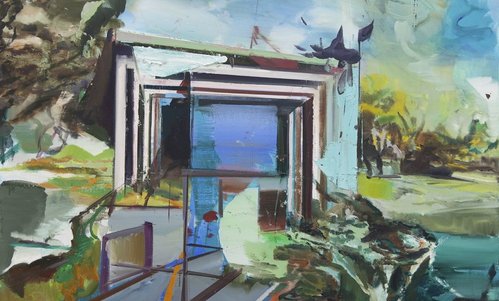
     Rain, I don’t Mind, 2014, acrylic, spray paint, oil on canvas, 36”x 48”. Courtesy of the artist.

    Throw a glance out the window, feel the pull. Eyes seek, settle; mind follows, stays. The border between inner and outer zones fades to a blur. Yangyang Pan has done her job. What has been outside comes in.

    Yangyang Pan situates the onlooker as an integral part of her work, for it is the ability to view the landscape that provides the link between seeing, seen and scene. She makes the connection between human and natural elements, to remind us that the landscape is not alone. Indeed, nor are we – and through artists such as Yangyang, we are made aware of how we are linked intrinsically to the gifts of the natural world.

    Yangyang’s emotional viewfinder and her bold use of colour, stroke and texture allow us to see, somewhat clearly, through a degree of abstraction. Cheeky, she makes sure to leave us at a point where we must make our own way to the end of the journey.

    What is outside is gathered close and absorbed. What is internal to us is set free and reborn in our interpretation. What is inside is out.

    Sabine Modder

    *Exhibition information: YangYang Pan: Inside Out, Nov 6 – 30, 2014, Parts Gallery, 1150 Queen Street East, Toronto. Gallery hours: Wed – Sat 12 – 6, Sun 12 – 5 p.m.