Author: artoronto

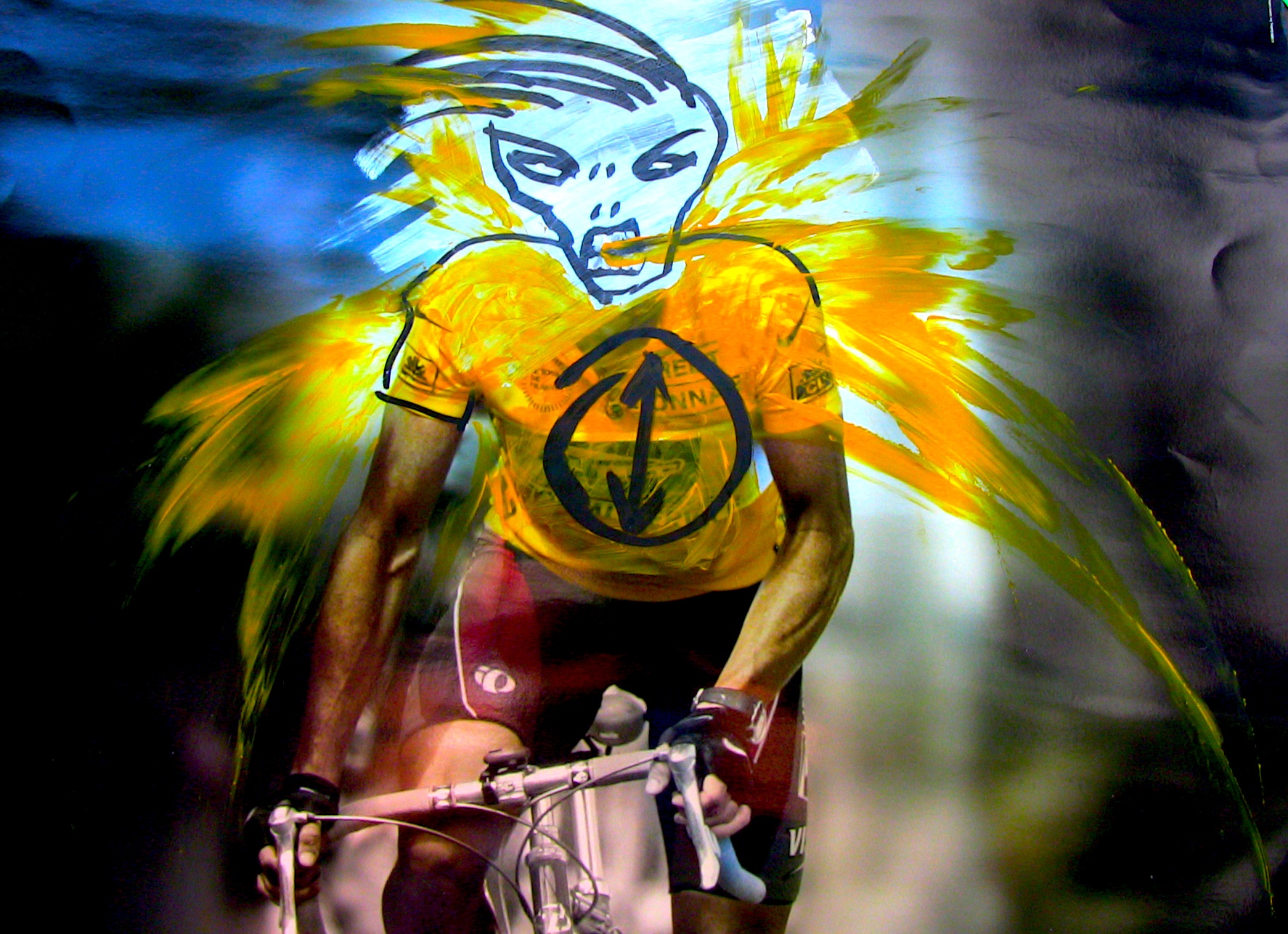
  • Istvan Kantor: END OF SUMMER PANIC

     Saturday, August 27 · 2:00pm – 6:00pm
    ANTIX – Centre for Art Crime and Neoism
    276 Crawford Street, Toronto
    through drive way towards garage
    www.istvankantor.com
    http://home.interlog.com/~amen/
    http://www.hungarianpresence.ca/Culture/Media/kantor-215.cfm

    Special feature: 50 brand new, shrink wrapped, MONTY CANTSIN “Born Again In Flames” vinyl, 1987, Maldoror Records, NYC, 10buxeach!

    Come and celebrate the end of the summer with mindblowing ideas at the Temple of Desperadoes and learn more about the Diabolic Personalia and Secret Archives of Istvan Kantor / Istvan Kantor’s ANTIX Depot is Istvan Kantor’s storage space and summer gallery, archive of Kantor’s life and crimes, a meeting place for secret conversations, future projects, conspiracy plans, also amazing deals on bloody canvases and many other beautiful Neoist Monty Cantsin artifacts! It is “the Vatican of Neoism”, the secret emergency exit to Neoist eternity… an archive of over three decades of works, from mail-art to machinery, anti-drawings, re-mixed-media paintings, stolen information, broken sculptures, hypersex-manifestos, flaming banners, burned flags, 1001 broken irons, … a spot for revolutionary ideas, conspiratorial gatherings, great deals, mind blowing conversations with Neoist Genii / mostly every saturdayday aft from 2pm to 6pm/ with special invited guests /Come with a juice or beer, bring your friends, look around, sit down, have a great afternoon… while the Rentagon is out on vacation, we R right into revolution!

    Istvan Kantor’s artistic practice incorporates robotic sculpture, video, performance, mixed-media installation, painting, sound, and various other action-based social-mediums like the open-pop-star movement of Monty Cantsin and the world wide network of Neoism. Neoism is a transmission interface and revolving platform to gain public support and media attention for its users.
    Kantor employs all his skills and talents to constantly surprise and fascinate. “I swear to God, I’ll never make any boring art!” he declares with bold determination, irony and wit, holding up a picketing sign.
    His main interest lies in creating work that establishes a discussion within and around the conflicting territories of institutional authority and cultural gentrification. In this regard Kantor’s work investigates the revolutionary and scientific aspects of artistic practices that attempt to surpass the conventional models of creative experience.
    Istvan Kantor is Hungarian-born, Toronto-based artist. Recent and upcoming solo exhibitions include: Monty Cantsin Was Here, Jogja National Museum, Yogyakarta, Indonesia, febr/2011; Made in Estonia, installation, Tallinn, may/2011; Selected works, St.Istvan Museum, Szekesfehervar, Hungary, oct/nov 2011 Upcoming group exhibitions include: Interakcje Festival, Piotrkow, Poland, may/2011; WRO Biennale, Wroclaw, Poland, may/2011

    Istvan Kantor aka Monty Cantsin is also known as a noise/music artist, electro-instrumentalist and singer of the Toronto based Red Armband. He has recorded and released over a dozen albums of songs and noise works since the early 80s.

  • Abstract Expressionist New York

    by Emese Krunák-Hajagos

    Abstract Expressionist New York
    Art Gallery of Ontario, Toronto, May 28 – September 4, 2011

         Abstract Expressionist New York considered a “killer” exhibition in Toronto showing the most important American art works of the 20th century. The exhibition is an open book of modern art history. It was exhibited first in New York titled The Big Picture (Museum of Modern Art, New York, October 3, 2010 – April 25, 2011) and is really a great bonus for Toronto to host a show at this scale and artistic importance in the summer.

        Abstract Expressionism was the first specifically American movement to achieve worldwide recognition. In the late 1930s and through World War II many leading painters fled the terrors of Nazism in Europe and sought refuge in the United States. Among them were Hans Hoffman, who became a pioneer and teacher of abstraction and Archile Gorky, the “godfather” of the movement. While the war was raging in Europe, New York City was a safe haven. Exiled artists and dealers filled the city. Peggy Guggenheim opened her gallery The Art of This Century, Leo Castelli became an art dealer and local artists all benefitted. At the end of the war, Europe was in ruins and New York replaced Paris as the centre of the art world. The United States came out of the war victorious and its economy was stronger than ever. Some kind of hero worship was in the air and the Americans were ready to develop their national identity even further and show their importance to the world. A new generation of American artists began to emerge and soon they would be ready to dominate the world stage. They were called the New York School or the Abstract Expressionists, a new term the art critic Robert Coates used to describe Hofmann’s works in 1946. All the artists felt an urgency to depict, look at, think about and make art of their time. As Jackson Pollock said, “It seems to me that the modern painter cannot express this age, the airplane, the atom bomb, the radio, in the old forms of the Renaissance or of any other past culture. Each age finds its own techniques.”
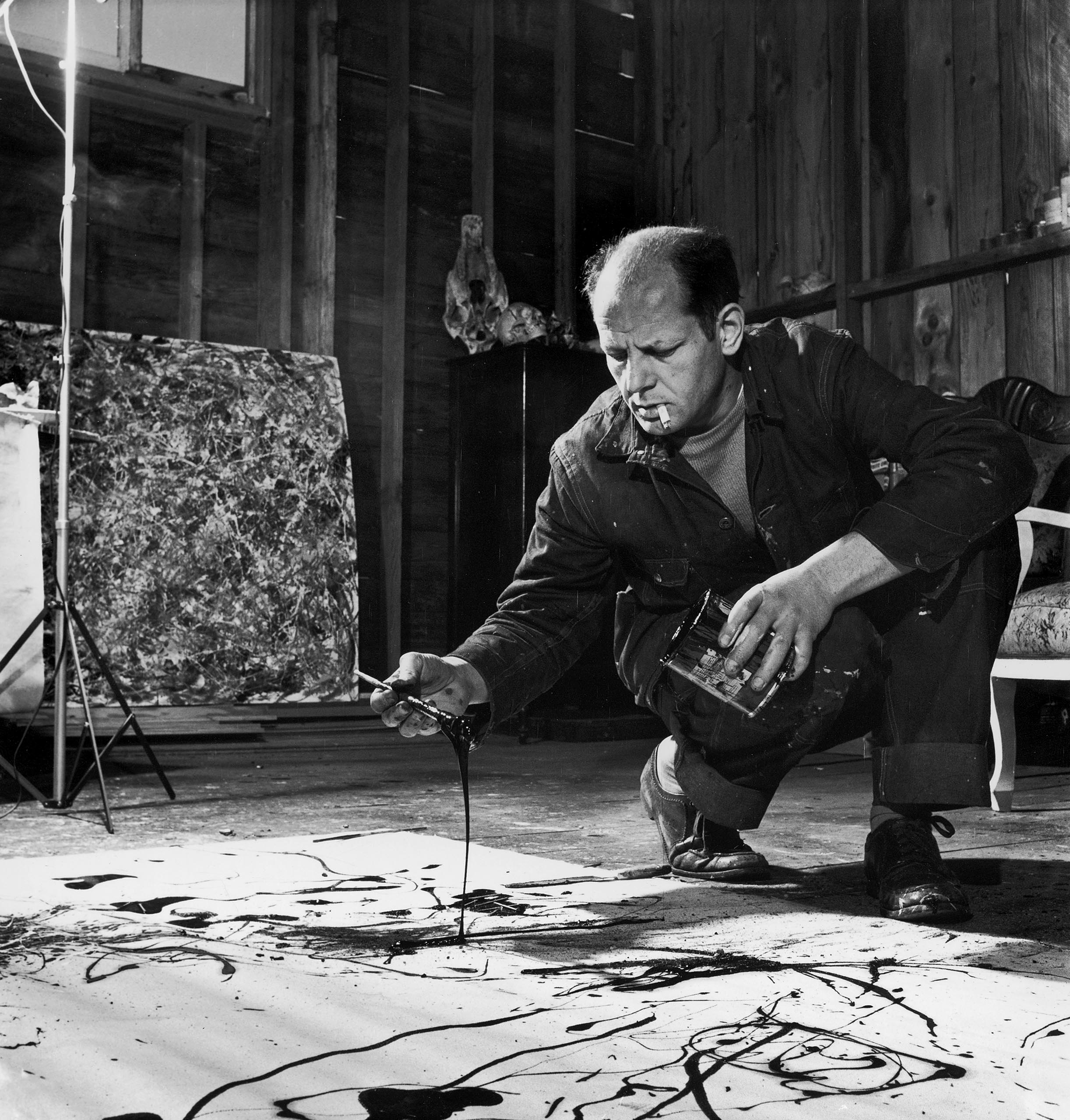
    Artist Jackson Pollock working in his studio. Photo by Martha Holmes/Time Life Pictures/Getty images

         “We agree only to disagree”could be the unwritten motto of this loose grouping of artists according to the art historian Irving Sandler. As the Abstract Expressionists never formed a unified group, their diversity was always visible. In the 1940s, the two leading critics of Abstract Expressionism, Clement Greenberg and Harold Rosenberg had different theories about the meaning, function and style of modern art that created an ongoing debate. Greenberg defined painting by its flatness, so it had to be purified of all illusionistic and sculptural effects such as deepness and plasticity. Subject matter also had to be eliminated. He urged the artists to develop “a bland, large, balanced, Apollonian art” aiming for “an intense detachment” from everything present—a rather minimalist approach. Greenberg advocated for Jackson Pollock and the Color field painters like Mark Rothko, Barnett Newman, Adolf Gottlieb, Clyfford Still and Hans Hofmann. However artists had little sympathy for his formalist perspective, as Rothko wrote in a letter to the New York Times in 1943: “It is widely accepted notion among painters that it does not matter what one paints so long as it is well painted… There is not such a thing as good painting about nothing.” Harold Rosenberg was more interested in the political and social movements of the period and their influence on the artists. He spoke of the transformation of painting into an existential drama: “At a certain moment the canvas began to appear to one American painter after another as an arena in which to act. What was to go on the canvas was not a picture but an event.” Action painting is a term created to describe the works of Jackson Pollock, Willem de Kooning and Franz Kline. Then came the big moment when it was painting for just the sake of PAINT and the gesture on the canvas was liberation from political, aesthetic and moral values.

           Abstract Expressionism and MoMA came into being about the same time. In the 1940s director Alfred H. Barr, Jr. started to collect works from his artist friends; being there at the moment when their first exhibition opened; artist and curator building institutional and art history at the same time. As MoMA’s director Glenn Lowry said what made that time unique  “was a capacity of artists to engage with a cosmic quest, a spiritual quest to find meaning.” “A total commitment on the artists’ side” continued Ann Temkin – “painting was the only thing that mattered there was no separation between the self and the art work, that’s why the paintings feel like living things.”  The exhibited works in this show all came from MoMA’s collection curated by Ann Temkin. Her goal was finding the layers underneath the surface and show the artists’ works before they became “big”, documenting the whole artistic development not just the trophy pieces. The New York and Toronto exhibitions are differently installed and that somehow changes the outcome. There are less works in numbers in Toronto still the show is as strong, even more focused, since the most important, strongest pieces are here.
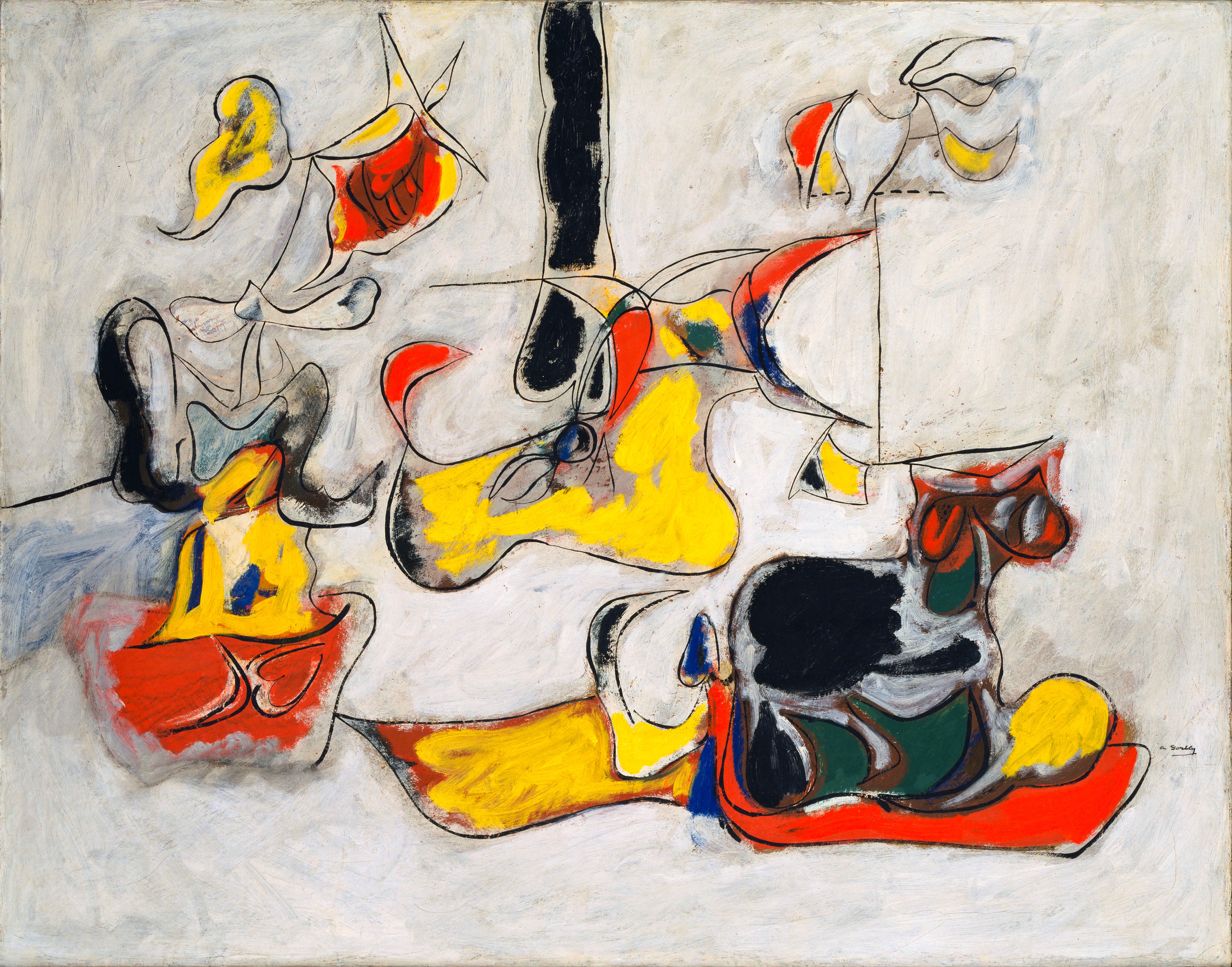
    Arshile Gorky (American, bornArshile Gorky (American, born Arshile Gorky (American, born Armenia. 1904-1948), Garden in Sochi; c. 194;3 Oil on canvas; 31 x 39″ (78.7 x 99 cm)The Museum of Modern Art. Acquired through the Lillie P. Bliss Bequest 492.1969 © 2010 The Arshile Gorky Foundation / Artists Rights Society (ARS), New York Photo Credit: The Museum of Modern Art, Department of Imaging Services, Paige Knigh

         As we walk into a narrow corridor at the beginning of the show we see the early mythological works of William Baziotes (Dwarf, 1947) and Adolf Gottlieb.  Achile Gorky’s late works like Garden in Sochi (1938-40) refers to the artist’s past and the memories of it. His images are more delicate and more outlined then earlier in his carrier with a vibrant palette. His figures go through a methamorphosis and are becoming floral like creatures and even a composition like Agony (1947) seems almost happy.

    Willem de Kooning (American, born the Netherlands.1904-1997) Woman, I.; 1950-52; Oil on canvas; 6′ 3 7/8″ x x58″ (192.7×147.3 cm). The Museum of Modern Art. Purchase 478.19532010 The Willem de Kooning Foundation / Artists Rights Society (ARS), New York Photo Credit: The Museum of Modern Art, Department of Imaging Services, John Wronn

        Willem de Kooning is represented by only three paintings hanging in the same small room; they were placed in three separate galleries in New York. It is even more visible here how he never applied himself to any style keeping his artistic freedom, switching between abstraction and figurativity. The famous Woman I, (1950), a strong figurative piece, is much disputed. Does it picture the scary, overwhelming aspect of female power over men or does it mirror male aggression toward women? The large figure of the woman with enormous breasts, big eyes and howling mouth is depicted by angry brush strokes while her clothes and the background are created by abstract patches of paint.
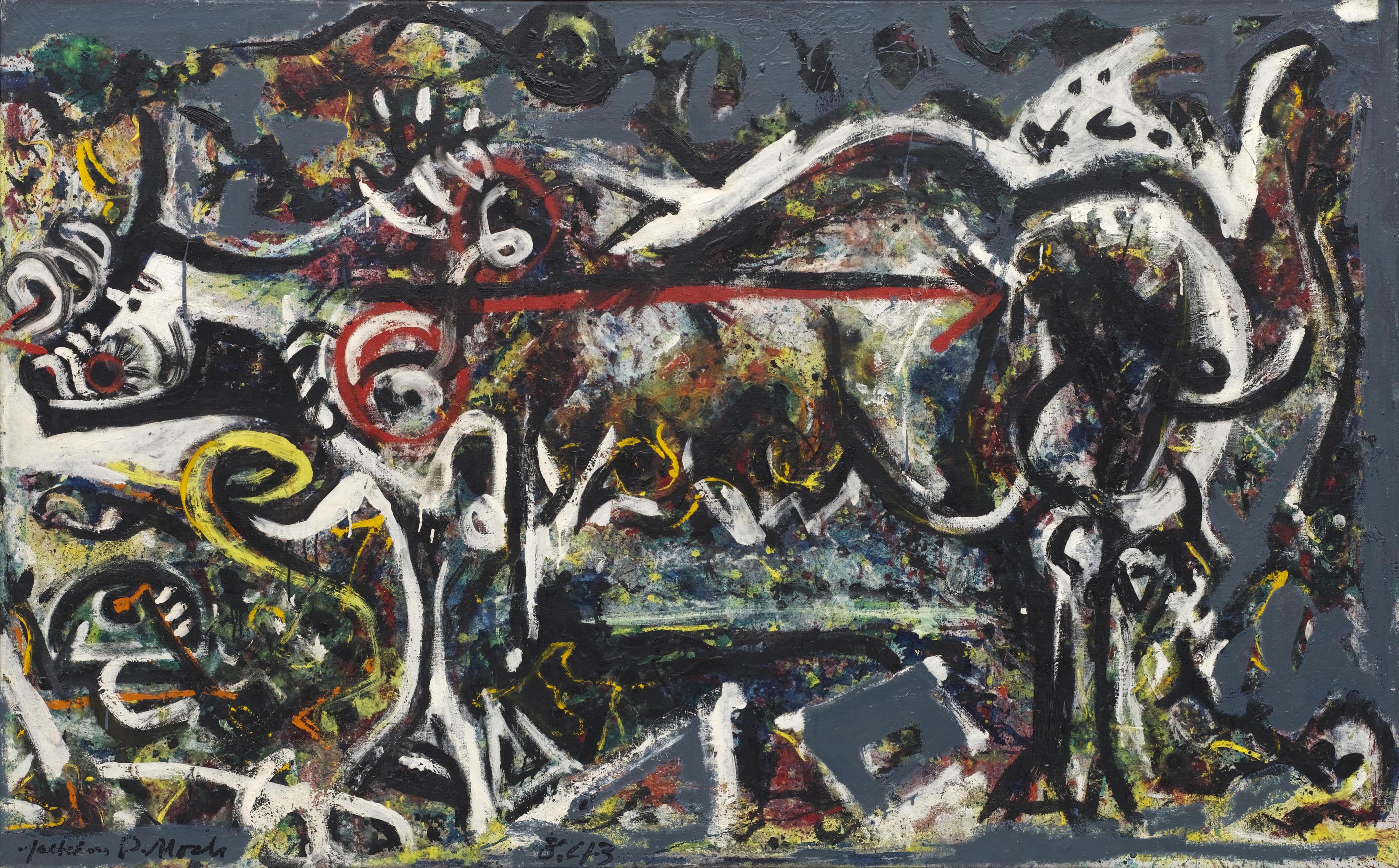
    Jackson Pollock (American, 1912-1956), The She-Wolf, 1943; Oil, gouache, and plaster on canvas41 7/8 x 67″ (106.4 x 170.2 cm) .The Museum of Modern Art. Purchaces2011 The Pollock-Krasner Foundation/Artists Right Society (ARS), New York:Photo credit: The Museum of Modern Art, Department of Imaging Services

     A large gallery is dedicated to Jackson Pollock’s paintings. His early canvases (Mask, 1941) remind us of Picasso and his first really original piece is The She-Wolf (1943) with its free-form abstraction. In 1947, Pollock described his painting process in detail: “I prefer to tack the unstretched canvas to the hard wall or the floor. I need a resistance of a hard surface. On the floor I am more at ease. I feel nearer, more a part of the painting, since this way I can walk around it, work from the sides and literally be in the painting.” Pollock used objects such as sticks, spatulas, knives, or vessels with which the paint could be dripped, poured or hurled on the canvas. He emphasized the automatism of his approach as a “pure harmony, an easy give and take” but also mentioned that after a “get acquainted period” with the painting he makes changes, and has no fear of destroying part of the composition since the painting has its own life and comes out well at the end. Full Fathom Five (1947) is a good example of this method. The weave of the top colour-layers veils a figure painted with lead paint. The objects worked into the picture such as buttons, keys, nails, cigarettes etc. are placed with reference to this hidden figure, you can see them at a close observation.
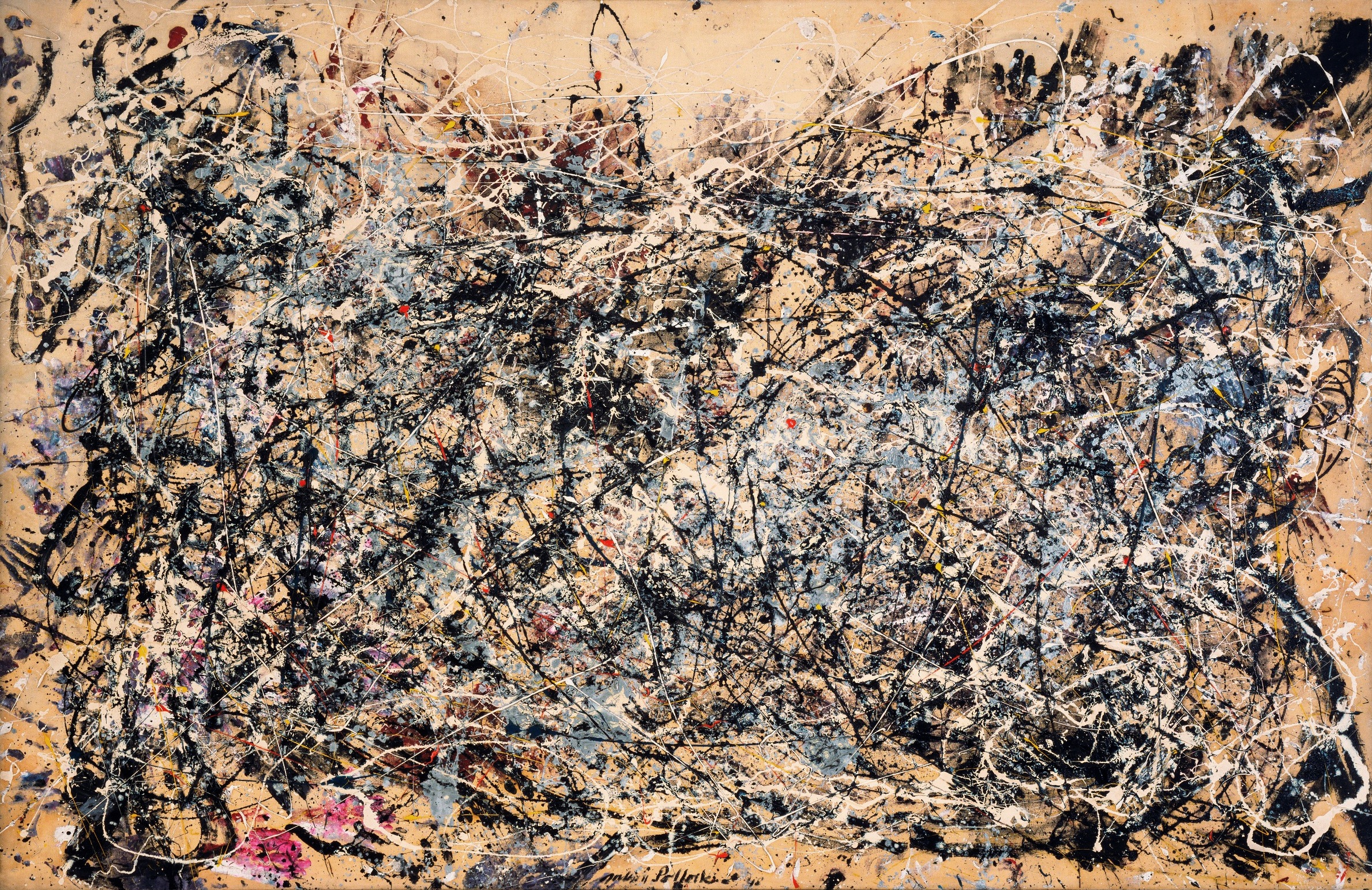
    Jackson Pollock (American, 1912-1956), Number 1A, 1948; 1948; Oil and enamel paint on canvas; 68″ x 8′ 8″ (172.7 x 264.2 cm). The Museum of Modern Art. Purchase ©2010 The Pollock- Krasner Foundation / Artists Rights Society (ARS), New YorkPhoto Credit: The Museum of Modern Art, Department of Imaging Services

        Pollock painted with his whole body, moving fast in a dance-like trance around the canvas, dripping or throwing paint sometimes straight from the can, then quickly touching it up, radiating a strong physical energy. His new painting method was a revelation to the New York art scene and in August, 1949 Life Magazine named him the greatest living painter in the United States. It was a hard responsibility to shoulder. In July 1950 Hans Namuth photographed and filmed him at work and his pictures created the mythic, sexually-charged image of “Jack the Dripper.” Pollock became a hero of mass media and someone called his drip-painting an  “apocalyptic wallpaper.” Pollock didn’t mean to create decor, still his “all over” method—covering the entire surface of the canvas and giving each part an equal importance (White Light, 1954)—became very influential for ornamental and decorative styles. The art critic Robert Hughes wrote that as his work was so influential, his image as a man was too. The image of a world famous painter, the Vincent van Gogh from Wyoming, dying at forty-four, drunk, with two girls in a big, expensive car, was elevated to symbolism as it is depicted in the actor and director Ed Harris’ movie: Pollock (2000).

         Mark Rothko is represented in a large gallery. Slow Swirl at Edge of Sea (1945), a surrealistic composition with two humanlike forms embraced in a swirling, floating, dancing happiness, depicted by soft grays and browns. In 1950 he started to paint his “multiforms,” his signature paintings. Rothko usually divided the canvas into three horizontal planes of bright, vibrant colours. He applied a thin layer of binder mixed with pigment onto the bare canvas, and then painted thinned oils onto this layer, then another layer, creating a dense mixture of overlapping colours and shapes which bleed into each other. His brushstrokes were light and very fast. A dramatic effect is created by the contrast of colours, radiating with inner energy (No.5/No.22, 1950).
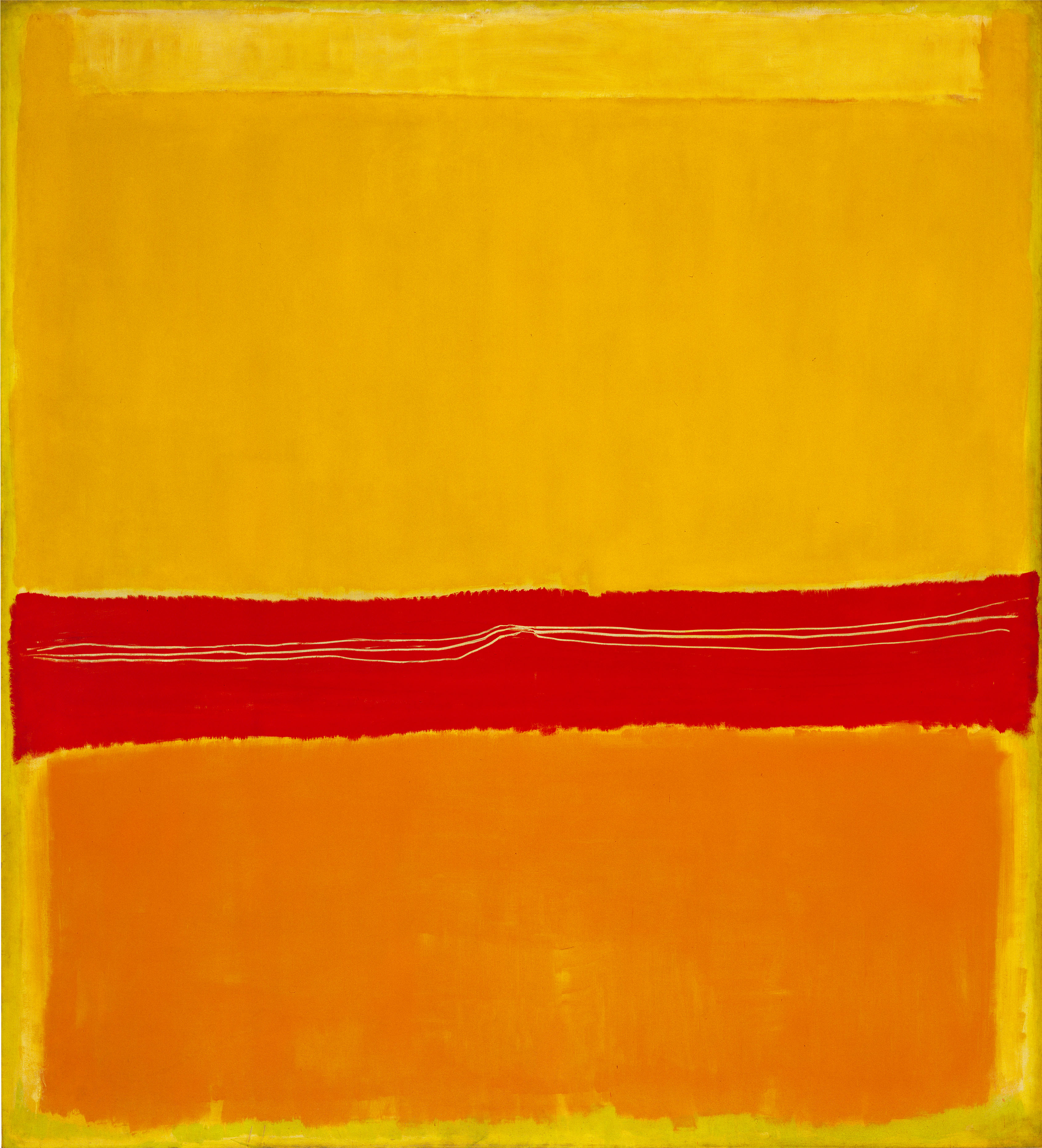
    Mark Rothko (American, born Latvia. 1903-1970), No. 5/No. 22; 1950 (dated on reverse 1949); Oil on canvas; 9′ 9″ x 8′ 11 1/8″ (297 x 272 cm). The Museum of Modern Art. Gift of the artist.© 1998 Kate Rothko Prizel & Christopher Rothko / ArtistsRights Society (ARS), New York.Photo credit: The Museum of Modern Art, Department of Imaging Services

         As Rothko wrote, his paintings are “only expressing basic human emotions – tragedy, ecstasy, doom and so on… The people who weep before my pictures are having the same religious experience I had when I painted them.” There is really something religious in Rothko’s attempt to abandon everything to feelings and create an unworldly atmosphere in his paintings No.37 Slate Blue and Brown on Plum (1958) gives a feeling of deepness and almost invites you to step into the blue shape and disappear into another world. Rothko became famous, successful and rich, and ironically that deepened his depression. The luxurious New York Four Seasons Restaurant’s commission (1958), well depicted in the Broadway show Red, was a great painterly challenge and his personal undoing at the same time. He never delivered the 40 pieces he painted for them. In the 1960s his horizon darkened dramatically. He finished the 14 large, dark, blood-coloured canvases for the Rothko Chapel but committed suicide before they were installed in 1971.

          A gallery shows a few works of Barnett Newman starting with Onement, I (1952), his breakthrough painting. The surface of a monochromatic background is vertically divided in half by an orange band, a “zip,” as the artist later called it. Newman explained his zip motive in his essay The First Man Was an Artist, as the stick the aboriginal man used to draw a line in the mud.  Newman suggested that his zip should be taken as a metaphor for this primal and tragic gesture of art. There is a photograph by Robert Frank showing a New York street with a white line in the middle (Street Line, New York, 1951); an interesting example of how a similar motive surfaces with different meanings in different artists’ works.
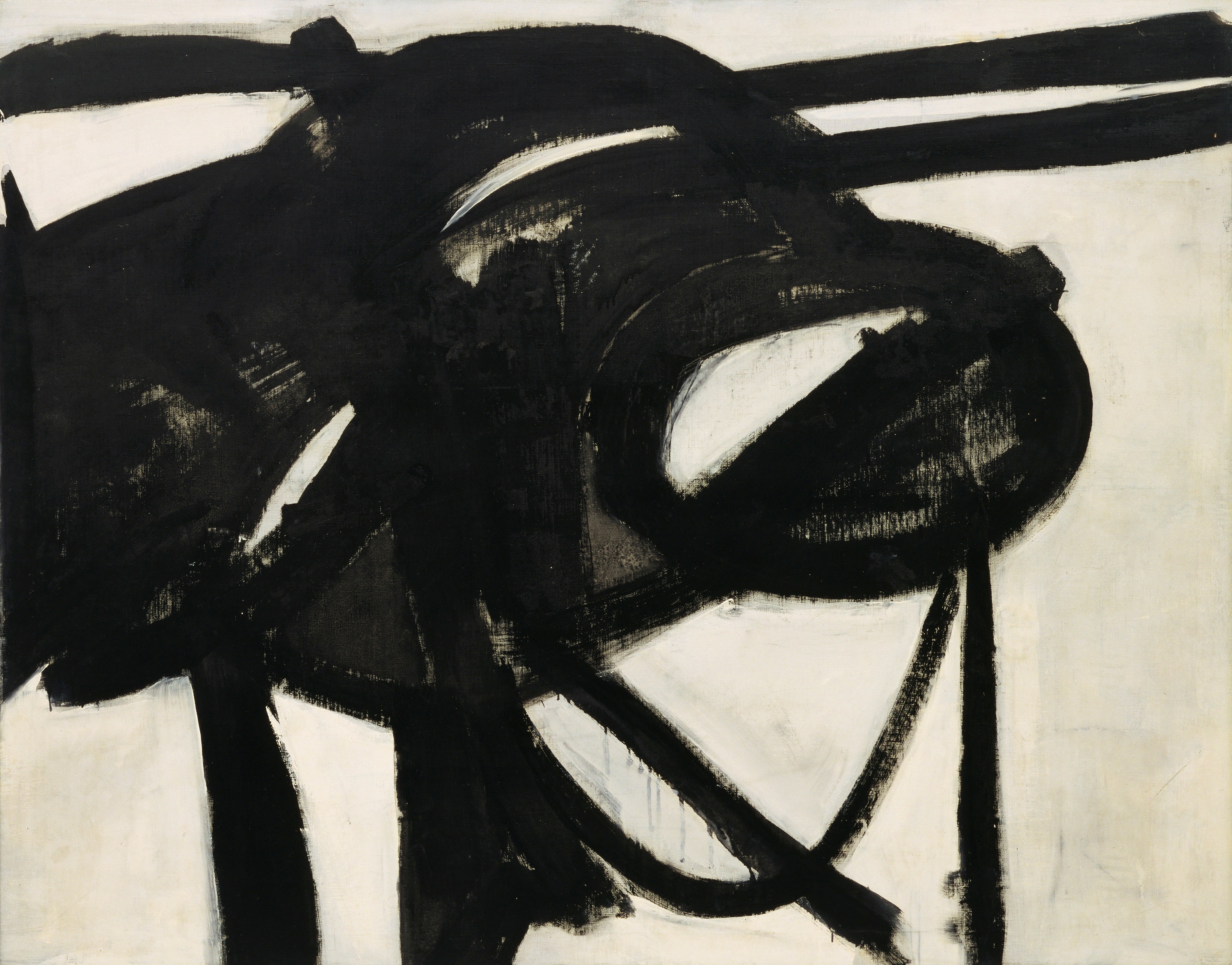
    Franz Kline (American, 1910-1962), Chief,1950; Oil on canvas; 58 3/8″ x 6′ 1 1/2″ (148.3 x 186.7 cm). The Museum of Modern Art. Gift of Mr. and Mrs. David M. Solinger. © 2010 The Franz Kline Estate / Artists Rights Society (ARS), New York. Photo credit: The Museum of Modern Art, Department of Imaging Services, John Wronn

         There are excellent pieces from Clyfford Still, Franz Kline and Robert Motherwell representing a more simplified, but not simple, gestural painting style which influenced the future artist generation greatly. Refreshing with its humour Isamu Noguchi’s Even the Centipede, (1957) stoneware sculpture with its long body and many legs created of plates, kettles and various pots. Abstract Expressionism  involved many female artists as well. Lee Krasner greatest paintings were created after her husband Pollock’s death, Gaea, 1966, among them with its dynamic red and black waves. On Joan Mitchell’s large canvas titled Ladybug, 1957 fast, free-swinging brushstrokes try to follow the color illusion created by the fly of the bug.
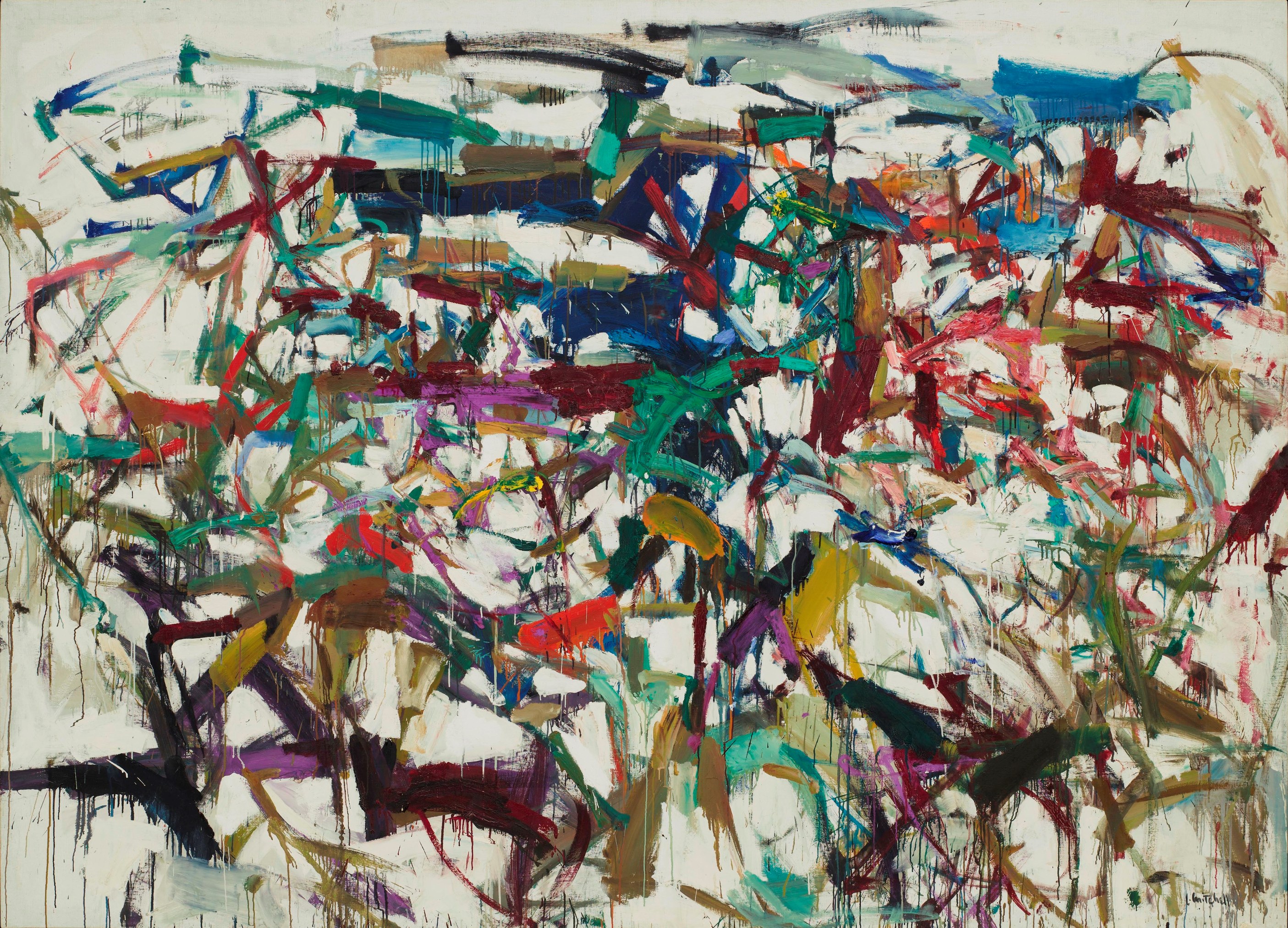
    Joan Mitchell (American, 1925-1992). Ladybug, 1957; Oil on canvas;6′ 5 7/8″ x 9′ (197.9 x 274 cm). The Museum of Modern Art. Purchase © Estate of Joan Mitchell.Photo credit: The Museum of Modern Art, Department of Imaging Services, Thomas Griesel

         In the last room, the Canadian born Philip Guston begun with pure painterly gestures, to start and finish his canvases in one session, not to stop, not to look at it, just stay close to it and paint, which produced one of the happiest painting I’ve ever seen (Painting, 1954) with its deep, energetic, pink strokes. Later he decided to depart from abstractionism in order to tell stories in cartoonlike compositions (Edge of town, 1969) and his painting is the last work in this amazing show.  



  • LAURA PETURSON: Possible Outcome

    September 7 – October 8, 2011
    Opening  and our First Anniversary! *let them eat cake*: Sat, Sept 10, 2 – 4pm
    TELEPHONE BOOTH GALLERY
    3148 Dundas Street West
    Toronto, Ontario M6P 2A1
    (The Junction, Dundas at St. John’s Rd.)
    T: 647.270.7903
    E: sharlene@telephoneboothgallery.ca 
    www.telephoneboothgallery.ca
    Hours: Tues by appt., Wed and Sat 11-6, Thurs and Fri 11-7

    SNEAK PEEK AT IMAGES IN EXHIBITION  (more to come)

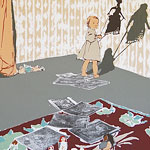
    Possible Outcome is a body of work comprised of prints created using screenprint, linocut, collograph and lithographic processes.  Influenced stylistically by fin-de-siècle art and literature, and by the domestic workings of her own family, Laura Peturson’s prints present a vision of childhood based in both reality and fiction.  These works capture and examine the expectations and sentiments placed upon very young girls. Each print depicts a child or children engaged in introspective play, often with objects that are commonly viewed as feminine.  In selected prints, the girls have been inserted compositionally into reproductions of 18th-century paintings.  A toddler reads in front of a Jacques Louis David reproduction taped to the wall of her nursery.  A little girl holds a shadow puppet as she stands amongst Ingres reproductions littered across the floor.  These neoclassical paintings reference a heroic male ideal and present the girls with a differently gendered possibility from their surroundings.  In addition to the narrative aspect of the work, the prints deal with formal elements, such as pattern, colour and the tension between illusory space and a flat, silhouetted aesthetic. 

    Laura Peturson received her MFA from the New York Academy of Art, New York in 2005 and a BFA from York University, Toronto in 2002.  She lives and works in Callander, Ontario and is an Assistant Professor of Fine Art at Nipissing University, specializing in printmaking. 


    Working from a melding of memory and fantasy, Kasia Czarnota’s glass works are inspired by family relationships, childhood and the tiny but wondrous moments that make up a day in a young life. Kasia Czarnota is a sculptor concentrating primarily in the mediums of kiln cast and blown glass. She attended Sheridan College Institute’s Crafts and Design Glass Program and her sculptural practice involves image and object manipulation that play with glass’ various qualities, including granular delicacy on one level and unique transparency on the other. An award winning artist, Czarnota’s work was recently exhibited at the Cheongju International Craft Biennale in South Korea.

  • Infinity cubed


    August 30 – September 23, 2011
    Opening: Thursday, September 1, 6-8pm
    JOHN B. AIRD GALLERY
    Macdonald Block
    900 Bay Street
    Toronto ON M7A 1C2
    For info: 647.435.5858

    Celebrates the vitality of the Sculptors Society of Canada’s 83rd year.

    The SSC is an organization of artists who have completed their formal training / apprenticeship and are working and exhibiting as professional sculptors. Membership is established through a jury of peers once a year. Once accepted – the SSC presents New Members with a sponsored exhibition in Dec. at the annual “Festive Spirits” celebrations! The AGM also takes place in Sept Ito elect an Executive Committee: 4 Officers + 4 Councillors.

    SSC MANDATE:
    •       to raise the profile of Canadian sculpture locally & abroad
    •       to foster & nurture young talent
    •       to educate & evoke dialogue among community
    •       to cultivate & encourage a progressive contemporary visual language

    Today, the SSC hosts numerous events interfacing with the creative community such as material and photography workshops, studio tours, as well as initiating open forums with guest speakers.  Informal seminars and discussions (open to the public) led by exhibiting artists at the Canadian
    Sculpture Centre (CSC) take place throughout the year. Twelve monthly exhibitions are installed annually at the CSC and one major members’ show held simultaneously (in September/October) at the John B. Aird Gallery (Macdonald Block) within the Provincial Ministries building.

    This year, “Infinity cubed” features contemporary figurative and non-figurative works in all media (stone, clay, bronze, steel, paper, wood, mixed-media) by 40 members:

    Adrienne Alison, Holly Atkinson, Irene Blogg, Frederico Carbajal, Yeon-Tak Chang, John Clinton, Mary Ellen Farrow, Eamon, Barbara Fletcher, Cesar Forero, Pat Foss, Camie Geary-Martin, Al Green, Haythem Hassan, Joyce Honsberger, Jane Hook, Judy Raymer Ivkoff, Elaine Jaques,
    Saulius Jaskus, Maryon Kantaroff, Marlene Kawalez, Evgueni Kogan, Pearl Levy, J.Mac, Bastien Martel, Richard McNeill, Elizabeth Merei, Lilly Otasevic, David Paolini, Octavia Proca, Peter Shoebridge, Alex Tavares, Tyzo David Toccalino, Dina Torrans, Lea Vivot, Holly Wheatcroft,
    Peter Wirun, Xiaojing Yan, Judi Michelle Young, Daniel Yu

  • Chagall and the Russian Avant-Garde

    Blue Circus (Le cirque bleu) Blue Circus (le cirque bleu), 1950-52; oil on canvas; Collection of the MNAM, Center Pompidou, Paris. ©Estate of Marc Chagall/Sodrac (2011), Chagall ©
     
    October 18, 2011 – January 15, 2012
    Art Gallery of Ontario

    The Art Gallery of Ontario is bringing the magic, whimsy and wonder of Marc Chagall to Toronto  with a major exhibition organized by the Centre Pompidou. Chagall and the Russian Avant-Garde: Masterpieces from the Collection of the Centre Pompidou, Paris on view from , features the lush, colourful, and dreamlike art of Marc Chagall alongside the visionaries of Russian modernism, including Wassily Kandinsky, Kasimir Malevich, Natalia Goncharova, Sonia Delaunay, and Vladimir Tatlin.

    Drawn from the collection of the Centre Pompidou, the exhibition examines how Chagall’s Russian heritage influenced and informed his artistic practice, illustrating how he at turns embraced and rejected broader movements in art history as he developed his widely beloved style. Chagall and the Russian Avant-Garde comprises 118 works from a broad array of media, including painting, sculpture, works on paper, photography, and film. The artwork is drawn entirely from the collection of the Centre Pompidou and features 32 works by Chagall and eight works by Kandinsky.

    Chagall Ball

    Saturday, October 15, 2011
    At the Art Gallery of Ontario

    Chagall’s Musical World

    Koffler Chamber Orchestra presents Chagall’s Musical World
    Sunday, November 20, 3:00pm
    Walker Court
    Included with admission to the AGO

    Past Present

    Past Present: Chagall Through Toronto’s Artists
    Wednesday, December 14, 8:00pm
    Weston Family Learning Centre
    $20.50 Members| $22.50 Public | $10 additional to visit the exhibition

    Past Present

    Past Present: Chagall Through Toronto’s Artists
    Wednesday, December 14, 8:00pm
    Weston Family Learning Centre
    $20.50 Members | $22.50 Public | $10 additional to visit the exhibition

  • David Hockney’s Fresh Flowers: Drawings on iPhones and iPads

    “UNTITLED, 22 JULY 2010, 1″IPAD DRAWING© DAVID HOCKNEY

    October 8, 2011 – January 1, 2012
    Roloff Beny Gallery, Level 4

    The Institute for Contemporary Culture presents the North American debut of this cutting-edge exhibition, which reveals David Hockney’s extraordinary use of this novel new artistic medium and its impact on shaping visual culture today. Hockney is one of the world’s most acclaimed contemporary artists, and Fresh Flowers is his first major show in Canada in over two decades. The exhibition features approximately 200 iPhone and iPad drawings displayed on 20 iPod Touches and 20 iPads.

    Hockney began working with the iPhone in 2008.  Since then, he has created hundreds of finger-drawn images, ranging in subject matter from flowers and self-portraits to landscapes and still life. More than 20 Hockney drawings in the exhibition will feature playback animations, allowing viewers insight into the artist’s creative process as they view the works being drawn from start to finish. Fresh Flowers will also feature two films featuring Hockney working on an iPad, eight large-scale animated projections of recent iPad drawings, and a nine-minute triptych slide show with an additional 169 images.

    Fresh Flowers marks the ROM’s first WiFi accessible exhibition, so visitors can share their experience online, in real time.

    Project initiated by the Fondation Pierre Bergé / Yves Saint Laurent, Paris.
    Charlie Scheips, Guest Curator. Ali Tayar, Exhibition Designer.

  • Elisabetta Fantone: Now and Then

    September 7 – 18, 2011
    Opening: Wednesday, September 7, 6 – 9  Artist in attendance
    Thompson Landry Gallery
    The Distillery District
    55 Mill Street, Building 5, #102
    & The Cooperage Building #32
    Toronto, Ontario, M5A 3C4
    Tel: 416-364-4955
    E-mail:info@thompsonlandry.com
    www.thompsonlandry.com
    Hours: Tues – Sat 11-6, Sun 12-5

    Born and raised in Montreal, Quebec, Elisabetta Fantone has always demonstrated tremendous ability in all things creative.  In her early career, Elisabetta’s passion for performance art has lead her to excel in both modeling and acting, however, she was always drawn to the visual arts.  Having studied interior design at LaSalle College, her love of the arts developed into a strong talent for portraiture.  Fantone’s foray into portraiture began with a series of expressive abstract faces she created in 2006.  Soon after, she began developing her figurative skills by depicting identifiable icons of pop culture.

    Fantone’s contemporary approach to portrait painting has been described as “modern pop art”.  Using acrylic on canvas, and a minimalist palette, she paints iconic faces in a close-up and cropped composition.  Limiting herself to three or four bold colours per piece, she separates the face of her subject by hand into large planes of colour that she fills in with an opaque layer of paint.  She finishes the work with a thick coat of glassy varnish, sealing her icons in space and time.  Fantone’s style is one which reflects her personal interest in and experience with pop culture, cinema and the concept of celebrity.  Her pieces explore the beauty which is often broken down by the media, but is reborn and timelessly preserved in her artwork.  The result is a dazzling stylized portrait of brilliant colours that captivates the viewer. 

     Since gaining artistic success in 2006, Elisabetta Fantone has had solo exhibitions in both her home town of Montreal and Miami.  She has also produced special commissions for celebrities such as the Thomas Flohr, Kardashian sisters, Gretchen Rossi and Russell Peters. She is the newest addition to the Thompson Landry Gallery’s all-Quebec roster, and a rising star on the international art scene. 

    This year, the Toronto Film Festival has inspired the artist to produce a brand new series of works based on the faces of film.  Her portraits will include a combination of classic and modern icons which will undoubtedly draw a crowd during the city’s exciting and dynamic festival.

  • Kieślowski in Posters


    August 31 – September 10, 2011
    Opening: Wednesday, August 31,  7 – 11pm
    Steam Whistle Gallery
    255 Bremner Ave
    (just south of the CN Tower)
    Toronto, ON
    416-362-2337 ext.246
    info@steamwhistle.ca
    www.steamwhistle.ca
    Hours: Mon – Thurs 12 – 6, Fri – Sat 11 -6, Sun 11 – 5pm

    Cinematic master Krzystof Kieslowski exhibits at Steam Whistle’s Art Gallery on loan from the Film Museum in Łódź, Kieślowski in Posters is an exhibition showcasing world movie posters. The art show is part of The Toronto International Film Festival.

     Krzysztof Kieślowski – director of such masterpieces as Oscar nominated the Three Colours Trilogy, Decalogue and The Double Life of Véronique. Kieślowski created films that speak a universal language and is known and respected by cinema lovers worldwide.

    Marking the 70th anniversary of his birth and the 15th anniversary of his death, the Film Museum in Łódź along with the Consulate General of the Republic of Poland in Toronto and YouNxt proudly present the North American premiere of Kieślowski in Posters: The Films of Krzysztof Kieślowski in World Film Posters.

    The collection, which spans the years 1976 to 1994, consists of 48 film posters from countries such as: Spain, Italy, Israel, Japan, the United Kingdom, France, Germany and Poland. It’s travelled the world and in September will debut in Canada during the Toronto International Film Festival. 

    About Steam Whistle Gallery:Steam Whistle Brewing hosts monthly art exhibitions in their Retail & Hospitality area to showcase local creative talent. Although many exhibitors are established artists, some are showing for the first time. Steam Whistle does not charge rent for their gallery space, nor is a commission earned on any works that are sold. At the close of each show, one piece from the show (of the artist’s choice) is donated to their permanent collection bringing further profile to artists through the thousands of visitors to the brewery annually.


  • Rochelle Rubinstein & Lanny Shereck: Homestead

    Rochelle Rubinstein and Lanny Shereck, DWELLING, printed, painted and stitched sculpture, 32 x 38 x 48 inches, 2011 (photo credit: Lanny Shereck)

    September 3 – 25, 2011
    Reception: Thursday, September 8, 2011, 6-8 PM
    Loop Gallery
    1273 Dundas Street West
    Toronto, ON, M6J 1X8
    T: 416.516.2581
    E-mail:loopgallery.patricia@gmail.com
    http://loopgallery.blogspot.com
    www.loopgallery.ca
    Hours: Wed-Sat 12-5pm, Sun 1-4pm

     Loop Gallery is pleased to announce exhibitions by loop members Rochelle Rubinstein and Lanny Shereck, entitled Homestead.

    “We shape our dwellings and afterwards our dwellings shape us.” – Winston Churchill
    This exhibition presents an exploration of the notion of habitation and of homesteading.
    The evocation of home in a collaborative installation, DWELLING, combines the permanence and strength of stone with the fragility and comfort of fabric.  The three structures, one hovering slightly above ground, with their accompanying chimneys or silos, evoke old barns, quaint cottages, or mini-shelters. Their lack of functionality, including an absence of doors and windows, is both alarming and sad.

    Individual works by Rochelle Rubinstein consist of printed, painted and carved wood panels depicting imaginary villages. Here, ideas and concerns about the home extend to the communities that shape us. Issues of privacy, alienation, and claustrophobia permeate these environments, where Sherpa villages morph into suburbia, straw bale cottages into concrete bunkers.

    Lanny Shereck has created painted and collage works of architectural and building debris, referring to the materials, methods and values with which we shape our homes. This work evokes the messy processes of destruction and construction that somehow give form to our quest for habitation.

  • 12th Annual Juried Emerging Sculptors Exhibition

     “First Prize” by Taylor Pilote

    August 9 – September 9, 2011
    Opening and Award Presentation: Thursday, August 11, 6:30pm
    CANADIAN SCULPTURE CENTRE
    500 Church Street
    Toronto ON M4Y 2C8
    Tel: 647.435.5858
    Email: gallery@cansculpt.org
    Hours: Tuesday – Friday 12-6; Saturdays 11-4

    Since 1999, the SSC – a non-profit artist-run organization – has brought in jurors and sponsored annual exhibitions for Emerging Sculptors from across Canada. As part of its educational mandate the SSC is proud to support (Canadian) Emerging Sculptors by providing them with an opportunity to advance their careers.

    This year, jurors Chad Wolfond, Dir. Lonsdale Gallery; Ted Rettig, Sculptor/Educator; and SunMi Jung, Sculptor – selected the following participants:

    Andy Berg, Kingston ON
    Candice Davies, Baysville ON
    Michelle Du Quesnay-Jones, Toronto ON
    ShuHui Lee, Toronto ON
    Alexandre Payer, Montreal QC
    Taylor Pilote, Fort Erie ON
    Louis-Marc Simard, Salmon Arm BC

    Award sponsors: Al & Malka Green, Artcast Inc., MST Bronze Ltd.

  • Electric Eclectics #6

    by Ashley Johnson

    July 29 – 31, 2011
    Meaford, Ontario

    I have wanted to attend the Electric Eclectics Festival since coming to Canada in 2005 and finally got an opportunity. Gary Silverberg of Art Condos, who is one of the EE sponsors, rolled out a press limo for the occasion, thoughtfully providing fluids and snacks. So, on a sweltering Saturday, we tumbled out onto a hillside descending to a meadow at the ‘Funny Farm’ in Meaford.

    Gordon Monahan was on hand to greet and orientate us. He is one of the organizers and is also an accomplished musician and sound installation artist. An impressive retrospective of his work has just been seen at several public galleries in Ontario.

    The main stage acts were scheduled for late afternoon so I went exploring, hoping for respite from the sun. People camp for the weekend and the hillside was dotted with colourful tents. They bring their own libations too, which was an unfortunate omission on my part. Luckily food and other cold drinks are available.

    This festival was not just about sound and included a number of interesting art installations, some malevolent robots, 3-D video and DJ-ing in the tent. There was a lot to see and do, including visiting the nearby beach for swimming.

    TONSPUR by Georg Weckwerth and Peter Szely. Photo: Ashley Johnson

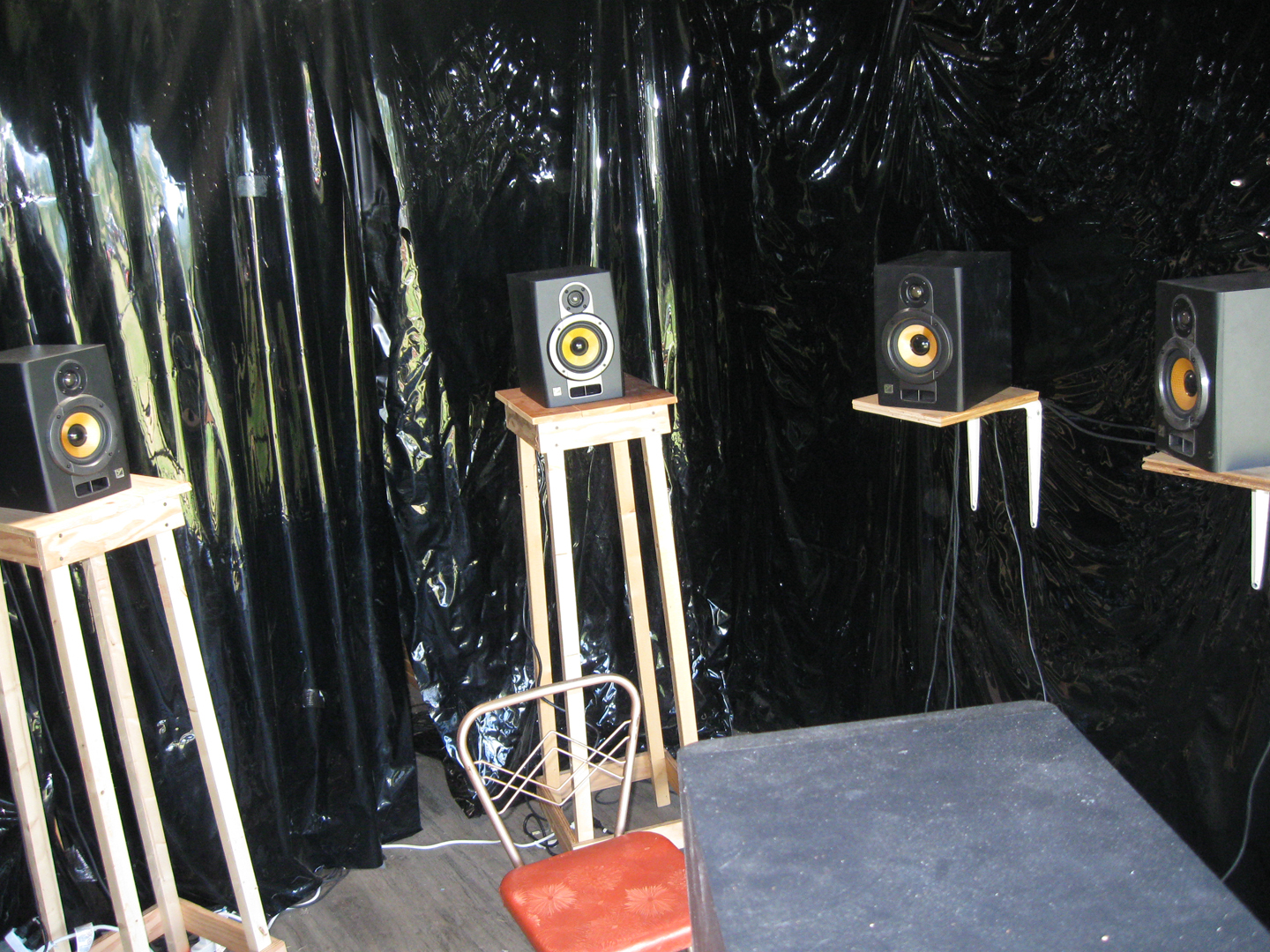
    The first acoustic installation I encountered was Austrian Astrid Seme’s entrancing ‘Urbirds Singing the Sonata’ (TONSPUR 41). TONSPUR is a permanent sound installation series curated by Georg Weckwerth and Peter Szely in Berlin, Vienna and Prague. Seme’s piece consists of a circle of speakers around a swivel chair. Each speaker emits a cycle of different bird sounds that swirl around the listener.

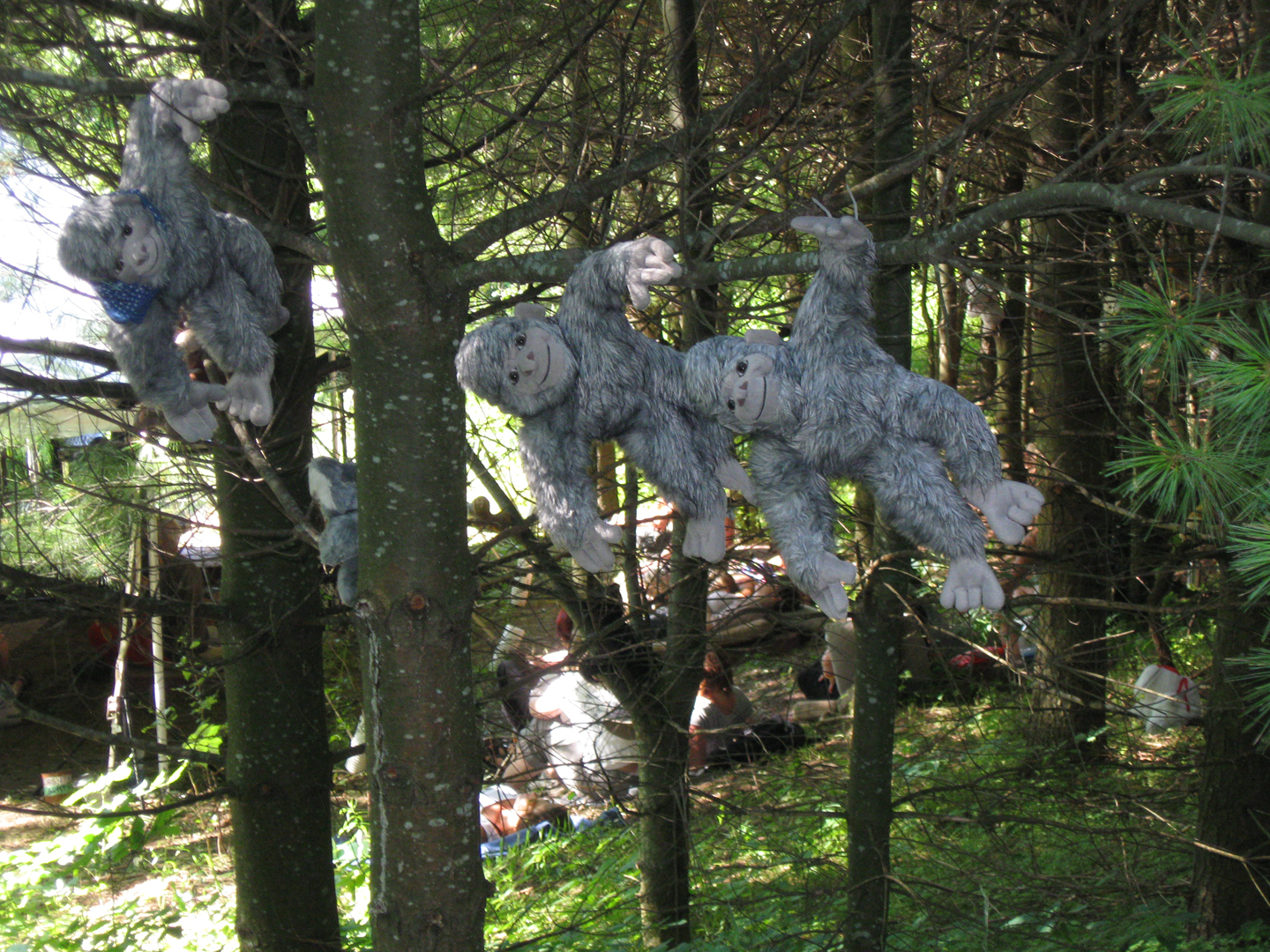
    Stuffed monkeys. Photo: Ashley Johnson

    Then, I staggered off down the hill into the forest valley where the DJ tent was situated. Stuffed animal toys lashed to branches are an odd touch. Sunda Duo Andrew Timar and Bill Parsons were playing soothing acoustic Indonesian instruments in the Gamelan tradition featuring a 20 string plucked zither, bamboo flutes, kacapi and traveling guitar. This tradition requires paired instruments to be tuned to one another slightly differently so that interference beats are created, causing a buzzing sound quite different to Western tuning.

    Next I visited Hilary Martin’s tent installation – Public Displays of Affection, where several wooden robots waited on a paper surface for the unwary. Hilary handed me some lipstick with the injunction to apply it. Hilariously I put it on my own lips not realizing that it was intended for the wooden lips of the robots! Duly applied and set, the robots respond to kissing noises that trigger a smack on the page.

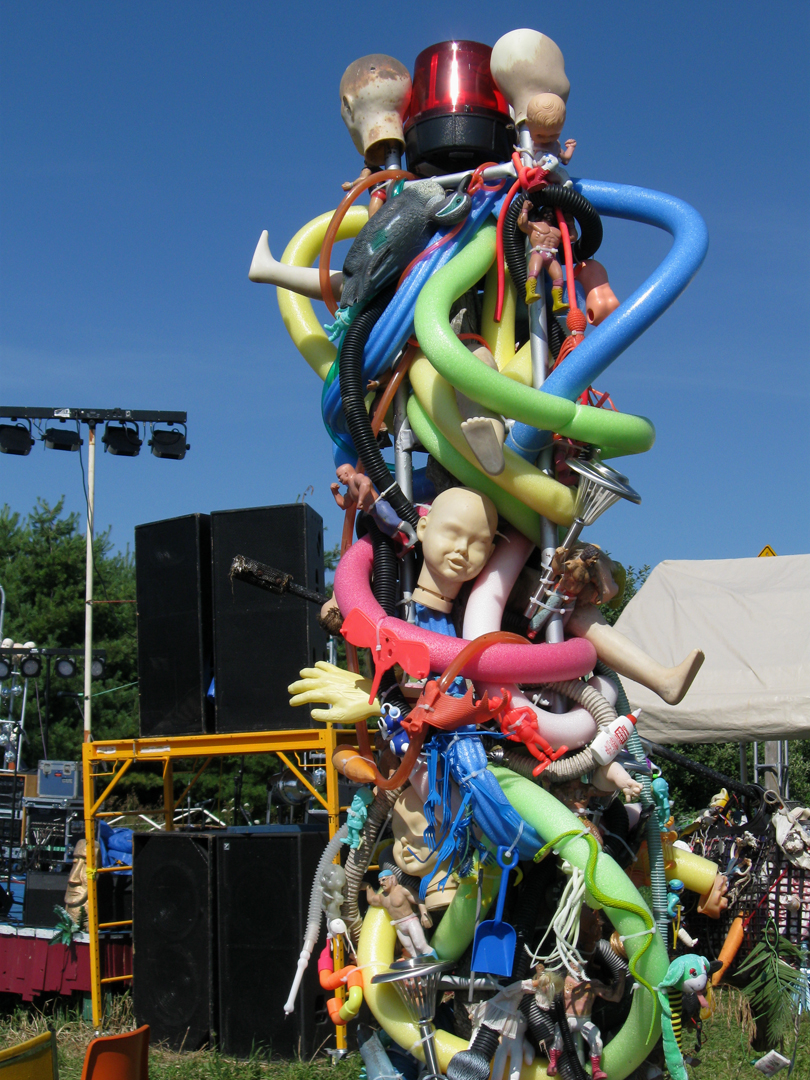
    Toy tower. Photo: Ashley Johnson

    Gathering remaining dignity, I set off for the main stage and the first act. The stage itself is eccentric with pillars of colourful toys and leaping stags. Audiolodge led the way with an interesting set. Kevin Curtis-Norcross, Troy David Ouellette and Paul Walde interact with speakers using a variety of implements like violin bows on stretched wire. Lesley Flanigan (New York) also exploited the capacity of speakers and microphones, using feedback and amplification. Sitting, surrounded by prepared speakers, she vocalizes and gets the sound swirling around her, reverberating and establishing a chorus. It was hauntingly beautiful.

    The heat on stage was intense for the performers as Torontonian Isla Craig and her guitarist Colin Fisher melded a more folk/trancelike music. The vocals and guitar had a lot of echo and reverb. Her voice was mesmerizing in its melodic flux.

    With the sun’s dying rays, Idiot Glee aka James Friley of Lexington, Kentucky played a set. He layers recordings of his voice adding organs and bass lines to create rich choral textures. The songs are reinterpretations of pop songs like “That’s All for Everyone” (Fleetwood Mac) that slowly and hypnotically unwind into the air.

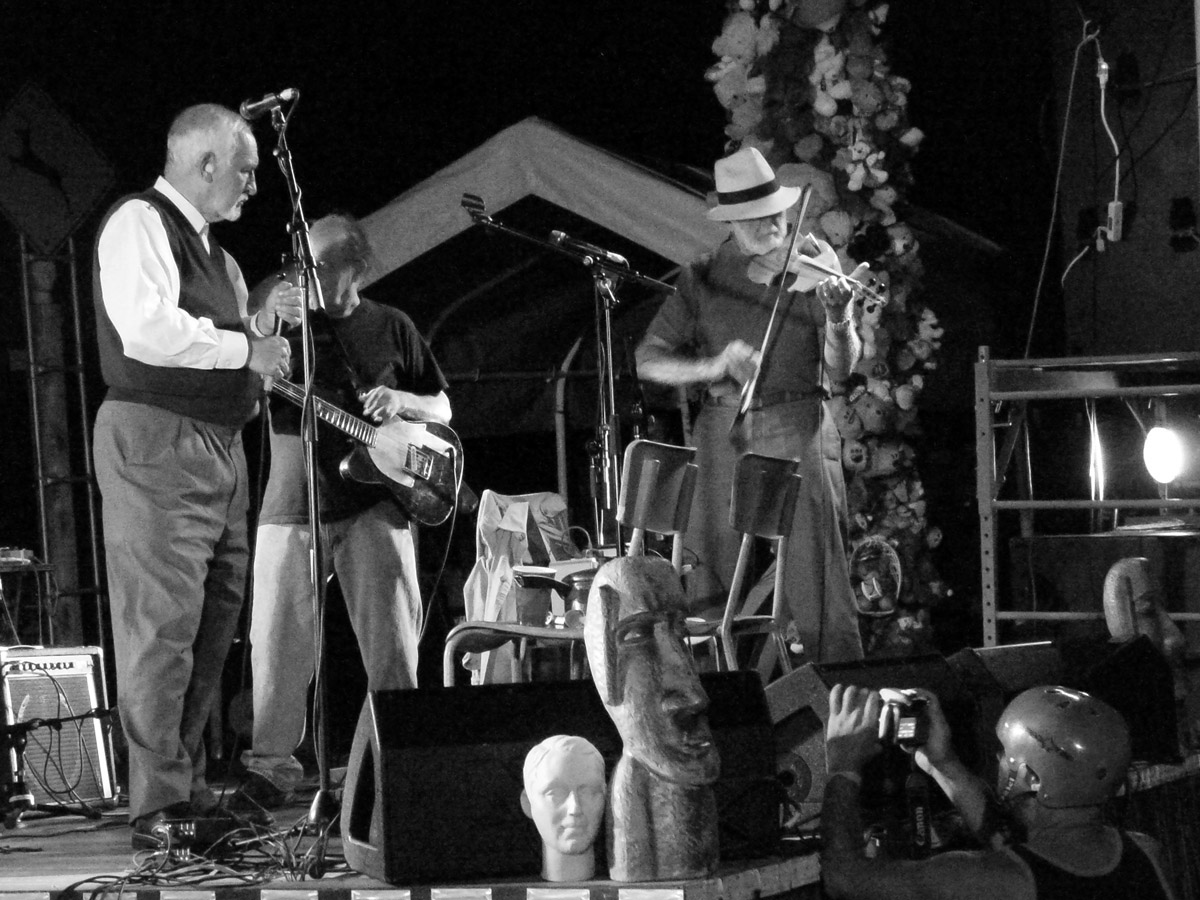
    Nihilism Spasm Band. Photo: David Hlynsky

     Later, the Nihilist Spasm Band from London, Ontario with guest Alexander Hacke (Berlin) smashed into the night. Formed in 1965, they have international repute as one of the first noise bands. Vocalist Bill Exley delivers a manifesto of political discontent about ownership or meat eating before the band launches into full-bodied improvisation using odd instruments like electric kazoos and pots alongside altered or built guitars and drums. They swept the night before them like a wave.

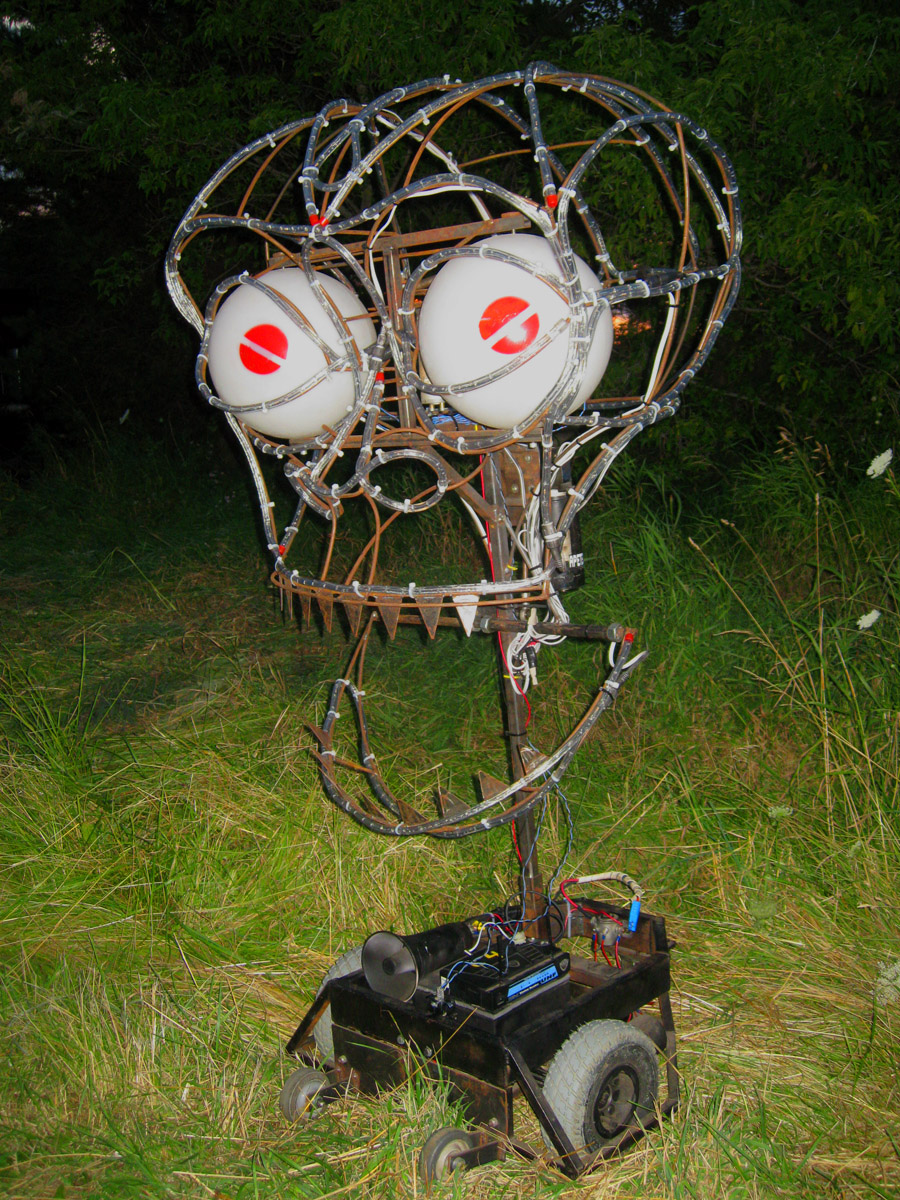
     Various other interesting acts punctured the evening but unfortunately it was time to catch my taxi back to Toronto. Winding my way back I was confronted by the malevolent robots of Apetechnology, a former collaborator with Survival Research Laboratories. One of these remote controlled contraptions had a wild, swinging drum that flashed light and sound at knee height. The other had steel teeth and rolling white eyes. It came up to say “I seeee you” in a mechanical voice.

    Apetechnology. Photo: David Hlynsky

     I took one final look into a trailer showing Willy Le Maitre’s 3-D video Outlook Expressed. This seemed like a primordial event as seeds transmogrified into other forms while seeming to be situated just in front of the screen. Sky and earth had traded positions.

     Julianna Barwick. Photo: David Hlynsky

    On the whole this festival is thoroughly entertaining and educational. I noticed that many of the audience are regulars and come geared for a party with lasers and flashing lights in their hair. Next year I’ll be back to camp.

    For links to the artist’s sites to listen to their music and further information on Electric Eclectics see http://www.electric-eclectics.com .

  • Courvoisier Artist Collective Exhibition and Urban Showcase for Local Talent


    August 10-September 4, 2011
    Opening: Wednesday, August 10, 7:00-9:30pm
    Formal Presentation at 7:30pm
    GALLERY 1313
    1313 QUEEN STREET WEST,
    TORONTO, ON M6K 1K8
    T: 416 – 536-6778
    E mail: director@g1313.org
    www.gallery13131.org
    or Rebecca Fair at PraxisPR
    T:905.949.8255 ext: 224 
    E-mail:  rebecca@praxispr.ca
    Hours: Wed – Sun 1- 6

    Artist Collective Unveils Gallery Exhibition And Urban Showcase For Local Talent
    The Courvoisier Collective supports local art community by bringing art back to the streets 

    The Courvoisier Collective program is the latest stage of the Courvoisier brand’s ‘Revolutionary Spirit’ campaign.  The program launched on June 6, 2011 with a call for art submissions. To participate and become a member of the Courvoisier Collective, artists submitted artwork to CourvoisierCollective.com.  During the one-month submission period over 130 art submissions, which spoke to the theme of the ‘renewal’ of the power of art, were received.  

    All submissions were eligible for a ‘Gallery Award’ call, where selected works, as chosen by online votes and the judging panel, will be exhibited at Gallery 1313. In addition, the three winning entries as determined by a panel of curators will have their submission appear on high-traffic urban billboards and PATH posters in Toronto during August 2011.

    The TOP THREE BILLBOARD WINNERS ARE:
    Erik Jerezano, First Place
    Hyein Lee, Second Place
    Mark Laliberte, Third Place