Author: artoronto

  • Tony Calzetta

    Bob Was Quite Leary of the Jibber Jabber Jimmys
    2012; 66 x 84 inches;  charcoal and acrylic on canvas

    April 14 – May 5, 2012
    Opening: Saturday, April 14,  4–9 p.m.
    Preview by appointment: April 11, 12 & 13
    R.S.V.P. to invite@delucafineart.com
    DE LUCA FINE ART GALLERY
    217 Avenue Road
    Toronto, ON, M5R 2J3
    T: 416-537-4699
    E: corrado@delucafineart.com 
    www.delucafineart.com.
    Hours: Tues–Sat 11–5 p.m.

    Over the past 35 years Tony Calzetta has developed a distinctive visual language of bold, simplified forms where colour, texture and lines jump into a third dimension and dance to life to create works that challenge the viewer’s imagination.

    As Kate Regan wrote in her essay “Tony Calzetta: Line Dancing,” “it was Paul Klee who wrote of taking a line for a walk to see where it would go. In the same spirit, Calzetta invites his lines to spin, zoom, fly, gesticulate and toddle.”

    This important exhibition of major works, Calzetta’s first in five years, is a new collection of large scale canvasses and drawings.

    Tony Calzetta received his B.F.A. from the University of Windsor and his M.F.A. from York University. He works mainly on canvas and paper and at times in sculpture and printmaking. He has published three major livres d’artiste, Acts of Kindness and of Love in collaboration with writer John Metcalf, and more recently How God Talks in His Sleep and Other Fabulous Fictions and Peculiar Practices with writer Leon Rooke. In addition to commissioned works he is represented in public, corporate and private collections in Canada, the U.S. and Europe. In 2011, his paintings exhibited at the Istituto Italiano di Cultura in Toronto were part of the Padiglione Italia at the 54th International Venice Biennale. He was elected as a member of the Royal Canadian Academy of Arts (RCA) in 2004.

    Tony Calzetta says, “My work is about drawing. The drawing is about images that are composed of shapes and forms constantly evolving from a highly personal visual vocabulary which started with subconscious doodling and automatic drawing and later from more conscious visual influences. My work can be viewed as ‘abstract funnies’ or ‘surreal cartoons’ which fit somewhere between high art and popular culture. My interest is with image as image and I believe in letting the viewer interpret and create his or her own narrative.”

  • Rock Therrien: Bonheur Facile

    Sky’s the limit 60 x 120

    April 12 – May 6, 2012
    Opening:  Thursday, April 12, 6 -9 p.m.
    Thompson Landry Gallery
    The Distillery District
    Stone Distillery Space
    55 Mill Street, Building 5, #102
    Toronto, Ontario, M5A 3C4
    Tel: 416.364.4955
    E-mail:info@thompsonlandry.com
    www.thompsonlandry.com
    Hours: Tues–Sat 11-6, Sun 12-5

    The mixed media works of Rock Therrien embrace the humour that often touches the viewer through the artist’s use of enlarged figures and playful text.  His characters bring the canvas to life, evoking memories of family and home with a wit that is both joyous and profound.  Despite the light-hearted subject matter of his pieces, Therrien’s works maintain the deeper essential concept, reminding the viewer that with the right outlook, happiness is easy to achieve.

    Born in Bellechasse, Quebec, Therrien combines traditional folk-art of Quebec with a comic-book style appeal which integrates authentic Canadian symbolism.  These scenes of Quebecois life draw the viewer into a world where joie-de-vivre is the highest priority.  The gorgeous layering of paint and found objects, combined with a beautiful sanded finish, creates an effect which is both fresh and nostalgic.  Influenced by childhood heroes of fiction like Asterix and Obelix, the pieces depict a life of fun, adventure and relishing the beauty of the moment.


  • The City of Fire and Too Much Air by Punch Clock

    The City of Fire and Too Much Air (concrete, steel, copper, brass, gold leaf, laser print) by Punch Clock

    April 3 – May 4, 2012
    Daily until 12 a.m.
    ROADSIDE ATTRACTIONS 
    911 Davenport Road
    Toronto, ON  M6G 2B7
    E: info@weseeinc.com

    The City of Fire and Too Much Air appears to portray a near futuristic metropolis crumbling under the weight of a rebellion. The members of Punch Clock do not see the piece representative of a world engulfed in destruction and despair, but rather one of hope, optimism and peace.

  • Tasman Richardson: NECROPOLIS

    MUSEUM OF CONTEMPORARY CANADIAN ART
    February 4 – April 1, 2012

    Tasman Richardson is a video and multi-media artist based in Toronto. He has exhibited and performed his work all over the world including Europe, Africa and Asia. Richardson’s artwork focuses on entropy, tele-presence, appropriation and JAW editing (which he founded), often using grim imagery. JAW editing consists of video cut ups used to create a possible narrative.

    Tasman Richardson, Memorial, Necropolis installation excerpt, 2011. Courtesy of the artist © Tasman Richardson.

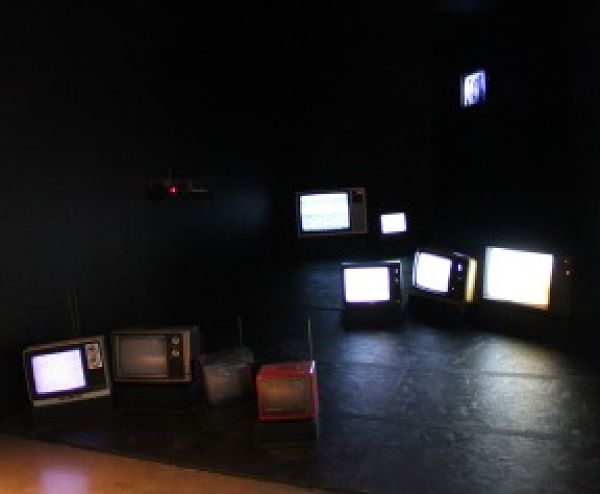
    The title of the exhibition itself, Necropolis, is a Greek term referring to a large cemetery or historic burial ground. This title seems ironic because Richardson’s multi-media exhibition involves bright colour, sound and the human ability to use his/her sight, perception, and touch in order to navigate through this shadowy trail. Once inside the gallery, the attendant will advise each viewer to proceed with absolute caution as it is dark, and those who are epileptic are not permitted to enter. Following this warning from the gallery attendant, the curious yet apprehensive spectator wanders into the blackened space, illuminated by a series of eerie video installations. The first work to be seen involves a slow and steady climb through numerous television sets. This installation piece named Forever Endeavor involves two separate screens facing each other, one depicting the late child actress Heather O’Rourke from the film Poltergeist, while the second screen illuminates the face of actress Naomi Watts from the film The Ring. These two actresses are frozen amongst evil scenes within their horror movies. Although these films were created twenty years apart, each of the females are haunted and victimized by ghosts through television. Being familiar with both these chilling films, as a spectator I begin to feel a subtle sense of panic.

    Tasman Richardson,Forever Endeavor, 2011.  Necropolis installation excerpt, 2011. Courtesy of the artist © Tasman Richardson

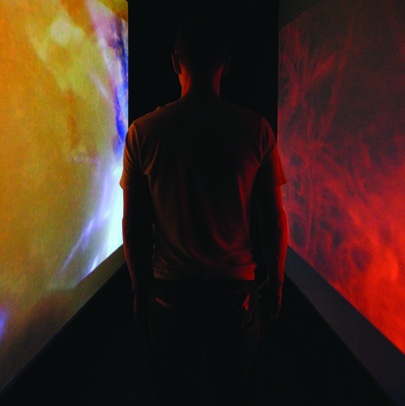
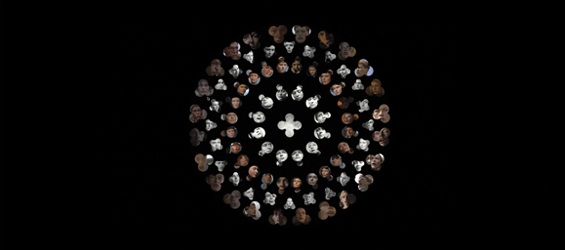
    At this point the exhibition becomes severely dark and one must step over what seems to be a glass walkway sitting atop what looks like a sheer twenty-foot drop. This sense of panic now intensifies as the viewer realizes he/she must step over this glass plank. In order to successfully navigate through this black tunnel viewers must use their sense of touch by grazing and stumbling into walls. Finding one’s way around Necropolis is as confusing as it is frustrating, as you will begin to question the very basic details of perception, feeling lost at many times in Richardson’s dark passageway. Within this passageway Richardson’s work titled Parsec propels coloured light shooting out on both sides of the spectator, creating a visual play on colour and space perception. Following Richardson’s Parsec piece is his Memorial installation a marker in which one is nearing the end of this exhibition. This work consists of a circular Rose Window, similar to the one housed in Notre Dame’s cathedral. Within this Rose Window are small scenes of the remaking of Joan of Arc, consisting of head and shoulder video portraits of men and women. The faces of these men and women turn away from the dire fire located in the middle of the window. These faces act as personifications of Joan of Arc, who was famously burned to death as a culture of people became convinced she was an evil witch.

    Tasman Richardson, Memorial, 2011.  Necropolis installation excerpt, 2011. Courtesy of the artist © Tasman Richardson

    With much of the exhibition I was more concerned with navigating through the dark passageways than focusing on each individual installation piece. Many of the pieces with the exception of Forever Endeavor and Memorial were difficult to connect with on a conceptual level. Forever Endeavor and Memorial had obvious conceptual parallels dealing with notions around evil spirits, humanity, and mass culture manipulation, whereas other works did not suggest this as obviously.

    The most effective aspect of this exhibition is Richardson’s approach in allowing one to use their perception and senses. In order to navigate through the exhibition one is often getting lost in corners amidst the darkness. However, the blackened architectural layout of the exhibition facilitates frustration, subtle panic and anxiety amongst its viewers, loosing their appreciation for the complex and visually playful installations. It seems when viewing this exhibition people’s priority lies within one’s ability to navigate through the exhibition than deconstructing the work of art.

    By: Amanda Pignotti

  • Tribute to Ayala Zacks

    Amedeo modigliani (Italian, 1884-1920), Portrait of Mrs. Hastings, 1915, oil on paperboard, 55.5 x 45.4 cm. AGO, Toronto, Gift of Sam and Ayala Zacks, 1970 © 2012 AGO

    April 4, 2012 – February, 2013
    ART GALLERY OF ONTARIO
    317 Dundas Street West
    Toronto, ON M5T 1G4
    T: 416.979.6648
    www.ago.net
    Hours: Tue & Thurs–Sun 10–5:30, Wed 10–8:30

    A new exhibition at the Art Gallery of Ontario (AGO) recognizes the extraordinary generosity of one the Gallery’s great patrons. A Tribute to Ayala Zacks (1912–2011) opens April 4, 2012 in the Frank P. Wood Gallery and includes significant works by celebrated artists including Marc Chagall, Giorgio de Chirico, Edgar Degas, Sonia Delaunay, Henri Matisse, Amedeo Modigliani and Pablo Picasso.

    Ayala Zacks and her husband, Sam Zacks, were committed and active supporters of the AGO. Following Mr. Zacks’ death in 1970, Ms. Zacks donated more than 300 works of European and Canadian modern art to the AGO collection. A Tribute to Ayala Zacks (1912–2011) honours the transformational effect that this gift had on the Gallery’s modern art collection and the leadership role that the couple played both at the AGO and within Toronto’s artistic community.

    Among the exhibition’s highlights is the first cast of Henri Matisse’s crucial early bronze, Figure décorative (1908), a powerful figure that the artist portrayed in his renowned painting Red Studio (1911). The work’s inclusion in A Tribute to Ayala Zacks (1912–2011) marks the first time in decades it is on view in Toronto.

  • Unframed Honesty / Rodrigo Echeverria Noriega at Oz Studios

    OZ STUDIOS (134 Ossington Avenue)
    January 9 – 23, 2012

    Oz Studios is an inconspicuous, small gallery space on Ossington Avenue. This quaint little space is just enough to host the solo show by Mexican artist Rodrigo Echeverria Noriega. Conservative Honours, the artist’s Canadian debut, uses a variety of media to depict a village that draws from imagery of the artist’s native country.

    Installation view of Rodrigo Echeverria Noriega: Conservative Honours at Oz Studios, 2012. Courtesy of the artist.

    Upon entering the gallery, you will notice Noriega’s clever touches all over the place—from the walls to the floors to the windows—engaging the whole space for a total aesthetic experience. I was particularly delighted by a red stripe that runs along the walls of the gallery. “I’ve installed a red bulb at the entrance,” Noriega happily explained, “so that when people walk in, they have red on their minds. Then they see the red stripe and they unconsciously recognize it, and feel welcome.”

    Rodrigo Echeverria Noriega, Reclining Woman, 2011. Acrylic on canvas. Courtesy of the artist.

    Noriega’s earthy paintings depict traditional Mexican imagery of figures and landscapes. Yet, the close embrace of a man and a woman in Redemption is evocative of Klimt’s Kiss (1907-08), and Reclining Woman seems to be in keeping with the long tradition of the reclining nude that goes all the way back to Giorgione.

    Rodrigo Echeverria Noriega, Redemption (A man and a woman hugging), 2011. Acrylic on canvas. Courtesy of the artist

    When I observed that some of his paintings evoke references from art history, Noriega nodded thoughtfully. Although he didn’t necessarily create his paintings based on those works, he does acknowledge the influence. “I value the tradition in art history and learn from the Masters. They’re the ones who got it right, you know? I take the tradition, and make something of my own, something modern and avant-garde,” he said.

    Even as his paintings invite nostalgia and contemplation, Noriega does not forgo his creative gestures. In between the paintings are bright orange pipes containing flowers. While they seem wonderfully quirky, Noriega said these flowers are for honouring the paintings, one adjacent to the other. Or, they could also be referencing the notorious Piranha Plant as seen in the Super Mario video games. “In that case, they’d take on a much more dangerous role,” added Noriega with a grin.

    Installation view of Rodrigo Echeverria Noriega: Conservative Honours at Oz Studios, 13-23 January, 2012. Courtesy of the artist.

    Noriega likes to experiment, as evident in the exhibit. “My primary focus is always painting, first and foremost,” he declared; but his art is undoubtedly informed by his forays into different mediums. The media he experiments with are not the end game, but a means to an end—which always comes back to painting.

    Loyal to his work, Noriega intends the paintings to be seen with “unframed honesty.” Instead of frames, the canvases are visually enclosed by strips of yellow he painted on the wall. He prefers that the paintings interact freely with the surface of the wall, and that the viewers experience the works in their bare form. “I don’t want my paintings to pretend,” explained Noriega. “I don’t want them hiding behind a fancy frame, or big stuffy conceptualism. My paintings are honest.”

    And that is precisely what I liked about Conservative Honours. Noriega’s paintings are delightfully down-to-earth and exude warmth. They are a welcome relief from the January blues.

    By Seowon Bang

  • Oleg Lipchenko: Freudoscope

    Freud 16. Creation of Adam. 2012. oil on canvas. 24″ x 24″

    April 5 – 20, 2012
    Opening: Thursday, April 5, 6 – 9 p.m.
    Artist’s Talk: Sunday, April 15, 1 – 3 p.m.
    BEZPALA BROWN GALLERY
    17 Church Street (Front and Church)
    Toronto, ON, M5E 1M2
    T: 416.907.6875
    E: info@bezpalabrown.com
    www.bezpalabrown.com
    Hours: Mon by appointment, Tues–Wed 11:00–6:00 p.m., Thurs–Sat 11:00–8.00 p.m., Sun 11:00–6:00 p.m.

    Dr. Sigmund Freud dreamed of building a very special device to explore people’s dreams. He even had a name for it—”Freudoscope.” Colleagues and friends didn’t take it seriously. They joked derisively. Dr. Freud seemed not to be offended, or he just pretended not to take the jokes seriously. He just smiled mysteriously, as he thought: “Well, go ahead—laugh, we’ll see if am I right or I am wrong, I know what I’m doing.”

    But no one knew that he actually had built such a machine…

    This project is called FREUDOSCOPE; Unknown Facts and Speculations about the Life and Death of Famous Dr. F. Dr. Freud was one of the first pop-stars of the twentieth century. His behavior in public, his attitude, his attention to his own appearance, as well as his not appearing at any Psychoanalytics conference or congress, leads one to conclude that he was a successful professional self-promoter rather than a modest scientist. His influence on the evolution of psychology in the twentieth century is more an object for anthropologists and philosophers of science. But, as a visual artist, I couldn’t just pass by such an intriguing topic. So, here you go, I present to you my interpretation of Freud through the FREUDOSCOPE.

    Oleg Lipchenko

    About Oleg Lipchenko

    Oleg Lipchenko, artist and illustrator. Oleg works on oil paintings and graphic art. His style can be described as symbolic, surrealistic, and plastically sophisticated, with the emphasis on expressiveness. He has had a number of solo and group exhibitions. His illustrator’s experience includes children’s books, book covers and scientific illustrations.

    Oleg works in traditional media including oil on canvas, watercolour, pencil and ink. He uses print graphics such as xylography, linoprint and l’eauforte and digital enhancement (for technical purposes such as scanning, color adjustment, etc.). In 2009, Oleg Lipchenko won the Elizabeth Mrazik-Cleaver Award from IBBY for his illustrations in Alice’s Adventures in Wonderland (Tundra Books, 2009). His Humpty Dumpty and Friends (Tundra Books, 2009) was nominated for the 2010 Book of the Year Awards by ForeWord Reviews. Recently Oleg has completed illustrations to the Hunting of the Snark by Lewis Carroll and illustrations for this Freudoscope exhibition.

    Oleg studied art and architecture in Art School and at the University in Poltava, Ukraine. He worked as an architect for several years, and as a teacher of drawing, painting and composition in the Art School. Oleg relocated to Canada in 1999. He lives in Toronto with his family and has embraced the Ontario way of life.

  • Blender by 253469

    Wednesday, March 28, 2012, 7 p.m.–3 a.m, March 29
    Garrison

    The artist project 253469 hosted a performance and audiovisual art party at the Garrison on Wednesday March 28, presenting a sampling of Toronto’s well known and unknown artists working in absurd, counterculture ways.  Wesley Rickert’s three short absurdist digital films set the tone for the night and the characteristic sounds of the 253469 noise project that followed.  Accompanied by special guest Amber Scott, the 253469 noise band combined analogue synthesizers and stick guitar with three voices improvising melody, reading nonsensical poetry and shouting out punk references in French and English, resulting in a sound that might resemble a walk backwards through Kensington market if all the stores simultaneously played deconstructed pop songs, readings by Edie Parker and sounds by John Cage.

    Alpha Couple

    Toronto duo Alpha Couple followed with a thirty-minute, low-intensity acoustic and emotional vocal arrangement.  Alpha Couple is Kristal Jax and Mark Wol.  They sing songs about the shitty middle class in their Junction neighbourhood and the pain of “I can’t” which Mark vocalizes while convulsing with movements of a man releasing demons into the microphone.  Alpha Couple is apple pie sweet with a side of dark intensity for balanced digestion.

     Nervous Breakdown

    The crowd loved the sounds and debut of Nervous Breakdown, combining DJ Abominable Hominid with the vocals of Brooke Stubbings, a theatrical artist and performer.  Sometimes sounding like Beth Gibbons (Portishead), Brooke bounces from jazz into pop and spoken word.  Brooke is a stage performer and can improvise her pants off.  Mostly it was her dress that kept coming off or up over her head as if she were standing over  a grate of subsonic proportions.

     Ulysses Castellanos,  “I’m Too Sad To Tell You”

    The moment of true exposure came when the master of ironic performance, Ulysses Castellanos, took the stage with his performance “I’m Too Sad To Tell You”:  A grown man crying into a can of beer while a slide show of children with cherub faces and open mouths cry tears and express pain.  The only context is your own reference.  Ulysses reveals nothing until he shreds his clothes with a knife, a gesture of humanity, a nod to the absurdity of clothing.  The slide show changes to a video of cat fights, police and white trash culture.  Ulysses dances and sings a rockabilly song, fully exposed.

     Jubal Brown

    The night finished with the intense projections of Jubal Brown’s machine-gun videos and the blended surprise of the newly formed audio project The Brunettes, where we got to witness another talent of Ulysses Castellanos:  yodelling.

    The Brunettes

    Text and photo: Kathleen Reichelt

  • Christos Damianos *DETAINED *

    April 4–15, 2012
    Opening: Thursday, April 5 , 7–10 p.m.
    GALLERY 1313  Cell Gallery & Window Box Gallery
    1313 Queen Street West
    Toronto, ON, M6K 1K8
    T: 416.536.6778
    E: director@g1313.org
    www.gallery13131.org
    Hours: Wed–Sun 1:00–6:00 p.m.

    In Christos Damianos’s *DETAINED* installation, the Cell Gallery is dominated by thousands of sunflower seeds on the ground. A cracking sound created as visitors walk around the room is combined with the tweeting of a bird. Unlike Al WeiWei’s thousand hand-painted clay versions used at the Tate Modern, these sunflower seeds are real. The visitor breaking shells creates a climate of fear or the fear of abduction, detainment or even death in the hands of a repressive government. Detained explores the way in which the Internet and digital technology co-exist in an increasingly destabilized cultural environment.

    The installation, purposely cramped in the Cell Gallery, unfolds slowly to the patient observer with an optimistic and ethereal view of passing time. The intimately stacked thousands of seeds on the ground do not represent Al’s installation as much as they speak to his imprisonment. Rather than isolating WeiWei in a cell, his personal space was reduced by the presence of police officers that monitored him around the clock, often sitting only inches away. In these etching monoprints and drawings, a line was drawn for each breath he took during a set period. This is an intuitive and steady process, reminiscent of the grids of Agnes Martin or Terry Winters. As such it is more performance than painting. The intimate act of being aware of one’s body—each breath, pulse, muscle ache—connects the artist with the experiences of prisoners who have shared this specific cell, as well as those who have shared the cell of political activists such as WeiWei. The ShhShh repeated across the wall, the chirping heard overhead and the prints on the walkway are not just metaphors of mandatory compliance, social networking and political protest but also serve to expand the artist’s practice and use of materials.

    The eighteen etchings and drawings pinned to the wall in a grid-like formation out of the viewers’ initial sight stand for the hard drive, diaries, archives and other materials confiscated from those illegally detained and/or abducted. The viewer experiences them only after entering the space and cracking some shells, thereby becoming a sort of activist. The paper responds to the stark white of the walls and the movement of the viewers by reflecting the light and fluttering in the breeze created by the viewers’ passing. As part of the performance, the artist hands out sunflower seeds to visitors in both the gallery and the courtyard.

    Window Box Gallery includes a large pile of sunflower seeds and a red tongue-shaped object drenched in blood, similar to that depicted in Picasso’s Guernica. This installation is an allegory or tribute to WeiWei and thousands of outspoken, sharp-tongued sacrificial critics.

  • WHAT JUST HAPPENED

    Image: Magnolia Banda-Marin, Pedro/Peter, February 2012

    April 4–15, 2012
    Opening: Thursday, April 5, 7–10 p.m.
    GALLERY 1313 Main & Process Gallery
    1313 Queen Street West
    Toronto, ON, M6K 1K8
    T: 416.536.6778
    E: director@g1313.org
    www.gallery13131.org
    Hours: Wed–Sun 1:00–6:00 p.m


    Gallery 1313 is pleased to present WHAT JUST HAPPENED, showing works by Magnolia Banda-Marín, Marta Franco, Ian Hahn, Cory Manley, Jasmine Mujkanovic and Alex Yardley.

    Sculpture/Installation Thesis Students’ 2012 Exhibitions Series OCAD University’s Sculpture/Installation Program, in collaboration with Katharine Mulherin Contemporary Art Projects, Gallery 1313 and Tomorrow Gallery, is pleased to announce the 2012 SCIN Thesis students’ exhibitions series entitled What Just Happened. For a period of eight weeks, this series of twelve exhibitions will feature the multimedia artworks of fourth-year students in professional gallery contexts in the Queen Street West area.

    This series is made possible by the support of the Faculty of Art and the Nora Vaughan Bequest to the Sculpture/Installation program.


  • Barbara Cole: Two People Walking …

    Barbara Cole, Same Difference, chromogenic print face-mounted on plexiglass

    April 14 – April 28, 2012
    Opening: Saturday, April 14, 2–4 p.m.
    BAU-XI PHOTO
    340 Dundas St. West
    Toronto, Ontario, M5T 1G5
    T: 416.977.0600
    E: toronto@bau-xi.com
    www.bau-xiphoto.com
    Hours: Mon-Sat 10–5:30, Sun 11–5:30

    Pointing her camera upwards from below the surface of the water, Cole captures figures demonstrating love, anger, remorse and joy, their movements abstracted by the refracting lens of the water.

    About the Artist: Barbara Cole is a self-taught photographic artist who has built an extraordinary career in image making since beginning her practice in the 1980s. She is best known for her still images and her lenticulars. This latest series from Barbara Cole’s ongoing underwater photographic work is inspired by choreographed dance, and in- vestigates the nature of emotional expression and gesture within a relationship.

    Cole’s artwork is extensively collected by both public and private institutions, and has been exhibited worldwide in such venues as the Canadian embassies in Washington, D.C. and Tokyo, Japan. Throughout her career, Cole has worked internationally on commercial projects and large-scale art commissions including installations for the Breast Cancer Centre in Toronto’s Princess Margaret Hospital and for Trump Hollywood, Florida. She has won prestigious awards such as the Grand Prize at the Festival International de la Photographie de Mode in Cannes, and third prize at the International Photography Awards in new york. Barbara Cole lives and works in Toronto, Canada.

  • Atsmon Ganor: AFRIKA

    April 5 – May 13, 2012
    Opening: Thursday, April 5, 6 – 9 p.m.
    Artist Talk: Sunday, April 15, 2 p.m.
    JULIE M. GALLERY
    15 Mill Street Building 37, Suite 103
    Toronto ON   M5A 3R6
    T: 416 603 2626
    E: info@juliemgallery.com
    www.juliemgallery.com


    In AFRIKA Atsmon Ganor’s perceptive, occasionally tongue-in-cheek approach to art-making comes to fruition in two series: one, a modular suite of paintings; and the other, text-based pieces.  Toying with words, colour palette, subtlety, and the multiple, Ganor encourages creative, lateral thinking in his audience.  Not to be missed!

    Atsmon Ganor is known as a leading Israeli artist of his generation.  Working from a studio in 401 Richmond, he has carved a space at the heart of Toronto’s art scene.  Ganor is equally invested in conceptual exploration and the aesthetics.

    AFRIKA is accompanied by an artist talk at 2 pm, Sunday, April 15th.  To put it simply, it is a joy to hear Atsmon Ganor speak. He is a rare find in the creative community: as eloquent with words as he is with colour, Ganor’s artist talk will enrich your experience of AFRIKA. Discover his life-long attraction to atlases; fall into his discussion of conceptual art practice; and experience stories of creation, where concentrated immersion is fundamental to the search for the spark of life in an artwork. Seating is limited. RSVP required.