Author: artoronto

  • Margaret Ballantyne: Landscape Variations


    September 20 – October 14, 2012
    Opening: Saturday, September 22, 2 – 4 p.m.
    DAVID KAYE GALLERY
    1092 Queen Street West
    (entrance on Dovercourt)
    Toronto, ON M6J 1H9
    T: 416.532.9075
    E: info@davidkayegallery.com
    www.davidkayegallery.com
    Hours: Wed – Fri 11 – 6, Sat – Sun 11 – 5 p.m

    Please join me, from 2:00 – 4:00 p.m., on Saturday, September 22nd to meet textile artist MARGARET BALLANTYNE and to preview her new exhibition Landscape Variations.

    MARGARET speaks of her practice, “Landscape in the pattern of the woven cloth has been my focus for many years. Most recently the exploration is done by painting geometric shapes on two landscape grounds, then slitting the canvas and weaving them into a single whole. These painterly surfaces are combined by the craft of weaving. As these images are woven together the pattern and colour juxtapose foreground and background. Pure colour is overlaid with transparent wash and interference colours. The brilliance of each woven piece remains essentially a subtle arrangement of the painted surface on woven canvas. These bold designs are then rewoven into a theoretical position on the relationship of art, design and the craft of weaving.”

  • Holier than Thou

    Peter Barelkowski


    September 26 – October 7, 2012
    Opening Reception: Thursday, September 27, 6 – 10 pm.
    Open for Nuit Blanche September 29, 2012, 12 p.m. to midnight
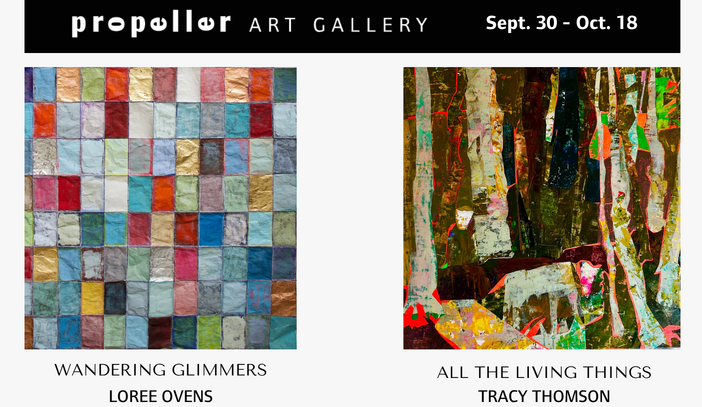
    PROPELLER CENTRE FOR THE VISUAL ARTS
    984 Queen Street West
    Toronto, Ontario M6J 1H1
    T: 416-504-7142
    E: gallery@propellerctr.com
    Hours: Wed/Sat: 12-6 pm, Sun: 12-5 pm

    Holier than Thou | Peter Barelkowski, Joseph Muscat, Holly Wheatcroft & Keijo Tapanainen

    Holier Than Thou / Visual Commentaries on Religion & Spirituality

    Propeller Centre for the Visual Arts is proud to present Holier Than Thou, an exhibition featuring four different viewpoints on the role of religion and spirituality in society as expressed through painting, mixed media, collage and sculpture. The content of the exhibition is intended to provoke, challenge and provide insightful commentary on two of religion’s most conflicting aspects: organized fundamentalism and radicalism alongside private, individual  and/or secular spirituality.

    The eighteenth century brought us Enlightenment, and with new developments in the Western world, established systems of faith were forced to adapt as various new secular movements gained momentum.  At the dawning of the twenty-first century, religious fervor is one again palpable, especially in political discourse and in war: wreaking havoc, spreading hate and causing pain and suffering. Holier Than Thou is an exhibition that discusses the negative aspects of organized belief systems which are often premised on exclusivity, preference and privilege, and contrasts them with the serenity and hopeful power of the basic tenets of spirituality such as the power of nature, meditation, and the beauty of the human body.

    Peter Barelkowski is a Toronto painter born in Poland and educated in Europe and Canada.  Adapting a visual language of grotesque and satire, Barelkowski effectively confronts the rationalism of historical perspective with the absurdity of political and religious powers that repeatedly throws humanity into the haunting dance macabre of war and annihilation. Although, deriving from specific historical events, Barelkowski’s works convey an uncomfortable universal message when applied to contemporary history. He is represented by Gallery 133 in Toronto.

    Joseph Muscat is a mix media artist born in Malta, educated in France and Canada and living and working in Toronto. His work spans a wide spectrum of two and three-dimensional work including painting, collage, photography, lithography and video. His recent tar paper – photographic collages use a wide repertoire of symbols referencing Political, Biblical and Environmental issues. He confronts these serious concepts with wit and whimsy balancing the Sacred with the Profane. He is represented by David Kaye in Toronto, Shayna Laing International in Montreal. He is currently Chair of Propeller Centre for the Visual Arts.

    Keijo Tapanainen is a Toronto based visual artist who creates digital works from mixed media and photographic images. He is interested in creating works that are playful in nature and that address the idiomatic and the idiosyncratic. The human figure is central to his art and these artworks attempt to capture the persona through the juxtaposition of complementary visual imagery, electronically composed, and collaged from unrelated sources. A native of Finland, he currently residing and working in Toronto.

    Holly Wheatcroft is a Toronto artist  and educator The artist’s sculptures  serve as symbolic searches for the sacred (order) in the profane (chaos) through the use of objects that reference the concept of axis mundi. Holly Wheatcroft has an extensive exhibition history that includes Peak Gallery and IDS Toronto, as well as site-specific community installations for bookhou, the MonTon Window, Infiniti cars and Weis & Associates. She is a member of Propeller Centre for the Visual Arts and the Sculptors Society of Canada, and is represented by the Art Gallery of Hamilton and Canvas Gallery in Toronto.

  • The Queen West Crawl

    The Queen Street West Crawl – Trinity Bellwoods
    September 15 & 16, 2012.

    The weather was perfect for this years Queen West Crawl and crowds flocked to this event, the tenth now, with over 250 artists plus food vendors and live music thanks to the Sinfonia Toronto.

    Sinfonia Toronto

    The event offers an opportunity for the public to view some great art and talk with the artist. Art collectors have the opportunity of purchasing directly from the artist.

    David Oxley, Crawl artist

    Shannon Dickie, Crawl artist

    Paul Brandejs, Crawl artist

    Thelia Sanders Shelton, Crawl artist

     Simon Scheiderman, Crawl Artist

    The Crawl started in 2003 as a one day event run by Artscape. In 2008 the Queen West Art Crawl (QWAC) was turned over to PCDG (Parkdale Community Development Group). This organization now has charitable status and is going to focus on the QWAC. So you can probably expect the Crawl to grow.

    Magdolene Dykstra, Crawl Artist

    Neil Young, Crawl artist

    Karen Kawarsky, Crawl Artist

    I sat on the jury this year along with Murray Whyte, arts writer for the Toronto Star and Manny Neubaucher of Neubacher Shor Contemporary Art Gallery. The jury process was online which made it a little easier but it still took considerable time to access the many entries.

    Talking to some of the artists they all seem happy with the turn out for the event. I didn’t hear about art sales but then I didn’t ask.

    Adam Kuczma, Crawl artist

    Sandy Middleton, Crawl artist

    Tony Taylor, Crawl Artist

    The evening before PCDG held a QWAC gala with a live auction at the Drake Hotels’ Underground Room. Cindy Goldrick, PCDG Executive Director since 2011 was on hand along with her Board of Directors many artists and supporters. CP 24 personality, Jamie Gutfreund worked the crow as auctioneer.

     Craig Hudson & Antoine Tedesco – Board members

    Looks like another successful year for the Queen West Art Crawl with many more to come.

    Text and Photo: Phil Anderson

  • Nuit Blanche is going to go on, strong and healthy: Interview with Julian Sleath

    Nuit Blanche is going to go on, strong and healthy: Interview with  Julian Sleath (J.L.) Programming Manager of Scotiabank Nuit Blanche

    With Scotiabank Nuit Blanche just around the corner, Artoronto.ca contributor Seowon Bang (S.B.) and the programming manager of special events at the City, Julian Sleath, engage in a conversation about Nuit Blanche and the past, present, and future of the city’s most prolific one-night art crawl.

    Usman Haque and Natalie Jeremijenko, Flightpath Toronto, 2011. Photo: Mauricio Contreras-Paredes

    THE PAST

    S. B: In the past, there has always been the debate of the spectacular and the populist vs. the critical and the “high art” when it came to Nuit Blanche – I’m sure this is old news to you. Nuit Blanche is meant to be a spectacle, not a mum art in a white box. Do you agree?

    J. S: The original mandate for Nuit Blanche in Paris was to transform the city, to put the unfamiliar in a familiar setting. We strategically work with curators and artists in places that are usually not expected to show art in—we try to look at public spaces differently. It’s interesting you mention the “white box.” Many institutions are involved to provide a full range of experiences, to provide many ways of enjoying contemporary visual art. It’s about the journey into the “white boxes.” Instead of dragging people to see the art or vice versa, we’re bringing the two together. There’s something incredible about the energy out of something that’s only there for 12 hours, like iconic pop concerts. Everyone can participate; Nuit Blanche breaks down the barriers in terms of whether you can afford to enjoy art, or how much you know about art.

    S.B: How do you respond to criticisms that Nuit Blanche has turned into an all-night booze party? There must also be security concerns, including crowd control, navigation, etc. Have there been incidents? How would you reassure visitors?

    JS: There are many things involved in organizing Nuit Blanche—infrastructure, road closures, etc. managed by an experienced team that brings you Canada Day, Doors Open, concerts and many more. In the first year of Nuit Blanche, people didn’t know what to expect. In this city, there is a passionate demand for large pedestrian experience. People want permission to stay out all night! It’s different from European cities. Things are shut down at 2 a.m here.

    AES + F, The Feast of Trimalchio, 2011. Photo: Phil Anderson

    S.B: In Europe, on the other hand, the nightlife never dies. A bit of night stroll, a sip of wine…

    J.S: Exactly. Inevitably, people in Toronto end up focusing not always 100% on contemporary art during Nuit Blanche. However, I hope some of them are pleasantly surprised. Who knows, they might stumble into a gallery one day and say, ‘Hey, I saw this artist’s work in Nuit Blanche the other night!’

    SB: Nuit Blanche is like an extended opening night crawl, in a way. People rarely come to openings to see art.

    J.S: Or like any other big cultural events, sporting events, or concerts, for which there is always a concern for crowd control and public safety. But these are not as heavily scrutinized as Nuit Blanche. Nuit Blanche is a big event that draws big crowds, and our team does everything to ensure it runs smoothly.

    Nuit Blanche, of course, does not condone reckless drinking. Our efforts are always on the visual art. Some people are now starting their night at 3 a.m, after the ruckus is over and things quiet down. There’s definitely an arc in the audience concentration. So this is an alternative if you want to experience the art but don’t want the big crowds and noises. Try to steer clear of the entertainment district, as well. There are also family-friendly Nuit neighbourhoods, like Artscape Wychwood Barns, Distillery District, Parkdale Village BIA and Queen West BIA.

    SB: Artworks are sprawled across the city, and Toronto has distinct pockets of neighbourhoods with different vibes. Miriam Arbus of artoronto.ca had a suggestion of maybe providing a better way of navigating people through the city. How would you respond to this?

    J.S: We have various tools like event guides, maps, and even apps to help people navigate through Nuit Blanche. On the Plan Ahead section of our website, we give you tips like how to get around the city, where to eat, and many more. They’re all available for you—people just have to invest more time when they are planning to go to Nuit Blanche. The tools are there.

    THE PRESENT

    SB: What’s new this year? Is there a special project or a notable new collaboration you’d like to highlight?

    J.S: Our focus is always on visual art, free, all night. To achieve this, we invite curators to pitch proposals and themes, and actively commission programs. For “Museum for the End of the World,” curated by Janine Marchessault and Michael Prokopow, the City Hall is devoted to 14 projects. City Hall becomes a museum for one night—from the parking lot up to loading dock to the Council Chamber and the Nathan Phillips Square. It’s such an unexpected place for art. A symposium with York University will be held in the Council Chamber as well.

    Museum of the Rapture, 2012, Douglas Couplan, Vancouver, Signage, Tableaux vivants, Zone B City Hall Project

    We are excited to be working with The Power Plant for the first time this year for a special 24-hour viewing of Christian Marclay’s The Clock. (The Power Plant, 231 Queens Quay W. For more information about The Clock, visit thepowerplant.org.)

    Janet Cardiff’s sound sculpture is another amazing installation. (Janet Cardiff’s Forty-Part Motet will be on view at Trinity-St. Paul’s Centre for Faith, Justice and the Arts, 427 Bloor St. W.)

    Regent Park Arts & Cultural Centre is also our new partner and they will be hosting Nuit Blanche programs as well as celebrating their new home. (Regent Park Arts Cultural Centre, 585 Dundas St. E.)

    Regent Park Arts & Cultural Centre, Our Lights Are On! 2012, Zone C Independent Project

    Planes, Trisha Brown Dance Company – New York, 2012, Zone C Exhibition Project

    Green Invaders, 2012, Yves Caizergues – Lyon, Zone A Exhibition Project

    S.B: How has the development of social media impacted Nuit Blanche?

    J.S: We have something called “Share your night.” Across the city in key locations, screens of social media stream displays messages sent to us by you, the audience.

    Some pieces change locations. Germaine Koh pushed a rock down Young St, GPS-linked. The locations are updated via social media so that people can follow her progress, of they wanted to.

    Social media is great for marketing and PR, but artists are using it as a medium these days.

    THE FUTURE

    S.B: What does the future have in store for Nuit Blanche—new developments, ideas, collaborations?

    JS: We are discussing the possibility of keeping the installation for more than one night. We have such great projects and installations, so it’s a shame to see them removed so quickly. But we also do not want to dilute the one-night-only experience. We’re still thinking—it’s an idea.

    Nuit Blanche is not a business, like Canadian Music Week. It’s about the iteration of contemporary visual art that’s available for all cities, towns, and collectives. There are similar all-night art events popping up around Canada, around the globe. We do not control them, but we’d love to collaborate. There is a tapestry of arts and culture, and we rely on one another.

    S.B: Martin Knelman was apprehensive about Nuit Blanche’s fate last year, and mentioned putting Nuit Blanche “up for adoption.” Is that still on the table? The departure of Rita Davies, who was instrumental in launching Nuit Blanche, must bring some shifts in terms of cultural initiatives, especially when the city’s arts funding is facing cuts in all direction.

    Beam of Underground Sun , 2012, Arezoo Talabzadeh, Kaveh Ashourinia, Toronto. Zone A Exhibition Project

    J.S: I haven’t heard anyone talking about Nuit Blanche being “adopted” by the private sector, as far as I know. Arts planning is well ahead in 2014—we intend to continue. Nuit Blanche is a large-scale public event, so it’s inevitable that Nuit Blanche is discussed every time someone talks about funding cuts. Comes with being successful, I guess.

    S.B: In March, the local art scene was shaken by Ontario government’s decision to slash the funding for Luminato by more than 40% and reduce support for other arts organizations. Are you confident about Nuit Blanche’s financial situation?

    J.S: 73% of our funding is met by sponsors and granting bodies. Nuit Blanche draws crowds, many of them tourists—it’s promoting Toronto as a great place for visual art to both locals and tourists. Hotels are willing to partner with us, and we’ve got travel partnership with Porter Airline, GO Transit, and VIA Rail. And of course, the City relies on the importance of tourism.

    The life sign is good. Nuit Blanche is going to go on, strong and healthy.

    (Featured image: Metropolis, Nuit Blanche, 2011. Photo: AdrianOosterman)

     

  • Alison Rossiter: Lost and Found

    Guilleminot Riviera, exact expiration date unknown, ca. 1930’s, processed 2012, diptych. Copyright:© Alison Rossiter / Courtesy of Stephen Bulger Gallery

    September 22 – October 20, 2012
    Opening Reception: Saturday, September 22, 2 – 5 p.m.
    Artist Talk: Saturday, September 22, 1-2 p.m. (RSVP as seating is limited)
    STEPHEN BULGER GALLERY
    1026 Queen St. W.
    Toronto, ON, M6J 1H6
    T: 416.504.0575
    E: info@bulgergallery.com
    www.bulgergallery.com
    Hours: Tues – Sat 11 – 6 p.m. or by appointment

    The gallery’s third exhibition with Alison Rossiter concentrates on her found photograms, which exist as latent images until they are processed using darkroom chemistry. Working under the safelight, while in the developer, abstract images appear on surfaces of the various types of photo papers that she has collected from hundreds of sources; some more than 100 years older than the expiration date printed on their packages. For Rossiter, a select few of those processed produce aesthetically pleasing results. The images formed are the result of the organic components of the gelatin silver papers decaying over time. Some are reminiscent of 20th Century art practice while others are arrangements of fingerprints of long deceased photographers, making this project one about archeology as well as art.

    Her simple working style – buying previously opened packages of old darkroom papers and processing them without exposing them to light – belie the sophistication of these images. Indeed, it is her mastery of photographic technique that coaxes the richly dense blacks, the impressive grey tones, as well as the clean whites that produces such exquisite results. Finally, it is also her ability to recognize excellence in a handful of successes that makes this work an exceptional homage to the medium of photography.

    Born Jackson, Mississippi, 1953, Rossiter has worked with the materials and processes of light sensitive, gelatin silver based photography since 1970. The darkroom is essential to her work process, whether it involves the traditional printing of negatives, drawing with flash lights, or making photograms. In 2003, she immersed herself into the field of photographic conservation as a volunteer at the Metropolitan Museum of Art in New York, which led to a profound appreciation of the history of photographic materials.

    For over three decades, she has been exhibited by many major institutions around the world and her work has been collected by important private and public institutions such as: National Gallery of Canada, Ottawa; The J. Paul Getty Museum, Los Angeles; The Art Institute of Chicago, Chicago; San Francisco Museum of Modern Art, San Francisco; Nelson/Atkins Museum of Art, Kansas City; The Art Gallery of Ontario, Toronto; Philadelphia Museum of Art, Philadelphia; Vancouver Art Gallery, Vancouver; amongst others.

  • Erosion / Encaustic works by Lesley Harries–Jones

    September 19 – 30, 2012
    Opening Reception: Thursday, September 20, 6 – 10 p.m.
    Open For NUIT BLANCHE September 29
    GALLERY 1313 Cell Gallery
    1313 Queen St. W.
    Toronto, ON, M6K 1L8
    T: 416.536.6778
    E: director@g1313.org
    www.g1313.org
    Hours: Wed – Sun 1 – 6 p.m.

    Interested in the environment she uses a variety of media including wax, pigment and tar to visually document the evolving destruction of our environment. Her work draws the viewer into an examination of color contrast and form illustrating her interpretation of the impact man continues to leave on our physical environment.

    “This series of paintings represent of the tenuous relationship between man and nature. My aim is to visually document the evolving destruction of the world we live in. These paintings are my interpretation of the carbon footprint – man’s continuing contamination of our physical environment. The use of pigmented wax in my paintings creates a subtle presentation of erosion, juxtaposed with the breaking up of surface, which is used to profile the phenomenal force of nature.”  Lesley Harries–Jones

  • The death of Mantegna by Alvaro Paz

    September 19 – October 14, 2012
    Opening Reception: Thursday, September 20, 6 – 10 p.m.
    GALLERY 1313 Process Gallery
    1313 Queen St. W.
    Toronto, ON, M6K 1L8
    T: 416.536.6778
    E: director@g1313.org
    www.g1313.org
    Hours: Wed – Sun 1 – 6 p.m.

    THE DEATH OF MANTEGNA works by Alvaro Paz

    Represented by La Scoperta Art Gallery Curated by Andres Lozano

    Alvaro Paz is part of an emerging wave of Latin American artists that deal with both classical and contemporary issues simultaneously. Having trained as a painter he uses the classical subjects of renaissance Italy to reflect upon contemporary Latin American problems such as street violence and the media.

    Alvaro has exhibited work in his native Venezuela, Mexico, Chile and the USA .

    This is his first Canadian Exhibition.

    Alvaro Paz was born in1986 . He lives and works in Maracailo, Venezuela.

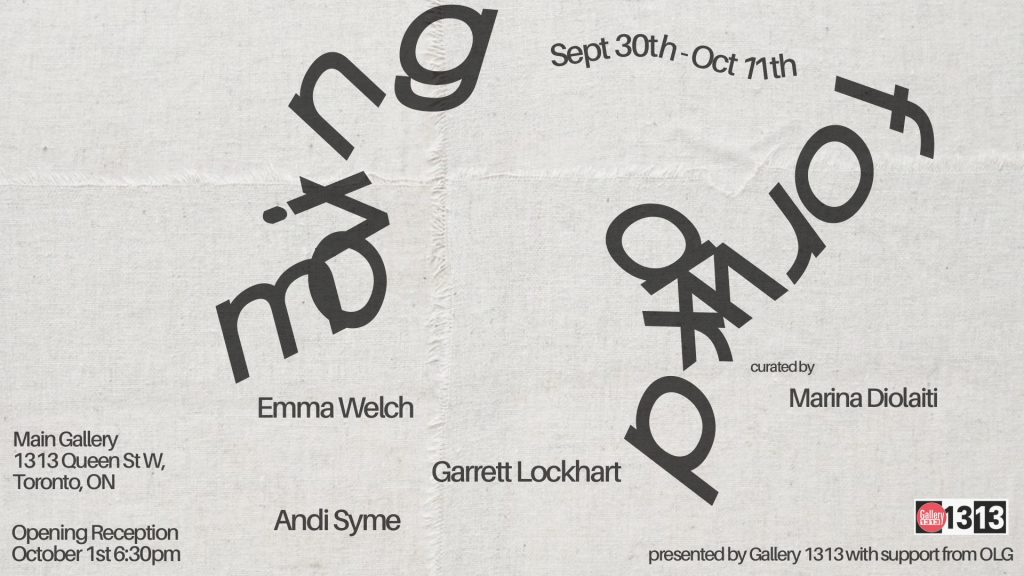
  • NIGHT MOVES / a group exhibition of members of Gallery 1313

    Gerard Richards, Ice Tower

    September 19 – 30, 2012
    Opening Reception: Thursday, September 20, 6 – 10 p.m.
    Open For NUIT BLANCHE September 29
    GALLERY 1313 Main Gallery
    1313 Queen St. W.
    Toronto, ON, M6K 1L8
    T: 416.536.6778
    E: director@g1313.org
    www.g1313.org
    Hours: Wed – Sun 1 – 6 p.m.

    NIGHT MOVES / a group exhibition of members of Gallery 1313:

    Zorida Anaya
    Fa Andrade
    Anastessia Bettas
    Paul Brandejs
    Diana Dickson
    Imre Hajagos
    Phillipa Hajdu
    Dan Hu
    Paul Kilbertus
    Jo Anne Maikawa
    Andreea – Alta Mihartescu
    Michelle Montague
    Quincy Morrison St. Kitts
    Melissa Penny
    Gerald Richards
    Pat Rice
    Chris Tryhonopoulos
    Nikki White
    Janice Ykema
    and others

  • Istvan Kantor on Hunger Strike

    Sunday, September 16, 2012, 2 – 5 p.m.
    ANTIX – Centre for Art Crime and Neoism
    276 Crawford Street, Toronto
    through drive way towards garage
    www.istvankantor.com
    http://home.interlog.com/~amen/

    I’m going on hunger strike to protest the authoritarian system that turns artists into servants of museums and slaves of institutions. What i’m expecting from this is to have a platform of communication in order to publicly announce my disagreements and demands.

    I’m inviting you to my storage space, known as ANTIX, located at 276 Crawford Street, Toronto, (through drive way to garage), to witness my official announcement written in blood as the initial action for this life intervention. I you are interested in participating you can also become a sponsor or a collaborator for the execution of this project.

    The biggest problem is that artists are obedient all over the world, in the face of institutional authority and power, acquisition rip-offs, mega exhibitions, superstar positions, they are hypnotized by the “good for your carrier” catch-sentences of the media and organizations, the empty promises and slogans of the collectors, the pretentious language of the curators, critics and art historians, and they are even mesmerized by their own starving artist legend and by their naive beliefs in immortality.

    Everybody knows that I’m anti-institutional as I have always made that very clear in public places, right inside the walls of the museums, surrounded by my conspirator friends, security guards, police, media and museum officials. I’m not hiding from my opponents and never tried to escape my fate. I know that I’m controlled through the surveillance devices of the vigilant system of the Rentagon. I’m considered a subversive, armed with cameras, transmission devices and most of all with my own blood in which circulates all my personal data and ideas. The genetical codes in my DNA are representing a potential danger to today’s technological society.

    Istvan Kantor aka Monty Cantsin Amen

  • Rachel Ovadia: Motivation


    September 27 – October 17,2012
    Opening Reception: Friday, September 28, 6 – 9 p.m.
    MUSE GALLERY
    1230 Yonge St
    Toronto, ON M4T 1W3
    T: 416.974.9986
    www.musegallery.ca
    musegallery@bellnet.ca
    Hours: Tues-Sat 11-6, Sun 11-4 p.m.

    “Mystical and enigmatic. Rachel Ovadia weaves threads of divine meaning into the very fabric of her esoteric compositions through expression that can enlighten and even transcend human understanding. She has formulated her own symbolic vocabulary – a paradoxical language that reads simultaneously as both simple and complex; an analytical code that has been shaped in part by her long-time fascination with the principles of Numerology, the Kabbalah and Buddhism.

    Colour, line and texture populate Rachel’s canvases with an ordered chaos. Ambiguous symbols become cryptic messages delivered by strong, deliberate brush strokes that complement minimalist lines ranging from delicate to bold. Objects dematerialize and vague contours emerge in configurations equipped with the subtle power to suggest rather than illustrate. Her evolving palette engages the intellect in its capacity to convey pure concept rather than just raw mood, where blocks of warm or cool colour share cerebral thoughts and ideas.

    Layers of paint are strategically applied and scraped to create textured architectural landscapes that are both earthy and refined. Symbolic lexicons emerge in Rachel’s compositions where abstraction meets reality meets genius. Her symbolic codes map out correlations between observable physical phenomena and the inner workings of humanity. She taps into numerological and other universal keys to decipher human nature and destiny. Each viewer responds uniquely to her elegant simplicity of line, suggestion of form and blocking of colour. Believing we each carry our own secretly encrypted codes from birth, Rachel invites us to identify with her work on an intimate level born of our individual experiences and beliefs.

    Rachel’s work is contemporary. It is primeval. It is timeless and universal. It taps into our collective memories and explores the yet to be discovered. It reflects the very core of human existence.” Sharon Gaum-Kuchar, curator

  • SAUL LEITER

    Saul Leiter, Tanager Stairs, 1954, chromogenic print, printed later,13 1/2 x 9 inches (image) 14 x 11 inches (paper)

    September 13 – October 6, 2012
    Opening Reception: Thursday, September 13, 6 – 8 p.m.
    NICOLAS METIVIER GALLERY
    451 King Street West,
    Toronto, M5V 1K4
    T: 416.205.9000
    www.metiviergallery.com
    Hours: Tuesday-Saturday 10 – 6 p.m.

    Nicholas Metivier Gallery is pleased to announce an exhibition of photographs by New York artist Saul Leiter. The exhibition will open on September 13 and will be on view through October 6 with a reception on Thursday, September 13 from 6– 8 PM.

    Saul Leiter was born in 1923 in Pittsburgh, the son of an Orthodox Jewish scholar. Developing an interest in art as a teenager, he quit theology school and moved to New York when he was 23 to pursue a career in painting. Leiter was introduced to the darkroom shortly after his arrival and while he has continued to paint throughout his career, it was his exploration into colour photography in the 1950s onwards that set him apart creatively and has been the subject of recent acclaim.

    Leiter was considered a member of the New York School, a group of photographers working between the late 1930s and early 1960s in New York City that redefined street photography. Most of Leiter’s contemporaries in this group, including Walker Evans and Robert Frank, only released works in black and white, adhering to the view that colour undermined the integrity of a photograph. Leiter in contrast exploited colour distortions and allowed for the accidental in the darkroom, abandoning notions of control.

    This will be Saul Leiter’s first exhibition in Canada and will feature photographs from his seminal body of work, Early Color. A collection of metropolitan scenes, Leiter employed mirrors, windows and the random passerby in a spontaneous manner to create alluring and unusual compositions. His background as a painter is evident in his poetic use of subdued colour and eye for the abstract.

    The exhibition coincides with an era of unprecedented recognition for Leiter’s work. This past spring, Leiter had a major career retrospective at the Hamburg House of Photography accompanied by a catalogue. Museum collections include: The Museum of Fine Arts, Houston; The Art Institute of Chicago; The Baltimore Museum of Art and The Victoria and Albert Museum, London. Leiter is represented by Howard Greenberg Gallery in New York.

  • Howard Lonn: Signals Back to the World

    Howard Lonn, Shape Imitator (Study), 2012, oil on canvas, 30 x 22 inches

    September 13 – October 6, 2012
    Opening Reception: Thursday, September 13, 6 – 8 p.m.
    NICOLAS METIVIER GALLERY
    451 King Street West,
    Toronto, M5V 1K4
    T: 416.205.9000
    www.metiviergallery.com
    Hours: Tuesday-Saturday 10 – 6 p.m.
    Nicholas Metivier Gallery is pleased to announce Signals Back to the World, an exhibition of new works by Howard Lonn. The exhibition will open on September 13 and will be on view through October 6 with a reception for the artist on Thursday, September 13 from 6– 8 p.m. This will be Lonn’s third exhibition at the gallery.

    Since the mid 1980s, Howard Lonn has been steadily building his reputation in the Canadian painting community, earning the respect of critics, collectors and fellow artists. Working on both canvas and paper, Lonn is an ambitious artist known for his visual language of deconstructed architecture and visceral technique. Approaching each painting as a problem, Lonn’s ‘solution’ involves a multitude of processes including layering, scraping and dripping paint. Rather than feeling overworked, Lonn’s expressive brushstrokes and, in some cases, gaudy colour conveys immediacy and gives the work a playful sensibility.

    The exhibition, Signals Back to the World, is comprised of twelve paintings, Lonn’s most cohesive body of work to date. Finding inspiration in the urban landscape, Lonn’s compositions combine architectural, human and abstract elements that defy logic.

    In a recent text about Lonn’s work, curator Ihor Holubizky states, “Lonn, like other thinking artists, will do anything to achieve the results that cannot be anticipated. He transforms and mutates his graphic sources by building up and tearing down.

    In the end a structure necessary for his painting appears, and makes it knowable, yet not to describe, but to propose.