Author: artoronto

  • Interior Design Show 2013


    January 24 -27, 2013
    METRO TORONTO CONVENTION CENTRE
    North Building, Exhibit Hall A & B
    255 Front Street West
    Hours: Friday & Saturday 9-7, Sunday 9-6 pm

    The Interior Design Show/IDS is Canada’s design fair. Since our inception in 1998, close to 660,000 design professionals, consumers and media have attended. The newest and most innovative in international and Canadian products are annually presented by 300 exhibitors. Inspirational exhibits feature both emerging and established designers; and highlight international interior design, architecture and industrial design trends. The most influential architects and designers from around the world share their design philosophies and experiences within the international keynote speakers program.

    IDS is more than just a fair. It is the total design experience.

    Friday is Trade Day: IDS Professional Trade Day is reserved to professional members of the design trade. The day is designed to inspire, educate and expose professionals to products, designers, and ideas from both international and national perspectives.

    Azure Trade Talks:
    This year we will continue to engage provoking conversations with the biggest newsmakers and icons in design and architecture. IDS is Canada’s top meeting place and offers an unparalleled ability to connect to ideas, to be inspired by new work, and to plug into current design trends. This year we bring you a trio of creatives, including multidisciplinary designer Jerszy Seymour and award-winning architect Jürgen Mayer, both challenging how we think about the world around us. The talks are CEU-accredited and take place on the KRUPS stage at the centre of the show.

    Globe Style Saturday:
    Globe Style Saturday, presented by Para Paints, explores the real trends that are driving how design shapes our cities, neighbourhoods and homes – get ready to be inspired. This powerhouse speakers’ series will feature three renewed designers ready to help us understand how design is working today. The inspiring line-up includes culture shaper Douglas Coupland, who is presenting a new body of work, and furnishings designer and writer Christiane Lemieux, who will talk about her influential work at DwellStudio in New York.

    House and Home Sunday:
    Visitors to IDS13 will see Canadian design personalities and celebrities up close and personal. The House & Home team returns, with hosts Lynda Reeves, Suzanne Dimma, Mark Challen and their special guests, on House & Home Sunday presented by Para Paints.

    For more information please check http://www.interiordesignshow.com.

  • Michael Snow: Objects of Vision

    Michael Snow: Objects of Vision
    July 18, 2012 – March 13, 2013
    Art Gallery of Ontario

    “In my work I’m always a sculptor,” says Michael Snow. This is a rather unexpected comment coming from an artist whose extensive oeuvre spanning six decades includes painting, sculpture, film, photography, and music. But a key link between his works in various media is their quality of unfolding in time as they interact with the viewer’s perception and position. The fourteen sculptures that make up Snow’s current retrospective at the AGO, aptly titled Objects of Vision, are of no exception.

    Michael Snow (Canadian, born 1928), Zone, 1982, plexiglass, rubber, 57.7 x 36.5 x 298.0 cm. AGO, purchase with funds from an anonymous donor, 2001 (2001/21). © Michael Snow 2012

    Born in Toronto, Snow relocated to New York City in 1962. Abstract Expressionism had by this time become ubiquitous and hegemonic, and resistance to its spiritualizing and mystifying tendency was shown by a generation of younger artists. Reified as Minimalism by 1968, this aesthetic shift emphasized the role of the viewer’s perception in the sculptural experience. Robert Morris, a key figure within Minimalism, wrote that “the object is but one of the terms in the newer aesthetic,” operating within a “function of space, light, and the viewer’s field of vision.”

    Michael Snow (Canadian, born 1928), Sighting, 1982, aluminum 38.5 x 102.0 x 32.5 cm. AGO, gift of Michael Snow, Toronto, 2001 (2001/206) © Michael Snow 2012

    Snow’s sculptures from this period in New York were formed very much out of this cultural milieu. 1968’s Sighting is a rectangular work with a diagonal slot, which functions as a viewfinder that crops a section of the space beyond and incorporates it into the sculptural work. The image within the frame changes as the viewer shifts positions, such that the act of looking becomes involved in the composition and constant re-composition of the work.

    Michael Snow (Canadian, born 1928), Blind (with Joyce Wieland), 1968, steel and aluminum, 246.4 x 245.7 x 246.4 cm. National Gallery of Canada, purchase, 1969. © Michael Snow 2012

    Blind is a work from the same year made of four parallel mesh screens of increasing gauge of opening. The viewer is encouraged to walk through the space between the meshes and is made aware of occupying the same space as the sculpture. If the slot of Sighting emulates a camera’s viewfinder, Blind calls for the viewer’s eyes to zoom in and out like a camera lens. The superimposed mesh screens “establish different focal planes” that prompt the viewer’s eyes to zoom back and forth from one plane to another.

     Michael Snow (Canadian, born 1928), 432101234, 1969, Chromed steel, aluminum and polyurethane foam, 27.6 x 59.2 x 68.0 cm. AGO, gift of Michael Snow, Toronto, 2001 (2001/202) © Michael Snow 2012

    Snow’s sculptural practice also embodies Minimalism’s other key trope of truth to materials and transparency of construction, an aesthetic of materiality that finds its roots in Constructivism. Departing from the phenomenological investigation of Blind, the 1969 sculptures Membrane and 432101234 call forth the viewer’s attention toward the materials (rubber and polyurethane foam, respectively) and the procedure behind its formal presentation.

     Michael Snow (Canadian, born 1928), with Transformer, 1982, wood, varnish, rope and cardboard, height adjustable x 490.0 x 12.0 cm tapering to a point. AGO, purchase with funds from an anonymous donor, 2001 (2001/120). © Michael Snow 2012

    In the exhibition catalogue, Curator Georgiana Uhlyarik commented that Transformer (1982) and Core (1982-1984) are the anchors of the exhibition. Both works possess a sense of drama that makes them stand out from the others. Even more, both are demonstrative of the two Minimalist tendencies evident in Snow’s earlier sculptural work – to involve the viewer’s vision in a participatory manner and to present material and procedural clarity. The imposing Transformer is composed of a narrow, five-meter-long tree trunk that hangs horizontally by a rope. The wood is whittled on one end to a sharp point, which persuasively directs our gaze along the wood and past the tip into space, away from itself. Yet, the work’s exposed materials and clear articulation of parts also function to direct attention to itself, toward its materiality and process. Likewise, the pillar-like Core makes manifest in the viewing of the work the materiality of ceramic from which it is made and the process of its production on a pottery wheel. The concentric piece entices the viewer to walk around it, but towering two meters high and despite its title, the core is impossible to access with the eye.

    Michael Snow (Canadian, born 1928), Core, 1982-84, unglazed ceramics, 206.5 x 82.o cm (10 sections). AGO, Collection of Canada Council for the Arts, Art Bank © Michael Snow 2012

    Transformer and Core powerfully attract and play with the viewer’s attention. This playful interaction between the object and the perceiver is present in the experience of all of the sculptures in the show. Snow’s objects deftly direct the viewer’s eyes and body, providing an entry-point for engaging with his art for visitors of all levels of visual literacy. By heightening our awareness of looking and of being in space, the fourteen sculptures successfully and playfully keep the viewer active and engaged.

    by Amy Luo

  • Peter Hoffer and Rachel MacFarlane at Nicholas Metivier

    Peter Hoffer and Rachel MacFarlane at Nicholas Metivier Gallery

    An exhibition by two contrasting, but in some ways complementary artists. Both paint very much in the present, with Peter Hoffer arching to nostalgia and Rachel MacFarlane coming off as futuristic. While both avoid the depiction of the human figure, Hoffer delivers pastoral scenes untrammeled by human activity. Evidence of nature with MacFarlane has all but vanished in the clutter of human production.

    Peter Hoffer

    Peter Hoffer’s paintings at Metivier Gallery struck me as landscapes from “Nowhere.” They evinced a gnawing sense that fragments of specific places had been ground and pulverized to serve the compositional restraints of the artist’s formulaic approach. The positive fruits of the strategy, of course, is the yield of a coherent body of work.

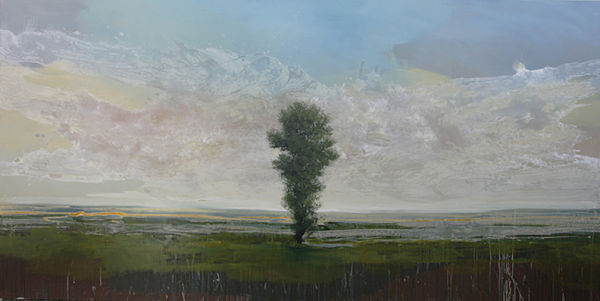
    Peter Hoffer, Guardian, 2012, oil, acrylic, and epoxy on board, 60 x 120 inches

    Given the swiftly-painted, drippy handling of the paint in many of the works, a sense of tranquility and peace ruled over all. It brought to mind the pre-Romantic landscapes of Claude Lorrain, with the absence, in this case, of human traces. Hoffer’s brand of the pastoral though, tends to the generic and bland. This may be deliberate. As such, the works may serve as soothing backdrops to the cacophony that generally engulf urban dwellers.

    Peter Hoffer, Cedar 2012, oil, acrylic, epoxy on panel, 36 x 60 inches

    The titles of Hoffer’s paintings “Spartan,” “Insignia,” “Estate,” and “Guardian,” hint at a management and control of nature. This takes the form of a taming or idealization of it, as the title “Pastoral” suggests. With the pairing of “Cartier” and “Epitaph” a narrative may be construed; Europeans land in the New World and end up trashing an unspoiled wilderness.

    Without doubt, Hoffer maintains a close identification with nature. The evidence is written into the artist’s working method, which is essentially a miming of its cycles. The clouds in “Epitaph,” for example, have not been painted exactly; they are literally splashes of liquidity, or latent rain. The green and brown earth pigments form rivulets that run down patches of unpainted board, a simulation of roots being watered. To complete the work, every drip and splash is sealed by a liberal coating of resin, essentially entombing it. The gloss does the job of preserving and bringing to life the elements.

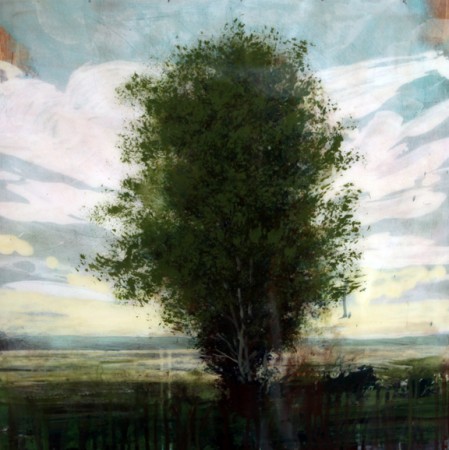
    Peter Hoffer, Baron, 2012, oil, acrylic, epoxy on board, 24 x 24 inches

    To an artist, the use of resin is seductive. Each millimetre of a work is suffused with light, bestowing to it a hyper-clarity. In Hoffer’s case it’s a wink to the 19th century Salon-era custom of the vernissage, where paintings were varnished prior to an art opening to imbue them with
    freshness.

    For some time now, a sizable number of contemporary art practitioners have been infected by a resin-mania, suggesting a return of the Salon in some fashion on a global scale. It seems that avant-garde strategies are being made acedemic on a wholesale basis, as white-cube markets
    proliferate, catering to a polyphony of tastes.

    Peter Hoffer, Estate, 2012, oil and resin on board, 36 x 72 inches

    John Constable’s admiration of Claude Lorrain may in some measure apply to Peter Hoffer’s current landscape oeuvre at Metivier, “All is lovely – all amiable – all is amenity and repose; the calm sunshine of the heart.”

    Rachel MacFarlane

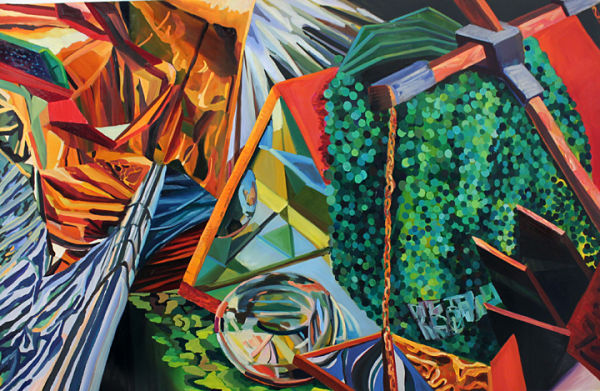
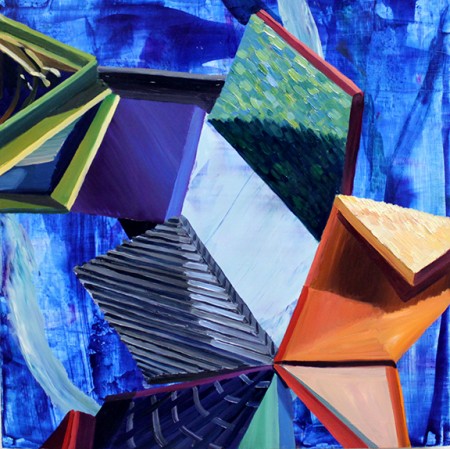
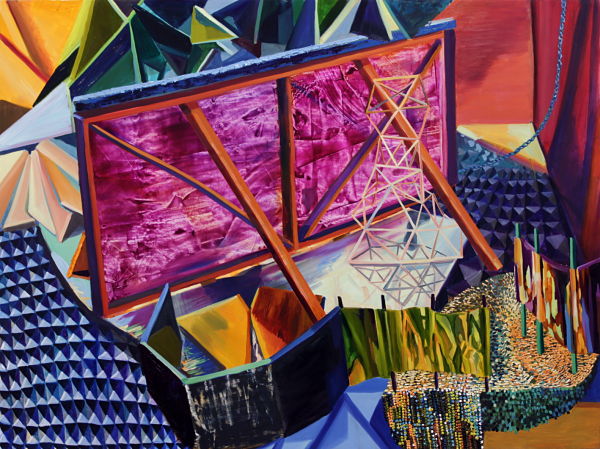
    To view Rachel MacFarlane’s paintings at Metivier is to enter an other-worldly kaleidoscope of acid-doused forms. Here and there are recognizable fragments; a chair, a rod, the corner of a box, or the edge of something that cannot be pinpointed. The more we look, the less important the literal references become. The eye is taken on a restless voyage to alien terrain, unpopulated and strangely vacant.

    Rachel MacFarlane, Hide out in the Strange Heath, 2012, oil on mylar, 35 x 55 1/2 inches

    What we see in the artist’s work might be interpreted as the rubble of modern utopian hopes. Something that was once ordered has now lapsed into chaos. Where is nature? Where is humankind for that matter? The sensibility here is not merely post-modern, but possibly post-human.

    Rachel MacFarlane, Tumbling, 2013, Oil on Wood Panel, 16 x 16 inches

    Inspiration for MacFarlane’s forms are her own collection of small maquettes, garbage and scraps really. With the judicious arranging and lighting of the props, work on the actual paintings begins for the artist. Since the scale of objects in the completed works is hard to fix
    for the viewer, the received images tend to drift from the retinal to an inner mind space.

    Hyper-saturated colour patternings contribute an aura of the hallucinatory. I would describe the experience as chemical thought traces of forgotten events, or flashbacks. If we imagine Alice as having fallen into the rabbit hole, the content of the works in this exhibition do little to bring her to the surface. The proof may be elicited from the artist’s titles: “Tumbling,” “Fracturing,” and “Hideout in the Strange Heath.”

    Rachel MacFarlane, The Under Study, 2012, oil on board, 35 x 47 inches

    To come up for air in the MacFarlane exhibition, the portals to the real world still come down to the formal basics, like paint-handling and the deft use of colour. These the artist mercifully furnish.

    by Steve Rockwell
    Photo: Nicholas Metivier Gallery, 2013

    *Note: the show is open January 5 – 26, 2013

  • Come Up To My Room turns 10

    Pink room by [r]ed[u]x lab, logo design by Jeremy Vandermeij

    GLADSTONE HOTEL
    Second Floor
    1214 Queen West.
    Toronto, ON, M6J 1J6

    For 10 years Come Up To My Room (CUTMR) has been pushing the boundaries of design practice in Canada, searching not so much for what is new but rather for what is real.  As curators we trust the designers to take risks and bring us their best work. Relevance is defined by the designer’s practice. Each year, we search for the right mix of practitioners who occupy different viewpoints: designers, design/builders, contemporary artists, material artists, architects, crafters, industrial designers and self-taught; people who think of design in broader strokes, who consider the term “designer” as they would “artist”.  CUTMR is unique in that we curate the show by the individual and then trust them to design a site-specific installation following their own personal vision. We do not cherry pick from a designer’s catalogue, but rather build trust not just as designers and curators but also as audience, opening ourselves up to the possibility of magic through mutual risk taking.

    Dennis Lin | Room 53, 2004

    Maison St. Pierre with Patrick Lightheart | Room 206. 2005

    Tiff Izsa | Room 206, 2006

    For the tenth edition of the show, Christina Zeidler and Pamila Matharu, the founding curators of CUTMR have returned to join the curatorial collective along with Noa Bronstein and David Dick-Agnew. From the vantage of ten years of CUTMR the emergent pattern of each CUTMR edition has built on the success of the previous year, each “graduating” year of designers inspiring the next group to reach further.  Within each edition there develops an almost collegial rapport between the designers as they share the experience of taking what is ephemeral and manifesting it in the context of the hotel while in conversation with the other work in the show. What has developed is a space which fosters a community of practitioners supporting each other, building ten years of launched careers, collectives, conversation, dialogue between disciplines and which has been a true incubator of art and design culture in Toronto.

    Bruno Billio | Room 209, 2007

    Laura McKibbon & Jasna Sokolovic | public space, 2009

    Richard Unterthiner & Paolo Ferrari | Room 207, 2010

    To mark the impact of CUTMR and the Gladstone Hotel on Queen West we have invited a handful of designers to “spill out” of the building. The unbridled gesture of making this metaphor physical points to the continuing strength of artists and designers within the context of city-building within “West Queen West” and all of Toronto.

    Eric Chan, Public Space, 2008

    CUTMR is unique. It’s a design show which smashes the perceived silos of art and design, emerging from the Gladstone Hotel’s hybrid strategy as both cultural incubator and operational restaurant and hotel business. In our first year of CUTMR, the Hotel had not yet been renovated, and we had not yet started the Artist Designed Hotel Room project. At the time, the idea of bringing an exhibition to the Hotel was a totally new, even transgressive idea, and so the cheeky title Come Up To My Room, was apropos. The parallel history of CUTMR and the development of The Gladstone Hotel reflected similar shifts in the development of Queen West. What remains relevant about the show is that there has not been an erasure of our history or the complexities of gentrification, but rather that the show has built upon a shifting context.  Over the ten years, although the bones of the hotel have not changed, the context of the Hotel has been growing and shifting. The second floor of the hotel, its history, its ghosts, become a palette from which the designers can pull inspiration, react and respond.

    Jamie Webster & Berkeley Poole | Room 205, 2010

    Christina Zeidler & Deanne Lehtinen | public space, 2011

    DarkLab |a reactive sound/sculpture installation presented by SubZeroArts team-members Deane Hughes and Christine Beaumont / Room 208, 2012

    Welcome to the tenth year of Come Up To My Room (January 24 -27, 2013). The original premise of CUTMR remains relevant: change happens through conversation and real change requires engaged dialogue between disciplines. Once again designers have taken up this challenge, pushed their practice and brought it together in this special and delicate environment at The Gladstone Hotel. We thank them for letting us play within their creations.

    Studio Kimiis, 2013

    Curatorial Statement, 2013 by Christina Zeidler, Pamila Matharu, Noa Bronstein and David Dick-Agnew.

    Photo credit: CUTMR, Gladstone Hotel

  • Carolyn Vesely, new Director of Granting at OAC

    Carolyn Vesely, Visual Arts Officer,
    named new Director of Granting
    at Ontario Arts Council

    Her new position takes effect May 13, 2013, following the retirement on May 10, 2013 of current Director of Granting Programs, Billyann Balay.

    Carolyn Vesely has been Visual Arts Officer at the OAC since 2001. In this role, her responsibilities include programs for public art galleries, artist-run centres, visual artists, craft artists and craft organizations, as well as other project programs. Prior to joining OAC, she was Executive Director of the Kitchener-Waterloo Art Gallery for four years. Carolyn was the Executive Director of the Kelowna Art Gallery in British Columbia from 1995 to 1998, after which she returned to Ontario. For seven years before moving to BC, she was the Director and Curator of the Glenhyrst Art Gallery of Brant in Brantford, Ontario.

  • Toronto Design Offsite Festival


    January 21-27, 2013 and beyond

    The third annual Toronto Design Offsite Festival (TO DO) shows the best in Canadian design at events and exhibitions across the city, January 21-27, 2013. Design-lovers will be inspired by a wide array of engaging programming from unexpected prototypes to immersive installations, leading off this year with a Junction Kick-off Weekend featuring opening receptions in the Junction neighbourhood January 19-20, 2013.

    With over 40 events and exhibitions, the festival brings together a diverse array of makers from a wide range of creative disciplines. Embracing ephemeral installations, practical design interventions, and covetable objects, the festival happens in venues across the city, from storefronts to galleries to national institutions.

    Join us Wednesday, January 23, 2013 between 8 and 10 pm for the TO DO Opening Party at Lightform‘s Toronto showroom. Come and find out what the festival is about, meet local designers, and experience special installations with the amazing community that makes the festival happen.

    And don’t miss the TO DO Awards presented by Herman Miller!

    Festival Schedule:

    Toronto Design Offsite Festival Opening Party
    Wednesday, January 23, 2013 8pm-12 am.
    Lightform, | Design Party

    Junction Kick-off Weekend
    January 19 & 20 2013
    Dundas Street West and Keele Street, | Toronto

    Toronto Design Offsite Festival Closing Party: Love Design Party
    Saturday January 26, 2013, 10 pm – 2:30 am
    Gladstone Hotel, | Design Party

    FULL CIRCLE
    November 15, 2012 – March 16, 2013
    WORKshop Inc., | Exhibition

    The Happy Show
    January 09  – March 03, 2013
    Design Exchange, | Exhibition

    Jeff Goodman Designs
    January 10 – Febuary 24, 2013
    Ontario Crafts Council Gallery, | Exhibition

    By the Dozen: Part II of Local Call – Junction Neighbours
    January 16 – Febuary 17, 2013
    Telephone Booth Gallery, | Exhibition

    TABLES, CHAIRS, & OTHER UNRELATED OBJECTS
    January 16 – February 09, 2013
    OCAD Student Gallery, | Exhibition

    Christina Zeidler and Deanne Lehtinen: “Look-I-Like” Product Launch and “MADE Cooler” Exhibition
    January 17 – March 09, 2013
    MADE, | Exhibition

    Snip
    January 18 – February 18, 2013
    The Hair Lounge, | Exhibition

    That Old Thing
    January 18 – 27, 2013
    Post + Beam Reclamation, | Exhibition

    Ash Out of Quarantine- Tumbling Ash New Growth
    January 19 – February 17, 2013
    ARTiculations, | Exhibition

    Jackson/Stern: Automatic/Revisited
    January 19 – February 16, 2013
    Latitude 44 Gallery, | Exhibition


    Peekay + Opticianado
    January 19 – 27, 2013
    Opticianado, | Exhibition


    Smach – Product Lunch
    Saturday, January 19, 2013 Smash, | Reception 6 – 9 pm


    When is a Door?
    January 19 – 27, 2013
    Forever Interiors, | Exhibition

    Workplace Affairs
    January 19 – 27, 2013
    East of Keele, | Exhibition

    archiTEXT / Grapes & Chips
    Monday, January 21, 2013, 6 – 8 pm
    East of Keele, | Workshop | Collaboration

    By the light: CDECA @ Magiks
    January 21 – January 27, 2013
    Magiks, | Exhibition

    Design Walk-In Pop Up
    January 21 – 27, 2013
    TBD, | Exhibition

    In Limbo
    January 21, 2013 – 27, 2013
    Academy of Lions, | Exhibition

    ONE WEEK ONLY! FUGITIVE GLUE POP-UP SHOP
    January 21 – 27, 2013
    Bosley Real Estate, | Exhibition

    Trade School Toronto
    January 21 – January 26, 2013
    Graven Feather, | Workshop | Collaboration

    DoUc: New Discourses for a Tired Century: A debate series
    Monday, January 21, 2013, 7:30 pm
    Gladstone Hotel, | Lecture | Talk

    “SORRY, I’M NOT SORRY, I’M NOT A JEWELLER …”
    January 22 – 27, 2013
    Philip Sparks, | Exhibition

    Building Culture Through Participatory Design – A Workshop
    Tuesday, January 22, 2013 6-9 pm.
    OCAD U, | Workshop | Collaboration

    PechaKucha Vol. 20
    Tuesday, January 22, 2013, 8 pm
    Gladstone Hotel Melody Bar, | Lecture | Talk

    Capacity
    January 23 – 27, 2013
    Gladstone Hotel Art Bar, | Exhibition

    Claesson Koivisto Rune + Mjölk
    Wednesday, January 23, 2013, 7pm
    Mjölk, | Exhibition

    Not Forkchops
    January 23 – 27, 2013
    Loop Gallery, | Exhibition


    Brothers Dressler: 10 Years and Beyond
    January 23 –  27, 2013
    BD Lab, | Exhibition

    Bev Hisey | PYRAMID SCHEME
    January 24 – 27, 2013
    Everydayhousewife, | Exhibition

    Come Up To My Room
    January 24, 2013 – 27, 2013
    Gladstone Hotel, | Design Party

    Do Design 2013
    January 24 –  27, 2013
    Various venues on Dundas Street West between Bathurst and Grace Streets, | Exhibition


    Kraftwerk
    January 24 – 27, 2013
    STUDIO HUDDLE, | Exhibition

    Manufacturers + Designers Connect
    January 24 – 27, 2013
    Milk Glass co., | Exhibition

    Mason Studio at Pavilion
    January 24 – 27, 2013
    Pavilion, | Exhibition


    Shiny Pretty Thing
    January 24 – 27, 2013
    Cooper Cole, | Exhibition

    The IwB Dublin Project
    January 24 – 28, 2013
    GBC School of Design Gallery, | Exhibition


    CreativeMornings Toronto
    Friday, January 25, 2013, 8:30 – 10:00 am
    Gladstone Hotel, | Lecture | Talk

    The Baitshop Presents: Oasis Skateboard Factory
    January 25 – February 07, 2013
    The Baitshop, | Exhibition

    Vodu Nuvo: The Birth of a Brand
    Friday, January 25, 2013, 9 am – 5 pm
    BRANDAID Project, | Exhibition

    Museum of Contemporary Canadian Art
    Saturday, February 02, 2013
    MOCCA, | Cultural Destination

    For more information please check: http://todesignoffsite.com/events-2/


  • Peter Hoffer and Rachel MacFarlane at Nicholas Metivier Gallery

    Peter Hoffer and Rachel MacFarlane
    Opening Reception: Thursday, January 10, 2013
    Nicholas Metivier Gallery

    Photo: Fox Martindale

    Nicholas Metivier Gallery kicked up the new year with two openings for two very different artists.

    Artists Peter Hoffer. Photo: Fox Martindale

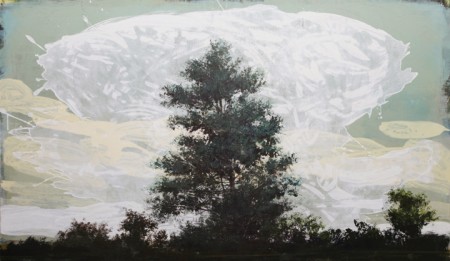
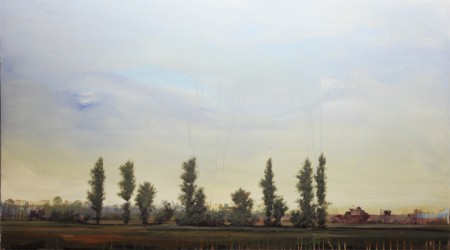
    As the press release stated, “The landscapes in Hoffer’s current exhibition are powerful yet sparse. At the center of most paintings sits a solitary tree, resembling the composition of a portrait. Each tree conveys a particular character and depending on its structure and surroundings, some trees appear heroic while others fragile.”

    Peter Hoffer, Silhouette, 2012, oil, acrylic, and epoxy on board, 36 x 60 inches

    Just looking at the photographs of Hoffer’s paintings I’ve thought that they are just another Northern landscapes. Standing in front of  them gives a totally different feeling. Their large size emphasizes the loneliness of trees mirroring our own and the transparent white layer on the top on the paint creates a special air condition with clouds overhanging.

    Installation view with Peter Hoffer’s paintings. Photo: Nicholas Metivier Gallery, 2013

    As a contrast to Hoffer’s almost monocrome compositions Rachel MacFarlene’s paintings caught the eye with their strong colors.

    Artist Rachel MacFarlane. Photo: Fox Martindale

    As outlined in the press release  “MacFarlane’s process begins with small maquettes that she makes from collected and curated refuse. These maquettes are then lit, studied and used as still-lifes for the structural foundation of her oil paintings. … MacFarlane’s imaginative use of colour, pattern and scale then eventually takes over, … drawing inspiration from new technology and contemporary culture such as video games and computer graphics.”

    Rachel MacFarlane, Electric Current Running, 2013, oil on wood,  16 x 20 inches

    Photo: Fox Martindale

    Installation view with Rachel MacFarlane’s paintings. Photo: Nicholas Metivier Gallery, 2013

    The gallery was packed with patrons and you can overhear many interesting discussions about the styles of the artists and the impression they strong work created in the viewers.

    Photo: Fox Martindale

    Photo: Fox Martindale

    The exhibition is open till January 26, 2013 in 451 King Street West, gallery hours: Tue-Sat 10–6 pm. 

  • Curator Talk

    Saturday, January 12, 2013 / 3:00pm – 4:00pm

    COOPER COLE GALLERY
    1161 Dundas Street West,
    Toronto ON, M6J1X3
    T: 647 – 347 – 3316
    E-mail: info@coopercolegallery.com
    www.coopercolegallery.com
    Hours: Wed–Sat 1–7, Sun 1–6 p.m.

    Join exhibition curator Lucas Soi as he tours De-Accessioned. Leading a walk around the gallery space that will reveal the contours of his curatorial composition, he will reminisce about the de-centralization of the exhibition space, institutional critique via art transportation materials, acts of appropriation through renouncing of the art object and the process of re-interpretation as camouflage.

    De-Accessioned is an exhibition that imagines the de-centralization of the exhibition space. Taking as its title the term describing the deliberate removal of an artwork from a museum’s permanent collection, it is one of the most controversial decisions an institution can make. Disrupting the “museum’s stated ambitions to assemble disparate objects into a single space and to bestow on them the intellectual, aesthetic, and categorical coherence of a collection, conserving these objects for posterity,” de-accessioning a work and releasing it back into the world is a process of re-interpretation. Separated from their functional context and circulated back into the real world, the works in De-Accessioned declare the transitory space between package and delivery as the site of exhibition. Many of the artworks on display use art transportation materials as their medium. In transit, the artwork assigns specific function to the practice of location, commanding a re-evaluation of its site-specificity. This socio-critical action allows works that are recognizable, such as paintings, to perjure the installation with their symbolism, leaving the audience to imagine a more appropriate arrangement in another ideal environment.

    For more information about the show please check http://coopercolegallery.com/exhibitions/34/de-accessioned/profile.

    The show is open till January 19, 2013.

  • Second Annual Emergent Artists Exhibition

    I recently visited the O’Born Contemporary‘s Second Annual Emergent Artists Exhibition at O’Born gallery on Ossington Avenue.  I was welcomed with a friendly and warm reception and guided to a catalogue that listed all of the artists involved, including work and aritist statements. 

    Installation view with Yshia Wallace, Superorganism, 2011, porcelain and wire 32” x 48” x 72”. O’Born Contemporary, 2012

    Installation view.  O’Born Contemporary, 2012

    While the the entire collection was well curated and all pieces were weighted with significant interpretations and stories, there were two artists’ works I was particularly drawn to. The work of Charlotte Stewardson is described in the Exhibition Statement as the portrayal of “…similar concerns of psychological influence on physical space [that] is articulated through photographic heaps of body and cloth, a mountain range of both life and the inanimate objects of our everyday.” At first glance, I was unable to truly make out what the subject matter portrayed, which in turn, immediately encouraged me to draw in closer to solve this visionary puzzle.  Soon after, I was able to piece together objects and characteristics that would then complete the human form. Juxtaposed against the soft layering of the cloth added to the dialectic of “the peculiar in the banal” which could also suggest life and death; i.e. life against the lifeless. The composition could be described as an ‘organized chaos’. A homogeneous entity, that when viewed at a closer proximity becomes heterogreneous subjects. The body lacks an identity, concealing another reality that lures the viewer into a further curious state of thought.

     Charlotte Stewardson, Interrupted Landscape, 2011, Digital Print 12” x 48”. O’Born Contemporary, 2012

    Lindsay Lauckner‘s work was the other luring piece, as the Exhition Statement says, “…photographs of estate sale homes focuses on the intermediate state of a home in transition, where remnants of previous inhabitants visibly fade to accommodate others. Lauckner’s images have a sense of stilling a time so briefly that it is otherwise likely to be forgotten.” The sentimental state of emotion through a  transition from old to new and from populating to evacuating, is vivid in her images. We see a history, but we can’t quite determine its narrative. She certainly has displayed “presence of life in the stillest of moments.” This photograph portrays a tryptic of portraits of (assumed) significant people, perhaps children of the home owners, yet we are still left to question ‘who and why?’.

    Lindsay Lauckner, Painted Portraits, 2012, Digital Chromogenic Print Edition of 5, 15” x 22.5”. O’Born Contemporary, 2012

    The opening on January 4, 2013. O’Born Contemporary, 2012

    The opening on January 4, 2013. O’Born Contemporary, 2012

    The opening on January 4, 2013.O’Born Contemporary, 2012

    I urge the public to visit this exhibition before it closes on January 19, 2013.

    Deborah Kanfer

  • Hazelton Hotel Sculpture Contest

    I See Through Them, Jaime Angelopoulos, 2011, 55″ x 35″ x 27″, cotton and polyester fabric, plaster, foam. Courtesy Parisian Laundry and the artist.

    The Hazelton Hotel
    Yorkville and Hazelton

    Jaime Angelopoulos, 30, one of Toronto’s hottest, emerging young artists, has won the first ever Hazelton Hotel Sculpture Contest. Her evocative piece will go on display in the Hazelton Hotel’s lobby beginning in January 2013.

    “We’re extremely excited to showcase the work of such a talented, young artist. I know it will animate and completely transform our lobby,” said David Mounteer, General Manager of The Hazelton Hotel. “This project shows the great wealth of artistic talent in our community and I’d like to sincerely thank everyone who submitted a piece of work.”

    Contest submissions closed on November 30th, 2012. The Hazelton Hotel asked artists to submit a work of sculpture for display on a designated pedestal in the hotel lobby and over 150 submissions were received in just two months. The proposals came from both emerging and established artists, working in a full range of materials and styles – from figurative bronzes and stone carvings, to more conceptual and abstract works.
    The submissions were judged by guest jurors: Bruno Billio (Hazelton artist), Kelly McCray (Curator) and Troy Seidman (Art consultant).

    As the winner of The Hazelton Hotel Plinth Sculpture Contest, Angelopoulos will receive an honorarium of $4000, use of The Hazelton Hotel’s private screening room for an artist’s talk in the Spring of 2013, plus one night’s accommodation. Her work I See Through Them (2011) will go on display on the plinth in the hotel’s lobby from January until July 2013.
    The judges felt that her strong and original practice, dedication to sculpture and singular voice, combined to create an exciting work, worthy of the distinction. Angelopoulos received her MFA from York University, Toronto (2010), and BFA from NSCAD University, Halifax (2005). She has exhibited her sculptures and drawings internationally, with solo exhibitions across Canada. Angelopoulos lives and works in Toronto and is represented by PARISIAN LAUNDRY in Montreal.

    An honourable mention goes to Janet Macpherson for her piece “Virgin Mary,” for the intricate ceramic work and fine details. The second honourable mention was awarded to Lee Kline for his piece “Pink Resin Wedge” for the degree of finesse involved in resin casting and the dynamic use of colour.

    For more information about the Hazelton Plinth Sculpture Contest and the mentioned artists, please visit thehazeltonhotel.com/hazeltonplinth.

  • AGO Art Courses for the Winter

    Courtesy of AGO. Copyright 2013 Art Gallery of Ontario.

    ART GALLERY OF ONTARIO
    317 Dundas Street West
    Toronto, ON M5T 1G4
    T: 416.979.6648
    www.ago.net

    AGO Offers Unique Opportunities for Kids, Adults and Families to Learn and Have Fun

    The Art Gallery of Ontario (AGO) offers Torontonians an opportunity to unleash their creativity and learn new skills at one of North America’s leading art galleries. Registration for a brand new slate of winter education activities is now open at www.ago.net/learning, and classes begin on January 12, 2013, in the AGO’s Weston Family Learning Centre.

    “We are proud to offer Toronto’s most exciting range of courses for art lovers of all ages, skill levels and interests,” said Kelly McKinley, the AGO’s executive director of education and public programming. “The quality of instruction and the variety of courses at the AGO really sets the Gallery apart as a leader in art education.”

    With more than 20 courses to choose from, Torontonians of all ages can hone a craft or learn a new one through painting, drawing, photography and cartooning, to name a few. The popular yoga program returns to the AGO with classes for adults and families. Courses run on weekdays, evenings, weekends and on a drop-in basis. There is a selection of courses for everyone – adults, youth, families and children.

    This season, the must-take courses include:

    Adults

    Introduction to Creative Photography (4 weeks: $200 Members / $265 non-Members) allows students to be creative with their digital cameras while learning about exposure, shooting in challenging lighting situations and creating strong compositions.

    Portrait Painting (10 weeks: $325 Members/$390 non-Members) provides students the opportunity to learn various painting and drawing techniques to represent the human face. Inspired by special AGO exhibitions as well as the AGO collection, students will tackle portraiture from varying angles, live observation and source imagery.

    In addition to scheduled classes in the WFLC, the AGO also offers drop-in classes, including Yoga in the AGO Galleries ($9 Members/$10 non-Members per class), where participants can practise among the works of the masters, and Life Drawing in the AGO ($15 per class) that allows participants to develop their drawing skills while working with life models.

    Youth

    Life Drawing (ages 13 to18; 8 weeks: $250 Members/$300 non-Members) is the perfect opportunity for teens to develop their drawing skills by observing human figures and utilizing various mediums. Noting everything from gestures and proportions to tone and shading, students will explore the technical and perceptual skills needed to draw confidently.

    As always, Ontario high school students with valid ID can visit the AGO for FREE after 3 p.m. Tuesdays through Fridays. Activities include DJ school, dance workshops, art-making and even skateboard building.

    Children: Ages 6 to 13

    Floor Burgers, Ice Cream Cones and More (ages 6 to 9; 4 weeks: $125 Members/$150 non-Members) is the much-beloved course that invites children to exercise their creativity by creating masterpieces with modelling clay, model magic, plaster, cardboard, wood and fabrics.

    Cartooning (ages 8 to 13; 8 weeks: $315 Members/$375 non-Members) allows kids to use their imaginations and tell their stories with cartoons, using several different tools, including pencil, pen, markers and scratchboard. With the guidance of a professional cartoonist, children learn the art of drawing, storyboarding and character development.

    Children: Ages 4 to 7

    Side by Side – Little Kids (ages 4 to 7; 4 weeks: $155 Members/$185 non-Members) is the perfect opportunity for parents, grandparents and caregivers to discover art through the eyes of the littlest art makers while painting, drawing, sculpting, printmaking and exploring the galleries side-by-side with them.

    Family Sundays continue to be a great hit! New to the schedule in 2013 is Family Yoga for ages 3 and up. This class will occur twice during every Family Sunday from 1:15 p.m. to 2 p.m. and 2:30 p.m. to 3:13 p.m. Whether it’s stretching like a cat, slithering like a snake or howling like a dog, it’s exciting family fun! Each class is 45 minutes and includes breathing exercises, stretches, yoga poses, partner yoga, games and relaxation using puppets, balls and music.

    Upcoming Family Sundays:

    Wintery Wandering
    January 27, 2013
    1 p.m. to 4 p.m. NEW TIME!
    Members’ hour: Noon to 1 p.m.

    Spend a Sunday afternoon in the studio playing with winter-themed materials – immersed in white and blue – making all white or blue constructions, things that hang and move and creating art from winter sounds. Spend the day exploring diverse art making processes, experimenting and playing!

    Kids Gallery of Ontario (KGO)
    February 18, 2013 (Family Day)
    Noon to 4 p.m.

    On Monday, Feb. 18, the AGO will celebrate Family Day 2013 by transforming into the Kids Gallery of Ontario (KGO) for one special day! The Gallery will have a family-friendly art-making extravaganza featuring the creation of a day-long exhibition by kids entitled Kid Nouveau. The iconic red AGO on the building’s exterior will be creatively reworked to reflect its temporary name change, to KGO. Kids attending the event (included in the price of admission) will be encouraged to channel their inner artists through activities co-programmed with Bunch Family Inc.

    Itty-Bitty City
    March 31, 2013
    1 to 4 p.m. NEW TIME!
    Member’s hour: Noon to 1 p.m.

    Kids love little itty-bitty things that you can hold in your hand. On Mar. 31, 2013, kids can make teeny tiny things.  Tiny cities, tiny fairy houses, tiny animals, tiny food — all things miniature because little is fun! Who knows, there might even be miniature golf.

    Courses are available to Members and the public and range from $100 to $350 for Members, and $100 to $440 for the public. More information on the WFLC and 2013 Winter Programming can be found by visiting www.ago.net/learning.

    Education Programs are generously supported by smART women with additional support from the Learning Fund

    The AGO acknowledges the generous support of its Signature Partners: American Express, Signature Partner of the Conservation Program; and Aeroplan, Signature Partner of the Photography Collection Program.

  • A grant for Gallery 44


    Gallery 44 is thrilled to announce the Ontario Trillium Foundation has  awarded a  $146,500 grant to strengthen our capacity as an artist-run centre to support artists, and build public engagement with contemporary art.

    More specifically, with this grant Gallery 44 will:
    Invest in our administrative space in order to respond to the growing membership and increased programming offered by our organization

    Improve the working conditions of the staff and viewing experience of the visitors by adding air conditioning to the office and gallery spaces

    Expand our services to artists by purchasing a new DSLR camera kit, upgrades to our digital darkrooms, available to rent at affordable rates

    Upgrade the plumbing and ventilation in our analogue darkrooms as the demand and interest in traditional and alternative processes continues to grow

    Purchase new HD projectors, monitors and audio equipment to better accommodate the needs of our exhibiting artists and current trends in contemporary photography

    Enhance opportunities in photographic education by renovating the studio/classroom multi-purpose

    Increase membership satisfaction and engagement by updating the current production facilities into a more contemporary and welcoming space to house our new digital printing services and existing analogue darkrooms (the only publicly accessible wet darkrooms in Toronto)

    This grant application was a result of  a strategic planning exercise, online membership survey, and consultation with users of our facilities.  We have tried to address the many needs of the organization and thanks to the Ontario Trillium Foundation we are able to move forward with the several capacity building projects listed above. The implementation of these projects will begin in the new year and we will keep you  updated on our progress.