Author: artoronto

  • Images Festival

    April 11 – 20, 2013
    Various locations in Toronto

    Established in 1987, the Images Festival is the largest festival in North America for experimental and independent moving image culture, showcasing the innovative edge of international contemporary media art both on and off the screen.

    Images has presented thousands of vanguard media-based projects in its 24-year history and is committed to an expanded concept of film and video practice: Alongside film and video screenings (ON SCREEN), the festival presents groundbreaking live performances (LIVE IMAGES), media art installations (OFF SCREEN) in local galleries and new media projects by many renowned Canadian and international artists.

    Images provides audiences with an annual extravaganza of contemporary moving image culture. For more information please visit http://www.imagesfestival.com.

  • Patti Smith’s Solo

    Patti Smith: Camera Solo
    February 9 – May 19, 2013
    Art Gallery of Ontario

    I recently went to see the Patti Smith exhibit at the AGO. It was such a treat to receive the opportunity to view her collection of images and learn more about this iconic figure.  

    Patti Smith, Self-Portrait, NYC, 2003, gelatin silver print, 12.75 x 9.5 cm (image), Courtesy the artist and Robert Miller Gallery, New York, © Patti Smith 2012

    Her photographs, taken with a vintage polaroid camera,  display small images but the intimacy of her chosen subject matter that poses a curiosity that lures the viewer in.  I found myself searching for more; at first thought, not enough was being revealed. However, nearing the end, I felt very connected in attempting to embrace her thoughts and feelings. As the Smith describes her work, “I don’t consider my photographs blurry…I think they are atmospheric.”

    Patti Smith, Winged Cherubin, San Severino Marche, polaroid print, 10.75 x 9.5 cm (image), Wadsworth Atheneum Museum of Art, CT. Gift of David and Mary Dangremond in memory of Leicester and Mary Plant Faust. © Patti Smith 2012

    Patti Smith captures a variety of scenes of her son and daughter in various instances, whether sitting on the couch or sleeping.

    Patti Smith, Jesse with Flower, 2003, gelatin silver print, (edition 10/10), 10.75 x 8.25 cm(image), Wadsworth Atheneum Museum of Art, CT. Purchased through the gift of Robinson A. and Nancy D. Grover. © Patti Smith 2012

    Other photographs are visual documentation of grave sites of artistic figures that heavily impacted her life; this was her way of paying respect and tribute. She manages to capture the somber essence of each scene, however, her intention is to expose and portray them in a bright happy light. As mentioned in the Toronto Star “Smith’s communion with the spirits, in her music and her art, is admirably joyous.” Smith further states, “When I take pictures of people’s gravesites, it’s not a morbid thing at all. I go to talk to them, to thank them.”

    Patti Smith, Walt Whitman’s Tomb, NJ, 2007, gelatin silver print, 10.75 x 8.25 cm (image), Courtesy the artist and Robert Miller Gallery, New York, © Patti Smith 2012

    There were a couple of pieces that particularly intrigued me. Her late father’s coffee cup and the Pope’s slippers were two subjects that continuously featured throughout the exhibit. “I relate to proximity…Just like when you go to the grave of your loved ones you feel a certain closeness to them…”, commented Smith. I questioned these subjects. It definitely added to the mystery of her life and her relationship with her father in particular. Such a mundane, yet intimate object, captured in a distilled scene. The juxtaposition of the latter plays against opposites of warm and cold and subjective and objective.

    Patti Smith, My Father’s Cup, 2004, gelatin silver print, (ed. 2/10), 10.75 x 8.25 cm (image), Private collection. © Patti Smith 2012

    Her style of photography appears to be influenced by fine art photography from the 1950s when black and white photography was considered an art form. Obviously, back in the 50s, this was still a much debated concept. From this, heterogeneously, Smith’s work carried even more iconic and interpretive weight.

    Patti Smith, Christoph Schlingensief, Munich, 2008, gelatin silver print, 12.75 x 9.5 cm (image), Courtesy the artist and Robert Miller Gallery, New York, © Patti Smith 2012

    Her exhibit comprised of seventy works, which I feel was the perfect size for an extensive body of work to have been displayed. Snug in one room, one doesn’t need to dedicate a copious amount of time going through it. I thought the conciseness of the exhibit worked well for Smith’s style. Furthermore, it intrigued me, my interest was certainly piqued. Potentially more so in hindsight. A thought provoking visual biography.

    This exhibit runs until May 19, 2013. Plenty of time left to still catch it.

    Deborah Kanfer

  • Point / Counter-Point

    Body and Identity – OCAD Thesis Exhibition
    March 20 – 31, 2013
    Gallery 1313 

    Five artists, members of an OCAD sculpture and installation thesis program, are exhibiting their work at Gallery 1313. The works are variations upon the theme of environment, whether social or natural or both, criticizing perceiving imbalances and offering suggestions to remedy the situation. It raises questions and reveals ambiguities.

    Katarina Tarrant’s Crown with Phallus, a work that evokes the debate between Jacques Lacan who did identify (along with Freud) the phallus with the penis, an identification with which philosopher and Belgian born feminist, Luce Irigaray and French philosopher, Jacques Derrida,  disagreed. There are four components to Tarrant’s work. The first two are a video of the process of making the phallus mould and a video of the naked artist adorning the crown with phallus.

    Katarina Tarrant, Crown with Phallus, video still

    The other pieces are the crown itself resting on a pillow called The Masquerade I. and an acrylic, pencil work entitled Masquerade II. The crown has a cross. The artist in the video does not cross her legs, which is the ‘demure’ feminine custom, but openly faces the male gaze. She has the crown between her legs, appropriating traditional male symbols of power. Art rules through the power to alter the identity of self by invoking the power of the male sex.

    Katarina Tarrant, Crown with Phallus

    The phallus in this sculpture is and is not the penis. It is the penis only when it has been ‘beheaded’ as the ‘male head of state’ and reinstated as the extension of the female centre power of rebirth. Crown with Phallus is thus the inverted image of the Throne of the Vagina which only a female queen with the crown between her legs can sit on. It is the undressing, addressing, and redressing that defines the sensual texture of the four works.

    Tara O’Connor’s Handmade Meat Labels  is based on an intervention against the addictives commonly used in butchered meat sold in your friendly neighbourhood supermarket.

    Tara O’Connor, Handmade Meat Labels 

    Her other work is that of a pig’s head mounted on a plaque titled Commodity Specimen overlooking a table with demonic pigs and bones, a combination portraying commercial practices as a mixture of the macabre and a sad reality.  

    Tara O’Connor’s installation

    The ‘meat’ of the market economy is the power of money to replace all human relations such as empathizing with fellow creatures. Capitalism is a vast butcher shop of dehumanizing relations. Under patriarchy phallus equals penis, as under capitalism, money equals need itself. So tell me: What do you need?

    Christina Iannelli in her series, (re) production, uses 19 x 11 white spoons dripping with red sauce at their end to represent the traditional role of women in Italian culture.

    Christina Iannelli,  (re) production

    Women bleed, the artists says, both at giving birth as the main function of their reproductive life or through menstruation. Blood also represent their sacrifices to patriarchal authority that confines them to the kitchen and to the bedroom and often makes them victims of male violence. The red drippings on the grey gallery floor can equally be spaghetti sauce, or blood, or both.

    Steven G. Kurtz, who uses ceramics, wood and metal, has five works in the show.  One of them influenced by the oldest pieces of sculpture depicting eight female forms like the Venus of Willendorf. The other inspired by seaweed, while another by oil-eating mushrooms, and the last two are giant black bronze butterflies symbolizing polluted air.

    Steven G. Kurtz’s installation

    Steven’s main interest is in logo-centric ecological practices privileging human over non-human sentience.

    Chantal Taylor’s work, depicting genetically modified organisms, is similar to O’Connor’s theme. Taylor’s piece is a double-helix display stand that has on one side Genetically Modified Food that can cause infertility, and other pernicious side-effects.  The modification of nature is implied by current technology enabling a more invasive ‘working’  upon the code of life itself. On the other side Chantal’s projected vision of Modified Human-Based Food with positive, benevolent side-effects is a note of optimism balanced against Tara’s more polemic stance.

    Chantal Taylor’s installation

    If art’s authority is the addressing, undressing, and redressing of the balance of power (Tarrant) to encourage a more integrated, empathetic societal body that is able to value things in themselves whether they are human (Iannelli) or not (O’Connor, Kurtz) then there is hope for a better world (Taylor). It also creates a power, a naked truth – a nakedness – that can only be glimpsed or experienced through cultivating the self-reflective and critical attitudes that each work embodies.

    The future bodes well for a country whose ‘current crop’ is the leading and cutting edge of its culture.

    David A. Ross
    Photo: Phil Anderson

  • Body and Identity / Opening Receptions

    Body and Identity,
    Gallery 1313
    Thursday, March 21, 2013, 7 – 10 p.m. 

    Reception for Body and Identity – Main , Process and Window Box Gallery – Thesis Program OCADU Sculpture and Installation with students Christina Iannelli, Steven G. Kurtz, Tara O’Connor, Chantal Taylor and Katarina Tarrant plus Paul Brandejs’ Spark exhibit in the Cell Gallery were crowd pleasers.

    The students from OCADU had just finished their Panels to review their thesis projects so they were ready to chill. Visitors to the gallery were intrigued with the different works which were visually pleasing and thought provoking at the same time.

    Visitor in front of Tara O’Connor’s installation

    Steven G. Kurtz’s sculptures

    Tara O’Connor‘s installation looked at the factory farming of animals for food with some parody. Steven G. Kurtz‘s work tried to make visitors think green with a renewed interest in nature and the environment while adoring his sculpture works.

    Christina Iannelli in front of her installation

    Christina Iannelli and Chantal Taylor with her installation

    Chantal Taylor‘s work also had a green message while Christina Iannelli‘s work dealt with cultural differences and the role of women.

    Katarina Tarrant with her installation

    Katarina Tarrant‘s provocative installation with video works challenged male power roles. In the Cell Gallery, Paul Brandejs an OCAD graduate himself, displayed his unique sculptural canvases with paint and giclee prints.

    This is the first half of two exhibits with thesis students from the sculpture and installation program and many are looking forward to that exhibit which will display a whole new range of challenging works opening on April 4th.

    Text and photo: Phil Anderson

  • Y.M. Whelan “The Geography of Dreams” at Yumart

    Y.M. Whelan: “The Geography of Dreams”
    March 20 – April 13, 2013
    Yumart

    Photo: Alice Tallman

    Yumart* had its official launch last Thursday, March 21st with an exhibition of paintings by proprietor Y.M. Whelan. A capacity crowd scaled the stairs at 101 Spadina Avenue to the freshly-renovated 550 square foot second floor space. Attendees and well-wishers took in a range of works that spanned from the early 80s up to the present.

    Y.M. Whelan. Photo: Alice Tallman

    The exhibition, “The Geography of Dreams” included the artist’s signature geometric abstractions. Since 1997, Whelan has been familiar to gallery goers variously as gallery assistant, director, curator, or exhibitor at Bau-Xi Gallery, the Moore Gallery, and Fran Hill Gallery.

    Y.M. Whelan, Maze, 2006, acrylic on paper, 19 1/2 x 13 inches

    Aspects and qualities of Whelan‘s recent work are typified in three works in this inaugural exhibition. The titles in each of the works capture a sense of the dynamism that animates her abstract oeuvre. The spare, gestural line geometry of “Maze” fuses the opposing notions of the controlled and spontaneous, features embodied in the artist’s canvas works. Whelan wishes to preserve the act and process of making the painting. Each work may be viewed as a contest between conflicting and contrasting forces – dark and light, open and closed, and so forth.

    Y.M. Whelan, Tidal Waves and Sea Battles, 2012, acrylic on canvas 30 x 26 inches

    This holds equally true for the colours. In “Tidal Waves and Sea Battles,” 2012, the deep yellow that tends to orange flashes against a sea green. The canvas is literally a battleground, a mat upon which aspects of the painterly craft wrestle for dominance.

    Y.M. Whelan, The Little House of My Past, 2012, acrylic on canvas 20 x 16 inches

    The work “The Little House of My Past,” 2012, is no less a contest, the outcome in this case is containment, a housing of moments experienced. The act of viewing permits a reliving and unlocking of past events. In this regard, the work and its title may serve as an emblem of the exhibition as a whole, where features Whelan‘s complete painterly output are encapsulated.

    Visitors in front of Y.M. Whelan, Extrication (Gem-Encrusted God Series), 1997, acrylic on canvas, 28 x 62 inches. Photo: Alice Tallman

    Steve Rockwell

    *Yumart is a new gallery at 101 Spadina Avenue, Suite 210, Toronto. Hours: Wed – Sat 12 – 6 p.m.

  • yumart – a new art venture

    Photo credit: Lee Lamothe

    Thursday, March 21, 2013, 6 – 8 p.m.
    yumart launch reception
    101 Spadina, suite 210
    Toronto, ON
    www.yumart.ca
    Hours: Wed to Sat 12 – 6 p.m.

    You are cordially invited to the launch reception of yumart – a new art venture located in the heart of Toronto’s fashion & entertainment district, steps away from fabulous 401 Richmond and “Art at 80” on Spadina.

    A unique retro low-rise building, yumart is situated on the 2nd floor of 101 Spadina Avenue on the southeast corner of Adelaide and Spadina.

    yumart will launch on Thursday March 21st with an exhibition of paintings by Y.M. Whelan. “The Geography of Dreams: paintings past and present” will include new paintings as well as a selection of works spanning several decades. The selected paintings were created at specific studios in Toronto throughout the artists’ career – Manville in Scarborough, Artscape at King.

    I sincerely hope to see you at this inaugural exhibition!

  • Revealing the Early Renaissance: Stories and Secrets in Florentine Art

    Bernardo Daddi. Italian (Florentine), about 1280-1348. The virgin Mary with Saints Thomas Aquinas and Paul. Tempera and gold leaf on panel, 121.6 x 113 cm. The J. Paul Getty Museum, Los Angeles

    March 16 – June 16, 2013
    ART GALLERY OF ONTARIO
    317 Dundas Street West
    Toronto, ON M5T 1G4
    T: 416.979.6648
    www.ago.net
    Hours: Tue & Thurs–Sun 10–5:30, Wed 10–8:30

    Both The Wall Street Journal and the Los Angeles Times have lauded Revealing the Early Renaissance: Stories and Secrets in Florentine Art as one of the most important exhibitions of recent times. Co-organized by the Getty Museum and the Art Gallery of Ontario, this spectacular exhibition sheds light on the artists who gave birth to the Renaissance — changing art, and the world, forever.

    The exhibition comprises more than 90 key pieces from the first half of the 14th century, including Giotto’s five-panel Peruzzi Altarpiece and his Madonna of San Giorgio alla Costa, two painted manuscripts of Dante’s Divine Comedy, and Bernardo Daddi’s Virgin Mary with Saints Thomas Aquinas and Paul.

    Revealing the Early Renaissance includes manuscripts that have never left Florence before and that are very rarely on view in the city where they were created. These monumental works of art, evocative of painting in three dimensions, have spent most of their lives closed and thus survive in pristine condition. Their painted pages serve as a magnificent window on 14th-century Florence. The exhibition also features an interactive map with touch screen that will allow visitors to explore the places where Renaissance Florence intersects with the Florence of today.

    Curated by Christine Sciacca, assistant curator of manuscripts at the J. Paul Getty Museum, together with coordinating curator Sasha Suda, assistant curator of European art at the AGO, Revealing the Early Renaissance: Stories and Secrets in Florentine Art brings to life recent discoveries about artistic techniques and studio practice in Florence between 1300 and 1350.

    EVENTS:

    The Artists’ Liturgy

    Non-denominational prayer service
    Sunday, March 17, 2013 9 – 10 a.m.
    Walker Court Free

    Symposium: Revealing the Early Renaissance: Stories and Secrets in Florentine Art 

    March 23, 2013 10 a.m. to 5 p.m.
    Baillie Court, AGO
    Public $144, Members $120, Students $50 (includes lunch)

    Musical Performance: Lionheart

    April 6, 2013, 2 p.m.
    Walker Court, AGO
    FREE with admission

    Talk: Disbound and Dispersed: The History of Illuminated Manuscripts

    April 17, 2013, 7 p.m.
    Marvin Gelber Print & Drawing Study Centre, AGO
    Public $12, Members $10, Students $8

    Talk: Navigating a Gracious Cosmos

    May 22, 2013, 7 – 8:30 p.m.
    Jackman Hall, AGO
    Public $12, Members $10, Students $8

    Talk: Florence at the Time of Dante and Giotto: A lecture by George Dameron

    June 5, 2013, 7 – 8:30 p.m.
    Jackman Hall, AGO
    Public $12 | Members $10 |Students $8

  • Motherline: A Self-Portrait Works by Carly McAskill

    Motherline: A Self-Portrait Works by Carly McAskill
    March 6 – 17, 2013
    GALLERY 1313

    The key idea of Carly McAskill’s new show, a thesis solo exhibition entitled Motherline: A Self-Portrait, is that identity is built through layers of memory. It is applicable both to individuals and society, the entity that individuals form through their interaction with each other. How so and what materials does the artist use to convey this message? The first is a heavily layered 32′ by 64′ section of old wallpaper on drywall. The artist has used encaustic on it to strip away, tear, and add to the composition, creating new patterns based upon the old. The different layers of material are different perceptual experiences stored and, as the encaustic treatment suggests, constantly subject to revision. Memory does not stand still, like a painting in an art gallery, which makes McAskill‘s work an ironic comment on both memory and art; it is not an object like a ‘still life’ but much more a process, a movement, a flow of sensation that has become temporarily stilled – framed – by discursive parameters.

    Carly McAskill, If Walls Could Talk, 2012  mixed media on paper

    Carly McAskill, If Walls Could Talk, detail, 2012  mixed media on paper

    In this instance the discursive parameter is Motherline. A line, and straight lines do not exist in nature, is the human attempt to connect one linear phenomenon to another. It is a function of mechanical causality: B follows A. Daughter follows Mother. As McAskill tell us, things do not follow so neatly. “I feel in constant conflict with keeping my artistic career that I have spent years building up and my yearning to eventually becoming a mother and a wife,” she writes ‘Artist,’ ‘mother’ and ‘wife’ are identities produced through the framing of perceptual based experience, and whose reframing (reprocessing, revision) doesn’t stop until we are no more.

    Carly McAskill, If Walls Could Talk, 2012  mixed media on paper

    There is a red striped toy baby carriage surrounded by pieces of drywall and encaustic signifying, as I take it, childhood. Is that how memory works, images encircled by debris, by the detritus of things that once were? As if, somehow, the image is the survivor of a vast swathe of perceptual destruction, standing proudly, even defiantly out of otherwise nothingness?

    On one wall *A Self-Portrait*, Flamboyant is extravagant, it is at once mystical, whimsy, mythical and powerful. Swirling in dark purple coils on the outside with curvilinear areas of bright green-blue on the inside, the figure with the artist’s recognizable face wears a crown of hairpins with dark purple on one side and yellow and pink stripes on the other. What is the relationship of self to memory? How do we recognize ourselves? Lacan spoke of a misunderstanding by which a body takes itself to be an image. If so, it is a most fruitful error.

    Carly McAskill, A Self Portrait, 2012, mixed media on paper, 74 x 50 inches

    Is self an image or is only conceivable in terms of one, and that the ‘real’ self may not exist? Once captured as an image, it becomes lost. Is self-image then a delusion? Does an artist continually recreate the self through a work in a game of lost and found, hide and seek? What do we see when we peer through the layered constructs of an identity if not its spaces?

    Carly McAskill, Reflecting Burdens, 2012, mixed media on plastic

    In a corner, McAskill has arranged 30 small mirrors with fancy, ornate frames, each having a variety of images, some of machines, others of natural scenes, while anothers with her childhood face. The mirror image suggests reflection, how it is that we see ourselves. What is the glass? Is it no tart itself? Is art the glass through which we capture what we think we are; how we remember ourselves to be? If so, then to think is to remember or thought is unthinkable without it. Memory is the mind again, and in ancient Greek myth, the Mother of the Muses, the patronesses of all arts and sciences, and whose name is the root of the word music, is *Mnemosyne*, Memory personified. Is this the Motherline of Memory? If mother, then father. Who coupled with Memory to produce art and science? It was Zeus, the exemplar of logic, his name derived from the Greek *zeugein*, to yoke, join as in the word zygote. Motherline has, in other words, some logic to it which joins or yokes the images.

    Carly McAskill, Florence Desjardins, 2012, pencil on paper, 30 x 23 iches

    On another wall facing *A Self Portrait* are six graphite paper drawings of McAskill‘s family tree with her grandmother, mother and sister’s faces. There is also one male image, that, I assume, of George V, the late father of the present queen, and Commonwealth sovereign of her grandmother’s era. Is the mind of memory the art of reflection? Is the logic of a life the continual struggle to remember who and what it is?  Are the discursive parameters framing the act of recollection the doing of art?

    Carly McAskill, Anne Baldasero, 2012, pencil on paper, 30 x 23 inches

    McAskill‘s current exhibition raises these questions and more. Her own mnemonic Odyssey into herself can help launch similar projects in us all.

    David A. Ross

    Photo: Phil Anderson

  • The Era of Doubt / Are You Alright?

    ARE YOU ALRIGHT? New Art from Britain
    February 1 – March 24, 2013
    MUSEUM OF CONTEMPORARY CANADIAN ART

    Kitsch and cuteness are fundamental elements of contemporary consumer culture. The combination of the two creates a grotesque vision of the world around us.
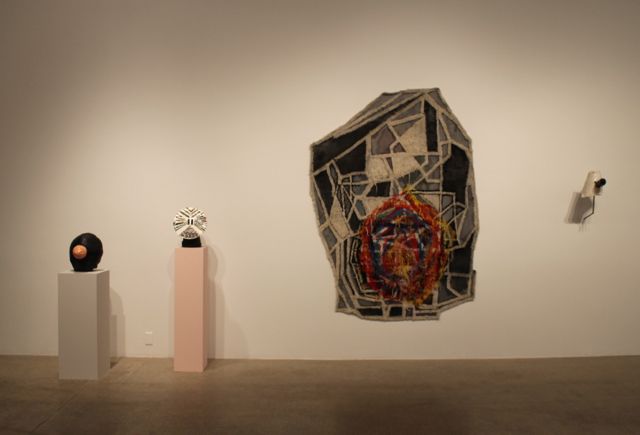
    ARE YOU ALRIGHT?, a group exhibition of British artists at the MOCCA, curated by Derek Mainella and Elizabeth Eamer, invites viewers to explore the feelings of a new generation of artists living in an era of rising doubt. This exhibition is a meeting of kitsch and filth within the contemporary British landscape that is composed of iconic faces, vivid colour, and household products.

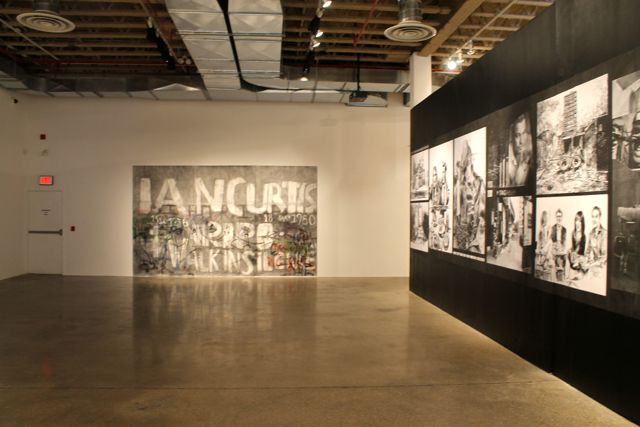
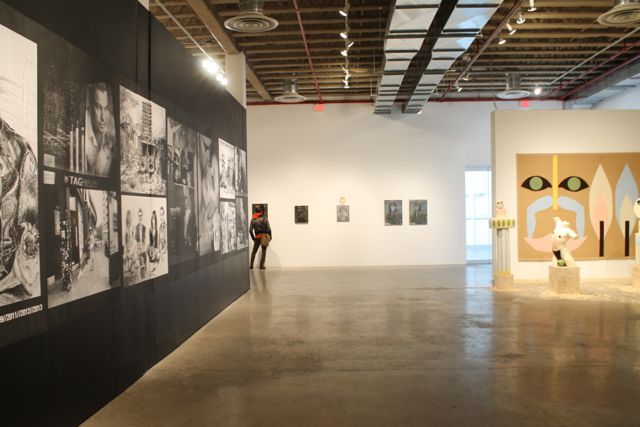
    Installation view with Graham Dolphin, Wall (Walk In Silence), 2012 (left) and Laura Oldfield Ford, Drifting through the Ruins (right)

    This new generation of artists acknowledges the legacy they have inherited from the Young British Artists (YBA) movement of the 1990’s. A movement of artists that were characterized by their commercial skills and their elitist patronage. This cohort of contemporary artists appears to be in conflict with the values of both society and the art world.

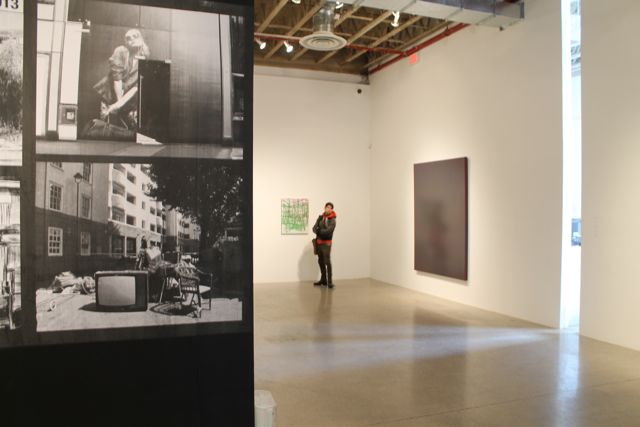
    Upon entering the space, the viewer is first impressed with the giant collaged works of Laura Oldfield Ford that resemble the advertisements that plaster our urban streets. Oldfield Ford’s Drifting through the Ruins, photocopied images are mounted on the wall that divides the large gallery space in two. She mixes images of luxury item advertisements with images of subsidized housing, demonstrating the ever widening social gaps that exist within contemporary Britain, and echoed across the rest of the world.

    Installation view with Laura Oldfield Ford Drifting through the Ruins (detail, left) and Boo Savillle Boo, To Your Scattered Bodies Go (right)

    The title of the exhibition ARE YOU ALRIGHT?, asks the spectator to question and reflect upon their own stability within a society in flux and does so using the empty construct of kitsch. The mixture of the collective works creates an atmosphere of a shared feeling of absence. The art spans across medium and meaning, the lack of coherence between the styles illustrates a sense of doubt among the exhibition’s participants and is intended to make the viewer feel alienation within the gallery.

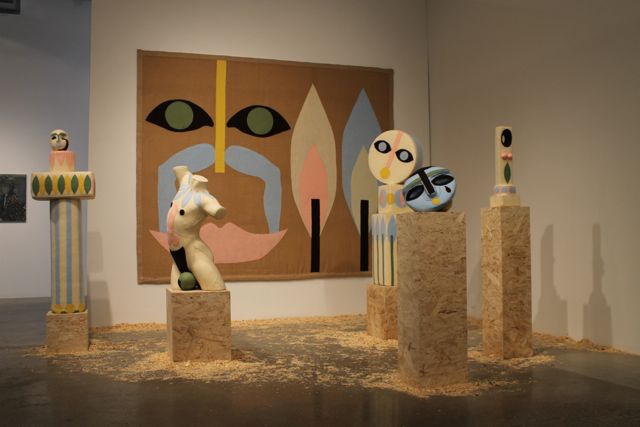
    Most of the pieces occupy the walls of the large open gallery space. The few exceptions that enter into the viewer’s space was Jonathan Baldock’s Pierrot, mock installation of an imagined museum display of sculptures made out of plush materials and in palette of infant-pastels. This installation demonstrates how even within museums, culture has been degraded to something that can be commoditized.

    Jonathan Baldock, Pierrot, 2011

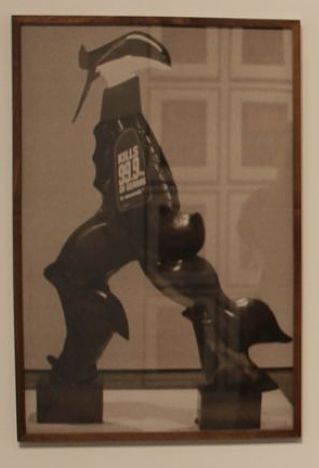
    Harry Burden also explores the commodification of art in his clever appropriation of modern sculptures, recreating these using household cleaners. These three sculptures, which the artist has entitled Sterile Anthromorphic Figure, have been photographed and printed on bleached poster paper, alluding to the bleach bottles the artist used to create his sculptures.

    Harry Burden, Sterile Anthromorphic Figure (Boccioni), 2012, digital print on bleached poster paper

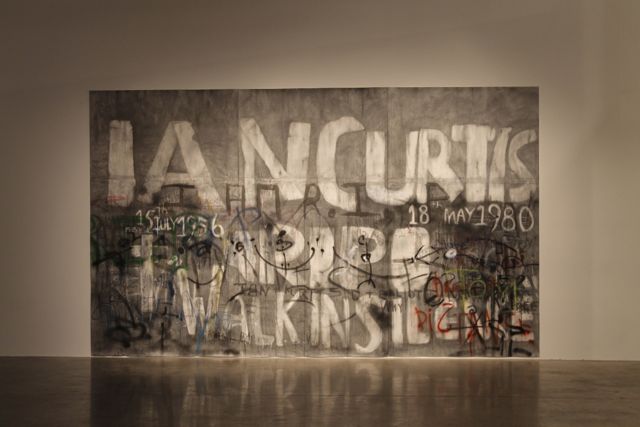
    The white walls of the gallery contrasted with the bright commercial colours, iconic faces and objects, and images imitating urban realties. Graham Dolphin recreates a homage of graffiti in commemoration to the late Ian Curtis, with his mixed media drawing Walk in Silence. Dolphin further explores the relationship between iconography and mass productions. In his video installation, 1500 Images of Kate Moss, the artist demonstrates an iconic image through its mass proliferation can move from the singularity of an idol into a homogenous pattern.

    Graham Dolphin, Wall (Walk In Silence), 2012, graphite ink, spray paint, crayon, tippex, marker pen biro on paper

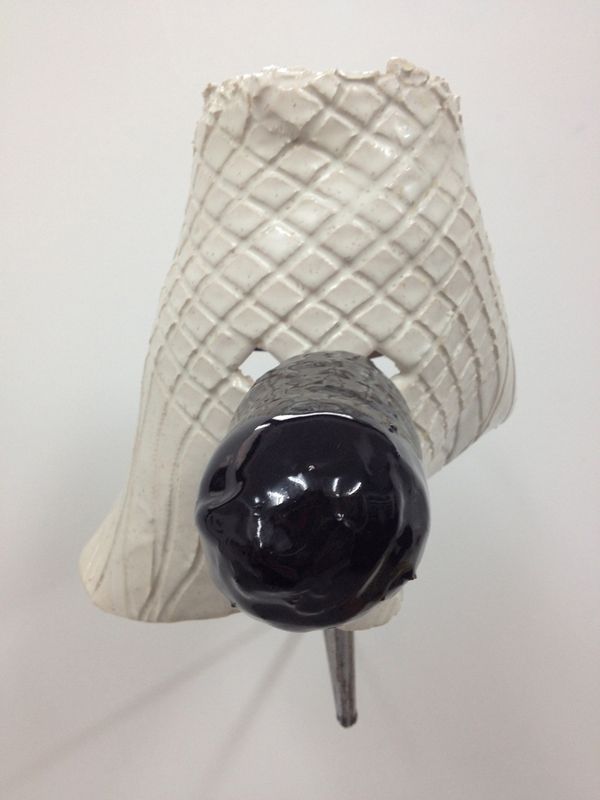
    Caroline Achaintre’s ceramic and leather sculptures Panto and Betzy, and the tapestry Swirler are both representations of male and female genitalia. They demonstrate a clear critique of fetishism and vulgarity that has been commodified within society and art.

    Caroline Achaintre, Panto (far left), leather and ceramic, 2012, and Swirler (middle), 2010, tufted wool, 255 x 164 cm

    Caroline Achaintre, Betzy, 2012 Ceramic, 23 x 37 x 26 cm

    The experience of this exhibition evolves from the bombardment of an abject reality to a retreat into abstraction. This withdrawal is evident in the final piece of Boo Saville. Her canvas, To Your Scattered Bodies Go, harkens back to the Abstraction movements of the twentieth century with their rejection of a world that has lost its moral compass.

    Installation view

    Currently the Art Gallery of Ontario has printed works from their own collection on display by the pioneer British Pop artist Richard Hamilton. The work of this new generation of British artist, is a continuation of what Hamilton began when he first pasted together newspaper clippings of the Rolling Stones and Marilyn Monroe. Hamilton’s Swingeing London (1967-1968), with its proliferation of images foretells the ever-increasing infiltration of mass media into our daily lives. Since the rise of the mass media, artists have incorporated and appropriated these images by taking them from the everyday and putting them into galleries as art. By doing so, they ask us to question their value and meaning in our lives. They reveal the effectual truth about these images as they are mindlessly devoured by society.

    Text and photo: Alice Tallman

  • Are You Alright?

    Are You Alright? New Art from Britain
    February 1 – March 24, 2013
    MUSEUM OF CONTEMPORARY CANADIAN ART

    James Unsworth, I Think of Demons, 2009.  Image courtesy the artist.

    Are You Alright? presents a new generation of British artists questioning Brit pop culture and engages the viewers with familiar icons in unfamiliar contexts to further emphasise the themes of disillusionment and rejection. First encountering James Unsworth’s I Think of Demons, the viewer is immediately introduced to the disgusted yet largely confused sentiment regarding contemporary British society that the artists share and are trying to generate.

    Graham Dolphin, Wall (Walk in Silence) (detail), 2012. Courtesy Seventeen, London. David Risley Gallery, Copenhagen.

    As the exhibition continues into the next room, the sprawling layout offers the viewer a multitude of sights. From a graffiti inspired wall work Wall (Walk in Silence) to Laura Oldfried Ford’s Transmission from a Discarded Future, ubiquitous media is mixed with abstract imagery and sets the context for the show. Set in a British context already, the large scale nature of the two works also effectively displaces you for a while, making you believe that you’re in Chelsea and not in Toronto.

    Laura Oldfield Ford, Heygate Estate 1974/1981/2011/2013 from the series ‘Transmissions From a Discarded Future,’2011 Photocopy on paper, 236 x 168 cm

    Another prevailing theme of the show seems to be a rejection of authority and conventions. By questioning contemporary society, the collective pushes the boundaries by using mundane objects such as mops in Harry Burden’s Dirty Fucking Hippies. Burden goes one step further questioning the role of museums in Dirt Painting where he creates an abstract minimalist work on a wall using only the dirt and dust collected from the floor of the MOCCA. This theme is hardly new and instead was quite popular during the prevalence of conceptual art in the 1960s. Furthermore, Michael Snow too referred to this in this recent exhibition Objects of Vision at the AGO where he presented protruding sculptural pieces intruding into the viewers’ space.

    Installation view with Harry Burden, Dirty Fucking Hippies, (in front) 2012. Photo: Alice Tallman

    One of the works that really stands out to me and encapsulates the entire theme would be Graham Dolphin’s 1500 Images of Kate Moss in 60 Seconds which effectively disillusions the viewer by flashing iconic images of the quintessential symbol of British fashion. The manner in which the viewer tries to grapple with the multitude of images being thrown at their direction is similar to the way in which today’s sensationalist society is constantly evolving and replacing itself. Hence, Dolphin is successful in mirroring the discomfort he feels with the society he lives within.

     Jonathan Baldock, Pierrot, Peregrine Program, Chicago (Installation view), 2011.

    Curators Elizabeth Eamer and Derek Mainella also succeed in providing a wide variety of work on display, creating a holistic feel to the exhibition as well as pleasing a wide range of tastes. The different mediums utilised range from cloth work and embroidery seen in Jonathan Baldock’s Pierrot  to bondage inspired assemblages by Caroline Achaintre to the transcendental minimalist inspired oil painting by Boo Saville, who probably possesses a neutral indifferent response to current British society. The entirety of the exhibition comes across intimidating at times and draws you in at other times, further succeeding in presenting and even generating a feeling of ambivalence towards the rest of society. The artist collective invites us into the club, and we’re honoured to join.

    Aliya Bhatia

  • Not “Alright”

    Justin Mortimer, Perimeter, 2012, oil on canvas, 183 x 183 cm

    Justin Mortimer: Perimeter

    Walking around Mocca’s show “Are you Alright?” Justin Mortimer’s large canvas titled Perimeter made me stop. I felt something strong, dark and brutal coming from it. The first thing that struck me were the large floating balloons. They suggested a party but the image is anything but. It took a while to recognize a figure in the bottom left corner. He is shrouded in darkness that covers most of surface of the painting. The man’s face is dark and expressionless, suggesting a brute. There is another figure but all we see is two arms seemingly sewing. They are sitting on the grass amid a scattering of balloons, and a line of washing hangs in the background adding domesticity to this strange story. Though the balloons are not dangerous in themselves their acid-colored presence made me uneasy.

    What kind of party are they coming from? Did the man get beaten up or just kicked out? Do they live in this area or are they trespassers? It’s hard to guess, but it seems something went wrong and violence is apparent. They sit anonymously in this wasteland, two losers on the periphery of society.

    Emese Krunák-Hajagos

  • Talk with Edward Burtynsky on Scale

    Edward Burtynsky, Pivot Irrigation #14, High Plains, Texas Panhandle 2011, chromogenic print, 34 x 96 inches, ed. 12

    Saturday, March 2, 2013, 2 p.m.
    NICOLAS METIVIER GALLERY
    451 King Street West,

    Nicholas Metivier Gallery will be hosting a talk with Edward Burtynsky on the subject of scale.

    Working from an aerial perspective, Edward Burtynsky uses a “human scale” that is dwarfed by the landscapes technology has created. In his new Pivot Irrigation series, Burtynsky creates compositions that resemble stained glass and textures that are evocative of wood or fabric. On close inspection, the viewer encounters miniature farms and pencil-thin pivot irrigation arms. It is only after this discovery that one can comprehend the mile and quarter mile radius of each crop circle.

    The talk is part of the exhibition titled Scale, a group exhibition featuring the works of Edward Burtynsky, Max Dean, William Fisk, Izima Kaoru, Mara Korkola, Robert Polidori, and Richard Tuttle. The exhibition will open on February 28 and will be on view through March 16, 2013 with an opening reception on Thursday, February 28 from 6– 8 p.m.

    This exhibition brings together nationally and internationally acclaimed artists whose work reflects a particular consideration for scale. Whether it is the physical size of the work itself or a conceptual concern within it, scale is an integral part of the painting or photograph’s success.