Author: artoronto

  • Cooper Cole to Open Second Location

    COOPER COLE is pleased to announce a second exhibition space opening at 777 Richmond Street West 2nd Floor.

    This offsite space will compliment the existing programming at our Dundas Street location, and feature exhibitions from gallery represented artists as well as projects from invited collaborators.

    The first exhibition at the gallery’s Richmond Street location is a solo show from artist Jeremy Jansen, June 1 – 24, 2013.
    Jeremy Jansen (b. 1979, Calgary, AB) is an artist whose practice is primarily based in sculpture and photography. His body of work considers the deconstruction of the built urban environment.

    Opening reception: Saturday, June 1, 2013, 3 – 6 p.m.

    Gallery Hours: Monday, Friday, and Saturday: 12 – 4 p.m., and by appointment.

  • World’s Greatest Pete Doherty

    Casino Rama, Orillia, Ontario, 2008 © Pete Doherty / Courtesy of the Stephen Bulger Gallery

    Book Launch: Thursday, May 30, 2013, 5 – 9 p.m.
    Stephen Bulger Gallery
    1026 Queen Street West

    Bulger Gallery Press is pleased to present, World’s Greatest, a publication that features 60 photographs by Pete Doherty and essays by Stephen Brunt, Jim Christy and Larry Fink.

    Doherty is a self-taught photographer and graduate of the Ontario College of Art, who, for many years, left behind the world of art to become a boxer. After retiring from his amateur career, Doherty returned to the ring with his camera in hand. His photographs primarily document the boxing world in Ontario and New York State, but are representative of professional and amateur boxing throughout North America. The images not only focus on the sport of boxing, but also on the people and personalities that populate that world. His photographs document the emotions and physical challenges of training, fighting, and the win or loss. They also address the politics that make up both amateur and professional fighting.

    A selection of the photographs from World’s Greatest will be exhibited in Gallery Two at the Stephen Bulger Gallery, May 30 – June 15, 2013.

    WORLD’S GREATEST PETE DOHERTY
    First printing, Bulger Gallery Press, 2013
    Publication © 2013 Bulger Gallery Press
    Photographs © 2013 Pete Doherty

  • Finding the Next Great Photographer

    Wednesday May 29 at 6:30 pm
    Katharine Mulherin Contemporary Art Projects
    1082 + 1086 Queen Street West (at Dovercourt Road)

    Janieta Eyre, Mute Book 4, 2009

    In recognition of Toronto’s CONTACT Photography Festival, this month’s artVentures event is a private tour of an exhibit by the acclaimed photographer Janieta Eyre. A presentation at the gallery will give us further insight into Eyre’s work and the world of contemporary photography.

    We will then re-group at one of Ossington Avenue’s trendy watering holes to further discuss the exhibit and the benefits of adding the right photography to our own collections.

    Janieta Eyre also has a featured exhibition at UTAC in this year’s Contact festival.

    Reserve your seat at:http://artventuresphotography.eventbrite.com/

  • In-Between Worlds

    Meryl McMacter: In-Between Worlds

    Meryl McMacter, Victoria, 2013, Digital Chromogenic Print, 36 x 50 inches

    April 27 – June 1, 2013
    Katzman Kamen Gallery

    Meryl McMacter is one of the most interesting young photographers working today. Her remarkable work in her Second Self series, had me looking forward to her show at Katzman Kamen Gallery. I could relate easily to her photograph in the CONTACT catalogue, Aphoristic currents. Layers and layers, rolls of rolls of newspaper surround a young woman’s head—almost to the point of downing. Her face—painted with a Native pattern—is just barely above these “waves” that represent the teachings of her two different backgrounds: European and Native. Looking at the other images on display, the Native background comes through strongly. Set mostly in winter landscapes, the artist poses in various costumes that call to mind stories of her people in the north. Wingeds calling shows a big bird—a totem animal maybe—that purposefully moves to fulfill some call. In a few other images McMaster—in clothing suggestive of traditional dress—performs some ancient ritual (Victoria) or becomes the host of a metal bird nest (Harbinger of Sudden Departure). These staged images are very cold and even the bloodiest is somewhat quiet. Regardless their strong narrative, they radiate solitude.

    Emese Krunák-Hajagos

  • Winners of Open Studio National Printmaking Awards

    Kurt Pammer, Windows Immaculata, Screenprint, 15″ x 39″.

    Winners of Open Studio National Printmaking Awards Announced

    Open Studio, Canada’s leading printmaking centre, is pleased to announce the winners of the sixth annual Open Studio National Printmaking Awards, presented May 16, 2013 at Open Studio’s 28th annual 100 Prints fundraising event at the Palais Royale.

    The winners are:

    First Prize ($3,000): Kurt Pammer (Toronto, ON)
    Second Prize ($1,500): Florin Hategan (Maple, ON)
    Third Prize ($500): Eric Euler (Toronto, ON/Baton Rouge, LA)

    Artists Rocky Dobey (Toronto, ON), Doug Guildford (Toronto, ON/Mill Village, NS), and Shogo Okada (Toronto, ON/Osaka, Japan) were also recognized with Honourable Mentions.

    “A sincere congratulations to all of the artists recognized by the Open Studio National Printmaking Awards,” said Jennifer Bhogal, Executive Director of Open Studio. “These awards set the standard for excellence in the field of print-based media. The artists acknowledged this year exemplify the power print holds to inspire appreciation for both the idea realized and the technical mastery employed. It was a thrill to see the finest examples of Canadian print media exhibited at 100 Prints.”

    The Open Studio National Printmaking Awards were launched in 2008 to recognize and reward excellence in the Canadian printmaking community. Open to all printmakers in Canada and Canadian printmakers working abroad, the awards are presented in conjunction with Open Studio’s annual 100 Prints event. Combining elements of a fine art exhibition and a lottery, 100 Prints is a much-anticipated event in the Canadian arts community, and provides a chance for art lovers to come face to face with works from celebrated Canadian visual artists, as well as pieces by promising emerging talents. It is also a major annual fundraiser for Open Studio, an artist-run, Toronto-based charitable organization that provides professional development opportunities for artists and promotes contemporary, original, fine art prints.

  • CONTACT 2013 / week 3 and 4

    Opening Receptions – the third and forth week of  Scotiabank CONTACT Photography Festival, 2013:

    Norman Wong x Arts & Crafts
    Opening Reception: May 23, 2013,  8 – 10 p.m.
    May 23 – June 15, 2013
    A&C Pop-Up
    1093 Queen St W Unit 2

    Artist Norman Wong at the opening reception with his portrait photo of Kevin Drew

    In celebration of Arts & Crafts Productions’ ten year anniversary, Norman Wong x Arts & Crafts includes an iconic black-and-white portrait series featuring artists of the Arts & Crafts roster, as well as a photographic retrospective on the record label. Wong, a Toronto-based fashion and celebrity photographer, is a longtime friend of Arts & Crafts and has had a unique opportunity through the years to document and work with musicians associated with the Arts & Crafts label.

    “I am tremendously excited to present the body work that represents my start as a photographer, and at times has been one of the reasons I kept going. These are photographs of people who mean a lot to me. They are my friends, family and heroes and it’s a special honor to finally show this private collection as part of AC10 celebrations” – Norman Wong.

    Walls covered by photographs of celebrities

    Photo: Celeste Ringrose

    InSight Part II
    Opening Reception: May 16, 2013, 7 p.m.
    May 16 – 26, 2013
    Gallery 1313
    1313 Queen St. West

    Another didactic exhibition by members of Gallery 44 opened on May 16 . The warm weather encouraged a large visitor presence boosted by artists.

    In this two-part exhibition, 30 members of artist-run Gallery 44 Centre for Contemporary Photography use a variety of styles and approaches, including digital and chemistry-based processes, to share their conscious and subconscious understanding of the world around and within.

    Dennis Duncan, Shifting Number 3, 2013

    Whether seeing into underlying truths or perceiving new associations, the artists in InSight share a unique range of vision.

    Visitors with Keith Davidson’s work, Untitled

    Staff from Gallery 44 also showed up to help celebrate the reception for these 15 photographers.

    Text and photo: Phil Anderson

    Banal Baroque by Elizabeth Zvonar
    Opening Reception: May 15,2013, 6 – 8 p.m.
    May 15 – June 15, 2013
    Daniel Faria Gallery
    188 St Helens Ave

    Banal Baroque is Vancouver-based Elizabeth Zvonar’s first solo exhibition in Toronto, featuring prints of the artist’s collage work, as well as her sculptures.

    Elizabeth Zvonar with her work

    Blending content from contemporary fashion and science magazines with themes and imagery pulled from historical lifestyle monthlies, Zvonar alters her source material to make images that are strange enough to invite closer contemplation.

    Elizabeth Zvonar, Blind Love, 2012

    The exhibition engages a conversation about daydreaming and history, the future and metaphysics, light humour, sex, and other complications. Zvonar continues to explore themes of the unknown and the possibility of something more.

    The most interesting abstraction leaves room enough for metaphor; or maybe the most interesting metaphor leaves room enough for abstraction.

    Photo: Fox Martindale

  • The Bikeriders by Danny Lyon

    Gallery visitors examing Lyon’s work. Photo: Shellie Zhang

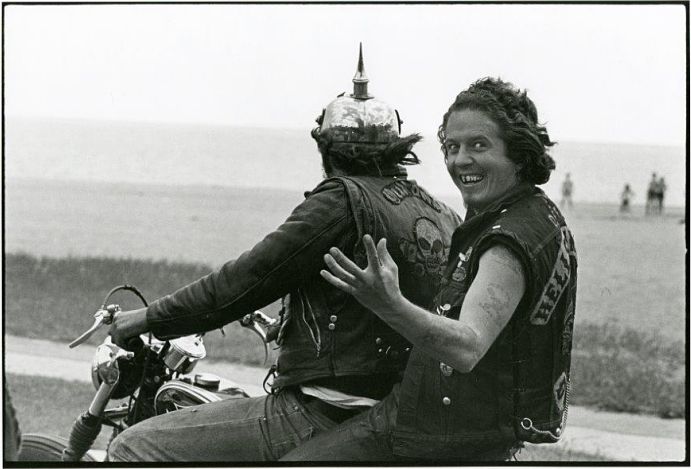
    This past weekend, The Bikeriders at the Stephen Bulger Gallery drew in an assortment of visitors from art consoeurs exploring the fruits of CONTACT, passer byers curious of the hype, and fans of motorcycles and biker culture. According to artist Danny Lyon himself, the photographs in this exhibition were “an attempt to record and glorify the life of the American bikerider.” However, this statement is simplifying Lyon’s accomplishments in this body of work. Surpassing mere glorification, Lyon captured the surprisingly humanist nature of the biker counterculture revolution during the 1960s. During this time, Lyon became a member of the Chicago Outlaws motorcycle club and traveled alongside them, sharing their lifestyle. As a result, The Bikeriders encapsulate a more tender side of the rebel group because Lyon was able to get close to the gang in a way others had not been able to. As Martin Parr remarked, The Bikeriders offers an authentic voice about its subjects, “understanding instinctively not only their hopes and aspirations, but also why they were rebelling against all kinds of adult authority.” In this body of work, Lyon exposes the complexity and intimacy within the biker culture by humanizing the individuals in the group and shedding their vicious associations without taking the edge off their badass aura.

    Danny Lyon,Funny Sunny Packing with Zipco, Milwaukee 1966. Copyright Dektol@wordpress.com Courtesy of Etherton Gallery, Tucson

    In each image, Lyon demonstrates that the general presumptions surrounding biker gangs are not as clear cut as most would believe them to be. Funny Sunny Packing with Zipco, Milwaukee (1966), depicts a Hell’s Angel biker enthusiastically riding on the same bike as an Outlaw driver. Popular culture would lead many to believe that these two gangs were rival gangs. Many viewers attending the opening began questioning their own knowledge of biker culture upon seeing this image, wondering if they were mistaken or if special circumstances allowed this encounter. No simple answers were provided in the gallery, leaving the visual message that in this moment that Lyon captured, their comradely exceeded any bad blood which may have existed.

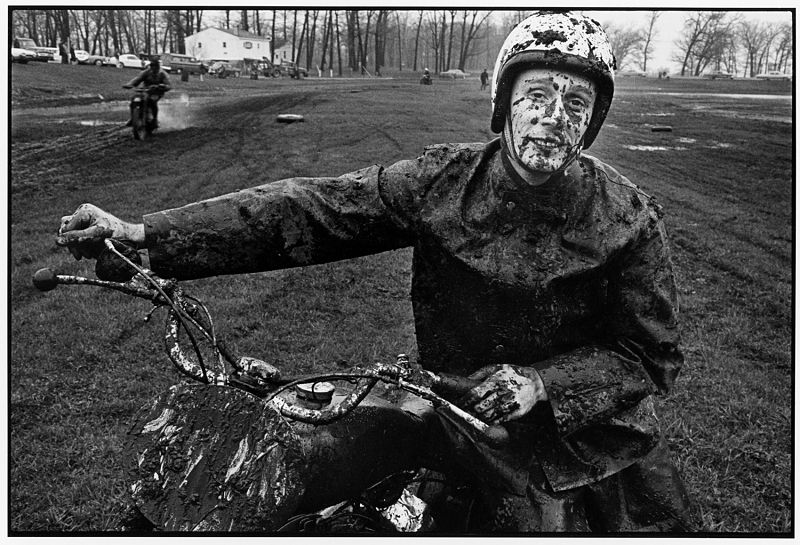
    Danny Lyon, Racer, Schereville, Indiana, 1965. © Danny Lyon / Courtesy of Etherton Gallery, Tucson, and Stephen Bulger Gallery, Toronto

    Another triumph in this series was Lyon’s ability to successfully reveal the underlying innocence within many of his subjects. Racer, Schereville, Indiana (1965) features a young man holding his bike after having ridden through a muddy terrain. At first glance, the black and white image creates the illusion that the mud on the man’s face are splatters of blood – similar to the gruesome images found in so many Hollywood films about bikers. Upon further examination, details within the photograph demonstrate that this is a rather wholesome scene. The man’s white smile shining through his dirtied face shows his boyish charm, playful features, and sincere enjoyment through riding.

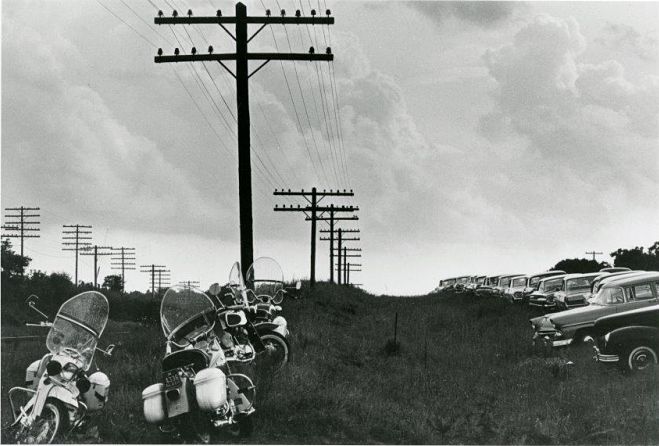
    Danny Lyon, Route 90, Alabama, 1964. Copyright Dektol@wordpress.com Courtesy of Etherton Gallery, Tucson

    As the only work in the exhibition that doesn’t feature a human subject, Route 90, Alabama (1964) possesses many symbols that offer insight towards Lyon’s idea of biker philosophy. The photograph depicts the wide open space that many have dreamed of with majestic clouds rolling in the sky and a light gleaming from over the horizon. In the corner, bikes stand as a celebration of freedom, nonconformity to mainstream culture and unity within the group. The silhouettes of the electrical poles that adorn the American landscape resemble rows of crosses, suggesting that this lifestyle is their religion and salvation. The lack of human presence further suggests that this evocative and sublime landscape represents something larger than the individuals within the culture.

    Stephen Bulger Gallery owner Stephen Bulger (left) and artist Danny Lyon at the Reception. Photo: Shellie Zhang

    Much like Hunter S. Thompson’s Hells Angels, The Bikeriders explores the seductive realm of the biker subculture with a different conclusion than those depicted in popular culture. Lyon offers a romantic insight towards the classic American outlaw and maintains their integrity with signs of compassion. In many ways, Lyon acts as a spokesman for his friends and comrades. By documenting their journeys and re- presenting their way of life to the public, Lyon brings forth evidence that perhaps these individuals do not deserve the negative image that they have been affiliated with.

    Shellie Zhang

    *Note: The exhibition runs from May 11 – June 15, 2013 at the Stephen Bulger Gallery, 1026 Queen Street West. Hours: Tue – Sat 11 – 6 p.m.

  • Collected Shadows

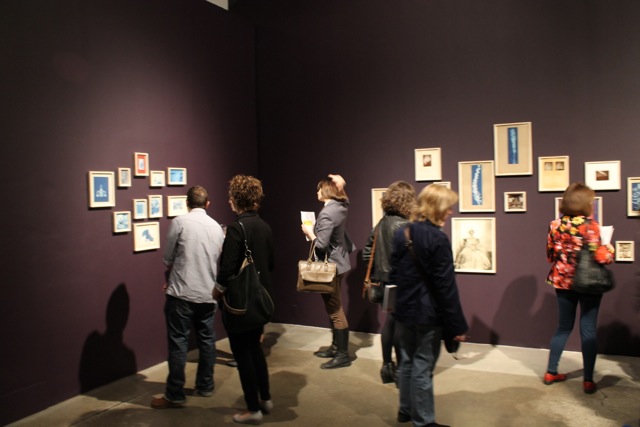
    For this year’s Sotiabank CONTACT Photography Festival, curator Timothy Prus pulled together an exhibition at MOCCA with an impressive count of 198 photographs. Titled Collected Shadows, the show is culled from the Archive of Modern Conflict’s collection of over four million images spanning from the mid-nineteenth century to the present. The Archive of Modern Conflict (AMC) is a Canada- and UK-based organization, whose practice of collecting focuses on diversity rather than renown; it amasses works from all across the globe by both amateur photographers and well-known names, such as photography giants Robert Frank and Étienne-Jules Marey.

    Installation view. Photo: Alice Tallman

    Distilling a digestible exhibition from such an extensive archive is a daunting task, but Prus bravely approaches the dizzying diversity by working with it rather than against it. The 198 photos hang on rich, aubergine walls, divided into clusters of as few as four and as many as over two dozen. Avoiding any obvious chronological organization, each grouping is a mix-and-match of images from various periods, sometimes loosely linked by technique or style, other times by theme. The photos in each cluster are arranged in a free-form salon style, spurring the eye to dart playfully and spontaneously from one picture to another.

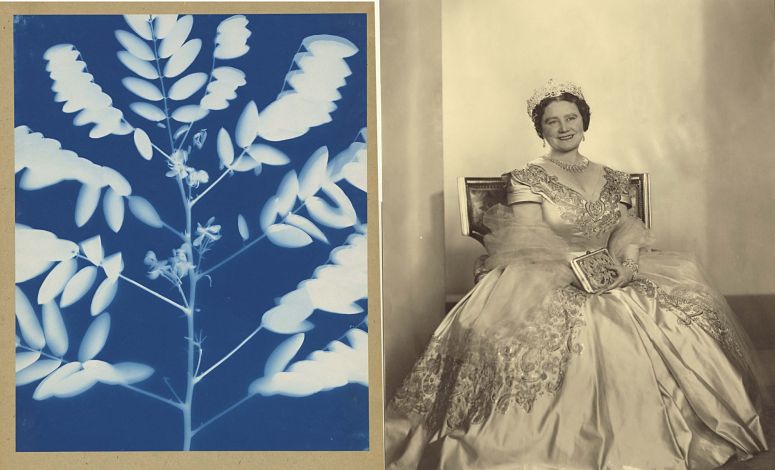
    Bertha Jaques (American), Plant Study, Cyanotype, c. 1910 (left) and Dorothy Wilding (British), Queen Elizabeth the Queen Mother, Silver Gelatin Print, c. 1954 (right)

    The exhibition places each archival photograph in a fresh context, side-by-side with images from other times and other places. The meaning of an image is never stable, its signification always dependent on its context. This show stages a wealth of chance meetings between pictures of remote subjects, reanimating the images and making them signify in unexpected ways. In one grouping, Bertha Jacques’ plant study cyanotypes (c.1910) appear next to society photographer Dorothy Wielding’s picture of Queen Elizabeth (1954). In another cluster of photos, a texturally captivating shot of lentils by Aleksandr Khlebnikov (c.1930) is shown near a somber picture of fellow Russian Kasimir Malevich’s last moments (1935).Each of these imaginatively grouped clusters of photos is a fountainhead of associations and clashes – between the mundane and the extraordinary, between nature and technology, and among divergent times, places, and peoples.

    Maxwell R. Hayes (Australian), Duk-Duk members, Silver gelatin print, 1964

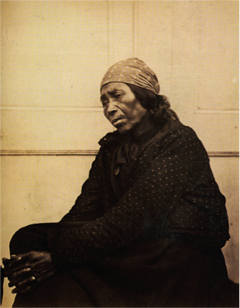
    The AMC declares as its task to engage with and constantly reassess the legacy of the incoming photographic stream – but it does just as well engaging with and reassessing the nature of photography itself. A photographic image is partly the result of a mechanical process that makes an indexical recording the world beyond the viewfinder. But the photograph is also an interpretation of reality by the photographer, who chooses, frames and manipulates that outside world. The indexical quality of photography makes it an appealing medium for objective record-making for diverse purposes, from judicial to scientific. Paul-Émile Miot’s Mi’Kmaq woman, Newfoundland (c. 1859) places emphasis on the factuality of the photographed subject, conceiving the photograph as objective material for ethnographic knowledge.

    Paul-Émile Miot, Mi’Kmaq woman, Newfoundland c. 1859

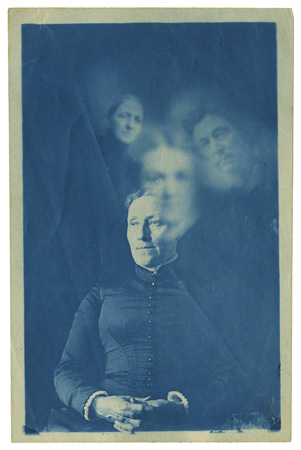
    But hanging nearby is Frank Coster’s Spirit photograph(1890), in which three ghostly busts hover over a seated portrait of a woman. This manipulated photograph deviates from factual recording, moving toward an image-making that makes the agency of the photographer more visible. As a reflection on the nature of the photographic medium, this exhibition makes evident the tension between objective recording and subjective interpretation that characterizes photography, which never escapes its indexical essence but which is also boundless in creative possibilities.

    Frank Coster (American), Spirit photograph, Cyanotype, c. 1890

    The immersive environment of this exhibition produces a hyperawareness of time and its relentless drive forward. Susan Sontag called the photograph a memento mori, a reminder of the mortality and mutability of the depicted subject. The photograph foregrounds the captured moment as something that has passed and no longer is; but it is paradoxically also a slice in time preserved, each viewing bringing the past back from the dead into a confrontation with the present. This is evident in a picture of two Nepalese women taken in 1890 by an unknown photographer. Though the image documents a historical moment that has long passed, the gaze of the two women stare out at the viewer and creates a connection that sustains the subjects’ presence in moment of encounter with the image. This provocative tension between presence and absence pervades the viewing of many of the photographs in this exhibition, lending the experience an eerie but poignant uncanniness.

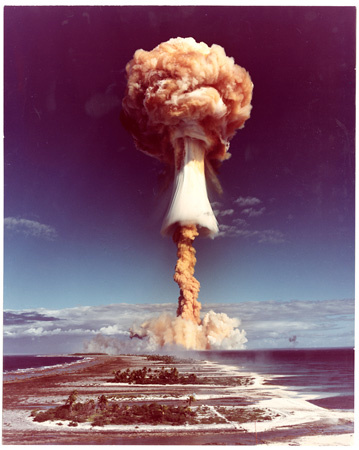
    Commissariat à l’énergie atomique DAM (French), Atomic trial on Mururoa atoll, Tahiti, Colour print, 1970

    The show comes to a vivid close with a bang, culminating in a group of photographs linked by the themes of fire, burning, eruptions, and explosions. Taking in the last of the pictures, no neatly packaged grand narratives come to mind. What surfaces instead are myriad stories of diverse peoples and the worlds they live in and create around themselves. And whether the exhibition’s self-reflexive look at the multi-faceted nature of photography has complicated or clarified our understanding of the medium, we’ll likely start looking at photographs a little differently after. Collected Shadows makes for a mind-jogging primer to the CONTACT festival, before one gets cracking on the other one hundred plus photography shows.

    Amy Luo

  • Sebastião Salgado’s Genesis

    Sebastião Salgado’s excellence in photojournalism is displayed in his exhibition entitled Genesis, on at the Royal Ontario Museum until September 2, 2013. Lélia Wanick Salgado, Sebastião’s wife, curated Genesis. The two founded the Instituto Terra, a non-profit organization dedicated to the replanting of the Atlantic Forest in Brazil. The ideas behind Genesis came from this initiative.

    Sebastião Salgado, The Arctic National Wildlife Refuge (ANWR) in northeastern Alaska, 2009, © Sebastião Salgado / Amazonas images

    This exhibition, a primary exhibition for the Scotiabank CONTACT Photography Festival, marks Salgado’s first exhibition in Canada. Although some of the photographs in the show were taken in Canada, the opening of the exhibition marked the photographer’s first visit to Toronto. Salgado thinks Canada is a marvelous country; however, what he finds most marvelous about Canada are places that are foreign to most Canadians living in the country’s major cities.

    Sebastião Salgado, Iceberg Castle between Paulet Islands and the South Shetland Islands on Weddeil Sea, 2005, © Sebastião Salgado

    The exhibition is divided into two gallery spaces. The first gallery displays the themes of Sanctuaries, Amazonia and Pantanal, and Northern Spaces. The walls are painted green, blue, and grey, calling to mind the earth, water, and ice that these images depict. The second installation contains work from the southern hemisphere, and the other is dedicated to photographs of Africa. The photographs in Planet South are set against slate grey walls like that of the rock of the Patagonian mountains. Africa is emphasized by red, like the harsh sun on the Sahara desert.

    Viewers move about this exhibition in the kind of silence one experiences walking through a Gothic Cathedral. The sublime scenes and moments Salgado has captured overwhelm all visitors. All of his photographs are black and white, yet they have the same richness of the most vivid colour photograph. With the absence of colour, the viewer’s eyes are entranced by the rich textures and minute details of the landscapes, people, and animals.

    Sebastião Salgado, Bay Madagascar, Baobab Tress. Bay of Moramba, 2010. © Sebastião Salgado

    Salgado’s photographs of remote, unspoiled landscapes are far beyond what we think the world looks like. His photographs of landscapes take the viewers across mountains and deserts, through lush rainforests to the artic tundra. Salgado brings together an excellent survey of the beauty of the planet. In many cases these landscapes appear to be alien and surreal places. When looking up close, some photographs appear to be a haze of dust, but when standing back, one sees all the pigments come together to create to the most detailed scenes.

    Sebastião Salgado, South Sudan, From Africa, the Dinkas, 2006. © Sebastião Salgado

    Salgado’s landscapes are illuminated with the most incredible light. He uses the natural light to emphasize the beauty of the landscapes. The light is used like a carving tool creating fantastic depth and allowing the viewer’s eye to travel as if for miles through the photographs.

    Sebastião Salgado, Yali women at rest, West Papua, Indonesia, 2010, © Sebastião Salgado / Amazonas images

    Salgado executed many photographs of people. When searching for people who embodied the ideas behind Genesis, Salgado was looking for people “where they live unhurried lives in communion with nature.” During the eight years creating Genesis, Salgado spent time with and photographed a multitude of communities in remote places and followed their ancestral traditions. These photographs are not representations of “others” or primitive societies, but rather a presentation of an alternative to the western capitalist way of life and thinking. Salgado shot both portraits of individuals and from the daily lives of those people. With his portraits, the detail is so exquisite one feels as if they could stroke the feather headdresses, feel the paint on their faces and bodies, or touch the soft fur.

    Sebastião Salgado, The Upper Xingu Indians. Brazil, 2005 © Sebastião Salgado

    While Salgado has already won a number of awards for his photographs of people, animals are a new subject in Salgado’s work. After so many years of capturing the beauty of people, Salgado has captured animals with an elegance that is equal to that in his photographs of people. In his study of animals from around the world, Salgado captures their sensibility and intelligence.

    Working back towards Genesis is the most progressive thing our society can do for the planet, yet the likelihood of this occurring is remote. With modernization, industrialization, and globalization, photo records such as Salgado’s are stark reminders of how much we have to lose if we don’t protect what is truly important.

    Alice Tallman

    *Note: The show is open till September 2, 2013 at the Royal Ontario Museum, 100 Queen’s Park. Hours: Mon–Sun, 10 – 5:30, Fri, 10 – 8:30 p.m.

  • Andrew Wright: Penumbra

    Andrew Wright’s Penumbra on display at the University Toronto Art Center (UTAC) opened May 3rd as a primary exhibition for the Scotiabank Contact Festival. This is Wright’s fifth year exhibiting with Contact.

    This is the first time his work for Contact has been assembled as a retrospective, displaying over a decade of his work. Bonnie Rubenstein, the artistic director for Contact, curated Penumbra.

    Adrew Wright, in front of his work After Kurelek, 2013

    The experience of Wright’s work is delightfully disorienting. The eye travels through incredible photographic details, out of focus hazes, and flat, non-reflective surfaces. Upon entering the space the viewer is struck by Nox Borealis, a freestanding photographic sculpture. Wright studied sculpture before turning to the photographic medium. This work has departed from the traditional domain of the wall and has entered into the direct vicinity. The work challenges viewers to maneuver around and through these two representations of an inverted artic sky. Wright has created a unique perspective of a landscape. This work is separated into two prints placed on plywood and standing freely within the gallery space. The shape of Nox Borealis, as well as Still Water resembles that of minimalist sculpture. Despite this likeness, his play of the crisp white snow set against a flat black sky set in an elongated space, has a more stupefying effect upon the viewer.

    Andrew Wright, Nox Borealis, 2012

     Wright has used a range of photographic technologies that expand across the history of photography, from the sixteenth century device of the camera obscura to the iPhone Apps of today. Although Wright has used both traditional and contemporary photographic technologies his works are not photographs in our traditional sense of the medium. He makes direct reference to proto-photographic techniques, he then appropriates these methods and interfaces them with modern technologies. The artist’s historical investigation of photography illustrates ways in which technology has changed how we view the world. This reference to the history of photography is made in works such as When Buildings Take Pictures Themselves, created using a camera obscura, the first photographic apparatus conceived in the Renaissance.

    When Buildings Take Pictures Themselves, 2013

    The works entitled Photogenic Drawings XXI, XXII, pay homage to the roots of photographic techniques, but were made using an Iphone app. Aided Drawing 1;2, are drawings created by using the 19th century device the camera lucida.

    Visitor looking through a Camera Lucida

    The apparatus was incorporated into the exhibition for visitors to look through, offering many ways of seeing. Wright plays upon the historical conventions of photography and turns them upside down.

    Andrew Wright, Photogenic Drawing, Antique Clouds, Prairie,2011

    Wright’s work effectively raises the questions: “where is the photographer? Where is the photography?” His response is through ambivalence to the subject matter of his work. He removes himself as photographer when creating the camera-less images Coronae 1;2.

    Andrew Wright, Coronae 2, detail, 2011

    They are created by puncturing old film. These works have the appearance of astronomical specimens. Box of Fifty are works made from expired film that have been left on a windowsill for a number of weeks. The works were then printed on out of production photo paper. The viewer feels uncertainty to what they are looking at with many of these pieces.

    Installation view with Andrew Wright, Tree correction series, 2013 (right)

    Wright’s work challenges its viewers to make sense of what they are looking at. His work asks its viewers to rummage through their visual vocabulary to make logical sense of these new ways of looking. Wright describes his work as “multi-tiered inquiries into the nature of perception, photographic structures, and technologies.” Wright’s work reflects his “interest in what makes a photograph and what makes a photographic experience.” In pursuit of the answers to these questions, the artist has abstracted and isolated the principles of the medium, and presented new ways of thinking about photography. 

    The show is open till June 29, 2013 at UTAC, 15 King’s College Circle. Hours: Tue – Fri, 12 – 5, Wed, 12 – 8, Sat, 12 – 4 p.m.

    Text and photo: Alice Tallman

  • Gallery Walk, May 10 – 12, 2013

    Some of the Scotiabank Contact Photography Festival shows are opening on this weekend. Please look at our suggestions for a gallery walk focusing on the Queen West area.
    We would be interested how did you like the shows so please let us know.

    Lee & Mei Lee Ogden: Sign Languages / Ester Pugliese: Disfluency and Delay
    April 27 – May 19, 2013
    loop Gallery

    1273 Dundas Street W JJ Lee & Mei Lee Ogden, My Little Pony, mixed media on watercolour paper, 60″ x 70″, 2013

    Using gouache, glitter paint, wax crayons, watercolour, and pencil crayons, Lee and her daughter explore the space between high and low art, visual and spoken language, mark making and representation, hearing and Deaf, narrative and abstraction.

    Ester Pugliese, Impromptu Performance: Branson School Chamber Singers and Singing Iceberg, acrylic, chalk, conté, carbon, and chalkboard paint on panel, 22 x 30 inches, 2013

    The mixed media works in Pugliese’s Disfluency and Delay consider the human inclination to adjust outward appearances, illustrating this tendency with contrasting examples from nature. Each work presents audio graphs of impromptu performances culled from YouTube videos.

    Lauren Luloff
    May 1 – May 25, 2013
    Cooper Cole Gallery
    1161 Dundas Street W

    Lauren Luloff, Plants and Eyes, oil, bleached bedsheets and fabric on muslin,71 x 57.50 inches,2013

    New York Arts Magazine listed her as one of the top 30 artists to watch in 2012. Luloff currently lives and works in Brooklyn, New York. Her large scale work use organic elements like leaves, grass, fruits represented in a somewhat abstract way on ornamental rugs or in front of decorative backgrounds.

    Edith Maybin: The Girl Document
    May 11 – June 8, 2013
    Opening Reception: Friday, May 10, 6 – 9 p.m.
    O’Born Contemporary
    131 Ossington Avenue

    Edith Maybin, Untitled, from the series The Girl Document, 2013

    Edith Maybin continues to explore the liminal space between girl and woman, this time through the use of still life photography. Beautiful and troubling, these in-camera constructions engage the viewer with both lucid detail and incomplete dreams. Fold upon fold, a singular portal unveils a deceitful truth, double-minded (untrustworthy) like photography itself.

    The Bikeriders by Danny Lyon
    May 11 – June 15, 2013
    Opening Reception: May 11, 2 – 5 p.m.
    STEPHEN BULGER GALLERY
    1026 Queen St. W

    Danny Lyon, Crossing the Ohio Louisville, 1963-67

    These images chronicle the activities of the motorcycle world from 1963–67. Lyon documented the life of the American bikerider in the Midwest from the seat of his Triumph motorcycle, equipped with a Nikon, a Rolleiflex, and a seven-pound portable tape recorder. The resulting black-and-white images provide a window into the rough, counterculture lifestyles of bikers on the road, also paving the way for the film Easy Rider (1969).

    I Was Already Lost by Botto + Bruno
    May  8 – June 29, 2012
    Pari Nadimi Gallery
    254 Niagara Street

    Botto + Bruno, Lost Time II., 2013,  graphite, white pencil, photographic collage on cardboard collage, 12 x 13 inches

    Known for their constructed photographic and video works which, at times, used as material for creating their large installtions, Botto + Bruno continue to be interested in investigating the revolts, wishes and dreams of teenagers who live in the immense suburbs of our planet. 

    Orion Tide by Kelly Richardson
    May 2 – June 8, 2013
    Birch Libralato
    129 Tecumseth St

     Kelly Richardson, Orion Tide, 2012-2013

    Like much of Richardson’s work, the landscape pictured in Orion Tide is digitally constituted, evoking grandiosity, ruggedness, and a sense of being in an unspecified but decidedly unfamiliar place. Richardson plays with the conventions of science fiction cinema by depicting a scene based in a sublime visual realness, unmoored from a clear point in time – both beautiful and terrifying.

  • CONTACT 2013 / 2nd week

    Opening Receptions – the second week of  Scotiabank CONTACT Photography Festival, 2013:

    The Girl Document by Edith Maybin
    Opening Reception: May 10, 2013, 6 – 9 p.m.
    May 11 – June 8, 2013
    O’Born Contemporary
    131 Ossington Ave

    From left to right: Artist Edith Maybin, O’Born Contemporary founder Donald E. O’Born and Assistant Director of the O’Born Gallery Rachel Anne Farquharson.

    O’Born Contemporary created a magical escape on a cold and rainy Friday evening. The large, and diverse, crowd hovered around the photographs with enthusiasm. Departing from her previous series, The Garden Document, The Girl Document displays an abstract space between girl/woman, mother/daughter.

    Installation view with Edith Maybin, The Girl Document, Untitled #4, 2013

    With vibrant eye-catching colors, and a variety of textures (hair, glass, cake, skin, flowers, rocks/minerals, etc) the photographs are undeniably captivating. Maybin’s work leaves her vulnerable to her audience because she is giving us a window into her life/family; however, she gives her audience room to gain an understanding of themselves as a result of experiencing her work.

    Edith Maybin, The Girl Document: Untitled #2, 2013, C-Print, 27 x 36 inches.

    Personally, I had several visceral reactions to Maybin’s work and it conjured up memories I had of my growth from a girl into a woman. I could relate to the themes of fear, pain, excitement, and wonder. Each time I looked at the photographs I discovered (and sometimes startled by) new elements I had initially missed.

    Edith Maybin, The Girl Document: Untitled #1, 2013, C-Print, 60 x 90 inches.

    She leaves her audience with not only visually stunning photographs, but a space for exploration and inquiry.

    Text and photo: Leanne Semaan

    I Was Already Lost by Botto + Bruno
    Opening Reception: May 8, 6 – 9, 2013
    May  8 – June 29, 2012
    Pari Nadimi Gallery
    254 Niagara Street

    Installation view. Photo: Fox Martindale

    For their exhibition at Pari Nadimi Gallery, internationally acclaimed Italian duo artists  Botto+ Bruno present an installation of a large wallpaper, as the center piece of the exhibition, made out of A3 sized photocopies.

    Photo: Veronica Scarpati

    The photocopies start with a text (a text cut up from Ballard’s Kingdom Come) and then develop into drawings and finally in black and white photography.  A number of small works with grey background and white framed, made of a drawing and a photo collage, are placed over the wallpaper.

    Botto + Bruno, Lost Time I., 2013,  graphite, white pencil, photographic collage on cardboard collage, 12 x 13 inches. Photo: Fox Martindale

    The installation also includes 3 large photographs. Every A3 and large photographs contains Botto + Bruno’s investigations of marginal places that are photographed, selected, archived, assembled, photocopied by the artists to make the final collage.

    Pari Nadimi Gallery owner Pari Nadimi (right) with a visitor in front of the  larger images. Photo: Veronica Scarpati

    Unfottunately the artists didn’t attend the opening reception but many photography lover attended it, Bonnie Rubenstein, Artistic Director of Scotiabank CONTACT Photography Festival, among them.

    Phot0: Fox Martindale

    I Shop / David Hlynsky
    Opening Reception: May 4, 2013, 3 – 7 p.m.
    May 4 – June 1, 2013
    De Luca Fine Art Gallery
    217 Avenue Rd N

    Between 1986 and 1990, Canadian-American artist David Hlynsky made four photography trips to regions still within the Soviet sphere of influence. During these final years of the Cold War, he sought to document the similarities between people living under powerful yet opposing political ideologies.

    De Luca Fine Art Gallery owner Corrado De Luca, artists David Hlynsky, gallery assistant Laura Keeler-Lavin and gallery co-director Walter Willems

    If we believe only the propaganda produced by Washington, Hollywood, and Moscow, the Cold War was a battle over fundamental freedoms and the rational distribution of wealth. In Hlynsky’s view, the battle was also about differing versions of our human connection to the material world.

    David Hlynsky, Three loaves of bread, Krakow, Poland 1988

    David Hlynky, Military Shirts, Moscow, 1990

    This exhibition illustrates a lost alternative to the unfettered marketplace. Depicting stripped-down window displays and simple graphics, the advertising photographed by Hlynsky uses a visual language reduced to its most bare function: the labelling of merchandise for its utility.

    Photo: Alice Tallman

    SCHATZBERG by Jerry Schatzberg
    Opening Reception: May 4, 12 – 6 p.m. Artist present 2 – 4 p.m.
    April 29 –June 2, 2013
    Nikola Rukaj Gallery
    384 Eglinton Ave W. Hours: Mon – Sat, 10 – 6, Sun, 12 – 6 p.m.

    Installation view. Photo: Veronica Scarpati

    This exhibition highlights the photographic work of Jerry Schatzberg from the 1950s – 70s. Schatzberg’s early career began in the 1950’s.  His rise as a iconic portrait photographer was marked by his intimate and emblematic images of emerging talents and thinkers of the 1960’s, including Bob Dylan, Fidel Castro, The Rolling Stones, Andy Warhol, Faye Dunaway, Catherine Deneuve and many others.

    Opening remarks by Nikola Rukaj, owner of Nikola Rukaj Gallery (left) with Jerry Schatzberg (right). Photo: Veronica Scarpati

    Jerry Schatzberg reinvented the conventions of his time.  Influenced by New Wave films from Europe, this body of work conveys a cinematic atmosphere with an emphasis on location, wide shots and odd angles to convey action, scale and mood.

    Jerry Schatzberg, Wall Street (Betsy Pickering), 1958, 40 x 40 inches. Photo: Claudette Abrams

    Through engagement with his notable subjects, he builds character and story through gesture and presence.

    Jerry Schatzberg, Rolling Stones, 1966, 40 x 40 inches. Photo: Claudette Abrams

    Jerry Schatzberg is signing his catalogue. Photo: Veronica Scarpati