Author: artoronto

  • A Journey to Belong

    Reading the title of the two-part exhibition at Robert Kananaj Gallery I’ve found it interesting, as belonging is a major issue in our society. But when I went to see the show and talked to gallery owner/curator Robert Kananaj, I realized how wrong I was since I totally misunderstood the title. He completely turned around the meaning of belonging and instead of focusing on its social relations he went back to the roots of the problem, the person. A Journey to Belong for him starts with the individual and not with the society. We waste our energy in focusing so much on what supposedly significant, said Kananaj, instead of giving ourselves to what is really important to us as human beings. Kananaj wants to create an awareness of the “insignificant”. Society could wait with it’s demanding, sometimes even depressing, pressure. Finding ourselves is the first step to belonging to anything or anywhere.

    Installation view of Part 2. Courtesy of Robert Kananaj Gallery

    So the Journey starts inside, finding yourself – who you are – going back to the roots, and then slowly recognizing yourself as an individual. Then you can belong to yourself, contemplate your newly found character, maybe build it further for a while, and then, if you want, reach out to others and the society.

    Lula Motra, Embroidery. Courtesy of Robert Kananaj Gallery

    It is indeed a very interesting theme to cover. The first exhibition was dedicated to Lula Motra’s work. This was the first solo exhibition of the Italian based Motra with drawings, embroidery and sculptures. She is a total outsider, with no formal art training. She started three years ago with drawings, then embroidery and most recently assembly like sculptures. Embroidery is one of the oldest art forms practised traditionally by women. It requires skills, discipline and persistence to finish something like an altar cover or even a bed cloth. Motra wasn’t influenced by any school or style. Her sensitive hands, guided by her special imagery, created a one of-a-kind-piece. There are large areas of empty spaces surrounded or disrupted by light colored silk lines depicting flowers, lakes or city maps mainly in abstract forms; a very unusual but also very beautiful embroidery. Motra’s drawings are colored pencil compositions also mixing realistic images like a piazza with abstract elements. They are very colorful and full of emotion – great fun to look at and try to decode. Motra’s drawings and embroideries are visual diaries of her state of being, recording her inner journey.

    Lula Motra installation from Part 1.  Courtesy of Robert Kananaj Gallery

    Kananaj put up the second show in an unusual way, since some of Motra’s pieces from Part 1 continue into Part 2. A few of her drawings and embroideries are there and her tubes made of plastic straws are still moving over the gallery’s walls. Three more artists are included in Part 2: Torsten Richter, Hollis Alexis Baptiste, and Luca Reffo. Torsten Richter is a Berlin based artist whose drawings depict everyday objects such as scythe, pitchfork, an old fence or just a piece of wood the carpenter left behind with his tool is still in it. Richter’s realistic drawing skills are great and he is a true follower of the old German masters. The focal point of each drawing is an object on a white surface of the paper, calling attention to simple functionality of the device with amazing sensual properties. There is an almost religious dedication in his method of sitting long hours in front of his object and lovingly depicting the smallest details. The final product is almost conceptual with its imbedded super realistic parts. It is again a journey to the self, motivated by the meditative process of creating these drawings by worshipping the objects and cultivating the self.

    Torsten Richter, Board with Right Hand, 2011, graphite pencil drawing on paper, 75 x 350 cm. Courtesy of Robert Kananaj Gallery

    Hollis Alexis Baptiste, the only Toronto based artists in this show, also works with everyday object. For more than 15 years, Baptiste has been incorporating these objects of no significance, like plastic bottles or unusual shaped objects, to be part of his strange structures. Large plastic bottles become abstract compositions and detergent containers create a group of strange figures, “illegal aliens”, as he calls them. Baptiste paints some of them bright yellow or deep blue or even Halloween black and red. They are funny and scary at the same time, an out-of-the-real-world assembly of his ghostly journey.

    Hollis Alexis Baptiste’s installation. Courtesy of Robert Kananaj Gallery

    Luca Reffo’s from Milan, Italy brings artistic research to his paintings, rendering disquieting movie-like atmospheres, imitations of original stage-set photographs and vintage film frames into his paintings. Each event is portrayed as a still image, conveying a sense of anguish for dream-like situations often heavy with psychological references. The visionary aspect of his realistic images is further emphasized by an original and disturbing use of lighting.

    Luca Reffo, The Reader, 2010-2011, oil on canvas 50 x 70 cm. Courtesy of Robert Kananaj Gallery

    The exhibition is interesting itself and you can easily lose yourself in the details of the artworks. If you go there, I suggest that you talk to Robert Kananaj and listen to his enthusiastic comments about the Journey, the artists and their work.

    Emese Krunák-Hajagos

    *Exhibition dates: October 10 – November 23, 2013, Robert Kananaj Gallery, 1267 Bloor Street West, Toronto. Gallery hours: Tue – Sat 11 – 6 p.m.

  • Call for Submissions / Project Gallery

    BRAZEN: Sexual Stigma Overcome

    Exhibition: December 5 – 12, 2013

    Opening: Friday, December 6, 2013

    Deadline: November 25, 2013

    Seeking submissions in any and all media for BRAZEN: Sexual Stigma Overcome, a guest curated group art exhibition at Project Gallery.

    This exhibition focuses on the sexual and physical empowerment of the individual who has overcome victimhood, and the many different barriers to, and celebrations of, healthy and joyful sexuality. One of the aims of the exhibit is to provide a platform for people who have been affected by any sexually transmitted infection(s), be it personally or vicariously, to express themselves beyond the stigmatization. After the initial diagnosis or realization, it’s easy to feel like a victim. This show aims to look at what happens next; how do we emerge from the ashes of victim identity to rise again as empowered self‐aware agents? Ours is a culture rife with stigmatization of sexual health afflictions, slut shaming, phobias and sexual  negativity. As artists we have the ability to illustrate a different narrative: the freedom that comes not from mere acceptance of our bodies and sexualities as they are, but from celebration of our bodies and sexualities (and those of our lovers) as they are in the present moment.

    The scar left on the psyche by abstinence focused education can be overcome through validation of our choices and through the raw intimacy of informed consent.

    The subject matter of the art can be as varied as the experiences: pain or fear around disclosure, the cycle of denial, solitude, rejection, rebellion, courage, sexiness, humor, pride, love, and even apathy.

    It is time to evolve beyond the stigma surrounding sexuality: it is time to revel in and celebrate our agency, our responsibility for our own health, the health of our lovers, and the triumphs and failures along our journeys as adults.

    We are seeking submissions in all media including but not limited to: painting, video installation, sound installation, collage, photography, clothing/textile, and sculpture. We are specifically interested in showcasing work themed around body empowerment, safe sex, queerness, and kinkiness. For the opening reception, we are interested in showcasing performance-based art that explores the themes of the show. We welcome proposals from dancers, choreographers, spoken word artists, musicians, and burlesque dancers. We are also open to showing short film screenings, as there is a full-wall projector and dedicated screens available to display video works.

    If you wish to submit, please include:

    • Up to 5 Photos or up to 2 videos of your work

    o Titled: FULLNAME_TITLE_SIZE_MEDIUM_DATE

    • A brief artist bio/statement ‐ up to 200 words

    • Contact information – including phone number and website/blog

    to: brazenexhibit@gmail.com by November 14th 2013 cc: submissions@projectgallerytoronto.com (quoting ‘BRAZEN EXHIBIT’ in the email subject)

    Typically artists selected to exhibit at Project Gallery contribute a nominal exhibition fee of 50-125$ based on exhibit duration as well as size and number of pieces exhibited. Fees go towards operating and maintaining of the gallery, exhibition promotions and printed materials, photography/videography, reception bar/food and SOP permits. Exhibition fees can be flexibly offset by commission negotiations.

  • Art Toronto 2013 / The changes

    Art Toronto, the city’s international art fair hosted at the Metro Toronto Convention Center, opened to the public on October 25th 2013 and closed on October 28th. Founded in 2000, Art Toronto was the first art fair conceived in Canada, and remains the single international contemporary art fair in Canada.

    All The Artists Are Here by Thom Sokoloski.

    Art fairs within the contemporary context are something new, offering a different kind of social environment within the inherently social art world. With a full season of art fairs around the world, galleries have the opportunity to expand their reach around the world beyond their stationary gallery. The very first art fair was Art Cologne held in 1967, but now art fairs are organized all over the world, the largest of these fairs being Art Basel hosted in Basel, Miami Beach and Hong Kong. Art fairs have contributed to the globalization of the art market with galleries, art dealers, and collectors traveling from fair to fair. Collectors graze through the aisles of gallery booths searching to complete their collections, or at least find the perfect new additions for them.

    At Art Toronto, the majority of galleries are Canadian, predominantly from Toronto and Montreal. The most prestigious galleries of Toronto and Montreal occupy the central spaces of the fair. The fair has representation from 14 countries and hosts over 123 exhibitors, including the fair’s cultural partners and publications. Art Toronto’s international exhibitors include several galleries from New York and London, as well as galleries from Tel Aviv, Seoul and Barcelona.

    Odon Wagner Contemporary, Toronto

    Paul Petro Contemporary Art, Toronto

    Galerie de Bellefeuille, Montreal

    Messum’s, London, UK

    Mulherin, Toronto & New York with Dean Baldwin, Bar Piano 

    The artists range from the emerging, to mid-career and established artists, from local artists, to artists exhibiting in other parts of the world. The organizers have dedicated a section of the fair to emerging artists, referred to as the NEXT section, indicating the up and coming talents and galleries of the art world, once again with the strongest representation from Toronto and Montreal.

    The galleries in NEXT section were designed by red signs

    Many of these galleries have only been open for a few years and, for several galleries, this is their first art fair. Will Aballe of Vancouver, a first time participant, opened up his artist collective Will Aballe Art Projects last January. Within this portion of the fair, there appears to be more experimentation with the works on display and their arrangement within the space. Many of the Next exhibitors displayed works executed in a diverse range of media, and had arranged their booths like a contemporary art gallery.

    “Blue-Chip” art sales were the buzz of the fair, the term indicates that the prices of the art sold at Art Toronto are increasing. It was reported by Canadian Art that Loch Gallery, a Canadian gallery specializing in Canadian and European historical painting, had $3 million in sales during the VIP reception on Thursday October 24th. These sales at Loch Gallery indicate that the most desired and sought after works are those considered to be Canadian historic paintings rather than contemporary art from emerging artists. Alan Loch believes collectors are attracted to historical work because “Some people are more comfortable spending money on something special rather than taking a chance.”

    Loch Gallery, Toronto

    One of the coordinators of the fair described the different types of collectors that come to Art Toronto: “There are two base of collectors. There are collectors that prefer to only collect historical work because they know they’re going to spend $50,000, and that in 10 years that work is going to be worth more. The other base, are collectors that really like to invest in young artists. They like to take the risk.” As the sales at this art fair have demonstrated, Canadian collectors are most comfortable collecting works considered to be an investment based on their historical significance.

    TrépanierBaer Gallery, Calgary

    Contemporary art is challenging to present at an art fair, as much contemporary art defies the way we traditionally look at art. Yves Trépanier, of TrépanierBaer Gallery of Calgary, representing the artist Evan Penny, understands the risk of showing emerging artists at larger art fairs that are dominated by historical art and work created by well known international artists (artists whose work has been exhibited around the world). If galleries are showing emerging Canadian artists at international art fairs outside of Canada, “You’ll crash and burn.” In order for Canadian galleries to compete on the international art market, galleries need to represent major contemporary figures. António Capelão of Bicha Gallery, London, UK, described contemporary art as “fragile.” Although the prices of art are constantly fluctuating, it is becoming increasingly difficult for artists to access the international art world, as the same coordinator of Art Toronto said: “It takes a long time for artists to get to a point where they are considered mid career and established. Sometimes an artist is emerging and then you never here from them again.” For contemporary artists to be acclaimed as established artists, it is essential for artists to receive public recognition before their work can be considered a part of international contemporary art, predestined to be a part of art history and the object of desire for avid collectors.

    António Capelão (in the middle) of Bicha Gallery, London, UK

    One way artists can emerge into the eyes of the public are through prizes such the RBC Painting Competition, a prize worth $25,000. The fifteen contestants of this competition had their work hung throughout display of the fair. This year’s winner is Colleen Heslin, an MFA student at Concordia. This competition is one way for artists and art students to gain exposure from collectors and find representation.

     Colleen Heslin, Almost young and wild and free, 2013, ink, dye and acrylic on cotton, 72″ x 48″. Photo: Margaret Irving

    With the new centrality of art fairs for the social and commercial exchange of the art world, perhaps we are witnessing a shift in the art market within Toronto and Canada. Or rather, these changes at Art Toronto are a reflection of how the art world has globalized and is expanding without borders or limits, with the prices of art sky rocketing without restraints.

    Text and photo: Alice Tallman

  • 85th…and Still Going Strong!!

    Sculpture Society of Canada’s 85th Anniversary Celebration
    October 24, 2013, 6 – 9 p.m.
    John B. Aird Gallery
    900 Bay Street, Toronto

    Founded by some of the most prestigious sculptors in Canadian art history, the Sculptors Society of Canada has been exhibiting and raising the profile of sculpture in Canada for  85 years.  The SSC was formed in 1928 by Frances Loring, Florence Wyle, Emmanuel Hahn, Elizabeth Wyn Wood, Henri Hébert, and Alfred Laliberté. By bonding together they were able to focus on the development of sculpture while raising the profile of Canadian sculpture locally and internationally. Through the Society and the support of fellow sculptors, works of the membership captured the interest of galleries, art festivals, and museums, including The National Gallery of Canada, The Toronto Art Gallery (now the Art Gallery of Ontario), and the International Biennale of Sculpture in Ravenna, Italy. In subsequent years, the SSC organized numerous exhibitions including a 50th anniversary exhibition that toured throughout Europe, a 65th anniversary tour of the SSC Permanent Collection to the USA, and in its 75th year, works representing Canada were sent to the premier Beijing International Biennale in 2003.

    The Sculptors Society of Canada is a charitable organization of professional artists who have completed their art training and are working as sculptors.

    Gillian Reddyhoff of the Toronto Archives (left)  Judi Michelle Young, Director of the Sculpture Society of Canada and artist John Clinton with the catalogue

    Judi Michelle Young, Director of the Sculpture Society of Canada (SSC) gave remarks as did Gillian Reddyhoff of the Toronto Archives on behalf of the John B. Aird board of directors. She gave a history of the gallery which opened in 1975, was shut down by the government in 1984 and was reopened due to the efforts of seven groups of artists in Toronto. The gallery has raised awareness of national and international sculpture. She hoped the artists exhibiting work that night would inspire future generations.

    Master of Ceremonies, sculptor John Clinton is speaking

    David Mirvish spoke gratefully of how the SSC made his mother feel welcome among their members. David Mirvish’s mother was Ann Lazare Mirvish and her piece Walpurgis Night was made in artist Frank Stella’s studio who was commissioned to decorate the Princess of Wales Theatre, as artist Patricia Brennan remembered.

    Ann Lazare-Mirvish, Walpurgis Night

    From left to right: David Mirvish, John Clinton, Judi Michelle Young & The Honourable Michael Chan, Minister of Culture, Tourism and Sport

    The Honourable Michael Chan, Minister of Culture, Tourism and Sport presented the SSC with a certificate to commemorate their 85th anniversary.

    Visitors with Ark 

    Visitors with Let’s Get out of Here

    Installation view with  Sharing by David Ruben Piqtoukun

    Icara by Peter Shoebridge

    Evgueni Kogan with Green Apple

    Patricia Brennan’s terra cotta sculpture is part of a series of people she calls angels and archangels.

    Patricia Brennan with her sculpture

    Visitors with Karen Stoskopf Harding’s Totem Mother

    Visitors with Facing East

    Visitors with Lunar Lodge-Variable 8

    Visitors with Woman with Cat

    Visitors with guest musician Aidan Todd-Parrish

    Sponsors: Abraham & Malka Green, David Mirvish, Edelman, Artcast Inc. Eurest

    Exhibition dates: October 24 – November 15, 2013, John B. Aird Gallery, 900 Bay Street, Toronto.

    Text and photo: Margaret Irving

  • Frances Ferdinands / Convergence

    Frances Ferdinands / Convergence

    Frances Ferdinands, Voyager #1, 2013, acrylic on canvas  24″ x 24″.

    Ferdinands’ work reminded me of curry, in its rich color palette, or textiles, in her patterns and details. Reds, yellows and orange are dominant creating a very, very vibrant atmosphere. I had the good fortune to be able to meet Frances Ferdinands at the opening of her show ‘Convergence’ and have her explain a little about her work, and why she chose this title.

    What interests me most about Frances and her work is the thought process that her paintings reflect. This richness might be a result of her background, her heritage and more importantly her journey. She came to Canada from Sri Lanka aboard a ship, when she was very young and as a result her memories of this journey and the life she left behind are somewhat fragmented. Perhaps her artwork demonstrates this, drawing on abstract expressionism to display the hybridization that has come to define her identity as a Canadian South Asian.

    Frances Ferdinands, Paisley to Plaid, mixed media, acrylic on canvas.  36″ x 52″

    Hybridization is an important term in analyzing Ferdinand’s work. Several motifs such as paisley and fabric demonstrate this hybridization, mixture of cultures, as we can see influences that are borrowed and integrated. Paisley itself has such a rich history that it is perfect to symbolize Ferdinand’s own journey from the East to the West, a convergence of sorts, in terms of culture and influences. Therefore it is accurate to say that ‘Convergence’ is about a journey, both literally and metaphorically. This journey is a realization of a fragmented past and coming to terms with it through her artwork. These paintings are very different from Ferdinands’ previous work that was mainly representational.

    Frances Ferdinands, Bits, mixed media, acrylic on canvas,  18″ x 18″

    An interesting aspect of Convergence is the fact that these pieces were created in a vacuum, as Ferdinands said it herself. She was moving away, drastically, from what she was known for, what she was comfortable with, thus adding to her own personal anxiety and uncertainty. What we can see of it in the show is a truly marvelous artistic journey, both in its context and visually.

    Haafiz Karim

    *Exhibition dates: October 15 – 27, 2013, Propeller Centre for the Visual Arts, 984 Queen Street West. Gallery hours: Wed – Sat 12 – 6, Sun 12 – 5 p.m.

  • Superabstraction at Angell Gallery

    Is abstract painting still relevant today? After reaching its apex locally in the 1950s, abstraction has since largely elided Canadian art historical discussion. But while such tendencies as conceptual, installation, and new media art emerged onto the scene, production of abstract painting has persisted through these intervening decades. How is today’s abstract art different from its predecessors? This question is taken up by the current group exhibition at Angell Gallery, titled Superabstraction, which takes a look at instances of abstraction in the practices of several contemporary Canadian and international artists. The exhibition was spurred by gallery owner Jamie Angell’s visit to a recent MOMA exhibition on the advent of abstraction in the early twentieth century, when the irreverent European avant-gardes first purged figuration from their canvases. Consequently, Angell was inspired to explore the rippling effects of this seismic artistic innovation on non-figurative painting today, almost 100 years later.

    Bradley Harms, Mini Scrambler, 2013, acrylic on canvas , 18″ × 24″. Courtesy of Angell Gallery

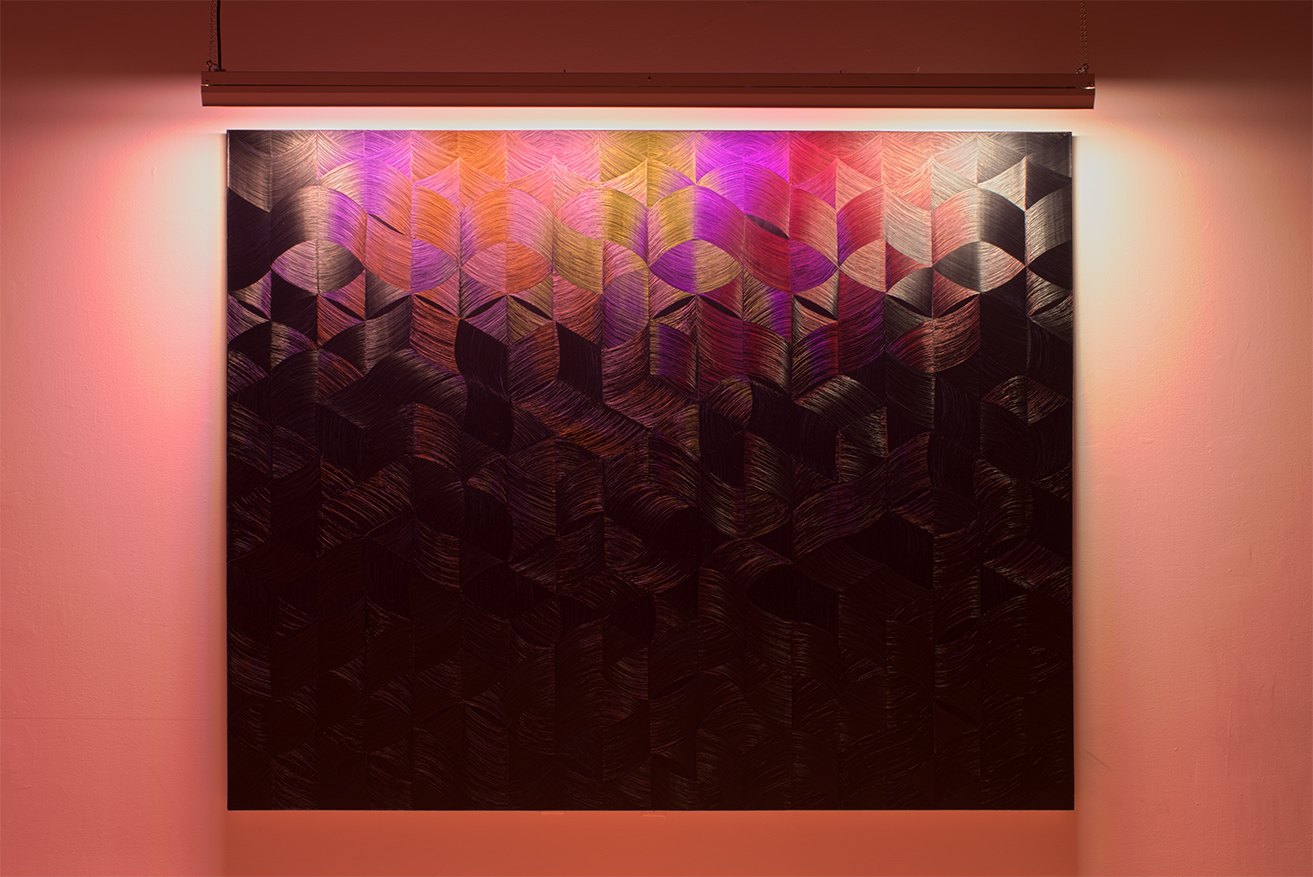
    While the exhibited artists employ the familiar visual vernacular of abstraction, they aren’t exactly reiterating their modernist forbearers. For one, this generation of artists have parsed the intervening art historical developments between late modernist abstraction and now, from Pop to Minimalism to Conceptualism. Toronto artist Daniel Hutchinson’s alluring black paintings, for example, redeploy the monochrome through Minimalism’s preoccupation with embodied perception. Displayed in a darkened room, each work is lit by a colour gel-treated fluorescent light tube. Glowing jewel tones of blues, greens, and purples seductively graze the painted surface, revealing the stiated grooves of each brushstroke of viscous black paint. The use of florescent light begs for a mention of Dan Flavin, who is most significantly remembered for introducing light fixtures into the artistic toolbox in the 1960s. Flavin thought of his florescent works as “image-objects,” referring to the relay of the viewer’s attention between the artwork as material object and as visual phenomenon. Hutchinson’s monochromes similarly educe a perpetual back-and-forth between the materiality of the painted work and the fleeting optical phenomena conjured by the eerie, fluorescent glow.

    Daniel Hutchinson, Painting for Electric Light (Analogous Colour), 2013, oil on canvas with fluorescent light, 77″ × 96″. Courtesy of Angell Gallery

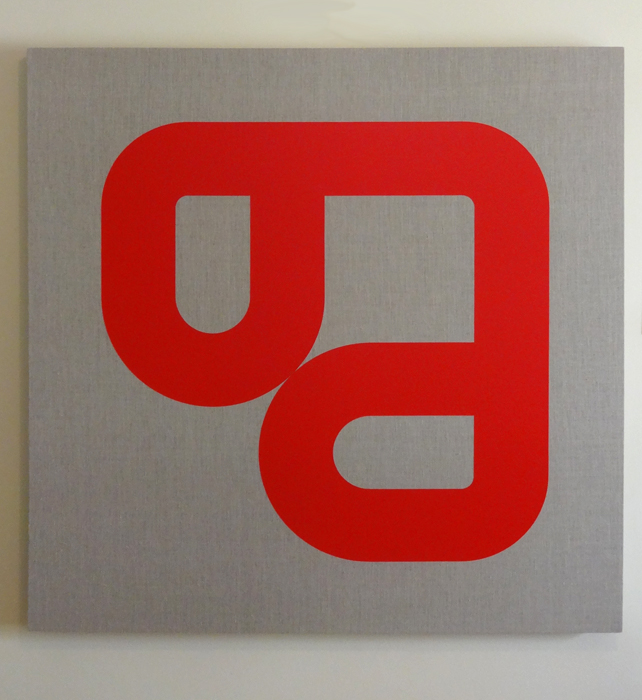
    Torontonian Neil Harrison’s oil on canvas works are informed by a diametrically different sensibility. Each work features a monochrome, logo-like design, painted with the precision and flatness of hard-edge abstraction. Harrison’s imagery makes references to the visual vocabulary of hieroglyphs, diagrams and, of course, corporate logos. The titles of the two works, Black Square and Red Square (both 2013), retrieved from my memory bank Kasimir Malevich’s paintings after the same titles executed a century ago. Declaring his floating shapes to be “pure feeling,” Malevich had exhibited his black square in the corner room, effectively superseding the traditional Russian icon with this mythical modern icon. Are Harrison’s assertive symbols, with their sharp aesthetic of commercial branding, the updated icons of our late capitalist era?

    Neil Harrison, Red Sqaure 2, 2013, acrylic on linen , 46″ × 46″. Courtesy of Angell Gallery

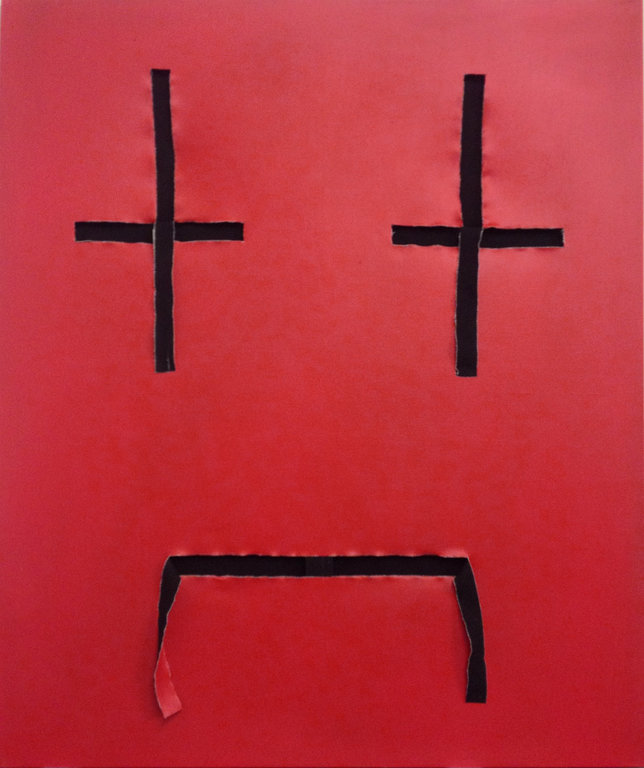
    The cut canvases of Derek Mainella, who is based in London, UK, summon the spectre of yet another major modernist figure. In the 1950s, Lucio Fontana attacked the sacrosanct surface of his canvases, slicing them open in a gesture of iconoclastic energy and machismo. Mainella also breaches the integrity of the canvas surface, but with formalist control and playful Pop sensibility. In Unit (R5) from 2013, parallel excisions in the upper half of the white canvas create strips of cloth that hang lankily down the lower half. The negative space of the perforated surface and the subtle tonal changes of the twisting ribbons of hanging canvas are cleverly employed to create a pleasing linear composition. Another work, Untitled (Acid), is more playful and ironic in tone, with the strategically sliced canvas producing the image of an emoticon-like angry face.

    Derek Mainella, Untitled (Acid), 2013, oil on canvas, 48″ × 40″. Courtesy of Angell Gallery

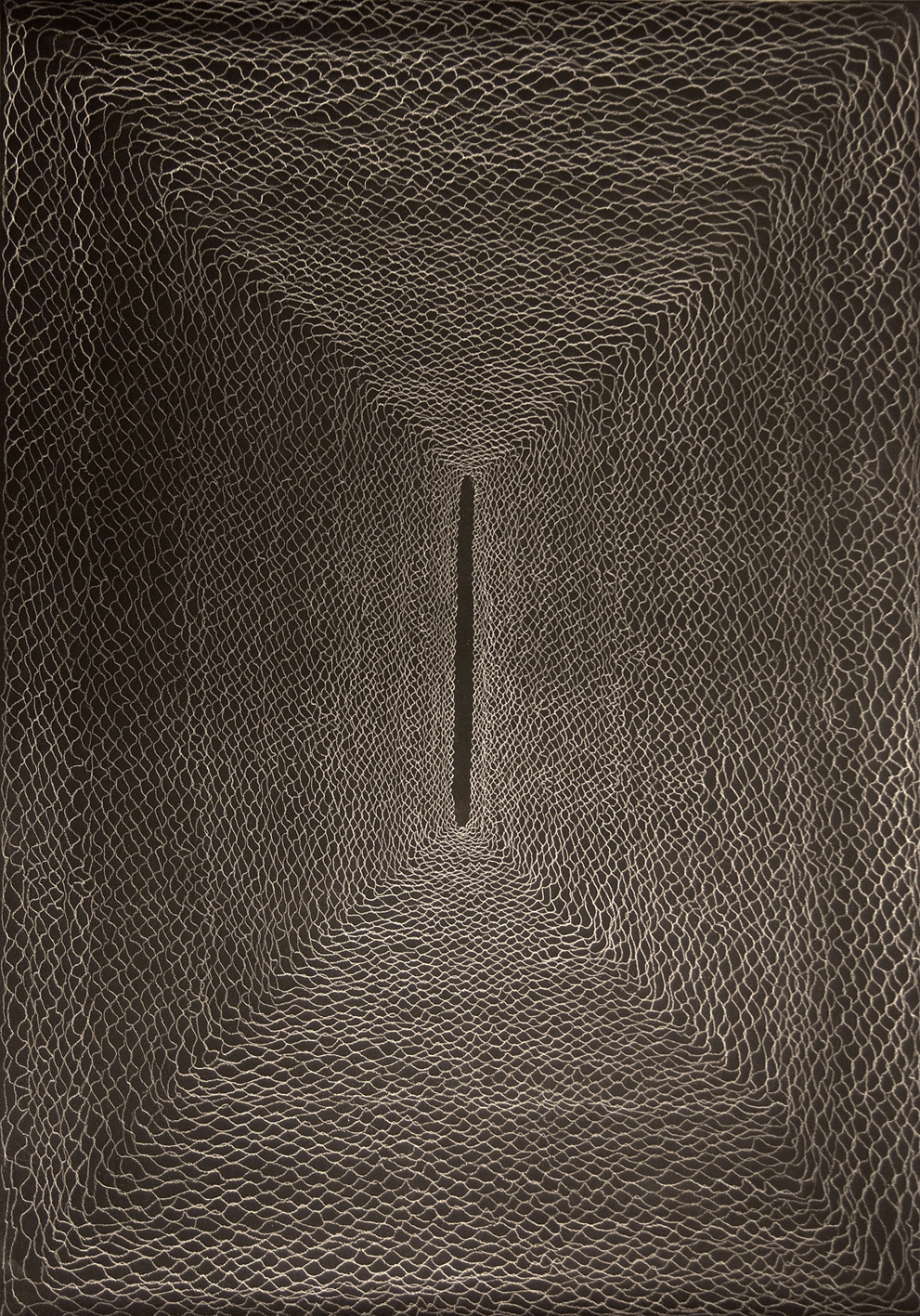
    In contrast to the assertiveness of Harrison and Mainella’s abstraction, the two works by Toronto-based Vessna Perunovich hang like demure wallflowers. But upon a closer look, these abstract pieces become magnetic. In each, graphite lines scribbled on black paper form concentric echoes from the circumference of the canvas toward the centre, leaving at last a small orifice into a black abyss. This method of working from outside-in, letting the frame echo into and “compose” the internal image, recalls Frank Stella’s black stripe paintings. But whereas Stella had famously declared of his work, “what you see is what you see,” Perunovich’s abstraction is more encouraging of associative excursions. The silvery, weaving pencil lines are evocative, for example, of a net or fence, tying this work thematically to the concern with boundaries that pervades her multi-media artistic practice.

    Vessna Perunovich, Sliver of Hope (diptych), 2013, acrylic and graphite pencil on paper, 30 x 22 inches. Courtesy of Angell Gallery

    From Piet Mondrian’s rhetoric of purity to Malevich’s claim of arriving at the “zero of form,” modernist abstraction since its early days has largely aimed at the distillation of painting. The reductive imperative was again echoed by the mid-century critical heavyweight Clement Greenberg, who declared that painting had to strip itself down to the unique essence of the discipline – namely, flatness. The contemporary iterations of abstraction presented in this show, however, derail and undermine this modernist teleology toward a pure, timelessness painting. Today’s abstraction is expansive rather than reductive, incorporating external allusions into the pictorial image. These contemporary artists seem insistent on acknowledging their post-ness in the art historical timeline. Their varied practices thus find coherence in this exhibition by dint of their self-reflexivity on the viability, place and meaning of abstraction today.

    Amy Luo

    *SUPERABSTRACTION / Derek Mainella, Daniel Hutchinson, Bradley Harms, Kineko Ivic, Neil Harrison, Kenneth Emig and Vessna Perunovich. Exhibition dates: October 4 – November 16, 2013, Angell Gallery, 12 Ossington Avenue, Toronto. Gallery hours: Wed to Sat 12 – 5 p.m.

  • Art Toronto 2013 / Highlights

    Art Toronto 2013 by Shellie Zhang

    This year, Art Toronto 2013 housed over 100 galleries from 13 countries at the Metro Toronto Convention Centre. With works ranging from emerging to established artists, new and familiar galleries, the 200,000 square feet of art can be quite intimidating. Here are some of the highlights of this year’s art fair.

    The venue can be separated into a few distinct categories. On the east side were the more commercial and big name galleries, many of which were from international locations. However, a lot of money was exchanged this weekend at Toronto’s only international art fair among local galleries. On opening night, Loch Gallery sold $3-million dollars’ worth of art and Mayberry Fine Art bore a red dot on a sale price of $350,000.

    Over at the Art Toronto Stage, Julia Dault talked of her own work in relation to her understanding of anti-illusionism and the fluid concept of home. In the past couple of years, the career of this Brooklyn-based Canadian artist has skyrocketed. Recently, her work has appeared in New Museum triennial “The Ungovernables”, Art Basel Miami, and the Armory Show in New York.

    Art Metropole’s large bookstore display offered more affordable pieces of art for the average art-collector. Founded in 1974 by the artists’ collective General Idea as an artist-run centre, Art Metropole is a not-for-profit organisation with a focus on the production, dissemination and contextualisation of artist-initiated publication. In keeping with the centre’s mandate, many visitors could be seen walking around with a little piece of ephemera that brightened their day.

    Angell Gallery had an extremely vast selection from the works of Kim Dorland to Yigal Ozeri. The gallery is known for featuring artists who employ unique techniques that defy set genres of production, straddle many mediums and produce fantastically exciting results. With their programming summarized at booth 900, their roster shines through as a diverse yet cohesive display.

    Stephen Bulger Gallery focused on the work of one artist this year in what was an extremely risky strategy. The concentration on Alison Rossiter’s unique gelatin silver prints allowed for a more intimate and meditative experience amongst the loud and large works of many other booths. Focusing on detail, subtleties, and the artist’s process, Stephen Bulger’s strict selection resulted in the gallery’s distinction.

    On the west side of the convention center at the Toronto Next Lounge, Instant Coffee has built a seating area amalgamating and redesigning elements from their recent exhibition Take The Easy Way at MKG 127. Here, artists who participated in Toronto’s Roundtable Residency discuss the works they produced and the benefits of this new local program.

    Text and photo: Shellie Zhang

    International Galleries at Art Toronto 2013 by Veronica Scarpati

    With 20 new international galleries in attendance and over 13 countries represented, Art Toronto brought an exciting mix of contemporary talent to our own back yard, but what exactly drew so many international galleries to Toronto for the first time?

    Now in its sixth year, Messum’s has become a regular at Art Toronto, bringing the best of British historical and contemporary art to Canadian collectors.

    From Japan to Tel Aviv, repeat exhibitors to first-time attendees, when asked to describe what set Art Toronto apart, the answer was surprisingly unanimous: strong referrals, friendly crowds and—most importantly—interested buyers.

    As Yann Bombard, first-time exhibitor from K+Y Gallery, Paris, explained, “Compared to New York or Paris, visitors here seem to have more time—and a genuine interest to learn about our artists.” When I spoke with Bombard, he was simultaneously writing up a sale, interacting with clients, and answering questions from fascinated visitors; with only four days to introduce his varied roster of European artists to the Canadian market, he had to make the most of it.

    Yann Bombard (right) introducing Cécile Plaisance’s playful lenticular, Wall Street, to an interested visitor.

    Visitors admiring French artist Elisabeth Lecourt’s work at K+Y Gallery. The artist folds vintage maps to create beautiful doll-like dresses.

    Among the works Bombard presented at K+Y Gallery, two blue ceramic foetuses by up-and-coming artist Joseph Klibansky were particularly striking. Fresh off a record-breaking sale at Sotheby’s Amsterdam and named one of the “young geniuses of the contemporary art market”, Klibansky—a celebrity in his own right—conceived of the idea for his gold-plated series in order to comment on the relentless reach of today’s material culture.

    Joseph Klibansky, Turquoise Evolution, 2013, gold-plated ceramic sculpture.

    Eager to expose Canadian collectors to contemporary movements in her own country, Monica Gutierrez, director of Mexico’s The New Wall Gallery was another first-time exhibitor at Art Toronto. Playing on the gallery’s name and mandate, Gutierrez is after new walls on which to showcase her artist’s work, and Art Toronto’s newly developed NEXT section provided just the platform she needed. “I had heard very good things about Art Toronto from other dealers in Mexico,” Gutierrez explained, “so I decided to try it out, and I’ve been surprise by how open and receptive everyone has been.”

    Introducing some of Mexico’s most promising artists to the Canadian market, Monica Gutierrez brings a refreshing mix of contemporary names to Art Toronto.

    Displaying the work of three up-and-coming artists, The New Wall Gallery glittered with a varied assortment of artworks. Although Joao Rodriguez’s gouache on paper pieces were especially beautiful, Hugo Garza’s series Opus Volo—a series of works created entirely during flight—stole the show.

    Hugo Garza, Redondo, 2013, from Opus Volo, c-print, acrylic dibond mount, 80 x 60 cm.

    Just steps down the corridor another Mexican gallery found its home, this one celebrating its fifth year in Toronto. It seems international exposure can prove very fruitful—and not just for foreign artists trying to break into the North American market. As Laura Ortiz Vega, one of the artists represented by Estudio Antena explained, among the gallery’s roster of emerging Latin American artists, works by Canadian Catto Houghton also found place on the gallery’s walls. Resulting from a chance meeting the previous year, a partnership was forged between Mexican and Canadian artists, and now, hung alongside Leandro Asoli and Andres Basurto’s work, Houghton’s graphic panels brought depth and dialogue.

    A Pan-American assortment at Estudio Antena, as the works of promising Latin American artists hung alongside those of Canadian Catto Houghton.

    In a technique developed by the artist, Vega creates expressive portraits using wax-coated embroidery thread instead of paint—a painstaking process that yields luminous, life-like results.  Catto Houghton, Untitled, 2013, acrylic on wood panel.

    With so much talent from around the world, Art Toronto once again proved to be a resounding success. But how does our still nascent fair measure up to its more established and august counterparts? In the words of Messum’s Kristian Day, “Toronto by far draws the friendliest and most interesting crowds and that’s why we’ll keep coming back year after year.”

    Text and photo: Veronica Scarpati

  • Attitude / Opening Reception

    Opening Reception: October 24, 2013, 6 – 9 p.m.
    Jonathan Bolyki Fine Arts
    678 Sheppard Avenue East, Toronto

    A joint venture between industrial designer Emelia Jojart and long-time artist Jonathan Bolyki gives birth to Jonathan Bolyki Fine Arts, a new gallery space which opened on Sheppard Avenue East on October 24.

    Jonathan Bolyki and Emelia Jojart  in their new space at 678 Sheppard Avenue East.

    Although Jojart and Bolyki only began discussing the possibility of a partnership back in August, both share a fundamentally similar approach to their work; as a designer, Jojart likes to keep her interiors clean and fresh, with unexpected surges of colour, while Bolyki chooses to forgo extraneous detail in favour of thought-provoking, colour-rich contrasts.

    Opening night at Jonathan Bolyki Fine Arts.

    With a look to use the new gallery space as a cultural bridge between Europe and Canada, Bolyki aims to show a varied roster of talent, introducing well-established European artists such as Agnes Szikra and Jozsef Baksai alongside emerging Canadian artists. While the gallery hopes to enable European figures to penetrate the North American market, new names on the Canadian scene will gain international exposure through sponsored residencies in Europe.

    Explaining this desire for highlighting new talent alongside established, seasoned artists, Bolyki referred to one of his favourite paintings: “I love to create stark contrasts; the strong play of light against dark always makes the whole more interesting. This is exactly what I want to bring to this new space—to show emerging artists beside established artists, to create a dialogue that is heightened through contrast.”

    Jonathan Bolyki, Remembrance, 2012, oil on canvas, 30 x 24 inches.

    For its inaugural show, Jonathan Bolyki Fine Arts presents a solo exhibition of recent works by the artist, combining previously unseen pieces from both his Barn and Attitude series.

     Jonathan Bolyki with works from his recent series, Barns and Attitude.

    Inspired by a serious conversation with his adult daughter, Attitude seeks to capture strong gestures and impassioned scenes from Bolyki’s own life, translating them with untamed strokes to trigger an emotional response in his viewers. Using his characteristically strong light and dark contrasts, the artist uses colour rather than detail to narrate these deeply human moments.

    Jonathan Bolyki, Attitude, 2012, oil on canvas, 30 x 24”.

    Jonathan Bolyki Fine Arts has an attractive roster of shows for the season ahead. Following Emilia Jojart’s mandate, 20% of the gallery’s revenues will be donated to fund human rights initiatives in Ethiopia.

    Exhibition dates: October 24 – November 26, 2013, Jonathan Bolyki Fine Arts, 678 Sheppard Avenue East, Toronto. Gallery hours: Monday – Sunday 11 – 6 p.m.

    Text and photo: Veronica Scarpati


  • Toronto’s new drive-thru gallery: Who is Involved?

    On every signaled street intersection in Toronto, there is a large grey box. A transformer box where electricians can access the circuits that run the lights. In other words… a five sided, blank canvas.

    Susie Losee. Harris Water Treatment Plant, Queen Street East. Photo: Imre Hajagos

    The Toronto City Council is currently undertaking an initiative that allows selected local artists to add some life to the boxes in an opportunity to expand on the city’s somewhat thriving street art culture. You may have even noticed a few already. Public art transcends its traditional habitat from the immaculate, temperature controlled gallery into the street to exist among us. It provides us with an opportunity to connect with art under our terms and in our environment. It is this connection that makes street art just for art’s sake. It becomes a symbol of the community and thus serves to bond us on innumerable various issues. It can also simply just provide us with a smile on our walk to work and help us forget just for a second how late we are. I began to think about the idea of art ‘existing among us’ and logged onto the councils publicly accessible archives to see whether this project is something anybody could get involved in. Are there benefits to be held in community collaboration?

    Productions Start by Adrian Hayles. Bloor Street and Robert Street corner. Photo: Rhys Male

    Lets take a look at the programs details to get acquainted with the principal idea of the initiative. In 2012 the Toronto City Council rolled out its new and amended, graffiti management plan. A key part of the plan is the traffic light box art project. 20 boxes across the city would be painted by 10 artists, selected by the city council. In addition, 100 ‘graffiti proof’ traffic box wraps will be installed around the city based on two designs. The cost of this project will exceed $85 000, including artists fees ($500 per box).

    City council challenges the grumbling of the self appointed, armchair economists in our community who might feel that such a project is a waste of taxpayers money, and are usually as dull and grey as a traffic light box.  I, on the other hand, admire their efforts in taking steps to further Toronto’s reputation as a forward looking, vibrant city. This in mind, it is disappointing to see the strict prerequisites one must hold to even be considered for an application. This is not to undermine the efforts of the skilled and talented artists that have been selected to take part. They of course deserve to be paid for their craft. This program however could potentially have a much further reaching social impact if it is more inclusive. Devon Ostom, Toronto based artist and curator notes that “Funds going to practicing artists is almost always a good thing…Lots of pro artists incorporate community input and processes so perhaps there is a middle ground there. However, it is going to be hard to get community input in there with a budget of only $500 each. Meaningful engagement processes take time and sometimes we just need to trust the artists.”  ”

    Landscape. University and Dundas. Photo: Rhys Male

    I looked to other cities that have already implemented a similar program in search of the middle ground. In Brisbane, Australia, traffic light box art has been a council initiative since 1999. In correspondence with Genevieve Searle, Public Arts Officer, I learned that over a thousand boxes have been painted, and many of those, by members of the community who had submitted an application. She goes on to note that public participation in arts projects fosters a sense of individual and community identity, and it is something that public arts project managers hold in significant importance.

    Encouraged to find out that community collaboration had already worked elsewhere in relation to the exact same project, I focused back on Toronto. Someone who knows the value of public participation in arts projects is the director of Artreach Toronto, Shahina Sayani. As the head of an initiative that aims to connect disadvantaged youths with their community through public art, I was excited to hear what she had to say about the project. Her response was very enthusiastic, “imagine what would come of this initiative if the artists that are commissioned to paint these structures were to share their artistry with community members and co-create. The impact would be tremendous; the art products would actually reflect the culture, diversity and flavour of the community they are situated within, and everyday citizens would feel more connected to their communities.”

    Yellow bird.  Bloor Street and Montrose Avenue corner. Photo: Rhys Male

    The beneficial reach of street art cannot be graphed, charted, or documented in such a way as to put a specific value on its worthiness. Nonetheless, those involved in the implementation process are aware that these benefits do exist. At the end of the day, the current program is a positive initiative. The platform has been built and publicly engaging works are now visible. However with evidence to support the inclusion of the community and over 2000 un-painted boxes, what should the next phase of this program be?

    Rhys Male

  • ART TORONTO 2013

    ART TORONTO, 2013
    October 25 – 28, 2013
    METRO TORONTO CONVENTION CENTRE

    North Building, 255 Front Street West

    This year the Art Toronto, the International Art Fair, continues to impress and surpass its previous year in what is the largest exhibition ever.

    All The Artists Are Here by Thom Sokoloski. Photo: Margaret Irving

    Photo: Veronica Scarpati

    Photo: Aliya Bhatia

    Since 2009, Art Toronto and the Museum of Contemporary Canadian Art have collaborated on the commission of a benefit edition by a Canadian artist. Each year the limited edition work is made available for sale exclusively at Art Toronto, and all proceeds from the sale goes to Mocca. This year it is Sarah Anne Johnson’s Gold Box.

    Sarah Anne Johnson, Gold Box, 2010/2013,12 x 18 inches; Chromogenic Print with applied gold leaf. Edition of 25 unique prints. $2,200.00 CDN ea. Copyright Sarah Anne Johnson, Courtesy Stephen Bulger Gallery, Toronto & Julie Saul Gallery, New York.

    Around one thousand artists are represented at the fair, which is in it’s fourteenth year, and has galleries from all over the world. This is Canada’s only international art fair. It is mostly contemporary art but galleries like Loch Gallery or Miriam Shiel are showing historic works too (jack Bush painting, Lynn Chadwick sculpture).

    Loch Gallery, Toronto, Winnipeg and Calgary. Photo: Margaret Irving

    “Once again the Toronto art fair has proven itself in being a well established venue attracting buyers from across Canada,” said Alan Loch after the opening night, “Our sales tonight exceeded the sales from the opening night last year.  This proves to us the continued interest in quality historical works of significance and established contemporary artists.” Loch Gallery sold artwork for more than $3-million during first night of the annual art fair.

    Bau-Xi Photo, Toronto. Photo: Margaret Irving

    Pari Nadimi Gallery, Toronto. Photo: Veronica Scarpati

    MULHERIN, Toronto & New York. Photo: Veronica Scarpati

    Stephen Bulger, director of Stephen Bulger Gallery, Toronto, introduces Alison Rossiter’s work. Photo: Margaret Irving

    Barbara Edwards Gallery Contemporary, Toronto. Margaret Irving

    Seung-Yong Kwak, Old Future, 2013. Acrylic on canvas, 46” x 31”, Galerie Gaia, Seoul, Korea. Photo: Leanne Simaan

    Joe Fatard, The Opening Ed./5, 1988. Bronze, 33″ x 17.9” x 12.5”, Galerie Claude Lafitte, Montreal, Canada. Photo: Leanne Simaan

    Anna Razumovskaya’s paintings, Hazelton Fine Art Galleries, Toronto, Canada Photo: Leanne Simaan

     Cynthia Corbett Gallery, London UK. Setting up the booth. Photo: Margaret Irving

    Zemack Contemporary Art, Tel Aviv, Israel. Photo: Margaret Irving

    Corrado De Luca, director of De Luca Fine Art / Gallery, Toronto said that this is their second year at Art Toronto and they are very optimistic. They came with a wide variety of art work including a Picasso drawing as well as excellent pieces from contemporary Canadian and American artists.

    De Luca Fine Art / Gallery, Toronto director Corrado De Luca and his wife Jes E. Sladojevic . Photo: Margaret Irving

    Bezpala Brown Gallery, Toronto. Photo: Veronica Scarpati

     Photo: Aliya Bhatia


    Contemporary Art Galleries Association (AGAC) showcasing works by Cynthia Girard. Photo: Margaret Irving

    Every year there are special projects that help define the fair and one such project is NEXT, sponsored by Toronto Life magazine.  Visitors can locate them by their red signs and they all contain works under $10,000 by emerging artists. The eighteen participating galleries are an international mix, besides Canadian galleries, there are others from Mexico, Japan and Italy. The criteria for emerging artist has changed lately, it could mean anyone who is just starting out in the art market regardless of his/her age.

    The NEXT section. Photo: Veronica Scarpati

    3D Gallery Venice, Italy. Photo: Margaret Irving

    Art Toronto, 2013 hours: Friday & Saturday  12 – 8 p.m.,  Sunday & Monday 12 – 6p.m.

  • Dennis Burton (1933-2013) at Christopher Cutts Gallery

    Dennis Burton (1933-2013)
    An Exhibition Commemorating his Six Decade Long Career
    Christopher Cutts Gallery

    Dennis Burton in front of  his painting, Six Questions. Photo: Victor Carvalho

    The Toronto art world of 2013 is very far removed from the 1950’s when Dennis Burton along with Graham Coughtry, Gordon Rayner and Robert Markle added zest and passion to it. Many Toronto artists now have New York representation and are known internationally. The schools that teach art are well established and we have a healthy selection of galleries and art museums. No doubt there is room for growth but the basic cultural foundations are in place.

    Dennis Burton, Diagram Portrait Reflection of Myself or Any Man as A Finite Universe, 1961. Oil on canvas, 67.5” x 67.5”. Courtesy of Christopher Cutts Gallery

    Dennis Burton and company helped make this possible through extraordinary effort and at considerable personal cost, both as teachers and as artists. Burton, born in Lethbridge, Alberta (1933) passed away in Vancouver (2013). Over the course of his career, much of it spent in Toronto, where he taught painting and drawing at the Ontario College of Art (1970-1971), was Director of the New School of Art (1971-1977) and President of Art’s Sake (1977-1978). Further afield, he taught at the Banff School of Fine Arts (1974), University of Lethbridge (1976 & 1989) and the Emily Carr College of Art (1980). Students remember being inspired by his erudite commitment to communicating a sense of contemporary aesthetics in a spirit of enjoyment.

    Dennis Burton, Fabros Plunge, 1964. Oil on canvas 48” x 42”. Courtesy of Christopher Cutts Gallery

    There was also a sense of anarchistic experimentation in their lives and work. They formed the Artist’s Jazz Band in Toronto with Burton playing the saxophone. This Neo-Dadaistic connection is echoed in London by equally important contributions from Greg Curnoe (1936-1992) who played with the Nihilism Spasm Band, a noise band still active. They apologize humorously on stage for absent members because they have passed away.

    Dennis Burton, Locomotion II, 1975 -76. Acrylic on canvas 72” x 84”. Courtesy of Christopher Cutts Gallery

    In retrospect art historians have judged this period purely in terms of American influence, tending to see the work of Burton and others as derivative. This is to misunderstand the uniquely Torontonian flavor of their work, with its humour and deconstructivist ethics. Nationalism is really just another form of colonization with little regard for the individual artist’s product and ideas. At the time, they received information about the New York art manifestations largely through magazines and the occasional exhibition so there is strong evidence of Abstract Expressionist influence, particularly de Kooning. It’s a significant choice as de Kooning was also loath to throw away his European painting heritage.

    Dennis Burton, Stripe Streak, 1977.  Acrylic on canvas 49” x 98”. Courtesy of Christopher Cutts Gallery

    Marcel Duchamp espoused the ‘beauty of indifference’, drawing attention with his ready-mades to the importance of context for any text, object or image. Musicians like John Cage were exploring percussive sound with ‘prepared’ pianos. Jasper Johns and Robert Rauschenberg epitomized the Neo-Dadaistic response to Abstract Expressionism and Post Painterly Abstraction in works that played with aesthetic elements and included items usually found in other contexts like beer cans, tires, goats, flags and text. Burton’s work can be appreciated as an anarchic delving into modernism, combined with his own love of text, calligraphy and interest in communication. Eroticism played a large role in his work and he became notorious for his Garterbeltmania paintings. These beautiful works explore erotic subject matter in both traditional figurative and abstract forms. Needless to say, they evoked controversy and censorship in an essentially puritanical society.

    Dennis Burton, Alchemy, 1978. Acrylic on canvas 60” x 60”. Courtesy of Christopher Cutts Gallery

    The memorial exhibition features works made in Toronto up to the seventies. Father Dead, Mother well references Robert Motherwell’s work, who’s own Spanish Elegies perhaps have more in common with Neo Dada than Abstract Expressionism. Burton’s interest in astrology and alchemy is also evident in works that seem to reference geometric structures but also refer to planets. Diagram Portrait of Myself or Any Man as a Finite Universe comically links a toothy mouth at the heart of the sun. Wordplay in Six Questions the painting behind him in the portrait image, seem to sum up his devotion to communication, art and love.

    Dennis Burton, Untitled 2, 1978 oil on masonite 49.5” x 50.25”. Courtesy of Christopher Cutts Gallery

    Burton’s commitment and integrity stand out for me. His paintings are uncompromising and express his ideas regardless of commercial interest. Toronto should be very proud of his contribution and indeed, those of his fellow travelers, represented mostly by the Isaacs Gallery. Their achievements need to be celebrated in a museum exhibition and publication. It will be up to the city to embrace them and ensure that this history is secured.

    Dennis Burton, Observation, 1979.  Mixed media on masonite 12” x 19.5”. Courtesy of Christopher Cutts Gallery

    Ashley Johnson
    Toronto, 2013

    *Exhibition dates: October 5 – 30, 2013, Christopher Cutts Gallery, 21 Morrow Avenue, Toronto. Gallery hours: Tues – Sat 10 – 6p.m.


  • Sculptors Society of Canada / 85th Anniversary Show

    Opening Reception: October 10, 2013, 6 – 9 p.m.
    Canadian Sculpture Centre
    500 Church Street, Toronto

    Sculpture Society of Canada (SSC) celebrated its 85th year with a juried show in Canadian Sculpture Centre. Participating artists: Gordon Becker, Andrew Benyei, Edward Falkenberg, Al Green, Judy Raymer Ivkoff, Evgueni Kogan, J.Mac, Richard McNeill, Marianne Reim, Peter Shoebridge, Dina Torrans and Judi Michelle Young.

    Founded by some of the most prestigious sculptors in Canadian art history, the SSC has been exhibiting and raising the profile of sculpture in Canada for 85 years. The mandate of this Society is firmly established by a collective belief in education, partnership, cooperation and support regarding sculpture; to discover and foster young talent, to raise the profile of Canadian sculpture and to rally and encourage sculptors working at a professional level.

    Visitors with Peter Shoebridge, Where Are You

    The large gallery was crowded with artists and visitors talking about the sculptures and listening to music. The exhibition involved all imaginable style from traditional representative to abstract. Peter Shoebridge’s ceramic couple (Where Are You) feels monumental as does Al Green’s Reciprocal Discs or Edward Falkenberg’s Forest Light.

    Edward Falkenberg with Forest Light

    Dina Torrans guides us toward the spiritual with her sculpture Into the Mystic accompanied with Soul Sound by J.Mac. ROOTS by Judi Michelle Young is a special Tree of Life, a very tall metal ladder with beautiful copper details. It reminds us of old tales when humans climbed up on tall trees into the sky or Jacob’s ladder to heaven.

    Dina Torrans with Into the Mystic

    President of SSC, artist Judi Michelle Young with ROOTS

    The visitors found Andrew Benyei’s ceramic sculpture, depicting a line of inpatient commuters (Eight Fifty Nine), funny and was amused by Gordon Becker’s Maroon.

    Visitor with Andrew Benyei, Eight Fifty Nine

    Artists, Gordon Becker with Maroon

    Remarks were given at the event by the local city counselor of Ward 27 Kristyn Wong-Tam who was an entrepreneur in the neighborhood and gallery owner prior to her political career. She was present at the opening of the Canadian Sculpture Centre current location at 500 Church Street in 2008 and has great empathy for galleries maintaining viability.

    Ward 27 Counsillor Kristyn Wong-Tam & Vice President of the board of directors for the SSC, Richard McNeill

    Executive Director, Ontario Arts Council, Peter Caldwell

    Vice President of the board of directors for the SSC, Richard McNeill spoke as well. The director and CEO of the Ontario Arts Council, Peter Caldwell, gave remarks to the guests warmly praising the artists and the Canadian Sculpture Centre for it’s part in showcasing wonderful talents and for surviving and succeeding in challenging economic times.

    Visitors and musicians  Peter Shoebridge & Aidan Todd-Parrish

    The show is open till November 1, 2013, Canadian Sculpture Centre, 500 Church Street. Gallery hours: Tue – Fri 12 – 6, Sat 11 – 4 p.m.
    To celebrate SSC’s anniversary an even bigger exhibition will be on display from October 22 to November 15, 2013 at John B. Aird Gallery,  titled, 85…and Still Going Strong featuring about 40 artists.
    Text and photo: Margaret Irving