Category: Simon Termine

  • Photography is Hard at Daniel Faria Gallery

    Photography is Hard at Daniel Faria Gallery

    Photography is hard? It’s never been easier to take pictures. No settings, no focus. Point. Shoot. Done. We take so many that three quarters of digital photos are never looked at again. For the one quarter that are keepers, easy to use filters elevate the mundane closer to perfection. Taking photos is not hard. 

    But, making photographs that are engaging, making images that attract a viewer’s full attention, making something that stands out in an oceanic flow of images – now that is hard.

    Photography is Hard at Daniel Faria Gallery showcases work that transcends this difficult threshold. It presents photo-based work that manages to be engaging and enigmatic. It’s a show that starts you off thinking you know what we’re about to see and then trips you up, leaving you wondering: what exactly are you looking at?
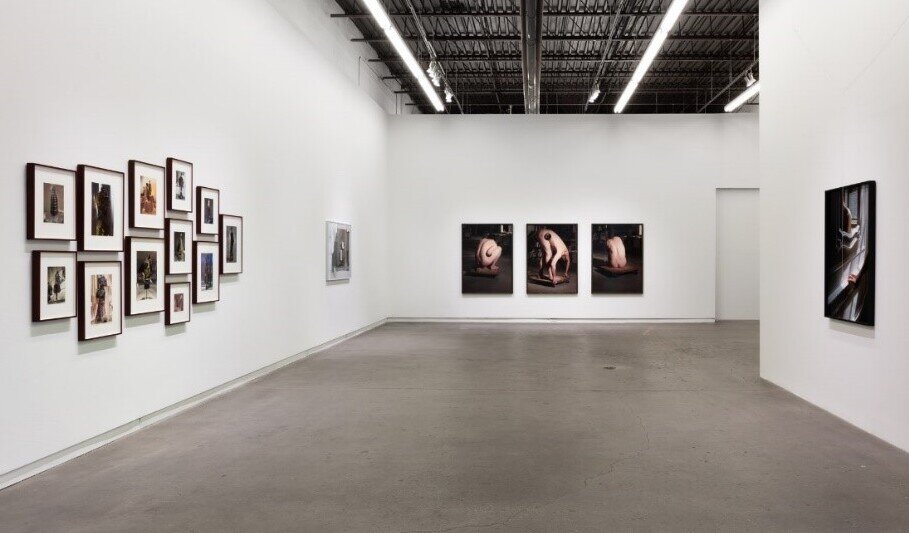
    Installation view of Photography is Hard at Daniel Faria Gallery

    In Shannon Bool’s series of images, you first see silhouettes of mannequin-like figures. The images are from fashion illustrations, but the models and their clothes have been replaced by images of dense cityscapes. At first impression you might think this to be a Photoshop collage. Only when you look very closely do you perceive how they’ve been put together. The images are physically layered. The fashion images are printed on paper and the urban images are overlaid on transparent film. The layers are held together by delicate, tiny stitches of thread. It’s only at the edges and the corners that you find clues to the construction of these collages.
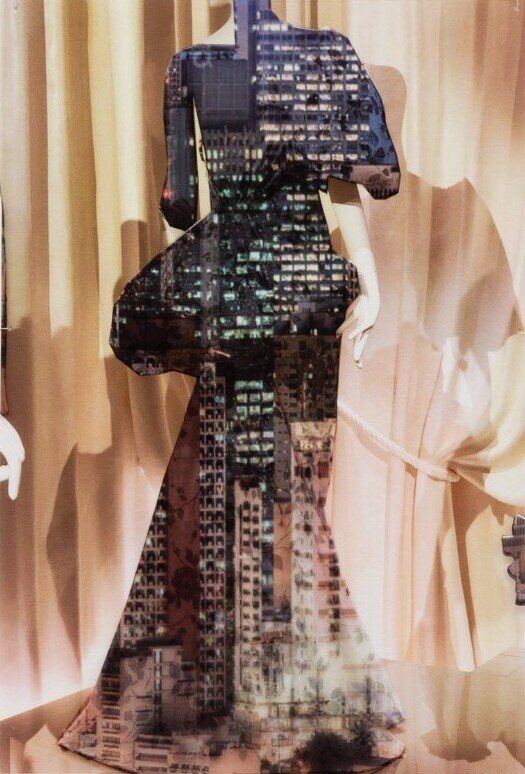
    Shannon Bool, St. Manilla, 2021, fine art print on Baryta, fine art print on transparency photo film, 13.2 x 9 in

    In Chris Curreri’s large tryptic, three images of a body are revealed in sharp chiaroscuro. In each image, the face is turned away from the camera and the shapes and geometry of the contorted body are the primary focus. It takes a while before you notice some curious anomalies. Does that arm in the left image seem to go through the body? And in the central frame, can we see through the black circle to the back of the room? Surely some digital manipulation is at play here. But no, the model, a simple black tube, and the camera have been aligned in such a way that it only appears to be impossible. The unadorned studio setting underscores the lack of technical artifice.
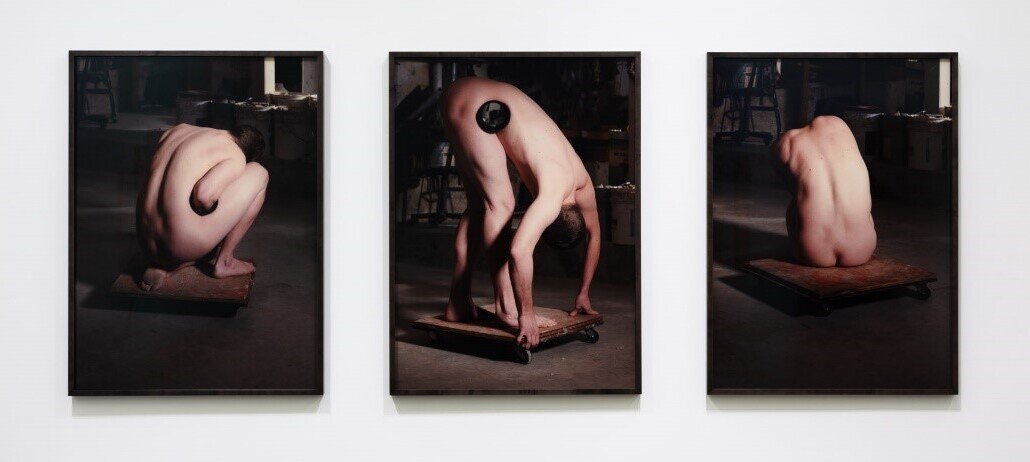
    Chris Curreri, Model in the Sculptor’s Studio, 2010, chromogenic prints, 56.4 x 41.4 in (each)

    In Steven Beckly’s The Rescue the star shaped pendant is not in the photograph but is a physical object suspended in front of it on a silver chain. Like a cat chasing a shiny bauble, we’re drawn into the image. Behind the picture plane, we follow a hand behind the pendant. We’re flipped around through another frame, this time a mirror, to follow the arm further in. Over the shoulder there is yet another frame, this time a window to the outside. The experience feels cinematic and animated even though we’re looking at a still image. 
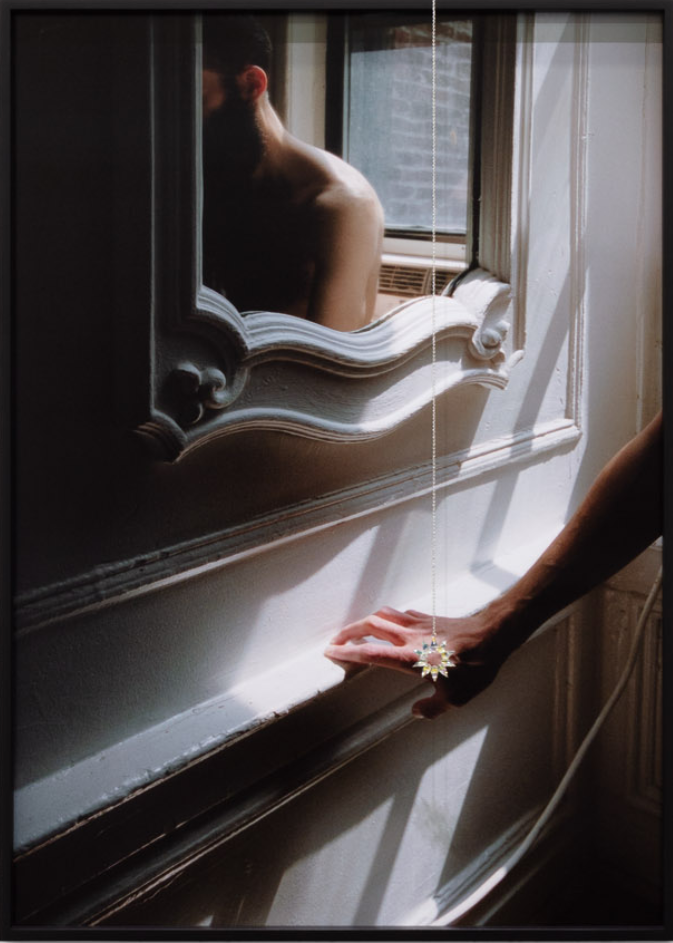
    Steven Beckly, The Rescue, 2020, framed photograph, silver chain, crystal, 42.75 x 30.75 in.

    The title of the show borrows its name from a photo collage by Elizabeth Zvonar. The central image of Photography is Hard is a reproduction of a drawing by Lucian Freud. One eye gazes diagonally past us while the other eye is darkened. The drawing has been cropped and placed over a background image of three arms outlined by the thin sharp shadows of a camera flash. Obscured by the collaged face and a white blur, two of the arms may be holding a camera while the third hand appears to focus the lens. Or are the two central arms manipulating the head, controlling the direction of the gaze? Is the raised finger and the lens drawing attention in a different direction? The image simultaneously invites and frustrates interpretation. 
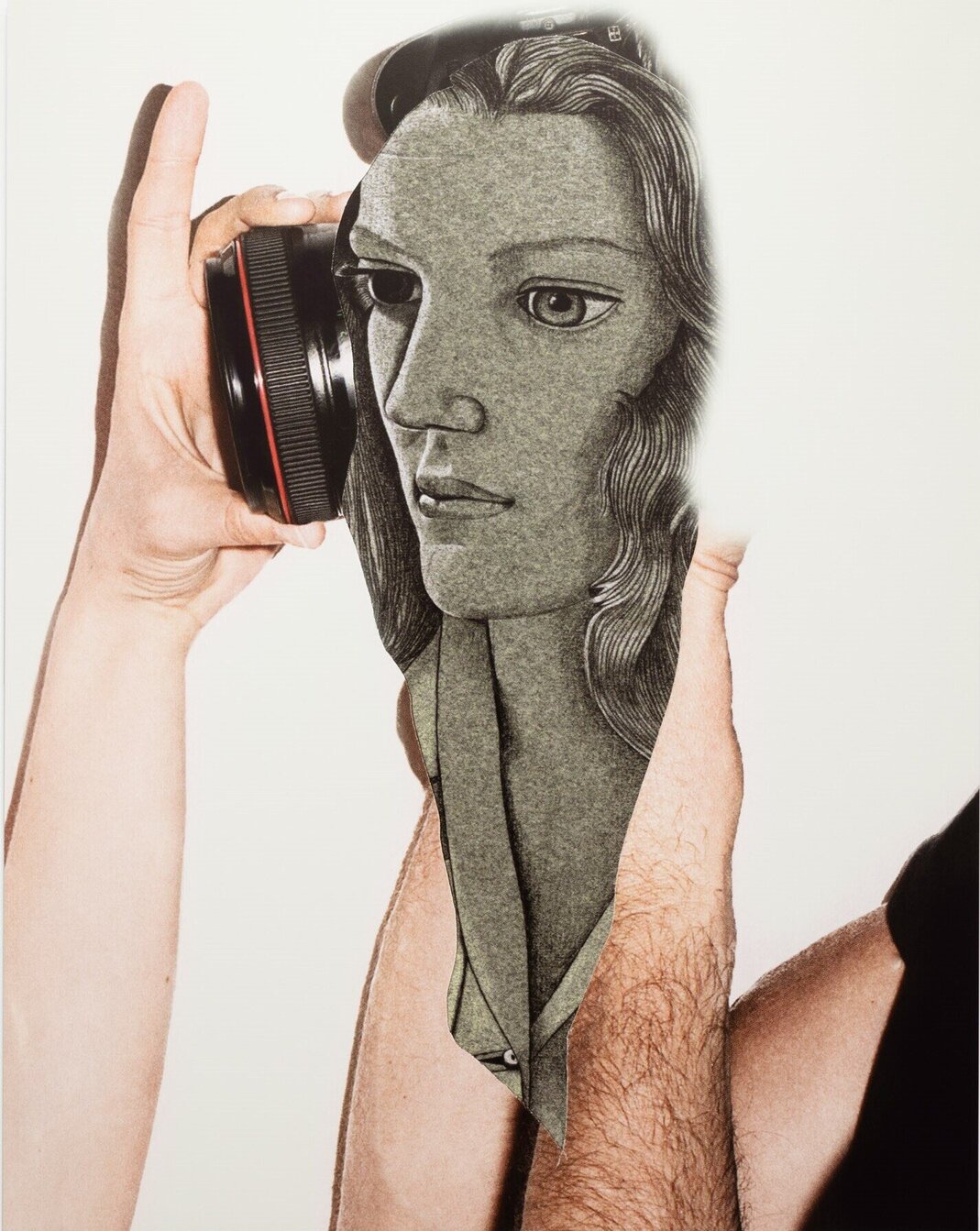
    Elizabeth Zvonar, Photography is Hard, 2019, digital inkjet print on Baryta, mounted on dibond, 58.5 x 46 in.

    Viewed on a screen, you might assume that the shadows and reflections in Nadia Belerique’s work are the inadvertent result of documenting the piece in a daylit space. But those spectral artefacts are part of the image. Light, reflections of the background, and the artist herself become compositional elements. In her studio, Belerique has staged an assemblage of images and stickers mounted on a wall, as well as on a piece of glass in front of the wall. Up close, the artist shows you how it’s all been put together. Some of the stickers are reversed and you can see the glue side. There’s tape visible and the image with the mice curls away from the wall. Shadows reveal the distance between wall and glass. But even with the process exposed, the illusion persists. From across the room, the photograph looks three dimensional, like layers of glass or resin.
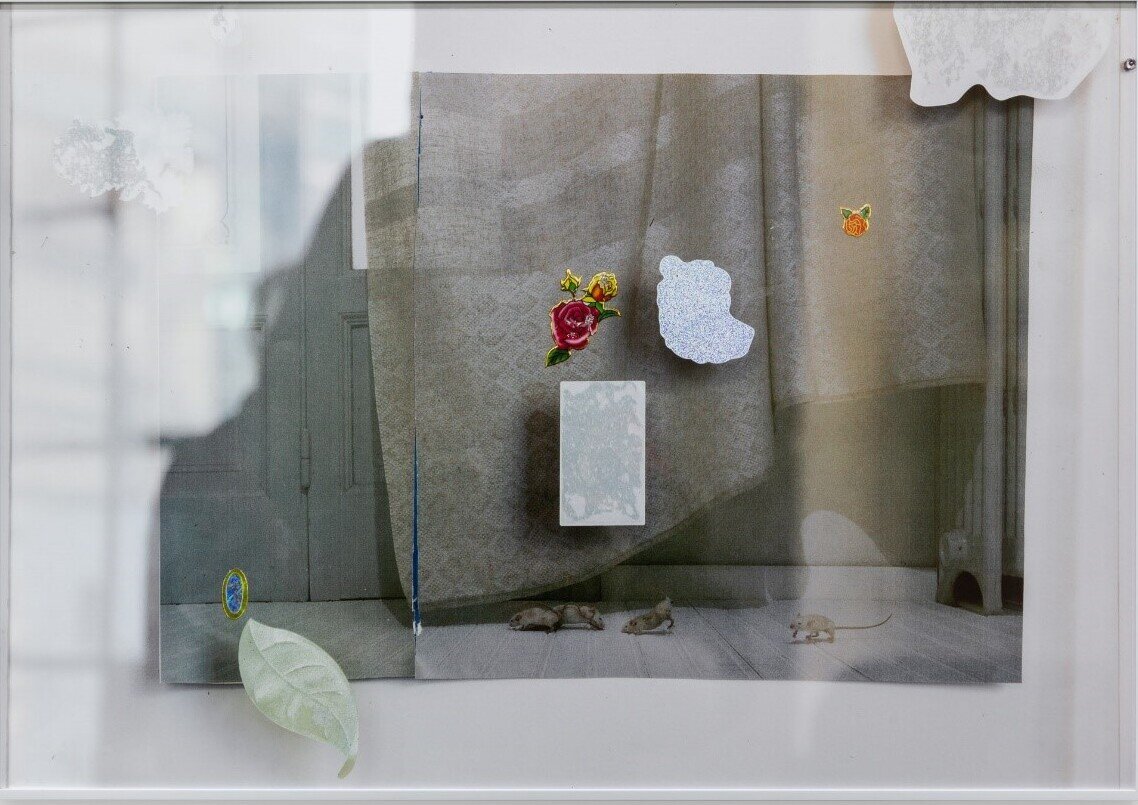
    Nadia Belerique, In The Belly of a Cat Part 2, or Run, 2018, inkjet print on dibond, 34 x 49 x in.

    Try and see this show in person. There’s more to these works than an online preview can convey. The work is rooted in photography, but the pieces have physical and material qualities that extend beyond what can be experienced on a screen. As varied as the practices of these artists are, one thing they have in common is that their work tells the story of its making. We don’t just see the finished pieces, in addition to the implied presence of a camera, you also perceive the presence of the artist. 

    Mikael Sandblom

    Images are courtesy of Daniel Faria Gallery

    *Exhibition information: Photography is Hard Group exhibition showing artworks by Steven Beckly, Nadia Belerique, Shannon Bool, Chris Curreri and Elizabeth Zvonar, August 7 – September 25, 2021, Daniel Faria Gallery, 188 St Helens Ave. Toronto. Gallery hours: Tue – Fri 11 am – 6 pm, Sat 10 am – 6 pm.
  • FOCUS: Los Angeles / Art Toronto 2017

    FOCUS: Los Angeles / Art Toronto 2017

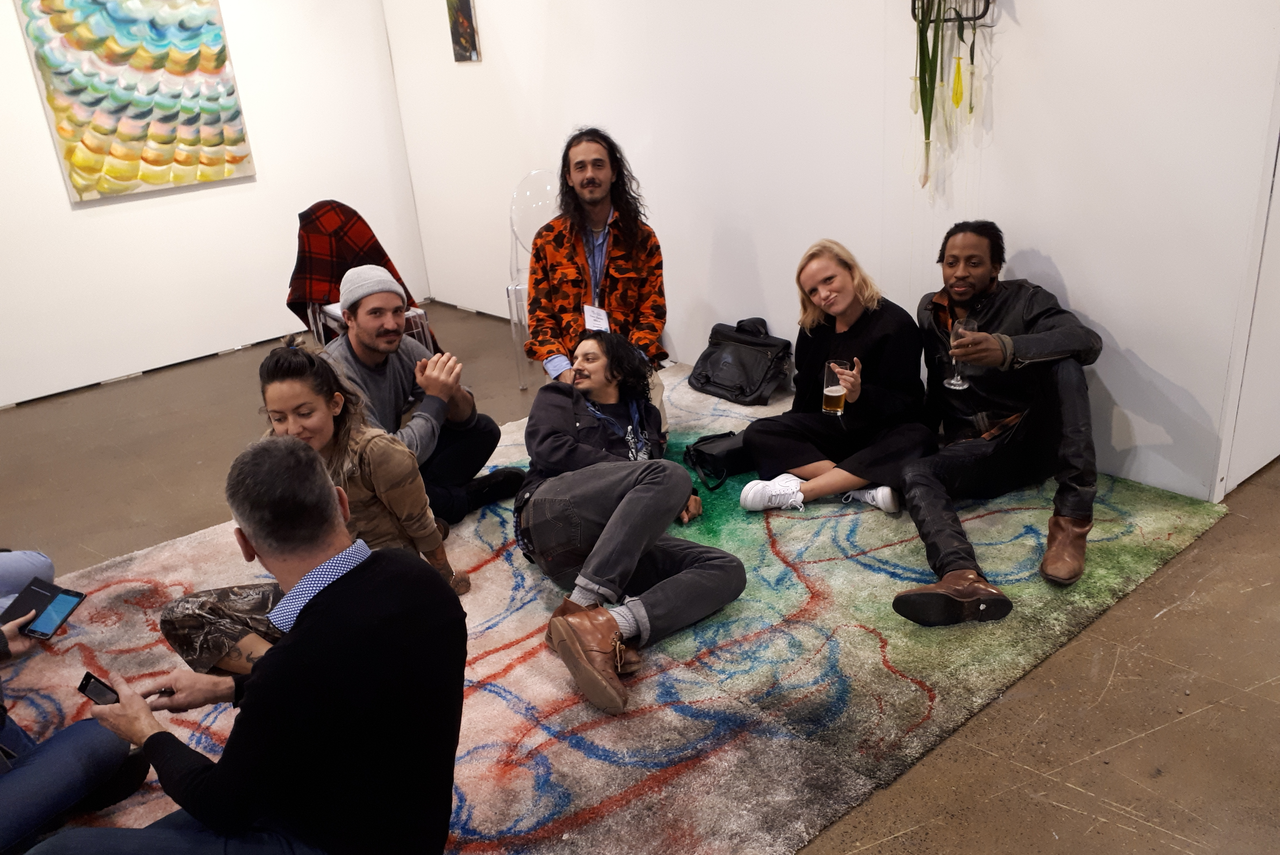
    Two days should have been enough to cover FOCUS LA at Art Toronto. Blame interruptions by well-meaning friends, lazy feet, and occasionally getting lost in the art fair weeds. Ferreting out all the pieces to the Santi Vernetti-curated LA Project Series: And the Sky is Grey would have been great. What I did manage, was spend some time with the eight FOCUS LA participating galleries, and snatch about half the panel discussion LA Talk: Beyond the Hype. My own familiarity with LA art scene begins to thin out somewhat in the middle of the 2010 decade. So much has happened in Los Angeles since. What I managed to glean was merely a core sample of a vital, if not explosively dynamic arts community.

    Santi Vernetti, Curator of FOCUS: Los Angeles said, “The best thing about LA are the artist-run galleries. Hundreds of artists are moving here. These artist-run spaces are often extensions of the schools, such as Cal Arts. LA is welcoming. There are spaces here. With the shifting geography of the city’s cultural landscape the lack of funding for re-development is a problem, however. While a dozen major international galleries may set up here, there is a lack of dialogue with the community.” He sees the lack of support and funding as a crisis, not only in Los Angeles, but across the U.S.

    Santi Vernetti, Curator of FOCUS: Los Angeles 2017. Courtesy of Art Toronto

    Anat Ebgi

    Gallery director Stefano di Paola studied art history at University of Southern California with an interest in academics and research. He likes working in a gallery because he gets to work directly with the artist and their work. Every six weeks there is something new. It is Anat Ebgi’s first time at Art Toronto. They were invited by curator Santi Vernetti to come here. It turns out that Stefano and Santi were at college together in different programs. The gallery brought Montreal artist Magalie Guérin here as a way of introducing her to collectors and curators here.

    Gallery director Stefano di Paola

    BBQLA

    BBQLA describes itself as a migrating installation, rather than a gallery. Conceived by Timo Fahler, Thomas Linder, and Adam Beris, who went to school together in Kansas City, they host BBQ’s that might be attended by 200 people. “The Gallery” evolved, 2-1/2 years ago from back yard and shed, to a temporary studio space, with BBQ’s of course. It was, and is, very casual. Timo Fahler said, “It’s been great. We’ve sold work.” I spoke with BBQLA artist, Daniel Gibson, who describes his performance as doing a public service, a spirituality. He invited me to take part. This turned out to be Cee-lo, a gambling game with three dice. First throw, I rolled a perfect 4-5-6, winning the bank.

    BBQLA comes to Toronto

    Club PrCo Los Angeles

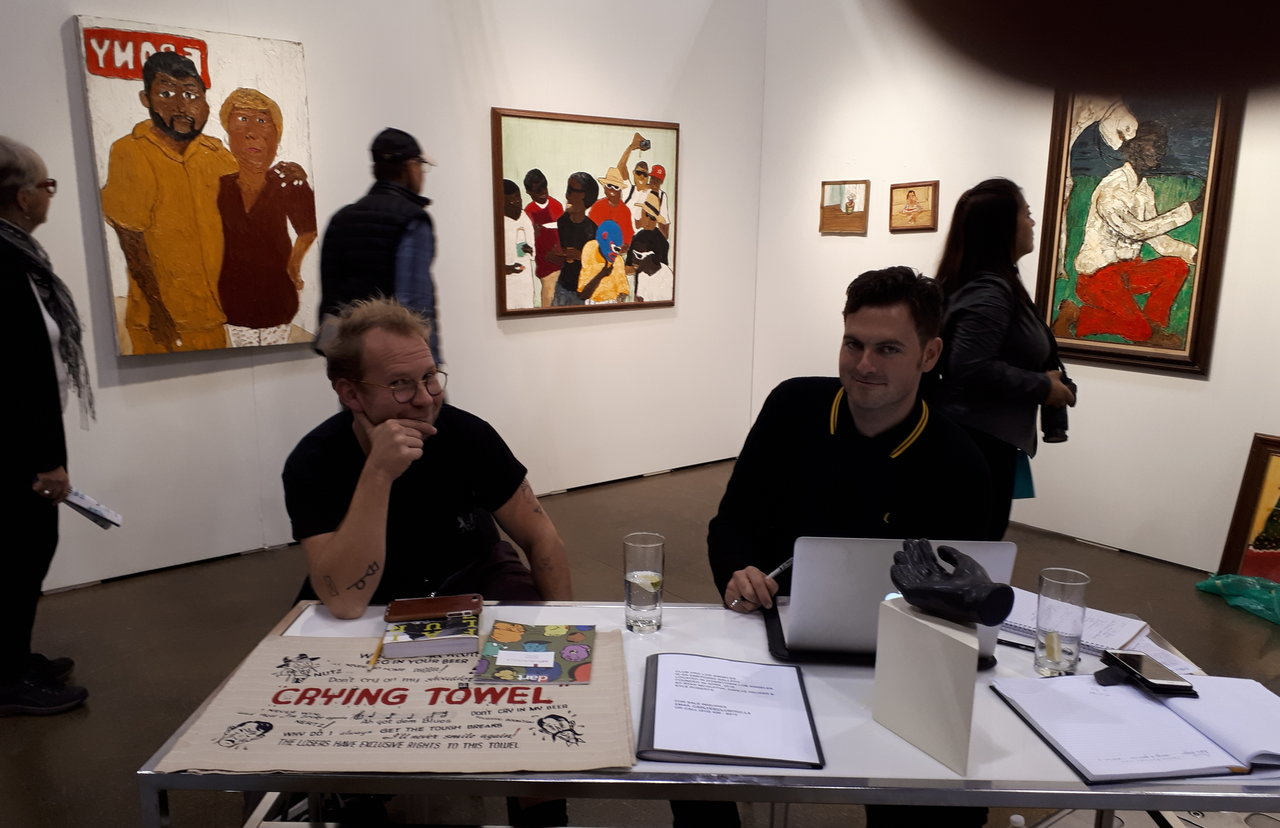
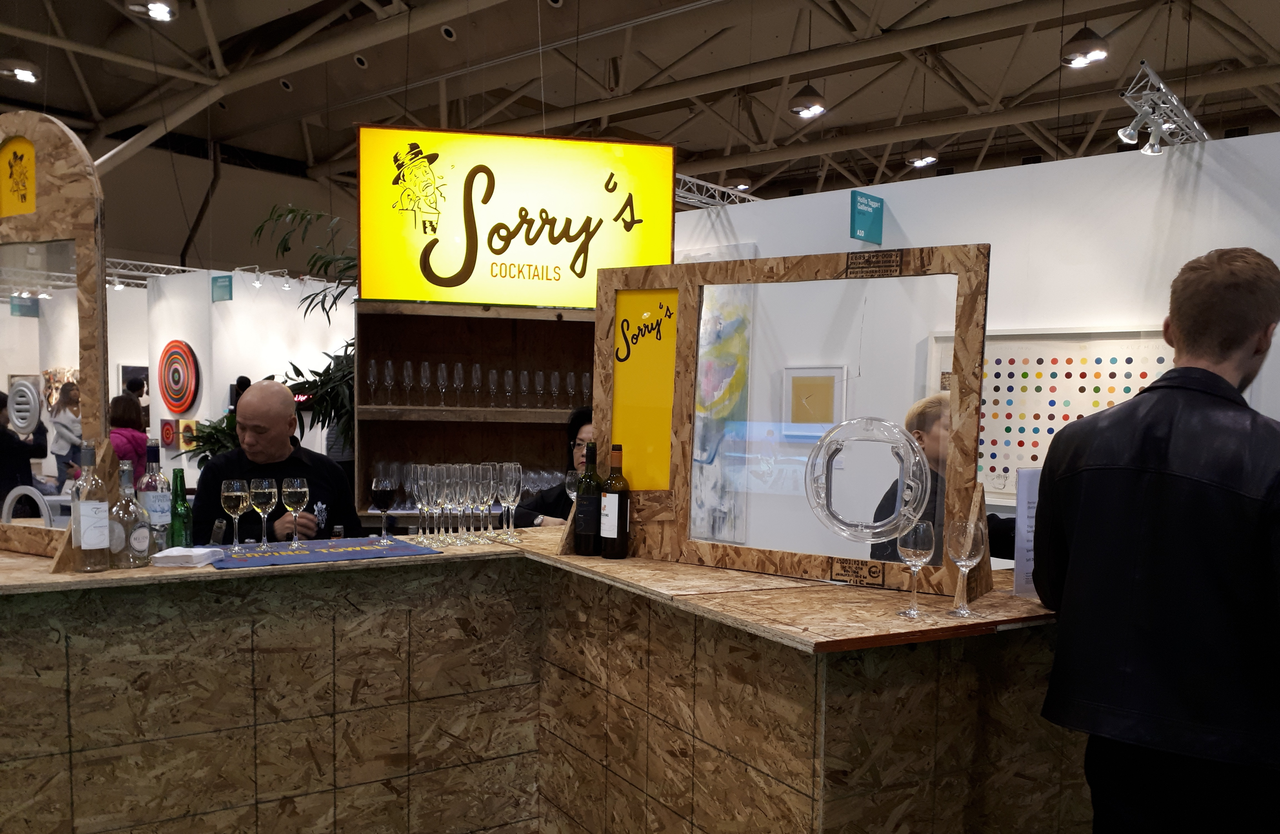
    Kyle Roberts of Club Pro Los Angeles said, “There is so much art happening in Los Angeles, that there is tension, artists making work and trying to fit with the politics. It’s a mixture of dog shit and lavender.”  Sitting with Kyle was artist, Adam Stamp who created the working bar at Art Toronto, called Sorry’s. I tested it out. It serves wine like any other bar. Adam is a bit disappointed that people don’t get that it’s art.

    Artist Adam Stamp (left) and club Pro Los Angeles gallerist Kyle Roberts (right)

    Adam Stamp’s Art bar, Sorry’s

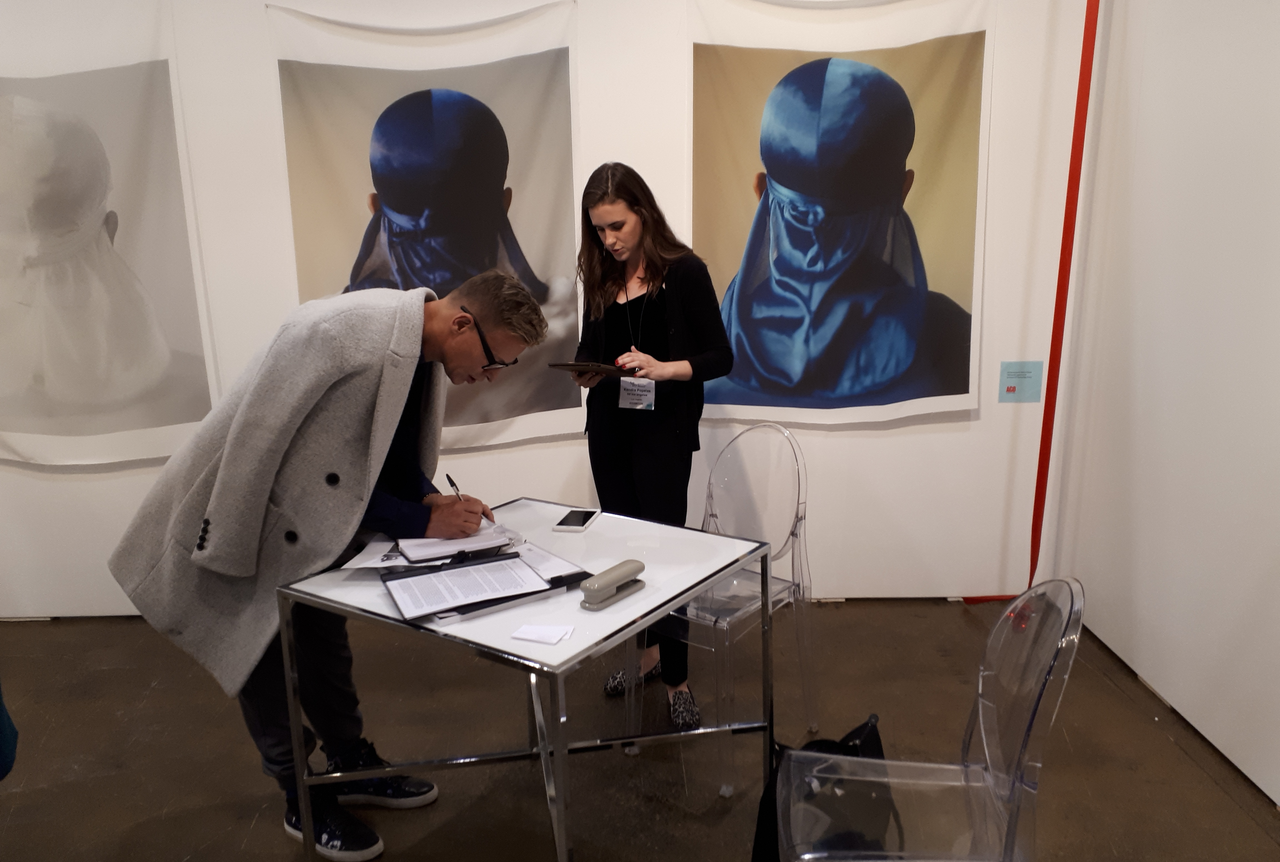
    Luis De Jesus Los Angeles

    Luis De Jesus represents three Canadian artists, so he decided to come to Art Toronto. He was part of the Speaker Series Power Talks, FOCUS: Los Angeles: Beyond the Hype. His gallery is located in the Culver City gallery district, a new gallery area where there were previously no galleries. The change occurred after Chinatown as a gallery district began to decline, with the departure of Perez Projects for instance. The ebb and flow of culture in urban areas has become a sensitive community issue. De Jesus maintains that it’s not the artists and galleries that are driving gentrification, it’s the developers.

    Luis De Jesus (standing) at his booth with Jay Wingate (seating).

    ltd los angeles

    Gallery owner Shirley Morales of ltd Los Angeles was away in Dallas when I stopped by the booth. I spoke, however, with Kendra Popelas who said, “It’s been very successful. We sold three of John Edmonds’silk prints to the AGO. TD Bank bought five of Esmaa Mohamoud’s basketballs. Her work is about masculinity and race, particularly as they relate to athleticism.”

    Kendra Popelas of ltd Los Angeles

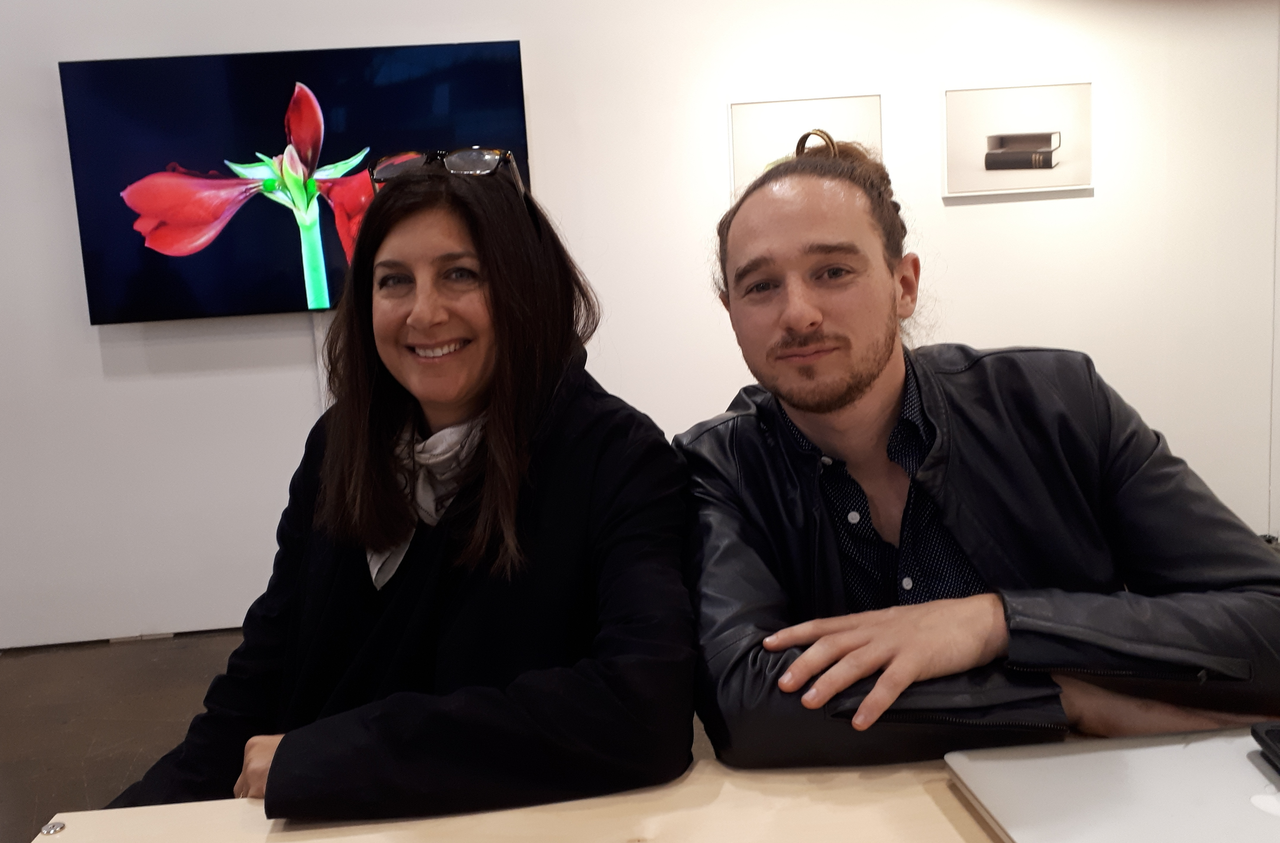
    Moskowitz Bayse

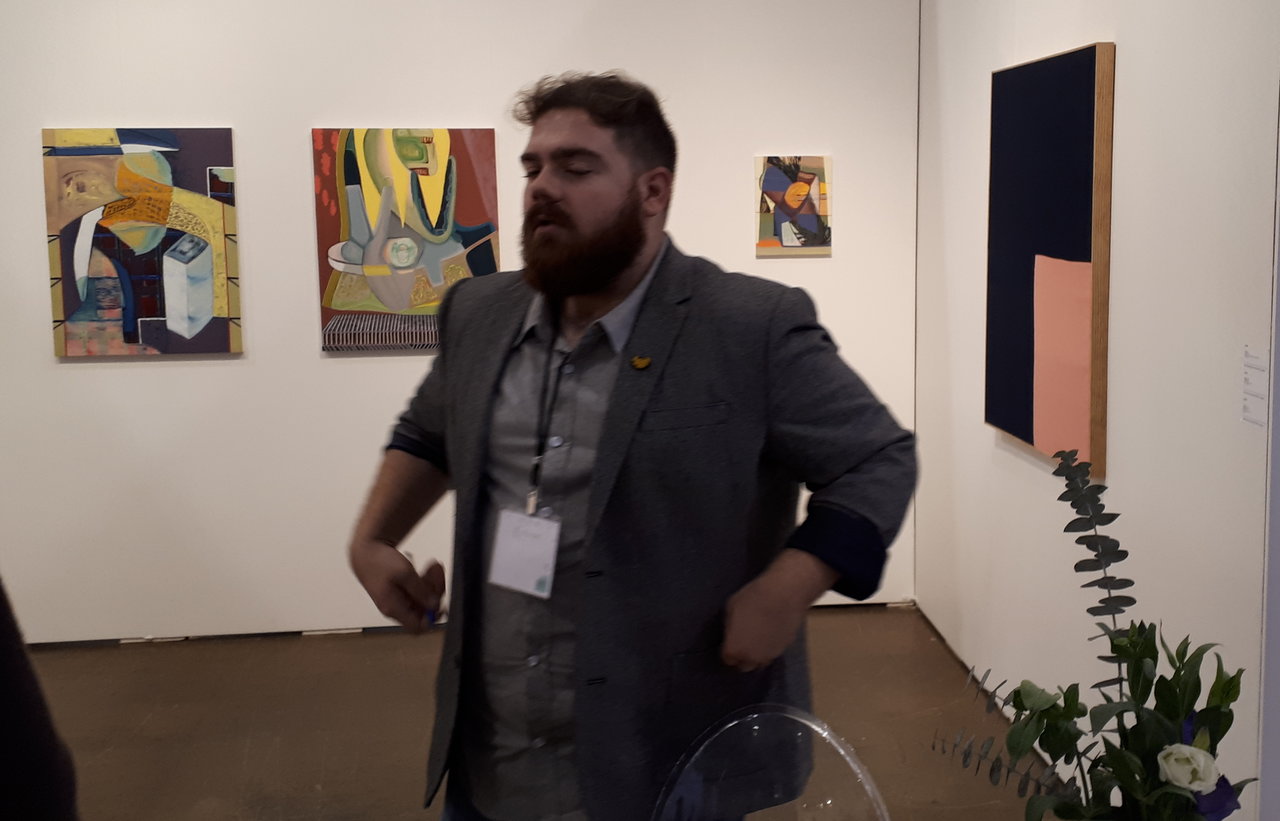
    Meredith Bayse operates the gallery with partner Adam Moskowitz in Hollywood. She noted, “The Melrose/LaBrea gallery district of Los Angeles emerged when post production in film went digital and these great spaces became available.” Adam admits that it was risk to bring only one artist to the fair, but said, “It was worth for us to be here. There have been some sales.” The artist, Kim Shoen was part of the FOCUS Los Angeles panel. She brought up the fact that a lot artist-run galleries are apartment galleries, as well as store fronts and garages. Her empty book works have an analogy to the city of Los Angeles as a site, spaces where things could take place, emptiness as possibility. She was surprised that issue didn’t crop up during the panel discussion.

    Artist Kim Shown and Adam Moskowitz of Moskowitz Bayse

    Night Gallery

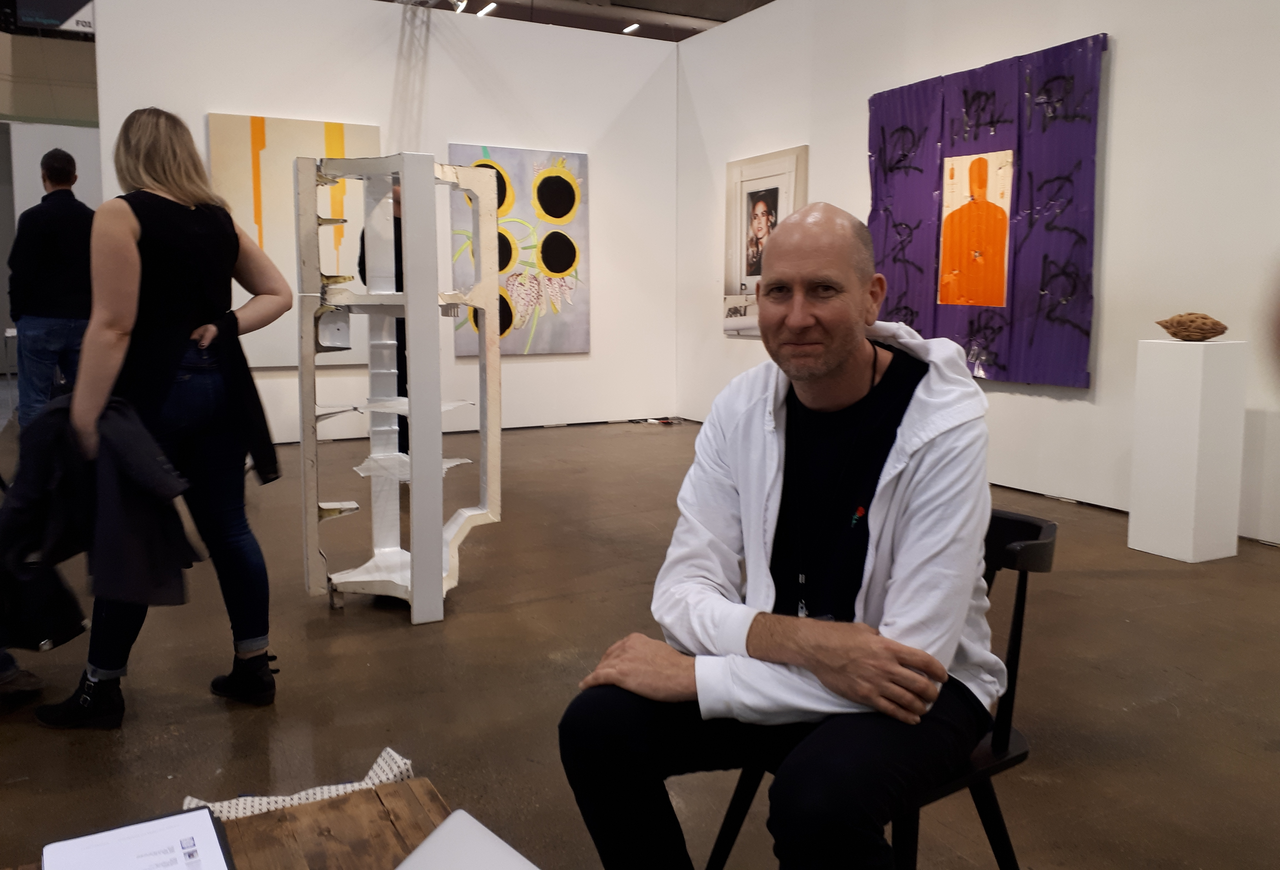
    Davida Nemeroff of Night Gallery is from Toronto, but moved to Los Angeles eight years ago, opening her gallery after six months. She represents mainly L.A. artists. Her gallery is located in the downtown warehouse district. She said, “People are really drawn to the work. FOCUS LA has given momentum and interest in LA galleries.”

    Night Gallery artist Josh Callaghan with his deconstructed refrigerator behind him.

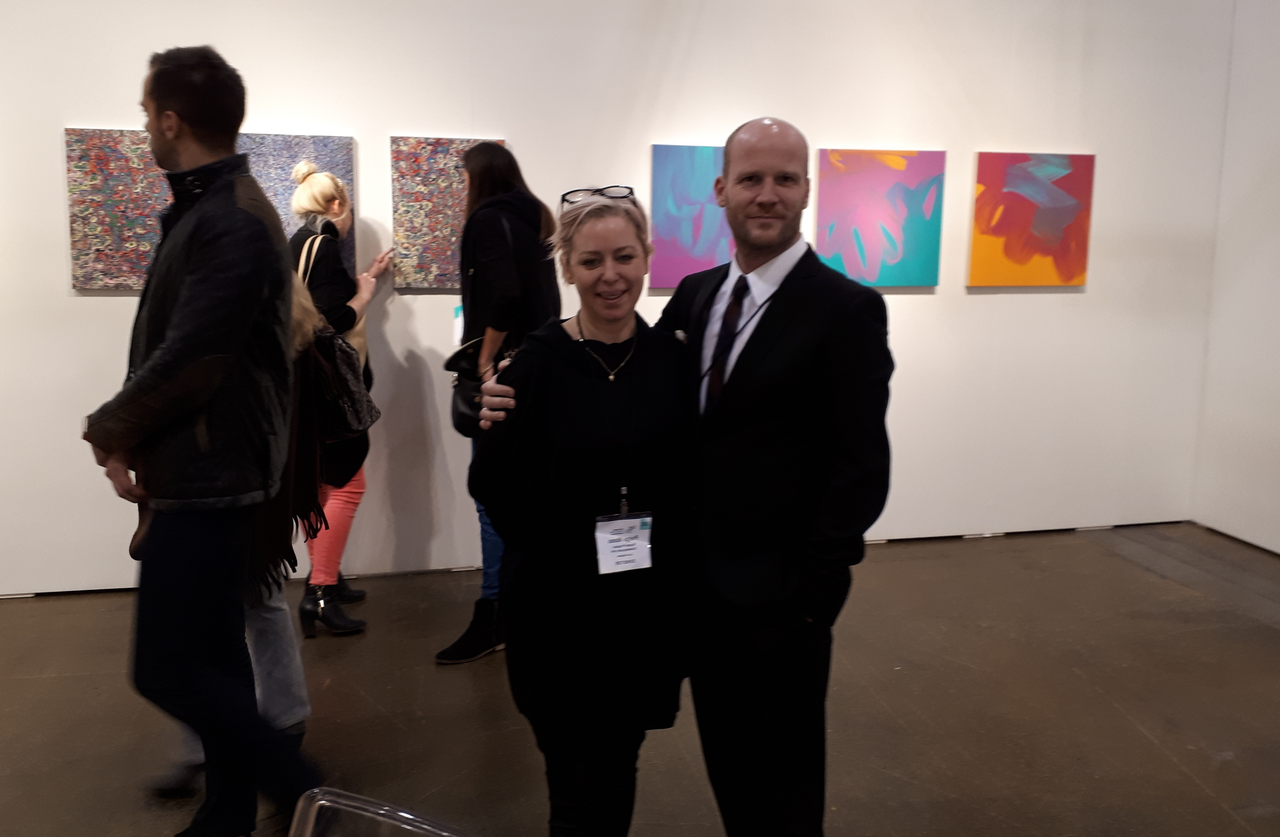
    Royale Projects

    Gallerist Rick Royale wanted to show an aesthetic through-line between four different artists at display at Art Toronto. Their only similarity is that they have lived and worked in Los Angeles for about ten years. He set out to expose a formal connection to surface, colour, and light, aspects associated with the geography of Los Angeles.

    Paige Moss and Rick Royale of Royale Projects

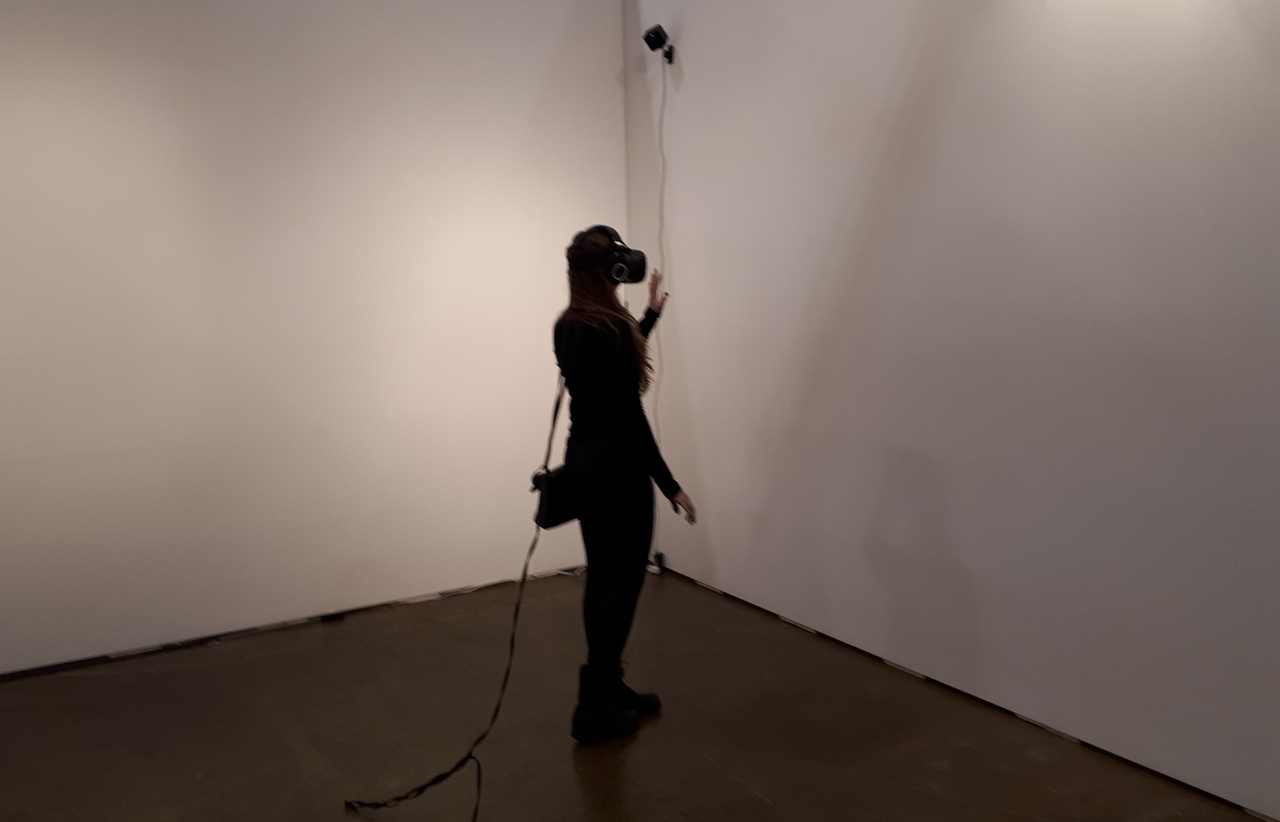
    FLOAT Museum, a future-facing virtual institution from Kate Parsons, was part of  the FOCUS LA  Project series.

    Kate Parsons VR installation at FLOAT Gallery

    Text and photo: Steve Rockwell